
Part 99
Once Rabban Gamliel's son fell ill. He sent two learned men to R. Hanina ben Dosa to beg God's mercy for him. R. Hanina saw them coming and went to an upstairs room and asked God's mercy for the boy. When he came down he said to them, 'Go! The fever has left him.' They asked him, 'Are you a prophet?' He replied, 'I am not a prophet or the son of a prophet. But this I have received from tradition: if my prayer of intercession flows unhesitatingly from my mouth, I know it will be answered; if not, I know it will be rejected.' They sat down and wrote and noted the exact moment at which he said this. When they got back to Rabban Gamliel he said to them, 'By the Temple Service, you are neither too early nor too late but this is what happened: in that moment the fever left him and he asked for water.'
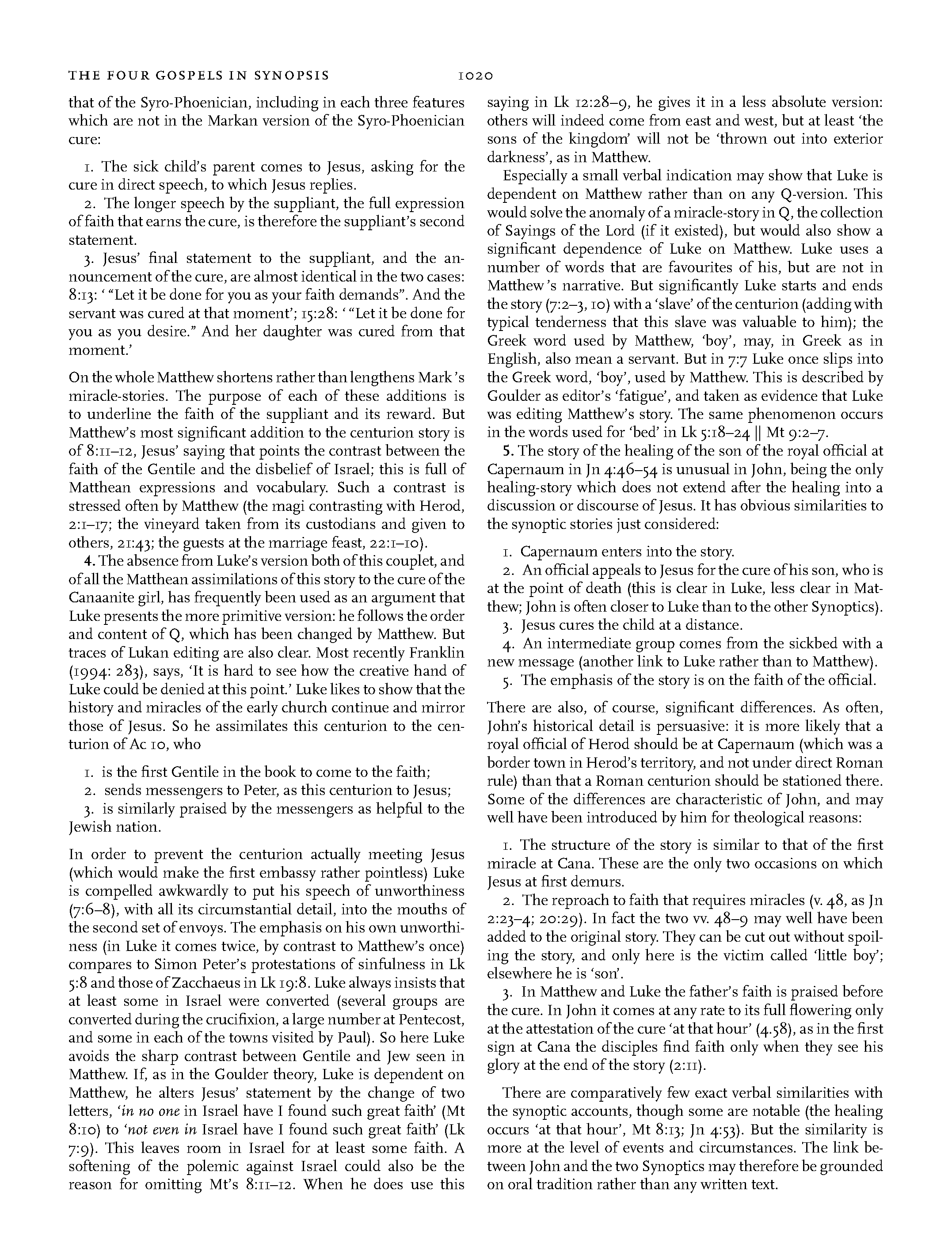
The relationship between the three accounts of the miraculous cure of the official's boy at Capernaum poses unusual problems. It is the only healing story shared by John and the Synoptic Gospels, and the only miracle story in the material normally assigned to Q (i.e. double tradition of Matthew and Luke without Mark). There are also unmistakable similarities with two other stories, one the story of the Syro-Phoenician woman's daughter (similarly healed at a distance) and the other a miracle-story about Rabbi Hanina ben Dosa.
2. First the link with the Markan tradition of the cure of the Syro-Phoenician's daughter (Mk 7:25—3o||Mt 15:22—8) should be outlined:
This story teaches the lesson that R. Hanina, though not a prophet (despite the allusions to i Kings 17:19; Am 7:14), had the healing gift and intercessory power of a prophet. It shares with the gospel story the following elements:
1. In each gospel this is the only miracle worked for a Gentile.
2. The parent comes to Jesus asking for the healing. 3. Thedialogue between Jesusand the suppliant is reported. 4. The faith of the Gentile is contrasted with that of the Jews.
1. Cure of a child at a distance. 2. Messengers sent by the father to ask for divine help. 3. Stress on simultaneity of the statement and the cure.
5. Jesus praises the parent's faith. 6. The cure is effected at a distance.
The story of R. Hanina also has the added wonder that he goes to pray without needing to be told. In the Jesus story his prophetic quality is not stressed—as it is stressed in Jesus' similar healing of the widow of Nain's son (Lk 7:16). Emphasis falls on the faith of the recipient rather than on the charisma of the miracle-worker.
Such detailed similarity cannot be wholly coincidental. One explanation is that there was an outline story in the oral tradition which took on the two or three slightly different forms in the tradition expressed by Mark, Matthew/Luke, and John.
Hanina ben Dosa was a well-known rabbi in Palestine in the generation after Jesus. Of him several wonders are related, among them this story:
3. In the Matthew-Luke story of the Capernaum cure there are significant differences between the two evangelists. Firstly, Matthew has assimilated the Capernaum story to
THE FOUR GOSPELS IN SYNOPSIS
IO2O saying in Lk 12:28—9, h£ gives it in a less absolute version: others will indeed come from east and west, but at least 'the sons of the kingdom' will not be 'thrown out into exterior darkness', as in Matthew.
that of the Syro-Phoenician, including in each three features which are not in the Markan version of the Syro-Phoenician cure:
1. The sick child's parent conies to Jesus, asking for the cure in direct speech, to which Jesus replies.
Especially a small verbal indication may show that Luke is dependent on Matthew rather than on any Q-version. This would solve the anomaly of a miracle-story in Q, the collection of Sayings of the Lord (if it existed), but would also show a significant dependence of Luke on Matthew. Luke uses a number of words that are favourites of his, but are not in Matthew's narrative. But significantly Luke starts and ends the story (7:2-3,10) with a 'slave' of the centurion (adding with typical tenderness that this slave was valuable to him); the Greek word used by Matthew, 'boy', may, in Greek as in English, also mean a servant. But in 7:7 Luke once slips into the Greek word, 'boy', used by Matthew. This is described by Goulder as editor's 'fatigue', and taken as evidence that Luke was editing Matthew's story. The same phenomenon occurs in the words used for 'bed' in Lk 5:18-24 || Mt 9:2-7.
2. The longer speech by the suppliant, the full expression of faith that earns the cure, is therefore the suppliant's second statement.
3. Jesus' final statement to the suppliant, and the announcement of the cure, are almost identical in the two cases: 8:13: ' "Let it be done for you as your faith demands". And the servant was cured at that moment'; 15:28: ' "Let it be done for you as you desire." And her daughter was cured from that moment.'
On the whole Matthew shortens rather than lengthens Mark's miracle-stories. The purpose of each of these additions is to underline the faith of the suppliant and its reward. But Matthew's most significant addition to the centurion story is of 8:11-12, Jesus' saying that points the contrast between the faith of the Gentile and the disbelief of Israel; this is full of Matthean expressions and vocabulary. Such a contrast is stressed often by Matthew (the magi contrasting with Herod, 2:1-17; ^e vineyard taken from its custodians and given to others, 21:43; the guests at the marriage feast, 22:1-10).
5. The story of the healing of the son of the royal official at Capernaum in Jn 4:46-54 is unusual in John, being the only healing-story which does not extend after the healing into a discussion or discourse of Jesus. It has obvious similarities to the synoptic stories just considered:
1. Capernaum enters into the story. 2. An official appeals to Jesus for the cure of his son, who is at the point of death (this is clear in Luke, less clear in Matthew; John is often closer to Luke than to the other Synoptics).
4. The absence from Luke's version both of this couplet, and of all the Matthean assimilations of this story to the cure of the Canaanite girl, has frequently been used as an argument that Luke presents the more primitive version: he follows the order and content of Q, which has been changed by Matthew. But traces of Lukan editing are also clear. Most recently Franklin
3. Jesus cures the child at a distance. 4. An intermediate group comes from the sickbed with a new message (another link to Luke rather than to Matthew).
(1994: 283), says, 'It is hard to see how the creative hand of Luke could be denied at this point.' Luke likes to show that the history and miracles of the early church continue and mirror those of Jesus. So he assimilates this centurion to the centurion of Ac 10, who
5. The emphasis of the story is on the faith of the official.
There are also, of course, significant differences. As often, John's historical detail is persuasive: it is more likely that a royal official of Herod should be at Capernaum (which was a border town in Herod's territory, and not under direct Roman rule) than that a Roman centurion should be stationed there. Some of the differences are characteristic of John, and may well have been introduced by him for theological reasons:
1. is the first Gentile in the book to come to the faith; 2. sends messengers to Peter, as this centurion to Jesus; 3. is similarly praised by the messengers as helpful to the Jewish nation.
1. The structure of the story is similar to that of the first miracle at Cana. These are the only two occasions on which Jesus at first demurs.
In order to prevent the centurion actually meeting Jesus (which would make the first embassy rather pointless) Luke is compelled awkwardly to put his speech of unworthiness (7:6-8), with all its circumstantial detail, into the mouths of the second set of envoys. The emphasis on his own unworthiness (in Luke it comes twice, by contrast to Matthew's once) compares to Simon Peter's protestations of sinfulness in Lk 5:8 and those of Zacchaeus in Lk 19:8. Luke always insists that at least some in Israel were converted (several groups are converted during the crucifixion, a large number at Pentecost, and some in each of the towns visited by Paul). So here Luke avoids the sharp contrast between Gentile and Jew seen in Matthew. If, as in the Goulder theory, Luke is dependent on Matthew, he alters Jesus' statement by the change of two letters, 'in no one in Israel have I found such great faith' (Mt 8:10) to 'not even in Israel have I found such great faith' (Lk 7:9). This leaves room in Israel for at least some faith. A softening of the polemic against Israel could also be the reason for omitting Mt's 8:11-12. When he does use this
2. The reproach to faith that requires miracles (v. 48, as Jn 2:23-4; 20:29). m fact the two w. 48-9 may well have been added to the original story. They can be cut out without spoiling the story, and only here is the victim called 'little boy'; elsewhere he is 'son'.
3. In Matthew and Luke the father's faith is praised before the cure. In John it comes at any rate to its full flowering only at the attestation of the cure 'at that hour' (4.58), as in the first sign at Cana the disciples find faith only when they see his glory at the end of the story (2:11).
There are comparatively few exact verbal similarities with the synoptic accounts, though some are notable (the healing occurs 'at that hour', Mt 8:13; Jn 4:53). But the similarity is more at the level of events and circumstances. The link between John and the two Synoptics may therefore be grounded on oral tradition rather than any written text.
THE FOUR GOSPELS IN SYNOPSIS
IO2I
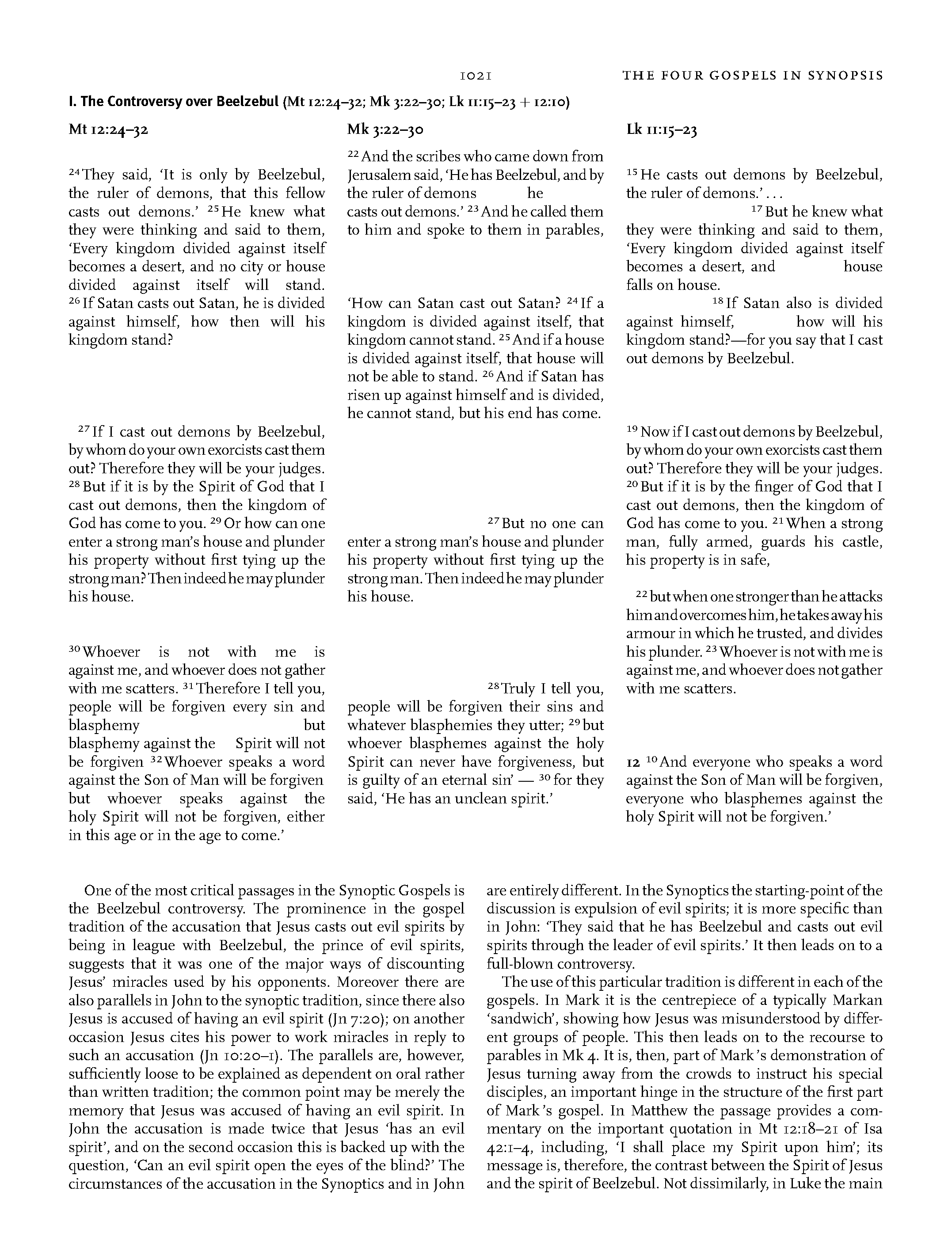
I. The Controversy over Beelzebul (Mt 12:24-32; Mk 3:22-30; Lk 11:15-23 + 12:10)
Mk 3:22-30
Lk 11:15-23
Mt 12:24-32
22 And the scribes who came down from Jerusalem said, 'He has Beelzebul, and by the ruler of demons he casts out demons.' 23 And he called them to him and spoke to them in parables,
15 He casts out demons by Beelzebul, the ruler of demons.'...
24 They said, 'It is only by Beelzebul, the ruler of demons, that this fellow casts out demons.' 25He knew what they were thinking and said to them, 'Every kingdom divided against itself becomes a desert, and no city or house divided against itself will stand. 26 If Satan casts out Satan, he is divided against himself, how then will his kingdom stand?
17 But he knew what they were thinking and said to them, 'Every kingdom divided against itself becomes a desert, and house falls on house.
'How can Satan cast out Satan? 24 If a kingdom is divided against itself, that kingdom cannot stand. 25 And if a house is divided against itself, that house will not be able to stand. 26And if Satan has risen up against himself and is divided, he cannot stand, but his end has come.
18 If Satan also is divided against himself, how will his kingdom stand?—for you say that I cast out demons by Beelzebul.
19 Now if I cast out demons by Beelzebul, by whom do your own exorcists cast them out? Therefore they will be your judges. 20 But if it is by the finger of God that I cast out demons, then the kingdom of God has come to you. 21When a strong man, fully armed, guards his castle, his property is in safe,
27 If I cast out demons by Beelzebul, by whom do your own exorcists cast them out? Therefore they will be your judges. 28 But if it is by the Spirit of God that I cast out demons, then the kingdom of God has come to you. 29 Or how can one enter a strong man's house and plunder his property without first tying up the strongman? Th en indeedhe may plunder his house.
27 But no one can enter a strong man's house and plunder his property without first tying up the strong man. Then indeedhe may plunder his house.
22 but when one stronger than he attacks him and overcomes him,hetakes away his armour in which he trusted, and divides his plunder.23 Whoever is not with me is against me, and whoever does not gather with me scatters.
30 Whoever is not with me is against me, and whoever does not gather with me scatters. 31 Therefore I tell you, people will be forgiven every sin and blasphemy but blasphemy against the Spirit will not be forgiven 32Whoever speaks a word against the Son of Man will be forgiven but whoever speaks against the holy Spirit will not be forgiven, either in this age or in the age to come.'
28 Truly I tell you, people will be forgiven their sins and whatever blasphemies they utter; 29 but whoever blasphemes against the holy
12 10And everyone who speaks a word against the Son of Man will be forgiven, everyone who blasphemes against the holy Spirit will not be forgiven.'
Spirit can never have forgiveness, but is guilty of an eternal sin' — 30 for they said, 'He has an unclean spirit.'
are entirely different. In the Synoptics the starting-point of the discussion is expulsion of evil spirits; it is more specific than in John: 'They said that he has Beelzebul and casts out evil spirits through the leader of evil spirits.' It then leads on to a full-blown controversy.
One of the most critical passages in the Synoptic Gospels is the Beelzebul controversy. The prominence in the gospel tradition of the accusation that Jesus casts out evil spirits by being in league with Beelzebul, the prince of evil spirits, suggests that it was one of the major ways of discounting Jesus' miracles used by his opponents. Moreover there are also parallels in John to the synoptic tradition, since there also Jesus is accused of having an evil spirit (Jn 7:20); on another occasion Jesus cites his power to work miracles in reply to such an accusation (Jn 10:20-1). The parallels are, however, sufficiently loose to be explained as dependent on oral rather than written tradition; the common point may be merely the memory that Jesus was accused of having an evil spirit. In John the accusation is made twice that Jesus 'has an evil spirit', and on the second occasion this is backed up with the question, 'Can an evil spirit open the eyes of the blind?' The circumstances of the accusation in the Synoptics and in John
The use of this particular tradition is different in each of the gospels. In Mark it is the centrepiece of a typically Markan 'sandwich', showing how Jesus was misunderstood by different groups of people. This then leads on to the recourse to parables in Mk 4. It is, then, part of Mark's demonstration of Jesus turning away from the crowds to instruct his special disciples, an important hinge in the structure of the first part of Mark's gospel. In Matthew the passage provides a commentary on the important quotation in Mt 12:18-21 of Isa 42:1-4, including, T shall place my Spirit upon him'; its message is, therefore, the contrast between the Spirit of Jesus and the spirit of Beelzebul. Not dissimilarly, in Luke the main
THE FOUR GOSPELS IN SYNOPSIS
IO22 occasional elements in the triple-tradition verses where Mark is closer to Luke than to Matthew. In Mk 3:22/7 the phrases are indeed in the Lukan order (Beelzebul first, not second as in Matthew), but the relationship between the verses is more easily explained as independent improvement by Matthew and Luke of Mark's clumsy double-phrase. In Mk 3:29 there are equally strong correspondences with Matthew. The argument is perhaps plausible, but by no means compelling.
part of the passage comes in the section on discipleship after the Lord's prayer and the promise (11:13) that the heavenly Father will give the Holy Spirit to those who ask him. It serves to contrast the spirit of the disciples with that of Jesus' opponents. Finally in John, the passages are part of the confrontation between Jesus and the temple authorities in Jerusalem, as part of the judgement theme that is so important in John.
From the point of view of the synoptic problem this passage has an importance all its own. Any solution to the problem must, of course, be shown to be valid for all the pericopes of the synoptic tradition. Nevertheless each theory has its special pericopes for which the proponents of the theory claim that their solution is obviously the best, while there are other pericopes where this solution is less obviously the best, and prima facie another solution would fit the facts equally well or perhaps even more easily. In the case of this pericope, however, it is claimed as primary evidence for their own theory by proponents of each of the principal solutions to the synoptic problem. The relationships between the synoptic passages have been claimed as evidence by proponents of the Griesbach theory, as evidence of Mark-Q overlap (in which Luke is closer than Matthew to Q) by proponents of the Two-Source theory, and by single-source theorists as evidence of editing of Mark by Matthew and Luke successively.
On the Two-Source theory it is considered a passage of Mark-Q overlap. It is one of the five principal passages accepted as such by Streeter (along with the preaching of John the Baptist, the temptations, the mustard seed, and the commissioning of the disciples, see c.2). Matthew and Luke share 6V2 verses absent from Mark, and in the tripletradition verses there is persistent minor agreement between them against Mark. Some explanation must be given of these agreements, and if the Mark-Q overlap theory makes sense at all, it is a possible candidate as the explanation. Therefore a three-stage process is postulated: first comes Mark, then Q develops this tradition, then Matthew and Luke independently combine this Q tradition with their version of Mark.
In order to show, however, that at least in this case Mark-Q overlap is the most economical explanation it is necessary to show that Luke's version is the more primitive, and Mark has subsequently been edited by Matthew. So advocates of the Mark-Q overlap claim that Matthew has taken verses from various places in Q (the elements occur in three different sections of Luke) to make a skilfully unified composition, but that the elements of this composition are still visible in their original form in Luke. Advocates of this theory are posed the formidable task of showing that underlying Luke and/or Matthew is a unified theology or style that is distinct from that of the final authors, and can be considered characteristic of Q. So Kloppenborg (1987: 121—7) argues vigorously that Luke is the more primitive version, more coherent than Matthew's form. Luke's parable of the stronger man in 11:21-2 evokes warfare, which better fits the mention of 'kingdom' in the previous verses than does Matthew's household burglary. Matthew would then have adopted the earlier verses from Q, but reverted slavishly to Mark for the burglary. After the little Q-saying of Luke 11:23, Luke would have added another passage (originally separate in Q, and used by Matthew at 12:43—5) to stress that mere expulsion of the evil spirit is not enough without a further positive response to the kingdom. For Kloppenborg both Mark and Q versions have the same origin: 'the starting-point for this complex of Q-sayings is the traditional Beelzebul accusation and its refutation in Mark 3:20-6' (ibid. 127). But Q has enlarged the scene in two ways, first by attributing the accusation not (as does Mark) to the scribes from Jerusalem but to 'your sons' in general, and secondly by applying Jesus' threat not only (as Mark) to those who accuse Jesus of complicity with Beelzebul, but to all who oppose Jesus (Lk 11:23-6).
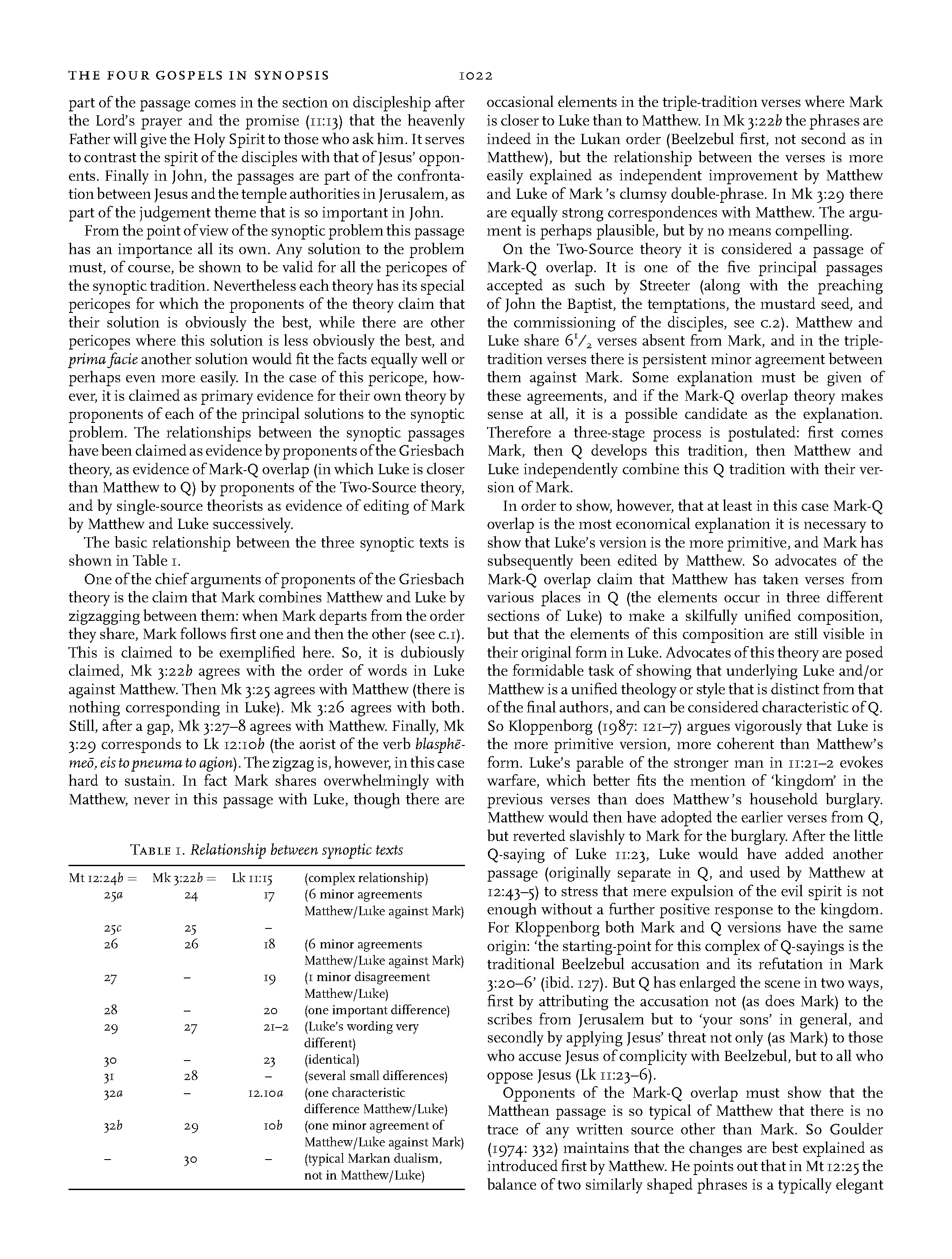
The basic relationship between the three synoptic texts is shown in Table i.
One of the chief arguments of proponents of the Griesbach theory is the claim that Mark combines Matthew and Luke by zigzagging between them: when Mark departs from the order they share, Mark follows first one and then the other (see c.i). This is claimed to be exemplified here. So, it is dubiously claimed, Mk 3:22/7 agrees with the order of words in Luke against Matthew. Then Mk 3:25 agrees with Matthew (there is nothing corresponding in Luke). Mk 3:26 agrees with both. Still, after a gap, Mk 3:27—8 agrees with Matthew. Finally, Mk 3:29 corresponds to Lk i2:iob (the aorist of the verb blasphemed, eistopneumato agion). The zigzag is, however, in this case hard to sustain. In fact Mark shares overwhelmingly with Matthew, never in this passage with Luke, though there are
TABLE i. Relationship between synoptic texts
Mt 12:24!} = Mk3:22fo = Lk 11:15 (complex relationship) 250 24 17 (6 minor agreements Matthew/Luke against Mark)
2y 25 26 26 18 (6 minor agreements Matthew/Luke against Mark) 27 - 19 (i minor disagreement Matthew/Luke) 28 - 20 (one important difference) 29 27 21-2 (Luke's wording very different) 30 - 23 (identical) 31 28 - (several small differences) 32a - I2.ioa (one characteristic difference Matthew/Luke) 32!} 29 lob (one minor agreement of Matthew/Luke against Mark) - 30 - (typical Markan dualism, not in Matthew/Luke)
Opponents of the Mark-Q overlap must show that the Matthean passage is so typical of Matthew that there is no trace of any written source other than Mark. So Goulder
(1974: 332) maintains that the changes are best explained as introduced first by Matthew. He points out that in Mt 12:2 5 the balance of two similarly shaped phrases is a typically elegant
1023 THE FOUR GOSPELS IN SYNOPSIS
Matthean improvement on Mark's rough phrase. Goulder then argues phrase by phrase that the expansions of Mark are so characteristic of Matthew that it would be a mistake to postulate any Q. Particularly the rhythm of w. 31, 33, 35 is typical of Matthean formations, and such antitheses as 'gather/scatter', 'good/bad'. It is then necessary to argue that Luke can best be explained as derived from Matthew. To begin with, it is pointed out that Luke often breaks up longer Matthean sections, and that the method of so doing is in this case typical of Luke (see 0.4).
Matthew. This is taken as an indication that 'finger of God' must have been the original form in Q (e.g. Stanton 19920: 177 n.3); to which Goulder (1989: 504) replies that this allusion to Moses' miracles in Ex 8:15 is typical of Luke, and that 'Spirit' occurs only twice in Luke's accounts of Jesus' teaching.
In this particular case it is unlikely that either side will finally convince the other. The particular question must be judged in function of the more general question whether a Mark-Q overlap makes sense, and particularly whether this overlapping Q is so close to Mark that some literary dependence of Mark on Q would need to be postulated. This in turn would raise the question of why Mark omitted so much ofQ.
On the other side it is argued that Luke, with his stress on the Spirit, would never have substituted 'finger of God' (Lk 11:20) for Matthew's 'Spirit of God' if he had been following
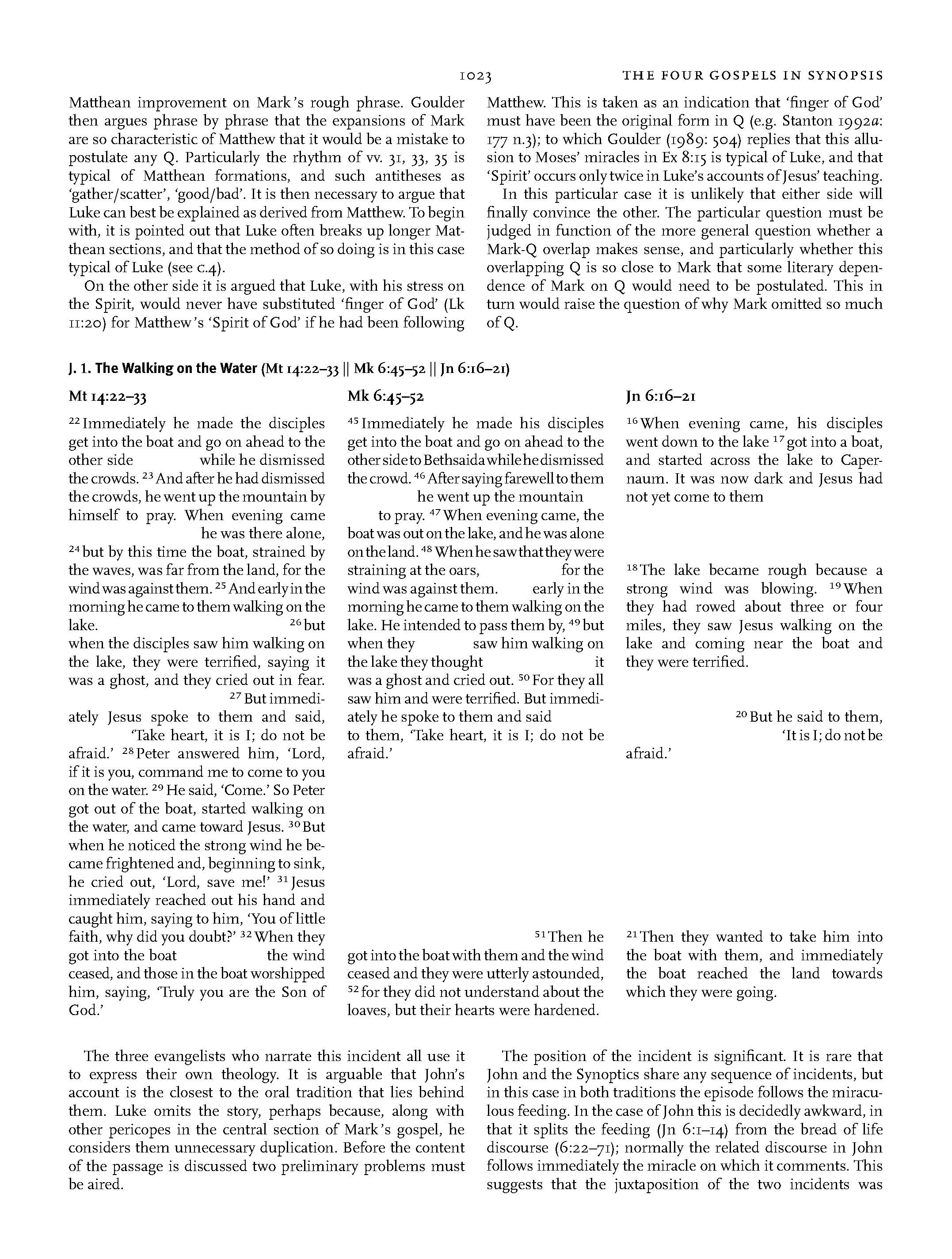
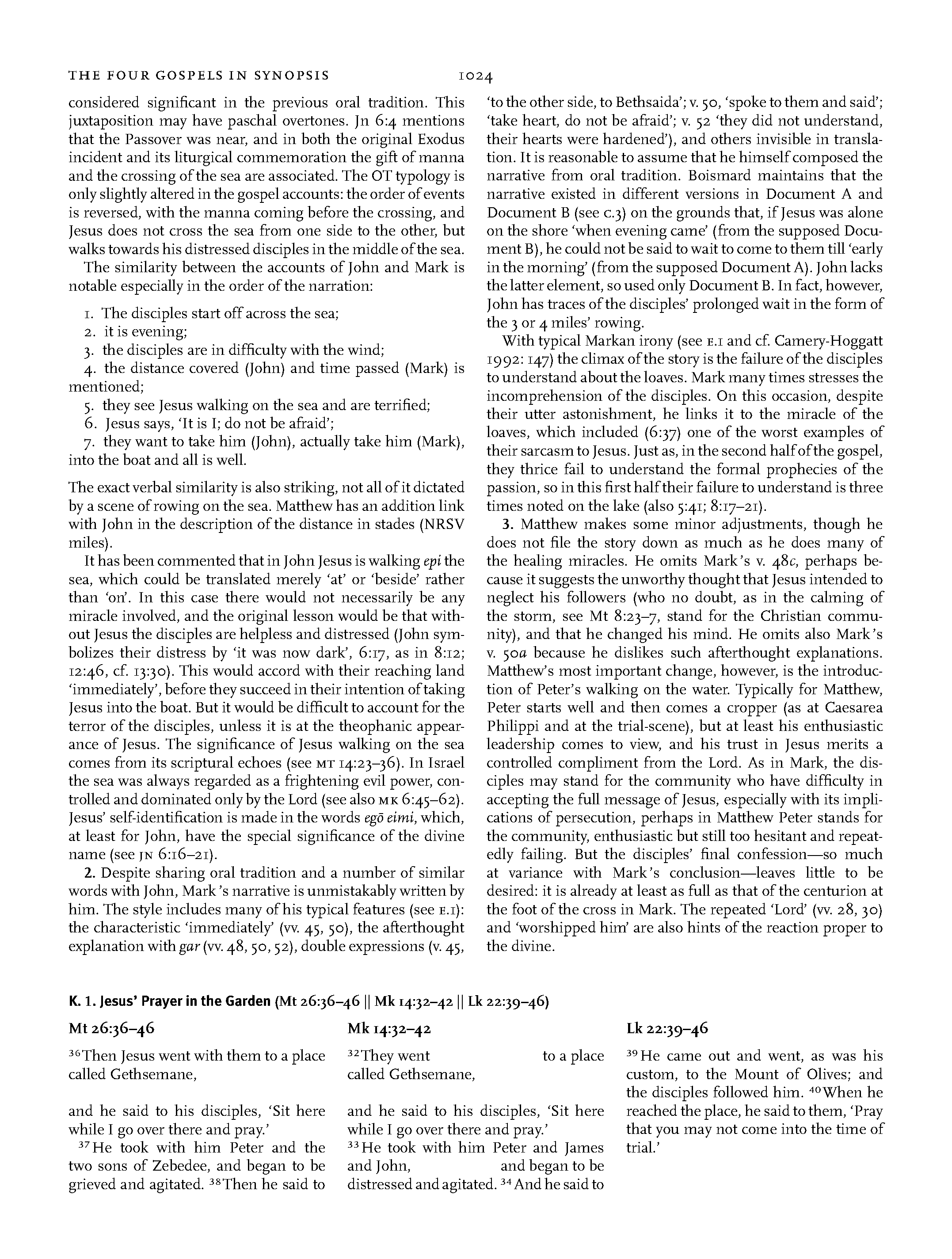
J. 1. The Walking on the Water (Mt 14:22-33 || 1^6:45-52 || Jn 6:16-21)
Jn 6:16-21
Mk 6:45-52
Mt 14:22-33
16 When evening came, his disciples went down to the lake 17got into a boat, and started across the lake to Capernaum. It was now dark and Jesus had not yet come to them
45 Immediately he made his disciples get into the boat and go on ahead to the other sideto Bethsaidawhilehedismissed the crowd.4S After saying farewell to them
22 Immediately he made the disciples get into the boat and go on ahead to the other side while he dismissed the crowds.23 And after he had dismissed the crowds, he went up the mountain by himself to pray. When evening came he went up the mountain to pray. 47When evening came, the boat was out on the lake, and he was alone on the land.48 Whenhe sawthatthey were straining at the oars, for the wind was against them. early in the morning he came to them walking on the lake. He intended to pass them by,49 but when they saw him walking on the lake they thought it was a ghost and cried out. 50 For they all saw him and were terrified. But immediately he spoke to them and said to them, 'Take heart, it is I; do not be afraid.'
he was there alone, 24 but by this time the boat, strained by the waves, was far from the land, for the wind was againstthem.25 And early in the morning he came to them walking on the lake. 26but when the disciples saw him walking on the lake, they were terrified, saying it was a ghost, and they cried out in fear.
18 The lake became rough because a strong wind was blowing. 19When they had rowed about three or four miles, they saw Jesus walking on the lake and coming near the boat and they were terrified.
27 But immediately Jesus spoke to them and said,
20 But he said to them, Tt is I; do not be afraid.'
'Take heart, it is I; do not be afraid.' 28Peter answered him, 'Lord, if it is you, command me to come to you on the water. 29 He said, 'Come.' So Peter got out of the boat, started walking on the water, and came toward Jesus. 30But when he noticed the strong wind he became frightened and, beginning to sink, he cried out, 'Lord, save me!' 31 Jesus immediately reached out his hand and caught him, saying to him, 'You of little faith, why did you doubt?' 32 When they got into the boat the wind ceased, and those in the boat worshipped him, saying, 'Truly you are the Son of God.'
21 Then they wanted to take him into the boat with them, and immediately the boat reached the land towards which they were going.
51 Then he got into the boat with them and the wind ceased and they were utterly astounded, 52 for they did not understand about the loaves, but their hearts were hardened.
The three evangelists who narrate this incident all use it to express their own theology. It is arguable that John's account is the closest to the oral tradition that lies behind them. Luke omits the story, perhaps because, along with other pericopes in the central section of Mark's gospel, he considers them unnecessary duplication. Before the content of the passage is discussed two preliminary problems must be aired.
The position of the incident is significant. It is rare that John and the Synoptics share any sequence of incidents, but in this case in both traditions the episode follows the miraculous feeding. In the case of John this is decidedly awkward, in that it splits the feeding (Jn 6:1-14) fr°m me bread of life discourse (6:22—71); normally the related discourse in John follows immediately the miracle on which it comments. This suggests that the juxtaposition of the two incidents was
THE FOUR GOSPELS IN SYNOPSIS 1024
'to the other side, to Bethsaida'; v. 50, 'spoke to them and said'; 'take heart, do not be afraid'; v. 52 'they did not understand, their hearts were hardened'), and others invisible in translation. It is reasonable to assume that he himself composed the narrative from oral tradition. Boismard maintains that the narrative existed in different versions in Document A and Document B (see 0.3) on the grounds that, if Jesus was alone on the shore 'when evening came' (from the supposed Document B), he could not be said to wait to come to them till 'early in the morning' (from the supposed Document A). John lacks the latter element, so used only Document B. In fact, however, John has traces of the disciples' prolonged wait in the form of the 3 or 4 miles' rowing.
considered significant in the previous oral tradition. This juxtaposition may have paschal overtones. Jn 6:4 mentions that the Passover was near, and in both the original Exodus incident and its liturgical commemoration the gift of manna and the crossing of the sea are associated. The OT typology is only slightly altered in the gospel accounts: the order of events is reversed, with the manna coming before the crossing, and Jesus does not cross the sea from one side to the other, but walks towards his distressed disciples in the middle of the sea.
The similarity between the accounts of John and Mark is notable especially in the order of the narration:
1. The disciples start off across the sea; 2. it is evening; 3. the disciples are in difficulty with the wind; 4. the distance covered (John) and time passed (Mark) is mentioned;
With typical Markan irony (see E.I and cf. Camery-Hoggatt 1992:147) the climax of the story is the failure of the disciples to understand about the loaves. Mark many times stresses the incomprehension of the disciples. On this occasion, despite their utter astonishment, he links it to the miracle of the loaves, which included (6:37) one of the worst examples of their sarcasm to Jesus. Just as, in the second half of the gospel, they thrice fail to understand the formal prophecies of the passion, so in this first half their failure to understand is three times noted on the lake (also 5:41; 8:17—21).
5. they see Jesus walking on the sea and are terrified; 6. Jesus says, 'It is I; do not be afraid'; 7. they want to take him (John), actually take him (Mark), into the boat and all is well.
The exact verbal similarity is also striking, not all of it dictated by a scene of rowing on the sea. Matthew has an addition link with John in the description of the distance in stades (NRSV miles).
3. Matthew makes some minor adjustments, though he does not file the story down as much as he does many of the healing miracles. He omits Mark's v. 48c, perhaps because it suggests the unworthy thought that Jesus intended to neglect his followers (who no doubt, as in the calming of the storm, see Mt 8:23-7, stand for the Christian community), and that he changed his mind. He omits also Mark's v. 500 because he dislikes such afterthought explanations. Matthew's most important change, however, is the introduction of Peter's walking on the water. Typically for Matthew, Peter starts well and then comes a cropper (as at Caesarea Philippi and at the trial-scene), but at least his enthusiastic leadership comes to view, and his trust in Jesus merits a controlled compliment from the Lord. As in Mark, the disciples may stand for the community who have difficulty in accepting the full message of Jesus, especially with its implications of persecution, perhaps in Matthew Peter stands for the community, enthusiastic but still too hesitant and repeatedly failing. But the disciples' final confession—so much at variance with Mark's conclusion—leaves little to be desired: it is already at least as full as that of the centurion at the foot of the cross in Mark. The repeated 'Lord' (w. 28, 30) and 'worshipped him' are also hints of the reaction proper to the divine.
It has been commented that in John Jesus is walking epi the sea, which could be translated merely 'at' or 'beside' rather than 'on'. In this case there would not necessarily be any miracle involved, and the original lesson would be that without Jesus the disciples are helpless and distressed (John symbolizes their distress by 'it was now dark', 6:17, as in 8:12; 12:46, cf. 13:30). This would accord with their reaching land 'immediately', before they succeed in their intention of taking Jesus into the boat. But it would be difficult to account for the terror of the disciples, unless it is at the theophanic appearance of Jesus. The significance of Jesus walking on the sea comes from its scriptural echoes (see MT 14:23-36). In Israel the sea was always regarded as a frightening evil power, controlled and dominated only by the Lord (see also M K 6:45~6 2). Jesus' self-identification is made in the words ego timi, which, at least for John, have the special significance of the divine name (see JN 6:16—21).
2. Despite sharing oral tradition and a number of similar words with John, Mark's narrative is unmistakably written by him. The style includes many of his typical features (see E.I): the characteristic 'immediately' (w. 45, 50), the afterthought explanation with gar (w. 48, 50,52), double expressions (v. 45,
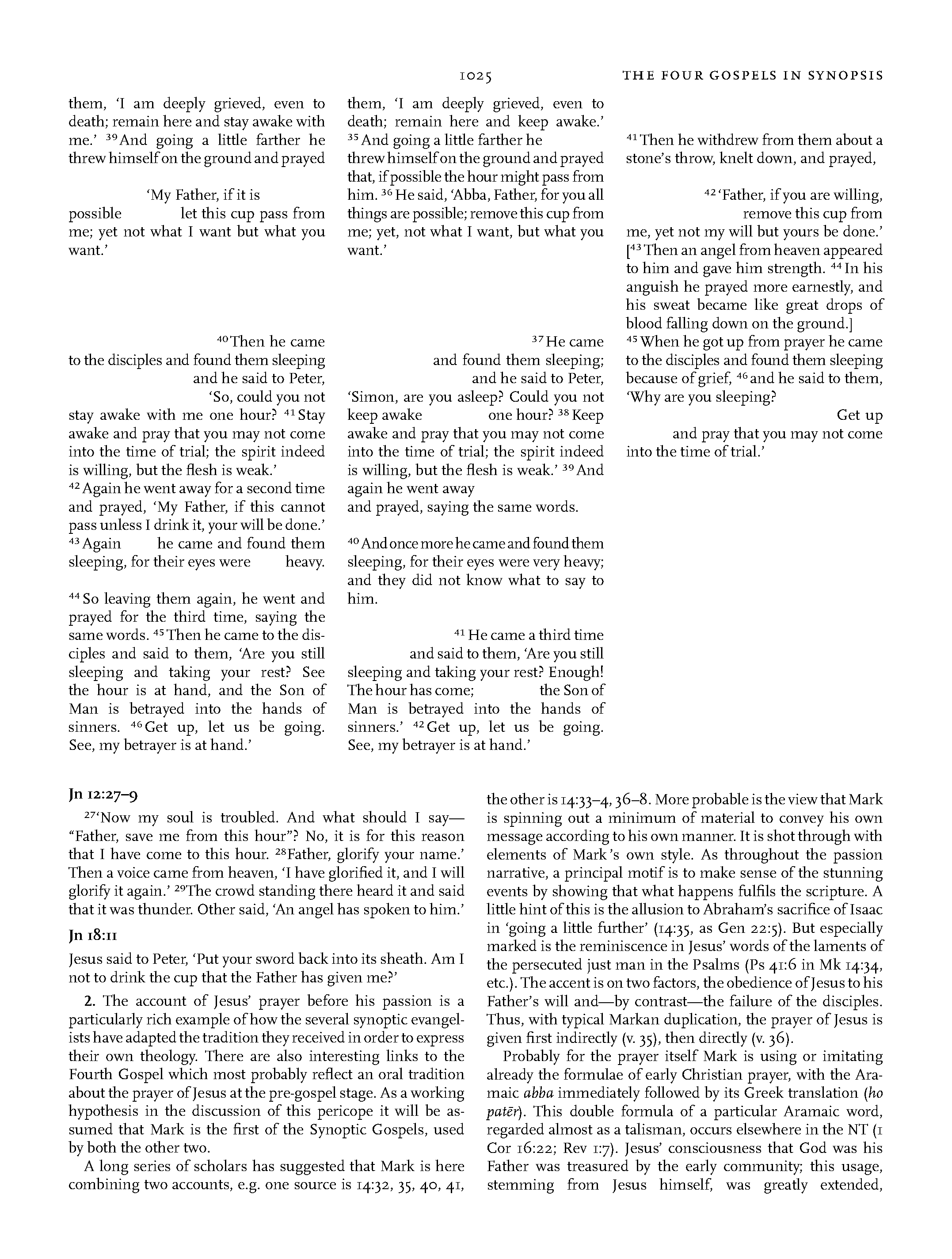
K. 1. Jesus' Prayer in the Garden (Mt 26:36-46 || Mk 14:32-42 || Lk 22:39-46)
36 Then Jesus went with them to a place called Gethsemane,
32They went called Gethsemane,
39 He came out and went, as was his custom, to the Mount of Olives; and the disciples followed him. 40When he reached the place, he said to them, 'Pray that you may not come into the time of trial.'
to a place and he said to his disciples, 'Sit here while I go over there and pray.'
and he said to his disciples, 'Sit here while I go over there and pray.' 33 He took with him Peter and James and John, and began to be distressed and agitated. 34 And he said to
37 He took with him Peter and the two sons of Zebedee, and began to be grieved and agitated. 38Then he said to
THE FOUR GOSPELS IN SYNOPSIS
them, T am deeply grieved, even to death; remain here and keep awake.' 35 And going a little farther he threw himself on the ground and prayed that, if possible the hour might pass from him. 36 He said, 'Abba, Father, for you all things are possible; remove this cup from me; yet, not what I want, but what you want.'
them, 'I am deeply grieved, even to death; remain here and stay awake with me.' 39And going a little farther he threw himself on the ground and prayed
41 Then he withdrew from them about a stone's throw, knelt down, and prayed,
42'Father, if you are willing, remove this cup from me, yet not my will but yours be done.' [43 Then an angel from heaven appeared to him and gave him strength. 44 In his anguish he prayed more earnestly, and his sweat became like great drops of blood falling down on the ground.] 45 When he got up from prayer he came to the disciples and found them sleeping because of grief, 46and he said to them,
'My Father, if it is possible let this cup pass from me; yet not what I want but what you want.'
40 Then he came to the disciples and found them sleeping
37 He came and found them sleeping; and he said to Peter, and he said to Peter, 'Simon, are you asleep? Could you not keep awake one hour? 38 Keep awake and pray that you may not come into the time of trial; the spirit indeed is willing, but the flesh is weak.' 39 And again he went away and prayed, saying the same words.
'So, could you not stay awake with me one hour? 41 Stay awake and pray that you may not come into the time of trial; the spirit indeed is willing, but the flesh is weak.' 42 Again he went away for a second time and prayed, 'My Father, if this cannot pass unless I drink it, your will be done.' 43 Again he came and found them sleeping, for their eyes were heavy.
'Why are you sleeping?
Get up and pray that you may not come into the time of trial.'
40 And once more he came and found them sleeping, for their eyes were very heavy; and they did not know what to say to him.
44 So leaving them again, he went and prayed for the third time, saying the same words. 45 Then he came to the disciples and said to them, 'Are you still sleeping and taking your rest? See the hour is at hand, and the Son of Man is betrayed into the hands of sinners. 46Get up, let us be going. See, my betrayer is at hand.'
41 He came a third time and said to them, 'Are you still sleeping and taking your rest? Enough! The hour has come; the Son of Man is betrayed into the hands of sinners.' 42Get up, let us be going. See, my betrayer is at hand.'
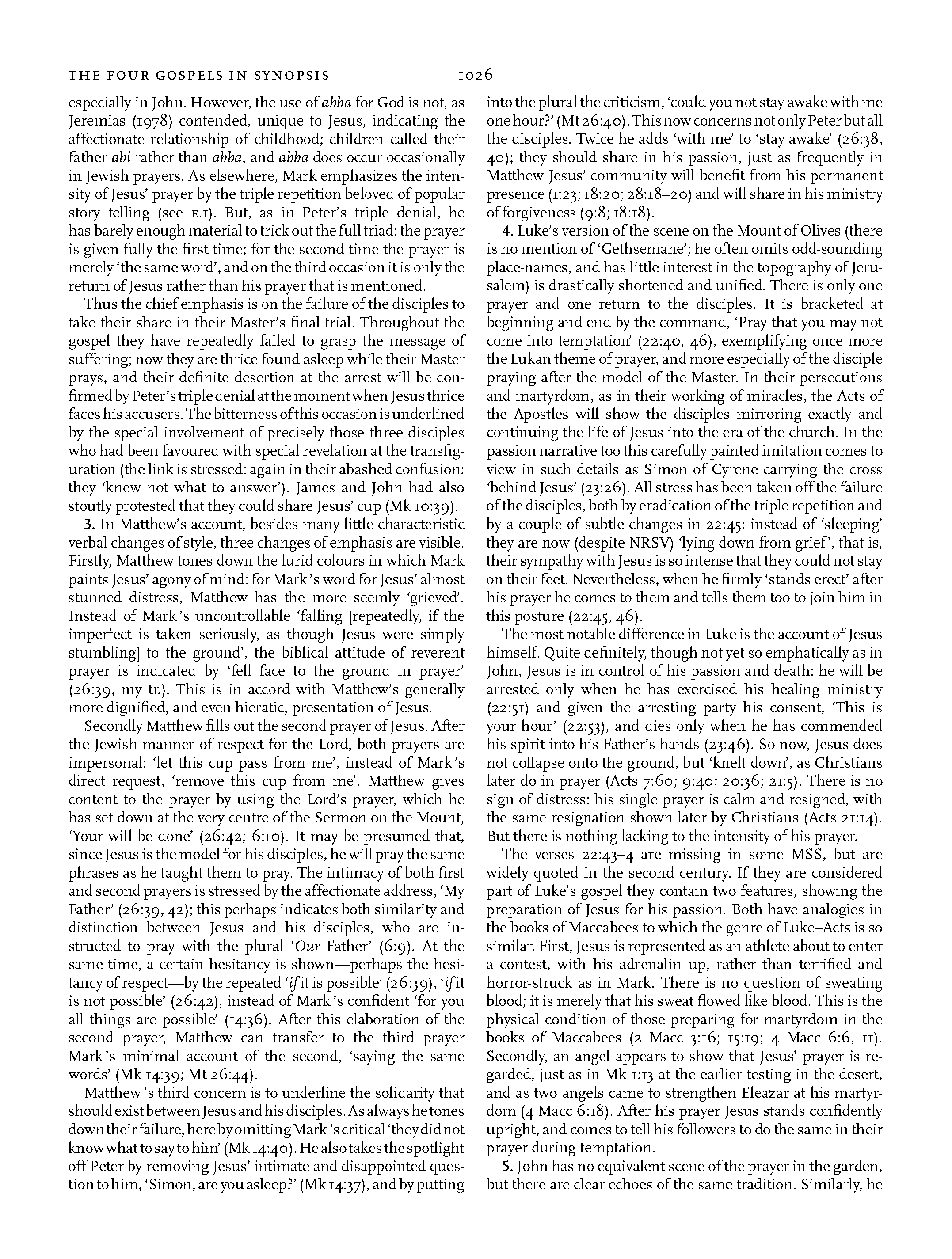
Jn 12:27-9 the other is 14:33—4,36—8. More probable is the view that Mark is spinning out a minimum of material to convey his own message according to his own manner. It is shot through with elements of Mark's own style. As throughout the passion narrative, a principal motif is to make sense of the stunning events by showing that what happens fulfils the scripture. A little hint of this is the allusion to Abraham's sacrifice of Isaac in 'going a little further' (14:35, as Gen 22:5). But especially marked is the reminiscence in Jesus' words of the laments of the persecuted just man in the Psalms (Ps 41:6 in Mk 14:34, etc.). The accent is on two factors, the obedience of Jesus to his Father's will and—by contrast—the failure of the disciples. Thus, with typical Markan duplication, the prayer of Jesus is given first indirectly (v. 35), then directly (v. 36).
27'Now my soul is troubled. And what should I say— "Father, save me from this hour"? No, it is for this reason that I have come to this hour. 28Father, glorify your name.' Then a voice came from heaven, T have glorified it, and I will glorify it again.' 29The crowd standing there heard it and said that it was thunder. Other said, 'An angel has spoken to him.'
Jn 18:11
Jesus said to Peter, 'Put your sword back into its sheath. Am I not to drink the cup that the Father has given me?'
2. The account of Jesus' prayer before his passion is a particularly rich example of how the several synoptic evangelists have adapted the tradition they received in order to express their own theology. There are also interesting links to the Fourth Gospel which most probably reflect an oral tradition about the prayer of Jesus at the pre-gospel stage. As a working hypothesis in the discussion of this pericope it will be assumed that Mark is the first of the Synoptic Gospels, used by both the other two.
Probably for the prayer itself Mark is using or imitating already the formulae of early Christian prayer, with the Aramaic abba immediately followed by its Greek translation (ho pater). This double formula of a particular Aramaic word, regarded almost as a talisman, occurs elsewhere in the NT (i Cor 16:22; Rev 1:7). Jesus' consciousness that God was his Father was treasured by the early community; this usage, stemming from Jesus himself, was greatly extended,
A long series of scholars has suggested that Mark is here combining two accounts, e.g. one source is 14:32, 35, 40, 41,
THE FOUR GOSPELS IN SYNOPSIS 1026 into the plural the criticism, 'could you not stay awake with me one hour?' (Mt 2 6:4o). This now concerns not only Peter but all the disciples. Twice he adds 'with me' to 'stay awake' (26:38, 40); they should share in his passion, just as frequently in Matthew Jesus' community will benefit from his permanent presence (1:23; 18:20; 28:18—20) and will share in his ministry of forgiveness (9:8; 18:18).
especially in John. However, the use of abba for God is not, as Jeremias (1978) contended, unique to Jesus, indicating the affectionate relationship of childhood; children called their father abi rather than abba, and abba does occur occasionally in Jewish prayers. As elsewhere, Mark emphasizes the intensity of Jesus' prayer by the triple repetition beloved of popular story telling (see E.I). But, as in Peter's triple denial, he has barely enough material to trick out the full triad: the prayer is given fully the first time; for the second time the prayer is merely 'the same word', and on the third occasion it is only the return of Jesus rather than his prayer that is mentioned.
4. Luke's version of the scene on the Mount of Olives (there is no mention of'Gethsemane'; he often omits odd-sounding place-names, and has little interest in the topography of Jerusalem) is drastically shortened and unified. There is only one prayer and one return to the disciples. It is bracketed at beginning and end by the command, 'Pray that you may not come into temptation' (22:40, 46), exemplifying once more the Lukan theme of prayer, and more especially of the disciple praying after the model of the Master. In their persecutions and martyrdom, as in their working of miracles, the Acts of the Apostles will show the disciples mirroring exactly and continuing the life of Jesus into the era of the church. In the passion narrative too this carefully painted imitation comes to view in such details as Simon of Gyrene carrying the cross 'behind Jesus' (23:26). All stress has been taken off the failure of the disciples, both by eradication of the triple repetition and by a couple of subtle changes in 22:45: instead of'sleeping' they are now (despite NRSV) 'lying down from grief, that is, their sympathy with Jesus is so intense that they could not stay on their feet. Nevertheless, when he firmly 'stands erect' after his prayer he comes to them and tells them too to join him in this posture (22:45, 4^)-
Thus the chief emphasis is on the failure of the disciples to take their share in their Master's final trial. Throughout the gospel they have repeatedly failed to grasp the message of suffering; now they are thrice found asleep while their Master prays, and their definite desertion at the arrest will be confirmed by Peter's triple denial atthe moment when Jesus thrice faces his accusers. The bitterness of this occasion is underlined by the special involvement of precisely those three disciples who had been favoured with special revelation at the transfiguration (the link is stressed: again in their abashed confusion: they 'knew not what to answer'). James and John had also stoutly protested that they could share Jesus' cup (Mk 10:39).
3. In Matthew's account, besides many little characteristic verbal changes of style, three changes of emphasis are visible. Firstly, Matthew tones down the lurid colours in which Mark paints Jesus' agony of mind: for Mark's word for Jesus' almost stunned distress, Matthew has the more seemly 'grieved'. Instead of Mark's uncontrollable 'falling [repeatedly, if the imperfect is taken seriously, as though Jesus were simply stumbling] to the ground', the biblical attitude of reverent prayer is indicated by 'fell face to the ground in prayer' (26:39, my tr-)- This is in accord with Matthew's generally more dignified, and even hieratic, presentation of Jesus.
The most notable difference in Luke is the account of Jesus himself. Quite definitely, though not yet so emphatically as in John, Jesus is in control of his passion and death: he will be arrested only when he has exercised his healing ministry (22:51) and given the arresting party his consent, 'This is your hour' (22:53), an(^ dies only when he has commended his spirit into his Father's hands (23:46). So now, Jesus does not collapse onto the ground, but 'knelt down', as Christians later do in prayer (Acts 7:60; 9:40; 20:36; 21:5). There is no sign of distress: his single prayer is calm and resigned, with the same resignation shown later by Christians (Acts 21:14). But there is nothing lacking to the intensity of his prayer.
Secondly Matthew fills out the second prayer of Jesus. After the Jewish manner of respect for the Lord, both prayers are impersonal: 'let this cup pass from me', instead of Mark's direct request, 'remove this cup from me'. Matthew gives content to the prayer by using the Lord's prayer, which he has set down at the very centre of the Sermon on the Mount, 'Your will be done' (26:42; 6:10). It may be presumed that, since Jesus is the model for his disciples, he will pray the same phrases as he taught them to pray. The intimacy of both first and second prayers is stressed by the affectionate address, 'My Father' (26:39,42)> mis perhaps indicates both similarity and distinction between Jesus and his disciples, who are instructed to pray with the plural 'Our Father' (6:9). At the same time, a certain hesitancy is shown—perhaps the hesitancy of respect—by the repeated 'ifit is possible' (26:39), '(fit is not possible' (26:42), instead of Mark's confident 'for you all things are possible' (14:36). After this elaboration of the second prayer, Matthew can transfer to the third prayer Mark's minimal account of the second, 'saying the same words' (Mk 14:39; Mt 26:44).
The verses 22:43—4 are missing in some MSS, but are widely quoted in the second century. If they are considered part of Luke's gospel they contain two features, showing the preparation of Jesus for his passion. Both have analogies in the books of Maccabees to which the genre of Luke—Acts is so similar. First, Jesus is represented as an athlete about to enter a contest, with his adrenalin up, rather than terrified and horror-struck as in Mark. There is no question of sweating blood; it is merely that his sweat flowed like blood. This is the physical condition of those preparing for martyrdom in the books of Maccabees (2 Mace 3:16; 15:19; 4 Mace 6:6, n).
Secondly, an angel appears to show that Jesus' prayer is regarded, just as in Mk 1:13 at the earlier testing in the desert, and as two angels came to strengthen Eleazar at his martyrdom (4 Mace 6:18). After his prayer Jesus stands confidently upright, and comes to tell his followers to do the same in their prayer during temptation.
Matthew's third concern is to underline the solidarity that should existbetween Jesus and his disciples. As always he tones down their failure, here by omitting Mark'scritical'theydidnot knowwhattosaytohim' (Mk 14:40). He also takes the spotlight off Peter by removing Jesus' intimate and disappointed question tohim,'Simon, are you asleep?'(Mk 14:37), and by putting
5. John has no equivalent scene of the prayer in the garden, but there are clear echoes of the same tradition. Similarly, he
1027 THE FOUR GOSPELS IN SYNOPSIS
Fitzmyer, J. (1970-1) The Use of Explicit Old Testament Quotations in has no scene of the trial before the Sanhedrin (Mk 14:53-64), but an echo of this scene appears earlier in the Pharisees' decision to kill him in Jn 11:57. J°hn portrays the passion of Jesus not as the moment of his humiliation but as the hour of his exaltation and glorification (see JN 18:1-19:24). John's Jesus is nevertheless fully human, so that his soul is troubled by the approaching trial (12:270). However, since it is the moment of his glorification and that of his Father (12:28), to which he has looked forward (2:4; 7:30; 8:20) and will look forward (13:1; 16:32), he thrusts aside the thought of praying to be delivered from it. The image of the cup of suffering seen in the synoptic accounts of the prayer in the garden is also present at his arrest in the garden (18:11). Here it is explicit that Jesus accepts the cup in an atmosphere of triumph, for it comes at the conclusion of the arrest scene. During this scene his divinity has shone through by his use of the mysterious divine 'I am he' (18:5, 6, 8) and the awestruck reaction of the arresting party in falling to the ground. He can be arrested only after he has given this consent. There are further echoes of the tradition in the Letter to the Hebrews, in the mention that 'Jesus offered up prayers and supplications, with loud cries and tears, to the one who was able to save him from death' (Heb 5:7). The echoes of the prayers of the persecuted just man in the psalms are evident here. As already in the wording of the prayer in Mark, Brown (1994: 229) suggests that this prayer 'came from an early Christian hymn of praise constructed of a mosaic of psalm-motifs'. Behind it would be the same tradition as that of the synoptic and Johannine prayer in the garden.
Qumran Literature and in the New Testament', NTS 7.
(1979), The Gospel According to Luke (New York: Doubleday). Franklin, E. (1994), Luke, Interpreter of Paul, Critic of Matthew (Sheffield: Sheffield Academic Press). Goodacre, M. (1996), Goulder on the Gospels (Sheffield: Sheffield Academic Press). Goulder, M. (1974), Midrash and Lection in Matthew (London: SPCK).
(1984), 'The Order of a Crank', in Tuckett (19840). (1989), Luke—A New Paradigm (Sheffield: Sheffield Academic Press). Green, H. Benedict, (1984), The Credibility of Luke's Transformation of Matthew', in Tuckett (19840). Green, Joel B. (1995), The Theology of the Gospel of Luke (Cambridge:
Cambridge University Press). Hawkins, Sir J. (1909), Horae Synopticae (Oxford: Clarendon). Jeremias, J. (1978) The Prayers of Jesus (Philadelphia: Fortress). Kloppenborg, J. (1987), The Formation of (^(Philadelphia: Fortress). Kloppenborg Verdin J. (2000), Excavating Q (Edinburgh: T. & T.
Clark). Koester, H. (1989), 'From Kerygma-Gospel to Written Gospel', NTS 35. Lamar Cribbs, F. (1971), 'St Luke and the Johannine Tradition', JBL go. Meeks, W. (1983), The First Urban Christians (New Haven: Yale University Press). Meier, J. (1982), 'Antioch', in R. Brown and J. Meier, Antioch and Rome
(London: Chapman). Meier, J. P. (1994), A Marginal Jew, ii (New York: Doubleday). Neirynck, F. (1978), The Symbol Q' ETL 54:119-25.
(1979), 'Once More the Symbol Q', ETL 55: 382-3. - (1988), Duality in Mark (Leuven: Leuven University Press). Peabody, D. (1987), Mark as Composer (Macon: Mercer University
Press). Perrin, N. (1970—1), Expo Times, 82. Piper, R. A. (1995), The Gospel behind the Gospels, supplement to
Novum Testamentum, vol. 75 (Leiden: Brill). Puech, E. (1993), The Collection of Beatitudes in Hebrew and Greek
(4(3525. 1-4 and Matt 5, 3-12)', in F. Manns and E. Alliata (eds.), Early Christianity in Context (Jerusalem: Franciscan Press), 353-68. Sanders, E. (1969), The Tendencies of the Synoptic Tradition (Cam-
Ashton, J. (1991), Understanding the Fourth Gospel (Oxford: Clarendon). Barthelemy, D. (1963), Les Devanciers d'Aquila (Leiden: Brill). Best, E. (1986), Disciples and Discipleship (Edinburgh: T. & T. Clark). Boismard, M. (1972), Synopse des quatre Evangiles (Paris: Editions du bridge: Cambridge University Press), 290—3. Sanders, E. and Davies, M. (1989), Studying the Synoptic Gospels
(London: SCM). Sim, D. (1998), The Gospel of Matthew and Christian Judaism (Edin-
Cerf). Brown, Raymond (1994), The Death of the Messiah (London: Geoffrey burgh: T. & T. Clark). Stanton, G. (1992 o), A Gosei/oro New Pecpie (Edinburgh: T.&T. Clark).
Chapman).
(1997), An Introduction to the New Testament (New York: Doubleday). Burridge, R. (1992), What are the Gospels? (Cambridge: Cambridge
(1992!?), BipAoc;, &ua~/~/eAiov or (C&LOC;?', in F. van Segbroeck et al. (eds.), The Four Gospels (Leuven: Leuven University Press). Stuhlmacher, P. (1983), Das Evangelium und die Evangelien (Tubingen:
University Press). Camery-Hoggatt, J. (1992), Irony in Mark 's Gospel (Cambridge: Cam-
Mohr). Tuckett, C. (1983), The Beatitudes: A Source-Critical Study, with a bridge University Press). Casey, C. (1998), Aramaic Sources of Mark's Gospel (Cambridge: Cam-
Reply by M. D. Goulder', NT 25.
(19840), Arguments from Order' in C. M. Tuckett, Synoptic Studies (Sheffield: Sheffield Academic Press).
bridge University Press). Denaux, A. (1992) (ed.), John and the Synoptics (Leuven: Leuven Uni-
(1984(7), 'On the Relationship between Matthew and Luke', NTS 30.
versity Press). Dodd, C. H. (1955-6), 'Some Johannine "Herrenworte" with Parallels
(1987), Readingthe New Testament (Philadelphia: Fortress). (1995), The Existence of Q' in R. A. Piper, The Gospel behind the Gospels, supplement to Novum Testamentum, 75 (Leiden: Brill), 19-48. von Wahlde, U. (1989), The Earliest Version of John's Gospel (Wilmingin the Synoptic Gospels', NTS 2. Donahue, J. (1973), Are You the Christ? The Trial Narrative in the Gospel of Mark (Missoula: Scholars Press). Dunn, J. (1983), 'Let John be John', in P. Stuhlmacher (ed.), Das
Evangelium und die Evangelien (Tubingen: Mohr).
ton, Del.: Glazier). Weeden, T. (1968), The Heresy that Necessitated Mark's Gospel',
(1991), 'John and the Oral Gospel Tradition', in H. Wansbrough (ed.), Jesus and the Oral Gospel Tradition (Sheffield: Sheffield Academic Press).
ZNW59.
62. Acts LOVEDAY ALEXANDER
Festus (25:1), who was procurator of Judea c.6o-2 CE. Acts therefore cannot be earlier than 0.62; and the puzzling failure to narrate the outcome of Paul's trial has been taken as evidence that the book itself was written during the two-year period of imprisonment in Rome (28:30), before the persecution under Nero (64 CE) in which Paul traditionally lost his life. But this is again conjecture, and there are reasons for seeing the work as a more mature reflection on the significance of the Pauline mission, written after the apostle's death (which seems to be presupposed by the valedictory tone of 20:18-38, esp. 25). It must also come after the composition of the gospel, which is referred to in the opening verse (1:1), and therefore probably after the destruction of Jerusalem in 70 CE
The book of Acts occupies a unique position in the NT, forming a bridge between the gospels and the epistles. It provides a narrative (the only one we have) of the steps by which the Christian message made the transition from the rural, Palestinian world of Jesus to the largely urban world of Paul and the later epistles, based in the Greek cities of the Roman empire. Whereas the gospels focus on Jesus, Acts focuses on people talking about Jesus, the apostles and others who spread his gospel across the Graeco-Roman world. While the Gospels are set almost exclusively in Galilee and Judea, Acts moves purposefully out from Jerusalem to the wider world of the empire, and its final scene is set in Rome. And while the gospels are located within the world of Palestinian Judaism, Acts moves out into the diaspora, where 'the Jews' are one vocal minority group among others seeking to maintain their identity within the multicultural civic communities of the empire.
(Lk 21:20). The gospel preface implies that Luke sees himself as a second-generation Christian, one who has 'followed' the tradition 'handed down by the original eyewitnesses' (Lk 1:2). Thus a date in the 8os (LK D) would make sense, even if the author had earlier been a companion of Paul, and might help to account for some of the mistiness that seems to have grown up around the character and theology of Paul and the details of his travels (cf. Barrett 1994—9: ii. pp. xl—xli). Nevertheless, despite this mistiness in detail, Acts shows remarkable knowledge of the general conditions of life in the eastern Mediterranean at the time of Paul, and belongs unmistakably to the first century.
A. Authorship. The book of Acts is anonymous: its opening verse (as was common in ancient literature) gives the name of its dedicatee, Theophilus, but not the name of the author. However, this dedication makes it easy to deduce that the author of Acts is the same as the author of Luke's gospel (cf. LK D), and there is sufficient continuity of language, style, and theological interests to make this one of the few virtually unchallenged conclusions of NT scholarship. Since Luke and Acts together account for a quarter of the NT, this makes this anonymous author (whom we shall call 'Luke' for convenience) one of the most important in the NT canon. The other possible indicator of authorship within Acts is the so-called 'we-passages' (see LK D; ACTS 15:36-18:28), which imply that the narrator was a companion of Paul on some of his voyages. Early church tradition identified him with the 'Luke, the beloved physician' of Col 4:14, a co-worker of Paul's (Philem 23) who was with Paul in prison, but this tradition has been questioned by scholars on the grounds that the author of Acts does not show the kind of knowledge we would expect of a close associate of Paul's (see LK D for a summary of the arguments). Since all the evidence on both sides lies within the book itself, it is difficult to resolve the question in advance of reading the text. I have tried to draw attention within the commentary to the passages which have a bearing on this question without prejudging the issue; but on balance I would agree with Fitzmyer and Barrett that it is difficult to find any alternative which makes more sense of all the data than the traditional ascription. See further Fitzmyer (1998: 49-51) and Barrett (1994-9: i. 30-48) (with full survey of all the ancient evidence); ii. pp. xlii-xlv.
C. Audience. Despite the address to Theophilus in the opening sentence (1:1), Acts is not a letter or a speech addressing a single reader. The address is properly considered a dedication (not unlike the dedications of published books today), which allows the author to single out and honour one particular reader while implying a wider distribution. Such a dedicatee, within the conventions of ancient literature, would normally be a real person known to the author, a friend or patron, and often (but not necessarily) represents the same kind of reader as the implied readers of the text. If this is the case here, the readers, like Theophilus, will be people who have already had some instruction in the faith and need to be assured of its 'reliability' (Lk 1:4). This seems to imply a both a predominantly Christian readership and one that will appreciate the neutral, academic tones of the preface. But it is also important to take account of the dramatic audiences Luke invokes within the text itself: see ACTS E.
D. Acts and the Gospel Story. Ancient readers of Acts would recognize immediately from the first verse that this is the second volume of a multi-volume work, and a proper estimation of its narrative construction must take this into account. Acts assumes its readers have a basic knowledge of the characters and framework of the gospel story; it also contains a number of explicit summaries of the story of Jesus from the lips of the apostles who are now charged with passing on the tradition (Lk 1:2) to a wider audience (cf. ACTS 2:14—36). There are significant differences between the two volumes, not only in subject-matter but in style, and these may reflect the
B. Date. The question of date is no easier to resolve than the question of authorship, with which it is inextricably bound up. The book ends with Paul in prison in Rome, waiting for his appeal to Caesar to be heard: according to the book's internal chronology he was sent to Rome soon after the accession of
1029 ACTS and was expected to express itself in language far removed from the everyday Greek of the streets. Within the broad realm of Greek historiography, Acts could perhaps most convincingly be classified as an antiquarian monograph dealing with institutional history; but this label does not seem to capture the real flavour of the book.
different sources Luke had at his disposal. Luke's style in the gospel is very largely determined by his synoptic sources, and as a result, it is marginally closer in language to Matthew and Mark than it is to Acts. But there are also striking similarities between the two volumes. Acts shares with Luke's gospel a common interest in rooting the story in the Jewish Scriptures; extensive parallelism between the words and deeds of Jesus in the gospel and those of the apostles and Paul in Acts; an interest in female characters; and similar patterns of narrative construction, especially a tendency to group material topically rather than chronologically and a fondness for 'type-scenes' which encapsulate the whole character of a phase of mission in one dramatic and detailed scene (cf. LK B). There is also a tendency to hold over certain narrative details from the gospel to Acts which suggests that Luke already had Acts in view when he was writing the gospel (cf. esp. ACTS 28:23-31). In particular, major themes introduced in the narrative prologue to the gospel (Lk chs. 1—4) reappear in clearer definition in the narrative epilogue to Acts (Acts 27—8). For a reader who did not know the story in advance, it would not be possible to predict the ending of Acts from the beginning of the gospel. Readers who make it to the end of Acts, however, will be sent back to reread the beginning of the gospel with new eyes, and will have a new appreciation of the prophetic significance of the Nazareth episode (1x4:16-30) and of Simeon's 'lighttothe Gentiles' (cf. LK E, ACTS 28:23-31).
3. Biblical History. It is far easier and more convincing to range Acts alongside other Greek narratives from Jewish writers seeking to place events of their own day within the broader framework of biblical history. Luke has an extensive knowledge of the Greek Bible (that is the Gk. translations of the HB used by diaspora Jews, principally but not exclusively the Septuagint or LXX) and assumes considerable knowledge of these texts in his readers. Quotations from the Bible form an important subplot of Acts, in the series of speeches that cumulatively presents the major scriptural testimonies used in early Christian hermeneutic. Some of these testimonia seem to reflect a very archaic stage of Christian hermeneutic and may go back to an early Florilegium such as those found at Qumran, an anthology of key scriptural texts arranged to support the sect's hermeneutic (cf. Brooke 2000: i. 297-8; Steudel 2000: ii. 936—8). Luke also draws on the Greek Bible for a rich fund of allusion, narrative typology, vocabulary, and style, all of which give his story a strongly 'biblical' flavour (Fitzmyer 1998: 90-5; 1981: 107-27). It is not surprising, then, that Luke's work should resemble biblical historiography much more than Greek: this is evident especially in its biographical structure (concentration on a succession of single characters) and in its overtly theological framework (Greek historians typically distance themselves from religious interpretations of events).
E. Genre. 1. The literary genre of Luke's gospel, like its language, is effectively determined by its subject-matter and sources: it is a 'gospel', modelled closely on Mark's (LK A). Acts is a very different proposition, and even though it forms a narrative continuation to the gospel, it is widely accepted that we may need to look further afield for literary models for Acts. Most scholars believe that the title (The Acts of the Apostles) which is first attested in the Anti-Marcionite Prologue in the second century is not original. It is a rather misleading description of the book's content given that there are no 'acts' recounted for many of the twelve Apostles and Paul (to whom well over half the book is dedicated) does not rank as an apostle in Luke's eyes. Of the three principal forms of prose narrative in the literature of the Graeco-Roman world (history, biography, novel), Acts is possibly unique in having been ascribed to all three (Powell 1991: 9). Further on the question of genre, cf. esp. Powell (ibid. ch. i); Winter and Clarke (1993).
4. Biography. Greek and Roman biography (an increasingly popular genre in the late ist cent.) in many ways provides a better parallel to the scope and scale of Luke's work, especially the biography of philosophers: Luke's description of the gospel in Acts 1:1 would most readily suggest a philosophical biography to ancient readers. Philosophical biography is so far the most convincing genre that has been suggested for Luke's two-volume work, following the pattern found in Diogenes Laertius of the life of the founder of a philosophical movement plus shorter biographical notes on his followers. Extant examples of this genre seem to lack the religious intensity of Luke's work, but late first-century philosophical literature shows that there was a real interest in presenting the lives of philosophers as templates for living the philosophical life, especially the life (and even more the death) of the martyrphilosopher Socrates. A number of details in Acts would recall this paradigm for Greek-educated readers: cf. esp. ACTS 17:16-21; 21:1-16; 25:1-12. 5. Novel. The late first century also sees the growth in popularity of a less pretentious narrative genre, the Greek novel, and it has been suggested that Acts is a form of novel. Certainly many readers unaccustomed to biblical narrative might take the book as a novel, with its exotic settings, adventurous plot, framework of travel, and explicit religious ideology. Luke shows some inclination to novelistic narrative techniques in the elaboration of his more dramatic scenes
2. Greek History. Acts is commonly described as a history of the early church, and in a very broad sense that is what it is. But it is important to appreciate that Acts does not sit easily within the confines of the literary genre of'history' as it was understood by Greek and Roman readers in the ancient world. In his formal prefaces and dedications, Luke echoes the language and conventions found in other secular prefaces of the time, prefaces to scientific or technical manuals or to academic treatises on ethnography or geography. Historians (who tend to avoid dedication) use this style sometimes in their more academic or antiquarian sections, but it is a far cry from the high-flown rhetoric that was expected of historical writers. Acts does not match the pretensions of contemporary historiography either in style or in subject-matter: history tended to concern itself with great men and public events,
(cf. e.g. ACTS 12:6—11), and the novel throws valuable light on Luke's narrative structure and textures. But there are also many differences, not least the lack of a love-interest, the
ACTS 1030 lack of emotion (pathos), and the political realism of Luke's narrative: the heroes and heroines of the novels tend to move in a fantasy landscape which is only superficially parallel to Luke's pragmatic locations.
Scene i: The Day of Pentecost (2:1-47) Scene 2: Healing at the Temple Gate (3:1—4:22) Interlude: The Spirit-Filled Life (4:23-5:16) Scene 3: Apostles on Trial (5:17-42) Scene 4: The First Christian Martyr (6:1-7:60) Act II: The Scattered Church: Samaria to Antioch (8:1—12:25)
6. Apologetic. Acts has frequently been described as an apologetic work, presenting the 'speech for the defence' for Paul, or for the church, or for Christianity, before a hostile world. The wide variety of constructions that have been put on this reading demonstrates its weakness: it is not easy to press the wide-ranging narrative of Acts into the service of a single apologetic purpose. It would be more correct to say that Acts contains a high proportion of apologetic speeches (some explicitly so described, e.g. 26:2), and that these must be taken into account when assessing the book's overall purpose and audience. Acts often shows Paul defending himself before a Roman tribunal, and takes pains to show that Roman magistrates believed him to be innocent of any offence against Roman law (e.g. 18:15; 25:8; 26:31), and this has often been taken to be the book's underlying purpose. But it is also noticeable that many of the damaging charges brought against Paul are left unanswered (e.g. 16:20-1; 17:6-7), and that Paul rarely gets the chance to speak in his own defence in these scenes (cf 18:14; I9:32)- The dominant social location addressed by the apologetic speeches in Acts is the Jewish community, both in Jerusalem (chs. 2, 4, 5, 7, 22) and in the diaspora (chs. 13, 28). Even where Paul is speaking before a Roman tribunal, he is addressing a Jewish audience and Jewish charges (chs. 24, 26). Despite Luke's interest in the Gentile mission, it is the relationship of the Christian 'sect' (28:22) to its Jewish parent that dominates his presentation; and this must be taken into account when assessing his audience and purpose.
Scene i: Samaria and Gaza (8:1—40) Scene 2: Damascus (9:1-31) Scene 3: Caesarea (9:32-11:18) Scene 4: Antioch and Jerusalem (11:19—12:25) Act III: Paul the Missionary (13:1—21:16)
Scene i: Paul's First Missionary Journey (13:1-14:28) Scene 2: The Apostolic Council (15:1-35) Scene 3: Paul's Second Missionary Journey (15:36—18:23) Scene 4: Paul's Third Missionary Journey (18:24—21:16) Act IV: Paul the Prisoner (21:17-28:31)
Scene i: Paul on Trial: Jerusalem (21:17-23:30) Scene 2: Paul on Trial: Caesarea (23:31—26:42) Interlude: Storm and Shipwreck (27:1—28:10) Scene 3: Paul in Rome (28:11-31)
Prelude (1:1-26)
Before the main action can begin, a narrative prelude smooths the transition from the first volume (1:1—5) by repeating the scene of the ascension in greater detail (1:6—n), and making up the numbers of the apostolic group (1:12-26).
(1:1) Authorial Introduction Luke begins his second volume with a conventional opening sentence in which he repeats the name of his addressee, Theophilus, and reminds his readers briefly of the contents of the first volume. Here the author slips out of the role of narrator and speaks in his own voice directly to the reader, as if to remind Theophilus (and all other readers) of the existence of the person who collected all the information behind the two books, the one who 'investigated everything carefully from the very first' and 'wrote it all up in an orderly fashion' (Lk 1:3) so as to reassure Theophilus of the reliability of the instruction he had received (Lk 1:4). This brief summary is a valuable indication of the way ancient readers would have seen the genre of Luke's first volume. The gospel was about 'all that Jesus did and taught': that is, it was a book focused on an individual (biography), and that individual was a teacher. Outside the world of the Bible, the most obvious niche to fit this kind of story into is philosophical biography, in which anecdotes of great teachers of the past were collected to provide images and examples for successive disciples to follow.
F. Text. The so-called Western Text of Acts, represented by a number of M S S of which the most famous is Codex Bezae (D), has substantially longer readings at certain points in the text, and the most significant of these are reproduced in the NRSV marginal readings (NRSV marg.). It has been argued that the longer text is original, but on the whole it is easier to explain the longer text as an expansion and clarification of a shorter original. See further Fitzmyer (1998: 66—79); Barrett (1994— 9: i. 2—29).
G. Structure. Like much biblical narrative (including the gospels), Acts is an episodic narrative with minimal authorial comment and simplistic chronology. It is not easy to analyse in modern terms. Ancient narrators do not think in terms of chapters or sections but create a seamless flow; Luke often uses summaries to mark the transition from one scene to next, and interleaves characters and themes (e.g. the introduction of Saul at 7:58). But the alternation of 'summary' and 'scene' (typically a significant event followed by diverse reactions and interpretative speech) suggests that we may usefully analyse Acts, like many of the Greek novels, in dramatic terms, as a drama with four major acts, each with several scenes. But it must be stressed that this is a modern, not an ancient, division.
(1:2-5) The Story So Far The detached, academic tone of the preface does not last very long. Luke forgets to tell his readers what the second volume is going to contain. Instead, he takes us back to the closing scenes of the first volume, spinning rapidly back from the ascension to Jesus' final command (v. 2) to the forty-day period of resurrection appearances (v. 3). By the time we reach v. 5 (still within the opening sentence in the original), we have slipped a further notch into direct speech (the 'he said' of v. 4 is not in the Gk.), as if we were standing beside the apostles being addressed directly by Jesus himself. Jesus' words in this section recall the opening scenes of the