
Part 116
(O'Brien 1982: 237) for the glorious return of Christ (3:4; cf. 1 Cor 16:22). Their incessant awareness of, and orientation to, this goal is the best guarantee of the vigilance required of all believers if they are to persevere (1:23). Gratitude for what they have already been given (1:12-14; 3:11-12) should enhance their attentiveness. It is typical of Paul to request prayers for himself (i Thess 5:25; Philem 22). It is a means of participation in the mission of the church (3:3; 2 Thess 3:1; Phil 1:19). The Colossians must beseech God (a) for Paul's liberation from prison in order to continue his mission (cf. i Cor 16:9; 2 Cor 2:12), and (b) for his ability to 'reveal' the mystery effectively. 'The divine passive of 1:26 finds its human herald in 4:4' (Aletti 1993: 260). Despite Paul's emphasis on the verbal dimension of such communication, it is likely that he also has in mind the existential aspect, in which his comportment reveals Christ (2 Cor 4:10—11; cf. i Cor 2:1—5).
It is to this aspect that Paul now alerts the Colossians. It is not enough to pray. They must also exhibit a presence in society that will prove attractive to non-believers (v. 5; cf. i Thess 4:12; Phil 2:14—16). Every opportunity to induce them to believe must be availed of. The speech of Christians should be winning and witty, and tailored to the needs of each interlocutor (v. 6). They must insinuate not dominate.
The literal translation of 3:18 is 'women be subject to men', but the context demands limitation to marriage, as some copyists have tried to convey by various additions. The admonition that a Christian woman be submissive to her nonbelieving husband (3:18) is to remind her that her new freedom (cf. Gal 5:1) does not exempt her from the obligations she undertook in marriage. Such behaviour is 'fitting' for a Christian because of its missionary potential (cf. i Pet 3:1). The obligation to love laid on the husband (3:19) indicates that the wife is a non-believer, since Christians by definition love one another (3:14; cf. i Thess 4:9). The temptation to treat her harshly might be due to her refusal to convert.
(4:7—18) Final Greetings The two bearers of the letter are introduced in a chiastic pattern (w. 7—9). Paul tactfully remains quiet regarding the personal history of Onesimus, simply noting that he has become a Christian ('brother'; cf. Philem 10), and has Paul's respect and confidence ('faithful'). The same adjectives are applied to Tychicus, who in addition is called 'minister' and 'fellow-servant in the Lord', exactly as
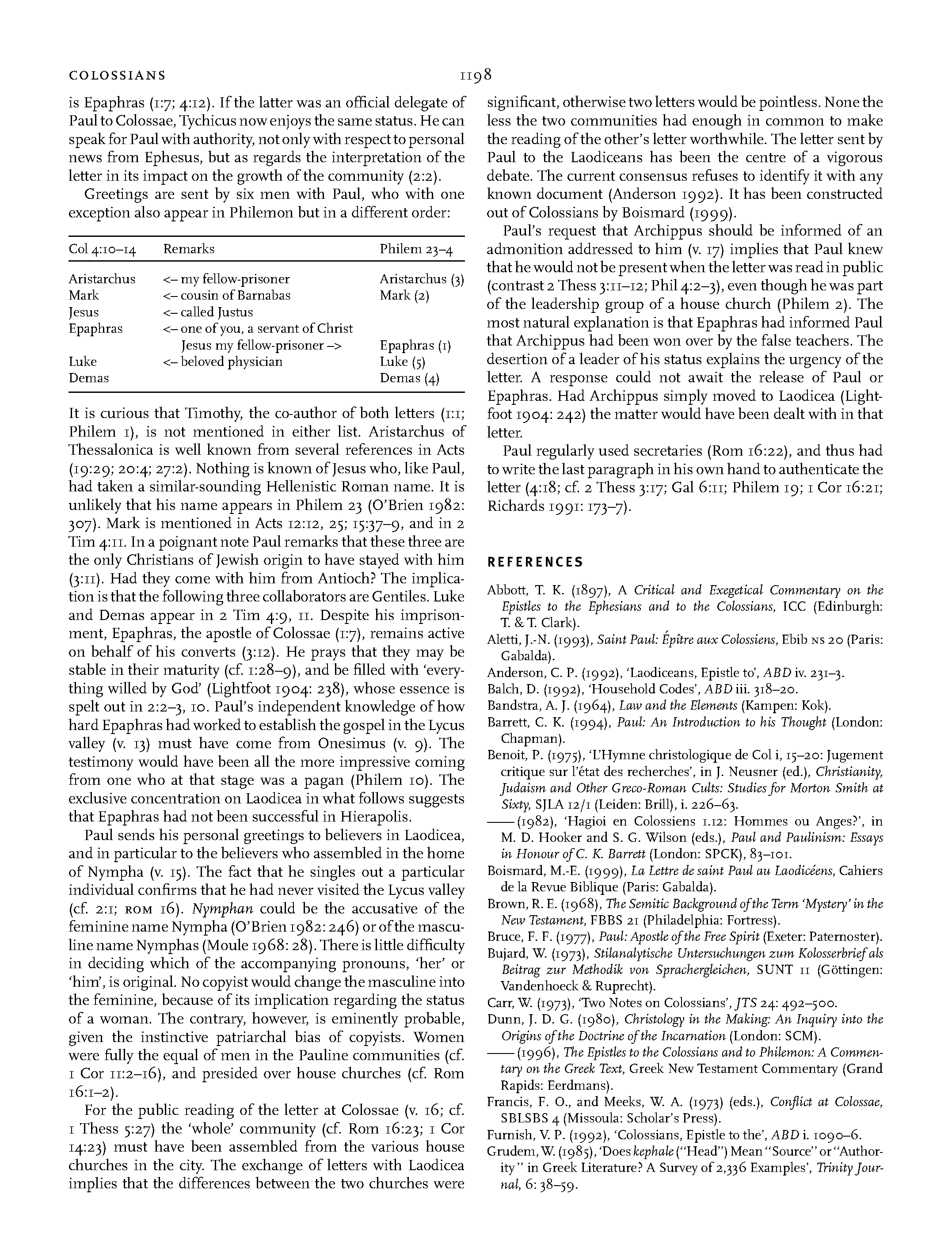
COLOSSIANS 1198 significant, otherwise two letters would be pointless. None the less the two communities had enough in common to make the reading of the other's letter worthwhile. The letter sent by Paul to the Laodiceans has been the centre of a vigorous debate. The current consensus refuses to identify it with any known document (Anderson 1992). It has been constructed out of Colossians by Boismard (1999).
is Epaphras (1:7; 4:12). If the latter was an official delegate of Paul to Colossae, Tychicus now enjoys the same status. He can speak for Paul with authority, not only with respect to personal news from Ephesus, but as regards the interpretation of the letter in its impact on the growth of the community (2:2).
Greetings are sent by six men with Paul, who with one exception also appear in Philemon but in a different order:
Paul's request that Archippus should be informed of an admonition addressed to him (v. 17) implies that Paul knew that he would not be present when the letter was read in public
Col 4:10-14 Remarks Philem 23-4
Aristarchus <- my fellow-prisoner Aristarchus (3) Mark <—cousin of Barnabas Mark (2) Jesus <— called Justus Epaphras <- one of you, a servant of Christ
(contrast 2 Thess 3:11-12; Phil 4:2-3), even though he was part of the leadership group of a house church (Philem 2). The most natural explanation is that Epaphras had informed Paul that Archippus had been won over by the false teachers. The desertion of a leader of his status explains the urgency of the letter. A response could not await the release of Paul or Epaphras. Had Archippus simply moved to Laodicea (Lightfoot 1904: 242) the matter would have been dealt with in that letter.
Jesus my fellow-prisoner -> Epaphras (i) Luke <— beloved physician Luke (5) Demas Demas (4)
It is curious that Timothy, the co-author of both letters (1:1; Philem i), is not mentioned in either list. Aristarchus of Thessalonica is well known from several references in Acts
Paul regularly used secretaries (Rom 16:22), and thus had to write the last paragraph in his own hand to authenticate the letter (4:18; cf. 2 Thess 3:17; Gal 6:11; Philem 19; i Cor 16:21; Richards 1991: 173—7)-
(19:29; 20:4; 27:2). Nothing is known of Jesus who, like Paul, had taken a similar-sounding Hellenistic Roman name. It is unlikely that his name appears in Philem 23 (O'Brien 1982: 307). Mark is mentioned in Acts 12:12, 25; 15:37-9, and in 2 Tim 4:11. In a poignant note Paul remarks that these three are the only Christians of Jewish origin to have stayed with him
(3:11). Had they come with him from Antioch? The implication is that the following three collaborators are Gentiles. Luke and Demas appear in 2 Tim 4:9, n. Despite his imprisonment, Epaphras, the apostle of Colossae (1:7), remains active on behalf of his converts (3:12). He prays that they may be stable in their maturity (cf 1:28-9), and be filled with 'everything willed by God' (Lightfoot 1904: 238), whose essence is spelt out in 2:2—3, IOPaul's independent knowledge of how hard Epaphras had worked to establish the gospel in the Lycus valley (v. 13) must have come from Onesimus (v. 9). The testimony would have been all the more impressive coming from one who at that stage was a pagan (Philem 10). The exclusive concentration on Laodicea in what follows suggests that Epaphras had not been successful in Hierapolis.
Abbott, T. K. (1897), A Critical and Exegetical Commentary on the
Epistles to the Ephesians and to the Colossians, ICC (Edinburgh: T.£ T.Clark). Aletti, J.-N. (1993), Saint Paul: Epitre aux Colossiens, Ebib NS 20 (Paris:
Cabal da). Anderson, C. P. (1992), 'Laodiceans, Epistle to', ABD iv. 231—3. Balch, D. (1992), 'Household Codes', ABD iii. 318-20. Bandstra, A. J. (1964), Law and the Elements (Kampen: Kok). Barrett, C. K. (1994), Paul: An Introduction to his Thought (London:
Chapman). Benoit, P. (1975), 'L'Hymne christologique de Col i, 15—20: Jugement critique sur 1'etat des recherches', in J. Neusner (ed.), Christianity, Judaism and Other Greco-Roman Cults: Studies for Morton Smith at
Sixty, SJLA 12/1 (Leiden: Brill), i. 226-63.
(1982), 'Hagioi en Colossiens 1.12: Hommes ou Anges?', in M. D. Hooker and S. G. Wilson (eds.), Paul and Paulinism: Essays in Honour of C. K. Barrett (London: SPCK), 83-101. Boismard, M.-E. (1999), La Lettre de saint Paul au Laodiceens, Cahiers
Paul sends his personal greetings to believers in Laodicea, and in particular to the believers who assembled in the home of Nympha (v. 15). The fact that he singles out a particular individual confirms that he had never visited the Lycus valley (cf. 2:1; ROM 16). Nymphan could be the accusative of the feminine name Nympha (O'Brien 1982: 246) or of the masculine name Nymphas (Moule 1968: 28). There is little difficulty in deciding which of the accompanying pronouns, 'her' or 'him', is original. No copyist would change the masculine into the feminine, because of its implication regarding the status of a woman. The contrary, however, is eminently probable, given the instinctive patriarchal bias of copyists. Women were fully the equal of men in the Pauline communities (cf. i Cor 11:2—16), and presided over house churches (cf. Rom 16:1-2). For the public reading of the letter at Colossae (v. 16; cf. i Thess 5:27) the 'whole' community (cf. Rom 16:23; I Cor 14:23) must have been assembled from the various house churches in the city. The exchange of letters with Laodicea implies that the differences between the two churches were de la Revue Biblique (Paris: Gabalda). Brown, R. E. (1968), The Semitic Background of the Term 'Mystery' in the
New Testament, EBBS 21 (Philadelphia: Fortress). Bruce, F. F. (1977), Paul: Apostle of the Free Spirit (Exeter: Paternoster). Bujard, W. (1973), Stilanalytische Untersuchungen zum Kolosserbrief als
Beitrag zur Methodik von Sprachergleichen, SUNT n (Gottingen: Vandenhoeck & Ruprecht). Carr, W. (1973), Two Notes on Colossians', JTS 24: 492-500. Dunn, J. D. G. (1980), Christology in the Making: An Inquiry into the
Origins of the Doctrine of the Incarnation (London: SCM).
(1996), The Epistles to the Colossians and to Philemon: A Commentary on the Greek Text, Greek New Testament Commentary (Grand Rapids: Eerdmans). Francis, F. O., and Meeks, W. A. (1973) (eds.), Conflict at Colossae,
SBLSBS 4 (Missoula: Scholar's Press). Furnish, V. P. (1992), 'Colossians, Epistle to the', ABD i. 1090-6. Grudem, W. (1985), 'Does kephale ("Head") Mean "Source" or "Authority" in Greek Literature? A Survey of 2,336 Examples', Trinity Journal, 6:38-59.
"99 I THESSALONIANS
Murphy-O'Connor, J. (19950), Tradition and Redaction in Col 1:15-
Gunther, J. J. (1973), St. Paul's Opponents and Their Background: A
20', RB 102: 231-41. (i995fe), Paul the Letter Writer, GNS 41 (Collegeville, Ind.: Liturgical Press). Nestle-Aland (1993), Novum Testamentum Graece, 2jth edn. (Stuttgart:
Study of Apocalyptic and Jewish Sectarian Teachings, NovTSup 35 (Leiden: Brill). Hafemann, S. J. (1986), Suffering and the Spirit: An Exegetical Study of
II Cor. 2:14—3:3 within the Context of the Corinthian Correspondence, WUNT 2/19 (Tubingen: Mohr [Siebeck]). Hooker, M. D. (1973), 'Were there False Teachers at Colossae?', in B.
Deutsche Bibelgesellschaft). Neumann, K. J. (1990), The Authenticity of the Pauline Epistles in the Light of Stylostatistic Analysis, SBLDS 120 (Atlanta: Scholars Press). O'Brien, P. T. (1982), Colossians, Philemon, WBC 44 (Waco: Word). Richards, E. R. (1991), The Secretary in the Letters of Paul, WUNT 2/42
Lindars and S. Smalley (eds.), Christ and Spirit in the New Testament: Studies in Honour of Charles Francis Digby Moule (Cambridge: Cambridge University Press). Kasemann, E. (1964), Essays on New Testament Themes, SET 41 (London: SCM). Kenny, A. (1986), A Stylometric Study of the New Testament (Oxford:
(Tubingen, Mohr [Siebeck]). Sappington, T. J. (1991), Revelation and Redemption at Colossae,
JSNTSup 53 (Sheffield: JSOT). Schenk, W (1987), 'Der Kolosserbrief in der neueren Forschung (1945-1985)', ANRW 2. 25. 4 (Berlin: de Gruyter), 3327-64. Schlier, H. (1961), Principalities and Powers in the New Testament, QD 3
Clarendon). Kremer, J. (1956), Was an den Leiden Christi noch mangelt: Eine interpretationsgeschichtliche und exegetische Untersuchung zu Kol i, 24(7,
BBB 12 (Bonn: Hanstein). Kuhn, K. G. (1968), The Epistle to the Ephesians in the Light of the
(Fribourg: Herder). Schmauch, W. (1964), Beiheft zu E. Lohmeyer: Die Briefe an die Philip-
Qumran Texts', in J. Murphy-O'Connor (ed.), Paul and Qumran (London: Chapman), 115—31. Lampe, P. (1985), 'Keine "Sklavenflucht " des Onesimus', ZNW 76: per, Kolosser und an Philemon, MeyerK (Gottingen: Vandenhoeck &
Ruprecht). Schubert, P. (1939), Form and Function of the Pauline Thanksgivings,:35-7Lightfoot, J. B. (1904), Saint Paul's Epistles to the Colossians and to
BZNW20 (Berlin: Topelmann). Spicq, C. (1958-9), Agape dans le Nouveau Testament: Analyse des textes,
Philemon (London: Macmillan). Lohse, E. (1968), Die Briefe an die Kolosser und an Philemon, MeyerK
Ebib (2 vols.; Paris: Gabalda). Wengst, K. (1972), Christologische Formeln und Lieder (Giitersloh:
(Gottingen: Vandenhoeck & Ruprecht). Moule, C. F. D. (1968), The Epistles to the Colossians and to Philemon,
Mohr).
CGTC (Cambridge: Cambridge University Press).
71. i Thessalonians P H I L I P F. ESLER
(1956) that in the Greek world the letter was designed to extend the possibility of friendship between the parties after they had become separated—that is why parousia ('presence' or 'arrival'), philophronesis ('affectionate kind treatment', 'friendship'), and homilia ('being together', 'communion', 'conversing') are basic to the conception of the Greek letter. 'Absent in body, but present through this letter' is a common Greek formula reflecting this phenomenon. Funk (1967: 265) suggests that Paul must have thought of his presence as the bearer of charismatic, even 'eschatological', power, even though he certainly does not equate his parousia with that of Christ and this theme is more clearly seen in i Cor 5:3—5 than in i Thessalonians.
A. Preliminary Issues. 1. Date Paul probably wrote i Thessalonians from Corinth within a matter of months after his initial visit to Thessalonica, in about 50-51 CE (so Best 1972: 7—13; Barclay 1993: 515). It is widely agreed that i Thessalonians is the earliest extant Christian text, a precious document which brilliantly illuminates one segment of the Christ-movement less than twenty years after the death of Jesus.
2. The Significance of the Epistolary Form It can hardly be without significance that the earliest document extant from the followers of Christ takes the form of a letter. Much research has been conducted recently which analyses the formal structures of Graeco-Roman epistolography (Stowers 1986), and their relation to early Christian letters, including those of Paul (Doty 1973), and i Thessalonians in particular (Boers 1976). But we should be careful not to miss the distinctiveness of i Thessalonians. While it does have many of the features seen in Graeco-Roman letters, there is no extant letter like this from the surrounding context, in that it combines personal features (such as the elaborate thanksgiving in 1:2—3:13) with instructions and end-time exhortation (Koester 1979). i Thessalonians, a carefully composed writing, 'is an experiment in the composition of literature which signals the momentous entry of Christianity into the literary world of antiquity' (ibid. 33).
4. It is uncertain if Paul is replying to a letter. Frame (1912: 157), Faw (1952: 220—2), and Malherbe (1990) think that he was, but most think that he was not. Paul could have learned of the situation in Thessalonica from Timothy (so Best 1972: 171 and Jewett 1986: 92). 5. Lastly, in this connection, it should be noted that most of the letters which survive from Graeco-Roman antiquity are from one individual to another and Paul is usually writing to a group or groups. We would expect this to make some difference. There is, indeed, some interest in group-oriented letters, especially those to a family (Stowers 1986: 71—6). Most of our evidence on family letters comes not from Greek epistolary theorists (preoccupied with the concerns of free adult males) but from Egyptian papyri. There is a letter from Cicero (in exile) to his family in Stowers (1986: 74—6).
3. An important insight of Robert Funk (1967) is that the letter substitutes for the personal presence of Paul. In this regard Funk accepts and develops the ideas of Koskenniemi
I THESSALONIANS I2OO great conflict (agon) in public (2:2). Furthermore, great affliction (Mipsis: 1:6) accompanied the reception of the word by the Thessalonians and, just as Paul had warned them that they would continue to be afflicted (3:4), so they are at the time he writes the letter (3:3). They have suffered at the hands of their fellow Thessalonians (2:14).
6. Context Thessalonica, located at the head of the Thermaic Gulf, was founded by Cassander in £.316 BCE on the site of an older city. There is some archaeological and literary evidence for the usual assemblage of Hellenistic features and buildings, such as an agora, a Serapaeum, a gymnasium, and a stadium (Vickers 1972). In due course Thessalonica passed into Roman hands, where its situation on the Via Egnatia, the great Roman road running from the Adriatic to the Black Sea, gave it great strategic and commercial significance. It is not surprising that it became the capital of the province of Macedonia. From surviving inscriptions it seems to have had a vibrant religious life, with numerous cults
5. The best explanation for such opposition lies in the more general issue raised by Paul's aim of having the Thessalonians abandon their traditional gods in favour of the monotheistic brand of faith he was preaching, an aim achieved as far as his addressees were concerned, since they had turned to God from idols (1:9). To appreciate what this means we need to understand the everyday reality of paganism in this part of the empire (see MacMullen 1981).
(Edson 1948; Donfried 1985; 1989).
7. There is little doubt that Thessalonica would have contained the same sharp division between a small wealthy, aristocratic elite and a much larger non-elite characteristic of the Graeco-Roman cities of the East. Jewett (1993) has usefully pointed out that the dominant form of housing for the non-elite would have been tenements, not the more spacious villa type houses.
6. Kinship, politics, economics, and religion were inextricably interrelated. Pagan rites were foci of economic and social interaction, playing a key role in maintaining the local political and economic system. The social dimension could be seen in crowds in theatres attached to shrines, with readings, music, and dancing (ibid. 18-24); economic aspects included coins minted and fairs attached to festivals (ibid. 25-7); and very important were meals at these festivals, generally involving meat not otherwise eaten and much wine and often partaken by thiasoi in small groups of diners, where the idea was found that the god might join those who were dining (cf Plut. Mor. HO2A). Here gross indulgence often occurred (ibid. 36—40; cf. i Cor 8:10) in the eidoleion where the statue of the deity was located.
B. The Nature of the Christ-Following Community in Thessalonica. 1. Jews or Gentiles or Both? In i Thess 1:9 Paul tells his audience they turned to God from idols to serve the one true God. This strongly suggests they were idolatrous Gentiles prior to conversion, for he would not describe Jews as turning from idolatry (de Vos 1999: 146-7). Many scholars refuse to accept this conclusion, mainly because it is contrary to what Acts 17:1—9 says, with its picture of Paul preaching in a synagogue and winning converts among Jews, God-fearers, Greeks, and rich women. But Luke is probably just following his typical pattern here (Luhrmann 1990: 237-41), possibly based on his desire to depict an early movement of Christfollowers made up of Jews and Gentile God-fearers (Esler 1987: 36-45). 2. Exactly what sort of idolatry the Thessalonians had previously engaged in is uncertain. Jewett (1986: 127—32; 165—7) has mounted a significant argument that Paul's converts were impoverished manual workers who had seen Cabirus, their saviour-god, hijacked by upper-class interests. This view has, however, been criticized as lacking evidence and also as resting on the false assumption that an end-time ideology is necessarily founded on some form of deprivation (Barclay 1993: 519-20). 3. Social Status Recent research on the social structure of Pauline communities has tended to favour socially stratified congregations with wealthy members providing a house for the meetings of the community and virtually acting as patrons to the members. But the fact that Paul does not mention the name of any person in Thessalonica raises the possibility that the whole congregation came from the poor non-elite, living in tenements (Jewett 1993). De Vos (1999: 154) sees in Thessalonica an audience of'free-born artisans and manualworkers'. Corinth and Thessalonica thus represent very different types of the early Christ-movement (Barclay 1992). The difficult life of an urban artisan has been well described by Hock (1980: 31—47). The community may also have embraced agricultural day labourers (Schollgen 1988: 73, 76).
7. Jews and Christ-followers who abstained from these celebrations were likely to be accused of misanthropy (MacMullen 1981: 40). If people became Christ-followers in great numbers the local temples would be less frequented and the meat trade could suffer (so it was in Bithynia before Pliny's actions: Ep. 10.96; MacMullen 1981:41). More dangerous was the charge of atheism, since the elite believed that the hoipolloi needed to take part in the local worship to ensure political stability (MacMullen 1981: 2-3). Later on there is explicit reference to such behaviour as 'godlessness' (atheotes), but there is no reason such a charge could not have been made in Paul'stime (Barclay 1993: 515). To be respectable and decent meant taking part in the cult; old was good and new was bad. Thus, religion served to strengthen the existing social order
(MacMullen 1981: 57—8). To deny the reality of the gods was absolutely unacceptable—one would be ostracized for that, even stoned in the streets (ibid. 62).
8. The particular proposal that the conflict centred on a charge that the Thessalonian followers of Jesus were contravening 'the decrees of Caesar' (explained by Judge 1971) rests on little but the historically dubious account of the Thessalonian mission in Acts 17:1—9 (also see de Vos 1999: 156—7). Nevertheless, as Donfried (1985) has argued, any abandonment of the imperial cult as part of a general rejection of idols would not have been well received in Thessalonica, where coins reveal signs of a cultic devotion to the emperor as early as 27 BCE.
C. The Character of the Letter: Theology and Identity. 1. Established Suggestions as to the Character of the Letter There has been much interest among critics in seeking some broad description with which to characterize the nature of
4. Opposition to the Christ-Followers in Thessalonica Paul's initial proclamation in Thessalonica was attended by
I2OI I THESSALONIANS notes, no explicit quotation from the OTand no reference to any OT figure (such as Abraham, for example) or to cultic language. Moreover, nowhere else in Paul's letters is the theme of dramatic future redemption so pronounced (Jewett 1986: 168). At a more general level, however, it has been reasonably argued, by Perkins (1989) for example, that Paul's desire to install Jewish categories and images in the hearts and minds of his converts in Thessalonica—with its profusion of pagan cults also competing for adherents (Donfried 1985; 1989)—is a more prominent theme in the letter than moral education of the sort advocated by Malherbe and others. This proposal seems to be more in tune with the markedly non-elite status of the recipients of the letter.
i Thessalonians. The two most popular sources for an overarching description are popular Hellenistic philosophy and rhetoric and Jewish biblical and extra-biblical traditions, since both areas, individually or jointly, have influenced what Paul has to say to his audience (Perkins 1989: 325-7). The numerous attempts to categorize i Thessalonians as a whole using the conceptual frameworks available to first-century Mediterranean persons can be referred as 'emic', a useful socialscientific term (derived from 'phonemic') referring to insider, native, or indigenous points of view, as opposed to 'etic' (derived from 'phonetic'), meaning the perspective of an outsider trained in contemporary social-scientific ideas and approaches (see Headland, Pike, and Harris 1990). One of the fundamental insights of the social sciences is the fundamental importance of the distinction between these two perspectives. Yet modern persons trained in twentieth-century ideas who seek to understand—however incompletely—a pre-industrial culture removed from them in space or time will usually find it necessary to employ both emic and etic perspectives in order to translate the experience of that culture into a framework they can understand (Esler 1995: 4-8). So, we will first consider some existing solutions to the nature of the letter from an emic point of view, and then briefly propose some etic perspectives which will be employed in the Commentary.
4. A Social Identity Approach to i Thessalonians Alternative ways of characterizing i Thessalonians, which are capable of comprehending possibly a broader range of issues and of facilitating useful contemporary applications, can be derived from the etic perspectives developed by modern social scientists.
5. One promising approach is that offered by social identity theory, a flourishing area of social psychology developed by Henri Tajfel and others in the 19703 and 19803 (see Tajfel 1978; 1981; Tajfel and Turner 1979; 1986; Brown 1988; Robinson 1996) and utilized in a recent monograph on Galatians (Esler 1998, esp. at 40-57) and in Esler (2000) dealing with Galatians and i Thessalonians. This theory explores the extent to which persons acquire and maintain a valued social identity, that is, that part of their sense of self which derives from belonging to one group rather than another, a process which is likely to be the focus of stereotypification and denigration. Social identity is more significant in group-oriented cultures (such as those present in the firstcentury Mediterranean world) than in modern individualistic cultures (such as those of northern Europe and North America). Social identity theory always insists on the primacy of the question 'Who do we say we are?'—which was expressed in the first-century Mediterranean world most directly in discourses of group-belonging derived from kinship or fictive kinship). Nevertheless, this theory also finds a place for ethical norms (as helping members maintain their sense of identity in new and ambiguous situations) and narratives of the past and future (as telling them who they are in relation both to where they have come from and whither they are proceeding). Even a conceptual apparatus usually (and reasonably) designated as 'theological' (and for i Thessalonians, see Marshall 1982) can serve a vital role in the processes of group differentiation and categorization which lie at the heart of this theory. Modern illustrations of the (often violent) dynamics of social identity lie to hand in the ethnic differentiation evident in Northern Ireland, Bosnia, Kosovo, Rwanda, and Israel/Palestine.
2. The first emic perspective consists of those derived from the Hellenistic setting. Donfried (1989) and Smith (1989: 170) regard the letter as one of consolation, having as its main purpose to console (paramuthdn) the Thessalonians at a time when they were suffering the effects of persecution. While i Thessalonians contains several consolatory elements
(see Commentary), the existence of other dimensions, however, raises some doubt as to whether 'consolation' is appropriate as a general designation for the letter (Chapa 1994). One other dimension to the letter, most prominently advocated by Malherbe (ig Sgc), is that of exhortation. Malherbe (1987: 68-78; ig Sgc) has argued that Paul's aim in the letter is closely in tune with elements of Graeco-Roman moral philosophy dealing with how, in a context of friendship between persons, one of them exhorted the others to maintain existing forms of behaviour, even though Paul modifies these traditions to accord with his own theology and interests. Malherbe (1987: 74) recognizes that hortatory themes are explicitly prominent only in i Thess 4-5, but argues that his self-description in chs. 1-3 serves a hortatory function by reminding them of his example.
3. The second prominent emic perspective involves Jewish traditions, expressed in biblical and extra-biblical literature, which speak of a decisive change in the cosmos which God is going to bring about. The fact that such ideas, especially expressed in the notions of the coming parousia of Christ and the salvation and deliverance from wrath for his followers that will result (1:6-10; 4:13-18), should figure so prominently in a letter addressed largely if not exclusively to former idolaters constitutes one of the most remarkable features of i Thessalonians. This is especially surprising when one considers that other areas of Jewish tradition play a fairly small part in Paul's message, since although some of his statements bear marks of having originated in Israelite Scripture (as noted in the Commentary), there is, as de Vos (1999: 146-7)
6. As will be noted in detail in the Commentary, i Thessalonians can be interpreted as an attempt by Paul to establish and maintain a desirable social identity for his Thessalonian converts in the face of the allure and threats posed by rival groups, and in relation to past, present, and future (Esler 2000). It is noteworthy, however, that in spite of Paul's seeking to nourish their group identity in a manner which includes pronounced outgroup stereotypification, he does not recommend ill-treatment of outsiders (which is an all too
I THESSALONIANS I2O2 common concomitant of such an attitude) but, on the contrary, actually advocates doing good to outsiders (3:12; 4:12). There is a strong countercultural dimension to Paul's position here.
The Prescript and Thanksgiving (1:1-10)
(1:1) The Prescript Paul follows the form of opening current in Graeco-Roman letters consisting of sender(s), recipient(s), a greeting, and sometimes a prayer for health or prosperity, in that order. Here the senders are himself, Silvanus, and Timothy, with Timothy being mentioned again later (3:1—10). Paul does not describe himself in v. i as an apostle, although he does use that term of himself (and perhaps Silvanus and Timothy) at 2:7. The recipients are 'the congregation' (ekklesia', 'church' in NRSV seems a little anachronistic here) 'of the Thessalonians (which is) in God the Father and the Lord Jesus Christ'. With this expression, in the very first verse, Paul inaugurates the issues of identity through group-belonging which will fill this letter. Social identity embraces the mere fact of belonging to a group (the 'cognitive' aspect) and its 'evaluative' and 'emotional' dimensions, that is, the positive or negative connotations members have about belonging and how they feel toward insiders and outsiders (Esler 1998: 42). Here the Thessalonians are invited to assess their membership of the congregation as extremely valuable through its close (though unexplored) relationship with their divine Father, an expression that constitutes the first of many instances of kinship language in the letter (Esler 2000), and the Lord Jesus. Although other groups are not yet mentioned, theirs is one plainly worth belonging to.
7. It is worth noting that proposing social identity as an overall framework for interpreting the letter, with issues traditionally referred to as ethical or theological here seen as contributing to Paul's overall task of strengthening the Thessalonians' sense of who they were, in no way forecloses on any claims his ethics and theology have to a privileged ontological status. To suggest that resituating biblical data within frameworks originating in the social sciences in some way prejudices Christian truth-claims is an unfortunate misconception of the social-scientific approach to interpretation which is still entertained in some quarters where the fact that every word in the New Testament is socially embodied does not seem to be taken with sufficient seriousness.
8. While social identity theory exists at a fairly high level of abstraction, within its broad reach other areas of socialscientific research can be used in relation to particular parts of i Thessalonians. Chief among them are the bedrock realities of Mediterranean culture (as compellingly modelled by Malina (1993) on the basis of the work of social anthropologists in the last few decades) and millennialism, the study of how certain contemporary pre-industrial peoples in Africa, the Americas, and the South Pacific have responded to the disruption or destruction of their traditional life styles by European colonization by generating myths of future deliverance which describe the coming destruction of the Europeans and the restoration of traditional lifestyles, the return of the ancestors, the provision of cargo, and so on (Esler 1994: 96104; Duling 1996). Jewett (1986) has applied such insights to both i and 2 Thessalonians.
(1:2—10) The Thanksgiving This section, consisting of one long sentence, comprises the thanksgiving that Paul includes in all his letters except Galatians, after the address and greeting. For Pauline thanksgivings, see Schubert 1939. Some see this section as ending as late as 3:13, but this suggestion probably strains the notion of thanks beyond its breakingpoint, v. 2, Paul notes that he constantly thanks God for the Thessalonians and mentions them in his prayers. He is obviously happy with them. v. 3, one reason for his positive regard now emerges: his memory of their work of faith (pistis), labour of love (agape) and steadfastness of hope (elpis) in 'our Lord Jesus Christ' before our God and Father. The triad of faith, love, and hope, which is common in the Pauline corpus (i Thess 5:8; Rom 5:1-5; i Cor 13:13; Gal 5:5-6) and later NT documents (Eph 4:2-5; Col 1:4-5; Heb 6:10-12; 10:22-4;I P£t 1:3-8), may well be an invention of Paul himself (Best 1972: 67). These three characteristics of becoming a follower of Christ are not just theological virtues but constitute distinctive badges of group identity. The Thessalonians, pushed to say who they were, could have given the distinctive answer, 'People characterized by faith (in Christ), love and hope'.
D. Outline. The Prescript and Thanksgiving (1:1—10)
The Prescript (1:1) The Thanksgiving (1:2—10) Paul's Ministry in Thessalonica (2:1-16)
The Divine Basis for the Initial Visit (2:1-4) Their Behaviour and Example (2:5—12) The Response of the Thessalonians (2:13—16) The Present Situation (2:17-3:13)
Paul's Desire to Visit the Thessalonians (2:17-20) Timothy's Mission (3:1—5) Thankful Receipt of Timothy's Report (3:6—10) Prayer for the Thessalonians (3:11-13) Living a Life Pleasing to God (4:1-12) v. 4, Paul, describing them as 'brothers' (adelphoi', NRSVhas 'brothers and sisters'), says he knows of their election (ekloge). The notion of election, with its long history antecedent to Paul of describing God's choice of Israel as his own people, is now redirected to designate the ex-idolatrous Thessalonians as a group with an extraordinary status and destiny as specially chosen by God. Here Paul both amplifies (or reiterates) their understanding of themselves and also enhances the positive connotations of belonging to such a group. The use of adelphoi, the first of seventeen instances in the letter, continues the kinship discourse already begun with the two references
Keeping the Traditions (4:1—2) Purity (4:3-8) Brotherly Love (4:9-12) The Lord's Coming (4:13-5:11)
The Circumstances of this Coming (4:13—18) The Need for Wakefulness (5:1—11) Final Exhortations and Greetings (5:12-28)
Honouring Leaders (5:12-13) Christian Identity-Indicators (5:14—22) Prayer for the Thessalonians (5:23—4) Closing Prayer and Instructions (5:25-8)
1203 I THESSALONIANS social identity, v. 10, Paul concludes by mentioning that now they are waiting for his (i.e. God's) son from heaven, 'whom he raised from the dead—Jesus who rescues us from the wrath that is coming'. Here we see that Paul has managed to persuade his Gentile converts to accept deeply Jewish tradition relating to the Day of Anger when the wicked will be condemned and the good saved. The notion of 'the day (of judgement)' is a common feature of Israelite end-time speculation (see Joel 2:1—2; Zech 9:16; Mai 3:1—2; for the last judgement, see i Enoch 1:1—9; 2 Esd 7-33~44> Apoc. Abr. 29.14—29). At the same time, this brief reference to what the future holds for them, although greatly developed later in the letter, further contributes to differentiating the Thessalonians as a positively valued in-group from negatively valued outsiders (Esler 2000). Myths of the future developed by millennial movements in modern pre-industrial settings virtually always serve this function.
to the Father. The word may include women (so Koester 1979: 36 and NRSV), as it must do in Galatians in the light of Gal 3:28, but it is possible that here it does not, even though some women may have been converted by Paul (see Fatum 1997). v. 5, this verse, in which Paul states how his gospel came among them not only in word, but in power and in the Holy Spirit and with full conviction, outlines either the occasion and manner of their election or the grounds by which Paul inferred the fact of their election. It is essential to give Paul's reference to power and the Holy Spirit its full force and meaning. He is reminding the Thessalonians of the miracles and other charismatic phenomena (probably prophesying, glossolalia, visions, and auditions) which accompanied their reception of his preaching. Such ecstatic phenomena, although rare, if not unheard of, in domestic settings in first-century cities of the Graeco-Roman East, were characteristic of Paul's mission (Esler 1994: 40-51), as he also later reminded the Galatians (Gal 3:1—5). Charismatic phenomena created an exciting zone of Spirit-filled experience unique to his congregations. Once again, the group-differentiating element to this language should not be missed—another way of describing their identity was as a group actually filled by God. v. 6, they became his and the Lord's imitators in the way they received the word in spite of persecution (thlipsis) in the joy of the Holy Spirit. The difficulties experienced by the Thessalonians, already implied by the reference to their endurance in 1:3, now surface openly in relation to their initial conversion. Possible reasons for external opposition to the Thessalonians turning to Christ, especially through neglect of cults considered vital to civic well-being, were considered above (cf i THESS B 4). One insight of social identity theory is that external opposition and persecution will often encourage members to act in terms of their group membership, so that such past suffering, now brought again to mind by Paul, probably strengthened their involvement with, and commitment to, the congregation. The 'joy inspired by the Holy Spirit' probably extends to the euphoria enjoyed by those who experience powerful dissociative states caused by divine possession (Esler 1994: 42).
Paul's Ministry in Thessalonica (2:1-16)
(2:1-4) The Divine Basis for Paul's Initial Visit w. 1-2, addressing them again in the language of fictive kinship as 'brothers', Paul reminds the Thessalonians how fruitful has been the work which he began among them (2:1). He then offers some precise information about his inauguration of his mission in Thessalonica, mentioning that, in spite of the suffering and abuse he (and presumably Silvanus and Timothy) previously experienced (hubristhentes: physically assaulted and dishonoured) in Philippi, with God's aid (lit. in our God) he courageously preached God's gospel to them in the midst of great conflict (agon, 'opposition' NRSV). The ill-treatment in Philippi may be the same as that recorded in Acts 16:19-24, where Paul and Silas (i.e. Silvanus of i Thess 1:1) were dragged to the lawcourts, experienced hostility from the crowd, and were then stripped, flogged, and thrown into prison on the order of the magistrates. Later they were delivered (Acts 16:25-40) and moved on to inaugurate the mission in Thessalonica (Acts 17:1—9). In any event, the Thessalonians must have known of the events—which involved being grossly shamed in public in a culture where honour was the primary virtue—to which Paul alludes. His point is that, in spite of this extreme type of opposition, he persevered when he came to Thessalonica, even though there too he encountered conflict w. 7-9, they 'became an example to all the believers in Macedonia and Achaia'. In other words, they provided an admirable ensemble of attributes of belonging to a Christbelieving group which was recognized as applicable to other such groups in neighbouring areas. Paul focuses on their faith (pistis) as the key feature (it was mentioned first in v. 3), knowledge of which has now spread so far that he has no need to say anything about them, because others tell him what success he had among the Thessalonians, how they turned from idols 'to serve a living and true God' (cf. i THESS B.I). Archaeological, epigraphic, numismatic, and literary evidence shows that a number of pagan cults were present in Thessalonica in Paul's time, including those of the Egyptian goddesses Serapis and Isis (who offered salvation and eternal life), Dionysus, Zeus, Asclepius, Demeter, and, most importantly, Cabirus (Edson 1948; Donfried 1985; Jewett 1986; Kloppenborg 1993). This was not unusual in the empire which exhibited a pullulation of beliefs (MacMullen 1981: i). The pagan cults of Thessalonica represent some of the outgroups against whom the Thessalonians must now seek to distinguish themselves so as to build and maintain a positive
(agon). Paul is not 'boasting' in our modern sense in saying this. He is doing what any honourable first-century Mediterranean man would do—setting out the foundation for his claim to respect and to authority. Moreover, the references to conflict in Philippi and then in Thessalonica illustrate the extremely competitive, indeed violent, context in which Paul's efforts to establish in-groups of Christ-believers had been conducted in the face of the actions of opposing out-groups.
v. 3, Paul now begins to make more explicit the basis and nature of his activity and status. His appeal (paraklesis) refers here to his initial preaching, whereas elsewhere in the letter paraklesis relates to his exhortations contained within it (so 4:1). Paul denies that the source of his preaching was error, impurity, or deception, although he does not say precisely what charges against him led to this denial; presumably the Thessalonians did know (Best 1972: 93—4). It is even unclear whether he is responding to attacks from outside or inside the
I THESSALONIANS 1204 them. Paul here reveals that he preached to the Thessalonians in a very low-status occupation as a craftsman of some sort (perhaps a tent-maker—Acts 18:3), not in the context of a synagogue, thus providing further evidence for the Thessalonians being a Gentile community (see i THESS 1:9). Hock (1980) has amply described how a craftsman's shop would have functioned as a locus for Paul's evangelism. That Paul could celebrate manual labour in this way suggests that his addressees also belonged to the non-elite in Thessalonica
Christ-movement, or from Israelites or Gentiles, v. 4, his authority comes from God. He has been approved by God to be entrusted to preach the gospel, and so he does, not to please men but the God who scrutinizes our hearts (see Jer 11:20; i Sami6:7). In Mediterranean terms, Paul presents himself as the loyal client of his divine patron, who knows him fully and has entrusted him to act as a broker to others, by distributing his benefaction (the gospel) to people who will become his clients, indeed his children.
(Jewett 1993). This observation finds further support in the fact that there is not a single member of this congregation socially prominent enough for Paul to address by name (unlike the case in Corinth), v. 10, the Thessalonians are witnesses that he worked among them in a manner that was holy, just, and blameless. Behind this assertion may lie sentiments to the contrary that Paul was aware were being expressed about him in the city.
(2:5-12) Their Behaviour and Example w. 5-6, Paul did not flatter them, that is to say, did not please the Thessalonians by attributing to them honour they did not possess, nor try to exploit them for personal gain. Nor did he seek honour (doxa, 'praise' NRSV) from anyone at all. Again, it is unclear precisely from which figures Paul might be distancing himself here. One possibility consists of the wandering philosophers, such as Cynics (Malherbe 1989/7: 38-9) and magicians of this period, whose sincerity was questionable (see Lucian, DC morte Peregrini, 3, 13). Alternatively or in addition, Paul may have in mind other members of the Christ-movement, such as the wandering apostles and prophets bent on living off congregations who are mentioned in the Didache (11.3-12), with something like the latter suggested by the next verse, v. 7, although as Christ's authorized apostle, that is, emissary or broker (apostolos), he held a position of considerable honour in relation to the Thessalonians, he was gentle (that is, not insisting on the benefits which rightly belonged to such an honourable position), like a wet-nurse or nursing mother comforting her children. For the word translated here as 'gentle' (Ipioi) there is a variant, 'infants' (nlpioi), which is somewhat better attested in the manuscript tradition, but the total inversion of the imagery in the rest of the verse which this reading would produce, with the Thessalonians now the children, suggests 'gentle' was the original form.
w. ii—12, once again Paul returns to the pervasive family imagery of the letter, although now changing its gender, by saying that they know he treated each one of them like a father his children (v. n), urging (parakaldn), encouraging (paramuthein), and offering witness (marturein, 'pleading' NRSV) as to how they should 'lead a life' (lit. walk, peripateiri) worthily of the God who called them into his kingdom and glory (v. 12). At the end of v. 12 the reference to God's kingdom and glory reinforces the elevated and honourable nature of the group to which they belong and the glorious destiny in store for them. These are central themes in the letter as a whole. They emphasize the measureless superiority of the Christ-believing ingroup to all out-groups in this environment.
The word peripatein in v. 12 is important (it also appears at 4:1, twice, and 4:12). It also occurs in Romans (4 times), i Corinthians (twice), 2 Corinthians (5 times), and Galatians (once). In the NT the verb can mean just 'to walk around' (Mk 2:9), but Paul uses it for the 'walk' of life. According to Seesemann (1967: 944-5), Paul relies on it in exhortatory contexts, particularly in the moral sense, a meaning which could only have derived from the LXX, since it is unknown in classical Greek. An LXX example of this meaning is at 2 Kings 20:3 (where Hezekiah says he has walked before God in truth and with a perfect heart) and Eccl 11:9; Sir 13:13. Yet a moral or ethical dimension alone is too narrow for v. 12 (4:1 and 4:12); it essentially means 'to live' or, within a social identity framework, 'to adopt a particular identity'. (2:13-16) The Response of the Thessalonians Dispute rages as to whether these verses are authentic to the letter or constitute a later insertion. The case for inauthenticity was argued by Baur (1873-5), and has recently been supported by many scholars including Pearson (1971), Boers (1976: 151-2), Koester (1979: 38), and Schmidt (1983). A much more limited interpolation theory regards 2:i6c as a marginal gloss inserted into the text after the sack of Jerusalem in 70 CE. Typical reasons for inauthenticity (see Koester 1979: 38) include the unnecessary resumption of the thanksgiving at 2:13, interruption of the close connection between 2:12 and 2:17, alleged non-Pauline use of Pauline terms (such as mimetai, 'imitators', in 2:14), the characterization of the Judeans in 2:14 as in conflict with Paul's attitude in Rom 9-11, lack of a historical point of reference for the last phrase in 2:16 ('the wrath to the
Malherbe (1989/7) has drawn attention to the similarity of Paul's language in 2:1—12 to that used of ideal Cynic philosophers (as opposed to money-grubbing charlatans) by Dio Chrysostom (40-120 CE), even to the extent of Dio's using the image of the nurse to epitomize how a good philosopher will treat his audience. Malherbe's (ibid. 46, 48) conclusion, however, that Paul's use of such language suggests he need not have been replying to an attack on him, is improbable. In this conflict-ridden and group-oriented culture it was inevitable that Paul would be attacked (2:1—2) and not at all surprising that in reply he would avail himself of a convenient stock discourse, in this case, perhaps, that of genuine travelling philosophers versus false ones (Koester 1979: 42). This discourse had probably become conventional long before Dio, writing after Paul, had utilized it himself.
v. 8, the sentiment here builds on v. 7. Because Paul cared so deeply for them (homeiromenoi—a rare word; Koester 1979: 42) and they had become very dear (agapetoi) to him, he gladly decided to share with them not only the gospel but his whole being. Paul is here drawing upon the strong bonds of love and group solidarity that characterized family life in this culture. v. 9 provides a specific interpretation of how Paul shared his whole being with them. He asks the Thessalonians, (his) 'brothers', to recall that while he preached the gospel of God to them he worked night and day so as not to be a burden on
1205 I THESSALONIANS violent sterotypification and vilification of out-groups. He denigrates the Judeans as those who killed the Lord Jesus (even though he had been crucified by the Romans) and the prophets and who persecuted him, acting in a way not pleasing to God and opposed to all human beings. In the last phrase Paul seems to go so far as to pick up and mouth for the benefit of his ex-idolatrous converts negative views on Judeans current in certain Graeco-Roman circles (see Stern 1974-80; Esler 1987: 76—80). The idea that the Judeans had killed the prophets was a common one among early Christ-followers (see Lk 13:34; Mt 5:12; 23:31, 35, 37; Acts 7:52; Rom 11:3). References to killing prophets are found in Scripture (i Kings 19:10) and from extra-scriptural accounts, as in important texts such as the Lives of the Prophets and the Martyrdom of end has come upon them') before 70 CE, and the absence of any allusion to these verses in 2 Thessalonians. Koester also considers a polemic against a third party would destroy the writer-recipient relationship he is trying to reshape.
It is submitted, however, that the better view is that 2:13-16 are authentic, as argued by Okeke (1980—1), Donfried (1984), Jewett (1986: 36—41), and Weatherly (1991), to name a few. There is no reason in the textual tradition to doubt their authenticity and the arguments just mentioned are unpersuasive. Thus, v. 13, beginning with a thanksgiving, marks a natural transition from Paul's message to its impact on the Thessalonians. As to mimetai, Paul uses the very word and in a very similar construction at i Thess 1:6 (and also at i Cor 4:16 and 11:1), so its use at 2:14 is Pauline. Okeke (1980—1) has offered an explanation for why we should not expect Paul to follow the same argument in this letter as when addressing the Romans. This particular point can be made more emphatically, however. A social-identity approach to Galatians has revealed how far Paul will go in stereotyping Israelites even when they are a part of his congregations (Esler 1998); we would expect such attitudes to apply a fortiori when his audience is Gentile, as in Thessalonica. Finally, there are other possible candidates for the catastrophe referred to in 2:16, such as the riot and massacre that occurred in Jerusalem in 48 CE (Jos. Ant. 20.112 andJ.W. 2.224-7; Jewett 1986: 37-9). Even among the critics in favour of 2:13—16 being authentic, however, one sometimes encounters a wish that the verses were not Pauline (see Jewett 1986: 41), perhaps reflecting a modern aversion to the powerful in-group/out-group antipathies of the first-century Mediterranean world which are largely alien to modern North American and northern European culture and which interpreters are often slow to recognize in NT texts.
Isaiah, v. 16, thus the Judeans have hindered him from preaching to the Gentiles so that they might be saved. A possible mechanism for such hindrance emerges in the picture of how the Judeans interfered with Paul's mission in Philippi as recounted in Acts 16:11-24, if mat account is historical. The result is that the Judeans have always filled their sins to the brim, perhaps referring to the repeated failure of Israel during history, and the anger has finally caught up with them. Although it is not easy to find an incident corresponding to the statement that the anger has come upon the Judeans, one possibility is the riot and massacre which occurred in Jerusalem in 48 CE (Jewett 1986: 37-8).
The Present Situation (2:17-3:13)
Paul recounts his long-standing desire to visit them, and how he sent Timothy instead. Generally, Funk (1967) argues that the traditional Greek epistolary topic of friendship (philophronesis; see Koskenniemi 1956) has been transformed into a new topic of the Christian letter, 'apostolic parousia'.
v. 13, Paul thankfully recalls their acceptance of God's word, which is active among those who believe. Here he again shows his closeness to them and also reminds them of the nature of the power present in this group, as already mentioned in 1:4. The implication is that none of the other groups in Thessalonica have anything like this to offer, v. 14, his Thessalonian 'brothers' became imitators of the Christ-following congregations (ekklesiai) in Judea (who had been persecuted by other Judeans (loudaioi), because they experienced just the same treatment at the hands of their own fellow-countrymen. To translate loudaioi as 'the Jews' (with NRSV and most other trs.) misses the extent to which this people (whether living in Judea, Galilee, or further afield) were regarded by others (and saw themselves) as oriented to Judea, and to Jerusalem and the temple within it. This point becomes very clear in Book n of Josephus' Jewish Antiquities, when Cyrus sends the Judeans home to Judea; thereafter in this text Josephus almost always refers to them under this name.
(2:17—20) Paul's Desire to Visit the Thessalonians v. 17, Paul has previously described himself as a nursing mother (2:7) and as a father (2:11) to them; now he retains the familial imagery but presents himself as (for a short period) having become an orphan in relation to them—but physically, not emotionally. The notion of 'absent in body but present in mind' was a common topic in Graeco-Roman epistolography (Funk 1967: 264; Stowers 1986: 59). The expression of his eagerness to come to them, part of the friendly letter framework, is a fairly common one in Paul's letters (cf. Rom 1:11; 15:23; 2 Cor 8:16-17; Phil 1:8). v. 18, yet although he earnestly sought to be physically with them again and wanted to come to them on a number of occasions, Satan prevented him. The idea of there being a hindrance to his coming is one of the structural features Funk isolates as belonging to the apostolic parousia (also found at Rom 1:13; 15:22). Moreover, the reference to Satan suggests Paul senses a supernatural force thwarting his desired visit to the Thessalonians (Best 1972: 126-7). wI9~2° provide the basis for Paul's missing the Thessalonians and desiring to be with them. For it is they who are his hope, joy, and crown of his claim to honour; in the presence of his Lord Jesus at his parousia they will be his honour and his joy. Here the typical Mediterranean connection of the honour of the individual and the publicly acknowledged worth of the group to which he or she belongs comes through loud and clear. At his parousia Jesus will reward those
For the nature of the opposition to the Thessalonians, cf i THESS 8.4. The opposition in Judea must have been somewhat different, as it would have drawn upon peculiarly Israelite opposition to the Christ-movement, of the sort perhaps that had previously motivated Paul himself to try to destroy it (Gal 1:13; Phil 3:6). v. 15, Paul now attacks the Judeans just as we would expect once we shed modern notions of ethical behaviour and attempt to enter the harsh first-century Mediterranean world of
I THESSALONIANS 1206
3:6. Yet Paul is now opening up the theme that even among his splendid and beloved Thessalonians there are problems. Timothy's report could not, after all, have been a uniformly positive one. Accordingly, even if Funk (1967) is right to see in v. 10 an invocation for divine approval and support for the apostolic parousia (as also in Rom 1:10; 15:30—2; i Cor 4:19; 16:7), the fact that an absent Paul might need to be present in epistolary form to correct as well as to praise must not be forgotten.
who are his own, so that those responsible for their conversion, here Paul, will earn a massive accretion of honour and joy from so public an acknowledgement. (3:1-5) Timothy's Mission w. 1-20, because he was no longer able to endure (i.e. his separation from them) he resolved to stay behind alone in Athens and send Timothy. In Acts, Paul moves from Thessalonica to Athens (17:16—34), with a brief intervening stay in Beroea (17:9-15). w. 2-5, according to Funk's parousia schema, this is the despatch of the emissary aspect (also see i Cor 4:17; 16:12; 2 Cor 8:18-24; 9:3~5! I2:I7~ 18; Phil 2:19—23), usually containing (i) a statement that someone has been or will be sent, here i Thess 3:212 (just noted); (2) his credentials, here i Thess 3.2/7 (Timothy is his brother and fellow-worker in God for the proclamation of the gospel of Christ); and (3) purpose, here i Thess 3:20-4 (Timothy was to strengthen and encourage them in the faith, lest anyone be agitated by the current tribulations, which they knew would come, just as he had foretold when he was with them). In v. 5, Paul offers a summary of his purpose in sending Timothy: because he could no longer endure, he sent Timothy to learn about their faith, lest the tempter had been successful or his labour fruitless.
(3:11—13) Prayer for the Thessalonians v. n, Paul now begins the detailed text of a prayer (especially signalled by verbs in the optative mood in w. n, 12) which he had described in summary form in v. 10 and which continues until the end of v. 13. The first invocation (as in v. 10) is that God their Father and their Lord Jesus might guide his way to them. v. 12, the second invocation of the prayer begins to pick up the shortcomings mentioned in v. n: Paul prays that God may make them increase and abound in love (agape) for one another and for all, just as Paul does for them. Although they are characterized by love already (i Thess 3:6), Paul prays that they will show even more love. There is room for improvement. It is significant that this love must not only be directed to the members of the congregation (a reality to be designated, quite naturally, as Philadelphia, 'brotherly love', at 4:9) but also to everyone, that is to all outside the congregation. This represents a significant, indeed countercultural, modification of group-oriented ways of behaving which were then the norm. The theme will be taken up again later (4:12).
(3:6—10) Thankful Receipt of Timothy's Report v. 6, Timothy has recently returned to Paul bearing the good news of their faith (pistis) and love (agape), that they always have a good memory of him and that they want to see him as much as he wants to see them. The first element of this good news is that the Thessalonians are preserving two parts of the (characteristic) Pauline triad mentioned at i Thess 1:3, namely, faith and love; these are vital attributes of the group identity Paul has wanted them to acquire. Nevertheless, Timothy's (or Paul's) omission of any mention of the third attribute—hope—may be deliberate, given what he will say to them later (4:10,13). As the founder of a congregation who wants them to imitate him, he naturally rejoices that he is still so warmly regarded by them. According to Funk, w. 6—9 relate to the benefits which accrue from the apostolic parousia—both to Paul and to his addressees (see also Rom 1:13; 15:32; i Cor 4:18-19, 21; Phil 2:19). w. 7-8, Paul states that their faith has encouraged him in a time of every distress (anagke) and persecution (thlipsis); if they stand firm he can go on living. Here 'faith' is a very general word denoting their whole identity as Christbelievers. Paul does not specify the affliction and tribulation and it is not possible to correlate this information with the descriptions of his activity in Acts at around this time, in either Beroea (Acts 17:10-15), Athens (Acts 17:16-34), or Corinth (Acts 18:1-17). Tlus is another reason against putting too much reliance on Acts as a historical source for Paul's experience at this time, a problem discussed in i THESS B.I in relation to the very different pictures given by Paul and Luke of the foundation of the congregation in Thessalonica. w. 910, because of the Thessalonians, Paul is able to offer joyful thanksgiving to God.
v. 13, thirdly, Paul prays that they (God and Jesus) may strengthen the Thessalonians' hearts in holiness so that they may be blameless before their God and Father at the parousia of their Lord Jesus with all his saints. This invocation directs the recipients of the letter to the future dimension of their existence, the return of Jesus. The omission ofhope in i Thess 3:6 suggested certain difficulties with their understanding of what the future held in store and, before proceeding to details
(4:13-18), Paul reminds them in abbreviated form of the goal of their existence. The Lord will return and they must be blameless in holiness when he does. The word 'holiness'
(hagiosune) refers to the Spirit-charged zone of existence they have entered by joining the congregation; its opposites are 'impurity' (akatharsia, 4:7, and porneia, 4:3), the label for the filthy world of idolatry and immorality which they have left behind (see i THESS 4:3).
Living a Life Pleasing to God (4:1-12)
Luhrmann (1990: 245) refers to this material, reflecting Paul's initial preaching, as 'ethics'. But 'ethics' as a differentiated province of human activity with a heavily individualistic tendency is quite a modern concept, having acquired its current status since the time of Kant (1724-1804). In the ancient world there was discussion of appropriate ways to behave, but set within wider frameworks of domestic or civic life. From the perspective of social-identity theory, on the other hand, norms for behaviour are values which define acceptable and non-acceptable attitudes and behaviours for group members. Norms bring order and predictability to the environment and thus assist in-group members to construe the world and to choose appropriate behaviour in new and ambiguous v. 10, day and night he prays most earnestly to see them and—but now a darker note intrudes—to amend the shortcomings (husteremata) of their faith. Shortcomings? Hitherto there has been no explicit mention of any deficiency in their faith (which here has the same meaning of Christ-following identity as at 3:7), even if a lack of hope was strongly implied at
1207 I THESSALONIANS v. 4, is one of the most difficult verses in the letter. (God also wills that) each one of them should know 'to acquire' (or, perhaps, 'to keep'—ktasthai; NRSV has 'control') his skeuos ('vessel') in sanctification (hagiasmos) and honour. There are two main options: (i) 'to keep or control one's body', which involves giving ktasthai a somewhat unusual meaning, or (2) 'to acquire one's wife'. As to (i), sometimes in the post-NT Greek world (but not before) the body is called the container of the soul (Maurer 1971: 359). But Paul does refer to human bodies at 2 Cor 4:7 as 'clay vessels', bearing a treasure. Maurer situations. Thus they maintain and enhance group identity (Brown 1988: 42—8; Esler 1998: 45). Even if critics are correct in seeing Israelite tradition, such as that found in the so-called Holiness Code of Lev 17-26 (Hodgson 1982), as lying behind some of what Paul says in i Thess 4:1-12, the usefulness of a social-identity approach to the material would persist. Throughout Israelite history norms, derived from the law and its interpretation, served to differentiate Israel from other groups (Esler 1998: 82-6) and Paul's reappropriation of some of those norms within a setting of the novel intergroup differentiation inaugurated with the establishment of congregations of Christ-followers is unsurprising.
(p. 365) says the reference is not to the bodies as bearing the soul but the message, but why should not this be the sense in 4:7? This interpretation of skeuos as body, preferred by a number of patristic writers (such as Tertullian and Chrysostom), in spite of a rather unusual sense for ktasthai, is the most likely meaning. Luhrmann (1990: 245-7) argues stronglythat skeuos means 'body' to include men and women—anthropoi— as in i Cor 7 (which assumes adelphos and Philadelphia as used in i Thessalonians do cover both genders). This meaning also seems far better adapted to the reference to sexual misconduct in the previous verse and to what follows in v. 6 (see below).
(4:1-2) Keeping the Traditions v. i, 'Finally, brothers', says Paul, thus indicating that he is moving on to a new series of points relating to the maintenance of their group identity which he has just signalled (in 3:6—13) is not quite as good as it should be. He wants them to 'walk' (peripatein: cf i THESS 2:12) and to please God in accordance with the traditions they had previously received (parelabete) from him (no doubt when he founded the congregation), and thus to do better and better. Paul uses the word peripated to create an indusio in 4:1—12, by placing it (twice) atthe beginning of the passage (v. i) and once at the end (v. 12). We are justified in translating it broadly, 'be of a particular identity', an identity which certainly includes moral norms, rather than the narrower 'behave in a particular way'. The exhortation to 'please God', reminds us that a major foundation for normative behaviour among this group is the very personal one of pleasing their heavenly Father (and patron), v. 2, Paul specifically reminds them of the existence of commands, that is, the instructions relating to norms, which he had previously given 'in our Lord Jesus Christ'. The last phrase indicates that these are distinctive to Christ-followers; they are emblems of group-belonging.
As to (2), there is a Jewish but not a Greek background for calling a woman a vessel (Maurer 1971: 361-2: 'to use as a vessel', 'to make one's vessel', are to be regarded as established euphemisms for sexual intercourse). If so ktasthai (present tense) in an ingressive sense ('to gain') would mean to marry
(as a defence against fornication) and in a durative sense ('to possess'—which would normally require the perfect tense) would mean to hold their own wives in esteem (as a defence against fornication—thus the phrase would correspond exactly to i Cor 7:2). This interpretation also fits quite well with v. 6 which would then be a warning against adultery with the wife of a member of the congregation. But this interpretation involves an unpleasant nuance of skeuos (women as containers for semen) which is unknown among Greek authors and is found only in some fairly erotic passages in Israelite works (Bassler 1995: 55).
(4:3—8) Purity v. 30, God's will is their sanctification (hagiasmos). Koester (1979: 43) reasonably moves away from too individualistic an interpretation by suggesting that hagiasmos should not be understood as a task of moral perfection for the individual, but as the reassessment of the values for dealing with each other in everyday life (i.e. it concerns relationships). Yet this really fails to bring out the full significance of this word. As suggested elsewhere (Esler 1998: 157—8), sanctification language in i Thessalonians (which covers hagios and hagiosune at 3:13, hagiasmos here and at 4:4 and 7, and hagiazo at 5:23) provides a semantic framework for expressing the ideal identity of his Gentile converts parallel to the language of righteousness which Paul reactively appropriates from Israelite tradition and deploys in Galatians and Romans when the Christ-following groups he addresses also include Israelites (Esler 1998: 141—77). This is vital language in the letter relating to norms which serves to encapsulate the very distinctive identity of the Thessalonian in-group in contrast to idolatrous out-groups, w. 3/7-6 list a number of aspects to this identity, with w. 7—8 summarizing the position, v. 3/7, the first dimension to their 'sanctification' is that they refrain from porntia, which probably means sexual sin of all types (Best
There are other, less likely, possibilities for skeuos. Donfried (1985: 342) argues that it means the penis, being a reference to the strong phallic symbolism in the cults of Dionysus, Cabirus, and Samothrace prevalent in Thessalonica. With ktasthai it means 'to gain control over one's penis, or over the body with respect to sexual matters'. Bassler (1995) makes an interesting new suggestion that it refers to one's virgin partner.
v. 5, Paul contrasts this behaviour with its opposite, the lustful passion of the Gentiles who do not know God. It seems much more plausible that 'lustful passion' is a reference to how the idolatrous Gentiles treat their bodies rather than their wives. Graeco-Roman wives were meant to live respectable lives at home, bearing their children and attending to domestic affairs. Greek or Roman men passionately involved with their wives were regarded as oddities. Best's (1972: 165) attribution to Paul of the notion that 'pagan marriage is motivated by lust' is culturally indefensible, v. 6 a, Paul offers another piece of advice, beginning with an infinitive, whose connection with what has preceded is difficult. It could be a new topic: '(It is God's will—understood from v. 3—that the Thessalonian converts) should not wrong (huperbainein) or de-
1972:161), which Paul presumably implies was characteristic of the idolatrous world they had left behind. Thus the norm (of sexual propriety) is firmly embedded in a contrast between ingroup and out-group.
I THESSALONIANS 1208 obvious explanation why this term was regarded as proper in the Christian context, since it was apparently considered as just part of agape and there was no further need to explain it; it may have come to Paul from Hellenized Judaism. Aasgaard (1997) has argued for striking parallels between Plutarch's understanding of philadelphia and Paul's thought on the subject.
fraud (pleonektein; NRSV has 'exploit') his brother in commerce (pragmati)'. This is unlikely, since it breaks up a chain of thought that is otherwise completely devoted to sexual misconduct decried in v. 3 and pragma in the singular is not used of commerce (Best 1972: 167). It is preferable to interpret pragma as 'matter' (so NRSV) or 'area', referring back to the misuse of one's body in the lustful manner of pagans. In this context huperbainein and pleonektein could have the meanings just attributed to them, in which case Paul would be warning the Thessalonians not to engage in sexual misconduct with the wives or husbands of other members of the congregation. But Paul is unlikely to have introduced such a limitation. What he is actually saying is that they should not 'outdo' (huperbainein) or 'gain the advantage over' (pleonektein) their brothers in the area of sexual conduct, that is, stop acting like the pagans around them for whom sexual conquests were a matter of pride and the more one achieved the more one had to boast about. Such competition was typical behaviour among unrelated males in this culture (Paul also attacks the same kind of attitudes and practices in Gal 5:26; Esler 1998: 230). Once again, Paul is differentiating this group from the sinful outsiders, v. 6b—c, he reminds them that God will take vengeance on this behaviour just as he had previously told them. There is a strong context for God as avenger in Israelite tradition (Deut 32:35; Ps 99:8; Mic 5:15; Nah 1:2).
Yet in a context in which Paul was intent on maintaining the appropriateness of kinship patterns from the surrounding culture to his Thessalonian congregation, the use of a word at home in Greek perceptions of the family had a lot to recommend it. More particularly, brotherly love characterizes the alternative to behaving like unrelated males always in competition, which he criticized in v. 6 a. Lying close to the heart of the identity Paul is recommending to the Thessalonians is the model of harmonious relations among a respectable family in the surrounding culture (Esler 2000). While the reference to their brotherly love at v. 9 is the most obvious example, the word adelphos occurs four times in the passage (4:1, 6, 10
(twice)).
Theodidaktos is unattested prior to Paul; he may have coined the word. He could be alluding to Lev 19:18 (so Luhrmann 1990: 248), or to 13354:13 or Jer 31:33—4, but this is unlikely for a Gentile congregation. Marshall (1982: 115) has a good explanation: Paul is saying that the Spirit empowers humans to love. This is in accord with Gal 5:22 (see Esler 1998: 203). Kloppenborg (1993) has suggested another source of Philadelphia, and theodidaktos, namely, that Paul is utilizing the local popularity of the Dioscuri, Castor and Pollux, whose devotion to one another was widely regarded as exemplifying Philadelphia, and that theodidaktoi evokes the Dioscuri as a pattern for imitation. But such a derivation is highly unlikely from the author of i Thess 1:9. How is it possible, contra Kloppenborg, that two pagan gods could offer the Thessalonians 'an appropriate mimetic ideal in a situation in which disparities in moral character lead to rivalry and tension' (1993: 237)?
v. 7, Paul begins to sum up the discussion initiated at v. 3 by reminding them of the rival brands of identity on offer: either the sanctification (hagiasmos), to which God has called them, or impurity (akatharsia), here (like the instance at 2 Cor 12:21) being related to the condition and product of porneia in v. 3. These words describe the stark alternatives available to ingroup and out-group, v. 8, Paul next reminds them of the divine dimension to the norms that are integral to their identity: the one who 'disregards', or 'rejects' (athetein), does not disregard a human being but the God who puts the Holy Spirit into them. Paul has already reminded them of the Spirit (see i Thess 1:5), which above all means the powerful charismatic phenomena associated with having, in effect, God within, and he now reiterates this message in the context of group norms in the area of sexual propriety.