
Part 2
3. Most scholars think that two phases in the development of Hebrew can be found in the pages of the OT: a classical Hebrew which prevailed until some time after the Exile, and a later Hebrew, first attested in Ezekiel and P, which develops through Ecclesiastes and Chronicles in the direction of later Mishnaic Hebrew—the learned language of Jews from about the first century CE onwards, by which time Aramaic had become the everyday tongue. However, this is disputed, and anyone who acquires classical Hebrew can read any biblical book without difficulty. As in many languages, there are wide differences between the Hebrew of prose narrative and that used in verse, where there is often a special vocabulary and
F. Ancient Translations of the Old Testament. 1. By the end of the Second Temple period (4th-2nd cents. BCE) there were substantial communities of Jews who no longer had Hebrew as their first language, certainly outside the land of Palestine
INTRODUCTION TO THE OLD TESTAMENT
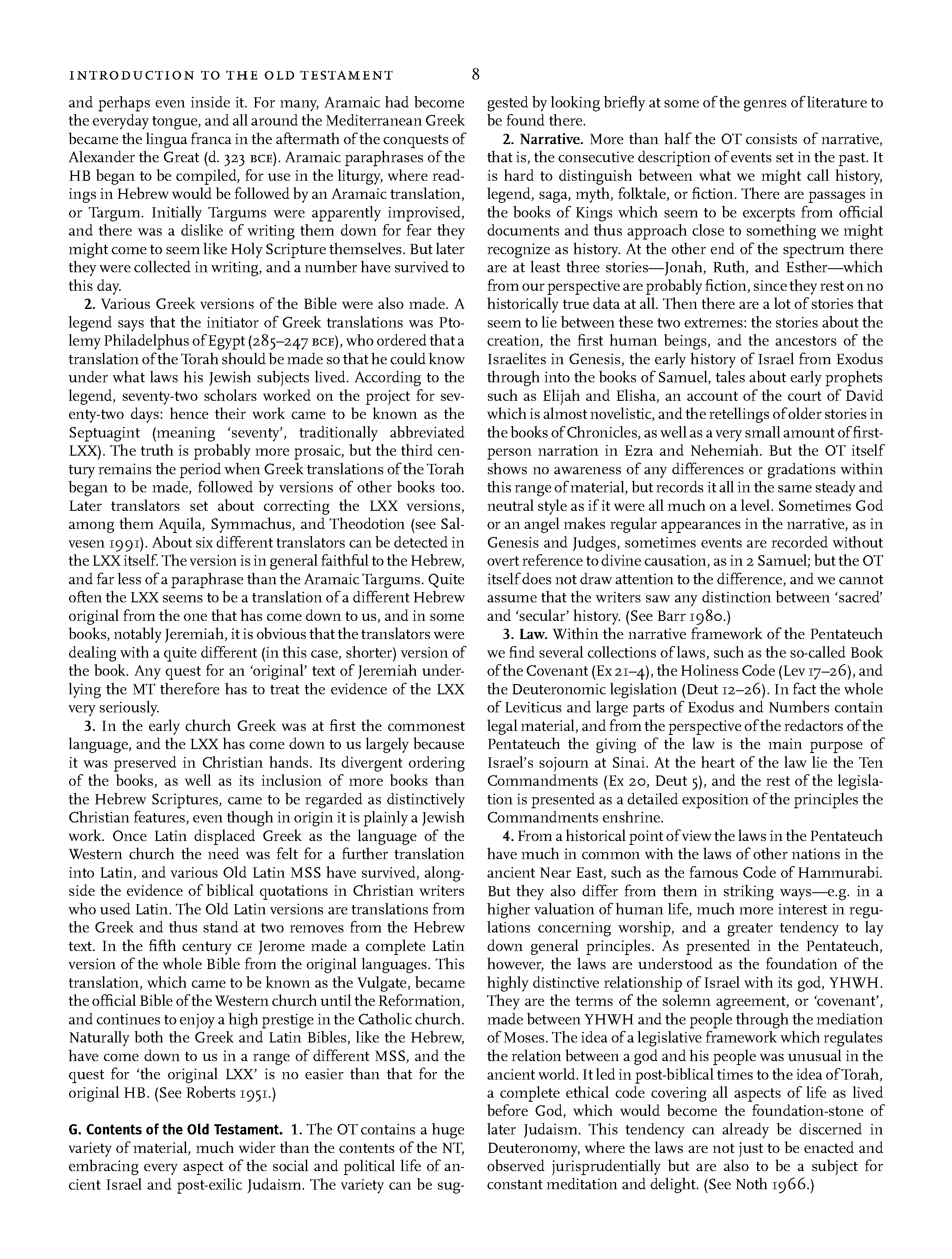
gested by looking briefly at some of the genres of literature to be found there.
and perhaps even inside it. For many, Aramaic had become the everyday tongue, and all around the Mediterranean Greek became the lingua franca in the aftermath of the conquests of Alexander the Great (d. 323 BCE). Aramaic paraphrases of the HB began to be compiled, for use in the liturgy, where readings in Hebrew would be followed by an Aramaic translation, or Targum. Initially Targums were apparently improvised, and there was a dislike of writing them down for fear they might come to seem like Holy Scripture themselves. But later they were collected in writing, and a number have survived to this day.
2. Narrative. More than half the OT consists of narrative, that is, the consecutive description of events set in the past. It is hard to distinguish between what we might call history, legend, saga, myth, folktale, or fiction. There are passages in the books of Kings which seem to be excerpts from official documents and thus approach close to something we might recognize as history. At the other end of the spectrum there are at least three stories—Jonah, Ruth, and Esther—which from our perspective are probably fiction, since they rest on no historically true data at all. Then there are a lot of stories that seem to lie between these two extremes: the stories about the creation, the first human beings, and the ancestors of the Israelites in Genesis, the early history of Israel from Exodus through into the books of Samuel, tales about early prophets such as Elijah and Elisha, an account of the court of David which is almost novelistic, and the retellings of older stories in the books of Chronicles, as well as a very small amount of firstperson narration in Ezra and Nehemiah. But the OT itself shows no awareness of any differences or gradations within this range of material, but records it all in the same steady and neutral style as if it were all much on a level. Sometimes God or an angel makes regular appearances in the narrative, as in Genesis and Judges, sometimes events are recorded without overt reference to divine causation, as in 2 Samuel; but the OT itself does not draw attention to the difference, and we cannot assume that the writers saw any distinction between 'sacred' and 'secular' history. (See Barr 1980.)
2. Various Greek versions of the Bible were also made. A legend says that the initiator of Greek translations was Ptolemy Philadelphus of Egypt (285—247 BCE), who ordered that a translation of the Torah should be made so that he could know under what laws his Jewish subjects lived. According to the legend, seventy-two scholars worked on the project for seventy-two days: hence their work came to be known as the Septuagint (meaning 'seventy', traditionally abbreviated LXX). The truth is probably more prosaic, but the third century remains the period when Greek translations of the Torah began to be made, followed by versions of other books too. Later translators set about correcting the LXX versions, among them Aquila, Symmachus, and Theodotion (see Salvesen 1991). About six different translators can be detected in the LXX itself. The version is in general faithful to the Hebrew, and far less of a paraphrase than the Aramaic Targums. Quite often the LXX seems to be a translation of a different Hebrew original from the one that has come down to us, and in some books, notably Jeremiah, it is obvious that the translators were dealing with a quite different (in this case, shorter) version of the book. Any quest for an 'original' text of Jeremiah underlying the MT therefore has to treat the evidence of the LXX very seriously.
3. Law. Within the narrative framework of the Pentateuch we find several collections of laws, such as the so-called Book of the Covenant (Ex 21-4), the Holiness Code (Lev 17-26), and the Deuteronomic legislation (Deut 12-26). In fact the whole of Leviticus and large parts of Exodus and Numbers contain legal material, and from the perspective of the redactors of the Pentateuch the giving of the law is the main purpose of Israel's sojourn at Sinai. At the heart of the law lie the Ten Commandments (Ex 20, Deut 5), and the rest of the legislation is presented as a detailed exposition of the principles the Commandments enshrine.
3. In the early church Greek was at first the commonest language, and the LXX has come down to us largely becaus it was preserved in Christian hands. Its divergent ordering of the books, as well as its inclusion of more books than the Hebrew Scriptures, came to be regarded as distinctively Christian features, even though in origin it is plainly a Jewish work. Once Latin displaced Greek as the language of the Western church the need was felt for a further translation into Latin, and various Old Latin M S S have survived, alongside the evidence of biblical quotations in Christian writers who used Latin. The Old Latin versions are translations from the Greek and thus stand at two removes from the Hebrew text. In the fifth century CE Jerome made a complete Latin version of the whole Bible from the original languages. This translation, which came to be known as the Vulgate, became the official Bible of the Western church until the Reformation, and continues to enjoy a high prestige in the Catholic church. Naturally both the Greek and Latin Bibles, like the Hebrew, have come down to us in a range of different MSS, and the quest for 'the original LXX' is no easier than that for the original HB. (See Roberts 1951.)
4. From a historical point of view the laws in the Pentateuch have much in common with the laws of other nations in the ancient Near East, such as the famous Code of Hammurabi. But they also differ from them in striking ways—e.g. in a higher valuation of human life, much more interest in regulations concerning worship, and a greater tendency to lay down general principles. As presented in the Pentateuch, however, the laws are understood as the foundation of the highly distinctive relationship of Israel with its god, YHWH. They are the terms of the solemn agreement, or 'covenant', made between YHWH and the people through the mediation of Moses. The idea of a legislative framework which regulates the relation between a god and his people was unusual in the ancient world. It led in post-biblical times to the idea of Torah, a complete ethical code covering all aspects of life as lived before God, which would become the foundation-stone of later Judaism. This tendency can already be discerned in Deuteronomy, where the laws are not just to be enacted and observed jurisprudentially but are also to be a subject for constant meditation and delight. (See Noth 1966.)
G. Contents of the Old Testament. 1. The OT contains a huge variety of material, much wider than the contents of the NT, embracing every aspect of the social and political life of ancient Israel and post-exilic Judaism. The variety can be sug-
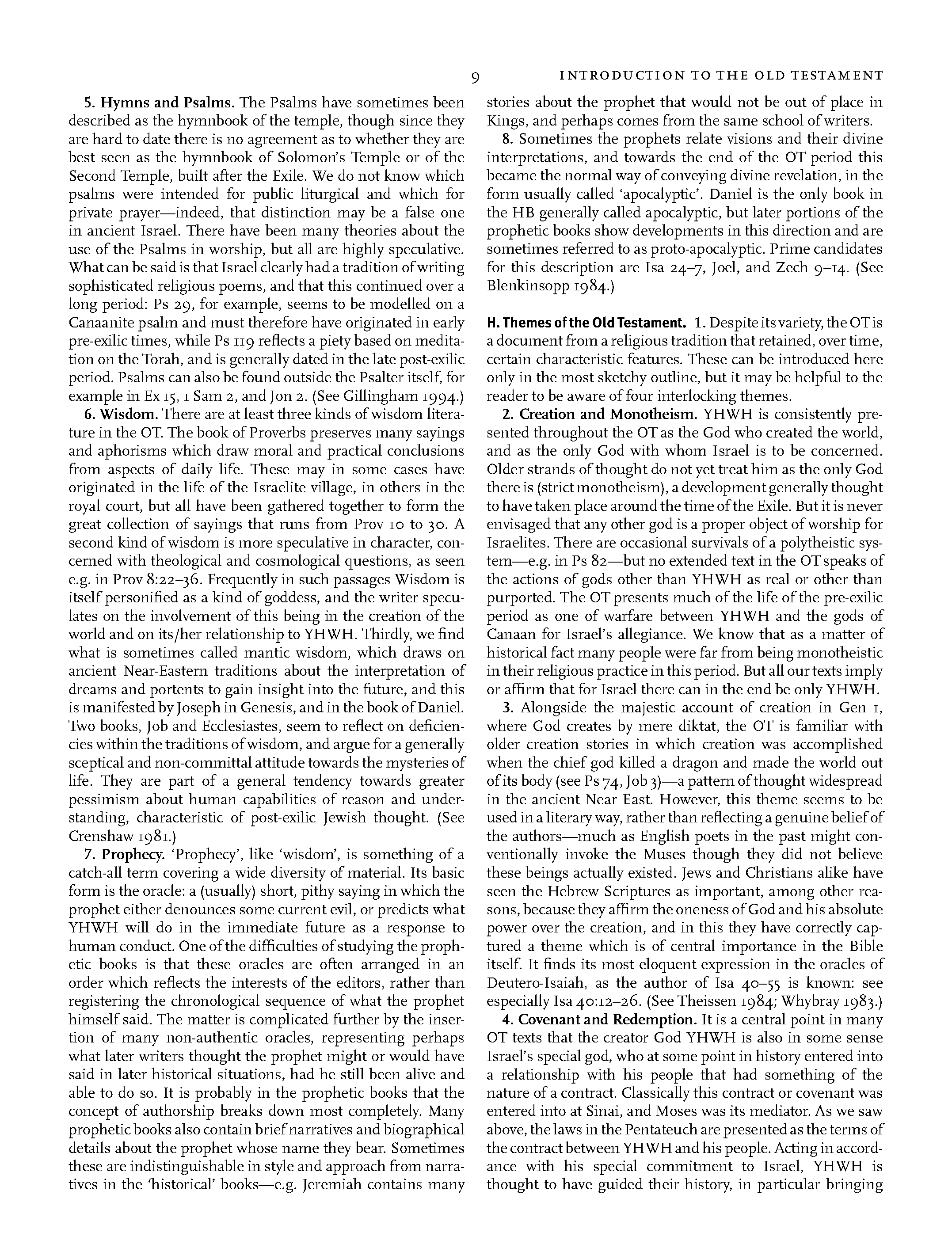
9 INTRODUCTION TO THE OLD TESTAMENT stories about the prophet that would not be out of place in Kings, and perhaps conies from the same school of writers.
5. Hymns and Psalms. The Psalms have sometimes been described as the hymnbook of the temple, though since they are hard to date there is no agreement as to whether they are best seen as the hymnbook of Solomon's Temple or of the
8. Sometimes the prophets relate visions and their divine interpretations, and towards the end of the OT period this became the normal way of conveying divine revelation, in the form usually called 'apocalyptic'. Daniel is the only book in the HB generally called apocalyptic, but later portions of the prophetic books show developments in this direction and are sometimes referred to as proto-apocalyptic. Prime candidates for this description are Isa 24—7, Joel, and Zech 9—14. (See Blenkinsopp 1984.)
Second Temple, built after the Exile. We do not know which psalms were intended for public liturgical and which for private prayer—indeed, that distinction may be a false one in ancient Israel. There have been many theories about the use of the Psalms in worship, but all are highly speculative. What can be said is that Israel clearly had a tradition of writing sophisticated religious poems, and that this continued over a long period: Ps 29, for example, seems to be modelled on a Canaanite psalm and must therefore have originated in early pre-exilic times, while Ps 119 reflects a piety based on meditation on the Torah, and is generally dated in the late post-exilic period. Psalms can also be found outside the Psalter itself, for example in Ex 15, i Sam 2, and Jon 2. (See Gillingham 1994.)
H. Themes of the Old Testament. 1. Despite its variety, the OT is a document from a religious tradition that retained, over time, certain characteristic features. These can be introduced here only in the most sketchy outline, but it may be helpful to the reader to be aware of four interlocking themes.
6. Wisdom. There are at least three kinds of wisdom literature in the OT The book of Proverbs preserves many sayings and aphorisms which draw moral and practical conclusions from aspects of daily life. These may in some cases have originated in the life of the Israelite village, in others in the royal court, but all have been gathered together to form the great collection of sayings that runs from Prov 10 to 30. A second kind of wisdom is more speculative in character, concerned with theological and cosmological questions, as seen e.g. in Prov 8:22—36. Frequently in such passages Wisdom is itself personified as a kind of goddess, and the writer speculates on the involvement of this being in the creation of the world and on its/her relationship to YHWH. Thirdly, we find what is sometimes called mantic wisdom, which draws on ancient Near-Eastern traditions about the interpretation of dreams and portents to gain insight into the future, and this is manifested by Joseph in Genesis, and in the book of Daniel. Two books, Job and Ecclesiastes, seem to reflect on deficiencies within the traditions of wisdom, and argue for a generally sceptical and non-committal attitude towards the mysteries of life. They are part of a general tendency towards greater pessimism about human capabilities of reason and understanding, characteristic of post-exilic Jewish thought. (See Crenshaw 1981.)
2. Creation and Monotheism. YHWH is consistently presented throughout the OT as the God who created the world, and as the only God with whom Israel is to be concerned. Older strands of thought do not yet treat him as the only God there is (strict monotheism), a development generally thought to have taken place around the time of the Exile. But it is never envisaged that any other god is a proper object of worship for Israelites. There are occasional survivals of a polytheistic system—e.g. in Ps 82—but no extended text in the OT speaks of the actions of gods other than YHWH as real or other than purported. The OT presents much of the life of the pre-exilic period as one of warfare between YHWH and the gods of Canaan for Israel's allegiance. We know that as a matter of historical fact many people were far from being monotheistic in their religious practice in this period. But all our texts imply or affirm that for Israel there can in the end be only YHWH.
3. Alongside the majestic account of creation in Gen i, where God creates by mere diktat, the OT is familiar with older creation stories in which creation was accomplished when the chief god killed a dragon and made the world out of its body (see Ps 74, Job 3)—a pattern of thought widespread in the ancient Near East. However, this theme seems to be used in a literary way, rather than reflecting a genuine belief of the authors—much as English poets in the past might conventionally invoke the Muses though they did not believe these beings actually existed. Jews and Christians alike have seen the Hebrew Scriptures as important, among other reasons, because they affirm the oneness of God and his absolute power over the creation, and in this they have correctly captured a theme which is of central importance in the Bible itself. It finds its most eloquent expression in the oracles of Deutero-Isaiah, as the author of Isa 40-55 is known: see especially Isa 40:12—26. (See Theissen 1984; Whybray 1983.)
7. Prophecy. 'Prophecy', like 'wisdom', is something of a catch-all term covering a wide diversity of material. Its basic form is the oracle: a (usually) short, pithy saying in which the prophet either denounces some current evil, or predicts what YHWH will do in the immediate future as a response to human conduct. One of the difficulties of studying the prophetic books is that these oracles are often arranged in an order which reflects the interests of the editors, rather than registering the chronological sequence of what the prophet himself said. The matter is complicated further by the insertion of many non-authentic oracles, representing perhaps what later writers thought the prophet might or would have said in later historical situations, had he still been alive and able to do so. It is probably in the prophetic books that the concept of authorship breaks down most completely. Many prophetic books also contain brief narratives and biographical details about the prophet whose name they bear. Sometimes these are indistinguishable in style and approach from narratives in the 'historical' books—e.g. Jeremiah contains many
4. Covenant and Redemption. It is a central point in many OT texts that the creator God YHWH is also in some sense Israel's special god, who at some point in history entered into a relationship with his people that had something of the nature of a contract. Classically this contract or covenant was entered into at Sinai, and Moses was its mediator. As we saw above, the laws in the Pentateuch are presented as the terms of the contract between YHWH and his people. Acting in accordance with his special commitment to Israel, YHWH is thought to have guided their history, in particular bringing
INTRODUCTION TO THE OLD TESTAMENT
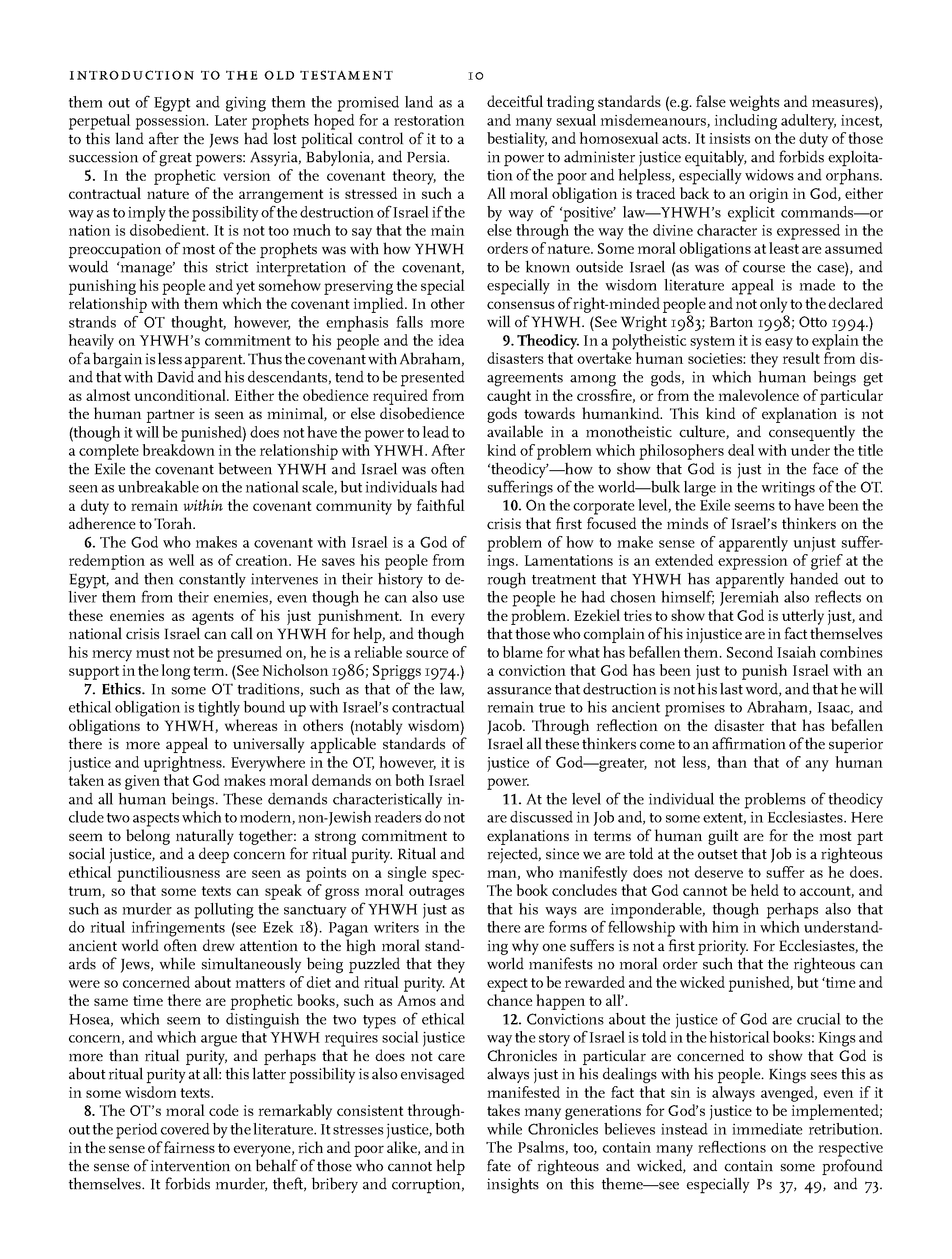
deceitful trading standards (e.g. false weights and measures), and many sexual misdemeanours, including adultery, incest, bestiality, and homosexual acts. It insists on the duty of those in power to administer justice equitably, and forbids exploitation of the poor and helpless, especially widows and orphans. All moral obligation is traced back to an origin in God, either by way of 'positive' law—YHWH's explicit commands—or else through the way the divine character is expressed in the orders of nature. Some moral obligations at least are assumed to be known outside Israel (as was of course the case), and especially in the wisdom literature appeal is made to the consensus of right-minded people and not only to the declared will of YHWH. (See Wright 1983; Barton 1998; Otto 1994.)
them out of Egypt and giving them the promised land as a perpetual possession. Later prophets hoped for a restoration to this land after the Jews had lost political control of it to a succession of great powers: Assyria, Babylonia, and Persia.
5. In the prophetic version of the covenant theory, the contractual nature of the arrangement is stressed in such a way as to imply the possibility of the destruction of Israel if the nation is disobedient. It is not too much to say that the main preoccupation of most of the prophets was with how YHWH would 'manage' this strict interpretation of the covenant, punishing his people and yet somehow preserving the special relationship with them which the covenant implied. In other strands of OT thought, however, the emphasis falls more heavily on YHWH's commitment to his people and the idea of a bargain is less apparent. Thus the covenant with Abraham, and that with David and his descendants, tend to be presented as almost unconditional. Either the obedience required from the human partner is seen as minimal, or else disobedience
9. Theodicy. In a polytheistic system it is easy to explain the disasters that overtake human societies: they result from disagreements among the gods, in which human beings get caught in the crossfire, or from the malevolence of particular gods towards humankind. This kind of explanation is not available in a monotheistic culture, and consequently the kind of problem which philosophers deal with under the title 'theodicy'—how to show that God is just in the face of the sufferings of the world—bulk large in the writings of the OT.
(though it will be punished) does not have the power to lead to a complete breakdown in the relationship with YHWH. After the Exile the covenant between YHWH and Israel was often seen as unbreakable on the national scale, but individuals had a duty to remain within the covenant community by faithful adherence to Torah.
10. On the corporate level, the Exile seems to have been the crisis that first focused the minds of Israel's thinkers on the problem of how to make sense of apparently unjust sufferings. Lamentations is an extended expression of grief at the rough treatment that YHWH has apparently handed out to the people he had chosen himself; Jeremiah also reflects on the problem. Ezekiel tries to show that God is utterly just, and that those who complain of his injustice are in fact themselves to blame for what has befallen them. Second Isaiah combines a conviction that God has been just to punish Israel with an assurance that destruction is not his last word, and that he will remain true to his ancient promises to Abraham, Isaac, and Jacob. Through reflection on the disaster that has befallen Israel all these thinkers come to an affirmation of the superior justice of God—greater, not less, than that of any human power.
6. The God who makes a covenant with Israel is a God of redemption as well as of creation. He saves his people from Egypt, and then constantly intervenes in their history to deliver them from their enemies, even though he can also use these enemies as agents of his just punishment. In every national crisis Israel can call on YHWH for help, and though his mercy must not be presumed on, he is a reliable source of support in the long term. (See Nicholson 1986; Spriggs 1974.)
7. Ethics. In some OT traditions, such as that of the law, ethical obligation is tightly bound up with Israel's contractual obligations to YHWH, whereas in others (notably wisdom) there is more appeal to universally applicable standards of justice and uprightness. Everywhere in the OT, however, it is taken as given that God makes moral demands on both Israel and all human beings. These demands characteristically include two aspects which to modern, non-Jewish readers do not seem to belong naturally together: a strong commitment to social justice, and a deep concern for ritual purity. Ritual and ethical punctiliousness are seen as points on a single spectrum, so that some texts can speak of gross moral outrages such as murder as polluting the sanctuary of YHWH just as do ritual infringements (see Ezek 18). Pagan writers in the ancient world often drew attention to the high moral standards of Jews, while simultaneously being puzzled that they were so concerned about matters of diet and ritual purity. At the same time there are prophetic books, such as Amos and Hosea, which seem to distinguish the two types of ethical concern, and which argue that YHWH requires social justice more than ritual purity, and perhaps that he does not care about ritual purity at all: this latter possibility is also envisaged in some wisdom texts.
11. At the level of the individual the problems of theodicy are discussed in Job and, to some extent, in Ecclesiastes. Here explanations in terms of human guilt are for the most part rejected, since we are told at the outset that Job is a righteous man, who manifestly does not deserve to suffer as he does. The book concludes that God cannot be held to account, and that his ways are imponderable, though perhaps also that there are forms of fellowship with him in which understanding why one suffers is not a first priority. For Ecclesiastes, the world manifests no moral order such that the righteous can expect to be rewarded and the wicked punished, but 'time and chance happen to all'.
12. Convictions about the justice of God are crucial to the way the story of Israel is told in the historical books: Kings and Chronicles in particular are concerned to show that God is always just in his dealings with his people. Kings sees this as manifested in the fact that sin is always avenged, even if it takes many generations for God's justice to be implemented; while Chronicles believes instead in immediate retribution. The Psalms, too, contain many reflections on the respective fate of righteous and wicked, and contain some profound insights on this theme—see especially Ps 37, 49, and 73.
8. The OT's moral code is remarkably consistent throughout the period covered by the literature. It stresses justice, both in the sense of fairness to everyone, rich and poor alike, and in the sense of intervention on behalf of those who cannot help themselves. It forbids murder, theft, bribery and corruption,
INTRODUCTION TO THE OLD TESTAMENT
There are, in fact, few books in the OT where the theme of ^
The Hebrew Bible theodicy is absent. (see Crenshaw 1083.)
Greek ffible
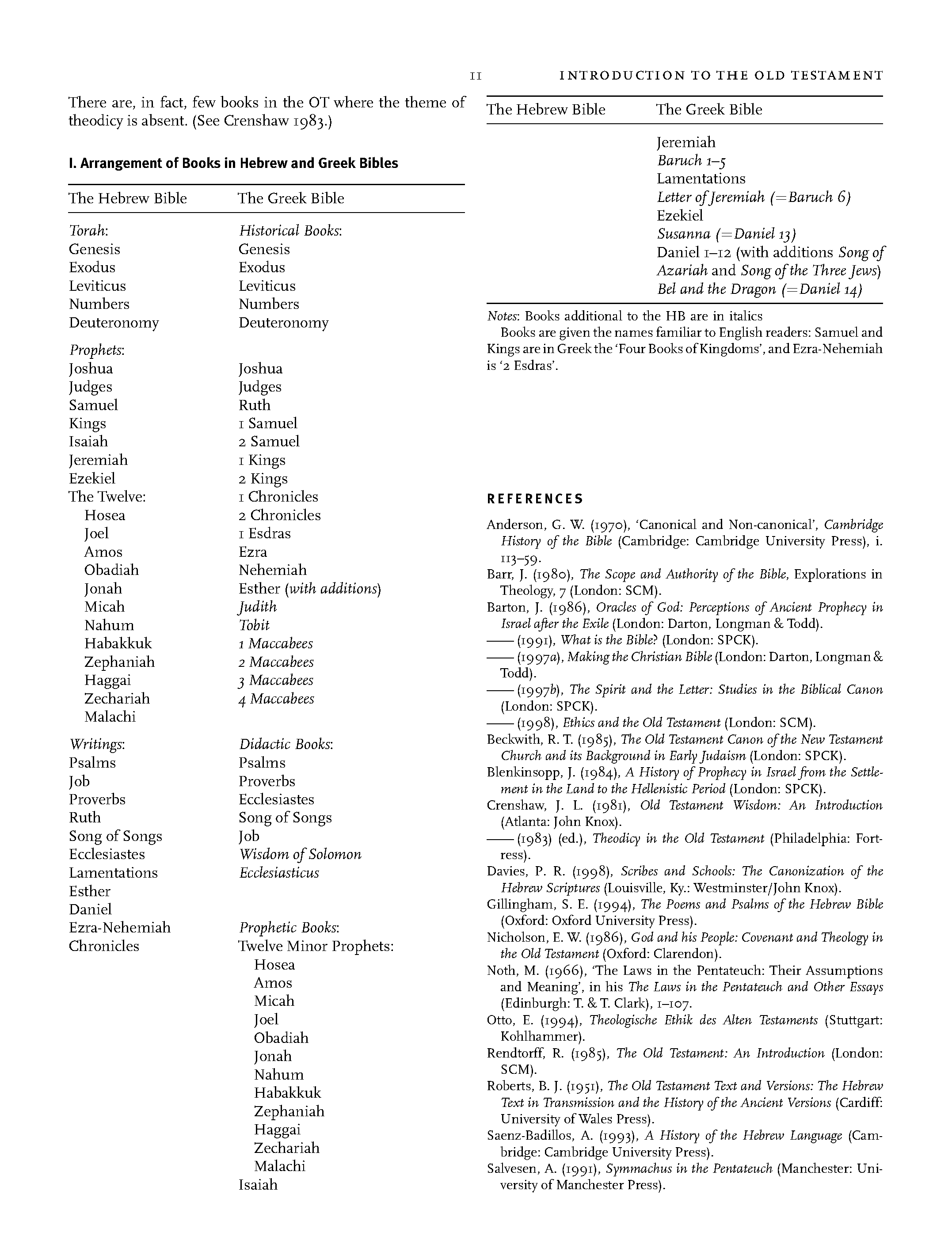
Jeremiah Baruch 1—5 Lamentations Letter of Jeremiah (= Baruch 6) -p 1 ' 1 Ezekiel Susanna (=Daniel 13) Daniel 1—12 (with additions Song of Azariah and Song of the Three Jews)
1. Arrangement of Books in Hebrew and Greek Bibles
The Hebrew Bible The Greek Bible
Torah: Historical Books: Genesis Genesis Exodus Exodus Leviticus Leviticus Numbers Numbers Deuteronomy Deuteronomy
Bel and the Dragon (= Daniel 14)
Notes: Books additional to the HB are in italics
Books are given the names familiar to English readers: Samuel and Kings are in Greek the 'Four Books of Kingdoms', and Ezra-Nehemiah is '2 Esdras'.
Prophets: Joshua Joshua Judges Judges Samuel Ruth Kings i Samuel Isaiah 2 Samuel Jeremiah i Kings Ezekiel 2 Kings The Twelve: i Chronicles Hosea 2 Chronicles Joel i Esdras Amos Ezra Obadiah Nehemiah Jonah Esther (with additions) Micah Judith Nahum Tobit Habakkuk i Maccabees Zephaniah 2 Maccabees Haggai 3 Maccabees Zechariah 4 Maccabees * * i i • Malachi
Anderson, G. W. (1970), 'Canonical and Non-canonical', Cambridge
History of the Bible (Cambridge: Cambridge University Press), i. 113-59. Barr, J. (1980), The Scope and Authority of the Bible, Explorations in
Theology, 7 (London: SCM). Barton, J. (1986), Oracles of God: Perceptions of Ancient Prophecy in
Israel after the Exile (London: Darton, Longman & Todd).
(IQQI) What is the Bible^1 (London" SPCK) I1 J J7al' MaKingme innsnan aime (Lonaon. uarton, Longman & Todd).
(1997b). The spirit and the letter: Studies in the Biblical canon
(London: SPCK).
(1998), Ethics and the Old Testament (London: SCM). Beckwith, R. T. (1985), The Old Testament Canon of the New Testament
Writings: Didactic Books: Psalms Psalms Job Proverbs Proverbs Ecclesiastes Ruth Song of Songs Song of Songs Job Ecclesiastes Wisdom of Solomon Lamentations Ecclesiasticus Esther Daniel Ezra-Nehemiah Prophetic Books: Chronicles Twelve Minor Prophets:
Church and its Background in Early Judaism (London: SPCK). Blenkinsopp, J. (1984), A History of Prophecy in Israel from the Settlement in the Land to the Hellenistic Period (London: SPCK). Crenshaw, J. L. (1981), Old Testament Wisdom: An Introduction
(Atlanta: John Knox).
(1983) (ed.), Theodicy in the Old Testament (Philadelphia: Fortress). Davies, P. R. (1998), Scribes and Schools: The Canonization of the
Hebrew Scriptures (Louisville, Ky.: Westminster/John Knox). Gillingham, S. E. (1994), The Poems and Psalms of the Hebrew Bible
(Oxford: Oxford University Press). Nicholson, E. W. (1986), God and his People: Covenant and Theology in the Old Testament (Oxford: Clarendon). Noth, M. (1966), 'The Laws in the Pentateuch: Their Assumptions
Hosea Amos Micah Joel Obadiah Jonah Nahum Habakkuk Zephaniah Haggai Zechariah Malachi Isaiah and Meaning', in his The Laws in the Pentateuch and Other Essays (Edinburgh: T. &T. Clark), 1-107. Otto, E. (1994), Theologische Ethik des Alien Testaments (Stuttgart:
Kohlhammer). Rendtorff R. (1985), The Old Testament: An Introduction (London:
SCM). Roberts, B. J. (1951), The Old Testament Text and Versions: The Hebrew
Text in Transmission and the History of the Ancient Versions (Cardiff: University of Wales Press). Saenz-Badillos, A. (1993), A History of the Hebrew Language (Cambridge: Cambridge University Press). Salvesen, A. (1991), Symmachus in the Pentateuch (Manchester: University of Manchester Press).
INTRODUCTION TO THE PENTATEUCH
Smend, R. (1981), Die Entstehung des Alten Testaments (Stuttgart: Kohl-
Theissen, G. (1984), Biblical Faith: An Evolutionary Perspective (London: SCM). Weingreen, J. (1982), Introduction to the Critical Study of the Text of the hammer). Spriggs, D. S. (1974), Two Old Testament Theologies (London: SCM). Sundberg, A. C. (1964), The Old Testament of the Early Church (Cam-
Hebrew Bible (Oxford: Oxford University Press). Whybray, R. N. (1983), The Second Isaiah, Old Testament Guides bridge, Mass.: Yale University Press).
(1968), The "Old Testament": A Christian Canon', CBO 30: H3-55Talmon, S. (1970), 'The Old Testament Text', Cambridge History
(Sheffield: Academic Press). Wright, C. J. H. (1983), Living as the People of God (Leicester: Intervarsity Press). Wurthwein, E. (1979), The Text of the Old Testament: An Introduction to of the Bible (Cambridge: Cambridge University Press), i. 15998.
the Biblia Hebraica (Grand Rapids: Eerdmans).
3. Introduction to the Pentateuch G. I. DAVIES
A. What is the Pentateuch? 1. The name 'Pentateuch' means literally 'the work comprising five scrolls', from Greek pente and teukhos, which can mean 'scroll'. It has been used since at least early Christian times for the first five books of the OT, Genesis to Deuteronomy. The Jewish name for these books was usually and still is 'the law': Hebrew torn, Greek nomos or nomothesia (the latter is literally 'legislation'), and it is this name which appears in the NT: e.g. Lk 24:11, 'What is written in the law, the prophets and the psalms', where we meet the threefold subdivision of the Hebrew canon that continues to be used, with the substitution of'writings' for 'psalms' as the third section. Cf. also the Greek Prologue to Sirach (£.132 BCE).
ical' before 'creed' raises some problems, for example whether the story which the Pentateuch as a whole tells is real history, a question whose answer has important theological implications which critics of von Rad were quick to point out. But there are also problems of a simpler kind which relate specifically to its accuracy as a description of Genesis i-n. Von Rad was, for much of his scholarly career, fascinated by the historical focus of so much of Israel's faith, and he tended to overlook or play down its teaching about God the Creator. This may well have been due to an understandable wish on his part not to allow a foothold in the OT for crude Nazi ideas about racial supremacy grounded in the order of creation which were current at the time he wrote his earliest works on the Hexateuch. It is, nevertheless, necessary to emphasize that the beginning of Genesis is not about history in the ordinary sense of that word, or indeed in any sense, and the idea that the Pentateuch is a 'historical' creed is in danger of losing sight of the important theological statements about creation in those chapters.
2. But there is a much deeper way of asking, and answering, the question, 'What is the Pentateuch?', one which goes beyond merely defining its external limits to enquire into its nature. In other words, what sort of a thing is this section of the Bible? This question can only really be answered after a full examination of the text, and one justification for the kind of detailed critical analysis which has been popular in modern OT scholarship is that it enables us to give a well-judged (if complicated!) answer to that question. It is a question of considerable theological importance, as can be seen from an introductory look at a few answers that have been given to it, some of which will be examined more fully later on.
2.4. A different way of representing the theological character of the Pentateuch is of course the traditional Jewish expression: the law. This is as characteristic of Judaism as von Rad's emphasis on faith is characteristic of his Lutheranism. If it seems at first sight to focus too much on the second half of the Pentateuch, where the laws are concentrated, and to give insufficient attention to the 'story' character of the earlier books, it is worth saying that this problem has not escaped the notice of Jewish commentators, and a very early one, Philo of Alexandria, in the first century CE, had what he thought was a perfectly satisfactory answer to it. It is that while written law is indeed mainly found in the later books of the Pentateuch, the personalities who appear in Genesis, for example, constitute a kind of'living law', since through their example, and in some less obvious ways, it was God's intention to regulate human behaviour, just as he does later by the written law. Another way of making the description 'law' more widely applicable involves going back to the Hebrew term torn. Although commonly translated 'law', its original meaning is something like 'instruction', and it could be used of other kinds of instruction as well as law in the strict sense. For example, the word torn is found in Proverbs, where the context shows that the reference is to the kind of teaching contained there, not to the law as such. If we use tora as a description for the Pentateuch in this more general sense of 'teaching' or 'instruction', it can easily embrace the non-legal parts of these books as well as the legal ones. On the other hand, while tora
2.1. Four of the five books in the Pentateuch deal with the time of Moses, and one recent suggestion has been that we should think of the Pentateuch as a biography of Moses with an introduction, that is, Genesis. This attempts to answer the question in terms of the literary genre of the Pentateuch.
2.2. Its main weakness, however, is that it puts Moses as an individual too much in the centre of the picture, important as he undoubtedly is as the leader of his people Israel. We might do better to call the Pentateuch the story of Israel in the time of Moses, with an introduction (Genesis) which sets it in the light of universal creation and history.
2.3. To many, however, this would not be theological enough to do justice to the strongly religious element that pervades the story from beginning to end. Gerhard von Rad suggested that the Pentateuch (or to be more precise, the Hexateuch, that is the Pentateuch plus the sixth book of the Bible, Joshua—see below) was an amplified creed, more specifically an amplified historical creed, as will be seen in more detail later. The implication is then that the Pentateuch is a product and an expression of faith—it is preceded as it were by an implicit 'I believe in God who...', it is a confessional document, as one might put it. Of course the adjective 'histor-
13 INTRODUCTION TO THE PENTATEUCH another. If nothing else this view serves to underline the differences in character, concerns, and origin of Deuteronomy, as compared with the earlier books. Yet those differences should not be exaggerated, and it can be argued that Deuteronomy belongs as much with the Tetrateuch as with the books that follow it, and when we come to look at the theology of the Pentateuch in more detail that will become clearer.
understood in this wider way does preserve an important truth about the Pentateuch (especially if it is thought of as 'The Teaching', with a capital T), it is in danger of being too vague a description to identify its distinctive character within theOT.
2.5. Another theological definition, which has the merit of combining the advantages of the last two, is to call the Pentateuch a covenant book, a document which presents the terms of God's relationship to his people, in the form of his promises to them and the laws which he requires them to obey. The support of the apostle Paul can probably be claimed for this description, for when he speaks of'the old covenant' in 2 Cor 3:14 it is very likely that he means specifically the Pentateuch. He is clearly thinking of a written document, because he refers to the 'reading' of the old covenant, and the substitution of the expression 'whenever Moses is read' in the following verse points firmly to the Pentateuch (for 'Moses' as shorthand for 'the books of Moses' see Lk 24:27). A somewhat earlier Jewish reference to the Pentateuch as 'the book of the covenant' occurs in i Mace 1:57. Despite the antiquity and authority of this description, it scarcely does justice to the narrative element in the Pentateuch, especially in Genesis.
B. The Documentary Hypothesis. 1. To make further progress with our question, 'What is the Pentateuch?', we need to dig deeper and consider more closely how it came to exist and what kinds of material it is made up of. A useful way into such study is to review, critically where necessary, the main directions which Pentateuchal scholarship has taken over the past century and a half (see also Clements 1997: ch. 2).
2. The year 1862 was auspicious for the development of Pentateuchal study in England and Germany. It was in that year that Julius Wellhausen went, at the age of 18, as a new student to the German university of Gottingen to study theology. That same year a young British student, T. K. Cheyne, was also in Gottingen, and he was to play an important part in bringing Wellhausen's later ideas to prominence in Britain— he became a professor at Oxford. The year 1862 was also when a series of books by John Colenso, a Cambridge mathematician, began to be published, and so brought critical OT scholarship very much into the public eye in Britain only shortly after the publication of Charles Darwin's Origins of Species and the collection called Essays and Reviews. And yet by 1862 the critical study of the Pentateuch was already some 150 years old.
2.6. A description which combines the literary and the theological aspects has been proposed by David Clines: he regards the Pentateuch as the story of the partial fulfilment of the promise to the patriarchs. This has the great advantage of highlighting the important theological theme of promise in Genesis, and of showing how Genesis is linked to the later books theologically, and not just by the continuation of the story. But of course it says nothing about Gen i—n, and one may wonder whether it takes enough account of the vast amount of legislative material in Leviticus and Deuteronomy especially.
3. There is no need to amplify this statement here—the details are in most Introductions to the OT—except to say that particularly since about 1800 strenuous efforts had been made, chiefly in Germany, to discover the process by which the Pentateuch had reached its present form, and that at the beginning of the i86os the leading scholars held to what was known as the Supplementary Hypothesis (Ergdnzungshypothese). According to this, the original core of the Pentateuch was a document known as the Book of Origins (Das Buch der
2.7. One might legitimately wonder whether there can be any brief answer to the question which is not open to some objection or another! If nothing else these quite different descriptions, and the comments on them, should have shown thatthe Pentateuch is a many-sided piece ofliterature and one which has features which appeal to a variety of religious and other points of view. The final description that I will mention is that the Pentateuch is an incomplete work, a torso, because the story which it tells only reaches its climax in the book of Joshua, with the Israelites' entry into the land of Canaan. For von Rad, as we saw, the real literary unit is the 'Hexateuch', 'the six books', and he had many predecessors who also took this view. It was especially popular among the source-critics of the late nineteenth and early twentieth centuries, who believed (as some still do) that the sources out of which the Pentateuch was composed were also used by the editor or editors who composed Joshua. It is less popular today, because Joshua is generally treated as part of the long historical work which extends to the end of 2 Kings, the Deuteronomistic History. In fact since Deuteronomy formed the introduction to that work and, even when taken alone, its connection with the first four books of the Bible can seem very weak, some scholars therefore speak of 'the Tetrateuch', that is the four books from Genesis to Numbers, as the primary literary unit at the beginning of the Bible. From this point of view the Pentateuch would be not so much a torso as a hybrid, the combination of one literary work with the first section of
Urspriinge), which was put together by a priest or Levite in about the time of King Solomon. A distinguishing mark of this book was that in Genesis and the beginning of Exodus (up to ch. 6) it avoided using the name YHWH for God, and employed other words, especially 'elohim, which means 'God', instead. This core, it was held, was expanded in the eighth century BCE, the time of the first great classical prophets, by the addition of stories and other matter in which the name YHWH was freely used from the very beginning. Later still, in the time of Jeremiah (7th cent), the work was further supplemented by the addition of the major part of Deuteronomy and shorter sections with a similar spirit elsewhere, and so the Pentateuch reached its present form, before the Babylonian Exile. Wellhausen's teacher at Gottingen, Heinrich Ewald, had played an important part in the development of this theory and still held to it in its essential points in 1862, though not with the rigidity of some of its other adherents.
4. But changes were in the air. An important challenge to this theory had already been made by the publication in 1853 of a book by Hermann Hupfeld. Its main theses were: (i) that the so-called 'original core' contained some passages which
the Pentateuch was a Book of Origins that began with the account of creation in Gen i and included most of the priestly laws in Exodus, Leviticus, and Numbers. Doubts about the antiquity of these texts had already been expressed in the 18303, but detailed critical arguments only began to appear in the early i86os. One can see this in the work of the Dutch scholar Abraham Kuenen (1828—91), whose Introduction to the OT began to be published in 1861. Kuenen, who accepted Hupfeld's division of the Book of Origins into earlier and later layers, also held that the priestly laws in the supposedly earlier layer were not in fact all ancient but had developed over a long period of time, some of them being later in date than Deuteronomy. An even more radical conclusion had been reached by a German schoolteacher, Karl Heinrich Graf, who on 7 October 1862 wrote to his former OT professor, one Eduard Reuss, T am completely convinced of the fact that the whole middle part of the Pentateuch [apparently Exodus 25 to the end of Numbers] is post-exilic in origin,' i.e. it all belongs to the final, not the first, stage of the growth of the Pentateuch, after the writing of Deuteronomy. Wellhausen himself, looking back on his early student days, also in the early i86os, wrote that he had been puzzled at the lack of reference to the allegedly very old priestly laws in the early historical books such as Samuel and Kings and in the prophets, though he had no idea at the time why this was. It was not until 1865 that these very new ideas came out into the open, when Graf published his views in book form. But while he maintained that all the legal parts of the Book of Origins were post-exilic in origin, he still held to the traditional early date for its narratives. In response to the appearance of Graf's book Kuenen now argued that the were of later origin than the rest and represented a first stage of expansion of the core; and (2) that both these later passages and the passages which the Supplementary Hypothesis itself had distinguished from the core were not fragments picked up from all over the place but had been parts of large preexisting narrative compositions which the compilers of the Pentateuch had drawn on as sources.
5. Hupfeld thus did two things. He refined the analysis of the Pentateuch into its component parts, which were now seen to be not three but four in number, and he replaced the idea of the expansion of an original core with a truly documentary theory of Pentateuchal origins. His four originally independent source-documents correspond closely in extent to those of later theories, three parallel narrative sources and the law-code of Deuteronomy (with some other passages related to it). His oldest narrative corresponds closely to what is now called the Priestly Work (P), the remainder of the Book of Origins is the later Elohist (E), and the sourc which uses the name YHWH is the Yahwist (J). Hupfeld did not depart from the dominant view at the time about the relative ages of the materials in these sources, and his position can be represented in terms of the modern symbols for them as P-E-J-D (for a fuller account of the sources as later understood see sections c.j and G).
Hupfeld's new ideas did not succeed in displacing the dominant Supplementary Hypothesis, at any rate not immediately. But some time before 1860 Ewald had recognized the existence of a second Elohist and the character of J and E as continuous sources—which places him very close to Hupfeld. A. Knobel, though less well-known, had reached similar conclusions independently of Hupfeld about the same time, and over a larger range of texts. His work is ignored in most modern accounts of the history of Pentateuchal criticism (though not by Wellhausen) and deserves greater recognition. These scholars brought the analysis of the Pentateuch to a state which received only relatively minor modification at the hands of those such as Wellhausen, whose work was to become the classical account of Pentateuchal origins and indeed remained so until very recently. Hupfeld's contribution at least was fully recognized: Wellhausen, for example, wrote in his own work on the composition of the Hexateuch: 'I make Hupfeld in every respect my startingpoint.' Where he and subsequent scholarship departed from Hupfeld was in the chronological order in which the sources were to be placed.
Book of Origins could not be divided up in this way, because the narratives were intimately related to the laws; so, if
(as Graf had so powerfully demonstrated) the laws were late in origin, the narratives associated with them in the 'earlier' part of the Book of Origins must be late too. Graf's letter to Kuenen accepting the validity of this point survives—it is dated 12 Nov. 1866—and subsequently Graf put this change of mind into print in an article in which he responded to various criticisms of his book, though the article only came out in 1869 after Graf's death. In this way the order (as represented by the modern symbols) P-E-J-D of Hupfeld was transformed into the J-E-D-P that became standard.
8. It is clear that Abraham Kuenen played a very important part in the development of this revised theory, although it (like Knobel's contribution) is often overlooked. What is interesting is that Kuenen gave a great deal of the credit for the contribution which he himself was able to make to John Colenso's series of volumes entitled The Pentateuch and The Book of Joshua Critically Examined. These books were one reason why an attempt was made to depose Colenso from the see of Natal, which he held, an attempt which was only the beginning of a long wrangle in the Anglican Church in South Africa. Much of what Colenso wrote merely echoed what was already being done in Germany, but in the first volume of the study he presented what seemed to him to be a devastating attack on the genuineness of the narratives of the Book of Origins and particularly the large numbers which they give for the participants in the Exodus (e.g. Ex 12:37), the very thing which had seemed to others a guarantee of the accuracy and
6. Two changes were in fact made. One, the placing of the YHWH-source—what we now call J—before the second Elohim-source—what we now call E—did not make a fundamental difference to the time at which either source was thought to have been written, and we shall not spend long on it. Once Hupfeld had made the separation between E and P it was really inevitable, as it was the supposed antiquity of the P texts which had led to the idea that the Book of Origins was the earliest source. When E was detached from this, it could easily be seen that in certain respects it had a more sophisticated approach to religion than the rather primitive J, and so it was natural to date it a little later.
7. The second change in order was much more decisive, in fact it was quite revolutionary. According to both the Supplementary Hypothesis and Hupfeld's theory, the oldest part of
15 INTRODUCTION TO THE PENTATEUCH and involved a number of different scholars in several countries. But it also begins to open up a topic of quite central importance at the present time when some very searching questions are once again being asked about the validity of what, for brevity, we may continue to call Wellhausen's theory.
antiquity of the source; on the contrary, argued Colenso, it was quite impossible that the numbers could represent real historical facts: they must be fictional. This argument so impressed Kuenen that he found no difficulty at all in regarding those narratives, as well as the priestly laws which Graf had examined, as a late and artificial composition.
9. It is evident from all this that the classical documentary theory of Pentateuchal origins owes little or nothing, as far as its origin is concerned, to Wellhausen: this was mainly the work of Hupfeld, Graf, and Kuenen, themselves of course building on much earlier work. To call it 'the Wellhausen theory', as is often done, is a misnomer, though a revealing one. What the new theory still needed, and what Wellhausen was to provide, was a presentation of it which would convince the many scholars who still held either to the Supplementary Hypothesis or to Hupfeld's version of the documentary theory. The work in which Wellhausen did this so successfully was originally called History of Israel. Volume I (Geschichte
C. The Logic of Source-Criticism. It is in fact possible to distinguish, logically at least and to some extent chronologically as well, four stages in the argument which led to the formulation of Wellhausen's account of the origins of the Pentateuch, and if we define them appropriately we shall find that they are quite generally applicable to all attempts to analyse the Pentateuch into its constituent parts, and indeed to all attempts at discovering what sources were used in biblical and other writings.
1. The first step was the acceptance that an enquiry into the sources of the Pentateuch was permissible at all, i.e. that it was not ruled out by the tradition which regarded Moses as the author of the whole Pentateuch. This tradition goes back to the NT and contemporary writings, though it is probably not implied by anything in the OT text itself. Clearly if this tradition is not open to question, there is little room for Pentateuchal criticism of any kind: one could only enquire into the sources that Moses may have used for the writing of Genesis, which is exactly what one early work of criticism, published in 1753, purported to uncover (Jean Astruc's Conjectures sur les memoires originaux dont il paroit que Moyse s'est servi pour composer le livre de la Genese). The reasons for questioning the tradition of Mosaic authorship of the Pentateuch are broadly of two kinds: (i) the relatively late date of the first appearance of this tradition (not at any rate before the Babylonian exile); (2) various data in the Pentateuch itself which seem to be inconsistent with it: an obvious one is the account of Moses' death (Deut 34).
Israels I)—when no further volumes appeared this was changed to Prolegomena to the History of Israel (Prolegomena zur Geschichte Israels)—and it was published in 1878. It is still worth reading and its thorough attention to detail, its treatment of evidence from all parts of the OT, and the force and vigour of its arguments still make a strong impression on the reader.
10. Two criticisms are often made of it. The first is that it embodies a Hegelian view of history which has been imposed upon the data of the OT (so e.g. W F. Albright and R. K. Harrison). This is not justified as a criticism of Wellhausen's method of working, whatever similarities may be traced between some of his conclusions and those of Hegel-inspired history-writing. It is a complicated issue but essentially it seems that what Wellhausen did was to approach the Pentateuch as a secular ancient historian would approach his primary sources in an effort to discover their character and closeness to the events described: his presuppositions and methods are those of a historian rather than those of a philosopher, and not significantly different from those with which more recent historians have worked. Where he does refer to Hegel once it seems to be an implied criticism. The other criticism is that Wellhausen presented his theory in isolation from knowledge of the ancient Near East, which makes it of no more than antiquarian interest: so Harrison again and especially K. A. Kitchen. Wellhausen did not of course have the benefit of knowing many of the archaeological discoveries of subsequent years, and what he did know he did not regard as of primary importance for interpreting the OT (unlike Gunkel: see below). But the main structure of his sourcecritical arguments has seemed to most subsequent scholars to be unaffected by these discoveries, rightly in my opinion. Where they have departed from them it has been because they sensed weaknesses in his treatment of the OT evidence, and not because of fresh evidence from the ancient Near East.
2. The second step was the analysis of the text, the demonstration of its lack of unity in detail. In the eighteenth century, well before the formulation of the Wellhausen theory, theories had been developed to account for what seemed to be signs of composite authorship, or the use of sources. Some passages, such as the Flood Story, appeared to arise from the combination of two originally separate accounts of the same event. In other cases it seemed unlikely or even impossible that two separate passages could have belonged to the same continuous account, the two creation stories for example. In the history of Pentateuchal criticism the distinction between this, analytical, stage of the enterprise and the next stage, synthesis or the attribution of passages or parts of passages to a particular source or layer of the Pentateuch, has not always been carefully observed. Indeed a clear distinction is perhaps not to be found before the handbook of Wolfgang Richter (Exegese als Literaturwissenschaft, 1971). But the two operations can and should be regarded as separate. To put it in a quite general formula: if ABCD represents a section of the Pentateuch, the assertion that A is of separate origin from B and that C is of separate origin from D is one thing; but the question of whether A belongs to the same source as C or D or neither, for example, is another question, and different answers to it will produce different theories about the larger sources of the Pentateuch.
11. This briefhistorical introduction to the origins of the socalled Graf-Wellhausen theory about the sources of the Pentateuch should have removed some misconceptions about it, and in particular it has shown that far from being the product of one man's mind it was arrived at through a process of research and discussion which lasted over several decades
over criteria such as 3 and 4 at c.2 above to argue that sections of the Pentateuch have a common source.
So on what basis is it argued that the Pentateuch is of composite origin? Four main kinds of criteria have commonly been used:
4. The fourth step is that of arranging the sources (or supplements) in chronological order and dating them. It is in this area that Graf, Kuenen, and Wellhausen made a real innovation. In relation to c. i, 2, and 3 they did little more than refine the results of their predecessors, especially Hupfeld: but on this point they made a radical change from him, in arguing that the Book of Origins/First Elohist (P) was the latest, not the earliest of the four sources, and in dating it to the post-exilic period. How are such conclusions reached, in general terms? Along two main lines, which must still be taken into consideration in any discussion of the matter:
1. repeated accounts of the same action or story. 2. the occurrence of statements (or commands) that are incompatible or inconsistent with each other. 3. vocabulary and style—the use of different words for the same thing, including e.g. different names for God; and variations of style. 4. the appearance of different viewpoints on matters of religion in particular, but also on other matters.
Two observations on these criteria should be made at this stage: their use will be clarified by an example later on.
4.1. The relative age of the sources can be considered in various ways: Does one source or layer take for granted the prior existence of another one? Is one source obviously more primitive in its way of presenting events, or its legal requirements, than another? Numerous examples of both these kinds of arguments can be found in Wellhausen's Prolegomena (1885). They can be cogent, but it must be pointed out that the argument from primitiveness to antiquity and from sophistication to lateness is a dangerous one, because it too quickly assumes that the religion of Israel developed in a single line with no setbacks or decline throughout its history or divergent patterns of religion coexisting at the same time. In practice the classical theory has relied much more heavily on arguments of a second kind.
1. The argument for disunity is strongest when several of these criteria occur together—so for example in the analysis of Gen 1—3. 2. In recent years it has been generally realized that criteria 3 and 4 are of far less value for analysis, at least when they occur alone, than i and 2. Variations in relation to 3 and 4 may perfectly well occur within a single account (so Noth 1972 and Westermann 1984). In fact it is much more at the next, constructive, stage that such factors enter in, by suggesting which of the various fragments into which the Pentateuch has been analysed have a common origin, i.e. belong to the same source or layer.
3. The third step is the development of hypotheses about the major constituent parts of the Pentateuch and their interrelation. Various models are possible, of which the idea that a number of independent source-documents have been combined is only the best-known because it is the pattern exemplified by the classical Documentary Hypothesis of Graf, Kuenen, and Wellhausen. Other 'models' are possible, however, and indeed have been tried, such as that the Pentateuch is simply a conglomeration of small units put together by an editor (the Fragmentary Hypothesis) or that an original core was amplified by the addition of fresh material, either material that had previously existed independently as small units or new material that was composed for the first time for the purpose of modifying the existing core (a Supplementary Hypothesis such as that which was dominant in the middle of the igth cent.). It is also possible, and in fact common today, to have a combined theory which exhibits features of all three models.
4.2. The actual or absolute dates of the sources can be fixed by reference to evidence outside the Pentateuch. Such arguments can themselves be subdivided according to whether reference is being made to fixed points in the events of Israel's political and religious history (such as the Babylonian exile) as we know them from the historical books of the OT, or to doctrines (such as the demand for the centralization of worship in Jerusalem) whose first formulation we can date by reference to these same historical books and the writings of the prophets, for example. Even here it is fair to say that the strength of the arguments used varies, and where a link can be established with something like the Exile, it can still be difficult to deduce a very precise date for the source in question. But for all that, it has seemed possible to define in broad terms the time when the various source-documents were put into their definitive form. I emphasize that last phrase because when scholars assign a date to a source they are not saying that this is when it was suddenly created out of nothing. They recognize that much of the material in the sources is older than the sources themselves, it comes from earlier tradition. What they are looking for when they date a source is the latest element within it, because that will show when it reached its definitive form.
With all of these models (except the Fragmentary theory) there is the problem of attribution, deciding what material belongs to the same source or stage of supplementation.
Sometimes this can be determined by what we may call narrative continuity: i.e. an episode in the story presupposes that an earlier part of the story has been told in a particular way. For example, Gen 9:6, 'Whoever sheds the blood of a human, by a human shall that person's blood be shed; for in his own image God made humankind,' clearly presupposes the account of the creation of human beings in Gen 1:26—7
D. An Example of a Source-Critical Argument: The Analysis of the Flood Story (Gen 6-9) into its sources. 1. Now we shall move back from theory to practice, and look at some of the detailed claims made by the classical theory associated with Wellhausen and the arguments that were used to support them. Historically, Pentateuchal source-criticism seems to have begun with the observation that Genesis opens with not one but two different accounts of creation (so already H. B. Witter in 1711): 1:1—2:3 (or 2:4a) and 2:4 (or 2:4/7)—25). The second
(note the reference to 'in his own image'), rather than that in Gen 2:7, and so they presumably belong to the same source or layer. Fortunately the character of the Pentateuch is such that this kind of argument can quite often be used. Where it cannot, one must have recourse to such factors as agreement
17 INTRODUCTION TO THE PENTATEUCH
Noah, his family, and the animals all went into the ark, cutting it a bit fine this time we may suppose! It is a strange way to tell a story, and there are further curiosities to follow which we must forgo because of shortage of space, as we must do also with some details of the explanation which seems to be required to do justice to them.
repeats a number of events already described in the first, but not in exactly the same order, and with some notable differences in presentation. The difference that was to be put to most productive use in subsequent scholarship was, of course, the difference over the divine names: the fact that whereas the first account refers to God only by the word 'God' ('elohim)', the second used the compound phrase 'the Lord God' = YHWH 'elohim, combining with the word 'God' the proper name by which Israel knew her God, YHWH.
5. But let us consider again the first two cases of repetition, in a slightly different way. We have in the paragraph 6:11-22 a speech of God to Noah with introduction and conclusion, a passage which makes perfectly coherent sense. But before it are two verses which parallel w. 11-13, and after it are five verses which parallel w. 17-22. And the striking thing is that whereas 6:11—22 use the word God (w. n, 12, 13, 22), the parallel passages placed before and after it use YHWH (6:5, 6,7; 7:1, 5). That is, we seem to have here two versions of a part of the Flood story, one of them, like the creation account in Gen 2, using the name YHWH, the other, like the creation account in Gen i, avoiding it and using 'elohim instead. But instead of being placed one after the other, as with the creation accounts, the two versions of the Flood story have been interwoven, with sections from one alternating with sections of the other. This interpretation of the situation is strengthened by two additional factors:
2. According to the word used to refer to God, the second account of creation was referred to as 'Yahwistic' and given the symbol J. J was used (after the German form, jahwistisch) because the abbreviations were worked out in Germany and the 'y' sound is represented by 'j' in German. The first account could be and was for a time called Elohistic (E), although this description of it was given up after Hupfeld's discovery that there were two major source-documents which avoided the name YHWH in Genesis. This source is known today as the Priestly Code, or Priestly Work (abbreviated as P), because of the prominent place given to priesthood and ritual in its later parts, particularly in the books from Exodus to Numbers. The early history of mankind, prior to the Flood, is also described twice, once in the form of a series of stories (chs. 3—4, 6:1—4), and once in the form of a genealogy (ch. 5). The first of these connects directly with ch. 3, while the second has various similarities to ch. i, so they were attributed to J and P respectively.
1. tensions or contradictions within the story which seem likely to be due to the combination of two different versions of it; e.g. the number of pairs of animals taken into the ark (one pair according to 6:19—20; seven pairs of clean animals, i.e. those that could be eaten, and of birds, but only one pair of the unclean animals according to 7:2-3). 2. the fact that when the whole story is analysed, one is left with two substantially complete accounts of the Flood, one showing affinities (including the name YHWH) with the second creation account and the other showing affinities with the first.
3. In the Flood story (6:5-9:17) things are not so tidy. Does it belong to J or P? Uses of the name YHWH do occur, but only in restricted parts of the story (6:5—8; 7:1—5, 16; 8:20—2): elsewhere the word 'God' ('elohim) is employed. Thus the story is hardly typical of P, which avoids YHWH, but yet it is not typical of J either, which uses YHWH much more consistently. What is one to make of this situation? Should one attribute the Flood story to a third source occupying an intermediate position with regard to the divine names between P and J? Or has either J or P changed its practice at this point?
One or two details remain unclear but the majority of scholars are agreed on something very like the following analysis: (a) 6:5-8; 7:1-5, 7-10, 12, 16/7-17, 22-3; 8:2/7-30, 6-12, 13/7, 20-2 (= J); (b) 6:9-22; 7:6, n, 13-160,18-21, 24; 8:1-20, 3/7-5,130, 14-19; 9:1-17 (= P). A more detailed presentation of the argument can be found in the commentaries on Genesis by S. R. Driver (1904: 85—6) and J. Skinner (1910: 147—50); cf. Habel (1971: 14-15).
4. Careful attention to the details of the story suggests that neither of these solutions is correct. We may note that there are a surprising number of repetitions or overlaps of details in it. Thus (i) w. 5-7 describe how YHWH saw the evil which men did on the earth and declared that he would therefore destroy the human race. When, after three verses referring specifically to Noah, we come to w. 11-13 we nnd another reference, this time to God seeing the corruption of'all flesh' and saying that he will therefore destroy it. (2) The paragraph then continues with instructions to Noah about how the ark is to be built (w. 14-16), how Noah and his family are to enter it
6. This brief but important example will give an idea of how the analysis of the Pentateuch proceeds in the classical documentary hypothesis. It is work of this kind which lies behind the lists of passages belonging to J, E, D, and P in the standard introductions to the OT There are, it should be said, some passages where scholars have not been unanimous about the recognition of the sources, and here caution is necessary. The following sketch will give a general idea of what has been thought to belong to each of the four sources:
(w. 17-18) and how he is to take a pair of every kind of living creature with him (w. 19—21). And this, we are told, is exactly what Noah did, 'he did all that God commanded him' (v. 22). therefore comes as something of a surprise when, in 7:1-4, we find YHWH telling Noah again to enter the ark with his family and the animals, and it again being said (v. 5) that Noah did a he was told. (3) By the time we get to the actual entry into the ark we are more prepared for repetitions, and we are not disappointed: 7:7-9 make explicit that Noah, his family, and the animals entered the ark, apparently with plenty of time to spare, as it was another 7 days before the flood started (v. 10). Then the rain began (w. 11-12), and then we are told again that
Genesis: Chs. i—n are formed from J (2:4/7—4:26; 6:1—4; part of the Flood Story (see above); 9:18—27; parts of 10; 11:1—9) and P (1:1-2:40; most of 5; the rest of the Flood Story; 9:28-9; the rest of 10; most of 11:10-32); most of chs. 12-50 come from J (including 12—13;
most of 19 and 24), E (including most of 20—2 and 40—2), and P (17; 23; 28:1—9; 35:9—I3> an(^ most of the genealogies).
could only be felt when a true appreciation of the late date and largely fictional character of Chronicles had been gained, and the dating of P is closely connected with the study of Chronicles. Graf's epoch-making essay of 1865 on the Pentateuch was published along with a study of the books of Chronicles, while Wellhausen devoted more than 50 pages of the Prolegomena to them. Chronicles does relate the existence of institutions characteristic of P in the pre-exilic period, and it was only when it had been shown that these elements of the Chronicler's account were fictional that a clear view of the nature of pre-exilic religion could be obtained, and so the necessity of a late date for P established.
Exodus: Chs. 1-24 are again made up of extracts from J, E, and P. The only passages of any length which are clearly from E are 1:15—21 and 3:9—15. P is the source of 6:2—7:13; 12:1—20, 40-51, and various shorter passages. Traditionally the Decalogue (20:1-17) and the Book of the Covenant (20:22-23:33) were ascribed to E, but it is now widely doubted if they appeared in any of the main sources. Chs. 32—4 are usually thought to have been based on] and E (32 £134 J; 33 parts from both), but they may be all J except for some late editorial additions. Chs. 25—31 and 35—40 are all from P.
Leviticus: The whole book, together with Num 1:1—10:28, is from P, though it is clear that already existing collections of laws have been incorporated in Lev 1-7 and Lev 17-26 (the latter section being known as the Holiness Code = H).
2. The second kind of argument was based on the relationship of the laws and narratives of P to the laws in Deuteronomy and the final chapters of Ezekiel. The origin of Deuteronomy in the eighth or seventh century BCE was generally regarded in the mid-nineteenth century as having been established beyond doubt by the critical arguments of W. M. L. de Wette and others, and Ezekiel was of course a prophet of the early sixth century. In a number of ways it was argued that the Priestly texts must be later than those in Deuteronomy and Ezekiel. This is not just a simple evolutionary argument, saying thatthe practices referredto by P must by their very character lie at the end of a long process of development. The argument is rather that in some cases Deuteronomy and Ezekiel make no reference to features of P which one might have expected them to mention if it were indeed a document of pre-exilic origin; while elsewhere what Deuteronomy and Ezekiel prescribe would make no sense if P already existed.
Numbers: The rest of the book, from 10:29, is again a mixture of], E, and P. E is most clearly present in the story of Balaam (ch. 23 and some verses in 22). P provided the sections of chs. 16—18 that deal with the revolt of Korah and the vindication of the Aaronite priesthood, most of 25:6—36:13, and some other passages; again older documents (including the wilderness itinerary in ch. 33) have been worked in.
Deuteronomy: from the D source, with the exception of a few passages, mostly at the end. But an original core in 4:45— 29:1 from pre-exilic times can be distinguished from a framework placed around it in the Babylonian Exile (so esp. chs. 4 and 29—30).
7. Fuller details can be found, (i) in commentaries, among which special mention should be made of the 'Polychrome Bible', published from 1893 onwards, in which the sections drawn from the various sources were marked in different colours, a custom which has been widely followed by theological students in their own copies of the Bible as an aidememoire (The proper title of the series was The Sacred Books of the OT, gen. ed. P. Haupt. A less colourful way of achieving the same end is by using different typefaces, as in von Rad's commentary on Genesis and Noth's on Exodus in the Old Testament Library series, where the P sections are printed in italics and the rest in ordinary type); and (2) in a synopsis of the Pentateuch, like those which are produced to show the relationships between the Synoptic Gospels, though they are hard to come by in English (but see Carpenter and HarfordBattersby (1900), ii; Campbell and O'Brien (1993) gives the texts of the sources separately, but not in parallel columns).