
Part 26
(14:1—22) Amaziah of Judah and Joash of Israel We learn a number of remarkable things about the Judean king Amaziah which, apart from the framing information, no doubt stem exclusively from the Judean annals. He took revenge for his father's murder (v. 5, cf. 2 Kings 12:20—1; w. 6—7 are an educated scribe's addition according to Deut 24:16, cf. also Ezek 18) only to fall victim to murder himself (w. 19-20). The background to such uncharacteristic unrest in Jerusalem's royal house is no longer discernible. Amaziah also defeated the Edomites in the Arabah (v. 7, cf. also v. 22). There seems to have been a bitter struggle between Edom and Judah at the time, cf. i Kings 22:48; 2 Kings 16:6. Finally, the most detail is reserved for the way in which Amaziah waged a war with Israel which he ultimately lost (w. 8—14). The cause of their enmity is unclear. According to tradition, it began with a challenging message from the Judean; the Israelite reply is flowery in style and proudly threatening in content. The military sparring takes place on Judean territory. Did Judah finally wish to free itself from subservience to Israel? Was it encouraged by the pressure exerted by Assyria upon Syria and Israel? Adadnirari III claims a successful westward campaign in 806, in which he defeated, amongst others, 'Omri-Land' (as Israel was ironically still called in Assyria) and also Edom (ANET 281-2). Perhaps this explains Amaziah's success against Edom and his boldness regarding Israel. He completely miscalculates, however. His army is defeated, he himself is captured, his palace and temple are plundered and a 200 m. breach in the particularly sensitive northern wall of Jerusalem is struck, allowing the Israelites virtually unhindered access to the city. Surprisingly, Amaziah actually outlives this devastating defeat by at least fifteen years. Nevertheless, his violent death probably relates back to these events. Before this is reported, however, the chronology of events is kept by the insertion of the concluding information about Joash of Israel and the accession of Jeroboam II (w. 15-16). The choice of Amaziah's successor is made by 'the people of Judah' (v. 21), probably meaning 'the people of the land', the united free citizens of the Judean provinces who had played an increasingly influential role in Judean politics since Athaliah's displacement.
(13:10-25) Jehoash of Israel and Elisha's Death The passage regarding Jehoash of Israel (his name is spelt 'Joash' in v. 12, 'Joahaz' in 2 Kings 14:1) is unusually structured, v. 10 contains the introductory formula, v. n gives his rating, and v. 12 is an early concluding formula. The following passage still concerns Jehoash and the concluding formula is repeated in 14:15—16. This distortion could be the result of the secondary insertion of two Elisha legends in w. 14—19 and 20—1, which were grafted onto the narrative context by means of w. 12-13 and 22-5. The second short legend tells the story of an incredible occurrence caused by an attack by the Moabites. It seems that the northern kingdom was weakened to such an extent after Jehu's coup that not only the Arameans, but other neighbours also took advantage of the situation. The hasty burial of a body in Elisha's grave (a burial cave?) results in a resurrection. There is no need to research the secret. Speculation, for example that the body only seemed dead, is entirely incorrect. The story glorifies Elisha's miraculous powers which could defy death even beyond his own grave, as it had done during his lifetime (2 Kings 4:18—37). The other legend contains Elisha's meeting with the king of Israel (the editors identify him as Jehoash) shortly before the prophet's death. Once more, Elisha acts as military support against the Arameans (as at 2 Kings 6—7). His honorary title, 'chariots of Israel and its horsemen', first used for Elijah in 2 Kings 2:12, originates from here. Elisha performs two magical deeds, or rather lets the king do so, due to his own weakness. The king does not know what he is doing, and is only enlightened by an explanation after the deed. The arrow shot to the east is an indication of future victory against Aram. It is significant that this shot is not to the north, showing us how far south the Arameans had advanced (cf. 2 Kings 10:32—3) and the point from where they are to be driven back. Striking upon the ground symbolizes the successful strikes against Aram. Unfortunately the king does not strike the ground often enough (perhaps a limitation of the first symbol's comprehensive claim). Here we learn that prophecy is not only a verbal phenomenon, but also has a material quality. Prophecies anticipate the future in words and deeds. Thus they do not only speak, but also use obscure sign language (cf. e.g. Isa 8:1— 4; 20; Jer27~8; Ezek4~5; 12, amongst others). Inw. 22-5, the editor discloses the reason for attributing the legend to Jehoash: It would not fit Jehoahaz, since he, according to 13:3, was under lifelong pressure from Hazael and Ben-hadad. The passage concerning Jehoash (13:10-12; 14:15-16) does not, (14:23-9) Jeroboam II of Israel Although Joash achieved impressive success in a number of ways, Jeroboam's reign outshines him as the northern kingdom enjoys a glorious period. The blood and tears that flowed during the great political swing seem finally to have been rewarded. Aram-Damascus was ensnared between Israel and Assyria (cf. the comment on the war with Damascus in v. 28). Apparently, Jeroboam finally controlled the territories (on the Bekaa plain?) northwards to Hamath on the Orontes, and also to the east and south as far as the Dead Sea (v. 25). This would imply that he had a firm grip on Judah, or at least the Jordan valley and the regions east of the Jordan, Gilead and Gad. Amos's prophecy granted further highlights to Israel's momentary political success:
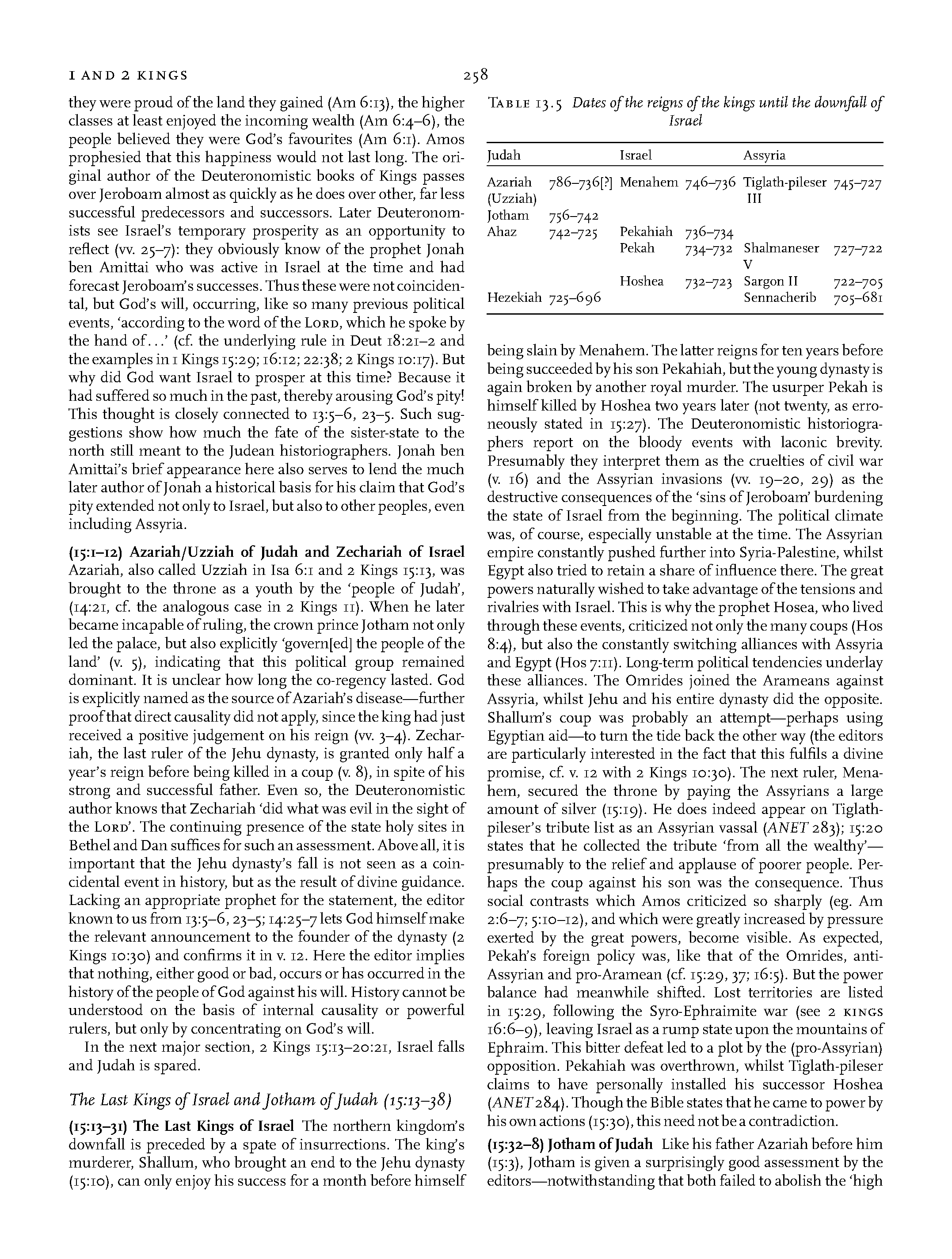
I AND 2 KINGS 258 they were proud of the land they gained (Am 6:13), the higher classes at least enjoyed the incoming wealth (Am 6:4—6), the people believed they were God's favourites (Am 6:1). Amos prophesied that this happiness would not last long. The original author of the Deuteronomistic books of Kings passes over Jeroboam almost as quickly as he does over other, far less successful predecessors and successors. Later Deuteronomists see Israel's temporary prosperity as an opportunity to reflect (w. 25-7): they obviously know of the prophet Jonah ben Amittai who was active in Israel at the time and had forecast Jeroboam's successes. Thus these were not coincidental, but God's will, occurring, like so many previous political events, 'according to the word of the LORD, which he spoke by the hand of...' (cf the underlying rule in Deut 18:21—2 and the examples in i Kings 15:29; 16:12; 22:38; 2 Kings 10:17). But why did God want Israel to prosper at this time? Because it had suffered so much in the past, thereby arousing God's pity! This thought is closely connected to 13:5—6, 23—5. Such suggestions show how much the fate of the sister-state to the north still meant to the Judean historiographers. Jonah ben Amittai's brief appearance here also serves to lend the much later author of Jonah a historical basis for his claim that God's pity extended not only to Israel, but also to other peoples, even including Assyria.
TAB LE 13.5 Dates of the reigns of the kings until the downfall of
Israel
Judah
Israel
Assyria
Azariah
Menahem
746-736
Tiglath-pileser
786-736[?]
745-727
(Uzziah) Jotham Ahaz
III
756-742 742-725
Pekahiah Pekah
736-734 734-732
Shalmaneser V
727-722
Hoshea
732-723
S argon II Sennacherib
722-705 705-681
Hezekiah
725-696 being slain by Menahem. The latter reigns for ten years before being succeeded by his son Pekahiah, but the young dynasty is again broken by another royal murder. The usurper Pekah is himself killed by Hoshea two years later (not twenty, as erroneously stated in 15:27). The Deuteronomistic historiographers report on the bloody events with laconic brevity. Presumably they interpret them as the cruelties of civil war (v. 16) and the Assyrian invasions (w. 19-20, 29) as the destructive consequences of the 'sins of Jeroboam' burdening the state of Israel from the beginning. The political climate was, of course, especially unstable at the time. The Assyrian empire constantly pushed further into Syria-Palestine, whilst Egypt also tried to retain a share of influence there. The great powers naturally wished to take advantage of the tensions and rivalries with Israel. This is why the prophet Hosea, who lived through these events, criticized not only the many coups (Hos 8:4), but also the constantly switching alliances with Assyria and Egypt (Hos 7:11). Long-term political tendencies underlay these alliances. The Omrides joined the Arameans against Assyria, whilst Jehu and his entire dynasty did the opposite.
(15:1—12) Azariah/Uzziah of Judah and Zechariah of Israel Azariah, also called Uzziah in Isa 6:1 and 2 Kings 15:13, was brought to the throne as a youth by the 'people of Judah', (14:21, cf. the analogous case in 2 Kings n). When he later became incapable of ruling, the crown prince Jotham not only led the palace, but also explicitly 'govern[ed] the people of the land' (v. 5), indicating that this political group remained dominant. It is unclear how long the co-regency lasted. God is explicitly named as the source of Azariah's disease—further proof that direct causality did not apply, since the king had just received a positive judgement on his reign (w. 3-4). Zechariah, the last ruler of the Jehu dynasty, is granted only half a year's reign before being killed in a coup (v. 8), in spite of his strong and successful father. Even so, the Deuteronomistic author knows that Zechariah 'did what was evil in the sight of the LORD'. The continuing presence of the state holy sites in Bethel and Dan suffices for such an assessment. Above all, it is important that the Jehu dynasty's fall is not seen as a coincidental event in history, but as the result of divine guidance. Lacking an appropriate prophet for the statement, the editor known to us from 13:5—6, 23—5; 14:25—7 lets God himself make the relevant announcement to the founder of the dynasty (2 Kings 10:30) and confirms it in v. 12. Here the editor implies that nothing, either good or bad, occurs or has occurred in the history of the people of God against his will. History cannot be understood on the basis of internal causality or powerful rulers, but only by concentrating on God's will.
Shallum's coup was probably an attempt—perhaps using Egyptian aid—to turn the tide back the other way (the editors are particularly interested in the fact that this fulfils a divine promise, cf. v. 12 with 2 Kings 10:30). The next ruler, Menahem, secured the throne by paying the Assyrians a large amount of silver (15:19). He does indeed appear on Tiglathpileser's tribute list as an Assyrian vassal (ANET 283); 15:20 states that he collected the tribute 'from all the wealthy'— presumably to the relief and applause of poorer people. Perhaps the coup against his son was the consequence. Thus social contrasts which Amos criticized so sharply (eg. Am 2:6-7; 5:10-12), and which were greatly increased by pressure exerted by the great powers, become visible. As expected, Pekah's foreign policy was, like that of the Omrides, anti Assyrian and pro-Aramean (cf. 15:29, 37; 16:5). But the power balance had meanwhile shifted. Lost territories are listed in 15:29, following the Syro-Ephraimite war (see 2 KINGS 16:6—9), leaving Israel as a rump state upon the mountains of Ephraim. This bitter defeat led to a plot by the (pro-Assyrian) opposition. Pekahiah was overthrown, whilst Tiglath-pileser claims to have personally installed his successor Hoshea (ANHT284). Though the Bible states that he came to power by his own actions (15:30), this need not be a contradiction.
In the next major section, 2 Kings 15:13—20:21, Israel falls and Judah is spared.
The Last Kings of Israel and Jotham of Judah (15:13-3^ (15:13-31) The Last Kings of Israel The northern kingdom's downfall is preceded by a spate of insurrections. The king's murderer, Shallum, who brought an end to the Jehu dynasty (15:10), can only enjoy his success for a month before himself (15:32—8) Jotham of Judah Like his father Azariah before him (15:3), Jotham is given a surprisingly good assessment by the editors—notwithstanding that both failed to abolish the 'high
259 I AND 2 K I N G S certain ben Tabeel, a man with an Aramean or Phoenician name (cf. Isa 7:6). Ahaz does not know what to do other than to appeal (against the advice of Isaiah, cf. Isa 7:3—9) to the Assyrian king for help, to become his vassal (T am your servant and your son'), but first of all to pay him a heavy tribute (v. 8; he accordingly appears in the list of Tiglath-pileser's tributes in 733, ANET 282). The 'Annals' seem to consider Ahaz's move to be decisive in bringing about war (v. 9). In fact places' (this was done only by Hezekiah and Josiah, 18:4; 23:8), both had to endure adversity (15:5,37) which could easily be ascribed to God's anger, nor is either king reported to have performed great political deeds. The short note, 'He built the upper gate of the house of the LORD' (v. 35) hardly merits the judgement, 'He did what was right in the sight of the LORD' (v. 34). Here we see that the Deuteronomistic theologians advocated a kind of collective, rather than individual causality (unlike the later Chroniclers). All Judean kings were doubly lucky: they were David's heirs and therefore heirs to the Davidic covenant (2 Sam 7:11—16), and they resided in Jerusalem, in the immediate vicinity of the house of YHWH. In most cases, this suffices to secure YHWH's favour. But it is important to remember that this double blessing is a gift and not a reward. After all, the Deuteronomists thought in terms of God's grace and mercy rather than of implacable demands.
(and according to Isa 8:1-4) me Assyrians would probably have attacked such a dangerous alliance in any case. The kingdom of Aram was already defeated by 732, its capital Damascus conquered and destroyed, whilst Israel was heavily punished and decimated (2 Kings 15:29). Judah, having voluntarily placed itself in Assyrian hands, was now in danger of being crushed by them.
(16:10—20) Ahaz Paganizes the Temple Ahaz wishes or is forced to give his oath of allegiance to his master personally, in Damascus, where Tiglath-pileser has set up headquarters. Here he sees an altar which he uses as a model for a new altar in the temple at Jerusalem. He himself later consecrates it and orders the required sacrificial rite (w. 12—150). This was not sacrilegious in itself—the altar was dedicated to YHWH and the offerings were quite regular (cf. Num 29:39). The problem was the bronze altar which had previously stood at its place and had been commissioned (or perhaps taken over, i Kings 8:64) by Solomon. The mere fact that it had to make way for a stone altar would have been sacrilegious to conservatives. Worse still, Ahaz orders that the revered old altar 'shall be for me to inquire by' (v. i$b), i.e. it should subsequently serve the purpose of divining omens from the inspection of entrails and liver, as was common practice in Assyrian religion. Thus sacrifice was made to YHWH at the new altar in front of the temple whilst Assyrian rites were performed at the old YHWH-altar behind the temple. In this way Ahaz tried to balance out the expectations of his new master with the sensitivities of his own population (cf. Spieckermanni982: 368). The note in v. lyf. shows what little regard the Assyrians took for the religious feelings of their vassals. The heavy bronze instruments once installed by Solomon in the temple court (cf. i Kings 7:27—39) were probably dismantled as part of the tribute demanded, along with other structural changes to the temple, made 'because of the king of Assyria'.
Ahaz ofjudah (16:1-20) (16:1-9) Ahaz and the Syro-Ephraimite War Ahaz—a king who enjoyed the support of the prophet Isaiah (Isa 7)—is sharply criticized by the editors. In contrast to positive judgements given, this seems to require extensive explanation. In other words, God's favour may often be unmerited, but his anger is always deserved. The statement that Ahaz 'walked in the way of the kings of Israel' (v. 3) is not meant politically (where the opposite is the case, see below), but religiously: Ahaz has the same pagan tendencies as the kings of Israel. Not only does he allow the people to worship at the 'high places' outside Jerusalem (as Azariah and Jotham had also done, 15:4, 35), but himself makes sacrifices there (v. 4). The phrase 'on the hills and under every green tree' implies that these were Canaanite fertility rites (cf i Kings 14:23-4; Jer 3:6, 13). Sacrifices of children are particularly foreign to YHWHworship (cf. Deuti8:io with v. 3 and 2 Kings 17:17; 21:6; 23:10). It is highly unlikely that the Deuteronomistic author could refer back to sources for all these allegations. He did, however, have information concerning Ahaz's construction of a nonYHWH altar in the temple of YHWH (see 2 KINGS 16:10-20 below). The rest of the claims are added from the standard Deuteronomic/Deuteronomistic repertoire, thus characterizing Ahaz as a quasi-heathen king sitting upon David's throne. The author is more interested in his type than his deeds. It is simply convenient that the 'Annals' offered a number of unfavourable political developments during this king's reign. In taking Elath from Judah, the Edomites took their Judean opponent's access to the Red Sea and thereby their control of the King's Highway through east Jordan to northern Arabia and Syria (v. 6). For the time being the shifting struggle between these two nations ends here, with Judah finally drawing the shorter straw (cf. i Sam 14:47; 2 Sam 8, 3; i Kings 11:14-22, 25/7; 22:48; 2 Kings 3:8; 8:20-2). Later, during the time of exile, when the Deuteronomistic History is written, Judah will suffer greatly under Edom (Ob 8-15). Even more severe are the consequences of the Syro-Ephraimite war (w. 5, 7-9). Around 734, Aram-Damascus and northern Israel form a powerful alliance with the background support of the Phoenician and Philistine city-states and Egypt in order to resist the advance of the Assyrians. Ahaz apparently refused to join this alliance and was therefore to be replaced by a Israel's Downfall (17:1-41) (17:1—6) The Military Collapse Assyrian pressure hit Judah's sister-state far harder. It existed only as a rump state from 732, its northern, western, and eastern territories having been placed directly under Assyrian administration (15:29). Despite, or perhaps because of, this, anti-Assyrian resistance, naturally instigated by Egypt, soon arose (v. 4). The Assyrians struck back mercilessly: after resisting bitterly, the capital Samaria was conquered and part of the population (not all of Israel, v. 6, probably the upper class) was deported. They were not displaced en bloc, as the Jews were later to Babylon, but were shifted decentrally to north-east Syria. This method of destroying races resulted in the exiled northern Israelite people leaving few traces in history and tradition, unlike the Jews. The last Israelite king, Hoshea, is given a relatively
I AND 2 K I N G S
peared, but united with others syncretistically (w. 32—4, 41). The episode reported in w. 25—8 offers an explanation for this phenomenon. It is unrealistic not only because of the plague of lions caused by religious problems. It also states that the foreigners had been imported without any prior instruction in how to worship YHWH. Another orthodox addition rigidly asserts that this colourful mixture of religions amongst the Samarians goes against the Torah (w. 35-40). This is the beginning of the Jewish—Samaritan split. The line of theology and history leading up to the HB does indeed run via Judah and no longer via Israel. But the influence of Israelite tradition and faith had long been absorbed and would continue to be. The originally northern Israelite traditions of, for instance, Jacob, Joseph, the Exodus, the conquest of the land of Benjamin, the deliverers, Saul, Elijah and Elisha, Jehu, Hosea, and many others eventually found their way into the Bible through southward-fleeing refugees of the time or by other means. Also, conversely, the Judeans and Jews never forgot their Israelite brothers and sisters. This can be seen not only in surviving Israelite tradition, but also in Judean reflections such as Jer 30-1 and i Chr 7. mild judgement by the Deuteronomists (v. 2), though not out of compassion, but to stress that the catastrophe had deeper roots than the unfortunate or mistaken policy of a single king.
(17:7-23) Theological Causes of the Catastrophe The Deuteronomistic theologians make explicit statements at decisive moments in history: in Josh i: 23—4; Judg 1—2; i Sam 7—8; 12; 2 Sam 7; i Kings 8, and also at this point. We must clearly understand the meaning of events. It seems that several hands were responsible for this reflection, w. 21-3 certainly differ from the previous verses, recapitulating the kingdom's division, 'the sin of Jeroboam' tainting northern Israel's subsequent history and the woeful announcements of the prophets. The conclusion is that it had to end this way. The state cult in Bethel steered the state onto a collision course which no northern dynasty turned away from. Thus all the prophets could do was to predict the fall of every house (i Kings 14:7—11; 16:1-4; 21:21-4; 2 Kings 9:7-10). By contrast to this stereotypical Deuteronomistic view of woeful prophecy, v. 13 shows another of the prophets' roles, namely to state the Torah. The entire passage (w. 12—19) expresses an underlying tone of strict laws: YHWH forbade a number of things, but Israel did them anyway (w. 12, 15). He also ordered a number of things which Israel did not do (w. 13, 15). Israel is accused of all manner of syncretism and paganism (w. 9—10, 15—17), interestingly including actions which are only attributed to Judah in the Deuteronomistic History (cf w. 9-10 with i Kings 14:23—4, w. 16—17 with 2 Kings 16:3; 21:3—6, as well as Judah's explicit mention in v. 19). This implies that Judah will experience the same fate for the same reasons as Israel some time in the future. There is perhaps a further (and older) textual layer in w. 7—8, 20, in which Israel is accused of being influenced by other cultures although YHWH expelled all foreign peoples from Israel before its land was taken—a perspective also found in the original edition of the Deuteronomistic book of Joshua. Whatever the case, the Deuteronomists all agree that the state of Israel was condemned to fall for breaking the first commandment. One should not consider this too narrow-mindedly religious. The first commandment underlies all the other commandments. Those who disregard God also disregard his laws and therefore the rights of their fellows and of all mankind. Recent history is full of examples of this.
Hezekiah of Judah and the Prophet Isaiah (18:1-20:21) (18:1—12) Hezekiah's Reign This king receives exceptional praise: he and Josiah (2 Kings 22:2) alone are comparable to David. There are various reasons for this: during Hezekiah's reign, Jerusalem was in mortal danger from the Assyrians, but, unlike Samaria, it did not fall. The prophet Isaiah is said to have supported him during this crisis, giving rise to a number of detailed stories. Furthermore, Hezekiah, like his successor Josiah, is said to have carried out religious reform. Reports of this (v. 4), however, are extremely brief and cannot be regarded as undoubted historical fact. Only the destruction of the Nehushtan, a snake-shaped cultic image traced back to none other than Moses (cf. Num 21:9), can really be attributed to Hezekiah, though details can no longer be discerned. Besides his piety (w. 6—7), Hezekiah's foreign political activity is highlighted: he frees the land from Assyrian subservience and conducts successful campaigns against the Philistines (w. 78). We know from an Assyrian source that Hezekiah was indeed the leader of an anti-Assyrian coalition from 705 BCE onwards, arresting the pro-Assyrian king of Ekron in this capacity. The editors—perhaps on a late textual level—repeat the description of the northern sister-state's defeat at the hands of the Assyrians (cf. w. 9—11 with 2 Kings 17:3—6), not without naming the entire population's lack of loyalty to the Torah as its cause (v. 12). How will Judah fare by comparison?
(17:24-41) The Immigrants from the East and their Cults True to their principle of destroying races in newly conquered territories, the Assyrians not only displaced Israelites eastwards, but also—probably over a longer period of time—deported people from other areas of the empire to Israel. The cities listed in w. 24, 29—31 are partly in Mesopotamia and partly in (18:13—16) The Assyrians Attack and Force Tribute Payment The Assyrians also stormed Judah. Soon the entire country was occupied and Jerusalem besieged. King Sennacherib depicted his victory over the strong fortress Lachish in a stone relief in his palace at Nineveh (now in the British Museum) and showed Hezekiah's desperate situation on a victory monument: 'As to Hezekiah, the Jew, he did not submit to my yoke, I laid siege to 46 of his strong cities... Himself I made a prisoner in Jerusalem, his royal residence, like a bird in a cage. I surrounded him with earthwork in order to molest those who were leaving his city's gate' (ANET 288).
Syria. Ethnic mixing was carried out in order to avoid the development of cores of resistance, and to paralyse the regions using the tension between peoples. The Deuteronomistic historiographers are primarily interested in the religious consequences of this policy: inevitably, religion in the province of Samaria became mixed. The gods and ritual traditions of various peoples are listed academically. The authors observed with a certain amazement how such religions established themselves so close to Judah. But they were also surprised by the fact that the religion of YHWH by no means disap-
26l I AND 2 K I N G S
Perhaps this was indeed true, or perhaps exaggerated, or maybe he received news of an insurrection in the Baylonian heartlands, or merely retreated after accepting Hezekiah's surrender and payment of the tribute. (19:9-19) Sennacherib's Letter and Hezekiah's Prayer All this, however, has still to happen. The Assyrians were still in The Bible text admits that Hezekiah could only free himself from Assyrian pressure by conceding defeat and paying a heavy tribute. This also conforms with Sennacherib's report: 'Hezekiah... did send me, later, to Nineveh, my lordly city, together with 30 talents of gold, 800 talents of silver, precious stones ... [and] all kinds of valuable treasures, his [own] concubines, male and female musicians' (ibid.). This happened in 701 BCE. There is hardly a doubt that the biblical text, presumably stemming from Judean annals, reports on the same incidents. Thus it is all the more surprising that we are told of further Assyrian pressure after these events. So from 18:17 onwards another source seems to have been used, i.e. the legends of Isaiah which are inserted here by the editors. They give the impression that the Assyrians break their word after receiving the tribute and put further pressure on Jerusalem (cf the equivalent chain of events in i Kings 20:1-7). They are given a clear response!
Syria-Palestine. According to the text, Sennacherib tried to intimidate Hezekiah a second time. There is strong evidence that this is a second, more recent version of the story of Jerusalem's miraculous rescue, inserted by later Deuteronomistic historians (Camp 1990, whereby editorial emendments to assimilate v. 13 with 18:34 an(^ vIJ with 18:30 seem to have been carried out). In his letter, Sennacherib is even bolder than Rabshakeh in his comparison of YHWH with the useless gods of other defeated nations. Hezekiah also appears even more pious than in 19:1—4. His prayer has the unmistakable tone of YHWH-monotheism as expressed by DeuteroIsaiah. Hezekiah and the reader understand that YHWH, as opposed to all other gods, can help since he is the only one that exists! (19:20-37) Isaiah's Second Oracle and Jerusalem's Liberation Isaiah's second response is much more detailed than the first. A separate song of scorn is inserted in w. 21-8, probably composed later for this specific context. YHWH himself throws down the gauntlet to the king of Assyria (18:17-37) Rabshakeh's Speeches The Assyrian king sends a delegation of leaders from his camp in Lachish under the leadership of Rabshakeh (which means 'chief cup-bearer') with the intention of forcing Jerusalem to capitulate. The Assyrians did indeed use such psychological warfare. The envoy delivers two speeches: one to King Hezekiah and his negotiators (w. 19—25) and one to the (warring) people on the city walls (w. 27—35). His arguments are well thought out: Hezekiah cannot expect help from anywhere, not from Egypt (v. 21), nor from his own army (w. 23-4), nor even from YHWH (w. 25 and 22—this is probably an editorial cross-reference to 18:4). The people should not rely on false promises made by their king (w. 29-30), nor on the help of YHWH (w. 33-5), but should accept the Assyrian king's peace proposals and surrender (w. 31—2). The Assyrian's speech, written by a Jewish narrator, is full of bitter sarcasm: exile seen as temptation (w. 31-2), YHWH placed on the same level as any other city god (w. 34-5), Rabshakeh in the role of a prophet of woe (v. 25). The key to placing this text historically may lie here. The deceptive language of the Assyrian ambassador is similar to that of Jeremiah, who advised capitulation when the Babylonians besieged Jerusalem in 589-587 (cf. Jer 37—8). It is possible that the core of the Isaiah legends was conceived to support the last Jewish king Zedekiah shortly before Judah's fall (Hardmeier 1990, exactly dating the event at 588). In any case the caricature of the imperial demagogue underlines a faith in YHWH's allegiance to his people and his holy city. Those who take no account of this miscalculate. (19:1-8) Isaiah's First Oracle Rabshakeh's arguments do not go unnoticed. Hezekiah is aware of his serious predicament and sends a delegation to the prophet Isaiah for advice and encouragement. His answer is clear: 'Do not be afraid', a classic opening to a positive oracle. YHWH will send a 'spirit' to the Assyrian king (cf. i Kings 22:21-2) who will retreat to Assyria in panic after merely hearing a rumour. On returning home, he will be murdered. Each part of this oracle is mentioned as fulfilled in 19:8, ga, 36-7. According to the text, an Egyptian army appears and forces Sennacherib to retreat. The Assyrian king also mentions the advance of an Egyptian army in his inscription, though he claims to have defeated them at Eltekeh (ANET287, near the Philistine border, cf. Josh 19:44).
(and Babylon and Persia): you boast about your power (w. 22-4—cf. already Isa 10:7-10)—although it was I who granted it to you (w. 25—7). Now I shall take it away from you (v. 28—the metaphor of a world leader being led away like an ox with a hook in his nose is defiantly comical!). The very late addition in w. 29—31 draws attention to the blessed activity in the Jewish exiled community. The oracle actually continues in w. 32—3 (v. 34 is a late-Deuteronomistic inclusion, cf. i Kings 11:12-13). The speech has an ABCBA structure. After the introductory and before the concluding formula ('thus says the LORD—says the LORD') is the double assurance that the enemy 'shall not come into this city' surrounding the central statement: the enemy's weapons cannot harm Jerusalem and he shall retreat in failure. This prophecy immediately takes effect: a plague-bringing angel kills scores of soldiers in the Assyrian camp (v. 35), upon which Sennacherib retreats (v. 360). Attempts to make such a miracle historically plausible—by stating that Herodotus once mentioned a plague of mice in the Assyrian army and that mice are known to be carriers of disease—misunderstand the story's actual intention. It is a call to acknowledge the unlimited power of God and the strictly limited power of man. (20:1-11) Hezekiah's Illness is Cured by Isaiah The following passage contains two individual episodes from Hezekiah's life. The first tells how Hezekiah received Isaiah's help during a severe illness. It is probable that the story originally depicted the prophet as a miracle healer: he goes to the king (v. ia), promises him a further fifteen years of life (v. 6a) and orders a fig paste to be spread on the diseased part of his body, 'so that he may recover' (v. 7—according to the original version in Isa 38:21). The king asks for a sign that he really will get better (v. 8a), upon which the prophet uses his miraculous powers to reverse the movement of the shadow on the sundial put up by Hezekiah's father, Ahaz: a symbol that Hezekiah's life-clock
outside the city walls, namely to the west instead of the east of the old city of David, one wall had to be built, stretching far further westwards. Remains of such fortifications have indeed been found. The newly created city district seems primarily to have been inhabited by refugees from the fallen kingdom of Israel. has also been turned back (w. 9-11). The recovery itself is not reported on further, though it must have occurred. A late editor picked up this story and converted it into a didactic narrative regarding an exemplary king: Isaiah initially makes a prophecy of woe (v. ib, cf. 2 Kings 1:16), upon which Hezekiah complains to God, referring to his piety (w. 2—3). God mercifully sends Isaiah back to the king with a positive prophecy: he will recover—significantly in order soon to return to the temple (w. 4-5). During his remaining lifetime, he witnesses Jerusalem's liberation from the Assyrians (v. 6b, close parallel to 19:34). The way this story is inserted leads to a strange chronology of events: Hezekiah did not reign a further 15 years after 701 (up to 686). This leads to the suggestion that the number 15 belonged to the core of the formerly independent story and also that the story should be placed chronologically before 2 Kings 18-19 (see Ruprecht 1990). (20:12-21) The Babylonian Envoys and Isaiah's Attitude towards them This episode, containing Hezekiah's negotiations with envoys sent by the Babylonian leader MerodachBaladan, would also be more plausible if it took place before 701: the anti-Assyrian coalition would have thus extended beyond Egypt to Syria. Marduk-apla-iddina (as he was correctly called) was chief of the Aramean tribe Bit Jakini and troubled both Sargon and Sennacherib with his claim to the Babylonian throne in the late eighth century. It seems that Hezekiah wanted to win him over as an ally and thus tried to impress his envoys by putting his military might and his warfunds on display (he might have even passed some of this on to Babylon). According to the narrative, this caused the prophet Isaiah to turn against him. This conforms with the 'real' Isaiah's strong criticism of Hezekiah's alliance policy in Isa 30—1. It is unlikely that Isaiah explicitly forecast the catastrophe of 587 (see w. 17-18). By placing this episode at the end of the Isaiah-Hezekiah narrative, the late editor could refer forwards to Jerusalem's fate despite its miraculous rescue in 701. Hezekiah's flirtation with Judah's later deadly enemy and his feather-headed reaction to Isaiah's warning (v. 19) do not show the king in a good light. Perhaps the editor of this passage was particularly critical of the kings (Camp 1990). The concluding comments on Hezekiah (v. 2of.) stress the king's energy and stem from the original author of Kings. Here he quotes from the Annals of the Kings of Judah, which also mention the construction of the conduit to Siloam which carried water from Gihon, Jerusalem's main well, under the city of David to the Pool of Siloam and was a technical masterpiece of its time. So that the new source of water was not The final major section, 2 Kings 21:1—25:30, documents the last kings of Judah and the downfall of the kingdom.
Manasseh and Amon (2 Kings 21:1-26)
Manasseh's 55-year reign is the longest of all the kings of Judah—and in the eyes of the author of Kings, he is the worst. He is the Judean image of the Israelite arch-rogue Ahab. Like Ahab in Samaria, Manasseh introduces the worship of Baal and Asherah to Jerusalem (cf. w. 3, 7 with i Kings 16:32-3). He too sheds innocent blood, in fact excessively (cf. v. 16 with i Kings 18:4; 19:10; 21). Just as Ahab's enemy was Elijah, so is Manasseh strongly opposed by prophets (w. 10—15). Manasseh is also a sinister reflection of the glorious king Josiah, who must abolish all the deities reintroduced by his predecessor (cf. 2 Kings 23). In brief: the extensive list of sins in w. 2—9 must rather be the editors' nightmare than a record of reality. There are, however, elements that fit exactly into the time and situation. Manasseh was Assyria's vassal, one could even say servant. Assyrian sources mention him as a bringer of tribute and as a military follower. There is not the slightest indication that he resisted his masters. This is precisely the reason for the length of his reign. Manasseh represented and reproduced Assyrian violence (v. 16). If he knew how to adapt to the political power, why not do the same in the field of religion (see Spieckermann 1982 and van Keulen 1996, contra McKay 1973)? w. 3 and 5 mention the worship of the 'host of heaven', astral deities of Mesopotamian origin. Baal and Asherah (v. 3) could be the conventional names for the highest god and goddess in the Assyrian pantheon, Asshur and Ishtar. Prophetic resistance to Manasseh's policy is indeed probable and is made tangible for us through figures such as Nahum and Habakkuk (Dietrich 1994). The summarizing prophetic speech in w. 10—15 was composed by Deuteronomistic authors, however, looking specifically forward to Jerusalem's first siege and defeat (a reference back to this speech is made in the passage concerning the siege in 2 Kings 24:2, see Dietrich, 1972). The editors worsen Manasseh's historically bad reputation in other ways also (especially in w. 30, 4, 6-9). The entire section concerning
TABLE 13.6 Dates of the reigns of the last kings of Judah and Assyria, and kings of Babylon
Judah
Assyria
Babylon
Manasseh
696-641
Sennacherib Esar-haddon Assurbanipal
705-681 681-669 669-631
Amon Josiah Jehoahaz Jehoiakim Jehoiachin Zedeldah
Nabopolassar
626-604
Assur-uballit
611-606
Nebuchadnezzar
604-562
Evil-Merodach
562-560
263 I AND 2 K I N G S ant' play a significant role in Deuteronomy. The ensuing reforms cover three areas. The temple of Jerusalem which was to be cleansed of non-YHWH influences was given the designated central role (w. 4-7, 11-12). The cult sites in the Judean provinces which were regarded as paganized (w. 8—10, 13—14) and cult sites on the land of the former northern kingdom, above all the altar of Bethel upon which lay 'the sin of Jeroboam' (w. 12-20), were to be eradicated. The third area introduced the communal passover feast in accordance with the newly introduced covenant (w. 21—3, cf. Deut 16:5—6). The historical question of whether Josiah actually took all the measures listed here is not easily answered. It depends on the perspective of the text's source: are the reform measures of 'good' kings (as well as the cultic deviations of 'bad' kings) simply part of an inner-Deuteronomistic reference system, and therefore theological rather than historical phenomena (Hoffmann 1980; Wurthwein 1984)? Or do the reports in 2 Kings 22—3 stem from a relatively extensive, older source which was close to the events (Dietrich 1977; Spieckermann 1982)? Similarly to the list of Manasseh's sins (21:39), there are passages in the report on Josiah's reforms which fit exactly with the state of affairs in the last years of the Assyrian empire: he sets aside astral worship (23:5), horses and chariots of the sun (v. n), roof-top altars (for sacrifices to the astral gods, v. 12), perhaps also the worship of Asshur and Ishtar in the form of Baal and Asherah (w. 4, 6—7—here, the hardly inventable reference to chosen women weaving robes for 'Asherah'; cf. also the extremely exact naming and placing of cult sites in v. 8fc). There are also notes which stem from Deuteronomistic ideology, however (e.g. w. 10,13—14,19—20, 24). The Bethel-scene's core (w. 15—18) could be historically correct—Bethel lies 20 km. north of Jerusalem—but has clear editorial references to i Kings 13. Closing down cultic sites outside Jerusalem accords with Deuteronomic thought (Deut 12), whilst displacing and degrading the resident priests to the rank of dcrus minor is definitely not demanded there (cf. the role of the Levites, for instance, in Deut 14:27-9). Thus both policies seem plausible. On the whole, one could say that Josiah's reforms significantly changed conditions within his sphere of influence. Judah was beginning to free itself from the cultural and political influence of its neighbours in order to concentrate on its essential qualities: faith in YHWH and a corresponding religious and social lifestyle. his reign, encompassing more than half a century of Judean history, does not contain a single positive word for him. One feels the apprehension that Judah is heading swiftly towards an abyss. This impression is strengthened when one learns that Amon, Manasseh's son and successor, 'walked in the way which his father walked' (v. 21). Unlike his father, he soon meets his fate. But then something surprisingly hopeful happens: 'The people of the land'—the same political group who brought about the downfall of the 'evil' queen Athaliah, enabling the 'good' king Joash to come to power (2 Kings 11:18, 20)—intervene to punish the king's murderers and place a certain Josiah on the throne. The struggle between loyalty and disloyalty to YHWH, and thus between the existence and destruction of the kingdom of Judah, has taken an unexpected turn.
Josiah (2 Kings 22:1-23:30) (22:1—20) The Book of the Law is Discovered Josiah comes to the throne as a child. 'The people of the land' guide and support him. Even the great reforms introduced eighteen years later accord with their views. In 621, Assyria's fortune is in deep decline. In 612 Nineveh was to be defeated by Babylon, having achieved independence under Nabopolassar in 625. It is high time to leave the sinking ship of Assyria. Judean reformers held in opposition by Manasseh urged internal change, including religious reforms. Whether they smuggled the ominous 'book of the law' into the temple and ensured that the high priest 'found' it during routine renovations (cf. 2 Kings 12), or whether the book had indeed been there for a longer time, will always remain a secret. A recently published ostracon (see Bordreuil, Israel, and Pardee 1998) seems to strengthen the evidence for a temple renovation just during the reign of Josiah. Critical research is united in believing that the discovered book was Deuteronomy or its core (Deut Sab—28). It takes the form of a speech made by Moses shortly before taking the land of Israel and could thus have been considered to be very old. It does include older material, but cannot have been compiled before the seventh century. Apart from the closing admonitions (Deut 28), it is the strict demand for the exclusive worship of YHWH (Deut 6:5!) and the cultic veneration of YHWH alone in the central holy site of Jerusalem (Deut 12) which seem to impress Josiah especially. One can be certain that other rules such as the social laws of Deuteronomy (e.g. Deut 15; 24) became state law under Josiah (cf. Criisemann 1992; Albertz 1992; Kessler 1992). All of this represents a pro-YHWH reform movement with allies in the highest circles of the court and the temple as well as the king himself. The prophetess Huldah, to whom Josiah appeals for an oracle, also supports the reforms. She encourages the king to make a great new beginning—even if the original wording of her prophecy was later overwritten by Deuteronomistic phrases pointing out the continued inevitability of the end of the kingdom of Judah (Dietrich 1972). What is being stated clearly is that Josiah and his reforms are not to blame for Judah's fate!
(23:25—30) Josiah's End and Judgement The editors give Josiah the highest praise for his religious reforms (v. 25). Jeremiah also describes him as a popular ruler who was modest and socially just (Jer 22:15—16). Thus it is all the more painful and inexplicable that God should surrender his chosen people and the holy city to their enemies. The phrases used in w. 26-7 show how threatening the demise of the state of Judah was to the Jewish people and the religion of YHWH. Nor does Josiah's personal fall encourage faith. He confronts Pharaoh Necho (609-593) wh° was on a campaign northwards to protect the ailing Assyrians from the Babylonians. This action displays Josiah's principally anti Assyrian attitude, whilst his presence in Megiddo shows that he was free to move about on Israelite territory. But the Pharaoh 'met him' and 'killed him' (v. 29), which makes it (23:1—24) Implementation of Religious Reforms First of all, in an almost democratic manner, Josiah makes sure he has a broad basis of support for his reform plans: 'All the people joined in the covenant' (v. 4); the terms 'people' and 'coven-
sound as if victory was easily accomplished. Were the Judeans simply too weak or did Josiah perhaps lack the support of the entire army? 'The people of the land' were at any rate loyal to him even beyond his death, ensuring a decent funeral and making his son Jehoahaz his successor. It was obviously a conscious choice, since Jehoahaz had an elder brother, as the comparison between 23:31 and 36 shows. This fact shortly proved to be disastrous.
Zedekiah and the Final Conquest of Jerusalem (2 Kings 24:18-25:21)
Judah's last king is a real brother of Jehoahaz (cf. 24:21 with 23:31) and therefore an uncle of the previously deported Jehoiachin (24:17), though he is in fact not much older. Thus Nebuchadnezzar reverts back to the old line of Josiah in placing Mattaniah upon the throne and giving him the throne-name Zedekiah. From him one could expect a policy which would be acceptable to both 'the people of the land' and Babylon. Thus Jeremiah is shown to have been his confidant (Jer 37:17—21; 38:14—28). Zedekiah, however, goes against the prophet's advice in choosing to turn his back on Babylon (cf. 2 Kings 24:20 and Ezek 17). Exiled opposition spreading nationalistic propaganda obviously manages to win him over (Jer 27—8). The editors do not concern themselves too much with such political matters and are satisfied with a brief and negative statement regarding Zedekiah (24:19). Greater attention is given to Jerusalem's defeat. The siege lasts nineteen months (25:1, 8). 'The people of the land' seem to resist bitterly before being overcome by hunger (v. 3, Lam 2:11—12; 4:4—5, 9—10). When the besiegers manage to breach the city walls, Zedekiah undertakes a sortie, is captured and horrifically punished
Jehoahaz, Jehoiakim, Jehoiachin, and Jerusalem's First
Capture (2 Kings 23:31-24:1/J
Jehoahaz presumably follows Josiah's policies (even if the editors give him a negative assessment—perhaps due to a lack of detailed information and in order to explain his sorry end). Jeremiah at least uses no words of anger concerning him, only grief (Jer 22:10-12). Yet only a few months after his accession, Necho, returning from his northern campaign, orders Jehoahaz to Syria, takes him prisoner, and deports him to Egypt where he dies. Necho places his older brother Eliakim upon the throne, giving him the throne-name Jehoiakim and thereby underlining his subservience. Tribute is also collected. Is this recompense for the Egyptian's intervention in favour of Eliakim? It is no coincidence that the tribute is collected from 'the people of the land' (23:35). The reform party who had the upper hand under Josiah is thus powerless—with the consequence that Judah, having just been freed of Assyrian influence, is now firmly in Egyptian hands. When Babylon's new and powerful ruler Nebuchadnezzar II defeats Egypt in 604 BCE at Carchemish on the Euphrates, however, Jehoiakim slips into the role of Babylonian vassal, only to return under Egypt's wing a little later (24:1). Jehoiakim is cunning and mean as well as antisocial and brutal (Jer 22:1319; 36). The editors are relatively mild in their judgement (23:37), referring back to the sins of Manasseh and the ensuing prophecies to explain Nebuchadnezzar's measures against Judah's resistance (24:2-4). Jehoiakim dies of natural causes—just before Nebuchadnezzar arrives in Jerusalem with a large army (24:6). His poor son Jehoiachin has to pay for his father's deeds. Nebuchadnezzar besieges Jerusalem, completely unhindered by Judah's protector, Egypt (24:7). Jehoiachin capitulates to the superior enemy without resistance (24:12). According to Jer 13:18—19, the southern parts of the kingdom of Judah were partitioned and placed under foreign administration. What led Jehoiachin to accept all these measures? Was it wisdom or fear, or even inadequate support from his own people? Or was it perhaps relatively generous conditions granted by Nebuchadnezzar on receiving Jerusalem? Hard as the tributes and deportations were, they were not fatal, not even to those hit hardest, the elite 'ten thousand', and certainly not to the simple farmers, 'the poorest people of the land' (24:14). The latter were perhaps even glad to see the back of Jehoiachin's upper class, whilst the Babylonians cleverly took advantage of such internal tensions (Dietrich 1997^. On the other hand, the exiles could expect a relatively bearable lifestyle in Babylonia and maintain the hope of soon returning home (cf. Jer 29). This hope was soon to be dashed as the first deportation was quickly followed by a second. Death had knocked on Judah's door.
(w. 4—7). What follows is a detailed and brutally sober description of the horrors which accompany defeat: destruction, burning, plundering, deportation, executions (w. 8-2ia). Not only the people's woe, but also the fate of the temple— after all the place of which YHWH said 'My name shall be there' (23:27)—is the subject of the narrator's pity (25:13—17). The concluding statement in 25:21/7, 'So Judah went into exile out of its land' is clearly too general. As 25:12 indicates (though also too hesitantly!) the second wave of deportations still left the majority of the population in the country. Are we here dealing with an exile-oriented perspective of the events?
The Jews under Babylonian Rule (2 Kings 25:22-30) (25:22—6) Gedaliah's Governorship The books of Kings and the Deuteronomistic History do not close with the horrific news of Jerusalem's defeat, but with reports of tentative new beginnings following the end. The first of these, however, ends in disaster despite commencing so promisingly: the Babylonians try to consolidate their position in the country, placing the more or less pro-Babylonian agrarian population under a Judean governor. The choice of Gedaliah shows intimate knowledge of Judean internal politics, since he stemmed from the famous Shaphan family who had always supported the political aims of Josiah's line (cf. 2 Kings 22:812; Jer 36:10). It is not coincidental that Jeremiah decides to remain amongst the people of the land, rather than joining the upper class in Babylon (Jer 40). Gedaliah significantly resides in Mizpah, a rural town lokm. north-west of Jerusalem. The old royal residence has served its time (and in any case lies in ruins). Soon, however—perhaps only a few weeks later, as v. 25 seems to suggest if compared to v. 8, perhaps after a number of years—hope of a fresh start under Babylonian rule is rudely crushed. Ishmael, probably a representative of the Manasseh—Jehoiakim line within the royal family, carries out a terrorist attack against Gedaliah and his closest supporters. A large number of refugees flee to Egypt (expect-
265 I AND 2 K I N G S ing reprisals from Babylon), a land enjoying the sympathy of important political circles in Judah and already the residence of a large Jewish community in exile. This text passage is probably an excerpt from the more detailed description in Jer 40-1.
Cross, F. M. (1973), "The Themes of the Book of Kings and the Structure of the Deuteronomistic History', in id., Canaanite Myth and Hebrew Epic (Cambridge, Mass.: Harvard University Press), 274-89. Criisemann, F. (1992), Die Tora: Theologie und Sozialgeschichte des alttestamentlichen Gesetzes (Munich: Kaiser). Dearman, J. A. (1989) (ed.), Studies in the Mesha Inscription and Moab, (25:27-30) Jehoiachin's Pardon The author of Kings shifts his view from the land of Judah and from the community in Egypt to that in Babylonia. Here, King Jehoiachin has been kept prisoner since his capture in 598 BCE. Clay tablets from 592 report on regular provisions from his Babylonian administrators. He himself becomes a symbol of the exiles' enduring hope for freedom, a return to the homeland, and the restoration of the Davidic kingdom. The prophecies of Ezekiel, who was also in exile, are dated according to Jehoiachin's 'years °f rule> (e-gEzek 29:17; 31:1). He has sons and grandchildren (i Chr 3:17—19), one of whom, Zerubbabel, would become a hopeful political figure following Babylon's decline (Ezra 2:2; Hag 2:20-3). Th£ final report of Jehoiachin's pardon and even special honour is especially revealing: the author of the Deuteronomistic History must have composed his work shortly after this event. He correctly wished to stress that the history of Judean royalty did not end with the fate of Zedekiah and his sons (25:7). Above all, however, he wished to end the book with a sign of hope. Even if YHWH has repeatedly to punish his people (most severely at the end), he still regards them with steadfast love.
Archaeology and Biblical Studies 2 (Atlanta: Scholars Press). Dever, W G. (1982), 'Monumental Architecture in Ancient Israel in the Period of the United Monarchy', in T. Ishida (ed.), Studies in the Period of David and Solomon and Other Essays (Winona Lake: Eisenbrauns), 269-306.
(1990), Recent Archeological Discoveries and Biblical Research (Seattle: University of Washington Press), 85—117. Dietrich, W. (1972), Prophetic und Geschichte: Eine redaktionsgeschichtliche Untersuchung zum deuteronomistischen GeschichtsweA, FRLANT 108 (Gottingen: Vandenhoeck & Ruprecht).
(1977), 'Josia und das Gesetzbuch (2 Reg XXII)', VT27:13-35. (1979), Israelund Kanaan: VomRingenzweierGesellschaftssysteme, SBS 94 (Stuttgart: Katholisches Bibelwerk).
(1986), 'Das harte Joch (i. Kon 12, 4): Fronarbeit in der SalomoUberlieferung', BN"34: 7-16.
(1992), David, Saul und die Propheten: Das Verhdltnis von Religion und Politik nach den prophetischen Uberlieferungen vom fruhesten Konigtum in Israel, 2nd edn., BWANT122 (Stuttgart: Kohlhammer).
(1994), 'Der Eine Gott als Symbol politischen Widerstands: Religion und Politik im Juda des 7. Jahrhunderts', in W. Dietrich and M. A. Klopfenstein, Ein Gott allein?, OBO 139 (Fribourg: Universitats-Verlag Gottingen: Vandenhoeck and Ruprecht), 463-90.
(19960), 'The "Ban" in the Age of the Early Kings', in V. Fritz and P. R. Davies (eds.), The Origins of the Ancient Israelite States, JSOTSup 228 (Sheffield: Academic Press), 196-210.
(1996!?), 'Histoire et Loi: Historiographie deuteronomiste et Loi deuteronomique a 1'exemple du passage de 1'epoque des Juges a 1'epoque royale', in A. de Pury, T. Romer, and J.-D. Macchi (eds.), Israel construit son histoire (Geneva: Labor et Fides), 297—323.
Ackerman, S. (1993), 'The Queen Mother and the Cult in Ancient
Israel', JBL 112: 385-401. Albertz, R. (1992), Rdiglonsgeschichte Israels in alttestamentlicher Zeit (2 (1997), 'Wem das Land gehort: Ein Beitrag zur Sozialgeschichte Israels im 6. Jahrhundert v. Chr', Ihr Volker alle, klatscht in die Hdnde, FS E. S. Gerstenberger (Miinster: Lit), 350—76. vols.; Gottingen: Vandenhoeck & Ruprecht).
(1997), 'Wer waren die Deuteronomisten? Das historische Ratsel einer literarischen Hypothese', EvT 57: 319-38. Alt, A. (1959), 'Menschen ohne Nameri, in id., Kleins Schriften zur (1998), 'Samuel und Konigsbiicher', TREo: Ehrlich, E. L. (1953), Der Traum im Alten Testament, BZAW 73 (Berlin: de Gruyter). Evans, D. G. (1966), 'Rehoboam's Advisors at Shechem, and Political
Geschichte des Volkes Israel (Munich: Beck), iii. 198—213.
(19640), 'Israels Gaue unter Salomo', in id., Kleine Schriften zur Geschichte des Volkes Israel (Munich: Beck), ii. 76—89.
Institutions in Israel and Sumer', JNES 25: 273-9. Frisch, A. (1991), 'Structure and its Significance: The Narrative of (1964!?), 'Das Gottesurteil auf dem Karmel', in id., Kleine Schriften zur Geschichte des Volkes Israel (Munich: Beck), ii. 135-49. Bartlett, J. R. (1976), 'An Adversary against Solomon, Hadad the Solomon's Reign', JSOT 51: 3—14. Gordon, R. P. (1975), 'The Second Septuagint Account of Jeroboam: History or Midrash?', VT 25: 368-93. Gorg, M. (1991), 'Jachin und Boas: Namen und Funktion der beiden
Edomite', ZAW88: 205-26. Barre, L. M. (1988), The Rhetoric of Political Persuasion: The Narrative
Tempelsaulen', in id., Aegyptiaca-BMica: Notizen und Beitrdgezu den
Artistry and Political Intentions of II Kings 9—11, CBQMS 20 (Washington, DC: Catholic Biblical Association of America). Biran, A., and Naveh, J. (1993), 'An Aramaic Stele Fragment from Tel
Beziehungen zwischen Agypten und Israel, Agypten und Altes Testament ii (Wiesbaden: O. Harrassowitz), 79—98. Gray, J. (1977), I elII Kings, OTL, 3rd edn. (Philadelphia: Westminster). Gressmann, H. (1907), 'Das Salomonische Urteil', Deutsche Rundschau, 130: 212—28. Gunneweg, A. H. J. (1972), Geschichte Israels bis Bar Kochba (Stuttgart: Dan', IE]43: 81-98.
(1995), 'The Tel Dan Inscription: A New Fragment', IE] 45: 1-18. Bloch-Smith, E. M. (1994), '"Who is the King of Glory": Solomon's
Katholisches Bibelwerk). Hardmeier, C. (1990), 'Umrisse eines vordeuteronomistischen Annalenwerkes in der Zidkijazeit', VT40:165—84. Hauser, A. J., and Gregory, R. (1990), From Carmel to Horeb: Elijah in Temple and its Symbolism', in Scripture and Other Artefacts: FS P.J. King (Louisville, Ky.: Westminster/John Knox), 18-31. Bordreuil, P., Israel, P., and Pardee, D. (1998), 'King's Command and Widow's Plea: Two New Hebrew Ostraca of the Biblical Period', Near Eastern Archaeology (formerly BA), 61: 2-13. Busink, T A. (1970), Der Tempel von Jerusalem von Salomo bis Herodes I
Crisis, JSOTSup 85 (Sheffield: JSOT). Hentschel, G. (1984—5), i Konige, 2 Konige, EB (Wiirzburg: Echter). Hoffmann, H.-D. (1980), Reform und Reformen, ATANT 66 (Zurich:
(Leiden: Brill), i. Camp, L. (1990), Hiskija und Hiskijabild: Analyse und Interpretation
Theologischer Verlag). Holder, J. (1988), 'The Presuppositions, Accusations, and Threats of i von 2 Kon 18-20 (Altenberge: Telos Verlag).
Kings 14:1-18', JBL 107: 27-38.
Hurowitz, V. (1992), I Have Built You an Exalted House: Temple Build- (1991), The Deuteronomistic History, JSOTSup 15 (Sheffield: Academic Press). German original, 1943. Parker, K. I. (1988), 'Repetition as a Structuring Device in i Kings ing in the Bible in Light of Mesopotamian and Northwest Semitic Writings, JSOTSup 115 (Sheffield: JSOT). Kaiser, O. (1962), DiemythischeBedeutungdesMeeresinAgypten, Ugarit i-n', JSOT 42:19-27. Pritchard, J. (1974) (ed.), Solomon 6[ Sheba (London: Phaidon). Rad, G. von (1961), 'Die deuteronomistische Geschichtstheologie in und Israel, 2nd edn. BZAW 78 (Berlin: de Gruyter).
(1984), 'Den Erstgeborenen deiner Sohne sollst du mir geberi, in id., Von der Gegenwartsbedeutung des Alten Testaments (Gottingen: Vandenhoeck and Ruprecht), 142—66. Keel, O. (1977), Jahwe-Visionen und Siegelkunst: Eine neue Deutung der den Konigsbuchern', in id., Gesammelte Studien zum Alten Testament, TBii 8 (Munich: Kaiser), 189—204. Ruprecht, E. (1990), 'Die urspriingliche Komposition der Hiskia-
Majestdtsschilderungen in Jes 6, Ez i und 10 und Sach 4, SBS 84/85 (Stuttgart: Katholisches Bibelwerk).
Jesaja-Erzahlungen und ihre Umstrukturierung durch den Verfasser des deuteronomistischen Geschichtswerkes', ZTK 87: 33-66. Sarkio, P. (1994), Die Weisheit und Macht Salomes in der israelitischen and Uehlinger, C. (1992), Gottinnen, Cotter und Gottessymbole: Neue EAenntnisse zur Religionsgeschichte Kanaans und Israels aufgrund bislang unerschlossener Quellen, QD 134 (Fribourg: Herder).
Historiographie: Eine traditionsund redaktionskritische Untersuchung uber i.Kon. 3—5 und 9—11, Schriffen der finnischen exegetischen Gesellschaft 60 (Helsinki: Finnische exegetische Gesellschaft; Gottingen: Vandenhoeck and Ruprecht). Schmitt, H.-C. (1972), Elisa: Traditionsgeschichtliche Untersuchungen (1994), 'Jahwe und die Sonnengottheit von Jerusalem', in W. Dietrich and M. A. Klopfenstein, Bin Gott alkin?, OBO 139 (Fribourg: Universitate Verlag; Gottingen: Vandenhoeck and Ruprecht) . Kessler, R. (1992), Staat und Gesellschaft im vorexilischen Juda: Vom 8. zur vo Massischen nordisraelitischen Prophetic (Giitersloh: Gerd Mohn). Seebass, H. (1967), 'Zur Konigserhebung Jeroboams I', VTij: 325—33. Smend, R. (1970), Jahweh War and Tribal Confederation: Reflections on Jahrhundert bis zum Exil, VTSup 47 (Leiden: Brill). Keulen, P. S. F. van (1996), Manasseh through the Eyes of the Deuteronomists: The Manasseh Account (2 Kings 21:1-18) and the Final Chapters of the Deuteronomistic History, OTS 38 (Leiden: Brill). Klopfenstein, M. A. (1996), 'i Konige 13', in id., Leben aus dem Wort: Israel's Earliest History (Nashville: Westminster/John Knox).
(1987), 'Derbiblische und derhistorische Elia', in id., Zurdltesten Geschichte Israels, BEvT 100 (Munich: Kaiser), 229-43.
Beitrdge zum Alten Testament, Beitrage zur Erforschung des Alten Testaments und des antiken Judentums 40 (Frankfurt am Main: Lang), 75-116. Knauf E. A. (1991), 'King Solomon's Copper Supply', in E. Lipinski (1989), Die Entstehung des Alten Testaments, 4th edn. (Stuttgart: Kohlhammer). Spieckermann, H. (1982), Juda unter Assur in der Sargonidenzeit, (ed.), Phoenicia and the Bible (Leuven: Peelers), 167-86. Levin, C. (1982), Der Sturz der Konigin Atalja: Ein Kapitelzur Geschichte
FRLANT 129 (Gottingen: Vandenhoeck & Ruprecht). Steck, O. H. (1968), Uberlieferung und Zeitgeschichte in den Elia-Erzdh-
Judas im 9. Jahrhundert v. Chr., SBS 105 (Stuttgart: Katholisches lungen, WMANT26 (Neukirchen-Vluyn: Neukirchener Verlag). Talstra, E. (1993), Solomon's Prayer: Synchrony and Diachrony in the Bibelwerk).
(1994), Die Entstehung der Rechabiter: FS O. Kaiser (Gottingen: Vandenhoeck & Ruprecht), 301-17. McKay, J. W. (1973), Religion injudah under the Assyrians 732-609 B.C., Composition ofi Kings 8,14—61 (Kampen: KokPharos). Timm, S. (1982), Die Dynastic Omri: Quellen und Untersuchungen zur
Geschichte Israels im 9. Jahrhundert vor Christus, FRLANT 124 (Gottingen: Vandenhoeck & Ruprecht). Veijola, T. (1982), Verheissung in der Krise: Studien zur Literatur und
Studies in Biblical Theology, second series 26 (London: SCM Press). McKenzie, S.L. (1987), The Source for Jeroboam's Role at Shechem (i
Theologie der Exilszeit anhand des 8g. Psalms, Suomalaisen Tiedakatemian toimituksia ser. B 220 (Helsinki: Suomalainen Tiedeakatemia). Walchli, S. (1999), Derweise KonigSalomo: Eine Studiezuden Erzdllun-
Kgs 11:43-12:3, 12, 2o)',JBL 106: 297-300. Malamat, A. (1965), 'Organs of Statecraft in the Israelite Monarchy', BA 28/2:34-65. Minokami, Y. (1989), Die Revolution des Jehu, GTA 38 (Gottingen: gen von der Weisheit Salomos in ihrem alt-testamentlichen und altor-
Vandenhoeck & Ruprecht). Mulder, M. J. (1998), i Kings, i. i Kings 1-11, Historical Commentary on icutalischen Kontext, BWANT 141 (Stuttgart: Kohlhammer). Weippert, H. (1983), 'Die Atiologie des Nordreiches und seines K6- the Old Testament (Leuven: Peeters). Nelson, R. (1981), The Double Redaction of the Deuteronomistic History, nigshauses (I Reg. 11,29—40)', ZAW95: 344—75.
(1992), 'Die Kesselwagen Salomos', ZDPVioS: 8-41. Weippert, M. (1971), Edom: Studien und Materialien zur Geschichte der
JSOTSup 18 (Sheffield: Academic Press). Niemann, H. M. (1993), Herrschaft, Konigtum und Staat: Skizzenzur
Edomiter auf Grund schriftlicher und archdologischer Quellen, Diss. ev. theol., Berne. Wilrthwein, E. (1984), Die Bucher die Konige, ATD 11/1-2 (Gottingen: soziokulturellen Entwiddung im monarchischen Israel, FAT 6 (Tubingen: Mohr). Noth, M. (1968), Konige I. Teilband, BKAT 9/1 (Neukirchen-Vluyn: Vandenhoeck & Ruprecht).
Neukirchener Verlag).
(1994), 'Naboth-Novelle und Elia-Wort', in id., Studien zum deuteronomistischen Geschichtswerk, BZAW 227 (Berlin: de Gruyter), '55-77Zohary, N. (1983), Pflanzen der Bibel (Stuttgart: Kohlhammer).
(1971), 'Die Wege der Pharaonenheere in Palastina und Syrien', in id., Aufsdtze zur biblischen Landesund Al/tertumskunde (Neukirchen-Venyn: Neukirchener Verlag), ii. 3—118.
14. i and 2 Chronicles
H. P. MATHYS (tr. B E N J A M I N L I E B E L T )
Unity. As far as the text's unity is concerned, Galling (1954: 10—17) suggests two Chroniclers with close theological ties who wrote around 300 and 200 BCE respectively, the second author being especially responsible for the material in Chronicles which is unique in the OT This and similar theories have had little support. The majority of researchers presume one underlying text which was added to at length (large parts of i Chr 1-9, 23-7, as well as other passages relevant to the Levites) or emended slightly to underline certain interests (such as the cult or priesthood).
Name. 1. The Latin Father St Jerome (347/8-420 CE) gave the text the name of Chronicles (Chronicon totius divinae historiae, Chronicle of the Whole of Sacred History), whilst it was still known as Paraleipomena (the things omitted from earlier historical texts) in the Septuagint. In the Vulgate and HB editions, it has almost identical titles (Verba dierum and dibre hayyamim). Chronicles contains a new version of events from Genesis to 2 Kings and continues its story up to Cyrus's edict, which it takes from Ezra 1:1-3.
2. According to a long-standing but now contested theory, the similarity between 2 Chr 36:22—3 and Ezra 1:1—3 indicates that the books of Chronicles, Ezra, and Nehemiah originally all had the same author or were two works by the same person, and were separated only on their inclusion in the canon. But even in the sections where the texts concur, their language and content differ significantly. The Chronicler was interested in all Israel (rather than merely in Judah) and did not object to mixed marriage with foreigners. The books of Ezra and Nehemiah contain contrary opinions, however, showing little interest in the house of David, prophets, or the dogma of retribution, whilst displaying an anti-Samaritan perspective. Such differences cannot simply be explained by the varying subject matter of i and 2 Chronicles and Ezra/Nehemiah. The latter two books were probably written as a sequel to the unsatisfactory ending to the books of Kings (Knauf 1995: 16-17). 3. Chronicles contains the entire history of the Davidic monarchy within the context of the genealogical development of the history of mankind and continues up to Cyrus's edict. At the turn of the 4th and 3rd centuries BCE, the Ptolomaic and Date. Chronicles is authorial rather than traditional literature. It possibly stems from the late Persian period or more probably early Ptolemaic times. Cross's (1975) extremely early dating of a first edition (520 BCE) is unlikely since this presumes a very brief period between the sources used and the text itself. Placing it in the Maccabean period is difficult because of a probable reference by the Greek historian Eupolemos to the LXX edition of Chronicles. 'Paraleipomena' contains no dating criteria. The daric coin mentioned in i Chr 29:7 was not introduced before 515 BCE and remained in use until Hellenistic times. The list of David's descendants (i Chr 3:19-24)—the number of generations it contains is unclear— leads roughly up to 460 or 320 BCE; it is not of much help.
Theology. 1. The underlying presumption of this commentary is that Chronicles can be seen as a counter to Manetho, Hekataios, and Berossos, whilst providing an alternative to the predominant Hellenistic values of the time. It ascribes well-received Hellenistic improvements (in agriculture, fortress construction, army organization, and warfare technology) to Israel, but virtually ignores or implicitly combats Greek culture and theology.
Seleucid historiographers Manetho, Hekataios, and Berossos claimed that the origins of civilization lay in Egypt and Babylon respectively—i.e. the places where they themselves wrote. Civilization subsequently spread from those areas. The Chronicler countered this with the theological argument that God's actions began with all mankind, before focusing his narrative on Israel (i Chr. 2-9), the reign of David (i Chr 10-29) and the history of the Judean monarchy (2 Chr 1-36), and concluding with (the almost unmentioned exile and) Cyrus's edict (2 Chr 36:22—3). LXX's division of Chronicles into two books is logical since David's reign was one of the greatest events in his people's history, even if it is closely linked with Solomon's rule.
This thesis has been partially anticipated by Welten (1973). According to him the war reports which are unique material in Chronicles reflect the constant threat to which Judah was exposed during the 3rd century through the conflicts of the Seleucids (in Babylonia) and the Ptolemeans (in Egypt). The unique material in Chronicles, in addition to war reports, encompasses information on the army's composition, building activities of the kings, speeches, prayers, and cultic material. It seldom contains valuable source material which was overlooked by the books of Kings.
2. Despite attempting to be historical literature, Chronicles is surprisingly unhistorical in its portrayal. Once the Davidic monarchy has been installed, the temple constructed, and the cult accommodated, nothing more of fundamental importance occurs. The Chronicler only briefly refers to such important events in Israelite history as the Exodus, the taking of the Land, and the judges period. As an author he viewed the history of Israel up to Cyrus's edict in its entirety. One example of this can be seen in his anticipation of the deportation of Transjordanian tribes to Assyria in i Chr 5:6.
4. Another factor, which was just as important in Chronicles as the rule of God through the Davidic kings, was the temple and its music, both introduced and controlled by David. This has prompted many to suggest that the Chronicler was a Levite, especially in view of his distanced attitude towards the priests. The unusually high degree of scriptural learning in his text suggests that it could have been conceived by a well-read author for an educated readership.
I AND 2 C H R O N I C L E S 268 viduals: those who act correctly are rewarded, whilst crimes against YHWH are punished. In other words, a long and wealthy reign is proof of good behaviour, although a fall from grace is possible at any time. This dogma, which strongly distinguishes Chronicles from its (Deuteronomist) source in the books of Kings, forces the author to rewrite Israel's history, as the example of Manasseh clearly shows: his fifty-five-year reign shows him to be a God-fearing king, though reports from source texts suggest the opposite. The Chronicler elegantly solves this problem: as punishment for his godlessness, Manasseh is deported to Babylon by the Assyrians, where he repents. This allows him to return to Jerusalem and reign for a further 30 years. This strict dogma of retribution, which Albertz (1992: 622) cautiously interprets as a reaction to Greek Moira (or rather Tyche as I think) faith, can be seen as a plea by the Chronicler for responsible conduct. According to this Greek conception man is not the master of his own destiny.
3. It is of special significance that the Chronicler almost entirely ignored the Exodus. Those who see Chronicles as part of an anti-Samaritan historical text can easily explain this: Chronicles only deals with controversial subjects, whilst the Exodus had already been documented in the Pentateuch, a text common to Samaritans and Jews. Japhet (1997) argues that the Chronicler's relative silence regarding the Exodus expresses Israel's conviction of being native in the land since the beginning of time. This may at least be partly true, since Israel's exile in Babylon is also treated with extreme brevity. Beyond this the Chronicler regarded the temple and not the Exodus as the way to salvation and, after all, was mainly concerned with the history of the Davidic monarchy.
4. The text's major sources are Genesis to 2 Kings and Ezra 1:1—3, whilst a large number of other OT texts are incorporated. One can regard Chronicles (though not quite as exclusively as Willi (1972) suggests) as textual interpretation, particularly in passages where the Chronicler interprets events using the Pentateuch and other parts of the canon as his source, instead of the more frequently used books of It is recommended that two Bibles be used by readers of this commentary, the second for comparison of the relevant Chronicles chapter with parallel texts. Parallels are noted in good (academic) editions of the Bible.
Samuel and Kings (the wording of 2 Chr 7:18, e.g., contains elements taken from i Kings 9:5 and Mic 5:1 (ruler over Israel)). The Chronicler's reworking of sources can more or less be described as a midrash, Targum, or 'the rewritten Bible'. Exegetic techniques systematically developed and applied more strictly by the rabbis, among others, stem from Chronicles. The text has often been criticized for its lack of care and its poor language, although (with a few exceptions) it actually reveals thoughtful conception and an awareness of style and form. i Chronicles
The 'Genealogical Forecourt' (i Chr 2:2-9:44) Genealogies have different functions: legal (e.g. inheritance), political (e.g. legitimizing rule), sociological (necessary preconditions for positions of rank and profession), and psychological (personal identity and self-justification). Some of these aspects are relevant to Chronicles' genealogies and can perhaps be proved by interpreting individual cases in chs. 1—9. Another factor relevant to these nine chapters as a whole is that genealogies form an important part of historical literature. Ephoros of Kyme (4th cent. BCE), the first universal historian, used them, along with geographical data, when relating early history. The Chronicler used a similar method for his period, but writing a national history, focused upon Israel from i Chr 2 onwards. The people of Israel formed the core of the world's population, whilst Jerusalem (and its temple) formed its geographical centre. Within this people, Judah, Benjamin, and Levi stand at its heart. The Davidic genealogies extend beyond their exile, revealing a continued interest in them. In contrast with Ezra and Nehemiah (Ezra 2:59—63; Neh 7:61—5), narrow individual interests do not appear. The Chronicler's reluctance to extend the genealogies to his own period might have been a method of concealing his own situation. As well as genealogies, chs. 1—9 also contain a number of references to areas where groups settled, struggles between groups and professions, etc. Where the author did not use biblical source material, he mainly used contemporary knowledge and attitudes. His documentation forms an important source of the history of his time, although the inclusion of invented material is also possible.