
Part 14
(27:1-11) The Daughters of Zelophehad Because ancestral lands are to be kept within the tribe (see Lev 25; i Kings 21:1—4), a way t° pass on the inheritance must be found if a man has no sons. In such cases daughters may inherit; that possibility is here given Moses' blessing (it occurs in Josh 17:3—6). A restriction is added in 36:1—2, providing an indusio for Num 27—36 (for less restrictive practices in that world, see Milgrom 1990: 482-4).
The daughters of Zelophehad take the initiative with Moses in pursuing inheritance rights inasmuch as their father had no sons (see the census, 26:33). The allusion to their father not being with Korah may refer to the 250 laymen of 16:2; 'his own sins' may refer to the old generation (26:64-5). They note that their father's name would still be associated with this land (27:4); apparently their sons would pass on the name (see 36:1-12; Ezra 2:61). Moses consults with God, who agrees with the daughters. In addition, God decrees other ways in which the inheritance is to be passed on in the absence of sons, with preference given to direct lineage (see Sakenfeld 1995). Levirate marriage (Deut 25:5-10) was probably not applicable here, either because the mother was dead or no longer of child-bearing age.
(28:1—29:40) Offerings for Life in the Land In chs. 28—9 offerings are instituted for various regular and festival occasions (the number seven is prominent throughout) for Israel's life in the land. They assume all previous texts in the Pentateuch regarding these matters (e.g. LEV 23; cf. NUM 7; 15; DEUT 16:1— 17) and may be a late addition. Whereas the opening chapters of Numbers centre on the spatial ordering of the community, these ordinances focus on its temporal ordering, in anticipation of a more settled life in the land. By marking out these times Israel placed itself in tune with God's temporal ordering in creation, a rhythm and regularity essential for the life God intends for all (for links to Gen i, see Olson 1996: 170-3). At these times through the year Israel is to be attentive to offerings given by God in and through which God acted for the sake of the life and well-being of the community (indeed, the cosmos). For a convenient summary of the significance of offerings, see Nelson (1993).
Israel's patrilineal system sought to ensure the endurance of the family name (see 27:4; Deut 25:5-6), a questionable issue from a modern perspective; yet, such a concern sought to safeguard a just distribution of land among the tribes (see 36:1—12). These women challenge the practice that only males inherit land; yet their appeal remains fundamentally oriented in terms of their father's name (w. 3-4), perhaps practising politics as the art of the possible. So they commendably challenge current practice, and take an important step toward greater gender equality, but they do not finally (seek to) overturn the patrilineal system. (See Fishbane 1985: 98-105.) (27:12-23) From Moses to Joshua This segment describes the transfer of authority from Moses to Joshua. A good case can be made, especially given the reference to the death of Moses (v. 13), that the report of Moses' death (now in Deut 34; note also the similarity between Num 27:12-14 and 06^32:48-52)
(28:1—2) introduces all the offerings (brought by the people) that belong wholly to YHWH (whole burnt offerings; purification or 'sin' offerings; each with meal and drink offerings, cf. NUM 15) for the various times. This totals thirty days of the year (252 total male animals—lambs (140), rams (20), bulls (79), and goats (13) for the purification offerings), besides the daily and sabbath offerings (two lambs in each case). 29:39-40 concludes the list, with a list of private offerings not covered here. On 'pleasing odour' (28:2, 24) see NUM 15:3.
The first three offerings (28:3—15) mark the basic temporal frame of days, weeks, and months. The remainder mark out the festival year, set primarily in terms of the beginning of the
131 NUMBERS a request, often in crisis (see 21:2; Jacob in GEN 28:20—2; Jephthah in JUDG 11:30—1; Hannah in i SAM 1:11).
two halves of the year, the first month (Passover and Unleavened Bread) and the seventh month (Rosh Hashanah, Day of Atonement, and Booths), with Weeks between these major seasons. These three festival periods are closely timed to Israel's three harvest times, and in time become associated with three events of Israel's early history (Exodus; giving of the law; wilderness wanderings).
Three categories of women whose vows are conditional are presented: those who are still in their father's house and under his authority (w. 3—5); women who are under vows
(even rash ones, see Lev 5:4) at the time they are married, vows not annulled by the father (w. 6—8); women who are married and under their husband's authority (w. 10-15). Widows and divorcees are excluded because they are under no man's authority (v. 9).
(28:3—8) Daily (continual) Offerings (tamid), offered every day (even on special days) at dawn and dusk, the points of transition between night and day. See EX 29:38—42.
In the cases presented essentially the same principles are operative. If a father or husband disapproves of a vow, he must speak up at the time he hears (of) the vow (not least a vow to fast, v. 13) or the vow stands. If the father or husband disapproves, the vow is annulled, the woman is forgiven by God and is to suffer no consequences. The fourth case is expanded (3:14-15): if a husband annuls his wife's vow after some time has passed, then he (not she) will be guilty of breaking the vow and will have to suffer the (unspecified) consequences (see Deut 23:21).
(28:9—10) Sabbath Offerings, which help focus on that hallowed seventh day of creation, separated from all other days. No purification offering is presented on the sabbath because of the theme of joyfulness. (28:11-15) Monthly (New Moon) Offerings. Cf. NUM 10:10. (28:16-25) Passover and Unleavened Bread, celebrated in the first month, v. 16 assumes the provisions for Passover (see 9:1—14; Ex 12:1—27; Deut 16:1—8). Unleavened bread (w. 17—25; see Ex 13:3-10) was celebrated on the seven days following Passover; it was begun and concluded with a 'holy convocation', on which days there was to be no occupational work. (28:26-31) Festival of First Fruits (Weeks; Harvest; Pentecost), one day with no occupational work. Celebrated fifty days (a sabbath plus seven times seven days) after Unleavened Bread at the start of the wheat harvest (June). See LEV 23:1521; DEUT 16:9—12.
These statutes assume dependence of the woman upon the man rather than a culture of reciprocity. They protect both men (from having the responsibility to fulfil a vow a woman has made) and, to a lesser extent, women (whose vows remain intact unless there is immediate male response). Lines of responsibility are thus clearly drawn. The overarching concern is that voiced in v. 2—individuals are to keep their word. Failed promises adversely affect one's relationship to God and disrupt the stability of a community.
(29:1—6) The first day of the seventh month is the traditional New Year's Day (this time in the autumn is thought to be the first month in an older agricultural year calendar, cf Ex 23:16; 34:22). This is an occasion for a holy convocation, with no occupational work. The shofar is blown (v. i); on blowing the trumpets at the appointed festivals, see NUM 10:10.
(31:1—54) War Against the Midianites This narrative (with 32:1—42) focuses on traditions associated with Israel's conquests and settlement in the Transjordan. It is often called a Midrash, with its frequent reference to prior texts in Numbers and its exaggerations (e.g. the amount of spoil and that no Israelite warrior was lost in battle, v. 49). Certainly the entire narrative is idealized, probably in the interests of the portrayal of the new generation, though a nucleus seems rooted in some event.
(29:7—11) Day of Atonement (Yom Kippur), celebrated on the tenth day of the seventh month, with a holy convocation, fasting, and no work at all (as on sabbath). See LEV 16:29-34; 23:26-32.
(29:12—38) Tabernacles (Booths; Sukkot; Ingathering) is the autumn harvest festival. Celebrated from the fifteenth day (when there was no occupational work) of the month for seven days, offerings are specified for each day, with many more animals than at other festivals. Fewer offerings are ordered for an eighth day, a day of'solemn assembly' (the seventh one for the year) with no occupational work, which ends the celebration. See LEV 23:33-6, DEUT 16:13-15.
w. i—2 pick up the story line from 25:17—18. God had commanded Israel to attack the Midianites in response to their corresponding attacks on Israel, v. 16 interprets this harassment in terms of Moabite/Midianite—merged here—women, at the instigation of Balaam, seducing Israelite men into idolatrous practices. Israel's obedient response to God's command is military in character and is interpreted as 'avenging' (n-q-m) Israel and God (w. 2-3). But the language of 'vengeance' for n-q-m is problematic; preferred is the sense of vindication, to seek redress for past wrongs. Israel is God's instrument of judgement against the Midianites, which would vindicate the honour of both God and the Israelites.
The large number of animals and amounts of produce anticipate settlement in a land of abundance. These statutes will help the wilderness community face into the future. (30:1-16) Vows and their Limits The mention of votive offerings in 29:39 perhaps provides the link to this material (see LEV 7:16—18; 22:17—25; 27; NUM 15:1—10). These statutes in casuistic style (cf. DEUT 23:21—3) concern vows or pledges (neder) made by men (v. 2), who are bound by their word, and by women who are as well (w. 3—15). But women are usually (v. 9) bound to their vows within limits placed by the actions of a father or husband. These are (sworn) promises to God ('oath' is used with human beings) related to service (nazirite, 6:2) or in exchange for the (potential) fulfilment of
This narrative is also linked to two earlier successful battles against Canaanites and Amorites (21:1-3, 2I~35)> each waged according to holy war principles in which their entire populations were destroyed (cf. Josh 6:20—1; 10:28—42). This battle takes a somewhat different turn. It has the earmarks of a Holy War, with the presence of the priest as 'chaplain' (see Deut 20:2-4; Phinehas rather than Eleazar because of Lev 21:11) and the sanctuary vessels (v. 6, presumably including the ark,
On the offensiveness of these holy war practices, see NUM 21:1—3. This victory is the first of the new generation and bodes well for the future.
14:44) and the sounding of alarm (10:9). Only 1,000 men from each tribe are engaged, a small percentage of those available (26:51; cf Judg 7:2-8; 21:10-12). The battle itself is only briefly described (w. 7-8) and every male (including Balaam) is killed and their towns destroyed (v. 10; cf. Josh 13:21—2). The presence of Midianites in Judg 6—8 would seem to question this, but there were other Midianite clans (see Hobab in 10:29-32). Then (unlike Num 21) the women and children (and animals) are not killed but taken captive and (with other booty) brought before Moses, Eleazar, and the congregation (v. 12). This action represents a variation in the practice of Holy War as outlined in Deut 20:13-18 (and 21:1014), where a distinction is made between the peoples of Canaan (including Amorite areas where some tribes settled, 32:33) and others more distant. Apparently the Midianites are considered among the latter, though qualified in view of Israel's prior history with them (ch. 25).
(32:1—42) Early Land Settlement Issues This chapter reports a crisis among members of the new generation regarding land settlement to the east of the Jordan (outside the usual definition of Canaan, but present in some texts, GEN 15:16-21, Exod 23:31). Its resolution by means of compromise stands in sharp contrast to earlier experiences (see 32:6—13) and witnesses to a change in this Israelite generation.
The focus is on tribes who settled in the highlands of Gilead east of the Jordan river—Reuben, Gad, and the half-tribe of Manasseh (see also Deut 3:12—20; Josh 13:8—32; 22:1—34). These tribes receive a somewhat mixed evaluation here and elsewhere in the tradition (see 16:1; Gen 49:3-4; Josh 22:1034; Judg 5:15-17; 11:29-40; i Chr 5:23-6). In 21:21—35 the Israelites had defeated the Amorite kings Sihon and Og and obliterated their communities; this happened at God's command (21:34). This theological point is correctly made by Reuben and Gad (32:4) in their request for this territory as their possession (32:1—5). These areas with their fertile pasture lands were now 'vacant', and their availability attracted the attention of these cattle-rich tribes (later joined by the half-tribe of Manasseh, 32:33-42).
Moses expresses anger that captives have been taken, or at least that 'all the women' have (w. 14—15). He isolates 'these women here', because they were involved in the Peor apostasy. But he commands not only that they be killed, but all women who are not virgins (because all are suspect?) and all male children (certainly a genocidal move), while female virgins can be preserved alive 'for yourselves', as wives or slaves (w. 16-18). No word from the Lord is given regarding this matter (common in Numbers), and there is no arbitration, so the reader might ask how legitimate it is. One cannot help but wonder if the unmarried women were checked one by one! The text informs the reader only indirectly that these commands of Moses were carried out (see v. 35).
Their final words, 'do not make us cross the Jordan', trigger Moses' memories of past disasters associated with reluctance to enter the land (32:8-15; see NUM 13-14), 'land' here understood to mean Canaan. Moses questions whether they are trying to avoid upcoming battles; indeed, he considers them 'a brood of sinners' (v. 14) who repeat the unfaithfulness exhibited by the spies, the effects of which he rehearses, and which could now recur with even more disastrous consequences—the destruction of Israel.
The commands regarding purification for persons (soldiers and captives) and organic materials which have come into contact with the dead are begun by Moses (w. 19-20; in terms of NUM 19, as is v. 24) and extended by Eleazar (w. 21—3, in terms of a word of God to Moses not previously reported) with respect to distinctions between flammable and nonflammable (metallic) items.
But, unlike Israel in chs. 13—14, these tribes propose a compromise (w. 16-19). They will settle in the Transjordan and leave their families and animals behind. And they will fight, indeed serve in the vanguard of the Israelites as they move across the Jordan. They will not return to their homes until 'all the Israelites' are secure and they will not inherit any of those lands (w. 16-19).
w. 25—47 f°cus on me distribution of the spoil. God speaks for the first time since v. 2 (w. 25—30) with commands regarding the disposition of captives and booty. They are to be divided evenly between the warriors and the rest of the congregation (cf. i Sam 30:24). One in 500 of the warriors' items are to be given to the priests as an offering to the Lord; one in fifty of the congregation's items (more because of less risk) are to be given to the Levites (see NUM 18:8-32 for other such portions; cf. also NUM 7). This command is carried out (v. 31) and w. 32—47 detail the disposition and quantity of the spoil; the total—just of the officers!—is immense: 808,000 animals, 32,000 young women, and (from v. 52) 16,750 shekels of gold. w. 48—54 deal with non-living booty. The officers approach Moses with information that no Israelite was killed and announce their gift to YHWH of the precious metals each soldier (v. 53 includes everyone) had taken. These valuables are brought to Moses to make atonement for themselves and as a memorial before God—through tabernacle furnishings made from the metals—regarding this event (w. 50, 54). The need for atonement is usually linked to EX 30:11-16 and the taking of a military census, but this seems strained; it might have to do with the taking of human life, not fully commanded by God in this case (see above).
Moses responds positively, if cautiously, and mention of God is especially prominent. Picking up on the 'vanguard' of v. 16, they are to go 'before the LORD' (w. 20-2), that is, before the ark (see JOSH 4:12-13; 6:7-13). If they follow through on their agreement they have fulfilled their obligation. If they do not, they can be sure that their sin will find them out (w. 20— 4). The effects of sin are here understood to have an intrinsic relationship to the deed and such effects will in time reveal what they have done (see NUM 14).
Gad and Reuben, using deferential language ('your servants', 'my lord'), agree with those terms (w. 25-7). And so Moses commands Eleazar, Joshua, and tribal heads to witness and honour (he will soon be dead) this agreement and these tribes formally and publicly agree (w. 28—32). If these tribes fail, they will have to take lands west of the Jordan (v. 30). The words, 'As the LORD has spoken' (v. 31) are striking because the text does not report God having so spoken; Moses' word seems to be as good as God's. When the agreement has been made, Moses gives the lands to these tribes, who rebuild Amorite
133 NUMBERS warning that will be more fully developed in Deuteronomy cities and rename them (w. 33-8; see JOSH 13:8-32 for land allotments).
(see esp. chs. 28—31).
The integration of the half-tribe of Manasseh (w. 33, 39—42) into the tribes settling in Transjordan comes as something of a surprise; it may be an old tradition added later (see 26:29-34; Josh 13:29—32). They oust more Amorites for their lands, and hence their situation is different from that of Gad and Reuben who possess already conquered lands. The land for two and one-half tribes is thus already in place before the Jordan is crossed.
(34:1—29) The Apportionment of the Land This chapter delineates the boundaries of the promised land (w. 1-15) and the leaders who are to apportion that land among the tribes
(w. 16—29). Both are chosen by God. The content suggests that the land will soon be in Israel's hands.
The boundaries of the land of Canaan are idealized; they do not correspond to the boundaries known from any time during Israel's history. On the other hand, the boundaries correspond well to the Canaan known from Egyptian sources prior to the Israelite settlement and a few other texts (see Josh 1319; Ezek 47:13-20). Several sites are not known and so the boundaries cannot be determined with precision (see Milgrom 1990: 501—2).
(33:1-49) The Wilderness Journey Remembered This passage is a recollection of the forty-two stages of Israel's journey through the wilderness, from Egypt (w. 3—5) to their present situation across the Jordan (v. 49). Its placement may recognize the end of the journey narrative and the beginning of the land settlement. The itinerary is represented as something Moses wrote at God's command (v. 2); it probably has its origin in one or more ancient itineraries that circulated in Israel through the generations (see Milgrom 1990: 497-9). Many sites are not mentioned elsewhere (w. 13,18-29); most are not geographically identifiable. The itinerary is a surprisingly 'secular' document; divine activity is mentioned only at the beginning (v. 4) and at the death of Aaron (v. 38). This omission emphasizes the importance of human activity on this journey.
The southern border (w. 2-5) moves from the southern end of the Dead Sea south and west across the wilderness of Zin to south of Kadesh to the Wadi of Egypt to the Mediterranean (the western boundary, v. 6). The northern border (w. 7— 9) is less clear, extending from the Mediterranean to Mount Hor (not the southern mountain, 20:22-9) into southern Syria (Lebo-hamath). The boundary to the east moves from a line north of the eastern slope of the Sea of Chinnereth
(Galilee) down the Jordan river to the Dead Sea (w. 10-12). Hence, the boundaries given here do not include Transjordan where two and one-half tribes had settled (v. 32), confirmed by Moses' statement (w. 13—15). From the perspective of v. 2
The reader can recognize two uneven segments, up to and following the death of Aaron (w. 38-9), perhaps betraying priestly interests, and the reference to the king of Arad (v. 40), perhaps because this is the first contact with Canaanites. Only v. 8 speaks of the travel time involved.
(cf. 32:17; 33:51), Israel has not yet entered the land of its inheritance. Yet God had commanded the destruction of the Amorites (21:34) an(^ cities of refuge are assigned in the Transjordan (35:14). Deut 2:24—5 includes the area west of the Jordan.
The first segment is w. 3-37 (see Ex 12:37-19:1; Num 10:1120:29). Noteworthy is the detail regarding the Passover, and the note about it as a battle among the gods (see v. 52; cf Ex 12:12; 15:11). Strikingly, Sinai is simply another stop along the way (w. 15-16), with no mention of the giving of the law, and the sea crossing is mentioned only in passing. The presence and absence of water is raised (w. 9,14), perhaps because of its import for the journey. This levelling of the journey to its bare bones highlights the journey itself rather than the events along the way.
Ten tribal leaders (not from Reuben and Gad) are appointed to apportion the land, generally listed from south to north
(w. 16—2 9). Eleazar and Joshua (v. 17) are to supervise the work.
(35:1—34) Special Cities and Refinements in the Law These stipulations are given by God to Moses for the enhancement of life for various persons in the new land. The taking of human life puts the land in special danger, w. i—8 allocate cities for the Levites (for lists see Josh 21:1—42; i Chr 6:54—81). Stipulations for land distribution in Num 34 are here continued, with provision for the Levites, who have no territorial rights (see 18:21—4; 26:62). Inasmuch as they will be active throughout the land (with unspecified functions more extensive than care for the tabernacle, such as teaching), they are to be allotted forty-eight cities (six of which are cities of refuge, w. 9-15). These cities provide for their housing and for grazing lands for their livestock, though not as permanent possessions (and others would live in them). 1,000 cubits (450 m.) in each direction from the town wall issues in a square of 2,000 cubits per side (see Milgrom 1990: 502-4). The various tribes will contribute cities according to their size.
The second segment (w. 41—9; see Num 21:1—22:1) moves quickly to the present situation (with a passing reference to Mt. Nebo, the site of Moses' death and burial).
(33:50—6) Directions for Conquest of Canaan This segment constitutes hortatory instructions from God to Moses regarding the nature of the attack on Canaan, which God has given for Israel to possess (v. 53). In possessing the land, they are to drive out (not exterminate; cf. Ex 23:23; Deut 7:1—6) all the present inhabitants, destroy their images and sanctuaries, and apportion the land by lot according to the size of the clans (v. 54, essentially a repetition of 26:54-5, perhaps because of the events of NUM 32). If they do not drive out the inhabitants
(35:9—15) institutes cities of refuge (cf. Ex 21:12—14; Deut 4:41-3; 19:1-3, 9; for a list see Josh 20:1-9). When established in the land, the people were to choose three cities of refuge on each side of the Jordan (well distributed north to south). These cities were set aside as a place of asylum for persons (Israelite or alien) who killed someone without intent, until their case could be properly tried. Their purpose was to ensure that
(which is what actually happens; cf. JUDG 1:1—2:5; J Kings 9:21), those left shall 'be as barbs in your eyes and thorns in your sides' (v. 55), which is what they prove to be over the years
(see Judg 2:11-3:6). The reader will recognize these themes from EX 23:23—33 and 34:11—16; they anticipate such texts as Deut 12:2—4. Th£ final verse (v. 56) anticipates the destructions of Samaria and Jerusalem and the exiling of Israel, a
N U M B E R S I34 year property transfer would not return it to the family, because the property would have been inherited rather than sold (v. 4; see LEV 25:13—33). Moses agrees with this reasoning and apparently receives a word form the Lord on the matter (it may be his interpretation of the 'word of the LORD' more generally, cf. Ex 18:23). The daughters may marry whom they wish, but it must be from within their own tribe (common in patrilineal systems) so that the tribal allotment of every tribe remains as originally determined. The daughters of Zelophehad—Mahlah, Tirzah, Hoglah, Milcah, and Noah—actually marry within their dan, sons of their father's brothers.
justice was done and to prevent blood feuds. As long as such persons remained within one of these cities they were secure from the avenger. The avenger of blood (or redeemer, go'el; cf. Lev 25:25, 47-9) was the relative of the deceased charged to ensure proper retribution for the sake of the land (see 35:33). These cities were probably functioning during the monarchial period. (35:16-34) Distinctions are made in the homicide laws between murder (including death through negligence) and unpremeditated killing (on the intentional/unintentional distinction, see 15:22—31; Ex 21:13—14). The burden of proof is on the slayer. Those who murder another with intent, regardless of the means or motivation (six examples are given, w. 16-21), are to be put to death by the avenger (w. 19, 21), though not without trial (v. 24 covers both cases, see below) and, according to the supplement (w. 30—4), evidence of more than one witness (v. 30; cf. Deut 19:15-21), and no monetary ransom ('loophole') is possible (v. 31). Murder pollutes the land and its wholeness, not least because God dwells there
The final verse in Numbers speaks of God's commandments given through Moses since 22:1, when Israel arrived by the Jordan at Jericho. These commandments have been essentially forward-looking, anticipating Israel's future life in the land. Inasmuch as Deuteronomy takes place over the course of a single day, at the end of Numbers Israel's entrance into the promised land is just hours away.
(v. 34); only the blood of the killer can expiate the land, that is, remove the impurity that the murder has let loose (w. 33-4). The avenger's action is necessary for the sake of the future of the land and its inhabitants.
Ashley, T. R. (1993), The Book of Numbers, NICOT (Grand Rapids:
Eerdmans). Balentine, S. E. (1983), The Hiding of the Face of God (Oxford: Oxford
On the other hand, killing without intent and hostility issues in a different response (w. 22-3). A trial is to be held (v. 24, outside the city of refuge, with national judges representing the congregation, cf. Deut 19:12; Josh 20:4—6) to decide whether the killing was truly unintentional. If so decided, the slayer was returned to the city where he originally took refuge (cf. Josh 20:6), where he remained until the high priest died.
University Press). Douglas, M. (1993), In the Wilderness: The Doctrine of Defilement in the
Book of Numbers (Sheffield: Sheffield Academic Press). Fishbane, M. (1985), Biblical Interpretation in Ancient Israel (Oxford:
Oxford University Press). Fretheim, T. E. (1984), The Suffering of God: An Old Testament Perspective, Overtures to Biblical Theology, (Philadelphia: Fortress).
The cities of refuge were a kind of exile, a home away from home for those who killed unintentionally, so this was a penalty. Because the city of refuge only masked the polluting effects of the murder, expiation was still necessary. This was accomplished through the death of the high priest, which had expiatory significance, issuing in a kind of general amnesty. Only then was release possible. If the slayer left the city before this happened (and no ransom was possible, v. 32), he was not protected from the avenger, whose actions would not incur guilt. (36:1-13) Once Again: The Daughters of Zelophehad This chapter picks up the issues raised by the daughters of Zelophehad; they provide an indusio for Num 26—36. In 27:1—11 they had requested Moses that they inherit their father's property inasmuch as he had no sons. They based their case on the continuance of their father's name and his property in their clan (27:4). Now members of their tribe (Manasseh) come to Moses, recall the previous arrangement (v. 2), and ask for an interpretation in view of the fact that upon marriage any property held by the wife became that of her husband. Hence, if a daughter were to marry outside her tribe, the property would transfer to that tribe and Manasseh (in this case) would lose its full original allotment. Even the jubilee
(1991), Exodus, Interpretation: A Bible Commentary for Teaching and Preaching (Louisville, Ky.: John Knox).
(1996), The Pentateuch, Interpreting Biblical Texts (Nashville: Abingdon). Joines, K. R. (1974), Serpent Symbolism in the Old Testament: A
Linguistic, Archaeological, and Literary Study (Haddonfield, NJ: Haddonfield House). Levine, B. (1993), Numbers 1—20: A New Translation with Introduction and Commentary, Anchor Bible (New York: Doubleday). Milgrom, J. (1990), Numbers, JPS Torah Commentary (Philadelphia:
Jewish Publication Society of America). Nelson, R. D. (1993), Raising Up a Faithful Priest: Community and
Priesthood in Biblical Theology (Louisville, Ky.: Westminster/John Knox). Olson, D. (1985), The Death of the Old and the Birth of the New: The
Framework of the Book of Numbers and the Pentateuch, Brown Judaic Studies, 71 (Chico, Calif.: Scholars Press).
Numbers, Interpretation: A Bible Commentary for Teaching and Preaching (Louisville, Ky.: John Knox). Sakenfeld, K. D. (1995), Journeying with God: A Commentary on the
Book of Numbers, International Theological Commentary on the Old Testament (Grand Rapids: Eerdmans). Wenham, G. J. (1981), Numbers: An Introduction and Commentary,
Tyndale Old Testament Commentary (Downer's Grove, 111.: InterVarsity).
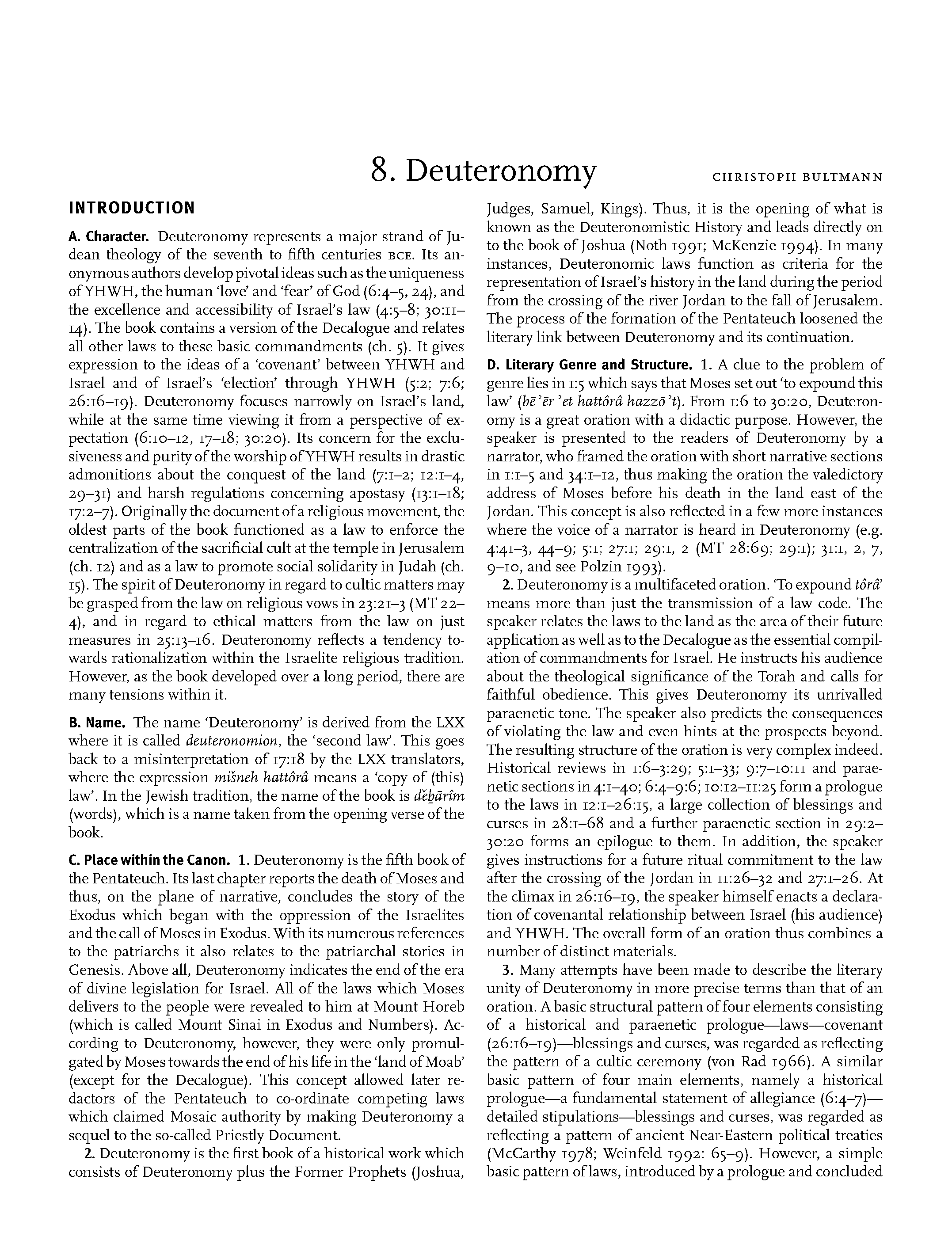
8. Deuteronomy CHRISTOPH BULTMANN
Judges, Samuel, Kings). Thus, it is the opening of what is known as the Deuteronomistic History and leads directly on to the book of Joshua (Noth 1991; McKenzie 1994). In many instances, Deuteronomic laws function as criteria for the representation of Israel's history in the land during the period from the crossing of the river Jordan to the fall of Jerusalem. The process of the formation of the Pentateuch loosened the literary link between Deuteronomy and its continuation.
A. Character. Deuteronomy represents a major strand of Judean theology of the seventh to fifth centuries BCE. Its anonymous authors develop pivotal ideas such as the uniqueness of YHWH, the human love' and 'fear' of God (6:4—5, 24)> an(^ the excellence and accessibility of Israel's law (4:5—8; 30:11— 14). The book contains a version of the Decalogue and relates all other laws to these basic commandments (ch. 5). It gives expression to the ideas of a 'covenant' between YHWH and Israel and of Israel's 'election' through YHWH (5:2; 7:6; 26:16-19). Deuteronomy focuses narrowly on Israel's land, while at the same time viewing it from a perspective of expectation (6:10—12, 17—18; 30:20). Its concern for the exclusiveness and purity of the worship of YHWH results in drastic admonitions about the conquest of the land (7:1-2; 12:1-4, 29-31) and harsh regulations concerning apostasy (13:1-18; 17:2—7). Originally the document of a religious movement, the oldest parts of the book functioned as a law to enforce the centralization of the sacrificial cult at the temple in Jerusalem (ch. 12) and as a law to promote social solidarity in Judah (ch. 15). The spirit of Deuteronomy in regard to cultic matters may be grasped from the law on religious vows in 23:21—3 (MT 22— 4), and in regard to ethical matters from the law on just measures in 25:13-16. Deuteronomy reflects a tendency towards rationalization within the Israelite religious tradition. However, as the book developed over a long period, there are many tensions within it.
D. Literary Genre and Structure. 1. A clue to the problem of genre lies in 1:5 which says that Moses set out 'to expound this law' (be'er 'el hattord hazzo't). From 1:6 to 30:20, Deuteronomy is a great oration with a didactic purpose. However, the speaker is presented to the readers of Deuteronomy by a narrator, who framed the oration with short narrative sections in 1:1-5 and 34:1-12, thus making the oration the valedictory address of Moses before his death in the land east of the Jordan. This concept is also reflected in a few more instances where the voice of a narrator is heard in Deuteronomy (e.g. 4:41-3, 44-9; 5:1; 27:1; 29:1, 2 (MT 28:69; 29:I); 3I:I» 2» 7» 9-10, and see Polzin 1993). 2. Deuteronomy is a multifaceted oration. 'To expound tord means more than just the transmission of a law code. The speaker relates the laws to the land as the area of their future application as well as to the Decalogue as the essential compilation of commandments for Israel. He instructs his audience about the theological significance of the Torah and calls for faithful obedience. This gives Deuteronomy its unrivalled paraenetic tone. The speaker also predicts the consequences of violating the law and even hints at the prospects beyond. The resulting structure of the oration is very complex indeed. Historical reviews in 1:6-3:29; 5:1-33; 9:7-10:11 and paraenetic sections in 4:1-40; 6:4-9:6; 10:12-11:25 f°rm a prologue to the laws in 12:1—26:15, a large collection of blessings and curses in 28:1—68 and a further paraenetic section in 29:2— 30:20 forms an epilogue to them. In addition, the speaker gives instructions for a future ritual commitment to the law after the crossing of the Jordan in 11:26—32 and 27:1—26. At the climax in 26:16—19, me speaker himself enacts a declaration of covenantal relationship between Israel (his audience) and YHWH. The overall form of an oration thus combines a number of distinct materials.
B. Name. The name 'Deuteronomy' is derived from the LXX where it is called deuteronomion, the 'second law'. This goes back to a misinterpretation of 17:18 by the LXX translators, where the expression misneh hattord means a 'copy of (this) law'. In the Jewish tradition, the name of the book is debdrim
(words), which is a name taken from the opening verse of the book.
C. Place within the Canon. 1. Deuteronomy is the fifth book of the Pentateuch. Its last chapter reports the death of Moses and thus, on the plane of narrative, concludes the story of the Exodus which began with the oppression of the Israelites and the call of Moses in Exodus. With its numerous references to the patriarchs it also relates to the patriarchal stories in Genesis. Above all, Deuteronomy indicates the end of the era of divine legislation for Israel. All of the laws which Moses delivers to the people were revealed to him at Mount Horeb (which is called Mount Sinai in Exodus and Numbers). According to Deuteronomy, however, they were only promulgated by Moses towards the end of his life in the 'land of Moab' (except for the Decalogue). This concept allowed later redactors of the Pentateuch to co-ordinate competing laws which claimed Mosaic authority by making Deuteronomy a sequel to the so-called Priestly Document.
3. Many attempts have been made to describe the literary unity of Deuteronomy in more precise terms than that of an oration. A basic structural pattern of four elements consisting of a historical and paraenetic prologue—laws—covenant (26:16—19)—blessings and curses, was regarded as reflecting the pattern of a cultic ceremony (von Rad 1966). A similar basic pattern of four main elements, namely a historical prologue—a fundamental statement of allegiance (6:4—7)— detailed stipulations—blessings and curses, was regarded as reflecting a pattern of ancient Near-Eastern political treaties (McCarthy 1978; Weinfeld 1992: 65-9). However, a simple basic pattern of laws, introduced by a prologue and concluded
2. Deuteronomy is the first book of a historical work which consists of Deuteronomy plus the Former Prophets (Joshua,
DEUTERONOMY 136 concerning the spirit of the Josianic age are severely restricted by the nature of the historical sources informing us about his times (cf. also P. R. Davies 1992: 40—1). Nevertheless, even if most of 2 Kings 22-3 is only legendary, the historical background of the representation in these chapters of Josiah's religious reform in 622 BCE may be sought in the activity of a movement which promoted the exclusiveness and purity of the Judean religion and gave literary expression to these ideas in a law code which later became the core of Deuteronomy. It is therefore not amiss to attribute the origin of Deuteronomy to a 'YHWH alone movement' in the seventh century BCE (M.
by an epilogue with curses, may already be found in the Code of Hammurabi of the eighteenth century BCE (where the curses threaten any future king who might abolish or alter the laws: ANET 163-80). Deuteronomy cannot be reduced to a literary structure which directly corresponds to any typical pattern because its erudite authors freely employ several elements from a common Near-Eastern cultural background.
E. History of Research. From patristic times onwards there was always a tradition that Deuteronomy was somehow related to the 'book of the law' (seper hattord) which, according to 2 Kings 22:1—23:25, was found in the Jerusalem temple during the reign of Josiah in the late seventh century BCE (e.g. Jerome, CChr.SL 75. 5). T. Hobbes, in his Leviathan (1651, chs. 33, 42), explicitly identified that law code with Deut 12—26 and emphasized that, in his opinion, it had been written by Moses. One hundred and fifty years later (1805—6), W. M. L. de Wette at the University of Jena came to the conclusion that Deuteronomy was not only the book which was found in the temple but had also been written not long before Josiah's times (see Rogerson 1992:19—63). Whereas for de Wette this hypothesis meant that Deuteronomy was a late part of the Pentateuch, later research into the history of the Israelite religion, conducted by A. Kuenen and J. Wellhausen around 1870, established the view that most parts of the Pentateuch were even later than the Josianic Deuteronomy (for a convenient presentation of this view see W. Robertson Smith 1892: 309430). The valuable commentary by S. R. Driver (1895) rests on this seminal model of the history of Israel's religious traditions. Subsequent scholarship tried to identify several editions of Deuteronomy which had been conflated into the extant book or to discover distinct redactional layers within it (see Mayes 1979; for a retrospective discussion see Nielsen 1995; for the current state of debate see Veijola (forthcoming)). Meanwhile it has become clear that the age of Josiah only stands for the beginnings of the literary development of Deuteronomy which reaches well into the Second Temple period.
Smith 1987: 11-42) and even to a distinct class of scribes who were educated in a Judean wisdom tradition (Weinfeld 1992: 158-78, 244-319). 2. An important factor in the development of the Deuteronomic movement is the language of political treaties in the ancient Near East (McCarthy 1978; Weinfeld 1992). Although the dependence of Deuteronomy upon such documents has often been overstated (see the critique by Nicholson 1986: 56-82), there are clear parallels in terminology and in the compositional function of a curse section. The relevant texts for comparison may be found in Parpola and Watanabe (1988) and ANET 531-41, also 201-6. The succession treaty of the Assyrian king Esar-haddon in favour of his son Assurbanipal, which dates from 672 BCE, is of particular interest here. Copies of this treaty were discovered during an excavation in Nimrud on the upper Tigris in 1955. They represent versions of the treaty as it was concluded with vassal states in the eastern periphery of Assyria and one can assume that the same treaty was also concluded with vassal states in the west, including Judah. The treaty must have been known to the scribe who wrote Deut28:2O~44 (Steymans 1995) and may also be alluded to in Deut 13. However, the question of under what political circumstances a Judean scribe would have borrowed those motifs from ancient Near-Eastern traditions remains open to conjecture.
3. The literary history of Deuteronomy developed further after the Babylonian conquest of Jerusalem in 587 BCE. According to Noth's theory of a Deuteronomistic History (see DEUT c.2), the author who wrote the history of Israel in her land must be seen against the background of this exilic age
F. Historical Background. 1. The age of Josiah, king of Judah 639-609 BCE (2 Kings 22-3), was characterized by the decline of the Neo-Assyrian empire. As very little is known about the impact of Assyrian politics and religion upon Judah, which since the second half of the eighth century had to some extent been a vassal state of Assyria, it is hard to decide what liberation from Assyrian domination would have meant to the Judeans (see McKay 1973; Spieckermann 1982; Halpern 1991). However, even in a very critical reading of Kings, scholars accept the historicity of the information given in 2 Kings 23:11-12, according to which Josiah removed Assyrian religious symbols from the temple in his capital Jerusalem (Wurthwein 1984: 459; cf Uehlinger 1995). It is less certain whether he also carried out the centralization of sacrificial worship which is attributed to him in 2 Kings 23:8-9, and whether this was instigated by the Deuteronomic law or conversely inspired the composition of a corresponding law code
(see, however, Cross 1973). That author opened his narrative with Deut 1-3; 4; 31; 34 (apart from some later additions) and placed the book of the law which had been passed on to him into this narrative framework. Furthermore, not only do such passages as 4:25—31 and 29:22—30:10 refer to Israel in exile; the entire concept which dominates the paraenetic sections, namely that Israel finds herself outside the promised land and has to regain it, looks like a response to the end of monarchic Judah.
4. More refined analyses of the distinct redactional layers within the Deuteronomistic History led many scholars to the conclusion that the work of the Deuteronomistic scribal school extended far beyond the middle of the sixth century BCE and right into the Persian period. Passages which secondarily add theological reflections on the relevance of the Torah to preceding narrative or paraenetic texts (such as Josh 1:7—8; Deut 6:17—18) are seen as an expression of a specific 'nomistic' or 'covenant-related' stage in the Deu-
(see Lohfink 1985; Clements 1996). Even more disputed is the historical reliability of the information about Josiah's encroachment on the territory of the former Assyrian provinces north of Judah (2 Kings 23: 15—20). Any general conclusions
J137 DEUTERONOMY
6. Two independent documents have been added to Deuteronomy, in ch. 32 the Song of Moses, and in ch. 33 the Blessing of Moses. Whereas the collection of sayings about the tribes in ch. 33 mostly predates the seventh century, the poem of ch. 32 has its origin in the context of later reflections about the relationship between YHWH and Israel amongst the nations.
teronomistic tradition (Smend 1971; 1983; Veijola 19960). Modifications in anti-syncretistic paraenetic passages which seem to reflect later historical experience of the Second Temple period (e.g. Deut 7:22; 7:3-4; cf. Neh 13:23-7; Ezra 9:1-2) are another point in question. An important formal criterion for these analyses is the recurrent shift of address in Deuteronomy between second person singular and second person plural (cf. DEUT 12:1-32) for which, however, an explanation in purely stylistical terms has also been suggested.
H. Literary History. 1. Deuteronomy developed from a law code to an oration of Moses within a narrative frame. The original law code aimed at a cultic reform in Judah and addressed its lay audience in the second person singular. It consisted of laws which were relevant to the centralization of sacrificial worship (12:13—19; 14:22—9; 15:19—23; 16:1—17; 18:1— 8) and probably also of laws concerning social and judicial matters (15:1—18; 16:18—19; J7:8—13; 19:1—21; 21:1—9; cf Morrow 1995), family and sex laws (see DEUT G.I), laws promoting equity in response to poverty (mainly in 23:15—25:16), and some ritualistic materials (e.g. 21:22-3; 22:9-10; 23:17-18), cf. Crilsemann 1996. 6:4—9 may have been the prologue to this law code. However, any detailed reconstruction of the original law code remains highly hypothetical. Whether or not it was presented as a law of Moses depends on the evaluation of 4:44-5 as its superscription.
G. Sources. 1. The legal core in chs. 12-26 incorporates many older materials. A direct comparison is possible between Deuteronomy and the so-called Book of the Covenant in Ex 20:22—23:33. This shows parallels between Ex 20:24—5 I I Deut 12:13-14, Ex 21:2-111| Deut 15:12-18, Ex 21:12-14 I I Deut 19:113, Ex 22:25-7 (MT 24-6)1123:19-20 (MT 20-1); 24:10-13, Ex 23:4-5 || Deut 22:1-4, EX 23:10-111| Deut 15:1-11, Ex 23:1418 || Deut 16:1—17. Thgse as well as some less obvious parallels make it clear that the Deuteronomic law represents a later stage in the history of Israelite law (Otto 19960; Levinson 1997; contrast Van Seters 1996), although the Book of the Covenant may itself contain post-Deuteronomic as well as preand proto-Deuteronomic materials. At least two more collections of laws were taken up by the authors of the law code, namely a collection of family and sex laws
2. The incorporation of Deuteronomy into the Deuteronomistic History was a distinct stage in its literary history (see DEUT c.2 and F.3), which created an explicit interrelation between the law and the issue of Israel's land as well as the differentiation between the law code and the Decalogue in ch. 5. In this process, the historians added laws to the code which look towards the subsequent history of Israel, such as the law on the king (17:14-20) and the law on the conquest (20:10-18, and further laws on warfare, see DEUT G.I).
(21:15—21; 22:13—29; 24:1—4; 25:5—12) and a collection of laws on warfare (20:10-14, 19-20; 21:10-14; 23:10-15) (Seitz 1971; Rofe 1987; 1985/7). Further laws may have been taken up from oral tradition, possibly with some paraenetic elements attached to them urging and motivating obedience, such as, e.g. 22:6-7. Th£ series of curses in 27:16-25 belongs to the apodictic law in Israelite tradition which commands an unconditional condemnation of or punishment for certain offences.
3. The literary development of the paraenetic sections in 4:1-40; 6:4-11:25; 29:2-30:20 as well as of the laws which are primarily concerned with the problem of syncretism or religious assimilation such as 12:1—7, 29~3IJ 13:1—18; 18:9—20 is a special problem (see DEUT F.4). Many suggestions have been made for attributing the respective texts to only a few successive editions or redactional layers. However, it seems more appropriate to think in terms of a prolonged literary process which led to what ideally may be called the canonical shape of Deuteronomy no earlier than the 4th century.
2. The large section of blessings and curses in ch. 28 contains a traditional series of blessings in w. 3-6 (which are reversed in w. 16—19). w20—44 closely follow a sequence of curses in Esar-haddon's succession treaty (see DEUT F.2).
3. Ch. 5 contains the Decalogue (w. 6-21) which found its place also in Exodus (20:2-17). However, instead of being a source of Deuteronomy, it is a composition which originated inside the Deuteronomic movement (Hossfeld 1982).
4. On the plane of the history of ideas, Deuteronomy is often seen as belonging to a Hoseanic prophetic tradition. The basic command of Deut 6:4—5 which centres on the notion of love' of God is regarded as a consequence of the theological concern and the metaphorical language of Hosea. As a second instance of Hoseanic influence the law concerning the king over YHWH's people (Deut 17:14—20) is appealed to. However, the available evidence does not sufficiently support the conclusion that Deuteronomy originated in the monarchy of northern Israel and was taken to Judah by refugees after the defeat of Israel in 722 BCE (Alt 1953).
I. Outline Review of the Conquest of the Land East of the Jordan ((1:1-5)
1:6-3:29) Discourse on the Excellence of the Law (4:1—40 (41—3, 44—9)) Review of the Covenant at Horeb and the Decalogue (5:1-33
(6:1-3)) Discourse on Faithful Obedience to the Law (6:4-11:25 (26-
32)) Promulgation of the Laws (12:1—25:19 (26:1—15)) Declaration of Mutual Commitments between YHWH and
Israel (26:16-19) Instructions for a Ceremony West of the Jordan (27:1—26) The Consequences of Obedience and Disobedience through
5. The historical reviews in 1:6—3:29; 5:1—33; 9:7—10:11 show a relationship with narrative traditions in Exodus and Numbers and presuppose the Yahwistic work in the Pentateuch. Whether 11:26-32 and 27:1-14, together with Josh 8:30-5, reflect an ancient tradition (Nielsen 1995; Weinfeld 1991) remains doubtful.
Blessings and Curses (28:1-68) Discourse on the Significance of the Law ((29:1) 29:2-30:20) Report of Moses' Parting from Israel, Including his Poem and his Blessings (31:1—34:12)
i38
DEUTERONOMY
(1:9-18) Officers in Israel This insertion, which separates w. 6—8 from its continuation in v. 19, authorizes an organization of the people modelled on 16:18—19 an(^ 17:8—11. The passage is remarkable in that it grounds the position of'leaders' on the consent of the people (v. 14) and specifies their qualification as 'wise, discerning, and reputable' persons (v. 13)—a profile which one may read as a self-portrait of the Deuteronomistic school. The designation of these leaders (ra'sim) in military terms (sarim, soterim, v. 15) corresponds with the literary context of the conquest narrative. Their designation as 'judges' (sdpetim) may reflect their actual function in the society of the author's time. A similar concern with the institution of leaders is expressed in Ex 18:13-27; 2 Chr 19:510; Num 11:14-17, 24-5, whereas no details about the appointment of officials during the time of the Judean monarchy (cf. e.g. Jer 36:12; 2 Kings 24:15) are known, w. 16-17, integrity of the judges is essential to the idea of justice, and just claims of the poor merit protection (cf. 24:14—15; Am 5:10—12).
Review of the Conquest of the Land East of the Jordan
(1:1—5) Moses as Orator The superscription to Deuteronomy introduces the book as the words of Moses to all Israel at a location east of the river Jordan. As Moses is never to cross the Jordan (3:23—8), the following oration will be his valedictory address. This, however, is only explicitly indicated in 31:1—2 (cf 4:22). The basic form of the superscription, 'These are the words that Moses spoke to all Israel beyond the Jordan as follows', has been considerably expanded, v. 5, which may be part of a specific compositional scheme (cf. 4:44; 29:1 (MT 28:69)), emphasizes the qualification of Moses' oration as law (tord). 'Of all the terms for God's instructions, none better characterizes Deuteronomy, since it connotes both law and an instruction that must be taught, studied, and pondered, and it is expected to shape the character, attitudes, and conduct of those who do so' (Tigay 1996: 3). For v. 4 see further on 2:243:11. v. 2 can best be explained as a misplaced gloss on 1:19, while v. ifc, which adds some topographical information, remains elusive, v. 3 reflects an interest in chronology that is typical of Priestly texts in the Pentateuch, cf. e.g. Ex 40:17; Numio:n. (1:6—3:29) The Conquest of Israel's Land Moses gives an account of the partly unsuccessful and partly paradigmatic beginning of Israel's taking possession of the promised land. The section gives expression to a deliberate concept of the land as YHWH's gift to Israel which Israel entered from outside at a certain moment in history. The Deuteronomistic History (see DEUT c.2) thus starts with an idealized image of the conquest of the land, and ends with a somewhat stylized image of the loss of the land, cf. 2 Kings 15:29; 17:6, 23; 25:21, 26. It thus shapes a coherent overall view of one extended period of Israel's history. Although the Deuteronomistic authors of the sixth and fifth centuries BCE include several historical traditions in their composition, their work cannot be called historiographical in a strict sense. (1:6-8) YHWH's Command Moses' retrospective does not start from the Exodus but with a reference to Mount Horeb. Thus it alludes to all the events which this name implies (cf. 5:2; 9:8). The land which Israel is to conquer is called 'the hill country of the Amorites' (har ha 'emori) by a designation based on the name for the area in Neo-Assyrian inscriptions. An alternative general designation is 'the land of the Canaanites' ('eres hakkencfant), and elsewhere in Deuteronomy a list of peoples is used for describing the population of the land (cf. 7:1; 20:17). Whereas chs. 2-3 carefully define Israel's territorial claims east of the Jordan (cf. 3:8), the vision of Israel's land as extending to the north as far as the river Euphrates (v. 7; cf. Josh 1:4) is alien to the concept of a conquest as well as to Israel's historical traditions. It may be either an echo of imperial rhetoric (Weinfeld 1991:133—4) or a reflection ofpolitical experience in the late seventh century when victory in a battle at Carchemish on the Euphrates in 605 BCE made the Neo-Babylonians the political overlords of Palestine (cf. Jer 46:2; 2 Kings 24:7). v. 8 emphasizes that Israel's hope for the land is founded on an oath which YHWH swore to her ancestors, cf. Gen 15:18. The verse forms an indusio with 30:20.
(1:19—2:1) The Failed Conquest In an artistic retrospective account, Moses indicates the reason why, after the Exodus, the Israelites did not conquer the promised land west of the Jordan from its southern border (cf. also the time-scale implied in 1:2). Disobedience (1:26; cf. 1:7-8) and lack of faith (1:32, RSV; contrast Ex 14:31) led to divine punishment of the Exodus generation (1:34-5; cf2:14-15). Kadesh-barnea has been identified with an oasis about 80 km. to the south-west of Beersheba, the town which normally marks the southern border of Judah (i Kings 4:25 (Mt 5:5); 2 Kings 23:8; cf. however Josh 15:2-4). Instead of being the starting-point for the conquest, it becomes the starting-point for a journey of nearly forty years south-eastwards to the Red Sea and back northwards on the eastern side of Mount Seir until the successful conquest begins with the crossing of the Wadi Arnon (2:24), a wadi which runs towards the Dead Sea from the east opposite En-gedi. The narrative has been constructed upon the basis of a tradition about the Calebites who had expelled 'the three sons of Anak' from the fertile Hebron area (cf. Josh 15:14 and some fragments in Num 13-14). (2:2-23) The Neighbouring Nations The second episode in Moses' account opens with a phrase similar to 1:6-7. Th£ approach to the Wadi Arnon offers an opportunity to define Israel's territorial claims against the Edomites, the Moabites, and the Ammonites (see ABD, ad loc.). The section has been expanded by several successive scribes. One basic feature is the idea that YHWH, and not the respective national deities, assigned these three peoples their territories (w. 5, 9, 19; contrast Judg 11:12-28, esp. v. 24). A second basic feature is the analogy between Israel's conquest of her land and the way in which these and other peoples took possession of their respective territories 'just as Israel did in the land they were to possess, which the LORD had given to them' (v. 12, NJPS). According to this view, the history of the historical nations follows on a mythological age in which 'Rephaim' (giants) inhabited the land. They may be called 'Emim', or 'Zamzummim', or 'Anakim' (w. 10-11, 20-1), and are comparable with 'Horim' and 'Awim' in other regions (w. 12, 22-3; cf. also Am 9:7). As far as the Rephaim are concerned, a mythological tradition has been identified through a Ugaritic text (c. 14—I2th cents. BCE) which also establishes a link between Rephaim
i39 DEUTERONOMY and the place-names Ashtaroth and Edrei (cf. 1:4; 3:11; see Margulis 1970). All these glosses amount to a striking reinterpretation of the conquest imagery which finds expression also in 9:2. w. 14-15, pointing back to 1:34-5, these verses mark a transition between two periods of Israel's history after the Exodus.
14, 25—9, the scene thus includes reflections on the relationship between Moses and the people. The opening of the prayer proclaims YHWH's uniqueness (as in i Kings 8:23); one might compare the hymnic praise of the sun god in an Akkadian hymn (Lambert 1960: 129 11. 45-6; ANET 388): 'Among all the Igigi (gods) there is none who toils but you, None who is supreme like you in the whole pantheon of gods.'
(2:24—3:11) The Model Conquest YHWH's command also stands atthe beginning of the third episode in Moses' account. 2:32-6, the first act of the conquest draws on an ancient tradition about a Transjordanian city ruler which has been preserved in the parallel narrative in Num 21:21—31. The account follows a highly stylized pattern: YHWH gives the enemy over, and the Israelites' army then 'strikes him down—captures his towns—utterly destroys all human beings in them—keeps the livestock and plunder as spoil'
Discourse on the Excellence of the Law (4:1-40)
This great discourse has been inserted between the historical retrospective and the superscription to the law in 4:44. Although it combines several components and although the form of address changes between second person plural and second person singular (see DEUT F.4 and Begg 1980), it eventually forms a unit framed by w. 1—2 and 40. The discourse gives an interpretation of the Exile after the destruction of Jerusalem in 587 BCE as a time of 'serving' gods who are nothing but 'wood and stone' (v. 28; cf. 28:64) and addresses the issue of Israel's 'return' to YHWH (v. 30; cf. 30:1-2). It presupposes the prohibition of idols in the Decalogue (w. 12— 13, 16; cf. 5:8) and contains an explicit monotheistic confession (w. 35, 39). Both these fundamental theological doctrines are being derived from the visual scene of YHWH's revelation at Mount Horeb and presented as an epitome of the Torah.
(2:33—5 and again in 3:3—7). This pattern agrees with the Deuteronomistic law on warfare in 20:10-18 and especially the injunction to 'utterly destroy' (h-r-m hifil) all former inhabitants of the land (20:16—17; see DEUT 7:1—2). Moses is thus represented as conducting an exemplary war against the Amorites east of the Jordan, cf. 3:21; 31:4. 2:25-30, the basic structure of the account has been supplemented by several additions which focus on divine providence: YHWH puts 'the dread and fear' of Israel upon the peoples (2:25), YHWH 'hardens the spirit' of the Amorite king (2:30). Moses acts in accordance with the law of 20:10 although neither this law nor the analogy with Israel's passing through the land of the neighbouring nations applies to the case of the Amorite territory (2:26-9). 3:I~7> ^e second Amorite king is seen not as a city ruler but as king of a vast region; see, however, 1:4 and DEUT 2:10—11, 20—i. His name has been adopted from an etiological tradition which links this mythological figure to Kabbah of the Ammonites (3:11, however, the Ammonite territory itself is exempted from the land which the Israelites claim, 2:19, 37). The description of the conquered towns probably depends on i Kings 4:13. 3:8 states the result of Moses' ideal conquest which a scribe, probably in the sixth century BCE, created from very remote memories of some early history of Israelite tribes in the land east of the Jordan.
(4:1—8) Israel's Wisdom Obedience to the 'statutes and ordinances' brings with it the promise of life (v. i; cf. 30:15-16) and is also seen as a condition for the conquest of the promised land (v. i; cf. 6:17—18). At the same time, the 'statutes and ordinances' are defined as rules for life in the land (v. 5; cf. 12:1). The substance and the extent of the law must be protected from any changes (v. 2). This principle lies on the way to the formation of a canon. In w. 6—8, a scribe gives expression to the ideal of Israel as a 'wise and discerning people' ('am hakam wenabon). Israel will be recognized as such a people from YHWH's protection (v. 7) as well as from her divine law (v. 8, cf. DEUT 1:5). Obedience to this incomparable law would counteract the 'foolishness' of the people which is attacked in Jer 4:22. The designation of Israel as a 'great nation' echoes Gen 12:2, cf. Deut 1:10. Inthe final shape of Deuteronomy, the admiration of the nations in 4:6—8 corresponds with their puzzlement in 29:24—8 (MT 23—7). w. 3—4, the warning against apostasy may be a gloss based on Num 25:1-5, cf. also Hos 9:10.
(3:12—20) Tribal Territories On the distribution of the land see Josh 13:8-32. w. 18-20, the 'rest' (n-w-h hifil I.) which YHWH has given to these tribes is an ideal for all Israel. Therefore, these tribes are summoned to support the conquest of the land west of the Jordan, cf. Josh 1:12—15; 22:1—4 (for the notion of'rest' cf. also Deut 12:9; Josh 23:1; 2 Sam 7:1; i Kings 8:56). The notion of a rest in which the towns may be left without any defence (v. 19) conveys a peaceful vision in strong contrast with the military ideology of 2:34.
(4:9—14) YHWH's Voice at Mount Horeb The praise of the Torah is complemented by a graphic representation of the revelation of the Decalogue. The Israelites are to keep that day in their memory and their heart and pass the tradition on to all future generations (v. 9). YHWH revealed the Ten Commandments directly to the people so that they could hear 'the sound of words' (v. 12; cf. 4:33; 5:24), and he thus established his 'covenant' (bmt) with them. The poetic imagery underlines the priority of the Decalogue over the several statutes and ordinances (w. 12—14). Th£ account is based on 5:1—6:3 which, in turn, depends on fragments of older traditions in Ex 19-34. ^ makes the special point that Israel did not see any 'form' (temund; 'shape' NJPS, 'similitude' KJV) in the theophany (v. 12).
(3:21—9) The End of Moses' Leadership w. 21—2, Moses' and Joshua's leadership in the conquest are seen in close parallel, cf. Josh 1:5. v. 28 is resumed in 31:7; Josh 1:6. The scene of Moses' rejected prayer is not continued by the narrator until 34:1—3. Moses wants to 'cross over' into the land and 'see' it (v. 25), but he may only 'see' it, whereas Joshua is to 'cross over' into it (v. 27-8). Moses thus becomes the symbol for an unfulfilled hope to live in the promised land. The reason for this is that YHWH makes him bear the consequences of the people's lack of faith—which Moses deplored in 1:32 (v. 26; the same thought has been added in 1:37-8). Not unlike 9:13-
(4:15—20) Prohibition of Idols and Astral Cults Like 5:8, Moses' warning excludes all sculptured images in wood or
DEUTERONOMY 140
(4:41—3) Cities of Refuge Based on 19:1—13, a narrative insertion identifies three towns in the allotted territory east of the Jordan (3:12-17) as places of refuge. This is repeated in Josh 20:1-9. (4:44-9) A Superscription v. 44 marks the transition from Moses' historical review in 1:6—3:29 to the publication of the tora in a more limited sense than that implied by 1:5. Still, the notion of tora includes paraenesis as well as the laws. Together with the subscription in 29:1 (MT 28:69), me superscription in v. 44 forms a frame around the extended law code as the document of a covenant, and 31:9 may refer to this unit. A parallel superscription in v. 45, which is taken up in 6:20-5, is stone (pesd) from Israel's cult. No image of the deity can signify religious truth, because the fundamental tradition of YHWH's theophany at Mount Horeb knows of no anthropomorphic or zoomorphic shape, cf. also the imagery of 1:33; Ex 13:21-2, contrast Ex 32:4. The strongly anthropomorphic language of the HB should be considered in the light of this critical thought. The section takes the law of 16:21—2 one step further and reflects a development which is also indicated by Isa 40:18-20, 25-6; Jer 10:14-16 (on religious iconography in Israel in antiquity see Keel and Uehlinger 1998). Astral cult, which is also an issue in the law code itself (17:2—7), seems to have been a major threat to Judean religious identity in the late monarchic period, cf. 2 Kings 23:11-12; Zeph 1:4-6; Jer 8:1—3, and see the quotations from an Assyrian treaty at DEUT 28:1—68. This type of religion is interpreted in w. 19—20 on a line with 32:8-9, according to which YHWH as the God most high assigns celestial beings as deities to the nations, whereas Israel is his own people ('am nahdld, cf. i Kings 8:51— 3 and the term 'am segulld in 26:18). However, the polemics in v. 28 and the confession in v. 35 seem to invalidate this interpretation of polytheism.
terminologically interesting, cf. 5:31. The term 'decrees' fedot) may designate the Decalogue, cf. 2 Kings 17:15 and the singular noun in such priestly texts as Ex 25:16; 31:18. As neither of these superscriptions can be shown to have been the original superscription to the law code which Hilkiah is said to have sent to Josiah (2 Kings 22:3—10), it remains an open question whether that document had already been attributed to Moses then. w. 46-9, these later additions are based on chs. 1-3. Instead of 'the land of Moab' as in 1:5, they speak more correctly of 'the land of... Sihon'.
(4:21-31) Moses' Prophetic Warning A scribe here gives Moses a prophetic role on his parting from Israel (cf. 31:14— 30). Moses foresees YHWH's wrath and YHWH's mercy in Israel's future history which centres on the Exile after the defeat of Jerusalem in 587 BCE. He confronts Israel's faith with two conflicting views of God: 'the LORD your God is a jealous God', and 'the LORD your God is a merciful God' (w. 24, 31; cf. 5:9-10; Ex 34:6-7). The tension between these two statements should not be superficially resolved, as both perceptions of God claim their place in religious experience and stimulate as much as restrict theological reflection. In the present context, the experience of divine punishment is seen as a consequence of violating the prohibition of idols (v. 23), not of the service of'other gods' as e.g. in 29:24-5 (MT 25-6); cf. also Rom 1:22—3. On the other hand, the expectation to 'find' YHWH 'if you search after him with all your heart and soul' (v. 29; cf. Jer 29:13-14; Am 5:4) is founded on YHWH's covenant with the ancestors (cf. 29:13 (MT 12)) which, unlike the covenant at Mount Horeb (4:13, 23) does not depend on obedience to the law (cf. Gen 15:6). v. 31, therefore, shows a greater kerygmatic depth than a passage like 28:58-68.
Review of the Covenant at Horeb and the Decalogue (j.'i-JJ
(&i-3)) (5:1-5) The Covenant at Mount Horeb The superscription which announces the Torah (4:44) is not directly followed by a code of laws, but instead by an explanation of the relation between the laws of Deuteronomy and the Decalogue (5:1—31) as well as by a series of discourses on faithful commitment to YHWH (chs. 6-n). Chs. 5-11 may altogether be attributed to Deuteronomistic scribes of the sixth and fifth centuries BCE; cf. DEUT F.3, H.3. The Decalogue is the foundation of YHWH's covenant with Israel (v. 2) which is linked to the place name 'Horeb' (as 'Sinai' in Exodus) and the imagery of God's speaking to the Israelites directly from 'out of the fire' (v. 4). Two further considerations have been added to this original concept: v. 3 emphasizes the continuous relevance of the covenant to all generations of Israel. The weight of this issue becomes clear in contrast to Jer 31:32 where the original covenant refers to the 'ancestors' and, after a history of unfaithfulness, needs eschatological renewal, v. 5 emphasizes the role of Moses as mediator between YHWH and Israel. A similar concern guides the narrators in Ex 19-24; 32-4. For a circumspect analysis of Deut 5 see Hossfeld (1982).
(4:32-40) A Confession of Monotheism w. 32-5, this unique statement in Deuteronomy must be seen on one level with Isa 45:5—6, 12, 18, 21—2; 46:9—10, although it may reflect a later liturgical adaptation of these sayings from the sixth century BCE. In a perspective of a theology of creation, the unit leads to a climax in a monotheistic creed, cf. 32:39. In a universal horizon, YHWH's revelation at Mount Horeb in a voice 'out of the midst of the fire' (RSV, cf. w. 12—13) an(^ his prodigious actions in the Exodus (cf. 5:15; 34:11-12) are considered a proof of his exclusive divinity. The knowledge of God (v. 35) which Israel will arrive at through an understanding of her traditions is finally to become the knowledge of 'all the people of the earth': i Kings 8:60; cf. 13349:6. w. 36 (cf. 8:5) and 37-9 read like homiletic amplifications of the preceding sections. In liturgical diction, v. 38 refers to the completed conquest of the land. w. 39—40 echo v. 35 and w. 1—2 respectively and form a finale to the discourse.
(5:6—21) The Decalogue A proper biblical perspective on the Decalogue can be gained through 5:24 (cf. 4:33): 'Today we have seen that God may speak to someone and the person may still live.' The Decalogue is fundamental not only to the covenant relationship between YHWH and Israel, but through Israel as God's revelation to humankind. Within the Christian tradition, it remains a valid exposition of the commandment to love God and one's neighbour (Mk 12:28—34; Rom 13:8—10). The Decalogue is a literary composition of the Deuteronomists and maybe more original in its context in Deut 5 than in Ex 20. It could, however, always function as a self-contained sequence of basic commandments and probably originated independently of its literary setting. The Decalogue integrates several distinct elements; see also Schmidt (1993). Its three
141 DEUTERONOMY mulated as positive law here. The life of the community is to be guided by three essential principles: the protection of human life, of marriage, and of property. Natural indignation at any offences against these rules is a powerful demonstration of their universal validity. The death penalty within a society (cf. 19:11—13) and war between hostile societies (cf 20:10—14) are not addressed by the commandment at v. 17, cf. also Gen 9:6. However, as the commandment expresses great respect for human life, it should strengthen a commitment to peace and protection of life in all fields, w. 20—1, the three concluding prohibitions can be related to the three preceding ones. Bearing false witness may be used as a strategy for causing another person's death, cf. 19:15—21; i Kings 21:8—14. Coveting a married woman may lead to adultery, and desiring another person's property may end in its misappropriation. The authors of the Decalogue have thus reduplicated the three basic rules of w. 17—19 in order to warn against the psychological origin of obvious violations of basic ethical norms, cf. Job 31:5-12. The same line of interpretation is pursued further in Jesus' teaching in Mt 5:21-2, 27-8. As much as the social world of ancient Judah can be recognized behind 5:12-21, and as strongly as the conflict between the God of the Exodus and 'other gods' in Israel's religious history characterizes 5:6-11, the Decalogue still remains the most comprehensive compilation of life-enhancing religious and ethical insights within the OT main sections are the self-presentation of YHWH and the prohibition of other gods (w. 6—10), the sabbath commandment (w. 12—15) and the series of six prohibitions in w. 17—21.
w. 6-10, in a first person singular address of YHWH, two basic features of Israel's faith are being expressed: the God who demands obedience to his commandments is the God who delivered his people from oppression in Egypt, and this God is a 'jealous God' ('el qanna') and therefore demands exclusive worship. God's punishment for 'iniquity' (awon) extends to an entire family, i.e. to the four generations which may at most be living at any one time. Ezek 18 revises this doctrine of 5:9-10 and Ex 34:7 in an extensive theological discussion, cf especially 18:19-20 and also Deut 7:10; 29:18—21 (MT 17—20). The first section of the Decalogue is framed by a witness to the gracious God who is known to those who love God through the Exodus and through a promise to show 'steadfast love' (hesed). The human being's response is to love God (v. 10; cf. 6:5), and this implies acknowledging God's uniqueness (v. 7) and keeping God's commandments (v. 10). v. 8, which separates v. 7 from its continuation in v. 9, is an addition which anchors the concern of 4:15—18 in the Decalogue. The prohibition effects a sharp distinction between visual representations of God and metaphorical representations of God in human language, v. n, invoking the name of a deity is part of an oath (cf. 6:13; Jer 5:2; Ps 24:4). The prohibition reflects the strong concern with judicial matters typical of Deuteronomy (cf. 16:19; 19:15-19). w. 12-15, me Decalogue includes only one distinctive religious custom, namely keeping the sabbath as a weekly day of rest from work. The commandment continues an older tradition (cf. Ex 23:12; 34:21) and at the same time probably transforms the day called sabbat from a celebration of full moon (cf. e.g. 2 Kings 4:23; Hos 2:11 (MT 13)) into a weekly day of rest, w. 14—15 particularly emphasize the social significance of a periodical day of rest and call for generous treatment of all dependent persons, whether they be formally linked to a family as slaves or live as 'resident alien[s] in your towns'. Obeying this commandment is a way of remembering God's liberation of Israel from oppression in Egypt (cf. 15:15; 26:68). In Ex 20:11, this motivation has been substituted with the concept of a cosmic dimension of a seven-day week, cf. Gen 1:1—2:3. Notwithstanding this notion of its universal character, the sabbath must also be protected as a 'sign' of the unique relationship between YHWH and Israel, cf. Ex 31:12-17.