
Part 98
The Person of Jesus. Reliance on the person of Jesus is the central condition for acceptance of God's sovereignty. The story Mark tells may be seen as an unveiling of the mystery of who Jesus is. The reader is told succinctly at the start that he is Messiah and Son of God (1:1). Through Markan irony (see above) the actors in the drama discover only painfully and slowly who Jesus is. But the believing reader, already enjoying knowledge of the resurrection, also shares in this discovery, learning as Mark's story unfolds what these titles mean. The reader benefits from the recognition of Jesus by the voice from heaven at the baptism (1:11) and the transfiguration (9:7) and by the unclean spirits as they are expelled (acknowledgements seemingly unnoticed by those present, 3:11; 5:7), but this knowledge is still denied to those who encounter Jesus. No human witness of Jesus reaches full acknowledgement of him as Son of God until the centurion at the cross. The quest pervades the gospel, as those who encounter Jesus attempt to puzzle out who he is (2:7; 4:41; 8:21, 29; 11:28; 14:61). It is made more laborious by Jesus' repeated order to 'tell no one about what they had seen until the Son of Man had risen from the dead' (9:9), the so-called'messianic secret' (see 1^x1:32—4).
Various explanations have been offered for Mark's insistence on the disciples' failure. Weeden (1968) suggested that Mark was concerned to correct a group of Christians who saw Jesus only as a miracle-worker and undervalued the importance of his passion. Best (1986) saw a pedagogical element, Mark hinting how hard it was to assimilate the full message of Jesus. A feature of the gospel possibly related to, and contrasting with, the failure of the disciples is the success and praise of those who take the initiative in approaching Jesus: the SyroPhoenician woman (7:25—30), the father of the epileptic boy (9:18), Bartimaeus (10:46—52), the woman at Bethany (14:9). Mark may be pointing the lesson that a first approach to Jesus is easy enough, but that enduring commitment brings its own difficulties. At any rate the gospel must be reacting to a testing situation of the persecution of Christians in which some (perhaps even some of the leaders of the community) have failed to understand that suffering for the sake of the gospel is an integral part of discipleship.
The dominant impression of Jesus is one of authority. When he calls the disciples they follow unhesitatingly
(1:16-20). He teaches and heals with authority (1:22, 27). The wind and the sea obey him (4:41). Even his unexplained commands are obeyed without question (11:1—6; 14:13—16). Amazement and astonishment follow him everywhere (2:12; 5:20; 6:51; 7:37). A challenge to his authority is easily defeated (11:27—33), until 'no one dared question him any more' (12:34). He acts like the prophets of old (6:15; 8:28), even providing bread in the desert for his followers as Moses did (6:35-44; 8:1-9). He arrogates to himself powers that only God possesses, forgiving sin (2:1-12), claiming to be lord of the sabbath (2:28), rebuking the storm (4:39; cf. Ps 107:23—9), walking on the sea (6:48; cf. Job 9:8). The final blasphemy—again Markan irony—is when he proclaims that the high priest will see him ' "seated at the right hand of the Power" and "coming on the clouds of heaven"' (14:62), a claim to share the very throne of God (see Donahue 1973). It is against this background that the titles given to Jesus, such as 'Son of Man' (see MK 2:1—12) must be understood.
The Kingship of God. The focus of Jesus' proclamation of the Good News in Mark is, however, the kingdom, or rather kingship, of God. This is the object of his first proclamation, the conclusion of the Markan introduction (1:15). The proclamation is closely followed by Jesus' first miracle, the expulsion of an unclean spirit (1:21—8). As Jesus interprets his power over evil spirits as being a sign of the triumph of the kingdom of God over the kingdom of Satan (3:23-4) his miracles of healing may also be understood as a sign of the advent of God's kingship and rule, the triumph of God over evil, so long awaited in Judaism. From the first teaching of John the Baptist
2. Matthew. Narrative Style. Mark and Matthew differ in two major respects. While Mark is concerned primarily to present a picture of the wonder of Jesus' personality Matthew concentrates on the teaching of Jesus. It has been calculated that
ioog THE FOUR GOSPELS IN SYNOPSIS
Mark, omitting the sweeping liberalism of Mk 2:27. More positively he frequently uses rabbinic methods of argument, a heading followed by examples (in rabbinic writing known as ah wetoledot) in Mt 5:17 before the six great completions of the law in5:2i—48 andin6:ibeforetheclassicgood works, the'lightand heavy' argument (Heb. qal wahomer, Lat. a minori ad majus) in 12:12, and kefaf or'summingup' in 7:12. It is notable that of all NT writers Matthew's formulas to introduce scriptural quotations are closest to those used at Qumran (cf Fitzmyer 1970—1). His use of Scripture, linked to the word rather than the meaning of texts, is similarly often characteristic of Jewish exegesis of the time (cf. Barthelemy 1963). This reaches its extreme when Jesus is represented as mounted on both the ass and the colt in Mt 21:7, in order to fulfil Zech 9:9 literally.
Mark contains 240 verses of teaching, and Matthew 620. Invariably Matthew expands the Markan teaching, just as he contracts the miracle stories. The guidance for the Christian life provided by Matthew is certainly one of the reasons why his early became the most popular and widespread of the gospels. Another reason—and this is surely at the heart of Matthew's popularity—is the poetic, rhythmic, and linguistic skill shown in Matthew's teaching sections, making the teaching attractive to remember and to quote.
Matthew tends to think in simple contrasts, using contrasting images, rock and sand (7:24), broad and narrow road (7:14), sun and rain (5:45), as well as many other pairs of images, birds and lilies (6:26-9), sPeck and log (7:4), moth and rust (6:19—20), and sometimes pairs of pairs, grapes, thorns, figs, thistles (7:16), stone, bread, snake, fish (7:9—10). His parables similarly point contrasts. Goulder (1974: 54) describes all Matthew's thirteen long parables as 'black and white caricature contrasts'. All of them contrast personalities
Most significant on this topic is Matthew's treatment of scribes. Mark shows little interest in the scribes, and has few good words to say for them. Matthew, on the other hand, is careful in his treatment of them, systematically removing them from passages where they could, in Mark's narrative, seem to have a part in the death of Jesus (passages corresponding to Mt 21:23; 26:3, 47; 27:1). On other occasions Matthew makes it clear that particular hostile scribes belong to the Pharisee party (7:28-9; 22:34-40) or he simply substitutes 'Pharisees' for 'scribes' (9:11; 12:24). More positively, scribes are joined to prophets and wise men as those who are to be sent out as messengers in 23:34—Luke, in his corresponding passage, joins them together as 'prophets and apostles'—so that with good reason the approving sketch of the 'scribe who has been trained for the kingdom of heaven' is seen as Matthew's own self-portrait (13:52). Some scholars conclude that Matthew was writing for a community of Christian Jews, possibly at Antioch (Meier 1982; Sim 1998).
(normally stock contrasting personalities, devoid of human interest or subtlety, the two builders (7:24-7), the two sons (21:28-31), the two servants (18:23-35), me wise and foolish wedding-attendants (25:1—13), and are themselves often in pairs (the mustard-seed and the leaven, 13:31—3, the treasure and the pearl, 13:44-6, the watchful householder and the faithful servant, 24:43-7; the talents and the sheep and goats, 25:14-46). Nor is it only the liveliness of the imagery that attracts. Matthew has also a balanced rhythm which is far more frequent in his sayings than in the other Synoptics; one of the most frequent forms is described by Goulder (1974: 71) as a 'four point antithesis which has a paradoxical element'. Of these Goulder counts forty-four in Matthew, e.g. 6:3; 7:16; 9:37; 10:16. Where they are shared by Mark and Luke the form given by Matthew is often sharper and more succinct (e.g. Mt 16:26 compared with both Mark's and Luke's versions, or Mt 10:26 with Mk 4:22, or Mt 20:16 with Lk 13:30). Two special types of these four-point sayings may be mentioned, one in which two of the four terms are the same ('You received without payment, give without payment, Mt 10:8, my itals.), and the other in which the four terms fall into pairs ('with the judgement you make you will be judged, and the measure you give will be the measure you get, Mt 7:2 (my itals.)—much more succinct—12 words only—in Matthew's Greek, and quite lost in Lk 6:37-8). If Mark was chosen to relate the Good News for his skill in storytelling, it could well be that Matthew was selected to write a gospel because of the memorably poetic quality of his oral version of the teaching of Jesus.
Matthew's Christology. In accord with this Jewishness Matthew sees the message of Jesus as bringing the teaching of Judaism to completion. Thus on twelve occasions he shows Jesus acting 'in order to fulfil' the scripture (1:23; 2:6; 15, 18, 23; 4:1516; 8:17; 12:18-21; 13:35; 21:5; 26:56; 27:9-10) as though with no other motive for action. He sees the miracles of Jesus as the fulfilment of Isa 61 (Mt 8:17; 11:5—6) and the resurrection of Jesus as the sign of Jonah (Mt 12:39; 16:4, whereas Mk 8:12 misses this significance, saying that no sign will be given). He sees Jesus as the new Moses, reflecting Moses' career in his infancy (this is the chief theme of Mt 2), in his lawgiving (Mt 5:1), and in his final charge on the mountain (Mt 28:16). Consequentially, the people of Jesus forms the new Israel, replacing the old. InMti6:i8 'my church' (or more exactly'my community/congregation') mirrors the people whom God called to himself in the desert, and they are the nation to which the kingdom will be given when it is taken away from the unresponsive tenants (22:43). The repeated promise of his presence among them (1:18; 18:20; 28:20) corresponds to the presence of God among the people of Israel.
Matthew's Jewishness. The other feature that contrasts Matthew's style with that of Mark is its Jewishness, and more precisely its rabbinic quality. It is not simply that Matthew leaves Semitic words unexplained (e.g. raqa in 5:22), or that he shows constant interest in Jewish matters, such as the three classic good works of Judaism (almsgiving, prayer, and fasting) or tithes, phylacteries, and the law. Nor yet thathe several times demurs from Mark's cavalier treatment of legal observance (e.g. he omits Mk 7:igc, 'Thus he declared all foods clean') and in Mt 12:1-8 is careful to justify the disciples' pluckingearsofgrain on the sabbath with more arguments than
Not unexpectedly, therefore, Matthew's Jesus is a more dignified and hieratic figure than Mark's, almost as though he were already the risen Christ. Many of the human touches of emotion found in Mark are missing in Matthew (e.g. Mk 1:43; 3:5). The thronging crowd scenes of the Markan miracles of healing give way to a solemn lone confrontation between
THE FOUR GOSPELS IN SYNOPSIS
speech and dialogue, for example the little scenes of the infancy stories in Lk 1—2, or Martha and Mary (10:38—42), the ten lepers (17:11-19) or the journey to Emmaus (24:1332). Luke's skill in presenting theology by means of such dramatic scenes is thrown into relief by similar scenes in the Acts, for example the baptism of the Ethiopian (Acts 8:26—40) or Saul's conversion (Acts 9:1—9). Luke's characters are colourful and varied; contrast the warm family atmosphere and joy of Luke's infancy stories with Matthew's, in which no human being speaks to any other, or the three main characters of Luke's parable of the prodigal son (15:11-32) with Matthew's skeletal and wooden characters in the parable of the two sons (Mt 21:28—32). A special feature is Luke's mixed characters, the blackguard Zacchaeus who makes good (19:1—10), the characters who do the right thing for the wrong reason (the friend at midnight, the crafty steward, the unjust judge).
the Healer and the beneficiary (cf. Mt 8:14-15 and 9:20-2 with their Markan equivalents). If Jesus worked no miracles at Nazareth because of their unbelief, it was not that he could not (Mk 6:5) but simply that he did not (Mt 13:58).
While in Mark the disciples consistently fail to understand Jesus and his message, in Matthew this is no longer possible (cf. Mk 6:52,8:21 with Mt 14:33,16:12). Whereas in Mark Jesus is commonly called 'teacher' by friend and foe alike, and 'Lord' only by sapient unclean spirits and the cured, in Matthew the disciples address him as 'Lord'. Only outsiders call him 'teacher', and—Judas at the moment of betrayal (26:25,49)— 'Rabbi'. This dignity of Jesus is naturally expressed by Matthew primarily in terms of the fulfilment of Judaism. He is greater than the temple, Jonah, or Solomon (12:6,41,42). He is the son of David (a title used by Mark only twice, by Matthew six more times, and the adoption of Jesus into the House of David is the principal theme of Mt i). Above all, he is the new Moses, succeeding in the desert where Israel had fallen to the testing (Mt 4:1—11). As the new Israel he is also God's son, frequently calling God 'Father'. This unique relationship is mysteriously portrayed in the virginal conception and the comparison to God's son in Egypt (2:15). It becomes the central assertion of Peter's two confessions of faith, as the climax of the scene of the walking on the water (14:33) and of the confession of Caesarea Philippi (16:16). Finally it becomes the central object of the ironical mockery of Jesus on the cross
Luke frequently uses patterns and parallels to convey his message. In the infancy stories the similarity and contrast between John the Baptist and Jesus, and between their parents, is carefully painted. The parallel between the gospel and the Acts shows the continuity between the ministry of Jesus and that of the Spirit (for example, the descent of the Spirit at Jesus' baptism followed by his programmatic speech at Nazareth is paralleled in the Acts by the descent of the Spirit at Pentecost and Peter's speech thereafter; the healings worked by the apostles in the power of the Spirit parallel those worked by Jesus himself). The four Beatitudes are balanced by four Woes (6:20-6). Luke is particularly enamoured of lists of four items (6:37-8; 14:12-13; 17:27). The infancy stories are bracketed by balancing scenes in Jerusalem (1:5—22; 2:41—50), and the Jerusalem ministry itself by prophecies about the fate of the city as Jesus reaches and leaves the city (19:41-4; 23:26-31).
3. Luke. It is impossible to discuss the gospel of Luke in isolation from the Acts of the Apostles, with which it shares so many characteristics that few serious scholars have ever disputed the joint authorship of the two volumes. Luke stands out from the other evangelists by his degree of sophistication. This is apparent first of all in his style of writing, on the level both of linguistic and of narrative style. His vocabulary is far more elevated than that of the other evangelists; he uses many compound words, constructions, and grammatical forms (he is the only evangelist to use the optative mood) which are more at home in literary Hellenistic Greek than is the homely language of Matthew and Mark. Luke is familiar with the conventions of Greek historiography: just as in the Acts he uses speeches as a way of conveying editorial comment, so in the gospel he follows the Greek convention of using meals as occasions of teaching (7:36—50; 22:24—38). Two particular points which would have caught the attention of a more sophisticated audience deserve mention: first, both gospel and Acts open with a formal Hellenistic preface (each related to the other), which places the work in the literary category of scientific treatise or monograph (see ACTS i: 1-4); it is intended to be a factual, well-ordered account. Secondly, many of the concepts involved would appeal to a Hellenistic audience, for example 'salvation', a term familiar to those acquainted with the 'salvation' offered by Hellenistic mystery-religions: Luke alone of the gospel-writers (apart from Jn 4:22, 42) uses the term or calls Jesus 'Saviour'; correspondingly, the beneficiaries of Jesus' miracles are described as 'saved' in a way that suggests that their cures bring more than merely physical salvation (8:36, 50; 17:19).
The geographical framework, and especially Jerusalem, have marked significance for Luke. This is not unexpected, in view of the importance of journeying in the Acts, the whole of the second half of which is devoted to Paul's missionary journeys. If the author was indeed a travelling-companion of Paul, journeying was a normal part of his way of life. Many of Luke's greatest stories occur in the framework of a journey (the journey to Emmaus, the conversion of the Ethiopian and of Saul himself). A major section of the gospel consists of the journey to Jerusalem (9:51—19:27).
In the gospels it is chiefly from Luke that we can glimpse the importance of Jerusalem. At every level it held an important position in Jewish hearts. As the city of David it was the city of God's promises. As the city of the temple it was the place of God's presence, the centre of pilgrimage for all Jews. Even by the Gentile Pliny it was described as 'by far the most distinguished city of the East' because of Herod's magnificent construction. For Luke it is the hinge-city of salvation. The gospel begins and ends there, the annunciation to Zechariah being located in the temple itself, and the resurrection appearances being confined to Jerusalem and its surroundings. While in Mark and Matthew the prophetic action of Jesus in the temple is construed as a demonstration of the barrenness of Judaism, Luke removes the image of the barren fig-tree of Israel and makes the action a cleansing of the temple, so that Jesus continues to use it 'daily' (19:47; 21:37) as his
Luke's narrative skill is particularly distinctive. His scenes are carefully crafted, often like dramatic scenes with 'stagedirections' of entrances and exits and liberal use of direct pulpit for teaching. When the chief priests challenge his
ion
THE FOUR GOSPELS IN SYNOPSIS
The prophet to Israel is, accordingly, one of the chief ways in which Luke represents Jesus. Like the biblical prophets, Jesus is 'filled with the Spirit', led by the Spirit' (4:1, 14, 18). Indeed, the scene at the Jordan is, in Luke's case, better described as 'the descent of the Spirit on the occasion of the baptism' rather than 'the baptism of Jesus'. From the beginning the biblical prophetic atmosphere is strong. Zechariah points out the child John as a prophet (1:79), but Jesus will be 'a light for revelation to the Gentiles and for glory to your people Israel' (2:32). Jesus already shows his prophetic qualities in dialogue with the teachers in the temple (2:47). In the crucial 'Nazareth manifesto' (one of Luke's most carefully composed historico-theological scenes, see 1.3) Jesus likens his mission to that of Elijah and Elisha (4:24—7); like a prophet, he is not accepted in his own country. After the raising of the widow's son he is publicly hailed as a prophet (7:16). His death at Jerusalem is shown with increasing intensity to be the death of a prophet, firstly by the conversation at the beginning of the journey with the two great prophetic figures of the OT about his exodos at Jerusalem (9:31), secondly by the interpretation of the great journey as a journey of destiny to die as a prophet at Jerusalem (13:33), but most of all by the constant prophetic activity on that journey. On the road to Emmaus the disciples sum up Jesus' activity as that of a prophet, and he himself acts as a prophet in interpreting the Scriptures. Finally the ascension shows the likeness of Jesus to the prophet Elijah, taken up to heaven in a fiery chariot (2 Kings 2:11).
authority, it is not, as in Mark and Matthew his authority to signal the destruction of the temple, but his authority to use it for teaching (20:1—2). The affection of Jesus himself for the holy city is underlined by the repeated expression of his sadness at its failure to respond and to recognize 'the way to peace' (19:42); this marks the mid-point of his final journey up to Jerusalem (13:34—5), and brackets the Jerusalem ministry itself, culminating in the tragic prophetic pronouncement on the way to Calvary (23:28-32). In the Acts Jerusalem is first the birthplace of the church, the home of the ideal community of the followers of Jesus, where they live together in harmony, prayer, and community of goods, and undergo their first persecutions. Then it is the centre from which the message spreads to the ends of the earth (Acts 1:8), to which Paul returns regularly to ensure the unity of the church.
The fate of Israel is for Luke a related preoccupation. The atmosphere of OT piety which pervades the infancy stories, and the deliberate cultivation of biblical language in the style of narration there used, shows that Jesus is born into the bosom of Israel as the fulfilment of God's promises to Israel, the fulfilment also of their longing for the promised deliverance (1:68-75; 2:25> 38)- But Luke, like Paul in Rom 9-11, must also face the problem that Israel largely rejected its Messiah. Luke's solution is strikingly different from Matthew's. For all his Jewishness (see E.2), Matthew leaves no doubt that Israel's rejection of Jesus brings on itself its own rejection. From the beginning there is a sharp contrast between the murderous rejection of Jesus by Herod the Jew and the reverence paid him by the Gentile magi. So to the parable of the wicked tenants Matthew deliberately adds, 'the kingdom of God will be taken away from you and given to a people who will produce its fruit' (Mt 21:43). m me parable of the wedding feast the guests originally invited refuse to come, with the result that their city is burnt (Mt 22:7—on the natural level a typical Matthean overreaction). Finally, at the trial before Pilate the people as a whole cry out, 'Let his blood be on us and on our children' (27:25). Does Matthew consider them as representatives of the people as a whole, or only of those who reject Jesus?
That Jesus is more than a prophet is shown by Luke in many ways, particularly by his use of the title 'Son of God'. In Mark this is already used significantly (see E.I, Person of Jesus)', Luke enlarges this use, so that it is 'moving beyond a functional understanding of Jesus' sonship' (J. B. Green 1995). The significance of the mysterious conception of the Son of the Most High through the Spirit of God without Mary having sexual intercourse (1:35) is confirmed by Jesus' saying about really belonging in his Father's house (2:49). The declaration of the voice atthe baptism is given further prominence by the genealogy that follows immediately, linking Jesus 'son, as it was thought, of Joseph' directly to Adam 'son of God' (3:23, 38). The frequent expressions of intimacy between Jesus and his Father (10:21—2; 22:43) reach their climax in Jesus'last words of trust on the cross (23:46). They are reinforced by Luke's stress on Jesus' constant practice of prayer (5:16), and his being found at prayer at all the decisive moments of his ministry (baptism, choice of the twelve, transfiguration, teaching of the Lord's prayer, agony in the garden).
By contrast Luke insists that at least part of Israel accepted the promised Messiah. He makes a sharp distinction between the people and their leaders. The people are continually favourable to Jesus, and Luke carefully uses for them the word laos, as a technical, biblical term for the people of God
(1:10; 3:15; 6:10; 23:27, etc.). At 7:9 where Matthew has 'In no one in Israel have I found such faith' Luke reads 'Not even in Israel ...' (my itals.), implying the presence of some response in faith among at least a part of Israel. In the final scenes the leaders are hostile to Jesus, stir up the people, and jeer at the crucified Messiah, while the people stand watching and return home beating their breasts, the first sign of turning to discipleship (23:35-48). The same pattern continues in the Acts, where the response of the people is enthusiastic (Acts 2:41,47; 6:1, 7, etc.), while the authorities are again uniformly and bitterly hostile. Paul does indeed three times solemnly turn from the Jews to the Gentiles with a biblical gesture of rejection (in Asia, Acts 13:46-51; in Greece, 18:6; in Rome, 28:25—8), but in each case only after numbers of the Jews had been drawn to Christianity.
Furthermore, Luke's use of the title kyrios of Jesus with the article ('the Lord') hints at a divine status for Jesus, for in contemporary documents the Hebrew and Aramaic equivalents are used of God. Mark uses this title of Jesus only in the vocative (except in the enigmatic Mk 11:3), in which usage it may mean no more than 'Sir!' The title is used overwhelmingly by Luke in narrative sections (e.g. 10:1; 11:39; I7:5)> so that Fitzmyer (1979: 203), notes, Tn using kyrios of both Yahweh and Jesus in his writings Luke continues the sense of the title already being used in the early Christian communities, which in some sense regarded Jesus as on a level with Yahweh.' The same status is also hinted by such passages as 8:39, where the beneficiary of the miracle is told to 'report all
THE FOUR GOSPELS IN SYNOPSIS
Jesus is limited to his own countrymen. The future mission of the church to the Gentiles is hinted only by the recognition of Jesus as Son of God by the Gentile centurion at the foot of the cross. By contrast to Mark, Luke is concerned, even in the gospel, to show that the good news of Jesus extends also to those beyond Judaism. He is thus preparing for the mission to the world that will take place in his second volume, the Acts. Already Simeon proclaims the child as a 'light to the Gentiles'. Inhis opening proclamation at Nazareth Jesus announces that he will follow the example of the prophets Elijah and Elisha in bringing his message to those beyond the borders of Israel. This is fulfilled in the cure of the centurion's boy, during which the centurion's merits are warmly praised (7:1—10). Luke's special interest in the salvation of the Gentiles is shown by his rare allegorization of the parable of the great supper (14:1624): after the messengers have brought in the crippled and beggars of the city (representing the outcasts of the Chosen People), they are sent out a second time into the highways and byways beyond the city, to gather in the Gentiles. A special interest is shown in the Samaritans, the neighbours of Judea to the north, and often especially hated and despised by the Jews. In the parable of the good Samaritan (10:29—37) and the cure of the ten lepers (17:11-19)—both arguably Lukan compositions—the Samaritans are presented mainly in an attractive light which contrasts favourably with Jews.
that God has done for you' and in fact 'proclaimed throughout the city all that Jesus had done for him'.
Luke has been described as 'the gospel of the underprivileged' from the emphasis that Luke places on Jesus' invitation to several neglected classes. Foremost among these are women. Luke alone mentions the women who accompany Jesus and minister to him (8:1—3). He habitually pairs women with men as recipients of salvation: Zechariah and Mary (1:1138, and in their balancing songs of praise, 1:46-55, 68-79), Simeon and Anna (2:22—38), the widow of Zarephath and Naaman (4:26—7), the daughter of Jairus and the son of the widow (7:11-15 and 8:41-56, a double crossover of the sexes), a man searching for a lost sheep and a woman searching for a lost coin (15:4—10). In the same vein, by contrast to Mk 3:31—5, he represents Mary, the mother of Jesus, as the first of the disciples and as their model in her response to God's word (1:38, 46-55; 8:21; 11:27-8).
From the infancy narratives onwards it is clear that Jesus has come to bring comfort to the poor. In Mary's canticle God has 'filled the starving with good things' (1:53). In this Luke echoes the theme, so prominent in the post-exilic writings of Judaism, of God's blessing on the poor and unfortunate who put their trust in him. No house can be found for Jesus to be born in, and he is welcomed by hireling shepherds, themselves inspired by the joyful song of the angels. The text for Jesus' opening proclamation at Nazareth is 'he has anointed me to bring good news to the afflicted' (4:18, quoting Isa 61:1—2). In the Lukan Beatitudes the blessings are not (as in Matthew) on the 'poor in spirit' but on those who are actually 'poor now, hungry now, weeping now' (6:20—1); they concern a social rather than a religious class. This is complemented by Luke's frequent warnings about the dangers of wealth and possessions (the terrible parable of the rich fool, 12:16-21; the excuses of the invited guests, 14:18—19; the parable of the rich man and Lazarus, 16:19—31; Luke's severity towards the rich ruler, 18:18—30). This is all the more striking since Luke's own background and circumstances seem to be reasonably comfortable: his style and language are possibly the most sophisticated of all the NT writers; his images drawn from economics (banking, interest-rates, loans, the sums of money mentioned) bespeak a certain familiarity with finance; in his world the status given by special places at table is important (14:7—14); his anxiety to show that reputable and even high-class persons accepted Christianity, and his horror of shame and humiliation (16:3; 18:5), all suggest a background of middle-class values. Luke shows Jesus' special care not only for the poor and for women, but also for other classes despised in Judaism, sinners and Gentiles. That Jesus came to call sinners was always at the heart of the gospel, but Luke places additional emphasis on this aspect. Story after story in Luke illustrates Jesus' welcome to sinners and the joy in heaven at repentance: the woman who was a sinner, the lost sheep, the lost coin, the prodigal son, Zacchaeus, the good thief. To be a sinner and to recognize one's state of sinfulness is almost a precondition of being called by Jesus (5:8; 15:2, contrast the spite of the dutiful elder son in 15:25-30 or the arrogance of the observant Pharisee in 18:9-14).
Running through the whole gospel as an undercurrent is teaching on discipleship. Luke presents Jesus as a model for his disciples. The early followers of Jesus in fact are shown in the Acts to be providing a mirror-image of his preaching, his miracles, his perseverance under persecution, and his witness unto death. Luke stresses the need for constant imitation of Christ. Disciples must take up their cross daily and follow him (9:23), just as Simon of Gyrene carries the cross behind Jesus (23:26). Jesus teaches his disciples to pray in imitation of his own prayer (IEI), and gives the whole scene of the agony in the garden as a lesson in prayer in time of temptation (22:40,46). Beside the imitation of Jesus, the most striking factor in Luke's teaching on discipleship is that it involves a total reversal of current practice and values. This is in line with Luke's stress on the need for conversion at all levels (3:3, 8). The great journey to Jerusalem and the last supper are for Luke valuable occasions for teaching on discipleship, and it is this instruction that comes back again and again. Disciples must first of all recognize their sinfulness, and then leave not merely their possessions but everything (5:28; 14:33; 18:22). Luke's social world was built on a network of mutual relationships of patron and client, in which patron expected service from client and client protection from patron. In the community of Jesus' disciples there is to be no such quid pro quo. All are to give without hope of return (6:36—8; 12:33—4) an(^ the great are to be servants of all (22:24—7). m mis way Luke looks ahead to the life of the Christian community after the resurrection.
5. The Historicity of John. Despite the similarity of tradition behind the Fourth and the Synoptic Gospels, the pattern of John is very different from both a literary and a theological point of view. Gone are the days when it was scholarly orthodoxy to maintain that John was the least reliable of the gospels historically. From Dodd (1955—6) to Dunn (1983; 1991) it has become accepted that John contains sayings that are as prim-
In the gospel of Mark Jesus has contact with Gentiles only in the person of the Syro-Phoenician whose daughter he heals. This contact is seen as exceptional, and the mission of
1013 THE FOUR GOSPELS IN SYNOPSIS of life and death, truth and falsehood, slavery and freedom, light and darkness, worldly and heavenly, openly and in secret, and other countless little contrasts.
itive as or more primitive than their versions in the synoptic tradition. Similarly John often shows local knowledge superior to that of the Synoptics, especially in the Jerusalem and passion sequences (Siloam, Bethzatha, Kidron, Golgotha). In a number of incidents John seems to be building on parallel historical traditions. Especially in the account of the passion his alternatives to the agony in the garden (Jn 12:27—9) an(^ the meeting of the Jewish authorities (11:47-53) are serious rivals.
John's portrait of Jesus can at last be described as 'incarnational', for this gospel both contains the two unambiguous assertions in the gospels of the divinity of Jesus, bracketing and so setting the tone for the whole gospel, 'the Word was God' (1:1) and 'My Lord and my God!' (20:28), and shows a Jesus subject to human exhaustion (4:6), loneliness (6:67), grief for a friend (11:35), an(^ shrinking from death (12:27). What this means is shown principally in two ways. The first is more obviously dependent on Judaism. In the prologue the Word is shown to be the culmination and fulfilment of the tradition of a personified, life-giving Wisdom, who is both God at work in the world and yet not simply identical with God. The Word is also the culmination of the revelation of God, greater than that made to Moses (1:17), explicable only as the revelation of the awesome glory of God (Ex 33:17—23; Isa 6:1-5). This revelation takes place throughout the ministry of Jesus, but reaches its climax in the exaltation or glorification of the cross (8:28; 12:32-4; 13:32; 14:13).
The Composition of John. From a literary point of view the Synoptic Gospels are composed, as it has been classically described, like beads on a string, from short, independent episodes and sayings joined together by the several evangelists to form a pattern. The fourth gospel has fewer, longer incidents and far fewer isolated sayings. Both miracles and sayings tend to be prolonged into dialogues and often monologues which bring out the meaning of these signs. Thus the healing of the sick man at the Pool of Bethzatha develops first into a series of dialogues about the miracle and then into a monologue by Jesus on judgement (5:1—9, 10—18, 19—47 respectively).
The Johannine Jesus also takes over for himself the allusive divine title of Deutero-Isaiah, T am he'. This is used both absolutely and with a predicate. Used absolutely it is a selfidentification, with scarcely veiled divine overtones. Thanks to the ambiguity of Johannine language it is impossible to exclude this awesome connotation when Jesus comes walking on the water (6:20), and it is certainly intended when the detachment, arriving to arrest Jesus, reacts to it by falling to the ground (18:5—8—the biblical reaction to the divine). It is so understood even more obviously by the Jews in 5:28, 58. Used as a predicate it attributes to Jesus awesome manifestations of the divine from within Judaism, which reach their full reality in him, T am the bread of life' (6:35), 'the light of the world' (8:12), 'the good shepherd' (10:11), 'resurrection and life' (11:25), '^e true vine' (15:1).
John's Christology. With this is allied the greatest difference of all: in the Synoptic Gospels the subject of revelation is the kingship or reign of God, of which Jesus is the messenger. In John the primary object of revelation is Jesus himself and his glory, or rather the revelation of God's glory in him, climaxing in the hour of the exaltation and glorification of Jesus, the cross and resurrection. The crucifixion is no longer a shameful humiliation which has to be explained as the will of God expressed in Scripture; it is a royal progress which enables the divinity of Jesus to shine through, and leaves Jesus reigning from the cross until he himself triumphantly signifies that all is fulfilled.
Nevertheless, it is a secret Jesus who is being revealed, and the theme of seeking Jesus runs through the gospel from 1:38 'What do you seek?' to 20:15 'Whom do you seek?' One feature of this is the series of puzzled questions by which the dialogues are advanced (e.g. 3:4, 9; 4:9, n, 29,33; 6:9, 28,42, 52, etc.). Another is the irony that runs through the gospel. This is principally in the mouth of the opponents of Jesus, who make exaggerated and self-important claims about their knowledge, just where they are most ignorant (4:12, 7, 27; 8:41, 47). Such irony becomes all-embracing in such incidents as the cure of the man born blind, when the Pharisees think they see but in fact are blind, and by their insistent refusal to accept the evidence gradually nudge the cured man towards full faith in Jesus; and the incident of the trial before Pilate, when in fact Jesus presides over the self-condemnation of those who think they are condemning him. But the disciples too can be ironical, often through bewilderment and overconfidence (1:46; 11:16; 16:29), as can Jesus himself, often with unanswered questions (3:10; 7:23, 28; 10:32). Double entendre is fundamental to all John's language. Just as Nicodemus quite legitimately misunderstands the Greek anoihen as 'again' when Jesus means 'from above' (3:3—7), so also the Son of Man 'lifted up' (3:14; 8:28; 12:32-4) means on one level 'lifted onto the cross' but on another level has a far more profound sense. At the same time it is a striking feature of John's language that he thinks in a series of contrasts—'John has dualism in his bones', writes Ashton (1991: 237)—expressed in the bipolarity
The second way in which the divine quality of Jesus is shown is by his relationship to the Father. The title 'Son of Man' is used frequently by Jesus in all the gospels, the simple title 'the Son', however, only on three occasions in the Synoptics but 20 times by the Johannine Jesus, denoting a close and simple relationship to the Father. There is an intimacy in this language thathas no parallel elsewhere. The Son is sentbythe Father—'the Father, the one who sent me' is a formula that occurs 21 times in John—and the relationship has been analysed in terms of the Jewish institution of the shalidh, an envoy sent out with the same powers as his principal to do the same work, to receive the same honour and to report back to the principal. Whereas the modern, Hellenized mind may define equality in the static terms of being, the Semitic mind, nowhere more clearly than Jn 5:19—30, defines the relationship in the dynamic terms of equality of action and authority, unity of purpose and of honour received. The central importance of this revelation of Jesus determines many other orientations of the gospel.
In John the ethical requirements of the Kingdom, so fully set out in the teaching sections of Matthew and Luke (the Sermon on the Mount and on the Plain, etc.), become simplified into the basic requirement of belief in Jesus 'that you may have life in his name' (12:44-50; 20:31). The only response
THE FOUR GOSPELS IN SYNOPSIS 1014 place the temple (2:21). In 5:1—18 he takes possession of the sabbath, claiming that as God has the right to work on the sabbath, so has he. At the Feast of Tabernacles, Jesus claims to provide the living water which was such an important feature of the feast, symbolizing the blessings of the messianic age (7:37—9). In giving sight to the blind and claiming to be the light of the world (8:12, cf 1:9; 3:19—21; 12:35, 3^> 4^) h£ agarn demanded is love (17:36), an echo of the love that is shared by the Father and the Son, reaches its climax on the cross, and is granted also by Jesus to his followers (13:1; 14:21—31; 17:23—4). The poor, so prominent especially in Luke, are barely mentioned. Indeed there is little of the Galilean peasant feel about this gospel: the action is more frequently in Jerusalem, and many of the people encountered (Nicodemus, the royal official at Capernaum) have a certain grandeur.
usurps the function of the law. Finally his death, at the time of the slaughter of the paschal lambs (19:24), replaces the passover sacrifice. But there is more to John's treatment of Judaism than this. Although at some levels of the gospel it can be acknowledged that 'salvation is from the Jews' (4:22, presumably in the sense of origin), on the whole the term is used to distinguish rites and festivals from the Christian way (2:6, 'the Jewish rites of purification'; 11:55, <me Passover of the Jews'; 7:2, 'the Jewish festival of Booths'). More hostilely it designates those who will not accept Jesus and are responsible for his death, replacing in this respect not only the Pharisees and the authorities of the Synoptic Gospels, but also the crowds of Jerusalem. Significant of the evangelist's own attitude may be 9:18-23, where 'the Jews' is used as a term for those designated in what may have been an earlier version of the story as 'the Pharisees', and attempts have been made to show that 'the Jews' is used in this hostile sense only in one layer of the gospel (von Wahlde 1989). The fear of the blind man's parents that they will be 'put out of the synagogue' for confessing Jesus may well reflect the hostility between Judaism and Christianity towards the end of the century. In the farewell discourses (perhaps representing a different layer) the same opponents seem to be designated by 'the world'
Eschatology. The perspective on the future is different. In the Synoptic Gospels there is a constant tension between the present and the future: the kingship of God is in some ways already a present reality, and yet it is still to be brought to reality in the future. There is a vivid expectation of the coming of the kingship in power when the Son of Man comes in his glory with the holy angels (Mk 9:1; 14:25, 62; Mt 24:30—1; 25:31). In John the concept of the kingship of God has virtually vanished—it is mentioned only Jn 3:3, 5—and has been replaced by that of'eternal life' which is a present reality in Jesus (1:4; 6:35, 63; 11:25) already possessed by believers (5:24; 6:47; 10:28). Since the perspective of the gospel is already resurrectional, Jesus can say already 'the hour is coming and now is when true worshippers will worship the Father in spirit and in truth (4:23)', or 'when the dead will hear the voice of the Son of God' (5:25). This perspective of John has classically been designated 'realized eschatology'. This is not to say that all expectation of the future has vanished, for those who have done good will still 'come forth to the resurrection of life' (5:29). But the decisive moment has already come in the 'hour' of Jesus which reaches its climax in the death and resurrection of Jesus.
(which can elsewhere be used in a positive sense, 1:9; 3:16-19; 12:46), but their identity is made clear by the phrase 'their law' (15:25) and the similar threat to put you 'out of the synagogue', 16:2.
Judgement. As far as the individual is concerned one is reminded that throughout the gospel the decisive moment is that of encounter with Jesus. Judgement is not, as in the
Synoptics, a 'day of the Lord' in the future, rather the coming of Jesus is a moment of krisis or judgement, and the whole gospel is in a sense a great judgement-scene. To 'judge' or 'condemn' (the same word in Gk.) occurs 4 times in Matthew, 5 times in Luke, 19 times in John. The Father has given all judgement to the Son (5:22) butitis not the Son who executes judgement; rather each individual exercises judgement by a personal reaction of faith or unbelief in Jesus (3:17—18). Thus the gospel represents a series of judgements: the disciples at Cana believe and see his glory; 'the Jews' refuse belief at the cleansing of the temple; Nicodemus shows goodwill but not yet belief, and so on until finally 'the Jews' tragically judge themselves before Pilate by rejecting God as king: 'we have no king but Caesar' (19:15)—if God is not king, then Judaism has no reason to exist. Forensic terminology is ubiquitous in the gospel: 'to bear witness' (once each in Matthew and Luke, 32 times in John), 'witness' (Mark thrice and Luke once, both at Jesus' trial, but 15 times in John). The witnesses to Jesus are the Baptist, Moses, his works, the crowds, the Paraclete, and above all his Father. Supporting these are terms like 'testimony', 'accuse', 'condemnation'.
The Spirit in John. The centrality of Jesus is not compromised but rather enhanced by the importance of the Spirit. There is a sense throughout the gospel that the Spirit is necessary to complete the work of Jesus. The descent of the Spirit at the baptism will enable Jesus to baptize in the Spirit, which is represented to Nicodemus as the means to rebirth and life (3:5—8). The Samaritan woman is taught that worship in the Spirit is the sole true worship (4:23—4). In the bread of life discourse the Spirit is the means of life (6:13). But the Spirit will not be given until after Jesus has been glorified (7:39), and the sense that all these passages envisage the life of the future community is strengthened by the dual reference during Jesus' 'hour'. On the cross his final act is 'he bowed his head and handed over [my tr] the Spirit' (19:30—is it to this that the climactic 'It is completed' refers?). The purpose of the first resurrectional appearance to the disciples is expressed as 'Receive the Holy Spirit' (20:22). The role and function of the Spirit are made clear principally in the five Paraclete or Counsellor sayings in the farewell discourses, when Jesus is laying out the future constitution of his community (14:15—17, 25—6; 15:16; 16:7-11, 13-15, see JN 14:16-17). It is to continue and further the presence and work of Jesus after his departure.
John and Judaism. The side-lining of Judaism comes to expression in the way Jesus in his own person, one after another, supersedes the institutions of Judaism. Already at Cana Jesus provides the wine of the marriage-feast to replace the water of the law. Immediately afterwards his own body is seen to re-
Sections F—K give six trial pericopes in which the theological outlook of the different evangelists may be seen, and the arguments in favour of the different solutions to the synoptic
1015 THE FOUR GOSPELS IN SYNOPSIS problem assessed. Apart from section i, different pericopes have been chosen than those discussed by Sanders and Davies
In these examples I frequently use my own translation, in order to reflect more exactly the detailed similarities and differences between the Greek texts of the several gospels.
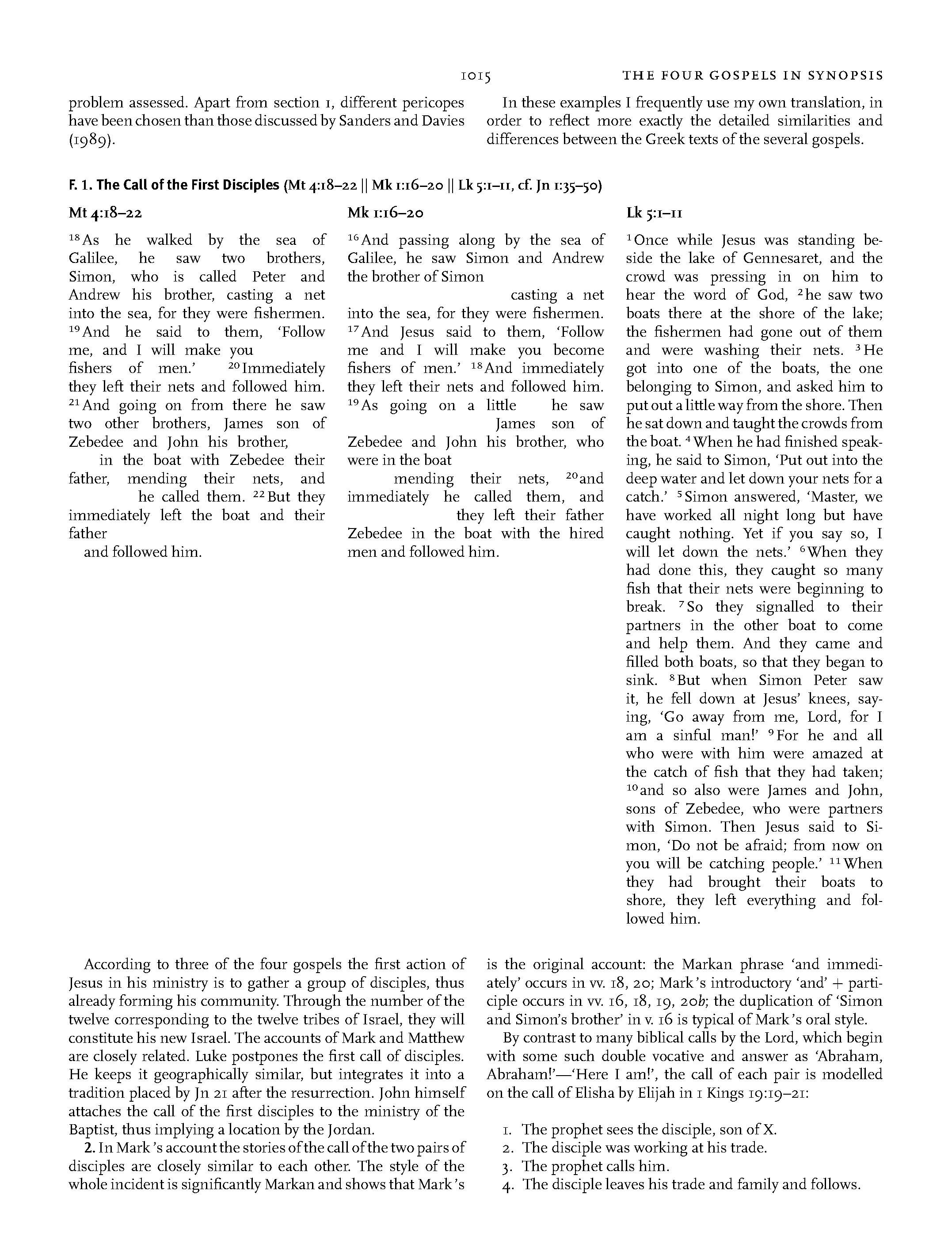
F. 1. The Call of the First Disciples (Mt 4:18-22 || Mk 1:16-20 || Lk 5:1-11, cf. Jn 1:35-50)
Lk 5:1-11
Mk 1:16-20
Mt 4:18-22
JOnce while Jesus was standing beside the lake of Gennesaret, and the crowd was pressing in on him to hear the word of God, 2he saw two boats there at the shore of the lake; the fishermen had gone out of them and were washing their nets. 3He got into one of the boats, the one belonging to Simon, and asked him to put out a little way from the shore. Then he sat down and taught the crowds from the boat. 4 When he had finished speaking, he said to Simon, 'Put out into the deep water and let down your nets for a catch.' 5 Simon answered, 'Master, we have worked all night long but have caught nothing. Yet if you say so, I will let down the nets.' 6When they had done this, they caught so many fish that their nets were beginning to break. 7So they signalled to their partners in the other boat to come and help them. And they came and filled both boats, so that they began to sink. 8But when Simon Peter saw it, he fell down at Jesus' knees, saying, 'Go away from me, Lord, for I am a sinful man!' 9For he and all who were with him were amazed at the catch of fish that they had taken;
16 And passing along by the sea of Galilee, he saw Simon and Andrew the brother of Simon
18 As he walked by the sea of Galilee, he saw two brothers, Simon, who is called Peter and Andrew his brother, casting a net into the sea, for they were fishermen. 19 And he said to them, 'Follow me, and I will make you fishers of men.' 20 Immediately they left their nets and followed him. 21 And going on from there he saw two other brothers, James son of Zebedee and John his brother, casting a net into the sea, for they were fishermen. 17And Jesus said to them, 'Follow me and I will make you become fishers of men.' 18And immediately they left their nets and followed him. 19 As going on a little he saw James son of Zebedee and John his brother, who were in the boat in the boat with Zebedee their father, mending their nets, and he called them. 22But they immediately left the boat and their father mending their nets, 20and immediately he called them, and they left their father Zebedee in the boat with the hired men and followed him.
and followed him.
10 and so also were James and John, sons of Zebedee, who were partners with Simon. Then Jesus said to Simon, 'Do not be afraid; from now on you will be catching people.' "When they had brought their boats to shore, they left everything and followed him.
According to three of the four gospels the first action of Jesus in his ministry is to gather a group of disciples, thus already forming his community. Through the number of the twelve corresponding to the twelve tribes of Israel, they will constitute his new Israel. The accounts of Mark and Matthew are closely related. Luke postpones the first call of disciples. He keeps it geographically similar, but integrates it into a tradition placed by Jn 21 after the resurrection. John himself attaches the call of the first disciples to the ministry of the Baptist, thus implying a location by the Jordan.
is the original account: the Markan phrase 'and immediately' occurs in w. 18, 20; Mark's introductory 'and' + participle occurs in w. 16, 18, 19, 2ofc; the duplication of'Simon and Simon's brother' in v. 16 is typical of Mark's oral style.
By contrast to many biblical calls by the Lord, which begin with some such double vocative and answer as 'Abraham, Abraham!'—'Here I am!', the call of each pair is modelled on the call of Elisha by Elijah in i Kings 19:19—21:
1. The prophet sees the disciple, son of X. 2. The disciple was working at his trade. 3. The prophet calls him. 4. The disciple leaves his trade and family and follows.
2. In Mark's accountthe stories of the call of the two pairs of disciples are closely similar to each other. The style of the whole incident is significantly Markan and shows that Mark's
THE FOUR GOSPELS IN SYNOPSIS 1016 difficult to be sure which was the original setting of the story. Simon's humble confession of his sinfulness fits Jn 21 better, after his triple denial at the time of the passion. Perhaps also the suggestions of the divine ('Lord', 'Do not be afraid') fit better a resurrection setting, though they do not demand it. Much the same reaction occurs when the disciples see Jesus walking on the water, see j.i. Two typical Lukan touches are the insistence that Peter must confess his sins before he is calledtobea disciple (as Zacchaeus repents, andasis stressed in the mass conversions of Acts. Secondly, when they accept the call they leave 'everything', a total renunciation often stressed by Luke (14:33): Levi at his call leaves all (5:28), and the very rich young ruler is advised to sell everything he has (18:23).
The call of the second pair is perhaps marginally more closely modelled on Elisha's call. The second pair leave their father without hesitation, in deliberate contrast to Elisha, who asks permission to take leave of his father. On the other hand, the first pair's desertion of their nets, their means of livelihood, links to Elisha's destruction of his yoke and oxen. Each of these factors underlines the immediacy of their response to the uncompromising call. Even if some preparation for or explanation of the call occurred in fact, Mark deliberately omits any mention of it, and thereby lays more stress on the astounding authority of Jesus. Two other slight touches in the call of the second pair also relate to Elisha's call: 'and they in the boat' (v. 10) corresponds to 'and he with the twelfth (i Kings 19:19). The final 'followed behind him' also echoes i Kings 19:20. If the call of the second pair is the original narrative, the call of the first pair is inserted before it because it is fitting that Simon should be called first of all. It is also to the first pair that the function to 'fish for people' is given; they are not only disciples but also apostles.
5. John's account of the call of the first disciples is significantly different:
(a) Again there are two pairs of disciples, to the first pair of whom Simon Peter is attached. The identity of the first disciples is, however, different. The first pair consists of Andrew and an anonymous disciple, the second of Philip and Nathanael. There is no explicit sign of the sons of Zebedee, who feature in Mark's and Matthew's accounts.
3. Matthew follows Mark's account very closely, with only minor adjustments, mostly literary. Matthew is a careful teacher, even sometimes pedantic. He superfluously (perhaps fussily) inserts the mention that both pairs were two brothers. With similar meticulousness he tells us, before they leave him, that Zebedee was present, whereas in Mark their leaving Zebedee is the first indication of his presence on the scene. Matthew also adds two theological clarifications. First he explains that Simon 'is called Peter'. Consonantly with his concern for the community throughout his gospel, Matthew draws attention right from the start to the office which will be his (Mt 16:16—19). He frequently stresses Peter's prominence, expecially by use of this title, though significantly he omits it when Peter fails his Master in Gethsemane (Mk 14:37)! Secondly Matthew mentions explicitly that the second pair leave the boat as well as their father, perhaps to suggest their total renunciation.
(h) The location is different. For the first three disciples there is no suggestion of the Lake of Galilee, though Jn 1:44 does note that Philip, Andrew, and Simon were 'from Bethsaida' on the shore of the lake, and the call of Philip and Nathanael takes place after Jesus' decision to go to Galilee (Jn 1:43). The association of the first pair with the Baptist and his activity 'in Bethany across the Jordan' (Jn 1:18) suggests a fair distance from the Markan location at the north end of the lake. This suggests that the rapid succession of days ('the next day' in Jn 1:29, 35, 43) may be an artificial schema, uniting disparate material to form a first week of Jesus' ministry (see JN 1:29-31).
(c) The theological emphasis is different. Instead of the magisterial call by Jesus the keynote of the first meeting is on the initiative of the disciples themselves in seeking and finding Jesus as teacher, Messiah, king of Israel, and Son of God. To this search Jesus responds by inviting the disciples to stay with him (1:38-9). On the second occasion the initiative lies with Philip, who leads Nathanael to Jesus.
4. The Lukan narrative is basically quite different: it concerns primarily Simon Peter and his apostolate. It is perhaps for this reason that Luke transfers the call till later, when they have already witnessed some of Jesus' teaching and miracles.
Simon's partners remain faceless until the last two verses, when their names are awkwardly tacked on with 'and so also were...'; it is really a bit late to tell us that the sons of Zebedee were his partners when we have already known about his partners for some time!
(d) Simon is the third, not the first to become a disciple. However, his special position is indicated by Jesus' imposition of a name, Peter, described much later by Mt 16:16-18.
5. The most interesting feature of all is that the first two disciples are nudged towards Jesus by John the Baptist. Especially since the discovery of the Qumran literature it has been suggested that Jesus himself was originally a disciple of John, and this strengthens the link between them.
Some relationship of the story in Lk 5:1—11 to Jn 21 is undeniable, perhaps at the oral level: there is the night-long unsuccessful toil, the word of Jesus leading to the almost breaking net, and finally the authorization of Peter. It is
G. The Beatitudes (Mt 5:3-12; Lk 6:20-3,:
Mt 5:3-12
Lk 6:20-6
20 Blessed are you who are poor, for yours is the kingdom of God.
3 Blessed are the poor in spirit, for theirs is the kingdom of heaven, 4 Blessed are those who mourn, for they will be comforted. 5 Blessed are the meek, for they will inherit the earth.
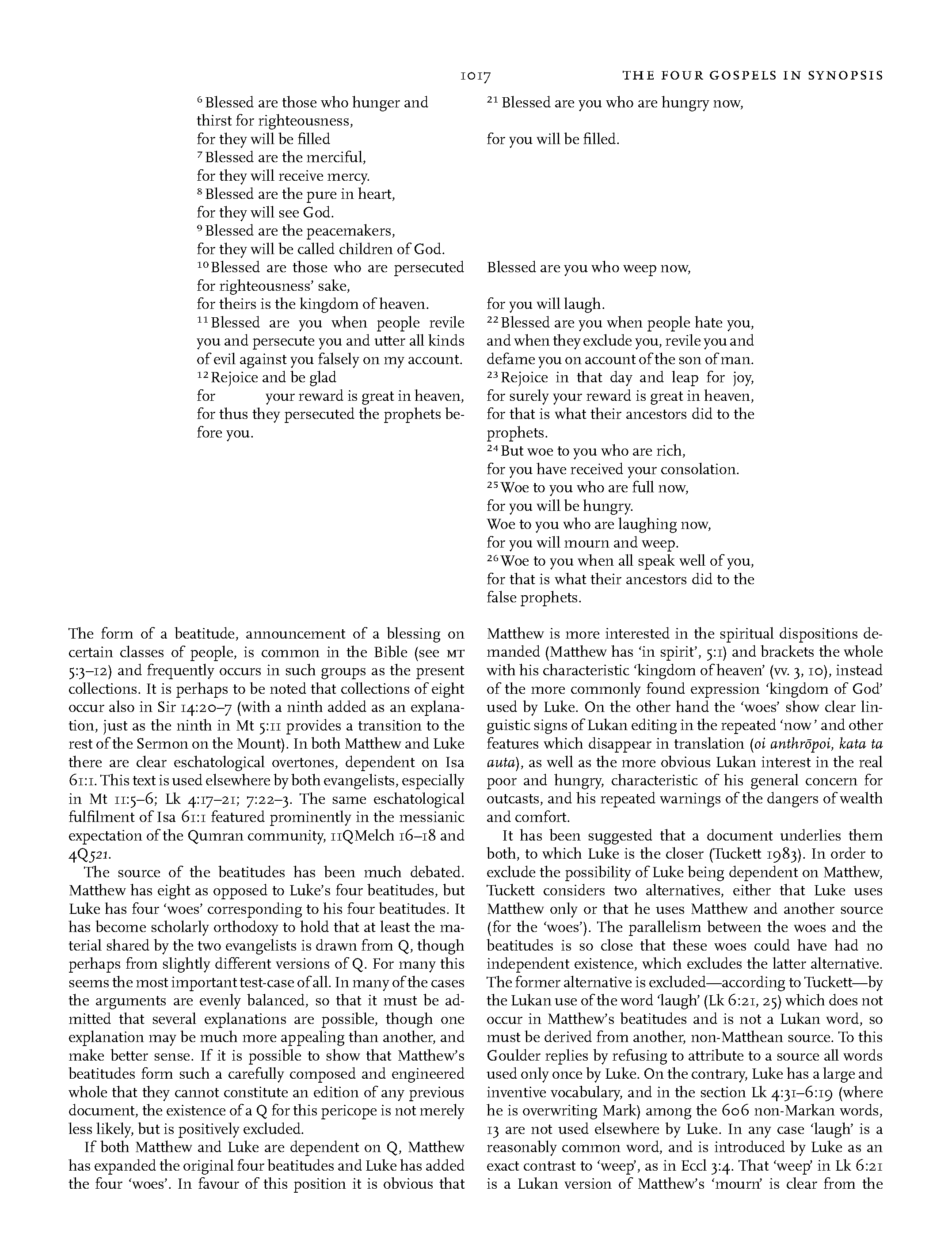
1017 THE FOUR GOSPELS IN SYNOPSIS
6 Blessed are those who hunger and thirst for righteousness, for they will be filled 7 Blessed are the merciful, for they will receive mercy. 8 Blessed are the pure in heart, for they will see God. 9 Blessed are the peacemakers, for they will be called children of God. 10 Blessed are those who are persecuted for righteousness' sake, for theirs is the kingdom of heaven. 11 Blessed are you when people revile you and persecute you and utter all kinds of evil against you falsely on my account. 12 Rejoice and be glad for your reward is great in heaven, for thus they persecuted the prophets before you.
21 Blessed are you who are hungry now,
for you will be filled.
Blessed are you who weep now, for you will laugh. 22 Blessed are you when people hate you, and when they exclude you, revile you and defame you on account of the son of man. 23 Rejoice in that day and leap for joy, for surely your reward is great in heaven, for that is what their ancestors did to the prophets. 24 But woe to you who are rich, for you have received your consolation. 25 Woe to you who are full now, for you will be hungry. Woe to you who are laughing now, for you will mourn and weep. 26Woe to you when all speak well of you, for that is what their ancestors did to the false prophets.
Matthew is more interested in the spiritual dispositions demanded (Matthew has 'in spirit', 5:1) and brackets the whole with his characteristic 'kingdom of heaven' (w. 3,10), instead of the more commonly found expression 'kingdom of God' used by Luke. On the other hand the 'woes' show clear linguistic signs of Lukan editing in the repeated 'now' and other features which disappear in translation (oi anthropoi, kata ta auta), as well as the more obvious Lukan interest in the real poor and hungry, characteristic of his general concern for outcasts, and his repeated warnings of the dangers of wealth and comfort.
The form of a beatitude, announcement of a blessing on certain classes of people, is common in the Bible (see MT 5:3—12) and frequently occurs in such groups as the present collections. It is perhaps to be noted that collections of eight occur also in Sir 14:20-7 (with a ninth added as an explanation, just as the ninth in Mt 5:11 provides a transition to the rest of the Sermon on the Mount). In both Matthew and Luke there are clear eschatological overtones, dependent on Isa 61:1. This text is used elsewhere by both evangelists, especially in Mt 11:5-6; Lk 4:17-21; 7:22-3. The same eschatological fulfilment of Isa 61:1 featured prominently in the messianic expectation of the Qumran community, nQMelch 16—18 and 4QJ21. The source of the beatitudes has been much debated. Matthew has eight as opposed to Luke's four beatitudes, but Luke has four 'woes' corresponding to his four beatitudes. It has become scholarly orthodoxy to hold that at least the material shared by the two evangelists is drawn from Q, though perhaps from slightly different versions of Q. For many this seems the most important test-case of all. In many of the cases the arguments are evenly balanced, so that it must be admitted that several explanations are possible, though one explanation may be much more appealing than another, and make better sense. If it is possible to show that Matthew's beatitudes form such a carefully composed and engineered whole that they cannot constitute an edition of any previous document, the existence of a Q for this pericope is not merely less likely, but is positively excluded.
It has been suggested that a document underlies them both, to which Luke is the closer (Tuckett 1983). In order to exclude the possibility of Luke being dependent on Matthew, Tuckett considers two alternatives, either that Luke uses Matthew only or that he uses Matthew and another source (for the 'woes'). The parallelism between the woes and the beatitudes is so close that these woes could have had no independent existence, which excludes the latter alternative. The former alternative is excluded—according to Tuckett—by the Lukan use of the word 'laugh' (Lk 6:21, 25) which does not occur in Matthew's beatitudes and is not a Lukan word, so must be derived from another, non-Matthean source. To this Goulder replies by refusing to attribute to a source all words used only once by Luke. On the contrary, Luke has a large and inventive vocabulary, and in the section Lk 4:31-6:19 (where he is overwriting Mark) among the 606 non-Markan words, 13 are not used elsewhere by Luke. In any case 'laugh' is a reasonably common word, and is introduced by Luke as an exact contrast to 'weep', as in Eccl 3:4. That 'weep' in Lk 6:21 is a Lukan version of Matthew's 'mourn' is clear from the
If both Matthew and Luke are dependent on Q, Matthew has expanded the original four beatitudes and Luke has added the four 'woes'. In favour of this position it is obvious that
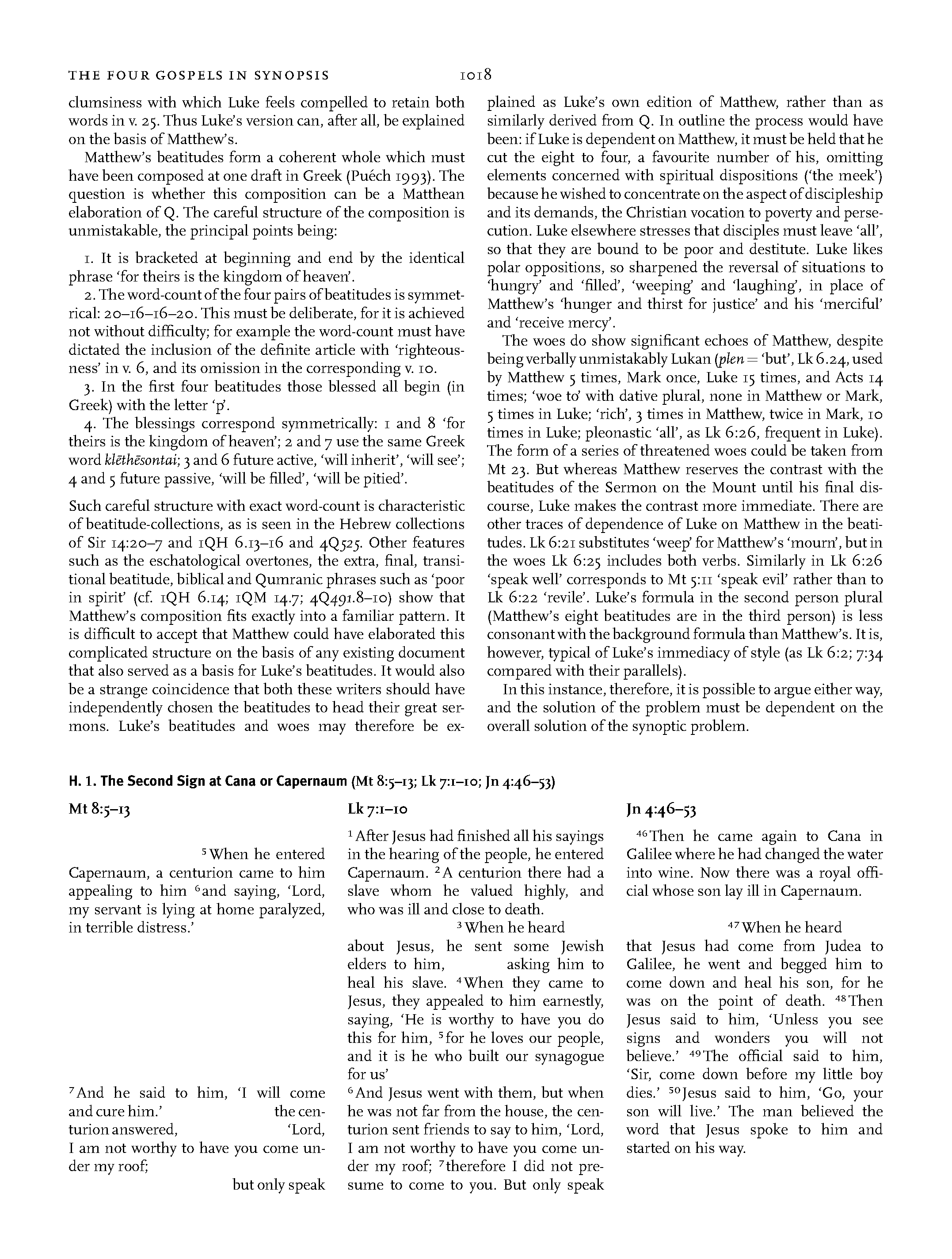
THE FOUR GOSPELS IN SYNOPSIS 1018 plained as Luke's own edition of Matthew, rather than as similarly derived from Q. In outline the process would have been: if Luke is dependent on Matthew, it must be held that he cut the eight to four, a favourite number of his, omitting elements concerned with spiritual dispositions ('the meek') because he wished to concentrate on the aspect of discipleship and its demands, the Christian vocation to poverty and persecution. Luke elsewhere stresses that disciples must leave 'all', so that they are bound to be poor and destitute. Luke likes polar oppositions, so sharpened the reversal of situations to 'hungry' and 'filled', 'weeping' and 'laughing', in place of Matthew's 'hunger and thirst for justice' and his 'merciful' and 'receive mercy'.
clumsiness with which Luke feels compelled to retain both words in v. 25. Thus Luke's version can, after all, be explained on the basis of Matthew's.
Matthew's beatitudes form a coherent whole which must have been composed at one draft in Greek (Puech 1993). The question is whether this composition can be a Matthean elaboration of Q. The careful structure of the composition is unmistakable, the principal points being:
1. It is bracketed at beginning and end by the identical phrase 'for theirs is the kingdom of heaven'.
2. The word-count of the four pairs of beatitudes is symmetrical: 20—16—16—20. This must be deliberate, for it is achieved not without difficulty; for example the word-count must have dictated the inclusion of the definite article with 'righteousness' in v. 6, and its omission in the corresponding v. 10.
The woes do show significant echoes of Matthew, despite being verbally unmistakably Lukan (plen= 'but', Lk 6.24, used by Matthew 5 times, Mark once, Luke 15 times, and Acts 14 times; 'woe to' with dative plural, none in Matthew or Mark, 5 times in Luke; 'rich', 3 times in Matthew, twice in Mark, 10 times in Luke; pleonastic 'all', as Lk 6:26, frequent in Luke). The form of a series of threatened woes could be taken from Mt 23. But whereas Matthew reserves the contrast with the beatitudes of the Sermon on the Mount until his final discourse, Luke makes the contrast more immediate. There are other traces of dependence of Luke on Matthew in the beatitudes. Lk 6:21 substitutes 'weep' for Matthew's 'mourn', but in the woes Lk 6:25 includes both verbs. Similarly in Lk 6:26 'speak well' corresponds to Mt 5:11 'speak evil' rather than to Lk 6:22 'revile'. Luke's formula in the second person plural (Matthew's eight beatitudes are in the third person) is less consonant with the background formula than Matthew's. It is, however, typical of Luke's immediacy of style (as Lk 6:2; 7:34 compared with their parallels).
3. In the first four beatitudes those blessed all begin (in Greek) with the letter 'p'.
4. The blessings correspond symmetrically: i and 8 'for theirs is the kingdom of heaven'; 2 and 7 use the same Greek word klethesontai; 3 and 6 future active, 'will inherit', 'will see'; 4 and 5 future passive, 'will be filled', 'will be pitied'.
Such careful structure with exact word-count is characteristic of beatitude-collections, as is seen in the Hebrew collections of Sir 14:20-7 and iQH 6.13-16 and 4Qj2j. Other features such as the eschatological overtones, the extra, final, transitional beatitude, biblical and Qumranic phrases such as 'poor in spirit' (cf iQH 6.14; iQM 14.7; 4(349:1.8-1:0) show that Matthew's composition fits exactly into a familiar pattern. It is difficult to accept that Matthew could have elaborated this complicated structure on the basis of any existing document that also served as a basis for Luke's beatitudes. It would also be a strange coincidence that both these writers should have independently chosen the beatitudes to head their great sermons. Luke's beatitudes and woes may therefore be ex-
In this instance, therefore, it is possible to argue either way, and the solution of the problem must be dependent on the overall solution of the synoptic problem.
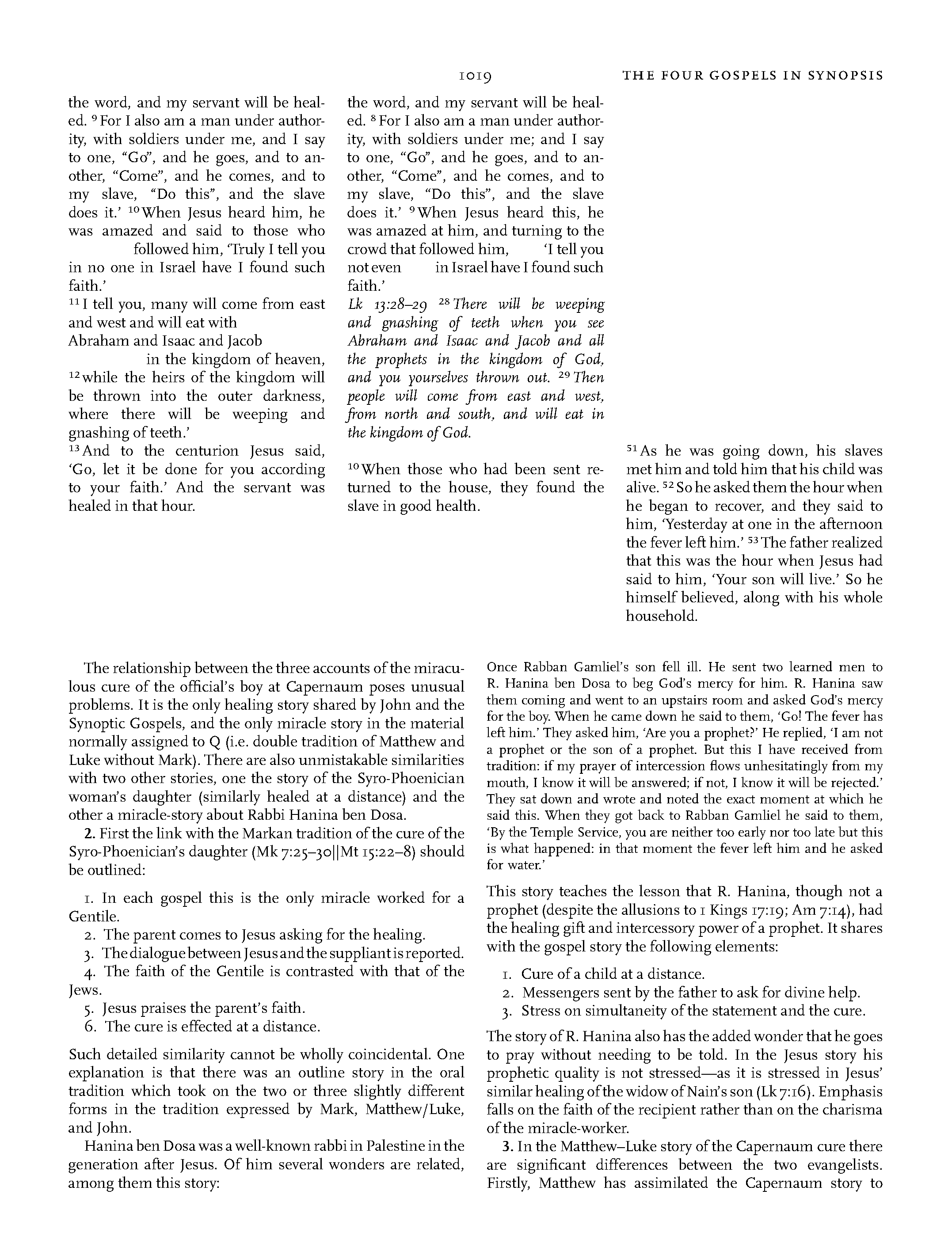
H. 1. The Second Sign at Cana or Capernaum (Mt 8:5-13; Lk 7:1-10; Jn 4:46-53)
Jn 4:46-53
Mt 8:5-13
Lk 7:1-10
46 Then he came again to Cana in Galilee where he had changed the water into wine. Now there was a royal official whose son lay ill in Capernaum.
1 After Jesus had finished all his sayings in the hearing of the people, he entered Capernaum. 2A centurion there had a slave whom he valued highly, and who was ill and close to death.
5 When he entered Capernaum, a centurion came to him appealing to him 6and saying, 'Lord, my servant is lying at home paralyzed, in terrible distress.'
47 When he heard that Jesus had come from Judea to Galilee, he went and begged him to come down and heal his son, for he was on the point of death. 48Then Jesus said to him, 'Unless you see signs and wonders you will not believe.' 49The official said to him, 'Sir, come down before my little boy dies.' 50Jesus said to him, 'Go, your son will live.' The man believed the word that Jesus spoke to him and started on his way.
3 When he heard about Jesus, he sent some Jewish elders to him, asking him to heal his slave. 4When they came to Jesus, they appealed to him earnestly, saying, 'He is worthy to have you do this for him, 5for he loves our people, and it is he who built our synagogue for us' 6 And Jesus went with them, but when he was not far from the house, the centurion sent friends to say to him, 'Lord, I am not worthy to have you come under my roof; therefore I did not presume to come to you. But only speak
7And he said to him, T will come and cure him.' the centurion answered, 'Lord, I am not worthy to have you come under my roof; but only speak
THE FOUR GOSPELS IN SYNOPSIS
the word, and my servant will be healed. 9 For I also am a man under authority, with soldiers under me, and I say to one, "Go", and he goes, and to another, "Come", and he comes, and to my slave, "Do this", and the slave does it.' 10When Jesus heard him, he was amazed and said to those who the word, and my servant will be healed. 8 For I also am a man under authority, with soldiers under me; and I say to one, "Go", and he goes, and to another, "Come", and he comes, and to my slave, "Do this", and the slave does it.' 9When Jesus heard this, he was amazed at him, and turning to the crowd that followed him, 'I tell you not even in Israel have I found such faith.' Lk 13:28-29 28 There will be weeping and gnashing of teeth when you see Abraham and Isaac and Jacob and all the prophets in the kingdom of God, and you yourselves thrown out. 29Then people will come from east and west, from north and south, and will eat in followed him, 'Truly I tell you in no one in Israel have I found such faith.' 111 tell you, many will come from east and west and will eat with Abraham and Isaac and Jacob in the kingdom of heaven, 12 while the heirs of the kingdom will be thrown into the outer darkness, where there will be weeping and gnashing of teeth.' 13 And to the centurion Jesus said, 'Go, let it be done for you according to your faith.' And the servant was healed in that hour.
the kingdom of God.
51 As he was going down, his slaves met him and told him that his child was alive.52 So he asked them the hour when he began to recover, and they said to him, 'Yesterday at one in the afternoon the fever left him.' " The father realized that this was the hour when Jesus had said to him, 'Your son will live.' So he himself believed, along with his whole household.
10 When those who had been sent returned to the house, they found the slave in good health.