
Part 52
This dirge over the ruined city begins with the temple treasures, now desecrated, another example of the cultic emphasis of this book. 'The precious children of Zion' are said to be 'worth their weight in fine gold', a lovely statement with
LAMENTATIONS 532 human values transcending cultic ones; yet now even these are as earthen pots. Such a contrast (as again in w. 5, 7—8) reminds us of ch. i. Compared to the jackals, 'my people has become cruel' (v. 3; cf Isa 1:3), as exemplified by the cannibalism of v. 10. A grim situation—indeed 'the chastisement of my people has been greater than the punishment of Sodom' (v. 6). The words used here for 'chastisement' and 'punishment' could instead mean 'iniquity' and 'sin', but the context suggests that NRSV is right to take them to refer to the people's tragic state. Sodom is said to have been overthrown in a moment, 'though no hand was laid on it'. The meaning of the Hebrew here is uncertain: the basic idea of the verb is 'turn', but it could be 'turn against', as in NRSV's 'no hand was laid on it' (implying that God acted directly), or 'turn towards', as in the NIV's 'without a hand turned to help her'. A similar problem arises in v. 7: the meaning of the rare Hebrew noun translated '[their] hair' by NRSV is uncertain. The root has to do with cutting: RSV has 'the beauty of their form', based on the idea of a carved object, whereas NRSV envisages the cutting of hair. The latter is the more likely since lapis lazuli (to be preferred to 'sapphire') was used in the art of the ancient Near East to represent hair.
chapters, it is not an acrostic, though its twenty-two verses perhaps echo that form. It is treated by some as separate from the rest of the book (e.g. Lachs 1966—7 assigned it a 2nd-cent. date); but there is no overwhelming reason to regard the chapter as anything but integral to the book.
The poem begins with a classic lament formula, 'Remember, O LORD!', and goes on to paint a sorry picture of the nation's disgrace. This is done in part by reference to the loss of some of the very special gifts of God: 'Our inheritance'—the land granted to Israel in ancient times—'has been turned over to strangers' (v. 2; cf. Num 26:53). One °f me great things about living in the promised land was rest from enemies (cf. Deut 12:10), but now 'we are given no rest' (v. 5; cf. 1:3). The NRSV's words 'With a yoke' (v. 5) are supplied from the Greek of Symmachus; the Hebrew in fact lacks them, but yields adequate sense none the less: 'on our necks we are hard driven'. Provan (19910: 126-7) finds hunting imagery here, the metaphor being one of close pursuit (which has a place in the second half of ch. 4). v. 6 speaks of political alliances (as did 4:17). 'Egypt and Assyria', being to the south and north of Judah respectively (at least in terms of travel routes), represent all nations, rather than referring to a precise historical circumstance. The reason for such pacts is said to be 'to get enough bread', straitened circumstances further indicated in v. 4
'The kings of the earth did not believe... that foe or enemy could enter the gates of Jerusalem' (v. 12; cf. 2:15). The perceptions of the nations are highlighted again in v. 15 (cf. Ps 79:10). According to Albrektson (1963) the fall of the supposedly inviolable city is the central theological problem of the book. w. 13-16 give a clear explanation of this disaster as the result of Judah's sin, presenting the nation's leaders as moral lepers. As so often in the OT prophets, moral and cultic sins occur side by side: they 'shed the blood of the righteous', they are 'defiled with blood', v. 17 makes reference to 'watching eagerly for a nation that could not save': ironically 'watching eagerly' is just the kind of attitude one should have towards God himself, according to 3:25—6. Instead, the people have looked vainly to political alliances, as also in 5:6. It is possible that Egypt is in view here (cf. Jer 37:5-10). In spite of all, 'The LORD'S anointed, the breath of our life, was taken in their pits' (v. 20; perhaps the capture of Zedekiah by the Babylonians is in mind; cf. 2 Kings 25:4-7). The poignant v. 2ob is reminiscent of royal psalms such as Ps 72; judgement upon the monarchy is mentioned also at 2:6, 9 and 5:16.
('We must pay for the water we drink; the wood we get must be bought') and v. 9 ('We get our bread at the peril of our lives'). If Lamentations comes, as is probable, from the period immediately after 587, the reference to alliances is likely to be retrospective, alluding to events leading up to the fall of the city.
v. 7 declares: 'Our ancestors sinned; they are no more, and we bear their iniquities.' It would be possible to take the word used here (lit. fathers) to mean leaders rather than ancestors, which would cohere with the blaming of leaders in 4:13—16, but it is more likely that 'ancestors' are indeed meant. Such an idea of suffering for the sins of one's forebears is assumed elsewhere in the OT (e.g. 2 Kings 23:26), but interestingly this is precisely the belief rejected in Ezek 18:1—4, which could well be contemporary with these words. The verse also stands at odds with the acknowledgements of responsibility found elsewhere in Lamentations (e.g. 1:8; 3:42, and, strikingly, v. 16 here). 'Slaves rule over us' (v. 8): important posts were sometimes given to the slaves of kings, but the real point is similar to that in Isa 3:4—7, namely that the proper ordering of society has been destroyed. Further dimensions of the tragedy are spelled out in w. 15—16: 'The joy of our hearts has ceased' (cf. 3:17—18). 'The crown has fallen from our head': as before, judgement on the monarchy is in view (LAM 4:20), and perhaps also an allusion to the dancer's garland (cf. Isa 28:1), picking up the reference to dancing having 'been turned to mourning'. Zion has been the focus of the book, and as we approach its end v. 18 portrays the once noble city lying desolate, with jackals prowling over it (cf. Mic 3:12; Jer 26:18).
v. 21 declares: 'Edom...to you also the cup shall pass': Edom is often regarded with particular enmity in the OT, especially it seems in relation to the events of 587 (cf. Ps 137:7; Ob 8—14). For the cup of judgement, cf. Isa 51:17—23 (esp. w. 22—3); Jer 25:15—29. v. 22 announces good news of a kind unparalleled elsewhere in the book: 'The punishment of your iniquity, O daughter Zion, is accomplished, he will keep you in exile no longer' (cf. Isa 40:1—2). The OT elsewhere too features a see-saw motif whereby the fortunes of Israel rise as those of the nations decline (and indeed vice versa), as in Ezek 35-6, which again concerns Edom. As before in Lamentations (cf. 1:22; 3:64), the fate of the enemies is related to their sins and is thus not in any way merely arbitrary.
'But you, O LORD, reign forever; your throne endures to all generations' (v. 19): it is hard to know how to take these very affirmative words, coming so close to the downbeat conclusion of the book. Could this be an ironic, even cynical, snatch of quotation from the temple liturgy (cf. Ps 93:1-2; 103:19)? In v. 20, we are straight back to pessimistic questioning, then in v. 21 comes the final appeal, which echoes
This relatively short chapter is in the form of a communal lament and has affinities with Ps 44, 74, and 79, usually seen as liturgies for times of national calamity. Alone of the five
E Z E K I E L
Essays on the Comparative Method (Winona Lake, Ind.: Eisenbrauns), 191—211. Hillers, D. R. (1992), 2nd edn., Lamentations, AB 7A (Garden City, NY:
Jerusalem's recalling of her former days of glory (1:7): 'Restore us to yourself, O LORD, that we may be restored; renew our days as of old'. The word 'unless', with which NRSV introduces the final verse, conveys perfectly (far better than the 'even though' proposed by Gordis 1974^) the way in which this perplexing book tails away into renewed doubt: 'you have utterly rejected us, and are angry with us beyond measure'. The book ends on anything but a confident note (contrary to Kraus 1968: 91); in fact, such is the bleakness of this conclusion that it is difficult to follow Johnson (1985) in judging even the book as a whole as essentially positive. Rather its greatness is to be found precisely in the honesty with which it articulates the ambiguities of the fate of Zion and indeed of the human condition itself.
Doubleday). Johnson, B. (1985), 'Form and Message in Lamentations', ZAW 97:
58-73. Jones, D. R. (1963), "The Cessation of Sacrifice afterthe Destruction of the Temple in 586 B.C.', JTS NS 14/1:12-31. Joyce, P. M. (1993), 'Lamentations and the Grief Process: A Psychological Reading', in Biblical Interpretation: A Journal of Contemporary Approaches, 1/3: 304—20. Kaiser, O. (1992), 4th edn., 'Klagelieder', in H.-P. Miiller et al, Das
Hohelied, Klagelieder, Das Buch Ester, ATD 16/2 (Gottingen: Vandenhoeck £ Ruprecht), 91-198. Kraus, H.-J. (1968), 3rd edn., Klagelieder (Threni), BKAT 20 (Neukirchen-Vluyn: Neukirchener Verlag). Lachs, S. T (1966-7), The Date of Lamentations V',JQR NS 57 (1966-
7): 46-56. Lanahan, W. F. (1974), The Speaking Voice in the Book of Lamentations', JBL 93: 41-9. Lindstrom, F. (1983), God and the Origin of Evil: A Contextual Analysis
Ackroyd, P. R. (1968), Exile and Restoration: A Study of Hebrew Thought of the Sixth Century BC (London: SCM). Albrektson, B. (1963), Studies in the Text and Theology of the Book of of Alleged Monistic Evidence in the Old Testament, ConBOT 21 (Lund: Gleerup). McDaniel, T. F. (1968), The Alleged Sumerian Influence upon La-
Lamentations, Studia Theologica Lundensia, 21 (Lund: Gleerup). Bloch-Smith, E. (1992), Judahite Burial Practices and Beliefs about the mentations', VTi8:198-209. Miller, A. (1991), The Mistreated Child in the Lamentations of Jere-
Dead, JSOTSup 123, JSOT/ASOR MS 7 (Sheffield: JSOT). Brandscheidt, R. (1988), Das Buch der Klagelieder, Geistliche Schriftlemiah', Breaking Down the Wall of Silence to Join the Waiting Child (London: Virago), 114-26. Mintz, A. (1984), Hurban: Responses to Catastrophe in Hebrew Literature sung, Altes Testament, 10 (Diisseldorf: Patnios). Clements, R. E. (1980), Isaiah 1—39, NCB (London: Marshall, Morgan
Scott). Cohen, C. (1973), "The "Widowed" City', JANESCU y 75-81. Cohen, M. E. (1988), The Canonical Lamentations of Ancient Mesopota-
(New York: Columbia University Press). Morgenstern, J. (1956), 'Jerusalem—485 B.C.', HUCA 27: 101-79;
(1957), 28: 15-47; i^60). 3I: !-29O'Connor, K. M. (1992), 'Lamentations', in C. A. Newsom and S. H.
mia (2 vols.; Potomac, Md.: Capital Decisions). Cohen, S. J. D. (1982), 'The Destruction: From Scripture to Midrash',
Ringe (eds.), The Women's Bible Commentary (Louisville, Ky.: Westminster/John Knox), 178-82. Pritchard, J. B. (ed.) (1969), 3rd edn. with suppl., ANET (Princeton:
Prooftexts: A Journal of Jewish Liturgy, 2:18—39. Fitzmyer, J. A. (1990), rev. edn., The Dead Sea Scrolls: Major Publications and Tools for Study, SBLRBS 20 (Atlanta, Ga.: Scholars Press). Freedman, D. N. (1986), Acrostic Poems in the Hebrew Bible, Alpha-
Princeton University Press), 'Lamentation over the Destruction of Ur', 455-63; 'Lamentation over the Destruction of Sumer and Ur', 611—19, both tr. S. N. Kramer). Provan, I. W. (1990), 'Reading Texts against an Historical Backbetic and Otherwise', CBQ48: 408-31. Galambush, J. (1992), Jerusalem in the Book of Ezekiel: The City as
Yahweh's Wife, SBLDS 130 (Atlanta, Ga.: Scholars Press). Gerstenberger, E. (1971), 'Derklagende Mensch', in H. W. Wolff (ed.), ground: The Case of Lamentations i', in Scandinavian Journal of the Old Testament i: 130—43.
Probleme biblischer Theologie (Munich: Chr. Kaiser), 64-72. Gordis, R. (197412), 3rd edn., The Song of Songs and Lamentations (New
(199112), Lamentations, NCB (London: Marshall Pickering). (1991(7), 'Past, Present and Future in Lamentations iii 52-66: The Case fora Precative Perfect Re-examined', VT4I/2: 164—75. Rudolph, W. (1962), 2nd edn., Das Buch Ruth—Das Hohe Lied—Die
York: Ktav).
(1974(7), The Conclusion of the Book of Lamentations (5.22)', JBL 93: 289-93. Gottlieb, H. (1978), A Study on the Text of Lamentations, Ada Jutlan-
Klagelieder, KAT 17 (Giitersloh: Mohn). Sawyer, J. F. A. (1989), 'Daughter of Zion and Servant of the Lord in dica, Theology Series, 48/12 (Aarhus: Del lasrde Selskab). Gottwald, N. K. (1962), 2nd edn., Studies in the Book of Lamentations,
Isaiah: A Comparison', JSOT44: 89—107. Shea, W. H. (1979), The qinah Structure of the Book of Lamentations',
SET 14 (London: SCM). Gwaltney, W. C., Jnr. (1983), The Biblical Book of Lamentations in
Bib. 60: 103-7. Treves, M. (1963), 'Conjectures surles dates et les sujets des Lamentathe Context of Near Eastern Lament Literature', in W. W. Hallo, J. C. Moyer, and L. G. Perdue (eds.), Scripture in Context, ii. More tions', Bulletin Renan, 95:1-4.
25. Ezekiel J. GALAMBUSH
A. Composition and Style. 1. Commonly considered the most difficult of the major prophets, Ezekiel's perceived obscurity actually reflects a tantalizing combination of obscurity and clarity. The book combines precise dating and clear, logical structure with bizarre imagery, opaque historical references, abrupt changes in subject-matter and literary style, and numerous grammatical and textual difficulties. Anchored in a specific historical context and well-documented events, but
E Z E K I E L
ful bride a perverse prostitute; and Tyre the merchant ship a foundering wreck. Throughout Ezekiel a strong visual sensibility predominates. Ezekiel sees visions that in turn contain seeing eyes and old men gazing at pictures, while he himself is instructed to observe carefully all that he sees. The extended metaphors are graphically intense, with the depictions of Jerusalem (exposing herself to all passers-by) and her lovers bordering on the pornographic. The emphasis on seeing builds on Ezekiel's role as witness to Judah's depravity and to YHWH's acts of self-vindication, and enlists the reader as witness alongside the prophet.
presented via a series of weird visions and grotesque metaphors, the book is above all, tantalizing. Whereas a reader might easily despair of comprehending every reference in Hosea or Jeremiah, Ezekiel continually holds out the elusive potential for order and precision.
2. As early as the first century CE, Ezekiel's structure impressed the historian Josephus, who commented that the prophet had left behind 'two books', probably the oracles of chs. 1-39 and the temple vision of 40-8. Ezekiel's structure and composition have continued to be debated by commentators up to the present day. Recurring themes and key words and a readily apparent overall structure give the work a striking appearance of unity (see Greenberg 1983). At the same time repetitions, the use of a broad range of genres and literary styles, and seeming anachronisms have raised the question of whether the book's apparent unity is simply the work of an especially talented redactor of earlier fragments or even of a succession of such redactors (see esp. Zimmerli 1979)- 3. Writing in 19 24, Gustav Holscher concluded that only 144 of the book's 1,273 verses (all of them poetry) were attributable to the ecstatic prophet Ezekiel, while the rest of the book derived from a tedious and legalistic post-exilic priest. Such radical minimalism represented the form-critical conventions that (i) all prophecy was originally oral; (2) the original oracles consisted of brief, formulaic utterances; and (3) a change in genre could generally be taken to indicate a change in author. In addition, anti-Jewish sentiment tended to idealize the Israelite prophets while decrying the 'decline' represented by early Judaism. Brief, poetic oracles were considered 'authentic' prophetic utterances, and thus superior to legal or didactic material, all of which was considered late and spurious. As academic assumptions changed over the course of the twentieth century, particularly the rejection of strict form-critical categories and heightened awareness of literary techniques, scholarly assessment of Ezekiel underwent a marked change, so that in 1983 Greenberg could create what he called a 'holistic' reading of the prophet and Davis (1989) explore Ezekiel as the first writing prophet. At the beginning of the twenty-first scholars, focusing on the book's complex and interlocking literary patterns, tend to attribute as much as possible to the original prophet. While additions are acknowledged
B. Historical Background. 1. Ezekiel is set in Babylon, beginning in the fifth year of Judah's Babylonian exile (593 BCE). Ezekiel was apparently brought to Babylon with the first group of exiles following Nebuchadrezzar's 597 BCE capture of Jerusalem. Zedekiah, the monarch chosen in 597 by Nebuchadrezzar to replace the rebellious and now exiled Jehoiachin, remained loyal to Babylon for only a few years, and in 594 BCE hosted an international meeting of regional leaders in Jerusalem, apparently to plan rebellion against Babylon. In 593 BCE Zedekiah was summoned by Nebuchadrezzar to Babylon, presumably to account for his actions and to renew his loyalty oath. Zedekiah's planned rebellion and subsequent reprimand by Nebuchadrezzar may have formed the occasion for Ezekiel's inaugural vision and call to speak against the 'rebellious nation' of Israel (2:3). Ezekiel considered Zedekiah's oath of loyalty to Babylon binding. According to 2 Chr 36:13, the oath had been sworn in the name of God (YHWH), and thus its abrogation violated YHWH's honour and constituted rebellion against YHWH.
2. Zedekiah seems to have continued to court illicit alliances, and in 592 BCE the Egyptian Pharaoh Psammeticus II (595—589 BCE) toured Palestine in a show of military power, clearly violating the Judean—Babylonian covenant. In addition to violating Zedekiah's covenant with Nebuchadrezzar (the covenant described in Ezek 17 as YHWH's own covenant), evidence from the Rylands IX Papyrus (Griffith 1909) indicates that Psammeticus stationed Egyptian priests in the land of Israel, thus compounding Judah's treaty violation with ritual abomination. The defilement of both name and temple represented by Psammeticus's 592 visit may have occasioned Ezekiel's vision, dated to the same year, of abominations taking place in the Jerusalem temple (chs. 8—n). Sometime following Psammeticus's visit Zedekiah withheld tribute from Babylon, relying on an Egyptian alliance for protection. In 588 BCE Nebuchadrezzar campaigned through Judah, destroying several large towns before laying siege to Jerusalem. The Egyptian army under the command of Pharaoh Apries
(all of chs. 40—8 are frequently considered an addition), the book's substantial unity is widely accepted. Agreement on Ezekiel's unity, however, does not settle the question of authorship. Relative literary unity may indicate that the book derives sub stantially from the sixth-century prophet E zekiel or that the work is largely the achievement of a later redactor so thoroughgoing as virtually to have authored the book.
4. Ezekiel displays a wide range of literary styles, from the intense disjointedness of Ezekiel's first vision (chs. 1—3) to the systematic dryness of his last (chs. 40-8). Perhaps its most striking literary feature, however, is its use of symbolic language. In addition to visions comprising approximately a third of the book, Ezekiel employs vivid extended metaphors to bring his charges against Judah and its neighbours. The metaphors are chiefly ironic, playing on and subverting commonly used symbols of national pride and identity (see EZEK 15:1—8). Thus, the lion of Judah becomes a rabid man-eater; Judah the luxuriant vine a dried-up twig; Jerusalem the faith-
(Hophra; 589—570 BCE) offered token resistance before withdrawing, leaving Jerusalem to the Babylonians, who in 586 BCE captured and burned the city. Zedekiah escaped by night, but was overtaken by the Babylonians at Riblah and forced to witness the killing of his two sons before being himself blinded. Massive deportations followed Nebuchadrezzar's victory, and Zedekiah was replaced by Gedaliah, a non-Davidic overseer whose title is not specified in either Israelite or Babylonian sources. Nebuchadrezzar continued his attempt to subdue the eastern Mediterranean seaboard, undertaking a siege of Tyre that was to last thirteen years (586-573) and
535 E Z E K I E L ultimately fail. The latest dated oracle in Ezek (29:17-21, dated to 571 BCE) promises Nebuchadrezzar Egypt as compensation for his ill-fated efforts in besieging Tyre. Nebuchadrezzar apparently shared Ezekiel's hopes regarding Egypt; Babylonian texts report a battle between the Babylonian and Egyptian armies in Egypt in 568 or 567 BCE, but no more is known about Nebuchadrezzar's Egyptian campaign(s).
esp. Halperin 1993), while intriguing, fail to engage the question of how such a figure, however bizarre by modern standards, would have functioned or have been understood within his own society. Ezekiel himself expresses misgivings about his role as prophet (20:49 [MT 21:5]; cf 9:8), but his concern seems to stem from people not taking his words seriously enough, rather than from resistance to taking on the prophetic role per sc.
3. The living conditions of the exiled Israelites are widely debated. Scholars have tended to emphasize either the individual and communal trauma entailed in the loss of family members and homeland or the exiles' ability to maintain their communal identity and social structures while in Babylonia. Both aspects of the exilic experience must be held in tension: the community was allowed to preserve its language, religion, and some forms of internal governance (i.e. elders). This same community, however, bore the scars of war and displacement, and many in Babylon were conscripted into forced labour corvees. Ezekiel, a priest of sufficient prominence to have been included in the deportation of the 'upper stratum' in 597, appears to have retained some status within the exiled community, as evidenced by the formal visits from the elders described in 8:1; 14:1; and 20:1. Ezekiel's primary concern is with theology rather than with subsistence, and his oracles tend to be directed to (or against) elders, princes, and other prophets. Even the likelihood that Ezekiel was a writing prophet would suggest that he lived in relative security and stability.
2. Ezekiel is remarkable for his personal involvement in accomplishing numerous symbolic actions. At times playing the role of the people (eating meagre food as if during a siege; 4:9-15), Ezekiel more often plays the part of YHWH himself, setting his face against Jerusalem (4:3), and even experiencing his own wife's death as a sign of YHWH's temple's demise
(24:15—24). Most frequently, however, Ezekiel is called upon to act as YHWH's witness, observing and certifying, first the people's abominations (thereby justifying their destruction; 8:i—18), then YHWH's command for Jerusalem's annihilation (9:5), and finally, each detail of YHWH's new and purified temple (chs. 40-8). Ezekiel is a witness in an almost legal sense, noting and attesting YHWH's actions (cf. the calls for Ezekiel to 'judge' in Ezek 20:4; 22:2). In this regard Ezekiel's appointment as sentinel over Israel in 3:16—21 is apt. Ezekiel is literally appointed to look out', to warn Israel against YHWH's wrathful approach, and he is told that his own life depends on his watchfulness.
D. Ezekiel and the Prophetic Tradition. 1. Ezekiel shows a number of affinities with earlier prophetic texts. Depiction of the prophet's personal experience most closely parallels descriptions of the early prophets Elijah and Elisha (see Carley 1975). In particular his experience of the 'hand of the Lord' as a compelling force (1:3; 3:22; etc.; cf. i Kings 18:46; 2 Kings 3:15) links him with this earlier tradition, as do reports of being physically transported by the spirit (3:12-14; 8:3; cf. i Kings 18:12; 2 Kings 2:16). Ezekiel's vivid sign-acts lend his persona a dramatic intensity similar to that of Elijah and Elisha, but whereas the earlier prophets' symbolic actions are generally depicted as having immediate, visible effects (e.g. calling fire from heaven in i Kings 18:30-9), Ezekiel's actions (with the possible exception of 11:13) are n°t transmuted into external events. Ezekiel's sign-acts, while clearly understood as setting in motion the events they portray, often precede their fulfilment by a period of years. Though presumed to be efficacious, Ezekiel's actions are not miraculous in the same sense as the deeds of Elijah and Elisha.
The relationship between the exiled community and those in the homeland seems to have been a complex one. Ezekiel's preoccupation with Jerusalem and Judah reveals not only his priestly concern over the temple and its destruction, but also the people's questions as to how to understand their own experiences vis-a-vis those of the population still in Israel. Popular concern for the welfare of family and friends back home was tempered by a sense of competition over which segment of the divided community now held hegemony over the Israelite land and cultural identity. Ezekiel, though critical of both the exiles and those in the land, sees the exiles, whose number includes figures such as himself who represent the status quo ante, as retaining God's favour and thus a claim to prominence in any future reconstruction of Israel.
C. The Person of the Prophet. 1. Ezekiel is identified in the book's superscription as a priest, and his deportation with the first exiles to Babylon in 597 BCE suggests his prominence, either because of family connections or because he was a priest of some importance. Whether Ezekiel functioned as a prophet as well as a priest before his vision of 593 BCE (chs. i3) is unknown. Ezekiel was recognized as a prophet by the Judean community in exile, and was apparently highly enough regarded that the elders assembled before him, perhaps even on a regular basis, to enquire of YHWH (Ezek 8:1; 20:1). Although the book provides some autobiographical information it is difficult to form a clear picture of the prophet or of how he was perceived by his contemporaries. To the modern reader Ezekiel seems to exhibit symptoms typical of mental illness. He experiences disorienting and overwhelming visions, undergoes paralysis and muteness, and attributes these debilitating occurrences to YHWH's direct intervention in his life. Attempts to diagnose the prophet's condition (see
2. While Ezekiel's experience seems most directly modelled on that of Elijah and Elisha, the content of his prophecy owes more to the prophets of the eighth to the sixth centuries. Thus Ezekiel's announcement in ch. 7 that 'the end (qes) has come' depends on Am 8:2 and the smelting of Israel in 22:17-22 reflects Isa 1:22-5. It is Jeremiah, however, with which Ezekiel is most intimately connected, to the extent that many of Ezekiel's most striking images seem like extended meditations on themes introduced in Jeremiah. Like Jeremiah, Ezekiel opens with a vision coming 'from the north' (1:4; Jer 1:13), a vision followed in Ezekiel's case by the eating of a divine scroll (3:1—3), an action styled on the metaphor of Jer 15:16. YHWH must then fortify each prophet against Israel's angry resistance to his words (Ezek 3:8-9; Jer 1:18-19).
Ezekiel's condemnation in ch. 13 of prophets whom YHWH never called seems to draw on Jeremiah's oracles against false prophets in 23:23—40; 29; the compelling image in Ezek 16 and 23 of Jerusalem and Samaria as degenerate sister-cities expands on the conceit introduced in Jer 3:6-14; the 'sour grapes' proverb cited in Jer 31:29, in Ezek 18 forms the basis for an extended debate over individual responsibility and the possibility of repentance; YHWH's claim in Jer 21:5 to fight with outstretched arm against his own people reappears in Ezek 20:33; and the depiction of YHWH as shepherd in Jer 23:1—8 is expanded upon in Ezek 34. Finally, Ezekiel appropriates Jeremiah's promise of renewal in 31:31-3, but with a characteristically ironic twist. Whereas Jeremiah shows YHWH inscribing his law onto the people's hearts as if onto so many stone tablets, in Ezek 11:19—20 and 36:26—7 YHWH must remove the people's hard, stony hearts altogether, replacing them with hearts of flesh before endowing them with his spirit. The question of how Ezekiel came to have such extensive knowledge of Jeremiah's words remains unresolved. It is entirely possible that a written edition of Jeremiah's prophecies was available to him in Babylon (cf Jer 29:24—32 in which Jeremiah counters an exiled prophet's response to his letter), though this raises the further question of why, despite his detailed commentary on the situation in Jerusalem, Ezekiel makes no mention of Jeremiah.
thought. A growing horror at the temple's defilement dominates the oracles of doom in chs. 1—24, and the temple's destruction, symbolized by the death of Ezekiel's wife (24:15-24), marks the ultimate satisfaction of YHWH's rage against Jerusalem and the beginning of his forgiveness. In the book's final chapters YHWH's eventual restoration of Israel is signified by the building of a new temple and YHWH's renewed residence within it (43:1-5). The existence or destruction of the Jerusalem temple serves as a cipher for the existence or non-existence of Israel. Israel's life is defined for Ezekiel, not by political independence, the Davidic monarchy (which receives scant notice in the book), or even the people's possession of the land (the second, more extensive exile of 586 BCE is barely mentioned in Ezekiel), but by the presence or absence of the temple, and by YHWH's acceptance or rejection of the temple as his home. The temple thus forms the emotional core of the book, representing Israel's ritual purity or impurity, its political and theological fidelity or infidelity, and YHWH's presence or absence among his people.
2. The Divine Name. The exile of YHWH's chosen people to Babylon, as well as their own flagrant disobedience to his laws, could easily be seen as compromising YHWH's reputation as a god worthy of the name. Ezekiel, like other exilic authors, is concerned to vindicate YHWH's offended honour. Exile in itself was sufficient to defile YHWH's divine name, as it implied either YHWH's impotence or his violation of his covenant oath made to Israel. As recorded in 36:20, the nations' observation that 'These are the people of the Lord, yet they had to leave His land' (NJPS) impels YHWH to act in defence of his holy name. The violation of Zedekiah's vassal oath sworn in YHWH's name similarly amounted to defilement of the name, and so YHWH in Ezekiel appears caught between the need to avenge himself against Judah and the competing need to manifest his power by bringing the people back from exile, both of which seem necessary to defend the sanctity of his name. Ezek 2 o retells the entire history of I srael as a struggle between YHWH's desire to punish Israel's disobedience and his unwillingness to defile his own name by destroying the covenant people. Ezek 16 and 23 cast YHWH's defilement in the emotionally charged terms of male sexual honour, depicting YHWH as a sexually shamed husband whose honour has been devastated by his wife's (the personified Jerusalem's) infidelity. YHWH's vindication of his honour, first by punishing Israel for its infidelity and then by reestablishing his potency and authority over the people, emerges as a dominant theme over the course of the book. The repeated phrase, 'Then they will know that I am YHWH'
E. Textual Problems. 1. The MT of Ezekiel is unarguably replete with grammatical lapses, repetitions, and inconsistencies. On the question of how to deal with these difficulties, however, little agreement has been reached, largely because no clearly superior text exists. LXX, while smoother, clearer, and containing fewer repetitions, can easily be interpreted as responding to the difficulties presented by MT rather than preceding them. In addition, LXX itself appears not to be a homogeneous translation but a composite text, and one that exists in widely differing versions. The Ezekiel scroll from Qumran cave n cannot be unrolled, and additional fragments of text cannot be argued conclusively to favour either LXX or MT. The Targum follows MT closely, thereby offering early interpretations of MT's difficult passages but no assistance in reconstructing a Vorlage. MT generally serves as a scholarly 'default text' with the versions used sparingly as correctives.
2. Divergent stands regarding Ezekiel's composition history have also affected the way commentators have viewed the book's textual difficulties. Zimmerli (1979; 1983), for example, who considered Ezekiel the product of several generations' accrued reflections, could assign many doublets to the hands of Ezekiel's earliest interpreters. Greenberg (1983: 2756), however, exploring the complexities of a presumed literary prophet, considered even an awkward repetition such as the doubled T said to you, "In your blood, live!"' of 16:6 not dittography, but a deliberate stylistic device.
(my tr.; see inter alia 6:7, 10, 14), sometimes employed as a threat of punishment and sometimes as a promise of restoration, emphasizes the concern for the divine name that motivates YHWH throughout Ezekiel. This 'recognition formula' (Zimmerli 1979: 37-41) occurs with variations some seventytwo times. In Ezekiel, to 'know YHWH' denotes not merely recognizing the deity, but specifically acknowledging his sovereignty. Not only the Judeans but ultimately all nations must come to 'know the LORD', that is, to recognize his dominion over all the earth. The climax of Ezekiel thus comes at the moment when YHWH is fully 'recognized'. After vanquishing his ultimate enemy and so vindicating his holy name in chs. 38-9, YHWH is at last enthroned in 43:1-5 on
F. Themes. 1. The Temple. Ezekiel's passionate concern with the Jerusalem temple—its defilement and destruction—has long been considered a central focus of the book. As a priest of sufficient stature to have been among the first exiled, Ezekiel may be assumed to have had more than a passing interest in both worship practices within and the ultimate fate of the Jerusalem sanctuary. In fact, both the structure and content of the book point to the temple's centrality in Ezekiel's
(11:19—20; 36^26—7), thus ensuring his ability to rule undefiled by the people's sins. Here purification and return (the word 'forgiveness', slh, does not occur in Ezekiel) take place not as an act of grace, but of necessity, a required step in the vindication ofYHWH's sovereignty. Ezekiel's concern presses far beyond the restoration of the people, to climax in ch. 43 with YHWH's own restoration as king. Within this overarching and impersonal scheme focused on YHWH's vindication, however, rests Ezekiel's almost pastoral attention to the moral life of the individual. In the midst of the calamity of the exile comes a firm rejection of despair and moral defeatism. Righteous action is far from pointless, as some in the exilic community claim (33:10), nor does hope lie in the vague notion that the righteousness of the ancestors will suffice for the present (14:12-20). Instead, even as he announces YHWH's inevitable destruction of Israel Ezekiel articulates a responsibility and opportunity for each person to 'turn and live' on the basis of new choices and righteous acts.
his holy mountain, overlooking the city whose name declares his sovereign presence at the centre of the world: YHWH is There (48:35).
3. The Divine Warrior. Ezekiel's concern with the sanctity of both temple and divine name manifests itself in the book via the symbolic complex associated with the Israelite celebration of YHWH as Divine Warrior (see ABD, 'Warrior, Divine'). In Israel, the New Year celebration apparently included a ritual in which YHWH (symbolized by the ark) went forth from the temple in an annual battle against cosmic enemies. While the ritual battle was taking place the temple was cleansed, and upon YHWH's victory a triumphant procession celebrated the renewal of the temple and reaffirmed YHWH's reign as well as that of his regent, the earthly monarch (see ABD, 'King and Kingship'). In the opening chapter of Ezekiel the prophet reports seeing a vision of YHWH as Divine Warrior, seated on his chariot-throne. Ezekiel then looks on in chs. 10-11 as YHWH mounts his chariot and rides forth from the temple to the Mount of Olives, the traditional goal of the New Year's ark procession. YHWH then engages in battle, first against Jerusalem itself, and then against the enemies of Judah. The wars of YHWH culminate in chs. 38—9 with the battle against Gog, depicted as a cosmic foe. Following his victory over Gog YHWH calls for the purification of the land and a sacrificial banquet, after which he returns in triumph to take his throne as king in a renewed and purified temple. For Ezekiel, writing in Babylon during a period when YHWH's power and kingship could not be affirmed by military, political, or ritual means, the visionary mode provides a venue through which to vindicate YHWH's honour and assert his continued sovereignty.
G. Outline Oracles of Destruction against Judah (1:1-24:27)
Ezekiel's Inaugural Vision and Commissioning (1:1-3:27) Signs and Oracles of Doom (4:1—7:27) The Vision of the Defiled Temple (8:1—11:25) Rulers, Elders, Prophets, and a Few Virtuous Individuals
(12:1-14:23) The Twisted Symbols of Judah's Pride (15:1—20:44) The End Approaches (20:45—24:27 [MT 21:1—24:27]) Hope for the Future (25:1-48:35)
Oracles against Foreign Nations (25:1-32:32) Images of Restoration and Return (33:1—39:29) YHWH's Re-enthronement (40:1-48:35)
4. Sin and Repentance. Ezekiel is widely noted for his assertions, primarily set forth in ch. 18 (cf. 33:10-20) that, contrary to the perspective expressed in Ex 34:7 and elsewhere, YHWH does not visit the sins of the parents upon the children; rather, each person is judged on the basis of individual merit. Moreover, each person's merit is determined solely by their current actions. Past sins do not count against a repentant individual, nor does past righteousness count in favour of a person who has turned to evil ways. Ezekiel thus presents a distinctive perspective on the individual as a moral agent and on the present moment as the moment of moral significance. YHWH stresses that he takes no pleasure in the death of the wicked, but desires repentance and life for each person (18:23, 32)-
Oracles of Destruction against Judah (1:1-24:27)
Ezekiel's Inaugural Vision and Commissioning (1:1-3:27)
(1:1-3) Superscription The book begins with a superscription informing the reader of the identity of the prophet and the time and place that the prophecy was received and delivered. Ezek 1—3 actually includes two such introductions, one in the first person (v. i) and one in the third (w. 2-3). w. 2-3 are the only two verses in the book written in the third person, and the first-person superscription of v. i is probably the original, v. i announces that the writer saw 'visions of God' while among the exiles 'by the river Chebar' in 'the thirtieth year'. The introduction is obscure, assuming the reader's knowledge of which year is 'the thirtieth' and who it was who were exiled 'by the river Chebar'. The second superscription
5. In contrast to the focus on the ongoing responsibility of each individual, YHWH's actions toward the community are designed solely to punish past sins and to purify the people as a whole, regardless of their present moral inclinations. At the communal level YHWH's concern is with the ritual defilement created by Israel's sins and his goal is to vindicate his name and his holiness (see EZEK F.2; ABD, 'Holiness (OT)'). The community must at all costs be fitted to these ends. Thus, much of Ezekiel describes YHWH's plans precisely to visit the consequences of the community's sins upon it so as to purify people, land, and temple and re-establish YHWH as sovereign. In his wholesale purgation of land and people YHWH will punish 'both righteous and wicked' (21:3-4 [MT 21:8-9]). Regardless of whether they choose repentance YHWH will replace their corrupt hearts with organs inclined to obedience
(w. 2-3) seems designed to clarify the first, identifying the speaker and the location of the Chebar, and restating the date in terminology consistent with that employed elsewhere in the book. w. 2—3 follow the typical form of prophetic superscriptions, providing a date in terms of the reigning monarch, identifying the prophet both by his own name (Ezekiel) and his father's name (son of Buzi), and announcing that 'the word of the Lord came' at this time. In this case Ezekiel's profession
E Z E K I E L 53« bedazzlement built up over the course of the vision. The creatures have four faces—each face having the likeness of a different animal, with a human face in the front—and four wings. The effect is that the creatures face in all directions simultaneously, and are thus able both to move in any direction and to guard the blazing substance around which they stand. In w. 15—21 Ezekiel describes four shining wheels accompanying the four creatures. The construction of the wheels, 'a wheel within a wheel', may indicate either concentric circles in the same plane or wheels at right angles to one another, thus facing, like the living creatures, in all directions at once. The wheel rims are full of eyes so that, like the creatures, they may be both omnipresent and all-seeing. Whereas the living creatures move at the impulse of 'the spirit' (of YHWH) the wheels are themselves moved (vertically as well as horizontally) by the spirit of the creatures.
as a priest is also noted (cf. Jer 1:1), as well as the location in which he prophesied: in the land of the Chaldeans (Babylonia), by the river Chebar. Finally, the superscription contains the notice that 'the hand of the Lord' was upon him there (v. 3).
The significance of the 'hand of the Lord' (cf. 8:1), and how this term differs from the 'word of the Lord' in the same verse or the 'visions of God' mentioned in v. i, is not clear, although the terminology seems to link Ezekiel's experience with that of earlier prophets such as Elijah (i Kings 18:46) and Elisha (2 Kings 2:15; see EZEK D.I). The correlation between the year specified in v. 2 (593 BCE) and the thirtieth year of v. i has long puzzled interpreters. Speculation has included the possibility that Ezekiel himself was 30 years old (in his thirtieth year) when he began to prophesy, or that the call actually occurred
(or the book was composed) in the thirtieth year of the exile, 568 BCE. The Targum of Ezekiel, however, suggests that Ezekiel received his call in the thirtieth year after Josiah's reform, a dating that would yield 593, and so correlate with the date given in v. 2. This early understanding has gained little credence among scholars, but given that Josiah's reform took place in a Jubilee year (cf. Hayes and Hooker 1988), Ezekiel might well be reckoning his vision according to the Jubilee. In this case, both his initial and his final vision are dated according to their relation to the Jubilee (EZEK 40:1). (1:4-280) The Vision of the Throne-Chariot Ezekiel watches as a stormy wind blows in from the north, bringing with it a shiny cloud that in turn contains YHWH's chariot borne by supernatural creatures (identified in 10:20 as cherubim). YHWH's approach from the north carries implications ranging from the mundane to the mythical. Although summer storms do in fact come into Babylon from the north, Ezekiel more probably reflects the Ugaritic traditions according to which the storm-god Baal made his home in the far north
In w. 2 2-8 a Ezekiel sees a crystalline dome stretching over the creatures' heads (cf. Gen 1:6), and notes the sound made by the creatures' wings as they move, 'like the sound of mighty waters, like the thunder of the Almighty' (v. 24). A voice sounds from over the firmament; the creatures halt and let down their wings. Ezekiel now looks above the dome to see the 'likeness of a throne' with what appears to be 'something that seemed like a human form' (v. 26). The form shines as if with hasmal, fire, and even a rainbow (w. 27-8), and upon seeing it Ezekiel falls prostrate, recognizing 'the appearance of the likeness of the glory' of YHWH (v. 28).
Ezekiel's vision report, for all its claims to describe only the remotest representations of things divine, employs what for an Israelite reader would have been unmistakable symbols of YHWH's presence. Zoomorphic throne guardians formed part of both Israelite and Babylonian iconography, as did the transformation of the divine throne into a war chariot, borne by its winged guardians and accompanied by fire, storm, and the thundering voice of the god (Ps 68; 77:16—19 [MT w. 17— 20]). The throne's location above the crystalline dome reflects YHWH's location 'above the heavens' (Ps 8:1 [MT 8:2]; 11:4; 57:11 [MT v. 12]), while the repeated emphasis on the mobility of the creatures and wheels may serve to explain YHWH's unexpected presence in Babylonia.
(cf. Ps 48:2 [MT v. 3]) or to a tradition describing an unnamed 'enemy from the north' (cf. Jer 1:13; Ezek 39:2) arriving to destroy Israel. In the light of YHWH's appearance riding his war chariot and Ezekiel's role warning Israel of YHWH's approach, the northerly storm wind of 1:4 probably foreshadows the approaching destruction of Israel. Ezekiel sees in the storm a shining cloud containing fire and 'something like hasmal' (v. 4). The identity of hasmal is not known, though the Akkadian cognate dmesu is also used in describing a god's shining appearance (see Greenberg 1983: 43). The details of Ezekiel's vision, while tantalizing, are also intentionally obscure. Ezekiel claims only to see 'the appearance of the likeness of the glory' of YHWH (v. 28), and while the vision is described in minute detail, it is likewise understood that what the prophet describes so fully remains essentially indescribable.
Ezekiel's Commissioning Ezekiel hears a voice addressing him, commanding him to rise. Ezekiel is called 'son of man' (2:1 RSV) here and throughout the remainder of the book, not as an honorific title, but as a mark of the distance between this 'mere mortal' and his divine interlocutor (see Vermes 1981; ABD, 'Son of Man'). The prophet is then set on his feet by the spirit (cf. 37:10), moving, like the living creatures, only at YHWH's behest. Ezekiel receives a commission to go to the 'rebellious house' of Israel and speak for YHWH. YHWH's emphasis on Israel's stubborn rebellion, and even his reassurance that Ezekiel need not fear the people's words and looks, suggest that Ezekiel's message will be rejected; none the less he will serve as evidence of YHWH's will, so that the people 'will know that there has been a prophet among them' (2:5). Ezekiel is now shown a scroll containing 'words of lamentation and mourning and woe' (2:10) and instructed to eat it (cf. Jer 15:16). Henceforth, Ezekiel speaks YHWH's words, which have literally been put into the prophet's mouth. The scroll's contents, lamentation and woe,
In w. 5-14 Ezekiel sees 'something like four living creatures' in the midst of the cloud. The designation of the creatures as hayyot, living beings, may emphasize that he is not experiencing a vision of the temple furniture, the carved cherubim bearing the ark, but of the living original (cf. the seraphim of Isa 6:1—8). The description of the four creatures is garbled in MT, with repetitions, sentence fragments, and even changes in the creatures' gender. While the uncertain prose creates translational difficulties, and may well reflect a corrupt text, the result is a strangely enhanced sense of awe and
539 E Z E K I E L the people. YHWH's command is puzzling, as its effect is to render Ezekiel incapable of communicating with the people, and thus seemingly to negate his commission as prophet. The restriction is particularly alarming in the light of 3:16-21 in which Ezekiel is told that he must warn the people on peril of his life. The problem is compounded by the fact that immediately following the announcement of his binding and dumbness YHWH commands Ezekiel to perform symbolic actions requiring both mobility and speech. While Ezekiel rarely reports his own fulfilment of YHWH's command the problem remains as to why YHWH would command actions he himself has rendered impossible to perform. One traditional solution has been to label w. 22-7 a late addition, or out of place in its current setting. Such a solution merely introduces the new problem of what the difficult passage is in fact doing out of place—how it got there and how it functions now. One less radical possibility is that Ezekiel's confinement and dumbness symbolize his status as a writing prophet. If in fact Ezekiel's prophecies were produced substantially in writing (while seated, silent and immobile, indoors) rather than orally, this novel practice might have required both explanation and theological justification in a culture regarding prophecy as primarily an oral genre. In v. 27 YHWH declares that when he addresses Ezekiel he will open the prophet's mouth to tell the people, 'Thus says the Lord God'. This emendation could refer to YHWH's removal of the dumbness in 33:21—2 but more likely means that YHWH will relieve the prophet's dumbness whenever YHWH gives Ezekiel oracles to deliver in YHWH's name.
confirm the earlier suggestion that YHWH has come as an enemy from the north: Ezekiel will prophesy destruction to Israel. In 3:4—11 YHWH offers Ezekiel the ironic consolation that he will not be sent to foreigners whose speech he cannot understand. Rather than going to foreigners, who might listen despite the language barrier, Ezekiel will go to his fellow exiles, who, understanding his words, will simply refuse to listen.
Ezekiel then reports that as the divine chariot departed he himself was lifted up by the spirit and returned to the exiles living at the Babylonian settlement of Tel Abib (3:12—15). Ezekiel depicts his visionary experience as entailing pain and consternation. The intensity of YHWH's hand upon him causes Ezekiel 'bitterness' and 'rage' (3:14, my tr.). Following the vision Ezekiel sits stunned for seven days. Ezekiel is not unique in experiencing the prophetic role as galling (cf Moses in Ex 4; and Jeremiah in Jer 15:15-18); Ezekiel feels the burden even before receiving orders or learning the community's response. 'Rage' (hemd) in Ezekiel is most often characteristic of YHWH (see inter alia 5:13,15; 6:12; 7:8) and it may be that Ezekiel is overwhelmed by his empathic experience of YHWH's fierce emotion. In his later sign-acts (beginning with 4:1—3) the prophet frequently takes on YHWH's role. Ezekiel is thus stunned not only by the fact of his encounter with the divine glory, but also by his internalization of divine rage.
(3:16—21) The Sentinel (See also EZEK 33:1—9.) After his seven days' recuperation, Ezekiel receives in effect a second commissioning, this time couched in metaphoric language. Ezekiel is to serve as the sentinel for Israel. The sentinel is posted on the city wall to watch for and give warning of enemies without. The metaphor refers obliquely to Jerusalem, the walled capital whose 'rebelliousness' (2:5) should give it reason to expect retaliation by Babylon. In fact, however, YHWH is the enemy approaching the city, and although YHWH, speaking through Ezekiel, warns the people, it is also YHWH against whom the people must be warned. The image of YHWH attacking the city is consistent with Ezekiel's vision in ch. i of YHWH riding on his war chariot, confirming the uneasy possibility that it is Israel against whom the Divine Warrior rides. Ezekiel's commission as sentinel employs military imagery to convey Israel's moral accountability. As sentinel Ezekiel is responsible for conveying YHWH's warning to the people. While it is the people who will be judged, the passage focuses on Ezekiel and his own accountability as sentinel. Thus, if Ezekiel warns the wicked to repent but they do not, they bear responsibility for their own sins. Should Ezekiel fail to warn them, however, they will receive the death sentence for their actions, but he will be held responsible for their death. Regardless, then, of the people's response, Ezekiel's own life is at stake as he is charged with a message of life-and-death importance.
Signs and Oracles of Doom (4:1-7:27)
(4:1—8) The Siege of Jerusalem Ezekiel is commanded to perform his first sign-act, a symbolic representation of Jerusalem under siege. After inscribing a map of Jerusalem on a mud brick (examples of mud maps are known from the ancient Near East) Ezekiel is to construct a model siege apparatus surrounding the model city. Finally, he is to set up an iron plate as a wall between himself and the city, set his face against the city, and lay siege to it. Ezekiel's action straightforwardly predicts a siege against Jerusalem, but the siege is not initiated by Babylon. Rather, it is YHWH, as represented by Ezekiel, who is setting his face against the city, and, intent on Israel's destruction, erecting a barrier between himself and them. Ezekiel, appointed in 3:16—21 as lookout against YHWH's attack, now changes roles, playing the part of YHWH. The iron plate between Ezekiel's face and the city recalls the hardening of the prophet's face in 2:8-9. Th£ hardness that kept Ezekiel from being harmed by the people's rejection apparently also keeps YHWH from being softened by their pleas. YHWH now commands Ezekiel to lie, first on his left side and then on his right, symbolically bearing the punishment of Israel and Judah respectively (w. 4—6). The prophet is to lie 390 days on his left side, signifying 390 years of punishment for the Northern Kingdom, and 40 days on his right side, signifying 40 years of punishment for Judah. The numbers are baffling. While Judah's 40 days may predict 40 years of exile (cf. Jeremiah's prediction of 70 years, Jer 25:11; 29:10), creating a symbolic correlation to the wilderness wanderings (cf. Ezek 20:36), a corresponding 3go-year exile
(3:22—7) Binding and Dumbness In the final episode of Ezekiel's call the prophet is sent out to 'the valley', where he again sees the divine glory. As in the earlier vision, Ezekiel falls prostrate but the spirit stands him upright. YHWH now restricts both Ezekiel's mobility and his speech. He is to confine himself to his house, where he will be bound with cords, and YHWH will strike him dumb and thus unable to reprove
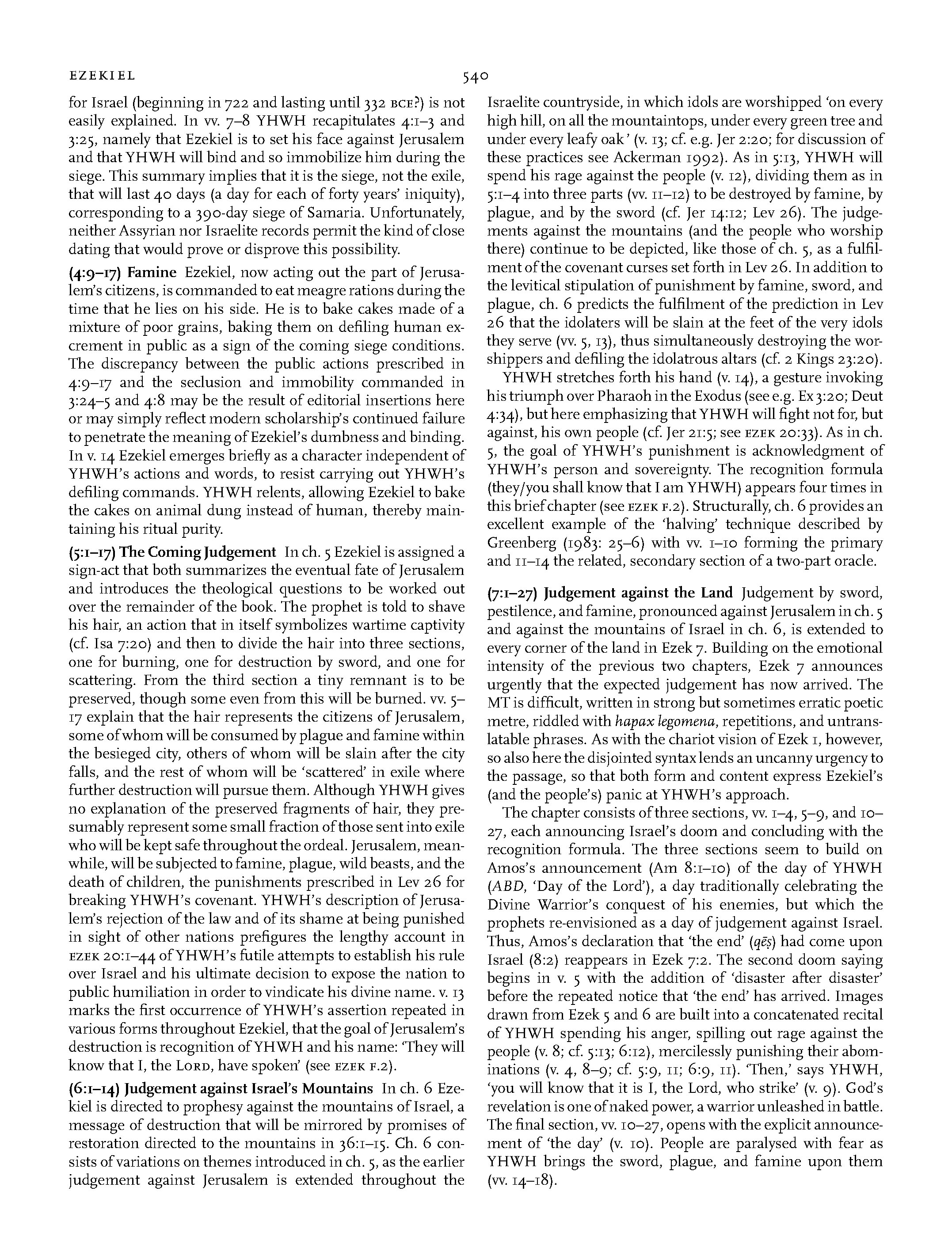
Israelite countryside, in which idols are worshipped 'on every high hill, on all the mountaintops, under every green tree and under every leafy oak' (v. 13; cf. e.g. Jer 2:20; for discussion of these practices see Ackerman 1992). As in 5:13, YHWH will spend his rage against the people (v. 12), dividing them as in 5:1—4 into three parts (w. 11—12) to be destroyed by famine, by plague, and by the sword (cf. Jer 14:12; Lev 26). The judgements against the mountains (and the people who worship there) continue to be depicted, like those of ch. 5, as a fulfilment of the covenant curses set forth in Lev 26. In addition to the levitical stipulation of punishment by famine, sword, and plague, ch. 6 predicts the fulfilment of the prediction in Lev 26 that the idolaters will be slain at the feet of the very idols they serve (w. 5, 13), thus simultaneously destroying the worshippers and defiling the idolatrous altars (cf. 2 Kings 23:20).
for Israel (beginning in 722 and lasting until 332 BCE?) is not easily explained. In w. 7—8 YHWH recapitulates 4:1—3 and 3:25, namely that Ezekiel is to set his face against Jerusalem and that YHWH will bind and so immobilize him during the siege. This summary implies that it is the siege, not the exile, that will last 40 days (a day for each of forty years' iniquity), corresponding to a 3go-day siege of Samaria. Unfortunately, neither Assyrian nor Israelite records permit the kind of close dating that would prove or disprove this possibility. (4:9-17) Famine Ezekiel, now acting out the part of Jerusalem's citizens, is commanded to eat meagre rations during the time that he lies on his side. He is to bake cakes made of a mixture of poor grains, baking them on defiling human excrement in public as a sign of the coming siege conditions. The discrepancy between the public actions prescribed in 4:9—17 and the seclusion and immobility commanded in 3:24-5 and 4:8 may be the result of editorial insertions here or may simply reflect modern scholarship's continued failure to penetrate the meaning of Ezekiel's dumbness and binding. In v. 14 Ezekiel emerges briefly as a character independent of YHWH's actions and words, to resist carrying out YHWH's defiling commands. YHWH relents, allowing Ezekiel to bake the cakes on animal dung instead of human, thereby maintaining his ritual purity.
YHWH stretches forth his hand (v. 14), a gesture invoking his triumph over Pharaoh in the Exodus (see e.g. Ex 3:20; Deut 4:34), but here emphasizing that YHWH will fight not for, but against, his own people (cf. Jer 21:5; see EZEK 20:33). As in ch. 5, the goal of YHWH's punishment is acknowledgment of YHWH's person and sovereignty. The recognition formula
(they/you shall know that I am YHWH) appears four times in this brief chapter (see EZEK F.2). Structurally, ch. 6 provides an excellent example of the 'halving' technique described by Greenberg (1983: 25-6) with w. i-io forming the primary and 11—14 me related, secondary section of a two-part oracle.
(5:1—17) The Coming Judgement In ch. 5 Ezekiel is assigned a sign-act that both summarizes the eventual fate of Jerusalem and introduces the theological questions to be worked out over the remainder of the book. The prophet is told to shave his hair, an action that in itself symbolizes wartime captivity
(7:1—27) Judgement against the Land Judgement by sword, pestilence, and famine, pronounced against Jerusalem in ch. 5 and against the mountains of Israel in ch. 6, is extended to every corner of the land in Ezek 7. Building on the emotional intensity of the previous two chapters, Ezek 7 announces urgently that the expected judgement has now arrived. The MT is difficult, written in strong but sometimes erratic poetic metre, riddled with hapax legomena, repetitions, and untranslatable phrases. As with the chariot vision of Ezek i, however, so also here the disjointed syntax lends an uncanny urgency to the passage, so that both form and content express Ezekiel's
(cf. Isa 7:20) and then to divide the hair into three sections, one for burning, one for destruction by sword, and one for scattering. From the third section a tiny remnant is to be preserved, though some even from this will be burned, w. 5— 17 explain that the hair represents the citizens of Jerusalem, some of whom will be consumed by plague and famine within the besieged city, others of whom will be slain after the city falls, and the rest of whom will be 'scattered' in exile where further destruction will pursue them. Although YHWH gives no explanation of the preserved fragments of hair, they presumably represent some small fraction of those sent into exile who will be kept safe throughout the ordeal. Jerusalem, meanwhile, will be subjected to famine, plague, wild beasts, and the death of children, the punishments prescribed in Lev 26 for breaking YHWH's covenant. YHWH's description of Jerusalem's rejection of the law and of its shame at being punished in sight of other nations prefigures the lengthy account in EZEK 20:1-44 of YHWH's futile attempts to establish his rule over Israel and his ultimate decision to expose the nation to public humiliation in order to vindicate his divine name. v. 13 marks the first occurrence of YHWH's assertion repeated in various forms throughout Ezekiel, that the goal of Jerusalem's destruction is recognition of YHWH and his name: 'They will know that I, the LORD, have spoken' (see EZEK F.2).
(and the people's) panic at YHWH's approach.
The chapter consists of three sections, w. 1—4, 5—9, and 10— 27, each announcing Israel's doom and concluding with the recognition formula. The three sections seem to build on Amos's announcement (Am 8:1-10) of the day of YHWH
(ABD, 'Day of the Lord'), a day traditionally celebrating the Divine Warrior's conquest of his enemies, but which the prophets re-envisioned as a day of judgement against Israel. Thus, Amos's declaration that 'the end' (qes) had come upon Israel (8:2) reappears in Ezek 7:2. The second doom saying begins in v. 5 with the addition of 'disaster after disaster' before the repeated notice that 'the end' has arrived. Images drawn from Ezek 5 and 6 are built into a concatenated recital of YHWH spending his anger, spilling out rage against the people (v. 8; cf. 5:13; 6:12), mercilessly punishing their abominations (v. 4, 8-9; cf. 5:9, n; 6:9, n). 'Then,' says YHWH, 'you will know that it is I, the Lord, who strike' (v. 9). God's revelation is one of naked power, a warrior unleashed in battle. The final section, w. 10—27, °Pens with the explicit announcement of 'the day' (v. 10). People are paralysed with fear as YHWH brings the sword, plague, and famine upon them
(6:1—14) Judgement against Israel's Mountains In ch. 6 Ezekiel is directed to prophesy against the mountains of Israel, a message of destruction that will be mirrored by promises of restoration directed to the mountains in 36:1—15. Ch. 6 consists of variations on themes introduced in ch. 5, as the earlier judgement against Jerusalem is extended throughout the
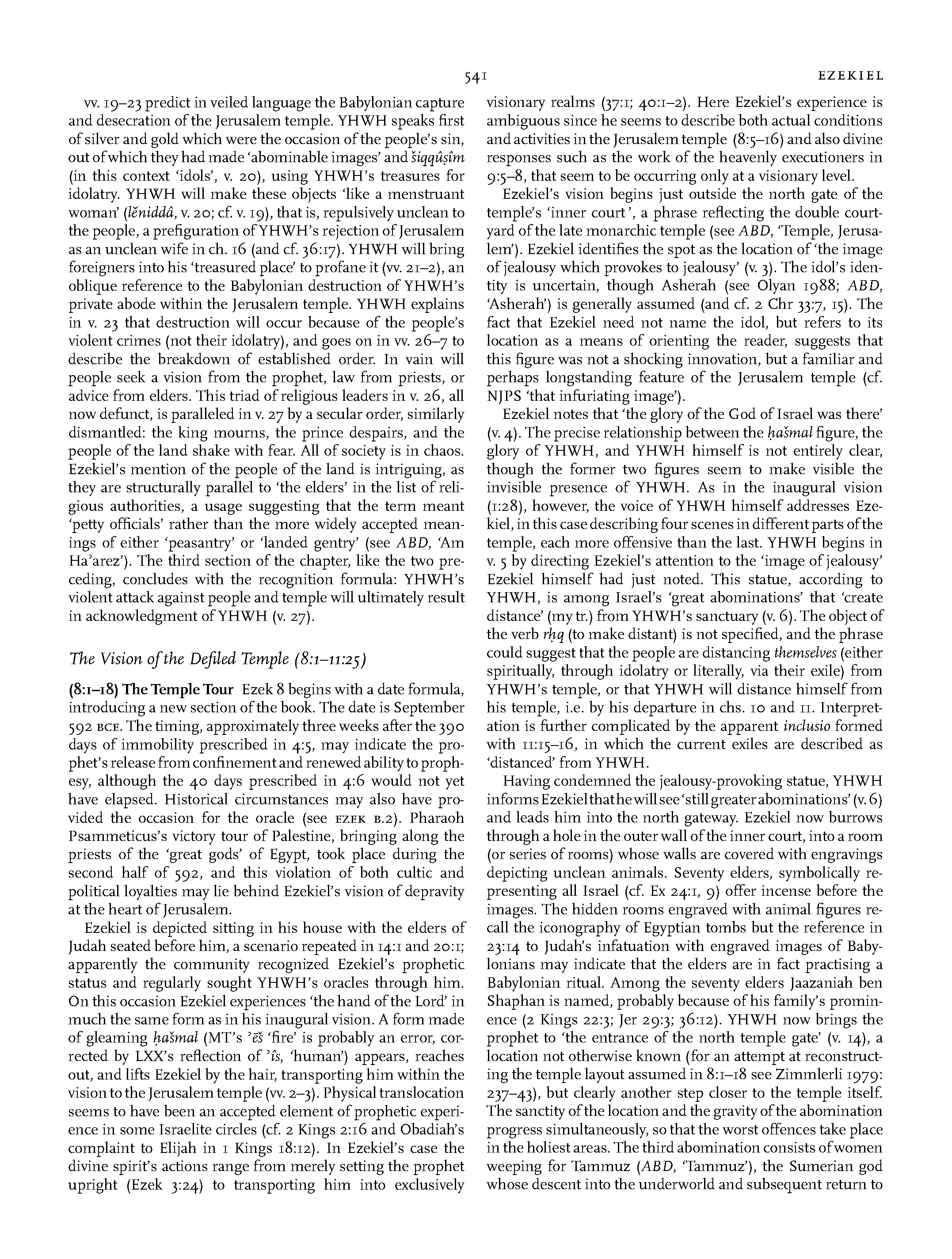
541 E Z E K I E L visionary realms (37:1; 40:1—2). Here Ezekiel's experience is ambiguous since he seems to describe both actual conditions and activities in the Jerusalem temple (8:5—16) and also divine responses such as the work of the heavenly executioners in 9:5-8, that seem to be occurring only at a visionary level. Ezekiel's vision begins just outside the north gate of the temple's 'inner court', a phrase reflecting the double courtyard of the late monarchic temple (see ABD, 'Temple, Jerusalem'). Ezekiel identifies the spot as the location of'the image of jealousy which provokes to jealousy' (v. 3). The idol's identity is uncertain, though Asherah (see Olyan 1988; ABD, 'Asherah') is generally assumed (and cf. 2 Chr 33:7, 15). The fact that Ezekiel need not name the idol, but refers to its location as a means of orienting the reader, suggests that this figure was not a shocking innovation, but a familiar and perhaps longstanding feature of the Jerusalem temple (cf. NJPS 'that infuriating image').
w. 19-23 predict in veiled language the Babylonian capture and desecration of the Jerusalem temple. YHWH speaks first of silver and gold which were the occasion of the people's sin, out of which they had made 'abominable images' and siqqusim
(in this context 'idols', v. 20), using YHWH's treasures for idolatry. YHWH will make these objects 'like a menstruant woman' (leniddd, v. 20; cf v. 19), that is, repulsively unclean to the people, a prefiguration of YHWH's rejection of Jerusalem as an unclean wife in ch. 16 (and cf. 36:17). YHWH will bring foreigners into his 'treasured place' to profane it (w. 21—2), an oblique reference to the Babylonian destruction of YHWH's private abode within the Jerusalem temple. YHWH explains in v. 23 that destruction will occur because of the people's violent crimes (not their idolatry), and goes on in w. 26—7 to describe the breakdown of established order. In vain will people seek a vision from the prophet, law from priests, or advice from elders. This triad of religious leaders in v. 26, all now defunct, is paralleled in v. 27 by a secular order, similarly dismantled: the king mourns, the prince despairs, and the people of the land shake with fear. All of society is in chaos. Ezekiel's mention of the people of the land is intriguing, as they are structurally parallel to 'the elders' in the list of religious authorities, a usage suggesting that the term meant 'petty officials' rather than the more widely accepted meanings of either 'peasantry' or 'landed gentry' (see ABD, 'Am Ha'arez'). The third section of the chapter, like the two preceding, concludes with the recognition formula: YHWH's violent attack against people and temple will ultimately result in acknowledgment of YHWH (v. 27).
Ezekiel notes that 'the glory of the God of Israel was there' (v. 4). The precise relationship between the hasmal figure, the glory of YHWH, and YHWH himself is not entirely clear, though the former two figures seem to make visible the invisible presence of YHWH. As in the inaugural vision (1:28), however, the voice of YHWH himself addresses Ezekiel, in this case describing four scenes in different parts of the temple, each more offensive than the last. YHWH begins in v. 5 by directing Ezekiel's attention to the 'image of jealousy' Ezekiel himself had just noted. This statue, according to YHWH, is among Israel's 'great abominations' that 'create distance' (my tr.) from YHWH's sanctuary (v. 6). The object of the verb rhq (to make distant) is not specified, and the phrase could suggest that the people are distancing themselves (either spiritually, through idolatry or literally, via their exile) from YHWH's temple, or that YHWH will distance himself from his temple, i.e. by his departure in chs. 10 and n. Interpretation is further complicated by the apparent indusio formed with 11:15-16, in which the current exiles are described as 'distanced' from YHWH.
The Vision of the Defiled Temple (8:1-11:25)
(8:1-18) The Temple Tour Ezek 8 begins with a date formula, introducing a new section of the book. The date is September 592 BCE. The timing, approximately three weeks after the 390 days of immobility prescribed in 4:5, may indicate the prophet's release from confinement and renewed ability to prophesy, although the 40 days prescribed in 4:6 would not yet have elapsed. Historical circumstances may also have provided the occasion for the oracle (see EZEK B.2). Pharaoh Psammeticus's victory tour of Palestine, bringing along the priests of the 'great gods' of Egypt, took place during the second half of 592, and this violation of both cultic and political loyalties may lie behind Ezekiel's vision of depravity at the heart of Jerusalem.
Having condemned the jealousy-provoking statue, YHWH informs Ezekielthathe will see'still greater abominations'(v. 6) and leads him into the north gateway. Ezekiel now burrows through a hole in the outer wall of the inner court, into a room
(or series of rooms) whose walls are covered with engravings depicting unclean animals. Seventy elders, symbolically representing all Israel (cf. Ex 24:1, 9) offer incense before the images. The hidden rooms engraved with animal figures recall the iconography of Egyptian tombs but the reference in 23:14 to Judah's infatuation with engraved images of Babylonians may indicate that the elders are in fact practising a Babylonian ritual. Among the seventy elders Jaazaniah ben Shaphan is named, probably because of his family's prominence (2 Kings 22:3; Jer 29:3; 36:12). YHWH now brings the prophet to 'the entrance of the north temple gate' (v. 14), a location not otherwise known (for an attempt at reconstructing the temple layout assumed in 8:1—18 see Zimmlerli 1979: 237—43), but clearly another step closer to the temple itself. The sanctity of the location and the gravity of the abomination progress simultaneously, so that the worst offences take place in the holiest areas. The third abomination consists of women weeping for Tammuz (ABD, 'Tammuz'), the Sumerian god whose descent into the underworld and subsequent return to
Ezekiel is depicted sitting in his house with the elders of Judah seated before him, a scenario repeated in 14:1 and 20:1; apparently the community recognized Ezekiel's prophetic status and regularly sought YHWH's oracles through him. On this occasion Ezekiel experiences 'the hand of the Lord' in much the same form as in his inaugural vision. A form made of gleaming hasmal (MT's 'Is 'fire' is probably an error, corrected by LXX's reflection of 'is, 'human') appears, reaches out, and lifts Ezekiel by the hair, transporting him within the vision to the Jerusalem temple (w. 2—3). Physical translocation seems to have been an accepted element of prophetic experience in some Israelite circles (cf. 2 Kings 2:16 and Obadiah's complaint to Elijah in i Kings 18:12). In Ezekiel's case the divine spirit's actions range from merely setting the prophet upright (Ezek 3:24) to transporting him into exclusively
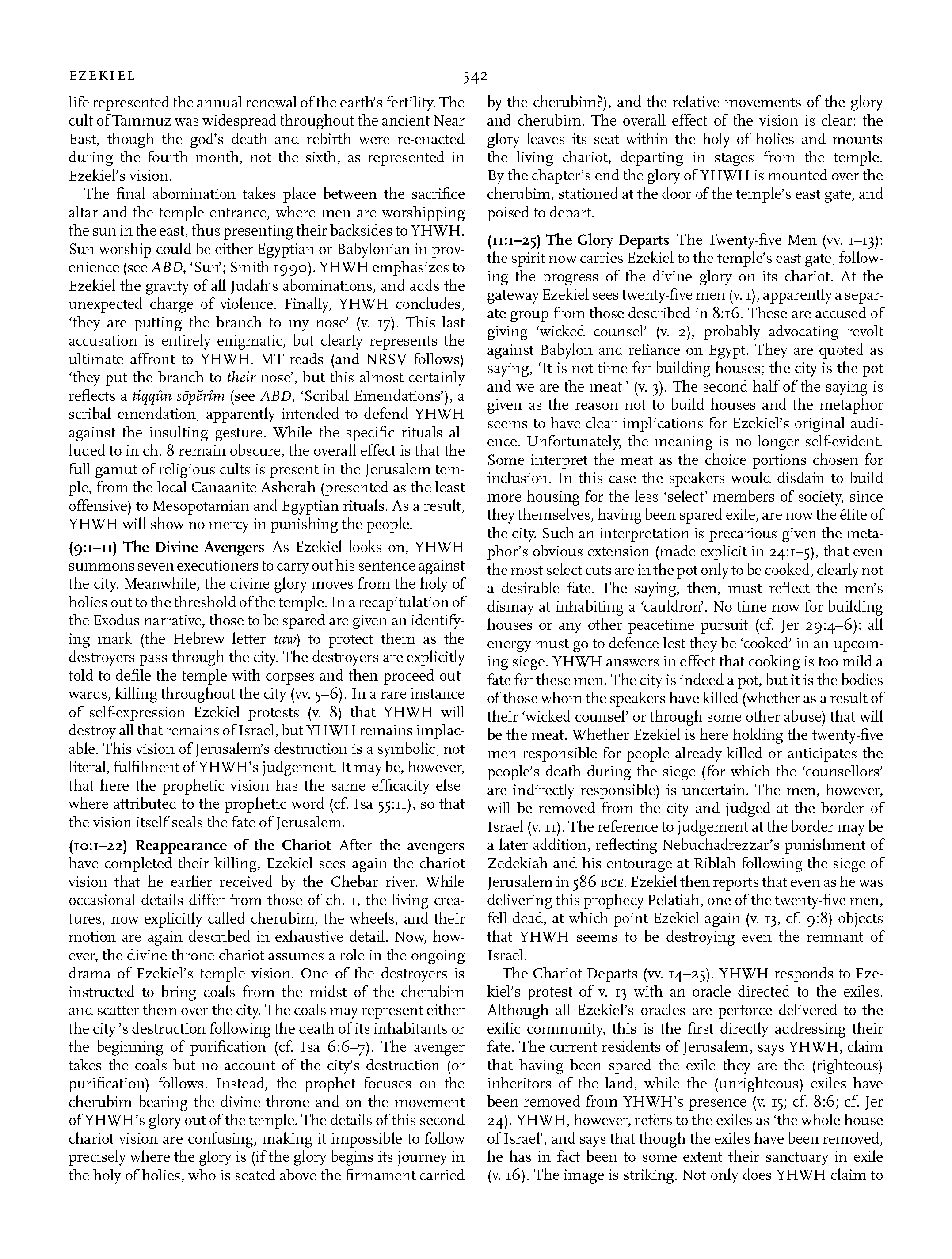
by the cherubim?), and the relative movements of the glory and cherubim. The overall effect of the vision is clear: the glory leaves its seat within the holy of holies and mounts the living chariot, departing in stages from the temple. By the chapter's end the glory of YHWH is mounted over the cherubim, stationed at the door of the temple's east gate, and poised to depart.
life represented the annual renewal of the earth's fertility. The cult of Tammuz was widespread throughout the ancient Near East, though the god's death and rebirth were re-enacted during the fourth month, not the sixth, as represented in Ezekiel's vision.
The final abomination takes place between the sacrifice altar and the temple entrance, where men are worshipping the sun in the east, thus presenting their backsides to YHWH.
(11:1—25) The Glory Departs The Twenty-five Men (w. 1—13): the spirit now carries Ezekiel to the temple's east gate, following the progress of the divine glory on its chariot. At the gateway Ezekiel sees twenty-five men (v. i), apparently a separate group from those described in 8:16. These are accused of giving 'wicked counsel' (v. 2), probably advocating revolt against Babylon and reliance on Egypt. They are quoted as saying, 'It is not time for building houses; the city is the pot and we are the meat' (v. 3). The second half of the saying is given as the reason not to build houses and the metaphor seems to have clear implications for Ezekiel's original audience. Unfortunately, the meaning is no longer self-evident. Some interpret the meat as the choice portions chosen for inclusion. In this case the speakers would disdain to build more housing for the less 'select' members of society, since they themselves, having been spared exile, are now the elite of the city. Such an interpretation is precarious given the metaphor's obvious extension (made explicit in 24:1-5), that even the most select cuts are in the pot only to be cooked, clearly not a desirable fate. The saying, then, must reflect the men's dismay at inhabiting a 'cauldron'. No time now for building houses or any other peacetime pursuit (cf. Jer 29:4-6); all energy must go to defence lest they be 'cooked' in an upcoming siege. YHWH answers in effect that cooking is too mild a fate for these men. The city is indeed a pot, but it is the bodies of those whom the speakers have killed (whether as a result of their 'wicked counsel' or through some other abuse) that will be the meat. Whether Ezekiel is here holding the twenty-five men responsible for people already killed or anticipates the people's death during the siege (for which the 'counsellors' are indirectly responsible) is uncertain. The men, however, will be removed from the city and judged at the border of Israel (v. n). The reference to judgement at the border may be a later addition, reflecting Nebuchadrezzar's punishment of Zedekiah and his entourage at Riblah following the siege of Jerusalem in 586 BCE. Ezekiel then reports that even as he was delivering this prophecy Pelatiah, one of the twenty-five men, fell dead, at which point Ezekiel again (v. 13, cf. 9:8) objects that YHWH seems to be destroying even the remnant of Israel.
Sun worship could be either Egyptian or Babylonian in provenience (see ABD, 'Sun'; Smith 1990). YHWH emphasizes to Ezekiel the gravity of all Judah's abominations, and adds the unexpected charge of violence. Finally, YHWH concludes, 'they are putting the branch to my nose' (v. 17). This last accusation is entirely enigmatic, but clearly represents the ultimate affront to YHWH. MT reads (and NRSV follows) 'they put the branch to their nose', but this almost certainly reflects a tiqqun soperim (see ABD, 'Scribal Emendations'), a scribal emendation, apparently intended to defend YHWH against the insulting gesture. While the specific rituals alluded to in ch. 8 remain obscure, the overall effect is that the full gamut of religious cults is present in the Jerusalem temple, from the local Canaanite Asherah (presented as the least offensive) to Mesopotamian and Egyptian rituals. As a result, YHWH will show no mercy in punishing the people. (9:1-11) The Divine Avengers As Ezekiel looks on, YHWH summons seven executioners to carry out his sentence against the city. Meanwhile, the divine glory moves from the holy of holies out to the threshold of the temple. In a recapitulation of the Exodus narrative, those to be spared are given an identifying mark (the Hebrew letter taw) to protect them as the destroyers pass through the city. The destroyers are explicitly told to defile the temple with corpses and then proceed outwards, killing throughout the city (w. 5-6). In a rare instance of self-expression Ezekiel protests (v. 8) that YHWH will destroy all that remains of Israel, but YHWH remains implacable. This vision of Jerusalem's destruction is a symbolic, not literal, fulfilment ofYHWH's judgement. It maybe, however, that here the prophetic vision has the same efficacity elsewhere attributed to the prophetic word (cf Isa 55:11), so that the vision itself seals the fate of Jerusalem.