
Part 38
The editor perhaps linked the psalm to the incident in i Sam 19:11—17 (part of v. n is quoted in the title) because the psalmist says he is surrounded by enemies who lie in wait for him.
Psalm 60 Although part of this psalm (w. 5-12) is repeated in Ps 108:6—13, there is no reason to suppose that it is not a unity. It is usually classed as a corporate lament. The Israelites have been defeated in battle, and they express their complaint to God and pray for future victory in w. 1-5. Then the divine promise of conquests is expressed, perhaps by a prophet, a section notable for the listing of parts of Israel and neighbouring lands over which God is to be sovereign (w. 6-8). Complaint and petition are resumed in w. 9-11, and the psalm ends with an expression of confidence that God will give his people victory (v. 12). The belief that military defeat was due to God's anger or rejection was common in the ancient world: King Mesha of Moab expresses similar sentiments on the Moabite stone: 'Chemosh [the Moabite god] was angry with his land' and allowed Omri to oppress Moab.
The almost exact repetition of w. 1—2 in 5—6 sounds like a refrain. It has been suggested that it marks off the first, more personal, part of the psalm (w. 1-7); 'Sdd' would then be misplaced, and w. 8—12 would form the second part, which adopts a more direct teaching stance and contains language and ideas that are akin to wisdom. This does not mean that two psalms have been combined, for the note of trust is maintained throughout. Psalm 63 Although confidence appears to dominate this psalm, most class it as an individual lament, largely due to the opening verses. Who the psalmist is and what called forth his prayer are far from certain. The reference to the sanctuary
The title links it with 2 Sam 8:3-14 (cf 10:6-14) but the details differ and since the account in 2 Samuel describes only victories the ascription is hardly apt, unless a previous defeat is assumed. The places mentioned in w. 6—7 lie mainly, though not exclusively, in the area ofnorthern Israel (Ephraim and Manasseh were the chief tribes). Moab, Edom, and the Philistines (w. 8—9) were Israel's traditional enemies, who had been defeated by David. Hostility towards Edom increased after the fall of Jerusalem in 586 BCE, when the Edomites encroached on Israelite territory, hence many place the psalm after that date. 'Lily of the Covenant' (or 'Lily of Testimony') is probably the name of the melody to which the psalm is to be sung, though it has been suggested that it refers to using lilies as a means of divination.
(v. 2) and to the liars who seek his life (w. 9, n) may point to criminal accusations from which the psalmist seeks to clear himself by an appeal to the higher court, through an ordeal, by uttering an oath of innocence, or by a divine oracle. The mention of the king in v. n does not necessarily make it a royal psalm, for the psalmist may include the king in his prayer (cf. Ps 61:6), but some features support this interpretation: the opening words may indicate the close covenant relationship with God that the king enjoys, w. 9—10 perhaps refer to a battle with the slain left to be eaten by jackals, and the confident language, including references to God's steadfast love and protection, are thought by some to be more suitable in the mouth of a king than of an ordinary Israelite.
Psalm 61 Despite the explicit reference to the king in w. 6-7 those who restrict the number of royal psalms to a minimum regard this as the prayer of an individual Israelite, who includes among his petitions a plea on behalf of the king, such as is found in some Babylonian prayers. (There is little reason to suppose that the verses are a later interpolation.) Royal maximalists describe it as the king's psalm, and explain the reference to the king in the third person by pointing to similar changes from first to third persons in an inscription from King Yehawmilk of Byblos, arguing that the manner of speech is a way of stressing the privileges granted to the king, here long life and perhaps continued prosperity for his dynasty ('to all generations').
Tenses present some uncertainties, as variations between the Eng. versions show. Are w. 9-10 an expression of what will happen to the enemies or should they be taken as a prayer
(soREB)?
What incident in the life of David the editor had in mind is less clear than in some other psalms. 'When he was in the Wilderness of Judah' may refer to David's flight from Absalom
(2 Sam 15-16), but the time when Saul was pursuing David has also been suggested (i Sam 23:14; 24:2). Psalm 64 Problems with the tenses in w. 7—9 make the interpretation of this psalm difficult. The verbs would normally be translated as a description of past events. If this is adopted, the whole of w. 2—9 is an account of the actions of the evildoers and the punishment which God has inflicted on them, and the psalm would be an individual thanksgiving, or a testimony to divine judgement, v. i, however, looks like the introduction to a lament. If the psalm is treated as such a prayer for deliverance from the enemies, it would be most natural to see w. 7—9 as an expression of confidence in the protection which God is going to give to the psalmist, and to
Despite some difficulties in the Hebrew text, the general sense is fairly clear. A plea to God for protection is linked with a promise to sing continual praise and pay daily vows. Unusually there is little indication of the dangers from which the psalmist is seeking deliverance. 'From the end of the earth' (v. 2) has been variously interpreted as showing that the psalmist was an exile, that the king was on a distant campaign, or even that the writer of the psalm depicted himself as at the
PSALMS
prefaced his own thanksgiving with hymns drawn from the temple worship, or the first two parts come from a temple festival within which the individual's thanksgiving was recited. (3) The whole psalm is national, the T of the last part being Israel. (4) It is a royal psalm, in which the communal hymn and thanksgiving finds its focus in the king's thanksgiving. The last of these reconstructions has the advantage of explaining the large number of sacrifices offered, which otherwise has to be regarded as poetic exaggeration (v. 15), as well as providing a setting for the whole psalm taken as a unity, but it still leaves unresolved whether the psalm was originally sung at some festival commemorating the Exodus and Conquest, perhaps at Gilgal, was part of the annual New Year Festival, or was a liturgy of thanksgiving after victory against foreign enemies.
translate the verbs as future (so NRSV; REB gives the same sense with presents and futures), either treating the tense as 'perfect of certainty' or making slight changes in the vowels. A third possibility is to regard the verbs as expressing a wish or prayer ('precative perfect'), in which case the petition of v. i is picked up at the end of the psalm, after the description of the activities of the psalmist's enemies.
The metaphors in w. 2-5 appear to point to slander, false accusations, or, possibly, curses or spells. They hardly refer to foreign enemies, and it is unlikely that they are to be taken literally, as if the psalmist's enemies were planning to mug him. This does not make their attacks any less fearsome, however, since the ancient Israelites regarded words as possessing their own power to achieve what was spoken (Isaac could not recall or alter the blessings which he had mistakenly pronounced upon Jacob, Gen 27).
Psalm 67 The meaning of the Hebrew tenses presents great difficulties for the interpretation of this psalm, as a glance at the ways the Eng. versions translate v. 6 shows. NRSV takes the first Hebrew verb in its natural sense: 'The earth has yielded its increase'. On this view the psalm is a thanksgiving for the harvest. The verb in the second line of the verse, however, would not normally be translated 'God has blessed us' (NRSV), but rather as 'God will bless us' or 'may God bless us'. Moreover, exactly the same verb is used in v. ja, so that there is little justification for the NRSV's 'May God continue to bless us' there, and the verbs in the rest of the psalm are most naturally taken as expressing prayers or wishes.
Psalm 65 This psalm is commonly associated with harvest thanksgiving, possibly due to the overtones which 'you crown the year' (v. n) has in English and the references to the flocks and grain in v. 13. It may have been a hymn of praise sung at the Feast of Booths (Tabernacles), but the emphasis upon the rains (though a feature of the Autumn Festival) may indicate that it belonged earlier in the agricultural year, perhaps at the beginning of the barley harvest (at the Feast of Unleavened Bread), or simply looking forward to the promise of a future plenty now that the rains have come. Others have suggested that it was intended as thanksgiving after a time of drought when the crops had begun to grow again (cf. i Kings 8:35—6; the linking of lack of rain and sin may be reflected in v. 3).
The refrain in w. 3 and 5 divides the psalm into three sections, the first two being broadly parallel, seeking God's favour and salvation, leading to joy among all the nations as they see God's blessing—a universalism that is somewhat rare in the Psalter. It is against this background that the two final verses have to be interpreted. It would produce consistency if the anomalous verb were taken as a petition, 'May the earth yield its harvest', a possible sense for this tense. An alternative view is that it expresses a repeated experience, represented by a present tense in English, 'The earth yields its increase', forming the basis for the petitions in w. 6b, ya, which should be taken as 'May God continue to bless us'. NIV treats all the verbs in w. 6, 7 as future, with 'has yielded' taken as a 'prophetic perfect' and expressing confidence that the prayer of the earlier sections of the psalm will be answered. This is possibly best of all. Psalm 68 This is the most difficult of the psalms and the space available here is quite insufficient to offer a detailed discussion. The problems arise from the large number of words which are found only here in the OT, the difficulties in determining the meaning of the tenses, probable textual corruption in many verses, the lack of clear structure and sequence of thought, uncertainty as to the meaning of some phrases even where the words and surface translation are fairly obvious, and ignorance of the way the psalm was used in ancient Israel. A comparison between the Eng. versions shows up the difficulty of understanding the meaning very clearly.
The three sections of the psalm are clearly defined: w. 1-4, praise to God who answers prayer and forgives sin; w. 5—8, a hymn to God, the mighty creator, which is rich in mythological ideas; and w. 9-13, containing references to the rains and the harvest. The verbs, especially in w. 11-13, present difficulties. The Eng. versions use English present tenses, describing the rains and the fruitfulness which God has given. The LXX took many of the verbs as imperatives and others as futures, thus making the psalm a prayer for forgiveness and a good harvest.
There seems no reason to think that the sections form separate psalms, as some have supposed. Praise, forgiveness, creation, and present providence fit easily together, especially when it is remembered that in ancient Israel creation was viewed as a recurring annual event, when God once again overcame the raging waters and secured the order of the world for another year.
Psalm 66 This psalm divides into three sections: w. 1-7 are a hymn of praise to God in which the crossing of the Red Sea and the Jordan are referred to (v. 6; if'the river' is parallel to 'the sea' the whole verse speaks of the Exodus deliverance); w. 8-12 are a national thanksgiving for some more recent deliverance from foreign conquest; and w. 13—20 are in the form of the thanksgiving of an individual, coming to the temple with sacrifices in payment of vows he had made when he was in distress.
Several different interpretations have been offered, (i) It may be that an editor has combined three originally separate psalms (or two, if w. 1-12 originally formed one hymn of national thanksgiving). (2) An individual psalmist may have
The first words appear to be a quotation from Num 10:35, though not exact, and some believe that the author of Numbers used cultic material such as is found in the psalm. Here
PSALMS 386 those accused of some crime, connected with an ordeal, an appeal to the higher court in the temple, or part of an oath ceremony, but this does not seem to fit the overall mood of the psalm.
they can be translated in at least four ways: 'O that God would arise and his enemies be scattered', 'God will arise...', 'God arises...', 'When God arises his enemies are [or will be] scattered'. The similarities with Num 10:35, together with the vivid account of 'solemn processions' in w. 24-5, have often been taken to show that the psalm accompanied a procession carrying the ark in the Autumn Festival. Other possible settings are as a battle song, or a ritual at Gihon or Mount Tabor. The disjointed nature of the psalm, however, has led others to suppose that several different psalm fragments have been combined, even that it is a kind of index in which the opening verses of a large number of poems are listed. Many of the ideas reflect the myths of other religions in the ancient Middle East, such as the accounts of YHWH riding on the clouds, as Baal did, the giving of rains, the defeat of 'Death', and battle scenes (at Ugarit the goddess Anat waded in the blood of her defeated enemies). These are intertwined with themes derived from the historical traditions of Israel: the Sinai theophany, the wilderness wanderings, victories over Israel's enemies, and the confederation of tribes
It is impossible to explain the curses in w. 22—8 as a quotation of the words of the psalmist's opponents, since they are addressed to more than one person, and they have to be accepted with their full force as what the psalmist wished upon his enemies (see PS f.2—8).
Psalm 70 This psalm repeats Ps 40:13—17, and most treat it simply as a doublet, the minor differences in the text being due either to corruption or deliberate alteration. Opinion is divided between taking Ps 70 as the original, which has been combined with another psalm to form a liturgy in Ps 40, and treating Ps 40 as the earlier psalm, possibly a royal psalm, w. 13-17 here being offered as a short plea for the use of ordinary Israelites. The lack of'Be pleased' in Ps 70:1 (NRSV adds it) perhaps favours the second view, but it is possible that 'make haste' serves both halves of the verse (as REB and NIV, despite their different renderings in the two parts, 'Make haste'/'Hasten' and 'come quickly'). The LXX takes the first line as part of the title, rendering it very literally, 'that the Lord may save me'.
(though only four are named in v. 27).
If an attempt is made to treat the psalm as a unity, it may be divided into eight sections: w. 1—3, God victorious over his enemies; w. 4-6 God, the protector of the needy; w. 7-14, God's victory (with reminiscences of the Song of Deborah in Judg 5); w. 15-18 (or 20), YHWH's choice of Zion as his dwelling; w. 19 (21)—23, God's victory brings salvation to his people; w. 24-7, a description of the procession; w. 28-31, the subject peoples bring gifts and submit to YHWH; w. 32-5, a triumphant hymn of praise to God.
As it stands, Ps 70 is a terse and urgent prayer for God's help to save the psalmist from enemies who wish to harm, even kill him.
Psalm 71 In the first two books of the Psalter there are four psalms which lack a title, this being one. Of the others the LXX joins 9 and 10, which the acrostic confirms, and the refrain links 42 and 43. Whether 70 and 71 were treated as one psalm is uncertain. Some Hebrew MSS join the two psalms, but the LXX provides a title for Ps 71: 'By David, of the sons of Jonadab and the first ones taken captive'.
Psalm 69 This psalm has some similarities with Ps 22, and both are quoted frequently in the NT(cf Jn 15:25 (v. 4); ]n2:ij; Rom 15:3 (v.g); Jn 19:28-9 (v. 21); Rom 11:9-10 (w. 22-3); Acts 1:20 (v. 25)). w. 1-29 are a plea for help, while w. 30-6 read like a hymn of thanksgiving and praise. The change of tone and form is often regarded as indicating the expression of a favourable oracle or some other sign that God has heard the psalmist's prayer, but some see the final verses as an attempt to fit an earlier psalm into the post-exilic situation.
w. 9, 17-18 suggest that the psalmist is an old man. The distress from which he seeks relief may be severe illness and the approach of death (v. 20), and, as so often in the psalms, his 'enemies' assert that God has abandoned him (v. n). He speaks of the faith in God which has sustained him all his life (w. 5—6, cf. 17), prays that God will not reject him (v. 9), and asks for renewed health (w. 20—1) and the discrediting of his enemies (v. 13, cf. v. 4). Then he will renew his praises (w. 1416, 22-4). Royal maximalists interpret it as the king's psalm, perhaps towards the end of his reign, when there are attempts to supplant him. They point to the close relationship with God that the psalmist affirms, and see royal declarations in his witness to God's salvation (w. 15, 18) and his praises. Other speculations are that the psalm is a call for protection from impending danger, the prayer of one who has fled to the sanctuary (cf. w. 1-3), and a plea by faithful Israelites in the post-exilic community. If, however, the references to old age are given primary emphasis, the psalm appears to be much more the work of an individual poet than a liturgical piece for repeated use.
The background to the psalm is uncertain. The reference to the waters reaching up to the psalmist's neck (v. i, cf. 14—15) probably indicates severe illness in which he feels that he has almost sunk down into Sheol. More prominent are the accounts of enemies (w. 4, 9—12, 14, 18, 19—21; even his family are estranged, 8), followed by the psalmist's curses on them (w. 22-8). Perhaps they believe that he is being punished by God. It may be, therefore, that this is the prayer composed for those who are sick, to be offered by the sufferer, or on his behalf, in the temple. Those who believe that many of the psalms are to be ascribed to the king point to communal aspects, the lofty position which the psalmist appears to hold, and the psalmist's plea as that of the nation's representative. The curses are felt to be appropriate to the royal office. To regard restoring what he did not steal (v. 4) as a reference to the payment of reparations after military defeat seems to be going beyond the natural sense of the verse: the enemies are more naturally taken as fellow Israelites, most probably members of the psalmist's own village or small town. Others include the psalm among the prayers of
A feature of the psalm is the frequent allusion to other psalms, even almost direct quotation (e.g. w. i—3/Ps 31:1—3; w. 5—6/Ps 22:9—10; v. ii (NRSV reverses the clauses)/Ps 22:1; w. i2-i3/Ps 35:22; 38:21; 40:13-14; v. 24/Ps 35:4, 26; 40:14). Might it be that the elderly psalmist strengthens his faith and
387 PSALMS an experience of God's presence, restored his faith. He realizes that evildoers will meet sudden divine judgement (w. 18— 20) and finds the blessing of knowing God (w. 21—6), and the psalm ends, as it began, with the supreme 'good' (v. 28).
expresses his petition through well-known and greatly loved psalms? Psalm 72 The obvious reference to the king secures agreement among the commentators that this is a royal psalm. Differences appear only when the original setting is considered. The marked idealism suggests to many that it is appropriate for the king's coronation or enthronement, though it may have been sung at the annual celebration of his accession. Key themes are the just rule which the king will exert, especially in his care for the poor and oppressed (w. 1-2,4,12-14), and the prosperity which his righteousness will bring to his people (w. 3, 6—7,16), together with the submission offoreign nations, who will bring tribute (w. 8-n, 15).
Some verses appear to be corrupt, and others are difficult to interpret, reflected in the considerable variations between the Eng. versions. In v. i NRSV and REB divide the Hebrew letters differently to produce '[good] to the upright'. This provides a good parallel to 'pure in heart', but lacks any textual support, and 'to Israel' should probably be retained. In v. 4 whether the wicked avoid suffering during their lifetime or at the moment of death in uncertain, v. 10 seems to be beyond recall. The meaning of the important v. 24 is uncertain not because of a corrupt text but because the meaning of several words is ambiguous. The issues are: (i) does 'afterwards' refer to the psalmist's present troubles or to death? (2) what connotation should be given to 'glory'—'with honour' or the glory of God's presence? and (3) does 'you will receive' relate to the experience of Enoch and Elijah, who were 'received, takenup' by God, presumably to be with him for ever, or is it divine acceptance in this life? The general lack of any belief in an afterlife throughout the OT except in the very latest writings makes it uncertain whether the psalmist envisages a happy life after death. But the hope seems so important in the thought of the psalm that perhaps it should be seen as a leap of faith.
As with many psalms, the tenses prove troublesome. The LXX treats them all as future apart from w. 30,17a. NRSV and REB regard w. 2—11,15—17 as prayers or wishes, with w. 12—14 as descriptive and providing the grounds for the favour which God shows to him and his people, and this may well be right. NIV keeps futures apart from w. 15—170, perhaps from conservatism, since AV has future tenses throughout, but possibly because it takes the psalm as messianic prophecy. It was treated as messianic in Jewish and early Christian tradition, the Targum paraphrasing v. i as 'O God, give the precepts of thy judgement to King Messiah, and thy righteousness to the son of king David', and v. 17 as 'His name shall be remembered for ever; and before the sun existed his name was prepared; and all peoples shall be blessed in his merits'. It is never quoted in the NT, however, though at an early period it was adopted as the special psalm for Epiphany.
Psalm 74 Although it has been suggested that this psalm has no historical links but belongs to a ritual desecration of the temple in the cult, almost everyone agrees that it celebrates the destruction of the temple by the Babylonians in 586 BCE. This is the only occasion when the temple was actually burned, and similarities with the poems in Lamentations which commemorate the event provide support. Whether it was composed soon after the events it describes or later, perhaps as part of an annual remembrance of the destruction, is less easy to decide. On the other hand the reference to the enemy having 'burned all the meeting places of God in the land' (v. 8) has sometimes been seen as a reference to synagogues (so Aquila and Symmachus), and the psalm has been interpreted as a reaction to the desecration of the temple by Antiochus Epiphanes in 167 BCE. The Targum paraphrased
The ascription to Solomon in the title, found also in Ps 127, may have been suggested to the editor by w. i, 10, 15 (cf i Kings 10:1—10, 22). In the LXX the form is different from the common 'Of David' normally expressed, and possibly 'for Solomon' rather than 'by Solomon' was intended—a Davidic psalm which he composed for Solomon.
It is generally agreed that w. 18—19 are a doxology at the end of Book 2 of the Psalter and are not an integral part of the psalm. For v. 20 see PS 0.4. Psalm 73 This psalm has some affinities with the wisdom writings, but its strongly personal tone and references to the temple have led many to hesitate about classing it simply as a wisdom psalm. Possible genres range from an individual lament or thanksgiving, a meditation or psalm of confidence, to a royal psalm. While a case can be made out forthe last (Israel is mentioned in v. i (NRSV emends), v. 15 seems to imply that the speaker is someone in authority, the intimate trust in God is suitable for a king, the evildoers, probably apostate Israelites, might just possibly be foreign oppressors, and the psalmist's loss of faith would fit the king's humiliation in the cult) most think that its intensely individualistic stance, coupled with the wisdom elements, make it unlikely. Form-critical approaches are less helpful than concentrating on its thought.
'the impious' (v. 22) as 'this mad king', apparently thinking of Antiochus Epiphanes, who was nicknamed by his enemies 'Epimanes', 'madman', which possibly indicates that the psalm was used later to commemorate the Greek desecration of the temple. It may even be that it was modified at that time, but the description in the psalm fits the Babylonian attack more closely than any other. It is very uncertain whether synagogues were built as early as the Maccabaean period, and the LXX reads 'Come, let us abolish the feasts of the Lord from the land' in v. 8, as do the Targum, Syriac, and Vulgate.
The main structure of the psalm is clear: w. i-n and 18-23 are prayers to God to come to the people's aid, while w. 12—17 recall the power of God in creation in hymnic fashion, using mythical ideas similar to those in Ugarit and Babylon (some find a reference to the Exodus in this section, and the NRSV may intend to support this with its translations 'You divided the sea' and 'creatures of the wilderness', but the whole passage more naturally refers to the divine battle that preceded creation). It has been suggested that the verbs show that the
The psalmist declares that he almost lost his faith in God when he saw how prosperous the wicked were, and he wondered whether his hard struggle to maintain his personal integrity was worthwhile. His first bulwark against apostasy is the effect that such unbelief would have on others (w. 15— 16). But the turning-point in his experience was a visit to the temple (v. 17). There an oracle, taking part in religious rites, or
PSALMS 388 the Creator (or perhaps as the God who saved Israel at the Red psalm has a more elaborate, chiastic form: w. 2-3 being matched by 18—23 (imperatives), 4—9 by 12—17 (perfects), and 10—ii (imperfects) forming the central section, with v. i as an introduction. Other word-plays, matching words, and the sevenfold repeated 'You' in w. 12-17 reveal the artistry behind the poetry.
Sea (Ex 14:10—31) atthe time of the Exodus). Or is it a psalm of thanksgiving which also recounts the troubles from which the psalmist has been delivered? The contrast between w. i-io and ii—20 has suggested to some that two psalms have been combined, a lament and a hymn of praise, the abrupt end in v. 20 possibly indicating that the second part is only a fragment of the original hymn. Yet there are striking similarities of vocabulary between the two parts, and indeed it has been suggested that there are deliberate parallels forming an indusio, e.g. 'voice' of lament in v. i ('aloud') and 'voice' of God's thunder in v. 17, the 'hand' of the psalmist (v. 2), the 'hand' of Moses and Aaron (v. 20), and 'remember' in w. 3 ('think'), 5, ii. However the psalm is understood, the urgent questions in w. 7-9 lie at its heart.
Psalm 75 The rapid changes of speech and style make it difficult to fit this psalm into any of the main categories. It begins as a thanksgiving by the community (v. i). w. 2-5 in the first person have been described as a prophetic oracle or the words of the king, declaring divine judgement on the wicked. God is the Creator who established the foundations of the world and maintains justice. The next section (w. 6-8) describes the future judgement, of which the 'cup of foaming wine' is a symbol, perhaps taken from the old ordeal in which the accused was made to drink a potion that would prove poisonous only to the wicked (for the figure cf. Ps 11:6; Isa 51:17). In v. 9 the psalmist (individual, king, or the community) vows to utter praise to God, and the psalm ends with a renewed promise, in a divine oracle or the words of the king, to destroy the power of the wicked (v. 10).
Taken as a unity, the psalm has been classified in many different ways: the prayer of an Israelite (possibly from the northern kingdom, if any weight is to be placed on 'Jacob and Joseph' in v. 15); a national lament; communal thanksgiving for deliverance from some national distress; a royal psalm in which the king is representative of his people, bearing the nation's suffering, and offers his intercession for the nation, with the final verse perhaps pointing to the king's office as shepherd of his people. It has even been suggested, rather improbably, that this is another of the prayers by a man falsely accused of some wrong.
The psalm fits naturally into some cultic festival. Those who treat a maximum number of psalms as royal regard this also as the king's psalm. Others note the oracles and describe it as a prophetic liturgy. Whether it ever had a historical background such as the failure of Sennacherib to capture Jerusalem (2 Kings 18—19, cfI9:35) is doubtful, as is the suggestion that it looks forward to the last judgement. Psalm 76 This psalm has similarities with Ps 46 and 48, and like them has been interpreted as the celebration of some Israelite victory over their enemies, as part of the New Year Festival in Jerusalem, as a prophecy of God's future victory, and more generally as post-exilic praise. The addition to the title in the LXX, 'to (concerning) the Assyrian' indicates that the first of these was adopted in some Jewish traditions, and the psalm related to Sennacherib's attack and defeat as described in 2 Kings 18-19. REB adopts a common emendation of v. 10 ('Edom, for all his fury, will praise you | and the remnant left in Hamath will dance in worship'), finding in the verse an allusion to David's victories, but some who accept the change of text reject a historical interpretation. Linking it with the pre-exilic Jerusalem Autumn Festival is probably more likely, though its presence in the Psalter shows that it continued to be sung in later worship.
In the absence of much secure evidence, this is an excellent example of the way interpretation is controlled by the presuppositions that are brought to the psalm.
Psalm 78 This is the first of the three great history psalms (PS £.13). The writer begins like one of the wisdom teachers ('teaching', 'parable', and 'dark sayings' are wisdom vocabulary, and the emphasis on teaching the next generation reflects the aims of the wise men). But unlike Proverbs or Job, this writer chooses to express his teaching by recounting incidents in Israel's history. The broad structure is clear. The history is worked over twice, first concentrating on events during the period of the wilderness wanderings (w. 12-41), then pointing more directly to the Exodus (w. 42-53), but continuing the history up to the time of David (w. 54—72). The emphasis is upon God's continuing protection and forgiveness of Israel, contrasted with Israel's constant rebellion and lack of trust. Past failures are told in order to urge the people to remember God's goodness and obey him. How far the introduction extends is not obvious: a narrow view limits it to w. 1-4, but since the survey of history begins at v. 9 (or even 12), it may extend to v. 8. Whether it is profitable to attempt to fit the psalm into any of the major categories is doubtful. It is not obviously either a hymn or a confession, and the sharp differences which mark it off from the wisdom books of the Old Testament make its description as a wisdom psalm unsafe, though it is plainly didactic.
NRSV follows the usual division of the text: w. 1—3 praise God who chose Zion as his dwelling and defended his city; w. 4-6 describe that victory in more detail; w. 7-9 change the metaphor into that of judge who saves the humble; and the final section, w. 10—12, which is less of a unity, declares that human beings will worship YHWH, even those most hostile to him, and calls on them to perform their vows. The 'Sdd' in w. 3 and 9 adopts a threefold structure by treating the middle sections as a description of God.
Many attempts at dating the psalm have been made. The chief pieces of evidence that have been drawn upon are: the mention of the destruction of Shiloh, the ending of the history with David, the criticisms of the northern kingdom without any reference to its destruction in 722; the apparent existence of the Jerusalem temple, comparisons of the plagues with the
Psalm 77 Difficulties in understanding the tenses in w. 1—12 make the interpretation of this psalm uncertain (contrast NRSV's present tenses with the predominantly past tenses of REB and NIV). Is itthe anguished prayer of an individual in distress that is made greater by his nation's suffering? On this vieww. 11-20 sustain the psalmist by recalling God's power as
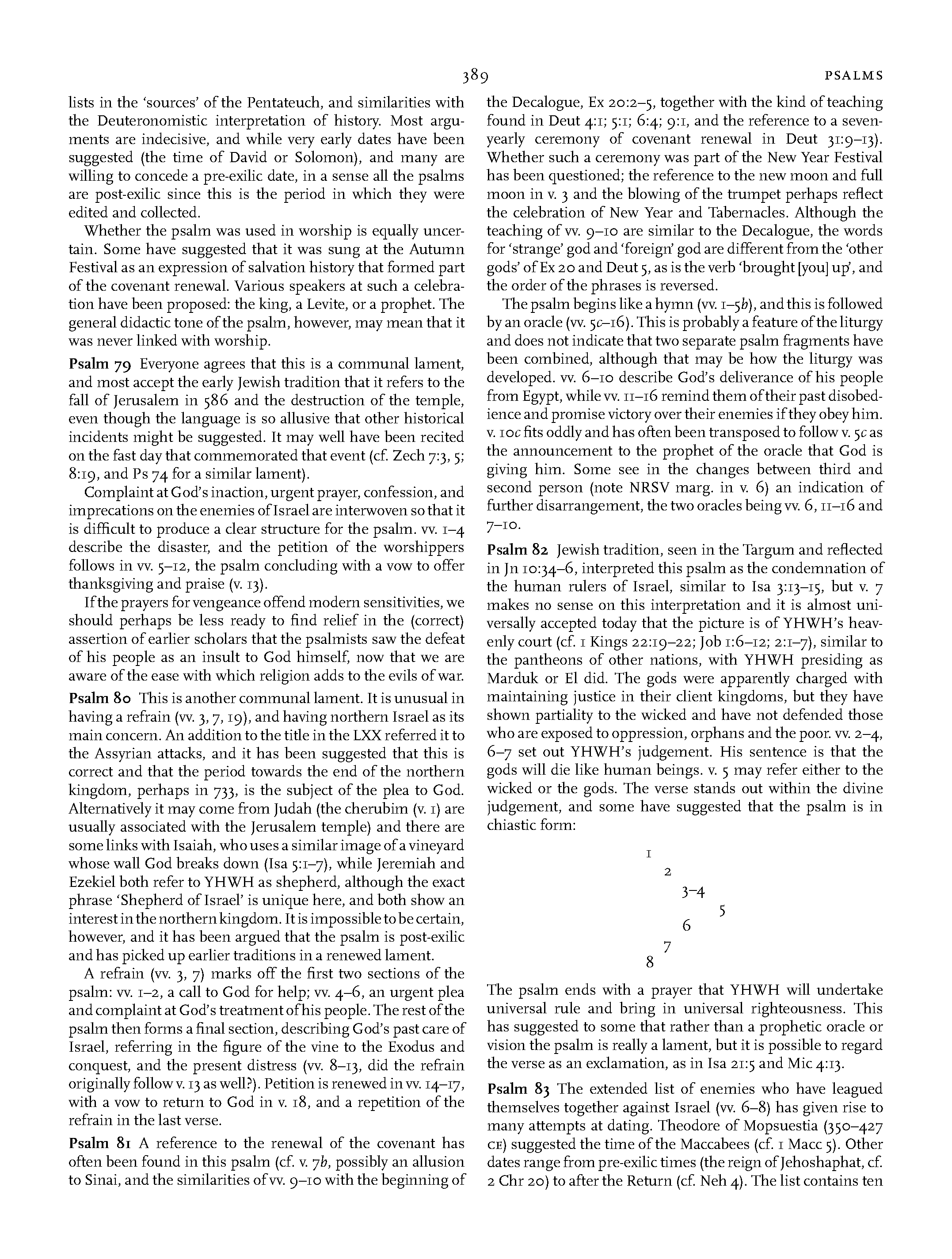
389 PSALMS the Decalogue, Ex 20:2—5, together with the kind of teaching found in Deut 4:1; 5:1; 6:4; 9:1, and the reference to a sevenyearly ceremony of covenant renewal in Deut 31:9-13). Whether such a ceremony was part of the New Year Festival has been questioned; the reference to the new moon and full moon in v. 3 and the blowing of the trumpet perhaps reflect the celebration of New Year and Tabernacles. Although the teaching of w. 9-10 are similar to the Decalogue, the words for 'strange' god and 'foreign' god are different from the 'other gods' of Ex 20 and Deut 5, as is the verb 'brought [you] up', and the order of the phrases is reversed.
lists in the 'sources' of the Pentateuch, and similarities with the Deuteronomistic interpretation of history. Most arguments are indecisive, and while very early dates have been suggested (the time of David or Solomon), and many are willing to concede a pre-exilic date, in a sense all the psalms are post-exilic since this is the period in which they were edited and collected.
Whether the psalm was used in worship is equally uncertain. Some have suggested that it was sung at the Autumn Festival as an expression of salvation history that formed part of the covenant renewal. Various speakers at such a celebration have been proposed: the king, a Levite, or a prophet. The general didactic tone of the psalm, however, may mean that it was never linked with worship. Psalm 79 Everyone agrees that this is a communal lament, and most accept the early Jewish tradition that it refers to the fall of Jerusalem in 586 and the destruction of the temple, even though the language is so allusive that other historical incidents might be suggested. It may well have been recited on the fast day that commemorated that event (cf Zech 7:3, 5; 8:19, and Ps 74 for a similar lament). Complaint at God's inaction, urgent prayer, confession, and imprecations on the enemies of Israel are interwoven so that it is difficult to produce a clear structure for the psalm, w. 1—4 describe the disaster, and the petition of the worshippers follows in w. 5-12, the psalm concluding with a vow to offer thanksgiving and praise (v. 13).
The psalm begins like a hymn (w. i-$b), and this is followed by an oracle (w. 50-16). This is probably a feature of the liturgy and does not indicate that two separate psalm fragments have been combined, although that may be how the liturgy was developed, w. 6-10 describe God's deliverance of his people from Egypt, while w. 11-16 remind them of their past disobedience and promise victory over their enemies if they obey him. v. loc fits oddly and has often been transposed to follow v. y as the announcement to the prophet of the oracle that God is giving him. Some see in the changes between third and second person (note NRSV marg. in v. 6) an indication of further disarrangement, the two oracles being w. 6,11-16 and 7-10.
Psalm 82 Jewish tradition, seen in the Targum and reflected in Jn 10:34-6, interpreted this psalm as the condemnation of the human rulers of Israel, similar to Isa 3:13—15, but v. 7 makes no sense on this interpretation and it is almost universally accepted today that the picture is of YHWH's heavenly court (cf. i Kings 22:19-22; Job 1:6-12; 2:1-7), similar to the pantheons of other nations, with YHWH presiding as Marduk or El did. The gods were apparently charged with maintaining justice in their client kingdoms, but they have shown partiality to the wicked and have not defended those who are exposed to oppression, orphans and the poor. w. 2—4, 6—7 set out YHWH's judgement. His sentence is that the gods will die like human beings, v. 5 may refer either to the wicked or the gods. The verse stands out within the divine judgement, and some have suggested that the psalm is in chiastic form:
If the prayers for vengeance offend modern sensitivities, we should perhaps be less ready to find relief in the (correct) assertion of earlier scholars that the psalmists saw the defeat of his people as an insult to God himself, now that we are aware of the ease with which religion adds to the evils of war. Psalm 80 This is another communal lament. It is unusual in having a refrain (w. 3, 7,19), and having northern Israel as its main concern. An addition to the title in the LXX referred it to the Assyrian attacks, and it has been suggested that this is correct and that the period towards the end of the northern kingdom, perhaps in 733, is the subject of the plea to God. Alternatively it may come from Judah (the cherubim (v. i) are usually associated with the Jerusalem temple) and there are some links with Isaiah, who uses a similar image of a vineyard whose wall God breaks down (Isa 5:1-7), while Jeremiah and Ezekiel both refer to YHWH as shepherd, although the exact phrase 'Shepherd of Israel' is unique here, and both show an interest in the northern kingdom. It is impossible to be certain, however, and it has been argued that the psalm is post-exilic and has picked up earlier traditions in a renewed lament.
A refrain (w. 3, 7) marks off the first two sections of the psalm: w. 1—2, a call to God for help; w. 4—6, an urgent plea and complaint at God's treatment of his people. The rest of the psalm then forms a final section, describing God's past care of Israel, referring in the figure of the vine to the Exodus and conquest, and the present distress (w. 8—13, did the refrain originally follow v. 13 as well?). Petition is renewed in w. 14-17, with a vow to return to God in v. 18, and a repetition of the refrain in the last verse. Psalm 81 A reference to the renewal of the covenant has often been found in this psalm (cf. v. yb, possibly an allusion to Sinai, and the similarities of w. 9-10 with the beginning of
The psalm ends with a prayer that YHWH will undertake universal rule and bring in universal righteousness. This has suggested to some that rather than a prophetic oracle or vision the psalm is really a lament, but it is possible to regard the verse as an exclamation, as in Isa 21:5 and Mic 4:13.
Psalm 83 The extended list of enemies who have leagued themselves together against Israel (w. 6-8) has given rise to many attempts at dating. Theodore of Mopsuestia (350—427 CE) suggested the time of the Maccabees (cf. i Mace 5). Other dates range from pre-exilic times (the reign of Jehoshaphat, cf. 2 Chr 20) to after the Return (cf. Neh 4). The list contains ten
PSALMS 390 ecy, or as petition, which turns the whole psalm into a lament, perhaps ending with the certainty of hearing.
names, which perhaps indicates that it is symbolic and that the psalm is a cultic lament (cf. Ps 2:1—3; 46:6; 48:4—8).
After calling upon God to remain inactive no longer (v. i), the onslaught of the enemies is described (w. 2-8). The rest of the psalm is an appeal to God to destroy these enemies, and the victories of Deborah and Barak over the Canaanite leader
Psalm 86 All agree that this is the prayer of an individual, and many describe it as almost a mosaic of quotations. The 'quotations', however, may simply be traditional phrases which the psalmist is reusing. There is less unanimity about the identity of the psalmist. The maximalists hold that it is a royal psalm, probably linked with the ritual humiliation of the king in the cult. They point to the extravagance of v. 9 which seems to go beyond what could be expected from an ordinary Israelite, and note the attacks by the enemies, the association of divine power with the king as YHWH's servant, and the stress on God's faithfulness and his great name, ideas that are linked elsewhere with kingship. On the other hand, some include it among the pleas of those unjustly accused or seeking divine acquittal, but there seem to be few grounds for this proposal. Perhaps it is a post-exilic psalm based on early traditional phrases, possibly taking over some features that previously belonged to royal psalms. The psalmist says so little about the distress from which he seeks God's rescue that it is difficult to determine what it is: enemies, false accusations, illness, even sin, are all hinted at.
Sisera (Judg 4—5) and of Gideon over the Midianites Oreb and Zeeb, and Zebah and Zalmunna (Judg 7:25; 8:13-21) are recalled as examples. Those looking for literary patterns point to the chiastic arrangement of w. 3—6, with the enemies of Israel flanked by the enemies of God.
Psalm 84 This is usually termed a pilgrim psalm, and the happiness which the godly Israelite finds as he makes his way to the temple for the Autumn Festival shines through. Other suggestions are that it is an entrance liturgy or simply a hymn of Zion. Several different types of prayer appear in it: expressions of joy and confidence that would fit a hymn of praise (w. i, 10, 12), longing, rather in the style of a lament (2, cf. ioa), prayer for the king (w. 8—9; 'our shield' refers to the king), and a description of the pilgrimage as the autumn rains are falling (w. 5-7). The whole psalm is bound together by the first and last verses, both addressing 'YHWH of hosts' and expressing delight and happiness. Most—even of those who find a maximum number of royal psalms—draw back from ascribing this psalm to the king himself, preferring to think of a cultic soloist.
The three-part structure is transparent: w. 1—7, a plea for help, based on the psalmist's piety (w. 1—4) and the character of God (w. 5-7); w. 8-13, a hymn-like section, interrupted by a call on God to teach the psalmist (v. n) and ending with thankful confidence that his prayer is answered, or a vow to offer praise, perhaps even to sacrifice a thank-offering (w. 12— 13); w. 14-17, renewed prayer, ending with a request for a 'sign', either some ritual or an oracle, or the salvation itself.
In v. 7 the MT seems to mean: 'he appears before God in Zion' (cf. RV); NRSV follows the LXX. Behind the psalm may be worship in which God was represented by an image which the worshippers 'saw' in the temple. No image of YHWH existed in Israel, but the phrase may have taken this over conservatively in the liturgy. Later scribes, anxious about orthodoxy and reverence, altered the verb into 'appear before'.
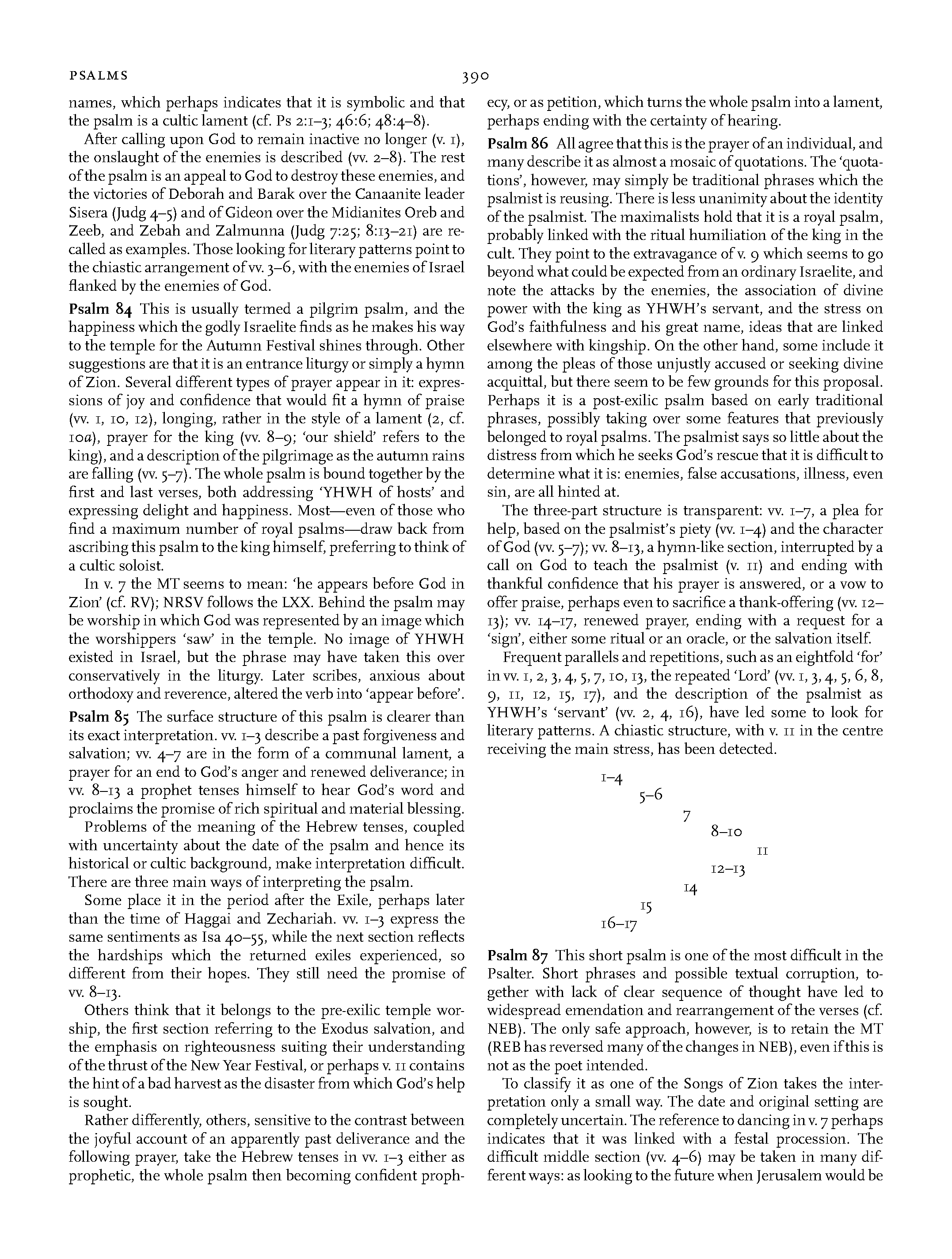
Frequent parallels and repetitions, such as an eightfold 'for' inw. i, 2, 3,4, 5, 7,10,13, the repeated 'Lord' (w. i, 3,4, 5, 6, 8, 9, n, 12, 15, 17), and the description of the psalmist as YHWH's 'servant' (w. 2, 4, 16), have led some to look for literary patterns. A chiastic structure, with v. n in the centre receiving the main stress, has been detected.
Psalm 85 The surface structure of this psalm is clearer than its exact interpretation, w. 1-3 describe a past forgiveness and salvation; w. 4—7 are in the form of a communal lament, a prayer for an end to God's anger and renewed deliverance; in w. 8-13 a prophet tenses himself to hear God's word and proclaims the promise of rich spiritual and material blessing.
Problems of the meaning of the Hebrew tenses, coupled with uncertainty about the date of the psalm and hence its historical or cultic background, make interpretation difficult. There are three main ways of interpreting the psalm.
Some place it in the period after the Exile, perhaps later than the time of Haggai and Zechariah. w. 1—3 express the same sentiments as Isa 40-55, while the next section reflects the hardships which the returned exiles experienced, so different from their hopes. They still need the promise of w. 8—13.
Psalm 87 This short psalm is one of the most difficult in the Psalter. Short phrases and possible textual corruption, together with lack of clear sequence of thought have led to widespread emendation and rearrangement of the verses (cf. NEB). The only safe approach, however, is to retain the MT (REB has reversed many of the changes in NEB), even if this is not as the poet intended.
Others think that it belongs to the pre-exilic temple worship, the first section referring to the Exodus salvation, and the emphasis on righteousness suiting their understanding of the thrust of the New Year Festival, or perhaps v. n contains the hint of a bad harvest as the disaster from which God's help is sought.
To classify it as one of the Songs of Zion takes the interpretation only a small way. The date and original setting are completely uncertain. The reference to dancing in v. 7 perhaps indicates that it was linked with a festal procession. The difficult middle section (w. 4-6) may be taken in many different ways: as looking to the future when Jerusalem would be
Rather differently, others, sensitive to the contrast between the joyful account of an apparently past deliverance and the following prayer, take the Hebrew tenses in w. 1-3 either as prophetic, the whole psalm then becoming confident proph-
391 PSALMS when hopes of the restoration of the Davidic monarchy were current (cf. Zech 4:6—14). On a cultic interpretation the psalm would accompany the ritual humiliation of the king, somewhat similar to that known in Babylon. To see it as part of an annual covenant festival is less likely. If used in a ritual it must have been followed by the king's salvation by God.
the centre of universal worship; as listing some of the nations from which Jewish proselytes have come to the festival; as a reference to Jews who come from different countries in the dispersion. The universal perspective may point to a post-exilic date, but it is impossible to be sure. The other countries might simply be a foil to YHWH's choice of Jerusalem.
Christian tradition has linked it with Christmas, God's covenant promise being fulfilled in Jesus. Typology might find parallels between the king's humiliation and Christ's humble birth, death, and final triumph.
'Rahab' (v. 4), the primeval monster quelled by YHWH in ancient story (cf Ps 89:10), represents Egypt. The 'springs' (v. 7) may symbolize divine blessing, or Zion may be thought of as the source of the streams of Paradise. Psalm 88 This is the bleakest of all the individual laments. The last word expresses its mood. The wonder is that the psalmist prays at all.
v. 52 is the doxology at the end of Book 3 of the Psalter (PS
D.2). Psalm 90 This is the only psalm ascribed to Moses, and while no one today would accept that Moses was the author, possible reasons for the title can be discovered. There are certain similarities with the Song of Moses (Deut 32), and only Moses calls on God to 'repent' (the word translated 'have compassion on' in v. 13; Ex 32:12).
The full horror of Sheol is found here. After death there is nothing but the land of darkness and forgetfulness, beyond God's care, outside the reach of his salvation, where the shades no longer offer praise (w. 5, 10—12, cf. Ps 6:5; 30:9: 115:17; Job 7:8—10; 10:21—2; see PS 0.13). The only spark of faith which glimmers through the darkness is v. i: 'O LORD, God of my salvation'. Three times he makes his plea to God (w. 1-2, 9, 13), but always he is met with silence; the final line of the psalm should perhaps be translated as REB, 'Darkness is now my only companion.' We are reminded of Job.
The psalm does not fit easily into any of the standard categories. It is often classed as a communal lament, but this suits only w. 13-17. The teaching in w. 3-12 has many wisdom features, though the main wisdom writings, apart from Job, do not address God in this way, and at v. 7 features of a lament appear (God's anger, references to sin, and the call 'How long?'). The psalm opens like a hymn of praise (w. 1—2). To divide it into two, or even three, separate psalms, however, is a counsel of despair. While it is possible that a post-exilic scribe compiled the psalm, using some earlier psalmic fragments and other material, what was produced is a single poem which deserves to be treated as a whole. Like Ps 73 it begins with a statement of faith—YHWH has proved himself the security and support of each generation, w. 3—12 emphasize the brevity of human life, made more bitter by toil and grief. 'How long?' (v. 13) is the familiar cry of lament (cf. Ps 6:3; 74:10; 79:5; 80:4; 94:3); the only ground for prayer is God's unwavering love (w. 13—17). In this way the eternity of God (v. 2) is contrasted with the fleeting life of human beings (v. 10), and our sin (v. 8) is answered by divine love (w. 14,17). Perhaps the scribe wished to compose a psalm that could be used in services of prayer and penitence (cf. Jdt 4:9—12), or even for private devotion. Psalm 91 Many and varied are the interpretations of this psalm. Royal maximalists find in the assurances given to the psalmist decisive evidence: the king alone can be the recipient of such divine protection. Other suggestions range from a form of entrance liturgy spoken by the priest to the worshipper at the temple, to part of the rites for a convert, who now sets himself under the protection of YHWH. The LXX added a title ascribing the psalm to David, while the Targum found in it a dialogue between David and Solomon. Similarities with Job 5:19-24 have led to proposals to link the psalm with wisdom writings, but Job itself may have been influenced by psalm forms. Reading 'pestilence' (v. 3) as 'word' (i.e. spell, rather than slander) and 'that wastes' (v. 6) as 'and a demon', the LXX reflects the interpretation of the psalm at the time of the translators as a defence against spells and demons. If it is a royal psalm it might have been recited before the king went out to battle, unless it formed part of temple ritual. The quotation of w. 11-12 in the temptations narrative (Mt 4:6;
The structure of the psalm is not clear. The three appeals to God mark some divisions. The descriptions of the psalmist's afflictions mark others: so ill that it seems he draws near to Sheol (w. 3—7); rejected with horror by his friends (v. 8); an account of Sheol (w. 10-12); seriously ill from his youth he is abandoned by God, subject to his wrath; and once again God seems to have caused his friends to shun him (w. 15—18). And the psalm breaks off in darkness, the mystery of suffering unsolved, the silence of God unexplained. Traditionally the psalm has been read on Good Friday. Psalm 89 After an introduction (w. 1-4), this long psalm falls into three easily discerned sections, w. 5—18 are a hymn of praise to YHWH, proclaiming his greatness among the gods, his power as creator, and his righteous rule; happy are his covenant people. It ends with a reference to the Israelite king, the nation's 'horn' and 'shield', w. 19—37 tell of YHWH's covenant with David and appear to be related in some way to Nathan's prophecy in 2 Sam 7:1-17; most probably both go back to traditions with a long history behind them and perhaps influenced each other. The final section of the psalm
(w. 38—51) is a lament. The king had been defeated and humiliated: he may even have lost his life (cf. v. 45), although the plea in w. 46-8, if by the king himself, would imply that he was only gravely threatened.
With so many clear references to the king, it is strange that Gunkel (id. and Begrich 1933:140) is hesitant about including it among his ten royal psalms. He regarded the combination of forms as pointing to a late date and reflecting the fall of the Davidic dynasty in 586. Some think it is a combination of separate psalms, but the overall unity seems assured, as is its being a king's psalm.
It is possible that it is related to some historical defeat, and the death of Josiah (2 Kings 23:29—30) or the Exile and imprisonment of Jehoiachin (2 Kings 24:8-17) have been proposed. Another suggestion places it after 520 BCE, at a time
PSALMS 392 strike at the heart of the Israelite ethic of care for the poor and oppressed; w. 8—n are akin to wisdom teaching, and use the wisdom vocabulary of 'fool', 'teach', and 'an empty breath'; w. 12-15 are a blessing on the righteous; and w. 16-23 are either an individual lament or the thanksgiving of an individual, according to how the tenses in w. 2 2—3 are understood. This does not mean that fragments from different psalms have been combined, since it is possible to find an overall unity in the theme of divine vengeance on the wicked, and there are similarities in vocabulary between the parts of the psalm (e.g. 'heritage', w. 5, 14; 'discipline' and 'teach', w. 10, 12; 'turn back', w. 2 ('give'), 15 ('return'), 23 ('repay'), the same Heb. word). Maximalists include the psalm among the king's psalms, claiming that it reflects 'royal' language, and finding the reference to the individual and the nation most suitable for the king who is the representative of his people. It was the king's duty to care for widows, the fatherless, and other oppressed members of society, including resident aliens (cf. Ps 72:2-4,12-14). The LXX adds the title: 'A psalm of David, for the fourth day of the week', a tradition which accords with the Mishnah's allocation of psalms for each day of the week (m. Tamid 7.4). Its position in the Psalter is odd, since it appears to break a sequence of enthronement psalms. Some have noted eight terms common to Ps 93 and 94, suggesting close links between them, but some are very common words and others
Lk 4:10-11) may reflect messianic interpretations of the psalm.
The structure of the psalm is more complicated than appears from the NRSV's emendations and rewriting (see RV for a more literal translation). The main sections are w. 1-13, 14—16, the latter being in the form of an oracle. Whether there is a dialogue in the first part is uncertain, but changes of person and exclamations interrupt the flow of the narrative. Psalm 92 Although this psalm begins with thanksgiving, its form is not entirely clear. Teaching, akin to that found in the wisdom writings (w. 6—7), and individual thanksgiving
(w. 10—n) are also found. Royal maximalists ascribe it to the king, pointing out that the psalmist's victory is also God's, that he is anointed, and that the community flourishes alongside the king. The title presents it as a sabbath psalm, and the Talmud states that it was sung at the offering of wine that accompanied the first sacrifice of a lamb (Num 28:9-10), while the Targum renders the title: 'a psalm of praise and song which the first man uttered upon the day of the Sabbath'.
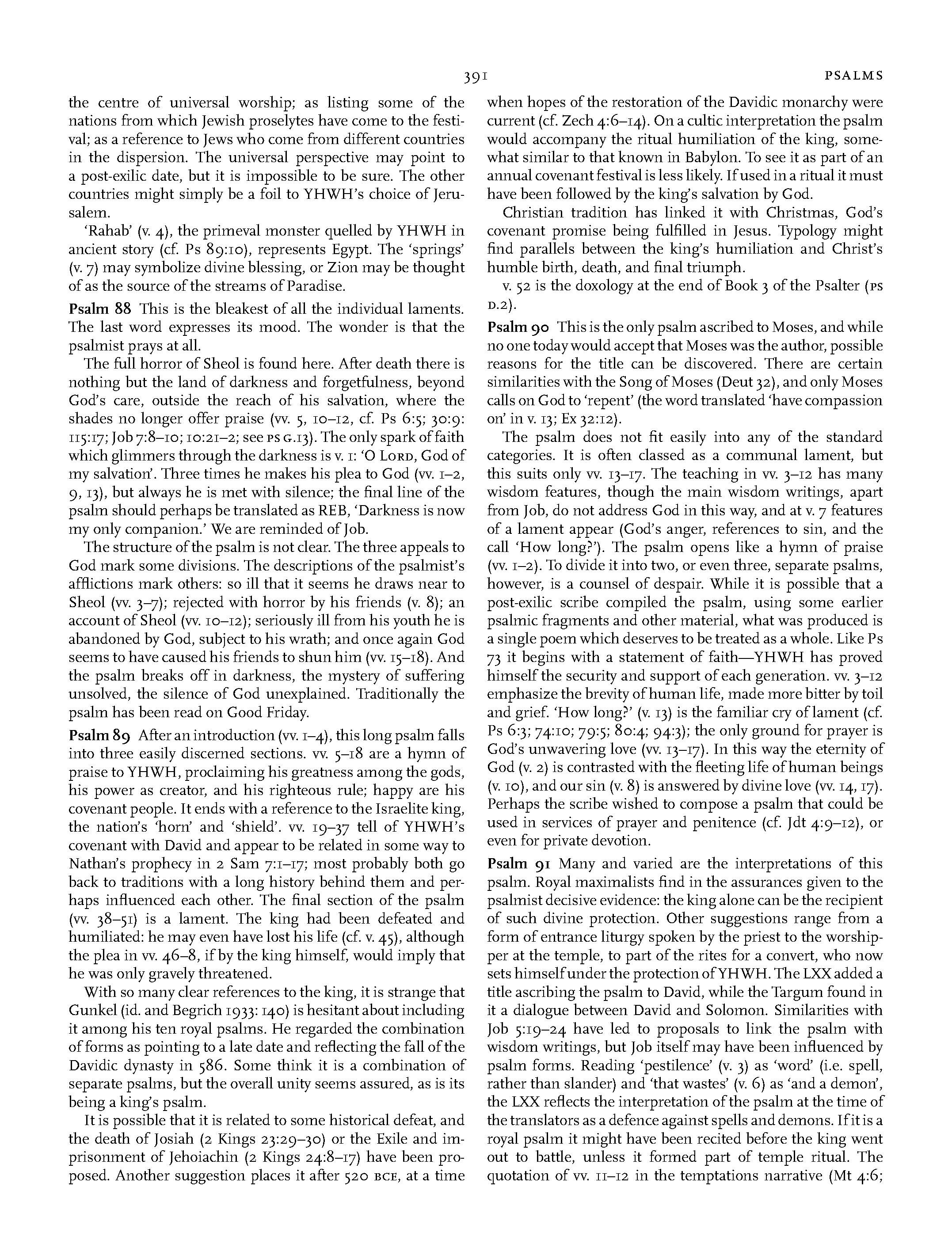
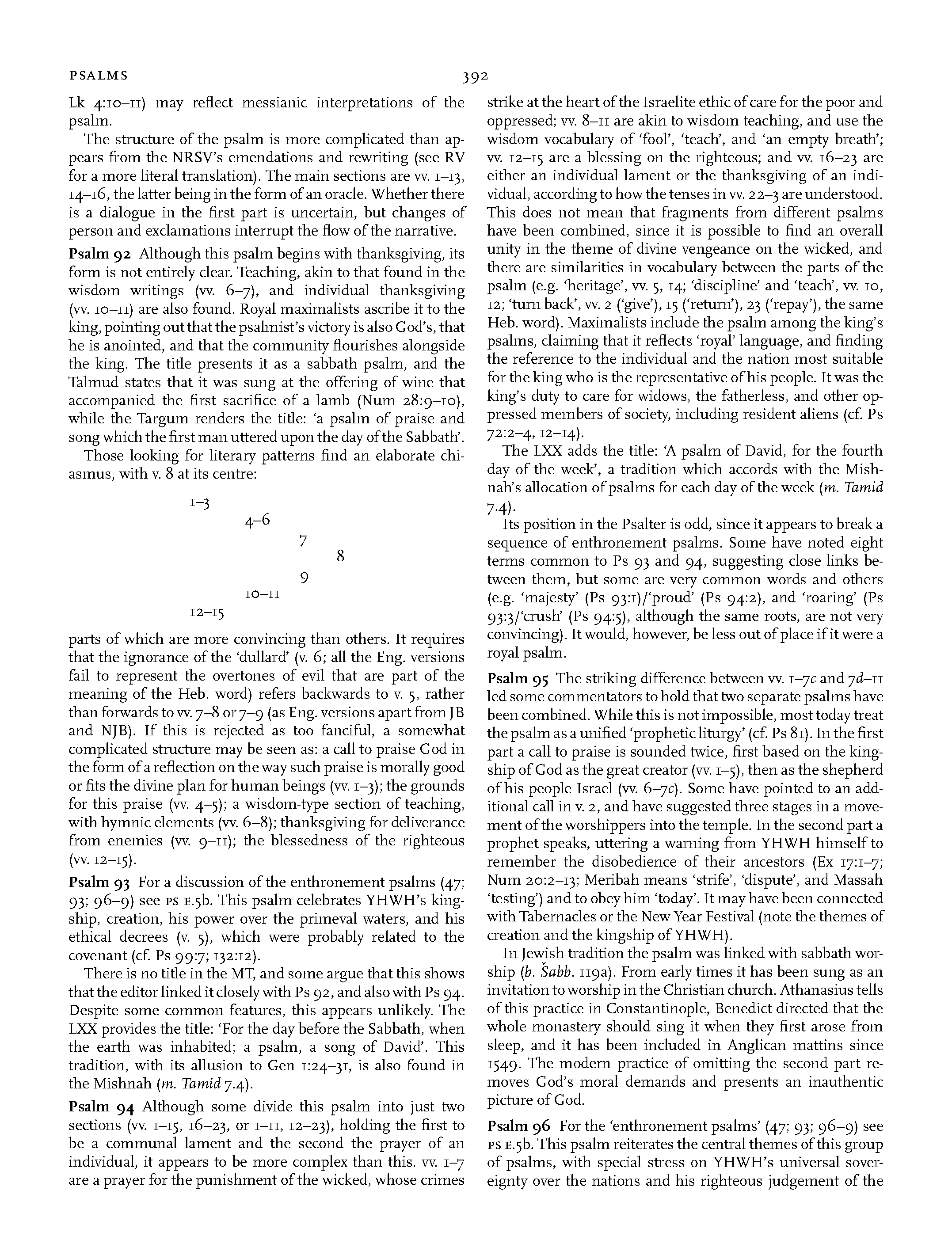
Those looking for literary patterns find an elaborate chiasmus, with v. 8 at its centre:
(e.g. 'majesty' (Ps 93:i)/'proud' (Ps 94:2), and 'roaring' (Ps 93:3/'crush' (Ps 94:5), although the same roots, are not very convincing). It would, however, be less out of place if it were a royal psalm.
parts of which are more convincing than others. It requires that the ignorance of the 'dullard' (v. 6; all the Eng. versions fail to represent the overtones of evil that are part of the meaning of the Heb. word) refers backwards to v. 5, rather than forwards to w. 7-8 or 7-9 (as Eng. versions apart from JB and NJB). If this is rejected as too fanciful, a somewhat complicated structure may be seen as: a call to praise God in the form of a reflection on the way such praise is morally good or fits the divine plan for human beings (w. 1-3); the grounds for this praise (w. 4—5); a wisdom-type section of teaching, with hymnic elements (w. 6—8); thanksgiving for deliverance from enemies (w. 9-11); the blessedness of the righteous (w. 12-15). Psalm 93 For a discussion of the enthronement psalms (47; 93; 96—9) see PS E.5b. This psalm celebrates YHWH's kingship, creation, his power over the primeval waters, and his ethical decrees (v. 5), which were probably related to the covenant (cf Ps 99:7; 132:12).
Psalm 95 The striking difference between w. i—yc and 7^—11 led some commentators to hold that two separate psalms have been combined. While this is not impossible, most today treat the psalm as a unified'prophetic liturgy' (cf. Ps 81). In the first part a call to praise is sounded twice, first based on the kingship of God as the great creator (w. 1-5), then as the shepherd of his people Israel (w. 6~7c). Some have pointed to an additional call in v. 2, and have suggested three stages in a movement of the worshippers into the temple. In the second part a prophet speaks, uttering a warning from YHWH himself to remember the disobedience of their ancestors (Ex 17:1-7; Num 20:2—13; Meribah means 'strife', 'dispute', and Massah 'testing') and to obey him 'today'. It may have been connected with Tabernacles or the New Year Festival (note the themes of creation and the kingship of YHWH).
In Jewish tradition the psalm was linked with sabbath worship (b. Sabb. 1193). From early times it has been sung as an invitation to worship in the Christian church. Athanasius tells of this practice in Constantinople, Benedict directed that the whole monastery should sing it when they first arose from sleep, and it has been included in Anglican mattins since 1549. The modern practice of omitting the second part removes God's moral demands and presents an inauthentic picture of God.
There is no title in the MT, and some argue that this shows thatthe editor linked it closely with Ps 92, and also with Ps 94. Despite some common features, this appears unlikely. The LXX provides the title: 'For the day before the Sabbath, when the earth was inhabited; a psalm, a song of David'. This tradition, with its allusion to Gen 1:24—31, is also found in the Mishnah (m. Tamidj.^).
Psalm 94 Although some divide this psalm into just two sections (w. 1-15, 16-23, or I~II> I2-23), holding the first to be a communal lament and the second the prayer of an individual, it appears to be more complex than this. w. 1—7 are a prayer for the punishment of the wicked, whose crimes
Psalm 96 For the 'enthronement psalms' (47; 93; 96-9) see PS E.5b. This psalm reiterates the central themes of this group of psalms, with special stress on YHWH's universal sovereignty over the nations and his righteous judgement of the
393 PSALMS ing few similarities with Deutero-Isaiah, by calling on the foreign nations to tremble before God instead of joining in his praise, and by directly naming Moses, Aaron, and Samuel, the three great intercessors (cf. Ex 32:11-14, 31-4; Num 12:13; 14:13—19; 16:44—8; i Sam 7:7—11). The text may be corrupt in places and the structure is not clear, w. 5 and 9 form a kind of refrain, although the wording is not exactly the same, but the threefold 'Holy' (w. 3, 5, 9), an outstanding feature of this psalm, may equally well mark the intended divisions. God's 'footstool' (v. 5) reflects a feature of ancient Middle-Eastern royalty; the ark (i Chr 28:2), the temple, Jerusalem (Lam 2:1), or the whole earth (Isa66:i) maybe intended by the term.
whole world, w. 1-3 sound the call to praise God. The reasons for offering praise are set out in w. 4—6, and this is followed by a renewed call to worship God in w. 7—10. In the final section of the psalm (w. 11-13) me whole of creation is summoned to rejoice before YHWH, who comes as righteous judge. 'Worship the LORD in holy splendour' (v. 9) see PS 29:2; 'new song' (v. i) see PS 33.
The LXX's title, 'When the house was built after the exile; a hymn of David', indicates the tradition that the psalm was written by David and used later to celebrate the rebuilding of the temple. It forms part of a composite psalm inserted into i Chr 16 for the bringing of the ark into Jerusalem by David. A notable Christian gloss in the Old Latin translation produced 'The Lord has reigned from the tree' in v. 10, and many of the Church Fathers from the time of Tertullian and Justin Martyr regarded the psalm as a prophecy of the cross, an interpretation reflected in the hymn Vexilla regis. Psalm 97 Many of the features common to the 'enthronement psalms' (Ps 47; 93; 96—9, PS E.5b) recur here, especially YHWH's kingship as universal lord, upholder of'righteousness', and saviour of his faithful followers. The most striking feature is the theophany in w. 2-5, which may reflect the appearance of God on Sinai (Ex 19), although similar phenomena revealing his appearance are found elsewhere in the OT, e.g. Hab3. It has been suggested that if the psalm was part of the temple worship, features of the theophany may have been experienced in the smoke of incense and the sacrifices accompanied by the blowing of the ram's horn, but there is no reason to treat the imagery so literally.
The LXX provides a title: 'A psalm of David'.
Psalm 100 This hymn of praise is marked by its seven imperative verbs ('make a joyful noise', 'worship', 'come', 'know', 'enter', 'give thanks', 'bless'). Similar to Ps 95, it is often held to have been sung at the entrance to the temple. The structure is transparent: the call to offer praise to God is made twice (w. i— 2, 4), each time followed by the motivation, first because YHWH is creator and shepherd of his people, then because of his goodness, love, and faithfulness, the last two words having strong associations with the covenant (w. 3, 5).
In v. 3/7 the text and margin of NRSV represent two traditions retained in the MTand reflected in the ancient versions. The Hebrew words 'his' (lit. 'to him') and 'not' are identical in sound but differ in spelling. Aquila, the Targum, and Jerome have 'his', as do all the most recent English translations, while the LXX, Symmachus, and the Syriac follow the alternative meaning, 'and not we ourselves', made familiar through the AV and BCP. A modern proposal is to take the word as a note of emphasis, producing: 'and we are indeed his people'. Psalm 101 The declaration of the psalmist that he will destroy all evildoers from the land, and especially from YHWH's city (v. 8), has convinced most commentators that this is a king's psalm, even though there is no specific mention of the king in it. Beyond this, however, there is little consensus. Some regard it as an expression of the king's vows at his enthronement, a view supported by the translation of the verbs as future (as in NRSV). This would not exclude its repetition on the annual celebration of his accession. Others point to the cry 'Oh when wilt thou come to me?' (v. 2 RSV; NRSV interprets the phrase differently, against most modern translations), and the metre, which is often used in laments, arguing that the psalm belonged to the New Year Festival in which, they believe, the king played a central part. He was ritually humiliated, like the king in Babylon, and appealed to God for deliverance on the basis of his righteousness and his just rule. The Babylonian king also confessed his innocence and declared that he had removed evildoers from his land. Whether this was depicted in terms of a battle is doubtful: there is no hint of such a conflict in this psalm. Even on this interpretation it is possible to see a future reference, the king vowing to continue his past practice.
Many phrases in the psalm are found elsewhere in the Psalter and the prophetic books, leading some to see it as the work of a post-exilic poet who formed it from earlier traditions, but there seems to be no need to deny that it could be earlier. The LXX title, 'By David, when his land was established' reflects the editor's view, though it has been interpreted, like the title to Ps 96, as indicating two traditions, that it goes back to David and that it was used after the Exile to celebrate the restoration of the Jews to their land. Psalm 98 This psalm begins and ends like Ps 96, and contains many features common to the 'enthronement psalms'
(47; 93; 96—9, PS E.5b). It has been suggested that this tremendous hymn marked the climax of the festival, but nothing is really known about its origins or use. A call to praise YHWH for his 'salvation' (w. 1—3, NRSV 'victory', see PS A.4) is followed by a second call to 'all the earth', first from the people and then from the primeval deep, the mountains, and all the inhabitants of the world because he is coming to exert his just rule (w. 4—9). For 'a new song' see PS 33.
It is the only psalm with just 'A psalm' as the title. The LXX adds 'of David', and the Syriac translation relates it to the deliverance from Egypt. In Anglican tradition it has been sung as an alternative to the Magnificat in Evensong, seeing Christ as the Lord who comes with salvation. Psalm 99 The last of the 'enthronement psalms' (47; 93:969; PS E.5b), begins with the familiar cry, 'YHWH is king'. It contains references to justice and righteousness (v. 4), and perhaps the covenant, with its moral demands (w. 4,7), and is centred upon Zion (v. 2; cf. 'his holy mountain', v. 9), yet it stands somewhat apart from the others in this group by hav-
The structure of the psalm is not immediately apparent, although repetitions of words and phrases suggest that it was carefully crafted. The simplest outline is to divide the psalm at v. 5, w. 2-4 setting out the king's own righteousness
PSALMS 394 as the thanksgiving of an individual, possibly after recovery from some illness (cf. w. 3—4) unless this is simply part of a general description of God's goodness.
and w. 5-8 his rule over his people, v. i (or possibly w. i-2a, if the Heb. verb translated 'I will study' is really 'I will make my theme' or 'I will sing a maskil psalm') forms the introduction. Phrases which may point to more elaborate structuring are 'within [in] my house' (w. 2,7, the same Heb. phrase), 'the way that is blameless' (w. 2, 6); 'before my eyes', 'in my presence'
The main divisions are w. 1-5, a self-exhortation by the psalmist to praise YHWH, w. 6—18, a description of YHWH's character and goodness, notable for the stress on divine forgiveness, compassion, and faithful love, and w. 19—22, a renewed call to praise, now directed to the heavenly beings and the whole of creation, (v. 19 may belong to the middle section, instead of providing the basis for the final call to praise.) In the second part of the psalm the singular subject of the opening is replaced by the plural 'us', and the tone becomes didactic and reminiscent of wisdom teaching, although the characterization of YHWH has parallels in the Torah and the prophets (cf. v. 8 with Ex 34:6; Num 14:18; Joel 2:13; Jon 4:2; v. 5 with 13340:31; and v. n with Isa 55:9), as well as in other psalms. Whether the psalm was sung within preexilic cultic worship, or comes from the time after the Exile within a circle of the pious who 'fear God' (w. n, 13, 17) is uncertain.
(w. 3, 7, identical Heb.), 'I will destroy' (w. 5, 8). Similar but not exact parallels are 'the faithful in the land' and 'the wicked in the land' (w. 6, 8), and 'integrity of heart', 'perverseness of heart', and'an arrogant heart' (w. 2,4, 5). Whether these form two sets of indusio, or some other pattern, is difficult to determine.
Psalm 102 The urgent prayer of an individual, hymn, and prophecy intermingle in this psalm. Some have held that two psalms have been combined, though there is some uncertainty about the precise extent of each (perhaps w. i—n with 23-4 and 12-22 with 25-8). Less drastic is the view that an earlier lament was adapted into a community prayer, maybe during the Exile. Royal maximalists wonder whether it might not be a king's psalm, the communal aspects showing the king as representative of the nation, and the hymnic features being part of the Autumn Festival. Others who retain the unity of the psalm ascribe the communal features to the use of the psalm within the temple worship or suppose that the psalmist adopted elements of praise from the cult. The final section has been seen as an alternative to the common vow to offer praise that is a feature of many individual laments.