
Part 112
With whom in Jerusalem did Paul discuss his convictions concerning the gospel he was proclaiming to Gentiles (v. 2) ? The NRSVand the REB refer to one 'private' meeting with the leaders of the Jerusalem church who play a prominent part in w. 6-10. Some commentators (including Betz 1979 and Martyn 1997) conclude (probably correctly) that two meetings are referred to in the Greek of v. 2, one with the whole church in Jerusalem, followed by one with the leaders.
In order to underline his independence of the Jerusalem authorities Paul mentions in v. 21 that after his short visit to Cephas he then went well to the north and north-west of Jerusalem, to places in Syria (presumably including Antioch) and in neighbouring Cilicia. Defenders of the south Galatia theory believe that Paul's first visit to Galatia took place during this journey. Martyn, a defender of the north Galatia theory, believes that v. 21 tells strongly against the south Galatian theory; he notes that if Paul had visited the cities of (south) Galatia at this point, it would have suited his argument to have said so (1997: 184).
Paul is anxious lest his fundamental conviction that Gentiles should be accepted without the requirement of circumcision be called in question or even rejected outright (2/7). In v. 3 it becomes clear that Paul and Barnabas had taken Titus with them to Jerusalem (v. i) as a test case. At first there is no dissension: the Gentile Titus was not compelled to be circumcised (v. 3). At this point the link between Paul's story in chs. i and 2 and the crisis in Galatia would have become crystal clear to those who heard this letter read aloud in churches in Galatia many hundreds of miles from Jerusalem. In chs. i and 2 Paul is narrating selected past events in his life not because he believed that his autobiography was interesting, but because he was convinced that his story was directly relevant to the disputes in Galatia. The phrase 'compelled to be circumcised' which is used in v. 3 with reference to Titus, recurs in Gal 6:12 with reference to the Galatian Christians. In v. 5 Paul insists that the stand he took on principle in Jerusalem was 'so that the truth of the gospel might always remain with you [Galatian Christians]'.
In w. 22-3 Paul goes still further: at this time he certainly was not in contact with the Jerusalem authorities, for he was not known personally by the churches in Judea, including Jerusalem. In that area stories had circulated about his volteface from persecutor to proclaimer, but he himself was not there, but far to the north. In v. 23 Paul quotes the report about him which had reached the Judean churches and had been received with thanksgiving to God (v. 24). No doubt only a summary is included, but some of the phrases seem to come directly from the report rather than from Paul himself. For example, Paul does not refer to the content of the Christian message as 'the faith', and he prefers the noun 'gospel/good news' to the verb 'proclaim good news'.
(2:1—10) Paul's Story, Part III: Conference in Jerusalem The meeting between Paul and Barnabas and Christians in Jerusalem was one of the most momentous events in the development of earliest Christianity. Was it intended to defuse a major crisis and to reconcile deep-seated differences ? What were the main issues at stake? Although some details are unclear, the main points can be set out confidently.
Paul's fury at the 'false believers' who had sneaked in like spies to 'enslave us' is not disguised; it is reflected in emotive language in w. 4—5 and in the tangled grammar, which the NRSV partly unravels. Where did this attempt to thwart 'the freedom we have in Christ Jesus' take place? Some scholars posit an earlier occasion in Antioch, partly on the basis of Acts 15:1, while others believe that the disruption took place in Jerusalem itself. Who are the 'false believers' who posed such athreat? Paul concedesthatthey are 'believers' ('brothers' in the Greek), but is adamant that he did not yield to their demand that Gentile Christians should be circumcised. Like the agitators in Galatia, they are perverting the gospel of Christ (1:6—7). The 'false believers' are probably not identical with 'the certain people from James' referred to in 2:12.
The relationship of Paul's account in these verses of a conference in Jerusalem to Acts 11:29—30 and 15:1—29 has baffled scholars for many decades. A minority insists that the 'apostolic council' recorded in Acts 15 took place after Galatians was written. This would account for Paul's failure to refer in ch. 2 to the 'apostolic decree' (Acts 15:20,29; 21:25) which, according to Luke, encapsulated the decisions reached at the 'apostolic council'. On this view the events recorded here are to be equated with Acts 11:29-30. However, most scholars accept that in spite of some glaring differences, there are enough similarities between the two passages to conclude that they record the same event from different perspectives. Even if Acts 15 draws on earlier sources, Luke wrote some three decades after Paul wrote Galatians—and, unlike Paul, Luke makes no claim to have been present himself. So
In v. 6 Paul insists that the Jerusalem leaders made no demands on Paul: 'they imparted nothing further to me' (REB). Here, as elsewhere in this passage, Paul is ambivalent about the Jerusalem leadership. He recognizes that they are the 'acknowledgedleaders' (2:2, 6,9) of the Jerusalem church, though he himself is unimpressed by their status, for they have no special standing in God's eyes.
"57 GALATIANS troublemakers in Galatia. It is preferable to read the record of the incident at Antioch as undergoing a subtle metamorphosis in w. 15-21 as Paul switches the focus of his attention from Antioch to Galatia.
In w. 7-9 Paul spells out the agreement that was reached, one which in Paul's eyes was a victory, not a compromise. The Jerusalem leaders recognized that Paul had been entrusted by God with the gospel 'for the uncircumcised', just as Peter had been entrusted with the gospel 'for the circumcised'. Most scholars now accept that Paul is referring here to a division of labour along ethnic (Jew / Gentile) rather than geographical
In v. ii Paul does not tell the reader why Peter came to Antioch (presumably from Jerusalem), nor does he give the reason for the dramatic confrontation. Only after the bald summary is given do the details emerge in w. 12 and 13. Peter had been fully accustomed to eating with Gentiles in the church at Antioch; he was thoroughly at home in the mixed congregation there of Jews and Gentiles. But when 'certain people came from James', Peter backtracked. Presumably the visitors came at the behest of James to express the concerns of the Jerusalem church. If they were the false believers of 2:4—5, surely Paul would have said so. They were not urging abandonment of the Jerusalem accord over separate missions to Jews and to Gentiles, but raising concerns over Peter's regular practice of eating with Gentiles, a matter apparently not discussed in Jerusalem. Paul does not tell us whether the meals in question were regular meals, or the Lord's supper, or both. At this time Jews and Gentiles regularly had contact with one another, but there were differing attitudes to table fellowship. Peter and other Jewish believers seem to have been welcoming Gentiles to their tables, probably on Jewish terms. They are likely to have been 'accepting invitations to Gentile tables without asking too many questions (cf. i Cor 10:27), though presumably on the assumption that the Gentile believers would have been mindful of the basic food rules' (Dunn 1993: 121). The verbs in v. 12 b imply that Peter began to draw back and refrain from table fellowship over a period of time. Who was applying the pressure, and why was Peter afraid? The NRSV refers to 'fear of the circumcision faction'; this phrase is usually understood to refer to Jewish Christians who came from James and who were uneasy about what were perceived to be Antioch's lax attitudes to table fellowship with Gentiles. The REB interprets the Greek quite differently: Peter 'was afraid of the Jews'. The Jews may have been non-Christians. Longenecker (1990) and others accept R. Jewett's theory that at the time of the Antioch incident a rising tide of Jewish nationalism had provoked Jewish antagonism towards Jews who were thought to be adopting lax attitudes towards association with Gentiles. Under this political pressure, the Jerusalem Christians were 'trying to take measures to keep Gentile Christians from needlessly offending Jewish sensibilities'. Hence the concerns of the Jersualem church were triggered by political rather than theological concerns.
(Israel / diaspora) lines. Paul is not referring to 'two gospels', one for each ethnic group; the very idea would have appalled him, as 1:7 confirms. The recognition that God was at work in making Peter 'an apostle to the circumcised' is in stark contrast to the reference to Peter in the account of the 'incident at Antioch' which follows in 2:10-14.
At last Paul names the leaders of the Jerusalem church: James, Cephas, and John (v. 9). They are referred to as 'pillars', as in supports for a building. Agreement is sealed by giving 'the right hand of fellowship', an act that had the same meaning in antiquity as it does today. 'By implication, the agreement sets up two cooperative but independent missionary efforts' (Betz 1979: 100). The only request made by the Jerusalem leaders to Paul and Barnabas was that they should remember 'the poor', i.e. they (probably the Antioch church) should support the Jerusalem church financially. Paul had no hesitation in accepting this request. We know from i Cor 16:13 that the Galatian churches did make weekly collections for the Jerusalem church (cf also Rom 15:25—6).
What is left unsaid in w. i—10 must not be forgotten. The 'false believers' fade completely from the scene at v. 5. There is not even a hint that they accepted the agreement. And if, as most scholars think, Acts 15 records a different version of the discussions in Jerusalem, Paul's failure to mention the 'apostolic decree' is significant: either Luke has anachronistically added the decree to his account of the apostolic council, or it was such an embarrassment to Paul that he could not bring himself to mention it here.
(2:11-14) Paul's Story, Part IV: Incident at Antioch The clash between Peter and Paul recorded in these verses is in sharp contrast to the amicable agreement reached at Jerusalem. In the earlier parts of Paul's story an indication of the chronology is given, but there is none here. This is one of the reasons why some scholars reverse the order of the two events narrated in ch. 2: the crisis that arose in Antioch (w. 11—14) was resolved by the agreement reached in Jerusalem (w. i-io). This reconstruction avoids the difficulty that in ch. 2 Paul does not indicate the outcome of his dispute with Peter at Antioch. But in such a carefully argued letter Paul is unlikely to have reversed the chronology, and in 2:1-10 there is no reference to food laws, the central issue at stake in Paul's clash with Peter.
These verses can be plausibly interpreted in several ways. Perhaps we have to accept that we do not know precisely why Peter acted in a way that led Paul to charge him with hypocrisy twice over in v. 13. What is clear is that Peter did not act impulsively and without support from other Jewish Christians. Even Barnabas, Paul's closest colleague (2:2, 9) 'was led astray'. It was Paul who was isolated, hence the emotive language (and perhaps even the lack of clarity) in w. 11—14. Paul's own position becomes clear in v. 14. He believes that Peter (and Barnabas and all the other Jewish Christians) were 'not acting consistently with the truth of the gospel' when they compelled Gentiles to live like Jews, i.e. to share table fellowship with Gentiles only when meals had been prepared in
Paul's failure to record the outcome of his face-to-face dispute with Peter is related to his primary concern to show that this incident has a direct bearing on the tensions in the Galatian churches. Even though the text gives no explicit indication of a change of scene from Antioch to Galatia at v. 14, most modern translations assume rather too readily that there is a major break at this point. However, the NRSV's footnote is helpful, and points the reader in the right direction: 'Some interpreters hold that the quotation extends into the following paragraph.' If so, then in 2:15—21 Paul is still addressing Peter in Antioch—but for the benefit of the
GALATIANS 1158 refutes this criticism, and especially the inference that Christ has become a servant of sin. In v. 18 Paul refers directly to the incident at Antioch: he would show himself to be a transgressor if he were to backtrack (as Peter did) and 'rebuild the walls of the Law that I have torn down' (Martyn 1997: 256).
accordance with Jewish dietary laws. ('Living like Jews' did not necessarily include circumcision; there is no indication that Peter was insisting that Gentile believers should be circumcised.) For Paul, a fundamental principle was at stake: Gentiles were being compelled to live like Jews in order to be accepted as members of the Antioch church. Hence Paul rounded on Peter in front of all those lined up against him. It is often pointed out that Paul's attack on Peter is at odds with his own exhortation in 6:1 to use a 'spirit of gentleness' when a fellow Christian is 'detected in transgression'.
In w. 19 and 20 Paul's statements about the Christian life are positive: both the incident at Antioch and the crisis in Galatia slip into the background. Although Paul repeatedly refers to himself in the first person singular, he is speaking on behalf of all Christian believers. 'Dying to the law' (v. 19) means being separated radically from it. For Paul 'dying to the law' takes place through identification with Christ's own crucifixion and death (v. igc). When this happens the believer's life is no longer self-centred, but Christ-centred (v. 20).
Paul says nothing about Peter's response, and nothing about the outcome of the confrontation. Martyn (1997: 240), concludes that 'the Antioch incident ended in political defeat for Paul'. That is a possible, but not a necessary reading of the text. Perhaps Paul was more concerned to press home the theological issues at stake, as he does in the following verses, than to record the outcome of a painful episode.
The phrase 'Christ who lives in me' is rarer in Paul than reference to the Spirit who indwells the believer. Both phrases are less common than Paul's references to Christian experience as 'in Christ' (e.g. 5:6), 'in him', 'in the Lord', or 'in the Spirit' (e.g. 5:25). In v. 2ob the NRSV's 'in the flesh' is misleading, especially in view of Paul's strongly negative use of 'the flesh' in 3:3 and 5:13,16-22. Here 'flesh' is neutral; it refers to the believer's 'present mortal life' (REB).
(2:15—21) Works of the Law or Faith? Paul expounds vigorously the theological issues at stake in his dispute with Peter. He probably intends these verses (or at least w. 15—18) to be part of his reply to Peter. Paul is unlikely to be recalling some seven years later the very words he used; no doubt these verses incorporate some of Paul's later reflections on the issues at stake. We do not know whether Paul formulated his convictions about 'justification by faith' in the light of his dispute with Peter, or whether he had developed them at an earlier point.
Paul does not often refer to Christ as 'Son' or 'Son of God'. When he does so, it is usually in a particularly rich theological context, as in Gal 1:16, 2: 2oc, and 4:4-6. Both the latter passages refer to the Son's self-giving 'for us', 'for our redemption', a note first sounded in Galatians in the opening greeting at 1:4. Once again there is a division of opinion over 'faith'. Does Paul refer to the believer's faith in the Son of God, or to the Son's own faith (NRSV f) or faithfulness?
w. 15 and 16 contain a set of programmatic statements that are expounded and underlined in the sections of Galatians that follow. In v. 15 Paul reminds Peter that both of them are Jews by birth, and hence view Gentiles as outside the law and therefore as sinners. Here Paul is echoing traditional views; perhaps he is even echoing the language used by the 'certain people from James' (v. 12). In the next verse Paul explains that v. 15 is by no means the end of the matter! In the lengthy v. 16 the phrase 'works of the law' is used three times and contrasted sharply with 'faith'. What does the former phrase refer to? Paul is refuting the claim made by the agitators in Galatia v. 21 is a summary of the whole of w. 15—21; in particular it underlines some of the key points of v. 16. Paul is probably responding directly to the claims of the agitators; the incident at Antioch has now faded from view. The agitators have claimed (or perhaps Paul thinks they have claimed) that Paul has wrenched asunder God's grace and the law. For Paul a person is reckoned as righteous in God's sight not through the law (synonymous in v. 20 with the 'works of the law', v. 16) but through faith in Christ (v. 16) whose death was not in vain (v. 2ic) but was an act of self-giving love for us (v. 2oc).
(and implicitly by Peter when he 'compelled] the Gentiles to live like Jews', v. 14) that one's standing before God is dependent on carrying out the requirements of the Mosaic law. 'Works of the law' is taken by some scholars to refer to the Jewish 'identity markers' of sabbath, circumcision, and dietary laws, rather than to the Mosaic law per se, but the negative comments on the law that follow in ch. 3 make this unlikely.
Paul's Central Arguments (3:1-5:1)
(3:1—5) How Did You Receive the Spirit? Paul continues the argument of the preceding verses and asks pointedly whether the Galatians received the Spirit by 'works of the law' or by 'believing what you heard' (v. 2). Attention is now focused directly on the Galatians who are roundly rebuked for the second time (cf. 1:6-19). Peter and the incident at Antioch are left far behind as Paul grapples vigorously with the issues at stake in the crisis in the Galatian churches. At nearly all the key points in ch. 3 Paul's argument is grounded on Scripture, but in this opening section Paul's appeal is to the Galatians' initial reception and continuing experience of the Spirit. The Galatian Christians are upbraided twice for their foolishness (w. i, 3); it is not their lack of intelligence that riles Paul, but their lack of discernment. Paul draws on contemporary patterns of polemical argument in suggesting that the Galatians have been 'bewitched' by the agitators. To use a modern-day
Paul insists that a person is 'reckoned as righteous' by God (NRSV n.) on the basis of'faith in Christ'. The meaning of the latter phrase is keenly discussed. It has traditionally been taken by translators and commentators to refer to the believer's faith in Christ, but a growing number of scholars insist that Paul is referring to Christ's own faithfulness to God, as in the NRSV footnote. The future tense 'will be justified' at the end of v. 16 is important; Paul is referring to the believer's ultimate standing before God.
Once again Paul includes Peter with his use of'we' / 'our' in v. 17. Paul seems to be referring to the stand he and Peter took before Peter backtracked: they had sought to base their standing before God solely on the basis of faith—and in so doing they had been dubbed 'sinners' by some. Paul vigorously
"59 GALATIANS
(v. n) leaves no room for living by the requirements of the law (v. 12). Paul's comments on the law in w. 10—12 are negative and harsh. The other side of the coin is expressed positively in w. 13-14: 'Christ redeemed us from the curse of the law... so that we might receive the promise of the Spirit through faith.' This section ends where it began (w. 2—5) with a reference to the importance of God's bestowal of the Spirit. But what does 'Christ became a curse for us' mean (v. 13) ? 'The thought is of Jesus acting in a representative capacity... the law printing its curse on Jesus, as it were, so that in his death the force of the curse was exhausted, and those held under its power were liberated' (Dunn 1993: 177, who rightly refers to 2 Cor 5:21 as an important parallel).
equivalent, they have had the wool pulled over their eyes. In fact Paul reminds the Galatians that he used visual imagery in his initial preaching: Jesus Christ was 'publicly exhibited as crucified'. As in i Cor 1:23; 2:2, Paul contrasts his preaching of the crucified Christ with the rhetorical sophistry of his opponents.
v. 3 is particularly important for Paul's argument. The Galatians have received the Spirit as the basis of their Christian experience, and they ought to continue in the Spirit (cf 5:25). Instead, they are 'now ending with the flesh'. Paul believes that some of the Galatians have succumbed (and others may follow) to the agitators' demands that circumcision is the mark of Christian identity. Paul returns to this topic more fully at 5:2—12; 6:12—13. Paul underlines and extends his central point in this section by asking a rhetorical question in v. 5 to which he expects a resounding 'no' as an answer. The tense of the verbs is important: God continues to sustain the Galatians with the Spirit; God continues to 'work miracles' among them. We do not know what form the miracles took, but Paul's main point is clear: God's Spirit continues to be experienced powerfully in the Galatian churches. For Paul, one's standing before God (past, present, and future) is not on the basis of carrying out the requirements of the law.
(3:15—29) Abraham's Offspring Paul seems to sense that the argument of the previous verses has been complex. So he pauses, and in contrast to 3:1, addresses the Galatians in endearing terms in order to secure their attention. He then provides an illustration from everyday life: one cannot annul or add to a ratified will (by means of a codicil). Paul uses a form of argument found in other Jewish writers of the time: in order to make a particular point he rejects the accepted meaning of Gen 17:8 as a reference to the promises given to Abraham and the generations of his descendants. He takes 'offspring' ('seed' in the Greek) in its literal sense in the singular to refer to one person, Christ. So God's promises were given only to Abraham and to Christ; in w. 26—9 Paul will insist that those who belong to Christ are Abraham's offspring, not Abraham's physical, i.e. ethnic, descendants.
(3:6—14) Abraham Believed God In v. 6 Abraham is introduced for the first time; he remains on stage until 5:1, though in some sections he lurks in the background. Given the prominence of Abraham in numerous early Jewish writings, it is not surprising that Paul also should appeal to parts of the story of Abraham. Paul takes his listeners immediately to Gen 15:6 in order to argue that 'those who believe' (including Gentiles) (w. 7—8) are descendants of Abraham.
In v. 17 Paul returns to his illustration of v. 15, but he now uses the term diatheke, which can mean either 'will' or 'covenant' to refer to God's covenant with Abraham. The law came into existence 430 years after God's covenant-promise to Abraham. There is no hint here that the law was God-given; indeed Paul's point is that as the law came later than the covenant ratified by God, it could neither nullify nor modify the promise to Abraham. The latter point is only implicit: in v. 15 Paul has explained that one cannot add a codicil to a will. The agitators in Galatia may well have argued along totally different lines: Gen 17 confirms that Abraham observed the law even before it was given by God to Moses at Sinai. Paul presses home his argument in v. 18. 'The law' and 'the promise' are set in antithetical opposition: 'the inheritance' given to Abraham comes via the latter, not the former. What is 'the inheritance' granted by God? It 'is the church-creating Spirit of Christ' (Martyn 1997: 343).
Paul is probably refuting the agitators' version of traditions about Abraham. They are likely to have appealed to the reference to Abraham's meritorious deeds in Gen 14 and to Abraham's acceptance of circumcision in Gen 17:4—14 as the basis of his acceptance by God. Paul, however, focuses solely on Gen 15:6 with its reference to Abraham's faith in God as the basis of his standing before God. He develops his argument from
Scripture in v. 8, claiming that through Scripture (in phrases from Gen 12:3 and 18:18) God 'declared the gospel beforehand to Abraham'. God's justification of the Gentiles by faith and his bestowal of his grace, peace, and favour upon them (i.e. his blessing of them, w. 8 and 9) is nothing new: it is anchored in
Scripture, and it was always part of God's purposes.
It is difficult to be certain about Paul's line of argument in w. 10-12. He claims that reliance on observance of the law brings a curse, not a blessing, and quotes Deut 27:26 in support. Why does the law bring a curse? Paul seems to be implying that it is impossible to carry out the requirements of the law: since those who try to do so fail to keep the law completely, they are accursed. There is a solemn warning to the Galatians here: beware of the law's siren voice, for it brings a curse, not a blessing. If this is Paul's main point in v. 10, then w. ii and 12 make a rather different point: they are concerned once again with the contrast between faith and keeping the law as the basis of one's standing before God. In v. n, Hab 2:4 underpins Paul's argument concerning faith; in v. 12, Lev 18:5 is cited to confirm that the law has to do with carrying out the requirements of the law and living by them. Living by faith
The obvious question now has to be faced (v. 19). If the law came into existence much later than the promise to Abraham, and is therefore secondary, why was it given at all? Answer: it was added as a supplement to the promises (this is the force of the verb used) 'because of transgressions', a phrase which has evoked much comment. Was the law added to bring about a knowledge of transgressions, or even to provide some sort of remedy for them? While the Greek can be construed in this way, in view of the negative comments on the law that follow, this interpretation is unlikely. Paul probably states that the law was given 'to cause or increase transgressions'. The next phrase 'until the offspring would come' confirms that the law's role is limited to the period between Moses and Christ. In nearly all strands of Jewish thought, and presumably in the
GALATIANS 1160
In v. 26 and in the grand finale to this section in v. 29 Paul brings discussion of who are true 'children of Abraham' back onto the agenda (cf. 3:16-19). In v. 26 those who are 'in Christ Jesus' are God's children, while in v. 29 those who 'belong to Christ' are Abraham's offspring; the expressions are synonymous. By now the listener will be well aware that one's standing before God is not grounded on law observance, but on faith, w. 27-8 interrupt the argument of w. 26 and 29 with a reference to baptism. Some of the phrases in these verses are found elsewhere in early Christian writings (see especially i Cor 12:13; Col 3:I1); only ^e first pairing in v. 28, 'Jew or Greek', is relevant to the immediate context. Hence several scholars conclude that Paul is here citing an early baptismal liturgy. The person who is about to be baptized removes clothing, symbolizing the old order, and in baptism is 'clothed with Christ' (v. 27). In baptism all the social distinctions that lay at the heart of the society of the day are abolished. 'Religious, social, and sexual pairs of opposites are not replaced by equality, but rather by a newly created unity' in Christ Jesus (Martyn 1997: 377). Whether this radical vision was put fully into practice by Paul himself, and in the churches he founded, is another question.
view of the agitators, the law had been given by God permanently.
The law's secondary role is underlined by the claim that it was 'promulgated through angels' (v. igd). The NRSV's 'ordained through angels' implies a more positive sense than the context allows. The first listeners were bound to notice the absence of explicit reference to the involvement of God in the giving of the law by God. The silence is telling, especially in view of the way God's involvement in the giving of the promise to Abraham is underlined in the Greek by the placing of'God' at the end of v. 18. Paul concedes that a mediator was involved in the promulgation of the law (v. 19 d). The statement that follows (v. 20) is one of the most puzzling in Paul's letters, but its gist is clear. A mediator, Moses, was involved. But since God is one and needs no mediator between himself and his people, God was not involved at Mt Sinai! This is indeed a radical rejection of Jewish views about the giving of the law, but it is in line with the preceding and the following comments about the role of the law.
An obvious objection is faced squarely in the verses which follow (cf 3:19). In the light of the negative comments about the law that have been made in the preceding verses, some listeners might have concluded that the law and the promise were fundamentally opposed to one another (v. 210). Paul adamantly resists this conclusion, and then proceeds to spell out what continuing function the law has (w. 22—5). First of all the hypothetical possibility that the law might have brought life is considered. In that case, Paul readily admits, God's 'rightwising' activity ('righteousness') on our behalf would be on the basis of the law. But since the law did not bring life, righteousness does not come as the result of keeping the law. Once again the careful listener will recall 2:16, where this theme rings out for the first time. w. 22 and 23 are partly similar: both use the verb 'imprison', and both conclude with a reference to faith. But Paul does not simply repeat himself. In v. 22 he refers to the way Scripture has imprisoned the whole of humanity, indeed the whole of creation ('all things') under the power of sin. 'Scripture' probably refers to Deut 27:26 which Paul cited in 3:11; 'under the power of sin' is synonymous with 'under a curse' in 3:110. This negative role played by the law had a positive outcome: so that the promise might be given to those who believe. In v. 23 Paul uses the pronoun 'we' for the first time since 3:13. The verses that follow confirm that Paul has in mind the Galatian Christians as well as himself. 'We' were imprisoned by the law; in the preceding verse sin plays this role. But the dark night did not last forever, with God's disclosure of Christ (cf. 1:12, 16) faith was revealed.
The Sending of the Son As at 3:15, Paul opens this section with an illustration from daily life (w. 1-2). In this case he modifies the illustration to suit his present purposes. The heir to an estate is in fact in a better position than a slave, for, unlike a slave, he knows that one day he will inherit his father's property. The date at which the son received his inheritance was probably fixed by law, rather than by an individual father. Nonetheless Paul's main points in w. 3—4 are well supported by the illustration. While waiting to receive the inheritance (cf. 3:18), 'we were enslaved'. But in God's own time, freedom was made possible through the sending of his
Son (w. 3—4). Paul takes the 'enslavement' theme further in w. 8-9: the Galatians, having been freed from slavery, now want to be enslaved all over again.
What are the 'elemental spirits of the world' (v. 3; cf. 4:8—9) which enslaved believers before their redemption, and which now attract the Galatians? The phrase probably refers to the basic materials or principles that lie at the heart of the cosmos. For a Jew, the law fulfilled that function. In any case, the context (cf. especially 4:5, 10) strongly suggests that Paul includes the law as an essential part of the 'elemental spirits'.
w. 4-5 contain one of Paul's richest Christological statements. Several scholars have claimed that it is a pre-Pauline confessional formula, partly because some phrases are not common elsewhere in Paul's writings, and partly because of its similarity to 'sending formulae' in Rom 8:3; Jn 3:17; i Jn 4:9 (and cf. Mk 12:6). Here Paul develops the theme of God's sending of the prophets to Israel: Jesus as God's Son is sent to redeem those 'under the law', i.e. Jews, so that 'we', all who are 'in Christ Jesus' (cf. 3:26-9) might receive adoption. 'Born of a woman' does not refer to the virginal conception of Jesus, but to his birth as a human being. 'Born under the law' may mean no more than 'born as a Jew', but in view of all the preceding negative statements about the law, 'under the law' probably includes a negative connotation.
Paul clarifies his main point with an illustration in w. 24-5. The law was our paidagogos until Christ came, but with the coming of faith we are no longer under a paidagogos. In many families in the Graeco-Roman world the paidagogos, often a slave, played an important part in caring for children. Sometimes this person acted primarily as a teacher (hence 'pedagogue'), sometimes as a disciplinarian. What would this metaphor have meant to the listeners in Galatia when they first heard Paul's letter read aloud? The context confirms that Paul had a negative connotation in mind: the law, like the paidagogos, provided unpleasant restraint for a limited period—until Christ came.
The precise background to Paul's reference to believers' 'adoption as children' (v. 5) has been keenly debated. Is this
n6i GALATIANS tional aside, these verses make explicit Paul's passionate concern for the Galatians, a concern that begins at 1:6 with Paul's expression of astonishment at the Galatians' behaviour.
phrase to be understood in the light of Graeco-Roman practices concerning the adoption of children? Or is there an OT/ Jewish background? If the latter, then, as Scott (1992) has argued, Paul may have in mind an analogy with God's adoption / redemption of Israel from slavery in Egypt: believers were redeemed to adoption as sons of God from slavery under the 'elemental spirits of the world' (GAL 4:3). v. 4 refers to God's sending of his Son; in v. 6 God 'has sent the Spirit of his Son': for Paul, 'Christ / Son' and 'Spirit' are closely related and in some passages almost synonymous. In v. 6 it is the Spirit who cries out to God on behalf of the believer and calls God, 'Abba', Father. The retention of the Aramaic word 'Abba' in a letter to Greek-speaking Christians is striking; it almost certainly reflects Jesus' own preferred way of referring to God (Mk 14:36; Lk 11:2).
Paul's opening plea, 'become as I am', recalls the earlier autobiographical sections of the letter, from 1:11 to 2:14 (or even 2:18). As in several other passages in his letters (e.g. i Cor 4:16—17; i Thess 1:6; Phil 4:9), Paul refers to his own example as a model of Christian discipleship. To modern readers this smacks of bragging, but it was a conventional mode of instruction used by philosopher-teachers in Paul's day. The phrase T... have become as you' is an expression of Paul's friendship and solidarity with the Galatians. In spite of the pain the Galatians have caused Paul, he does not consider that he himself has been wronged (v. I2c); the implication is that they have wronged God or Christ.
The argument of w. 1-7 is brought to a climax in v. 7: the believer's adoption as a child of God means (negatively) release from enslavement to the 'elemental spirits of the world' and (positively) acceptance as an heir to God's promises to Abraham.
The Galatians know more about Paul's illness than we do (v. 13)! Presumably an illness led to Paul's initial visit to the Galatian churches—or perhaps it detained him there longer than planned. The reference to Paul's 'first' proclamation of the gospel may imply a second visit, but surely Paul would have referred to any second visit in this extended discussion of his relationship with the Galatians. Paul's illness put the Galatian Christians'to the test' (v. 140), probably because their pre-Christian beliefs would have tempted them to draw the inference that Paul's illness was the result of demon possession. In fact, the welcome Paul originally received could hardly have been more enthusiastic: he was welcomed as 'an angel of God', as a representative of Christ Jesus himself. The latter phrase parallels the similar idea in Matt 10:40, where Jesus assures his disciples that whoever welcomes them, welcomes Jesus himself, w. 15—16 express the breakdown of Paul's warm relationship with the Galatians. Although v. 15/7 is often taken to imply that Paul's illness was ophthalmic, it may be no more than a vivid expression of the Galatians' initial willingness to do almost anything in their support of Paul. v. 16 is taken as a rhetorical question in NRSVand some other translations, but the Greek can equally well be construed as an indignant expression of Paul's frustration at the Galatians' about turn. In w. 17—18 the agitators are referred to explicitly, but as elsewhere, they are not named (cf. 1:7). The NRSV's 'they make much of you... so that you may make much of them' is too bland: the REB's double reference to 'lavishing attention' is preferable. Paul even claims that the agitators want to 'exclude you', i.e. to drive a wedge between Paul himself and the Galatians. The first half of v. 18 is probably an aphorism or proverb which Paul expands in order to press home his point: Paul had hoped that his absence from the Galatian churches would not impair his relationship with them.
(4:8-11) Why Do You Want to be Enslaved Again? Paul once again speaks directly and forcefully to the Galatian Christians (cf 3:1—5), and develops several of the themes of 4:1—7 further. Before they became Christians, Galatians were enslaved to 'beings that by nature are not gods', i.e. to idols (cf. i Cor 8:5; 12.2). Now as believers they have come to know, i.e. to experience, God's Spirit (cf. 3:1—5; 4:6). Paul immediately modifies this statement in v. gb by emphasizing yet again God's initiative in redemption from enslavement to 'the weak and beggarly elemental spirits' (GAL 4:3): 'you have come...to be known by God'.
In v. 10 the link between the elemental spirits and the law becomes explicit. What are the special 'days, and months, and seasons, and years' that the Galatians now want to observe closely, probably under the influence of the agitators? Although v. gc, 'you want to be enslaved' may suggest that the Galatians have not yet succumbed to meticulous observance of the Jewish calendar, v. 10 implies that they have done so. There is general agreement that Paul is referring to observance of the Jewish sabbath and festivals. Observance of 'months' probably refers to observance of the new moon which marked the beginning of each month; precisely what is meant by 'years' is uncertain. Martyn correctly notes that Paul's argument here is not even partly anti-Jewish (1997: 417-18): God's new creation in Christ (cf. 6:15) marks the end of the distinction between 'holy times' and 'profane times' that is basic to all peoples—one of the pattern of'elemental pairs of opposites' to which the Galatians were enslaved (3:28; 4:3, 8-9).
The poignant expression in v. 19 of Paul's perplexity and pain has no close parallel in his other letters: Paul likens himself to a pregnant mother 'in the pain of childbirth'. His concern for the Galatians could not have been expressed more powerfully. Paul probably continues with the imagery of pregnancy in the final clause where he speaks of his hope that Christ will be 'formed', i.e. like an embryo or foetus, among the Galatians. In v. 20 Paul concludes this section with his wish to be present personally with the Galatians in the hope that their warm relationship might be restored. Paul knows that his letter will have to substitute for his presence. There is
(4:12—20) Paul's Perplexity Longenecker (1990: 184—7), ^as argued that v. 12 marks the opening of the final major section of the letter, the transition from the 'rebuke' section (3:1-4:11) to the 'request' section (4:12-6:10). However, the link between the emotional personal appeals of v. n and the entreaties in w. 12 and 19-20 makes it preferable to align 4:12-20 closely with the preceding verses. In v. 12 Paul opens this section with a term of endearment, 'friends', which he has not used since 3:15; in v. 19 he refers to the Galatians as his 'little children'. Although w. 12-20 have been dubbed an erratic and emo-
GALATIANS 1162 into slavery, the present Jerusalem who is in slavery with her children (w. 24—5). In the other column Paul places the free woman (the unnamed Sarah), the Jerusalem above who is free, and who is our mother (v. 26). Paul does not take pains to balance the two columns precisely, for his main interest is in the contrast between two 'Jerusalems'.
no confident expectation here (or elsewhere) that this letter will be more effective than the agitators who are still personally present in the Galatian churches.
(4:21-5:1) The Hagar and Sarah Allegory There is no agreement on the reason for the inclusion of these verses at this point in the letter. Some scholars suggest that they are an afterthought, or have even been displaced from elsewhere. Others link them to the exhortation of the final main section of the letter. The traditional and preferable view is to take them as Paul's striking final argument in his sustained exposition that starts at 3:1.
Earlier in his letter Paul has been at pains to stress his independence from the Jerusalem Christian leaders (1:1820); in 25/7 a further step is taken: the church of Jerusalem to whose authority the agitators appealed 'is in slavery with her children'. Paul's polemic could hardly be more acute. In stark contrast stands 'the Jerusalem above, our mother'; here Paul draws on a theme found in several OT passages (e.g. Ps 87; 13350:1; 66:7—11) and in Jewish writings (e.g. 4 Ezra 10:25— 57). The phrase 'our mother' is surely intended to include both Jewish and Gentile Christians. In v. 27 Paul appeals to Scripture ('it is written') to sustain his point. The preceding verses make it clear that Paul interprets Isa 54:1 as a reference to Sarah: her barrenness and desolation will be reversed, for she will bear more children than 'the one who is married', i.e. Hagar.
Right up until v. 2ifo Paul speaks negatively about the law— 32 times in all; in every case he has the law of Moses in mind. It is no exaggeration to claim that from 2:16 to v. 2ia Paul's view of the law is 'consistently malignant' (Martyn 1997: 37). In v. 2ib, however, Paul's tone changes dramatically: nomos (law) is used positively for the first time in this letter. In this verse Paul speaks with heavy irony: you Galatians who desire 'to be subject to the law', listen to what the law really says, for it does have positive things to say. This verse must have focused the minds of the Galatians sharply on Paul's central concern: heard aright, the law bears witness to the gospel, as in the allegory of Hagar and Sarah that follows.
In v. 28 Paul's earlier frustration with the Galatians 4:19— 21) gives way once again to endearment, 'my friends, you are children of the promise, like Isaac', who is now named for the first time. The contrast between Isaac and Ishmael (not named) becomes even sharper in v. 29. Paul draws attention to Ishmael's persecution of Isaac, a tradition not found in the OT itself, though several Jewish sources do mention an argument between the two. A parallel is drawn with the agitators' 'persecution' of the Galatian Christians: 'so it is now also', v. 29 sets out a further vivid contrast: whereas Ishmael and the agitators were 'according to the flesh', Isaac and the Galatians were born 'according to the Spirit'. The Galatians' experience of the Spirit has been prominent in several earlier passages (3:1—5, 14; 4:6); the contrast between flesh and Spirit will be developed further in 5:5, 16-26.
In w. 22 and 23 Paul summarizes parts of the Hagar-Sarah traditions from Gen 16—21. In v. 22 the reference to 'a slave woman' and 'a free woman' echo the language (but not the thought) of 3:28, and especially the opening sections of ch. 4. In v. 23 a contrast is drawn between the child 'born according to the flesh', i.e. conceived naturally, and the child born 'through the promise', i.e. following God's promise to Abraham that his aged and barren wife Sarah would bear him a son. Paul's summary is terse: neither the mothers nor the children are named. Barrett (1982: 161) has argued convincingly that Paul is responding to the agitators' interpretation of the Hagar-Sarah traditions. 'The wording implies that the story is already before the Galatians; they will know that the slave is Hagar, the free woman Sarah'. Paul explains that this is an allegory, a form of interpretation in which individuals and key details in a narrative all represent someone or something else. Allegorical interpretation was used by Philo of Alexandria, a slightly earlier contemporary of Paul's, as well as by some rabbis. Philo's allegories were more elaborate and less related to the original context than Paul's. Paul states boldly that the two women are 'two covenants' (v. 24) even though Gen 17:21 refers to only one covenant, the one that God promises to establish with Isaac, whom Sarah will bear to Abraham. In fact Paul does not refer explicitly to the
Paul relentlessly pursues his case against the agitators with a further citation of Scripture in v. 30, where Gen 21:10 is adapted slightly to fit the present context. The argument reaches its climax in v. 31. By now the listeners in the Galatian churches should have been able to draw the conclusion themselves: they are children of the free woman, Sarah, and so are the true children of Abraham. The strong language of the citation, 'Drive out the slave and her child', should not be read as an attack on Judaism: Paul's attention is focused sharply on the agitators and their claims.
Gal 5:1 has baffled commentators in ancient as well as modern times. There are two related difficulties. Although the Greek of v. la is so awkward that early scribes made several attempts to tidy it up, there is now general agreement that the NRSV and similar translations are appropriate. Opinion is still keenly divided, however, on the relationship of v. i to its context. NRSV, REB, and many other translators and commentators appeal to the contrast between slavery and freedom as an obvious link to the preceding verses: v. i is taken as a ringing conclusion to the Hagar-Sarah allegory. Others, including NIV, see it as the opening of a new section in which Paul turns to exhortation, and note the link with 5:13. Still others take it as a short independent paragraph that acts as a bridge between the allegory and the new themes
Sarah covenant, and does not even name her. Paul focuses on Hagar, who is said to come from Mount Sinai, a detail not mentioned in Genesis. Paul's further comment about Hagar in v. 25 led to several attempts by scribes to clarify his point. The NRSV provides the more difficult and therefore probably original reading; a note in the NRSV provides an equally wellattested reading, 'For Sinai is a mountain in Arabia.'
The verb sustoixeo 'corresponds to' in v. 25 is the key to these verses. The verb was used to refer to soldiers standing in the same line; it came to refer to the correspondence of categories in lists. Paul lines up in the same column, as it were, Hagar, Mount Sinai, children being born (even now)
1163 GALATIANS were the case, Paul insists, then the agitators' persecution of him would have ceased. But since it has not ceased, it must be based on misinformation. Paul is so angry with the agitators that in v. 12 he makes 'the crudest and rudest of all his extant statements' (Longenecker 1990: 234). Attempts to soften Paul's plain speaking, either by euphemisms or by interpreting these hash words figuratively as 'let them excommunicate themselves', are unconvincing.
of chs. 5 and 6. On balance, the NRSV's punctuation is to be preferred.
Exhortations (5:2-6:1 o)
(5:2—12) Neither Circumcision nor Uncircumcision Paul opens this section with a solemn appeal to the Galatians: 'Mark my words' (REB). In these verses with their repeated references to circumcision, the central issue at stake in Paul's dispute with the agitators is brought out into the open. v. 2 implies that some of the Galatians are on the point of succumbing to the agitators' insistence that they should be circumcised if they wish to become true children of Abraham; v. 3 implies that some have already done so. Paul is adamant that two corollaries follow: Christ will benefit them no more, and they will be obliged to keep the whole law of Moses. Perhaps the agitators had not been frank about the latter point. There is plenty of evidence to confirm that Paul is not misrepresenting Jewish teaching in his insistence that the Galatians cannot pick and choose which parts of the law they will observe.
(5:13—26) Living by the Spirit Paul now turns to general exhortations which are not directly related to the crisis in Galatia, though there are numerous linguistic links with the preceding sections. This is clearly the case in v. 13: its ringing reference to God's call to freedom is in contrast to the 'yoke of slavery' the agitators are imposing (cf 5:1). As in 5:6/7, Paul is aware that unbridled freedom can lead to antinomianism; hence Paul's insistence on loving commitment to one another which is as strong a bond as slavery.
In v. 13 Paul uses the word 'flesh' (sarx), one of the most problematic words for the translator of his letters. Earlier in Galatians 'flesh' is used in a purely neutral sense to refer to human or physical nature, but in w. 13,16,17 (twice), 19, 24, and 6:8, 'flesh' is used in a negative, ethical sense to refer to a person's sinful or corrupt nature. Should the translator attempt to replicate the quite different ways in which the word is used? REB uses 'unspiritual nature' or 'old nature' for the negative references to sarx, and several different phrases for the 'neutral' uses. NRSV signals the different way in which Paul uses sarx in this section by translating it as 'selfindulgence' in v. 13, before reverting to 'flesh' in the remainder of the section.
w. 4 and 5 summarize many of Paul's key points: most of the phrases occur in 2:15—21, Paul's opening exposition of the chasm between being justified by the law and living by faith, through the Spirit. 'Hope' is not used elsewhere in this letter, though the general theme of waiting for future salvation is prominent. In v. 6 Paul quotes a formula that he himself has probably coined. The first half, 'neither circumcision nor uncircumcision counts for anything', is repeated almost verbatim in 6:15 and in i Cor 7:19, though in each case the positive statement that follows is expressed differently. In 6b faith and love are related more closely than elsewhere in Paul's letters. 'Faith working through love' rules out any suggestion that Paul's ethical teaching has no moral demands.
As in 4:21/7, Paul speaks about the law of Moses positively in v. 14, and cites Lev 19:18, 'love your neighbour'. Earlier in the letter the law has consistently been referred to negatively. The NRSV's 'the whole law is summed urf is misleading, for the verb means 'fulfil'. What then is intended by 'fulfilling the whole law'? Barclay's comment is apt: it describes 'the total realization of God's will in line with the eschatological fulness of time in the coming of Christ' (1988: 40). Paul uses withering sarcasm in v. 15 to denounce in-fighting in the Galatian churches. This may perhaps have been sparked off by differing attitudes to the agitators' claims, but we cannot be sure.
w. 7-12 are linked together more loosely than w. 2-6. Here Paul rattles off several different images, though they are all related to the overall argument, w. 7 and 8 recall Paul's opening appeal in 1:6-9. The reference to Christian living as a running race echoes 2:2. The question, 'who prevented you?' probably also refers to running races: Who cut in on you, or who side-tracked you? Since God ('the one who calls you') is in no way responsible for this, the agitators are responsible (v. 8). They are likened in v. 9 to a little yeast which leavens the whole batch of dough, a well-known image in antiquity for the power of evil. v. lob is taken by Martyn (1997: 475), as a reference to the leader of the agitators, 'the man who is disturbing your minds'. This is not impossible, but the NRSV's 'whoever it is that is confusing you' is preferable; as in 1:7, the reference is general. Why does Paul claim in v. n that he is still being persecuted? And when did Paul ever 'preach circumcision'? This verse is one of the most puzzling in this letter. Elsewhere in his letters (e.g. i Thess 2:16; 2 Cor 11:23—9) Paul mentions the persecution he received at the hands of his non-Christian opponents, but that is not in view here. In 4:29 Paul refers to the agitators as 'persecutors', and it is their actions which are referred to again here. They seem to have claimed mischievously or mistakenly that at some stage following his call to proclaim Christ to the Gentiles (1:15-16), Paul did 'preach circumcision'. How or why they gained that information, we do not know. Perhaps they had received a false rumour concerning the circumcision of Titus (2:3). Paul's logic is clear: the agitators still claim that he is 'preaching circumcision'. If that
'Living by the Spirit' and 'gratifying the desires of the flesh' are set in opposition to one another in v. 16 which acts as a heading to w. 17-24. The bald statement of v. 16 is expounded in v. 17: the two ways of living are 'at war with one another' (Martyn 1997: 493). The final clause of v. 17 has long baffled exegetes. A plausible interpretation envisages that the battle between 'Spirit' and 'flesh' frustrates the wishes of the believer. In v. 18 being 'led by the Spirit' is contrasted with being 'subject to the law', themes prominent in several passages earlier in the letter (e.g. 2:16; 3:1-5; 4:6-7). In w. 19-21 Paul sets out a list of 'the works of the flesh' (NRSV) or 'the behaviour that belongs to the unspiritual nature' (REB). In w. 22—3 there is a list of the virtues that are the fruit of the
Spirit. Lists of virtues and vices were well known in the Hellenistic world; there are partial parallels in Jewish 'two ways' traditions. While there are numerous lists of vices in the NT writings, there is no comparable juxtaposition of substantial lists of virtues and vices; perhaps the closest NT
GALATIANS 1164 perhaps they are general maxims which have their place in nearly every community setting.
parallel is Jas 3:13-17. Although some translations list the vices of w. 19—21 in groups, NRSV correctly treats them as a random list of 15 items. Paul rounds off the list with a solemn warning, which he says, repeats teaching he gave them earlier—presumably when he was present with them: 'those who do such things will not inherit the kingdom of God'. Here Paul may be using a common early Christian catechetical formula, for the wording is not characteristically Pauline.
NRSV places v. 6 in a paragraph on its own, for this exhortation does not seem to be related either to those that precede or to those that follow. In i Cor 9:14 the right of preachers to be supported financially is asserted. This verse is rather different. It refers in general terms to the support (which surely included financial support) to be given by those under instruction in the faith to their teachers. In w. 7—8 Paul adapts proverbial statements well known in antiquity, adding his own distinctive theological emphases. The sharp contrast between 'flesh' and 'Spirit' in v. 8 is in effect a summary of 5:16-25. The eschatological warning of 5:2ic is echoed in the future tenses in v. 8, 'you will reap corruption / eternal life', and in the reference to reaping at harvest-time in v. 9.
The phrase 'fruit of the Spirit' (v. 22) is evocative: 'the fruit' is not the result of the believer's effort, but of the gift of the Spirit. The nine items in the list of virtues are often grouped into three groups of three, though it is doubtful whether this was Paul's intention. In the light of the opening verses of this section (w. 13, 14) we can be more confident that Paul deliberately placed 'love' at the head of the list.
w. 24 and 25 bring the argument of this section to a climax. Believers who identify with the crucifixion of Christ (cf. 2:19) have 'crucified the old nature' (REB). v. 25 explains how this is possible: by living by the Spirit. Although this is taken by some as the beginning of the next section of Paul's exhortations, it is better to interpret this verse (with NRSV) in conjunction with v. 24: these two verses focus on the chasm between 'flesh' and 'Spirit', the theme first set out in the 'headline' in v. 16. v. 26 is a rather bland exhortation, though v. 15 confirms that it was sorely needed in the Galatian churches.
By using the phrase 'so then', Paul indicates that v. 10 rounds off the series of exhortations which began at 5:13. The encouragement to the Galatian Christians to 'work for the good of all' encapsulates a bold vision. The churches in Galatia were tiny minorities in the societies in which they lived. As this letter emphasizes repeatedly, they had their own internal tensions and conflicts. But here they are urged to strive for the well-being of all without distinction. That special concern should be shown for those of the 'household of faith' is understandable.
Conclusion (6:11-18)
(6:1-10) Let us Work for the Good of All Nearly every verse in this section includes an explicit exhortation, but the links between them are loose. Even more problematic is the extent to which these exhortations are related to the specific needs of the Galatian churches. Some insist that they are very general and quite unrelated to the main arguments of the letter, while others discern close links at almost every point. A mediating position is more plausible than either extreme: Paul has adapted well-known ethical maxims to meet the needs of the Galatian Christians. Many of the maxims in this section can be read as extended expositions of several of the fruits of the Spirit listed in 5:22—3. As we shall see below, there are further important links between this section and the latter half of ch. 5.
The final sentences of Paul's letters usually summarize and press home its key points. Galatians is no exception. Betz (1979: 313) correctly notes thatthese verses are the hermeneutical key to the whole letter. Unlike Paul's other letters, there are no personal greetings. This is as significant as the absence of the expected thanksgiving at 1:6 (GAL 1:6). In both cases a ready explanation is provided by the strained relationships between Paul and the Galatians.
Paul takes over from his amanuensis for the final sentences (cf. also i Cor 16:21; Col 4:18; 2 Thess 3:17; Philem 19). The reference to the 'large letters' he makes when writing himself is probably not a reference to his clumsy handwriting. When this letter was read aloud in the Galatian churches (1:2), the listeners would not have been aware of the change in handwriting. 'Large letters' probably signals the importance of the words which follow.
The opening maxim in v. i is very general. Translated literally, the Greek reads, 'you who are spiritual'; this is taken by some to refer to a specific group within the Galatian churches. But earlier in the letter Paul has insisted that all Christians have received the Spirit (e.g. 3:1—5; 4:6), so the NRSV is appropriate: 'You who have received the Spirit'. The 'spirit of gentleness' enjoined recalls 'gentleness', one of the fruits of the Spirit (5:23). Paul's concern for the erring believer is paralleled in Mt 18:15 an(^ Jas 5:I9What is the law of Christ which is to be fulfilled (v. 2)? Since 'fulfilling the law' in 5:14 refers to the law of Moses, the use of the similar verb here strongly suggests that 'law' here also refers to the law of Moses—as 'redefined and fulfilled by Christ in love'
In w. 12—13 Paul attacks the agitators explicitly and provides his own reasons for their insistence on circumcision. In claiming that they 'want to make a good showing in the flesh' Paul may be employing 'barbed humor, inviting the Galatians to laugh at the Teachers' (Martyn 1997: 561). It is not easy to see why an insistence on circumcision would enable them to avoid persecution. Were they currying favour with a powerful ultra-conservative group in the Jerusalem church (ibid. 562), or with a group of non-believing Jews who were incensed at the way Gentiles were being accepted into the 'people of God', i.e. as proselytes, without circumcision? We do not know. Paul claims that the agitators do not themselves obey the law (i3»): they cannot pick and choose which parts of the law to observe
(Barclay 1988:134,141). Dunn (1993:323) is even more specific: 'it means that law (Torah) as interpreted by the love command in the light of the Jesus-tradition and the Christ-event'. The maxims in w. 3-5 come as something of an anticlimax after the rich exhortations of w. 1—2. Perhaps they are partly related to weaknesses Paul is aware of in the Galatian churches. Or
(cf. also 5:3). Paul's final jibe is that his opponents are boasting about their success in persuading some of the Galatians to undergo circumcision (iy). There is an appropriate form of boasting, however: Christ crucified (140; cf 3:1). For Paul the
1165 E P H E S I A N S which Paul bears proudly. Although the final verse is similar to the final benedictions found at the end of all Paul's letters, the reference to the grace of Christ is particularly poignant in view of the content of the letter as a whole; it echoes the opening reference in 1:6 to God's call 'in the grace of Christ'.
cross of Christ entails a radical break with 'the world'. Paul is not advocating a sectarian separation from the world, as 6:10 confirms; living by the Spirit entails the crucifixion of the flesh with its passions and desires (5:16, 24).
v. 15 is one of several very rich theological statements in the letter. It echoes 5:6, but caps the earlier verse with the claim that in Christ God is bringing about a new creation. The terse phrase, 'there is a new creation' is expounded in 2 Cor 5:17: the old order has passed away, everything has become new. In v. 16 Paul extends the blessing of God's peace and mercy upon those who follow this standard or rule, i.e. that there is a new creation in which the distinction between circumcised and uncircumcised is abolished.
Barclay, J. M. G. (1987), 'Mirror Reading a Polemical Letter: Galatians as a Test Case',JSNTy. 73-93.
(1988), Obeying the Truth: A Study of Paul's Ethics in Galatians (Edinburgh: T. £T. Clark). Barrett, C. K. (1982), Essays on Paul (London: SPCK). Betz, H. D. (1979), Galatians: A Commentary on Paul's Letter to the
The final phrase of v. 16 has evoked considerable discussion. Does Paul call down God's blessing upon a second group, 'the Israel of God', as well as upon those who follow the rule he has just enunciated? This interpretation is adopted by the NRSV: 'and upon the Israel of God'. Or does Paul refer boldly to Christian believers as the Israel of God? If so, the 'and' is understood as explanatory: 'that is to say', or 'namely'. The latter interpretation is now widely accepted. If Paul does refer here to Christians as the Israel of God, what becomes of non-believing Israel? This issue does not surface in Galatians, though in due course Paul did grapple with it in Rom 9-11. In v. 17 Paul refers to the marks (stigmata) he bore on his body as a result of the hostility he experienced as an apostle of Christ (cf 2 Cor 11:23—30). There may be an undercurrent of irony: it is 'the marks of Jesus' rather than the mark of circumcision
Churches in Galatia, Hermeneia (Philadelphia: Fortress). Dunn, J. D. G. (1993), The Epistle to the Galatians, BNTC (London: A. &
C. Black). Hengel, M., and Schwemer, A. M. (1997), Paul Between Damascus and
Antioch: the Unkown Years (London: SCM). Kern, P. H. (1998), Rhetoric and Galatians, SNTSMS 101 (Cambridge:
Cambridge University Press). Longenecker, R. N. (1990), Galatians, WBC 41 (Dallas: Word). Martyn, J. L. (1997), Galatians, AB 33A (New York: Doubleday). Meeks, W. (1983), The First Urban Christians: the Social World of the
Apostle Paul (New Haven: Yale University Press). O'Brien, P. T. (1977), Introductory Thanksgivings in the Letters of Paul,
NovTSup49 (Leiden: Brill). Scott, J. M. (1992), Adoption as Sons of God, WUNT 2/48 (Tubingen:
Mohr[Siebeck]).
68. Ephesians J. D. G. DUNN example the long sentences which constitute 1:3—14 and 4:11-16 (single sentences in Greek), and the repetition and piling up of adjectives, phrases, and clauses such as we find in 1:17—19, 2:13—18, and 3:14—19. Anyone familiar with the other Pauline letters will recognize that Ephesians is exceptional on this point. If written at the same time as the other 'prison epistles' (including Philippians and Philemon), these differences become all the more striking. And if written by an unnamed amanuensis or secretary, the latter had far more scope for free composition than any of Paul's previous secretaries.
The letter to the Ephesians is one of the most attractive documents in the NT and one to which many Christians turn when low in spirit. Its mood of elevated composure, sustained prayer, and uninhibited confidence in God (particularly chs. i and 3), and its vision of the church, united, growing to maturity and loved (chs. 2, 4, 5) have been uplifting and inspiring for countless individuals and communities over the centuries. This character and quality of the letter is unaffected by the disputes over its authorship and purpose.
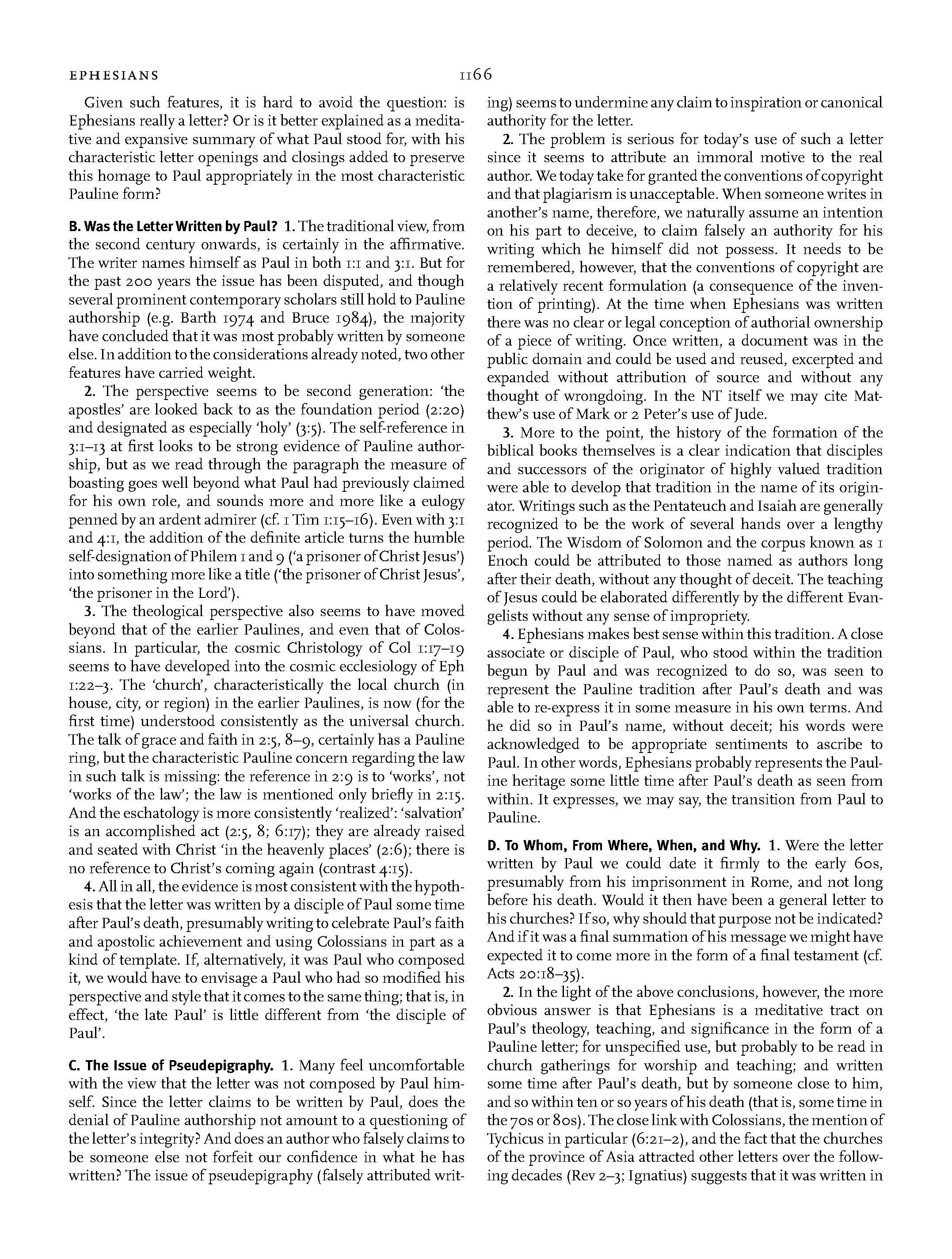
3. In some way most striking of all is the exceptionally close relationship between Ephesians and Colossians (see Mitton 1951: 279—315). Compare particularly:
A. Distinctive Features of Ephesians. 1. In comparison with the other Pauline letters, however, Ephesians is something of a puzzle. Unlike all the others, it is not directed to a particular church or situation or person. The words 'in Ephesus' (1:1), which most modern translations still include, are not present in the earliest and best M S S; and second-century references to the letter do not know it as sent to Ephesus (see Best 1987). The lack of specified addressees in the original text and absence of Paul's normal list of greetings are confirmed by the absence of reference to particular situations or problems known or reported to the author. This raises the question whether it was intended as a circular or catholic letter, rather like James and i Peter, though in these cases particular recipients are still specified.
Eph. 5:5-6 5:19-20 5:22,25 6:5-9 6:21-2
Col. 3:5-6 3:16 3:18-19 3:22-4:1 4:7.
Eph. 1:15-17 2:5 2:16 4:2 4:16 4:31-2
Col. 1:3-4, 9-10
Such identical phraseology can be explained only if both letters were written at the same time, or, more likely (given the differences already noted), by one letter deliberately drawing upon the other. Most scholars have concluded that the character of the interdependence is best explained as Ephesians using Colossians, in part at least, as a model.
2. The style of the letter (particularly chs. 1—3) is pleonastic, that is, marked by repetitions and redundancies. Note for
Given such features, it is hard to avoid the question: is Ephesians really a letter? Or is it better explained as a meditative and expansive summary of what Paul stood for, with his characteristic letter openings and closings added to preserve this homage to Paul appropriately in the most characteristic Pauline form?
ing) seems to undermine any claim to inspiration or canonical authority for the letter.
2. The problem is serious for today's use of such a letter since it seems to attribute an immoral motive to the real author. We today take for granted the conventions of copyright and that plagiarism is unacceptable. When someone writes in another's name, therefore, we naturally assume an intention on his part to deceive, to claim falsely an authority for his writing which he himself did not possess. It needs to be remembered, however, that the conventions of copyright are a relatively recent formulation (a consequence of the invention of printing). At the time when Ephesians was written there was no clear or legal conception of authorial ownership of a piece of writing. Once written, a document was in the public domain and could be used and reused, excerpted and expanded without attribution of source and without any thought of wrongdoing. In the NT itself we may cite Matthew's use of Mark or 2 Peter's use of Jude.
B. Was the Letter Written by Paul? 1. The traditional view, from the second century onwards, is certainly in the affirmative. The writer names himself as Paul in both 1:1 and 3:1. But for the past 200 years the issue has been disputed, and though several prominent contemporary scholars still hold to Pauline authorship (e.g. Earth 1974 and Bruce 1984), the majority have concluded that it was most probably written by someone else. In addition to the considerations already noted, two other features have carried weight.
2. The perspective seems to be second generation: 'the apostles' are looked back to as the foundation period (2:20) and designated as especially 'holy' (3:5). The self-reference in 3:1-13 at first looks to be strong evidence of Pauline authorship, but as we read through the paragraph the measure of boasting goes well beyond what Paul had previously claimed for his own role, and sounds more and more like a eulogy penned by an ardent admirer (cf. i Tim 1:15-16). Even with 3:1 and 4:1, the addition of the definite article turns the humble self-designation of Philem i and 9 ('a prisoner of Christ Jesus') into something more like a title ('the prisoner of Christ Jesus', 'the prisoner in the Lord').