
Part 27
5. The Chronicler omitted much from the source materials he used, such as the story of David and Bathsheba. This is not an attempt to show David in a better light, since the author presumed that the reader already knew the source text. The Chronicler was interested merely in the public side of David's reign.
6. The Chronicler's theology is impressive in its encompassing, strict, and even rational nature. God, who is never mentioned using his old names or any reference to place, is distant, but still keeps in touch with mankind. Intermediary bodies play no part in Paraleipomena. All the kings' actions derived directly from YHWH. YHWH imposed his monarchy, the kings sat upon his throne. This does not mean that the kings were simply puppets; the Chronicler depicted good kings as active and dynamic.
7. There was only one legitimate monarchy, namely the Davidides in Jerusalem. The kings of the northern kingdom were regarded as usurpers. Similarly, there was only one people, to whom the inhabitants of the north belonged if they acknowledged Jerusalem's exclusive rights of representation and accepted the cult performed there as uniquely legitimate. (This claim is underlined by the southern kingdom's rightto use the name Israel.) Since the northern kingdom was illegitimate, its history is not described by the Chronicler. Nevertheless he often mentions the northern kingdom when it comes into contact with the south. Chronicles contains hardly any anti-Samaritan arguments, distinguishing it from Ezra/Nehemiah.
Strictly theological matters also unfold in the 'genealogical forecourt'.
8. One of the most important and prevalent characteristics of Chronicles is the dogma of retribution applied to indi-
269 I AND 2 C H R O N I C L E S
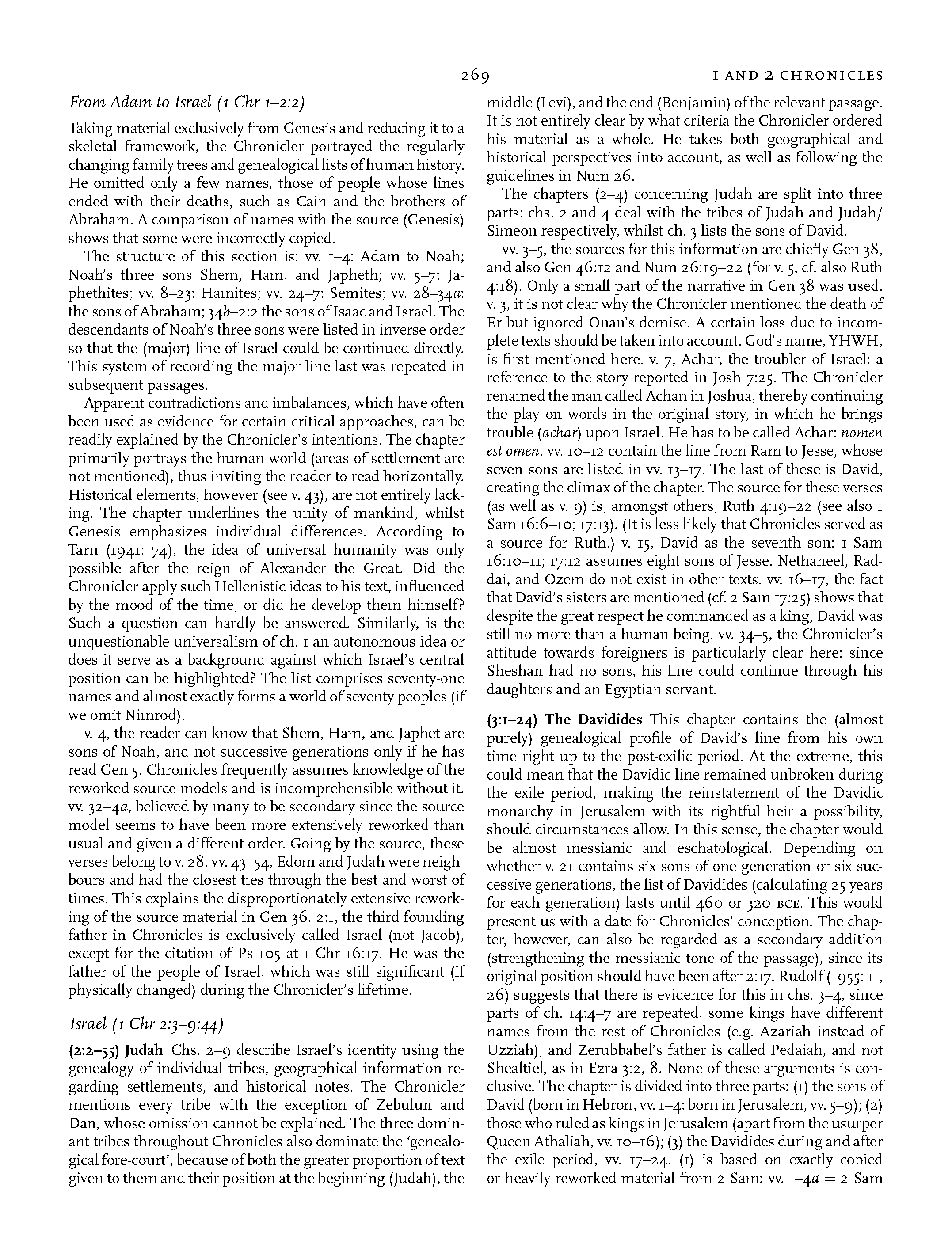
From Adam to Israel (i Chr 1-2:2) middle (Levi), and the end (Benjamin) of the relevant passage. It is not entirely clear by what criteria the Chronicler ordered his material as a whole. He takes both geographical and historical perspectives into account, as well as following the guidelines in Num 26.
Taking material exclusively from Genesis and reducing it to a skeletal framework, the Chronicler portrayed the regularly changing family trees and genealogical lists of human history. He omitted only a few names, those of people whose lines ended with their deaths, such as Cain and the brothers of Abraham. A comparison of names with the source (Genesis) shows that some were incorrectly copied.
The chapters (2—4) concerning Judah are split into three parts: chs. 2 and 4 deal with the tribes of Judah and Judah/ Simeon respectively, whilst ch. 3 lists the sons of David.
w. 3-5, the sources for this information are chiefly Gen 38, and also Gen 46:12 and Num 26:19—22 (for v. 5, cf also Ruth 4:18). Only a small part of the narrative in Gen 38 was used, v. 3, it is not clear why the Chronicler mentioned the death of Er but ignored Onan's demise. A certain loss due to incomplete texts should be taken into account. God's name, YHWH, is first mentioned here. v. 7, Achar, the troubler of Israel: a reference to the story reported in Josh 7:25. The Chronicler renamed the man called Achan in Joshua, thereby continuing the play on words in the original story, in which he brings trouble (achar) upon Israel. He has to be called Achar: nomen cst omen. w. 10-12 contain the line from Ram to Jesse, whose seven sons are listed in w. 13-17. The last of these is David, creating the climax of the chapter. The source for these verses (as well as v. 9) is, amongst others, Ruth 4:19—22 (see also i Sam 16:6-10; 17:13). (It is less likely that Chronicles served as a source for Ruth.) v. 15, David as the seventh son: i Sam 16:10—n; 17:12 assumes eight sons of Jesse. Nethaneel, Raddai, and Ozem do not exist in other texts, w. 16—17, me fac that David's sisters are mentioned (cf. 2 Sam 17:25) shows that despite the great respect he commanded as a king, David was still no more than a human being, w. 34—5, the Chronicler's attitude towards foreigners is particularly clear here: since Sheshan had no sons, his line could continue through his daughters and an Egyptian servant.
The structure of this section is: w. 1-4: Adam to Noah; Noah's three sons Shem, Ham, and Japheth; w. 5-7: Japhethites; w. 8—23: Hamites; w. 24—7: Semites; w. 28—340: the sons of Abraham; 34/7—2:2 the sons of Isaac and Israel. The descendants of Noah's three sons were listed in inverse order so that the (major) line of Israel could be continued directly. This system of recording the major line last was repeated in subsequent passages.
Apparent contradictions and imbalances, which have often been used as evidence for certain critical approaches, can be readily explained by the Chronicler's intentions. The chapter primarily portrays the human world (areas of settlement are not mentioned), thus inviting the reader to read horizontally. Historical elements, however (see v. 43), are not entirely lacking. The chapter underlines the unity of mankind, whilst Genesis emphasizes individual differences. According to Tarn (1941: 74), the idea of universal humanity was only possible after the reign of Alexander the Great. Did the Chronicler apply such Hellenistic ideas to his text, influenced by the mood of the time, or did he develop them himself?
Such a question can hardly be answered. Similarly, is the unquestionable universalism of ch. i an autonomous idea or does it serve as a background against which Israel's central position can be highlighted? The list comprises seventy-one names and almost exactly forms a world of seventy peoples (if we omit Nimrod).
(3:1-24) The Davidides This chapter contains the (almost purely) genealogical profile of David's line from his own time right up to the post-exilic period. At the extreme, this could mean that the Davidic line remained unbroken during the exile period, making the reinstatement of the Davidic monarchy in Jerusalem with its rightful heir a possibility, should circumstances allow. In this sense, the chapter would be almost messianic and eschatological. Depending on whether v. 21 contains six sons of one generation or six successive generations, the list of Davidides (calculating 25 years for each generation) lasts until 460 or 320 BCE. This would present us with a date for Chronicles' conception. The chapter, however, can also be regarded as a secondary addition v. 4, the reader can know that Shem, Ham, and Japhet are sons of Noah, and not successive generations only if he has read Gen 5. Chronicles frequently assumes knowledge of the reworked source models and is incomprehensible without it. w. 32—40, believed by many to be secondary since the source model seems to have been more extensively reworked than usual and given a different order. Going by the source, these verses belong to v. 28. w. 43-54, Edom and Judah were neighbours and had the closest ties through the best and worst of times. This explains the disproportionately extensive reworking of the source material in Gen 36. 2:1, the third founding father in Chronicles is exclusively called Israel (not Jacob), except for the citation of Ps 105 at i Chr 16:17. He was the father of the people of Israel, which was still significant (if physically changed) during the Chronicler's lifetime.
(strengthening the messianic tone of the passage), since its original position should have been after 2:17. Rudolf (1955: n, 26) suggests that there is evidence for this in chs. 3—4, since parts of ch. 14:4-7 are repeated, some kings have different names from the rest of Chronicles (e.g. Azariah instead of Uzziah), and Zerubbabel's father is called Pedaiah, and not Shealtiel, as in Ezra 3:2, 8. None of these arguments is conclusive. The chapter is divided into three parts: (i) the sons of David (born in Hebron, w. 1-4; born in Jerusalem, w. 5-9); (2) those who ruled as kings in Jerusalem (apart from the usurper Queen Athaliah, w. 10—16); (3) the Davidides during and after the exile period, w. 17-24. (i) is based on exactly copied or heavily reworked material from 2 Sam: w. 1-40 = 2 Sam
Israel (i Chr 2:3-9:44J
(2:2-55) Judah Chs. 2-9 describe Israel's identity using the genealogy of individual tribes, geographical information regarding settlements, and historical notes. The Chronicler mentions every tribe with the exception of Zebulun and Dan, whose omission cannot be explained. The three dominant tribes throughout Chronicles also dominate the 'genealogical fore-court', because of both the greater proportion of text given to them and their position at the beginning (Judah), the
I AND 2 C H R O N I C L E S
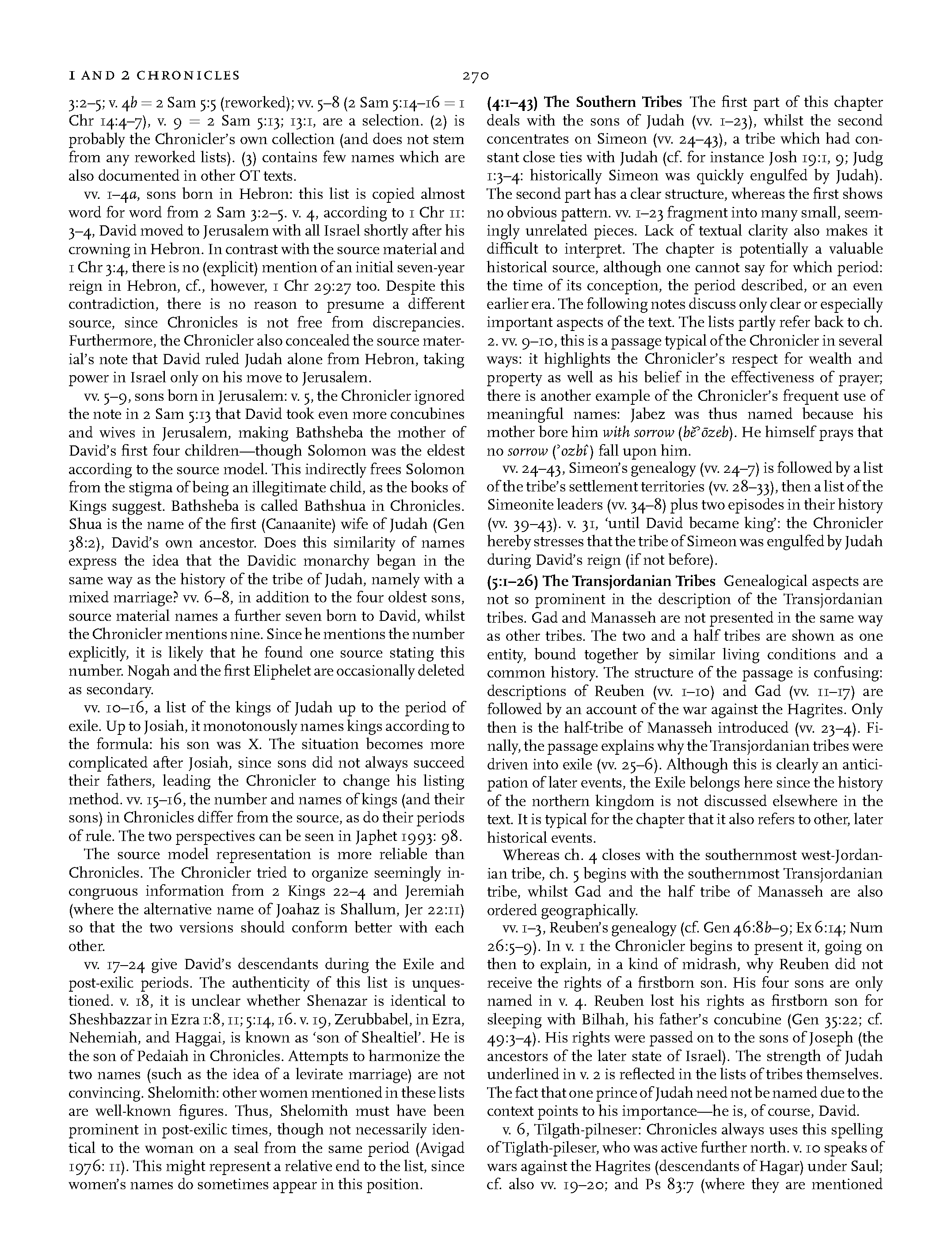
(4:1—43) The Southern Tribes The first part of this chapter deals with the sons of Judah (w. 1—23), whilst the second concentrates on Simeon (w. 24-43), a tribe which had constant close ties with Judah (cf. for instance Josh 19:1, 9; Judg 1:3—4: historically Simeon was quickly engulfed by Judah). The second part has a clear structure, whereas the first shows no obvious pattern, w. 1—23 fragment into many small, seemingly unrelated pieces. Lack of textual clarity also makes it difficult to interpret. The chapter is potentially a valuable historical source, although one cannot say for which period: the time of its conception, the period described, or an even earlier era. The following notes discuss only clear or especially important aspects of the text. The lists partly refer back to ch. 2. w. 9—10, this is a passage typical of the Chronicler in several ways: it highlights the Chronicler's respect for wealth and property as well as his belief in the effectiveness of prayer; there is another example of the Chronicler's frequent use of meaningful names: Jabez was thus named because his mother bore him with sorrow (bfozeb). He himself prays that no sorrow ('ozbi) fall upon him.
3:2-5; ¥.4/7 = 2 Sam 5:5 (reworked); w. 5-8 (2 Sam 5:14-16 = i Chr 14:4—7), v. 9 = 2 Sam 5:13; 13:1, are a selection. (2) is probably the Chronicler's own collection (and does not stem from any reworked lists). (3) contains few names which are also documented in other OT texts.
w. 1—40, sons born in Hebron: this list is copied almost word for word from 2 Sam 3:2—5. v. 4, according to i Chr n: 3-4, David moved to Jerusalem with all Israel shortly after his crowning in Hebron. In contrast with the source material and i Chr 3:4, there is no (explicit) mention of an initial seven-year reign in Hebron, cf, however, i Chr 29:27 too. Despite this contradiction, there is no reason to presume a different source, since Chronicles is not free from discrepancies. Furthermore, the Chronicler also concealed the source material's note that David ruled Judah alone from Hebron, taking power in Israel only on his move to Jerusalem.
w. 5-9, sons born in Jerusalem: v. 5, the Chronicler ignored the note in 2 Sam 5:13 that David took even more concubines and wives in Jerusalem, making Bathsheba the mother of David's first four children—though Solomon was the eldest according to the source model. This indirectly frees Solomon from the stigma of being an illegitimate child, as the books of Kings suggest. Bathsheba is called Bathshua in Chronicles. Shua is the name of the first (Canaanite) wife of Judah (Gen 38:2), David's own ancestor. Does this similarity of names express the idea that the Davidic monarchy began in the same way as the history of the tribe of Judah, namely with a mixed marriage? w. 6-8, in addition to the four oldest sons, source material names a further seven born to David, whilst the Chronicler mentions nine. Since he mentions the number explicitly, it is likely that he found one source stating this number. Nogah and the first Eliphelet are occasionally deleted as secondary.
w. 24—43, Simeon's genealogy (w. 24—7) is followed by a list ofthetribe's settlement territories (w. 28—33), then a list of the
Simeonite leaders (w. 34-8) plus two episodes in their history (w. 39-43). v. 31, 'until David became king': the Chronicler hereby stresses that the tribe of Simeon was engulfed by Judah during David's reign (if not before). (5:1—26) The Transjordanian Tribes Genealogical aspects are not so prominent in the description of the Transjordanian tribes. Gad and Manasseh are not presented in the same way as other tribes. The two and a half tribes are shown as one entity, bound together by similar living conditions and a common history. The structure of the passage is confusing: descriptions of Reuben (w. i-io) and Gad (w. 11-17) are followed by an account of the war against the Hagrites. Only then is the half-tribe of Manasseh introduced (w. 23—4). Finally, the passage explains why the Transjordanian tribes were driven into exile (w. 25-6). Although this is clearly an anticipation of later events, the Exile belongs here since the history of the northern kingdom is not discussed elsewhere in the text. It is typical for the chapter that it also refers to other, later historical events.
w. 10—16, a list of the kings of Judah up to the period of exile. Up to Josiah, it monotonously names kings according to the formula: his son was X. The situation becomes more complicated after Josiah, since sons did not always succeed their fathers, leading the Chronicler to change his listing method, w. 15—16, the number and names of kings (and their sons) in Chronicles differ from the source, as do their periods of rule. The two perspectives can be seen in Japhet 1993: 98.
The source model representation is more reliable than Chronicles. The Chronicler tried to organize seemingly incongruous information from 2 Kings 22-4 and Jeremiah (where the alternative name of Joahaz is Shallum, Jer 22:11) so that the two versions should conform better with each other.
Whereas ch. 4 closes with the southernmost west-Jordanian tribe, ch. 5 begins with the southernmost Transjordanian tribe, whilst Gad and the half tribe of Manasseh are also ordered geographically.
w. 1—3, Reuben's genealogy (cf. Gen 46:8/7—9; Ex 6:14; Num 26:5—9). m vJ me Chronicler begins to present it, going on then to explain, in a kind of midrash, why Reuben did not receive the rights of a firstborn son. His four sons are only named in v. 4. Reuben lost his rights as firstborn son for sleeping with Bilhah, his father's concubine (Gen 35:22; cf. 49:3-4). His rights were passed on to the sons of Joseph (the ancestors of the later state of Israel). The strength of Judah underlined in v. 2 is reflected in the lists of tribes themselves. The fact that one prince of Judah need not be named due to the context points to his importance—he is, of course, David.
w. 17-24 give David's descendants during the Exile and post-exilic periods. The authenticity of this list is unquestioned, v. 18, it is unclear whether Shenazar is identical to
Sheshbazzar in Ezra 1:8,11; 5:14,16. v. 19, Zerubbabel, in Ezra, Nehemiah, and Haggai, is known as 'son of Shealtiel'. He is the son of Pedaiah in Chronicles. Attempts to harmonize the two names (such as the idea of a levirate marriage) are not convincing. Shelomith: other women mentioned in these lists are well-known figures. Thus, Shelomith must have been prominent in post-exilic times, though not necessarily identical to the woman on a seal from the same period (Avigad 1976: n). This might represent a relative end to the list, since women's names do sometimes appear in this position.
v. 6, Tilgath-pilneser: Chronicles always uses this spelling of Tiglath-pileser, who was active further north, v. 10 speaks of wars against the Hagrites (descendants of Hagar) under Saul; cf. also w. 19-20; and Ps 83:7 (where they are mentioned
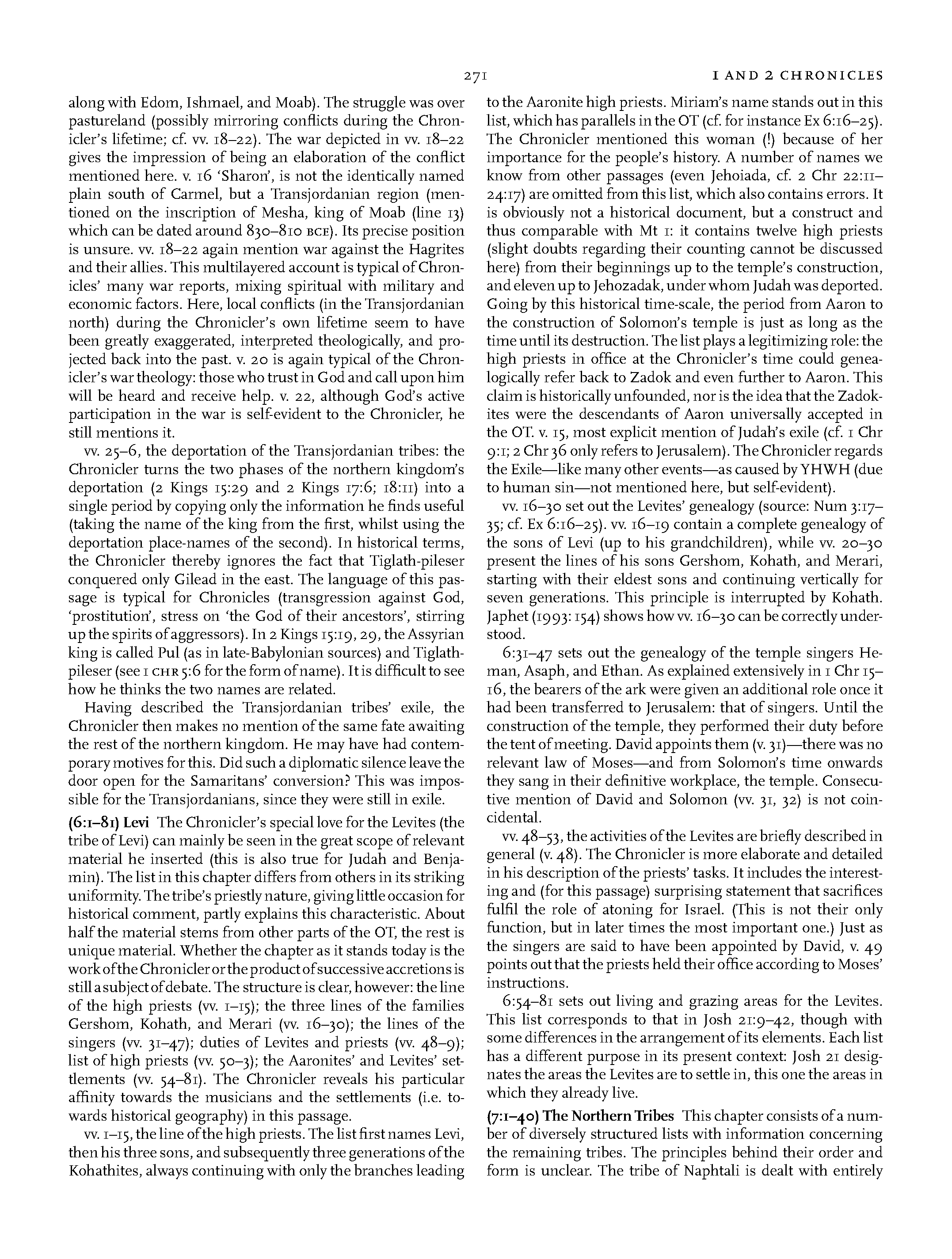
271 I AND 2 C H R O N I C L E S to the Aaronite high priests. Miriam's name stands out in this list, which has parallels in the OT (cf. for instance Ex 6:16—25). The Chronicler mentioned this woman (!) because of her importance for the people's history. A number of names we know from other passages (even Jehoiada, cf. 2 Chr 22:11— 24:17) are omitted from this list, which also contains errors. It is obviously not a historical document, but a construct and thus comparable with Mt i: it contains twelve high priests along with Edom, Ishmael, and Moab). The struggle was over pastureland (possibly mirroring conflicts during the Chronicler's lifetime; cf. w. 18—22). The war depicted in w. 18—22 gives the impression of being an elaboration of the conflict mentioned here. v. 16 'Sharon', is not the identically named plain south of Carmel, but a Transjordanian region (mentioned on the inscription of Mesha, king of Moab (line 13) which can be dated around 830-810 BCE). Its precise position is unsure, w. 18-22 again mention war against the Hagrites and their allies. This multilayered account is typical of Chronicles' many war reports, mixing spiritual with military and economic factors. Here, local conflicts (in the Transjordanian north) during the Chronicler's own lifetime seem to have been greatly exaggerated, interpreted theologically, and projected back into the past. v. 20 is again typical of the Chronicler's war theology: those who trust in God and call upon him will be heard and receive help. v. 22, although God's active participation in the war is self-evident to the Chronicler, he still mentions it.
(slight doubts regarding their counting cannot be discussed here) from their beginnings up to the temple's construction, and eleven up to Jehozadak, under whom Judah was deported. Going by this historical time-scale, the period from Aaron to the construction of Solomon's temple is just as long as the time until its destruction. The list plays a legitimizing role: the high priests in office at the Chronicler's time could genealogically refer back to Zadok and even further to Aaron. This claim is historically unfounded, nor is the idea that the Zadokites were the descendants of Aaron universally accepted in the OT. v. 15, most explicit mention of Judah's exile (cf. i Chr 9:1; 2 Chr 36 only refers to Jerusalem). The Chronicler regards the Exile—like many other events—as caused by YHWH (due to human sin—not mentioned here, but self-evident).
w. 25-6, the deportation of the Transjordanian tribes: the Chronicler turns the two phases of the northern kingdom's deportation (2 Kings 15:29 and 2 Kings 17:6; 18:11) into a single period by copying only the information he finds useful (taking the name of the king from the first, whilst using the deportation place-names of the second). In historical terms, the Chronicler thereby ignores the fact that Tiglath-pileser conquered only Gilead in the east. The language of this passage is typical for Chronicles (transgression against God, 'prostitution', stress on 'the God of their ancestors', stirring up the spirits of aggressors). In 2 Kings 15:19, 29, the Assyrian king is called Pul (as in late-Babylonian sources) and Tiglathpileser (see i CHR 5:6 forthe form ofname). Itis difficult to see how he thinks the two names are related.
w. 16—30 set out the Levites' genealogy (source: Num 3:17— 35; cf. Ex 6:16-25). w16-19 contain a complete genealogy of the sons of Levi (up to his grandchildren), while w. 20-30 present the lines of his sons Gershom, Kohath, and Merari, starting with their eldest sons and continuing vertically for seven generations. This principle is interrupted by Kohath. Japhet (1993:154) shows how w. 16-30 can be correctly understood.
6:31—47 sets out the genealogy of the temple singers Heman, Asaph, and Ethan. As explained extensively in i Chr 1516, the bearers of the ark were given an additional role once it had been transferred to Jerusalem: that of singers. Until the construction of the temple, they performed their duty before the tent of meeting. David appoints them (v. 31)—there was no relevant law of Moses—and from Solomon's time onwards they sang in their definitive workplace, the temple. Consecutive mention of David and Solomon (w. 31, 32) is not coincidental.
Having described the Transjordanian tribes' exile, the Chronicler then makes no mention of the same fate awaiting the rest of the northern kingdom. He may have had contemporary motives for this. Did such a diplomatic silence leave the door open for the Samaritans' conversion? This was impossible for the Transjordanians, since they were still in exile.
(6:1—81) Levi The Chronicler's special love forthe Levites (the tribe of Levi) can mainly be seen in the great scope of relevant material he inserted (this is also true for Judah and Benjamin). The list in this chapter differs from others in its striking uniformity. The tribe's priestly nature, giving little occasion for historical comment, partly explains this characteristic. About half the material stems from other parts of the OT, the rest is unique material. Whether the chapter as it stands today is the work of the Chronicler orthe product of successive accretions is still a subject of debate. The structure is clear, however: the line of the high priests (w. 1-15); the three lines of the families Gershom, Kohath, and Merari (w. 16—30); the lines of the singers (w. 31—47); duties of Levites and priests (w. 48—9); list of high priests (w. 50-3); the Aaronites' and Levites' settlements (w. 54-81). The Chronicler reveals his particular affinity towards the musicians and the settlements (i.e. towards historical geography) in this passage.
w. 48-53, the activities of the Levites are briefly described in general (v. 48). The Chronicler is more elaborate and detailed in his description of the priests' tasks. It includes the interesting and (for this passage) surprising statement that sacrifices fulfil the role of atoning for Israel. (This is not their only function, but in later times the most important one.) Just as the singers are said to have been appointed by David, v. 49 points out that the priests held their office according to Moses' instructions.
6:54—81 sets out living and grazing areas for the Levites. This list corresponds to that in Josh 21:9—42, though with some differences in the arrangement of its elements. Each list has a different purpose in its present context: Josh 21 designates the areas the Levites are to settle in, this one the areas in which they already live.
(7:1—40) The Northern Tribes This chapter consists of a number of diversely structured lists with information concerning the remaining tribes. The principles behind their order and form is unclear. The tribe of Naphtali is dealt with entirely w. 1-15, the line of the high priests. The list first names Levi, then his three sons, and subsequently three generations of the Kohathites, always continuing with only the branches leading
individual parts are sometimes more logical if placed at the time of Nehemiah.
within one verse (v. 13). Dan and Zebulon are omitted completely, whilst Benjamin appears here as well as in ch. 8 (if viewed from a somewhat different perspective). The reasons for such irregularities can only be speculated upon. Occasionally, loss of textual material could have been a factor. The missing or scarcely described tribes were all in the north and therefore played no important role after their deportation by Tiglath-pileser. The tribes of Issachar, Benjamin, and Asher are all treated differently from the sons of Joseph (a story is even told about the Ephraimites in w. 21—3).
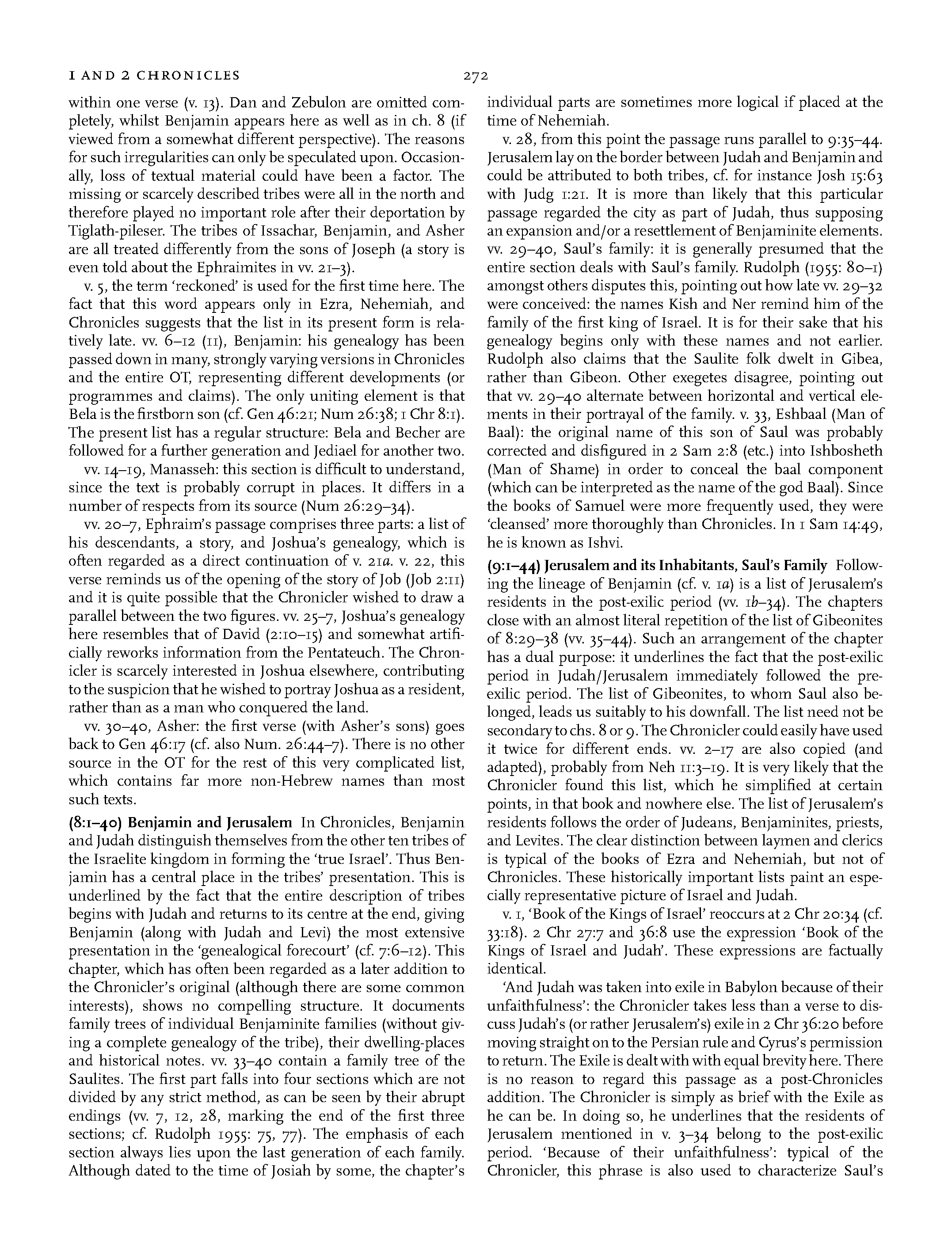
v. 28, from this point the passage runs parallel to 9:35—44. Jerusalem lay on the border between Judah and Benjamin and could be attributed to both tribes, cf. for instance Josh 15:63 with Judg 1:21. It is more than likely that this particular passage regarded the city as part of Judah, thus supposing an expansion and/or a resettlement of Benjaminite elements, w. 29—40, Saul's family: it is generally presumed that the entire section deals with Saul's family. Rudolph (1955: 80—i) amongst others disputes this, pointing out how late w. 29-32 were conceived: the names Kish and Ner remind him of the family of the first king of Israel. It is for their sake that his genealogy begins only with these names and not earlier. Rudolph also claims that the Saulite folk dwelt in Gibea, rather than Gibeon. Other exegetes disagree, pointing out that w. 29-40 alternate between horizontal and vertical elements in their portrayal of the family, v. 33, Eshbaal (Man of Baal): the original name of this son of Saul was probably corrected and disfigured in 2 Sam 2:8 (etc.) into Ishbosheth (Man of Shame) in order to conceal the baal component (which can be interpreted as the name of the god Baal). Since the books of Samuel were more frequently used, they were 'cleansed' more thoroughly than Chronicles. In i Sam 14:49, he is known as Ishvi.
v. 5, the term 'reckoned' is used for the first time here. The fact that this word appears only in Ezra, Nehemiah, and Chronicles suggests that the list in its present form is relatively late. w. 6—12 (n), Benjamin: his genealogy has been passed down in many, strongly varying versions in Chronicles and the entire OT, representing different developments (or programmes and claims). The only uniting element is that Bela is the firstborn son (cf. Gen 46:21; Num 26:38; i Chr 8:1). The present list has a regular structure: Bela and Becher are followed for a further generation and Jediael for another two.
w. 14-19, Manasseh: this section is difficult to understand, since the text is probably corrupt in places. It differs in a number of respects from its source (Num 26:29—34).
w. 20-7, Ephraim's passage comprises three parts: a list of his descendants, a story, and Joshua's genealogy, which is often regarded as a direct continuation of v. 2ia. v. 22, this verse reminds us of the opening of the story of Job (Job 2:11) and it is quite possible that the Chronicler wished to draw a parallel between the two figures, w. 25-7, Joshua's genealogy here resembles that of David (2:10—15) an(^ somewhat artificially reworks information from the Pentateuch. The Chronicler is scarcely interested in Joshua elsewhere, contributing to the suspicion that he wished to portray Joshua as a resident, rather than as a man who conquered the land.
(9:1—44) Jerusalem and its Inhabitants, Saul's Family Following the lineage of Benjamin (cf. v. ia) is a list of Jerusalem's residents in the post-exilic period (w. 1^-34). The chapters close with an almost literal repetition of the list of Gibeonites of 8:29—38 (w. 35—44). Such an arrangement of the chapter has a dual purpose: it underlines the fact that the post-exilic period in Judah/Jerusalem immediately followed the preexilic period. The list of Gibeonites, to whom Saul also belonged, leads us suitably to his downfall. The list need not be secondary to chs. 8 or 9. The Chronicler could easily have used it twice for different ends. w. 2—17 are also copied (and adapted), probably from Neh 11:3-19. It is very likely that the Chronicler found this list, which he simplified at certain points, in that book and nowhere else. The list of Jerusalem's residents follows the order of Judeans, Benjaminites, priests, and Levites. The clear distinction between laymen and clerics is typical of the books of Ezra and Nehemiah, but not of Chronicles. These historically important lists paint an especially representative picture of Israel and Judah.
w. 30—40, Asher: the first verse (with Asher's sons) goes back to Gen 46:17 (cf. also Num. 26:44-7). There is no other source in the OT for the rest of this very complicated list, which contains far more non-Hebrew names than most such texts.
(8:1—40) Benjamin and Jerusalem In Chronicles, Benjamin and Judah distinguish themselves from the other ten tribes of the Israelite kingdom in forming the 'true Israel'. Thus Benjamin has a central place in the tribes' presentation. This is underlined by the fact that the entire description of tribes begins with Judah and returns to its centre at the end, giving Benjamin (along with Judah and Levi) the most extensive presentation in the 'genealogical forecourt' (cf. 7:6—12). This chapter, which has often been regarded as a later addition to the Chronicler's original (although there are some common interests), shows no compelling structure. It documents family trees of individual Benjaminite families (without giving a complete genealogy of the tribe), their dwelling-places and historical notes, w. 33-40 contain a family tree of the Saulites. The first part falls into four sections which are not divided by any strict method, as can be seen by their abrupt endings (w. 7, 12, 28, marking the end of the first three sections; cf. Rudolph 1955: 75, 77). The emphasis of each section always lies upon the last generation of each family. Although dated to the time of Josiah by some, the chapter's v. i, 'Book of the Kings of Israel' reoccurs at 2 Chr 20:34 (cf33:18). 2 Chr 27:7 and 36:8 use the expression 'Book of the Kings of Israel and Judah'. These expressions are factually identical.
'And Judah was taken into exile in Babylon because of their unfaithfulness': the Chronicler takes less than a verse to discuss Judah's (or rather Jerusalem's) exile in 2 Chr 36:20 before moving straight on to the Persian rule and Cyrus's permission to return. The Exile is dealt with with equal brevity here. There is no reason to regard this passage as a post-Chronicles addition. The Chronicler is simply as brief with the Exile as he can be. In doing so, he underlines that the residents of Jerusalem mentioned in v. 3-34 belong to the post-exilic period. 'Because of their unfaithfulness': typical of the Chronicler, this phrase is also used to characterize Saul's
273 I AND 2 C H R O N I C L E S a theological interpretation of events, strongly highlighting Saul's culpable behaviour.
crimes (a king who prefigured the Exile) in the following chapter (10:13).
v. 6, the Chronicler replaces the words, 'his armour-bearer and all his men' in the source (i Sam 31:6) with 'and all his house'. This underlines the fact that the Saulites were wiped out. The episode containing Ishbaal's brief rule in 2 Sam 2—4 is irrelevant to the Chronicler, though this does not deter him from occasionally mentioning Saul's descendants (8:33-40; 9:39-40). v. 7, the source's 'men of Israel' becomes 'all the men of Israel' in Chronicles. The precise positioning, 'on the other side of the valley [Jezreel] and... beyond the Jordan' is also changed into the vaguer 'in the valley'. This turns a specifically located defeat into a general, comprehensive, 'primeval' failure, providing us with a first reference to the analogous situation of the Babylonian Exile.
v. 2, the source for this is Neh 11:3. The Chronicler deletes 'the province' from this source, probably because the phrase recalled too strongly that Judah had long been a province of the Achaemenide empire. Generally (cf v. I's ending), 'the first' should be understood as referring to after the return from exile. Other translations are also possible: 'the main, most important residents', 'the first inhabitants from old'. The latter translation is plausible if one (such as Japhet 1993: 206) considers the reference to the Exile in v. ib to be perhaps a gloss, especially since nothing else in this text refers to a return. The phrase in the source, Neh 11:3, 'And the descendants of Solomon's servants', is omitted by the Chronicler.
w. 9-10, the source model (i Sam 31:9) reports that the Philistines decapitated Saul, while the Chronicler omits this fact. He does, however, note that Saul's armour was placed in the temple of their gods and that his head was fixed in the temple of Dagon. According to the source model Saul's armour was placed in the temple of Astarte and his body fastened to the walls of Beth-shan. These discrepanices are easily explained: Saul's descration cannot take place in Israel (Bethshan). Naming 'the temple of Dagon' reminds readers knowledgeable of the Bible that the same deity lost his head and hands at that very place after the Philistines carried YHWH's ark there (i Sam 5:4). This is Dagon's moment of power. Here references to the Exile in Babylon cannot be missed: Israel's (dead) king is in a foreign land, in exile. Saul's fate also reminds us of Goliath, v. 10, as elsewhere (with the exception of 2 Chr 15:16), the Chronicler deletes any mention of a goddess, replacing 'Astarte' with 'their god'. It is impossible to fight her since she cannot even be named.
v. 3, 'some of the people of... Ephraim, and Manasseh' is an addition by the Chronicler that goes beyond the source model. Residents of the northern kingdom who were loyal to YHWH are repeatedly called upon to find asylum in Judah/Jerusalem on religious grounds; this passage indirectly implies that these calls were also repeatedly heeded, w. 17-26, the Chronicler goes to great lengths lovingly to portray the gatekeepers. Whilst they are not yet Levites in Neh 11:19, mis is precisely what is stated in this paragraph, w. 18—19 'gatekeepers' ('porters', AV), 'thresholds of the tent': according to the Chronicler, the gatekeepers' duty, which was above all to guard entrances, had its roots in the desert-dwelling period and had not been changed since that time. This is what lent it such special dignity and distinguished it from that of the singers, who had only held their office since their job as bearers of the ark became unnecessary (cf. 6:13).
w. 35—44, the section 1:1—9:34 leads from Adam up to the temple community of the post-exilic period; the chapters are a kind of population assessment. These verses, the end of the first review, provide an ideal lead into the second review, comprising the period from David until the restoration after the Exile. This period and the events portrayed within it are regarded as the history of the kingdom of YHWH, as manifested by the Davidides. The verses differ only in detail from their source model.
w. 13—14, the Chronicler gives no less than four reasons for Saul's rejection, which is explicitly ascribed to the Lord, (i) His transgression (NRSV, 'unfaithfulness'): using this typical term, which does not appear in the source model, the Chronicler describes religious crimes as the way to defeat and exile. (2) For not keeping the word of God. This is a general judgement of Saul's behaviour (as declared in Deuteronomy and Ps 119, for instance). It may also refer to crimes committed by Saul as reported in i Sam 13 and 15. He takes the term 'kept' from the first chapter (i Sam 13:13—14) and '[YHWH's] word' (NRSV, 'commandment') from the second (i Sam 15, passim). In using this construction, the Chronicler underlines his own knowledge of the Scriptures and makes clear what he expects from the reader. (3) For consulting a medium. This accusation, which contains a pun (Saul and 'enquire' (NRSV, 'consulted') are made up of the same consonants in Hebrew), refers to his visit to the witch of Endor (i Sam 28). (4) Because he did not seek the Lord: this phrase emphasizes the Chronicler's positive (and internalized) attitude towards God in as general a way as possible.
David's Rule (i Chr 10:2-29:3°)
Saul's Downfall and Rejection (i Chr 10:1-14)
In this chapter Chronicles changes its form from a list-based presentation to a more narrative portrayal (in which lists are inserted). From now on, the Chronicler bases his work on the books of Samuel and of Kings, using their information on the sole legitimate Davidic kingdom, whilst also adding his own material. He begins with Saul's downfall. This chapter is not merely a necessary introduction to David's reign, making it more legitimate and comprehensible. Nor is it simply an evil backdrop to make David's rule shine all the brighter. It is there in its own right, portraying the monarchy in its negative form. The Chronicler makes slight, but theologically significant changes to his sources, linking Saul's defeat with the Babylonian Exile. The source models portray Saul's defeat as a purely earthly event, depicting Saul almost as a tragic figure— elements which are entirely absent from Chronicles. The author adds to his source materials in w. 13—14 by including
David's Rule until the Preparations for the Temple's Construction (i Chr 11:1-22:1)
(11:1-47) The Installation of David as King, Conquest of Jerusalem, David's Heroes ch. n begins the most extensive part of Chronicles and deals with David. Beyond the material he took from his sources (chs. 11—21), the Chronicler includes
in Hebron. Both parts stem from detailed information from various sources and are not rigidly structured. Both contain few, yet significant, theological statements. One subject binds the whole chapter together (using catchwords amongst other methods), namely help for David from his supporters and God. The Chronicler does not discuss Saul's kingdom, especially ignoring his conflict with David. That period is presented only covertly here. Since the information in this chapter is concerned with aspects regarded as untypical for the Chronicler (aside from certain high numbers), it is often seen as in part old and dependable, and in part consisting of newer additions from a later period than the Chronicler's own. On the other hand, one can regard this passage as largely stemming from the Chronicler, who refers strongly back to biblical source material (especially i Samuel) and expresses his admiration for strength and power in a literary manner. The first part divides into four sections: w. 1-8, the Benjaminites come to David in Ziklag; w. 9—16, the Gadites come to David's mountain stronghold; w. 17-19, the same occurs to Benjamin and Judah; w. 20-2, the people of Manasseh come to David in Ziklag. The section, which clearly shows a structure despite large individual differences, concludes with a summary in v. 22: David received much support. Only four tribes are mentioned, perhaps because they play a particularly important role in the Chronicler's sources.
unique material in chs. 22-9. This structure is also mirrored in chs. ii—12, which contain David's installation as King of all Israel. The reports concerning David's crowning in Hebron, the conquest of Jerusalem, and David's heroes can all be found in the books of Samuel, though in a different order. The subsequent list of people (soldiers) (ch. 12; unique material in Chronicles) who joined David underlines the fact that all Israel supported David, whilst at the same time recapping the omitted story of David's past (together with Saul). The two chapters are artfully structured, as short key statements show (cf e.g. 12:18).
w. 4-9, the conquest of Jerusalem. The source's report of this event (2 Sam 5:6-10) is rather obscure and may have seemed unclear to the Chronicler. He uses the narrative framework, but fills it out by making Joab the main protagonist of Jerusalem's capture (and repairer of some of the buildings). It is possible that the source model's unclear term sinnor (2 Sam 5:8; NRSV: water shaft, left out by the Chronicler) reminded him of Joab's mother Seruiah and incited him to mention her name in his version, v. 4, it is historically likely that David captured Jerusalem with his private army (if it was not handed over peacefully). The Chronicler cannot allow this for theological reasons, making the conquest a pan-Israelite issue, v. 9, this sentence is an almost identical copy of the source (2 Sam 5:10), but strongly supports the Chronicler's theology (the LORD ... was with him). This is also true of the seldom-used phrase 'the LORD of hosts', where the source has 'the LORD, the God of hosts'.
w. 23—40 cover David's coronation in Hebron, w. 23, 38—40 only briefly describe the accession itself, whilst portraying the subsequent feast at much greater length. In the middle of the passage, a kind of military census is inserted, v. 23, the kingdom of Saul is passed on to David in Hebron (cf. 10:14—11:3)— peacefully, v. 38, David is accepted as king by everyone and with all their hearts. Unanimity and acts of conviction enjoy the Chronicler's highest regard, as the entire text shows, w. 39—40, after David's crowning, a great secular feast takes place that is unrivalled in the OT—the Chronicler cannot be challenged on this point. The joy of feasts also characterizes his work (cf. e.g. 29:22; 2 Chr 30:21-6).
w. 10-47 list David's men. Apart from w. 42-7, which are the Chronicler's own material, the passage conforms with 2
Sam 23:8—39. Since the original list is torn from its historical context, it is difficult to know whether it refers to the period before or after David's accession to the throne. In the source, it is made up of three parts: (i) The three men (whom nobody could match); one act of heroism is mentioned in respect of each of them. (2) Two other heroes, again with their acts of heroism. (3) The thirty heroes. The Chronicler keeps this structure, which is not totally consistent, deleting the name of the third hero, Shammah, as well as the act of heroism ascribed to Eleazar, the second hero, who consequently inherits Shammah's deed. v. 10, the Chronicler strongly diverges from the source material here, in order to domesticate David's heroes and their actions, i.e. to insert them into David's (and YHWH's) kingdom. Pushed linguistically, the Chronicler underlines that this is David's kingdom, pertaining to and encompassing all Israel, whilst referring back to YHWH's word (and pledge) to Israel—though this promise is never directly described, w. 11-41 (47), many details of the list differ from the source material, including the names of heroes. In many cases it is difficult to distinguish whether this is due to scribal errors or the Chronicler's own perspective. The source already contains many textual problems, v. 23, 'five cubits tall... like a weaver's beam': these two details, which are not from the source model, draw parallels with the story of David and Goliath, though what exactly the Chronicler is referring to is difficult to judge. (12:1-40) David's Supporters This chapter divides into two parts: w. 1-22 contain a list of people who joined David before his coronation, whilst w. 23—40 name those who came to him
(13:1-14) An Unsuccessful Attempt to Bring Back the Ark of the Covenant Once David has been anointed king in Hebron, Jerusalem has been conquered, and his followers have been named, Chronicles' David immediately thinks of bringing the ark of the covenant to Jerusalem, rather than making war against the Philistines. The Chronicler changes the order of events given in the source material, driven by the theological idea of the cult's primacy. He regards the ark as the origin and the centre of Jerusalem's holy site. The source model hardly concerns itself with the first, unsuccessful attempt to transport the ark. Chronicles, however, portrays it as motivating David to wage a war against the Philistines, to behave in a God-fearing manner (and later to take precautionary measures), thereby fulfilling the preconditions for the success of the second transportation attempt. The source model depicts the first attempt as a personal task primarily carried out by David, whilst Chronicles makes it an issue for all Israel. This underlines the Chronicler's consistently held opinion that important events (especially of cultic nature) were carried out not merely by the monarch. He begins with an original passage concerning plans for the project; then follows a report which he draws from his source (2 Sam 6:1—n), having to omit v. 12.
275 I AND 2 C H R O N I C L E S technical measures. Just as YHWH 'burst out against Uzzah' w. 1-4 detail preparations for the project. Consistent with the previous chapters, David initially consults his military leaders (i.e. he makes a suggestion), though this rapidly transforms into a (cultic) congregation (v. 2). It is a classic example of the Chronicler's three-way division of society between the king, the notables, and the people/congregation, v. 2, there are two conditions for the project's execution: the willingness of those present and God's acceptance of the plan. As is revealed later on, the second condition has not yet been fulfilled. This verse also emphasizes that the plan is impossible without the collaboration of the priests and Levites. Some regard 'who remain in all the land(s) of Israel' as a neutral phrase, referring to the different regions of the land (cf. also 12:39/7). Others see it as a reflection of Israel's diaspora situation. '[L]et us send abroad' is a double-worded phrase in Hebrew. Its first component (to break out, pcrcz) is not only repeated in this chapter (Perez-uzzah), but also plays a central role elsewhere in i Chronicles (13:11; 14:11; 15:13). v. 3, the ark suddenly appears and represents Israel's fate. 'Because Saul neglected it' (i.e. did not look for it—a favourite phrase of the Chronicler) makes an indirect, though transparent, allusion to 10:14. At that time the people experienced hardship. So pay heed!
(13:11), he 'has burst out against' the place where the Philistines will be conquered (14:11). This chapter has close parallels with ch. 10, as the interreferential language underlines. David succeeds where Saul failed. The Chronicler makes small but significant changes to the source model, in both style and content.
w. 1-2, in the source, these statements follow the conquest of Jerusalem rather than the successful transportation of the ark. It is the ark that gives David's reign its greatness for the sake of Israel, as the Chronicler emphasizes more strongly than the source model, w. 8-16, the Chronicler copies two similarly structured battle reports from the source (the advance of the Philistines, an enquiry to God with a positive response and the Philistines' defeat). He changes the geography, however, along with the place-names (w. 8, n, 16), since he saw the battles from the perspective of Isa 28:21, where the Gibeon valley as well as Mount Perazim are mentioned (resulting in the replacement of Geba with Gibeon in v. 16). v. 16, Isa 28:21 refers to battles described in Josh 10 and 2 Sam 5 to illustrate the strange acts God is about to perform. In its Chronicles form ch. 14 is itself interpreted using the interpretation of 2 Sam 5 in Isaiah. Thus the source of the comparison becomes its target, v. 17, David's geographically limited military successes have an astonishing effect: his fame (name) spreads world-wide and he is feared everywhere. This sentence stems from the Chronicler's own material and can only be correctly understood in view of Jerusalem's status at the time it was written. David drove fear into the hearts of people round the world, so Jerusalem, a small temple state within an enormous empire, need not be meek.
w. 5—14, the Chronicler followed his source more closely from this point onwards, v. 5, Chronicles goes beyond the source in naming the borders of Israel. Instead of the usual boundaries, from Beersheba to Dan, the Shihor river in Egypt
(probably the Nile) and Lebo-hamath are used to increase the size of Israel, which achieved such proportions only after David's spectacular victories (cf. Josh 13:3, 5 as source; Joshua was not able to conquer these regions), v. 6, the Chronicler makes the source model more 'Israelite' by explicitly mentioning that the people who were with him stemmed from 'all Israel'. The identification of Baalah as Kiriath-jearim is a logical deduction from Josh 15:9; the source (i Sam 7:1—2) only mentions Kiriath-jearim.
(15:1—29) Taking the Ark to Jerusalem; Cultic Regulations This chapter can be regarded as an artfully conceived unity or as one which has had its relatively small original element more than doubled using the insertion of two extensive lists (w. 4—10 and w. 16—24) an(^ °ther methods. Whether these lists belong to the basic element is matter for debate, as is also their age, i.e. the cultic organization they reflect. The lists are either not entirely uniform or cannot be reconciled with others, leaving the question of their interpretation open: it is precisely these elements that reflect shifts within the cult and power structure, especially amongst the Levites, as will briefly be discussed below. In assessing the literary unity of this chapter, one question is dominant: was only such material included originally as was directly relevant to the transportation of the ark and the introduction of cultic music, or did the chapter already contain at least elements of everything pertaining to the cult in its original form? If the first case is true, some later additions were made. If the second is true, one can regard the chapter as relatively unified. The second theory is preferable, based on the assumption that the Chronicler found it easier to accept contradictions in his text than to ignore material.
v. 9, the owner of the threshing-floor is called Nachon rather than Chidon, in the source model. 'Uzzah reached out his hand to the ark of God and took hold of it' (2 Sam 6:6); here, 'Uzzah put out his hand to hold the ark'. Does the Chronicler's emendation imply that the mere attempt to touch the ark, not just the deed, was sacrilegious? Or perhaps the Chronicler is expressing the same idea as his source model using more contemporary Hebrew, v. 13, Obed-edom the Gittite: he is a Philistine. In 15:25 the Chronicler deletes the word 'Gittite'. v. 14, the Chronicler will use the three months of the ark's stay with Obed-edom to insert David's victories over the Philistines (ch. 14). In the source model, David is so overjoyed about the blessing of the ark's presence in Obed-edom's home that he arranges for its onward transportation (2 Sam 6:12).
(14:1—17) David Increases in Power; Victories over the Philistines The three months during which the ark remains with Obed-edom facilitate the insertion of 2 Sam 5:11-25 at this point, but they do not explain it, especially since the two wars against the Philistines would have been better placed in the context of chs. 18—20. The Chronicler chooses this position for their insertion in order to underline the blessing bestowed upon David. His efforts to transport the ark pay off and are rewarded. The (initial) failure of the project is due to clumsy w. 1-3, preparations are made for the ark's transportation. In keeping with his habitual tendency, the Chronicler portrays the project as one which involves all Israel (v. 3). He takes advantage of the opportunity to highlight the role of the Levites. Only they have the right to carry the ark. v. 2, since David has been bestowed with blessing, as ch. 14 shows, the
(16:1—43) The Festive Psalm of David, the Religious Ceremonies in Jerusalem and Gibeon The source (2 Sam 6:17—19; the Chronicler omits the dispute with Michal in w. 20-3) describes the last act of transporting the ark to Jerusalem and the dismissal of the people. In Chronicles, this act is part of a great religious festival, in which the sacrifices play only a part. David takes the opportunity to determine the musical service for all time (w. 4-6,37) and also to carry it out for the first time (v. 7). He lays down the rules for the service at the tabernacle of Gibeon here. The Chronicler's own material (w. 4—42) is situated at the centre of the chapter. The psalm sung by the Levites (w. 8-36) is occasionally attributed to later editors, though its close adherence to the Chronicler's own theology contradicts this.
failure of the first attempt to transport the ark can only be due to its irregular execution. It is hoped that this error can be corrected by allowing only the Levites to bear the ark, as the Law prescribes (Deut 10:8; 31:25). The Chronicler is referring to these passages here. It is not possible to discern whether the Chronicler's primary concern is that David fulfilled these requirements or that the laws of Moses have been adhered to. w. 4-10, this absolutely even list has often been regarded as a later addition that parallels and expands v. n. It is more probable that the Chronicler inserted a list known to him here, forcing him to make v. n similar to v. 4 (resumptive repetition). As well as the three traditional priest families, Gershom, Kohath, and Merari, listed in a different order here, the list contains also Hebron and Uzziel, Kohath's sons according to Ex 6:18, and Elizaphan. w. 11—15, in a speech typical of Chronicles, David announces his intentions, calling upon the priests and Levites to sanctify themselves, referring back to the failed first attempt. They immediately follow these instructions and take up the ark. v. 12, what exactly is meant by sanctification can be deduced from Ex 19:14-15: washing their clothes and sexual abstinence, w. 16-24 expand upon the Levitical duties. This complicated passage, which cannot be entirely understood in all its points and which probably contains information from different periods, interrupts the contextual flow. This does not necessarily mean that it is a secondary addition. It seems important to the Chronicler that the relevant instructions were carried out and put into practice immediately after the ark's arrival. If taken to its furthest degree, it can be claimed that the introduction of cultic music in this passage is indirectly based upon 2 Sam 6:12—15.
w. 1-3, the wording of these verses closely resembles the source, but fulfils a different purpose: they are not the conclusion, but the beginning of the final act. It would have been difficult for the Chronicler to imagine that God was not praised and thanked (cf. for instance 2 Chr 20:26, 28; 29:30; 30:21, 27). v. 6, trumpets are the instruments reserved for the priests (but cf. v. 42). The Shofar (horn) was used in earlier times. There must be two trumpet-playing priests, since according to Num 10:2, YHWH ordered Moses to produce two silver trumpets, v. 7, David has Asaph and his brothers deliver a psalm for the first time (as emphasized, more are to follow), w. 8—36, David's festive psalm is made up of three smaller psalms: Ps 105:1—15; 96; 106:1, 47—8. The Chronicler slightly changes their form and greatly alters some of their content, adapting them to the context and his own theology. His reworking of the psalms is similar to his reworking of other sources. The Chronicler could not have expressed his concerns better than by the psalms he chooses. In order to remain convincing, he had to choose well-known psalms that were used by the cult, rather than produce his own psalms. Nor could he portray them in any other order: his composition initially looks back at the history of events up to that point (Ps 105:1-15)—interrupting them in line with his consistent tendency to ignore the Exodus and the conquest of the land— before praising YHWH (Ps 96), and finally asking him for deliverance from enemies (Ps 106:1, 47-8). The Chronicler's composite psalm contains a hidden political message: in its first section Ps 105 speaks of Israel as 'few in number'—as was the case at the time of the Chronicler. Of the nine passages mentioning foreign peoples in the sources, the Chronicler copies seven (w. 8, 20, 24, 26, 28, 31, 35, cf. also 'all the earth', v. 30). The foreign nations are above all shown the greatness of YHWH (in contrast to the gods). They are obliged to recognize him. Finally, a prayer is made for independence from the power of other nations. The two sections of Ps 96 which could be interpreted as YHWH'S mighty acts towards other nations (w. 10, 13), are ignored by the Chronicler. The small and (religiously) self-confident nation of Israel, hoping for political independence, is identical to the Israel at the time of the Chronicler! The theological profile of the psalm also conforms to his own religious priorities: the composite psalm is filled with calls to praise and thank God: a central theme of Chronicles, as are the greatness and awesomeness of God. Such ideas are highlighted by the psalms.
w. 25—9, the transportation of the ark. v. 25, unlike in the source model, David is not informed that the house of Obededom is blessed because of the presence of the ark. His reasons for transporting the ark are therefore less egoistic. In Chronicles the project is more democratic since it is carried out by David together with the elders of Israel and the captains over thousands, v. 26, the Chronicler replaces the neutral word 'bearers' with 'the Levites', who are, as he emphasizes, helped by God. The number of sacrifices, which differs from the source model, corresponds with later practice (see e.g. Num 23:1; Ezek 45:23; Job 42:8). v. 27, 'David danced' (2 Sam 6:14): the Chronicler changes two consonants in his source so that 'danced' becomes 'wore' (NRSV, 'was clothed with'). This is typical of the Chronicler's emendments. He then digresses from his source model by adding that David's gown was of fine linen—as were those of all the cult personnel who were present, before returning to the source model ('and David was girded with a linen ephod'). Due to this change and the mention of several Levites, David, in a way, appears as a member of the 'normal' cult personnel, v. 28, 'all Israel': this democratizes the source material ('David and all the house of Israel'). The ark's transportation is also accompanied by more music in Chronicles, v. 29, Michal, who is never declared as David's wife in Chronicles, (indirectly) shows contempt for the ark, thereby taking on the same attitude as the Saulides (13:3), whose last remaining member she represents. According to the source model David is leaping and dancing before the Lord; in the Chronicler's version he only dances, but not before the Lord, though it is unclear why.
v. 22, 'anointed ones' (especially kings) and 'prophets' are central figures in Chronicles. This title fits the patriarchs in
277 I AND 2 C H R O N I C L E S
Deuteronomistic History. Indeed this increases in Chronicles. This second section is less theologically deviant from its source model, apart from the name used for God. (18:1-17) David's Wars against Neighbouring Peoples: A List of David's Executive The Chronicler uses almost all the reports of David's wars from his source model (2 Sam 8:1—18), although he summarizes them. This creates a single section with a unified content. Only 18:15-17 (the list of his officers), which also follows the war reports in the source, falls out of this mould. This underlines the Chronicler's interest in war, politics, and economy, especially since he deletes the disorder regarding David's successor from the chapters he used. (He ignores it because he is not interested in the private affairs of individuals and because he regards Solomon as the only possible successor. After all, the unpleasant affair was well known to readers of Samuel and Kings.) By concentrating David's three wars within one chapter, the Chronicler gives the reader the impression that David is a warrior, which is precisely the desired effect: David is a warrior and thus denied the task of building the temple, since this requires peace (cf. e.g. Deut 12). This idea is highlighted by the deliberate sandwiching of chs. 18—20 between two passages concerning the temple's construction. The Chronicler did not need to create this effect artificially, since it can be found in his source model the source model, however, as it does in Chronicles. The patriarchs have therefore been robed in the prophet's mantle and given the king's sceptre in this passage, v. 35, 'Save us ... and gather and rescue us from among the nations' (Ps 106:47: 'Save us, O LORD our God, and gather us from among the nations'). The plea in the source refers to the Exile. The Chronicler erases this reference. He does so in a way to comment on the situation of his own time: some Jews were dispersed about (but no longer in exile), whilst the temple state of Jerusalem is not politically independent (against this background the request 'deliver us from the heathen' can be read as a sort of political manifesto).
w. 39-42 describe procedures for the ceremony at God's residence in Gibeon. No other OT book mentions a regular (sacrificial) cult in Gibeon. Its historical authenticity is sometimes supported by the argument that i Kings 3:3 confirms its existence and speaks out against it. It is more likely, however, that these four verses were conceived by the Chronicler
(although this passage has even occasionally been ascribed to later priestly writers). The Chronicler is at pains to portray an uninterrupted and legitimate (sacrificial) cult spanning the entire period from the desert era (with its tabernacle), including the Lord's residence at Gibeon, right up to Solomon's establishment of the temple in Jerusalem. Aside from the presence of the tabernacle, Gibeon's importance is underlined by its priests, musicians, and gatekeepers.
(2 Sam 7: Nathan's prophesy; 2 Sam 8: war reports). An interpretation of the war reports belongs in a commentary on Samuel. Only the significant changes made by Chronicles are discussed here.
(17:1-27) Nathan's Covenant and David's Prayer The Chronicler stays close to his source model in 2 Sam 7 for this passage. Striking variations are made only in v. i (to suit the context and ch. 18), v. 13 (partial omission), and v. 17 (divergent version of an unclear source). He also makes a number of theologically motivated corrections to the source material.
v. 4, Chronicles has: 1,000 chariots, 7,000 horsemen, 20,000 foot-soldiers; the source has: 1,700 horsemen, 20,000 foot-soldiers. The original source probably read as follows: 1,000 chariots, 700 horsemen. The number was probably multiplied by ten by the Chronicler (cf. 19:18). w. 15—17, the list of David's highest officers is appropriately placed after David's wars, since military ranks play a central role in it. v. 17, the Chronicler allows David and Solomon to perform priest's tasks, although in general Chronicles distinguishes itself from earlier texts in its tendency to put greater distance between the roles of the king and the priests. This leads to David's sons becoming 'chief officials in the service of the king', rather than priests, a vague term allowing several different interpretations. (19:1-20:3) War against the Ammonites (and Arameans) This passage corresponds with 2 Sam 10:1—11:1; 12:26—31. It is a relatively close representation of the text, with the exceptions of the omitted Bathsheba episode and 2 Sam 12:27-9. The Chronicler only slightly reworks the source model's theology and content. Details, however, do differ in almost every verse. This could be due to both the complicated history of the text and stylistic improvements made by the Chronicler. 19:68 and its source model have a parallel in the Qumran text (4QSama), which stands between them and demonstrates that the relationship between Samuel and Chronicles was not one of unilateral or unambiguous independence. 19:6, the Chronicler omits Tob from the source model's list of kingdoms, also replacing Aram Beth-rehob with Aram-naharaim (Mesopotamia). Perhaps Beth-rehob no longer existed at the Chronicler's time. In any case the scale of the war is increased by the change. The extremely high price paid v. i, 'and the Lord had given him rest from all his enemies around him' (2 Sam 7:1) is omitted by the Chronicler, since David's wars have yet to take place (chs. 18-20). It is important to the Chronicler that David first thinks of finding a residence for the ark. v. 13, the Chronicler deletes the following sentence from 2 Sam 7:14: 'when he commits iniquity, I will punish him with a rod such as mortals use, with blows inflicted by human beings'. This deletion has been explained in various ways: (i) The Chronicler portrays Solomon as free of guilt. (2) Unlike the source model, in which the entire dynasty is included, this oracle refers only to the combined reign of David and Solomon, making the comment irrelevant. (3) The promise made to David is irrespective of his son's behaviour. '[A]s I took it from him who was before you': the source mentions
Saul by his name. In remaining unnamed, his status as persona non grata is emphasized.
v. 14, the Chronicler makes two changes of emphasis which strengthen his theological perspective, especially his idea of the king's role, and are of central significance. The promise is directed at Solomon and not at (the house of) David. He also underlines a subsequently repeated theme: the Davidides including Solomon are not rulers of their own kingdom, but of YHWH's (cf. e.g. 28:5; 29:11, 23; 2 Chr 9:8; 13:8). This divine rule (over/in Israel) extends beyond the Davidic dynasty, w. 16—27, David's prayer forms a reply to the promise given by means of Nathan. Prayers and speeches play a considerable role in interpreting past or future events in the
by the Ammonites (1,000 talents of silver, cf 2 Chr 25:6) is mentioned only by the Chronicler who is highly interested in monetary matters. 19:18, Chronicles and its source model again vary in the stated weaponry and the size of the army David defeats. The Chronicler multiplies the number of chariots by ten (cf. 18:4). Whatever the original text stated, 40,000 foot-soldiers (Chronicles), even if grossly exaggerated, are more convincing than 40,000 horsemen (source). 20:1, which corresponds to 2 Sam 11:1 and contradicts it to some extent, implies that Joab devastated the Ammonites' land and besieged Kabbah without any foreign help. This version of events, which has often been regarded as historically correct, contradicts the Chronicler's ideology since he is keen to increase David's role and to allow all Israel to participate in the conflict. King David is suddenly in Kabbah in v. 2, leading some to believe that the verses in 2 Sam 12:27—9 were deliberately omitted here. This interpretation is possible, though it is also feasible that the Chronicler presumed knowledge of the relevant passage. (20:4-8) The Wars Fought by David's Heroes The source (2 Sam 21:15-22) reports four battles (against the Philistines) involving David's heroes. In the first, Ishbi-benob attempts to slay David. But Abishai, the son of Zeruiah, hurries to his aid and slays Ishbi-benob. From this point, David is no longer permitted to enter into battle alongside his men: the light of Israel must not be quenched. This first battle episode is omitted by the Chronicler, probably because the idea that a Philistine could even endanger David was unpleasant to him. He consequently deletes the number 'four' from his source model in v. 8. By slightly changing a consonant in the source, the Chronicler turns Rapha's descendants into Rephaites, i.e. legendary giants also mentioned in Deut 2:11, 20-1; 3:11-13. This increases the significance of the battles noted here. This allusion does not appear as such in the English translation, v. 5, according to 2 Sam 21:19, Elhanan, the son of Jaareoregim of Bethlehem, slew Goliath. This report is transferred to David and greatly extended (i Sam 17). The Chronicler presumes this story to be well known, thus omitting it. He resolves the contradiction by slightly changing the Hebrew text in 2 Sam 21:19 to make Elhanan slay Goliath's brother Lahmi. Thus, according to Chronicles, David slew Goliath, whilst Elhanan killed his brother Lahmi.
figure mentioned in Job i and Zech 3. The Chronicler reinterprets unacceptable elements of the source model, taking the perspective of Job i. Nothing explicit in the text explains the sinful nature of a census. Joab resists David's plan more strongly here than in the source model, actually using the word 'trespass' (v. 3; NRSV, 'guilt') and thereby increasing
David's responsibility. The Chronicler omits the individual stages of the census (due to its insignificance or incomprehensibility), merely documenting the result: 1,100,000 men of the united kingdom of Israel and Judah, of whom 470,000 are Judeans (source model: 500,000; have 30,000 Benjaminites been omitted? cf. 2 Sam 24:9). This is 200,000 fewer than in the source. Levi and Benjamin have not been counted, as the Chronicler states in v. 6 (unique material). According to Num 1:49, it is forbidden to carry out a military census in Levi, whilst Benjamin was probably omitted since the tabernacle resided upon its territory, v. 6 thus contains a key to understanding this chapter.
21:7, since Satan persuaded David, YHWH's disapproval, rather than David's remorse, is portrayed here (unlike 2 Sam 24). '[A]nd he struck Israel': this summary forecasts the events reported in v. 14. 21:16, the Chronicler describes the angel hanging in the air more extensively than his source model
(cf. Qumran); cf. also the descriptions in Num 22:31 and Josh 5:13-15 upon which the verses are probably based (cf. also v. 18); furthermore cf. Dan 8:15; 12:6. 21:18, in the source, the order to erect an altar upon the threshing-floor of Oman
(the later name for Araunah) is made solely by Gad, who in Chronicles is sent by an angel. Does this angel play the same mediating role as in Zechariah, or is it more comparable to Num 22:35? 21:21—5, the purchase of Oman's threshingfloor is modelled on Abraham's purchase of Machpelah's cave (Gen 23), even repeating specific details, the most important of which is David's insistence on paying the full price (an expression used only in Gen 23:9 and w. 22, 24). The 600 silver shekels David pays is more than Abraham's 400 silver shekels for Machpelah's cave. The site of the temple is more valuable than Sarah's burial site (600 is also a multiple of 12, an important number in various ways within Chronicles).
21:28-30, the grammar and content of 22:1 would be more suitable as a continuation of v. 28, hence some have suggested that w. 29—30 are a later gloss. They can, however, also be regarded as a parenthesis. They explain why David made sacrifices upon Oman's threshing-floor, rather than at the high place at Gibeon (because an angel obstructed his way). This underscores the idea that only one place can be legitimately used at any time as a site for sacrifice made by the cult of God's people.
(21:1-22:1) David's Census and Purchase of a Site for the Temple The Chronicler reports less extensively on the census than his source model, concentrating more on events at Ornan's threshing-floor. It is here that the temple will be built, the unspoken central theme of the chapter: the rest of i Chronicles concerns preparations for its construction. Certain passages resemble the Qumran version of 2 Sam 24,4QSama
22:1, in the section's climax, the site is gloriously announced as the future site of YHWH's temple and place for sacrifices. It becomes 'synonymous' with the desert tabernacle, the high place at Gibeon (and Oman's threshing-place); all legitimate cultic sites and buildings that play an important part in Israel's history, have now been enumerated. The language of this verse is very similar to Gen 28:17, which concerns the construction of the holy site at Bethel. This is occasionally interpreted to imply that neither Bethel nor any other Samaritan holy place is a legitimate sacrificial site for YHWH.
more closely than the canonized Hebrew text. Thus the Chronicler must have had a different source from the version of 2 Sam 24 printed in Hebrew Bibles today; one which would explain the numerous discrepancies between ch. 21 and 2 Sam 24.
21:1-16, it is not God's newly rekindled anger that leads David to carry out a census (as in the source model), but Satan. Japhet (1997: 145—8) presumes this to be an anonymous human persuader. It is more likely, however, that this is the same
279 I AND 2 C H R O N I C L E S
Preparations for the Temple's Construction (i Chr 22:229'-3°) (22:2—19) Material and Spiritual Preparations This chapter introduces the long section stretching up to ch. 29 which has no parallel in 2 Samuel. The whole of its contents—including the lists!—serve the sole purpose of the following eight chapters: the construction of the temple, David and Solomon's joint project, one conceiving it and the other executing it. The reigns of David and Solomon appear almost to form a single entity, especially in this chapter. Many commentaries have regarded chs. 23—7 as a supplementary gloss to the Chronicler's work. If this were true, the Chronicler would have accentuated the theme of a Davidic-Solomonic joint kingship even more strongly. The chapter, which contains much speech and little narrative, divides into three parts: w. 2—5, David's (own) preparations for the temple's construction; w. 6-16, his speech to Solomon; w. 17-19, a speech to Israel's rulers.