
Part 128
For when he had chosen Peter and Andrew, who were brothers, he came to me and to my brother James, saying, T have need of you, come unto me.' And my brother said, 'John, this child on the shore who called to us, what does he want?' And I said, 'What child?' He replied, The one who is beckoning to us.' And I answered, 'Because of our long watch that we kept at sea you are not seeing straight, brother James: but do you not see the man who stands there, fair and comely and of a cheerful countenance?' But he said to me, 'Him I do not see, brother; but let us go and we shall see what it means.' And so when we had landed the ship, we saw him helping us to beach the ship.
P. Apocryphal Acts. 1. Just as the apocryphal gospels amplify events relating to Jesus' birth, childhood, and death, so the apocryphal Acts tell us about the founding fathers of the church. There are many apocryphal Acts that have survived, but the most important and influential are the oldest: the Acts of Andrew, the Acts of John, the Acts of Paul, the Acts of Peter, and the Acts of Thomas. These were written in the second century.
And when we left the place, wishing to follow him again, he again appeared to me, bald-headed but with a thick and flowing beard; but to James he appeared as a youth whose beard was just starting. We were perplexed, both of us, as to the meaning of what we had seen. But when we followed him, we both became gradually more perplexed as we thought on the matter. Yet to me there appeared a still more wonderful sight; for I tried to see him as he was, and I never at any time saw his eyes closing but only open. And sometimes he appeared to me as a small man and unattractive, and then again as one reaching to heaven. Also there was in him another marvel; when I sat at table he would take me upon his breast and I held him; and sometimes his breast felt to me to be smooth and tender, and sometimes hard, like stone, so that I was perplexed in myself and said, 'What does this mean?'
2. The inspiration for these Acts was the Acts of the Apostles. The five second-century apocryphal Acts themselves spawned further imitators and many derivative versions. Eventually this type of literature gave rise to Lives of the Saints and hagiographies. But as far as the second-century Acts and their immediate successors are concerned, the emphasis is on an individual apostle's miracles, prayers, and preaching.
3. Only the Acts of Thomas has survived intact. The other early Acts are very fragmentary, especially in their early chapters. The ecclesiastical authorities who denounced these second-century Acts, labelling them as 'apocryphal', none the less seemed to allow their concluding chapters to survive. It is in those chapters where in most cases an account of the eponymous hero's martyrdom is to be found. Such accounts were presumably exemplary and of hortatory value to the faithful, even though the stories preceding the martyrdom were rejected by the authorities as uninstructive, secondary, or even unorthodox. Later, expurgated or catholicized rewritings of the originals were encouraged. But sufficient of the earlier, original Acts can be reconstructed from surviving MSS and other sources.
Another glory I will tell you, brethren. Sometimes when I meant to touch him, I met a material and solid body; and at other times again when I felt him, the substance was immaterial and bodiless and as if it were not existing at all. (88—9, 93)
6. Acts of John relates the Transfiguration:
At another time he took me and James and Peter to the mountain, where he used to pray, and we beheld such a light on him that it is not possible for a man who uses mortal speech to describe what it was like. Again in a similar way he led us three up to the mountain saying, 'Come with me.' And we went again and saw him at a distance praying. Now I, because he loved me, went to him quietly as though he should not see, and stood looking upon his back. And I saw that he was not dressed in garments, but was seen by us as naked and not at all like a man; his feet were whiter than snow, so that the ground there was lit up by his feet, and his head reached to heaven; so that I was afraid and cried out, and he turned and appeared as a man of small stature, and took hold of my beard and pulled it and said to me, 'John, be not unbelieving, but believing, and not inquisitive.' And I said to him, 'What have I done, Lord?' And I tell you brethren, I suffered such pain forty days at the place where he took hold of my beard, that I said unto him, 'Lord, if your playful tug has given me so much pain, what if you had given me a beating?'And he said to me, 'Let it be your concern from henceforth not to tempt him who is not to be tempted' (90; cf. Mt 17:1—9 and par.)
4. Within the Acts of John are to be found some details relevant to our understanding of the figure of Christ in the second century. In particular, the belief that he was able to appear in differing guises, sometimes simultaneously to different people, had taken hold. This polymorphic picture of the risen Jesus may have developed from those Easter narratives in Luke's and John's gospels, in which Jesus is not readily identified (for example, Mary thinks Jesus is a gardener (Jn 20:15), ^e men going to Emmaus do not recognize their travelling companion as Jesus (Lk 24:37), the disciples think he is a ghost (Lk 24:16), see also Jn 21:4). Also in these Easter stories Jesus can come and go at will (Lk 24:31, 36), and can
7. In other apocryphal Acts the risen Jesus is variously experienced as a boy, as a youth, and as an old man in the
EARLY CHRISTIAN LITERATURE 1324 same lion. In the Acts of Peter we see the story of an adulteress who becomes paralysed when she tries to receive the eucharist. Also we find a story in which Peter revives a dead fish. In the Acts of Thomas, which is a pilgrim's progress of some 170 chapters, there is a long string of episodes including that of a man killed by a snake which identifies itself with the primeval serpent, and also the story of a speaking colt, which identifies itself as Balaam's ass and the ass that bore Mary and later Jesus. In the Acts of Thomas we are also granted a lurid description of the otherworld by a woman who is brought back to life. (This is a rare theme in the Acts but tours of heaven and, particularly, of hell are regularly found in the apocryphal apocalypses, for example the Vision of Paul. See R.2-4)
Acts of Peter, as a child in the Acts of Andrew, and as a youth in the Acts of Paul. These often strange descriptions none the less reveal an orthodox belief in the omnipresence of Jesus.
8. A related phenomenon are those stories within the apocryphal Acts which describe the apostle and Jesus as interchangeable. Thomas is Judas Thomas or Didymus, the twin of Christ, and is identified as Jesus in Acts of Thomas n and 39. Jesus and Andrew are interchangeable in Acts of Andrew, 28. This belief in the apostle as the alter ego of his master (again, quite orthodox in itself) is thus expressed in dramatic and literal form.
9. However, the majority of the stories in the apocryphal Acts are concerned with the deeds of the eponymous hero— these are the 'acts' themselves.
13. Confronted by such stories as these, many may contemptuously move to literature on a higher spiritual plane. But it would be a mistake if those seeking a picture of secondcentury Christianity were to reject these apocrypha as if they contained mainly heretical, unorthodox, or Gnostic material. Those adjectives may accurately describe some details in the apocryphal Acts but not the highest percentage of their contents.
10. The contents have had their influence on Christian tradition. The description of Paul (from the Acts of Paul and Thecla, 3) is well known: 'And he saw Paul coming, a man small in size, bald-headed, bandy-legged, of noble mien, with eyebrows meeting, rather hook-nosed, full of grace. Sometimes he seemed like a man and sometimes had the face of an angel.' The description of Peter's inverse crucifixion and its significance relating to Adam's birth occurs in the Acts of Peter. The tradition that India was evangelized by Thomas is found in the Acts of Thomas. The Quo Vadis? scene in which Jesus sees the impending death of the apostle as a repetition of his own crucifixion comes from the Acts of Peter', and a comparable scene also occurs in the Acts of Paul. In these selfconscious feminist days the story of Thecla in the Acts of Paul has had a fresh lease of life: this story is about a virgin named Thecla who hears Paul preach and decides to follow his teaching. She abandons her fiance and subsequently rejects the importuning of a wealthy Syrian, a spurning that results in her being thrown to wild animals. She escapes unharmed. Her vow of celibacy causes her mother to have her burned but the pyre is miraculously extinguished. She performs an autobaptism and becomes a preacher in her own right. The trials of a character who is not an apostle are rare in this type of literature but the tale was a popular one and ensured Thecla's fame.
14. The apocryphal Acts have a historic value. Their most obvious use is that they give an unparalleled insight into the popular folk religion of their times. But even more important, they reveal aspects of early Christian preaching, teaching, and worship. Most of these Acts are orthodox and catholic and stem from those secondto third-century Christians who in writing these stories of the apostles projected their own faith. In our day we may well reject the stories as bizarre and turn away from their longwindedness, but behind their undoubted exaggeration and distortion lies a faith that shares much with the NT in general and the Acts of the Apostles in particular. The stories are merely vehicles for a faith that has many characteristics in common with biblical Christianity. Despite alleged links between the apocryphal Acts and Polybius, Dionysius of Halicarnassus, Tacitus, and Josephus, the main inspiration behind the apocryphal Acts was the canonical Acts.
11. These stories obviously reveal that we are dealing with material significantly different from the canonical NT. The theological intensity and inspiration of the latter seem to have evaporated at the end of the first century. Much of the secondcentury literature analogous to the NT genres is conspicuously of a different character. It is not difficult, even with a casual dipping into the apocryphal Acts, to find a range of bizarre tales and strange miracles.
15. The above sampling of some of the more sensational contents of the apocrypha could reinforce the commonly held view of this material. A more profitable reading of the texts looks for the motives behind these stories. And there are often positive theological points to be seen.
16. A brief survey of the canonical Acts will allow comparisons to be made. In Acts the church, somewhat idealized (2:43—7; 4:32~4)> successfully spreads its message in increasingly concentric circles, beginning in Jerusalem, through the efforts of apostles (6:7; 9:31; 12:24; I:5; 19:20). These men are up against a corrupt world that has destroyed Jesus but through divine protection, the Holy Spirit, and their own selfsacrifice and abstinence they overcome conflicts with the world's authorities. They are arrested on several occasions
12. From the Acts of Andrew we read of Maximilla who forsakes her husband after she converts to Christianity and allows her servant, Euclia, to impersonate her in her husband's bed so as to preserve her self-imposed abstinence. From the Acts of John we read of a parricide who later castrates himself: he is rebuked by John for so doing but is then converted. In the same book we have an odd tale where John rebukes bedbugs who disturb his sleep. We also have the long story of Drusiana and Callimachus that contains a case of attempted necrophiliac rape, but which results in most (but, unusually in this sort of story, not all) of the participants being converted. From the Acts of Paul comes the baptism of a lion— and Paul's subsequent preservation when thrown to the self- (4:3; 5:18—19 with a miraculous release from goal; 12:4 with its mention of four squads of soldiers needed for the arrest and v. 7 with another miraculous release; 24:23). Stylistic speeches are placed on the lips of the various apostles, principally Peter and Paul, and these serve to justify the rationale of the Christian hope against Jewish expectations or pagan beliefs, to stress the invincibility of their message, and to defend
I325 EARLY CHRISTIAN LITERATURE such ordeals when it spread into the pagan world) but those ordeals were real enough, and it is the belief that the trials were to be endured because Jesus himself had suffered which provides the motive behind these stories of persecution, arrest, trial, and death in all types of early Christian literature. In addition—particularly in the apocrypha—the various trial scenes serve as convenient contexts for the authors to have their hero preach a sermon before large, and generally sympathetic, crowds. A courtroom scene is a useful device for allowing the apostle to deliver a major apologia pro vita sua. It is important to read these defences as they are likely to represent the rationale of those Christians who identify with the apostle in order to withstand their own tribulations. They are moral stories encouraging fearless faith. And that is as true in the apocrypha as in the NT. their actions as apostles. Sacraments, baptism, the laying-on of hands, and the eucharist are described. Prayers are reported. Various healings, raisings from the dead, and other miracles are described. The apostles even display a mastery over natural powers—Paul's impending shipwreck is averted through his command of the situation. Numerous conversions occur including the eunuch and the proconsul of Paphos. Paul's own conversion is described three times. All these events take place within a restless travelogue: new scenes, new characters, new conflicts come and go in a profusion of anecdotes and episodes. Christ appears in various forms (18:9-10; 23:11). Wicked rulers (including Herod, 12:16,19) and Jewish persecutors (13:45; 14:5,19; 17:5; 20:3; 21:27; 23:12) are recurrent opponents. Many of these themes are the stock-in-trade of the apocryphal Acts too, which is not surprising if the canonical Acts was the inspiration behind them.
19. The apostles in the apocryphal Acts are imitators of Jesus even after death. Just as Jesus fails to be bound by death, so too the apostles' deaths are in fact triumphs: Thomas reappears after death; the dust from his empty tomb is used to effect the conversion of his killer, King Misdaeus. Nero sees a vision (presumably of Peter) after Peter's death and he subsequently ceases persecuting Christians. In the Acts of Paul Nero hears of Paul's reappearance; Longus, a proconsul, and Cestus, a centurion, see Titus and Luke praying with Paul after the latter's death.
17. Despite the obvious differences between the canonical and apocryphal Acts, what is worth noting (once an initial repugnance to the apocryphal stories has been overcome) are the many similarities. It is appropriate to look at some of these in greater depth. First and foremost in all the Acts the triumph of God, of Jesus, and of his followers over evil and temporal powers is a common denominator. Secondly, each apostle is a peripatetic teacher. As such they emulate the Twelve and the Seventy (Seventy-two) sent out by Jesus. The Christian message with its universalism requires itinerant preachers. Several of the apocryphal Acts include a scene in which the individual apostles are allocated by lot their portion of the world for evangelization. Thus Thomas in the Acts of Thomas is sent to India. But the apostles are more than evangelists. During his ministry Jesus, according to Lk 10:19 an(^ elsewhere, prepares his disciples to follow his example. After Pentecost these followers are empowered by the Spirit to be imitators of Jesus not only as travelling preachers but as healers and miracle-workers. The parallel between the life, miracles, and death of Jesus and that of the apostles is carefully drawn in the canonical Acts and that parallelism is also clear in the later traditions.
20. Among the speeches the farewell address of the apostle, from Stephen onwards, is another valuable vehicle in which the author can give a defence of Christianity. Jesus' threechapter farewell discourse in the fourth gospel doubtless provided a precedent for the long farewell in, among other places, the Acts of Andrew, where, like a grand-opera singer expiring after a lengthy death bed aria, Andrew gives a final sermon that lasts over three days.
21. It is worth noting that in the Acts of Andrew and the Acts of Peter the hero apostrophizes the cross on which he is to die. These are presented as private meditations. The speech in the Acts of John occurs in the MS that provides chs. 87-105; it is highly mystical and has probably been influenced by Gnostic ideas. For documents that took root in the somewhat syncretistic environment of the second century we should not be surprised to find in several of the apocryphal Acts the influence of Gnosticism. The Gnostic and heretical tinges were primarily responsible for the judgement that the documents as a whole were secondary, heretical, spurious—in other words 'apocryphal' in the conventional understanding of that word. Jerome rejected the orthodoxy of the Acts of Paul, Eusebius in his History denounced the Acts of Andrew, the Acts of John, the Acts of Paul, and the Acts of Peter as heretical, Epiphanius claimed that the Encratites used the Acts of Andrew, of John, and of Thomas. The Gelasian Decree (early 6th cent.) lists the Acts of Andrew, Peter, Paul, and Thomas as 'apocryphal', Augustine and Pilaster of Brescia say that the Manicheans and Priscillianists used Andrew, Thomas, and Peter. The Manicheans substituted the five great apocryphal Acts for the canonical Acts. All of this succeeded in condemning these and allied apocryphal Acts. It was not so much that their contents were at fault, it was that they had been contaminated by having been associated with groups deemed heretical by the orthodox. But, as we have tried to show, the animus behind the composition, their speeches, theology, and
18. The apostles' deaths, usually martyrdoms, may be compared to that of Jesus: Peter and Andrew are crucified. Paul is decapitated and milk spurts from his severed neck onto his slaughterer. Thomas is slain by four soldiers. In the Acts of the Apostles, Stephen's and James's deaths are included, and Paul's, although not described, is none the less anticipated (20:24; 21:13; 28:30). Those responsible for these deaths may vary. In canonical Acts the protagonists are frequently Jews. In the apocryphal tradition the Christian (personified by the eponymous hero) is persecuted by Romans, Nero in the case of Paul in the Acts of Paul. This change is understandable in documents written a century or more after canonical Acts. The question of Israel's relationship to Jesus and his church became increasingly irrelevant to later Christian generations whose preoccupations were with Gentile authorities. None the less the important common link is that the apostles, as imitators of Christ, have to be arraigned before governors and kings, as Jesus himself was and as he predicted for his followers (Mk 13:9-13 and par). This prediction can be dismissed as a prophecy after the event (or the trials of Jesus and the apostles in the NT seen as mere dramatic reconstructions invented by the church that in its own day was experiencing
EARLY CHRISTIAN LITERATURE 1326 canonical writings. The roundness and multifaceted nature of the canonical writings, especially the epistles and the gospels with their paradoxes concerning the person and message of Christ, are diluted in the second-century Acts. miracles are not as unorthodox as one thinks. Even a passage such as the Acts Pet. 29 in which we read that Peter was venerated like a god and that the sick were laid at his feet for him to heal them is no more exaggerated or superstitious than Acts 5:12-16 where Peter's shadow is sufficient to cause miraculous healings, or 19:11—12, where it is said that handkerchiefs and scarves were touched by Paul to effect cures. As for the godlike nature of the apostle, again the canonical Acts sets a precedent in 14:13-18 when sacrifices were about to be made to Paul and Barnabas, or 28:6 where Paul is taken to be a god by the Maltese.
25. Nevertheless, however anodyne, prolix, and repetitive much of the teaching in the apocryphal Acts may be, the speeches are worthy of attention. It is rewarding to read the prayers, such as that found in Acts Thorn. 50 during the eucharist, for example, to gain an insight into the preoccupations and practice of the second-century church: Come, perfect compassion; Come, fellowship with the male; Come, you who know the mysteries of the Chosen One; Come, you who have partaken in all the combats of the noble combatant; Come, rest, that reveals the great deeds of the whole greatness; Come, you who disclose secrets and make manifest the mysteries; Come, holy dove, Who bears the twin young; Come, secret mother; Come, you who are manifest in your deeds; Come, giver of joy and of rest to those who are united to you; Come and commune with us in this eucharist, which we celebrate in your name, And in the agape, in which we are united at your calling.
22. Another common denominator is that of sea journeys. They form a necessary part of many travel narratives, but they often have a supernatural side to them. Possibly this form of transport was particularly prone to disaster, and the traveller by sea was dependent on divine protection. Certainly Paul's journey to Italy in Acts 27-8 was beset with disasters. His labours were seen as a test of his faith. Similarly in the secondcentury Acts not only is such a theme repeated but the boat itself almost seems to symbolize the church. In the Acts of Peter the steersman is named, significantly, Theon: en route Peter and Theon are granted a Christophany. In the Acts of Paul Paul's journey by boat (a story independent of that in Acts) is captained by a believer, and, again a Christophany occurs; the apostle is strengthened in his faith. The Acts of Andrew and Matthias, considered by some to have prefaced the Acts of Andrew, has a similar episode in which Jesus is portrayed as the master-helmsman.
26. Few would find fault with the message in Acts Pet. 26: While the young men were saying this, the prefect in the forum looked at Peter and said, 'What do you say, Peter? Behold, the lad is dead; the emperor liked him, and I spared him not. I had indeed many other young men; but I trusted in you and in your Lord whom you proclaim, if indeed you are sure and truthful: therefore I allowed him to die.' And Peter said, 'God is neither tempted nor weighed in the balance. But he is to be worshipped with the whole heart by those whom he loves and he will hear those who are worthy. Since, however, my God and Lord Jesus Christ is now tempted among you, he is doing many signs and miracles through me to turn you from your sins. In your power, revive now through my voice, O Lord, in the presence of all, him whom Simon killed by his touch.' And Peter said to the master of the lad, 'Come, take hold of him by the right hand and you shall have him alive and walking with you.' And the prefect Agrippa ran and came to the lad, took his hand, and restored him to life. And when the multitude saw this they cried, There is only one God, the God of Peter.'
23. Among other links between the two categories of Acts is that the sacraments of baptism and eucharist are well represented. The apocryphal Acts include a new sacrament, that of sealing. There are several occurrences of this rite: usually it seems to be a way of symbolically branding ownership, especially on new converts. In both the canonical and the apocryphal Acts Christianity is seen to triumph over paganism, represented by sorcerers. The episode of the silversmiths at Ephesus in Acts 19:23-41 serves that purpose, as does the strange tale of the sons of Sceva in Acts 19:13—20. Both Philip and Paul overcome sorcerers (Acts 8:9—13; 13:6—12). In the apocrypha we may point to the story of the destruction of the temple of Artemis and the conversion of its priests in Actsjn 32—45. The story of the destruction of the statue of Caesar and its subsequent restoration in Acts Pet. n serves the same purpose of showing symbolically the Christian's control or supremacy over pagan rulers. Peter's contact with Simon Magus inspired the lengthy contests between the two in Acts of Peter: the 15 verses of the account in Acts are now inflated to several chapters in which not only do Peter and Simon deliver lengthy speeches but so also do a dog and an infant! The trial of strength obviously goes in Peter's favour as he is the personification of Good against Evil. Nothing could be more orthodox than this, and the apocryphal tales are in the same mould as medieval mystery plays. The underlying faith of these apocryphal tales may be recognized as undeniably Christian even when their modes of expression are harnessed to storytelling conventions that are, to modern sophisticated minds, inappropriate, ludicrous, or counterproductive.
27. Nor would orthodox believers quibble with the teaching on the incarnation in Acts Thorn. 79—80; 143, in which the corporeal reality of Christ's earthly body shows that this apocryphon is not Gnostic or Docetist in its proclivities. Acts of Thomas's teaching on redemption through suffering in ch. 72 is also standard: Having said this, they alighted from the wagon. And the apostle began to say, 'Jesus Christ, whose knowledge is despised in this country; Jesus Christ, of whom nothing has been heard in this country; Jesus, [you] who receive all apostles in every country and every city, and by whom all worthy of you are glorified; Jesus, [you] who have taken a form and become like a man and appeared to all of us in order not to separate us from your love; Lord, you are he who has given himself for us and has bought us with a price by his blood, as a precious possession. But what have we, Lord, to offer in exchange for your life which you have given for us? For what we have is your gift. We entreat you and thereby have life.' (ch. 72)
28. We can see that in the circles that produced and used this literature wealth was abhorrent. (Peter, for instance, has several tirades against the earthly values of Eubula in ch. 17 and against Chryse in 30-1; John rails against beauty and possessions in Actsjn. 43.) The theme of celibacy is a recurring one. See, for instance, Acts Jn. 113, where John recalls
24. A fair judgement that can legitimately be made about the apocryphal Acts is that they exaggerate or overemphasize, and thereby distort, an element that is often present in the
1327 EARLY CHRISTIAN LITERATURE in unchastity, and by all these you will be afflicted. But if you obey and preserve your souls pure to God, there will be born to you living children, untouched by these hurtful things, and you will be without care, spending an untroubled life, free from grief and care, looking forward to receive that incorruptible and true marriage, and you will enter as groomsmen into that bridal chamber full of immortality and light. he was glad he was prevented from marriage and prays to God: You who have preserved me also till the present hour pure to yourself, and free from intercourse with a woman; who, when I inclined in my youth to marry, appeared to me and said, T am in need of you, John'; who prepared for me beforehand my bodily weakness; who, on the third occasion when I wished to marry, prevented me immediately, and said to me at the third hour on the sea, 'John, if you were not mine, I would let you marry'; who for two years blinded me, letting me mourn and be dependent on you; who in the third year opened up the spiritual eyes, and gave me back my visible eyes; who, when I regained my sight, disclosed to me the repugnance of gazing upon a woman; who delivered me from temporary show, and guided me to eternal life; who separated me from the foul madness of the flesh; who snatched me from bitter death, and presented me only to you; who silenced the secret disease of the soul, and cut off its open deed; who afflicted and banished him who rebelled in me; who established a spotless friendship to you; who prepared a safe way to you; who gave me undoubting faith in you; who have traced out for me pure thoughts towards you; who have given the due reward to every deed; who have set it in my soul to have no other possession than you alone—for what can be more precious than you? Now, since I have accomplished your stewardship with which I was entrusted, make me worthy, O Lord, of your repose, and give me my end in you, which is the unspeakable and ineffable salvation.
But such teaching did not originate in the apocrypha. The Christian tradition since the beginning elevated poverty, obedience, and chastity as ideals, and the NT itself extols the unique value of fellowship with God as the only basis for true family relationship (in, for instance, Mk 3:33-5; Lk 14:26). 31. Two particular passages within the apocryphal Acts are worthy of our attention, not only because of their distinctiveness from much of their contexts but also because of the beauty and poignancy of their poetry. These are the Hymn of Christ in Acts Jn 94—5, a poem since set to music by Gustav Hoist, and the Hymn of the Soul or Hymn of the Pearl in the Acts of Thomas. Both poems are likely to have been insertions into their respective narratives; they may have had an independent existence previously. The former concerns Christ and the disciples who exchange versicles and responses within the context of a dance. The latter is a charming oriental tale of a youth who sets out to recover a pearl of great price, and when he ultimately succeeds in his mission he is rewarded with a heavenly garment. The allegory may be one of the incarnation, or (to those who see Gnostic ideas at work) the soul in search of its heavenly origins. Both these hymns merit careful reading. The Hymn of Christ is narrated by John:
29. In the Acts of Thomas the apostle urges celibacy on a bridal couple and both accept. In the Acts of Peter Xanthippe leaves her husband: as he is a friend of the emperor, Peter's death is consequently arranged. A similar situation occurs when leading women in the Acts of Thomas accept celibacy in marriage. There may even be a touch of humour in the way the hapless pagan husbands persistently importune and entreat their determined wives who subject them to the treatment meted out by Lysistrata (see Acts Andr. 14; 37).
He then began to sing a hymn, and to say: 'Glory be to you, Father!' And we circling him said, 'Amen.' 'Glory be to you, Word! Glory be to you, Grace!' 'Amen.' 'Glory be to you, Spirit! Glory be to you, Holy One! Glory be to the glory!' 'Amen.' 'We praise you, O Father. We give thanks to you, light, in whom darkness does not abide.' 'Amen.' 'Now we give thanks, I say: I will be saved, and I will save.' 'Amen.' 'I will be loosed, and I will loose.' 'Amen.' 'I will be pierced, and I will pierce.' 'Amen.' 'I will be born, and I will bear.' 'Amen.' 'I will eat, and I will be eaten.' 'Amen.' 'I will hear, and I will be heard.' 'Amen.' 'I will be understood, being wholly understanding.' 'Amen.' 'I will be washed, and I will wash.' 'Amen.'
30. A comparable theme is that the apostles are consistently described as ascetics: they practise a rigorous self-denial, their abstinence and otherworldliness are exemplary. The reputation of Thomas (Acts Thorn. 20) is typical: continually he fasts and prays, and eats only bread with salt. His drink is water, and he wears only one garment whatever the weather. He takes nothing from anyone, and what he has he gives to others. One can understand why Encratite groups found these Acts congenial, but the teaching in itself is compatible with and closely paralleled in NT teaching, even though unworldliness and chastity as Christian virtues are pushed to the extremes, as for example in the uncompromisingly negative teaching about marriage and procreation in Acts Thorn. 12: Grace is dancing. 'I will pipe, dance all of you!' 'Amen.' 'I will mourn, lament all of you!' 'Amen.' 'An Ogdoad is singing with us.' 'Amen.' 'The Twelfth number is dancing above.' 'Amen.' 'The whole universe takes part in the dancing.' 'Amen.' 'He who does not dance, does not know what is being done.' 'Amen.' T will flee and I will stay.' 'Amen.' T will adorn, and I will be adorned.' 'Amen.' T will be united, and I will unite.' 'Amen.' T have no house, and I have houses.' ' T have no place, and I have places.' 'Amen.' T have no temple, and I have temples.' 'Amen.' T am a lamp to you who see me.' 'Amen.' T am a mirror to you who perceive.' 'Amen.' T am a door to you who knock on me.' 'Amen.' T am a way to you, wayfarer.' 'Amen.'
Remember my children, what my brother said to you, and to whom he commended you; and know that if you refrain from this filthy intercourse you become temples holy and pure, being released from afflictions and troubles, known and unknown, and you will not be involved in the cares of life and of children, whose end is destruction. But if you get many children, for their sakes you become grasping and avaricious, plundering orphans and deceiving widows, and by doing this you subject yourselves to most grievous punishments. For most children become unprofitable, being possessed by demons, some openly and some secretly. For they become either lunatics or half withered or crippled or deaf or dumb or paralytics or idiots. And even though they be healthy, they will be again good-for-nothing, doing unprofitable and abominable works. For they will be detected either in adultery or in murder or in theft or
32. The theology and the character of the canonical Acts may itself have been responsible for any change of direction from the character of the gospels and epistles. Once the traditional sources and rich material of Luke's gospel gave way to the picaresque contents of his second volume we leave the world of Hellenistic Judaism and embark on material that shows the influence of secular romances and pagan historiography. This influence permeates the second-century Acts. The characteristically Pauline theology of his letters is
EARLY CHRISTIAN LITERATURE 1328 to be from his pen. A letter from the Corinthian church to Paul and his reply, known as 3 Corinthians, are found in the Acts of Paul. A portion of that reply reads: conspicuous by its absence not only in the apocryphal Acts of Paul and the Acts of Peter but in the canonical Acts as well. The theological teaching of Acts may be said to be less significant than that in the NT gospels or epistles, even though its principal aim of showing the growth of Christianity as a universal religion is admirably achieved. The real hero of Acts is the gospel which spreads through the Spirit's guidance from the centre of the old dispensation, Jerusalem, to Rome, the capital of the empire, within thirty years of Jesus' death. (Peter, even Paul, are not elevated to centre stage: Peter merely goes off elsewhere in Acts 12:17; Paul's death is left unrecorded.) As it stands, Acts may legitimately qualify as the first history book of the church. Its success set the ball rolling, and the popular religious fervour of the next century carried on in that tradition by retailing comparable stories about the spread of Christianity, but now with one apostle as gospel-bearer completely in the spotlight.
Paul, the prisoner of Jesus Christ, to the brethren at Corinth, greeting! Being in many afflictions, I marvel not that the teachings of the evil one had such rapid success. For my Lord Jesus Christ will quickly come, since he is rejected by those who falsify his teaching. For I delivered to you first of all what I received from the apostles before me who were always with Jesus Christ, that our Lord Jesus Christ was born of Mary of the seed of David, the Father having sent the spirit from heaven into her that he might come into this world and save all flesh by his own flesh and that he might raise us in the flesh from the dead as he has presented himself to us as our example. And since man is created by his Father, for this reason was he sought by him when he was lost, to become alive by adoption. For the almighty God, maker of heaven and earth, sent the prophets first to the Jews to deliver them from their sins, for he wished to save the house of Israel; therefore he took from the spirit of Christ and poured it out upon the prophets who proclaimed the true worship of God for a long period of time. For the wicked prince who wished to be God himself laid his hands on them and killed them and bound all flesh of man to his pleasure. But the almighty God, being just, and not wishing to repudiate his creation had mercy and sent his Spirit into Mary the Galilean, that the evil one might be conquered by the same flesh by which he held sway, and be convinced that he is not God. For by his own body Jesus Christ saved all flesh, presenting in his own body a temple of righteousness through which we are saved.
33. It is instructive to return to the canonical Acts after having had a diet of reading the apocrypha. One finds that it is the similarities rather than the differences between the two that are striking. Because the second-century Acts are derivative and owe their inspiration to the Acts of the Apostles this is perhaps not so unexpected. The miraculous disappearance of Philip (8:39), the supernatural deaths of Ananias and Sapphira, the lengthy story about the conversion of Cornelius, Saul's blindness, Elymas's blindness, Peter's vision of food, and the stirring sea yarns would all sit comfortably in one of the apocryphal Acts. Modern Christians are accustomed to accept—or rationalize—these stories without ridicule just as they are prepared to accept the miracles of Jesus—especially nature miracles like his walking on the water, or the blasting of the fig-tree—or the story of the transfiguration in the gospels. The apocryphal writings do not have the monopoly of incredible legends.
2. The most famous of the other invented letters, allegedly written by Paul, is the Epistle to the Laodiceans. As is usual in the traditions of this apocryphal literature, the original impetus to concoct a writing was because of a perceived gap in the NT. Col 4:16 refers to a letter Paul wrote to the church in Laodicea. That letter did not survive. The apocryphal letter was created, perhaps as early as the second century, out of phrases found in the authentic Pauline corpus, particularly Philippians and Galatians, in order to compose an epistle intended to be accepted as that referred to in Colossians. That it succeeded in its purpose is shown by its appearance in several Latin MSS of the NT, including the famous codices Fuldensis, Cavensis, and Ardmachanus. It even appears as an appendix at the conclusion of modern printed editions of the Latin Vulgate, such as the Stuttgart edition, Biblia Sacra (41994). A portion (w. 6—16) reads:
34. However, the apocryphal Acts seldom match the drive or spirituality of the canonical Acts and instead are almost entirely moralistic with accounts of their eponymous hero's exploits. The entertainment value of the tales was obviously paramount in the apocryphal tradition, but these Acts are witnesses to the religious ideas of a great part of Christendom—even if such teaching did not match the intellectual debates and theological ideals of the patristic writers and ecclesiastical hierarchy when they attempted to proclaim or standardize Christian doctrine and literature. These Acts were the popular reading-matter of Christians in many parts of the Mediterranean, Syria, North Africa, and Asia over several centuries at precisely the same time as the great patristic thinkers were formulating creeds, doctrines, and canons of belief and practice. The apocrypha show us that early Christianity was not preoccupied only with high theological debate, with niceties of definition, or with ethics and philosophy. The apocryphal Acts may be crudely sensational, may promote an unthinking superstition at worst, a simple faith at best, but their creation, enduring existence, and undoubted popularity show us that Christianity was vibrant, popular, and above all successful throughout the dark ages of the second century and beyond.
And now my bonds are manifest, which I suffer in Christ, on account of which I am glad and rejoice. This to me leads to eternal salvation, which itself is brought about through your prayers and by the help of the Holy Spirit, whether it be through life or through death. For my life is in Christ and to die is joy. And his mercy will work in you, that you may have the same love and be of one mind. Therefore, beloved, as you have heard in my presence, so hold fast and work in the fear of God, and eternal life will be yours. For it is God who works in you. And do without hesitation what you do. And for the rest, beloved, rejoice in Christ and beware of those who are out for sordid gain. May all your requests be manifest before God, and be steadfast in the mind of Christ. And do what is pure, true, proper, just and lovely. And what you have heard and received, hold in your heart, and peace will be with you.
3. Other apocryphal epistles include a set of fourteen letters, most of which are likely to have been composed in the fourth century, purporting to be correspondence between Paul and Seneca.
Q. Apocryphal Letters. 1. Given Paul's reputation as a letterwriter, it is not surprising that several apocryphal letters claim
I329 EARLY CHRISTIAN LITERATURE probably written in the fourth century. Once again, one finds the names Peter and Paul in use as the supposed authors of apocryphal works. That an apocalypse was written in Paul's name is not surprising given the statement by Paul in 2 Cor 12 that he had been 'caught up as far as the third heaven'. In the authentic Pauline literature this baffling statement is not explained. It was an obvious gap that was left to the imagination of a later writer to fill. The Apocalypse of Paul tells what happened to Paul on his otherworldly visits. This apocalypse proved to be the most popular of the western church's apocryphal apocalypses, and it led to the generally held beliefs about heaven and hell that fuelled the medieval imagination. Much of the art and sculpture in the Middle Ages depicting the afterlife was inspired by this work. Dante's Inferno was also influenced by the Apocalypse of Paul and even quotes it.
4. There is even a letter allegedly from Christ to Abgar. This occurs in a version of a legend related by Eusebius. Abgar, who was king of Edessa from 4 BCE to 7 CE and again from 13—50 CE, sent a letter to Jesus asking him to come to Edessa to heal his malady. Jesus did not accede to the request, but sent a letter instead. This is that letter: You are blessed; you believe in me, and you have not seen me. It is written concerning me, 'Those who have seen me will not believe in me', and "Those who have not seen me will believe and will be saved.' Regarding what you wrote to me that I should come to you, I have to complete here everything I was sent to do and, after I have accomplished it, to be taken up to him who sent me. After I have been taken up I will send to you one of my disciples to heal your suffering and to provide life for you and those with you.
After Jesus' death Thomas sent Thaddeus (or Addai in the
3. The extracts below are taken from the Coptic Apoc. Pet. 26, 27,31. If a modern reader feels that some of the imagery is commonplace, this familiarity is due to the pervading influence apocalyptic texts such as this one have had on subsequent literature.
Syriac) to visit the king. Thaddeus healed the king and Edessa was converted to Christianity. According to the fourth-century treatise, the Pilgrimage of Etheria, a letter of Christ's, possibly this one, was preserved and copied, and miraculous powers were attached to it.
5. Other texts have conventionally been classified as letters. The Epistula Apostolorum, for example, is, however, not really epistolary in form or content: it starts as a letter but soon turns into an apocalypse. (Perhaps the book of Revelation provides a loose parallel.) Similarly, the Epistle of Pseudo-Titus was never an example of real, personal correspondence. It is a homily on the theme of celibacy. That letter is used to assist in the recovery of some missing portions of the apocryphal Acts of John, of Peter, and of Andrew.
And near that place I saw another gorge wherein the discharge and excrement of those who were in torment ran down, and became like a lake there. And women sat there up to their necks in that filth, and over against them many children born out of due time sat crying; and from them went forth rays of fire and smote the women in the eyes; and these were those who conceived out of wedlock and caused abortion.
And other men and women were being burned up to their middle and were cast down in a dark place and were scourged by evil spirits, having their entrails devoured by worms that never rested. And these were the ones who had persecuted the righteous and delivered them up.
6. The Gnostic library found at Nag Hammadi used letters as a form of communication. The Letter (or Apocryphon) of James, like the Epistula Apostolorum, is another example of an And in another great lake full of foul pus and blood and boiling mire apocalyptic book, and is a dialogue of the risen Saviour with those on earth. stood men and women up to their knees. And these were the ones who lent money and demanded usury upon usury.
R. Apocryphal Apocalypses. 1. Christian writers, biblical and post-biblical, concerned themselves, just as their Jewish predecessors had done, with apocalyptic themes and teaching. The word 'apocalypse' means a revelation of things normally hidden. In general, apocalypses speak of the signs and portents presaging the end of this world, and of the nature of the other world. In the apocryphal literature we may separate these two features. There are those passages which describe what heaven and hell hold in store for the faithful and the unbeliever. The language of these apocalypses is dualistic and speaks of two opposing realms: hell, the abode only of the sinner, and heaven, the home of the believer. Post-biblical writers used this genre of literature with its tours of the other world with great imagination. It could well be that biblical texts such as Rev 21:1-8 provided the starting-point for the richly developed imaginative constructions we find in the apocryphal books. The writings may have been relegated as 'spurious' or 'secondary', in other words as 'apocryphal' in the common understanding of that term, but they were obviously regularly read by Christians even after their use was condemned by the ecclesiastical authorities.
4. Two extracts now follow from the Vision (or Apocalypse) of Paul. The first of these, from ch. 20, describes Paul's arrival in Paradise; the second, taken from ch. 31, comes from the much fuller descriptions of his visit to hell—there he encounters many sufferers.
And when I had entered within the gate of Paradise, there came out to meet me an old man whose countenance shone as the sun; and when he had embraced me he said, 'Hail, Paul, beloved of God.' And he kissed me with a cheerful countenance. He wept, and I said to him, 'Brother, why do you weep?' And again sighing and lamenting he said, 'We are hurt by men, and they grieve us greatly; for many are the good things which the Lord has prepared, and great is his promise, but many do not perceive them.' And I asked the angel and said, 'Sir, who is this?' And he said to me, This is Enoch, the scribe of righteousness.' And I entered into that place, and immediately I saw Elijah, and he came and greeted me, laughing and rejoicing. And when he had seen me, he turned away and wept, and said to me, 'Paul, would that you should receive the rewards of your labours which you have done for the human race. As for me, I have seen great and many good things which God has prepared for the just, and the promises of God are great, but many do not perceive them; but even after many labours scarcely one or two enter into these places.'
2. Curiosity about the character of heaven and hell fascinated Christian writers from the earliest times. Two of the most influential texts were the Apocalypse of Peter, dating probably from the mid-second century, and the Apocalypse of Paul, And I saw there a river boiling with fire, and in it a multitude of men and women immersed up to the knees, and other men up to the navel, others even up to the lips, others up to the hair. And I asked
EARLY CHRISTIAN LITERATURE I330
Grant, R. M. (1964), The Apostolic Fathers: An Introduction, Apostolic the angel and said, 'Sir, who are those in the fiery river?' And the angel answered and said to me, 'They are neither hot nor cold, because they were found neither in the number of the just nor in the number of the godless. For those spent the time of their life on earth passing some days in prayer, but others in sins and fornications, until their death.' And I asked him and said, 'Who are these, sir, immersed up to their knees in fire?' He answered and said to me, 'These are they who when they have gone out of church occupy themselves with idle disputes. Those who are immersed up to the navel are those who, when they have taken the body and blood of Christ, go and fornicate and do not cease from their sins till they die. Those who are immersed up to the lips are those who slander each other when they assemble in the church of God; those up to the eyebrows are those who nod to each other and plot spite against their neighbour.'
Fathers, i (New York: Nelson).
(1966), Ignatius of Antioch, Apostolic Fathers, 4 (Camden: Nelson). and Graham, H. H. (1965), First and Second Clement, Apostolic Fathers, 2 (New York: Nelson). Hahneman, G. M. (1992), The Muratorian Fragment and the Development of the Canon (Oxford: Clarendon), esp. ch. 2. Hlavik, R. (1996), The Strugglefor Scripture and Covenant, WUNT 2/82 (Tubingen: Mohr [Siebeck]). Huck, A. (1981), Synopse der drei ersten Evangelien, I3th edn., rev. H.
Greeven (Tubingen: Mohr [Siebeck]). Jefford, C. N. (ed.) (1995), The Didache in Context, NovTSup 77 (Leiden: Brill).
(1996), Reading the Apostolic Fathers (Peabody, NJ: Hendrickson). Joly, R. (1968), Le Pasteur: Introduction, texte critique, traduction, notes,
5. Whereas the apocalypses of Peter and of Paul are concerned with the current state of affairs in heaven and hell, the Apocalypse of Thomas contains predictions about the ending of the present world. It is thus 'apocalyptic' in its sense of foretelling the future. From the NT onwards Christians were made aware that they were already living in the end time. For them Christ was believed to have inaugurated the last age. Christians were not sure how imminent that final day, increasingly thought of as the day of judgement, would be; many hazarded a guess. Nor did the Christians know what warnings would announce or precede the coming of the End. Again, attempts were made to list which events were to be disregarded and which were portentous. Apocalyptic passages in the NT gospels and of course the book of Revelation are concerned with these warnings and the signs of the times. Such speculation has never ceased. The writer of the Apocalypse of Thomas, dating perhaps from the fifth century, gave a countdown, and describes the events of the final six days before the end of the world. One part of this text is given here: it concerns the events on the fourth day before the End.
SC 53, 2nd edn. (Paris: Cerf). Kirkland, A. (1990), The Shepherd of Hennas: Some Aspects of its Composition and Transmission, unpublished Ph.D. thesis, University of Cape Town. Koester, H. (1990), Ancient Christian Gospels (London: SCM).
Synoptische Uberlieferungbei den Apostolischen Vdtem,TU 65 (Berlin: Akademie). Kraft, R. A. (1965), Barnabas and the Didache, Apostolic Fathers, 3
(New York: Nelson). Lake, K. (1912—13), The Apostolic Fathers, LCL (2 vols.; London: Heinemann). Lightfoot, J. B., and Harmer, J. R. (1989), The Apostolic Fathers, rev.
M. W. Holmes (Grand Rapids: Baker Book House). Linnemann, A. (1992), Die Apostolischen Vdter, i. Die Clememensbriefe (Tubingen: Mohr [Siebeck]). Neirynck, F. (1991), The Apocryphal Gospels and the Gospel of Mark', in F. Van Segbroeck (ed.), Evangelica, ii. 1982—1991: Collected Essays by Frans Neirynck, BETL 99 (Leuven: Leuven University Press), 715-72. Niederwimmer, K. (1993), Die Didache, Kommentar zu den apostolischen Vatern, i (Gottingen: Vandenhoeck & Ruprecht). E. T. 1998 (Minneapolis: Fortress). Osiek, C. (1999), The Shepherd of Hennas (Minneapolis: Fortress). Prigent, P., and Kraft, R. A. (1971), Epitre de Barnabe, SC 172 (Paris: And on the fourth day, at the first hour, from the land of the east the abyss shall melt and roar. Then shall all the earth be shaken by the might of an earthquake. In that day shall the ornaments of the heathen fall, and all the buildings of the earth, before the might of the earthquake. These are the signs of the fourth day.
Cerf). Rordorf W, and Tuilier, A. (1978), La Doctrine des douze apotres (Didache), SC 248 (Paris: Cerf). Schneemelcher, W. (ed.) (1991-2), New Testament Apocrypha, ET R.
McL. Wilson (Cambridge: Clarke), i, ii. Scholer, D. M. (1971), Nag Hammadi Bibliography 1948—1969, NHS 3 (Leiden: Brill). Tuckett, C. M. (1989), 'Synoptic Tradition in the Didache', in J.-M.
Aland, K. (ed.) (1985), Synopsis Quattuor Evangeliorum, I3th edn.
Sevrin (ed.), The New Testament in Early Christianity, BETL 86 (Leuven: Leuven University Press), 197-230. Tugwell, S. (1989), The Apostolic Fathers (London: Chapman). Wengst, K. (1984), Schrifien des Urchristentums, ii. Didache (Apostel- (Stuttgart: Deutsche Bibelgesellschaft). Barnard, L. W. (1966), Studies in the Apostolic Fathers and their Background (Oxford: Blackwell). Carleton Paget, J. (1994), The Epistle of Barnabas: Outlook and Backlehre), Bamabasbrief, Zweiter Klemensbrief, Schrift an Diognet (Munich: Koselverlag; Darmstadt: Wissenschaftliche Bibelgesellschaft). Whittaker, M. (1967), Die Apostolischen Vdter, i. Hennas, Der Hirt des ground, WUNT 2/64 (Tubingen: Mohr [Siebeck]). Dibelius, M. (1923), Die Apostolischen Vdter, iv. Der Hirt des Hennas, HNT Erganzungsband (Tubingen: Mohr). Draper, J. A. (1996) (ed.), The Didache in Modern Research, AGJU 37
Hennas, GCS 48/2, 2nd edn. (Berlin: Akademie). Windisch, H. (1920), Die Apostolischen Vdter, iii. Der Barnabasbrief, (Leiden: Brill). Elliott, J. K. (ed.) (1993), The Apocryphal New Testament (Oxford: Clar-
HNT Erganzungsband (Tubingen: Mohr). endon).
83. Bibliographical Guide to Biblical Studies
History and Theology, Old Testament Brueggemann, W., and Wolff, H. W. (1975), The Vitality ofOT Traditions (Atlanta: John Knox). Barr, J. (1999), The Concept of Biblical Theology: An Old Testament Clements, R. E. (1976), A Century of OT Study (Guildford: LutterPerspective (London: SCM). worth). Bright, J. (1981), A History of Israel, 3rd edn. (London: SCM). ciines> D j A_ (^g je ^,eme of the pmtatmch (Sheffield: JSOT). Brueggemann, W. (1997), Theology of the Old Testament: Testimony, Lohfink, N. (1994), Theology of the Pentateuch: Themes of the Priestly Dispute, Advocacy (Philadelphia: Fortress). Narrative and Deuteronomy (Edinburgh: T. £ T. Clark). Clements, R. E. (1978), Old Testament Theology: A Fresh Approach Nicholson, E. W. (1997), The Pentateuch in the Twentieth Century (London: Marchall, Morgan, and Scott). (Oxford: Oxford University Press). Eichrodt, W. (1961-7), Theology of the Old Testament (2 vols.; London: Noth M_ (l972)> A Histoiy of Pmtateuchal Traditions, ET (Englewood SCM). Cliffs: Prentice-Hall); from German original, uberlieferungs Hayes, J. H., and Miller, J. M. (1990), Israelite and Judaean History geschichte des Pentateuch, 1948. (London: SCM). Patrick, D. (1986), Old Testament Law (London: SCM). Herrmann, S. (1981), A History of Israel in Old Testament Times (Philapritchard, J. B. (ed.) (1969), Ancient Near Eastern Texts Relating to the delphia: Fortress). oy Testament, yd edn. (Princeton: Princeton University Press). Jagersma, H. (1982), A History of Israel in the Old Testament Period von Ra(j> G_ (1962), OT Theology, ET (Edinburgh: Oliver £ Boyd). (London: SCM). Wellhausen, J. (1885), Prolegomena to the History of Israel, ET (Edin- (1985), A History of Israel from Alexander the Great to Bar Kochba burgh: A. £ C. Black); from German original, Geschichte Israels I, (London: SCM). :g7g Noth, M. (1960), The History of Israel, 2nd edn. (London: A. £ C. whybray, R. N. (1987), The Making of the Pentateuch: A Methodological Black)- Study (Sheffield: JSOT). von Rad, G. (1975), Old Testament Theology (2 vols.; Edinburgh: T. £
T. Clark). „ 4. Genesis
2. Introduction to the Old Testament Blenkinsopp, J. (1992), The Pentateuch. An Introduction to the First Five
Books of the Bibk (London: SCM). Barton, J. (1991), What is the Bibk? (London: SPCK). Gunkel, H. (1964), The Legends of Genesis (New York: Schocken). (1997), Makingthe Christian Bibk (London: Darton, Longman £ McKane, W. (1979), Studies in the Pentateuchal Narratives (Edinburgh: Todd)- Handsel). Blenkinsopp, J. (1984), A History of Prophecy in Israel from the SettleNoth> M (I972)> A Historf Of Pmtateuchal Traditions (Englewood ment in the Land to the Hellenistic Period (London: SPCK). Cliffs' Prentice-Hall) Childs, B. S. (1979), Introduction to the Old Testament as Scripture Redford, D. B. (1970), A Study of the Biblical Story of Joseph (Genesis 37- (London: SCM). J0j> VTSup 20 (Leiden: Brill). Crenshaw, J. L. (1981), Old Testament Wisdom: An Introduction Rogerson, J. W. (1974), Myth in Old Testament Interpretation, BZAW (Atlanta: John Knox). I34 (Berlin: de Gruyter). Davies, P. R. (1998), Scribes and Schools: The Canonization of the Thompson, T. L. (1974), The Historicity of the Patriarchal Narratives, Hebrew Scriptures (Louisville: Westminster/John Knox). BZAW 133 (Berlin* de Gruyter) Hayes, J. H. (1982), An Introduction to Old Testament Study (London: Van Seters, J. (1975), Abraham in History and Tradition (New Haven SCM). an(j London: Yale University Press). Kaiser, O. (1975), Introduction to the Old Testament: A Presentation of its von Rad> G (I966), "The Joseph Narrative and Ancient Wisdom', in Results and Problems (Oxford: Blackwell). TTie Problem of the Hexateuch and Other Essays (Edinburgh and Laffey, A. (1988), An Introduction to the Old Testament: A Feminist London: Oliver & Boyd), 292-300. Perspective (Philadelphia: Fortress). (l972)> GenesiSr OTL, 2nd edn. (London: SCM). Noth, M. (1966), "The Laws in the Pentateuch: Their Assumptions Westermann, C. (1974), Creation (London: SPCK; Philadelphia: and Meaning', in his The Laws in the Pentateuch and Other Essays Fortress). (Edinburgh and London), 1-107. (1980), The Promises to the Patriarchs. Studies on the Patriarchal Soggin, J. A. (1989), Introduction to the Old Testament: From its Origins Narratives (Philadelphia: Fortress). to the Closing of the Alexandrian Canon (London: SCM). Genesis (3 vols.; London: SPCK, 1984, 1985, 1987). Theissen, G. (1984), Biblical Faith: An Evolutionary Perspective (LonGenesis (Grand Rapids: Eerdmans, 1987; London: SPCK, 1988). don: SCM). Whybray, R. N. (1987), The Making of the Pentateuch. A Methodological
Study, JSOTSup 53 (Sheffield: JSOT). 3. Introduction to the Pentateuch 5. Exodus Albertz, R. (1994), A History of Israelite Religion in the OT Period, ET (2 vols.; London: SCM). Brueggemann, W. (1994), 'Exodus', in The New Interpreter's Bibk (vol. Alt, A. (1966), 'The Origins of Israelite Law', in Essays on Old Testament i; Nashville: Abingdon). History and Religion, ET (Oxford: Blackwell), 87—132. First published Cassuto, U. (1967), A Commentary on Exodus (Jerusalem: Magnes). 1934. Childs, B. S. (1974), Exodus: a Commentary (London: SCM). Blenkinsopp, J. (1992), The Pentateuch: An Introduction to the First Five Croatto, J. S. (1981), Exodus: a Hermeneutics of Freedom (Maryknoll, NY: Books of the Bible (London: SCM). Orbis Books).
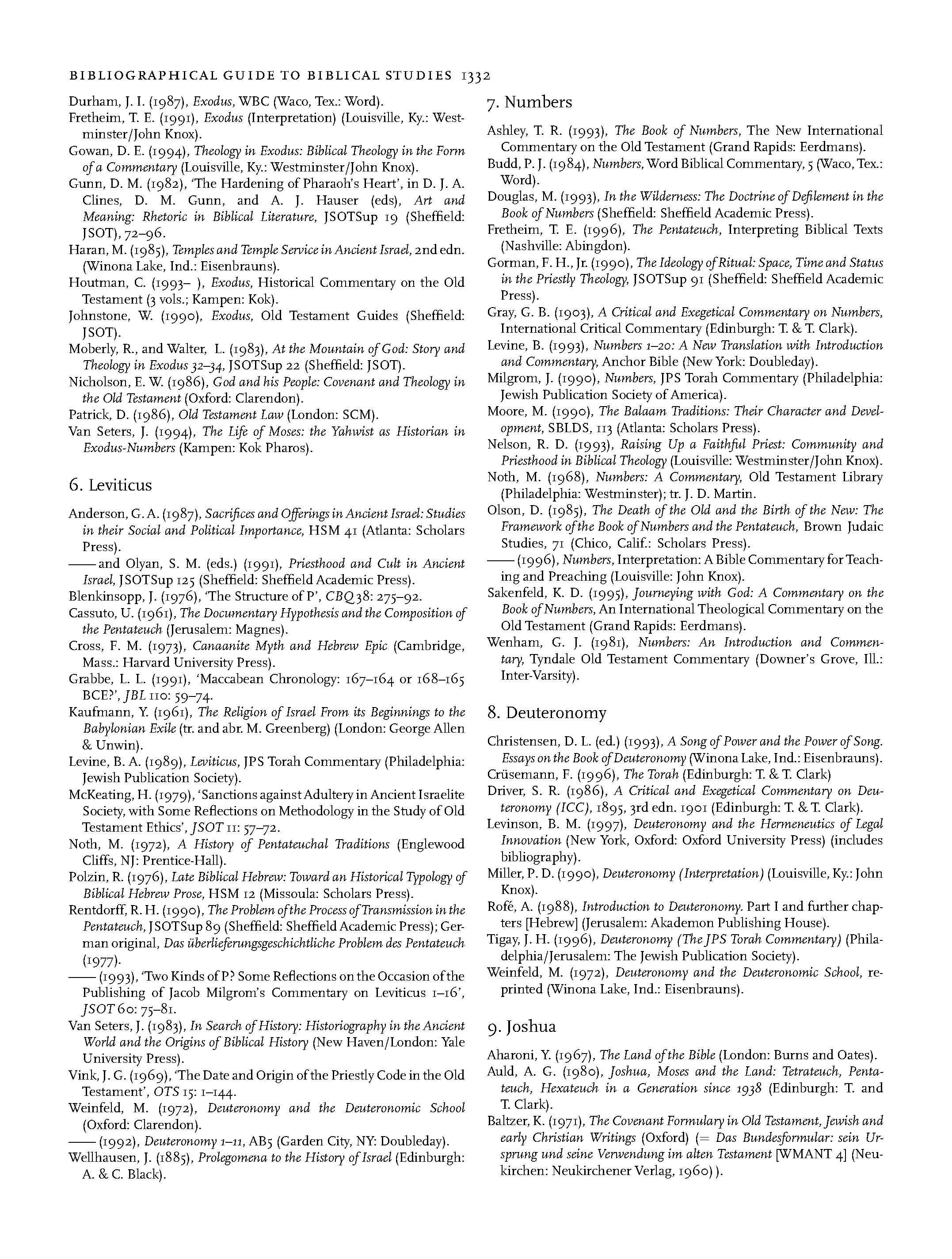
BIBLIOGRAPHICAL GUIDE TO BIBLICAL STUDIES I332
7. Numbers
Durham, J. I. (1987), Exodus, WBC (Waco, Tex.: Word). Fretheim, T. E. (1991), Exodus (Interpretation) (Louisville, Ky.: West-
Ashley, T. R. (1993), The Book of Numbers, The New International minster/John Knox). Gowan, D. E. (1994), Theology in Exodus: Biblical Theology in the Form
Commentary on the Old Testament (Grand Rapids: Eerdmans). Budd, P. J. (1984), Numbers, Word Biblical Commentary, 5 (Waco, Tex.: of a Commentary (Louisville, Ky.: Westminster/John Knox). Gunn, D. M. (1982), "The Hardening of Pharaoh's Heart', in D. J. A.
Word). Douglas, M. (1993), In the Wilderness: The Doctrine of Defilement in the Clines, D. M. Gunn, and A. J. Hauser (eds), Art and Meaning: Rhetoric in Biblical Literature, JSOTSup 19 (Sheffield: JSOT), 72-96. Haran, M. (1985), Temples and Temple Service in Ancient Israel, 2nd edn.
Book of Numbers (Sheffield: Sheffield Academic Press). Fretheim, T. E. (1996), The Pentateuch, Interpreting Biblical Texts (Nashville: Abingdon). Gorman, F. H., Jr. (1990), The Ideology of Ritual: Space, Time and Status (Winona Lake, Ind.: Eisenbrauns). Houtman, C. (1993- ), Exodus, Historical Commentary on the Old in the Priestly Theology, JSOTSup 91 (Sheffield: Sheffield Academic Press). Gray, G. B. (1903), A Critical and Exegetical Commentary on Numbers, Testament (3 vols.; Kampen: Kok). Johnstone, W (1990), Exodus, Old Testament Guides (Sheffield: International Critical Commentary (Edinburgh: T. & T. Clark). Levine, B. (1993), Numbers 1-20: A New Translation with Introduction
JSOT). Moberly, R., and Walter, L. (1983), At the Mountain of God: Story and and Commentary, Anchor Bible (New York: Doubleday). Milgrom, J. (1990), Numbers, JPS Torah Commentary (Philadelphia: Theology in Exodus32-34, JSOTSup 22 (Sheffield: JSOT). Nicholson, E. W. (1986), God and his People: Covenant and Theology in Jewish Publication Society of America). Moore, M. (1990), The Balaam Traditions: Their Character and Develthe Old Testament (Oxford: Clarendon). Patrick, D. (1986), Old Testament Law (London: SCM). Van Seters, J. (1994), The Life of Moses: the Yahwist as Historian in opment, SBLDS, 113 (Atlanta: Scholars Press). Nelson, R. D. (1993), Raising Up a Faithful Priest: Community and Exodus-Numbers (Kampen: Kok Pharos).
Priesthood in Biblical Theology (Louisville: Westminster/John Knox). Noth, M. (1968), Numbers: A Commentary, Old Testament Library
6. Leviticus (Philadelphia: Westminster); tr. J. D. Martin. Olson, D. (1985), The Death of the Old and the Birth of the New: The Anderson, G. A. (1987), Sacrifices and Offerings in Ancient Israel: Studies
Framework of the Book of Numbers and the Pentateuch, Brown Judaic Studies, 71 (Chico, Calif: Scholars Press). in their Social and Political Importance, HSM 41 (Atlanta: Scholars Press).
(1996), Numbers, Interpretation: A Bible Commentary for Teaching and Preaching (Louisville: John Knox). Sakenfeld, K. D. (1995), Journeying with God: A Commentary on the and Olyan, S. M. (eds.) (1991), Priesthood and Cult in Ancient Israel, JSOTSup 125 (Sheffield: Sheffield Academic Press). Blenkinsopp, J. (1976), The Structure of P', CBQ38: 275-92. Cassuto, U. (1961), The Documentary Hypothesis and the Composition of Book of Numbers, An International Theological Commentary on the Old Testament (Grand Rapids: Eerdmans). Wenham, G. J. (1981), Numbers: An Introduction and Commenthe Pentateuch (Jerusalem: Magnes). Cross, F. M. (1973), Canaanite Myth and Hebrew Epic (Cambridge, tary, Tyndale Old Testament Commentary (Downer's Grove, 111.: Inter-Varsity).
Mass.: Harvard University Press). Grabbe, L. L. (1991), 'Maccabean Chronology: 167—164 or 168—165
BCE?',JBLno: 59-74. Kaufmann, Y. (1961), The Religion of Israel From its Beginnings to the
8. Deuteronomy
Babylonian Exile (tr. and abr. M. Greenberg) (London: George Allen & Unwin). Levine, B. A. (1989), Leviticus, JPS Torah Commentary (Philadelphia: Christensen, D. L. (ed.) (1993), A Song of Power and the Power of Song.
Essays on the Book of Deuteronomy (Winona Lake, Ind.: Eisenbrauns). Criisemann, F. (1996), The Torah (Edinburgh: T. & T. Clark) Driver, S. R. (1986), A Critical and Exegetical Commentary on Deu-
Jewish Publication Society). McKeating, H. (1979), 'Sanctions against Adultery in Ancient Israelite teronomy (ICC), 1895, 3rd edn. 1901 (Edinburgh: T. &T. Clark). Levinson, B. M. (1997), Deuteronomy and the Hermeneutics of Legal
Society, with Some Reflections on Methodology in the Study of Old Testament Ethics', JSOT u: 57-72. Noth, M. (1972), A History of Pentateuchal Traditions (Englewood
Innovation (New York, Oxford: Oxford University Press) (includes bibliography). Miller, P. D. (1990), Deuteronomy (Interpretation) (Louisville, Ky: John
Cliffs, NJ: Prentice-Hall). Polzin, R. (1976), Late Biblical Hebrew: Toward an Historical Typology of Knox). Rofe, A. (1988), Introduction to Deuteronomy. Part I and further chap-
Biblical Hebrew Prose, HSM 12 (Missoula: Scholars Press). Rentdorff R. H. (1990), The Problem of the Process of Transmission in the ters [Hebrew] (Jerusalem: Akademon Publishing House). Tigay, J. H. (1996), Deuteronomy (TheJPS Torah Commentary) (Phila-
Pentateuch, JSOTSup 89 (Sheffield: Sheffield Academic Press); German original, Das uberlieferungsgeschichtliche Problem des Pentateuch (:977)- delphia/Jerusalem: The Jewish Publication Society). Weinfeld, M. (1972), Deuteronomy and the Deuteronomic School, re- (1993), Two Kinds of P? Some Reflections on the Occasion of the Publishing of Jacob Milgrom's Commentary on Leviticus i—16', JSOT60: 75-81. Van Seters, J. (1983), In Search of History: Historiography in the Ancient printed (Winona Lake, Ind.: Eisenbrauns).
9. Joshua
World and the Origins of Biblical History (New Haven/London: Yale University Press). Vink, J. G. (1969), The Date and Origin of the Priestly Code in the Old
Aharoni, Y. (1967), The Land of the Bible (London: Burns and Dates). Auld, A. G. (1980), Joshua, Moses and the Land: Tetrateuch, Pentateuch, Hexateuch in a Generation since 193$ (Edinburgh: T. and T. Clark). Baltzer, K. (1971), The Covenant Formulary in Old Testament, Jewish and Testament', OTS 15: 1—144. Weinfeld, M. (1972), Deuteronomy and the Deuteronomic School (Oxford: Clarendon). early Christian Writings (Oxford) (= Das Bundesformular: sein Ursprung und seine Verwendung im alten Testament [WMANT 4] (Neukirchen: Neukirchener Verlag, 1960)).
(1992), Deuteronomy 1—11, AB5 (Garden City, NY: Doubleday). Wellhausen, J. (1885), Prolegomena to the History of Israel (Edinburgh: A. £C. Black).
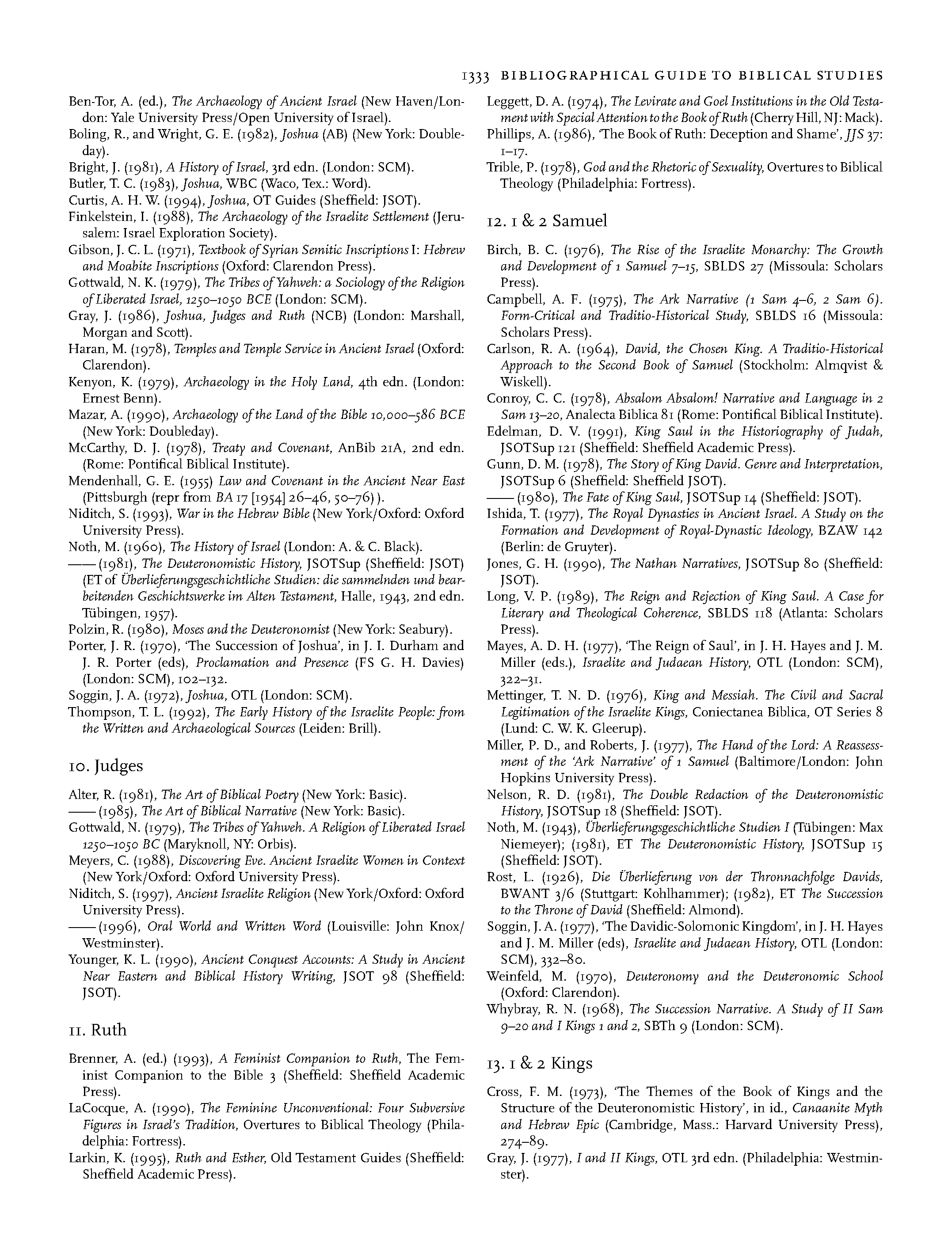
1333 BIBLIOGRAPHICAL GUIDE TO BIBLICAL STUDIES
Ben-Tor, A. (ed.), The Archaeology of Ancient Israel (New Haven/Lon-
Leggett, D. A. (1974), The Levirate and Gael Institutions in the Old Testadon: Yale University Press/Open University of Israel). Boling, R., and Wright, G. E. (1982), Joshua (AB) (New York: Doublement with Special Attention to the Book of Ruth (Cherry Hill, N J: Mack). Phillips, A. (1986), The Book of Ruth: Deception and Shame', JJS 37: day). Bright, J. (1981), A History of Israel, 3rd edn. (London: SCM). Butler, T. C. (1983), Joshua, WBC (Waco, Tex.: Word). Curtis, A. H. W (1994), Joshua, OT Guides (Sheffield: JSOT). Finkelstein, I. (1988), The Archaeology of the Israelite Settlement (Jeru-
1-17. Trible, P. (1978), God and the Rhetoric of Sexuality, Overtures to Biblical
Theology (Philadelphia: Fortress).
12. i & 2 Samuel salem: Israel Exploration Society). Gibson, J. C. L. (1971), Textbook of Syrian Semitic Inscriptions I: Hebrew
Birch, B. C. (1976), The Rise of the Israelite Monarchy: The Growth and Moabite Inscriptions (Oxford: Clarendon Press). Gottwald, N. K. (1979), The Tribes of Yahweh: a Sociology of the Religion and Development of i Samuel 7—15, SBLDS 27 (Missoula: Scholars Press). Campbell, A. F. (1975), The AA Narrative (i Sam 4-6, 2 Sam 6). of Liberated Israel, 1250-1050 BCE (London: SCM). Gray, J. (1986), Joshua, Judges and Ruth (NCB) (London: Marshall, Form-Critical and Traditio-Historical Study, SBLDS 16 (Missoula: Scholars Press). Carlson, R. A. (1964), David, the Chosen King. A Traditio-Historical
Morgan and Scott). Haran, M. (1978), Temples and Temple Service in Ancient Israel (Oxford: Clarendon). Kenyon, K. (1979), Archaeology in the Holy Land, 4th edn. (London: Approach to the Second Book of Samuel (Stockholm: Almqvist & Wiskell). Conroy, C. C. (1978), Absalom Absalom! Narrative and Language in 2
Ernest Benn). Mazar, A. (1990), Archaeology of the Land of the Bible 10,000—586 BCE
Sam 13—20, Analecta Biblica 81 (Rome: Pontifical Biblical Institute). Edelman, D. V. (1991), King Saul in the Historiography of Judah, (New York: Doubleday). McCarthy, D. J. (1978), Treaty and Covenant, AnBib 2iA, 2nd edn.
JSOTSup 121 (Sheffield: Sheffield Academic Press). Gunn, D. M. (1978), The Story of King David. Genre and Interpretation, (Rome: Pontifical Biblical Institute). Mendenhall, G. E. (1955) Law and Covenant in the Ancient Near East
JSOTSup 6 (Sheffield: Sheffield JSOT).
(Pittsburgh (repr from BA 17 [1954] 26-46, 50-76)). Niditch, S. (1993), War in the Hebrew Bible (New York/Oxford: Oxford (1980), The Fate of King Saul, JSOTSup 14 (Sheffield: JSOT). Ishida, T. (1977), The Royal Dynasties in Ancient Israel. A Study on the University Press). Noth, M. (1960), The History of Israel (London: A. £ C. Black).
Formation and Development of Royal-Dynastic Ideology, BZAW 142 (Berlin: de Gruyter). Jones, G. H. (1990), The Nathan Narratives, JSOTSup 80 (Sheffield: (1981), The Deuteronomistic History, JSOTSup (Sheffield: JSOT) (ET of Uberlieferungsgeschichtliche Studien: die sammelnden und bearbeitenden GeschichtsweAe im Alten Testament, Halle, 1943, 2nd edn. Tubingen, 1957). Polzin, R. (1980), Moses and the Deuteronomist (New York: Seabury). Porter, J. R. (1970), "The Succession of Joshua', in J. I. Durham and JSOT). Long, V. P. (1989), The Reign and Rejection of King Saul. A Case for Literary and Theological Coherence, SBLDS 118 (Atlanta: Scholars Press). Mayes, A. D. H. (1977), The Reign of Saul', in J. H. Hayes and J. M.
J. R. Porter (eds), Proclamation and Presence (FS G. H. Davies) (London: SCM), 102-132. Soggin, J. A. (1972), Joshua, OTL (London: SCM). Thompson, T. L. (1992), The Early History of the Israelite People: from Miller (eds.), Israelite and Judaean History, OTL (London: SCM), 322-31. Mettinger, T. N. D. (1976), King and Messiah. The Civil and Sacral
Legitimation of the Israelite Kings, Coniectanea Biblica, OT Series 8 (Lund: C. W. K. Gleerup). Miller, P. D., and Roberts, J. (1977), The Hand of the Lord: A Reassessthe Written and Archaeological Sources (Leiden: Brill). ment of the 'AA Narrative' of i Samuel (Baltimore/London: John Hopkins University Press). Nelson, R. D. (1981), The Double Redaction of the Deuteronomistic
10. Judges
Alter, R. (1981), The Art of Biblical Poetry (New York: Basic).
(1985), The Art of Biblical Narrative (New York: Basic). Gottwald, N. (1979), The Tribes of Yahweh. A Religion of Liberated Israel
History, JSOTSup 18 (Sheffield: JSOT). Noth, M. (1943), Uberlieferungsgeschichtliche Studien I (Tubingen: Max