
Part 83
(8:18—22) Before the next three miracle stories there are two encounters which emphasize the hardships of discipleship. The encounters belong here because they illustrate the moral of the stilling of the storm, which is a symbolic illustration of what it means to follow Jesus. The first, w. 19—20, in which a scribe addresses Jesus as 'teacher' (not 'Lord') and is not asked to follow, may offer a negative illustration, whereas the second, w. 2i—2, in which Jesus is called 'Lord' and issues the call, 'Follow me', may offer a positive illustration, v. 20 could allude to Ps 8: 'the Son of Man', who has nowhere to lay his head, in truth has all things under his feet, including the birds of the air. v. 22, which many have thought in tension with the commandment to honour father and mother, demands that 'the [spiritually] dead' take care of burial: Jesus must be followed now. The shocking saying should not be explained away as a mistranslation of a hypothetical Aramaic original or in terms of secondary burial or rites of mourning. Only a little more plausible is the attempt to find here an idiom expressing the duty of caring for one's aged parents until they are dead. More likely we should find here a prophetic consciousness which can, 'according to the need of the hour' (b. Yebam. gob), flout custom and law (cf. Jer 16:1-9; Ezek 24). In any case early Christian texts follow Jewish tradition in making burial an act of lovingkindness (27:57—61, etc.).
w. 28—9, which conclude the SM, should not be quickly passed over. First, the items it shares with 4:23—52 make the beginning and end of the SM mirror each other. Secondly, the line is similar to others which close chs. 10, 13, 18, and 24-5 and helps clarify the outline of the entire book (see MT E.II). Thirdly, one is put in mind of a formula used in Deut 31:1, 24 and 32:45. It seems likely enough, given the clear allusions to Moses in 5:1-2 and 8:1 (cf. Ex 34:29 LXX),thatw. 28-9 are one more piece of Matthew's Moses typology.
Jesus' Deeds within and for Israel (8:1-9:34^
Following the challenge of Jesus' difficult speech in the SM, this passage gives us the challenge of his merciful deeds, which are performed for people from the margins of Jewish society or without status—a leper, a Roman's servant, Peter's mother-in-law, two demoniacs, etc.—and are grouped into three triads; see MT 1.3.
(8:23—7) The stilling of the storm is 'a kerygmatic paradigm of the danger and glory of discipleship' (Bornkamm 1963: 57). The sea and its storm symbolize the world and its difficulties
(8:1—4) Th£ story of Jesus cleansing a leper—the disease is probably not what we know as leprosy but may be any one of several skin diseases—echoes both Num 12 (Moses heals Miriam) and 2 Kings 5:1-14 (Elisha heals Nathan). It comes appropriately here as illustration of one of the central themes of the SM: Jesus, who sends the healed man to a priest, observes the law of Moses (cf. Lev 13:49). But the story also links up with what follows. 11:5 makes the cleansing of lepers an item of eschatological expectation; so these verses stand as fulfilmentto prophecy. Further, 10:8 instructs missionaries to heal lepers and so extends the notion of the imitation of Christ. (8:5-13) A nameless Roman centurion, an exemplar of faith, asks help from Jesus the Jew: a Roman commander becomes a supplicant. The request is for the man's 'son' or 'servant' (the Gk. is ambiguous). Jesus' response is apparently a question: 'Should I come and cure him?' (my tr.). Jesus hesitates to help a Gentile (cf. 15:24). But the soldier wins him over by a declaration of faith: Jesus, whose spiritual authority is analogous to the centurion's military authority, needs only speak a word. Jesus' response is threefold: (i) he declares that no one in Israel has such faith; (2) he makes a prophetic threat using the language of Ps 107:3—'the heirs of the kingdom' (which cannot mean all Jews) will suffer eschatological rejection while many from east and west (Gentiles or diaspora Jews)
(cf. Ps 65:5; 69:1-2), and the ship is, as in patristic exegesis, the church. So the main point is that discipleship requires faith in Jesus in the midst of trial. But there is also a Christological message. Jesus is a prophet greater than Jonah. (The parallels with Jonah are obvious; cf. esp. v. 24 with Jon 1:4 MT) Unlike Jonah, Jesus does not pray to God but directly addresses the storm; and in stilling the cosmic forces of evil that threaten the created order (cf. Ps 46; Rev 13:1; 21:1), he exercises the power of YHWH himself (cf. Ps 65:7; Isa 51:9-10).
(8:28-34) Tlus narrative continues the theme of Jesus' authority. It may depict the healing of Gentiles (cf. 8:5—13). Such is suggested by the location in the Decapolis and the fact that swine are being raised nearby. On the other hand, the population along the east coast of the Sea of Galilee was mixed, and in the other cases where Jesus bends his rule of confining his mission to the lost sheep of the house of Israel this is made plain (8:5-13; 15:21-8). In either event Jesus sends the demons into the water—apparently a punishment as they were thought to prefer dry places (cf. 12:43). But this success does not garner support for Jesus' cause. As elsewhere his service for others generates hostility: good is repaid with evil.
MATTHEW 858 as faith in Jesus as the embodiment and channel of God's power and grace.
(9:1-8) In the story of the man sick with palsy Jesus—now home in Capernaum (cf. 4:13)—sees and responds to the faith of those who bring a paralytic: he forgives the man's sins. The story presupposes that the infirmity has a spiritual cause (cf. Ex 20:5; i Cor 11:29-30; Jas 5:14-15; in 9:32-4 a demon makes a man deaf and dumb). So by forgiving sins Jesus uproots the cause of the paralysis. Although 4QPrNab proves that at least some Jews could think of one person forgiving another's sins (with healing as the result), in Matthew the scribes object that Jesus has spoken evil ('blaspheming') because he has done what only God can do. Jesus, however, urges that it is easier to pronounce the forgiveness of sins than to command someone to walk, this because only the latter can be objectively verified. Further, because Jesus, in the event, can in fact make the paralytic walk and so do the harder thing, others must wonder whether he cannot also forgive sins. (9:9-13) The first verse is an extraordinarily brief call story with the same structure as the two stories in 4:18-22; see above. The arrangement depends upon i Kings 19:19—21. In the objection story in w. 10—13, which may be set in Peter's house, Pharisees denigrate Jesus by asking how he can eat with tax collectors and sinners, that is, those who through apostasy have removed themselves from the covenant. Jesus responds with a proverb (the sick need a physician), a scripture (Hos 6:6), and a declaration about his mission (in which the 'righteous' are apparently the '(self-)righteous'). The scripture, again quoted in 12:7, was probably an important text for Johannan ben Zakkai in the period after 70 CE: it helped people come to terms with the destruction of the temple. Perhaps then Matthew's use of Hos 6:6 was polemical: Jesus, not the rabbis, properly applies the prophet's words.
(9:27—31) This colourless healing story closely resembles 20:29-34, of which it may be a redactional doublet. It prepares for 11:5, which cites Isaiah's prophecy of the healing of the blind. Blindness for an ancient Jew could involve not only poverty and hardship (cf. Mk 10:46) but also religious alienation (cf. Lev 21:20; nQTemple 45:12-14). But the Torah makes some humanitarian provisions for the blind (e.g. Lev 19:14), and Jesus' ministry to the blind may be interpreted as an extension of such concern. The blind men call Jesus 'Son of David'. This is a messianic title (1:1); but Jesus also heals as Son of David in 12:23; !5:22; and 20:30-1. This matters because, with one exception, 'son of David' is, in the OT, used of Solomon, who was later renowned as a mighty healer and exorcist (cf. T. Sol. 1:7; 5:10; 20:1; 26:9). Perhaps then Matthew offers a Solomon typology. (9:32-4) The healing of a demoniac who is deaf and dumb— the Greek word, kophon, here means both—appropriately closes Matthew's third miracle triad. Not only does it prepare for 11:5 ('the deaf hear'), but the crowd's declaration that Jesus' ministry is like nothing in Israel's history (cf. Judg 19:30) is climactic. Moreover, v. 34 records the negative reaction of the Pharisees to the crowd's wonder and so anticipates the theme of opposition in the missionary discourse (cf. esp. 10:25). (9:35-10:4) This unit, like 8:16-22, concludes a miracle triad, contains summary statements about Jesus' healing ministry, and uses Scripture ('sheep without a shepherd' appears in Num 27:17; 2 Chr 18:16; Jdt 11:19). It also closes off one section and opens another, concluding chs. 8-9 and introducing the missionary discourse by equating the work of the disciples with the compassionate work of Jesus (cf. 9:35 with 10:1). They do what he does and work in the eschatological harvest. By harking back to 4:23 and so forming an indusio with the introduction to the SM, the passage makes Jesus' words (chs. 5—7) and deeds (chs. 8—9) the fundamental context for understanding 10:1—42. The twelve are to preach to Israel about the kingdom of God and to heal the sick (10:1, 7-8) and so imitate Jesus. Moreover, as 5:1-7:27 gives content to the command to preach the gospel (10:7), and as 8:1—9:34 gives content to the command to heal the sick, raise the dead, cleanse lepers, cast out demons (10:8), Jesus' words and deeds are for the missionary example and precedent.
(9:14—17) John the Baptist's disciples (cf. 14:12) ask why the disciples of Jesus, the preacher of repentance, do not fast, that is, display acts of repentance. The question is not why they do not fast at all. For 5:17-20 implies that they at least keep the fast for the day of atonement (cf. Lev 16:1—34), an(^ Jesus himself fasts in 4:1—11. Rather the issue is probably why they do not follow the custom (which the Pharisees followed) of fasting on Mondays and Thursdays. Jesus declares that guests do not fast during wedding celebrations and implies that the time of the Messiah's presence is in this particular akin to a wedding celebration. But this in turn means that when the Messiah has gone such fasting will be appropriate. Jesus then adds the parables about the patch and wineskins. These too offer paradoxical combinations. Putting new cloth on an old garment and new wine into old wineskins are as improbable as wedding guests fasting. The implicit subject continues to be the discontinuity between old and new. But there is also continuity: 'so both are preserved'. Jesus' message and the kingdom of God not only bring the new but fulfil Judaism: the past is not abandoned but fulfilled. (9:18-26) Here Jesus raises from the dead the daughter of a synagogue director (this justifies 11:5: 'and the dead are raised') and heals a woman with a uterine haemorrhage. The former he sets his hand upon (cf. the OT's 'hand of God'), the latter puts her hand upon him (or rather his 'fringe', that is, 'tassel', cf. 23:5). Because Jesus can read the thoughts of the woman with a haemorrhage, w. 20—2 are really a sort of conversation. Their theme is faith—which in 9:28 is clarified
The Disciples' Ministry of Words and Deeds (10:1-42)
10:1—4 °Pens with an implicit call to imitate Jesus the missionary. By casting out 'unclean spirits' (cf. 12:43) and healing the sick (cf. 4:23) the twelve, who have been in the background until now, repeat his deeds. Unlike a genealogy, in which the names outline a pre-history (cf. 1:2—17), a hst of students (cf. m. 'Abot 2.8) indicates a post-history—here the church under Peter's head. Peter is 'first', by which is meant not just first on the list but of privileged status. Judas, the most dishonoured, is last.
(10:5—25) Following the instructions in w. 5—15 there comes first a list of hardships (w. 16-23) and then a warning that the twelve—their number corresponds to the tribes of Israel— will be treated as Jesus was treated (w. 24—5). Altogether the picture is bleak: the future is full of tribulation. Thus the scene
MATTHEW between covered and revealed, hidden and made known, darkness and light, whispering and proclamation, speak of the eschatological revelation of God's truth in which the inspired imagination can even now find solace, v. 28 unfolds the real meaning of death. And w. 29—31 declare God's sovereignty over the present. In its entirety the section is a sort of theodicy that offers consolation. It declares that the eschatological future will reverse the present (v. 26) and that what happens after death matters above all (v. 28). But lest one suppose that only the future will see God's will done, v. 29 asserts God's present sovereignty. This of course leaves unanswered the problem of how God can be sovereign in a world where his saints suffer so. v. 30 responds with the lesson of Job: God knows what we do not (the verse is not a promise of God's protection—that is contradicted by the context—but a proverb which contrasts God's omniscience with human ignorance; cf Job 38:37; Sir 1:2; Apoc. Sed. 8.6).
is set for 10:2 6-31, which (in a way reminiscent of 6:2 5-34 and 7:7—11) offers consolation. Jesus opens with a prohibition—given prominence by its initial position—not to go to Gentiles or Samaritans (v. 5; in Matthew Jesus never visits Samaria). Jesus is sent only to the lost sheep (cf 9:36) of the house of Israel. It is not until the turning-point marked by his death and resurrection that there will be a Gentile mission (28:19). Th£ Messiah is, in accordance with the Scriptures, sent to Israel.
w. 11—15 concern the reception and rejection of missionaries in 'town or village' (cf. 9:35) and their response to such. The gift of peace is not just a social convention. Given the prophecies of peace for the eschatological age (e.g. Isa 52:7) and the eschatological content of the disciples' mission, the apostolic greeting should be understood as a sign of the inbreaking of the kingdom: God is bringing salom. But when a place does not receive the good news, the Messiah's emissaries will wipe their feet or shake the dust off themselves as they leave it. Such action is a public demonstration of the breaking of communion and the repudiation of responsibility
(10:32—42) This section on confession (w. 32—3), conflict (w. 34—9), and consolation (w. 40—2) is partly repetitious: public confession, familial division, eschatological trial, endurance in suffering, and the reception of missionaries have already been treated. The repetition, however, adds emphasis: suffering is indeed inevitable. But there is more than repetition. Whereas 10:5-25 is largely specialized instruction for missionaries, w. 32 ff could be heeded equally by every believer. While the non-missionary might find much of w. 5—25 beside the point, the last portion of the discourse imposes itself upon all.
(cf. 27:24); and it intimates a fate worse than that which came to Sodom and Gomorrah, two cities remembered as so wicked that God made them a burned-out waste (Gen 18:16—19:29). Obviously it is unprecedented honour to hear the disciples' proclamation and unprecedented failure to reject it.
The prophecies of affliction in 10:16—23 8° beyond the pre Easter period to include later missionaries. So we pass from past to present without notice (cf. the situation in Jn 3). The transition reflects Matthew's typification of the twelve: they stand for the Christians of later times. Further, the eschatological character of the sufferings, reinforced by the parallels in 24:9-14 as well as in Jewish apocalyptic literature, imply that the postand pre-Easter periods both belong to the messianic woes and will only be ended when the Son of Man comes on the clouds of heaven. (So 10:23; me verse is n°t a reference to the resurrection, Pentecost, or the destruction of Jerusalem.) The missionary endeavour takes place in the latter days, and the suffering of missionaries is a manifestation of the birth-pangs which herald the advent of God's new world.
The prophecy of family strife is based upon Mic 7:6, which was thought to describe the discord of the latter days (cf. m.
Sola 9:15); and the conviction that the great tribulation would turn those of the same household against one another was widespread (cf. Jub. 23:16). So v. 35 comprehends the ministry of Jesus and the time of the church—literal and figurative crucifixion characterizes and so unifies both periods (v. 38)— in terms of the eschatological woes (cf. Rev 6:4).
The missionary discourse winds down with promissory words in which the disciples are not active but passive: they are received and served (w. 40—2). The main theme is compensation: those who welcome the eschatological messengers of Jesus welcome Jesus himself and so gain eschatological reward. The little ones' are Christian missionaries; so v. 42 is a word not for them but for others—those who, although not itinerants, can share in the Christian mission.
The passion narrative has left more than traces in w. 16-23. The fate the disciples face is analogous to what Jesus suffers in later chapters. Jesus too is handed over (26:45). He appears before a sanhedrin (26:59). He is whipped (20:19; cf27:26). He is led before a governor (27:1-26). He bears testimony before government officials (26:57-69; 27:11-26). He is betrayed by a member of the group closest to him (26:47—56). And he is killed. The reader recalls all this not only because ch. 10 is permeated by the implicit notion of Jesus Christ as model missionary but also because 10:24-5 explicitly sets the mistreatment of Jesus beside the mistreatment of the disciples. So we have in w. 17—23 what we also meet in 5:38—42: Jesus in his passion is the exemplar of suffering discipleship.
The Response of Israel (11:1-12:50)
(11:1-12:46) Chs. 11-12 recount the failure of'this generation' to accept God's eschatological messengers and recognize 'the deeds of the Messiah' (11:2, my tr.; the term is a comprehensive reference to Jesus' ministry in Israel). But the focus on rejection is punctuated by the invitations and hope found in 11:2530; 12:15—21; and 12:46—50. Not all is bleak. There is a remnant. (11:1-19) Following a transitional sentence (see MT 7:28-9), we have the Christological question of John the Baptist. It is rather surprising in view of John's recognition of Jesus in ch. 3. It is also surprising that the upshot of the disciples' mission is not recorded: while they are commanded to go out, they are never said to return. Perhaps the odd circumstance not only
The theme of the imitation of Christ, already strongly implicit, becomes explicit in w. 24—5. The verses (cf. Jn 13:16) declare that suffering will come to those who are like Jesus. The implicit subject of'call' and 'malign' may be the Pharisees
(cf. 9:34). Beelzebul is Satan, the prince of demons (12:24-6).
(10:26-31) Three negative injunctions (w. 260, 280, 310) mark three different points, w. 26-7, with their antitheses
MATTHEW 860
(12:1—8) Although Jews certainly recognized that exceptional circumstances sometimes allowed the non-observance of Torah (cf. i Mace 2:39-41), the Pharisees object that the disciples, by plucking and eating grain on the sabbath, are acting unlawfully (cf. Ex 34:21). But Jesus answers by appealing to an unlawful act—which some late rabbinic sources place on a sabbath—of his royal ancestor David, an act motivated by hunger: the king and those with him ate the bread of the Presence (i Sam 21). Only the priests were allowed to eat such bread (Lev 24:9). The force of Jesus' appeal is debated, but the following suggestions (which are not contradictory) should be considered: (i) because Scripture does not condemn David for his action, the Pharisees' rigidity is unacceptable; (2) one can observe one commandment at the expense of another (cf. w. 5-6), and here Jesus puts mercy first (cf. 12:7, 9-14); (3) if David could break the Torah, so can the Messiah (cf. w. 6, 8). w. 5-6 then add that if the priests in the temple could violate the sabbath for a higher good, how much more he who is greater than the temple? The argument concludes with (i) an appeal to Hos 6:6 (already cited in 9:13) which shows Scripture's overriding demand for mercy; and (2) a clarifying addition: Jesus' ministry stands above the sabbath. Nothing in the pericope outlaws sabbath observance. Such observance is indeed presupposed by 24:20. Jesus is not setting aside the law but, in traditional Jewish fashion, placing one divine imperative over another for the moment.
prevents 10:23 fr°m being viewed as a false prophecy but also implies that the Jewish mission is still continuing.
Jesus' answer to John conflates the language of Isa 26:19; 29:18; 35:5-6; 42:7, 18; and 61:1. All the items listed—which might remind one of Elijah—refer to things that have already happened, so that the reader sees in Jesus the fulfilment of Isaiah's eschatological prophecies. (Cf. the list of eschatological events listed in 4Qj2i; this includes giving sight to the blind, raising the dead, and preaching good news to the poor.)
In w. 7—15 Jesus ceases to speak of himself and instead speaks of John. He makes five points. John is a prophet and more than a prophet (v. 9). He is the figure foretold by Mai 3:1 (so v. 10; cf Ex 23:20). He is the greatest of those born among women (v. n—although the least in the coming kingdom will be greater than he). He is the turning point in salvation history
(w. 12-13; ^e suffering of John and the saints after him belong to the time when the kingdom is attacked by violent men). And he is Elijah (v. 14; cf. Mai 4:5—6 and John's resemblance to Elijah in Mt 3:4; the issue will come up again in 17:9-13). Having spoken about himself (w. 2-6) and about John (w. 7—15), Jesus next speaks about the response of'this generation' to both (w. 16—19). Most commentators identify the children of v. 16 with Jesus and John: the former's invitation to rejoice and the latter's call for the mourning of repentance have fallen upon hostile ears. But the text literally identifies 'this generation' with the piping and wailing children, and it may be better to think that the Baptist, who sternly demanded repentance, met with those who wanted rather to make merry ('we played the flute for you, and you did not dance'), and that Jesus, who preached good news and likened the present to a wedding celebration, was thought to be insufficiently sombre
(12:9—14) Jesus does a second controversial thing on the sabbath: he heals a paralysed or withered hand. Probably many but not most Jewish teachers of Jesus' day would have thought it wrong, unless a life were at risk, to heal on a sabbath. In defence Jesus (who here does nothing but speak) appeals not to scriptural precept or example (contrast 12:1—8) but to the human sentiment of his hearers. He assumes that their common practice is to help animals on a sabbath
('we wailed, and you did not mourn', cf. 9:14-17). In any case the deeds of Jesus are the deeds of Wisdom, and they exonerate him (v. 19).
(contrast CD 11:23—14). He then makes the inference from the lesser to the greater: if it is lawful to do good to an animal on a sabbath, surely it is lawful to do good to a human on a sabbath.
(11:20—4) The two eschatological woes, whose form—address, indictment, verdict—recalls OT oracles (e.g. Isa 5:11— 17), carry forward the disappointment registered at the end of 11:16-19—although nothing has prepared for the mention of Chorazin or Bethsaida. But we have read of scribes and Pharisees in Capernaum opposing Jesus (9:3, n) and of a crowd in Capernaum laughing athim (9:24). The passage serves notice that Jesus' mission to Israel has not summoned corporate repentance and that the consequences will be devastating.
(12:15—21) As in 8:16—17,we have a summary of Jesus' healing activity followed by a formula quotation from Isaiah. The text is Isa 42:1-4, 9, the longest OT quotation in Matthew. Jesus is the chosen servant, the beloved with whom God is well pleased, and the Spirit (cf. the following paragraph) is upon him—all of which recalls the baptism. The mention of Gentiles harks back to 4:15 and anticipates 28:19. Th£ voice not heard in the streets relates itself naturally to v. 16 and Jesus' lack of self-publicity. The 'bruised reed' and 'smouldering wick' probably represent Jesus' compassion for those at society's margin. (12:22-50) As in 12:1-21 two controversies with the Pharisees (w. 22-37 and 38-45) are followed by a paragraph which focuses on those who accept Jesus. 11:1—30 has a similar structure: after the section which ends with the rejection of John and Jesus by 'this generation' (11:16-19) and the woes upon Galilee there follows the invitation in 11:25-30. (12:22-37) Tlus drawn-out objection story consists of (i) an exorcism (v. 22); (2) the positive (if inadequate) response of the crowd (v. 23); (3) the dissenting and polemical reaction of the Pharisees to the crowd (v. 24); and (4) Jesus' extended
(11:25—30) The theme of rejection (11:2—24) now recedes as we read of those—the 'infants' (cf. 10:42)—who respond rightly to the deeds of the Messiah (11:2). w. 25-6 (instead of making justified complaint) offer thanksgiving; v. 27 reveals that Jesus is the revealer; and w. 28—30 are an invitation. The whole has a Mosaic colour. The declaration about Father and
Son knowing each other depends upon Ex 33:12-13, in which Moses says that God knows him and in which Moses prays that he might know God; and the promise of rest (cf. the realized eschatology in Heb 4:1—13) is modelled upon Ex 33:14. Jesus moreover is like Moses in that he is 'meek' (Num 12:3), full of revelation (Jewish tradition made Moses all but omniscient; cf. Jub. 1:4; Sipre Deut. §357), and has a 'yoke' (a word often applied to the Mosaic law). All this accords with Jesus' status as the new Moses of the new covenant.
86i MATTHEW greater than Jonah and Solomon, namely, Jesus (cf. 12:6), 'this generation' has not rightly responded. This then leads to a parable about exorcism, in which the last things are worse than the first. This illustrates the situation with those who have rejected the proclamation of Jesus and the church: they would be better off at the final assize if they had never heard the gospel. (12:46-50) 4:21-2; 8:22; and 10:34-7 entail at best a loosening of family ties, at worst renunciation of one's parents and siblings. But Jesus offers consolation when he declares that his disciples are his family, and that all who do the will of his Father belong to that family. The obedient disciple is not left alone, without a family; for the church is the household of faith in which there is a father (God) and in which there are brothers and sisters (23:8). Jesus' demand to forsake family is not a call to solitary existence but an invitation to join a new spiritual community.
response. This last consists of three rebuttals and a warning (w. 25—30), teaching on the unforgivable sin (w. 31—2), and a unit on fruits and words (w. 33—7).
Jesus first responds by appeal to common sense (w. 25-6). But w. 27-8 are difficult. If v. 27 urges that two similar activities (exorcisms of Jesus, exorcisms of others) should not be assigned to radically dissimilar sources (Beelzebul, God), v. 28 goes on to make a claim whose logic has seemed to many unclear. Why should Jesus' exorcisms signal the coming of the kingdom? By his own reasoning should not the same be signalled by the exorcisms of others? But the questions miss the implicit Christological claim. Jesus accepts the miracles of others but holds his own to be of different import because of his identity as the Messiah. What matters is not the exorcisms but the exorcist ('if I cast out demons'). The Messiah has come as victor over evil forces, so the kingdom is already establishing itself.
In w. 31—2 Jesus drops his defensive posture and takes up the offensive. His words are warnings to those who have not accepted what has just been said. v. 31 simply declares that although God is ready and willing to forgive, those who oppose the eschatological work of God's Spirit in the ministry of Jesus push God's inclination to forgive past its limit. (Cf 4(3270 ii 12-15, where we read of those who curse or speak against 'those anointed with His Holy Spirit'.) Despite the common tradition of associating the sin against the Holy Spirit with i Jn 5:16, nothing is here taught about postbaptismal relapse. The meaning of v. 32, however, remains obscure. For speaking a word against the Son of Man seems in context to be the same as blasphemy against the Holy Spirit— the one is forgivable, the other is not. A truly satisfying interpretation has yet to be offered, w. 33-7 conclude the unit by opposing the possible supposition that blasphemy cannot really have eternal consequence because it consists of nothing but words with the assertion that to speak evil is to be evil: words reflect the true self and so can be the criterion of divine judgement. (Cf. further FGS i.) (12:38-45) After being asked for a sign Jesus speaks of the one sign to be given to 'this generation', refers to the eschatological judgement of'this generation', and utters a parable about 'this generation'. The scribes and Pharisees want from Jesus not words but a stupendous miracle. The irony is that Jesus has already worked enough miracles to persuade an open mind. So he brands the request as coming from 'an evil and adulterous [i.e. faithless] generation', an expression which recalls Deut 1:35 and 32:5. Jesus' contemporaries are like those who grumbled in the wilderness, those whom God punished by not letting them see the land of promise. None the less, a stupendous sign still will be given—Jesus' resurrection from the dead. ('Three days and three nights' is from Jon 2:1 LXX and, in view of Matthew's chronology, can hardly be taken literally.)
Explaining Israel's Response (13:1-52)
This discourse is a sort of theodicy—not a solution to the problem of evil in general but a solution to the rejection of Jesus in particular. See MT 1.5. (13:1-23) The parable of the sower (w. 1-9) comes with an allegorical explanation (w. 18-23) which makes matters plain: the effects of Jesus' proclamation in Israel are varied because of various factors (including the devil's activity, lack of character under trial, and inappropriate love for the world), w. 10-17 are more difficult. The disciples want to know why Jesus speaks in parables. He answers that the parables reveal and (in accordance with Isa 6:9—10) hide atthe same time, for their effect depends upon the moral status of the hearer. So parables uphold the concept of a closed group in Matthew's thinking (cf. 7:6). Things that should not be revealed to unbelief are not. Only those who do the will of the Father in heaven and so belong to Jesus' family will understand Jesus' parables (cf. 11:25-30; 12:46-50). Those who do not do the will of the Father will not understand. Knowledge has a moral dimension. While the mysteries of the presence of the eschatological kingdom are given by grace through his parables, such teaching falls upon closed as well as open ears. As in the parable of the sower, so too in w. 10—17: the divine message begets different responses.
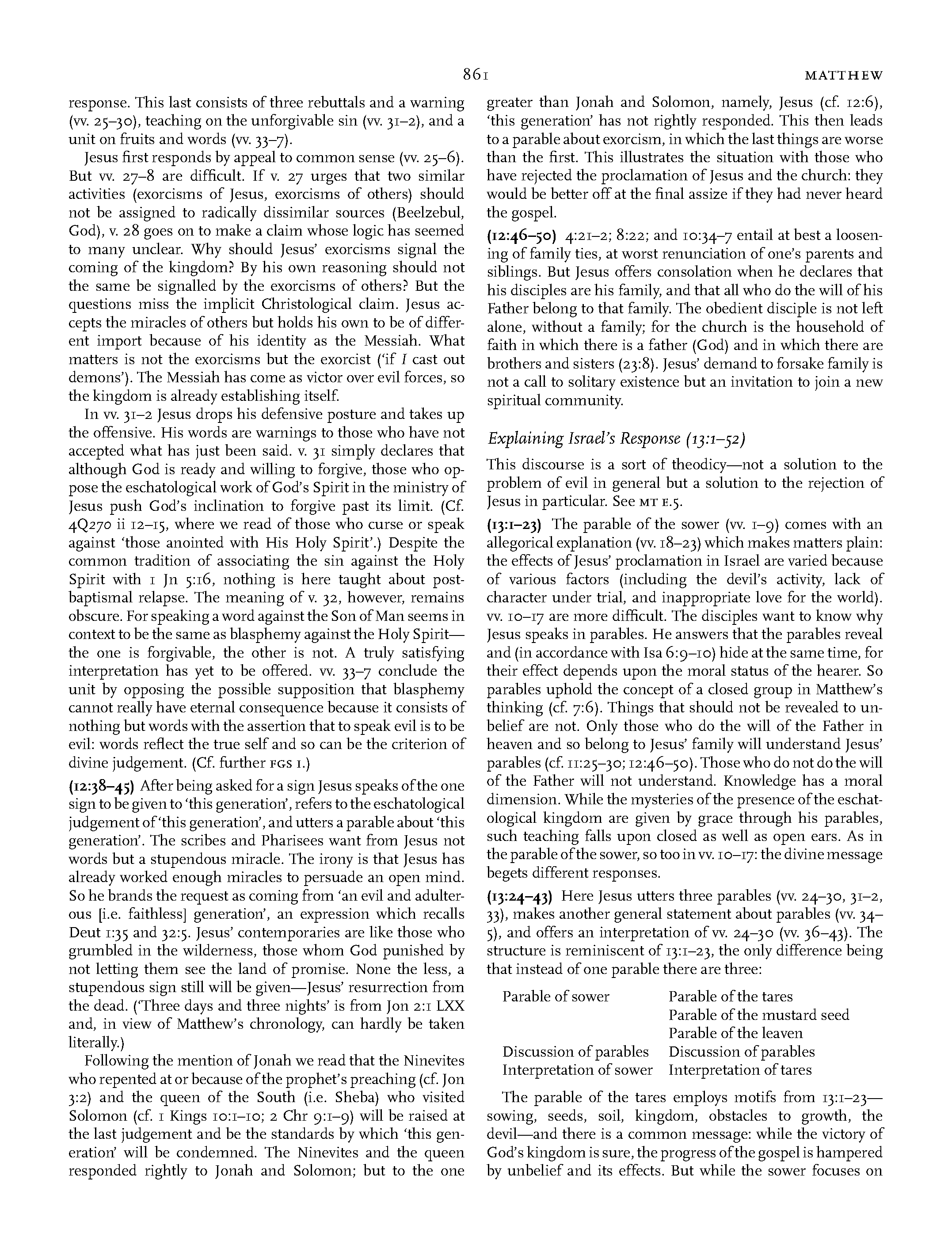
(13:24—43) Here Jesus utters three parables (w. 24—30, 31—2, 33), makes another general statement about parables (w. 345), and offers an interpretation of w. 24-30 (w. 36-43). The structure is reminiscent of 13:1—23, the only difference being that instead of one parable there are three:
Parable of sower Parable of the tares Parable of the mustard seed Parable of the leaven Discussion of parables Discussion of parables Interpretation of sower Interpretation of tares
Following the mention of Jonah we read that the Ninevites who repented at or because of the prophet's preaching (cf. Jon 3:2) and the queen of the South (i.e. Sheba) who visited Solomon (cf. i Kings 10:1—10; 2 Chr 9:1—9) will be raised at the last judgement and be the standards by which 'this generation' will be condemned. The Ninevites and the queen responded rightly to Jonah and Solomon; but to the one
The parable of the tares employs motifs from 13:1—23— sowing, seeds, soil, kingdom, obstacles to growth, the devil—and there is a common message: while the victory of God's kingdom is sure, the progress of the gospel is hampered by unbelief and its effects. But while the sower focuses on
MATTHEW 862 actions of believers, not unbelievers. The point is that although the kingdom is hidden (cf. 13:31—3) it can be found; and when it is, one should make whatever sacrifice is necessary to obtain it. 'Anyone who counts the cost of discipleship has completely failed to grasp the greatness of the reward' human responsibility (the devil being only one factor among others), the tares concentrates on the devil, who imitates Jesus (the sower of 13:1—9) by sowing his own seed. Satan shares responsibility for human sin; those without faith are 'sons of the evil one'. Many commentators have thought the parable reflects concern over the character of some members of Matthew's church and teaches tolerance, but w. 24—30 do not clearly address a situation in the Christian community. Augustine used this parable to argue against the Donatists, who wanted to exclude the lapsed from church. 13:36—43, however, quite plainly identifies the field with the world, not the church. Moreover, the broader context is not ecclesiological affairs but failure to believe in Israel's Messiah, and 18:15-20 shows us that Matthew had no qualms about pulling up Christian weeds when necessary.
(Beare 1981: 315).
The parables of the treasure and pearl appropriately succeed 13:1-43 by offering paraenesis—buy, sell, seek. Granted the kingdom's value and its sure triumph, one must strive to overcome every obstacle in the way of obtaining it. One must not respond as the people denounced in chs. 11-12 or be like the unfruitful seeds of 13:1-23. The necessity for such action is, in turn, underlined by w. 47-50, which return to the last assize (cf. 13:36—43): judgement will come upon those who reject the kingdom. There is, accordingly, a shift of emphasis between 13:1-43 and w. 44-50. Whereas the former is more descriptive, the latter is more hortative.
The parable of the mustard seed (a proverbially small seed: cf 17:20) in w. 31-2 teaches that a humble beginning is not inconsistent with a great and glorious destiny. The juxtaposition of two seemingly incongruent facts—the tiny seed and a tree for birds—illustrates the contrast between the experience of Jesus and his followers in the present and their expectations of the future. Our parable implicitly sets reality and hope side by side and offers that the grand end is in the mundane beginning. Just as the seed produces the tree, so that which is inconspicuously present in Jesus' ministry will become the universal reign of God.
The discourse ends with w. 51-2, a comparative proverb. The major point is that the disciples have indeed understood Jesus' discourse and so qualify as scribes instructed in the truths of the kingdom of heaven. Perhaps a Christian counterpart to the Jewish rabbinate is envisaged. It is altogether probable that Matthew belonged to a 'school' of Christian scribes. In this case the verse would be a sort of self-portrait. What exactly is meant by 'new' and 'old' is unclear. Should we think of the new revelation in Jesus and old revelation in the Torah, or of Christian tradition and Jewish tradition, or of the teaching of Christians and Jesus' teaching, or of Matthew's interpretations of Jesus' parables and those parables themselves?
The introduction to the parable of the leaven (v. 33) resembles the introduction to the parable of the mustard seed, and both parables tell of a small, hidden thing that becomes large through an organic process. These similarities signal an identity of theme. Both teach that the coming of the kingdom begins not with a grand spectacle but a hidden presence. In this way the character and nature of Jesus' ministry, including its failure in Israel, can be better understood.
The Birth of the Church (13:53-17:27)
(13:53-8) This pericope, which supplies a concrete example of people hearing but not hearing and seeing but not seeing (cf. 13:13), illustrates that the failure to understand leads not to indifference but to hostility, and further that unbelief does not correspond to any geographical pattern: Jesus' words and deeds are rejected in the north (here Nazareth) as well as the south, in his home town as well as the capital. There is no sacred space uncontaminated by hostility. The lesson complements 12:46-50, which immediately precedes 13:1-52. For if in w. 53-8 one learns that geographical and social ties do not really matter, in 12:46—50 it is taught that family ties may be relaxed by commitment to Jesus. So the great parable discourse is framed by two texts which relativize the significance of earthly ties.
w. 34—5 is a formula quotation about Jesus' use of parables. The quotation from Ps 78:2 grounds Jesus' parabolic manner of speaking in prophecy: the OT prophesies the Messiah's use of revelatory parables. These verses also serve as a transition from one audience to another: Jesus turns from those who do not understand to those who do (cf. 13:10-17).
w. 24-30 tell a parabolic story, w. 37-9, in response to the disciples' request for its interpretation (cf. 13:10), supply a sort of lexicon which explains the allegorical meanings of seven figures in that story, w. 40-3 then take those meanings and with them constructs a second narrative about the last judgement. The result is two stories—w. 24—30 and 40—3—with one meaning. Together they put things in eschatological perspective. If the sun now shines on the just and unjust, it shall not always be so. The tares will eventually be plucked up, the wheat gathered. History's end will give the answers to the difficult questions that history, including the history of Jesus, raises.
w. 53—8 link up not only with what precedes but also with what follows. In v. 57 Jesus implicitly proclaims himself a prophet, and in 14:5 the people hold John to be a prophet. The upshot is clear. John's fate, which is recounted in 14:1-12, is that of a prophet, and a similar fate must also lie ahead for Jesus. To be a prophet means to suffer rejection and ultimately death (cf. 23:29-39).
(13:44—52) The three parables (cf. 13:24—33) of the treasure, pearl, and net are followed by an interpretation of the latter (cf. 13:18-23, 13:36-43) and a general discussion of parables (cf. 13:10—17, 34—5) which concludes the discourse. The first two parables (w. 44—6) concern finding the kingdom (represented by the treasure and the pearl) and doing everything to obtain it. The focus is on the present, not the future, and on the
On the concluding formula in v. 53 see MT 7:28-9. In v. 55 the crowd attempts to explain away the extraordinary by associating it with the familiar. Their unbelief, which moves Jesus to restrict his effort on their behalf, is not explained. But 13:1-30 has already supplied the answers.
863 MATTHEW
(14:22—36) This passage, which is rich in both its Christological implications and its instruction on discipleship, is a epiphany which brings rescue. Jesus orders the disciples to cross without him—a circumstance which may be intended to teach that if obedience to Christ puts one in dire need then Christ himself will offer help. Jesus, illustrating 6:6, then goes by himself up a mountain to pray (cf. the circumstance that Moses prayed alone on Sinai, e.g. Ex 32:30-4). But when the disciples suffer distress during the last watch of night, Jesus walks on the sea towards them and, to calm a terror born not only from the wind but also from fear of a ghost, commands them not to be afraid. By walking on the sea, Jesus, like the omnipotent creator of the OT, overcomes the powers of chaos (cf. Job 9:8), and by crossing the sea sothathis disciples may in turn cross safely he is again like YHWH, who prepared the way for the Israelites to pass through the Red Sea (Ps 77:19). Clearly the powers of the deity are incarnate in God's Son, who can here borrow the theophanic T am' (ego eimi, v. 27; cf. Ex 3:14). (Cf. further FGS f.)
(14:1-12) Having in the parable discourse examined the roots of unbelief, Matthew now shows us how the failure to gain faith can manifest itself. In this passage (cf the rather different account in Josephus, Ant. 18 f § 117-19) unbelief begets not only misunderstanding (w. 1-2—Jesus is mistaken for John raised from the dead) but violent opposition (w. 3—12; cf. 13:53— 8). Moreover, the passage portends in some detail the passion narrative, for there are many parallels between Jesus and John. Both are seized (v. 3; 21:46) and bound (v. 3; 27:2) and suffer the shameful deaths of criminals. Both are executed at the command of a government official (Herod, Pilate) who acts reluctantly at the request of others (w. 6-n; 27:11-26). Both are buried by their disciples (v. 12; 27:57-61), and in each case opponents fear what the crowds might do because they hold John and Jesus to be prophets (v. 5; 21:46). As in 2:1—23
(where the opponent is Herod the Great, Herod the tetrarch's father); 5:38-42; and 10:17-23, the end is foreshadowed. So John's martyrdom is not an interesting aside, a slack moment in the narrative during which someone other than Jesus is the focus, but rather a Christological parable: the fate of the forerunner is that of the coming one (cf. 17:12).
w. 28-31 constitute a story within a story. Peter rightly wishes to imitate his Lord, who can share his authority and power with his followers. But Peter begins to sink because of his little faith (cf. 6:30; 8:26) and so must cry for help (cf. Ps 69:1-3). Jesus, however, is there to answer his call despite inadequate faith. What counts is not strength of will or courage but Jesus' saving presence.
Because John is elsewhere identified with Elijah (11:14),an(^ because in i Kings 17—19 the prophet Elijah accuses King Ahab of misdeeds while the evil Queen Jezebel seeks the prophet's life, one may liken Herod to king Ahab and Herodias to Jezebel. It is suggestive that in the very next pericope Jesus acts like Elisha, Elijah's successor (see 2 Kings 4:42—4).
(15:1—20) Jesus speaks with the scribes and Pharisees (w. i— 9), then with the crowd (w. 10—n), then with the disciples (w. 12-20). The theme of the first conversation is the Pharisaic tradition: that tradition does not have the same authority as Scripture, and where it goes against Scripture it must be condemned. (23:2—3, 23 imply that the tradition is not rejected completely.) Then in w. 10-11, 15-20, Jesus teaches the truth about purity: the serious defilement is that created by the heart, w. 12—14 attack the Pharisees themselves: their lives exhibit hypocrisy and they cannot be followed (cf. 16:5— 12). There is no obvious thematic link with the surrounding material.
(14:13—21) The feeding of the five thousand is above all about the compassionate (cf. v. 14) Jesus and his supernatural ability to satisfy those in physical need—a theme that runs throughout the gospel. Here, as in the similar stories in i Kings 17:8— 16; 2 Kings 4:42—4; and Jn 21:4—8, the miracle, itself undescribed, comes not in response to a request but flows from the spontaneous goodness of the miracle worker. (Despite the opinions of many, it is not clear that the numbers—five loaves, two fishes, twelve baskets, 5,000 men—have symbolic significance.)
The verbal parallels with 26:20-9 make the present episode foreshadow the eucharist, and this episode may even be a sort of allegory of the church's eucharistic celebration. But there is more. Like the last supper, the feeding of the five thousand anticipates the messianic banquet. It also strongly recalls 2 Kings 4:42—4, where (i) Elisha takes bread and (2) commands, 'Give to the people, and let them eat', whereupon (3) a question is raised as to how so many can be fed by so little; but (4) the people eat anyway and (5) food is left over. The parallelism implies that Jesus is an eschatological prophet like Elisha. Finally, Jesus' miracle in a deserted (eremon) place in the evening after crossing water recalls the miraculous evening fall of manna in the wilderness (eremos) under Moses after passage through the Red Sea (Ex 16; Num n). Sipre on Num 11:22 records thatthe Israelites ate fish in their desert wanderings (cf. Wis 19:12), and the manna in the wilderness was spoken of as a sort of'bread' (e.g. Deut 8:3). Matthew's Moses typology is, as patristic exegesis saw, again present (cf. Jn 6:25 ff). In sum, the miraculous feeding looks to the past and to the future—it anticipates the Lord's supper and the messianic banquet and it looks back to OT miracles of Moses and Elisha.
The legal question of why the disciples do not ritually wash their hands before eating is for us a dim one. Not only do we no longer think in terms of ritual purity, but we have no detailed sources on the subject of handwashing from the first century. 7:3, according to which no Jew would eat with unwashed hands, is usually said to be exaggeration. But Jn 2:6, which refers to stone jars of water for purification at a wedding, is perhaps some evidence that ritual handwashing was widely practised before 70 CE.
Jesus does not directly answer the Pharisees but rather accuses them of hypocrisy: they keep their own tradition at the expense of violating Torah, specifically the commandment to honour one's parents (Ex 20:12; Deut 5:16)—a commandment whose importance is shown by Ex 21:17, which prescribes death for speaking evil of father or mother. The Pharisees teach that one can pronounce a qorban vow—a vow which withdraws something from profane use and makes it as though it were dedicated to the temple—for the purpose of not sharing property, even with one's parents (cf. m. Ned. 5:6; contrast 4:7-8). But this is hypocrisy, which can be illustrated by the quotation from Isa 29:13.
MATTHEW 864
The parallelism with 8:5—13 is striking. Both passages are about Jesus encountering a Gentile who wants him to heal a child. In both, the supplicants call Jesus 'Lord'. In both, the focus is not on the healing itself but the preceding conversation, which in each instance contains a general statement by Jesus about Israel. In addition, both record initial hesitation on the part of Jesus, relate how the Gentile wins Jesus over by clever words which illustrate great faith, and have the healings, which are accomplished at a distance, transpire 'from that hour'. The assimilation of the two episodes is part of our author's wider habit of assimilating like to like. But the repetition also reinforces the common themes, above all the theme that salvation comes to those outside Israel in response to their faith in Jesus.
Nothing so far said annuls any OT law. On the contrary, Jesus is presented as upholding Torah (cf. 5:17—20). Even the declaration in v. n (cf. Rom 14:14) does not abolish Moses. It is not halakah but a moral pronouncement. We have here the Semitic idiom of relative negation in which all the emphasis lies on the second half of the saying. Food cannot defile because true defilement is a function of morality. What matters is not the belly (v. 17) but the heart (cf. 5:21-8; 23:16-26; also the interesting parallel in 2 Chr 30:18-20). The 'parable' (v. 15) may relativize the ritual law but it does not set it aside. Compare the teaching in Num. Rab. 19:8: 'It is not the dead that defiles nor the water that purifies. The Holy One, blessed be He, merely says:"I have laid down a statute, I have issued a decree. You are not allowed to transgress my decree."' As Maimonides later said, defilement 'is a matter of scriptural decree and dependent on the intention of the heart', v. n could be formulated as is 5:27-8: 'You have heard that it was said, "One is defiled by what goes into the mouth." But I say to you: what comes out of one is what defiles one.' Just as the condemnation of lust does not mean indifference to adultery, so too the identification of the heart as the source of defilement does not mean the dismissal of levitical law.
(15:29—39) The feeding of the four thousand is very much like the feeding of the five thousand (14:13-21), and so the meaning of the two stories is much the same: again the repetition makes for emphasis. (And again it is dubious to find symbolic significance in the various numbers.) There is indeed an old tradition that the five thousand were Jews, the four thousand Gentiles; but nothing substantial in Matthew supports this interpretation, and 15:21—8 seemingly contradicts it. There is, however, one major way in which w. 29—39 add to the narrative. The gathering of the crowds, the healing of the sick (cf. 11:5), the allusion to Isa 35:5-6 (w. 30-1), the compassionate feeding of many, and the mountain setting together recall OT prophecies about Mount Zion (see Donaldson 1985). So the second feeding shows us that the eschatological expectations associated with Zion have come to fulfilment in Jesus. (16:1-4) Despite everything Jesus has said and done, the Pharisees and Sadducees—an unlikely alliance—remain unconvinced; and because they find Jesus a threat to themselves, they seek to trip him up by making a request they think he cannot fulfil. They profess to want a spectacular sign in or from the heavens but refuse to see the many proofs right before their eyes (cf. 12:38). They can read the signs of the weather but are blind to the signs of the last times set by God. Jesus, who here makes no vain attempt to persuade, does not granttheir request—we assume thathe could (cf. 26:53)—but offers them only the sign of Jonah, that is, his resurrection (cf. 12:40; the Sadducees dogmatically denied the general resurrection) . The chief point is that seeing is not believing. Rather, one does not see until one believes. For the faith that holds the soul also rules one's perception. It is vain to expect hardened hearts to be melted by demonstrations of power. This is why, in this gospel, miracles, while certainly pointers to God's presence in Jesus, are always therapeutic or salvific; their object is not the convincing of sceptics (cf. 13:56).
The unit concludes with a list of vices (v. 19; cf. the Decalogue) which tell the tale of the defiled heart and then a summary conclusion (v. 20). This last makes plain that the whole discussion turns on the question of Pharisaic tradition, not the written law, for the washing of hands before meals is only enjoined in the former.
(15:21—8) When Jesus goes to the region of Tyre and Sidon (v. 21)—two cites with evil reputations (cf. Ezek 28)—he meets a Canaanite woman. 'Canaanite' adds to the negative connotations of 'Tyre and Sidon'. As Chrysostom rightly had it, 'the evangelist speaks against the woman, that he may show forth her marvellous act, and celebrate her praise the more. For when you hear of a Canaanite woman, you should call to mind those wicked nations which overturned from their foundations the very laws of nature and, being reminded of these, consider also the power of Christ's advent.'
The woman surprisingly addresses Jesus as Lord and Son of David and asks for mercy for her daughter, who suffers from a demon. Jesus' response is silence—he is either turning her down or trying her faith. The disciples then want her dismissed (cf. 14:15). Jesus, in accordance with 10:6, declares his commitment to I srael, the nation which is by and large lost for lack of leadership. He thus promotes a biblical doctrine of election. Israel is God's chosen people, and to them the Messiah goes first of all. Even in the face of opposition and disbelief Jesus, the mirror of God's faithfulness, continues to direct his mission to the leaderless sheep of Israel. Instead of taking Jesus' theological pronouncement for the last word the woman again asks for help. Jesus responds with seemingly cruel words (which may reproduce a proverb): it is not good to take the bread of the children (that is, what Jesus has to offer Israel) and to give itto dogs (Gentiles). The woman then offers an unexpected riposte: the dogs eat the scraps that fall from their masters' tables. This recognizes Israel's privileges yet simultaneously implies that others can be benefited. Jesus acknowledges the clever reply as the product of great faith and so grants the daughter's healing.
(16:5—12) The emphasis is not upon Jesus' ability to meet physical needs or his pedagogical skills, although both themes are present; the focus is the admonition about the Pharisees and Sadducees. The warning to beware of their 'leaven', repeated twice, frames the discourse, and is interpreted in the conclusion (v. 12: 'leaven' means teaching). It is clearly the main point. Perhaps among early readers of this gospel there were still some who attended Jewish synagogue. To them the warning would be most appropriate. The tension with 23:2-3, where Jesus tells disciples to observe what the scribes and Pharisees say, is more apparent than real; w. 5 and
865 MATTHEW
(pctra—we have a wordplay) refers to Peter, the foundation stone of the new temple which Jesus builds. This does not mean Peter is the first holder of an office others will someday hold, as Roman Catholic tradition has it. But he is surely more than a representative disciple, as so many Protestants have anxiously maintained. Rather, he is a man with a unique role in salvation history. His person marks a change in the times. His significance is akin to that of Abraham: his faith is the means by which God brings a new people into being. In fact, one should perhaps think of Gen 17. There too we witness the birth of the people of God through an individual whose name is changed to signify his crucial function (Abram becomes Abraham, 'father of a multitude'). Moreover, Abraham is, in ii do not imply that everything taught by the Jewish leaders is false, just as 23:2—3 can scarcely mean that everything they say is true. And whereas the latter is about what followers of Jesus and Jewish teachers have in common, the former is about what divides the two groups. It follows that believers should listen to the synagogue leaders in so far as the leaders' speech is grounded in the authoritative oracles of the OTand so true; at the same time, believers must also take heed, for the leaders' opposition to Jesus means that much of what they teach must be false.
(16:13—20) The primary function of this passage is to record the establishment of a new community, one which will acknowledge Jesus' true identity and thereby become the focus of God's activity in history. The event has been occasioned by the rejection of Jesus by so many in Israel, including Israel's leaders, a rejection chronicled in the previous chapters.
Isa 51:1—2 (cf. the comments on 3:9), a rock from which the people of God are quarried. Is not Peter the patriarch of the church?
That the gates of Hades will not prevail against the church is not an allusion to Jesus' death and resurrection, nor to the general resurrection, nor to Christ's descent into hell (a thing otherwise unattested in this gospel). The most plausible interpretation is that the gates of Hades are the ungodly powers of the underworld who will assail the church in the latter days: the church will emerge triumphant from the eschatological assaults of evil. In the background is the end-time scenario of powers which, unleashed from below, rage against the saints (cf. i Enoch 56:8; Rev 11:7; 17:8). One may compare Rev 9:1—11, where the demonic hosts, under their king, Abaddon, come up from the bottomless pit to torment humanity. They prevail against all except those with the seal of God.
The major themes have their collective root in Davidic messianism, above all in Nathan's famous oracle to David, preserved in 2 Sam 7:4—16 || i Chr 17:3—15. Jesus is confessed as both Christ and Son of God; he builds a church or temple; and he gives to Peter the keys to the kingdom of heaven. These are all Davidic motifs. In 2 Sam 7 and i Chr 17 it is promised that one of David's descendants will rule Israel as king (and therefore as anointed one), that he will be God's son (T will be his father, and he will be my son'), that he will build a temple, and that his kingdom will be forever. This oracle was, before Matthew's time, understood to refer not just to Solomon but to Israel's eschatological king (cf. 4QFlor). Matthew asserts its fulfilment in Jesus. Moreover, the giving of the keys of the kingdom of heaven to Peter has its closest OT parallel in Isa 22:22, where God will place on Eliakim's shoulder 'the key' of 'the house of David' (a term with messianic associations; cf. Zech 12:7-13:1; Lk 1:27); with it he will open and none will shut, and he will shut and none will open. This text, which is applied to Jesus in Rev 3:7 and here lies behind Jesus' promise to Peter, is about the activity of a man second only to the king. In sum, w. 13—20 record the eschatological realization of the promises made to David.
In v. 19 Peter is given the keys to the kingdom, which is explicated to mean that he has the authority to bind and loose (cf. 18:18). This is not a statement about exorcism or the forgiveness of sins (cf. Jn 20:23). Rather, Peter, as a sort of supreme rabbi of the kingdom, is given teaching authority. His decisions stand.
(16:21—3) Once it is evident that Israel as a corporate body is not going to welcome Jesus as the Messiah, two things remain to be done. First, Jesus must found a new community. Secondly, he must give his life as a ransom for many. Having just begun the first task in the previous paragraph, he now turns his eyes towards the second. His prophetic foresight is such that he can see the future, including his own death. But Peter, who here goes from the heights to the depths and functions not as the rock on which the church is built but as a stone of stumbling (Isa 8:14), behaves like a fool and does not recognize the necessity of messianic suffering. Jesus rebukes him in the strongest possible terms—and shows that the Messiah goes to his death as a free man: he chooses his own destiny. (16:24-8) After the brief narrative setting (v. 240) there are sayings on discipleship (w. 24/7-26) and the eschatological future, which will come sooner rather than later (w. 27-8). The logic is clear: thought of the future should encourage acts of discipleship in the present, for only the final state matters (cf. v. 26). But discipleship is not easy of achievement. Jesus is not a substitute but a leader who must be followed (v. 24; cf. 4:18—22; 8:18—22; 9:9), and his life ends in suffering and crucifixion (w. 21—3). Further, Jesus calls for a surrender or denial of self no matter what the cost or dangers (v. 25). This means above all obedience to another's will (cf. Gethsemane).
When Jesus gets to Caesarea Philippi, a Gentile town 20 miles north of the Sea of Galilee, he asks his disciples what others think of him. The consensus is that Jesus is a prophet. People identify him with John the Baptist (so Herod, 14:2) or Elijah (in4:i8-22 Jesus acts like Elijah) or Jeremiah (a prophet like Moses who spoke against the temple, suffered, and was remembered as a martyr) or more generally 'one of the prophets'. But when Peter confesses that Jesus is more than a prophet, thathe is the Christ, the Son of the living God, Jesus pronounces over him (not the disciples as a group) a beatitude. Jesus goes on to utter three sentences, each of which consists of three parts—a statement of theme plus an antithetical couplet. The first sentence, v. 17, interprets the confession as an eschatological secret revealed through divine agency.
The second sentence, v. 18, concerns Peter and the ekkllsia, the end-time community, the counterpart of the Sinai congregation (which in Deuteronomy is called the ekklesia). The verse is among the most controversial in all Scripture. 'You are Peter' matches 'you are the Messiah', and Jesus, like Peter, also utters revelation. The most natural reading is that 'this rock'
MATTHEW 866
Lastly, the command to keep silent until Jesus has risen from the dead (v. 9) not only stresses the impossibility of preaching the whole truth about Jesus until he has completed his mission—this underlines the centrality of the cross—but also makes Peter, James, and John authoritative bearers of the Jesus tradition.
Anything more difficult could hardly be asked of human beings. Faith is obedience, and obedience is the grave of the will.
(17:1—8) The major theme of this epiphany is Jesus' status as a new Moses. 'Six days later' (v. i, an ambiguous reference, but cf. Ex 24:16) Jesus' face shines like the sun (v. 2) as does Moses' face in Ex 34:29—35 (cf. Philo, vit. Mas. 170; Ps.-Philo, LAB 12:1). As in Ex 24:15—18; 34:5 a bright cloud appears, and a voice speaks from it (so too Ex 24:16). The onlookers—a special group of three (v. i; cf. Ex 24:1)—are afraid (v. 6; cf. Ex 34:29—30). And all this takes place on a mountain (v. i; cf. Ex 24:12, 15—18; 34:3). Moreover, Moses and Elijah, who converse with the transfigured Jesus, are the only figures in the OT who speak with God on Mount Sinai, so their presence together makes us think of that mountain. Jesus is the prophet like Moses of Deut 18:15, J^-
(17:14—21) Jesus' exorcism of a demon who is causing selfdestructive behaviour (v. 15) is told primarily for the sake of Jesus' provocative declaration in v. 20. The focus is not on Jesus as healer but on discipleship and faith. The lesson is not what Jesus can do but what his followers should do. Despite 10:1 the disciples have been unable to cast out the demon. They, by their 'little faith' (v. 20), have retrogressed to the spiritual level of the multitude (v. 17). But this is needless. So after expressing prophetic exasperation and healing the boy himself, Jesus informs them that any faith at all can move mountains, that is, work wonders. This seemingly stands in tension with his diagnosis of'little faith'. That is, v. 20 affirms that the disciples have at least some faith, whereas v. 21 (NRSV marg.) suggests that only a little faith will do miracles (cf. i Cor 13:2). Although the way the two ideas should be harmonized is unclear, the main point stands: faith enables; its lack cripples. Faith, which is not belief but trust and hope in God in Christ, is the precondition which God has set for many of his actions in the world (cf. 13:58). (17:22-3) Jesus, without adding any additional details, again plainly prophesies his end. The repetition not only emphasizes Jesus' prophetic powers and makes plain the voluntary nature of his suffering but also pushes the reader forward in anticipation: the key to everything must be in the end. If in 28:18 Jesus declares that all authority has been delivered to him (by God), here he speaks of being delivered into the hands, that is, authority, of sinful people. The poles of experience represented by the two texts are worlds apart. This adds pathos. God gives the Son of Man into the hands of others, and God gives the Son of Man universal authority. It is the burden of the gospel to demonstrate that these two opposing acts, far from being contradictory, are, in God's hidden but sovereign will, the two complementary halves of the same divine purpose.
The transfiguration relates itself to the immediately preceding narrative. It illustrates 16:24-8 first by showing forth the glory of the parousia foretold in w. 27—9 (cf. 2 Pet 1:16—18) and secondly by making concrete the resurrection hope of those who follow the hard commands of Jesus issued in w. 24-6.
(In 13:43 the resurrected saints shine like the sun.) As for the prophecy of passion and resurrection in 16:21—3,me transfiguration anticipates Jesus' exaltation. Further, through the allusion of the voice to Isa 42:1 ('with him I am well pleased') Jesus is made out to be the suffering servant of Isaiah. Going back even further, to 16:13—20, the divine confession of Jesus as the Son of God confirms and underlines Peter's confession.
The transfiguration not only resembles the baptism but also has a twin of sorts in 27:32-54. 17:1-8 records a private epiphany in which an exalted Jesus, with garments glistening, stands on a high mountain and is flanked by two religious giants from the past. All is light. But 27:32—54 relates a public spectacle in which a humiliated Jesus, whose clothes have been taken from him and divided, is lifted upon a cross and flanked by two criminals. All is darkness. In both accounts there are three named onlookers (17:1; 27:56), Jesus is confessed as Son of God (17:6; 27:54), and people are afraid (17:6; 27:54: 'and were overcome with fear'; the Greek is the same in both places although this does not appear from the NRSV). And whereas Elijah is present in one place (17:3), in the other he fails to appear (27:46-9). We have in all this pictorial antithetical parallelism, a diptych in which the two plates have similar lines but different colours. As God's Son Jesus participates in the whole gamut of human possibilities; the eschatological prophecies of doom and vindication play themselves out in his life. Jesus is humiliated and exalted, surrounded by saints and ringed by sinners, clothed with light and wrapped in a mantle of darkness.
(17:24—7) After Peter tells tax collectors that Jesus pays the tax for support of the sacrificial system in Jerusalem, the apostle goes to Jesus for instructions about that tax. Jesus says that the relationship between God and Israel is like that between a king and his family. Just as a king does not tax his own family, so God does not tax his people. The point is not that Jesus rejects the temple cult. He rather rejects the idea that theocratic taxation is the appropriate means of maintaining that cult. But with the miracle—not actually narrated—of the coin in the fish (which sounds like a piece of folklore), Jesus makes arrangements for payment. He thereby avoids offending the devout people who, in collecting the money, think themselves to be serving God. Personal freedom must be delimited because it must be responsibly exercised, which means it must take into account the effect upon others (cf. i Cor 8:13). At the same time, by not giving his own money but only a lost coin, Jesus does not acknowledge the legitimacy of a mandatory tax. One may compare Paul's collection for the poor in Jerusalem (which was seemingly modelled on the collection of the
(17:9—13) Just as Peter's confession of Jesus as the Son of God is immediately followed by a passion prediction (16:13-23), so now is the transfiguration immediately followed by another prophecy of the suffering of the Son of Man. The verses deprive Jewish criticism of Christian claims of one forceful objection, namely, since Elijah has not yet come (cf. Mai 4:5), the eschatological scenario cannot be unfolding. Jesus counters that Elijah, in the person of the Baptist, has indeed come
(v. 12). Beyond that the passage emphasizes yet once more the parallels between Jesus and John: both suffer similar fates.
867 MATTHEW
The warning against harming 'little ones' is reinforced by the parable in 18:10—14. Th£ shepherd recovering his lost sheep stands for God's work in Christ and so illustrates God's concern for the faithful who go astray. His concern for such— represented by his appointment of guardian angels for them (v. 10)—is the paradigm and illustration for a similar human concern (cf. v. 14; cf. 5:45—8). To harm them would be to set oneself against God.
temple tax). The apostle stressed that payment was purely voluntary: he was not collecting a tax (Rom 15:25—7).
Instructions for the Church (18:1-35)
This, the fourth major speech, is the ecclesiastical discourse; see MT 1.7. w. 1—5 focus on the theme of imitating and receiving children; w. 6—9 warn about causing others or oneself to stumble; w. 10-14 sPeak of God's love for the lost. All three paragraphs refer to 'children' or little ones'. But with 18:15 Sthe key word becomes 'brother' (which the NRSV translates 'member of the church'). In this second half there are instructions for communal discipline (w. 15-20), teaching on forgiveness (w. 21-2), and a long parable (w. 23-35). It ma7 ^e that the three paragraphs before w. 15—20 and the two after are buffers of a sort; that is, they emphasize the qualities required if one is going to be so bold as to carry out the difficult directions on discipline. Before talking about reproof Jesus goes on at length about humility, not offending others, and God's love. And as soon as he finishes the subject of disciplinary measures he talks about reconciliation and forgiveness. The pastoral effect is to strike a balance. Just as 7:6 joins a logion about discernment to injunctions prohibiting condemnation of others (7:1—5), so ch. 18 surrounds the material on fraternal correction with calls for generosity, humility, and forgiveness. (18:1-14) This block of moral teaching, which presupposes a communal setting, begins by referring to literal children (v. 2), but by w. 10—14 'little ones' designates believers (cf 10:42). The transition from one thing to the other is probably marked by the change in vocabulary: paidion is the key word in w. 1-5, mikros in w. 6—14; i.e. w. 1—5 concern literal children, w. 6—14 believers. The former teaches that one should become like little children, for only by this will one enter the kingdom (v. 3). One should humble oneself as a child, for in the kingdom the humble will be great (v. 4; cf. 23:12). The point is not that children are self-consciously humble but that they are, within society, without much status or position. One also should— perhaps this is an illustration of humility—welcome children in 'my name', for to receive such a one is to receive Jesus himself (v. 5; Jesus' own action in 19:13—15 illustrates his words here). The sequence is: entrance into the kingdom
(18:15-35) Ifone Christian sins against another, the offended party, imitating the shepherd who goes after the lost sheep, should first seek reconciliation in private by bringing up the fault (cf. Lev 19:17, alluded to in v. 15). If this attempt fails, the offended should next seek the aid of another, maybe two (cf. Deut 19:15; 2 Cor 13:1; i Tim 5:19), and try again. If that likewise does not produce results, the matter is to be brought to the whole community. If, after that, a sinner remains recalcitrant, he or she must be regarded as outside the community