
Part 8
(29:45-6) in a specially beneficent form: he will 'dwell among them'.
2. This is not simply the theology found in Exodus: the story which it tells is intended as the foundation and legitimation of this theology. YHWH demonstrates that he is the God of all the earth in his victory over Pharaoh. No other god even enters the contest. He demonstrates his commitment to Israel in his calling of Moses, his revelation of his name, his deliverance of Israel from slavery in Egypt, and his appearance to them at Sinai. The covenant which he offers the Israelites embodies the basic demand that they should be committed to him alone, and governs the entire story of the nation from this point onwards. The instructions he gives to Moses in 25-31 are intended to govern the way in which his presence with his people is to be safeguarded for all time.
4. With the exception of the Exodus from Egypt itself, the major ideas of the book are not popular traditions but ideas of an intellectual elite striving to preserve or excite national feeling in a time of crisis, and to reshape the national spirit through an exclusive monotheistic ideal which they saw as the only way to preserve the nation at all.
5. What then is the likelihood that the traditions of Exodus reach right back, as the book claims, to the origin of Israel? (See, among others, S. Herrmann 1973; de Vaux 1978: i. 321472; Ramsey 1981: 45-63; Houtman 1993: 171-90.) If one abstracts the many miraculous elements, the story in itself is not implausible, and indeed similar events appear in Egyptian
69 EXODUS
3. Obviously in the above two paragraphs I have combined points from the two or more main writers of the book. P's particular contributions are the recollection of the promise to the ancestors, the definition of the name YHWH as a new revelation, and the instructions for the building of the sanctuary for his presence.
Easter hymns (e.g. 'Come ye faithful, raise the strain') or with baptism (i Cor 10:1—5; Origen, Homily on Exodus, 5.5).
3. More recently, some readers have read Exodus 'against the grain' of the text, identifying themselves with groups who are marginal to it, such as women (Exum 1993,1994; Fewell and Gunn 1993), or simply reading as moderns sceptical of the values maintained by the book (Clines I995» and b), and pointing to their socially relative character. This procedure, of course, makes it more difficult to embrace the witness of the book; but that does not make these any less legitimate readings. On the contrary, they should be welcomed as powerful tests of the validity of the far-reaching claims that the book makes.
4. Exodus raises questions about the character and motives of YHWH, which can be followed through the commentary. Miranda (1973: 89) asserts that (in J) YHWH acts to deliver the Israelites from slavery simply because he is the God of justice who delivers the oppressed, and not because they are his people or because of any prior commitment. In the text as it stands the prior commitment is clearly stated (2:24 (P)). Even in J the prior connection between YHWH and the ancestors is emphasized. That is not to say that YHWH does not act because of his justice; 'justice' in the HB is a term of relationship, and denotes, among other things, acting in accordance with the commitments one has to other particular people. YHWH's self-proclamation in 34:6—7 lays great stress on the virtues of relationship, and his compassion, also emphasized there, has to be seen in that context.
(1:1-2:22) The first two chapters of the book set out the problem to which God responds and introduce the person through whom he will act; they are the exposition of the plot. God is hardly mentioned; it is implied that he is active behind the scenes, but he does not appear on stage until he hears the cry of his people (2:24). At first sight Pharaoh's command to kill the baby boys (1:16, 22) does not fit in with the main story in which the Israelites are subjected to forced labour, especially as it is not mentioned again after ch. 2. It was clearly intended as context for the traditional story in 2:1— 10. However, there is no contradiction. In Pharaoh's speech Israel is presented not as a convenient source of labour but as a danger. The two measures have the same object: to crush and weaken the Israelites (Houtman 1993: 245). To destroy only boys is not a very efficient way of wiping out a nation: the object could rather be to deprive it of its leadership.
5. There is, however, an increasing emphasis as one moves into the plagues narrative and beyond on YHWH's action for his own sake: 'that the Egyptians shall know that I am the LORD [YHWH]' (7:5). YHWH's need to achieve a resounding victory over Pharaoh leads him to manipulate him into fruitless opposition (see EX 7:6—11:10). His motive appears to be not so much compassion for or commitment to Israel as the need to have his own Godhead recognized (Durham 1987: 99; Gunn 1982: 84). This is a particular emphasis of the P material, though it is not absent from J. However, the ancient reader would have seen it differently. Human patrons' generous treatment of their clients redounded to their honour; likewise there was no contradiction between the divine patron's commitment to his people and to his own glory. Moreover, the good order of the world demanded that its ruler should be recognized.
Most of 1:1-2:22 belongs to J, but P is responsible for 1:1-5, 7,13-14.
(1:1-7) These verses form a link between Genesis and Exodus. They refer back to Gen 46:5—27 and 50:26, and set the scene for the story of the oppression and deliverance of Israel in Ex 1-15. We are reminded in v. 7 of the promise to the patriarchs that they would have a multitude of descendants (e.g. Gen 15:5), but at the same time it begins the exposition of the plot of Exodus. We are reminded of it twice in the following verses (12, 20); whatever the Egyptians may do, the Israelites continue to increase, so God is perhaps secretly at work. v. i, the Jewish name for Exodus, semdt, 'Names', comes from the first words, v. 5, seventy names are listed in Gen 46.
E. Exodus and the Reader. 1. As with any great work of literature, what Exodus means is in the end up to the reader. Creative readings of the book depend not merely on the readers' needs and perspectives, but upon their propensity to read themselves into the book. Thus, although Miranda's reading of YHWH's motives in Ex 3 (see above, 0.4) may seem distorted, we understand it when we realize that he speaks for the Latin-American base communities, conscious of their own oppression, who identify themselves with oppressed Israel and claim God's just deliverance for themselves. Thus Exodus, despite its emphasis on God's self-regarding motives and destructive activity, has taken a central place in liberation perspectives on the Bible (cf. also Gutierrez 1988; Croatto 1981). 2. The book's original purpose was to create or strengthen the identity of the community of Israel, and that is certainly the way in which it has been read by Jews ever since. The book forms the warrant for the festival of Passover. In traditional Christian exegesis, on the other hand, Christians have seen themselves as the Israelites brought through the Red Sea by the hand of God, and the experience of the Sea has been identified with the Resurrection, as in John of Damascus's
(1:8—14) This section relates the beginning of the oppression of Israel. The new king 'did not know Joseph'. 'Know' in Hebrew often has an overtone of relationship. The relation of friendship and service set up between Joseph and the earlier king is forgotten. In the king's speech (w. 9—10) the writer uses irony to undermine the king's credibility. He grossly exaggerates the numbers of the Israelites, but in doing so confirms the divine promise to the patriarchs. He says 'let us deal shrewdly with them', but the story shows that his plan is anything but shrewd; and he ends by posing the danger that the Israelites may escape—which was exactly what happened! The Israelites have to perform conscript labour for the state. Often the OTwriters describe them as slaves. Strictly speaking this is not the same thing: a conscript labourer is not the
EXODUS 70 and 18:1—12, Jether in 4:18, and Hobab in Judg 4:11 and perhaps Num 10:29. He is a Midianite in Exodus and Numbers and a Kenite in Judges. Probably he originally had no name in the tradition (Schmidt 1988: 85-7), and the writers, or the traditions they draw on, have filled in the blank in various ways. In Exodus this may point to different source material, v. 22, there may be a hidden meaning in Moses' words. Which is the 'foreign land', Midian or Egypt?
property of his master. But understandably the writers tend to ignore the distinction. Forced labour was a practice of Israelite kings also, but the biblical tradition has a moral repugnance to it (i Kings 12:18; Jer 22:13). v. n>me names of the supply cities (see ABD for each, and Redford 1963; they are in the east of the Nile Delta) have often been taken as a clue to the historical setting of the Exodus. Rameses is probably the capital of Rameses II, abandoned after his death in 1212 BCE. On the other hand, the form of the name Rameses in Hebrew suggests that it was borrowed no earlier than 700 BCE (Redford 1963: 411—13). A writer at a later time could have used the names to give his story colour without having an old tradition.
(2:23-5:21) God's intervention: Act I In this section the Israelites call for help, and the God of Israel responds by appointing Moses as his agent, and promises him he will deliver the Israelites; but Moses' first attempts to ask Pharaoh to let them go meet with failure. This creates a crisis which can only be overcome by a further and more powerful divine intervention.
(1:15-22) Pharaoh's attempt to deprive the Israelites of male leadership is first of all frustrated by the courage of two women, and three more frustrate the second stage of his plan. For feminist reflections on this irony, see Exum (1993, 1994). v. 15, 'the Hebrew midwives'. This is the first appearance of the word 'Hebrew' in the book. It is used to refer to the Israelites from the point of view of the Egyptians (or, later, of other foreigners). Forthe origin of the word see 'Hebrew', and 'Habiru, Hapiru' in ABD iii. v. 19. The midwives' lie is not disapproved of—the OT reflects the moral sense of ordinary people, not moral philosophers!
The God of Israel is usually given his name YHWH, but in places he is referred to by the more general 'elohim, 'God'. 2:23-5 (and probably not much else here) belongs to P, who avoids using 'YHWH' before YHWH himself reveals the name. 3:9—15 is often ascribed to a distinct source, E; but the writer (J) may simply find it appropriate to use 'elohtm in describing the dialogue with Moses, who does not yet know the name. See Moberly (1992: 5—35). 2:23, the statement about the death of the king expresses the passage of time, and prepares for 4:19. But this makes no difference to the oppression. 2:23-5 adds a theologically important link between the Israelites' oppression and God's action. God's action is a response not only to what he sees, but also to what he hears, the cry of a suffering people. His action is then determined by his prior commitment to Israel's ancestors (see Gen 17; 35:1113; 6:2—8). 'Covenant' here refers to a solemn promise made by God to the patriarchs. In Israelite society it was the responsibility of the nearest relative to redeem a person from the grip of the creditor and the slaveholder (Lev 25:25, 47-9). P expresses YHWH's responsibility to Israel, which was not based on physical kinship, in the concept of this 'covenant' with the ancestors. See further EX 6:2-8.
(2:1—10) The birth story of Moses appears to be based on a very old folk-tale, which we first find as the birth story of King
Sargon of Akkad (about 2300 BCE; ANET 119). Moses is destined to die; the human compassion of Pharaoh's daughter impels her to disobey her father and rescue him. v. i, 'a Levite woman': the Hebrew text actually says 'the daughter of Levi', but may be influenced by 6:20 (Schmidt 1988: 50). v. 9, Mose is brought up as a Hebrew, even though adopted as an Egyptian. This ironic twist serves to explain his later role. v. 10, the name 'Moses' is probably derived from an Egyptian word often found in personal names such as that of the Pharaoh Thutmosis. But here, as so often in the OT, it is given a fanciful Hebrew derivation: 'Moses' is Moshe (moseh), which means 'one who draws out'.
(2:11—150) Can it be right for the oppressed to take justice into their own hands? The story neither approves nor disapproves. It shows us that Moses is a man who is passionate for justice (so is God's choice of him so odd?), but also imprudent. For without the divine authorization which he later receives, there is no possibility that his action could succeed. As far as the plot is concerned, the episode gets Moses from Egypt to Midian, where he is to meet God. (2:15^-22) Moses in Midian. The resemblance of this story to that of Jacob in Gen 29, and more distantly to Gen 24, has often been noted. It may be a literary convention, in stories of the hero's finding a wife in distant parts (Alter 1981: 47—62), or a deliberate imitation (Van Seters 1994: 32).
(3:1—4:17) The Call of Moses This passage follows basically the same pattern as some other accounts of God's call of individuals to special tasks, e.g. Gideon in Judg 6:11-24, Jeremiah in Jer 1:4—10. In all of them, five things happen. There is a meeting between God and the chosen one; God gives him a commission; he ofc/ectsthathe is unfit; God reassures him; God gives him a sign (Habel 1965). Here, however, the pattern is expanded. It is complete by 3:12; but Moses keeps finding new objections, which God responds to seriously; the elements of commission and assurance are thus taken up again in various ways, and a whole section (4:1-9) is devoted to signs. It is often suggested that Moses is here cast in the role of a prophet. It is true that much of the material is typical of prophecy (e.g. Moses is to speak to a king in the name of God); but some is more typical of a military leader, for example the assurance T will be with you' (3:12; see Gowan 1994: 56—61). Moses is both. This simple storytelling device of repeated objections enables the passage to be much richer than a simple call to service. It is in the first place God's promise that he himself will act to deliver Israel. Moses' work takes its place within the divine plan, and is impossible without God's action. God's words dominate the passage, and they refer
'Midian' was an Arab people occupying an area to the east of the Gulf of Aqaba; but it is possible that their shepherds came as far west as the Sinai peninsula (Mendenhall 1992/7), where Mt. Sinai/Horeb (3:1,12) has traditionally been located. Inv. 17 the word translated 'came to their defence' is the word which the OT regularly uses of God's 'saving' people. Here is another sign marking Moses out as one who is ready to save people who are suffering injustice, v. 18, Moses' future father-in-law is called Reuel here and probably in Num 10:29, Jethro in 3:1
71 EXODUS hangs on to that, he will eventually see the confirmation of his mission in the meeting of all the people (the last 'you' is plural) with their God.
backwards and forwards; the whole of the Pentateuchal story is set out here. The story of Exodus is a plot with few surprises, because the chief character promises beforehand everything that is to happen. It is essential to this that God should here reveal his name YHWH (3:13-15), backing his promise with it, as we might sign our name to a contract.
(3:13-15) Here the god in the bush, so far nameless to Moses, reveals his name. Why does Moses ask this question (v. 13)? The call is to be a messenger, and a messenger needs a name to authenticate his credentials. Moses, however, does not know the name of his 'father's god'; but he cannot be sure that the Israelites do not know it either. The story at this point does not commit itself on whether the Israelites know YHWH's name already; it focuses on Moses' ignorance, not Israel's. But while this is Moses' reason for raising the question, the author has a deeper motive for highlighting it. A strong tradition held that the bond between Israel and YHWH went back to the time of the Exodus from Egypt (see Hos 2:15; 11:1; 13:4; Jer 2:2-8). Therefore it is appropriate that it is at this point, when he announces his intention to save, that YHWH becomes known to Israel. But here the episode is part of a larger story in which Israel's ancestors have already encountered this God, so the story must be told in a way which allows for this. 6:2-8 (P) clears up the ambiguity of this passage.
The passage pictures the interplay of divine sovereignty and human freedom. It ends, of course, with total victory for YHWH. Moses, for all his show of independence, is forced to submit, and for many chapters will play the role of a mere agent. Yet he has not been deprived of his humanity, and will later (14:13-14 and esp. 32-3) show that he can take the initiative (Gunn 1982: 84-7).
(3:1-6) Moses' meeting with God is the experience of a mysterious and awe-inspiring, but attractive presence, an example of the experience of the holy, as denned by Rudolf Otto (Gowan 1994: 25—53). It cannot be described literally, but only pictured, as in e.g. Judg 5:4-5; Ps 18:7-15; 50:1-6; Hab 3. When God is described in such passages as coming in visible ways to judge and save, scholars call it a 'theophany'. Fire is the most regular accompaniment of theophanies. Therefore, although people have tried to explain what the burning bush was in natural terms, this misses the point. But who is it who appears to Moses? The narrator calls him first 'the angel' (lit. messenger) of YHWH ('the LORD') (v. 2), and then in one verse (4) both YHWH ('the LORD') and 'elohim ('God'). It is common in theophanies for the one who appears to be called 'the angel of YHWH/'eZoMm' (as in Judg 6:11—24); but it normally becomes clear (as in Judg 6:14) that it is YHWH himself who is speaking. In this way the narrator makes it clear that the event is a real visitation of God, but avoids saying that YHWH himself became visible, v. 6 finally makes it clear that the mysterious apparition is none other than the God who is spoken of in Genesis, and was known to Israel's ancestors and Moses' own father, v. i, for Jethro see EX 2:18. Horeb and 'the mountain of God' are alternative names, particularly in Deuteronomy, for the mountain called Sinai in Ex 19 where God reveals himself to Israel, v. 5, similarly Josh 5:15. The practice of removing footwear in holy places is regular in Judaism, Islam, and Buddhism, but its meaning is disputed: see Houtman (1993: 351-2).
God answers Moses' question in v. 15. But first he tantalizes him with a play on words. The Hebrew for T am' or T will be' is ehyeh. Changed into the third person this would be yihyeh or in an older form yahweh, which was probably the pronunciation of YHWH. Many meanings have been seen in T AM WHO I AM' or T WILL BE WHO I WILL BE'; probably the simplest is T will be whoever I will be', that is, while I will graciously reveal my name to you, I will not be bound or defined by it (Gowan 1994: 84). But as a wordplay the meaning is not as important as the sound! The actual origin of the name YHWH is quite uncertain (see de Vaux 1978: i. 338-57). (3:16-22) YHWH follows up his revelation of his name by telling Moses how he is to use it, and so goes into his commission in detail, along with the assurance that he will unleash his own power to compel the king to let the I sraelites go. Thus the whole story up to Ex 12 is given here in outline.
'The elders of Israel' do not in fact accompany Moses to the king (v. 18, cf 5:1). Is this an inconsistency in the story, or a mistake on Moses' part? The request they are to make of the king (v. 18) is of course a ruse, which ought not to worry anyone's conscience when dealing with tyrants (see EX 1:19). But it also picks up 3:12.
(3:7—12) The divine promise and commission, Moses' initial objection and God's fundamental reassurance. Because v. 9 seems to repeat the substance of v. 7, it has often been thought that w. 9—12 come from a different source (E) from w. 7—8. But it is important that God's promise to 'bring up' the Israelites out of Egypt stands alongside his commission to Moses to 'bring them out'. Neither the divine initiative nor the human agency can be dispensed with. The phrases in v. 8 are conventional. The list of former inhabitants occurs in many places with slight variations; it is impossible to give a precise meaning to the names, except for the Jebusites, who were the people of Jerusalem before David captured the city (2 Sam 5). Moses' objection in v. n is a standard expression to avoid commitment. See Judg 6:15, Jer 1:6, which get the same answer; i Sam 18:23. Th£ 'sign' in v. 12 has caused problems, since it is not something that Moses can see and be convinced by now (contrast 4:1—9). Gowan (1994: 55—6) rightly says that T will be with you' is sufficient in itself as an assurance; if Moses
(3:21—2) The puzzling instruction is carried out in Ex 12:35—6. Daube (1947: 49-50) offers a plausible explanation. There was a custom (Deut 15:14) that a released slave should get a generous endowment. The Israelites are to deceive the Egyptians—if it is deception—into giving them their rightful due!
(4:1—9) Moses may well mean that he does not know whether to believe YHWH. YHWH's answer is to demonstrate his power by means of 'signs' that he enables Moses to perform. These signs achieve what that in 3:12 could not, in immediately convincing a wavering Moses. Such signs, however external and artificial they may appear to us, are common in OT narrative (compare Judg 6:17-22, 36-40). In the story that follows they are used not only to convince the Israelites (4:30), but, with variations, to impress the Egyptians (7:8—24; foreshadowed in 4:21).
EXODUS 72 people. The text is uncertain, and a better reading may be 'The fault is with you.'
(4:10-17) Moses offers his final excuse (v. 10). YHWH's answer (w. 11—12) shows that the author takes for granted that YHWH is the Creator. Moses has now run out of excuses and simply turns the job down (v. 13). And YHWH runs out o patience, but his answer harks back to Moses' pretext in v. 10. Moses must go, but his brother may do the speaking for him. However, in the event, this does not happen in any consistent way (explicitly only in 4:30); and Aaron sometimes performs the signs (as in 4:30; 7:10, etc.) rather than, or as well as, speaking. It is probable that Moses' pretext is simply, for the author, a device to bring Aaron into the story, for the sake of a group in Jewish society that was attached to him, presumably the priests who claimed descent from him. It is not clear why Aaron is called 'the Levite' (v. 14) when Moses was one himsel according to 2:1. It probably refers to his task rather than his descent. 'You shall serve as God for him', Moses is told in v. 16. That is, the relation between Moses and Aaron is like that between God and his prophet.
(5:21—13:16) The Intervention of God: Act II This is the key act of the story, in which YHWH's powerful action enables the Israelites to leave Egypt, though not yet to escape finally from Pharaoh's reach. It has much the same structure as the previous act: the appeal to God, his response of promise and commission, Moses and Aaron's request to Pharaoh. The vital differences are God's supporting action (the plagues) on the one hand and his delaying action (hardening Pharaoh's heart) on the other.
(5:21—7:7) In response to Moses' despairing complaint, God again reveals his name, confirms his promise to deliver the Israelites from slavery, and repeats his commission to go to Pharaoh. 6:1 advances the story and points forward to the plagues. Eventually, in 7:3-5, we return to this point. But from 6:2 to 7:2 (except for 6:14—25) the episode appears to go over the same ground as 3:1-4:17, but with new language. In the context this is quite appropriate, since Moses has been brought to the point where only fresh encouragement and a fresh mandate from God can restore his confidence. But it is also the sign of a fresh hand at work. The whole passage from 6:2 is the work of P, probably working on the basis of the existing story. (6:14-25 may be a still later expansion.)
(4:18—26) Moses' return to Egypt is told in a rather disjointed narrative which probably shows the effect of the piecing together of different sources or traditions, v. 19 refers back to 2:23, but seems to ignore all that has happened in between, since Moses already has his marching orders and has even said goodbye, w. 21—3 develop Moses' instructions in a new direction as compared with 3:20. Pharaoh will refuse to let Israel go because YHWH so wills. This important theme is taken up again at 7:3. The mention of the 'firstborn son' anticipates another major theme of the story (Ex 11—13).
The formal speech of God in 6:2—8 has an elegant structure (see Auffret 1983 for details). The pronouncement T am the LORD [YHWH]' occurs in key places and is clearly the key to the entire speech (see also Zimmerli 1982). It is more than a bare statement of authority: it is the self-giving of a person, whose personality and character are summed up in his name, but who can be fully known for who he is only in his gracious act of salvation (6:7).
In the obscure w. 24-6 the biggest puzzle is: why should YHWH try to kill the messenger whom he has only just commissioned? There are other questions. Why does Zipporah do what she does and how does it work? What is the meaning of her words ? Many scholars have regarded the piece as an old legend in which the attacker was a demon, possibly intended to explain the origin of the practice of the circumcision of infants. Maybe, but this does not really explain what it means in this context. The first question is not really answerable, but at least two other episodes are in some way similar: the command to Abraham to sacrifice Isaac (Gen 22) and Jacob's wrestling with God at the Jabbok (Gen 32). The God of the Bible has a dark side. Zipporah circumcises her son and touches Moses' own penis ('feet' is a euphemism) with the severed foreskin. Along with her words, this suggests a symbol legitimizing this marriage between the leader of Israel and a foreign woman, which may have been a scandal to some of the first readers of Exodus in the Second Temple period
The ambiguity in 3:13—15 is cleared up in 6:3. How could Israel's ancestors have known the God whose name is now newly revealed? Answer: they knew him under another name. Therefore Moses can be sure that the promise to them is still valid. 'God Almighty' (NRSV, etc.) is a conventional translation of 'el sadday. 'el means 'God'; the meaning of sadday is unknown. See Gen 17:1; 35:11; 28:3. For 'covenant' in 6:4 see EX 2:23-5. 6:5 takes up the wording of Ex 2:24.
Something new is introduced at 6:712. YHWH's rescue of Israel from Egypt is the beginning of a permanent relationship between them. This promise will be fulfilled at Sinai in Ex 19-40, with the establishment of institutions by which God and people are related. In 6:8 the speech returns to its beginning, by promising the imminent fulfilment of what God swore to Israel's ancestors.
(Romer 1994—only one of many proposals). For circumcision, see GEN 17 and 'Circumcision' in ABD i.
For 6:12 see 4:10. The genealogical material in 6:14-25 is to our mind quite out of place in the middle of a story. But the author had different ideas of literary appropriateness. His object is expressed in 6:26-7: to locate the heroes of the tale within the Israelite social structure and so validate them as historical according to his ideas of history (Childs 1974: 116), and probably to claim them as members of his own social group. Social and political status depended mainly on kinship, and genealogies, real or fictitious, were essential to validate it (Wilson 1977). As in many genealogies in the Bible, many of the names are those of kinship groups who trace their descent from a supposed ancestor with the same name. Moses
(4:27—5:21) describes Moses and Aaron's first attempt to carry out YHWH's commission. It fails, and Pharaoh's oppression of Israel is simply intensified; a common experience for many who have challenged tyranny. Significant for the future development of the story is Pharaoh's dismissal of their request in 5:2: T do not know the LORD'. The long series of 'plagues' in chs. 7-12, according to YHWH's own statement in 7:3, has just one aim: that the Egyptians should know YHWH. See EX 7:8-11:10. For 5:1 see EX 3:18. For 'the Hebrews' in 5:3 see EX 1:16. In 5:16 ' "You are unjust to your own people"' is odd, since the Israelites are not Pharaoh's
73 EXODUS and Aaron, then, belong to the Kohathite Levites, and Aaron is the ancestor of the Jerusalem priests. Aaron's wife (6:23) is a Judahite (see Num 1:7), which signifies the close connection between the priests of Jerusalem and the people of Judah. Korah (6:21), the sons of Aaron (6:23), and his grandson Phinehas (6:25) will all play parts in the story which follows (Num 16; Ex 24 and Lev 8—10; Num 25). 6:28—30 takes up the story again by summarizing 6:2-13.
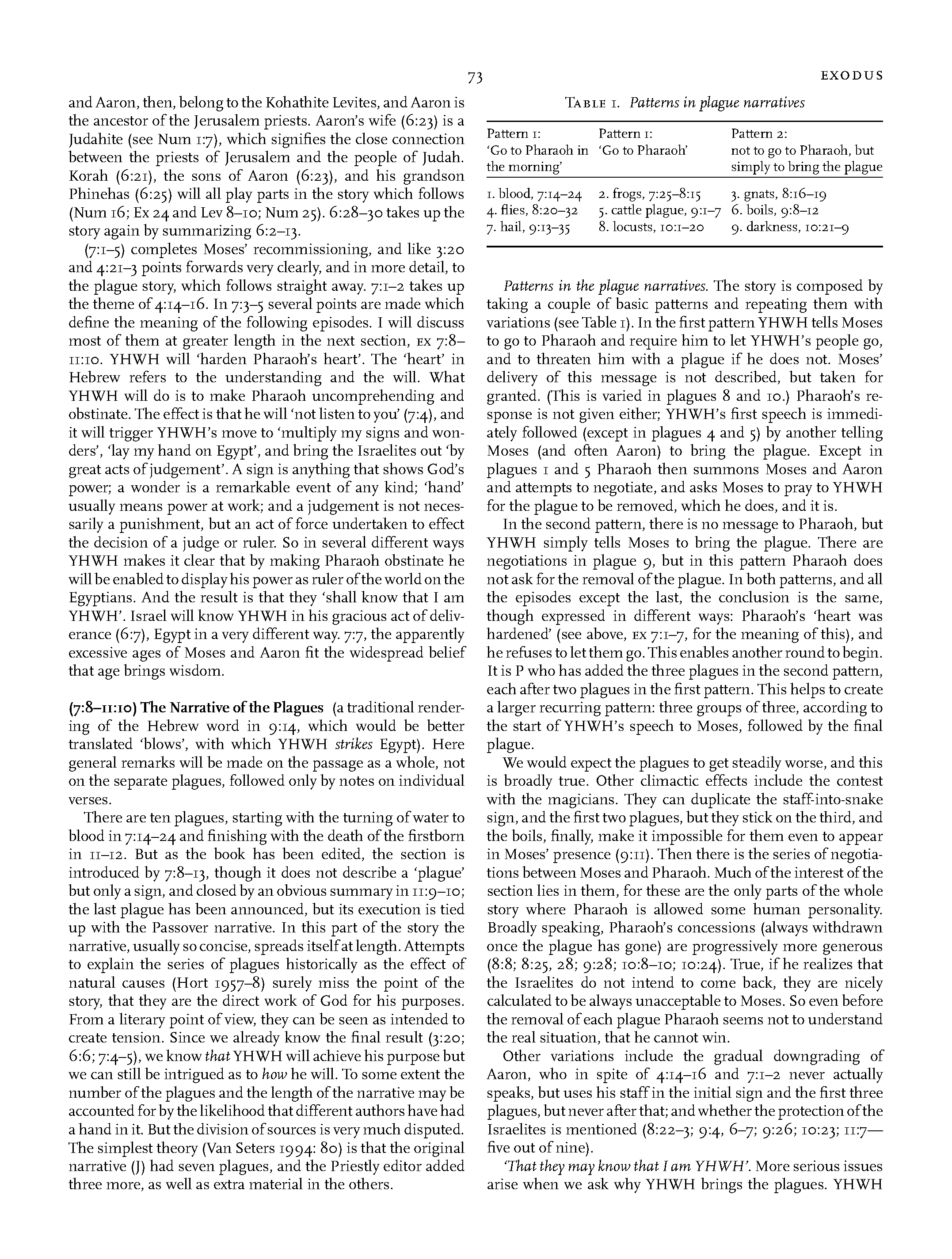
TABLE i. Patterns in plague narratives
Pattern i: Pattern i: 'Go to Pharaoh in 'Go to Pharaoh' the morning'
Pattern 2: not to go to Pharaoh, but simply to bring the plague i. blood, 7:14—24 2. frogs, 7:25—8:15 3. gnats, 8:16—19 4. flies, 8:20-32 5. cattle plague, 9:1-7 6. boils, 9:8-12 7. hail, 9:13-35 8. locusts, 10:1-20 9. darkness, 10:21-9
(7:1-5) completes Moses' recommissioning, and like 3:20 and 4:21—3 points forwards very clearly, and in more detail, to the plague story, which follows straight away. 7:1—2 takes up the theme of 4:14-16. In 7:3-5 several points are made which define the meaning of the following episodes. I will discuss most of them at greater length in the next section, EX 7:8— 11:10. YHWH will 'harden Pharaoh's heart'. The 'heart' in Hebrew refers to the understanding and the will. What YHWH will do is to make Pharaoh uncomprehending and obstinate. The effect is that he will'not listen to you' (7:4), and it will trigger YHWH's move to 'multiply my signs and wonders', 'lay my hand on Egypt', and bring the Israelites out 'by great acts of judgement'. A sign is anything that shows God's power; a wonder is a remarkable event of any kind; 'hand' usually means power at work; and a judgement is not necessarily a punishment, but an act offeree undertaken to effect the decision of a judge or ruler. So in several different ways YHWH makes it clear that by making Pharaoh obstinate he will be enabled to display his power as ruler of the world on the Egyptians. And the result is that they 'shall know that I am YHWH'. Israel will know YHWH in his gracious act of deliverance (6:7), Egypt in a very different way. 7:7, the apparently excessive ages of Moses and Aaron fit the widespread belief that age brings wisdom.
Patterns in the plague narratives. The story is composed by taking a couple of basic patterns and repeating them with variations (see Table i). In the first pattern YHWH tells Moses to go to Pharaoh and require him to let YHWH's people go, and to threaten him with a plague if he does not. Moses' delivery of this message is not described, but taken for granted. (This is varied in plagues 8 and 10.) Pharaoh's response is not given either; YHWH's first speech is immediately followed (except in plagues 4 and 5) by another telling Moses (and often Aaron) to bring the plague. Except in plagues i and 5 Pharaoh then summons Moses and Aaron and attempts to negotiate, and asks Moses to pray to YHWH for the plague to be removed, which he does, and it is.
In the second pattern, there is no message to Pharaoh, but YHWH simply tells Moses to bring the plague. There are negotiations in plague 9, but in this pattern Pharaoh does not ask for the removal of the plague. In both patterns, and all the episodes except the last, the conclusion is the same, though expressed in different ways: Pharaoh's 'heart was hardened' (see above, EX 7:1—7, for the meaning of this), and he refuses to let them go. This enables another round to begin.
It is P who has added the three plagues in the second pattern, each after two plagues in the first pattern. This helps to create a larger recurring pattern: three groups of three, according to the start of YHWH's speech to Moses, followed by the final plague.
(7:8—11:10) The Narrative of the Plagues (a traditional rendering of the Hebrew word in 9:14, which would be better translated 'blows', with which YHWH strikes Egypt). Here general remarks will be made on the passage as a whole, not on the separate plagues, followed only by notes on individual verses.
We would expect the plagues to get steadily worse, and this is broadly true. Other climactic effects include the contest with the magicians. They can duplicate the staff-into-snake sign, and the first two plagues, but they stick on the third, and the boils, finally, make it impossible for them even to appear in Moses' presence (9:11). Then there is the series of negotiations between Moses and Pharaoh. Much of the interest of the
There are ten plagues, starting with the turning of water to blood in 7:14-24 and finishing with the death of the firstborn in ii—12. But as the book has been edited, the section is introduced by 7:8—13, though it does not describe a 'plague' but only a sign, and closed by an obvious summary in 11:9-10; the last plague has been announced, but its execution is tied up with the Passover narrative. In this part of the story the narrative, usually so concise, spreads itself at length. Attempts to explain the series of plagues historically as the effect of natural causes (Hort 1957-8) surely miss the point of the story, that they are the direct work of God for his purposes. From a literary point of view, they can be seen as intended to create tension. Since we already know the final result (3:20; 6:6; 7:4-5), we know that YHWH will achieve his purpose but we can still be intrigued as to how he will. To some extent the number of the plagues and the length of the narrative may be accounted for by the likelihood that different authors have had a hand in it. But the division of sources is very much disputed. The simplest theory (Van Seters 1994: 80) is that the original narrative (J) had seven plagues, and the Priestly editor added three more, as well as extra material in the others.
section lies in them, for these are the only parts of the whole story where Pharaoh is allowed some human personality. Broadly speaking, Pharaoh's concessions (always withdrawn once the plague has gone) are progressively more generous (8:8; 8:25, 28; 9:28; 10:8-10; 10:24). True, if he realizes that the Israelites do not intend to come back, they are nicely calculated to be always unacceptable to Moses. So even before the removal of each plague Pharaoh seems not to understand the real situation, that he cannot win.
Other variations include the gradual downgrading of Aaron, who in spite of 4:14—16 and 7:1—2 never actually speaks, but uses his staff in the initial sign and the first three plagues, but never after that; and whether the protection of the Israelites is mentioned (8:22-3; 9:4> 6-7; 9:26; 10:23; II:7— five out of nine).
"That they may know that I am YHWH'. More serious issues arise when we ask why YHWH brings the plagues. YHWH
EXODUS 74 enlighten Pharaoh but to triumph over him, to'gain glory over him' (14:4). He will truly 'know that I am YHWH' only at the very end of the process (14:18), when it will do him no good at all: this must be ironical. Durham (1987: 96) and Gunn (1982: 84) may well be right in suggesting that the true audience for the demonstration is Israel, certainly from the point of view of the authors. The account is shaped by a theology interested above all in maintaining the absolute sovereignty of the God they serve.
himself says that it is so that Pharaoh and his people (and Israel, 10:2) may know him: 7:5,17; 9:14; 10:2; cf. also 8:10,22; 9:29; 11:7. Pharaoh had said in 5:2 that he did not know YHWH. He will now—to his cost. From each new round of the struggle he will find that YHWH, not he, emerges with the real power in his own land, and indeed throughout the world. 9:14—16 is especially clear. If it had just been a question of liberating Israel, one stroke would have been enough. This long-drawn torture has a different goal: 'that you may know that there is none like me in all the world'.
Believing readers will need to reflect on the question whether a God so anxious to display his power and triumph over his enemies is the God that they believe in. See Gunn 1982: 84 and, by contrast, Croatto 1981: 29. But Brueggemann (1995: 47) suggests that the struggle between YHWH and Pharaoh is not a matter of personalities; they are embodiments of opposed social policies; so that the victory of YHWH is the victory of a no-slavery policy.
The hardening of Pharaoh's heart. We may well wonder why YHWH's demonstrations of his power must be so violent and destructive. And why do they have to be repeated so often, with increasing destructiveness? The answer is there at the end of every single episode. Pharaoh fails to draw the right conclusion from his experience, so it needs to be repeated. Other people get the point (9:20; 10:7), but not Pharaoh.
Now if we had not already had the clues in 4:21 and 7:3, we might at first think that Pharaoh was responsible for his own incomprehension and obstinacy, especially as in three places we are told that 'Pharaoh hardened' his own heart (8:15, 32; 9:34). It is after all quite natural in the first three episodes (7:13; 7:22; 8:15), when his own magicians can produce the same effects, so that there is no clear demonstration of YHWH's superiority; though even here we are reminded that YHWH had foretold it, and that only he can remove the effects (8:10). Pharaoh's obstinacy in 8:15 seems to be a response to the respite from the frogs, but as plague succeeds plague this gradually ceases to be a convincing explanation. The magicians themselves point out the truth after the third plague (8:19), and his continuing blindness at 8:32 and 9:7 becomes increasingly puzzling. From 9:12, after the sixth plague, it becomes increasingly plain that it is YHWH who is hardening Pharaoh's heart, for his own purposes; so in 10:1, 20, 27, and in the summary at 11:10. This is something which Pharaoh himself and his officials do not know, hence the officials' despairing protest at 10:7. Even if Pharaoh appears to act independently, he is in fact a puppet in the hands of YHWH. Taken as a whole the narrative gives little support to the common preacher's idea that Pharaoh falls victim to a paralysis of the will set up originally by his own free decision. (This paragraph summarizes the fine analysis of Gunn 1982.)
Notes on individual verses. 7:8—13 develops 4:2—5. The motif of the contest between courtiers is a popular one (see Gen 41; Dan 2; 4; 5; i Esd 3-4), and it serves here as a comic counterpoint to the tragic struggle between YHWH and Pharaoh. Not that the magicians are clowns. They have real power, but it is soon shown not to compare with YHWH's (Durham 1987: 92). The turning of water into blood takes up 4:9, but is much more extensive and drastic. There is a seasonal reddening of the Nile waters at the time of the inundation (Hort 1957—8: 87—95), but ^ cannot be taken seriously as the origin of an account of water being actually turned into blood (Durham 1987: 97). For'Hebrews'in 7:16 see EX 1:15, andforthe request to Pharaoh, obviously a blind, see EX 3:18. In 8:10, the lesson about YHWH's power is derived by Moses from the exact fulfilment of Pharaoh's definition of the time. 8:16, 'gnats' (NRSV), or lice: biting insects at all events. 8:21, 'swarms of flies': the Hebrew simply says 'mixed swarms', without specifying the insects. 8:22: the land of Goshen, see Gen 45:10, has never been satisfactorily identified. There is no particular reason known why any animal the Israelites sacrificed would be 'offensive' (8:26; same word as in Deut 14:3) to the Egyptians; presumably it is meant to be the invention of the wily negotiator. It is odd that after all the Egyptians' livestock have died in the cattle pestilence (9:1-7), there are still some alive to be affected by the boils (9:10) and the hail (9:19—25). OT authors or editors are not concerned for narrative coherence in the way we might be.
It is possible (Childs 1974: 172) that an older version of the story was much simpler: YHWH's sole purpose was to force Pharaoh to release the Israelites, and the successive plagues were simply a response to Pharaoh's own refusal to act sensibly. But that is not the case in the story as we have it. Here YHWH prevents Pharaoh from acting sensibly in order to have an excuse for bringing the plagues on him. Gowan's comment (1994: 138) is to the point: 'If freeing the Hebrews from slavery had been God's main intention... then for God to harden Pharaoh's heart so as to extend the agonies of the process would be indefensible on any grounds.' But if his purpose is as stated in 7:5, 17, etc., to make Pharaoh know that he is God, it is strange that he acts every time to frustrate his own purpose. For that is the effect of the 'hardening', to prevent Pharaoh from understanding the truth. However often and destructively YHWH displays his power, it will have no effect on Pharaoh until YHWH wants it to. As Gowan sees (1994: 138), the truth must be that the object is not to
In 9:13-35, the seventh and longest of all the plague episodes, except the last, things are moving towards a climax, and this is signalled by YHWH's especially detailed explanation of why he is acting as he is (9:14-16). 9:31-2 is a note added, not in the right place, perhaps to explain how the locusts had anything to destroy in the next plague. Pharaoh's remark in 10:10 is ironical, actually a curse. Of course he understands very well what Moses really wants; he imposes a similar unacceptable condition in 10:24.
Ch. ii is awkward; Moses appears to be leaving in 10:29, but at 11:8 itturns outhe has been speaking to Pharaoh since 11:4. No doubt there has been some rearrangement of the text, in order to accommodate the detailed ritual instructions which are given in 12:1—28 before the final blow is actually struck. But the chapter does impressively introduce this final act. 11:2—3 repeats the instructions of 3:21-2 (see EX 3:21-2). 11:9-10
75 EXODUS strengthen and celebrate ritually both the identity of the nation and its social structure of patriarchal extended families. Unleavened Bread is not explained in 12:14-20, simply commanded; but in 12:34, 39 it is explained in story terms. Probably the story was invented to explain it, and Moses' subsequent commands in 13:3—10 do not refer to it, simply emphasizing the feast's commemorative function.
sums up the section, so that it is tied up before launching into the Passover instructions, which will be followed by the final blow and then immediately by the leaving of Egypt.
(12:1-13:16) The Passover and the Exodus from Egypt Once more the style of the narrative changes abruptly. The climax of the account of YHWH's blows against Egypt does not come until 12:29-39, and this brief narrative is surrounded with detailed ritual instructions. Some of them concern not what the people are to do immediately, but how they are to repeat the rite in time to come, which to us seems inappropriate in the context. Once again we need to understand the motivation of the writers. They are not simply writing about the past; they are offering to their people an account of events which made them a people, events which are to be celebrated and relived. The little dialogues between child and parent in 12:25-7 and
The relation between the consecration of the firstborn, also probably a very ancient practice, and the events described in the story is obvious, and is explained in 13:15. It is not just that the firstborn males of cattle are consecrated to YHWH in sacrifice, but that human firstborn are redeemed (by payment or substitution), just as they were in Egypt. There may have been a time in Israel when firstborn sons were sacrificed—see Ezek 20:26; Jer 7:31. Therefore it is appropriate that the 'horrifying' edict, as Ezekiel calls it, should be presented as revoked as a symbol of the deliverance of the whole people from slavery.
13:14-15 show how by celebration a people can keep memory alive and recreate the saving and founding act of their God. As this passage is the climax of the story of deliverance, it is natural that the theme of observance should be concentrated here.
Instructions for Passover and Unleavened Bread are also given at Deut 16:1-8; there are striking differences. Jewish interpreters have traditionally distinguished between 'the Passover of Egypt' and 'the Passover of the [subsequent] generations'. Critical scholars have tended instead to see the history of the rite in the differences: the usual view is that Passover began as a family observance, and was transferred to the temple in the time of Josiah as part of the centralization required by Deuteronomy, and that during the Exile P kept the festival alive by reviving its family character.
Three ritual observances are presented in this text as memorials of the Exodus, but the first two are held at the same time and virtually merged: Passover (pesah), the Festival of Unleavened Bread (massot), and the consecration of the firstborn. The first two celebrate the Exodus in other texts: Unleavened Bread in Ex 23:15, and Passover (and Unleavened Bread) in Deut 16:1-8; but the consecration of the firstborn is related to the Exodus only here (compare Deut 15:19-20). All three are widely believed to be very old rites of various origins which at some stage have been given an interpretation related to the Exodus. (For details see Childs 1974: 186-9; de Vaux
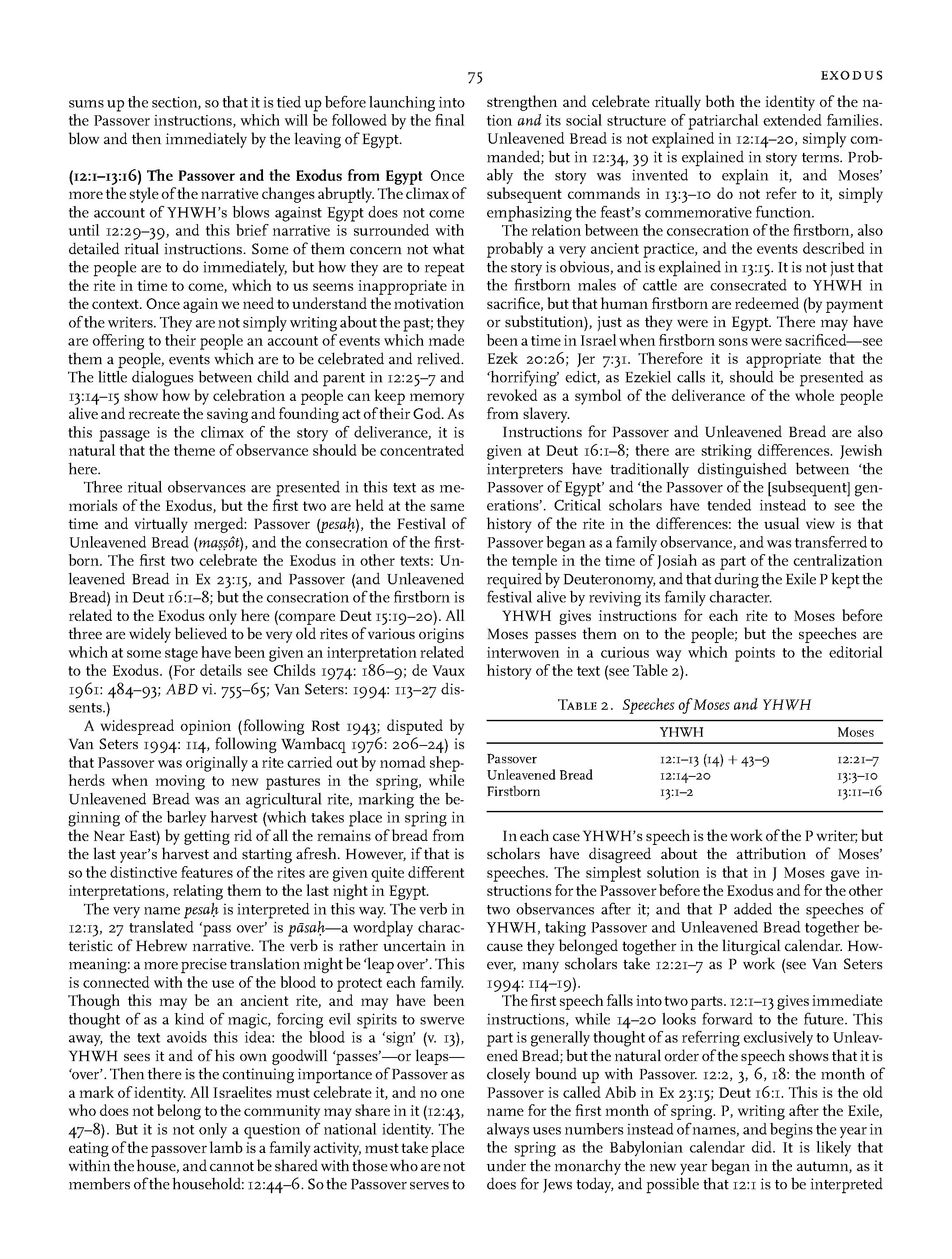
YHWH gives instructions for each rite to Moses before Moses passes them on to the people; but the speeches are interwoven in a curious way which points to the editorial history of the text (see Table 2).
1961: 484-93; ABD vi. 755-65; Van Seters: 1994: 113-27 dissents.)
TABLE 2. Speeches of Moses and YHWH
A widespread opinion (following Rost 1943; disputed by Van Seters 1994: 114, following Wambacq 1976: 206-24) is
YHWH Moses
Passover Unleavened Bread Firstborn
12:21-7 13:3-10 13:11-16
12:1-13 (:4) + 43-9 12:14-20 13:1-2 that Passover was originally a rite carried out by nomad shepherds when moving to new pastures in the spring, while Unleavened Bread was an agricultural rite, marking the beginning of the barley harvest (which takes place in spring in the Near East) by getting rid of all the remains of bread from the last year's harvest and starting afresh. However, if that is so the distinctive features of the rites are given quite different interpretations, relating them to the last night in Egypt.
In each case YHWH's speech is the work of the P writer; but scholars have disagreed about the attribution of Moses' speeches. The simplest solution is that in J Moses gave instructions for the Passover before the Exodus and for the other two observances after it; and that P added the speeches of YHWH, taking Passover and Unleavened Bread together because they belonged together in the liturgical calendar. However, many scholars take 12:21-7 as P work (see Van Seters
The very name pesah is interpreted in this way. The verb in 12:13, 27 translated 'pass over' is pasah—a wordplay characteristic of Hebrew narrative. The verb is rather uncertain in meaning: a more precise translation might be leap over'. This is connected with the use of the blood to protect each family. Though this may be an ancient rite, and may have been thought of as a kind of magic, forcing evil spirits to swerve away, the text avoids this idea: the blood is a 'sign' (v. 13), YHWH sees it and of his own goodwill 'passes'—or leaps— 'over'. Then there is the continuing importance of Passover as a mark of identity. All Israelites must celebrate it, and no one who does not belong to the community may share in it (12:43, 47-8). But it is not only a question of national identity. The eating of the passover lamb is a family activity, must take place within the house, and cannot be shared with those who are not members of the household: 12:44-6. So the Passover serves to
1994: 114-19). The first speech falls into two parts. 12:1—13 gives immediate instructions, while 14—20 looks forward to the future. This part is generally thought of as referring exclusively to Unleavened Bread; but the natural order of the speech shows that it is closely bound up with Passover. 12:2, 3, 6, 18: the month of Passover is called Abib in Ex 23:15; Deut 16:1. This is the old name for the first month of spring. P, writing after the Exile, always uses numbers instead of names, and begins the year in the spring as the Babylonian calendar did. It is likely that under the monarchy the new year began in the autumn, as it does for Jews today, and possible that 12:1 is to be interpreted
EXODUS 76
Pharaoh. His attempt to recapture them is rewarded with the total destruction of himself and his army. With the end of Israel's oppressors the story of their deliverance reaches a conclusion. It has been argued that the story of the deliverance at the sea is the original basic story of the Exodus (Noth 1962: 114—15). But we have already seen that the commemoration of the Exodus is concentrated on the last night in Egypt. It is better to see this as the last twist in the tale, the final example of the pattern where a crisis evokes a desperate cry from the people, to which YHWH graciously responds, as in 2:23—5 an(^ 5:22-6:1. From another point of view this is the beginning of the Israelites' 'wanderings in the wilderness'. We are introduced to the way in which YHWH will lead them in the wilderness, and the story is the first of several in which the people complain to Moses and YHWH graciously provides for them.
as a call for a new calendar. See 'Calendar' in ABD i. The Hebrew word translated lamb' in 12:3, etc. by NRSV is wider than our word lamb', as you can see from 12:5. The requirement for a yearling male is quite practical—these were the most expendable members of the flock. The 'bitter herbs' in 12:8 are today taken as a symbol of the bitterness of oppression: the interpretation of the rite is an ongoing process. The requirement for the animal to be roasted whole (12:9, 46) differentiates it from a public sacrifice, which was boiled (as in Deut 16:7), and also perhaps symbolizes the integrity of the family and the nation. The identification of the lamb as the passover is held back to the climax ofYHWH's speech in 12:11.
Moses passes on the instructions in 12:21-7. "^e passover lamb' may be intended to refer back to 12:11. In 12:23, <me destroyer' has been taken as a relic of an ancient belief in demons as the object of the blood-smearing; but it can just as well be interpreted as YHWH's own angel. 12:29 resumes the thread of the story broken off at 11:8. At 12:32 is a reference back to Pharaoh's last negotiations with Moses in 10:24—6, and at 12:35-6 to 11:2. 'Succoth' in 12:37 maybe identified with Tell el-Maskutah on the east border of Egypt, close to the present Suez Canal (ABD s.v. Succoth).
(13:17-22) The Israelites are, in fact, not 'wandering' in the wilderness, even if it looks like it. Their movements are determined by the purposes of God. 13:17 tells us why God does not lead them by the obvious route; w. 18, 20 trace the route on the map, first in general terms, then by mentioning the staging posts; and w. 21-2 tell us how God leads them.
The 600,000 in 12:37 is obviously historically impossible, but it is the standard biblical figure, repeated in the censuses in Num i and 26. The origin of the figure is disputed. But it was habitual for ancient scribes to exaggerate numbers. The writer produced a number which seemed fitting to him as a representation of the might ofYHWH's people marching out in freedom.
The quickest route to Canaan was along the Mediterranean coast. The author appears to suggest they would meet the Philistines there—an anachronism if the Exodus took place in the late thirteenth century BCE. But this is imaginative history which cannot be fixed in time (EX C.3). Instead, they went inland 'by way of the wilderness toward the Red Sea'. In other places (23:31; Num 21:4; i Kings 9:26) 'the Red Sea' (Heb. 'sea of reeds, weeds') refers to the Gulf of Aqaba. It is often thought that the Gulf of Suez is meant here, or one of the lakes north of it, because 15:4, 22 and other texts (but not 14) fix it as the place where the great deliverance took place, and the Gulf of Aqaba is too far away (see 14:2). For Succoth
The P editor, or a later one, adds his own reflections in 12:40—2. The figure of 430 years is fitted to his scheme of chronology. The Exodus happens 2,666 years after creation— two-thirds of 4,000 years (Blenkinsopp 1992: 48; but see Hughes 1990: 5—54). 12:41, 51 again liken the Exodus to the marching out of a military force.
(v. 20) see EX 12:1—13:16; Etham is unknown. For all topographical details from this point on, see Davies (1979). v. 19 refers back to Gen 50:25,andforward to Josh 24:32. Inw. 21-2 God's leadership is represented in a literal, visible manner. Cloud and fire are two of the commonest accompaniments of God's presence in theophanies (see EX 3:1—6). In the pillar of cloud and fire God's presence becomes permanent and mobile. This visible presence continues with them presumably to the borders of the promised land.
In 12:43-9 some further provisions for Passover are added. They underline the close connection of the feast with the integrity of the nation, symbolized by circumcision, and of the family. The translation 'bound servant' in 12:45 NRSV is very dubious, and the word is more usually thought to refer to a lodger or temporary visitor. A very brief speech by YHWH in 13:1—2 ensures that the theme of the consecration of the firstborn is given divine authority; but Moses has first to introduce the Israelites to the festival of Unleavened Bread in 13:3-10. This speech has strong Deuteronomic overtones (see EX C.i); many of the phrases can be found in Deuteronomy (e.g. the sign on the hand and the emblem on the forehead is in Deut 6:8), and the device of the dialogue with the child is used in Deut 6:20-5. But there is also a reference back to Ex 3:8 in 13:5. Moses goes on to instruct the people about the consecration of the firstborn. The first offspring of every female, if it is male, whether human or of domestic animals, belongs in principle to YHWH. However, only cattle, sheep, and goats can be sacrificed. The donkey is an 'unclean' animal which cannot (Lev 11:3—it has undivided hoofs), so a sheep must be sacrificed instead, or the donkey simply killed (13:13). A substitute sacrifice must be offered in place of human firstborn.
(14:1-31) It is clear that the action of this chapter is presented from two different points of view; but these do not clash, because they are focused on different characters, w. 1—4, 15— 18 are words of YHWH showing us the events from his point of view as the climax of his struggle with Pharaoh in the plagues narrative. (For a full discussion of this, see EX 7:8— 11:10.) YHWH deliberately entices him out to recapture the Israelites, so that he may 'gain glory' for himself (w. 4, 17). One last time, with deepest irony, he announces 'the Egyptians shall know that I am the LORD' (v. 18): as they sink to their deaths, they will know that YHWH is the true ruler of the world.
But in w. 10-14, 30"1 we see things from the Israelites' point of view. They are in panic, but Moses tells them to trust in YHWH's deliverance: 'Do not be afraid... you have only to keep still' (w. 13, 14). Moses uses a form of assurance
(13:17—15:21) The Intervention of God: Final Act The Israelites have left Egypt, but they are not yet out of the reach of
77 EXODUS
YHWH when they are finally delivered from their oppressors. This is a victory song, but the victor is God, so it is also a hymn of praise and thanksgiving. It has parallels in the Psalms, which are pointed out in the notes, but it does not rigidly follow any one model of psalm. Psalms of praise often begin with a call to the people to praise, such as Ps 118:1—4. Th£ song sung by Miriam in v. 21 is such a call and could be intended as the opening to which the men's song in 1-18 is the response that recurs again and again in the accounts of Israel's wars, where prophets urge the king or commander not to be afraid, but to trust in YHWH. Cf. particularly Isa 7:4; 28:16; 30:15. However, in the end faith comes as a result of seeing YHWH's act of salvation (v. 31). This pattern of events is repeated several times in the story of Israel in the wilderness: three times in the next three chapters, so that the lesson is rubbed in.
(Janzen 1992). The song does not describe the previous state of distress or the cry to God for help, unlike many thanksgiving psalms (Ps 18; 30; 118). Everything is concentrated on YHWH and his victory. The song achieves its effect by repeating the account of the victory in several different vivid and allusive ways, punctuated with words of praise.
Although these points of view do not clash on the theological level, there are obvious unevennesses in the story, v. 4 seems at first to be fulfilled in v. 5, but actually looks forward to v. 8. YHWH's order in v. 16 is carried out only in v. 21 and has effect only next morning! According to a widely accepted source division, in J (w. 5—7, 10—14, 19—20, 2ib, 24—5, 2jb, 30—1) Pharaoh changes his own mind, and the sea is driven back by the wind and then returns to overwhelm the Egyptians. This is the account which concentrates on the Israelites and Moses' call for faith. In P (w. 1—4, 8—9,15—18, 2ia, 2ic, 22— 3, 26-70 (to 'over the sea'), 28-9) YHWH 'hardens Pharaoh's heart', and the sea is split into two walls when Moses stretches out his hand, which fall in when he stretches out his hand again.
There is a dispute about the age of the song. One school (see Cross 1973), argues that the grammar and poetic style mark it out as very old, perhaps from the eleventh or twelfth century BCE, so a very ancient and important witness to the event of the Exodus. Others (recently Brenner 1991) say that the song relies on Ex 14 as it now stands, so that it must be quite late (fifth century?), and composed to occupy its present place; the author has deliberately created a song which looks old enough to be sung by Moses. But it is possible (Houston 1997) that v. 8 was the source from which the P author in Ex 14 took his account by interpreting its imaginative picture literally. This would make the song older than P, but not necessarily older than J. Of course, now that the song is part of the Ex text we inevitably read it in line with the account in ch. 14. The song looks forward to the completion of YHWH's work in the settling of Israel in his own land. All the promises in 3:7—12 and 6:2—8 are seen as fulfilled, really or virtually, in the miracle at the sea.
On one central point the text is at one. The Israelites are delivered and the Egyptians destroyed by God's power. Whether he uses the natural elements or the hand of Moses, he triumphs in person over the enemies of Israel, who are his own enemies.
YHWH's opening instructions to Moses (v. 2) are to turn back. This is intended as deliberate deception: it is to make Pharaoh think the Israelites are lost, and tempt him to follow them (v. 3). The place-names in v. 2 cannot be located exactly, but they are on the borders of Egypt, and by 'the sea' (see EX 13:17-22). In v. 5 Pharaoh's motive is different. He receives an intelligence report that the Israelites have 'fled'. Since he knew they were going, this must mean that they have not returned as implied in the negotiations (7:16, etc.). In w. 9,18, 23, 26,28 the NRSV has 'chariot drivers' where other versions have 'horsemen' or 'cavalry'. The Hebrew word normally means 'horseman'. NRSV is probably based on the fact that armies are known not to have had mounted cavalry before the first millennium BCE. But the author of Exodus would not have known that, and almost certainly meant 'horsemen'. A different word is translated 'rider' in 15:1, 21.
The song can be divided into: an introduction, w. 1-3; a main section praising YHWH forthe victory, 4—12; and a coda looking forward to the entry into the promised land, 13—18. For 'rider' in w. i, 21 seethe note on 14:9, etc. in EX 14:1-31. But the word here could mean 'charioteer', v. 2 is closely similar to Ps 118:14, 2^- The word for 'heap' in v. 8 is used in the account of the Jordan crossing in Josh 3:13, 16. As the text stands, this verse has to be taken as describing the 'walls' ofwater in 14:22, 29; but if the poem is older, it could have been a poetic description of a wave rearing up and about to break; the breaking is described in 10 (Houston 1997).
For the question 'who is like YHWH' (v. n) cf. Ps 89:6-8. 'Your holy abode' in v. 13 could be Sinai or the temple at Jerusalem, but v. 17 makes the latter more likely. The song praises YHWH not just for the settlement in Canaan but for the establishment of his dwelling among them at Zion. The final verse is another psalm-type motif: see Ps 93:1; 95:3; 96:10; etc. v. 19 recalls the essence of the story after the look into the future in w. 13—18.
What the Israelites claim to have told Moses in Egypt (v. 12) they have not said anywhere in the text of Exodus; but this kind of allusion is very common in Hebrew narrative. In v. 15 YHWH asks Moses why he is crying out to him ('you' is singular), but the narrator has not told us he has. Moses may be assumed to have relayed the Israelites' cry in v. 10 to YHWH. In v. 19 as elsewhere (see EX 3:1—6) 'the angel of God' may be a substitute for YHWH himself (cf 13:21). But the statement is repeated with reference to the pillar of cloud; so it is often held that in v. 19 there are two parallel sources, v. 29 is not a simple repetition ofv. 22. Ittells us thatthe Israelites had passed through in safety while the Egyptians were destroyed behind them.
There was a custom, when men came back victorious from a battle, for women to come out from the towns to meet them (hence 'went out' in v. 20) with victory songs and dances (see i Sam 18:6—7). Since this victory has been won by YHWH, not by the men, the men have celebrated it, but the women's role is not forgotten, and may well be intended to be prior to the men's (see above, and Janzen 1992; against Trible 1994:169— 73). Miriam is called a prophet probably because of this song, which is seen as inspired.
(15:1-21) Pieces of poetry occasionally break the flow of prose in the Pentateuch, often at significant points. This one is particularly suitable here: it is fitting that Israel should praise
EXODUS 78
(15:22—7) For general comments and comments on the location of the place-names, see the previous section. Nothing is said about how or why the 'tree' or 'piece of wood' (15:25) made the water sweet. It seems like magic, but to the author it is simply the way in which YHWH chooses to act. And it is YHWH who 'tests' them. They have known YHWH as a 'healer' in his 'healing' of the water; they should beware lest he act in the opposite way (as he does in Numbers).
(15:22-18:27) Israel in the Wilderness The two main accounts in Exodus are of YHWH's deliverance of Israel from Egypt and of his gracious provision for their future life with him at Sinai. But Israel have first to reach Sinai through the wilderness. What is meant by 'wilderness' in the Bible is not totally barren sand-desert, but steppe with low rainfall and sparse vegetation, suitable as pasture for sheep and goats but not much else. So there is a linking section describing this journey, but it is more than a simple link. The episodes are based on the well-known conditions of life in the wilderness, but these are used as an opportunity to develop the characterization of the Israelites and the relationship between them, Moses, and YHWH. The first three episodes in particular go very closely together. Two short stories about water frame the much longer one about the manna. In each the people raise a complaint against Moses, to which YHWH responds with gracious provision for their needs. In each Moses acts as the intermediary between YHWH and the people, both ruling them and interceding for them. The word used for 'complain' implies bad-tempered grumbling; in 16:3 and 17:3 they even suggest they would have been better off back in Egypt—thus rejecting YHWH's act of salvation. In spite of this YHWH is patient and gracious. Yet there is a harder note to the relationship, for another word which occurs in each story is 'test'. YHWH tests Israel (15:25; 16:4) to see whether they will be faithful and obedient; Israel tests or provokes YHWH (17:2, 7) by their grumbling. The theological point is very clear: life for Israel depends on trust in God's provision and obedience to his requirements. This is a lesson that reaches far beyond their temporary life in the wilderness; the best commentary is Deut 8. The main outlines of the relationship that will be literally cast in stone at Sinai begin to emerge; hence we should not be surprised that most of these stories anticipate points that are eventually grounded formally in the law given there: the 'statute and ordinance' at Marah (15:25); the sabbath provision in the manna story (16:5; 22-30); the legal system established on Jethro's advice (18:13-27). There is a similar group of stories in Num n; 12; 14; 16; 20:2—13, but in most of these the people's grumbling arouses YHWH's anger and his punishment. This arrangement is surely deliberate. Once the people have received the law and accepted the covenant, there is no excuse for them.
(16:1-36) For general comments and comments on the location of the place-names, see EX 15:22-18:27. This story seems to have originally been based on the fact that the tamarisk tree of the Sinai peninsula in May and June exudes drops of a sweet substance which is gathered and eaten by the local people, who still call it man. But the amounts are small, and obviously the story goes far beyond that natural fact. It speaks of a miracle which provides enough food every day, all the year round, to sustain a whole people on the march. And to that miracle of provision are added two further miracles which test the obedience and faith of the people. There is the miracle of precise quantity (w. 17—18). God's providing is always enough for the day, it cannot be stored (v. 2 o). And there is the miracle of the sabbath exception to this miracle (w. 22-30). The meaning of these miracles is found first in the saying in v. 5 which has echoed in one form or another through the narrative since 6:7. Here it is a rebuke to the Israelites who have spoken of Moses and Aaron as having brought them out of Egypt (v. 3). They need to understand that it is YHWH alone who can and will provide for them. The second lesson is that the generosity of YHWH is only of value to them if they on their part obey his commands. The full meaning of the sabbath will not be revealed until 20:11; but for the moment they need to understand simply that it is possible to rest for a day and still live, by YHWH's grace.