
Part 25
(19:9—18) Elijah's Meeting with God on Horeb As Moses had done before him (Ex 24; 33) Elijah hopes to meet God on Mount Horeb. He does not appear: at least, not in impressive natural phenomena (which one would have connected with the weather god Baal) and not in demonstrations of violent power (as were sometimes cherished in religious arguments, e.g. in 18:40 and in countless other examples up to the present day). Elijah encounters a completely different God on Mount Horeb. The description of his approach is extremely powerful and quietly beautiful. The image of God suggested here is in clear contrast to that of i Kings 18 and especially 2 Kings 10. Hosea's criticism of Jehu's bloody wrath (Hos 1:4) is probably the background to this scene. Although it is difficult to see the figure of Elijah as an ironic reflection of Moses in general (see Hauser and Gregory 1990), this story does show ironic traits. The prophet is twice asked the reason for his presence, and twice the same frustration breaks out in him, as if God had not appeared to him in the meantime. In speaking of the 7,000 Israelites who do not kneel before Baal in the ensuing battle, God redresses the balance of Elijah's complaint about his complete solitude. At the same time Elijah is charged with enlisting three warriors for YHWH's cause of whom at least two draw a line of blood through history: the insurgents Hazael of Aram and Jehu of Israel. The third in the group is the prophet Elisha who doubtless belongs historically more with the other two than Elijah does (see 2 Kings 8:7—15; 9:1— 10). The latter's enormous influence seems to have attracted various traditions and not least the figure of Elisha.
(19:19-21) Elijah Charges Elisha The first of Elijah's three required appointments in 19:15-16 is that of Elisha. In fact it will be the only one, since Elisha immediately takes over Elijah's staff—or his mantle!—and carries it further. Elijah's mantle was apparently his hallmark (cf. 2 Kings 2:8,14; in 1:8 a different Heb. word is used). By enveloping Elisha with it, Elijah passes on to him his spirit and his mission. Elisha appears as a rich farmer, Elijah as a restlessly wandering prophet. Acceptance of this duty requires Elisha's relinquishment of his property and family. He seems to be prepared to do this on certain conditions. Elijah's answer can be interpreted in two ways: as scoldingly rejective ('Goback again; for what have I done to you?') or as understandingly warning ('Go, but [remember] what I have done to you', Gray 1977:413). It is also unclear whether Elisha bids farewell to his parents, but he determinedly takes leave of his property and gives it to the people. From now on he is Elijah's servant and 'follows him', cf. Mt 4:19; 8:18-22. The two men were historically not so
247 I AND 2 K I N G S lation—was given a secure economic existence and thus firm citizen's rights by the allocation of sufficient land. This is shown by the attempt to legally protect landownership for everyone (Lev 25; Deut 5:21). Initially, King Ahab was forced to capitulate to this (probably still unwritten) right of his subjects: an idea which paints a positive picture of the monarchy. Nevertheless, this story shows how unscrupulously the king's power over the civilian rights could still be used and how compliant the lay assessors' court was to his wishes. The queen is the driving force behind this, since she comes from abroad and does not respect Israelite ethics, or perhaps does not know them. In any case, nobody attempts to stop her, so that evil can poison society from the top down—not merely a modern experience. If the scandal of Naboth is still an individual case for which the royal court is responsible, the theft of land by the ruling class 100 years later becomes an economic principle (Isa 5:8; Am 2:6; Mic 2:1-2). closely tied as it appears here. They stand for different styles of prophecy, being representative of single and group prophets (Schmitt 1972: 183—4). Our text may mark the beginnings of the idea of prophetic succession.
Ahab and YHWH's Prophets (i Kings 20:1-22:40) (i Kings 20:1—34) Ahab's Victory over the Arameans Following a Prophetic Oracle In i Kings 20 and 22 we are told of a series of wars between an Aramean king, Benhadad, and King Ahab of Israel. This does not fit the fact proved by Assyrian sources that Ahab and the Aramean king, Adad-idri (Aram. Hadadezer), were closely allied to each other (ANET 276—7). It is probable that the Omri dynasty was at peace with Aram, and that this relationship deteriorated only under Hazael (cf 2 Kings 8:12—13, 28—9; 13:3, and elsewhere). Thus, should our stories reflect historical fact, they belong to the time following Jehu's coup. At this point, however, they wish to describe the confrontation between King Ahab and the prophets of his time. It has been suggested that scenes containing the prophets were added to the text at a later point, and that originally the stories dealt with profane scenes of war. This is possible, though not certain. In ch. 20, the Israelite king repeatedly defeats an aggressive and arrogant enemy with the help of prophetic oracles of war. Interestingly, the Arameans considered YHWH to be a mountain god who had no power on the plains (v. 23), a belief that stemmed from underlying religious and social history. YHWH's home was originally the mountains of southern Sinai and Edom (Ex 3; Judg 5:4) and Israel itself initially developed into an ethnic and political power on the mountains of Palestine (Judg 1:27-35; I Sam 13-14; 2 Sam 2:9). Now, however, so the story tells us, the entire country belongs to YHWH (and his Israelite people)! Ahab even manages to force Ben-hadad to agree to an Israelite trading office in Damascus (v. 34). (20:35-43) A Prophetic Warning to Ahab The initially positive outcome of the war against Aram is tarnished by the following scene, as Ahab transforms from being a victor to a sinner: he should not have made business contracts with Benhadad, but should have 'devoted him to destruction', i.e. killed him. Devoting to destruction, or 'banning', passing spoils of war and their previous owners on to God, later became an underlying principle of Deuteronomistic theory and historical writing (Deut 13:12-18; 20:16-18; Josh 6-7; 11:10-15, and elsewhere). It was probably practised in the early times of the kings in Israel as in Moab—although not in every war, but only out of extreme necessity (cf. Dietrich 19960). As gruesome as this ritual is, it is equally clear that war is being waged without prospect of material gain. Once a 'banning war' had been declared, it seems that especially prophetic, i.e. strictly YHWH-following circles, insisted upon its compliance (cf. also i Sam 15). In this case, the prophet's ingenious scheming forces the king to catch himself out and bring judgement upon himself—as Nathan had once done to David (2 Sam 12).
(21:17-29) Elijah's Judgement against Ahab and his Court The loss of the farming population's rights in Israel did not occur without resistance. This can be seen in the bitterly outraged tone of the Naboth narrative, though it lacks further elaboration or explanation of this point (contra Wilrthwein 1984, who sees w. i—16 as a closed short story in its own right). Someone is required to confront the king and under such circumstances this is normally a prophet. A parallel rendering of this story in 2 Kings 9:25-6 shows that although a prophet apparently did protest against the judicial murder of Naboth (and his family) it can hardly have been Elijah. The latter's appearance in these verses has obviously been reworked several times. Originally, there was probably only a brief scene: suddenly, Elijah stands before the king in the vineyards of Naboth. He listens to Ahab's surprised question (v. 20: 'Have you found me, O my enemy?'), briefly and firmly throws his accusation at him (v. 19: 'Have you killed, and also taken possession?'), and immediately announces his judgement (v. 19: 'In the place where dogs licked the blood of Naboth, dogs will also lick up your blood'). This prophecy does not come true to the letter. Editors ensured that God gives Elijah detailed instructions regarding his task (w. 17—19, in which the slight discrepancy of the setting between Samaria and Jezreel is glossed over). Elijah must scold and warn Ahab in a lengthy speech (w. 20^-22, 24, closely related to the speeches in i Kings 14:7-11 and 2 Kings 9:7-10) in which the king's religious failings are repeated (w. 25—6). Ahab's transformation into a repentant sinner postpones his judgement to the next generation (w. 27-9). v. 23 does not (as suggested by Steck 1968) belong to a particularly anti-Jezebel authorial layer dating from the time following Ahab's death. The reference in 2 Kings 9:36-7 ascertaining the fulfilment of the prophecy proves that this section must clearly be Deuteronomistic. The text describes Elijah angrily breaking his staff over Omri's dynasty, preparing the reader for terrible deeds in the future.
(22:1—40) Micaiah ben Imlah's Prophecy and Ahab's Death Although great punishment only befalls his sons (the OT thought collectively right up to the period of exile), Ahab is not left unreprimanded. Despite his dying of natural causes according to the Annals of the Kings (22:40), the editors emend this. They insert an account of the Israelite king's (21:1—16) Ahab's and Jezebel's Judicial Murder of Naboth This story is a paradigm for the conflict between the demands of the state and the rights of the people. The farmer Naboth has the right and indeed the duty to bequeath his land to his family and not to outsiders. The ruling ideal in ancient Israel was that each farming family—over 90 per cent of the popu-
I AND 2 K I N G S
mortal wounding during a war with Aram. The story is thematically linked with i Kings 20, although here Judah and Israel are allies. The sister states were closely tied at the time of Omri's dynasty and remained so until after the uprisings of Jehu and Joash (2 Kings 9-11). So the editors entered the appropriate names, Ahab and Jehoshaphat. Ahab is given the role of the villainous hero. He causes war, gains Judah's support in arms (w. 1-4), but does not hesitate to sacrifice his ally to the enemy in order to save his own skin (w. 29-30). The outcome, however, is different (w. 31—6). The Judean remains unhurt whilst a stray arrow hits the Israelite. He remains courageous during battle (making it unclear whether he died on the battlefield, which weakens the discrepancy of 22:40), but succumbs to his injuries in the evening, v. 38 relates these events back to Elijah's prophecy (21:19). Th£ story of Micaiah ben Imlah is inserted within this narrative frame (w. 5-28). It continues the theme of the relationship between the kings of Judah and Israel, but concentrates on the conflict between optimistic court prophets and independent prophets of woe. The Judean king is apparently willing to listen to prophecy even when it is critical—a sign that this passage has been reworked by Judeans. By contrast, the Israelite king only wishes to hear what he wants from the prophets. When one prophet finally says something else, the king and his court prophets take action against the troublemaker. Nevertheless, the latter is proved right, whilst all others, despite also seeing themselves as messengers of God and using impressive symbols to prove this, are wrong. A fundamental problem regarding the prophets is the unaccountability of their own attitude towards God's messages. Here (as in Jer 28 and Mic 3:5—8) the basic rule seems to be that a prophet is less convincing the more clearly he confirms wishes and expectations. Micaiah ben Imlah declares thathis opponents are possessed by an evil spirit with whose help they wish to drive the king to death. His knowledge of this stems from witnessing (in a vision, cf Isa 6) discussions at a heavenly council. In passing on his secret knowledge to the mortally endangered king, Micaiah gives him a final chance to change course. The lying spirit, however, prevails over the spirit of truth. Micaiah's warnings to the king have the same effect as those of Isaiah to the people (Isa 6:910): they serve to entrench opinions rather than change them. True prophets seem to experience this repeatedly. dominance. Whenever the sister states were at harmony with each other, their Transjordanian neighbours suffered hardship. Judah controlled Edom and therefore had access to the Red Sea. They probably lacked the nautical skill, however, to undertake trade projects. Nevertheless they refused such help from Israel, perhaps out of age-old defensiveness towards the more powerful northern kingdom. This may be a reason for the good religious rating given to Jehoshaphat by the editors. Ahaziah, Ahab's son and successor, had no chance of mild judgement, especially since punishment of the Omri dynasty had only been postponed. Besides this, the editors knew in what light the following story would show the king and his short reign.
2 Kings
(1:1-18) Elijah and the Death of Ahaziah Having fallen through a lattice—it is unclear whether this is a window or a grid on the roof protecting an upper chamber—and suffered permanent injury, the king calls for an oracle (cf. i Kings 14), though from Baal rather than YHWH. Two qualities of this Syro-Palestinian god are described: he is the patron-god of the Philistine city Ekron (similarly Ashdod's patron seems to have been Dagon, cf. i Sam 5) and he has a second name, Zebub, meaning 'fly'. Fly-Baal: is this a title of honour revealing that his oracles were carried out to the sound of humming, or is it a (Jewish) term of abuse, derived from zebul (prince) ? In any case, this deity seems to have been particularly appropriate for a case such as Ahaziah's. An oracular consultation does not take place due to Elijah's interference in the name of YHWH. According to the present text, he does so following the explicit order of an 'angel of the LORD' (w. 3—4) and three (fifty-strong) army divisions are unable to stop him (w. 9-16). These are additions designed to underline the almost transcendental position of the prophet who cannot be ordered about and must be treated with utmost reverence! (Many biblical stories show that this advice was highly necessary: prophets had no protection, carried no weapons apart from their word, and were often faced with evil and even deadly enemies.) The original version of this story (w. 2, 5—7, 17) is rather short. Ahaziah asks the wrong god, Elijah gives him a reply devoid of hope in the name of the right one. This is thematically similar to i Kings 18: Elijah's action to promote the exclusive worship of YHWH in Israel. Clearly his name ('My God is YHWH!') was closely linked to this mission. The king does not yet know the name of the seer of woe. Description of his appearance, however—an ascetic hermit—immediately puts him in the picture. Aside from his mantle (cf. 2 Kings 2:13), another recognizable feature of Elijah seems to be that he suddenly appears precisely when he is not expected or wanted, fearlessly saying what was to be said in the name of his God (cf. i Kings 18:7; 21:17—20). It is almost unnecessary to say that king Ahaziah soon died.
Jehoshaphat of Judah and Ahaziah of Israel (i Kings 22:41-
2 Kings 1:18) (22:41-54) Jehoshaphat and Ahaziah's Governments Only now is Jehoshaphat officially introduced, although he has already been closely linked to Ahab. This agrees well with the statement in the Annals that there was no war with Israel at that time, no doubt a consequence of the Omri dynasty's
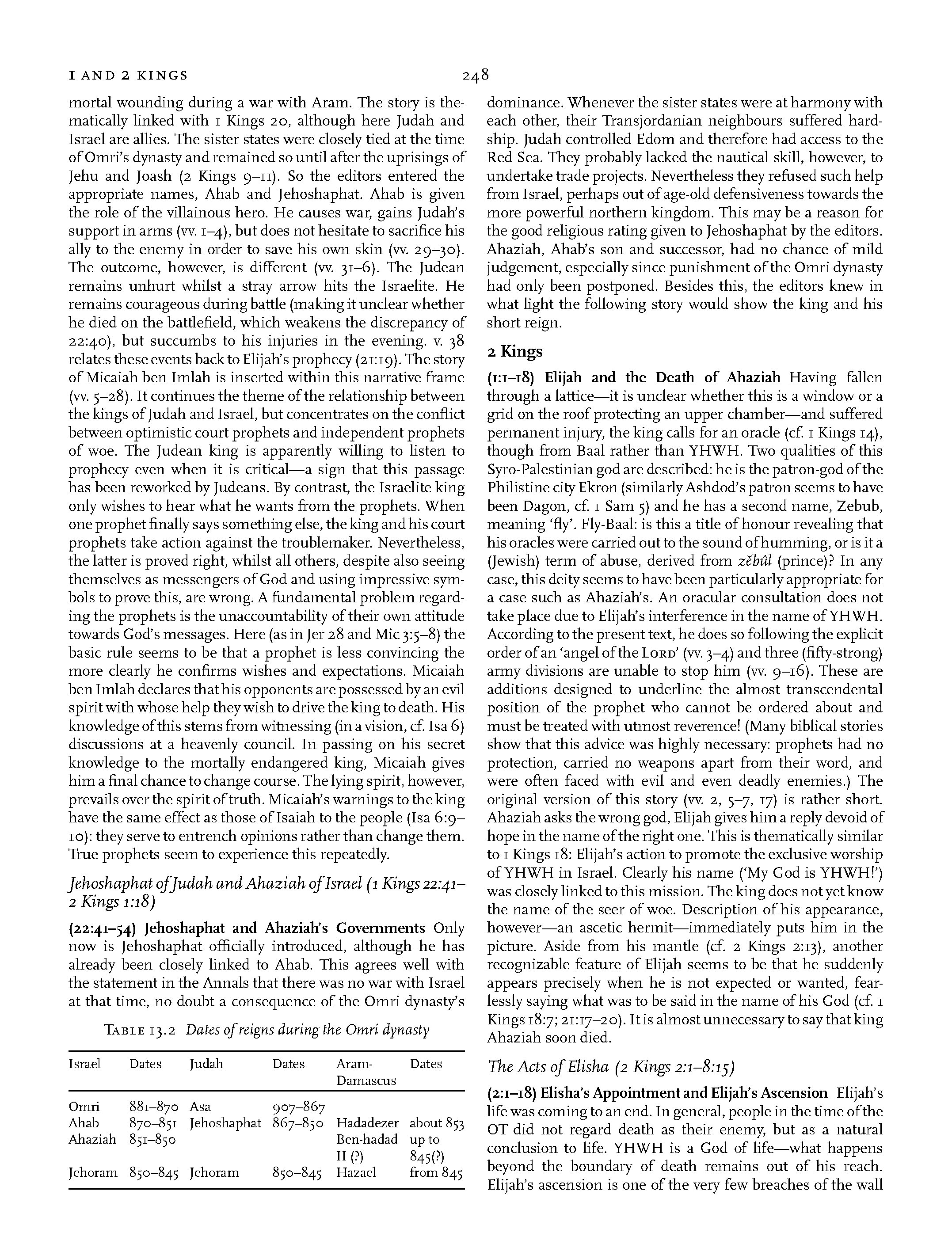
TABLE 13.2 Dates ofrdgns during the Omri dynasty
Israel
Dates
Judah
Dates
AramDamascus
Dates
The Acts of Elisha (2 Kings 2:1-8:15) (2:1—18) Elisha's Appointment and Elijah's Ascension Elijah's life was coming to an end. In general, people in the time of the OT did not regard death as their enemy, but as a natural conclusion to life. YHWH is a God of life—what happens beyond the boundary of death remains out of his reach. Elijah's ascension is one of the very few breaches of the wall
Asa Jehoshaphat
Omri Ahab Ahaziah
881-870 870-851 851-850
907-867 867-850
Hadadezer Ben-hadad II(?) Hazael
about 853 up to
Jehoram
850-845
Jehoram
850-845
249 I AND 2 K I N G S particularly mild (2 Kings 17:2)—not because he was a relatively God-fearing ruler, but in order to avoid the misunderstanding that he alone was the cause of the northern kingdom's demise. The Deuteronomistic theologians teach us that God is forbearing, allowing guilt to pile up over a long period of time before demanding atonement. The reader is then asked to apply this perspective to the fall of Judah: its cause is not its last king (Zedekiah), nor even the last kings (including Josiah!). Here too guilt has accumulated over a long period of time, up to the point when, in God's eyes, the mark was overstepped. of death made by the OT, from which the faith in resurrection develops later. It is no coincidence that of all people, Elijah was expected to return at the time of the NT (Mk 6:15; 8:28). Since he only departed rather than died, he did not even need to be resurrected, but merely return from his heavenly journey to announce the Messiah's arrival. According to the present text (w. 2—6), Elijah, Elisha, and many prophet disciples were aware of the impending departure. Elijah wishes to be alone when the time comes: miracles tended to occur at times of silence. Elisha, however, is required and wants to accompany him: as a witness to the miracle and an heir to the master. He does indeed inherithis 'spirit' (not completely, though still the double portion due the eldest son, v. 9, cf Deut 21:17). The spirit is that which is closest to the sphere of God, cf. Judg 3:10; 14:6; i Sam 10:10; n:6; Isa 11:2, and elsewhere. Elisha also inherits Elijah's mantle, which was not only his hallmark (i Kings 19:13, 19; cf. 2 Kings 1:8), but also proved to possess magic powers. Both Elijah and Elisha could divide the river Jordan with it, reminding us of Moses' division of the Reed Sea (Ex 14:21). It is strange that Elijah is given a military title of honour: 'chariot of Israel and its horsemen [better: horses]' (3:4—27) Elisha's Contribution to the Campaign against Moab Israel under the Omri dynasty was consistently a regional superpower—especially at the time of this story. The kingdoms of Judah and Edom were compliant (w. 7—8), the kingdom of Moab was a vassal liable to pay tribute (v. 4), and refusal to do so resulted in military reprisals. One such campaign, however, threatens to fail as water supplies ran out in the desert of Edom. The Judean king has the idea of calling for a prophet of YHWH, and Elisha—an Israelite!—wishes only to deal with the king of Judah (w. 11-14). This must be a remnant of Judean reworking of the text (cf. already i Kings 22). The older Israelite version of the story reports that Elisha ensured the success of the Israelite king's campaign. He placed himself in a state of trance using music (not only a modern phenomenon!) in which he could simultaneously serve as oracle and adviser. It is pointless to dig holes arbitrarily in an arid country, unless one is ordered to do so by a prophet: miraculously, the holes were filled with water (shall we think that there was an impermeable layer just below the surface?). It is still more unbelievable that the enemy believed this water to be blood (either due to its colouring or because of light reflection), leading them to throw caution to the winds, leave the protection of their defences, and be easily defeated. All this was due to Elisha. It is possible that the oldest version of this tale was a relatively sober report: the advance of the allied army against Moab was initially successful (w. 4-90, 24/7-26)—so far as one can describe the devastation of an entire region as successful—until the Moabite king, out of desperation, made a terrible sacrifice, struck Israel with 'great wrath', and forced the invaders to retreat (v. 27). The source of this 'great wrath', be it YHWH, the Moabites, or their god, remains unclear. At this point one should take note of an unusual piece of extra-biblical evidence. King Mesha of Moab (mentioned in 3:4) erected a victory stele which was discovered in the Moabite town of Diban in 1863. On it he boasts of his triumphs against Israel (text in ANET, analysis and interpretation in Dearman 1989). His description is in some points similar to 2 Kings 3: during the years before his reign Israel dominated Moab until he turned his trust to the god Chemosh and subsequently forced Israel out of the country. Mesha does not report that Israel, Judah, and Edom made a great campaign against Moab. Nevertheless such action fits well with the time of Omri's dynasty, which tended to have a policy of broad alliances (e.g. against Assyria) and which could always drag Judah in its wake. The sinister, final scene in 2 Kings 3:27 reflects something of the Moabites' religious faith, though nothing of this kind is mentioned in Mesha's report. Chemosh was in no way a lover of child sacrifices, as it may (v. 12). Originally it seems to have belonged to Elisha (2 Kings 13:14), having then been transferred to his predecessor: by contrast to Elijah, Elisha does seem to have been awarded this kind of merit: an entire cluster of stories (which was, according to Schmitt 1972, at one time an independent collection, and can be found especially in 2 Kings 3; 6—7) tells of wartime successes achieved by the Israelite kingdom with the aid of Elisha. (2:19-25) Elisha Brings Life and Death First, however, we are shown that Elisha has the same power to perform miracles as Elijah before him. To this day, one can see the spring named after Elisha at the oasis in Jericho, its wonderfully fresh and abundant water in the heat of the region being attributed to a miracle by the prophet. By stark contrast, another miracle uses incredibly destructive power against teasing children. Apparently Elisha, like his adherents, wore a tonsure which was often the subject of mockery. History tells us that ridiculing prophets can be costly (cf. 2 Kings 1:9—14), but so costly? Another forty-two deaths are mentioned in 2 Kings 10:12—14, where Jehu orders the massacre of Judean princes. Is this later crime prepared for in order to legitimize its methods in the same way as Jehu's massacre of Baal-worshippers in 2 Kings 10:17—27 is preceded in i Kings 18:40 by Elijah's murder of prophets of Baal?
(3:1-3) King Jehoram of Israel The last ruler of the Omri dynasty—not a son, but a (presumably younger) brother of his predecessor Ahaziah—received, like all northern kings, a negative, yet nevertheless more favourable, rating than his parents Ahab and Jezebel. He is said to have abolished the 'pillar of Baal', a cult-stone setup by his father. In i Kings 16:32 this is not mentioned; perhaps because it was a minor sacrilege, or confused with the 'altar of Baal'. Perhaps it is even a Deuteronomistic invention, designed to shed a positive light on Jehoram compared to his father. The usurper Jehu's arrow still struck him from behind (2 Kings 9:24), not because he personally deserved it, but because the woe which had long hung over his dynasty now befell him. The last king of Israel, Hoshea, suffered a similar fate: his concluding judgement is
appreciation, Elisha offers support from the highest offices in the state (he is obviously a very influential man). The lady proudly refuses this, referring to her own (equally influential) clan. Elisha's servant Gehazi—who was perhaps added to the Elisha stories at a later date—guesses what the lady might secretly desire: she is childless and will, according to all accounts, remain so. Elisha immediately promises her a son: a repeated theme in the Bible, usually announcing the coming of a great Israelite (cf. e.g. Gen 18:10; Judg 13:3; i Sam 1:17; Lk 1:13), but used here simply to demonstrate the power of prophetic miracles. Initially, the lady hardly dares to take Elisha at his word. She is not disrespectful in v. 16, only afraid of possible failure—an all too understandable fear, as we shall see. Although the announced birth takes place promptly and punctually (v. 17), the child is snatched away at a tender age, by sunstroke, it seems (w. 18-20). He becomes sick in the morning and dies at midday (v. 20). The desperate mother immediately knows that only Elisha can help her now. She carries the dead child's body to his chamber and locks it in there, as if to stop the spirit from going too far from the body. A dramatic race against time begins, incredible for the reader, since the child has already died. Without explaining much to her husband (his short retort still tells us that one usually only sought out prophets on holy days), the mother swiftly rides for about 2 o km. to the nearby Carmel mountains and finds Elisha there. Gehazi cannot hold her back or send her away before, 'in bitter distress', she reports to the prophet what has happened (v. 28). Nor is she satisfied with the suggestion that Gehazi should rush to Shunem with the prophet's staff (v. 29). Her wish prevails, namely that Elisha should accompany her personally (v. 30). She hopes for nothing less than an awakening of the dead and seems to realize that the prophet must be personally present for this. Gehazi can indeed achieve nothing (v. 31) and Elisha himself steps in. First of all he prays (v. 33): probably a concession to the piety of a later time. Then he undertakes a magical task in two steps (w. 34-5): by laying his entire body exactly next to the corpse he transfers his own life-energy to the child. Initially his warmed body, then a hefty sneeze, show a return to life. The story finishes abruptly (w. 36—7): Elisha places the child in its mother's arms for the second time. Presumably the drama ends on the same day as it had begun. As with other miracles, natural explanations for this phenomena, such as mouth-to-mouth resuscitation, are unnecessary. Something metaphysical has happened, achieved through the miracle-working power of a prophet and the decisive action and faith of a mother. appear here. The crown-prince's sacrifice was rather a desperate attempt to force the god into action, as we have already seen with Jephthah during his war against the Ammonites (Judg 11:30-1). We also discover from the Mesha stele that Chemosh exacted a far higher sacrifice from Israel: several Israelite villages were 'banned', i.e. given to the god and completely eradicated (cf. the Israelite analogy, i Kings 20:35-43). Th£ war rituals hinted at here are archaically gruesome, though one must not be deceived by them: they were sporadic rather than widespread. Mass armies, the destruction of entire countries, religious wars dominated by fanaticism, extensive genocide, weapons of mass destruction: none of these phenomena were contrived or practised by the small states of the ancient Near East, but are the invention of our own time.
(4:1—7) Elisha Helps a Poor Widow 2 Kings 4 gives us a view of the way of life of the groups of prophets such as the one gathered around Elisha. They led an eremitic existence in deserted areas, but had followers in the cities from where they received visitors. Occasionally they made preaching journeys to the cities themselves. Apparently, their faith filled their entire lives, so that their needs were extremely modest. The widow of a prophet-disciple is the principal figure in the first anecdote. Her husband had probably given up his material goods when he joined Elisha. He died, leaving a family in debt. The wife was unable to pay these debts and the creditor wanted her sons to work them off. This arrangement existed not only in Israel, but also throughout the ancient Near East (cf. Ex 21:2-4; Deut 15:12). In itself, the idea of forcing insolvent debtors to work for their creditors for a limited period of time is not reprehensible, since it ensures the creditor his rights and prevents the debtor from losing his land or long-term freedom. In the eighth century, though, as the prophets complain, this method was used systematically in order to rob farmers of their land (Isa 5:8; Am 2:6; Mic 2:2). The present story shows how hard debt-slavery can hit a socially weak family. In the eyes of the law a widow has lost the protection of her husband; if she then loses the support of her sons, she runs the risk of ruin. The fact that she turns to Elisha shows that he was regarded not only as the spiritual leader of the prophet-fraternity, but also as a kind of clan-chief carrying social responsibility for its members. Unfortunately, he does not have the material or legal means to help her. He can, however, perform miracles. Elisha uses one to increase what little she has beyond all measure, though not without asking for her active help. In carrying out his apparently senseless request, the widow proves her faith in him (cf. the strikingly similar structure in i Kings 17:7—16 and Mk 6:35— 44; 8:i—10). The result is several full oil-jars, obviously a fortune enough to relieve poor people of their plight. The story teaches us that those who have faith in the prophet (and his God) will not be let down.
(4:38-44) Elisha Allows his Disciples to Eat their Fill It is pleasing that a biblical story has daily domestic chores as its theme—and even makes the men do the work. In the barren landscape of the lower Jordan valley, the group of prophets must literally scrape together a living. An obviously inexperienced man finds a vegetable he does not recognize. It is the wild pumpkin (Citrullus colocynthis), which grows on flat tendrils in arid places and is used as a medicine, but if consumed in great quantities it has a toxic effect (Zohary 1983: 185). It is cut and thrown into the large cooking-pot. During the meal a woeful cry is heard. 'There is death in the pot' reveals the terror of men who often enough had too little in the pot to meet their needs. Elisha comes to their aid. A little flour (4:8—37) Elisha Helps a Childless Woman to Beara Son Elisha is described as a frequent traveller. He is regularly taken in by a rich lady in Shunem on the northern border of Jezreel (a common situation amongst wandering prophets). The guest room setup on the roof by the husband upon his wife's request shows wealth and generosity: it has firm walls and is equipped with luxurious furniture (v. 10). Wishing to show his host
251 I AND 2 K I N G S probably a later addition). Appended to this main story, designed to hail the glory of God and Elisha, a secondary narrative deals with the teaching of disciples: what can a prophet accept as recompense for such services and at what point is he selling his soul? The episode has its precursor in w. 5/7,15/7,16, where Elisha serves as a good example: in a case like this, a prophet accepts nothing. It must be clear that great power and wealth cannot force or buy the support of prophets and God. Nor must prophets let themselves be used as tools for any interest groups (cf. also Mic 3:5). Gehazi, Elisha's servant named in other stories (and probably also included at a later date, 4:27-37; 8:4-5) serves as a complementary negative example: he cunningly accepts the presents brought by Naaman for himself, but is strongly condemned by his master for this and is afflicted by the same sickness as the recently healed Aramean. Exempla decent, or: disciples of the prophet, be warned! makes their meal palatable. In the past, the search for a natural explanation for this has distracted from the intention of the story. This is a further example of Elisha's miracleworking power and how it helps those who trust in it. The same applies to the following short episode in w. 42-4, which is surely a type of the stories of the multiplication of food in the NT. Out of little comes a great deal, so much that all who are hungry can eat their fill and still not finish the food. These are symbolic stories against hunger, encouraging solidarity amongst people, and also showing God's care for his creatures.
(5:1—27) Elisha Heals the Aramean General Naarnan This story brings astonishing news: that Elisha healed neighbouring Aram's highest-ranking military officer of a stubborn illness. Unlike the kings of the time, his name has been remembered. Perhaps he was connected with unhappy memories in Israel. An Aramean campaign through Israel is mentioned (v. 2) and it is said that Aram could give Israel orders (w. 6—7). We are placed in a period of widespread Aramean hegemony over Israel, perhaps the time of Hazael and Jehu or Joash (cf 2 Kings 8:11—12; 10:32—3; 13:22). In helping the Aramean general, Elisha simultaneously helps the Israelite king. His reputation as a miracle-worker initially crosses the border by chance, through a young Israelite prisoner-of-war (6:1—7) Elisha also Helps his Disciples The following short story is deliberately inserted to show what can really help the disciples of the prophet. When they are confronted by the need for craftsmanship, someone's axe-blade falls into the water. This seemingly trivial matter was a serious problem to Elisha's followers, since they did not themselves own such valuable tools. They were borrowed and had, of course, to be returned. Called by his student, the master is willing to help. He does not, however, conjure up a new axe, but hurries to the place where the blade sank, asks to know the exact spot, and uses a kind of analogical magic before letting the disciple fish the piece of metal out of the water. The apparently banal episode is symbolically touching: God and his prophet can, in exceptional cases, defy the laws of gravity if God's people require them to do so. (6:8-23) Elisha Captures Arameans and Subsequently Ensures their Release The scene moves back from the smallerscale group of disciples to the larger political world, where Aramean troops can move across Israelite territory unhindered. The only thing the Israelite king can do is to avoid falling into their hands. Indeed he survives ambushes against him several times. The Aramean king (possibly Hazael, should this story have historical roots) can only presume he has been betrayed (v. n). But on discovering that the Israelite king (v. 12—it could be Joash) is guided by the hand of a clairvoyant prophet, he sends an army regiment with horses and chariots to Dothan (about 15 km. north of Samaria) to arrest Elisha. The city is quickly surrounded and there is no escape for Elisha. The reader sees through the eyes of the despairing servant what nobody else but Elisha can see: a heavenly host stands by Elisha, who also have horses and chariots, but theirs are made of fire (v. 17). Perhaps this is an early interpretation of Elisha's archaic title: 'chariots of Israel and its horsemen [better: horses]' (2 Kings 13:14). But it does not come to a battle with the Arameans. God 'struck them with blindness' (v. 18), so that Elisha can mock them: the one they seek—himself!—is not here. He will lead them to him. Thus he lures them into his trap, right into the middle of the strongly fortified royal city of Samaria, from which—the tide has turned—they themselves have no escape (w. 19—20). Does the core of the story form a cunning wartime tactic by Elisha? Or was the prophet always considered to be in league (v. 3). By mentioning Elisha, the girl does great service not only to her master, but also to her people and finally her God. Typically of men, however, it initially results in misunderstandings and threats rather than healing and freedom. The Aramean king orders his colleague/vassal in Samaria to produce the necessary miracle immediately, something he is naturally unable to do (w. 6-7). Naaman expects respectful behaviour and conventional miracle-healing from Elisha and threatens to leave when he does not receive this. The consequences are imaginable (w. 11-12). The general of course refuses to descend from his chariot to see the prophet who in turn sends his servant to the door instead of meeting the (enemy!) commander in person (w. 9—10). Nevertheless he is willing to help, but only according to his rules and with the active participation of the patient (v. 10). Naaman promptly finds Elisha's demand to ritually bathe in the Jordan unreasonable: as if the rivers in and around Damascus were unsuitable! As soon as Naaman complies with Elisha's instructions, following encouragement from his subjects— these are often more sensible than their rulers, v. 13!—he is immediately cured (presumably he did not suffer from leprosy, but psoriasis). Some critics have suggested that the story originally ended here, though there is no need for this hypothesis, nor is it probable, let alone the eight narrative layers suggested by Hentschel (1985: 158—60). Naaman understandably returns to his benefactor. He wishes to ensure the future proximity of the God who helped him so tangibly.
Since this God resides only in Israel, he wishes to take two mule-loads of Israelite earth to Damascus in order to be able to sacrifice to YHWH there (w. 150, 17): a splendid earthbound understanding of God, still far removed from the theoretical monotheism of, for instance, Deutero-Isaiah (e.g. Isa 45:5—6). Elisha understands the request and grants it immediately, parting from Naaman in peace (v. 19; discussion of the problems of the proselytes, as mentioned clearly in v. 18, is
due to its own means, but is granted victory when almost all hope has disappeared. Only the prophet believes that God can help even when one's own resources have been exhausted. with God? He hinders the king, however, whom he respectfully calls 'father' (cf., however, 13:14), from simply killing the enemy that has fallen into his hands. Prisoners, he teaches, are not to be killed, but to be fed and released (w. 21-2). Such humane principles helped reduce tensions and enmities even back in such times (v. 23); but they are not universally kept to the present day.
(8:1-6) Elisha Helps a Refugee The episode refers back to the story in 4:8-37, but concentrates only on the woman and her property. Her son and husband play no further part—probably a sign that the story was handed down separately. Elisha foresees famine, warns the woman, and recommends her to emigrate in advance (cf. the motive named in the stories of Ruth and Joseph and countless reports of so-called economic refugees today). In this way she does indeed survive the famine, but finds that her property belongs to someone else when she returns. It probably fell into the crown's hands since it had no owner. Had neighbours taken it over, an argument within the clan would have had to be solved. The woman appeals to the king who returns her the land on hearing of her connections with Elisha. Once again we see what influence the prophet has with the king and how much he uses it to support his followers, especially those who are in social need (cf. also 4:1-7)! Referring back to i Kings 4, this story seems to add a new aspect in w. 4-5. Here, Elisha's servant Gehazi announces all his master's great deeds to the king who is highly impressed with the prophet's miracle-working power. A recently published ostracon (inscribed potsherd) contains the plea of a widow to an official asking for transference to her of her late husband's land (see Bordreuil, Israel, and Pardee 1998). Whether or not she was successful remains unclear; she did not have a prophet as her ally.
Elisha Brings Hope in Great Wartime Hardship Despite the kind gesture of 6:23, the Aramean threat to Israel becomes critical. The enemy no longer makes plundering raids through the country, but now stands before the capital, Samaria. It was common practice to besiege cities for months, even years, in order literally to starve them out (cf. 2 Kings 17:5; 25:1—2). The narrative stresses the increasingly desperate situation: even poor-quality food and fuel is extremely expensive (v. 25), ravenous hunger drives people to cannibalism (w. 26—9, cf. also Lam 2:20; 4:10), the king is completely powerless and deeply dejected (w. 27,30). At last Elisha comes on the scene—not as a possible helper, but as his opponent who must fear for his life (w. 31-2). It seems he encouraged resistance to the enemy and trust in YHWH, though now the king's patience has come to an end (v. 33). Elisha sees attack as the best form of defence: God has told him that good-quality food will be available at normal prices within one day (7:1). A more astute and practical prophecy of salvation is hardly imaginable under the circumstances. When the king's adviser shows doubts, Elisha even risks a woeful prophecy against him (7:2). The king's silence seems to suggest that he is prepared to give Elisha one final chance. The story reaches its dramatic climax—and then surprisingly digresses to a few lepers standing at the city gates, rejected and avoided by other citizens. They are the first to witness the Arameans' sudden retreat, take personal advantage of the situation, and subsequently announce the news to state officials (w. 3—11). This is a wonderful precursor to Jesus' recognition that God loves making the last first (Mk 10:31 par). Meanwhile the reader also learns what the lepers do not know: that God brought hallucinations to the Arameans, leading them to believe in the advance of great Egyptian and Hittite armies, and forcing them to break off the siege immediately (w. 6-7). Even if there were a small number of Hittites in the area (and Egyptians further away), they would never have had the power or the will to free Samaria. This, however, is not an indication of the narrator's ignorance, but of the Arameans' confusion. Not believing in God, the Israelite king is not convinced by such a story, and suspects a trick (v. 12; cf. a very similar scene in 3:23-4). Finally, however, they dare carefully to investigate the situation—and find the Arameans' eastward retreat route to the Jordan littered with weapons and goods discarded in panic. Only now do they dare to enter the camp before the city and take possession of their provisions. Lo and behold, food prices do indeed sink to the level forecast by Elisha (w. 13—16). The story cannot end without showing the doubting adviser meeting the fate he deserves (v. 17; w. 18— 20 were probably added later as further clarification and explanation). The narrative themes are war and victory, though neither is glorified. War brings terrible suffering to mankind, especially to civilians and above all to women and children (6:28!). Furthermore, Israel is not victorious (8:7—15) Elisha Supports a Change of Power in Damascus An eminently political story is placed at the end of the Elisha cycle (though cf. also 2 Kings 13:14—21). It is highly surprising that a prophet can move about in the capital city of his most dangerous enemy and even influence the highest political circles there. The Aramean king, named here as Benhadad, becomes seriously ill and sends his general Hazael to Elisha—the prophet of YHWH and not of Hadad or Baal!— in order to request an oracle. Elisha's reply is ambiguous: Hazael should tell the king he will recover although he will also die (v. 10). The riddle is solved a little later: the king would have survived his illness (v. 14), but cannot survive Hazael's assassination attempt (v. 15). Hazael probably did not wish to wait for his predecessor's natural death, as Elisha foresaw. At the same time, a vision shows the prophet how brutally the new ruler will attack Israel (w. 11—13; cfJ Kings 19:17; 2 Kings 8:28; 10:32-3; 12:17-18; 13:3; Am 1:3). It seems that Elisha, even if only after an inner struggle, actually encourages Hazael to carry out the coup and to murder. If one remembers that the relationship between Israel and Aram at the time of the Omri dynasty was relaxed, and that the change of power in Damascus dramatically worsened it, Elisha seems to be shown in an unnervingly lurid light. The war which Hazael declares shortly after his accession leads to the Omride Joram's wounding and his murder by general Jehu (who hated Arameans). All this was suggested by Elisha (2 Kings 9-10). Was this his intention in going to Damascus? Did he take the suffering and death of many people into account in his efforts to bring about political change in Israel? Or is this story not to be understood historically, but as an
253 I AND 2 KINGS
Such notes could stem from three different sources: the Judean and the Israelite annals and the Jehu novella. The Judean annals claim that their king took part in the war against Aram and that he followed his wounded cousin Joram from Ramoth to Jezreel (8:28f). According to the Israelite annals, Joram alone waged war against Aram, his wounding giving Jehu the opportunity to carry out a putsch. This coup is referred to very sparingly in both annals, as opposed to in the Jehu novella (cf. 9:143 with i Kgs 15:27; 16:9, I5b-i7). The author of the Books of Kings placed excerpts from both annals in their correct position, having to accept their interruption of the novella's narrative flow (9:15/7 is a continuation of 9:13) and the duplication of the brief report in 9:16. He wished to make very clear that Jehu was a schemer, that he was not the first in Israel, and that it is astonishing how carelessly Joram and Ahaziah fell into his trap. After all, the threat of coups was known to be particularly high during wartime. But the fate of these two pagan kings was predestined and therefore took its inevitable course.
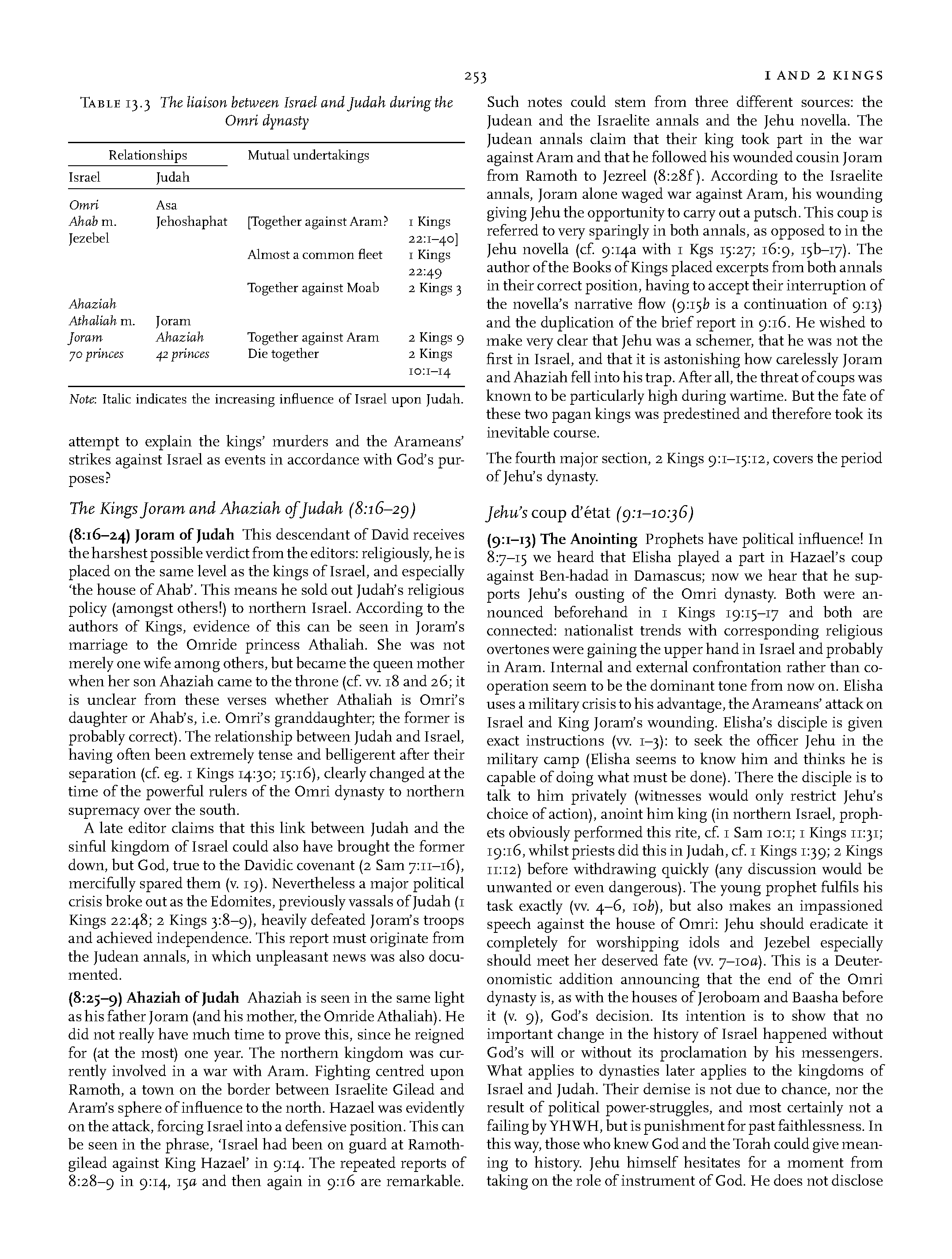
TABLE 13.3 The liaison between Israel andjudah duringthe
Omri dynasty
Relationships
Mutual undertakings
Israel
Judah
Asa Jehoshaphat
Omri Ahab m. Jezebel
[Together against Aram?
i Kings 22:1-40] i Kings 22:49 2 Kings 3
Almost a common fleet
Together against Moab
Ahaziah Athaliah m. Joram
Joram Ahaziah 42 princes
Together against Aram Die together
2 Kings 9 2 Kings 10:1—14
70 princes
Note: Italic indicates the increasing influence of Israel upon Judah. attempt to explain the kings' murders and the Arameans' strikes against Israel as events in accordance with God's purposes?
The fourth major section, 2 Kings 9:1—15:12, covers the period of Jehu's dynasty.
The Kings Joram and Ahaziah of Judah (8:16-29)
Jehu's coup d'etat (9:1-10:36) (8:16-24) Joram of Judah This descendant of David receives the harshest possible verdict from the editors: religiously, he is placed on the same level as the kings of Israel, and especially 'the house of Ahab'. This means he sold out Judah's religious policy (amongst others!) to northern Israel. According to the authors of Kings, evidence of this can be seen in Joram's marriage to the Omride princess Athaliah. She was not merely one wife among others, but became the queen mother when her son Ahaziah came to the throne (cf. w. 18 and 26; it is unclear from these verses whether Athaliah is Omri's daughter or Ahab's, i.e. Omri's granddaughter; the former is probably correct). The relationship between Judah and Israel, having often been extremely tense and belligerent after their separation (cf. eg. i Kings 14:30; 15:16), clearly changed at the time of the powerful rulers of the Omri dynasty to northern supremacy over the south.
(9:1-13) The Anointing Prophets have political influence! In 8:7—15 we heard that Elisha played a part in Hazael's coup against Ben-hadad in Damascus; now we hear that he supports Jehu's ousting of the Omri dynasty. Both were announced beforehand in i Kings 19:15-17 and both are connected: nationalist trends with corresponding religious overtones were gaining the upper hand in Israel and probably in Aram. Internal and external confrontation rather than cooperation seem to be the dominant tone from now on. Elisha uses a military crisis to his advantage, the Arameans' attack on Israel and King Joram's wounding. Elisha's disciple is given exact instructions (w. 1-3): to seek the officer Jehu in the military camp (Elisha seems to know him and thinks he is capable of doing what must be done). There the disciple is to talk to him privately (witnesses would only restrict Jehu's choice of action), anoint him king (in northern Israel, prophets obviously performed this rite, cf. i Sam 10:1; i Kings 11:31; 19:16, whilst priests did this in Judah, cf. i Kings 1:39; 2 Kings 11:12) before withdrawing quickly (any discussion would be unwanted or even dangerous). The young prophet fulfils his task exactly (w. 4-6, lofc), but also makes an impassioned speech against the house of Omri: Jehu should eradicate it completely for worshipping idols and Jezebel especially should meet her deserved fate (w. 7-100). This is a Deuteronomistic addition announcing that the end of the Omri dynasty is, as with the houses of Jeroboam and Baasha before it (v. 9), God's decision. Its intention is to show that no important change in the history of Israel happened without God's will or without its proclamation by his messengers. What applies to dynasties later applies to the kingdoms of Israel and Judah. Their demise is not due to chance, nor the result of political power-struggles, and most certainly not a failing by YHWH, but is punishment for past faithlessness. In this way, those who knew God and the Torah could give meaning to history. Jehu himself hesitates for a moment from taking on the role of instrument of God. He does not disclose
A late editor claims that this link between Judah and the sinful kingdom of Israel could also have brought the former down, but God, true to the Davidic covenant (2 Sam 7:11-16), mercifully spared them (v. 19). Nevertheless a major political crisis broke out as the Edomites, previously vassals of Judah (i Kings 22:48; 2 Kings 3:8-9), heavily defeated Joram's troops and achieved independence. This report must originate from the Judean annals, in which unpleasant news was also documented. (8:25-9) Ahaziah of Judah Ahaziah is seen in the same light as his father Joram (and his mother, the Omride Athaliah). He did not really have much time to prove this, since he reigned for (at the most) one year. The northern kingdom was currently involved in a war with Aram. Fighting centred upon Ramoth, a town on the border between Israelite Gilead and Aram's sphere of influence to the north. Hazael was evidently on the attack, forcing Israel into a defensive position. This can be seen in the phrase, 'Israel had been on guard at Ramothgilead against King Hazael' in 9:14. The repeated reports of 8:28—9 in 9:I4> J5a and then again in 9:16 are remarkable.
dow. Apparently, no one dares to disobey him. He impertubably goes in to eat, a man without emotions. As an afterthought, he remembers that one must give people of good birth a decent burial, but there is not enough left of Jezebel to bury (v. 30—5). Not for the first time, the narrator is extremely reserved in his commentary on the situation. The attempt at legitimizing events by referring back to the judgement made in i Kings 21:23 in w3^~7 must be by the hand of editors. what the prophet, 'that madman', has told him (v. n), perhaps to protect himself from being considered a 'madman'. Finally he divulges his secret and receives spontaneous support (w. 12-13). When he realizes he has the army behind him, he becomes unstoppable. Radical literary critics have claimed that the entire prophetic opening to the story of Jehu is secondary. They see the coup as a profane political event which is also reported profanely by the narrator, whose personal attitude towards it is distanced (see Wurthwein 1984, contra almost all others, including Minokami 1989 in this case). Politics and political reports had, however, religious implications at the time (as they can have today). Jehu conspires with both military and religious circles (see 10:15-16). His actions have both political and religious motives and release religious emotions.
(10:1—14) The Eradication of the Dynasties In the ancient Near East it was common to eradicate not only the ruling king, but also the entire ruling house after a coup. This minimized the threat of blood-revenge and claims to the throne. The royal house of Omri resided in Samaria (i Kings 16:24). Jehu addresses the Samarians and with seeming fairness, but implicitly threatening them, lets them choose between loyalty to the previous dynasty and defection to him, the murderer of their king (w. 1—5). Letters regarding the fate of the Omrides strongly remind us of Ahab and Jezebel's correspondence with the nobles of Jezreel concerning Naboth's fate (i Kings 21:8-10)—and the Samarians show no more character than the Jezreelites. Jehu's order was ambiguous: 'Take the heads of your master's sons and come to me,' could mean he wanted them to deliver the leading figures of the royal family into his hands. But they bring the heads of the decapitated Omrides to Jezreel, apparently seventy in number (w. 6—7). Jehu reacts cold-bloodedly. He takes responsibility for murdering the king, but not for the slaughter of the royal family. The prophet Hosea does not accept this. Roughly 100 years later, he is convinced that God 'will punish the house of Jehu for the blood of Jezreel' (Hos 1:4). A Deuteronomistic reworker of the story of Jehu feels obliged to add a pious explanation legitimating his deeds (v. 10). The Jehu narrator himself again withholds judgement, moving swiftly on to the next remarkable event instead. Forty-two male members of the Judean royal family—at that time closely tied and related to the I sraelite royal house (cf. 2 Kings 3:7; 8:26, 29)—fall into his hands near Betheked (an unlocatable village, presumably between Jezreel and Samaria). The unfortunate men are obviously ignorant of the latest developments, announce their allegiance to the Omrides, and thereby condemn themselves to death (w. 13-14). (10:15-27) The Massacre of Baal-Worshippers An indication of the contents of the drama's last act is given when Jehu meets Jehonadab ben Rechab and they become allies. Jehonadab is presumably the leader of a nomadic YHWH-worshipping religious order which had strictly detached itself from the culture and religion of the country (cf. Jer 35; Levin 1994 is most probably wrong in stating that Jehonadab is merely a chariot officer). In their common 'zeal for the LORD', they ride to Samaria. The news that further Omrides have been killed there (v. 17) is due to Deuteronomistic thoroughness, wishing to see the announcement made in 2 Kings 9:8—9 carried out to the end. Jehu (and Jehonadab) now turn their attention from the house of Omri to the house of Baal. Since the time of Ahab, there had been a temple of Baal in Samaria (i Kings 16:32) which perhaps played a similar role for the Omrides as the temple in Jerusalem did for the Davidides. As in Jerusalem, the religious leaders were close to the political powers; (9:14—37) The Kings and the Queen Mother are Murdered Before rumours have time to spread Jehu arrives in Jezreel (on the southern border of the plain of the same name) where King Joram is recovering from injury. We are told besides that his colleague (and cousin!) Ahaziah of Judah is also residing with him (v. 16). In an impressive scene from the sentinel's viewpoint (Gk. tdchoskopia), the narrator depicts the way in which Jehu steers his chariot, a usurper's irresistible charge ('like a maniac') in w. 17—20. Jehu and the reader know what drives him, although Joram is still ignorant. Since he can learn nothing from his messengers, he investigates the matter himself (v. 21), an action which leads to his downfall. He harmlessly asks if Jehu himself and his army have peace (salom). Jehu's reply mimics the question and continues with sharp criticism of the Omrides' religious policy, especially the Phoenician queen mother Jezebel (v. 22; here too the religious dimension cannot have been added secondarily, contra Wurthwein 1984, Minokami 1989). Joram now recognizes Jehu's aggressive intentions, but it is too late to flee, there only being time to warn Ahaziah. Jehu's arrow strikes him from behind between his shoulders. The narrator lets the traitor give a reason for his deed: Joram had to suffer for a sin committed by his father Ahab (w. 25,260). Unlike in i Kings 21, not only Naboth's murder, but that of his entire family is mentioned here, whilst the threatened judgement is not connected with Elijah. Precisely these discrepancies suggest the originality of the passage in the context (contra Wurthwein 1984; Minokami 1989; Timm 1982). v. 26/7 is, however, a Deuteronomistic addition. The Judean Ahaziah can initially flee to the south, but is overtaken after about 10 km. on his ascent to the mountains and shot down. Severely wounded, he manages to get as far as Megiddo, but dies there and is taken to Jerusalem by his followers. Jehu can now turn his attention to Jezebel, who is still in Jezreel. He obviously encounters no resistance on entering the city—other than from Jezebel who defends herself in her own way: lavishly decorated, she appears at the window from which royalty show themselves to the people. Thus she demonstratively and symbolically takes over the business of government following the king's death. She addresses the approaching Jehu as Zimri, thereby bringing to mind another usurper who murdered his royal master, only to be overcome himself—by Omri! (see i Kings 16:8—2 o). The affront is cutting and not without nobility. Jehu reacts impatiently and orders the lady to be thrown out of the win-
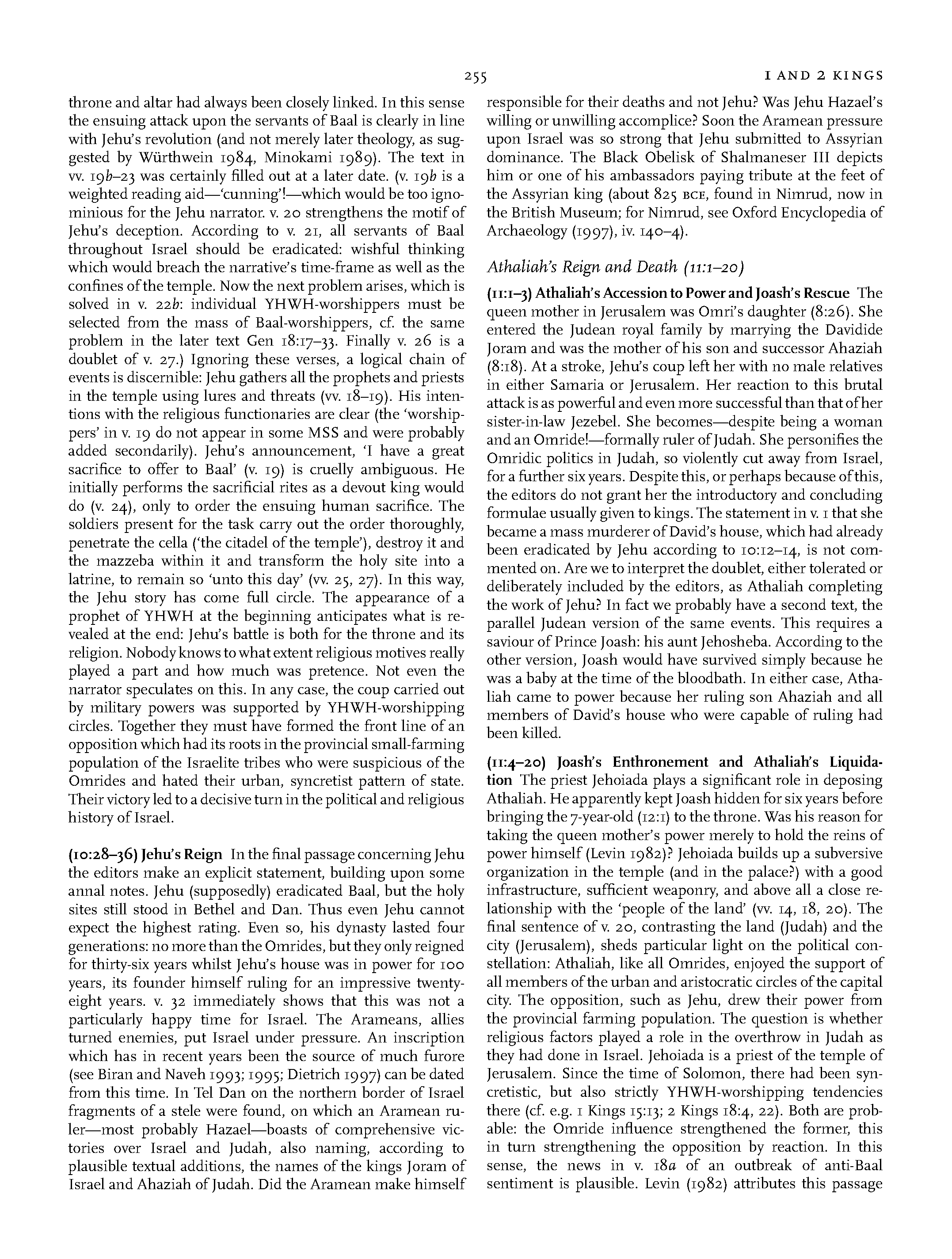
255 I AND 2 K I N G S responsible for their deaths and not Jehu? Was Jehu Hazael's willing or unwilling accomplice? Soon the Aramean pressure upon Israel was so strong that Jehu submitted to Assyrian dominance. The Black Obelisk of Shalmaneser III depicts him or one of his ambassadors paying tribute at the feet of the Assyrian king (about 825 BCE, found in Nimrud, now in the British Museum; for Nimrud, see Oxford Encyclopedia of Archaeology (1997), iv. 140-4). throne and altar had always been closely linked. In this sense the ensuing attack upon the servants of Baal is clearly in line with Jehu's revolution (and not merely later theology, as suggested by Wurthwein 1984, Minokami 1989). The text in w. 19/7-23 was certainly filled out at a later date. (v. igfc is a weighted reading aid—'cunning'!—which would be too ignominious for the Jehu narrator, v. 20 strengthens the motif of Jehu's deception. According to v. 21, all servants of Baal throughout Israel should be eradicated: wishful thinking which would breach the narrative's time-frame as well as the confines of the temple. Now the next problem arises, which is solved in v. 22/7: individual YHWH-worshippers must be selected from the mass of Baal-worshippers, cf the same problem in the later text Gen 18:17—33. Finally v. 26 is a doublet of v. 27.) Ignoring these verses, a logical chain of events is discernible: Jehu gathers all the prophets and priests in the temple using lures and threats (w. 18-19). His intentions with the religious functionaries are clear (the 'worshippers' in v. 19 do not appear in some M S S and were probably added secondarily). Jehu's announcement, 'I have a great sacrifice to offer to Baal' (v. 19) is cruelly ambiguous. He initially performs the sacrificial rites as a devout king would do (v. 24), only to order the ensuing human sacrifice. The soldiers present for the task carry out the order thoroughly, penetrate the cella ('the citadel of the temple'), destroy it and the mazzeba within it and transform the holy site into a latrine, to remain so 'unto this day' (w. 25, 27). In this way, the Jehu story has come full circle. The appearance of a prophet of YHWH at the beginning anticipates what is revealed at the end: Jehu's battle is both for the throne and its religion. Nobody knows to what extent religious motives really played a part and how much was pretence. Not even the narrator speculates on this. In any case, the coup carried out by military powers was supported by YHWH-worshipping circles. Together they must have formed the front line of an opposition which had its roots in the provincial small-farming population of the Israelite tribes who were suspicious of the Omrides and hated their urban, syncretist pattern of state. Their victory led to a decisive turn in the political and religious history of Israel.
Athaliah's Reign and Death (11:1-20) (11:1—3) Athaliah's Accession to Power and Joash's Rescue The queen mother in Jerusalem was Omri's daughter (8:26). She entered the Judean royal family by marrying the Davidide Joram and was the mother of his son and successor Ahaziah (8:18). At a stroke, Jehu's coup left her with no male relatives in either Samaria or Jerusalem. Her reaction to this brutal attack is as powerful and even more successful than that of her sister-in-law Jezebel. She becomes—despite being a woman and an Omride!—formally ruler of Judah. She personifies the Omridic politics in Judah, so violently cut away from Israel, for a further six years. Despite this, or perhaps because of this, the editors do not grant her the introductory and concluding formulae usually given to kings. The statement in v. i that she became a mass murderer of David's house, which had already been eradicated by Jehu according to 10:12-14, is not commented on. Are we to interpret the doublet, either tolerated or deliberately included by the editors, as Athaliah completing the work of Jehu? In fact we probably have a second text, the parallel Judean version of the same events. This requires a saviour of Prince Joash: his aunt Jehosheba. According to the other version, Joash would have survived simply because he was a baby at the time of the bloodbath. In either case, Athaliah came to power because her ruling son Ahaziah and all members of David's house who were capable of ruling had been killed.
(11:4-20) Joash's Enthronement and Athaliah's Liquidation The priest Jehoiada plays a significant role in deposing Athaliah. He apparently kept Joash hidden for six years before bringing the 7-year-old (12:1) to the throne. Was his reason for taking the queen mother's power merely to hold the reins of power himself (Levin 1982)? Jehoiada builds up a subversive organization in the temple (and in the palace?) with a good infrastructure, sufficient weaponry, and above all a close relationship with the 'people of the land' (w. 14, 18, 20). The final sentence of v. 20, contrasting the land (Judah) and the city (Jerusalem), sheds particular light on the political constellation: Athaliah, like all Omrides, enjoyed the support of all members of the urban and aristocratic circles of the capital city. The opposition, such as Jehu, drew their power from the provincial farming population. The question is whether religious factors played a role in the overthrow in Judah as they had done in Israel. Jehoiada is a priest of the temple of Jerusalem. Since the time of Solomon, there had been syncretistic, but also strictly YHWH-worshipping tendencies there (cf. e.g. i Kings 15:13; 2 Kings 18:4, 22). Both are probable: the Omride influence strengthened the former, this in turn strengthening the opposition by reaction. In this sense, the news in v. i8a of an outbreak of anti-Baal sentiment is plausible. Levin (1982) attributes this passage (10:28—36) Jehu's Reign In the final passage concerning Jehu the editors make an explicit statement, building upon some annal notes. Jehu (supposedly) eradicated Baal, but the holy sites still stood in Bethel and Dan. Thus even Jehu cannot expect the highest rating. Even so, his dynasty lasted four generations: no more than the Omrides, but they only reigned for thirty-six years whilst Jehu's house was in power for 100 years, its founder himself ruling for an impressive twentyeight years, v. 32 immediately shows that this was not a particularly happy time for Israel. The Arameans, allies turned enemies, put Israel under pressure. An inscription which has in recent years been the source of much furore (see Biran and Naveh 1993; 1995; Dietrich 1997) can be dated from this time. In Tel Dan on the northern border of Israel fragments of a stele were found, on which an Aramean ruler—most probably Hazael—boasts of comprehensive victories over Israel and Judah, also naming, according to plausible textual additions, the names of the kings Joram of Israel and Ahaziah of Judah. Did the Aramean make himself
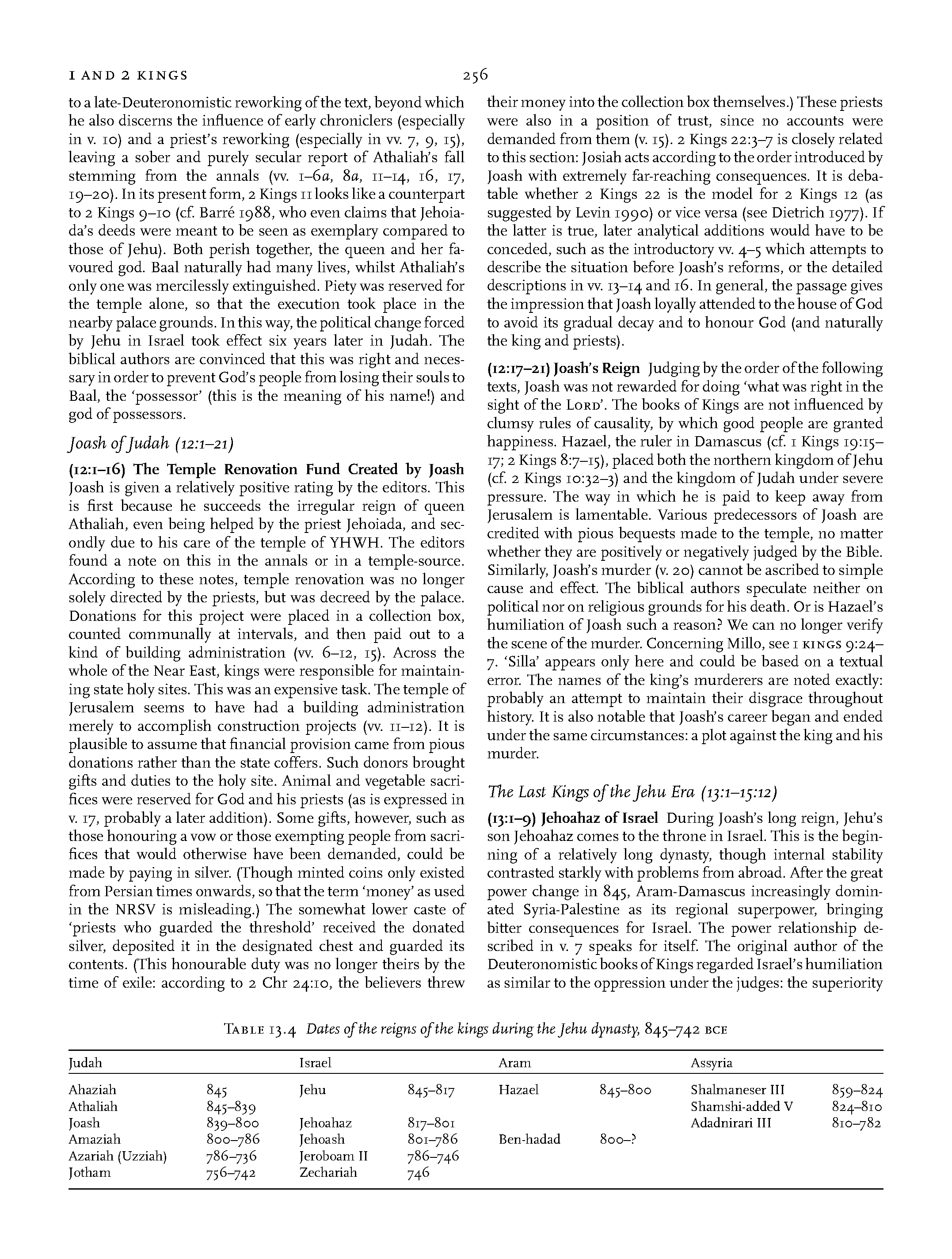
their money into the collection box themselves.) These priests were also in a position of trust, since no accounts were demanded from them (v. 15). 2 Kings 22:3—7 is closely related to this section: Josiah acts according to the order introduced by Joash with extremely far-reaching consequences. It is debatable whether 2 Kings 22 is the model for 2 Kings 12 (as suggested by Levin 1990) or vice versa (see Dietrich 1977). If the latter is true, later analytical additions would have to be conceded, such as the introductory w. 4-5 which attempts to describe the situation before Joash's reforms, or the detailed descriptions in w. 13-14 and 16. In general, the passage gives the impression that Joash loyally attended to the house of God to avoid its gradual decay and to honour God (and naturally the king and priests). to a late-Deuteronomistic reworking of the text, beyond which he also discerns the influence of early chroniclers (especially in v. 10) and a priest's reworking (especially in w. 7, 9, 15), leaving a sober and purely secular report of Athaliah's fall stemming from the annals (w. i-6a, 8a, 11-14, Z6> 17. 19—20). In its present form, 2 Kings n looks like a counterpart to 2 Kings 9—10 (cf Barre 1988, who even claims that Jehoiada's deeds were meant to be seen as exemplary compared to those of Jehu). Both perish together, the queen and her favoured god. Baal naturally had many lives, whilst Athaliah's only one was mercilessly extinguished. Piety was reserved for the temple alone, so that the execution took place in the nearby palace grounds. In this way, the political change forced by Jehu in Israel took effect six years later in Judah. The biblical authors are convinced that this was right and necessary in order to prevent God's people from losing their souls to Baal, the 'possessor' (this is the meaning of his name!) and god of possessors.
(12:17—21) Joash's Reign Judging by the order of the following texts, Joash was not rewarded for doing 'what was right in the sight of the LORD'. The books of Kings are not influenced by clumsy rules of causality, by which good people are granted happiness. Hazael, the ruler in Damascus (cf. i Kings 19:15— 17; 2 Kings 8:7—15), placed both the northern kingdom of Jehu (cf. 2 Kings 10:32-3) and the kingdom of Judah under severe pressure. The way in which he is paid to keep away from Jerusalem is lamentable. Various predecessors of Joash are credited with pious bequests made to the temple, no matter whether they are positively or negatively judged by the Bible.
Joash of Judah (12:1-21) (12:1-16) The Temple Renovation Fund Created by Joash Joash is given a relatively positive rating by the editors. This is first because he succeeds the irregular reign of queen Athaliah, even being helped by the priest Jehoiada, and secondly due to his care of the temple of YHWH. The editors found a note on this in the annals or in a temple-source. According to these notes, temple renovation was no longer solely directed by the priests, but was decreed by the palace. Donations for this project were placed in a collection box, counted communally at intervals, and then paid out to a kind of building administration (w. 6—12, 15). Across the whole of the Near East, kings were responsible for maintaining state holy sites. This was an expensive task. The temple of Jerusalem seems to have had a building administration merely to accomplish construction projects (w. 11—12). It is plausible to assume that financial provision came from pious donations rather than the state coffers. Such donors brought gifts and duties to the holy site. Animal and vegetable sacrifices were reserved for God and his priests (as is expressed in v. 17, probably a later addition). Some gifts, however, such as those honouring a vow or those exempting people from sacrifices that would otherwise have been demanded, could be made by paying in silver. (Though minted coins only existed from Persian times onwards, so that the term 'money' as used in the NRSV is misleading.) The somewhat lower caste of 'priests who guarded the threshold' received the donated silver, deposited it in the designated chest and guarded its contents. (This honourable duty was no longer theirs by the time of exile: according to 2 Chr 24:10, the believers threw
Similarly, Joash's murder (v. 20) cannot be ascribed to simple cause and effect. The biblical authors speculate neither on political nor on religious grounds for his death. Or is Hazael's humiliation of Joash such a reason? We can no longer verify the scene of the murder. Concerning Millo, see i KINGS 9:247. 'Silla' appears only here and could be based on a textual error. The names of the king's murderers are noted exactly: probably an attempt to maintain their disgrace throughout history. It is also notable that Joash's career began and ended under the same circumstances: a plot against the king and his murder.
The Last Kings of the Jehu Era (13:1-15:12) (13:1—9) Jehoahaz of Israel During Joash's long reign, Jehu's son Jehoahaz comes to the throne in Israel. This is the beginning of a relatively long dynasty, though internal stability contrasted starkly with problems from abroad. After the great power change in 845, Aram-Damascus increasingly dominated Syria-Palestine as its regional superpower, bringing bitter consequences for Israel. The power relationship described in v. 7 speaks for itself. The original author of the Deuteronomistic books of Kings regarded Israel's humiliation as similar to the oppression under the judges: the superiority
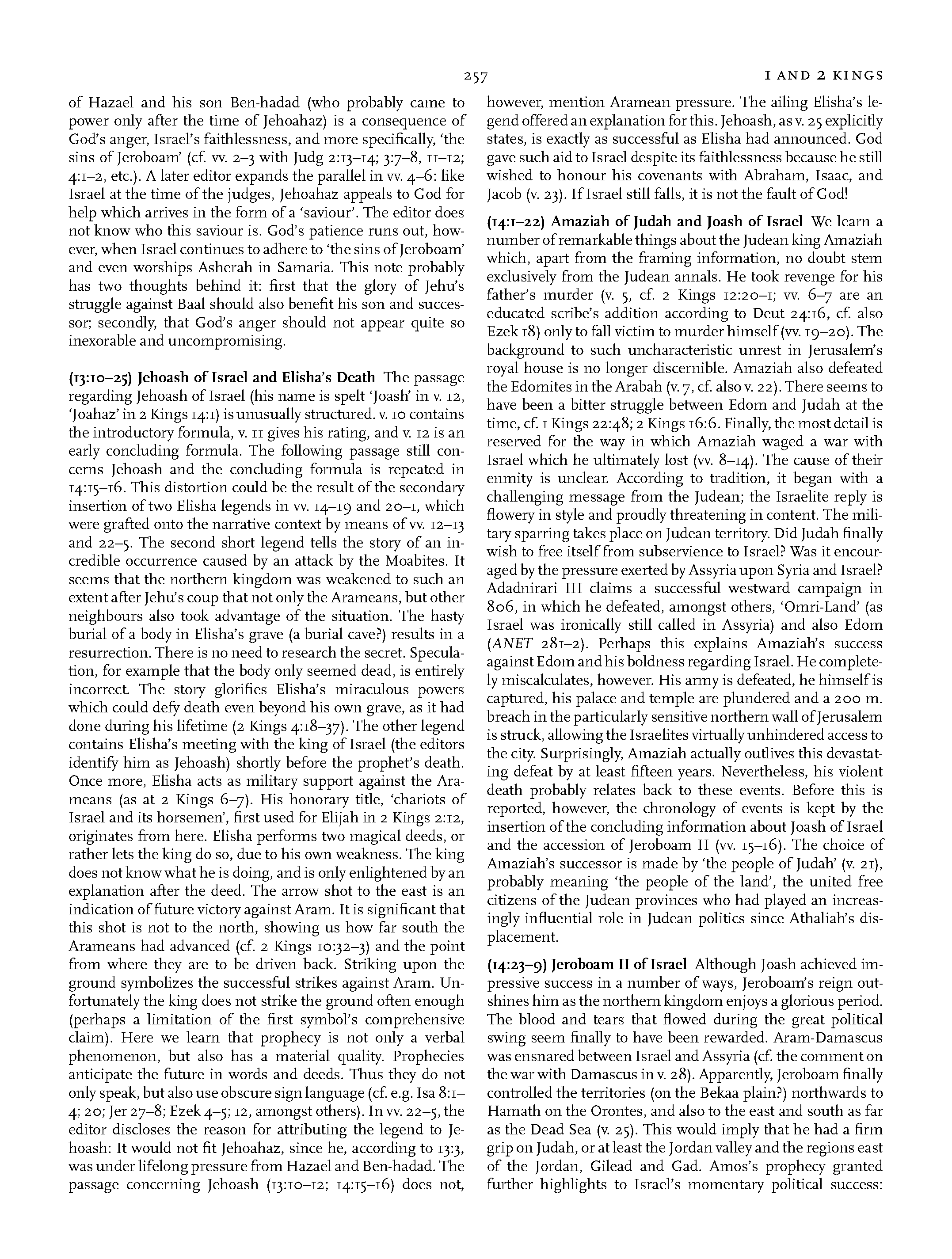
TABLE 13.4 Dates of the rtigns of the kings duringthejehu dynasty, 845-742 BCE
Judah
Israel
Aram
Assyria
Ahaziah Athaliah Joash Amaziah Azariah (Uzziah) Jotham
Jehu
845-817
Hazael 845-800
Shalmaneser III Shamshi-added V Adadnirari III
859-824 824-810 810-782
845 845-839 839-800 800-786 786-736 756-742
Jehoahaz Jehoash Jeroboam II Zechariah
Ben-hadad 800-?
257 I AND 2 K I N G S however, mention Aramean pressure. The ailing Elisha's legend offered an explanation for this. Jehoash, as v. 25 explicitly states, is exactly as successful as Elisha had announced. God gave such aid to Israel despite its faithlessness because he still wished to honour his covenants with Abraham, Isaac, and Jacob (v. 23). If Israel still falls, it is not the fault of God! of Hazael and his son Ben-hadad (who probably came to power only after the time of Jehoahaz) is a consequence of God's anger, Israel's faithlessness, and more specifically, 'the sins of Jeroboam' (cf w. 2-3 with Judg 2:13-14; 3:7-8, 11-12; 4:1-2, etc.). A later editor expands the parallel in w. 4-6: like Israel at the time of the judges, Jehoahaz appeals to God for help which arrives in the form of a 'saviour'. The editor does not know who this saviour is. God's patience runs out, however, when Israel continues to adhere to 'the sins of Jeroboam' and even worships Asherah in Samaria. This note probably has two thoughts behind it: first that the glory of Jehu's struggle against Baal should also benefit his son and successor; secondly, that God's anger should not appear quite so inexorable and uncompromising.