
Part 104
6. To this point, the discussion has had to do with relative chronology. In order to develop an absolute chronology, it is necessary to determine some fixed dates. Paul himself is not all that helpful in this regard. The reference to King Aretas in 2 Cor 11:32 is the only instance where he names an otherwise identifiable secular figure. Still, one reference is better than none. As observed above, Murphy-O'Connor (1996: 5—7) has argued that Paul's departure from Damascus can be dated to about 37 CE; while this may represent more precision than the evidence allows, at least one can say that the event had to have taken place before Aretas's death in 39 or 40 (Riesner 1998: 84-9). The other possible anchor-point is provided by the reference to Paul's appearance before Gallic, the proconsul of Achaia (Acts 18:12). In 1905 an inscription was discovered at Delphi containing the text of a letter from Claudius to the city, which also referred to Gallic as proconsul. Since the term of office for a proconsular governor of a province was normally one year, commencing on the first of July, it is possible to fix Paul's appearance before Gallic to some time in the latter part of 51 CE (Murphy-O'Connor 1996: 15-22; Riesner 202-11). This, of course, assumes that Luke's report is reliable; advocates of a letters-based chronology place Paul's time in Corinth much earlier, and thus are required to dismiss the Acts account entirely.
1073 INTRODUCTION TO THE PAULINE CORPUS argue for an inverted sequence. Most commentators place Galatians prior to Romans and in the same general timeframe as the Corinthian correspondence, though as has already been observed there is a minority view that holds it to be the earliest of the letters. As for the 'prison epistles'— Philippians, Philemon, and Colossians (if authentic)—while traditionally they have been seen as written during Paul's Roman imprisonment, there is a growing body of opinion that would place some or all of them earlier, perhaps in an Ephesian imprisonment between i and 2 Corinthians (see 2 Cor 1:8; note the reference to many imprisonments in 2 Cor 11:23).
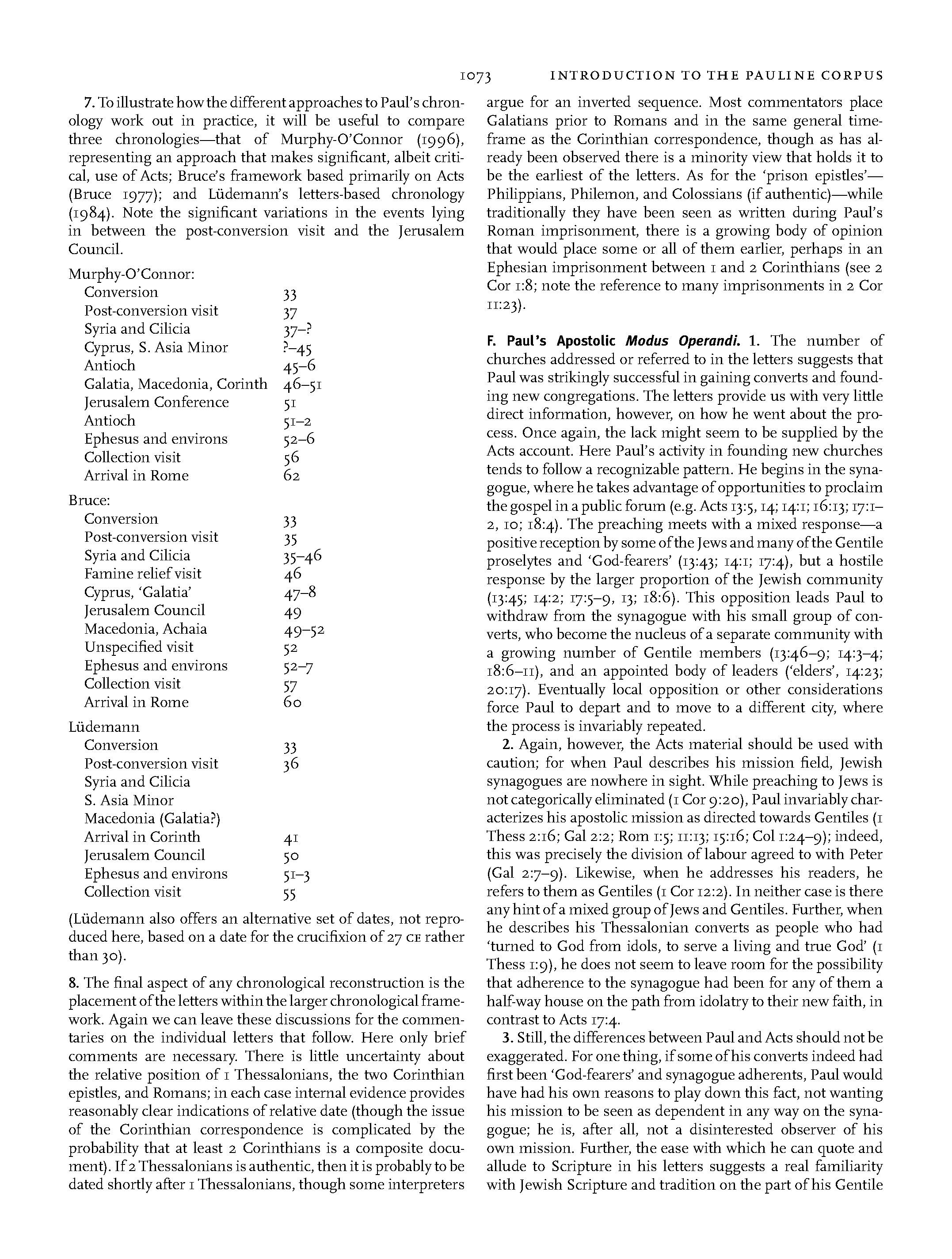
7. To illustrate how the different approaches to Paul's chronology work out in practice, it will be useful to compare three chronologies—that of Murphy-O'Connor (1996), representing an approach that makes significant, albeit critical, use of Acts; Bruce's framework based primarily on Acts (Bruce 1977); and Liidemann's letters-based chronology (1984). Note the significant variations in the events lying in between the post-conversion visit and the Jerusalem Council.
Murphy-O'Connor:
Conversion Post-conversion visit Syria and Cilicia Cyprus, S. Asia Minor Antioch Galatia, Macedonia, Corinth Jerusalem Conference Antioch Ephesus and environs Collection visit Arrival in Rome
33 37 37-? ?-45 45-6 46-51 51 51-2 52-6 56 62
F. Paul's Apostolic Modus Operand!. 1. The number of churches addressed or referred to in the letters suggests that Paul was strikingly successful in gaining converts and founding new congregations. The letters provide us with very little direct information, however, on how he went about the process. Once again, the lack might seem to be supplied by the Acts account. Here Paul's activity in founding new churches tends to follow a recognizable pattern. He begins in the synagogue, where he takes advantage of opportunities to proclaim the gospel in a public forum (e.g. Acts 13:5,14; 14:1; 16:13; I7'-I~ 2, 10; 18:4). The preaching meets with a mixed response—a positive reception by some of the Jews and many of the Gentile proselytes and 'God-fearers' (13:43; 14:1; 17:4), but a hostile response by the larger proportion of the Jewish community (13:45; 14:2; 17:5-9, 13; 18:6). This opposition leads Paul to withdraw from the synagogue with his small group of converts, who become the nucleus of a separate community with a growing number of Gentile members (13:46—9; 14:3—4; 18:6-11), and an appointed body of leaders ('elders', 14:23; 20:17). Eventually local opposition or other considerations force Paul to depart and to move to a different city, where the process is invariably repeated.
Bruce:
Conversion Post-conversion visit Syria and Cilicia Famine relief visit Cyprus, 'Galatia' Jerusalem Council Macedonia, Achaia Unspecified visit Ephesus and environs Collection visit Arrival in Rome
33 35 35-46 46 47-8 49 49-52 52 52-7 57 60
Ludemann
2. Again, however, the Acts material should be used with caution; for when Paul describes his mission field, Jewish synagogues are nowhere in sight. While preaching to Jews is not categorically eliminated (i Cor 9:20), Paul invariably characterizes his apostolic mission as directed towards Gentiles (i Thess 2:16; Gal 2:2; Rom 1:5; 11:13; I5:I6; Col 1:24-9); indeed, this was precisely the division of labour agreed to with Peter
Conversion Post-conversion visit Syria and Cilicia S. Asia Minor Macedonia (Galatia?) Arrival in Corinth Jerusalem Council Ephesus and environs Collection visit
33 36
4i 5° 5i-3 55 (Ludemann also offers an alternative set of dates, not reproduced here, based on a date for the crucifixion of 27 CE rather than 30).
(Gal 2:7—9). Likewise, when he addresses his readers, he refers to them as Gentiles (i Cor 12:2). In neither case is there any hint of a mixed group of Jews and Gentiles. Further, when he describes his Thessalonian converts as people who had 'turned to God from idols, to serve a living and true God' (i Thess 1:9), he does not seem to leave room for the possibility that adherence to the synagogue had been for any of them a half-way house on the path from idolatry to their new faith, in contrast to Acts 17:4.
8. The final aspect of any chronological reconstruction is the placement of the letters within the larger chronological framework. Again we can leave these discussions for the commentaries on the individual letters that follow. Here only brief comments are necessary. There is little uncertainty about the relative position of i Thessalonians, the two Corinthian epistles, and Romans; in each case internal evidence provides reasonably clear indications of relative date (though the issue of the Corinthian correspondence is complicated by the probability that at least 2 Corinthians is a composite document). If 2 Thessalonians is authentic, then it is probably to be dated shortly after i Thessalonians, though some interpreters
3. Still, the differences between Paul and Acts should not be exaggerated. For one thing, if some of his converts indeed had first been 'God-fearers' and synagogue adherents, Paul would have had his own reasons to play down this fact, not wanting his mission to be seen as dependent in any way on the synagogue; he is, after all, not a disinterested observer of his own mission. Further, the ease with which he can quote and allude to Scripture in his letters suggests a real familiarity with Jewish Scripture and tradition on the part of his Gentile
INTRODUCTION TO THE PAULINE CORPUS 1074 of the kind of appointed 'elders' referred to in Acts (e.g. Acts 14:23). Indeed, a striking feature of the letters is that in dealing with local conflicts Paul does not bring local office-holders into the picture, either to instruct them or to encourage his readers to submit to them. He tended to operate more on the basis of a charismatic, gift-based leadership (Rom 12:4—7; J Cor 12: 1—31; cf Eph 4: ii—16), though one should not underestimate the de facto leadership role played by the head of the household in which the church met.
readers, a fact not inconsistent with the idea that some of them had had a prior association with the synagogue. In addition, Paul's statement in i Cor 9:20 that 'to the Jews I became as a Jew, in order to win Jews', indicates thathe did not consider Jews to be out of bounds for him. Indeed, given the evidence for Jewish communities in most of the cities where he worked, it would be difficult to imagine that he could have carried on a mission that did not impinge on the synagogue community in some way.
4. Nevertheless, Paul's letters represent our primary source, and we should not allow the more fully developed but nevertheless schematized picture in Acts to control or overshadow the information emerging from the letters themselves. Further, the task of setting the information from both Acts and the letters into a richer description of Paul's mission has been aided of late by more sociologically informed studies—both those that draw on models of how new religions grow and develop (on the Christian mission generally, see Stark 1996) and those that attempt detailed descriptions of Paul's social context (e.g. Meeks 1983). One emphasis arising from both types of study is the importance of various social networks in the spread of a new religious movement. While the role of public preaching and teaching should not be eliminated entirely, more emphasis should be placed on family networks (e.g. i Cor 7:13-16), on the extended household with its various networks of slaves, freedmen, tenants, clients, and so on (e.g. i Cor 1:16), and on the networks involved in the carrying out of a trade (Hock 1980). Indeed, the frequency of references to house-churches (i Cor 16:19; R°m J6:3-5, 23; Philem i; Col 4:15) suggests that households provided the primary social context in which Paul's churches were embedded (though other models such as voluntary associations may have helped shape the new communities as well; see Ascough 1997).
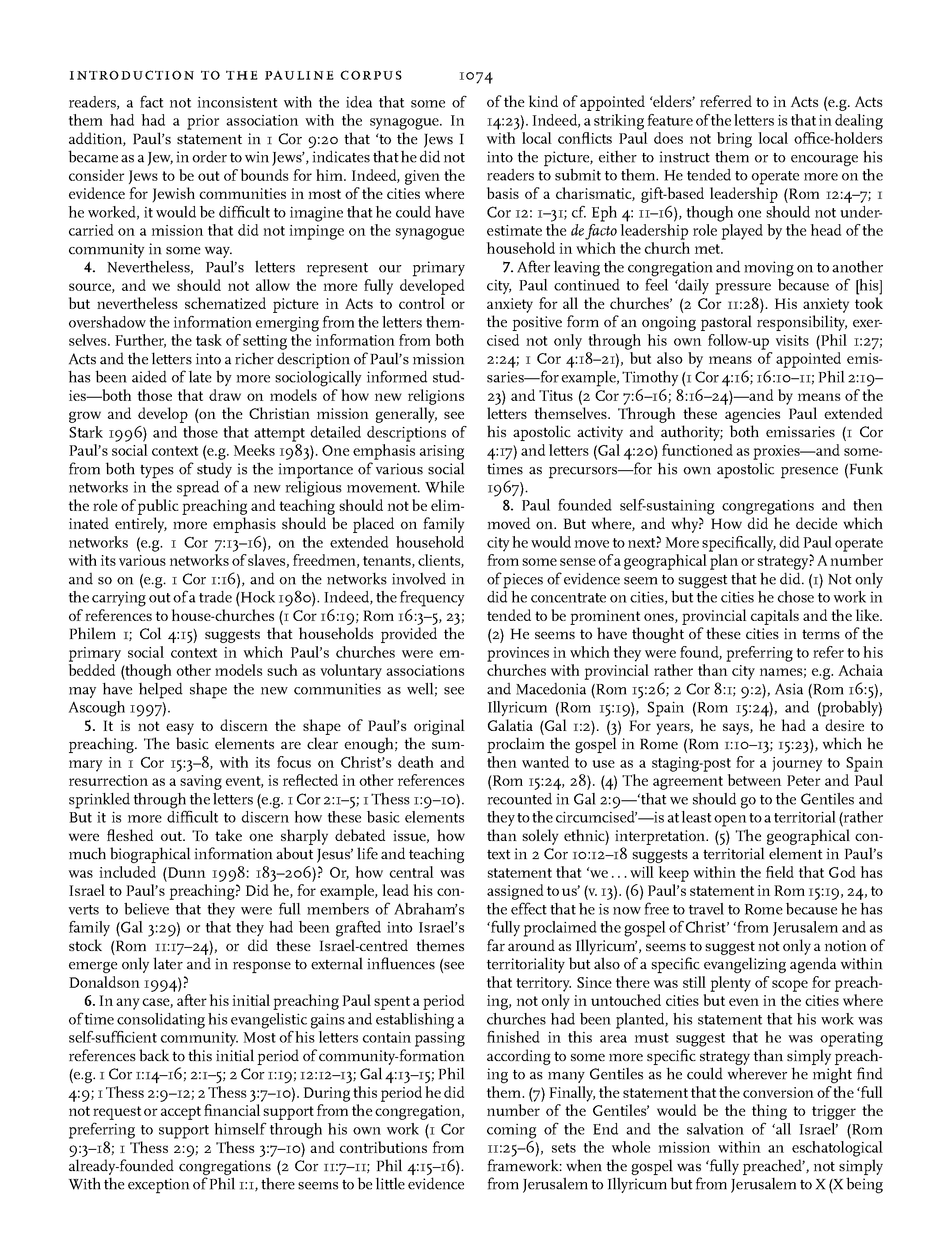
7. After leaving the congregation and moving on to another city, Paul continued to feel 'daily pressure because of [his] anxiety for all the churches' (2 Cor 11:28). His anxiety took the positive form of an ongoing pastoral responsibility, exercised not only through his own follow-up visits (Phil 1:27; 2:24; i Cor 4:18-21), but also by means of appointed emissaries—for example, Timothy (i Cor 4:16; 16:10-11; Phil 2:1923) and Titus (2 Cor 7:6-16; 8:16-24)—and by means of the letters themselves. Through these agencies Paul extended his apostolic activity and authority; both emissaries (i Cor 4:17) and letters (Gal 4:20) functioned as proxies—and sometimes as precursors—for his own apostolic presence (Funk 1967). 8. Paul founded self-sustaining congregations and then moved on. But where, and why? How did he decide which city he would move to next? More specifically, did Paul operate from some sense of a geographical plan or strategy? A number of pieces of evidence seem to suggest that he did. (i) Not only did he concentrate on cities, but the cities he chose to work in tended to be prominent ones, provincial capitals and the like.
(2) He seems to have thought of these cities in terms of the provinces in which they were found, preferring to refer to his churches with provincial rather than city names; e.g. Achaia and Macedonia (Rom 15:26; 2 Cor 8:1; 9:2), Asia (Rom 16:5), Illyricum (Rom 15:19), Spain (Rom 15:24), and (probably) Galatia (Gal 1:2). (3) For years, he says, he had a desire to proclaim the gospel in Rome (Rom 1:10-13; I5:23)> which he then wanted to use as a staging-post for a journey to Spain
5. It is not easy to discern the shape of Paul's original preaching. The basic elements are clear enough; the summary in i Cor 15:3-8, with its focus on Christ's death and resurrection as a saving event, is reflected in other references sprinkled through the letters (e.g. i Cor 2:1—5; iThess 1:9—10). But it is more difficult to discern how these basic elements were fleshed out. To take one sharply debated issue, how much biographical information about Jesus' life and teaching was included (Dunn 1998: 183—206)? Or, how central was Israel to Paul's preaching? Did he, for example, lead his converts to believe that they were full members of Abraham's family (Gal 3:29) or that they had been grafted into Israel's stock (Rom 11:17—24), or did these Israel-centred themes emerge only later and in response to external influences (see Donaldson 1994)?
(Rom 15:24, 28). (4) The agreement between Peter and Paul recounted in Gal 2:9—'that we should go to the Gentiles and they to the circumcised'—is at least open to a territorial (rather than solely ethnic) interpretation. (5) The geographical context in 2 Cor 10:12—18 suggests a territorial element in Paul's statement that 'we... will keep within the field that God has assigned to us' (v. 13). (6) Paul's statement in Rom 15:19, 24, to the effect that he is now free to travel to Rome because he has 'fully proclaimed the gospel of Christ' 'from Jerusalem and as far around as Illyricum', seems to suggest not only a notion of territoriality but also of a specific evangelizing agenda within that territory. Since there was still plenty of scope for preaching, not only in untouched cities but even in the cities where churches had been planted, his statement that his work was finished in this area must suggest that he was operating according to some more specific strategy than simply preaching to as many Gentiles as he could wherever he might find them. (7) Finally, the statement that the conversion of the 'full number of the Gentiles' would be the thing to trigger the coming of the End and the salvation of 'all Israel' (Rom 11:25—6), sets the whole mission within an eschatological framework: when the gospel was 'fully preached', not simply from Jerusalem to Illyricum but from Jerusalem to X (X being
6. In any case, after his initial preaching Paul spent a period of time consolidating his evangelistic gains and establishing a self-sufficient community. Most of his letters contain passing references back to this initial period of community-formation (e.g. i Cor 1:14—16; 2:1—5; 2 Cor 1:19; 12:12—13; Gal4:13—15; Phil 4:9; iThess 2:9—12; 2Thess3:7—10). During this period he did not request or accept financial support from the congregation, preferring to support himself through his own work (i Cor 9:3-18; i Thess 2:9; 2 Thess 3:7-10) and contributions from already-founded congregations (2 Cor 11:7—11; Phil 4:15—16). With the exception of Phil 1:1, there seems to be little evidence
1075 INTRODUCTION TO THE PAULINE CORPUS
G. The Letters. 1. Paul wrote neither theological treatises nor narratives but letters, and a proper understanding of his literary legacy requires that we take seriously its epistolary character. To do this, we must look not only at the letters themselves, but also at the letter-writing conventions that were present in the Graeco-Roman world. Fortunately, we are the beneficiaries of a century of careful comparative study, with the result that the shape and texture of Paul's letters are being brought ever more clearly into focus.
wherever he considered the end of the territory to be), then the parousia would take place.
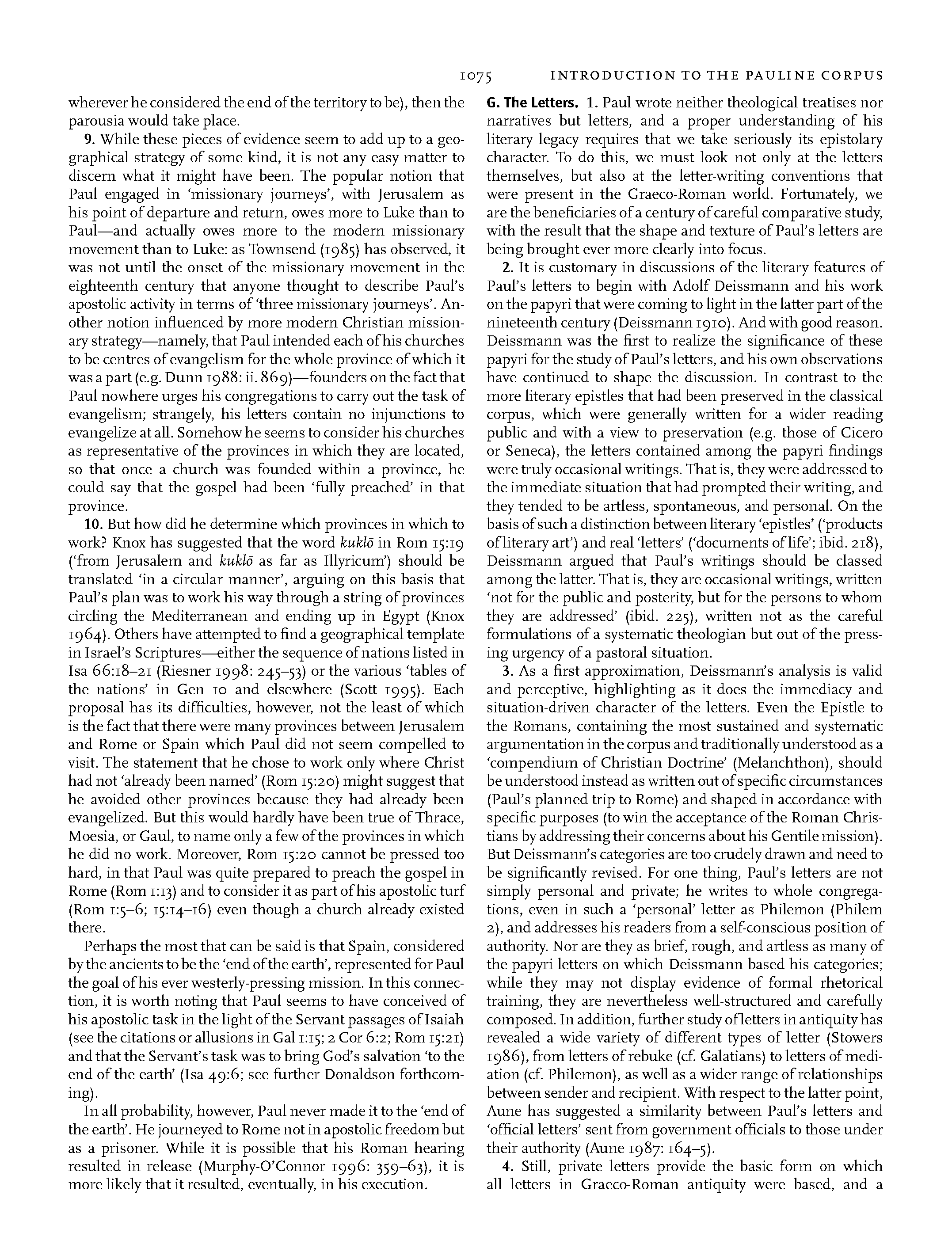
9. While these pieces of evidence seem to add up to a geographical strategy of some kind, it is not any easy matter to discern what it might have been. The popular notion that Paul engaged in 'missionary journeys', with Jerusalem as his point of departure and return, owes more to Luke than to Paul—and actually owes more to the modern missionary movement than to Luke: as Townsend (1985) has observed, it was not until the onset of the missionary movement in the eighteenth century that anyone thought to describe Paul's apostolic activity in terms of'three missionary journeys'. Another notion influenced by more modern Christian missionary strategy—namely, that Paul intended each of his churches to be centres of evangelism for the whole province of which it was a part (e.g. Dunn 1988: ii. 869)—founders on the fact that Paul nowhere urges his congregations to carry out the task of evangelism; strangely, his letters contain no injunctions to evangelize at all. Somehow he seems to consider his churches as representative of the provinces in which they are located, so that once a church was founded within a province, he could say that the gospel had been 'fully preached' in that province.
2. It is customary in discussions of the literary features of Paul's letters to begin with Adolf Deissmann and his work on the papyri that were coming to light in the latter part of the nineteenth century (Deissmann 1910). And with good reason. Deissmann was the first to realize the significance of these papyri for the study of Paul's letters, and his own observations have continued to shape the discussion. In contrast to the more literary epistles that had been preserved in the classical corpus, which were generally written for a wider reading public and with a view to preservation (e.g. those of Cicero or Seneca), the letters contained among the papyri findings were truly occasional writings. That is, they were addressed to the immediate situation that had prompted their writing, and they tended to be artless, spontaneous, and personal. On the basis of such a distinction between literary 'epistles' ('products of literary art') and real 'letters' ('documents of life'; ibid. 218), Deissmann argued that Paul's writings should be classed among the latter. That is, they are occasional writings, written 'not for the public and posterity, but for the persons to whom they are addressed' (ibid. 225), written not as the careful formulations of a systematic theologian but out of the pressing urgency of a pastoral situation.
10. But how did he determine which provinces in which to work? Knox has suggested that the word kuklo in Rom 15:19
('from Jerusalem and kuklo as far as Illyricum') should be translated 'in a circular manner', arguing on this basis that Paul's plan was to work his way through a string of provinces circling the Mediterranean and ending up in Egypt (Knox 1964). Others have attempted to find a geographical template in Israel's Scriptures—either the sequence of nations listed in Isa 66:18-21 (Riesner 1998: 245-53) orthe various 'tables of the nations' in Gen 10 and elsewhere (Scott 1995). Each proposal has its difficulties, however, not the least of which is the fact that there were many provinces between Jerusalem and Rome or Spain which Paul did not seem compelled to visit. The statement that he chose to work only where Christ had not 'already been named' (Rom 15:20) might suggest that he avoided other provinces because they had already been evangelized. But this would hardly have been true of Thrace, Moesia, or Gaul, to name only a few of the provinces in which he did no work. Moreover, Rom 15:20 cannot be pressed too hard, in that Paul was quite prepared to preach the gospel in Rome (Rom 1:13) and to consider it as part of his apostolic turf (Rom 1:5-6; 15:14-16) even though a church already existed there.
3. As a first approximation, Deissmann's analysis is valid and perceptive, highlighting as it does the immediacy and situation-driven character of the letters. Even the Epistle to the Romans, containing the most sustained and systematic argumentation in the corpus and traditionally understood as a 'compendium of Christian Doctrine' (Melanchthon), should be understood instead as written out of specific circumstances
(Paul's planned trip to Rome) and shaped in accordance with specific purposes (to win the acceptance of the Roman Christians by addressing their concerns about his Gentile mission). But Deissmann's categories are too crudely drawn and need to be significantly revised. For one thing, Paul's letters are not simply personal and private; he writes to whole congregations, even in such a 'personal' letter as Philemon (Philem 2), and addresses his readers from a self-conscious position of authority. Nor are they as brief, rough, and artless as many of the papyri letters on which Deissmann based his categories; while they may not display evidence of formal rhetorical training, they are nevertheless well-structured and carefully composed. In addition, further study of letters in antiquity has revealed a wide variety of different types of letter (Stowers 1986), from letters of rebuke (cf Galatians) to letters of mediation (cf. Philemon), as well as a wider range of relationships between sender and recipient. With respect to the latter point, Aune has suggested a similarity between Paul's letters and 'official letters' sent from government officials to those under their authority (Aune 1987: 164-5).
Perhaps the most that can be said is that Spain, considered by the ancients to be the 'end of the earth', represented for Paul the goal of his ever westerly-pressing mission. In this connection, it is worth noting that Paul seems to have conceived of his apostolic task in the light of the Servant passages of Isaiah
(see the citations or allusions in Gal 1:15; 2 Cor 6:2; Rom 15:21) and that the Servant's task was to bring God's salvation 'to the end of the earth' (Isa 49:6; see further Donaldson forthcoming).
In all probability, however, Paul never made it to the 'end of the earth'. He journeyed to Rome not in apostolic freedom but as a prisoner. While it is possible that his Roman hearing resulted in release (Murphy-O'Connor 1996: 359—63), it is more likely that it resulted, eventually, in his execution.
4. Still, private letters provide the basic form on which all letters in Graeco-Roman antiquity were based, and a
INTRODUCTION TO THE PAULINE CORPUS 1076 knowledge (cf. ch. 8), and in spiritual gifts (cf. chs. 12,14). In Philemon, before pressing his request that Philemon receive Onesimus back with love (v. 16) and so refresh Paul's heart (v. 20), he gives thanks for Philemon's demonstrated 'love for all the saints' (v. 5) and for the way in which 'the hearts of the saints have been refreshed' already through Philemon. In less capable hands, this section would have been crudely manipulative. In Paul's more subtle and even elegant phrasing, however, this section functions as a kind of overture, introducing the themes to follow and predisposing the recipients to a receptive reading of the letter as a whole. The one exception is Galatians, where Paul moves straight from the prescript (concluded, unusually, with a doxology) to an expression of astonishment at the culpable folly of the readers. Here the prayer/ thanksgiving section is omitted for effect, or one could even argue that it has been replaced with a curse section (Gal 1:6-9). 6. At this point in both Graeco-Roman letters and in Paul we move into the body of the letter, where the sender sets out to accomplish the purpose for which the letter was being written. Here, the sheer variety of purposes and forms means that it is not as easy to identify epistolary patterns at work in letter bodies as a whole. Still, comparative work has by no means been fruitless (White 1972). For one thing, many of the formulae by which Paul introduces his subject-matter or takes up new themes are frequently found elsewhere: e.g. T am astonished that'; T want you to know that'; T beseech/appeal to you'; T rejoice that'; T am confident that'—all are frequent in Paul and richly documented in Graeco-Roman sources (Aune 1987: 188; Longenecker 1990: pp. cv—cviii). As observed already, letter bodies can be further categorized according to the particular function intended for the letter (Stowers 1986). Also, as will be picked up in more detail below, considerable new light has been shed on the letters, particularly on the letter bodies, by analysing them in terms of the conventions of ancient rhetoric. Finally, it is possible in at least some of the letters to identify a section of parenaesis at the end of the body proper (Rom 12:1—15:13; Gal 5:1—6:10; i Thess 4:1—5:22), i.e., a combination of instruction and encouragement, no doubt related to the particular circumstances prompting the letter, but in ways that are not always readily discerned.
comparison between Paul and the epistolary papyri is very illuminating. Paul's letters are composed according to the conventional pattern of the day, although he adapted it in ways that made his letters particularly effective means of extending and reinforcing his apostolic activity.
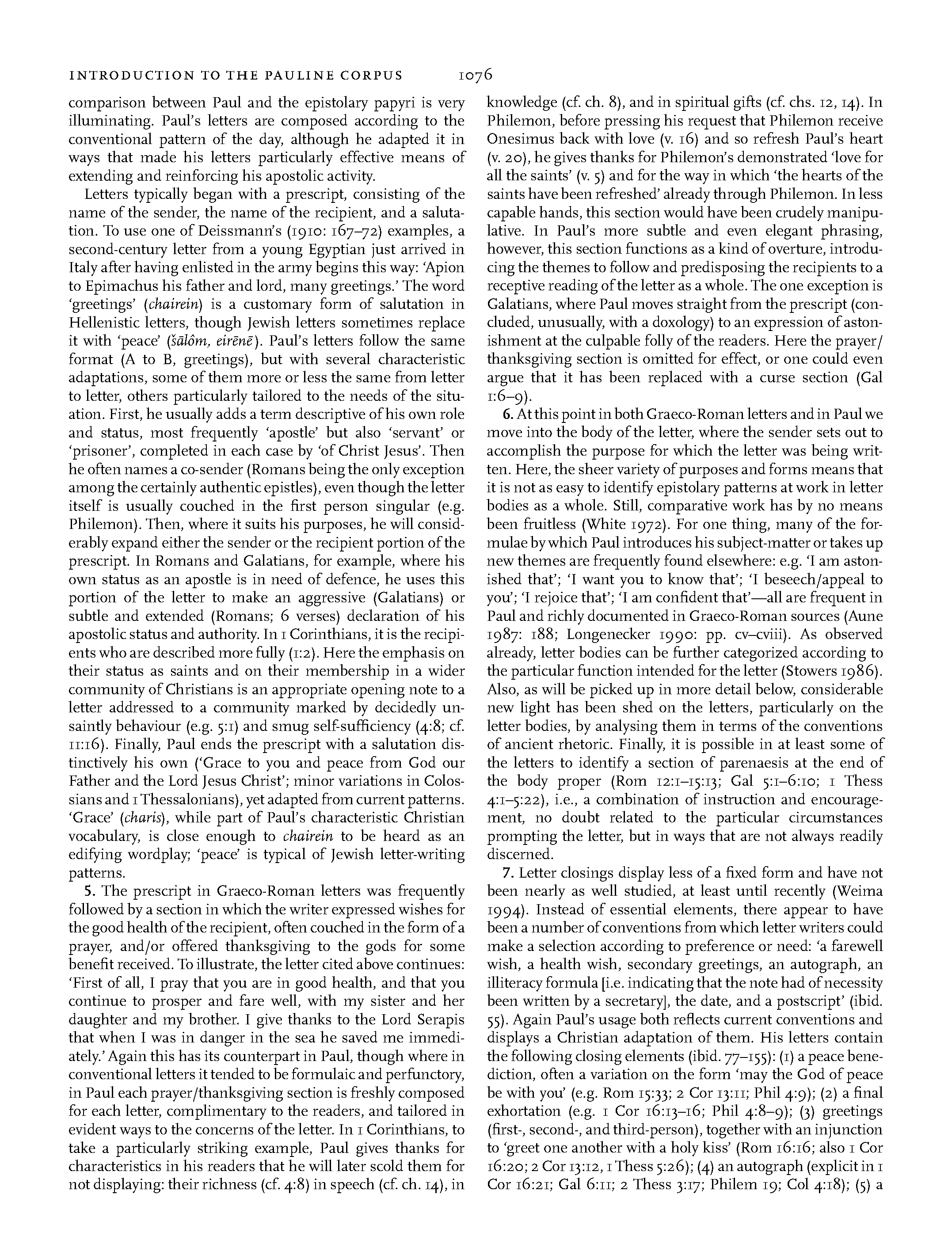
Letters typically began with a prescript, consisting of the name of the sender, the name of the recipient, and a salutation. To use one of Deissmann's (1910: 167-72) examples, a second-century letter from a young Egyptian just arrived in Italy after having enlisted in the army begins this way: 'Apion to Epimachus his father and lord, many greetings.' The word 'greetings' (chairdn) is a customary form of salutation in Hellenistic letters, though Jewish letters sometimes replace it with 'peace' (salom, eirene). Paul's letters follow the same format (A to B, greetings), but with several characteristic adaptations, some of them more or less the same from letter to letter, others particularly tailored to the needs of the situation. First, he usually adds a term descriptive of his own role and status, most frequently 'apostle' but also 'servant' or 'prisoner', completed in each case by 'of Christ Jesus'. Then he often names a co-sender (Romans being the only exception among the certainly authentic epistles), even though the letter itself is usually couched in the first person singular (e.g. Philemon). Then, where it suits his purposes, he will considerably expand either the sender or the recipient portion of the prescript. In Romans and Galatians, for example, where his own status as an apostle is in need of defence, he uses this portion of the letter to make an aggressive (Galatians) or subtle and extended (Romans; 6 verses) declaration of his apostolic status and authority. In i Corinthians, it is the recipients who are described more fully (1:2). Here the emphasis on their status as saints and on their membership in a wider community of Christians is an appropriate opening note to a letter addressed to a community marked by decidedly unsaintly behaviour (e.g. 5:1) and smug self-sufficiency (4:8; cf 11:16). Finally, Paul ends the prescript with a salutation distinctively his own ('Grace to you and peace from God our Father and the Lord Jesus Christ'; minor variations in Colossians and i Thessalonians), yet adapted from current patterns. 'Grace' (charis), while part of Paul's characteristic Christian vocabulary, is close enough to chairdn to be heard as an edifying wordplay; 'peace' is typical of Jewish letter-writing patterns.
7. Letter closings display less of a fixed form and have not been nearly as well studied, at least until recently (Weima 1994). Instead of essential elements, there appear to have been a number of conventions from which letter writers could make a selection according to preference or need: 'a farewell wish, a health wish, secondary greetings, an autograph, an illiteracy formula [i.e. indicating that the note had of necessity been written by a secretary], the date, and a postscript' (ibid. 55). Again Paul's usage both reflects current conventions and displays a Christian adaptation of them. His letters contain the following closing elements (ibid. 77-155): (i) a peace benediction, often a variation on the form 'may the God of peace be with you' (e.g. Rom 15:33; 2 Cor 13:11; Phil 4:9); (2) a final exhortation (e.g. i Cor 16:13-16; Phil 4:8-9); (3) greetings (first-, second-, and third-person), together with an injunction to 'greet one another with a holy kiss' (Rom 16:16; also i Cor 16:20; 2 Cor 13:12, i Thess 5:26); (4) an autograph (explicit in i Cor 16:21; Gal 6:11; 2 Thess 3:17; Philem 19; Col 4:18); (5) a
5. The prescript in Graeco-Roman letters was frequently followed by a section in which the writer expressed wishes for the good health of the recipient, often couched in the form of a prayer, and/or offered thanksgiving to the gods for some benefit received. To illustrate, the letter cited above continues: 'First of all, I pray that you are in good health, and that you continue to prosper and fare well, with my sister and her daughter and my brother. I give thanks to the Lord Serapis that when I was in danger in the sea he saved me immediately.' Again this has its counterpart in Paul, though where in conventional letters it tended to be formulaic and perfunctory, in Paul each prayer/thanksgiving section is freshly composed for each letter, complimentary to the readers, and tailored in evident ways to the concerns of the letter. In i Corinthians, to take a particularly striking example, Paul gives thanks for characteristics in his readers that he will later scold them for not displaying: their richness (cf. 4:8) in speech (cf. ch. 14), in
1077 INTRODUCTION TO THE PAULINE CORPUS
11. Any discussion of the actual functioning of the individual letters themselves or of the ends to which their particular persuasive powers are turned is best left to the individual commentaries to follow. More generally, however, one can say that what Paul intends to accomplish by means of his letters is what he himself would do if he were there. As he says towards the end of his troubled correspondence with the Corinthians: 'So I write these things while I am away from you, so that when I come, I may not have to be severe in using the authority that the Lord has given me for building up and not for tearing down' (2 Cor 13:10). Or a little earlier in the same letter: 'Let such people understand that what we say by letter when absent, we do when present' (2 Cor 10:11). Further, the promise (threat?) of a visit in many of the letters (i Cor 4:18-21; 16:5-9; 2 Cor 9'-4> I3:I> IO; Phil 2:24; Philem 22) serves to reinforce the connection between action by letter and action in person (Funk 1967).
grace benediction, in the form 'the grace of the Lord Jesus be with you'. The one fixed element, found in all the letters, is the closing grace benediction, which taken in combination with the prescript means that each letter is framed with the wish for grace. In addition, each closing contains a selection of the other elements, with a tendency towards the order in which they were listed above.
8. In more recent years, epistolary analysis has been supplemented—or even rivalled—by a second type of analysis to which the letters have been subjected, that of rhetorical criticism. The pejorative overtones associated with the term 'rhetoric' in popular parlance (e.g. mere or empty rhetoric) is a measure of how far this once highly prized declamatory skill has fallen in esteem. In antiquity, however, rhetoric was one of the two possible capstones of an education (philosophy being the other) and the basic prerequisite for a public career. Shorn of its negative connotations, 'rhetoric' simply denotes the 'art of persuasion', and more recent study has recovered a sense of its place in antiquity and its potential for New Testament interpretation (Kennedy 1984).
12. Of course the Corinthians themselves felt that, at least as far as the exercise of forceful discipline was concerned, Paul's letters were more effective than his presence! 'His letters are weighty and strong, but his bodily presence is weak and his speech contemptible' (2 Cor 10:10). But discipline was only one arrow in his epistolary quiver. What Paul was attempting to do in his letters—to continue the archery metaphor by borrowing a phrase from Beker (1980)—was to direct a 'word on target' to the situation of his readers, to bring the 'coherent core' of his gospel to bear on the 'contingent circumstances' to which the letter was addressed. Paul's ultimate aim, in person or by letter, was to create and maintain for his converts a new world in which they might live and find meaning, a world grounded on the death and resurrection of Christ and the victory over the forces of evil and death that these had signalled.
9. Rhetorical criticism looks at argument in the NT from several angles (see Mack 1990), each of which can be fruitfully applied to the body of Paul's letters. One has to do with classification of argument types. Ancient rhetoricians divided argument into three categories—judicial (rendering verdicts on past actions), deliberative (making decisions about future courses of action), and epideictic (bestowing praise or blame)—and these have been brought to bear on Paul's letters. A second approach has to do with the classification of different elements within an argument. Aristotle distinguished between ethos (the establishment of the speaker's relationship with the audience and the basis of the speaker's authority), logos (the substance, structure and arrangement of the argument itself), and pathos (the ways in which the emotions of the audience are elicited and engaged in the service of the argument). These three categories can readily be applied to each of Paul's letters, with immediate and fruitful results. A third aspect of rhetorical criticism is concerned with the logos itself, especially with structures of ancient rhetoric as prescribed in the handbooks of Quintilian and others. In his work on Galatians, for example, Betz (1979) attempts to demonstrate that the argument in this epistle unfolds according to the prescribed sequence of the exordium (introductory section), the narratio (recitation of the facts of the case), the propositio (thesis to be demonstrated), the probatio (specific arguments or proofs), and the concluding exhortatio.
13. This brings us close to the matter of Paul's 'theology', to which we will turn our attention in a moment. But first, two final items concerning the letters themselves. One of these has to do with two other agents with roles to play in the process of communication carried out by a letter. As was customary in a culture where the means of letter production were not readily available to all, Paul made use of a secretary to do the actual pen and papyrus work. This is implied by the autograph section in many of the letter closings, where Paul himself takes up the pen 'to write this greeting with [his] own hand' (i Cor 16:21). It is stated explicitly in Rom 16:22 where, in the midst of a series of third-party greetings, the secretary breaks into the conversation to add his own word of greeting: T Tertius, the writer of this letter, greet you in the Lord.'
10. Occasionally one gets the sense in reading rhetorical criticism that text is being eclipsed by pattern; that is, that the text is being squeezed to fit a prescribed rhetorical pattern, or at least that demonstrating the pattern has taken precedence over revealing the text. Further, it is doubtful that Paul himself would have been exposed in an explicit way to the type of rhetorical training prescribed by the handbooks. Still, since rhetoric itself permeated the cultural air he breathed, he would have been deeply affected by rhetorical patterns and conventions at least in a secondary way. Moreover, any approach that encourages readers to attend carefully to the actual functioning of a text as it works its persuasive power on a reader is to be warmly welcomed.
What was the role of the secretary in the production of Paul's letters? There is a range of possibilities, from simply producing a good copy from Paul's corrected first draft to actually composing the substance of the letter under Paul's general direction. The oral quality that comes through at many points, however, especially where sentences are broken off or new thoughts begun before old ones are fully completed (e.g. Rom 5:12; 8:3) or where verbs of speaking are used with respect to what is being said in the letter (Rom 11:13; 2 Cor 12:19), seems to suggest that Paul dictated his letters. This is also confirmed by a general evenness in style among the certainly authentic letters.
INTRODUCTION TO THE PAULINE CORPUS 1078 day we are familiar with situations where it is considered quite appropriate for texts that have been written by one person to be attributed to another—political speeches, for example, or 'as told to' autobiographies, or unfinished manuscripts published posthumously after being edited and completed by a colleague or admirer of the deceased. Furthermore, the ancients tended to have different attitudes towards authorship than are standard in our own culture, with its notions of copyright and intellectual property. Take, for example, this statement by the late second-century Christian writer Tertullian: '[The Gospel] which was published by Mark may be maintained to be Peter's, whose interpreter Mark was, just as the narrative of Luke is generally ascribed to Paul. For it is allowable that that which disciples publish should be regarded as their master's work' (Adv. Marc. 6.5). Certainly cases of deception were known in antiquity, no less than in our own day. But there is a much broader range of options to be put into play in the discussion.
14. Perhaps more important for the process of communication was the role played by another agent—the person delivering the letter. In an era where there was organized postal service only for Roman imperial business, individual arrangements had to be made for the delivery of letters, preferably by someone known to the sender. Presumably the 'tearful letter' referred to in 2 Corinthians (2:3—4, 9> 7:^>I2) h3^ me positive effect that it did (7:6-16) at least in part because Titus (who probably delivered the letter) had been present to interpret it, to ensure that it was being heard correctly, to mollify any who were upset by it, and perhaps even to negotiate a more positive response than if Paul had delivered his message in person. The role of the letter carrier also comes up in Col 4:7-9 where Paul (if Colossians is directly from Paul) commends Tychicus, again the probable letter carrier, who 'will tell you all the news about me'. Later readers, who have to piece together information about Paul's 'news' like a detective in a P. D. James novel, might wish that Paul had not left so much to the letter carrier, but had put more of the actual detail of his life and circumstances into the letters.
One of the factors in the discussion of authenticity, however, and one of the keys to Paul's enduring significance, is the presence in the certainly authentic letters of a distinctive set of theological themes and structures. To this we will now turn our attention.
15. The reference in the previous paragraph to the disputed authenticity of Colossians brings us to the final item to be touched on in this section. Fully six of the thirteen letters that bear Paul's name display characteristics that have led many scholars to conclude that some or all of the six were not written directly by Paul. While the details need to be left for the individual commentaries to follow, the characteristics are a combination of elements: differences in vocabulary and style, differences in theological outlook, reflections of contextual circumstances that probably emerged only later, and so on. These characteristics are not uniformly present in the six letters: 2 Thessalonians, Colossians, and Ephesians are much more Pauline in their vocabulary, style, and theology than are the Pastorals (i and 2 Timothy, Titus). There are also variations within these two groups. Ephesians, with its long sentences and its piling up of synonyms and genitive constructions (e.g. 'the working of the power of his strength', 1:19), sounds less Pauline than does Colossians or 2 Thessalonians. With respect to the Pastorals, some of the features that set these writings apart from the rest of the Pauline corpus (the concern for church order; the stiff and formal tone out of keeping with letters ostensibly written to close associates) are absent from 2 Timothy.
H. The Thought within and beneath the Letters. 1. One cannot read through Paul's letters without being struck by the dazzling array of images, metaphors, terms, concepts, and typologies that he uses to describe the human situation and the work of Christ and its consequences. A classroom of even beginner-level students can quickly fill up a whole blackboard. In an order as random as a classroom brainstorming session: justification; sin; redemption; judgement; flesh; Spirit; spirit; body; law; works of the law; faith; grace; boasting; Christ; Lord; the first/last Adam; Son of God; sons of God; sons of Abraham; righteousness; reconciliation; adoption; freedom; slavery; expiation; sanctification; enemy; wrath; love; for us; for our sins; blood; gospel; preaching; body of Christ; in Christ; putting on Christ; in the Spirit; crucified with Christ; dying with Christ; rising with Christ; walking; called; being one; bought and sold; first fruits; wisdom; glory; living sacrifice; faith, hope, and love; triumph; dying to the law; dying to sin; principalities and powers; elemental spirits; condemnation; fellowship—not to mention 'things that are not to be told, that no mortal is permitted to repeat' (2 Cor 12:4).
16. In each case scholars have entertained a range of possibilities. Some have defended authenticity by appealing to special circumstances that might account for the observed deviations from the norm. Others have pointed to the way in which Paul included others within his sphere of apostolic authority—those mentioned as co-senders of letters, for example—in order to argue that Paul may have given a secretary or co-worker greater latitude in the actual composition of the letters in question. Still others—the majority in the case of Ephesians and the Pastoral epistles—believe that letters were written by former associates or later admirers of Paul some time after his death, written to bring the voice and authority of Paul to bear on pressing circumstances in the real author's own day.
2. The list is a testimony to the vigour and vitality of Paul's mind. His was an active intellect, throwing off metaphors and ideas as a grindstone throws off sparks. Yet the very kaleidoscopic dazzle of his language makes it difficult to read him well, especially since his statements on some topics (the law, in particular) seem to be in considerable tension with each other. Is there a discernible pattern or an underlying structure that will help us make coherent sense of this welter of theological language? What, in other words, is the basic shape of Paul's theology?
3. The task is by no means easy. The puzzlement expressed by the author of 2 Peter, noted at the outset of this essay (2 Pet 3:16), is echoed by modern readers as well. In Franz Overbeck's delightfully paradoxical way of putting it: 'No one has ever understood Paul, except Marcion; and even he misunderstood him.' Or, in more expanded form: '[Paul's] greatness is
17. Readers who encounter this discussion for the first time often interpret the latter suggestion as implying deliberate deception on the part of the real author. But even in our own
1079 INTRODUCTION TO THE PAULINE CORPUS regard are those tensions arising from his new belief that Christ, not Torah, is the true badge of membership in the family of Abraham. Paul's theology, then, is that developing body of thought that exists in between conviction and circumstance, driven in different ways by both and by the dynamic interaction between them.
shown in the very fact that he has found no congenial interpreter and probably never will. From Marcion to Karl Earth, from Augustine to Luther, Schweitzer or Bultmann, he has ever been misunderstood or partially understood, one aspect of his work being thrown into relief while others have been misunderstood and neglected' (Schoeps 1961: 13).
4. Some have decided that the very attempt to find a coherent pattern of thought in Paul is misdirected, either because Paul's significance is to be found instead in his spirituality or his exercise of pastoral care, or because his thinking contains an irreducible element of incoherence. Among those who think that the quest for coherence is worth pursuing, there have been several different ways of formulating the problem, or several different places in which the interpretative key has been sought. Some have looked to Paul's 'background', hoping to find in Paul's Jewish formation or Hellenistic environment (or a combination of the two) the grid-points around which his theological discourse can be plotted and patterned. Others have looked to his conversion (as has already been observed), hoping to find a biographical and experiential paradigm that might have generated—and thus might make sense of—his later argumentation. Still others have attempted to select from the larger set of terms and metaphors a primary image or a central theme around which the remainder can be arranged. 'Justification by faith not works' is probably the best-known example of such an attempt. These approaches have been supplemented from time to time by various developmental schemes, which try to discern a substantial progression of Paul's theology as he matured.
7. This is obviously not the place to try to develop any fullscale description of this developing body of thought. The most recent (and highly successful) attempt to do this (Dunn 1998) ran to some 800 pages! But for present purposes, in addition to this suggestion of a multilevel approach to Paul's theology, it will be helpful to make a few further comments about the shift that is currently underway with respect to a central aspect of his thought, namely, the nature of the human plight and of the solution provided by God in Christ. An older pattern, shaped in large measure by the controversies of the Reformation era (though constructed from elements in existence ever since the church had become a distinctly Gentile institution), has been increasingly displaced by a new pattern owing much to a new appreciation of the Jewish context in which Paul carried out his apostolic mission. Of course, to reduce the complex field of Pauline interpretation to two 'patterns' is a considerable oversimplification; reality is much more complex than that. Still, it is often helpful to paint with broad strokes before working on the fine details, so there is value in a simplified sketch. In any case, both patterns deal with the central themes of sin and salvation, but in strikingly different ways.
8. The older approach assumes that for Paul the fundamental problem posed by sin was essentially that it left human beings guilty before a righteous God. God demands righteousness first and foremost, but humans are universally sinful and thus under divine condemnation. Christ's role, then, is conceived primarily as a way of removing this guilty verdict. His death makes it possible for God, though righteous, to forgive sin, and for humans, though sinful, to be considered righteous. In this 'objective' view of the atonement (the process by which Christ overcomes the problem posed by sin and effects a reconciliation between God and humankind), the problem posed by human sin is located ultimately with God; even though God might be willing to forgive, the standards of divine righteousness make this impossible. There are various ways in which this 'impossibility' has been understood. The most common, however, is that God's righteousness required that sin be punished. In his death—so runs this 'penal substitutionary' view of the atonement—Christ functioned as a substitute, experiencing death as the punishment for sin, even though he was not guilty of sin. With the penalty paid, God is then free to overlook sin, 'imputing' Christ's righteous status to those who believe.
5. Perhaps the most promising approach, however, is one that sees Paul's 'theology' as a cumulative activity taking place between two other levels of cognition and perception. The foundational level, located in structures beneath the surface of the text, consists of Paul's set of basic convictions, things that he took to be axiomatic or self-evident. Some of these were native convictions, stemming from his primary formation in Judaism; others were secondary and reconstitutive, stemming from his Damascus experience. We have already discussed the way in which Paul's 'conversion' experience can be seen as a redrawing of his primary Jewish convictions around the new belief that God had raised Jesus from death and thus made him Saviour and Christ.
By contrast, the uppermost level, encountered at the rhetorical surface of the letters, is much more contingent, in that it is related to the specific situations that prompted Paul's epistolary response. This level is not to be simply identified with either the actual circumstances themselves or Paul's actual response, though both are involved. Rather, it is to be located in Paul's perception of the situation, as he views it through the lens of his basic gospel convictions.
9. If guilt and its consequence—condemnation—constitute the nub of the human plight, then the heart of salvation for Paul is to be found in its opposite, justification. Christ's fundamental accomplishment in this older view, then, was seen as opening up the possibility of justification, a new status attributed to the believer on the basis of faith. What gave Paul's doctrine of justification by faith its particular spin in the traditional line of interpretation was the way it was defined in contrast to 'works'. Faith and works were taken to be fundamental categories for Paul, representing two mutually exclusive personal stances or attitudes vis-a-vis God. 'Works' is
6. What is commonly thought of as Paul's theology, then, can be seen as lying in between these two levels and produced by the dynamic interaction between them. New and unforeseen circumstances in his churches force Paul to develop the implications of his core convictions in order to be able to address them. Questions raised by opponents or sceptical hearers of his message raise to the surface tensions inherent in his new set of convictions, tensions that he needs to resolve if his message is to be heard. Especially prominent in this
INTRODUCTION TO THE PAULINE CORPUS 1080 weakened by the flesh, could not do: by sending his own Son in the likeness of sinful flesh, and to deal with sin, he condemned sin in the flesh, so that the just requirement of the law might be fulfilled in us, who walk not according to the flesh but according to the Spirit.
understood as an attitude of self-confidence based on meritorious achievement, where one attempts to earn acceptance and standing before God on the basis of moral and religious accomplishment. While such standing might be theoretically possible, the pervasiveness of sin, it is argued, made it impossible in reality. Thus Paul's language of justification by faith is interpreted within the framework of two mutually exclusive religious frameworks—one operating on the basis of divine grace humbly accepted, the other on the basis of human achievement boastfully put forward.
At this point in Romans, Paul is bringing the argument of chs. i—8 to a conclusion. He returns to the theme of justification: there is no condemnation—that is, there is justification—for those in Christ Jesus. Why? Not because Christ has endured a penalty that had to be meted out, but because Christ has performed an act of liberation: he has liberated you from the law of sin and death. For Paul, sin is conceived not simply as culpable wrongdoing, but more fundamentally as a power, a kind of force-field that 'has come into the world through one man' (Rom 5:12), bringing death in its train and holding the whole of humankind under its sway. Those in its power commit sins and incur guilt, of course, but precisely because of the power of sin already at work in them: 'If I do what I do not want, it is no longer I that do it but sin that dwells within me' (Rom 7:20). The problem posed by sin, then, is only secondarily one of guilt; more fundamentally, the problem is bondage. What is needed is not forgiveness per sc', until the power of sin is nullified, forgiveness does not get at the root of the problem. What is needed, rather, is liberation.
In this reading of Paul, Judaism comes into the picture essentially as an example of a works religion—the one with which Paul was most familiar, but nevertheless just a particular example of a more general human tendency. Paul's interest in the Gentiles is taken for granted, in that it is assumed that he begins with a generically human problem—how can a sinful human being find acceptance before a righteous God?
10. In this way of construing Paul's thought, it can readily be seen how the distance between Luther and Paul has been collapsed, so that Paul's problem and solution are understood to replicate those of Luther himself. We have already seen one difficulty with this reading of Paul—the fact that its legalistic interpretation of Judaism represents a fundamental misunderstanding of how the law functioned with respect to the covenant. But there are other difficulties as well. One has to do with sin. It is hard to imagine how someone who read in his
12. Christ's accomplishment, then, is to be seen more fundamentally in terms of a confrontation with sin, breaking its power and opening up a new sphere in which life can be lived. What Christ has done in the flesh is to 'condemn sin'
Scriptures that God was 'merciful and gracious, slow to anger and abounding in steadfast love' (Ps 103:8) could have believed that human guilt for sin was a fundamental obstacle to divine forgiveness. Another has to do with justification by faith. While juridical language (justification, etc.) looms large in Galatians and Romans, when one looks at the letters as a whole one is struck by the limited role it plays. Outside Galatians and Romans (and Phil 3) Paul never uses this doctrine as a fundamental first principle to be brought to bear on problems, in Corinth, say, or Thessalonica. Moreover, he quite happily issues all sorts of commands and injunctions to his congregations concerning 'works' they are to perform, without feeling any apparent compunction to warn them of the dangers of legalism. In fact, the only 'works' that Paul gets upset about are those that would turn Gentiles into Jews—circumcision, food laws, sabbath observance, and other Torah regulations. Since Romans and Galatians are written precisely for the purpose of defending the equal status of Gentile believers as Gentiles, against those who would in effect have them become Jews, it can be argued that instead of being his central theme, justification by faith is a particular line of argument developed for this purpose.
(v. 3). In context, this must mean more than simply to declare sin to be deserving of condemnation; the law was very good at doing this (ch. 7), but what Christ has done is something that the law 'could not do' (v. 3). Christ, for Paul, has not only pronounced the verdict but also carried out the sentence; he has won a victory over sin and emptied it of its power—at least for those who are 'in Christ' (v. i) and who 'walk according to the Spirit' (v. 4).
13. While Christ's death makes possible a new objective status (of which justification is one metaphor), this is not the heart of salvation for Paul. Instead, salvation has to do with the real subjective experience of being liberated from sin's power and transferred to a sphere in which a different power is at work, the power of the Spirit. Those who are empowered by the Spirit—who 'walk according to the Spirit' (v. 4)—are thereby 'of Christ' (Rom 8:9) or 'in Christ' (v. i) or have Christ in them (Rom 8:10). This language is part of a larger complex in Paul in which the Christian experience is described in participatory terms—i.e. as an experience of sharing with Christ in the process of dying to this age, an age in which sin and death are the regnant powers, and rising to the life of the age to come, where sin and death are finally defeated (Rom 6:i—n). While the process will not be complete until the End, believers even now experience the Spirit as a kind of first fruits
11. These observations could be developed at much greater length. But for present purposes this will suffice as an introduction to an alternative way of construing Paul's central story of plight and salvation, again sketched out in broad strokes. Rom 8:1—4 provides us with a convenient set of paints and brushes:
(Rom 8:23) of the full harvest to come. Just as those under the power of sin were bound to transgress the law (Rom 7:14—20), so those who 'walk according to the Spirit' are enabled to 'fulfil' 'the just requirement of the law' (v. 4).
In contrast to the juridical language of justification by faith, this language of participation in Christ permeates the letters, functioning as the touchstone for ethics (e.g. Rom 6:1—n; Gal 5:16-26) and the fundamental first principle for dealing with
There is therefore now no condemnation for those who are in Christ Jesus. For the law of the Spirit of life in Christ Jesus has set you free from the law of sin and of death. For God has done what the law,
io8i INTRODUCTION TO THE PAULINE CORPUS outset (Gamble 1975). The reference in 2 Pet 3:16, along with the writings of Clement of Rome, Ignatius, and Polycarp, indicate that by the late first and early second centuries most of Paul's letters were known and were being cited as authoritative texts, though there is no indication of the shape or extent of the collection. The first extant list of Pauline writings is that of the 'heretic' Marcion in the mid-second century, a list containing all but the Pastorals. The Pastorals are included, however, in lists drawn up later in the century by Irenaeus, Tertullian, and Clement of Alexandria. These three authors also contributed significantly to the concept of a Christian canon of scripture, consisting of a set of 'apostolic' writings existing alongside the Scriptures originating with Israel; the terms 'Old' and 'New Testament' (the Latin equivalent of 'covenant') were contributed by the Latin writer Tertullian. By the end of the second century, then, the thirteen letters contained in our New Testament had been collected into a single Pauline corpus that formed part of a larger (though still somewhat fluid) collection of authoritative Christian Scripture.
community problems (e.g. i Cor 6:15-20; 10:14-22). If we begin here, we will be able to make much better sense of Paul than if we take justification by faith as the centre and startingpoint. Faith is still fundamental, though what it does in the first instance is to open the door for the believer's incorporation into Christ.
14. In this portrayal of Paul's thought, Judaism comes into the picture not as an example of the wrong kind of religion: rather, in Paul's reinterpretation of Torah-religion, Israel becomes the place where the nature of the human plight was clarified and the decisive act of God's solution was carried out. Israel's role, as Paul understands it, was to be a kind of representative sample of the whole of humankind, in both plight and salvation. Within Israel, the Torah functioned to define and reveal sin (Rom 5:20; 7:7, 13), so that it could be clearly seen that all were under its power and subject to death; within Israel, Christ appeared to confront and defeat sin, so that all could be liberated from its power and share in the glory of the age to come. As a representative (Rom 11:1—6) of this representative sample, Paul felt himself called to announce this liberation to the nations out of which Israel had been called in the first place.
3. This process of canonization represents a dramatic shift in the context within which these letters were read. At the outset, neither Paul nor his intended readers saw the letters as 'Scripture', even though Paul wrote both out of the conviction that God had 'spoken' in a new way in Christ (revelation being one component in the concept of'Scripture'), and with a sense of divinely granted authority (a second component). No doubt these were factors in the initial preservation of the letters. But what happened next? In the absence of any hard data between the 503 and the gos of the first century, there is room for a variety of possibilities. Some argue for a Pauline school— associates and later followers of Paul, who made collections of the letters in order to study the thought of the master, producing new letters to synthesize his thought (e.g. Ephesians) or to bring his voice to bear on new situations (the Pastorals). Others suggest that it was the publication of the Acts of the Apostles that produced a renewed interest in Paul and led churches to dig the letters out of the archives and copy them for circulation. Edgar Goodspeed and his followers (e.g. Knox 1959) link this with the imaginative idea that the one primarily responsible for the collection was none other than Onesimus, the slave for whose benefit the letter to Philemon was written. This theory rests on two (not completely implausible) suppositions: that the Onesimus of Philemon is the same person referred to by Ignatius (C.IIOCE) as bishop of Ephesus; and that the inclusion of the short, semi-personal letter to Philemon in the Pauline corpus requires some explanation. It is more probable, however, that the process of collection was both a more continuous and a more haphazard affair, with different collections emerging in different local settings through the latter part of the first century.
This is far from being even a sketch of Paul's theology; a rough outline of one section of a sketch would be more accurate. Still, if the letters cannot be understood without some sense of the convictional and theological levels operating beneath the surface, this sketch of a sketch might provide the reader with a bit of a glimpse of what might be going on beneath the surface and giving shape to what appears above.
I. The Collection and Enduring Significance of the Letters. 1. It was observed above that we have been able to arrive at a better understanding of Paul's letters by comparing them with ordinary letters of his own day, noting not only the similarities but also the differences. In addition to the differences already discussed, there is one further difference between Philemon, say, and Apion's letter to his father Epimachus (discussed above) that deserves reflection. The issue is that of preservation. That we are able to read the papyri letters at all is purely due to happenstances of survival and discovery—the favourable Egyptian climate and the chancy circumstances of archaeological investigation. Paul's letters, by contrast, have been deliberately preserved by generations of reading communities that have continued to find them meaningful and have each taken great care to preserve them and hand them on to the next. Consequently the 'meaning' of these texts cannot be restricted to the limited confines of the original reading event. These texts have had a significant afterlife, continuing to speak in fresh ways to new situations, and this afterlife has added its own successive layers of meaning that hover like an aura around the texts as we read them today.
2. The actual process by which Paul's letters were collected in the first place can be only dimly discerned (Gamble 1975; 1985). That they have survived at all seems to indicate that they were preserved by their original recipients; the only other option—that Paul and his associates preserved a 'master file' of letters—is ruled out both by the absence of some letters (e.g. the one mentioned in i Cor 5:9) and by evidence that suggests the gradual emergence of a standard collection rather than the existence of a fixed corpus of letters from the
4. In any case, the basic fact is clear that the letters survived not because the early church was interested in preserving an archival record of its origins, but because those who first read the letters over the shoulders, as it were, of the original recipients felt that the letters transcended their original settings and had continuing meaning for readers and situations beyond the original context. While our understanding of the letters has been richly enhanced by careful scholarly reconstruction of their original contexts, it should not therefore be
INTRODUCTION TO THE PAULINE CORPUS 1082
Paul's letters without recognizing the social and cultural effects they have had. This type of study is still in its infancy (see Bockmuehl 1995), but examples spring readily to mind. We have already observed at the outset of this essay the role played by the Epistle to the Romans in the conversions of Augustine, Martin Luther, and John Wesley. These conversions are significant not only for their own sake, but also for their farreaching social and historical consequences—Augustine and the 'introspective conscience of the West' (Stendahl 1976), Luther and the Reformation, Wesley and the evangelical revivals in Great Britain and the New World. It would take whole volumes of books to trace the historical consequences of Paul and his letters in these events alone.
supposed (though a perusal of much scholarly literature suggests that it often has been supposed) that the question of the meaning of these texts is exhausted when a full recovery of this 'original meaning' is attained. At least three additional layers or dimensions of meaning need to be recognized.
5. The first is the canonical context. While the letters were first written as individual items of communication—part of an ongoing dialogue between Paul and the community in question, to be sure, but to be read independently of any other letter from Paul—they have been preserved in a canonical collection of which they are an integral part (Childs 1984). At least in the context of the church, then, one cannot read Galatians, say, with its polemical and extreme language about (some aspects of) Torah-centred religion, without reference to the more tempered and generous language of Romans. Likewise, the negative view of marriage in i Cor 7 has to be read alongside the more positive depiction in Eph 5; even if Ephesians is not by Paul himself, these texts have been preserved for us by a tradition that makes no distinction whatsoever between Pauline and Deutero-Pauline or post-Pauline literature.
9. To take another, quite different, example: during archaeological excavation of the city of Caesarea Maritima, a mosaic floor was discovered in a building dating from the Byzantine period (6th cent. CE) that originally served some public and bureaucratic function. The mosaic contained the text of Rom 13:3: 'Do you wish to have no reason to fear the authority? Then do what is good, and you will received its approval.' Here, probably not for the first time and certainly not the last, statements from Paul's letter to the church in Rome were used by ruling powers to encourage submission to the state. The role of this text in eliciting and reinforcing the church's acquiescence to the policies of the Nazi regime in Germany is a more extreme example of the same power of texts to shape social realities, for good or ill. The fact that the text was being misinterpreted in the process—what he said to the Roman Christians notwithstanding, Paul was quite prepared to engage in activity that the state considered disruptive enough to justify his arrest and imprisonment (2 Cor 11:23)— in no way diminishes the point.
6. To say this, of course, is to say nothing about how one goes about resolving tensions among the members of the collection; there are no rules to say that Romans trumps Galatians or that Eph 5 is to be preferred over i Cor 7 (or vice versa in either case). Tension and interpretative difficulty come with the canonical territory, even more so when the rest of the canon is brought into play (as indeed it should be). Of course, we can read the letters in isolation from each other if we choose to do so. But they have been preserved only as part of a collection where they are presented to us as 'the epistles of Saint Paul'. This process of canonization, then, is not simply the ecclesiastical equivalent of the dry sands of Egypt—a historical happenstance that has effected the preservation of these letters but that is extrinsic to their meaning. Intrinsic to the process of preservation is the development of a framework of meaning within which the letters have been handed on to subsequent generations.
10. The point could be elaborated at great length, and there is much interesting work waiting to be done on the epistles of Paul as factors in social history. But the most important thing to be said about the letters as subjects, as agents accomplishing effects, is that the potential for their functioning in this way is present every time they are read anew. In any fresh encounter with these texts they bring to the event the evocative power of their rhetorical voice, along with the reverberating echoes of the processes of meaning-production that have preserved them and brought them to us. We bring to the event our own personal subjectivities, along with whatever we have come to know about the texts themselves, the circumstances lying behind them, the structures of thought and conviction lying beneath them, and the history of preservation, interpretation, and effective agency opening up in front of them. What comes out of the encounter, happily, has often been unpredictable and full of rich surprise. Paul would call it grace.
7. This leads to a second 'value-added' stage in the process. Subsequent generations have not simply handed on the texts in their canonical framework of meaning. Each generation of Christian readers has engaged in the process of scriptural interpretation—of reading these letters within this framework in order both to enter more deeply into the text and to bring it to bear on the situations and circumstances of their own day. Scriptural interpretation is of necessity a collaborative and corporate exercise, but one that is impoverished when the voices of previous generations of interpreters are left out of the discussion. Recently there has been a revival of interest in the history of interpretation, evidenced for example by the series Ancient Christian Commentary on Scripture
(Inter Varsity Press) and Pilgrim Classic Commentaries (Pilgrim Press), and this is helping to bring these voices back to the interpretative table.
Ascough, R. S. (1997), What Are They Saying About the Formation of
8. But this is not the only way in which the transmission of Paul's letters through the years has generated levels of meaning that accompany them into the present. The Bible has existed not simply as an interpretative object; it has been a kind of subject or agent as well, impacting—indeed, shaping in fundamental ways—the culture in which it has been transmitted to us. One cannot come to a full understanding of
Pauline Churches? (New York: Paulist). Aune, D. E. (1987), The New Testament in its Literary Environment
(Philadelphia: Westminster). Beker, C. (1980), Paul the Apostle: The Triumph of God in Life and
Thought (Philadelphia: Fortress). Betz, H. D. (1979), Galatians: A Commentary on Paul's Letter to the
Churches in Galatia, Hermeneia (Philadelphia: Fortress).
1083 ROMANS
Bockmuehl, M. (1995), 'A Commentator's Approach to the "Effective
(1959), Philemon among the Letters of Paul (Nashville, Tenn.: Abingdon).
History" of Philippians', JSNT 60: 57-88. Brown, R. E. (1997), An Introduction to the New Testament (New York:
(1964), 'Romans 15:14-33 and Paul's Conception of His Apostolic Mission', JBL 83: i-n. Kummel, W. G. (1929), Romer 7 und die Bekehrungdes Paulus (Leipzig:
Doubleday). Bruce, F. F. (1977), Paul: Apostle of the Heart Set Free (Grand Rapids:
Eerdmans). Childs, B. S. (1984), The New Testament as Canon: An Introduction
Hinrichs). Longenecker, R. N. (1990), Galatians, WBC (Waco, Tex.: Word). Liidemann, G. (1984), Paul Apostle to the Gentiles: Studies in Chronology
(London: SCM). Deissmann, A. (1910), Light from the Ancient East: The New Testament
(London: SCM). Mack, B. L. (1990), Rhetoric and the New Testament (Minneapolis:
Illustrated by Recently Discovered Texts of the Graeco-Roman World (London: Hodder& Stoughton). Donaldson, T. L. (1994), ' "The Gospel that I Proclaim among the
Fortress). Meeks, W. A. (1983), The First Urban Christians: The Social World of the
Gentiles" (Gal 2:2): Universalistic or Israel-Centred?', in L. Ann Jervis and Peter Richardson (eds.), Gospel in Paul: Studies on Corinthians, Galatians and Romans for Richard N. Longenecker, JSNTSup 108 (Sheffield: Sheffield Academic Press), 166-93. (1997), Paul and the Gentiles: Remapping the Apostle's Convictional World (Minneapolis: Fortress).
Apostle Paul (New Haven: Yale University Press). Muggeridge, M., and Vidler, A. (1972), Paul: Envoy Extraordinary
(London: Collins). Murphy-O'Connor, J. (1996), Paul: A Critical Life (Oxford: Clarendon). Rambo, L. R. (1993), Understanding Religious Conversion (New Haven:
Yale University Press). Ramsay, WM. (1907), St. Paul the Traveller and the Roman Citizen, gth
(forthcoming), ' "The field God has assigned": Geography and Mission in Paul', in Leif Vaage (ed.), Religious Rivalries and the Struggle for Success in the Early Roman Empire, Studies in Christianity and Judaism (Waterloo, Ont.: Wilfrid Laurier University Press). Dunn, J. D. G. (1988), Romans, WBC (2 vols: Waco, Tex.: Word).