
Part 58
(Wolff 1990: 6-8), and perhaps also one of the 'am-hd'dres, 'the people of the land' (Rudolph 1975: 22), a conservative group of small landowners with a particular concern for constitutional stability (e.g. 2 Kings 21:24). Th£ remainder of the title seems to be deduced from the information in ch. i in particular, and is unlikely to be of independent historical value.
(2:1-3:12) Judah and Jerusalem Condemned These two chapters basically comprise five paragraphs in which various groups within the Judean population are condemned for social injustice and rejection of the prophetic word. In substance they derive from Micah himself and form the securest basis for reconstructing his historical message. Within the broader structure of the book (see MIC 1:2—16), however, they function more in retrospect as background to the broader international vision of chs. 4-5.
God's Dealings with his People as a Warning to the Nations (1:2-5:15;
(1:2—16) One Nation's Judgement is Another Nation's Warning Although this lengthy passage includes material of diverse origins, it has been developed by stages into a single literary unit with clear connections between the various parts
Man Proposes, but God Disposes (2:1-5). Accusation (w. 1-2) and threat ('therefore', w. 3, 5) are here perfectly balanced: as the accused 'devise... evil' (v. i), so does God in return (v. 3); 'they covet fields' (v. 2), while God parcels out theirs to others (v. 4); they seize others' 'inheritance' (v. 2) only to bewail the loss of their own (v. 4). But who are 'they'? Rather than simply avaricious capitalists, who dispossess the small landholders of their supposedly inalienable property, they may rather be official administrators under the crown (cf. 3:1, 9) who were obliged to tax the rural population heavily and sometimes to appropriate land and property as part of Hezekiah's military preparations for Sennacherib's invasion (cf. Isa 22:7—11), which struck Micah's home territory first (cf. Dearman 1988; Wolff 1990: 74-5). For Micah, T was only doing my job' is no excuse: his ethical interpretation of their exercise of power is that it amounts to a breach of the Ten Commandments (v. 2). The threat is therefore directed initially against a relatively small circle in Judean society, who will have no part in the future reconstruction after the Assyrian devastation is over (v. 5). Again, however, the later addition of'against this family' (v. 3; cf. Am 3:2) suggests that the passage has subsequently been reread after the Babylonian exile in terms of national sin and judgement.
(e.g. 'For lo', v. 3; 'All this is for', v. 5; 'For this', v. 8). The prophecy against Samaria (v. 6) is likely to be the earliest part, but its fulfilment is already reused by Micah (w. 8-9 with 10—16) as background to his warning that a similar fate awaits Judah and Jerusalem. His words were partially realized at the time of Sennacherib's invasion of Judah in 701 BCE (cf. 2 Kings 18-19) but,as Jer 26:18-19 reminds us, it was not until the fall of Jerusalem to the Babylonians in 587 BCE that Micah's words found complete vindication, and this may be reflected in v. 16. Finally, by extension of the same process and in the light of this vindication, v. 2 (post-exilic) elevates these lessons from history into a warning to all the nations. This universal perspective then gives shape to chs. 1—5 as a whole, with the words of Micah to Jerusalem in chs. 2—3 giving way to an emphasis on the nations in 4-5, and concluding (5:15) with a clear reprise of v. 2. Thus the historically bound words of Micah become in later reflection a timeless and universal word of the Lord. w. 3—4 are a characteristic description of a theophany, but unlike earlier passages, where this theme heralds God's deliverance (e.g. Judg 5:4—5; Ps 18:6—19), hgre it presages judgement (v. 5). Appropriate to an introduction to the book, v. 5» reflects Micah's basic message (cf. 3:8/7). Elsewhere, 'transgression' and 'sins' apply particularly to the ruling elite, while 'Jacob' and 'the house of Israel' invariably refer to Judah
A Prophetic Disputation (2:6—11 with 12—13). Th£ plural imperative 'do not preach' indicates that a new paragraph starts here (and obviously concludes with the use of the
(e.g. 2:7, 12; 3:1, 8, 9), and both may originally have done so here. In line with the theme of this chapter, however, they have
597 MICAH does not regard himself as a prophet. As already noted, the verse is a succinct summary of the basis of his condemnation same verb in v. n). Nevertheless, it follows closely on the preceding, and illustrates how Micah and his associates were opposed by those whom they condemned. There are considerable obscurities in the Hebrew text, so that it is not always clear where a change of speaker occurs; the following outline (which differs from NRSV) can only be tentative.
(see MIC 1:5; 3:1), just as 3:12 will epitomize its consequences.
Concluding Judgement (3:9—12). This paragraph gathers up the themes of chs. 2-3 as a whole: form, addressees, and accusations are broadly the same. v. 10 may well reflect for Jerusalem the same circumstances as 2:1—5 did for the countryside, v. ii refers to the same misplaced confidence as 2:6—7, n, but clarifies that this was based on the so-called tradition of Zion's inviolability; see especially Ps 46, which is more or less quoted here. Micah's uncompromising judgement is therefore appropriate (v. 12) and was remembered more than a century later as the epitome of his preaching (Jer 26:18). The fulfilment of his words at that time doubtless stimulated renewed attention to his work, leading to its reworking in redaction, as already seen, and in development, as follows immediately.
Micah's preaching is rejected (w. 6—7) on the basis of an orthodox view of God's patience and promises (cf 3:11/7) (read 'his words' instead of'my words' in v. 7). Micah retorts (w. 810) that such confidence is misplaced because his opponents do not, in fact, 'walk uprightly'. They violently seize what is not theirs (v. 8, not a reference to the law of Ex 22:26-7; Deut 24:10-13), and again, perhaps because of the national emergency (see MIC 2:1—5), they appropriate others' property, v. ioa is the heartless command of the evictors, while lob, 'because of [your] uncleanness [ = moral defilement; cf. Isa 6:5; Am 7:17] you will be destroyed...' (my tr.), is Micah's riposte, v. n is a sarcastic conclusion. 'Wine and strong drink' are an attractive part of the covenant blessings (e.g. Am 9:13); these people like preachers who focus on the promises without reference to the conditions of obedience which accompany them. w. 12—13 are usually interpreted as a promise of God's restoration of his exiled people, in which case their present setting remains a puzzle, awkwardly anticipating the sharp change in mood between chs. 3 and 4. However, there has always been a minority of commentators (recently Mays 1976: 73—6; Hagstrom 1988: 51—7, 85—6; Brin 1989) who see them rather as an announcement of judgement: the 'gate' of v. 13 naturally suggests Jerusalem (hardly Babylon!), where the people have been gathered by God for a siege (v. 12). It is he who breaks down the defensive wall (cf. Ps 80:12; 89:40) and who, in a reversal of the Exodus, leads his people away into exile. On this view, 4:6-7 deliberately reverses this judgement saying, just as 4:1—5 reverses 3:9—12.
(4:1—5:15) Israel among the Nations This section presupposes the reality of the judgement already described, but opens up the prospect of a glorious restoration beyond it. While several of the previous themes are thus reversed, a consistent new element is the effect of Israel's restoration on the nations, whether for good or ill. This connects with ch. i and sets the words of the historical Micah in a more universal context. The material is of diverse origin and date, but it has been welded together to show how the vision for a new order (4:1—5) will be realized through the rule of God (4:6—7), exercised by a restored monarchy in Israel (4:8-5:6). For this to come about, both the nations and Israel will need to be forcefully purged
(57-15)- Peace at the Last (4:1—5). The section opens with a vision (of late-exilic origin at the earliest) of universal, eschatological peace. Several verbal associations with the concluding paragraph of ch. 3 demonstrate that God's destruction of Zion is not his last word, but rather the necessary first step in his farreaching purpose. It should be emphasized that the peace of verses 3^—4 can only be achieved as the nations willingly submit to God's instruction: 'The theological integrity of the prophecy lies in its unity' (Mays 1976: 93). A concluding (liturgical?) response (v. 5) invites the people of God to exemplify just such a submission, w. 1—3 have a close parallel in Isa 2:2-4, and each passage concludes with a verse (Isa 2:5; Mic 4:5) which integrates the material into its new context. Mic 4:4 (lacking in Isaiah) is probably an original part of the oracle, and has Isaianic characteristics. It therefore looks as though the material has come independently into each book from a common original which was developed in Isaianic circles.
Cannibalism in Court! (3:1-4). Three closely related paragraphs in ch. 3 bring the catalogue of judgements to a climax in v. 12. In this section, the 'heads' and 'rulers' (the ruling elite of Judah and Jerusalem) are condemned for manipulating the judicial process in a manner which results in a denial of true 'justice' (v. i), a fundamental term in Micah's critique (cf. 3:8, 9). As in 2:1—5, neither they nor the courts regarded their actions as illegal, but if the outcome is an intolerable oppression of the ordinary citizen (so the grotesque metaphor of w. 2—3), then the system itself stands condemned. As a result, they themselves will call to God at some time of unspecified distress (v. 4, perhaps amplified by 3:12), only to find that he will no more answer them than they have the people.
Prophets for Profit (3:5-8). Just as 3:1-4 has a certain parallel in 2:1—5, so t°° does 3:5—8 in 2:6—11. Now, however, the objects of Micah's polemic are explicitly called 'prophets' (w. 5—6), 'seers', and 'diviners' (v. 7)—and there seems to be little difference between them; the latter are no worse than the former (indeed, in 3:11 the prophets 'divine'), but all alike are condemned because the substance of their message is determined solely by their wages (v. 5). The judgement, therefore, is another case of poetic justice (w. 6-7): 'vision', 'revelation', and an 'answer from God' will all be withdrawn, leaving them looking foolish and ashamed. Micah adds a concluding and contrasting note about himself (v. 8), which implies that he
A Positive Role for the Remnant (4:6-7). The realization of the vision (cf. 'in that day') will begin by God's rule in Zion over the restored remnant. As 4:1—5 reverses 3:9—12, so here the judgement of 2:12-13 is overturned (see too Zeph 3:11-20). This absolute use of the word 'remnant' is post-exilic, and helps to locate the setting of the redaction of this section as a whole.
The Instrument of God's Rule (4:8—5:6). This passage has a clear and balanced structure. 4:8 and 5:2 (introducing 5:2—6) are exactly parallel, and between come three short paragraphs
MICAH 598 tions only as a foil to Israel, not as a subject in their own right. At the same time, it is Israel as a collective whole which is addressed rather than particular sections within the population. Whatever the material's origins (most of 6:1-7:7 could be as early as Micah), these features certainly suit its later use within the worshipping community, towards which the closing verses of the book clearly point.
introduced by 'now' (4:9, n; 5:1). The whole is closely tied to the preceding by way of detailed development of the theme of God's rule. 4:8 makes clear that God's rule over Zion will be exercised through a restoration of 'the former dominion', which 5:2-6 confirms will be in the person of a new Davidic figure. His insignificant place of origin parallels that of the remnant among the nations; in neither case does God's rule follow the normal course of power politics. Whether or not the reference to the Assyrians in 5:5-6 points to a pre-exilic origin for 5:2—6 (in part, at least), its redactional setting and hence use in the book as a whole are clearly post-exilic. For readers at this later time, 'Assyria' will be a sobriquet for the world powers in general (cf Ezra 6:22 etc.), an interpretation reinforced by the unprecedented use of the parallel 'land of Nimrod' (cf. Gen 10:8—12). The period of suffering which precedes his rule (5:3) is thus the Exile (cf. 4:10); as throughout this section, restoration follows, and does not replace, judgement. This emphasis is also the focus of the three short paragraphs in 4:9—5:1. The first two (and so probably also the third, 5:1; the Heb. text, however, is too obscure for certainty) may have their origin in the immediate aftermath of the fall of Jerusalem to the Babylonians (so Wolff 1990), but they are developed by future promises which loosen them from any strictly bound historical setting. The gathering of the exiles (4:10/7) and the overthrow of enemies (4:12-13; 5:1 is developed by the promises of 5:2—6) link up with what has been seen elsewhere in the section, so that again God's 'thoughts' and 'plan' (4:12) are to use his now judged people as his agents and instruments of eventual universal rule.
(6:1—8) God's Requirement In w. 2—5, God takes his people to court to accuse them of ingratitude. His treatment of them over the course of their long history is characterized as 'saving acts' (v. 5), some examples of which are supplied (w. 4-7b). They, however, consider only that he has 'wearied' them (v. 3); they focus exclusively on his demands without seeing them as a response to his prior grace. This is unnatural behaviour, as the call to the mountains and foundations of the earth to act as witnesses implies (v. 2).
The first verse is a separate introduction, characterizing the text as 'what the LORD says'. As we saw in 1:1 and 1:2-16, no matter who the speaker was in the original text (and there are frequent changes in person throughout chs. 6—7), it is now all presented as God's word to the reader or hearer.
Although there is a sharp change of form at v. 6, it cannot be read in isolation from what precedes: an unidentified individual is chastened by God's indictment, and in order to put the relationship right offers a crescendo of cultic responses. God's reaction (v. 8) is in effect to say, 'It is not what I want, but whom I want, that counts'. It is a summary of early prophetic and Deuteronomic ethics (cf. Deut 10:12—13). 'Justice> was the key theme of Micah's preaching (3:1, 8, 9), so that the earlier chapters have given specific examples of what is here elevated into an abstract principle. 'Kindness' is its frequent partner elsewhere (though not in Micah), and refers primarily to the necessary conditions for the forging of a community which justice then regulates. 'To walk humbly' would be better translated as 'to walk carefully, prudently'; it includes humility, but goes very much further (cf. Eph 5:15).
A Negative Role for the Remnant (5:7-9). In 4:6-7 the remnant was restored as a sign of the positive benefits of God's rule. Here, we see the other side of the coin—as his instrument of judgement on the nations which oppose it. For this use of the 'dew' image (v. 7), see 2 Sam 17:12 (Rudolph
1975; Hillers 1984); the two similes of w. 7 and 8 are thus closely parallel in both structure and thought.
No Peace for the Wicked (5:10—15). A probably pre-exilic oracle in lob—14 (which some scholars ascribe to Micah) is here reused to stress again that 'in that day' the rule of God will not be thwarted by either military or religious opposition. As 5:7-9 was the negative counterpart of 4:6—7, this maybe regarded as the downside of 4:1—5. (With 4:8 and 5:2 in parallel, the whole of chs. 4-5 thus displays a certain symmetrical arrangement.) The content of w. 10-14 points to Israel as the object of God's judgement here, but v. 15 extends this to the nations. The clear echo of 1:2 ('obey' in 5:15 is the same word as 'hear' in 1:2) is the clue to the purpose of the whole, and shows again that the final form of Mic 1-5 is ultimately concerned with God's dealings with all the nations, to whom Israel is presented as an example. The prospect of peace and blessing is set before them (4:1-4), but persistence in their rebellion will lead to their overthrow. As with Israel, however, this need not be God's last word, for 'that day' (4:6 and 5:10) can include his rule over a remnant just as much as vengeance on the disobedient.
(6:9-16) Crime and Punishment The main thrust of this textually difficult passage is clear. The accusation (w. 10—12) is of dishonest business practices which result in the amassing of ill-gotten gain. The punishment (w. 13-15), which closely imitates ancient Near-Eastern forms of treaty curses, is that God will ensure that this activity will all be in vain. v. 16 repeats this two-part form, summarizing and extending it now in terms reminiscent of the Deuteronomic History. Judah has imitated the evil ways of the northern kingdom of Israel, and so will share her fate of national disaster. The development of thought is closely comparable with 1:3—7, just as the prophet's response in 7:1 echoes 1:8-9.
(7:1-7) Lament for the Loss of Society The description in w. 2—6 of a society which has lost all sense of cohesion has so many parallels in the book of Proverbs that in itself it could stem from almost any point in the later pre-exilic or earlier post-exilic periods. Here in Micah, however, it is closely integrated into its surrounding context. First, it illustrates the consequences of ignoring the requirement of 6:8. Secondly, it follows as a prophet's lament on the announcement of national disaster in 6:16, just as 1:8 follows 1:7, so that it may be applied in particular to the consequences of life in
God and Israel (6:1-7:20)
A major new section of the book begins at 6:1. Like chs. 1—5, its general shape is of warning and threat (6:1—7:7) followed by promise (7:8-20), but in contrast the latter refers to the na-
599 NAHUM political rehabilitation. The community (cf. 'our God' in v. 17) presses this with a petition that this restoration should be as glorious as at the time of the Exodus when the nation knew God's care and when their enemies were overwhelmed. The closing verses (18—20) reflect the calm of a restored relationship with God (contrast 6:1—8), no matter what the external circumstances. 'Iniquities', if not enemies, may be trodden 'under foot', and 'sins', if not Egyptians, cast 'into the depths of the sea' (v. 19). The members of the assembly have repositioned themselves as the spiritual heirs of the patriarchs, and so anticipate a return to the experience of God's 'faithfulness' and 'unswerving loyalty'.
such a time of dire emergency. Thirdly, v. 7 provides a transition to the last part of the book; even now, there are those who maintain faith, and that faith will be vindicated (cf Isa 8:17— 18). The first person speaker of w. i, 7 could thus be the respondent of 6:6, the personified figure of Zion (6:9 and especially 7:8—10), or the prophet. The ambiguity may be conscious, since all three embody or represent the community of those who look to the LORD' (v. 7) in contrast to the unrighteous. The reader, of course, is thus drawn in to identify himor herself with the speaker and so to appropriate personally and in community the faith of the concluding psalm-like passage (7:8-20). (7:8-20) Concluding Confession, Appeal, and Confidence The four short paragraphs in this passage can each be paralleled formally by elements found in the psalms of lament, so that the suggestion has often been made that the piece is liturgical. It lacks rubrics, however (contrast Hab 3), the changes of person of the participants (e.g. from first person singular in w. 8—10 to plural in 19—20) are liturgically awkward, and the order of paragraphs (esp. w. 11—13 before 14-17) is not what would be expected (Wolff 1990). The arrangement is thus more likely to be literary and redactional, though intended to draw the reader in, as seen already at 7:7
Brin, G. (1989), 'Micah 2, 12—13: A Textual and Ideological Study',
ZAWior. 118-24. Dearman, J. A. (1988), Property Rights in the Eighth-Century Prophets:
The Conflict and its Background, SBLDS 106 (Atlanta: Scholars Press). Hagstrom, D. G. (1988), The Coherence of the Book of Micah: A Literary
Analysis, SBLDS 89 (Atlanta: Scholars Press). Hillers, D. R. (1984), Micah, Hermeneia (Philadelphia: Fortress). Jeremias, J. (1971), 'Die Deutung der Gerichtsworte Michas in der
Exilszeit', ZAW&y. 330-54. Mays, J. L. (1976), Micah: A Commentary, OTL (London: SCM). Na'aman,N. (1995)' "The House-of-No-Shade Shall Take Away its Tax
The first-person speaker in w. 8-10 is feminine, and so probably Zion/Jerusalem as a personification of the community. The setting is one of defeat, distress, and darkness (which applied to Jerusalem as much after as during the Exile), but for the first time in Micah this is acknowledged as being due to sin, which is frankly confessed. This is a first step on the road to the repentance which so many of the prophets saw as a precondition for restoration.
from You" (Micah i n)', VT45: 516-27. Rudolph, W. (1975), Micha—Nahum—Habakuk—Zephanja, KAT (Giitersloh: Mohn). Shaw, C. S. (1993), The Speeches of Micah: A Rhetorical-Historical
Analysis, JSOTSup 145 (Sheffield: JSOT). Wolff, H. W. (1990), Micah: A Commentary (Minneapolis: Augsburg);
German original BKAT 14/4 (Neukirchen-Vluyn; Neukirchener Verlag, 1982).
Appropriately, this is met by a reassuring oracle (w. 11-13) which promises a regathering of the dispersed exiles and
33. Nahum JULIA M. O B R I E N the book a more universal frame, shifting the exclusive attention on the downfall of Nineveh to a larger vision of God's awesome power. Numerous links with other parts of the prophetic corpus, especially Deutero-Isaiah, suggest a late exilic or perhaps post-exilic editing. Given Nahum's catchword connections to Micah and Habakkuk (which envelope it in the canon) (see Nogalski 1993), redaction may have been undertaken with an eye to the book's canonical placement. Clearly, a book so focused on a single enemy would need tobe generalized in some way for later generations to appropriate its message.
The superscription of Nahum bluntly and tersely confronts its reader with the theme and tone that will dominate the book. The sole focus on Nineveh underscores that the book will pointedly address the fate that is to befall Assyria, and indeed all who stand in opposition to YHWH and YHWH's people. Its self-description as a 'burden' (massif', usually translated 'oracle'), well describes a collection that is textually, historically, and theologically 'heavy', one filled with difficulties, ironies, and harsh pronouncements.
A. Text. Textually, Nahum is notoriously difficult, as notes to the NRSV and other translations attest. Its vocabulary is uncommon, its text at times seems ill-preserved, and its pronouns shift repeatedly in number and gender with rare indication of their antecedents.
C. Dating. The recognition of the multilayered character of the book complicates its dating. While most scholars accept a general time-frame between 663 BCE (the fall of Thebes, Nah 3:8) and 612 BCE (the fall of Nineveh), the final form of the book is probably exilic or even post-exilic, given allusions to Isa 40—55 and other prophetic materials. Further problematizing the dating of Nahum is the possibility that Assyria may represent less a historical entity than a symbolic enemy, much
B. Redaction. Most commentators have attributed the book's disjointedness to an extensive redactional history. Several clues indicate editing. The semi-acrostic in 1:2-8 bears little connection to the rest of the material but does serve to offer
NAHUM 600 as Edom serves as a symbol of evil in many of the prophets, and Babylon stands for Rome in Revelation. The readiness with which Nahum's language could be read symbolically is attested in the Nahum pesher from Qumran, in which the writers' contemporary foes are labelled 'Assyria'.
sequence) has enticed many commentators to emend it to various degrees. Nogalski (1993: 104—7) convincingly argues that a redactor incorporated and altered a 'loose' acrostic in order to apply an earlier Nahum corpus to a new situation in the exilic or post-exilic period; the effect of its inclusion is to stress God's universal sovereignty beyond the book's specific historical context. This powerful poem imputes to YHWH strong feelings and awesome power. Alluding to the credo found in Ex 34:6-7 and elsewhere, the author highlights the deity's insistence on vindicating his friends and ensuring that his enemies do not escape punishment. The dichotomy of the fate of friends and enemies is especially strong in v. 3: God is 'slow to anger' and 'will not acquit'. Similarly, w. 6-7 explain that no one can withstand the inferno of God's anger and that he is a place of safety for those who take refuge in him. YHWH's ability to effect his will is underscored by the strongly mythological language of the passage. Ancient Near-Eastern motifs of storm gods and geological upheaval, as well as epithets commonly used for other deities, reinforce the image of the powerful, vindicating God.
D. Literary Features. 1. Disagreements regarding the material that would have constituted the 'original' Nahum also relate to discussions of the book's genre. Those who maintain that the semi-acrostic in 1:2—8 was composed for, or incorporated early into, the book often attribute it to cultic circles. The tone and vocabulary of Nahum also indicate affinities with the Oracle against the Nations genre utilized by other prophets. A succinct discussion of the history of scholarship on Nahum is found in Mason (1991).
2. Despite its textual difficulties, Nahum manifests evident literary skill. Its acrostic—whether original or not—demonstrates literary playfulness. Assonance, alliteration, repetition, and wide-ranging metaphors abound.
E. Theological Concerns. 1. Engendering perhaps even more discussion, however, is what readers are to make of a book dominated by anger and violence. While late nineteenthcentury commentators lambasted the book's bloodthirsty celebration of revenge, mid-twentieth-century scholars attempted to vindicate the book, by arguing (i) that a god who did not punish evildoers would not be a good god; and/ or (2) that the book's final form reframes the original celebration of revenge into a call for celebration of God's universal sovereignty. Recent feminist critiques have found these latter rationalizations of the deity's behaviour in Nahum unsatisfying and have pointedly focused attention on the graphic sexual violence of Nah 3, directly attributed to YHWH the Divine Warrior.
(1:9-11) The shift from the previous hymnic description of God to an address to 'you', as well as cryptic references to concrete events, indicates the beginning of a new section. According to Nogalski (1993), these verses serve as a transition from the imported acrostic to the original Nahum corpus which begins in 1:11-14. Th£ 'you' of v. 9 is the first of many unspecified pronouns in this section and the next. Ambiguity attends v. n ('from you an evil plotter came out') both in terms of the pronominal antecedent and in the identification of the 'plotter', though Isa lo's designation of Assyria as the 'plotter' may serve as a close parallel. 'Belial', both in 1:11 and 1:15 (HB 2:1), seems a generic reference to evil rather than indication of a personified demonic power. The lack of antecedents to the many pronouns of this section, as well as the lack of any reference to Assyria so far (apart from the superscription), has been variously assessed. It may indicate that much traditional, generic material has been gathered for later application to the Assyrian context; or, conversely, it may indicate that the superscription itself is presupposed by and integral to the remainder of the book. v. 10 introduces a literary technique frequent in Nahum: the concatenation of similes/metaphors. Within the course of one verse, 'they' are interwoven thorns and drunkards who will be burned like chaff.
F. Outline. While the clearly composite nature of Nahum precludes agreement on the delineation of its sections, a thematic outline is as follows:
Superscription (1:1) Theophanic Hymn in Semi-Acrostic Style (1:2—8) The Futility of Assyria's Resistance (i:g—n) The Contrasting Fates of Judah and Assyria (1:12-2:2) (HB 2:3) The Assault of Nineveh (2:3-13) (HB 2:4-14) An Oracle against Nineveh (3:1—ig)
(1:12-2:2) (HB 2:3) While 'you' in 1:12-13 refers to Judah (T will afflict you no more,' T will break off his yoke from you'), in 1:14 God addresses an individual 'you' whom most commentators identify as the king of Assyria. 1:15 (HB 2:1) again addresses Judah, while 2:1 (HB 2:2) announces to Assyria that a 'scatterer' (variously considered an epithet of YHWH or an allusion to the Babylonians) has arrived. This volley of addressees betrays, as do earlier verses, the book's extended redactional history. 1:15 is a clear reference to Isa 52:7, one of the many connections between Nahum and Deutero-Isaiah.
(1:1) The designation of this anti-Assyrian prophecy as a 'burden' (massif) parallels closely the similar designation of Oracles against the Nations in Isa 13—23, as well as the superscriptions of Zech 9:1; 12:1; and Mai 1:1. 'Nahum', which means 'comfort', echoes the beginning of Deutero-Isaiah, a somewhat ironic designation for the harsh voice to follow. The significance of the description of the prophecy as a 'book' is debated, but may indicate final redaction in a period in which prophetic books (and perhaps collections) were being formed. (1:2-8) That Nahum opens with an acrostic has been noticed at least since the mid-nineteenth century, though its origin is debated. The acrostic's incomplete state (it continues only as far as the letter kap and manifests two breaks in the alphabetic
(2:3—13) (HB 2:4—14) This unit portrays the attack of Nineveh, identified in 2:8 (HB 2:9) for the first time since the superscription. Well-dressed warriors storm the city, their chariots dash in madly, and the city walls cannot hold them back. While some mythological motifs are evident in this section
('waters run away', 2:8, HB 2:9), various literary devices
6oi HABAKKUK rape/war connection arises and its problematic character for modern readers, highlights the irony of this passage: Assyria's brutal warfare was perpetrated by men, and when women were involved at all they were victims. Facetiously, w. 13-14 encourage the Assyrians to try to defend themselves, though v. 15 makes clear that all resistance is futile. Locust vocabulary is used extensively in w. 15—17, where three different Hebrew words are used to describe these devourers. In this regard, Nahum shares with Joel (esp. ch. i) the comparison of invading armies with locust plagues.
attempt to capture the feel of an actual siege: staccato sentences, some without verbs; and alliteration in 2:10 (HB 2:11)
(buqd iimebuqd iimebulldqd, 'Devastation, desolation, and destruction'). 2:7 (HB 2:8) has proved problematic for interpreters. The MT reads 'she is exiled'. While NRSV links 'she' to the city Nineveh, Sanderson (1992: 218) relates the reference to Ishtar, the city goddess of Nineveh. Others have suggested that the reference to 'handmaids' later in the verse suggests that 'she' is an Assyrian princess. The lion imagery in 2:11—12 (HB 2:12—13) draws upon the iconographic connection of Assyria with the lion.
Nahum ends with a mock funeral dirge for the Assyrian king in w. 18-19, in which the Assyrian leaders are called 'shepherds' (cf. Jeremiah, Ezekiel, and Zech 9-14). v. 19 performs an important theological function, forcefully reminding the reader that the preceding exultation in Assyria's downfall issues not from free-floating hatred but from the community's own suffering. This concluding rhetorical question leaves the reader with another, implicit one: is delight in an oppressor's defeat morally justified?
(3:1—19) v. i begins with hoy ('woe'), a form-critical marker of the 'woe-oracle'. While this genre often bears funerary connotations, Roberts (1991: 118) well demonstrates its utilization in other contexts. As in Nah 2, literary devices attempt to capture the feel of attack; 3:2—3 strings together phrases without verbs, heaping up images of the devastation of Nineveh. While other prophets frequently compare sinful Israel and/or Judah to a prostitute, Nahum directs this imagery towards Nineveh in 3:4. The sexual violence in 3:5—6 is graphic: YHWH himself uncovers the woman's genitals for all nations to see and throws filth upon her. w. 8-n taunt Nineveh, asking it to compare itself to Thebes, a well-defended Egyptian city conquered by the Assyrian king Ashurbanipal in 663 BCE.
Mason, R. (1991), Micah, Nahum, Obadiah, Old Testament Guides
(Sheffield: JSOT), 56-84. Nogalski, J. (1993), Redactional Processes in the Book of the Twelve
Even Thebes went into exile, even her children were dashed to pieces, and Assyria can expect to fare no better than its own victim, v. 13 again turns to derogatory feminine imagery: Assyrian warriors are shamefully compared to women, and the double entendre of 'gates opened wide to your enemies' promises the horror of sexual violation. Sanderson (1992: 219), who explains both the social setting from which the
(Berlin: de Gruyter). Roberts, J. J. M. (1991), Nahum, Habakkuk, and Zephaniah: A Commentary, OTL (Louisville, Ky.: Westminster/John Knox). Sanderson, J. E. (1992), 'Nahum', in Carol A. Newsom and Sharon H.
Ringe (eds.), Women's Bible Commentary (London: SPCK; Louisville, Ky.: Westminster/John Knox), 217—21.
34. Habakkuk DONALD E. GOWAN
A. The Subject of the Book. 1. Habakkuk is different from all the other prophetic books, in subject-matter and in its choice of forms of literature. It questions whether the earlier prophets' explanation of the disasters that befell Israel and Judah can be true: that YHWH has sent the armies of foreign nations to punish them for their crimes. The crimes of those armies are manifestly worse than those of Israel or Judah, so how can this be called God's just judgement?
in general terms (Childs 1979: 447—55) may perhaps make it all the more valuable as an early contribution to the perennial question of theodicy (ABD vi. 444-7): whether God's justice can really be seen at work in the world.
B. Unity and Method. 1. We know nothing about Habakkuk except that 1:1 gives him the title 'prophet' (elsewhere only Hag 1:1; Zech 1:1). This, plus the extensive use of liturgical forms and wisdom terminology, suggests that he may have been a 'cult prophet', functioning in some formal way in the worship of the Jerusalem temple (Murray 1982: 200-16; Coggins 1982: 77-94). The book begins with the language used in the psalms of lament (cf. 1:2—4 with Ps 13:1—2; 74:10; 89:46; and 1:12-13 with Ps 5:4-5), indicates that the prophet could seek an oracle from YHWH (cf. 2:1 with 2 Kings 3:1120), speaks explicitly of YHWH's presence in the temple (2:20), and concludes with a psalm that uses technical terms found also in the Psalter (3:1, 9, 13, 19), all showing that the prophet knew well the language of worship and may have even been an official participant. He was also well acquainted with the concerns and vocabulary of the sages in Jerusalem: his questions about the justice of God remind us of Job and
2. The reference to the Chaldeans (the ruling class that established the Neo-Babylonian empire in the late 7th cent.; ABD i. 886—7) in I;6 suggests that the book is a reaction to the approach of Nebuchadnezzar's army as it made its way through Syria and Phoenicia, and it shows no awareness of the fall of Jerusalem in 597 BCE, so may be dated in approximately 600 BCE. Jehoiakim was king of Judah (2 Kings 23:34— 24:7; Jer 22:13—19) and it may have been the injustice of his reign that led to the complaints in Hab 1:2-4, although some think the wicked in these verses are the foreign armies. For the history of the period, see Miller and Hayes (1986:402—15). Neither the wicked in 1:4, 13; 2:4—19 nor the righteous in 1:4, 13; 2:4 are explicitly identified, and this has led to much debate over the date and setting of the book, but the fact that it speaks
HABAKKUK 602
17). But like Job, Habakkuk does not give up on God, and insists there must be an answer, using the imagery of the watchman on a tower to representhis persistence (2:1). NRSV has emended 'what I will answer' to 'what he will answer', but the MT is understandable as a reference to the way Habakkuk may react to the answer he awaits from God. His reaction is recorded in 3:17—19.
Ecclesiastes, and he uses favourite words of the sages, such as 'complaint' (2:1), 'taunt', 'mocking riddles' (2:6), and others (Morgan 1981: 63—93). Th£ only uniquely prophetic form in the book is the 'woe' (or 'alas') poem in 2:6-19.
2. The book is clearly divided into three partas: 1:2-2:5 is a complaint of the prophet, quoting two oracles from God (1:5— n; 2:4—5); 2:6—20 is a poem consisting of five 'woes' over some unnamed tyrant; 3:1-19 is a psalm of thanksgiving. Since ch. 3 has its own introduction many have suggested it did not originally belong with chs. 1—2, but most commentators now agree that even though it may once have been used separately it now forms an appropriate conclusion to the book (Roberts 1991: 141; Robertson 1990: 212; Smith 1984: 95).
God's answer (2:2-5) is brief. and in many respects cryptic. He affirms the need for persistence, assuring Habakkuk that waiting will not be futile (v. 3), and speaks of writing a vision (without indicating what its contents will be) on tablets (v. 2), one of the few references in the prophetic books to putting their words in written form (cf. Isa 8:1; 30:8; Jer 36). 'So that a runner may read it' (NRSV and most trs.) suggests a message written large, but the Hebrew literally says 'so that one who reads it may run'. Royal messengers normally carried a written copy of the text they were to declare, and since the prophets functioned as messengers of God (cf. the frequent occurrence of the 'messenger formula': 'Thus says the Lord'; Westermann 1967: 98-128) this may be an allusion to the delivery of God's message by his prophet.
(1:1) The oracle was a word from God directly spoken to an inspired person. Habakkuk is said to have 'seen' it (also Isa 2:1; Am 1:1) because it was known that sometimes revelation came to the prophets via visions (cf. Hab 2:2; Isa 1:1; Ob 1:1), even though no vision is recorded in this book.
(1:2—2:5) Whereas other prophets announced that God was about to bring judgement upon his people because of the injustice in their society (e.g. Isa 5; Am 5:11-12; 8:4-8), Habakkuk complains to God, using the language of the psalms of lament (Westermann 1981: 165—213), that God appears to have done nothing to alleviate the violence he sees around him (1:2-4). Without introduction a new speaker appears in 1:5-11. The speaker is clearly God himself, as 1:6 reveals. This is usually taken to be a response to the complaint, with a new message that God intends to use the Chaldeans as his agents of judgement for the sins of his people, the way he had used the Assyrians in the eighth century (Isa 10:1-19; Mic i; etc.). If so, this is a dialogue between the prophet and his God, similar to the complaints of Jeremiah that God answered (Jer 11:18-20, 21-3; 12:1-4, 5~6; 15:10-18, 19-21). Isaiah and Micah may have accepted the idea of Assyria as agent of judgement, but Habakkuk knows too much about what an invading army does to conquered people to accept that as evidence for God's justice. His rejoinder in 1:12—17 puts the issue bluntly: how can a righteous God do nothing about wrongdoing, treachery, and wickedness? Rather than a dialogue, 1:2—2:1 may be a single complaint, however, in which Habakkuk quotes an oracle he had received earlier (1:5—11). If so, this oracle was already the cause of the protest in 1:2-4.
2:4 is the thematic centre of the book, but the first half of the verse is difficult. NRSV paraphrases, using 'proud' to represent a word that occurs only here in the OT, but which seems to be formed from a root meaning 'to swell', so others translate it 'puffed up'. 'Spirit' is not the best choice for nepes, which is better rendered 'life'. 2:412 must be a contrast of some sort to 2:4/7, but every translation proposed so far involves some guesswork. 2:4/7 is composed of three potent words in Hebrew. According to Habakkuk the righteous have been suffering unjustly (1:4, 13) and the issue is when and whether God will do something about it. As used in ch. i, 'righteous' would seem to mean 'innocent', as in many other occurrences of the word (ABD v. 724—36). Here, God does not say what he intends to do for them, but assures them that life is possible in the meantime, and in Hebrew to be alive means more than merely to exist or survive; it connotes full vitality, health, and even reputation (IDE iii. 124—6; TDOTiv. 324—44). The last word is more appropriately translated 'faithfulness' than 'faith' since that is its usual meaning in the OT (cf. 2 Chr 19:9; Hos 2:20), and the root has the sense of'belief only in 1337:9 (ABDii. 744—9). Paul thus used the verse in an original way in Gal 3:11: 'Now it is evidentthat no one is justified before God by the law; for "The one who is righteous will live by faith'" (cf. Rom 1:17). Faith and faithfulness are not to be sharply distinguished, for one can scarcely be faithful without faith, and mere belief without faithful behaviour would be a mockery, as Paul makes clear in Rom 6 and elsewhere. God's brief answer insists the puffed up (proud or presumptuous) will not endure, but offers no explanation for their present success in a world supposedly ruled by a just God. The answer, so far, is an existential one, putting the responsibility on the shoulders of the righteous, but containing the promise that they may live by their faithfulness. The pronoun with 'faithfulness' is singular in Hebrew (not 'their', NRSV). The usual translation has been 'his faithfulness', referring to the righteous, but some prefer 'its faithfulness', i.e. the reliability of the vision promised in 2:2 (Janzen 1980: 53—78; Roberts 1991: 104).
TheMT's 'we shall not die' (1:12) is identified in the rabbinic literature as one of the tiqqune hassopherim (emendations of the scribes), a few very early changes of texts that were offensive for some reason. Rabbinic tradition recalled that the original reading was 'you shall not die', a good parallel to 'Are you not from of old...?' in 1:120, and NRSV has adopted that tradition. Apparently the scribes found the very thought of the death of God to be shocking enough to alter the sentence, even though it negated the idea. 1:12-13 represents one of the OT's starkest contrasts between belief in a just and holy God and the realities of this violent world, comparable to some of Job's speeches (Job 21, 24). Habakkuk elaborates on the impossibility of accepting the cruelties of an invading army as God's way of establishing justice on earth, likening the enemy to a fisherman and the defeated to his catch (1:14—
603 HABAKKUK
(3:1—19) The separate title given to this poem, similar to those attached to some of the Psalms (Ps 7:1; 17:1; 86:1; 90:1), suggests that this may originally have been a separate piece, a psalm produced for use in temple worship, but it now forms an appropriate conclusion to the book (Hiebert 1986). Its use of theophanic language is similar to that of Ps 18, and it may thus have been written as a psalm of thanksgiving. Several lines are extremely difficult to translate, because of their use of rare words. Apparently Habakkuk either quoted extensively from earlier poetry, or deliberately chose to use archaic language to express the awesomeness of the coming of the Lord, v. 2 is an effective introduction, including a prayer for divine intervention recalling ch. i, a confession of awe (lit. fear) at God's work, anticipating the terrifying theophany of w. 3—15, and the key words 'wrath' and 'mercy'.
(2:5) serves as a transition verse between the first and second major sections of the book. It introduces the theme of 2:6—19; the inevitable downfall of the arrogant who (like the Chaldeans) 'gather all nations for themselves'. It may thus be an elaboration of 2:40. MT reads 'wine is treacherous', which does not seem a natural move from 'the righteous live by their faith', and NRSV has preferred the reading 'wealth', found in the commentary on Habakkuk at Qumran. The reference to wine in MTmay look ahead to 2:15-16, however. The metaphor of Death as a monster with a gaping mouth was well known in the ancient Near East (Prov 27:20; 30:15—16; Isa 5:14; also inthe Baalepic found at Ugarit in Syria; ANET 1955:138).
(2:6—20) Clearly this is a distinct section of the book, with an introduction in 6a and with v. 20 making the transition to ch. 3. It is a poem of five stanzas, the first four of which are introduced by hoy ('woe' or 'alas'). The same word occurs in the middle of the fifth stanza (v. 19). It may be that v. 18 originally followed v. 19 and became dislocated in the copying of the text, or perhaps the poet chose to vary the shape of the last stanza. In Hebrew the entire poem speaks of a tyrant in the third person; NRSV has changed the references to second person. The exclamation hoy was originally a cry of grief, as i Kings 13:30 shows. The element of grief appears in some prophetic uses (Jer 22:18; 30:7; 34:5; Am 5:16), but the word is used here in a context of rejoicing over the death of a tyrant, and Isaiah uses it to introduce a series of accusations (5:8-23; 10:1-4). Some have claimed the word was just a cry to get attention, like 'Hey!', but that scarcely explains its uses in mourning the dead and the fact that it is usually followed by a third-person reference (ABD vi. 945—6; TDOTiii. 359—64). Other elements in Habakkuk's poem show that he had constructed a mock funeral song, using the traditional cry of grief in a new way, and emphasizing the theme of reversal of fortune that is typical of dirges (cf. 2 Sam 1:19—27). The introduction, with the words 'taunt' and 'mocking riddles', alerts us that Habakkuk is making a radically new use of a traditional genre. God has thus told the prophet to authorize his suffering people to celebrate the death of the tyrant in advance, for his downfall is inevitable.
w. 3-15 are one of the impressive theophanies (ABDvi. 505n; OCB 740-1) of the OT, a term used of descriptions of the appearance of God that make extensive use of the most aweinspiring of natural phenomena in order to convey the sense of God's overwhelming power (cf. Ex 19; Ps 18:7-19; 50:3; 77:16-20; Nah 1:2-8). Its archaic character is reflected not only in its vocabulary, but also in the echoes of ancient NearEastern myths involving conflict between a hero god, such as Marduk or Baal, and the watery chaos, Tiamat or Yam (ANET 1955: 60-72, 129-31; and cf. Ps 74:13-15; Isa 27:1; 51:9). Habakkuk also used the old traditions of YHWH as a warrior in order to speak of God's coming to save his people. Teman and Mount Paran (v. 3) are places south-east of Judah and are probably intended to recall the Sinai tradition, as in Deut 33:2. Cushan maybe a poetic shortening of Cushanrishathaim, one of the oppressors of Israel during the period of the Judges (Judg 3:8-10), and Midian may thus refer to the story of Gideon (Judg 6-8). Israel's use of terrifying language to describe the saviour God, as in w. 5—15, may be disturbing to modern readers, but it is properly understood as an effort to convey the awareness that God is 'wholly other', whose presence is both daunting and intensely attractive; the religious experience best described by Rudolf Otto as the 'numinous' (Otto 1958; Gowan 1994: 25—53). These two aspects of the sense of God's immediate presence then appear in Habakkuk's description of his reaction, in w. 16-19. He is physically shaken by it (v. i6a), but the presence of God has given him not only the ability to endure trustfully (v. i6fc) but a sense of rejoicing that transcends all suffering. In the economy of ancient Israel, the failure of all that is listed in v. 17 would mean starvation, but in w. 18—19 Habakkuk affirms that he has found in the saviour God the strength to become 'more than conqueror' (Rom 8:37; cf. 2 Cor 4:8-10). He has not found rational answers to the 'Why?' and 'How long?' questions with which the book began, but he has learned how to live without the answers, and how to live rejoicing.
Five of the ways the tyrant has brought suffering to many people will soon rebound upon him, the prophet says. He has enriched himself by impoverishing others; soon his own debts will be called in (w. 6fc-8). He has sought to ensure his own security at the cost of others; his own palace will testify against him (w. 9—11). He thought the greatness of his building programmes justified bloodshed and iniquity; when the earth is filled with the knowledge of the Lord that will be shown to be folly (w. 12-14). The use of drunkenness to accomplish his purposes (w. 15—17) maybe literal (cf. Isa 28:7; Prov 31:4—5), but the cup in v. i6h is the metaphorical cup of wrath found also in Jer 25:15-19. The violence done to Lebanon
(v. 17) refers to the frequent invasions of Phoenicia by Mesopotamian conquerors in order to obtain its valuable cedars (cf. Isa 14:8; 37:24). The gods who have authorized the empirebuilding of the tyrant are mocked as mere idols (w. 18-19), using wordplays in Hebrew, one of which may be echoed in English as 'stolid statues'. Then the rude mockery is brought to a sudden end with the call to silence (v. 2 o), for Habakkuk is about to speak of the way YHWH comes to save his people.
Childs, B. S. (1979), Introduction to the Old Testament as Scripture
(Philadelphia: Fortress). Coggins, R. (1982), 'An Alternative Prophetic Tradition?', in Richard
Coggins, Anthony Phillips, and Michael Knibb, (eds.), Israel's Prophetic Tradition: Essays in Honour of Peter R. Ackroyd (Cambridge: Cambridge University Press).
ZEPHANIAH 604
Otto, R. (1958), The Idea of the Holy: An Inquiry into the Non-Rational
Gowan, D. E. (1994), Theology in Exodus: Biblical Theology in the
Factor in the Idea of the Divine and its Relation to the Rational (Oxford: Oxford University. Press). Roberts, J. J. M. (1991), Nahum, Habakkuk, and Zephaniah: A Com-
Form of a Commentary (Louisville, Ky.: Westminster/John Knox), ch.2. Hiebert, T. (1986), God of My Victory: The Ancient Hymn in Habakkuk mentary. Old Testament Library (Louisville' Ky.: Westminster/John Knox). Robertson, O. P. (1990), The Books of Nahum, Habakkuk, and Zeph-
3, HSM 38 (Atlanta: Scholars Press). Janzen, J. G. (1980), 'Habakkuk 2:2-4 in the Light of Recent Philological Advances', HTR 73: 53-78. Miller, J. M., and Hayes, J. H. (1986), A History of Ancient Israel and aniah (Grand Rapids Mich.: Eerdmans). Smith, R. L. (1984), Micah-Malachi, Word Biblical Commentary
Judah (Philadelphia: Westminster). Morgan, D. F. (1981), Wisdom in the Old Testament Traditions (Atlanta:
(Waco, Tex.: Word Books). Westermann, C. (1967), Basic Forms of Prophetic Speech (Philadelphia:
John Knox). Murray, R. (1982), 'Prophecy and the Cult', in Richard Coggins,
Westminster).
(1981), Praise and Lament in the Psalms (Atlanta: John Knox).
Anthony Phillips, and Michael Knibb (eds.), Israel's Prophetic Tradition: Essays in Honour of Peter R. Ackroyd (Cambridge: Cambridge University Press).
35. Zephaniah REX MASON reference to the 'remnant of Baal', which suggests Josiah had done his work, or on the identification of the prophet with the exiled priest of the same name, or on the basis of Deuteronomic parallels in the book (e.g. Hyatt 1948, Williams 1963, Robertson 1990). However, the phrase in 1:4 may just mean 'every vestige of Baal' (Ben Zvi 1991: 67) while the Deuteronomic parallels are general and we do not know which influenced the other. The identification of the two Zephaniahs is purely hypothetical. The most extreme dating of Zephaniah in the second century BCE (while allowing for a 6th-century origin for 1:4-13, Smith and Lacheman 1950) has received little support. However, many would argue for a postexilic date for the present form of the book (e.g. Ben Zvi).
A. The Prophet. 1. For all the lengthy pedigree given for Zephaniah in i: i we know nothing about him. His descent is traced back to 'Hezekiah'. Commentators offer the mutually cancelling views that either Hezekiah was so well known he did not need to be called 'king' or that, if it were really the Hezekiah he would have been called king! We cannot use either view for evidence as to why Zephaniah did not criticize the king in his prophecy (e.g. at 1:8). It is, perhaps, difficult to believe that one who criticized the political and religious establishment of his day so severely was of the royal line. Zephaniah seems to know Jerusalem well and to be familiar with the language and practices of its temple worship. The deduction from this that he was a 'cult prophet' runs into the same difficulties as the view that he was royal: could an official temple servant have been so devastating in his critique of it? He draws on very similar prophetic traditions to those found in Amos, Hosea, and Isa 1-39. The suggestion that he is to be identified with an exiled priest of the name (2 Kings 25: 18—21, Williams 1963) lacks both foundation and probability.
B. The Book. 1. The outline and division of contents which we follow in the commentary is one which is generally and broadly accepted (variations are noted). The book, small as it is, shows the whole range of prophetic material including oracles of judgement against Israel/Judah, oracles against the nations, oracles of salvation for Israel or a remnant within her, and more cosmic or universal pictures of YHWH's future action tending towards what is sometimes called 'apocalyptic'. General prophetic themes, especially as found in Amos, Hosea, and Isa 1-39, include the 'day of the LORD', whether seen as a day of darkness and judgement for God's people or as salvation for Israel and judgement of the nations; a critique of both social injustice and religious apostasy; and calls for repentance in humble submission to and dependence upon YHWH. In addition, there are echoes of psalms and other worship material from the temple cult. There is a dearth of unambiguous references to historical events and, as we shall see, there appears to be a tendency towards a more generalizing interpretation of earlier prophetic material, which may suggest a complex redactional process as earlier oracles were edited, exegeted, and found to have relevance in new situations. It is difficult to be precise about the exact stages of such redaction. Some commentators see the book as mainly the work of the seventh-century prophet Zephaniah (e.g. Kel-
2. The superscription sets Zephaniah's ministry in the time of King Josiah (640-609 BCE). Many commentators have accepted this and seen his attacks especially on the religious syncretism of Judah as predating Josiah's reform of 621 BCE. It is argued that such abuses would not have existed after the clean-up described in 2 Kings 23:4-24 (e.g. Roberts 1991: 163). We may suspect that the account of Josiah's reform has been somewhat exaggerated, especially in the light of the subsequent fierce attacks of Jeremiah and Ezekiel on the religious life of Judah. Even if that is so, however, it is true that the book would suit a general movement of unrest following the period of Assyrian domination in the time of Manasseh such as gave rise to the Deuteronomic reform movement. (For a brief survey of the history of the period and assessment of the account of Josiah's reform, see Mason 1994: 35—43; for a recent questioning of the account of Josiah's reform in Kings, see Clements 1996: 10-13.) Some have argued for a postreform Josianic date, or even a date in the reign of his successor Jehoiakim, sometimes on the grounds of 1:4 with its
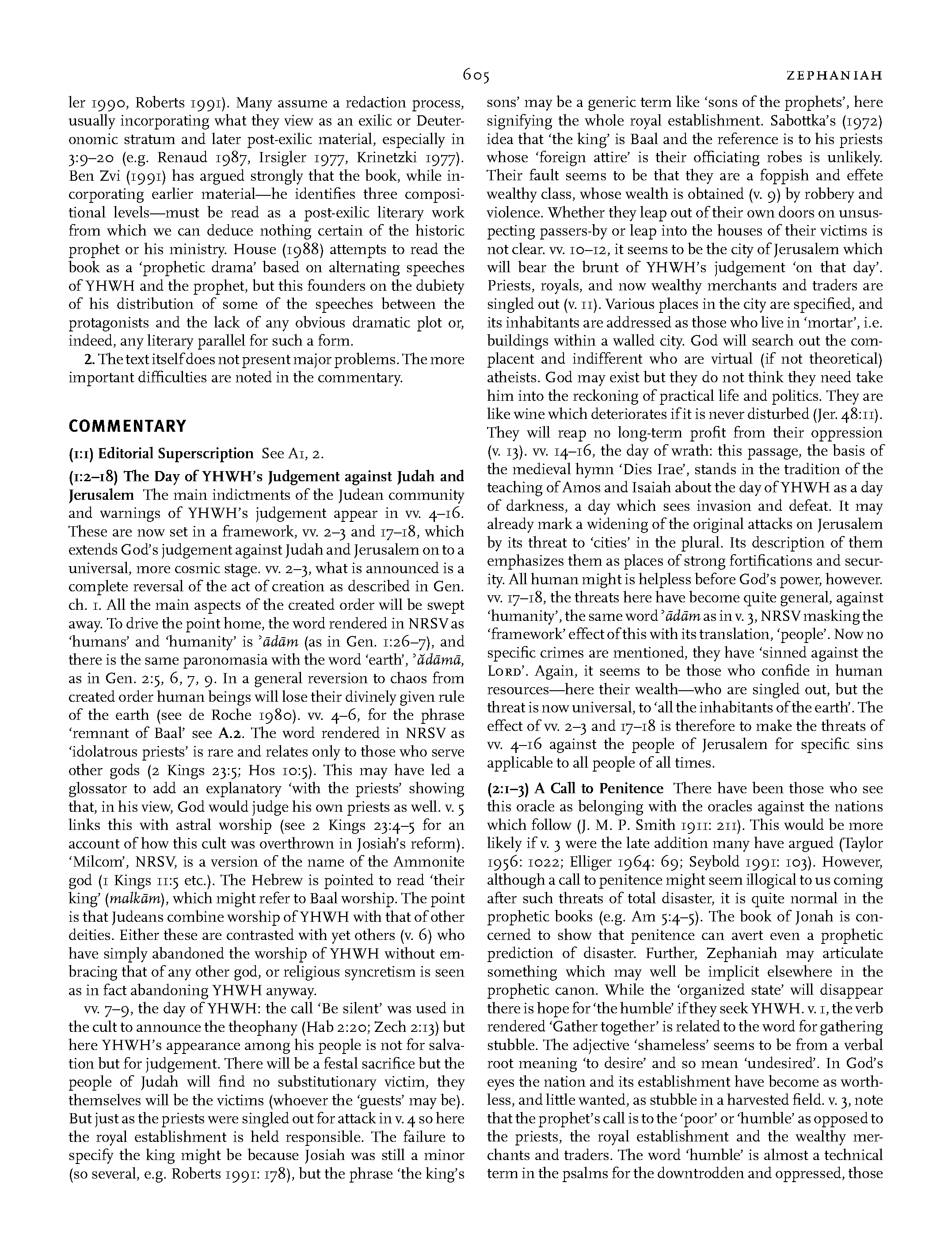
605 ZEPHANIAH sons' may be a generic term like 'sons of the prophets', here signifying the whole royal establishment. Sabottka's (1972) idea that 'the king' is Baal and the reference is to his priests whose 'foreign attire' is their officiating robes is unlikely. Their fault seems to be that they are a foppish and effete wealthy class, whose wealth is obtained (v. 9) by robbery and violence. Whether they leap out of their own doors on unsuspecting passers-by or leap into the houses of their victims is not clear, w. 10-12, it seems to be the city of Jerusalem which will bear the brunt of YHWH's judgement 'on that day'. Priests, royals, and now wealthy merchants and traders are singled out (v. n). Various places in the city are specified, and its inhabitants are addressed as those who live in 'mortar', i.e. buildings within a walled city. God will search out the complacent and indifferent who are virtual (if not theoretical) atheists. God may exist but they do not think they need take him into the reckoning of practical life and politics. They are like wine which deteriorates if it is never disturbed (Jer. 48:11). They will reap no long-term profit from their oppression ler 1990, Roberts 1991). Many assume a redaction process, usually incorporating what they view as an exilic or Deuteronomic stratum and later post-exilic material, especially in 3:9-20 (e.g. Renaud 1987, Irsigler 1977, Krinetzki 1977). Ben Zvi (1991) has argued strongly that the book, while incorporating earlier material—he identifies three compositional levels—must be read as a post-exilic literary work from which we can deduce nothing certain of the historic prophet or his ministry. House (1988) attempts to read the book as a 'prophetic drama' based on alternating speeches of YHWH and the prophet, but this founders on the dubiety of his distribution of some of the speeches between the protagonists and the lack of any obvious dramatic plot or, indeed, any literary parallel for such a form.
2. The text itself does not present major problems. The more important difficulties are noted in the commentary.
(v. 13). w. 14-16, the day of wrath: this passage, the basis of the medieval hymn 'Dies Irae', stands in the tradition of the teaching of Amos and Isaiah about the day of YHWH as a day of darkness, a day which sees invasion and defeat. It may already mark a widening of the original attacks on Jerusalem by its threat to 'cities' in the plural. Its description of them emphasizes them as places of strong fortifications and security. All human might is helpless before God's power, however, w. 17-18, the threats here have become quite general, against 'humanity', the same word 'adam as in v. 3, NRSV masking the 'framework' effect of this with its translation, 'people'. Now no specific crimes are mentioned, they have 'sinned against the LORD'. Again, it seems to be those who confide in human resources—here their wealth—who are singled out, but the threat is now universal, to 'all the inhabitants of the earth'. The effect of w. 2—3 and 17—18 is therefore to make the threats of w. 4-16 against the people of Jerusalem for specific sins applicable to all people of all times.
(1:1) Editorial Superscription See Ai, 2. (1:2-18) The Day of YHWH's Judgement against Judah and Jerusalem The main indictments of the Judean community and warnings of YHWH's judgement appear in w. 4—16. These are now set in a framework, w. 2—3 and 17—18, which extends God's judgement against Judah and Jerusalem on to a universal, more cosmic stage, w. 2-3, what is announced is a complete reversal of the act of creation as described in Gen. ch. i. All the main aspects of the created order will be swept away. To drive the point home, the word rendered in NRSVas 'humans' and 'humanity' is 'adam (as in Gen. 1:26-7), and there is the same paronomasia with the word 'earth', 'ddama, as in Gen. 2:5, 6, 7, 9. In a general reversion to chaos from created order human beings will lose their divinely given rule of the earth (see de Roche 1980). w. 4-6, for the phrase 'remnant of Baal' see A.2. The word rendered in NRSV as 'idolatrous priests' is rare and relates only to those who serve other gods (2 Kings 23:5; Hos 10:5). This may have led a glossator to add an explanatory 'with the priests' showing that, in his view, God would judge his own priests as well. v. 5 links this with astral worship (see 2 Kings 23:4—5 for an account of how this cult was overthrown in Josiah's reform). 'Milcom', NRSV, is a version of the name of the Ammonite god (i Kings 11:5 etc.). The Hebrew is pointed to read 'their king' (malkam), which might refer to Baal worship. The point is that Judeans combine worship of YHWH with that of other deities. Either these are contrasted with yet others (v. 6) who have simply abandoned the worship of YHWH without embracing that of any other god, or religious syncretism is seen as in fact abandoning YHWH anyway.
(2:1-3) A Call to Penitence There have been those who see this oracle as belonging with the oracles against the nations which follow (J. M. P. Smith 1911: 211). This would be more likely if v. 3 were the late addition many have argued (Taylor 1956: 1022; Elliger 1964: 69; Seybold 1991: 103). However, although a call to penitence might seem illogical to us coming after such threats of total disaster, it is quite normal in the prophetic books (e.g. Am 5:4-5). The book of Jonah is concerned to show that penitence can avert even a prophetic prediction of disaster. Further, Zephaniah may articulate something which may well be implicit elsewhere in the prophetic canon. While the 'organized state' will disappear there is hope for 'the humble' if they seek YHWH. v. i, the verb rendered 'Gather together' is related to the word for gathering stubble. The adjective 'shameless' seems to be from a verbal root meaning 'to desire' and so mean 'undesired'. In God's eyes the nation and its establishment have become as worthless, and little wanted, as stubble in a harvested field, v. 3, note that the prophet's call is to the 'poor' or 'humble' as opposed to the priests, the royal establishment and the wealthy merchants and traders. The word 'humble' is almost a technical term in the psalms for the downtrodden and oppressed, those w. 7-9, the day of YHWH: the call 'Be silent' was used in the cult to announce the theophany (Hab 2:20; Zech 2:13) but here YHWH's appearance among his people is not for salvation but for judgement. There will be a festal sacrifice but the people of Judah will find no substitutionary victim, they themselves will be the victims (whoever the 'guests' may be). But just as the priests were singled out for attack in v. 4 so here the royal establishment is held responsible. The failure to specify the king might be because Josiah was still a minor (so several, e.g. Roberts 1991: 178), but the phrase 'the king's
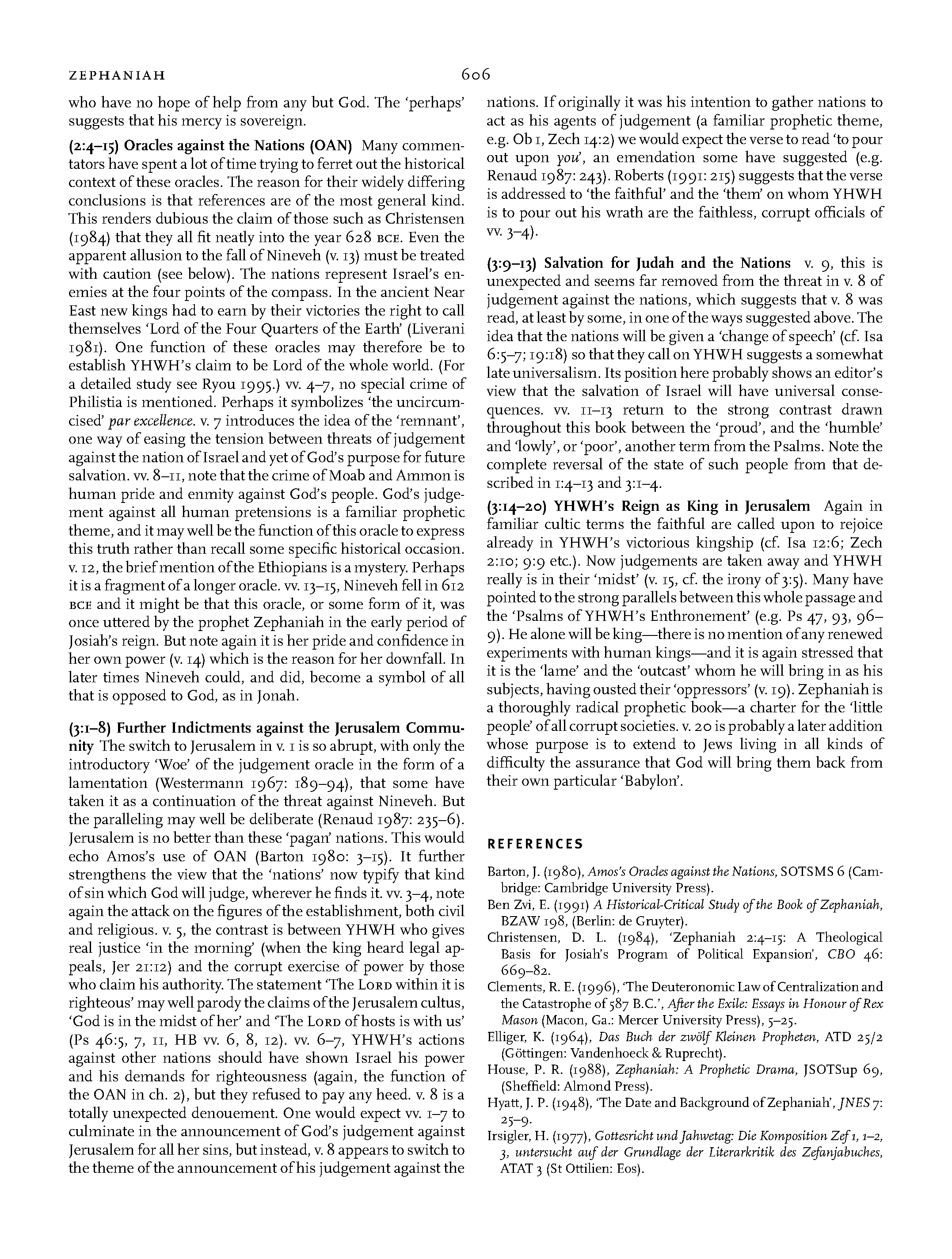
ZEPHANIAH 606 nations. If originally it was his intention to gather nations to act as his agents of judgement (a familiar prophetic theme, e.g. Ob i, Zech 14:2) we would expect the verse to read 'to pour out upon you', an emendation some have suggested (e.g. Renaud 1987: 243). Roberts (1991: 215) suggests thatthe verse is addressed to 'the faithful' and the 'them' on whom YHWH is to pour out his wrath are the faithless, corrupt officials of w. 3-4).
who have no hope of help from any but God. The 'perhaps' suggests that his mercy is sovereign.
(2:4—15) Oracles against the Nations (OAN) Many commentators have spent a lot of time trying to ferret out the historical context of these oracles. The reason for their widely differing conclusions is that references are of the most general kind. This renders dubious the claim of those such as Christensen
(1984) that they all fit neatly into the year 628 BCE. Even the apparent allusion to the fall of Nineveh (v. 13) must be treated with caution (see below). The nations represent Israel's enemies at the four points of the compass. In the ancient Near East new kings had to earn by their victories the right to call themselves 'Lord of the Four Quarters of the Earth' (Liverani 1981). One function of these oracles may therefore be to establish YHWH's claim to be Lord of the whole world. (For a detailed study see Ryou 1995.) w. 4—7, no special crime of Philistia is mentioned. Perhaps it symbolizes 'the uncircumcised' par excellence, v. 7 introduces the idea of the 'remnant', one way of easing the tension between threats of judgement against the nation of Israel and yet of God's purpose for future salvation, w. 8-n, note that the crime of Moab and Ammon is human pride and enmity against God's people. God's judgement against all human pretensions is a familiar prophetic theme, and it may well be the function of this oracle to express this truth rather than recall some specific historical occasion, v. 12, the brief mention of the Ethiopians is a mystery. Perhaps it is a fragment of a longer oracle, w. 13—15, Nineveh fell in 612 BCE and it might be that this oracle, or some form of it, was once uttered by the prophet Zephaniah in the early period of Josiah's reign. But note again it is her pride and confidence in her own power (v. 14) which is the reason for her downfall. In later times Nineveh could, and did, become a symbol of all that is opposed to God, as in Jonah.
(3:9—13) Salvation for Judah and the Nations v. 9, this is unexpected and seems far removed from the threat in v. 8 of judgement against the nations, which suggests that v. 8 was read, at least by some, in one of the ways suggested above. The idea that the nations will be given a 'change of speech' (cf. Isa 6:5-7; !9:I8) so that they call on YHWH suggests a somewhat late universalism. Its position here probably shows an editor's view that the salvation of Israel will have universal consequences, w. 11—13 return to the strong contrast drawn throughout this book between the 'proud', and the 'humble' and 'lowly', or 'poor', another term from the Psalms. Note the complete reversal of the state of such people from that described in 1:4—13 and 3:1—4.
(3:14—20) YHWH's Reign as King in Jerusalem Again in familiar cultic terms the faithful are called upon to rejoice already in YHWH's victorious kingship (cf. Isa 12:6; Zech 2:10; 9:9 etc.). Now judgements are taken away and YHWH really is in their 'midst' (v. 15, cf. the irony of 3:5). Many have pointed to the strong parallels between this whole passage and the 'Psalms of YHWH's Enthronement' (e.g. Ps 47, 93, 969). He alone will be king—there is no mention of any renewed experiments with human kings—and it is again stressed that it is the 'lame' and the 'outcast' whom he will bring in as his subjects, having ousted their 'oppressors' (v. 19). Zephaniah is a thoroughly radical prophetic book—a charter for the 'little people' of all corrupt societies, v. 20 is probably a later addition whose purpose is to extend to Jews living in all kinds of difficulty the assurance that God will bring them back from their own particular 'Babylon'.
(3:1—8) Further Indictments against the Jerusalem Community The switch to Jerusalem in v. i is so abrupt, with only the introductory 'Woe' of the judgement oracle in the form of a lamentation (Westermann 1967: 189-94), mat some have taken it as a continuation of the threat against Nineveh. But the paralleling may well be deliberate (Renaud 1987: 235-6). Jerusalem is no better than these 'pagan' nations. This would echo Amos's use of OAN (Barton 1980: 3-15). It further strengthens the view that the 'nations' now typify that kind of sin which God will judge, wherever he finds it. w. 3—4, note again the attack on the figures of the establishment, both civil and religious, v. 5, the contrast is between YHWH who gives real justice 'in the morning' (when the king heard legal appeals, Jer 21:12) and the corrupt exercise of power by those who claim his authority. The statement 'The LORD within it is righteous' may well parody the claims of the Jerusalem cultus, 'God is in the midst of her' and 'The LORD of hosts is with us' (Ps 46:5, 7, 11, HB w. 6, 8, 12). w. 6-7, YHWH's actions against other nations should have shown Israel his power and his demands for righteousness (again, the function of the OAN in ch. 2), but they refused to pay any heed. v. 8 is a totally unexpected denouement. One would expect w. 1—7 to culminate in the announcement of God's judgement against Jerusalem for all her sins, but instead, v. 8 appears to switch to the theme of the announcement of his judgement against the
Barton, J. (1980), Amos's Oracles against the Nations, SOTSMS 6 (Cambridge: Cambridge University Press). Ben Zvi, E. (1991) A Historical-Critical Study of the Book of Zephaniah,
BZAW 198, (Berlin: de Gruyter). Christensen, D. L. (1984), 'Zephaniah 2:4-15: A Theological
Basis for Josiah's Program of Political Expansion', CEO 46: 669-82. Clements, R. E. (1996), The Deuteronomic Law of Centralization and the Catastrophe of 587 B.C.', Afterthe Exile: Essays in Honour of Rex Mason (Macon, Ga.: Mercer University Press), 5—25. Elliger, K. (1964), Das Buch der zwolf Kleinen Propheten, ATD 25/2
(Gottingen: Vandenhoeck & Ruprecht). House, P. R. (1988), Zephaniah: A Prophetic Drama, JSOTSup 69,
(Sheffield: Almond Press). Hyatt, J. P. (1948), The Date and Background of Zephaniah', JNES 7:
25-9. Irsigler, H. (1977), Gottesricht undjahwetag: Die Komposition Zefi, 1—2,
untersucht auf der Grundlage der LiteraAritik des Zefanjabuches, ATAT 3 (St Ottilien: Eos).
607 HAGGAI
Keller, C. A. (1990), Nahoum, Habacuc, Sophonie, CAT lib 2nd edn.
Ryou, D. H. (1995), Zephaniah's Oracles against the Nations: A Synchro-
(Neuchatel: Delachauxet Liestle). Krinetzld, G. (1977), Zefanjastudien. Motivund Traditionskritik + nic and Diachronic Study of Zephaniah 2:1—3:8, Biblical Interpretation Series, 13 (Leiden: Brill). Sabottka, L. (1972), Zephanja, Versuch einer Neuilbersetzung mit philo-
Kompositionsund Redaktionskritik, Regensburger Studien zu Theologie, 7 (Frankfurt: Lang). Liverani, M. (1981), 'Critique of Variants and the Titulary of Sennalogischem Kommentar, BibOr25 (Rome: Pontifical Biblical Institute). Seybold, K. (1991), Nahum, Habakuk, Zephanja, ZB, (Zurich: Theolocherib', in F. M. Pales (ed.), Assyrian Royal Inscriptions: New Horizons (Rome: Istituto perl'Oriente). Mason, R. (1994), Zephaniah, Habakkuk, Joel, Old Testament Guides, gischer Verlag). Smith, J. M. P. (1911), 'Zephaniah', in Micah, Zephaniah, Nahum,
Habakkuk, Obadiah and Joel, ICC (Edinburgh: T. £T. Clark), 159263. Smith, L. P., and Lacheman, E. R. (1950), 'The Authorship of the Book
(Sheffield: Sheffield Academic Press). Renaud, B. (1987), Michee-Sophonie-Nahum, SB (Paris: Gabalda). Roberts, J. J. M. (1991), Nahum, Habakkuk and Zephaniah, OTL of Zephaniah', JNES 9:137-42. Taylor C. L. (1956), "The Book of Zephaniah', IB 6 (New York: Abing-
(Louisville, Ky.: Westminster/John Knox). Robertson, O. P. (1990), The Books of Nahum, Habakkuk and Zephadon), 1007—34. Westermann C., (1967), Basic Forms of Prophetic Speech, tr. White niah, NICOT (Grand Rapids, Mich.: Eerdmans). Roche, M. de (1980), 'Zephaniah 1:2, 3: The "Sweeping" of the Crea-
(London: Lutterworth); German original, 2nd edn., (Munich: Chr. Kaiser, 1964). Williams, D. L. (1963), The Date of Zephaniah', JBL 82: 77-88.