
Part 24
(2:26—7) Tne Elimination of Abiathar Solomon does not dare to harm David's trusted priest and successful minister. He does, however, relieve him of all his duties and send him into exile in Anathoth, a small country town about 5km north of Jerusalem. Jeremiah, who also originates from here (Jer 1:1; 32), could be his descendant. It is interesting that David mentions neither Abiathar nor Adonijah in his will. Their fate depends solely on Solomon. (2:28-35) The Elimination of Joab Alarmed by the escalating purge, Joab flees to the holy tent. Even Benaiah is incapable of killing him at the altar. Joab cleverly refuses to leave the holy place. In irony, Solomon interprets the pathetic statement T
(1:38—53) Solomon's Accession to Power The anointing of Solomon takes place at the well of Gihon, just below the palace grounds. The Cherethites and Pelethites are present: David's powerful and readily available mercenary troop (see 2 Sam 15:18). The holy oil is brought from the tent in which the ark of the covenant stands (2 Sam 6:17). Solomon's accession thus
I AND 2 K I N G S
method of discovering God's will (cf. Gen 28; 37; i Sam 28:6,15; Joel 3:1; Dan 2; Mt 2:13). Such means are, of course, also open to abuse (cf. Jer 23:25—7; Zech 10:2, alsoPs 73:20; in general Ehrlich 1953). (3:16-28) Solomon's Judgement The wisdom granted Solomon in his dream is immediately put to effect in making an unusually clever court judgement. The king is confronted with an insoluble problem: claim against counter-claim without witnesses or evidence. Maternal love, however, in itself not a legally relevant factor, provides the key to truth and justice. Yet our admiration for Solomon's wisdom should not distract us from the fact that this is a repeated theme found in various cultures and used to make the sagacity of numerous judges famous (Gressmann 1907) right up to the character of Azdak in Bertolt Brecht's Caucasian Chalk Circle. What is unique about Solomon's version is that the argument about the child is not between two wives of one man (who would have had a decisive influence on the outcome), but between two prostitutes. Such personae miserae (who also include widows) are given special care by the community and above all by the king (cf. 2 Sam 14:4-10; 2 Kings 8:1-6). Solomon's praise in v. 28 again stems from the author of the story of Solomon.
will die here' literally. Benaiah murders Joab at the altar, following Solomon's explicit orders. This is a serious crime against Israel's religion and law. Even Solomon's justifying speech in w. 31^-33 (which is attributable to the same author as 2:5-9, 24) cann°t hide this fact. As a reward for his loyal service Benaiah takes over Joab's post as army chief, whilst Zadok (cf 1:8,10, 34, 39) becomes Abiathar's successor. (2:36-46) The Elimination of Shimei Solomon plays a cruel game with Shimei, probably a former officer in the private guard who has switched sides from Solomon to Adonijah (cf. 1:8,10), but who is linked here with the Benjaminite leader of 2 Sam 16:5—14 and 19:17—24. He places him under housearrest only to sentence him to death when he is forced to leave his house. The author of w. 44-5, the pro-Solomon, prodynastic thinker already known to us, gives Solomon's cynical condemnation (w. 42—3) a religious justification. Once again Benaiah is the willing accomplice. The reader cannot feel pleased about the outcome that the kingdom is now firmly in Solomon's hands.
Solomon's Initial Acts as King (3:1-4:34)
(3:1) Marriage to the Pharaoh's daughter Remarkably, Solomon's first act as ruler is this obviously diplomatic marriage. Is such intermarriage a positive symbol of Solomon's importance? The Egyptian lady plays a surprisingly large role in the story of Solomon (cf. 7:8; 9:16; 11:1). However, an Ammonite will become the mother of his heir, not an Egyptian (14:21).
(4:1—6) Solomon's Ministers A comparison with David's ministerial lists (2 Sam 8:16—18; 20:23—6) shows both the young monarchy's continuity and its development. The cabinet posts of 'forced labour' (Ado[ni]ram] and State Department (Jehoshaphat, his title literally meaning 'reminder') remain unchanged. Joab and Abiathar have been removed. Benaiah, who had moved up from the fifth to the second rank of importance under David, is the only military officer, although he is now ranked fourth. Zadok's son Azariah is solely in charge of religious policy and is first on the list. (v. 4/7 in which Zadok and Abiathar are listed as they used to be, beside each other, is probably a gloss.) David's 'secretary', administrator of the royal offices and archives, is replaced by two new officers. The number of ministers has generally increased as the administration has obviously become more complicated. Beyond the existing departments, the posts of 'chief of officials', the provincial governors (see 4:7—19), 'the king's friend' (probably the king's chief adviser and representative), and 'chief of the palace' (head administrator of the royal estate and its buildings) are created. It seems that Solomon has rewarded his party followers with high rank: not only for Benaiah, but also Zadok, Nathan, and their sons (assuming that the prophet Nathan is meant in v. 5). This kind of text is likely to have stemmed from the palace archive in Jerusalem and is therefore of great historical value.
(3:2—3) A Religious Assessment of Solomon In this passage, we have the first beginnings of a king's assessment which the editors make of almost every following ruler. On the whole, Solomon receives a good rating. He loved' YHWH (just as YHWH loved him, 2 Sam 12:24). Solomon has, like many of his successors, weaknesses: there were in Judah 'high places', small sacrificial sites in or near individual towns, although, according to the Torah of Moses (Deut 12), only one place of worship was permitted, Jerusalem. But Solomon had not yet built his temple there.
(3:4—15) The Dream-Revelation in Gibeon Gibeon (today el-Jib, 8 km. north-west of Jerusalem) is traditionally seen by Israel as a heathen city (cf. Josh 9; 2 Sam 21:2). An important sanctuary was there dedicated to YHWH or perhaps to the sun-god Shemesh (cf. Josh 10:12—13). Solomon arranges a great sacrifice and remains overnight in the high place, perhaps with the intention of instigating a divine revelation. God does indeed appear to him and grants him a free wish—an age-old theme in fairy-tales and legends. Solomon shows modesty and insight. He requires great wisdom to rule, and wisdom is, according to the OT (e.g. Prov 2:6), a gift of God. God promises Solomon wisdom as well as everything else he did not wish for, but which the narrative describes him as having. This passage paints an extraordinarily positive picture of Solomon. The hand of the author of the Book of the Acts of Solomon (11:41) is especially noticeable in its praise of Solomon (w. I2b, 13/7) and Israel (w. 8, gb). In the passages regarding the Davidic covenant and loyalty to the Torah (w. 6, 14), the editors are particularly tangible (Walchli 1996). The original story shows a high regard for the importance of the dream. The beginning of v. 15 expresses no disappointment; quite the opposite, dreams are a legitimate
(4:7—19) Israel's Provinces under Solomon This list describes the twelve regions of northern Israel: the most influential part of the Davidic-Solomonic kingdom. The city-state of Jerusalem and the land of Judah are not included, nor are foreign possessions. It is not entirely clear what purpose Israel's division into districts had: was it simply to mark out spheres of influence, in which Solomon ensured loyalty through trusted representatives (see Niemann 1993)? Or were they provinces with strict borders that were expected to pay fixed duties at regular intervals to the royal court (see 4:8, 27) as well as provide forced labour (cf. 9:23)? According to Alt's (19640)
237 I AND 2 K I N G S analysis, the list reveals interesting geographical organization. It begins with the central mountain country of Ephraim, then describes the surrounding area, moves on from here to the north (Naphtali, Asher, and Issachar) and concludes with the south and south-east (Benjamin and Gad, to be read with LXX for Gilead in v. 19). Itis striking that traditionally Israelite territories are separated from those which had been Canaanite city-states in the past. Solomon seems to have separated these two great populations due to their differing histories, lifestyles, and self-perceptions, but united them in serving him. As provincial governors he appointed loyal court officials (the names Ahilud, Ahimaaz, and Hushai are well known from the David-Solomon narrative) and trusted administrators from the Canaanite regions (Alt 1959).
(5:1-12) The Contract with Hiram of Tyre By now Solomon has gathered enough wealth and wisdom to undertake larger building projects. Nevertheless, he requires foreign help for this since Israel is a lowly developed agrarian country. The Phoenicians are suitable partners due to their world-wide trading connections and high cultural standards, and above all, their large timber stocks in the mountains of Lebanon. Hiram (whose Phoenician name is 'ahiram), king of the important city of Tyre, is said to have collaborated with David (2 Sam 5:11) and is the first to take up relations with Solomon. Yet it is Solomon who makes a request. It is possible to discern an older textual layer (according to Walchli 1996: w. 150,16, 20, 22-5, 26/7) containing very dry contract agreements: Solomon orders timber shipments and offers compensation not only for the materials but also for labour. He also suggests dispatching his own workforce. Hiram ignores this suggestion, but promises to fell the necessary trees and deliver them as rafts to the coast of Israel. His price for this is delivery of a large quantity of wheat and oil (to be produced, of course, by Israelite farmers). The editors also let the two kings discuss the importance of the Davidic covenant and clarify why it is
(4:20—8) The Wealth and Security of Solomon's Time Other parts of the kingdom than Israel are presented in this passage. The narrator states that the land of Judah prospered as much as Israel, since the latter did not have to support Solomon's court alone, but could share the burden with neighbouring states from the Euphrates to Egypt (this is surely a gross exaggeration!). Next comes an assessment of how much the king costs his people—the author really means how much the people let this king cost them. Conversion rates for i cor shift between 220 and 450 litres. This amounts to tens of thousands of kilos of flour per day and the same number of cattle annually. Whether these numbers refer to the residence in Jerusalem or also to the provincial administration is unclear. Added to this were fodder and straw for thousands of chariot-horses. Even if these figures are exaggerated, one can assume that costs were relatively high. Israel and Judah were beginning to have large courts to feed. State administration had become increasingly centralized and voluminous from the time of Saul. (4:29-34) Solomon's Wisdom This passage opens with praise for the king typical of the book of the history of Solomon. Here his wisdom is given prominence. We have come full circle since the opening passage in 3:1—15. This time Solomon's wisdom is not that of a king or a judge, but of an academic. It is said that he simply knew a very great deal, much more than any other person. The geographical horizon opens unexpectedly: science was international even then. Indeed texts of wisdom from the whole of the ancient Near East do exist. They generally contain accumulated general knowledge, tested rules for success in life. The classic example in the OT is the older part of Proverbs (Prov 10—31). It is no coincidence that Solomon is named as its author (Prov 10:1; 25:1; hence also 1:1). A different kind of wisdom is implied in this text, namely that of natural order (v. 33); it has to do with the ability to enumerate creation, as declared in Job 38—9, Ps 104, and Gen i. This form of early science also helped one to succeed in life.
Solomon rather than David before him who is building a temple: waging war and supporting religion seem to be mutually exclusive achievements in the Bible!
(5:13—18) Forced Labour in Israel The massive availability of forced labour from 'all Israel' seems to be reported with pride (the tone of 9:20-3 will be different). The core of the reports is surely correct, given that (unpaid!) forced labour is later the cause of the kingdom's partition (i Kings 12). The figures mentioned here are probably grossly exaggerated. The Israelites do unexpectedly appear in Lebanon. Did Hiram actually allow this or did the biblical narrators insist upon their inclusion? Stone, as opposed to timber, is abundant in the hills surrounding Jerusalem. Gebalites, i.e. people from Byblos (in today's northern Lebanon) were also used as masons: this is not surprising given the context.
(6:1—10) Construction of the Temple Walls It is important to ask what motives lie behind the detailed descriptions in i Kings 6-7. Is this a construction order, a description of building procedure, or the memory of a destroyed building? The text is full of technical terms whose meaning is no longer wholly intelligible. The contours of the building are nevertheless imaginable. The foundation stone is said to have been laid in the 48oth year since the Exodus, placing construction of the temple in a chronological line with this holy date in Israel's history. It is possible to count the years in the Deuteronomistic History from Deut 1:3 onwards and actually arrive at the sum of roughly 480. None the less, this is also a round number heavy with significance: not only can it be divided in many ways, but it also encompasses twelve forty-year generations. It is symbolic that construction should have begun in that year. The ground-plan of the temple shows it to have been long and narrow, as was commonly found in the region of Israel. The passages surrounding the building were striking, the temple walls against which they were built being stepped to create rebates for the gallery floor beams, so that they were thicker at the bottom, and the gallery passages correspondingly narrowed. Opposite the holy place was the low-ceilinged dcbir, most holy place of all. The ceiling beams were made of
The Temple of Solomon (5-'i-9-'9J
According to Hurowitz (1992) the entire account of templebuilding is shaped in a way that is reminiscent of analogous Assyrian descriptions. It may have belonged to the Book of the Acts of Solomon which seems to originate in the Assyrian epoch, but apparently used older documents. Later on it was reworked by the editors.
man responsible for the large and wonderful bronze structures in the temple of Solomon. Like his king, he was called Hiram or Ahiram. First of all, two pillars built by him which stood at the entrance to the temple are described (w. 15-22). Their names have been preserved (yet are hardly translatable), their appearance can be pictured (9 m. high with capitals of lotus-leaf wreaths: Keel and Uehlinger 1992: 194), but their function is a mystery. They probably did not represent goddesses, as has been suggested in the past (Gorg 1991), but were enormous, stylized depictions of God-given, creative life, decorated with lotus-plants interwoven with pomegranates. The circular bronze sea (w. 23-6) had a diameter of 5m. and was 2.5 m. high. It probably depicted the primeval sea, a theme connected with Creation across the ancient Near East and in the OT (cf. Gen 1:1-10; Isa 51:9-10; Ps 24:2; 89:10-11; and Kaiser 1962). The oxen are a remarkable feature, generally symbolizing gods such as Baal or Hadad to whom fighting strength and virile fertility were attributed. The ten identical mobile basins (w. 27-39) each had a capacity of over 900 1. of water. Is this an image of heaven's or God's generous gift of water (cf. H. Weippert 1992) or do they have a more practical purpose (cf. 2 Chr 4:6)? Closer observation of the temple's interior reveals the dominance of an inclusive rather than exclusive monotheism: YHWH had taken up and integrated qualities from all manner of other gods and thereby become the universal, all-encompassing God. In w. 40—7 everything mentioned is recapitulated. It is added that Solomon established his own ore-refinery in the Jordan valley to produce the necessary copper. An appendor felt the necessity to include the as yet unmentioned holy instruments and royal blessing-gifts, richly covering everything with gold (w. 48—51).
especially precious cedar wood. The building was not particularly large: about 30x10x15 metres. But it was not for accommodating the worshippers—they gathered in the courtyard— and God was intangible anyway. According to Isa 6:1, the train of his robe alone filled the temple.
(6:11-13) A Word from God to Solomon The Deuteronomists took pains to show that God was not bound to the confines of the temple building. In the background lies faith in Zion as the place of God's permanent presence and therefore eternal security, as expressed, for example, in Ps 46 and 2 Kings 19:32—4. This text clarifies that the presence of God is contingent upon his commandments being kept. The prophets say the same, in e.g. Jer 7; 26:1-6; Mic 3:9-12; Mk 11:15-19; 13:1-2.
(6:14—36) The Interior Decoration of the Temple: Wood-Carvings All the walls of the holy site were clad with wooden panels and carvings made of costly materials. The ornamentation described is emphatically non-figural: plant—and at most animal—decoration rather than human (let alone divine) figures. The aniconic trait is characteristic of the YHWH-religion from early times. Yet the plants and animals mentioned are full of religious connotation, representing power, happiness, and blessing, as other ancient oriental temples (Bloch-Smith 1994) and Palestinian iconography (Keel and Uehlinger 1992: 189—96) show. Cherubim (w. 23—7; there was originally one, according to Hentschel 1984-5) are the clearest concession to the figurative perceptions of Canaanite-Phoenician religion. Such creatures were partly animal, human, and angelic (cf their description in Isa 6:2, though, here they are called 'seraphim'). They were built into ancient oriental thrones and apparently symbolized metaphysical powers carrying the monarch on his throne. In this way, the cherubim can be seen as carrying the invisible king, YHWH, upon his throne above them (see Keel 1977: 15-36). The doors, constructed in a technically and artistically complicated way, are the subject of special description (w. 31—5). It is probably the author's vivid imagination rather than Solomon's wealth that makes the entire temple and all its interior shine with gold.
(8:1—21) The Dedication of the Temple For the temple dedication, all the oldest and most honourable people (w. i, 3; not all men, v. 2) in Israel (and certainly Judah) are invited to the capital city. The festivities begin with a procession. The ark is carried out of the tent in the city of David where it has stood so far (cf. 2 Sam 6) and taken up to the temple grounds. The ark was originally a transportable war palladium which was carried into battle in the conviction that YHWH was enthroned upon it and would lead his people to victory (cf. i Sam 4; 2 Sam ii:n and Smend 1970). We do not know what the wooden chest (this being the meaning of the Hebrew word for 'ark') contained, if anything. It was the editors who placed the tablets of the Ten Commandments into it (cf. v. 9 and Ex 25:21). The ark's place was the most holy place in the temple, beneath the spread wings of the cherubim. Should they be carriers of the throne, the ark is king YHWH's pedestal. He himself is not depicted, only the equipment with which he rules. The ark retains the signs of mobility, its carrying staves. These symbolize that YHWH is not bound to one place. In fact he does bind himself to this place. He resides in the impenetrable darkness of the most holy place, is therefore doubly invisible, yet is close enough to touch. The festive dedication speech correlates the secretive nature of this God with the light of the sun, which was worshipped as a divine power elsewhere in the orient and possibly also in pre-Davidic Jerusalem (cf. Keel and Uehlinger 1994). Here, the sun is used as a symbol of YHWH's ruling power (w. 12—13 in me LXX version; it should be noted that the speech is passed on from
(7:1—12) Construction of the Palace Almost by chance, we learn that the temple is integrated into a larger complex of government buildings. Going by the construction period and its measurements, the temple can hardly have been more than a palace chapel. Other buildings are of course not described in such a detailed and concrete manner as the temple (although cf. efforts, especially by Busink 1970: 334—6). The 'House of the Forest of the Lebanon' seems to have been especially monumental, named for its richly crafted and precious Lebanese timber. It was roughly 50x25 metres large, making it an enormous hall of great splendour. Forty-five pillars carried the ceiling and partly an upper floor which perhaps served as the royal bodyguard's armoury and quarters (cf. 10:17 and Isa 22:8). Beyond this were a separate thronehall and various accommodation and administration buildings. The palace and the temple seem to have been similar in architectural style and material, giving the entire complex an impressive appearance.
(7:13—51) The Interior Decoration of the Temple: Metalworks The Bible records the name of the Phoenician crafts-
239 I AND 2 K I N G S
(3:4) and far too many for the usual altar to suffice (v. 64 is an explicatory addendum). The numbers go beyond all realistic measure. The narrator wishes to show that Solomon is, as always, generous in making every effort to satisfy God and God's people.
an ancient Israelite book of songs, probably the Book of the Righteous, cf Josh 10:13; 2 Sam 1:18). The next point of ceremony is the blessing of the assembly. Here the king assumes the duties of a priest (v. 14), whereupon the editors have Solomon give a short sermon (w. 15-21): since the Exodus from Egypt (cf. 6:1!), God had intended to reside in Jerusalem. David's successes and Solomon's succession find their goal in the temple in Zion. One can infer what the building meant to later generations, especially to those standing before its ruins.
(9:1—9) God's Appearance This entire passage is late-Deuteronomistic. The author explicitly refers to the episode in Gibeon (v. 2). God need no longer appear to Solomon in such an inappropriate place, but can do so in the temple designed for this purpose! He assures him of his approval of the dynasty and the temple, though they are made on the condition that his laws are kept. Should king and countrymen not abide by the commandments, especially the first, by worshipping other gods, they risk the severest of punishments: the loss of their country and the destruction of the newly dedicated temple. The events of 587 BCE are unmistakably predicted here. We are given a reading guide for the ensuing description of history. Israel and Judah began with such greatness under David and Solomon, only to end so sadly. The temple collapses in ruins, David's dynasty is forced from power, Judah and Israel's land is stolen. What remains is God's love for his people, as well as the possibility that his people will learn to be true to him. Thus this section is two things at once: an explanation for woe and an offer of salvation.
(8:22-53) Solomon's Dedicational Prayer at the Temple The introductory prayer reflects in great theological depth the relationship between God's promise to David and the people's loyalty to the Torah (w. 23-6), and between the inestimable size of God and his residence in Zion (w. 27-30). A sentence such as v. 27 rejects any temple (or church) ideology. God is too great to be caught up by anyone or anything, yet he can be found in the place he has designated, making himself tangible to his chosen people. In the main prayer Solomon bids God to hear all future prayers made to heaven in this temple: in particular in the event of difficult trials (w. 31—2), wartime hardship (w. 33-4), drought (w. 35-6), and any other misfortune (w. 37-40). To close, Solomon clearly foresees the state of affairs following exile: He prays for the proselytes who will come to Jerusalem (w. 41—3) and for the Israelites or Jews who will dwell in other countries (w. 44-5, 46-51). Zion should give every member of YHWH's chosen people a common identity (w. 52—3). The passage does not seem to be a single unit. The interests of different periods and people are probably collected in it. Talstra (1993) claims to have discerned the different textual layers: one pre-Deuteronomist (w. 31-2, 3740, 41—3), a first Deuteronomist from the time of Josiah (w. 14—20, 22—5, 28—9), a second from the period of exile (w. 44-5, 46-51), and one post-Deuteronomist (w. 33-6, 523, as well as 57-61). This dating seems on the whole to be too early. Veijola (1982) distinguishes between three Deuteronomistic layers from during and after the period of exile: (i) w. 14, 153, 17-21, 62-3, 65-6; (2) w. 16, 22-6, 54», 55-8, 61, 66a; (3) w. 29-30, 31-510, 52-3, 59-60. (8:54-61) Blessing and Warning Solomon again blesses the gathering, cf. v. 14—or were all of the sermon and prayer passages between them later additions? The Deuteronomistic author lets Solomon movingly confirm the fulfilment of all the promises of Moses, i.e. complete ownership of all the land, assured existence for all God's people and the enduring presence of YHWH in this country with them. The hopes and dreams of the (post-)exile period can be inferred in the significant word 'rest', cf. Josh 21:43-5; 2 Sam 7:1, n. The plea for God not to cast his people out but to instil in their hearts a willingness to abide by the commandments, expresses their awe of God's judgement and acceptance of their own insufficiencies. Israel knows that it owes its existence to God's mercy. And it knows that its existence is not an end in itself, but serves the purpose of manifesting God to all the peoples of the world, v. 60 is reminiscent of Deutero-Isaiah and is an outstanding statement of monotheism (cf. Isa 43:10-12; 45:4-6). (8:62-6) The Feast of the Temple Dedication The festivities take the form of a seven-day feast. Solomon makes a huge number of sacrifices, naturally many more than in Gibeon
Continuation of Solomon's Governmental Activity, his Fall and Death (9:10-11:43)
1 Kings 9—10 overlaps several times with 3:1—4:34. The construction of the temple stands at its centre. It is not easy to answer the question whether i Kings 3-10 depicts a golden age which is framed by i Kings i and n (see Frisch 1991), or whether Solomon's decline already begins in i Kings 9 (see Parker 1988). The latest editor perhaps intended the latter. (9:10-14) The Tribute to Tyre Having read in 5:25, that Solomon paid for the Hiram of Tyre's help with agricultural products: we are surprised to learn that he had to cede entire villages (probably not the whole of Galilee, but the strip of land at the Bay of Akko—see Knauf 1991). The embarrassing situation is only slightly alleviated by the comment that Hiram was not satisfied with this payment. The Israelites living there will not have taken much comfort from this. In 2 Chr 8:2 the problem is solved by the assertion that Hiram made Solomon a present of the towns. (9:15-23) Construction of Towns and Forced Labour This section seems to try to correct the news of 5:13—18 in favour of Solomon. It is probably a late Deuteronomistic addition (see Dietrich 1986). The narrator assures us that it was not Israelites who were driven to forced labour, but 'only' Canaanites. This statement is palliative, but the list of cities the editor uses to underline it is highly interesting. Thus we learn that
Solomon built not only the palace court of Jerusalem, but also the storage and defence structures of various cities in the land. The list, whose authenticity can hardly be doubted, has repeatedly been used by archaeologists for dating purposes. This is legitimate in itself, though it could easily lead to hasty conclusions. At the centre of disputes about biblical texts and archaeological facts lie the cities of Gezer, Megiddo, and Hazor (cf. Dever 1982; 1990). To an objective observer, building works attributable to Solomon seem rather modest.
to the God of Israel. On the one hand this is patriarchal slander, but on the other, it is simply realistic: women tend not to be so susceptible to rigid ideology as men. In today's terms, Solomon gave his wives something similar to minority rights and religious freedom. According to the biblical author, he hereby committed a grave sin leading to dire political consequences. (11:9-13) A Divine Manifestation The late-Deuteronomistic theologian and author of this section defines the nature of
Individual Acts of Government Following her mention in 9:16, the elusive daughter of the Pharaoh reappears. As in 9:15, the 'Millo' is referred to in connection with the house built for her (alone?). This term is probably related to the Hebrew word for 'to fill'. It is probably a substructure designed to secure the sloping terrain of the palace grounds (cf 2 Sam 5:9; i Kings 11:27; 2 Kings 12:20). A single note speaks of Solomon's triannual sacrificial feasts at the temple. This is followed by a report on Solomon's shipping on the Red Sea (here dubiously connected to the Reed Sea of Ex 14). One can assume that the Tyrians, who were far more experienced in this field, actually carried out the trade. The destination port of Ophir may have been near Aden or on the Horn of Africa. (10:14-29) The Queen of Sheba This story had great spiritual and even political after-effects all the way to Ethiopia (Pritchard 1974). It essentially praises Solomon's wisdom and cleverness by making a noble and wise ruler so deeply impressed by him. The story now appears decorated with exclusive gifts, much gold, and a sermon showing that the well-travelled lady has understood several of the underlying ideas of Deuteronomistic thought: since God loves Israel, he put Solomon on its throne. Today Sheba is no longer sought amongst the Sabians of Saudi Arabia, but in a north Arabian principality mentioned in an eighth-century Assyrian text (cf. Sarkio 1994: 186-91). This undercuts, though not significantly, the effect a meeting between a fabulous king and a fairy-tale queen has on one's imagination.
Solomon's crime: he has broken the first commandment. As a consequence he will lose power—though naturally, in recognition of David's merits, not all power and not immediately. Such reflections come to the firm conclusion that people's actions, in private and in public life, are connected to their future well-being. God himself ensures that wrong deeds have unpleasant consequences and good deeds have pleasant ones. The biblical authors differentiate between good and evil according to the Torah. This guideline helps them to explain catastrophes such as the division of the state or exile. (The Book of Job shows, however, what happens if such guidelines are applied systematically: the crime-punishment formula does not always add up. Excessive and unimaginable suffering cannot be subsumed under such a world-view.)
(11:14—28) Signs of Decline in the Kingdom of Solomon Now that Solomon is disloyal to God, the first 'adversary' (Heb. satan) of several emerges. The editor stresses that God is the initiator of these events (w. 14, 23, then also 29—33). The story of Hadad, the Edomite prince who was cast out of the country by David, his hardship, and his recapture of power whilst in exile in Egypt is told with marked sympathy (cf. M. Weippert 1971: 295—305; Bartletti976 claims that Hadad was in reality a political lightweight). The text reveals that he returned home shortly after David and Joab's deaths (v. 21). The editors shifted his return into the age of Solomon, for purely religious reasons. The same is also possible, though not as clear, for Rezin of Damascus. Both stories suggest that the young monarchy's temporary subjugation of neighbouring countries was not just a figment of the author's imagination. Their rediscovered independence would otherwise not require any explanation. It is unclear whether Edom and Aram were already territorial kingdoms at the time of David. Perhaps they were tribal chiefdoms, only assuming the structures of a state in their resistance to Israel, as it may itself have done whilst opposing the Philistines. Solomon's third enemy arises from within northern Israel, tellingly from amongst the forced labourers which the provinces, specifically Ephraim, had to provide. As is often the case with revolutionaries, Jeroboam stems from the elite of a repressed people (v. 28). The causes of the revolthe leads, also forcing him into Egyptian exile (v. 40), are replaced here by a prophet-story (11:29-39). (11:29-40) Ahijah of Shiloh and Jeroboam ben Nebat The story is multilayered and probably completely Deuteronomistic (cf. Dietrich 1972: 15—20; as opposed to H. Weippert 1983 who sees an old core in w. 29-31, 37, 38, 40 and beyond that several pre-exilic additions). It is designed to show that it was not Jeroboam's revolutionary drive, nor Solomon's repressive regime that brought Jeroboam to power, but the will of God as revealed by the prophets. The editors knew Ahijah of Shiloh from the story in 14:1-18. Whereas there he is Jeroboam's
(10:14—29) Solomon's Wealth Here everything around Solomon is literally dipped in gold. King Midas does not seem a far cry. Silver 'was not considered as anything in the days of Solomon' (v. 21). The warning in the law of Deut 17:17, that too much silver and gold should not be hoarded by a king, is hereby clearly unheeded. From this point, Solomon's splendour is somewhat dimmed (cf. Dietrich 1996/7). Not all that glittered, however, was of solid gold. The man-size shields (v. 16) were each coated with 600 shekels (about 7 kg.) of gold or gold alloy. Nor, of course, was the throne entirely made of ivory. The Phoenicians were famous for their ivory marquetry and carvings. The material for this must have come from Africa, either via the Nile or the Red Sea from East Africa, or via Tarshish (probably Tartessos), i.e. the Mediterranean, from West Africa, as v. 22 may suggest. The lion and bull decorations symbolize power, almost superhuman power (cf. 7:29). Notes in w. 26—9 on armament and arms trade are historically interesting. David lamed captured horses, not knowing what else to do with them (2 Sam 8:4). Solomon had a large chariot fleet (which is, however, not as large here as in 5:6). He also profited from serving as an agent for the export of arms from Egypt to Syria and Asia Minor: a practice which was as common and questionable as it is today (cf. also Deut 17:16). (11:1-8) Solomon's Wives and their Idolatry It was not unlikely, nor would many have considered it unethical at the time, that Solomon maintained a harem including, for diplomatic reasons, foreign women. The reputed thousand women is surely an exaggeration and would again, in view of the Torah (cf. Deut 17:17), have been intolerable. The text concentrates on religious rather than moral arguments. In a tone similar to other post-exilic texts (Ezra 10; Neh 10), women, especially foreign ones, are regarded as a temptation threatening loyalty
241 I AND 2 K I N G S enemy, they make him his supporter here. The symbolically torn coat probably stems from i Sam 15:27—8. The editors explain (w. 31—9) Jeroboam's rise in advance as a consequence of Solomon's decline. The delay in Solomon's punishment is, as in 11:9-13, due to God's affection for David. Furthermore, the powers of Judah, Jerusalem, and the dynasty of David are permanently bound together, a triple gift of mercy alleviating the pain of the loss of the northern kingdom (w. 35-6). The prophet (i.e. the editor) does not miss the opportunity to measure Jeroboam by the same guidelines of the commandments. His covenant is immediately made subject to conditions much stricter than those attached to David's in 2 Sam 7. Every reader of the time knew that northern Israel failed miserably in keeping these laws and was therefore destroyed much more brutally than Judah and long before it.
younger hotheads demand clear, authoritarian conditions and do so in an extremely vulgar manner, 'loins' being a euphemism for 'phallus'. The narrator tries to explain the Davidic dynasty's surprising loss of most of the kingdom by using this stylized old-young opposition. Actually, the cause is the way Solomon squeezed Israel dry, and the trigger was the undiplomatic arrogance of Rehoboam's men. Perhaps Solomon had already lost the north. A language of separation almost identical to v. 16 can be found in 2 Sam 20:1. In other words, by the time of Absalom's failed revolt, if not before, the northern tribes had privately distanced themselves from Davidic rule. Although they no longer lived in tents (except in times of war, see 2 Sam 11:11) the expression reveals something of the semi-nomadic lifestyle of at least some of the northern Israelites in the past. This trait must have influenced their critical stance towards their rulers. The author of this passage is unmistakably a Judean who admits that Rehoboam played a part in the partition, but who regards it as a perverse rebellion (v. 19) against the legitimate reign of the descendants of David. A later editor, inspired by the spirit of the prophets, adds that things come to pass exactly as the prophet Ahijah of Shiloh had forecast (v. 15, cf. 11:29—32).
(11:41—3) Solomon's Death Here we find the first (almost) regular concluding formula for a king. The editors admit that they have not told everything they know about Solomon. The rest can be read in the Book of the Acts of Solomon. Some over-sceptical critics believe this reference to be fictive. Unfortunately, only the excerpts quoted in i Kings 3-10 exist today. In its basic tone it was probably highly celebratory.
Solomon's reign is reported to have lasted for the round sum of forty years. Death unites him with his 'ancestors', explicitly, of course, with David. As with all family graves, the deceased's body was probably laid upon a stone bench in the royal tomb, whilst the bones of his dead relatives were collected in an ossuary. The transition from a state of earth-life to the diminished state in Sheol, the realm of death, takes place between lying on the bench and being taken to the ossuary. Resurrection is still a distant thought, but its foundations have been laid.
(12:21—4) A War between Brothers Averted The Judean scribes found it hard to come to terms with Israel's partition. Before catastrophe struck in 11:29-39, me prophet Ahijah had appeared to announce a harsh, but as yet limited, divine judgement upon the ruling house of Jerusalem. After its occurrence, another prophet, Shemaiah, confirms God's irreversible decision. This is an attempt to explain that however understandable their anger and laudable their courage, Rehoboam and the Judeans cannot prevail by taking up arms against the will of God, especially when it means fighting against their 'kindred'. Although the entire story is a mental construct which contradicts 14:30, it is still impressive that the usual way of thinking in terms of power politics and military categories is subordinate to strictly theological and ethical criteria. (12:240-2 LXX) A Special Greek Version of the Story of Jeroboam The Greek version has an addition after 12:24 which is not present in the Hebrew, referred to with small letters (from a to z). In this version, the story of Jeroboam often concurs literally with the Hebrew text in i Kings 11-14, 7et
The next major section, i Kings 12:1—16:14, documents the consolidation of the two kingdoms Israel and Judah.
Division of the realm (12:1-24)
(12:1—20) The Scandal in Shechem Whilst Rehoboam could take his father Solomon's place in Judah apparently without opposition, he required confirmation from the northern kingdom. Reports of contractual agreements between northern tribes and the relevant kings go back as far as the earliest beginnings of the kingdom (cf i Sam 10:24—5; 2 Sam 5:3; 19:10-11,42-4). After Solomon's death, Israel forced negotiations which took place in Shechem, known today as Nablus, in the central mountain country of Ephraim. (It is incorrect to say that Jeroboam ben Nebat already had a role to play in events, as v. 2 states. Although he had returned from exile in Egypt by then, he was called upon only after the failure of negotiations with the south, cf. v. 20 and McKenzie 1987.) The northern tribes demanded that Rehoboam reduce the state burdens which Solomon had imposed upon them—a clear indication of how at least northern Israel had previously regarded the regime. Rehoboam seeks advice from 'the older men who had attended his father Solomon' and with 'the young men who had grown up with him and now attended him' (w. 6, 8). These do not form two separate advising bodies occasionally differs from it decisively. Thus we discover, for instance, that Jeroboam was the commander of a chariot unit, that he laid claim to the entire kingdom during Solomon's lifetime (b), leading to his expulsion. Following his return from exile, he expanded his home town Zereda and waited there. Even then his wife Anot had been told Ahijah's woeful prophecy about her son (g— n, cf. 14:1—18 in the Heb. text). He is promised ten of the twelve tribes (o) in Shechem by the prophet Shemaiah (not by Ahijah near Jerusalem, as in 11:29—31 of the Heb. text). Following the failure of negotiations with Rehoboam (p—s; more detailed in the Heb. text, 12:3—14) and the threat of civil war (cf. 12:21—4),me compromise settlement gave Jeroboam ten tribes and Rehoboam two (t—z). We probably have a midrashic rewriting of the Hebrew text here (Gordon 1975) rather than the core of an old and historically valuable northern Israelite version (as in Seebass 1967; Gray 1977: 310-11).
(so Malamat 1965), but represent a political conflict between two generations (so Evans 1966). The king's experienced advisers encourage him to make a moderate contract, whilst
Israel (cf. Klopfenstein 1996). The story is probably based on two narratives (cf. Wurthwein 1994): one concerning the conflict between Jeroboam and a man of God from Judah at the holy site of Bethel (w. i-io), the other telling of the meeting between an Israelite and a Judean prophet (w. 11—32). The first legend demonstrates how superior a prophet is even to a king. An earthly ruler is powerless when faced with the miraculous might of God and his power to give events a favourable or detrimental turn as he wishes. The books of Kings vary the prophet—king conflict several times, each time leaving the prophet the upper hand, although historical reality often proved to be different (cf. Jer 26:20-4; 3^)- Here, Jeroboam's conflict in Bethel led to the theory that this is a folklore version of the appearance of the prophet Amos in Bethel (cf. Am 7:10— 17). The second narrative deals with the relationship between two prophets, often a tense and sensitive affair. Who can decide who is right when two prophets speak, claiming God's authority, yet contradict each other? (cf. i Kings 22 and Jer 27— 8 on this problem; Walsh claims that i Kings 13 demonstrates that only prophets who kept YHWH's commandments are to be trusted). In our story, the 'true' prophet allows himself to be deceived by the 'false' prophet and pays for it with his life. His death does convince his opponent of the truth of the 'true' prophet's relationship to God—and makes him want to join him in death. Not only is this bizarre, but it is also related to the old theme of God's mighty actions compared to the insufficiencies of his human instruments. The two stories focus on the holy site in Bethel and its altar, both of which are contaminated by 'Jeroboam's sin' and will sooner or later feel the power of the true God: the prophet's word immediately destroys the altar (w. 3, 5) and the holy site is abolished 300 years later by King Josiah (2 Kings 23:15-18), although the common grave of both prophets is preserved. Thus prophetic words are proved to contain the power of God. He directs history in such a way as to fulfil the prophecies so that truth may prevail.
Jeroboam I of Israel (12:25-14:24)
(12:25-33) State Worship in Bethel and Dan King Jeroboam I, founder and quasi-democratically legitimized ruler of northern Israel (12:20), initiated a number of building projects, like Solomon before him: he built castles in the central towns of his realm (v. 5)—in the cis-Jordanian Shechem and in trans Jordanian Penuel (as the central city of the original Israelite region of Gilead, cf. i Sam n). Much more important for the Bible, however, is the fact that he established state holy sites in the far north and deep in the south of his kingdom. This too likens him to Solomon. Everywhere in the East, rulers who wished to be recognized or who tried to introduce a new era in history became active in founding new cult sites. A state requires a state religion or ideology. Jeroboam knew this and became active in religious politics. It was probably the Judean author's wishful thinking that made Jeroboam worry whether his subjects were too fond of the Davidic-Judean state religion
(w. 26-7). Jeroboam could have confined himself to Bethel had this been the case. The temples in Bethel and Dan had long existed and were influential beyond their regions (cf. Judg 17-18; Gen 28; 35). Canaanite deities must originally have resided there (as was almost certainly the case with Jerusalem's previous temple!), but the Israelite YHWH had in the meantime (also?) begun to be worshipped. Thus the temples were well suited as a place of intellectual and spiritual integration for the most important population groups of the country. The intention to link 'Canaan' with 'Israel' can be seen in the central cult figures used and the way they are inaugurated. Jeroboam did not make 'calves', but (young) bulls, the animal symbolizing Canaan's main gods El and Baal. But the Israelite YHWH 'who brought you up out of the land of Egypt', is claimed to be worshipped by Israelites in Bethel and Dan (v. 28; today the words 'calves' and 'gods' correspond with each other, a feature arising from Judean polemics). The combination of Israelite faith in the liberating power of the God of the Exodus and Canaanite faith in the power to bless of their national gods stands in opposition to the Judean belief that God resides in Zion. This is an impressive, yet dubious functionalization of religion. The Judean scribes recognized this correctly, regardless of their biased perspective, and severely criticized Jeroboam's policy, even interpreting it as the seed of the fall of his dynasty and indeed the kingdom he founded (cf. 12:29; J3:33~4 and the references in dealing with all northern kings to 'the sins of Jeroboam'). Various cultic alterations for which Jeroboam is seen to have been responsible are criticized in this light: the creation of holy high places (cf. v. 31 with Lev 26:30; Deut 12; 2 Kings 17:9—10), the appointment of non-Levite priests (cf. v. 31 with Deut 18:1-8), and the unauthorized introduction of a religious feast (cf. v. 32 with Lev 23:34). This is a heavy burden for the northern kingdom to bear right from its very beginnings! (13:1-32) The Judean Man of God and the Prophet in Bethel Mention of this illegitimate feast invites the authors to make Jeroboam plan illegitimate cult activities at the illegitimate holy site of Bethel and be caught red-handed by a prophetloyal to YHWH. An editor has inserted a detailed prophet story
(14:1—20) A Breach between Ahijah of Shiloh and Jeroboam Jeroboam feels the might of the prophetic word from a further prophet: Ahijah of Shiloh. In w. i—6, 12, 130, 17—18, an older prophet story concerning the king's failed oracular seance with Ahijah can be discerned. (There are thematically similar scenes in i Sam 9:1-10:16; 2 Kings i.) It demonstrates how it is impossible to cheat a prophet, even if he is old and blind and one has the perfect disguise (contrast Gen 27). Ahijah mercilessly reveals to the queen that her child will die. The reason for this is unclear in the text, although the context of i Kings 13-14 provides an explanation. In addition, the editors turn the oracle of w. 7—11, 13/7—16 into an extensive statement against Jeroboam and a comprehensive declaration against his dynasty. Even the entire history of the northern kingdom is observed here (Holder 1988). The same prophet who announced Jeroboam's rise to power (11:29—39) now forecasts that his sins will lead to the fall of Jeroboam's dynasty. Later, a coup sweeping Jeroboam's son Nadab aside provides confirmation of the prophecy's truth (15:29-30). This pattern of prophecy and fulfilment can be plotted across the books of Kings (cf. already i Kings 11:29—31 + 12:15 and then 16:1—4 + 16:11— 12; 21:21-3 + 22:38 + 2 Kings 9:36-7; 2 Kings 9:7-10 + 10:17; 21:10-15 + 24:2J 22:16-17 + 25:I~7)- m all evidence of the
(between 12:32 and 13:33) which is marked by Jeroboam's cultsacrilege, but which also illustrates the function of the office of prophet and its historical significance for the history of
243 I AND 2 K I N G S
East, such as amongst the Hittites, the queen mother held a specific rank of'mistress' (in Heb. synonymous with the word for queen mother), giving her power especially in the case of her son's death. Abijam's mother was Maacah, daughter of Abishalom. Going by his name, this could have been David's son, who died during the rebellion and would naturally have had clear political influence. One would have, however, to interpret 'daughter' as 'granddaughter', making Maacah's mother Tamar, the daughter of Absalom mentioned in 2 Sam 14:27. All this is hypothesis and rather unlikely, especially since Maacah's father is named as Uriel of Gibeah in 2 Chr 13:2. Thus names cannot tell us much about this queen mother (but see 15:10). Her son did not rule for long (about two full years, cf. v. i with 15:9; the number 'three' in 15:2 can be explained since the years of accession and death were not complete calendar years). There were conflicts with the northern state at this time (v. 7/7, probably a note from the diaries of the Judean kings). The editors give Abijam a poor rating, probably because he did not reverse the (alleged) atrocities introduced by Rehoboam. Later theologians have pondered why YHWH continued to reside in Jerusalem despite such unworthy rulers. The answer is that David's merits were so great—even considering the Bathsheba—Uriah scandal—that his sinful successors could still profit from them. Would this dates and facts we should not forget that the history of Israel, in the eyes of the author, is dictated not by internal connections of causality, but by its relationship to God (cf von Rad 1961 and Dietrich 1972).
Rehoboam, Abijah, and Asa ofjudah (14:25-15:24 J
(14:21—31) Rehoboam Although we have come to know Rehoboam from the story of the kingdom's division, the introductory formula is only now inserted. This is an editorial principle in Kings: up to this point the Israelite Jeroboam stood at the centre of affairs, whilst the Judean Rehoboam was only a minor character. Now our eyes turn to the south and Rehoboam becomes the protagonist. Little good can be reported of him: he was 41 when he came to power, somewhat too old to follow the foolish advice of his young counsellors. His mother was an Ammonite, a twice-mentioned fact (14:21, 31) which can be compared to that of Solomon's foreign wives and their idol-worship (11:1—8). By now all kinds of heathen rituals are said to have found their way into Judah (and not confined to Jerusalem, as with Solomon before him). 'Pillars', tall standing stones, perhaps represented deified ancestors. 'Sacred poles' are probably stylized trees symbolizing either the old goddess Asherah or her power to bless which had become integrated into YHWH. The editors use standard sentences (w. 22-4) which are often repeated later. They hammer out how breaches of the first commandment formed the underlying evil which led to Judah's (and even earlier, Israel's) downfall. As with almost all kings, the editors report the most important—and in this case unpleasant—events of Rehoboam's reign. On the one hand there is the constantly rekindling war with Jeroboam, a plausible account (v. 30, probably taken from the Book of the Annals of the Kings of Judah) and on the other a short report of a confrontation with Egypt which had grave consequences for the temple at Jerusalem (w. 25—30, perhaps taken from the temple's own registers). Pharaoh Shishak, known in Egypt as Shoshenk (about 945-924 BCE, founder of the 22nd 'Libyan' dynasty) undertook a campaign to Palestine and Syria. He later ordered it to be recorded in the temple at Karnak. All the cities he claims to have conquered are listed there—they do not include Jerusalem (cf. Noth 1971). In our text, Jerusalem is made the sole object of the campaign. It is possible that the city had to pay a high price for freedom, a first sign of warning for 'the city that the LORD had chosen out of all the tribes of Israel, to put his name there' (v. 21).
store of good deeds be exhausted one day? The question is not yet relevant, due to the existence of other rulers, more faithful than Abijam.
(15:9—24) Asa King Asa reigned for an unusually long time. We learn that he was 'diseased in his feet' in old age: this is perhaps an indication of paralysis and possibly of his son Jehoshaphat's regency during Asa's lifetime. Asa is given a good assessment by the editors. He can even be compared to David, though he did not abolish the high places outside Jerusalem. That was left to Josiah (2 Kings 23:8). Otherwise, Asa was exemplary: he made pious donations to the temple, chased the cult-prostitutes out of the country (cf. 14:24), and dismissed the queen mother 'because she had made an abominable image for Asherah'. It is striking that the queen mother has the same name here as in 15:2. She is certainly the same person. Maacah was, of course, the mother of Abijam, not Asa, but kept her position as queen mother following Abijam's early death until Asa relieved her of the post (cf. Noth 1968: 335-6). The note on this must have been taken from the Annals of the Kings and is therefore historically reliable, especially since such actions were very unusual in a country so loyal to its dynasty. Perhaps it shows a new political direction: away from the present dominance of the Jerusalem aristocracy and towards the Judeans of the country. This would explain Asa's steps against syncretistic tendencies in the state cult of Jerusalem. Ackerman (1993) argues that the queen mother was regarded as Asherah's representative, making her son the offspring of a goddess as well as the adopted son of YHWH (cf. Ps 2:7). Did Asa oppose such religious and ideological perceptions? It is certain that he successfully fended off northern Israel's activities in the border area of Benjamin, even if his methods were questionable. His reaction to northern Israel's provocative expansion of the Benjaminite town of Ramah into a border fortress (cf. Josh 18:25) was to incite the Aramean king in Damascus to carry out a
(15:1-8) Abijam This is the first king who is given synchronized dating, i.e. correlation to the line of kings in the sister state. Such references remind us of their common heritage despite their separate development. Israel and Judah together form the people of YHWH. The names of the Judean queen mothers are always included. This has specific political reasons. Since David's dynasty reigned exclusively in Judah and there were several different parties and interest-groups (cf. i Kings i alone), rival parties always had to present a Davidide as pretender, though his rank was decisive. In this the queen mother was an overriding factor: the kinship and party represented by her decided who took up the reins of government (Dietrich 1979). In Judah, as in other parts of the ancient Near
the editors. This may be implied by the separate note 16:7, the core of which stems from the Annals, according to some critics.
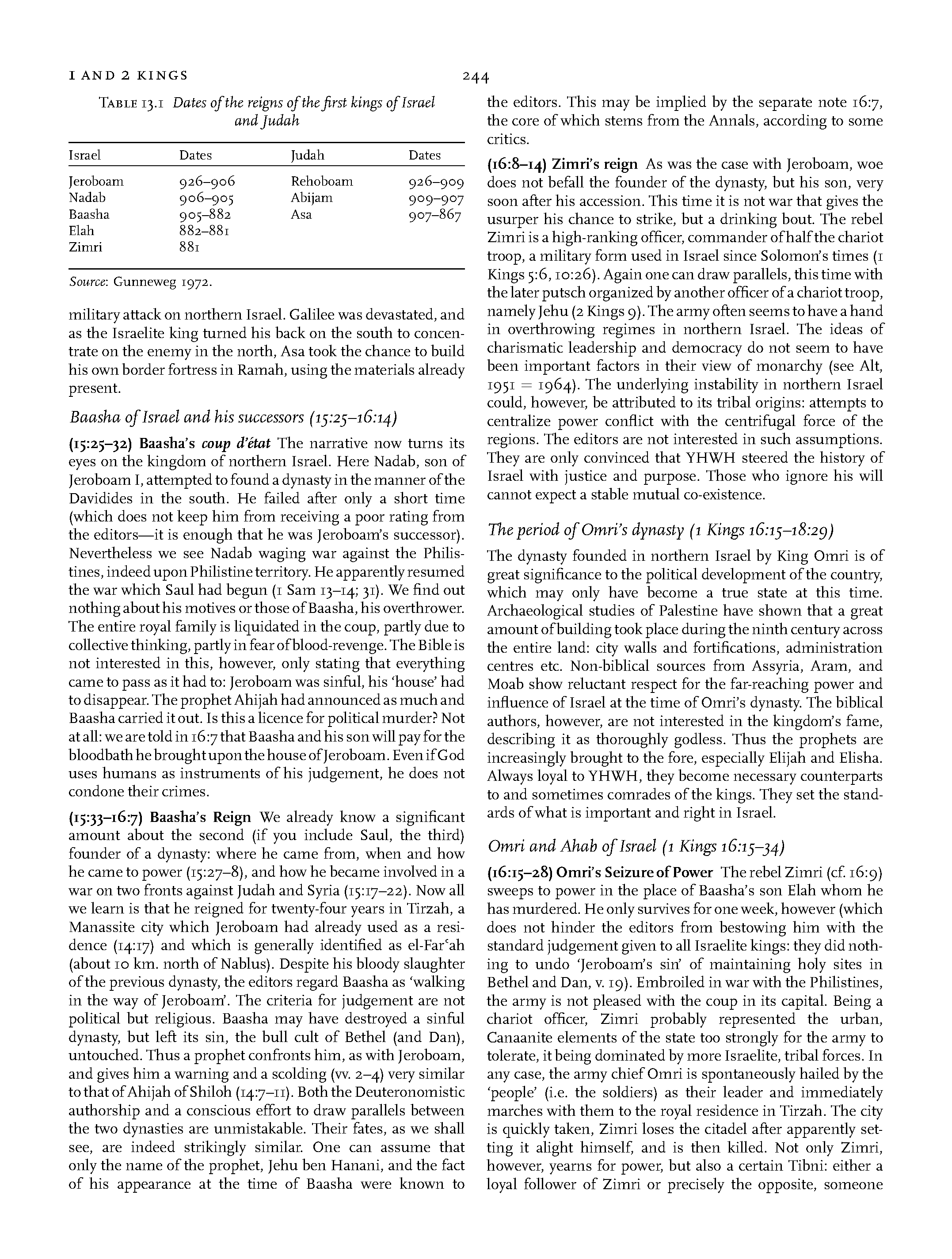
TABLE 13.1 Dates of the reigns of the first kings of Israel andjudah
Israel
Dates
Judah
Dates
(16:8—14) Zimri's reign As was the case with Jeroboam, woe does not befall the founder of the dynasty, but his son, very soon after his accession. This time it is not war that gives the usurper his chance to strike, but a drinking bout. The rebel Zimri is a high-ranking officer, commander of half the chariot troop, a military form used in Israel since Solomon's times (i Kings 5:6,10:26). Again one can draw parallels, this time with the later putsch organized by another officer of a chariot troop, namely Jehu (2 Kings 9). The army often seems to have a hand in overthrowing regimes in northern Israel. The ideas of charismatic leadership and democracy do not seem to have been important factors in their view of monarchy (see Alt, 1951 = 1964). The underlying instability in northern Israel could, however, be attributed to its tribal origins: attempts to centralize power conflict with the centrifugal force of the regions. The editors are not interested in such assumptions. They are only convinced that YHWH steered the history of Israel with justice and purpose. Those who ignore his will cannot expect a stable mutual co-existence.
Jeroboam Nadab Baasha Elah Zimri
Rehoboam Abijam Asa
926-909 909-907 907-867
Source: Gunneweg 1972.
military attack on northern Israel. Galilee was devastated, and as the Israelite king turned his back on the south to concentrate on the enemy in the north, Asa took the chance to build his own border fortress in Ramah, using the materials already present.
Baasha of Israel and his successors (15:25-16:14)
(15:25—32) Baasha's coup d'etat The narrative now turns its eyes on the kingdom of northern Israel. Here Nadab, son of Jeroboam I, attempted to found a dynasty in the manner of the Davidides in the south. He failed after only a short time (which does not keep him from receiving a poor rating from the editors—it is enough that he was Jeroboam's successor). Nevertheless we see Nadab waging war against the Philistines, indeed upon Philistine territory. He apparently resumed the war which Saul had begun (i Sam 13—14; 31). We find out nothing about his motives or those of Baasha, his overthrower. The entire royal family is liquidated in the coup, partly due to collective thinking, partly in fear of blood-revenge. The Bible is not interested in this, however, only stating that everything came to pass as it had to: Jeroboam was sinful, his 'house' had to disappear. The prophet Ahijah had announced as much and Baasha carried it out. Is this a licence for political murder? Not at all: we are told in 16:7 that Baasha and his son will pay for the bloodbath he brought upon the house of Jeroboam. Even if God uses humans as instruments of his judgement, he does not condone their crimes.
The period of Omri's dynasty (i Kings 16:15-18:29 J
The dynasty founded in northern Israel by King Omri is of great significance to the political development of the country, which may only have become a true state at this time. Archaeological studies of Palestine have shown that a great amount of building took place during the ninth century across the entire land: city walls and fortifications, administration centres etc. Non-biblical sources from Assyria, Aram, and Moab show reluctant respect for the far-reaching power and influence of Israel at the time of Omri's dynasty. The biblical authors, however, are not interested in the kingdom's fame, describing it as thoroughly godless. Thus the prophets are increasingly brought to the fore, especially Elijah and Elisha. Always loyal to YHWH, they become necessary counterparts to and sometimes comrades of the kings. They set the standards of what is important and right in Israel.
(15:33—16:7) Baasha's Reign We already know a significant amount about the second (if you include Saul, the third) founder of a dynasty: where he came from, when and how he came to power (15:27—8), and how he became involved in a war on two fronts against Judah and Syria (15:17—22). Now all we learn is that he reigned for twenty-four years in Tirzah, a Manassite city which Jeroboam had already used as a residence (14:17) and which is generally identified as el-Far'ah (about 10 km. north of Nablus). Despite his bloody slaughter of the previous dynasty, the editors regard Baasha as 'walking in the way of Jeroboam'. The criteria for judgement are not political but religious. Baasha may have destroyed a sinful dynasty, but left its sin, the bull cult of Bethel (and Dan), untouched. Thus a prophet confronts him, as with Jeroboam, and gives him a warning and a scolding (w. 2-4) very similar to that of Ahijah of Shiloh (14:7—11). Both the Deuteronomistic authorship and a conscious effort to draw parallels between the two dynasties are unmistakable. Their fates, as we shall see, are indeed strikingly similar. One can assume that only the name of the prophet, Jehu ben Hanani, and the fact of his appearance at the time of Baasha were known to
Omri and Ahab of Israel (i Kings 16:15-34)
(16:15-28) Omri's Seizure of Power The rebel Zimri (cf 16:9) sweeps to power in the place of Baasha's son Elah whom he has murdered. He only survives for one week, however (which does not hinder the editors from bestowing him with the standard judgement given to all Israelite kings: they did nothing to undo 'Jeroboam's sin' of maintaining holy sites in Bethel and Dan, v. 19). Embroiled in war with the Philistines, the army is not pleased with the coup in its capital. Being a chariot officer, Zimri probably represented the urban, Canaanite elements of the state too strongly for the army to tolerate, it being dominated by more Israelite, tribal forces. In any case, the army chief Omri is spontaneously hailed by the 'people' (i.e. the soldiers) as their leader and immediately marches with them to the royal residence in Tirzah. The city is quickly taken, Zimri loses the citadel after apparently setting it alight himself, and is then killed. Not only Zimri, however, yearns for power, but also a certain Tibni: either a loyal follower of Zimri or precisely the opposite, someone
245 I AND 2 K I N G S usually greedy (ravenous) birds, that feed the hermit Elijah. Who can harm such a man?
particularly faithful to tribal Israel. Four years later Tibni dies (cf the dates in 16:15 an(^ J6:23), probably not of natural causes. The victor's name, Omri, is not Israelite, but might be Arabian. Perhaps he worked his way from army general to head of state due to his unusually charismatic personality. He certainly created Israel's first long-living dynasty and achieved political stability. By founding a new capital city belonging to the crown, as David had done before him (cf. 2 Sam 5), Omri took a first step towards such stability. Samaria (later Sebaste) was geopolitically and strategically well situated and could be built without taking larger, existing structures into account. Omri equipped it with a generous acropolis (about 180 x 90 m., from Ahab's time about 200 x loom.), and created an opulent city in all respects (cf. Isa 28:1), which served as the royal residence of the Israelites until the destruction of the state. The editors report that the Israelite rulers' religious failings were even worse than those of their predecessors, though they do not explain why.
(17:6—16) Elijah and the Widow in Zarephath But Elijah suffers the same fate as his people: his water runs dry. So God sends him on to the Sidon region, home of Queen Jezebel, the lion's den. He expects to find a widow to feed him there. Men of God are often poor, needing the help of others, especially of women. Elijah does not know that the one God has chosen for him this time is terribly impoverished herself. He learns this only after having randomly asked a woman at the gates of Zarephath for water and then for bread. She claims, 'as the LORD your God lives', that she and her son are starving themselves. Elijah repeats his wish, but adding the soothing words, 'Do not be afraid', and continues by prophesying an endless supply of food. The editors explicitly remark that it comes to pass as Elijah had predicted. The power and truth of a prophet's word is proved repeatedly, it being a hallmark of the Deuteronomistic view of prophets.
(16:29—34) Ahab and Jezebel Omri's son and successor, Ahab, sinks some degrees lower in the editors' rating system by marrying the Phoenician princess Jezebel, building a temple for Baal in Samaria, and erecting a cult symbol in honour of the goddess Asherah. Baal is the classic Canaanite god of fertility, responsible for nature's rebirth. Asherah is the mother goddess of the Canaanite pantheon and stands at El's, Baal's, or even YHWH's side, presumably symbolized by some wooden object such as a stylized tree. Perhaps these really are signs of Phoenician influence (cf. Jezebel's father's name: Ethbaal). Ahab, however, must have been driven by the need to appease the religious influence of Israel's urban Canaanite population, since Bethel and Dan were mainly Israelite YHWH-worshipping sites (cf. i Kings 12:25—30). The note in v. 34 could stem from the 'Annals'. It is unclear what had been constructed in Jericho by that time, although according to archaeological studies it is unlikely that the entire city had already been built. Two sons of Hiel, who was responsible for the construction of Jericho, died during the building of it (they were not ritually killed, cf. Kaiser 1984)—an event interpreted by the editors as an example of God's unambiguous word: Joshua's curse upon Jericho (Josh 6:26) was a prophetic statement.
(17:17-24) Elijah Awakens the Dead This story was probably an unconnected piece, attached to the previous episode by the editors. Both stories contain the same three people and deal with the question of whether it is worthwhile to support itinerant men of God. w. 7-16 show clearly that those who share their food with them end up eating more rather than less. In this passage we learn that their presence does not bring only death (by seeing guilt and bestowing punishment, v. 18), but also life. This story is closely related to that in 2 Kings 4:18-37, and perhaps even stems from it. The prophet plays the role of a magician reviving a dead soul by a ritual action. It is of course God making all this possible—the prophet calls upon and pleads with him twice. Finally death withdraws, though not permanently. The entire OT accepts death, while showing us how to use God's guidance in shaping life. Passages such as this stress that death is not an independent supernatural power, contrary to other oriental beliefs which feared and revered death as a deity. Thus this story is central to the main theme of the Elijah cycle: the true God versus false gods.
(18:1—20) Elijah and Obadiah The theme of drought and rain is now resumed in the narrative. The land of Israel thirsts and even the king suffers under the drought. YHWH sends for Elijah in order to bring about the crisis and then the solution to the unfolding conflict. The meeting between the prophet and the (godless) king is preceded by one with a (God-fearing) minister. His name is also telling: Obadiah, 'servant of YHWH'. He is said to have come to the aid of YHWH's servants during a purge of prophets. On unexpectedly seeing Elijah standing before him, he falls to the ground in fear and respect. Elijah can obviously be everywhere and nowhere: a repeating theme for which Elijah was famous. We also learn that Ahab organized a search for Elijah and that Jezebel pursued prophets of YHWH in general. Thus we begin to understand why Elijah's journey took him across the lonely river of Kerith into the foreign territory of Phoenicia.
Elijah and Ahab (i Kings ij-.i-icj-.zi)
(17:1-6) Elijah's Conflict with Ahab and his Flight The description of Ahab's mistake is followed immediately by the prophet Elijah's sudden appearance. His name alone is telling: 'My God is YHWH!' Such exclusive worship must have been unusual at that time. Elijah confronts the king with YHWH's word against Ahab's policy of ensuring harmony by syncretizing the worship of YHWH and Baal: the land will suffer drought and hunger. This is a declaration of war against Baal, god of fertility and rain. It will finally be YHWH, not Baal, who brings rain. From here onwards, a tense conflict begins between the two deities which is resolved only in 18:41-5. The prophet of YHWH withdraws to a small east Jordanian river valley as soon as he has made his declaration. The narrative lays great store by ensuring that each change of scene is directed by a divine order. It is said that Elijah is a man led by God and obedient to him. Miraculously it is ravens,
(18:21—40) Elijah and the Competition Between the Gods on Mount Carmel The king asks Elijah, as soon as he meets him, the same question as his minister had (18: 7,17), only he does not call the prophet 'my lord', but 'troubler of Israel'. Elijah
ily on the story's historical precision and not set enough store by the theological freedom of the narrator—who after all wrote at a much later time. The struggle for the exclusive worship of YHWH and against Baalism was much more long-term and less triumphant than i Kings 18 suggests—a fact reflected in Elijah's sudden need to flee. His destination is Horeb, the name used by Deuteronomy and the editors for Sinai. Mention of Beer-sheba and Elijah's loss, in the desert, of all will to live remind us of Hagar and Ishmael's fate in Gen 21. Here too God's messenger brings salvation in the form of food and water. He must, however, encourage the dispirited man of God twice before he is willing to make his way to the mountain of God, inspired by miraculous powers (cf. 18:46).
immediately throws the accusation back at him (which is followed by a longer explanation, probably added by the editors). Ahab organizes a gathering of the people on Mount Carmel, after which he has no further role in the story. This is another unconnected story which is probably only placed in its present context out of necessity (cf for instance the wastage of water in v. 34—5, although there is a drought everywhere). It has been suggested that this story reflects a real political and religious conflict at the time of Ahab regarding a holy place on Mount Carmel near to the Phoenician border (Alt 1964/7:135— 49). It is more probable that it is a theologically planned anticipation of Jehu's bloody deeds against Baal followers (2 Kings 10:18-27, see Smend 1987). In this sense the horrifying ending in v. 40 is both necessary and highly unsettling. But before this point, a bitter struggle concerning the true god and the right religion flares up. Elijah stands against the people. They do not seem to understand the choice Elijah offers at all: 'YHWH or Baal', since the idea of YHWH monotheism was not yet sufficiently established in Israel. Elijah then turns to the Baal prophets and suggests a competition between them. They do not answer, but the people do, on their behalf. A miracle must bring truth to light. Those who have read i Kings 17 know that YHWH can perform miracles. It is quickly revealed that Baal is incapable of doing this. Here the cultic and ritual activities of Baalistic religion are reliably reported: their prayer, rhythmic movements, and self-mortification building up to ecstasy (w. 26—9). But Baal remains inactive. By contrast, YHWH-religion concentrates on the spoken word (prayer) and can immediately work miracles. The people to whom this is demonstrated turn to YHWH's side at once. This call of faith, 'The LORD indeed is God', unmistakably reminds us of Elijah's name ('my God is YHWH'). Elijah's belief has become that of the people. (18:41-6) Elijah Brings Rain The return of the rains is another triumph for Elijah. The theme of drought reappears along with king Ahab. King and prophet are no longer enemies, but in agreement. The fact that the king can eat again is perhaps a sign that he was once depicted as a remorseful and therefore God-fearing king (Wurthwein 1984). Elijah acts like a magician who uses his superhuman powers—as symbolized by the gesture in v. 42—to call for rain seven times. At the climax, he slips into ecstasy, similar to the Baal prophets' trance earlier. He differs from them decisively, however: the 'hand of the LORD' grasps him and he storms ahead of the royal chariots for more than 20 km. from Carmel (some see Samaria as the starting-point) to Jezreel. This archaic-sounding anecdote again shows how YHWH breaks the boundaries of what is humanly possible. The opening conflict of 16:32—3 and 17:1 is thus solved as YHWH proves himself to be the only effective God (although not necessarily the only one that exists). (19:1-8) Elijah's Flight to Horeb Even Elijah is human, as Jezebel proves. According to the LXX, she opens her warning of revenge—sworn by 'the gods'—with the proud statement, 'If you are Elijah, I am Jezebel!' The fact that this woman repeatedly plays the role of Elijah's (and YHWH's) strongest antagonist in his stories may have to do with the real history or be a further version of the text written shortly after Ahab's death, which made Jezebel rather than Ahab the main villain (see Steck 1968). Both interpretations could depend too heav-