
Part 51
(42:1-22) Jeremiah's Intercession All the survivors of Ishmael's bloody devastation, 'from the least to the greatest', including Johanan, go to Jeremiah for advice regarding their planned escape to Egypt. The story begins with the survivors' request that Jeremiah intercede on their behalf. They make a dramatic oath to 'obey' whatever message they receive, setting a curse upon themselves if they do not (w. i—6) and underscoring their subsequent disobedience.
Jeremiah does not reply hastily to the request but goes away for ten days and returns with the divine response (w. 7-22). The response repeats themes and motifs that occur earlier in the book but which are used here in the new conflict between life in the land and escape to Egypt. YHWH promises to
521 JEREMIAH shows women with minds of their own and spiritual resources to which they hold fast (O'Connor 1992). The women speakfor themselves reporting that life collapsed when they stopped worshipping the queen of heaven. They would, therefore, continue to make cakes for her and offer libations. The text portrays the women as brazen violators of the covenant who implicate their husbands in their practices, revealing the husbands to be weak but not idolaters themselves (w. 15-19).
'build' and to 'plant' the survivors only if they remain in the land. Since Jeremiah had previously advised exiles that they would prosper only in Babylon, this is puzzling counsel. Now life in the land under Babylon is a preferred alternative to escape to Egypt. And another new element enters the narrative. YHWH grieves over the disaster 'I... brought upon you'
(v. 10). This verse portrays YHWH as repentant of divine action against the people and uses YHWH's empathy to further motivate submission to Babylon. Submission will gain mercy and restoration to their native soil (w. 11—12). But if the Judeans go to Egypt where they expect to escape suffering, they will find sword, famine, and pestilence (w. 13-15). w. 18-22 continue divine advice to the remnant of Judah against the fatal mistake of escape to Egypt. There is no escape from Babylon.
Jeremiah replies that it is exactly that history of idolatry that led to the destruction of the city (w. 2—23; see Keown, Scalise, and Smothers 1995: 263 on parallels with Ezekiel). Furthermore, they can surely continue these wicked practices in Egypt and with the same certainty of extinction. Upon them will settle the curses of YHWH. Pharaoh will meet the same fate as Zedekiah at the hands of Nebuchadrezzar (w. 24-30). This chapter announces the end of Judean life in Egypt. The believing community will disappear, for YHWH's name will never again be pronounced on their lips (v. 26). They have no future because they have turned from YHWH, disregarded the prophets, and engaged in deliberate, calculated idolatry. They are inheritors of idolatry and their departure from the land plunges them further into the family perversity. They, not YHWH, have created the end of their own history. The divine word will triumph (Carroll 1986: 743). Despite Jeremiah's attacks on the Egyptian exiles, a thriving and productive Jewish community continued.
(43:1—13) Jeremiah and Baruch Become Exiles Suddenly Johanan, who acted heroically in ch. 42, speaks insolently. He and other leaders of the remnant accuse Jeremiah of lying, and they charge Baruch with inciting Jeremiah to betray them to the Babylonians (w. 1—3). In Brueggemann's terms (1994), the opponents accuse Baruch, not Jeremiah, of socio-political bias in favour of Babylon. This suggests that Jeremiah's memory is too sacred to attack but that his scribal successors, represented by Baruch, are in open contest over the control of the future. Then Johanan, the leaders, and the remnant, described in terms that seem to ignore the massacres of ch. 42, disobey Jeremiah, forcing him and Baruch to escape with them to Egypt (w. 4—7). In a massive contradiction of his own preaching, Jeremiah meets a fate similar to the Babylonian exiles. He and Baruch are taken from the land against their will and forced where they do not wish to go. They escape none of the pain of their people. They disappear with their lives to a place already condemned.
(45:1—5) Baruch and the Scroll Ch. 45 concludes chs. 26—44 by asserting that the prophetic word will survive because Baruch will 'gain his life as a prize of war' (v. 5). The chapter contains a lament by Baruch and reassurance by Jeremiah. The date is the fourth year of Jehoiakim 'when he wrote these words in a scroll at the dictation of Jeremiah' (v. i). The scroll probably refers to the second scroll that Jeremiah and Baruch created after Jehoiakim burned the first (36:32). The scroll contains Jeremiah's original message and additional words as well. As the written expansion of Jeremiah's message for later audiences, the scroll survives and Jeremiah's prophetic mantle has been handed on.
In Egypt Jeremiah continues to prophesy, and directs rather than performs a symbolic action (w. 8—13). In full view of the Judeans, the directee, presumably Baruch, is to bury stones at the gate to Pharaoh's palace at Tahpanhes (w. 8-9) and then explain the action. The dreaded King Nebuchadrezzar of Babylon will come to Egypt and establish his throne over those buried stones. What YHWH promised in 42:15—17, 22 will happen at the hand of Nebuchadrezzar (v. n) who will destroy the Egyptian deities (w. 12-13). (44:1-30) Idolatry in Egypt Jeremiah delivers a final message to Judeans living in Egypt. A preamble explains the recent disaster that befell Jersualem and Judah as the consequence of the wickedness of its inhabitants (w. 1-6). w. 7-10 continue the harangue but speak directly to the circumstances of the remnant in Egypt who are threatened with extinction because of idolatry and forgetfulness of their history of sin. Their sin will cause all but a few fugitives to perish (w. 11-14).w-15~3°> worship of the queen of heaven exemplifies the idolatry that causes the destruction of the Egyptian refugees. (On the identity of the queen of heaven see Ackerman 1987; Keown, Scalise, and Smothers 1995: 266-7; and Smith 1990:145, 55). Jeremiah accuses the people of Jerusalem of this crime in the temple sermon (7:1—8:3), but in that text it is entire families that are engaged in idolatry. Here women are the chief practitioners and defenders of idolatrous practices. The narrative intends to reveal the depth of idolatrous thinking, but it also
Like Jeremiah, Baruch utters a lament of sorrow, pain, and weariness (w. 2—3) that follows upon the utterances of curses upon his own people (ch. 44). Through Jeremiah, YHWH replies, using the principal motifs of the book, T am going to break down... and pluck up... the whole land' (v. 4). Deconstruction and demolition of the land, of the way of life, of the symbolic world of Judah cannot be avoided, not even by escape to Egypt. The only way out of suffering is through its very centre. Baruch is then admonished not to seek 'great things' for himself. This probably means that he should not consider himself to be Jeremiah's replacement but only the conduit of Jeremiah's message. Baruch's reward is not grand but it is precious. He will survive. He will gain his life 'as a prize of war', wherever he goes (v. 5).
With this lament and response, the main part of the book closes on a sombre note. Baruch is the world-weary survivor who is promised only his life, not escape, not return, not restoration of fortunes. Only life, endurance through difficulties, that is the prize in the midst of exhaustion from the disaster that will come 'upon all flesh' (v. 5). The Baruch narratives end with a most chastened hope that leaves the
JEREMIAH 522
1987). In that year Babylon defeated Egypt at Carchemish, gaining control of Syria—Palestine and destroying Egypt's power in the region. This dating, therefore, places Jeremiah's interpretation of Egypt's history well in advance of events about which it prophesies. It implies that YHWH has plans, long known and foretold, that will determine the fate of nations and reverse Israel's fate. For an exilic audience, the oracle's date confirms its reliability and offers hope that their enemies will be defeated and their God will triumph, w. 3—12, the day of YHWH begins with a battle scene (w. 3—6) in which a voice, presumably YHWH's, calls to military troops to prepare for battle. It is not clear which army is being addressed, the Egyptian for the defence or the Babylonian for the attack. Parallel commands in the second stanza (v. 9) suggest that Egypt is called to battle only to face defeat. Babylon is never named in this poem because, as Carroll (1986: 763) points out, the real enemy is YHWH. A few vivid words describe defeat in the north as they stumble and fall (w. 5—6).
lyrical Utopian vision of chs. 30-3 far from sight. The mood is of subdued trauma, emotional devastation after cascading catastrophes, quiet after the passing of divine wrath. There is not yet energy for rebuilding or planting. There is little space for dancing or laughing. Now there is only waiting.
But survival is assured by the stories in chs. 37—45. Jeremiah, Baruch, Ebed-melech, and a remnant survive. Yet survivors must still obey Jeremiah's message or further destruction awaits. The next section of the book, the Oracles Against the Nations, confirms survival of the faithful who wait in obedience. It implies a reversal of fortunes for them because YHWH is 'going to bring disaster upon all flesh' (v. 5). Israel and Judah are no longer the target as all present power arrangements are about to be overthrown (Brueggemann 1991: 210).
(46:1—51:64) Oracles Against the Nations Common in prophetic literature (Isa 13-23; Ezek 25-32; Am 1-2; and Zeph 2:2-15), ^e Oracles proclaim unequivocally that YHWH is ruler of the nations. In the book of Jeremiah, this complex genre gains special importance from Jeremiah's title, 'prophet to the nations' (1:10; McKane 1986: clxv). The LXX places the Oracles at 25:13 in the centre of the book, following the drinking of the poisoned cup by Israel and the nations. By contrast, the MTmakes the Oracles the penultimate section of the book and presents them in a different order from the LXX. Carroll (1986: 751-9) and Herrmann (1986:163-5) have good discussions of these differences as well as genre and themes, and Clements (1988: 245—7) draws attention to the significant differences in tone, theme, and theology among the Oracles.
w. 7-12, the famed swelling and waning of the Nile describes the rise and fall of Egypt, the foreign power that intended to 'cover the earth' with destruction, but which is now under attack in the day of YHWH. Egypt again prepares for battle but has no possibility of defending itself. The enemy is not human but divine. YHWH gains 'vindication' for foes, offering a sacrifice in the 'land of the north' (w. 9-10). In mocking reuse of the poem of Judah's wound (8:22), Egypt is sent to Gilead for a healing balm, but there is no healing for her (v. n). Female imagery reappears in describing the wounded nation's reversal of fortunes. Egypt is 'virgin daughter', vulnerable and shameful (w. 11—12). w. 13—25, Egypt's exile: a prose frame that specifies Egypt's human assailant as Nebuchadrezzar of Babylon (w. 13, 25) encompasses the second oracle against Egypt. Because the battle is in the divine sphere, the human agent Babylon remains in the margins of both power and poem (w. 13, 25). In the poetry itself the battle is cosmic and heavenly. On the mythic day of YHWH the deities of Egypt and Israel enact the siege. A command to announce the battle in Egypt's major cities opens the poem (v. 14). Egypt's defeat is certain, for YHWH has 'thrust down' Egypt's bull-god, Apis (v. 15; on Egyptian deities and cities, see Thompson 1980: 691-4). Nor is the deified Pharaoh, called 'King Bombast' (NEB), a match for the true king YHWH (v. 18). Pharaoh's power is mere braggadocio; YHWH's power is genuine and international. YHWH sends the agent of destruction to advance upon Memphis and send Egypt into exile (v. 19). Female metaphors again describe Egypt's vulnerability and shame (w. 20—4). She is a beautiful heifer, and like her, her soldiers are fat and well-paid. They cannot withstand'the gadfly from the north' (w. 20-1). Egyptmakesa noise like a retreating snake in front of her enemies (w. 22—3). Daughter Egypt is shamed and taken captive by the mythic enemy from the north (v. 24).
Despite modern resistance to theological themes of vengeance, anger, and retribution, Bellis (1995) shows that the Oracles in Jeremiah, particularly those against Babylon, serve important rhetorical, literary, and theological functions. They seek to build up the weak faith of Israel, and they defend God against charges of injustice. Located at the book's conclusion, they bring satisfactory closure to the captive nation's hopes. YHWH is the principal speaker throughout the poems, giving them the authority of divine speech. YHWH's voice announces that foreign nations had been instruments of divine punishment of Israel and Judah, but soon tables will turn to create a different future. The Oracles address Judah's neighbours first (chs. 46-9) and culminate in oracles against Babylon (50-1).
(Chs. 46—9) Oracles Against Judah's Neighbours The predominant metaphor across these texts is that of the cosmic battle. As Carroll (1986: 754) points out, this is one of many shared poetic elements between the Oracles and chs. 4-6, 810. Now the mythic enemy from the north will stalk Israel's neighbours.
(46:1—25) Oracles Against Egypt This chapter contains poems against Egyptthatbring to fulfilment Jeremiah's prophecies to the Judean remnant that escaped to Egypt (chs. 43-4). Babylon will destroy their safe refuge, v. i introduces the entire collection of Oracles Against the Nations. The remainder of the chapter comprises three poems, two concerning Egypt (w. 3-12, 14-24) and one concerning Israel (w. 27-8). Prose comments link the poems (46:2,13, 25-6).
The historical prose frame makes no promise of Egypt's survival (v. 25). Egypt's great crime in these poems is not equivalent to the crimes of Israel and Judah in the book of Jeremiah. Its offences are hubris, personified in its pharaoh (v. 17), and false claims to power over the earth and its civilizations (v. 8). Its gods are not declared false, but before powerful YHWH they are powerless. YHWH rules the world (v. 18). For exiles, these would be hope-restoring words, w. 27-8, comfort v. 2 dates the first poem (w. 3—12) to the year 605, the fourth year of Jehoiakim and a code for the year of judgement (Taylor
523 JEREMIAH make it a barren place (v. 9). Known for its viniculture (Keown, Scalise, and Smothers, 1995), Moab has a history of complacency described in terms of a wine that will soon be decanted (w. 11-12). v. 14 returns to language of warfare. Soldiers speak through the ventriloquism of the poet who mocks them. They think they are mighty warriors but YHWH, 'LORD of Hosts', the head of armies, has sent the destroyer (v. 15). Readers are to mourn over Moab for its great power is broken (v. 17).
for Israel: Israel/Jacob, by contrast to exiled Egypt, will return. This poem promises comfort, restoration, and a quiet, fearless future for the dismayed exiles of Israel (v. 27). Jacob is YHWH's servant; YHWH is with him (v. 28). Retribution and the turning of the tables is at hand, for YHWH will make an end of all the nations 'among which I banished you' for punishment (v. 28). This short poem of reversal offers redactional clues to the interpretation of the whole collection of Oracles Against Nations. The poem assumes restoration of covenant relationship between YHWH and Israel and interprets the national tragedy as divine punishment that will soon end. It affirms that YHWH is just. The poem promises an international reversal of fortunes, punishment for the punishers. It asserts divine control of history and obliquely suggests that the nations were out of hand and now, in turn, deserve punishment. Hence, the audience of the oracles is Judah, not the nations themselves. The oracles function to give hope, encourage endurance, and reassert the justice of God who continues to elect them as a special people among all the nations. What is at stake here is identity politics, a global vision that places the survivors of the destroyed nation of Israel at the head of YHWH's people.
In w. 18—20, YHWH addresses the city, daughter Dibon, for she too is under attack and put to shame. A prose comment in w. 21-7 names the destroyed cities to illustrate the destruction of Moab's power. In retaliation for its mockery of innocent Israel, Moab will be forced to drink until sick with drunkenness (cf 25:22).
YHWH next speaks to Moab's inhabitants, urging them to flee and accusing them, with repetitive insistence, of false pride (w. 28-33). YHWH wails for Moab as gladness, joy, and wine presses are removed from the land (w. 31—3). In prose, w. 34-9 elaborate on YHWH's lament by naming the cities crying out in the disaster. In poetry again, YHWH announces that an eagle will swoop down on Moab to terrify and destroy 'because he magnified himself against the LORD' (w. 40—2). No one among them can escape the pit (w. 43—4); all will perish (w. 45-6). But the oracles against Moab come to a truly surprising conclusion for, in the last line, YHWH promises to restore the fortunes of Moab (v. 47). Carroll (1986: 796) interprets this reversal of fortune as a simple recognition that Moab survives. Theologically the verse affirms divine desires for the well-being of nations beyond Judah.
(47:1—7) Oracle Against the Philistines This poem presents historical perplexities, not the least of which relates to the superscription that describes the attack as coming from Egypt in the south (v. i), whereas the poem describes the mythic attack from the north (Carroll 1986: 777). Why Philistia is included at all in the list of enemies is not clear (Keown, Scalise, and Smothers 1995: 299). What is certain is that the attack ultimately comes from warrior YHWH. The invasion is like an overflowing, raging river that will destroy all in its path
(49:1—39) contains a series of short Oracles against several peoples: Ammon, Edom, Damascus, Arab tribes, and Elam. (49:1-6) Against the Ammonites The history of relations between Israel and Ammon was bitter. The book of Jeremiah implicates the Ammonites in Gedaliah's assassination (40:13— 41:3; Thompson 1980: 715—16 provides a history of the relationship). The major theme of the poem is punishment of Ammon for land-grabbing. In a disingenuous rhetorical question, YHWH asks if Israel is without an heir. The next verse provides motivation for the question: why has Ammon's capital city taken over Gad, presumably from Israel? For the crime of wrongful land acquisition, YHWH will invade the city of Kabbah, reduce it to ruin, and give the land back to Israel (w. 1—2). Mourning and exile will follow as Ammonite locations are destroyed. Like other nations, Ammon's pride and false boasting will bring disaster upon the 'faithless daughter' (v. 4). Female imagery again underscores the terror and vulnerability of a people about to be attacked. But like Moab
(v. 2; cf. 46:7-8). The day of YHWH has come. People scatter at the noise of the army and abandon children in fear. The poem provides no clear reason for the attack, but it ends with the 'song of the sword'. In a poignant personification of YHWH's weapon, an unidentified speaker begs the sword to be still but recognizes that the sword is unable to countermand YHWH's plans for it (w. 6-7).
(48:1—47) Oracles Against Moab This chapter, comprising a loose collection of prose and poetry, contains the book's second lengthiest description of attack against a foreign nation. Only the poems about the destruction of Babylon are longer (chs. 50—1). (See Keown, Scalise, and Smothers (1995: 308— 10) for a discussion of literary forms, division of passages, and Moabite place-names.) Moab's status as a traditional and bitter enemy of Israel may explain the rancorous tone of these Oracles. There is significant echoing of texts from several other OT passages in this chapter, and numerous parallels with Isa 15-16 (Holladay 1989: 346; Thompson 1980: 700). Despite textual difficulties, the general argument of the chapter is clear. YHWH will visit punishment upon Moab.
(48:47), Ammon will later have its fortunes restored (v. 6). (49:7-22) Against Edom Two poems (w. 7-11,14-16) and two prose comments (w. 12-13, I7~22', but see Thompson 1980: 719) portray YHWH's obliterating punishment of Edom. On the troubled history of relations between Israel and Edom, see the book of Obadiah and ibid. 720. The Edomites are the offspring of Jacob's brother Esau (Gen 36). YHWH questions the disappearance of wisdom from Edom, perhaps a wisdom derived from its ancestral connection to Jacob. YHWH will be the one to bring calamity upon them (w. 7—8). Unlike grapegatherers or thieves who leave something after they work,
In w. i—2 YHWH announces the invasion of Moab's major cities, plots against the nation, and destruction by the sword. Another voice cries out in alarm that great desolation, destruction, and wild fleeing for safety is occurring in Moab (w. 3—6). Moab's crime arises from its own arrogance concerning its power and wealth (Brueggemann 1988: 243). For this idolatrous hubris, its god Chemosh will go into exile (v. 7). There will be no escape and salt will cover the desolate country to
JEREMIAH 524 a seemingly fickle divine reversal in relation to Babylon, these passages are good news for the exiles. They no longer explain why Judah's tragedy occurred, but, like chs. 30—3, they look beyond the tragedy to a new future. In them is expressed a biblical hope, a glimpsed confidence, that the present reality does not exhaust reality, that just out of sight, beyond comprehension, dwells the God of justice (Brueggemann 1991).
YHWH will completely pillage Edom, here called Esau
(w. 9—10). Orphans and widows alone will remain, signifying the end of the people (v. n). w. 12—13 are a Prose comment that links this text with the destructive drinking bout (25:21). If even the innocent must drink the cup of punishment, how can Edom expect to escape? Who might be innocent is not revealed, but perhaps the prose writer believes that Judah's exiles are innocent of the totality of the disaster that befell them.
Keown, Scalise, and Smothers (1995) summarize problems in interpretation, particularly in delimiting literary units. Carroll (1986) dates the poems to the post-exilic period and suggests that they may have functioned as songs of celebration upon Babylon's defeat. Bellis (1995) and Aitken (1984) find structural and thematic unity among the poems. Bellis (1995: 216—27) and Keown, Scalise, and Smothers (1995) identify similar poetic units: 50:2-20, 21-32, 33-46; 51:1-33 (Bellis divides at v. 19); 34-58 (Keown, Scalise, and Smothers divide at v. 44). The great difficulty in agreeing upon a structure reveals the complicated nature of the collection. It is perhaps best viewed as a loose unity of voices, an interpretative conversation that moves from promises of attack on Babylon, through preparations for military onslaught, to a portrayal of Babylon's ultimate doom. The cosmic battle, this time between the enemy from the north and Babylon, between YHWH and the Babylonian deity Bel/Merodach, serves as an organizing metaphor for the chapters. Interwined with poetic imaginings of Babylon's fate, are poetic and prose accounts of Israel's escape from captivity. Rhetorically, the chapters seek to create hope by inverting the fate of the exiles over that of Babylon.
w. 14—16 announce in poetry the sending of an unnamed messenger among the nations. By implication, Jeremiah is the messenger, sent to announce the cosmic battle in which YHWH will reduce Edom to the least among the nations. A lengthy prose comment compares Edom's destruction to the ruin of the wicked Sodom and Gomorrah (v. 18, cf. Gen 19) and to the decimation of a flock (w. 20-1). The agent of this apocalyptic catastrophe (v. 29) is YHWH who will attack like a lion (v. 19) and swoop down like an eagle, turning warriors into frightened women (v. 22). The poem never names Edom's sin. (49:23^7) Against Damascus The poem against Damascus also uses female imagery to reveal the weakness, panic, and grief that will befall Syria's capital city. This poem also omits the sin that provokes the destroying fire (v. 27).
(49:28—33) Against Kedar and Hazor In the list of Nebuchadrezzar's triumphs in the Oracles (v. 28), Kedar and Hazor join Egypt among those attacked (46:2; see Thompson 1980: 726—7 on peoples and places). The superscription identifies Nebuchadrezzar as the addressee of the poem's commands to attack. He is to 'rise up, advance' against both the tribe of Kedar (v. 29) and the people of Hazor (v. 31). As the human agent of the attack, Nebuchadrezzar merely followed YHWH's commands (v. 30). Kedar and Hazor will lose their herds of camels and cattle (w. 29, 32) and both peoples will be dispersed (w. 30, 33). No reasons for their fate appear in the poem, unless being at ease (v. 31) implies a profligate arrogance.
(50:1—46) The Enemy from the North An undated superscription emphatically relates 50:2-51:64 to Babylon (v. i). w. 2-20, whether this material is all poetry (Bellis 1995, Keown, Scalise, and Smothers 1995), or partly prose (NRSV; Carroll 1986) is not certain. A simple declaration of celebration by YHWH opens the poem. Coming after this long book in which Babylon has dominated Judah and the nations around it, the words compress immense feeling. Babylon is taken; her gods are shamed (v. 2). Using verbs of completed action, the text pictures already accomplished destruction. The agent of that destruction is the mythic foe from the north, an unnamed enemy that will reduce Babylon to a wasteland (v. 3).
(49:34—9) Against Elam A prose passage interprets theologically the international turmoil created by Babylon's imperialism. The comment is set in the reign of Zedekiah, just after Babylon's first invasion of Judah in 597, and describes Elam's devastation in cosmic and meteorological terms. The four winds of heaven, not historical agents, will be YHWH's instruments in Elam's destruction. After this colossal disaster, YHWH will restore its fortunes (v. 39).
In w. 4—10 YHWH continues to speak but shifts the subject from Babylon to Israel. The fates of Israel and Babylon are connected, for the coming attack on Babylon will signal the return of Israel and Judah. They will come weeping to seal the everlasting covenant with YHWH (cf. Jer 30-3). YHWH refers to the people with empathy. They are lost sheep, led astray by their shepherds/rulers, and attacked by enemies who think themselves guiltless as they punish sinful Israel (w. 6—7). But now the exiles must flee from Babylon. The enemy from the north comes again as a company of plundering nations that YHWH will bring against Babylon (w. 8-10). w. 11-16, direct address shifts to the plunderers of YHWH's heritage. Though they 'frisk about' now, their mother will be shamed, made desolate, and left without inhabitants. YHWH commands the cosmic army to take position for the attack, to raise the shout, to cut off from Babylon the sower and the harvester. In the world of poetry, Babylon's destruction is accomplished and celebration has begun (w. 14-16).
(50:1—51:64) Against Babylon Long thought to be misplaced, derivative, and monotonous, these two chapters contain Oracles that form a fitting theological conclusion to the book (Bellis 1995; Reimer 1993). Here the punisher is punished; the destroyer is destroyed; the inflicter of pain receives pain. Although previous texts understood Babylon as YHWH's agent and Nebuchadrezzar as YHWH's servant, these chapters see them as perpetrators of evil against innocent, oppressed Israel. No longer does the text emphasize Israel's sinfulness, though that theme does not disappear entirely (50:7; 5I:5)-
Chs. 50-1 portray the deity as a God of recompense, the warrior God, who sets right the world's injustices and restores the well-being of the chosen people. Despite the vengeful nature of the material and theological difficulties created by
525 JEREMIAH time in the book YHWH orders the implied exilic audience to flee Babylon and return to Zion (w. 6—10, 45—51). Divine power dominates the passages. YHWH, creator of all the earth, alone has the power and wisdom to set the world aright for Israel and all the earth's peoples. The vengeful violence of captives and their gloating delight at the fall of their vanquishers converge in a theology of divine governance of nations and of divine power to create a future out of nothing which will overturn systems of domination.
w. 17-20, YHWH again speaks about Israel, reinterpreting its history as a series of destructive attacks upon hunted sheep. Perhaps as sheep they are innocent or stupid, but certainly they are helpless and vulnerable, despite guilt ascribed to them by enemies (v. 7). In a reinterpretation of invasions by Assyria and Babylon, YHWH will prevent any one from finding sin among the remnant. They will be pardoned. Earlier interpretations of tragedies of Israel and Judah as the result of sin are not denied, but they are transcended by divine fiat. w. 21—34, preparations for battle continue and descriptions become more vivid (w. 20—2). Babylon, 'the hammer of the whole earth', is itself cut down. YHWH addresses Babylon directly. The nation is caught in a snare of its own devising (w. 23—4), so YHWH will conduct the military campaign against it (w. 25—7), making Babylon's fall inevitable, v. 28 shifts attention from Babylon and the armies attacking it to the fugitives escaping from it. Already approaching Zion to announce the achievement of divine vengeance, they act as a chorus commenting upon the action. w. 29-32 return to the scene of battle preparations. Babylon has arrogantly defied the Holy One of Israel so YHWH plans retaliation. Speaking directly to Babylon, YHWH takes a stand against it, the arrogant one (w. 31—2). Babylon has exceeded its divine commission. Israel's suffering is no longer entirely of its own making.
w. 1—5, military preparation: underscoring divine agency, YHWH uses first-person verbs to plan the siege against Babylon. Cosmic and human elements will participate in the invasion (w. 1—2) to destroy utterly the military power of the Chaldeans (w. 3—4). Although the poem's final verse appears to change the subject, it announces the conclusion to be drawn from the promised attack. Despite the guilt of Israel and Judah, YHWH has not abandoned them (v. 5). w. 6-10, urgent appeals to the exiles follow. To save their lives from the divine vengeance about to engulf Babylon, exiles must flee. Now Babylon, not Judah, is guilty. Although Babylon had been a golden cup in YHWH's hand (cf. 25:15-29), she has fallen from her insider status (w. 6—7; Stulman 1995). A voice calls for balm to heal the nation's wound (cf. 8:23-9). The exiles themselves speak. They had tried to heal Babylon, but it is too late; the patient is dying (v. 9). In a poetic crescendo of urgency and excitement, the captives advise each other to flee to Zion where they will declare their vindication by their God (v. 10).
Interpretation of international events has come full circle within the book itself. History has a different face in these chapters, for here Israel and Judah are oppressed people, not guilty people. They have a future, unexpected and barely imaginable. Their strong Redeemer, the one who buys back captives, will take their side and give 'rest' to the whole earth (v. 34).
w. 11-14,war preparations continue with divine commands that echo preparations for the cosmic battle against Judah in chs. 4—10. YHWH orders the armies to sharpen arrows, raise the standard, post sentinels, and prepare ambushes (w. n— 12), but here the nameless, perhaps mythic, armies receive historical identification in a prose comment. The Medes will destroy Babylon in YHWH's retaliation for the temple (v. n). Victory is assured (v. 14). w. 15—19, praise of the Creator: perhaps the hymnic language of this poem is voiced by the exiles. The divine agent of battle is the Creator, wise and understanding, whose powerful voice creates tumult and pyrotechnic meteorological events (w. 15—16). Compared to the Creator, the idols are worthless, a delusion (cf. 3:23; 10:15). Th£ w. 35-40 (The Sword), this curse-like poem gloats over the reversal of fortunes about to take place, as if an incantation of the sword would activate thrusts into the heart of Babylon. The song of the sword involves intricate literary weaving of phrases and forms. The phrase, 'a sword against', appears five times and its object is always an element of Chaldean society: the inhabitants, officials, diviners, the military, and the nation's treasures (w. 35—7). The second and third verses of the poem (w. 36, 37) break the monotony of sword imprecations by adding curses that continue through v. 380. The final verse changes the instrument of attack from sword to drought. The artistically crafted poem concludes with a motive for the devastation to come. For its rampant idolatry, Babylon deserves the sword (v. 38/7). A prose comment (w. 39-40) finds in the poem cause for the destruction that will reduce Babylon to an uninhabited land like Sodom and Gomorrah.
battle between Jacob's God and the lifeless gods of goldsmiths is already over (w. 17—19). w. 20—3, this poem repeats the violent first-person verb and preposition, T smash with you'
(wenippasti beka) eight times to create a staccato rhythm of destruction. Babylon is the assumed addressee, the divine hammer used to destroy kingdoms, warriors, and ordinary people (McKane 1986: 1310). w. 24—33, war planning and preparations continue. In first-person speech, YHWH declares divine opposition to superpower Babylon, the 'destroying mountain' (w. 24—5). Nations muster for war (w. 27—9) and Babylon trembles in panic and fear (w. 29—33).
w. 41-6 (The Foe from the North), the sword approaches in this poem that uses imagery familiar from earlier parts of the book and forms a frame with v. 3. A speaker announces the imminent approach of a people from the north. They are cruel, noisy, and arrayed for battle against daughter Babylon. The king is like a terrified and pain-struck woman in labour w. 34-44, accusations of Babylonian wrongdoing accelerate. YHWH imagines the speech of the people in Zion describing Nebuchadrezzars's violence against them and their request for vengeance (w. 34—5). YHWH promises to take vengeance, drying up Babylon, sending lion-like attackers, making Babylon drunk for its arrogance, and punishing the engorged Babylonian god, Bel. w. 45—58, again YHWH calls the exiles to depart, to save themselves. They must overcome the fear created by the rum ours among them (w.45-6). In the
(v. 43). Prose verses (44—6) divulge the identity of the agent of destruction. It is YHWH, coming like a lion, sovereign and unbiddable, coming with a divine plan that will make the earth tremble.
(51:1—64) Opposing fates of Babylon and Israel continue to interweave and echo one another in this chapter. For the first
JEREMIAH 526 ported and sustained community identity is destroyed by this catastrophe. The promises of Jeremiah's call (Jer i) have been accomplished.
eschatological future, YHWH will destroy Babylon. The cosmos will shout for joy (w. 47—8). But now it is urgent that the exiles do not linger but remember YHWH in Jerusalem (v. 50). The people speak of their shame and the desecration of the temple (v. 51), and YHWH promises punishment of Babylon no matter how mighty it becomes (w. 52—3).
The bleak narrative of this chapter implies that Israel and Judah will disappear from history, but perhaps a glimmer of hope remains. King Jehoiachin gains his life as a prize of war. Though still captive, he receives honour at the king's table, and an allowance. Like the exiles in Babylon, he survives. The king's release may be symbolic. The book does not end with a triumphal procession back to Zion but with dignified existence in captivity. How to survive the tragedy has been the subject of the book. Its many conflicting voices—of warning and accusation, defending and attacking divine justice, urging submission or resistance to Babylon, blaming the people for their sufferings, and of brief but translucent hope—all give the exiles instructions for survival. They must endure for the future day. Jeremiah's words will not fail.
w. 54—8, the poetry of the book closes with an imagined portrayal of the attack. There is a cry, a crashing, massive noise, for the destroyer has come against Babylon (v. 56). Her leaders will be made drunk, will sleep never to wake, and Babylon will fall to the ground, w. 59—64, a symbolic act, described in prose by a third-person narrator, closes the Oracles Against the Nations. The action is performed neither by Jeremiah nor by Baruch but by Baruch's brother Seraiah. Jeremiah sends Seraiah to Babylon with the scroll containing the prophecies against it. Seraiah is to read the scroll aloud, attach a stone to it, and sink the scroll in the Euphrates. The sinking of the scroll mimics the way Babylon itself will sink from its high position. The symbolic act embodies the divine will. It waits only to come to completion.
Ackroyd, P. R. (1968), Exile and Restoration: A Study of Hebrew Thought of the Sixth Century B.C. (London: SCM). Ackerman, S. (1987),' "And the Women Knead Dough": The Worship
(52:1—34) The End The end of the book reports in prose the end of national life in Judah, but curiously, neither Jeremiah nor YHWH appears in it. The temporal and geographical setting is exile, and Babylonian defeat is far from sight. The chapter is nearly identical to the account of the nation's fall that concludes the second book of Kings, the final book of the Deuteronomistichistory (2 Kings 24:18-25:30). The Jeremiah chapter substitutes an enumeration of exiles for the description of Gedaliah's governorship and assassination (2 Kings 25:22—6). Jer 40:5—41:8 describes the Gedaliah era far more fully. Keown, Scalise, and Smothers (1995) propose that the book of Jeremiah uses a pre-existing narrative because it would have more authority than a newly minted one. Carroll of the Queen of Heaven in Sixth Century Judah', in Peggy L. Day (ed.), Gender and Difference in Ancient Israel (Minneapolis: Fortress), 109-24. Aitken, K. (1984), 'Jeremiah', Daily Study Bible (Edinburgh: St.
Andrew's Press) Anderson, B. W. (1978), ""The Lord Has Created Something New": A
Stylistic Study of Jer 31:15-22', CBQ 40: 463-77. Bak, D. H. (1990), Klagender Gott-Klagende Menschen: Studien zur
Klage im Jeremiabuch, BZAW 193 (Berlin: de Gruyter). Baumgartner, W. (1987), Jeremiad's Poems of Lament (Sheffield: Almond). German original, BZAW 32,1917. Bellis, A. O. (1995), The Structure and Composition of Jeremiah 50:2- ji:jS (Lewiston, NY: Mellen). Biddle, M. E. (1988), "The Literary Frame Surrounding Jeremiah 30,
(1986) and Clements (1988) see in the borrowing the signature of Deuteronomistic editors.
1-33, 6', ZAWioo: 409-15. (1990), A Redaction History of Jeremiah 2:1—4:2, ATANT 77 (Zurich: Theologischer Verlag).
The narrative divides into six vignettes: failure of kings (w. 1—3); Zedekiah's failed escape (w. 3/7—11); deportation of people (w. 12—16) and of temple vessels (w. 17—23); execution of officials (w. 24-7); numbers of exiles (w. 28-30); Jehoiachin's survival (w. 31-4).
(1996), Polyphony and Symphony in Prophetic Literature: Rereading Jeremiah 7-20 (Macon: Mercer University Press). Blank, S. H. (1961), Jeremiah: Man and Prophet (Cincinnati: Hebrew
Union College). Boadt, L. (19820), Jeremiah 1-25 (Wilmington, Del.: Michael Glazier).
At first the chapter appears to be a superflous addition to the book, but it actually functions as vindication of Jeremiah's message (Carroll 1986: 858; Clements 1988: 268). In it Jeremiah's words of judgement against kings, priests, temple, and people find tragic fulfilment. The closing chapter, moreover, describes the destruction of the regnant symbols of the nation. The holy city is invaded. The cowardly king and 'all the soldiers' escape only to be caught; the king's sons are murdered; the king, blind to the word, is himself blinded; and the temple is burned. Many citizens and temple vessels are deported. Officials are executed. The numbers of exiled are listed. The counting of exiles in Jeremiah differs markedly from the enumeration in 2 Kings 24:14 where 10,000 people are said to have been deported rather than the 4,600 in v. 28. The numbers in Kings may be inflated, or the numbers in Jeremiah may count only men (Keown, Scalise, and Smothers 1995: 381). Whatever historical data underlie the account, the narrative simply and vividly depicts the collapse of the nation just as Jeremiah promised. Every element of life that sup-
(1982!?), Jeremiah 26—52, Habakkuk, Zephaniah, Nahum (Wilmington, Del.: Michael Glazier). Bogaert, P. M. (1981) (ed.), Le Livre dejeremie: Le Prophete et son milieu, les oracles et leur transmission (Leuven: Leuven University Press). Bourguet, D. (1987), Les Metaphores dejeremie, EBib 9 (Paris: Lecoffre). Bright, J. (1951), 'The Date of the Prose Sermons of Jeremiah', JBL 70:
J5-35-
(1965), Jeremiah, AB 21 (Garden City, NY: Doubleday). Brueggemann, W. (1988), To Pluck Up, To Tear Down: A Commentary on the Book of Jeremiah 1—25 (Grand Rapids, Mich.: Eerdmans).
(1991), To Build, To Plant: A Commentary on Jeremiah 26—52 (Grand Rapids, Mich.: Eerdmans).
(1994), ' "The Baruch Connection": Reflections on Jer. 43:1—7', JBL 113: 405-20. Carroll, R. P. (1981), From Chaos to Covenant: Prophecy in the Book of
Jeremiah (New York: Crossroad).
(1986), Jeremiah, OTL (Philadelphia: Westminster). (1989).Jeremiah (Sheffield: JSOT). Childs, B. (1959), 'The Enemy From the North and the Chaos Tradition' JBL 8: 187-98.
527 JEREMIAH
Clements, R. E. (1988), Jeremiah (Atlanta: John Knox).
Hyatt, J. P. (1958), Jeremiah: Prophet of Courage and Hope (New York:
(1993), 'Jeremiah 1—25 and the Deuteronomistic History', in A. G. Auld (ed.), Understanding Poets and Prophets: Essays in Honour of George Wishart Anderson (Sheffield: JSOT), 93-113.
Abingdon).
(1984), 'Jeremiah and Deuteronomy', in L. G. Perdue and B. W. Kovacs (eds.), A Prophet to the Nations: Essays in Jeremiah Studies (Winona Lake: Eisenbrauns), 113—27. Isabell, C. D., and Jackson, M. (1980), 'Rhetorical Criticism and
(1996), Old Testament Prophecy: From Oracles to Canon (Louisville, Ky.: Westminster/John Knox). Condamin, A. (1920), Le Livre dejeremie (Paris: Lecoffre). Craigie, P. C, Kelley, P., and Drinkard, J. F. (1991), Jeremiah 1-25, WBC
Jeremiah VII i-VIII 3', Vo: 20-6. Ittmann, N. (1981), Die Konfessionen Jeremia: Ihre Bedeutungfur die
26 (Dallas: Word Books), i. Cross, F. M. (1964), The History of the Biblical Text in Light of
Verkundigung des Propheten, WMANT 54 (Neukirchen-Vluyn: Neukirchener Verlag). Janzen, J. G. (1973), Studies in the Text of Jeremiah, HSM 6 (Cambridge,
Discoveries in the Judean Desert', HTR 57: 281—99. Dearman, J. A. (1990),' "My Servants the Scribes": Composition and
Mass.: Harvard University Press). Jones, D. R. (1992), Jeremiah, NCB (Grand Rapids, Mich.: Eerd-
Context in Jeremiah 36', JBL 109: 403-21. DeRoche, M. (1983), 'Jeremiah 2:2—3 and Israel's Love For God During mans). Keown, G. L., Scalise, P. J., and Smothers, T. G. (iff^^},Jeremiah26—52, WBC 27 (Dallas: Word). Kessler, M. (1968), 'Jeremiah Chapters 26—45 Reconsidered', JNES the Wilderness Wanderings', CBQ45: 364-75. Diamond, A. R. P. (1987), The Confessions of Jeremiah in Context: Scenes of Prophetic Drama, JSOTSup 45 (Sheffield: JSOT).
(1993), 'Portraying Prophecy: Of Doublets, Variants, and Analogies in the Narrative Representation of Jeremiah's Oracles—Reconstructing the Hermeneutics of Prophecy', JSOT 57: 99—119.
27: 81-8. (1997), 'Jeremiah XXV 1-29: Text and Context, a Synchronic Study', ZAW 109: 44-70. Klein, R. W. (1979), Israel in Exile: A Theological Interpretation, OBT and O'Connor, K. M. (1996), 'Unfaithful Passions: Coding Women Coding Men in Jeremiah 2-3 (4:2)', Biblical Interpretation, 4/3: 288-310. Dobbs-Allsopp, F. W (1955), 'The Syntagma of Bet followed by a
(Philadelphia: Fortress). Kremers, H. (1953), 'Leidensgemeinschaft mil Gott im Alien Testament', EvT 13:122—40. Lindars, B. (1979), 'Rachel Weeping For Her Children: Jeremiah geographical name', CBQ 57: 451-70. Duhm, B. (1901), Das Buchjeremia, KHCAT n (Leipzig: Mohr). Fischer, G. (1991), 'Jer25 und die Fremdvolkerspruche: Unterschiede
31:15-22', JSOT 12: 47-62. Liwak, R. (1987), Der Prophet und die Geschichte: Eine literar-historische zwischen hebraischem und griechischem Text', Bib 72: 474-99. Fishbane, M. (1985), Biblical Interpretation in Ancient Israel (Oxford:
Untersuchungzum Jeremiabuch (Stuttgart: Kohlhammer). Lohfink, N. (1981), 'Der junge Jeremia als Propagandist und Poet:
Clarendon). Frank, A. (1995), The Wounded Storyteller: Body, Illness, and Ethics
Zum Grundstock von Jer 30—31', in P. M. Bogaert (ed.), Le Livre de Jeremie: Le Prophete et son milieu, les oracles et leur transmission
(Chicago: University of Chicago Press). Fretheim, T. E. (1984), The Suffering of God (Philadelphia: Fortress). Gerstenberger, E. (1963), 'Jeremiah's Complaints: Observations on Jer
(Leuven: Leuven University Press), 351-68. Lundbom, J. R. (1995), 'Jeremiah 15, 15—21 and the Call of Jeremiah,'
SJOT9:43-55. Margaliot, M. (1980), 'Jeremiah X 1-16: A Re-examination', VT 30:
15:20-21,' JBL 82: 393-408. Goldman, Y. (1992), Prophetic et royaute au retour de I'exil: Les origines
295-308. McConville, J. G. (1993), Judgement and Promise: An Interpretation of litteraires de la forme massoretique du livre dejeremie, OBO 118 (Gottingen: Vandenhoeck & Ruprecht). Gunneweg, A. H. J. (1970), 'Konfession oder Interpretation im Jerethe Book of Jeremiah (Leicester: Apollos). McFague, S. (1988), Metaphorical Theology: Models of God in Religious miabuch', ZTKGj: 395—416. Habel, N. (1965), The Form and Significance of Call Narratives', ZAW
Language (Philadelphia: Fortress). McKane, W. (1980), 'ntDB in Jeremiah 23:33-40', in J. A. Emerton
77: 297-323. (1995), Th£ Land is Mine: Six Biblical Land Ideologies (Minneapolis: Fortress). Hayes, J. H., and Miller, J. M. (1986), A History of Ancient Israel and
(ed.), Prophecy: Essays Presented to Georg Fohrer (Berlin: de Gruyter), 35-54- (1981), 'Relations between Poetry and Prose in the Book of Jeremiah with Special Reference to Jeremiah iii. 6—n and xii. 14— 17', SVT32: 220-37. (1986; 1989), Jeremiah, ICC (2 vols.; Edinburgh: T. &T. Clark). Meyer, I. (1977), Jeremia und diefalschen Prophete (Gottingen: Vanden-
Judah (Philadelphia: Westminster). Herrmann, S. (1986), Jeremia, BKAT 12 (Neukirchen-Vluyn: Neukircherner Verlag). Heschel, A. J. (1962), The Prophets (2 vols.; New York: Harper Colohoeck & Ruprecht). Miller, P. D. (1984), 'Sin and Judgment in Jeremiah 34:17-19', JBL 103: phon). Holladay, W. L. (1958), The Root subh in the Old Testament, with Parti-
611-23. Mowinckel, S. (1914), Zur Komposition des Buches Jeremia (Kristiana: cular Reference to its Usages in Covenantal Contexts (Leiden: Brill).
(1962), 'Style, Irony, and Authenticity in Jeremiah', JBL 81:44-54. (1980), "The Identification of the Two Scrolls of Jeremiah', VT3O: 452-67. (1986; 1989), Jeremiah, Hermeneia (2 vols.; Philadelphia and Minneapolis: Fortress).
Dybwad). Newsome, J. D. (1984), The Hebrew Prophets (Atlanta: John Knox). Nicholson, E. W. (1970), Preaching to the Exiles: A Study of the Prose
Tradition in the Book of Jeremiah (Oxford: Blackwell).
(1973), Jeremiah 1-25, CBC (London: Cambridge University Press).
(1990), Jeremiah: A Fresh Reading (New York: Pilgrim). Honeyman, A. M. (1948), The Evidence for Regal Names among the
Jeremiah 26-52, CBC (London: Cambridge University Press). O'Connor, K. M. (1988), The Confessions of Jeremiah: Their Inter-
Hebrews,' JBL 67:13-26. Hossfeld, F. L., and Meyer, I. (1973), Prophetgegen Prophet. EineAnalyse pretation and Role in Chapters 1-25, SBLDS 94 (Atlanta: Scholars der alttestamentlichen Texte zum Thema: Wahre undfalsche Propheten, Biblische Beitrage 9 (Schweizerisches Katholisches Bibelwerk). Hubmann, F. D. (1978), Untersuchungen zu den Konfessionen: Jer. n,
Press).
(1989), 'Do Not Trim a Word: The Contributions of Chapter 26 to the Book of Jeremiah', CBQ. 617-30.
18—12, 6 und Jer. 15,10—21, FB 30 (Wiirzburg: Echter).
LAMENTATIONS 528
O'Connor, K. M. (1992), 'Jeremiah', in Carol A. Newsom and Sharon
Seitz, C. R. (1985), "The Crisis of Interpretation over the Meaning and
H. Ringe (eds.), The Women's Bible Commentary (Louisville, Ky.: Westminster/John Knox), 169-77. Odashima, V. T. (1989), Heilsworte im Jeremiabuch: Untersuchungen
Purpose of Exile: A Redactional Study of Jeremiah xxi—xlii', VT 35: 78-97. (19890), The Prophet Moses and the Canonical Shape of Jeremiah', ZAWior. 3-27.
zu ihrer vordeuteronomistischen Bearbeitung (Stuttgart: Kohlhammer). Ollenburger, B. C. (1987), Zion the City of the Great King: A Theological
(1989(7), Theology and Conflict: Reactions to the Exile in the Book of Jeremiah, BZAW 176 (Berlin: de Gruyter). Seybold, K. (1993), Der Prophet Jeremia: Leben und Werk, Urban-
Symbol of the Jerusalem Cult, JSOTSup 41 (Sheffield: JSOT). Osswald, E. (1962), Falsche Prophetic im Alten Testament (Tubingen:
Taschenbucher, 416 (Stuttgart: Kohlhammer). Skinner, J. (1922), Prophecy and Religion, Studies in the Life of Jeremiah
Mohr). Overholt, T. W. (1970), The Threat of Falsehood (Naperville, 111.: Allen-
(Cambridge: Cambridge University Press). Smith, M. S. (1990), The Laments of Jeremiah and Their Contexts: A son).
(1979), 'Jeremiah 2 and the Problem of "Audience Reaction" ', CBQr. 262-73.
Literary and Redactional Study of Jeremiah 11-20, SBLMS 42 (Atlanta: Scholars Press). Soderlund, S. (1985), The Greek Text of Jeremiah: A Revised Hypothesis,
(1988), 'Jeremiah', HBC (San Francisco: Harper & Row), 597— 645. (1989), Channels of Prophecy: The Social Dynamics of Prophetic Activity (Minneapolis: Fortress). Perdue, L. G. (1984), 'Jeremiah in Modern Research: Approaches and
JSOTSup 47 (Sheffield: JSOT). Song, C. S. (1981), The Tears of Lady Meng:A Parable of People's Political
Theology, Risk, n (Geneva: WCC). Stulman, L. (1986), The Prose Sermons of the Book of Jeremiah: A
Issues', in Perdue and Kovacs (1984).
Redescription of the Correspondences with Deuteronomistic Literature in the Light of Recent Text-Critical Research, SBLDS 83 (Atlanta: Scholars Press).
(1994), The Collapse of History: Reconstructing Old Testament Theology, OBT (Minneapolis: Fortress).
and Kovacs, B. W. (1984) (eds.), A Prophet to the Nations: Essays in Jeremiah Studies (Winona Lake, Ind.: Eisenbrauns). Pohlmann, K. (1978), Studien zum Jeremiabuch: Bin Beitragzur Frage
(1995), 'Insiders and Outsiders in the Book of Jeremiah: Shifts in Symbolic Arrangement', JSOT 66: 65—85. Suleiman, S. R., and Crosman, I. (1980) (eds.), The Reader in the Text: nach Entstehung des Jeremiabuches, FRLANT 118 (Gottingen: Vandenhoeck & Ruprecht).
Essays on Audience and Interpretation (Princeton: Princeton University Press). Taylor, M. A. (1987), 'Jeremiah 45: The Problem of Placement', JSOT
(1989), Die feme Gottes—Studien zum Jeremiabuch: Beitrdge zu den 'Konfessionen' im Jeremiabuch und ein Versuch zur Frage nach den Anfdngen derjeremiatradition, BZAW179 (Berlin: de Gruyter). Polk, T. (1984), The Prophetic Persona: Jeremiah and the Language of the
37:79-98. Thiel, W. (1973), Die deuteronomistiche Redaktion von Jeremia 1—25,
WMANT4I (Neukirchen-Vluyn: Neukirchener Verlag).
(1982), Die deuteronomistiche Redaktion von Jeremia 26-45, WMANT 52 (Neukirchen-Vluyn: Neukirchener Verlag). Thompson, J. A. (1980), The Book of Jeremiah, NICOT (Grand Rapids,
Self, JSOTSup 32 (Sheffield: JSOT). Rad,G. von (1936), 'Die Konfessionen Jeremia', Erth 3:265-76 (1965),
Old Testament Theology (New York: Harper & Row), ii.
Mich.: Eerdmans). Tov, E. (1976), The Septuagint Translation of Jeremiah and Baruch: A
(1984), 'The Confessions of Jeremiah', in Perdue and Kovacs (1984: 339-48). German original, 1962. Raitt, T. M. (1977), A Theology of Exile (Philadelphia: Fortress). Reimer, D. J. (1989), The "Foe" and the "North" in Jeremiah', ZAW
Discussion of an Early Revision of the LXX of Jeremiah 29—52 and Baruch 1:1-3:8, HSM 8 (Missoula, Mont.: Scholars Press). Trible, P. (1978), God and the Rhetoric of Sexuality, OBT (Philadelphia:
101/2: 223-32. (1993), The Oracles Against Babylon, Jeremiah 50-51: A Horror Among the Nations (San Francisco: Mellen Research University Press). Reitzschel, C. (1966), Das Problem der Urrolle: Ein Beitragzur Redak-
Fortress). Wanke, G. (1971), Untersuchungen zur sogenannten Baruchschrift, BZAW 122 (Berlin: de Gruyter). Washington, H., and Gordon, P. (1995), 'Rape as a Military Metaphor in the Hebrew Bible', in A. Brenner (ed.), A Feminist Companion to the Latter Prophets, Feminist Companion to the Bible, 8 (Sheffield: Sheffield Academic Press), 308-25. Weems, R. J. (1995), Battered Love: Marriage, Sex, and Violence in the tionsgeschichte des Jeremiabuches (Giitersloh: Mohn). Reventlow, H. G. (1963), Liturgie und prophetisches Ich bei Jeremia
(Giitersloh: Mohn). Ricoeur, P. (1975), The Rule of Metaphor: Multidisciplinary Studies of the
Hebrew Prophets (Minneapolis: Fortress). Weippert, H. (1973), Die Prosareden des Jeremiabuches, BZAW 132
Creation of Meaning in Language (Toronto: University of Toronto Press). Roberts, J. J. M. (1992), "The Motif of the Weeping God in Jeremiah
(Berlin: de Gruyter). Weiser, A. (1960), Das Buch Jeremia, ATD 20/21 (Gottingen: Vandenand Its Background in the Lament Tradition of the Ancient Near East', Old Testament Essays, 5: 361-74. Rudolph, W. (1947), Jeremia (Tubingen: MohrfSiebeck]).
hoeck & Ruprecht). Wilson, R. R. (1989), 'Jeremiah', in Bernhard W.Anderson (ed.), Books of the Bible (New York: Charles Scribner's Sons), i. 281-302.
24. Lamentations P. M. JOYCE
Jerusalem and her people. It comprises five poetic laments, in style similar to many in the psalter. The qind or lament metre (classically three beats followed by two) characterizes much of the poetry of the book, and is best seen in ch. 3 (Shea 1979). Four of the five chapters are acrostic poems; acrostics
A. Subject-Matter and Literary Genre. The English title of the book, Lamentations, sums up very well its subject-matter. As is commonly the case, the Hebrew title is taken from its first word, 'ekd, meaning 'how!' The book consists of a series of complaints about a disaster, which has struck the city of
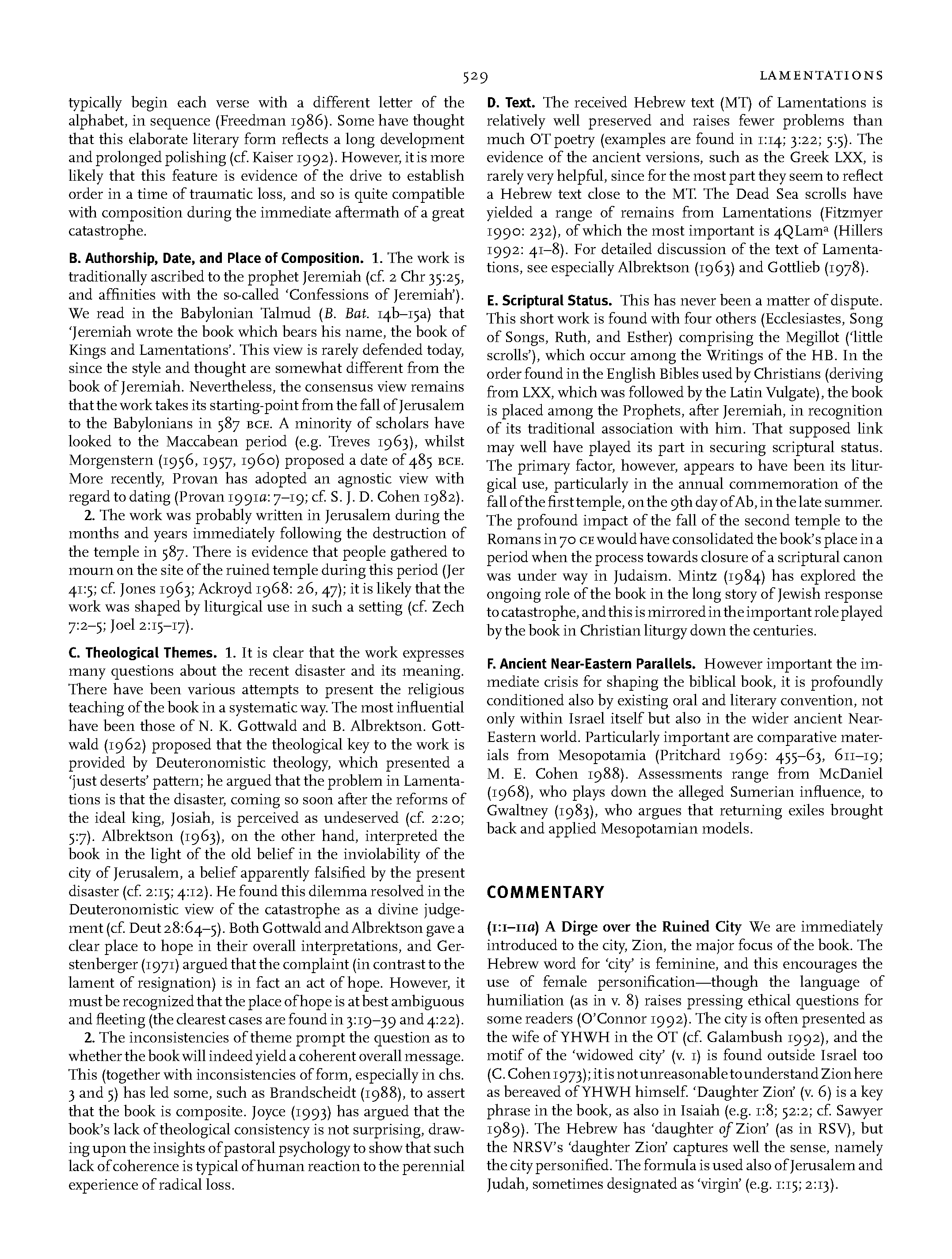
529 LAMENTATIONS
D. Text. The received Hebrew text (MT) of Lamentations is relatively well preserved and raises fewer problems than much OT poetry (examples are found in 1:14; 3:22; 5:5). The evidence of the ancient versions, such as the Greek LXX, is rarely very helpful, since for the most part they seem to reflect a Hebrew text close to the MT. The Dead Sea scrolls have yielded a range of remains from Lamentations (Fitzmyer 1990: 232), of which the most important is 4QLama (Hillers 1992: 41-8). For detailed discussion of the text of Lamentations, see especially Albrektson (1963) and Gottlieb (1978).
typically begin each verse with a different letter of the alphabet, in sequence (Freedman 1986). Some have thought that this elaborate literary form reflects a long development and prolonged polishing (cf. Kaiser 1992). However, itis more likely that this feature is evidence of the drive to establish order in a time of traumatic loss, and so is quite compatible with composition during the immediate aftermath of a great catastrophe.
B. Authorship, Date, and Place of Composition. 1. The work is traditionally ascribed to the prophet Jeremiah (cf. 2 Chr 35:25, and affinities with the so-called 'Confessions of Jeremiah'). We read in the Babylonian Talmud (B. Bat. i/^b—153) that 'Jeremiah wrote the book which bears his name, the book of Kings and Lamentations'. This view is rarely defended today, since the style and thought are somewhat different from the book of Jeremiah. Nevertheless, the consensus view remains that the work takes its starting-point from the fall of Jerusalem to the Babylonians in 587 BCE. A minority of scholars have looked to the Maccabean period (e.g. Treves 1963), whilst Morgenstern (1956, 1957, 1960) proposed a date of 485 BCE. More recently, Provan has adopted an agnostic view with regard to dating (Provan 19910: 7-19; cf. S. J. D. Cohen 1982).
E. Scriptural Status. This has never been a matter of dispute. This short work is found with four others (Ecclesiastes, Song of Songs, Ruth, and Esther) comprising the Megillot ('little scrolls'), which occur among the Writings of the HB. In the order found in the English Bibles used by Christians (deriving from LXX, which was followed by the Latin Vulgate), the book is placed among the Prophets, after Jeremiah, in recognition of its traditional association with him. That supposed link may well have played its part in securing scriptural status. The primary factor, however, appears to have been its liturgical use, particularly in the annual commemoration of the fall of the firsttemple, on the gth day ofAb, in the late summer. The profound impact of the fall of the second temple to the Romans in 70 CE would have consolidated the book's place in a period when the process towards closure of a scriptural canon was under way in Judaism. Mintz (1984) has explored the ongoing role of the book in the long story of Jewish response to catastrophe, and this is mirrored in the important role played by the book in Christian liturgy down the centuries.
2. The work was probably written in Jerusalem during the months and years immediately following the destruction of the temple in 587. There is evidence that people gathered to mourn on the site of the ruined temple during this period (Jer 41:5; cf. Jones 1963; Ackroyd 1968: 26,47); it is likely that the work was shaped by liturgical use in such a setting (cf. Zech 7:2-5; Joel 2:15-17).
C. Theological Themes. 1. It is clear that the work expresses many questions about the recent disaster and its meaning. There have been various attempts to present the religious teaching of the book in a systematic way. The most influential have been those of N. K. Gottwald and B. Albrektson. Gottwald (1962) proposed that the theological key to the work is provided by Deuteronomistic theology, which presented a 'just deserts' pattern; he argued that the problem in Lamentations is that the disaster, coming so soon after the reforms of the ideal king, Josiah, is perceived as undeserved (cf. 2:20; 5:7). Albrektson (1963), on the other hand, interpreted the book in the light of the old belief in the inviolability of the city of Jerusalem, a belief apparently falsified by the present disaster (cf. 2:15; 4:12). He found this dilemma resolved in the Deuteronomistic view of the catastrophe as a divine judgement(cf Deut28:64~5). Both Gottwald and Albrektson gave a clear place to hope in their overall interpretations, and Gerstenberger (1971) argued that the complaint (in contrast to the lament of resignation) is in fact an act of hope. However, it must be recognized that the place of hope is at best ambiguous and fleeting (the clearest cases are found in 3:19—39 and 4:22).
F. Ancient Near-Eastern Parallels. However important the immediate crisis for shaping the biblical book, it is profoundly conditioned also by existing oral and literary convention, not only within Israel itself but also in the wider ancient NearEastern world. Particularly important are comparative materials from Mesopotamia (Pritchard 1969: 455—63, 611—19; M. E. Cohen 1988). Assessments range from McDaniel (1968), who plays down the alleged Sumerian influence, to Gwaltney (1983), who argues that returning exiles brought back and applied Mesopotamian models.
(r.i—iia) A Dirge over the Ruined City We are immediately introduced to the city, Zion, the major focus of the book. The Hebrew word for 'city' is feminine, and this encourages the use of female personification—though the language of humiliation (as in v. 8) raises pressing ethical questions for some readers (O'Connor 1992). The city is often presented as the wife of YHWH in the OT (cf. Galambush 1992), and the motif of the 'widowed city' (v. i) is found outside Israel too (C. Cohen 1973); itis notunreasonable to understand Zion here as bereaved of YHWH himself. 'Daughter Zion' (v. 6) is a key phrase in the book, as also in Isaiah (e.g. 1:8; 52:2; cf. Sawyer 1989). The Hebrew has 'daughter of Zion' (as in RSV), but the NRSV's 'daughter Zion' captures well the sense, namely the city personified. The formula is used also of Jerusalem and Judah, sometimes designated as 'virgin' (e.g. 1:15; 2:13).
2. The inconsistencies of theme prompt the question as to whether the book will indeed yield a coherent overall message. This (together with inconsistencies of form, especially in chs. 3 and 5) has led some, such as Brandscheidt (1988), to assert that the book is composite. Joyce (1993) has argued that the book's lack of theological consistency is not surprising, drawing upon the insights of pastoral psychology to show that such lack of coherence is typical of human reaction to the perennial experience of radical loss.
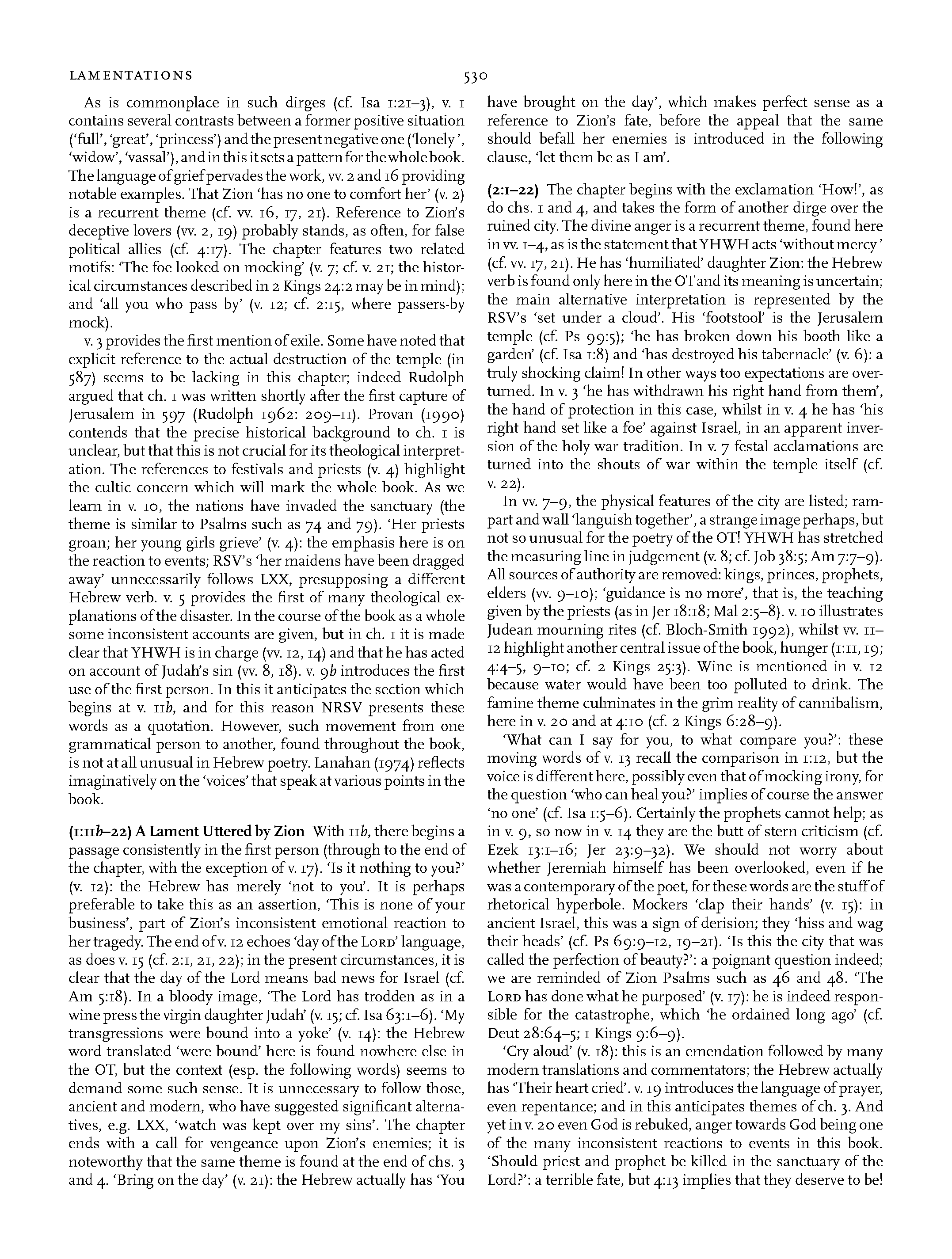
LAMENTATIONS 53° As is commonplace in such dirges (cf. Isa 1:21-3), vI contains several contrasts between a former positive situation ('full', 'great', 'princess') and the present negative one ('lonely', 'widow', 'vassal'), and in this it sets a pattern for the whole book. The language of grief pervades the work, w. 2 and 16 providing notable examples. That Zion 'has no one to comfort her' (v. 2) is a recurrent theme (cf. w. 16, 17, 21). Reference to Zion's deceptive lovers (w. 2, 19) probably stands, as often, for false political allies (cf. 4:17). The chapter features two related motifs: 'The foe looked on mocking' (v. 7; cf. v. 21; the historical circumstances described in 2 Kings 24:2 maybe in mind); and 'all you who pass by' (v. 12; cf. 2:15, where passers-by mock).
have brought on the day', which makes perfect sense as a reference to Zion's fate, before the appeal that the same should befall her enemies is introduced in the following clause, 'let them be as I am'.
(2:1—22) The chapter begins with the exclamation 'How!', as do chs. i and 4, and takes the form of another dirge over the ruined city. The divine anger is a recurrent theme, found here in w. 1—4, as is the statement that YHWH acts 'without mercy' (cf. w. 17, 21). He has 'humiliated' daughter Zion: the Hebrew verb is found only here in the OTand its meaning is uncertain; the main alternative interpretation is represented by the RSV's 'set under a cloud'. His 'footstool' is the Jerusalem temple (cf. Ps 99:5); 'he has broken down his booth like a garden' (cf. Isa 1:8) and 'has destroyed his tabernacle' (v. 6): a truly shocking claim! In other ways too expectations are overturned. In v. 3 'he has withdrawn his right hand from them', the hand of protection in this case, whilst in v. 4 he has 'his right hand set like a foe' against Israel, in an apparent inversion of the holy war tradition. In v. 7 festal acclamations are turned into the shouts of war within the temple itself (cf. v. 22).
v. 3 provides the first mention of exile. Some have noted that explicit reference to the actual destruction of the temple (in 587) seems to be lacking in this chapter; indeed Rudolph argued that ch. i was written shortly after the first capture of Jerusalem in 597 (Rudolph 1962: 209—11). Provan (1990) contends that the precise historical background to ch. i is unclear, but that this is not crucial for its theological interpretation. The references to festivals and priests (v. 4) highlight the cultic concern which will mark the whole book. As we learn in v. 10, the nations have invaded the sanctuary (the theme is similar to Psalms such as 74 and 79). 'Her priests groan; her young girls grieve' (v. 4): the emphasis here is on the reaction to events; RSV's 'her maidens have been dragged away' unnecessarily follows LXX, presupposing a different Hebrew verb. v. 5 provides the first of many theological explanations of the disaster. In the course of the book as a whole some inconsistent accounts are given, but in ch. i it is made clear that YHWH is in charge (w. 12,14) and that he has acted on account of Judah's sin (w. 8, 18). v. gfc introduces the first use of the first person. In this it anticipates the section which begins at v. nfc, and for this reason NRSV presents these words as a quotation. However, such movement from one grammatical person to another, found throughout the book, is not at all unusual in Hebrew poetry. Lanahan (1974) reflects imaginatively on the 'voices' that speak at various points in the book.
In w. 7-9, the physical features of the city are listed; rampart and wall 'languish together', a strange image perhaps, but not so unusual for the poetry of the OT! YHWH has stretched the measuring line in judgement (v. 8; cf. Job 38:5; Am 7:7—9). All sources of authority are removed: kings, princes, prophets, elders (w. 9-10); 'guidance is no more', that is, the teaching given by the priests (as in Jer 18:18; Mai 2:5—8). v. 10 illustrates Judean mourning rites (cf. Bloch-Smith 1992), whilst w. n— 12 highlight another central issue of the book, hunger (1:11,19; 4:4-5, 9-10; cf. 2 Kings 25:3). Wine is mentioned in v. 12 because water would have been too polluted to drink. The famine theme culminates in the grim reality of cannibalism, here in v. 20 and at 4:10 (cf. 2 Kings 6:28-9).
'What can I say for you, to what compare you?': these moving words of v. 13 recall the comparison in 1:12, but the voice is different here, possibly even that of mocking irony, for the question 'who can heal you?' implies of course the answer 'no one' (cf. Isa 1:5-6). Certainly the prophets cannot help; as in v. 9, so now in v. 14 they are the butt of stern criticism (cf. Ezek 13:1—16; Jer 23:9—32). We should not worry about whether Jeremiah himself has been overlooked, even if he was a contemporary of the poet, for these words are the stuff of rhetorical hyperbole. Mockers 'clap their hands' (v. 15): in ancient Israel, this was a sign of derision; they 'hiss and wag their heads' (cf. Ps 69:9-12, 19-21). Ts this the city that was called the perfection of beauty?': a poignant question indeed; we are reminded of Zion Psalms such as 46 and 48. 'The LORD has done what he purposed' (v. 17): he is indeed responsible for the catastrophe, which 'he ordained long ago' (cf. Deut 28:64-5;I Kings 9:6-9).
(i:nb-22) A Lament Uttered by Zion With nfc, there begins a passage consistently in the first person (through to the end of the chapter, with the exception of v. 17). Ts it nothing to you?'
(v. 12): the Hebrew has merely 'not to you'. It is perhaps preferable to take this as an assertion, 'This is none of your business', part of Zion's inconsistent emotional reaction to her tragedy. The end of v. 12 echoes 'day of the LORD' language, as does v. 15 (cf. 2:1, 21, 22); in the present circumstances, it is clear that the day of the Lord means bad news for Israel (cf. Am 5:18). In a bloody image, 'The Lord has trodden as in a wine press the virgin daughter Judah' (v. 15; cf. Isa 63:1—6). 'My transgressions were bound into a yoke' (v. 14): the Hebrew word translated 'were bound' here is found nowhere else in the OT, but the context (esp. the following words) seems to demand some such sense. It is unnecessary to follow those, ancient and modern, who have suggested significant alternatives, e.g. LXX, 'watch was kept over my sins'. The chapter ends with a call for vengeance upon Zion's enemies; it is noteworthy that the same theme is found at the end of chs. 3 and 4. 'Bring on the day' (v. 21): the Hebrew actually has 'You
'Cry aloud' (v. 18): this is an emendation followed by many modern translations and commentators; the Hebrew actually has 'Their heart cried', v. 19 introduces the language of prayer, even repentance; and in this anticipates themes of ch. 3. And yet in v. 20 even God is rebuked, anger towards God being one of the many inconsistent reactions to events in this book. 'Should priest and prophet be killed in the sanctuary of the Lord?': a terrible fate, but 4:13 implies that they deserve to be!
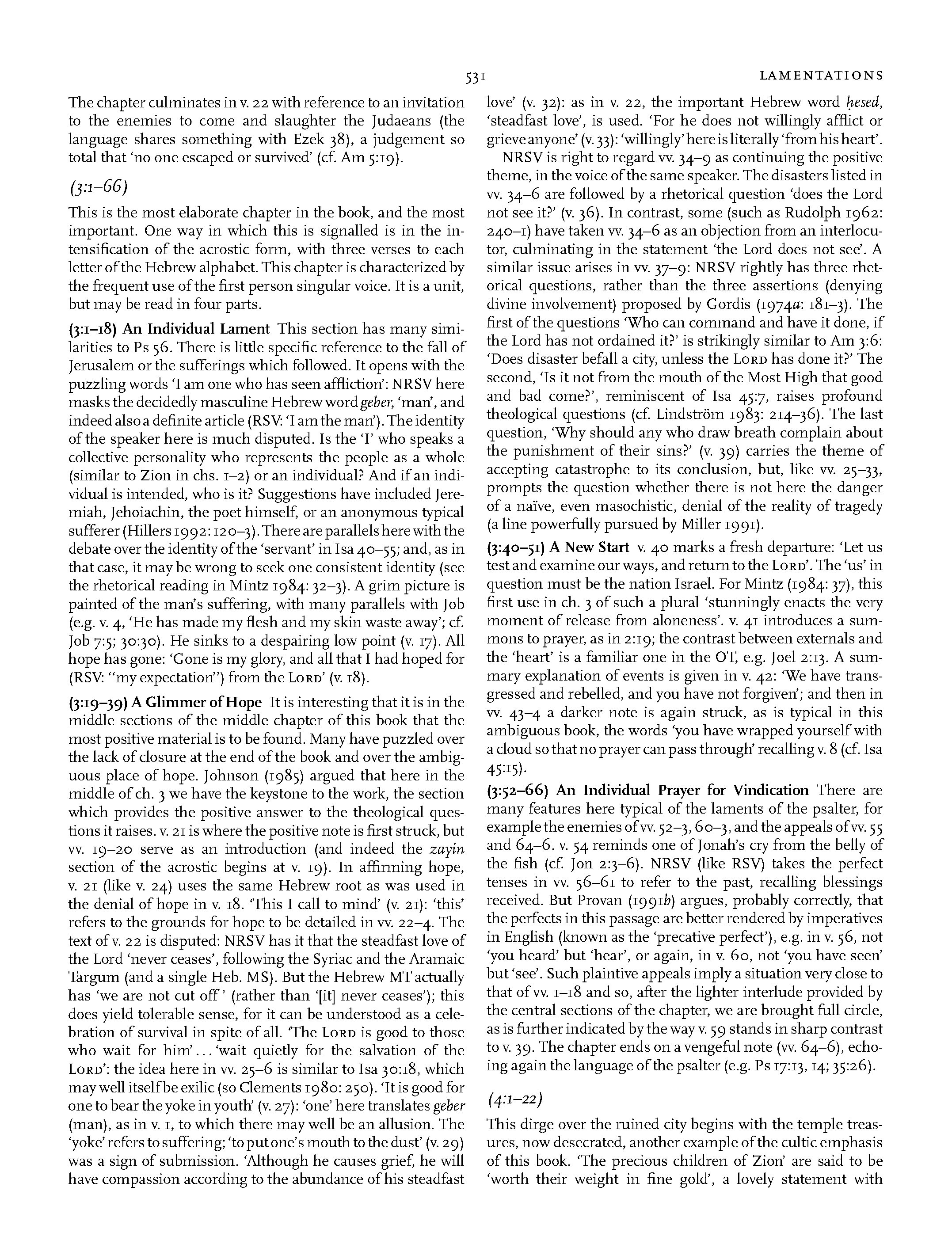
531 LAMENTATIONS love' (v. 32): as in v. 22, the important Hebrew word hesed, 'steadfast love', is used. 'For he does not willingly afflict or grieve anyone' (v. 33): 'willingly'here is literally 'from his heart'.
The chapter culminates in v. 22 with reference to an invitation to the enemies to come and slaughter the Judaeans (the language shares something with Ezek 38), a judgement so total that 'no one escaped or survived' (cf. Am 5:19).
NRSV is right to regard w. 34-9 as continuing the positive theme, in the voice of the same speaker. The disasters listed in w. 34—6 are followed by a rhetorical question 'does the Lord not see it?' (v. 36). In contrast, some (such as Rudolph 1962: 240-1) have taken w. 34-6 as an objection from an interlocutor, culminating in the statement 'the Lord does not see'. A similar issue arises in w. 37—9: NRSV rightly has three rhetorical questions, rather than the three assertions (denying divine involvement) proposed by Gordis (19740: 181-3). Th£
This is the most elaborate chapter in the book, and the most important. One way in which this is signalled is in the intensification of the acrostic form, with three verses to each letter of the Hebrew alphabet. This chapter is characterized by the frequent use of the first person singular voice. It is a unit, but may be read in four parts.
first of the questions 'Who can command and have it done, if the Lord has not ordained it?' is strikingly similar to Am 3:6: 'Does disaster befall a city, unless the LORD has done it?' The second, Ts it not from the mouth of the Most High that good and bad come?', reminiscent of Isa 45:7, raises profound theological questions (cf Lindstrom 1983: 214—36). The last question, 'Why should any who draw breath complain about the punishment of their sins?' (v. 39) carries the theme of accepting catastrophe to its conclusion, but, like w. 25-33, prompts the question whether there is not here the danger of a naive, even masochistic, denial of the reality of tragedy (a line powerfully pursued by Miller 1991). (3:40-51) A New Start v. 40 marks a fresh departure: 'Let us test and examine our ways, and return to the LORD'. The 'us' in question must be the nation Israel. For Mintz (1984: 37), this first use in ch. 3 of such a plural 'stunningly enacts the very moment of release from aloneness'. v. 41 introduces a summons to prayer, as in 2:19; the contrast between externals and the 'heart' is a familiar one in the OT, e.g. Joel 2:13. A summary explanation of events is given in v. 42: 'We have transgressed and rebelled, and you have not forgiven'; and then in w. 43-4 a darker note is again struck, as is typical in this ambiguous book, the words 'you have wrapped yourself with a cloud so that no prayer can pass through' recalling v. 8 (cf. Isa 45:15). (3:52-66) An Individual Prayer for Vindication There are many features here typical of the laments of the psalter, for example the enemies ofw. 52—3,60—3, and the appeals ofw. 55 and 64-6. v. 54 reminds one of Jonah's cry from the belly of the fish (cf. Jon 2:3-6). NRSV (like RSV) takes the perfect tenses in w. 56-61 to refer to the past, recalling blessings received. But Provan (1991/7) argues, probably correctly, that the perfects in this passage are better rendered by imperatives in English (known as the 'precative perfect'), e.g. in v. 56, not 'you heard' but 'hear', or again, in v. 60, not 'you have seen' but 'see'. Such plaintive appeals imply a situation very close to that ofw. i—18 and so, after the lighter interlude provided by the central sections of the chapter, we are brought full circle, as is further indicated by the way v. 59 stands in sharp contrast to v. 39. The chapter ends on a vengeful note (w. 64—6), echoing again the language of the psalter (e.g. Ps 17:13,14; 35:26).
(3:1-18) An Individual Lament This section has many similarities to Ps 56. There is little specific reference to the fall of Jerusalem or the sufferings which followed. It opens with the puzzling words T am one who has seen affliction': NRSV here masks the decidedly masculine Hebrew wordgefcer, 'man', and indeed also a definite article (RSV: Tarn the man'). The identity of the speaker here is much disputed. Is the T' who speaks a collective personality who represents the people as a whole (similar to Zion in chs. 1-2) or an individual? And if an individual is intended, who is it? Suggestions have included Jeremiah, Jehoiachin, the poet himself, or an anonymous typical sufferer (Hillers 1992:120—3). There are parallels here with the debate over the identity of the 'servant' in Isa 40-55; and, as in that case, it may be wrong to seek one consistent identity (see the rhetorical reading in Mintz 1984: 32—3). A grim picture is painted of the man's suffering, with many parallels with Job (e.g. v. 4, 'He has made my flesh and my skin waste away'; cf. Job 7:5; 30:30). He sinks to a despairing low point (v. 17). All hope has gone: 'Gone is my glory, and all that I had hoped for
(RSV: "my expectation") from the LORD' (v. 18).
(3:19—39) A Glimmer of Hope It is interesting that it is in the middle sections of the middle chapter of this book that the most positive material is to be found. Many have puzzled over the lack of closure at the end of the book and over the ambiguous place of hope. Johnson (1985) argued that here in the middle of ch. 3 we have the keystone to the work, the section which provides the positive answer to the theological questions it raises, v. 21 is where the positive note is first struck, but w. 19—20 serve as an introduction (and indeed the zayin section of the acrostic begins at v. 19). In affirming hope, v. 21 (like v. 24) uses the same Hebrew root as was used in the denial of hope in v. 18. 'This I call to mind' (v. 21): 'this' refers to the grounds for hope to be detailed in w. 22—4. The text of v. 22 is disputed: NRSV has it that the steadfast love of the Lord 'never ceases', following the Syriac and the Aramaic Targum (and a single Heb. MS). But the Hebrew MT actually has 'we are not cut off (rather than '[it] never ceases'); this does yield tolerable sense, for it can be understood as a celebration of survival in spite of all. 'The LORD is good to those who wait for him'... 'wait quietly for the salvation of the LORD': the idea here in w. 25—6 is similar to Isa 30:18, which may well itself be exilic (so Clements 1980: 250). Tt is good for one to bear the yoke in youth' (v. 27): 'one' here translates gcbcr (man), as in v. i, to which there may well be an allusion. The 'yoke'refers to suffering;'to putone'smouth to the dust' (v. 29) was a sign of submission. 'Although he causes grief, he will have compassion according to the abundance of his steadfast