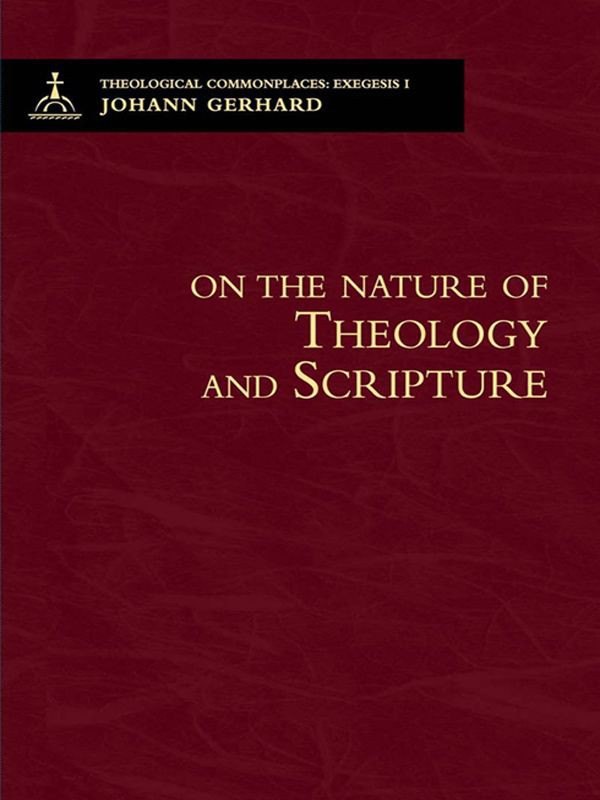
On the Nature of Theology and Scripture
Johann Gerhard
Theology
Chapters 426
- Manufactured in the United States of America ≈ 2 min
- CONTENTS ≈ 8 min
- PUBLISHER’S PREFACE ≈ 6 min
- EDITOR’S PREFACE ≈ 2 min
- INTRODUCTION ≈ 4 min
- GERHARD THE WRITER ≈ 5 min
- GERHARD’S U SE OF ARISTOTELIAN AND SCHOLASTIC CATEGORIES ≈ 3 min
- EDITIONS OF THE THEOLOGICAL COMMONPLACES ≈ 4 min
- COMPARISON OF EDITIONS OF GERHARD’S LOCI ≈ 7 min
- DEDICATORY EPISTLES ≈ 22 min
- 8 That is, baptized. ≈ 35 min
- Second, homonyms. ≈ 69 min
- The logic of the order. ≈ 2 min
- Chapter I: Nomenclature includes: (1) Etymology, § 2. (2) Homonyms, § 3. (3) Synonyms, § 9. The factual material explain ≈ 24 min
- Chapter II: The efficient cause of Scripture is either principal or instrumental. The principal cause is the true God, o ≈ 1 min
- First, the principal [efficient cause], which is God. ≈ 26 min
- Second, the instrumental causes, which are the holy men of God. ≈ 2 min
- Question 1: Whether God wanted His Word to be written. ≈ 12 min
- Question 2: Whether Scripture was necessary. ≈ 12 min
- § 31. (2) Bellarmine declares: ≈ 35 min
- Chapter III: The authority of Scripture arises from and depends on the principal efficient cause (God), § 33. ≈ 59 min
- 4 Something added to or connected with; an essential feature. ≈ 17 min
- Chapter IV: The material of Scripture is the holy things reduced to writing by the will of God, which are contained in t ≈ 5 min
- Chapters V: The books of the Bible are distinguished in various ways, § 55. ≈ 13 min
- Chapters VI: But among all the divisions, that one stands out by which they are distinguished between canonical and apoc ≈ 1 min
- Why they are so called. ≈ 4 min
- Which and how many there are. ≈ 4 min
- Which are the apocryphal books? ≈ 1 min
- The ambiguity of the word “apocryphal.” ≈ 3 min
- [First, from the instrumental efficient cause.] ≈ 5 min
- Second, from their external form. ≈ 3 min
- Third, from the subject matter. ≈ 2 min
- A posteriori. First, those controversial books are not quoted by Christ and the apostles. ≈ 2 min
- Second, they lack the testimony of the Israelite church. ≈ 14 min
- Third, they lack the testimony of the early Christian Church. ≈ 3 min
- The Council of Laodicea. ≈ 12 min
- Melito. ≈ 4 min
- Eusebius of Pamphilus. ≈ 1 min
- Cyril of Jerusalem. ≈ 1 min
- Epiphanius. ≈ 2 min
- Amphilochius. ≈ 1 min
- Nazianzen. ≈ 1 min
- Origen. ≈ 1 min
- Athanasius. ≈ 1 min
- The Trullan Synod. ≈ 1 min
- The Damascene. ≈ 2 min
- Hilary. ≈ 1 min
- Jerome. ≈ 3 min
- Rufinus. ≈ 3 min
- Philastrius. ≈ 1 min
- Gregory. ≈ 1 min
- The Glossa ordinaria of the Bible. ≈ 2 min
- The gloss of the Jus canonicum. ≈ 1 min
- Cardinal Hugh [of St. Cher]. ≈ 1 min
- Cajetan. ≈ 1 min
- Archbishop Antoninus of Florence. ≈ 1 min
- Rabanus. ≈ 1 min
- Erasmus. ≈ 1 min
- Petrus Cluniacensis. ≈ 1 min
- Hugh of St. Victor. ≈ 1 min
- Junilius Africanus. ≈ 1 min
- The author of De mirabilibus scripturae. ≈ 9 min
- The approval of the Papists themselves. ≈ 2 min
- The exceptions of the Papists: First, that the canon of the Jews must be distinguished from that of Christians. ≈ 5 min
- Second, that one must distinguish between protocanonical and deuterocanonical books. ≈ 6 min
- Third, that it is one thing not to accept but another to reject. ≈ 3 min
- Fourth, that we must distinguish between the time when the canon was not yet completely established and when it was announced by public auth ≈ 3 min
- The arguments of the Papists: First, that the apostles declared that these books were canonical. ≈ 6 min
- Second, that the councils and fathers consider those books as canonical. ≈ 18 min
- Third, that the fathers cite testimonies from these books. ≈ 4 min
- Question 1: Whether some canonical books have perished. ≈ 11 min
- Question 2: Whether the prophetic books were consumed in the burning of Jerusalem and were restored by Ezra. ≈ 13 min
- Question 3: Whether Ezra restored corrupted books. ≈ 3 min
- Question 4: Whether Ezra invented new Hebrew letters. ≈ 12 min
- 6 End of the fourth century. ≈ 3 min
- Chapters VII: The canonical books of the Old Testament specifically, § 118. ≈ 1 min
- Genesis. ≈ 5 min
- Exodus. ≈ 2 min
- Leviticus. ≈ 1 min
- Numbers. ≈ 1 min
- Deuteronomy. ≈ 5 min
- Joshua. ≈ 2 min
- Judges. ≈ 4 min
- Ruth. ≈ 3 min
- The two Books of Samuel. ≈ 2 min
- The two Books of Kings. ≈ 7 min
- The two Books of Chronicles. ≈ 5 min
- The two Books of Ezra. ≈ 4 min
- Esther. ≈ 2 min
- Job. ≈ 31 min
- The Psalter. ≈ 13 min
- The Proverbs. ≈ 2 min
- Ecclesiastes. ≈ 5 min
- Song of Songs. ≈ 5 min
- Isaiah. ≈ 6 min
- Jeremiah. ≈ 4 min
- Lamentations. ≈ 2 min
- Ezekiel. ≈ 3 min
- Daniel. ≈ 2 min
- Hosea. ≈ 2 min
- Joel. ≈ 2 min
- Amos. ≈ 3 min
- Obadiah. ≈ 2 min
- Jonah. ≈ 3 min
- Micah. ≈ 1 min
- Nahum. ≈ 1 min
- Habakkuk. ≈ 1 min
- Zephaniah. ≈ 2 min
- Haggai. ≈ 1 min
- Zechariah. ≈ 2 min
- Malachi. ≈ 22 min
- 3 and 4 Ezra. ≈ 8 min
- 3 and 4 Maccabees. ≈ 7 min
- The Prayer of Manasseh. ≈ 2 min
- The appendix to the Book of Job. ≈ 2 min
- The Book of Tobit. It is not found in the Hebrew sources. ≈ 1 min
- The Greek version does not agree with the Latin. ≈ 6 min
- It conflicts with historical truth. ≈ 9 min
- It has some things that do not agree with canonical truth. ≈ 15 min
- The fathers remove it from the canon. ≈ 1 min
- As do some of the Papists. ≈ 1 min
- Antithesis. ≈ 4 min
- The Book of Judith. ≈ 1 min
- It does not agree with historical truth. ≈ 22 min
- It is not at all in harmony with the analogy of faith. ≈ 5 min
- It is excluded from the canon by the Israelite church and the early Christian church. ≈ 2 min
- Antithesis. ≈ 12 min
- The seven last chapters of the Book of Esther. ≈ 2 min
- They were not written in Hebrew but in Greek. ≈ 5 min
- They were not written by a prophet. ≈ 2 min
- They conflict with the canonical Book of Esther. ≈ 8 min
- It conflicts with historical truth. ≈ 6 min
- It is excluded from the canon by the Israelite church and the early Christian church. ≈ 3 min
- Some Papists number it among the apocryphal writings. ≈ 4 min
- Antithesis. ≈ 13 min
- The Book of Wisdom. ≈ 26 min
- It contains some matters not in harmony with the analogy of faith. ≈ 2 min
- It lacks the unanimous approval of the early Church. ≈ 3 min
- Antithesis. ≈ 16 min
- It contains some things not in harmony with the analogy of faith. ≈ 2 min
- Antithesis. ≈ 13 min
- It is not written in the prophetic language. ≈ 1 min
- It conflicts with the canonical books. ≈ 2 min
- It conflicts with historical truth. ≈ 1 min
- The more sensible Papists reject it. ≈ 1 min
- Antithesis. ≈ 2 min
- They are not found in Hebrew. ≈ 5 min
- They were not written by a prophet. ≈ 5 min
- They lack the approval of the Church. ≈ 1 min
- The more sensible Papists reject them. ≈ 2 min
- Antithesis. ≈ 1 min
- The two Books of Maccabees. ≈ 1 min
- They are not written in the prophetic language. ≈ 1 min
- They do not have the testimony of Christ nor of the apostles in the New Testament. ≈ 1 min
- Bellarmine makes the exception: ≈ 5 min
- They contain discordant matters. ≈ 7 min
- Bellarmine makes the exception: ≈ 7 min
- They contain some matters not consistent with the analogy of faith. ≈ 4 min
- The Israelite church did not accept them into the canon. ≈ 6 min
- Some Papists remove them from the canon. ≈ 2 min
- Antithesis. ≈ 8 min
- Whether there are some apocryphal books among the New Testament books. ≈ 19 min
- The canonical books of the New Testament of the first rank: The Gospel of Matthew. ≈ 6 min
- The Gospel of Mark. ≈ 4 min
- The Gospel of Luke. ≈ 5 min
- The Gospel of John. ≈ 30 min
- The Acts of the Apostles. ≈ 9 min
- The thirteen Pauline Epistles. ≈ 5 min
- Romans. ≈ 2 min
- 1 Corinthians. ≈ 3 min
- 2 Corinthians. ≈ 2 min
- Galatians. ≈ 2 min
- Ephesians. ≈ 2 min
- Philippians. ≈ 1 min
- Colossians. ≈ 2 min
- 1 Thessalonians. ≈ 2 min
- 2 Thessalonians. ≈ 1 min
- 1 Timothy. ≈ 1 min
- 2 Timothy. ≈ 1 min
- Titus. ≈ 1 min
- Philemon. ≈ 1 min
- 1 Peter. ≈ 10 min
- 1 John. ≈ 3 min
- The Epistle to the Hebrews. ≈ 40 min
- The Epistle of James. ≈ 20 min
- 2 Peter. ≈ 8 min
- 2 and 3 John. ≈ 7 min
- The Epistle of Jude. ≈ 15 min
- Revelation. ≈ 47 min
- Chapters XI: The apocryphal and rejected books of the New Testament, § 301. ≈ 17 min
- The internal form of Scripture. ≈ 2 min
- The external form. ≈ 13 min
- Chapter XIII: From the fact that the Old Testament was written by holy men of God in the Hebrew language, and the New Te ≈ 30 min
- Antithesis. ≈ 8 min
- The Hebrew text is not corrupt. ≈ 2 min
- First, not by the malice of the Jews. ≈ 11 min
- Second, nor by the carelessness of scribes. ≈ 12 min
- Antithesis. ≈ 11 min
- Examples of corruption adduced by Bellarmine: First, Isaiah 9:6: “He will call Him.” ≈ 4 min
- Second, Jeremiah 23:6: “He will call Him.” ≈ 3 min
- Third, Psalm 22:[16]. ≈ 5 min
- Fourth, Psalm 19:4: “their voice.” ≈ 5 min
- Fifth, complete sentences are missing. ≈ 5 min
- The vowel points are as old as the Hebrew text. ≈ 8 min
- We prove this, first, from Christ’s assertion in Matthew 5:18. ≈ 6 min
- Second, from the nature and condition of the vowel points. ≈ 6 min
- Third, from the peril of ambiguity and uncertainty. ≈ 10 min
- Fourth, from the perspicuity of Scripture. ≈ 6 min
- Fifth, from the perfection of Scripture. ≈ 2 min
- Sixth, from the Jews’ reverence toward Scripture. ≈ 2 min
- Seventh, from the consequence of absurdities. ≈ 3 min
- Antithesis. ≈ 7 min
- Contrary arguments: First, from the perfection of the Hebrew language. ≈ 2 min
- Second, from the quoting of the Greek version in the Old Testament. ≈ 2 min
- Third, from the diverse readings of proper names. ≈ 2 min
- Fourth, from the condition of the dagesh and of the pointing of the shin. ≈ 2 min
- Fifth, from an ignorance of Hebrew poetry. ≈ 2 min
- Sixth, from the omission of the vowel points in today’s writings of the Hebrews. ≈ 2 min
- Seventh, from the suppression of the vowel points. ≈ 3 min
- Eighth, from the Chaldaic name for certain vowels. ≈ 2 min
- Ninth, from the omission of Jerome. ≈ 4 min
- The Greek text in the New Testament was not corrupted. ≈ 7 min
- Antithesis. ≈ 5 min
- First, 1 Corinthians 15:47: “The second man is from heaven.” ≈ 5 min
- Second, 1 Corinthians 7:[34]: “and he is divided.” ≈ 4 min
- Third, Romans 12:11: “serving the Lord.” ≈ 3 min
- Fourth, some parts of Scripture are missing. ≈ 3 min
- Fifth, some things in them are superfluous. ≈ 6 min
- The end of Scripture: First, with respect to God. ≈ 1 min
- Second, with respect to us. ≈ 8 min
- The effects of Holy Scripture. ≈ 7 min
- Scripture is perfect. ≈ 5 min
- We prove this, first, from its clear appellation in Psalm 19:7. ≈ 8 min
- Second, from its principal efficient cause. ≈ 2 min
- Third, from its material. ≈ 7 min
- Exceptions to the passages Deuteronomy 4:2 and 12:32. ≈ 11 min
- Exceptions to the passage John 20:31. ≈ 8 min
- Exceptions to the passage Galatians 1:8. ≈ 5 min
- Exception to the passage 2 Timothy 3:15. ≈ 15 min
- Exception to the passage Revelation 22:18. ≈ 2 min
- Fourth, from its end and effect. ≈ 6 min
- Statements of the ancients regarding the perfection of Scripture. ≈ 17 min
- The confession of the Scholastics and of certain Papists. ≈ 7 min
- Antithesis: Of the Papists. ≈ 3 min
- Their arguments: First, that either the entire canon taken together is sufficient or the individual books by themselves are sufficient. ≈ 3 min
- Second, that the apostles did not write in accordance with God’s mandate. ≈ 2 min
- Third, that many necessary things are not contained in Scripture: A remedy for women against original sin. ≈ 4 min
- The remedy for males who die before their eighth day. ≈ 3 min
- The justification of the Gentiles in the Old Testament. ≈ 2 min
- The authority of the canonical books. ≈ 9 min
- The understanding of Scripture. ≈ 4 min
- The virginity of Mary. ≈ 3 min
- The celebration of Easter on Sunday. ≈ 2 min
- Infant Baptism. ≈ 1 min
- Purgatory. ≈ 1 min
- The perfection of Scripture. ≈ 1 min
- The institution of the sacraments. ≈ 1 min
- Antithesis: Of the Calvinists. ≈ 1 min
- Antithesis: Of the Photinians. ≈ 2 min
- Antithesis: Of the Weigelians. ≈ 1 min
- Chapter XIX: Which excludes the necessity of traditions, § 394. ≈ 3 min
- First, they are opposed to the written Word of God. ≈ 7 min
- Second, they derive from Pharisaism. ≈ 5 min
- They are the characteristic of heretics. ≈ 2 min
- Fourth, they are fallacious and uncertain. ≈ 4 min
- Fifth, they have not come from Christ and the apostles. ≈ 7 min
- Statements of the fathers. ≈ 3 min
- Antithesis. ≈ 14 min
- Arguments in favor of traditions: First, John 16:12: “I yet have many things to say to you.” John 21:25: “But there are also many other thin ≈ 15 min
- We respond. (1) The same faulty logic is coming back: ≈ 7 min
- Third, 2 Thessalonians 2:15: “Hold to the traditions.” ≈ 9 min
- Fourth, 1 Timothy 6:20: “Guard the deposit.” ≈ 7 min
- Fifth, 2 John 12 and 3 John 13: “I have many things to write to you.” ≈ 4 min
- The testimony of the Papists, councils, and fathers. ≈ 3 min
- Rational arguments: First, from the consensus of heretics in despising traditions. ≈ 3 min
- Second, from the custom of all the heathen. ≈ 3 min
- Third, from the dignity of the Catholic Church. ≈ 2 min
- Fourth, from the dignity of the divine mysteries. ≈ 3 min
- Chapter XX: (2) And perspicuity, § 414. ≈ 3 min
- This is proved, first, from statements of Scripture. ≈ 5 min
- Second, from its efficient cause. ≈ 1 min
- Third, from an enumeration of its constituent parts. ≈ 6 min
- Fourth, from the chief material and contents of Scripture. ≈ 3 min
- Fifth, from an accidental outcome. ≈ 5 min
- Sixth, from a comparison of the Old and New Testaments. ≈ 4 min
- Seventh, from a deduction to the absurd. ≈ 4 min
- Statements of the fathers. ≈ 16 min
- The approval of our adversaries. ≈ 4 min
- Antithesis: First, of the Papists. ≈ 3 min
- Their arguments: First, Psalm 119:18: “Give me understanding.” ≈ 3 min
- Third, 2 Peter 3:16. ≈ 3 min
- Fourth, Daniel 12:4. ≈ 1 min
- The testimony of the fathers. ≈ 1 min
- Rational arguments. ≈ 6 min
- Our testimony. ≈ 2 min
- Second, the Calvinists. ≈ 5 min
- Third, the Photinians. ≈ 26 min
- This is proved: First, from its title. ≈ 11 min
- Second, from God’s command. ≈ 9 min
- Third, from the reformation of divine worship. ≈ 3 min
- Fourth, from the appeal of Christ and His apostles to Scripture. ≈ 7 min
- Fifth, from the commendation of Scripture. ≈ 2 min
- Sixth, from the condition of a norm. ≈ 3 min
- Seventh, from sufficient enumeration. ≈ 1 min
- The statements of the fathers. ≈ 19 min
- Antithesis: First, of the Papists. ≈ 15 min
- Of the Weigelians. ≈ 1 min
- Chapter XXII: And their infallible judge, § 453. ≈ 3 min
- First, the principal, absolute, and authentic judge is God Himself. ≈ 5 min
- Second, the ministerial and inferior judge is the Church. ≈ 5 min
- Third, Scripture alone is the voice of the principal judge and the norm of the ministerial judge. ≈ 11 min
- Statements of the fathers. ≈ 6 min
- Therefore the judge is not: First, unregenerate man speaking according to the dictates of reason. ≈ 2 min
- Second, the enthusiast who boasts of the internal testimony of the Holy Spirit. ≈ 3 min
- Third, the Roman pontiff, boasting of the immediate assistance of the Holy Spirit. ≈ 4 min
- Fourth, councils. ≈ 3 min
- Fifth, the fathers. ≈ 1 min
- Antithesis: First, of the Papists. ≈ 6 min
- The arguments of the Papists: First, from the imperfection of Scripture. ≈ 4 min
- Second, from a comparison with the civil commonwealth. ≈ 2 min
- Third, from the disagreement of those who acknowledge Scripture as the judge. ≈ 3 min
- Fourth, from the appeal of heretics to Scripture. ≈ 6 min
- Fifth, from the condition of a judge. ≈ 4 min
- Antithesis: Second, of the Calvinists. ≈ 2 min
- Antithesis: Third, of the Photinians. ≈ 28 min
- Arguments of the Photinians. ≈ 8 min
- Fourth, the Weigelians. ≈ 4 min
- Chapter XXIII: The object of Scripture is all human beings without exception, § 481. From this, it is concluded deductiv ≈ 3 min
- We prove that the laity should read Scripture: First, from the divine command. ≈ 10 min
- Second, from divine approval. ≈ 2 min
- Third, from the intention of God and the holy men of God. ≈ 13 min
- Fourth, from the fruit produced by this reading. ≈ 5 min
- Fifth, from the corresponding form of proven examples. ≈ 2 min
- Seventh, from a comparison of both similar and equal things. ≈ 1 min
- Statements of the ancients. ≈ 15 min
- The approval of some of our adversaries. ≈ 4 min
- Antithesis. ≈ 7 min
- Chapter XXIV: Now if the laity are not only to be allowed to read Scripture but also invited, then it must surely be nec ≈ 8 min
- Antithesis. ≈ 3 min
- The arguments of the Papists: First, from the history of the Old Testament. ≈ 6 min
- Second, from the usage of the apostles. ≈ 3 min
- Third, from the usage of the universal Church. ≈ 2 min
- Fourth, from reason. ≈ 1 min
- Fifth, from inconvenience. ≈ 9 min
- Sixth, from the majesty of the divine offices. ≈ 2 min
- Seventh, from the absurd. ≈ 1 min
- Eighth, from the excellence of the Hebrew, Greek, and Latin languages. ≈ 4 min
- Section I: On the Chaldaic Version of the Old Testament ≈ 9 min
- Section II: On the Greek Translation of the Old Testament ≈ 13 min
- Section III: On the Syriac Version of the New Testament ≈ 14 min
- Section IV: On the Arabic Translation of Holy Scripture ≈ 5 min
- Section V: On the Latin Vulgate Translation of the Bible ≈ 1 min
- It is not Jerome’s work. ≈ 11 min
- It departs from its sources. ≈ 3 min
- It teems with many errors. ≈ 12 min
- The fathers depart from it. ≈ 7 min
- Antithesis. ≈ 9 min
- The arguments of the Papists: First, from the antiquity of the translation. ≈ 3 min
- Second, from the dignity of its commendation. ≈ 2 min
- Third, from parity of nature. ≈ 2 min
- Fourth, from the variety of translations. ≈ 2 min
- Section VI: On Luther’s German Translation ≈ 5 min
- Passages in which he is slandered by the Papists. ≈ 22 min
- The necessity of interpretation. ≈ 1 min
- Interpretation belongs to the ecclesiastical ministry. ≈ 2 min
- Rules for the interpretation of Scripture: First, the meaning of Scripture is to be drawn out from Scripture itself. ≈ 11 min
- Second, the interpretation of Scripture should be analogous to the faith. ≈ 3 min
- Third, the more obscure and more rare things are to be explained from the clearer and more frequent things. ≈ 1 min
- Fourth, the natural meaning of words and colloquial expressions are to be discovered from the sources. ≈ 2 min
- Fifth, interpretation should be proper and literal. ≈ 2 min
- Sixth, interpretation should agree with each passage’s aim, circumstances of parts, and order. ≈ 6 min
- Seventh, one must consult the ancient and more recent interpreters. ≈ 3 min
- Chapter XXVI: The use of this article is theoretical: (1) Teaching. (2) Refuting. And practical: (1) Admonishing. (2) Co ≈ 1 min
- Chapter XXVII: The definition of Scripture can be formed from the preceding. Holy Scripture is the Word of God; by His w ≈ 1 min
- GLOSSARY ≈ 8 min
- NAME INDEX ≈ 46 min
- Oecolampadius, Johannes, E1.431 ≈ 16 min
- OLD TESTAMENT Genesis ≈ 3 min
- Exodus ≈ 2 min
- Numbers ≈ 1 min
- Deuteronomy ≈ 2 min
- Joshua ≈ 1 min
- Judges ≈ 1 min
- 1 Kings ≈ 1 min
- 2 Kings ≈ 2 min
- 2 Chronicles ≈ 1 min
- Ezra ≈ 1 min
- Nehemiah ≈ 1 min
- Esther ≈ 1 min
- Job ≈ 1 min
- Psalms ≈ 4 min
- Proverbs ≈ 1 min
- Isaiah ≈ 2 min
- Jeremiah ≈ 1 min
- Ezekiel ≈ 1 min
- Daniel ≈ 1 min
- Amos ≈ 1 min
- Tobit ≈ 2 min
- Judith ≈ 1 min
- Additions to Esther ≈ 1 min
- Wisdom (Wisdom of Solomon ) ≈ 1 min
- Sirach (Ecclesiasticus) ≈ 1 min
- 1 Maccabees ≈ 1 min
- 2 Maccabees ≈ 1 min
- NEW TESTAMENT Matthew ≈ 4 min
- Mark ≈ 1 min
- Luke ≈ 3 min
- John ≈ 4 min
- Acts ≈ 4 min
- Romans ≈ 3 min
- 1 Corinthians ≈ 3 min
- 2 Corinthians ≈ 2 min
- Galatians ≈ 1 min
- Ephesians ≈ 1 min
- Colossians ≈ 1 min
- 1 Thessalonians ≈ 1 min
- 2 Thessalonians ≈ 1 min
- 1 Timothy ≈ 1 min
- 2 Timothy ≈ 2 min
- Hebrews ≈ 2 min
- James ≈ 1 min
- 1 Peter ≈ 1 min
- 2 Peter ≈ 1 min
- 1 John ≈ 1 min
- Revelation ≈ 2 min
- WORKS CITED ≈ 3 min
| Author | Johann Gerhard |
|---|---|
| Language | English |
| Era | Reformation |
| Categories | Theology · Christian Classics |
| Length | 426 chapters · ≈ 40 h 7 min read |
| Formats | Web Book · EPUB |