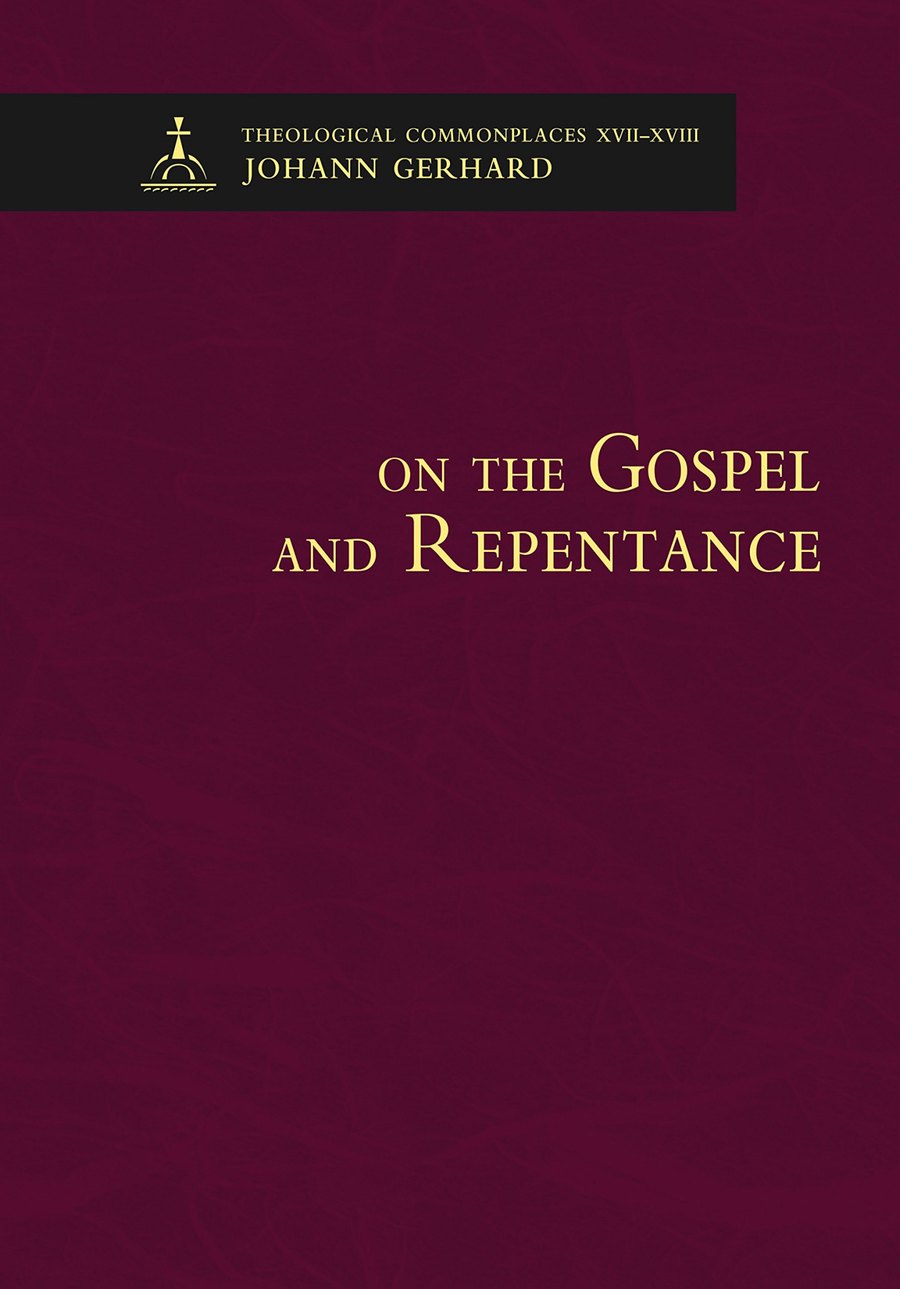
On the Gospel and Repentance
Johann Gerhard
Theology
Chapters 322
- Content ≈ 11 min
- Editor’s Introduction ≈ 1 min
- THE GOSPEL ≈ 3 min
- REPENTANCE ≈ 6 min
- EDITIONS OF THE THEOLOGICAL COMMONPLACES ≈ 4 min
- Comparison of Editions of Gerhard’s Loci ≈ 7 min
- Chapter I ≈ 4 min
- The etymology of evangelium (“Gospel”). ≈ 3 min
- The definition of the word. ≈ 1 min
- Homonyms. ≈ 10 min
- When the word “Gospel” is being used generally or specifically. ≈ 3 min
- Synonyms for “Gospel.” ≈ 4 min
- Summaries of the Gospel in the Old Testament. ≈ 5 min
- From the New Testament. ≈ 16 min
- Parabolic and typological descriptions of the Gospel. ≈ 4 min
- Chapter II ≈ 3 min
- What the benefits of the Gospel are. ≈ 5 min
- That the Gospel is properly the message of the free forgiveness of sins because of Christ. ≈ 13 min
- The testimony of the ancients. ≈ 7 min
- Whether new commandments are given in the Gospel. ≈ 4 min
- The arguments of Bellarmine in favor of the affirmative side. ≈ 3 min
- Whether laws are contained in the Gospel. ≈ 13 min
- Whether the Gospel contains threats and terrors. ≈ 14 min
- Whether conditional promises are contained in the Gospel. ≈ 8 min
- Matthew 19[:17]: “If you wish to enter into life, keep the Commandments.” Luke 10[:28]: “Do this, and you will live.” ≈ 10 min
- Romans 8[:13]: “If by the Spirit you put to death the deeds of the flesh, you will live.” 2 Timothy 2[:11]: “If we have died with Him, we sh ≈ 7 min
- Ezekiel 18[:21]: “But if a wicked man turns away from all his sins,” etc., “he will live.” ≈ 2 min
- In what way faith is required in the promises of the Gospel. ≈ 5 min
- Whether the Gospel requires the condition of obedience. ≈ 4 min
- Whether the Gospel requires both faith and works. ≈ 5 min
- Chapter III ≈ 3 min
- The internal impulsive cause of the decree of the Gospel. ≈ 1 min
- The external [impulsive cause]. ≈ 2 min
- The revealing of the Gospel is the work of the entire Holy Trinity. ≈ 4 min
- Whether the Son is the “contributory cause” of the Gospel. ≈ 3 min
- The instrumental cause of the Gospel. ≈ 3 min
- The apprehending instrument. ≈ 3 min
- Chapter IV ≈ 7 min
- That there is one and the same Gospel in the Old and New Testaments. ≈ 19 min
- First, John 1[:17]: “The Law was given through Moses; grace and truth came through Jesus Christ.” ≈ 3 min
- Second, Romans 1[:2]: “The Gospel promised beforehand through His prophets.” ≈ 1 min
- Third, Romans 16[:25]: “The Gospel is the mystery which was kept silent for long ages.” ≈ 1 min
- 4 Chemnitz’s Works 8:838–46. ≈ 5 min
- Chapter V ≈ 3 min
- And universal. ≈ 3 min
- Whether the condition of faith removes the grace and universality of the promises of the Gospel. ≈ 5 min
- To whom the evangelical goods pertain. ≈ 2 min
- The effects and goods of the Gospel. ≈ 3 min
- The accidental effects of the Gospel. ≈ 3 min
- Those are the words of Brenz. ≈ 4 min
- Whether the Gospel of John is to be worn about the neck. ≈ 4 min
- The efficacy of the Spirit must not be separated from the word of the Gospel. ≈ 3 min
- The end purpose of the Gospel. ≈ 10 min
- Chapter VI ≈ 3 min
- The points of agreement between the Law and the Gospel. ≈ 4 min
- The difference between Law and Gospel. ≈ 11 min
- Where the distinction between Law and Gospel must especially be observed. ≈ 3 min
- Statements of the ancients about the distinction between Law and Gospel. ≈ 9 min
- Judgment on the statements of the ancients. ≈ 5 min
- Biel ( Sent ., 3, dist. 40, q. 1): ≈ 6 min
- Bellarmine’s opinion about the distinction of Law and Gospel. ≈ 4 min
- Whether the promises in the Old and New Testament differ. ≈ 8 min
- Whether new commandments have been given in the New Testament. ≈ 5 min
- [That] the Law comes alone, and the Gospel comes with grace. ≈ 4 min
- Nonprincipal differences between Law and Gospel. ≈ 7 min
- Chapter VII ≈ 8 min
- The arguments of those who claim that Christ is the new Lawgiver: First, from Matthew 5. ≈ 7 min
- Second, from the names given to Christ. ≈ 2 min
- Third, from a comparison of Christ with Moses. ≈ 4 min
- Fourth, from the publishing of the new commandment. ≈ 4 min
- Fifth, from mention of the specific “law of Christ.” ≈ 2 min
- Sixth, from the institution of the Sacraments. ≈ 3 min
- Chapter VIII ≈ 4 min
- What they think was added to the First Commandment. ≈ 4 min
- What they say has been added to the Second Commandment. ≈ 4 min
- What they say has been added to the Third Commandment. ≈ 4 min
- What they say has been added to the Fourth Commandment. ≈ 1 min
- What they say has been added to the Fifth Commandment. ≈ 2 min
- What has been added to the Sixth Commandment. ≈ 5 min
- What they say has been added to the Seventh Commandment. ≈ 8 min
- What they say has been added to the Eighth Commandment. ≈ 4 min
- What they say has been added to the Ninth Commandment. ≈ 2 min
- What they say has been added to the Tenth Commandment. ≈ 4 min
- Chapter IX ≈ 5 min
- The opinion concerning evangelical counsels is refuted. ≈ 5 min
- First, we cannot rise to a perfect love of God. ≈ 4 min
- Second, something is always lacking in good works. ≈ 4 min
- Bellarmine counters: ≈ 14 min
- Fourth, [1 John 3:16:] “We ought to lay down our lives for our brethren.” ≈ 3 min
- Fifth, nothing should be added to God’s Commandments. ≈ 3 min
- Sixth, we cannot do as much as we owe. ≈ 6 min
- The statements of the fathers. ≈ 3 min
- The arguments in favor of establishing the evangelical counsels. ≈ 1 min
- First, Isaiah 56[:4–5]: “Thus says the Lord to the eunuchs: ‘I shall give them a better name.’ ” ≈ 14 min
- Second, Wisdom 3[:13]: “Blessed is she who is barren and undefiled,” etc. ≈ 3 min
- Third, Matthew 13[:8]: “some a hundredfold, some sixty, some thirty.” ≈ 6 min
- Fourth, Matthew 19[:11–12]: “Some castrate themselves for the sake of the kingdom of heaven.” ≈ 11 min
- Fifth, Matthew 19[:21]: “If you would be perfect, go and sell everything.” ≈ 14 min
- Sixth, Matthew 19[:21]: “Follow Me.” ≈ 6 min
- Seventh, 1 Corinthians 7, where a counsel of continence is proposed. ≈ 16 min
- Eighth, 1 Corinthians 9: The apostle did more than he had been commanded. ≈ 12 min
- We respond. ≈ 9 min
- Examples from the early church. ≈ 2 min
- The statements of the fathers. ≈ 3 min
- The arguments of reason. ≈ 4 min
- Chapter X ≈ 7 min
- It must not be denied simply that the Gospel is the preaching of repentance. ≈ 5 min
- The distinctions that must be observed in this question. ≈ 5 min
- The Gospel, understood properly, is not the preaching of repentance. ≈ 2 min
- That the Law does not know Christ; therefore it does not accuse unbelief. ≈ 7 min
- Other arguments: First, that the righteousness of the Law is accused, and yet the Law does not accuse itself. ≈ 3 min
- Second, that Christ’s suffering and death pertain to the Gospel, yet in His Passion the wrath of God shines forth. ≈ 3 min
- Third, that salutary contrition comes from the Gospel. ≈ 2 min
- Fourth, that the Holy Spirit rebukes the world concerning sin (John 16[:8]). ≈ 2 min
- Fifth, that the Gospel excludes all boasting. ≈ 1 min
- The authority of Dr. Philipp [Melanchthon]. ≈ 7 min
- Chapter XI ≈ 5 min
- Whether there is only one testament with regard to matter or substance. ≈ 6 min
- [Negative conclusions.] ≈ 3 min
- Affirmative [conclusions]. ≈ 6 min
- Arguments for the essential identity of both testaments. ≈ 5 min
- Second, God entered into a covenant with Noah and Abraham. ≈ 6 min
- Third, the doctrine concerning Christ was also taught under the old testament. ≈ 4 min
- Fourth, the moral Law has not been antiquated. ≈ 4 min
- Chapter XII ≈ 4 min
- Abuses of the doctrine of the Gospel. ≈ 2 min
- Its true use. ≈ 5 min
- The definition of the Gospel. ≈ 2 min
- Connection with the preceding commonplace. ≈ 2 min
- The necessity and usefulness of the doctrine of repentance. ≈ 2 min
- Chapter I ≈ 8 min
- Whether Luther denied that repentance was grief. ≈ 5 min
- Μετάνοια. ≈ 5 min
- Μεταμέλεια. ≈ 3 min
- How μετάνοια and μεταμέλεια differ. ≈ 5 min
- [Hebrew terms.] ≈ 3 min
- The homonyms of the word “repentance” ≈ 7 min
- The synonyms of “repentance.” ≈ 5 min
- Other ways of saying “repentance,” from the ancients. ≈ 3 min
- Is repentance the second plank after shipwreck? ≈ 4 min
- Chapter II ≈ 1 min
- The Novatians deny this. ≈ 9 min
- What repentance is. ≈ 7 min
- Hebrews 6[:4–6]: “It is impossible for those who have once been enlightened.” ≈ 10 min
- First, “the power to forgive sins must be reserved for God alone.” ≈ 1 min
- Second, “God would be mutable.” ≈ 2 min
- Third, “Scripture speaks doubtfully about remission.” ≈ 1 min
- Fourth, “Esau did not find a place of repentance.” ≈ 4 min
- Chapter III ≈ 2 min
- Chapter IV ≈ 2 min
- To what end penance is established as a sacrament. ≈ 5 min
- Is it the Novatian heresy to say that repentance is not a sacrament? ≈ 3 min
- Does the Augsburg Confession claim that penance is a sacrament properly speaking? ≈ 4 min
- The arguments with which penance is excluded from the number of the sacraments: First, it has no external element. ≈ 15 min
- The imposition of hands. ≈ 4 min
- Second, repentance existed also in the Old Testament. ≈ 13 min
- Third, the sacrament of penance lacks a foundation in John the Baptist’s sermon and in the practice of Christ Himself. ≈ 7 min
- Fourth, the sacrament of penance has no foundation in the doctrine and examples of the apostles. ≈ 8 min
- Fifth, it has no foundation in the fathers. ≈ 3 min
- Three arguments that penance is not a sacrament. ≈ 3 min
- Arguments in favor of establishing the sacrament of penance. ≈ 18 min
- Statements of the fathers for establishing the sacrament of penance. ≈ 6 min
- Chapter V ≈ 3 min
- The divisions of repentance. ≈ 15 min
- Chapter VI ≈ 14 min
- Is man’s will a contributing cause of repentance? ≈ 8 min
- Arguments to establish cooperation in conversion. ≈ 1 min
- [The instrumental cause is the Word of God.] ≈ 2 min
- Chapter VII ≈ 10 min
- Contrition is a part of repentance. ≈ 4 min
- Faith is a part of repentance. ≈ 4 min
- Statements of the ancients. ≈ 15 min
- Do the Evangelicals disagree in listing the parts of repentance? ≈ 4 min
- Do terrors belong to the parts of repentance? ≈ 3 min
- First, that Scripture distinguishes terror from repentance. ≈ 7 min
- Second, [that] theologians do not mention terrors in their definition of repentance. ≈ 3 min
- Third, [that] being terrified is a natural affection. ≈ 2 min
- Fourth, [that] terrors are found in those who do not repent, and some people repent without terrors. ≈ 4 min
- Some claim that faith is not part of repentance. ≈ 2 min
- First, [that] faith is distinguished from repentance. ≈ 2 min
- Second, [that] faith precedes and produces repentance. ≈ 4 min
- Third, [that] believing is an act of faith, not of repentance. ≈ 1 min
- Fourth, [that] the fathers do not mention faith. ≈ 1 min
- Fifth, [that] the Ninevites doubted. ≈ 1 min
- Whether good works are a part of repentance. ≈ 5 min
- In what sense some people claim good works are parts of repentance. ≈ 2 min
- Good works are the consequence of repentance. ≈ 5 min
- Whether mortification and vivification are parts of repentance. ≈ 3 min
- Whether contrition, confession, and satisfaction are parts of repentance. ≈ 7 min
- The arguments which Bellarmine has produced in favor of this enumeration of parts. ≈ 12 min
- What is found lacking in this partition. ≈ 13 min
- Section I: Contrition. ≈ 3 min
- What contrition includes. ≈ 12 min
- External signs of contrition. ≈ 10 min
- The efficient cause of contrition. ≈ 2 min
- The difference between salutary and destructive contrition. ≈ 4 min
- What should be thought about the distinction between legal and evangelical contrition. ≈ 1 min
- The instrumental cause of contrition. ≈ 10 min
- The purpose for which contrition is required. ≈ 4 min
- Is contrition a terror conceived from the threats of the Law? ≈ 3 min
- Is contrition suffering? ≈ 13 min
- Whether contrition pertains to the Gospel. ≈ 3 min
- Does contrition free us from sins? ≈ 4 min
- Can contrition be had without the special help of God? ≈ 2 min
- Does contrition include a hatred of sin? ≈ 1 min
- Does contrition include the intent to live correctly? ≈ 3 min
- Whether contrition is necessary for justification. ≈ 2 min
- How much contrition is required? ≈ 11 min
- Whether contrition is a cause of the remission of sins. ≈ 8 min
- First, Ezekiel 18[:27]: “He shall make his soul live.” ≈ 3 min
- Second, “Make for yourselves a new heart” (in the same place). ≈ 3 min
- Third, Jonah 3[:10]: “God saw their works.” ≈ 2 min
- Fourth, Psalm 51[:17]: “A sacrifice to God is an afflicted spirit.” ≈ 1 min
- Fifth, Daniel 4[:27]: “Redeem your sins with alms.” ≈ 8 min
- Sixth, Luke 7[:47]: “Many sins are remitted to her because she loved much.” ≈ 7 min
- The statements of the fathers. ≈ 4 min
- Rational arguments. ≈ 4 min
- Does contrition forgive sins before absolution? ≈ 3 min
- Are all sins forgiven to the truly repentant? ≈ 2 min
- Is imperfect contrition good? ≈ 5 min
- Section II: Confession. ≈ 2 min
- Public confession. ≈ 2 min
- Private confession. ≈ 7 min
- Whether confession is disapproved. ≈ 3 min
- The advantages of confession before the minister of the church. ≈ 16 min
- Papist auricular confession. ≈ 22 min
- Bellarmine counters ( De poenit ., 3, ch. 18): ≈ 8 min
- Second, it demands something impossible. ≈ 14 min
- Third, it transforms Gospel into Law. ≈ 12 min
- Fourth, it is a torment to consciences. ≈ 9 min
- Should one confess only to a priest? ≈ 3 min
- Fifth, it labors under many difficulties. ≈ 6 min
- Sixth, it was not used in the early church. ≈ 12 min
- Seventh, it was repealed by Nectarius. ≈ 2 min
- Marsilius Patavinus ( Defensor pacis , part 2, ch. 6): ≈ 14 min
- Those are the words of Bellarmine. ≈ 14 min
- Second, on the basis of types and allegories of the Old Testament. ≈ 13 min
- He goes on to say: ≈ 6 min
- 2 Corinthians 5[:19]: “He gave us the ministry of reconciliation.” ≈ 3 min
- James 5[:16]: “Confess your sins.” ≈ 2 min
- 1 John 1[:9]: “If we confess our sins . . .” ≈ 3 min
- The testimony of the fathers and councils. ≈ 6 min
- Rational arguments. ≈ 2 min
- Absolution. ≈ 6 min
- Section III: Satisfaction. ≈ 1 min
- Whether Christ made satisfaction only for original sin. ≈ 5 min
- Arguments in favor of the negative side. ≈ 8 min
- Whether Christ made satisfaction for the punishment of our sins. ≈ 9 min
- The bountiful pity of God does not halve pardon. ≈ 18 min
- Public. ≈ 4 min
- Private. ≈ 2 min
- Disagreements of the Papists concerning satisfaction. ≈ 12 min
- Bellarmine’s discourse on satisfaction. ≈ 15 min
- [Augustine] ( De civ. Dei , bk. 13, ch. 4): ≈ 20 min
- Whether the guilt of punishment can be redeemed by good works. ≈ 3 min
- Whether works of satisfaction can be undertaken voluntarily. ≈ 7 min
- Whether it is right for priests to enjoin satisfactory works. ≈ 10 min
- How many works of satisfaction there are. ≈ 3 min
- What carena, quadragena , and septena mean. ≈ 5 min
- Whether we can make true satisfaction to God. First, Isaiah 1[:16]: “Cease to do perversely.” ≈ 2 min
- Second, Daniel 4[:27]: “Redeem your sins with almsgiving.” Proverbs 16[:6]: “By mercy iniquity is redeemed.” ≈ 5 min
- Third, Matthew 3[:8]: “Bear fruits worthy of repentance.” ≈ 4 min
- Fifth, sacrifices in the Old Testament were for making satisfaction. ≈ 1 min
- The statements of the fathers. ≈ 8 min
- Papal indulgences. ≈ 6 min
- Arguments against indulgences. ≈ 26 min
- The foundation for indulgences: from Colossians 1[:24]. ≈ 12 min
- The papal jubilee. ≈ 6 min
- The Christian jubilee. ≈ 2 min
- Who ought to repent? ≈ 5 min
- The Prayer of Manasseh [v. 8]: “Repentance is not set for the just.” ≈ 1 min
- Luke 15[:7]: “Righteous persons need no repentance.” ≈ 3 min
- When must repentance be done? ≈ 3 min
- The fruit of true repentance. ≈ 7 min
- What should arouse us to repent. ≈ 18 min
- Repentance must not be deferred. ≈ 9 min
- Things to be considered so as to stir up contrition. ≈ 5 min
- Things fittingly considered for stirring up and strengthening faith. ≈ 6 min
- The definition of repentance. ≈ 9 min
- Glossary ≈ 9 min
- SOURCES ≈ 1 min
- FOR FURTHER STUDY ≈ 2 min
- Person Index ≈ 26 min
- Scripture Index ≈ 64 min
- Works Cited ≈ 6 min
- Ambrose of Milan ≈ 2 min
- Anselm of Canterbury ≈ 1 min
- Augustine of Hippo ≈ 3 min
- Augustine of Hippo, cont. ≈ 3 min
- Bellarmine, Robert (Roberto Bellarmino) ≈ 2 min
- Bernard of Clairvaux ≈ 1 min
- Bernard of Clairvaux, cont. ≈ 2 min
- Beza, Theodore ≈ 1 min
- Chemnitz, Martin ≈ 1 min
- Chrysostom (John Chrysostom) ≈ 3 min
- Cicero, Marcus Tullius ≈ 1 min
- Cluniacensis, Petrus. See Petrus Cluniacensis ≈ 1 min
- Conradus de Lichtenau (Abbas Urspergensis) ≈ 1 min
- Cyprian (Thascius Caecilius Cyprianus) ≈ 1 min
- Cyril of Alexandria ≈ 1 min
- Epiphanius of Salamis ≈ 1 min
- Erasmus, Desiderius ≈ 1 min
- Et omnis utriusque sexus. See Omnis utriusque sexus ≈ 2 min
- Funccius, Johannes (Johann Funck) ≈ 1 min
- Gerhard, Johann ≈ 1 min
- Gregorius de Valentia. See Valentia, Gregorius de ≈ 1 min
- Heilbrunner, Jakob ≈ 1 min
- Ignatius of Antioch (Ignatius the Martyr) ≈ 1 min
- Ius canonicum ≈ 2 min
- Jerome (Sophronius Eusebius Hieronymus) ≈ 1 min
- Junius, Franciscus, and Tremellius, Immanuel ≈ 1 min
- Luther, Martin ≈ 4 min
- Luther, Martin, cont. ≈ 2 min
- Melanchthon, Philipp ≈ 1 min
- Nazianzen, Gregory (Gregory of Nazianzus) ≈ 1 min
- Sabunde, Raymundus de. See Raymundus de Sebunda ≈ 1 min
- Salmeron, Alfonsus (Alfonso Salmerón), cont. ≈ 1 min
- Tertullian (Quintus Septimus Florens Tertullianus) ≈ 1 min
- Tharasius. See Tarasius of Constantinople ≈ 1 min
- Theophylact (Theophylactus de Achrida) ≈ 1 min
- Thomas Aquinas, cont. ≈ 1 min
- Urspergensis, Abbas. See Conradus de Lichtenau ≈ 1 min
| Author | Johann Gerhard |
|---|---|
| Language | English |
| Era | Reformation |
| Categories | Theology · Christian Classics |
| Length | 322 chapters · ≈ 29 h 7 min read |
| Formats | Web Book · EPUB |