
34. The Sin Of Enslavement
The Sin of Enslavement
34. THE SIN OF ENSLAVEMENT
(Ordinario IV, dist. 36, q. I) Regarding this thirty-sixth distinction [of Bk. IV] I ask: Does slavery impede matrimony?
[Arguments Pro and Con} That it can:
No one can give what belongs to another; but the body of the slave belongs to the master, according to the Philosopher in III Ethics, chs. 3-6 [passim].
Furthermore, religious profession is more pleasing than carnal marriage; but a slave cannot make religious profession against the will of his master; neither, then, can he contract marriage.
To the contrary:
The canon "Dignum est" entitled "The Marriage of Slaves," [Decretales Gregorii IX IV, tit. 9, c. I, states that "marriage among slaves shall in no way be prohibited. And if they shall have contracted marriage against the will and objections of their masters, on no grounds is this to be dissolved by an ecclesiastical court, but they are no less bound to render their own masters their due and customary service"].
[Body of the Question} Here there are two points to be investigated: [I] How did slavery originate and was it introduced justly? [2] Does it impede marriage?
[Article I: The Origins of Slavery} As for the first, it is said that by the law of nature all are born free.
However, servitude or, more properly, filial subjection to the father pertains to the law of nature, for instance, filial obedience pertaining to education. For according to the Philosopher in Bk. VIII of the Ethics: "The son has existence and education from the father."
But the slavery about which we are talking is that described by the Philosopher in Bk. I of the Politics, according to which the master can sell the slave like an animal, for he cannot exercise acts of manly excellence, since he has to perform servile actions at the command of his master. {Addition: And this servitude or enslavement is such that an individual loses all his legal rights to another person, which is something not to the good of the slave, but to his detriment, and this slavery is what Aristotle talks about when he says a slave is like an inanimate instrument, neither can he be good or virtuous. This kind of slavery, as we said, is not good but bad for the slave, and therefore the Apostle says: "Know that you are free and do not make yourself subject to any man."} This sort of slavery is introduced only by positive law.
Sin But how can it be just? I reply: In dist. 15, it was explained how dominion of possessions came to be just [by positive law], and so I say that this vile form of servitude can be just only in two cases: the first is when a person voluntarily subjects himself to such [to pay a debt, for instance]; but such subjection is foolish. Indeed, it may even be against the law of nature that a man abdicate his freedom in this fashion.
Nevertheless, once he has done so, he must carry out his part of the bargain, because this is only just. The other way servitude can originate is if one who is justly charged with the government of the community, seeing that some criminals are so vicious that their liberty would harm both themselves and the public, can justly punish them with slavery, just as he could execute them in certain cases for the welfare of the state.
And if you insist that there is also a third legitimate reason for servitude, for instance, that if one captured in war is preserved unharmed, and thus spared from death, he may become a slave destined to serve, I doubt this-unless [playing on words] you mean by "servus" here one who is "preserved." Neither is such enslavement a clear case of justice, even if the captor, perhaps, might have otherwise killed his captive
(assuming the war was a just one of self-defense and not one of invasion, and that the captive persisted in his obstinacy against the person fighting defensively). Nevertheless, given that the captive could cease to be obstinate, since he has it in his power to change his mind, it seems inhuman to inflict on him a punishment that is against the law of nature. Neither does the second justifying reason for enslavement apply here, since he might very well not remain rebellious or abuse his liberty, but become docile, perhaps, and use the liberty granted to him in a proper way.
[Two objections and their solution] To the first point [that all are born free] you may object that servitude is not against the law of nature, because according to the Philosopher in I Politics: "Those strong in mind should rule; those strong in body should serve." Some are naturally strong in mental ability and hence naturally disposed to rule; others are less prudent in mind but more robust in body; therefore some are naturally suited to be masters, whereas others are naturally suited to be servants. In support of this one can cite the example of the members of the human body, where certain parts naturally serve the main part [or head]. To this I reply: What he says there applies not to that extreme form of servitude [i. e., the slavery] we are speaking of now, but only to political service, where superiors appoint inferiors, not as distributing or arranging inanimate things, but rather in the way the less gifted are assigned appropriate tasks by the more gifted.
The Sin of Enslavement 32 7 If you argue against the second point [that positive law can justify servitude] on the ground that, if something is against the law of nature, it can never become just (because crimes are not ratified by their longevity, but are rather more to be condemned; now, all forms of servitude other than these two cases [of voluntary indenture and as punishment for criminal activity] are against the law of nature; therefore, no matter how long such a contrary custom has existed, it would not seem just that a master exercise such dominion over such servants), I reply: In dist. 15 I explained how a right could be acquired by prescription, namely, if certain conditions, determined by law, prevail
(namely, that it is acquired by a just title and that the possessor is in good faith, and that he has possessed such without interruption for a period of time determined by law). Now, while this refers to possessions, it does not apply to slavery, for, according to the law of nature, the reasons for possessing gold and persons who serve you are not the same, and it would be difficult to establish the justice, by prescription, of retaining slaves of this sort, unless one assumed they became such from the outset by one or the other legitimate ways in which servitude is introduced. And if you object, Why, then, did the Apostle [Eph.
6:5; Col. 3:22] command such slaves to obey their masters? I reply that many obligations were unjustly introduced, but nevertheless, once they have been established, they have to be observed. Hence, the Apostle, after showing that slavery is not something commendable in itself, and even more, no one should keep one enslaved, says [I Cor.
7:21]: "Were you a slave when your call came? Give it no thought.
Even supposing you could go free, you would be better off making the most of your slavery."
[Article 2: Is Slavery an Impediment to Marriage?] [The opinion of others] Regarding the second, on the basis of the preceding article, some say that the slave could contract marriage though his master is unwilling, because matrimony is from the law of nature, whereas servitude is not, but rather is against it. But what is of the law of nature is not annulled by what is only positive law. Another reason given is that the slave does not belong to his master to such an extent that he has no right to such natural acts as pertain to the conservation of the individual. For it is obvious that he can use what is necessary for life; therefore, by the same token he has a right to what pertains to the conservation of the species. That the implication holds is proved from the fact that the conservation of the species, since it is a greater natural good, pertains even more to the natural law. Or it is argued in this way. The slave cannot be just a brute animal, and hence all men have a right to some acts on their own; neither can one be just
Sin a slave where such acts are concerned. On the contrary, nature makes man so free that he cannot even make himself a slave in these matters.
This is so as regards natural acts that pertain to the preservation of the individual and also of the species, and a person cannot obligate himself to any master in what is in violation of such; but a person can so obligate himself that he is bound to his master where other subsequent acts are concerned.
These arguments could be refuted: The first, because an obligation not of the law of nature could impede some liberty that one has in virtue of natural law, and that is the case here. Take this example: by the law of nature lowe you nothing; nevertheless I can vow obedience to you, and then I am bound to obey you. Matrimony, however, pertains to the law of nature only in the secondary sense, as was explained earlier [in selection 18], whereas the obligation to "render to each his due" seems to be equally a matter of natural law; indeed, it is primarily such. Therefore, by reason of the obligation to the master that a slave has imposed upon himself, he is bound to render to his master whatever is his due and to abstain from anything that would prevent him giving such service, even though this other impediment [to marrying] might not oblige him by reason of some secondary law of nature.
The second reason is not conclusive, because it is certain that not everyone bound to conserve himself as an individual is also called upon to multiply the species. If you say that at least it is licit for him to do so and man cannot take this from him, I admit this is true where there is a case of necessity in which the conservation of the species depends upon an act of his. But because many who are not slaves and have embraced the Christian law have chosen to beget, the conservation of the species does not require his particular contribution to this goal, and therefore he can be prevented from making such by some other obligation he has. Consequently, if a prior commitment to perform acts of lesser importance prevents him from performing acts of greater importance, where these are not absolutely necessary for the procreation of offspring, then it does not seem he should put off doing these less important things he owes in order to perform unnecessary, though more important, acts. For it does not seem that the procreation of children through him is necessary in any unqualified sense of that term, for the human species can be multiplied and children begotten by others.
This argument is confirmed, because before he marries, let us say he is bound to perform certain acts, call them A, B, and C. If he marries, however, he may be obliged to something that is incompatible with B and C. In such a case, he cannot justly take on this marital obligation,
The Sin of Enslavement 32 9 since in so doing he would violate the prior commitment he has made to another.
[Scotus' solution] I say, then, to this article that the slave can marry if his master is willing, and if the burden of married life causes his customary service to suffer somewhat, the master, by permitting him to marry, has implicitly relaxed to some extent what is required of him.
And if the master later takes back his concession to such an extent that he prevents his servant from having any carnal intercourse whatsoever, or sends him to distant parts or imposes such labor upon him that he cannot occasionally visit his wife, then that master sins mortally and clearly needs to be corrected by the Church as well.
Also he can marry, even if his master is not willing, insofar as he has some rights over his own body, for he has not deprived himself of all freedom to perform such marital acts, and so far as his body still belongs to him, he can share it with another. And if this other person, whether free or not, will be content with this modicum of freedom or this limited use of what she knows he can give, then she can give herself to him in marriage without being at a disadvantage, and the exchange of vows is valid. Now, the slave has such dominion over his body when he is not engaged in serving his master; and if he marries despite his master's opposition, then the married partners have no obligation to each other as regards intercourse save what they can fulfill without doing injustice to the master. Hence that chapter [in canon law] entitled "The Marriage of Slaves" says that the slave who marries when his master is unwilling gives what he has, and is still bound to fulfill his service obligations to his master, because he could not give another what he did not have in his possession. But he did not have an unqualified dominion over his own body; therefore, etc.
And from this it follows that a slave could marry a free woman provided she is aware of his servile condition and consents to marry him with this in mind, because then she gives him dominion over her body insofar as she receives from him that measure of dominion he has over his own body, and he can marry the girl. And then it would seem that both give what they can to each other and in marrying in this way they are bound in justice to fulfill their marriage obligations as far as those acts of customary service to the master do not impede them.
But what happens when two slaves marry without their masters' consent, and one master sends his servant to Africa and the other his maid to France? Is it lawful for them to do this? I say that because legally marriage is favored, the masters should be induced not to do this. But if they should insist on doing so, it is not clear how they would be acting unjustly towards their servants, granting their servile
Sin condition. For prior to the marriage, his master had the right to send him there, and what is more, to sell him; and similarly she too owed it to her master to be in the place he chose; and by their own actions in marrying without the permission of their masters, they could not liberate themselves in any greater measure, nor justly free themselves from their masters. Therefore, it would still be licit.
But if a girl intended to contract marriage with one she believed was free, but actually was a slave, is their marriage valid? One could sayan error in regard to a worse condition invalidates the contract, because it prevents the one making the exchange from receiving what he or she intended to exchange, whereas for the opposite reason, ignorance of a better condition or one that was equal does not invalidate a contract.
[Reply to the Initial Arguments] To the first, according to this last argument it is clear that a slave does not belong to his master in every respect, because he has the legal right to eat, drink, and sleep, and in short, to engage in all such activities as do not detract from the service he owes his master. Therefore, since under such a stipulation he could engage in carnal intercourse, he could obligate himself to such insofar as this is within his legal rights. And what the Philosopher says of that damnable form of servitude, where the slave is like an animal, can be interpreted to mean he belongs to his master like a possession or like money. But this does not mean that in his actions he is only led and does not lead on his own, because no matter how much of a slave he might be, he is still a man and so has free will. And on this score, it is clear what great cruelty is involved in first imposing such servitude, for it reduces a man who is his own master and free to act in a manly and virtuous fashion, to the status of a brute animal, as it were, unable to choose freely or to act virtuously.
To the second, there is no likeness in the two situations, for in taking religious vows the one making profession submits himself in complete obedience to his religious superior, and in this he withdraws himself entirely from the service he is accustomed to give his master. But this is not the case with one who enters marriage, for what he does for his mate is compatible with the service he owes and is accustomed to render his lord. But the Church wants neither to prejudice the rights of another nor to destroy anyone's privileges in favor of another.
Bibliography Adams, Marilyn McCord. "The Structure of Ockham's Moral Theory," Franciscan Studies 46
(1986), PP·I-35·
---."Duns Scotus on the Goodness of God," Faith and Philosophy 4 (1987), pp. 486-505.
---. William Ockham. 2 vols. (Notre Dame, IN: University of Notre Dame Press, 1987a).
---. "Duns Scotus on the Will as Rational Power," Via Scoti: Methodologica ad MentemJoannis Duns Scoti, ed. Leonard Sileo (Rome, Antonianum, 1995), pp. 839-54'
Alluntis, E, and Wolter, A. B. John Duns Scotus; God and Creatures, The Quodlibetal Questions
(Princeton/London: Princeton University Press, 1975; reprint Washington, D.C.: The Catholic University of America Press, 1981).
Anselm. S. Anselmi Cantuariensis Archiepiscopi opera omnia, ed. E S. Schmitt (Stuttgart:
Friedrich Frommann Verlag, 1968).
Auer, J. Die menschliche Willensfreiheit im Lehre des Thomas von Aquin undJohannes Duns Scotus
(Munchen: Max Huber, 1938).
B~k, E "Scoti schola numerosior est omnibus aliis simul sumptis," Franciscan Studies 16 (1956), pp. 144--65· Balie, C. Les Commentaires de Jean Duns Scot sur les quatre livres des Sentences (Louvain: Bureau de la Revue d'Histoire Ecc!esiastique, 1927), Appendix II, pp. 264-301.
---. "Une question inedite de J. Duns Scot sur la volonte," Recherches de theologie ancienne et medievale 3 (1931), pp. 191-208.
---. "De Ordinatio I. Duns Scoti disquisitio historica-critica," in Opera omnia I. Duns Scod
(Vatican edition), tom. I (1950), pp. 1*-329*.
---. "Johannes Duns Scotus und die Lehrentscheidung von 1277," \Vissenschaft und Weisheit
21 (1966), pp. I 88ff.
Binkowski, J. Die Wertlehre des Duns Skotus (Berlin/Bonn: E. Dummler, 1936).
Boler, John. "The Moral Psychology of Duns Scotus: Some Preliminary Questions," Franciscan
Studies 50 (1990), pp. 31-56.
---. "Transcending the Natural: Duns Scotus on the Two Affections of Will," American
Catholic Philosophical Quarterly 67 (1993), pp. 109-26.
---. "An Image for the Unity of Will in Duns Scotus," Journal of the History of Philosophy 32
(1994), pp. 23-44· Bonansea, Bernardine M. "Duns Scotus' Voluntarism," John Duns Scotus, 1265-1965, ed John
K. Ryan and Bernardine M. Bonansea (Washington, D.C.: The Catholic University of America Press, 1965), pp. 83-121.
---. Man and His Approach to God in John Duns Scotus (Lanham, Md.: University Press of America, 1983).
Borak, A. "Liberta e prudenza ne! pensiero di Duns Scoto," Laurentianum 10 (1969), pp. 105-41.
Bourke, V. I. History of Ethics, vol. I (Garden City, N.Y.: Image Books, 1970).
Burger, Maria. Personalitiit im Horizont absoluter Priidestination: Untersuchungen zur Christologie des Johannes Duns Scotus und ihrer Rezeption in modernen theologischen Ansiitzen (Munster:
Aschendorff, 1994).
Copleston, E A History of Philosophy, vol. 2 (Westminster, Md.: Newman Press, 1950).
De Blic, J. "Synderese?" Revue d'ascetique et de mystique 15 (1949), pp. 146-57.
De Wulf, M. Histoire de la philosophie medievale, ed. 6, t. II (Louvain: L'lnstitut Superieur de
Philosophie/paris: J. Vrin, 1936).
Dumont, Stephen. "The Necessary Connection of Moral Virtue to Prudence According to John
Duns Scotus-Revisited," Recherches de Theologie ancienne et medievale 55 (1988), pp.
184-206.
33 1
Bibliography ---. "Theology as a Science and Duns Scotus's Distinction between Intuitive and Abstractive Cognition," Speculum 64 (1989), pp. 57~9.
---. "The Propositio Famosa Scoti: Duns Scotus and Ockham on the Possibility of a Science of Theology," Dialogue 31 (1992), pp. 415-29.
---. "The Origin of Scotus's Theory of Synchronic Contingency," Modem Schoolman 72
(1995), pp. 14!M>7· Duns Scotus, loannis. Opera omnia, ed. Wadding-Vives, 22 vols. (Paris, 1891--(5), referred to as the Wadding reprint edition.
---. Opera omnia (Civitas Vaticana: Typis Polyglottis Vaticanis, 1950-- ), referred to as the Vatican edition.
---. Quaestiones super libros metaphysicorum Aristotelis, Libri I-IX. Opera Philosophica III-IV, ed. Girard Etzkorn et al. (St. Bonaventure, N.Y.: Franciscan Institute, 1994).
Dupre, Louis. Passage to Modernity: An Essay in the Hermeneutics of Nature and Culture (New
Haven and London: Yale University Press, 1993).
Effler, R. John Duns Scotus and the Principle 'Omne quod movetur ab alio movetur' (St. Bonaventure, N.Y.: Franciscan Institute, 1962).
Erdmann, J. E. Grundriss der Geschichte der Philosophie, Bd. I (Berlin: W. J. Hertz, 1866) .
Frank, W. A. "John Duns Scotus' Quodlibetal Teaching on the Will," Ph.D. dissertation (Washington, D.C.: The Catholic University of America, 1982).
---. "Duns Scotus' Concept of Willing Freely: What Divine Freedom Beyond Choice Teaches Us," Franciscan Studies 42 (1982a), pp. 68--89.
---."Duns Scotus on Autonomous Freedom and Divine Co-Causality," Medieval Philosophy and Theology 2 (1992), pp. 142--64.
---. "Sine Proprio: On Liberty and Christ, A Juxtaposition of Bernard of Clairvaux and John
Duns Scotus," Bernard Magister, ed. by John R. Sommerfeldt (Kalamazoo, Mich.: Cistercian
Publications, 1993), PP·461-78.
--- and Allan B. Wolter. Duns Scotus, Metaphysician (West Lafayette, Ind.: Purdue University Press, 1995).
Freppert, Lucan. The Basis of Morality According To William Ockham (Chicago: Franciscan Herald,1988).
Gal, G. "Peter de Trabibus on the Absolute and Ordained Power of God," Studies Honoring
Ignatius Charles Brady, Friar Minor, ed. R. S. Almagno and C. L. Harkins (St. Bonaventure,
N.Y.: Franciscan Institute, 1976), pp. 283--92.
Gilson, E. Jean Duns Scot (Paris: J. Vrin, 1952).
Harris, C. R. S. Duns Scotus, vol. 2 (Oxford: Clarendon Press, 1927).
---. "Duns Scotus, John," Encyclopedia of the Social Sciences, vol. 3 (New York: Macmillan
Company, 1937), p. 282.
Hayes, Z. St. Bonaventure's Disputed Questions on the Mystery of the Trinity (St. Bonaventure,
N.Y.: Franciscan Institute, 1979).
Henry of Ghent. QltOdlibetal Questions on Free Will, trans. Roland J. Teske (Milwaukee, Wise.:
Marquette University Press, 1993).
Hoeres, W. "Naturtendenz und Freiheit nach Duns Scotus," Salzburger lahrbuch far Philosophie und Psychologie 2 (1958), pp. 95-134.
---. Der Wille als reine Vollkommenheit nach Duns Scotus (Miinchen: Verlag Anton Pustet,
1962).
---. "Wille und Person bei Scotus," Wissenschaft und Weisheit 29 (1962a), pp. 188--210.
Honnefelder, Ludger. "Die Kritik des Johannes Duns Scotus am kosmologischen Nezessitarismus der Araber: Ansatze zu einem neuen Freiheitsbegriff," Die abendliindische Freiheit vom 10. zum
14. Jahrhundert. Der Wirkungszusammenhang von Idee und Wirklichkeit in europiiischen Vergleich, ed. Johannes Fried (Sigmaringen: Thorbecke, 1991), pp. 24!M>3.
--- et aI., eds. John Duns Scotus: Metaphysics and Ethics (Leiden: E. J. Brill, 1996).
Hugh of St. Victor. De Sacramentis Christianae Fidei (PL 176, 17--618).
Incandela, Joseph M. "Duns Scotus and the Experience of Human Freedom," Thomist 56 (1992), pp.229-56.
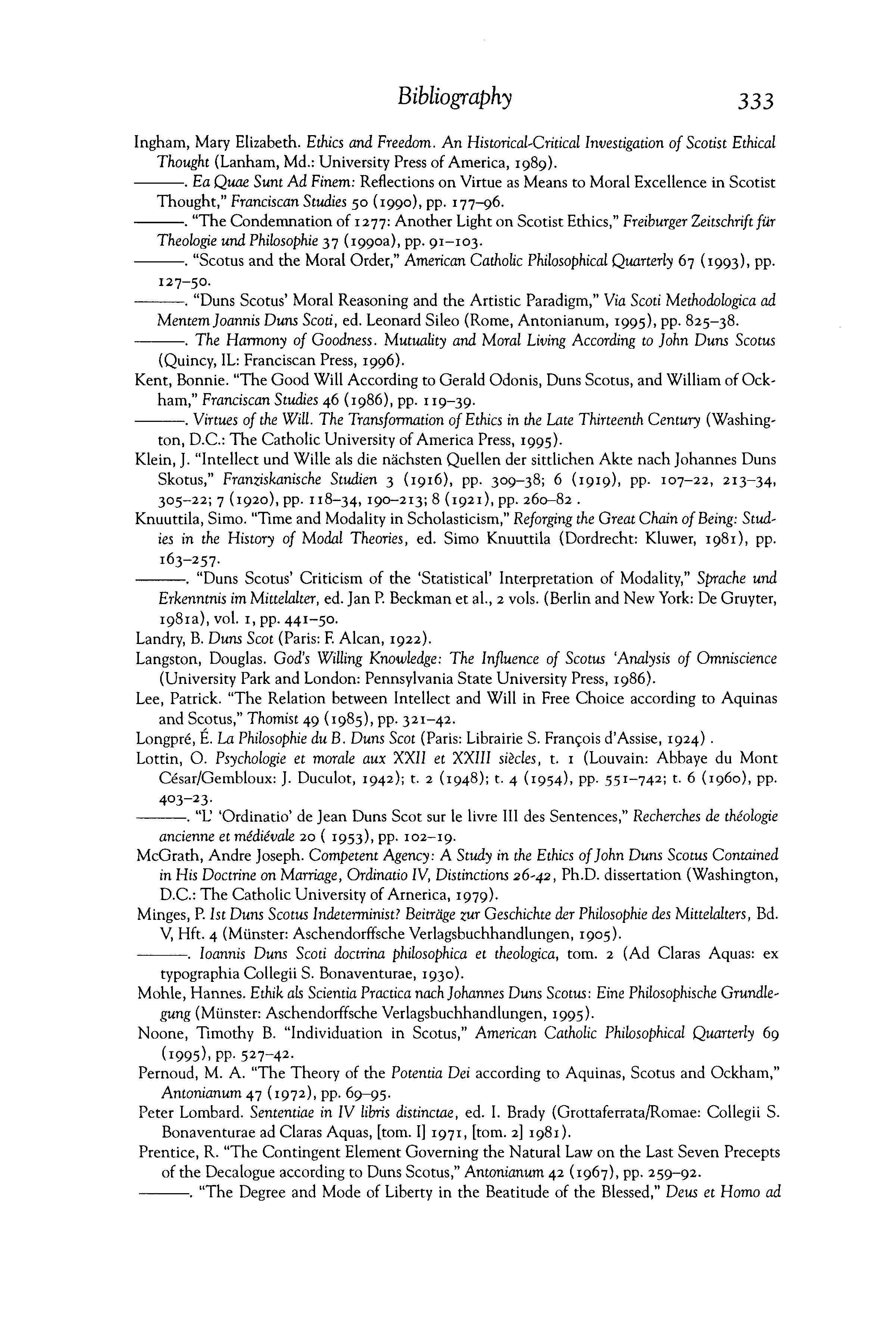
Bibliography
Ingham, Mary Elizabeth. Ethics and Freedom. An Historical-Critical Investigation of Scotist Ethical
Thought (Lanham, Md.: University Press of America, 1989)'
---. Ea Quae Sunt Ad Finem: Reflections on Virtue as Means to Moral Excellence in Scotist
Thought," Franciscan Studies 50 (1990), pp. 177-<)6.
---. "The Condemnation of 1277: Another Light on Scotist Ethics," Freiburger Zeitschrift fur
Theologie und Philosophie 37 (1990a), pp. 91-103.
---. "Scotus and the Moral Order," American Catholic Philosophical Quarterly 67 (1993), pp.
127-50 .
---. "Duns Scotus' Moral Reasoning and the Artistic Paradigm," Via Scoti Methodologica ad
MentemJoannis Duns Scoti, ed. Leonard Sileo (Rome, Antonianum, 1995), pp. 825-38.
---. The Harmony of Goodness. Mutuality and Moral Living According to John Duns Scotus
(Quincy, IL: Franciscan Press, 1996).
Kent, Bonnie. "The Good Will According to Gerald Odonis, Duns Scotus, and William of Ockham," Franciscan Studies 46 (1986), pp. 119-39.
---. Virtues of the Will. The Transformation of Ethics in the Late Thirteenth Century (Washington, D.C.: The Catholic University of America Press, 1995).
Klein, J. "Intellect und Wille als die na.chsten Quellen der sittlichen Akte nach Johannes Duns
Skotus," Franziskanische Studien 3 (1916), pp. 309-38; 6 (1919), pp. 107-22, 213-34,
305-22; 7 (1920), pp. 118-34, 190-213; 8 (1921), pp. 260-82.
Knuuttila, Simo. "Time and Modality in Scholasticism," Reforging the Great Chain of Being: Studies in the History of Modal Theories, ed. Simo Knuuttila (Dordrecht: Kluwer, 1981), pp.
163-257.
---. "Duns Scotus' Criticism of the 'Statistical' Interpretation of Modaliry," Sprache und
Erkenntnis im Mittelalter, ed. Jan P. Beckman et aI., 2 vols. (Berlin and New York: De Gruyter,
198m), vol. I, pp. 441-50.
Landry, B. Duns Scot (Paris: F. Alcan, 1922).
Langston, Douglas. God's Willing Knowledge: The Influence of Scotus 'Analysis of Omniscience
(University Park and London: Pennsylvania State University Press, 1986).
Lee, Patrick. "The Relation between Intellect and Will in Free Choice according to Aquinas and Scotus," Thomist 49 (1985), pp. 321-42.
Longpre, E. La Philosophie du B. Duns Scot (Paris: Librairie S. Fran~ois d'Assise, 1924) .
Lottin, O. Psychologie et morale aux XXII et XXIII siecles, t. I (Louvain: Abbaye du Mont cesar/Gembloux: J. Duculot, 1942); t. 2 (1948); t. 4 (1954), pp. 551-742; t. 6 (1960), pp.
40 3-23.
---. "1: 'Ordinatio' de Jean Duns Scot sur Ie livre III des Sentences," Recherches de theologie ancienne et mtdievale 20 ( 1953), pp. 102-19.
McGrath, Andre Joseph. Competent Agency: A Study in the Ethics of John Duns Scotus Contained in His Doctrine on Marriage, Ordinatio IV, Distinctions 26-42, Ph.D. dissertation (Washington,
D.C.: The Catholic University of America, 1979)'
Minges, P. 1st Duns Scotus Intleterminist? Beitriige zur Geschichte der Philosophie des Mittelalters, Bd.
V, Hft. 4 (Munster: Aschendorffsche Verlagsbuchhandlungen, 1905).
---. Joannis Duns Scoti doctrina philosophica et theologica, tom. 2 (Ad Claras Aquas: ex typographia Collegii S. Bonaventurae, 1930).
Mohle, Hannes. Ethik als Scientia Practica nachJohannes Duns Scotus: Eine Philosophische Grundlegung (Munster: Aschendorffsche Verlagsbuchhandlungen, 1995).
Noone, Timothy B. "Individuation in Scotus," American Catholic Philosophical Quarterly 69
(1995), pp. 527-42.
Pemoud, M. A. "The Theory of the Potentia Dei according to Aquinas, Scotus and Ockham,"
Antonianum 47 (1972), pp. 69-<)5· Peter Lombard. Sententiae in IV libris distinctae, ed. I. Brady (Grottaferrata/Romae: Collegii S.
Bonaventurae ad Claras Aquas, [tom. II 1971, [tom. 21 1981).
Prentice, R. "The Contingent Element Governing the Natural Law on the Last Seven Precepts of the Decalogue according to Duns Scotus," Antonianum 42 (1967), pp. 259-<)2.
---. "The Degree and Mode of Liberty in the Beatitude of the Blessed," Deus et Homo ad
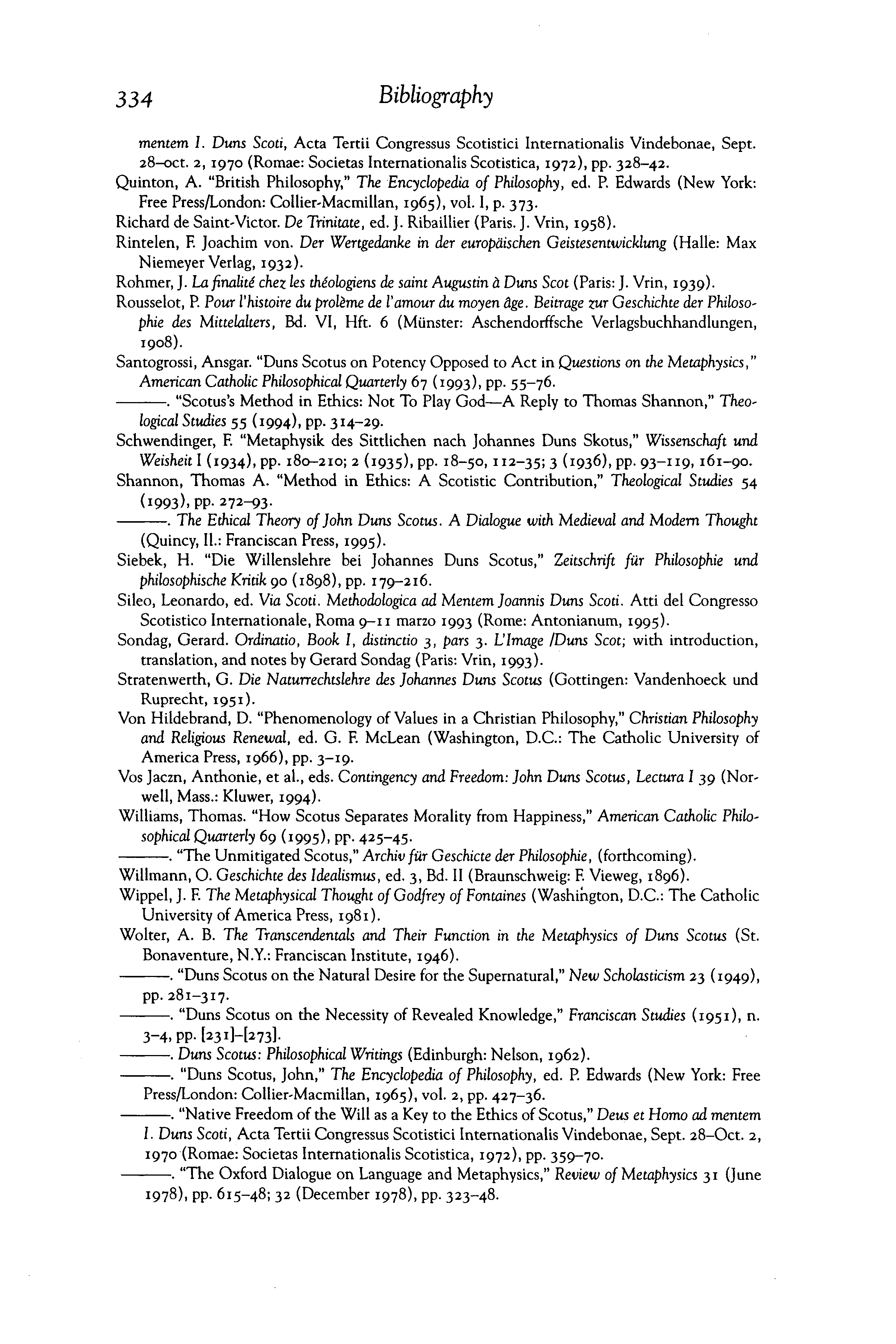
Bibliography mentem I. Duns Scoti, Acta Tertii Congressus Scotistici Internationalis Vindebonae, Sept.
28--oct. 2, 1970 (Romae: Societas Internationalis Scotistica, 1972), pp. 328-42.
Quinton, A. "British Philosophy," The Encyclopedia of Philosophy, ed. P. Edwards (New York:
Free Press/London: Collier-Macmillan, 1965), vol. I, p. 373.
Richard de Saint-Victor. De Trinitate, ed. J. Ribaillier (Paris. J. Vrin, 1958).
Rintelen, R Joachim von. Der Wertgedanke in der europl1ischen Geistesentwicklung (Halle: Max
Niemeyer Verlag, 1932).
Rohmer, J. La jinalite chez les theologiens de saint Augustin a Duns Scot (Paris: J. Vrin, 1939).
Rousselot, P. Pour I'histoire du proleme de I'amour du moyen iige. Beitrage zur Geschichte der Philosophie des Mittelalters, Bd. VI, Hft. 6 (Munster: Aschendorffsche Verlagsbuchhandlungen,
1908).
Santogrossi, Ansgar. "Duns Scotus on Potency Opposed to Act in Questions on the Metaphysics,"
American Catholic Philosophical Quarterly 67 (1993), pp. 55-76.
---. "Scotus's Method in Ethics: Not To Play God-A Reply to Thomas Shannon," Theological Studies 55 (1994), pp. 314-29.
Schwendinger, R "Metaphysik des Sittlichen nach Johannes Duns Skotus," Wissenschaft und
Weisheit 1(1934), pp. 180-210; 2 (1935), pp. 18-50, 112-35; 3 (1936), pp. 93-119,161-9°.
Shannon, Thomas A. "Method in Ethics: A Scotistic Contribution," Theological Studies 54
(1993), pp. 272-93.
--. The Ethical Theory of John Duns Scotus. A Dialogue with Medieval and Modem Thought
(Quincy, 11.: Franciscan Press, 1995).
Siebek, H. "Die Willenslehre bei Johannes Duns Scotus," Zeitschrift fur Philosophie und philosophische Kritik 90 (1898), pp. 179-216.
Sileo, Leonardo, ed. Via Scoti. Methodologica ad MentemJoannis Duns Scoti. Atti del Congresso
Scotistico Internationale, Roma 9-11 marzo 1993 (Rome: Antonianum, 1995).
Sondag, Gerard. Ordinatio, Book I, distinctio 3, pars 3. L'Image /Duns Scot; with introduction, translation, and notes by Gerard Sondag (Paris: Vrin, 1993).
Stratenwerth, G. Die Naturrechtslehre des Johannes Duns Scotus (Gottingen: Vandenhoeck und
Ruprecht, 1951).
Von Hildebrand, D. "Phenomenology of Values in a Christian Philosophy," Christian Philosophy and Religious Renewal, ed. G. R Mclean (Washington, D.C.: The Catholic University of America Press, 1966), pp. 3-19.
Vos Jaczn, Anthonie, et aI., eds. Contingency and Freedom: John Duns Scotus, Lectura 139 (Norwell, Mass.: Kluwer, 1994).
Williams, Thomas. "How Scotus Separates Morality from Happiness," American Catholic Philosophical Quarterly 69 (1995), pro 425-45.
---. "The Unmitigated Scotus," Archil! fur Geschicte der Philosophie, (forthcoming).
Willmann, O. Geschichte des ldealismus, ed. 3, Bd. II (Braunschweig: R Vieweg, 1896).
Wippel, J. R The Metaphysical Thought of Godfrey of Fontaines (Washington, D.C.: The Catholic
University of America Press, 1981).
Wolter, A. B. The Transcendentals and Their Function in the Metaphysics of Duns Scotus (St.
Bonaventure, N.Y.: Franciscan Institute, 1946).
---. "Duns Scotus on the Natural Desire for the Supernatural," New Scholasticism 23 (1949), pp.281-317· ---. "Duns Scotus on the Necessity of Revealed Knowledge," Franciscan Studies (1951), n.
3-4, pp. [231]-[273].
--. Duns Scotus: Philosophical Writings (Edinburgh: Nelson, 1962).
--. "Duns Scotus, John," The Encyclopedia of Philosophy, ed. P. Edwards (New York: Free
Press/London: Collier-Macmillan, 1965), vol. 2, pp. 427-36.
---. "Native Freedom of the Will as a Key to the Ethics of Scotus," Deus et Homo ad mentem
1. Duns Scoti, Acta Tertii Congressus Scotistici Internationalis Vindebonae, Sept. 28-0ct. 2,
1970 (Romae: Societas Internationalis Scotistica, 1972), pp. 359-70.
---. "The Oxford Dialogue on Language and Metaphysics," Review of Metaphysics 31 (June
1978), pp. 615-48; 32 (December 1978), pp. 323-48.
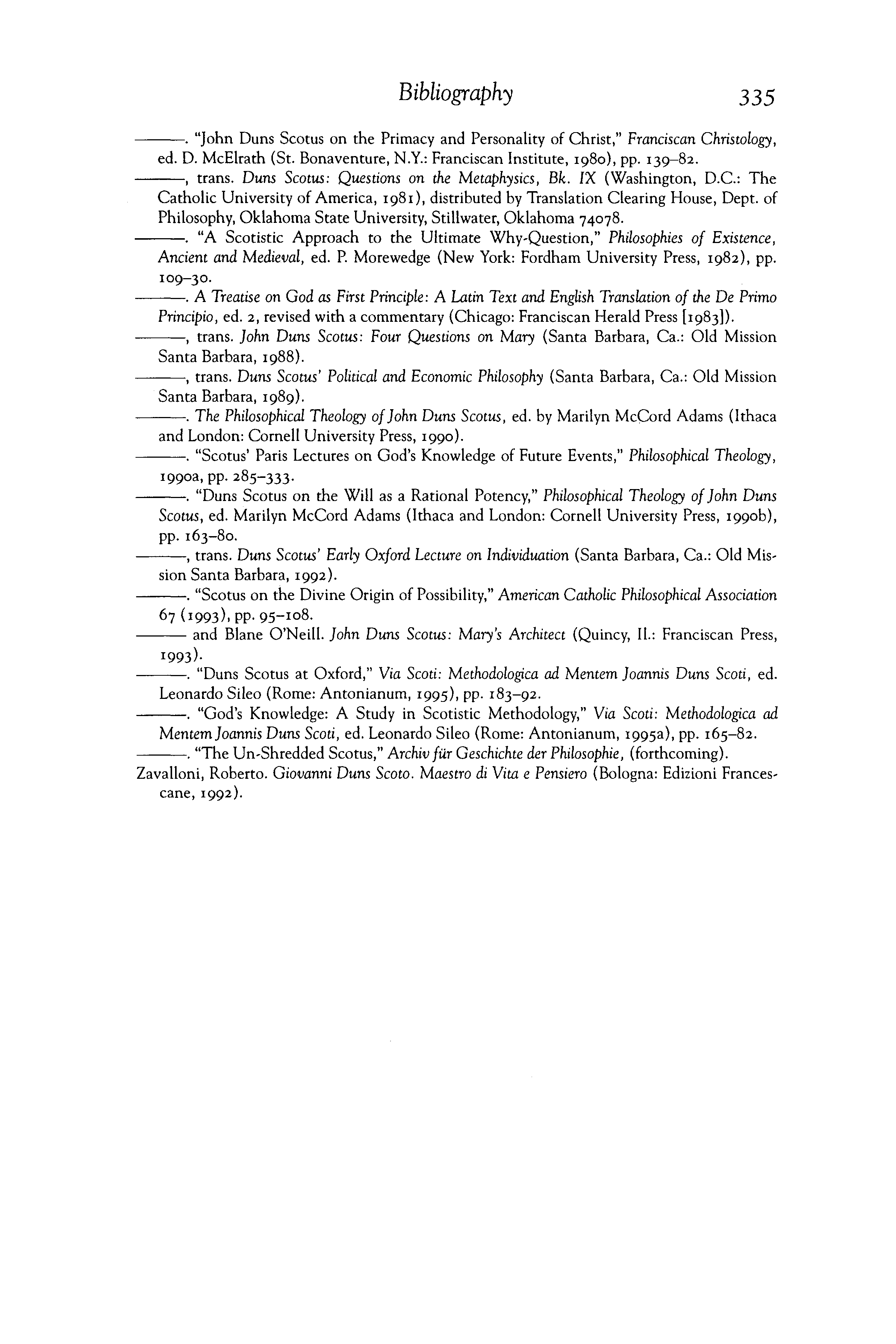
Bibliography
---. "John Duns Scotus on the Primacy and Personality of Christ," Franciscan Christology, ed. D. McElrath (St. Bonaventure, N.Y.: Franciscan Institute, 1980), pp. 139-82.
---, trans. Duns Scotus: Questions on the Metaphysics, Bk. IX (Washington, D.C.: The Catholic University of America, 1981), distributed by Translation Clearing House, Dept. of Philosophy, Oklahoma State University, Stillwater, Oklahoma 74078.
---. "A Scotistic Approach to the Ultimate Why-Question," Philosophies of Existence,
Ancient and Medieval, ed. P. Morewedge (New York: Fordham University Press, 1982), pp.
109-30.
---. A Treatise on God as First Principle: A Latin Text and English Translation of the De Primo
Principio, ed. 2, revised with a commentary (Chicago: Franciscan Herald Press (1983)).
---, trans. John Duns Scotus: Four Questions on Mary (Santa Barbara, Ca.: Old Mission
Santa Barbara, 1988).
---, trans. Duns Scotus' Political and Economic Philosophy (Santa Barbara, Ca.: Old Mission
Santa Barbara, 1989).
--. The Philosophical Theology of John Duns Scotus, ed. by Marilyn McCord Adams (Ithaca and London: Cornell University Press, 1990).
---. "Scotus' Paris Lectures on God's Knowledge of Future Events," Philosophical Theology,
1990a,pp. 285-333· ---. "Duns Scotus on the Will as a Rational Potency," Philosophical Theology of John Duns
Scotus, ed. Marilyn McCord Adams (Ithaca and London: Cornell University Press, 1 990b) ,
PP· 163-80.
---, trans. Duns Scotus' Early Oxford Lecture on Individuation (Santa Barbara, Ca.: Old Mission Santa Barbara, 1992).
---. "Scotus on the Divine Origin of Possibility," American Catholic Philosophical Association
67 (1993), pp. 95-108.
--- and Blane O'Neill. John Duns Scotus: Mary's Architect (Quincy, II.: Franciscan Press,
1993)· ---. "Duns Scotus at Oxford," Via Scoti: Methodologica ad Mentem Joannis Duns Scoti, ed.
Leonardo Sileo (Rome: Antonianum, 1995), pp. 183-92.
---. "God's Knowledge: A Study in Scotistic Methodology," Via Scoti: Methodologica ad
MentemJoannis Duns Scoti, ed. Leonardo Sileo (Rome: Antonianum, 1995a), pp. 165-82.
---. "The Un-Shredded Scotus," Archiv fur Geschichte der Philosophie, (forthcoming).
Zavalloni, Roberto. Giovanni Duns Scoto. Maestro di Vita e Pensiero (Bologna: Edizioni Francescane, 1992).

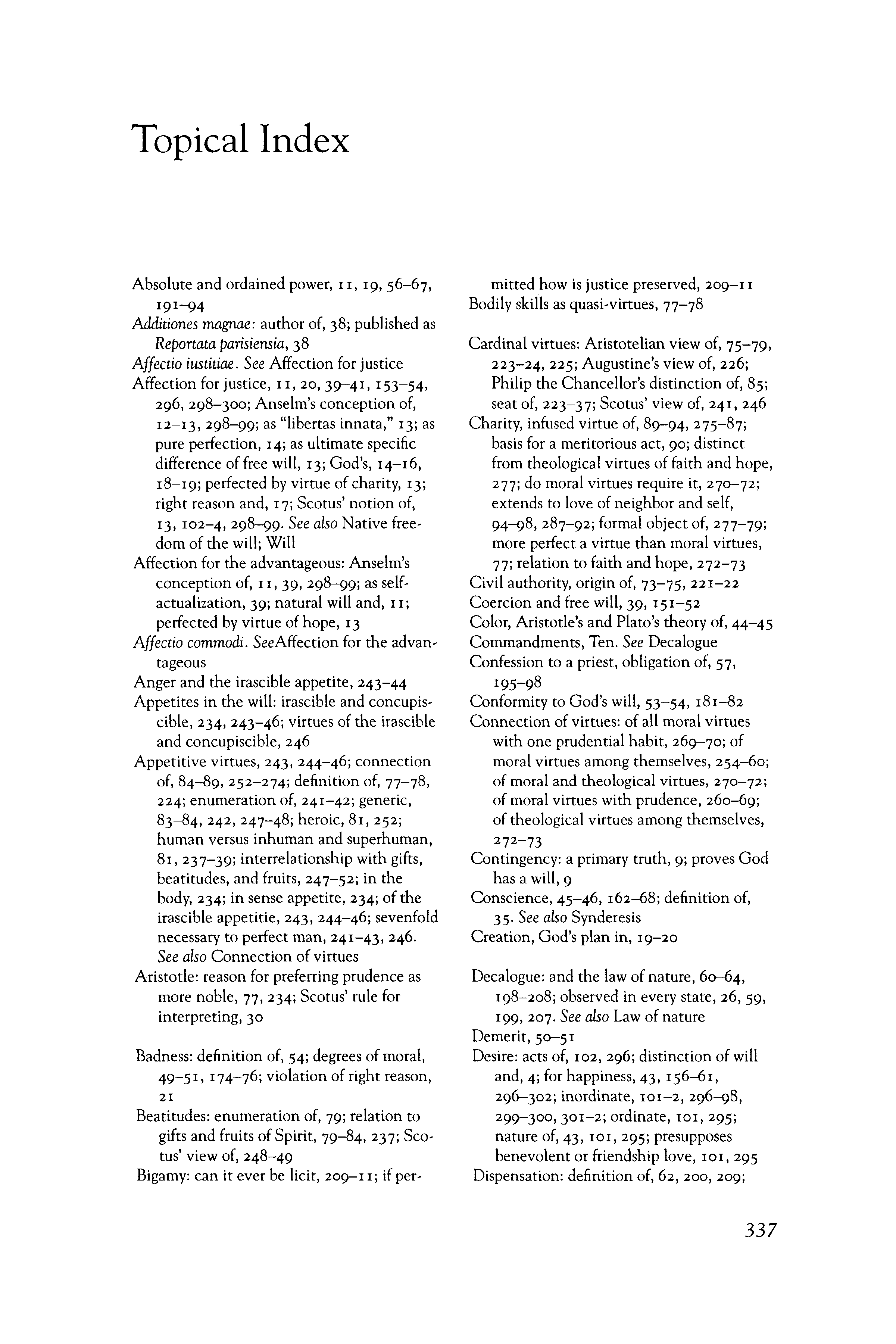
Topical Index mitted how is justice preserved, 209-11 Bodily skills as quasi-virtues, 77-78 Absolute and ordained power, II, 19,56--67,
191-<)4 Additiones magnae: author of, 38; published as Cardinal virtues: Aristotelian view of, 75-79,
Reportata parisiensia, 38 Affectio iustitiae. See Affection for justice Affection for justice, 11,20,39-41,153-54,
223-24, 225; Augustine's view of, 226; Philip the Chancellor's distinction of, 85; seat of, 223-37; Scotus' view of, 241, 246
Charity, infused virtue of, 89-<)4, 275-87; 296, 298-300; Anselm's conception of, 12-13, 298-<)9; as "libertas innata," 13; as pure perfection, 14; as ultimate specific difference of free will, 13; God's, 14-16, basis for a meritorious act, 90; distinct from theological virtues of faith and hope,
277; do moral virtues require it, 270-72; extends to love of neighbor and self, 94-<)8, 287-92; formal object of, 277-79; more perfect a virtue than moral virtues,
77; relation to faith and hope, 272-73 Civil authority, origin of, 73-75,221-22 Coercion and free will, 39, 151-52 Color, Aristotle's and Plato's theory of, 44-45
Commandments, Ten. See Decalogue Confession to a priest, obligation of, 57, 18-19; perfected by virtue of charity, 13; right reason and, 17; Scotus' notion of,
13,102-4,298-<)9. See also Native freedom of the will; Will Affection for the advantageous: Anselm's conception of, I I, 39, 298-<)9; as selfactualization, 39; natural will and, II; perfected by virtue of hope, 13 Affectio commodi. SeeAffection for the advantageous
Anger and the irascible appetite, 243-44 Appetites in the will: irascible and concupis195-<)8 Conformity to God's will, 53-54, 181-82 Connection of virtues: of all moral virtues cible, 234, 243-46; virtues of the irascible and concupiscible, 246 Appetitive virtues, 243, 244-46; connection with one prudential habit, 269-70; of moral virtues among themselves, 254-60; of moral and theological virtues, 270-72; of moral virtues with prudence, 260-69; of theological virtues among themselves,
272-73 Contingency: a primary truth, 9; proves God of, 84-89, 252-274; definition of, 77-78,
224; enumeration of, 241-42; generic, 83-84,242,247-48; heroic, 81, 252; human versus inhuman and superhuman, 81,237-39; interrelationship with gifts, beatitudes, and fruits, 247-52; in the body, 234; in sense appetite, 234; of the irascible appetitie, 243, 244-46; sevenfold necessary to perfect man, 241-43, 246.
See also Connection of virtues Aristotle: reason for preferring prudence as has a will,9 Conscience, 45-46, 162-68; definition of,
35. See also Synderesis Creation, God's plan in, 19-20 Decalogue: and the law of nature, 60-64, more noble, 77, 234; Scotus' rule for interpreting, 30 198-208; observed in every state, 26, 59,
199, 207· See also Law of nature Demerit, 50-51 Desire: acts of, 102, 296; distinction of will
Badness: definition of, 54; degrees of moral, 49-51,174-76; violation of right reason,
Beatitudes: enumeration of, 79; relation to and, 4; for happiness, 43,156-61, 296-302; inordinate, 101-2, 296-<)8, 299-300,301-2; ordinate, 101,295; nature of, 43, 101,295; presupposes benevolent or friendship love, 101,295 Dispensation: definition of, 62, 200, 209; gifts and fruits of Spirit, 79-84, 237; Scotus' view of, 248-49
Bigamy: can it ever be' licit, 209-II; if per-
Index ness of will, 14-15; three ways ofloving, from decalogue, 22-23, 24, 26-27, 60-73,
13,91,277-79. See also Trinity; Love of God Goodness: accidental, 51-52; dependent 199-219 Divine positive law, 57-60, 195--98; twofold sense, 59-60 Divorce: and the Mosaic law, 64-65, 72-73, upon conformity with right reason, 4, 22; dependent upon God's will, 3, 16-25,57; essential, 17; generic and specific, 21; meritorious, 17,54; moral, 20-22,47-54, 167-82; natural, 17-20, 52; primary, 17 212-19; an unmitigated evil, 64-65, 72-73; not permitted equally to men and women, 73; views of the schools of Shammai and Hillel, 65
End: alone does not justify actions, 51-52, Habits: as active potencies, 44; defined, 35;
176-78; of mankind is supernatural, 13, 20,24,28,61 Ethical system of Scotus: basis of unity, ix; differ from acts, 35 Happiness, 42-45, 155-62; as a reflex object of well-ordered love, 13; God's, 14; loved out of an affection for justice, 14, 105,
Holy Spirit: gifts and fruits of, 78-84, presuppositions of, ix, 5 Evil as a privation, 98 Firmness of purpose, a pure perfection, 14
Fortitude, 72; and the irascible appetite, 242; 237-52; sin against, 303 resides in the will, 76 .
Freedom: Anselm's definition of, 12,98, 293; lndeterminancy, positive and negative, 37
Indifferent acts. See Morally indifferent acts Intellect: as partial cause of will-act, 44, 46; as power to sin, 14,98-100,293-95; moral,28 Free will: coercion and, 39, 151-52; compatinot a per se rational faculty, 36; will and,
31-39,44, 127-42 ble with some necessity, 12, 15; essential perfection of, 11; how God's differs from ours, 9; pure perfection, 10, 12; positive or superabundant indeterminacy, 10; psychological pressure on, 39; ultimate specific difference of, 13 Justice: as a moral virtue, 76; Anselm's definition of, 12,55,184; commutative and distributive, 185; God's, 54-56, 183--91; infused, 102 (see also Charity); legal, 21-22, 184; modifies God's creative act,
16, 18-19, 185-86, 188; particular, 184-85; secondary object of, 19, 186, 188, 19Q-191; Scotus' definition of, 55 Gifts and fruits of the Spirit, 78-84, 237-52; beatitudes and, 79, 237; distinction from virtues, 79: enumeration of, 78-79; Scotus' view of, 249-51
God: absolute and ordained power of, II, 19, Killing, two views on, 200-201 Knowledge of moral law, three requirements
56-57, 191-94; and affection for justice, 14-16, 18-19; as beatific object, 279; as perfect lover, 13; co-operation with actions of creatures, 99, 293--94; debtor to his goodness, 8, 19,57, 184, 190-91; generosity of, 190; infinity of, 8; intellect not dependent on intelligibility of creatures, for, 27 Law: Church, 196; divine positive law, 57-60, 195--98; eternal, 23; natural, 195; permitting the lesser of two evils, 73,212.
See also Law of nature Law of nature, 22-25, 26-29, 57-64, 71, 195; dispensation from, 22-23, 24, 26-27, 60-73; secondary or extended sense of, 58,61,63,211-12; fitting it be revealed,
59,206-7; Gratian's notion of, 63,195, 202, 203; knowledge of finer details of, 27; observed in every state, 59, 63, 196,
207; recognized by all, 58-59, 63-64; rough agreement as to substantive content of, 27; strict, proper, or primary sense, 58, 61, 62,211; two tables of, 22-23,27,28,29,63-64,202-3, 204-7; 17-18; justice of, 16, 18-19,54-56, 183-91; liberality of, 190; metaphysical notion of, 5--9; mercy of, 54-55; must be loved, 18,21-22,54,89,184, 189--90; necessarily happy, 14-15; ordinatissime IIOlens, 9, 17, 19-20,55,57; rectitude of will, 56, 184-85, 187; relationship to creatures governed by right reason, 16-25; reveals his will in nature, 25; selflove both free and necessary, 16; self-love not private or jealous, 12, 20; steadfast-
Index
written in the heart, 26-27, 207 Lex aetema. See Law: eternal Love of God, 18,21-22,89-94,275-92; 223,224,225-26; Augustine's view of, 226; Henry of Ghent's view of, 78, 235-37; connection of, 84-89, 252-74; refutation of views of others, 225-30; relation to gifts and fruits of Spirit, 223-37; Scotus' view of, 230-35; will as the seat of, 75-78, 223-37 Motion: Whatever is moved is moved by above all is morally right act, 89-91, 276-77; does nature suffice for such love,
91-94, 279-il2; for his own sake is primary object of charity, 277-78; how are we obliged to, 284-85; how understand "above all," 279-84; includes love of neighbor and self, 94-98, 287-92; why is charity necessary if nature suffices for,
93-94, 285 Love of neighbor, 28, 94-96, 205-6, 287-291 Love of self, 97-98, 291-92 Lucifer's sin, 14,27-28,100-105,295-302 Lying, 106-9,304-14; Bonaventure's view, another, 36-37 Native freedom of the will, ix, 20-21, 29, 39.
See also Affection for justice Natural inclination: as active potency, 43-44; for happiness, 43; more powerful than a habit, 43 Natural law. See Law of nature Natural volition, 39, 41-42, 154-55 Natural will, 39, 41-42, 154-55 Nature, seeks its own perfection, 13 Necessity and freedom, 14-16 Necessitarianism: Abelardian and Leibnizian,
106-9; by perfect, 108-9,308-11; officious or polite, 108-9, 308; pernicious, 108,307-8; scandal, 310-11; three views why sinful, 106-8,305-7 Man as end of all sensible things, 20 Marriage, 64-70; bigamous, 64, 70-72; 16, 19,57; Averroistic, 16,55,56 Oaths: nature of, I 10, 3 I 6; in favorable or Christian or sacramental, 64, 66-68; divorce and, 64-66; more difficult than religious life, 69; purpose of, 64, 66, 69,
209; spiritual, 67; under Mosaic law, 72-73,212-19 Merit, 17,49,50,51; and demerit, 50-51 Metaphysics: contribution to the Theoloodious matters, 319; promissory, 321-22; special kinds of, 320-22; as testimonials for promotion to offices, 112,318-19 Perfect, two senses of, 109, 309 Perjury, 110-13,314-23; against natural law and the first table of the decalogue, 110,
Phenomenological axiology, 29 Polyandry, never licit, 2 I 2 Polygamy, why it was permitted, 2I1-I2 Positive indeterminacy, 10 Power, absolute and ordained, I 1,19,56-67, gian's enterprise, 6; faith and, 5; notion of God, 5-9; subject and goal of, 6-7 Moderation of the desire for happiness, 27.
See also Lucifer's sin Monogamy: Christ restores, 65; dispensation from, 69; pertains to natural law in a secondary sense, 211-12
Moral badness: definition of, 49-50; degrees 191-94 Practical science, 32-35,127-36 Practice. See Praxis Praxis, 31,33-35, 127-30, 132-35, 201 Property, private ownership of, 74-75, of, 50-51,174-76 Moral goodness: conformity to God's will,
53-54, 181-82; degrees of, 48-49, 173-74; nature of, 47, 207-10; source of, 48, 167-69 Morality of choosing the lesser of two evils,
219-222 Proportionality principle, 73 Prudence, 85-89; connection with praxis, 35;
73; two views of, 213-15; Scotus' defense of second view, 215-18 Moral law: accessible to reason, 25-29, 57, definition of, 35; faith a more perfect virtue than, 77; generic or specific, 87-88; habit of, 76, 87-88; virtue, 34; legislator requires, 22 I; no moral virtue without,
85,88; one virtue, 32; practical knowledge, 34; resides in the practical intellect,
34,76-77,85. See also Connection of virtues Pure perfection, 98, 294; liberty as, 294
62~3; content versus obligation of, 24-25; evolution of, 29; God and, 54-57, 183-94; in general, 57-75, 195-222; scope of, 22 Morally indifferent acts, 5 I-52, 178-8 I Moral virtues, 75-89, 223-74; angel can acquire, 231-32; Aristotelian view of,
Index Rational appetite, not free will, I I, 103, 298 Reason and faith, 5-6 Revelation of God's will in nature, 25-26
Right reason, ix, 4, 16,21-22,49; and affecTrinity: inner life of, 12; Richard of St. Victor's explanation of, 12; man's destiny as union with, 13,54 tion for justice, 17,21; governs God's creativity, 19; three requirements to know what is in accord with, 26 Vices as habits, 35 Virtues: Aristotle's view of the seat of the cardinal, 75-76; as habits, 35; connection of, 84-89, 252-74; infused charity,
89--94,275--92; intellective, 242-43; intellectual and moral, 75-89, 223-74; relation to gifts and fruits of the Spirit,
78-84,237-52. See also Appetitive virtues Volition, natural. See Will: natural Science: technical meaning of, 31; practical,
32-35, 127-36; theoretical, 32-33; unity of,3 1 Scotistic Commission, x, 75 Scotistic school, ix Secrets, obligation to keep, 113-14,323-25
Self-actualization, 39 Sin, 25, 98-123, 293--95; gravity not deterWill: ability to act deficiently, 99-100, mined by habit, 111,316-17; of enslavement, 114-23,325-30; of Lucifer, 100105,295-302; of malice, 105-6,302-4; original, 24; the power to, 9B--99, 293--94
Skills. See Bodily skills as quasi-virtues Slavery, 114-23,325-30; Church's attitude
294--95; all elicited acts are free, 39; always acts according to either of its two inclinations, 46, 102, 296; and intellect as essentially ordered causes, 44; appetites in, 234, 243-46; as a passive potency, 44; as an active potency, 37, 44; as opposed to nature, 16; as pure perfection, towards, 114-16; legality of, 116-20,326; marriage and, 329; origins of, 325-26; symbiotic versus parasitic, 115-16; why the Church permitted, 114-16 Social theory. See Civil authority, origin of Sufficient reason, principle of, 19 Supernatural order, 20. See also End: of 10; as a rational potency, 2 I, 35-37, 136-50; as self-determining, 16,37; cannot be forced by God's absolute power,
31; cannot will evil, 44,105-6,303; controls thought, 37-38; Henry of Ghent's theory of, 78; how its acts are ordered,
100-110,295; inclinations of, Q-12, 39-41,46,153-66; malice only in an act of, 38; natural, 11-12,41-42, 154-55; not determined by good, 44, 105; passions of, 229; superabundant sufficiency of,37 mankind is supernatural Synderesis: definition of, 35, 45-46; introduced by error, 45; various views of,
45-46. See also Conscience Temperance, 75; relation to the concupiscible appetite, 246; resides in the will, 76; seat of, 75-76, 246