
20. Divorce And The Mosaic Law
The Moral Law in General opposite could not be licit, or even in some cases necessary. In such a case, however, there would be justice on the part of the parties entering marriage as well as in regard to what they gave to each other, for right reason would dictate that their contractual exchange take place in a different way, and in addition the divine precept to enter such a contract would also be there. {[In the other "Ordinatio" the answer is put this way]: I say that this authority, "They shall be two in one flesh," must be understood in this fashion. They are one by reason of the offspring begotten by both parents, and hence having several wives does not militate against the way marriage was initially instituted.} As for Lamech, however, one could admit that he did sin mortally, because he acted contrary to the law of nature in the secondary sense.
He sinned, I say, by contracting with several women where neither right reason dictated this law had to be revoked, nor was he dispensed from the law by his superior [God]. In short, he had neither excuse to fall back on.
To the second I say that there never was a just contract between those who made a marital exchange of such a sort, namely, where the secondary end was favored at the expense of the primary purpose, since they should have wanted the latter more than the former. But biandry [or polyandry] would serve the interests of the secondary end, and far less the primary purpose, because the same woman during the same period of time could not be impregnated by more than one man.
[To the initial argument for the positive view]:
To the initial argument to the contrary, I say that although one may presume some of the holy patriarchs did not sin in contracting bigamous unions, because both of the aforesaid conditions for such occurred in their case, namely, there was a need for polygamy and it was approved and prescribed by divine authority, nevertheless, if some of them did not have such an excuse or lacked either one or the other ground for validating such marital unions, I would not argue against those who maintained that they may have sinned grievously, since I do not think they were confirmed in grace.
20. DIVORCE AND THE MOSAIC LAW
(Ordinatio IV, dist. 33, q. 3) Regarding divorce, I ask: Under the Mosaic law was it licit for a man to repudiate his wife?
[Arguments Pro and Con} For the affirmative:
Deuteronomy 24:1: "When a man has taken a wife, and she finds no
Divorce and the Mosaic Law
favor in his eyes because of something indecent, let him write out a bill of divorce and give it to her, and dismiss her from his house."
Also, Malachi 2:16: "When you shall hate your wife, put her away, says the Lord God of Israel."
Furthermore, there is that rule of canon law: "Everything which is born of certain causes, can be dissolved by the same causes" [Decretum
Gratiani II, causa 27, q. 2]; but marriage is born of mutual consent, therefore it can be dissolved by mutual consent.
Also, [ibid., I, canon 1 I), dist. 34, "Si cuius," it says: "If it be established of a married cleric that the wife has committed adultery, she ought to be given a bill of divorce and sent away"; therefore, divorce is licit also under the Gospel law.
For the negative:
On the contrary, divorce seems to be against the law of nature that Adam promulgated in the words: "A man shall cleave to his wife"
(Genesis 2), from which Christ concluded: "Therefore, what God has joined together, let no man put asunder" [Matthew 19:6]. {In the other translation it reads thus: It is against the law of nature that man separate those who are joined by God, as Christ assumed in the Gospel when he said: "What God has joined," etc.}
Also, the marriage contract is essentially an irrevocable gift of the power of one's body to another for that of the other; therefore, no accommodation or gift for a time only can be matrimony. But if divorce were licit, there would be at most a gift for a time, because if it were perpetual, the woman divorced would remain one's wife, and therefore it would be illicit to send her away. It follows, then, that under the Mosaic law no matrimony would exist if divorce were licit there.
Also, it was never licit for a woman to divorce her husband; therefore, neither was it licit for a man to divorce his wife, since so far as they are marriage partners, they may be judged equal.
[Body of the Question1 [One view] Here it is claimed that under the Mosaic law it was unlawful to divorce one's wife, and any man who took a divorced woman to wife sinned mortally, because she was unclean, for she had apparently been put away because she was impure. But her sin was not punished according to the law, but separation was permitted to prevent husbands killing their wives, and therefore, to avoid a greater evil the law permitted this lesser evil.
[Arg. I) The first proof of this is found in the citation of Christ reproving divorce (Matthew 19:9): "I say to you, whoever puts away his
The Moral Law in General wife, except for immorality, commits adultery, and he who marries a woman who has been put away commits adultery."
[Arg. 2] It is proved also by the reason Christ gave for this, which is that from the beginning God joined male and female in marriage, as is clear from Adam's words, and he added: "Therefore, what God has joined together, let no man put asunder."
[Arg. 3] It is also proved, thirdly, from Christ's reply to the question of the Pharisees when they objected: "Then why did Moses command divorce and the promulgation of a divorce decree?" He said to them:
"Because Moses, by reason of the hardness of your heart, permitted you to put away your wives; but it was not so from the beginning."
And the marginal gloss on this says: "Moses permitted this, not God."
And the Master [Peter Lombard], on this distinction, ch. 2, says:
"This was permitted by Moses, not to concede divorce, but to prevent homicide." And Augustine in The Lord's Sermon on the Mount says:
"By commanding that a written notice of dismissal be given he did not thereby command that the wife be put away. But in order that a careful consideration of the written notice might moderate the rash anger of the man who is casting out his wife, he said: 'Whoever puts her away, let him give her a written notice of dismissal. '" One can understand this from what Ambrose commanded the emperor Theodosius because of the cruelty of a certain law he had impetuously passed. Ambrose wanted him to issue a law that the minister would not carry out this cruel precept except after thirty days had passed, so that during that time, his anger would have cooled, perhaps, and he would temper his sentence. Hence, Plato also said to someone, as Jerome recounts:
"I would punish if I were not angry." And Augustine adds, in the aforesaid work, "By seeking a: delay of the dismissal of the wife, he made it known he did not wish a marriage to be dissolved, insofar as he could make this known to obdurate men."
[Arg. 4] Also, the canon on divorce in the [Decretales Gregorii IX IV, tit. 19, c. 8], says the truth of the Gospel has condemned divorce.
[Another view] Another opinion says that giving a bill of divorce and putting away one's wife was licit under the law of Moses, because
Moses promulgated the law of God, and therefore those whom he joined and pronounced married as legislator, God himself joined, and those whom he separated, God separated, because God could divorce those who were married.
Furthermore, according to Augustine in his first letter to Jerome, which is cited in canon law [Decretum Gratiani I, c. 7], dist. 9: "If we once admit that in the Holy Scriptures there could be even a polite lie, what will remain of their authority?" -as if he were to say:
Divorce and the Mosaic Law
"Nothing would be left." And the reason is that whatever authoritative text is adduced to repel heresy one will reply that this too is the word of a jocose or polite liar, just as the other text is. And the same with the counsels-if Scripture presents some counsel as salutary and useful to observe, the observance of such will have no backing in Scripture; and similarly, if some concession in Scripture is given in regard to something otherwise illicit, it will follow that there will be no unqualified authority that such is licit. For the same holds for concessions as to what is licit as holds for commandments as to what must be done and for admonitions or counsels as to what is useful. For just as a precept is not about something which it is necessary to perform, so neither is a concession about something one can do licitly.
Also, a just law would not directly give one an occasion to sin mortally, but this concession seems to give the Jews directly an occasion to put aside their wives; for if this were not written, they would have no more reason for divorce than the patriarchs had before the law of Moses; therefore either divorce is not a mortal sin, or the law permitting it was not just.
[Defense of this second opinion] The way in which one could suitably explain the second opinion is this. Complete justice does not pertain to this matrimonial contract or exchange except by divine ratification, although prior to this there is sufficient equity in the contract and for the parties entering into it, and when such justice can be found in the exchange, it is reasonable that God should ratify it. [As we saw earlier] the exchange of the body of one man for those of several women is just when such an exchange is necessary for the procreation of children, and hence God justly dispensed from monogamy and, what is more, approved of bigamy, because a greater good would come of it than would be possible if but one woman contracted with one man; what is more, those marrying under such conditions ought to wish to marry in this way according to right reason. Now, the case is similar here. To avoid an evil which outweighs the good of wedlock's indissolubility, God can dispense from it so that the marriage holds good until such a time as the woman may come to displease her husband. And in such a contract justice is preserved to some extent. For not only to obtain a greater good, but also to avoid a greater evil, the parties marrying may want to give themselves to each other in this fashion. Now, uxoricide is a greater evil than indissolubility is a good, because it includes not only the serious evil suffered by the woman killed but also the grave evil of the guilty killer. Uxoricide would also be a serious evil for the whole country, because it would be an occasion of continual discord and fighting by reason of the ire of the wife's
The Moral Law in General parents towards her murderer; and this would tend to break down the family, because if the man were killed by his adversaries or by the law, it would destroy his family and the education of his child.
Thus it could be said that just as God had given a dispensation in regard to bigamy for the sake of a greater good, so too he dispensed that race to avoid a greater evil. {In the other version this reads: And according to this it could be said that since indissolubility and a perpetual obligation represents one of the goods of marriage, no marriage of the Jews was perfect, because the matrimonial contract was always entered into under the condition that it could be dissolved by a bill of divorce. But in marriage under the new law there is not only this good of indissolubility but also another, namely, the fact that marriage is a sign of the union of Christ and the Church, which is a one-to-one relationship. But in marriage under the law of nature, which held, for instance, in the case of Abraham, the first requirement or good, namely, indissolubility, was present, but not the second, which was that a man have but one wife. But in the Mosaic law, when divorce was allowed and one man could have several wives, neither requirement was characteristic of marriage, because neither was it a one-toone relationship, nor was the union simply indissoluble. But this had to occur by divine dispensation.} [To the arguments for the first opinion] If one holds this view, one could answer the arguments for the other in this way.
[Re I] Christ made his promulgation for the duration of his law, namely, that of the Gospel, in such a way that it would have the status it had under the law of nature, where it held between one man and one woman. However, since under the Mosaic law, bigamy was licit, he also returned marriage to an unqualified state of perfection, namely, as indissoluble as it was under the law of nature. And so he invalidated for the duration of his law that contract which had been licit under the Mosaic law, which was a temporary use of their bodies for reproduction until a woman ceased to be pleasing in the eyes of her husband. This, like other imperfections licit under the law of Moses,
Christ removed, and those which were more permanent he brought to perfection. And hence after the time the Gospel was promulgated, to have several wives or to-divorce one and marry another became damnable. But before that time, this was not condemned in the way those who hold the first opinion claim. And according to this second opinion, Jews, from the promulgation of the Gospel, are obliged to have, not two wives, but only one wife, and they are not in any way to divorce her.
[Re 2] As for Christ's proof, what he said obviously refers to the law of nature, and to refute the Pharisees it was enough to point out that
Divorce and the Mosaic Law
they were not observing even the law of nature in regard to marriage, and he showed he was reasonable in establishing inseparability according to his law, something that was consonant with the first of these marital goods present in the law of nature.
[Re 3] As for the added argument based on Christ's reply to the Pharisees, namely, "God permitted this because of the hardness of your hearts," note that many consider this to be a genuine permission and not just a concession, since Christ said specifically "he permitted this." By these words he meant that Moses did not command this, or counsel this, or approve of this. Moses simply did not prohibit it, since he regarded it as something licit because of a certain need. This permission was not a case of dissimulation about something illicit, for such an interpretation implies that Moses only permitted them to be damned by not pointing out to them specifically that this was the way to damnation, thus suggesting the opposite. No just lawgiver, however, where human laws are concerned, can prevent many evils from remaining unpunished, according to what Augustine says in his work
On Free Choice I, ch. 5. If a lawgiver does not punish every evil, and thus only permits some inasmuch as he does not expressly punish them, then it does not follow that he concedes such things. Hence a human law could still be just which would state that something could occur which is against that law.
What is added there as to "the hardness of your hearts," etc., does not imply that what is referred to is illicit; for frequently the obduracy of the subjects is the reason why some restrictions of law are relaxed that would otherwise not be relaxed, and which it would be useful not to relax in their case if they were more tractable. For instance, a college president, seeing that his group is prone to the opposite of what it would be more righteous to observe, although he could order the opposite advantageously if only his subjects were more amenable, can refrain from establishing such rules, or if they are already in force, he can in all honesty relax them lest their enforcement lead to a multiplicity of sins.
As for the arguments from the Ordinary Glosses it seems that the first could be denied, because Moses as legislator was only God's mouthpiece. If one wished to gloss the text, however, one could say that it was Moses, not God, who permitted this. In other words, God did not give this precept immediately to Moses in the way that he gave him the other commandments. That is why nowhere in the first four books of the law do we find God commanding this of Moses or of others. Therefore, this, more than the other things God spoke to Moses, is attributed precisely to Moses, as are all the other things that
The Moral Law in General occur only in Deuteronomy. And there was a fitting reason for this, since God wished the relaxations resulting from human industry to appear as though they came not from himself but rather from his servants. Hence to lighten the labor of Moses, who sat through the whole day judging the people, God expressed this not immediately through himself, but to Jethro, his relative, indicating it was of human industry.
As for the other gloss, it is easy to see that it says nothing against this view. For it is true that God did not give the command to divorce, but only commanded that if one did divorce, a bill of divorce should be given. This was a human counsel, however, though not of human origin, inasmuch as the man was speaking for God.
As for the citation from Augustine I concede that the delay which writing the bill entailed does suggest that God was displeased with this dismissal; and that it was not merely that it would be better not to dissolve the marriage, but that it was bad to do so, but not so bad that one would sin gravely against marriage in the way one would if this were not licensed by law.
[Re 4] As for what canon law says about divorce, the answer is clear from what was said about the first argument; it is true that Christ condemned divorce for the duration of his law.
[Reply to the Initial Arguments] To the arguments at the beginning:
As for the first, the answer is clear from the solution to the question. And when it is said that it is against the law of nature which says:
"What God has joined together," etc., I say that it is not against the law of nature in the strict sense, because it is not against any selfevident principles that pertain to the law of nature nor against any conclusion that follows immediately from such principles that a contract hold for only a time, according to this second view, nor does it run contrary to the education of the children, for God could have arranged another plan for the education of children, but one not as convenient as this is, and then even though one of the goods of marriage is in harmony with the law of nature, namely, indissolubility, God could have dispensed with this in order to avoid a greater evil.
To the second argument, I grant that matrimony is, simply speaking, a perpetual obligation; but a marriage could be a firm obligation for a period of time that is not forever, and hence I concede that marriage under the Mosaic law was not marriage in an unqualified sense, except perhaps where some individuals wished to oblige themselves forever beyond what the law required, something they were not required to do by that law. Or one could say that if matrimony was sim-
Positive Law and Civil Authority 2I9 ply perfect under the law and thus an indissoluble union, this was true, unless the legislator [God] revoked the contract or dispensed from such, and that he did dispense when a woman displeased her husband to such an extent that uxoricide was feared. Such a dispensation would be similar to that which occurs when a religious who is in a nonconsummated marriage is dispensed because of solemn religious vows, where the marriage is one in an unqualified sense and not just one that holds for a time, but the legislator in such a case dispenses because of a greater good, whereas in the other case it is to avoid a greater evil.
To the third argument, I deny the analogy, because the grounds for dispensation are not similar. Where the woman hates the man there is not as great a danger as where the man hates the woman, since the sex difference prevents the woman from taking such vengeance as a man is wont to do.
For just as one could concede that one man could have several women for the purpose of reproduction, something that is not conceded to a woman, so it would be against the marital good of having children if one woman had several husbands, and thus in neither case is the situation the same for a woman as for a man.
If one wished to hold the first opinion, however, one could easily reply to the arguments against it. As for the authorities from Deuteronomy and Malachi, they are permissions involving a lesser evil.
However, the actions they permit are still mortally sinful but are allowed only to prevent an even graver mortal sin happening.
As for the second, that legal rule refers just to what can be dissolved, which is not the case with the marital obligation. Also one could say to the minor premise that this marital obligation is born of the mutual consent of the contracting parties acting only as instrumental causes, but the principal cause is the divine approbation; and this rule of law does not hold for instrumental causes. Hence, from the principal cause [Christ] inferred that marriage is indissoluble, saying, according to Matthew [19:6]: "Therefore, what God has joined together, let no man put asunder."
2 I. POSITIVE LAW AND CIVIL AUTHORITY
(Ordinatio IV, dist. 15, q. 2) I ask: What is the source of distinct ownership such that this may be called "mine" and that "yours"? For all injustice through misappropriation derives from this as well as all justice through restitution ...
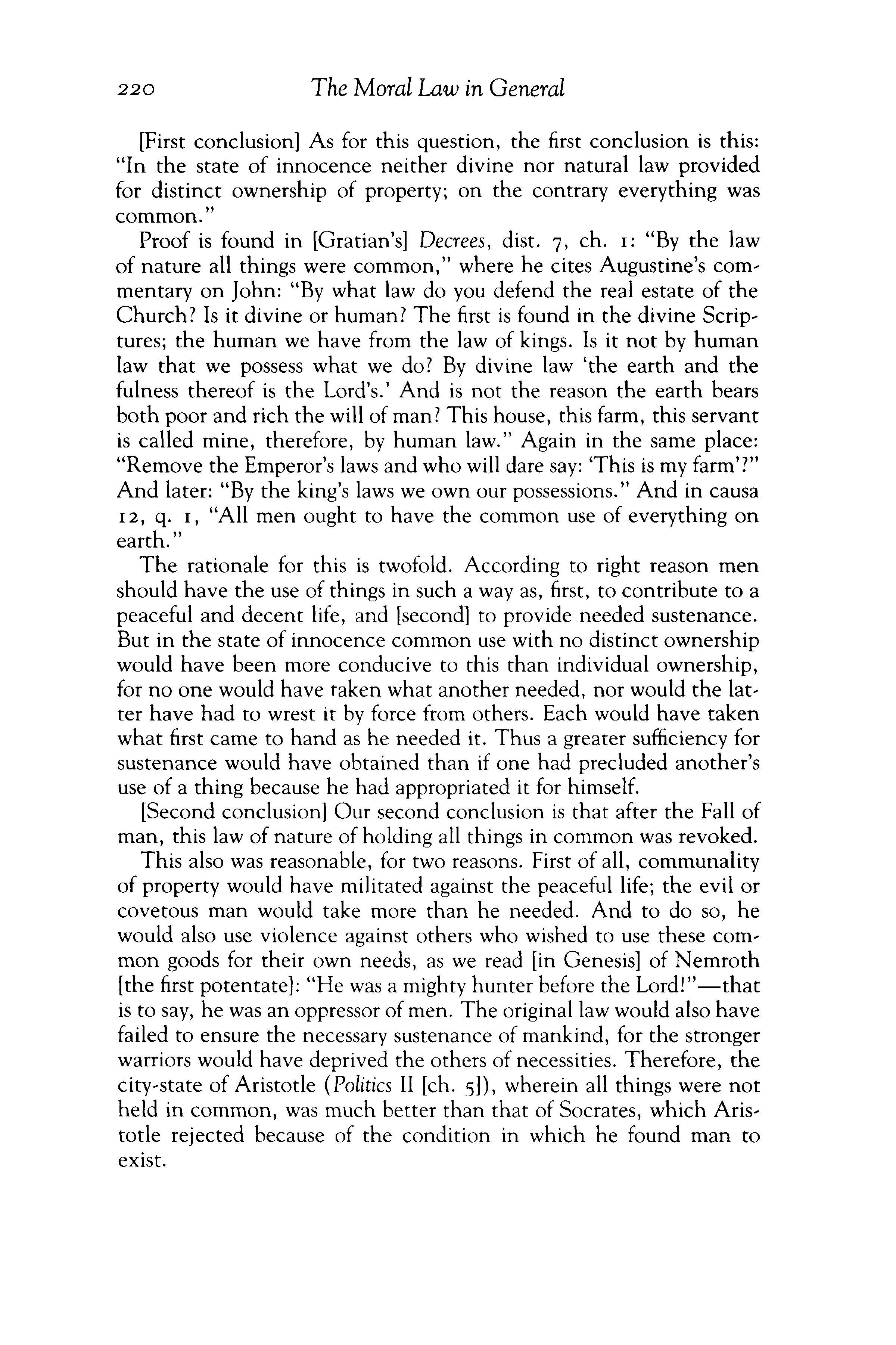
The Moral Law in General [First conclusion] As for this question, the first conclusion is this:
"In the state of innocence neither divine nor natural law provided for distinct ownership of property; on the contrary everything was common."
Proof is found in [Gratian's] Decrees, dist. 7, ch. I: "By the law of nature all things were common," where he cites Augustine's commentary on John: "By what law do you defend the real estate of the Church? Is it divine or human? The first is found in the divine Scriptures; the human we have from the law of kings. Is it not by human law that we possess what we do? By divine law 'the earth and the fulness thereof is the Lord's.' And is not the reason the earth bears both poor and rich the will of man? This house, this farm, this servant is called mine, therefore, by human law." Again in the same place:
"Remove the Emperor's laws and who will dare say: 'This is my farm'?"
And later: "By the king's laws we own our possessions." And in causa 12, q. I, "All men ought to have the common use of everything on earth."
The rationale for this is twofold. According to right reason men should have the use of things in such a way as, first, to contribute to a peaceful and decent life, and [second] to provide needed sustenance.
But in the state of innocence common use with no distinct ownership would have been more conducive to this than individual ownership, for no one would have taken what another needed, nor would the latter have had to wrest it by force from others. Each would have taken what first came to hand as he needed it. Thus a greater sufficiency for sustenance would have obtained than if one had precluded another's use of a thing because he had appropriated it for himself.
[Second conclusion] Our second conclusion is that after the Fall of man, this law of nature of holding all things in common was revoked.
This also was reasonable, for two reasons. First of all, communality of property would have militated against the peaceful life; the evil or covetous man would take more than he needed. And to do so, he would also use violence against others who wished to use these common goods for their own needs, as we read [in Genesis] of Nemroth
[the first potentate]: "He was a mighty hunter before the Lord!"-that is to say, he was an oppressor of men. The original law would also have failed to ensure the necessary sustenance of mankind, for the stronger warriors would have deprived the others of necessities. Therefore, the city-state of Aristotle (Politics II [ch. 5]), wherein all things were not held in common, was much better than that of Socrates, which Aristotle rejected because of the condition in which he found man to exist.
Positive Law and Civil Authority
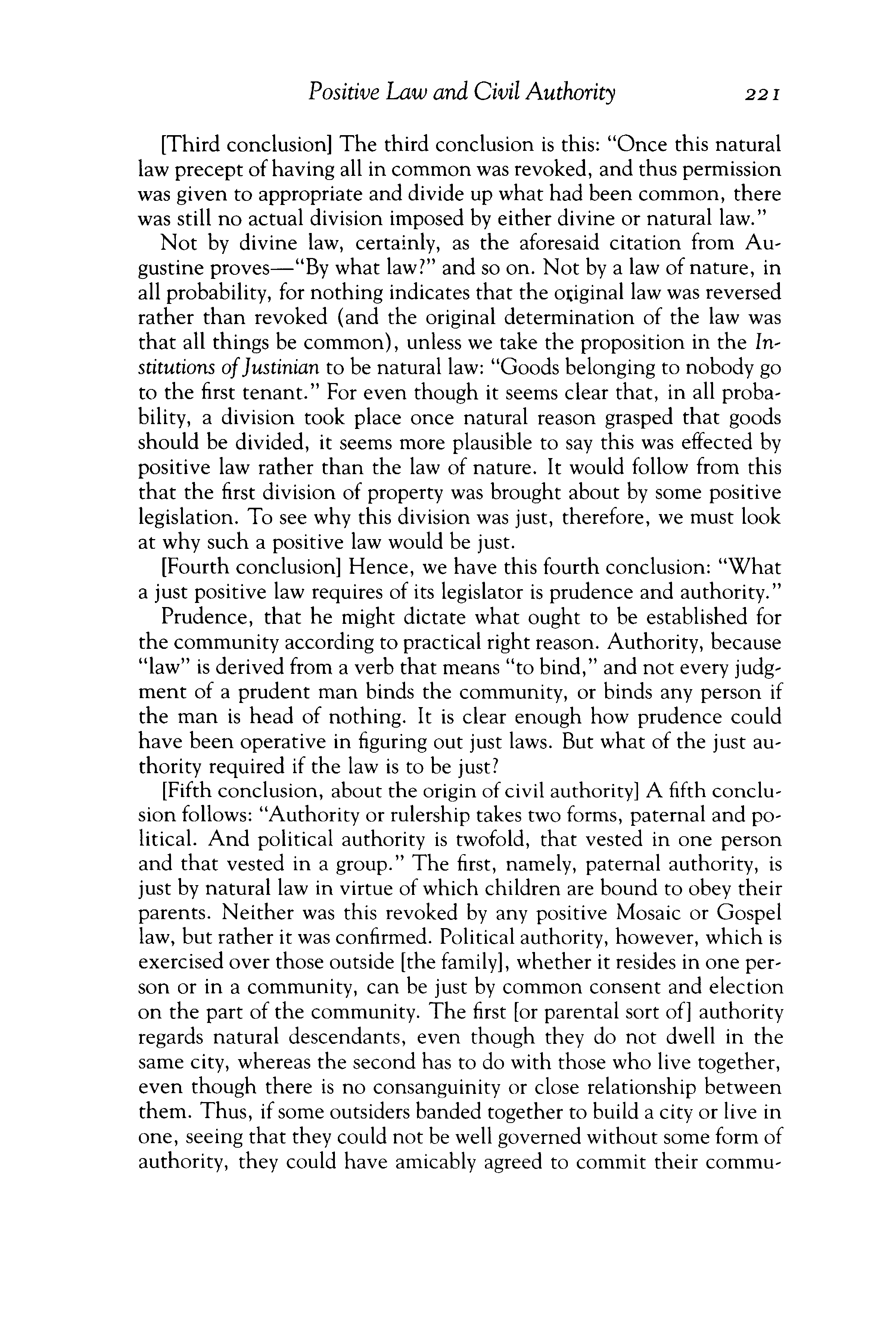
[Third conclusion] The third conclusion is this: "Once this natural law precept of having all in common was revoked, and thus permission was given to appropriate and divide up what had been common, there was still no actual division imposed by either divine or natural law. "
Not by divine law, certainly, as the aforesaid citation from Augustine proves-"By what law?" and so on. Not by a law of nature, in all probability, for nothing indicates that the OI;iginallaw was reversed rather than revoked (and the original determination of the law was that all things be common), unless we take the proposition in the Institutions of Justinian to be natural law: "Goods belonging to nobody go to the first tenant." For even though it seems clear that, in all probability, a division took place once natural reason grasped that goods should be divided, it seems more plausible to say this was effected by positive law rather than the law of nature. It would follow from this that the first division of property was brought about by some positive legislation. To see why this division was just, therefore, we must look at why such a positive law would be just.
[Fourth conclusion] Hence, we have this fourth conclusion: "What a just positive law requires of its legislator is prudence and authority."
Prudence, that he might dictate what ought to be established for the community according to practical right reason. Authority, because
"law" is derived from a verb that means "to bind," and not every judgment of a prudent man binds the community, or binds any person if the man is head of nothing. It is clear enough how prudence could have been operative in figuring out just laws. But what of the just authority required if the law is to be just?
[Fifth conclusion, about the origin of civil authority] A fifth conclusion follows: "Authority or rulership takes two forms, paternal and political. And political authority is twofold, that vested in one person and that vested in a group." The first, namely, paternal authority, is just by natural law in virtue of which children are bound to obey their parents. Neither was this revoked by any positive Mosaic or Gospel law, but rather it was confirmed. Political authority, however, which is exercised over those outside [the family], whether it resides in one person or in a community, can be just by common consent and election on the part of the community. The first [or parental sort of] authority regards natural descendants, even though they do not dwell in the same city, whereas the second has to do with those who live together, even though there is no consanguinity or close relationship between them. Thus, if some outsiders banded together to build a city or live in one, seeing that they could not be well governed without some form of authority, they could have amicably agreed to commit their commu-
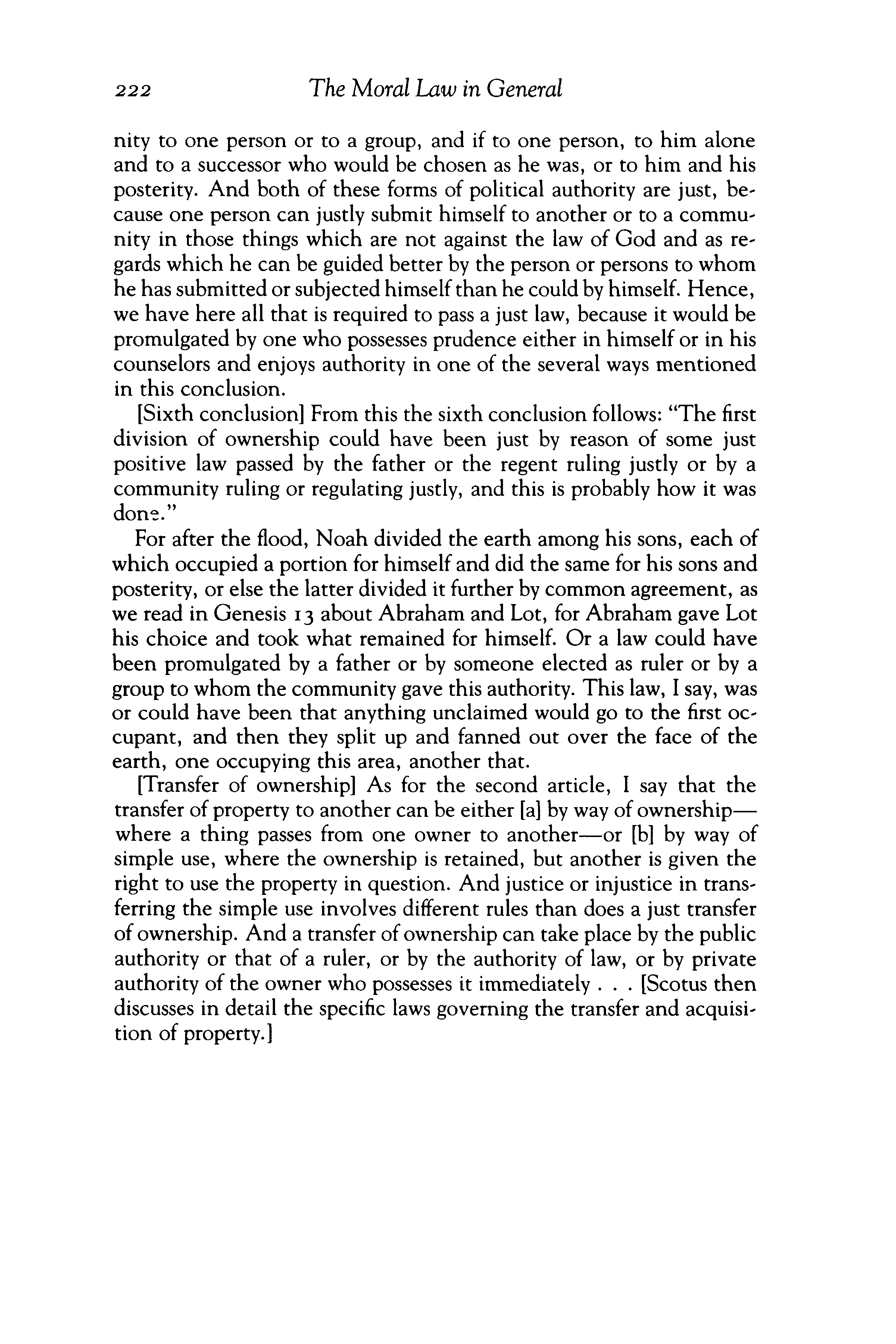
The Moral Law in General nity to one person or to a group, and if to one person, to him alone and to a successor who would be chosen as he was, or to him and his posterity. And both of these forms of political authority are just, because one person can justly submit himself to another or to a community in those things which are not against the law of God and as regards which he can be guided better by the person or persons to whom he has submitted or subjected himself than he could by himself. Hence, we have here all that is required to pass a just law, because it would be promulgated by one who possesses prudence either in himself or in his counselors and enjoys authority in one of the several ways mentioned in this conclusion.
[Sixth conclusion] From this the sixth conclusion follows: "The first division of ownership could have been just by reason of some just positive law passed by the father or the regent ruling justly or by a community ruling or regulating justly, and this is probably how it was don~."
For after the flood, Noah divided the earth among his sons, each of which occupied a portion for himself and did the same for his sons and posterity, or else the latter divided it further by common agreement, as we read in Genesis I 3 about Abraham and Lot, for Abraham gave Lot his choice and took what remained for himself. Or a law could have been promulgated by a father or by someone elected as ruler or by a group to whom the community gave this authority. This law, I say, was or could have been that anything unclaimed would go to the first occupant, and then they split up and fanned out over the face of the earth, one occupying this area, another that.
[Transfer of ownership] As for the second article, I say that the transfer of property to another can be either [a] by way of ownershipwhere a thing passes from one owner to another-or [b] by way of simple use, where the ownership is retained, but another is given the right to use the property in question. And justice or injustice in transferring the simple use involves different rules than does a just transfer of ownership. And a transfer of ownership can take place by the public authority or that of a ruler, or by the authority of law, or by private authority of the owner who possesses it immediately. . . [Scotus then discusses in detail the specific laws governing the transfer and acquisition of property.]