
Front matter
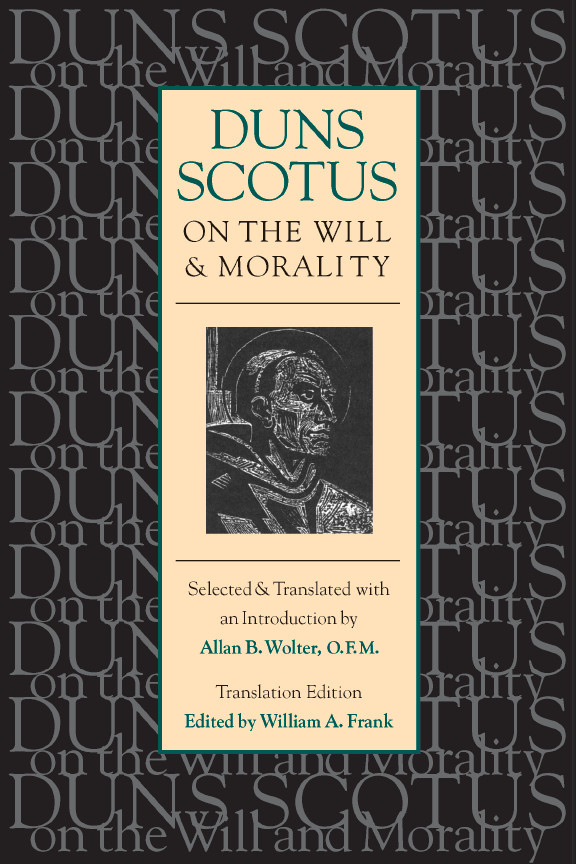
DUNSSCOTUS
on the Will and Morality

DUNSSCOTUS
on the Will and Morality Selected & Translated with an Introduction by Alan B. Wolter, O.EM.
Translation Edition Edited by William A. Frank The Catholic University of America Press
Washington, D.C.
Copyright © 1986,1997 The Catholic University of America Press All rights reserved Printed in the United States of America The paper used in this publication meets the minimum requirements of American National Standards for Information Science--Permanence of Paper for Printed Library materials, ANSI Z39.48-1984.
Ubrary of Congress Cataloging-in-Publication Data Duns Scotus, John, ca. 1266-1308.
[Selections. English. 19971
Duns Scotus on the will and morality I selected and translated with an introduction by Allan B. Wolter: edited by William A.
Frank.-Translation ed. p. cm.
Includes bibliographical references and index.
I. Ethics, Medieval. 2. Will-Early works to 1800. I. Wolter.
Allan Bernard, 1913- . I I. Frank, William A. II I. Title.
B765·1l731l8613 1997 171' .2-dc21 97-2325 ISBN-IO: 0-8132-0895-5 (alk. paper)
ISBN-I 3: 978-0-8132-0895-4
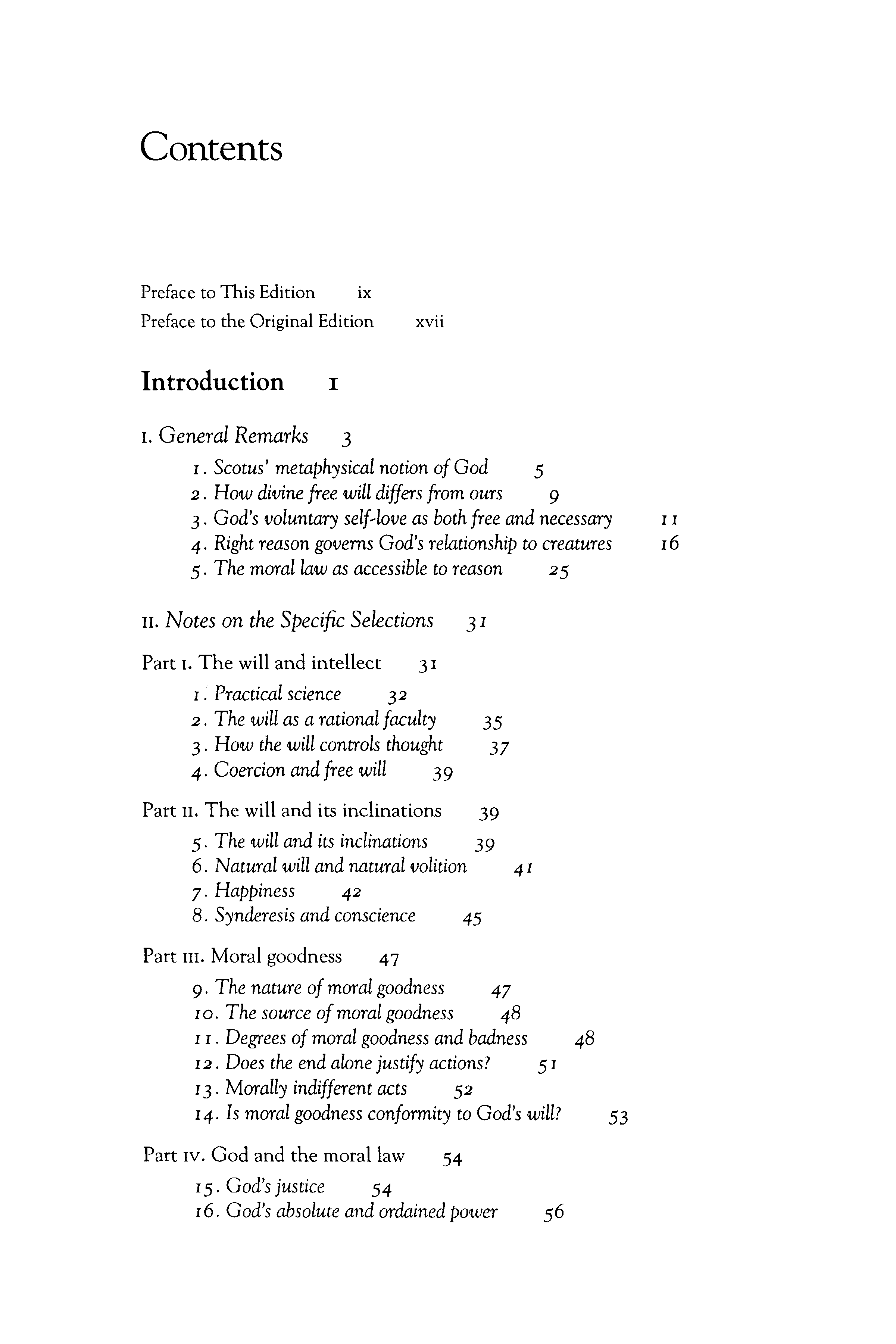
Contents Preface to This Edition ix Preface to the Original Edition xvii Introduction I I. General Remarks
I. Scotus' metaphysical notion of God
2. How divine free will differs from ours
3. God's voluntary selrlove as both free and necessary I I 4. Right reason governs God's relationship to creatures
5. The moral law as accessible to reason
n. Notes on the Specific Selections 3 I Part I. The will and intellect 3 I I : Practical science
2. The will as a rational faculty
3. How the will controls thought
4. Coercion and free will
Part II. The will and its inclinations
5· The will and its inclinations
6. Natural will and natural volition
7· Happiness
8. Synderesis and conscience
Part lll. Moral goodness
9· The nature of moral goodness
10. The source of moral goodness
I I . Degrees of moral goodness and badness
12. Does the end alone justify actions?
5 I 13· Morally indifferent acts
14. Is moral goodness conformity to God's will?
Part IV. God and the moral law
15· God's justice
16. God's absolute and ordained power
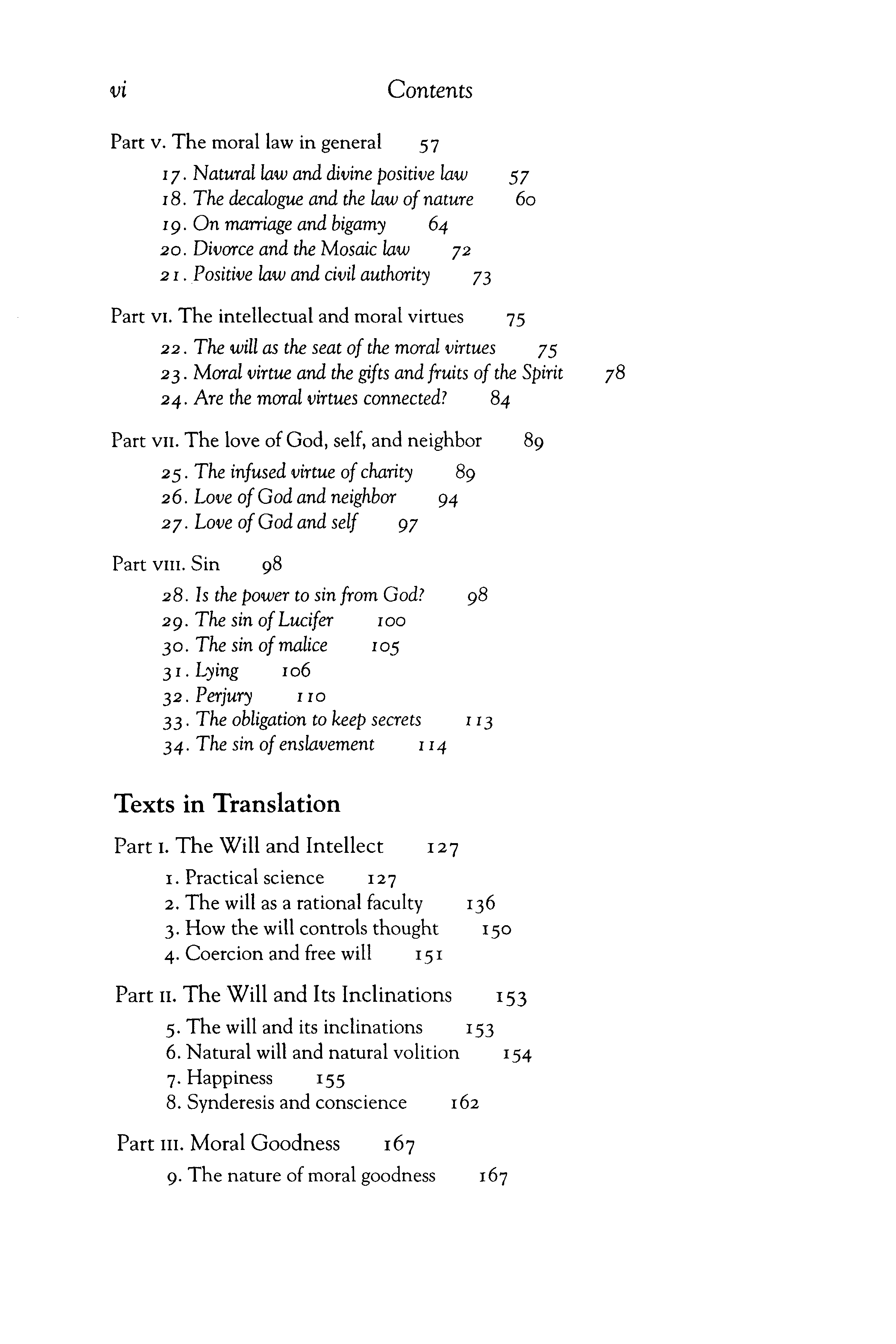
Vl Contents Part v. The moral law in general
I7. Natural law and divine positive law
I8. The decalogue and the law of nature
I 9. On marriage and bigamy
20. Divorce and the Mosaic law
2 I. Positive law and civil authority
Part VI. The intellectual and moral virtues
22. The will as the seat of the moral virtues
23. Moral virtue and the gifts and fruits of the Spirit
24. Are the moral virtues connected?
Part VII. The love of God, self, and neighbor
25. The infused virtue of charity
26. Love of God and neighbor
27. Love of God and self
Part VIII. Sin
28. Is the power to sin from God?
29. The sin of Lucifer
30. The sin of malice
3 I. Lying
32. Perjury IIO 33. The obligation to keep secrets I I3 34. The sin of enslavement II 4 Texts in Translation Part I. The Will and Intellect
I. Practical science
2. The will as a rational faculty
3. How the will controls thought ISO 4. Coercion and free will
Part II. The Will and Its Inclinations
5. The will and its inclinations
6. Natural will and natural volition
7· Happiness ISS 8. Synderesis and conscience
Part lll. Moral Goodness
9. The nature of moral goodness
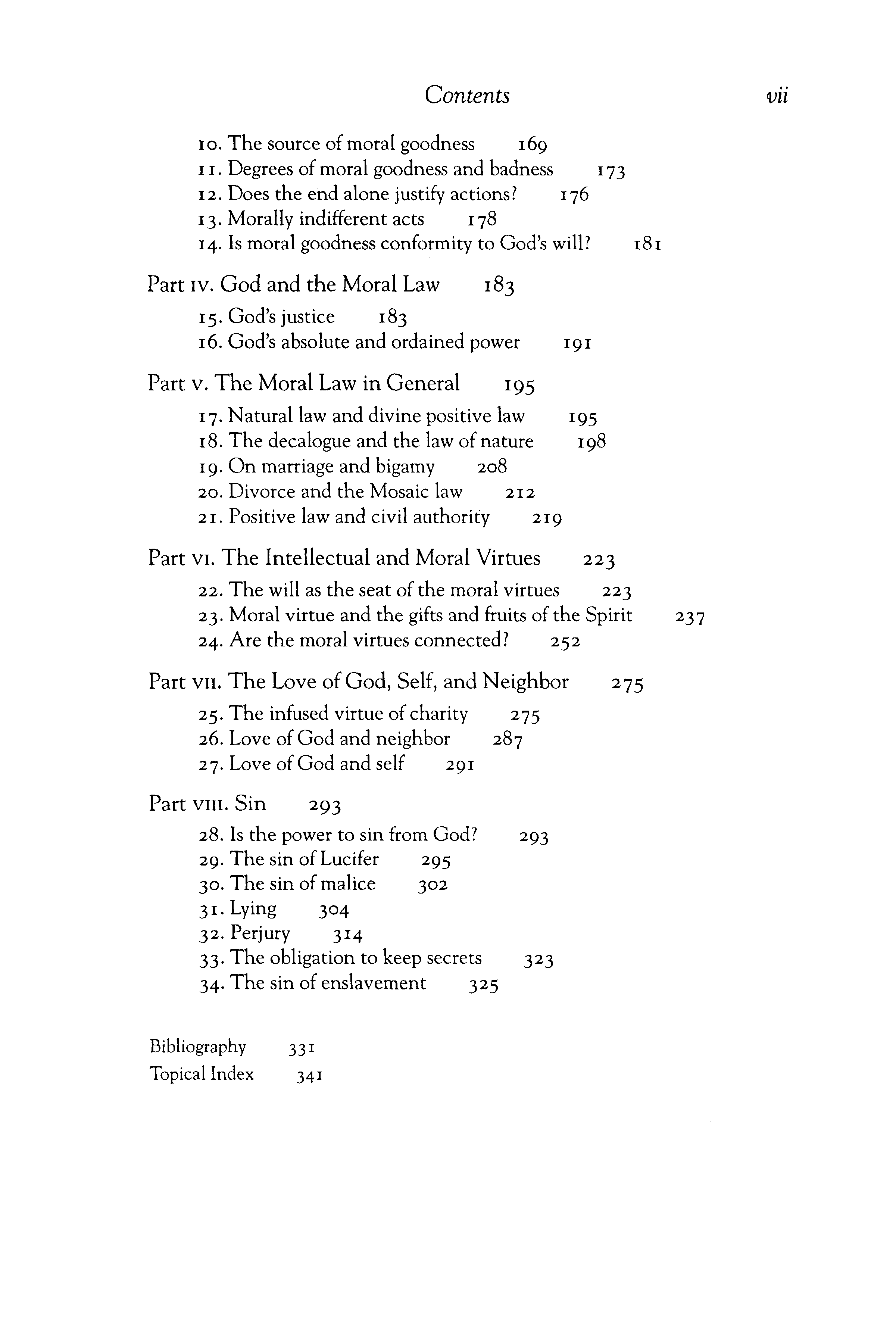
Contents vii 10. The source of moral goodness
I I. Degrees of moral goodness and badness I 73 12. Does the end alone justify actions?
13. Morally indifferent acts
14. Is moral goodness conformity to God's will?
IBI Part IV. God and the Moral Law
15. God's justice
16. God's absolute and ordained power
Part v. The Moral Law in General
17. Natural law and divine positive law
18. The decalogue and the law of nature
19. On marriage and bigamy 20B 20. Divorce and the Mosaic law 2 I 2 21. Positive law and civil authority
Part VI. The Intellectual and Moral Virtues
22. The will as the seat of the moral virtues
23. Moral virtue and the gifts and fruits of the Spirit
24. Are the moral virtues connected?
Part VII. The Love of God, Self, and Neighbor
25. The infused virtue of charity 26. Love of God and neighbor 27. Love of God and self
Part VIII. Sin
2B. Is the power to sin from God?
29. The sin of Lucifer
30. The sin of malice
3 I. Lying
32. Perjury
33. The obligation to keep secrets
34. The sin of enslavement
Bibliography
Topical Index

Preface to This Edition Since the appearance of the original edition of Duns Scotus on the Will and Morality, there has been a remarkable growth of interest in the thought of this early fourteenth,century Franciscan master. In part, this renaissance reflects the spate of scholarly activity associated with the official recognition of the cult of John Duns Scotus when
John Paul II confirmed his status as blessed during a Solemn Vespers in the Basilica of St. Peter in 1993. It is also the case that Allan Wolter's book on Scotus' volitional and ethical doctrine has itself provoked and guided a good deal of the recent inquiry.
Whatever the source of the activity, it has become evident since the recent international Scotus conferences held in Rome and Bonn that there is active interest among philosophical scholars along several lines of investigation directly connected with Duns Scotus on the Will and Morality. The following three areas deserve special mention: (I)
Scotus' metaphysics of freedom and contingency (e.g., Vos, 1994; Dumont, 1995; Frank, 1992; Honnefelder, 1991; and Wolter, 1990a),
(2) his anthropological doctrine of the will (e.g., Boler, 1990, 1993; Incandela, 1992; and Adams, 1987, 1995), and (3) Scotistic ethical theory (e.g., Adams, 1986; Santogrossi, 1994; Shannon, 1995, and especially Ingham, 1996). In fact, these investigations have enabled us to begin to see more critically a unity of concern in Scotistic thought.
In the balance of my remarks I shall try to sharpen the focus on this unifying thread.
The problem of freedom. The lodestone of Scotus' theological vision is the idea of Divine Love, as understood both within the mutuality of the Trinitarian Persons and in God's relation to creation. His philo, sophical thought expresses this fundamental reality under the aspects of the metaphysics of contingency and the experience of freedom.
Scotistic freedom, however, is a subtle notion that does not easily adjust itself to classical Greek or medieval concepts of nature and sci, ence, nor does it happily jibe with prevailing modem libertarian strains of thought. It is precisely this seminal understanding of free, dom that has been increasingly brought to the fore in the last ten or fifteen years of scholarship.
The correct understanding of the God/world relationship is one of the more important metaphysical questions in which freedom is a cen, tral issue. This is especially true in the case of Christian thinkers, and ix
x Preface to This Edition Duns Scotus' account of the relationship is a particularly challenging instance. One of the critical problems Christian thinkers face is the tension between the idea of a world possessed of an intelligible structure and the notion of creatures appearing out of nothingness by the fiat of a transcendent God. The basis of the tension is that philosophers expect to find the rational foundations of the world in necessary reasons, but a "fiat," even if it is divine, seems arbitrary, if not uncertain. Thus, when Scotus claims that the Divine Will in his relations with creatures is an exemplar of orderly, reasonable volition, he asserts that the world's intelligibility is founded on the reason of Divine Freedom. One might ask, however: "What is to count as reasonable?" The Scotistic answer falls between two polarized positions, and it is important to see that it cannot be assimilated to either of them.
One position, which we can call Aristotelian essentialism, bases intelligibility on the fact that things have natures, and God is bound to respect the requirements of these essences. This strategy, however, fails to honor the unqualified primacy Scotus gives to Divine Freedom in his dealings with the world. The second pole asserts voluntarism in its radical, unmitigated form and emphasizes the arbitrariness of God's choices in regard to his creatures. This second theory, which we might call anarchical, fails to express Scotus' thought, because he rejects the idea of an arbitrary willy-nilly in the Divine Will. It is interesting to note that both the essentialist and anarchical theories share a common idea of what counts for "rationality." At the origin of this notion of rationality is a metaphysical order that requires each actual being to exclude the simultaneous real possibility of its opposite. For instance, in the Aristotelian framework, to take the classical formulation, cosmic and ethical order finally comes to rest in ultimate ontological essences or natures. By contrast, where such forms are eliminated in the name of divine liberty and omnipotence, cosmology and morality lose their substantive, rational foundation. In the often told story of the history of ideas, the philosopher-theologians of the late medieval and early renaissance period opted for the nominalist, anarchical alternative and in the process put an end to what Louis Dupre, in Passage to Modernity, has called the classical "ontotheological vision of the rea1." Most versions of this narrative portray Duns Scotus as a patriarch of later nominalistic theologians.
The truth of Scotus' theodicy, however, is otherwise. He is no standard essentialist, nor is he a familiar nominalist, for the reason that he has not put freedom and reason in a fundamental ontological opposition to one another. The order or the reason of nature and action, of cosmology and morality, unfold within the architectonic form of freedom.
And this explains why, when Duns Scotus says that God is a debtor to
Preface to This Edition xi his own generosity (debitor ex liberalitate sua lOrd. IV, dist. 46]) and that in his creative action his volition is most orderly (ordinatissime volens [Ord. III, suppl., dist. 32]), Scotus is under the sway of a single idea: Liberality-the freedom that is generosity-has its own order. Interpretations of Scotus' doctrine of freedom will continue in a disorienting oscillation between the poles of essentialism and nominalism until we have a sufficiently cogent account of "freedom's reason."
Metaphysics of contingency. Part of what makes current Scotus studies so interesting and philosophically fruitful is that we find ourselves in search of what is, for our time, a fresh paradigm of reason, one that is common to both metaphysics and ethics, and which belongs essentially and centrally to a fundamental narrative of freedom. We find this enthusiasm of discovery in the work of the John Duns Scotus
Research Group, headed by Antoine Vos Jaczen, at the Franciscan Study Centre and Theological Faculty at Utrecht University. Confirming and extending ideas independently developed by Simo Knuutilla, they have identified the centrality of the notion of "synchronic contingency" in Duns Scotus' systematic thought (Vos, 1994, pp.
23-37, 127-29)· According to this modal theory, "the opposite of what is actually the case is both logically and really possible at the very time when it is actually the case" (Dumont, 1995, p. 160). This radical contingency derives from the distinctive potency that distinguishes the free will as its own species of active power. The resultant ontology is a remarkable achievement, for it means that any finite created entity subsists over against the simultaneous and real possibility that it could be otherwise. Accordingly, to say that something is contingent is to state something about the modality of its present existence, and not only to describe the present fact as a succession from past reality that was otherwise nor simply to affirm that in the succeeding future it will be otherwise.
Freedom is thus the glue of the universe, for the Divine Will actively causes finite things to exist and persist in the way they do. Within a Parmenidean or even an Aristotelian framework, ultimately what-is is and could not not-be, and thinking comes to rest either in the necessity of the great cycles and rhythms of nature, or even more finally in the Unmoved Mover's contemplation. If, however, our notion of being is inextricably bound up with the concept of possibility and synchronic contingency, as it is with Scotus, then actuality discovers its reason in the logic of the will's freedom. Such voluntarist considerations find their complement in an account of the foundation of possibility in the divine intellect (Wolter, 1993). As yet, however, there is no standard study that adequately integrates the various strains of the metaphysical and cosmological issues of freedom in an account of the rational order
xii Preface to This Edition of the universe. It is likely that this cannot be done until we have a better grasp of Scotus' theory of personhood. Recent anthropological and ethical studies of Scotus have made some progress along these lines.
Anthropology. Two of Scotus' doctrines, the key sources for which are found in Part II and Parts IV-V, lie particularly close to our con, cern with the architectonic form of freedom. One centers on Scotus' intriguing doctrine of natural law, and the other concerns his teaching on the affectio justitiae. Regarding the latter, John Boler's three studies of the doctrine of affectio justitiae, which Scotus calls the innate free, dom of the will, has demonstrated in great detail how Scotistic morali, ty requires a radical transcendence of the natural. "For Scotus . . . morality arises precisely with the possibility of somehow 'transcending' the pursuit of the agent's 'natural' potential in favor of a concern for the 'good in itself' of things. The presence of affectio justitiae . . . trans, forms the whole appetitive structure of the agent" (Boler, 1994, p. 27)'
This transformation lies at the heart of rational personhood. In Sco, tus' philosophy, "nature" underdetermines the content of morality and the good we achieve through our free will. "'Action in accord with right reason,' therefore, picks out what is reasonable or rational. . . .
But it is not something suited to the nature of the agent. Being moral cannot be analyzed in terms of an agent's nature, because being free is precisely not being 'in' a nature" (Boler, 1990, p. 38). In effect, morali, ty arises from the discontinuity between the natural and the voluntary.
"Nature" does not suffice to specify the content of morality: it can only give us the good in the eudaemonistic form of the bonum sibi. Tran, scending freedom, of course, has its measure; it is not arbitrarily open, ended, for its object is the bonum in se of things and, most especially, the love of God. But how is it that we recognize the moral good for what it is? Scotus seems to believe that the moral agent's right reason suffices to discern the ethical truth in a moral situation.
Ethical theory. In discussions of moral obligation, it is important to distinguish the subjective problem of explaining how what is morally obligatory makes a claim upon us from the question of the objective basis of moral obligation. The second, more fundamental question asks for the origin of the moral rightness or wrongness of a given action.
Why, for instance, ought one not murder? Or why should one love God? For Scotus, the first principle of morality, promulgated in the first tablet of Moses' decalogue, is "God is to be loved," and it obligates because it is axiomatic; it is a self,evident consequence of the very meaning of God and love. The principle holds universally-under all possible circumstances, for all rational agents, always. All other pre'
Preface to This Edition xiii cepts that are not logically necessary inferences from the primary principle and which in fact govern the large majority of our practical, workaday situations oblige for a different reason. In order to explain why these precepts (such as those against murder, adultery, and theft) oblige, Scotus introduces contingency into his account of moral obligation.
In the act of creation God ordered all things to participation in Divine Love (Wolter, 1980; Adams, 1986; Santogrossi, 1994). It is easy enough to understand the claim that all angelic and human beings are intended to be co-lovers of God, but Scotus insists that all created reality exists in some subordination, whether immediate or remote, to the dynamic principle, "God is to be loved." Thus even "a tree exists insofar as it enables me to love God more in himself" (Ord. suppl., dist. 32). Now the interesting point here is that among the interrelationships connecting creatures to one another, especially the ones binding man to man, but also man to nature, those that are morally obligatory do not express anything that could not logically or really be otherwise. As such, the content of morality participates in the radical contingency of finite reality. But that is not to say that the moral order is in this respect arbitrary. The checkrein on moral relativism is Divine Authority. The order of creation reflects a judgment on God's part that certain relationships ought to obtain among finite entities because it is a most suitable and exceedingly fitting way for all things to participate in Divine Love. In the act of creation, therefore,
God's decision concerning the harmony of goodness in the universe becomes natural law. Now this means that the demands of what is good, both with respect to things in themselves (bonum in se) and for us (bonum sibi), embody an intelligible structure, but one much better understood as analogous to the aesthetic judgment of a creative artist than the proof of a mathematician. One of the challenges to properly interpreting Scotus' ethical theory lies in the difficulty of appreciating this kind of rationality. Mary Elizabeth Ingham has made a brilliant contribution to the effort in her book, The Harmony of Goodness:
Mutuality and Moral Living According to John Duns Scotus.
With regard to the subjective concern of how moral obligation makes its claim in the actual deliberations and actions of moral agents,
Scotus is a right reason theorist. Man's dignity partially consists in the fact that God has given us the capacity for moral reason, which in principle can correctly estimate the entire ensemble that goes into the make up of a moral act, namely, its object, agent, end, and circumstances. If the acting person goes on to will in accordance with the judgment of right reason, then the resultant action-a real alteration
xiv Preface to This Edition in the complex web constituting the creative order-advances God's own purpose of bringing all things into harmony, as it were, with Divine Love.
Among the questions raised by this dual teaching on right reason and the contingency of natural law precepts of the second tablet of Moses' decalogue, the one provoked by the way Scotus deals with dispensations from the natural law that God is supposed to have made in the Old Testament has emerged as a particularly important ethical issue. In the view of standard medieval exegesis, God seems to have lifted his injunctions against acts of murder, theft, and adultery, as when he ordered Abraham to sacrifice his son and when he bade
Hosea marry a harlot. Scotus readily absorbs these kinds of events in his ethical theory. To begin with, the rationale of the original, standard precepts rests in the fact that God has seen some special harmony in a life lived in accordance with such laws. But, let us say, the conditions of the world have changed due to some natural disaster or to an evolved and incorrigible hardheartedness on the part of mankind, and in his judgment the primary good of raising co-lovers might be more fittingly attained by sacrificing what in the earlier scheme of things was an inviolable, but secondary, good. Given these terms, God could dispense with the requirements of the natural law governing our behavior with the secondary goods. It must be added, though, that he would in no way be obligated to do so, for he might address the crisis more fittingly in other imaginable ways. We are even less able to predict what God will deem fitting than we can anticipate the particulars of a creative artist's next masterpiece. What we do know, however, is that, whatever the content of the moral law, it will be evident to us and will make its claim to govern our actions through the deliberations of right reason. With the exception of Andre McGrath's Ph.D. dissertation (1979) on the ethical doctrine of Scotus' Ordinatio treatment of marriage, the historical-critical exegesis of Scotus' teaching on the dispensations from the natural law has not significantly advanced beyond Robert Prentice's excellent study (1967). Nevertheless, critical discussion of the meta-ethical issue and its practical significance has been brought into prominence by Thomas Shannon (1993,
1995) and the pointed opposition of Ansgar Santogrossi (1994).
The notion that morally obligatory laws are revisable in response to changing circumstances and the prospect that the moral agent's right reason can discern what is morally obligatory captivates Shannon. He finds in Scotus' development of these ideas an enriching inspiration for a contemporary ethical theory that prizes the autonomy of the moral agent and emphasizes the dependence of moral value on the
Preface to This Edition xv individuating circumstances of action. Santogrossi (1994) thinks that Shannon has overstated the case for human autonomy in the act of determining moral values. If Shannon were right, then Scotistic morality would be a kind of ethical deism. In other words, according to his interpretation, it would appear that God has given us a sufficient capacity for moral reasoning, placed us in a contingent, dynamic world of moral values, and released us to our freedom. The problem as Santogrossi sees it, however, is that authentic dispensations need to be ratified by an historical event of special revelation. It may be that right reason suffices to authenticate the original positive ordination of contingent, innerworldly, secondary goods to the primary good of Divine
Love, but he argues that alterations to the original intent of creation require the confirmation of some form of special revelation. The difficulty with Santogrossi's doctrine, from Shannon's point of view, is that this introduces authority and the need for obedience to divine positive law, a move that would compromise his ideals of freedom and mature rational autonomy. Besides the exegetical question of getting Scotus' doctrine right, there is the critical philosophical issue which can be posed in the following way. To what extent does the autonomy of a moral agent find its perfection not only in transcending eudaemonistic interests in favor of a personally indifferent service to the intrinsic good of another, but also in the actual conformity to divine positive judgment? At issue in this meta-ethical dispute are judgments regarding the degree of mutuality required between God and man, and the form it must take, in the process of moral action.
This edition. Among those who have tried to understand perennial philosophical issues from within an architectonic of freedom, John
Duns Scotus stands as one of history's seminal thinkers. Many of his teachings regarding liberty, contingency, and an ethics attuned to the concerns of mutuality and historical circumstance resonate with modem sensibilities. These prefatory remarks highlight the interesting and fruitful work now being done along these lines in the last decade.
Much of this inquiry has been instigated by the publication of Allan Wolter's Duns Scotus on the Will and Morality. It is still the standard source book in the field. We hope that by publishing it in an affordable English-only edition we can make Duns Scotus' thought on the will and morality more widely available to scholars and students. In this edition the original thirty-four selections of texts from Scotus' works have been maintained as they were in the first edition. We have eliminated the Latin texts and retained only the English translations.
Allan Wolter's General Remarks in the Introduction and his Notes on the Specific Selections have been retained and only slightly amended,
xvi Preface to This Edition either to correct errors or to remove irrelevant references to the deleted Latin texts. The bibliography has been expanded substantially, mainly in order to reflect much of the philosophical scholarship on Scotus' ethical and volitional doctrine since the 1986 publication of the first edition.
William A. Frank University of Dallas July 15, 1996
Preface to the Original Edition These selections were originally chosen for use in a graduate course on a specific topic in the history of philosophy, Duns Scotus' theory of ethics. The main aim was twofold: first, to correct the common misconceptions that arose because of his voluntaristic notions of God's relationship to creation, but more important, to show the unity of his ethical system based on right reason, for it is his rational approach to what he believed as an ex professo theologian that makes his conceptions of morality and especially the will of more than historical interest.
As an original philosopher, Scotus was perhaps more of a metaphysician or a philosophical psychologist than an ethician. He did, however, solve enough ethical questions in the course of his two major theological works, the Ordinatio, or revised commentary on the Sentences of Peter Lombard, and his magisterial Quodlibet, to develop a distinctive approach to moral philosophy. In subsequent decades this became so popular that the Cistercian moral theologian John Caramuel y Lobkowicz, writing in the mid-seventeenth century, was able to say that "the school of Scotus is more numerous than all the others combined" and to use this fact as a theological argument against the counterview that God himself could not dispense from any aspect of the natural law (B~k, 1956).
I have often suggested that most of what seems distinctive about Scotus' ethics has its roots in his theory of the will's native liberty, and when this is properly understood the unity of his ethics becomes apparent and the antinomies some claimed to find in it are dissolved. It seemed inappropriate, then, to publish a collection of texts on his moral philosophy without including some relevant items about the will that would substantiate this opinion.
Since Scotus' ethical system systematically presupposes his whole metaphysical conception of God's nature and the world's dependence on his will, it might seem fitting to include some texts on this topic as well. However, since so much of this is readily available in texts and translations I have published earlier, it seemed sufficient simply to sum up what I thought might be relevant in the Introduction, as well as point out there to what extent specific ethical insights might be logically independent of his system and hence of interest to those who do not share his metaphysical conceptions or religious faith.
xviii Preface to the Original Edition The selection of items, for better or worse, was governed by what seemed to me most important for putting Scotus' ethical views in proper perspective, particularly in view of the distressing repetition of old errors by professional philosophers. It is my hope that this rework, ing of the rough translations done for my students over the past decade may be of some use to a wider group of scholars, particularly those with no working knowledge of Scotus' cryptic Latin style or those limited to using the presently available editions. Most of the material relevant to his ethical theory has not yet appeared in the new critical Vatican edi, tion. Also much of the material used in the past was taken from what are now recognized as unexamined student reports (Reportata), rather than from more reliable texts such as Scotus' own earlier Lectura (now partially edited for the first time), or his late revised Ordinatio, and magisterial Quodlibet. Where the text of the Vatican press was not available, I tried to correct the Wadding edition on the basis of some of the better manuscripts recommended by the late C. Balie, former president of the Scotistic Commission in charge of the Vatican edi, tion. I have also allowed myself the liberty of a quasi-commentary style, rather than a literal translation, in view of the face,to,face edi, tion of the original text.
Without the initial interest of my graduate students, friends, and colleagues who occasionally sat in on my seminars on Scotus or en' couraged my work on his thought, I might never have undertaken the tedious task of translating so difficult a thinker. I am grateful to them all, especially to Dean Jude Dougherty and to Professors John Wippel and Marilyn McCord Adams, who suggested or encouraged the pub, lication of these selections, to Dr. William A. Frank for permission to include parts of his corrected Latin text of the Quodlibet, to the staff of The Catholic University of America Press for their gracious editorial assistance, and particularly to Frank Hunt, who had the thankless task of carefully reading and correcting the entire typescript. As usual lowe much to all my Franciscan confreres at the Old Mission for their kindly support and congeniality that makes it possible to work here under such pleasant circumstances.
Old Mission, Santa Barbara March 27, 1985
I General Remarks IIII he dual primary purpose of editing these texts was to present a sufficient number of John Duns Scotus' ethical writings to enable historians of medieval philosophy, first of all, to correct some common misconceptions as to his theory of morality, and secondly to perceive its inner coherence. If this were accomplished, then I would hope-as my secondary aim-that they and others interested in ethical theory might better appreciate the value of his more interesting insights and see their relevance for contemporary ethical issues. Before turning to a brief analysis of the particular items, then, it seems well to address a few general remarks to the concerns that prompted the publication of the present collection.
Let us begin with what is perhaps the most persistently recurring objection to his moral philosophy. An article on British philosophy in The Encyclopedia of Philosophy sums it up well in a single line: "Things are good because God wills them and not vice versa, so moral truth is not accessible to natural reason" (Quinton, 1965, p. 373). This same claim has been made from the very beginning of the neoscholastic revival initiated by Pope Leo XIII (Erdmann, 1896, p. 214; Willmann,
1896, p. 508f; Siebeck, 1898; Landry, 1922, pp. 33f, 343f, etc.), and though effectively refuted periodically (Minges, 1905; Klein, 1916;
Longpre, 1922; Schwendinger, 1934; De Wulf, 1936; Copleston, 1950; Stratenwerth, 1951; Haeres, 1958; Wolter, 1972), tends to be repeated, especially by those dependent on material available in present editions, where unexamined student reports are credited with the same value as Scotus' own more carefully worded remarks.
More discriminating scholars, like Vernon Bourke, recognize that
Introduction Scotus "died before he could say his best word on the problems of ethics" and that "until recently his writings have been badly edited and they are not yet wholly available in critical texts." Nevertheless, he could see-even on the limited basis of what has been critically edited-that Scotus "was one of the most brilliant intellects produced in the British Isles" and "in spite of his general opposition to the philosophy of Thomas Aquinas, Duns Scotus supports the view that right reason is the basis on which to judge good human action. He offers, in fact, one of the clearest explanations of the meaning of recta ratio"
(Bourke, 1970, p. 15of). Copleston, too, was well aware of Scotus' genius and importance, yet he admits at the beginning of his relatively short, but excellent, introductory account of Scotus' ethics that "my aim is not to propound all the ethical doctrines of Scotus, but rather to show that the accusation which has been brought against him of teaching the purely arbitrary character of the moral law, as though it depended simply and solely on the divine will, is, in the main, an unjust accusation" (Copleston, 1950, p. 545).
While his work is largely successful in accomplishing this limited but important goal, it does not show in any detail the inner coherence of Scotus' ethical theory and how he uses right reason to develop specific ethical conclusions. The same is true of Gilson's more extended account, which is not surprising in view of what he says about the scope and limitations of this work. "On n'y trouvera pas non plus un
'systeme' de Duns Scot, mais, cette fois, la seule raison en est que nous ne l'avons pas trouve nous-meme" (Gilson, 1952, p. 7).
C. R. S. Harris, it seems to me, put his finger on the keystone that gives Scotus' ethical philosophy its distinctive unity when he wrote:
"His insistence on the distinction between will and desire enables him to grapple more adequately with the psychological analysis of ethical problems and lends his thinking a deeper insight into the facts of moral experience than was displayed by any Christian thinker since the days of Augustine" (Harris, 1927, p. 303). Yet Harris himself fails to see the full import of this distinction when he treats of Scotus' moral philosophy ex professo. For while he admits that "it is a mistake to interpret Duns' ethical theory solely in the light of [his] voluntaristic passages, as Landry, Jourdain, Schwane, Werner and many other of his critics have seen fit to do," Harris himself is unable '0 comprehend how these statements can be reconciled with Scotus' equally strong assertion that "the goodness of an action is dependent on conformity with right reason. That there is a latent contradiction in Scotus' thought," he goes on to say, "cannot be doubted, nor can we find any satisfactory solution to the antinomy . . . It is only by a
General Remarks
frank recognition of this antinomy that we can hope to avoid the onesided interpretation in which his teaching has so often been distorted"
(PP·33 1-35)·
It seems incredible, however, that Duns, whom his most understanding yet outspoken critic admired "because of the great knowledge he had of logic" (Ockham, 1970, P.344), was not aware of such a glaring antinomy at the very core of his ethics. For that reason, it seems well to begin the first and general part of this introduction with a brief account of the following presuppositions that underlie Scotus' ethical system. The first is his metaphysical notion of God; the second, his conviction that God must have free will and how it is to be understood; the third, how God's love for his infinitely perfect nature is both voluntary and steadfast, and hence is, in a special sense, necessary; the fourth, how this dual aspect of his will affects his relationship to creatures, with whom he always deals according to right reason and in some ordained and methodical way; and the last, in what sense God could be said to have revealed his will naturally to creatures, particularly in regard to the moral law. Once all this is properly understood, I think two points become very clear. First, Scotus had every reason to think moral truth was accessible to man's natural mental powers; second, his ethical philosophy as a whole is remarkably coherent.
I. Scotus' metaphysical notion of God Though an ex professo theologian, Scotus-like the generality of his university colleagues in the tradition of Anselm's Faith Seeking Understanding-made wide use of philosophy, which in his day included all knowledge acquired by natural reason. And living in an age that intellectually at least was pluralistic, embracing not only Jewish philosophers like Maimonides and Avicebron, but Moslem Aristotelians like
Avicenna and Averroes, Scotus was concerned to separate out the rational component of his beliefs from those "that are the subject of belief, wherein reason is held captive-yet to Catholics, are the more certain since they rest firmly upon [revealed] truth and not upon our intellect which is blind and weak in many things" (De Primo Principia
4.86; Wolter, 1983, p. 146). Hence his attitude towards what reason could prove:
If there are some necessary reasons for what we believe, it is not dangerous to set them forth, neither for the sake of believers nor for the sake of unbelievers. Not for believers, for Catholic doctors, inquiring into the truth of their beliefs and trying to understand them, did not intend thereby to destroy the merit of faith. Indeed Augustine and Anselm believed they labored meritoriously in trying to understand what they believed, according to that text
Introduction from Isaiah 7:[9] (in the other [Le., Septuagint] translation): "Unless you believe, you will not understand"; for as believers they inquired, that they might understand the reasons for what they believed ... Neither is it dangerous so far as unbelievers are concerned. If one could find necessary reasons to prove the possibility of some fact, it would also be useful to confront unbelievers with such, because by so doing one might to some extent persuade them not to resist such beliefs as impossibilities. On the other hand, it could be dangerous to present such unbelievers with sophisms as demonstrations, because by so doing one could expose the faith to derision (and this is also true of all other matters, also those which are [theologically] indifferent, such as geometry). Rather than proposing fallacious arguments in place of demonstrations, it is better for one who lacks knowledge to recognize that he is ignorant than to think he knows on the basis of such sophisms. (Ord. II, dist. 1, nn. 138-39; Vatican ed. VII, pp. 69-70) Hence the theologian's need for critical analysis, rather than a fundamentalistic naivete or pietistic attitude.
If you say, otherwise, that God gives such knowledge to whom he wills, then it would follow that we labor in vain in our study and inquiry into the truth.
A far better and easier way of coming to theology would be to sit in church and ask God to give us this light. lSi dicas, quod non dat sic, sed cui vult (sc.
Deus) etc., sequeretur quod laboraremus frustra in studio et inquirendo veritatem, et esset multo melior via et levior veniendi ad scientiam theologiae sedere in ecclesia et rogare Deum, ut daret nobis illud lumen.] (Ord. III, suppl. dist. 24; Codex A, f. r67ra) Because theology has God as its subject, Scotus was most interested in what philosophy could offer in the way of rational knowledge of God's existence and nature. John Duns felt that metaphysics, as the first and highest of the theoretical sciences outlined by Aristotle, had the most to contribute to his enterprise. Aristotelians like Avicenna and Averroes, however, had been at odds as to its subject and its goal.
William of Alnwick, Scotus' secretary, gave the following edited account of John's own words as to why he sided with the former:
We must first see whether metaphysics, the first and highest of the naturally acquired habits [of knowledge or science] perfecting man's intellect in the present life, has God as its first object. On this point there is a controversy between Avicenna and Averroes. Avicenna claims that God is not the subject of metaphysics, because no science proves [the existence of] its own subject. The metaphysician, however, proves that God exists. Averroes reproves
Avicenna in his final comment on the Physics, Bk. I, because he wished, by using the same major premise against Avicenna, to prove that God and the pure spirits are the subject of metaphysics, and that God's existence is not proved in metaphysics, since it is only by means of motion, which pertains to the science of natural philosophy [or physics], that any kind of pure spirit can
General Remarks
be proved to exist.-It seems to me, however, that of the two, Avicenna has spoken better. Wherefore, I argue against Averroes as follows ... If the philosopher of nature can prove that God exists, then God's existence is a conclusion of natural philosophy. Now if metaphysics cannot prove the existence of God in this way, then God's existence is presupposed as a principle of metaphysics. Consequently, a conclusion of natural philosophy is a principle of metaphysics, and therefore the philosophy of nature is prior to metaphysics ... Now it is not just such properties of the effect as are treated in the philosophy of nature that are possible only on condition that God exists, for the same is true of the properties treated in metaphysics. Not only does motion presuppose a mover, but a being that is posterior presupposes one that is prior. Consequently, from the priority that exists among beings, the existence of the First Being can be inferred, and this can be done in a more perfect way than the existence of a Prime Mover can be established in natural philosophy. We can infer, then, in metaphysics from act and potency, finiteness and infinity, multitude and unity, and many other such metaphysical properties, that God or the First Being exists ... Hence I concede with Avicenna that God is not the subject of metaphysics. The Philosopher's statement (Metaphysics, Bk. I) that metaphysics is concerned with the highest causes, presents no difficulty. For he speaks here as he did in the Prior Analytics, Bk. I, where he says: "First it is necessary to determine with what [Prior
Analyticsl is concerned and what it has to do. It is concerned with demonstration and has to do with the demonstrative branch of learning, that is with the general science of demonstrating or syllogizing". Hence "concerned with" denotes properly the circumstance of the final cause just as much as it does that of the material cause. Wherefore, metaphysics is concerned with the highest causes as its end. In knowing them, metaphysical science attains its goal. (Wolter, I962, pp. 9I2) Though he developed his metaphysical proof with slight variations in all his commentaries on the Sentences, its final form appears in what was to become a philosophical classic, his Tractatus de Primo Principia.
Fittingly-since metaphysics has "being" as its subject-Scotus opens with a prayer to the God who revealed himself to Moses as "the I am who am." "Help me then, 0 Lord," he prays, "as I investigate how much our natural reason can learn about that true being which you are if we begin with the 'being' which you predicated of yourself." And in the closing pages he sums up what he thinks metaphysics can offer a believing Catholic: o Lord, our God, Catholics can infer most of the perfections which philosophers knew of you from what has been said. You are the first efficient cause, the ultimate end, supreme in perfection, transcending all things. You are uncaused in any way and therefore incapable of becoming or perishing; indeed it is simply impossible that you should not exist, for of yourself you are necessary being. You are therefore eternal, because the span of your existence is
Introduction without limit and you experience it all at once, for it cannot be strung out in a succession of events. For there can be no succession save in what is continually caused, or at least in what is dependent for its existence upon another, and this dependence is a far cry from what has necessary being of itself.
You live a most noble life, because you are understanding and volition. You are happy, indeed you are by nature happiness itself, because you are in possession of yourself. You are the clear vision of yourself and the most joyful love, and although you are self-sufficient and happy in yourself alone, you still understand in a single act everything that can be known. At one and the same time you possess the power to freely and contingently will each thing that can be caused and by willing it through your volition cause it to be. Most truly then you are of infinite power. You are incomprehensible, infinite, for nothing omniscient or of infinite power is finite ... Neither is the ultimate end, nor what exists of itself in all simplicity, something finite. You are the ultimate in simplicity, having no really distinct parts, or no realities in your essence which are not really the same. In you no quantity, no accident can be found, and therefore you are incapable of accidental change, even as I have already expressed, you are so in essence. You alone are simply perfect, not just a perfect angel, or a perfect body, but a perfect being, lacking no entity it is possible for anything to have. Nothing can formally possess every perfection, but every entity can exist in something either formally or eminently, as it does in you, 0 God, who are supreme among beings, the only one of them who is infinite. Communicating the rays of your goodness most liberally, you are boundless good, to whom as the most lovable thing of all every single being in its own way comes back to you as to its ultimate end. (Wolter, 1983, pp. 142 -44) In describing how we form concepts of God (Ord. I, dist. 3, n. S8;
Vatican ed. III, p. 48), Scotus points out that there are two ways in which we can speak and think of his infinite perfection. One is to enumerate all his perfections in the manner Scotus does above; the other is by using a simpler, but less perfect, concept (Le., one that does not spell out formally all it implies), namely, "infinite being," which virtually includes all of the above. And in his Quodlibet, q. s, he explains in some detail how we go about forming such a concept or how we give conceptual meaning to the term "infinite" as applied to God (see
Alluntis-Wolter, 1975, pp. 108-12).
The point of all this is that God, for Scotus, is equated with a being of infinite perfection, whether unqualified perfection be conceived of intensively or extensively. This will explain much of what he says about what is necessarily binding on God, both with respect to what he is and with respect to what he owes his own goodness, if and when he creates (selections 15 and 16). It also accounts for what will be binding in an absolute sense on whatever moral beings God might create (selections 18, 25, 26, 27, and 32). And in all these matters,