
4. S. 339.1 (PL 38:1480); my trans. See also s. 46.2.
The Bishop 79
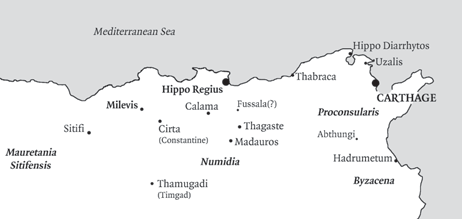
Augustine's North Africa
The episcopacy now defined his life. He spoke of it as a "heavy load" (sarcina). Once, in a sermon on the anniversary of his ordination, he remarked: "To preach, to rebuke, to correct, to build up, to feel responsible for every one of you—it's a terrible burden, a huge weight, an enormous task."3 Why so burdensome? Because Augustine saw his office—and much else—in light of Christ's second coming. Christ's final judgment meant that accounts would be audited and debt payments come due. As he explained to his hearers, "The difference between each of you and me is this: that you are going to have to render an accounting only for yourself, while I am going to have to do it for myself and for you." 4
As bishop, Augustine had sacramental duties, notably, preaching at daily and Sunday liturgies of the Word and presiding at daily and Sunday Eucharists. He also oversaw the years-long training of catechumens and presided over their baptism each Easter. Such duties were but one facet of his work. He also had to supervise his clergy, who sometimes caused him real headaches. He had to make sure that the finances of the church were in order and that church properties were properly managed. He was expected to ensure that the poor, especially widows and orphans, received the church's aid. Augustine's world had nothing like a welfare system or social security. Churches around the Empire clothed and fed, on a daily basis, large numbers of dependents.
3. S. 339.1 (PL 38:1480); my trans. The term sarcina appears in his letter to Paulinus of Nola right after his ordination (ep. 31.4). It becomes a commonplace: see s. 339.1, ep. 85.2; cf. s. 340.1.
4. S. 339.1 (PL 38:1480); my trans. See also s. 46.2.