
Part 9
In one school of the prophets, their accommodation needed rebuilding, but during the work a borrowed axe head was lost. For people who could not afford an axe in the first place, this was no small loss. Again God met his people's need, showing they could always depend on him (6:1-7).
Miracles of warning to Israel (6:8-8:15)
The remaining stories of Elisha concentrate on his dealings with the rulers of Israel and Syria. God was going to use Syria to punish Israel for its sin during the period of the Omri dynasty, but first he had various lessons to teach the two nations.
On one occasion when Israel and Syria were fighting each other, Elisha repeatedly warned the Israelite king of Syrian ambushes (8-10). The Syrian king was furious when he learnt why his ambushes failed, and sent an army to capture Elisha. Instead Elisha took control of the Syrian soldiers and led them to the Israelite capital, Samaria (11-19).
Israel's king thought this a perfect opportunity to slaughter the enemy, but Elisha directed him to feed them and release them. As a result peace was temporarily restored between Israel and Syria. The whole story was a lesson to both countries that God controlled their destinies (20-23).
Some time later the Syrians returned and besieged Samaria. With people dying of starvation and no help from God in sight, the king blamed Elisha for the trouble and tried to murder him (24-33). Elisha assured the king there would be plenty of food the next day (7:1-2), but when a report reached the king that it had arrived, he was slow to believe (3-12). The report was true, and at least one person was trampled to death as people rushed to buy (13-20).
In spite of the judgment that had begun to fall on Israel, God was still caring for those who were faithful to him. The woman whose son had been raised to life (see 4:8-37) was saved from poverty by being warned of a famine soon to hit Israel. She went and lived elsewhere during the famine, but by God's control of events she received back all her property when she returned to Israel (8:1-6).
Meanwhile God was continuing to prepare Syria to be his instrument to punish Israel. The king Benhadad was seriously ill, but he would have recovered had not Hazael murdered him. Hazael then became king. Elisha wept when he saw the terrible suffering that Hazael would bring upon Israel (7-15; cf. 1 Kings 19:15).
8:16-12:21 REMOVAL OF JEZEBEL'S BAALISM
Jezebel's Baalism spreads to Judah (8:16-9:10)
The writer now returns to his historical account of the kings of Judah and Israel. Jehoshaphat's son Jehoram, who was married to Athaliah the daughter of Ahab and Jezebel, became king of Judah after his father's death. Through Athaliah, Jezebel's Baalism spread to Judah. Jehoram made sure that no one challenged his right to do as he pleased by killing all likely rivals. Because of this and his support for Jezebel's Baalism, he was assured of a horrible death (16-19; 2 Chron 21:4,11-15,18-20).
For David's sake God did not yet destroy Judah, though the nation certainly weakened. Edom to the south and Libnah on the Philistine border freed themselves from Judah's rule, while the Arabs and the Philistines raided and plundered with great success (20-24; 2 Chron 21:16-17).
During one of these raids most of Judah's royal family was killed. Jehoram's sole surviving son, Ahaziah, became king after his father's death (2 Chron 22:1), but in his short reign he proved to be no better than his father. He was dominated by his mother Athaliah, along with relatives of hers from the north whom she had brought into the Jerusalem palace (2 Chron 22:3-4). He joined his uncle Joram (or Jehoram) of Israel in war against Hazael of Syria. When Joram retreated to the summer palace at Jezreel to recover from wounds received in battle, Ahaziah went to visit him (25-29).
Elisha saw that the time had come for him to carry out his last major responsibility, which was to anoint Israel's army commander Jehu as king. Jehu's job was to rid Israel of the entire family of Ahab and Jezebel (9:1-10; cf. 1 Kings 19:16).
Jehu's revolution (9:11-10:14)
On hearing of Jehu's anointing as king, Jehu's senior officers swore their immediate allegiance (1113). Without allowing time for news of the rebellion to leak out, Jehu set off for Jezreel (14-16). As he approached the city, Joram and Ahaziah, unaware of the rebellion, went out to meet him. Joram was killed on the spot, appropriately at Naboth's vineyard (17-26; cf. 1 Kings 21:17-19). Ahaziah was killed after a chase (27-29). Jehu quickly went on to Jezreel to deal with the queen mother, Jezebel. Knowing she could expect the same fate as Joram, she prepared herself to meet the executioner with royal dignity. She died a horrible death, as the prophet had foretold (30-37; cf. v. 10).
The massacre continued. After arranging for the execution of Ahab's seventy surviving male descendants in Samaria, Jehu displayed their heads as a warning to any likely rebels (10:1-8). He tried to make the people believe that the seventy had been killed directly by God, but they were probably not convinced. They well knew that the only way Jehu could make his throne safe was to kill all Ahab's descendants. God's earlier announcement of judgment on the family of Ahab gave Jehu the opportunity to carry out his plans (9-11; cf. 9:7-9). Since the late Ahaziah was a descendant of Ahab, Jehu killed Ahaziah's relatives as well (12-14).
End of Jezebel's Baalism in Israel (10:15-36)
Jehu next put into operation a plan to rid Israel of all Jezebel's Baal-worshipping followers. In this he had the cooperation of Jehonadab, a man who had led his people to give up the agricultural life (possibly because of its tendencies to Baal worship) and go back to the simple way of life followed by Abraham and the early Israelites (15-17; cf. Jer 35:6-10). Through deceit and butchery, Jehu wiped out Jezebel's Baal worshippers (18-27).
However, Jehu did not remove the idol worship established earlier by Jeroboam. This gives further indication that his anti-Baal campaign resulted from political, rather than religious, motives. Nevertheless, he destroyed the dynasty of Omri along with its particular form of Baal worship, and for this God rewarded him. His dynasty would last longer than any other in the northern kingdom (28-31).
As the story in Kings shows, Jehu went far beyond what was necessary to bring God's judgment on the dynasty of Omri. His needless butchery, still talked about a century later, would be the reason why his own dynasty would come to a bloody end (Hosea 1:4).
Jehu's massacre of all the nation's leading administrators left the nation's internal government weak and unstable (see 10:11). The slaughter of Jezebel's descendants brought the long-standing treaty with Tyre and Sidon in the north to a sudden end. The murder of Judah's king and his relatives lost Israel the support of her sister nation to the south. Jehu's withdrawal of Israel's troops from Ramoth-gilead to support his revolution weakened Israel's eastern border (see 9:4-5,11-14). Syria's king Hazael was quick to attack, and over a time seized most of Israel's territory east of Jordan. Elisha's prophecy was coming true (32-36; cf. 8:12).
End of Jezebel's Baalism in Judah (11:1-21)
Ahaziah, king of Judah, had been assassinated the day of Jehu's revolt (see 9:27). His mother Athaliah showed herself a true daughter of Jezebel when she killed all her grandchildren (except one who escaped), seized the throne, and established her mother's Baalism in Judah. The one who escaped was the baby Joash, who was rescued by his aunt (a princess married to the high priest; 2 Chron 22:11) and hidden for six years in the temple (11:1-3).
When Joash was seven years old, the high priest Jehoiada, with the support of the palace and temple guards, claimed the throne for him. The coup was planned for a sabbath day, when the changing of the guard ensured that a much larger group of guards than usual would be at the temple (4-8). All went according to plan without bloodshed, apart from the execution of Athaliah (9-16).
Because Athaliah had interrupted the line of Davidic kings, the restoration of the Davidic king to the throne was accompanied by a renewal of the covenant. All Jerusalem celebrated the great day. The people went wild with joy, destroying Athaliah's Baal temple and all that belonged to it (17-21).
True worship restored in Judah (12:1-21)
Under the influence of Jehoiada, Joash encouraged the worship of Yahweh (12:1-3). But his project for repairing the temple (damaged by Athaliah and her followers; 2 Chron 24:7) was hindered by the priests. They lacked enthusiasm and were inefficient, and possibly dishonest, in handling the finances (48). Joash therefore separated the funds for the priests' personal use from the funds for the temple repairs, and placed the latter under the supervision of an official of the royal treasury. He then hired workmen who had a desire to do the work properly and honestly (9-16).
After Jehoiada's death, Joash, no longer under the strong priestly influence of his life-long adviser, turned to idolatry. When rebuked by the new high priest Zechariah, Joash had Zechariah murdered (2 Chron 24:15-22; Matt 23:35). Judgment on Joash was swift and severe. Hazael led his troops across Israel and south into Judah as far as Gath. He then turned to attack Jerusalem, and Joash saved the city only by robbing the temple treasury and sending the money to Hazael (17-18; 2 Chron 24:23-24). But he could not buy off the judgment that was to fall on him personally. Soon after the battle he was assassinated by his officers, and was not even given a royal burial (19-21; 2 Chron 24:25-27).
The prophecy of Joel
It was possibly during the early part of Joash's reign that the prophet Joel wrote his book. During that time Joash was still a boy and the government was largely in the hands of Jehoiada. If that is so, Joel was the first of the writing prophets (i.e. prophets who wrote books of the Bible).
However, the book of Joel mentions no date of writing, and it could possibly have been written many years later, perhaps after the return from captivity and even later than the time of Nehemiah. If that is the case, Joel was among the last of the writing prophets. The message of the book is straightforward and can be readily understood regardless of its date of writing.
Joel's reason for writing was a severe plague of locusts that devastated Judah. He interpreted this as a judgment on Judah for its sin, and urged the people to repent. In response to their repentance, God removed the locusts and promised to give the nation productive crops again (Joel 1:4; 2:10-14,25). Joel saw the events as symbolic of God's future judgment on all enemies and his coming blessing on all the faithful (Joel 3:16-19).
13:1-17:41 HISTORY TO THE FALL OF ISRAEL
After the anti-Baal revolution (13:1-14:22)
Jehu's son Jehoahaz followed the sins of earlier Israelite kings, and so did his people. The Syrian attacks foreseen by Elisha were so severe that, had God not mercifully intervened, the whole population would have been left homeless and the entire army destroyed (13:1-9).
The next king, Jehoash, learnt from Elisha that he would win three battles against Syria. He would have won more, had he not lacked faith in God (10-19). During Jehoash's reign Elisha died, but dramatic events at Elisha's tomb showed that the God who had worked through him was still alive and powerful (20-21). Jehoash won three battles as Elisha had foretold, and thereby regained some of Israel's lost territory (22-25).
After the murder of his father Joash, Amaziah came to the throne of Judah. Once firmly in control, he executed his father's murderers (14:1-6). He planned to attack Edom, but when a census of his army revealed that he had not enough soldiers, he hired trained men from Israel. A prophet told him to send the Israelites back, for God would not give Judah's army victory while it contained men from the ungodly northern kingdom. Angry at missing out on the chance to raid the Edomites, the northerners raided the cities of Judah instead. Amaziah, meanwhile, attacked and defeated Edom (7; 2 Chron 25:5-13).
Foolishly, Amaziah brought back to his palace some idols of the defeated Edomites. His military victory gave him such self-assurance that he thought he could act independently of God and ignore the warnings of God's prophet (2 Chron 25:14-16). Confident in his increased military experience, he decided to attack Israel. The Israelite king warned him that Judah would be defeated, but Amaziah persisted. Judah was defeated, Amaziah was taken captive and Jerusalem was plundered (8-16; cf. 13:12). Later he was allowed to return to his throne, but apparently he was unpopular and, like his father, was assassinated (17-22).
An era of prosperity (14:23-15:7)
During the long reigns of Jeroboam II in the north and Azariah (or Uzziah) in the south, Israel and Judah experienced political stability and economic development such as they had not known since the days of David and Solomon. This was possible partly because political conditions in the region were favourable to Israel and Judah.
Syria had been used by God to punish Israel for its sins in following Baal. With the death of Hazael, Syrian power declined and Israel regained lost territory (see 13:24-25). Events further favoured Israel when Assyria, the rising power in the region, became involved with enemies to its north and for forty years did not bother Israel and Judah.
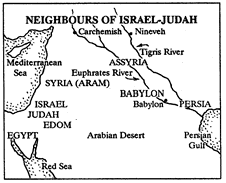
Under these conditions Jeroboam II expanded his kingdom from Hamath in the north to the Dead Sea in the south, as foretold by the prophet Jonah. This gave him control over many trade routes, which further helped Israel's economy. But religiously he was a failure, and the evils of his reign were condemned by the prophets Amos and Hosea (23-29; cf. Amos 1:1; 7:10-11; Hosea 1:1; 7:1-3).
Azariah (or Uzziah) in Judah began his reign well, mainly because of the godly instruction that he received from his teacher Zechariah (15:1-3; 2 Chron 26:1-5). He spread his rule west to the Mediterranean Sea, east over Ammonite territory, and south as far as the Red Sea and Egypt. This gave him control over important land and sea trade routes (see 14:22; 2 Chron 26:6-8). He fortified the capital city Jerusalem, improved agricultural and pastoral conditions in every region of the country, built up the armed forces and equipped his troops with the most modern weapons (2 Chron 26:9-15). His big mistake was to think that he could become religious head of the nation as well. God punished him with leprosy, and his son Jotham acted as joint ruler till Uzziah's death (4-7; 2 Chron 26:16-23).
Jonah and the Assyrians
Israel's prosperity during the era produced within many Israelites, even the prophet Jonah, a selfish, nationalistic spirit. Jonah had already successfully predicted Jeroboam II's victories over a number of enemies (see 14:25), and no doubt he would have liked to see the downfall of Assyria. The capital of Assyria, Nineveh, was already threatened by an enemy from the north. But God told Jonah to go and warn Nineveh of the coming attack, and urge the people to repent of their sins so that they might avoid destruction (Jonah 3:4-5,10).
At first Jonah refused to go, for he preferred to see Nineveh overthrown. He had to learn that God was the controller of all nations, and he would have mercy on any who turned from their sins, regardless of nationality. This was of particular importance in the case of the Assyrians, for God was preserving them to be his instrument to punish Israel.
The fiery preaching of Amos
Two hundred years earlier, in the time of Solomon, a distinct merchant class had begun to appear in Israel (see notes on 1 Kings 9:26-10:29). During the time of Jeroboam II and Uzziah (the eighth century BC), the merchants grew into a powerful group. Society was no longer built around the simple agricultural life. As commerce and trade developed, so did city life. This brought with it greed and oppression, as the upper classes exploited the poorer classes. Bribery was widespread, the courts were corrupt, and the poor were left with no way of obtaining justice.
Amos was the first of several prophets to speak out against these evils. He was a shepherd-farmer who knew how the poor suffered, because he himself had to deal with ruthless merchants and corrupt officials in selling his produce. In his fiery preaching he condemned the greed and luxury of the rich. He knew they had gained their wealth by cheating and injustice (Amos 2:6-7; 3:10,15; 6:4-6; 8:4-6). They still carried out their religious exercises, but these were worthless in God's sight as long as the worshippers persisted in wrongdoing (Amos 5:21-24; 8:10).
Most of Amos's attacks were directed against the northern kingdom (Amos 2:6; 4:1; 6:1; 7:10). The people, it seems, took little notice. Amos clearly saw what Israel's upper classes failed to see, namely, that the nation was heading for a terrible judgment from God (Amos 3:12; 6:14; 7:11).
Hosea's experiences
Despite Amos's accusations and warnings, social conditions in Israel worsened. This is seen from the writings of Hosea, who began to preach late in the reigns of Jeroboam II and Uzziah, and continued through the reigns of succeeding kings (Hosea 1:1). Like Amos, Hosea was concerned chiefly with Israel, though he referred also to Judah.
Hosea saw that Israel's society was corrupt because its religion was corrupt. The priests were as bad as the merchants and officials. Baal worship, complete with its fertility rites and prostitution, was widely practised. Israel did not know the character of Yahweh (Hosea 4:1-6,17-19; 5:4,15; 6:6-10; 7:2-4; 9:15; 13:16; cf. Amos 2:7-8).
Since Israel's covenant bond with Yahweh was likened to the marriage bond, Israel's association with other gods was really spiritual adultery. Hosea began to understand what this meant to God when his own wife left him for other lovers. But her pleasures did not last and she was sold as a slave. All this time Hosea remained faithful to his marriage covenant, and when he found his wife a slave, he bought her back. It was a picture of the covenant love of God for his unfaithful people. They too would go into captivity, but after cleansing from the filth of their adulterous association with the Canaanite gods, God would bring them back to live in their land again (Hosea 2:5-10; 3:1-5).
Chaos in Israel (15:8-26)
The long and prosperous reign of Jeroboam II brought political as well as social and religious troubles. When Jeroboam died, Israel entered a time of political chaos, as ambitious men fought to seize power. The nation lost its stability, and Assyria soon began to show interest in adding Israel to its rapidly expanding empire.
Jehu's dynasty, which began bloodily, ended bloodily when its fifth king was murdered after a reign of only six months (8-12; cf. 10:30; Hosea 1:4; Amos 7:9). The assassin, Shallum, reigned only one month before he was murdered by Menahem, who then seized the throne (13-16). Menahem survived ten years, but only by buying the protection of the Assyrian king Tiglath-pileser III (also known as Pul). This policy damaged Israel's economy, weakened its independence and opened the way for eventual conquest by Assyria (17-22).
Israel's army commander Pekah was opposed to this pro-Assyrian policy. After Menahem died and was succeeded by his son Pekahiah, Pekah murdered Pekahiah and made himself king (23-26). The plots, assassinations and repeated changes in foreign policy were condemned by God's prophets (Hosea 5:13; 7:3,7,11; 8:4; 10:3-4; 12:1).
Isaiah and Ahaz
Meanwhile Tiglath-pileser III was working towards a complete military conquest of Israel. (The prophets had already predicted such a conquest; see Hosea 10:5-8; Amos 7:17.) Realizing this, the Syrian king Rezin and the Israelite king Pekah formed a defence alliance to resist Assyria. They tried to persuade Judah's king Jotham and the succeeding king Ahaz to join them, but the kings of Judah refused. Rezin and Pekah then attacked Ahaz, with the aim of conquering Judah, putting their own king on the throne, then forcing Judah to join their anti-Assyrian alliance (see 15:37; 16:5; Isa 7:1-2,6).
As the Israel-Syrian invasion force approached, Ahaz panicked. But one man among his advisers, the prophet Isaiah, remained calm and urged the king to trust in God. Isaiah assured Ahaz that he need not fear, for Israel-Syria would not defeat Judah, but would themselves be conquered by Assyria. Ahaz had only to trust in God (Isa 7:2-9; 8:4). However, Ahaz neither trusted in God nor believed Isaiah. Instead he asked Assyria to come and help him. Isaiah warned that this was foolish, for it would put Judah under Assyria's control (Isa 8:5-8). Again Ahaz ignored the advice (see 16:7-8).
Assyria then attacked Syria and Israel. Assyria's policy was to carry off the people of a conquered country into other countries of the Assyrian Empire (to prevent rebellion breaking out in the conquered territory) and replace them with settlers from elsewhere. Therefore, when Tiglath-pileser conquered Syria, he transported the people into captivity in Assyria (732 BC). This brought the kingdom of Syria to an end, as foretold by God's prophets (see 16:9; Isa 17:1; Amos 1:4-5). Tiglath-pileser attacked Israel also, overrunning its eastern and northern territory and taking the inhabitants into captivity (see 15:29). This was the beginning of the end for Israel.
Judah's decline under Ahaz (15:27-16:20)
The writer of Kings records the Assyrian attack mentioned above. Pekah's policy had proved fatal and he was assassinated by Hoshea, a sympathizer with Assyria. Hoshea then became king and won temporary relief for Israel by submitting to Assyria's control (27-31).
Before speaking further of Hoshea, the writer returns to the time before Pekah was assassinated. Pekah's program for the conquest of Judah had begun during the reign of Jotham, but reached its climax in the reign of Jotham's successor Ahaz. The aggression of Israel-Syria and the constant threat from Assyria prompted Jotham to build defence fortifications throughout Judah. He also made his borders secure by taking control of neighbouring Ammon (32-38; 2 Chron 27:3-6).
Because of his lack of faith in God, Ahaz had a disastrous reign. Apart from the damage he did to Judah by following other gods, he almost ruined the nation's economy by his policies in the war with Israel and Syria. Buying Assyrian aid did not save him from heavy losses in the war, and he would have suffered even more had not Israel released the war prisoners taken from Judah. His weakened country suffered further at the hands of invading Edomites from the south and Philistines from the west. He also lost the Red Sea port of Elath (Ezion-geber) (16:1-9; 2 Chron 28:5-18).
Earlier, after losing a battle with Syria, Ahaz had turned from Yahweh to worship the 'victorious' Syrian gods. He closed the temple to Yahweh in Jerusalem and built altars to foreign gods throughout Judah (2 Chron 28:22-25). But Assyria, acting on Ahaz's request, had now conquered Syria (see v. 9) and established its religion and its administration in Damascus. Ahaz now replaced the Syrians' religion with the Assyrians', and built a copy of their altar in Jerusalem (10-16). Ahaz's hiring of Assyria was so costly that he removed valuable metal from the temple to pay Tiglath-pileser (17-20). (It was after this conquest of Syria that Tiglath-pileser overran eastern and northern Israel; see 15:29.)
The importance of Isaiah
There was great variety in the kinds of people God chose to be his prophets. Whereas Amos was a poor farmer, Isaiah was a person of high social standing, an adviser to the king who was able to influence national policy. His ministry had begun long before the time of Ahaz. It began in the year of Uzziah's death and continued through the reigns of Jotham, Ahaz and Hezekiah (Isa 1:1; 6:1). The traditional belief is that he was executed during the reign of the wicked Manasseh by being sawn in two (cf. 21:1-2,16; Heb 11:37).
In the early part of the book of Isaiah, the prophet records his attempts to persuade Ahaz to trust in God, not in Assyria, to save Judah from the Israel-Syrian invasion. In the next part of the book he records his attempts to control the zeal of the good king Hezekiah, who was rather too keen to rely on help from Egypt in revolting against Assyria (see notes on 18:1-20:21). Isaiah shows that all these nations, and others as well, were under God's judgment. Judah too would be punished for its sin, and its people taken into captivity.
The final section of the book of Isaiah shows that God would not cast off his people for ever. He would preserve that minority of people who had always remained faithful to him, and through them he would rebuild the nation. God's people would return to their land and enjoy peace and prosperity once more. The Messiah-king would come, and his kingdom would spread to all nations.
Micah accuses the rich landowners
No doubt one man who cooperated with Isaiah was Micah, who prophesied during the same period of Judah's history (Isa 1:1; Micah 1:1). While Isaiah was using his influence at Jerusalem's royal court, Micah was coming to the aid of the small farmers. (He came from a farming village and was probably a farmer himself; Micah 1:1,14.) As Amos and Hosea had done before him, he condemned the injustice, greed and false religion that were widespread in Judah, especially among the upper class people of Jerusalem (Micah 3:1-3,9-11; 6:9-12; 7:3).
Micah was particularly concerned at how the rich ruthlessly gained possession of the land of the small farmers. They lent money to the farmers at high interest, then, when the farmers found it impossible to pay their debts, seized the farmers' houses and land as payment (Micah 2:1-3,9). The farmers then were required to rent their land from their new masters, which increased their burden even more. The state of affairs showed no thought for the rights of others, no understanding of true religion, and no knowledge of the character of God. It was a sure indication that Judah was heading for judgment (Micah 3:12; 6:16).
End of the northern kingdom (17:1-41)
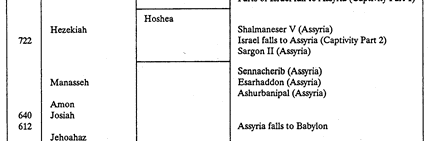
Some time after Shalmaneser V succeeded Tiglath-pileser III as king of Assyria, the Israelite king Hoshea tried to show himself independent of Assyria by refusing to pay the annual tribute. He thought that with Egyptian support his rebellion would be successful. Shalmaneser put an end to such hopes by invading Israel and besieging Samaria. After three years Israel's defence collapsed, and Shalmaneser's successor, Sargon II, captured Samaria and carried off the survivors into captivity (722 BC). This was the end of the northern kingdom (17:1-6).
The fact that Israel's nineteen kings were spread over nine dynasties is an indication of the instability that characterized the northern kingdom throughout its history.
At this point the writer comments at length on the reason for the fall of Israel, namely, the spiritual failure of the people as a whole. Though Jeroboam I was responsible for changing the official religious policy, the real cause of the failure lay with the common people, who readily copied local religious practices. This was open disobedience to God's covenant commands given by Moses and repeated by the prophets (7-17). In the end God punished the people by making them captives in a foreign land, as they had once been in Egypt. Only Judah was left, but it too was turning from God (18-23).
In accordance with their normal policy, the Assyrians resettled people from other parts of their Empire into cities of the northern kingdom (which was now known as Samaria). These settlers tried to avoid punishment from Israel's God by combining the worship of Yahweh with their own religion. They also intermarried with the Israelites left in the land. Their descendants, known as Samaritans, being of mixed blood and mixed religion, were despised by the Jews (24-33; cf. John 4:9; 8:48). The presence of all these religions in the land God gave to Israel was in sharp contrast to God's plan, which was for Israel to worship him alone (34-41).
18:1-25:30 HISTORY TO THE FALL OF JUDAH
New policies under Hezekiah (18:1-12)
With the destruction of the kingdom of Israel in the north and the disastrous reign of Ahaz in the south, Assyrian influence in Palestine was at its peak. In spite of this, the young king Hezekiah set out on the bold task of reforming Judah's religion and freeing Judah from Assyrian power. He destroyed all the local idolatrous shrines (something that no king since David had been able to do), and because of this the writer of Kings regarded him as Judah's greatest king (18:1-6).
(For Hezekiah's extensive religious reforms see notes on 2 Chronicles 29:1-31:21. The reforms were largely external, being concerned mainly with temple services and ceremonies. There is no evidence of any lasting change in either the rulers or the people, and no direct reference to the reforms by the prophets of the time, Isaiah and Micah.)
Hezekiah realized that once he reversed his father's policy concerning Assyria, the Assyrian army would attack Jerusalem. To prepare against siege he strengthened the city's defences and improved its water supply (see 20:20; 2 Chron 32:5). Once he was assured of military support from Egypt, he revolted against Assyria by refusing to pay further tribute. Isaiah opposed this reliance on Egypt, just as during the reign of Ahaz he opposed reliance on Assyria. What Judah needed was not military help from Egypt but quiet faith in God (7-8; Isa 30:1-3,15). Assyria's recent conquest of the northern kingdom should have been a warning to Hezekiah (9-12).
Freed from Assyrian power (18:13-19:37)
When news reached Hezekiah that the Assyrian army, under the new king Sennacherib, was heading for Jerusalem, he quickly prepared the defences of the city. He also cut off any water supply outside the city that might be of help to the besieging armies. Above all, he encouraged his troops to trust in God for victory (13; 2 Chron 32:1-8). But, on seeing the strength of the siege, Hezekiah began to repent of his rebellion and offered to pay whatever money Sennacherib demanded (14-16).
After taking a large payment from Hezekiah, the Assyrian king showed that he intended to punish him anyway. He sent three senior officers to demand that Hezekiah surrender. Unknowingly, the Assyrian officers agreed with Isaiah (though for different reasons) that reliance on Egypt was useless (17-21; cf. Isa 30:1-3; 31:1-3,8). In any case, they said, God had sent the Assyrians to punish Jerusalem (22-25).
On seeing how their words troubled Jerusalem's officials, the Assyrians spoke even more boldly. They tried to persuade the common people to surrender, promising to treat them well in the lands to which they would take them (26-32). Their big mistake, however, was to insult Yahweh by claiming he was no stronger than the gods of other nations whom the Assyrians had conquered (33-37).
When Hezekiah sent to enquire about the situation from Isaiah, the reply made it clear that God would not tolerate the Assyrians' mockery (19:1-7). The Assyrians temporarily withdrew from Jerusalem to deal with a crisis elsewhere, but sent a letter renewing their threats and challenging God to resist them (8-14). Hezekiah then presented the whole matter to God, who, being the only true and living God, was the only one who could save Jerusalem (15-19).
Isaiah brought God's reply. It condemned the Assyrians for mocking God and boasting of their achievements, especially when they were only God's instrument to carry out his judgments. God would therefore punish them and save Jerusalem (20-28). Fields not sown because of the enemy's siege would become fruitful again, and the number of genuine believers in Judah would increase (29-34).
Having announced his plans, God then acted. The Assyrian army was almost destroyed (701 BC), and although Sennacherib escaped home, he was later assassinated (35-37).
Warning concerning Babylon (20:1-21)
It seems that the events recorded in 20:1-19 occurred before those recorded in 18:13-19:37. Hezekiah was about to die, but, in answer to his prayer, God promised to extend his life. This was for the purpose of bringing Judah through the time of conflict with Assyria that has just been described (20:1-7). God gave Hezekiah a miraculous sign to prove that he would do what he had promised (8-11).
At this time Babylon was increasing in power and was looking for allies to help it overthrow Assyria. Hezekiah's illness gave the Babylonian king an excuse to send representatives to Jerusalem, in the hope that they could encourage Hezekiah to join with Babylon against Assyria. Hezekiah was proud of the prosperity he had brought to his kingdom, and was willing to cooperate (12-13; 2 Chron 32:25,31). Again Isaiah condemned this willingness to enter into foreign alliances. He saw that it would result in conquest by the allied nation (14-21).
Manasseh's evil reign (21:1-26)
Hezekiah's reformation had cleansed Judah of the outward forms of foreign religion, but the inward spiritual condition of most people had not changed. The faithful remnant was still small (see 19:30-31). Possibly under pressure from Assyria, Manasseh reversed his father's religious policy and with almost fanatical zeal reintroduced foreign religious ideas of every kind. Fifty-five years under his rule left Judah in a worse spiritual condition than that for which God had destroyed the original Canaanites (21:1-9). Therefore, God announced he would punish Judah as he had punished Israel. No later king was able to remove fully the evil that Manasseh brought upon Judah (10-16; cf. 23:26-27).
Towards the end of his life, Manasseh rebelled against Assyria. He was taken captive and brought before the Assyrian leaders at Babylon, which at that time was under the control of Assyria. Later he was allowed to return to Jerusalem. Believing that his captivity was a punishment by God for his sins, he attempted to return to the true worship of Yahweh. But it was too late to undo the damage he had done over half a century, and his reform had no lasting effect (17-18; 2 Chron 33:10-20).
Manasseh's son Amon returned to the earlier policies of his father, but after a brief reign he was murdered. Some of the leading citizens, tired of the constant cruelty and bloodshed (cf. v. 16), executed Amon's murderers and put Amon's eight year old son Josiah on the throne (about 640 BC). In this way power rested with the king's advisers, who could then follow policies that would benefit the people and restore peace and stability to Judah (19-26).
Zephaniah and Josiah
By the time he was twenty, Josiah had developed his own policy and begun reforms that lasted many years (2 Chron 34:1-5). He was possibly prompted to introduce these reforms through the preaching of the prophet Zephaniah. Zephaniah was probably not much older than Josiah and appears to have been related to him (cf. Zeph 1:1).
So far as we know, Zephaniah was the first prophet to appear in Judah for over seventy years. The Bible has no record of any prophets during the evil reigns of Manasseh and Amon. Zephaniah's work marked the beginning of a new period of prophetic activity in Judah. He lived in Jerusalem, where he denounced the same evils as Isaiah and Micah denounced a century earlier (Zeph 1:4-9; 3:3-4). His announcements of judgment no doubt prompted many of the people to change their ways and cooperate in Josiah's reforms (Zeph 2:3).
Josiah repairs the temple (22:1-20)
Included in Josiah's reformation was a project for extensive repairs to the temple, which had been damaged during the reigns of Manasseh and Amon (22:1-7). By this time Assyrian power had weakened considerably, which enabled Josiah to carry out his reformation program without interference from outside. He even extended his power into the conquered territory of the former northern kingdom (see 23:15,19; 2 Chron 34:6-7).
During the fifty-seven years when Manasseh and Amon reigned, a new generation had grown up in Judah who knew nothing of the law of God as given to Israel by Moses. When workers on the temple found some scrolls of this long-forgotten law, Josiah, on reading the scrolls, was shocked to learn how far Judah had turned away from God (8-13). He sent messengers to ask a prophet what to do, and received the reply that, despite his personal faith, Judah was doomed. But he could continue his reforming work, so that the judgment might be postponed to the reign of some future king (14-20).
Extent of Josiah's reforms (23:1-27)
Josiah was not discouraged by the prophecy of judgment on Judah. Rather he intensified his efforts to change his people. His greater reformation would now begin. To gain the cooperation of all the leading citizens, he explained to them the contents of the book on which he was basing his reforms, and invited them to join with him in renewing the covenant with God (23:1-3).
With uncompromising zeal, Josiah removed all idolatrous priests and destroyed all shrines and sacred objects associated with other gods, whether in Judah or in former Israel. After the removal of the country shrines, he centralized Judah's worship in Jerusalem where it could be properly supervised. Although most priests came to live in Jerusalem, some refused (4-14; 2 Chron 34:6-7). At Bethel he burnt the bones of the false prophets on their altar and then destroyed it, as foretold by a godly prophet of an earlier era. But he was careful not to damage the tomb where the bones of the godly prophet lay (15-20; cf. 1 Kings 13:1-3,29-32).
On the positive side, Josiah re-established the worship of Yahweh by keeping the Passover. The festival had added significance at this time, as it symbolized a fresh deliverance from bondage (21-23; for details of this Passover see 2 Chron 35:1-19). He also ordered the removal of all private household gods, and prohibited all forms of spiritism and fortune telling. Apart from Hezekiah, Josiah was the only king of Judah to receive unqualified praise from the writer of Kings (24-25; cf. 18:5).
Nevertheless, Josiah's reforms were not enough to remove the idolatrous ideas deeply rooted in the minds of the people. Few were genuinely converted, and God did not remove his earlier sentence of judgment (26-27).
Warnings from Jeremiah
Jeremiah was from a priestly family, but God called him to be a prophet. His prophetic work began about 627 BC, during the reforms of Josiah (Jer 1:1-2; cf. 2 Chron 34:3,8). But Jeremiah says little about the reforms. This was no doubt because he saw there had been no basic change in the hearts of the people, and therefore the changes in the external forms of the religion would have no lasting effect. Although Jeremiah did not discourage the zealous king from the good work he was doing, he pointed out to the people that if they did not change their behaviour and attitudes, they would not escape God's judgment (Jer 11:15; 14:12).
After the death of Josiah, Jeremiah's warnings became more urgent. He assured the people of Judah that because of their persistent rebellion against God, they would be taken captive to Babylon (Jer 21:27). Jeremiah became a prominent national figure during the time of Judah's later kings, and his ministry lasted till after the destruction of Jerusalem in 587 BC. He was violently opposed by leaders and common people alike, and on occasions imprisoned (Jer 20:1-6; 26:1-11; 28:1-17; 37:1-21; 38:1-28). The significance of Jeremiah and his protests will become clear as the story moves on.
Nahum and the destruction of the Assyrians
While Josiah was reigning in Judah, great changes were occurring among the more powerful countries of the region. Most important of these changes was the decline of Assyria and the rise of Babylon. This was foreseen by the prophet Nahum, whose short book is wholly concerned with the destruction of the Assyrian capital Nineveh and the end of Assyrian power (Nahum 1:1-2; 2:8). Nahum rejoiced that at last a fitting divine judgment was going to fall on such an arrogant and brutal oppressor (Nahum 2:13; 3:1,7,18-19).
Egypt and Babylon (23:28-30)
During the years of Assyria's declining power, Egypt took the opportunity to extend its influence. But Babylon had now risen to power, and in 612 BC it conquered Nineveh. Pharaoh Necho of Egypt, fearing this Babylonian expansion, went to help what was left of Assyria to withstand Babylon. He no doubt hoped that Assyria might yet form some sort of defence barrier between Egypt and Babylon.
Josiah apparently saw this Assyrian-Egyptian alliance as a threat to Judah's independence. He preferred Assyria to remain weak and tried to stop Egypt from helping it. This proved to be a fatal move. Judah was defeated and Josiah killed in battle (609 BC). By a decision of Judah's leading officials, Josiah's second son Jehoahaz (or Joahaz) was made the new king (28-30; 2 Chron 35:20-25). Meanwhile, as Babylonian power expanded, Assyria collapsed, and its national identity disappeared.
Habakkuk's problem concerning Babylon
God was preparing Babylon to be his instrument to punish Judah. The prophet Habakkuk was puzzled when he learnt of this, because he knew that the people of Babylon were even worse sinners than the people of Judah. In his book he records how he argued with God about this matter, and how God reassured him that any of the people of Judah who remained faithful to him would enjoy his favour. The Babylonians, however, because of their pride at conquering God's people, would themselves suffer God's punishment (Hab. 1:6,13; 2:4,16).
End of Judah's independence (23:31-37)
Pharaoh Necho now considered himself to be the controller of Judah, and would not accept the king chosen by the people of Judah. The unfortunate Jehoahaz was thrown into prison and later taken to Egypt, where he eventually died. Necho made Jehoahaz's older brother Jehoiakim king instead, and placed a heavy tax on Judah (31-37).
It soon became clear why the people of Judah had not chosen Jehoiakim as king. He was a proud, cruel and oppressive ruler, who murdered those who opposed him and insultingly rejected the advice of God's prophets (see 24:4; Jer 26:20-23; 36:1-32). In spite of the heavy taxes his country had to pay Egypt, he built himself luxurious royal buildings, forcing people to work on his selfish projects without payment (Jer 22:13-17).
Conquest by Babylon and captivity (24:1-17)
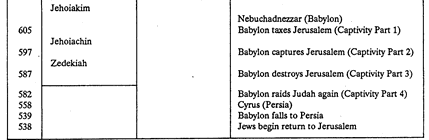
In 605 BC the armies of Babylon under Nebuchadnezzar conquered Egypt in the famous Battle of Carchemish (Jer 46:2). This meant that Judah now came under the control of, and paid tribute to, Babylon. When the conquerors returned to Babylon, they took with them captives from the conquered countries, including some of the most capable and well educated young men they could find among the leading families of Jerusalem. One of these was the youth Daniel (Dan 1:1-6).
After three years Jehoiakim stopped paying tribute, thinking that Nebuchadnezzar was too busy with wars elsewhere to deal with Judah. Jehoiakim depended on Egypt to support his rebellion, a policy that Jeremiah consistently opposed (Jer 2:18,36). Nebuchadnezzar did not immediately return and attack Jerusalem, but he weakened its power by allowing other countries within his Empire to raid across Judah's borders (24:1-4).
When he had put down rebellions elsewhere, Nebuchadnezzar sent his army to besiege Jerusalem. Jehoiakim the king was taken prisoner and chained ready to be sent to Babylon, but he died before the journey began. No one mourned his death, and his body was thrown on the garbage dump outside Jerusalem as if it were the carcass of an unclean animal (5-7; 2 Chron 36:6; Jer 22:18-19; 36:30).
The eighteen year old Jehoiachin (also known as Jeconiah, or Coniah) then became king. After three months he saw that further resistance was useless and surrendered (597 BC). Most of the nation's treasures, along with the king, the royal family, the palace officials and all Judah's best people, were carried off to Babylon. Among these captives was the young man Ezekiel. Only those of no use to Babylon were left in Jerusalem. Babylon then appointed Jehoiachin's uncle, Zedekiah, as king (8-17; see Ezek 1:1-3).
The destruction of Jerusalem (24:18-25:21)
All Judah's most capable administrators had been taken captive to Babylon. The few advisers who were left to Zedekiah had no true understanding of the situation, either political or religious, and persuaded the weak king to seek Egypt's help in rebelling against Babylon. This was a policy that Jeremiah clearly saw was disastrous, for it would lead only to the horrors of siege and destruction. His advice was that Judah accept its fate as God's will and submit to Babylon (18-20; 2 Chron 36:11-14; Jer 21:1-10; 27:12-15; 37:6-10).
Zedekiah, however, followed the advice of the pro-Egypt party and rebelled against Babylon. Nebuchadnezzar decided to crush the rebellious city once and for all. When Egypt came to Jerusalem's aid, the siege was temporarily lifted, but Jeremiah warned that this would only make Babylon more determined to crush Judah, and Egypt with it. The pro-Egypt party accused Jeremiah of being a traitor and had him imprisoned (Jer 37:1-38:28).
The Babylonians returned and soon Jeremiah's prophecy came true. The horrors of the siege are vividly described in the book of Lamentations (Lam. 2:10-12,19-21; 4:4-5,7-10). When, after a year and six months, the Babylonians finally made a break in the wall, Zedekiah and some of his men tried to escape, but were captured (25:1-7).
Babylonian soldiers then poured into the city, seizing anything of value that could be taken back to Babylon, and burning or smashing what remained. This was the end of Jerusalem (587 BC). The leaders of the rebellion were killed, and the most useful citizens taken captive (8-17).
In the course of arresting the chief officials of Jerusalem, the Babylonians released Jeremiah from jail and gave him full freedom to decide where he would like to live, Babylon or Judah. Jeremiah chose to stay in Judah with a small number of farmers and other poorer people who were of no use to Babylon (1821; Jer 39:11-40:6).
In Egypt and Babylon (25:22-30)
Gedaliah was appointed governor of those who remained in Judah, and with Jeremiah's support he followed a pro-Babylon policy. He took no action against Judah's anti-Babylon military leaders who had escaped the Babylonians. Rather he encouraged them, along with others who had fled the country, to return and settle around Mizpah, north of Jerusalem (22-24; Jer 40:7-12).
Within a few months Gedaliah was murdered by the leaders of the anti-Babylon group. Fearing a revenge attack by Nebuchadnezzar, the remaining Judeans in the resettlement area fled for safety to
Egypt, taking the protesting Jeremiah with them (25-26; Jer 40:13-43:7). It is believed that Jeremiah was stoned to death in Egypt by his fellow Judeans. The Babylonians, meanwhile, made their punishing raid on Judah as expected, and took captive any that they found (582 BC; Jer 52:30).
After all the centuries of God's dealings with his people, most of them were now back in Chaldea (Babylon) from where Abraham had been called, and others were back in Egypt where their ancestors had been slaves. Yet God had not cast off his people. They received a sign of hope for the future when the Babylonians released Jehoiachin from prison and promoted him to a place of honour in the Babylonian palace (in 568 BC). God was still in charge of his people's affairs, and one day a remnant would return to the homeland and rebuild the nation (27-30; cf. Jer 29:10-14).
Obadiah's accusations against Edom
When Babylon attacked and destroyed Jerusalem in 587 BC, Edom joined in, welcoming the opportunity to enrich itself and to help wipe out what remained of the Israelite nation (Ps 137:7). The prophet Obadiah, apparently one of those left behind in Judah, announced God's judgment on Edom for its hostility, particularly since Edom and Israel were brother nations (being descended from Esau and Jacob respectively) (Obad 10-14).
Ezekiel in Babylon
Among the important citizens of Jerusalem taken captive to Babylon in 597 BC (see 24:10-17) was the young priest Ezekiel. If he had hoped to return to Jerusalem to serve God in the temple, he was soon to be disappointed. Jeremiah wrote to the exiles to tell them plainly that they would probably spend the remainder of their lives in Babylon (Jer 29:1-14). Ezekiel's work for God was to be as a prophet in Babylon, not as a priest in Jerusalem. He began his prophetic ministry five years after his arrival in Babylon, and continued it for at least twenty-two years (Ezek 1:2; 29:17).
In the early days of his preaching, Ezekiel repeatedly condemned the sins of the citizens of Jerusalem. He made it clear that the suffering of the people, both those in Jerusalem and those in Babylon, was a fitting judgment from God. He warned that for those left in Jerusalem worse was yet to come. The city would be destroyed and the temple burnt when the Babylonians invaded the city for the third and final time (Ezek 6:1-7; 7:20-27; 11:9-10; 21:21-22).
At first the exiles rejected Ezekiel's message (Ezek 12:27-28). A few years later, when news reached them that Jerusalem had fallen as Ezekiel had predicted, they realized that Ezekiel was a true prophet who knew God's mind. They began to listen to his messages again, though few genuinely changed their ways (Ezek 33:21,30-33).
Nevertheless, Ezekiel was encouraged to move ahead with the next and most important part of his ministry, which was to prepare God's people for the new era that lay ahead. He looked for the day when God's people would be cleansed from their sins and worship him in spirit and in truth.
The long career of Daniel
Daniel was among the first citizens of Jerusalem to be taken captive to Babylon. (This was in 605 BC; see 24:1a; Dan 1:1-6.) He was probably only a teenager when he entered the Babylonian court to be trained as an administrator. During his long career he held some of the most important positions in Babylon's government. He outlasted the Babylonian Empire, and was still alive in the third year of the Persian king Cyrus, who had conquered Babylon in 539 BC (Dan. 10:1). He therefore lived to see the first of the Jews return to Jerusalem to rebuild the nation (2 Chron 36:22-23).
The first half of the book of Daniel records stories of Daniel and his friends that illustrate the overruling control of God in the lives of his people. The second half shows, through a series of unusual visions, how God would continue this government in the affairs of his people: first, during the confusion and conflict that would follow the period of Persian rule; second, during the events of Christ's ministry and death; and third, during the final great events connected with the return of the Messiah and the end of the world's history.
1 Chronicles
As with Samuel and Kings, Chronicles consists of two books in our Bibles, but was only one book in the original Hebrew Bible. The writer has not recorded his name, though he has recorded the names of some books and documents from which he gathered his material (1 Chron 9:1; 27:24; 29:29; 2 Chron 9:29; 16:11; 24:27; 33:19; 35:25).
A chronicle is a record of events, and the biblical writing called Chronicles records events that took place in Israel during the period covered by the books of Samuel and Kings. But Chronicles differs from Samuel and Kings in both style and content. The Chronicler wrote for people of a specific period and with a clear purpose in mind.
Circumstances of the time
Chronicles was written many years after Israel and Judah had been taken into captivity. After the captivity of the northern kingdom (Israel) by Assyria in 732 and 722 BC, many of the people of Israel became scattered among the nations where they lived, and largely lost their national identity. Those of the former southern kingdom (Judah), who were taken captive to Babylon in a number of stages between 605 and 582 BC, largely retained their national identity. When Persia conquered Babylon in 539 BC and gave permission to the Jews to return to their homeland, those who returned were people of this latter group. Further migrations followed in succeeding generations.
Most of those who returned had never lived in Palestine and knew little of the temple that once functioned in Jerusalem. These were the people for whom the Chronicler wrote. He wanted to give them some background knowledge about their country and their religion. In particular he wanted to impress upon them that they were more than just a lot of migrants living back in the land of their forefathers. They were a continuation of that pre-captivity nation whose life had been built on the twofold foundation of the Davidic dynasty and the Levitical priesthood.
Characteristics of Chronicles
God had a purpose in restoring his people to their homeland. He was still in control of their history, and the promises he had given to David and his dynasty would yet be fulfilled. The Chronicler has therefore chosen and arranged his material carefully, so that his readers might see the importance of rebuilding their nation according to God's design. Although he traces the history of the nation from the time of its first king, Saul, he says little about Saul. He is concerned almost entirely with the Davidic line of kings and the temple in Jerusalem with which they were connected.
The northern kingdom was a breakaway from God's chosen line through David, and its religion a rebellion against the true worship of God that was centred in Jerusalem. The writer of Chronicles has no desire to interest his readers in the northern kingdom and its sinful ways. For him the Davidic line of kings is the only legitimate dynasty, Jerusalem the nation's only legitimate capital, the temple in Jerusalem its only legitimate sanctuary, and the Levitical priesthood the only legitimate religious order. In concentrating on the southern kingdom, the writer wants to show his readers how the God-given Davidic kingship and the God-given Levitical order were essential to the national life of God's people.
Because of his special interests, the writer of Chronicles gives many details that the writers of Samuel and Kings do not record. This is particularly so in relation to Israel's religious organization during the period of the monarchy. On the other hand there are many things that he does not record, such as the failures of some of the Davidic kings. His aim is not to examine the lives of individuals, but to show that the Davidic kingdom was established with the religious order as an inseparable part of Israel's national life.
The Levites are always of particular interest to the writer of Chronicles. Whereas the writers of Samuel and Kings scarcely mention them, the Chronicler mentions them repeatedly, to show the part they played in the nation's affairs. He wants to impress upon his readers that the nation functions best when the civil administration of the Davidic kings and the religious order of the Levites work in harmony as God intended.
OUTLINE OF 1 CHRONICLES
1:1-9:34 Genealogies of the tribes of Israel 9:35-22:1 The reign of David 22:2-29:30 Preparations for the temple
1:1-9:34 GENEALOGIES OF THE TRIBES OF ISRAEL
The long lists of names that characterize Chronicles may not make interesting reading for us today, but they were important to the original readers. First, these genealogies proved to those who returned that they were a true continuation of the former kingdom. Second, they indicated who among the people had to carry out various religious duties and who among them were of the royal family of David. The lists recorded the origin and development of each tribe in some detail, so that people would know the tribe to which they belonged.
All the tribes came from a common ancestor, Jacob, and through him from Abraham. Abraham was the true father of the nation and a key figure in God's purposes for the human race (cf. Gen 12:1-3; 13:1417; Matt 1:2-16).
The origins of Israel (1:1-54)
As in many of the genealogies of the Bible, the genealogy here is simplified. That is, it does not list the name of every person descended from one ancestor, but selects certain people and certain generations according to the purpose of the writer. In this genealogy the writer is concerned mainly with only one line of descent from Adam.
To begin with, the writer records the line of descent from Adam to Noah (1:1-4). Although he records the descendants of Noah's three sons (5-23), he is particularly concerned with the line through Shem that produced Abraham (24-27). The nation Israel was descended from Abraham through his son Isaac and grandson Jacob, but before dealing with Israel, the writer lists people descended from Abraham's other children (28-33) and from Isaac's other son (34-54).
Descendants of Judah and Simeon (2:1-4:43)
Having listed the children of Jacob (Israel) starting with the eldest son Reuben, the writer immediately turns his attention to the tribe of Judah, the tribe that produced the dynasty of David (2:117). He traces the line of David first, then goes back to deal with a number of other important people in Judah and lists their descendants (18-55). On completing this, he returns to list the family of David (3:19), the descendants of David who reigned after him to the captivity (10-16), and further descendants who lived during the time of the captivity and later (17-24). The section concludes with a collection of miscellaneous branches from Judah's family tree (4:1-23).
The tribe of Simeon had no tribal territory of its own, but dwelt within the territory of Judah (Josh 19:1,9). It is therefore dealt with here, immediately after the listings for Judah. Some of the Simeonites' conquests, which are not mentioned elsewhere, are also recorded (24-43).
The eastern tribes (5:1-26)
At the beginning of this section, the writer gives the reason why he listed the genealogy of Judah before that of Reuben, the firstborn. Reuben had lost his rights as the firstborn (see Gen 35:22), so the ruling power in Israel was given to Judah instead. The firstborn's double portion of the inheritance went to Joseph, who received two tribes in Israel (Ephraim and Manasseh). The descendants of Reuben, along with those of Gad and half the tribe of Manasseh, dwelt on the east of Jordan, not in Canaan itself. Their territory had no natural boundaries to the north or east, and so was open to attack from the Assyrians (5:110).
Gad's descendants are listed next (11-17). In addition there is the account of an important victory that the two and a half eastern tribes won, thereby giving them greater security and prosperity (18-22). There is also a short list of the leading families of the eastern half of the tribe of Manasseh (23-24). The section closes by recording that the people of the two and a half eastern tribes, because of their unfaithfulness to God, were conquered by the Assyrians and taken into captivity (25-26).
The Levites (6:1-81)
Levi had three sons, Gershon, Kohath and Merari. The priesthood in Israel began with Aaron, who was descended from Levi through Kohath. From that time on, all Aaron's descendants, and no others, were priests. This means that the Levites may be divided into four groups – the priestly Kohathites, the non-priestly Kohathites, the Gershonites and the Merarites.
The Chronicler begins with the priestly line descended from Aaron through his son Eleazar, and traces the line to the time of the captivity (6:1-15). He follows this with genealogies of the Gershonites, the remaining Kohathites and the Merarites (16-30). Next he gives the genealogies of the three who were put in charge of the temple singers – Heman the Kohathite (31-38), Asaph the Gershonite (39-43) and Ethan the Merarite (44-48). (Songs from these three men, and others from a group of Levitical musicians known as the sons of Korah, have been collected in the book of Psalms; e.g. Ps 42; 44-50; 73-85; 87-89.)
Forty-eight cities had been given to the Levites after Joshua's conquest of Canaan (Josh 21:41), and these also were divided into four groups. The cities for the priestly Kohathites were all in the region around Jerusalem and therefore within easy reach of the temple (49-60). Cities for the other three Levitical groups were more distant from Jerusalem (61-65). The writer then lists the cities for these three groups: first for the non-priestly Kohathites (66-70), then for the Gershonites (71-76) and finally for the Merarites (77-81).
Genealogies of the remaining tribes (7:1-8:40)
Although the lists here are incomplete and in places difficult to follow, it seems that the tribes dealt with are Issachar (7:1-5), parts of Benjamin and Dan (6-12), Naphtali (13), the portion of Manasseh not listed earlier (14-19; cf. 5:23-24), Ephraim (20-29) and Asher (30-40).
Benjamin is given in greater detail, possibly because it included Jerusalem in its tribal territory. Also this was the only tribe that joined Judah in the southern kingdom, the kingdom that remained loyal to the Davidic dynasty (8:1-28). Benjamin also produced Israel's first king, Saul, whose family details are given (29-40).
First group to return to Jerusalem (9:1-34)
At the time of writing, the first of the exiles had just returned to Jerusalem, having been given permission by the Persian king Cyrus (2 Chron 36:22-23). The writer lists the heads of the families who returned (9:1-9). He points out that priests, Levites and temple servants also returned, to emphasize that the re-establishment of the nation Israel had to be on the basis of the religious order appointed by David before the captivity (10-16).
Just as gate-keepers were needed to guard the tabernacle and the temple in former times, so they would be needed to guard the temple in rebuilt Jerusalem (17-21). The writer records how David organized the guards' working hours and duties in the former temple (22-27). Even everyday matters, such as the care of temple equipment and the preparation of incense, spices and sacred foods, were carefully planned and supervised (28-32). People such as musicians and singers, who were to be ready for duty any time, day or night, lived in some of the temple buildings (33-34).
9:35-22:1 THE REIGN OF DAVID
End of the line of Saul (9:35-10:14)
Saul is introduced by listing his genealogy once again (35-44). However, the Chronicler passes over the reign of Saul in silence, for his concern is with the dynasty of David. Saul's death alone is recounted, since that was the means of bringing in the reign of David. It was also God's judgment on Saul for his unfaithfulness and disobedience (10:1-14; see notes on 1 Sam 31:1-13).
David made king (11:1-12:40)
It seems clear that the writer of Chronicles assumes that his readers have already read the books of Samuel and Kings. (In this commentary also it is assumed that the reader has read these books. For further details see notes and maps at the relevant places in Samuel and Kings, and the appendix at the end of Chronicles.)
In view of his readers' assumed knowledge, the Chronicler makes no attempt to record events that have little to do with his central purpose. For example, he omits all reference to the attempt by Saul's followers to continue the rule of Saul's family (2 Sam 1:1-4:12). Instead he passes straight on to the establishment of David in Jerusalem as king over all Israel (11:1-9; see notes on 2 Sam 5:1-10), and the important part that David's mighty men played in establishing and maintaining his kingdom (10-47; see notes on 2 Sam 23:8-39).
Others who gladly gave themselves to David to fight for him are also mentioned: the Benjaminites who joined him at Ziklag when he was fleeing from Saul (12:1-7; see notes on 1 Sam 27:1-7); the fearless soldiers from Gad, Benjamin and Judah who had previously joined him at his stronghold in Adullum (818; see notes on 1 Sam 22:1-23); and the Israelite military commanders from Manasseh who deserted to him at the time of the Philistines' last battle with Saul (19-22; see notes on 1 Sam 29:1-30:25). Finally, the writer records how all the tribes of Israel sent a representative force of troops to Hebron to present themselves to David, their new king (23-40; see notes on 2 Sam 5:1-5).
The ark comes to Jerusalem (13:1-16:7)
David knew that part of the reason for Israel's previous weakness was Saul's lack of interest in its religious life. Even the ark of the covenant, symbol of God's presence, lay forgotten in a country house. David set out to restore the ark to its rightful place at the centre of the nation's religious life. In bringing the ark to Jerusalem, his aim was to make Jerusalem the religious, as well as the political, centre of Israel. But his plans suffered an early setback because of a lack of reverence for the ark (13:1-14; see notes on 2 Sam 6:1-11).
An account of two victories over the Philistines is inserted (out of chronological order), probably to impress upon the reader how David's fame was spreading (14:1-17; see notes on 2 Sam 5:11-25).
The writer then goes back to the story of the ark and shows how, after the earlier setback, it was finally brought to Jerusalem. Nothing disastrous happened this time, because the ark was transported in the proper manner and handled with fitting reverence. It was carried on the shoulders of the Levites, who themselves were ceremonially cleansed (15:1-15; see notes on 2 Sam 6:12-15).
Music and singing, organized and directed by the Levites, accompanied the procession. The three leading singers previously named, Heman, Asaph and Ethan (see 6:31,33,39,44), were in charge of the singers, who were under the overall control of Chenaniah. Obed-edom, who had looked after the ark during its recent stay in his house (see 13:14), was appointed to be one of the guardians of the ark in Jerusalem. He was also among the official singers when not required for guard duty (16-24).
After the arrival of the ark in Jerusalem, David and the people celebrated the event with sacrifices and feasting (25-16:3; see notes on 2 Sam 6:16-23). David also appointed various officials to lead the worship. The arrangements for singing and music made on this occasion became the basis of Israel's future organized public worship (4-7).
A psalm of thanksgiving (16:8-36)
The Chronicler records a psalm that was sung in celebration of the ark's arrival in Jerusalem. It was typical of the psalms sung on such great national occasions. It began with a call to God's covenant people to worship him in praise for his faithfulness to the covenant he made with Abraham (8-13). This covenant was the work of God alone. Out of all the nations of the earth he chose Abraham, promising to make his descendants into a nation and to give them Canaan for a national homeland (14-18). In the early days, when they were few in number, Abraham's descendants could easily have been wiped out by hostile neighbours, but God miraculously preserved them (19-22).
In view of all he had done for them, God's people were urged to praise him and to proclaim his mighty acts to others. People could never really know other gods, for those gods were lifeless, but they could know the only true God, both through the created universe and through the public worship of the sanctuary (23-27). Therefore, the peoples of the world were urged to bring God worship and sacrificial offerings (28-30), and the physical creation was urged to bring him praise (31-34). His unfailing mercy was the Israelites' assurance that they could always depend on him to save them (35-36). (The above psalm is not in Samuel; the two psalms of 2 Samuel 22:1-23:7 are not in Chronicles.)
Plans for a permanent house (16:37-17:27)
On being brought to Jerusalem, the ark had been placed in a tent that David prepared for it (see v. 1). David appointed temple servants to remain with the ark to guide the worship, apparently under the direction of the senior priest, Abiathar. The other chief priest, Zadok, was in charge of the worship at the tabernacle, which was still at Gibeon (37-43).
One reason why David did not shift the tabernacle from Gibeon was that he was planning to build a permanent dwelling place for the ark in Jerusalem. He wanted to build a house for God, but God wanted rather to build a house for David. The house God wanted to build was a dynasty, a line of royal descendants, one of whom would build the temple (17:1-27; see notes on 2 Sam 7:1-29).
David's fame (18:1-22:1)
Before speaking further of the temple, the writer lists a number of David's victories in war. These records show how God was strengthening David's kingdom according to his promise, but they show also why God would not allow David to build the temple. One who had caused so much bloodshed was not a suitable person to build the nation's sacred place of worship (see 22:7-10).
The writer records victories over miscellaneous enemies (18:1-17; see notes on 2 Sam 8:1-18); victory over a combined Ammonite-Syrian attack (19:1-19; see notes on 2 Sam 10:1-19); victory over Ammon at Rabbah (20:1-3; see notes on 2 Sam 11:1; 12:26-31); and various victories over the Philistines (4-8; see notes on 2 Sam 21:18-22).
In bringing these battle stories together, the writer has omitted a number of passages from the parallel section of 2 Samuel. He is concerned with God's plan for establishing the kingdom of David, not with the fate of Saul's survivors (2 Sam 9:1-13; 21:1-17), nor with David's personal sins and family troubles (2 Sam 11:2-12:25; 13:1-20:26).
There is, however, one sin of David's that the Chronicler does record, and that is his numbering of the people. Yet even this story is recorded not to point out a personal weakness, but to show how David bought the piece of ground on which the temple was to be built (21:1-22:1; see notes on 2 Sam 24:1-25). The writer now moves on to show how David, having bought the site, began preparations for the temple's construction.
22:2-29:30 PREPARATIONS FOR THE TEMPLE
David's encouragement to Solomon (22:2-19)
God's purpose was that Solomon, not David, should build the temple. Although David understood the reason for this and accepted it humbly, he did all he could to help Solomon in his task. He gathered construction materials in great quantities, and put all foreigners in Israel to work preparing the stones for building (2-5). Most importantly, he encouraged Solomon to seek wisdom from God and obey his commandments, so that he might govern the nation according to the law of God (6-13). David provided Solomon with further practical help by arranging for various kinds of craftsmen to be ready to start work when the time arrived. (14-16).
David's conquests gave Israel such strength and security that it was safe from attack. This allowed Solomon to concentrate on his building program without interference (17-19).
Arrangements for the Levites (23:1-26:32)
Having appointed Solomon to be his successor, David made further arrangements for the service of the temple. First, he set out a plan to distribute duties among the Levites. A census showed that there were 38,000 Levites eligible for temple service. Of these, 14,000 were official record-keepers, judges, guards, singers and musicians. The remainder were to help in the general service of the temple (23:1-6). Clearly, there were far too many Levites to work in the temple all at the same time. David therefore divided them into groups according to their families, the total number of groups coming to twenty-four (7-23).