
Part 7
One daughter-in-law accepted Naomi's offer and returned to her family in Moab. The other, Ruth, was determined to go on to Israel with Naomi, trusting in Naomi's God, whatever the cost (14-18). Although Naomi was welcomed home by the local townspeople, she was sad when she thought of all she had lost over the previous ten years (19-22).
2:1-4:22 START OF A NEW LIFE IN ISRAEL
Ruth works in the field of Boaz (2:1-23)
Back in Israel it soon became clear that God was in control of affairs in the lives of the two widows. According to Israelite law, when a farmer reaped his harvest he was not to send his workers through the field a second time to pick up the odd stalks of grain that the reapers dropped. These were to be left for the poor, who would follow the reapers and glean what grain they could (Lev 23:22; Deut 24:19). Ruth therefore went gleaning, to gather food for Naomi and herself. Unknown to her, the field in which she happened to glean belonged to a relative of Naomi's late husband. The man's name was Boaz (2:1-7).
Boaz had heard of Ruth's kindness to Naomi and looked for ways to reward her. He gave her food and drink, protected her from the local youths, and made sure that the reapers deliberately left extra grain for her to pick up (8-16).
Through Boaz's kindness and her own hard work, Ruth took home more grain than she had hoped for. When Naomi heard her story, she knew that God was directing events. She told Ruth that the man who had been kind to her was a close relative of Naomi's late husband (17-20). Ruth continued to glean in Boaz's field for the rest of the harvest season (21-23).
Naomi's plan (3:1-18)
By the time reaping was over, the widows had put aside enough grain to last them till the next summer. But Naomi was concerned for Ruth's future, and suggested that she marry (3:1).
One difficulty was that Naomi had no sons still living; that is, there were no brothers of Ruth's late husband whom Ruth could marry. Naomi therefore suggested Boaz, as he was apparently the closest living relative. In addition, he had shown some interest in Ruth. Naomi thought out a plan whereby Ruth could discuss the matter quietly with Boaz without the local people knowing. Accordingly, one night Ruth crept to the threshing floor where Boaz was sleeping, guarding his grain. She quietly lifted the blanket from his feet, so that as his feet grew cold he would slowly wake up. Then, while all others were asleep, she put the request to him. By asking him to 'spread his skirt over her', she was figuratively asking him to take her as his wife (2-9).
Boaz was delighted and honoured. He knew that Ruth could easily have married one of the local men much nearer her age than he. But she chose rather to be faithful to her family obligations. He therefore showed similar faithfulness by being open and honest with her. He told her there was a closer relative than he, and this man had the right to marry her. Only if this relative was not willing would Boaz take her as his wife (10-13).
Ruth remained at the threshing floor for several hours. Boaz then gave her some more grain and sent her home while it was still dark, as he did not want anyone to see her and begin to gossip (14-15). Naomi was encouraged that things were working out as she had hoped (16-18).
Boaz marries Ruth (4:1-22)
Feeling the effects of the poverty of widowhood, Naomi decided to sell her late husband's land. To prevent the land from passing out of the family, she had to ensure that it was bought (or redeemed) by the nearest relative (cf. Lev 25:23-28). In this case that person was the same one who had to produce through Ruth an heir who could carry on the names of the late Elimelech (Naomi's husband) and Mahlon (Elimelech's son and Ruth's husband). But should such an heir be born, he would also inherit the family property. That meant that the close relative who bought Naomi's land would later lose it if he produced a son through Ruth. The man was willing to buy Naomi's land if that was all he was required to do, but to marry Ruth as well would cause him financial loss (4:1-6).
By the ceremony of handing over his shoe, the man with the right to buy Naomi's property indicated that he was handing this right over to Boaz. The way was now clear for Boaz to marry Ruth. This gave Boaz the chance to keep alive the family name of Elimelech (and Mahlon), to hold on to their family property, and to marry the woman he loved (7-10). The witnesses and onlookers at the ceremony blessed Boaz and Ruth with the wish that God would make them as fruitful and prosperous as Israel's ancestors (11-12).
The child born to Boaz and Ruth meant a lot to Naomi, but what most enriched her life was the love and care of her daughter-in-law Ruth (13-15). History shows that the onlookers' good wishes for Boaz and Ruth's child were fulfilled in a greater way than they could possibly have expected. The child not merely carried on the name of Naomi's husband and son, but he became the grandfather of King David and an ancestor of Jesus the Messiah (16-22; cf. Matt 1:1,5).
1 Samuel
BACKGROUND TO 1 & 2 SAMUEL
Originally the two books of Samuel were one, and provided a continuous history of Israel from the time of the judges to the end of the reign of David. The books do not name their author, though they indicate that material in them was collected from various written records, such as those of Samuel, Nathan, Gad, David and the author(s) of the book of Jasher (1 Sam 10:25; 2 Sam 1:18; 1 Chron 27:24; 29:29).
The title 'Samuel' is taken from the man who is the leading figure in the early part of the story, and who anointed the two kings whose lives are followed through the rest of the story. The period covered by the two books is between eighty and one hundred years.
From judges to kings
The opening chapters of 1 Samuel carry on the record of Israel's history from the book of Judges. During the time of the judge Eli, Israel's political and religious life followed the pattern of the period of the judges, with the people turning away from God and falling under the power of their neighbours (1 Sam 2:12,32; 3:11-13; 4:10-11,18; cf. Judg 2:13-15). But when Samuel, probably the greatest of the judges, successfully urged the people to put away their false gods and turn again to Yahweh, God in his mercy rescued them from their enemies (1 Sam 7:3-6,13,15-17; cf. Judg 2:18; 3:9,15).
However, Samuel was not able to bring about any lasting change in the nation. His sons who succeeded him as judges were worthless, and the people demanded that the system of government be changed. Instead of government by judges, they wanted a monarchy similar to the monarchies of neighbouring nations (1 Sam 8:1-5). The outcome was the appointment of Saul as Israel's first king, but Samuel warned that this would not solve the nation's problems. Under the judges God had punished Israel for its unfaithfulness (1 Sam 12:9-11), and under the kings he would punish it just the same (1 Sam 12:13-15).
During the early days of the Israelite monarchy, the nation's leadership retained many of the features of the leadership that operated during the time of the judges. This was seen particularly in the way the leaders received the special power of God's Spirit to save Israel from its oppressors and carry out other tasks given to them (1 Sam 10:6; 11:6-11; cf. Judg 3:10; 6:34; 11:29; 14:6,19). Thus, when Saul rebelled against God and was rejected, the Spirit of God departed from him and came upon David (1 Sam 16:1314).
But David was the last of the Spirit-gifted leaders. The people wanted, and received, a system of government where such leaders were not needed. With a firmly established monarchy, the leadership would pass automatically from father to son (1 Sam 8:19-22).
In contrast to Saul, David submitted to God and desired to carry out God's will (Ps 89:20; Acts 13:22). With David a new era began, and Israel at last found the stability it had been looking for. The remainder of 1 and 2 Samuel deals with the reign of David, whom Israelites of later ages regarded as Israel's greatest king. He established the dynasty that produced the promised Messiah (2 Sam 7:12-16; Matt 22:42; Luke 1:32-33).
OUTLINE OF 1 SAMUEL
1:1-7:17 Israel under Eli and under Samuel 8:1-12:25 Establishment of the monarchy 13:1-15:35 Saul's early victories 16:1-19:24 The rise of David 20:1-31:13 Saul's pursuit of David
1:1-7:17 ISRAEL UNDER ELI AND UNDER SAMUEL
Birth of Samuel (1:1-2:11)
Elkanah was a Levite who lived in the tribal territory of Ephraim (1:1; 1 Chron 6:33-38). Each year he took his family to the town of Shiloh to offer sacrifices to the Lord. (Since the time of Joshua, Shiloh had been the central place of worship in Israel; Josh 18:1,10; Judg 18:31.) According to the regulations for certain sacrifices, the offerer, after offering his sacrifice, received back some of the sacrificial food, which he then shared with the members of his household in a joyous fellowship meal (see Lev 7:1116,20). For Elkanah's household the happiness of the occasion was always spoiled when one of Elkanah's wives, Peninnah, mocked the other wife, Hannah, because Hannah was unable to have children (2-8).
In deep distress, Hannah cried to God, asking him to give her a son. She promised that, if God answered her prayer, she would give her son back to God to serve him as a Nazirite for life (9-11; concerning Nazirites see notes on Num 6:1-21). The priest Eli encouraged Hannah to believe that God would answer her prayer (12-18). In due course she gave birth to a son, whom she named Samuel (19-20). When the child was two or three years old, Hannah took him to Shiloh, where she dedicated him to God for life (21-28).
Overjoyed at all that God had done for her, Hannah could now laugh at those who had mocked her (2:1). She praised God for his just action in helping the downtrodden and reversing the wrongs she had suffered. God had humbled the proud and exalted the humble (2-8). And what God had done for Hannah, he could do for others. Neither the people of Israel nor their rulers needed to fear their enemies if they trusted faithfully in the saving power of God (9-10).
Having offered her praise to God, Hannah returned home with her husband. But Samuel stayed behind at Shiloh, where he was brought up by Eli in the house of God (11). (Since the Israelites were no longer shifting the tabernacle from place to place, they had apparently carried out alterations and additions that made it a more permanent structure; see 1:9.)
Judgment on the family of Eli (2:12-3:18)
Eli the priest had become the judge, or chief administrator, in Israel. He sat at the door of the house of God where people could freely meet him to seek his advice or ask for directions in disputes (see 1:9; 4:18). His sons, it seems, carried out the routine work in connection with the sacrifices and ceremonies.
According to the Levitical law, the portion of the sacrifice that was for God had to be burnt on the altar first, after which the priest and the offerer took their portions. Eli's sons were not satisfied with this. First, they took more of the boiled meat than they should have, thus robbing the offerer of what rightly belonged to his own sacrificial meal. Second, and much worse, they took the best part of the meat before it was boiled, so that they could roast and eat it at their leisure. This showed their disrespect for God, because it meant that they took their portions before God received his (12-17; cf. Lev 3:1-5; 7:15; 7:2933).
While Samuel's parents experienced increasing divine blessing because of their unselfish devotion to God (18-21), Eli's sons were warned of the coming punishment because of their greed and immorality (22-25). The corruption of Eli's sons contrasted sharply with the godly development in the life of the young Samuel. God was preparing Samuel to be Eli's successor (26).
God then sent a prophet to Eli to announce a divine judgment upon the ungodly family (27-29). Eli's descendants, instead of enjoying lasting service in the priesthood, would be punished with shame, poverty and early death. Even though God might allow a descendant of Eli to continue functioning for a time as a priest, he would eventually remove the person from office. He would take the priesthood away from the family of Eli, and give it to a man more worthy of it (30-36; cf. 4:11; 14:3; 22:11-20; 1 Kings 2:26-27).
Some time later, when Samuel was probably twelve or thirteen years of age, God revealed to Samuel what previously he had made known to Eli through the prophet (3:1-14). In spite of his many weaknesses, Eli was humble enough to accept God's announced judgment as a just punishment (15-18).
Samuel – prophet, judge, priest (3:19-21)
Years passed and Samuel developed into a religious and civil leader known and respected throughout the land, from Dan in the far north to Beersheba in the far south (19-21). He was a prophet who made known God's will to the people (see 3:20-21) and a judge who ruled over the civil affairs of the people (see 7:15). In addition he was appointed by God to carry out priestly duties even though he was not a descendant of Aaron (see 7:9; 1 Chron 6:33-38).
The priesthood was by now so corrupt that it was of little spiritual help to the people. The various ceremonies and sacrifices were meaningless rituals. Consequently, God was increasingly using prophets, rather than priests, to speak to his people.
As the Spirit revealed God's message to the prophets, they passed it on to the people. Sometimes the prophets became over-excited because of the activity of the Spirit of God upon them, and their uncontrolled behaviour gave them a bad reputation (see 10:9-12; 19:20-24). In an effort to develop this religious enthusiasm for the benefit of the nation, Samuel established a school of prophets at Ramah. Others were later established in Bethel, Jericho and Gilgal (see 19:18-20; 2 Kings 2:3,5; 4:38).
Emotionalism did not feature in all prophetic preaching, nor was it essential to the prophet's ministry. The important characteristic of the prophet was that he spoke as the representative of God in announcing God's will to the people (see 22:5). The prophet's messages were therefore concerned chiefly with the people's daily affairs. Nevertheless, as the prophet urged the people to turn from their sins to God, he may also have foretold events that would follow their obedience or disobedience.
The Philistines capture the ark (4:1-22)
For many years the Philistines had oppressed Israel (Judg 13:1). Samson had begun to save Israel from them (Judg 13:5), but the Philistines now fought back and decided to extend their rule further into Israel's territory. The Israelites should have realized that their defeats were God's punishments upon them because of their sin, and turned to him in repentance. Instead they thought that they would guarantee his help by carrying the symbol of his presence (the ark of the covenant) on to the battlefield, after the manner of their heathen neighbours (4:1-4; cf. 2 Sam 5:21). God showed clearly that he had withdrawn his help from Israel by allowing the ark to be captured (5-11).
Eli must have realized that the death of his two sons in battle fulfilled God's previously announced judgment, but he seems to have been more shocked at the capture of the ark. He died that day (12-18). So too did Eli's daughter-in-law, who was also shocked at the capture of the ark. God had surely departed from Israel (19-22).
This was probably the time when Shiloh, the religious centre of the nation, was destroyed (Ps 78:6061; Jer 7:12,14; 26:6). But the priests managed to escape to Nob, taking with them whatever they could of the house of God (see 21:1-6; 22:18-19; 1 Kings 8:4).
The ark returns (5:1-7:1)
Although God used the Philistines to judge Israel, he would not allow them to dishonour him. He showed that the capture of the ark did not mean that he was inferior to the Philistine god Dagon (5:1-5). Wherever the ark went it brought trouble to the Philistine people. A plague of mice seems to have spread a painful and deadly disease throughout the country, bringing widespread suffering and death (6-12; cf. 6:5).
The Philistines felt fairly certain that the ark was the cause of their troubles. So they decided to send it back to Israel, along with gifts to Israel's God to pay for their sin in capturing his ark (6:1-6). To test whether their theory was correct, they planned to put the ark on a new cart to be drawn by two milking cows that had never pulled a cart and had only recently calved. The cows were to be left alone to see if Israel's God directed them to take his ark back to Israel. Normally the cows would want to break loose and return to their calves (7-9).
God restored his honour by bringing his ark back without the Israelites' doing anything at all (10-12). The Israelites accepted the Philistines' gifts and offered sacrifices to God, but God killed those Israelites who looked into the ark. He wanted to impress upon the people that the ark was sacred. They were not to treat it as an object of curiosity or superstition (13-19; cf. Num 4:20). The people then took the ark and placed it in a private house in the nearby town of Kiriath-jearim (20-7:1).
Samuel's leadership (7:2-17)
During the years of Philistine oppression, Samuel's position as chief ruler in Israel became firmly established. As a religious leader he commanded the people to turn from idols and worship the Lord only, and the people responded (2-6a). As a civil leader he settled disputes among them (6b). In response to the people's repentance and Samuel's prayers for them, God gave Israel a great victory over the Philistines (7-11). The Israelites continued to fight against the Philistines till they had driven them from Israel's territory completely. From this time on, as long as Samuel remained in control of Israel, the Philistines were of no great trouble to Israel (12-14).
With the destruction of Israel's tabernacle at Shiloh, the nation's religious life centred on Samuel, who set up an altar for sacrifice in his home town of Ramah. The civil administration also centred on Samuel, as he moved in an annual circuit around four major towns where he held district courts to settle disputes (15-17).
8:1-12:25 ESTABLISHMENT OF THE MONARCHY
The people ask for a king (8:1-22)
Israel's history continued to follow the pattern set out in the book of Judges. Once the God-appointed judge (in this case, Samuel) was no longer able to exercise control over the nation (for Samuel was old and his sons who succeeded him as judges were worthless), the people turned from God and drifted into wrongdoing (8:1-3).
In search for stability within the nation, the people asked Samuel to bring the old system to an end and to give them a king as other nations had. This was more than merely a rejection of the system of rule by judges; it was a rejection of God. The people's troubles came from their sins, not from the system of government. The remedy, therefore, was to turn to God in a new attitude of faith, love and practical holiness. Instead they turned to a new political system (4-9).
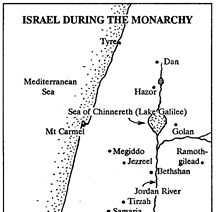
As well as rejecting God, the people of Israel were inviting social and economic hardship. Samuel reminded them of the examples they could see in the nations round about, where kings oppressed their people with harsh rule, forced labour and heavy taxes (10-18). But the Israelites were unmoved; they wanted a king. In particular, they wanted one who would be an impressive military leader (19-22).
Samuel's prediction about Saul (9:1-10:16)
Saul, who became Israel's first king, originally had no desire for political power and little interest in the spiritual ministry of Samuel. As the son of a wealthy landowner, he was more concerned about the loss of his father's donkeys, and the worry he might cause his father by being away so long in search of them (9:1-5). This concern led him to seek help from Samuel. He thought that Samuel, with his ability to see visions and make predictions, could tell him where the donkeys were (6-14).
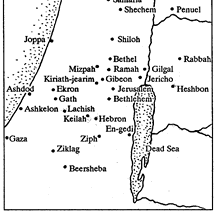
God revealed to Samuel that he had chosen Saul to be Israel's king. Saul would save Israel from the Philistines, who had recently renewed their attacks (15-17). Samuel prepared Saul to receive this startling news by treating him with special honour at a sacrificial feast that was being held at that time (1824).
The next day Samuel told Saul privately that God had chosen him to be king, after which Samuel anointed him in a brief, private ceremony (25-10:1). Samuel then predicted three things that would soon happen as proof to Saul that Samuel's predictions always came true. Most important of these three events would be the coming of God's special power upon Saul to change him from an ordinary Israelite farmer into a national leader. Saul would receive additional guidance by going to the shrine at Gilgal, where Samuel would pass on God's directions to him (2-8).
When the Spirit of God first came upon Saul, he certainly behaved differently, but those who knew him were not impressed. They were surprised that a well respected young man like Saul should associate with religious extremists and behave in such an undignified manner (9-13). But Saul did not reveal what Samuel had told him about the kingship (14-16).
Saul made king (10:17-27)
Some time later, Samuel called a meeting of the leaders of all the tribes and families in Israel to select a king (17-19). The selection was made by a system of drawing lots that finally led to one man being chosen. Two people, a confident Samuel and a nervous Saul, knew through God's previous private revelation who would be chosen (20-24).
After the selection had been made, Samuel announced publicly the rights and duties of a king (25; cf. Deut 17:14-20). Many of the people were delighted when they saw the appearance of the man who had been chosen king, but some doubted and mocked. Saul therefore made no immediate changes in the nation's administration, but returned to his farm at Gibeah (26-27). (Gibeah became the administrative centre of Israel during Saul's reign; see 11:4; 14:2; 15:34; 22:6; 26:1.)
Saul's victory over the Ammonites (11:1-15)
Within a short time Saul had the opportunity to prove to the doubters that he was the man to lead Israel. About a century earlier the Ammonites had exercised control over Israel's territory of Gilead, east of Jordan, till Jephthah overthrew them (Judg 10:7-8; 11:29-33). Now they attacked again and seemed certain of victory (11:1-3). When he heard the news, Saul called Israel's fighting men together (using a well recognized local procedure; cf. Judg 19:29) and assured the Gileadites of victory (4-9). The Israelites tricked the Ammonites into thinking they were about to surrender, but the next day Saul launched a surprise attack that smashed the Ammonite army (10-11).
Saul had led Israel to victory in his first battle, and immediately became a national hero. Samuel then arranged for a public ceremony at Gilgal, where Saul was declared king over a now unified people (1215).
Samuel's farewell address (12:1-25)
The people's demand for a king was an insult to Samuel as well as to God. Samuel therefore called upon them to declare before God and before the king that he had been blameless in all his behaviour. He had given them no cause to be dissatisfied with his leadership (12:1-5).
In the lengthy address that followed, Samuel reminded his hearers of all that God had done in giving Israel the land of Canaan for a homeland (6-8). He reminded them also that Israel's troubles in Canaan had come from the sins of the people, not from the type of leadership. They now had the leadership they wanted, a king, but even he would not be able to save them from judgment if they sinned against God. As under the rule of the judges, so under the rule of a king, God would give his people into the hand of their enemies when they rebelled against him, and save them from their enemies when they obeyed him (9-15).
Samuel gave the people clear proof that he spoke for God in condemning them for asking for a king. In response to his word, God sent a sudden storm, even though rain did not normally fall at that time of the year (16-18). The people were terrified and realized their sin in asking for a king. But now that they had their king, there could be no turning back. Samuel could not change matters, but he promised to keep praying for them and to keep teaching them God's way. Though no longer their political leader, he was still their priest and prophet (19-25).
13:1-15:35 SAUL'S EARLY VICTORIES
Preparing to fight the Philistines (13:1-14)
Israel's regular army consisted of two divisions, one under the command of Saul, the other under the command of Saul's son Jonathan. Other fighting men were called to join the army when needed. Such a need arose when Jonathan attacked a Philistine camp, and the Philistines replied by sending a large army to attack Israel (13:1-6a).
In a time of national emergency, Saul was apparently to go to Gilgal, where he was to wait seven days for Samuel to arrive. By that time, Israel's leaders would have gathered the army together. Samuel could then offer sacrifices to God on behalf of the nation, and pass on God's instructions to Saul (see 10:8). The current Philistine attack tested Saul's obedience. But rather than wait for Samuel, he offered the sacrifice himself. Probably his action resulted partly from impatience and partly from the desire to have complete power, religious as well as political (6b-9). Samuel saw that Saul's action was really a rebellion against the authority of God. As punishment God would one day take the kingship from him and from his family (10-14).
War against the Philistines (13:15-14:46)
After Samuel left Gilgal, Saul took his troops and joined with the other section of the Israelite army, which was under Jonathan. Together they prepared for the battle against the Philistines (15-18). The Philistines were confident of victory, partly because for many years they had so controlled metal-working activities in the area that the Israelites owned hardly any weapons. This enabled the Philistines to raid throughout Israel without fear of strong resistance (19-22). In addition they controlled the mountain pass by which the Israelites hoped to attack them (23).
Jonathan, however, without telling his father, worked out a daring plot to attack the Philistines. To begin with he took his armour-bearer, climbed up the rocky slope on the other side of the pass, and approached the Philistine camp (14:1-7). The two men tricked the Philistines by pretending they were deserting from the Israelite army. The Philistines relaxed their defences and welcomed the supposed deserters. Jonathan and his servant then attacked the unsuspecting enemy and killed twenty men (8-14). Panic quickly spread through the Philistine camp (15).
On hearing of the Philistines' confusion, Saul hurriedly assembled a fighting force and went out to do battle. He was so eager to seize the opportunity to attack the enemy that he did not wait to receive God's directions through the priest (16-20; see v. 3). Israelites who had earlier deserted to the Philistines or hidden themselves in fear suddenly returned to Saul's side and joined in the battle (21-23).
Saul put a curse on any soldier who stopped to eat that day, as he wanted to carry the battle on unbroken till the Philistines were destroyed. It was a stupid curse, for tiredness and hunger prevented the Israelites from being fully successful (24-30).
As soon as night fell, the soldiers ate freely. By eating food that was forbidden by God's law, they showed that, although they feared to break the king's command, they did not fear to break God's. Saul was distressed when he heard what the people had done (31-35; cf. Lev 17:14). He was even more distressed when he learnt that God would not guarantee him victory in a proposed night attack on the Philistines. Assuming that one of his soldiers was responsible for this hindrance to God's help, he added to his previous rash curse an equally rash vow to punish the offender (36-39).
When it was revealed that Jonathan was the offender, Saul gave a further demonstration of his unpredictable nature. He did not carry out his vow, but heeded the voice of those who demanded Jonathan's release (40-46).
Summary of Saul's reign (14:47-52)
Despite his many weaknesses of character, Saul was a strong leader in battle and led Israel to many victories (47-48). He helped develop this strong leadership by collecting around him the best and most capable men from his own family circle and from the army (49-52).
War against the Amalekites (15:1-35)
The Amalekites came under the same curse as those Canaanite nations that were to be destroyed (15:1-3; cf. Exod 17:8-16; Deut 20:16-18; 25:17-19). Again Saul's obedience was tested, and again he failed. His kingly power gave him no right to alter God-given instructions to suit himself (4-9).
God sent Samuel to tell Saul of the consequences of his disobedience (10-16; cf. 13:13-14). Religious sacrifices and military victories were no substitute for obedience. Samuel had given Saul God's instructions, but Saul, by acting independently of those instructions, had rebelled against God. He had proved himself unfit to be king of God's people (17-23). No appeal from Saul could alter the fact that God was going to replace him as king of Israel (24-29). The most that Samuel could do for him was to accompany him in a final act of public worship (30-33). Although not removed immediately from the kingship, Saul lost for ever the services of Samuel (34-35).
16:1-19:24 THE RISE OF DAVID
David brought to the royal court (16:1-23)
When told by God to go and anoint a king to replace Saul, Samuel feared to, lest Saul kill him. God therefore told Samuel to keep the matter secret (16:1-3). Reassured by this additional word from God, Samuel went to Bethlehem, where he met the leading men of the important families in that area (4-5).
The outcome of Samuel's visit was that he anointed David, youngest son of the family of Jesse. Anointing was a way of marking out people for other important positions besides kingship, and Samuel gave no indication to the onlookers why he had anointed David. For David's sake, as well as for Samuel's, Saul was not to know that Samuel had already anointed David as Saul's successor. Many years would pass before David actually became king (6-13).
Now that the special power of God's Spirit came upon David (see v. 13), it departed from Saul. Troubled by his own jealousy and sense of insecurity, Saul became emotionally and mentally unstable. Meanwhile David matured. He became skilled in speech, writing and music, and learnt to be a brave fighter through having to defend his flocks from wild animals and Philistine raiders (14-18; cf. 17:34-36). The next step in his preparation for kingship was his introduction to Saul as one who could play music to relax the king's troubled nerves. The outcome of this was that eventually he became a permanent member of the royal court (19-23).
Goliath's challenge and defeat (17:1-58)
The Philistines again assembled their troops to fight against Israel (17:1-3). As often happened in ancient warfare, the invaders challenged the defenders by calling for a contest between the champions of the two sides (4-11). At this time David was back on his father's farm at Bethlehem, for he did not need to remain at Saul's court when Saul was away directing affairs on the battlefield (12-16).
When circumstances later brought David to the scene of the battle, he discovered that the Philistines had a champion, Goliath, whom no Israelite dared to fight (17-25). David was not even a soldier, but he volunteered to fight the Philistine (26-32). He reasoned that since Goliath had defied God he was certain of defeat, and since Israel was God's army it was certain of victory (33-40; cf. v. 26, 45). David killed Goliath without using a sword or a spear, proving that God did not need weapons to save his people (4150). The Philistines fled in confusion, but the Israelites caught and killed many of them, then plundered the camp they left behind (51-54).
Saul did not immediately recognize David as the young man who had previously played music to calm him during his half-mad fits. It was probably after David's victory over Goliath that Saul took him into his court permanently, making him his armour-bearer and full-time court musician (55-58; see 16:2122; 18:2).
David's success and Saul's jealousy (18:1-30)
Once David came to live at Saul's court, he and Jonathan became close friends. In fact, Jonathan promised loyalty to David as if bound to him by covenant. David continued to produce outstanding successes as a soldier, and Saul made him an officer. The promotion was popular with army officers and common people alike (18:1-5). David's popularity, however, stirred up Saul's jealousy, and Saul tried to kill him (6-11). Saul was now afraid of David, so removed him from the court by giving him a military command that kept him on the battlefield. But this only resulted in more success and more fame for David (12-16).
Determined to force David into wrongdoing, Saul offered to give his eldest daughter to David for a wife, and then deceived David by giving her to someone else. But David remained guiltless (17-19; cf. 17:25).
When Saul learnt that another of his daughters, Michal, was in love with David, he saw another opportunity to try to trap him (20-22). He asked David to kill one hundred Philistines as the bride price, thinking that David would surely be killed in the attempt. David was pleased at this sort of bride price, for he was too poor to pay money. He was successful against the Philistines, and Saul hated him even more. Through his marriage to Michal, David became part of the royal family (23-30).
By this time David had probably written some of the psalms that are now part of the biblical book of Psalms (cf. 2 Sam 23:1). The introductions and titles to these psalms indicate that a number of them were written during the time of his flight from Saul. These, along with other psalms he wrote over a long and eventful career, give David's personal views of events that the writer of 1 and 2 Samuel describes in narrative form.
Jonathan, Michal and Samuel (19:1-24)
For a while Jonathan was successful in persuading his father to stop trying to kill David (19:1-7). However, David's further military successes made Saul jealous again. He made two more attempts on David's life, first at the palace, then at David's house. This time another of Saul's family, Michal, helped David escape (8-17; cf. Ps 59).
David found safety with Samuel at Ramah. Three times Saul sent men to arrest David, but each time they were overcome by the power of God's Spirit that worked through Samuel and his followers (18-21). In the end Saul himself went, but he too was overcome by God's Spirit. People were surprised to find Saul prophesying, but it showed how powerless he was to resist the power of God. And that same allpowerful God protected David (22-24).
20:1-31:13 SAUL'S PURSUIT OF DAVID
Jonathan helps David escape (20:1-42)
Apparently Jonathan did not know of the number of attempts that his father had made to kill David (20:1-2). When he saw that David was genuinely fearful, he agreed to co-operate with David in finding out Saul's real intentions once and for all (3-9).
Jonathan's love for David was genuine. Even though he knew that David, and not he, would be the next king, he showed no sign of jealousy. He asked only that David, on becoming king, remain loyal to him and show kindness to his descendants (10-15). The two swore loyalty to each other and so renewed their covenant (16-17).
David and Jonathan worked out a plan to let David know whether he should remain in Saul's service or flee for safety. Their sole purpose was to save David's life. They made no plot against the king, and by keeping their whole plan a tight secret, they ensured that no rumours would arise (18-23).
Even when Saul tried to make Jonathan see that David was a threat to his own future, Jonathan maintained his unselfish loyalty to David (24-31). Saul then accused Jonathan of disloyalty to his family and tried to kill him (32-34). Jonathan now had no doubts about his father's intentions. With much sadness he and David farewelled each other and David departed (35-42).
Flight from Saul (21:1-15)
The first place to which David fled was Nob, which, since the destruction of Shiloh, had become the city of priests (21:1). About this time a few personal servants joined him, according to an arrangement he had made with them earlier. David obtained food for himself and his men by deceiving Ahimelech the priest concerning the purpose of his journey. Unfortunately for him, and for Ahimelech and the other priests, he was seen by someone sympathetic to Saul (2-9).
From Nob David went to the Philistine city of Gath. He expected that the Philistines would welcome him as a deserter from the Israelite army and so give him refuge (10). But the Philistines had not yet heard of David's break with Saul. They knew only that David had killed thousands of their own Philistine people. Thinking he may have been spying in preparation for more attacks, they decided to kill him. David acted quickly, and escaped by pretending he had gone mad (11-15; see Ps 34; 56).
A fighting unit (22:1-23)
David found a hiding place in the barren regions of Adullam. Here he was joined by his family, who had fled to escape the hate and revenge of Saul (22:1; see Ps 57; 63; 142). Knowing this hard life would be too much for his aged parents, he left them in the care of the king of Moab, and returned to his home territory of Judah. By now a crowd of four hundred, mainly outlaws and discontented people, had joined David, and he soon built these into a strong fighting unit (2-5; 1 Chron 11:10,15).
Among those who joined David were many experienced soldiers who had escaped from the eastern tribes, along with a number from Benjamin and Judah. David was careful at all times to make sure that he was not welcoming spies or others whom Saul might use to destroy him (1 Chron 12:8-18). Soon the force numbered six hundred (see 23:13). Throughout the time of Saul's pursuit, David and his men remained within the tribal area of David's tribe, Judah. However, they were gradually driven either farther south into the hotter and drier regions, or farther west into the regions controlled by the Philistines.
Meanwhile Saul was accusing his soldiers and officials of being disloyal to him and of supporting David. Saul reminded them that they could expect favours and gifts from him because they were from his tribe, Benjamin. They would get nothing from David, because he would obviously favour people from his own tribe, Judah (6-8).
When Saul discovered that Ahimelech had helped David, Ahimelech pointed out that he did so because of his loyalty to Saul. He understood that David was carrying out Saul's business (9-15). Saul by now was furious beyond reason, and commanded that not only Ahimelech but all the priests of Nob be killed. Only Abiathar escaped, and he immediately went and joined David (16-23; see Ps 52).
Saul's fierce hunt (23:1-24:22)
Since Abiathar had brought with him the high priest's ephod (containing the Urim and Thummim), David was able to ask and receive God's direct guidance. God's first direction was to rescue the Israelite town of Keilah from the raiding Philistines (23:1-6). As soon as he had defeated the Philistines, David withdrew from Keilah. He knew that Saul's army was larger and better equipped than his. He knew also that he could not trust the people of Keilah to stand with him against Saul. David still recognized Saul as the legal king and did not want to fight against him. Nor did he encourage the Israelite people to fight against their king (7-13).
David hid in the hill country near Ziph, and Jonathan came to visit him. Jonathan also remained loyal to Saul as the legal king, but he reassured David that nothing had changed the relationship between the two of them (14-18).
Saul was delighted, and David distressed, when some people from Ziph told Saul where David was hiding (19-24; see Ps 54). David was saved from certain capture when Saul left hurriedly to deal with another attack by the raiding Philistines (25-29).
Having dealt with the Philistines, Saul resumed his pursuit of David (24:1-2). Saul had in his court a group of zealous followers, probably Benjaminites, who accused David of plotting against the king and urged Saul on to destroy him (see 18:22-26; 22:7; 24:9; 26:19; Ps 7). By sparing Saul when he could easily have killed him, David proved that he had no evil intentions against Saul (3-13). God knew that David had not plotted against Saul (14-15), and even Saul himself recognized that David's uprightness was the mark of a true king. He asked David to promise that when he became king he would not wipe out Saul's family. Saul, however, gave no promise to spare David. Therefore, when Saul returned home, David thought it safer to return to his hiding place (16-22).
David marries Abigail (25:1-44)
At this point we are told that Samuel died (25:1). David, at the time, was having trouble supporting his six hundred men. It seems that his men provided protection for farmers against the raiding Philistines (see v. 16, 21), and then demanded that the farmers pay them by giving them food supplies (see v. 8, 18, 27, 35). One wealthy farmer, Nabal, refused to pay and insulted David. Furious at Nabal's response, David set out with four hundred of his men to deal with him (2-13).
Only the quick thinking and wise advice of Nabal's wife, Abigail, stopped David from killing Nabal and his entire household. She sent David the required food supplies (14-22) and reminded him to keep trusting in God to defend him and destroy his enemies. Certainly, he was not to do anything he would later regret (23-31).
David was thankful for Abigail's provisions and for her advice. Events soon proved her words to be true. God removed David's enemy when Nabal suffered a stroke and died (32-38). David then married Abigail, and in so doing became part-owner of a large and prosperous farming area in Judah (39-42). He lost Michal, however, when Saul took her and gave her to someone else (43-44).
The move to Philistia (26:1-27:12)
Although he had every intention of killing Nabal, David still refused to harm Saul; but Saul remained determined to harm David (26:1-5). When another opportunity arose to kill Saul, David refused to act. He was content to leave the matter with God, who would remove Saul when he saw fit (6-12).
Once again David produced proof that he had no evil intentions towards Saul (13-17). But clearly David was becoming tired of this continual flight from the mad king. Not only was it wearying, but it was driving him from God through cutting him off from the public worship places of his people (18-20). Saul confessed his wrongdoing and promised not to harm David, but David still thought it wise to remain in the south and keep away from Saul (21-25).
Worse was to follow when David left his own territory for the safety of enemy Philistia. This time Achish, the Philistine ruler, welcomed him, because he now knew that David was Saul's enemy and not one of his army commanders. (For David's previous meeting with Achish see 21:10-15.) Also, David's army, strengthened by the addition of a number of Benjaminites skilled in long-range warfare (1 Chron 12:1-7), would be useful to the Philistines. Wisely, David obtained a separate town, Ziklag, for his people. This enabled him to avoid trouble with the Philistines and to hold his followers together. He stayed there sixteen months (27:1-7).
This was not a time of great spiritual profit for David. His previous experiences, when he was hunted by Saul in the Judean wilderness, spiritually enriched him and produced many of his psalms. By contrast, his time in Philistia was often characterized by shameful behaviour and, so far as we know, produced no psalms.
David pleased Achish and enriched his people by carrying out successful raids that Achish thought were against the Israelites or peoples friendly to the Israelites. But David lied to Achish, for the raids were against other peoples, usually those hostile to the Israelites. To his shame David directed his men to slaughter all the inhabitants of the towns he raided. In this way he made sure that no one was left to tell Achish the true story about which people David had plundered (8-12).
Another Philistine-Israelite war (28:1-29:11)
When the Philistines set out to attack Israel, Achish made David and his troops his personal bodyguard (28:1-2). Back in Israel, Saul was terrified. He asked God what he should do, but God refused to show him (3-6). So he went to a woman who consulted the spirits of the dead, hoping that through her he could get directions from Samuel (7-14).
Samuel spoke to Saul from the world of the dead, but he gave him neither comfort nor help. He merely confirmed what he had told Saul earlier concerning God's rejection of him. He made it clear that David was the man God had chosen to succeed him, and added that Saul and his sons would die in the coming battle (15-19). Saul was now more terrified than ever, but the woman gave him some food to help strengthen him for the fight ahead (20-25).
The Philistine leaders also had their problems. The four rulers who shared the military command with Achish were suspicious when they saw David with six hundred Israelites among their own forces. They well knew of David's previous victories over the Philistines, and suspected that David and his men might turn against the Philistines during the battle (29:1-5). They therefore sent David and his men back to Ziklag. David was disappointed at this, for he had possibly planned to do what the Philistine leaders suspected he would do. At the same time the Philistine leaders may have saved David from an act of folly, because if he had fought in war against his own people, they would hardly want to accept him as their king (6-11).
David's victory and Saul's defeat (30:1-31:13)
When David's men returned to Ziklag, they found it a deserted, burnt out ruin. The Amalekites had raided the cities of Philistia and Judah while all the fighting men were away at war. The shock of losing everything – wives, families and possessions – drove David to total dependence on God. It was the kind of dependence that seems to have been lacking during his sixteen months in Philistia (30:1-8).
Assisted by some capable Israelite military commanders who had deserted to him on his recent battle march (1 Chron 12:19-22), David set out after the Amalekites. He was helped also by a slave of the Amalekites who had been left to die by the roadside but who was able, after being revived, to direct
David to the Amalekite camp (9-15). David's men slaughtered the Amalekites, recovered the Israelite people and goods, then plundered the possessions of the enemy (16-20).
In sharing out the plunder among his men, David guaranteed equal rewards for those who carried out the raid and those who stayed at the base camp to guard the supplies (21-25). He also shared some of the plunder among various Judean cities and local tribes, thereby giving these people good cause to support him in the future (26-31).
Meanwhile, farther north, the battle between Israel and the Philistines was raging. Overcome by the attackers, the Israelites fled. Saul's sons were killed and Saul himself was wounded. Knowing the cruel and shameful treatment that he would receive if the enemy captured him, Saul took his own life (31:1-7). The enemy therefore dishonoured his dead body instead. But the men of Jabesh-gilead, remembering that Saul had once saved them from shameful treatment by their enemies, rescued his body and gave him an honourable burial (8-13; cf. 11:1-11; 1 Chron 10:13-14).
2 Samuel
OUTLINE OF 2 SAMUEL
1:1-4:12 Civil war after Saul's death 5:1-10:19 David establishes his kingdom 11:1-20:26 Conflicts in David's family 21:1-24:25 Miscellaneous matters
1:1-4:12 CIVIL WAR AFTER SAUL'S DEATH
Mourning for Saul and Jonathan (1:1-27)
David learnt of Saul's death from one of Saul's own men, an Amalekite who had become a citizen of Israel (1:1-4; see v. 13). The man clearly thought that by adding a few details to the story and by bringing Saul's crown to David, he could win David's favour (5-10; cf. 4:10).
As long as Saul lived, David had regarded him as the Lord's anointed king and had consistently refused to harm him (cf. 1 Sam 24:6; 26:11). He therefore reacted with anger when the Amalekite claimed to have killed Saul, and ordered his swift execution (11-16).
In spite of all Saul's hostility to him, David was generous to Saul in the song he composed in memory of him and his son Jonathan. David knew how the enemy Philistines would rejoice when they heard of Saul's death, and he wished that the news could be kept from them (17-20). He cursed the place where Saul died (21), praised the bravery of Saul and Jonathan (22-23), and recalled the prosperity that Saul brought to the people (24). Most of all, he sorrowed over the loss of his true and faithful friend Jonathan (25-27).
Two kings in Israel (2:1-3:1)
The Philistines now controlled much of Israel's territory west of Jordan (see 1 Sam 31:7). Believing that David was still friendly to them, the Philistines allowed him to become king over Judah in the south, no doubt thinking that this would help to divide and weaken Israel further. The tribes east of Jordan, however, were still free, and David quickly tried to win their support (2:1-7). But Abner (Saul's army commander and his cousin; see 1 Sam 14:50) had beaten David to it. Having escaped across Jordan, he appointed Saul's son Ishbosheth as king over all Israel (apart from Judah), though he himself was the one who had the real power (8-11).
David's army commander was his nephew Joab (1 Chron 2:13-16). Both Abner and Joab were eager to control the strategic town of Gibeon, and when the two happened to meet near the town they agreed to an armed contest between selected young men from each side (12-14). The limited contest grew into a furious battle, which Joab's army won (15-17). Joab and Abner had long been rivals (see 1 Sam 26:5-6), but for Joab the rivalry became hatred when Abner killed Joab's brother (18-25). Abner's army fared badly, and only his personal appeal to Joab brought a break in hostilities (26-32).
Over the next two years the supporters of Ishbosheth and the supporters of David were in constant conflict. Victory consistently went to those on David's side (3:1).
End of the line of Saul (3:2-4:12)
On becoming king of Judah, David followed the pattern of neighbouring kings by taking a number of wives (2-5). (For the more important people of David's family and relatives see the appendix at the end of the commentary on 2 Samuel.) Meanwhile Abner became so powerful among Ishbosheth's supporters, that Ishbosheth accused him of trying to gain the throne for himself. (According to an eastern custom, one way a person signified his claim to the throne was by claiming the king's harem; see 12:8; 16:22.) Angry and frustrated, Abner saw that Israel could not be rebuilt on the weak foundation of Ishbosheth. He therefore decided to join forces with David, and in that way help strengthen and unify Israel (6-11).
David accepted Abner's offer of support on the condition that Michal, David's first wife and Saul's daughter, be returned to him. Having Saul's daughter as wife would further strengthen David's claim to Saul's throne (12-16; cf. 1 Sam 18:20-27; 25:44). Most of Israel's leaders readily joined with Abner in transferring their allegiance to David. Only Saul's tribe, Benjamin, needed a little extra persuasion (1721).
Joab, however, was not pleased to see Abner join David's army, for it meant he now had a rival for the post of commander-in-chief. Treacherously he killed Abner, giving the excuse that he was taking revenge on behalf of his dead brother. But David clearly considered it to be murder (22-30; cf. Num 35:19-28). David publicly showed his disapproval of Joab's deed, and regretted that one of the nation's finest leaders should die in such a manner. But David took no action against Joab (31-39; cf. 1 Kings 2:56,32).
With the death of Abner, Ishbosheth's kingdom collapsed, Ishbosheth himself being murdered. The royal rule of Saul's family had come to an end, as forecast by Samuel (see 1 Sam 13:13-14). All that remained of the line of succession through Jonathan was one badly crippled child (4:1-8). David, as in the previous case of murder, showed his disapproval (for Ishbosheth had done him no harm), but this time he ordered the murderers to be executed. As always, he wanted to make it clear that he would not gain Saul's throne through murder (9-12).
5:1-10:19 DAVID ESTABLISHES HIS KINGDOM
Conquest of Jerusalem (5:1-25)
All the tribes of Israel now sent a representative force of soldiers to Hebron to present themselves to David, their new king (5:1-3; 1 Chron 12:23-40). The two-year civil war had now finished, and for the next five and a half years David reigned in Hebron over a unified Israel (4-5; cf. 2:10-11).
David probably realized that so long as he remained in the territory of his own tribe in the south, the northern tribes would hesitate to give him their full and enthusiastic allegiance. He therefore set out on the bold task of making Jerusalem his capital. The conquest of Jerusalem was sure to win him nationwide support, for it had been lost to the Jebusites soon after Joshua's conquest and had remained in Jebusite hands ever since (Judg 1:8,21; 19:10-12). Also, since it belonged to no tribe and was situated centrally between the northern and southern sections of Palestine, there could be no cause for any tribal jealousy if David made his capital there.
The Jebusites thought the city's position and defences so strong that no attack against them could succeed. They mocked the Israelites by saying that even the blind and crippled along the city walls could defend the city against them. But Joab gained entrance through a water tunnel and conquered the city in a surprise attack. As a reward for his victory, he was now appointed army commander of all Israel, not just Judah (6-10; 1 Chron 11:6). David firmly established himself in his new capital by building a palace and enlarging his harem (11-16).
A new unity was appearing in Israel, and the Philistines saw this as a danger to their power. They attacked David in the area south of Jerusalem in an effort to split the country into two parts again. David lost no time in responding. He launched a surprise attack (probably from his established stronghold in Adullum; cf. 1 Chron 11:15-19), drove the enemy back, and captured and burnt their idols (17-21; 1 Chron 14:12). Later, when the Philistines launched a second attack, David drove them from Israel's territory and carried the conquest across the border into the Philistines' territory. This was a decisive victory for the Israelites, and never again did the Philistines gain power over them (22-25).
The ark brought to Jerusalem (6:1-23)
Part of the reason for Israel's weakness during Saul's reign was the king's lack of interest in the nation's religious life. David was determined to correct this state of affairs. He began by restoring the ark, symbol of God's presence, to its rightful position as the centre of Israel's religious life. (During Saul's reign the ark had remained in a country house in Kiriath-jearim, also known as Baal-judah or Baalah; 1 Sam 7:1-2; 1 Chron 13:5-6.) In bringing the ark to Jerusalem, David was aiming to make Jerusalem the religious centre of Israel as well as the royal city and administrative capital (6:1-5).
David's plans suffered an early setback when a person who touched the ark was killed. Apparently thinking that God was angry with him for moving the ark, David feared to take it any further. He left it in the nearby house of a man named Obed-edom (6-11).
God's blessing on the house of Obed-edom during the next three months made David realize that God's anger was not because of the removal of the ark. Rather it was because of the lack of respect for
God that had characterized the operation. For example, the Israelites had copied the Philistines (who knew no better) by transporting the ark on a cart, instead of carrying it on the shoulders of the Levites (see v. 3; cf. Num 4:15; 7:9; 1 Sam 6:7). Therefore, when David decided to move the ark again, he was careful to do things properly (1 Chron 15:2,13-15). He was so relieved when no one was struck dead, that he stopped the procession after it had gone only six paces and offered sacrifices of thanksgiving (12-15).
At this time the tabernacle was in Gibeon (1 Chron 16:39). David made no attempt to shift it to Jerusalem, possibly because it was too old to move without causing major damage, or possibly because David was thinking of building a new and more lasting structure. When he brought the ark to Jerusalem, he placed it, to begin with, in a special tent that he had prepared for it. He and the people celebrated the great event with a sacred ritual of music, dancing, sacrifice and feasting (16-19; see 1 Chron 15:16-28). The psalm sung on this occasion praised God for giving the people of Israel their homeland, and contrasted the power of this glorious God with the weakness of heathen idols (1 Chron 16:8-36).
Michal did not share David's enthusiasm, and rebuked him for his unashamed display of joy during the procession. She thought his behaviour unfitting for a king (20-23). But David was determined to lift the spiritual life of the people. He appointed suitable men to be with the ark and guide the worship at Jerusalem, apparently under the direction of the senior priest, Abiathar. The other chief priest, Zadok, was in charge of the tabernacle at Gibeon (1 Chron 16:4-6,37-42).
God's promise and David's prayer (7:1-29)
When David expressed his desire to build God a permanent symbolic dwelling place, God reminded him through the prophet Nathan that Israel's God, Yahweh, was not limited to one land or one place. For that reason his symbolic dwelling place had been a tent, something that was movable and could be set up in any place at all (7:1-7).
Nevertheless, because the people of Israel were not spiritually in a condition where the ideal for them could work, God would allow them to build the temple (just as he had allowed them to set up the monarchy). But the building of the temple was not of immediate importance. God was more concerned that David's house be firmly established – referring not to his palace but to his dynasty (8-11). David would have a line of royal descendants who would rule for generation after generation in Israel. One of these would build God's temple. Even if some kings proved unworthy of his blessings, God would not alter his purposes. He had chosen the dynasty of David as the means of bringing the Messiah, the Saviour of the world (12-17; cf. Ps 2:7-9; 89:19-37; Matt 22:42; Acts 13:22-23).
God's establishment of David as king of Israel was amazing enough, but even that seemed a small thing compared with the permanent dynasty God now promised him. Deeply humbled, David hardly knew what to say. He could only praise God for all he had done, both for David personally and for the people of Israel as a whole (18-24). David prayed that God would fulfil his promise and that his people would never cease to praise him (25-29).
David's military victories (8:1-18)
To emphasize that God was strengthening the royal house of David according to his promise, the writer gives a summary of David's military victories. David conquered the Philistines and the Moabites (8:1-2; 1 Chron 18:1-2), then expanded north across the Syrian (Aramean) state of Zobah and even took control of the central Syrian province based on Damascus (3-8).
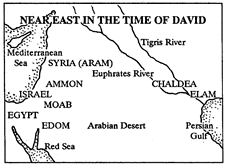
Another Syrian state, Hamath, submitted to David without a fight. Israel rapidly grew prosperous with the wealth it received from these and other conquered states (9-12). David's army, under the control of Joab, gained a notable victory over Edom, though the victory was not easily won. Abishai was the hero of the battle (13-14; 1 Chron 18:12; Ps 60).
David's rule now extended over most of the country between Egypt and the Euphrates. As his kingdom expanded, he developed and organized his administration. He also formed a personal bodyguard of Cherethites and Pelethites, people who lived among the Philistines and who had joined David's fighting force during the years David lived in that area. They were tough, loyal soldiers (15-18; cf. 15:18; 20:7; 1 Kings 1:38).
Remembering former kindnesses (9:1-10:19)
Although his power was now great, David did not forget his covenant with Jonathan. Unlike other kings, David would not destroy the family of the king whom he replaced (9:1; see 1 Sam 20:12-17). David not only spared the life of Jonathan's sole surviving son, the crippled Mephibosheth, but also restored to him Saul's family property (2-8; cf. 4:4). David gave Mephibosheth the privilege of free access into the palace, and appointed one of Saul's former servants to manage his property for him (9-13).
Another to whom David tried to be friendly was the new king of Ammon, whose father had helped David during his flight from Saul. But the Ammonites rejected David's goodwill, suspecting that he was looking for ways of spreading his power into their country (10:1-5). They then decided to attack Israel, and even hired soldiers from various Syrian states to help them. The Israelite soldiers turned back the attackers, then, as if to show that Israel had no desire to seize Ammonite territory, returned home (6-14). (This was probably the battle referred to earlier in 8:3-8.)
The Ammonites were willing to accept defeat, but the Syrians were not. They prepared for a second attack on Israel. This time David did not stop when he had turned back the attackers, but overran their country and seized political control (15-19).
11:1-20:26 CONFLICTS IN DAVID'S FAMILY
David takes Bathsheba as wife (11:1-12:31)
While the Israelite army was out fighting another battle against Ammon, David, back in Jerusalem, committed a series of sins that brought him sorrow and trouble for the rest of his life. To begin with, he was guilty of sexual immorality with Bathsheba, wife of Uriah, one of David's top soldiers (11:1-5; cf. 23:39).
On discovering that Bathsheba was pregnant, David thought of a plan to cover up his sin. He recalled Uriah from the battle and sent him home to sleep with Bathsheba, hoping that this would make people think that Uriah was the cause of Bathsheba's pregnancy. But Uriah refused to go near his wife (6-13). David therefore sent Uriah back to the battle and arranged for him to be killed during the fighting (14-17). After waiting for confirmation from the battlefield that Uriah was dead (18-25), David took Bathsheba into his palace as a royal wife (26-27).
David was unaware that anyone in the palace knew of his sin. But Nathan knew, and he trapped David by seeking his judgment in a case where a rich sheep-owner stole and killed a poor man's pet lamb to provide food for his own meal. As expected, David condemned the guilty person (12:1-6). Nathan pointed out that David had condemned himself. In punishment for his murder of Uriah, his own family would be torn apart by murder. In punishment for his adultery with Bathsheba, his own family would be morally disgraced in the eyes of all Israel (7-12).
In genuine sorrow David confessed his sins to God (see Ps. 51) and God graciously pardoned him. But that did not remove the distress that David would suffer as a result of his sins (13-14). (For the fulfilment of the judgments announced by Nathan see 13:10-19,28-33; 16:21-22; 18:9-15,31-33; 1 Kings 2:13-15; 2 Kings 11:1-2.)
When the child born to David and Bathsheba became sick, David prayed earnestly for it. But the child died, as Nathan had foretold (15-18). David accepted what had happened and realized it was part of God's judgment upon him (19-23). Some time later another son, Solomon, was born to David and Bathsheba (24-25).
The story now returns to the battle with the Ammonites in Rabbah that had provided David with the opportunity for his misdeeds (see 11:1,7,15). The Israelites had captured Rabbah's most strongly defended area and cut off the city's water supply. They could now easily take the whole city, and Joab called David down from Jerusalem to have the honour of leading the triumphal entry. David became king of Ammon and forced the Ammonites to work for Israel (26-31).
David's family troubles begin (13:1-14:33)
The first of the foretold disgraces that fell on David's family followed the same pattern as David's own sin: sexual immorality followed by murder, with the murderer carefully plotting how to get rid of his victim.
Amnon, David's eldest son, tried to seduce his half-sister Tamar, but when Tamar resisted him he raped her (13:1-14). Cruelly, Amnon then drove Tamar away, and the young princess cried bitterly at the loss of her virginity in such circumstances (15-19). David knew what had happened but did nothing. Tamar's brother Absalom also knew, and waited for an opportunity to take revenge on behalf of his sister (20-22).
After two years Absalom got the opportunity he was looking for and had Amnon murdered (23-29). While news of the murder was sent to David (30-33), Absalom fled to the safety of his mother's family in Geshur (34-39; cf. 3:2-3). David had now lost two sons – an adulterer who was dead and a murderer who was in exile.
Joab apparently wanted to see some stability restored to the royal household, with one man firmly recognized as heir to the throne. That man, in Joab's opinion, was Absalom. David made no attempt to bring Absalom back from exile, because this would require him to sentence him to death for murder. Joab therefore laid a plan that would enable the king to bring Absalom back safely (14:1-3). He used a woman to win from the king a judgment that in certain circumstances it was not wrong to show mercy to a murderer (4-11). The woman then used this principle to show that David should allow Absalom to return (12-17).
Although David realized that he had been tricked by Joab into making this judgment (18-20), he stuck to his decision and allowed Absalom to return. However, he did not allow Absalom to enter the royal court. In this way he showed firstly that he had not forgiven his son, and secondly that he did not consider Absalom a suitable person to succeed him as king (21-24).
Whatever David's opinion of Absalom might have been, the people in general were impressed by his handsome appearance (25-27). He was also ambitious and was becoming impatient for power. He had spent three years in exile (see 13:38) and another two years back in Jerusalem, yet he had still not been accepted by the king (28). He decided he would wait no longer. When Joab showed an unwillingness to give him further help, he persuaded Joab to take notice of him by burning Joab's fields. Without delay Joab arranged for him to meet the king, with the result that he received the king's pardon. His fierce ambition had at last brought him back into the royal court (29-33).
Absalom's rebellion (15:1-37)
By cunning and deceit over the next few years, Absalom strengthened his position and gathered himself a following, mainly among the people of Judah's country regions. He encouraged a feeling of dissatisfaction with David's administration and promised a better deal for the common people if he were in a position of authority (15:1-6).
Clearly, Absalom was plotting to seize the throne. It appears that he relied for the success of his rebellion upon the personal support he had built up among the country people. This was one reason why he chose Hebron as the place to declare himself king (7-10). The leading citizens of Jerusalem were unaware of the plot, except for the man who was possibly the mastermind behind it, David's chief adviser, Ahithophel (11-12; cf. 16:23).
The rebellion took David by surprise, because, as far as he knew, the people of Jerusalem still supported him. Now he could not be sure who was for him and who was against him. Knowing that Absalom would head for Jerusalem to claim the throne, David did not want to be trapped in the city. Nor did he want to cause the citizens unnecessary bloodshed. He therefore gathered his household and loyal troops, and fled (13-18; Ps 3). Foreigners who had defected to Israel remained loyal to David, and people from the villages near Jerusalem lamented his departure (19-23).
When the priests Abiathar and Zadok set off to escape with David, taking the ark with them, David sent them and the ark back to Jerusalem. In so doing he expressed his hope that he was not leaving Jerusalem permanently (24-29). He also intended that Abiathar and Zadok, by staying in Jerusalem with the ark, could join with David's loyal adviser Hushai to form a spy ring in the midst of Absalom's court. The priests' sons were to act as messengers to carry news to David (30-37; cf. 17:15-17).
Apparent success of the revolt (16:1-23)
As David left Jerusalem, Ziba (whom David had appointed to manage the property of Saul's grandson Mephibosheth; see 9:9-13) took the opportunity to win David's favour by bringing him food and animals to assist his escape. Ziba then told David that Mephibosheth was a traitor who was planning to seize the throne for himself. As a result David took away Mephibosheth's property and gave it to Ziba, though later events showed there was some doubt whether Mephibosheth really was a traitor (16:1-4; cf. 19:24-30).