
Part 29
As for John, Jesus refused to give any indication of how his life would end. Some misinterpreted this to mean that John would never die, so John added a note at the end of his book to correct the misunderstanding (John 21:20-23). He also pointed out that he had made no attempt to give a detailed account of the life of Jesus; but what he had given was the testimony of an eye witness, and it was to be believed (John 21:24-25).
166. On a mountain in Galilee (Matt 28:16-20; Mark 16:15-18)
The apostles had an indication why Jesus had told them to go to Galilee when he took them up one of the mountains. From there they could look out to the next stage of the kingdom's mission, the Gentile nations beyond. The three and a half years public ministry of Jesus had been limited to Israel (cf. Matt 10:5-6; 15:24; Rom 15:8), but the ministry that the risen Jesus now passed on to his disciples extended to all nations without distinction. His power would be in his disciples, preserving them through dangers and enabling them to perform remarkable works (Matt 28:16-17; Mark 16:15-18).
Jesus' purpose in this activity was to establish his church (cf. Matt 16:18), as his followers preached the gospel, baptized those who believed, and taught the converts to understand and follow his teachings. As the converts, in turn, passed the message on to others, the church would continue its worldwide expansion, assured always that the victorious Jesus was working with his people (Matt 28:18-20).
167. The ascension (Mark 16:19-20; Luke 24:50-53)
From Jesus' resurrection to his ascension was about six weeks, and during that time he gave his disciples further teaching on the kingdom of God (Acts 1:3). The overall content of that teaching is probably represented by the summary attached to the story of his first Sunday night appearance to the disciples. He showed them how his ministry on earth was the climax of God's Old Testament purposes and the starting point for worldwide expansion through his followers. A clear understanding of God's purposes, together with their own eye witness accounts of Jesus' death and resurrection, would give them confidence in taking the gospel to others (see Luke 24:44-49; Acts 1:8).
When the time arrived for Jesus to leave his disciples and return to his Father, the disciples were no longer confused but confident. Again Jesus was to be taken from them, but this time instead of fleeing in fear and distress, they accompanied him to the place chosen for his departure. From near Bethany, the village on the slopes of Mount Olivet just outside Jerusalem, Jesus left his disciples, with the promise that one day he would return (Mark 16:19; Luke 24:50-51; cf. Acts 1:9-12).
The disciples returned to Jerusalem praising God, and a few days later received the Holy Spirit as Jesus had promised. They began their task of preaching the good news about Jesus and multitudes believed. Their risen Lord was working with them (Mark 16:20; Luke 24:52-53; cf. Acts 2:1-4,41-47; 4:10-12).
Acts
INTRODUCTION
Acts is an important book for our understanding of the origins and growth of the early church. Its longer title, The Acts of the Apostles, reflects the prominence of the apostles Peter and John in the early days of the church, and the prominence of the apostle Paul in the subsequent expansion of the church into the Gentile world. The book is important also for our understanding of the writings of the New Testament as a whole. Paul's earlier letters all belong to the period of Acts, and present-day readers will understand even the remaining letters of the New Testament better when they are familiar with Acts.
The writer of Acts
Early Christian records, including the record within the Bible itself, indicate that Luke wrote the book of Acts. The book was the second of two volumes that Luke wrote, the first being Luke's Gospel. Luke wrote for a person of some importance named Theophilus, to give him a trustworthy account of Christianity from the birth of its founder to the arrival of its greatest apostle in Rome (Luke 1:1-4; Acts 1:1-2).
Luke was a doctor by profession (Col 4:14), but he became also a skilled historian. Secular historians acknowledge him as a reliable writer, whose record is a valuable source of information on a period that changed the course of world history. He carefully dated the beginning of his story according to well known events in secular history (Luke 1:5; 2:1-2; 3:1-2), and the findings of archaeology confirm the exactness of the technical words he used in relation to places and officials (Acts 13:7; 16:12,35; 18:12,16; 19:31,35).
Parts of Acts are Luke's eye-witness accounts, indicated by his use of 'we' and 'us' in some of the narratives. On two of Paul's missionary journeys he spent some time travelling with Paul (Acts 16:10-12; 20:5-6,13; 21:1,7,17), and he accompanied Paul on the journey to Rome that concludes the book (Acts 27:1-3; 28:16; cf. Philem 23-24).
From the title of honour that Luke uses in addressing Theophilus, it seems that Theophilus might have been a high ranking official in the Roman government (Luke 1:3; cf. Acts 23:26; 26:25). Whether he was or not, there is no doubt that at the time Luke wrote (in the early AD 60s) the Roman government was paying increasing attention to Christianity. Luke was therefore concerned to point out that Christianity was in no way rebellious to Roman rule and was not a threat to law and order. To understand why such a defence of Christianity was necessary, we should first consider the circumstances of the Roman Empire in which the Christians lived.
Emperor worship
During the last century of the pre-Christian era, Rome had spread its power far and wide, but this did not immediately produce the Roman Empire as we know it in the New Testament. After the assassination of Julius Caesar in 44 BC, Rome went through a disastrous time of civil war, political confusion and social upheaval. Thousands of people were poor and without work, and lawlessness was widespread. Corruption flourished among government officials, and ambitious army generals were constantly plotting for more power.
Then, in 27 BC, arose one man who was able firstly to control, then to correct, the disorders. He became the first ruler of what became known as the Roman Empire, and he took the name of Caesar Augustus (Luke 2:1). He was so honoured by the people that the rulers of the Roman Empire after him took his name, Caesar, as the title of the Emperor (Luke 3:1; 20:22; Acts 25:11,25).
The people were so thankful for the peace and order that Augustus brought that they praised him in language usually used only for the gods. From this arose Emperor worship, which became the official religion of the Empire. The government allowed other religions, but those religions had first to be officially registered. Nevertheless, all people had to offer worship to the Emperor's image, even if they belonged to one of the other (registered) religions. The only exception concerned the Jews. The Roman authorities did not force Jews to join in Emperor worship, because they knew that Jews would never bow to any idol. As long as the Roman authorities thought that Christianity was part of the Jewish religion, they took no action against the Christians. But once they saw that it was a new religion, different from Judaism and therefore outside the law, they persecuted the Christians cruelly.
Roman citizenship
Originally, a Roman citizen was an inhabitant of Rome, whose citizens were given special privileges by the Emperor. Later, the government extended Roman citizenship to people of other cities and provinces, as well as to people who had given outstanding service to the Empire. Some people were able to buy Roman citizenship. People could have Roman citizenship even if they were not of Roman blood, and this citizenship passed on to their children (Acts 22:28).
Roman citizens could not lawfully be bound or beaten by local judges or officials, nor could they be executed without a verdict from a general meeting of the people. If they were not satisfied with the justice they received, they could appeal direct to the Emperor (Acts 16:37; 22:25-29; 25:11).
Communications
There was much trade and travel between the provinces of the Roman Empire. Government officials, businessmen and soldiers went to all parts of the Empire to promote trade and maintain peace. They usually settled in towns that the Romans called colonies. These were towns established as centres of Roman life in a non-Roman world, and their citizens enjoyed the right of self-government and the privileges of Roman citizenship. Among these Roman colonies were Pisidian Antioch, Lystra, Troas, Corinth and Philippi (Acts 16:12).
These and other important towns were linked to each other and to Rome by a system of roads that the Romans built throughout their Empire. The early Christian missionaries chose important towns along these roads as centres for the extension of the gospel. Once strong churches were established in these centres, the gospel would quickly spread to other places along the roads and in the regions round about.
The Greek language, which had become widely used during the time of the Greek Empire, was now the most commonly spoken language of the Roman Empire. This helped considerably towards the rapid spread of Christianity to the peoples of many nations. Local people of different regions continued to speak their own languages (the Jews of Palestine, for example, spoke Aramaic, a language related to Hebrew), but they usually spoke Greek as well (cf. Mark 5:41; 15:34; John 19:20; Acts 14:11; 22:2).
Greek was also the language most widely used for reading and writing. The New Testament was written in Greek – not the classical Greek of the scholars, but the common Greek of the ordinary people. Yet it was still a rich and powerful language, well suited to be the means by which God made known his purposes to the world.
Jews in the Roman Empire
Over the centuries Jews had become scattered throughout the lands of the Roman Empire. Some of these had migrated in search of better commercial opportunities, and others had fled as refugees in times of oppression. Then there were those who had been taken captive to foreign lands by conquerors such as Babylon, and those who had moved elsewhere when given permission by overlords such as Persia. They were known as 'the Jews of the Dispersion' or 'the scattered Jews' (John 7:35; James 1:1; 1 Peter 1:1; cf. 2 Kings 15:29; 17:6; 24:14-15; 25:11; Ezra 1:1-4).
Because they and their ancestors had lived in other countries so long, most of these Jews spoke only Greek. They had no knowledge of Palestinian languages such as Hebrew and Aramaic. However, they maintained their Jewish identity and unity through following the religion of their ancestors. Wherever they lived they built synagogues as centres for worship, teaching and supervision of Jewish affairs in general (Luke 4:16-17,31-33; 12:11; Acts 13:14; 17:1; 18:7-8). They kept the traditions of the law of Moses and went to Jerusalem for various ceremonies and festivals (John 5:1; 7:1-3).
Many Gentiles were attracted by the high moral standards of the Jewish religion and often joined in the synagogue services. Some were even circumcised and baptized as Jews, and so became known as proselytes, or converts to Judaism (Acts 2:10-11; 6:5). Most, however, did not become full proselytes, preferring simply to attend the synagogue, listen to the teaching, and keep certain sabbath and food laws. These were called God-fearers, or worshippers of God (Acts 10:1-2; 16:14). Many of these Gentiles, having already a knowledge of God and a desire to worship him, readily became Christians when they first heard the gospel of Jesus Christ (Acts 13:43; 14:1; 17:4).
God's true people
Throughout his book Luke made it clear to Theophilus that Christians, not the followers of Judaism, were the true people of God. Christianity was not an illegal religion, but the legitimate continuation of the religion established by Abraham and developed through Moses, David and the Israelite nation (Acts 2:3133; 13:26-33; 15:15-18; 26:22-23; 28:23).
This progression from the old era to the new, from the Jewish age to the Christian, came about through Jesus Christ. He was God's Saviour for the world, the Messiah of whom the Jewish religion spoke and for whom it prepared the way (Acts 2:36; 3:18; 9:22; 17:3; 18:5,28). Though he had physically left the world and returned to his heavenly Father, he was in a sense still in the world. Through the Holy Spirit he lived within his followers, the Christians, and through them he continued to work (Acts 1:4-5; 2:33; 3:6,16; 4:30-31; 5:31-32). The growth of the church was the ongoing work of the living Christ, acting by his Spirit through his followers (Acts 8:39; 9:17,31; 10:19,45; 13:2,4; 15:28; 16:7-7).
Christians were people who cared for others. They brought help and healing to those who were sick, distressed, lonely, and poor (Acts 3:2-6; 5:15-16; 9:32-41; 11:28-29; 14:8-10; 28:7-9). They may have been involved at times in civil disturbances, but Luke pointed out by one example after another that they were never the trouble-makers. Consistently the Roman authorities declared the Christians to be innocent (Acts 16:37-39; 18:12-16; 19:31,37; 23:29; 25:18; 26:31-32; 28:30-31). In almost every case where there was trouble involving the Christians, the Jews were to blame (Acts 9:23,29; 13:50; 14:2,5,19; 17:5,13; 18:12-17; 21:27).
Luke's entire story emphasized the triumph of the Christian gospel and the life-giving blessings it brought for all people, regardless of race. The first part of the story had concluded with the triumphant return of the risen Christ to his heavenly Father (Luke 24:50-53). The second part begins at the same point (Acts 1:1-11) and shows how, in only thirty years, Christianity grew from a handful of believers in Jerusalem to a vast community that brought new life and hope to Asia Minor, eastern Europe, and even to Rome itself (Acts 28:31).
1:1-2:47 Birth of the church 3:1-5:42 Rapid growth and great popularity 6:1-8:3 Changes in Jerusalem 8:4-9:31 Throughout Palestine and beyond 9:32-12:25 Jerusalem and the Gentiles 13:1-14:28 Into Asia Minor 15:1-35 First major church problem 15:36-18:22 Into Europe 18:23-21:16 Back to Asia Minor and Europe 21:17-23:35 Jerusalem finally rejects the gospel 24:1-28:31 Paul farewells the East; goes to Rome
1:1-2:47 BIRTH OF THE CHURCH
The task ahead (1:1-11)
Theophilus, to whom the book is addressed, was apparently a person of influence to whom Luke wished to give a reliable account of the origins and development of Christianity. In his Gospel, Luke had told Theophilus of what Jesus began to do through his life, death and resurrection (1:1-2; cf. Luke 1:1-4). Luke now goes on to tell Theophilus what Jesus continued to do through his followers.
On the occasions when Jesus appeared to his apostles after his resurrection, he taught them the significance of his death and resurrection in relation to the kingdom of God that they were now to proclaim. They would be able to begin this work within a few days, after Jesus returned to his heavenly Father and sent them the gift of his Spirit as he had promised (3-4; cf. John 14:26; 15:26; 16:7; Mark 1:8).
The apostles, thinking more about possible political independence for Israel than about their responsibility to preach the gospel, misunderstood Jesus' words. Jesus told them not to spend time thinking about things that God did not intend them to know, but to go and tell people everywhere that he was alive and triumphant. Jesus would no longer be with them physically, but through the Spirit he would come and live in them to enable them to carry on the work that he had started (5-8; cf. John 14:12,16-18).
He would make no more appearances to the apostles for the time being, but some time in the future he would return to be physically with his people again (9-11).
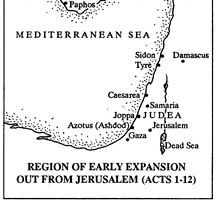
Jesus' plan for the expansion of the gospel was that it spread out in ever widening circles – from Jerusalem into the surrounding province, then into neighbouring regions, and eventually into every part of the world (v. 8). The book of Acts shows how the work started in Jerusalem (Chapters 1-7), expanded through Judea, Samaria and Syria (Chapters 8-12), and kept on moving out till it reached the heart of the Empire (Chapters 13-28).
A replacement for Judas (1:12-26)
After Jesus' departure, the apostles returned to Jerusalem, where they met and prayed with various people, among them Jesus' mother and brothers. During the time of Jesus' ministry, his brothers had not believed in him as the Son of God, but the resurrection must have turned them to true faith (12-14; cf. John 7:5; 1 Cor 15:7).
Soon after, the apostles met with just over a hundred other Christians in Jerusalem to choose an apostle to replace Judas. Luke adds a note outlining how Judas had died. When Judas returned the betrayal money to the priests, the priests felt they could not put the money into the temple treasury, so used it to buy a field in Judas' name. This field was the place where Judas killed himself, and later it became a cemetery for Gentiles (15-20; see Matt 27:3-10).
The replacement apostle had to be an eye witness of the events of Jesus' public ministry, and particularly of his resurrection. Two were found, equally qualified and apparently equally suitable. The apostles therefore laid the matter before God in complete faith, believing that if they drew lots to decide between the two, the result would indicate God's choice (21-26).
Apostles and their duties
The word 'apostle' meant 'a sent one'. Jesus gave the name to his chosen twelve because he sent them out, equipped with his messianic powers, to spread the message of the kingdom (Matt 10:1-7; Luke 6:13). They were to spread the message throughout Israel first (Matt 10:5-7), as preparation for the worldwide mission to follow (Matt 28:19-20). The significance of the number twelve was that just as twelve tribes had been the basis of the old people of God, so twelve apostles would be the basis of the new people of God, the Christian church (Matt 16:18; Eph 2:20; Rev 21:12,14).
By choosing a replacement for Judas, the apostles showed that at first they considered it necessary to maintain the unit of twelve. Some years later when James was executed (Acts 12:1-2), they did not feel the same need to find a replacement, probably because by that time the original twelve-member group had largely fulfilled its purpose. It had provided the first-hand witness to Jesus' life, death and resurrection that Jesus wanted (Luke 24:46-48; John 15:27; Acts 1:21-22), it had established the church on the basis of Jesus' teaching (John 14:26; Acts 2:42; 6:4) and it had overseen the expansion of Christianity from Jerusalem into the wider world beyond (Matt 28:19-20; Acts 1:8; 8:14; 10:44-48). It no longer functioned as a group and the unit of twelve no longer needed to be maintained.
However, the office of apostle continued to be recognized, and as the church grew, an increasing number of people were recognized as apostles (Acts 14:14; Rom 16:7). It even became necessary to warn against false apostles (2 Cor 11:13; Rev 2:2). From this it is clear that the title of apostle applied to a wider group of people than the twelve (1 Cor 9:1; 15:8-11; Gal 1:19).
Apostles in this broader sense continued to preserve, teach and develop the truths of the Christian gospel, and people accepted their teaching as having the authority of God's Word (1 Cor 1:1; 12:28; 14:37; 1 Thess 2:13; 2 Thess 2:15; 2 Peter 3:15-16; cf. John 16:13-14). This apostolic authority extended to all aspects of the church's life (Acts 5:1-11; 2 Cor 12:12; 13:1-3; 2 Thess 3:4,14), though apostles rarely forced their authority upon people. They usually preferred that Christians develop maturity by making their own decisions and using their spiritual gifts (Acts 15:6; 2 Cor 1:24; 13:10; Eph 4:11-13).
It seems that apostles did not pass on their office to the next generation. They had been God's provision to link the ministry of Christ with the birth of the church, and to ensure that the church was built upon a proper foundation (Eph 2:20). As the Christian teaching became firmly established in written form (2 Thess 2:15) and as the churches became firmly established through local elders (Acts 14:23; 20:28), the necessity for apostles decreased. The apostolic office had fulfilled its purpose and after the first century it died out.
The church is born (2:1-13)
Pentecost was a Jewish harvest festival held on the Sunday fifty days after Passover, when Israelites presented the first portion of their harvest to God (Lev 23:15-21). It was therefore a fitting day to mark the birth of the Christian church. Christ, the true Passover had been sacrificed (1 Cor 5:7), and now fifty days later God poured out his Spirit on that small group of disciples who were to become the first members of the church of Jesus Christ.
In Old Testament times a person who received a special gift of God's Spirit may have announced a message from God as evidence of the Spirit's presence (e.g. Num 11:26). So also on the Day of Pentecost, when the followers of Jesus received the promised gift of his Spirit, they spoke words from God, and they did so in 'other tongues'. This means that their speech was in words that did not belong to their own language and that they did not understand, unless someone interpreted them (2:1-4; cf. 1 Cor 14:13-19).
When the disciples moved from the house into the street outside (possibly on the way to the temple), people were attracted by the noisy activity. Some Jews of the Dispersion who were in Jerusalem for the festival recognized their local languages in the speech of the disciples and praised God. Others recognized no languages at all and accused the disciples of being drunk (5-13).
Peter's preaching (2:14-42)
Seeing the people's interest, Peter addressed them, this time speaking in his normal language. His address shows some features of the early apostolic preaching. First he quoted from the Old Testament, to show that the Pentecost events fulfilled what the prophets foretold. To Peter the important point of the prophecy was that God poured out his Spirit on everyone – not everyone whether believers or not, but everyone within the community of God's people, whether male or female, young or old, slave or free (1421; see v. 39).
Peter followed this with a short summary of Jesus' work, death and resurrection, showing that in spite of human injustice, God was working out his purposes (22-24). Next he quoted Old Testament Scriptures that Jews in general believed referred to the Messiah. Although David was the author of the passages quoted, the words could not refer to him, as he was dead, whereas the person referred to here was alive. This person, though not David, was a descendant of David; in fact, the Messiah. And this Messiah was Jesus, who had risen from the dead, returned to his Father in heaven, and sent the Holy Spirit upon his disciples (25-36). ('Messiah' was a Hebrew word meaning 'the anointed one'. It was used to refer to the descendant of David who would be God's chosen king and saviour, not just for Israel, but for the world. The Greek equivalent of 'Messiah' was 'Christ'.)
Finally, Peter called on the people to turn from their sins and believe in Jesus Christ. Because these people were part of the 'wicked generation' of Jews who killed the Messiah Jesus (cf. v. 23,40), they were to show their change of heart by being baptized in the name of the Messiah Jesus. They had to show publicly that they believed Jesus to be the Christ, the one whose divine authority was shown by the mighty works that God did through him (cf. v. 22). In this way they, and in fact people of any generation, would receive the same gift of the Holy Spirit as the apostles and others had just received (37-40).
With the addition of three thousand people, the church now consisted largely of new believers, but these believers soon grew into a strong body. They were built up through learning the teachings of Jesus passed on to them by the apostles, and through joining in fellowship where they worshipped and shared in the Lord's Supper (41-42).
Baptism with the Spirit
Both John the Baptist and Jesus had foretold the outpouring of the Holy Spirit described by Luke, referring to it as a baptism (Matt 3:11; Acts 1:4-5). The baptism with the Holy Spirit may be defined as that event on the Day of Pentecost by which the risen Christ gave the Holy Spirit to his disciples as he had promised and, in so doing, united them into one body, the church (Acts 2:33; 11:15-16; 1 Cor 12:13).
On the Day of Pentecost two separate groups received the baptism, or gift, of the Spirit. The first was the group of apostles and others mentioned in Acts 1:15 and 2:1-4, the second the group of three thousand mentioned in Acts 2:37-42. But there were several important differences between the two groups.
The first group consisted of people who were already believers and who had to wait till after Jesus' ascension to receive the Spirit. The second group consisted of people who became believers only after hearing Peter preach on the Day of Pentecost and who received the Holy Spirit immediately. The experience of those of the first group (i.e. their speaking in tongues) should not be considered the normal experience of the Christian, because of the special circumstances in their case. They had lived with Jesus and could receive the Holy Spirit only after Jesus had completed his work and returned to the Father (John 7:39; 16:7). The experience of those of the second group, who received the Holy Spirit when they believed, without any unusual happenings, was the normal experience of Christians, then as well as now.
Of all the people in the New Testament who received the Holy Spirit (meaning, in other words, all Christians; see Rom 8:9-11), in only two other places, both special cases, does it state that the people spoke in tongues (see notes on Acts 10:44-48; 19:1-6).
Christians of all eras have a part in what occurred on the Day of Pentecost. Through that baptism of the Spirit they are, the moment they believe, made part of Christ's body, the church, and made sharers in his Spirit (1 Cor 12:13). Jesus' promised gift of the Holy Spirit, given initially at Pentecost, extends through the ages to all who repent and believe the gospel (Acts 2:38-39).
Life in the new community (2:43-47)
The early Christians had such a strong sense of unity that they brought their money and possessions together to form a central pool, from which all could receive help as they had need (43-45). Perhaps they were too hasty in sharing out their collective wealth, because soon none was left. As a result other churches (who did not copy the idea of a central pool) had to send money to help them through their difficulties (cf. Rom 15:26; Gal 2:10).
In addition to having fellowship in each others homes, the Christians went to the temple for public prayer and witness day by day. Their numbers increased continually, as others who were attracted by this new life of joy and love joined them. They enjoyed the goodwill of the citizens of Jerusalem in general (46-47).
3:1-5:42 RAPID GROWTH AND GREAT POPULARITY
Preaching in the temple (3:1-26)
On one of their visits to the temple, Peter and John healed a crippled beggar. The man had been lying at the gate that led from the outer public court to the inner courts where only Jews were allowed, but as soon as he was healed he followed the apostles into the temple, jumping and praising God (3:1-10).
After prayer the three men returned to the public court, where they found that a crowd of curious onlookers had gathered. Peter took the opportunity to tell the people that this healing was further proof that the Jesus whom they crucified was the Messiah. Jesus had healed cripples, and his messianic power was continuing to work through his disciples (see v. 6; cf. Matt 11:2-6). But that power was available only through faith in him as the Messiah who, having died, was now victoriously alive (11-16).
If the Jews repented of their sin in crucifying Jesus, God would forgive them. They would then experience all those blessings of the messianic age that they longed for and that the prophets of Old Testament times had spoken of. The climax of those blessings would be the return of Jesus Christ himself (17-21). The Jews of the New Testament era were the ones who, above all others, could experience the fulfilment of the covenant promises God gave to their ancestors; but first they had to turn from their sins and believe in Jesus as their Messiah. To reject him would bring destruction (22-26).
Growth brings opposition (4:1-31)
During the centuries leading up to the Christian era (see 'The New Testament World'), several parties had arisen within the Jewish religion. The most important of these were the Pharisees and the Sadducees.
The Pharisees came mainly from the common people, and tried to preserve the Jewish way of life from the corruption of foreign ideas and political ambition. They were concerned with the outward show of religion, but not so concerned with correct attitudes of heart (Matt 12:1-2; 15:1-2; 23:5,23-28). The Sadducees came mainly from the wealthy classes and were more concerned with exercising power in Jewish society than with following tradition. They were the high priestly party and had controlling power in the Sanhedrin, the supreme Jewish council that sat in Jerusalem (Matt 16:11-12; 26:57,59; Acts 5:17).
A major difference of faith between the two parties was that the Pharisees believed in a physical resurrection of the dead, but the Sadducees did not (Matt 22:23; Acts 23:8).
When the number of Christians in Jerusalem increased rapidly as a result of Peter's preaching (the men alone numbered about five thousand), the Sadducees became angry. In particular, they were angry because all these people were responding to a message that was based on a belief in Jesus' resurrection. The Sadducees therefore had no hesitation in using their priestly power to arrest Peter and John and bring them before the Sanhedrin (4:1-4).
Once again Peter accused the Jews, especially their leaders, of rejecting and crucifying the Messiah (cf. v. 10-11 with 2:23; 3:13-15). God, by contrast, raised him from death and gave him the place of highest honour. Jesus fulfilled the Old Testament messianic promises, and if the Jews rejected him, no other way of salvation was available to them (5-12).
Although the apostles had not been taught in the Jewish law schools, they had been taught by Jesus. The members of the Sanhedrin recognized this and found it as difficult to argue with the apostles as it had been to argue with Jesus. To make matters more difficult for them, the healed man was proof that Jesus was still alive and working miracles (13-14). Since the apostles had broken no laws, and since the healing had increased the Christians' popularity, the Jewish leaders dared not punish the apostles. They could do no more than command them to stop preaching in the name of Jesus. But the apostles refused to obey (1522).
The apostles considered this opposition to be a continuation of the opposition that Jesus himself experienced at the hands of the ruling authorities. The Christians had learnt from the Old Testament to expect such opposition, but they prayed that through the power of God's Spirit they would have boldness to continue Jesus' messianic ministry of preaching and healing (23-31).
Sin, cleansing and further growth (4:32-5:16)
Believers continued to sell their property and bring money from the sales to the apostles for distribution among the poor (32-35). One example of generosity came from a Jew from Cyprus who so consistently helped and encouraged others that people gave him a name to suit his character, Barnabas (meaning 'son of encouragement') (36-37).
There was no rule that forced people to sell their property. When Ananias and Sapphira sold some property, their sin was not that they kept part of the money for themselves, but that they lied through saying they had handed over all the money. After the unbroken triumphs of the weeks since Pentecost, this entrance of deliberate sin into the church must have shocked the apostles. As often happened when there was deliberate sin at the start of a new stage in God's unfolding plan for his people, God emphasized the seriousness of sin in a dramatic judgment (5:1-10). (Comparable judgments on deliberate sin occurred in the Garden of Eden, at the establishment of the Levitical priesthood and upon Israel's entrance into Canaan; Gen 3:1-24; Lev 10:1-7; Josh 7:1-26.)
Such severe judgments emphasized the holiness God demanded. They also reminded his people that all were sinners, and only his grace kept them alive and allowed them to serve him (11).
Far from slowing down the growth of the church, the judgment removed the sin that could have hindered growth. Although people saw that insincerity had no place in the church, vast numbers continued to join the church. Meanwhile, the healing ministry of Jesus continued to operate through the apostles (12-16; cf. Matt 14:35-36).
Opposition from Jewish leaders (5:17-42)
A sizable portion of the population of Jerusalem was now Christian (cf. 2:41,47; 4:4,16,17; 5:14,16,28). And the more the church grew, the more jealous and angry the Sadducees became. Again they brought the apostles before the Sanhedrin, though God showed he could rescue them at any time, should he so desire (17-21a). The apostles knew that, because of their widespread popular support, they could have successfully resisted arrest, but they chose not to. Instead they trusted in the overruling power of the sovereign God whom they served (21b-26).
The Sadducees in particular were angry; for they, being the high priestly party, were the ones whom the apostles blamed for the death of Jesus (27-28; cf. 4:6,10; 5:17). Also this new movement was based on a belief in Jesus' physical resurrection, something that the Sadducees believed could not happen but that the apostles repeatedly claimed they had witnessed. The apostles refused to alter their message, but assured the Sanhedrin that forgiveness was available to the repentant (29-32).
Though the Sadducee majority in the Sanhedrin would gladly have killed the apostles, a respected Pharisee teacher named Gamaliel persuaded the Sanhedrin not to. The Pharisees were pleased to see so many believing in the resurrection, for it gave support to their belief against the Sadducees'. They regarded the Christians as sincerely religious Jews who, though unusually enthusiastic, were orthodox enough to attend the temple daily to preach and pray (see 2:46; 3:1; 5:12,25,42). Gamaliel advised against opposing the new movement, in case it was from God. If it was not, it would collapse anyway (33-39).
Acting on Gamaliel's advice, the Sanhedrin released the apostles. But the Sadducees gained some satisfaction by having the apostles beaten for disobeying a previous Sanhedrin command (40; cf. 4:17; 5:28). This was the first time that Christians suffered physical punishment for their faith in Jesus, but they rejoiced through it all (41-42).
6:1-8:3 CHANGES IN JERUSALEM
Organizing church affairs (6:1-6)
In the Jerusalem church there were two types of Jews, those brought up in Palestine who spoke Aramaic and those brought up in other places (such as Jews of the Dispersion) who spoke only Greek. The Greek-speaking Jews were known as Hellenists. Throughout Palestine there was tension between the two groups, and this tension carried over into the church. The Hellenists complained that, when widows were given their daily share from the common pool, the Hellenist widows were being neglected (6:1).
To ensure that the daily distribution of food was handled fairly and in the right spirit, the apostles invited the church to choose seven suitable men, whom the apostles then appointed to look after the work. It appears from their Greek names that those chosen were Hellenists (2-6). With the appointment of these men, the apostles took the first steps towards the organization of the the church.
Deacons (church helpers)
When Christianity later spread to nearby regions, other churches followed Jerusalem's example of appointing people to look after specific affairs. As a result an order of deacons, or church helpers, became a regular feature of life in the early church (Phil 1:1; 1 Tim 3:8). The word 'deacon' was related to the words used to denote the Jerusalem seven and their work. It was the common Greek word for servant or minister (Rom 12:7; Eph 6:21; Col 4:17).
The New Testament nowhere defines the work of deacons. In the case of the Jerusalem seven, their main purpose was to accept responsibility for certain everyday tasks and so give the apostles more time for prayer and teaching (Acts 6:4). In churches that later grew up elsewhere, pastoral care and church leadership were the responsibilities of the elders. Deacons were a separate group who had other responsibilities (Phil 1:1; 1 Tim 3:1,8; cf. Acts 20:28; Rom 12:6-8; 1 Peter 5:1-5). The variety of needs within the church meant that opportunities existed for both men deacons and women deacons (Rom 16:12; 1 Tim 3:11; cf. Luke 8:1-3; 1 Tim 5:10).
Deacons were to be spiritual people, for right attitudes were necessary even in carrying out routine activities (Acts 6:3; 1 Tim 3:9). But the work of deacons was not limited to such activities. Two of the Jerusalem seven, for example, were gifted preachers (Acts 6:5,8-10; 8:5).
The Bible records no instructions concerning how deacons were appointed, though the action of the Jerusalem church may suggest some guidelines. The church leaders apparently invited the church members to select suitable people, taking into account their character, behaviour, ability, family life and Christian commitment (Acts 6:3a; 1 Tim 3:8-13). After due prayer and consideration, the elders made the appointment (Acts 6:3b; 1 Tim 3:10), in the understanding that only Spirit-gifted and Spirit-controlled people could properly do the work of deacons (1 Cor 12:4-7,11; 1 Peter 4:11).
Preaching of Stephen (6:7-15)
With the conversion of a large number of priests (not high priestly Sadducees, but ordinary temple officials), the Christians' ties with the temple might have become even stronger (7). But the preaching of Stephen quickly saw those ties broken decisively, at least in the case of the Hellenists. Stephen was one of the seven men who administered the church's welfare work, but he was also a prominent preacher and miracle-worker (8).
Stephen saw that Christianity and Judaism could not go hand in hand. With Jesus' death and resurrection, Judaism was finished. The Jewish religious system, along with its laws, ceremonies, priests and temple, had fulfilled its purpose and was now replaced by something new. When the Jews heard Stephen preaching these things in one of the Hellenists' synagogues in Jerusalem, they reported him to the Sanhedrin for preaching against Judaism (9-15). The Sadducees were pleased at last to have an accusation against the Christians that was certain to win popular support. They knew that the people would not tolerate this threat to their national religion (see v. 12).
Stephen before the Sanhedrin (7:1-60)
The defence that Stephen made before the Sanhedrin was not designed to win its approval. He outlined Israel's history to demonstrate two main points. First, God had never shown himself to be limited to one dwelling place, or even one locality (therefore the Jews were mistaken in attaching such importance to the temple in Jerusalem). Second, the people of Israel had always rejected the messengers of God (therefore their rejection of the Messiah Jesus was not surprising).
Although Canaan was the land that God gave to Abraham and his descendants, God was present with Abraham even in the distant land of Mesopotamia (7:1-8). The people of Israel showed their rejection of God's servants from the beginning, when their ancestors, out of jealousy, rejected Joseph and sold him as a slave into Egypt. Yet God was with Joseph in Egypt (9-16).
Some years later, the people of Israel rejected Moses, not understanding that God had sent him to be their deliverer (17-29). For forty years Moses lived as an exile in the wilderness, but even there God appeared to him (30-34). The man whom the people rejected became the people's saviour, with the promise that a greater messenger of God was yet to come (35-37). But the people rebelled against Moses and disobeyed God (38-43).
Originally, God's symbolic dwelling place was a movable tent, something that could be set up anywhere at all, demonstrating that God was not limited to one place. When Solomon later built a permanent temple in Jerusalem, people developed the mistaken idea that this temple was the only place where God dwelt (44-50). The Jews of Stephen's time, like their ancestors, misunderstood God, resisted his Spirit, disobeyed his law and rejected his messengers. Finally, they killed the Messiah himself (5153).
On hearing these words, the members of the Sanhedrin could keep silent no longer. But Stephen, remaining calm, supported Jesus' claim that he, the Messiah, shared equality with God. To the Jews, Stephen was repeating the blasphemy for which they had killed Jesus. In a burst of uncontrolled anger they rushed upon him, dragged him out of the city and stoned him to death. But before he died, Stephen, again following the example of Jesus, committed his life to God and asked forgiveness for his murderers (54-60; cf. Mark 14:62-64; Luke 23:34,46).
Christians driven out of Jerusalem (8:1-3)
With the killing of Stephen, fierce persecution broke out against the Christians in Jerusalem. No longer did the Pharisees favour the Christians; in fact, it was a Pharisee, Saul, who led the persecution. The Christians were attacked, imprisoned, or driven violently from the city, but they did not deny their faith. Although they previously went to the temple daily, they now saw the truth of what Stephen had taught, and they were prepared to suffer for it (8:1-3).
It seems that only the Hellenist Christians were driven from the city. (Stephen was a Hellenist; see 6:8-9.) Apparently the Aramaic-speaking Christians were allowed to stay (cf. 9:26; 11:2). This Jerusalem church, without the Hellenists, later became very narrow in its outlook and was a source of trouble to other churches. The Hellenists, on the other hand, became a means of blessing to the whole world.
8:4-9:31 THROUGHOUT PALESTINE AND BEYOND
Christianity enters Samaria (8:4-25)
In the time of the Roman Empire, the region of Samaria was the central part of Palestine and along with the neighbouring region of Judea was governed from Caesarea. The origins of the Samaritans go back to Old Testament times, when Samaria was the name of the chief city of the region.
After Assyria had conquered the central and northern parts of Israel and taken the people into captivity (722 BC), it moved people from other parts of its empire into Samaria and surrounding towns.
These settlers intermarried with Israelites still left in the land and combined the Israelite form of worship with their own. This resulted in a race of mixed blood and mixed religion known as the Samaritans (2 Kings 17:5-6,24-33; Ezra 4:9-10). When the Jews returned from captivity and settled in and around Jerusalem (538 BC), tension arose between Jews and Samaritans (Ezra 4:1-4), and this tension lasted into New Testament times (Luke 9:52-53; John 4:9).
Philip, a Hellenist, appears to have been the first person to take the gospel into Samaria. As a result of his preaching and miraculous works, many Samaritans believed and were baptized (4-8). A well known local magician, Simon, was so impressed by these miracles that he too was baptized, hoping no doubt that he could learn the secret of Philip's power (9-13).
When the apostles in Jerusalem heard of the conversion of so many Samaritans, they sent Peter and John to Samaria to pray that the Samaritans would receive the Holy Spirit. The reason why the Samaritans did not receive the Spirit immediately they believed was probably that God first wanted the apostles to be convinced that Samaritan believers shared the same privileges as Jewish believers. The long-standing hostility between Jews and Samaritans (an attitude that even the apostles were recently guilty of; Luke 9:52-56) was not to be carried over into the church. By using the apostles to be his means of giving the Holy Spirit to the Samaritans, God demonstrated publicly that Samaritans were accepted into the church on an equal standing with the Jews and with the full support of the apostles (14-17).
As a sign that they had received the Holy Spirit, the Samaritans apparently spoke in tongues. This impressed Simon even more, and he would gladly have paid money to have the sort of power over people that he thought the apostles had. Instead he received an assurance of God's judgment (18-24). As for the apostles, they not only welcomed the Samaritans but they also preached the gospel in many of the Samaritan villages (25).
Christianity enters Philistia (8:26-40)
From Samaria Philip headed south towards the region of Philistia on the Mediterranean coast (26). On the way he met another non-Jewish person who responded to his preaching. This man, a government official from Ethiopia in north Africa, was already one of the God-fearers and was reading the Old Testament when Philip met him (27-29). However, he did not understand what he was reading. When Philip explained the Scriptures to him, the man learnt the meaning of Jesus' death, became a believer and was baptized (30-38). The man was overjoyed as he continued his journey homeward, and no doubt readily spread the good news of Jesus Christ among his fellow Africans. Philip, meanwhile, preached around the towns of Philistia, then moved north along the coast till he came to the provincial capital, Caesarea (39-40).
Conversion of Saul (9:1-19a)
The name by which Christianity was known was 'the Way' (see 9:2; 19:9,23; 22:4; 24:14,22). Possibly the name originated with the Christians themselves, who believed their movement was the way of the Lord, the way of salvation and the way of life. But to the Christians' opponents the name represented a movement that had to be destroyed.
By this time the gospel had spread north at least as far as the Syrian city of Damascus, which had a large Jewish population. The Sanhedrin therefore sent fiery young Saul to arrest any Christians who still attended the synagogue and bring them to Jerusalem for trial (9:1-2). But before Saul reached Damascus he had an encounter with the risen Jesus that convinced him that Jesus was Lord and Christ, as the Christians claimed. The persecutor became a disciple of Jesus (3-9; cf. 2:36; 1 Cor 9:1; 15:8).
Through one of the local Damascus Christians, God revealed that he had chosen Saul to go to distant countries, taking the gospel to rulers and common citizens alike, to Gentiles and Jews without distinction (10-15). This would be a difficult task (16), but God prepared him for it by filling him with the Holy Spirit. Saul demonstrated openly his break with the old life and his start of the new by being baptized (1719a).
Saul's entire background and training had been used by God to help prepare him for the work ahead (Gal 1:15-16). He was a full-blooded Jew born in Tarsus, a town in Cilicia in south-west Asia Minor (Acts 22:3; Phil 3:5). He inherited Roman citizenship from birth (Acts 16:37; 22:26-28), had a Roman name, Paul (Acts 13:9), and grew up to speak both Greek and Hebrew (Acts 21:37,40). As a religiously zealous youth, Saul moved to Jerusalem where he studied Jewish law according to the strict Pharisee
traditions, his teacher being the well known Rabbi Gamaliel (Acts 22:3; 23:6; 26:5). Like all Jewish young men he learnt a trade, which in his case was tent-making (Acts 18:3).
All the influences in Saul's upbringing and education, whether Greek, Hebrew or Roman, had an effect on his life and ministry. The Greek influence taught him how to think clearly and analyse issues (Eph 3:1-6), the Hebrew influence helped him develop a character of moral uprightness (Phil 3:6), and the Roman influence gave him an international outlook that led to his great plan for the spread of Christianity (Rom 15:19-24).
In Damascus, Arabia, Jerusalem and Tarsus (9:19b-31)
People throughout Damascus soon knew of Saul's conversion. He openly joined with the Christians and argued convincingly against the Jews (19b-22). Part of the next three years he spent in Arabia, after which he returned to Damascus (Gal 1:17-18). His activities there stirred up such violent opposition that he fled to save his life (2325; 2 Cor 11:32-33).
When Saul arrived in Jerusalem, the Christians did not welcome him. They feared that he was only pretending to be a Christian, so that when he found out who the true Christians were he could imprison them. Barnabas apparently knew him better and introduced him to the two leading apostles who were in Jerusalem at the time, Peter and James the Lord's brother (26-27; Gal 1:18-19).
Saul made good use of his two weeks in Jerusalem by preaching the good news of Jesus Christ. Not surprisingly, this made the Jews angry, as they were the ones who three years previously had sent him to crush Christianity. When they made plans to kill him, Saul escaped to his home town of Tarsus in Cilicia (28-30; Gal 1:21).
At that time the rest of the churches in Judea did not know Saul personally, but they certainly knew of his conversion, because without his fiery leadership the persecution had died down and the churches were left in peace (31; Gal 1:22-24).
9:32-12:25 JERUSALEM AND THE GENTILES
Peter in Lydda and Joppa (9:32-43)
While God was preparing Paul for the Gentile mission ahead, he was also broadening the vision of Peter and other church leaders. Peter moved out from Jerusalem and visited some of the Christian groups that had sprung up in the semi-Gentile coastal plain area where Philip had preached earlier (cf. 8:40). At Lydda he healed a paralyzed man (32-35) and at nearby Joppa he raised a woman to life. In both places news of the miracles spread and many people believed (36-42). By staying with a person whose trade the Jews considered unclean, Peter demonstrated a more relaxed attitude towards former Jewish restrictions (43).
European converts (10:1-48)
In the Roman regiment based in Caesarea was a centurion named Cornelius, a man who was such a sincere God-fearer that all his household followed his faith. In response to his expressions of faith and acts of kindness, God promised to send Peter to tell him the good news of Jesus Christ by which he could be saved (10:1-8; cf. 11:14).
First, however, God wanted to teach Peter certain lessons. God gave him a vision to show him that the old Jewish food laws were of no further use. There was no longer a distinction between clean foods and unclean foods, and therefore Peter was free to eat all foods (9-16). While Peter was thinking about the meaning of the vision, God told him to go to Caesarea to meet the Roman, Cornelius (17-23a). By the time Peter left for Caesarea the next day, he had learnt the meaning of the vision. If certain kinds of food were not unclean, neither were certain kinds of people. Peter was not to be afraid of mixing with the Gentiles (23b-29).
After Cornelius welcomed him (30-33), Peter began his address. He emphasized at the outset that, although Israel was God's means of sending the Saviour Jesus, in the matter of personal salvation God did not favour one nation above another (34-36). Peter then summarized the events of Jesus' life, death and resurrection (37-42), and concluded by repeating that forgiveness was available to people of any nationality (43).
Cornelius and his household, being already prepared for the gospel, readily believed when they heard it. Immediately, they received the gift of the Holy Spirit direct from God, without an apostle doing anything at all. It was like a repeat of the Pentecost events, but this time with Gentiles, not Jews (44-46; cf. 11:15-17). Peter saw clearly that God had accepted these Gentiles and he had no hesitation in baptizing them (47-48).
Reaction of the Jerusalem church (11:1-18)
Many in the Jerusalem church criticized Peter for what had happened in the house of Cornelius. Their minds were so moulded by Jewish thinking that they could think of Christianity only as an improved form of Judaism. They were pleased when Gentile proselytes or God-fearers accepted Jewish ways, but they were not pleased when people of any nationality entered the community of God's people without any thought for the Jewish laws concerning foods, cleansing and circumcision (11:1-3).
Peter therefore explained to his critics how God had corrected his prejudice against the Gentiles (414) and how the Gentiles had received all God's blessings on the same basis as the Jews (15-17). Although they accepted Peter's explanation and praised God (18), they were not fully convinced, and soon trouble broke out again (see 15:1,5).
A new work in Antioch (11:19-26)
While the apostles and others were spreading the gospel in various places, an interesting work grew up in Antioch in Syria. Some Christians who had been scattered from Jerusalem at the time of Stephen's death preached among the Greek population of Antioch and many believed (19-21). When the leaders of the Jerusalem church heard this, they sent Barnabas to Antioch. This was a wise choice, for Barnabas was from nearby Cyprus and had a much broader outlook than those Jews who had never been outside Judea. He had the ability to understand and help the new converts, and under his wise guidance the church grew rapidly (22-24).
Within a short time there was more work than Barnabas himself could manage. He wanted a helper, but the person had to be of the right sort. Therefore, he did not go back to Jerusalem to look for help, but went to Tarsus to get Saul. The last mention of Saul in the story was ten years earlier (see note following 11:30), and now he returned with Barnabas to help the Antioch church. For the next year they preached and taught, among Christians and non-Christians, with the result that the church grew even more (25-26).
The language spoken in Antioch was Greek. Consequently, when the disciples spoke about Jesus, instead of using the Hebrew word 'Messiah' they used the equivalent Greek word 'Christ'. The local citizens heard the disciples use this word continually and, although it had no significance for them, it gave them an easy name by which to identify this group of religious people – 'Christ's people' or 'Christians'. Elsewhere in Acts, Christians are called believers, disciples, followers, brothers and saints (or God's holy people) (see 5:14; 9:1,32; 11:1). To the Jews they were known as Nazarenes (see 24:5).
Fellowship between churches (11:27-30)
Towards the end of Barnabas and Saul's year in Antioch, some prophets from Jerusalem visited the Antioch church. One of them warned of a coming famine that would bring much suffering to the believers in Jerusalem. The Antioch believers (who were Gentiles) demonstrated the meaning of true fellowship by sacrificing their own money and goods to help their troubled Jewish brothers (27-29). The offering was taken to Jerusalem by Barnabas, Saul and Titus (30; Gal 2:1).
This was only Saul's second visit to Jerusalem since he had become a Christian fourteen years earlier. His first visit was three years after his conversion (Gal 1:18; Acts 9:26-30). The only certain knowledge we have of the other eleven years concerns the last year, which he spent with Barnabas in Antioch (v. 26). Now, with Barnabas, he went from Antioch to Jerusalem (v. 30; see Gal 2:1). While in Jerusalem they met the leading apostles, Peter, John and James the Lord's brother, who reassured them that their work among the Gentiles had the full support of the Jerusalem leaders (Gal 2:9-10). Barnabas and Saul then returned to Antioch (Acts 12:25).
Prophets
In biblical language, prophets were spokesmen for God, preachers who brought God's message to the people of their time (Ezek 3:4,27; Hag 1:13). They were not primarily predictors (which is the usual meaning in everyday speech today), though in urging people to turn from sin they may have foretold the blessings or judgments that would follow their obedience or disobedience (Isa 1:18-20; Jer 17:7-10). In Old Testament times the prophets were Israel's great preachers, and John the Baptist continued the line of prophet-preachers into the New Testament era (Matt 11:13-14; Luke 3:3-7,16-18).
When Jesus established the new community of God's people, the Christian church, he appointed that prophets have a part to play in the church's life. Like apostles, they were one of his gifts to help the growth of the church (1 Cor 12:28; Eph 4:11). Also, like apostles, they became less necessary as the authoritative Christian teaching became increasingly available in written form. It seems that they were not needed after the first century. They were Christ's special provision to ensure that the early church was built on a proper foundation and in accordance with God's plan (Eph 2:20; 3:4-6).
Prophets sometimes gave special directions in particular situations (Acts 11:27-30; 13:1; 21:9-11), though their main ministry was the steady teaching of God's message to build up the believers (Acts 15:32; 1 Cor 14:3-5,31). They may have received messages direct from God (1 Cor 14:6; Rev 1:1-3) and may have preached without preparation (1 Cor 14:29-31). But they were still responsible for what they said and for the control they exercised over themselves (1 Cor 14:32). Likewise the hearers were responsible to examine what was said and not to accept anything without testing it first (1 Cor 14:29; 1 Thess 5:20-21; 1 John 4:1; 2 John 10).
In exceptional circumstances, people who were not recognized prophets in the church may have prophesied (Acts 19:6). Because this increased the possibility of false prophets, God gave to certain Christians the ability to discern more readily the difference between the true and the false (Matt 7:15; 24:24; 1 Cor 12:10; Rev 2:20).
Events in Jerusalem (12:1-25)
Back in Jerusalem the church was experiencing much difficulty. The Jews in general were becoming restless concerning the free mixing between Jewish and Gentile Christians, and were angry at the apostles for encouraging it. The governor at that time, Herod Agrippa I (a grandson of Herod the Great), knew it was not wise to let the Jews become too excited. Therefore, in an effort to please them he took action against the apostles by having one of them, James, executed (12:1-2).
The execution of James pleased the Jews more than Herod expected, so next time he planned to kill the leading apostle, Peter (3-5). However, in answer to the prayers of the Jerusalem church, Peter miraculously escaped (6-11). After a brief visit to assure the Christians he was free again, Peter fled to a safer place (12-19).
Herod, by contrast, suffered a horrible death. The people of Tyre and Sidon, anxious to ensure a constant food supply from Herod's territory, had tried to win his favour with a show of extravagant flattery. Herod accepted the praise as if he was God, and was punished for it (20-23). The persecutor died but the church continued to grow (24-25).
James the Lord's brother
With the apostles' becoming more involved with matters outside Jerusalem, James the brother of Jesus was now the most prominent leader in the Jerusalem church (Acts 12:17; 15:13; Gal 1:18-19;
2:9,12). He apparently became a believer only after Jesus' resurrection (1 Cor 15:7; cf. Mark 6:3; John 7:5), and was a foundation member of the Jerusalem church (Acts 1:14).
Although most of the Jews in the Jerusalem church still held to former beliefs and customs, James was not a slave to the law. Continually he tried to encourage his fellow Jews to be more tolerant of others (Acts 15:13,19). The common people respected him for his sincere faith and called him James the Just.
The character of James' life and teaching can be seen in the letter in the New Testament that bears his name (James 1:1). It gives teaching on how to face trials and temptations, on the character of true faith, and on many practical matters such as the control of the tongue, the use of wealth and the exercise of patience (James 1:3,12; 2:14-17; 3:2,13; 4:1-2; 5:8).
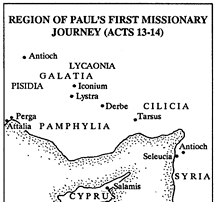
13:1-14:28 INTO ASIA MINOR (FIRST MISSIONARY JOURNEY)
Zeal of the church in Antioch (13:1-3)
The church at Antioch, which was the first Gentile church, was also the first church to see its responsibility to send off missionaries to distant places. It became the 'jumping off point' for the establishment of other churches. For this purpose it decided to send off its two most gifted and experienced leaders, Barnabas and Saul (now to be called by his Roman name, Paul). The church showed its identification with the missionaries as its representatives in the simple ceremony of the church leaders' placing their hands on them and committing them to God (13:1-3).
Preaching in Cyprus (13:4-12)
Barnabas and Paul took with them as their young assistant John Mark, a relative of Barnabas who had come back with them from Jerusalem (see 12:12,25; Col 4:10). (John Mark was probably the young man mentioned in Mark 14:51-52. Later he wrote the book known as Mark's Gospel.) The three sailed for Cyprus, the home of Barnabas, and immediately began preaching in the synagogues (4-5). They headed west for the provincial capital of Paphos, preaching the gospel from one end of the island to the other. One result of their preaching was that the governor of the island believed, in spite of the efforts of a local Jewish magician (who also claimed to be a prophet) to persuade him otherwise (6-12).
To Antioch in Pisidia (13:13-52)
When the trio arrived at Perga on the mainland of Asia Minor, John Mark, for some unknown reason, left the other two and returned to Jerusalem. Paul considered this a serious failure on Mark's part (13; see 15:38).
From Perga, Paul and Barnabas moved north into the province of Galatia and came to the town of Antioch, often referred to as Pisidian Antioch to distinguish it from Antioch in Syria. There they preached in the synagogue just as they had done in the towns of Cyprus (14-16). (Before the time of the Roman Empire, Asia Minor consisted of a collection of small independent states. When the Romans took control, they redivided the area to form a lesser number of Roman provinces. The large central province that they named Galatia included within it the region of Pisidia and parts of the former kingdoms of Phrygia and Lycaonia.)
Paul's address to the synagogue audience was similar to the addresses of Peter and Stephen (see notes on 2:14-42; 7:1-53). He began by outlining the history of Israel, showing that the promised Saviour had come in the person of Jesus Christ (17-25). Although the Jews in Jerusalem rejected and killed Jesus (2629), God raised him from death to show openly that he was the promised Son of David, the great Messiah (30-37). All who repented of their sins and believed in him would find forgiveness and salvation (38-41).
The audience, which consisted of Jews along with Gentile proselytes and God-fearers, responded well to the message. These people did not usually hear such an exposition of the Scriptures, and they looked forward to hearing more (42-43).
Next week almost the entire population of Antioch came to the synagogue to hear the missionaries preach. This made the Jews jealous and angry. They feared that the missionaries were stealing their Gentile converts by offering an easier religion, one that promised salvation through faith without regard for the Jewish law (44-45). Paul and Barnabas replied that God's plan was for Israel to carry his message of salvation to the Gentiles, and for this reason the missionaries preached the gospel to the Jews first. But if the Jews would not accept salvation, how could they preach it to the Gentiles? Therefore, Paul and Barnabas turned from the Jews and offered it to the Gentiles direct (46-47).
The missionaries' straightforward words and the Gentiles' ready response angered the Jews even more, and they drove the two men from the city. Yet the converts, being true disciples, not only stood firm for God after the missionaries departed, but spread the gospel throughout the region (48-52).
Other churches in Galatia (14:1-28)
Paul and Barnabas moved on to the town of Iconium, where events followed the same pattern as in Antioch. They preached in the synagogue and both Jews and Gentiles believed. But as the number of converts increased, the people of the city became clearly divided between supporters of the apostles and supporters of the Jewish leaders. Because of the threat of murder, the apostles fled the city and went to Lystra (14:1-7).
When the apostles healed a crippled man in Lystra, the people thought they must have been two of the Greek gods, so prepared offerings for them (8-13). At first the apostles did not know what was happening, as they did not understand the local language (v. 11), but as soon as they found out they corrected the misunderstanding. In the synagogues they had based their preaching on the revelation of God in the Old Testament, but on this occasion their preaching had a different basis. Idol worshippers knew nothing of the Old Testament, so the apostles explained something of the character of God from his activity in the world of nature (14-18).
Again the Jews stirred up opposition and Paul was almost killed (19). Possibly the wounds he later referred to in his Letter to the Galatians were the result of injuries he received on this occasion (Gal 6:17).
The apostles then moved on to Derbe, where they founded another church (20). Not lacking in courage, they returned through the cities where they had only recently been persecuted, for they knew how important it was to strengthen the young churches and appoint elders. The apostles had given these new converts a solid foundation of teaching, and they trusted God to uphold and guide them (21-23).
After a short time in Perga, which they had missed on the outward journey, the two apostles returned to the church that had sent them out. With thanks to God they told of the work that he had done among the Gentiles through them (24-28).
Elders (church leaders)
The appointment of elders was part of God's plan to give spiritual leadership to the churches. In Old Testament Israel the leaders of the community were known as elders (Exod 24:1; Deut 21:1-6; Ruth 4:211) and in the Israel of New Testament times people called elders administered Jewish affairs through the synagogues (Mark 15:1; Luke 7:3). In similar fashion there were elders to provide leadership to the new community of God's people, the church.
In the early days of Acts when the Jerusalem church was the only church, the leaders were the apostles (Acts 4:37; 6:2-4). As the apostles' work outside Jerusalem increased, there arose within the Jerusalem church a group of elders that was distinct from the apostles (Acts 11:30; 15:6). Other churches followed this practice, though the New Testament writers did not always give the elders an official title. The emphasis was more on the work they did than the office they held (Acts 13:1; 14:23; 1 Cor 16:16; 1 Thess 5:12-13; Heb 13:7,17; 1 Peter 5:1-2).
This truth is evident in the variety of words that the Bible uses for elders – shepherds, overseers, guardians, leaders and bishops. Most of these words come from only two words in the Greek of the original New Testament, presbuteroi and episkopoi. Both Greek words seem to apply to the same person and office. For example (in the words of the RSV), in Acts 20:17 Paul sent for the elders (presbuteroi) of the Ephesian church, but when they came (v. 28) he called them guardians (episkopoi). Likewise in Titus 1:5 he told Titus to appoint elders (presbuteroi), then in the same sentence (v. 7) he called them bishops (episkopoi). In reference to any specific local church Paul always used the plural 'elders' rather than the singular 'elder' (Acts 14:23; 20:17; Phil 1:1; 1 Thess 5:12).
Elders were shepherds who led, ruled, guided and cared for the flock (Acts 20:28; 1 Tim 3:5; 5:17; Heb 13:17; 1 Peter 5:1-3). They had to have some ability at teaching (1 Tim 3:2) so that they could feed the church with instruction that was helpful and protect it from what was harmful (Acts 20:28-30; 1 Tim 6:3-5; Titus 1:9; 2 John 7-11). The church on its part was to support financially those who sacrificed their time and income to minister to it (Gal 6:6; 1 Tim 5:17-18).
Besides having the right abilities, elders were to be blameless in their character and behaviour (1 Tim 3:1-7; Titus 1:5-9). They were to be examples to the church, and were never to use their authority to advance their own interests or force their personal wishes upon others (Heb 13:7; 1 Peter 5:2-3).
The Bible contains no specific instructions concerning the procedure for choosing and appointing elders. In the case of a new church, it seems that the first elders were appointed by the founders of the church (Acts 14:23). Normally, an appointment was not made too soon after a person's conversion, as time was necessary for spiritual character and gift to develop (1 Tim 3:6; 5:22). Although those making the appointment needed to realize that only the Holy Spirit could really make a person an elder (Acts 20:28; 1 Cor 12:11,28), they needed to realize also that elders could function properly only if they had the church's respect and confidence (1 Thess 5:12-13; Heb 13:17). For this reason they probably shared in prayer and consultation with the church before making the appointment (cf. Acts 6:3).
As a church grew, other people developed the sorts of spiritual gifts that directed them towards eldership (1 Tim 3:1). In addition, existing leaders had a responsibility to train those who possessed the right leadership abilities (2 Tim 2:2; cf. Acts 16:2-3). No doubt the existing elders were the ones who made the new appointments (1 Tim 4:14; cf. Acts 1:21-26), but again only in fellowship with the church as a whole (cf. Acts 15:22).
THE CHURCH AND ITS FUNCTION
At this point it may be helpful to look back over what we have learnt of the church so far and add a few more notes concerning how the early churches operated.
God's plan in operation
After the repeated failures that marked the early days of human history, God declared his purpose to choose for himself a people through whom he would provide a salvation for all the world. He began by choosing one man, Abraham, and promising to make from him a nation that would be in a special sense God's people and his channel of blessing to the whole world. The people of this nation, Israel, were therefore both Abraham's physical descendants and God's chosen people (Gen 12:1-3; Exod 6:7; 19:5-6; John 8:37).
This did not mean, however, that all those born into the Israelite race were, on account of their nationality, automatically forgiven their sins and blessed with God's eternal favour. On the contrary the history of Israel shows that from the beginning most of the people were ungodly and unrepentant. Those who, like Abraham, truly trusted God and desired to obey him were always only a minority within the nation (Isa 1:4,11-20; Rom 11:2-7; Heb 3:16). These were God's true people, the true Israel, the true descendants of Abraham (Rom 2:28-29; 4:9-12; 9:6-8).