
Part 23
Some of the hearers object that Micah should not preach like this (6). Micah and the people alike should know that a God of patience will not hastily punish his people and will, in fact, reward those who do good to others (7). The trouble is, says Micah, that the people are not doing good to others. They take the property of those who have done them no wrong, and drive honest women and children from their homes (8-9). They, in turn, will be driven out of their homes. God gave them the land of Canaan as a place of rest, but they have made it unclean. Therefore, they must be removed from it (10).
The people do not want to hear moral teaching from God's prophet. They would rather hear from the false prophets who, being greedy and dishonest like themselves, talk only of the pleasures of life (11).
Although the nation will go into captivity, there will always be a minority in the nation who remain faithful to God. God will bring them back to their land. In Babylon they will be like a flock of sheep locked up in a foreign fold, but their shepherd, God, will break the wall of the fold and lead them out. He will take them into a new fold in their own land (12-13).
Corrupt leaders (3:1-12)
The nation's civil leaders are the first to be condemned, because they have reversed the standards of justice. Greedy officials cooperate with corrupt judges to exploit the people for their own benefit. Because of the cruel oppression that they have practised, God will not save them from the fury of the enemy, no matter how much they cry for his help (3:1-4).
Religious leaders are also condemned. Prophets preach words of comfort and approval to those who give them food and money, but announce judgment on those who refuse. Such men will cease to be prophets, because God will not speak through them (5-7). God will speak only through those (such as Micah) who refuse to alter his message to please the hearers (8).
Priests are just as corrupt as the civil leaders and prophets, and do religious service only for those who pay them well. Yet all these leaders think that God will protect them simply because his temple is situated in their city (9-11).
God can tolerate the corruption of these leaders no longer. He will smash their city, and their temple with it (12). (As a result of this prophecy, the king Hezekiah determined to take stronger action in reforming Judah. The success of his reformation won for Judah a postponement of the threatened judgment; see Jer 26:18-19.)
4:1-5:15 THE IDEAL KINGDOM
Shame replaced by glory (4:1-5:1)
Previously Micah recorded God's promise that the people of Israel would come from captivity back to their land (see 2:12-13). He now looks beyond that to the greater day when God's ideal king reigns and Jerusalem is the religious centre of the world. People of all nations desire to worship God and learn his law, with the result that there is universal peace and contentment (4:1-4). This future hope encourages Micah and his few fellow believers to be more faithful to God now (5).
Micah sees the people in captivity as a flock of sheep that have been attacked, injured and scattered. The remains of this flock will be gathered again, healed, and brought back to their own land to become a strong nation once more (6-8). The prophet then pictures the siege of Jerusalem and the suffering of its inhabitants. They will be taken captive to Babylon, but after a period God will bring them back (9-10).
Another illustration of the triumph of God's people is given in the form of a vision where the prophet sees the overthrow of a great army that besieges Jerusalem. The army is composed of soldiers of many nations, who await their chance to break down the walls and plunder the city. They scoff at the people and dishonour the king, not realizing that God has brought them together so that he might destroy them the more easily – all in one place at one time. They will be punished by God's almighty power, crushed as the grain on the threshing floor is crushed under the hoofs of the oxen (11-5:1).
(There was in the time of Micah a siege of Jerusalem similar to the one described here. On that occasion Assyria was the nation that besieged Jerusalem and mocked God, but God miraculously saved the city, preserved his people and destroyed the attackers; see 2 Kings 18:13-19:37.)
God's chosen king (5:2-15)
Ruling over Israel in this golden age will be a king specially chosen by God. He will have only a humble beginning, being born in the small Judean town of Bethlehem. But his ancestry will go back to ancient times, to the great king David, who himself came from Bethlehem and whose dynasty was guaranteed by God to last for ever. This king will have full right to David's throne, and through him God's promises to David will be fulfilled (2; cf. 1 Sam 17:12; 2 Sam 7:16; Matt 2:6; John 7:42).
Until this person is born, however, Israel will continue to be troubled by enemies; but when he comes, Israel's scattered believers will be united under his rule. He will rule in the strength that comes from God to nourish and protect God's people (3-4).
Israel will have plenty of good leaders and will be safe from all enemies. Any who try to invade Israel, whether they be Assyrians or other enemies, will find themselves driven back and conquered by Israel (5-6). The people of God will take his truth to all nations. Like dew they will be the means of refreshment and new life to those who seek God. But like a lion they will be the means of destruction to those who oppose him (7-9).
People of the new Israel will now enjoy God fully, because God will remove all that previously kept them from trusting in him. At various times Israel and Judah had been tempted to trust in military strength, fortified cities, occult practices, Baal worship and heathen armies, but now all such things will be destroyed (10-15).
6:1-7:20 GOD ACCUSES AND THE PEOPLE REPLY
What God desires (6:1-16)
Returning to conditions in his own time, Micah pictures a courtroom where, with the heavens and earth as witnesses, God accuses his people of unfaithfulness (6:1-2). God recalls the great things he has done for them, as if asking why they treat him so badly in return (3-5).
The people's reply shows their misunderstanding. They ask what sort of worship God wants. Does he want sacrifices that are exact according to the letter of the law? Or an increase in the number of sacrifices? Or more lavish sacrifices? Or even heathen sacrifices? If God tells them what he wants, they will try to please him (6-7).
God replies that he has already shown them (particularly through Amos, Hosea and Isaiah) what he wants, namely, justice and love towards their fellow human beings, and faithfulness and humility towards God. Correct sacrifices and enthusiastic religious exercises are of no value if the people do not have right attitudes and right conduct (8).
Micah warns that God sees the rich merchants throughout Judah's cities and he takes note of their crooked business methods. When selling grain they use undersized measures, and when weighing the buyer's money they use extra heavy weights. They become rich through violence, lies and trickery (9-12). God will make sure that these cheats do not enjoy the good things they have built up for themselves. Through drought, famine and enemy attacks he will destroy their dishonestly gained wealth, and finally destroy them (13-16).
Sin, repentance and forgiveness (7:1-20)
Speaking as one of the genuine believers in the nation, Micah confesses that God's accusations are true. The prophet can find nothing to satisfy him in the life of the people as a whole. Judah as a nation is fruitless and of no use to God (7:1).
All around him Micah sees a society that is in a state of moral decay. Gang warfare is widespread, and law-breakers buy protection from judges. Rich businessmen and other influential persons bribe government officials to cooperate with them in their evil plans (2-3). Even the best of them cannot be trusted. Treachery and deceit are so widely practised that people cannot trust even their friends and relatives (4-6).
Those who remain faithful to God know that they are part of a nation that is doomed for judgment. But they know also that somehow God will save the faithful (7). Micah acknowledges the justice of God's punishment in allowing the people to be taken into captivity. Enemies may rejoice because of their conquest of Israel and Judah, but they themselves will in turn be conquered. Those among God's people who have remained faithful to him will then return to their homeland (8-10). Jerusalem will be rebuilt, and people from other nations will return with the believing Jews to settle in the new Jerusalem. Other nations will then find that it is their turn to suffer devastation because of their sins (11-13).
In a concluding prayer Micah appeals to God, the great shepherd, to rescue, protect and feed his people. He asks that God will work miracles for them as he did in the time of Moses (14-15). People of other nations will no longer fight against Israel, but will humbly acknowledge God's almighty power and submit to his rule (16-17).
These thoughts prompt a final expression of praise from Micah. No words can describe the excellencies of Israel's God. He is a God of mercy, faithfulness and constant love, and only because of these characteristics does he forgive the sins of his people. His punishment of them is temporary, but his forgiveness is eternal (18-20).
Nahum
Most of the short book of Nahum is concerned with the coming judgment of Assyria, and particularly with the destruction of its capital, Nineveh. The Assyrians had been cruel enemies of Israel and Judah, but Nahum saw that the day of judgment for them was now approaching.
The Assyrian oppression
Assyria had risen to power more than a century before the time of Nahum. From its base in Mesopotamia, it established an empire that soon began to spread over nations of the Palestine region. It conquered Syria in 732 BC, and Israel (the northern part of the divided Israelite kingdom) in 722 BC, taking the peoples of both nations into captivity (2 Kings 15:29; 16:9; 17:3-6).
With the fall of Israel, the southern kingdom of Judah became open to Assyrian aggression, and for the next one hundred years had a constant struggle to keep itself independent. At times Judah was under the power of Assyria and had to pay it heavy taxes; at other times it managed to reassert its independence; but always it was in a state of tension, if not conflict, with Assyria (2 Kings 16:720; 18:7-37; 19:37; 2 Chron 28:16,20-21; 30:6; 33:11).
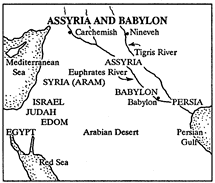
By the time of Josiah, who began to reign in Judah in 640 BC, Assyria's power had weakened considerably. This enabled Josiah to carry out much needed religious and social reforms without the threat of interference from Assyria. During Josiah's reign there was a revival of prophetic activity in Judah, with the ministry of the prophets Zephaniah, Jeremiah, Nahum and Habakkuk. (For the relation of Josiah's reforms to this prophetic activity see background notes to Zephaniah.)
With Assyria weakening and Babylon growing stronger, Nahum foresaw what the people of Judah had desperately wanted for more than a century, the end of Assyrian power. His description of Nineveh's overthrow is dramatic, colourful and full of feeling. He rejoiced that at last a fitting divine judgment was to fall upon the nation whose cruelty made it one of the most barbarous oppressors in history. In 612 BC Nineveh was conquered as Nahum foretold, falling to the armies of Babylon.
1:1-15 The power of God 2:1-3:19 The destruction of Nineveh
1:1-15 THE POWER OF GOD
God is the great judge, the all-powerful ruler of the universe. On the one hand he is patient with the rebellious, but on the other he is zealous for righteousness. His punishment of the guilty is severe, but it is also just (1:1-3a). Through storms, winds, droughts and earthquakes he sends judgments that bring total destruction. When his wrath is poured out on sinners, no one can escape (3b-6).
Being so mighty, God can protect those who trust in him, and destroy those who fight against him (78). Nahum warns all enemies that it is useless to plot against God, for he can destroy them with one blow. He will not need to strike twice (9-11).
Turning to address the people of God, Nahum promises that God will not punish them further. He will free them from the enemy's power (12-13). Nahum tells the Assyrians that their gods will be destroyed (14), but tells the Judeans that their God will be victorious. Soon a messenger will bring them news of the overthrow of Assyria, whereupon they should worship God with thanks, sincerity and joy (15).
2:1-3:19 THE DESTRUCTION OF NINEVEH
Destroyed because of cruelty (2:1-13)
Chapters 2 and 3 consist of two separate poems on the same subject, the destruction of Nineveh and the reasons for it. Nahum begins his graphic description of the attack on Nineveh by calling upon the watchman on the city wall to alert the city that the enemy is approaching. God is now going to destroy those who destroyed Israel and oppressed Judah (2:1-2).
The prophet pictures the brightly uniformed soldiers, the gleaming chariots and the prancing horses as the enemy army approaches the city walls. The officers who lead the attack are so keen for battle that they stumble in their haste (3-5). Enemy soldiers break open the water gates, flooding the city and throwing it into confusion. Some of the soldiers capture the queen and the palace harem, while others plunder the city (6-9).
So ruthless and cruel were the Assyrians in their treatment of the nations they attacked, that the prophet likens them to wild animals. They are like ferocious lions that savagely attacked smaller helpless animals and then dragged them back to their den. But now the lions are dead and the den is empty. The few surviving Ninevites look with horror on their devastated city (10-13).
Destroyed because of greed (3:1-19)
Not only was Assyria cruel, but it was also greedy. Often it conquered nations solely to plunder them. Nahum likens it to a prostitute, for it thought only of money and pleasure and gave no thought for morality. The prophet gives another vivid picture of the battle scene in Nineveh as God acts in judgment against the guilty people (3:1-4).
Like a prostitute Nineveh dressed herself with lavish adornments and lived in luxury by tempting and deceiving others. Her splendour will be replaced by shame. She will be like a prostitute who is stripped and made to walk naked in the streets. Those whom she deceived and robbed will now laugh at her (5-7).
Nahum reminds Nineveh of what happened to the city of Thebes in Egypt. It was well defended and had strong allies, but it was conquered and its people taken into captivity (8-10). The same will happen to Nineveh. Its outlying fortresses will be demolished as easily as ripe figs are shaken from a tree. When troops in the city hear of this they will lose courage and the city will be overthrown (11-13). They may store water in case of a siege, and strengthen the city walls to withstand the battering rams, but all their precautions and preparations will prove to be useless. The city will be burnt to the ground and left as bare as a field that has been stripped by locusts (14-15a).
The merchants, officials and others involved in Nineveh's commerce are likened to a swarm of locusts. But just as locusts fly away when the sun gets hot, so these will flee when Nineveh is attacked (15b-17). Assyria's leaders will be killed, leaving the people leaderless and an easy prey for the attackers. Assyria will fall, never to rise again. Those who suffered from its cruelty will then rejoice (18-19).
Habakkuk
Although Habakkuk does not mention the Judean kings of his time, the contents of his book indicate the era in which he prophesied. He announced his message during the closing years of the kingdom of Judah, when Babylon had risen to power and Judah was threatened with conquest.
The prophet and the Babylonians
With its conquest of Assyria in 612 BC, Babylon became the leading power in the region of Mesopotamia and Palestine. Then in 605 BC it defeated Egypt at Carchemish on the Euphrates River (see map located in the commentary on Nahum). Since Egypt had earlier defeated Judah, this meant that Babylon replaced Egypt as Judah's overlord (2 Kings 23:33-35; 24:7; Dan 1:1-4).
When Judah rebelled against Babylon, the Babylonian armies captured Jerusalem, took all the best people into captivity, and appointed a new king over those who remained in the city (597 BC; 2 Kings 24:10-17). When, after some years, the new king also rebelled, Babylon finally lost patience. It destroyed Jerusalem and took most of the remaining people into captivity. This was the end of the kingdom of Judah (587 BC; 2 Kings 25:1-12).
The prophet Habakkuk lived during the early days of this build-up of Babylonian control over Judah. His book records how he argued with God when he learnt that God was preparing Babylon to be his instrument to punish Judah. Habakkuk was confused, perhaps angry, because he knew that the Babylonians were worse sinners than the Judeans. God assured Habakkuk that any of the Judeans who remained faithful to him had no cause for fear. Although the nation as a whole would be destroyed, the faithful would enjoy his favour.
God had a message for the Babylonians as well. They had no cause for self-satisfaction. They had shown an intolerable arrogance in conquering God's people, and therefore they too would suffer a divine judgment.
Habakkuk's faith was strengthened through his dialogue with God. He may not have received the detailed explanations from God that he was looking for, but he received a revelation of God's power and wisdom that gave him a better knowledge of God and a determination to remain faithful to him.
1:1-2:5 Habakkuk complains and God answers 2:6-20 Babylon's sins 3:1-19 Habakkuk trusts in God's judgment
1:1-2:5 HABAKKUK COMPLAINS AND GOD ANSWERS
First complaint and answer (1:1-11)
Despite Habakkuk's zealous preaching and fervent prayer, Judah shows no sign of improvement. All around him the prophet sees violence, lawlessness, injustice and all sorts of other social evils. Knowing God is holy and just, he asks God how long will he allow this wickedness to go unpunished (1:1-4).
God replies that he is preparing the Babylonians (Chaldeans) to punish Judah. God has not told the Judeans about this, because he knows they would not believe him. They would not believe that he would use such a wicked nation to punish his own people (5-6). Then follows a description of the Babylonians that demonstrates the ruthlessness of their sweeping conquests. Arrogant and powerful, they do as they wish regardless of laws, justice, kings or armies (7-11).
Second complaint and answer (1:12-2:5)
Habakkuk replies to God by asking a further question. If Judah is God's people for ever, and if God is holy, how can he use Babylon to punish Judah when the Babylonians are more wicked than the Judeans (12-13)? It seems to Habakkuk that God has the same standards as the Babylonians. They treat the people of nations as if they were no better than fish in the sea – there to be caught for the fisherman's enjoyment
(14-15). The Babylonians' power is their god. Their appetite for conquest will never be satisfied. They will go on killing and plundering (16-17).
Having made his complaint, the prophet awaits God's answer (2:1). The answer is that the greed, pride and violence of the Babylonians will be the means of their downfall. Some time may pass before the judgment falls, but it certainly will fall. Wickedness always brings defeat in the end, just as moral uprightness always leads to victory. There is a message in this for the Judeans also: the greedy are never satisfied, but the righteous find genuine contentment in their loyalty to God (2-5).
2:6-20 BABYLON'S SINS
The prophet now announces judgment on evildoers, listing five sins that God must punish. He introduces each condemnation with the words, 'Woe to him who . . .' (GNB: 'You are doomed!'). The evildoer here is probably Babylon, but the condemnation has an application also to the Judeans. In fact, it applies to people of any age and race.
The lust for power and wealth (2:6-11)
To illustrate Babylon's lust for power, the prophet refers to the practice of money-lending, which was the cause of much injustice and hardship in society. Babylon is like a merciless money-lender who, by charging high interest that the debtor cannot repay, gets as many people into his power as possible. But these enslaved people will suddenly arise and overthrow their wicked master. They will do to him what he previously did to them (6-8).
Babylon has made itself wealthy and secure by treating other nations shamefully. It is like a bird that builds its nest high in a tree away from trouble, where it can live in ease and comfort. But Babylon's luxury will be a witness against it in the day of judgment, and so ensure for it a fitting punishment (9-11).
Destruction, cruelty and idolatry (2:12-20)
In its ruthless conquests Babylon destroyed cities and nations, often with the sole aim of enriching itself. It seized the wealth and manpower of these nations and used them to make its own national capital magnificent. It does not realize that God alone is ruler of the world, and the great city that Babylon has built will one day be burnt to the ground (12-14).
God used Babylon to punish other nations, a judgment that the prophet likens to a cup of strong drink that is given to a person to make him drunk. But the Babylonians went beyond the limits that God set. They cruelly butchered people and took delight in mocking their victims. God will therefore punish the Babylonians and they will be the ones to drink God's cup of punishment. They will be drunk and others will mock them. They will become the victims of violence, and their land, flocks, cities and people will be destroyed (15-17).
Finally, the idolatry of the Babylonians is condemned. They thought their idols gave them victory, but such lifeless creations are powerless. They can do nothing but deceive those who trust in them. The living God will show that he alone is the controller of the world (18-20).
3:1-19 HABAKKUK TRUSTS IN GOD'S JUDGMENT
The psalm of Chapter 3 has no direct connection with Judah and the Babylonians. Nevertheless, it is relevant to what Habakkuk has just written, for it describes the appearance of God in his work of judging the nations and saving his people. The psalm is introduced by what appears to be the name of the tune to which it was sung (3:1).
Habakkuk recalls the mighty works that God has done for his people in the past, and he prays that God will act on their behalf again. However, he knows that when God's anger is stirred against sinners, Israel's enemies may not be the only ones to suffer. God's people also are sinners, and therefore the prophet prays for God's mercy when he deals with them (2).
God's judgment is pictured in a number of illustrations, some of which appear to be taken from the story of Israel's escape from Egypt and journey to Canaan under Moses. The judgment is like a thunderstorm that is seen approaching over the tops of the southern mountains (3-4); like a plague from which no one escapes (5); like an earthquake that terrorizes the nations and shakes the mountains (6); like a desert wind that blows down the Arab's tents (7); like the overthrow of enemies in battle, whether by armies or by the spectacular intervention of the forces of nature (8-9); like a flood that sweeps everything away (10); like an eclipse of the sun that leaves the earth in darkness (11); like the triumph of a warrior who kills his enemies and saves his people (12-15).
The prophet trembles as he thinks of such a judgment. His only hope is to trust in the controlling justice and mercy of God (16). Fields and flocks may be destroyed, but he will remain faithful to God. He will rest contented in the knowledge that a God of infinite wisdom and power knows what he is doing, and his will is perfect. Such deep trust is the answer to the questions, doubts and complaints that he had earlier expressed (17-19).
Zephaniah
From the information given in the biblical records, it seems that Zephaniah was the first prophet to appear in Judah since the conclusion of Isaiah and Micah's ministry seventy years earlier. His preaching marked the beginning of a new era of prophetic activity in Judah, but it was an era that also saw the destruction of Jerusalem and the end of the kingdom of Judah.
A prophet in Jerusalem
For much of the seventy years before Zephaniah, the king over Judah was the wicked Manasseh. After his fifty-five years on the throne, Judah was in a worse spiritual condition than the original Canaanites, whom God had destroyed. His reign was marked by cruelty, bloodshed, immorality and foreign religious practices of every kind. The damage he did to Judah could not be fully corrected by any king who came after him, and it resulted in the destruction of Judah (2 Kings 21:1-9,16; 23:26-27).
Manasseh's son Amon followed his father's policies, but after a reign of only two years he was murdered. The leaders of Judah were by now tired of political and social violence, so they executed Amon's murderers and put Amon's eight year old son Josiah on the throne (640 BC). In this way they could act as advisers to the king and so develop a national policy that would restore justice and stability to the nation (2 Kings 21:19-22:2).
By the time he was twenty years of age, Josiah had developed his own national policy and had begun religious reforms that lasted many years (2 Chron 34:3-4). (For details see 2 Kings 22:3-23:25; 2 Chron 34:1-35:27.) The ministry of the prophet Zephaniah may have had some part in prompting the king to introduce his reforms. Zephaniah was a young man probably not much older than Josiah and appears to have been related to him (both being descended from Hezekiah; see Zeph 1:1; cf. 2 Kings 20:21; 21:18,24).
Zephaniah lived in Jerusalem, where he saw and denounced the same evils as Isaiah and Micah denounced almost a century earlier. His preaching no doubt prompted many of the people to change their ways and cooperate in Josiah's reforms. It may also have helped produce the renewed prophetic ministry in Judah. Other prophets of Zephaniah's time were Jeremiah, Nahum and Habakkuk, and these were followed after the destruction of Jerusalem by Obadiah and Ezekiel.
1:1-3:8 Punishment of sinners 3:9-20 Salvation for the repentant
1:1-3:8 PUNISHMENT OF SINNERS
Sins of Jerusalem (1:1-18)
The prophet opens with a general statement about judgment that probably comes as no surprise to the people of Jerusalem. He announces that God will destroy sin from the earth (1:1-3). What surprises the hearers is Zephaniah's assertion that God will destroy them, for they too are sinners (4a). Anti-God practices established by Manasseh still exist, such as the worship of Baal, the worship of the stars and the worship of Milcom (Molech). These practices will be dramatically removed, together with those who engage in them (4b-6; cf. 2 Kings 21:3-6).
As an offerer kills his sacrificial animal and invites his guests to eat it, so God will slaughter the people of Judah and allow them to be swallowed up by the Babylonian armies (7). During the reigns of Manasseh and Amon, foreign religious customs, violence and cheating were widespread. Particularly blameworthy were members of the royal family, along with government officials and others who through corruption had won favour with the royal household. All will be punished (8-9).
When God searches through Jerusalem he will catch and punish the dishonest merchants. Cries will be heard from various parts of the city – the Fish Gate, the Second Quarter (the newer part of the city), the hills, and the Mortar (the market area in the lower part of the city). God will deal with the merchants who have made themselves rich by ignoring him and cheating others (10-13).
It will seem that the day of the world's final great judgment has come. People in places of power will suddenly find themselves powerless against God's judgments. Walled cities and other defence installations will give no protection (14-16). The former leaders and other influential persons will find that they are as helpless and defenceless as the blind and the poor whom they have exploited (17-18).
The certainty of judgment (2:1-15)
In spite of the certainty of judgment, there is still hope for those who will turn to God in humility and faith. The only ones to escape the divine wrath will be those who renounce their former wrongdoing and determine to live in obedience to God (2:1-3).
To impress upon the Jerusalemites that no sinners will escape God's wrath, Zechariah gives them examples of coming judgment on neighbouring nations. The first judgment concerns regions to the west of Judah. The greedy Jerusalem merchants are told that the rich commercial cities of Philistia will be destroyed and their inhabitants killed. The ruined cities will become sheep pastures, and the new inhabitants will be those Jerusalemites who have responded to the prophet's appeal of verse 3 and repented (4-7).
Moab and Ammon, to the east of Judah, will suffer a worse fate than the Philistines. Their lands will be so devastated that they will not be useful even for feeding sheep. The reason for this severe judgment is that in their pride they mocked God's people and therefore mocked God (8-11).
To the south the nation of Ethiopia (GNB: Sudan; NIV: Cush) will fall under God's judgment (12), and to the north mighty Assyria will be destroyed. Assyria had confidently boasted that it ruled the world, but now it will be left a wilderness. It will be fit only to be a dwelling place for birds and wild beasts (1315).
More sins of Jerusalem (3:1-8)
Zephaniah now returns to consider further the sins of Jerusalem. Injustice and oppression are widespread, and people who are guilty of such evils take no notice of the prophet's rebukes (3:1-2). Officials and judges are corrupt. More savage than lions and greedier than wolves, they favour only those who pay them well. Religious leaders are just as bad, and use their position to gain benefits for themselves (3-4).
Daily, God has showed the people what is right, but they are too absorbed in their own selfish pursuits to take any notice of him (5). He has punished other nations to show them the results of sin, but again it has made no difference. They merely increase their corruption (6-7). By reminding them of the certainty of final judgment, Zephaniah urges the people to repent before it is too late (8).
3:9-20 SALVATION FOR THE REPENTANT
When all the sinners have been destroyed, the humble who have previously turned from their sin (see 2:1-3) will then enjoy a new life of peace and blessing. In the midst of judgment there is mercy for the repentant. Cleansed sinners from all nations will worship and serve God with pure hearts (9-10). No longer will Jerusalem be characterized by the pride, rebellion, dishonesty and deceit of Zephaniah's day. Wrongdoing will be removed from the community of God's people (11-13).
Although God's people may previously have had sorrow because of his punishments upon them, now they will have joy. They will dwell together with God, their king, without fear of further judgment (1415). In view of this promising future, they are not to be lazy or discouraged, but alert and full of confidence. Defeat will be replaced by victory. God will take away their shame and in his love give them new life (16-18). Exiles will be gathered from the lands of their oppression and be established again in their own land. Under God's rule they will share with him in receiving praise from the whole earth (1920).
Haggai
Haggai and Zechariah worked together in Jerusalem during the period that followed the Jews' return from captivity in Babylon. Two hundred years earlier the former northern kingdom Israel had been conquered by Assyria and the people taken captive into foreign countries (722 BC; 2 Kings 17:1-6). Some time later people of the former southern kingdom Judah suffered a similar fate when they were conquered by the Babylonians and taken captive to Babylon (605-587 BC; 2 Kings 24:1-25:12). People of the former northern kingdom were largely absorbed by the nations among whom they lived, but not so the people of the former southern kingdom. They retained their national identity, and these were the ones who returned to reconstruct the ancient Israelite nation.
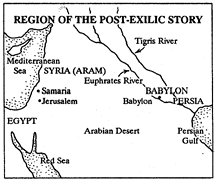
Though there was no longer a division between northerners and southerners, most of those who returned were from the former southern kingdom, Judah. These were once known as Judeans, but this was shortened to 'Jews', which now became a common name for Israelites in general.
The event that made the Jews' return possible was Persia's conquest of Babylon in 539 BC. When the Persian king Cyrus gave permission for captive peoples to return to their homelands, a large group of Jews migrated to Jerusalem. Though under the overall control of Persia, they were allowed to establish their own leadership in Jerusalem. Their early leaders were the governor Zerubbabel and the high priest Joshua (or Jeshua). These were still the leaders when Haggai and Zechariah began their ministry (Ezra 2:1-2; 5:1-2).
The preaching of Haggai and Zechariah
Soon after arriving in Jerusalem, the Jews showed their desire to rebuild the temple on Mt Zion. They set up an altar of sacrifice, and in the second year they started to lay the foundation of the temple (Ezra 3:1-3,8-10). However, local people began to oppose the builders, with the result that the work stopped (Ezra 4:1-5,24).
For about sixteen years no work was done on the rebuilding of the temple. Because of this, God raised up the prophets Haggai and Zechariah to work among his people. They began preaching in 520 BC, their job being to stir up the people to get on with the job and not stop till it was finished (Ezra 5:1-2; Hag 1:1; Zech 1:1).
People blamed opposition from local enemies and hardship from famine as the reasons for not building. The prophets saw that these were not the real reasons. The problem lay with the people themselves. They were not willing to work for God, though they were quite energetic when working for themselves. The problem was spiritual, not political or material (Hag 1:2-4,9-10).
This opinion of the prophets was soon proved to be correct, for when the people restarted the work and opposition broke out afresh, the Persian king encouraged the Jews. He even issued a second decree to confirm the decree of the former king Cyrus. In addition he gave financial assistance to make sure the work was finished satisfactorily (Ezra 5:3; 6:6-12).
The early preaching of Haggai and Zechariah was designed to get the Jews started and encourage them through their early difficulties. This ministry lasted almost six months and, according to the record preserved in the Bible, consisted of four messages from Haggai and two from Zechariah. Two years later Zechariah delivered his third message. Zechariah's remaining two messages seem to come from a period much later in his life.
Characteristics of the two books
While Haggai's preaching was straightforward and easy to understand, Zechariah's consisted largely of vivid accounts of unusual visions and dramatic messages given to him by God. As a result, his preaching required more thought on the part of his hearers. This type of preaching (or writing) was known as apocalyptic. (Concerning characteristics of apocalyptic writings see background to Daniel.)
Haggai was mainly concerned with rousing the people from their spiritual laziness to get them working on the rebuilding of the temple. Zechariah supported Haggai in this urgent ministry, but went on to give further teaching. He wanted to see a lasting spiritual change in the lives and outlook of the people, so that they would be better equipped to serve God in the future.
Through Zechariah, God was further preparing his people for the purpose for which he had chosen them. That purpose would find its fulfilment in the coming of the Messiah, the establishment of his kingdom, and the salvation of people worldwide. The latter half of Zechariah's book (consisting of two messages delivered probably later in his life) shows that the Jews' task would not be easy. There would be bitter conflicts with the forces of evil, but in the end God's kingdom would triumph.
Summary of contents
The table below shows the sequence of the messages and events recorded in Haggai and Zechariah.
BC Month Day Message/Event Reference
521 Darius as king
520 6 1 Haggai's 1st message Hag 1:1-11 6 24 Temple started Hag 1:12-15 7 21 Haggai's 2nd message Hag 2:1-9 8 Zechariah's 1st message Zech 1:1-6 9 24 Haggai's 3rd message Hag 2:10-19 9 24 Haggai's 4th message Hag 2:20-23 11 24 Zechariah's 2nd message Zech 1:7-6:15
518 9 4 Zechariah's 3rd message Zech 7:1-8:23
516 12 3 Temple finished Ezra 6:14-15 years later Zechariah's 1st oracle Zech 9:1-11:17 late in life Zechariah's 2nd oracle Zech 12:1-14:21
THE PROPHECY OF HAGGAI
Haggai's rebuke and its results (1:1-15)
The Jews were making excuses for not building the temple, saying that they were suffering a time of personal hardship and enemy opposition. They claimed it was not yet time to begin the work (1:1-2). Yet they could build houses for themselves. In fact, they had taken much of the available timber and used it extravagantly in their own homes, even though timber was in short supply and was needed for the temple (3-4). Because of their selfishness God had punished them with poverty and famine (5-6).
People complained that they could not build the temple because they were poor. Rather, replied the prophet, they were poor because they would not build the temple. They were selfish, thinking only of what they wanted, not what God wanted. Therefore, they had to go back to the forests and cut timber for the temple (7-11).
Haggai's forthright preaching brought quick results. The people, realizing the truth of his accusations, responded to his appeal, and in little more than three weeks had restarted work on the temple. When they began to obey God and fear him, he promised to be with them (12-15).
A message of encouragement (2:1-9)
Although the foundation of the temple had been laid sixteen years earlier, it had no doubt been damaged during the years of neglect. More work was necessary before construction could begin on the building itself. After the people had been at work for about a month, they could see enough of the rebuilt foundation to form an idea of the size of the proposed temple. Some of the very old people, remembering Solomon's magnificent temple, may have commented that this new temple was not very impressive by comparison. Haggai saw that this would discourage the builders, so he brought them a message of encouragement (2:1-3). As God's spokesman, Haggai passed on God's assurance that he was with them, just as he had been with their ancestors when he brought them out of Egypt (4-5).
Just as God shook the earth with the giving of the law at Mt Sinai, so through this temple he would 'shake' heaven and earth in a far greater way. Through the temple, he was reconstructing the religious centre of the Jewish nation, for this was the nation from which the Messiah was to come. Israel's temple would receive greater splendour than the discouraged workmen imagined. God, who was the real owner of the world's wealth, would direct rulers of other nations to bring their silver and gold to beautify it (6-8; cf. Ezra 6:8-12).
However, far greater glory would come through the multitudes from many nations who would join with Israel in the true temple. The Messiah's real dwelling place would be among all the redeemed in a living temple that he would establish in the world in glory. The temporary hardships of the Jewish builders would appear as nothing compared with the splendour of that day (9).
Promises of blessing (2:10-19)
At the end of three months all the foundation work was finished (cf. 1:14-15; 2:18). Zechariah had successfully urged the people to repent (Zech 1:1-6), and now Haggai emphasized again that spiritual cleansing was the only way by which they could enjoy God's blessing (10).
Haggai reminded the people that their wrong attitudes in the past had been the cause of all their troubles. He gave an illustration to show that contact with unclean things made a person unclean, but contact with holy things did not make a person holy. As long as they had neglected the temple and let it lie as a ruined 'dead' thing in their midst, they had been unclean and therefore unacceptable to God. All their religious activity had not made them holy, no matter how much it brought them in contact with holy things (11-14).
The people's selfishness and disobedience had brought God's judgment upon them in damage to their crops and a shortage of food. Now that they had turned from their selfish ways and obeyed God, things would change (15-17). God would reverse the unfavourable agricultural conditions and give them fruitful crops again. His promise would begin to come true from that very day; for on that day, by completing the foundations of the temple, they had given visible proof that their obedience was genuine (18-19).
A personal message for Zerubbabel (2:20-23)
Later the same day Haggai delivered another encouraging message, this time to Zerubbabel the governor (20). Zerubbabel was a descendant of David in the line of kings who reigned in Jerusalem, and he was entitled to the throne of Israel (Matt 1:6-12). But because Israel was still under Persian rule he was allowed to be only governor.
Despite these restrictions, Haggai encouraged Zerubbabel with the assurance that he was still God's specially chosen representative. Through him God would not only re-establish the nation Israel, but would overthrow all nations and establish God's worldwide kingdom. Zerubbabel did not live to see the fulfilment of Haggai's words, but the promise passed on to one of his descendants, Jesus the Messiah, in whom the prophecy will find its fullest meaning (21-23; cf. Matt 1:12-16).
Zechariah
Zechariah was a fellow worker with Haggai in bringing God's message to the Jews in Jerusalem at the beginning of the post-exilic period. Their chief concern during the early days of their ministry was to arouse the Jews from their selfish laziness and urge them to rebuild the temple. Zechariah went on to give teaching over a wide range of issues, as part of his task to prepare people for the era of the Messiah that lay ahead.
The introductory notes to Haggai give background details for both Haggai and Zechariah, and the reader should be familiar with that material before continuing with the present study. The notes that introduce Haggai also discuss characteristics of Zechariah that mark it out as a different kind of book from Haggai.
1:1-6:15 Zechariah's visions 7:1-8:23 A question about certain fasts 9:1-14:21 The triumph of the Messiah
1:1-6:15 ZECHARIAH'S VISIONS
Call to repentance (1:1-6)
At the time Zechariah delivered his first message, Haggai had already been preaching for about two months (1:1; cf. Hag 1:1). In his two recorded messages of that time, Haggai had shown that all Israel's current difficulties were because of the people's selfishness and disobedience in failing to rebuild the temple. As a result of Haggai's preaching the people stirred themselves and started building again (Hag 1:1-2:9).
Zechariah now joins Haggai in the preaching, recalling that disobedience to the prophets of former times had led to hardship and finally captivity (2-3). The people should therefore learn from their forefathers' experiences and take notice of the words of the prophets. This means not simply that they must rebuild the temple, but more importantly that they must acknowledge their sin, accept God's discipline, turn from their disobedience and begin a new life of devotion to God (4-6).
Eight visions
The section 1:7-6:8 consists of a series of eight visions. These are arranged with the two most important visions in the centre, and the remaining visions in two equal groups, one on either side.
At the time that Zechariah received these visions, work on rebuilding the temple had been going on for five months, three months of which were taken up with preparing the foundations (cf. v. 7 with Hag 1:14-15; 2:18). The people would clearly benefit from some encouragement and direction. The first three visions are largely messages of encouragement to the builders, the middle two are of special encouragement to the leaders Joshua and Zerubbabel, and the final three give assurance of ultimate victory for God and his people.
Encouragement to the builders (1:7-2:13)
In the first vision some mounted patrol officers have just returned from a tour of duty and report to a rider on a red horse who is standing among some trees (7-10). The patrol officers report that throughout the empire all is calm and peaceful (11).
This report may be good news for the Persians but it is not for the Jews, who have now been in bondage to foreign overlords for more than seventy years. They long for freedom and pray for God's mercy (12-13). God tells them that although he used foreign nations to punish them, those nations went beyond the limits he had set. He loves his people and he knows what their enemies have done to them (14-15). Therefore, he will now turn and help Israel again. The temple will be finished, and the city rebuilt and made prosperous once more (16-17).
The second vision assures the Jews that they need have no fear of foreign overlords. Nations may attack them from all sides, using their power to oppress Israel as wild beasts use their horns to terrify their victims, but their success will not last. As each wild beast is overcome by a workman who smashes it with a hammer, so each nation that attacks Israel will be overthrown (18-21).
In the third vision Zechariah sees a young man going out to measure Jerusalem in preparation for the rebuilding of its walls (2:1-2). But a messenger stops him, for the rebuilt city will extend beyond the walls of the former city. In fact, it will not need walls, because God will be its protector (3-5).
Those Jews still in Babylon may have made living conditions reasonably comfortable for themselves, but they should beware of becoming too settled. They should return to Jerusalem as quickly as possible, both to enjoy its blessings and to avoid the punishment about to fall on their captors (6-9). God gives further encouragement to those working on the temple by assuring them that it will be the means by which he dwells among his people again. Citizens of other nations will renounce their gods and come to join with Israel as the people of God (10-13).
Encouragement to Joshua (3:1-10)
Zechariah then has a vision in which he sees Satan accuse the high priest Joshua (and therefore the people he represents) of being unclean. Because of their long exile in idolatrous Babylon, they are no longer fit to enter God's presence. In other words, Satan is hinting that the people are wasting their time building the temple. Since they are unclean, no sacrifices that they offer there will be acceptable to God (3:1; see also v. 3).
God replies that he has not cast off his chosen people. Their time of exile in Babylon has been his punishment on them because of their sin, but now he has saved them. He has snatched them from the hand of their enemies, brought them back to their land and cleansed their sin. Now he is going to set up the temple and its priesthood for them once again (2-5).
Joshua and his fellow priests are warned to be faithful to God in carrying out their duties in the new temple that God will put in their care. Joshua will then be able to enter the presence of God without fear of Satan's accusations (6-7). The reestablishment of the Israelite priesthood is a further sign to assure the people that their Messiah will come (8. For the significance of the messianic title 'the Branch' see commentary on 6:12-13). A specially engraved stone is to be set in the temple as a reminder of what the Messiah will do. He will cleanse the land of sin and bring in a new era of contentment and prosperity (910).
Encouragement to Zerubbabel (4:1-14)
The next vision is of a seven-headed lampstand standing between two olive trees. The olive trees pour their oil into a central bowl on top of the lampstand. The oil from this central bowl then feeds the seven lamps that provide the light. This means that the lamps do not need anyone to look after them. Light is provided supernaturally through the constant supply of oil from the trees (4:1-5; see also v. 12).
This vision was of particular encouragement to Zerubbabel who, in his task of reconstructing the temple, faced mountainous obstacles. His authority was limited by Persia; he had a shortage of labour and materials; his workers were discouraged by certain Jews who despised the new building as being small in comparison with Solomon's magnificent temple; and he was surrounded by hostile foreigners who tried to hinder the work. God now gives him a message of encouragement and reassurance. Just as the lamps receive a continuous supply of oil supernaturally, so the temple will be finished through the power of God's Spirit. God's power, not human power, is to be the source of Zerubbabel's strength (6-10a).
Zechariah then records an additional meaning given to the two olive trees. Through the Davidic prince Zerubbabel and the high priest Joshua, God will supply spiritual power to Israel. This will enable Israel to send forth the light of God throughout the whole earth (10b-14).
Assurance of final victory (5:1-6:8)
Previously God gave a promise that the Messiah will remove sin from the land (see 3:9b). This will come either through forgiveness (in the case of those who repent) or destruction (in the case of those who continue in their sin). This latter judgment is now pictured in the vision of a huge flying scroll that announces God's judgment on all those who choose to ignore God's law. No one has any excuse, because the scroll is large enough for all to read and it flies over the whole land so that all can see it (5:1-3).
Whether wrong actions are directed against God or against others, the wrongdoers will not escape judgment (4).
In the past Israel often fell into idolatry, with its accompanying sin of sexual immorality. Therefore, idolatry and everything associated with it must be removed from Israel's land. In Zechariah's vision, idolatry is symbolized by a large container, inside which is a woman, probably a prostitute (5-8). The container and its contents are then carried away to the distant land of Babylon. There the woman will be at home among the ungodly idol worshippers awaiting final punishment; but the land of Israel will at last be free of her defiling influence (9-11).
Having cleared the land of sin, God establishes the kingdom of the Messiah with its worldwide authority. This seems to be the meaning of the final vision, which begins with the appearance of four chariots coming out from the stronghold where God dwells (6:1-4). The chariots speed to the four corners of the earth to spread God's rule throughout the world (5-7). God is particularly pleased to see the nations to the north conquered, for that was the direction from which most of the enemy conquests of Israel came (8).
Israel's captivity and re-establishment in its land was a foreshadowing of the events pictured in these three visions – the punishment of sinners, the removal of idolatry and the setting up of the Messiah's kingdom. Restored Israel had turned from its sins, put away idolatry, and was now in the process of establishing a God-centred national life once again through the rebuilding of the temple.
The crowning of Joshua (6:9-15)
Just as the setting up of the Messiah's kingdom will be marked by the crowning of the Messiah as universal king, so the re-establishment of the nation Israel was marked by the crowning of Joshua. The crown was made from gold and silver brought from Babylon by some exiles who had recently arrived in Jerusalem (9-11).
A coronation of the high priest was unusual, but because the restored nation of Israel was still under Persian rule, a coronation of the Davidic prince Zerubbabel may have appeared to be an act of rebellion. But the Persians were not likely to object to a religious ceremony marking the restoration of Israel's national life and the reconstruction of their temple.
Zechariah's words, spoken on behalf of God, further indicate that the crown rightly belonged to Zerubbabel; for though the words were addressed to Joshua they applied to Zerubbabel. It was Zerubbabel, not Joshua, who was the 'branch' in David's family tree, the royal descendant entitled to the throne of Israel. Joshua's rightful place was as the high priest who assisted the civil ruler. The two men, because of the peaceful understanding between them, led the nation in the ways of God. Their joint rule fittingly foreshadowed the rule of the true 'Branch', the king-priest Messiah (12-13; cf. 3:8; see also notes on Hag 2:20-23).
The three recently returned exiles who supplied the gold and silver for the crown were apparently witnesses at the ceremony. The crowning took place in the house of their friend Josiah, and the crown was later placed in the completed temple in Jerusalem. There it was displayed as a memorial to those who gave it and as a symbolic guarantee of greater things to come (14-15).
7:1-8:23 A QUESTION ABOUT CERTAIN FASTS
Mourning over the past (7:1-14)
In captivity the Jews had instituted four fasts to mourn the destruction of Jerusalem. One fast was in the tenth month, which was the month the Babylonians laid siege to the city. One was in the fourth month, to mark the day eighteen months later when the Babylonians broke through the walls and invaded the city. Another was in the fifth month, to mark the destruction of the temple. The other was in the seventh month, to mark the murder of Gedaliah, the last Jewish ruler in Jerusalem (see 8:18-19; cf. 2 Kings 25:1-4,8-9,25).
Now that the temple was beginning to take shape (for it had been under construction more than two years) a question arose in the minds of certain Jews. With the temple rebuilt, should they still keep the fasts that had been instituted in Babylon as memorials of destruction (7:1-3)?
Zechariah replies that those fasts had no value in God's sight anyway. Self-pity, not repentance towards God, was what prompted the people to keep them. Furthermore, the destruction they commemorated came about only because they had been disobedient to God's prophets. Through their own stubbornness, the people were driven out of what used to be a prosperous land (4-7).
The Jews of Zechariah's day should not repeat the sins of their ancestors. Rather they should show their obedience to God in lives of active justice, love and mercy towards their fellows. They must avoid the temptation to exploit those who, for one reason or another, are disadvantaged (8-10). The heartless attitude of their ancestors towards the needy was a reflection of a more deep-seated problem, their hardness of heart towards God (11-12). Because they ignored God's instruction to them through the prophets, God ignored their prayers to him when the enemy attacked. As a result they were taken into foreign captivity (13-14).
Confidence for the future (8:1-23)
Zechariah goes on to outline the blessings that will come to Jerusalem when God dwells there. God's love for Jerusalem was the reason why he punished it so severely. With corresponding zeal he will restore it to a favoured place according to his covenant promises (8:1-3).
In the new community of God's people, there will be no place for fear or violence. Old and young alike will enjoy lives of freedom and contentment greater than they imagined possible (4-6). Above all, they will enjoy true fellowship with God. After their years of captivity they will now begin to experience the blessings God always intended for them (7-8).
Since the people had restarted work on the temple, conditions in Jerusalem had changed. God removed the afflictions of drought and enemy action that he had used to punish them in the past (9-11). In their place he now gives blessings of agricultural prosperity and peace (12-13). These blessings will continue and will increase, but the people on their part must continue to behave rightly towards God and towards one another (14-17).
In view of all that God will do, the people should not waste time mourning over calamities of the past. Instead they should look confidently to the future and turn their fasts of mourning into feasts of joy (18-19). In contrast to the relatively few Jews who were at that time rebuilding the temple and city, multitudes of Gentiles from far and wide will come to Jerusalem to seek the God of Israel (20-23).
9:1-14:21 THE TRIUMPH OF THE MESSIAH
Israel always looked forward to a messianic day of glory and power. The people longed for the day when all enemies would be destroyed, and righteousness would be established in the land under the rule of the Messiah. The nation's re-establishment under Zerubbabel and Joshua was a foretaste of that great day. Israel could expect to see its former enemies conquered and full independence restored in its land.
This in fact happened. The years 334-326 BC saw the Greek conqueror Alexander the Great spread his rule over all those countries that had previously controlled Israel. Although Alexander's conquests included Israel, the time came when Israel finally won full independence under the Maccabees (143 BC). In due course the Messiah came in the person of Jesus Christ, but by this time the Jews, through their own sin, had lost their independence. Worse still, they rejected their Messiah.
The prophecies of Zechariah have to some extent been fulfilled, but they still await a greater fulfilment. This will take place when Jesus Christ returns to conquer all enemies and establish his universal rule of peace and joy. In Zechariah the time factor therefore has little meaning. Events that cover many years, or perhaps are separated by centuries, may be condensed into one verse. Much shorter periods may be dealt with at length.
Zechariah's prophecies are not descriptions of historical events that he happens to have written in advance. They are a revelation of God's purposes given to instruct, warn, encourage, guide and inform his people. Their fulfilment may take different forms in different eras. In some cases the fulfilment may be closely related to events belonging to the time from Alexander to the Maccabees; in others it may be more concerned with the greater events of Christ's life and work; and in yet others it may relate more fully to the future events of the return of Christ and the age to come.
Enemies punished; freedom restored (9:1-17)
The prophet outlines how Israel will move from its present position (in its own land but still under Persian rule) to full independence, and then into the era of the Messiah's rule. He sees an invading army moving down from the north. First it conquers the Syrian cities of Hadrach, Damascus and Hamath, then the Phoenician cities of Tyre and Sidon (9:1-4). From there it moves down the coastal plain to conquer the Philistine cities of Ashkelon, Gaza, Ekron and Ashdod. The Philistine practice of eating unclean food will cease, and the Philistines will become part of Israel, as the Jebusites had in the time of David (5-7; cf. 2 Sam 5:6-10). Jerusalem, however, will be preserved. Although it will come into the enemy's sphere of control, it will not be destroyed (8).
(History records that an invasion such as the above took place when Alexander's armies swept through the region, conquering many of Israel's former enemies, including its current master, Persia. Although Alexander took control of Jerusalem, he did not destroy it.)
Greek rule may spread over Palestine, but eventually it will be overthrown. God's king will then reign in Jerusalem, though not as a warlike conqueror. He will enter the city in quiet yet royal dignity, and establish a worldwide reign of peace (9-10).
Now that he has pointed to the climax of Israel's glory through the reign of the Messiah, the prophet returns to the time of Alexander. He shows that God will set his people free according to the covenant he made with them at Sinai (11-12). Israel will become a weapon in God's hand to slaughter its enemies and thereby carry out God's judgment upon the nations (13-15). On gaining its freedom, the nation will settle down to a life of security, joy and prosperity (16-17).
Problems of leadership (10:1-11:3)
At the time this prophecy was given, the temple had long been finished and life in Jerusalem was not as it had been previously. Zerubbabel and Joshua had apparently died, and without strong leadership the Jews drifted into the ungodly ways of neighbouring nations. Some were using idolatrous objects as magic charms, in the belief that these would bring good rains and good crops. Zechariah tells them to stop such practices and trust in God alone (10:1-2).
God is angry with Israel's leaders, who have no concern for the people they rule. God will replace them with strong, stable, dependable leaders, who in God's strength will overthrow the ruling power (35). Jews who are still scattered throughout other lands will return to their homeland, where they will live in confidence and joy under God's protection (6-7). The movement of people to the promised land will be like the migration from Egypt to Canaan in the time of Moses (8-11). In response to God's grace his people will worship and obey him (12).
As for bad leaders, their judgment is certain, no matter how great and mighty they think themselves to be. They increase their power and wealth by oppressing the people without mercy, and therefore God will punish them without mercy. His judgment will be like a raging fire sweeping through the proud forests, where not even the strongest and fiercest animals will escape (11:1-3).
Two short plays about leadership (11:4-17)
After announcing God's judgment on Israel's bad leaders (see 11:1-3), Zechariah demonstrates that judgment in two short plays. In these plays he acts the part of a shepherd, representing the leaders of God's people.
In the first play God told Zechariah to act the part of a good shepherd. Zechariah was to look after a people oppressed and exploited by bad shepherds, whose sole aim was to enrich themselves. They cared nothing for the flock. God showed Zechariah, however, that his efforts were doomed to failure. Leaders and common people alike were heading for a fitting punishment (4-6).
Nevertheless, Zechariah acted his short drama. With a shepherd's stick called 'grace' (or 'favour') he tried to give the sheep the gracious and beneficial leadership that God desired for them. With another stick, called 'union', he tried to bind them closer to one another in national peace and harmony. He even destroyed the three bad shepherds. In return the people were angry with him. They were so far removed from the ways of God that they preferred the bad shepherds to the good shepherd (7-8).
Zechariah therefore broke his two sticks, to show the people that he would no longer be their shepherd (9-11; see also v. 14). When he suggested that they might pay him his wages, they gave him such a small amount that it was an insult. This was especially so since the wages really belonged to God, whom he served (12-13). He knew that the people preferred the sort of society where the greedy could get what they wanted by exploiting others. In the end such a society would destroy itself (14).
In the second play Zechariah played the part of a bad shepherd, which was the sort of shepherd Israel wanted. This cruel and selfish leadership was what the people deserved, and would be God's means of punishing them (15-17).
There may have been events in Zechariah's day or soon after that corresponded to the two plays he acted. Certainly, there was a striking correspondence with conditions among the Jews of Jesus' day. The people rejected him, preferring the bad leadership of the Pharisees, Sadducees, scribes, priests and elders (cf. John 10:7-13,26-31). They crucified the one whom God graciously gave to save them. They fought among themselves and with the Roman authorities who governed them, and finally brought upon themselves slaughter and destruction at the hands of Rome in AD 70.
Victory, but with mourning (12:1-13:1)
On occasions God used Gentile nations to punish his people Israel, but if his desire was to fight for Israel, no enemy attack could be successful. On the occasion that Zechariah speaks of in Chapter 12, God strengthens his people to overthrow the armies that besiege Jerusalem (12:1-3). The charging horses of the enemy are thrown into confusion as God comes to the help of his people. The Jewish leaders acknowledge that, above all, God is the cause of Jerusalem's victory (4-5).
The Jewish fighters who lead the attack against the enemy are not from Jerusalem, but from the country areas round about. This prevents the people of Jerusalem from boasting that they have been responsible for the destruction of the enemy. Fitting honour is given to their brave brothers from the country (6-7). All, however, realize that God is really the one who has saved Jerusalem (8-9).
God's people may have won a great victory, but the victory has been costly. As they mourn their dead, the people are humbled to a new attitude of sorrow for their wrongdoing, and they cry to God for mercy. The chief cause of their mourning is their realization that a man whom they had recently murdered was the one whom God had sent to save them. They may have objected to his announcements or directions concerning the battle, but now they realize that they should have honoured him (10). There is mourning throughout the land, but it is particularly intense among those connected with the civil and religious leadership in Jerusalem (11-14). Yet God's forgiveness is available to all who are genuinely sorry for their disobedience and treachery (13:1).
False prophets and true shepherd (13:2-9)
Having introduced the subject of forgiveness and cleansing, Zechariah goes on to deal with those evils that had to be removed from the land. One of Israel's chief sins was idolatry, and this had been encouraged by the false prophets. Therefore, all false prophets must be killed (2-3).
If a false prophet escapes, he might try to preserve his life by throwing away his prophet's cloak and disguising himself as a farmer. But he will not be able to remove the scars on his back. (Such scars were a characteristic of sorcerers and false prophets. They were made by cutting 'magic' marks in the skin; see Lev 19:28; 1 Kings 18:28.) If someone notices the scars, the false prophet will lie to protect himself, saying that he received the scars through a fight or an accident in a friend's house (4-6).
Zechariah returns to the subject of leadership, using again the illustration of the shepherd. (The leader referred to here may be the person of 12:10 who was killed by his own countrymen.) The leader of God's choice is one who is close to God and who truly cares for God's people. But the people kill him and persecute his followers. As a result of this shepherd's death, the majority of his people fall under divine judgment. The minority who are left go through a time of suffering, but through this they become better people and come into closer fellowship with the God in whom they have trusted. These are God's true people (7-9).
No doubt this true shepherd was Jesus the Messiah (Matt 26:31; John 19:37). His own people killed him, and with his death the majority of Israel fell under God's judgment. Some, however, were saved. These became God's true people, though they suffered persecution at the hands of the rebellious (Rom 9:6-8; 11:5-7; Gal 4:28-29).
The Messiah's kingdom (14:1-21)
In the final section of his book, Zechariah outlines briefly the worldwide triumph of the Messiah. Since those for whom he writes are familiar only with the region around Palestine, he limits the geographical details to that area. Other pictures are likewise taken from the way of life familiar to the Jews.
The scene opens with the enemies of God mistakenly thinking that at last they have conquered his people (Jerusalem). Confident that they have achieved victory, they sit down in the middle of the city to divide the plunder, while the Jews are either led away captive or imprisoned in the city (14:1-2). Suddenly God acts in supernatural judgment. As he once divided the Red Sea to give his people a way of escape from the Egyptians, so he divides the mountains east of Jerusalem to give his people a way of escape from the enemy-occupied city (3-5).
God gives his people satisfaction and provision by altering the course of nature for their benefit. They lack nothing (6-8). God now establishes his throne in a restored and repopulated Jerusalem, from where he rules over all the earth. Mountains around the city are flattened so that Jerusalem is lifted up in the eyes of all nations and Israel's God is worshipped worldwide (9-11).
Enemies are destroyed in a terrifying judgment, and Israel is compensated for all that it previously lost to plundering armies (12-15). Survivors among the nations are required to come to Jerusalem to worship God. This ingathering of nations is likened to Israel's ingathering of harvest fruits at the Feast of Tabernacles (Festival of Shelters) at the end of each agricultural year (16-19).
No longer is there a difference between sacred and non-sacred articles. Everything is holy and fit for the service of God, even household pots and pans and bells on the necks of horses. Since all things are holy, traders are no longer needed in the temple to exchange non-sacred for sacred goods. True holiness will at last be established in the world (20-21).
Malachi
The meaning of the Hebrew word malachi is 'my messenger'. Since a prophet was God's messenger, some have thought that 'Malachi' in the opening verse is not a person's name but a statement that the writer is a genuine messenger from God. (The same word is used of another messenger of God in Malachi 3:1.) The usual understanding is that the writer, in calling himself Malachi, is introducing himself by his own name, as do the other writing prophets.