
Part 2
Children born in Haran (29:31-30:24)
Jacob's coolness to Leah created unhappiness in his household. Leah's desire for Jacob's love is seen in the names she gave her first four sons (31-35). Rachel, feeling ashamed that she had not yet produced a child herself, gave her slave-girl to Jacob so that the slave-girl might produce a son whom Rachel could adopt as her own. The result was two sons (30:1-8; cf. 16:1-4). Leah, believing she was not able to have any more children, did the same, and soon Jacob had two more sons (9-13).
When Leah obtained some mandrakes (plants used to make a medicine that people believed helped a woman become pregnant), Rachel bought them from her at the price of giving her a night with Jacob. Rachel's bitterness increased when she found that the mandrakes did not help her, whereas Leah had another son. Leah soon afterwards had yet another son (her sixth) and then a daughter (14-21). Finally Rachel had a son, Jacob's eleventh (22-24).
Jacob tricks Laban (30:25-43)
After Rachel had borne him a son, Jacob decided to return to Canaan. Laban asked Jacob what wages he would like, since much of Laban's prosperity had resulted from Jacob's farming ability (25-30). Jacob claimed as wages all the part-coloured animals in the flock, plus all the black sheep. As these were relatively few in number, Laban agreed, though he then attempted to lessen Jacob's profit by removing from the flocks all the part-coloured animals and black sheep he could find (31-36).
But Jacob was not to be beaten. He decided not to return to Canaan immediately, and spent the next few years carefully breeding Laban's animals. He cross-bred the best of the animals to produce more and more sheep and goats that were healthy and of a colour that advantaged him, while the number of allblack goats and all-white sheep (Laban's share) steadily decreased, in both quality and quantity. Like others of his time, Jacob thought that if an animal when breeding was startled by the sight of something spotted or striped, its offspring would be spotted or striped. His success was due rather to his wise selection of animals, and especially to the overruling activity of God (37-43; cf. 31:8-9).
Jacob flees from Laban (31:1-55)
As Laban and his sons became increasingly hostile to him, Jacob prepared to leave for Canaan without delay (31:1-13). Leah and Rachel agreed, for they too were angry with Laban. He had used them to make himself rich, but apparently had no intention of giving them a share in the inheritance (14-16). Therefore, when they fled, Rachel stole her father's household idols, for according to Mesopotamian custom possession of these gave her some right to the inheritance (17-21).
Laban was upset to find that Jacob and his family had escaped, but was particularly upset that they had taken his idols with them. However, when he caught up with Jacob he was unable to find his idols (22-35). Jacob could bear Laban's persecution no longer, and accused him of heartless ingratitude in view of Jacob's twenty years hard work for him (36-42).
Jacob and Laban, equally suspicious of each other, then made an agreement to prevent one from attacking the other. They set up a stone as witness to their agreement and, by eating a sacrificial meal together, bound themselves to their word (43-55).
Preparing to meet Esau (32:1-32)
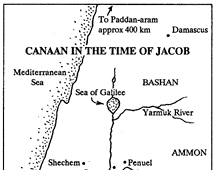
During the twenty years that Jacob had been in Mesopotamia, Esau had established his household in territory to the south near the Dead Sea. Jacob knew that if he was to live in peace in Canaan, he would first have to put things right with Esau. With much fear and anxiety he sent news to Esau that he was coming to meet him (32:1-8).
Jacob had by now learnt a humility before God that was lacking the previous time he met Esau. He thanked God for his remarkable blessings in the past, and prayed that God's promises for the future would guarantee protection for him against his brother (9-12). At the same time he thought it wise to send Esau a series of gifts, with the aim of winning his favour (13-21).
Still moving south, Jacob sent his family across the river Jabbok, while he remained behind by himself (22-24a). That night he met God, who appeared to him in the form of a man wrestling with him. As they wrestled, Jacob realized that this 'man' had superhuman strength and the power to bless. As in previous conflicts, Jacob was determined to win, but now he had to learn that against God he could never win. His proud self-confidence was at last defeated. Yet in another sense Jacob did win, for he demanded, and received, a special blessing of God's power that would ensure victory in the future. Though defeated and humbled, he did not lose his persistence or fighting spirit. The old determination was still there, but Jacob the cheat now became Israel, God's champion (24b-29). By giving him a permanent limp, God never allowed Jacob to forget that the only way he triumphed was through defeat (30-32).
Meeting with Esau (33:1-17)
Jacob may have had a dramatic spiritual experience with God, but he still had to face Esau the next day. He took precautions to protect his family against any possible hostility, then went ahead to meet Esau personally (33:1-3). Esau showed a generous spirit of forgiveness, with the result that the dreaded meeting proved to be a happy reunion. Jacob had gained Esau's birthright and blessing by cunning and deceit, but he was not allowed to enjoy them fully till he humbled himself before Esau, and Esau acknowledged that he had no claim against Jacob. Esau did this by accepting Jacob's gift (4-11).
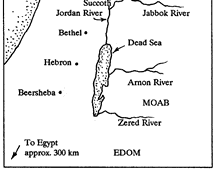
Esau asked Jacob to follow him to Edom, but Jacob thought it better not to go immediately. He had a large family and large flocks and herds, and decided to settle for the time being at the town of Succoth nearby (1217).
Back in Canaan (33:18-35:15)
From Succoth Jacob later moved with his household across the Jordan River into Canaan itself and settled in Shechem. By buying a piece of land, he gained permanent possession of part of the land God had promised to him and his descendants (18-20; cf. 23:1-20; 28:1-5).
When the son of a local headman raped Jacob's daughter Dinah, the headman suggested to Jacob that his son marry Dinah, and that Jacob's sons marry the local Canaanite women (34:1-12). Jacob's sons agreed to the intermarriage provided the men of Shechem were first circumcised (13-17). The Shechemites agreed, for they saw the opportunity for economic profit through intermarriage with Jacob's household (18-24).
But Jacob's sons deceived the Shechemites. As soon as the Shechemite men were circumcised and not physically in a condition to defend themselves, Jacob's sons attacked the town, killing the men and plundering their households (25-29). By going too far in taking revenge for the rape of their sister, Jacob's sons opened the way for further violence (30-31).
God then told Jacob to go to Bethel, where God had appeared to him at the time of his departure from Canaan many years earlier (35:1; cf. 28:11-22; 31:13). First, however, all those with Jacob were to get rid of any idols they had brought with them from Mesopotamia (2-4). In view of the hostility against Jacob and his household after the massacre at Shechem, God gave them his special protection as they travelled (5-8).
At Bethel God renewed his covenant promises to Jacob. The significance of God's reassurance at this time was that Jacob was now back in the land God had given him, and he had with him the family through whom God's promises would be fulfilled (9-15; cf. 13:14-16; 17:2).
Further details of Jacob's family (35:16-29)
This section of the history of Israel closes by recording the birth of Jacob's last son (16-18), the death of Rachel (19-21), the sin of Reuben because of which he lost the birthright (22; cf. 49:4; 1 Chron 5:1), the names of Jacob's twelve sons, who are listed in legal order according to their mothers (23-26), and the death of Isaac (27-29).
Descendants of Esau (36:1-43)
The story is now about to move on from Jacob to his family, but first the record of Esau is brought to a close. The covenant family (Jacob's) had settled in Canaan, while the non-covenant family (Esau's) had settled in Edom. There, over many years, Esau's descendants grew into a large nation (36:1-19; cf. 27:3940). As the Edomites grew, the original inhabitants of the land, the Horites, were either forced to move elsewhere or absorbed into Edom (20-30; cf. 14:6; Deut 2:12). The record lists the early Edomite kings (31-39) and the main Edomite tribal divisions (40-43).
37:1-50:26 FAMILY GROWTH AND THE MOVE TO EGYPT
Joseph taken to Egypt (37:1-36)
God had told Abraham that his descendants would become slaves in a foreign land, and would remain there till Canaan was ready for judgment. Then they would destroy the Canaanites and possess their land (see 15:13-16). The long story of Joseph shows how God was directing events according to his preannounced purposes.
Being the father's favourite, Joseph was not popular with his ten older brothers. He was even less popular when he told them about his dreams, which suggested that one day he would have authority over them (37:1-11). When a suitable opportunity arose, his brothers tried to kill him, but Reuben saved his life (12-24). The brothers then sold Joseph to some traders who took him to Egypt, where he became a slave in the house of Potiphar, one of Pharaoh's chief officers (25-36).
Judah and his descendants (38:1-30)
Back in Canaan, Jacob's family had further troubles. Judah, Jacob's fourth eldest son, had three sons, the eldest of whom had married. When this son died childless, Judah, according to the custom of the time, asked his next son Onan to have a temporary sexual relationship with the widow Tamar, with the hope that by him Tamar might produce a child. Legally, this child would be considered son of the dead man and so would carry on the family name and inheritance. But Onan refused, for he wanted any children he fathered to be his own. Because of his refusal to carry out his family obligation, God killed him (38:1-10).
Thinking that he had already lost two sons because of Tamar, Judah hesitated to give his last son to her in case that son died too. Even when the son was old enough to marry, Judah would not give him to her. Tamar therefore thought of a plan to force Judah himself to have intercourse with her, so that she might produce an heir. She disguised herself as a prostitute and succeeded in seducing Judah (11-19). When Judah later found that his daughter-in-law was pregnant, he saw a welcome opportunity to be rid of her once and for all. Tamar saved herself and shamed Judah by revealing that he was the cause of her pregnancy (20-26).
Tamar gave birth to twins, the elder of whom began that line of descent from Judah which led to David and finally produced Jesus the Messiah (27-30; cf. Matt 1:3,6,16; Luke 3:23,31,33).
Joseph's rise to power (39:1-41:57)
In contrast to Judah, Joseph was blameless in his behaviour in Egypt. Soon he was placed in charge of Potiphar's household (39:1-6). When he rejected the immoral invitations of Potiphar's wife, she turned against him bitterly and had him thrown into prison (7-20). Again his behaviour was blameless, and soon he was given a position of responsibility over the other prisoners (21-23).
Among the prisoners who later joined Joseph were two of Pharaoh's palace officials (40:1-4). One night they both had unusual dreams and, believing the dreams foretold something, told their dreams to Joseph. Joseph predicted that within three days one of the officials would be restored to his former position and the other executed (5-19). The predictions came true, but the restored official failed to do as Joseph requested and bring Joseph's case to Pharaoh's attention (20-23; cf. v. 14-15).
Two years later, when Pharaoh described some puzzling dreams to his palace advisers, the restored official for the first time told the king about Joseph (41:1-13). As a result Pharaoh sent for Joseph, who interpreted the dreams as meaning that Egypt would have seven years of plenty followed by seven years of famine (14-32). Joseph added a recommendation of his own that would ensure a constant food supply throughout the fourteen years (33-36).
Pharaoh was so impressed with Joseph that he made him not only administrator of the program but governor of all Egypt (37-44). The thirteen years Joseph spent as a slave and a prisoner (cf. v. 46 with 37:2) taught him much about practical wisdom and dependence on God, qualities that would now help him considerably in his government of Egypt. He married an Egyptian and had two sons by her (45-52). When the famine came, Egypt alone was prepared for it, and people travelled there from other countries to buy food (53-57).
Joseph and his brothers (42:1-45:28)
When Joseph's brothers came to Egypt to buy grain, Joseph recognized them but they did not recognize him (42:1-8). Rather than make himself known to them immediately, Joseph decided to test them to see if they had experienced any change of heart over the years. Joseph was not looking for revenge. His apparently harsh treatment of them, mixed with kindness, was designed to stir their consciences. They realized they were being punished for their unjust treatment of their younger brother (9-24). Further events impressed upon them that God was dealing with them (25-28).
Joseph's brothers returned to Canaan with a genuine desire to do what was right. But when they told Jacob what the Egyptian governor required of them, they could not persuade him to cooperate (29-38).
After resisting for some time, Jacob eventually realized that he had to allow his sons to return to Egypt, this time taking Benjamin with them. A new spirit of unity and self-sacrifice now appeared among the sons of Jacob (43:1-14). They were still fearful of Joseph (15-23), whose remarkable knowledge gave them the uneasy feeling that they could hide nothing from him (24-34).
The greatest test of the brothers came when Joseph placed them in a situation similar to that of many years earlier when they had sold him. He accused them of a theft by Benjamin, and then gave them the chance to save themselves at Benjamin's expense (44:1-17). The brothers could easily have escaped by sacrificing Benjamin, but instead one of them offered to bear the punishment in his place, so that he, the favourite son, could return to his father (18-34).
Joseph's plan had succeeded. His brothers, accepting the consequences of their past guilt, were now changed men, both in their attitudes and in their behaviour. Therefore, when Joseph told them who he was, he had no need to accuse them of their misdeeds. Instead he pointed out that God had arranged for him to come to Egypt so that the covenant family could be kept alive during the famine (45:1-8). He told them that, since the famine would last another five years, they should bring Jacob and their families to Egypt where he could look after them (9-15).
Pharaoh confirmed Joseph's invitation and provided his family with transport for the move (16-20). Loaded with provisions, the brothers then returned home and told their father all that had happened (2128).
The migration to Egypt (46:1-47:12)
As they were leaving Canaan for Egypt, Jacob and his family stopped to worship God at Beersheba, the last town in Canaan. Here God told Jacob that, though he would die in Egypt, his descendants would one day return and possess the land (46:1-4). Jacob's family, at the time of the move to Egypt, numbered about seventy people (5-27).
Knowing that Egyptians did not like to live alongside people who kept sheep or cattle, Joseph told his brothers to tell Pharaoh that they were keepers of both sheep and cattle and that they had brought their flocks and herds with them. This would ensure that Pharaoh gave them a territory separate from the Egyptians, where they could live together and multiply without their culture and religion being too easily corrupted by the Egyptians (28-34). Joseph's plan again succeeded, and the family settled in the fertile land of Goshen near the mouth of the river Nile (47:1-12).
Joseph's economic policy (47:13-26)
If Joseph had not planned wisely, the seven-year famine would have ruined Egypt and Canaan. He gave the people food in return for their money (13-15), then, when they had no money, in return for their animals (16-17), then, when they had no animals, in return for their land and even themselves (18-19). In the end all the land belonged to the government and everybody worked for the government, but in return Joseph gave the people land and seed for farming (20-24).
Joseph's policy may have appeared to be hard-hearted at first, but in time the people discovered that it saved them from disaster. Soon they were producing good crops again, though they had to pay the usual tax to the government (25-26).
Words for Joseph and his sons (47:27-48:22)
By insisting that Joseph bury him at Machpelah, Jacob showed his faith in God's promises. He knew that Canaan would become the land of his people (27-31; cf. 23:17-20; 35:12; 46:4).
Joseph's two sons, Ephraim and Manasseh, were by now about twenty years old (see 41:50; 45:6; 47:28), and Joseph wanted his father to bless them before he died. This blessing was more than an expression of good wishes; it was an announcement believed to carry with it the power to make the blessing come true. Jacob blessed Ephraim and Manasseh, raising them to the status of sons. This gave Joseph the birthright that Reuben had lost, for now Joseph, through his two sons, would receive twice the inheritance of Jacob's other sons (48:1-7; 1 Chron 5:1-2).
Both of Joseph's sons would become heads of tribes in Israel, though the tribe of the younger son Ephraim would be greater than that of Manasseh (8-20). Jacob also gave to Joseph his plot of ground near Shechem, which was the one piece of land he owned in Canaan (21-22; cf. 33:19; 34:26-29; John 4:5).
Blessings on Jacob's twelve sons (49:1-28)
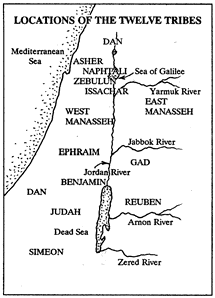
The last words of Jacob to his sons found their fulfilment in the history of Israel's twelve tribes (49:1-2). First Jacob dealt with the six sons of Leah (see v. 3-15), then with the four sons of the minor wives (see v. 16-21), and finally with the two sons of Rachel (see v. 22-27).
Reuben should have been strong, but through lack of self-control he lost the leadership of the nation (3-4; cf. 35:22). Simeon and Levi had been violent, and their tribes were scattered in Israel (57; cf. 34:25-26). Simeon lost its separate tribal identity and was absorbed into Judah (Josh 19:1,9). Levi, however, had a more honourable scattering because of its zeal against idolatry. It had no separate tribal inheritance of its own, but was given cities in all the other tribes (Exod 32:26-29; Num 35:2-8).
Judah was the leading tribe, fierce and powerful in conquering its enemies and ruling over the other tribes. From this tribe came the royal family of David, whose greatest king, the Messiah, would rule universally in an age of unimaginable prosperity (8-12; cf. Judg 1:2; 2 Sam 7:16; Rev 5:5).
The tribe of Zebulun, which settled near the Mediterranean coast, was enriched through the trade that passed through its territory to the sea (13; cf. Deut 33:18-19). Issachar gained some prosperity from the good farming country it inhabited, but too often it submitted to the powerful Canaanites who controlled much of the region (14-15).
Though pushed out of its original territory on the coast, Dan believed it had the same right to exist as any other tribe. It gained a new dwelling place in the far north, but only by treachery and cruelty (16-18; cf. Judg 18:1-31). Gad, on the east of Jordan, was more open to attack than the western tribes, but its men were fierce fighters who drove back the invaders (19; cf. Deut 33:20).
Asher, bordering the northern coast, lived in rich farming lands whose olive orchards produced the best oil in Palestine (20; cf. Deut 33:24). The neighbouring tribe of Naphtali spread across the highland pasture lands to the Sea of Galilee (21; cf. Deut 33:23).
At the time of Jacob's prophecy, Joseph was at the height of his power. He may have been treacherously attacked in the past, but God had strengthened and blessed him (22-24). The two tribes descended from Joseph were likewise blessed. They were large in number, and the regions they occupied were among the best in the land (25-26; cf. Josh 17:17-18). The final tribe, Benjamin, was too warlike for its own good, and brought such trouble upon itself that it was almost wiped out (27-28; cf. Judg 19:121:25).
Deaths of Jacob and Joseph (49:29-50:26)
Again Jacob insisted that he be buried at Machpelah, as a final witness that he died having the same faith as Abraham and Isaac (29-33; cf. 47:29-31). When Jacob died, Pharaoh declared an official time of mourning for him of seventy days. Pharaoh also sent a large group of officials and servants to Canaan with Jacob's family to provide all necessary help and protection (50:1-9). The Canaanites were amazed that Egyptians should come all the way to Canaan to bury someone who was obviously a very important person (10-14).
After seventeen years in Egypt (see 47:28), Joseph's brothers still had feelings of guilt and fear because of their treatment of Joseph in his youth. Joseph was saddened that they should think he might yet try to take revenge on them. He repeated that he would look after them in the future as he had in the past, for God had overruled their evil to preserve the family (15-21; cf. 45:7).
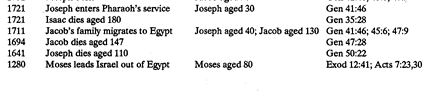
Joseph lived for at least another fifty years after the death of his father (22; cf. 41:46; 45:6; 47:28). Like his father he saw his family grow, and he died with the same assurance that his descendants would inhabit the promised land. As an expression of that faith, he left instructions that when the covenant people moved to Canaan they take his remains with them (23-26; cf. Heb 11:22). His faith was not disappointed (Exod 13:19; Josh 24:32).
APPENDIX A
APPENDIX B
Exodus
As with Genesis, Exodus takes its name from the Septuagint (abbreviated as LXX), the first Greek translation of the Old Testament. The name means 'a going out', and refers to the central event of the book, Israel's escape from Egypt.
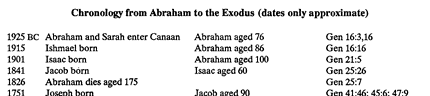
The Genesis story concluded with the family of Jacob (Israel) firmly settled in Egypt. Exodus takes up the story approximately four hundred years later (Gen 15:13-14; Exod 12:41), by which time the descendants of Israel had multiplied till they were a nation in their own right, even though still in Egypt. The book shows how God delivered his people from slavery in Egypt, led them to Mount Sinai, and there formally confirmed the covenant made with Abraham, so that Israel might become in reality a people who would belong to and live for God. God then gave the people, through Moses, the principles by which they were to live and the religious order which they were to maintain if they were to enjoy the blessings of the covenant.
Revelation of God's character
Apart from its value in recording the historical facts on which Israel's national and religious life was built, Exodus is important in revealing much of the character of the one who was Israel's God. Above all, he was a God who redeems. The people of Israel were always to remember him as the one who brought them 'out of the land of Egypt, out of the house of bondage' (Exod 6:3-8; 20:2).
Israelites were to see their history not just as a collection of stories, but as a revelation to them of who God was, how he operated, and what he expected from them. God was involved in every aspect of Israel's life: victories were his saving acts, disasters were his judgments. The preservation and growth of the nation was God's doing (Exod 1:21; 14:21-22,31; 32:35). Israel's God was holy, which meant that the people also had to be holy. They were to be set apart for God and were to keep his commandments (Exod 19:5).
Yet this God, who was different from and separate from his sinful creatures (Exod 19:12-13), also wanted to dwell among them (Exod 25:8; 33:14). The one whose holiness and justice required the punishment of the sinner (Exod 32:33) was the same one who graciously provided the way whereby repentant sinners could come to him, have their sins forgiven and be brought into living fellowship with the holy God (Exod 29:10-14; 34:6-7).
1:1-4:31 Preparation of Moses 5:1-15:21 Deliverance from Egypt 15:22-18:27 Journey to Sinai 19:1-24:18 Making of the covenant 25:1-31:18 The tabernacle and the priesthood 32:1-34:35 Covenant broken and renewed 35:1-40:38 Construction of the tabernacle
1:1-4:31 PREPARATION OF MOSES
Egypt's oppression of Israel (1:1-22)
The small community of Israelites who first settled in Egypt were all members of one family, the family of Jacob, and their early days were ones of happiness and prosperity (Gen 46:1-7; 47:11-12). God had promised they would grow into a nation, and over the following centuries they increased in numbers and influence till they dominated the whole of the north-east corner of Egypt (1:1-7; cf. Gen 13:16; 17:2; 47:27).
By this time the Egyptian rulers no longer showed friendship to the Israelites (or Hebrews, as the Egyptians called them). Pharaoh feared that if an enemy invaded from the north-east, the Israelites might join them, so he decided to act. He took control of the Israelites and forced them into slavery, using them to build fortified cities where he could keep supplies for his army (8-14). Pharaoh also tried to control the Hebrews' population growth by introducing a policy of child slaughter. But his plan failed, largely because of the courage of the Hebrew midwives, who feared God more than they feared him. Through it all God was at work, preserving his people according to his covenant promise (15-22).
Preparation of Moses (2:1-25)
Moses was the person God chose to save his people and lead them out of Egypt. He was born of godly Hebrew parents, who no doubt taught him that the true and living God was the only legitimate object of human worship, and this God had chosen Israel to be his people. At the same time Moses grew up in the Egyptian palace, where he was trained in the best learning and culture available at that time (2:1-10; see Acts 7:22; Heb 11:23).
By the time he was forty years of age, Moses believed that God had chosen him to deliver Israel from oppression in Egypt. But when in a burst of anger he killed an Egyptian who was beating a Hebrew, he showed that he was not yet ready for the task God had for him. Neither were his people ready to recognize him as their deliverer. To save his life Moses fled Egypt, and in so doing he rejected, willingly and decisively, his Egyptian status (11-15; see Acts 7:23-29; Heb 11:24-25).
Midian, the place to which Moses escaped, was a semi-desert region to the east, believed to be somewhere in the Sinai peninsular. (The Midianites were descended from Abraham through one of his lesser wives, Keturah, and so were distant relatives of the Hebrews; Gen 25:2-4.) Moses lived for many years in the house of a Midianite chief, Jethro (also known as Reuel), whose daughter Moses married. Here Moses no doubt learnt much about desert life and tribal administration, experience that later proved useful in his leadership of Israel on the journey to Canaan (16-22).
For forty years Moses remained in Midian (Acts 7:30). During this time the Hebrews back in Egypt were suffering increasingly cruel persecution, but at the same time God was preparing Moses to save them. God was teaching Moses those qualities of discipline, toughness, obedience and trust that were necessary if Moses was to rescue God's people from slavery in Egypt and bring them safely to their new homeland (23-25).
God calls Moses (3:1-12)
While Moses was minding sheep at Mount Sinai (also called Mount Horeb, after the range in which it was situated), the unseen God, who for eighty years had silently guided his life, made himself known to him. The revelation of God in the burning bush showed that though this God was unapproachably holy, he could dwell among earthly things without destroying them (3:1-6).
God was now going to use Moses to deliver his people from bondage in Egypt and bring them into a new homeland in Canaan. Moses was hesitant when he saw the task that lay ahead, but God assured him of divine help. Once Moses had led the Israelites out of Egypt and brought them to Mount Sinai, he would know with assurance that Israel would conquer all enemies and possess the promised land (7-12).
The God of Israel (3:13-22)
If Moses was to present himself to the people of Israel as the one who would lead them out of Egypt, he would need to convince them that he knew God's purposes for them. But he doubted whether they would understand, since they did not know the character of him whom they vaguely called the God of their ancestors. In asking God for help in explaining his purposes to them, Moses was wanting to know not simply the name of God, but the character of the God who owned that name (13).
On certain occasions when God gave a fresh revelation of himself, he revealed a new title for himself that summarized the revelation in one or two words. The name that God announced to Moses on this occasion was 'I am'.
The name 'I am' and the few words of divine explanation that accompanied it were deliberately mysterious, for God's concern was not to satisfy curiosity, but to make himself known to those who wished to know him. His name indicated a character that would be revealed in the triumphant events to come. The eternal, unchangeable, ever-present, ever-active God would prove himself to be always dependable and completely able to meet every need of his people. He would be whatever he would choose to prove himself to be in the varied circumstances Israel would meet (14-17).
Although Moses would eventually be accepted by the Israelites, he would meet only stubbornness in the Egyptian king. He would have an early demonstration of the character of his opponent in Pharaoh's refusal to allow the Israelites' reasonable request to offer sacrifices in a place that was not offensive to the
Egyptians (cf. 8:26-27). So great would be the display of God's power in overcoming such stubbornness, that the Egyptians would gladly give their riches to the Israelites (a debt they owed after so many years of slave labour) in order to be rid of them (18-22; see 12:33-36).
The name of God
Israel's ancestors knew God as 'the LORD', Yahweh (or Jehovah) (Gen 2:4; 12:1; 26:2; 28:21; 49:18), but the name meant little to the Israelites of Moses' time. God's revelation to Moses in the 'I am' statement of Exodus 3:14 was an explanation of what the name Yahweh should have meant to God's people.
In the Hebrew language the word translated 'I am' is related to the name Yahweh. Originally, Hebrew was written with consonants only, and the readers put in the vowels as they read. It is believed that 'Yahweh' is the correct pronunciation of the word YHWH (the name of Israel's God), though absolute certainty is not possible, as there are no Hebrew records old enough to preserve the original pronunciation. By the time it had become the practice to add the vowels in written Hebrew, the Jews no longer spoke the name YHWH. They claimed this showed their reverence for the holy name of God, but for many it was more a superstition. Whatever the reason, the practice developed that when Jews read the Scriptures, instead of speaking the word YHWH, they substituted the word adonai, meaning 'lord' or 'master'.
When the Hebrew Bible added vowels to the consonants for the first time (about 300 BC), it put the vowels of adonai to the consonants YHWH. This produced a new word, Jehovah, though Jews continued to substitute adonai for YHWH when speaking. Translators of English versions of the Bible usually avoid the pronunciation problem by using the expression 'the LORD' (in capital letters) as the substitute for YHWH.
God gives his power to Moses (4:1-17)
In reply to Moses' further complaints that the people of Israel would not believe God had sent him, God enabled Moses to perform three startling signs. The Israelites had no doubt seen magicians in Egypt and such signs would impress them. But they would see that what Moses demonstrated was more than mere magic (4:1-9).
At times Moses himself showed a tendency towards the same disbelief as he suspected in his fellow Israelites. Whether his claim to be unskilled in speech was true or not, his attitude showed a lack of faith. He was merely making excuses and this displeased God. The outcome of his complaint was that God appointed his older brother Aaron to be his spokesman (10-17).
Moses returns to Egypt (4:18-31)
After meeting God, Moses returned to Jethro and then set out with his wife and sons for Egypt. God warned Moses of the stubbornness he could expect to meet in Pharaoh and of the disaster this would bring upon the Egyptian people (18-23). However, Moses could hardly instruct Israel to obey God when he himself had neglected the first requirement of the covenant, the circumcision of his son (cf. Gen. 17:10,14). God sent Moses a near-fatal illness or accident to awaken him to his responsibilities. As Moses was unable to perform the operation, his wife did so instead. Consequently, she saved Moses' life and so received her husband back when she thought she had lost him for ever (24-26).
Aaron came to meet Moses at Horeb and the two then moved on to Egypt. As Moses expected, the Israelites were unbelieving at first, but they changed their minds when they saw the divinely directed signs (27-31).
The hardening of Pharaoh's heart
In considering the biblical language concerning the hardening of Pharaoh's heart, we must bear in mind that to the godly Hebrew, God was the first cause of everything. Language that to us seems strange would not appear strange to the writer of this story. He would see no inconsistency in saying that God hardened Pharaoh's heart, that Pharaoh hardened his own heart, or that Pharaoh's heart was hardened. They were different ways of saying the same thing.
Certainly, we must not imagine that God hardened Pharaoh's heart against his will, then punished him for having hardness of heart. Before Moses had returned to Egypt, Pharaoh's heart was filled with pride and rebellion against the God of Israel. This was clearly shown in his treatment of the Israelites, and was confirmed by his challenge to God when Moses first met him (5:1-2). His heart was already hardened by his own choice. He was determined to resist God at all costs, in spite of repeated opportunities to reverse this attitude (7:13; 8:32). By confirming Pharaoh in this hardness, God showed both the greatness of Pharaoh's sin and the justice with which it was punished (9:12; cf. Rom 9:14-18).
5:1-15:21 DELIVERANCE FROM EGYPT
Moses' first meeting with Pharaoh (5:1-6:27)
In the eyes of the Israelites, Moses' first meeting with Pharaoh was a disaster. Pharaoh had no fear of Yahweh and no concern for Yahweh's people. In fact, when Moses asked to take his people into the wilderness to offer sacrifices to Yahweh, Pharaoh responded by accusing the Israelites of laziness and making their work harder (5:1-14). This not only increased the suffering of the Israelites but also caused them to turn against Moses. Their great deliverer had done nothing but add to their troubles (15-21)!
Moses was bitterly disappointed at what was happening. It seemed to him that God had failed to keep his promise. In desperation he turned to God and was reassured (22-6:1).
God told Moses that the full significance of his character as Yahweh, the Saviour and Redeemer of his covenant people, would now be revealed to these oppressed slaves in a way that the great men of former times had never seen. Those men, Israel's ancestors, knew that God was the Almighty, the one who created and controls all things and who is fully able to fulfil all his promises; but they had never experienced his character as the covenant Redeemer, the one who would save them from slavery according to the promise given to Abraham (Gen 15:13-14).
In the days of the ancestors, the nation Israel did not exist; it was but a promise of something future. As a result the significance of Yahweh as Saviour-Redeemer had gradually been forgotten. But now the full significance of that name would be dramatically revealed. The Israelites would learn not just the name of their God, but the character indicated by that name. Yahweh was a God of redemption (2-8).
When Moses tried to explain all this to the disheartened Israelites, they were not interested enough to listen. This in turn caused Moses to become disheartened, but God strengthened and encouraged him (913).
A selective genealogy shows how God had been working through Israel's history to produce Moses and Aaron at this time. They were prepared and appointed by him to carry out his work of delivering Israel from Egypt. The two men belonged to the tribe of Levi (14-27).
Forecast of coming judgment (6:28-7:13)
Before Moses approached Pharaoh to give him a final opportunity to release Israel, God reminded Moses that not just Pharaoh but the whole Egyptian nation was under the threat of judgment. People and king alike were stubbornly opposed to Yahweh and were devoted followers of Yahweh's enemies, the Egyptian gods (6:28-7:7; cf. 9:27; 12:12).
These were gods of nature and were therefore connected with the river Nile, on which Egypt depended entirely for its water and for the fertile soil washed down at flood time each year. According to the Egyptians' belief, their gods brought them fruitfulness and prosperity. The plagues that God sent were therefore a judgment on these gods, bringing devastation to the Nile valley and creating widespread ruin and disease. Because these plagues had a religious significance, the Bible calls them 'signs' (see 10:2).
God gave Pharaoh one last chance to release the Israelites before the plagues began. But when his magicians used their skills to imitate the miracle performed by Moses and Aaron, Pharaoh arrogantly dismissed the Israelite leaders (8-13).
Nine plagues (7:14-10:29)
The timing, intensity and extent of these plagues show clearly that they were sent by God. It also seems fairly clear that God used the physical characteristics of the Nile valley to produce them.
When the first plague struck, it polluted all the water in the Nile and in the irrigation canals and reservoirs connected with it, resulting in all the fish dying. As the dead fish floated to the banks they would force the frogs out of the water, thereby producing the second plague. Egypt's magicians were able to copy Moses in these two plagues, though in view of the abundance of red water and frogs, their achievements were hardly impressive. They would have helped Pharaoh more by removing the plagues.
God alone was in control, and Moses proved this to Pharaoh by removing the plagues at the time he had announced (7:14-8:15).
As God intensified his display of power in the successive plagues, the Egyptian magicians were forced to admit defeat. They saw that Moses and Aaron were not just a couple of sorcerers or magicians who could foresee events then perform tricks to make it appear they had produced the events. This was the direct activity of God, and the protection of Israel through the plagues confirmed the fact. The favourable breeding conditions created by the first two plagues may have been the causes God used to produce successive plagues of gnats and flies (8:16-32).
With piles of dead frogs rotting in the sun and swarms of flies spreading the germs, there was soon a deadly plague of cattle disease throughout the land (Israel's cattle excepted). This was followed by an outbreak of painful skin diseases among the Egyptian people (9:1-12).
Before he announced the seventh plague, God reminded Pharaoh of his mercy towards him in the previous plagues. God could have destroyed him and his people in one mighty plague, but instead he sent these lesser plagues, each time giving Pharaoh an opportunity to repent. The longer Pharaoh delayed, the greater would be his downfall, and the greater would be God's glory when he finally overthrew him. God gave good warning before the coming destruction by hail and lightning, so that people could escape the judgment if they wished. Many of Pharaoh's courtiers, fearful of Israel's God, heeded Moses' warnings and so were not affected by the disaster (9:13-35).
A clear division now existed among Pharaoh's courtiers. Some stubbornly supported Pharaoh but others tried to persuade him to release the Israelites. Pharaoh offered Moses a compromise that was unacceptable and disaster struck again. Only the flax and barley had been destroyed in the seventh plague. The wheat, which grew up later in the season, was now destroyed by locusts in the eighth plague (10:120).
The ninth plague was probably a dust storm so intense that the sun was blotted out and the land left as dark as night. So thick was the dust that the darkness could literally be felt. Pharaoh would still not release the Israelites unconditionally. Moses saw that the time for reasoning with Pharaoh had come to an end (10:21-29).
Final plague announced (11:1-10)
Although God gave Pharaoh full warning of the final plague, he stated no time. However, the Israelites had to make preparation for departure from Egypt, for this plague would bring more than judgment on Egypt; it would bring redemption for God's people (11:1-3; for v. 2-3 see notes on 3:21-22). The plague, some form of physical affliction, would prove fatal to the firstborn of people and animals throughout Egypt. It would fulfil the warning given earlier to Pharaoh (4-10; see 4:22-23).
The Passover (12:1-36)
Until now the Israelites had escaped the judgment of the plagues without having to do anything, but now their safety depended on their carrying out God's commands. Redemption involves faith and obedience.
Each family would be delivered from judgment only by killing a sacrificial animal as substitute for it, and sprinkling the animal's blood on the door of the house where the family lived. The sprinkled blood indicated to those outside that a substitutionary sacrifice had been made; the life of an animal had been taken instead of the life of the firstborn. The Lord's executioner would then 'pass over' that house and no one inside would be killed.
The Passover feast that followed was to be prepared with a minimum of delay. For this reason, the animal was not to be cut up or boiled, but roasted whole over an open fire, and the bread was to be baked without yeast (leaven) to save time waiting for it to rise. The meal was to be simple and the people were to eat it in haste, fully dressed ready for their departure in the morning. They were not to save any of the uneaten meat for the next day, possibly to avoid spoiling, and possibly to prevent people from keeping it as a sort of magic charm. The simplicity and solemnity of the meal no doubt kept them from any feelings of self-glory (12:1-14).
For the next week the people would have no time to bake their bread leavened. They therefore had to carry their dough and baking pans with them, baking as they went. Throughout its future history, Israel was never to forget its hasty departure from Egypt. A symbolic re-enactment of the Passover along with a Feast of Unleavened Bread was to be held as an annual festival, to remind the people of Israel of their deliverance from bondage (15-36; cf. Mark 14:1).
The Israelites leave Egypt (12:37-51)
Approximately 430 years after Jacob entered Egypt with his family, his nation of descendants departed (cf. Gen 15:13; 46:6-7). A sizable group of non-Israelite people, including Egyptians and others who had intermarried or mingled with the Israelites, went with them (37-42). The Israelites were not to send these people back, but neither were they to lessen God's requirements for joining in religious festivals simply to suit these foreigners. Rather they were to encourage the foreigners to carry out the covenant requirements and join with them as worshippers of Yahweh, the only true God (43-51).
Dedication of the firstborn (13:1-16)
Since God had spared the firstborn of Israel's people and animals in the Passover judgment, these rightly belonged to him. The people were to acknowledge this by dedicating, or setting apart, their firstborn to God in an act of thankful worship (13:1-2; see also v. 15). This act also symbolized the consecration (or dedication) of the entire redeemed nation to God, since Israel as a whole was God's firstborn (see 4:22). The people were reminded again to keep the Feast of Passover and Unleavened Bread, for the event that the feast commemorated was the reason for the dedication of the firstborn (3-10).
Animals considered ceremonially clean, such as sheep and cattle, were dedicated to God by means of sacrifice. Animals considered ceremonially unclean and therefore unfit to be offered as sacrifices, such as donkeys, had to be redeemed. That is, they had to be bought back from God, and this was done by the payment of a clean animal in the place of the unclean. If an animal was not redeemed, it had to be destroyed. Human sacrifice, however, was forbidden. Instead the parents ceremonially presented their firstborn to God, and then redeemed the child by a payment of money (11-16; cf. Num 18:15-16).
Note: The instruction in 13:9,16, which speaks of the necessity for true religion in one's inner life and outward behaviour, is in figurative language that Jews of later generations understood literally. This resulted in the creation of phylacteries. These were small boxes containing strips of cloth on which people wrote selected teachings from the law of God. The Jews usually wore phylacteries on their arms or foreheads (see Matt 23:5).
Final triumph over Egypt (13:17-14:31)
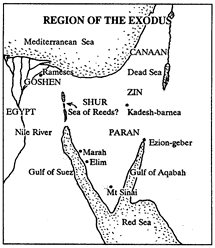
When they left Egypt, the Israelites did not go by way of the Mediterranean coast, as this was well defended by the Egyptians and war would certainly have resulted. Instead they went east towards the Red Sea (17-18). (A literal translation for the name of this stretch of water is Sea of Reeds. It was not the 200 kilometre wide sea that we today call the Red Sea, but probably an extension of the Red Sea's northwestern arm, the Gulf of Suez. It seems to have been a large shallow expanse of water near the line of the present-day Suez Canal.)
Guided by the symbols of God's presence, the Israelites headed for Canaan. They took with them the embalmed body of Joseph, in accordance with Joseph's earlier request whereby he expressed his faith that one day his people would return to the promised land (19-22; cf. Gen 50:25; Heb 11:22).
The Israelites, by contrast, showed no faith at all when they found they had been led into a dead end. With an impassable stretch of water in front of them, Egyptian soldiers in pursuit behind them, and difficult country on both sides, escape seemed impossible (14:1-12). Moses, however, saw that God was in control. God had drawn Pharaoh out, and now he would be glorified in a final demonstration of power that would overthrow Egypt and bring complete deliverance to his people (13-18).
By nightfall the Egyptians had almost caught up to the Israelites, but the fiery cloud that symbolized God's presence came between the two, and so prevented the Egyptians from advancing farther (19-20). The Israelites received further assistance from the wind, which blew at gale force all night and dried up enough of the sea to form a passage for them to cross to the other side. Just before daybreak, when all the Israelites had crossed over, the Egyptians tried to follow. But by then the wind had dropped and the sea waters began to return to normal, bringing firstly confusion, then panic, and finally destruction to the Egyptian chariot force (21-29). God's intervention had defeated the enemy and at the same time humbled Israel to a new attitude of faith and reverence (30-31).
Moses' victory song (15:1-21)
The song that Moses and the people sang was more than just a song of rejoicing over a fallen enemy. It was above all a song of praise to God, whose character the people had come to know better in the events of their deliverance from Egypt. He was a God of power who saved his people and overthrew their enemies, a God of terrible majesty and holiness who so directed the forces of nature that arrogant, rebellious people were destroyed (15:1-10). Yahweh executed his judgment on Egypt's gods and proved to his people that he was the only God. Moreover, he was their covenant Redeemer, and was faithful to his promises (11-13; cf. 6:6; 12:12).
In addition the victory gave Israel confidence for the future. As God overthrew mighty Egypt, so he would overthrow less powerful nations that Israel would meet on the journey ahead. Having redeemed his people from bondage, God would surely bring them into the land he had promised them (14-18). Miriam then led the women in a victory celebration of music, dancing and singing (19-21).
15:22-18:27 JOURNEY TO SINAI
Complaints about water (15:22-27)
Having spent all their lives in Egypt, the Israelite people were not prepared for the hardships of life in the barren wilderness regions. Their joyous feelings of faith, so confidently displayed in their song of victory at the Red Sea, did not last long. When, after three days thirsty travel, they found that the only water available was undrinkable, they complained bitterly (22-24).
God had to teach the people that his presence among them did not mean they would be free of the problems of daily living. Nevertheless, if they lived each day in obedience to him, he would help them survive in the desert amid hardship and disease. He could teach them bushcraft so that undrinkable water could be made drinkable; or he could guide their journeyings so that they came to places where good water was available (25-27).
Complaints about food (16:1-36)
The people soon forgot God's goodness to them in giving them water, and complained against him again. This time their complaint was that they had no food (16:1-3). Once more God lovingly gave his people what they needed. From this time on till they entered Canaan, their regular food would be a flakelike substance that they had never seen before. They called the food manna (meaning 'What is it?'), because they did not know what else to call it (4; see v. 15).
God supplied the manna every morning and the people had to eat it that day. The only exceptions concerned the Sabbath, their weekly day of rest. On Saturday mornings God gave no manna, but on Fridays he gave two days supply, half of which the people kept for use on Saturday. The manna spoiled quickly, so the people preserved the extra amount for Saturday by baking or boiling it beforehand (5-7; see v. 23). The night before the first supply of manna, God gave the people additional food in the form of an abundance of birds which, apparently being tired after a long flight, were easily caught and cooked for supper (8-13). Concerning the collection and distribution of the manna in the morning, Moses gave instructions to ensure that no one had either too much or too little (14-18).
Through the command that prohibited keeping the manna overnight, God gave his people the opportunity to prove their obedience. Through the promise that ensured rest on the Sabbath because of the double supply of manna each Friday, God presented them with a way to demonstrate their faith. But in both matters they failed (19-30).
Moses was commanded to put part of the manna in a jar and keep it as a memorial of how God fed his people in the wilderness. The jar was later placed in the ark of the covenant together with Aaron's rod and the stone tablets on which the law was written (31-36; see Heb 9:4).
Events at Rephidim (17:1-16)
When the people arrived at Rephidim and found no water, they again complained against God and against Moses. Once more Moses prayed for them and once more God miraculously provided. The names by which the place became known, Massah and Meribah, reminded the people of how they 'tested' God (Massah) and 'argued with' Moses (Meribah) (17:1-7).
The Amalekites, a race of wild desert nomads descended from Esau (see Gen 36:12,16), saw the migration of the Israelites to their region as a threat to their security. They attacked Israel but, again in response to Moses' prayer, God gave Israel a notable victory (8-13). Israel could expect further trouble from the Amalekites in the future. For the benefit of future leaders, Moses recorded that God would fight for Israel until Amalek was entirely wiped out (14-16; cf. Deut 25:17-19; 1 Sam 15:2-23; 1 Chron 4:4143).
On looking back over the weeks since Israel left the Red Sea, we can see how God proved that he could meet all his people's needs. He had preserved them through all dangers and hardships, whether from thirst, disease, hunger or war.
Organizing the administration (18:1-27)
As the Israelites approached Sinai, Moses' wife and children joined him. (He had apparently sent them back to Midian for safety during the time of his conflict with Pharaoh.) With them came Moses' father-in-law Jethro, now a believer in the God of Israel (18:1-12).
Moses had a heavy responsibility in leading the people and dealing with their troubles, and Jethro soon saw that it was wearing him out. Up till then, the people brought all their disputes to Moses, and they accepted his decisions as the laws of God. Jethro suggested that the time had come for a more organized system of administration, with responsible men appointed to assist Moses. These could look after the simple everyday cases, leaving only the more difficult cases for Moses. This would relieve the pressure on Moses and at the same time benefit the people, for they too were becoming worn out because of the long delays in waiting for cases to be heard (13-23). Moses saw the worth of Jethro's advice and put it into practice. Meanwhile Jethro returned home (24-27).
Now that others were to assist Moses in judging the people, a set of laws became necessary. The judges needed some recognized standard if they were to give fair judgments. God therefore gave ten commandments (Chapter 20) as the basic principles that were to underlie the whole law. These were probably the principles that Moses had used as his unwritten standard all the time. The miscellaneous laws that follow (Chapters 21-23, known as the Book of the Covenant) were based on these principles. They were probably taken from cases that Moses had already judged and were now confirmed as being acceptable laws for the future.
19:1-24:18 MAKING OF THE COVENANT
Israel at Mount Sinai (19:1-25)
The arrival of the people at Mount Sinai marked the fulfilment of the promise God made to Moses on the occasion of the burning bush (see 3:12). The journey from Egypt took three months and was accomplished solely by God's power and care. Long before the nation of Israel existed, God chose it to be his people and he confirmed this choice in a covenant made with Abraham. He then guided the history of Abraham's descendants to bring his covenant promises to fulfilment (see Gen 12:2; 15:7-21; Exod 2:24; 4:22; 6:6-8; 15:13). (For the meaning of 'covenant' see note on Genesis 9:8-17.) The blessings of this covenant meant that the people of Israel were to belong to God and, as priests, worship and serve him. As God's chosen people, Israel was to represent him to the nations of the world (19:1-6).
Although the covenant was established solely by God's grace, the covenant's central blessing of communion with God could become a reality only as the people were holy in life and devoted to him; and this could be so only as they understood God's requirements and were obedient to them. The people acknowledged this and solemnly pledged themselves to carry out God's commands. Thus, although the covenant originated in divine grace and was not conditional upon human works (see Gal 3:17-18), the people were still required to keep their part of the covenant if they were to enjoy its blessings (7-9).
Before receiving the detailed requirements of the covenant, the people were reminded of the holiness of the God who initiated the covenant. So holy was he that the people had to carry out symbolic acts of cleansing over the next two days before they were allowed even to look on the mountain while God was speaking there with Moses. A boundary was drawn around the mountain to emphasize the distance between this holy God and his sinful people (10-15). The people were then given a brief view of the awesome power of the one to whom they had submitted themselves. He was not be treated lightly. Any, except those specially invited, who crossed the boundary around the mountain, whether out of idle curiosity or misguided zeal, would be struck with certain death (16-25).
Basic principles of the covenant (20:1-17)
The form of the covenant God made with Israel followed a pattern that was common in the ancient world when an overlord made a covenant with his subjects. God introduced himself to his people by declaring his name and status as Yahweh the sovereign Lord, and recounting to his people what he had graciously done for them. He reminded them that their God was living and active, and that the words they were about to hear were a revelation direct from him (20:1-2).
After the introduction came the basic covenant obligations, summarized in ten easily remembered commandments. These were not laws in the legal sense, for they carried no penalties. Rather they were the principles on which the nation's laws would be built and by which the nation should live.
The first three commandments were concerned mainly with attitudes to God. He alone was the true God; there was room for no other (3). No image of any kind was to be an object of worship, whether used as a symbol of the true God or as the representation of some other (false) god. God would act in righteous judgment against those who rebelled in this way, and against those of succeeding generations who followed the bad example of their ancestors. The sins of one generation would affect the next. But to those who remained faithful, God would prove himself faithful (4-6).
Yahweh's people were not to misuse his name, either in swearing to a statement that was not true or in swearing to a vow that was not kept. They were also to be careful not to use his name irreverently, such as when cursing in anger (7; cf. Lev 24:16).
In the fourth commandment God showed that people could combine an attitude of reverence towards him with an attitude of care for their own needs. The weekly Sabbath encouraged people to worship God, since the day was set apart to him as holy, but at the same time it benefited them by making sure they had adequate rest from their regular work (8-11).
The remaining six commandments dealt with people's duties in the community. They were to be faithful to their family responsibilities, and in doing so would help towards a healthy stable society and ensure for themselves a long and happy life. They were to act with love and consideration towards others by refraining from murder, maintaining purity in sexual relationships, respecting other people's rights to their possessions, refusing to make false accusations, and avoiding the desire for anything belonging to another person (12-17).
Correct attitudes in worship (20:18-26)
Moses was satisfied when he saw that the people, having witnessed the frightening events connected with God's coming to Mount Sinai, were suitably humbled. They became aware of their shortcomings and at the same time developed a greater fear of God (18-21).
People were to show a similarly humble attitude when they built altars at places of God's special revelation (e.g. 17:14-16). Because Israel was a wandering people, such altars were not to be permanent; because Israel was a sinful people, the altars were not to be lavish. They were to consist of simply a mound of earth or a heap of loose rocks, depending on which material was available in the region. The altars were not to be so high that they required steps, in order to avoid any immodesty that might occur if people lifted up their robes while climbing the steps (22-26; cf. 28:42-43).
Characteristics of Hebrew laws
Hebrew laws were mainly of two kinds. The first kind we have met in the Ten Commandments. These were absolute standards, usually in the negative (e.g. 'You shall not steal'). The second kind, which we shall meet repeatedly in the next three chapters, consisted of laws that probably resulted from cases where Moses or his assistants had given judgments, and those judgments now became standards for use in future cases (e.g. 'If a man borrows anything from his neighbour, and it is hurt or dies . . . he shall make full restitution'). Laws of the first kind may be considered basic principles; those of the second kind, the application of those principles to specific circumstances.
When reading the Hebrew law code, we should remember that it was designed to suit the cultural and social habits of the time. It's purpose was to maintain order and administer justice among a people whose way of life was already established. For example, it did not immediately outlaw slavery, for the social, economic and political order of the age was so constructed that slavery could not be instantly abolished. But Hebrew law introduced attitudes of consideration for the welfare of others that were unknown in most other ancient cultures, and so began the process that eventually brought an end to slavery.
Hebrew law was in some ways similar to other law codes of the ancient world, but it also had some important differences. A fundamental requirement was that the punishment had to fit the crime. There was not the brutality found in some ancient nations, where punishments were out of all proportion to the crime (21:22-25; Deut 25:3). Also, justice was the same for everyone, regardless of status. Laws did not favour the upper classes, but guaranteed a fair hearing for all (23:3,6; Lev 19:15).
In particular the Hebrew law code protected the rights of the defenceless and disadvantaged, such as the poor (23:6), foreigners (23:9), widows and orphans (22:22), debtors who sold themselves into slavery (21:1-11) and even those who were born slaves (23:12).
The basic reason for these differences was no doubt that the Hebrew law came from God, a fact that is stated repeatedly. Legal, moral and religious matters were not separated as in some law codes, for in the community of God's people all areas of life were relevant to each other. The people viewed everything in the light of their understanding of God and their relation to him.
Laws concerning slavery (21:1-11)
Among the Hebrews a slave had rights. Any person, man or woman, who became the slave of another Hebrew, could not be held as a slave for more than six years (21:1-2; Deut 15:12). If a man took his wife with him into slavery, he also took her with him when he was released. If he was unmarried when he became a slave, then later was given a wife by his master, he did not take his wife and children with him when released. They remained with the master. However, if he chose to continue working for the master, he could keep his wife and family (3-6).
The case of a female slave who had become a wife or concubine of the master was different. She was not freed after six years like other slaves, but neither could her master sell her to a foreigner if he no longer wanted her. She had to be bought either by her parents or by some other close relative. If no one bought her, the husband-master had to continue to look after her in accordance with her rights as his wife. If the husband failed to do this, he had to free her without payment (7-11).
Concerning violence and injury (21:12-27)
Death was the penalty for wilful murder, violence to parents and kidnapping for slavery. Israelite law did not allow the widespread ancient practice of a murderer trying to escape punishment by clinging to the horns of the altar and pleading for mercy. But cases of manslaughter were different. When the Israelites settled in their new homeland, they were to appoint certain places as cities of refuge, where a person guilty of manslaughter could find safety (12-17; Num 35:9-15; Deut 19:1-6).
A person had to pay compensation for injuries done to others, the amount paid depending on the nature of the injury and the loss or inconvenience it caused (18-19). A master could not treat a slave brutally and could not beat him to death. If he did, he was punished. If there was no proof that the slave's death was the result of the beating, the master was not punished; but neither could he replace the slave. He had to bear the cost of the loss (20-21).
The basic principle of justice was 'an eye for an eye and a tooth for a tooth'; that is, the punishment had to fit the crime. A heavy penalty was required for a major offence, a light penalty for a minor offence. This principle also restricted vengeance, as people often take revenge far in excess of the wrong done to them (22-25). If a slave suffered serious injury through cruel treatment, he was compensated by being freed unconditionally (26-27).
Jesus, in his reference to 'an eye for an eye and a tooth for a tooth' (see Matthew 5:38-42), did not contradict the principle of fair punishment for wrongdoing, a principle that is a basic element in civil government. Jesus was not laying down laws for civil administrators as was the case with Moses, but was reminding his disciples that they must not always stand on their rights. In personal relationships they must be guided by a spirit of forgiveness, self-denial and active love towards the offender. The spirit ruling in the hearts of Christians is not the same as that which rules in the code of legal justice.
Injuries caused by animals (21:28-36)
Laws were laid down both to protect and to punish the owners of animals that injured or killed people. In determining how much the owner was at fault and what compensation he should pay, the main consideration was how much he could be held responsible for control of the animal. If the person killed by the animal was a slave, compensation was paid to the master, since he owned the slave. But the slave was acknowledged as a human being, not treated as a mere 'thing', and the animal that killed him was destroyed as in the case of an animal that killed a free person. This destruction of the animal was a recognition of the sanctity of human life (28-32).
The principles for assessing responsibility and compensation for injury to animals were similar to those outlined above for injury to people. All parties received fair treatment (33-36).
Laws about repayment (22:1-17)
A convicted thief had to return stolen goods and pay a fine in the form of an additional compensation to the owner. The more serious the crime, the heavier the fine. If the thief could not make the payment, he himself became the payment by becoming the slave of the one whose goods he had stolen. It was not lawful to kill a thief caught in the act, unless at night, when self-defence could make such action excusable. Normally the thief was to be captured and brought before the judges (22:1-4).
Compensation had to be made for damage caused by cattle or fire (5-6). A person who had goods left in his care could become the centre of a dispute if those goods were lost or damaged. If he could satisfy the judges, either through making a statement on oath or by producing evidence, that he was not responsible, he was not required to pay compensation. But if a suspicion of dishonesty existed, or if two parties claimed possession of the same thing, the judges had some means of deciding who was wrong (715).
When a man, through misbehaviour, caused a young woman to lose her virginity, he had to pay compensation to the woman's father. This payment was required whether the father allowed the man to marry his daughter or not, because the father now had no chance of obtaining the bride price he could normally expect for a virgin daughter (16-17).
Miscellaneous matters (22:18-23:19)
Israelite law prohibited pagan customs and religious practices that threatened the nation's spiritual life. The penalty for such offences was usually death (18-20). The Israelite people were to remember their own bitter experiences in Egypt and show mercy to the disadvantaged. The law against charging interest on a loan was designed to encourage the rich to help the poor instead of exploiting them (21-27). (For the contrast between lending that is greedy exploitation and lending that is a legitimate investment see Luke 6:34; 19:23.) Being part of a nation dedicated to God, the people were to be respectful and generous towards him, and keep themselves pure from all uncleanness (28-31).
Officials had to administer strict justice at all times. They were not to favour either the rich or the poor, nor were they to allow popular opinion to influence justice. Yet to follow strictly the letter of the law was not enough. People were to be kind to others, even to enemies and foreigners. They were also to be kind to animals (23:1-9).
Every seventh year the people had to rest the land from farming. Any produce that grew of itself during that year was to be left for the poor. God would give extra produce in the sixth year so that there would be no shortage the following year. Every seventh day was to be a rest day for all, masters, workers and animals (10-13; see Lev 25:18-22).
There were three main festivals each year that at least all male adults were to attend. The first of these was Passover-Unleavened Bread, which commemorated the deliverance from Egypt. The second was Pentecost-Harvest Firstfruits, which was celebrated fifty days later and marked the end of the wheat harvest. The third was Tabernacles-Ingathering (GNB: Festival of Shelters), which came at the end of the agricultural year (14-17; for details see Lev 23:1-44).