
Part 32
as non-Christians do, and must not give the sinful nature any chance to do its evil work. They must live in the victory of Christ, with behaviour that reflects his character (11-14).
The use of Christian liberty (14:1-15:13)
Although Christians are free from religious rules and regulations such as those found in Moses' law, some have difficulty living with such freedom. Because their faith is not strong, they have their own laws which they feel bound to keep. Other Christians should accept such people warmly into their fellowship and not argue with them about personal opinions (14:1).
Some of the Jewish Christians in the church in Rome had grown little in their faith and still kept old Jewish food laws, but stronger Christians ate any food at all. Paul warns the stronger Christians not to look down on their weaker fellows, and warns the weaker ones not to criticize those who feel free to eat anything. Christians are servants of the Lord, and he is able to uphold them even when their fellow Christians might think they will fall (2-4).
In addition to keeping food laws, some Jewish Christians observed special holy days. The principle of the individual's responsibility to Christ again applies. Both strong and weak Christians recognize Christ's lordship in such matters, and all should make up their minds about what they believe is right for them in the circumstances (5-6). Christians live not to please themselves but to please Christ, who bought them for himself through his death and resurrection. They are answerable to him for all their actions (7-9). Christ the Lord is the one who will judge his servants. Those servants have no need to judge each other (10-12).
It is better that all Christians, instead of judging each other, make sure they do not damage others by causing them to do wrong. Things that are harmless to some people are sinful to others (13-14). Weaker believers may feel that a certain action is wrong, but if they see stronger believers doing it and they follow their example, they sin against their conscience. The liberty of the stronger believers therefore becomes a cause of sin. It leads weaker believers to do what they feel is wrong, and this in turn could bring ruin to their Christian lives (15-16). The important things in the Christian life are not food and drink, but the things that bring about peace and upbuilding (17-19).
Happy indeed are Christians of strong faith whose consciences are not in bondage to laws and rules concerning matters of lesser importance. But in certain circumstances they should refuse to exercise the freedom that their consciences allow, so that their actions do not spoil the work of God in the lives of others (20-23).
The strong must have a sympathetic understanding of the weak, and not act to please only themselves. Christ is the perfect example of one who always acted out of consideration for others, no matter what it cost him (15:1-3). Through the Scriptures, as well as through the example of Christ, God encourages Christians to live in unity with one another (4-6).
Christ received all and served all, whether strong or weak, Jew or Gentile, and Christians must do the same (7-9). Jewish Christians should be thankful for Christ's faithfulness in fulfilling the promises given to Israel. Gentile Christians should be thankful for his mercy in extending salvation to them (10-12). Both should rejoice together in the hope, joy and peace that God gives through the Holy Spirit (13; cf. 14:17).
15:14-16:27 PLANS, GREETINGS AND FAREWELL
Mission to Gentiles and Jews (15:14-33)
Paul has not written to the Roman believers because he doubts their ability to understand or teach the truth. He has written because he wants to give them added assurance in the principles of the gospel that they have already received. This is because, as apostle to the Gentiles, he wishes that the work among the Gentiles everywhere, including Rome, be acceptable to God (14-16). Paul has good reason to be pleased as he thinks of his mission among the Gentiles, though his emphasis is not on what he has done but on what God has done through him (17-19a). He has preached the gospel among the Gentiles from Jerusalem to Illyricum (a region north-west of Greece), mainly in places where it has not been preached previously (19b-21).
This concern to make the gospel known in the unevangelized regions is the reason why Paul has not yet visited Rome (22). Now that he has finished his work in Greece, he feels free at last to go to Italy. From Rome he wants to move farther west and preach the gospel in other unevangelized areas, even as far as Spain (23-24). First, however, he is going to deliver a gift of money from the Gentile churches to the poor Christians in Jerusalem. He believes it is fitting that the Gentiles make this offering to their Jewish brothers, since they owe their salvation to the Jews in the first place (25-27). He will then come to Rome and go on to Spain (28-29).
Paul requests the prayers of the Christians in Rome on two specific matters. He asks them to pray firstly that the unbelieving Jews will not attack him, and secondly that the Jerusalem church will accept him gladly (30-33).
Personal greetings (16:1-27)
The person who took this letter to Rome was Phoebe, a woman well respected for her work in the church in Cenchreae, one of the seaports of Corinth. She had been a tireless helper of Paul and many others, and Paul asks the Roman Christians to welcome her (16:1-2).
Paul then sends greetings to a number of people whom he had met during his missionary travels and who now lived in Rome. First among these were Paul's loyal friends, Aquila and Priscilla. They were now back in Rome after a time in Ephesus, and a local church met in their home (3-5; cf. Acts 18:1-3,1819,24-26). Little is known of most of the others whom Paul mentions. There were both Jews and Gentiles, and some, such as Junias and Andronicus, were prominent Christian workers (6-11). Paul mentions a number of women who were well known for their Christian service, and one in particular who had been a great personal help to him (12-13). He sends greetings to two additional households where groups of Christians met (14-16).
A warning is given to beware of those who, by their smooth talk, mislead people and create divisions within the fellowship (17-18). Wise leaders, however, will not be deceived by flattering speech. They will recognize Satan at work among them, and will triumph over him (19-20).
Various people who were with Paul in Corinth join him in sending greetings. These include his secretary Tertius and his host Gaius (21-24; cf. 1 Cor 1:14). Paul finishes his letter with a further note of praise to God, who through the old order prepared the way for the new life that the Christian gospel has now made possible. It is a life that people of all nations can have through faith and obedience (25-27).
1 Corinthians
Corinth was a prosperous manufacturing centre and seaport in Achaia, the southern part of Greece. A main road connected it with important towns to the north, and sea routes connected it with other ports to the east, west and south. The city was so well known for its immorality and vice that people commonly referred to a person of loose morals as one who 'behaved like a Corinthian'. Yet Paul planted a church there, and it soon became one of the most colourful and troublesome churches of them all.
Origins of the church
Paul established the church in Corinth during his second missionary journey. He began his work there by preaching in the synagogue each Sabbath and working during the week at his trade of tentmaking (Acts 18:1-4). When the Jews forced him out of the synagogue, he went and preached in the house next door. An early convert was Crispus, the ruler of the synagogue. Another convert, Sosthenes, seems to have been the ruler of the synagogue who succeeded Crispus (Acts 18:6-8,17; 1 Cor 1:1,14). Many of the converts, however, came not from the synagogue, where there was a strong moral influence, but from the ungodly community at large, where immorality, vice and idolatry were widespread (1 Cor 1:26-27; 6:911,15; 10:25-28).
During the eighteen months that Paul stayed in Corinth he suffered constant opposition, but by the time he left he had firmly established the Corinthian church (Acts 18:9-12,18). Among the churches that grew up in the region round about was one at Cenchreae, Corinth's port area to the east (Acts 18:18; Rom 16:1).
Letters to Corinth
Some time after returning to his home church in Syria, Paul set out on his third missionary journey (Acts 18:22-23). He moved quickly to Ephesus on the west coast of Asia Minor, and stayed there for most of the next three years (Acts 19:1; 20:31). While in Ephesus, Paul heard that some of the Corinthians had moral difficulties, so he wrote them a letter to pass on helpful advice. The letter has not been preserved (1 Cor 5:9). Paul heard also that some Corinthians had developed strong feelings against him personally, and even doubted whether he was really an apostle. He therefore sent Timothy and Erastus to Corinth (by way of Macedonia) to deal with problems in the church (Acts 19:22; 1 Cor 4:8-13,18-21).
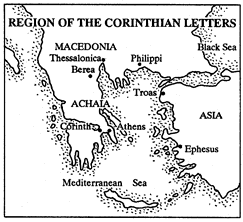
In the meantime some believers from Corinth arrived in Ephesus. They gave Paul the disturbing news that factions had developed in the Corinthian church because people foolishly made favourites of various teachers (1 Cor 1:10-13). Paul heard also of a serious case of sexual immorality in the church (1 Cor 5:1) and of disputes between Christians in the public law courts (1 Cor 6:1). Soon after this, a group of representatives from Corinth arrived with a letter setting out questions on a variety of issues that needed attention (1 Cor 7:1; 16:17). Among these issues were such things as marriage, food offered to idols, the use of spiritual gifts in the church, the coming resurrection and the collection for the poor Christians in Jerusalem (1 Cor 7:1; 8:1; 12:1; 15:1; 16:1).
With all these matters before him, Paul wrote the lengthy letter that we know as 1 Corinthians. It seems that he sent the letter to Corinth direct by boat, as he expected it to arrive there before Timothy (1 Cor 16:8-10).
1:1-9 Introduction 1:10-4:21 Divisions in the church 5:1-6:20 Moral faults in the church 7:1-40 Christian marriage 8:1-11:1 Food offered to idols 11:2-34 Order in public worship 12:1-14:40 Spiritual gifts in the church 15:1-58 The doctrine of the resurrection 16:1-24 Final instructions
1:1-9 INTRODUCTION
The Corinthian Christians may be in a sad spiritual condition, but Paul addresses them as God's holy people. They are sanctified in Christ Jesus, having a holy standing before God because of what Christ has done for them. Paul now wants to instruct them so that they might live as God's holy people should (1:13).
Through the grace of God, the Corinthian Christians have been specially enriched in such gifts as knowledge and speech, enabling them to understand and explain the truth (4-5). In fact, they are not lacking in any spiritual gift. They have plenty of ability, but they must allow God to control it, if they want to be blameless when they stand before Christ (6-9).
1:10-4:21 DIVISIONS IN THE CHURCH
No blame upon Paul (1:10-17)
Paul urges the Corinthian Christians to stop their quarrelling and be united (10). He has heard from people from Chloe's household that the Christians have divided themselves into factions. Some called themselves Paul's party. Others, who were impressed with the preaching of Apollos (cf. Acts 18:24-28), formed the Apollos party. Perhaps it was the Jewish group who claimed to be followers of Peter; while a fourth group claimed even higher leadership than that of Paul, Apollos or Peter, by calling themselves Christ's special party (11-12).
With a few ironical questions, Paul rebukes all the parties. He is thankful that he baptized only a few people in Corinth, namely, Crispus, Gaius and the household of Stephanus (cf. Acts 18:8; Rom 16:23; 1 Cor 16:15,17). No one can now accuse him of baptizing people with the aim of gaining a personal following. Nor did he make any attempt to attract followers by displaying much wisdom or ability in his preaching. His sole aim was to preach the gospel of Christ crucified, so that people might be saved (1317).
Contrasts in wisdom and power (1:18-31)
The whole idea of salvation from sin through the death of Christ on the cross appears foolish to the average person, but to believers it shows God's power (18). God's way has always been different from that of people in general. Whether they be Greek philosophers, Jewish scholars, or just ordinary citizens, people always think their schemes and ideas are full of wisdom; but God shows them up to be foolish (1920).
God, in his wisdom, saves people by way of the cross and no other. People think this way to be foolish, but no matter how much they try to know God through their own wisdom, they will never succeed (21).
The Jews want miraculous signs to prove that Jesus is the mighty Messiah, but instead they see him crucified. To them this shows not power, but weakness. A crucified Messiah is in their view a stumbling block, something that they will not believe and that consequently prevents them from receiving God's salvation. As for the Greeks, they consider the whole idea to be mere foolishness. But to believers, Jews or Greeks, it gives proof of God's power and wisdom. The cross alone can conquer sin and bring salvation (22-24). That which the Greeks think to be foolish proves to be wiser than anything people can imagine. That which the Jews think to be weak proves to be stronger than anything people can accomplish (25).
As further proof that this salvation has nothing to do with human wisdom, Paul reminds the Corinthians of the types of people who make up their church. Few of them hold important positions in the academic, political or social world. Yet God has taken them and made them his people, to prove that he does not accept anyone on the basis of natural ability or worldly status. No one can therefore boast before him (26-29). Wisdom is found not in personal achievement but in what God has done in Christ. Through Christ, God has put believers right with himself, declared them to be holy and set them free from the power of sin. Everything centres in Christ. Believers boast in him alone (30-31).
Worldly and spiritual wisdom (2:1-16)
Paul reminds the Corinthians that when he was among them he did not try to impress them with any great show of learning. He preached the plain gospel without trying to make it attractive to any one class of people (2:1-2). During his time in Corinth, Paul had been physically weak and lacked his usual boldness. As a result his preaching was not at all impressive. Yet this was no great disappointment to him, because he wanted his converts to stand in the power of God, not to become attached to the preacher because they were impressed with his style (3-5).
Although the gospel does not depend on human wisdom, that is no reason to look down on it as though it were something inferior. Christianity has a superiority and dignity of its own. It is based on the wisdom of God, which makes all human wisdom appear weak and insignificant (6-7). Lack of this wisdom was what caused people to crucify Christ. On the other hand, those who have this wisdom enter into blessings that the ordinary people of the world cannot understand. The only ones who can understand these things are those who have the Spirit of God (8-10).
Just as a person's own spirit, and no one else's, knows what is going on inside that person, so the Spirit of God, and no one else, knows what is going on within God. Therefore, only those who have the Spirit of God can know the mind of God (11-12). They receive instructions from God through the Spirit and pass on these instructions to others, not by means of worldly wisdom, but by the same Spirit. Those who receive the instruction will likewise have understanding through the work of that Spirit within them (13).
Ordinary people of the world reject the things of God as foolish, because they do not have his Spirit and therefore do not have the means of understanding them (14). Those who have the Spirit of God are able to form judgments on all things, because now that Christ has changed their thinking, they see things from Christ's point of view. But those without God's Spirit are unable to form judgments on things of the Spirit, and therefore are unable to judge spiritual issues in the lives of believers (15-16).
Lack of spiritual growth (3:1-9)
When Paul was in Corinth a year or two previously, he could not speak to the believers as spiritual people (such as those just described in 2:6-16), because they were then little different from ordinary, natural people of the world. They were babes in Christ and Paul treated them so. He did not find fault with them then, because one expects new converts to be like that; but he does find fault with them now, because they are still like that (3:1-2). They are like people 'of the flesh', people whose lives are characterized by the old sinful nature. They are like the people of the world that Paul has just been describing in Chapter 2. Their behaviour is not according to the wisdom of God, but according to the wisdom of the world. Their quarrels and divisions are proof of this (3-4).
Some of the Corinthians were exalting Paul, others exalting Apollos. But Paul and Apollos are not in opposition; they are working together. The work of God in Corinth is likened to a field in which Paul did the planting, and Apollos the watering. Though the two have different functions, both are necessary, but neither of them can make the plants grow. Only God can do that (5-6). Those who plant will not see as much fruit as those who water or those who reap. For that reason the reward does not depend on the fruit people see but on the work they faithfully carry out (7-9).
Christian activity tested (3:10-23)
The Corinthians are likened also to a building. Paul laid the foundation, and now other Christians, in particular the teachers, have the responsibility to build on that foundation (10). There is only one foundation, Jesus Christ, but the structure may be built in all sorts of ways. People may build something of lasting worth through using valuable materials (gold, silver and precious stones), or they may build something of no lasting worth through using cheap materials (wood, grass and straw) (11-12).
When each building is tested by fire on the day of judgment, quality alone will count. The valuable materials will survive, but the cheap materials will be burnt up. Christians who have made the effort to grow spiritually have built something that is permanent and worthy of reward. Christians who have lived like ordinary people of the world have built nothing permanent and in the end will lose everything. They will be like those who run from a burning house but lose all their possessions. They themselves are saved, but they have nothing to show after a lifetime of activity (13-15).
Since the church (that is, the group of believers as a whole) is the temple of God, it must be holy. God will act in judgment on those who destroy his temple through division or makes it unclean through sinful behaviour (16-17).
Paul returns to the subject of wisdom, because the divisions in Corinth were caused by those who considered themselves wise in following favourite teachers. The humblest believer can understand the things of God, whereas those who are wise by the world's standards cannot. Heavenly wisdom is foolishness to the ordinary people of the world; but the wisdom of the world is foolishness to God (1820). By attaching themselves to one particular teacher, the Corinthians are not increasing God's blessing, but limiting it. All teachers are theirs, not just one. Since they belong to Christ, their blessings are unlimited (21-23).
Attitudes towards God's servants (4:1-21)
What the Corinthians think about the servants of God is not important. God is the one who gives his servants their work and they are responsible to him, not to anyone else (4:1-2). Paul is not concerned about the Corinthians' assessment of him. Even Paul himself cannot properly assess how true his service has been. He may not know of any failure in his service, but that does not mean he is faultless. The only judgment that matters is the one that will take place at Christ's return, when he examines motives and reveals hidden attitudes (3-5).
The Corinthians should stop boasting of their attachment to certain teachers, as if it shows that they are superior to others. All these teachers are but God's gift to them; and no one has cause for personal boasting about something that, after all, was freely given by another (6-7).
Paul shows his disappointment concerning the unchristian attitudes at Corinth by the irony he uses in comparing the pride of the Corinthians with the humiliation of the apostles. The Corinthians thought they were superior Christians. Paul says that he wishes they were, so that he and other apostles might be built up in the faith through them! It appears that the apostles, instead of being the leaders of the Christian community, are the most backward. They are openly humiliated, as people about to be killed in the public arena. They are fools, weak and despised, so different from the mighty Corinthians (8-10)! On account of his service for Jesus Christ, Paul suffers constant hardship and unceasing persecution. He is cursed, beaten and treated as the lowest of the low, yet he always returns good for evil (11-13).
In writing to the Corinthians like this, Paul is warning them as a father might warn his children (1415). He wants them to remember the things he taught them, by word and example, when he was among them. The teaching he gave them is no different from what he gives in other churches, and to remind them of it he is sending Timothy to them. Perhaps Timothy can help the church back to the right path (16-17).
This sending of Timothy does not mean that Paul himself is afraid to go, as his opponents claim. He will not hesitate to go if he believes it is God's will; and he will soon find out whether these opponents are as good as they say they are. He urges them to change their ways quickly, otherwise his visit will be marked by unpleasant discipline instead of enjoyable fellowship (18-21).
5:1-6:20 MORAL FAULTS IN THE CHURCH
Adulterous living (5:1-13)
Paul now turns to the second difficulty that had been reported. In this case the sin was one that would hardly be found even among the pagan Greeks. A man was living in adultery with his father's wife, probably a minor wife or the wife of a remarriage. Yet the Christians did nothing about the shameful situation. They thought they were so advanced in their Christian experience that there was no need to restrict the freedom of the church members. Actually, says Paul, they should have put the guilty man out of the church (5:1-2).
Though absent from Corinth, Paul quickly takes action. He urges the church to meet and deal with the matter immediately. The man must be put out of the community of God's people; that is, out of the sphere where God rules, into the sphere where Satan rules. The purpose of this is 'that the flesh might be destroyed', an expression that may refer to physical disease or even death. Such severe physical punishment in this world may be necessary so that the man's spirit may be saved in the next (3-5; cf. Mark 9:43-47; Acts 5:1-11; 1 Cor 11:30).
The Corinthians are foolish to think themselves so free from rules and laws that they can allow such things to go on. By keeping such sin among them they are really helping to destroy their own church. Sin spreads throughout a group of people in the same way as yeast spreads throughout a lump of dough (6). The Christian life is likened to a festival such as Israel's Feast of Passover and Unleavened Bread. Just as Israelites cleaned all leaven out of their houses at the time of the Passover, so the Corinthians should clean the leaven of sin out of their church, because Christ the true Passover Lamb has already been sacrificed (7-8).
Paul had given instructions on these matters in his previous letter, but the Corinthians misunderstood them. He did not mean that Christians should have nothing to do with the sinful people they meet in the world, because that would require them to leave the world altogether (9-10). Rather he meant that Christians are to have no close fellowship with those who say they are believers but deny it by their shameful behaviour (11).
Christians are not required to judge non-Christians for their sins, but they are required to take action against sin in the church. In the case in question, this will mean the removal of the guilty person from the church fellowship (12-13).
Lawsuits before heathen judges (6:1-11)
If a dispute arises between believers, it should be settled within the church, not in a public court of law (6:1). If Christians are to share in the future judgment of the world, surely they can judge everyday affairs of the present life (2-3). The Corinthians boast of their wisdom, yet not one among them is wise enough to decide the matter. Instead they shame themselves by taking Christian problems to non Christian people for a decision (4-6).
Christians should not have lawsuits at all. They should be willing to suffer ill-treatment, as Jesus taught, but at Corinth they attack and cheat each other (7-8). They behave like the sorts of people they were before they became Christians. God has declared them righteous and holy through Jesus Christ, and therefore they should be righteous and holy in their conduct (9-11).
Unlawful sexual freedom (6:12-20)
The Corinthians had claimed that since they were not in bondage to laws they could do as they wished. Paul replies that this is not so. Not all things are helpful, and some may lead a person into a new kind of bondage (12).
Certain people at Corinth even claimed that just as the stomach needs a constant supply of food to satisfy it, so the body needs unrestrained sexual pleasure for its satisfaction. Paul denies this. The body's main purpose is not concerned with sex but with God. It is the means by which people serve God and by which God functions in people (13). It is a body which, in the case of believers, will one day be raised in glory and which is already united spiritually with Christ. Such a body should not, therefore, be united physically with a prostitute (14-17).
Immorality is a sin against the dignity of one's own body. For the believer it is a sin also against the temple of God, for the believer's body is the Holy Spirit's dwelling place. Whatever is not fitting in God's temple is not fitting in the body of the believer (18-19). God has bought believers out of the slavery of sin at the price of Christ's life. They belong to him, not to themselves, and therefore they must use their bodies for his glory (20).
7:1-40 CHRISTIAN MARRIAGE
Responsibilities of marriage (7:1-9)
Paul now deals with those matters concerning which the Corinthians had written. One problem concerned marriage. Some thought it more honourable and a sign of moral purity not to marry. Paul replies that marriage is honourable. It is the normal course God has set out for humankind, though there are exceptions. In some cases it may be better not to marry (he will explain this in a moment), but because Corinth is an immoral city and full of temptation, it is better to marry (7:1-2).
In marriage both husband and wife have their rights, but they also have obligations to each other (34). In some circumstances husband and wife may feel such a need for increased prayer that they agree not to have sexual relations for a time. But this is exceptional. They should resume normal marital relations as soon as possible, so that Satan does not rouse their natural passions wrongly (5).
There are no rules that Paul can lay down to demand that people marry or not marry, though his personal preference is that they be like him and remain single. In this way they can serve God without the added responsibilities of marriage. He realizes, however, that everything depends on how God has prepared each person (6-7).
Concerning the unmarried and widows, Paul recommends that they remain single. But if in their single state they are only going to burn with sexual desire, they would do better to marry (8-9).
Problems of separation and divorce (7:10-16)
Paul claims the authority of Christ in reminding the Corinthians that a Christian husband and wife should not separate (cf. Matt 19:6). If they do, every effort should be made to bring them together again. If this fails, they must remain single (10-11).
In the examples that follow, Paul knows of no command of Christ to quote, though he believes his advice carries the authority of the Spirit of God (see v. 40). He considers situations other than those of normal Christian marriage, such as when one partner of a pagan marriage subsequently becomes a Christian. (He does not consider the possibility of believers marrying unbelievers. They will marry only 'in the Lord'; see v. 39.) If the unbelieving partner is willing to continue the marriage, the believer should also be willing (12-13).
Such a union between a believer and an unbeliever is not considered unclean, neither is any child born of that union. God considers it a holy and lawful union on account of the believing partner (14). If, however, the unbeliever is unwilling to continue the marriage and departs, the believer must let it be so and consider the marriage at an end. There is no point in forcing the unbeliever to continue the marriage in the hope of making the person a Christian if such action is only going to cause quarrels. Marriage, after all, is intended to bring peace and contentment. Nevertheless, there will be cases where the unbelieving partner comes to believe in Christ (15-16).
The life of God's choosing (7:17-24)
God wants Christians to be patient and to accept that their current state of affairs is God's will for them for the present (17). Believers may have differences in marital, national or social status, but this should make no difference to their spiritual well-being. The important issue is obedience to God's commandments. Even those who are slaves should feel no inferiority, but if they can be free, so much the better (18-21).
More important than status in the world is status before God. Believers who are slaves in the world have the liberty of God's children, while believers who are free citizens in the world are God's slaves. God has freed all believers from the bondage of sin. They should not allow themselves to be enslaved again through following the ways of an ungodly society (22-24).
The unmarried and widows (7:25-40)
Corinth was at that time troubled by some unusually distressing circumstances. In view of this, Paul felt it best for people, whether married or single, to stay as they were for the time being. The responsibilities that go with marriage and a family would only add to the current difficulties (25-28). This was not the time for people to create further problems for themselves by making changes or becoming more involved in worldly affairs. It was a time to remain steady and remember the importance of eternal things (29-31). The married, being anxious for their families, must spend time looking after them. The unmarried, being free from such worry, can give themselves fully to the service of God (32-35).
In spite of his advice against marriage during the current crisis, Paul realized that Corinth's low moral standards provided many temptations for single men and women. If such people were anxious to marry, they should not be prevented, in case the temptations proved too much for them (36). But for those without such strong passions, it would be better in the present circumstances not to marry (37). Both courses of action are right, but the latter is preferable (38).
Finally, Paul has some advice for widows. Christian marriage is a lifelong union, broken only by death. When the husband dies, the widow is free to remarry, provided she marries another believer. Here again Paul's advice is that, because of the current crisis, she would be wiser to remain single (39-40). (See 1 Timothy 5:14 for Paul's advice to widows in different circumstances.)
8:1-11:1 FOOD OFFERED TO IDOLS
In Corinth, as in other places, temples were not just religious centres but also popular eating places. This created problems for the Christians, because the food was usually first offered to idols and Christians were not sure whether they should eat it. A related problem concerned food they bought in the market, for it also may have been first offered to idols. These are the issues Paul now deals with, though they lead him to the more important issue of the exercise of Christian rights and freedom.
Different attitudes to idols (8:1-13)
The Corinthians boast that they have knowledge on the subject of idols. They know what is false and what is not. But, Paul answers, knowledge is not enough. It is never perfect and can lead to pride. Christians must be guided in their behaviour by love, not merely by knowledge. Only in this way can they grow to full maturity (8:1-3).
Some Christians, claiming to have strong faith, have no hesitation in eating food offered to idols. To them an idol is only a piece of wood or stone. Paul agrees that an idol is a lifeless object (though he will explain the meaning of making offerings to these lifeless objects in 10:19-20). He knows also that, although there are countless gods and deities, there is only one God and only one Lord (4-6).
Not all Christians, however, feel that an idol is only a piece of wood or stone. Some have for many years worshipped idols as if they were real. Their consciences are easily affected by anything connected with idolatry, and they feel it would be wrong to eat what has been offered to idols (7).
Though the kind of food people eat may not be important (8), that is no reason for those of 'strong' faith to eat in the temple feasts. If people of 'weak' faith follow their example and eat also, they sin, through doing what their consciences tell them is wrong (9-10). God then holds the 'strong' Christians responsible for doing lasting damage to the lives of the 'weak'. They sin against their fellow believers and against Christ (11-12). Paul's own attitude in such matters is that he would rather not eat at all than eat and harm another (13).
Paul's example (9:1-23)
The principle Paul has been teaching in the previous chapter is that no matter what rights Christians may have, they should be willing to sacrifice those rights for the sake of others. He now demonstrates that principle with a number of personal examples.
Paul has the same rights as others, and in fact more, since he is an apostle. But he does not always exercise his rights. Some people have misunderstood this and think that he is not an apostle at all. Paul points out that the existence of the Corinthian church is living proof of his faithfulness in his apostolic ministry (9:1-2). Paul and Barnabas (and their dependants) have as much right as the other apostles to travel and live at the expense of the church. But they deny themselves this privilege and work to earn their living, so as not to be a financial burden to the church (3-6).
Any workers, whether they be soldiers, farmers, shepherds or servants of the church, have the right to receive their living from their occupation (7). This principle is found also in the law of Moses. An animal that treads out the grain is allowed to eat the grain as it works (8-9; Deut 25:4). Just as the farmer expects to get something to eat from the results of his work, so does Paul. He has worked hard in spiritual service in Corinth and he is entitled to a material reward (10-11).
Others have received gifts from the Corinthians, but Paul has not. He has not exercised his right, because he does not want financial matters to be a hindrance to the work in Corinth (12). Both the law of Moses and the teachings of Jesus show that Paul has the right to claim financial support from the Corinthians (13-14; Deut 18:1; Luke 10:7-8).
In writing like this, Paul is not trying to shame the Corinthians into giving him financial assistance. He prefers things as they are. He preaches the gospel, not because he wants to boast about his work or income, but because he is compelled to preach (15-16). Whether he preaches willingly or not, he must preach. His reward is the knowledge that he preaches freely without claiming his rights to financial support (17-18). He sacrifices his own freedom in order to serve others, his aim being to get people to listen to his message and accept it (19). This applies to all whom he helps, whether Jews, Gentiles, or 'weak' Christians such as those who will not eat food offered to idols (20-23).
Necessity for self-discipline (9:24-27)
Christianity is a life of effort. As runners in a race strain to the full to win the prize, so Christians should put all their effort into whatever they do (24). As athletes undergo strict training in their pursuit of victory, so Christians should deny themselves lawful pleasures and foods in order to be more useful for God (25). Paul has purpose and effort in all that he does. He is like a runner who heads for the finishing line or a boxer who aims to land his punches. He spares no effort in his program of vigorous selfdiscipline to keep himself fit. He realizes that it is dangerously easy to warn and instruct others, then fall into sin himself and be disqualified (26-27).
Warnings from history (10:1-13)
Paul now illustrates from the history of Israel that some might join in the fellowship of God's people, but miss out on the final blessing. All the people of Israel were united with Moses in their escape from Egypt and all enjoyed God's provision through none other than Christ himself. But only two, Joshua and Caleb, entered into the blessing of the promised land. The rest disobeyed and were punished (10:1-5). (For relevant stories see Exod 13:17-22; 14:21-29; 16:1-17:7; Num 13:1-14:35.)
These events should be a warning to Christians. Idolatry can give a feeling of self-satisfaction that results in moral laziness. This leads to the relaxing of control over sinful desires and finally to sexual immorality. This was what happened to Israel (6-8; see Exod 32:1-6; Num 25:1-9). Christians should not put God to the test by seeing how far they can go without his acting in judgment. The Israelites did and were destroyed (9; see Num 21:5-9). They complained bitterly against him and were punished (10; see Num 16:1-50).
All these things are a warning to the Christians in Corinth not to be too confident in thinking they can join in idol feasts and not be affected by them. Tests and temptations will indeed come, but there will always be a way out. There can be no excuses. They must be loyal to God (11-13).
Avoid idol feasts (10:14-22)
In view of the dangers of idolatry, there is only one wise course to take in relation to idolatrous feasts, and that is to have nothing to do with them (14-15). Those who receive bread and wine in the Lord's Supper are united with Christ in one body and spiritually share in him (16-17). Likewise in the Israelite sacrificial system those who eat the food of the sacrifices are united with the altar on which the sacrifices are offered (18). Christians cannot say, therefore, that eating food in idolatrous feasts has nothing to do with idolatry. Maybe the idol is only a piece of wood or stone, but the people who make offerings to it do not see it as such. They are, in fact, sacrificing to evil spirits (19-20).
Just as eating food at the Lord's Supper means having fellowship with the Lord, so eating food at idolatrous feasts means having fellowship with the idol, or worse, with the evil spirits behind the idol. Now that the Corinthians know the true meaning of eating food offered to idols, they must cease the practice at once, otherwise God might act against them in judgment (21-22).
Consideration of fellow believers (10:23-11:1)
Some things that are allowable are not helpful. If Christians think of others before they think of themselves, they will refrain from certain things in case others copy them and are weakened spiritually as a result (23-24).
The Corinthians should understand that the reason why they must not join in idol feasts is that eating involves fellowship with the idol and its demons. It is not that the physical properties of the food are in any way changed. Therefore, when Christians buy food at the market or eat in the house of pagan friends, they must not create unnecessary problems by asking whether the food has been offered to idols. If they do not know, it does not matter. They should eat the food and be thankful to God who gave it (25-27).
If, however, someone tells them the food has been offered to idols, they should not eat it. They do not want others to think they agree with idol worship. Christians do wrong when they use their personal liberty in a way that causes others to sin. If by eating food they harm others, their thanksgiving for the food becomes meaningless (28-30).
To summarize, Christians should be guided in their behaviour not by their knowledge of the rights they have, but by their consideration for the glory of God and the well-being of their fellows (31-32). This is the way Paul lives, and he wants the Corinthians to follow his example, just as he follows Christ's (3311:1).
11:2-34 ORDER IN PUBLIC WORSHIP
When women pray or prophesy (11:2-16)
Paul had heard from the visitors from Corinth of disorder in the public worship of the church. To start with, some of the Corinthian women were speaking in the church services without the veil over their heads. This was shameful by current social standards in that part of the world. Paul argues that Christians do not have to show their new-found freedom by rejecting the local customs of politeness and etiquette. In fact, these customs may reflect a basic God-given principle.
Although he praises the Corinthians for their steadfastness in following his teachings (2), Paul realizes that certain matters still need attention. He reminds them that the woman is under the authority of the man, just as the man is under the authority of Christ (3). The head covering may be seen as a sign of that relationship. Therefore, a man should not wear a head covering when he prays or prophesies, because he is not under any creature's authority; but a woman should, because she is under the authority of the man. To have her head uncovered is as shameful as to have it shaved bare (4-6). Woman was made from man and for man, and though she has a special status as the glory of man, she is nonetheless under his authority (7-9). The angels observe this order in the church (10).
This does not mean that the woman is inferior or that the man is superior. Neither man nor woman can exist without the other (11-12). The Corinthians can see for themselves that it is shameful for a woman to pray with her head uncovered. It is as shameful as for a man to have long hair like a woman, or a woman to have short hair like a man. The environment in which they live should tell them what is natural and what is not, and this order should be reflected in the church (13-15). Paul does not want to argue the matter further, but he reminds them that what he has just outlined is the common practice among the churches (16).
The Lord's Supper (11:17-34)
God's purpose was that the Lord's Supper should demonstrate and strengthen the unity of his people in one body (see 10:16-17), but the way the church in Corinth practised it, it produced the opposite effect. It caused Christians to break into opposing groups. The only advantage in this, Paul ironically points out, is that it enables a person to see how many good Christians there really are (17-19).
The practice in those days was that when Christians met for the Lord's Supper, all who could afford to brought along food and drink to share with the poor in a common meal. At the end they ate the Lord's Supper. The common meal was called a love feast, but at Corinth it showed little sign of love. The ceremonial meal was called the Lord's Supper, but at Corinth it was very much their own supper. The rich greedily ate their own food without sharing it with others and without even waiting for everyone to arrive. So the poor went hungry, while the rich feasted and became drunk. Paul says that those who shame themselves and the church in this way would do better to eat at home (20-22).
Paul then gives them the true meaning of the Lord's Supper, as the Lord had revealed it to him. The eating of bread and drinking of wine together is a communion with Christ, a spiritual sharing together in his body and blood (cf. 10:16). It is a fresh enjoyment of and proclamation of the benefits of his death. It is also a reminder that through his death the old era has passed and the full blessings of the new covenant have become the possession of all Christ's people (23-26).
Nobody should join in this act of communion thoughtlessly. All should examine themselves to make sure their conduct and attitude are in keeping with the Supper's meaning (27-28). If they join in it thoughtlessly, as if it were just an ordinary meal, they bring God's judgment upon themselves. Indeed, some in the church have, because of their wrong behaviour, suffered such judgment in sickness and death (29-30). Christians should examine themselves honestly to see what they are really like. If not, God may send them difficulties to bring them back from the wrong way and save them from the judgment that awaits sinners (31-32).
Therefore, Paul concludes, the Corinthians should cease their shameful rush and greed at the Lord's Supper and remember what it is for. It is not just a feast (33-34).
12:1-14:40 SPIRITUAL GIFTS IN THE CHURCH
The variety of gifts (12:1-11)
Some unusual spiritual gifts operated in the early church. One of these caused people to speak with strange sounds (commonly referred to as 'tongues') that neither they nor the hearers understood unless someone interpreted them. Some at Corinth, still influenced by attitudes from former idolatrous days, were impressed by such things and considered those who so spoke to be spiritually superior. However, the situation got out of control and people said things that were wrong, such as 'Jesus be cursed!' This shows, says Paul, that speaking in tongues is not necessarily speaking by the Holy Spirit (12:1-3).
Different gifts and different types of service do not indicate different levels of spirituality. Nor should they produce competition or jealousy, for the same triune God works through a variety of people for the spiritual development of all (4-7).
Whatever the gifts, they are all given by the Spirit of God. Some people have gifts of wisdom and knowledge (8). Others have unusual abilities, such as faith to do the apparently impossible and power to heal sickness and disease (9). Further gifts enable various people to work miracles, to speak words from God, to tell the difference between those gifts that come from the Spirit and those that do not, to speak in tongues, and to interpret tongues so that they become understandable to the hearers (10). The one God gives all these gifts, and he gives them according to his will (11).
Unity in spite of many gifts (12:12-31)
The human body is made up of many parts, all with different functions, yet there is a basic unity throughout the body. So it is in the church which is Christ's body. All believers, without distinction, are introduced into and united in that body through the baptism of the Spirit. The same Spirit dwells within each one (12-13).
Many parts make up the body, and all are necessary for its proper functioning. Those without more obvious gifts should not think there is no place for them in the church. In the body of Christ, as in the human body, each part has its own special task (14-20).
God has so designed the body that no matter how important one part may be, it cannot function properly without dependence upon all the other parts (21). People with more obvious gifts should not look down on others. Certain parts of the body may appear at first to be less important, but the body cannot do without them (22). Other parts of the body are less presentable, but they are the parts we clothe more attractively. Just as there is harmony between the various parts of the body, so there should be in the church (23-25). In addition, there should be unity. When one part of the body suffers, the whole body suffers; when one part is honoured, the whole is honoured. There is no competition (26).
It is clear, then, that all Christians are part of the body but their gifts vary widely, from the more important gifts to the less important (27-28). All gifts are necessary, but not everybody can do everything (29-30). Christians should desire the higher gifts, but there is something greater than even the highest gift that all, whether great or small, can have, and that is love. Paul will explain what he means in the next chapter (31).
Love is greater than the gifts (13:1-13)
The Corinthians were impressed with people who exercised the more spectacular gifts. Paul reminds them that no matter what gifts they have – tongues, prophecy, wisdom, knowledge, faith – if they lack love they are not merely unimportant, they are nothing (13:1-2). People may be so generous with their goods and money that in the end they themselves become poor. They may be so faithful to their duty that they sacrifice their lives. But without love they have gained nothing (3).
Paul then describes some of the qualities of love. Chief of these is that it thinks of others, not of self. Love is patient, kind, humble, forgiving, self-controlled and always thoughtful of the feelings of others. It is not boastful, bad mannered, resentful or irritable (4-5). At the same time it upholds God's standards of righteousness, always rejoicing in what is true and never in what is wrong. It is trusting and persevering, and always looks positively to the ultimate fulfilment of God's purposes (6-7).
The various gifts are temporary and imperfect, for they are limited to life in the present world. But love is permanent, and endures into the age to come (8-10). The gifts Christians exercise are likened to the changing abilities and capacities in the life of a growing child, but love is likened to the maturity of adulthood (11). In the present world Christians have only a limited understanding of eternal things. Their view of the age to come is unclear. When face to face with Christ they will know these things clearly, just as God knows them clearly (12). The important issue for Christians is not the display of their spiritual gifts, but the exercise of faith, hope, and above all, love (13).
The gift of tongues (14:1-25)
In the light of his teaching on the variety of spiritual gifts and the importance of love, Paul now considers the problem that had arisen in the Corinthian church concerning tongues. The gift is allowable, but prophecy is preferable. This is because those who speak in tongues speak to God, not to their fellow worshippers, and therefore are of spiritual help only to themselves (unless someone interprets for them). Prophets, however, speak to all and so build up the whole church (14:1-5). (GNB calls prophets 'those who proclaim God's message', since they passed on to the people the revelation that God gave specifically to them.)
It would be pointless if Paul came to the Christians in Corinth and spoke in tongues that no one understood. It would be much better to give them some revelation or teaching in their own language, so that they could learn from it and be built up spiritually (6).
Paul follows with two illustrations to emphasize the importance of speaking in a way that means something to the hearers. The purpose of playing a musical instrument is to get a tune out of it, not to make a meaningless noise. The purpose of blowing a bugle on the battlefield is to alert the soldiers to prepare for battle (7-8). Likewise with speech the purpose is to be understood. Tongues that no one understands are as useless to the hearers as a foreign language that they have never heard before (9-11). Christians should desire those gifts that are going to be of help to others in teaching them and building them up in the faith (12).
If people have the gift of tongues, they should pray also for the gift to interpret them. Their mind as well as their spirit will then benefit, because they pray and sing with understanding (13-15). They should think also of others in the church. If the hearers do not understand what the speaker is saying, they can neither benefit from it nor express their support for it (16-17). Paul is thankful to have the gift of tongues, but in the church he would rather speak in ordinary language that will instruct and strengthen the hearers (18-19).
The Corinthians' love for the spectacular shows that they are childish in their thinking. It is good to have the innocence of childhood concerning evil, but in their minds they must be mature adults (20). In one famous Old Testament event, the strange speech of the Assyrian invaders was a sign to God's unfaithful people of coming judgment. In a similar way tongues may be a warning of God's judgment to those who stubbornly refuse to trust in him (21-22a; cf. Deut 28:49; Isa 28:11-12). Prophecy, by contrast, strengthens the hearts of believers with a message from God (22b).
If those who know nothing about Christianity come into a Christian meeting where various people are speaking in different tongues, they may think that the speakers are mad. But if the speakers are prophesying, God's word may speak to the hearers and bring them to know God (23-25).
Order and upbuilding (14:26-40)
At the meetings of the Corinthian church, the Christians came prepared to take part in the service in a variety of ways. The guiding rule was that everything was to be spiritually helpful (26). But confusion arose because several spoke in different tongues at the same time, often with no interpreter. Paul says that if no interpreter is present, they must keep quiet. Even if an interpreter is present, they must speak in turn, and then no more than two or three (27-28).
Similar instructions are given to prophets. They must restrict their participation to two or three, and the hearers must examine what is said and not accept it blindly (29). The prophets must keep control of themselves and make sure that everything is orderly and of value to the hearers (30-33). The women must be orderly too. It is not their job to instruct the church or question the preacher. They can discuss their questions with their husbands at home (34-35). The Corinthians must not get the idea that there are special rules of conduct just for them (36).
Some of the Corinthians thought they had the special gift of being able to tell what was of God and what was not. Paul suggests that if this is the case, they should show it by acknowledging that what he is saying comes from God (37-38). Although they should not disallow tongues, they should positively encourage prophecy. Above all, everything must be orderly and helpful to the spiritual upbuilding of the church (39-40).
15:1-58 THE DOCTRINE OF THE RESURRECTION
The fact of Christ's resurrection (15:1-11)
Among the Corinthians were some who denied that there will be a physical resurrection of the dead. Paul points out in this chapter that the truth of the resurrection is part of the gospel which they believed and by which they are saved (15:1-2).
The gospel Paul preaches has been given him by God. It has as its basis the death, burial and resurrection of Jesus Christ (3-4). Paul then gives a list of eye witnesses to Christ's resurrection, including Peter, James the Lord's brother and many others, most of whom were still living should anyone want to question them. These eye witnesses could confirm that the resurrection of Christ was an undeniable fact (5-7).
Last of all the risen Lord appeared to Paul himself, who at the time was on the road to Damascus to arrest and imprison Christians (see Acts 9:3-6). God's choice of the fierce persecutor to be his special apostle was unnatural and unexpected. Yet through God's grace, Paul did a greater work than all the other apostles. He is careful to point out, however, that he and his fellow apostles all preached the same gospel (8-11).
A guarantee of final victory (15:12-28)
To those who claim there will be no bodily resurrection of the dead, Paul replies that if this is true it means that Christ has not been raised. In that case the gospel he preaches is not true and the believer's faith is without foundation (12-14). Furthermore, it means that the preachers of the gospel have misled their hearers. For if Christ has not been raised from the dead, he is certainly not the victorious Saviour. He has not conquered sin; sin has conquered him (15-17). Those who died believing in Christ have likewise been for ever conquered by sin and death. As for those believers still living, they are to be pitied for putting up with hardship in the hope of a better life to come if, as the doubters argue, there is no such future life (18-19).
Christ's return guarantees the resurrection of all believers. They will not merely be brought back to life, but they will enter into a new kind of life, one where death will no longer have any part. Death is the result of sin, and all who are descended from Adam will die; but all who have faith in Christ will triumph over death. This victorious resurrection of believers will take place at Christ's return (20-23).
With the final banishment of death itself, Christ will see the victory he won at the cross effectual to the last outpost of rebellion. Having established full and complete authority over everything and everyone, he will deliver up this authority to his Father (24-26). The work for which the Son willingly became subject to the Father will then be complete. Everything will be subject to him who is Lord of all (27-28).
A source of encouragement (15:29-34)
It seems that another strange practice the church in Corinth had introduced was that of baptizing people on behalf of those who had died unbaptized. Paul does not stop to discuss whether this was a desirable practice; he simply asks what meaning can it have if there is no future resurrection? If people do not believe in the resurrection but practise baptism for the dead, they are demonstrating something they do not believe in (29).
There are no doubts about the resurrection in Paul's mind. On the contrary his assurance of the resurrection and the victory it will bring encourages him amid daily trials. In Ephesus (the place from which he writes) he is daily in danger of being killed because of his faithfulness in preaching the gospel. If, however, there is no hope of a future and better life, he suffers for nothing. He would do better to forget about preaching the gospel and have a good time while he still has the opportunity (30-32).
Paul warns the Corinthians not to deceive themselves. If they mix with people who deny the resurrection, they will soon have wrong ideas about God, and this in turn will lead to wrong behaviour (33-34).
The resurrection body (15:35-58)
Some people mocked the idea of the resurrection by asking how could bodies that have decayed in the earth be raised to life again. Paul answers with an illustration. A seed dies when it is put in the ground, but this is part of the process of bringing forth new life in the form of a plant that grows up out of the ground. What grows up is different from what was buried, but in a sense it is the same thing. It is dry and dead looking when put in the ground, but fresh and beautiful when it appears as a living plant (35-37). The doubters should remember also that plant life takes many different forms. So does animal life (3839). God gives a different life, beauty and form to different things, depending on his purposes for them (40-41).
In similar manner the resurrection body is different from the body that is buried in the ground. The body that is buried is perishable, unattractive, and powerless; the body that is raised is imperishable, beautiful, and strong. Just as the present body is suited to the needs of present earthly life, so the resurrection body is suited to the needs of the spiritual life of the age to come (42-44).
Adam was the first of a race of physical, earthly people; Christ is the first of a race of spiritual, heavenly people. Adam's body was the pattern for the bodies of people in the present life; Christ's body is the pattern for the bodies of believers in the life to come (45-49). Believers will have their physical bodies of the present life changed into spiritual bodies suited for life in the heavenly kingdom (50).
The change from the physical to the spiritual will take place when Christ returns and the dead are raised. All Christians, both those who have died and those still alive, will have their physical perishable bodies changed instantly into spiritual imperishable bodies (51-53). Death will have no more power over believers. Sin, which makes death fearful and which uses the law to hold people in this state of fear, will be finally destroyed (54-57).
Believers have no reason to be hesitant or doubtful concerning the coming resurrection. Rather they will find that they have greater confidence and purpose in their Christian life and service as they understand the full meaning that the resurrection has for them (58).
16:1-24 FINAL INSTRUCTIONS
Plans for the collection (16:1-4)
For many years Paul had been concerned for the poor Christians in Jerusalem, and he was always doing his best to help them (Acts 11:27-30; Gal 2:10). During his third missionary journey he had been organizing a collection of money and goods among the Gentile churches to take to Jerusalem. He hoped that as the Jerusalem Christians saw the loving concern that the Gentile churches had for them, they would feel a greater sense of unity and fellowship with their Gentile brothers in other countries (cf. Acts 24:17; Rom 15:25-27). (Paul talks about this collection more fully in 2 Cor 8:1-9:15.)
The Corinthians were participating in this collection and had written to Paul about it. In response Paul advises them to put their offerings into the fund each Sunday, so that the money will be ready when he visits Corinth. The amount people give will depend on the amount they earn (16:1-2). The church should also choose representatives to take the money to Jerusalem, and when Paul comes to Corinth he will write letters to introduce these men to the Jerusalem church. In fact, he might even go with them (3-4).
Personal notes and farewell (16:5-24)
Paul's plan is to visit Macedonia and then move south to Corinth. He realizes that the church in Corinth needs further help, so when he comes he wants to spend some time there (5-7). He is not sure when he will make this visit, as he currently has much urgent work to do in Ephesus (8-9).
When Timothy arrives in Corinth (cf. Acts 19:22), the Christians are not to treat him with any less respect than they would Paul, for Timothy and he are doing the same work. Paul is anxious for Timothy to return to Ephesus as soon as possible, so that he might find out whether the situation in Corinth has improved (10-11). Paul tells them he has suggested that Apollos pay them another visit, but Apollos feels the time is not yet suitable (12).
Paul urges the Corinthians not to act like children any longer, but to act like responsible mature adults (13-14). Not all of them have acted immaturely. There are faithful hard-working people like those of the household of Stephanus, and the church should follow their leadership (15-16). The other two men who have come with Stephanus to seek Paul's advice are likewise ones whom the church should follow (1718).
A number of people and churches of the province of Asia join Paul in sending greetings to the Corinthians. Among these are Aquila and Priscilla, and the church in Ephesus that meets in their house (19-20; cf. Acts 18:18-19,24-26).
Finally, Paul takes the pen from his secretary to sign the letter himself (21; cf. 2 Thess 3:17). In his own handwriting he adds a warning to those who are disloyal to Christ, expresses his longing for Christ to return, and sends his love to all the believers in Corinth (22-24).
2 Corinthians
In his previous letter Paul had spoken of his plans to move from Ephesus north to Macedonia and then down to Corinth (1 Cor 16:5-7; cf. Acts 19:21). However, when Timothy returned from Corinth to Ephesus (cf. 1 Cor 16:10-11), the news that he brought was so disturbing that Paul changed his plans. The New Testament does not record Paul's travels of this period in any detail, but occasional references to them give us at least some understanding of events.
A painful visit and a severe letter
When Paul learnt that neither his lengthy letter nor Timothy's recent visit had brought any improvement in the Corinthian church, he made a trip to Corinth direct by boat. He had already warned that he would come and deal with the trouble-makers if they did not change their ways (1 Cor 4:19-21), and now he did as he had said. This was only Paul's second visit to Corinth. It gave him such distress that when he looked back on it later he referred to it as a painful visit (2 Cor 2:1; 13:2).
Though painful, the visit was only brief, but Paul hoped to visit the church again soon (2 Cor 1:1516). Within a short while news reached him in Ephesus that nothing had improved in Corinth. In fact, his recent visit only made his opponents more rebellious. Paul's immediate thought was to rush back to Corinth and deal with the rebels, but upon consideration he thought it better not to. He did not want to act hastily or do anything that he might later regret (2 Cor 1:23).
Instead Paul wrote a letter. It was a very severe letter, which challenged the church to deal with those who opposed his apostolic authority. The letter was taken to the Corinthian church by Titus, but it seems not to have been preserved (2 Cor 2:3-4; 7:8; 12:18).
Titus took the letter to Corinth direct, but he was to return via Macedonia and meet Paul in Troas. Paul meanwhile finished his work in Ephesus and moved north to Troas, but he was so anxious to get news of the Corinthians' response to his letter, that he could not bear waiting for Titus. So he left Troas and went looking for him in Macedonia (2 Cor 2:12-13; cf. Acts 20:1). Paul met Titus in Macedonia and was overjoyed at the good news Titus brought. As a result of the severe letter, the trouble-makers in Corinth had realized their error and stopped opposing Paul (2 Cor 7:5-6).
With much relief, Paul wrote yet another letter (known to us as 2 Corinthians) and sent it to Corinth with Titus and two others (2 Cor 8:16-18,22-23). In view of the recent troubles, Paul wrote at length concerning various aspects of Christian service. The final section of the letter, Chapters 10-13, is such a strong defence of Paul's apostolic authority, that some Bible scholars believe it is the severe letter that he wrote previously.
1:1-11 Introduction and encouragement 1:12-2:17 Paul explains his recent actions 3:1-6:13 True Christian service 6:14-7:16 Concerning previous correspondence 8:1-9:15 Collection for the poor in Jerusalem 10:1-13:14 Apostolic authority
1:1-11 INTRODUCTION AND ENCOURAGEMENT
Paul greets the Corinthian church, along with other Christians in Achaia, in the name of the God of all comfort (1:1-3). One reason why Christians suffer all kinds of troubles is that they may know how to sympathize with and help others who are similarly troubled. Just as they share in Christ's sufferings, so they can share in his comfort (4-5). When the Corinthians see the divine comfort Paul experiences in his sufferings, they should be encouraged to bear their own sufferings (6-7).
The troubles that Paul suffered in the province of Asia were so severe that they almost led to his death. But they also caused him to see clearly that he himself was completely helpless, and therefore he needed to trust entirely in God (8-9). This gives him the assurance that in the future God will likewise deliver him. If the believers in Corinth pray for God's protection over him in his work, they will also have good reason to give thanks when God answers their prayers (10-11).
1:12-2:17 PAUL EXPLAINS HIS RECENT ACTIONS
Reasons for changing his plans (1:12-2:4)
Certain people in Corinth had accused Paul of insincerity. According to them, Paul tried to give the impression through his conduct and his letters that he felt in a certain way, when he did not feel that way at all. Paul denies this. In all his behaviour, whether in dealing with people in general or in dealing with the Corinthians in particular, he has been sincere and straightforward. The same is true of his letterwriting. He hopes the Corinthians will believe this, so that in the coming judgment neither they nor he will feel shame on account of wrong attitudes (12-14).