
Part 35
2:1-4:16 CHURCH LEADERSHIP AND TEACHING
Conduct in church meetings (2:1-15)
Teachers of the kind Paul has described in Chapter 1 are usually narrow in their outlook and pray only for those of their own group. Christians should avoid such selfishness. They should pray for all without distinction, for God wants all to be saved (2:1-4). This salvation comes through the death of Jesus Christ. Paul rejoices that God has appointed him an apostle and teacher to make known this good news to the Gentiles (5-7).
Paul then deals with two problems likely to arise when people participate in the public activities of the church. One concerns men, and the other concerns women. A tendency in men when leading a public gathering is to talk and act in a way that displays their abilities and so wins praise from others. A tendency in women is to dress in a way that attracts attention. Paul tells men to pray in a proper manner and to remember that the purpose of prayer is to speak to God, not to gain an advantage over others. He tells women that if they want to impress people they should do so by good deeds, not by extravagant dress (8-10).
On the subject of women's modesty, Paul adds that they should demonstrate this modesty in a quiet readiness to learn. He does not consider it their job to instruct and lead the church (11-12). Paul gives these restrictions because he believes women are more easily persuaded than men. Consequently, there is a greater risk that they will believe and teach what is false. He refers to the example of Eve to support this statement, and to show that from the beginning God designed each of the sexes to have its own particular place in the arrangement of human affairs (13-14). This does not mean that women have an unimportant place in God's plan. They will find their fulfilment, their 'salvation', their own unique honour, through having children and bringing them up in the ways of Christian faith, love and holiness (15).
Elders and deacons (3:1-13)
Churches of the New Testament era were self-governing bodies that were independent of each other and under the control of local elders. Elders were also known as shepherds, overseers, guardians, leaders and bishops, but these names represent only two words in the original Greek, presbuteroi and episkopoi.
These two Greek words refer to the same office and people. For example (in the words of the RSV), in Acts 20:17 Paul sent for the elders (presbuteroi) of the Ephesian church, but in verse 28 he called them guardians (episkopoi). Likewise in Titus 1:5 he told Titus to appoint elders (presbuteroi), then in verse 7 he called them bishops (episkopoi). Elders were like shepherds over the flock. Their responsibility was to lead, rule, guide, teach and care for the church (Acts 20:28; 1 Tim 3:5; 5:17; Heb 13:17; 1 Peter 5:1-3).
Early churches also developed an order of deacons, or church helpers. (The Greek diakonos was the common word for servant or minister.) It seems that deacons looked after many of the everyday tasks in the church so that the elders had more time for prayer and teaching (Acts 6:2-4; cf. Rom 12:6-8; Phil 1:1). However, deacons were not limited to routine affairs, and some were also preachers (cf. Acts 6:5,8-10; 8:5).
Most of the New Testament churches were founded in heathen cities, where many of the converts came from a background of low moral standards. Although some of these converts may have developed spiritually, they may also have retained disorders in their marriages, families and personal habits. These disorders, in spite of otherwise good qualities, would make such people a poor example to the church should they be in leadership positions as elders or deacons.
Paul therefore gave Timothy some guidelines concerning those who might hold office in the church. The qualities he lists are not qualifications in the sense that anyone who fulfils these requirements is an elder (for such a person may not have the elder-shepherd qualities outlined above). Rather they are minimum requirements that otherwise suitable people must fulfil if the church is to recognize them as elders or deacons.
Elders should maintain a quality of personal and family life that is a good example to others in the church. Their behaviour should be blameless and they should have some ability to understand and teach the Scriptures (3:1-5). They should not be recent converts, as time is necessary for spiritual character and gift to develop. They must each have a good reputation, not only among Christians but also among those who are not Christians (6-7).
Paul gives a similar list of qualities to test the suitability of deacons, both men and women. Although he does not require deacons to have an ability to teach, he does require them to have a sound understanding of basic Christian truth. He also gives a warning against gossip, since deacons are likely to know about the personal affairs of those who give to and receive from the church's finances (8-13).
The true church; the false teachers (3:14-4:5)
Timothy is urged to remind the believers that their behaviour should reflect the character of the church of God to which they belong. That church is not like a heathen temple occupied by some lifeless god, but is the dwelling place of the living God and the upholder of his truth (14-15). This living God (in the words of an early Christian song that Paul quotes) entered the world of human existence in the person of Jesus Christ, who died, rose from death, brought salvation to the world, and returned to heaven where he reigns in glory and is worshipped unceasingly (16).
Despite the greatness of God and his salvation, some abandon their faith. They claim to be following the true teaching of God, but actually they are following the deceitful teaching of evil spirits. They have ceased to teach that right moral behaviour is the natural outcome of true faith, and as a result their consciences have become dead (4:1-2). Instead of allowing the truth of God to mould people's minds and attitudes, they try to force people to obey laws. They teach, for example, that it is wrong to marry and to eat certain foods. But this teaching directly opposes God, who gave marriage and food for people's benefit (3-5).
(The false teaching that Paul and Timothy fought against at Ephesus was an early form of Gnosticism. It was a problem that Paul had dealt with in letters he wrote a year or two previously. For further details of this teaching see introductory notes to Ephesians and Colossians.)
Dealing with the false teachers (4:6-16)
Paul makes it clear to Timothy that good teachers do not waste time arguing about silly stories, but concentrate on teaching positive Christian doctrine. This is the best answer to those who teach nonsense. By thinking and talking about the great truths of the Christian faith, teachers will build themselves up as well. They must not forget, however, to train themselves with the self-discipline that leads to spiritual fitness and lasting blessings (6-8). True servants of God persevere in all aspects of their work, whether in teaching others or in training themselves. They are assured that this will lead them to a fuller enjoyment of the salvation that God has given them (9-10).
Some older ones in the church may not be pleased to hear the younger man Timothy giving them instruction and perhaps correcting them. This is all the more reason why Timothy must make sure that he is blameless in his speech, conduct, love and faith (11-12).
God had given Timothy ability as a preacher and teacher. The elders of Timothy's home church, as well as Paul, had publicly acknowledged this by the ceremony of laying their hands on him when he first went out with Paul in the service of God (13-14; cf. 2 Tim 1:6; Acts 16:2). Nevertheless, Timothy must work hard to develop the gift God has given him. As a result of this combination of divine gift and human diligence, both God's servant and those among whom he works will enjoy salvation in its fulness (15-16).
5:1-6:21 VARIOUS KINDS OF PEOPLE IN THE CHURCH
The young, the old and the widows (5:1-16)
It may at times have been difficult for Timothy to deal with those who were older or those who were of the opposite sex. Paul therefore reminds him to be careful how he treats people, and always to show fitting courtesy and to act with moral uprightness (5:1-2).
The church must care for those of its members who are in need. But the church does not have a duty to support financially those elderly people who have children and grandchildren who can look after them. The church should support only the widows who are very poor and who have no one to whom they can turn for help except God (3-5). Other widows, who have found a means of support by turning to a life of pleasure, should be sternly warned, for they are killing their spiritual lives (6-7). Paul repeats that, wherever possible, the widows in the church should be looked after by their own families. Even unbelievers acknowledge they have a responsibility towards elderly parents (8).
Because of its limited finances, the church should limit the number of widows on its welfare list. It should include only those who are over the age of sixty, have been married only once, have promoted Christian standards in their families and households, have demonstrated the servant attitude in their manner of living and have a reputation for good deeds (9-10).
Younger widows should not be included on the church's welfare list. In past cases some have shown a tendency to remarry hastily and the results have been disastrous. Others have become gossips and busybodies. They would do better to remarry (to those who share their faith; cf. 1 Cor 7:39) and so have the responsibility of bringing up children and looking after the home (11-15). In summary, people should look for ways to provide for widows privately rather than to let them become a burden to the church (16).
Church elders and Timothy himself (5:17-25)
The church members should recognize the valuable service that the elders give and should reward them generously (17-18). Any accusation of wrongdoing against elders must be supported by witnesses.
If they are shown to be guilty, they should be rebuked publicly, since their position as leaders in the church makes their sin the more serious (19-20).
Timothy is reminded not to show favouritism nor to act hastily in appointing people to positions of leadership in the church. Others will doubt his own purity if he appoints a person who is later shown to be a wrongdoer (21-22). The reminder to Timothy to keep himself pure does not mean he must no longer drink wine, for if he takes it in reasonable amounts it may help him enjoy better health (23). But (to return to the matter of appointing officers in the church) he must remember that not all the good or all the bad in a person can be seen at first. Sooner or later, however, it will become obvious. Therefore, it is wise not to accept or reject anyone too hastily (24-25).
The slaves (6:1-2)
Slaves had equal status with others in the church (Gal 3:28), but not in the households where they worked. Paul helped to raise the status of slaves, and eventually to bring an end to slavery, by encouraging Christian slaves to work with responsibility and dignity. They were not to think of themselves as mere tools of their masters. Paul assures them that if they act in a way that is fitting for those who are God's children, they will also bring honour to the name of God (6:1). Any who work for Christian masters should work all the better. In so doing they will bring added benefit to those who are their fellow believers in Christ (2).
Trouble-makers and God's servant (6:3-16)
The teaching of the false teachers differs from that of Christ, and their conduct likewise differs. Their kind of teaching arises out of pride and creates argument, which in turn leads to suspicious thoughts and insulting talk about others. Paul knows that their real reason for setting themselves up as Christian teachers is to become rich (3-5).
Christianity does make a person rich, but not in the way the false teachers think. Christians are rich when they learn to be satisfied with what they have, and are not always wanting more (6-8). Those whose chief desire is to build up their wealth are easily led away from God. They might gain the wealth they desire, but spiritually they finish in a state of terrible poverty. Their spiritual lives become ruined, their true happiness is destroyed, and their minds are full of worries (9-10).
Paul warns Timothy to beware of these dangers, and encourages him to concentrate on developing the Christian virtues. He must not give up the struggle. When he first committed himself by a public declaration to his work, he knew that this work would require much perseverance (11-12). He is encouraged by the example of Jesus who, when he was before Pilate, made a firm declaration in spite of the suffering he knew it would bring. Timothy likewise must be faithful to the end in spite of the hardships. His assurance is that he will then share in the triumph of that great day when Jesus Christ returns (13-16).
The wealthy (6:17-21)
One danger with wealth is that when people have financial independence, they may not trust God as they should. Instead of hoarding their riches, they should use them to help others. In this way they will be investing in something far more lasting than earthly wealth. They will be building a life far more enduring than earthly life (17-19).
Paul brings his letter to a close by reminding Timothy of two of its chief points. First, Timothy must preserve and pass on the true Christian teaching. Second, he must not waste time arguing with those who have replaced this teaching with their own foolish inventions (20-21).
2 Timothy
Some time after writing 1 Timothy and Titus, Paul left Macedonia. His exact route is unknown, but two of the places he visited were Corinth in the south of Greece and Miletus on the west coast of Asia Minor (2 Tim 4:20). He also visited Troas to the north, but it seems that he must have been forced to leave Troas in a hurry, for he left behind some of his most valued possessions (2 Tim 4:13). This suggests that Troas may have been the place where he was arrested. He was then taken to Rome, and from prison he wrote his final letter, 2 Timothy.
Last words to a fellow worker
When the government authorities in Rome laid their charges against Paul, he was deserted by friends that he thought would help him. But God rescued him from violence and enabled him to proclaim the gospel to his captors (2 Tim 4:16-17). Nevertheless, Paul did not have the optimism of his first imprisonment. Instead of expecting release, he expected execution (2 Tim 4:6-8).
With time running out, Paul wrote to Timothy to give him final encouragement and make some urgent requests. Because the church in Ephesus was still troubled by false teachers, Paul encouraged Timothy to persevere in giving wholesome Christian teaching and to avoid wasting time with senseless arguments (2 Tim 1:6-8; 2:14-16,23-25; 4:2,5). He also wanted Timothy to come to Rome quickly (2 Tim 4:9).
Paul was feeling cold and lonely in prison. He missed his friends, he needed warm clothing and he wanted his books (2 Tim 4:9,13,21). He felt particularly sad that Demas, who had been with him faithfully during his first imprisonment, had now deserted him (2 Tim 4:10; cf. Col 4:14). Some Christians visited him (2 Tim 1:16-18; 4:21), but others had gone to various places in the service of God (2 Tim 4:10,12). Only Luke was able to stay with him for any length of time (2 Tim 4:11).
The two people that Paul most wanted to come and be with him in his closing days were Timothy and Mark, the two who as young men had set out with him many years earlier on his missionary journeys. Mark was probably working in Colossae, not far from Ephesus, where Timothy was at the time (2 Tim 4:9,11; cf. Col 4:10). It is not certain whether Timothy and Mark reached Rome before Paul's execution. According to ancient writings, he was executed some time during the first half of the AD 60s.
1:1-2:13 Encouragement to Timothy 2:14-4:5 An approved worker and false teachers 4:6-22 Paul's last farewell
1:1-2:13 ENCOURAGEMENT TO TIMOTHY
Need for courage and faithfulness (1:1-18)
Paul recalls the time when he left Timothy behind in Ephesus, and remembers how Timothy wept as they parted. He longs to see him again (1:1-4). No doubt the quality of Timothy's faith, which so attracted Paul to him, was largely the result of a godly upbringing by those of sincere faith (5). At the beginning of Timothy's ministry Paul had shown publicly that he believed Timothy to be divinely gifted for his work. He encourages Timothy to keep working and not to become hesitant through fear of opposition (6-7).
Far from being timid, Timothy must be bold in showing himself of one mind with Paul in standing for the truth of Jesus Christ. True, this will result in suffering, but he will willingly bear such suffering when he remembers all that God has freely done for him (8). God saves sinners and makes them his people solely by his grace, not because of anything they have done. Before the world was made, God planned to give people eternal life, but this gift becomes theirs only through Christ's victory over death on the cross (9-10).
The imprisonment Paul suffers is not because he has failed in any way, but because he has steadfastly upheld the gospel. He has carried out the work God gave him to do. Therefore, his imprisonment neither causes him shame nor weakens his confidence. He knows that God will be faithful to him and will preserve the gospel, no matter how severe the persecution (11-12). Timothy also must stand firm and, with the help of God's Spirit, uphold the message of truth that God has entrusted to him (13-14).
Paul gives Timothy two examples of commitment, one bad the other good. The bad example concerns Christians from the province of Asia who apparently deserted Paul at the time of his arrest (15). By contrast another from Asia, Onesiphorus of Ephesus, went looking for Paul, in spite of the difficulties and risks involved. Paul prays that God will reward him with blessing on his family now, and mercy in the day of judgment (16-18; cf. 4:19).
Need for endurance (2:1-13)
Like Onesiphorus, Timothy must persevere for the sake of Christ and endure hardship. He must push on vigorously with his task of passing on the truth Paul has taught him. He should do this wisely and carefully, by instructing people who are trustworthy and have the ability to teach others (2:1-2).
In dealing with the difficulties in Ephesus, Timothy must realize that he is a soldier of Jesus Christ. He must expect suffering and endure it. A soldier is not concerned with civilian affairs, but concentrates on the battle before him. In the same way Timothy must give his full attention to the task before him (34). He must have the strict self-discipline of an athlete if he is to gain the heavenly prize (5). He must have the patient hard-working attitude of a farmer if he wants to see worthwhile results from his work (6). If he thinks carefully about these matters, he will understand more fully what is involved in working for God (7).
The example of the risen Christ is a source of encouragement to Christians. Christ endured even to death, but in the end he triumphed (8). No hardship is too great when it is the means of bringing blessing to those whom God has chosen (9-10).
Through their death with Christ, believers have new life. Because God is consistent in his character, he will be faithful to his promises and reward those who are loyal to him. But the same divine consistency of character means that he will show no pleasure to those who deny him (11-13).
2:14-4:5 AN APPROVED WORKER AND FALSE TEACHERS
Teach essentials; avoid quarrels (2:14-26)
Paul repeats the advice of his previous letter that Timothy should not waste time discussing fanciful theories (cf. 1 Tim 1:3-11; 4:6-10). Christian teachers build up their hearers by presenting the truth of God clearly and honestly, not by allowing the imagination to control their preaching (14-16).
Foolish speculation and self-invented theories were what caused Hymenaeus and Philetus to depart from the faith. They denied the future resurrection of the body, apparently by asserting that the resurrection was the spiritual awakening experienced at conversion (17-18; cf. 1 Tim 1:19-20). But false teaching does not shake the firm foundation of God's truth. God protects those who belong to him, though they on their part must turn away from wrongdoing (19).
The presence of good and bad in the visible church is compared to the presence of many types of articles in a large house. Some articles are precious, but others are of little value and are unfit for honourable use (20). If believers are to be clean and fit for God's use, they must avoid sinful desires and foolish arguments, and seek instead the company of those who strive for the truly Christian virtues (2123). By wise and patient instruction, the servants of God may be able to release wrongdoers from Satan's grip and lead them into the freedom that comes from knowing God's truth (24-26).
Warning of worse to come (3:1-9)
Timothy may be surprised that such evil should appear within the community of God's people. Paul warns him that worse is to follow. When people try to keep the outward form of religion but reject its inner power, the evil within them soon shows itself in their words and actions. The more they please themselves and reject God, the more wrong they do (3:1-5).
By cunning and deceit, people who call themselves Christians will gain entrance into private homes, where they will soon find people willing to listen to them. Women especially, being on the whole more aware of personal shortcomings than men, will be easily impressed by the words of these false teachers, and just as easily misled. Desiring to know the way to a better life, they will soon become captives of their evil teachers (6-7).
These teachers are like Jannes and Jambres, the Egyptian magicians who opposed Moses. Their words and actions are an imitation of the truth, and people who are easily impressed will readily believe them. But, as with the Egyptian deceivers, their true character will in due course be exposed (8-9; cf. Exod 7:8-12).
Preach the Word constantly (3:10-4:5)
Paul refers to his own experiences to illustrate the truth that the person who whole-heartedly follows God must expect persecution. Timothy was well aware of this, even before he joined Paul in his work. In his own neighbourhood he had seen Paul suffer because of his devotion to Christ (10-12; cf. Acts 13:50; 14:5-6,19; 16:1-2). This shows in a clearer light the difference between the true teacher and the false. The latter gains a following only by turning away from the truth of God (13).
There is little likelihood that Timothy will be easily led astray by false teaching. From childhood he has been guided by the Scriptures, and his faith in those Scriptures gives him assurance in his salvation (14-15). He must maintain this confidence, knowing that the Scriptures are divinely given and that they are God's means of instructing people in right belief and right living. Those who are well instructed in the Scriptures will always be ready when an opportunity arises to do good (16-17).
Since God's servants must give him an account of their service, they should not miss any opportunity to teach the Scriptures, though they must always speak in a manner suited to the circumstances (4:1-2). Things will get worse as people turn away from those who teach the Scriptures, and listen to those who teach their own theories. This is a further reason why Timothy should endure hardship and not turn aside from the work God has given him (3-5).
4:6-22 PAUL'S LAST FAREWELL
Knowing that he has faithfully carried out the work God entrusted to him, Paul faces execution with confidence. He looks beyond death to the full enjoyment of salvation that will be experienced by all whose love for Jesus is the controlling force in their lives (6-8).
Before he dies, Paul would like Timothy to come and visit him. He is disappointed that Demas has preferred the safety and comfort of ordinary life to the danger and hardship of life with Paul. Others have left Rome because of urgent needs in distant places (9-10). Paul has valuable help and comfort from Luke. He desires also that Mark come to Rome with Timothy, and that on the way they call at Troas to collect the books and warm clothing that Paul had left with Carpus. Tychicus will provide some help in Ephesus while Timothy is absent on his trip to Rome (11-13).
Paul warns Timothy to beware of Alexander, a person who did him much harm, possibly as a prosecution witness (14-15). After his arrest, when the Roman authorities laid charges against him, Paul had stood alone. No one was willing to witness for him in his defence. But God did not fail him, and gave him the opportunity to proclaim the gospel fully to all present. Because God was with him, he was neither attacked nor silenced (16-17). He is therefore confident that God will remain with him through whatever lies ahead and bring him safely into his heavenly kingdom (18).
Among the Christian friends whom Paul greets in Ephesus are Priscilla and Aquila, the Jewish couple who were among the first to take the gospel to Ephesus. They had now returned to Ephesus after their second period of residence in Rome, and were no doubt of help to Timothy in his difficult task (19a; cf. Acts 18:1-4,18-26; Rom 16:3). Another who could help Timothy was Onesiphorus, who was apparently back in Ephesus after his visit to Paul in Rome (19b; cf. 1:16-18). Erastus and Trophimus could not yet help Timothy, as they were temporarily in other parts (20).
Some of the local Christians in Rome, though unable to stay with Paul, visited him occasionally. They join in sending greetings to Timothy. With a final note urging Timothy to come with all speed, Paul signs off for the last time (21-22).
Titus
For convenience in arranging the books in our Bible, Paul's two letters to Timothy have been kept together, followed by his letter to Titus. However, Titus was written some time before 2 Timothy, probably about the same time as 1 Timothy and for much the same reason. The background notes to 1 Timothy provide also the background to Titus, and should be read fully as an introduction to the study of Titus.
1:1-16 The need for elders 2:1-3:15 Christian behaviour and its basis
1:1-16 THE NEED FOR ELDERS
God appointed Paul to be a preacher of the gospel, but Paul knows that this work involves more than merely the announcement of a message. God has chosen sinners to be his people, and Paul's first aim is to present the gospel in such a way that he can lead these people to eternal life. More than that, Paul wants to go on and instruct them in the Christian truth, so that they might develop practical godliness in their lives. His writing to Titus in Crete is in accordance with this wide-ranging responsibility (1:1-4).
Affairs in the churches of Crete were far from satisfactory, partly because the churches had no elders to provide the right sort of leadership. Paul was aware that time was needed for spiritual ability to show itself, and therefore he had been in no hurry to appoint elders during his brief time in Crete. Instead he left Titus to attend to this matter, while he himself moved on to other countries. He now writes to Titus from one of those countries and repeats instructions he gave earlier in Crete (5).
As in his letter to Timothy, Paul outlines certain minimum requirements for those who hold positions of leadership in the church. Such people must be blameless in conduct, firm in their understanding of Christian truth, and capable at both teaching truth and exposing error (6-9). (For fuller discussion on the character and responsibilities of elders see notes on 1 Timothy 3:1-13.)
Strong and suitably gifted elders are especially necessary because of the craftiness of false teachers, in particular the Judaisers. These false teachers move around private homes, where they soon gain people's interest through their unusual interpretations and clever arguments. In this way they make money, even though the things they teach are nonsense (10-11). They take advantage of what Paul sees as a weakness among the people of Crete in general, namely, their readiness to accept anything that appears to make life easier and more enjoyable, whether such things are true and wholesome or not (12-14).
The Judaisers were apparently insisting on ritual purity, but Paul asserts that if a person is spiritually and morally pure, ritual purity has no meaning. Wrong belief in relation to these things is a serious matter, because belief determines character. Wrong belief corrupts the mind, and the actions that follow are likewise corrupted. The false teachers and their followers do not know God as they claim, but in his sight are unclean and therefore unable to do anything good (15-16).
2:1-3:15 CHRISTIAN BEHAVIOUR AND ITS BASIS
Different people in the church (2:1-10)
The best way to resist wrong teaching is to give positive instruction in Christian doctrine and its moral application. This will produce spiritual growth and right behaviour in all groups alike, regardless of age or social background. Older men, for instance, should set an example of a well balanced Christian life (2:1-2). Older women also should be a good example. If their lives are free of such bad habits as gossip and social climbing, the younger women are more likely to benefit from their advice and learn how to carry out their responsibilities in the home (3-5).
In encouraging the young men to be self-controlled, Titus himself should be an example. By being careful in his behaviour and speech, he can prevent his opponents from finding any cause to criticize either him or his teaching (6-8). Slaves also can demonstrate the value of the Christian teaching by being obedient, cooperative and honest at all times, no matter how their masters treat them (9-10).
God's grace changes lives (2:11-3:11)
People are saved only by God's grace – that loving and merciful attitude of God that freely gives his immeasurable blessings to those who do not deserve them. When people accept the salvation that this grace brings, they learn that their most fitting response is to turn from their former sinful ways and follow the ways of God. They have a desire for holiness, and this desire is increased by their anticipation of Christ's return (11-13). Christ died not merely to save people from the penalty of sin, but to save them from all wickedness. He wants them to be pure in their everyday lives and eager to do good (14).
Titus must teach these truths vigorously. The Christian teacher must make it clear that God places moral responsibilities upon all who have faith in Jesus Christ (15).
Christians should be obedient to the civil authorities, and courteous and helpful to all. They should have a concern for the good of the society in which they live, and do all they can to promote peace and harmony in the community (3:1-2). Their new lives will be different from their former lives, because God in his grace has cleansed the past, made them new people, and poured out his Holy Spirit upon them. They are saved not because of anything they have done, but because of what God has done for them (3-6). God has declared them righteous, so that they are now acceptable to him. They have eternal life now, and can look forward to the full enjoyment of this life when Jesus Christ returns (7).
Titus must teach plainly this gospel which Paul has just summarized. He must emphasize that if people truly believe it, their lives will be changed. Although they are not saved by good works (see v. 5), they must now devote themselves to producing good works (8). Because of this positive approach to the Christian life, they must not waste time arguing about senseless topics. In fact, they should avoid people who specialize in such things. These teachings are not merely unprofitable, they are harmful, because they lead to quarrels and divisions (9-11).
Personal notes (3:12-15)
In his letter to Timothy written at the same time, Paul spoke of his desire to visit Ephesus (see 1 Tim 3:14), but in his letter to Titus he says nothing of any intention to go to Crete. Instead he will send Artemas or Tychicus to relieve Titus, so that Titus can go to meet him in Nicopolis in Achaia, where he intends to spend the winter (12).
Meanwhile certain people might visit Titus on their way through Crete, and Paul asks Titus to give them whatever help he can (13). All God's people should use all the opportunities available to them to help those in need. At the same time they should make sure that they themselves do not become a burden to others. The Christian life should be a useful life (14-15).
Philemon
Philemon was a Christian who lived in the city of Colossae and owned the house where the Colossian church met (Philem 1-2; see background notes to Colossians). He had a slave, Onesimus, who had stolen some of Philemon's goods and escaped to Rome in search of a new life of freedom. At that time Paul had just arrived in Rome for the first time, and was being held prisoner while he awaited the Emperor's decision on his case (Acts 28:16,30). In Rome Onesimus happened to meet Paul and was converted (Philem 10).
Onesimus knew that since he was now a Christian, he should correct the wrong he had done and return to his master, but he was understandably fearful. Paul, however, knew Philemon well, for Philemon also had been converted through the work of the apostle (Philem 19). Paul therefore wrote this letter to Philemon, asking him to forgive the runaway slave and receive him back as a brother in Christ. Not only was Philemon to welcome Onesimus back personally, but the church was to welcome him as a new and useful addition to its fellowship (Philem 17; Col 4:9).
It seems that the letters to Philemon and to the Colossian church were sent at the same time (cf. Col 4:10,12,14; Philem 23-24). With them Paul also sent his letter to the Ephesians (cf. Eph 6:21-22; Col 4:79).
CONTENTS OF THE LETTER
Paul greets Philemon, his wife Apphia, and the other believers who meet in their home. He also greets Archippus, who was possibly their son and who was serving God in that region (1-3; cf. Col 4:17). Paul rejoices because of what he has heard (probably from Epaphras and Onesimus; cf. Col 1:7-8; 4:9,12) of Philemon's strong faith in God and sincere love for God's people. This faith and love have been a source of strength and encouragement to the church in Colossae. Paul prays that Philemon will continue to share these blessings with others and so further build up the church (4-7).
Knowing Philemon's caring nature, Paul does not have to use his apostolic authority to command Philemon in any way. He knows he can depend on Philemon's generous spirit to forgive Onesimus and receive him back (8-9). Onesimus had once been a useless slave, but now his whole life has been changed. He has so lovingly helped Paul in prison that he has become like a son to Paul (10-11).
Although Paul would like to keep Onesimus with him, he feels that the right thing to do is to send him back to his original master, Philemon. No doubt Philemon would be happy to allow Onesimus to stay in Rome where he could continue to look after Paul, but that is a matter for Philemon to decide, not Paul. Whatever Philemon does, Paul wants him to do it willingly, not because Paul has forced him (12-14).
Perhaps it was God's will that Onesimus left Philemon briefly so that he might be saved eternally. No longer will he be a lazy and uncooperative slave, but a willing and helpful brother in Christ. Philemon should therefore treat him as a brother (15-16).
If Onesimus stole or damaged anything in making his escape, Paul will gladly pay the cost on Onesimus' behalf. However, Philemon should not forget the debt that he himself owes Paul, even his eternal salvation. But Paul's gladness will be much greater if Philemon freely forgives everything (1720). Paul is confident that Philemon will act with generosity – maybe do even more than Paul suggests and give complete freedom to the slave (21).
Paul hopes to be released soon and pay a visit to Colossae. In the meantime, he and those with him send greetings to Philemon personally, in addition to the greetings they had sent to the whole church in the Colossian letter (22-25; cf. Col 4:10-14).
Hebrews
Since the title of this letter, 'To the Hebrews', is not part of the original writing, the Bible contains no direct statement to indicate to whom the letter was written. The title reflects an early and widely held belief that it was written to a group of Hebrew (i.e. Jewish) Christians. The contents of the letter support this belief.
Effects of persecution
During the reign of Nero (AD 54-68), persecution of Christians increased considerably. This caused some Jewish Christians to wonder if they had done right in giving up their Jewish religion and becoming Christians. They had believed, as Jesus and his followers taught, that the Jewish religion no longer served God's purposes, that the priesthood and the sacrifices would come to an end, and that the temple in Jerusalem would be destroyed. Yet, thirty years after Jesus' death and resurrection, the temple was still standing and the Jewish religion was still functioning.
With the increasing persecution, some of the Jewish Christians became discouraged. They began to doubt whether Christianity really was God's new and victorious way to the eternal kingdom. In their view, Judaism appeared to be as firm as ever, whereas Christianity appeared to be heading for disaster. Some had stopped attending Christian meetings and even given up their Christian faith and gone back to Judaism (Heb 10:25-31). The letter to the Hebrews was written to reassure the Jewish believers and prevent them from slipping back to their former religious practices (Heb 2:1-3).
The writer and his readers
Although the writer of this letter has not recorded his name, he was probably a well known Christian preacher of the time. Much of the letter is in the form of a sermon (Heb 13:22), and the beliefs that form its basis are the same as those taught by Stephen, Peter, Paul, John and other prominent preachers of the apostolic era. The writer was a Jew (Heb 1:1), though he wrote polished Greek and took his Old Testament quotations from the Greek version known as the Septuagint. Both he and his readers heard the gospel from those who had personally heard Jesus teach (Heb 2:3).
The Jewish Christians who received this letter seem to have been a group within a larger church. There is little to indicate where their church was located, and suggestions vary from Jerusalem to Rome. They apparently knew Timothy, and may also have known the group of Italian Christians who sent them greetings by means of this letter (Heb 13:23-24). The writer hoped that he and Timothy would visit them soon (Heb 13:19,23).
In the meantime the writer wanted to reassure these discouraged Jewish believers that Jesus Christ was the true fulfilment of the Jewish religion. The Old Testament finds its completion in him. He is far above all prophets, angels, leaders and priests, and his sacrifice has done what all the Israelite sacrifices could never do. Nothing of human initiative or effort can add to God's way of salvation, for what Christ has done is final (Heb 10:12-13).
OLD TESTAMENT RELIGIOUS PRACTICES
Present-day readers sometimes find the book of Hebrews difficult to understand, because the writer refers repeatedly to the regulations and ceremonies of the ancient Israelite religion. His readers were familiar with what he was talking about, but readers today will find it helpful to refresh their knowledge of the Israelite religious system before starting to read Hebrews.
The old covenant
A covenant was an agreement between two people that carried with it obligations, and possibly benefits or penalties, depending on whether a person kept or broke it. But covenants between God and people differed from everyday covenants in that they were not agreements between equals. God was always the giver and people the receivers. Mere human beings could never negotiate an agreement with the almighty God or place conditions upon him. God's promises originated in his sovereign grace, and the people of his creation could do nothing but accept his favour and submit to his directions (Gen 15:18; 17:7-9).
These features are clearly seen in the covenant ceremony at Mount Sinai when the nation Israel formally became God's people. God, in his grace, had chosen Israel to belong to him, even though Israel had done nothing to deserve such favour. But if the people were to enjoy the blessings of the covenant relationship, they needed to do God's will. The people readily acknowledged this and promised to keep the law that God gave them through Moses. They swore that they would keep their part of the covenant (Exod 24:3,8; cf. 6:7; 19:4-6; Lev 26:3-13).
On account of this connection between the covenant and the law, people commonly speak of 'the old covenant' as a general term for the law of Moses. In some cases the expression is used to refer to Israel's entire religious system.
Though given by God, this old covenant was never intended to be permanent. Its purpose was to prepare the way for Jesus Christ (Heb 8:6-9,13). The writer of Hebrews wants to show that once Christ came, the old covenant was of no further use. His death on the cross did what all Israel's laws and ceremonies could not do. It brought cleansing from sin and the right to enter God's presence. Christ's death established a new covenant, one that is perfect and lasts for ever (Heb 9:15; 13:20).
Salvation under the old covenant
If the old covenant could not bring cleansing, how were people under that covenant saved? The answer is that they were saved by God's grace through their faith in him, which is the only way sinners have ever been saved. No one can be saved by keeping the law (Rom 3:20,27-28; Eph 2:8-9). Abraham lived before the old covenant was established, whereas David lived under the old covenant, but both were saved in the same way, by faith (Rom 4:1-16; Gal 3:17-18).
The old covenant was never intended to be a way of salvation. The law of Moses was not a means by which people could earn forgiveness. However, it helped them see their sin and God's holiness, and so encouraged them to turn in faith to God and ask for mercy (Rom 3:19; 5:20; Gal 3:19). When Christ came, he did what the law could not do, for by paying sin's penalty he made forgiveness possible for the repentant (Rom 8:3-4; Gal 3:23-25).
Although God saved people freely by his grace, the ceremonies of the law helped people see how it was possible for him to do so. They were a further stage in the revelation of God's purposes. God, before whom all things are eternally present, saw that those purposes would be fulfilled in Christ. It was on the basis of Christ's death that God was able to put sinners right with himself, even those who lived in Old Testament times (Rom 3:25-26; Heb 9:15).
The tabernacle
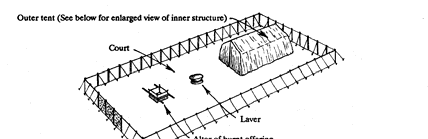
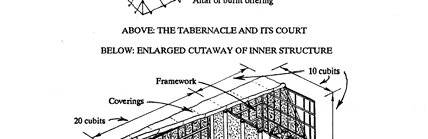
God's appointed place for the performance of Israel's religious duties was the tabernacle, or tent of meeting. The structure was of simple design, so that it could be easily put together, taken apart and transported. It was a mobile sanctuary, carried by the migrating Israelites on their journey from Mount Sinai to Canaan. Simply described, it consisted of a wooden box-like frame covered with a cloth and protected from the weather by a tent that covered the whole. All that people saw from the outside was a tent (Exod 26:1-30).
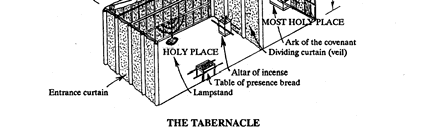
The wooden-framed structure under the tent had two rooms. The front room, which was entered through a curtain, was called the Holy Place and contained three pieces of furniture – a seven-headed lampstand, a table of sacred bread, and an altar for burning incense (Exod 25:23-40; 26:36-37; 30:1-10). A second curtain separated the Holy Place from the smaller rear room, which was known as the Most Holy Place or Holy of Holies. This room was the symbolic dwelling place of God. It contained the ark of the covenant (or covenant box), whose richly ornamented lid was the symbolic throne of God, known as the mercy seat (or grace throne) (Exod 25:10-22; 26:31-35).
Surrounding this tabernacle-tent was a rectangular court, whose perimeter was marked by a tall fence. In this court was an altar on which the priests offered all the animal and food sacrifices, and a laver (or large basin) in which the priests washed (Exod 27:1-19; 30:17-21). Outside the court were the tents of the Israelites, pitched in an orderly arrangement on the four sides, so that the tabernacle was in the centre of the camp (Num 2:1-34).
Priests and Levites
One tribe of Israel, the tribe of Levi, was responsible for the erection, maintenance and transport of the tabernacle. One man in this tribe, Aaron, the older brother of Moses, was Israel's first high priest, and his sons were the priests who assisted him (Exod 28:1; Num 8:14-19). The Old Testament priesthood is therefore sometimes called the Aaronic priesthood, sometimes the Levitical priesthood. Only the descendants of Aaron could be priests, and only members of the tribe of Levi could assist in the service and maintenance of the tabernacle (Exod 29:9; Num 3:1-10).
Priests were responsible to teach the law and to see that the Israelite people maintained God's standards of morality, holiness, cleanliness and justice (Lev 10:10-11; Deut 17:8-9; 24:8; 33:10). They offered sacrifices on behalf of those who brought them, and therefore were mediators between the people and God (Lev 1:4-9; 6:25-26). They also carried out daily functions in the tabernacle, such as tending the lamps and offering incense (Exod 27:20-21; 30:7-8).
Only priests could enter the Holy Place (Num 18:1-7; Heb 9:6), and only the high priest could enter the Most Holy Place. Even then he could do so only once a year, on the Day of Atonement. On that day he sprinkled the blood of the sacrificial animal on the mercy seat and approached God on behalf of the people to ask his mercy and forgiveness for their sins (Lev 16:2-3,11-15; Heb 9:7).
Sacrifices
People offered sacrifices (or offerings) to God as expressions of their devotion to him. Different sacrifices were appointed for different purposes, but all contained some element of atonement; that is, some part of the ritual symbolically dealt with sin's penalty so that the offerer could be restored to a right relationship with God.
In the sacrifice of an animal, for example, the worshipper may have presented it as a personal substitute, and, on the basis of the animal's death, asked God's forgiveness. The person knew that because death was the penalty for sin, there could be no forgiveness of sin apart from death. The sacrifice was the God-given means of expressing faith (Lev 17:11).
The sacrificial animal had to be healthy and free from defects. This was to symbolize perfection, as if the animal was not under condemnation and so was fit to be the substitute for the sinner (Lev 1:3,10). Forgiveness through blood meant, in other words, forgiveness through the death of a guiltless substitute (Heb 9:22).
Yet animal sacrifices could not take away sins (Heb 10:4). They were a temporary arrangement for Old Testament times that gave people a way to demonstrate their repentance, faith and obedience. They also taught people what their atonement involved. But whether people knew it or not, the sacrifice of Christ was the means by which God forgave them when they turned to him in faith (Rom 3:21-26).
The writer of Hebrews has a special concern for Jewish Christians who at one time had participated in the various rituals of Israel's religious system. He wants to impress upon them that although Israel's religious system prepared the way for Christ, it could never save guilty sinners. Jesus Christ is the only way of salvation.
1:1-2:18 Salvation through Christ 3:1-5:10 God's true people 5:11-6:20 Christian growth and perseverance 7:1-10:18 Christ's priesthood and sacrifice 10:19-12:29 The endurance of genuine faith 13:1-25 Miscellaneous instructions
1:1-2:18 SALVATION THROUGH CHRIST
God speaks through his Son (1:1-4)
Israel prepared the way, but Jesus Christ brings God's plan of salvation to its fulfilment. In Old Testament times God spoke to people through Israelite prophets, but now he speaks more directly, for he speaks through his Son. In addition, his revelation is much clearer, for Jesus Christ is the exact expression of the divine nature. All things were created by him, are controlled by him, and one day will return to him as his rightful possession (1:1-3a).
Besides revealing God to needy sinners, Jesus brings needy sinners to God, by providing them with cleansing from sin through his death on the cross. Because of who Jesus is and what he has done, God has given him a position far above all things, angels included (3b-4).
Christ greater than angels (1:5-14)
According to Jewish beliefs, angels were beings of a high order who fulfilled an important role in the giving of God's law to Israel (Acts 7:53; Gal 3:19). The writer therefore shows from the Old Testament (which the Jews believed to be the Word of God) that Jesus Christ is greater than angels. His birth into the world as a man does not mean that he is inferior to angels. On the contrary, angels worship him, for he is God, inseparably united with his Father (5-6).
Angels are merely servants, and carry out God's commands through wind and fire. Christ is King, and is exalted by God to the highest place. He lived a life of practical righteousness, and God has given him an eternal kingdom (7-9). In contrast to created things, Christ is himself the Creator. Created things change and eventually pass away; Christ never changes and lives eternally (10-12). He was victorious in his work on earth and now awaits the final victory over all things. Angels, by contrast, are simply servants sent by God to help those who share in the victory Christ has won (13-14).
Warning against rejecting Christ (2:1-4)
God's law was announced to Moses by angels, but his salvation was made known to all humankind by his own Son. This is the more reason why people should not turn away from the gospel, but believe it (2:1-3a). Those who saw and heard Jesus Christ bore testimony to the divine origin of the gospel. Their testimony was confirmed by the miracles and other evidences of the Holy Spirit's power that accompanied the early apostolic preaching (3b-4; cf. Acts 2:43; Gal 3:5).
Christ's humanity and suffering (2:5-18)
Jews considered that human beings were inferior to angels. They therefore wondered how Jesus Christ could be superior to angels when in fact he was a man.
The writer points out that this human status of inferiority to angels is only temporary. God's original purpose was that human beings should rule over all things, but because of sin they lost this authority and are themselves in need of salvation (5-8). Jesus Christ, in order to save them, took their position of being temporarily lower than angels, so that he might accept sin's penalty on their behalf. He died in shame on a cross, but God exalted him to the highest place in heaven (9).
When Adam sinned, humankind lost its original God-given glory and suffered as a result. Jesus Christ therefore had to join in that suffering and bear it fully if he was to save a fallen race from the results of sin. Having suffered, Christ then entered his glory. Because he identified himself with the human race, those who now identify themselves with him have their sins removed and share his glory. Consequently, they can attain the position God originally intended for those he created in his image (10).
Three Old Testament quotations emphasize the union that exists between Christ and the men and women he has saved. He calls them his brothers and sisters, he trusts in God as they do, and he and these his children are God's new people (11-13).
Christ became a human being to save human beings, and he did so by living with them and dying for them. His death was a victory, not a defeat, for by it he set people free from the power of Satan. Those whom he saves are now free from the fear and bondage that sin brings (14-15). The reason Christ descended to a status lower than angels was that the people he wanted to save were lower than angels (16). By sharing their experiences of human life, he could be their representative in taking away sin. He could also be their helper in gaining victory over life's temptations (17-18).
3:1-5:10 GOD'S TRUE PEOPLE
Christ greater than Moses (3:1-6)
Moses was God's special 'apostle' to Israel, the chosen representative he sent to his people. Aaron was God's appointed high priest, the person who approached God on the people's behalf. Christ is greater than both (3:1). Christ was faithful in his work as Moses was in his. But Christ is far superior. Moses was but a servant in the house of God (i.e. the people of God), whereas Christ built the house and is head over it. That house (i.e. the people of God) is now the Christian church. It consists of all who hold firmly to Jesus Christ (2-6).
Warning against unbelief (3:7-4:13)
The writer warns his disheartened Jewish readers with some reminders from Israel's experiences in the wilderness (see Exod 17:1-7; Num 20:1-13; Ps 95:7-11). Those experiences show that people who appear to be God's people may be so unbelieving, bitter and complaining, that they cannot enjoy the inheritance God has promised (7-11). They should resist the tendency to unbelief and stubbornness, by encouraging one another to maintain their faith with confidence to the end (12-15). They should bear in mind that many who shared in the deliverance from Egypt were refused entrance into the promised land because of their unbelief (16-19).
God's will was that the people of Israel, having been freed from bondage in Egypt, should find rest in Canaan, the land God promised them. In the same way God wants people everywhere to be freed from the bondage of sin and find rest in Jesus Christ. But, as with Israel, unbelief will exclude them from this promised rest (4:1-2). God's rest has been available from the time he created the world as a human dwelling place, but because of sin, people have not found this rest. It becomes theirs only through faith (3-5).
The Israelites who were disobedient under Moses did not reach the land or find the rest that God promised them. The Israelites who entered Canaan under Joshua were those of the generation that followed. However, long after the time of Joshua, David repeated God's promise of rest. This indicates that occupation of Canaan was not the complete fulfilment of God's promise (6-8; see Ps 95:7-8). The real rest that God promises is salvation through faith. Just as God rested after his work of creation, so people will find true rest when they stop working to try to earn salvation and trust in what Christ has done for them (9-10; cf. Matt 11:28).
People must make every effort to remove unbelief and all other hindrances to the enjoyment of God's rest. To help them in this, God has given them the Scriptures. His living Word penetrates into the heart, separates the merely natural from the truly spiritual, and exposes people as they really are before God (11-13).
A high priest for the faithful (4:14-5:10)
Because people were in danger of denying their Christian faith and going back to Judaism, they are reminded that Christ's priesthood is incomparably superior to Aaron's. Christ needs no tabernacle or temple, for he has passed through the heavens and into the presence of God. Through him, believers also may enter this presence, and ask God's help during their temptations. They can depend upon Christ, because being man he can sympathize with them, and being God he can give them super-human aid (1416).
The Israelite high priest, since he acted on behalf of the people, needed to have a sympathetic nature and an awareness at all times that he too was a sinner who needed God's forgiveness. His high priesthood was an office to which he was appointed, not one he chose for himself (5:1-4). All this was true of Christ, except that he, having no sin, did not offer sacrifices for his own cleansing (see 7:26-28). He was God's Son, appointed by God to an eternal priesthood (5-6; for the priesthood of Melchizedek see 7:1-28).
Jesus Christ participated in the normal experiences of earthly life. In so doing he learnt the full meaning of obedience to his Father's will, even though it led to suffering and death (7-8; cf. Matt 26:3646). Having fulfilled in practice God's ideal of human perfection, he is completely qualified to carry out his God-given work of saving and helping those who submit to him (9-10).
5:11-6:20 CHRISTIAN GROWTH AND PERSEVERANCE
Warning to the unstable (5:11-6:8)
The writer would like to say more about Christ's priesthood, but he feels his readers will not understand. Instead of being mature Christians they are spiritual babes, in spite of having received so much instruction in the Scriptures that by now they should be teachers themselves (11-12). They have not made the effort to study and understand the Word, and therefore are not able to apply its teachings to life's problems. Like children who have to be fed on milk, they have no ability to decide for themselves, but can only follow the lead of others. Mature Christians, by contrast, are like adults who can eat any food. They have trained themselves to discern between what is good and what is not (13-14).
Many Jews were of the childish kind just described. They said they were Christians, but they had made no progress. They seem to have merely added the name of Christianity to their former Jewish beliefs. Christianity, like Judaism, includes belief in sin, repentance, faith, cleansing, resurrection and final judgment, but Christianity involves more than mere acceptance of certain truths. If people do not progress beyond these basic beliefs, their Christian profession may soon be in danger. When persecution makes it uncomfortable for them to be known as Christians, they might give in to the temptation to go back to Judaism without changing their beliefs (6:1-3).
Christianity is not another name for Judaism. It completely replaces it, because Christ's death on the cross has made Judaism dead and useless. If people have joined in the life of the church and tasted the blessings that come through Christ's death, then deliberately renounce Christ, nothing is left for them but judgment. They have disowned and shamed Christ by an action similar to that of the people who crucified him (4-6).
Just as all the earth receives rain, so all who meet in the church receive God's blessings. But as some soil later proves to be bad, so some in the church later prove to be without life. Those with true faith prove it by their perseverance (7-8).
Encouragement to sincere believers (6:9-20)
Although some who received this letter needed such solemn warnings, others had clearly shown by their changed lives that they were genuine Christians. The writer has no doubts about such people (9-10). He encourages them to keep up the good work. They are not to lose heart or become lazy, but persevere to the end (11-12).
Warnings of judgment need not unsettle the believers concerning their assurance of salvation. When God promises salvation he keeps his word. Moreover, he confirms his promise with his oath (or vow). Abraham's confidence in God gave him patient endurance so that he received what God promised (1315). In legal affairs people swear oaths to confirm their statements. In his grace God does the same. He gives people double assurance of salvation by giving his promise and then adding his oath (16-18).
The security of believers is based on the work of Jesus Christ. That work is their guarantee that God will never cast them out. The Levitical high priest entered God's presence as the people's representative when he went through the curtain into the Most Holy Place. Jesus Christ, the great high priest, enters God's presence as the Christians' representative. More than that, he is their forerunner. He is the guarantee that one day they too will be permanently in God's presence (19-20).
7:1-10:18 CHRIST'S PRIESTHOOD AND SACRIFICE
The priesthood of Melchizedek (7:1-10)
Jesus Christ's high priesthood is far superior to Aaron's. Christ belongs to the priestly order of Melchizedek, a priesthood that existed before, and is far higher than, that of Aaron. (For the background concerning Melchizedek see Genesis 14:17-24 and Psalm 110:4.) Melchizedek was both a priest and a king, a combination not allowed in the Aaronic priesthood. In the Levitical order, people kept strict records of ancestry, birth and death, to confirm a person's right to be a priest (cf. Ezra 2:62-63; Neh 7:6365), but no such records exist for Melchizedek. They are not necessary, because his priesthood is not limited by time or Levitical laws. This is clearly seen in Abraham's acknowledgment of Melchizedek as the representative of the Most High God long before the Levitical law was given. In all these things the priesthood of Melchizedek foreshadowed that of Christ (7:1-3).
Abraham was a great man, being the father of all Israel, but Melchizedek was greater, for he blessed Abraham. The one who blesses must be greater than the one blessed. Abraham acknowledged Melchizedek's superiority by giving him a tithe (one tenth) of his goods. Under the Levitical law ordinary Israelites paid tithes to the Levites, their religious representatives. But the Levites, being in Abraham (so to speak), paid tithes to Melchizedek. In this they acknowledged the superiority of his priesthood to theirs (4-10).
Christ, a priest like Melchizedek (7:11-28)
The necessity for a new priesthood under Christ shows that the Levitical priesthood (and with it the law of Moses) failed to bring perfection. Therefore, the new priest belongs not to Aaron's order but to Melchizedek's (11-12). Christ could not be a priest in the Levitical order, because he was not from the tribe of Levi. He was from Judah, a tribe that had no part in priestly affairs (13-14).
Laws concerning physical birth and age determined who could be Levitical priests and how long they could serve. The priesthood of Christ does not depend on human ancestry, nor, because of his indestructible life, can it be brought to an end (15-17). Christ has done what the Levitical system could not do. He has brought perfection and given people access to God's presence (18-19).
The Levitical priesthood lacked permanence and certainty, but not so Christ's priesthood. It is guaranteed by the oath of God (20-22). Christ is not like the Levitical priests, who needed others to take their place when they died. He lives on as a priest for ever, bringing people to God and giving them God's saving help (23-25). Because of the purity of his character, life and work, Christ is worthy of the place of highest honour. Levitical priests could not, with all the sacrifices they offered, make others perfect, because they themselves were sinners. Christ, God's sinless Son and great high priest, makes people perfect for ever by one sacrifice, the sacrifice of himself (26-28).
A new priest and a new covenant (8:1-13)
Only once a year could the Levitical high priest enter God's symbolic dwelling place (the Most Holy Place), but Christ the great high priest lives in the actual presence of God for ever (8:1-2). Levitical priests offered animal sacrifices, but Christ offered himself. He did not make this offering as a Levitical priest (for he was not of the family of Aaron), but the work of the Levitical priests pictured his work. The sacrifices they offered were a picture of Christ's sacrifice of himself (3-5).
The old priesthood failed along with the old covenant. Therefore, a new and greater priesthood is necessary for a new and greater covenant. The new priesthood is Christ's (6-7).
God never intended the old covenant to be permanent. It was given for Israel's benefit, but it failed to produce the promised blessings, because the people failed to obey its commandments. The new covenant cannot fail, because it depends not on people's obedience to a set of laws, but on God's grace in changing people from within. He gives them inner spiritual life that makes them loyal to him and enables them to do his will (8-10). Priests are no longer necessary to mediate between people and God, because all believers know God personally. They have direct fellowship with him, because he has taken away their sins (11-12).
Jeremiah made these statements about the new covenant more than six hundred years before the time of Christ (see Jer 31:31-34). This demonstrates that even in Old Testament times God showed that the old covenant was only temporary (13).
Priestly work under the old covenant (9:1-10)
Before discussing Christ's priestly work further, the writer describes the tabernacle and its furniture (see introductory notes). The golden altar of incense, though kept in the Holy Place, was connected with the ark of the covenant in the ritual of the Day of Atonement (see Exod 30:6; Lev 16:12-14,18-19). This may be why the writer mentions it as belonging to the Most Holy Place. He also mentions the three objects kept in the ark and the glorious creatures of beaten gold who spread their wings over the mercy seat (9:1-5).
Only priests could go into the Holy Place, and only the high priest into the Most Holy Place. He did this only once a year, on the Day of Atonement, when he sprinkled the blood of the sacrificial animal and asked forgiveness for himself and the people. This ritual, arranged by God, showed that under the old covenant people could not enter freely into God's presence (6-8).
Clearly, the sacrifices did not cleanse the worshippers of sin, because they were still kept at a distance from God. The sacrifices were a temporary arrangement for the era before Christ. They brought ceremonial cleansing, but not actual cleansing. Now that Christ has come and cleansed sin fully, they are of no more use (9-10).
Priestly work under the new covenant (9:11-14)
When the Jewish high priest entered the Most Holy Place, God's symbolic presence, he took the blood of the sacrificial animal with him. This was a sign that an innocent substitute had died for the guilty sinner, so that the barrier to God's presence through sin might be removed. Jesus Christ, the great high priest, offered himself as the sacrifice, and through his blood (i.e. by means of his sacrificial death) entered the presence of God, obtained eternal salvation from sin, and cleansed the sinner's guilty conscience. Ceremonial cleansing through animal sacrifices is replaced by actual cleansing through Christ's sacrifice (11-14).
Sacrifice under the old covenant (9:15-22)
Under the old covenant, repentant sinners offered sacrifices for their sins, but the sacrifices themselves could not bring forgiveness. They brought no more than ceremonial cleansing. The actual cleansing of those sins depended on the sacrifice of Christ. Whether sins were committed before the time of Christ or after, the death of Christ is the basis on which God forgives them. Through Christ, God has made a new covenant, and the inheritance he promises under this covenant is one of total and eternal forgiveness (15).
An inheritance can be received only after the death of the person who promised it. So also people can receive forgiveness of sins only through the death of Christ (16-17). Events at the making of the old covenant point to the necessity of Christ's death for the making of the new covenant. The old covenant was established with sacrifices, though the ritual of killing animals and sprinkling blood was more than just a dramatic way of swearing to keep the covenant. It signified also the removal of past sin, so that
Israel entered the covenant cleansed (18-21; cf. Exod 24:3,6-8). The principle of cleansing through sacrifice was basic to the old covenant (22).
Sacrifice under the new covenant (9:23-10:18)
Levitical sacrifices were part of a material order and brought symbolic cleansing. Christ's death is concerned with the spiritual order and brings actual cleansing (23). The Levitical high priest entered the symbolic presence of God with the blood of a sacrificial animal, a ceremony that had to be repeated yearly. Christ entered God's real presence on account of his own blood, and he did so only once. His death is sufficient to remove completely the sins of the whole world, past, present and future (24-26).
People die once and face judgment. Christ died once and gained eternal salvation for those who trust in him. By his death believers are forgiven; their sins are taken away. They will enjoy the fulness of their salvation when Christ reappears, coming out of the heavenly tabernacle to be with them for ever (27-28).
The repeated offering of the Levitical sacrifices showed that they were unable to bring complete cleansing. They indicated that there must have been something better yet to come (10:1-4). God's plan was not that animal sacrifices be offered for ever, but that they prepare the way for Jesus Christ. As the man who came from God, Jesus spent his life doing God's will, even though it led him to offer that life in sacrifice. His death puts an end to all the old sacrifices, for it cleanses people from sin once and for all (510).
Israelite priests stood offering sacrifices day after day. Their work was never finished, because animal sacrifices could not remove sin. The great high priest offered one sacrifice (himself), took away sin for ever, then sat down in God's presence. His work of salvation is complete, and is available for those who want it. But there remains his work of judgment on those who refuse it (11-14). Under the new covenant a complete and permanent spiritual work is done in the lives of God's people. There is no need for further sacrificial offerings. God's work through Christ removes all sin and gives believers new life in the Spirit (15-18).