
Part 24
Conditions in Israel
After Persia's conquest of Babylon in 539 BC, the first lot of Jewish exiles returned to Jerusalem and set about rebuilding their city and temple. They were under the leadership of the governor Zerubbabel and the high priest Joshua, and these were helped by the prophets Haggai and Zechariah (Ezra 5:1-2). It was largely a result of the stirring preaching of the prophets that the temple was finished (in 516 BC; Ezra 6:14-15). (For further details of this period see background to Haggai.)
Little is known of affairs in Israel during the next sixty years. A new generation grew up, and without the strong leadership provided by Zerubbabel, Joshua, Haggai and Zechariah, the people drifted from God. When news of this reached Persia, a godly Jewish priest named Ezra obtained authority and finance from the Persian king, Artaxerxes, to go to Jerusalem and carry out reforms there. This was in 458 BC (Ezra 7:7,11-26).
Ezra's reforms met with only limited success. But when Nehemiah arrived in Jerusalem thirteen years later (445 BC) more extensive changes began to take place. Nehemiah also was a Jew who had previously lived in Babylon, and he also came to Jerusalem with authority from Artaxerxes. He was the king's appointed governor over Jerusalem (Neh 2:1-8; 5:14-15). Ezra and Nehemiah then worked together to lead the people back to God (Neh 8:9; 12:26).
It seems that Malachi carried out his ministry some time during this period of post-exilic reform by Ezra and Nehemiah. The date of his book cannot be fixed with certainty, but the sins he rebuked were similar to those that Ezra and Nehemiah had to deal with.
The people apparently expected that because they had come back to their land and rebuilt their temple, they were going to enjoy the unlimited blessing of God. This did not prove to be so, and as a result people began to doubt whether God really cared for them. Malachi replied that the fault was on their side, not God's. They had, by their sins, created barriers that hindered the flow and enjoyment of God's love.
1:1-5 God's love for Israel 1:6-3:18 Sins of the people 4:1-6 God's care in the day of judgment
1:1-5 GOD'S LOVE FOR ISRAEL
People may pride themselves that they are God's people, yet displease him through living to please themselves. Malachi learns through experience that when such people are rebuked, they usually take offence. Their reaction is to point out, in a hurt tone of voice, that they are innocent and have been treated unfairly. Malachi's method of dealing with them is to quote their complaints (note the number of times he says, 'You say . . .' or something similar; e.g. 1:2,6-7; 2:17; 3:7,13-15), then to show that they have no right to make such complaints. They should not blame God, but blame themselves.
The people's main complaint is that God does not love them. If he does, they argue, let him prove it to them by giving them comfort and prosperity instead of hardship and poverty. Malachi will soon show them the reasons for their difficulties, but first he wants to make them see that they have clear proof of God's love. This is seen in God's choice of Jacob and not Esau, though there was nothing in Jacob that made him more lovable than his brother (1:1-2).
Jacob's descendants, Israel, have been punished but they are now back in their God-given homeland. But Esau's descendants, Edom, have suffered a judgment from which their nation will never recover. The destruction throughout Edom's land will be a reminder to people of future generations of Edom's incurable wickedness (3-5).
1:6-3:18 SINS OF THE PEOPLE
Disgraceful sacrifices (1:6-14)
Israel, as God's people, should honour him as their father and reverence him as their master. Instead they insult him. They offer to God animals that are lame, sick and blind. They would never think of offering such animals to the governor, yet they offer them to God and expect him to be pleased with them (6-9). They would do better to close the temple doors and have no sacrifices at all than to offer worship like that. Even Gentiles offer more sincere worship (10-12).
To the Jews the whole worship ritual is boring. Not only do they insult God by the standard of their offerings, but they also cheat him. When in trouble they promise to sacrifice something of value if he saves them, but once they are saved they give him something worthless (13-14).
Unworthy priests (2:1-9)
The priests are chiefly to blame for the poor spiritual condition of Israel. If they do not quickly reform their ways, God will punish them. He will reduce their income from the people's tithes and offerings, and bring public disgrace upon them. He may even remove them from their position as priests, in order to stop the priesthood from becoming so corrupt that it has to be abolished. God prefers to maintain the priesthood, according to the promise he gave to the tribe of Levi (2:1-4).
Priests are not merely officials who look after temple rituals. They are supposed to be the spiritual and moral guides of the people. The early priests taught the people, by their personal example as well as by their instruction, how to know God and live righteously (5-6; cf. Num 25:11-13). Priests are servants of God who have the responsibility to teach people God's law and give them practical instruction concerning everyday affairs (7; cf. Deut 33:10). But the priests of Malachi's day have failed to uphold God's standards, either by teaching or by practice, and so have led Israel astray. They favour the rich and powerful, and as a result are despised by the common people (8-9).
Divorces and mixed marriages (2:10-16)
Marriage disorders were a further cause of Israel's troubles. Many Jewish men had married idolatrous heathen women, and introduced idolatrous practices into the holy worship of God (cf. Ezra 9:1-2; Neh 13:23-27). Not only did these Jewish men marry idol worshippers, but they divorced their Jewish wives to do so. They despised both the marriage covenant and the covenant God made with Israel at Sinai. God designed the covenant to promote family and national unity, but these men break up families and intermarry with pagans (10-11). Malachi warns that God will act in decisive judgment against those guilty of such selfishness and disloyalty (12).
The wrongdoers are upset that God no longer accepts their ritual sacrifices and offerings, but they show no concern at their own unfaithfulness in breaking a marriage covenant that God himself had witnessed (13-14). By marrying idolatrous wives they show that they have no real desire to bring their children up to know and follow God. They also show that they are unconcerned that their former wives are left to face lives of hardship (15-16).
Cheating God (2:17-3:18)
When the Jews saw surrounding nations prosper while they suffered hardship, they complained that God was not just. Other nations made no effort to keep God's law, whereas Israel was his people (17). Malachi replies that if justice is what the Jews want, then justice is what they will have; but they must realize that such justice will apply to them as well as to their heathen neighbours. They have asked for the God of justice; now he will come and do his work of justice among them (3:1).
God will intervene in human affairs and bless his people as they wish, but first he will have to cleanse them of all uncleanness, rebellion and social injustice – and this will be a very painful process. Those who resist his cleansing and continue in their sin will be punished with swift destruction (2-5). (The intervention of God spoken of here was the coming of Jesus Christ. The messenger who came before him was John the Baptist; see Matt 3:10-12; 11:10; John 3:27-28.)
If the people want to escape hardship, they should be asking for mercy, not justice; for their hardship, though a punishment, is a merciful punishment. As always, God has been extremely patient with them. If God always acted according to strict justice (as they are claiming he should) they would all have been destroyed long ago (6-7).
Because of drought, locust plagues and plant diseases, they have had poor crops, but all these disasters have been sent by God. They are his punishment upon them because they have kept for themselves what rightly belongs to him. In their selfishness they have failed to give him their tithes and offerings (8-9). They must change their ways and be honest with God. Then he will bless them with good rains and good crops. The result of their generosity will be that they become more contented and their land becomes a better place in which to live (10-12).
Many of the people continue to murmur against God. They complain that it is useless to try to live to please him, as they still suffer hardships. By contrast, those who openly defy him seem to prosper (1315). Others, however, will not allow themselves to be influenced by such talk. They encourage one another to remain faithful to God, believing that he will never forsake them. The difference between these two classes – those who truly serve God and those who do not – will be clearly seen in the day of judgment (16-18).
4:1-6 GOD'S CARE IN THE DAY OF JUDGMENT
God's action in destroying the wicked in the day of judgment is pictured in the illustration of a farmer burning off his field after he has harvested his grain. The righteous are likened to the farmer's calves, which were previously tied up in the dark stalls but are now set free. They burst forth to go leaping and skipping over the recently burnt-off fields. As the sun shines down upon them it brings healing and vigour into their lives of newfound joy and freedom (4:1-3).
In view of their coming salvation, the righteous should remain faithful to God's law. In addition they should look expectantly for the appearing of the Messiah's forerunner, symbolized here under the name 'Elijah'. If the people respond to the preaching of this Elijah, they will be united in one spirit with their believing forefathers, Abraham, Isaac and Jacob. But if they refuse to repent, they will meet divine judgment (4-6).
The symbolic Elijah was John the Baptist (Matt 11:10-15; 17:10-13; Luke 1:13-17). After Malachi, John was the next prophet whose voice was heard in Scripture. The time of the Messiah's appearing had arrived, and John's voice announced, 'Prepare the way of the Lord, make his paths straight' (Mark 1:3; John 1:19-28; 3:26-30).
The New Testament World
JEWS AND THEIR RELIGION
In the time of Jesus the social, religious and political conditions of Israel were vastly different from those of Old Testament times. Many of the changes came about during the period between the close of the Old Testament era and the beginning of the New. The origins of the changes, however, go back into the national life of Israel during the time of the Old Testament monarchy. A brief survey of events and developments in Israel will help towards a better understanding of the life and ministry of Jesus.
Hebrews, Israelites or Jews
About a thousand years before the time of Christ, David established in Jerusalem a dynasty through which God promised to bring the universal king, the Messiah (2 Sam 7:12-16; Ps 2:6-9; Isa 9:6-7; 11:19). David was followed by Solomon, but after Solomon the kingdom divided into two. The northern section broke away from the dynasty of David, but it still called itself Israel. The city that eventually became its capital was Samaria. The southern kingdom became known as Judah, after its leading tribe. It remained loyal to the dynasty of David, whose kings continued to reign in Jerusalem, but now over only the southern kingdom.
When the people of the northern kingdom were conquered by Assyria and taken into foreign captivity (722 BC), they became absorbed into the countries of their exile and largely lost their national identity. But when the people of the southern kingdom were conquered and taken captive to Babylon (605-587 BC), they largely remained in one region and retained their national identity. The people of Judah were called Judeans, and this was later shortened to 'Jew' (Jer 34:9).
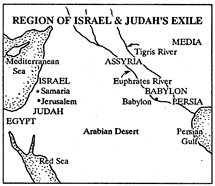
After Persia's conquest of Babylon (539 BC), captives from Babylon returned to their Israelite homeland. This meant that those who rebuilt Israel were largely Judeans, or Jews. But they were also Israelites according to the name's original meaning (for they were descended from the man whose name was Israel, Jacob). There was no longer a division in the nation between north and south, and the names 'Israelite' and 'Jew', along with the ancient name 'Hebrew', were used interchangeably (John 1:19,47; 2 Cor 11:22; Gal 2:14).
Jews and Samaritans
The Samaritans were a race of people that emerged after the Assyrians' conquest of the northern kingdom in 722 BC. The Assyrians' policy was to move conquered peoples into other countries. Therefore, after they had taken the Israelites into foreign captivity, they resettled people from other parts of their empire into the cities of the former northern kingdom, mainly in the region around Samaria (2 Kings 17:6,24).
These settlers tried to avoid punishment from Israel's God, Yahweh, by combining the worship of Yahweh with their own religious practices (2 Kings 17:25-33). They also intermarried with the Israelite people left in the land, resulting in the emergence of a new racial group, the Samaritans. By the time the Jews had returned to Jerusalem (after Persia's conquest of Babylon in 539 BC), the Samaritans were well established in the land.
When the Jews began to rebuild Jerusalem and its temple, the Samaritans offered to help, but the Jewish leaders rejected them. They saw the Samaritans as a people of mixed blood and mixed religion, and feared they would introduce corrupt ideas into Israel's religion. The Samaritans reacted bitterly and opposed the Jews throughout their building program (Ezra 4:1-5; Neh 4:1-9). Although the Jews eventually completed the building program, some of the leading Samaritans, through cunning and deceit, gained influence in Jerusalem. They introduced corrupt religious and social practices, but within a few years were driven from the city in disgrace (Neh 13:1-9,23-28).
Sacred places and sacred writings
As a result of the Jews' constant rejection of them, the Samaritans turned their attention to organizing their own religion, to make it more distinct from the religion of the Jews. One development was the building of a temple of their own on Mt Gerizim, a place of religious significance located not far from Samaria (cf. Deut 11:29; 27:12; Josh 8:33). This only increased the hatred between Jews and Samaritans, and this hatred continued into New Testament times (Luke 9:52-54; John 4:9).
In defending their actions, the Samaritans used selected parts of the Pentateuch (the five books of Moses), but they became so extreme that they almost treated the remaining Old Testament books as being of no importance. Their chief beliefs were that there was only one God, Moses was his only prophet, the law of Moses was the only authoritative teaching, and Mt Gerizim was the only true place of worship (cf. Deut 27:12; John 4:20).
The Jews, by contrast, had so many sacred writings that they were forced, by the arguments of the Samaritans, to consider which were the Word of God and which were not. This led, in time, to the acceptance of the thirty-nine books that form our Old Testament. This might be called the Jewish Bible, though the arrangement of books differs from that of the Old Testament in the Christian Bible.
The Jewish synagogue
With the rebuilding of Jerusalem and the temple, sacrificial rituals again became part of the Jewish religion. These had not been possible when the people were in exile in Babylon, with the result that greater emphasis was placed on teaching and obeying the moral teachings of the law. Although sacrificial rituals were now restored, the emphasis on teaching the law was maintained. This is clearly seen in the work of Ezra and Nehemiah, who gathered the people together in Jerusalem to read them the law and explain its meaning (Neh 8:1-4,7-8; 9:1-3). In the years that followed, such teaching activity was partly the reason for erecting local meeting places known as synagogues (from a Greek word meaning 'to gather or bring together').
Wherever the Jews settled they built themselves synagogues (Mark 1:21; Luke 4:16; John 6:59; Acts 13:5,14). These were centres for prayer, worship, teaching, fellowship and administration of local Jewish affairs. The synagogue leaders became the acknowledged leaders of the Jewish community and were called elders (Matt 21:23; Luke 7:3-5). The chief elder was known as the ruler (Mark 5:22; Acts 22:19). Elders had power to punish wrongdoers, even to the extent of flogging them or expelling them from the synagogue community (Matt 10:17; 23:34; John 9:22).
A synagogue was a simple building, consisting of a main meeting room entered through a porch, with an open court outside. It had no altar and no sacrifices were offered there. Women and men sat on opposite sides of the room, and the leaders sat in the chief seats, facing the audience (Matt 23:6).
Synagogue services were conducted at least every Sabbath and were under the control of leaders (Mark 1:21; Acts 13:14-15). The service opened with prayers, followed by readings from Old Testament scrolls that were kept in a special box and handed to the reader by an attendant (Luke 4:16-17,20; Acts 15:21). Either a local leader or an invited person then delivered an address based on one of the readings (Luke 4:16-22; Acts 13:15; 17:10-11), after which the service was closed with prayers.
In the everyday functions of the Jewish religion, synagogues became more important than the temple in Jerusalem. But later teachers were far removed in spirit from Ezra and Nehemiah, and by the time of Jesus the synagogues were more a hindrance than a help to God's purposes. The Jewish religion had changed so much that it is commonly referred to as Judaism, to distinguish it from the religion set out in the law of Moses.
Teachers of the law (scribes)
Chiefly to blame for the development of Judaism were the scribes, or teachers of the law. In the days before mechanical printing, scribes were those who made written copies of the sacred writings. Theirs was a specialized job, and because of their skill in copying details of the law exactly, people regarded them as experts on matters of the law (Ezra 7:6,10).
Although the priests were supposed to be the teachers in Israel (Deut 33:10; Mal. 2:7), people now went rather to the scribes to have problems of the law explained. During the four to five hundred years between the time of Ezra and the time of Jesus, the scribes grew in power and prestige. They became known as teachers of the law, lawyers and rabbis (Matt 22:35; 23:2-7).
There was a great difference between the explanations of the law given by Ezra and those given by the scribes of Jesus' time. Over the years the scribes had developed their own system, which consisted of countless laws to surround the central law of Moses. Some of these new laws grew out of legal cases that the scribes had judged; others grew out of traditions that had been handed down. The scribes forced their laws upon the Jewish people, till the whole lawkeeping system became a heavy burden (Matt 15:1-9; 23:2-4).
Being leaders and teachers in the synagogues, the scribes enjoyed prestige and power in the Jewish community (Matt 23:6-7). They taught in the temple in Jerusalem, and established schools where they trained disciples (Luke 2:46; Acts 22:3). They then sent these disciples to spread their teaching far and wide (Matt 23:15). Most of the scribes belonged to the party of the Pharisees, one of the two major groups that developed within Judaism (Matt 5:20; 23:2; Acts 5:34).
The Jewish Council (Sanhedrin)
As early as the time of Ezra, groups of elders and judges had been appointed to administer the law in Jewish affairs (Ezra 7:25-26; 10:14). This practice was followed in the local synagogue committees, but as these committees grew in power a more rigid system of Jewish rule developed. Although any local Jewish council could be called a Sanhedrin, the word was most commonly used for the supreme Jewish Council in Jerusalem.
The Jerusalem Sanhedrin consisted of a maximum of seventy members, not counting the high priest, who occupied the position of president. Its composition changed from time to time, but in New Testament times it consisted of scribes, elders, priests and other respected citizens. It included people from both main Jewish parties, the Pharisees and the Sadducees (Matt 26:3,57-59; Acts 5:17,34; 23:1,6).
Rome gave the Sanhedrin authority to arrest, judge and punish Jewish people in relation to certain religious and civil matters (Acts 5:17-21,40; 9:2). The Sanhedrin could condemn a person to death, though according to its own law it could not pass such a sentence at night (Luke 22:66), and according to Roman law it could not carry out the sentence (John 18:31). The Jewish authorities had to convince the Roman authorities that the person deserved death, after which the Romans themselves carried out the execution (Luke 23:1-4,24). However, the Romans knew the difficulties of governing the Jews, and they sometimes feared to deny the Jews their wishes or even to intervene when there was mob violence (Matt 27:24-26; cf. Acts 7:57-58).
JEWS UNDER FOREIGN RULE
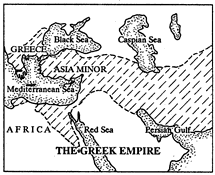
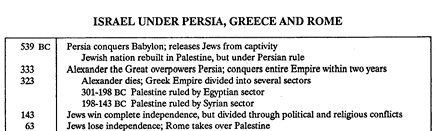
Although the Jews were ruled by Rome in the time of Jesus, many features of the Jewish way of life were the result of political events in the pre-Roman period. The Persians, who had conquered Babylon in 539 BC and helped the Jews to rebuild their ancient homeland, remained the Jews' overlord for the next two hundred years. But rapid changes occurred with the dramatic conquests of Alexander the Great and the establishment of the Greek Empire.
Greek rule and influence
Alexander was from Macedonia, the northern part of present-day Greece. In little more than a year he overran Asia Minor and took control of much of the eastern Mediterranean region (333 BC). His conquests spread rapidly through parts of northern Africa and western Asia, then continued over what remained of the Persian Empire till they reached India.
Wherever they went the Greeks planted Greek culture. The Greek language became commonly spoken throughout the region, and remained so into the New Testament era in spite of the rise of Roman power. People in local regions continued to speak their own languages (the Jews of Palestine spoke
Aramaic, a language related to Hebrew), but they usually spoke Greek as well (cf. Mark 5:41; 15:34; John 19:20; Acts 14:11; 22:2). The New Testament was written in Greek.
Greek architecture spread through the building of magnificent new cities, and Greek philosophy changed the thinking of people everywhere (1 Cor. 1:20-22). The Greeks brought some help to the people they governed, by providing a standard of education, sport, entertainment and social welfare that most people had never known before. Those who absorbed this Greek culture were regarded as civilized; all others were regarded as barbarians (Rom 1:14).
Alexander died while at the height of his power (323 BC) and his vast empire was divided among his generals. In the early days after the break-up there were four dominant leaders, but power struggles among them (and others) continued for many years. By 301 BC there were three main sectors in the divided empire: one in the west centred on Macedonia, and two in the east centred respectively on Egypt to the south and Syria to the north.
At first Palestine was within the Egyptian sector, where each of the Greek rulers took the name Ptolemy. Under the Ptolemies the Jews had a reasonably peaceful existence. During this time, in the recently built city of Alexandria in Egypt, a group of about seventy Jewish scholars translated the Hebrew Bible into Greek. This translation is known as the Septuagint (meaning 'seventy' and usually abbreviated as LXX). In New Testament times both Jews and Christians used the Septuagint as well as the Hebrew Old Testament. When the New Testament writers quoted the Old Testament, they usually used the Septuagint rather than make their own translation from the Hebrew.
Changes in Israel
Some of the later Ptolemies became hostile to the Jews, but conditions worsened when the Syrian sector conquered the Egyptian sector and so brought Palestine under its control (198 BC). The Greek kings who ruled Syria were known as the Seleucids, after the king who founded the dynasty. Most of the kings gave themselves the name Antiochus, after Antioch, the capital of the Seleucid kingdom that the founder of the dynasty built in 300 BC (cf. Acts 11:20; 13:1,4).
Israel had now been under Greek rule for more than a hundred years, and Greek customs and ideas were having an influence on the Jews' religion and way of life. Divisions began to appear among the Jewish people. Some Jews not only tolerated this Greek influence but actively encouraged it. In doing so they won favours from the Greek rulers and had themselves appointed to important positions in the Jewish system. Others firmly opposed all Greek influence, particularly the influence of Greek rulers in Jewish religious affairs.
When fighting broke out in Jerusalem between rival Jewish factions, the Seleucid king of the time, Antiochus IV Epiphanes, mistakenly thought that the people were rebelling against him. He invaded Jerusalem, killed Jews in thousands, made others slaves, burnt the Jewish Scriptures, forced Jews to eat forbidden food and compelled them to work on the Sabbath day. He set up a Greek altar in the Jewish temple, then, using animals that the Jews considered unclean, offered sacrifices to the Greek gods. To the Jews this was 'the awful horror' (GNB), 'the abomination that makes desolate' (RSV) (Dan 11:31). But Antiochus failed to realize that the Jews were zealous for their religion and would not stand idly by and allow him to destroy it.
Jewish resistance led by the Maccabees
The Jews' fight for religious freedom began through a priest named Mattathias. He and his five sons (known as the Maccabees, after Judas Maccabeus, his son and the leader of the group) escaped from Jerusalem, put together a small army and began to carry out surprise attacks against the forces of Antiochus. The attacks were so successful that after about three years the Maccabees had overthrown the pro-Greek party of Jewish priests in Jerusalem and cleansed and rededicated the temple (165 BC). From that time on, the Jewish people celebrated the great event in the annual Feast of Dedication (John 10:22).
Encouraged by their remarkable victory, the Maccabees (also known as the Hasmoneans, after their old family name) decided to keep fighting till they had won political freedom as well. But the religiously strict Jews, who had previously opposed Greek political interference in their religion, also opposed the Maccabees' drive for political power. They believed that the Maccabees had done their job by restoring the temple and regaining religious freedom for the Jews. They should not have any part in politics.
These opposing viewpoints eventually produced the two main parties that divided the Jewish people, the Sadducees and the Pharisees. The Sadducees wanted political power, whereas the Pharisees were content to have religious freedom. The Maccabees carried on the war in spite of the Jewish opposition, and after twenty years won political independence (143 BC).
Sadducees and Pharisees
After four and a half centuries under Babylon, Persia, and then Greece, the Jews were free again. However, they were now clearly divided, under the domination of two major parties. On the one side were the pro-political priests and leaders (the later Sadducees) who were wealthy, powerful and favoured by the Hasmonean rulers. On the other side were the anti-political traditionalists (the later Pharisees), who were poor, powerless and favoured by the common people. The differences between the two parties increased as each developed its own beliefs and practices.
The Pharisees' chief aim was to keep the law in all its details; not so much the law of Moses as the countless laws developed and taught by the teachers of the law, the scribes. They were particularly strict in keeping rules relating to religious observances such as fasting (Luke 18:11-12), tithing (Matt 23:23), Sabbath-keeping (Matt 12:1-2), the taking of oaths (Matt 23:16-22) and ritual cleanliness (Mark 7:1-9). The name 'Pharisees' meant 'the separated ones', and many were so convinced they were God's only true people that they kept themselves apart from others (Acts 26:5; Gal 2:12).
If the Pharisees were the party of the scribes, the Sadducees were the party of the priests (Acts 5:17). (Their name possibly comes from Zadok, a priest of Solomon's time whose descendants were regarded as the only legitimate priests; 1 Kings 1:38-39; Ezek 44:15-16). The Sadducees' strategy was to use the religious and political structures of Jewish society to gain power for themselves. Since they controlled the priesthood, one of the main channels of power, it suited them to emphasize the temple rituals. However, they had little interest in the traditions of the scribes. The only Jewish law they acknowledged was the written law of Moses (Luke 20:27-28).
Sadducees and Pharisees had several other well known differences, chiefly in matters of their beliefs. The Sadducees did not believe in the continued existence of the soul after death, the resurrection of the body, the directing will of God in life's events, or the existence of angelic beings, all of which were important beliefs to the Pharisees (Matt 22:23; Acts 4:1-2; 23:7-8).
End of Jewish independence
The Hasmoneans ruled for almost one hundred years. Under them political, religious and military power joined together, so that the Hasmonean ruler was at the same time governor, high priest and commander-in-chief of the army.
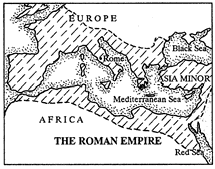
During the period of Hasmonean rule the Pharisees were often the ones who suffered. They welcomed the chance to reverse the situation when a later queen showed herself favourable to them. But when she died, fighting broke out between her two sons, one of whom favoured the Pharisees, the other the Sadducees. At that time Rome's power was spreading towards Palestine, and as General Pompey had his army nearby in Syria, both sides asked for his help. Pompey settled the dispute by leading his army into Jerusalem and taking control himself. Thus, in 63 BC, Jewish independence came to an end.
Herod the Great
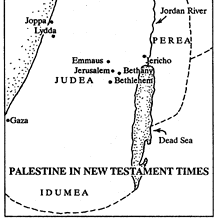
One of the two brothers who sought Rome's support was appointed by the Roman administration as political head and high priest of Judea. He proved to be a weak leader. He was very much under the influence of an Idumean friend Antipater, who was cunningly planning to gain control himself. (Idumea was a region in the south of Judea that was inhabited by a mixture of Jews, Arabs and the remains of the nation once known as Edom.) In the end Antipater was appointed governor of Judea, with his two sons in the top two positions under him.
At that time Judea, and in fact the whole of the eastern Mediterranean region, was troubled by a succession of power struggles, divisions and wars. Antipater was eventually murdered and his sons overthrown. But one of the sons, who had developed even greater cunning than his father, escaped to Rome, from where he had himself appointed the new governor of Judea and given the title of king. This person we know as Herod the Great.
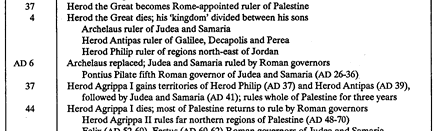
Through treachery and murder, Herod removed all possible rivals. Then, having made his position safe, he began to develop and expand his kingdom. He ruled Judea for thirty-three years (37-4 BC). He carried out impressive building programs, two of his most notable achievements being the rebuilding of Samaria and the construction of Caesarea as a Mediterranean port. In Jerusalem he built a military fortress, government buildings, a palace for himself and a magnificent temple for the Jews (Matt 27:27; Mark 13:1; John 2:20; Acts 23:10,35).
In spite of the benefits Herod brought them, the Jews hated him. This was partly because of his mixed blood (though he was Jewish by religion) and partly because of his ruthlessness in murdering any he thought a threat to his position. His butchery was well demonstrated in his massacre of the Bethlehem babies at the time of Jesus' birth (Matt 2:13,16).
Family of Herod
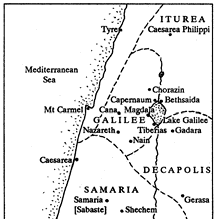
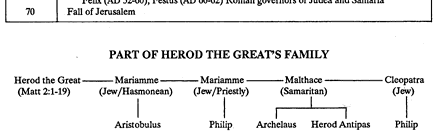
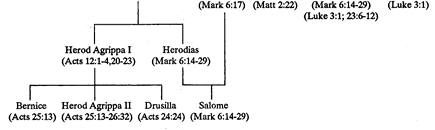
Before he died, Herod divided his kingdom between three of his sons, though they, like their father, could rule only within the authority Rome gave them. The southern and central parts of Palestine (Judea and Samaria) went to Archelaus, a man as cruel as his father but without his father's ability (Matt 2:22). The northern part of Palestine (Galilee) and the area east of Jordan (Decapolis and Perea) went to Herod Antipas, the man who later killed John the Baptist and who agreed to the killing of Jesus (Mark 6:14-29; Luke 3:1; 23:6-12). The areas north-east of the Sea of Galilee (Iturea and Trachonitis) went to Herod Philip, a man of milder nature than the rest of his family (Luke 3:1).
Direct Roman rule
Archelaus was so cruel and unjust that in AD 6 the people of Judea and Samaria asked Rome to remove him and govern them directly. From that time on, Judea and Samaria were ruled by Roman governors, or procurators, with headquarters at Caesarea. The procurators of Judea and Samaria mentioned in the Bible are Pilate, Felix and Festus (Matt 27:2; Acts 23:24,33; 25:1).
The only exception to this rule by procurators was the brief 'reign' of Herod Agrippa I, a grandson of Herod the Great (Acts 12:1-4,20-23). Through winning favour with Rome, he gained the former territories of Herod Philip (in AD 37) and Herod Antipas (in AD 39). In AD 41 he gained Judea and Samaria, and for three years he ruled almost the entire 'kingdom' of Herod the Great. Upon his death in AD 44, Judea and Samaria returned to the rule of Roman governors.
Earlier, when a governor from Rome replaced Archelaus (AD 6), the Jews for the first time had to pay taxes to the Romans direct instead of through the Herodian ruler. When Rome conducted a census to assess this tax, a group of Jews led by a man called Judas the Galilean rebelled, claiming that it was wrong for the people of God to pay tax to a pagan emperor (Acts 5:37). Because of their zeal in trying to free Israel from pagan influence, they became known as Zealots, or Patriots, and formed a minor political-religious party in Israel (Luke 6:15; Acts 1:13).
The zealots were so opposed to Roman rule that they were prepared to fight against it. Rome's mismanagement of Jewish affairs increased their determination, and in AD 66 they revolted openly by taking control of Jerusalem. There was much turmoil and bloodshed during the next four years, but the Romans gradually reasserted their control, first in Galilee then throughout Judea. Finally, in a series of brutal and devastating attacks, they conquered Jerusalem, massacred the people, burnt the temple and left the city in ruins (AD 70). So far as Rome was concerned, the Jewish nation was finished.
Introduction to the Four Gospels
THE WRITING OF THE GOSPELS
According to long-established practice, the first four books of the New Testament are known as Gospels. This is probably because they record the gospel, or good news, of the coming of Jesus Christ, the world's Saviour.
Each of the four Gospel writers had a special purpose in writing his book, and he selected and used his material accordingly. Each gave his own emphasis to teachings and events taken from the life of Jesus, according to the plan and purpose of his book. The writers wrote for different people, who lived in various countries and came from different racial and religious backgrounds. Yet there is no disagreement in the picture of Jesus Christ that the four writers present: he is divine and human, Lord of all and the Saviour of people everywhere (Matt 11:27-30; Mark 2:10,28; Luke 2:11,29-32; John 5:20-25).
The Gospels are not biographies of Jesus, and make no attempt to give a detailed or chronological account of Jesus' life. Nevertheless, they give all the facts that people need to know in order to believe in Jesus as the Son of God and so have life through him (John 20:31).
Record of Jesus' life
Taken together the four Gospels present a picture of three main periods in Jesus' life. These three periods are his early childhood, his public ministry (i.e. his teachings, healings, miracles, etc.) and his death, burial and resurrection.
The stories of events leading to, including, and immediately following Jesus' birth are given at some length. Nothing more is written about his childhood until he was twelve years old, and even then only one incident is recorded. But that incident is enough to show that even at such an early age Jesus knew he had a special relation with God, for he was God's Son (Luke 2:49; cf. 1:35).
Nothing more is recorded in the Bible of the next eighteen years (approximately) of Jesus' life. Then, when about thirty years old, he began his public ministry (Luke 3:23), and this lasted about three and a half years. Much of his work was done in Galilee, the northern part of Palestine, though he met his fiercest opposition in Judea in the south, particularly in Jerusalem, the centre of Jewish religious power. The religious leaders considered that Jesus was guilty of blasphemy in claiming to be the Son of God, and they were constantly looking for an opportunity to kill him. Jesus, however, continued to carry out his ministry openly, knowing that he would be arrested and killed only when he had finished his ministry and the time appointed by his Father had come (Luke 13:31-33; John 8:20; 13:1; 17:1,4).
Jesus' last week in Jerusalem was full of tension and activity, and is recorded in greater detail than any other part of his life. He entered Jerusalem as Israel's Messiah-king, cleansed the temple, debated with hostile Jewish opponents, gave teaching to his disciples on many subjects, then allowed himself to be arrested, cruelly treated, falsely condemned and crucified. Then follows an account of his burial, resurrection, and activity after his resurrection. Finally, he returned to his Father with the promise that one day he would come again (Luke 24:50-51; Acts 1:9-11).
Extent of Jesus' ministry
If we had only the Gospels of Matthew, Mark and Luke, we might think that the public ministry of Jesus lasted barely a year and that he spent almost the whole of that time in the north. John's Gospel records more of his work in the south, particularly in and around Jerusalem. It also provides information that shows clearly that the ministry of Jesus lasted several years.
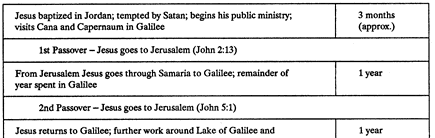
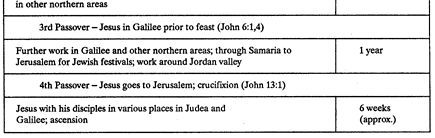
John mentions three specific Passover Feasts (John 2:13; 6:1,4; 13:1) and possibly a fourth (John 5:1. It is widely assumed that the unnamed feast mentioned here was the Passover). Because the Passover Feast was held only once a year, the record of four Passovers would indicate that the public ministry of Jesus must have covered at least three years.
The broad divisions of Jesus' ministry are set out in the following table. We should bear in mind, however, that we cannot with certainty assign every portion of the Gospel accounts to a particular time or place in Jesus' life.
Re-telling the story of Jesus
Soon after Jesus' ascension, his disciples began the task of spreading the good news of the salvation he had brought. They started in Jerusalem and several thousand were converted (Acts 1:8; 2:41,47; 4:5; 5:14; 6:7). From Jerusalem the gospel spread to neighbouring provinces, then to countries beyond, till Christianity was firmly established in western Asia and eastern Europe (Acts 8:5,40, 11:19-20; 13:4,14; 16:11-12; 18:1; 28:13-15). This growth took place over a period of about thirty years (the AD 30s to the 60s).
Those who became Christians were taught the stories that recounted the activity and teaching of Jesus. This emphasis on the life of Jesus was one reason why apostles had to be personal associates who had been with Jesus from his baptism to his ascension. They could give first-hand accounts of what he said and did, and in particular could give eye-witness testimony to his resurrection (Acts 1:21-22; 3:15; 5:32; 10:36-41). The apostles carefully instructed new believers, who memorized the stories and sayings of Jesus and went out to spread the good news to others. New converts were taught similarly, and they too went out to teach and make disciples of others (Matt 28:18-20; Acts 2:42; 8:4; 2 Tim 2:2).
As the years passed and the church grew, those who had seen and heard Jesus became fewer in number and more widely scattered. In order to preserve what these witnesses taught about Jesus, people began to prepare written accounts of things Jesus said and did (Luke 1:1). In this sort of activity we can see the origins of the four Gospels, the first of which was probably written about AD 60, and the last about AD 90. Although we do not know all the details concerning how or when each book was written, we can find enough evidence in the books themselves and in other first century writings to make the following explanation a possibility.
Two related accounts
It seems that Mark's Gospel was the first to be written. Mark had assisted the apostle Peter in missionary work that took them through the north of Asia Minor and brought them eventually to Rome (cf. 1 Peter 1:1; 5:13). When Peter left to go on further journeys, Mark remained for a while in Rome. The Roman Christians asked Mark to write down the story of Jesus as they had heard it from Peter, with the result that he wrote the book that we know as Mark's Gospel.
Mark was still in Rome when Paul arrived as a prisoner, accompanied by Luke and Aristarchus (Acts 27:2; 28:16). In letters Paul wrote from Rome at this time, he mentions that Mark, Luke and Aristarchus were all with him, and they surely would have got to know each other well (Col. 4:10,14; Philem 24).
Over the years Luke also had been preparing an account of the life of Jesus. No doubt he did much research during the two years he had recently spent with Paul in Palestine (Acts 24:27). Others had already written accounts of Jesus' life and ministry (Luke 1:1), and Luke gathered material from these as well as from people still living in Palestine who had seen and heard Jesus. When he arrived in Rome and met Mark, he took some of Mark's material to add to his own and so bring his book to completion.
Whereas Mark wrote for a group of Christians, Luke wrote for someone who was probably not a Christian. This person, Theophilus, appears to have been a government official of some importance, and Luke's purpose was to give him a trustworthy account of the origins of Christianity (Luke 1:1-4). Luke's account was so long that it was divided into two books. The first, which covers events from the birth of Jesus to his ascension, we know as Luke's Gospel. The second, which covers events from Jesus' ascension to Paul's arrival in Rome, we know as the Acts of the Apostles (cf. Acts 1:1-2).
A third related account
The Gospel of Matthew appears to have been written about ten years after the Gospels of Mark and Luke. Matthew's concern was to produce an account of Jesus' ministry that was especially suited to the needs of Christians of Jewish background. His book shows a particular interest in the fulfilment of God's purposes concerning Israel's Messiah, and the responsibility of the Messiah's people to spread his message to the Gentiles. According to early records, the Jewish Christians for whom Matthew wrote were those of Syria and Palestine.
By this time Mark's Gospel had become more widely known, and because it represented Peter's account of Jesus' ministry, it was well respected. Matthew therefore saved himself a lot of work by using much of Mark's material in his own book. (About 90% of Mark is found in Matthew.) There is also a lot of material common to Matthew and Luke that is not found in Mark. This material, commonly referred to as Q, probably came from one or more of the many writings in use at the time (cf. Luke 1:1). This common material Q consists mainly of sayings and teachings of Jesus, in contrast to stories about him.
Because of the parallels between Matthew, Mark and Luke, the three books are often referred to as the Synoptic Gospels (meaning Gospels that 'see from the same viewpoint', in contrast to the Gospel of John). Each of the Synoptic Gospels, however, has material of its own that has no parallel in the other Gospels. In Mark this amount is less than 5%, in Matthew about 28%, and in Luke about 45%.
A different kind of book
John's Gospel is different in form and style from the other three Gospels. The book was written probably within the last decade or so of the first century, by which time the other three Gospels were widely known. Although John follows the same general development of the story from Jesus' baptism to his resurrection, his purpose was not to produce another narrative account of Jesus' ministry. He selected only a few stories of Jesus, but recorded at length the teaching that arose out of them. He wanted to instruct people in basic Christian truth concerning who Jesus was and what this meant for the people of the world.
The reason John wrote his Gospel was that in the region where he lived (probably Ephesus, in western Asia Minor), people were confused because of the activity of false teachers. Some of these denied that Jesus was fully divine, others that he was fully human. John opposed these teachers (cf. 1 John 2:18-23,26; 4:1-3), but his chief reason for writing was not negative. He had a positive purpose, and that was to lead people to see Jesus as the Son of God and so to find true life through him (John 20:30-31).
Much of John's Gospel therefore consists of teaching, but most of this teaching comes from the recorded words of Jesus himself. In comparison with the Synoptic Gospels, action stories are few. More than 90% of the material in John's Gospel is not found in the other Gospels.
INTRODUCTION TO MATTHEW
The writer and his readers
Matthew's Gospel does not record the name of its author or the purpose for which he wrote the book. The title 'Matthew', given to it in the second century, reflects the early church's belief that the author was the apostle Matthew. There was, however, some uncertainty concerning the stages of development that the book went through before the final version appeared. Whether or not Matthew himself actually produced the finished product, it seems clear that his writings (referred to in second century documents) must have at least provided a major source of material for the book.
Like the rest of the New Testament, the Gospel of Matthew was written in Greek. It seems to have been written for Greek-speaking Jewish Christians of Syria and Palestine, to reassure them that Jesus was the Messiah promised in the Old Testament, and he fulfilled the purposes for which God chose Israel. The Jewish Christians, as the people of the Messiah, were not to fail in evangelizing the Gentiles as Israel of Old Testament times had failed, but were to be energetic in spreading the gospel to all nations (Matt 28:19-20; cf. 8:11-12; 11:20-24; 24:14).
A likely place for the writing of such a book is Antioch in Syria, which was closely connected with the Jewish churches of the region and the mission to the Gentile nations (Acts 11:19-22,27-29; 13:1-4; 15:1-3,22). (For further details on the writing of Matthew's Gospel see previous section, 'The Writing of the Gospels'.)
Matthew the tax collector
Evidence within the Gospel supports the view that the writer was Matthew the tax collector, who later became one of the twelve apostles. When Mark and Luke list the twelve apostles, they name Matthew but do not record his occupation (Mark 3:18; Luke 6:15). When they mention the tax collector who became a follower of Jesus, they call him not Matthew but Levi, which was his other name (Mark 2:14-17; Luke 5:27-32). They seem, out of kindness to Matthew, to avoid mentioning that he was once a tax collector, for the Jews despised those of their own people who collected taxes on behalf of the oppressor Rome.
Matthew, far from hiding the fact that he was once a tax collector, states it clearly. He uses the name Matthew, not Levi, in speaking of his response to Jesus' call (Matt 9:9-13), and when listing the twelve apostles he states his previous occupation (Matt 10:3). The book reflects the gratitude that a tax collector would feel in being chosen by Jesus to be an apostle. Stories about the dangers of money reflect the lessons learnt by one whose life was once dominated by greed (Matt 18:23-35; 20:1-16; 27:3-10; 28:1213).
The place where Matthew worked as a tax collector was Capernaum, on the shore of Lake Galilee (Mark 2:1,13-14). He had a good income and owned a house large enough to entertain a large number of people (Luke 5:29). He seems to have enjoyed a secure and stable lifestyle, but he left all this for the risky business of following Jesus and spreading the good news of his kingdom (Matt 10:5-23). He was involved in the establishment of the early church (Acts 1:13), but the Bible gives no details of his later ministry.
Arrangement of Matthew's material
Matthew's Gospel may contain much that is in Mark and Luke, but the treatment of the material is different. Luke, for example, has usually grouped together stories that are exclusive to him, and kept them separate from stories that he has taken from Mark. But Matthew has adjusted and rearranged all his material, regardless of its source. He has made each part fit into the plan of his book in a way that makes it inseparable from the rest. He records more teaching and less action in comparison with Mark and Luke, and his material is not always in chronological order.
In Matthew the material is arranged according to subject matter rather than chronology. It is built around five main teaching sections where Jesus instructs his followers in what he requires of those who enter his kingdom. Each of the five sections concludes with a statement such as 'When Jesus had finished these sayings . . .' (Matt 7:28; 11:1; 13:53; 19:1; 26:1). The five sections concern the personal behaviour of those in Christ's kingdom (Chapters 5-7), proclamation of the message of the kingdom (Chapter 10), parables of the kingdom (Chapter 13), attitudes to others within the kingdom (Chapters 18) and the climax of the kingdom at the return of Christ (Chapters 24-25).
A teaching purpose
The characteristic flavour of the Gospel of Matthew comes mainly from the material that is found only in Matthew. Included in this are many quotations from the Old Testament. Matthew often introduces these quotations by a statement showing how the Old Testament was fulfilled in Jesus (Matt 1:22; 4:14; 8:17; 13:35; 21:4; 27:9).
In particular Matthew shows that Jesus was the promised Messiah, the son of David, the fulfilment of God's purposes for Israel (Matt 1:1,17; 2:6; 9:27; 11:2-6; 16:16; 21:9; 26:63-64). The kingdom of God was the rule of God, and in Jesus that kingdom had entered the world (Matt 4:17,23; 5:3; 12:28; 18:1-4; 24:14). Jesus was the king, though he was not the sort of king that most people had expected (Matt 4:810; 21:5,9-11; 25:31,34; 26:52-53; 27:11). (For further discussion on the kingdom of God and the Messiah see the section 'Jesus and the Kingdom' that follows.)
Jewish Christians were often persecuted by unbelieving Jews for forsaking the religion of their ancestors. Matthew reassured these Christians by pointing out that they were not the ones who had wandered away from the Old Testament religion. Rather they had found the true fulfilment of it. Jesus did not contradict the law, but brought out its full meaning (Matt 5:17).
Matthew not only taught the Jewish Christians the high standards of behaviour required of them, but urged them to be energetic in spreading the good news of the kingdom to others (Matt 5:13-16; 10:5-8; 24:14; 28:19-20). The unbelieving Jews, who zealously kept the traditions, were consistently condemned (Matt 15:1-9; 23:1-36). They missed out on the promised kingdom, with the result that the gospel was sent to the Gentiles, and many believed (Matt 3:7-9; 8:11-12; 12:21,38-42; 21:43). Jesus had laid the foundation of his church, and no opposition, whether from the Jews or the Romans, could overpower it (Matt 16:18).
INTRODUCTION TO MARK
Authorship
Like the other three Gospels, Mark is anonymous. However, from the first century the commonly held view has been that the author is John Mark of Jerusalem, and that his Gospel reflects Peter's account of Jesus' ministry.
Mark came from a prominent family in the early Jerusalem church. His parents were wealthy enough to own a large house and employ servants (Acts 12:12-13) and at least one of his close relatives, Barnabas, was a reasonably prosperous landowner (Acts 4:36-37; Col. 4:10). The traditional belief is that Mark's family home was the place where Jesus held the last supper and where the disciples met in the early days of the church (Luke 22:11-13; Acts 1:13).
Mark's service in the gospel
Perhaps the first reference to Mark is in the story of the young man who followed Jesus and his friends to the Garden of Gethsemane but fled when opponents tried to seize him. This story appears only in Mark's Gospel (Mark 14:51-52). According to a common practice, an author might include a reference to himself but not use his own name directly (cf. John 13:23; 2 Cor 12:2).
Because the early church leaders met in Mark's family home, Mark would have known Peter and other early Christian leaders (Acts 12:12-14). Paul and Barnabas were impressed with him sufficiently to take him with them from Jerusalem to Antioch in Syria, and then to Cyprus and Asia Minor on a missionary journey (Acts 12:25; 13:1-5).
After only a short time, Mark left Paul and Barnabas and returned to Jerusalem (Acts 13:13). Paul thought this showed a weakness in Mark and refused to take him on his next missionary journey. When Paul and Barnabas quarrelled about the matter and separated, Barnabas took Mark on a return mission to Cyprus (Acts 15:36-41).
The Bible records nothing of Mark's activities during the next ten years or so. Other early records, however, provide evidence that he spent some time with Peter evangelizing the northern regions of Asia Minor. He became so closely associated with Peter that Peter referred to him as his son (1 Peter 5:13). Later the two visited Rome, where Peter helped the church by his teaching on the life and ministry of Jesus. When Peter left Rome, Mark stayed behind, and in response to the needs of the local Christians he wrote down the story of Jesus as they had heard it from Peter. The result was Mark's Gospel. (For further reference to Mark's ministry in Rome see earlier section 'The Writing of the Gospels'.)
Paul visited Rome while Mark was there, and recommended him as one who could be of help to young Christians (Col. 4:10). A few years later, when Paul was awaiting execution, he called for Mark to be with him in his final days (2 Tim 4:11).
Features of Mark's Gospel
In Mark's Gospel there are many features that reflect the interests and character of Peter. Apart from events surrounding Jesus' death and resurrection, most of Jesus' ministry recorded in Mark was centred in Galilee, where Peter's home town of Capernaum seems to have been Jesus' base. In fact, his real base may have been Peter's own house (Mark 1:21,29; 2:1; 9:33).
The account in Mark shows the characteristic haste of Peter, as it rushes on from one story to the next. The language is usually more clearcut than in the parallels of the other Gospels, reported statements are more direct and details are more vivid. This is particularly so in describing Jesus' actions and emotions (Mark 1:41; 3:5; 4:38; 6:6; 10:14,16,21,32). The genuineness of Peter is seen in that his mistakes are more openly reported than in the other Gospels (Mark 9:5-6; 14:66-72), whereas incidents that might bring him praise are omitted (cf. Matt 14:29; 16:17).
As the story of Jesus was set in Palestine, the Gentiles in Rome needed certain details explained. Consequently, Mark translated Hebrew or Aramaic expressions (Mark 3:17; 5:41; 7:11,34; 15:22,34) and explained Jewish beliefs and practices (Mark 7:3-4; 12:18,42; 14:12; 15:42).
Persecution of Christians
During the decade of the sixties, the government intensified its persecution of Christians, particularly after Nero blamed Christians for the great fire of Rome in AD 64. Just before this, Peter had written a letter from Rome (which he code-named Babylon; 1 Peter 5:13) to Christians in northern Asia Minor to warn them that, although they were already being persecuted, worse was to come. He gave them encouragement to face their trials positively and to look forward to a victorious future (1 Peter 1:6; 2:2023; 3:14-17; 4:12-16). Not long after this he himself was executed by Rome (2 Peter 1:14; cf. John 21:1819).
Mark's Gospel, like 1 Peter, was written at the beginning of this time of increasing persecution. It reminded the Roman Christians (from Peter's own experience of the life and teaching of Jesus) that they would need strength and patience to endure misunderstandings, false accusations, persecution and possibly betrayal (Mark 3:21,30; 4:17; 8:34-38; 10:30; 13:9,13; 14:41,71-72; 15:15,19,32).
Mark's view of Jesus
The Gospel of Mark records more action than the other Gospels, but less of Jesus' teaching. Its basic teaching purpose, as the opening verse indicates, is to show that Jesus is the Son of God (Mark 1:1). According to Mark, the entire ministry of Jesus showed that he was a divine person in human form, the Messiah who came from God.
At the baptism of Jesus, the starting point of his public ministry, God's declaration concerning Jesus showed what this unique ministry would involve. That declaration combined Old Testament quotations relating to the Davidic Messiah and the Servant of the Lord, showing that Jesus' way to kingly glory was to be that of the suffering servant (Mark 1:11; cf. Ps 2:7; Isa 42:1). Jesus was the heavenly Son of man to whom God promised a worldwide and everlasting kingdom, but he would receive that kingdom only by way of crucifixion (Mark 8:29-31,38; 10:45; 14:62; cf. Dan 7:13-14). (For the meaning of 'Son of man' and 'Son of God' see 'Jesus and the Kingdom' below.)
As might be expected, the death of Jesus is the climax of Mark's Gospel, but Mark draws attention to the confession of Jesus that brought about that death. Mark alone records that when the Sanhedrin asked Jesus if he was the Messiah, the Son of God, Jesus replied openly, 'I am'. Jesus then expanded his answer to show that he was both messianic Son of God and heavenly Son of man, and he was on the way to his kingly and heavenly glory (Mark 14:61-64).
Throughout his Gospel, Mark reinforces this essential truth that Jesus was the Son of God. Demons knew that Jesus was the Son of God (Mark 3:11; 5:7), Jesus' disciples recognized it (Mark 8:29), and the Father confirmed it at his transfiguration (Mark 9:7). Jesus declared it plainly to his disciples and to his enemies (Mark 13:32; 14:61-62), and even a Roman centurion at the cross was forced to admit it (Mark 15:39).
INTRODUCTION TO LUKE
Luke and Theophilus
The opening words of the Gospel of Luke and the book of Acts indicate that the two books were written by the same person. Together they form a continuous record of the origins of Christianity, from the birth of its founder to the arrival of its greatest missionary in Rome.
Both books were written for a man named Theophilus, who, from the title by which he is addressed, appears to have been a person of some importance, possibly a high-ranking official in the Roman government (Luke 1:1-4; Acts 1:1-2). The books do not record the name of the writer, but the common belief from the time of the early church is that it was Luke.
A Gentile historian
It seems certain that Luke was a Gentile, and therefore the only New Testament writer who was not a Jew. Early records suggest that he was born in Antioch in Syria, though at the time of Paul's missionary travels he seems to have lived in Philippi, in the north of present-day Greece.
By profession Luke was a doctor (Col 4:14), but he became also a skilled historian. He carefully dated the beginning of his story according to well known events (Luke 2:1-2; 3:1-2), and the findings of archaeology have confirmed the exactness of the technical words he used for places and officials (Acts 13:7; 16:12,35; 18:12,16; 19:31,35)
Luke first appears in the biblical record when he joined Paul in north-western Asia Minor and accompanied him on Christianity's first missionary thrust into Europe. Luke's movements can, to some extent, be traced by his use of the word 'we' when he was with the missionary party and the word 'they' when he was not. Paul's first centre of evangelism in Europe was Philippi (Acts 16:10-12), and Luke remained there when Paul moved on to other parts of Greece (Acts 17:1). He rejoined Paul several years later when, on a subsequent journey, Paul passed through Philippi on his way to Jerusalem (Acts 20:5-6).
It seems that from this time on, Luke remained with Paul as one of his most valued fellow workers. When Paul was arrested in Jerusalem and then imprisoned in Caesarea, Luke remained close by. He no doubt used the time to gather information from eye witnesses of the life of Jesus to include in his Gospel (Luke 1:2-3). When, at the end of a two-year imprisonment, Paul was sent to Rome, Luke accompanied him (Acts 27:1; 28:16). He was with Paul during a further two-year imprisonment in Rome, and during this time he finished the writing of his Gospel and Acts (Acts 28:30; Col 4:14; Philem 24). (For further details of events in Rome that helped Luke in his writings, see earlier section 'The Writing of the Gospels'.)
Luke concluded his two-part record at the point he had chosen. Christianity's greatest ambassador was proclaiming the gospel openly and unhindered in the very heart of the Empire (Acts 28:31). But the end of Luke's book did not mean the end of Paul's life. As had happened many times before, Paul was released from his imprisonment and went on further travels. After visiting churches in various countries he was again arrested, then taken to Rome where this time he faced execution. Luke was still with him, and in fact was the only one with him as Paul awaited the executioner (2 Tim 4:6,11).
Stories with a purpose
Of the four Gospels, Luke is the longest and most orderly. It covers more of the life of Jesus than the other Gospels, though like them it does not attempt to give a biography of Jesus. The writer has gathered and arranged his material with a definite purpose in mind, and with much skill has produced a book that contains more of the well known stories of Jesus than any other.
In writing his account, Luke was concerned with more than providing Theophilus with a record of historical details. He selected and presented his material in a way that defended and promoted Christianity. He wanted to show that God in his love had a plan of salvation for a sinful humanity, and that in accordance with that plan Jesus Christ came to be the Saviour. Those who believed in Jesus received the promised salvation, then spread the message of that salvation worldwide (Luke 1:17; 1:6873; 2:11; 3:4-6; 4:18,21; 19:10; 24:44-48; cf. Acts 1:8). (Most of the statements and stories represented by the references above, and by those that follow, are found only in Luke.)
A Saviour for all
Luke shows that although Jesus belonged to the Jewish race and grew up in the Jewish religion, the salvation he brought was not in any way tied to the Jews. People did not have to adopt the Jewish religion or the Jewish way of life to be saved. Certainly, the religion of Israel had prepared the way for Jesus, but now that he had come it had fulfilled its purpose. The salvation he brought was for people everywhere, regardless of race. The Jews enjoyed no favoured treatment, and the Gentiles suffered no prejudice against them (Luke 2:32; 3:6-8; cf. Acts 15:6-11). In fact, Jesus was often more appreciated by Gentiles than by Jews, with the result that Gentiles received his salvation, but Jews missed out (Luke 4:25-27; 7:9; 11:31-32; 17:11-18).
Just as there was no distinction on the basis of race or religion, so there was no distinction on the basis of social class. Salvation was available equally to all. Luke illustrates this (and in so doing gives a warning to Theophilus) by showing that often the socially respectable missed out on salvation, but the socially despised received it (Luke 7:29-30; 10:30-37; 16:19-31; 18:9-14; 19:1-9).
In developing this theme, Luke draws attention to the various kinds of socially disadvantaged people who received God's blessings. Among these were slaves (Luke 7:2-7; 12:37), aliens (Luke 10:30-37; 17:16), the poor (Luke 1:53; 2:7; 6:20; 7:22) and women (Luke 1:28; 2:36-38; 7:37-48; 8:2; 13:11-13), in particular, widows (Luke 4:25; 7:12-15; 18:1-7; 21:1-4).
INTRODUCTION TO JOHN
An associate of Jesus
Early tradition and biblical evidence indicate that 'the disciple whom Jesus loved' was John the son of Zebedee, and that this John was the author of John's Gospel (John 21:20,24). Although the other Gospel writers mention John by name often, his name does not appear in John's Gospel. This is no doubt because the writer follows the common practice of using the descriptive name by which he was known rather than his real name (John 13:23; 19:26; 21:7). His use of the name may also have indicated his gratitude for all that Jesus had done for him.
The family of John lived in a town on the shores of Lake Galilee. He and his brother James worked with their father Zebedee as fishermen, along with Peter and Andrew, brothers from another local family (Matt 4:18-21; Luke 5:10). John's mother, Salome, appears to have been the sister of Mary the mother of Jesus (Matt 27:56; Mark 15:40; John 19:25).
Both pairs of brothers seem to have responded to the preaching of John the Baptist and looked expectantly for the promised Saviour. When Jesus arrived, they were among the first to join him (Matt 4:22; John 1:35-40). All four were later included in Jesus' group of twelve apostles (Matt 10:2), and Peter, James and John developed into an inner circle that was especially close to Jesus (Mark 5:37; 9:2; 14:33).
Jesus called James and John 'sons of thunder', probably because they were sometimes impatient and over-zealous (Mark 3:17; Luke 9:49-56). As Peter became increasingly more prominent among the twelve, James and John tried to outdo him by seeking from Jesus the top two positions in his kingdom. The only guarantee Jesus gave them was of coming persecution (Matt 20:20-28). By the time of Jesus' ascension, Peter and John were clearly the two leading apostles (Luke 22:8; John 19:26-27; 20:2-9; 21:20).
A church leader
In the early days of the church, Peter and John provided the main leadership and bore the main persecution (Acts 1:13; 3:1-11; 4:13-20; 5:40). They were among the first to show that the church must accept non-Jews equally with Jews (Acts 8:14-17,25) and they encouraged the evangelization of the Gentiles (Gal 2:9).
The Bible contains little additional information about John's ministry. Non-biblical writings indicate that he lived to a very old age (cf. John 21:20-23) and spent most of his later years in and around Ephesus, from where he wrote his Gospel and Letters. He was known as 'the elder' (2 John 1; 3 John 1) and has been traditionally regarded as the writer of Revelation. If that is so, he probably spent his final years as a prisoner on the island of Patmos, off the coast from Ephesus (Rev 1:9).
Battle with false teachers
Churches of the Ephesus region had long been troubled by false teaching (cf. Acts 20:17,29-30; Rev 2:2). The teaching was an early form of Gnosticism, a heresy that became very destructive during the second century. The Gnostics tried to explain some of the mysteries of the universe – such as the relation between good and evil, spirit and matter, God and people – by combining Christian belief with pagan philosophy. Because they denied there could be a perfect union between things that appeared to be opposites, some denied that Jesus was fully a human being, others that he was fully God.
John firmly opposed both these errors. But his writings were more than merely a defence against false teaching. He had a positive purpose, and that was to lead people to faith in Christ, so that they might experience the full and eternal life that Christ made possible (John 20:31; cf. 1:4; 3:15; 4:14; 5:24; 6:27; 8:12; 10:10; 11:25; 14:6; 17:3; see also 1 John 1:1-3; 5:13). (For the relation of John to the other Gospels see earlier section, 'The Writing of the Gospels'.)
The uniqueness of Jesus
From the outset of his Gospel, John asserted that Jesus was divine (John 1:1) and human (John 1:14). He was eternal (John 1:2), he created all things (John 1:3) and he came from the heavenly world to reveal God to the human race (John 1:18; 3:13; 5:18-19; 6:62; 8:23,26; 14:9,11). He was also fully human. He had a material body with normal physical characteristics (John 4:6-7; 9:6; 12:3; 19:34), and he experienced normal human emotions (John 11:35; 12:27; 19:26-27).
If the heretical Gnostics of the AD 90s had trouble accepting Jesus' uniqueness, so did the orthodox Jews of the AD 30s. John's method of teaching the confused people of Ephesus was to recount the stories and teachings of Jesus. He had many stories of Jesus available to him (John 21:25), but he chose to use only a few. He did not just recount incidents from Jesus' life, but showed the significance of the incidents. For this reason he called them 'signs' (John 20:30; cf. 2:11; 4:54; 6:14; 7:31; 12:18,37).
Jesus' signs showed not only that he was the Messiah, but also that he was the Son of God (John 20:31). The Jews considered it blasphemy that a person who had grown up among them should claim to be God (John 6:42; 8:53-59; 10:33; 19:7). As a result, the signs that Jesus performed were usually followed by long debates with the Jews (e.g. the miracle in John 5:1-15 followed by the debate in 5:1647; the miracle in John 9:1-12 followed by the debate 9:13-10:38). These and other debates that Jesus had with the Jews provided John with much of his teaching material. He used the actual words of Jesus to teach Christian truth (e.g. John 7:1-39; 8:12-58).
When John and one of the other Gospel writers recorded the same miracle, they treated the material differently. The other writers did little more than tell the story, whereas John followed the story with lengthy teaching that arose out of it (cf. Matt 14:13-21 with John 6:1-14 and the teaching that follows in John 6:26-65).