
Part 4
If the child born was a boy, the mother was cut off from physical contact with members of her family for seven days, and from all things religious for forty days. If the child born was a girl, the time of uncleanness in each case was doubled. This also was probably related to the consequences of Eve's sin on those of her sex. Boys were circumcised when eight days old (12:1-5; for the significance of circumcision see Gen 17:9-14).
When the time of her ceremonial uncleanness was over, the mother indicated her dedication to God by offering a burnt offering, and her cleansing and restoration by offering a sin offering. If she could not afford the animal that was normally required for the burnt offering, she could offer a bird instead (6-8; cf. Luke 2:21-24).
Detection of leprosy (13:1-59)
Biblical scholars and medical scientists alike have shown that the leprosy the Old Testament speaks of was not always the disease that we know as leprosy today. The word had a broad meaning that covered a number of infectious skin diseases, some of which were curable. It applied even to fungus or mildew on clothes and buildings.
Laws laid down in these chapters concerned two main things. Firstly, because such disease was symbolic of sin, it made people ceremonially unclean and unable to join in the religious activities of the community till they were healed and ceremonially cleansed. Secondly, the public health had to be protected by separating infected people from the camp and destroying anything that might carry the disease to others.
These chapters are not concerned with the treatment of the disease. Instructions outlined here were for priests, not for doctors. Priests had the responsibility to see that holiness was maintained in the camp, and this holiness was inseparable from ordinary health and cleanliness. These laws helped the priests detect the disease in its early stages and so prevent infection from spreading.
People were to report any suspicious looking skin infection to the priests, who then quarantined the patient till they were sure whether the disease was dangerous. If it proved to be leprosy, the person was not merely quarantined but was put out of the camp (13:1-11; see v. 45-46). Cases may have arisen where a person could have appeared to be getting leprosy, but the suspected disease later proved to be something else. In fact, it may even have healed itself (12-17). Any boil or inflammation had to be investigated (1828); also any itches, skin spots or falling out of the hair (29-44). If someone was found to be carrying an infectious disease, the person was excluded from the camp (45-46).
Mildew was often a problem in damp or humid weather, and the law of Moses set out regulations to counter its harmful effects. Any clothing found to contain mildew had to be brought to the priests for examination (47-49). Affected clothing had to be washed, and if that did not remove the problem, it had to be destroyed (50-59).
Restoration after healing (14:1-32)
A lengthy ritual was laid down for the restoration of a cleansed leper or any other person who had been healed of an infectious skin disease. The ritual lasted more than a week, and began at the place where the person was temporarily living outside the camp (14:1-3; cf. v. 10).
The cleansed person, previously 'dead' through his disease, symbolized his 'death' by killing a bird, symbolized his cleansing by draining the bird's blood into a bowl of pure water, and symbolized his new life of freedom by releasing a second bird, which had been stained with the blood of the first. The priest then sprinkled some of the blood seven times on the cleansed person, using a brush made of hyssop bound to a cedarwood handle with red cord. One reason why the bird's blood was dropped into the bowl of water was to 'expand' it, because the amount of blood from one bird was not by itself enough for all the ritual (4-7).
Washing and shaving completed the cleansing ritual for the first day. The person was then allowed to return to the camp, but not yet to visit his own tent (8-9).
After waiting outside his tent for a week, the cleansed person offered sacrifices at the tabernacle and was re-admitted to the full fellowship of Israel. Since he had not been able to fulfil his religious responsibilities during the time of his isolation from from the tabernacle, he first offered a guilt offering in repayment. The priest then applied some of the sacrificial blood, along with holy oil, to the person's head, hand and foot, symbolizing the person's total rededication to the service of God (10-18). This was followed by the presentation of a sin offering, a burnt offering and a cereal offering (19-20). The person who was too poor to afford animals for the sin offering and burnt offering could offer birds instead, though the cleansing ritual itself followed the usual pattern (21-32).
Mildew in houses (14:33-57)
Instructions were also given concerning what people were to do when, upon settling in Canaan, they lived in houses where mildew and fungus on the walls attracted disease-carrying germs. First they were to arrange for the priest to make a thorough inspection (33-36). If, after a week's quarantine, the trouble persisted, the owners of the house were to remove and replace infected plaster and stones (37-42). If this did not cure the trouble, they had to demolish the house (43-47). The ritual for the rededication of a cleansed house was similar to that for the rededication of a cleansed person (48-57).
Discharges from sexual organs (15:1-33)
Strict precautions were to be taken when a man was found to have venereal disease or some other infection connected with his sexual organs, to prevent the infection spreading to others (15:1-12). After apparent healing, the man had to wait a further week to ensure he was fully healed. He then carried out cleansing rites, offering a sin offering and a burnt offering (13-15).
After sexual intercourse, ceremonial uncleanness remained only till evening and was removed by bathing (16-18). A woman was ceremonially unclean for seven days during her normal menstruation, and again it seems that the uncleanness was removed by bathing (19-24). If she suffered from abnormal or lengthy discharge, she was not ceremonially clean till seven days after her return to normal health. In this case a sin offering and a burnt offering were also required (25-33).
16:1-17:16 THE BLOOD OF ATONEMENT
Day of Atonement: introduction (16:1-10)
God's dramatic judgment on Aaron's two sons (see 10:1-7) showed clearly that the priests needed to act with care and reverence in everything they did, especially inside the tabernacle (that is, in the Holy Place). This chapter goes on to explain that only the high priest could enter the inner sanctuary (the Most Holy Place), and then only once a year, on the Day of Atonement.
Although the regular rituals dealt with sin in various ways, the people were still not perfect and their sacrifices not fully effective. Even the best offerings did not enable the offerers to come into the presence of their God, not even through their representative, the high priest. Therefore, on this one day of the year when entrance into God's presence was available, all the sins of the previous year were brought before God for his forgiveness and removal, so that the people, through their priestly representative, could enter his presence unhindered.
But the priests also were sinners, and had to make atonement for themselves before they could make it on behalf of others (cf. Heb 9:7). The regulations for the day's proceedings begin by specifying the animals needed (16:1-5) and outlining the main offerings, namely, a sin offering for the priests (6; explained in detail in v. 11-14), and a two-part sin offering for the people (7-10; explained in detail in v. 15-22).
Day of Atonement: sacrifices (16:11-22)
Aaron sacrificed the priests' sin offering at the altar in the tabernacle courtyard, then took fire from this altar along with blood from the sacrifice into the tabernacle (that is, into the tent). He used the fire to burn incense on the golden altar that stood in the Holy Place against the curtain dividing the Holy Place from the Most Holy Place. As he drew back this curtain to enter the Most Holy Place, incense from the altar floated through the open curtain and covered the mercy seat (the lid of the ark, the covenant box), the symbolic dwelling place of God. Aaron then sprinkled the blood of the sacrificial animal on and in front of the mercy seat (11-14).
This sprinkling of the blood on the mercy seat reminded the Israelites that mercy, God's mercy, was their only hope for salvation. In spite of all their sacrifices and other rituals, when they at last reached the climax of their highest religious exercise, they could do nothing but acknowledge that they were helpless sinners, dependent entirely on God's mercy for their forgiveness.
After completing the ritual for the priests' sin offering, Aaron came out of the tabernacle-tent into the open courtyard. He offered the people's sin offering on the altar of sacrifice, and returned into the Most Holy Place with the sacrificial blood to repeat the ritual at the mercy seat. Since everything that human beings have contact with is affected by their sin, the blood of the people's sin offering was used also to make atonement for all parts of the tabernacle that any person had touched (15-19; cf. Heb 9:21-22).
The people's sin offering consisted of not one goat but two. After sacrificing the first goat and applying its blood inside the tabernacle-tent, Aaron returned to the courtyard to carry out the ritual with the second goat. He laid his hands on its head, confessed over it the sins of the people, and sent it far away into the wilderness to a place from which it could not return. This was apparently a further picture to the people that their sins had been laid on an innocent victim and taken far away from them (20-22).
Although the blood ritual of the annual Day of Atonement had meaning to the Israelite people of Old Testament times, it was still only a shadow or outline of the reality that was to come through Jesus Christ (Heb 7:19; 10:1). For the way in which it pictured the sacrificial death of Christ, and for the contrast between its limitations and the perfection of the atoning work of Christ, see Hebrews 9:6-14,23-28.
Day of Atonement: other details (16:23-34)
Until now the high priest was clothed in the plain white clothes of the ordinary priests (see v. 4). This may have been to emphasize to him the need for humility and the importance of purity in all his representative actions in the ritual of sin-cleansing. Now that atonement for sin had been made, he bathed himself, put on his normal high priestly clothes and offered burnt offerings of consecration, first for the priests, then for the people. All others whose duties brought them into contact with the sin offering during the ritual had likewise to cleanse themselves (23-28).
As for the Israelite people as a whole, they were to participate in this solemn act of confession and atonement in a fitting spirit of shame and humility. It seems that on that day they were to do no work and eat no food (29-34).
Sacredness of blood (17:1-16)
The blood ritual of the Day of Atonement shows the importance of animal blood in God's sight. The blood of the animal signified the death of the animal. Therefore, when Israelites wanted to kill animals from their flocks or herds to obtain meat, they were not to slaughter the animals thoughtlessly, but bring them to the tabernacle altar and kill them as peace offering. Thus, besides getting their meat, they acknowledged God in an act of worship. An additional benefit of this regulation was that it prevented the killing of animals in the open fields, where the Israelites might be tempted to follow the Egyptian custom of offering animals to satyrs (goat-like demons) (17:1-7).
When Israelites killed animals not for meat but solely as religious sacrifices, they could carry out the killing only at the tabernacle altar (8-9). Later, when they settled in Canaan, the laws concerning killing animals for meat were adjusted to suit the new circumstances (see notes on Deut 12:15-28).
God gave animal flesh to humankind as food, but in taking animal life people had to acknowledge God as the rightful owner of that life. Because an animal's shed blood represented its life that had been taken, people were not to eat or drink it (cf. Gen 9:3-4). They were to pour the blood out either at the altar (in the case of animals suitable for sacrifice) or on the ground (in the case of animals not suitable for sacrifice). This was an act of sacrificial thanks to God for the benefit he allowed at the cost of the animal's life. Yet so amazing is the grace of God that, having forbidden people to use the shed blood of animals in any way for their own benefit, God gave that blood to them as a means of making atonement for their sins (10-14).
On occasions people may have eaten, perhaps unknowingly, of flesh from which the blood had not been properly drained. In such cases they were considered unclean for the rest of the day, but they suffered no other penalty, provided they carried out the required cleansing ritual (15-16).
18:1-22:33 PRACTICAL HOLINESS
Sexual relationships (18:1-30)
Moral standards in the ancient world were low, a fact well illustrated by the list of sexual perversions given in this chapter. In Egypt the Israelites had seen these things practised all around them, and in Canaan, to which they were travelling, the moral filth was even greater; so great, in fact, that it was incurable. As at the time of the Flood, God saw that the only solution was to destroy the entire population (18:1-5).
The sexual unions (RSV: 'the uncovering of the nakedness') forbidden here are contrary to the decent relationships expected in a family. Sexual unions between parents and children, brothers and sisters, inlaws and in-laws, could result only from unnatural and uncontrolled lust. If allowed to go unchecked, such behaviour would eventually ruin marriage, family and society (6-18).
Other perversions were also forbidden, such as homosexuality, sexual unions between humans and animals, and the offering of one's children either as burnt sacrifices or as religious prostitutes (19-23). (Molech was an Ammonite god to whom people sometimes offered children as burnt sacrifices; see 1 Kings 11:5-7; 2 Chron 28:1-3; Jer 7:31; 32:35.) The opening warning concerning the destruction of all who practise such things is repeated, with an added reminder to the Israelites that they would suffer the fate of the Canaanites if they ignored God's moral instruction (24-30).
Miscellaneous matters (19:1-37)
Probably the miscellaneous laws collected here were decisions or warnings given by Moses in cases where there was some doubt about what was right or wrong. Often all that was needed was a reminder of existing laws; for example, those concerning respect for parents, Sabbath-keeping, worship of idols and eating of sacrificial food (19:1-8).
When harvesting, farmers were always to leave something for the poor (9-10). Employers had to pay wages promptly, and judges had to be impartial and free of corruption. People in general were to avoid stealing, lying, and exploiting the disadvantaged (11-15). They were to love each other, avoid gossip and exercise forgiveness (16-18).
Israelites were warned not to copy superstitious customs concerning cattle-breeding, farming and weaving that the heathen believed would increase productivity. They were to follow God and trust his ordering of nature (19). A man could not treat a slave-girl as if she had no rights, and if he took advantage of her he was to be punished (20-22). Farmers were to use wise farming methods to obtain the best possible results, but they were still required to offer the firstfruits to God before enjoying the produce themselves (23-25).
Another short list outlaws further superstitious practices that the heathen thought brought good luck. These included the cutting of the hair or beard into certain shapes and the making of cuttings or tattoos on the body (26-28; cf. 1 Kings 18:28). All forms of prostitution, fortune-telling and witchcraft were forbidden (29-31; cf. 2 Kings 21:6). People were to respect the elderly, help foreign travellers and refugees, and be honest in all their business dealings (32-37; cf. Amos 8:4-6).
Penalties for wrongdoing (20:1-27)
The law now sets out penalties for the more serious offences outlined in Chapters 18 and 19. People who offered their children to the gods were to be stoned to death (20:1-5; for Molech see note on 18:21). Those who looked for guidance through witchcraft were guilty of rebellion against God and were to be punished by being cut off from the life of the community. A person who consulted the spirits of the dead was to be killed (6-9,27).
Most of the perverse sexual unions mentioned in Chapter 18 were also punishable by death (10-21). The Israelites had to be holy before God, and this meant they had to separate themselves from the sinful practices of the Canaanites. If they failed in this, God would destroy them as he would the Canaanites (22-27).
Rules concerning priests (21:1-22:16)
Priests carried a heavy responsibility in acting on the people's behalf in offering their sacrifices, and therefore they had to guard against ceremonial uncleanness. They were to have nothing to do with the burial of the dead, except in the case of close relatives, and were not to make public show of their sorrow by disfiguring themselves. They and their families were to be blameless in all things moral (21:1-9).
Rules for the high priest were even stricter than those for the ordinary priests. He was not to touch any dead body at all, nor to show the most ordinary signs of mourning. In fact, he was not even to cease his duties temporarily to show respect for the dead (10-15).
A priest with any physical defects could not act as the people's representative in offering sacrifices. However, since the defects were not the result of his own doing, he was still allowed to enjoy the benefits of the sacrifices (16-24).
If a priest became ceremonially unclean by any means whatever, he was not to have contact with the holy things of God till he had been ceremonially cleansed (22:1-9). The part of the sacrificial food that became the priest's portion was to be eaten only by the priest's immediate family and those slaves who were considered permanent members of his household. Visitors, neighbours, hired workers and any of his children who married and set up house elsewhere were not allowed to eat the sacrificial food. Should a person eat such food unknowingly, he had to replace it, adding a fifth to it as a fine for his mistake (1016).
Animals for sacrifice (22:17-33)
All animals offered in sacrifice to God had to be the best available. The only exception concerned the freewill offering, for in that case the state of the animal was an indication of the offerer's state of heart (17-25).
Sacrificial animals had to be at least a week old, to ensure that they were normal and healthy. When people made sacrifices, they were to have sympathy for the innocent animals that lost their lives. For this reason a mother animal was not to be killed on the same day as her young (26-30). As always, the Israelites' behaviour was to reflect the holiness of the God who had redeemed them and now dwelt among them (31-33).
23:1-27:34 SPECIAL OCCASIONS
God's holy days (23:1-3)
There were three main feasts, or festivals, of the Israelite religious year: Passover-Unleavened Bread and Pentecost-Harvest Firstfruits at the beginning of the year, and Tabernacles-Ingathering half way through the year. On these three occasions all the men of Israel were to assemble at the central place of worship (Exod 23:14-17). People participated in these feasts with a mixture of solemnity and joy. They were humbled before God, yet thankful to him for his merciful salvation and never-failing provision (23:1-2).
Before God gave his people the details of these festivals, he reminded them that the most basic of all their special religious days was the weekly Sabbath of holy rest. In the excitement of the annual festivals, the people were not to forget their regular weekly obligations (3).
Feasts at the beginning of the year (23:4-22)
The Israelite religious year began with the month that celebrated the Passover and the escape from Egypt (Exod 12:2). This was the season of spring in Israel and corresponds with March-April on our calendar. (It seems that Israelites also had a secular calendar, which differed from the religious calendar by six months. This means that the first month of the religious calendar was the seventh month of the secular calendar, and the beginning of the seventh month of the religious calendar was New Year on the secular calendar.)
On the fourteenth day of the first month was the Passover, which commemorated God's act of 'passing over' the houses of Israel when the firstborn throughout Egypt were killed (4-5; see notes on Exod 12:1-14). Immediately after the Passover was the seven-day Feast of Unleavened Bread. This was in remembrance of the people's hurried departure from Egypt, when they had no time to bake their bread leavened but carried their dough and baking pans with them, baking as they went (6-8; see notes on Exod 12:15-36).
At this time the barley was ripe and ready to harvest. (The wheat was not ready till a few weeks later.) Therefore, on the day after the first day of the Feast of Unleavened Bread, a sheaf of the firstfruits of the barley harvest was presented to the priests and waved up and down in offering to God. This was the people's acknowledgment to God that he had given the harvest that they were about to reap (9-11).
On the same day as they presented the sheaf offering, the people also presented animal sacrifices. They sought forgiveness for their sins through a sin offering, and in gratitude to God for his gifts they consecrated themselves to him afresh through a burnt offering. They also acknowledged his care and provision in general by presenting a cereal offering and a wine offering taken from their daily household food (12-13; Num 28:16-25). Only after they acknowledged the whole harvest as belonging to God were they allowed to gain benefit from it for themselves (14).
During the next six weeks people were busy harvesting, first the barley and then the wheat. At the end of the wheat harvest they offered to God two loaves of bread such as they ate in their normal meals, as an expression of gratitude to him for their daily food. They also sacrificed a sin offering and a burnt offering as at the time of the barley firstfruits, and, in addition, a peace offering. Because this was a harvest festival, the holy worship was accompanied by much rejoicing (15-21; Num 28:26-31).
This festival was known by different names. Falling as it did on the fiftieth day after Passover, it was sometimes called the Feast of Pentecost ('pentecost' meaning 'fiftieth'). It was also called the Feast of Weeks (being a week of weeks after the offering of the barley firstfruits), the Feast of Firstfruits and the Feast of Harvest.
Since this festival marked the end of the harvest season, a reminder was given not to be selfish when reaping, but to leave some grain for the poor (22; cf. Deut 16:9-12).
Mid-year festival season (23:23-44)
The first day of the seventh month (somewhere during September-October on our calendar) was the Day of Trumpets. On this occasion the people were called together for a religious ceremony by the blowing of trumpets, the purpose of the ceremony being to prepare the people for the solemn cleansing of sin that followed ten days later on the Day of Atonement (23-32; see notes on 16:1-34).
A further five days later, on the fifteenth day of the month, was the start of the week-long Feast of Tabernacles (RSV: Feast of Booths; GNB: Festival of Shelters). On this occasion the people lived in booths (huts or shelters) made of branches of trees and palm leaves in memory of their time in the wilderness. This feast was also called the Feast of Ingathering, for it marked the end of the agricultural year, when all the grapes, olives, dates, figs and other produce of the land had been gathered in. It was a joyous festival, as all Israel rejoiced in thanksgiving before God for his blessing on all their farming activity (33-44; Deut 16:13-15; for details see Num 29:12-38).
The people were now well stocked with food for the winter months that lay ahead. During winter the rains came, and soon the people began sowing and planting for the next annual cycle.
Reverence for God (24:1-23)
Further instructions are given to remind the Israelites of their daily and weekly responsibilities in relation to the Holy Place. To begin with the people had to supply the oil so that the priests could keep the lamp burning continually (24:1-4). The priests also had to make sure that twelve cakes of 'presence bread', renewed weekly, were on the table before the Lord continually. This was possibly to symbolize that the nation Israel, which consisted of twelve tribes, lived continually in the presence of God and received its provision from him (5-9; cf. Exod 25:23-30).
A quarrel that arose in the camp resulted in one of the parties cursing the holy name of God. This was not merely bad language, but speech that showed an irreverent and rebellious spirit towards God, possibly influenced by attitudes brought from Egypt. Moses did not act hastily in punishing the offender, but waited for God to show him what to do (10-12).
God's judgment was that any person, regardless of nationality, who was heard cursing his name should be stoned to death. The public participation of the accusers in the execution would impress upon them that they could not make accusations lightly. They had to be absolutely certain that the person was guilty (13-16).
The principle that God laid down as the basis of judgment, in civil as in religious offences, was that the punishment had to be in proportion to the crime. It was never to take the form of revenge and was never to be in excess of the wrong that had been done (17-23; see notes on Exod 21:22-27).
Sabbatical and jubilee years (25:1-34)
When the Israelites conquered Canaan and divided it among their tribes and families, they were not to be selfish or greedy in their use of the land. Just as people and their working animals were to rest one day in seven, so the land was to rest one year in seven. The lack of cultivation during this seventh or sabbatical year gave people the opportunity to recognize in a special way that God was the rightful owner of the land. At the same time it gave the land the opportunity to renew its powers of reproduction (25:1-7; cf. Exod 23:10-11).
After seven lots of seven years there was an additional sabbath year called the jubilee, or fiftieth year (GNB: the Year of Restoration). In this year all land that had been sold or otherwise changed hands during the previous fifty years returned to the original owner. This helped maintain the fairness of the original distribution of the land. It prevented the poor from losing their family property permanently, and prevented the rich from gaining control of the whole land (8-12).
In view of the return of all land to the original owner in the fiftieth year, the sale price had to be reduced from its original value, so that it was proportionate to the number of years that remained till the fiftieth year. People were to be honest in their buying and selling of land, and not cheat each other (1317).
People had no reason to fear a shortage of food during the sabbatical and jubilee years. Whatever grew of itself during the 'rest' years was sufficient for the poor and for the flocks and herds (see v. 6,7,12; Exod 23:10-11). In addition God would bless every sixth year with double, and the forty-eighth year with triple, the normal produce. This would ensure enough food throughout the sabbatical and jubilee years (18-22). The people were not to act as if they owned the land and could do as they liked with it. God was the owner; they were merely tenants (23-24).
If people needed money they could sell their land, but as soon as possible either they or a close relative had to buy it back (redeem it). The price again depended on how many years remained till the next jubilee, when normally they would receive all their land back free (25-28).
These laws for the return of land in the year of jubilee applied to all land in the country regions, such as farm and pastoral land, country villages, and districts where the Levites lived and kept their flocks. The only place where they did not apply was in the walled cities, where houses were close together and occupied very little land. The interests of such people were usually commercial and had nothing to do with the cultivation of the land and its 'rest' years (29-34; cf. v. 15-16).
Sympathetic treatment of others (25:35-55)
Because all Israel existed in a special relation to God, Israelites were not to take advantage of each other. They could lend money to those in need, but were not to charge interest (35-38). They could give employment to those who wished to work for them to repay debts, but they could not make such people permanent slaves as they could foreigners (39-46).
When Israelites sold themselves as slaves to resident foreigners to repay debts, their relatives had to make every effort to buy them back. They were to do so fairly by paying the equivalent of a labourer's wages for the period from the day of the transaction to the year of jubilee, when normally slaves would be released. Masters were to consider their slaves' well-being and not treat them harshly (47-55).
Promises and warnings (26:1-46)
God reminded the people to put into practice all they had been taught concerning him, his sabbaths and his sanctuary (26:1-2). Obedience would bring agricultural prosperity, social contentment, victory over enemies, and a comforting sense of God's presence (3-13). Disobedience would bring widespread disease, defeat by enemies, drought and destruction, till they awoke to their sin and turned again to God (14-20).
If the people failed to respond, God would increase their disasters, sending against them fierce enemies who would starve them to death, butcher them with the sword, devastate their cities and take them captive into other countries (21-33). If the people refused to rest the land every seventh year, God would force them to rest it by allowing foreign invaders to carry them into exile. Their land would then lie desolate and waste (34-39; cf. 2 Chron 36:20-21; Jer 34:13-22). When finally they turned in confession to God, he would bring them back to their land according to the covenant he made with them (40-46).
Valuations for things vowed (27:1-34)
People often vowed things to God out of gratitude for his goodness to them, usually in some crisis they had met. If the offering vowed was a person, this person was not to be offered in sacrifice but was to be redeemed, or bought back, by the payment of money to the sanctuary. The amount to be paid was estimated by the priests according to the usefulness of the person offered. The priests were to give special consideration to a poor person who could not pay the amount estimated (27:1-8).
Concerning the vowing of animals to God, if a person vowed a clean animal (that is, an animal eligible for sacrifice), he could not redeem it. He had either to offer the animal in sacrifice or give it to the priests, who could either keep it or sell it. All money from sales went into the sanctuary treasury. If any person, after vowing one thing, tried to offer something else instead, he lost both (9-10).
When a person vowed an unclean animal (that is, an animal not eligible for sacrifice, such as a camel or an ass), he had to give it to the priests, who again could either put it to work or sell it. Alternatively, the person who vowed it could buy it back at an estimated price, but he had to add a fine of one fifth of the animal's value, because he kept for himself something he had vowed to God (11-13). Similar laws applied in the case of a vowed house (14-15).
Arrangements for a person who vowed land were much the same. If he wished to buy it back, the value depended on the number of years to the year of jubilee, when normally all land would return to the original owner. If the person who vowed the land did not buy it back, or if he sold it after vowing it, it did not return to him in the year of jubilee. It became the permanent property of the sanctuary (16-21). If the land a person vowed was not his originally and was not bought back by him after he vowed it, it returned to the original owner at the year of jubilee (22-25).
Firstlings of clean animals could not be vowed to God, since they were his already (Exod 13:2). Firstlings of unclean animals could be vowed, then either bought back by the offerer or sold by the priests as in normal cases (26-27). Anything that was devoted to God for destruction could not be vowed, redeemed or sold (28-29).
The tithe (i.e. one tenth) of all produce and animals belonged to God. It could be kept for personal use only by payment of its value to the sanctuary, along with the usual fine (30-34).
Numbers
At the point where the book of Numbers opens, the people of Israel had been camped at Mount Sinai almost one year. During that time God had been preparing them for the life ahead by instructing them in the kind of religious, moral and social order he required of them as his covenant people. (For details see introductory notes to Leviticus.) The time had now come for the people to leave Sinai and head for the promised land, Canaan. The book of Numbers details the preparations for the journey, outlines certain regulations that the people had to follow, and describes significant events that occurred along the way.
A nation in the wilderness
On two occasions between the people of Israel's departure from Egypt and entrance into Canaan, Moses conducted an official counting, or census, of the nation. These two census are recorded in the book of Numbers, and from them the book takes its name.
The first census, at the beginning of the book, helped Israel prepare an army for the conquest of Canaan. Although the journey to Canaan should have taken only a few weeks, it actually took about forty years. The reason for this was that the people rebelled against God by refusing to trust him for victory, whereupon God left them in the wilderness till that generation died off and a new generation grew up. The second census, which is towards the end of the book, was therefore forty years after the first, its purpose being to organize the new generation for the conquest of Canaan.
Since the two census represent only a small portion of the book, the English title 'Numbers' does not give a true indication of the book's contents. The Hebrew title 'In the Wilderness' is probably more suitable, as the book covers the journey from Sinai to the borders of Canaan, and much of this journey was through wilderness country. Most of the stories recorded in Numbers are concerned with this journey. The book gives very little information concerning the forty wasted years when Israel was not journeying, but 'wandering', in the wilderness (Num 32:13).
1:1-10:10 Preparations for the journey 10:11-14:45 From Sinai to Kadesh 15:1-19:22 Lessons at Kadesh 20:1-22:1 From Kadesh to the plains of Moab 22:2-32:42 Events on the plains of Moab 33:1-36:13 Preparation for entrance into Canaan
1:1-10:10 PREPARATIONS FOR THE JOURNEY
A military census (1:1-54)
Before leaving Sinai, Moses took a census of the number of men available for military service, so that he could plan and prepare for the battles that lay ahead. Twelve of Israel's leading men, one from each tribe, helped him carry out the work (1:1-16). The census was no doubt carried out over several weeks, and was finished twenty days before the people left Sinai (17-46; cf. 10:11).
The Levites were not included in this census, as they were not required for military service. Their duty was to transport and look after the tabernacle, setting it up when the people camped and taking it down when they were ready to move on. For this reason, the Levites camped around the tabernacle, and the other twelve tribes camped farther out according to the plan described in the following chapters (4754).
Plans for camping and marching (2:1-34)
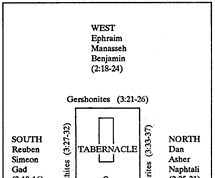
In setting up a camp, the Israelites arranged themselves in four groups of three, one group on each of the four sides of the tabernacle. Each of these four groups had a flag bearing the name of the senior tribe in the group. The group on the eastern side was under the flag of Judah, and when the people journeyed this group went first (2:1-9). The group on the southern side was under the flag of Reuben, and this group had second place in the procession (10-16).
Next in the march came Levi, carrying the tabernacle. The tabernacle and the tribe that looked after it were therefore central in the march just as they were central in the camp, emphasizing that God was always in the midst of his people (17). The group under Ephraim, which camped on the west side of the tabernacle, came behind the tabernacle in the procession (18-24), and the group under Dan, which camped on the north side of the tabernacle, came last (25-31). There were special arrangements for the Levites (32-34; see 3:14-39).
The importance of the Levites (3:1-51)
Details are now given concerning the position of the Levites in the camp and the duties given to them. Although all Levites were God's special servants, the only Levites who were priests were those descended from Aaron. The writer therefore gives details of Aaron's family (3:1-4). The Levites maintained the tabernacle and helped the priests in the religious ceremonies, but only Aaron and his sons did the priestly work itself (5-10; cf. 1 Chron 23:35,24-32).
Because God preserved Israel's firstborn during the Passover judgment in Egypt, those firstborn became his special possession. But for the service of the tabernacle, God took the whole tribe of Levi as his special possession instead of those who had been spared in the Passover judgment (11-13).
In counting the Levites, Moses divided them into three sections according to the three families descended from Levi's three sons, Gershon, Kohath and Merari (14-20; cf. Exod 6:16). The Levites camped on the four sides of the tabernacle in the area between the tabernacle and the other tribes (see 1:53).
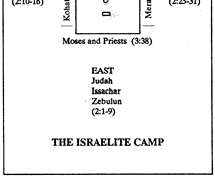
The Gershon group camped on the west side of the tabernacle and looked after most of the curtains and hangings (21-26). The Kohath group camped on the south side and had care of the tabernacle's most sacred objects – the furniture, the vessels and the curtain (or veil) that separated the Holy Place from the Most Holy Place (27-32). The Merari group camped on the north side and had responsibility for all the timber and metal parts belonging to the tabernacle framework and the fence that surrounded the court (33-37). Moses, Aaron and the priests camped on the east side of the tabernacle in front of the entrance and had responsibility for all the ceremonies (38-39).
From the census Moses learnt that there were 22,273 firstborn but only 22,000 Levites. Since the firstborn were replaced by Levites on a one-for-one basis, this meant that 273 firstborn still had not been replaced. They still belonged to God. They therefore had to be bought back from God, or redeemed, by a payment of money to God's representatives, the priests (40-51).
Some duties of the Levites (4:1-49)
Moses then took a special census of Levites, but this time counted only those aged between thirty and fifty, for only those in this age group did the actual work (4:1-3). The work detailed here concerned taking down the tabernacle and packing it for transport. (Further details are given in 7:1-11.)
The priests themselves packed the furniture and other sacred articles, for not even the Kohathites who carried them were allowed to see or touch them. A covering of soft cloth protected the articles from scratching, and a further covering of animal skin protected them from the weather. All articles were carried on either poles or boards. The ark had a special outer covering of blue so that all could see it prominently in the procession (4-20).
After the furniture and vessels were removed from the tabernacle, the curtains and hangings were taken down. These were carried by the Gershonites (21-28). The framework and foundations were then taken apart and packed ready for carrying by the Merarites (29-33).
Aaron's eldest surviving son Eleazar, who was in charge of all the Levites, supervised the whole work. He took direct control of the Kohathites, since they carried the most holy things. His younger brother Ithamar controlled the Gershonites and Merarites (see 3:32; 4:16,28,33). The writer then records the number of working men in the three Levitical groups (34-49).
Laws for uncleanness and repayment (5:1-10)
The laws grouped together in Chapter 5 deal with problems likely to arise where people lived close to each other in a community such as Israel's. People who were ceremonially unclean, whether through disease or any other cause, were put outside the camp. The religious significance of this was that it demonstrated that defilement could not be tolerated in a community where the holy God dwelt. The practical benefit was that it helped prevent the spread of infectious disease (5:1-4; see notes on Lev 13:115:33).
When people through carelessness caused harm or loss to others, they had to confess their wrong, present a sin offering and pay back the loss, together with a fine amounting to one fifth of its value. If the wronged person or a near relative could not be found, the offender had to make the repayment and the fine to the priests instead (5-10; see notes on Lev 5:14-6:7).
Suspicion of adultery (5:11-31)
If a man suspected his wife of having sexual relations with another man but he had no evidence, he had to bring her to the priest, along with a small sin offering, to determine whether she was guilty (11-15; cf. Lev 5:11). The test that the priest conducted was known as a trial by ordeal.
The priest announced the curse that rested on an unfaithful wife, wrote this curse down in ink, then washed the ink into a bowl of holy water that also contained dust taken from the tabernacle floor. The woman acknowledged the curse by taking the sin offering in her hands and swearing an oath. Then the priest offered the offering, after which the woman drank the water (16-26).
Such a ritual must have had great emotional effect, for by drinking the water the woman was taking into herself symbols of God's holy presence (dust from the tabernacle floor) and his curse on sin (the ink). But the innocent had nothing to fear, because the water was only slightly dirty and would not normally cause any illness. If, however, the woman was suddenly attacked by violent pains, it showed she was guilty (27-31).
Many ancient peoples (including, it seems, Israel) used trials by ordeal to determine guilt or innocence for a variety of offences. God took this well known custom, purified it from the idolatry and injustice that usually characterized it, and used it to impress upon his people the purity and faithfulness he required in the marriage bond. Heathen trials by ordeal were mostly cruel and certain to bring a verdict of guilt unless the most unlikely happened. By contrast, the Israelite trial described here was physically harmless and in no way biased against the accused.
Nazirite vows (6:1-21)
The name Nazirite is not to be confused with Nazarene (the name for a citizen of Nazareth). It comes from the Hebrew word nazir, whose meaning indicates that a Nazirite vow was one of separation. People could make such a vow if they wanted to declare openly that they had set themselves apart to God for a certain period to do some particular service (6:1-2).
Nazirites expressed their commitment to their vow by submitting to three specific requirements. By refusing wine and anything likely to produce it, they showed their temporary refusal of the enjoyments of life. At the same time they ensured they would not lose control of themselves through drunkenness. By letting their hair grow, they made it clear to the general public that they were living under the conditions of the vow. By not touching anything dead, they emphasized to themselves and others the holiness that their service for God required (3-8).
No remedy was available for those who broke a vow deliberately. If they accidentally touched a dead body they could ask forgiveness through a ceremony in which they offered two birds (the usual offering for ceremonial uncleanness; Lev 15:13-15) and a lamb (an additional guilt offering; Lev 5:6). But the time they had observed the vow was lost and they had to begin all over again (9-12).
At the end of the period of their vow, Nazirites offered sacrifices and shaved all hair from the head. They were no longer bound by the three specific conditions of the Nazirite vow (13-20). As for the thing vowed, they must have done what they had promised. Their sincerity would be indicated by the voluntary offering of any additional sacrifices they could afford (21).
The priestly blessing (6:22-27)
When the priests blessed the people, the blessing they pronounced was a reminder that God alone provided Israel with health, prosperity, protection and safety. In his grace and mercy he would be patient with their failures, correct their weaknesses and give them the full enjoyment of his unlimited blessings. They were God's own people (22-27).
Offerings from Israel's leaders (7:1-88)
The story returns briefly to the ceremony of the dedication of the tabernacle that had taken place a month or so previously (7:1; see Exod 40:17; Num 1:1). At this ceremony the leaders of the twelve tribes brought their gifts to the altar and offered them to God. The event is recorded here probably because it gives information about the wagons and oxen to be used in transporting the tabernacle. Two wagons and four oxen were for the Gershonites, who carried the tabernacle's curtains and hangings. Four wagons and eight oxen were for the Merarites, who carried the larger and heavier load of the frames and foundation materials. The Kohathites, who carried the furniture and sacred vessels, received no wagons or oxen, because they carried their loads on shoulder poles (2-11).
All twelve tribal leaders donated the same amount. They shared the cost of the wagons and oxen equally, and brought identical offerings of vessels, cereals, oil, incense and animals required for the sacrificial rituals of the tabernacle. The writer's purpose in repeating the details of the identical offerings is perhaps to emphasize that all tribes had an equal share in the maintenance of the tabernacle and its services (12-88).
More about the tabernacle (7:89-8:4)
A short note mentions how Moses received God's messages in the Most Holy Place. Normally, no one except the high priest could enter the Most Holy Place, but Moses' position was unique (89; cf. 12:78; Deut 34:10-12). Moses passed on instructions to Aaron to ensure that when the lamps were placed on the lampstand, they were positioned to throw light forward towards the opposite wall, and so give good light in the Holy Place (8:1-4).
Dedication of the Levites (8:5-26)
The ceremony described here parallels that for the dedication of the priests that has already been described in Leviticus 8:1-36. The washing, shaving, and offering of a sin offering indicated cleansing from sin; the offering of a burnt offering indicated dedication to God's service. The action of the twelve tribal leaders (acting on behalf of the whole people) in laying their hands on the heads of the Levites was the people's acknowledgment of the Levites as their representatives. By the symbolic action of waving his arms up and down, Aaron presented the Levites to God for his service (5-13). God then gave them back to Aaron to help him and the other priests in their work (14-19). Everything was done according to God's instructions (20-22).
Twenty-five is given here as the minimum age for Levitical service, compared with thirty stated earlier (see 4:3). Perhaps there was an initial training period of five years. Levites ceased from their main duties when they became fifty years of age, but could still help in various ways (23-26).
Feast of Passover (9:1-14)
Before leaving Sinai, Israel kept the Passover in remembrance of the deliverance from Egypt. (For details of the Passover feast see notes on Exodus 12:1-36.) All Israelites were to keep the Passover, but a problem arose when some men thought they should not, because they were ceremonially unclean through handling a dead body. They asked Moses what to do and Moses asked God (9:1-8).
God's instruction was that a second Passover feast was to be held, a month after the first, for those who missed the official feast through being either ceremonially unclean or away on a journey at the time.
But all others had to join in the regular feast, and any who broke this law were to be expelled from the camp. Even non-Israelites who lived among them were to keep the Passover, provided they were circumcised (9-14; cf. Exod 12:43-49).
God's guidance (9:15-10:10)
From the Red Sea to Sinai a cloud had guided Israel as a visible sign that God dwelt among and led his people (Exod 13:21-22). This cloud covered the completed tabernacle, indicating clearly to all that God accepted it. God was the centre of their life and the object of their worship (Exod 40:34-38). Through the cloud God would continue to guide them, and they had to respond to his commands with prompt obedience (15-23).
When Moses wanted to pass God's commands on to the people, he called a meeting by blowing two trumpets. If he blew only one trumpet, it meant he was calling only the tribal leaders. If the movement of the cloud showed that the time had come to break camp, a series of distinctive short blasts (called alarms) told the various tribes when to begin marching (10:1-8). Once Israel settled in Canaan, the trumpets were to be blown in times of war and at the annual feasts, as a symbolic request to God to remember his people (9-10).
10:11-14:45 FROM SINAI TO KADESH
The procession moves off (10:11-36)
Almost one year after they arrived at Mount Sinai, the people of Israel, led by Judah, moved off on the journey to Canaan (11-16; see Exod 19:1). The Gershonites and Merarites went in advance of the Kohathites, probably so that they could set up the tabernacle, ready for placement of the furniture when the Kohathites arrived (17-28).
Although the cloud guided Israel, the leaders still needed to know local conditions. For this reason Moses asked his brother-in-law Hobab to go with them, as Hobab had grown up in the region (29-32). Apparently the ark went in front of the whole procession, symbolizing, as Moses' prayer indicated, the leadership of God in overcoming obstacles and making a way for his people. When the people set up a new camp (in this case, after three days' journey) Moses prayed again, inviting God to dwell among them (33-36).
Moses' heavy burden (11:1-35)
The people had travelled only a short time when they began to complain against God, with the result that God punished them (11:1-3). Among those who journeyed with the Israelites from Egypt were some foreigners who had mixed with the Israelites in Egypt (Exod 12:38). These people complained that they were tired of having the same food every day, even though it was miraculously supplied by God. They wanted some of the food they had been used to in Egypt (4-9). (For the origin of manna see Exodus 16:136.)
Soon the discontent spread throughout the camp. Moses complained to God that the responsibility of looking after this complaining multitude was a burden greater than he could bear. In addition he knew of no way to provide such a crowd of people with the food they wanted (10-15).
God did not rebuke Moses for his outburst. He understood Moses' troubles and helped him through them. God commanded Moses to bring seventy of the leading elders of Israel to the tabernacle, where he gave them a share of the same spirit as he had given Moses, so that they could help Moses in the government of the people. God responded to Moses' second complaint by promising a supply of meat that would give the people more than they asked for. In their greed for meat they would eat so much that they would become sick (16-23).
When the seventy leaders received this spirit from God they prophesied. Two of their number for some reason had not attended the ceremony at the tabernacle, but the spirit came upon them where they were in the camp and they prophesied there. Joshua, one of Moses' assistants, was concerned about this and asked Moses to silence the men. He apparently felt that if the people saw these men doing what previously only Moses did, they might give them the sort of respect that previously they gave solely to Moses. Moses rebuked Joshua. He was not jealous if others became more honoured in the eyes of the people; in fact, he wished that all the people might have God's Spirit upon them (24-30).
God gave the people the meat they wanted, but it brought an outbreak of disease that caused many deaths. The meat came from countless birds which, being tired after a long flight where they battled heavy winds, were easily caught only a few feet above the ground (31-35).
Miriam and Aaron's jealousy (12:1-16)
Apparently Moses' first wife had died and he had remarried. His new wife was not an Israelite, and Miriam and Aaron used this as an excuse to criticize him. The real reason for their attack, however, was their jealousy of Moses' status as supreme leader of Israel. Moses, being a humble man, did not defend himself, because he knew that God was the only true judge; and God's judgment was that although Aaron, Miriam and the seventy had a part in the leadership of Israel, Moses' position was unique. God spoke with him directly and entrusted him with supreme authority over his people (12:1-8).
Miriam apparently had taken the lead against Moses and so was the more severely punished, though Aaron shared her shame and sorrow. Moses' humble spirit was again shown when he asked God to forgive Miriam. God did, but just as a daughter who had been publicly rebuked by her father had to spend seven days in shame, so did Miriam. She had been rebuked by God with leprosy and, though now cleansed, she still had to spend seven days in isolation the same as other cleansed lepers (9-16; cf. Lev 14:8).
The twelve spies (13:1-33)
Israel pushed on towards the promised land. The long and tiresome journey through the wilderness of Paran was relieved by stoppages at various points where the people set up camp for a few days (see 10:12; 11:35; 12:16; 13:3). As they moved nearer to Canaan, Moses sent twelve spies, one from each tribe, to see what they could find out about the country – its terrain, its people, its defences and its productivity (13:1-20). The spies probably split up, going in different directions to search out the required information. They covered the land from south to north, west to east (21-24).
Meanwhile the people had journeyed closer to Canaan and set up camp at Kadesh, in the north of the wilderness of Paran. There the spies rejoined the camp after their forty days fact-finding mission (25-26). In brief, their report was that the land was very fruitful but its inhabitants were fearsome. For ten of the spies, this observation about the local inhabitants was sufficient reason to cancel all plans for the invasion of Canaan, and they persuaded the people to agree with them. Only two spies, Joshua and Caleb, suggested Israel go ahead as planned and occupy the land (27-33; 14:6).
Israel's refusal to enter Canaan (14:1-45)
Only a year earlier the Israelites had experienced the power of God in giving them victory over the mighty Egyptians, but now they had no faith to believe that he would lead them to victory over the less powerful Canaanites. They rebelled against God and his leaders by deciding to appoint a new leader instead of Moses and go back to Egypt. God therefore told Moses that he would destroy Israel and build a new nation for himself through Moses (14:1-12).
Again the humility of Moses showed itself. He asked God not to destroy his rebellious people, lest other nations mock him, saying he was weak, unable to finish what he began. Moses appealed to God to be merciful to his people and forgive them as he had done in the past (13-19).
God answered Moses' prayer and did not destroy the people, but neither did he ignore their rebellion. Although they had experienced God's mighty power in the past, they now said they would rather die in the wilderness than trust him for victory over the Canaanites. God's punishment was that they would have their wish: they would die in the wilderness (20-25; see v. 2).
The people had complained that they were concerned about the future of their children (v. 3). God assured them he would look after the children and bring them into Canaan, but the rebellious adults would die in the wilderness. All who were at that time twenty years of age or over (except Joshua and Caleb) would die during the next forty years. Only when they were dead and a new generation had grown up would Israel enter the promised land. The ten rebellious spies died immediately (26-38).
Because the people feared the enemy and refused to enter the promised land, God turned them back into the wilderness (v. 25). But on hearing of their punishment, they then tried to attack the enemies whom previously they feared. This again was a rebellion against God. They had lost their opportunity to enter Canaan, and God's will for them now was to remain in the wilderness for the next forty years. But the people stubbornly persisted. Earlier they refused to go into Canaan with God; now they tried to conquer the land without him. They were defeated, as they themselves had forecast when they heard the spies' report. With God there would be victory, without him defeat (39-45; cf. 13:31-33).
15:1-19:22 LESSONS AT KADESH
Miscellaneous regulations (15:1-41)
Animal sacrifices that were wholly or partly burnt on the altar had to be accompanied by cereal offerings and drink offerings. The amounts of flour, oil and wine to be offered increased with the size of the animal (15:1-16; for details see notes on Lev 2:1-16). Another sort of offering was a cake made from the first lot of grain threshed after harvest. It was an acknowledgment that all grain came from God (1721).
Should the people as a whole be guilty of sin through carelessness, they could ask God's forgiveness by offering the required sacrifices (22-26). A similar provision was available for the individual who sinned through carelessness, but no provision was available for the person who sinned deliberately in bold defiance of God (27-31; for details see notes on Lev. 4:1-5:13).
An example is then given of a person who defied God by deliberately breaking his law. The man was swiftly punished (32-36). Moses told the people that in future they were to wear cords and tassels on the corners of their clothes to remind them to keep God's law (37-41; cf. Matt 9:20; 23:5).
Korah, Dathan and Abiram (16:1-50)
In the events recorded in this chapter, two groups combined to rebel against the leadership of Moses and Aaron. One was a group of 250 prominent Levites under the leadership of Korah, who were envious that only Aaron and his family were allowed to be priests. The other was a group headed by two Reubenites, Dathan and Abiram, who were envious and critical of Moses' leadership of the nation (16:13).
Moses again allowed God to be the judge. He asked both groups to appear before God with him to see who was right. The Reubenites refused but the Levites went, taking a crowd from the camp with them in support (4-15). The Levites were to burn incense in firepans, or censers (which, as a rule, only Aaron and his sons were allowed to do), so that God might show his approval or otherwise (16-19).
God threatened to destroy the whole camp, and although Moses and Aaron knew he had the right to do so, they begged him not to (20-24). He responded to their prayer by destroying only those who actually took part in the rebellion. Korah, Dathan, Abiram and some of their chief supporters were swallowed up by the earth in the sight of the camp, but the 250 Levites suffered a different fate. They had wanted to burn incense before God; now they were burnt by fire from God (25-35).
Neither the fire nor the firepans used by the rebellious Levites could be used again. Eleazar the priest emptied the firepans and had them beaten into a bronze plate to cover the altar, where it was a constant reminder that only the family of Aaron could burn incense before God (36-40).
The people blamed Moses and Aaron for the death of the rebels and gathered at the tabernacle in a hostile demonstration against the leaders (41). Again God threatened to destroy the people (42-45), and again Moses and Aaron begged him not to. But God's judgment in the form of a deadly plague had already begun, and it was stopped only when Aaron made atonement for them by burning incense. This emphasized once more that only the priests could take fire from the altar and offer it with incense before the Lord (46-50).
Aaron's rod (17:1-13)
The two Reubenites, Dathan and Abiram, had challenged the right of Moses (a Levite) to lead the country; the Levite, Korah, had challenged the right of Aaron's family to be the sole priestly family in the Levitical tribe. Having destroyed the rebels, God now gave clear proof that the tribe of Levi was his specially chosen tribe, and the family of Aaron his specially chosen family within that tribe. He did this by miraculously changing the rod identified with the tribe Levi and the priest Aaron (17:1-8).
From that time on, Moses was to keep Aaron's rod in front of the ark, as a reminder of the divinely chosen positions of Levi and Aaron in Israel (9-11). (The rod was later placed inside the ark; Heb 9:4.) The people understood God's message and feared even to go near the tabernacle (12-13).
Support of priests and Levites (18:1-32)
In view of the recent rebellion, God gave further instruction concerning the separate responsibilities of priests and Levites. The Levites were to help the priests and were under their direction, but they were not to do any priestly work in the sanctuary (i.e. the tabernacle-tent). Only the priests could enter the sanctuary, and in so doing they took the risks on behalf of the people for any wrongdoing in relation to God's holy dwelling (18:1-7).
Since the priests had no time to earn a living like others, they had to be supported in other ways. Their food supplies – meat, oil, wine, grain, fruit, etc. – came partly from offerings that required a portion to be set aside for the priests, and partly from firstfruits and other offerings given to the tabernacle (8-14). When the firstborn of all living things were offered to God, they became, in part, the property of the priests, God's representatives. When people or animals were redeemed, the priests received the payment (the redemption price). When a firstborn animal was sacrificed, the priest received a portion. The contributions from all these offerings helped compensate the priests for not being allowed to own land (15-20).
Details are then given for the support of the Levites. Like the priests they did religious service for the people, on whose behalf they ran the risk of doing wrong in matters relating to the tabernacle and its ceremonies. In return for this they received the people's tithes. This constant income from the tithes was also compensation for their not receiving a separate tribal area in Canaan (21-24).
Having received tithes, the Levites themselves then paid tithes. Though the tithe of their income was the produce of other people's fields and vineyards, God accepted it as being their own. Likewise what remained was reckoned to be their own, and they were free to use it accordingly. The tithes of the Levites helped support the priests (25-32).
More laws about cleansing (19:1-22)
God had told the people earlier that any who came in contact with a dead body were to be considered ceremonially unclean. They had to be ceremonially cleansed with water before they could again mix in the community or join in public worship. (For the significance of the laws of cleansing see introductory notes to Leviticus 11:1-15:33.)
Israel now received instructions concerning the preparation of the water to be used in the cleansing ritual. First of all a healthy young cow was killed, after which its blood was ritually sprinkled. The meaning was that the animal, symbolically perfect, bore the consequences of sin and uncleanness. Its carcass was then burnt and its ashes were kept in a special place to be mixed with pure water (v. 17) to form the water of cleansing. All who took part in the killing and burning of the animal were themselves ceremonially unclean for the remainder of the day (19:1-10).
The water of cleansing gained its symbolic power from the ashes of the sacrificial animal mixed with it. The ashes were proof of the animal's death, by which the curse of sin was removed. In the cleansing ritual, the priest sprinkled the water over the person being cleansed (11-13). The tent of a dead person, along with its contents, was unclean, and the cleansing ritual again included sprinkling with the water of cleansing. Objects likely to contain some impurity, such as uncovered containers and even graves, made any person who contacted them unclean (14-19).
Uncleanness spread to anyone or anything that the unclean person touched. This was further reason for people to make sure they obeyed all the laws relating to cleanness and uncleanness (20-22).
The cleansing ritual may have been useful in teaching that sin and death kept people from God's presence, but it was unable to bring more than ceremonial cleansing. It cleansed externally in the sense that it removed the results of physical contact with unclean things, but it could not cleanse the conscience or remove the results of sin. Only the death of Jesus Christ could do that (Heb 9:13-14; 10:22; 1 Peter 1:2).
20:1-22:1 FROM KADESH TO THE PLAINS OF MOAB
Moses' sin at Meribah (20:1-13)
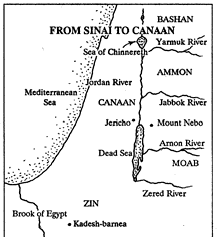
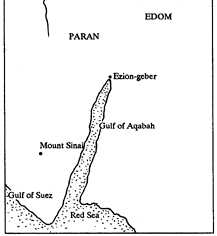
Kadesh-barnea, or Kadesh, on the northern edge of the wilderness of Paran, appears to have been the Israelites' centre during their years of wandering in the wilderness. On one occasion just after the people returned to Kadesh, Miriam died (20:1).
Again there was a shortage of water and again the people complained. (See Exodus 17:1-7 for a similar story.) When Moses and Aaron told God of the people's complaint, God told Moses to speak to the rocky hill beside which they were camped, and water would flow out (2-9).
Moses was angry with the people for their rebellious spirit. Instead of humbly doing as God told him and showing them that God was providing for them, Moses disobeyed God's command and misrepresented him before the people. Instead of accepting God's directions in faith and speaking to the rock, Moses acted according to his own feelings. In anger he struck the rock, called the people rebels, and rebuked them for their constant demands on him as their leader. In so doing, he disobeyed God, spoke rashly to the people, and took personal credit for the miracle instead of giving honour to God. God's punishment was to prevent Moses (and Aaron who had supported him) from entering the promised land (10-13; cf. 20:24; 27:12-14; Deut 3:26-27; Ps 106:32-33).
The long detour (20:14-21:20)
A well used trade route called the King's Highway ran from Ezion-geber on the Red Sea through the kingdoms of Edom and Moab into Syria. Moses decided to use this route for Israel's entrance into Canaan. He therefore asked the Edomite king for permission to pass through his territory, promising not to damage Edom's fields or use its water. If, in an emergency, the Israelites needed to use Edom's water, they would pay for it. Moses expected a favourable reply, because Israel and Edom were brother nations (Edom being descended from Esau, Israel from Jacob), but the king of Edom refused (14-21).
Israel changed route and soon came to Mount Hor. There Aaron died, his death being God's judgment for his sin at Meribah. God announced his death in advance, so that a ceremony could be held to appoint Eleazar, Aaron's oldest surviving son, as the replacement high priest before Aaron died (22-29).
When one of the Canaanite kings heard that Israel was heading towards Canaan, he launched an attack and took some of the people captive. Israel responded promptly, and with God's help destroyed the attackers. It was the first step towards Israel's conquest of Canaan (21:1-3; cf. Deut 20:16-18).
The long detour that the Edomites forced upon the Israelites caused the people to become impatient and complaining again. God punished them with a plague of snakes whose bite produced burning pains and even death. Moses prayed for the people, and God replied by promising to heal all who stopped complaining and trusted in him (4-9).
Moving forward again, the Israelites journeyed around the fortified areas of Moab, crossed the Zered River, and headed north across the tableland region east of the Dead Sea. The writer mentions two significant events in the brief account of the journey across the tableland. One was the crossing of the Arnon River, which marked the boundary between Moabite and Amorite territory; the other was the discovery of water in one particularly dry region. The people celebrated the events by singing well known songs (10-20).
Territory seized east of Jordan (21:21-22:1)
Although Israel had not attacked its brother nation Edom when the king of Edom refused a request to pass through his territory, it did not hesitate to go to war with the Amorite king Sihon who refused a similar request. The Amorites started the fighting, but Israel crushed their army, conquered their chief city Heshbon, and overran their territory (21-25). The victory was especially pleasing to Israel, because the Amorites had only recently gained this territory from the Moabites. The Amorites had written a victory song to celebrate their conquest of Moab (along with its national god Chemosh), but now they themselves were conquered (26-30). As a result of this victory, Israel now controlled an area on Canaan's eastern border that extended from the Arnon River north to the Jabbok River (31-32).