
Part 6
Although the book outlines the conquest of Canaan, it does not provide a detailed historical account of events. The battle for Canaan lasted a long time (Josh 11:18), at least five years (Josh 14:7,10), but the writer passes over some of the longer battles in only a few verses. By contrast, he describes events of little military importance in considerable detail.
The reason for this unevenness in the story is that the writer's chief concern is not to provide a detailed military or political record, but to show what God was doing with his people. The writer is more a preacher than a keeper of statistics; more a prophet than a historian.
To the Israelites, a prophet was not primarily a person who predicted the future, but a person who revealed God's will to his people (Isa 1:18-20; Jer 1:7,9; Amos 3:7-8; cf. Exod 4:10-16; 7:1-2). They viewed their history as a revelation of what God was doing, and for this reason most of the biblical books that we call historical, they called prophetical. Many of Israel's historians were prophets (1 Chron 29:29; 2 Chron 9:29; 12:15).
The Israelites divided their prophetical books into two sections, which they called the Former Prophets (Joshua, Judges, Samuel and Kings) and the Latter Prophets (Isaiah, Jeremiah, Ezekiel and the twelve so-called Minor Prophets). In the Former Prophets God revealed his purposes through the history of Israel, showing how the affairs of Israel, and in fact all nations, were under his control. In the Latter Prophets he revealed his purposes through the words of his spokesmen.
Because of this distinctively Israelite way of viewing history, the writer of Joshua has made no attempt to record everything that happened during the era. Neither has he recorded events in strict chronological order. Rather he has selected and arranged his material according to his prophetic purpose. He wants to lead his readers to a greater knowledge of God, through writing about those matters that are of greater significance in God's dealings with his people.
1:1-5:15 Entry into Canaan 6:1-12:24 Conquest of the land 13:1-22:34 Division of the land 23:1-24:33 Joshua's farewell
1:1-5:15 ENTRY INTO CANAAN
Preparations (1:1-2:24)
God's command to Joshua was brief and straightforward: he was to take the land of Canaan. (The region in which Canaan was situated was occupied by various tribal peoples, the most important of whom were the Hittites and the Amorites.) Israel would not win the land without a fight, but the people had God's assurance that wherever they advanced they would gain possession (1:1-5). As leader of the people, Joshua had the assurance of God's presence, but he still needed personal courage and wisdom. These would also be his as he devoted himself to the task of understanding and obeying God's law (6-9).
Joshua then instructed his officials to prepare the people for departure in a few days time (10-11). The two and a half tribes who had asked for and received their inheritance on the eastern side of the Jordan River did not forget the promise they had made earlier to Moses. They were ready to cross Jordan and help their fellow Israelites conquer the western area. After that they would return and settle down to enjoy their own inheritance (12-18; cf. Num 32:1-33).
The first city that the Israelites had to conquer was Jericho, for it blocked their passage through the mountain pass to the land beyond. Joshua sent two men ahead to spy out Jericho, and although their presence in the city was discovered, they received protection from a prostitute named Rahab (2:1-7).
Rahab told the spies that the people of Jericho were terrified of the Israelites; but she herself had heard sufficient of the God of Israel to believe in his power and mercy to save her. By protecting the Israelite spies, she won from them a guarantee that she and her household would be safe from any violence when Israel attacked (8-14; cf. Heb. 11:31). The spies warned her, however, that she would have to remain faithful and follow their instructions if she and her family were to be spared (15-21; cf. James 2:25). The spies' safe return to Israel's camp reassured them that God was in full control and Israel was certain of victory (22-24).
Crossing the Jordan River (3:1-5:1)
Israel's conquest of Jericho was more than just a military exercise. It had religious meaning. The Israelites were to cleanse themselves before God, because he was the one who would lead them against their enemies. His presence was symbolized in the ark of the covenant (GNB: covenant box), which the priests carried ahead of the procession in full view of the people (3:1-6).
As God had worked through Moses, so he would work through Joshua. Just as the waters of the Red Sea had miraculously dried up to allow the former generation to escape from Egypt, so the waters of the Jordan would miraculously dry up to allow the new generation to enter Canaan (7-13).
It seems that the way God stopped the Jordan was by a collapse of its banks at the town of Adam (twenty-five kilometres upstream) that dammed the river. God was controlling events according to his perfectly timed plan, so that the waters at the river crossing dried up just as the priests arrived there. The priests then stood in the middle of the dry river bed until all the people crossed over (14-17).
Twelve men, one from each tribe, were then sent back to take twelve stones from the river bed, to be set up at the place where the people camped that night as a memorial of the great event (4:1-8). Joshua set up another memorial of twelve stones in the middle of the river itself, before the river broke through the earth dam upstream and returned to its normal flow. These remarkable events caused the people to give Joshua the same honour and respect as previously they had given Moses (9-18; cf. 3:7).
Once the people had established their camp at Gilgal, Joshua took the twelve stones that the men had brought from the river and set up the memorial (19-24). When the Canaanites heard about the Israelites' miraculous crossing of the Jordan, they were filled with fear (5:1).
Camp at Gilgal (5:2-15)
Israel's camp at Gilgal became the centre for the battle campaign that was to follow. But before the people could receive the land God promised them in the covenant, they had to renew their covenant relation with him.
During the previous forty years, the people of Israel had brought shame upon themselves through consistently being disobedient and unbelieving. They had even neglected the first requirement of the covenant, which was the circumcision of all newborn male children. Circumcision was the sign of the covenant. Therefore, just as there had been a general circumcision for all males in Abraham's household when the covenant was sealed (see Gen 17:9-14), so again there was a general circumcision in Joshua's time for all who were still uncircumcised. The ceremony sealed them as God's people who were to inherit the land promised to Abraham in the covenant (2-9; see Gen 17:5-8).
With the completion of the circumcision, the people could celebrate the Passover (something that an uncircumcised person was not allowed to do; see Exod 12:47-49). The journey from Egypt to Canaan was now officially over, and therefore the miraculous daily supply of manna ceased (10-12; cf. Exod 16:35).
God's special messenger appeared to Joshua to remind him that God was the commander of Israel's army. This messenger was so closely identified with God that Joshua fell at his feet and worshipped. To him it appeared that God had temporarily taken human form (13-15).
6:1-12:24 CONQUEST OF THE LAND
Destruction of the Canaanites
The following chapters show that the Israelites' conquest of Canaan was well planned. First they won control of the central region (Chapters 6-9). This created a division between the northern and southern regions, and so prevented Canaanite tribes throughout the country from joining forces. Israel then had a much easier task in conquering the rest of Canaan, first the south (Chapter 10), then the north (Chapter 11).
Israel's destruction of the people of Canaan was not merely for political or material gain. It had a religious and moral purpose in God's plan. He had given the Canaanites time to repent, and the case of Rahab shows that any who turned from their sins and believed in the God of Israel could be saved. But for the Canaanites as a whole, their wickedness was now so great that the time for judgment had come (Gen 15:16; Deut 7:1-5). In the case of Sodom and Gomorrah, God had used the forces of nature to bring destruction; in the case of the Canaanites, he used his people Israel.
Apart from certain specified exceptions, the Israelites were to spare nothing and keep nothing (Deut 7:1-5; 20:16-18). The judgment had a religious significance, and everything was to be devoted to God for destruction. It was 'devoted', or 'holy', not in the sense of being morally pure, but in the sense of being forbidden to humans. People could not use devoted things for themselves. By destroying them, they were, in effect, presenting them to God and then carrying out God's judgment upon them (see 6:17-18; Lev 27:28-29; Deut 13:17). Concerning the destruction of the Canaanites' possessions, precious metals were excepted. These were added to Israel's treasury, probably after they were ceremonially purified by being passed through fire and washed in water (see 6:19; Num 31:21-23).
One result of moral filth is physical disease. Therefore, the destruction of the Canaanites (in some cases together with their sheep and cattle) ensured the removal of deadly diseases that could have threatened Israel's existence. The absence of Canaanite religious practices would also be a help to Israel's religious life and moral well-being.
Defeat of Jericho (6:1-27)
The destruction of Jericho demonstrated the kind of warfare that Israel was engaged in. God's unusual directions for the conquest of Jericho showed clearly that this was a religious judgment and Israel was his instrument. This was demonstrated in the important role of the priests, the prominence of the ark of the covenant, and the repeated use of the number seven in the battle preparations (6:1-7). Over the next six days the Israelites marched around Jericho once each day, and then returned to the camp at Gilgal (8-14).
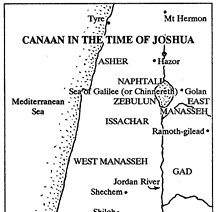
On the seventh day the Israelites were to march around the city seven times. When the walls of the city fell, they were to destroy all the people except Rahab and those in her house, and all the goods except the precious metals. The Israelites were to keep nothing for themselves (15-19).
If earthquake activity had caused the collapse of the Jordan's banks, the same earthquake activity may have weakened the foundations of Jericho's walls. Nevertheless, the collapse of the walls at the exact moment God planned showed that victory came through the power of God, in response to the faith of his people (20-25; Heb 11:30). God intended Jericho to remain in ruins, as a permanent memorial that it had been destroyed by his curse. If any person rebuilt the city, the curse would pass on to him, and as a consequence he would suffer the loss of his own sons (26-27; cf. 1 Kings 16:34).
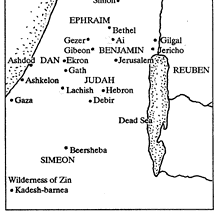
Achan's sin (7:1-26)
God was angry that Israel had not been fully obedient to him in the conquest of Jericho. One of the people, Achan, secretly kept for himself what he should have destroyed (7:1). Therefore, when the Israelites moved on to attack the much smaller town of Ai, God allowed them to be driven back and to suffer losses (2-5). Joshua was distressed, not just because Israel had been defeated, but because their defeat would encourage the Canaanites. If all the Canaanites joined forces, Israel could be destroyed (6-9).
In response to Joshua's desperate prayer, God told him the reason for Israel's defeat. One person's sin concerning the devoted things of Jericho was enough to break the agreement that the whole nation had made with God, and so bring disaster upon it. God's curse on the devoted things passed on automatically to those associated with them. The person who kept the devoted things was now himself devoted to destruction, and through him Israel was also (see 6:18). The nation could be saved only by destroying the devoted things and all persons and things connected with them (10-15). Through the ritual of drawing lots, Joshua discovered that Achan was the guilty person. Achan's confession confirmed that the choice was correct (16-21). He and all that was his were then destroyed (22-26).
Victory in central Canaan (8:1-9:27)
Now that the Israelites had removed the cause of their defeat, God promised Joshua victory over Ai. He added that on this occasion the Israelites could keep the plunder for themselves (8:1-2).
Even with God's assurance of victory, Joshua planned the attack thoroughly. One company of soldiers was to draw the men of Ai out of the city to fight, then a second company would come out of hiding to attack Ai from the rear (3-9). The plan worked perfectly. When the first Israelite company drew the enemy out, Ai was left defenceless (10-17). The second Israelite company then captured the city (1819). The men of Ai, caught between the two companies, were wiped out (20-23). The Israelites killed the people trapped inside Ai, after which they plundered the city and burnt it (24-29).
Having now cleared the way, Joshua led his people to Shechem, about thirty kilometres farther on. God had earlier instructed the people through Moses that, as soon as possible after entry into Canaan, they were to go to Shechem to promise their obedience to the covenant. First of all Joshua built an altar, on which the people offered sacrifices that expressed dedication and fellowship. Joshua also wrote the law of God on plastered stones, which he set up in Shechem to remind the people of the rule of life that God laid down for them in their new land (30-32; Deut 27:1-8).
The people gathered at the mountains Gerizim and Ebal, on either side of Shechem, to collectively declare their loyalty to the covenant. The six tribes who gathered at Mt Gerizim answered 'Amen' as the blessings of the law were read. The six tribes who gathered at Mt Ebal answered 'Amen' as the curses for disobedience were read (33-35; cf. Deut 27:11-14).
As Israel's fame spread, certain Canaanite tribes joined forces to resist any further advances (9:1-2). However, the people of Gibeon and three other towns in the central highlands thought of a different way to protect themselves. Knowing that Israel would destroy all the inhabitants of Canaan, they tricked Israel's leaders into agreeing not to kill them. They did this by pretending that they were not from Canaan at all, but were from a distant country (3-15). The Israelites were angry when they discovered the truth, but the leaders would not break their promise. They allowed the Gibeonites to live, but put them to work for Israel (16-21). The Gibeonites were grateful to be alive and willingly submitted to Israel's rule (2227).
Victory in southern Canaan (10:1-43)
The five kings who between them controlled much of southern Canaan saw Joshua's control of Gibeon as a threat to their security. They decided to conquer Gibeon and so stop any further move south by Israel (10:1-5).
Joshua faced his biggest battle thus far. He knew that it would be a life-or-death struggle, but God encouraged him with the assurance of victory (6-8). God then helped make victory possible by causing some unusual changes in the weather that were favourable to Israel but fatal to the enemy (9-15). The enemy armies were almost destroyed, though some people found refuge in the fortified Canaanite cities (16-21). The five kings were then killed in a public execution, which included symbolic actions to reassure Israel's military leaders that no enemy could stand before them (22-27).
Encouraged by the victory, Joshua led his forces farther into the southern regions of Canaan, where he conquered the key cities. These included cities in the foothills leading down to the coast, such as Libnah, Lachish, Gezer and Eglon (28-35), and more elevated cities in the central tableland such as Hebron and Debir (36-39). The conquest continued till it reached as far south as Kadesh-barnea and as far west as Gaza on the Mediterranean coast. Israel now controlled almost the whole of southern Canaan (4043).
Victory in northern Canaan (11:1-15)
Alarmed by Israel's victories in the south, the kings of the north organized the largest, strongest and best equipped army that Israel had yet faced (11:1-5). Again God encouraged Joshua, and again Joshua launched a devastating surprise attack. He defeated the combined northern forces, making sure that he destroyed all their horses and chariots. This was apparently to prevent the Israelites from being tempted to use the horses and chariots themselves instead of trusting wholly upon God (6-9). Joshua captured all the key cities and destroyed the chief city, Hazor. All of northern Canaan was soon in the hands of Israel (1015).
Summary of Israel's conquests (11:16-12:24)
Now that Israel controlled all the territory that was to become its homeland, the writer summarizes the entire conquest. First he summarizes Joshua's conquest of all the area west of Jordan (i.e. Canaan itself), where nine and a half tribes were to receive their inheritance (16-23). Then he summarizes the former conquest in the time of Moses, when Israel gained control of the territory east of Jordan, where two and a half tribes had already been allotted their inheritance (12:1-6; cf. Num 21:21-35; 32:33). Finally he lists the kings of the Canaanite city-states whom the Israelites had defeated (7-24).
The record of Joshua's conquest of Canaan is now complete. It has dealt only with the main events and has emphasized the decisiveness of Israel's victory. Actually the war lasted a long time, at least five years (cf. 11:18; 14:7,10).
Once Israel had won control of the land as a whole, Israel's leaders began the task of dividing it among the tribes. Throughout the country, however, there were many areas that the Canaanites still occupied, usually because they had either escaped the Israelites or proved too difficult to conquer. Many of these areas were in valleys or plains, where the Canaanites maintained control because of their large forces of chariots (cf. 17:16-18). The individual Israelite tribes were now to clear the Canaanites out of these areas and so enjoy full possession of their inheritance (see 13:1; 14:12). But the people were tired of battle, and the Canaanites whom they failed to destroy later became a source of much trouble to Israel (cf. 15:63; 16:10; 17:12). This is well demonstrated in the book of Judges.
13:1-22:34 DIVISION OF THE LAND
All the land that Israel had conquered was now divided among the twelve tribes. The list of tribal boundaries may not make very interesting reading today, but it was necessary for Israel as a permanent and lawful record to which people could refer if any disagreement arose. It also told the tribes of the enemies that had yet to be destroyed, both within their own tribal areas and in lands round about.
Overall plan for the division (13:1-14:5)
The area west of Jordan, which still contained many areas occupied by Canaanites, was to be divided between nine and a half tribes (13:1-7; for details of the separate tribal areas see 14:6-19:51). The area east of Jordan was to be occupied by two and a half tribes, in accordance with the arrangements that Moses made earlier (8-13; for details see 13:15-33). Cities for the Levites were to be allotted in all the tribes, since Levi had no tribal area of its own (14; Num 18:24; for details see 21:1-42).
Reuben was the most southern of the three eastern tribes, and occupied territory that Israel took from the Amorite king Sihon (15-23). Gad settled in the central section east of Jordan, and occupied much of the region commonly known as Gilead (24-28). The half tribe of Manasseh occupied the northern section east of Jordan, which included part of Gilead along with part of the rich pasture land of Bashan (29-31). The settlement of two and a half tribes east of Jordan instead of in Canaan itself had been approved by Moses (32-33).
Localities for the nine and a half western tribes were decided by drawing lots, but the area of land that each tribe received was in proportion to the population of the tribe (14:1-2; cf. Num 26:54-56; 33:54). In spite of the omission of Levi, the number of tribes among whom Israel's territory was divided (i.e. land on both sides of Jordan) was still twelve. This was because the son who received the birthright received twice the inheritance of the other sons, which in this case meant he received an additional tribe. As a consequence Joseph, who received the firstborn's inheritance instead of Reuben, received two tribes in Israel. The tribes were descended from his two sons, Manasseh and Ephraim (3-5; cf. Gen 48:5-6; 1 Chron 5:1-2).
The tribe of Judah (14:6-15:63)
By far the largest portions of Canaan went to the chief tribes, those of Judah and Joseph (cf. Gen 49:8-12,22-26). Judah received almost the whole of southern Canaan, and Joseph received almost the whole of central Canaan.
Caleb received his special inheritance within the area given to his tribe, Judah. Here he proved that his expression of faith made forty-five years earlier was not mere words. At that time he and Joshua alone in Israel believed that the Israelites could destroy the fearsome people of Anak whom they saw in Canaan. Now Caleb was prepared to do it (6-12; cf. Num 13:25-33; 14:24). Joshua gladly gave him permission to go ahead (13-15).
Judah was allotted southern Palestine between the Dead Sea and the Mediterranean Sea, as far south as the Wilderness of Zin and the Brook of Egypt (15:1-12). Within this territory Caleb then conquered the people of Anak. His courage and faith helped to develop the boldness of others, especially Othniel, who received Caleb's daughter as a reward for his bravery. Caleb also gave the young couple a piece of land as a wedding gift, but because the region was very dry he gave them an additional piece of land containing two springs of water (13-19; Judg 1:11-15; 3:9).
The cities of Judah were grouped in various regions: the dry southern region known as the Negeb (20-32); the low foothills region known as the Shephelah (33-44); the coastal plain territory of the Philistines (45-47); the central highland country (48-60); and the semi-desert region near the Dead Sea (61-62). The prize city of Jerusalem, however, remained unconquered (63).
The Joseph tribes (16:1-17:18)
Ephraim and the western half of Manasseh together occupied most of the central portion of Canaan between the Jordan River and the Mediterranean Sea (16:1-4). The southern part of this territory belonged to Ephraim (5-10), the northern part to Manasseh (17:1). (The other half of Manasseh had already received its allotment east of Jordan.)
Western Manasseh was divided between six major family groups. No details are given concerning portions received by five of these groups, but the remaining portion was subdivided into five smaller portions, which were given to the five daughters of Zelophehad. This was in accordance with the special law which directed that where a man had no son, his inheritance could pass to his daughters (2-6; see Num 27:1-11). Manasseh also took towns from the smaller tribes to its north, apparently claiming it could drive out the Canaanites from these towns. It failed to remove the Canaanites, but still kept the territory for itself (7-13).
Although the Joseph tribes received the best part of Canaan, they were still not satisfied. They wanted more land, but they did not want to work for it or fight for it. Joshua told them that if they cleared the forests and drove out the Canaanites, they would find that they had plenty of land within the territory already allotted to them (14-18).
The seven smaller tribes (18:1-19:51)
Allotments were now finished for two and a half tribes on the east of Jordan (Reuben, Gad and half of Manasseh) and two and a half tribes on the west (Judah, Ephraim and the other half of Manasseh). The next task was to settle the seven smaller tribes that remained. For this purpose the camp, including the tabernacle, was shifted from Gilgal to a more central location at Shiloh (18:1-2; cf. 5:10; 10:6,15,43; 14:6; 19:51; 22:9,12).
Many of the people had by now become lazy and were not willing to fight or work. Joshua stirred them up to finish the job. He sent off men to survey the remainder of the land and divide it into seven portions. He then drew lots to decide which area each tribe would receive (3-10).
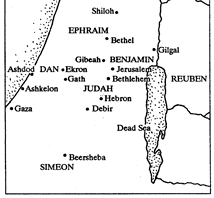
Benjamin received a small area between the powerful tribes of Judah and Ephraim. A number of important towns of the central highlands were located in Benjamin, among them Jerusalem, which was just inside Benjamin's southern border (11-28). Simeon was settled in part of the tribal area of Judah (since Judah's area was too large for it), in the dry southern region known as the Negeb. As a result Simeon soon lost its separate tribal identity and was absorbed into the more powerful Judah (19:1-9; cf. Gen 49:5-7).
The next four tribes in the list occupied Galilee and neighbouring regions in the north of Canaan. Zebulun's territory was in the fertile hill country that rose from the coastal plain to the mountains of southern Galilee (10-16). Issachar, which bordered Zebulun, occupied the Valley of Jezreel to the south of the Sea of Galilee. The area was strategically important and agriculturally rich (17-23). Asher was allotted the coastal plain from Mt Carmel north to the Phoenician cities of Tyre and Sidon. But it never gained full control of the area, and had to be content with the region around Mt Carmel and the neighbouring hill country (24-31; Judg 1:31-32). Naphtali was given the Galilean hills and the Jordan Valley north of the Sea of Galilee (32-39).
Dan's original position was on the Philistine coast between the tribes of Judah and Ephraim. Squeezed between Israel's two most powerful tribes, and pushed back from the coast by the Philistines and the Amorites, the tribe of Dan later moved and settled in the far north (40-48; Judg 1:34; 18:1-31). Finally, Joshua received his special inheritance, which, by God's command, he himself chose. It was in the area of his own tribe, Ephraim (49-51).
Cities for the Levites (20:1-21:45)
The Levites were given forty-eight cities throughout Israel, along with surrounding pasture lands for their cattle (see 21:41-42; Num 35:1-8). Among these cities were six cities of refuge (Num 35:6). These were cities where a person who had killed another could flee for safety until he had been lawfully judged (Exod 21:12-14). If he was found guilty of murder he was to be executed, but if he was found to have caused the death accidentally, he could live in the city of refuge under the protection of the chief priest as long as that priest lived. This limited his freedom, but at the same time it ensured that he was safe from the revenge of the dead person's family (20:1-6; Num 35:9-34).
Three of the cities of refuge were west of Jordan and three east. In both the western and eastern regions one city was in the northern section, one in the central and one in the southern (7-9; Num 35:1415).
Levi had three sons, Kohath, Gershon and Merari. Aaron was of the family of Kohath, and all Aaron's descendants, and no others, were priests (Exod 6:16,18,20; Num 3:10). The forty-eight cities of the Levites were therefore divided into four groups, which corresponded to the four divisions of the Levitical tribe: the priestly Kohathites, the non-priestly Kohathites, the Gershonites and the Merarites (21:1-7).
The drawing of lots decided the allocation of the cities (8), but God controlled the outcome so that the cities given to the priestly Kohathites were all within easy reach of Jerusalem, where the temple would one day be built (9-19). The non-priestly Kohathites were farther from Jerusalem (20-26), the Gershonites were mainly in the north (27-33) and the Merarites were mainly in the north and east (34-40). Once the Levites had received their cities, the allotment of Canaan was complete (41-45).
Settlement of the eastern tribes (22:1-34)
Now that the territory west of Jordan had been conquered and divided among the nine and a half tribes, the other two and a half tribes were free to return to their inheritance east of Jordan. Joshua commended them for being faithful to their word in helping their brothers conquer Canaan (22:1-4; cf. Deut 32:16-32), and warned them to remain true to God in their new homeland (5). He then sent them back to their families with his blessing (6-9).
The eastern tribes expressed their loyalty to God and their unity with their brothers in Canaan by building an altar (10). But the western tribes misunderstood their action. They saw it as a sign not of unity, but of division. They thought the eastern tribes were rebelling against God and corrupting the religion he had given them (11-20).
In response the eastern tribes explained that they were not setting up an independent religion. On the contrary they wanted to demonstrate that they shared the same faith as their brothers across the river (2125). They had not built the altar to offer sacrifices. They had built it solely for the purpose of reminding their descendants that they were part of Israel and worshipped the same God as their fellow Israelites (2629).
This explanation satisfied the western tribes and peace was restored. The eastern tribes even gave the altar a special name to ensure that they never forgot its significance. They were bound to Yahweh, their covenant Lord (30-34).
23:1-24:33 JOSHUA'S FAREWELL
Nothing is recorded of events that occurred between Joshua's division of the land and his farewell addresses to the nation many years later. His life was now drawing to a close (see v. 14), and he called Israel's leaders together to pass on some encouragement and warning (23:1-2). He assured them that God would continue to fight for his people till all the remaining Canaanites were destroyed, provided his people remained true to the covenant. They were to love God, keep his commandments, and avoid the worship of all other gods (3-11). They were not to intermarry with the Canaanites who still lived among them (12-13), and were to remember that loyalty to God would bring his continued blessing, but disloyalty would bring his judgment (14-16).
Just as the people had once gone to Shechem to declare their loyalty to the covenant (see 8:30-35), so now the leaders, on behalf of the people, returned to Shechem to make a fresh declaration of loyalty (24:1). The covenant had originated with God, who brought Abraham from Mesopotamia into Canaan and promised to make from him a nation that would one day possess Canaan as its homeland (2-4). Centuries later God fulfilled that promise when he brought Israel out of Egypt (5-7), through the wilderness (8-10) and finally into Canaan (11-13). Sadly, the Israelites had demonstrated a tendency towards idolatry, whether the idolatry of Abraham's ancestors, of the Egyptians, or of the Canaanites. Therefore, they had to make a firm decision whether they were going to serve one of these gods or serve the true God, Yahweh (14-15).
The people readily declared that they would serve Yahweh alone (16-18). Joshua knew that to declare loyalty was easy, but to maintain it was not so easy. He therefore reminded the people of the terrible consequences if they broke their covenant with such a holy God (19-20). When the people swore that they knew what they were doing, Joshua challenged them to put their professed loyalty into practice immediately (21-24). He then ceremonially sealed the renewed covenant, wrote the covenant laws in a book, and set up a stone as a memorial of the people's promise to be loyal and obedient (25-28).
Joshua died in the knowledge that his strong leadership had helped the people maintain their allegiance to God. He was buried in his own piece of land in the tribal area of Ephraim (29-31). Joseph's bones, which the Israelites had brought with them from Egypt, were also buried within the area of the Joseph tribes. This was in accordance with Joseph's instructions, given centuries earlier, by which he had openly declared his faith in God's promises (32; cf. Gen 50:24-25; Exod 13:19; Heb 11:22). The high priest also was buried in Ephraim (33).
Judges
The book of Judges deals with events in Israel during the two hundred years that followed Joshua's conquest of Canaan. Israel under Joshua had won a great victory, but the people had not been fully obedient to God's command to destroy all the Canaanites. As a result those Canaanites who were left in the land became a source of trouble to Israel, both religiously and politically.
During this period Israel's history developed a pattern that is repeated many times in the book of Judges. Time and again Israel turned away from God, copied the religious practices of the Canaanites, became politically weak and finally fell under the power of neighbouring tribes or nations. But God, who used these enemies to punish his disobedient people, was long-suffering and merciful. In each case he gave them, in his time, a deliverer from among their own people who overthrew the enemy and led Israel back to himself.
These deliverers were called judges, because they carried out God's judgment in defeating the enemy and delivering his people. Other judges, less warlike, carried out God's judgment by guiding the everyday affairs of his people according to his law. From these leaders, military as well as civilian, the book takes its name.
Israel and its enemies
It appears that the various conquests by enemy nations, and the deliverances by the Israelite judges that followed, never involved the whole of Canaan. Usually the only tribes involved were those in the area of the enemy's activity. Also, some of the conquests and deliverances may have occurred in different parts of the country at the same time. For example, the story of Jephthah and the Ammonites may belong to the same period as the stories of Samson and the Philistines (Judg 10:7-8; 11:5; 13:1). There was little unity in Israel, and each tribe (or group of tribes) looked after its own area without concern for the other tribes.
The main reason for this lack of unity was the people's departure from God. If they had made him the centre of their national life, their loyalty to him would have bound them together. Their disunity was made worse by their failure to destroy the enemy among them. Canaanite strongholds in a number of key places kept the tribes apart. In Canaan itself (the area between the Jordan River and the Mediterranean Sea) the tribes were broken into three main sections – northern, central and southern – while the eastern tribes were separated from the rest by the Jordan River.
This breaking up of Israel created not only political disunity but also religious disunity, for it meant that many of the tribes were cut off from Israel's central place of worship at Shiloh (Josh 18:1; 22:9). In short, most of the nation's troubles, material, political and spiritual, were a direct result of the people's failure to obey God and wipe out the Canaanites (Judg 1:21,27-36; cf. Deut 7:2-4; 9:5; Josh 24:14-24).
The religion of the Canaanites
Canaanite gods were known as Baalim (plural of Baal; see Judg 2:11-12; 10:10; 1 Kings 16:31), and goddesses as Ashtaroth (plural of Ashtoreth, or Astarte; see Judg 2:13; 1 Sam. 7:3-4) and Asherim (plural of Asherah; see Judg 6:25-26; 2 Kings 23:4). These were gods of nature and fertility who, among other things, were believed to have the power to increase agricultural productivity. Since Israel knew Yahweh as the Creator of nature, the people easily fell to the temptation to combine Canaanite ideas with their own and so worship Yahweh as another Baal. The word baal was a common Hebrew word that meant master, husband or owner, and since the Israelites knew Yahweh as their master, husband and owner, they further linked the Canaanite Baals with him (Hosea 2:5-10).
The places where the Canaanites liked to carry out their Baal rituals were the sacred hilltop sites known as high places (Num 33:51-52; 2 Kings 23:13). Among the features of these high places were the sacred wooden or stone pillars known as Asherim (named after Asherah, the goddess whom they represented; Judg 6:25-26; 1 Kings 14:23). From the beginning Israelites had worshipped Yahweh at various places in the hills (e.g. Gen 22:2; Exod 17:8-15; 19:3), and again the people readily fell to the temptation to take over the high places of Baal and use them in their worship of Yahweh. All this was in spite of God's command that the high places of Baal were to be destroyed (Num 33:52; Deut 12:2-3).
Prostitutes, male and female, were available at these high places for fertility rites. These were religious-sexual ceremonies that the people believed gave increase in crops, herds, flocks and family (1 Kings 14:23-24; Hosea 2:5,8-9; 9:1-2,10-14). In following the Baals, the Israelites were also guilty of spiritual prostitution. The covenant bond between Israel and Yahweh was likened to the marriage bond; therefore, Israel's association with Baal and other gods was spiritual adultery (Judg 2:12-13,17; Jer 2:20; 3:6-8; Hosea 2:13; 4:12).
1:1-2:10 Summary of Joshua's conquest 2:11-16:31 Rule of the judges 17:1-21:25 Tribal disorder within Israel
1:1-2:10 SUMMARY OF JOSHUA'S CONQUEST
Israel's incomplete conquest (1:1-36)
The writer of the book is concerned with events 'after the death of Joshua' (see 1:1), but before describing these events he gives a background to them by outlining Israel's conquest of Canaan under Joshua. First, he summarizes the attack led by Judah and Simeon in the southern part of the central highlands (1:1-7; see notes on Josh 10:1-43).
Jerusalem was among the highland towns that Joshua captured. Later, however, it was retaken by the enemy, so that by the time Benjamin received Jerusalem in its tribal allotment, the enemy was firmly in control of the city again (8; cf. v. 21). Israel then carried the conquest south to Hebron, where Caleb won a great victory (9-10; cf. v. 20; see notes on Josh 14:6-15). Caleb's boldness encouraged Othniel, who spread the conquest even further (11-15; see notes on Josh 15:13-19).
Although the Israelite armies won control of the hill country, they were not able to maintain control of the plains, being driven back into the hills by the Canaanite chariot forces. Consequently, towns captured by Israel on the coastal plain of southern Palestine were later recovered by the Philistines (1621). (The towns of Ashdod, Ashkelon, Gaza, Gath and Ekron were known as 'the five cities of the Philistines'; cf. 3:3; 16:23; Josh 13:3.)
Having outlined Israel's conquest in southern Canaan, the writer goes back in the story to mention part of Israel's earlier conquest in central Canaan (22-26; see notes on Josh 8:1-29). As the Israelites spread their conquest farther north they gained control of the hill country, but could not gain control in the plainland regions where the Canaanite chariot forces operated (27-30; see notes on Josh 17:7-18). In the far northern tribal areas of Naphtali and Asher, the Canaanites maintained even greater control (31-33), and the central coastal tribe of Dan was eventually forced out of its territory completely (34-36; see notes on Chapters 17 and 18 below).
Results of Israel's failure (2:1-10)
In bringing Israel into Canaan, God was faithful to his covenant promises. The Israelites, however, were not faithful to theirs. Therefore, just as Israel was once God's instrument to punish the Canaanites, so now the Canaanites would be God's instrument to punish Israel (2:1-5). After the death of Joshua and the godly leaders whom he had trained, the Israelites turned away from God. In so doing they brought Israel into an extended period of suffering and defeat, though within this period there were times of peace. These were won for them through God-sent deliverers known as judges (6-10).
2:11-16:31 RULE OF THE JUDGES
Pattern of judgment and deliverance (2:11-3:6)
When the people of Israel rejected God and began to worship Baal and other gods, God punished them. He allowed them to fall under the power of foreign tribes and nations who seized their property and ruled them cruelly (11-15). When, after many years of suffering, the people finally turned again to God, God gave them deliverers who overthrew the enemy and restored independence to Israel. But as soon as they were living in peace and contentment again, the people forgot God and returned to their idolatrous ways. This pattern was repeated generation after generation (16-19). The enemy whom the Israelites failed to destroy then became a source of trouble to them (20-23).
God used enemies in and around Palestine to test Israel's loyalty to him and to punish them when they were disobedient. He also used them to give each new generation of Israelites experience in warfare (3:1-4). Some Israelites intermarried with these people and worshipped their gods (5-6).
Othniel, Ehud and Shamgar (3:7-31)
The first invader of Israel seems to have come from Aram, which was far to the north of Palestine. The Israelite leader who finally defeated him, Othniel, came from the tribe of Judah, which was in the south of Palestine (see Josh 15:13-19). It appears, therefore, that the enemy had overrun most of the land. As in other cases recorded in Judges, Israel's victory came through God's special power given to the deliverer (7-11; cf. 6:34; 11:29; 13:25; 14:6,19; 15:14).
Israel's next oppressor came from the east. The forces of Moab, assisted by Ammon and Amalek, crossed the Jordan and advanced as far as Jericho, the city of palms. From there they exercised control over the tribal area of Benjamin and possibly the border areas of Ephraim. They ruled for eighteen years (12-14). Israel's deliverer, Ehud, came from Benjamin. When the time came for him to take Israel's periodic tribute money to the Moabite king (probably at Jericho), he cunningly gained a private meeting with the king and assassinated him (15-23). Before the Moabites discovered what had happened, Ehud escaped and mobilized his soldiers (24-27). When the Moabites tried to flee back to Moab, they were cut off by the Israelites at the Jordan crossing, and mercilessly slaughtered (28-30).
Another great leader who rescued the Israelites from an enemy was Shamgar. He won his victory over the Philistines, who lived on the Mediterranean coastal plain (31).
Deliverance under Deborah (4:1-5:31)
Hazor, chief city of the north, had been conquered and burnt by Joshua (Josh 11:10-13). However, not all the people had been destroyed. Having rebuilt Hazor, they now took revenge on the northern tribes, especially Zebulun and Naphtali, and ruled them cruelly for twenty years (4:1-3). (To understand fully how God saved Israel at this time, we must read the historical outline in Chapter 4 together with the song of victory in Chapter 5.)
Israel's deliverer on this occasion was Deborah, a woman who was already established as a leading civil administrator in the nation (4-5). With her army commander Barak, she led a large Israelite force up Mt Tabor. The plan was to make the enemy commander Sisera believe there was an armed rebellion in Israel, and so draw Sisera's chariot forces out into the plain of the Kishon River, which lay below the Israelites (6-10).
The plan was successful. Soon after Sisera crossed the shallow stream, a tremendous rainstorm flooded the river. The soft ground quickly became one huge bog; the small stream became a raging river. The Canaanites were thrown into confusion as chariots became bogged, horses grew mad with fear, and soldiers drowned in the rushing waters. Certain of victory, the Israelites rushed down upon the enemy (11-16; see also 5:20-22).
Sisera escaped and looked for safety in the tent of his friend Heber (17; cf. v. 11). But Heber was not at home, and Sisera did not know that Heber's wife Jael was on the side of Israel. Once Jael had made sure that Sisera was soundly asleep, she killed him (18-22). The Israelites' victory that day gave them the confidence and courage to fight on till they destroyed the power of the enemy to enslave them (23-24).
Deborah and Barak's song of praise recalls the dramatic activity of God, the initiative of the leaders and the willing service of the people which together produced this spectacular victory. The rainstorm that God used to fight for his people reminded them of the earthquake he sent at Mt Sinai (5:1-5; cf. Exod 19:16).
Israel had suffered enough under the cruel Canaanites, whose raiding and violence made trade, travel and farming almost impossible. They would not even allow the Israelites to make any weapons to protect themselves. Then arose Deborah! Rich and poor alike are now urged to join with Israelites everywhere in songs of praise for God's deliverance through her (6-11).
When Israel's leaders stirred themselves to overthrow the Canaanites, most of the tribes joined in enthusiastically. With Benjamin and Ephraim in the lead, and Manasseh (Machir), Zebulun, Naphtali and Issachar following, the Israelites rushed down the valley and attacked the enemy. Shame on Reuben, Gad
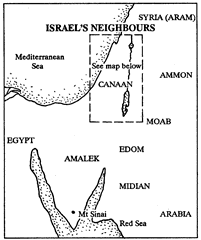
(Gilead), Asher and Dan who were selfishly concerned with their own affairs and did not come to help the other tribes (12-18).
The Canaanites came looking for victory and reward, but instead they met defeat, because God turned the forces of nature against them (19-22). Although some in Israel selfishly refused to join in the fight against the enemy, Jael risked her life to make Israel's victory complete (23-27). The song writers pictured Sisera's mother waiting anxiously for her hero son to return, assuring herself that the reason for his delay was that he was gathering the rewards of victory. But the Israelites knew, with a feeling of vengeful delight, that Sisera would never return (28-31).
God prepares Gideon (6:1-40)
Israel's return to sinful and idolatrous ways met its punishment in the raids of the Midianites. As usual the Amalekites were pleased to join in the attack. Year by year, for seven years, the invaders rode their army of camels from the deserts of Arabia, crossed the Jordan, and raided the fields and herds of the helpless Israelites. Their attacks reached as far north as Naphtali and as far west as Gaza. So fierce were their attacks that the Israelites could no longer live safely in the open fields or in the towns. They were driven to a life of poverty and hardship in their mountain hiding places (6:1-6).
When the Israelites cried to God for help, God reminded them that they had been disobedient and unfaithful (7-10). Nevertheless, in his grace, he would send them a deliverer. The man he chose was Gideon (11-14). In spite of an assurance of victory, Gideon was at first unsure of God's call (15-18). Only after fire miraculously burnt up his offering was Gideon certain that God had indeed spoken to him (19-24).
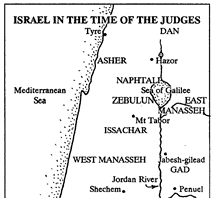
Gideon began his reformation of Israel in his home town. He smashed the altar of Baal, along with its sacred wooden pillar, and built a new altar on which he offered holy sacrifices to Israel's God, Yahweh, the only true God (25-27). His father, who was apparently caretaker of the altar of Baal, was the first to see the error of his ways and turn from Baal (28-32).
The men of the town were at first angry at Gideon's action, but when he began to put together a fighting force to deal with the Midianites, they were the first to support him. People of other tribes followed their example and joined him (33-35). As the people prepared themselves to fight Midian, Gideon's faith began to weaken, but God in his grace reassured him of victory (36-40).
Deliverance under Gideon (7:1-8:35)
God allowed Gideon only three hundred men to launch the attack against the Midianites, so that Israel might know that victory was not by military power but by God's power (7:1-8). A Midianite soldier's dream showed that an unnatural fear had come upon the Midianites. When he dreamt that a poor man's loaf of barley overthrew a rich man's tent, he thought that poverty-stricken Israel would overthrow Midian's army. The Midianites could, in fact, have wiped out the Israelites with ease (9-14). Gideon knew that victory for Israel was now certain and he prepared his men for attack (15-18).
The Midianites were thrown into confusion when they were awakened in the middle of the night by the alarming sound of rams horns blasting, water jars breaking and Israelites yelling. When they saw lights all around the camp, they thought that Israel's army was upon them. In their panic many began swinging their swords at anything they saw move in the darkness, not realizing that they were killing their own soldiers. Others tried to escape (19-22). The larger Israelite forces then joined in the battle (23).
Gideon gave to the men of Ephraim the task of cutting off the Midianites' escape by seizing the Jordan River crossing. In doing so, the Ephraimites captured and killed two Midianite princes (24-25). However, the Ephraimites were offended because Gideon had not called them to join in the main battle. They calmed down when Gideon praised them by pointing out what a good job they had done. Whereas Gideon and his men had killed many of the ordinary Midianite soldiers, the Ephraimites had killed the two Midianite princes. The quality of Gideon's 'harvest' could not compare with that of the Ephraimites' 'gleanings' (8:1-3).
As for Gideon himself, he would not rest till he had killed the enemy kings. Not only were they the Midianite leaders, but they had also killed Gideon's brothers (4-5; cf. v. 18-19). The leaders of certain cities east of Jordan doubted that Gideon would be successful, and refused to give him needed supplies for his army. They feared that if they helped Gideon, the Midianites would later return and punish them. Gideon promised that if they would not help him, he would punish them (6-9).
Though greatly outnumbered, Gideon pursued the two kings and captured them (10-12). As he returned from battle, he punished the leaders of the Israelite cities who had refused to help (13-17). He himself then killed the kings who had killed his brothers (18-21).
By now there was a widespread feeling among the Israelites that they should be like the nations round about and have a king whose rule would pass on to his descendants after him. Gideon refused their invitation, pointing out that Yahweh was their king (22-23). Although he continued to exercise some leadership in Israel, Gideon was not the great leader in peace that he had been in war. As Aaron had once done, he made a material symbol of the unseen God, and this soon led the people into idolatry (24-28).
In spite of his refusal to be Israel's king, Gideon showed a tendency towards the sort of lifestyle that was typical of kings in neighbouring nations. Like them he built a large household of wives, concubines and children (29-32). When he died, the people easily slipped back into Baal worship. In their security and prosperity they forgot the God who had saved them (33-35).
The story of Abimelech (9:1-57)
Gideon had about seventy sons. One of these, Abimelech, was not a full-blooded Israelite, for his mother was a Shechemite. (The Shechemites were a group of Canaanites who lived peaceably among the Israelites; see Gen 12:6; 34:1-31; Josh 24:32.) With the help of some worthless Shechemites, Abimelech killed all his brothers (except one who escaped) and established himself 'king' in Shechem. His 'kingdom' probably consisted only of Shechem and a few towns round about (9:1-6).
Jotham, the brother who escaped, warned the Shechemites in a parable of the trouble they would bring upon themselves. Good men are likened to good trees: they are too concerned with giving useful and honourable service to be bothered with seeking power. By contrast Abimelech is like a bramble: he can give neither shelter nor protection. And just as a bramble can catch fire easily and burn down a forest, so would Abimelech be the means of the Shechemites' destruction (7-21).
In due course trouble arose between Abimelech and the Shechemites. Through highway robbery, the Shechemites created an atmosphere of insecurity and disorder, at the same time robbing Abimelech of his taxes (22-25). When a suitable occasion arose and Abimelech was in another town, a group of Shechemites plotted to overthrow him. The chief administrator in Shechem pretended to be on their side, but secretly he sent news to Abimelech (26-33). Abimelech came quickly and put down the rebellion (3441).
But Abimelech did not stop at that. He decided to teach his subjects a lesson. He would destroy all the people of Shechem, both those who went out to work in the fields and those back in the town who took shelter in the city stronghold (42-49). In senseless fury Abimelech carried his attack to other towns, but his uncontrolled rage and lack of caution soon brought about his own death. The Shechemites who supported him were also destroyed, as Jotham had predicted (50-57).
Jephthah and five other judges (10:1-12:15)
Little is known of the political or military activities of the judges Tola and Jair. They both exercised power for lengthy periods, and Jair's family certainly enjoyed considerable power and prestige among the East Jordan tribes (10:1-5).
Again the Israelites turned away from Yahweh and worshipped false gods, and again they were punished. The Ammonites conquered the eastern tribes, crossed Jordan, and seized large portions of Israelite territory in Canaan as well. The Philistines attacked and conquered from the west (6-9). After eighteen years of oppression, the Israelites cried to God for help. In his mercy God saved them, though not until they got rid of their foreign gods and began to worship him again (10-16). Their deliverance from the Ammonites during the time of Jephthah is described in 10:17-12:7; their difficulties with the Philistines during the time of Samson are outlined in 13:1-16:31.
The leaders of the eastern tribes were desperate in their search for someone to lead Israel in battle against the Ammonites (17-18). The man they chose was Jephthah. The son of a prostitute, Jephthah had been cast out of his family and become the leader of a gang of bandits (11:1-6). He was tough, bitter and uncompromising, and he accepted the tribal leaders' invitation only after they agreed that he would remain their leader after the war was over (7-11).
Ammon had ruled eastern Israel for eighteen years (see 10:8). Apparently aware of feelings of restlessness and revolt in Israel, the Ammonites decided to attack. They made the excuse that Israel had taken their territory from them, so now they intended to take it back (12-13).
Jephthah replied by giving them an account of Israel's progress from Egypt to the region east of Jordan that was now in dispute. Firstly, he pointed out, Israel did not take any of this territory from peoples related to Israel, whether they were Ammonites, Edomites, or Moabites. All Israel's land east of Jordan was taken from the Amorites, who were under the judgment of God (14-22). Secondly, the land had been given to the Israelites by their God Yahweh, and his will had to be obeyed (23-24). Thirdly, the Moabite king of the time made no complaint that Israel had seized his territory. Why, then, after all these years should a dispute arise (25-26)? Jephthah appealed for understanding, but the Ammonites would not listen (27-28).
Although God gave Jephthah his special help, Jephthah was still only a slightly reformed bandit. He knew little of the character of God, and thought that by making a vow to sacrifice a person as a burnt offering to God, he could buy God's help and so ensure victory. Human sacrifice was against God's law (see Lev 18:21; Deut 12:31), but the people had forgotten that law and followed the religions of the neighbouring nations (see 10:6; cf. 2 Kings 3:26-27). Having made his vow, Jephthah went to battle and won a great victory (29-33). On his return from battle, Jephthah found that the person whom he had to offer according to his vow was his only daughter. Nevertheless, he kept his vow and sacrificed her (3440).
Once more the Ephraimites were offended that they, the strongest tribe in Israel, had not been invited to the battle (cf. 8:1-3). They crossed the Jordan River into the eastern territory to complain to Jephthah and to fight if necessary (12:1).
Jephthah replied that for years the eastern tribes had been asking for Ephraim's help, but had never received it. Why should they ask for it again (2-3)? The Ephraimites replied by accusing the eastern tribes of having run away from Israel; but when fighting broke out between the two groups, the Ephraimites were the ones running away. Jephthah's soldiers cut off their escape at the Jordan. The Ephraimites' attempt to disguise themselves and slip through the checkpoint was not successful, because their speech betrayed them as Ephraimites (4-6).
Having liberated his people, Jephthah then ruled over them, but after only six years he died (7). Three subsequent judges are listed, but little is known of them. From the sizes of their households it appears that they were people of wealth and influence (8-15).
A man to fight the Philistines (13:1-25)
The Philistines were by far the strongest enemy that Israel had yet met. Their forty years of rule lasted until the time of Samuel, and they continued to give trouble during the reigns of Saul and David (13:1).
Samson was the man God chose to begin the job of breaking the Philistines' rule. Before he was born, his mother was told by a messenger from God that she was to dedicate the child to God as a Nazirite for life. This meant that Samson was not to drink wine, touch anything dead, or cut his hair. These restrictions were to be a constant reminder to him and to others that he was totally dedicated to the service of God (2-7; cf. Num 6:1-21).
God's messenger repeated the instructions for the benefit of Samson's father (8-14), who then prepared to offer a sacrifice to God (15-16). When the messenger ascended towards heaven in the flames of the altar, Samson's parents realized that he was a supernatural figure, the angel of the Lord (17-23; see note on Josh 5:13-15).
In due course Samson was born. As he grew to manhood, God's special power worked in him to prepare him for the tasks ahead (24-25).
Samson's exploits (14:1-16:31)
So dominant were the Philistines in Israel, that the Israelites had decided to live with them peacefully rather than try to rise up in armed rebellion. Samson had other ideas. He thought that his marriage to a Philistine woman would give him the opportunity to do some harm to the enemy (14:1-4).
In spite of Samson's desire to help Israel, he had little respect for either his Nazirite vow or the Israelite law. He handled a dead lion, married a Philistine woman and joined in the customary winedrinking feasts of the Philistines (5-10; cf. Deut 7:1-3). His opportunity to harm the Philistines came quickly and unexpectedly during his wedding feast. Through the deceit of his wife, he lost a bet with thirty of her Philistine friends (11-18); but he took revenge by killing thirty other Philistines, whose valuables he used to pay off his lost bet. Then, with no more desire to go on with the marriage, he returned home (19-20).
On calming down, Samson decided he would return and take the woman as his wife after all. When he found that she had been given to another, he took revenge on the Philistines by burning their harvest (15:1-5). The Philistines replied by killing Samson's wife and father-in-law, since they were the cause of the trouble. Samson, in return, killed more Philistines (6-8).
Not wishing to extend the conflict at this stage, Samson moved to a hideout near one of the towns of Judah. But the Philistines attacked the town and demanded that the Israelites hand Samson over to them. The Israelites were willing to cooperate, because Samson had brought them enough trouble (9-13). Again, however, Samson slaughtered the Philistines (14-17). The victory left him weak and thirsty, but God refreshed him, thereby providing a fitting reminder that God alone was the source of his strength (18-19).
The spectacular exploits of Samson went on for twenty years (20). Although he is called a judge, he was neither a civil administrator nor an army commander. His 'deliverances' consisted of one-man adventures against the Philistines in the areas where they had overrun Judah and Dan, the latter being Samson's tribe (see 13:2; 15:9). Samson's attacks unsettled the enemy and stirred the people of Israel from their lazy acceptance of foreign rule. He began the deliverance that eventually saw the Philistines overthrown (see 13:5b).
Samson had a moral weakness in matters concerning women, and on one occasion this almost led to his capture (16:1-3). The Philistine leaders, on learning of this weakness, worked out a plan to use the woman Delilah to trap him (4-5). Delilah's early efforts were unsuccessful, but she did not give up (6-14). Samson had paid little attention to the self-discipline demanded by his Nazirite vow, except that he allowed his hair to remain uncut. But when he removed this the last symbol of his separation unto God, he was in fact separated from God. The Lord who had given him his strength now left him. His abnormal power was gone, and his enemies soon captured him (15-22).
In the celebration feast that followed, the Philistines praised their god Dagon and humiliated Samson (23-25). But when Samson turned to God at last, God graciously responded. He allowed Samson a return of his former strength, so that he had a greater victory in his death than he ever had in his life. The sudden death of all the leading Philistine rulers was the turning point that gave Israel its first hope for victory (2631).
17:1-21:25 TRIBAL DISORDER WITHIN ISRAEL
The writer of the book has now finished his account of the activity of the judges. To this he adds an appendix consisting of two stories (not necessarily placed in their correct chronological position in the book) that illustrate the disorder that existed in Israel during that period. The nation had no central government and people in the various tribes did as they pleased (see 17:6; 18:1; 19:1; 21:25). The stories record important changes that occurred in two tribes, Dan and Benjamin.
The migration of the Danites (17:1-18:31)
Micah, a man who lived in the tribal area of Ephraim, had stolen some money from his mother. When he heard the frightening curse she placed on the thief, he thought it wise to confess his guilt and return the money. To show her thanks, the mother made a silver idol to add to the other idols that were kept in the household shrine. Micah made matters worse by appointing his son, an Ephraimite, as priest (17:1-6). When a young Levite who lived in the tribal area of Judah later passed that way, Micah hired him to be priest instead of his son (7-13).
People of the tribe of Dan had never won complete control over their tribal inheritance on the Philistine coast. Squeezed between Israel's two most powerful tribes, Judah and Ephraim, and pushed back from the coast by the Philistines and the Amorites, they were left with very little area to call their own (see 1:34). They therefore sent a group of representatives to look for a better dwelling place elsewhere. The men's journey took them through Ephraim, where they stayed overnight with Micah (18:1-2). They asked Micah's guidance concerning their mission and were encouraged by his favourable reply (3-6).
Moving on, the Danite spies eventually arrived at Laish in the far north of Palestine. There they found a suitable area, fertile and well watered. It was inhabited by a quiet-living people who had made no preparations against attack, and who were so cut off from the big cities on the coast that they had no way to get help if they were suddenly attacked. Enthusiastic about what they had seen, the spies returned with their report. Soon the people of Dan were on the move, eager to conquer Laish and make it the centre of their new homeland (7-10).
On the way the Danites stopped at the house of Micah (11-13). Ignoring Micah's previous kindness to them, they raided his shrine, robbed him of his images, and bribed his priest to go with them (14-21). When Micah protested, they threatened him with swift destruction if he tried to resist them (22-26). They journeyed on to Laish, where they ruthlessly slaughtered the people and burnt the town. They then rebuilt the town according to their own plans, renamed it Dan, and used Micah's priest and images to establish their own idolatrous religion (27-31).
The war with Benjamin (19:1-21:25)
A Levite whose concubine had run away from him came to Judah looking for her. When they were reunited, her father was so pleased he did not want them to leave. They therefore stayed with him a few days, then set out to return to the Levite's home in Ephraim (19:1-9).
The route back to Ephraim took the couple through the tribal territory of Benjamin. Looking for somewhere to sleep the night, they preferred not to stay in Jerusalem, which was inhabited by foreigners, but to move on to Gibeah, where they would be among their fellow Israelites (10-14). But the people of Gibeah were not hospitable, and the Levite and his wife thought they would have to sleep in the town square. However, an old man (who was not a Benjaminite, but an Ephraimite) saw them and took them into his house (15-21).
While the Levite was enjoying the old man's hospitality, a crowd of Benjaminite men attacked the house, demanding that the old man hand over his guest for them to satisfy their sexual perversions. The old man refused, but the Levite gave them his concubine instead. They raped her throughout the night and she was found dead on the doorstep the next morning (22-26). Her husband responded to this violence by cutting the corpse into twelve pieces and sending a piece to each of Israel's twelve tribes. This was an ancient method of calling the people together to fight against a common enemy, which in this case was the wicked men of Gibeah (27-30). (For a comparable incident see 1 Samuel 1:1-11.)
Soldiers from all Israel gathered to attack Gibeah (20:1-11). Not only did the rulers of Gibeah make no attempt to punish the murderers, but the leaders of Benjamin also took their side. Benjamin decided to fight against the other eleven tribes (12-17).
At the beginning the battle went well for the Benjaminites. They knew the terrain of the country better than the Israelites, and in those hilly regions Israel's larger numbers were of no great advantage. Added to this, the Benjaminites were fighting for the lives of their people and for their homeland, whereas the Israelites shared no such personal interests. Also, the Israelites may have been over-confident with their much larger army (18-25). Only when the Israelites became desperate and turned to God in sincerity and complete dependence did God promise them victory (26-28).
In spite of the assurance of God's help, the Israelites had to plan their attack carefully and carry it out properly in order to be victorious (29-36a). The story of the battle is then repeated in greater detail to show how the Israelites operated. Their main force drew the Benjaminites out from Gibeah, after which a smaller Israelite force came out of hiding to attack the defenceless city. The soldiers of Benjamin, caught between the two Israelite forces, were massacred (36b-46). Only six hundred of the Benjaminite fighting force escaped. The Israelites meanwhile spread their attack throughout the whole tribal territory of Benjamin, burning the towns and slaughtering the people (47-48).
Soon the Israelites were sorry that they had acted in such savage haste against the Benjaminites. Almost the whole tribe had been wiped out. Now the Israelites wanted to rebuild Benjamin, but they could not see how to do it. They could not provide wives for the six hundred Benjaminite men who survived the battle, because they had earlier vowed never again to allow their daughters to marry Benjaminites (21:1-3).
The Israelites therefore looked for other ways of finding wives for the Benjaminites. To start with they made a destructive raid on the town of Jabesh-gilead and carried off the young ladies. Their excuse for this was that they were punishing Jabesh-gilead because it had not joined in the battle against Benjamin. The operation provided four hundred of the wives (4-14).
Israel's leaders then thought of how to find wives for the remaining two hundred Benjaminite men (15-17). They arranged for the men to go to a festival at Shiloh and each take a wife for himself without asking the parents' permission. Because no fight would take place, the Benjaminites could not be accused of capturing the girls; and because the parents of the girls had not actually given their daughters to the Benjaminites, they could not be accused of breaking their vow (18-22). The men did as they were told and the plan succeeded (23-24). It would have been useless for either the girls or their parents to complain about these matters, because, as the writer pointed out earlier, Israel had no central government to administer justice in inter-tribal affairs (25; cf. 17:6; 19:1).
Ruth
The story of Ruth belongs to the period of the judges, and provides a refreshing contrast with the low religious and moral condition of Israel pictured in Judges. It shows that simple trust in God and loving thought for others still existed in Israel. Here and there throughout the nation were people who tried to live their lives humbly and righteously before God. The story shows also that God was graciously caring for such people and was guiding everyday events for their good, and ultimately for the good of the nation.
1:1-22 Ten years of hardship in Moab 2:1-4:22 Start of a new life in Israel
1:1-22 TEN YEARS OF HARDSHIP IN MOAB
When a severe famine struck Israel, Elimelech took his wife Naomi and their two sons across the Jordan and south to the land of Moab, in the hope of finding a living there. But Elimelech died, and within ten years his two sons, who had married Moabite wives, died also (1:1-5).
Naomi saw no future for herself in Moab, so, upon hearing that the famine in Israel had passed, she decided to return home. Her daughters-in-law loved her and decided to go with her to ease her burden (610).
As the daughters-in-law were thoughtful of Naomi, so she was thoughtful of them. They were both childless and would remain so if they stayed with her, as she had no other sons whom they could marry. (The custom was that if a man died childless, his brother was to have a temporary marital relation with the widow so that she might produce a son. This son would be reckoned as belonging to the dead brother, and so would carry on his name and inheritance; see Deut 25:5-10; Mark 12:19.) Naomi made it clear that they should feel no obligation to go with her. They were free to remain with their own people and begin new lives by remarrying and having families of their own (11-13).