
Part 17
Although the people of Israel repeatedly failed and suffered God's punishment, they nevertheless looked forward to a golden age of glory and power. The expectancy of a golden age naturally became greater as the exiles in Babylon learnt that they were about to return to their land. But, having returned and rebuilt their nation, they again failed. Jesus Christ, the embodiment of ideal Israel, not only suffered God's punishment because of his people's sins, but brought the glory and power that Israel hoped for but never achieved (cf. Isa 42:1-4 with Matt 12:17-21; cf. Isa 53:4 with Matt 8:17).
Success and failure of God's servant (42:1-25)
In the previous chapter the servant of Yahweh was identified with Israel (see 41:8). Israel is probably again the servant who is identified here, but the ideals outlined in this song never became a reality in the nation. They did, to some extent, characterize the faithful remnant, but they found their perfect expression only in the one who embodied the ideals God desired, Jesus Christ. The prophet foresees that this servant of Yahweh, though empowered by God's Spirit and concerned with establishing God's justice in the world, will never make a show to attract attention to himself, never hurt those who sorrow, and never turn away from those of even the weakest faith (42:1-4).
The result of the servant's work will be the salvation of people from many nations. Through his servant, the Creator will send the message of his salvation to the people of his creation, to turn them from darkness to light, from bondage to freedom (5-7). Yahweh, the eternal God and all-powerful redeemer, needs no help from idols in this. He will bring his purposes to fulfilment through his servant. The Jews' salvation out of bondage in Babylon will be a sign and a guarantee of a much wider salvation that is yet to come (8-9).
This statement of God's purposes brings forth an outburst of praise. From various parts of creation and from various nations of the world, people join in singing praises to the merciful God (10-12). This same God, however, will destroy those who fight against him (13).
God himself then speaks. He had appeared to be inactive and silent during the time of the Jews' captivity in Babylon, but now he will act decisively. He will lead his people out of the blindness and darkness of captivity back to the land of their ancestors (14-16). At this demonstration of God's power, all those who trusted in idols will feel foolish and ashamed (17).
Having set out his ideal purposes for Israel (see v. 1-4), God now displays the condition of Israel that brought about its captivity in Babylon. Spiritually the people were blind and deaf, and stubbornly refused to see God's truth or listen to his voice (18-20). God had given them his law so that they might bring other nations to know him and praise him. Instead they disobeyed his law and were plundered by those nations (21-22). The calamities that befell Israel were not accidental; they were sent by God. But because the people did not know God, they did not know the meaning of the events that brought about their defeat and captivity (23-25).
Redemption through God's grace (43:1-28)
Despite Israel's failure and subsequent punishment, God has not cast off his people for ever. God used the power of foreign nations to enslave them and bring sufferings and hardships upon them, but he will now destroy the power of those nations. He will make them pay the ransom price for the redemption of captive Israel. They will fall so that Israel can go free (43:1-4). Wherever the captives are, they are still God's people, and he will bring them back to their land (5-7).
God challenges the nations to meet him in court to see who controls the history of the world, Yahweh or the gods of the nations. If they can prove that their gods have knowledge of past events or can predict future events, they are invited to bring these gods with them to court, along with any other witnesses they can find to support their claims (8-9). As for Yahweh, his sole witness will be Israel. The history of Israel proves that God's predictions always come true and that he is the only God. People can therefore be assured that when he predicts Israel's release and return to its land, this prediction also will come true (10-13).
For Israel's sake, God will overthrow Babylon. He is still Israel's covenant God, and once again he will redeem his people from bondage (14-15). Just as he miraculously led Israel through the Red Sea and across the desert in the time of Moses, so he will lead his people to the promised land again (16-19). As on the former occasion, he will protect them from danger and provide for their needs along the way (2021).
This restoration of Israel to its land will be entirely by God's grace. The people certainly do not deserve it. While they have been in captivity, God has not demanded that they maintain the sacrificial ritual. He has placed no added burden upon them. But they have not shown their gratitude to him through prayer or other expressions of worship. They ignore God and continue in their sinful and selfish ways (22-24).
God is still willing to forgive his people, if only they will honestly examine themselves and admit their wrongdoing (25-26). The history of Israel shows, however, that the people do not repent readily. From the time of Jacob to the time of their captivity, they and their rulers have consistently rebelled against God and brought divine judgment upon them (27-28).
Israel's God and man-made gods (44:1-28)
Not only is God willing to forgive his people, but he wants to pour out the power of his Spirit upon them so that new spiritual life will spring up within them. This will enable them to evangelize the Gentiles, who will then join the descendants of Jacob in worshipping the God of Israel (44:1-5). Israel's redeemer is the only God. He knows the end from the beginning and his people can depend on him always (6-8).
In contrast to the one true and living God are the many lifeless gods that workmen make. But how can a man make a god? What he makes must be inferior to himself, not greater. By making idols a person lowers his own status and brings shame upon himself (9-11).
When a craftsman makes an idol of metal, he gets hot and tired from his work, and the idol can do nothing to help him (12). When a craftsman makes an idol of wood, he has to use a tree that the living God has made to grow. After the man has chopped the tree down, he uses part of it to make a fire to cook his meals, and uses another part of it to make an idol that he then worships (13-17). To worship manmade things is clearly absurd, but those who worship them cannot see this, because they are spiritually blind (18-20).
The prophet then returns to consider the one true God and what he has done for his people. He has chosen them to belong to him, forgiven them their sins and saved them from their enemies (21-23). He is their redeemer as well as their creator, and he is now about to prove wrong those who forecast the destruction of Israel (24-25). As the prophet has already announced, God is going to act on behalf of his people. At his direction Cyrus will conquer Babylon and permit the Jews to return and rebuild Jerusalem (26-28).
God uses Cyrus (45:1-19)
Cyrus's many victories, and the power and wealth he gained through them, were all planned by God. God was preparing the way so that Cyrus could conquer Babylon and release the Jews. Throughout these events, Cyrus did not know God and was unaware that God was using him to carry out his purposes for Israel (45:1-4).
To Cyrus, his release of the captive Jews was a relatively minor event in his long and glorious career, but in the eyes of God it was the purpose for which he had risen to international power. When people recognize this as God's doing, they will praise him as the only true God (5-7). Israel, meanwhile, will enter a new era of divine blessing (8).
Some Israelites may have questioned God's wisdom in using a heathen king to bring about their restoration. God replies that they have no right to argue with him or question the way he deals with his children (9-11). God is the creator and controller of the universe. He has used Cyrus to give the Jews their freedom and the chance to rebuild Jerusalem, and the Jews have not needed to do anything. For this they should be thankful to God (12-13).
In addition, people of other foreign nations will give their assistance to Israel. They will forsake their idol-gods for the God who cannot be seen, the God of Israel (14-17). God always works to a plan, whether in creation or in the history of Israel. The chaos that resulted from Babylon's destruction of Jerusalem is no cause for Jews to turn away from God in disappointment. They must not think that he has lost control of events or that he has some new mysterious plan for them. He will be true to his word and do for his people what he has purposed for them (18-19).
Babylon's helpless gods (45:20-46:13)
Cyrus's conquest of Babylon will prove to those Babylonians who survive that to trust in idols for victory is useless. Wooden gods could not foresee Cyrus's conquest, but Yahweh, the only true God, predicted it long ago (20-21). People of surrounding nations may previously have fought against Yahweh by trusting in idols, but now they should forsake those idols and submit to the living God. Then they will find victory, righteousness and strength, and will join with all God's true people in bringing him praise (22-25).
The prophet pictures the Babylonian refugees as they flee from the armies of Cyrus, taking with them whatever personal possessions they can carry. The Babylonian gods (two of the most important of which were Bel and Nebo), instead of saving the people, have to be saved by them. So far from helping the people, they only become a hindrance and a burden, causing the donkeys and oxen to groan under the extra weight they have to carry (46:1-2). The people of Yahweh, by contrast, are carried by him. The God who made them cares for them, and will continue to care for them to the very end (3-4). Gods of silver and gold cost their worshippers much in money, time and effort, but they cannot do anything to save their worshippers from trouble (5-7).
Many of the Jews had once been tempted to follow the idolatrous ways of the Babylonians. They are reminded that Yahweh alone is God (8-9). The future is under his control, and at the right moment he will call Cyrus to come and destroy Babylon and release the Jews (10-11). Those Jews who stubbornly refuse to trust in God must therefore change their ways, if they want to share in the blessings of the new Israel (12-13).
Judgment on Babylon (47:1-15)
The great nation Babylon is likened to a beautiful and vain young lady who is now disgraced. She once lived in luxury, but now she is made to sit in the dirt, forced to work like a slave girl, stripped of her beautiful clothing and made to walk around naked (47:1-3). God's judgment on Babylon brings freedom to Israel (4).
Pride is the reason for Babylon's downfall. God's desire was to use Babylon to punish Israel, but Babylon has gone beyond the limits God set and has acted with unnecessary cruelty (5-7). Proud of the place of honour she has gained among the nations, she acts as if she is God. Therefore, God will punish her. She thinks she is unconquerable, but God will suddenly destroy her (8-9).
In her arrogance Babylon thinks that she can do as she likes and no one can stop her (10-11). She thinks that her rise to power is a result of guidance received through her knowledge of magic and astrology. The prophet challenges her to keep trusting in magic and astrology, and see if that will save her from God's judgment (12-13). What she will find is that the magicians and astrologers themselves will fall under God's judgment. They will be destroyed, as straw is burnt in a fire. No one will be able to save Babylon from the coming judgment (14-15).
The past and the future (48:1-22)
Before returning to their homeland, the people are reminded of the sins that led the nation into captivity. They must not repeat former errors. The people's chief failing was that they honoured God with their words but not with their conduct (48:1-2). Knowing their tendency towards idolatry, God gave his people advance revelations of his will, to prevent them from turning to idols for guidance. But they still stubbornly rejected his teaching (3-5).
Nevertheless, God once again tells them his plans in advance, namely, that he is going to lead them back to their land. But he makes the announcement at the last minute, as it were, for their previous history has shown that they cannot be trusted. God is not going to give them the chance to claim that idols have brought them this deliverance (6-8).
God has been very patient with his people. He likens his work with them to that of a refiner, who puts silver in the fire to burn up the rubbish and leave the metal pure. In the same way God has 'refined' the people of Israel, but they have proved worthless. However, for the sake of his own honour, God does not destroy them (9-11).
The God who called Israel to be his people still looks after them. The God who made the world still controls its history. He brings Cyrus to Babylon to conquer Israel's oppressor and free the captive people (12-15). God has always spoken openly with his people, and now he does so again, by sending his messenger the prophet to make his plans known to them (16).
Because God wanted only the best for his people, he was saddened to see the suffering they had brought on themselves through their stubborn disobedience. If they had paid attention to his instruction, they would have enjoyed unbroken peace and prosperity (17-19). God is now delighted that they are about to leave Babylon and return to their land. He will protect and provide for them, but if they want to enjoy peace in their land they must live uprightly (20-22).
49:1-55:13 THE SALVATION OF GOD'S PEOPLE
The servant's task (49:1-7)
Leaving behind the subject of Cyrus's conquest, the prophecy now develops the theme of the servant of Yahweh. The second Servant Song begins by recording how Israel was chosen by God to be his servant, and prepared by God to do his work. As Israel did the work faithfully, it would bring praise to God (49:1-3).
Israel as a whole failed, but from generation to generation a minority within Israel, the remnant, remained loyal to Yahweh as his servant. They were unable to save their people from captivity, but they still trusted in God that he would bring some good from their work (4). They now see God's purpose in preserving and strengthening the faithful remnant through the captivity. He wants to use them to lead his people back to their land, from where they will send the light of his salvation to the darkened heathen nations (5-6). God's servant will then no longer suffer the shame that Israel experienced in the captivity. On the contrary, those who once despised God's servant will now give him honour, proving to all that God is faithful to his people and faithful to his word (7).
Again the nation as a whole failed in its task, though, as always, a small minority remained faithful (cf. Luke 1:16-17; John 20:21; Acts 13:46-47). Jesus the Messiah, the perfection of Israel, was the one who truly brought his people back to God, sent the light of God's salvation to the Gentiles, and receives homage from people of all nations (Matt 1:21; Luke 2:30-32; Acts 26:23; Rom 15:8-12; Rev 3:7).
Israel rebuilt (49:8-50:3)
Once more God promises the return of the captive Jews to their homeland. God will protect them along the journey and help them as they rebuild their ruined country (8-10). Whether exiled in Babylon or scattered in other places, the people will return home amid much rejoicing (11-13).
Some of the Jews thought God had forgotten them. God now shows that for him this is impossible (14-16). Israel will return and rebuild its homeland. Opponents who try to ruin Israel's work will not be successful and will leave in shame and defeat (17-18). People born in exile will flock to the rebuilt Jerusalem. The land previously uninhabited and in ruins will become well populated and prosperous again (19-21). Scattered Jews in other countries will also return, helped by generous aid from the nations among whom they have lived (22-23).
Among the exiles were some who apparently doubted the prophet's promise of restoration, for Babylon seemed unconquerable. How can a captive people possibly be freed when they are in the grip of such a powerful tyrant (24)? God replies that he can do it. He reminds the doubting exiles that he is the all-powerful God and Israel's covenant redeemer. He will crush the Babylonians in a judgment suited to the cruel oppression that they inflicted on their helpless victims (25-26).
Other Jews blamed God for their troubles, as if he had cast them off like a husband who divorces his wife or a father who sells his children to pay off his debts. God replies that they have no evidence to support such an accusation, for he has neither 'divorced' them nor 'sold' them. Rather their sins are the cause of their troubles (50:1). They ignored God when he spoke to them through his servants the prophets. But he still loves them and has the power to save them. Nothing in all creation can withstand his power (2-3).
The servant's patient endurance (50:4-11)
In this, the third Servant Song, the words again may have an application to the experiences of Israel among the nations. In particular they reflect the experiences of the few faithful Jews who tried to teach, warn and comfort their ungodly fellow exiles in Babylon. The song becomes even more meaningful when applied to the experiences of the Messiah himself.
The servant is taught by God day by day, so that he can give teaching and encouragement to those who need it. Although people respond with opposition and physical violence, the servant does not give up. He learns the meaning of obedience by the things he suffers (4-6). He perseveres because he knows that he has acted blamelessly and that God is with him. And if God is on his side, no one can triumph over him. Those who make accusations against him will not prove him guilty, but will themselves be put to shame (7-9).
In a world of darkness faithful believers walk confidently and do not fall, because they trust in God. Others, who do not trust in God but who make their own 'fire' to give them light, will find in the end that the fire burns them. In other words, when people depend on human scheming instead of depending on God, they will find in the end that their scheming is the cause of their downfall (10-11).
God of the impossible (51:1-23)
To the captive Jews it must have seemed almost impossible to escape from the powerful grip of the tyrant Babylon, make the long journey over harsh territory and then rebuild their ruined country. God encourages them with reminders of the apparently impossible things he has done for them in the past. The very origin of Israel was something of a miracle. God built a nation out of one couple, even though the man and his wife were past the age when they might normally expect to have children. The same God is still active; he can perform a miracle again and restore Jerusalem (51:1-3).
From this rebuilt Jerusalem, God's salvation will spread throughout the world. This salvation will not be temporary and political, but eternal and spiritual. People of all nations will receive new life and hope when they come to know God (4-6). The Israelites should be encouraged as they see what God is about to do through them. They should have no fear of their present oppressors (7-8).
A cry from the captive Israelites urges God to act on their behalf. As he overthrew Egypt (here symbolized by Rahab, the mythical dragon of the Nile) and led his people through the Red Sea and into Canaan, so may he overthrow Babylon and lead his people back to Jerusalem. They look expectantly to a new age when sorrow is banished and they live in Zion in unbroken contentment (9-11).
God reassures Israel with the reply that he is the Creator, the eternal one. Israel's enemies, by contrast, are merely creatures, who one day must die. Israel has no need, therefore, to fear Babylon's might and fury (12-13). Yahweh, Israel's covenant God, is the Almighty. He is in control of all affairs and he will release his captive people. More than that, he will give them his teaching so that they can know him and serve him (14-16).
Jerusalem fell, but it is now about to rise again. The Babylonian attack on Jerusalem was a punishment sent by God to bring about the collapse of the city and the destruction of Judah. The judgment is likened to a strong drink given to a person to make him drunk, so that he staggers and falls (17-20). This strong drink is now to be taken from Judah and given to Babylon, so that it will stagger and fall. God is going to destroy Babylon as he destroyed Judah (21-23).
Joy in Jerusalem (52:1-12)
In view of these promises, the prophet urges the captive Jews to prepare for the return to Jerusalem. The city that heathen armies defiled and destroyed will be rebuilt, to become strong, holy and beautiful again (52:1-2).
God will redeem his people from slavery, but he will not pay the slave-owner (Babylon) any ransom (3). In earlier days the Israelites were made slaves in Egypt, even though they went there in peace. They then established themselves in Canaan, but again they fell into bondage. Some were taken captive to Assyria, and now the rest are slaves in Babylon. The oppressor nations paid nothing for their slaves, and God will pay nothing to release the slaves. Rather, he will punish the slave-owners, particularly since they have mocked him (4-5). Then the doubting Israelites will see clearly that their God is the controller of history (6).
Overjoyed at this reminder of the triumph of God, the prophet pictures a messenger going from Babylon to Jerusalem to announce the good news that God reigns supreme. The people of Israel will return and Jerusalem will be rebuilt (7). He pictures the watchmen in Jerusalem rejoicing as they see the first lot of exiles returning to the city. Onlookers from other nations will see God's power displayed (810).
As he pictures the first exiles leaving Babylon, the prophet reminds those carrying the temple vessels to keep themselves ceremonially clean (11; cf. Ezra 1:7-11). He cannot help but contrast the quiet and orderly departure on this occasion with the hurried exodus from Egypt when Israel set out for its land the first time (12).
Israel and the Messiah
The fourth Servant Song (52:13-53:12) emphasizes the contrast between Israel's sufferings at the hands of the Babylonians and the coming glory in the restored nation. The song, however, does more than merely contrast suffering and glory. It reveals that the two are inseparably connected, that suffering is necessary before glory. It shows for the first time that the servant must die. He must bear punishment of sin before he can enjoy the glory that God has promised.
Previous statements in the book have made it clear that Israel is the servant who has sinned, who is punished, and who looks for future glory (see 41:8; 42:19-25; 49:5-7). But this song makes it clear that the removal of sin and the blessings of glory are possible only as another takes the punishment on behalf of the sinful servant. Yet the one who bears Israel's sin is also called God's servant. The servant dies for the servant; the suffering servant dies for the sinful servant.
It may be, then, that the Israel of the exile suffered for the sins of Israel of former generations; or that the faithful remnant in exile suffered because of the sins of the people as a whole in exile. The suffering, however, is not only because of Israel's sins, but to take away Israel's sins. Certain sins of Israel, such as idolatry, were removed through the exile, but the removal of sin in its fullest sense could come about only through Jesus the Messiah. Jesus was the ideal Israel, the perfect servant, who takes away his people's sin through bearing the punishment for them (Matt 1:21; Heb 2:14-17).
Jesus does even more than that. He dies for the sin not only of Israel, but also of the world. Only in him do people have complete forgiveness of sin, and only in him will they experience future glory (John 1:29; Heb 2:9-10).
The fourth Servant Song speaks of Israel's sufferings at the hands of the Babylonians and its glory in the rebuilt Jerusalem. But those events do not fully satisfy the language of the song. They are but dim pictures of the sufferings of Christ and the glory that follows (1 Peter 1:11).
The servant's suffering and glory (52:13-53:12)
Just as people were startled at the sight of the servant's great sufferings, so will they be startled at the sight of his great glory. They will be struck dumb, as it were, as they witness a sight more glorious than they or anyone else could ever have imagined (13-15).
Many people find it hard to believe that God will give his servant such power and magnificence, because when they look at the servant they see just an ordinary person of insignificant beginnings. They liken him to a small plant growing in dry and infertile ground – so different from the magnificent trees that stand majestically in the tall forests. They see nothing in his appearance that is impressive or attractive. On the contrary, when they see the extent of his sufferings they turn away from him in disgust, like people repelled by the sight of a diseased person (53:1-3).
At first those who see the servant's intense suffering think that he is being punished by God for some wrong he has done. However, as they think further they realize that he is suffering not for his own sins, but for the sins of others; in fact, their sins. They are the ones who have turned away from God and they are the ones for whom the servant dies. It is for them that he bears God's punishment (4-6).
The servant is treated cruelly, but he bears it silently. Those who judge him show neither mercy nor justice; they just send him off to be killed. His fellow citizens are just as heartless, and show no concern that he suffers death unjustly. Yet he bears all this for the sake of those who are sinners (7-8). Those who hate him leave him to die in disgrace like a criminal, but those who love him give him an honourable burial. They know he has done no wrong (9).
Despite the inhumanity of people, the servant's death is according to God's will. It is a sacrifice for the removal of sin. But beyond the sorrow of death is the joy of the resurrection. The servant is satisfied when he sees the fruits of his suffering, namely, a multitude of spiritual children who are forgiven their sins and accounted righteous before God because of his death (10-11). The sufferer becomes the conqueror and receives a conqueror's reward. Because he willingly took the place of sinners and prayed for their forgiveness, he is now exalted to the highest place (12).
Yahweh and Israel reunited (54:1-17)
Israel is likened to the wife of Yahweh. Her exile in Babylon was like a period of divorce when God separated her from him because of her sins. During this time she did not increase or prosper as a nation. She is now to return to God and to her homeland, where she will produce greater increase than in the days before the captivity. As an Arab has to enlarge his tent to accommodate more children, so Israel will have to enlarge its borders to accommodate this increase (54:1-3).
When Israel returns to her husband, she will no longer bear the shame of her separation. In love God will forgive her and take her back to himself (4-6). His discipline of Israel was only temporary, and now he looks forward to a glad reunion and a lasting relationship (7-8). He promises that he will not send the nation into such a shameful exile again (9-10).
The new Israel, built by God himself, will have the beauty of a city built of precious stones (11-12). God will teach his ways to those who dwell in the city, so that justice and righteousness become the most noticeable features of their way of life (13-14). God is the creator of the world and the controller of all human activity in the world. He will make sure that no one who fights against his people will be victorious (15-17).
God's free provision (55:1-13)
Many of the Jews had made life reasonably tolerable for themselves in Babylon. The prophet knew that they were so settled that they might not want to uproot themselves and face the hardships of life back in their desolated homeland. Many were more concerned with making life easier for themselves than with knowing God and looking to him for their provision. God warns against this self-centred attitude and invites them to trust fully in him. The blessings he gives are free. They cannot be bought with money, but they bring more satisfaction than all the temporary benefits that people might manage to gain (55:1-2).
If the people respond to God's purposes for them, the divine blessings will extend far beyond the borders of the restored nation. When God's people take his message to other nations, people who previously had no knowledge of God will become followers of the God of Israel. God's people will see his covenant promises to David fulfilled beyond their expectations (3-5).
First, however, God requires repentance. When people turn from their sin to God, he forgives them freely according to his mercy (6-7). This mercy is so great that it is beyond human understanding. What God has prepared for his people is greater than they have ever imagined (8-9).
As surely as rain soaks into the ground and makes plants grow (it does not float back up to the clouds), so will God's promise of Israel's restoration come true (it will not return to God fruitless). God will lead his people out of Babylon and back to their homeland. The world of nature will rejoice along with God's people, and their land will become fruitful again (10-13).
56:1-66:24 PRESENT SHAME AND FUTURE GLORY
Having looked beyond the Babylonian captivity to the Jews' imminent return to their homeland, the prophet now sees the people resettled in and around Jerusalem. What he sees causes him to realize that this is not the golden age after all. Social and religious sins once again become a characteristic of the national life of Israel. The prophet contrasts this corrupt state of affairs with conditions in the ideal Jerusalem of the future.
In this section, as in the previous sections (Chapters 40-48 and 49-55), we must remember that we are reading poetry, where the pictures are vivid and the language exaggerated. We do not need to interpret the prophecies literally (e.g. mountains do not literally have voices and trees do not literally have hands; cf. 55:12). The important consideration for the reader is not merely what the prophecies say, but what they mean.
Of particular importance is the spiritual significance of the prophecies, and this is the aspect that the New Testament emphasizes. The prophecies of Isaiah take on new meaning once Jesus Christ has come.
Thus, the glorious kingdom that God promised Israel is, above all, a spiritual kingdom centred in Jesus the Messiah (32:1-8; cf. Luke 17:21). The faithful remnant of Israel is in fact the true Israel (10:2023; cf. Rom 9:6-7,27-33). The spiritual, not the natural, descendants of Abraham are the real people of God (41:8; cf. Gal 3:29). The salvation of God is proclaimed worldwide and people of all nations join in one body to be his people (54:1-3; cf. Gal 4:26-28). The new Jerusalem for which believers hope is not material and earthly like the old, but is spiritual and from heaven (60:1-22; cf. Rev 21:1-4; 21:22-27).
True worshippers (56:1-8)
God reminds his people that life in the rebuilt nation must be based on his law. This applies to laws that concern social justice as well as those that concern religious practices (56:1-2).
When the Jews returned to Jerusalem, some Gentile converts returned with them. Among these were several eunuchs, possibly people who were previously connected with the palaces in Babylon and Persia. The law of Moses made it plain that eunuchs were to be excluded from the tabernacle worship, probably to discourage the Israelites from making their own people eunuchs (Deut 23:1). But in the new Jerusalem all foreigners, eunuchs or otherwise, who honour God and keep his law should be allowed to worship in the temple along with godly Israelites (3-5).
Love and obedience towards God, not physical or national characteristics, are the important things in God's sight. The temple is for the use of all people, not just Jews, because God's mercy is for all people (6-8).
Corruption and idolatry (56:9-57:21)
The Assyrian captivity of the northerners and the Babylonian captivity of the southerners did not include the whole populations. Those who were of no use to the conquerors were left behind, along with scattered country people who escaped the enemy. These and their descendants soon followed the old religious practices of the Canaanite people. They worshipped idols, offered human sacrifices to the god Molech, and practised fertility rites with religious prostitutes, all in the hope of becoming prosperous (2 Kings 17:24-41). Those who engaged in these practices tried to join in the worship of Yahweh when the Jews returned from captivity.
Israel's spiritual leaders should have been like alert watchmen, who warned the people of these dangers and instructed them in the ways of God. Instead, says the prophet, they are like lazy, overfed watchdogs who can only sleep. They are interested only in personal gain and do not care for the people. The civil leaders (likened to bad shepherds) are equally greedy and corrupt (9-12).
In such conditions the righteous are the ones who suffer. They find relief only when they rest in death (57:1-2). The wicked, meanwhile, carry on with their witchcraft, immorality, idolatry and child sacrifice. They do not realize that by their behaviour they are challenging God and inviting his judgment (3-6). Although their idolatrous practices involve costly sacrifices, shameful behaviour and tiresome journeys, they persist in them, hoping vainly for a better life (7-10).
Although the people have turned from God to worthless idols, God has been patient with them. But his patience has not led them to repentance. They will now find that their gods will not save them from God's punishment (11-13).
By contrast, God will help those faithful to him, no matter what obstacles are in their way. Although he is exalted above the heavens, he also dwells with those who humbly acknowledge their sin and turn from it (14-15). He may punish them when they do wrong, but he does not remain angry with them. When they humbly acknowledge their wrong and show their desire to please him again, he gives them new life and strength (16-18). The repentant enjoy peace and fellowship with God, but the wicked live in a turmoil of uncleanness. They will be excluded from God's peace for ever (19-21).
True religion (58:1-14)
The Jews thought they were a righteous people because they carried out the daily rituals required by the law. The prophet is about to show them that in spite of all this they are still sinners. In fact, their attitude towards these rituals is their chief sin (58:1-2).
For example, many practise fasting not because they are truly humble before God, but because they hope God will be impressed with their actions. But at the same time as they fast, they oppress their workers and fight with one another. They act and dress in a way that shows they are fasting, but such fasting is worthless in God's sight (3-5). God would rather that they cease oppressing others and begin to help the poor and needy (6-7). Only then will he be pleased with them; only then will he accept their worship and answer their prayers (8-9a).
When the people stop treating others with contempt, God will show kindness to them. When they sacrifice their comfort for the sake of those who are ill-treated and hungry, God will bless them. He will give them fresh spiritual life and restore their country to the strength of former days (9b-12). Religious observances are important, but people must carry them out from right motives. Whether practising fasting or keeping the sabbath traditions, the important thing is to honour God, not to seek personal benefit (1314).
Society incapable of reform (59:1-21)
Ungodly society is heading for destruction. The reason for this is not that God is powerless to save people, but that people's sins have cut them off from God, the only one who can save them. They have filled the land with violence, lies and treachery (59:1-3).
Because of the corruption of the courts, there is no justice in society (4). Wickedness multiplies as evil people spread their poison and trap the innocent in their plots. They try to cover their sin with a show of respectability, but they are not successful (5-6). Because their thoughts are evil, their actions also are evil. Always devious, they are a constant source of trouble to others. They know nothing of such basic virtues as kindness, honesty and justice (7-8).
The prophet then joins with the people in confessing their sin. They would like to see an end to oppression and injustice, but they hope in vain. They live in a society of moral darkness that they themselves have created (9-11). They have turned away from following God and have developed a way of life where honesty and truth are ignored (12-13). Injustice and corruption are everywhere, from the highest law courts down to the market places of the common people. The person who tries to be honest suffers persecution from those who find it more convenient to cooperate with the corrupt system. God sees all this and it displeases him (14-15).
God sees that the human race cannot reform itself. What is needed is the intervention of God. In purity and justice he acts against the sinners, with the result that people worldwide acknowledge his lordship (16-19). Those who repent of their sins enter a new relationship with him. They become his true people and enjoy the spiritual blessings of his covenant with them (20-21).
A glorious kingdom (60:1-22)
In Chapters 60-62 the scene returns to Babylon, where the captive Israelites look forward to the return to their homeland and the reconstruction of their national life. Here, more than in the previous chapters, the blessings seem to go far beyond those experienced by post-exilic Israel. (See sub-section 'New Jerusalem' at the introduction to Chapters 40-66.)
When sin is removed and enemies are punished, Israel will receive the glory it has always hoped for. Not only will scattered Jews return to their land, but people of all nations will come to Jerusalem to worship the God of Israel (60:1-5). Some countries send camels loaded with treasure. Others send animals that guarantee a constant supply for the sacrifices in the rebuilt temple (6-7). Ships bring people and goods from countries across the sea to enrich Israel (8-9).
Foreigners help rebuild Jerusalem, and demonstrate their submission to Israel by the constant supply of gifts they bring to the city (10-12). Some of the nations provide valuable building materials for the new temple (13). Nations that in the past attacked Israel now become its subjects. Those who previously plundered and disgraced Israel now bring it riches and honour (14-16).
Jerusalem is established with beauty, security and strength. Violence and cruelty are replaced by peace and righteousness (17-18). Lights are not necessary, because God's glory fills every place. There is no sadness and no sin. Since the sovereign God is in control there is perfect security and universal prosperity (19-22).
Good news for the exiles (61:1-62:12)
God's Spirit gives the prophet some good news to pass on to the Jews held captive in Babylon. They will be released to return to their land, but their captors will be punished (61:1-2). When they arrive in Jerusalem, they may be overcome with grief because of the ruin and devastation they see around them. But God will encourage and strengthen them so that they can rebuild their beloved city (3-4).
Foreigners will carry out the everyday duties for the Jews and contribute liberally to the national income. This will enable the Jews to concentrate on the more important matters of worshipping and serving God (5-6). God will give blessings to his people that are far beyond anything they have ever expected. In justice he will compensate them for the plundering they have suffered at the hands of their enemies (7-9).
In thanks the prophet praises God in advance for saving Israel and giving it glory, a glory that he likens to the beauty of wedding garments. As surely as seeds sprout and grow, so just as surely will God save Israel and bring praise to himself from people of all nations (10-11).
But at the time of writing, the prophet is still in Babylon and Israel has not yet been saved. The prophet will therefore not cease praying for Israel till it has been restored to its land in glory (62:1-3). The nation will then no longer be like an unfaithful wife living alone and in disgrace. Her husband still loves her and will take her back. As the deserted woman becomes happily married again, so the desolate nation will again rejoice in fellowship with Yahweh (4-5).
In Jerusalem watchmen wait expectantly for the first returning exiles. The prophet urges these watchmen to join him in unceasing prayer that God will soon fulfil his promise and bring his people back, never to be plundered again (6-9). He then commands people to go out and prepare the way for Israel's release from Babylon and return to Jerusalem. Israel will again be known as the people whom God has redeemed (10-12).
God's holy anger (63:1-6)
When Babylon made its last attack on Jerusalem (587 BC), Edom joined in, taking wicked delight in helping to destroy the Israelite nation. God's messengers announced his judgment on Edom for this (Ps 137:7; Obad 1,10-14; cf. Mal 1:4-5), though in the denunciation in the present chapter, Edom may be a symbol for all God's enemies. (Compare the picture that follows with Revelation 14:18-20; 19:13-16.)
On seeing a person clothed in red approaching him from Edom, the prophet asks who it is. The person replies that he is the Lord, who punishes his enemies but saves his people (63:1). The prophet asks why his clothes are red (2), and receives the reply that they are red with the blood of slaughtered enemies. When God acts in his righteous anger, the blood of sinners runs freely over the earth, in much the same way as juice runs out of grapes when workers tread them in a winepress. Since God alone is all-holy and all-powerful, he alone can carry out this judgment (3-6).
A prayer for Israel (63:7-64:12)
The prophet's prayer for God's suffering people begins by recalling God's great acts of love in the past (7). Because Israel was his people, God saved them from slavery in Egypt, though when they rebelled against him, they were punished (8-10). Nevertheless, God forgave them. Therefore, asks the prophet, could not this God of mercy and love, who has done such great things for Israel in the past, also save his people from captivity in Babylon now (11-14)?
It seems as if God has withdrawn into his heavenly dwelling place, for there is no evidence of his mercy upon his people. The prophet realizes that if Abraham and Jacob, Israel's earthly fathers, saw their descendants in captivity, they would be ashamed of them and want to have nothing to do with them. But he prays that God, their true Father, will not cast them off (15-16). It seems, however, as if he has. He has allowed the Babylonians to destroy their temple and take them to a foreign land, where there is no evidence that Yahweh is their God or that they are his people (17-19).
God has revealed himself and saved his people with supernatural acts in the past, and the prophet longs that he might do so again. The enemies of God would then be overthrown (64:1-3). By contrast, those whose chief pleasure is to please God know that God helps them in the most unexpected ways (45a). They also know that, despite their desire to please God, they are still self-willed sinners. Even their best deeds are polluted by sin. They often forget God and have only themselves to blame for the troubles that result (5b-7).
Although they have failed miserably, the people know that God is still their Father. He may punish them, but he still loves them (8-9). Therefore, asks the prophet, is not the destruction he has sent upon Judah sufficient punishment? Can God not see the desolation of Jerusalem and take pity on the ruined city? Will he not now forgive his people and bring them back to their land (10-12)?
God's people: servants or rebels? (65:1-16)
It was God's desire that Israel seek him and enjoy his blessings, but instead the nation rebelled against him and stubbornly went its own way. Only a minority within Israel, along with those of Gentile nations who turned to Israel's God, were really God's people (65:1-2). As for the people of Israel as a whole, they had throughout their long history repeatedly made God angry. They sacrificed to other gods, consulted the spirits of the dead and ate forbidden food, yet all the time they claimed that they were holy but other nations were unclean (3-5). Consequently, God had punished Israel and sent the people into captivity (6-7).
Amid all the religious corruption of Israel there is still a faithful remnant. They are like a few good grapes in a bad bunch. For their sake God will restore Israel to its land, where faithful believers will worship and serve him in peace and contentment (8-10). But those who ignore his warnings and continue to worship foreign gods will be destroyed (11-12).
The minority of faithful believers, those who worship and obey God, are God's truly chosen ones, God's true servants. They will be blessed with God's favour. The rest of the nation, those who ignore God, will be disgraced with God's punishment (13-14). Although the ungodly will be destroyed, their name will continue to be used by the faithful as a symbol of the curse of God upon disobedience. The faithful, by contrast, will be given a new name, to indicate God's favour upon them. They will live in loyal dependence on the faithful God (15-16).
A new creation (65:17-25)
Israel's condition in the time of the prophet is then contrasted with conditions in the new Jerusalem, the kingdom of the Messiah. That kingdom is not an improved version of the old Israelite kingdom, but is something entirely new. It is a new creation, where the quality of life will be different from that of the present world. Sorrow will be replaced by rejoicing. Life will not be cut short except where God acts in judgment (17-20).
In the new creation people will have complete satisfaction. They will not experience the sufferings and frustrations that result from sin, but will enjoy life as God intended them to enjoy it (21-23). The absence of sin will mean that, above all, they will live in perfect fellowship with God. The world of nature also will benefit in this new era of genuine peace and harmony (24-25).
Attitudes towards ritual (66:1-6)
This chapter continues the contrast between the majority of Israel who were the people of God in name only, and the godly minority who were his true people. The returning exiles were glad to hear that the temple was to be rebuilt, but the prophet reminds them that they are mistaken if they think that God's sole dwelling place is a temple. God dwells everywhere. They are also mistaken if they think that God's chief requirement for people is that they carry out religious ceremonies. What God most desires is their humble acknowledgment of sin and their genuine repentance (66:1-2).
Without this humble attitude of heart, killing an innocent animal in sacrifice is as bad as killing a person; presenting holy offerings is as bad as presenting unclean things; so-called worship of God is as bad as worship of idols. Correct religious ritual, without obedience in the common things of everyday life, will not help a person escape the judgment of God (3-4).
Genuine believers, who emphasize that to fear God is more important than to be ritually correct, are excluded from the religious ceremonies by the ritualists. They are mocked with the challenge to show openly that God is on their side (5). God's judgment on these sinners will begin at the very place where they mock him, the temple (6).
New people and a new age (66:7-24)
Usually there is a long period of development before a group of people becomes a nation, but the new nation Israel will appear suddenly and unexpectedly, like a baby born before the due date (7-9). As with the birth of a baby, there is much rejoicing over the birth of the new nation (10-11). The 'baby' grows strong and active because God is the one who nourishes it. Under the controlling hand of God, Israel prospers (12-14).
While Israel enjoys God's blessings, enemy nations suffer. God's people have new life, but the rebels are punished with death (15-16). In particular, God's judgment falls upon those who reject his law and engage in idolatrous rituals (17).
The day of God's great intervention in history displays his glory to the people of the world, bringing destruction to some and salvation to others. Gentiles from far-off nations, together with Jews scattered in those nations, flock to Jerusalem to worship God. No distinction is made between Jew and Gentile; all have access to the house of God, and all have equal right to worship and serve him (18-21). In the new age all the redeemed join in the unending worship of God. Those who rebel against him and reject his love suffer unending punishment (22-24).
Jeremiah
INTRODUCTION
An obvious feature of the book of Jeremiah is the unusually large amount it reveals of the author's personality. Jeremiah, like other prophets, knew that if he faithfully announced God's message he would be unpopular, but his writings reveal the deeper tensions that developed within him. He was sad at the ungodly state of his people, and he unceasingly denounced the false religious practices, wrong social behaviour and foolish government actions that characterized the nation. The bitter persecution he received was distressing enough, but much more distressing was the feeling that God had been unfair to him.
If we are to understand the difficulties and conflicts that Jeremiah faced, we must first understand the condition of the people to whom he preached. A century earlier the former northern kingdom (Israel) had been destroyed and its people scattered among the nations of the Assyrian Empire. Now the southern kingdom (Judah) was heading for a similar judgment, and Jeremiah's task was to warn the unrepentant people that the day of reckoning was almost upon them.
RELIGIOUS BACKGROUND
Josiah's reformation
The reign of Josiah (640-609 BC) brought with it a reformation of Judah's religion and a revival of genuine prophetic activity in the nation. The person who initiated the reforms was Josiah himself, and the most important person in the renewed prophetic activity was Jeremiah.
When Josiah came to the throne of Judah, he inherited a country that was religiously and morally corrupt. The two kings before him, Manasseh and Amon, had reigned for a total of fifty-seven years, during which they had dragged Judah down to a religious and moral condition worse than that for which God had destroyed the original Canaanites. Manasseh introduced foreign religious practices of every kind, and developed a national policy (which Amon followed) of promoting these practices in place of the true worship of Yahweh (2 Kings 21:1-9; 21:16,19-22). Josiah, on becoming firmly established as king, set out to reform Judah. His aim was to rid Judah of all these evils and re-establish the worship of Yahweh as taught in the law of Moses.
The generation that had grown up during the time of Manasseh and Amon knew almost nothing of the law that God had given to Israel at Mt Sinai. When workmen were repairing the temple and found some scrolls of this long-forgotten law, Josiah was able to read it for himself. He was shocked to find how far Judah had turned away from God, but this only increased his zeal for reform. He removed all idolatrous priests and destroyed all shrines and other sacred objects associated with false gods. He reintroduced the Passover, centralized the worship in Jerusalem where it could be properly supervised, and prohibited all forms of spiritism and fortune-telling (2 Kings 22:1-23:25).
However, Josiah's reforms were not enough to remove the idolatrous ideas that were deeply rooted in the minds of the people. Although religious disorders were removed and proper practices introduced, few people were changed inwardly. The nation was still rebellious against God and was heading for certain judgment (2 Kings 23:26-27).
Jeremiah's view of Judah's religion
In 627 BC, during the reign of Josiah, Jeremiah began his prophetic work (Jer 1:1-2). But he makes little reference to Josiah's reformation. Being a prophet, he saw there had been no real change in the hearts of the people, and therefore the changes in the external forms of the religion would have no lasting effect (Jer 9:25-26; 11:15). In fact, idolatrous practices soon returned (Jer 7:16-20; 19:3-9).
While not discouraging the zealous king from carrying on with his good work, Jeremiah tried to strike deeper into the hearts and consciences of the people. He was not opposed to Josiah's revival of the sacrificial system, for people still had to be obedient to the law (Jer 17:21-22,26); but he pointed out that unless people had a moral and spiritual reformation, they would certainly fall under God's judgment (Jer 14:12).
The most important period of Jeremiah's work began after Josiah's death. His warnings became more intense as he assured the people that, because of their persistence in wrong attitudes and wrong behaviour, they would be taken captive to Babylon (Jer 10:17-18; 21:2-7; 26:1-6).
God's messenger rejected
People did not like to hear Jeremiah's repeated announcements that the Babylonians would conquer Jerusalem, destroy the temple and take the people captive. As a result he suffered constant persecution. He was violently opposed by his own family (Jer 12:6), by the people of his home town (Jer 11:19-21), by the citizens of Jerusalem in general (Jer 15:10,20; 18:18; 20:7), by the religious leaders (Jer 20:1-2; 28:10-11; 29:24-28), by the civil authorities (Jer 37:11-15; 38:1-6,24-27) and by the kings of Judah (Jer 36:26; 37:18). He was flogged (Jer 20:2; 37:15), on occasions imprisoned (Jer 20:1-2; 37:15,21; 38:13) and often threatened with death (Jer 11:21; 26:7-9; 36:19,26; 38:4,15).
Jeremiah never married (Jer 16:2) and for much of his life he had few friends. Society at large would have nothing to do with him (Jer 15:10,17), and after a while he was not even allowed to enter the temple (Jer 36:5). His loneliness increased when he was forbidden to join in ordinary community activities such as feasts and funerals (Jer 16:5,8). Nevertheless, some people in places of influence at times gained protection for him against his persecutors (Jer 26:24; 38:7-13; 40:5-6).
HISTORICAL BACKGROUND
Readers of Jeremiah may at times find the book confusing because the prophecies and narratives are not arranged in chronological order. To help towards a clearer understanding of the book, the following summary gives the sequence of local and international events that form the background to Jeremiah's messages.
Collapse of Assyrian power
One factor that favoured Josiah in his reform was the decline of Assyria, who had, till then, been the chief power in the region. Assyria had destroyed Judah's sister kingdom to the north a century earlier (2 Kings 17:5-6) and had made life difficult for the Judean kings of the time (see introductory notes to Isaiah). By the time of Josiah Assyrian power had weakened sufficiently for Josiah to carry out reforms in his country without interference from hostile neighbours.
As the power of Assyria declined, Babylon and Egypt expanded their influence in the region. When Babylon conquered the Assyrian capital Nineveh in 612 BC, Pharaoh Necho of Egypt set out to resist any further Babylonian expansion. He apparently hoped that he could strengthen the remains of Assyria's western territory, so that it might form a defence barrier between Egypt and Babylon.
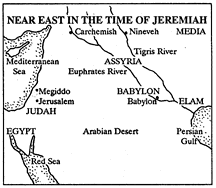
Since Judah lay between Egypt and Assyria, the Judean king Josiah saw this alliance between the two nations as a threat to Judah's independence. He preferred Assyria to remain weak, and attempted to stop Pharaoh's army as it passed through Palestine on its way to Assyria. This proved to be a disastrous decision. Judah was defeated and Josiah was killed in battle (609 BC; 2 Kings 23:28-30). Assyria could withstand the superior forces of Babylon no longer, and soon collapsed. It became absorbed into the Babylonian Empire and lost for ever its separate national identity.
End of Judah's independence
Following Josiah's death, the people of Judah made Josiah's second son, Jehoahaz, the nation's new king (2 Kings 23:30). But Pharaoh Necho now considered himself the controller of Judah and he would not accept the king whom the Judeans had chosen. He removed Jehoahaz and took him captive to Egypt, then put Jehoahaz's older brother, Jehoiakim, on the throne instead. He also placed a heavy tax on Judah (2 Kings 23:31-34).
Once Jehoiakim began to rule, it soon became clear why the people had not chosen him as king. He was a proud, cruel and oppressive ruler, who did not hesitate to murder any who opposed him or even displeased him (2 Kings 24:4; Jer 26:20-23; 36:21-26). Despite the heavy taxes his country had to pay Egypt, he built himself luxurious royal buildings. To make matters worse, he forced the builders to work on his selfish projects without payment (Jer 22:13-18).
Beginning of Babylon's conquest
The long struggle between Egypt and Babylon came to a climax when the armies of Babylon conquered Egypt in a famous battle at Carchemish, on the Euphrates River, in 605 BC (Jer 46:2). This meant that Judah now came under the control of Babylon and had to pay its taxes to Babylon instead of to Egypt.
When the victorious Babylonians returned to their homeland, they took captive with them a number of capable and well educated young men from the leading families of Jerusalem. These young men, among whom were Daniel and his three friends, were to be trained as administrators in the Babylonian government (Dan 1:1-6).
After three years Jehoiakim rebelled against Babylon by refusing to pay further taxes. This was a dangerous decision, but Jehoiakim apparently hoped that Nebuchadnezzar would be too busy with wars elsewhere to deal with the rebellion of a small country such as Judah. Although Nebuchadnezzar did not attack Jerusalem immediately, neither did he ignore it. His anti-Judean tactic was to encourage neighbouring countries under his control to carry out guerilla attacks against Judah, and so undermine whatever economic, political or military stability might have remained (2 Kings 24:1-2).
In due course, after he had established his authority in other troublesome regions, Nebuchadnezzar sent his armies to besiege Jerusalem. It seems that by this time the people of Jerusalem could tolerate the worthless Jehoiakim no longer, and handed him over to the Babylonians in an attempt to win concessions for themselves. Although the city had not fallen, Jehoiakim found himself a captive in the enemy's hands. He was chained ready to be sent to Babylon, but he died before the journey began. No one mourned his death, and his body was thrown on the garbage dump outside Jerusalem, as if it were the carcass of an unclean animal (2 Chron 36:6; Jer 22:18-19; 36:30).
The eighteen year old Jehoiachin (also known as Jeconiah, or Coniah) became king, but after three months he saw the uselessness of resisting the Babylonians further. He therefore surrendered, in the hope that he could lessen Jerusalem's suffering and gain reasonable treatment from the conquerors (597 BC; 2 Kings 24:10-12).
Having captured Jerusalem, the Babylonians lessened the likelihood of further revolt by carrying off most of Judah's wealth and all its best people to their own country. They left behind only those they had no use for, and appointed Jehoiachin's uncle, Zedekiah (another son of Josiah), as king over them (2 Kings 24:12-17).
The destruction of Jerusalem
Zedekiah was a weak king, easily persuaded by influential people. With all Judah's most capable administrators taken to Babylon, Zedekiah's government was dominated by self-seeking officials who had poor political judgment and no religious insight. They were constantly urging Zedekiah to seek Egypt's help and rebel against Babylon. Jeremiah opposed any policy of rebellion against Babylon, knowing that it would lead only to the horrors of siege and destruction. He advised Judah to accept its fate as God's will and submit to Babylon (2 Kings 24:18-20; Jer 21:1-10; 27:12-22).
Foolishly, Zedekiah followed the advice of the pro-Egyptian party and rebelled against Babylon. Nebuchadnezzar lost patience and, determined to put an end to Jerusalem's rebellion, sent his armies to crush the city in one final great siege. When Egypt came to Jerusalem's aid, the siege was temporarily lifted, but Jeremiah assured the Jerusalemites that Babylon would return to crush both Egypt and Judah. The pro-Egyptian party accused Jeremiah of being a traitor and had him beaten and thrown into prison (Jer 37:1-21).
Soon the Babylonians returned and Jeremiah's prophecy came true. (The book of Lamentations gives a vivid picture of the dreadful conditions in and around Jerusalem during the siege; see Lam 2:10-12,1921; 4:4-5,7-9.) When, after a siege lasting a year and a half, the Babylonians finally made a break in the wall, Zedekiah and some of his men tried to escape, but were captured by the enemy (2 Kings 25:1-7).
The victorious Babylonian soldiers then overran Jerusalem, seizing anything of value that could be taken back to Babylon and burning or smashing what remained. The temple was destroyed and the city left in ruins. The Babylonians executed the leaders of the rebellion and took all the most useful citizens captive. They released Jeremiah from prison and gave him full freedom to decide where he would like to live, Babylon or Judah. Jeremiah decided to stay in Judah, along with a small number of farmers and other poorer people who were of no use to Babylon (2 Kings 25:8-21; Jer 39:13-14; 40:4-6). This was the end of Jerusalem (587 BC).
Jeremiah taken to Egypt
Gedaliah, one of the few leaders in Jerusalem who had not supported Zedekiah's pro-Egyptian policy, was appointed by the Babylonians as governor over those who remained in Judah. With Jeremiah's support he followed a pro-Babylon policy. He took no action against those anti-Babylonian military leaders of Judah who had managed to escape the Babylonian army. Instead he encouraged them, along with other refugees who had fled the country, to return and settle around his administrative headquarters at Mizpah, a town north-west of Jerusalem (2 Kings 25:22-24; Jer 40:7-12).
The anti-Babylon group, however, had still not learnt the lessons Jeremiah had been trying to teach them. Refusing to accept Babylon's domination, they plotted against the governor Babylon had appointed, and when a suitable occasion arose they murdered him. Fearing a revenge attack by Nebuchadnezzar, the remaining Judeans of the resettlement area fled for their lives to Egypt, taking a protesting Jeremiah with them (2 Kings 25:25-26; Jer 40:13-43:7).
Even in Egypt, the country whose help he had always rejected, Jeremiah's continued to announce God's message. But God's people refused to heed it (Jer 43:8-44:30). According to tradition they became so hostile that eventually they stoned him to death.
The use of names
During the time of the divided kingdom, the custom was to refer to the northern kingdom as Israel (or Samaria, after its capital), and the southern kingdom as Judah (or Jerusalem, after its capital). (For further details about the use of names see introductory notes to Isaiah.) By the time of Jeremiah only Judah remained, so there was no further need to distinguish between the former northern and southern kingdoms. Jeremiah sometimes uses the name Israel when referring to Judah, for he uses the word according to its ancient and more general usage, not according to its specific usage during the time of the divided kingdom.
To avoid confusion, these notes will refer to the southern kingdom only by its name Judah. The name Israel will be used only to apply to the northern part of the divided kingdom, except in those places where the context makes it clear that the reference is to ancient Israel (e.g. Israel in the time of Moses).
1:1-6:30 Jeremiah's early ministry 7:1-20:18 The spiritual condition of Judah 21:1-25:38 Warnings to kings and false prophets 26:1-34:22 Prophecies of exile and return 35:1-45:5 Events in Judah and Egypt 46:1-51:64 Messages for foreign nations 52:1-34 Historical appendix
1:1-6:30 JEREMIAH'S EARLY MINISTRY
The call of Jeremiah (1:1-10)
Jeremiah belonged to a priestly family that lived not far from Jerusalem. However, he may never have practised as a priest, for God's will was that he be a prophet. His prophetic ministry lasted at least forty years. It began in 627 BC (the thirteenth year of Josiah's reign) and continued into the era that followed the destruction of Jerusalem in 587 BC (1:1-3).
God had chosen Jeremiah to be a prophet before he was born. He was to be God's messenger to Judah and the surrounding nations (4-5). At the time God called him to be a prophet, Jeremiah was probably no more than twenty years of age. When he objected that he was too young and inexperienced for such a task, God replied that he would be with him and give him the message to speak. Jeremiah had no cause to be afraid (6-8).
Much of Jeremiah's message would not be popular and at times would appear to be pessimistic because of its repeated announcements of God's judgment. Nevertheless, judgment was necessary, because proud self-confidence must be broken down and the corruption of sin removed before new spiritual life can grow up (9-10).
Two visions (1:11-19)
To encourage Jeremiah in the work that lay ahead of him, God gave him two visions. The almond, first tree to bloom in spring, symbolized God's watchfulness and constant readiness to keep his promises (11-12. The Hebrew word for 'almond' sounds like the Hebrew word for 'watching'). The giant boiling pot, tilted from the north so as to pour its contents over Judah, symbolized a foreign army entering Judah from the north and overrunning the country. This was a judgment brought about by God because of Judah's idolatry (13-16).
God told Jeremiah he was not to be afraid in announcing Judah's doom, for God cannot use a coward. He warned that Jeremiah had a lifetime of opposition ahead of him, but at the same time he promised to specially strengthen his servant. All the attacks on Jeremiah, whether from political leaders, religious leaders or the people at large, would not overcome him, because God would strengthen and defend him (17-19).
A nation's unfaithfulness (2:1-19)
While Josiah was reconstructing the outward form of Judah's religion, Jeremiah was searching into the deeply rooted attitudes of the people and trying to bring about a truly spiritual change. He contrasts the nation's present sad condition with its devotion to God in former days. Israel once loved God, as a bride loves her husband. She was like the firstfruits of the harvest that belonged to God, and those who plundered her were punished (2:1-3).
God now challenges the nation to produce proof that her turning away from God has resulted from any failure on God's part. He brought his people out of Egypt, cared for them on their long journey through harsh dry country, and gave them a pleasant fertile land to live in. But they polluted the land by their wickedness. Under the leadership of ungodly priests, ignorant teachers, corrupt rulers and worthless prophets, they turned away from God and followed the religious practices of their heathen neighbours (48).
Therefore, God lays a charge of unfaithfulness against his people, and calls upon the sun, moon and stars that shine upon them to be his witnesses. Heathen nations remain true to their gods, even though those gods may be lifeless and useless. Israel and Judah, by contrast, exchanged the true and living God for useless idols (9-12). They acted like people who turned away from the natural spring that gave them a permanent supply of pure water, and trusted for their water supply in a cracked cistern they had made themselves (13).
Israel and Judah boasted that they were God's children, but now they are becoming slaves of other nations. A century earlier Assyria had invaded the northern kingdom, destroyed its cities and taken its people into captivity (14-15). Other nations now threatened the southern kingdom. God warns that it is useless and foolish for Judah to ask either Egypt or Assyria to help defend it against enemy invasions. It is useless because such attacks are a judgment on Judah for its disobedience. It is foolish because, in seeking aid from a more powerful nation, Judah is placing itself under that nation's religious influence and political power (16-19).
Idolatry and immorality (2:20-37)
In associating with Baal and other gods, Judah has broken the covenant bond with Yahweh. Judah's unfaithfulness is likened to adultery (20). (Throughout the following chapters, Jeremiah makes repeated reference to the beliefs and practices of Baalism, and to the significance they had in leading God's people into spiritual adultery and prostitution. For information that will help to understand Jeremiah's teaching, see introductory notes to Judges, subheading 'The religion of the Canaanites'.)