
Part 30
From this faithful minority came one person, Jesus the Messiah, who was the divinely chosen descendant of Abraham to whom God's promises to Abraham pointed. All God's ideals for Israel and all his promised blessings for the human race were fulfilled in Jesus (Gal 3:16). Jesus then took the few remaining faithful Israelites of his day and made them the nucleus of God's new people, the Christian church (Matt 16:18). The church, then, was both old and new. It was old in that it was a continuation of that body of believers who in every age remained faithful to God. It was new in that it did not formally come into being till after the death, resurrection and ascension of Jesus (Matt 16:18,21; Titus 2:14; 1 Peter 2:9).
The word used by Jesus and translated 'church' meant originally a collection of people – a meeting, gathering or community. It was used for the Old Testament community of Israel, and was particularly suitable for the new community, the Christian church, that came into existence on the Day of Pentecost (Exod 12:6; 35:1; Deut 9:10; 23:3; Acts 2:1-4; 5:11; 7:38; 8:1).
The body of Christ
As the church grew, Christians understood its meaning more fully. They saw that Christ and the church are inseparably united and make up one complete whole, just as the head and the body make up one complete person. Through his resurrection and ascension, Christ became Head of the church. He has supreme authority over it and is the source of its life, growth and strength (Eph 1:20-23; 4:15-16; Col 1:18; 2:19). Another picture of the relationship between Christ and the church is that of marriage. This emphasizes Christ's love for the church and shows how, in order to gain the church as his bride, he laid down his life in sacrifice (Eph 5:23,25).
Both the picture of the body and the picture of marriage illustrate Christ's headship of the church (Eph 1:22-23; 5:23). Both pictures also make it clear that God accepts the church as holy and faultless only because it shares the life and righteousness of Christ (Eph 5:26-27; Col 1:22).
This view of the church in all its perfection as the body of Christ is one that God alone sees. The view that people in general see is of the church in a world of sin where it is troubled by imperfection and failure (cf. 1 Cor 1:2 with 1 Cor 3:1-3; cf. Eph 1:1-4 with Eph 4:25-32). God sees the church as the full number of believers of all nations and all eras, a vast international community commonly referred to as the church universal. People see the church only in the form of those believers living in a particular place at a particular time.
Within what society sees as the visible church are those who are genuine believers and those who are not. People often find it difficult to tell the difference between the two, but God knows all things and he will make the decisive separation on the day of final judgment (Matt 13:47-50; 1 Cor 10:1-11; 2 Cor 13:5).
The local church
This leads to the most common usage of the word 'church', and that is to denote the meeting together of a group of Christians in a particular locality. This community is the church in that locality. It is the local expression, a sort of miniature, of the timeless universal church (Acts 13:1; 1 Cor 1:2).
The story of the early church in Acts shows that when people repented and believed the gospel, they were baptized (Acts 2:38,41; 10:48). By their faith they became members of Christ's body, the church, and they showed the truth of this union by joining with other Christians in their locality. That is, having become part of the timeless universal church, they now became part of the local church (Acts 2:41,47).
Churches in New Testament times met in private homes or any other ready-made places they could find (Acts 12:12; 19:9, 20:7-8; Rom 16:5,14-15). Their meetings were to be orderly and, above all, spiritually helpful (1 Cor 14:26,40). The believers were built up through being taught the Scriptures and through having fellowship with each other by praying, worshipping, singing praises and observing the Lord's Supper together (Acts 2:42; 20:7,27; 1 Cor 11:23-33; 14:15).
From the church, believers went out to make known the gospel to others. They baptized those who believed, brought them into the fellowship of the church and taught them the Christian teaching, so that they too might become true disciples of Jesus Christ (Matt 28:19-20; Acts 1:7-8; 8:4; Col 1:27-29). They recognized that their responsibilities applied to distant regions as well as to their own localities (Matt 28:19; Acts 13:2-4; Rom 15:19-20); and besides preaching the gospel they helped the victims of disease, hunger and injustice (Acts 3:2-6; 11:28-29; 16:16-18; Rom 12:8,13; James 1:27; 2:14-16; cf. Matt 25:3440).
Each local church, though having fellowship with other local churches (Acts 11:29; 18:27; 1 Cor 16:1-4), was responsible directly to the Head, Jesus Christ, in all things. There was no central organization or head church to control all others, and no set of laws either to hold the churches together in one body or to hold all the believers in one church together. Unity came through a oneness of faith in the Spirit, with Christ as the Head (Eph 4:4-6).
Christians thought of the church not as an organization or institution, but as a family. Christ was the Head, and all the believers were brothers and sisters (Gal 6:10; Eph 2:19). The strength of the church came not from any organizational system, but from the spiritual life that each believer possessed and that all believers shared in common (Phil 1:7; 2:1-2; 1 John 1:3).
Leadership in the churches
The Bible gives few details concerning how the early churches arranged their meetings and carried out their functions. No set form was laid down. That does not mean that the churches lacked leadership or that they carried out their work without thought and planning. Churches had elders to be responsible for spiritual care, growth and direction, and deacons to look after some of the church's more routine affairs (Phil. 1:1; see earlier notes). People in those leadership positions may have been gifted in various ways, since God gave a range of gifts to build up his people within the life of the body. Among these gifts were apostles, prophets, evangelists, pastors and teachers (Eph 4:11-13).
Apostles and prophets seem to have been especially suited to the time of the church's infancy (Eph 2:20; see earlier notes). Evangelists were, according to the meaning of the word, those who preached, announced or proclaimed the gospel, or good news. Their chief concern was to make known the gospel to those who had not heard it, and plant churches in places where previously there were none (Acts 8:5,40; 14:21, 16:10; Rom 10:14-15; 15:19-20; 2 Cor 10:16; 2 Tim 4:5).
Pastors were those whose special ministry was spiritual care. In the language of the original New Testament writings there was a close connection between the words 'pastor', 'shepherd' and 'flock', indicating that many of the qualities of the pastor were similar to those we have already considered in relation to elders (John 21:15-17; 1 Peter 5:1-4). Pastors were not a separate group from teachers, for the way they fed the flock was through teaching the Word (Acts 20:27-28; cf. 6:2-4). In fact, where pastors and teachers are mentioned together in Ephesians 4:11, the grammatical connection between the two words indicates that both words refer to the same people, pastor-teachers.
Teachers, being also pastors, had more than the ability to understand and teach the Word clearly. They taught in such a way that the members of the church were strengthened in their faith and equipped to serve God (Rom 12:7; 1 Cor 12:28; Eph 4:11-12). They helped Christians develop the ability to discern between teaching that was wholesome and teaching that was not, and so grow towards spiritual maturity (Eph 4:13-14; Col 1:28; 2:4; 1 Thess 5:20-21; 1 Tim 1:3-5; 4:6-8; Heb 5:12-14).
From the above data we can see that there was some overlap between the gifts mentioned in the New Testament. People were not divided too sharply into separate categories, and some combined within them several of the gifts; e.g. Paul (Rom 15:20; 1 Tim 1:1; 2:7), James (Gal 1:19; 2:9-10), Timothy (1 Tim 4:13-16; 2 Tim 4:5), Barnabas (Acts 11:22-26; 14:14), Silas (Acts 15:32; 17:10-14) and others.
Responsibilities of church members
God's purpose was not for these specially gifted people to do all the spiritual work in the church, or to be so dominant that the church members became completely dependent on them. On the contrary, they were to use their gifts to teach, train and build up other Christians and so prepare them for fuller Christian service. In this way individual Christians grew to spiritual maturity and the church as a body was built up (Eph 4:11-16; 2 Tim 2:1-2; cf. 1 Cor 14:3-4,12,26).
Paul pointed out to the early Christians that in a local church each member had a gift for the service of God, given by the Holy Spirit according to his will (1 Cor 12:11,18). He likened the church to the human body: a living organism made up of many parts, all with different functions to perform. Yet with the variety there was equality. The church, unlike ancient Israel, had no exclusive class of religious officials who had spiritual privileges that ordinary people did not have (Rom 12:4-8; 1 Cor 12:12,27; Eph 2:18-20). Many gifts operated in the early churches, but Christians were to use them in dependence upon the Spirit's power and in keeping with the Spirit's teaching (1 Cor 12:4-11).
If a local church was to operate properly, all the people in that church needed to find out what gifts the Holy Spirit had either given them or withheld from them, then develop the gifts they had (Rom 12:68; 1 Tim 4:14-16). This would leave no room for pride on the one hand or jealousy on the other, but through the care of the members one for the other the church would be built up (1 Cor 12:14-30).
15:1-35 FIRST MAJOR CHURCH PROBLEM
Judaisers trouble the churches (15:1)
The writer of Acts has already shown that many of the Jewish Christians in Jerusalem were not happy that Gentiles should be received into the church as equal with Jews, but without having to follow the Jewish laws (see 11:1-3). Peter may have silenced them once (see 11:18), but many still retained their old Jewish attitudes and ideas.
A group of these Jews now came from Jerusalem to Antioch in Syria, teaching that Gentile converts had to be circumcised and keep the law of Moses (15:1; see also v. 5). These men claimed they had authority from James, but James later denied this (Gal 2:12; cf. Acts 15:24). They argued so persuasively that even mature Christians such as Peter and Barnabas stopped eating with the Gentile Christians in case they broke Jewish food laws. Paul, who before his conversion was as zealous a Jew as any, saw that the teaching of the Judaisers was contrary to the Christian gospel. A forthright public rebuke from Paul resulted in Peter and Barnabas realizing their error and resuming fellowship with the Gentiles (Gal 2:1116; cf. Acts 15:6-12).
Paul writes to the Galatians
Soon after correcting the trouble in Antioch, Paul heard that the Judaisers had spread their teachings to the newly planted churches of Galatia (Antioch, Iconium, Lystra, and Derbe) and some of the new Christians were being led astray. Angered at this, Paul immediately sent off a sharply worded letter, known to us as the Letter to the Galatians (Gal 1:6; 3:1).
In this letter Paul pointed out that there was only one gospel, the one he preached, and that the law of Moses has no authority over Christians. They are justified by faith in Christ and live by the same faith. Though free from the law of Moses, they are not lawless, but under the direction of the indwelling Spirit of Christ (Gal 3:3; 5:1,13,16,18).
To Jerusalem to discuss the problem (15:2-21)
The trouble created by the Judaisers had now spread to the farthermost parts of the church, so the matter needed to be settled quickly and decisively. Because the teaching came from Jerusalem, that was the place to discuss the matter. The church at Antioch therefore appointed Paul, Barnabas and other leaders to go to Jerusalem as its representatives. Along the way and after their arrival in Jerusalem, they reported on the widespread turning to God among the Gentiles, but as soon as the meeting began the Judaisers spoke against them (2-5). (This Jerusalem meeting is sometimes referred to as the Council of Jerusalem.)
After lengthy debate, Peter vigorously opposed the Judaisers and defended the Gentiles, asserting that Gentiles should not have to keep the Jewish law. The way of salvation and entrance into the full Christian fellowship was by faith alone, and was the same for Jews and Gentiles. This principle was basic to the gospel and could not be changed (6-11). The recent experiences of Paul and Barnabas reinforced this principle (12).
James agreed with Peter, Paul and Barnabas, adding that the events they were witnessing – the coming of the Messiah, the establishment of his kingdom and the expansion of that kingdom among the Gentiles – had been foretold by the prophets of Old Testament times (13-18).
In summing up the discussion, James repeated that no attempt should be made to put the Gentiles under the Jewish law (19). However, one problem remained. Jewish attitudes to social issues had been moulded by centuries of submission to the law of Moses, whereas Gentiles had no such law and as a result their moral standards were lower. The Jews considered many Gentile practices improper, such as the eating of any sort of food at all, regardless of how it had been killed or whether it had been offered to idols. James therefore suggested that the Gentile Christians would help improve relations between the two groups if they were careful not to engage in practices that the Jews considered offensive (20-21).
Letter from Jerusalem (15:22-35)
Acknowledging the wisdom of James' suggestion, the Antioch representatives were pleased to take back with them two leading men from the Jerusalem church, Judas and Silas, to help create a better understanding between the Jewish and Gentile groups (22).
The party also carried a letter from the Jerusalem meeting that expressed regret concerning the Judaisers' trouble-making and encouraged the Gentiles to be considerate of their Jewish brothers. The letter was not one of command, because all churches were independent of each other and none had the right to dictate to another. Yet there was a unity between them because of the common life they shared in Christ. If Christians were to enjoy that unity, they had to exercise love towards those who held different opinions on matters of lesser importance (23-29).
When the group arrived in Antioch, the local Christians were greatly encouraged to hear the outcome of the Jerusalem meeting, and gladly accepted the letter that the leaders passed on to them (30-31). They also profited from the preaching of Judas and Silas. But because they had been unsettled by the recent difficulties, Paul and Barnabas stayed on for a while to strengthen and reassure them (32-35).
15:36-18:22 INTO EUROPE (SECOND MISSIONARY JOURNEY)
Choosing a partner (15:36-41)
Paul and Barnabas thought that, in view of the recent troubles with the Judaisers, they should revisit the newly established churches in Galatia (36). Unfortunately, they could not agree on whether to take
Mark with them. Barnabas wanted to but Paul refused, as he considered Mark to be unreliable. In the end they separated, Barnabas going to his native Cyprus with Mark, and Paul going to his native Cilicia with Silas (37-41).
Silas had, by his actions at the Jerusalem meeting and by his Christian service at Antioch, shown himself to be a person of ability and wisdom. Also, as Paul was to visit the churches where the Judaisers had just been, he no doubt saw some value in having with him a member of the Jerusalem church. Added to this, Silas was, like Paul, a Roman citizen (see 16:37), which would be an advantage in the Gentile areas.
Across Asia Minor to Troas (16:1-10)
Upon arriving in Lystra, Paul and Silas were joined by Timothy, a young man whom the elders of the Galatian churches considered suited to the task ahead (1 Tim 1:18; 4:14). Timothy was half-Jewish, and Paul thought it wise that he be circumcised, apparently hoping that this would gain acceptance for Timothy with the Jewish population wherever the missionaries went. The circumcision of Timothy was for practical, not religious, purposes, in keeping with Paul's principle that while working with the Jews he would live like the Jews so that he might win them for Christ (16:1-3; cf. 1 Cor 9:20).
As they passed through the Galatian towns, the missionaries delivered copies of the Jerusalem letter to the churches. This letter added further weight to what Paul had said to them in his own recent letter (45).
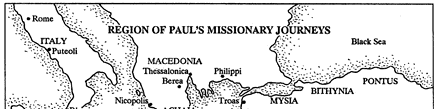
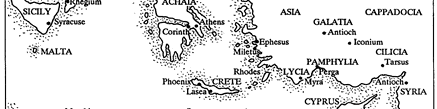
Leaving Galatia they entered the province of Asia, but God did not allow them to preach there. They headed north towards the province of Bithynia, but again God prevented them from carrying out their plans. So they headed west across the region of Mysia to the town of Troas, from where they prepared to sail to Europe. Their destination was to be the province of Macedonia, the northern part of present-day Greece. These unexpected changes in Paul's missionary movements showed that although he knew the importance of planning his work, he knew also the importance of obeying whenever God directed him otherwise (6-10).
Philippi – first church in Europe (16:11-40)
The missionaries left Troas with another addition to the party, Luke, the author of the book (note the word 'we' in verse 11). Luke's home appears to have been in Philippi, the city to which the group was now heading (11-12). It seems that Philippi had few Jews and no synagogue, but a group of God-fearers met for prayer at the river bank. The missionaries joined with them and made known to them the gospel of Jesus Christ. As a result a cloth merchant named Lydia became a Christian and, through her, her household also believed (13-15).
Not all the interest that the preachers created in Philippi was favourable. Trouble began when they healed a slave girl who, because of an evil spirit that possessed her, earned much money for her owners by telling fortunes (16-18). When her owners found she could no longer be used to earn them money, they attacked the missionaries and created a riot. Paul and Silas were arrested, flogged and thrown into prison without trial or questioning (19-24).
Yet even in prison Paul and Silas found the opportunity to talk about Jesus Christ. The outcome was the conversion of the jailer along with his household (25-34). Next morning Paul and Silas were allowed to go free, but they refused to go until they received an apology from the local officials. Paul claimed that the officials had no right to flog Roman citizens, especially without trial (35-40).
Through Macedonia to Athens (17:1-15)
In recording the groups' departure from Philippi and subsequent movements, the writer uses 'they' rather than 'we', indicating that Luke stayed behind in Philippi. The others moved on to Thessalonica, where over the next three Sabbaths their preaching in the synagogue brought good results (17:1-4). (If this visit to Thessalonica was the one referred to in Philippians 4:16, they probably stayed longer than three weeks, since the Philippians twice sent gifts to him there.)
As usual the missionaries' successes stirred up the jealousy of the Jews. With the help of some hooligans, the Jews caused an uproar and attacked the house of Jason where Paul had been staying. When they discovered that Paul was not at home, they seized Jason instead and took him to the city officials. They accused Jason of helping a group of Jewish rebels who were planning to set up their own king,
Jesus, in rebellion against Caesar. When no one could find Paul and his party, the officials held Jason responsible to see that there was no further trouble. The payment of money that they took from Jason may have involved a guarantee that Paul would leave the city and not return (5-9; cf. 1 Thess 2:18). (Although Paul did not visit Thessalonica again on this journey, he may have visited it on his next journey; see 20:12.)
At Berea the story of Jewish opposition was much the same (10-13). Paul was forced to depart, leaving Silas and Timothy behind while he went on to Athens. From Athens he sent a message telling them to rejoin him at once (14-15). After they met him in Athens, Paul sent them back to Macedonia, Timothy going to Thessalonica and Silas probably to Philippi (see 1 Thess 3:1-2; cf. Acts 18:5).
Paul in Athens (17:16-34)
Athens was in the province of Achaia, the southern part of present-day Greece. It was the chief centre of learning in the Roman Empire, a place where philosophy, religion and politics were taught and discussed freely. When some local philosophers heard Paul preaching in the public places of the city, they invited him to give an account of his religion to the council of philosophers known as the Areopagus. This was an ancient council that exercised control over those who lectured publicly in Athens. When Paul preached, he so often linked the name 'Jesus' with the word 'resurrection' (Greek: anastasis) that the philosophers thought he was introducing them to two gods, Jesus and Anastasis (16-21).
The Areopagus was divided largely between two schools of Greek philosophers, the Epicureans and the Stoics (v. 18). The Epicureans believed that because nothing in the world is lasting or stable, people should not become too involved in the affairs of life. They should seek contentment through living calmly, and should try to avoid all pain, desire, unpleasant feelings and superstitious fears. This was how the gods lived, and for this reason they took little interest in human affairs. The Stoics believed that everything is determined by a universal Mind or Reason. Therefore, people should accept whatever they meet in life without fear or complaint, and adjust their lives to fit what nature has determined for them. Self-discipline was essential; reason was always to have control over feelings.
Paul confidently announced to the members of the Areopagus that he would explain to them the nature of the God whom they did not know (22-23). This God was the Creator and Controller of the universe and the Lord of all humankind. Yet he was a God whom human beings could know, for they
were made in his image (24-28). In former ages God had been patient with the ignorance of a sinful human race, but now that Jesus had come he held people responsible for their acceptance or rejection of him. Forgiveness was available to those who repented of their sin, but punishment faced those who refused to repent. By raising Jesus from death, God showed that Jesus was the one through whom he would deal with people, whether in forgiveness or in punishment (29-31).
The Epicureans would have agreed with Paul that God needs nothing from human beings (v. 25). The Stoics would have agreed that there is a supreme God who is the source of all life and who determines when and where the peoples of the earth should live (v. 24-26,28). But both alike found that Paul's teaching about the resurrection was not worthy of serious consideration. Not all Athenians, however, rejected Paul's message (32-34).
Across to Corinth (18:1-4)
Corinth was a strategic commercial centre situated on a well used Roman road. It was also an important port, and like many ports it was full of all sorts of vice. Its reputation was so bad that people referred to a person of loose morals as one who 'behaved like a Corinthian'. Yet Paul planted a church there and, not surprisingly, it became one of the most colourful and unorthodox churches of all.
As he often did on his travels, Paul earned his living in Corinth by working for a time at his trade of tentmaking (cf. 1 Thess 2:9; 2 Thess 3:8). In so doing he met a Jewish married couple, Aquila and Priscilla, who were also tentmakers and who were to become his lifelong friends. They, along with other Jews, had recently been forced to leave Rome by command of the Emperor (18:1-3). No doubt they went with Paul to the synagogue, where he preached the gospel (4).
Paul writes to the Thessalonians
At that time Silas and Timothy returned from Macedonia, bringing with them gifts of money for Paul from the Macedonian churches. This provision released Paul from his tentmaking and enabled him to spend all his time preaching (see 18:5; cf. 2 Cor 11:8-9; Phil 4:15). Paul was so pleased with the good news that Timothy brought from Thessalonica that he wrote and sent off a letter which we know as First Thessalonians (1 Thess 3:6).
Paul was particularly pleased to hear that his hasty departure from Thessalonica had not hindered the progress of God's work there. Despite constant persecution, the church continued to grow, and within a short time had spread the gospel throughout the surrounding districts (1 Thess 1:6-8; 2:13-14). Sadly, some criticized Paul for leaving the new converts in Thessalonica to face the anti-Christian trouble that initially had been stirred up through him. Paul defended himself against these accusations and at the same time encouraged the Christians to stand firm amid the opposition (1 Thess 2:1-8,17-18; 3:3-5). He also gave instruction concerning certain aspects of Christian behaviour and cleared up some misunderstandings concerning the return of Jesus Christ (1 Thess 4:1,9,13; 5:1-2).
Within a short time, perhaps only a few weeks, Paul heard that some of the Thessalonians had misunderstood parts of his letter, particularly those parts dealing with Christ's return. He therefore sent off a second letter, which is known to us as Second Thessalonians.
Some mistakenly thought that when Paul said Jesus Christ would return 'suddenly' he meant 'immediately'. There were even those who thought that if Christ was about to return, there was no purpose in working any longer. As a result they became idle and a burden to others. Paul corrected the misunderstandings (2 Thess 2:1-3), rebuked the idle (2 Thess 3:6-12), gave further encouragement to the persecuted (2 Thess 1:4-5) and urged all to stand firm in the truth (2 Thess 2:15).
Eighteen months in Corinth (18:5-17)
Meanwhile in Corinth, Paul was having the usual trouble with the Jews. They forced him out of the synagogue, so he went and preached in the house of Titius Justus, a Gentile God-fearer who lived next door (5-7). Crispus, the ruler of the synagogue, himself believed (8; cf. 1 Cor 1:14), and possibly the new ruler of the synagogue, Sosthenes, later believed also (see v. 17; cf. 1 Cor 1:1).
In spite of the constant opposition, Paul kept preaching, and during the year and a half that he stayed in Corinth the church grew (9-11). On one occasion when the Jews tried to lay a charge against Paul, the governor refused to hear them. He looked upon Paul's party as a group within Judaism, and saw the dispute as a religious matter that the Jews would have to settle themselves (12-16). The local people, seeing that the governor was unsympathetic to the Jews, took the opportunity to express their anti-Jewish feelings by beating up one of the Jewish leaders (17).
Return to Antioch (18:18-22)
Paul then prepared to return home. At Cenchreae, from where the ship sailed, he fulfilled a vow (probably a Nazirite vow; see Num 6:1-21) which for some reason he had taken upon himself (18). He sailed across to Ephesus where he stayed a short while. His preaching created much interest and probably resulted in the start of a church in that city. Then, leaving Aquila and Priscilla in Ephesus, he sailed for his home church in Antioch, though he hoped to return to Ephesus soon (19-22).
18:23-21:16 BACK TO ASIA MINOR AND EUROPE (THIRD MISSIONARY JOURNEY)
Through Galatia to Ephesus (18:23-19:7)
On his third great journey to the west, Paul set out by visiting the churches of Galatia once again. This was the fourth time he had visited these churches and he had also written them a letter (23; cf. 13:14,51; 14:21; 16:2-6).
In the meantime a learned Jew named Apollos had come to Ephesus from Alexandria in Egypt. Like many of the Jewish teachers in Alexandria, he had a detailed knowledge of Old Testament references to the Messiah and was able to teach impressively. However, he lacked knowledge of certain Christian teachings until Aquila and Priscilla explained them to him (24-26). Later, when he moved across to Corinth, he was of great help to the church there and added considerably to the good work Paul had done previously (27-28; 1 Cor 3:6). Unfortunately, the Corinthian church divided into factions, because people made favourites of various teachers. This was a problem that Paul soon had to deal with (1 Cor 1:12; 3:4).
On arriving in Ephesus, Paul met a group of twelve people who had repented and been baptized as taught by John the Baptist. But they did not know that since the death and resurrection of Jesus, the form of baptism that John proclaimed was no longer in use. The one whom John announced had come, and the baptism with the Spirit that John promised had been given (on the Day of Pentecost; cf. Matt 3:11; Acts 1:4-5; 2:16-17,33). When they understood this they were baptized in water as disciples of Jesus Christ, and received the Holy Spirit as the original disciples had at Pentecost (19:1-7).
Ephesus and the surrounding region (19:8-22)
After Paul had preached for three months in the synagogue, the Jews forced him out, so he went and taught in the lecture hall of Tyrannus. He carried on his teaching work there for the next two years, during which the disciples took the message into the surrounding countryside (8-10). This activity seems to have resulted in churches being founded, without Paul's help, in the towns of Colossae, Hierapolis and Laodicea (Col 2:1; 4:13), and possibly also Smyrna, Pergamum, Thyatira, Sardis and Philadelphia (Rev 2:8,12,18; 3:1,7).
The healing ministry of the Messiah that had worked through Peter and John continued to work through Paul (11-12; cf. 3:1-16; 5:12-16; 9:33-35). Some itinerant Jewish wonder-workers, impressed with Paul's ability to drive out demons in the name of Jesus, tried to copy him, but were themselves violently attacked by the demons (13-16). Sorcery, magic and superstition were widespread in Ephesus, but God's power was at work in the city and large numbers of people turned to him (17-20).
As the churches in the province of Asia grew stronger, Paul began planning his future movements. His ultimate aim was to go to Rome, so that he could help establish Christianity more firmly in the heart of the Empire (cf. Rom 1:11-15). But first he wanted to go to Jerusalem. During the past year or so he had been organizing a collection of money to take to the poor Christians in Jerusalem, a plan that he hoped would bind the Jewish and Gentile churches together (1 Cor 16:1-4; 2 Cor 8:1-24; 9:1-5; Rom 15:23-27). His purpose in sending two fellow workers to Macedonia was probably to help promote and organize this project (21-22).
A riot in Ephesus (19:23-41)
Paul preached and taught in Ephesus for almost three years (see 20:31), and many people became Christians. Ephesus was considered to be the home of the goddess Artemis (or Diana), and the citizens of Ephesus were the honoured guardians of the magnificent temple of Artemis in their city. With so many people turning from the worship of Artemis, the temple was losing its popularity. Furthermore, local silversmiths who made small images and household shrines of the goddess were going out of business (23-27).
Angry at their loss of income, the silversmiths stirred up the people against Paul and his fellow missionaries, and a riot broke out. Since any who did not worship Artemis were in danger, the Jews tried to protect themselves by pointing out that they were not associated with the Christians. But the mob refused to listen (28-34).
In calming the riotous crowd, the city's chief official defended Paul and his party. At the same time he warned the people not to take the law into their own hands again, because Rome would not tolerate such disorder (35-41). Although on this occasion Paul did not suffer physical violence, on other occasions during his stay in Ephesus he certainly did (1 Cor 15:32; 2 Cor 1:8-9).
Travels and writings of this time
During this three year period, most of which Paul spent in Ephesus, much happened that is not recorded in Acts. However, as we read Paul's letters we can understand more of his activity during this time. The following is a suggested summary of events:
1. While in Ephesus, Paul wrote to the church in Corinth on various practical and moral issues. The letter has not been preserved (1 Cor 5:9).
2. Paul sent Timothy and Erastus to Macedonia (Acts 19:22) and from there to Corinth, in an effort to deal with problems in the Corinthian church (1 Cor 4:17; 16:10). Certain people in the church had developed strong feelings against Paul and even questioned his standing as an apostle (1 Cor 4:813,18-21).
3. Meanwhile some Corinthian believers (people from Chloe's household) arrived in Ephesus with bad news about the state of affairs in Corinth. Quarrels and factions had developed in the church because people made favourites of their teachers (1 Cor 1:11-12). Further problems arose because of immorality in the church and lawsuits between Christians (1 Cor 5:1; 6:1). In addition, representatives from the church came to Paul in Ephesus with questions on a variety of other matters (1 Cor 7:1; 8:1; 12:1; 16:17).
4. These concerns prompted Paul to write the church another letter, known to us as 1 Corinthians. It was probably taken to Corinth direct by boat so that it reached the church before Timothy (1 Cor 16:8-10). The letter dealt with the problems Paul had heard about, and answered questions concerning marriage, food offered to idols, spiritual gifts, order in the church, the coming resurrection and the collection for the Jerusalem Christians.
5. Earlier Paul had planned to visit Macedonia and then Corinth (Acts 19:21; 1 Cor 16:5-7). But when Timothy returned from Corinth with the news that neither his visit nor Paul's latest letter had been able to improve the situation, Paul changed his plans. He made a hurried trip across to Corinth (as he had warned; 1 Cor 4:19-21) in an effort to deal with the trouble-makers. This was Paul's second visit to Corinth, and later he looked back on it as one that gave both him and the Corinthians much distress (2 Cor 2:1; 13:2).
6. Paul could not stay long in Corinth, but he planned to revisit the church as soon as his work in Ephesus was finished (2 Cor 1:15-16).
7. Back in Ephesus, Paul soon heard that his recent trip to Corinth, instead of helping to improve matters, made his opponents more rebellious. He was furious, but thought it wise not to rush back and perhaps act in a way he might later regret (2 Cor 1:23). Instead he wrote a letter, a very severe letter, in which he urged the church to take firm action against those who opposed his Christ-given authority. Although Paul refers to the letter in his writings, it has not been preserved. It was taken to Corinth by Titus (2 Cor 2:3-4; 7:8; 12:18).
8. Upon completing his work in Ephesus, Paul went north to Troas, where Titus was to meet him after delivering the letter to the Corinthians. But Titus had not yet arrived. Paul was so anxious to get news from Corinth that, rather than wait for Titus in Troas, he went across to Macedonia to meet him sooner (2 Cor 2:12-13; cf. Acts 20:1).
9. Titus met Paul in Macedonia (probably Philippi) and told him that the severe letter had produced favourable results. The Corinthians were no longer rebellious (2 Cor 7:5-6). Without delay Paul wrote yet another letter to the Corinthians, the letter we know as 2 Corinthians, and sent it with Titus and two others (2 Cor 8:16-18,22-23). In this letter Paul expressed his joy at the Corinthians' change of heart, explained his recent actions, described the transforming power of the gospel, gave further details of the collection for the poor Christians in Jerusalem, and defended his apostolic ministry.
Through Macedonia and Achaia (20:1-2)
As seen in paragraph 8 of the above summary, at the end of Paul's three years in Ephesus he travelled north to Troas and then across to Macedonia (20:1). After meeting Titus and writing 2 Corinthians, Paul moved around other parts of the region and then headed south towards Achaia (2). Possibly one place he visited was Illyricum, a region that in New Testament times included the Roman province of Dalmatia and in modern times includes the country of Albania (Rom 15:19; cf. 2 Tim 4:10).
Paul writes to the Romans
In due course Paul arrived in the south of Greece and stayed there three months (see 20:3). No doubt he spent much of this time with the church in Corinth (2 Cor 13:1), for he wanted to be assured that it was stable and strong before he expanded his work to the west (2 Cor 10:15-16). From Corinth the next base in his planned move westward was Rome (Acts 19:21).
A church already existed in Rome. Paul had not planted it, as he had not yet been to Rome (Rom 1:13; 15:22). Most likely those who planted it were Christians from other parts of the Empire who travelled to Rome or went there to live (cf. Acts 2:10; Rom 16:3-16). Paul saw Rome as a key centre from which to spread the gospel farther to the west, perhaps even as far as Spain (Rom 15:23-24,28-29). More than that he saw that if Christianity had a strong base in the heart of the Empire, it would readily spread throughout the Empire. He therefore wrote to the church in Rome to make sure that the Roman Christians themselves had a clear understanding of the gospel and that they shared his vision for worldwide evangelism (Rom 1:10-15; 10:12-17; 15:14-16).
At the time of writing, Paul was staying in Corinth with Gaius, one of the earliest Corinthian converts and probably a respected leader in the church (Rom 16:23; cf. 1 Cor 1:14). Another local Christian, Phoebe, was going to Rome and took the letter on Paul's behalf. She was a deacon in the church at Cenchreae, one of the port areas of Corinth (Rom 16:1-2).
Return to Macedonia and Troas (20:3-12)
Although Paul was planning to visit Rome, his immediate concern was to go to Jerusalem with the money he had been collecting from the Gentile churches (Rom 15:24-26; Acts 19:21). But just as he was about to set sail, he heard of a Jewish plot to kill him. So he changed his plans and returned through Macedonia (3). In Macedonia, probably at Philippi, Luke rejoined the party (indicated by the renewed use of 'we' and 'us' in the narrative). They then sailed across to Troas, where they joined the representatives of the Gentile churches who were to go with Paul to Jerusalem (4-6; cf. 1 Cor 16:3).
It seems that, by this time, Sunday had become a special day for Christians, when they met for fellowship and worship (7; cf. 1 Cor 16:2; Rev 1:10). During Paul's final meeting with the Christians in Troas, the all-night discussion was interrupted when a young man fell out of a window to his death; but Paul restored him to life (8-12).
To Jerusalem with the offering (20:13-21:16)
From Troas Paul went by land to Assos, where he rejoined the rest of the party and sailed to Miletus (13-16). Since Miletus was only about fifty kilometres from Ephesus, Paul took the opportunity to call the elders of the Ephesian church to come and meet him. He wanted to give them some final encouragement and pass on helpful warnings (17).
Paul's opponents in Asia had probably been trying to turn the Christians against him. Therefore, he reminded the Ephesian elders of his tireless work in Ephesus and of the constant danger he faced from the Jews (18-24).
The Christians at Ephesus also were about to be shaken by serious troubles. Paul knew that, in spite of his preaching in Ephesus, people both from within the church and from outside would try to destroy the work of God in that city. The elders would need to be watchful, understanding, hard-working and strong if the church was to withstand Satan's attacks (25-31). Paul reassured the elders that by God's grace and through his Word they would be built up. He also reminded them that, like him, they were to sacrifice their rights and comforts for the sake of others, and never use their position of leadership for personal profit (32-38).
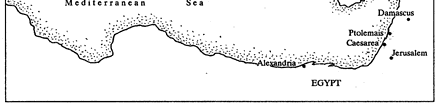
From Miletus Paul and his party sailed to Patara, where they changed ships and sailed across the Mediterranean to Phoenicia (21:1-3). They had fellowship with the Christians at Tyre, Ptolemais and Caesarea, where churches had been founded by those scattered after the killing of Stephen. One of those early evangelists, Philip, was still in Caesarea and Paul's party stayed with him several days (4-9; cf. 8:45,40; 11:19). In Caesarea, as in Tyre, prophets warned Paul of the trouble that he would meet in Jerusalem, but he was determined to go on (10-14; see also v. 4).
Finally, Paul reached his destination, Jerusalem. There he stayed with Mnason, who was a Jewish Christian from Cyprus and an early member of the Jerusalem church. He was probably one of the few in Jerusalem who were fully in agreement with Paul's work among the Gentiles (15-16).
21:17-23:35 JERUSALEM FINALLY REJECTS THE GOSPEL
Danger in Jerusalem (21:17-26)
Over the previous ten years the church in Jerusalem had become narrower in its outlook. As leaders of broader outlook such as Peter, John and Barnabas moved out to other areas, the Jewish Christians left in Jerusalem slipped back into legalism. At the Jerusalem meeting of Chapter 15, James and his likeminded fellow elders had successfully defended the Gentiles, but they now had little influence over the members at large. Those who wished to put all Christians under the Jewish law, though silenced at the Jerusalem meeting, had not changed their former views, and now their number had grown to many thousands (see v. 20).
The elders of the Jerusalem church were glad to receive the offering from the Gentile churches (1719), but this had little effect on the thinking of most of the church members. The legalistic Jews were not concerned greatly about what Paul taught the Gentiles, but they were angered to hear reports that he taught the Jews not to keep the law of Moses or the traditions of their ancestors (20-21). James and his friends suggested that Paul prove to the Jerusalemites that he was as religious a Jew as any, by joining with four other Jews in a purification ceremony in the temple (22-25).
Being willing to do almost anything to win his fellow Jews, Paul joined in the ceremony (26; cf. 1 Cor 9:20-23). Whether he was right or wrong in doing so is not clear. Certainly the plan was not a success, for it got Paul into serious trouble that left him a prisoner of Rome for most of the next five years.
The crowd attacks Paul (21:27-36)
Paul, James and the elders were so busy trying to please the Jerusalem Jews that they may have forgotten Paul's constant enemies, the Asian Jews (cf. 20:18-19; 2 Cor 1:8). These were the ones who brought about his downfall. Because they saw him in the streets with a Gentile friend from Ephesus, they accused him (wrongly) of taking the Gentile into a part of the temple where Gentiles were forbidden (2729). When a riot broke out, the mob seized Paul and tried to kill him (30-31).
The Roman troops in Jerusalem were well trained to control Jewish riots, and on this occasion only their swift action prevented Paul from being murdered (32). Lysias, the military commander, had no idea who Paul was or what he had done to make the Jews angry, but he was determined to see him dealt with properly according to Roman law, not by mob violence (33-36).
Paul's reply to the crowd (21:37-22:29)
By his command of the situation, Paul showed much physical courage and mental alertness. One minute he was snatched from a violent death, the next he was able to address a mob of wildly excited Jews who were screaming for his blood. He spoke with such power that a rioting crowd of would-be murderers listened to him in silence (37-40).
Paul wanted to show that he was a zealous Jew, called by God to serve him. He told of his Jewish upbringing and education, and of his religious zeal in persecuting those he thought to be law-breakers (22:1-5). But then the risen Jesus intervened and he became a believer (6-11). Through the announcement of a respected and law-abiding Jew named Ananias, he learnt of God's purpose for him to take the gospel to people everywhere (12-16). Above all he wanted his own people, the Jews, to hear the gospel, and only when they rejected it did God send him to preach it among the Gentiles (17-21).
As soon as Paul mentioned his mission to the Gentiles, uproar broke out afresh. All Paul's speech and all the crowd's shouting were in Aramaic, which the Roman commander probably could not understand. So he decided there was only one way to find out the truth, and that was by flogging (22-24). When Paul told the soldiers that he was a Roman citizen, they quickly untied him. They knew how close they themselves had come to being law-breakers (25-29).
Before the Sanhedrin (22:30-23:11)
Still wanting to find out the story behind this remarkable man, Lysias called the Jewish Sanhedrin to examine him (30). Paul soon saw, however, that the Sanhedrin was already set against him and he was not likely to get justice there (23:1-5).
Paul therefore changed his tactics. The one who had spoken to the Roman commander in Greek, addressed the mob in Aramaic, announced himself as God's apostle to the Gentiles and claimed to be a Roman citizen, now called himself a Jewish Pharisee! He was being condemned because of his orthodox Pharisaic belief in the resurrection (6).
The immediate result of Paul's declaration was that the Sanhedrin split in two, Pharisees against Sadducees. Some Pharisees thought Paul was not such a bad person after all (much the same as another Pharisee had said of Peter and John in a similar Sanhedrin dispute more than twenty years earlier; see 5:33-39). In the uproar that followed, the Roman soldiers again saved Paul from possible death (7-10). The Lord was still with Paul and eventually would bring him to Rome (11).
Sent to Caesarea (23:12-35)
The Jews were not finished yet. They decided to ask Lysias to send Paul to the Sanhedrin for a fresh trial the next day, so they could attack and kill him on the way (12-15). Unfortunately for the Jews, the plan was discovered and reported to Lysias (16-22).
Knowing that the Jews would carry out their plan if at all possible, Lysias thought it better to remove Paul from Jerusalem altogether. He decided to send Paul to the provincial capital, Caesarea, where he would come under the direct control of the provincial governor (23-24). In sending a letter to the governor, Lysias carefully rearranged the story to make sure that no blame could be placed on him (2530). As Paul left Jerusalem for the last time, he had still not seen the fulfilment of his lifelong wish of unity between Jerusalem and the Gentile churches. But he did not give up his fight against Jewish misunderstandings (31-35).
24:1-28:31 PAUL FAREWELLS THE EAST; GOES TO ROME
Imprisoned in Caesarea two years (24:1-27)
In the trial before Felix, the Jews used a professional lawyer to present their case (24:1-4). They made three accusations against Paul. Firstly, he created uprisings among the Jews, the suggestion being that he was stirring up rebellion against Rome. Secondly, he was a leader of the Nazarenes, a religious group that operated without government permission and therefore was probably rebellious against Rome. Thirdly, he had defiled the temple in Jerusalem (5-9).
Paul began his defence by denying that he had stirred up the people in Jerusalem. No one could prove such a claim (10-13). Secondly, he admitted that he was a follower of 'the Way', but this was the true continuation and completion of the ancient Israelite religion. It was not a new sect, neither was it false. Paul believed in the resurrection of the dead, as did most Jews, and he worshipped the same God as they did (14-16). Finally, he had not defiled the temple; in fact, he had carried out a ceremony of purification. In addition he had brought gifts to help his fellow Jews in their need. The Sanhedrin's only accusation against him concerned his belief in the resurrection, and even that was supported by only one section of it (17-21).
Felix knew the Jews well and plainly saw that Paul was not guilty, but out of fear of the Jews he would not release him. So Paul spent the next two years in prison, though he was allowed to receive visits from friends (22-23; see v. 27). Felix wanted to find out more about Paul's Christian beliefs, but he became uncomfortable when Paul spoke of the need for right behaviour and the certainty of coming judgment. Paul could have been released had he been willing to pay the bribe Felix was seeking, but he refused. Felix therefore left him in prison till the arrival of the next governor, who could handle the case as he wished (24-27).
No hope of justice in Judea (25:1-12)
When the new governor, Festus, arrived in Palestine, the Jews were quick to accuse Paul afresh. They no doubt thought that the new governor's lack of experience in handling Jewish affairs would help them win a judgment against Paul (25:1-5).
The trial before Festus was much the same as the one before Felix, but the confused Festus was not sure how to handle the case. He saw no reason why Paul should be in prison, yet he thought it wise to gain the goodwill of the Jews from the outset of his governorship. He therefore suggested that Paul go to Jerusalem and have the case dealt with there, perhaps before the Sanhedrin with Festus himself as the judge (6-9).
Paul could tolerate this injustice no longer. Neither Felix nor Festus had found him guilty of any wrongdoing, yet he had been kept a prisoner of Rome for two years; and all this merely to satisfy the Jews. Paul saw clearly that he would receive no justice from either Festus or the Sanhedrin, so he turned to the final court of appeal open to every Roman citizen, that of Caesar himself (10-12).
Paul again declared innocent (25:13-26:32)
Among those who came to Caesarea to pay their respects to the new governor was Herod Agrippa II. This man was the son of Herod Agrippa I (the governor mentioned in 12:1-4,20-23) and the brother of Bernice and Drusilla (13; cf. 24:24; see 'The New Testament World'). He was Rome's appointed ruler over certain areas in the far north of Palestine, but he had no power in the region governed by Festus. He was, however, an expert on Jewish affairs (see 26:3,27,31), and Festus was quick to seek his advice on Paul's case (14-22).
Festus' problem was that he had to send Paul to Caesar for trial, but he had no idea what to say to Caesar about the case. He did not know what accusations the Jews brought against Paul or why they wanted him executed (23-27).
Paul was pleased at last to have the opportunity to put his case before a ruler who had a good knowledge of the Jewish religion (26:1-3). His account of events was similar to that which he gave to the Jewish mob in Jerusalem two years earlier, but with an occasional change of emphasis to suit the present audience. Like most loyal Jews, Paul believed in the resurrection of the dead, but when he preached that Jesus' resurrection brought the Jews' age-long hopes to fulfilment, they persecuted him (4-8).
To some extent Paul could understand the Jews' feelings, because he himself had once persecuted the followers of Jesus (9-11). But the risen Lord Jesus appeared to him and sent him to preach the forgiveness of sins to all people, Jews and Gentiles alike (12-18). Paul willingly obeyed, because he now saw that the salvation brought by Jesus the Messiah was the fulfilment of all that the law and the prophets foretold (19-23).
Festus could not follow the argument at all and thought that Paul was mad (24). Agrippa, however, was familiar with the Old Testament Scriptures and understood what Paul was saying. Paul therefore appealed to him for support (25-27). Agrippa replied, either light-heartedly or sarcastically, that Paul was being over-enthusiastic if he thought he could convert him to Christianity in such a short time (28-29). Nevertheless, he was honest enough to admit that Paul had done nothing that deserved imprisonment (3032).
By one example after another Luke was making it clear to Theophilus that the Christians were not unlawful or rebellious. In addition to those already mentioned who found no guilt in Paul (namely, the Jerusalem army commander, the Jewish Sanhedrin and two Roman governors), an independent expert on Jewish affairs also declared him to be innocent.
From Caesarea to Rome (27:1-28:15)
Festus arranged for a centurion and a unit of Roman soldiers to take Paul, along with a number of other prisoners, to Rome. Two Christians also went with Paul, his loyal friend Luke and a church leader from Thessalonica named Aristarchus (27:1-2; cf. 19:29; 20:4). They began the journey on a ship that took them as far as Myra in Asia Minor. There they changed to one of the huge grain ships that sailed between Alexandria and Italy. After several days they came to the island of Crete (3-8).
At the port of Fair Havens (Safe Harbours), Paul advised the ship's officers not to sail any further till the dangerous winter season had passed. But they rejected Paul's advice and decided to move on to the next Cretan port, Phoenix, which they considered to be a better place to spend the winter (9-12).
Soon all were sorry that they had not listened to Paul. A fierce storm struck, and it seemed certain that the ship would sink and all on board would drown (13-20). Paul believed otherwise. God had assured him that, although the ship would be lost, all on board would be saved, and Paul himself would eventually reach Rome (21-26).
Paul's natural qualities of leadership soon saw him take control of the situation, in spite of his being a prisoner. When the ship was about to run aground and some sailors tried to escape, the Roman guard acted on Paul's advice and stopped them (27-32). When Paul warned that people were endangering their lives by going so long without eating, the ship's officers likewise heeded his words (33-38). Only the centurion's respect for Paul stopped the soldiers from killing the prisoners when the ship broke up. In the end all those on board the ship escaped safely to land (39-44).
The island on which they landed was Malta. The local people were kind and helpful to them all, but again Paul was the one who created the most interest (28:1-6). Although he was legally a prisoner, he and his party spent three days with the island's chief official as his special guests. In return for the hospitality received from the islanders, Paul and Luke attended to many of their medical needs (7-10).
Three months after landing on Malta, when winter was over and sailing was again safe, Paul's party boarded another Alexandrian grain ship and sailed for Puteoli in Italy. From there they went by road to Rome, being met by Christians from Rome at a number of places along the way (11-15).
Paul in Rome (28:16-31)
In Rome Paul enjoyed a limited freedom. He was allowed to live in his own house and people could visit him freely, though a Roman soldier guarded him constantly (16; cf. v. 30).
Soon after arriving he invited the Jewish leaders in Rome to come and see him. He outlined the events that had brought him to Rome and pointed out that he had done nothing contrary to Jewish law. He made it clear that he brought no accusation against the Jewish people; his appeal to Caesar was solely to prove his innocence (17-20).
The Jewish leaders gave the surprising reply that they had heard no reports about Paul, though they knew that people everywhere were turning against the Christians (21-22). It seems likely that, once Paul had left Palestine, the Jerusalem Jews felt they had achieved their main goal. They may not even have sent an accusation to Rome; for if they had failed to win the support of Felix and Festus in their own country, they had little hope of winning the support of Caesar in anti-Jewish Rome. Also, if Festus sent any official papers, they probably went down with the ship.
As usual Paul preached his message to the Jews first, showing from the Old Testament that the gospel he preached was the true fulfilment of the religion of Israel. But, as in other places, most of the Jews rejected his message. This also, said Paul, had been foretold by the Old Testament Scriptures. Therefore, he would once again turn and proclaim the message to the Gentiles and they would believe (23-29).
Paul's two-year house imprisonment probably included a fixed period of eighteen months during which his accusers could present their case. If, as seems likely, the Jerusalem Jews presented no case, the authorities in Rome could take no action. Any further relevant correspondence between Rome and the authorities in Palestine would account for the remaining six months.
The point Luke emphasizes concerning Paul's two years in Rome is a positive one, namely, that Christianity's leading representative was allowed to preach the gospel freely in Rome, and Roman officials had first-hand knowledge of his activity. Clearly, the Roman authorities did not consider Christianity an unlawful or politically dangerous religion. Paul proclaimed the kingdom of God in the heart of the Empire just as he had proclaimed it elsewhere. And on that triumphant note, Luke concludes his story (30-31).
The Post-Acts Period
PAUL IN ROME
During Paul's two-year imprisonment in Rome a number of people from distant places came to visit him. The news Paul received from these visitors prompted him to send off a number of letters, some of which have been collected in the New Testament.
Letter to the church in Colossae
One person to visit Paul in Rome was Epaphras, a Christian from Colossae in Asia Minor. The church in Colossae was probably formed during Paul's long stay in Ephesus, when the converts he trained took the gospel into the surrounding countryside (Acts 19:9-10). Epaphras, in fact, seems to have been the person mainly responsible for founding the church in Colossae (Col 1:6-7; 4:12). Now a problem had arisen that Epaphras was unable to deal with, so he went to Rome to seek Paul's help.
A strange form of teaching had found its way into the Colossian church. It was an early form of Gnosticism, a religious philosophy that combined Christian belief with pagan mythology. It also contained features taken from Judaism, mainly in connection with ceremonial laws and sacred rituals (Col 2:16,20-21).
The false teachers were concerned with trying to harmonize things that they considered to be in conflict with each other, such as good and evil, spirit and matter, God and man. Because they believed matter to be evil, they argued that a God who is holy could not come in contact with human beings who are sinful. They taught that there were countless intermediate beings, part-spirit and part-matter, who helped bridge the gap between God and the human race, and Jesus Christ was one of them. People were required to worship these beings if they were to gain victory over evil and eventually reach God (Col 2:810,18).
Paul opposed this teaching, pointing out that Jesus Christ is the only mediator between God and the human race, and the only person able to save sinful human beings. He is the supreme God who is over and above every being, spirit or material, yet he is the perfect human being who by his death conquered evil and brings repentant sinners into union with God (Col 1:15-22; 2:9,15). This union means that on the one hand believers can have victory over evil, and on the other that Christ's life can be reproduced in them (Col 3:3-5,10).
Letter to Philemon
While Epaphras was with Paul, another person from Colossae arrived at Paul's place of imprisonment in Rome. This person, Onesimus, was a slave who worked for Philemon, the Christian in whose house the Colossian church met (Philem 1-2,10).
Onesimus had escaped from his master and fled to Rome in search of a new life of freedom. But upon meeting Paul he was converted. He knew that since he was now a Christian, he should correct past wrongdoings and return to his master, but he was understandably fearful. Paul knew Philemon well, so wrote him a letter asking him to forgive Onesimus and receive him back as a brother in Christ. Not only was Philemon to welcome Onesimus back to his household, but the church was to welcome him as a new and useful addition to its fellowship (Philem 10-20; cf. Col 4:9).
Letter to the church in Ephesus
Paul apparently learnt from Epaphras that the false teaching was not confined to Colossae. He therefore wrote another letter to send back to the region, as a means of passing on teaching to the churches as a whole. This letter, known to us as Ephesians, was more general than Paul's other letters. It made no specific references to individuals or incidents in a particular church, but dealt with broader issues of Christian faith and practice. It gave further teaching on matters discussed in Colossians, such as the uniqueness of Christ, his victory over evil spiritual forces, his union with his people, and the results that this union should produce in the lives of Christians (Eph 1:20-23; 2:2-6; 4:1,17; 6:12).
Ephesians seems to have been one of several similar letters that Paul sent to the churches of the region. Perhaps the name of the receiving church was written into the introduction of each letter as it was delivered. If so, that would explain why some ancient manuscripts include the word 'Ephesus' in the introduction, but others omit it (Eph 1:1). Paul's letter to the church in Laodicea may have been another copy of this letter (Col 4:16). The person who delivered these letters, Tychicus, also passed on news of Paul's circumstances in Rome (Eph 6:21-22; Col 4:7-9).
Though held prisoner in Rome, Paul was not alone. Luke and Aristarchus, who had travelled with him from Caesarea, were still there (Col 4:10,14; Philem 24). So were Mark and Timothy, who had travelled with him on his missionary journeys (Col 1:1; 4:10; Philem 1,24). There was also a Jew, Jesus Justus (Col 4:11), and another friend, Demas (Col 4:14; Philem 24). No doubt his Christian friends in Rome visited him often (Rom 16:1-15).
Letter to the church in Philippi
Possibly it was during this two-year period in Rome that Paul wrote his letter to the Philippians. The letter records that Paul was a prisoner at the time of writing (Phil 1:13), but it does not record where he was imprisoned. The account of his life shows that he was imprisoned in many places and on many occasions (Acts 16:23; 22:23-30; 24:23-27; 28:16,30; 2 Cor 11:23), but the present imprisonment in Rome seems the most likely setting for the writing of Philippians.
The church in Philippi showed its concern for Paul by sending one of its members, Epaphroditus, to Rome to help him and give him a gift from the church. Paul wrote to thank the Philippians for their gift (Phil 1:5; 4:18) and to correct wrong attitudes that had arisen in the church (Phil 2:1-4,14; 4:2-3). The Philippians were not to be discouraged because of his imprisonment, for he had many opportunities to teach and preach (Phil 1:12-14). Christians in Rome were able to help him, including some who were in the government service (Phil 4:21-22).
PAUL REVISITS THE CHURCHES
Free again
Although the result of his trial was in doubt for so long, Paul remained hopeful that he would be released. He told the Philippians that he expected to visit them soon (Phil 1:25,27; 2:24), and earlier he had told Philemon of his plans to visit Colossae (Philem 22). Almost certainly he was released at the end of his two years imprisonment. What happened after his release is not certain, but from details in the letters he wrote to Timothy and Titus, we can work out at least some of his movements.
Helping Timothy and Titus
One place that Paul visited after leaving Rome was the island of Crete. It seems that among those who accompanied him on this trip were two co-workers from former years, Timothy and Titus. Paul found that the churches of Crete were in confusion, mainly because of false teachers. He stayed for a while to help correct the difficulties, but when he had to move on to other places he left Titus behind to carry on the work and establish proper leadership in the churches (Titus 1:5,10-11).
When Paul came to Ephesus he found further problems of false teaching. He had once warned the Ephesian elders that false teachers would create confusion in the church (Acts 20:29-30), and now that had happened. Self-appointed 'experts' were ruining the church with unprofitable teaching based on ancient myths, legends, laws and genealogies (1 Tim 1:4-7; 4:1-3; 6:3-5). Some of the teaching was so harmful that Paul believed the only way to deal with the unrepentant offenders was to put them out of the church (1 Tim 1:19-20).
After some time Paul departed from Ephesus to go to Macedonia, but he left Timothy behind to give further help to the church (1 Tim 1:3). In Macedonia Paul no doubt fulfilled his wish of revisiting the Philippian church (cf. Phil 2:24; 4:1). But he was concerned for the two men he had left behind in Crete and Ephesus, and decided to write them each a letter. The two letters, Titus and 1 Timothy, are similar in many ways, though 1 Timothy is much longer and more personal.
In both letters Paul encourages his two fellow workers to be confident in carrying out the task entrusted to them (1 Tim 1:3,18; 4:6,11-12; Titus 1:5; 2:15), to establish some order and leadership in the churches (1 Tim 2:1,8; 3:1-13; 5:17; Titus 1:6-9; 2:2-8), to instruct people in Christian truth (1 Tim 3:1415; 4:13-14; 6:20; Titus 2:1; 3:8) and not to waste time arguing about senseless issues (1 Tim 4:7; 6:20; Titus 3:9).
Imprisoned again
Some time after writing to Timothy and Titus, Paul left Macedonia. His exact route is unknown, but among the places he visited were Corinth in the south of Greece and Miletus on the west coast of Asia Minor (2 Tim 4:20). He also visited Troas to the north. The fact that he left behind some of his valued possessions at Troas suggests he may have been arrested there and forced to leave in a hurry (2 Tim 4:13). Wherever he was arrested, he was taken to Rome once more, and from prison wrote his final letter, 2 Timothy (2 Tim 1:8; 2:9).
When the authorities in Rome laid charges against Paul, some of his friends deserted him. But the God who always stood by him rescued him from violence and enabled him to proclaim the gospel to the Roman officials (2 Tim 4:16-17). Nevertheless, he did not have the optimism of his first imprisonment. Instead of looking forward to release, he expected only execution (2 Tim 4:6-8).
Knowing that time was running out, Paul wrote to Timothy to give him further encouragement and make a number of urgent requests. The church in Ephesus was still troubled by false teachers, and Paul wanted Timothy to stand firm in teaching the Christian truth (2 Tim 1:6-8,14; 2:3,15; 3:14-17; 4:2,5). At the same time he was to avoid time-wasting arguments with people whose chief aim was to make trouble (2 Tim 2:14,16,23; 3:5).
Two people who would no doubt be of help to Timothy in his difficult task were Aquila and Priscilla, who were now back in Ephesus after their second period of residence in Rome (2 Tim 4:19; cf. Acts 18:2,18-19,24-26; Rom 16:3). The family of Onesiphorus, who had given Paul valuable help in Rome, were also now back in Ephesus and likewise would be a help to Timothy (2 Tim 1:16-18; 4:19).
Martyrdom in Rome
Several urgent requests that Paul sent to Timothy indicate the distress of his final imprisonment. As he sat in his unhealthy cell, he was beginning to feel cold and he missed his books (2 Tim 4:13,21). He was also lonely. Demas, who had been with him faithfully during his first imprisonment, had now left him (2 Tim 4:10; cf. Col 4:14). Others had gone to various places in the service of God (2 Tim 4:10,12). Some of the local Roman Christians visited him (2 Tim 4:21), but only Luke could stay with him for any length of time (2 Tim 4:11).
The two people Paul most wanted with him in his closing days were Timothy and Mark, the two who, as young men, had set out with him on his early missionary journeys. Mark was most likely working in Colossae, not far from Ephesus, so Timothy would have had no difficulty going to fetch him (2 Tim 4:9,11; cf. Col 4:10). Whether they reached Rome in time is not certain. The apostle to the Gentiles, who throughout his life had never been far from death at the hands of the Jews, was finally beheaded by imperial Rome (about AD 62).
THE MINISTRY OF PETER
Encouraging the persecuted
By this time persecution was breaking out against the Christians throughout the Empire. As long as Christianity was thought to be a branch of Judaism, it was protected by law, because Judaism was a legal religion. But people in general were becoming more aware of the differences between Christianity and Judaism. When the Jews in Jerusalem killed James the Lord's brother (about the same time as Paul was martyred in Rome), everybody could see clearly that Christianity was not a movement within Judaism. It was plainly an unlawful religion.
In addition to this, people hated Christians because they could not mix freely in a society whose practices they saw as idolatrous and immoral. The Emperor Nero, who began a sensible reign ten years previously, was by now senselessly brutal and bitterly anti-Christian. He blamed Christians for the great fire of Rome (AD 64), with the result that fierce persecution broke out. About this time Peter wrote the letter that we know as 1 Peter. Its purpose was to encourage Christians to bear persecution patiently, even if it meant death (1 Peter 2:20-23; 3:14-15; 4:12-19), and to assure them of their living hope and glorious future (1 Peter 1:3-9).