
Part 33
In the recent past, Paul had twice been forced to change his plans for a visit to Corinth. His first plan was to go to Macedonia, down to Corinth and then to Jerusalem (Acts 19:21; 1 Cor 16:5-7). His second plan was to go to Corinth first, up to Macedonia, back to Corinth and then to Jerusalem. The advantage of this second plan was that the Corinthians would benefit from his ministry twice. When he was forced to change this plan also, the Corinthians accused him of not keeping his word, of being like an ordinary person of the world who says 'Yes' one day and 'No' the next (15-17).
Again Paul denies the accusation. To act in such a way would be contrary to the character of Christ that Paul had preached to them. There was nothing uncertain about Christ. The fulfilment of all God's promises in him shows that he always said 'Yes' to his Father's will. And Christians add their 'Yes' by saying 'Amen', by which they mean 'Yes, indeed, this person is the Truth of God' (18-20). The Christian life is one of assurance and stability, because it is from God, it is in Christ, and it is guaranteed by the Holy Spirit (21-22).
Paul's decision against going to Corinth was not because he lacked certainty or courage. Rather it was because he wished to spare the Corinthians the unpleasantness of his stern treatment (23). He does not want them to think he is a dictator; but they must realize the importance of discipline if they are to have true happiness (24).
Neither Paul nor the Corinthians would have wanted him to pay them another painful visit. Paul's desire was to enjoy fellowship with them, but this would not have been possible had they been full of sorrow. So instead of visiting them personally, he wrote to them. The purpose of the severe letter was not to hurt them, but to urge them to repent. He wrote out of love, so that his next visit to them would be an occasion for joy (2:1-4).
Forgiveness for the offender (2:5-11)
In this section Paul speaks about an offender and his offence, and although we do not know to whom or what he was referring, the Corinthians did. The offence seems to have concerned Paul personally (perhaps a denial of his apostolic authority), and was one reason for Paul's severe letter. The issue caused sorrow for the church and for Paul (5). The church finally dealt with the offender, probably by excluding him from the fellowship for a period (6).
Paul now has to warn the Corinthians not to be hard and unforgiving. The man had shown sorrow and repentance for his sin, and the church should now lovingly welcome him back. If they continue to treat him harshly, their action could have bad results instead of good, through driving the man away from God in bitterness and sorrow (7-8).
The Corinthians had demonstrated their unity with Paul in dealing with the offender. He wants them to demonstrate that unity again, by forgiving the man and receiving him back (9-10). If they fail to forgive, Satan may use the opportunity to do further damage, both to the man and to the church (11).
Paul's sincerity in his ministry (2:12-17)
Once again Paul states that all his movements were guided by an interest for the Corinthians, not for himself. He was so keen to meet Titus and hear news of the Corinthians that he could not concentrate on his work in Troas. So rather than wait for Titus in Troas he went across to Macedonia, in the hope of meeting him there (12-13).
The good news that Titus brought from Corinth leads Paul to an outburst of praise to God. He pictures the preachers of the gospel joining Christ in his victory procession. The gospel is triumphant. In another illustration he likens the gospel to a sweet smell that spreads everywhere (14). But some reject the gospel, and to them it is an offensive stench that kills. The preachers whom God calls to carry such a message of life and death have a great responsibility. They are not hawkers trying to sell goods for their own gain, but announcers of God's message. They have no mixed motives, but are concerned only for the spiritual well-being of others (15-17).
3:1-6:13 TRUE CHRISTIAN SERVICE
The servant and the message (3:1-18)
Some of the teachers who came to Corinth brought with them letters of recommendation from their home churches, and claimed that these letters gave them authority to teach. Paul carried no such letters, with the result that his opponents suggested he had no right to teach. Paul replies that pieces of paper do not guarantee the truth of people's ministry. A better means of judging is by the fruit of their work. The Corinthian church, which is the fruit of Paul's work in Corinth, is all the recommendation he needs. This is the work of the Spirit of God, and is far greater recommendation than a mere letter. The gospel produces fruit that no set of laws can produce (3:1-3).
Paul has confidence in his ministry, but it is a confidence that rests in God, not in himself. What changes people is the gospel, not any personal ability that Paul might have (4-5). He is a servant of the new covenant, by which the Spirit of God gives believers new life within. The old covenant (the law of Moses) set out written laws, but in the end it brought death, because the people were unable to keep it (6).
The contrast between the old covenant and the new is now illustrated by reference to the story in Exodus 34:29-35. When Moses, after receiving the law from God, came down from the mountain, his face shone with a brightness that reflected the glory of God. His face was so bright that he had to cover it with a cloth, as the people were afraid to approach him. Paul's point is this: if the covenant that brought condemnation and death came with glory, how much more glory must the new covenant have which brings righteousness and life (7-9). If the covenant that was temporary came with glory, how much more glory must the new covenant have which is permanent (10-11).
After Moses had been away from the presence of God for a while, the brightness of his face faded, but the veil over his face prevented Israelites from seeing this fading brightness. To Paul, this fading brightness symbolized the fading away and eventual end of the old covenant. The permanence of the new covenant, by contrast, gives Paul confidence in all that he says and does (12-13).
In a sense there is still a veil that belongs to the old covenant. It is the veil that covers the minds of the Jews, for they read the Old Testament but refuse to see Christ as its fulfilment. Consequently, they cannot properly understand it (14-15). When Moses went in before the Lord he removed the veil. Similarly, when Jews turn to Jesus Christ, the veil is removed. Through the work of the Spirit, Christ sets them free from the bondage of sin and the law (16-17). Christians also must make sure that there is no veil between them and their Lord. The better they know Christ personally, the more they will be changed so that they become increasingly like him (18).
The life and work of a servant (4:1-18)
God's true servants do not avoid their responsibilities or use dishonest methods. They do not change the plain meaning of God's Word to suit themselves, but teach that Word faithfully and directly (4:1-2). Not all will believe, because Satan blinds their minds, but true preachers remember always that the message they preach is Christ's, not theirs. Then, when the hearers allow the light of that message to shine into their hearts, they see Christ as their Lord and God (3-6).
It seems strange that the priceless treasure of knowing Christ should be given to ordinary human beings, people beset by troubles and imperfections. It is like putting costly jewellery into an earthenware pot (7). Paul's life is not one of glory and honour; it is one of continual suffering and trouble. Yet his faith is never shaken. After all, if Christ suffered such things, his disciples should not be surprised when they too suffer. But this same life of Christ in him turns these sufferings into victories (8-11). Such a life is worthwhile when it is the means of bringing spiritual life to others (12).
As with the psalmist, so with Paul, his faith in God causes him to express his confidence amid all his afflictions (13; cf. Ps 116:9-11). Even if his sufferings lead to death, that will not mean defeat, because death itself will be conquered by Jesus Christ (14). Meanwhile the unfailing servant of God makes every effort to build up more and more people in the knowledge of God, and so bring glory to him (15).
In view of all this, Paul does not become discouraged. Though physically troubled and weary, he is inwardly strengthened. He sees his sufferings as small and temporary when compared with the unseen and eternal glories that one day will be his (16-18).
Confidence and courage (5:1-10)
Christians receive further encouragement amid daily trials through the knowledge that the present body is only temporary. It is like a tent in which a person lives for a short time, whereas what God has prepared for the future life is a permanent home (5:1). Another illustration likens the present body to clothes that cover a person. Again this is only temporary. One day all that is earthly and temporary will be replaced by that which is spiritual and eternal (2-4). The indwelling Holy Spirit is the guarantee that one day believers will enjoy the fulness of life for which God is at present preparing them (5).
At present believers are physically separated from Christ, but the desire to be with him is a continual source of encouragement. They do not at present see Christ, but live by faith in him (6-8). They are further reminded of the need to live faithfully when they realize that being with Christ will bring not only glory, but also judgment. Their life will be examined and they will receive what Christ considers is due to them, whether for better or for worse (9-10).
The power of love (5:11-6:13)
Because Paul knows that he is accountable to Christ, he knows what it means to fear the Lord, and this makes him more diligent in his service. God knows that his motives are pure and he trusts that the Corinthians know also (11).
In making these statements, Paul is not trying to write a recommendation for himself. He is trying to give his supporters reason to be bold in defending him against those who criticize him (12). They may have seen him display his feelings in different ways at various times, but they know he never acted out of self-interest (13). His constant awareness of Christ's love was the inner spiritual power that guided his actions. Christ died the death that sinners should have died, firstly to bear the penalty of their sins, and secondly to put an end to living for self. From now on they should live for him (14-15).
Before he became a Christian, Paul had judged Jesus by the standards of the ordinary person of the world, and in so doing had judged him wrongly. Now he no longer judges Jesus, or anyone else, from a merely human standpoint, because in Christ he sees everything in a new light. Old attitudes go and new attitudes replace them (16-17).
This changing from the old to the new is done by God through Jesus Christ. It is part of the total work that God does as he reconciles people to himself, and turns sinners into his friends. Having reconciled them, God then sends them out to preach the message of reconciliation to others, so that other sinners might be brought to God (18-20). The basis of this message is the death of Christ. Through the judgment of sin in Christ, God is able to forgive repentant sinners and give them a righteous standing before him (21).
Some at Corinth had heard this message but not responded to it. They were still spiritually dead. Paul therefore offers salvation to them once again, and they must decide whether to accept it or reject it (6:12). They are not to make excuses by trying to find fault with Paul, for he has never given anyone grounds for rejecting the gospel (3). He has had all kinds of difficult experiences (4-5), but through them all he has proved his genuineness by the spiritual quality of his life and the truth and power of his message (6-7). Some people have honoured him, others insulted him, but in all circumstances he has shown by his consistent behaviour that he is a true servant of God (8-10).
The Corinthians have not returned to Paul the open-hearted love that he has shown them. He has room in his heart for them, but they have no room in their hearts for him (11-12). He appeals to them to return his love (13).
6:14-7:16 CONCERNING PREVIOUS CORRESPONDENCE
The Christian in ungodly society (6:14-7:1)
Apparently the Corinthians still misunderstood what Paul was trying to teach them about relationships with unbelievers (cf. 1 Cor 5:9-11). Previously they thought it meant cutting themselves off from unbelievers completely. Now they go to the other extreme and think their relationships can be as close as they like, even to marriage. Not so, says Paul. There must be no permanent and binding relations with unbelievers. The new life of Christians is as different from the life of non-Christians as light is from darkness or as Christ is from Satan (14-15).
The church is the temple of God, and so is the individual Christian (cf. 1 Cor 3:16; 6:19). God dwells within his people, and his dwelling place must be holy. Being united with idol worshippers is the same as bringing a heathen idol into God's temple (16). Christians can have no part in the ungodliness of the sinful society in which they live. They are now members of the family of God, and their relationship with their heavenly Father is more important than all their physical and earthly relationships (17-18). In view of this, they must make sure they are cleansed from the impurities of the ungodly world, so that they might be holy before God (7:1).
Joy at the Corinthians' repentance (7:2-16)
Again Paul appeals to the Corinthians to open their hearts to him, and not to feel hesitant because of the accusations his enemies have made. Nothing in life or death can separate him from them. He assures them that he is overjoyed at the news he has just heard concerning them (2-4).
Paul recalls the restlessness he felt in Macedonia as he awaited Titus' return with news from Corinth. He recalls also the joy he experienced when Titus recounted how he had been comforted when he saw the Corinthians' changed attitude towards Paul. That severe letter had been worthwhile. Titus' visit had been fruitful (5-7).
At first Paul had felt sorry for writing as he did, but now he is glad to see that the sorrow which the letter brought them was the means of bringing them to repentance (8-9). This is because their sorrow was not just shame at wrongdoing, but real sorrow and repentance before God. They acknowledged their sin to God and asked him to forgive them. Because they saw themselves from God's point of view, they spared no effort in clearing up the wrongdoing that was among them (10-11). Paul is satisfied that the letter has achieved its purpose. That purpose was not to hurt people, but to help them view matters under the searching eye of God (12).
Before Paul sent Titus with that severe letter, he boasted to Titus of his confidence that the Corinthians would see their wrongdoing and repent. He therefore has added joy to know that not only did Titus find them repentant, but he was also filled with love for them (13-16).
8:1-9:15 COLLECTION FOR THE POOR IN JERUSALEM
About a year earlier Paul had given instructions to the Corinthians about the collection of money he was organizing for the poor Christians in Jerusalem (1 Cor 16:1-4). The Corinthians had made a start (see 9:2), but in the meantime they became so concerned with their own difficulties that they neglected their responsibilities in the matter. Now that they have cleared up their local troubles, Paul reminds them of the importance of this exercise in Christian giving.
Paul urges the Corinthians to give (8:1-15)
The giving of the Christians in Macedonia is an example of true Christian giving. They might have suffered from persecution and poverty, but they gave generously – not only as much as they were able but far more, and without any urging from Paul (8:1-3). In fact, they begged Paul to allow them the privilege of taking part in the offering. Such an attitude was possible only because they first gave themselves to the Lord, for him to use them as he desired (4-5). Paul will now send Titus to Corinth to encourage the believers to complete what they had started. The enthusiasm they show in other spiritual exercises should be shown in their giving also (6-7).
There are no rules to force Christians to give. They should give out of love. Through love, Christ gave everything, leaving the glory of heaven for a sinful world, so that he might save sinners and give them a share in his riches (8-9). The Corinthians should likewise show sacrificial love, by completing the work that they began the previous year. There is no law to determine the amount they should give. It will depend on how much they have (10-12).
Although the Corinthians may be financially better off than Christians in some other churches, Paul does not want to burden them unfairly. Nevertheless, they should realize that while they are able to help poorer churches, they should. They must bear in mind also that they do not know the future. One day they themselves may be poor and the Jerusalem church able to send help to them (13-14). The principle is not that all must receive an equal amount, but that all must have enough according to their needs, with no greed and no starving (15).
Arrangements for the collection (8:16-9:5)
Titus is just as keen as Paul to see this collection completed successfully (16-17). He is travelling to Corinth with two other well known Christians. One of them has been chosen by several churches as their representative to join Paul and the other representatives who will later take the money to Jerusalem. The other is a proven friend of Paul's who has the interests of the Corinthians at heart. The reason for sending three people is to ensure that no one, whether inside or outside the church, has any cause to doubt Paul's uprightness or sincerity. Everything must be done openly and honestly (18-22). By participating wholeheartedly in this offering, the Corinthians will display the generous love of which Paul has often boasted (23-24).
Paul feels he must speak further on the matter. He reminds the Corinthians of their enthusiasm the previous year, and of the fact that his boasting of their enthusiasm had stirred the Macedonians to join in the offering (9:1-2). He is sending these three men ahead to ensure the collection is completed before he arrives. If he comes and finds them not ready, he will be ashamed because of his over-confidence, and the Corinthians will be ashamed because of their laziness. Also it will mean that when he arrives he will have to stir them to make a hurried collection. This would not be an honourable way to do things. It would be more like paying a tax than willingly making an offering to God (3-5).
The blessing of Christian giving (9:6-15)
God takes notice of the way Christians give, and if they give generously he rewards them generously. People should decide thoughtfully the amount they should give, then give it joyfully (6-7). They need not fear poverty if they give much, because God is able to increase his supply to ensure that generous givers still have more than they need (8-10; cf. Prov 11:24). The threefold result of true giving is that the poor are helped, the givers are blessed, and God is glorified in thanksgiving (11-12). The giving of the Corinthians will prove the genuineness of their faith. It will also join givers and receivers together in fellowship in Christ, who is the greatest gift of all, the gift given by God himself (13-15).
The Corinthians responded to Paul's appeal. Later, when he was in Corinth, he wrote to the Romans saying, 'At present I am going to Jerusalem with aid for the saints, for Macedonia and Achaia have been pleased to make some contribution for the poor among the saints in Jerusalem. They were pleased to do it . . .' (Rom 15:25-27).
10:1-13:14 APOSTOLIC AUTHORITY
In spite of all Paul has said, there were still trouble-makers at Corinth. Certain travelling preachers had gained some standing in the church and continued to make accusations against Paul. Paul refers to them ironically as 'super apostles', and more directly as 'false apostles' (see 11:5,13).
Spiritual power; worthless boasting (10:1-18)
These so-called apostles repeatedly questioned the authority of Paul and succeeded in winning some of the Corinthians over to their side. They accused Paul of trying to make himself appear tough and bold when writing letters to them, but of being weak and cowardly when face to face with them. He was no apostle, they claimed, just an ordinary person with ordinary worldly attitudes. Paul replies that what they mistakenly thought was weakness was really tolerance. He had made every effort to control his feelings, in order to show kindness and patience towards the Corinthians. Only when everything else fails will he use with severity the apostolic authority that is his by right (10:1-2).
Worldly people force others into submission by exercising their power and authority. Christians submit to Jesus Christ and depend upon his power and authority. This is a far greater force with which to fight evil. It destroys pride and makes even the mind obedient to Christ (3-5). But if the false apostles refuse to join with the rest of the church in submitting to Paul's instructions, he is ready to use his apostolic authority to deal with them (6).
The false apostles claim that they have Christ's authority; so does Paul (7). The difference is that Paul has proof of his authority. He has built up converts and churches, whereas the false apostles have brought only harm and ruin (8). In writing like this, Paul is not trying to frighten his readers into submission, as his opponents claim. When he comes they will find out for themselves that what he says, he does (9-11). Nor is he trying to compete with the false apostles in seeing how highly he can praise himself (12).
In coming to Corinth, the false apostles are trespassing on Paul's ground, since he was the first to take the gospel there. Unlike them Paul keeps to the limits God has given him. God's call for him was to be a pioneer missionary to the Gentiles (cf. Acts 9:15; Rom 1:5; 15:16,20; Gal 2:9). He will not, therefore, interfere with the fruit of another person's work (13-14). Corinth marks the western extent of Paul's ministry so far, and before he moves into unreached regions farther west, he wants to make sure that the Corinthian church is strong and healthy (15-16). He is not saying all this to praise himself. The one whom he praises is God (17-18).
Paul is not inferior to others (11:1-15)
Although he knows that boasting is foolish, Paul feels he must say a few things to prevent the Corinthians from believing the propaganda of these men who set themselves up as super apostles. He feels for the Corinthians with the kind of jealousy that a father feels for his daughter. He has brought them from the darkness of heathenism into the light of God's world, so that he might present them as a bride to Christ (11:1-2). Paul is afraid that these false apostles will deceive the Corinthians just as Satan deceived Eve. He knows that the Corinthians have a tendency to accept wrong teaching very easily (3-4).
Even if Paul does not have the skilled speech and persuasive style of the false apostles, he is not inferior to them. At least he teaches the truth, and that is what is important (5-6).
Paul had a right to be financially supported by those to whom he ministered, but when he was at Corinth he had earned his living by making tents. He did this so that the Corinthians could be built up in their knowledge of the Christian teaching without having to worry about supporting him. He even accepted gifts from other churches so as to remain financially independent of the Corinthians. But he received no thanks for his efforts. The false apostles (who came later and who did accept money from the Corinthians) used it as 'proof' to the church that Paul was merely a labourer and not an apostle at all (79).
One reason why Paul supports himself is his love for the Corinthians. He has no intention of changing his practice of self-support, because he wants the Corinthians to see the difference between the true apostle and the false apostles (10-12). These men seek only their own gain. They make themselves look like servants of God, but really they are servants of Satan. Their ultimate punishment is certain (1315).
Paul's experiences as an apostle (11:16-33)
All boasting is foolish, but since the Corinthians have heard much boasting from others, Paul decides they shall hear some from him (16). This is not the way Christ spoke, but Paul hopes it may do something to bring them to their senses. After all, he says cuttingly, they tolerate other fools, why not tolerate him (17-19)? The false apostles had enslaved the Corinthians and then cruelly taken their money. In comparison with such slave-masters, Paul is weak indeed (20-21)!
The false apostles claimed to be learned Jews, pure Hebrews. So is Paul (22). Concerning the more important matter of service, however, Paul is far superior. He has worked harder and suffered more in the spread of the gospel, even to the point of death time and again. He quotes specific examples of his experiences, most of which are either not recorded or not detailed in Acts (23-27). More than all these trials was the inner trial of the constant anxiety from which he was never free, his concern for the churches. Paul felt every weakness and every problem among his converts as if it were his own (28-29).
Remarkably, Paul's boasting is almost entirely concerned with things that the normally boastful person is ashamed to speak about, namely, personal humiliations. Yet God knows that in recounting these experiences Paul has not been exaggerating or twisting the truth (30-31). One final story comes to mind. It concerns the time he escaped from Damascus, when Jewish opponents had persuaded the governor to send soldiers to arrest him (32-33; see Acts 9:23-25).
A genuine case for boasting (12:1-10)
Before leaving the subject of boasting, Paul wants to give one more example (12:1). Fourteen years previously he had seen a vision, but because he does not want to exalt himself, he speaks about his experience in the third person, referring to himself simply as 'a man'. By some unknown means he was taken up into Paradise, where he heard and saw things that God does not normally allow people to know (2-4). He is not telling this story so that the Corinthians will have a higher opinion of him. He wants people to judge him only from their personal experience of him, from what they themselves have seen him do and heard him say (5-6).
It would be easy for Paul to have feelings of self-importance because of his visions, but God intervened to make sure this would not happen. He sent Paul some particular trial (or trials) that constantly hindered him in his work (7). (Notice that Paul now departs from his original intention of speaking in the third person and reverts to speaking directly in the first person – not 'a man' but 'me'.) God did not answer Paul's prayer to remove this trial, but that was to Paul's advantage, because it made him constantly dependent on God's grace and power. The greater Paul's sense of weakness, the more he realized the need to cast himself upon God. Therein lies his strength (8-10).
Plan to visit Corinth again (12:11-21)
The Corinthians have forced Paul to this foolish boasting through their believing the accusations that the false apostles made against him. He reminds them also of the miracles and wonders he performed among them, in spite of great difficulties. All these examples should make them see clearly that he is not a second-class apostle (11-12). His refusal to live at the Corinthians' expense was for the purpose of helping them. But instead of being thankful to him, they have been offended. They regard his action as an insult to their church. With great irony Paul asks their forgiveness for what he has done (13).
What Paul wants is the Corinthians themselves, not their money. He is coming to visit them again and he still will not take financial support from them. He will spend not only his money but also his time and energy for them, as a parent would for his children (14-15).
Some of the Corinthians made the hurtful accusation that Paul was deceitful. They said that although he did not take money from them openly, he managed to get it from them by other, more cunning, methods (16). Paul points out that this is nonsense. The Corinthians well know that he and those whom he sent had been open and straightforward in everything (17-18).
Paul has not been saying all this because he feels answerable to the Corinthians. He is answerable to God, not to them. Nevertheless, he trusts that they may have been helped by what he has said (19). Many of them are still childish in their thinking and behaviour, and they need to change urgently. Otherwise when Paul visits them, he will feel shame instead of pride, sorrow instead of joy. He does not want to have to act severely once again (20-21).
Final appeal for order (13:1-14)
As he writes, Paul is already on his way to Corinth. He therefore repeats his former warning that if the Corinthians do not discipline the trouble-makers among them, he will be forced to discipline them himself when he arrives. He will determine the truth of matters not according to gossip but according to evidence that can be tested (13:1-2). They have wanted proof of Paul's Christ-given authority, but when they see it in action among them, they will be sorry. People once thought Christ was weak, just as the Corinthians think Paul is weak; but the resurrection power and authority seen in Christ will be seen also in Paul (3-4).
The Corinthians have been examining Paul, demanding that he show proof of his apostolic authority. Now he calls upon them to examine themselves and show proof of their Christian faith (5). If they fail the test, Paul will have to prove his apostolic authority by using it; that is, he will pass the test. If they pass the test, Paul will be content not to use his authority, even though some may say it is because he has no authority; that is, they will consider he has failed the test (6-7).
Paul is not greatly concerned whether he passes the test in their eyes. He is more concerned with upholding the truth of the Christian gospel (8). He wants to build up other people in the faith more than build a reputation for himself. He wants to see them spiritually strong, even though this will leave him no opportunity to demonstrate his divinely given power among them. That is why he is writing now. He wants to give them the opportunity to change their ways, so that he might spare them the unpleasant experience of tasting his apostolic authority in judgment (9-10).
In conclusion, Paul urges the Corinthians to take notice of his advice and correct the troubles in the church, so that there might be unity, peace, love and joy among them (11-13). They are more likely to experience these specific blessings as they experience the more basic blessings of the gospel. Through that gospel the Father has exercised his love towards them, Christ in his grace has saved them, and the Spirit has given them true fellowship with God through coming to dwell within them (14).
Galatians
During his first missionary journey into Asia Minor, Paul evangelized the southern part of the Roman province of Galatia, and established churches in the towns of Antioch, Iconium, Lystra and Derbe (Acts 13:13-14:23). These are the churches he addresses in his letter to the Galatians. (See maps located in the commentary on Acts.)
Jewish difficulties
The early chapters of Acts record that the Christian church was born in Jerusalem, and in the beginning consisted almost entirely of Jews. As the disciples moved out to other areas, large numbers of Gentiles believed and so became part of the expanding church. With Jews and Gentiles in the same church, difficulties soon arose.
Many of the Christian Jews in Jerusalem were still very Jewish in their outlook, and looked upon Christianity as a sort of improved Judaism. As Jews they had been pleased to see a few Gentiles become converts to Judaism from time to time, but they were not pleased at what they now saw happening in the church. They did not think it right that people of any nationality could enter the community of God's people without any thought for Jewish laws relating to food, cleansing and circumcision.
On one occasion Jewish traditionalists in the Jerusalem church rebuked Peter for eating with Gentiles, but when Peter explained how God had shown him that he blesses Jews and Gentiles alike, they said no more (Acts 11:1-18). However, many were not fully convinced, and when Paul returned to Syrian Antioch after his first missionary journey, trouble broke out again.
Trouble in Syrian Antioch
While Paul was in Antioch, a group of Jews came from Jerusalem and taught the Gentile Christians that they were required to be circumcised and keep the law of Moses (Acts 14:26-28; 15:1,5). These men claimed to have authority from James (the brother of Jesus and the most prominent leader in the Jerusalem church), but James later denied this (Gal 2:12; Acts 15:24). They argued so cleverly that even mature Christians such as Peter and Barnabas stopped eating with the Gentiles in case they broke Jewish food laws (Gal 2:12-13).
Paul, who had been as zealous a Jew as any before his conversion, saw that the teaching of the Judaisers was contrary to the Christian gospel. His forthright public rebuke caused Peter and Barnabas to see their error and resume their fellowship with the Gentiles (Gal 2:11,14; cf. Acts 15:6-12).
Trouble in Galatia
Soon after Paul corrected the trouble at Antioch, he heard that the Judaisers had spread their teaching to the recently established churches in Galatia. He was angry at the Judaisers for upsetting the young Christians, and shocked that the Christians had believed them (Gal 1:6; 3:1). In response he sent off the sharply worded letter known to us as Galatians.
In this letter Paul asserts that Christians are saved by faith and live by faith. They are not saved by the law of Moses, nor are they governed by it; yet at the same time they are not lawless. They are under the direction of the indwelling Spirit of God (Gal 3:3; 5:1,13,16,18).
The problem caused by the Judaisers had now spread to the most distant parts of the church. It therefore needed to be dealt with quickly and decisively. Because the teaching had come from Jerusalem, that was the place to discuss the matter. Therefore, after he sent off his letter to the churches of Galatia, Paul went to Jerusalem with Barnabas and others from Antioch to settle the matter once and for all (Acts 15:2-35).
1:1-2:21 Paul's gospel is the only gospel 3:1-4:31 Law-keeping has no place in the gospel 5:1-6:18 The fruits of Christian liberty
1:1-2:21 PAUL'S GOSPEL IS THE ONLY GOSPEL
Rebuke to the Galatians (1:1-10)
At the outset Paul reminds the Galatians that his call to be an apostle did not come from any human source or through any human agency. It came direct from God. The gospel that God called him to preach is the good news that by the grace of God and through the death of Christ, people can be saved from their sins (1:1-5).
Paul is amazed and angered to hear that many of the Galatians are turning away from this, the only true gospel. Instead they are believing the Judaistic teaching that they must keep the law to be saved (67). He twice pronounces the curse of God on all who preach contrary to the one true gospel (8-9). The Judaisers had accused Paul of not preaching circumcision, to make it easy for Gentiles to join the church. He preached to please people, they claimed. Can they still say so, after hearing him use such severe language as this? This is not the language of a person trying to win someone's favour! No; Paul's aim is to please Christ, not his hearers (10).
Paul's gospel came direct from God (1:11-24)
Again Paul emphasizes that the gospel he preaches was not of human invention and came from no human source. He received it through the direct work of God in him (11-12). He supports this claim by pointing out that his preaching of this gospel has nothing to do with his religious background. He had been brought up a strict Jew, opposed to Christianity, educated in the law and obedient to the traditions (13-14).
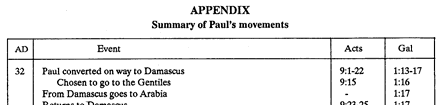
Nor did any of the apostles, leading Christians, or existing churches have any part in helping Paul form his gospel. To demonstrate this, he gives a brief account of his movements during his first few years as a Christian. He begins by pointing out that after his conversion he did not go to see the church leaders in Jerusalem, but went away to the loneliness of Arabia, and then returned to Damascus (15-17; see Acts 9:1-25).
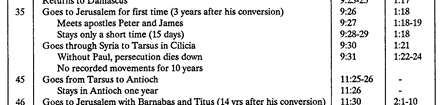
The first visit Paul made to Jerusalem as a Christian was fully three years after his conversion. Even then he stayed only fifteen days. During that time he met only one of the original apostles (Peter), along with James the brother of Jesus (18-20). Some at Jerusalem got to know him a little (see Acts 9:26-29), but elsewhere in Judea no one knew him personally. But they all knew of his conversion, because without his fiery leadership the persecution had died down. After this short time in Jerusalem he went to the provinces of Syria and Cilicia (21-24; see Acts 9:30-31). (For a summary of references in Acts and Galatians to Paul's early years as a Christian see Appendix.)
Jerusalem supports Paul's gospel (2:1-10)
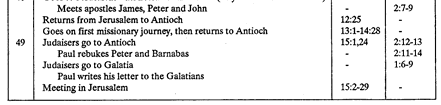
Fourteen years after his conversion (i.e. eleven years after the visit mentioned in 1:18), Paul went to Jerusalem again, this time with Barnabas and Titus (2:1; see Acts 11:27-30). He did not go to seek the apostles' approval, for he had no doubts about the truth and authority of the gospel he preached. Rather he met the apostles as one of equal standing with them, and explained to them his work among the Gentiles. He wanted complete understanding with them concerning the nature of the true gospel. There was not one gospel for the Jews and another for the Gentiles (2).
Judaisers had tried to force Paul to circumcise Titus, one of his Gentile converts. Paul refused and the apostles in Jerusalem supported him. They agreed that the gospel as Paul preached it was complete; additional rites from the Jewish law were not necessary (3-6). More than that, they were in full agreement with Paul and Barnabas in their work among the Gentiles. They realized that God had called them to this work, just as he had called James, Peter and John to work among the Jews (7-9).
The only request the Jerusalem leaders made was that Paul and Barnabas remember the needs of the poor Christians in Jerusalem. This was something Paul was always ready to do. In fact, he had just brought an offering to Jerusalem from the church in Syrian Antioch (10; see Acts 11:30).
Saved by faith alone (2:11-21)
Being assured of the fellowship of the Jerusalem leaders, Paul and Barnabas returned to Antioch (see Acts 12:25). From there they set out on their first missionary journey (see Acts 13:1-3). On returning to Antioch at the end of the journey, they came into conflict with a group of Judaisers who had come from Jerusalem. These men claimed to have the authority of James, and taught that Christians should keep the
Jewish laws concerning food, circumcision and other matters. Their teaching was so persuasive that Peter, Barnabas and most of the Jews stopped eating with the Gentiles (11-13). Paul rebuked Peter publicly for his inconsistency (14).
Jews such as Paul and Peter were saved by faith in Christ, not by obedience to the law. How useless, then, to go back to something that could not save them in the first place (15-16). To put the argument another way: if Gentile Christians are wrong for not keeping the law, Jewish Christians must also be wrong for being justified apart from the law. And since Christ is the one who justifies them, he too must be wrong. Clearly, such a possibility is absurd (17). Rather, the real sin is to go back to keeping the law after being justified apart from the law (18).
The law cannot bring life; it can only condemn to death all who have broken it. Christ took this punishment for sinners by his death on the cross. When sinners turn to Jesus Christ in faith they are removed from the law's power (for the law can have no power over those who are now 'dead'), and given new life, the life of Christ. Having been saved by faith without the law, they now live by faith without the law (19-20). The conclusion is that if sinners can be justified by law, Christ need not have died (21).
Justification by faith
Paul often speaks of sinners being justified (GNB: put right with God). He uses the word in a legal sense, where he likens God's act of justification to that of a judge who declares a person to be righteous, or in the right. To justify is the opposite of to condemn, which means to declare a person guilty, or in the wrong (cf. Deut 25:1; Matt 12:37). ('Justify' and 'righteous' are different parts of the same word in the original languages of the Bible.)
Justification does not mean that God makes repentant sinners righteous in the sense that they now have some inner power that enables them to work to achieve perfection. It means that God declares them righteous. He gives them a righteousness that is not their own – a new status, a new standing, that makes them fit for the presence of a holy God (Rom 4:6-8; 2 Cor 5:21). God now sees believers as being 'in Christ', and accepts them not because of anything they have done, but because of what Christ has done through his death and resurrection (Rom 3:27-28; 4:24-25; Phil 3:9).
Through the work of Jesus Christ, God is able to be righteous in justifying those who have faith in him. Because Jesus bore their sin, God can now declare them righteous (Rom 3:24-26; 1 Peter 2:24). God does this freely by his grace, and repentant sinners accept it by faith (Rom 3:24; Titus 2:11; 3:4-7).
Faith is chiefly concerned not with knowledge but with trust. It is not simply an acceptance of certain facts, but a reliance upon Jesus Christ for all that salvation means (Rom 3:22; Gal 2:20-21; 3:26). Faith in itself does not save. It is simply the means by which sinners accept the salvation that Christ offers. The merit lies not in faith itself, but in the object of faith. Salvation is not a reward for faith, but a gift that God offers to undeserving sinners (Rom 3:25; 5:15). When people by faith accept what Christ has done for them, God declares them righteous on account of Christ and assures them that they need never again fear the condemnation of sin (Rom 8:33-34; 1 John 5:12-13).
3:1-4:31 LAW-KEEPING HAS NO PLACE IN THE GOSPEL
Experience of the Galatians (3:1-5)
When the Galatians first heard the gospel from Paul, they understood clearly that salvation was based solely on Christ's death, and they gladly received it by faith. Now, because they have fallen under the power of the Judaisers, they have turned from this gospel and are trying to live according to the law (3:12). If the almighty power of God's Spirit was necessary to save them from the penalty of sin, how do they expect to triumph over sin in their lives by their own efforts to keep the law (3)? Surely they must know that the miracles they experienced among them came as a result of faith, not because of law-keeping. If they forsake Christ for the law, all those experiences have done them no good at all (4-5; cf. Acts 14:3).
Example of Abraham (3:6-14)
Abraham's life demonstrates that God justifies on the basis of faith, not law-keeping. (To understand the illustrations that follow, read Genesis 12:1-3; 13:14-18; 15:1-6; 22:15-18.) Abraham was justified not because he kept the law, but because he believed God. The law, with its rules about circumcision, had not yet been given. The real children of Abraham are not those who have been circumcised according to the law, but those who have been saved by faith (6-7). The Old Testament long ago declared that Gentiles would be saved the same way as Abraham – by faith (8-9).
Those who try to win God's favour by keeping the law are condemned to death by that law when they break it. Since all break it, all are condemned (10). Another reason why people cannot be justified through the law is that justification is by faith; but the law requires obedience, not faith (11-12). Christ's death on the cross was the clear sign to all that he bore the curse of God. He suffered the death penalty on behalf of the law-breakers, so that all who believe in him might escape the law's curse. Like Abraham, they are justified by faith (13-14).
God's law and God's promise (3:15-22)
Paul then adds an illustration to show that God's basis for justification (which, from the beginning, was faith) was not changed by the law. When people sign an important document, no one can alter its contents; when God makes a covenant, he does not change it (15). God made a promise that through the offspring (singular) of Abraham all peoples would be blessed. This was fulfilled in Christ, who gives salvation to all who have faith in him (16). The law, which came hundreds of years after Abraham, could not alter this promise or add conditions to it. People are justified by faith as Abraham was, according to God's promise (17-18).
If the law did not bring salvation, why was it given? Certainly, it was intended to be beneficial to those who received it (Lev 18:5; Deut 10:13), but it also showed people how far they fell short of God's standards. In so doing, it encouraged them to acknowledge their sin and seek God's forgiveness. Like a light switched on in a dark and dirty room, the law showed up the filth but could not remove it. It was a temporary provision that impressed upon people their inability to keep God's commands, and so prepared them to welcome the Saviour. It was given specifically to Israel, the nation God chose to be his covenant people, and, as in all covenant arrangements, it required the people to keep their part of the contract. In establishing the covenant, Moses acted as mediator between God and Israel, and angels were God's messengers who delivered the law to Moses (19).
By contrast, when God made his unconditional promise to Abraham, he was the sole contracting party. There was therefore no need for a mediator. God was issuing a promise, not laying down laws. He was showing that salvation depends solely on his grace; it is not a reward for law-keeping (20).
The law God gave to Moses neither replaced nor conflicted with the promise he gave to Abraham. The purpose of the law and the purpose of the promise were different. God never intended the law to be a means of salvation. It showed people God's standards, but showed them also how helpless they were to meet those standards. It impressed upon them that they could receive life and righteousness only by the promised gift of God, and they had to receive that gift by faith (21-22).
The law's purpose illustrated (3:23-4:7)
Jews under the law were like children under the control of a guardian, but this was only in anticipation of the coming of Christ. When he came, those who trusted in him were forgiven the sins they had committed against the law and were put right with God. Instead of being like children under a guardian, they now enjoyed the freedom of full-grown mature sons of God (23-26). Since the coming of Christ, all believers are united in him and are God's children, regardless of race, social status, sex or the law. Being part of Christ, they are part of Abraham's promised offspring. Those justified by faith are Abraham's true descendants (27-29).
Paul gives another example, similar to the first, to illustrate the law's function. A child who inherits his father's property cannot do as he likes with it until he has reached the age of an adult. Though legally the owner, in reality he is little different from a slave, being under the control of guardians who manage his affairs for him (4:1-2). This illustrates the position of those previously under the law. They were like children receiving instruction. But Christ came and fulfilled the law's requirements, so that those under its control could be released to enjoy their inheritance as adult sons of God (3-7).
Paul's concern for the Galatians (4:8-20)
Before they believed in Christ, most of the Galatians were pagans, in bondage to idols of wood and stone. Now that they have come to know the true God, they are foolish to get into bondage again by trying to keep the Jewish law. By doing so they are not going forward in their Christian lives; they are going backwards (8-11).
The Galatians should live as those free from the law, just as Paul does. He feels sorry for them, not angry with them. He does not consider their error to be an attack on him personally, and he still has the most pleasant memories of their kindness to him when he was ill while visiting them (12-14). They would have done anything for him then, and he hopes they will not turn against him now because of his attempts to correct their error (15-16).
Part of the Judaisers' tactics in trying to gain control over the Galatians was to turn them against Paul personally. Paul is certainly not jealous when others show interest in his converts after he has gone, provided they have pure motives (17-18). He is concerned only for the Galatians' good and he is prepared to put up with any suffering to help their Christian lives grow and develop. If it were possible he would visit them rather than write, for he is worried about them (19-20).
Example of Hagar and Sarah (4:21-31)
Paul now attacks the Judaisers by using a form of argument that they themselves liked to use. He returns to the story of Abraham to show that law-keeping is slavery and it cannot be mixed with grace. (For the background to the illustration that follows read Genesis 15:1-6; 16:1-16; 17:15-22; 18:1-15; 21:1-21.) Abraham had two sons, Ishmael, who was born as a result of human arrangements that lacked any exercise of faith, and Isaac, who was born in fulfilment of God's promise. The mother of Ishmael was the slave woman Hagar; the mother of Isaac was Abraham's true wife Sarah (21-23).
Hagar is likened to the covenant of law given by God to Israel at Mt Sinai; Sarah is likened to the covenant of grace given freely to all people from heaven. The spiritual descendants of the slave woman are the Jerusalem Judaisers of Paul's day; the spiritual descendants of the free woman are those saved by God's grace through faith (24-26). The Jews, children of Abraham by natural descent, have largely failed to be God's people; the Gentiles, who previously had neither life nor hope but who now largely make up the church, become Abraham's spiritual children. Thus, in Paul's illustration, the slave woman finishes with few offspring, but the free woman, who was formerly childless, now has a multitude of descendants (27).
Ishmael is likened to the Jews who are slaves under the bondage of the law; Isaac is likened to those saved by God's grace and freed from the law. Just as Ishmael persecuted Isaac, so the Jews under the law now persecute those who are God's people through his grace. Children of the law and children of grace cannot live together; the former must be thrown out. There is no place for law-keeping in God's family (28-31).
5:1-6:18 THE FRUITS OF CHRISTIAN LIBERTY
No place for law-keeping (5:1-12)
Through the death of Christ, believers have been freed from the bondage of the law. They should therefore live as free people (5:1).
If circumcision is necessary for salvation, Christ is of no use. Also, those who want to keep the law about circumcision must keep the whole law. They cannot choose one command and ignore others to suit themselves. If they try to find salvation through law-keeping, they cut themselves off from the salvation that comes from Christ through God's grace (2-4). That salvation has nothing to do with circumcision. It is received by faith, is guaranteed by the Holy Spirit and produces a response of love in the lives of believers (5-6).
The Galatians were progressing spiritually until the Judaisers arrived. The new teaching these people have brought with them is not from God and will eventually corrupt the whole church if it is not stopped immediately. Certain punishment lies ahead for these false teachers (7-10).
Apparently the Judaisers had twisted some of Paul's words to try to convince the Galatians that even their apostle taught that circumcision was necessary. If this was so, replies Paul, he would have no more trouble from the Jews. The reason the Jews opposed him was that he preached that the cross, not circumcision, was the way to salvation. He wishes that these Judaisers would not stop at circumcision but go the whole way and emasculate themselves, so that they might no longer trouble the Christians (11-12).
True freedom; true Christianity (5:13-26)
Christian freedom does not mean that believers may do as they like. On the contrary, they must think of others and act to please them. This is what the law commands, but those who want to put themselves under the law cannot do it. Instead they are unkind and cruel to each other. The goal that the law aims at is not reached by trying to keep the law, but by acting with true Christian liberty (13-15).
Sooner or later Christians find that they do not always do the good that their consciences tell them to do, because the sinful human nature fights against God's Spirit within them. The way they triumph over these wrong desires is not by putting themselves under the law, but by allowing God's Spirit to direct their lives (16-18). Even if people put themselves under the law, rebellious human nature produces only those evils that the law forbids and that exclude people from God's kingdom (19-21).
If, on the other hand, Christians allow God's Spirit to control them, their lives become full of the most pleasing virtues – the opposite of those things that the law forbids (22-23). Their lives should demonstrate the truth that their sinful nature has been crucified with Christ and has no further power over them. They are now controlled by God's Spirit (24-26).
Some Christian responsibilities (6:1-10)
When they live by the Spirit's power, believers will want to be of spiritual help to others. They will not be harshly critical when they see other believers caught in wrongdoing, but will feel the sorrow of others as if it were their own. They will remember how easily anyone can be overcome by temptation (6:1-2). People are foolish when they compare themselves with others in order to feel satisfied about their own spirituality. Each person is answerable to God for his or her own behaviour, regardless of what other people may have done (3-5).
Christians must help support financially those who teach them (6). They should not deceive themselves in this matter. Christians, like farmers, reap what they sow. If they live to please themselves according to their natural desires, in the end they will reap the fruit of all natural desires, which is disappointment and death. On the other hand, if they put God's affairs before their own, their lives will produce qualities of eternal value (7-8). This is the season for sowing, not reaping. By untiringly helping others, whether financially or otherwise, believers guarantee for themselves future reward of lasting worth (9-10).
Summary and farewell (6:11-18)
Up till now Paul's secretary has been writing down his words as he speaks. Now Paul takes the pen and with large bold letters writes a conclusion to the letter (11). One reason why the Judaisers insist on circumcision is to escape the persecution they will receive if they preach Christ's death as the way of salvation. Although they preach the necessity of circumcision, they are not interested in keeping the law. They want only to boast of success in getting many converts (12-13).
Paul does not boast about what he has done, nor about the virtues of carrying out or not carrying out a particular religious ceremony. He boasts only about what Christ has done for him on the cross. Christ has given him a new life, so that sinful things may no longer attract him and his sinful nature may no longer desire them (14-15). Those who live according to this principle are the true people of God, the true descendants of Abraham (16).
Slaves had scars made in their bodies to show which master they belonged to. The important mark in Paul's body is not circumcision, which marks a person as a slave of the law, but scars he received in his service as a willing slave for Jesus Christ (17). (Paul may be referring to scars he received when he was stoned by opponents in Galatia; see Acts 14:19.) He closes his letter by encouraging the Galatians once more to stand firm in the grace of God (18).
Ephesians
The letter of Paul that we know as Ephesians is more general than his other letters. Much of it is concerned with the union that exists between Christ and the church, and the results that this union should produce in the lives of Christians. Paul says nothing specific about his relations with the church in Ephesus or with individuals in the church, even though he spent more time with the Ephesian church than with any other.
At the time Paul wrote this letter, a particular kind of false teaching had caused trouble among the churches in and around Ephesus. Paul's special messenger apparently took a number of copies of the same letter and distributed them around these churches. Someone may have written the name of the receiving church into the introduction as copies were distributed. If this was the case, it would explain why some ancient manuscripts include the word 'Ephesus' in the opening greeting, but others omit it (Eph 1:1; see translators' note). Paul's letter to the church in the nearby town of Laodicea may have been another copy of this letter (Col 4:16).
The Ephesus region
Christianity probably came to Ephesus when Paul visited the city towards the end of his second missionary journey. He could not stay long, but left his friends Aquila and Priscilla there, and as soon as possible returned (Acts 18:18-23; 19:1). Ephesus was the chief city of the Roman province of Asia (in western Asia Minor; see map in the commentary on Acts), and Paul saw that if Christianity was established in Ephesus it would spread throughout the province.
Paul's ministry in Ephesus lasted three years and was the major work of his third missionary journey (Acts 20:31). In strengthening the church he trained many disciples, and these, it seems, were the people who took the gospel to the scattered towns and villages of the province (Acts 19:8-10). This outreach was probably the cause of churches being founded in Colossae, Hierapolis and Laodicea (Col 1:7; 2:1; 4:13; Rev 3:14), and possibly also in Smyrna, Pergamum, Thyatira, Sardis and Philadelphia (Rev 2:8,12,18; 3:1,7).
Ephesus was a centre for some of the pagan religions of the region (Acts 19:35). This meant that the Christian converts came from a society where superstition and false religious ideas were widespread (Acts 19:18-19,26-27), and Paul knew that sooner or later the church in Ephesus would be troubled by false teaching (Acts 20:17,29-30). He knew also that a society with false religious beliefs usually has low moral standards, and his letter to the Ephesians deals with the sorts of problems that arise when a church is planted in such a society.
Purpose of the letter
It seems that Paul wrote this letter during the time of his first imprisonment in Rome, when he was under house arrest for two years (Acts 28:16,30; Eph 4:1; 6:20). Tychicus was about to go from Rome to Colossae with letters from Paul to the Christians there, so Paul thought it worthwhile to send this more general letter, which Tychicus could pass on to Ephesus and other churches of the region (cf. Eph 6:2122; Col 4:7).
A kind of false teaching was spreading around the region and creating much confusion among Christians. It was an early form of Gnosticism, a religious philosophy that regarded Jesus Christ as neither fully human nor fully God, but as a sort of semi-angelic being. This teaching asserted that, although Jesus Christ was superior to the Christians who followed him, both he and they needed help from unseen angelic powers if they were to reach perfection. Paul deals more specifically with this false teaching in his letter to the church in Colossae, a town not far from Ephesus. In that letter Paul shows that Christ is supreme over the universe, and needs no help at all from angelic beings. Christians, being already complete in Christ, likewise need nothing to be added to them. (For further details see introductory notes to Colossians.)
In his letter to the Ephesians, Paul repeats his assurances that Christ is supreme over the universe, and this includes all the angelic powers, good and bad. They can add nothing to him (Eph 1:20-21). There is no possibility that anything in the universe can fill up some lack in Christ. On the contrary he fills the universe (Eph 1:23; 4:10). By his death and resurrection he has triumphed over all the evil spiritual forces of the universe. Because of this, Christians likewise can have victory in their battle against evil (Eph 2:26; 6:12).
Paul considers not only Christians personally, but also the church as a whole. The church is the body of Christ, and it shares with him in his victory over all angelic powers (Eph 1:21-23; 2:6). The church does not have to humble itself before angels. Rather angels are humbled before the church, as they see in it an overwhelming demonstration of God's wisdom and power (Eph 3:10). All this is good reason for the Christians in and around Ephesus not to allow themselves to be persuaded by the clever, but wrong, ideas of the false teachers (Eph 5:6).
1:1-23 A life of fulness through Christ 2:1-3:21 God's plan for the church 4:1-6:24 The daily life of the church members
1:1-23 A LIFE OF FULNESS THROUGH CHRIST
Praise for blessings in Christ (1:1-14)
In introducing himself, Paul reminds his readers that they are saints, God's holy people, who live their lives in union with Jesus Christ (1:1-2). He then offers praise to the triune God: in verses 3-6 on account of the Father who planned salvation; in verses 7-12 on account of the Son who made this salvation a reality; and in verses 13-14 on account of the Holy Spirit who guarantees salvation.
God's blessings, which believers receive because of their union with Christ, are not limited to the things of this world. They lift the lives of believers above everyday things so that now, in the present world, they can enjoy the spiritual blessings of the heavenly world (3). God planned his purposes for his people before the universe was created. In his love he chose them to be his children, his aim being that they should be holy and blameless, and so bring praise to him (4-6).
Through Paul, God now makes known more of his eternal plan. By calling it a mystery, Paul does not mean that he is going to tell people something to confuse or puzzle them. He means that he is going to tell them something they would not know unless God revealed it to them. God has, so to speak, a 'secret plan' (GNB), which he now reveals. Believers already know that people have forgiveness only through the grace of God and the blood of Christ, but a further truth is now made known. This truth is that one day all the rebellion and confusion throughout the universe will cease, and unity between God and his creation will at last be restored through Christ. The universe will find its full meaning in him (7-10).
In choosing Jewish and Gentile believers to be united in one church as his people, God shows that he is already fulfilling his purposes for harmony and unity (11). Paul was a Jew, and his words 'we who first hoped in Christ' refer to the Jewish people who had waited for the coming of Christ for centuries. But most of Paul's readers were Gentiles. In the next sentence he therefore addresses them with the words 'you also', to emphasize that they too are now God's people, because of their response to the gospel. God gives the Holy Spirit to Jews and Gentiles without distinction. The Spirit is the guarantee that they are God's people now, and that one day they will receive all that God has promised them (12-14).
A prayer for understanding (1:15-23)
Paul's prayer for the Ephesians combines thanksgiving and praise with requests offered in true faith. Paul knows they are converts from paganism, but he expects them to develop a mature understanding of Christianity. He is not content that they should have a few basic Christian beliefs. He wants them to have true wisdom, based on a proper knowledge of God and a clear understanding of all the riches that are theirs through Christ, both in this world and in the next (15-18).
In addition Paul wants these converts to know the real power of God in their lives. This power is unlimited, as God has clearly shown by raising Jesus from the dead and placing him in the position of highest authority and honour. He is above all things, material and spiritual, now and for ever (19-21). As the head has control over the body, so Christ has authority over the church. At the same time he is inseparably united with it, for Christ and his church make up one complete whole. Because he fills the universe, Christ gives completeness to all things everywhere (22-23).
2:1-3:21 GOD'S PLAN FOR THE CHURCH
Sinners saved by grace (2:1-10)
In their natural state, all people are spiritually dead because of sin. Nothing they do can bring them back to life, because no matter how much good they try to do, they are still sinners. This is true of Jews and Gentiles alike. In body and mind they are under the control of Satan, and consequently are rebellious against God (2:1-3). Such rebels do not deserve God's love, but God loves them nevertheless. God does for sinners what they cannot do themselves. He gives them new life, and he does this on the basis of Christ's death and resurrection. By God's grace, Christ not only died to bear the penalty of human sin, but he rose to glorious life in the heavenly world so that repentant sinners can have a glorious new life in him (4-7).
This salvation is entirely God's work. Sinners cannot save themselves. Through faith they can only turn to God in their helplessness, and humbly accept the salvation that God offers. Good works cannot earn them salvation, but once they are saved their lives should be full of good works. When God gives people a new life, they must live a new life (8-10).
Jew and Gentile made one in Christ (2:11-22)
For centuries there had been bitterness and tension between Jews and Gentiles, mainly because of the way proud Jews looked down on Gentiles. Jews had circumcision as the sign that they were God's people; Gentiles did not. Because they were not God's people, Gentiles enjoyed none of Israel's privileges through the covenants and promises. They had no hope for a Messiah and no knowledge of God (11-12). The Jews, having been chosen to receive God's law, considered themselves close to God but the Gentiles far from him. They did not even allow Gentiles into the holiest part of the temple. It was as if a solid wall separated the two. But Christ, through his death, broke down this wall, abolished the offensive law and commandments, destroyed the hatred and made peace (13-16).
No longer are the 'near' Jews more privileged than the 'far off' Gentiles. In Christ there is no longer a distinction between Jews and Gentiles, for all who believe are God's people. All have equal status as citizens of God's heavenly city, all are members of his family, and all come into his presence through the one Spirit (17-19). The new temple in which God dwells is not a building like the old Jewish temple. It is a spiritual dwelling place. Apostles and prophets form the foundation, other believers form the main building, and all is built around and built into Christ (20-22).
God's wisdom and love displayed (3:1-21)
It was because Paul had taken the gospel to the Gentiles that he was imprisoned in the first place (Acts 21:27-36). Yet he feels humbled to think that God should graciously choose him for such a noble work (3:1-2). As a Jew he was once proud of his belief that only Jews were God's people. Even if some of the 'far off' Gentiles believed in God, they were still not God's covenant people in the sense that Jews were. Now God's special revelation shows Paul clearly that no longer is this so. Jewish and Gentile believers are united in one body, the church, and as God's people they share equally in all God's blessings (3-6).