
Part 8
Shimei, another of Saul's relatives, was pleased to see David humiliatingly removed from his throne, and cursed him bitterly (5-8). David showed much patience in accepting the humiliation, believing it might have been part of God's judgment upon him (9-14).
Meanwhile Absalom seized power in Jerusalem, though David's cause was helped when Hushai gained entrance into Absalom's circle of advisers (15-19). Absalom then took over his father's harem, to demonstrate to all that he was now king. By his shameful treatment of the harem women he showed his utter contempt for his father (cf. 12:11). This was all carefully planned by Ahithophel. He saw that if Absalom's revolt was to succeed, there had to be no possible chance of a reconciliation between Absalom and David (20-23).
War between Absalom and David (17:1-19:8)
Ahithophel advised Absalom that he needed to do only one thing to make his throne secure, and that was kill David. If he did this swiftly, without war or unnecessary bloodshed, the people would soon be fully behind him (17:1-4). Hushai, wishing to gain time for David to escape and organize his troops, advised against such a risky operation, for David was a very experienced soldier. He recommended that the whole Israelite army be assembled and Absalom himself lead them into battle (5-13). Being as vain as he was ambitious, Absalom liked this idea and accepted Hushai's advice (14).
At the risk of their lives, David's spies took him news of Absalom's plan (15-20), with the result that David and his men quickly escaped across Jordan (21-22). Ahithophel committed suicide. His plotting had brought Absalom to the throne, and he knew that all would be lost if Absalom followed Hushai's advice (23). David had now gained valuable time to rest his weary men, obtain provisions and plan his war strategy (24-29).
The military leaders whom David appointed over his men suggested he not go with his troops to the battle, lest he be killed. David agreed, but warned them not to kill Absalom (18:1-5). David's experienced army leaders knew better than the inexperienced Absalom how to direct the fighting in the difficult conditions of the thick forest. Absalom's forces suffered a crushing defeat (6-8). Though Joab acted against David's command in killing Absalom, he knew that this was the only way to bring the revolt to an end (9-15). Once Absalom was dead, further fighting was not necessary. Absalom had hoped for himself an honourable memorial, but he was buried in disgrace (16-18).
Not knowing how best to break the news of Absalom's death to David, Joab sent an African slave, in case the king reacted violently and killed the bearer of such bad news. But Ahimaaz, knowing that David would be overcome with grief, persuaded Joab to send him as well (19-23). Ahimaaz arrived first and tried to break the news to David softly (24-29), but when the African arrived he told David bluntly that Absalom was dead (30-33).
David's uncontrolled grief over the death of Absalom created dissatisfaction among those who had risked their lives to save him (19:1-4). Joab spoke harshly to David, telling him to stop mourning and show some appreciation of what his troops had done for him. If not, he might lose their support entirely (5-8).
David returns to Jerusalem (19:9-43)
Because the nation was still deeply divided as a result of Absalom's revolt, David did not return to Jerusalem immediately. He was waiting for the people to give an indication that they wanted him restored as king. Some people of the northern tribes had suggested they invite David back, but the people of Judah, David's own tribe, had apparently said nothing (9-10).
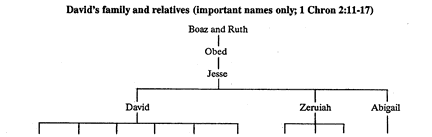
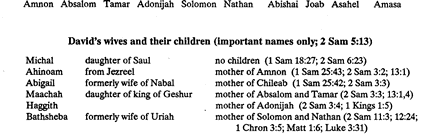
Knowing the rivalry that existed between Judah and the other tribes, David cunningly suggested that Judah quickly show its support for him, otherwise it would be outdone by the other tribes. Also, in an effort to win the allegiance of those Judahites who had followed Absalom, he made Amasa, Absalom's commander, chief of his army. This was clearly unfair to Joab, who had remained loyal to David and won him the victory (11-14). (Absalom, Joab and Amasa were cousins; see 1 Chron 2:13-17.)
As he was returning to Jerusalem, David was greeted by some of the people who had met him earlier when he was fleeing (15-18a). Shimei, who had previously cursed him, now begged his favour, and David promised not to execute him (18b-23; cf. 16:5-14; but see 1 Kings 2:8-9). Mephibosheth contradicted Ziba's earlier statement to David about Mephibosheth's supposed disloyalty. It seems that David did not know whom to believe, so he divided Saul's property between the two of them (24-30; cf. 16:1-4). By taking Barzillai's son into the royal court, David rewarded Barzillai for his former kindnesses (31-38; cf. 17:27-29). The party then crossed the Jordan and headed for Jerusalem (39-40).
Judah responded so vigorously to David's call to bring him back to Jerusalem, that it outdid the other tribes (see v. 11, 40). Unfortunately, the whole affair further stirred up those inter-tribal jealousies which one day would result in the breaking up of the kingdom (41-43).
Sheba's revolt (20:1-26)
With virtually the whole nation in a state of unrest, Sheba, a Benjaminite, seized the opportunity to try to lead the northern tribes to break away from David (20:1-2). Being anxious to re-establish his kingdom in Jerusalem, David did not leave the city but sent his new commander-in-chief Amasa to assemble the army and pursue Sheba (3-4).
When Amasa was slow in assembling the army, David sent off his private army, the fighting force that had been with him since the days of his flight from Saul. David placed Abishai in charge of the operation, but Joab went also (5-7). When the troops with Abishai and Joab met the troops with Amasa, Joab murdered Amasa and again took control of the army (8-13).
Sheba's uprising apparently did not attract a large following. When he was finally trapped in the town of Abel in the far north of Israel, only a few people of his own clan were left with him (14-15). The citizens of Abel, on the advice of an old woman among them, saved their besieged town from destruction by murdering Sheba and throwing his head over the wall to Joab (16-22).
This section of the book closes with a list of the chief officials in David's administration during the latter part of his reign. The list shows certain changes and developments that had occurred over the years (23-26; cf. 8:15-18).
21:1-24:25 MISCELLANEOUS MATTERS
The writer of 2 Samuel has finished his historical record of David's reign. Since the story of David's sin with Bathsheba, the writer has mainly been concerned with showing how this one event changed the course of David's life. He now returns and records various other stories and poems to show other difficulties David faced during his reign. He shows also how God cared for him during those difficulties. (The story of David's closing years is given in the opening chapters of 1 Kings.)
Judgments and justice (21:1-22)
One of David's difficulties was a three-year famine throughout the land. God showed him that this was a judgment on Israel because Saul had slaughtered the Gibeonites. By such action Saul broke the oath that Joshua, as representative of the nation, had sworn to the Gibeonites in the name of God (21:1-2; see Josh 9:15,19-21). Saul's sin had to be cleansed and the Gibeonites' claim for justice needed to be satisfied. Therefore, seven of Saul's descendants were executed, the number seven symbolizing full satisfaction (3-9).
David was filled with sympathy when he saw how one of Saul's former concubines sorrowed for the dead men. He tried to comfort her by arranging for an honourable burial for the bones of Saul and Jonathan, possibly along with those of the seven victims. This showed also that he himself had no hatred for his former king, but had executed the seven men only in response to God's call for justice. God then lifted his judgment on Israel by ending the famine (10-14).
During one of the Philistines' many battles with Israel, a Philistine giant had apparently tried to take revenge on behalf of the dead Goliath by trying to kill David. But he himself was killed by one of David's chief men (15-17). Three other Philistine giants were killed by Israelites on different occasions (18-22; cf. 1 Chron 20:5).
Two psalms (22:1-23:7)
The first of these two psalms was written by David to celebrate his victories over his enemies. Later it was put to music for use in the temple services and appears in the book of Psalms as Psalm 18.
David began the psalm by praising God who constantly answered his prayers and saved him from death (22:1-7). God displayed his mighty power in earthquakes, wind, rain, lightning, thunder and darkness (8-16), and sometimes he used these forces to save David from his enemies (17-20). God worked on behalf of David because of David's uprightness and obedience (21-25), showing that God treats people as they deserve (26-30).
Because God is perfect in all his ways, David could always depend upon him (31-33). This God protected David and gave him ability as a soldier and a national leader (34-37), so that he repeatedly conquered his enemies (38-43). His fame spread far and wide as foreign nations submitted to his rule (4446), but he gladly acknowledged that all his greatness came from God (47-49). Later kings of David's dynasty could likewise be assured of God's unfailing blessing (50-51).
In the second psalm David commented briefly on the blessings that a God-fearing king brought to his people. Life under such a king had a pleasantness that could be likened to that of a morning without clouds. As the sun benefited the grass after rain, so the king benefited his people (23:1-4). David's dynasty was assured of the additional blessings of stability and lasting prosperity, because of the covenant God made with David (5; cf. 7:16). But, like any wise ruler, David knew also that he had to punish the wicked, and he would not avoid this responsibility even though it was often difficult and dangerous (6-7).
David's mighty men (23:8-39)
From the hundreds of men who gathered around him during his flight from Saul, David had built a loyal and tough fighting unit. This unit remained the central strength of his army throughout his long reign (see 1 Sam 22:1-2; 30:9; 2 Sam 15:18; 18:1-2; 20:7; 1 Chron 11:10). The commander-in-chief of his army was Joab (see 8:16, 20:23).
Next in rank below Joab were three generals, or commanders, each of whom was a courageous fighter and a national hero. These men were known simply as The Three (8-12; 1 Chron 11:10-14). After The Three came The Thirty, three of whom were especially remembered for the occasion on which they risked their lives because of their devotion to David (13-17). The leader of The Thirty was Joab's brother Abishai. Another notable figure among The Thirty was Benaiah, commander of David's bodyguard (1823; see note on 8:18).
Although the group took its name from the number thirty, there are more than thirty names in the biblical lists. This is probably because the lists include the names of those who had been killed and those who had replaced them (24-39; 1 Chron 11:20-47).
The census and its outcome (24:1-25)
Israel's increasing power and prosperity under David may have given David and his people feelings of self-praise, as if they, and not God, had been the cause of this growth. God saw that the time had come to awaken Israel to this sin. Therefore, God allowed Satan to suggest to David that he take a census of the people. David's pride in his growing nation was apparently what made the suggestion seem such a good idea, but God was going to use the event to reveal that pride and punish it (24:1-4; 1 Chron 21:1). The officials carried out the census first in the territory east of Jordan, then in the north of Canaan, and finally in the south (5-9).
Even before God acted in judgment, David's conscience told him he had sinned. Through a prophet, God offered David a choice of one of three calamities as a punishment, but David chose rather to leave the decision with God and trust in his mercy (10-14). A plague broke out in Israel, physically weakening the nation that David thought was strong. Even Jerusalem, the city that David was so proud of, would have been destroyed had not God in his mercy stopped the plague (15-17).
To show his repentance, David was told to offer sacrifices to God, but in view of the recent events he feared to go to the tabernacle at Gibeon (1 Chron 21:29-30). God therefore allowed him to remain in Jerusalem, but directed him to the hilltop farm of a man named Araunah (or Ornan). David was to buy the piece of hard ground that Araunah used as his threshing floor, and build on it an altar to offer the sacrifices (18-20). Araunah wanted to give the piece of ground to David for nothing, but David insisted that he buy it. If his offering was to be a genuine sacrifice, it had to cost him something (21-25).
Later David bought the surrounding land as well, and declared that this was the place where the temple of God would be built (1 Chron 21:25; 22:1). It was apparently the place where Abraham had offered up Isaac (2 Chron 3:1; cf. Gen. 22:2).
Summary: from Moses to David
1280 BC Moses leads Israel out of Egypt Years in the wilderness 1240 Israel under Joshua enters Canaan Period of the judges 1050 Saul becomes Israel's first king 1010 Saul dies; David becomes king 1003 David conquers Jerusalem 970 David dies; Solomon becomes king
APPENDIX
1 Kings
BACKGROUND TO 1 & 2 KINGS
The two books of Kings (originally one book) carry on the history of Israel from the books of Samuel. They cover a period of about four centuries from the closing years of David's reign to the time the people were taken into captivity in Babylon. They describe the division of the kingdom into two, and the history, decline and fall of the separate kingdoms.
Characteristics of the books
As with the books of Joshua, Judges and Samuel, the two books of Kings have been written as prophetic history. That is, the author's main concern was not merely to record events, but to show the meaning of those events in the purposes of God. (For further discussion on the features of prophetic history see introductory notes to the book of Joshua.)
Because of this concern to see the meaning to Israel's history, the writer does not record all the events of any one era. Nor does he always place events in their chronological order. He selects and arranges his material according to its religious, rather than its political, significance. He might mention a politically important king only briefly (e.g. Omri; 1 Kings 16:21-28), but deal with politically unimportant events in some detail (e.g. the ministry of Elijah and Elisha). He deals with the affairs of surrounding kingdoms only as they are of significance in God's purposes for Israel.
The author of Kings has chosen to remain anonymous. He may have been a prophet, and he probably used the official court records, along with the records of the prophets, in preparing his book (1 Kings 11:41; 15:7,23,31; cf. 2 Chron 9:29; 33:19). Lengthy sections of the prophetical books Isaiah and Jeremiah are found also in Kings (e.g. Isa 36:1-39:8; Jer 39:1-10; 52:1-34). The whole work was probably completed after the collapse of the Israelite nation, when the people were in captivity in Babylon.
OUTLINE OF 1 KINGS
1:1-4:34 Solomon establishes his kingdom 5:1-9:25 Solomon's building program 9:26-11:43 Other features of Solomon's reign 12:1-16:28 Early days of the divided kingdom 16:29-22:53 Ministry of Elijah
1:1-4:34 SOLOMON ESTABLISHES HIS KINGDOM
Solomon becomes king (1:1-53)
David was old and his health was failing. He needed a nurse with him continually, one of her duties being to lie with him in bed to give him warmth. Although this nurse, Abishag, was not David's concubine, many people apparently thought she was (1:1-4; see note on 2:22).
Adonijah, David's oldest surviving son, decided to establish himself as king while David was still alive, and so prevent any possible claim to the throne by Solomon later. Once he had gained the support of the senior priest Abiathar and the army commander Joab, Adonijah thought he could ignore the friends and advisers of David who favoured Solomon (5-10).
Those friends of David had more influence in the palace than Adonijah realized. Possibly the most important of them was the prophet Nathan, who apparently knew that God's will was for Solomon to be the next king (cf. 2 Sam 7:12-17; 12:24-25; 1 Chron 22:6-10). Nathan quickly thought of a plan to prompt David to declare openly that Solomon was to succeed him as king (11-14). First Bathsheba told David what Adonijah had done (15-21), then Nathan asked David if he approved of Adonijah's action (22-27). Shocked at what he heard, David declared that Solomon, not Adonijah, would be his successor (28-31).
Once roused to action, David was determined to see Solomon anointed and publicly proclaimed king (32-37). Solomon's appointment seems to have won popular support. It also had the backing of David's personal bodyguard of Cherethites and Pelethites, who were under the command of the tough Benaiah (38-40).
Adonijah's celebrations were cut short when he heard what had happened (41-48). He realized that his claim to the throne now had little chance of success. Therefore, he decided that the wisest thing to do was to acknowledge Solomon as king in return for Solomon's guarantee not to execute him (49-53).
The excitement of these events must have given David a sudden renewal of strength just before his death. He arranged a second anointing of Solomon, this time with full regal and religious ceremony, at which he presented Solomon to the people. He wanted them to see that Solomon was his divinely chosen successor (1 Chron 28:1-10; 29:20-22).
Opponents of Solomon executed (2:1-46)
As he saw his death approaching, David passed on to Solomon advice aimed at ensuring stability to his reign and good government for God's people. The first and most important point was a reminder to be faithful to God. God's promises of a prosperous kingdom and a lasting dynasty required David and his successors to be obedient to God's will. Without obedience, there was no guarantee of blessing (2:1-4; 1 Chron 22:6-16).
David's second piece of advice to Solomon was to remove those likely to rebel against him, and reward those who had remained loyal to him. David had for many years known that Joab should have been punished for the murders he had committed (see 2 Sam 3:30; 20:10). He now saw an opportunity to deal with Joab, because he knew that Solomon would not hesitate to execute one who had recently supported Adonijah (5-9).
After the death of David (10-12), Solomon soon found opportunities to get rid of his opponents. Adonijah was first to be killed. Since a new king inherited the former king's concubines, Solomon considered that Adonijah's request to marry Abishag was an attempt to claim David's throne (13-22; cf. 2 Sam 3:7; 12:8; 16:22). Adonijah was executed for treason (23-25).
Solomon then dealt with Abiathar, the high priest who, with Joab, had supported Adonijah. Abiathar was not executed, but his dismissal brought his priestly work, and the priestly work of Eli's descendants, to an end (26-27; cf. 1 Sam 2:27-36).
Next Joab was executed. He had no right to ask for mercy by clinging to the altar, as he had been guilty of wilful murder (28-35; cf. Exod 21:12-14). Joab was followed by Shimei, a relative of Saul who had always been opposed to the throne of David (see 2 Sam 16:5-14). To lessen Shimei's chances of plotting against him, Solomon would not allow him to leave Jerusalem (36-38). When Shimei went to Gath in search of runaway slaves, Solomon saw this as defiance of his authority. Shimei was promptly executed (39-46a). With all possible opponents now removed, Solomon's position was secure (46b).
Solomon's wisdom (3:1-28)
David's power had come through war and conquest; Solomon's came through clever commercial and political agreements with neighbouring countries. Solomon gave impressive public display of his loyalty to God, but he ignored God's warnings when he saw advantages to be gained through foreign alliances. His marriage to the daughter of Pharaoh guaranteed peace for Israel in a region where Egypt was the chief power, but it probably required Solomon to pay respect to Egypt's gods (3:1-3; cf. 11:1-8; Exod 34:1216).
Although David had placed the ark of the covenant (GNB: covenant box) in a special tent in Jerusalem, the tabernacle (GNB: tent of the Lord's presence) and the remainder of its articles were still at Gibeon (1 Chron 15:1-3; 16:1,39; 21:29). Soon after being crowned king in Jerusalem, Solomon went to Gibeon for a lavish religious ceremony, as a public exhibition of his devotion to God (4; 2 Chron 1:2-6). While there, he had a dream in which God offered to give him whatever he chose. By asking for wisdom to judge between the morally right and the morally wrong, he showed his concern for the just government of God's people (5-9). God gave him all that he asked for and more (10-15).
Back in Jerusalem Solomon soon had to put this wisdom to use, when he was called upon to decide which of two prostitutes was the mother of a disputed baby (16-22). Solomon knew that both women were of low moral standard, but he did not allow such knowledge to affect his sense of justice. Many of the people of Israel might have been ungodly, but Solomon still had to understand their affairs and act with fairness when settling disputes among them (23-28).
The administration of the kingdom (4:1-34)
Details are now given of how Solomon administered Israel. First the leading religious, civil and army officials are listed (4:1-6). Solomon revised the taxation system by dividing the country into twelve zones, each of which had to provide the royal household with all its food supplies for one month of the year. These twelve zones apparently replaced the former tribal areas (7-19).
Neighbouring nations that had become part of the Israelite empire also paid taxes, and so enriched Solomon further. Israel as a nation enjoyed peace and prosperity (20-21). The monthly food supply was enormous, for it had to maintain not only the royal family and government officials, but also the army (22-28).
Because of his wisdom, Solomon was famous in countries far and near. People made collections of his proverbs and songs, and many travelled to Israel to hear his wisdom (29-34).
5:1-9:25 SOLOMON'S BUILDING PROGRAM
When David had expressed a desire to build a permanent house for God, he was told that God was more concerned with building a permanent 'house' for David, namely, a dynasty. As for a symbolic dwelling place for God, God had already shown his ideal for Israel in the tabernacle. Nevertheless, he would allow Israel to have a temple, though it would be built not by David, but by David's son Solomon (see notes on 2 Sam 7:1-17).
Despite God's emphasis on the need to build a godly family, both David and Solomon seem to have been more concerned with building a lavish temple. David may not have been allowed to build the temple himself, but he helped Solomon all he could by preparing the plan and setting aside money and materials for the building's construction. He wanted everything to be ready so that Solomon could begin construction as soon as he became king (1 Chron 22:2-16; 28:11).
But Solomon's plans were for more than a temple. His building program lasted more than twenty years, and included an expensive palace and other impressive buildings to adorn his national capital. (For details of David's preparations for the temple and its services, and his extensive instructions to Solomon, see notes on 1 Chronicles 22:2-29:30.)
Workers and materials (5:1-18)
No doubt Solomon intended the building of the temple to be a help to Israel's spiritual life, but the way he carried out the work could easily have had the opposite effect. He obtained the best of materials from Hiram, king of Tyre, but the contract with Hiram almost certainly involved religious ritual and recognition of Hiram's gods (5:1-9).
Solomon agreed to pay for all this material by sending farm produce to Hiram. But Israel's farmers may not have been happy to see their hard earned produce going to a heathen king, especially since it was only to pay for a lavish building program in the capital city (10-12). Nor would people in northern Israel be pleased to see their land handed over to Hiram to pay off Solomon's debts (see 9:11-14).
These disadvantages may not have existed had Solomon been more moderate in his plans and materials. The temple did not need to be any larger than the old tabernacle, and David seems to have left Solomon plenty of materials for its construction (1 Chron 22:2-5; 29:1-9).
Another of Solomon's policies that created feelings of dissatisfaction and rebellion was that of forced labour (see 12:4). All working men were required to give three months work to the king each year, to provide a year-round workforce of 30,000 men. One third of these were sent to Tyre to work in relays, a month at a time, cutting the timber under the supervision of Hiram's men. The timber was then floated down to the Israelite port of Joppa (see v. 6,9; 2 Chron 2:8-10,16). Besides these part-time Israelite workers, there were 150,000 full-time slaves (mainly Canaanites; 9:20-22) who did the harder work of quarrying and carrying the stone (13-18).
Overall plan of the temple (6:1-13)
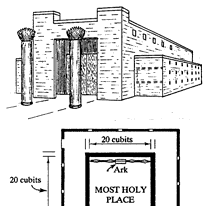
The simplest way to describe Solomon's temple is as a rectangular stone building with a porch added to the front, and three storeys of storerooms added to the sides and rear. The side and rear walls of the main building were reduced in thickness by one cubit (about forty-four centimetres, or eighteen inches) for the middle storey, and by a further cubit for the top storey. This created 'steps' on which the timber beams rested to form the floors for the middle and upper storeys (6:1-6).
All stones used in the building were cut and dressed at the quarry, so that they would be as easy to handle as possible. No stoneworking tools were used at the temple site (7-10). God gave Solomon the timely reminder that the temple would be a means of blessing to him and his people only if he was obedient to God (11-13).
Details of the temple's interior (6:14-38)
Inside the temple the stonework was covered with lavishly carved wood panelling overlaid with beaten gold (14-15; see v. 22). A partition divided the main temple into two rooms. The larger front room was called the nave or Holy Place; the smaller rear room was called the inner sanctuary or Most Holy Place (16-18).
The Most Holy Place contained the ark of the covenant, symbol of God's presence (19). This room had a lower ceiling than the rest of the building (20; cf. v. 2) and, also unlike the rest of the building, was without windows (cf. 6:4; 8:12). Its entrance was closed by a curtain, a pair of doors and gold chains hung across the doorway (21-22; see v. 31; 2 Chron 3:14). Inside the room were two huge winged creatures, or cherubim, which side by side stretched across the width of the room. They were probably symbolic guardians of the ark (23-28). The doors to the Most Holy Place were of carved wood overlaid with gold, similar to the temple walls (29-32).
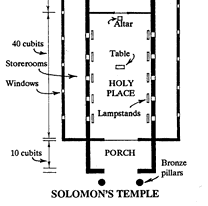
In the front room were the altar of incense, the table of 'presence bread' and ten lampstands, five on each of the two side walls (see 7:48-49). Folding doors led from the entrance porch to this room (3335). A walled courtyard surrounded the whole building (36). The total construction time for the temple was seven years (37-38).
Construction of other buildings (7:1-12)
After finishing the temple, Solomon moved on to the next part of his building program. This was the building of a magnificent palace that took thirteen years (7:1). He also built many other expensive buildings in this national showpiece. The House of the Forest of Lebanon, so called because of its three rows of cedar pillars, was apparently a military headquarters and weapons storehouse (2-5; cf. 10:17; Isa 22:8). The Hall of Pillars was probably a meeting hall, and the Hall of the Throne a judgment court. There was also a separate palace for his queen, the daughter of Pharaoh (6-8). All these buildings, along with the temple and Solomon's own palace, were built within the Great Court, around the perimeter of which was a stone and timber wall (9-12).
More concerning the temple (7:13-51)
Israel seems to have lost the spiritual insight and artistic skill that in the time of Moses enabled its craftsmen to design and make the decoration for God's dwelling place (cf. Exod 31:1-6). Solomon therefore hired a craftsman from Tyre to do the bronze work and other decorations for the temple, with no apparent concern for the wrong religious ideas this man may have had. By coincidence this hired craftsman was named Hiram (GNB: Huram), the same as the king (13-14; 2 Chron 2:7,13-14).
Hiram the bronzeworker made two bronze pillars that stood in front of the porch but did not support the roof. They seem to have been purely ornamental. Decorations around the bowl-shaped tops of the pillars consisted of pomegranates, large flowers and a network of interwoven chains (15-22; see v. 4142).
A new bronze altar was made, much larger than Moses' tabernacle altar, which was now far too small for the great numbers of animals that Solomon sacrificed (see 8:64; 2 Chron 4:1). A bronze laver (GNB: tank), in the form of a huge basin supported on the backs of twelve oxen, held water for bathing and other cleansing rites (23-26). There were ten additional mobile lavers, each consisting of a bronze basin fixed on top of a trolley, or cart. The basin sat inside a square frame, on the outside of which were attached decorative panels (27-39).
The writer then lists all the articles made of bronze (40-45). The bronze casting was done at a place in the Jordan Valley where the ground was suitable (46-47). Other articles were also made, till the temple was finished in every detail and fully equipped for its services (48-51).
The ark brought to the temple (8:1-21)
People came from all over Israel to celebrate the dedication of the temple (see v. 65). The ceremony took place at the time of the mid-year festival season (8:1-2; see Lev 23:24,27,34).
In transferring the ark from David's temporary tent to the temple, Solomon, evidently remembering the mistake of his father, was careful to see that the priests and Levites carried the ark and all the holy vessels in the proper manner (3-9; cf. 2 Sam 6:1-7). The procession was accompanied by music and singing provided by the priests and Levites, all of whom were on duty for the special occasion (2 Chron 5:11-14).
Once the ark was in its rightful place, God gave the sign of his presence by filling the temple with a cloud of glory. As in the case of the tabernacle, the light of God's presence was so dazzling that human activity in the sanctuary had to cease (10-13; cf. Exod 40:34-35). Amazed at all that had happened, Solomon contrasted that day with the days of their ancestors. Ever since Israel had become a nation, God had refused to choose any city for his dwelling place; but now he chose the city of David and his son Solomon (14-21).
The dedication ceremony (8:22-9:9)
Solomon then went up on to a specially made bronze platform, knelt down and prayed to God in the presence of the assembled people (2 Chron 6:12-13). He admitted that only God's grace had allowed his father and himself to fulfil their wish of building God a symbolic dwelling place. He prayed that God's grace would rest likewise upon his royal descendants after him (22-26). Solomon knew there was no necessity for the temple, because God dwells everywhere. But he asked that God would graciously hear his prayer and the prayers of the people when they came to the temple to pray (27-30).
Because the temple was a place of prayer, Solomon thought of various circumstances when people would go there to pray. He asked that judges, such as himself, would have God's help in making legal judgments where the evidence was uncertain (31-32; cf. Exod 22:7-12). He thought of cases where God might punish his people through war, famine, disease or other disasters, and he asked that when they repented, God would forgive them (33-40).
In a public display of concern for foreigners, Solomon prayed that they too would come to know God, and that God would answer their prayers as he did those of Israelites (41-43). He asked that God would hear the Israelites when they prayed for success against their enemies in war (44-45). Finally, he asked that God would hear them when they cried for mercy from those whom he sent to punish them (4653).
God demonstrated his acceptance of Solomon's prayer by sending fire from heaven to burn up the sacrifices (2 Chron 7:1-3). Solomon then prepared to pray for God's blessing upon the assembled people (54-55). He praised God for his faithfulness to his promises, and asked that God would help his people to obey his law (56-61). The ceremony concluded in typical fashion with large numbers of sacrifices (6264), and public celebrations continued for a further week (65-66).
In accepting the temple, God again reminded Solomon that the important 'house' was not the house of God (the temple), but the house of David (those whom God had appointed to govern Israel for ever). Though in relation to the people they were kings, in relation to God they were servants, and they had to be obedient to his will if they were to enjoy the fulfilment of his promises (9:1-5). Solomon had built the temple to show that God dwelt among his people. But if the king or his people rebelled against him, God would destroy the temple to show his displeasure with them (6-9).
Building development in other cities (9:10-25)
Earlier Solomon had borrowed from Hiram about four thousand kilograms of gold to help finance his ambitious building programs. In payment of these debts, Solomon gave Hiram twenty cities in northern Israel. Hiram was not satisfied with these cities and returned them (which meant that Solomon had to look for other ways to repay the loan) (10-14; see 2 Chron 8:1-2).
To strengthen Jerusalem's security, Solomon rebuilt the Millo (some sort of defence fortification) and all the damaged sections of the city wall. He also rebuilt ruined cities, established army bases at strategic points, and equipped selected cities to store the farm produce collected to maintain the government (1519; cf. 4:7,22-28; 5:11). He made all foreigners slaves. Israelites, though not officially slaves, were treated little better (20-24; cf. 12:4).
Solomon kept the covenant requirements in relation to the annual religious festivals. His harsh treatment of his subjects, however, showed little regard for other covenant requirements, such as those concerned for people's well-being (25; cf. Exod 23:9,14-17; Lev 19:13).
9:26-11:43 OTHER FEATURES OF SOLOMON'S REIGN
Trade, fame and wealth (9:26-10:29)
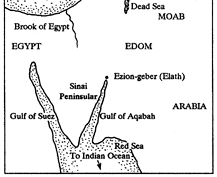
Always alert in business dealings, Solomon saw the opportunity for further profits by cooperating with Hiram in trade transport. Goods from the Mediterranean were received at Hiram's port of Tyre, taken overland to the Israelite port of Ezion-geber at the northern tip of the Red Sea, then shipped east, possibly as far as India. Since the Israelites were not a seafaring people, Solomon hired seamen from Hiram to teach and guide his men. Goods that these ships brought back from the east further enriched the two kings (26-28; cf. 10:11-12,22). ('Ship of Tarshish' was a technical name for a certain kind of oceangoing merchant ship. It was not an indication of the port to which or from which a ship was sailing.)
Archaeology indicates that Solomon mined and smelted iron and copper in the region of Eziongeber, from where he shipped the materials east (cf. Deut 8:9). The strategic and economic importance of Ezion-geber (or Elath) was a cause of frequent conflicts between Jerusalem and Edom, the original owners of the port (cf. 2 Kings 14:22; 16:6).
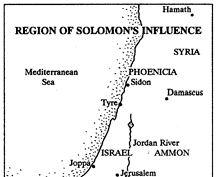
People of other nations heard of Solomon's reputation for wisdom, and on one occasion the queen of an Arabian country visited Jerusalem to test him with hard questions. She was amazed not only at Solomon's wisdom but also at the splendour of his court (10:1-9). At the same time both she and Solomon took the opportunity to have some useful trade exchanges (10-13).
Solomon gained further wealth by taxing all goods that passed through Israel along the international trade routes. He spent much of this wealth extravagantly, to give his city and palace a splendour unequalled among the nations of the region (14-22). Nations that sought his favour also brought him expensive gifts (23-25). Besides building a large horse and chariot force for himself, he became the middleman in an international horse and chariot trade that further enriched him (26-29).
The reign of Solomon saw the beginnings of a strong merchant class in Israel. Previously Israel's economy was largely agricultural and pastoral, but gradually the merchants gained control over the farmers. Over the next two centuries conditions for the farmers worsened and social injustice increased, causing prophets such as Amos, Hosea, Isaiah and Micah to condemn the corrupt society and announce its coming judgment.
Solomon's idolatry (11:1-43)
Although some of Solomon's marriages were for political purposes, most of his wives and concubines were probably given to him as gifts. These women usually brought their gods into Israel, and Solomon's weakness in worshipping these gods led finally to his downfall (11:1-8). God's judgment on Solomon and Israel was to bring the long-standing friction between northerners and southerners to a climax in the division of the kingdom. Only Solomon's tribe Judah (which had by this time absorbed Simeon in the south) along with neighbouring Benjamin would be left for Solomon's son to rule. The remaining tribes, led by Ephraim, would form the breakaway northern kingdom (9-13).
By this time the king of Egypt who had been friendly to Solomon (see 3:1) had died. The new Pharaoh, fearful of Solomon's power, encouraged any rebellion inside or outside Israel that would weaken Solomon. Hadad, crown prince of Edom, had been taken to Egypt in childhood when David conquered Edom. He grew up in Egypt, and later returned to Edom, from where he carried out guerilla attacks against Israel (14-22). Other enemies used Syria as a base from which to conduct guerilla warfare against Solomon. The leader in this case was Rezon, another who had escaped when David conquered his country (23-25; cf. 2 Sam 8:3,13).
Meanwhile the prophet Ahijah revealed that Jeroboam would be the next king. Jeroboam was one of Solomon's most capable administrators, an ambitious hard-working young man whom Solomon put in charge of the Ephraim-Manasseh workforce (26-33). Ahijah also warned Jeroboam that he had to be obedient to God. But Jeroboam's immediate concern was to gain power, and no doubt he used his position to influence his fellow northerners against Solomon and so gain a following for himself (34-39).
When Solomon tried to kill him, Jeroboam escaped to Egypt, for he knew he could be sure of Pharaoh's support. He stayed there till the death of Solomon, awaiting his opportunity to return and seize the throne of Israel (40-43).
12:1-16:28 EARLY DAYS OF THE DIVIDED KINGDOM
Revolt against Rehoboam (12:1-24)
From the time of the judges there had been tension between Judah and the northern tribes, particularly Ephraim. Rehoboam apparently knew of the possibility that the northern tribes would break away from him, and therefore he arranged for a special coronation ceremony in Shechem, one of the more important northern cities (12:1).
Jeroboam decided immediately that he would test Rehoboam's ability as a leader. He knew that Solomon's forced labour and heavy taxation policies were unpopular, and he used these to stir up the people against Rehoboam (2-5). Rehoboam realized the seriousness of the situation, but whether he relaxed or tightened his father's policies, he was doomed to failure. The northern tribes decided to break away from Rehoboam and form their own kingdom (6-17).
Rehoboam tried to force his authority on the rebels by sending his labour chief, Adoram, to deal with them. Adoram was probably the most unpopular person in Israel, and the northerners promptly murdered him. They then invited Jeroboam to be their king (18-20). Rehoboam fled to his palace in Jerusalem, from where he planned to establish his rule in the north by military force. To his credit he changed his mind when a prophet told him that this division was God's will (21-24).
With the division of the kingdom came the collapse of the empire that David and Solomon had built. One by one the subject nations regained their independence.
Two kingdoms
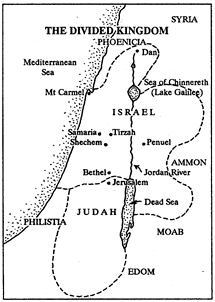
From this point on, the northern kingdom of ten tribes was known as Israel, the southern kingdom as Judah. Judah was the smaller of the two kingdoms in both population and area, and had the poorer country agriculturally, but politically it was more stable. It had an established dynasty, the dynasty of David, and its people, being mostly from one tribe, were fairly well unified.
By contrast there was never a strong unity in the northern kingdom. Reasons for this were the greater number of tribes in the north, the comparatively large population of Canaanites still living in the area, and the natural divisions created by mountains and rivers. Judah was more isolated, but Israel was more open to foreign interference.
The writer's plan in outlining the history of the two kingdoms is to record the reign of one king to his death, then return to the story of the other king and follow it through the same way. The length of a king's reign is at times difficult to determine, since in some cases the king shared the reign with his father during the latter's last years as king. Sometimes the length of the reign is calculated from the beginning of the joint reign, other times from the beginning of the reign as sole king. Further variations occur because the number of years of a king's reign may include the years of his ascension and death as full years, even though he reigned for only part of those years.
Writings such as 'The Books of the Chronicles of the kings of Israel and Judah', which the writer mentions frequently from here on, are not to be confused with the books called Chronicles in our Bible. Rather they were the official court records of Israel and Judah.
False religion in the north (12:25-33)
Shechem, where Rehoboam had hoped to unite all Israel, now became the capital of Jeroboam's breakaway kingdom. Jeroboam established a second capital at Penuel, east of Jordan, probably with the aim of holding the allegiance of the two and a half eastern tribes (25). Later he moved his capital a short distance north to Tirzah, which remained the capital during the reigns of several kings (see 14:17; 15:21,33).
Jeroboam saw that his people might be tempted to transfer their allegiance to Rehoboam if they went to Jerusalem for sacrifices and festivals. He therefore set up his own shrines at Bethel (near his southern border) and Dan (near his northern border), complete with his own order of priests, sacrifices and festivals. This new religion included many ideas taken from the religions of Canaan and neighbouring countries. It was a rebellion against God for which the writer of Kings repeatedly condemns Jeroboam. It led Israel into increasing moral and religious corruption over the next two centuries (26-33).
Jeroboam's punishment (13:1-14:20)
God soon showed that this new form of religion was totally unacceptable to him. A prophet from Judah came to Bethel and, by bold words and dramatic actions, condemned both the people and the king (13:1-10).
However, there was another prophet, a much older man, who lived in Bethel and had apparently not spoken out against Jeroboam's wrongdoing. The old prophet seems to have been jealous of the prophet from Judah, and decided to tempt him to disobey God's command. By using lies and deceit he was successful (11-19).
As the prophet from Judah was returning home, he was killed by a lion in punishment for his disobedience (20-26). When the people of Bethel saw the lion standing quietly beside the body of the man it had killed, without either eating the body or attacking the man's donkey, they realized that this was no ordinary death. The old prophet also was shocked, and expressed his admiration for the younger man's boldness (27-32). But in spite of these warnings of judgment, Jeroboam did not change his ways (33-34).
When his son fell ill, Jeroboam sent to the prophet Ahijah for help (14:1-5). Ahijah was the person who had first told Jeroboam that he would become king. Now he told him that God would remove him and his descendants from Israel's throne, because he had led the nation into idolatry (6-11). Jeroboam received immediate assurance that this prophecy would come true when his son died, as Ahijah had foretold (12-18). Before the predicted judgment fell on Jeroboam personally, he and the people of the northern kingdom suffered much in a long battle with Judah, which by that time was under the rule of Rehoboam's son Abijah (19-20; 2 Chron 13:2-20).
Rehoboam's reign in the south (14:21-31)
The story returns to the kingdom of Judah. After the division of the kingdom, Rehoboam quickly strengthened the defences on his southern border, for he knew that Egypt was likely to support Jeroboam (cf. 11:40; see 2 Chron 11:5-12). For three years Rehoboam carried on the true worship of Yahweh. This was mainly because of the help he received from a large number of priests and Levites from the north who fled to Judah rather than participate in the corrupt religion of Jeroboam (2 Chron 11:13-17).
During this time Rehoboam ruled wisely and trained his sons as administrators. The new kingdom of Judah was strong and well organized (2 Chron 11:18-23; 12:1). Unfortunately, Rehoboam's pride increased with his power, and he tried to show himself independent of God by adopting practices of the Canaanite religions (21-24). (For details of the Canaanite religions see introductory notes to the book of Judges.)
As a judgment on Judah for this sin, God allowed the Egyptians and their allies to invade the land, capture the defence cities that Rehoboam had built, invade Jerusalem, and carry off much of the gold that Solomon had carefully stored up. Only a last minute confession of sin from Rehoboam and his governors saved Judah from destruction (25-31; 2 Chron 12:2-16).
Rehoboam's policies continued (15:1-8)
Both Rehoboam and his son Abijam (Abijah) who succeeded him were unfaithful to God, though not to the extent that Jeroboam was. False religion had official recognition in the north through the new system that Jeroboam had established, but in the south it was rather a corruption that existed alongside the orthodox worship of God (15:1-5).
Abijam thought that, because the kingdom of Judah still practised the ancient religion that God had given Israel through Moses, this would guarantee God's help in giving him victory in a war with Jeroboam. He did, in fact, defeat Jeroboam, but this was because his soldiers fought in genuine reliance on God, not because God was in any way obliged to help him (6-8; 2 Chron 13:1-22).
Asa's reformation in Judah (15:9-24)
Judah's new king, Asa, spent the first ten years of his reign getting rid of Canaanite religious practices and strengthening the nation's defences. Strong faith and a strong fighting force enabled him to defeat a huge army that invaded Judah from the south. Plunder seized at the time enriched Judah considerably (2 Chron 14:1-15).
A prophet pointed out how this victory proved that, as in the time of the judges, God blessed those who trusted in him in their distress (2 Chron 15:1-7). This encouraged Asa to move ahead more zealously with his reformation. He destroyed the remaining idols and invited all the people to sacrifice to the Lord and swear their loyalty to him. Those who joined in Asa's reforms included the faithful from the north who had migrated to Judah (2 Chron 15:8-15).
Asa then removed the queen mother, who was one of the main supporters of the false religion. He also drove out the religious prostitutes, but he did not remove all the local Baal shrines (9-15).
While Asa was busy dealing with enemies from the south, the Israelite king to the north, Baasha, took the opportunity to move into Judah's territory and build a fort at Ramah, a few kilometres north of Jerusalem (16-17). Asa took what was left of his reserve funds to bribe Syria to break its treaty with Israel and attack her. Syria was easily bribed, and gained an additional prize by seizing much of Israel's northern territory. Then, while Israel was fighting Syria in the far north, Asa attacked Ramah. He destroyed the fort and carried away the materials to build two forts for his own kingdom as protection against Israel (18-22).
This policy of trusting in foreign nations showed a weakening of Asa's trust in God, and brought him into conflict with the prophet Hanani. It was a failure of faith that repeated itself just before his death. When suffering from a disease in the feet, he looked for healing through pagan sorcerers instead of trusting in God (23-24; 2 Chron 16:7-14).
After Jeroboam (15:25-16:20)
As predicted by Ahijah, Jeroboam's dynasty soon came to an end. His son Nadab was murdered by Baasha, one of his army generals, who then declared himself king. Baasha quickly removed all possible rivals by destroying Jeroboam's entire family (25-34; cf. 14:11-14). However, Baasha was no better than Jeroboam. Because he followed Jeroboam's policies, he would suffer Jeroboam's fate (16:1-4). Just as Baasha brought Jeroboam's dynasty to an end by murdering Jeroboam's son and wiping out the rest of his family, so Baasha's own dynasty came to an end when another army general murdered his son and wiped out his family (5-14).
The new military dictator, Zimri, misjudged the support he would receive from the army, and lasted only a week. When he saw that the army preferred the commanding officer Omri, Zimri committed suicide (15-20).
The dynasty of Omri established (16:21-28)
Confusion followed Zimri's death. Omri seized the throne but was challenged by Tibni. There was civil war for four years (see v. 15,23) before Omri was officially crowned king. Two years later he moved his capital from Tirzah to Samaria, which remained the capital till the end of the northern kingdom. It was an excellent site for a capital and enabled later kings to withstand fierce attacks and strong sieges (21-24).
During the remaining six years of his reign, Omri brought a measure of stability to Israel, though religiously he was worse than former kings (25-28). His strong rule produced a dynasty that lasted four generations. Only Jehu's dynasty, which succeeded it, lasted longer.
16:29-22:53 MINISTRY OF ELIJAH
Jezebel's Baalism in Israel (16:29-17:24)
In a new political alliance, Ahab, the new king of Israel, married Jezebel, daughter of the king-priest of Phoenicia. Ahab not only accepted his wife's Baalism, but also gave it official status in Israel by building a Baal temple in the capital (29-33). The Baalism imported by Jezebel was of a kind far more evil and far more dangerous to Israel's religion than the common Canaanite Baalism practised at the high places. Jezebel's Baalism (as we shall refer to it, to distinguish it from the common Baalism) was that of the great god Melqart, whose dwelling place was the Tyre-Sidon region of Phoenicia where Jezebel came from. Jezebel then set about making this the official religion of Israel.
The rebuilding of Jericho further demonstrated the spirit of rebellion against God that characterized Israel. The project was in direct opposition to God's clear command (34; cf. Josh 6:26).
Israel's religious life was in such danger that God intervened with an unusually large number of miracles and judgments. First he sent the prophet Elijah to announce a three-year drought throughout the land (17:1). This showed the powerlessness of Baal, who was supposed to be the God of nature and fertility. At the same time it showed the power of Yahweh, who was still God of Israel. Elijah was no doubt unpopular because of the drought, so God directed him to hide near a stream in his home territory of Gilead, east of Jordan. No one knew where he was, and he did not even need to go out to look for food, because God provided it miraculously (2-6).
When Elijah's water supply dried up (7), God sent him to Zarephath in Phoenicia. This was Baal's home territory, but the drought there was just as severe. The miraculous feeding of Elijah, the widow and her household showed that God's power was greater than Baal's even in Baal's home country; and, unlike Baal's, it could work independently of nature. The events showed also that faith, not nationality, was the basis for God's blessing (8-16; cf. Luke 4:25-26). The healing of the widow's son confirmed her faith in God, and assured Elijah of God's presence and power in the dangerous and lonely days ahead (17-24).
Elijah and the prophets of Baal (18:1-46)
After three years unbroken drought, God told Elijah that the time had come to make Ahab and Israel decide clearly whether they would follow him or Baal (18:1-2). Ahab was concerned about the effect of the drought on Israel's trade and defence (for he was in danger of losing his valuable transport animals), but he was not so concerned about the religious condition of the country. He still tried to serve both God and Baal. While his queen attacked God's prophets, his God-fearing manager of the royal household tried to protect them (3-6).
Upon returning to Israel, Elijah demanded that he meet Ahab (7-16). He declared clearly to Ahab that divided loyalty was in God's sight disloyalty. This was Ahab's sin and a chief cause of Israel's troubles (17-18).
So zealous was Jezebel in establishing her religion in Israel, that she now had hundreds of Baal prophets working for her. Elijah challenged Ahab to take the prophets of Baal to Mt Carmel (believed to be a sacred Baal site) for a public contest to reveal which was the true God (19-24). Baal was supposed to be the god of nature, but he was shown to be powerless (25-29). Yahweh showed himself to have total power over nature, by defeating Baal in a victory that involved lightning, fire and water (30-39). When the people acknowledged Yahweh's victory, Elijah took advantage of the favourable circumstances to destroy Baal's prophets (40).
Elijah gave final proof that God, not Baal, was the controller of nature by announcing that God would now end the drought. As Ahab raced his chariot home to escape the approaching storm, Elijah, in the strength of God, ran before him in triumph (41-46).
God reassures Elijah (19:1-21)
When Jezebel heard that Elijah had killed her prophets, she threatened to do the same to him. She still had great power over the people, who, despite Elijah's victory at Mt Carmel, soon returned to their idolatrous ways (19:1-2; cf. v. 10). Elijah fled south through the barren regions of Judah where, overcome with despair, he wanted only to die. But God sustained him, enabling him to keep moving south till he reached Mt Sinai, the place where God had made his covenant with Israel (3-8).
Elijah doubted whether the covenant had any more meaning for Israel. The people as a whole repeatedly rebelled against its commands, and they were spiritually unaffected by the drought and its spectacular removal (9-10). God then showed Elijah that although violent and spectacular events had some use, there would be lasting benefits only as people listened to God's voice in their hearts and responded accordingly (11-14). Through the work of an enemy king Hazael, an Israelite king Jehu and the prophet Elisha, violent and spectacular events would occur as punishments on Israel; but always there would be some who heeded God's voice and remained faithful to him (15-18).
With renewed confidence Elijah returned to Israel. Elisha showed his willingness to succeed Elijah by killing his oxen (his previous source of income) and using them to provide a farewell dinner for his family and friends (19-21).
Defeat of Ben-hadad (20:1-43)
Ahab appeared to be in serious trouble when a combined army of Syria (Aram) and neighbouring states besieged the Israelite capital Samaria and demanded heavy payments. Ahab at first submitted (20:14), but when their demands increased, he changed his mind and decided to fight (5-12).
A prophet assured Ahab that God would give Israel victory (13-15). Ahab's plan, based on the prophet's advice, was to send a large group of young men ahead to distract the Syrians, then follow with a surprise attack by his army. Ahab won a decisive victory, but was warned to be ready for a further battle the following spring (16-22).
The Syrians improved the combined fighting force by replacing the allied commander-kings with their own professional soldiers. They also thought they had a better chance of victory by changing the location of the battle to a region where their gods were stronger. Again Israel won, proving to the Syrians (and to Ahab) that they were mistaken in thinking God's power was limited to only certain places (2330).
Ahab captured the enemy king Ben-hadad, but let him go after Ben-hadad agreed to give back to Israel territory that Syria had previously seized. The two kings also made a trade agreement that was very favourable to Israel. This cooperation with Syria was no doubt intended to give Israel added strength against any possible invader, but it would not have been necessary had Ahab trusted in God, as his recent victory should have taught him (31-34). A young prophet acted a parable to show Ahab that because he rejected a God-given opportunity to destroy the enemy once and for all, that enemy would return and bring increasing suffering upon Israel (35-43).
Naboth's vineyard (21:1-29)
The events so far recorded of Ahab show that his religious, military and trade policies were all contrary to God's will. The story of his seizure of Naboth's vineyard shows that he was equally ungodly in the matter of common justice. Ahab at first made an honest offer to buy Naboth's vineyard. Naboth refused, as land inherited from ancestors was an Israelite's most valued possession (21:1-4). Jezebel therefore arranged to have Naboth falsely accused and executed. People were easily bribed, officials were corrupt, and there was no one to uphold the law on behalf of the ordinary citizen (5-16).
As Ahab took possession of the vineyard, Elijah met him. The prophet announced God's judgment on Ahab, and particularly on his murderous wife Jezebel (17-24). Ahab and Jezebel had done lasting damage to Israel. Two of their sons would reign over Israel, but then the dynasty of Omri would come to an end (25-29).
Ahab and Jehoshaphat (22:1-40)
Three years after making his peace agreement with King Ben-hadad of Syria, Ahab broke it. He saw the chance to retake the border town of Ramoth-gilead, and persuaded Jehoshaphat, king of Judah, to help him (22:1-4). (Jehoshaphat had previously made an alliance with Ahab by having his son Jehoram marry Ahab's daughter Athaliah; 2 Kings 8:16-18,25-26; 2 Chron 18:1.) The professional prophets in Ahab's court were more concerned with pleasing Ahab than with telling him God's will. Jehoshaphat was not impressed with them and asked Ahab to send for another prophet, Micaiah (5-12).
Micaiah, having been warned by the messenger to agree with the court prophets, simply repeated their words. But even Ahab saw that he was not speaking what he believed (13-16). Micaiah then announced God's truth plainly: the prophets were lying and Israel would be defeated (17-23). When one of the court prophets objected to this statement, Micaiah suggested he spend time alone seeking God's will instead of merely trying to impress the king. The king responded to this rebuke by throwing Micaiah into jail (24-28).
Foolishly ignoring Micaiah's prophecy, Ahab went to war with Syria. He tried to escape death by disguising himself as an ordinary soldier, but his efforts were in vain. He was wounded early in the battle, but with much courage remained at the battle scene all day to encourage his men. He died that evening (29-36). Elijah's prophecies were starting to come true (37-40; cf. 21:19).
The good work of Jehoshaphat (22:41-53)
In spite of the reformations by Asa and Jehoshaphat, the people of Judah did not remove all the Baal shrines from the local high places. But this did not weaken Jehoshaphat's determination to reform his country. He gathered a number of selected priests, Levites and administrators, and sent them to teach God's law throughout Judah (41-43; 2 Chron 17:1-9). He also strengthened Judah's army, so that other nations thought it wise to encourage his friendship (2 Chron 17:10-19). Other notable achievements of his reign were his reform of the judicial system and his remarkable defeat of a huge enemy army through faith in God (see notes on 2 Chron 19:4-20:30).
Jehoshaphat's foolishness in going with Ahab to battle spoiled an otherwise good reign (44-46; 2 Chron 19:1-3). In accordance with his policy of cooperation with Israel, he decided to join Ahab's son Ahaziah in operating a shipping line. When the ships were wrecked, Jehoshaphat realized, as a prophet had previously pointed out, that God did not want him to continue this close association with the wicked Ahaziah (47-53; 2 Chron 20:35-37).
2 Kings
OUTLINE OF 2 KINGS
1:1-8:15 Ministry of Elisha 8:16-12:21 Removal of Jezebel's Baalism 13:1-17:41 History to the fall of Israel 18:1-25:30 History to the fall of Judah
1:1-8:15 MINISTRY OF ELISHA
Elijah succeeded by Elisha (1:1-2:25)
Ahab's son Ahaziah had not reigned long when he was injured in a fall. When he sent messengers to ask foreign gods whether he would recover, Elijah met them along the way. He sent them back with a message that the king would die, because he had forsaken the true God for foreign gods (1:1-10). Ahaziah sent soldiers to arrest Elijah, apparently with the intention of killing him because of his bold words. The ungodly king lost a hundred soldiers before he realized that he could neither silence nor kill the man whom God had sent to rebuke him (11-18).
Assured of this divine protection, Elijah saw that the time had come to pass on his work to Elisha. Together they visited some of the major centres where young prophets and other faithful Israelites lived. (Schools for prophets had been established in these towns as early as the time of Samuel; see notes on 1 Samuel 3:19-21.) This was a test for Elisha, who could easily have been tempted to stay at one of the schools of the prophets instead of continuing on with Elijah (2:1-6).
Elisha stood the test. He knew that since he was Elijah's spiritual heir, he had to remain with Elijah to the end, in order to receive the spiritual power to carry on his work. The mark of the heir was that he received a double portion of the father's inheritance (7-10; cf. Deut 21:17).
When Elijah was suddenly and supernaturally taken away, Elisha knew that, in this one man, Israel had lost a defender equal to a whole army of horses and chariots. But he soon had clear proof that God's special power had now passed from Elijah to him (11-14). Back in Jericho the young prophets did not believe the report of Elijah's spectacular departure, till they had spent three fruitless days looking for him (15-18).
Elisha's first two miracles symbolized blessing and cursing, the two characteristics of his future ministry. At Jericho, where people were distressed through an unhealthy water supply, he brought healing. At Bethel, where the chief shrine of Israel's corrupt religion was situated, he brought God's curse on those who rejected his message (19-25).
The increasing importance of prophets
Ever since the time of Samuel the schools of the prophets had served a useful purpose in Israel's religious life. They were valuable training centres for young men who were enthusiastic about improving the quality of spiritual life in the nation. Although members of these schools had a reputation for unorthodox behaviour (1 Sam 10:5,9-12; 19:20-24; 2 Kings 9:11), many of them were genuine followers of God.
Elijah and Elisha did not belong to these schools, but members of the schools looked upon them as their spiritual leaders. Elisha seems to have moved from school to school, spending some time in each community (see 2:1-7,15; 4:38; 6:1). His aim was not to train the young men to be professional prophets, but to build up the godly among them and so help strengthen the faithful minority in an unfaithful nation.
The cases of Elijah and Elisha show that a person did not have to be a member of one of these schools to be a prophet. Of those prophets whose writings have been collected in the Bible, few appear to have been professional prophets. The emphasis of the true prophets was that they had been called by God, not that they had received specialist training (Jer 1:5; Ezek 2:1-5; Amos 7:14-15).
Chief characteristic of the prophets was that they were God's spokesmen in announcing his will (Judg 4:4; 1 Kings 18:18; 22:8; Jer 23:18; Ezek 2:7; Amos 2:6-16; 3:7). They brought God's message to the people of their time, and this message may have included instruction for the present and warnings or promises for the future (Isa 1:16-20; Jer 18:7-10). The prophets were mainly preachers to the general public and in some cases advisers to the nation's rulers (2 Sam 7:1-3; 2 Kings 19:1-7; Isa 7:3-4; 37:5-6; 39:5-7; Jer 7:1-7; 38:14; Zeph 2:1-3).
Elisha helps in the defeat of Moab (3:1-27)
Joram (or Jehoram) succeeded his brother Ahaziah in Israel. He was not as bad as his father Ahab, and at least showed some displeasure with Baal worship by removing a sacred pillar that his father had built (3:1-3).
After Ahab's death, Moab had revolted against Israelite rule and refused to pay tribute, but Ahaziah did nothing about it (see 1:1). Joram tried to recover this valuable source of income by a military attack in which he had the support of Judah and Edom, both of whom would benefit if Moab was weakened. The army marched around the southern end of the Dead Sea and approached Moab from the deserts of Edom (4-8).
When, after a week's march, the army had no water, Joram blamed God. Jehoshaphat knew God better and asked him through the prophet Elisha what they should do (9-12). Elisha felt no obligation to help Joram, but for the sake of Jehoshaphat he announced that God would supply enough water to meet all their needs. They were then to attack and devastate Moab. That night, probably as a result of a storm in the distant red hills of Edom, water flowed down the dry creek bed beside which the army was camped (13-20).
Next day the refreshed allies slaughtered the falsely confident Moabites and devastated their towns, farmlands and forests. They seemed certain of complete conquest of the land when suddenly, while approaching the last stronghold, they saw the Moabite king sacrifice his son. This must have so inspired the Moabites and terrified the Israelites that the allied army was forced to retreat and finally return home (21-27). Relieved of pressure from their attackers, the Moabites took the opportunity to rebuild their country. Soon they were engaging in guerilla attacks against Israel (see 13:20).
Elisha's miracles
At this point the writer of Kings departs from his chronological pattern and recounts a number of incidents to demonstrate the nature of Elisha's work. Elisha had an important part to play in God's judgment on the northern kingdom because of its unfaithfulness during the time of the dynasty of Omri. He also had to help preserve and strengthen that small body of believers in Israel who remained faithful to God (see 1 Kings 19:15-18). A collection of six stories (4:1-6:7) shows how Elisha used his supernatural powers to help preserve this small remnant when it was threatened with extinction. A second collection (6:8-8:15) deals with that part of his work which was concerned with judgment on the nation Israel.
Miracles of care for the remnant (4:1-44)
The widow of one of the prophets was in desperate trouble. She had hardly any food left and was about to lose her only means of income; for her sons were to be taken from her in payment for a debt. Elisha's miraculous provision of oil enabled her to pay the debt and so preserve a few of God's faithful in days of extreme hardship (4:1-7).
Another of Israel's faithful was the wife of a wealthy landowner. She recognized Elisha as God's representative and offered him hospitality as often as he needed it. As with the poor widow of the previous story, Elisha provided for the woman's future, in this case by promising her a son (8-17). Some years later the son died. The woman, still strong in faith, reasoned that seeing the prophet had promised her the son in the first place (even though she had not asked for a son), he had the responsibility to correct what had gone wrong. He was God's representative and she would speak with no other (18-31). She insisted that Elisha himself go to her house, and again she would accept no other. Her faith was rewarded when Elisha brought her son back to life (32-37).
Elisha moved around the schools of the young prophets to instruct and encourage the faithful. At one school, during a time of famine, food was so scarce that the men had to eat wild plants. In these circumstances they suffered a serious loss when one of their meals was ruined because somebody had mistakenly cooked a poisonous plant. God lovingly provided for them through Elisha (38-41).
On another occasion God's care for the faithful was shown when a farmer brought an offering of food that was miraculously multiplied to feed Elisha and a hundred of his followers (42-44).
More miracles of care (5:1-6:7)
Syria was Israel's most powerful neighbour during Elisha's lifetime, and was a constant source of trouble around Israel's borders. When the Syrian army commander Naaman approached the king of Israel with a request to be treated for leprosy, the king of Israel interpreted this as a trick by Syria aimed at creating war (5:1-7). Elisha, however, saw it as an opportunity to reveal God's power to the military commander whom God was preserving to lead Syria against Israel (8-14). Naaman's knowledge of the one true God was still imperfect, but at least he had a more sincere faith than many of the Israelites (1519; cf. Luke 4:27).
Elisha had refused payment for the healing, as he was God's servant, not a wonder-worker looking for money (see v. 15-16). But most of the prophets lived in poverty, and Gehazi could not resist the temptation to seek some financial benefit from the miracle. Fittingly, he was punished by receiving Naaman's leprosy (20-27).