
Part 15
In like manner this ideal wife is generous towards her family. When making clothes she uses good cloth, so that all in her household look well dressed and, through her foresight, enjoy good protection when bad weather comes. The respect that people have for her husband is due in large measure to her (2125). Through her wise words, kindness, consideration, diligence and reverence for God, the family is uplifted. Her children and her husband delight in her and the community at large honours her (26-31).
Ecclesiastes
The title of the book, Ecclesiastes, comes from the Septuagint, the first Greek translation of the Old Testament. The translators took the title from the Hebrew word qohelet, the name that the writer of the book uses for himself. It has been translated by such English words as preacher (RSV), teacher (NIV) and philosopher (GNB) (Eccles 1:1,12).
Although the writer does not tell us his name, he was probably a well known wisdom teacher in Jerusalem. A number of of his illustrations reflect the viewpoint of those with status and wealth, which suggests that his students were mainly from upper class families (cf. Eccles 5:11-14; 6:1-2; 8:2-3; 10:4). But he also taught the common people at large (Eccles 12:9).
Teaching style
A common practice in those times was for an author to write as if he were some well known person in the past whose life would form a background for his own teaching. This is what the writer of Ecclesiastes appears to do in the opening chapters of his book. He quotes what was probably a saying of King Solomon, 'Vanity of vanities, all is vanity', and, placing himself in the position of Solomon, develops his message. He shows that all the wealth, pleasure, wisdom and power that people may gain will, in the end, be of no benefit to them if they have wrong attitudes to life and to God.
Ecclesiastes is not a story or argument that moves through the book in an unbroken development from the first verse to the last. Rather it is a collection of some of the writer's teachings, and was probably put into its present form late in the writer's life. Nevertheless, each section is related to the book's central message. That message is presented at length in the opening two chapters, then is restated and discussed, in part or in whole, in the following sections. Although each section forms a unit by itself, the book is not disjointed. The writer has to some extent grouped sections where the subject matter is similar.
Like other Hebrew wisdom teachers, the writer is concerned with the apparent contradictions of life. (For a background to the wisdom writings in general see introductory notes to the book of Job.) He is not content to accept comfortable orthodox theories, but examines the frustrations and injustices that at times make life appear to be useless and without meaning. But he is not a pessimist. He has a strong faith in God, and this faith gives him his interpretation of life.
Meaning of the book
We must not read Ecclesiastes as if the writer is a priest or a prophet. He is not trying to explain the meaning of atonement, nor is he calling people to repentance. He is a wisdom teacher who wants to encourage God's people to find the meaning in life that God intended. His interpretation of life, built around the basic truths that God is sovereign and God is the Creator, may be summarized as follows.
No matter what benefits people gain for themselves in life, they are cancelled by the certainty of death. Life seems useless (Eccles 2:14,18; 6:1-6). Yet through it all God is in control, directing events according to his purposes (Eccles 3:11a,14; 8:15b). The writer is frustrated that he cannot know God's purposes, but he never doubts that such purposes exist (Eccles 3:11; 8:16-17; 9:1a). People should not therefore waste their time and energy searching after what God has kept to himself, but concentrate on enjoying what God has given to them, namely, life (Eccles 3:12-13; 5:18-19).
God is the sovereign Lord who controls all that happens in people's lives. At the same time he is the Creator who has given his world to the people he created. Therefore, people should accept whatever God determines for them, but at the same time they should find enjoyment in God's world and in all their activities in that world (Eccles 2:24; 9:7-10). But this enjoyment must not be selfish or without restraint, for they will only enjoy life properly as they act with wisdom rather than folly, and as they do good rather than evil (Eccles 7:5,7-9,19).
1:1-4:16 Accept the life God gives and enjoy it 5:1-10:20 Make the most of life's frustrations 11:1-12:14 Have a positive attitude to life
1:1-4:16 ACCEPT THE LIFE GOD GIVES AND ENJOY IT
Is there a purpose to life? (1:1-11)
At times life does not appear to have much meaning. People have to work to keep themselves alive, but in the end they lose everything they have worked for. Generation after generation passes, but the same things still happen (1:1-4). The sun rises and sets, then the next day the cycle is repeated. The wind blows and circles around, coming back to begin its course all over again. Rivers flow unceasingly into the sea, but the sea is never full and the rivers never dry up (5-7). Life is wearisome; nothing satisfies; history will go on repeating itself; past generations die and are forgotten, and the same will happen to future generations (8-11).
Lessons from experience (1:12-2:26)
Writing as Solomon, the author now looks back and describes the experiences of a truly wise and wealthy man who searched for a meaning to life. First he tried the study of wisdom, but it led only to misery and frustration. Some things could not be made to fit any sort of consistent pattern; others, which in theory may have solved some problems, in practice did not exist (12-15). His learning and experience enabled him to tell the difference between wisdom and folly, but they were unable to help him find a meaning to life. His greater wisdom only increased his frustration and bitterness (16-18).
Continuing his search, the great king turned to pleasures of various kinds, but they did not provide the answer (2:1-3). He used his knowledge and resources in extravagant building programs and agricultural projects, and his household had everything he needed for a life of luxury and pleasure (4-8). All his achievements brought him a certain amount of satisfaction. But as he looks back he confesses that they brought him no nearer to solving the mystery of life's purpose (9-11).
Kings can build for themselves huge fortunes and accomplish impressive works, but even the wealthiest and most ambitious of kings found that all this did not bring satisfaction. What chance, then, does anyone else have? The frustrated searcher turned therefore to consider the subject of wisdom again (12). He reminded himself of the obvious truth that wisdom is better than folly (13), but he recalled also that the wise person dies the same as the fool, and both alike are soon forgotten (14-17).
Not only has wisdom no advantage over folly; diligence has no advantage over idleness. A person uses all his knowledge and skill in his work, spending long days labouring and sleepless nights worrying, but when he dies all that he has built up is left to someone else. Not only that, but the person who inherits all this did not work for it and may even foolishly waste it (18-23).
The writer now reaches one positive conclusion concerning the purpose of life. God intends people to enjoy the good things of life and to find enjoyment in their work. This is God's gift. Those who accept this gift please God. To them God gives the wisdom and ability to enjoy his gift. Those who do not accept this gracious gift from God, but who spend their energies trying to achieve happiness by their own wisdom and efforts, find that all they build up for themselves will be lost. In despair they cry out again that life is useless (24-26).
Events controlled by God's fixed order (3:1-15)
In 1:1-11 the author considered the ceaseless toil and repetition in the natural world and decided that life was useless. Now (ignoring for the moment the conclusions he has just outlined in 2:24-26) he considers the fixed order of events in the world. It appears to him that everything happens at the time God has decided it will happen. In view of this, all human effort to improve life is useless. People can change nothing (3:1-9).
Human beings may have a desire to know God and the realities of the unseen eternal world, but they still cannot understand God's ways. The writer is confident that God does everything perfectly according to his plan, but he is also frustrated because he does not know what that plan is. People can only accept whatever God sends them and find pleasure in it (10-13). They can change nothing; events will go on repeating themselves according to God's fixed purposes. Their realization of this keeps them in a state of fear before God (14-15).
Injustice in the world (3:16-4:3)
Having acknowledged God's order in human events, the writer now observes that the 'order' is, at times, not very orderly. For example, injustice abounds (16). Maybe, thinks the writer, God will put everything right in a judgment day in the afterlife (17). On the other hand, thinks he, there may not be an afterlife. He observes that people die the same as animals, as if God is trying to show that they are no different from the beasts. Also, he asks, can it be proved that people have life after death? The best they can do, concludes the writer, is to enjoy life while they can (18-22).
Although the enjoyment of life is a desirable goal, the world has so much cruelty and oppression that many people have no way of finding any sort of enjoyment. It would be better for these sufferers if they were dead; better still if they had never been born (4:1-3).
The uselessness of achievement (4:4-16)
Several examples illustrate how useless much human activity is. Some people drive themselves in their work but can never relax and enjoy it, because they are always worrying about being ahead of everyone else. Others do not work at all and so ruin themselves. Both extremes should be avoided. People should work for a living and enjoy it, but they should not be so ambitious that they create trouble for themselves (4-6).
Other unhappy people are those who spend all their time making money which they neither use themselves nor give to others (7-8). Those who cut themselves off from others, such as these rich misers, really harm themselves, for cooperation with others increases personal security (9-12).
Probably no one experiences the worthlessness of success and fame more than the great man who falls from power. He may have risen from poverty to fame, from prison to the throne, but if he refuses to listen to advice, any intelligent youth could rule better than he (13-14). In fact, among the thousands of people over whom a king rules there may just happen to be such an intelligent youth, who will overthrow the king and seize the throne for himself. But he, like the former king, will soon be forgotten (15-16).
5:1-10:20 MAKE THE MOST OF LIFE'S FRUSTRATIONS
Advice about religion (5:1-7)
Among the many affairs of everyday life that the writer deals with is the matter of religious practices. First he warns that the offering of sacrifices is useless if the worshippers have no desire to listen to God's word or obey it (5:1). Those thinking of making vows must consider their vows carefully before telling them to God. Too many words may lead to foolish vows, just as too much work can produce bad dreams (2-3).
People are not forced to make vows, but having made them they must do as they have promised. If they break their vows, it is useless to make excuses to the temple officials. That will not help the offenders escape the chastisement of God (4-6). Therefore, the writer reminds his readers again to avoid silly thoughts and foolish speech, and above all to fear God (7).
Advice about money (5:8-6:12)
Greed for money is a common social evil and the cause of much suffering. Because of such greed, government officials exploit poor farmers. Each official makes sure he takes as much money as he can, so that after he has passed some of it on to those above him who protect him, he has enough left for himself. As for the farmers, besides losing their profits to corrupt officials, they must also give some of their harvest as a tax to the king (8-9).
Prosperity does not satisfy, because the more people have, the more they want. The rich may lie awake at night worrying about their money, while labourers sleep soundly (10-12). Another frustration for the rich is that they may lose all their money in an unsuccessful business deal. In the end they have nothing to pass on to their children in spite of a lifetime of hard work (13-17). Life is short, and people should use the possessions and the work God has given them to bring themselves enjoyment, not trouble. This is God's will (18-20).
Two further examples illustrate the deceitfulness of riches. People may have wealth but not be able to enjoy it. Then, when they die, the benefits of their wealth are enjoyed by others, who may not even be relatives (6:1-3). Others may have everything that enables them to enjoy their wealth but they refuse to. They might live to a great age, but die in misery and are forgotten. A baby born dead, never having seen the world's light, is better off than such people (4-6).
No matter how much people have, they are never satisfied. Why, then, do they waste time and effort trying to improve themselves? They would do better to find enjoyment in what they have than always to want something else (7-9). After all, they cannot change what God has determined. Neither can they argue with God. They do not know what is best for them in this short life, nor do they know what will happen after they die (10-12).
Proverbs about life and death (7:1-14)
The writer now faces up to the fact that people have to make their way through life in spite of its various misfortunes. Through a collection of proverbs he points out that whatever circumstances they find themselves in, they should use them to the best advantage.
To begin with, people should desire a good reputation. If they live worthwhile lives, the day of their death will be more important than the day of their birth. It will be the climax that confirms their good reputation for ever (7:1). In view of this, they should always bear in mind the certainty of death, and not waste their lives on empty pleasures (2-4).
People who understand life will prefer the sincere rebuke of a wise person to the empty praise of a fool (5-6). They will avoid the temptation to get rich through oppression and bribery, knowing that these ruin a person's character (7). They will not be impatient or hot-tempered, and will not try to escape present troubles by wishing to be back in the past (8-10). They will recognize that wisdom and money, when used together, can improve the quality of life, but they will also accept the various circumstances they meet as being God's will for them. They cannot change what God has determined, but they can enjoy whatever good they meet (11-14).
Avoid extremes (7:15-29)
One of the puzzles of life is that bad people often have long and prosperous lives, but good people suffer and sometimes die before they have had a chance to enjoy life. The writer suggests that people follow a middle course through life, where they do not ruin their lives through being either over-zealous for goodness and wisdom or over-tolerant towards sin and foolishness. Those who fear God will be successful in avoiding both extremes (15-18).
Certainly, wisdom is better than folly and right is better than wrong, but the reality is that everyone sins sometimes. Before condemning others, people should realize that they may have been guilty of similar things themselves (19-22).
Again the writer points out how his search for absolute wisdom failed. He found that the meaning of existence was beyond his understanding. So he turned to consider practical wisdom in relation to human conduct, and discovered the disaster that results from wickedness and stupidity (23-25). His own experience taught him the ruin that an immoral woman can bring to the man who falls victim to her temptations. He also came to the conclusion that, though he might find one man in a thousand whom he could respect, he could not find one such woman. For this he blames not God but the human race in general. People have become too smart for their own good (26-29).
Compromise, despair and joy (8:1-17)
Wisdom helps people see the underlying meaning of things and teaches them that to act with pleasantness is better than to act with harshness (8:1). If, for example, people work in the king's palace, they will do what the king says, partly because they have sworn before God to be obedient and partly because they will be punished if they disobey. But if they find the king's command unreasonable, wisdom will show them a way out. They will wait for a suitable opportunity to act, then act in such a way that, though they do not disobey the king, neither do they sin against their conscience (2-5).
Despite the compromise he recommends, the writer knows that people remain uneasy about the outcome and about the future in general. They know they have no control over life or death. Just as there is no escape from a battle, so there is no guaranteed success to wrongdoers (6-8).
Often there appears to be no principle of justice at work in the world. The wicked go unpunished and, even when they are dead and buried, people still praise them for their achievements in life (9-10). It seems that this lack of punishment encourages people to sin (11-12a). The writer knows what the traditional teachers say: that those who fear God will be rewarded and those who are wicked will be punished (12b-13). But he also knows that often the opposite is true (14). People should not despair over these problems, but rather enjoy whatever God has given them in life (15). They should not spend weary days and sleepless nights puzzling over problems to which only God knows the answer (16-17).
Life's opportunities (9:1-12)
A person may believe that life is under the control of God, but still not know whether the experiences one meets in life are a sign of God's pleasure or a sign of his anger. The same fate, death, comes to all (9:1-3). Good people have no advantage over the bad. The only advantage is that of the living over the dead. The living can still do things, but the dead are useless and forgotten (4-6).
Therefore, people should enjoy life to the full while they have the opportunity, as there will be no further opportunity when they are dead. Festive occasions, marital relations and daily work are all part of the order that God has instituted for human society, and he wants people to enjoy them (7-10). Much in life seems to depend on chance. Those who deserve success may miss out because of some misfortune; those who do not deserve defeat may be overtaken by calamity (11-12).
Thoughts on wisdom and folly (9:13-10:20)
A simple story illustrates how a person may be wise and humble, but the good he does is not appreciated by those who benefit from it. Riches, status and a show of power are the things people admire. If a person lacks these, he is ignored or despised, even though his quiet words of wisdom may save a city from destruction (13-18).
One foolish act can spoil a lot of good. Stupidity leads to wrongdoing and marks a person out as a fool in the eyes of everyone (10:1-3). But when a ruler acts like a fool, the wise person will be patient and not panic. Unfortunately, fools often get into places of authority, but more capable people are not given a chance (4-7). In most activities there is some danger, so people should be careful and plan ahead; otherwise, instead of enjoying success they may meet disaster (8-11).
Fools talk without thinking of the consequences of their words and so get themselves into trouble. They waste their time with much talk about the future, even though no one can know the future. They waste their energy in useless work. They have no idea where they are going (12-15).
Immature rulers, who think only of their own comforts and ignore the needs of the people, bring hardship and discontent to the country they rule (16-17). Laziness leads to decay. If people want to enjoy the good things of life, they must work so that they can earn the money to buy them (18-19). The wise will learn how to control their thoughts and, consequently, their words and actions. In this way they will keep out of trouble (20).
11:1-12:14 HAVE A POSITIVE ATTITUDE TO LIFE
Boldness in spite of uncertainty (11:1-8)
It is typical of the writer that he encourages a positive attitude to life. True, life may be uncertain, but that is no reason to refuse to act positively. Regardless of what people decide to do, they must work at it boldly in spite of the risks, expecting results in due time. However, they should not put all their goods or money into one project. Then, if they meet misfortune in one place, the rest of the investment will be safe (11:1-2).
The world of nature shows that there are many things in life that people can neither control nor alter. There is much they do not know. If they always wait till they are certain before putting their plans into action, they will never do anything (3-5). Rather their attitude should be positive and optimistic (6). Life is compared to the light of day, death to the darkness of night. People should therefore enjoy life to the full while the light of day lasts (7-8).
Advice to young people (11:9-12:8)
God's will is that people enjoy life. In fact, they have a responsibility to do so. The writer urges young people especially to take note of this and not to misuse their mental or physical powers through developing wrong attitudes to life. However, their enjoyment of life must be according to a proper understanding of God and his character. They, like all others, are answerable to him for their behaviour (9-10).
Young people should remember that God is the Creator, the giver of life and all that goes with it. They should accept life from his hand and enjoy it as he intended. The opportunity will have passed by the time old age comes (12:1).
The writer pictures old age as a run-down house in a cold dark winter. The old person, now at the end of his life, is shaky, bent, half blind, half deaf, unable to sleep well, fearful of heights and afraid to walk along the street. He has lost all desire for life's pleasures (2-5). Finally, death overtakes him. He is (to use another picture) like a broken bowl or a smashed water jar. God who first gave him life now takes it back. Life has run its course and has led, in the end, to nothing (6-8).
Final comments (12:9-14)
Those whom the writer taught were not only the sons of the rich who attended the wisdom schools, but also ordinary people around the city. His method of study was to consider all the wise teachings relevant to his subject, select the most suitable, then arrange them in a way that was interesting and helpful to his audience. However, he never twisted the truth to suit his own purposes (9-10). True wisdom teaching, such as that which the writer speaks of here, comes from God. It helps people on and sticks in their minds (11).
A final warning is necessary. Too much study can be harmful, especially if it goes beyond what is taught by the wisdom teachers (12). All people have a basic responsibility to fear God and obey his commandments. They are answerable to God for everything they do (13-14).
Song of Songs
The intellectual and literary abilities of Solomon earned him recognition as one of Israel's greatest wisdom teachers and song writers (1 Kings 4:29-34). His accumulation of wives and concubines made him perhaps its most famous lover (1 Kings 11:1-4). Not surprisingly, he was traditionally regarded as the author of the collection of love poems known as the Song of Songs, or the Song of Solomon. The book names Solomon as its author and makes reference to the splendour of Solomon and his court (Song of Songs 1:1,5; 3:7-11; 8:11-12).
This does not mean, however, that Solomon is the chief character of the book, or that the poems are concerned with him personally. A poet can write about others besides himself. Readers of the Song of Songs in fact often have difficulty working out who the poems are about, as separate poems can be understood in different ways. In some poems all the words may be from one speaker, but in others they form a dialogue. They may even include the words of additional speakers. Some poems describe actual feelings and events, but others recount dreams. The poems may recall the past, speak of the present or look forward to the future.
Interpretation of the book
Since readers have to work out for themselves who the various speakers are, many interpretations of the book have been suggested. These are reflected in the sub-headings that translators of different versions of the Bible have introduced.
Some interpretations of the book see it as a drama concerning Solomon himself. Among these there are two main viewpoints. The first sees only two main characters, Solomon and a Shulammite girl, who fall in love and marry. (The meaning of 'Shulammite' is not clear. The word may have come from the name of the village where the girl lived.) The other view is that there are not two main characters but three – a young shepherd, a Shulammite girl and King Solomon. The shepherd and the girl are deeply in love, but Solomon has taken the girl from her shepherd-lover, put her into his harem and now unsuccessfully tries to win her love.
Other interpretations take the view that the book is not a drama at all and that it is not about Solomon. Rather it is a collection of love poems recounting the exchanges of love between a young man and a young woman. This is the view taken in the commentary below. Only two main characters are involved, an unnamed shepherd-farmer and an unnamed country girl whose love for each other is expressed in a series of poems.
There is a basic unity to the book. Certain features recur throughout, and there is a general development that reflects the maturing relationship between the two lovers. There is a progression from the longing for a distant lover in the opening poem to what appears to be the home-coming of a married couple in the final poem. But the poems are not necessarily in chronological order, and in places it is uncertain whether they have been written before or after marriage.
The following notes will simply deal with the two people as lovers, whether engaged or married. In biblical times people considered engagement to be as binding as marriage, and this meant that love poems may have contained erotic expressions. But this did not give the lovers permission for sexual relations before marriage.
Love between the sexes
In the order that God has laid down for human society, sexual love between a man and a woman has its rightful place. One reason for the inclusion of the Song of Songs in the Scriptures may have been to show God's approval of sexual love. Always, however, the love is in the context of a relationship where a man and a woman commit themselves to each other in marriage, to the exclusion of all others (Song of Songs 2:16; 6:3; 7:10; 8:6).
The detailed and unashamed descriptions of love between a man and a woman, though they may embarrass some present-day readers, reflect the purity and pleasure of a love relation between the sexes. Figures of speech that the lovers use may seem strange to people of a different language and culture, but in their original setting they were no doubt regarded as compliments of the highest order. The language of lovers is always extravagant, and in the Song of Songs the beauty and power of the language displays the intensity of human love in a way not found elsewhere in the Bible.
1:1-2:7 Opening exchanges of praise 2:8-6:3 Memories and dreams 6:4-8:14 The strength of true love
1:1-2:7 OPENING EXCHANGES OF PRAISE
The girl longs for her lover (1:1-7)
After an introductory note (1:1), the collection opens with a poem spoken by the girl in praise of her absent lover. At times she imagines she is speaking to him, at times she thinks about him, but always she longs for his love and attention. She thinks that all girls must love such a handsome young man. To her he is king, and she imagines the coming wedding day when he takes her into his room, praises her beauty and makes love to her (2-4).
Aware that men have a liking for lighter skinned girls such as those of Jerusalem, the girl makes excuses for her dark skin. She is a farm girl who has worked in the sun, and she compares the colour of her skin to that of black goat-hair tents. Yet she knows that her lover makes a better comparison when he likens her to the beautiful curtains of Solomon's palace. The reason for her dark skin is that her hardhearted brothers have made her look after the family vineyards, with the result that she has not had time to look after the 'vineyard' of her own appearance (5-6).
The girl wishes she knew where her lover was feeding his sheep. Then she could go straight to him without having to wander from flock to flock looking for him (7).
The lovers talk together (1:8-2:7)
In reply to the girl's longing, the man invites her to come and join him in the fields (8). He praises her beauty and promises to give her the finest jewellery (9-11). The girl responds that her greatest joy is just to be in his presence and let her love flow out to him (12-14). After the man further praises the girl's beauty (15), she expresses her desire to be with him in the fields again, where they can lie down together in the shade of the trees (16-17).
The girl regards herself as nothing special – just a country maiden, just a small wildflower in a large field (2:1). Yes, replies her lover, but she is the only flower in the field. Compared with her, all the other girls are brambles (2). And her lover, replies she, is like a tree that surpasses all the other trees of the forest. He protects, strengthens and refreshes her. His company is to her a feast of joy and love (3-6).
In view of the girl's strong desire for her lover, a warning is given (in the form of an appeal to the easily excited young women of Jerusalem). The warning shows the danger of trying to stir up love when a person is not ready for it (7).
2:8-6:3 MEMORIES AND DREAMS
Springtime and night-time (2:8-3:5)
A fresh poem begins with the girl's recalling the coming of her shepherd-lover across the hills to visit her at her house (8-9). She remembers his words as he invited her to go with him to visit the fields and vineyards, where the dreariness of winter had passed and the new life of spring was bursting out (10-15). But now she is alone again and he is in the fields looking after his sheep. She longs for the day when he will return to her (16-17).
Because she thought constantly about her lover by day, the girl often dreamt about him at night. On one occasion she dreamt that she was walking around the streets of her home town looking for him. When, to her delight, she found him, she immediately took him back to her family home (3:1-4). She adds her reminder that, when two people have such love for each other, it does no good to stir up their feelings further (5).
A wedding procession (3:6-5:1)
As the wedding day approaches, the girl pictures the coming of the bridegroom for her as a royal wedding procession – King Solomon in all his glory coming to this humble country town to claim his bride. She pictures the scene as the procession approaches amid clouds of perfumed incense. The centre of attraction is the king himself, carried on his gold and silver carriage and surrounded by fully armed royal guards in brilliant uniforms (6-11).
The bridegroom meets his bride and praises her in the most extravagant language (4:1-5). He looks forward to the first night with this one who, to him, is flawless, the one who fulfils all his ideals (6-7). In making his bride his own, he feels like a conqueror who has taken a person from a well defended stronghold. Yet he feels also like one who has himself been conquered, for his bride has stolen his heart (8-11). Everything about her is pure and lovely. She is like a fragrant garden where he can find delight and refreshment for ever (12-15).
In response the bride wishes that the wind would blow upon her 'garden', so that her lover might smell its fragrance and come into it (16). The bridegroom accepts the invitation, comes to his 'garden' (his bride) and takes the girl as his own. Friends then announce their blessing on the bridal couple (5:1).
A dream of frustration (5:2-6:3)
Another dream reflects the girl's unfulfilled longing as she waits impatiently for her wedding day. She dreams that while she is asleep, her lover has travelled through the night to come to her and now he knocks on her door (2).
Only half awake, the girl is slow to get out of bed and answer the door. She finds it a nuisance, as she has just bathed and got herself dressed for bed (3). Suddenly she realizes what has happened: her lover has come for her! Excitedly she hurries to the door and opens it to welcome him. But she has delayed too long and now he has gone (4-6). She rushes into the streets looking for him, but receives no sympathy from the nightwatchmen. To them a girl in her bedclothes who rushes around the streets at night must be a prostitute, and they treat her harshly (7).
Desperately the frustrated dreamer appeals to the women of Jerusalem to help her find her lover, but the women's reply is uncooperative. Why is her lover more special than anyone else's that they should help her find him (8-9)? The girl replies that in appearance, build and personality he surpasses all others (10-16). If he is so wonderful, reply the women, they would like to go with her to meet him (6:1). At this the girl remembers that she has not really lost him, for she has only had a dream. She knows where he is. He is at home on the farm, faithful to her as ever (2-3).
6:4-8:14 THE STRENGTH OF TRUE LOVE
Desires for each other (6:4-7:13)
Using language that he has used before, the man again praises the girl's loveliness (4-7; cf. 4:1-3). The nation's most beautiful women may have been chosen for the palace harem, but they must look with envy upon the beauty of the lovely farm girl who is his beloved (8-10). In a brief parenthesis that follows, the two lovers are reminded of an occasion when they met on the farm. The girl was carried away by her lover's charms as if taken away by a prince on his chariot (11-12). The theme quickly returns to the praise of the girl, with the harem women asking her to display her beauty for them. But neither she nor her lover want people to gaze upon her as if she were a common dance girl (13).
The girl's unclothed loveliness is for her lover's appreciation and no one else's. He then describes her beauty from her feet to her head (7:1-5), and adds a short erotic song expressing his great desire for her (6-9a). The girl replies that she belongs solely to him. She wants to go for a walk with him through the fields and vineyards, where together they can enjoy each other's love (9b-13).
Restrained behaviour (8:1-4)
A brief poem addressed by the girl to her lover displays the frustration that the two felt in not being able to show their love to each other openly. The girl comments that if they were brother and sister they would at least be able to kiss in public (8:1-3). But fitting expressions of love between the two will come in their own good time. They do not need anyone to arouse them (4).
At home with family and friends (8:5-14)
The final poem sees the lovers walking along the road on their way home (5a). As they approach the house, the girl is reminded that the place where they fell in love was the garden of the home where her lover was born (5b). She then praises the power of love that binds her to him. True love demands total possession of each by the other. It is indestructible and beyond value (6-7).
The girl recalls the words of her older brothers when she was only in her early teens. Her brothers had helped her develop that strength of character that enabled her to retain her purity when unworthy men approached her. If, like a wall, she resisted such men, her brothers would honour her. If, like a door, she tended to yield to them, her brothers would protect her (8-9). Now, as one who has resisted and who has retained her purity to the maturity of adulthood, she enjoys contentment with her one and only true love (10).
Solomon spent extravagantly maintaining his harem, an action likened here to the costly business of maintaining a vineyard by using hired workers. So far as the lover and his beloved are concerned, Solomon may keep his wealth and the hired workers may keep their wages. As for the small 'vineyard' (the girl), she is not for hire. She belongs solely to her lover (11-12). The man asks his beloved to speak, so that he and his friends may hear her voice (13). She does, by echoing her words of former years when she desired that he come quickly and take her to be his own (14; cf. 2:8-9).
Old Testament Prophecy
INTRODUCTION
In modern usage, the words 'prophecy' and 'prophet' are usually concerned with foretelling events. A prophet is a person who predicts (for example, a weather prophet). This was not the chief usage of the words in Old Testament times. Prophecy basically meant making known the will of God. A prophet was a spokesperson for God.
This definition of a prophet was well illustrated in the case of Aaron, who was Moses' prophet. He was Moses' spokesman. Moses was leader of the nation, but Aaron was the one who announced Moses' directions to Israel (Exod 4:10-16; 7:1-2). In the same way a prophet of God announced God's will to the people (1 Kings 22:7-8; Jer 1:7,9; Ezek 3:4,27; Amos 3:7).
The true prophet could be appointed only by God (Jer 1:5,9; Ezek 2:3-7; Amos 7:15), and was therefore known as a man of God (1 Sam 2:27; 9:6; 1 Kings 13:1-2), a messenger of God (Hag 1:13), or a servant of God (2 Kings 17:23; Jer 7:25). Sometimes he was called a seer (meaning 'one who sees'), because he may have seen God's message in a vision (1 Sam 9:9,18-19; Zech 1:7-8).
The prophetical books
A clear indication of the Israelites' view of prophecy is seen in the way they arranged the books of the Old Testament. They divided their Bible into three portions, which they called the Law, the Prophets and the Writings. The Law consisted of the five books of Moses. The Prophets consisted of the Former Prophets (Joshua, Judges, Samuel and Kings) and the Latter Prophets (Isaiah, Jeremiah, Ezekiel and the twelve so-called Minor Prophets). The Writings consisted of the miscellaneous other books.
From the composition of the Former Prophets group we see that the books that we call historical the Israelites called prophetical. The reason for this is that these books were written from the prophetic viewpoint (most of Israel's historians were prophets; cf. 1 Chron 29:29; 2 Chron 9:29; 12:15), showing how God was working out his purposes in the lives of his people. In summary it might be said that in the Former Prophets God revealed himself in the history of the nation Israel, while in the Latter Prophets he revealed himself through the words of his spokesmen.
Because the Israelites had this understanding of prophecy, they excluded Chronicles from the Former Prophets and Daniel from the Latter Prophets. Chronicles was written from the priestly viewpoint rather than the prophetic. Daniel was written in the apocalyptic style rather than the prophetic. (In the type of literature known as apocalyptic, the revelations were based on dreams and visions, where weird animals, mysterious numbers and unnatural events were used symbolically to warn or encourage God's people.)
Professional prophets
The prophets whose writings have been collected in the Bible (commonly referred to as the writing prophets) date from the eighth century BC, but prophets had been active in Israel long before the time of these men. As preachers and spiritual guides, they brought God's message to his people (Judg 4:4; 1 Sam 3:20; 2 Sam 7:2).
In the time of Samuel there were many enthusiastic young prophets, but they were often guilty of uncontrolled behaviour that gave prophets a poor reputation (1 Sam 10:5,9-12; 19:20-24; cf. 2 Kings 9:11; cf. Amos 7:14). In an effort to redirect this religious enthusiasm for Israel's spiritual benefit, Samuel established a school of prophets at Ramah. This was followed by additional schools in other towns (1 Sam 19:18-20; 2 Kings 2:3,5; 4:38).
When Israel's religion was under threat because of the Baal worship introduced by Jezebel, the prophets Elijah and Elisha found many genuine followers of God in these schools. These young men (the 'sons of the prophets') maintained the worship of God in a nation that had largely sold itself to Baal (2 Kings 2:1-7,15; 4:38; 6:1).
By the time of the writing prophets about two hundred years later, many of those who passed through the schools of the prophets were more concerned with being religious professionals than with spiritually feeding God's people. Few of the writing prophets appear to have been professionals. Their emphasis was that the true prophet had been called by God, not that he had received professional training (Jer 1:4-8; Amos 7:14-15).
True and false prophets
Religion was an important part of Israelite life, and people often consulted prophets about their affairs. Consequently, prophets often lived and functioned near Israel's public places of worship (1 Sam 9:11-12; 10:5; 1 Kings 13:1-2; 18:30; Jer 35:4; Amos 7:12-13). Some of them were advisers to kings and officials, for through them God could give directions when leaders had to make important decisions (2 Sam 7:1-3; 24:11-12; 1 Kings 22:6-8; 2 Kings 19:1-7; Jer 38:14-17).
Because the prophets received their income from the people to whom they ministered, many of them gave in to the temptation to prophesy the sorts of things that they knew their hearers wanted to hear. This guaranteed good rewards and stability in their jobs, but it brought condemnation from genuine believers. Because of this dishonesty and greed, they were known as false prophets (1 Kings 22:13-18; Jer 6:13-14; 23:16-17; Micah 2:11; 3:5-7,11; Zeph 3:4).
Although they were called prophets, these men were not God's spokesmen. They were appointed by themselves, not by God. They spoke according to their own selfish desires, not according to the mind of God (Jer 14:14; 23:21-22; Ezek 13:1-3,17). Instead of rebuking the people for their sin, they maintained their popularity by assuring the people that God was pleased with them. Actually, the nation was heading for judgment, and the corruption of the prophets was one reason for that judgment (Jer 23:11-17; Ezek 13:8-16,22).
The test of a prophet, whether he was true or false, was not whether his predictions came true (for even the predictions of a false prophet might come true). The test was whether he led people in the ways of God (Deut 13:1-5; Jer 23:21-22,29-32; Hosea 9:7-8). Clearly, if a prophet made a bold assertion that his prediction would come true and it did not, he was a false prophet (Deut 18:22).
True prophets were concerned chiefly not with foretelling events, but with leading the people to repentance and faith (Micah 3:8; 7:18; Zeph 2:1-3). They often opposed formal religious practices, not because the practices themselves were wrong, but because the people carried them out in the wrong spirit. Religious exercises were of value only if the people were godly in their attitudes and behaviour. They were no substitute for morality. People had to be humble before God and righteous in their dealings with their fellows if God was to accept their outward expressions of worship (Isa 1:12-17; Amos 5:21-24; Micah 6:6-8).
Current events and future hopes
Since the prophet's main purpose was to bring God's message to the people of his time, prediction was not an essential part of the message. However, it often played a part, because the God who is concerned about the present is the God who controls the future.
Therefore, as the prophets urged people to turn from their sins and obey God, they often spoke of events that would follow the people's obedience or disobedience. The prediction was not just to satisfy curiosity about the future, but had an important moral purpose. It taught people how they should act now (Isa 1:18-20; Hosea 11:1-11; 14:1-7).
In relation to this it should be noted that predictions were usually conditional, even when the prophet did not mention the conditions in his prophecy. For example, a prediction of good may not have been fulfilled if the people were disobedient. A prediction of disaster may not have been fulfilled if the people repented (Jer 18:7-10; 26:17-19; Jonah 3:4,10).
Like all the godly in Israel, the prophets looked forward to that great day when God would punish evil, destroy all enemies, cleanse the earth and establish his righteousness in the world (Isa 24:17-23; 32:1-4). The one who would rule in this golden age was known as the Messiah, meaning 'the anointed one' (cf. Ps 2:1-7). (In Old Testament times kings, priests, and sometimes prophets were appointed to their positions by the ceremony of anointing. Holy oil was poured over the head of the person as a sign that he now had the right, and the responsibility, to perform the duties required by his position; cf. Exod 28:41; 1 Sam 10:1; 1 Kings 1:39; 19:16.)
The preachers of the Old Testament pictured the Messiah as a king, a conqueror and a saviour. They lived in the expectation that a king of the dynasty of David would reign in a worldwide kingdom of peace and righteousness (Isa 9:6-7; 11:1-5; 32:1; Jer 23:5; Zech 6:12-13). But they spoke also of a prophetic figure whom they pictured as a servant, a sufferer and a victim (Deut 18:15,18; Isa 52:13-14; 53:4-7; Zech 12:10). What they did not see was that both pictures applied to the same person. The Messiah who finally came was both a king and a servant, both a conqueror and a sufferer, both a saviour and a victim (cf. 1 Peter 1:10-12).
Another point that the prophets did not see was that this person would fulfil God's purposes for humankind not all at once, but through two separate entrances into the world. The New Testament makes it clear that the promised Messiah was Jesus Christ (Matt 11:2-6; 22:41-45; Luke 1:32-33; 24:19,25-26; Rev 5:5). The Messiah's first coming began with Jesus' birth and ended with his death, resurrection and ascension. At his second coming he will judge the world and lead his people into the era of the new heavens and the new earth (Heb 1:5-9; 9:27-28; Rev 19:11-16; 21:1-4).
Problems concerning time
This apparent inconsistency in relation to time is typical of all prophetic prediction. Within the one prediction there may be some parts fulfilled within the prophet's lifetime, other parts fulfilled within a hundred years or so, and other parts still not yet fulfilled (e.g. Joel 2:24-32; Hag 2:20-23).
The reason for this is that the prophet sees things from God's point of view, and God does not live in the sort of time system that operates in the world of our experience (Jer 23:22; Ezek 8:1-3; 11:24). The prophet sees and knows in a way that is different from that of the ordinary person. It is as if he steps out of the world of time into the world of eternity, where time as we know it does not exist (2 Peter 3:8; Rev 1:8).
Consequently, the prophet may speak of events in language of the future, the present, or the past tense (e.g. Isa 9:6-7; 53:1-9; Jer 51:52-57). In the course of history as ordinary people see it, events may be separated from one another by hundreds or even thousands of years, but in the message of the prophet they may not be separated at all. They may be mentioned together as if they happened almost at the same time (e.g. Isa 53:1-12; 61:1-9; Ezek 34:20-24; Mal 2:17-3:4).
The language of prophecy
Early prophets such as Deborah, Samuel, Nathan, Elijah and Elisha have left little or no record of their prophecies. But the biblical accounts of their ministries show that they sometimes passed on their messages by means of stories and actions (2 Sam 12:1-7; 1 Kings 11:29-31). In later times prophets frequently wrote down their messages as well as, or instead of, speaking them (Isa 30:8; Jer 29:1,25; 30:2; 36:1-4). Some also acted them (Isa 20:1-6; Jer 19:1-3; Ezek 5:1-12).
Of the prophecies that have been written down, most are in the form of poetry. The reason for this is probably that poetry is better able to express a person's deeper thoughts and feelings. It is also easier to memorize than prose, and this would help people in remembering and passing on the message (Isa 55:6-9; Joel 1:2-4; Amos 3:1-8).
Hebrew poetry has no rhyme or metre as in English poetry. Its style and rhythm come largely from its arrangement of words and sentences. The most common form is that in which the first line of a verse contains the main thought, and the following line (or lines) then adds weight to this thought either by repeating it in a slightly different form (Isa 30:3; 32:3), by stating its opposite (Nahum 1:6-7; Hab 2:4), or by adding some further explanation or contrast (Isa 55:2-3; Jer 9:4-6; Hosea 8:7).
When reading the poetry of the prophets, we should be concerned not so much with the meaning of each separate phrase or line, as with the meaning of the verse (or verses) as a unit. We should also remember that poets create vivid word pictures and use exaggerated language to express their thoughts. They do not expect us always to interpret their words literally (Isa 40:12; Amos 9:13; Micah 4:4).
Isaiah
Isaiah lived during that period of Old Testament history when the Israelite nation was divided into two kingdoms. The division occurred about 930 BC, soon after the reign of Solomon (1 Kings 11:9-13; 12:16-20), and resulted in a northern kingdom of ten tribes and a southern kingdom of two tribes.
The northern kingdom continued to call itself Israel, though in fact it was the breakaway part of the nation. It dissociated itself from both the dynasty of David and the religion that centred on the temple in Jerusalem (1 Kings 12:25-33). The early centres of administration were Shechem and then Tirzah, but within fifty years a new and well fortified capital was established at Samaria, and this was still the capital in the time of Isaiah.
The southern kingdom called itself Judah, after the tribe that formed its major part. Jerusalem, which had been the capital of the entire nation in the time of David and Solomon, was now the capital only of Judah. The dynasty of David continued to rule in Jerusalem, but now it ruled only over the southern kingdom. The Jerusalem temple remained the centre of Judah's religious life in spite of the false religion that repeatedly troubled the nation.
A prophet and a statesman
God's servant Isaiah lived in Jerusalem, where he was an adviser to several kings of Judah. He was a person of importance, and over many years he used his position to try to influence Judah's policies in both local and international affairs. His work began in the year of King Uzziah's death (740 BC), and continued through the reigns of Jotham, Ahaz and Hezekiah (Isa 1:1; 6:1,8-9). According to traditional Jewish belief, he was executed during the reign of the wicked king Manasseh by being sawn in two (cf. Heb 11:37).
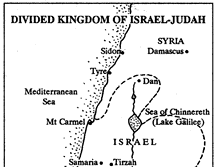
Much of the early part of Isaiah's book is concerned with his attempts to persuade the ungodly Ahaz to trust in God instead of seeking military help from Assyria. The next portion of the book records his attempts to control the zeal of the good king Hezekiah, who was so keen to free Judah from Assyrian power that he too sought foreign military aid, in this case from Egypt.
Isaiah saw that Assyria and Egypt, along with many other nations among Judah's neighbours, were opposed to Israel's God, who was the one and only true God. The prophet therefore announced God's judgments upon each of them in turn. But he saw also that Judah was rebellious against God. The nation was heading for a terrible judgment that would see the people taken into captivity in a foreign land. Through all these events, however, God would preserve the remnant, that minority of the people who remained faithful to him.
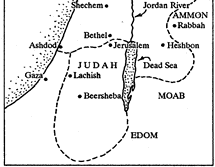
The final section of the book, which was probably written much later than the earlier parts, shows God's purposes in preserving the remnant. From this faithful group would come the beginning of new life for God's people. When the people acknowledged the justice of God's punishment and received cleansing from past sins, they would return to their land and enjoy peace and prosperity once more. This future glory of Israel is described at length, with particular emphasis on the qualities of the messianic king who would rule and the worldwide blessing that his kingdom would bring.
Conditions of Isaiah's time
With the long and prosperous reigns of Uzziah (or Azariah) in Judah and Jeroboam II in Israel, both kingdoms enjoyed expansion and progress (2 Kings 14:23-25,28; 15:1-7; 2 Chron 26:1-15). However, the prosperity brought with it severe religious, social, moral and political evils. The prophets of this time, Amos and Hosea, tirelessly denounced the moral and religious corruption of the people, and tried to defend the poor against the exploitation of the rich (Amos 2:6-7; 3:10,15; 6:4-6; 8:4-6; Hosea 4:1-6; 6:610; 7:2-4; 12:7-9).
The work of these two prophets was soon strengthened by that of Isaiah, and a few years later by that of Micah. Although the four prophets carried out their work in different parts of Israel and Judah, and although each had his own emphasis, they all saw the same evils and announced the same judgment (cf. Isa 1:12-23; 3:14-17; 5:11-13; 5:20-23; Micah 2:1-5,8-9; 3:1-3,9-12; 7:3).
Isaiah, being in a better position than the other three to influence the king, tried also to develop a greater concern for God's standards in the government of the nation. He saw what was happening in Jerusalem, and knew that Judah was heading for inevitable judgment. Yet the troubles of Judah were inseparably linked with those of Israel, and much in Isaiah's book relates also to the northern kingdom.
Political instability in Israel
When Jeroboam II died (753 BC), the northern kingdom Israel entered a time of political chaos as ambitious men fought to seize power. The new king reigned only six months before being murdered, but his assassin reigned only one month before suffering a similar fate at the hands of Menahem, who then became king (2 Kings 15:8-16).
Israel quickly lost its stability, and Assyria soon began to show interest in adding Israel to its rapidly expanding empire. Menahem survived only through buying the protection of the Assyrian king Tiglathpileser III (also known as Pul). The Israelite army commander Pekah was opposed to this pro-Assyrian policy. When Menahem died and was succeeded by his son, Pekah murdered the new king and seized the throne for himself (2 Kings 15:17-26).
Israel and Syria attack Judah
Tiglath-pileser III now planned a complete military takeover of Israel. (God's prophets had already predicted such a conquest; Hosea 10:5-8; Amos 7:17.) To strengthen the defence against Assyria, the Syrian (Aramean) king Rezin and the Israelite king Pekah entered into a joint defence agreement. They tried to persuade the Judean king Jotham and the succeeding king Ahaz to join them, but the Judean kings refused. Rezin and Pekah then attacked Ahaz, apparently with the aim of conquering Judah, putting their own king on the Judean throne, then forcing Judah to join their anti-Assyrian alliance. This attack took place in 735 BC (2 Kings 15:37; 16:5; Isa 7:1-2,6).
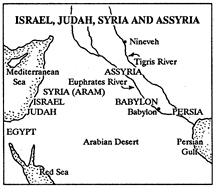
On learning that the Israelite-Syrian army was nearing Jerusalem, Ahaz panicked. Isaiah remained calm and urged the king to trust in God, assuring him that he had nothing to fear. Israel and Syria would not defeat Judah, but would themselves be conquered by Assyria. Ahaz had only to believe God (2 Kings 16:5; Isa 7:2-9; 8:4). But Ahaz neither trusted God nor believed Isaiah. Instead he decided to ask Assyria to come and help him. Isaiah warned that this was a foolish move, because it would place Judah under Assyria's control. Again Ahaz ignored the advice (2 Kings 16:7-8; Isa 8:5-8).
In response to Ahaz's request, Assyria attacked Syria and Israel. When Assyria conquered a country, its policy was to take the people captive into other parts of the Assyrian Empire and replace them with settlers from elsewhere. This helped to prevent rebellion breaking out in the conquered territory. Therefore, when Tiglath-pileser III conquered Syria, he carried off the people into captivity in Assyria (2 Kings 16:9). This happened in 732 BC and marked the end of the kingdom of Syria, as foretold by the prophets (Isa 17:1; Amos 1:4-5).
Tiglath-pileser continued his attack across the border of Syria and into Israel. He seized much of Israel's eastern and northern territory, and carried off the inhabitants into captivity (2 Kings 15:29). This was the beginning of the end for Israel. The nation was finally conquered by Assyria and its people taken captive into foreign lands in 722 BC (2 Kings 17:1-6).
Judah's new policies under Hezekiah
The Assyrians were now dominant in Palestine. In the north they had replaced former Israelite inhabitants with settlers from elsewhere (2 Kings 17:24), and in the south they had imposed a heavy tribute on the Judean king Ahaz (2 Kings 16:7-8). But when the young Hezekiah succeeded Ahaz in Judah, he set out on the bold task of freeing Judah from all Assyrian influence, whether military, political or religious.
Hezekiah's first action was to reform Judah's corrupt religion. He destroyed all idolatrous shrines, cleansed and rededicated the temple, reinstituted various festivals and ceremonies, and organized the priests and Levites according to the arrangements originally set out by David (2 Kings 18:1-6; 2 Chron 29:1-31:21).
It is doubtful, however, that Hezekiah's reforms brought any lasting change in the lives of the people in general. Hezekiah is commended for the good work he did (2 Kings 18:5), but the prophets of the time, Isaiah and Micah, do not mention his reforms. They saw that, in spite of the renewed religious activity, people had not changed inwardly. They gave little evidence of genuine faith and repentance (Isa 1:11-20; Micah 6:6-8).
In relation to Assyria's military and political dominance of Judah, Hezekiah was equally zealous for reform. But before he declared his new policy on foreign affairs, he fortified Jerusalem's defences, strengthened the city wall and improved the city's water supply as a precaution against possible siege (2 Kings 20:20; 2 Chron 32:5-6). Then, assured of military backing from Egypt, he revolted against Assyria by refusing to pay further tribute (2 Kings 18:7-8).
Isaiah opposed this dependence upon Egypt, just as during the reign of Ahaz he had opposed dependence upon Assyria. Judah's need was not for military help from Egypt but for quiet faith in God (Isa 30:1-3,15; 31:1,3). In response to Hezekiah's rebellion, Assyria attacked Jerusalem (701 BC; Isa 36:16). The book of Isaiah gives a lengthy account of events surrounding the attack and Jerusalem's miraculous deliverance.
Captivity and return
After the account of Jerusalem's deliverance from the Assyrian siege, there is a gap in the record of approximately 150 years. This gap occurs between Chapters 39 and 40, and forms a natural division in the book. In fact, Chapters 40-66 are so different in content and style from Chapters 1-39, that some biblical scholars suggest they were not written by Isaiah, but come from some person or persons of a later generation.
In brief, what happened during this intervening period was that Assyria was conquered by Babylon (612 BC), who then conquered Judah, carried the people captive to Babylon and destroyed Jerusalem (605-587 BC). The messages recorded in the latter section of Isaiah were intended originally for the Judean captives in Babylon.
During this time of the Judeans' captivity, events foreseen by the prophet began to happen. In neighbouring Persia a man named Cyrus had risen to power, and one by one conquered most of the surrounding nations. Then, in 539 BC, he conquered Babylon, and immediately gave permission to the captive Jews to return to their land (Ezra 1:1-4). Many returned and immediately began to rebuild the temple, but because of delays through opposition it was not finished till 516 BC (Ezra 6:14-15).
THE USE OF NAMES
The name Yahweh
In the Hebrew Bible a number of words are used for God, the most common of which are translated in English Bibles as 'God' (Hebrew: el or elohim) and 'the LORD'. The latter of these two words, which is always printed in capitals, has a distinctive significance in the Old Testament. Where God is called 'Lord' (and the whole word is not in capitals), the Hebrew word is usually adon or adonai, a word that indicates God's sovereignty as lord and master. But where he is called 'LORD' (in capitals) the Hebrew word is yahweh, the name of the Hebrews' God.
There is some mystery concerning the origin and usage of this name. Israel's ancestors knew God as Yahweh (Gen 12:1; 26:2; 28:21; 49:18), but the people as a whole seem to have first understood the significance of the name only at the time of their escape from Egypt under Moses. God revealed himself to Moses as 'I am who I am' (Exod 3:14; sometimes translated 'I will be who I will be'), and Moses was to pass this revelation on to the people. In revealing himself in this way, God was providing an explanation of what the name Yahweh should have meant to his people. In the Hebrew language the word translated 'I am' is related to the name of God, Yahweh.
Originally the Hebrew language was written using consonants only. The absence of vowels was no problem, because readers knew how to put in the vowels as they read. The name of Israel's God was written as YHWH (without vowels) but pronounced apparently as Yahweh. There can be no absolute certainty about this pronunciation, because there are no Hebrew records old enough to record it.
By the time the Hebrews had developed the practice of adding vowels to the written language, they no longer spoke the name YHWH. This, they claimed, showed their reverence for the holy name of God, but for many it was more a superstition. Whatever the reason for it, the practice developed that when the Hebrews read the Scriptures, instead of speaking the word YHWH, they used the word adonai (meaning 'lord' or 'master').
When, about 300 BC, a version of the Hebrew Bible added vowels to the consonants, it put the vowels of adonai to the consonants YHWH. This produced a new word, Jehovah, though the Hebrews still preferred to substitute adonai for YHWH when speaking. English translations of the Bible have usually avoided the pronunciation problem by using 'the LORD' (in capitals) instead of YHWH.
Names of nations
A common practice among the Old Testament prophets was to refer to countries by some representative feature, such as a king (Isa 14:4; Ezek 28:2), a god (Isa 46:1; Jer 48:46), a river (Isa 8:7; Jer 2:18), a mountain (Isa 1:27; Ezek 35:2), a tribe (Isa 7:2; Jer 49:8), or a city (Isa 9:8-9; Jer 49:3). The reader of the prophets will therefore find that the northern kingdom Israel is often called either by the name of its leading tribe, Ephraim, or by the name of its capital, Samaria. In the same way the southern kingdom Judah is sometimes called by the name of its capital, Jerusalem. Among foreign nations, those most commonly referred to by their capital cities are Assyria (called Nineveh) and Syria (called Damascus).
Names of Israelites
During the years of the captivity in Babylon and the subsequent reconstruction of Israel, it became increasingly common to refer to Israelites as Jews. The background to this change of usage goes back to the time of the divided kingdom.
When the people of the former northern kingdom (Israel) were taken captive to various countries by Assyria, they became absorbed into the nations where they lived and largely lost their national identity. But when the people of the former southern kingdom (Judah) were taken into captivity in Babylon, they retained their national identity. The people of Judah were called Judeans, which was later shortened to 'Jew'.
After Persia's conquest of Babylon, captives from Babylon returned to the ancient Israelite homeland. This meant that most of those involved in the rebuilding of Israel were Judeans, or Jews. But they were also Israelites, according to the meaning of the name that went back to the nation's origins. There was no longer any division in Israel between north and south, and the names 'Israelite' and 'Jew', along with the ancient name 'Hebrew', were used interchangeably (Jer 34:9; John 1:19,47; 2 Cor 11:22; Gal. 2:14).
1:1-6:13 Judah an unclean people 7:1-12:6 Judah in the reign of Ahaz 13:1-23:18 Messages for various nations 24:1-27:13 Final judgment and salvation 28:1-33:24 Hezekiah and the Assyrians
34:1-35:10 More about judgment and salvation 36:1-39:8 Historical appendix 40:1-48:22 Return from Babylon 49:1-55:13 The salvation of God's people 56:1-66:24 Present shame and future glory
1:1-6:13 JUDAH AN UNCLEAN PEOPLE
God judges Judah (1:1-9)
The opening chapter introduces most of the main issues that the prophet is to deal with, and therefore is a summary of the overall message of the book. The scene is one of judgment. God is the judge, his people the accused, heaven and earth the witnesses. The charge is that Judah has rebelled against God. Even animals are grateful for what their masters do for them, but the people of Judah show no gratitude to their heavenly Father (1:1-3).
Isaiah declares that the sinful people are more than ungrateful to God; they despise him (4). God has punished them repeatedly by sending enemy armies to attack them, with the aim that they see their sin and return to him. His punishment has been so consistent that Judah is likened to a person who has been beaten and flogged till he is bruised and cut from head to toe. But Judah is still stubbornly unrepentant (58). It would have been destroyed long ago, had not God shown mercy on account of the few faithful believers scattered throughout the nation (9).
Religious and moral corruption (1:10-31)
No doubt the people thought they were pleasing God by offering sacrifices, attending public worship services, and keeping the special Israelite feasts; but because their everyday lives were full of sin, their religious exercises were hateful to God. No matter how correct the form of worship, God will not accept it unless the people show a corresponding zeal for right behaviour (10-15).
The people must turn from their selfishness and treachery, and begin to show love and honesty in their everyday dealings if they want to be pleasing to God (16-17). He is ready and able to cleanse them, but whether he will depends on them. They must be willing to stop pleasing themselves and obey him instead. God wants them to enjoy prosperity in their land, but if they refuse to change their ways they will meet only disaster (18-20).
Jerusalem is so morally filthy that it is likened to a prostitute. The city that was once pure is now unclean. It is like silver that has become covered with dirt, like wine that has been watered down. The rulers and judges are corrupt, favouring the rich in return for bribes, but ignoring the poor and denying them justice (21-23).
God loves Jerusalem (Zion), and therefore he will not tolerate this wrongdoing. He will act in judgment against the rebels, like a refining fire that burns away the rubbish and leaves the metal pure. Corrupt rulers and judges will be replaced by those who are just. Jerusalem, instead of being like a prostitute, will be like a faithful wife (24-26). In the end the righteous will triumph, while the wicked will be overthrown (27-28).
People engage in heathen worship in the hope of increasing their prosperity, but in the end they will find that it does them no good (29). They are proud of the power they have gained through their evil ways, but they will find that, unless they turn from their corruption and idolatry, this power will be the means of their destruction. It will be like a spark that sets a forest on fire (30-31).
Baal worship
From the early days of their settlement in Canaan, the Israelites had been led astray by the worship of local gods, collectively known as Baalim (the Hebrew plural of Baal). Joshua warned the original settlers of the dangers of idolatry (Josh 24:14-15), but by the time of the judges it was a major national problem. It continued to be a problem throughout the history of the Israelite kingdom, and was in fact one of the chief reasons for the captivity of both Israel and Judah. Because Isaiah, like most of the prophets, refers to Baal worship often, present-day readers need to have some understanding of how Baal worship functioned if they are to understand the book of Isaiah. For further details see introductory notes to Judges, sub-heading 'The religion of the Canaanites'.