
Part 3
One superstitious heathen practice that Israel's law prohibited was the keeping of part of a sacrifice as a good luck charm. Another was the boiling of a young goat in its mother's milk, in the hope that this would give increase in the flocks (18-19).
Promises and instructions (23:20-33)
The covenant document, which began in Chapter 20 and which has laid down God's requirements for his people, concludes with a number of promises and warnings. This again follows the well known form of ancient covenant documents. The specific promises for God's people were protection on their journey to the promised land, victory over enemies, health and prosperity in Canaan, and national expansion till they filled their allotted territory. These blessings, however, were conditional upon their obedience and complete loyalty to God (20-33).
The covenant sealed (24:1-18)
When Moses recounted the covenant demands to them, the people once more declared their willingness to obey (cf. 19:8). In ancient times covenants were usually sealed by blood (see notes on Gen 15:7-21), and at Sinai too God and his people were joined in a blood ritual. Half of the blood was thrown against the altar (representing God) and half was sprinkled on the people. This blood ritual, though having its usual significance in covenant ceremonies, may have had added meaning in view of Israel's recent experience in the events of the Passover. On that occasion sacrificial blood was evidence of life laid down to release a person under condemnation of death. The blood that sealed the covenant at Sinai seems to have had a similar significance. It spoke of Israel's release from the penalty of past sin so that the nation entered the covenant as a people who were holy and dedicated to God (24:1-8; cf. 19:5-6). (For details of the various sacrificial offerings see notes on Leviticus 1:1-7:38.)
To emphasize the closeness of this covenant relation with God, the representatives of Israel went up into the mountain, where they saw the glory of God (without being struck dead, the writer notes) and ate the meal of the peace offering in fellowship together (9-11). On returning to the camp, Moses appointed Aaron and Hur to govern the people in his absence while he and Joshua returned to the mountain. Joshua went only part of the way, but Moses, when invited, entered the very presence of God. He was there about six weeks, during which he received God's directions concerning the building of the tabernacle and the establishment of the priesthood, as recorded in Chapters 25-31 (12-18).
25:1-31:18 THE TABERNACLE AND THE PRIESTHOOD
Purpose of the tabernacle
The cloud on the mountain was only a temporary sign of God's presence with his people. Now that Israel was beginning a new era, God gave the people a tabernacle, or tent, as a permanent sign that he dwelt among them and was part of them. He was the very centre of their national life. This tabernacle was known as the tent of meeting (39:32), for it was the place where God met with his people. It was also called the tent of the testimony (38:21), to remind the people that within it, in the ark, was the testimony of God, the law, that was to guide and control their lives.
Yet while God dwelt among his people, he also, in a sense, dwelt apart from them, for they were sinful and he was holy. They could not come to God directly. They had to come first to the priests and offer sacrifices, then the priests approached God on their behalf. The contrasts between the limitations of this old covenant and the perfections of the new covenant through Jesus Christ are presented in the New Testament book of Hebrews. But until God's purposes were fulfilled in the life, death and resurrection of Jesus, the laws and ceremonies of the old covenant helped people to understand God and to understand themselves.
God did not design these laws and ceremonies as a means by which people might earn salvation. Rather they were part of the developing plan of God that showed people, stage by stage, how he was able to forgive those who trusted in him, yet be just in doing so. This revelation reached its climax in Jesus Christ, and on the basis of his death God could forgive all who had faith in him, even those who lived in Old Testament times (Rom 3:25-26; Heb 9:15).
Then, as now, people were saved only by faith in the sovereign God who in his mercy forgave them and accepted them. Faith, not understanding, was the requirement for salvation. A person's understanding of how God's work of salvation operated depended on how far the divine revelation had progressed in its movement towards completion in Jesus Christ. But in any era the repentant sinner who turned in faith to God could be forgiven.
Design of the tabernacle
The tabernacle was designed so that it could be easily put together, taken apart and transported, for the people of Israel took it with them on their journey to Canaan and set it up at camps along the way.
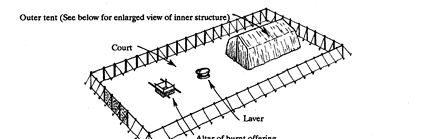
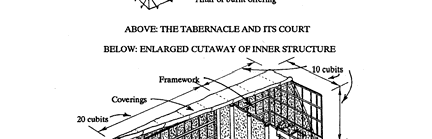
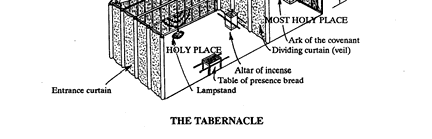
Simply described, the tabernacle consisted of a wooden box-like frame covered with a cloth and protected from the weather by a tent that covered the whole. In outward appearance it was a tent (which is the meaning of the word 'tabernacle'). The timber framed structure hidden under this tent consisted of two rooms. The front room, which was entered through a curtain, was called the Holy Place and contained three pieces of furniture – a table, a lampstand and an altar for burning incense. A second curtain separated the Holy Place from the smaller rear room, which was called the Most Holy Place or Holy of Holies. This room was the symbolic dwelling place of God and contained the ark of the covenant.
This tabernacle-tent was set in a large court surrounded by a fence. In this enclosure were two articles, the most important of which was an altar on which all the animal and food sacrifices were offered. The other article was a laver, or large basin, in which the priests washed. The tabernacle complex was in the centre of the camp, with the people's tents pitched in an orderly arrangement around it (see Num 2:1-31; 3:21-38).
As a structure, the tabernacle was entirely suited to Israel's circumstances. A tent over a prefabricated frame was suitable for a travelling people, and its construction could withstand the desert winds. Many of its articles of furniture were fitted at the corners with rings, through which poles were placed to make the articles easy to carry. The wood to be used was plentiful in the region, did not warp or rot easily and was light, which helped further towards easy transport. Metals were of the kind that would not rust. Timber was overlaid with metal, bronze being used to cover articles in the open courtyard, and gold those inside the tabernacle-tent. Cloth hangings were suitable for the entrances and partitions of a tent.
The brilliance of the metals and the richness of the cloth hangings increased as one moved from the outer court, through the Holy Place to the Most Holy Place. This helped emphasize the glory and majesty of Yahweh, the King of Israel (cf. 28:2).
Materials given by the people (25:1-9)
All the building materials used in the tabernacle came from the voluntary offerings of the people, who at the time were enjoying a degree of prosperity because of their recent gains from the Egyptians and the Amalekites (25:1-7; see 12:36; 17:13). The people gave so generously that Moses had more than he needed and asked them not to bring any more (see 36:5-7). In order that the visible (symbolic) dwelling place of God might be a help and not a hindrance to the people's spiritual growth, everything had to be built according to God's instructions. The people were not to try to 'improve' God's plan by introducing ideas they may have got from similar kinds of structures they had seen in Egypt (8-9).
Ark of the covenant (25:10-22)
The ark (GNB: covenant box) was a gold covered wooden box, two and a half cubits long, one and a half cubits wide, and one and a half cubits high. (A cubit was about forty-four centimetres or eighteen inches.) It was the only piece of furniture in the Most Holy Place (see 26:34). Inside the ark were the two stone tablets on which the law was written, as a constant reminder to the people of Israel that the God who dwelt among them was also their law-giver (10-16; Deut 10:1-5). (Later Aaron's rod and the golden pot of manna were also placed in the ark; see Heb 9:4.)
A specially sacred part of the ark was its richly ornamented lid, called the mercy seat. The two cherubim (GNB: winged creatures) attached to the top of the mercy seat apparently symbolized divine protection of the seat, the ark and the contents (17-21). This mercy seat appears to have been a visible throne for the invisible God. It was the place where God spoke with Moses and where the high priest made atonement for the sins of the people when he entered the Most Holy Place once a year (Lev 16:119,29-31; Heb 9:7). The name mercy seat emphasized to the people of Israel that when they finally
reached the heart of their religion they were still sinners, dependent entirely upon the mercy of God for their salvation (22).
The table and the lampstand (25:23-40)
These two pieces of furniture were placed opposite each other against the side walls of the Holy Place (see 26:35). The table was made of wood overlaid with gold, and the vessels associated with it (used in the ceremonies of the Holy Place) were all made of gold (23-29). On the table were twelve small loaves of bread (called 'presence bread') arranged in two rows of six. Each Sabbath the priests placed twelve fresh loaves on the table and ate the old loaves (Lev 24:5-9). The symbolism of the presence bread is not explained. Possibly it was a reminder that the whole of Israel, in its twelve tribes, lived constantly in the presence of God. God was their provider, and the bread was a fitting and constant acknowledgment of this before him (30).
No dimensions are given for the lampstand. It weighed about thirty-five kilograms, held seven lamps, was made of one piece of gold, and was richly ornamented. Its trays and other utensils were also of gold. This seven-headed lamp provided continual light in the otherwise dark Holy Place, and was tended by the priests morning and evening (31-40; cf. 27:20-21).
Curtains, coverings and framework (26:1-37)
Probably the easiest way to picture the two-roomed structure under the tent is as a huge open box with a cloth draped over it. This cloth was a multi-coloured, richly embroidered linen covering that formed a ceiling and hung over the four sides but did not quite reach the ground. It consisted of two sets of five curtain strips sewn along their length and then tied together to form one huge covering (26:1-6).
Over this multi-coloured linen covering was draped a second covering, this one of black goats' hair. It was cut and sewn in similar fashion to the inner linen covering but was bigger all round so that it reached to the ground, thereby protecting the inner covering (7-13).
Pitched over this covered box-like structure was a two-layer tent made of animal skins. This provided the entire structure inside with protection against the weather (14).
The two sides and rear of the structure under the tent were made of wooden frames overlaid with gold and fitted vertically. This produced a structure thirty cubits long, ten cubits wide and ten cubits high. The wooden frames were inserted into metal bases and held firm by five horizontal bars in each wall (15-30).
A richly embroidered multi-coloured curtain was hung from pillars to form a partition between the two rooms of this rectangular structure. This curtain is usually called the veil, to distinguish it from another curtain that hung from another set of pillars to form the front wall and entrance to the structure (31-37). The pillars were fitted into metal bases and were probably held firm at the top by a connecting horizontal bar. Their tops were richly ornamented (see 36:38).
Altar of burnt offering (27:1-8)
All animal sacrifices were offered on what has become known as the brazen altar (though the metal referred to in older English versions as brass was probably bronze or, less likely, copper). The altar was made of timber overlaid with bronze and was hollow inside. Its utensils also were made of bronze (27:13).
The instructions do not tell us how sacrifices were burnt on this altar. Either the altar was filled with earth to form a mound on which the sacrifices were burnt, or it had an internal grid for the same purpose. Halfway up the altar on the outside was a horizontal ledge supported by a grating. The priest may have stood on this ledge while offering the sacrifices, to avoid treading in the blood of the sacrificial animals that was poured out at the base (4-8).
Tabernacle court; oil for the lamp (27:9-21)
Around the perimeter of the tabernacle courtyard (GNB: enclosure) was a fence, which separated the tabernacle sufficiently from the camp to create a feeling of reverence towards the symbolic dwelling place of God. This fence gave protection against desert winds and was high enough to prevent people outside from watching the rituals out of idle curiosity.
The fence was made of cloth attached to posts, which were fitted into metal bases in the ground and held firm by ropes tied to ground pegs (see 35:17-18). A silver band at the tops of the posts may have been a decoration, or it may have been a means of connecting the tops of all the posts to give the fence added stability. As with the tabernacle-tent, the court faced east and had a curtain entrance in its eastern side (9-19).
Light from the seven-headed lamp was the only light in the tabernacle. The ordinary people supplied the oil for the lamp, and the priests tended the lamp morning and evening to keep it burning continually (20-21).
The priesthood
Having outlined his plans for the tabernacle as the central place of worship for his people, God now provided further for that worship by establishing a priesthood. The priests were responsible for the proper functioning of all matters connected with the tabernacle and its services.
Until now Moses had been not only the leader of the people but also the go-between, or mediator, between the people and God. In the ordered religious life of the nation that was now being established, this function of people's representative in religious affairs was given to Aaron (who was appointed high priest) and his sons (who were the ordinary priests that assisted him). In future only direct male descendants of Aaron could be priests. It was further revealed (see notes on 32:25-29 below) that only those of the same tribe as Aaron, the tribe of Levi, could assist in the practical affairs of the tabernacle such as its erection, maintenance and transport (cf. 6:16-25; 29:9; Num 3:9-10).
Priests were required to offer sacrifices on behalf of those who brought them (Heb 8:3). They therefore served as mediators between the people and God. They also carried out daily functions connected with the overall tabernacle rituals, such as ensuring that a sacrifice was burning on the altar continually (29:38-42; Lev 6:12), keeping the lamp burning in the Holy Place (27:20-21) and offering incense on the golden altar (30:7-8). They were also to teach the law of God to the people and serve as moral guides to the nation (Deut 31:9-13; 33:10; Mal 2:7).
Only priests could enter the Holy Place and only the high priest the Most Holy Place. Even then he could do so only once a year, on the Day of Atonement (Lev 16:1-19,29-31; Heb 9:6-7).
Clothing for the priests (28:1-43)
All priests wore special clothing that gave them a dignity and honour suited to their office. The high priest's clothing was especially striking, but more importantly its various pieces helped the people understand the sacredness of his functions before God (28:1-3).
The most colourful piece of clothing worn by the high priest was the ephod (GNB: sacred vest), a short linen garment of the same material as the tabernacle curtains but with gold thread worked into the cloth (see 39:2-3). It was held in place by two shoulder straps and bound at the waist by a band (RSV: girdle; GNB: sash) of the same material. Attached to the shoulder straps were two stones, one to each shoulder, engraved with the names of the tribes of Israel (4-14).
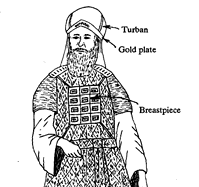
Positioned centrally over the high priest's chest was a piece of richly embroidered cloth, doubled to form a square flat pouch. This was called the breastplate or breastpiece. Fixed to the outside of it were twelve precious stones, again symbolic of Israel's twelve tribes. The breastplate was tied over the ephod with gold chains attached to rings at the four corners. Inside it were the Urim and Thummim, generally thought to be two small objects which, when drawn out of the pouch, would indicate 'yes' or 'no' to a suitably put question (15-30; cf. Num 27:21; 1 Sam 14:41; 28:6).
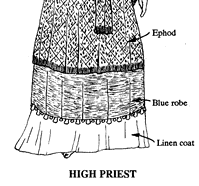
Directly beneath the ephod was a blue robe. From the bottom of this robe hung bells and pomegranates, so that when the high priest moved from place to place inside the tabernacle, the people outside, on hearing the bells, could follow him in their thoughts and prayers. The sound of the bells would reassure them, letting them know that the high priest had not been struck dead. Their offering had been accepted (31-35).
On his head the high priest wore a turban, fixed to the front of which was a gold plate engraved with the words 'Holy to the Lord'. This declared to all that holiness was essential to every part of Israelite worship (36-38). The remaining garments of the high priest (that is, those worn under his blue robe) were the same as those for ordinary priests, namely, a full length long-sleeved white linen garment (GNB: embroidered shirt), along with undergarments and other accessories (39-43).
Several features of the high priest's clothing reminded him constantly that he was acting not as an individual, but as the representative of the people. First there were the engraved stones bearing the names of the twelve tribes on his shoulder pieces and breastplate (v. 12,21). Second there were the objects known as the Urim and Thummim, through which he sought God's will in judging the people (v. 30). And third there was the gold plate on his turban to symbolize that he bore their guilt before the holy God who alone could pardon them (v. 38).
Dedication of the priests (29:1-37)
One purpose of this dedication ceremony was to impress upon priests and people alike that those who served God had to do so with purity and reverence. The priests were washed, symbolizing purification, then clothed and anointed, symbolizing appointment to their position (29:1-9).
Since they themselves were not free from sin, the priests had to offer sacrifices for their own sins before they could act on behalf of others. First they offered a bull as a sin offering. By laying their hands on its head, they identified themselves with the animal. As their representative it died the death that they, because of their sins, should have died. The blood placed on the horns of the altar was evidence of life laid down. The offering of the best parts of the animal on the altar signified the priests' devotion to God, and the burning of its remains outside the camp their hatred of sin (10-14).
Once sin had been justly dealt with, the priests offered a burnt offering. By burning the entire animal on the altar they pledged total dedication to God and his service (15-18).
After this the priests offered a second ram, called the ram of ordination (GNB: dedication). The unusual procedure in placing blood on the ear, thumb, toe and clothing of the priests probably symbolized the dedication of their whole life and service to God (19-21). Another way the priests demonstrated their dedication was by taking the most valued parts of the animal, along with certain cereal foods, waving them up and down in symbolic offering to God, then sacrificing them on the altar (22-25).
God showed his acceptance of the priests' offering and his fellowship with them by giving them, as their special portion, certain other parts of the sacrificial animal. Again, however, the offerers first waved these portions before God to acknowledge that all rightly belonged to him (26-28). Finally, the priests came together to eat the remainder of the animal in a meal, thereby expressing fellowship with one another and with God (29-34).
This whole ceremony was repeated seven days. This gave the priests time to think carefully about the importance of the ritual and the life of service that lay ahead (35-37).
The daily offerings (29:38-46)
As an expression of Israel's constant devotion to God, an offering of consecration was kept burning on the altar continually. The priests renewed the offering morning and evening, arranging the parts of the sacrificial animal on the altar in such a way as to ensure that the fire never went out (38-42; see Lev 6:813). God reminded Moses that his purpose in giving Israel the tabernacle and the priesthood was that he might dwell among his people and that they might know and serve him (43-46).
Altar of incense; tabernacle tax (30:1-16)
The altar of incense was made of wood overlaid with gold. It was much smaller than the altar of burnt offering, was located in a different place and was designed for a different purpose. It was not used for sacrifices, but only for the burning of incense, offered each morning and evening. Incense was a substance produced by grinding and blending certain spices (see v. 34-38 below), and when burnt gave off thick white smoke and a strong smell. Its ceremonial burning seems to have symbolized the offering of prayers and homage to God (30:1-10).
Whenever there was a national census, the people were to pay a special tax, which was then used for the maintenance of the tabernacle. This tax was equal for all, but small enough for even the poorest to pay, indicating that before God the rich had no advantage over the poor. The lives of all were preserved on the same basis, the mercy of God. All had an equal share in the maintenance of the tabernacle and its services (11-16).
Bronze laver (30:17-21)
The laver was a large basin in which the priests washed their hands and feet before either entering the Holy Place or administering the sacrifices. No doubt they needed to wash again after offering the sacrifices (cf. 2 Chron 4:6). Such washing, apart from its practical benefits, had symbolic significance, since cleansing from all uncleanness was necessary for acceptable service for God (17-21).
No details are given concerning the shape or size of the laver, though it was large enough to require a firm base or stand (see v. 17). It was made from polished bronze mirrors that many of the women gave as their contribution to the construction the tabernacle (see 38:8).
Anointing oil; incense (30:22-38)
Oil had special significance when used to anoint people or things. Anointing, in its highest sense, meant that holy oil was poured over, or otherwise applied to, people or things to signify that they were set apart for the service of God. The art of preparing oils, perfumes and incenses was well known in Egypt and Arabia, and the Israelites apparently learnt such skills from these people. But the formula given to Moses for the anointing oil was to be used only for the oil of the tabernacle rituals (22-33).
Likewise the incense for the tabernacle was to be made according to an exclusive formula. This incense was to burn 'before the testimony', that is, on the golden altar that stood in front of the ark of the testimony (the covenant box) but separated from it by a curtain (34-38).
Craftsmen for the work (31:1-11)
In building the tabernacle, the craftsmen were to follow strictly the God-given plan, but they still had plenty of opportunity to use their creative abilities. The power of God's Spirit worked through human intelligence and ability. At the same time people had to remember that natural ability was not enough for the service of God. His Spirit was necessary in guiding the craftsmen so that everything might be in accordance with his purposes (31:1-6)
This combination of obedience and initiative in the work of the craftsmen applied not just to the tabernacle itself. It applied also to the priests' clothing, the anointing oil and the incense (7-11).
The tabernacle and its services were similar enough to other ancient structures and religious practices for the Israelite people to understand them readily. Yet they were different enough to impress upon them the uniqueness of Yahweh and the faith by which they served him.
The weekly day of rest (31:12-18)
People might have thought that, because the tabernacle was a sacred structure, they could work on it on the Sabbath day. God reminded them to keep the weekly Sabbath as a holy day of rest. This rest was part of God's plan for preserving the holiness of his people (12-17).
God then gave Moses the ten basic commandments of the covenant engraved on stone as he had promised (see 24:12; cf. Deut 10:4). Having received God's instructions for his people, Moses went down from the mountain to put them into practice (18).
32:1-34:35 COVENANT BROKEN AND RENEWED
The golden bull (32:1-35)
Although they were God's people and had been delivered by his mighty power from slavery in Egypt, the Israelites were still very much Egyptian in their feelings, thinking and habits. They made an animal idol as a visible symbol of their unseen God, then developed a ritual to go with it, complete with priest, altar, sacrifices and feasting. And, as often happened with the pagan religions, drunkenness and immoral sex-play accompanied their idolatry (32:1-6).
This all happened while Moses was still on the mountain. God told Moses what was happening during his absence, adding that the people, because of their sin, deserved to be wiped out. God could then start afresh to build a people for himself, using Moses as the father of his new people just as previously he had used Abraham and, through him, Jacob (7-10).
Moses, thinking more of God's honour than his own, successfully pleaded with God not to destroy Israel, for the Egyptians would surely misunderstand his actions and accuse him of deceiving his people. Moses based his plea on God's mighty acts of deliverance in the past and his promises to Israel's ancestors. God heard Moses' prayer and as a result Israel was saved from destruction (11-14).
Reassured by God's response but still angry with the people, Moses returned to the camp. By breaking the stone tablets on which the law was engraved, he demonstrated graphically to the people that they had broken God's law. By grinding the idol to powder, mixing it with water and making the people drink it, he forced them to admit their sin and accept its consequences (15-20). At the same time he held Aaron responsible, because as leader of the people Aaron should have opposed the idolaters. Instead he followed them (21-24).
God did not wipe out the nation, but neither could he overlook sin. Men of the tribe of Levi, who had remained faithful to God amid the rebellion, carried out God's judgment and for their zeal were rewarded. Once the tabernacle was constructed and in use, only those of this tribe would be servants of God in the general duties connected with it (25-29; cf. Num 1:47-53; Deut 33:8-11). Note: The family of Aaron was one family within the tribe of Levi (see 4:14), and God had already given them the sole rights to the specialized work of the priesthood (see 28:1; 29:9). The Israelite priesthood is therefore referred to sometimes as the Aaronic priesthood, sometimes as the Levitical priesthood.
In a display of genuine love for the unbelieving people, Moses offered to die on their behalf and so be punished for them. But God would not accept the death of one person for another, for all were sinners, though the extent of their sin varied. God would hold each person responsible for his or her actions. He would show mercy on the unfaithful nation, but he would punish individuals who rebelled against him (30-35).
Assurance of God's presence (33:1-23)
Because of his mercy God allowed the people to continue their journey to the land he had promised their ancestors, but because of their sin he could not go with them lest he destroy them. However, he promised to send a heavenly representative to go before them into Canaan. He also required the people to give a clear outward sign of mourning for their past sin and the loss of fellowship with God that resulted from it (33:1-6).
God's refusal to go with Israel troubled Moses. He therefore came to God with yet another request on behalf of the rebellious people. In introducing this prayer, the writer gives us a picture of how the people of Israel worshipped during the time before they built the tabernacle. Moses met and talked with God in a tent outside the main camp, while the people stood at their tent doors facing Moses' tent and worshipping in spirit with him. Moses' chief assistant, Joshua, acted as guardian of this sacred meeting place (7-11; cf. 24:13).
Moses then put his question to God. If God would not dwell among the people lest he destroy them, and if his special representative was not to dwell among them but go ahead of them, who then would dwell among them? The people may have been rebellious, but Moses did not want God to remove himself from them completely. He asked God for some clear indication of his plans. God replied by promising Moses his presence. This reassured Moses, for he saw no purpose in Israel's entering Canaan as God's people if his presence was not among them (12-16).
God's reply encouraged Moses to ask even more. He wanted a greater spiritual understanding of the nature of God. In answer God revealed to Moses something more of his glory. The vision was not to satisfy curiosity about God's appearance, but to reveal the goodness, mercy and glory of him who was Israel's God, Yahweh (17-23). (This vision took place a little later, when Moses returned to the mountain; see 34:4-7.)
The covenant re-established (34:1-35)
When the people first swore their faithfulness to the covenant, they promised to keep all its requirements (see 24:3-8), but in practice they failed badly. God in his grace would renew the covenant, and to this end he called Moses back up the mountain. His fresh revelation to Moses therefore emphasized his love and mercy, but it also reminded the people of his righteous justice. Moses, painfully aware of the Israelites' weakness, appealed to the grace of God, asking that he would still dwell among them and own them as his people in spite of their stubbornness (34:1-9).
God then renewed his covenant, promising Israel provision and protection. He would cause the world to be amazed at the greatness of his power as he drove out nation after nation to give his people the land he had promised them (10-11). He sternly warned his people against copying, or even tolerating, heathen religious practices in their new land. This warning was particularly appropriate in view of recent events in the worship of the golden idol. To forsake God and follow other religious ideas would be spiritual adultery, compared to the unfaithfulness of a woman who leaves her husband for another man (12-17).
Accompanying the renewal of the covenant was a command to the people never to forget their deliverance from Egypt. Therefore, they were to keep the Feast of Unleavened Bread and maintain the practice of redeeming their firstborn (18-20; see 12:15-36; 13:1-16). Also specifically mentioned was the obligation to keep the weekly Sabbath and the annual festivals (21-24; see 23:12-17). Additional reminders concerned requirements for sacrifices and firstfruits (25-26; see 23:18-19).
God then made a declaration that the covenant Israel had broken was now re-established. Though the account is brief, Moses was with God on the mountain for about six weeks, as on the previous occasion (27-28; cf. 24:18).
Moses' appearance was so changed through his meeting with God, that he covered his face with a cloth when speaking to the people. The man who met God was unaware of his glory till others told him of it; by contrast, the people who had easily fallen into sin were afraid when they met one who appeared to them as a shining messenger from God (29-35; cf. 2 Cor 3:7-18).
35:1-40:38 CONSTRUCTION OF THE TABERNACLE
This section largely repeats the instruction given on the mountain in Chapters 25-31. It emphasizes that the people had to do God's work according to his covenant requirements. Therefore, they were to keep the Sabbath (35:1-3; cf. 31:16). If they wanted God to accept their offerings for the building of the tabernacle, they had to present those offerings in a spirit of joy and willingness (35:4-29). Though all could give offerings, only those with the God-given ability and the right motivation were to do the work (35:30-36:1). The people responded so generously in bringing materials for the work, that Moses asked them to stop giving (36:2-7).
The workmen then started on the tabernacle, making the double layer of inner coverings and the double layer outer tent (36:8-19), the wooden framework, the pillars and the curtains (36:20-38), the ark and the mercy seat (37:1-9), and the table, lampstand and altar of incense (37:10-29). They also made the articles for the court area, namely, the altar of burnt offering (38:1-7), the laver (38:8) and the fence that surrounded the court (38:9-20). Then follows a list of the offerings (38:21-31) and an account of the priests' clothing (39:1-31).
With much satisfaction and thanks, Moses inspected the completed, but as yet unassembled, parts of the tabernacle (39:32-43). He then supervised the erection of the entire complex, and dedicated the tabernacle and the priests as God had instructed him (40:1-33).
Exactly one year after leaving Egypt, or nine months after arriving at Sinai, the Israelites set up the newly made tabernacle (see 12:2; 19:1; 40:17). The cloud then rested on it as the visible evidence of God's dwelling among his people as the centre of their life and the object of their worship. This same cloud guided them on their journey through the wilderness to Canaan. Whether they camped or travelled, Yahweh, their covenant Redeemer, was with them (40:34-38).
Leviticus
In accordance with his promise to Abraham, God had brought the people of Israel out of Egypt and set them on their way to Canaan. After three months they arrived at Mount Sinai, where they remained for about a year while they organized themselves for the new life that lay ahead (Exod 19:1; Num 10:11). The book of Leviticus contains some of the teaching God gave to his people during the year they were camped at Sinai.
Religious system for a covenant people
The people of Israel knew that God had freely chosen them to be his people and in his grace had freed them from slavery in Egypt. They therefore responded fittingly by promising to do whatever he required of them (Gen 12:2; 15:7-21; Exod 2:24; 4:22; 6:6-8; 19:4-9; 20:2). God then joined himself to Israel in a covenant ceremony in which he laid down certain basic principles and detailed commandments, and the people in reply promised unconditional obedience (Exod 20:1-24:18).
God went on to show his people the plans he had for the religious life of the nation. He would provide them with a central place of worship, a priesthood to officiate in religious matters, and a sacrificial system by which they could demonstrate their faith towards him (Exod 25:1-Lev 7:38). To this he added a body of laws to ensure that priests and people alike were holy and pure in their relations with him and with one another (Lev 8:1-27:34).
This brief summary of the contents of Exodus and Leviticus shows that there is no break between the two books (cf. Exod 40:17; Lev 1:1; 27:34). It shows also that readers need to be familiar with the tabernacle and the priesthood in the second half of Exodus in order to understand the sacrificial system in the opening chapters of Leviticus. (Concerning the artificial division that produced the first five books of the Bible, see the introductory notes to Genesis, sub-heading 'The Pentateuch'.)
Although the book is entitled Leviticus, it contains little instruction for the Levites as a whole. (This instruction is given mainly in the next book, Numbers.) Almost the whole of the instruction in Leviticus is for the priests, who were only one family (the family of Aaron) within the tribe of Levi (Exod 29:9; Num 3:9-10). However, Israel's religious system in general is commonly called the Levitical system, and the Aaronic priesthood is sometimes called the Levitical priesthood.
Christianity is not part of the Israelite religious system, and Christians are not under Israel's law (Rom 6:14; Gal 5:1-4). But Christians can learn much from Leviticus as they understand those universal and timeless principles that underlie the specific laws given to one nation for a particular period (Rom 8:3-4; Gal 5:14,18). Also, since the Bible repeatedly refers to the sacrifices, festivals, rituals and ceremonies of the Levitical system, an understanding of Leviticus will help readers understand the rest of the Bible better.
1:1-7:38 The offerings 8:1-10:20 The priesthood established 11:1-15:33 Cleanness and uncleanness 16:1-17:16 The blood of atonement 18:1-22:33 Practical holiness 23:1-27:34 Special occasions
ISRAEL'S SACRIFICIAL SYSTEM
Offerers and their attitudes
From earliest times, offerings and sacrifices were a means by which people expressed their devotion to God. Some sacrifices were like gifts, the worshippers offering the best of their crops or animals to God in thanks for his goodness (Gen 4:4; 8:20). Other sacrifices emphasized fellowship, the offerers eating part of the sacrifice in a meal with their relatives and friends in the presence of God (Gen 31:54). Others were for the forgiveness of sins, where a slaughtered animal bore the penalty that the offerers, because of their sins, should have borne (Job 42:8). Features of these early sacrifices were later developed in the sacrificial system of Israel.
In any era or nation, the heart attitude of the worshippers was more important than their gifts. Abel offered the best of his flock in humble faith and God accepted his offering. Cain's attitude was arrogant and his life ungodly, and therefore God rejected his offering (Gen 4:2-5; Heb 11:4; 1 John 3:12). The Bible does not say that Abel's offering was more acceptable than Cain's because it involved the shedding of blood. Not till the time of Noah did God reveal the special significance of blood (Gen 9:3-6), and not till the time of Moses did he show clearly the value of blood for atonement (Lev 17:11).
God progressively revealed his ways as people were able to understand them, but the acceptance of offerings always depended on the spiritual condition of the offerers. The sacrificial system developed under Moses in no way ignored this principle; on the contrary, it had this principle as its basis. But troubles arose when people carried out the rituals mechanically, without genuine faith and uprightness. The prophets of God condemned such religion, not because of any fault in the sacrificial system, but because of the way people misused it (Isa 1:13-20; Amos 5:21-24; Micah 6:6-8).
Significance of blood
The Passover was an important event in the development of Israel's sacrificial system, for there the people saw the significance of blood more clearly. Since blood was a symbol of life, shed blood was a symbol of death – not death through natural causes but death through killing (Gen 9:3-6; Num 35:19,33). The blood of the Passover lamb was important not because of any special quality in the blood itself, but because it represented the animal's death, by which the firstborn was saved from judgment. The animal's death was the important thing; the blood sprinkled around the door was but a visible sign that the animal's life had been taken instead of the life of a person (Exod 12:13).
In Israel's sacrificial system God gave this shed blood of animals to guilty sinners to make atonement for their sin (Lev 17:11). All were guilty before God, and the penalty was death. They were cut off from God and had no way of bringing themselves back to God. Sinners who sought God's forgiveness realized there could be no forgiveness for sin, no releasing them from its consequences, apart from death. God therefore gave the blood of a guiltless substitute to bring cleansing and release from sin. Pardon was not something people had to squeeze from an unwilling God, but was the merciful gift of a God who wanted to forgive. The escaping of God's punishment was not something they brought about, but was due to God himself.
The animal that died in sacrifice suffered the penalty of sin so that sinners could be forgiven; for without such shedding of blood there could be no forgiveness (Heb 9:22). The blood of these animal sacrifices did not take away sins (Heb 10:4), but it did provide a way whereby people could see that God was acting justly in dealing with their sins. The only blood able to cleanse sins is the blood of Jesus Christ – his death on the cross – and in view of his death God could 'pass over', temporarily, the sins of believers in former ages. They were forgiven, one might say, on credit, because sin could not be actually removed till Christ died (Rom 3:25-26; Heb 9:15).
Sacrifice and salvation
It should always be remembered that the law, or the old covenant (to which the law belonged), was never meant to be permanent. Its purpose was to prepare the way for Jesus Christ, whose death did all that the Israelite sacrifices could not do. If, then, these sacrifices could not bring salvation, how, it may be asked, could those who lived under the old covenant be saved?
The answer is that people living under the old covenant were saved the same way as people are today – by the grace of God; and they received that salvation by faith (Eph 2:8). No people have ever been able to boast that they have achieved God's salvation by their own works (Eph 2:9).
Abraham lived hundreds of years before the introduction of the old covenant at Sinai, but he was saved by faith (Rom 4:13,16,22; Gal 3:17-18). The law was given at Sinai not as a means of saving people, but as a means of showing them the sort of life that a holy God required of them. In itself it was good, and it was intended to benefit those who were under it (Lev 18:5; Rom 7:10,12). But sinful human nature stirs people up to rebel against God, with the result that the law, though intended for people's good, in reality showed up their sin (Rom 7:7-13).
The benefit of the law in relation to salvation was that it showed people their sinfulness, so that they could then turn in faith to God and ask for his mercy and forgiveness (Rom 3:19-20; Gal 3:19). The law could teach, but it could not save. It could train, but it could not bring perfection. It could only prepare the way for Christ, who did all that the law could not do (Rom 8:3-4; Gal 3:23-25).
Although God in his grace forgave those who in faith turned to him, the sacrificial system and other religious practices detailed in the law were a God-given way by which people could express that faith. The instructions for the rituals provided a way by which they could demonstrate their obedience. The entire sacrificial system was a means by which God taught people what atonement involved. It was a further stage in the development of his plan of salvation, a plan that reached its fulfilment in Jesus Christ (Rom 3:21; Heb 9:23-26).
Whether people in Old Testament times knew it or not, Jesus Christ was the means by which God forgave those who turned to him in faith (Rom 3:25-26). The basis of salvation was always faith, not knowledge, and certainly not works (Rom 4:1-8).
Content of the sacrifices
The details of the sacrificial rituals taught the people that though God forgave sin freely, he did not treat sin lightly. He was a just God, and the sacrifices helped to teach people the meaning of atonement.
Whatever animal a person offered, it had to be without defects, symbolizing perfection. It was not, so to speak, under condemnation itself and so was fit to be the guiltless substitute for the guilty sinner (Lev 1:3,10). Normally the offerings, whether animal sacrifices such as bulls, goats, sheep, doves and pigeons, or food offerings such as cereals, flour, oil and wine, had to be the property of those who offered them. They were things that people had worked for and were in some way identified with personally. Wild animals and fish, though they could be eaten, could not be offered as sacrifices. Whatever people offered had to cost them something; they were things people sacrificed. They were offerings, things people gave (cf. 2 Sam 24:24). God did not want to drive anyone into poverty, nor did he delight in the death of animals; but he had to impress upon people that sin was a serious matter, and its removal was costly.
God's consideration for the people is seen in the alternatives he provided. People could offer the kinds of animals that they could afford and that were in keeping with their status in the community (Lev 1:3,10,14; 5:7-13).
No matter what status people enjoyed or what kinds of sacrifices they offered, the offerings always had to be the best available. Animals usually had to be males, which were more costly than females. To ensure that offerings were as near perfect as possible, salt was added to preserve them, and leaven (yeast) was forbidden to avoid spoiling (Lev 2:11,13).
The procedure followed
Much detail is given concerning the preparation and offering of the sacrifices, again emphasizing the orderly thoroughness that God required. The overall pattern was similar for most of the offerings. When the offerer brought the animal he laid his hands on its head, indicating that it was bearing his guilt and that he desired God to accept it on his behalf (Lev 1:4). He then killed it. He had to do this himself, an action that impressed upon him the horror that had resulted from his sin (Lev 1:11).
The animal was killed not on the altar but in the court of the tabernacle on the north side of the altar. The priest collected the blood in a basin to apply in various places, as a visible sign that a life had been taken to bear the penalty of sin. In some cases the priest splashed the blood against the sides of the altar of sacrifice; in others he took the blood into the tent to apply to the altar of incense or the mercy seat, then returned and poured out the remainder on the ground beside the altar (Lev 1:11; 4:7; 16:14). In the case of bird offerings, the amount of blood was not sufficient for all this ritual, and was usually drained out beside the altar (Lev 1:15; cf. 14:15).
With each kind of sacrifice, some of it was burnt, though the amount that was burnt and the place in which it was burnt varied. The portions that were not burnt were eaten, sometimes by the priests and worshippers, sometimes by the priests and their families, and sometimes by the priests alone.
There were five main offerings. Directions concerning those who brought the offerings are given in Leviticus 1:1-6:7, and further details of procedure for the priests are given in Leviticus 6:8-7:38. The following notes combine details from the two sections to help towards a clearer understanding of the five different offerings.
1:1-7:38 THE OFFERINGS
The burnt offering (1:1-17)
Of all the offerings, the burnt offering was the most ancient. It had been in general use among God's people long before Moses set out laws to regulate it. The offerings of Noah, Abraham and the Israelites in Egypt were all earlier forms of this sacrifice (Gen 8:20; 22:2; Exod 10:25). It was called the burnt offering because all the flesh was burnt upon the altar. None of it was eaten.
Thanksgiving, devotion and atonement were all in some way symbolized in this sacrifice, but by far the outstanding characteristic was that of dedication or consecration. The burning of the whole animal on the altar symbolized the complete devotion and dedication of the offerers (cf. Rom 12:1). Before the burning, however, a blood ritual reminded the offerers that, without atonement, they could have no relation with God. They had to deal with sin first (1:1-5). The washing of the animal's internal organs before burning may have suggested the need for inner cleansing before offering oneself to God. The sacrifice went up to God as something specially pleasing to him (6-9).
The law did not specify a particular kind of animal for the burnt offering. The choice of animal depended largely on the family circumstances and financial capacity of the offerers. Although the initial regulations were for more expensive animals such as cattle, similar regulations were set out for less expensive animals such as sheep and goats (10-13). There were even regulations for birds, which were the only animals that some poor people could afford (14-17).
An additional point found in 'the law of the burnt offering' in Chapter 6 is that the fire on the altar was never to go out. As a continual expression of devotion to God, an offering of consecration was kept burning on the altar continually. It was renewed each morning and evening (cf. Exod 29:38-42). When burning the evening sacrifice, the priests were to arrange the pieces of the sacrifice so that they fed the fire all night. The priests tended the fire and removed the ashes at the time of the morning sacrifice. The fire had little chance of going out during the day, because individuals would offer sacrifices constantly (6:8-13).
The cereal offering (2:1-16)
Products offered in the cereal offering (GNB: grain offering) came from the common food of the people. These offerings were the people's acknowledgment to God that they received their daily provisions from him. The products offered were therefore both a gift and a thanksgiving. The wine offering, sometimes called the drink offering, had similar significance (see 23:13,18,37).
It seems that cereal offerings and wine offerings were never offered alone, but always with burnt offerings and peace offerings (Num 15:1-10). This showed that consecration to God (as pictured in the burnt offering) and fellowship with God (as pictured in the peace offering) were not separate from the ordinary affairs of life. In the ritual of the cereal offering the priest burnt a handful of the food with the sacrifice; in the wine offering he poured some of the wine over the sacrifice. Any food that remained belonged to the priests (2:1-10).
Leaven and honey, because of their tendency to spoil, were not to be offered on the altar. However, like grain and other fruit, they could be offered as firstfruits in thanks to God for his provision of the produce of the land (11-16).
'The law of the cereal offering' emphasized that the priests had to be in a state of ceremonial holiness when they ate the portion of the sacrifice that was not burnt on the altar (6:14-18). Just as there was a continual burnt offering, so there was a continual cereal offering, which the priests took from their own food and offered morning and evening. The priests, as well as the people, had to acknowledge that God was their daily provider (6:19-23; Exod 29:38-42).
The peace offering (3:1-17)
Among Israelites in general, the most popular of the offerings was the peace offering (GNB: fellowship offering). The characteristic feature of this offering was the feast for the worshippers that followed the sacrifice (1 Sam 9:12-13). First, however, the animal was sacrificed with blood ritual the same as that of the burnt offering. Then the Lord's portion, consisting of the richest and most vital parts of the animal, was burnt upon the altar, probably to indicate consecration, as in the burnt offering (3:1-5; 7:22-27). This procedure, which was outlined first for cattle, applied also to sheep and goats (6-17).
Only when the offerers had completed these two steps of atonement and dedication could they go ahead with the feast. Even then they had first to provide the priest with his portion, which the priest, before eating, symbolically offered to God by the ritual of waving it up and down (7:28-36; cf. Exod 29:26-28).
The offerers and their guests then joined in a joyous feast where they ate the remainder of the sacrifice. No offerer could eat alone, because the offering was to express peace, and this was indicated in the fellowship of people eating together. This in turn pictured the higher fellowship with God. The offering also encouraged people to be generous and hospitable, for they were to share their meal not only with friends and relatives, but also with the poor and needy (Deut 12:5-7,12-13).
Meat for the feast came from the sacrificial animal, but other food items, such as cakes and biscuits, came from the daily food of the people. Though the host did not offer these additional food products on the altar, he still had to present a portion to God. He did this by giving a portion to the priest together with the priest's portion of the sacrificial animal (7:11-14).
A time limit was set for this feast, possibly to ensure that the food did not spoil in the hot climate. If the offering was a thanksgiving, a person would very likely invite a good number of friends to join and celebrate with him; as a result the food could all be conveniently eaten in one day. But if the offering was for a vow or was a personal freewill offering, the ceremony would be more private and the number of people invited would be much smaller. The food could not all be eaten in one day, so the time limit was extended to two days (7:15-18).
People had to remember at all times that the happiness of the feast did not lessen its holiness. Therefore, all who joined in had to be ceremonially clean (7:19-21).
The sin offering: regulations (4:1-35)
Burnt offerings, cereal offerings and peace offerings were not compulsory; people made them voluntarily to express their devotion. The sin offering, however, was compulsory whenever people realized they had committed some (accidental) sin that broke their fellowship with God. In the other offerings there was an element of atonement (for sin affects everything that people do), but in the sin offering, atonement was the central issue.
The animal was killed in the usual manner and again the richest and most vital parts were burnt on the altar as God's portion. The special feature of the sin offering was the treatment of the blood and the carcass. In the case of sin of the high priest (4:1-12) or of the whole nation (13-21), some blood from the sacrifice was poured out on the altar and some was taken into the Holy Place, where it was sprinkled in front of the veil and placed on the horns of the altar of incense. This was to show that approach to God, previously hindered through sin, was possible again, because atonement had been made. After this the carcass was burnt outside the camp. When people saw this being done, they knew that the ritual was over: sin had been judged and fellowship with God was restored.
In the case of a private person (in contrast to the case of the high priest or the whole nation), the animal's blood and carcass were treated differently. The place where the priest met with God, and where the nation met with God through him, was in the Holy Place at the veil that hung between the altar of incense and the ark of the covenant. Therefore, the blood was applied there, to symbolize that through the blood of atonement access to God was possible again (see v. 6-7). But for ordinary people, the place of meeting with God was the altar in the court where they offered their sacrifices. The blood was therefore applied to this altar, to symbolize atonement and renewal of fellowship with God (22-35).
No blood from the sin offering of a private person was taken into the Holy Place, and the carcass, instead of being destroyed outside the camp, was eaten solemnly by the priests. The worshipper would have assurance that God was satisfied and fellowship restored when he saw the same priest who offered the sacrifice on his behalf eating part of it in the presence of God. The priest was allowed to eat the sacrificial meat in this case, because the sin offering was not for his own sin. He could not do so when the sin offering was for his own sin or for the sin of the nation of which he was a member (6:24-29).
A simple rule summarized the procedure for the treatment of the carcass and the blood. In those cases where the blood was brought into the Holy Place, the carcass had to be burnt, not eaten. In those cases where the blood was not brought into the Holy Place, the carcass had to be eaten, not burnt (6:30; 10:18).
The sin offering: its uses (5:1-13)
Sin offerings could be offered only for those sins that people committed unintentionally, such as through carelessness, haste, accident or weakness. When people realized they were guilty of such sins, they had to make confession and bring a sin offering (5:1-6; cf. 4:13,22,27). No sacrifice was available for deliberate or premeditated sins (Num 15:30). The sin offering therefore showed up the weakness of the sacrificial system. It provided only for those sins that people might have thought excusable, but provided no way of dealing with the sins that troubled them most. (See further comment below: 'Limitations of the offerings'.)
There were grades in the offerings made by various classes of people. The sin offering for a priest or for the whole nation had to be a young bull (4:3,14); for a ruler, a male goat (4:23); and for the common people, either a female goat (4:28), a female lamb (4:32), two birds (5:7), or cereal (5:11), depending on the financial ability of the offerer. In each of the above cases there was a sin offering for atonement and the miniature burnt offering, usually referred to as the Lord's portion. In the case of the sin offering for a private citizen, there was also a sacrificial meal for the priests.
In the special offering available for the poor, two birds were offered instead of one. The reason for this was that one bird was not large enough to divide between the two parts of the ritual. The first bird provided the blood for the atonement ritual (the sin offering), and the second was wholly burnt on the altar (the Lord's portion, or miniature burnt offering) (7-10).
A bloodless offering (flour) was available for those who were virtually destitute. It had to be offered humbly and plainly, so that offerers might understand clearly that their atonement did not depend on any trimmings they might add, but on the sacrificial blood with which the offering was mixed when placed on the altar (11-13).
The guilt offering (5:14-6:7)
Regulations concerning the guilt offering (GNB: repayment offering) were similar to those for the sin offering made by non-priestly individuals, except that no gradations were allowed (7:1-10; see notes on 4:22-35).
Like the sin offering, the guilt offering was offered when people realized they had committed sin unknowingly. But the guilt offering differed from the sin offering in that it was offered in cases where the wrongdoing involved money or things of monetary value and therefore could be measured. For example, people may have forgotten to present firstlings or tithes, things that rightly belonged to God. In such cases they had to pay the money or goods to the priests (God's representatives) along with an additional twenty percent as a fine, before presenting the guilt offering (5:14-19).
A similar rule applied in cases where people unintentionally caused others to suffer some loss of money, goods or property. The full loss had to be paid back, along with a fine amounting to one fifth of its value. This fine compensated the owner and punished the offender (6:1-7).
The law of the offerings (6:8-7:38)
In the section known as 'the law of the offerings', the additional regulations were mainly for the benefit of the officiating priests. These regulations have already been dealt with in the discussion on the preceding chapters. Although the present chapters list the offerings in a slightly different order from the earlier chapters, the same five categories are dealt with: the burnt offering (6:8-13; see notes on 1:1-17), the cereal offering (6:14-23; see notes on 2:1-16), the sin offering (6:24-30; see notes on 4:1-5:13), the guilt offering (7:1-10; see notes on 5:14-6:7) and the peace offering (7:11-38; see notes on 3:1-17).
Limitations of the offerings
If the sin offering and the guilt offering were only for sins committed unknowingly, what were people to do when they had knowingly done wrong and later been sorry for it? The sacrificial system showed up sin in all its horror and taught people how serious a matter sin was, but it also showed that it had no complete solution to the problem. None of the five categories of sacrifice was designed to provide a way for wilful, guilty, yet repentant sinners to find acceptance with God. Guilty sinners had no right to forgiveness. They were left with nowhere to turn except to God himself; they could do nothing but cast themselves upon God's mercy.
This does not mean that repentant sinners could ignore the sacrifices, as if they were of no use. The sacrifices had been given by God and they all contained symbolic acts of atonement. In addition, a sacrifice was offered on the Day of Atonement for the cleansing of all the sins of the people (see 16:30). Repentant sinners could by faith cry out for mercy, realizing that God provided a way of approach to him through these sacrifices. But the sacrifices would have defeated their purpose if people could use them to gain automatic forgiveness without thinking of God or their own desperate spiritual need. The sacrifices pointed beyond themselves to the mercy of God, which in every age is the only hope for sinners (Ps 51:12,16-17).
Believers of Old Testament times may not have seen clearly that full cleansing could come only through the perfect sacrifice of Jesus Christ, but they had no doubt that their salvation depended solely on God's grace. And on the basis of Christ's sacrifice (which the Levitical sacrifices foreshadowed), God exercised mercy while at the same time being righteous in forgiving those who had faith in him (Rom 3:21-26; Heb 9:23-10:4).
8:1-10:20 THE PRIESTHOOD ESTABLISHED
Ordination of the priests (8:1-36)
After giving instruction concerning the sacrifices, Moses put into practice God's commands for the ordination (or dedication) of the priests. (For the details and meaning of this ordination ceremony see notes on Exodus 29:1-37.)
First Moses washed the priests, symbolizing cleansing, then clothed and anointed them, symbolizing their appointment to office (8:1-13). (For the significance of the priests' clothing see notes on Exodus 28:1-43.) Since the priests themselves were not free from sin, they had to carry out acts of atonement for themselves before they could act on behalf of others. They offered a bull as a sin offering, according to the laws laid down in the previous chapters (14-17). Once cleansed from sin, they offered a ram as a burnt offering, dedicating themselves to God's service (18-21).
The priests then offered a second ram in a special offering of ordination. This offering was not listed in Chapters 1-7, as it was used only in the ceremony for ordination of the priests. Blood was applied to the ears, hands, feet and clothing of the priests, to indicate the consecration to God of all that they were and all that they did. They gave further demonstration of their dedication to God by taking the most valued parts of the animal and other sacrificial food, waving them up and down in symbolic offering to God, and then sacrificing them to him by burning them on the altar. Since Moses was acting as officiating priest in this service, he also received his portion (22-30).
After the presentations to God and Moses, the priests received their portions, which they ate in holy fellowship with one another and with God, as in the peace offering. The whole ceremony was repeated seven days, giving time to think calmly and solemnly on its importance and on the life of priestly service that lay ahead (31-36).
The priests begin their duties (9:1-24)
Immediately after the seven-day ordination period, Aaron and his sons began their duties. Before acting as the representatives of others, they offered a sin offering for their own cleansing and a burnt offering for their own dedication (9:1-14). After this they offered four sacrifices on behalf of Israel: a sin offering, to indicate that the people were cleansed from sin; a burnt offering, to indicate that they were dedicated to God; a cereal offering, to indicate that the people were thankful for his provision; and a peace offering, to indicate that they were in close fellowship with him (15-21).
Moses then took Aaron into the tabernacle, probably to hand over to him the responsibility for the duties to be carried on inside the tent. God showed publicly his approval of the dedication ceremony, and the people responded by showing their humble submission to God (22-24).
Sin of Nadab and Abihu (10:1-20)
Although Aaron and his four sons had a special place in the Israelite community, they had no right to act independently of God. When the two older sons offered fire upon the altar of incense contrary to the way they had been instructed, they were punished with instant death (10:1-4). (Apparently the only fire allowed on the altar of incense was that which came from the altar of burnt offering; see 16:12; Num 16:46.)
God demanded obedience and holiness in all matters connected with the service of the tabernacle. This truth was impressed upon the people when they saw the two offenders, along with their priestly clothes, buried outside the camp. Moses allowed no mourning for them by the other priests, as their death was an act of God's judgment (5-7).
Under no circumstances were God's priests to carry out his service carelessly or in an unfit state of mind, body or spirit (8-11). They were also to note carefully which parts of the offerings belonged to them and how they were to eat them (12-15).
In view of these instructions, Moses was angry when he found that the portion of the people's sin offering that the priests should have eaten had been burnt instead (cf. 6:26; 9:3,15). Aaron replied that because of the terrible happenings that day, his two younger sons thought it would be more acceptable to God for them to burn their portion in sorrow than to eat it in joy. Their action was wrong but it came from good motives. Moses, with great sympathy and understanding, saw this and said no more. No doubt God also saw that the attitude of heart of these two brothers was vastly different from that of the former two. They were therefore pardoned, whereas the former two were punished (16-20).
11:1-15:33 CLEANNESS AND UNCLEANNESS
Since Israel's God was holy, Israel itself had to be holy (11:44-45). One duty of the priests was to distinguish between what was holy and unholy, clean and unclean (10:10). This holiness was to extend to every part of the people's lives, including the food they ate and their bodily cleanliness. Those who broke any of the laws of cleanliness were considered unclean and had to be ceremonially cleansed before they could join again in the full religious life of the nation. The whole system of ritual cleanness and uncleanness was an object lesson in sin, its results and its cleansing.
Besides having a religious purpose, the laws ensured that the nation as a whole would be as physically healthy as possible. The laws prevented people from eating foods that could be harmful, ensured that diseases received proper attention, and limited the chances of infectious diseases spreading through the camp. The laws also prevented Israelites from mixing too freely with people of surrounding nations, and thereby helped preserve the purity of Israel's religion.
Concerning animals (11:1-47)
In reading these laws, we should remember that they were given to a people few in number, living in a hot and very small country, in an age when scientific knowledge as we know it today was not possible. The laws were not meant to govern the lives of all people in every country or every age (Acts 10:13-15; Rom 14:14,20; 1 Cor 10:31; 1 Tim 4:4).
Groupings of animals as those that 'chew the cud', 'have divided hoofs', 'have fins and scales', etc. were not intended to be scientific classifications. Rather they were a simple means of identifying the various kinds of animals to be met in the region where Israel lived. Most of the animals here called unclean lived in places or fed on foods likely to contain germs. They could easily pass diseases on to any who ate their flesh (11:1-23).
Any person who touched the dead body of an animal was considered unclean till evening. In other words the person was quarantined till cleansed of possible disease-carrying germs (24-28; cf. Num 19:1122).
In the case of lifeless objects that came in contact with anything dead, the treatment depended on how readily those objects could be washed or otherwise cleansed. If full cleansing was not possible, such as with earthenware pots, the object had to be destroyed (29-33). People had to be particularly careful concerning drinking water that was kept in earthenware pots, but a spring or well was usually considered safe since it had a constant supply of fresh water (34-40).
The section concludes with a reminder that these laws, though they brought obvious health benefits, were concerned basically with keeping the people holy before God. The covenant people of God were to be disciplined in what they ate and how they lived. They had to learn to choose the good and refuse the bad, if they were to maintain their lives in a right relation with him (41-47).
Concerning childbirth (12:1-8)
One consequence of Eve's sin that affected women in general was the trouble and pain of childbirth (Gen 3:16). The process of conceiving and giving birth was affected by sin from the beginning (Ps 51:5), which is probably the reason why Israelite law required the mother to be ceremonially cleansed after childbirth.