
Part 34
Paul believes that only by God's grace could one as unworthy as he be given the work of taking the gospel to the Gentiles. He believes also that only by God's power will he be fruitful in that work (7-8). God's plan of uniting all believers in one church in and through Christ displays to people and to angels his great wisdom (9-11). This encourages Christians in their everyday lives, for if God is so wise and powerful, they know that they can enter into his presence at all times without fear or doubt. They therefore should not be discouraged, as some in Ephesus were when they heard that their apostle was in prison (12-13).
The one to whom Paul prays is the Father of all who believe, whether Jews or Gentiles. This one is the true Father. Everything in the universe has its origin in him. Even earthly fathers and their families exist only because there is a heavenly Father and his family (14-15).
Paul asks this heavenly Father that those who are his children might be strengthened inwardly through allowing the Spirit of Christ within them to control them. As they understand more of Christ's love, they will grow to be more like him in their lives (16-19). They should not think that this goal is too high to reach, for God is able to do far more than they think possible (20-21).
4:1-6:24 THE DAILY LIFE OF THE CHURCH MEMBERS
Unity in the church (4:1-16)
God's great purposes for his church should produce a new quality in the lives of the church members. The blessings that God gives should not lead the believers to pride. On the contrary, when they see that these blessings are an indication of the standard God expects, they will develop a new humility. When people or circumstances annoy them and try their patience, they will show love by being patient and helpful (4:1-2).
People in the church come from various racial, cultural and social backgrounds, but they must not allow these differences to spoil the unity that God has created in the church (3). After all, they hold all the important things in common. They are indwelt by the same Spirit, they own the same Jesus as Lord and they are children of the same heavenly Father. As fellow members of the same body, the church, they have experienced the same baptism, share the same faith and look forward to the same salvation (4-6).
Just as people in the church differ from one another, so the spiritual gifts that Christ has given for the functioning of the church vary from person to person (7). Christ is likened to a triumphant conqueror who has returned from battle and now divides the goods seized in battle among his people. In Christ's case he came down to earth where he conquered sin, Satan and all the other angelic powers of evil. He then returned to heaven, from where he shares out his gifts to his church (8-10).
These divine gifts are in fact people – apostles, prophets, evangelists, pastors and teachers. They are given to build up the Christians so that they also can do the work of God. This will help the Christians individually and the church as a whole to grow in maturity towards the perfection and fulness that is found in Christ himself (11-13).
Such Christians will not be like immature children who can be persuaded to believe almost anything (14). Mature Christians will be confident in their faith, though they will always act towards others in love. They will be under the control of Christ, as the parts of the body are under the control of the head. This will help them to maintain and develop strength in the church (15-16).
The old and the new standards (4:17-32)
Although believers have entered a new life through Christ, they still live in a society that does not know God and whose moral outlook is darkened by its ungodliness. The less Christian influence there is in the society, the lower the moral standards are. Christians, however, should not behave according to the commonly accepted practices of society. People without God, through repeatedly ignoring the warnings of conscience, can easily lose those feelings of guilt that conscience produces. They then live solely to please themselves, without thought for others (17-19).
Christians, by contrast, should act according to the teaching and example of Jesus (20-21). They must put off attitudes that belong to their former way of life, just as they would put off dirty clothes. They must put on fresh clean clothes; that is, they must have a new way of life, where their thinking is changed and they examine all practices in the light of their new life from God (22-24).
These instructions are not merely negative. As old practices go they must be replaced by new ones. For example, lying and deception must be replaced by openness in speaking the truth always (25). Christians may do well to be angry about sin, but when feelings of bad temper or revenge arise, they should put them out of the mind immediately. If not, Satan may use them to weaken their spiritual lives (26-27).
Instead of stealing, Christians should work honestly, both to help others and to look after themselves (28). The uncontrolled tongue, as much as any of the other bad habits listed here, saddens God's Holy Spirit. Therefore, bad habits of speech, especially in being angry with or talking about others, must be replaced by speech that is helpful to others. The lives of Christians should be characterized by love, kindness, compassion, understanding and forgiveness (29-32).
More about the new standards (5:1-20)
Just as children follow the example of their parents, so Christians must follow the example of their heavenly Father. Their love, then, will not be mere words, but will show itself by self-sacrifice, just as Christ's love did (5:1-2).
Converted pagans had a special problem in that many of the sinful practices they once engaged in were still widespread in the society in which they lived. One way to overcome the temptation to such practices was not even to speak about them. They should certainly not joke lightheartedly about them, because people who practise such things are enemies of God's kingdom (3-5).
Besides being careful about what they say, Christians should be careful about what they hear. They must examine what people say, whether concerning religion, morals or anything else, to see whether such people are on the side of Satan (darkness) or Christ (light). Only by careful testing will Christians know whether a thing is pleasing to God or not, whether it belongs to the light or to the darkness (6-10). If the lives of Christians are pure, they will show up the sins of others, just as light shows up dirt. Any who stir themselves from their moral laziness can be cleansed, if they allow themselves to be examined in the light of Christ (11-14).
Christians must be alert at all times. They must act wisely and display the worth of Christianity to a sinful world (15-17). In former days they might have tried to overcome depression or find enjoyment by drinking till they became drunk. Now that they are Christians, they should open their lives to God and allow God's Spirit to control them. They will find true joy in having fellowship with other Christians, singing praises together and giving thanks to God (18-20).
Christian relationships (5:21-6:9)
People can have good relations with one another only as they consider one another. When they insist on their rights without considering others, they only destroy harmony and fellowship (21).
In the next section Paul illustrates this principle in certain family and social relationships. In 5:22-33 he considers the the case of husbands and wives, in 6:1-4 the case of parents and children, and in 6:5-9 the case of masters and servants. In union with Christ, people within these various categories share the same spiritual status (Gal 3:28). But in the family and in society, people have different functions, and they must know how they should act towards each other.
If a family is to enjoy genuine contentment, it must have leadership, and this responsibility rests with the husband. As the church submits to Christ, so the wife is to submit to her husband (22-24). Christ's headship of the church, however, was shown not through the use of force, but through the sacrifice of himself for her, so that she might be pure and faultless (25-27). Likewise the husband's headship of the wife is shown not by forcing his authority upon her, but by treating her as equal with himself (28-29). There is unity between husband and wife, as there is between Christ and his church. This unity is the basis of the relationship (30-33).
Paul refers to the Ten Commandments to support his teaching that in the Christian family, children have a responsibility to obey and respect their parents. Although this is a duty, it will also bring a reward (6:1-3). Parents, on their part, must combine wise teaching with understanding discipline if they are to expect the children's respect and obedience (4).
Slavery was so widespread in the world of the first century that the social, political and economic order of the day could scarcely survive without it. Paul knew that he could not expect slavery to be abolished immediately, but he worked towards its abolition by encouraging new attitudes. In most churches there were Christian slaves and Christian masters, but their attitudes to each other had to change now that they were both 'in Christ'. The same principles can be applied to employers and employees in any society. Christians must work honestly and well for an earthly master, as if they were working for Christ (5-8). Christian masters must act with similar honesty and concern towards those who work for them. They must remember that, in the eyes of God, masters are servants and God is their master (9).
The Christian's warfare (6:10-24)
For Christians, life involves warfare, though the battle is not with earthy forces but with spiritual. They are involved in a struggle against hostile demonic powers who have rebelled against God and oppose his people. As ancient soldiers wore armour when they fought their battles, so Christians must prepare themselves for conflict. They receive their armour, as well as their strength, from God, but they themselves must fight the battle. Above all they must make sure that when the battle is over, they are still on their feet (10-13).
In putting on his armour, the Roman soldier first tied his under-robes together by a belt, then put on his breastplate and shoes, and finally took up his shield, helmet and sword. Christians likewise should be fully prepared to meet the enemy. They must secure the inner life through the truth, and protect the outer life by being morally upright (14). Their feet must be ready to take the gospel to any place at any time. A firm faith in God will provide them with a shield against the devil's temptations (15-16). The knowledge of their sure salvation will give them assurance of complete victory. As they increase their knowledge of God's Word, they will be able to use that Word when fighting the enemy. In addition they must pray constantly, both for themselves and for fellow Christians who are engaged in a similar battle (17-18).
Finally, Paul asks prayer for himself, not that he might escape prison, but that he might speak boldly for Christ as a good ambassador should (19-20). If the Ephesians want to know more about Paul's circumstances in prison, Tychicus can tell them when he delivers the letter. They can always be assured that God will be faithful to those who are faithful to him (21-24).
Philippians
At the time of writing this letter, Paul was being held prisoner (Phil 1:13), but the letter does not specify the location of his imprisonment. Over the course of his Christian service Paul was imprisoned many times (2 Cor 11:23), though the only places of imprisonment mentioned in the biblical record are Philippi (Acts 16:23), Jerusalem (Acts 22:23-30), Caesarea (Acts 24:23-27) and Rome (Acts 28:16,30). Paul could have written his letter to the Philippians from one of several places, but if that place was one of the cities mentioned above, the most likely is Rome. (See map located in the commentary on Acts.)
Paul and the Philippian church
Philippi was an important city in the province of Macedonia in the north of Greece. It was one of the select cities that the Romans established as colonies, which were centres of Roman life in a non-Roman world (Acts 16:12). Paul first visited the region during his second missionary journey, and the church in Philippi was the first church that he established in Europe (Acts 16:11-40). He visited it twice during his third missionary journey (Acts 20:1-6), and seems to have retained a special affection for it (Phil 1:8; 4:1,18).
After his third missionary journey and subsequent arrest in Jerusalem, Paul was sent to Rome to present his case to Caesar. He was imprisoned in Rome for two years (Acts 28:16,30), and possibly wrote his letter to the Philippian church towards the end of that time.
Paul was visited in his imprisonment by a Christian from Philippi called Epaphroditus, whom the church had sent as its representative to give Paul whatever help he needed. Epaphroditus brought news of the church in Philippi, together with a gift of money and goods from the Philippian believers (Phil 4:18). While with Paul, Epaphroditus became seriously ill. News of his illness travelled back to the Philippians, and news of their concern travelled back to Paul (Phil 2:25-27). With travel being slow in those days, this would have taken some time, indicating that Epaphroditus must have stayed with Paul several months.
The letter to the Philippians in our Bible is the letter that Paul sent back to Philippi, probably with Epaphroditus (Phil 2:28). Paul uses the letter to thank the Philippians for their gift, to put right some minor disorders that had arisen in the church, and to encourage the Christians to live the truly Christian life. A spirit of warmth and optimism runs through the letter.
Paul told the Philippians not to be discouraged because of his imprisonment, for he had plenty of opportunity to spread the gospel and teach believers (Phil 1:12-14). He enjoyed good fellowship with the Christians in Rome, and some Christians in the government service were able to visit him and help care for him (Phil 4:21-22). Timothy also was with him (Phil 1:1). Although execution was always a possibility (Phil 2:17), he was optimistic that he would be set free and so be able to visit the Philippians again (Phil 1:27; 2:24).
1:1-26 Paul's experiences during imprisonment 1:27-2:30 Teaching about humility 3:1-21 The way to perfection 4:1-23 Encouragement and thanks
1:1-26 PAUL'S EXPERIENCES DURING IMPRISONMENT
A prayer for the Philippians (1:1-11)
In greeting the church, Paul mentions in particular the church leaders, as these had probably been responsible for arranging the collection of gifts sent to him (1:1-2). He is thankful not only for the present gift, but for the many gifts they have sent him, from his first visit to their city to his current imprisonment. Through their prayers and gifts they have been true partners with him in spreading the gospel (3-5).
Paul prays that the work of God in their lives will continue to grow and develop till it reaches perfection in the day when they stand before Christ. Paul's feelings of joy towards them are but a reflection of Christ's feelings (6-8). As they learn more of God and his ways, they will learn how to act towards one another with genuine love. They will also learn how to act in choosing what is spiritually helpful and rejecting what is not. Their lives will be filled with truly good qualities and will be pleasing to God (9-11).
Results of Paul's imprisonment (1:12-26)
Some of the Philippians were becoming down-hearted because Paul had been imprisoned so long. He tries to encourage them with the news that through his imprisonment he has been able to tell the good news of Jesus Christ to many people whom he could not reach otherwise. Among these were people such as Roman guards and government officials. His fearless example has encouraged the local Christians to evangelize more boldly (12-14).
Unfortunately, the local Christians are bold in different ways. Some are sincere disciples of Jesus Christ, and are more zealous for him because of Paul's example. Others, who are more interested in gaining status for themselves in the church, are jealous of Paul's influence and are glad to see him locked up. This enables them to pursue their selfish ambitions, knowing that Paul can do nothing to stop them (15-17). Paul, however, is not angry. He is glad that at least they are still preaching the true gospel, even if not from the best motives (18).
Paul believes that through the Philippians' prayers he will have added help from God's Spirit and so be set free. This will allow him to continue his work of spreading the gospel. But as he thinks also of the possibility of execution, his confidence is briefly shaken. He feels less certain that he will be released. Nevertheless, whether he will be released or executed, his aim is to bring honour to Christ (19-20). As for his personal desires, he does not know which he prefers. Life itself means to enjoy Christ, and death will only increase this joy; but if he is released he will have further opportunity to serve God in the world. His death will benefit him, but his life will benefit others (21-24).
At this thought Paul's original confidence returns. He expects that their prayers for his release will be answered. Apart from the joy this will bring to both Paul and the Philippians, it will increase their faith and lead to further progress in their lives for Christ (25-26).
1:27-2:30 TEACHING ABOUT HUMILITY
The need for unity and courage (1:27-30)
Signs of disunity were appearing in the Philippian church, and Paul seeks to correct the problem before it spreads. The believers must be careful of their conduct, particularly in their relations with one another. It is important that there be complete unity among the believers if the church is to withstand the attacks of the enemy (27).
Persecutors get an uneasy feeling of fear when they see the courage of those whom they persecute, and this fear is a warning to them of coming judgment. Christians, by contrast, get increased confidence when they withstand persecution, and this confidence is an assurance to them of coming salvation. As the Philippians suffer together for Christ's sake, they will be more firmly united with one another and with Paul (28-30).
Christ's example of humility (2:1-11)
Paul gives four reasons why Christians should have greater unity between them: the encouragement given them by Christ; the power of Christ's love working in them; the common sharing they have in the same Spirit; and the sympathetic kindness that God's children should show to each other. Although the Philippians bring Paul much joy, that joy will not be complete till there is genuine unity among them (2:1-2). They are not to be concerned solely with their own spiritual progress, for this can lead to selfsatisfaction and pride. They must learn to look for and admire the good points in others (3-4).
If they are indeed 'in Christ Jesus', they should share his spirit of humility; and humility means denying self for the sake of serving others. Christ did not selfishly grasp for the supreme glory of heaven, even though it was his by right (for he was God). Rather he became a servant for the sake of sinful humankind. He became a man, and accepted the restrictions and hardships that human nature placed upon him. But, unlike all other members of the human race, he did not sin. He entered the world of human beings in order to save human beings from their sins. As a servant he spent his earthly life doing whatever his Father required, even though it meant that he suffered and eventually died on a cross (5-8).
Only after this humility, suffering and death was Christ raised to the place of supreme glory. The honour that he refused to seek by selfish ambition was given to him in even greater measure because of his humility and obedience. One day all people, angels and demons will acknowledge that he is Lord (911).
Putting belief into practice (2:12-18)
In view of Christ's example, the Philippians must remove all trace of pride and quarrelling, and show in their lives the nature of the salvation that God has given them. They must obey God's will as Christ did, and they will be able to do this because God works within them (12-13). They will then be like lights shining in darkness. They will be people of blameless conduct who take God's message to a spiritually and morally corrupt world. In this way they will fulfil God's purpose for them as well as please Paul (1416). Their lives will be like a sacrifice offered on the altar to God; and if Paul is executed, his blood will be like an additional offering poured on top of their sacrifice. It will be a triumphant climax to Paul's life and a cause for rejoicing in praise to God (17-18).
Timothy and Epaphroditus (2:19-30)
For an example of self-denying humility and service, Paul refers them to Timothy. They will have a chance to meet Timothy again soon, as Paul is sending him to Philippi to help the church through its problems. Paul trusts that Timothy will return to him with the good news that the Philippians are united in love once again (19-20). Most people are too concerned with looking after themselves to stop and think how they can help others, but Timothy gives himself unsparingly to serve others for the sake of Jesus Christ (21-24).
Epaphroditus is another good example. He had been sent by the Philippian church to comfort and help Paul in his imprisonment. While there he fell ill and almost died, but far from looking for pity, he was upset to think that news of his illness had caused the Philippians anxiety (25-27). In being prepared to sacrifice his life for the sake of Paul, Epaphroditus gave an example of self-denying service for others. Paul himself is now another example, for he is about to sacrifice the valuable help of Epaphroditus just at the time when he needs it most. For the sake of the Philippians, Paul is going to send Epaphroditus back (28-30).
3:1-21 THE WAY TO PERFECTION
Paul's testimony (3:1-16)
At this point Paul repeats warnings that he gave the Philippian church some time earlier concerning Judaisers. He calls the Judaisers 'dogs' because they like to 'cut the flesh' of people; that is, they insist that they must circumcise Gentiles before those Gentiles can be saved. The true people of God, whom Paul calls the 'true circumcision', are not those who have carried out a ceremony to put a mark in their bodies, but those who have received new life from Christ through an inward spiritual change (3:1-3).
To support this statement, Paul refers to his own experience. He was born and circumcised a Jew and trained to be a zealous law-abiding Pharisee, but he found that trying to do good by keeping laws could not make the guilty sinner acceptable to God. Such things only prevented him from trusting in Christ (47). He has not only put aside religious ceremonies and national status, but he considers that all things in which he might boast are worthless. They cannot gain righteousness before a holy God. Righteousness is a gift that God gives to those who have faith in Christ (8-9).
But Paul does not stop there. Having died and risen with Christ, he wants to go on and experience in reality what this means – death to sin and selfish desires, and a new life of constant victory through the living power of the risen Christ within him. He is encouraged to keep moving towards this goal by his knowledge that final victory over sin, suffering and death is certain (10-11).
Paul knows that he will not reach perfection in this life. He will reach it only on the day when Christ returns and raises the righteous from death. But since he now belongs to Christ, he believes that perfection is the only goal he can aim at. Nothing less would be in keeping with such a high position. He therefore puts all his energy into his efforts to reach this goal, just as a runner strains every muscle to reach the finishing line and gain the prize (12-14).
Mature Christians will have the attitude to life that Paul has just outlined. Should any at present think differently, they will soon come to agree, if they allow God to teach them. Whatever the case, all should make sure that they do not slip back from the standard of practical holiness they have already reached (15-16).
A guide for behaviour (3:17-21)
Jewish false teachers tried to make the Philippians keep laws; other false teachers said they could do as they liked. Paul warns the Philippians to believe neither. They will learn the standards of Christian behaviour by following the example of Jesus and those who live like him. Those who allow themselves to follow the natural desires of their bodies and their minds are not disciples of Jesus Christ, but enemies (17-19). Christ's people are interested in things of spiritual and heavenly value. They will be careful how they live, knowing that the body they have now is the body in which they will meet Christ. When that time comes, Christ will change their bodies to be like his (20-21).
4:1-23 ENCOURAGEMENT AND THANKS
Concerning thoughts and conduct (4:1-9)
With words of warmest friendship, Paul encourages the Philippians to stand firm and not be shaken by problems that arise, whether inside the church or outside. He appeals to two women who had quarrelled to become friends again. The women had once worked with Paul, and no doubt they would be a help to the church if they were united. He asks a close friend in the church to do all he can to help these women forget their differences (4:1-3).
Above all, the Christians must at all times rejoice and be patient with one another. They must learn not to worry but to pray with thankful and believing hearts. God's peace will then protect them from unnecessary mental and emotional tension (4-7). By filling their minds with the things that are good and honourable, they will have conduct that is good and honourable. They must remember the example Paul has given them (8-9).
Thanks for the Philippians' gifts (4:10-23)
The Philippians thought constantly of Paul's needs, but were not able to send anything to him in his imprisonment until now. Paul's joy at receiving this gift is not because he has a greedy desire for money, because he has long ago learnt to be satisfied with whatever he has. His contentment comes not through money or possessions, but through the assurance that Christ enables him to meet every situation (10-13).
Paul repeats that his pleasure is not because of the personal profit he has gained through the Philippians' gifts, whether now or on previous occasions. Rather it is because of the profit they will gain through their sacrifice and generosity. Their gifts are like an investment with God, who, as their banker, will add interest to their account (14-17). Through their offerings, Paul has more than enough. They too will have more than enough, because God will repay them according to his abundant wealth in Jesus Christ (18-20).
On this joyous note Paul finishes his letter. Among the Christians who join him in sending greetings are a number of government officials. These people are of special interest to Paul, as they had probably been converted as a result of their contact with Paul at his place of imprisonment (21-23).
Colossians
The city of Colossae was in the Roman province of Asia (the western part of Asia Minor), inland from the important coastal city of Ephesus. It seems that Paul did not visit Colossae during his missionary travels recorded in Acts (Col 2:1; cf. Acts 16:6-8). The church there was probably established while Paul was in Ephesus during his third missionary journey, when converts from Ephesus took the gospel into the surrounding regions (Acts 19:8-10). The person chiefly responsible for founding the church in Colossae was Epaphras (Col 1:6-7).
However, the church had since been troubled by a very persuasive kind of false teaching and the leaders did not know how to deal with it. Epaphras therefore decided to seek Paul's help. By this time Paul was in Rome, where he was imprisoned for two years awaiting the outcome of his appeal to the Emperor (Acts 28:16,30; cf. 25:11-12; 27:1-2; Col 4:10,18). Upon hearing from Epaphras about the problem in Colossae, Paul wrote and sent off his letter to the Colossians (Col 4:12,16).
The messenger who carried the letter, Tychicus, also carried Paul's letter to the church in Ephesus, and probably his letter to the church in Laodicea (Eph. 6:21-22; Col 4:7-8,16). At the same time Paul wrote a short personal letter to Philemon, the man in whose house the Colossian church met (Philem 12,10,23-24; cf. Col 4:9). (For further details of Paul's writings of this time, see the introductory notes to Ephesians and Philemon.)
The false teaching in Colossae
One reason why false teaching arose in Colossae (and other churches of the region) was that certain people tried to combine Christian belief with pagan mythology. The teaching was an early form of Gnosticism, a heresy that created serious trouble throughout the church during the second century. The name Gnostic comes from the Greek gnosis, meaning 'knowledge'.
In Colossae the Gnostic-type teaching included ideas taken from Judaism, mainly in relation to religious ceremonies. Gnostic religions usually introduced their followers to a variety of rituals and regulations (Col 2:16,20-21). They also claimed to give their followers special knowledge of mysteries that people outside their group could not share (Col 2:4,18; 1 Tim 6:20). But the main problem centred on a wrong understanding of Jesus Christ and the salvation that Christians receive through him.
The false teachers tried to reconcile things that they considered to be in conflict with each other, such as good and evil, spirit and matter, deity and humanity. They claimed that matter was evil, and that therefore a God who was holy could not come in contact with human beings who were sinful. This meant that Jesus Christ could not be both divine and human.
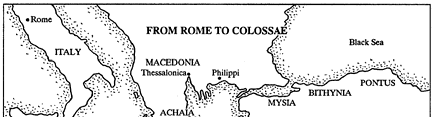
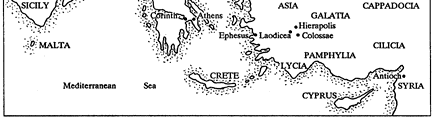
To solve this problem, the false teachers taught that the gap between God and the human race was bridged by countless beings who were part-spirit and part-matter (or part-divine and part-human). The first and highest of these sprang from God himself and was almost as great as God. The second originated from the first, the third from the second, and so on down the scale, so that those beings closer to God were more Godlike, and those closer to the human race less Godlike. Together these beings controlled the material universe, and people had to approach God through them if they wanted superhuman protection against the world's evil forces. People climbed a ladder, so to speak, as they moved in worship from one angelic being up to the next, till finally they reached God (Col 2:8,18).
According to the false teachers, Jesus Christ was one of these part-divine part-human beings. Paul saw that if this were so, Christ was no longer the one mediator between God and humankind, and his death was no longer the one way to cleanse sinners and reconcile them to God. Paul asserted that Christ is God, and he is supreme over all things, whether seen or unseen. Christ did not originate from some intermediate being between God and humankind, but is himself the creator of all things, in both the spirit world and the material (Col 1:15-19; 2:9).
At the same time, Christ is the Saviour of sinful human beings and the conqueror of the powers of evil (Col 1:20-22; 2:15). Through him God entered the world of human existence and shares in a living relationship with his human creatures. As the head is united with the body, so Christ is united with his people, the church (Col 1:18; 2:19). This union means that believers can share Christ's victory over evil and that the character of Christ's life can be reproduced in them (Col 1:13; 3:3-5,10).
Practical outcome of the teaching
Because of the Gnostic belief that matter was evil, the false teachers in Colossae taught people to withdraw as much as possible from involvement in the material world. Among their teachings were harsh treatment of the body and strict obedience to rules (Col 2:20-23; cf. 1 Tim 4:3). But in other churches, teachers who believed that matter was evil encouraged the opposite sort of behaviour. They argued that since people live in material bodies in a material world, there is no way they can escape the evil associated with matter. The result of this teaching was a lack of self-control that produced much immorality (2 Tim 3:4-5; 1 John 3:4-10).
The false teachers claimed that their knowledge of heavenly mysteries raised them to a level of existence where the deeds of the body could not affect the spirit. The Christian response was that knowledge cannot be separated from behaviour. The true knowledge of heavenly mysteries is found only in Christ, and it always leads to right behaviour (Col 1:9-10; 2:2-4; 3:1-3; 1 John 2:4,29; 3:6,14-19).
1:1-2:5 The true view of Christ 2:6-3:4 False views lead to bondage 3:5-4:6 The Christian's new life 4:7-18 Personal news
1:1-2:5 THE TRUE VIEW OF CHRIST
Paul's prayer for the Colossians (1:1-14)
The chief cause of Paul's thanksgiving is that the Colossians have accepted the gospel and come into union with Jesus Christ (1:1-3). This gospel, which they heard originally from Epaphras, is not just another of the many new religions of the day. It is the universal gospel that is preached everywhere and changes the lives of people of all nations and cultures. It proves its power in the new attitude of love that believers show to one another and to others (4-8).
Paul prays that in addition to having love, the Colossians will increase in knowledge. This knowledge is not like the theorizing of the Gnostics, which leads only to feelings of superiority and selfsatisfaction. It is a personal and practical knowledge of God and his will, which will produce a healthy spiritual life of fruitfulness for God. Right behaviour will only be possible as they have right knowledge (9-10). The power to live such a life with patience and joy comes from God alone. Through Christ he has saved them from the powers of evil and made them fit to share the good things that he has prepared for them in his kingdom (11-14).
Christ and his work (1:15-23)
Having completed his introduction, Paul begins immediately to correct the wrong ideas that had been taught. The teaching he gives in verses 15-23 provides a basis for what follows in the remainder of the letter.
Christ is not some part-angelic being, but God himself. God is invisible, yet people can see him and know him in Jesus Christ. Jesus is God and therefore was not created. He existed before creation, and is superior to all created things (15). In fact, he himself is the Creator. He is the source and controller of all things, seen and unseen, including the world of angelic beings that the false teachers liked to talk about. More than that, he is the goal of all creation; all things exist for his glory (16-17).
Because of his eternal godhead, Jesus is the source and the head of the physical creation. Because of his triumphant resurrection, he is the source and the head of the new creation, the church. As head, he is the sovereign ruler. He is not a mixture of God and angel, but has in himself the full nature and power of God (18-19). The only way that sinful creation, including men and women, can be reconciled to God is by Jesus Christ. Only through his death can people be brought back to a state of harmony with God (20).
The Colossians should know this, for they themselves have experienced his divine power in saving them from sin. Their salvation has been entirely by Christ, who took upon himself a physical body like theirs and, in that body, bore their sin. Angelic powers can add nothing to what Christ has already done. If the Colossians want finally to stand before God in the perfection of Christ, they must hold firmly to the truth that the work of Christ is complete and perfect. This truth is the foundation of the gospel wherever that gospel is preached, and it cannot be changed to suit human theories and philosophies (21-23).
Paul's service for Christ (1:24-2:5)
Some of the Colossians, confused by the clever arguments of the false teachers, might be tempted to accept their teaching. They might think that this teaching is more advanced, and therefore nearer the truth, than what they heard from Epaphras. Paul emphasizes that the gospel he and Epaphras preach is the only gospel. It has the authority of Christ, and its genuineness is proved in the experiences of those who preach it. Paul illustrates all this from his own life. The Gnostics appoint themselves teachers, but Paul was appointed by Christ. By enduring sufferings in the service of Christ, he is sharing in the sufferings of Christ (24-25).
Paul's message reveals to people the plan of God that had not been made known to previous generations. This secret plan is that Gentiles are to be his people, indwelt by Christ (26-27). (For the meaning of 'secret plan', or 'mystery', see notes on Ephesians 1:7-10; 3:3-6.)
Once the apostle has brought people to know Christ, he must teach and instruct them so that they might grow to spiritual maturity. Paul knows that much hard work is necessary in order to reach this goal (28-29).
Paul's concern for the churches in Colossae and Laodicea (churches that he has never visited) shows that his interest is not merely with churches that he himself has founded. He wants all churches to be strong, through the believers loving one another and having a full understanding of their riches in Christ. The hidden treasures of wisdom are found in him, not in Gnosticism (2:1-3). The Colossians must maintain the orderly fellowship and strong faith they have had in Christ from the beginning. They must examine all teaching carefully, and not allow themselves to be easily led astray by the arguments of the false teachers (4-5).
2:6-3:4 FALSE VIEWS LEAD TO BONDAGE
Freedom through Christ (2:6-15)
Again Paul reminds the believers that receiving Christ is only the beginning of the Christian life. There must be continual growth through building the life on him (6-7).
The Colossians know that God has freed them from the powers of evil (see 1:13). If, then, they turn and accept a religion powered by the unseen spiritual forces of evil, they are placing themselves in bondage once again (8). Christ needs no angelic powers to help him, for the fulness of God's nature exists in him in its totality. Those in Christ likewise need no angelic powers to help him, for they are already complete in him (9-10).
Paul gives an illustration that likens Christian salvation to the common Jewish rite of circumcision. Circumcision was literally a cutting away of the flesh. Salvation through Christ is also a cutting away of the flesh, though in this case 'flesh' refers not to part of the physical body but to sinful human nature. Christians have been freed from the power of the old nature (11).
A second illustration likens salvation to the rite of baptism. Union with Christ means the death and burial of the old life, and the rising again to new life (12). The Colossian believers had once been spiritually dead. Being Gentiles they did not even have the Jewish covenant sign of circumcision to give them hope of better things to come. Yet God forgave them their sins (13).
The law of God shows up human sinfulness and demands death as the punishment. It is like a book that records sinners' debts, then demands their death because they cannot pay those debts. But God forgave the sins and wiped out the debts, because Christ paid the full penalty on behalf of repentant sinners. He destroyed the power of the law – as if he took that book with its record of sins and debts and nailed it to the cross with himself. Therefore, believers need no longer fear the power of the law (14). Nor need they fear the power of the spiritual forces of evil, for Christ has conquered them, taken away their power and displayed his victory over them (15).
Christian freedom in practice (2:16-3:4)
In view of the freedom that Christ has won for them, the Colossian believers must not listen to those who try to force them to obey the rules and regulations of the Israelite law. Practices taught in the law may be compared to shadows. They are not solid or permanent, but their existence enables the viewer to know that there is some real object that casts the shadows. That real object is Jesus Christ. Now that he has come, the shadows are of no further interest. The ceremonies of the law have no further use (16-17).
Neither should Christians listen to those who want to show their 'superior' knowledge by mixing their own philosophies with the gospel. Christian life and growth come from God through a direct relationship between the believer and Christ. There is no scale of angelic beings forming a ladder to link Christians with God (18-19).
Having been set free from the bondage of sin through Christ's death, Christians should not get into bondage again by becoming slaves of religious regulations that people want to impose upon them. To make laws to live by is the way of the worldly person, not the way of the Christian. No matter how clever and religious those laws may appear, they will not succeed in controlling the desires of the body (20-23).
Because they have died to sin, Christians are not in bondage to things of the world as the Gnostics are. Christians have been raised with Christ to new life in a higher world, where their desires and conduct are like Christ's (3:1-2). Through Christ they have life directly in God. In contrast to the Gnostics, they do not try to climb a ladder of countless intermediate spirit beings. Neither the Gnostics nor any other unbelievers can understand this life, because the life is 'in Christ' and therefore is hidden from their view. Its true character will be fully shown on the day when Christ's glory is revealed (3-4).
3:5-4:6 THE CHRISTIAN'S NEW LIFE
Old and new habits (3:5-17)
Not only do Christians believe that through Christ's death they have died to sin, but they must also show it to be true in their daily lives. They must make every effort to put away the old selfish habits that God hates, from obvious sins such as sexual immorality to hidden sins such as greed and other uncontrolled desires (5-7). They must control the tongue and discipline personal behaviour. This renewing of their lives is not something that happens only once. It must go on all the time, so that more of the old nature is conquered and the new person is more like God (8-10).
Since the goal of the Christian life is to become like Christ, there is no way that Christians can be divided into superior or inferior classes according to race, culture or social status. All are equal in him, united in him, and should strive to be like him (11).
Believers should put off old sinful habits as they would put off dirty clothes. They should put on new good habits as they would put on fresh clean clothes. They should have a new attitude, which thinks of others before thinking of self. It is as if the new 'clothes' they have just put on are bound together by love, so that their appearance is one of genuine beauty and completeness (12-14).
Within the church there are people of various personalities and social backgrounds, but they can all live together in harmony through allowing the peace-loving spirit of Christ to guide their actions. Through teaching and singing they can build one another up in the faith. At all times and in all places they should live and act as new people in Christ (15-17).
Life in the home and in society (3:18-4:6)
Harmony in the home depends on the husband's showing understanding love to his wife, and the wife's showing loyal submission to her husband (18-19). Children are to be obedient to their parents, but parents must treat their children with understanding and not be harsh or unreasonable (20-21). When slaves work for their masters as if they were working for the Lord Christ, they will produce work of good quality. Masters, on their part, must reward their slaves fairly, knowing that they too have a master, God, and he will treat them as they treat others (22-4:1).
Christians must be regular and persistent in prayer. They must keep alert as they pray, for they can be easily distracted (2). They should specifically pray for the servants of God with whom they are partners in the gospel, that God's messengers may have opportunities to make known his message, and that they may do so clearly (3-4). Besides praying for the activity of others, Christians should be careful of their own conduct, and make sure their speech is pleasant to listen to and sensible. In this way they will attract, and not repel, those who are not believers (5-6).
4:7-18 PERSONAL NEWS
Tychicus, who carried Paul's letter to Colossae, had the additional duty of telling the church how Paul was faring in his imprisonment. One person who accompanied Tychicus was Onesimus, a slave from Colossae who had escaped to Rome, met Paul and become a Christian. Paul wanted the Colossians to welcome Onesimus as part of the church (7-9). (Paul also wanted Onesimus's master, Philemon, to welcome him home and forgive him; Philem 10-20.)
With Paul during his imprisonment in Rome were three Jewish Christians: Aristarchus, who had travelled with him on the adventurous sea voyage from Palestine (see Acts 27:1-2); Mark, who had once helped him in the gospel and who was likely to visit Colossae soon (see Acts 12:25; 13:5,13; 14:36-39); and Jesus Justus (10-11).
Three other people with Paul were Gentiles: Epaphras, who had worked faithfully and prayerfully in and around Colossae (see 1:7); Luke, the writer of one Gospel and Acts, who also had travelled with Paul from Palestine to Rome (see Acts 27:1-2; 28:16); and Demas, who later deserted him (see 2 Tim 4:10) (12-14).
Paul also sends greetings to the church in the neighbouring town of Laodicea. The church there had likewise received a letter from Paul, and he asks that the Colossian and Laodicean churches exchange letters so that both may receive additional teaching (15-16). In closing, Paul encourages Archippus to carry out his work for God faithfully, and reminds the Colossians that he is still imprisoned and he needs their prayers (17-18).
1 Thessalonians
On his second missionary journey, Paul entered Europe for the first time when he crossed from Asia Minor to Macedonia, the northern part of present-day Greece. The first churches that he established in Europe were in the Macedonian cities of Philippi and Thessalonica (Acts 16:11-12; 17:1). Paul wrote his first letter to the Thessalonians only a few months after he established the church.
Growth of the Thessalonian church
Paul's initial work in Thessalonica brought fruit among the Greeks but violent opposition from the Jews. When the Jews created a public uproar, the city authorities tried to restore peace by getting rid of Paul. They made one of the local Christians deposit an amount of money with them, apparently as a guarantee that Paul would leave the city and not return (Acts 17:2-10; cf. 1 Thess 2:18). (Although Paul did not visit Thessalonica again on his second missionary journey, he may have visited it on his next journey; see Acts 20:1-2.)
From Thessalonica Paul went to neighbouring Berea and then on to Athens in the province of Achaia, the southern part of presentday Greece (Acts 17:10-15). From Athens he sent his fellow worker Timothy back to Thessalonica to help the young church (1 Thess 3:1-2). After a short time in Athens, Paul went across to Corinth, also in the south of Greece (Acts 18:1), and it was there that Timothy met him upon returning from Thessalonica a few weeks later (Acts 18:5; 1 Thess 3:6).
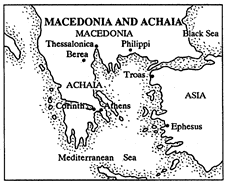
Timothy brought Paul news that the church in Thessalonica, though it suffered persecution, had grown strong. Within only a short time it had spread the gospel far and wide throughout the surrounding districts (1 Thess 1:6-8; 2:13-16; 3:3). Thankful at this news, Paul sent off the letter that we know as 1 Thessalonians. In this letter Paul also dealt with a number of matters that needed attention in the church. He defended himself against unwarranted accusations, instructed misguided believers about aspects of Christian behaviour, and cleared up misunderstandings about Christ's return.
1:1-3:13 Relations with the Thessalonians 4:1-12 Teaching about marriage and work 4:13-5:11 Concerning Christ's return 5:12-28 Advice on other matters
1:1-3:13 RELATIONS WITH THE THESSALONIANS
Response to the gospel (1:1-10)
Paul gives thanks to God for the good news that Timothy brought back concerning the Christians in Thessalonica. Through their belief in Christ their lives have been changed, so that in everything they do their faith, love and endurance are clearly seen (1:1-3).
The Thessalonians have given proof that they are God's people by the way they have believed and stood firm for the gospel. They had seen how Paul was persecuted in Thessalonica and they knew that believing the gospel would bring suffering. But they also knew that the gospel operated by the power of God and they gladly accepted it, confident of its power to save them (4-6). Their conduct amid persecution has been an example to Christians throughout Macedonia and Achaia (7).
Much of Macedonia and Achaia had been evangelized as a direct result of the Thessalonians' zeal. Paul has no need to boast to others about this outstanding work, because Christians everywhere know about it already (8). Throughout the region people are talking about how readily the Thessalonians responded to the message Paul preached. No longer are they in bondage to lifeless idols. They have become servants of the living God, and they look forward to the climax of their salvation at the return of Jesus Christ (9-10).
Paul's work in Thessalonica (2:1-16)
In Paul's day there were some travelling preachers whose main aim was to make money, usually by crafty or dishonest methods. Certain people in the Thessalonian church, apparently angry that Paul had left them suddenly, accused him of being one of these untrustworthy travelling preachers. They said he was concerned only for himself, not for them. Paul replies that he has never used smooth words to deceive people or gain a following. His readers know that in both Philippi and Thessalonica he was so straightforward in preaching God's message that he suffered bodily harm (2:1-5).
Paul wanted neither praise nor money. As an apostle he had a right to be supported financially by those to whom he ministered, but he did not claim this right. Far from trying to make financial profit from the Thessalonians, he gave freely to help them (6-8). He worked at his trade to earn enough money to support himself, and spent the rest of his time preaching (9). The Christians in Thessalonica know that his conduct among them was without fault. It was a living example of the kind of life that Paul urged them to live, the life that pleases God and brings glory to his name (10-12).
The Thessalonians knew that the gospel they received was not something of human creation but was a message from God himself, and they were prepared to suffer for it. They were persecuted by the citizens of their own country, just as the Christians in Judea were persecuted by the Jews (13-14). Not only had the Jews crucified the Lord Jesus and rejected God themselves, but they were now trying to prevent the message of Jesus from reaching the Gentiles. In doing so they were building up a terrible divine judgment against themselves (15-16).
After leaving Thessalonica (2:17-3:13)
Having reminded the Thessalonians of his work and conduct while among them, Paul now outlines his thoughts and feelings for them since he left. In spite of what his opponents are saying, his failure to return does not mean that he has no interest in them. Several times he has tried to return, but each time something has stopped him (17-18). He wants to have joy, not shame, at Christ's return, and for this reason he is eager to see his converts grow and develop in the faith (19-20).
Paul was faced with a difficulty. He was not able to return to Thessalonica, yet he was not able to rest if he did not return. He therefore did the next best thing and sent his fellow worker Timothy, even though it meant that Paul had to face alone the difficult task of preaching in Athens (3:1-2; cf. Acts 17:16-34). Timothy's task was to strengthen the Thessalonians' faith to withstand persecution. Paul did not want the good work already done among them to be destroyed through people turning away from Christ (3-5).
Timothy has now returned and Paul is overjoyed at the news he has brought. The believers in Thessalonica have progressed in their faith and love, and their longing to see Paul is as great as his longing to see them (6-8). He does not know how to thank God for such good news. He desires more than ever to revisit them, so that he can further help their growing faith (9-10). But he will return only if God wants him to. God is the one who guides their progress, and only he can make them strong. In view of Christ's return they should increase in love and holiness (11-13).
4:1-12 TEACHING ABOUT MARRIAGE AND WORK
God's will is that there be continual progress in the lives of believers, leading them to increasing holiness. As they try more to please God, they will become increasingly different from those who do not know God (4:1-3a).
For example, in relations between the sexes, Christians will not be uncontrolled as the pagans are, but will restrain their sexual passions (3b-5). If they commit immoral acts they shame themselves and harm others. They also sin against God, for God's purpose in calling people to himself is to make them holy. For this reason he gives his Holy Spirit to live within their bodies. When people fight against the holy purpose of the Spirit, they invite judgment (6-8).
The Thessalonians had love for each other as Christians, but apparently some used this as an excuse to become dependent on others instead of being ready to help others. If people love others they will work to support themselves, so that they do not become a burden to their friends. In addition, idle people are often guilty of being busybodies, and this is not a characteristic of love. The Thessalonians must correct faults such as these that have appeared in their church. This will prevent non-Christians from criticizing them, and prevent fellow believers from being unnecessarily burdened (9-12).
4:13-5:11 CONCERNING CHRIST'S RETURN
Those who have died (4:13-18)
Among the Thessalonians, some were worried that those in their church who had died would not share in the return of Christ and the final triumph of his kingdom. Paul assures them that they will share in his return just as they share in his death and resurrection. (13-14). Believers who have died, far from being at a disadvantage, will be raised to life first. Believers still alive will join them, and together they will meet Christ and be with him for ever (15-17). Christian faith should give people hope and encouragement. They should see death not as a tragic end but as a glorious entrance into something new (18; cf. v. 13b).
Those who are still alive (5:1-11)
Paul had already told the Thessalonians that no one knows when Christ will return. He will come as unexpectedly as a thief. His intervention in the affairs of the world will be as sudden as birth pains. His return will smash the non-Christian's sense of security with a destruction that none will escape (5:1-3). The life of the non-Christian is likened to a dark night of moral laziness and ill-discipline. The life of the Christian is likened to a bright day of watchfulness and self-control. Therefore, Christians of the 'day' should not act like non-Christians of the 'night', otherwise they will be both surprised and ashamed when Christ returns (4-7).
Just as soldiers must always be prepared for any eventuality, so Christians must always be prepared for Christ's return. They must be self-controlled in their behaviour, strong in faith and love, and confident in their salvation (8). Union with Christ means that they will escape God's wrath and enjoy salvation in its fulness. This is a further reason why they should live in a way that pleases God and encourages fellow Christians (9-11).
5:12-28 ADVICE ON OTHER MATTERS
Minor difficulties had arisen in the Thessalonian church, and the church leaders had the responsibility to see that these matters were put right. Paul therefore reminds the church members to respect those who have the duty of guiding the church, and not to be offended when the church leaders find it necessary to give corrective instruction (12-13). The leaders, on their part, must always act with patience and understanding (14).
All Christians should live in a constant attitude of helpfulness, joy, prayer and thanks (15-18). In all matters they need the unhindered help of God's Spirit. This is particularly so in being able to tell the difference between right and wrong, so that they do not despise Spirit-inspired messages as worldly, and do not exalt worldly attitudes as spiritual (19-22).
God alone can give the Thessalonians the necessary strength to put Paul's advice into practice. God wants his people to progress constantly towards greater holiness in every part of their lives and being (2324). To this end Paul reminds the church leaders to read the letter to the church and to make sure that the believers understand it fully (25-28).
2 Thessalonians
Within a short time of sending off 1 Thessalonians, Paul received news that certain Christians in the Thessalonian church had misunderstood parts of the letter. He therefore sent off the letter known to us as 2 Thessalonians. Paul was still in Corinth (he remained there a year and a half; Acts 18:11), and his second letter may have followed his first by only a few weeks.
One misunderstanding of the Thessalonians concerned the return of Jesus Christ. Paul had said that Christ would return unexpectedly and suddenly, but some people thought this meant he would return immediately. There were even those who thought that if this were the case, there was no purpose in working any longer. As a result they became idle and a burden to others (2 Thess 2:1-2; 3:11). In writing to correct the misunderstandings, Paul gave additional teaching about the return of Christ, rebuked those who were idle, and gave further encouragement to those who were persecuted.
1:1-2:12 Concerning Christ's return 2:13-3:18 Present needs in the church
1:1-2:12 CONCERNING CHRIST'S RETURN
A source of encouragement (1:1-12)
The Thessalonian Christians continue to grow in faith, love and endurance, in spite of the constant persecution they suffer; and Paul continues to talk about them as an example that should challenge others (1:1-4; cf. 1 Thess 1:3,6-7). He encourages them to keep moving forward, and points out that their suffering is proof of the genuineness of their faith. Their endurance shows that they are worthy to inherit the kingdom of God. In his righteous judgment God uses sufferings to bring his people to maturity, but by the same righteous judgment he will punish those who persecute them (5-6).
Christ's return will bring relief and rest to the persecuted believers (Paul here links himself with the Thessalonians), but it will also bring judgment to the ungodly. For the one it will bring glory, for the other eternal destruction (7-10). Paul prays that by God's power the Thessalonians will go on producing those qualities of Christian character that are fitting in those whom God has called. Such character will bring honour to Christ now and will reach its full expression in the age to come (11-12).
The day of the Lord (2:1-12)
Some of the Thessalonians thought that the final day of the Lord had already come. Paul states firmly that they did not get such an idea from any prophecy, preaching or letter of his (2:1-2). That day will not come until there is open and widespread rebellion against God, led by one known as the man of lawlessness (RSV; NIV) or the wicked one (GNB). This person will recognize no authority, Christian or otherwise, apart from his own, and will put himself in the place of God as the sole controller of human society (3-4).
The Thessalonians knew what Paul was talking about, because he had given teaching on these things while among them (5). They also knew what we do not, namely, what or who it is that prevents these things from happening now. One suggestion is that this restraining power is the system of law and government that to some extent can control evil in human society (cf. Rom 13:3-4). Evil is always at work in the world, but when the restraining power is removed, evil will reign unhindered till it reaches its fulness in the man of lawlessness. Then Christ will return and with terrible ease destroy him (6-8).
During his rise to power the man of lawlessness will be empowered by Satan to perform miracles. In this way he will deceive people who, having deliberately rejected God and chosen evil, give him their support and so fall under God's judgment. God will use the unrestrained work of Satan as a means of punishing a rebellious world (9-12).
2:13-3:18 PRESENT NEEDS IN THE CHURCH
Stability amid persecution (2:13-3:5)
From considering the terrible judgment that awaits the wicked, Paul turns to look at the bright future that awaits the Thessalonian believers. God will destroy the man of lawlessness and his followers, but the same God loves the Thessalonian believers. Their salvation is certain because God chose them as his from eternity, called them to himself through the gospel, and will in due course give them a share in Christ's glory (13-14).
In view of the security that is theirs through the gospel, the Thessalonians need not be frightened by persecution or worried about future events. If they hold firmly to the apostolic teaching given to them, they will find that God strengthens them with courage and hope (15-17).
Paul asks for prayer that his proclamation of the gospel in Corinth will bring the same fruitful results as it did in Thessalonica. He desires also that God will protect both him and the Thessalonians against the attacks of Satan (3:1-3). He is confident that they will continue to stand firm, and that they will obey the important instructions that he is about to give them (4-5).
Work to earn a living (3:6-18)
Thinking that Christ was about to return, some believers in Thessalonica stopped working for a living and were being supported by others in the church. Paul says that the church should not support such people. By their selfishness, these idlers are denying the teaching they have received concerning Christian brotherhood (6). They should follow Paul's example. As a teacher Paul had the right to be supported by those whom he taught, but instead he worked hard to earn his own living, so as not to be a burden to others (7-9).
If people refuse to work, others should not support them, because this only encourages them to remain idle (10). These people are not only an unnecessary financial burden, but because they have nothing to do, they become nuisances and busybodies. They must stop annoying others and start working to earn their own living (11-13). If any ignore these apostolic instructions and persist in their idleness, the believers should not show them sympathy. In fact, a brotherly warning might bring them to their senses (14-15).
In conclusion Paul prays that the Thessalonians, instead of being unsettled by misunderstandings concerning the return of Christ, may experience the calmness of God's peace among them (16). Paul then takes the pen from his secretary and, following his usual practice, writes a few words himself to prove the genuineness of the letter (17-18).
1 Timothy
Paul's letters to Timothy and Titus are commonly referred to as the Pastoral Letters. These letters show Paul's deep concern for the pastoral responsibilities he had entrusted to Timothy and Titus, and the warm relationship he shared with his two fellow workers. The letters belong to the final years of Paul's life, and give an indication of how church life had developed since the early days of Paul's missionary travels.
Paul's later travels
Although the book of Acts records many of Paul's travels, it does not record them all. It concludes at the point chosen by the author according to the purpose of his book, but it does not represent the end of the story of Paul. Paul was imprisoned in Rome for two years as he awaited the outcome of his appeal to Caesar (Acts 28:16,30), and the letters he wrote during that time showed that he hoped to be released. He even expected to travel to other countries and revisit some of the churches (Phil 1:25,27; 2:24; Philem 22). It seems certain that at the end of two years Paul was released and went on further journeys, but since the book of Acts had by this time been completed, the only references to these journeys are in Paul's later writings.
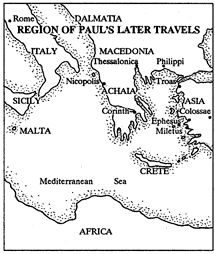
Among the places Paul visited (accompanied, it seems, by Timothy and Titus) was the island of Crete. He soon found that the churches of Crete were in a state of serious disorder, mainly because they lacked the right leaders and were confused by false teachers. Paul gave whatever help and direction he could, but he had to move on to other places. He therefore left Titus behind to carry on the work and establish proper leadership in the churches (Titus 1:5,10-11).
Upon arriving in Ephesus, Paul found further problems of false teaching. Some years earlier he had warned the elders of the Ephesian church that he expected such problems to arise (Acts 20:2930). Self-appointed 'experts' were causing much harm in the church with unprofitable teaching based on ancient myths, legends, laws and genealogies (1 Tim 1:4-7; 4:1-3; 6:3-5). Some of the teaching was so damaging that Paul decided the only way to deal with the offenders was to put them out of the church (1 Tim 1:19-20). But Paul could not stay in Ephesus indefinitely, as he wanted to visit churches in other regions. Therefore, when the time came to move on to Macedonia, he left Timothy behind to give further help to the church (1 Tim 1:3).
Letters to Timothy and Titus
In Macedonia Paul probably fulfilled his wish to visit the Philippian church (cf. Phil 2:24; 4:1), but he was concerned for Timothy and Titus whom he had left to deal with difficult church problems. He therefore sent to them the letters known to us as 1 Timothy and Titus.
The two letters are similar in many ways, though the letter to Timothy is longer and more personal. In both letters Paul encourages his fellow workers to be confident in carrying out the tasks entrusted to them (1 Tim 1:3,18; 4:6,11-12; Titus 1:5; 2:15). They are to establish order and leadership in the churches (1 Tim 2:1,8; 3:1-13; 5:17; Titus 1:6-9; 2:2-8), instruct people in Christian truth (1 Tim 3:14-15; 4:13-14; 6:20; Titus 2:1,7; 3:8), and avoid wasting time with arguments about senseless issues (1 Tim 4:7; 6:20; Titus 3:9).
1:1-20 Warning against false teachers 2:1-4:16 Church leadership and teaching 5:1-6:21 Various kinds of people in the church
1:1-20 WARNING AGAINST FALSE TEACHERS
False and true (1:1-11)
The letter begins with a reminder to Timothy of the reason Paul urged him to stay at Ephesus. Timothy has to stop people wasting time and confusing others with senseless discussions that lead only to conflict and argument. Those responsible for this confusing teaching must learn to control their imagination. Instead of inventing fanciful stories based on Old Testament genealogies, they should concentrate on the kind of teaching that produces a sincere faith, a clear conscience and a pure heart (1:15).
Because these so-called teachers do not aim at building people up in faith and love, they are really false teachers. They want to have authority and prestige like the Jewish scribes, but they have no understanding of the Scriptures they so confidently try to explain. They only lead people away from the truth (6-7).
The false teachers, by using their imagination to interpret the law, try to establish a set of regulations by which Christians should live. The law, however, was not given for that purpose. It was given to sinful people to show them God's righteous standards. As a result it showed people their sinfulness, and in this way led them to God to ask his mercy. This is the way Paul uses the law in preaching the gospel (8-11; cf. Rom 3:19-20; 7:7-12).
Reminders from past experiences (1:12-20)
As soon as Paul mentions the gospel, he is reminded of the power and grace of God that he has experienced in his own life. God changed Paul, and turned the greatest of sinners into his special representative to take the gospel to the Gentiles. If God can do that, there must be no limit to his mercy, grace and love (12-15). No person is beyond hope. Christ's patience in dealing with the persecutor Paul should be an assurance to others that he will be merciful to them too. When repentant sinners are thankful for all that the Almighty God has done for them, they will respond by giving him honour and glory (1617).
Paul recalls the prophecy, given at the outset of Timothy's ministry, that indicated the kind of ministry to which he was called. He trusts that as Timothy thinks over the words of that prophecy, he will find renewed courage to stand firm for what he knows to be right. A firm faith must be linked to a clear conscience (18-19a).
Hymenaeus and Alexander were two who had been guilty of serious wrongdoing because they separated their beliefs from their behaviour. They refused to change their ways and in the end were put out of the church. They were, so to speak, put out of the sphere where God's rule was acknowledged into the sphere where they were open to the attacks of Satan. But Paul hoped that the punishment would lead to correction, so that as they realized their wrongdoing they would turn from it (19b-20).