
Part 10
Each Levitical group was to serve in the temple two weeks each year. (This accounted for forty-eight weeks. The remaining four weeks would be taken up with the festivals of Passover, Pentecost and Tabernacles, when all the men of Israel were to assemble at the central place of worship. On these occasions all Levites would be on duty; see Exod 23:14-17.) The work of the Levites included assisting the priests, keeping the temple clean, providing the music and singing for worship, and attending to the many practical matters connected with the sacrifices and ceremonies (24-32).
The priests also were divided into twenty-four groups, each of which served in the temple for two weeks per year as outlined above. The service alternated between the Eleazar branch and the Ithamar branch of the Aaronic family. Each priest's turn for service was decided by drawing lots (24:1-6). The names of the twenty-four priestly groups are then given (7-19), followed by a further list of some Levitical families (20-31).
Among the temple singers (a total of 4,000; see 23:5) were 288 specially skilled musicians. Included in these were twenty-four leaders (25:1-7). These 288 musicians were also divided into twenty-four groups that served in rotation. Their job was apparently to train and lead the section to which they were assigned (8-31).
There were also 4,000 gate-keepers, or temple guards (see 23:5). They too were probably divided into twenty-four groups who took turns to go on duty. The number of positions to be guarded was twenty-four (26:1-19). The wealth that David and others won for Israel through their conquests was administered by a group of treasurers, whose names are listed (20-28). The 6,000 judges (see 23:4) were most likely organized on a rotation system for their service. Some of them were concerned with the central administration, some worked only in the area west of Jordan, and some worked only among the two and a half tribes that were located east of Jordan (29-32).
Military and civilian leaders (27:1-34)
In contrast to the detail that the writer gives in the lists of the Levites, there is only a brief summary of David's military and civil leaders. Each month 24,000 men were required to do one month's military service. The twelve commanding officers (who took turns at commanding this fighting force, one month at a time) all belonged to David's group of 'mighty men' (27:1-15; see 11:10-47). Three other lists name the leaders of Israel's tribes (16-24), the officials who looked after the king's farmlands (25-31), and the king's close advisers (32-34).
Solomon presented to the people (28:1-29:30)
David had been forced to appoint Solomon as king hastily when he learnt that another son, Adonijah, was plotting to seize the throne for himself (see notes on 1 Kings 1:5-53). That very unceremonious anointing of Solomon was followed soon after by a second anointing, this time with full religious and regal ceremony (see 29:22). This second occasion is the one that the Chronicler refers to here. David presented Solomon to the people as the one who, by God's choice, would succeed him as king and build the temple (28:1-10). David gave Solomon the plans he had prepared for the temple and its service. He encouraged Solomon to persist in the work till the temple was finished and in use according to the plans he had set out (11-21).
In addition to the money and materials he had already given for the project (see 22:14), David gave a lavish offering from his own personal funds. His example prompted the people to make similarly generous offerings (29:1-9). The joyful response from the people brought from David an outburst of magnificent praise to God. He gladly acknowledged that everything that people possess comes from God; therefore, in making offerings to him, the Israelites had only given back what he had already given them. They had done this joyfully and willingly, and David prayed that they would maintain such devotion to God always (10-20).
Next day the people joined in a great festival and swore allegiance to Solomon as their new king (2125). The writer will now continue with the story of Solomon, but before doing so he gives a brief summary of the reign of David (26-30).
2 Chronicles
OUTLINE OF 2 CHRONICLES
1:1-9:31 The reign of Solomon 10:1-36:23 The kings of Judah
1:1-9:31 THE REIGN OF SOLOMON
Solomon's wisdom and wealth (1:1-17)
The writer of Chronicles is chiefly concerned with the continuation of the dynasty of David through Solomon according to God's promise, and therefore he omits stories that he considers irrelevant to his theme. He says nothing of Adonijah's attempt to gain the throne, and nothing of Solomon's alliance with Egypt (1 Kings 1:1-3:3). His initial emphasis is rather on Solomon's devotion to God from the very beginning of his reign.
To demonstrate Solomon's devotion, the writer records the impressive ceremony Solomon arranged at the tabernacle in Gibeon and his commendable request for God's wisdom in ruling Israel (1:1-13; see notes on 1 Kings 3:4-15). However, the writer omits the examples given in 1 Kings 3:16-4:34 that show Solomon's wisdom at work in the everyday affairs of the people, in his overall administration of the kingdom, and in his writings and songs.
Before describing Solomon's plans for building the temple, the writer shows that under Solomon Israel enjoyed stability and prosperity. Such a king was well able to carry out the temple building program successfully (14-17; see notes on 1 Kings 10:26-29).
Construction of the temple (2:1-7:22)
With the help of King Hiram of Tyre, Solomon prepared materials and arranged a workforce to build the planned temple (2:1-18; see notes on 1 Kings 5:1-18). Construction went on for seven years, until the temple, its furniture, its courtyard, and all other articles and decorations connected with it were completed according to plan (3:1-5:1; see notes on 1 Kings 6:1-7:51). The temple was then dedicated to God (5:27:22; see notes on 1 Kings 8:1-9:9).
Solomon's greatness (8:1-9:31)
Other building programs of Solomon are outlined. The Chronicler adds a note that the reason Solomon built a separate palace for his Egyptian wife was to preserve the holiness of the throne. This point is important to the Chronicler, who wants to show that the Davidic kings, on the whole, tried to remain faithful to God. He notes in addition that Solomon organized the temple services according to the plan that David had laid down (8:1-18; see notes on 1 Kings 9:10-28).
After outlining once more Solomon's wisdom, commercial ability, fame and wealth (9:1-28; see notes on 1 Kings 10:1-25), the Chronicler closes his record of Solomon's reign. He makes no mention of Solomon's idolatry and the judgment to which it was leading (1 Kings 11:1-40), for he is concerned with the continuation of the Davidic dynasty rather than with the failure of its kings (29-31; see notes on 1 Kings 11:41-43).
10:1-36:23 THE KINGS OF JUDAH
Division and its consequences (10:1-13:22)
The Chronicler records the division of the kingdom (10:1-11:4; see notes on 1 Kings 12:1-24), but omits the statement in 1 Kings 12:20 that Jeroboam was made king of the northern tribes. He does not even mention Jeroboam's reign (1 Kings 12:25-14:20). He considers that because the northerners broke away from the dynasty of David and from the true worship of God, they had no right to be called a kingdom, and certainly not the kingdom of Israel.
Unlike the writer of Kings (who calls the southern kingdom Judah and the northern kingdom Israel), the writer of Chronicles calls the southern kingdom either Judah or Israel. For him Judah is the only true kingdom, and the Davidic kings are the only legitimate kings. Nevertheless, he still accepts people from the north as Israelites, and is pleased when any return to God and the Davidic rulers (see 11:13-17; 15:9; 30:1-12). He sometimes refers to the northern kingdom as Ephraim.
Priests and Levites are often prominent in the Chronicler's account of Judah's successes. Solomon's son Rehoboam began his reign well, mainly through the influence of a large number of priests and Levites who fled to Judah from the north rather than join in Jeroboam's idolatry. As long as Rehoboam followed the ways of God as taught by the priests, Judah was strong and stable. When he introduced Canaanite religious practices, God punished him by way of a damaging invasion from Egypt (11:5-12:16; see notes on 1 Kings 14:21-31).
Abijam (or Abijah) followed the religious policy of his father in allowing the worship of Baal to exist side by side with the worship of God, but he did not completely forsake God as Jeroboam did in the north. Abijam's unexpected victory over Jeroboam in battle demonstrated that God was on the side of the king who belonged to David's dynasty and who refused to join in the false religion of the north (13:1-22; see notes on 1 Kings 15:1-8).
Reformation under Asa (14:1-16:14)
God's blessings on Asa showed his pleasure with those who removed Canaanite customs and restored the Levitical order of worship. God rewarded Asa by giving him a remarkable victory over a large and powerful army that invaded from the south. This sign of God's pleasure encouraged Asa to continue his reforms with greater boldness (14:1-15:19; see notes on 1 Kings 15:9-15).
When, however, Asa trusted in outside help instead of trusting in God, he displeased God and was rebuked by one of God's prophets. Not willing to listen to advice, he treated cruelly any of his people who opposed his policies (16:1-14; see notes on 1 Kings 15:16-24).
Towards the end of Asa's reign, Ahab came to power in the north. Under the influence of his foreign wife Jezebel, Ahab introduced a new form of Baal worship in Israel. This Baalism was far more powerful and far more evil than that practised by the common people at the local Baal shrines (1 Kings 15:2521:29). But since these matters concerned the northern kingdom, the Chronicler, in keeping with his usual practice, does not record them.
The reign of Jehoshaphat (17:1-20:37)
Jehoshaphat carried on the reform that Asa began, by destroying all the Baal shrines that remained in Judah (17:1-6; cf. 15:17). Positively, he educated the people in the law of God by forming an official group of instructors whom he sent around Judah's towns and villages. The group consisted of civil leaders, priests and Levites (7-9). He also fortified Judah's defences and enlarged its army, so that neighbouring countries feared to attack it (10-19).
Judah's army was so strong that Ahab of Israel sought and obtained Jehoshaphat's help in a war against Syria (Aram) (18:1-34; see notes on 1 Kings 22:1-40). A prophet rebuked Jehoshaphat for this, as Ahab was a worshipper of Baal and therefore an enemy of God (19:1-3).
Jehoshaphat reformed and reorganized Judah's judicial system to eliminate injustice, guarantee fair treatment for all, and ensure that standard procedures were followed throughout the land. He set up courts and appointed judges in all the chief cities of Judah, with the main court and the chief judges in Jerusalem. The courts and the officials were divided into two kinds. Some dealt with religious matters and were under the control of the chief priest. Others dealt with civil matters and were under the control of the chief governor (4-11). This arrangement was a further indication to the Chronicler that David's dynasty governed according to the Levitical code (cf. Deut 16:18-20; 17:8-12).
Some time later, a combined army of various nations from the south and east set out to attack Judah (20:1-2). The Chronicler notes that Jehoshaphat and his people not only cried to God for help, but they did so by gathering at the temple in Jerusalem. That was the place of prayer for God's people in times of crisis (3-12; cf. 6:24-25). As a result God answered their prayer. He assured them through a prophet (who was also a Levite) that the enemy would be defeated without Judah's army having to do anything (13-17).
The priests and Levites, being very active in Judah, led the people in songs of praise even before the victory was won (18-23). After the people had plundered the defeated army, the Levitical singers led them to the temple to praise God for the victory (24-30).
Earlier, Jehoshaphat had done wrong when he formed a military partnership with Ahab (see 18:3; 19:2). Later, he did wrong again when he formed a commercial partnership with Ahab's son Ahaziah. God sent a disaster to remind Jehoshaphat that he was not to cooperate with Israel's Baal-worshipping kings (31-37; see notes on 1 Kings 22:41-50). (The Chronicler omits the other references to Ahaziah's short rule in 1 Kings 22:51-53.)
Jezebel's Baalism in Judah (21:1-23:21)
The Baalism of Ahab and Jezebel remained strong in the northern kingdom during the successive reigns of their sons Ahaziah and Joram (2 Kings 1:1-8:15). It spread to Judah in the reign of Jehoshaphat's son Jehoram, who was married to Athaliah, the daughter of Ahab and Jezebel (21:1-20; see notes on 2 Kings 8:16-24).
Judah's next king, Ahaziah, at the direction of his mother Athaliah and her northern relatives, cooperated with the idolatrous northern kingdom, and as a result met an early death (22:1-9; see notes on 2 Kings 8:25-29; 9:21-29; 10:12-14). The kings of both Judah and Israel were killed by Jehu, whose anti Baal revolution in the northern kingdom is recorded in 2 Kings 9:1-10:36.
Upon the king of Judah's death, Athaliah seized the throne for herself. She ruled for six years, during which she did all within her power to establish the northern Baalism of her parents in Judah. But the priests and Levites remained faithful to God. The Levites were the temple guards, and the writer emphasizes the part they played (in cooperation with the palace guards) in getting rid of Athaliah and restoring the throne to the Davidic dynasty. The Chronicler also points out that although the coup took place in the temple grounds, no one except the priests and Levites entered the temple buildings. People still had to respect the temple's holiness (22:10-23:21; see notes on 2 Kings 11:1-20). The death of Athaliah marked the end of Jezebel's Baalism in Judah.
Joash and Jehoiada (24:1-27)
The reign of the new king Joash showed how a strong and godly priesthood was necessary for the proper functioning of the Davidic kings. As long as he was under the influence of the high priest Jehoiada, Joash encouraged true worship among his people. After Jehoiada died, Joash turned away from God and encouraged Canaanite worship. For this he came under God's judgment. Even his death was a punishment, notes the Chronicler, because he had murdered the priest who rebuked him (24:1-27; see notes on 2 Kings 12:1-21).
Prosperity followed by disaster (25:1-28:27)
Succeeding kings of Israel are passed over in silence (2 Kings 13:1-25). Judah was to have nothing to do with the northern kingdom, not even to the hiring of Israelite soldiers. Amaziah took the advice, and was rewarded with victory in a battle against Edom. But the victory, instead of increasing his dependence on God, gave him a feeling of independence. He turned from God and worshipped idols. The ungodly northern kingdom then became God's instrument to punish the rebellious southern kingdom (25:1-28; see notes on 2 Kings 14:1-22).
Under the rule of Jeroboam II in the north (2 Kings 14:23-29) and Uzziah (or Azariah) in the south, both kingdoms enjoyed remarkable growth and prosperity. Unfortunately, this made Uzziah proud, and he arrogantly took to himself the rights of a priest. The writer points out that although the priesthood and the kingship were both appointed by God, they were separate and independent systems. One could not take over the functions of the other (26:1-23; see notes on 2 Kings 15:1-7).
Jotham followed the good policies of his father, while being careful not to repeat his father's errors. In the Chronicler's view, Jotham's fear of God was the source of his strength and success (27:1-9; see notes on 2 Kings 15:32-38).
The great prosperity throughout both kingdoms was followed by unbelievable chaos. In the north the kingdom of Israel almost collapsed (2 Kings 15:8-31), and in the south the disastrous reign of Ahaz almost brought destruction to Judah (28:1-27; see notes on 2 Kings 16:1-20). Within a short time the northern kingdom was conquered by Assyria and its people carried away captive. This was the end of the northern kingdom (2 Kings 17:1-41).
Hezekiah's religious reforms (29:1-31:21)
Immediately he became king, Hezekiah began a thorough reformation of Judah's religion. This was prompted partly by the preaching of the prophet Micah (Jer 26:17-19; see notes on 2 Kings 18:1-12).
The Chronicler gives a detailed account of Hezekiah's work, particularly that part of it which affected the temple, the priests and the Levites. Hezekiah called a meeting of priests and Levites and told them plainly that neglect of the temple was the reason for God's anger with Judah. Their first job was to clean the rubbish out of the temple and prepare it for the recommencement of religious services (29:1-11). The temple was so filthy that a large group of Levites took more than two weeks to clean and prepare the building for use again (12-19).
Hezekiah then held a service in which sacrifices were offered for the cleansing and rededication of the king, the nation and the temple (20-24). All this was accompanied by the music and singing of the Levites as arranged by David (25-30).
When the service was finished, the people were invited to make personal offerings. They responded so promptly and generously that the priests were spiritually unprepared for, and physically unable to cope with, the renewed activity in the temple. The Levites, who showed more enthusiasm, had to be called in to help (31-36).
After the rededication of the temple, Hezekiah held a great Passover Feast. His reforms began too late for the Passover to be held in the first month of the year (the time specified in the law), so it was postponed one month (cf. Num 9:10-11). Hezekiah invited the scattered northerners who had escaped captivity, but most were not interested (30:1-12).
Those who gathered for the feast cleansed Jerusalem of all traces of false religion. Their zeal for religious purity stirred up the priests and Levites to hurry and ceremonially cleanse themselves in time for the feast. Certain visitors to Jerusalem arrived too late for the seven day purification ritual before the Passover, and joined in the feast while still unclean. On Hezekiah's request, God forgave them (13-22). The occasion was so joyous that the feast was extended one week (23-27).
Once the city of Jerusalem and its temple had been cleansed, the people went out and cleansed the country areas (31:1). Having removed false religion, Hezekiah made plans for the proper functioning of the nation's true religion. First he divided the priests and Levites into groups according to David's plan (see 1 Chron 23:1-26:32). Then he arranged for their proper support through the orderly payment of tithes and offerings by all the people (2-7).
People responded so generously that Hezekiah prepared special storage places for all the sheep, cattle and produce they offered. He also appointed officials to administer the stores, and made a register of all those eligible for support, to ensure there was no dishonesty in the administration (8-21).
Hezekiah's political administration (32:1-33)
To the writer of Chronicles, Hezekiah's religious reforms were the most important feature of his reign. Politically, he was able to remain independent of Assyria, but only because God intervened in response to his faith (32:1-23; see notes on 2 Kings 18:13-19:37). He also made Judah prosperous. But pride in his achievements led him to become friendly with Babylon, the rising power in the region. It was a policy that later brought disaster upon Judah (24-33; see notes on 2 Kings 20:1-21).
The evil of Manasseh and Amon (33:1-25)
Manasseh receives the full blame for destroying all the good work that his father had done. Over his long reign of fifty-five years he dragged the nation down to its lowest spiritual condition ever. Although he made a brief attempt at reform towards the end of his life, he could not undo the damage of the previous half a century. Nor was any king after him able to reform Judah sufficiently to save it from judgment. Like Israel, Judah would go into captivity because of its wickedness (33:1-20; see notes on 2 Kings 21:1-18). If any trace of Manasseh's reform remained after his death, Amon soon removed it (2125; see notes on 2 Kings 21:19-26).
The final reform (34:1-35:27)
Another reform swept Judah during the reign of Josiah (34:1-33; see notes on 2 Kings 22:1-23:20). As with the reform of Hezekiah, the climax in the eyes of the Chronicler was a great Passover Feast in Jerusalem.
After returning the ark to its rightful place in the temple, the priests and Levites prepared themselves for their duties. Josiah arranged them in divisions as Hezekiah had done earlier, so that the music, singing, sacrifices and other rituals could be conducted properly. The king, his governors and the leading Levites generously provided the sacrificial animals needed by the people for the occasion. The whole festival was even more spectacular than that of Hezekiah's time (35:1-19; see notes on 2 Kings 23:21-27). Sadly, Josiah was killed in battle at only thirty-nine years of age (20-27; see notes on 2 Kings 23:28-30).
Failure, defeat and captivity (36:1-23)
The Chronicler spent much time describing the reforms of Hezekiah and Josiah, impressing upon his readers that good kings tried to be faithful to the Mosaic and Davidic covenants. They had to follow the Levitical order if they were to enjoy the promises given to the dynasty of David. With the death of Josiah, Judah quickly returned to its former ungodly ways. Successive kings followed disastrous policies, both political and religious, which resulted in God's final judgment upon the nation. He allowed Babylon to conquer Judah, destroy Jerusalem, and take the people captive to a foreign land.
It is not the Chronicler's purpose to record details of the conquest. These are given in Kings. Instead he draws attention to the reasons for Judah's destruction: the unfaithfulness of the priests and the people, and their refusal to heed the warnings of the messengers God sent to them (36:1-21; see notes on 2 Kings 23:31-25:30).
Yet God did not cast off his people for ever. About seventy years later a new age dawned, when Cyrus, the Persian king who had conquered Babylon, announced that the Jews were free to return to their homeland and rebuild their nation. As formerly, that nation was to have its life centred on the temple in Jerusalem (22-23).
APPENDIX
Index of Parallel Passages
1 Chronicles 1 Samuel
1:1-9:44 -
10:1-14 31:1-13
2 Samuel
11:1-9 5:1-10
11:10-47 23:8-39
12:1-40 -
13:1-14 6:1-11
14:1-17 5:11-25
15:1-16:3 6:12-23
16:4-43 -
17:1-27 7:1-29
18:1-17 8:1-18
19:1-19 10:1-19
20:1 11:1
20:2-3 12:26-31
20:4-8 21:18-22
21:1-22:1 24:1-25
22:2-29:30 -
2 Chronicles 1 Kings
1:1-13 3:4-15
1:14-17 10:26-29
2:1-18 5:1-18
3:1-5:1 6:1-7:51
5:2-7:22 8:1-9:9
8:1-18 9:10-28
9:1-28 10:1-25
9:29-31 11:41-43
10:1-11:4 12:1-24
11:5-12:16 14:21-31
13:1-22 15:1-8
14:1-16:14 15:9-24
17:1-19 -
18:1-34 22:1-40
19:1-20:30 -
20:31-37 22:41-50
2 Kings
21:1-20 8:16-24
22:1-6 8:25-29
22:7-9 9:21-29; 10:12-14
22:10-23:21 11:1-20
24:1-27 11:21-12:21
25:1-26:2 14:1-22
26:3-23 15:1-7
27:1-9 15:32-38
28:1-27 16:1-20
29:1-31:21 -
32:1-33 18:13-20:21
33:1-25 21:1-26
34:1-33 22:1-23:20
35:1-27 23:21-30
36:1-21 23:31-25:30
36:22-23 -
Ezra
BACKGROUND TO EZRA AND NEHEMIAH
It seems that in Old Testament times the books of Chronicles, Ezra and Nehemiah were joined to form a continuous story. The book of Ezra begins at the point where the account in Chronicles ends.
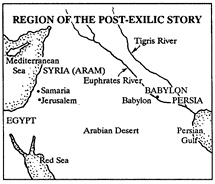
The year was 539 BC and the Jews' period of exile in Babylon was at last over. Persia had just conquered Babylon, and the Persian king Cyrus had issued a decree giving permission to the Jews to return to their homeland (1 Chron 36:22-23; Ezra 1:1-4). The era that followed is known as the post-exilic period. Six books of the Bible deal with this period, three of them historical, the other three prophetical. The summary of events below will help towards a clearer understanding of these books.
Note: From this point on Israelites in general were commonly referred to as Jews. About two hundred years earlier, the people of the former northern kingdom of Israel had been taken captive to various nations, and in time became absorbed by those nations. But when people of the southern kingdom Judah were later taken captive to Babylon, they retained their national identity. The people of Judah were called Judeans, but this was shortened to 'Jew'. Because most of those who returned from Babylon to Palestine were from the former southern kingdom, they could be called either Israelites or Jews. There was no longer any division in Israel, and the two names, along with the name 'Hebrew', were used interchangeably (Jer 34:9; John 1:19,47; 2 Cor 11:22; Gal 2:14).
First exiles to return
After Cyrus's decree of 539 BC, many thousands of Jews returned to Jerusalem. They had their own Jewish leaders in the civil administrator Zerubbabel and the high priest Joshua (or Jeshua), but they were still within the Persian Empire and still under Persian rule. Jerusalem lay within the province known as Beyond the River (GNB: West Euphrates; NIV: Trans-Euphrates), which extended from the Euphrates River to the Mediterranean Sea (Ezra 4:10,16; 7:21,25).
Soon after arriving in Jerusalem, the Jews began to rebuild the temple. First they set up the altar, and in the second year they laid the foundation of the building (Ezra 3:1-3,8-10). However, enemies then began to oppose the builders, with the result that the work stopped (Ezra 4:1-5,24).
Haggai and Zechariah
For at least sixteen years no work was done on the construction of the temple (Ezra 4:24). Then, in 520 BC, God raised up two men from among the Jews in Jerusalem to rouse the people to get on with the job, and not to stop till it was finished. These two men were the prophets Haggai and Zechariah (Ezra 5:12; Hag 1:1; Zech 1:1).
As soon as the people restarted work, there was renewed opposition (Ezra 5:3). The local governor referred the matter to the Persian king Darius (Cyrus having died some years previously). Darius investigated the matter and found that Cyrus had given permission to rebuild the temple. He therefore issued a second decree, supporting the initial decree of Cyrus, to allow the work to go on (Ezra 6:6-12).
Haggai's stirring preaching brought immediate results, and soon the Jews were again at work on the reconstruction of the temple (Hag 1:2-6,12-15). Zechariah supported Haggai, and went on to give more extensive teaching designed to bring a spiritual change in the lives and outlook of the people (Zech 1:4; 6:15; 7:8-9; 13:1). Four years after the restarting of the work, the temple was finished (in 516 BC; Ezra 6:14-15; cf. 4:24).
The book of Esther
Persia's next king after Darius was Xerxes I. He was also known as Ahasuerus, and reigned from 486 to 465 BC. He is the king who features in the story recorded in the book of Esther.
Return under Ezra
Artaxerxes succeeded Xerxes I as king of Persia in 465 BC. In the seventh year of his reign (458 BC) he issued a decree giving Ezra authority and finance to go to Jerusalem and carry out reforms there (Ezra 7:1,7,13).
It will be seen, from examining the relevant dates, that the events recorded in the opening part of the book of Ezra (i.e. events relating to Zerubbabel, Joshua and the rebuilding of the temple) took place before Ezra was born. The writer of the book of Ezra no doubt searched through many letters, documents and historical records to prepare much of the early part of the book. We do not reach the time of Ezra himself till half way through the book. Ezra's return was about eighty years later than Zerubbabel's. The people in Jerusalem in Ezra's time were a different generation from those who returned with Zerubbabel.
Ezra was a priest and a scribe skilled in the law of God (Ezra 7:6,12). In former days a scribe was a person who made copies of the law for those who wanted to read it, but in post-exilic days he became also a teacher of the law. He was a person whose opinions in religious matters were highly respected. In later years the scribes gained more and more power in Israel, while the prophets declined in both numbers and influence.
Nevertheless, the scribe Ezra was a man sent by God. He read the law and explained its meaning, so that it became a handbook for the people to follow in their everyday living (Ezra 7:10; Neh 8:8). Here we see the origin of the religious system known as Judaism that was developed by the scribes over the next few centuries. However, examples from the Judaism of Jesus' time show that it was spiritually unhelpful and far different in spirit from the sort of religious life that Ezra taught.
Return under Nehemiah
In the twentieth year of his reign, Artaxerxes issued a second decree allowing a government sponsored group of Jews to return to Jerusalem, this time under the leadership of Nehemiah (445 BC). The temple in Jerusalem had been finished more than seventy years earlier, but the city itself was still in a state of disrepair, and the wall around the city had not yet been rebuilt. The reconstruction of the wall and the city was the specific project for which Nehemiah received the support of Artaxerxes (Neh 2:1-8).
Ezra had gone to Jerusalem thirteen years before Nehemiah. His reforms met with only partial success, and only when Nehemiah arrived and became governor of Jerusalem did the reformation have any great effect on the population as a whole. The two men worked together in leading the people back to God (Neh 8:9). Nehemiah stayed in Jerusalem twelve years, then returned to Persia (Neh 2:1; 13:6). Some time later he came back to Jerusalem (Neh 13:6-7).
The biblical book of Nehemiah, which was written by Nehemiah himself, records the significant events of his two terms as Jerusalem's governor.
The prophet Malachi
It seems that Malachi preached in Jerusalem during the period of reform by Ezra and Nehemiah. The date of his prophecy cannot be fixed with certainty, but the sins he rebuked were similar to those that Ezra and Nehemiah had to deal with.
The people expected that, because they had come back to their land and rebuilt their temple, they were going to enjoy the unlimited blessing of God. This did not prove to be so, and as a result they began to doubt whether God really cared for them. Malachi replied that the fault was on their side, not God's. They had, by their sins, created obstacles that hindered their enjoyment of God's love (Mal 1:2,6-7; 2:17; 3:7-8,13-14).
Malachi's book brings to a close the prophetical ministry in the Old Testament history of Israel. Four hundred years would pass before the voice of a prophet would be sounded in Scripture again. It was the voice of one crying in a barren country, 'Prepare the way of the Lord, make his paths straight' (Mark 1:3).
Summary of events
BC Persian king Events and references
558 Cyrus Becomes king
539 Cyrus captures Babylon (Dan 5:30-31)
Cyrus' decree; Zerubbabel returns (Ezra 1:1; 2:2)
538 Work on temple begins (Ezra 3:1-3,8-10)
537 Work on temple stops (Ezra 4:1-5,24)
530 Cambyses Becomes king
521 Darius I Becomes king
520 Haggai and Zechariah prophesy (Ezra 5:1-2; Hag 1:1; Zech 1:1)
Darius' decree to rebuild temple (Ezra 4:24; 6:6-12)
516 Temple finished (Ezra 6:14-15)
486 Xerxes I Becomes king; also known as Ahasuerus (Esther 1:1)
465 Artaxerxes I Becomes king
458 Artaxerxes' 1st decree; Ezra returns (Ezra 7:1,7,13)
445 Artaxerxes' 2nd decree; Nehemiah returns (Neh 2:1-8)
424 End of Artaxerxes' reign
OUTLINE OF EZRA
1:1-2:70 Zerubbabel's return 3:1-6:22 The temple rebuilt 7:1-8:36 Return under Ezra 9:1-10:44 The problem of mixed marriages
1:1-2:70 ZERUBBABEL'S RETURN
Cyrus had been ruler of Persia for some time before he conquered Babylon in 539 BC. His policy was, when he conquered a nation, to allow any people held captive by that nation to return to their homeland. Therefore, soon after he conquered Babylon (i.e. in his first year as the Jews' new ruler) he gave permission for the Jews to return to Jerusalem (1:1-4). Jeremiah's prophecy made seventy years earlier had come true: the Jews were released from Babylon's power to return to Palestine and rebuild their nation (Jer 25:1,12; 29:10).
Although all had permission to return, many chose to remain in Babylon. They were reasonably well settled and secure in Babylon, and did not want to face the risks and hardships of a new life in Jerusalem.
Nevertheless, they assisted those who returned by giving them money and goods. Cyrus also gave some assistance, giving back the temple treasures and handing over a gift of money from the royal treasury to help finance the reconstruction of Jerusalem (5-11; see also 3:7; 6:4).
At first the leader of the returning exiles was Sheshbazzar (see 1:8, 5:14), but for some reason not recorded he was soon replaced by the joint leadership of Zerubbabel and Joshua (see 3:2; 5:2; Hag 1:1; 2:2). Alternatively, Sheshbazzar may have been another name for Zerubbabel.
The record of those who returned to Jerusalem begins by listing the chief men who were to assist Zerubbabel and Joshua (2:1-2). (The person named Nehemiah in this list is not the person we meet later in the book of Nehemiah.) The total number who returned was about 50,000. Some were classified according to their families (3-19), others according to the towns their families originally came from (20-35). The priests, Levites and temple servants were all listed separately (36-58). Others could not be fitted into any category (59-63). On arrival in Jerusalem, some made offerings of money towards the building of the temple. All the people were then settled in and around Jerusalem (64-70).
3:1-6:22 THE TEMPLE REBUILT
Work begins (3:1-13)
Non-Jewish people living in and around Jerusalem were not pleased at the return of the Jews to the area. The Jews were understandably afraid, and wanted to ensure God's protection by carrying out their religious duties faithfully. The mid-year festival season was approaching (see Lev 23:23-43), so the Jews quickly built an altar on which to offer their sacrifices. This marked the recommencement of regular sacrifices and festivals according to the ancient Levitical law (3:1-6).
The Jews then turned their attention to the task of rebuilding the temple. They ordered timber from Lebanon, and took stones from the ruins of the old temple and recut them for the new building (7). By the beginning of the next year they were ready to start work. Under the supervision of the Levites the work went well, and the foundation was laid amid much rejoicing. Some older people, however, had a feeling of sadness when they recalled how the splendour of the former temple had been destroyed (8-13).
Opposition stops the work (4:1-24)
As a result of Assyria's resettlement program of two centuries earlier, a race of people grew up in the area around Samaria and Jerusalem who were of mixed blood and mixed religion. They were known as Samaritans (see notes on 2 Kings 17:24-33). The Jewish leaders refused their offered help in building the temple of God, no doubt to prevent wrong ideas from corrupting Israel's religion. The Samaritan group reacted bitterly. They opposed the Jewish builders so fiercely that soon work on the temple stopped completely (4:1-5,24).
Two examples show the kind of opposition that Israel suffered. These stories do not belong to the time of Zerubbabel. They are taken from official documents of a later period, and in fact are written in a different language from the rest of the book. The writer puts them into his account at this point to give the reader an idea of how Israel was unjustly persecuted.
The first example is taken from the reign of Ahasuerus, also known as Xerxes I (6). (This king later showed favour to the Jews, as the book of Esther shows). The second belongs to the reign of Artaxerxes I. By that time the temple had long been completed and the Jews were rebuilding the walls of Jerusalem. Their Samaritan opponents wrote to Artaxerxes, accusing the Jews of fortifying Jerusalem in preparation for a rebellion against Persia (7-16). The king therefore commanded that the work cease immediately, though he reserved the right to reverse his decree at a later date if he so desired (17-23). (We learn from Nehemiah 2:1-8 that later this king did, in fact, reverse his decree and give his support to the Jews.)
The temple completed (5:1-6:22)
Having given examples of anti-Jewish activity from another era, the writer returns to the time of Zerubbabel. Because of opposition from their enemies, the Jews did no work on the temple for about sixteen years. Then the prophets Haggai and Zechariah began to stir up the people to get them working on the building once more (5:1-2).
Some local people must have objected to the renewed activity, and soon a group of officials arrived at the scene to question the legality of the building program (3-5). But the provincial governor investigated the matter fairly. He noted the Jews' claim that they had received royal permission, and sent a full report to King Darius to see whether the Jews' story was true (6-17).
A search of the official records showed that the Jews' claim was true (6:1-5). Darius therefore had no hesitation in giving permission for the work to continue. In addition he guaranteed protection for the workers, and ordered the provincial officials to provide the Jews with money and materials at the government's expense. He wanted to ensure that the building was completed according to plan, and that the Jews had enough animals and produce to reestablish the temple rituals satisfactorily (6-12).
Four years later the temple was completed and dedicated. The offerings that the people made were on behalf of all twelve tribes of Israel, for the pre-exilic division between north and south no longer existed (13-18).
A few weeks after the dedication ceremony, the people celebrated the first of the annual festivals in their new temple. This was the Feast of Passover and Unleavened Bread. Among those who gathered for the festival were local Jews who had not been part of the Babylonian exile and who had mixed with other people of the region. They were allowed to join in the festival provided they separated themselves from the mixed religion of the surrounding people (19-22).
7:1-8:36 RETURN UNDER EZRA
The temple was completed in 516 BC. Ezra's return was in 458 BC, the seventh year of the reign of Artaxerxes I (see 7:1,7). There is therefore a gap of about sixty years between Chapters 6 and 7. By the time of Ezra, former leaders such as Zerubbabel, Joshua, Haggai and Zechariah had died. Without their leadership, Israel's religious life became weak and its community life disordered. The only detailed information that the Bible gives of events during these years is found in the book of Esther.
Plans for reform (7:1-28)
Ezra was both a priest and a scribe. He had a thorough knowledge of the Jewish law and he was well respected in official circles in Persia. When he told the king of his plan to go to Jerusalem to reform the Jewish people, the king readily gave his approval (7:1-10).
In addition the king gave Ezra funds from the royal treasury to carry out his program (11-20), with the assurance of further funds from the Persian administration in Palestine should the need arise (21-24). He also gave Ezra the authority to appoint judges, set up courts and carry out punishments (25-26). The whole arrangement caused Ezra to praise God and gave him added confidence as he began his work (2728).
Details of the journey (8:1-36)
Leaders of the family groups who returned under Ezra are listed, along with the numbers of people in the various groups (8:1-14). Surprisingly, no Levites were among them, so Ezra sent specially for some. Levites were essential, as religious service was the main purpose of Ezra's return (15-20).
The journey to Jerusalem would take Ezra and his party about four months (see 7:9). During this time they would constantly be open to attacks from robbers. Yet even though they had with them large amounts of money and treasure, Ezra refused to ask the king for an escort of armed soldiers. He considered that to do so would contradict all that he had told the king concerning the protection God would give his people. So they fasted and prayed, trusting in God alone for their safety (21-23).
Ezra kept an exact record of all the wealth that they were taking with them. When that same amount was paid into the temple treasury at the end of the journey, it proved to all that God had answered their prayers and given them safety throughout their journey (24-34). The returned exiles acknowledged God's goodness by offering sacrifices. After this, Ezra went to the local Persian officials to present the documents authorizing him to take control of the Jewish community (35-36).
9:1-10:44 THE PROBLEM OF MIXED MARRIAGES
Ezra's grief (9:1-15)
One of the first problems that Ezra dealt with was that of mixed marriages. Israelite men had married non-Israelite wives and had families by them. The practice was widespread and involved even the leaders of the community. If allowed to continue, it could destroy Israel's religion and even Israel's identity as a distinct race (9:1-2).
When told of the matter, Ezra was overcome with grief and shame. He turned to God to confess the sin on behalf of the nation (3-5). He acknowledged that God had frequently and justly punished his people for their rebellion by allowing them to fall captive to their enemies; but in his grace God always left some to carry on the nation. The present liberty and protection that Persia gave them were further evidences of God's grace (6-9). Ezra's fear was that because of this latest rebellion against his law, God would act in judgment again, but this time leave no remnant at all (10-15).
The problem solved (10:1-44)
People heard of Ezra's grief and gathered with their families to meet him. They confessed their wrongdoing and promised on oath before Ezra that they would correct it (10:1-5). But the problem could not be solved in a day, for it was widespread and its consequences were far-reaching. Ezra therefore went away to a quiet room in a friend's house where he could spend the night considering the matter before God. The result was that a meeting of all families was arranged for three days later (6-8).
The weather on the day of the meeting was unfavourable, but the people sat and shivered in the rain to hear Ezra's judgment. They were genuinely concerned to put things right. Only a few objected when Ezra announced that the offenders should get rid of their foreign wives (9-15). This was going to take time, so officials were appointed to oversee the matter. Their work took three months to complete (1617). Mixed marriages were as widespread among the religious leaders as among the common people, but in the end all alike put away their foreign wives. They also offered sacrifices for their sin (18-44).
Nehemiah
For the background to the book of Nehemiah see the introductory notes to the book of Ezra.
OUTLINE OF NEHEMIAH
1:1-2:10 Nehemiah returns to Jerusalem 2:11-7:73 Rebuilding the city wall 8:1-13:31 Nehemiah's reforms
1:1-2:10 NEHEMIAH RETURNS TO JERUSALEM
Thirteen years had now passed since Artaxerxes issued his decree giving Ezra authority to go to Jerusalem and reform Israel (Ezra 7:7; Neh 2:1). Ezra's work had some early success, but when the Jews tried to strengthen Jerusalem's defences by rebuilding the city wall, their enemies accused them of planning to rebel against Persia. They reported the matter to Artaxerxes, with the result that the king issued a decree commanding that the work stop immediately (Ezra 4:7-23).
Meanwhile in Persia, Nehemiah, a Jewish official in the king's palace, had risen to the trusted rank of cupbearer (GNB: wine steward; see 1:11). When the Jews heard that one of their own people was in a position to speak to the king, they came to Persia to see him. In particular they told him of the distress that the Jews' opponents had created in Jerusalem through carrying out the king's decree (1:1-3; cf. Ezra 4:23). That decree allowed the king to reverse his decision at a later date if he desired (Ezra 4:21), and the Jewish representatives from Jerusalem no doubt hoped that Nehemiah could persuade the king to become favourable to them again.
But Nehemiah was not a mere opportunist. He was a man of God and a man of prayer. He knew that his people's troubles were largely a result of their sins, and in a spirit of humble confession he brought the matter before God and asked his help (4-11).
For four months Nehemiah prayed about the matter. He was therefore fully prepared when an opportunity arose for him to speak to the king about it. The result was that he received permission to return and carry out the reconstruction work he had planned. He was also given the necessary building materials (2:1-8). This was probably the time when he was appointed governor of Jerusalem (see 5:14).
Circumstances surrounding Nehemiah's return were different from those that had surrounded Ezra's return, and Nehemiah felt it wise to accept the king's offer of an armed escort (9; cf. Ezra 8:21-23). Officials who previously controlled the Jerusalem district were hostile when they found they had lost this area to Nehemiah. Besides being Jewish, he had authority from the Persian king that made him independent of them (10).
2:11-7:73 REBUILDING THE CITY WALL
The plan of work followed (2:11-3:32)
Rebuilding the broken-down wall was going to mean much hard work. In fact, the task was so huge that some may have said it could not be done. Therefore, before announcing his plans, Nehemiah made a secret survey himself so that he would know exactly how much work was to be done and the amount of materials that would be required (11-16). This first-hand knowledge, together with his account of how God had guided all the events leading up to his return, convinced the people that they should start rebuilding the walls. Opposition, however, seemed inevitable (17-20).
The work was properly planned. Groups of people were allotted work areas side by side around the city, so that the entire wall was built. The list of workers shows that Jews from far and near came to help. Not only builders, but priests, goldsmiths, perfumers, government officials, merchants and young women helped in the work (3:1-16). The Levites repaired the section near the high priest's house (17-21). Priests and others who were residents of Jerusalem were usually allotted those sections of the wall that were closest to the areas where they lived. People from other regions built the remaining sections (22-32).
Early opposition (4:1-23)
Since the Jews had the Persian king's approval for their building program, their opponents, being also under the government of Persia, hesitated to attack Jerusalem openly. However, they were still able to mock and ridicule, hoping that this would dishearten the people from building (4:1-5).
But the Jews were not easily discouraged and the work continued (6). The enemies therefore planned to create confusion and uncertainty among the Jews by carrying out surprise terrorist attacks on the city. On hearing of this, the Jews increased their prayer and strengthened their defences (7-9).
Jews from outlying areas informed Nehemiah of the enemies' movements (10-12), but Nehemiah still took no risks. He armed all the workers and divided them into two shifts, one working while the other stood guard. He also made arrangements for battle in case of a sudden attack (13-21). Country people who worked in the city were asked to sleep there rather than return home, in order to provide added protection at night (22-23).
The greed of the rich (5:1-19)
Another problem that Nehemiah dealt with was the tension that had developed over the years between the rich and the poor. Those in financial difficulty borrowed money from the rich to buy food and pay their land taxes to the Persian government. The rich took advantage of them by charging heavy interest. Then, when the poor could not pay, the rich took their land from them in payment, and in some cases took their children as slaves. Troubles increased when a famine hit the land, and with the rebuilding of the wall these troubles increased further, since the workers were not able to earn a normal living. The poor saw no way out of their difficulties and appealed to Nehemiah for help (5:1-5).
Nehemiah knew the greed and cunning of the rich. One of their schemes was to sell Jews to foreigners as slaves, knowing that Nehemiah's policy was for the state to buy them back (6-8). Therefore, he commanded the rich to return any people or property they had seized, and to remove all interest on loans (9-13).
Throughout the twelve years of his governorship, Nehemiah gave the people an example to follow. He did not claim benefits that were lawfully his, as he did not want to place added burdens on the people. He even fed his employees and guests out of his personal funds (14-19).
The wall completed (6:1-7:73)
With the wall nearing completion, the enemies saw that their only hope lay in getting rid of Nehemiah himself. They tried to draw him out into the country where they could murder him, but Nehemiah was aware of their tricks (6:1-4). They then spread rumours, by means of an open letter, that Nehemiah was planning a revolt against Persia, but their efforts came to nothing (5-9).
The enemies thought of yet another plan. They tried to make Nehemiah act in a way that would ruin his reputation for fearlessness before opponents and reverence for the temple. Again they failed (10-14). Even the spies and traitors whom the enemies had planted in Jerusalem were unable to stop Nehemiah from completing the wall (15-19).
Jerusalem was now surrounded with a solid wall of defence. But as usual Nehemiah took no risks. The city was only thinly populated and special precautions were necessary. In case of a surprise early morning attack, Nehemiah ordered that the city gates remain closed until all the people were awake and about their daily business. In addition he formed a city-wide guard, arranged so that each household supervised an area close to it (7:1-4).
Nehemiah then made a register of all those living in Jerusalem. It was based on lists that went back to the very first group of returned exiles, who had come to Jerusalem with Zerubbabel almost a century earlier (5-73; see notes on Ezra 2:1-70, where the same list is given).
8:1-13:31 NEHEMIAH'S REFORMS
First reading of the law (8:1-18)
The wall was finished on the twenty-fifth day of the sixth month (see 6:15). Israel's mid-year meetings and festivals were held during the seventh month (Lev 23:24,27,34), so this was a fitting occasion to assemble the people to celebrate the completion of the rebuilt wall (see 7:73b, 8:1). (The same time of the year had been chosen for the dedication of the rebuilt altar more than ninety years previously; see Ezra 3:1-6.)
At the people's request, Ezra, assisted by some Levites, read the law and explained it to the people. It must have been so long since the people had heard the law that they all listened attentively (8:1-8). When they found how far they had departed from the law, they were filled with grief. Nehemiah was concerned that the celebration, instead of being a time of joyous feasting, was turning into a time of mourning and weeping (9-12).
Next day Israel's leaders returned to hear more of God's law (13). This led in turn to a full-scale national celebration of the Feast of Tabernacles (RSV: Feast of Booths; GNB: Festival of Shelters). On this occasion the people lived in temporary shelters made of branches of trees and palm leaves, in memory of their ancestors' unsettled existence in the wilderness (14-18; see Lev 23:33-43).
Israel's confession and oath (9:1-10:39)
Two days after the end of the Feast of Tabernacles (which lasted from the fifteenth day to the twentysecond day of the month; see 8:18; Lev 23:34), the people reassembled for another reading of the law. After this came a time of confession and worship led by the Levites (9:1-5).
The prayer began by exalting God as the great Creator, and by praising him for choosing Abraham and making his covenant with him (6-8). God was faithful to his people through all their trials, whether in Egypt or in the wilderness (9-15). Even when they rebelled against him, he forgave them and brought them into the promised land (16-25). Still the people were rebellious and still God forgave them. But they continued in their disobedience. In the end, after many defeats and much oppression, they were taken captive into foreign lands, so that God might humble them and bring them to repentance (26-31). Though they were now back in their land, they were still under the rule of foreigners. They confessed that this was a just reward for their sins, for they had been disobedient to the covenant (32-37).
Having confessed their failures, the people made a fresh covenant promise to be faithful to God. They confirmed their promise with a written oath signed by their leaders on their behalf (38). Nehemiah was the first to sign (10:1), followed by the priests (2-8), Levites (9-13) and civil leaders (14-27). All the people were bound by the covenant document to be obedient to God's law (28-29).
Specific matters mentioned in the document concerned mixed marriages (30; see Exod 34:15-16), the Sabbath day and the sabbatical year (31; see Exod 20:8-10, 23:10-11; Deut 15:1-2), the temple tax (32; see Exod 30:11-16), the maintenance of the temple and its rituals (33-34), offerings of firstfruits and firstborn (35-36; see Num 18:13-18) and tithes (37-39; see Num 18:21-28).
Lists of Jerusalem residents (11:1-36)
Most of the people who returned from exile had settled in the country around Jerusalem rather than in the city itself. Therefore, because Jerusalem was thinly populated, a resettlement scheme was put into practice. Under this scheme one tenth of the residents from the country areas came to live in Jerusalem and so increase its stability. In addition to these, a large group offered willingly to come and live in the city (11:1-2).
A list is then given of the heads of the families who returned with Zerubbabel. (The descendants of these families would have been the old established residents of Jerusalem at the time the resettlement program was planned.) Apart from those belonging to the tribes of Judah and Benjamin (3-9), most seem to have been priests, Levites or other temple servants (10-21. See also notes on 1 Chron 9:1-34, where the same list is given, with a few variations and additions). Arrangements were also made for overseeing the work of the Levites, regulating the temple singers, and having a Jewish representative at the court of the Persian king (22-24). Then follows a list of reoccupied towns in the former tribal territories of Judah and Benjamin (25-36).
Lists of priests and Levites (12:1-26)
Following the lists of residents of Jerusalem are the lists of priests and Levites. The first of these records the names of those priests and Levites who returned with Zerubbabel and Joshua (12:1-9). (The Ezra mentioned in this list is not the more commonly known Ezra.) After recording the descendants of Joshua for the next six generations (10-11), the writer returns to record the heads of the other original priestly families (12-21).
Besides dealing with the families of priests, the records also deal with ordinary temple servants. Some of the records extend to an era later than the time of Nehemiah (22-26).
Dedication of the wall (12:27-13:3)
The story continues from where it left off in 10:39. After the reading of the law, the celebration of the Festival of Tabernacles and the people's oath of loyalty to the covenant, the wall was dedicated. Priests, Levites, singers, musicians and leading citizens joined in the ceremony (27-30). The people assembled at a point beside the wall on one side of the city. They then divided into two groups and set off marching in opposite directions around the wall. One group was led by Ezra (31-37), the other by Nehemiah (38-39). The two groups met on the opposite side of the city at the temple, where they joined in offering sacrifices and praising God with much rejoicing (40-43).
Officials were then appointed to oversee the collection and distribution of money and supplies that the people brought to the temple. All Israelites gave one tenth of their income to this central fund. From there it was divided among the Levites, who assisted the priests and provided music, singing and other services in the temple. The Levites in turn gave one tenth of their income to support the priests (44-47). A further reading from the law reminded the people to keep God's temple holy. Pagans were to be refused entry (13:1-3).
Nehemiah's later reforms (13:4-31)
After serving twelve years as governor of Jerusalem, Nehemiah returned to Persia for a period (see 5:14; 13:6). During his absence the religion of the Jews deteriorated, while the Jews' old enemies, Sanballat and Tobiah, gained some influence in Jerusalem. The high priest Eliashib was especially blameworthy in this. He allowed a member of the high priestly family to marry the daughter of Sanballat (see v. 28), and gave permission to Tobiah to live in one of the temple rooms. This was directly against the law that Nehemiah tried to uphold, for Tobiah was an Ammonite (see 4:3; 13:1). On his return Nehemiah quickly corrected the disorders (4-9).
Nehemiah discovered also that the people had broken an important covenant promise made at the time of the dedication of the city wall. They had not paid tithes, with the result that the Levites had to leave the service of the temple and work for their living in the fields (10-14; cf. 10:35-39).
People were also working and trading on the Sabbath, thereby breaking another of the covenant promises (15-18; cf. 10:31). Nehemiah quickly put an end to this. By closing the city gates on the Sabbath, he prevented people from bringing their goods into the city to sell. He also stopped them from selling outside the gate or waiting there in preparation for selling as soon as the Sabbath was past (19-22).
In Ezra's day the people had taken an oath to put away their foreign wives, and in fact had done so (Ezra 10:19,44). Now the practice was widespread again, and threatened to corrupt Israel's religion. With characteristic fearlessness, Nehemiah soon corrected the situation (23-29). There is no doubt that he, more than anyone else, helped the people of his day establish their way of life on a proper religious basis according to the law of God (30-31).
Esther
The book of Esther belongs to that period of Israel's history known as the post-exilic. The story recorded in the book took place in Persia during the reign of the Persian king Xerxes I, also known as Ahasuerus, who reigned from 486 to 465 BC. (For further details of the post-exilic era see background notes to the book of Ezra.)
Persia had become ruler of the Jews more than half a century before the time of Ahasuerus, when Cyrus conquered Babylon (in 539 BC). Although Cyrus gave permission to the captive Jews to return to their homeland, many preferred to remain in Babylon (or Persia, as it now was). They felt assured of reasonable security and freedom in the land of their captivity, and did not want to face the risks and hardships of a new life in Jerusalem. They and their descendants continued to increase in prosperity, but showed little interest in re-establishing their religion as a spiritual force in their national life.
God, however, was still guarding his people. The book of Esther does not mention the name of God or the religious activities that should have been the main feature of Jewish life. But it shows that God was still ruling in their affairs, whether they acknowledged him or not. He still had a purpose for his people and he would not allow them to be destroyed.
1:1-2:23 Esther becomes queen 3:1-7:10 Plan to destroy the Jews 8:1-10:3 The Jews triumphant
1:1-2:23 ESTHER BECOMES QUEEN
Officials and leading citizens from all over the Persian Empire had gathered in the winter capital for an exhibition designed to display the riches and magnificence of the royal court. The exhibition lasted six months and was brought to a fitting climax by a lavish seven-day banquet (1:1-9). The week of wine and merriment so excited the king that his sexual urges were in danger of getting out of control. Consequently, when he told his queen Vashti to display her beauty before the crowd of wine-soaked men at the banquet, Vashti refused (10-12). The queen had defied the king's authority and his pride was hurt. In anger he removed her from being queen (13-22).
For some time the king made no attempt to replace Vashti. He still had plenty of concubines, but his advisers suggested that he appoint an official queen (2:1-4). The most beautiful young women in the land were therefore brought together in the palace, where they were further beautified and trained so that the king might choose one as his queen. Among them was an orphan Jew named Esther, who had been brought up by her cousin Mordecai. But she did not reveal to anyone in the palace that she was a Jew (511).
After a year of beauty preparation, all the young women were taken in turn to the king. In the end he chose Esther and crowned her queen (12-18). (This happened four years after he removed Vashti; cf. 1:3; 2:16.)
Mordecai apparently worked in or around the palace (see v. 11,19). When he heard that two of the palace guards were plotting to assassinate the king, he passed on the information to the king by way of Esther. The guards were executed, and Mordecai's good deed was noted in the official records (19-23).
3:1-7:10 PLAN TO DESTROY THE JEWS
Haman plots evil (3:1-15)
Some time later, a proud and ambitious man named Haman was promoted to the position of chief minister in the Empire. He apparently demanded that people honour him almost as if he were a god. Mordecai refused, letting it be known that he was a Jew, and claiming that to give Haman such honour was against his Jewish religion. Haman was furious, and decided to get his revenge by killing all the Jews in the Empire (3:1-6). (Esther had now been queen just over four years; cf. 2:16; 3:7).
Being superstitious, Haman cast lots to find out the best day on which to carry out his murderous plan. He gained the king's permission by pointing out how the wealth seized from the Jews would enrich the royal treasury. The king even gave his ring to Haman, which meant that Haman could put the royal seal on any order he wished to make. However, God was clearly in control of the casting of the lots, with the result that Haman would have to wait eleven months before he could carry out his plan (7-11).
Haman dared not bring forward the date of his 'lucky day'. He therefore went ahead and issued the decree, announcing that in eleven months time all Jews would be destroyed. God, meanwhile, could work in the affairs of the government and reverse the force of the decree (12-15).
Esther agrees to help the Jews (4:1-17)
Mordecai realized that the Jews' only hope now lay with Esther, who, shut up in the women's quarters of the palace, had not heard of the decree till Mordecai told her. He added that her duty now was to ask the king to cancel the decree (4:1-9).
Esther pointed out that this was not as easy as Mordecai thought, for even the queen risked her life in making a request of the king (10-11). But Mordecai believed that God would not allow the Jewish people to be destroyed, and that Esther would be his means of saving them. She therefore agreed to approach the king. First, however, she asked for three days of fasting by the Jews on her behalf (12-17).
Haman's humiliation and defeat (5:1-7:10)
After three days Esther approached the king and invited him and Haman to dinner (5:1-4). She was so pleased with their friendly response that she decided to invite them again the next day, in the hope that they would be even more favourable to her (5-8). Haman thought that the honour given him by the queen showed that she, as well as the king, was pleased with him and agreed with his anti-Jewish policy. He decided to take the opportunity of this royal favour to arrange for a decree from the king to have chief enemy Mordecai executed immediately (9-14).
Early next morning, Haman went to ask the king for Mordecai's execution. But the king had just spent the night reviewing some official records, where he was reminded that Mordecai had saved his life several years earlier. Knowing nothing of the hatred that Haman and Mordecai had for each other, the king decided that Mordecai must be rewarded (6:1-5).
The king consulted Haman about the matter, but did not tell Haman the name of the person who was to receive the proposed royal honour. Haman, thinking that the honour was for himself, suggested an extravagant public show of the king's favour (6-9). The king agreed, with the result that Haman, instead of executing Mordecai, had to carry out the king's command to honour Mordecai before the people (1011). Haman's humiliation appeared to his family and friends as a foreshadowing of worse to come (1213).
When the king and Haman joined Esther for dinner that night, the circumstances were entirely favourable for Esther to put her case to the king (14-7:2). The king showed no anger when he found out that Esther was Jewish, but he burst into fury when told that Haman had planned the destruction of the queen and her people. Haman threw himself down on the couch before Esther to cry for mercy, but the king, in his rage, interpreted Haman's action as an attempt at rape. He then learnt that Haman had prepared to execute the man who had saved the king's life. The king had heard enough; he condemned Haman to immediate death (3-10).
8:1-10:3 THE JEWS TRIUMPHANT
Victory and celebration (8:1-9:32)
Although Mordecai was appointed chief minister instead of Haman (8:1-2), the decree arranged by Haman was still in force. A king's decree could not be changed. However, the king gave Esther and Mordecai his authority to issue a new decree that would counteract the former one (3-8).
Esther and Mordecai acted promptly. They gave the Jews permission to take whatever action they chose in order to defend themselves against any attack on the appointed day. Because the new decree showed that the king was now sympathetic to the Jews, provincial officials would hesitate to enforce the former decree (9-14). Many non-Jewish people were so impressed by what had happened, that they became open converts to the Jewish religion (15-17).
It seems that when the day for the destruction of the Jews arrived, very few of their enemies attacked them. Rather the Jews attacked their enemies, possibly doing more than the decree gave them permission to do. To their credit, however, they refused to exercise their right to plunder the enemies' goods. The Persian officials now feared Mordecai's power, and thought it wise to give the Jews whatever help they needed (9:1-10).
At Esther's request, the Jews in the capital were given an extra day to take revenge on their enemies (11-15). This meant that although the slaughter in the provincial areas lasted only one day, in the capital it lasted two days (16-19).
Mordecai ordered that the great occasion be celebrated by feasting, exchanging gifts of food and giving to the poor (20-22). From that time on the Jews held an annual festival, known as the Feast of Purim, to celebrate their victory over Haman. The word 'purim' was the Hebrew plural of the PersianAssyrian word pur, and meant 'lots'; for by casting lots, Haman decided which day was suitable for his attack. It was a day that turned into one of triumph for the Jews (23-28; cf. 3:7,13). Esther and Mordecai then issued a formal decree to confirm Mordecai's instructions concerning Purim as official law for all Jews (29-32).
Continued prosperity (10:1-3)
The book concludes by noting the greatness of Mordecai and the benefits that he brought to the Jewish people. Under his administration, non-Jewish peoples were forced to contribute more to the Empire's economy, so the burden on the Jews was eased (10:1-2). Mordecai continued in his position as chief minister in the government of Ahasuerus for many years, and under him the Jews had security and contentment (3).
Job
Among the many different types of books in the Old Testament are those known as the wisdom books. These are the books of Job, Proverbs and Ecclesiastes, though certain psalms and parts of other books might also be classified as wisdom literature.
Wisdom writings
God used various kinds of preachers and teachers to instruct and guide his people. He used priests to teach and supervise his law (Lev 10:8-11; Deut 33:10; Mal 2:7), and prophets to bring messages that would reveal his purposes and turn people from sin to obedience (Ezek 2:3-5; Amos 3:1,7-8; Micah 3:8). He also used wisdom teachers. These people, sometimes known as 'the wise', constituted a distinct category among the teachers of Israel (Jer 18:18; cf. Isa 29:14). They did not claim to receive revelations from God, but examined the everyday affairs of life and, as people of faith, instructed others in right living (Eccles 12:9-10).
The biblical literature that comes from the wisdom teachers is of two main types. One of these, represented by the book of Proverbs, deals mainly with the general principles of right and wrong as they apply to life in general; for example, the righteous will prosper but the wicked will perish (Prov 11:5-8; 12:6-7). The other, represented by Job and Ecclesiastes, looks at the exceptions to these general principles; for example, the righteous sometimes have all sorts of troubles, but the wicked enjoy peace and prosperity (Job 12:4; 21:7-13; Eccles 7:15; 8:10,14).
These features do not indicate that the wisdom teachers had conflicting interpretations of life. They show rather that wise people were able to look at various aspects of life in different ways. The same teacher could consider important issues from a variety of viewpoints. The writer of Proverbs, for example, acknowledges that an acceptable general principle may not apply equally in every case (Prov 26:4-5), while the writers of Job and Ecclesiastes recognize that, in spite of the exceptions, general principles are still the basis for wise teaching (Job 28:20-28; Eccles 7:1-13).