
CHAPTER IV
C. III. §21—C. IV. § 22] MISCELLANIES, BOOK VII.
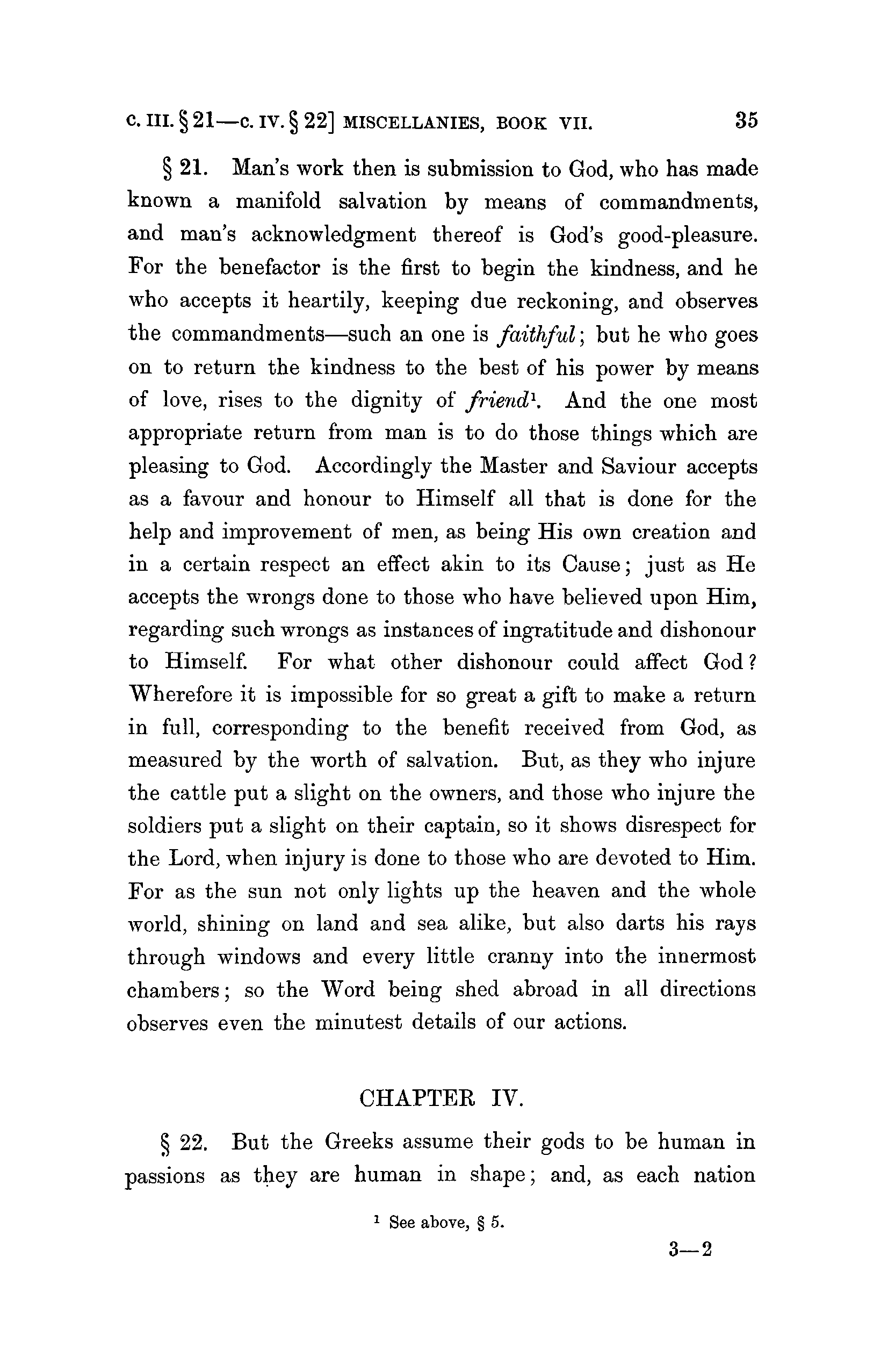
§ 21. Man's work then is submission to God, who has made known a manifold salvation by means of commandments, and man's acknowledgment thereof is God's good-pleasure.
For the benefactor is the first to begin the kindness, and he who accepts it heartily, keeping due reckoning, and observes the commandments—such an one is faithful; but he who goes on to return the kindness to the best of his power by means of love, rises to the dignity of friend1. And the one most appropriate return from man is to do those things which are pleasing to God. Accordingly the Master and Saviour accepts as a favour and honour to Himself all that is done for the help and improvement of men, as being His own creation and in a certain respect an effect akin to its Cause; just as He accepts the wrongs done to those who have believed upon Him, regarding such wrongs as instances of ingratitude and dishonour to Himself.
For what other dishonour could affect God ?
Wherefore it is impossible for so great a gift to make a return in full, corresponding to the benefit received from God, as measured by the worth of salvation. But, as they who injure the cattle put a slight on the owners, and those who injure the soldiers put a slight on their captain, so it shows disrespect for the Lord, when injury is done to those who are devoted to Him.
For as the sun not only lights up the heaven and the whole world, shining on land and sea alike, but also darts his rays through windows and every little cranny into the innermost chambers; so the Word being shed abroad in all directions observes even the minutest details of our actions.
CHAPTER IV.
§ 22. But the Greeks assume their gods to be human in passions as they are human in shape; and, as each nation
1 See above, § 5.
3—2 https://doi.org/10.1017/CBO9780511695513.010 Published online by Cambridge University Press
ITPQMATEQN Z'
[P. 841, s. 302
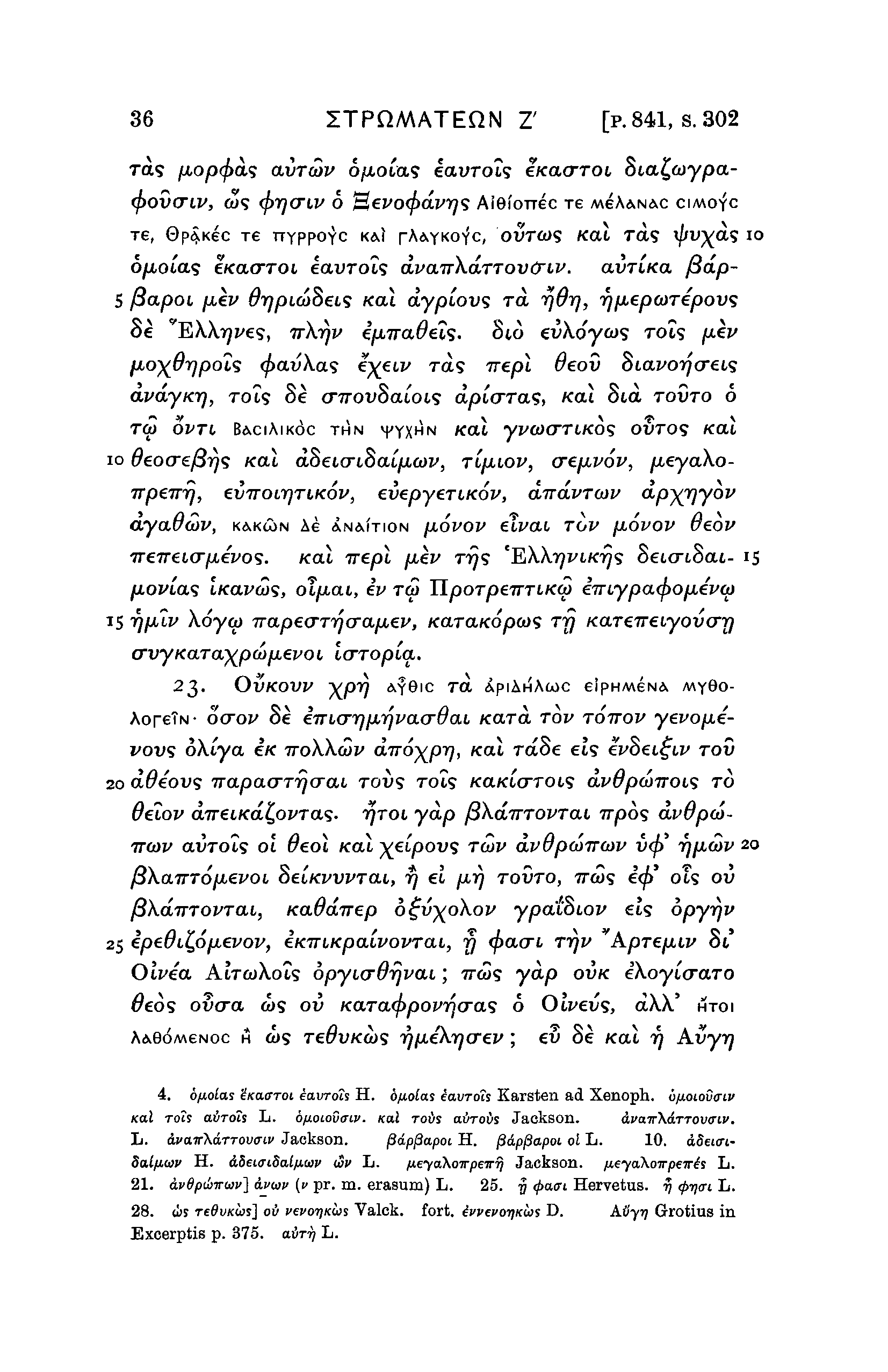
Tas poppas avrcov o/ioias eaurois e/cacrroi. Sia£a)ypa- <f)OV(TLV, a><> <f>r](riv 6 Hevcxfxivrjs
Aiefonec TS MEAANAC CIMO^C T6, Qp^Kec T£ TTYPPOYC KA! r^YKoyc, OUT&>S Kat r d s i/fi^as I 0 o/xoia? l/cacrroi eaurols dvair\6.TTov(riv. avTiKa fidpS jBapoi p.ev drjpLGjSeus Kal dypLovs r d ^f^, r)[JLepa)Tepov<;
Se "EXXiji/e?, TTX^V e|U7ra#eis.
8io evXoyws rots /u.et< <f>av\.a<> e^eti/ r a s vrept #eoi) Stavo^crets ) , rots 8e (TTrovSatoi? dpicrTas, Kal Sta TOUTO 6
TW oirt BACIAIKOC THN YYXHN /cal yva)(TTLKo<; OVTOS Kal io deocrefirjs Kal dSetcriSai/iw^, TC/JLLOV, cre.fj.vov,
TTpenrj, evirot.r)TiK6v, evepyeTLKov, dvdvTcov dyaOaiv, K^KCON Ae AN&ITION p.6vov elvat TOV JJLOVOV 0eov •ne.TreKTfjLevo'i. Kal irepl p,kv TT}<; 'JLWyjvLKrjs Seto-tSatis fjLOVia<; t/cavws, ot^Liai, ev rai TlpoTperrTLKaj i ^ 15 17/x.w Xdya) TrapecTTrjcrafxev, KaraKopa)? Trj crvyKara^pcofievoL icrTOpia.
2 3 .
OVKOVV XPV A?6ic r d APIAHAWC eipHMeNA MY9OAoreTNocrov Se eTncrrjiirjvacrdaL /card TOV TOTTOZ' yevofievovs oXCya CK TTOXXWV diro^py), Kal rdSe ei? ivSet^tv TOV
20 d64ov<; TTapao~TrjaaL TOUS TOIS Ka/ctcrrots dvdpanrois TO delov oLTreLKa^ovTa^. TJTOL yap (SkaTTTOvTai Trpos dvQputavTols ol deol Kal yelpovs
TO>V dvdpcoTrov v<f> rjficov 20 SeiKvvvTai, r/ ei /i,i) TOVTO, ITCOS i<j>' ol? ov Kaddirep o^v^oXov ypatSuov ets opyrjv 25 ipedi^ofj-evov, eKiriKpaivovrai, fj <f>ao-L TT\V vA.pTep.tv Si Olvea AITWXOIS bpyio~9r)vai; 770)5 yaP °VK eXoytcraro ^eos ovo~a ws ou KaTa<f>povrjo~a<; 6 Olvevs, dW HTOI AA86M6NOC H a)s Te8vKO)s r)[i.eXr)o~ev; eS Se /cai 17 4. dfioLas 'tuasToi iavrois H. ofiotas eavrots Karsten ad Xenoph. u/jioiovcnv
Kal TOIS a&Tois L. 6/tcoio0ffu'. Kal TOI>S auroi)s Jackson. dj'aTrXdTToutrii'.
L. avairkaTTOvinv Jackson. pdppapoi H. fi&ppapoL ol L.
10. adeundalfian H. d5ei<Ti8a(^.Mc we L.
/i»e7aXo7r/)e7r^ Jackson.
/ieyaXoirpeirh L.
21. dvBpiiiTrav] avuv (c pr. m. erasum) L.
25. ^ <^>ain Hervetus. y <p-q<n L.
28. ws TESUKUS] ov cevoi;/cws Valok. fort. tvvcvoriKus D.
ACY?; Grotius in Exoerptis p. 375. airr/ L. https://doi.org/10.1017/CBO9780511695513.010 Published online by Cambridge University Press
C. IV. §§ 22, 23]
MISCELLANIES, BOOK VII.
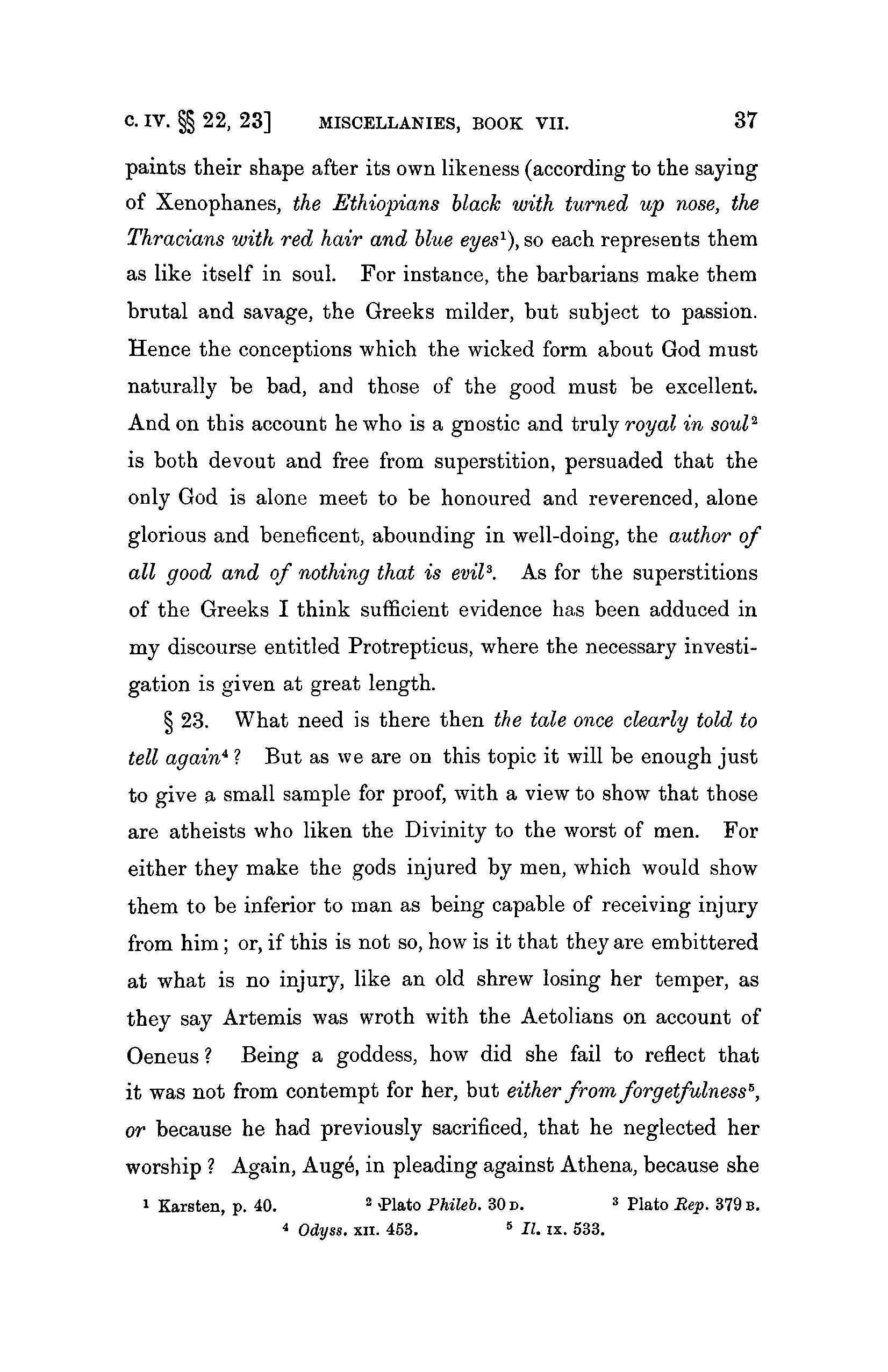
paints their shape after its own likeness (according to the saying of Xenophanes, the Ethiopians black with turned up nose, the Thracians with red hair and blue eyes1), so each represents them as like itself in soul. For instance, the barbarians make them brutal and savage, the Greeks milder, but subject to passion.
Hence the conceptions which the wicked form about God must naturally be bad, and those of the good must be excellent.
And on this account he who is a gnostic and truly royal in soul2 is both devout and free from superstition, persuaded that the only God is alone meet to be honoured and reverenced, alone glorious and beneficent, abounding in well-doing, the author of all good and of nothing that is evil3. As for the superstitions of the Greeks I think sufficient evidence has been adduced in my discourse entitled Protrepticus, where the necessary investigation is given at great length.
§ 23. What need is there then the tale once clearly told to tell again* ? But as we are on this topic it will be enough just to give a small sample for proof, with a view to show that those are atheists who liken the Divinity to the worst of men. For either they make the gods injured by men, which would show them to be inferior to man as being capable of receiving injury from him; or, if this is not so, how is it that they are embittered at what is no injury, like an old shrew losing her temper, as they say Artemis was wroth with the Aetolians on account of Oeneus ? Being a goddess, how did she fail to reflect that it was not from contempt for her, but either from forgetfulness5, or because he had previously sacrificed, that he neglected her worship ? Again, Auge, in pleading against Athena, because she
1 Karsten, p. 40.
2 'Plato Phileb. 30 D.
3 Plato Rep. 379 B.
4 Odyss. xn. 453.
6 II. ix. 533. https://doi.org/10.1017/CBO9780511695513.010 Published online by Cambridge University Press
STPQMATEQN Z'
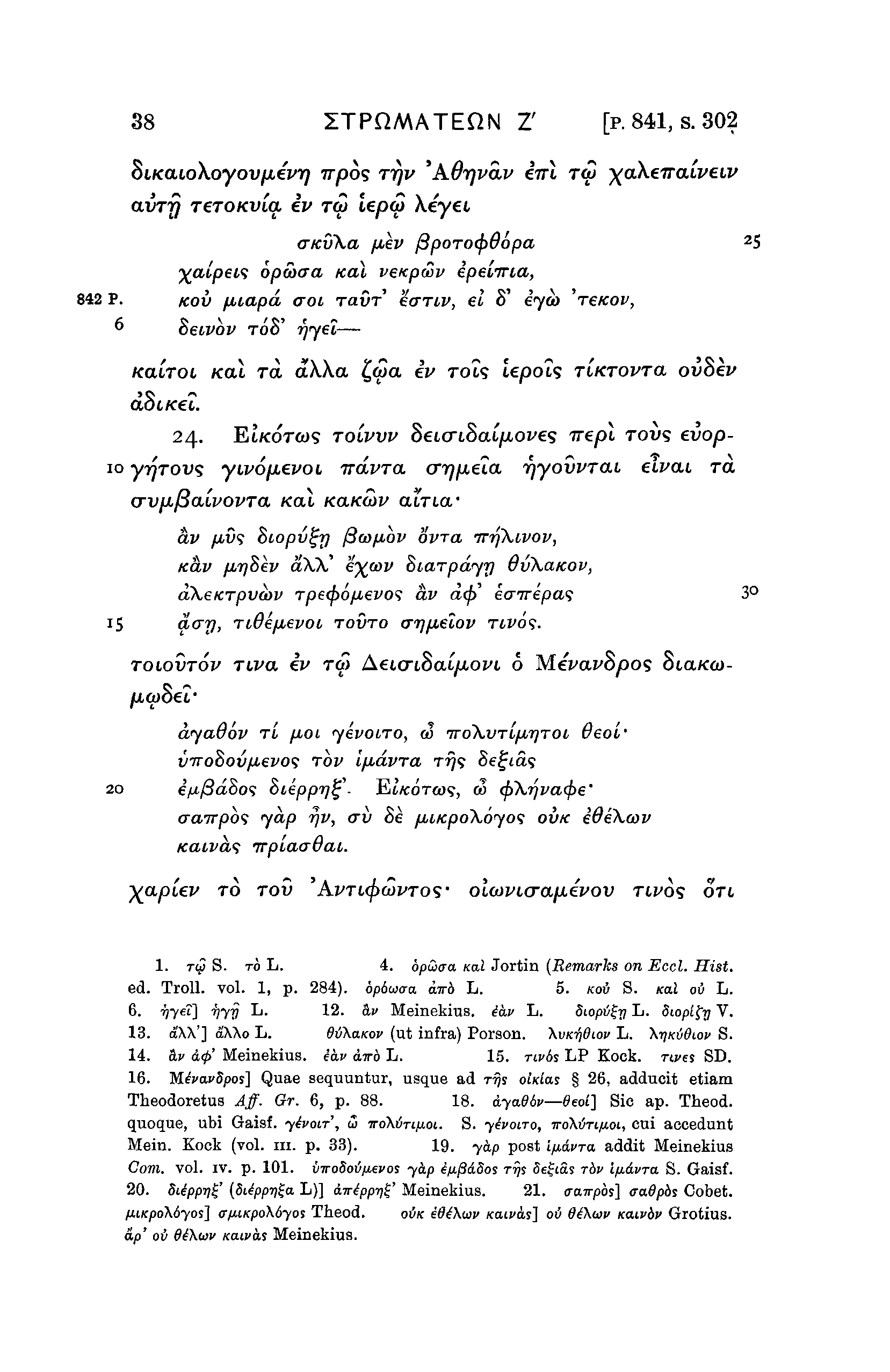
[p. 841, s. 302 rrjv 'A0Tjvav eVt rw )(akeiraiveiv avrrj TeroKvia. iv TW lepai \eyet crKvXa /j,ev j3poTocf>66pa
Xaipeis opwaa ical veKpoov ipeliria, 842 P. icov fuapd <roi TOUT' ecrnv, el 8' iya> Weicov,
Bewov TOS' rj'yel— /cat ret. a \ X a ( w a iv rocs lepot? TIKTOVTO, ov§e 24.
EI/COTWS TOIVVV 8etcri8atju,oves 7re/3t rows euop10 yTjrous yivofj-evoL irdvTa (Trjfx^ia rjyovvTau eivai TO. crvjJL/3aCvovTa KaX KaKOiv a t r i a 1 av fAVS Bcopv^rj f3a>fiov ovra irrfKivov, Kav fj.r)Bev aXX' e^v Biarpdyy OvXaicov, aXeKTpvav rpecfiofievo'; av d<f> ecnrepas 3°
acy, riOefievoi TOVTO crrjfieiov TWOS.
TOLOVTOV Twa iv TO) AetcrtSaiju.oi't 6 MevavSpos /LiajSet' ayadov T'L p,OL yevoiTO, cJ iroXvTifiTjToi, 6eoi' inroSov/Mevos TOP ifJbdvTa T?/9 8e£ias
e/u./3a8o? 8ieppT)!f. EtVoToj?, cu cfiXrjvafye' craTrpbs yap i)v, o~v Be fwcpoXoyos OVK ideKcov Kaiva<; )(apiev TO TOV 'AvTi<f>aJvT0S' olwvio-ajJLevov TWOS OTL 1. TQ S.
TO L.
4. 6pu<ra Kal Jortiu (Remarks on Eccl.
Hist. ed. Troll, vol. 1, p. 284). bpbwaa airb L.
5. Koi S. Kal ov L.
6. ^7«] ^7^ L.
12. civ Meinekius. ^dy L.
Siopiyfj; L. Stopifj; V.
13. a\\'] aXXo L. eiXaKov (ut infra) Porson.
\VK-/}6IOV L. \-qKiBmv S.
14. ftp <£0' Meinekius. edp dx6 L.
15. TICAS LP Kock. rtyes SD.
16.
MhcwSpos] Quae sequuntur, usque ad rijs oldas § 26, adducit etiam Theodoretus Aff. Gr. 6, p. 88.
18. dyadSv—Seoi] Sic ap. Theod. quoque, ubi Gaisf. yivoir, u iroXiSn^oi. S. yhoiro, iroX&n/ioi, cui aecedunt
Mein. Kock (vol. in. p. 33).
19. yap post i/idcra addit Meinekius Com. vol. iv. p . 101. VTroSoifievos yhp ififi&dos T^S SefiSs TOI/ Ifi&vra S. Gaisf.
20.
Slippy!;' (SUppnZa L)] A.ir{ppT)g Meinekius.
21. era7rpos] <ra6pbs Cobet.
IxiKpokbyos] aiuKpo\byos Theod. oiK ed£\iov /caiKas] ov 6t\uv Kaivbv Grotius. ap' ov 6£huv icatvas Meinekius. https://doi.org/10.1017/CBO9780511695513.010 Published online by Cambridge University Press
C. IV. §§ 23, 24]
MISCELLANIES, BOOK VII.
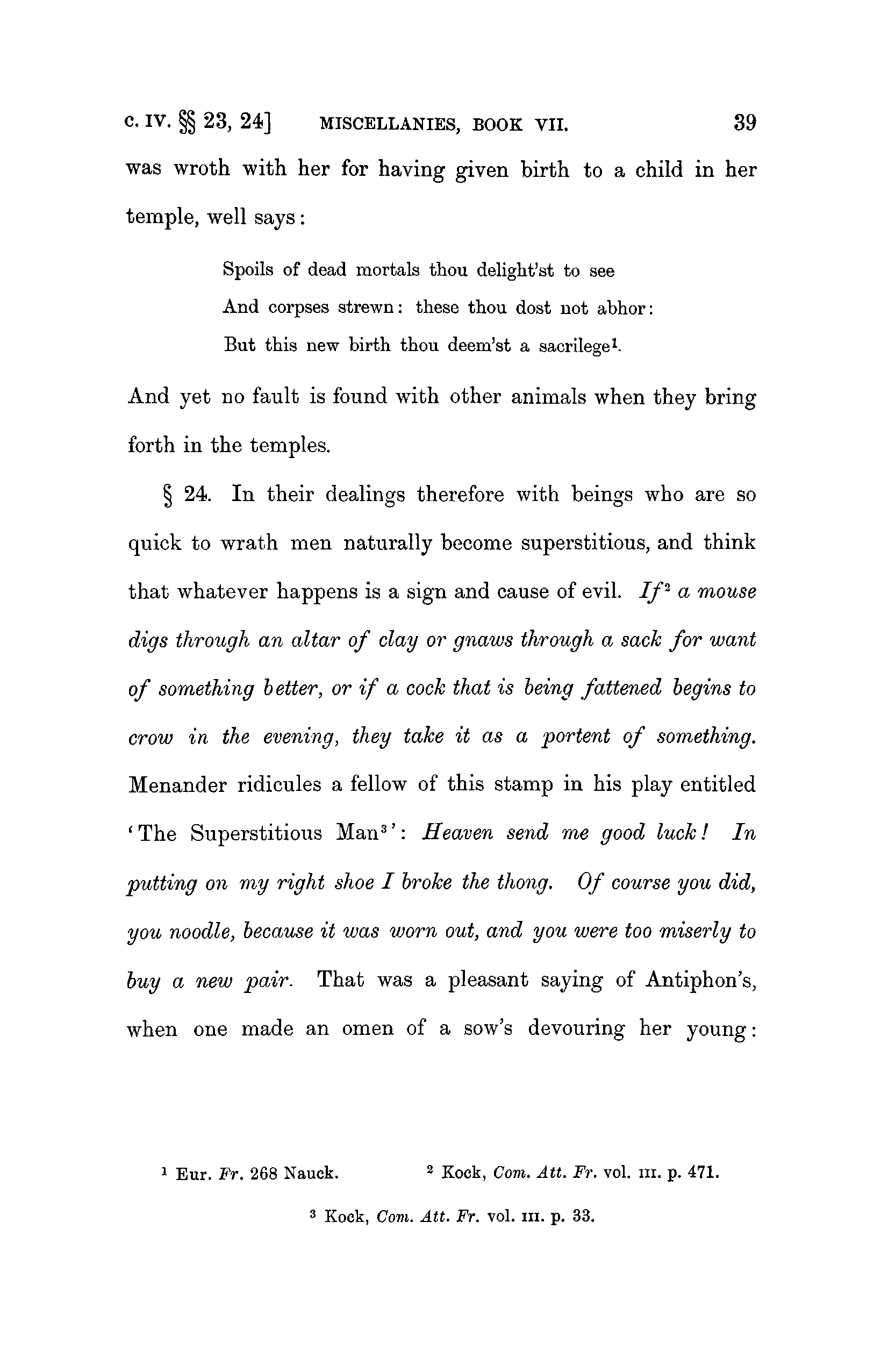
was wroth with her for having given birth to a child in her temple, well says:
Spoils of dead mortals thou delight'st to see And corpses strewn: these thou dost not abhor:
But this new birth thou deem'st a sacrilege1.
And yet no fault is found with other animals when they bring forth in the temples.
§ 24. In their dealings therefore with beings who are so quick to wrath men naturally become superstitious, and think that whatever happens is a sign and cause of evil. If2 a mouse digs through an altar of clay or gnaws through a sack for want of something better, or if a cock that is being fattened begins to crow in the evening, they take it as a portent of something.
Menander ridicules a fellow of this stamp in his play entitled ' The Superstitious Man3': Heaven send me good luck!
In putting on my right shoe I broke the thong.
Of course you did, you noodle, because it was worn out, and you were too miserly to buy a new pair.
That was a pleasant saying of Antiphon's, when one made an omen of a sow's devouring her young:
1 Eur. Fr. 268 Nauck.
2 Kock, Com. Att. Fr. vol. in. p. 471.
3 Kock, Com. Att. Fr. vol. in. p. 33. https://doi.org/10.1017/CBO9780511695513.010 Published online by Cambridge University Press
ZTPQMATEQN Z'
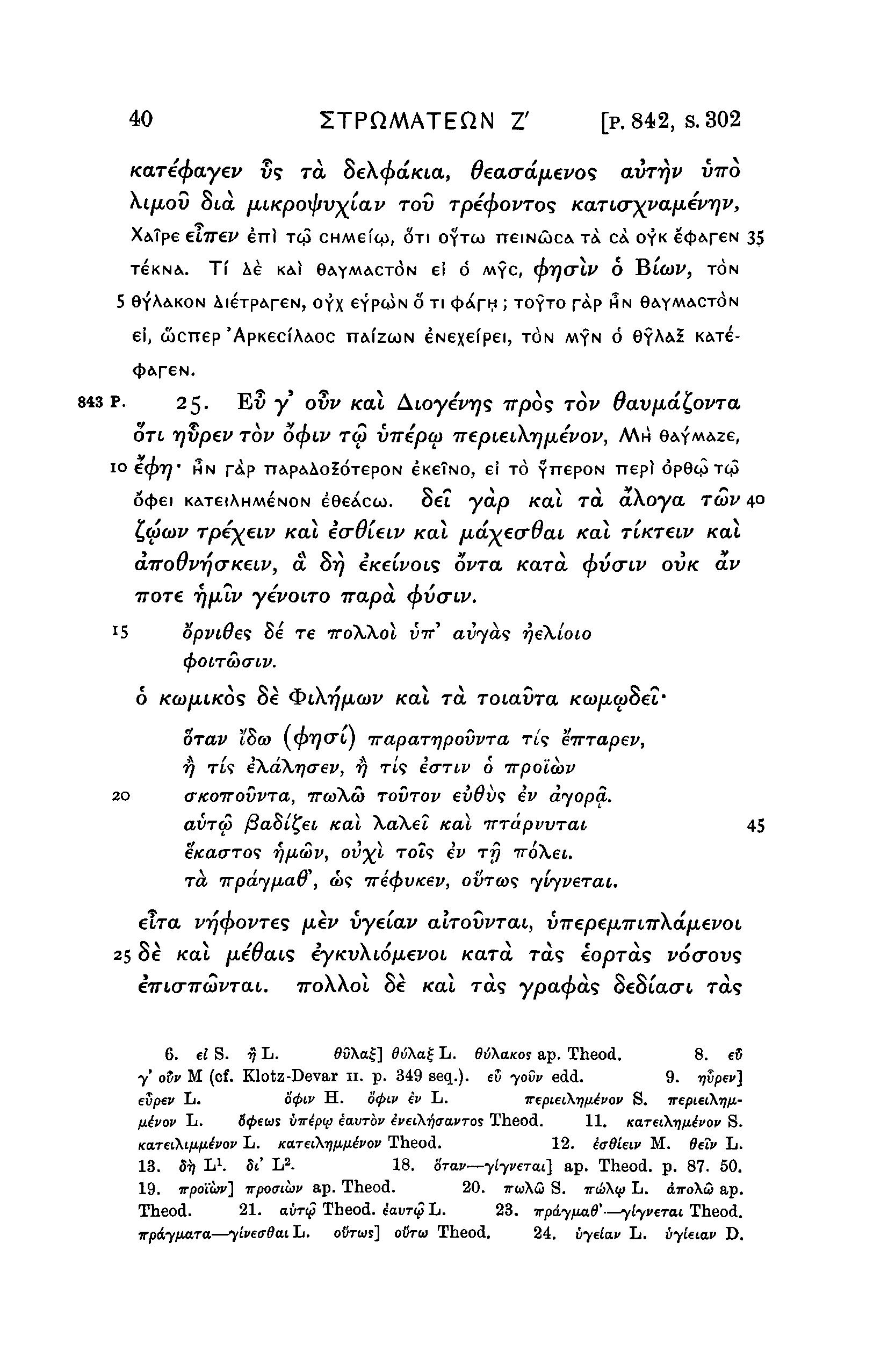
[p. 842, s. 302 yev vs TO, SeX<£aKia, deacrdfievo? avrqv VTTO u Sia. fiLKpo\pv^Cav TOV Tp€(f>ovTo<; KaTio-yyap.£vr]v,
X&Tpe eiirev err) TCJ> CHMGICP, OTI OYTCO TreiNtoc^ T<\ C£ OYK e<t>*r6N 35 T6KN&.
Tf Ae KA( G&YMACTON ei 6 MYC, (f>rjo~lv 6 B l o w , TON s SYAAKON AieTpAreN, OYX 6 Y P « N 6 TI 4><^r^; TOYTO r^p HM ed.Y M A C T° N ei, wcrrep'ApKecfAAOc n&fzwN eNexeipei, T 6 N MYN d 6YA&5 K&TC843 P.
25. Ev y' o w Kal AtoyeV>;s Trpos TOV $avfid£,ovTa o n y]vpev TOV 6<j>iv TW VTrepcp TrepieiXrqiLevov, MH
10 e(prj'
HN r<^P TTdip&AoIoTepoN eKeTNO, ei TO YTrepoN nept o 6(j>ei KATeiAH/weNON e0eAcco.
Set y a p K a i r a a X o y a
T W J ' 40
tftitov rpiyeiv KOX ko~Qii.iv Kai fx.d^eo'daL Kal TLKTCCV Kai aTTo0vrjcrK€LV, a. S17 CKeivois ovra Kara <f>vo~LV OVK av
77OT€ T7/jt,lI' yivOVTO TTapa <f>VO~LV.
!S opviOes Si re rroXXol VTT1 avyas rjeXloio Se QihrjiMiiv Kal r a Toiaura i'Sa) [(fyrjO~L) TrapaTrjpovvra Tt? eirrapev, rj Tt? iXaXrja-ep, rj TI? ecrTti' o Trpolwv
(TKOTrovvTa, TTtoXw TOVTOV evdvs ev dyopa. avTo> /3aSt£et Kai XaXet Kal •trrapwrai
eica<TTO<; rjfiaiv, ou%t Tots eV T ^ wokei.
TO, TrpdyfiaO', &>? 7re<f>vicev, ovrws <yiyveTai. vrj(]>ovTes fikv iyeCav airouvrai, vT 25 Se Kai //,e'0ais eyKuXio/Aevoi Kara Ta.5 eopra.5
£tno-!TO)VTaL. 7roXXoi Se Kai Tas ypa<pa$ SeSiacri ra?
6. ci S.
•? L. eC\a|] 0i5Xaf L.
0i\a.Kos ap. Theod.
8. e8 7' offy M (of. Klotz-Devar 11. p. 349 seq.). ev yovv edd.
9. yvptv] evpev L. o^ic H .
8<f>iv & L. irepieCKruxivov S. irepieikij/iliivov L. ci0ews vwtptg eavrbv ivetK^aavTos Theod.
11.
KOTeiXij/t^oi' S.
KarfiXifiiiivov L.
Kwra\i]ixiiivov Theod.
12. iaSUiv M.
0«K L.
13.
«r) L1.
St' L2.
18. oTav—ylyveTcu'] ap. Theod. p. 87. 50.
19. ir/jo'iux] irpotjiwv ap. Theod.
20.
7rw\w S.
Tnli\cp L. d7ro\w ap.
Theod.
21. avrifi Theod. eour^ L.
23. Trp6.ytw.ff—yivveroi Theod. irp6.yiw.Ta.—ylveadat.'L. oiirus] O8TW Theod.
24. u7c(ai' L. iyUiav D. https://doi.org/10.1017/CBO9780511695513.010 Published online by Cambridge University Press
C. IV. §§ 24, 25]
MISCELLANIES, BOOK VII.
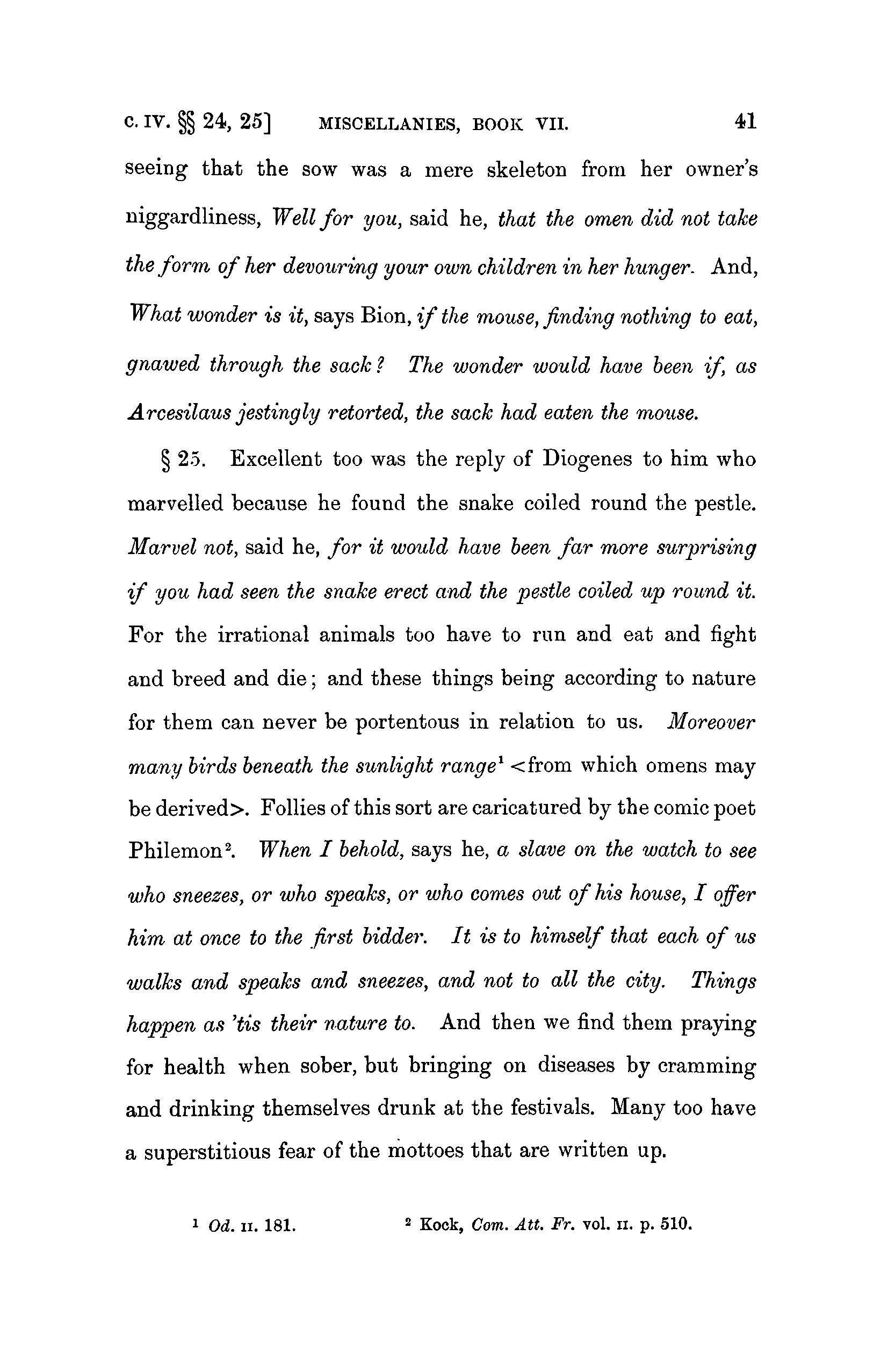
seeing that the sow was a mere skeleton from her owner's niggardliness, Well for you, said he, that the omen did not take the form of her devouring your own children in her hunger. And,
What wonder is it, says Bion, if the mouse, finding nothing to eat, gnawed through the sack? The wonder would have been if, as Arcesilaus jestingly retorted, the sack had eaten the mouse.
§ 25. Excellent too was the reply of Diogenes to him who marvelled because he found the snake coiled round the pestle.
Marvel not, said he, for it would have been far more surprising if you had seen the snake erect and the pestle coiled up round it.
For the irrational animals too have to run and eat and fight and breed and die; and these things being according to nature for them can never be portentous in relation to us. Moreover many birds beneath the sunlight range1 <from which omens may be derived>. Follies of this sort are caricatured by the comic poet
Philemon2. When I behold, says he, a slave on the watch to see who sneezes, or who speaks, or who comes out of his house, I offer him at once to the first bidder. It is to himself that each of us walks and speaks and sneezes, and not to all the city. Things happen as 'tis their nature to. And then we find them praying for health when sober, but bringing on diseases by cramming and drinking themselves drunk at the festivals. Many too have a superstitious fear of the mottoes that are written up.
1 Od. ii. 181.
2 Kook, Com. Att. Fr. vol. n. p. 510. https://doi.org/10.1017/CBO9780511695513.010 Published online by Cambridge University Press
ITPQMATEQN Z'
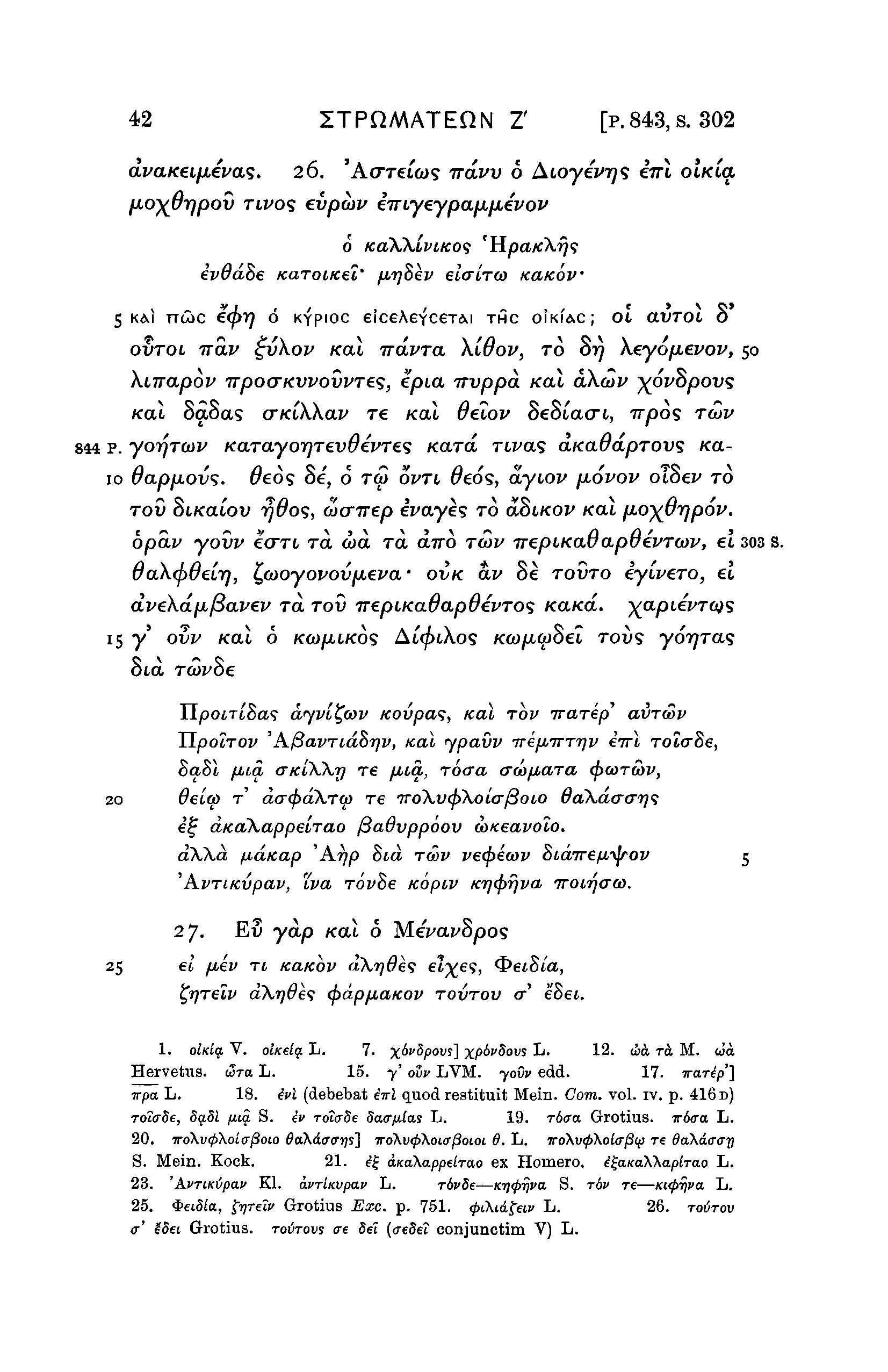
[P.843, a 302 26. 'Acrreiws irdvv 6 AioyeV^s inl OLKLCL jj.o)(dr)pov Tivos evpwv iT
ivddBe Karoi/cei' firjBev elcrirco ica/cow 5 K«J TTWC i(f)Y) 6 Kypioc eiceAeyceTAi THC O'\K'H,C; ol avTol S'
OUTOI irav £v\ov Kal vdvTa \Wov, TO Srj keyo/juevov, 50 Xnrapov TrpocrKwovvTes, epia TTvppa Kal akcjv )(6vSpov<s
Kal SaSas (rKiWav TC Kal deiov SeSiacri, Trpos TOJV 844 P. yorjTbiv KaTayo7)Tev0evTe<s Kara Ttvas aKaddpTovs Ka10 dapfjiov';. deos Se, d T<5 OVTI deos, ayiov /xovov oTSev TO TOV hiKaiov rjdo<;, a>o-rrep eVayes TO CLSLKOV Kal fio^Oiqpov. opav yovv eo"ri Ta aia r a airo TCOU Trepi-KadapuevTon', et 303 f
6a\(f>6cLrj, tfiioyovovfjieva • OVK av 8e TOCTO eyCvero, el aVeX.aju,/3avev r a TOU irepiKadap64vTO<; KaKa.
15 y' ovv Kal 6 KWju-t/cos Aic^iXos /cw/xaiSei TOWS Sia TaivSe ayvu£a>v icovpas, Kal TOV -rraTep1 avtmv
TlpoiTOv 'A/3avTid$riv, Kal <ypavv TrefiirTTjv eirl TolcrSe, Ba8l fiia crKiWri T6 /tta, rocra crco/iara
6ei,a> T dcrcf)aXTO) re 7roA,u^>Xoi<r/Soi el; aKaXappeiTao (Badvppoov ooiceavolo. dWa fiaKap A.r)p Sia T&V vetyemv SiaTrefiyfrov 'AvTiKvpav, 'iva TovSe tcopiv K7]if>f)va 27.
Eu yap Kal 6 MevavSpos
et fiev TI KaKov aXr/des et^es, <I>6tSta, <f>dp/u,aKov TOVTOV <T e'Set.
1. oUlq. V. olKelq. L.
7. x^^Povs] XpA"5ous L.
12. (ict rd M. aia Hervetus. i3™ L.
15. 7' ow LVM.
70OK edd.
17. waripi irpa L.
18. toil (debebat iirl quod restituit Mein. Com. vol. iv. p. 416 n) rofcrSe, 5p5i /niy S. iv roicrSe dour/ilas L.
19. rbaa Grotius. irbtra L.
20.
To\v</)\ol<rf3oLO $a\&ff(n)s] iro\v<p\oi(r{$oLoi 6. L . iro\v<f>\ol<Tl3<fi re da\&(T<F7] S. Mein. Kock.
21. ^| aKaXappdrao ex Homero. i^aKaWaplrao L.
23.
'KvTuctipav Kl. cwrUvpav L.
TACSE—K-qtpTJva S. r6y re—nupTJva L.
25.
Qeidla, i-qreiv Grotius .Exc. p . 751. ^iXidfeii' L.
26. TOIJTOU
<r' ?5et Grotius.
TOOTOVS ffe del (<re5e? conjunctim V) L . https://doi.org/10.1017/CBO9780511695513.010 Published online by Cambridge University Press
C. IV. §§ 26, 27]
MISCELLANIES, BOOK VII.
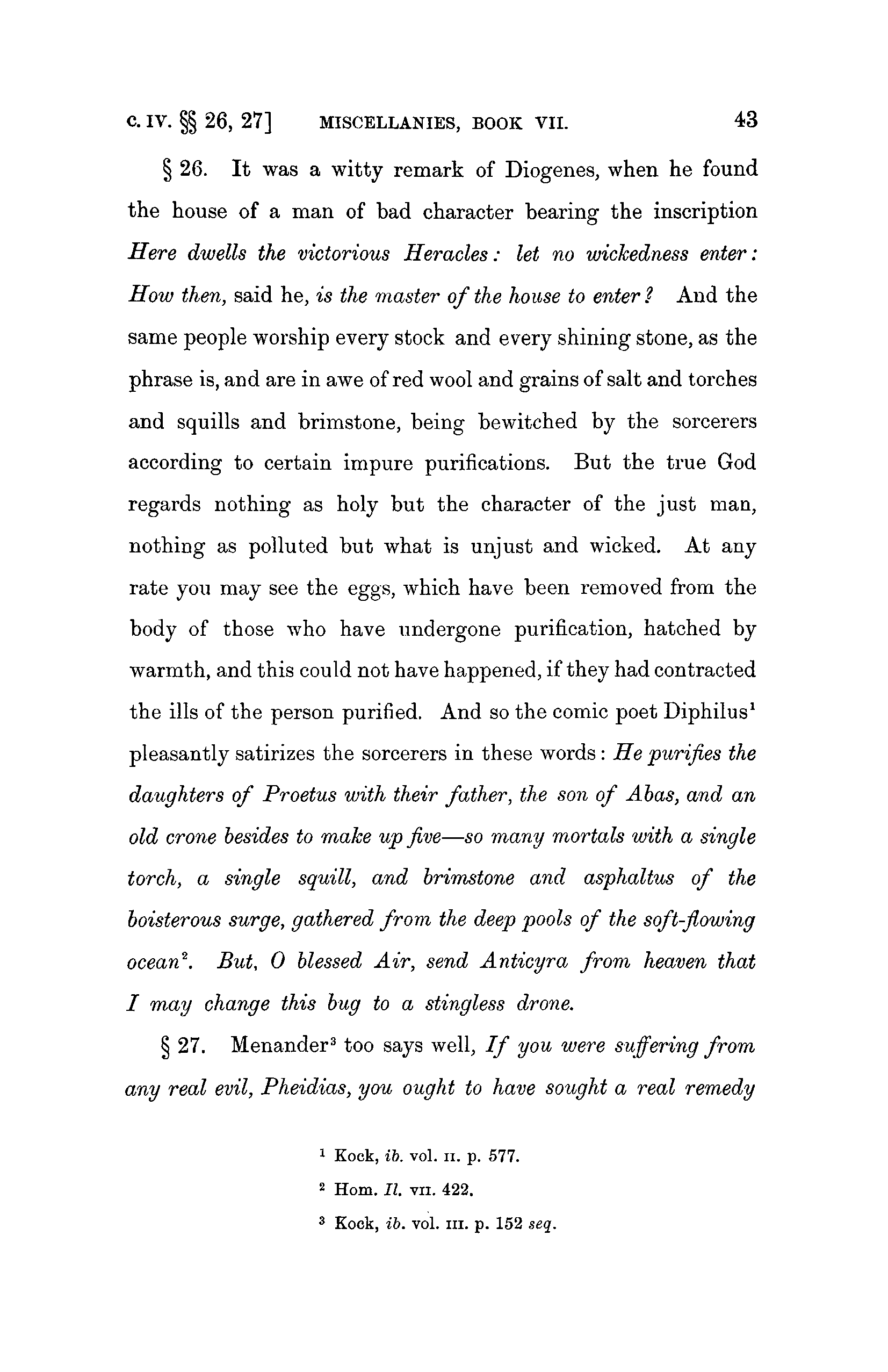
§ 26. It was a witty remark of Diogenes, when he found the house of a man of bad character bearing the inscription
Here dwells the victorious Heracles: let no wickedness enter:
How then, said he, is the master of the house to enter? And the same people worship every stock and every shining stone, as the phrase is, and are in awe of red wool and grains of salt and torches and squills and brimstone, being bewitched by the sorcerers according to certain impure purifications. But the true God regards nothing as holy but the character of the just man, nothing as polluted but what is unjust and wicked. At any rate you may see the eggs, which have been removed from the body of those who have undergone purification, hatched by warmth, and this could not have happened, if they had contracted the ills of the person purified. And so the comic poet Diphilus1 pleasantly satirizes the sorcerers in these words : He purifies the daughters of Proetus with their father, the son of Abas, and an old crone besides to make up five—so many mortals with a single torch, a single squill, and brimstone and asphaltus of the boisterous surge, gathered from the deep pools of the soft-flowing ocean2. But, 0 blessed Air, send Anticyra from heaven that I may change this bug to a stingless drone.
§ 27. Menander3 too says well, If you were suffering from any real evil, Pheidias, you ought to have sought a real remedy
1 Kock, ib. vol. ii. p. 577.
2 Horn. II. vn. 422.
3 Kock, ib. vol. in. p. 152 seq. https://doi.org/10.1017/CBO9780511695513.010 Published online by Cambridge University Press
ZTPQMATEQN Z'
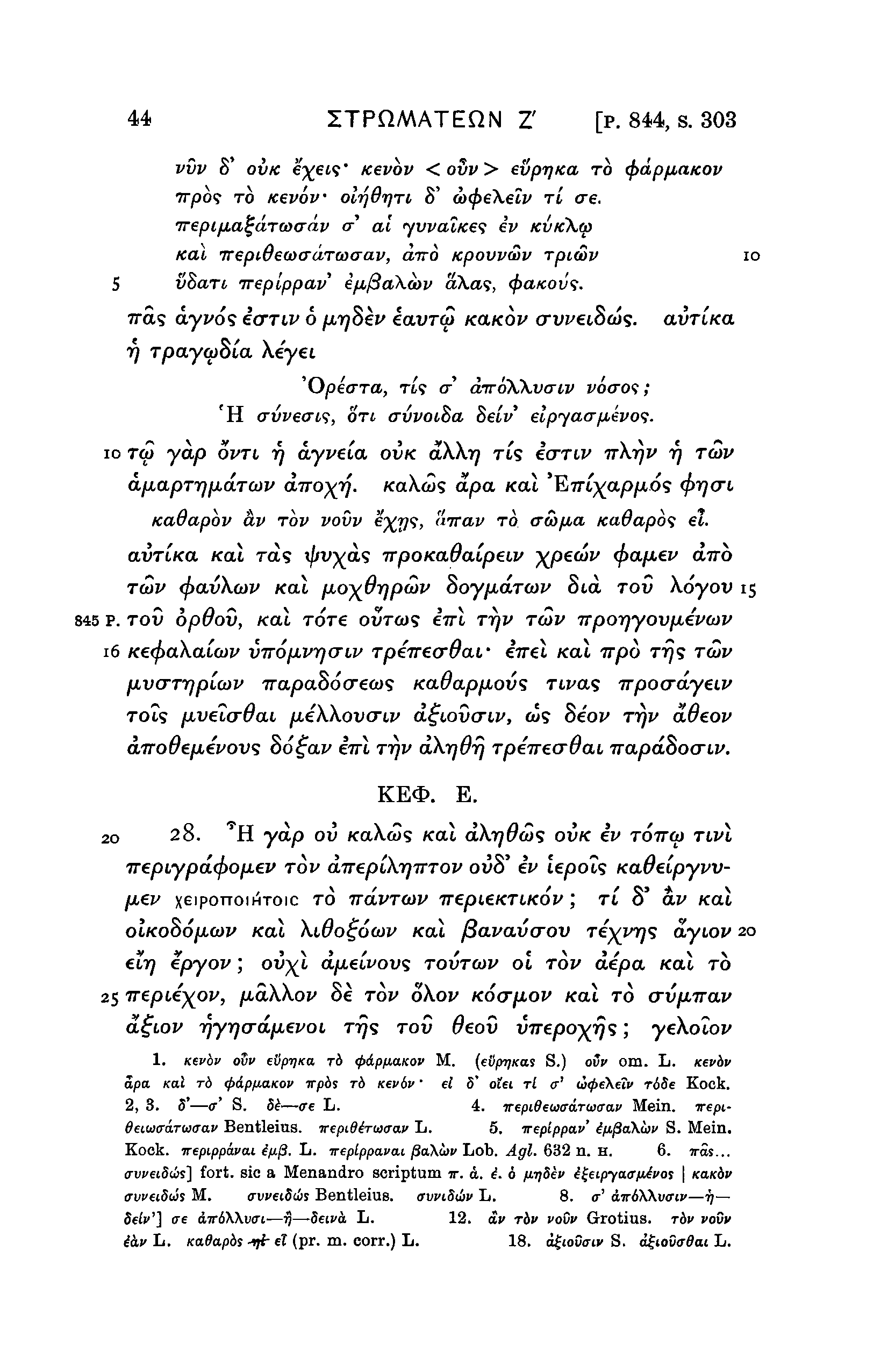
[p. 844, s. 303 vvv S' OVK e^et?' Kevov <ovv> evprjKa TO (j>dpjia.KOi> 7T/3O? TO Kevov olrjOrjTi K ax^eXelv TL ere.
Trepi/j.ai;dTa>o~av & al yvvaiK€<; iv KVK\G> KCU irepi-Oecoo'dTiaaav, diro Kpovvaiv Tpiwv io
vBaTc ireplppav ifif3a\a>v a\a?, <f>aicovs.
7ras dyvos icrTLV 6 pr/Sev iavTCp KOLK6V crvueiSoj^. avriKa rj TpaycoSCa Xeyei 'OpeaTd, Tt? a diroSJKvcnv vocros; 'H avvecn<i, OTI o-vvooBa Seiv' elpycur/j<evo<}. io T&> yap OVTL rj ayveCa. OVK aXKrj Tts icrTiv irXrjv r] TUSV ap,apTr)p,d.TQ)v d.TT0)(7j. KaX&is apa /cai 'E7rt^a/>/*os <f>r)<ri,
Kadapov av TOV VOVV exw>> <'lirav TO a-aifjua Kadapo? el.
Kai r a s i/a^as TrpoKadalpe.iv *xpeojv (f>ap,ev dirb <f>av\o)v Kal p*oy9y}ph>v Soyp.a.Twv Sid TOV \6yov 15
845 P. TOV 6p0OV, Kal TOTC OVT(O<S ivl TTjV T0)V 7TpOr)yOVp.€V(OV 16 Ke<f>a\ata)v vTrop,vqo~iv TpeirecrdaL' inel Kal irpb Trjs TCUV pvo-TrjpCcov Tra^oaSocrews Ka6app,ov<; Ttvas TTpoo~6.yi.iv TOIS p.veio'dai p.i\\ovo~iv d^i.ovo'iv, c«5s Seov •n)i> d6eov ' iirl TTJV d\y]6rj TpeTreaOai, napaSoaiv.
28. 'H yap ov /caA.aJs Kal d\rj0a><; OVK iv TOTTOJ TLVI vepLypdcpop-ev TOV dTrepCkqirTov oi5S' iv le/aois Kadeipyvvpuev xeiponoiHTOic TO ndvTcov irepieKTLKOv; TL 8' av /cat
OLKoSop-ojv Kal \t,0o£6<i>v Kal /3avavo~ov re^v^s dyiov 20 etrj epyov; ov-^l dp.e£vovs TOVTCOV ol TOV depa Kal TO 25 irepiiyov, p.aXKov Se TOV okov Koo~p,ov Kal TO o~vp.Trav d^iov r\yr\o-dp.evoi TTJS TOV deov virepo-^rj^; yeXolov 1.
Ktvbv ovv eOpTjKa ri> (pdp/Micov M. (eiipTjKas S.) ovv om. L . xevbv apa Kal rb (pipfuiicoy irpbs rb nev6v • el 5' olet TL <r' w<f>e\eiv r68e Kook.
2, 3. 8'—«•' S. de—<xe L.
4. irepideuaaTtixrav Mein. rrept- $uu<ra.Twaav Bentleins. vepWiruxraf L.
5. ireplppav' i/ifiaKuv S. Mein.
Kock. irepippavai i/ifi, L. ireplppavai jSaXwc Lob. Agl. 632 n. H.
TOS... a-vveiSds] fort, sic a Menandro scriptum v. d. ^. 6 juqiev e"£eipya.<Tfit'i>os | KaKiv irvKciSus M. o-uvetStis Bentleius. avviSiiiv L.
8. o-' d7r6XXiKr»'—ij— Sdv'] (re d7n5XXwri^—ij—-deivi. L.
12. av rbv voOv Grotius. rbv vovv iavL.
KaBapbs -rfr eT (pr. m. corr.) L.
18. afioiW S. o|ioCo-floi L. https://doi.org/10.1017/CBO9780511695513.010 Published online by Cambridge University Press