
CHAPTER I
MISCELLANIES, BOOK VII.
CHAPTER I.
§ 1. It is now time for us to prove to the Greeks that the gnostic alone is truly devout, so that the philosophers, learning what sort of person the true Christian is, may condemn their own folly for their careless and indiscriminate persecution of the name of Christian, while they irrationally abuse as atheists those who have the knowledge of the true God. And in addressing philosophers I think one should employ ratiocination as more convincing, since they are better trained to understand it from their previous course of instruction, even if they have not yet shown themselves worthy to participate in the power to believe. Of the sayings of the prophets we will make no mention at present, intending hereafter to avail ourselves of the Scriptures on the fitting occasions. For the present we will only give a summary indication of what is declared by them, in the form of a sketch of the Christian religion, in order that we may not break the thread of the discourse by constant references to the Scriptures, especially when addressing those who do not yet understand their phraseology.
When we have shown their general purport, the exhibition of the testimonies shall be superadded afterwards on their believing. And if our words seem to some of the uninstructed to be different from the Lord's Scriptures, let them know that it is from the Scriptures that I 2 https://doi.org/10.1017/CBO9780511695513.010 Published online by Cambridge University Press
ITPQMATEQN Z'
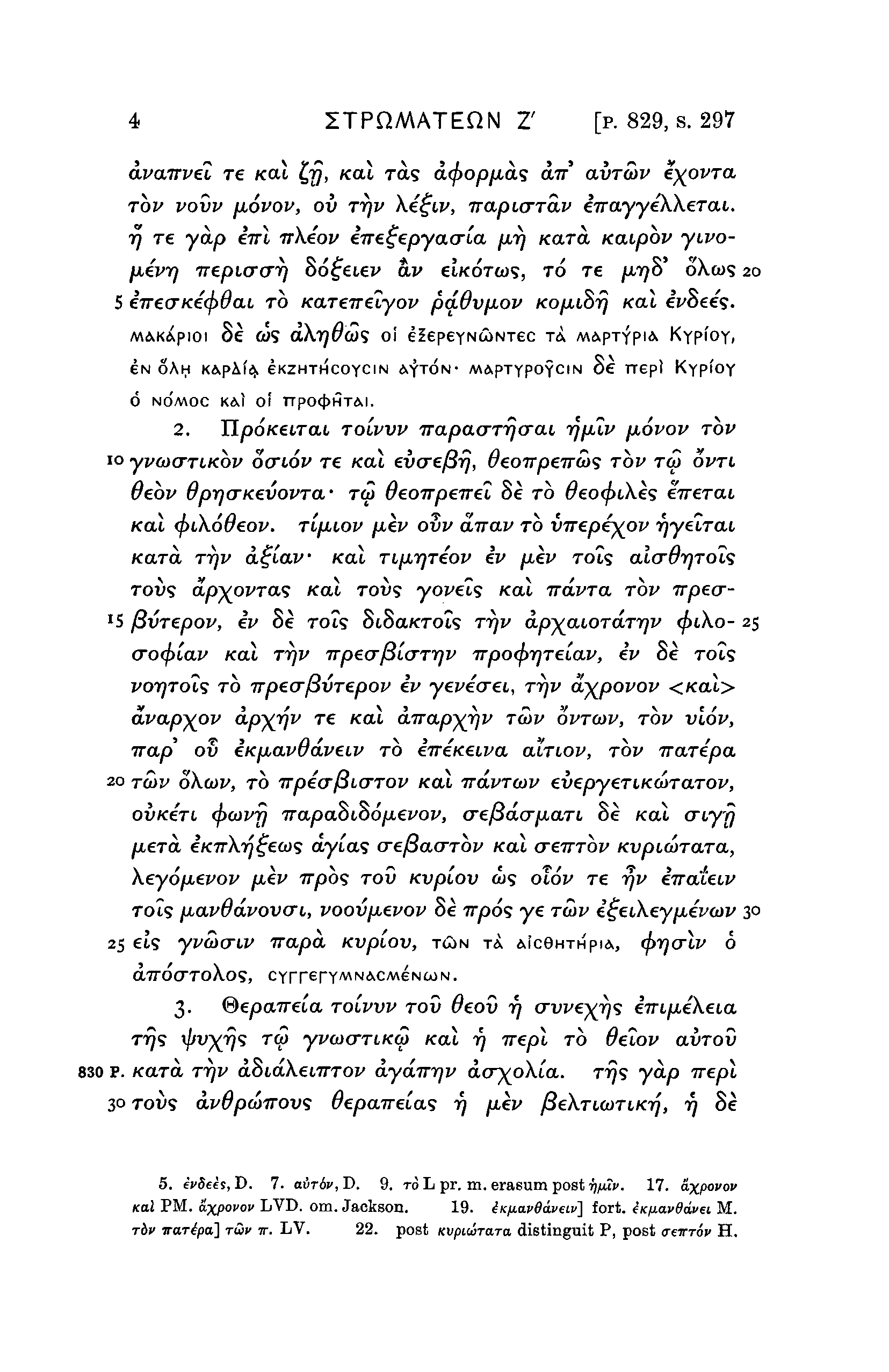
[p. 829, s. 297 dvanvel re /cat £17, /cal TIXS OL(f>opiJ.a<s CLTT avT<ov l^ovra TOV vovv [lovov, ov Tr)v ketjiv, •napio-Ta.v eVayye'XXerat.. y\ re yap eVl irkiov eVefepyao-ta JUT) Kara Kaipbv yivofjievr) irepLa-crri ho^etev av ei/corcus, TO re ^178' 6'Xcus 20 5 iire.o'Ki^dat TO KaTeirelyov pa.Qvp.ov Kop.iSrj KCLL evSee's.
M&K&pioi Se a5s dkr)0a)<; oi elepeyNcoNTec T& M&PTYPIA Kypfoy, eN OAH K&pAf^ IKZHTHCOYCIN *,yTONMApTypoyciN Se rrepl Kypioy
6 NO'MOC K&i oi rrpo((>HT«>i.
IIpoKetrat. TO'LVVV Trapao-Trjcrai rfpXv p.6vov TOP 10 yvciHTTiKov oaiov TC /cat evcrefirj, 6eoTTpeTra>s TOV TW
0ebv 8pr)o~KevovTa' ra OeoTrpeireZ Se TO ^eo^)tX Kat <j)iX60€ov. Ttp-Lov [xkv ovv aiTO-v TO viTepi^ov
Kara, TT^V d^tav /cat TLfxrjTeov iv /xev rots alo~6r)To1<i rous ap^ovTas /cal TOUS yovets zeal vravra TOV Trpecrl5 fivTepov, iv Se rols StSa/crots T^V dp^atorar^v (^1X025
<ro(j)Lav /cat T77i> irpea^io'T'iqv irpo<f>iqTeiav, iv Se Tots TO Trpeo-fivTepou iv yeveaei, TTJV d^povov </cat> pyrjv re /cat airapyjiv TCOV OVTCOV, TOV vlov, nap" ov iKfjbav0dv€iv TO iireKewa
CLITIOV, TOV
vaTepa 20 raiy oXaw, TO Trpicrfito-Tov /cat irdvTcov evepyeTLKcoTaTOv, ou/ceVt (f>covrf TrapaSiSofj-evov, cre/3ao"jaaTt Se /cat o"ty'^
/xera, iKwXrj^eo)<; aytas o-e/Sao"roj/ /cat creirTov KvpiatTarra, Xeyofnevov fikv Trpbs TOV KvpCov OJS otov TC 7)1' eTrat'etv
TOIS fJL<xv0dvovcn, voov^vov 8e TT/JOS ye rav e'^etXey/xeVwz/ 3° 25 ets yvaia"tv irapa Kvpiov, T<^N TA AiceHTHpiA, (f>r)crlv 6 a,Troo"ToXos, CYrrerYMNACM6NWN3.
©epavreta TO'IVVV TOV 0eov 17 cruve^s eVtjLte'Xeta Tir}s ipv-xfj'* TW yvwo-Tt/cw /cat 17 7rept TO ^etov avrou
830 p. /caTa T^V dStaXetTTTOi' aydvrjv da^oXta. r^Js ydp Trept 30 rot)? avdpwirovs 0epa.Trela<; rj fiev ySeXricoTi/CTj, 17 Se
5. evSeh, D. 7. ai)r6p, D.
9. TO L pr. m. erasum post ^/«y.
17. axpovov Kal PM. axpovoi' LVD. om. Jackson.
19. iK^avBdveiv] fort. £icixav9di>ei M.
T6>> iroT^pa] rail' TT. LV.
22. post KvpiuTara distinguit P, post (revrov H. https://doi.org/10.1017/CBO9780511695513.010 Published online by Cambridge University Press
C. 1. §§ 1—3]
MISCELLANIES, BOOK VII.
they draw their life and breath, and that it is their object, taking these as their starting-point, to set forth, not their phraseology, but their meaning only. For further elaboration being unseasonable would with good reason seem superfluous, while on the other hand it would be a very careless and unsatisfactory way of treating the subject if we were to omit all consideration of that which is of pressing importance. And blessed indeed are they who search out the testimonies of the Lord: with their whole heart they will seek him1.
Now they which testify of the Lord are the law and the prophets2.
§ 2. It is our business then to prove that the gnostic alone is holy and pious, worshipping the true God as beseems Him; and the worship which beseems God includes both loving God and being loved by Him. To the gnostic every kind of preeminence seems honourable in proportion to its worth. In the world of sense rulers and parents and elders generally are to be honoured; in matters of teaching, the most ancient philosophy and the earliest prophecy; in the spiritual world, that which is elder in origin, the Son, the beginning and first-fruit of all existing things, Himself timeless and without beginning; from whom the gnostic believes that he receives the knowledge of the ultimate cause, the Father of the universe, the earliest and most beneficent of all existences, no longer reported by word of mouth, but worshipped and adored, as is His due, with silent worship and holy awe; who was manifested indeed by the Lord so far as it was possible for the learners to understand, but apprehended by those whom the Lord has elected for knowledge, those, says the apostle, who have their senses exercised3.
§ 3. The gnostic therefore pays service to God by his constant self-discipline and by cherishing that which is divine in himself in the way of unremitting charity. For as regards the service of men, part may be classed as meliorative treatment and part as ministrative service. Thus the medicinal i Psalm cxix. 2, 1 Pet. i. 10.
2 Jo. v. 39, Eom. iii. 21 (cf. Act. x. 43). s Heb. v. 14. https://doi.org/10.1017/CBO9780511695513.010 Published online by Cambridge University Press
ZTPQMATEQN Z'
[p. 830, s. 297
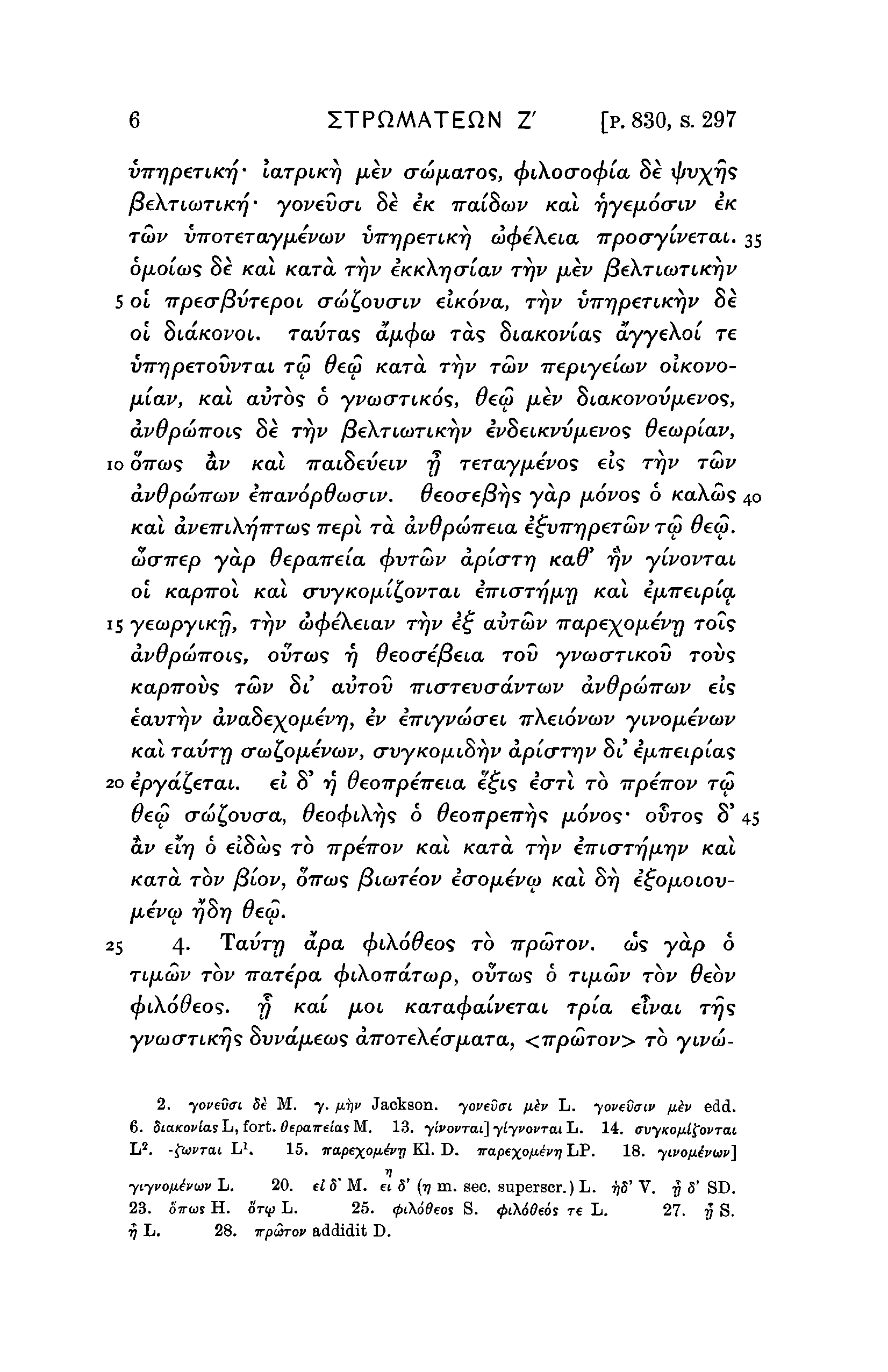
T) fiev cr&jjuaTos, <f>i\oo-o(j>Ca Se 7 • yovevcrt Se ix iraihoiv /cat v)ye[LO<riv IK TWV vTroreray/Aevoiv vTrrjpeTLKrj axfaeXeia TTpoo~yiverai. 35
Ojnouws Se Kal Kara TTJV e/c/cX-^criav TTJV fikv fUekrMaTLKrjv 5 ol irpeo-fivTepot, a-a>t,ov<Tiv elxova, rr)v VTTTjpeTUcrjv Se ol hiaKovoi. ravras a/A^xu Tas Sta/covia? ayyeXoi re VTTTJP^TOVVTat To! ^€&5 Kara T^V rwv irepiyeiaiv
OLKOVOfilav, Kal auros 6 yvwcrriKos, ^e&J yu.ev Sia/co^oujae^os, avdpa>TTOLS Se T171' ySe\Tiwrt/c^v eVSei/cpu/Aevos 6ea>pCav,
10 OTTWS ai/ Kat TratSeueti' ^ reTay/j,evo<s ets riji' rali' av6pcx)TTu>v ivavopdaxTLV. deocrefirjS yap JUOVOS 6 /caX&is 40 /ecu dj'eTriX'^TrTws Trepl r a avdpanreia itjvTrrjpeTwv ra> deqi. uxnrep yap Oepaneia <f)VTwv apiarr) Kad' T\V yivovrat ot Kapiroi Kal <rvyKo\)lLpvTai hricrrr\[x,ri Kal ifAireupCa
15 yecopyLKrj, TTJV d)(f>ekeiav rr/v i£ avTbiv Trapey^ofjievrj rot? ai>0panroL<;, ovrws rj ^eocre'/Seta TOV yvcoariKov rows Kapirovs TS>V SI' aurou vca'TevcroivTcov av6pco7ro)v eis iavrrjv avaSe^ofievri, iv iinyvctJcreL irXetovoiv yivopivoxv /cat Tavrrj cruttp^ivuiv, crvyKO[j.i,Sr)v apienrjv St' CjHTreipta?
20 ipydt,erai. et S' TJ deoTrpeireta efi? ecrrl ro Trpiirov ra #e<w cruttpvera, deo(f>L\r]<; 6 6eoTrpeiTrj<i [xovo<i' ovros S' 45 ctv eti; 6 etSws TO irp&nov Kal /caret TT)P iTncrTiqiirjv Kal
Kara TOV jiiov, OTTOS /3LCOT€OV io-o/jLeva) Kal ST) i^ofxovovfievco 77S77 ^eal.
Tavry a/>a (faXodeos TO npcoTOu. a><; yap 6 TLfJLa>i> TOV Ttaripa (frikoTraTcop, ovrws 6 TI/JLCHV TOV debv
<f)iX69eo<;. rj Kai [JLOI, KaTa<f>aiveTaL TpCa etvai Trj<s yva)o-TLKr)<; Swa/xews dTroreXe'cr/AaTa, <7rpcoTov> TO yivoy2. yovevai Se M. y. fxty Jackson, yovevvi /xh L. yovevau' /xtv edd.
6. SiaKovlas L, fort. Oepairelas M.
13. yivovraC] ylyvovrai L.
14. avyKO/jXfyvTai.
L2. -fcoprai L1.
15. irapexo/i,&ri El. D. vapexo/nirri LP.
18. 7ivo/*frup]
yiyvophuv L.
20. ei 5" M. ei 5' (ij m. sec. superscr.) L. ^S'V.
$ 5' SD.
23.
O7TWS H. oVy L.
25.
(pMOeos S.
<pi\60eos re L.
27. ij S. ij L.
28. irpQrrov addidit D. https://doi.org/10.1017/CBO9780511695513.010 Published online by Cambridge University Press
C. I. §§ 3, 4]
MISCELLANIES, BOOK VII.
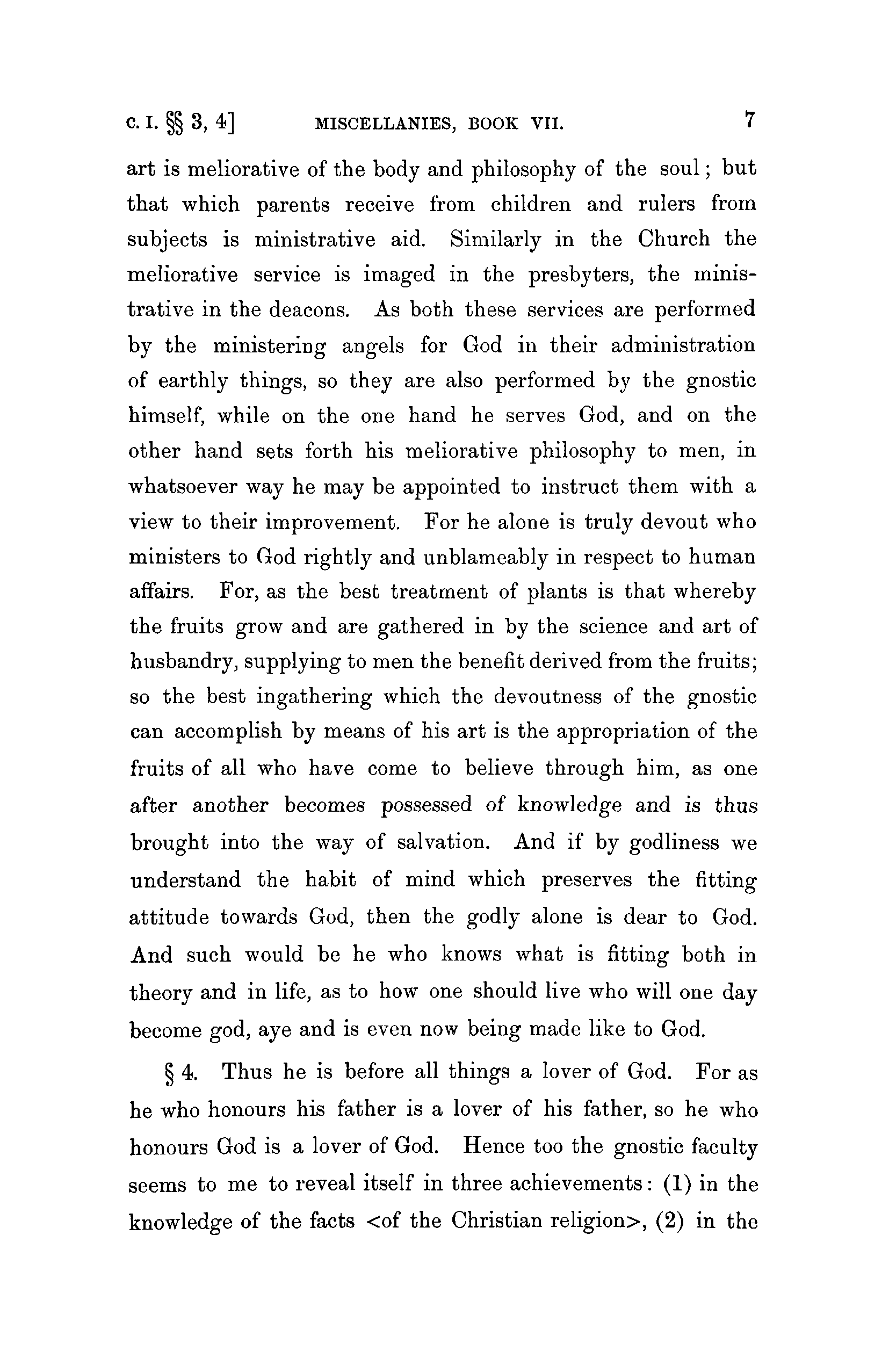
art is meliorative of the body and philosophy of the soul; but that which parents receive from children and rulers from subjects is ministrative aid. Similarly in the Church the meliorative service is imaged in the presbyters, the ministrative in the deacons. As both these services are performed by the ministering angels for God in their administration of earthly things, so they are also performed by the gnostic himself, while on the one hand he serves God, and on the other hand sets forth his meliorative philosophy to men, in whatsoever way he may be appointed to instruct them with a view to their improvement. For he alone is truly devout who ministers to God rightly and unblameably in respect to human affairs.
For, as the best treatment of plants is that whereby the fruits grow and are gathered in by the science and art of husbandry, supplying to men the benefit derived from the fruits; so the best ingathering which the devoutness of the gnostic can accomplish by means of his art is the appropriation of the fruits of all who have come to believe through him, as one after another becomes possessed of knowledge and is thus brought into the way of salvation. And if by godliness we understand the habit of mind which preserves the fitting attitude towards God, then the godly alone is dear to God.
And such would be he who knows what is fitting both in theory and in life, as to how one should live who will one day become god, aye and is even now being made like to God.
§ 4. Thus he is before all things a lover of God. For as he who honours his father is a lover of his father, so he who honours God is a lover of God. Hence too the gnostic faculty seems to me to reveal itself in three achievements: (1) in the knowledge of the facts <of the Christian religion>, (2) in the https://doi.org/10.1017/CBO9780511695513.010 Published online by Cambridge University Press
ITPQMATEQN Z'
[p. 830, s. 297
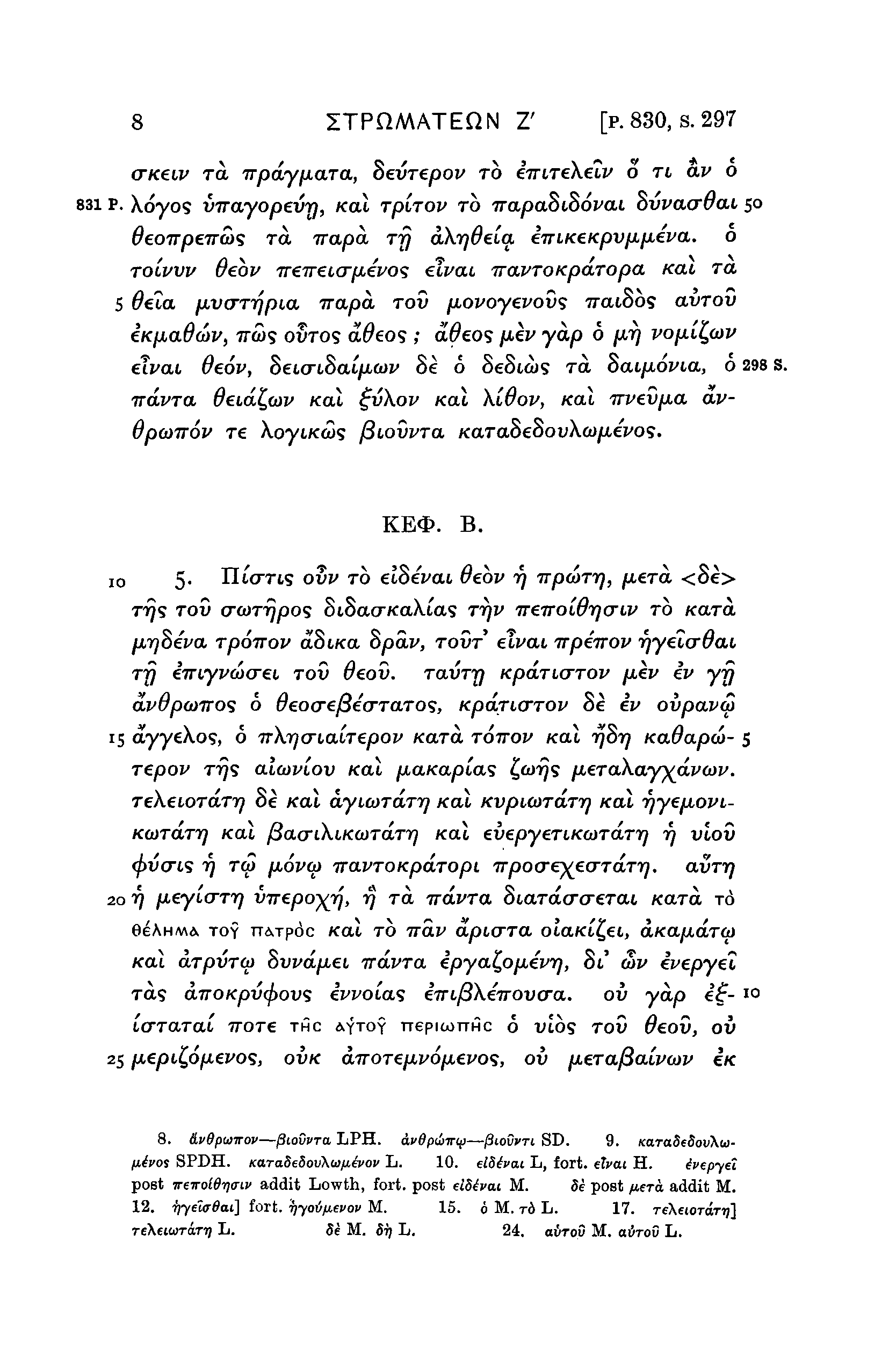
<TK€.iv TO. TTpdyixara, Sevrepov TO eViTeXetv o TL av o 831 p. Xdyos vnayopevy, /cat Tp'iTOv TO irapaSiSovac ovvacrdai 50 deowpeTras r a Trapa 777 aKiqdeLa eTrt/ce/c/au/AjaeVa. o Toivvv 9ebv Treireio-pivos elvcu TravTOKparopa /cat r a 5 #eta jjbvo-Trjpia irapa TOV [Lovoyevovs TraiSos CLVTOV iKfj,a6(ov, rrais ouros a^eos ; a^eo? /xei' yap 6 [xr/ vo[A.i£,(ov eti'at deov, Seio-tSai/AWtSe 6 SeSicis r a SatfJiovca, 6 298 s.
TraWa deud^cav KO.1 £vkov KaX \C6OV, /cai dpomov re Xoyt/cais fiiovvTa.
. B.
Iltcms oSv TO etSeWi ^eov 17 irpaiTr), peTa <Se> TOU o~o)T7Jpos SiSao-/caXtas TIJV iretToWr\o'iv TO KCLTO. fj/r]hiva Tpoirov aSi/ca hpav, TOVT eivai irpercov rjyeLo~9a.i Trj iiriyvdia-ei TOV deov.
TavTr) K.pa.Tio~TOv (JLCV iv yfj avdpcoTTOs o deocrefieo-TaTos, K.pdrno~TOv Se iv oipavw 15 ayyeXo?, 6 v\rjo~iaiTepov KOTO, TOTTOV /cat 17877 KaOapco5 Tepov T7J9 aioivlov /cat jaa/ca^otas ^<UTJS //.CTaXay^avcuv.
TeXetoTaTTi Se /cat ayLa)Ta.Tr) /cat KvpLCOTaTT] /cat -fjyefjLOVLKOTaTT] /cat ySao"tXt/c&jTaT77 /cat evepyeTLKcoTaTT) TJ viov
<f>vo~c,<s 17 TW fiovco rra.vTOKpa.TOpi 7rpoo~e)(eo-T<£T7), avTrj 20 77 \Leyio~Tt] VTrepo^rj, 77 r a vavra
StaTao'creTat icaTa TO eeAH^A TOY TT<yrp6c /cat TO TTSI' aptcrTa ota/ct^et, d/cajttaT&t
/cat aTpvTco Swva/Aei vaivTa ipya^o^evr), 81 &v ivepyel Tas anoKpv(j)ovs eVvotas eTrtySXeVowcra. ou yap ef10 tcTTarat ?7OTe THC AYTOY nepicorriHC 6 vtos TOG ^eou, ou
25 /jLept,£,6fj.evos, OVK dTroTeju.i'd/ytevo?, ou fiera^aivoiv e/c 8. &v9pwTov—f3i.ovvTa LPH. ivSpdnry—ptovvTi. SD.
9. KaT<x5e5ov\w- /ufros SPDH.
KaraStSovXia/j.^i'oi' L.
10. ddtvai L, fort, efcat H. tvepyei post TrewoWi}tni> addit Lowth, fort, post eibtvai M.
5e post ^cra addit M.
12. fryeMT-flai] fort. Tjyoti/ievov M.
15. 6 M. TA L.
17. TeXetorari)] L.
8e M. 57) L.
24. auroO M. OI5TOU L. https://doi.org/10.1017/CBO9780511695513.010 Published online by Cambridge University Press