
CHAPTER X
C X. §§ 55, 56]
MISCELLANIES, BOOK VII.
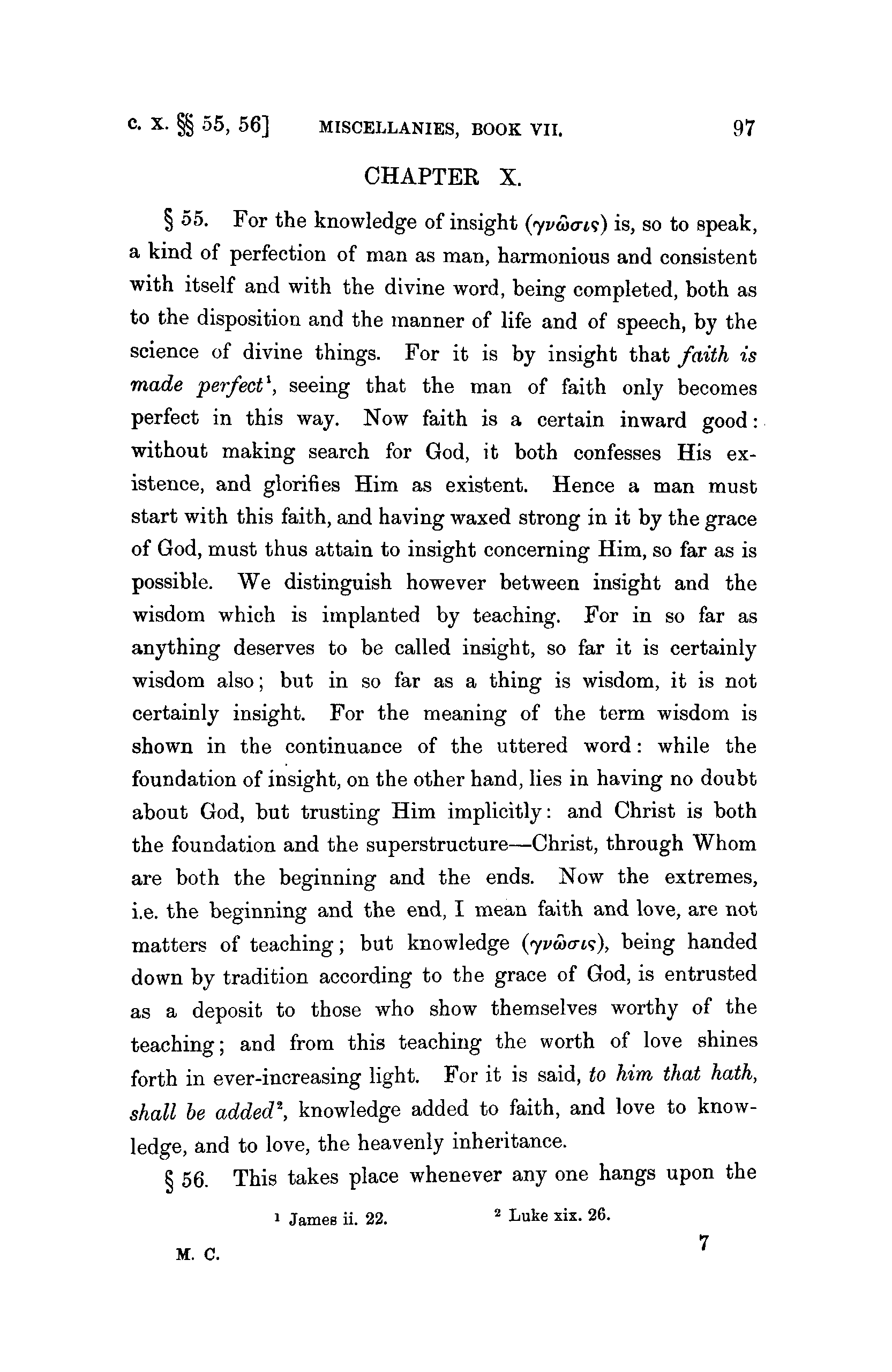
CHAPTER X.
§ 55. For the knowledge of insight (yva><ri<;) is, so to speak, a kind of perfection of man as man, harmonious and consistent with itself and with the divine word, being completed, both as to the disposition and the manner of life and of speech, by the science of divine things. For it is by insight that faith is made perfect1, seeing that the man of faith only becomes perfect in this way. Now faith is a certain inward good: without making search for God, it both confesses His existence, and glorifies Him as existent. Hence a man must start with this faith, and having waxed strong in it by the grace of God, must thus attain to insight concerning Him, so far as is possible. We distinguish however between insight and the wisdom which is implanted by teaching. For in so far as anything deserves to be called insight, so far it is certainly wisdom also; but in so far as a thing is wisdom, it is not certainly insight. For the meaning of the term wisdom is shown in the continuance of the uttered word: while the foundation of insight, on the other hand, lies in having no doubt about God, but trusting Him implicitly: and Christ is both the foundation and the superstructure—Christ, through Whom are both the beginning and the ends. Now the extremes, i.e. the beginning and the end, I mean faith and love, are not matters of teaching; but knowledge (yva)o-i<;), being handed down by tradition according to the grace of God, is entrusted as a deposit to those who show themselves worthy of the teaching; and from this teaching the worth of love shines forth in ever-increasing light. For it is said, to him that hath, shall be added*, knowledge added to faith, and love to knowledge, and to love, the heavenly inheritance.
§ 56. This takes place whenever any one hangs upon the i James ii. 22.
2 Luke xix. 26.
M. C. https://doi.org/10.1017/CBO9780511695513.010 Published online by Cambridge University Press
ITPQMATEfiN Z'
[p. 865, s. 311
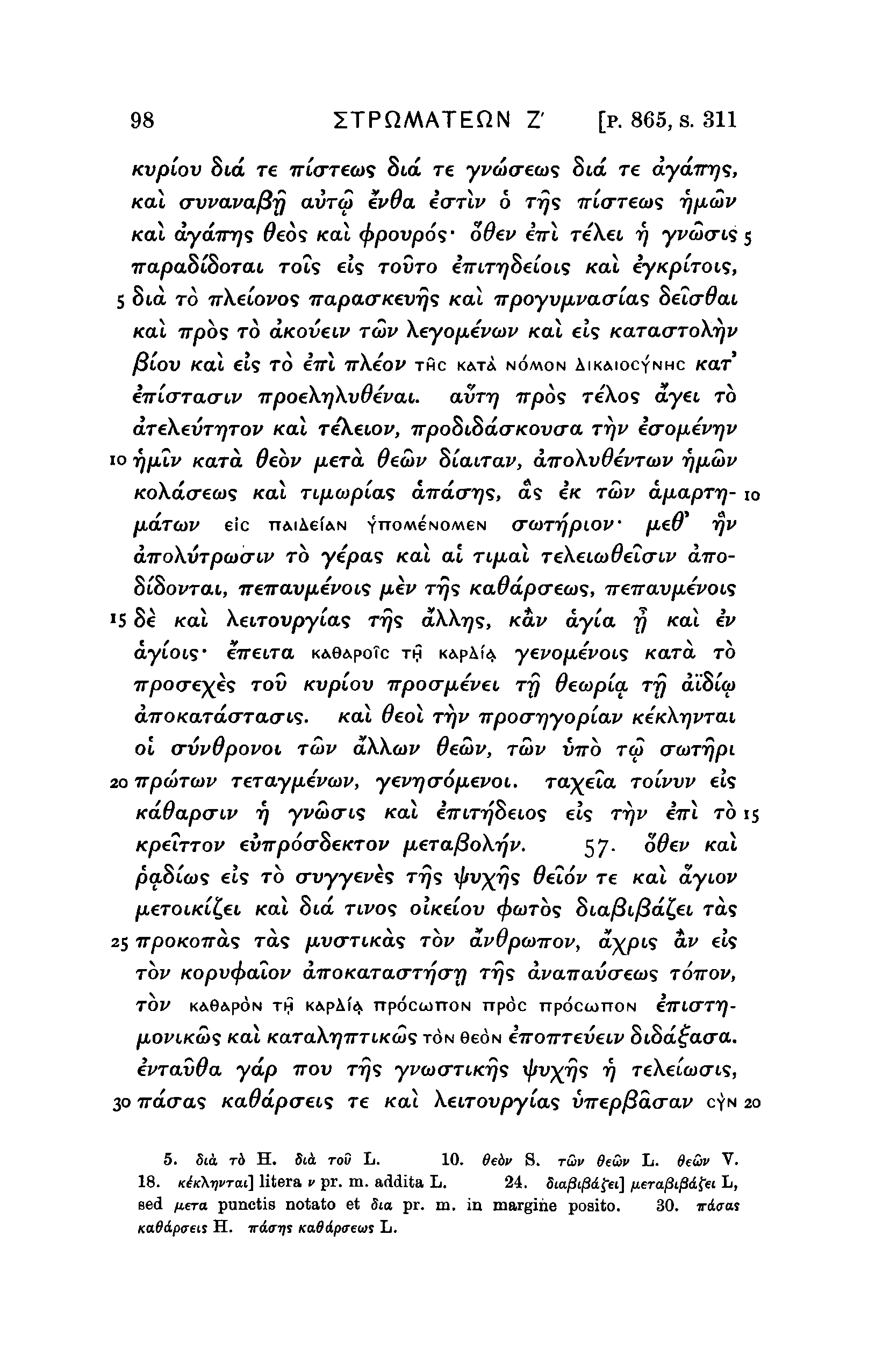
Kvplov Swx re 7rtcrTe<us Stot re ypcucretws §«£ re /cat o~vvava/3r) aur&J eV#a earii/ 6 TTJS 7riorea>s
/cat dydirr)<s #eos /cat <f>povp6$m 66e.v eVl Te'Xet 17 7ra/3aStSoTat rots eis TOVTO eViT^Setots >cal e
S Sid TO TTXCIOVOS TrapacrKevrjs /cat TTpoyvfLvaata<; Setcr^at Kat TTJOOS TO aKoveuv Tdv Xeyofxevwv /cat ets yStov /cat eis TO evrt 7r\eoi' THC K<\TA NOMON AIKAIOCYNHC
TrpoeXrjXvOdvat,. avTiq Trpos Te'Xos ayet TO /cat TeXetoi/, 7r/3oStSao-/cov<ra TT^V i<rofievr)v /caTa ^eoi/ /ICTO, ^eoii' StatTav, anoXvdevTwv r/fiiov /coXao"ews /cat Ti/Jicopias aTrdo~r)<;, as e/c rai' dfiapTrj10 eic TTAiAef&N YTro^eNOMEN coiTt/jpiov fizu TJV TO yepas /cat at Tifnal TeXeia)9eio~Lv OLTTOireiravfiivoi<i fiev T^S Ka0dpo~e<o<;, 7re7rauju.€vots
'5 Se /cat XetToupytas T^S aXX^s, KOLV dyta 17 /cat iv dytots' eVetTa KAGAPOTC TI? K(\pAf<s. yevofievots Kara TO Tr/aocre^es TOV Kvplov vpoafiivei, TT} deapta. rfj d't'Siw d77O/caTdo"Tao"ts.
/cat ^eol r*)*' 7rpoo~r)yopiav KeKXrjVTai oi o~6v6povoi Twv aXXoiv dewv, T£>V VTTO T&> o~a>Tr}pi
20 vpwTwu TZTayfjiivcov, yevr)o~6(ievoi.
Ta^eta TO'IVVV €ts KaQapo~iv r) yv£>o~i<i Kat CTrtT^Setos ets r^v
CTTI TO 15
KpeiTTOv tvirpoo-h'eKTOv fiZTafioXrjV.
57. o^ev Kat paStcos ets TO o-uyyei^es TTJS $v)(r}<i Oelov TC Kat dyiov /neTotKt^et Kat Sta Ttvos OIKUOV <f>coTb<; Sia/8iy6d£ei TCIS
25 7rpoKO7rds Tcts jnucrTtKois TOV avdptairov, a^pts a^ ets TOI' Kopv<f>alov dTroKaTao~Trjo~r) rijs di'aTravo'ews TOTTOI/,
TOI/ KAO^poN T£ K&pA(4 npoctorroN np6c npoctonoN iirurrt)fjLOViKo>% Kat KaTaX^TTTtKws TON eeoN iiroTTTevew StSd^acra. evTavda ydp irov T^S yva»o"TtK^s ' / ' v ^ s 17 TeXetwcrts,
30 Trdo-as KaOdpaeis TC Kat XetTOupytas vnepfiao-av cyN 20 5. Sii T6 H. 5I4 TOO L.
10. 0eAy 8. TUV Oe&v L. Seuv V.
18. KiicXriimu] litera « pr. m. addita L.
24. 5ia;3i|8(ifei] /ifTa/3i)3(£fei L, Bed /tera punctis notato et 8m pr. m. in margihe poaito.
30. irdiras KO.66.pi7M H .
7rd(77;s Ka6dp<reuis L . https://doi.org/10.1017/CBO9780511695513.010 Published online by Cambridge University Press
C. X. §§ 56, 57]
MISCELLANIES, BOOK VII.
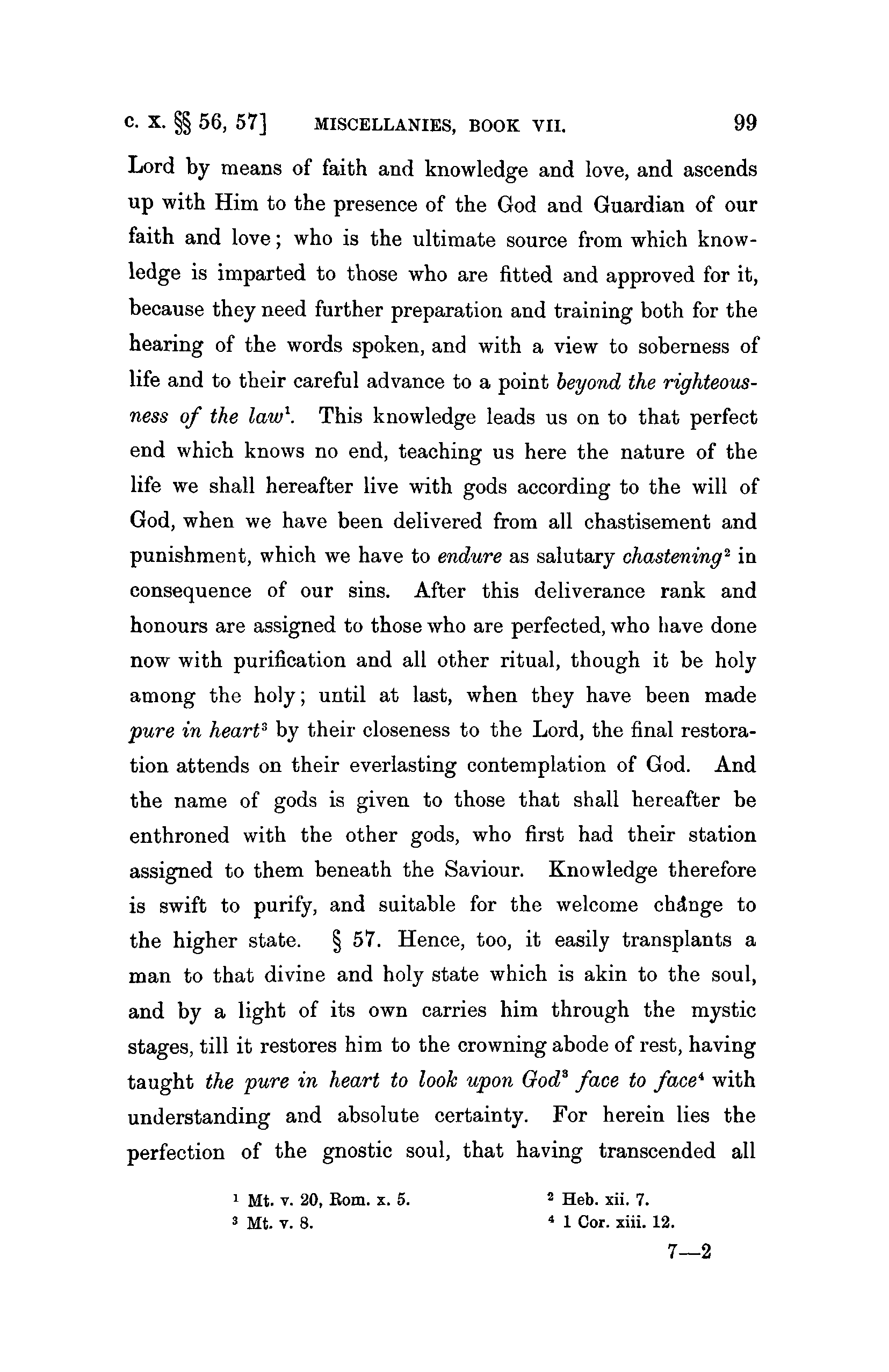
Lord by means of faith and knowledge and love, and ascends up with Him to the presence of the God and Guardian of our faith and love; who is the ultimate source from which knowledge is imparted to those who are fitted and approved for it, because they need further preparation and training both for the hearing of the words spoken, and with a view to soberness of life and to their careful advance to a point beyond the righteousness of the law1. This knowledge leads us on to that perfect end which knows no end, teaching us here the nature of the life we shall hereafter live with gods according to the will of God, when we have been delivered from all chastisement and punishment, which we have to endure as salutary chastening2 in consequence of our sins. After this deliverance rank and honours are assigned to those who are perfected, who have done now with purification and all other ritual, though it be holy among the holy; until at last, when they have been made pure in heart3 by their closeness to the Lord, the final restoration attends on their everlasting contemplation of God. And the name of gods is given to those that shall hereafter be enthroned with the other gods, who first had their station assigned to them beneath the Saviour. Knowledge therefore is swift to purify, and suitable for the welcome change to the higher state.
§ 57. Hence, too, it easily transplants a man to that divine and holy state which is akin to the soul, and by a light of its own carries him through the mystic stages, till it restores him to the crowning abode of rest, having taught the pure in heart to look upon Oodz face to face* with understanding and absolute certainty. For herein lies the perfection of the gnostic soul, that having transcended all
1 Mt. v. 20, Bom. x. 5.
2 Heb. xii. 7.
3 Mt. v. 8.
4 1 Cor. xiii. 12.
7—2 https://doi.org/10.1017/CBO9780511695513.010 Published online by Cambridge University Press
ITPQMATEQN Z'
[P. 865, s. 311
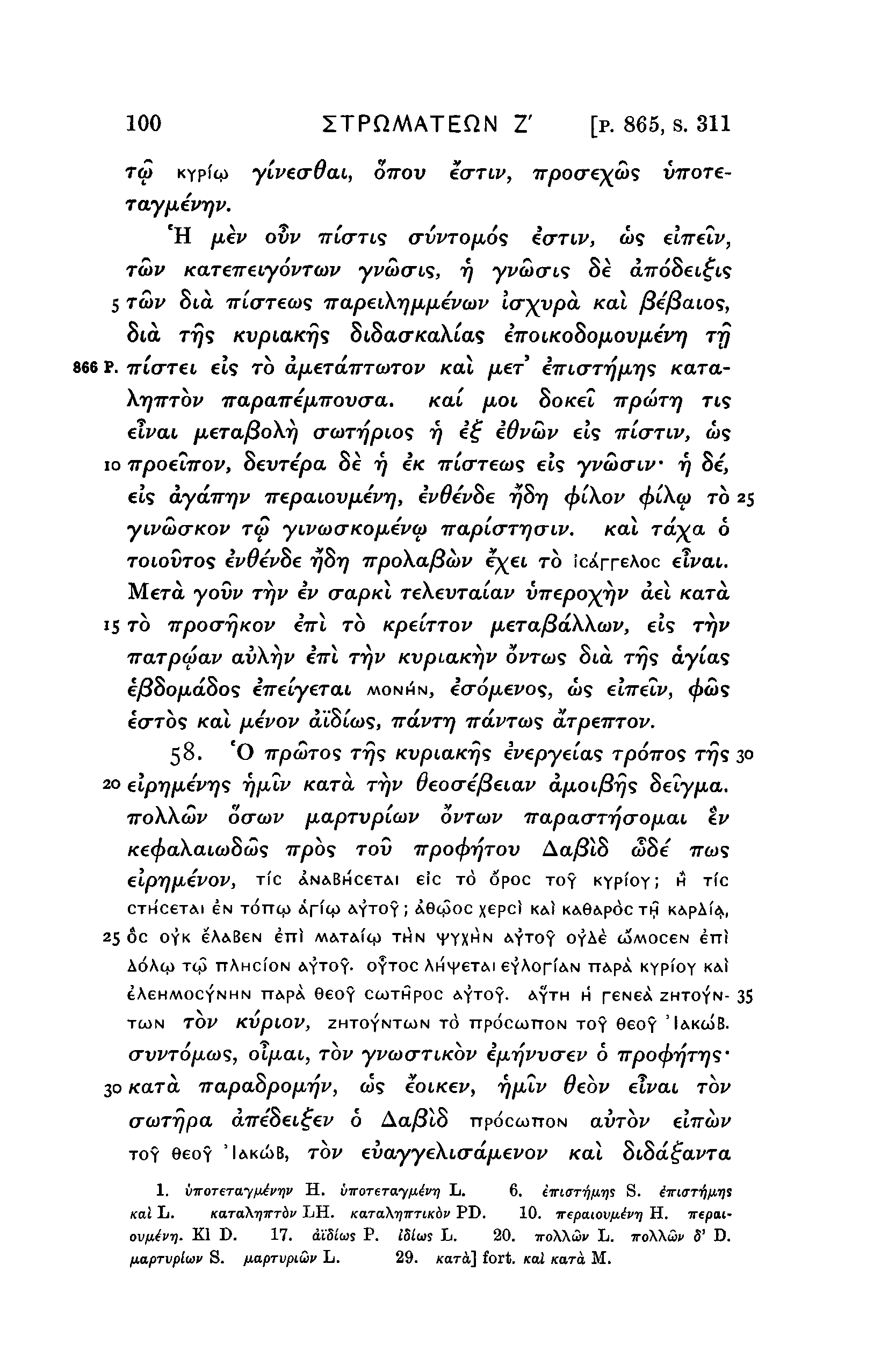
TW Kypfcf> ylvetrdai, OTTOV ecrriv, irpoo~e)(S><; VTTOTCrayfievrjv.
'H fiev ovv 7TC(TTL<S O-WTO/XOS io-nv, o>s elirelv, TWV KaTeirtiyovTcov yvS>(Ti<i, 77 yvaxxis Se ciTrdSei^i?
5 TWV Sici morews irapei\r)iA[Levtov io~)(ypa /cat y8e)8aios, Sid rijs Kvpiaicrjs StSacr/caXtas tTTOiKohofxovfiivr) Trj 866 P. TTto-ret eis TO a/jLeTaTTTayrov /ca! /ACT' eTTtcrTTf/x^s
KaraXyjTTTOv TrapaTriinrovcra.
KOX ftoi So/cei Trpcorr) TIS eti'ai [ieTaf3o\ri aroiTrjpio<; r) i£ iOvotv eis iticmv, ws io irpoeiirov, Sevrepa Se 17 e/c 7rto"Te«us eis yvuxnv r\ Se, ets aya.ir'qv irepaiovfievr}, ivdivZe 17877 <f>'ikov <^i'Xw TO 25 ywuxjKov TW yiv(o<TKOjx,iv(o ira.pL<TTr)&iv. /cat r a ^ a 6
TotouTOs iv$evSe vjSv) 7rpo\a/3a)v ^Xet TO icArreAoc etvat.
Mera. yovi1 TT)^ ev cap/ct TeXei>Tatai> vnepo^rjv del /caret, 15 TO TrpocrrfKov iirl TO Kpeirrov jiteTaySaXXwv, ets T^I» Trarpwav avXr/v eVt TI)V KvpiaKrjv OVTWS Sia TTJS ctytas e;8So/LtaSos CTretyeTat MONISN, iaoixevo<i, a>s elnelv, ^»&)s
CCTTOS /cat fxevov dt'Stws, Trdvrr) TrdvT(x><s afrpemov.
58.
'O irp(oTO<; TT}S /a/pia/ajs ivepyeLas rpovos Trjs 30 ati' /caTa T^V deoo-efieiav d/xoi/3rjs Sety/xa. oo~a>v /xapTvpicjp OVTWV trapa.o-T'qo-o^ai %v ws TT/JOS TOU Trpo<frrJTOv A a ^ t S c5Se' TTWS TIC ANABHC6T&I eic TO opoc TOY KYPIOY; H Tfc
CTHC6TAI 6N TOntp Apfcp AYT0Y i A6C{3oC X^pci KA! K&6&POC Thi K^pAfiSi, 25 6c OYK eA&BeN e n ! M&TAftp T H N Y Y X H N AYTOY ofAe COMOC€N eni
AoAcp Tt}> nAHcfoN AYTOYOYTOC AHyeT&i CYAOPIAN TTAPA KYpfoY KAI
6A6HMOCYNHN TT&pA. GeOY CtOTHpOC AYTOY-
&YTH H fENeA ZHTOYN3S
TUN
TOP KVpLOP,
ZHT0YNTO1N TO TTpOCtOTTON TOY 66OY ' l
o~vPTOfJL0)s, otju,at, TOV yp(jio~TiK.op ifjLtjpvo-ep 6 30 Kara napaSpofjujp, w? eoiKep, 77/uv ^eov etvat TOV o-a>Trjpa a.Tre'Setfei' 6 Aa^tS npdctonoN CLVTOP TOY 6eoY 'IAKJJB, TOT evayye\io~dfjiepop /cat 1. vTroTeTay/jAfriv H. viroTeraynivrj L.
C'JTIITT^TJS S. iiruTT-/i)irjs Kal L.
Ka.Ta\qirTbv L H .
Ka.TakriirTi.Kbv PD.
10. Trepa.iovfi.tvri H. irepaioviiiv-r). Kl D.
17. di'Sius P.
£5(us L.
20. 7ro\Xu>/ L.
TTOXXWV 5' D.
S. fiaprvpiuv L.
29. /taxi] fort. Kai Kara M. https://doi.org/10.1017/CBO9780511695513.010 Published online by Cambridge University Press
C. X. §| 57, 58]
MISCELLANIES, BOOK VII.
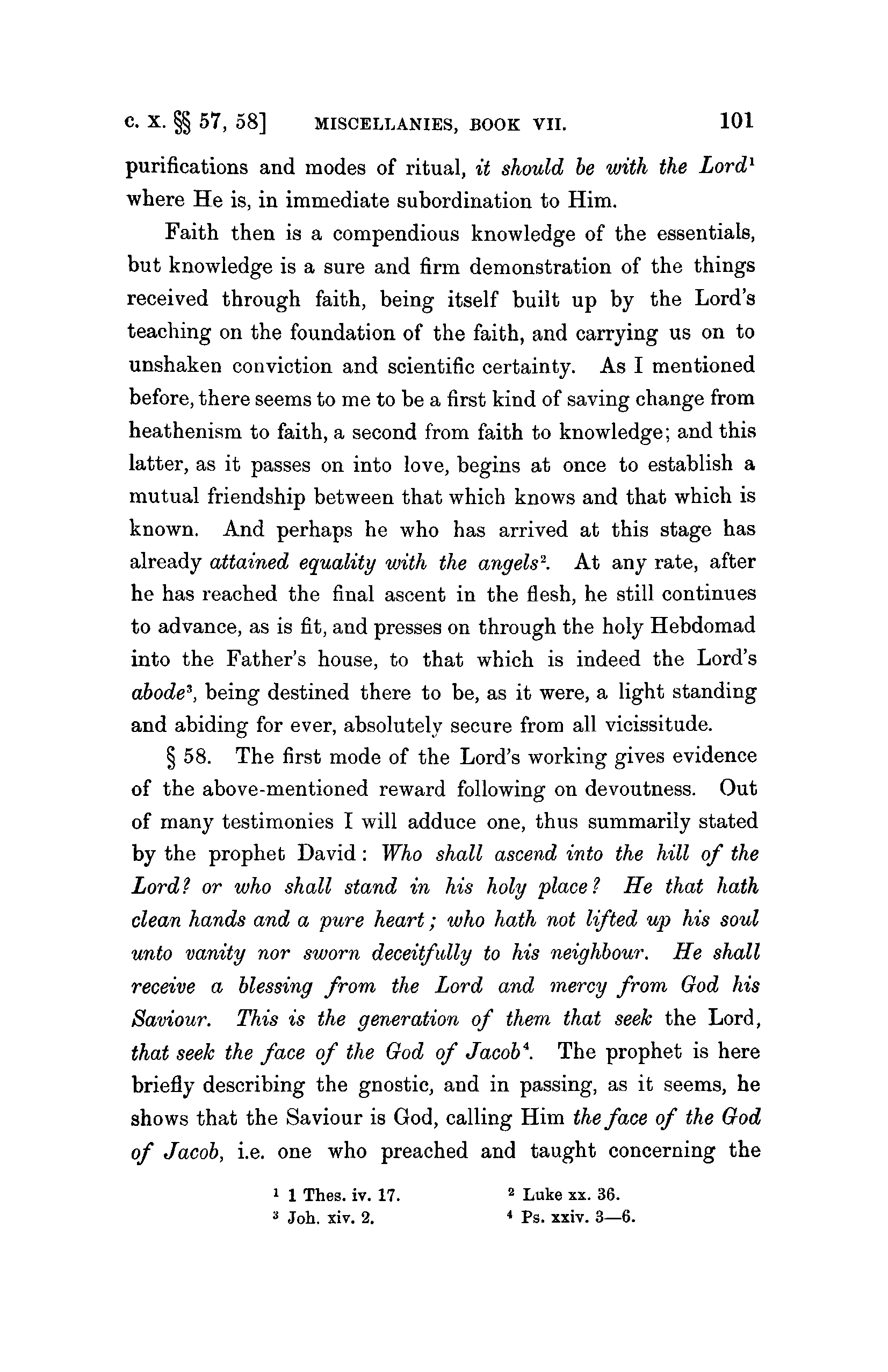
purifications and modes of ritual, it should be with the Lord1 where He is, in immediate subordination to Him.
Faith then is a compendious knowledge of the essentials, but knowledge is a sure and firm demonstration of the things received through faith, being itself built up by the Lord's teaching on the foundation of the faith, and carrying us on to unshaken conviction and scientific certainty. As I mentioned before, there seems to me to be a first kind of saving change from heathenism to faith, a second from faith to knowledge; and this latter, as it passes on into love, begins at once to establish a mutual friendship between that which knows and that which is known. And perhaps he who has arrived at this stage has already attained equality with the angels2. At any rate, after he has reached the final ascent in the flesh, he still continues to advance, as is fit, and presses on through the holy Hebdomad into the Father's house, to that which is indeed the Lord's abode3, being destined there to be, as it were, a light standing and abiding for ever, absolutely secure from all vicissitude.
§ 58. The first mode of the Lord's working gives evidence of the above-mentioned reward following on devoutness. Out of many testimonies I will adduce one, thus summarily stated by the prophet David: Who shall ascend into the hill of the Lord? or who shall stand in his holy place? He that hath clean hands and a pure heart; who hath not lifted up his soul unto vanity nor sworn deceitfully to his neighbour. He shall receive a blessing from the Lord and mercy from God his
Saviour. This is the generation of them that seek the Lord, that seek the face of the God of Jacob4. The prophet is here briefly describing the gnostic, and in passing, as it seems, he shows that the Saviour is God, calling Him the face of the God of Jacob, i.e. one who preached and taught concerning the 1 1 Thes. iv. 17.
2 Luke xx. 36.
3 Joh. xiv. 2.
* Ps. xxiv. 3—6. https://doi.org/10.1017/CBO9780511695513.010 Published online by Cambridge University Press
ZTPQMATEQN Z'
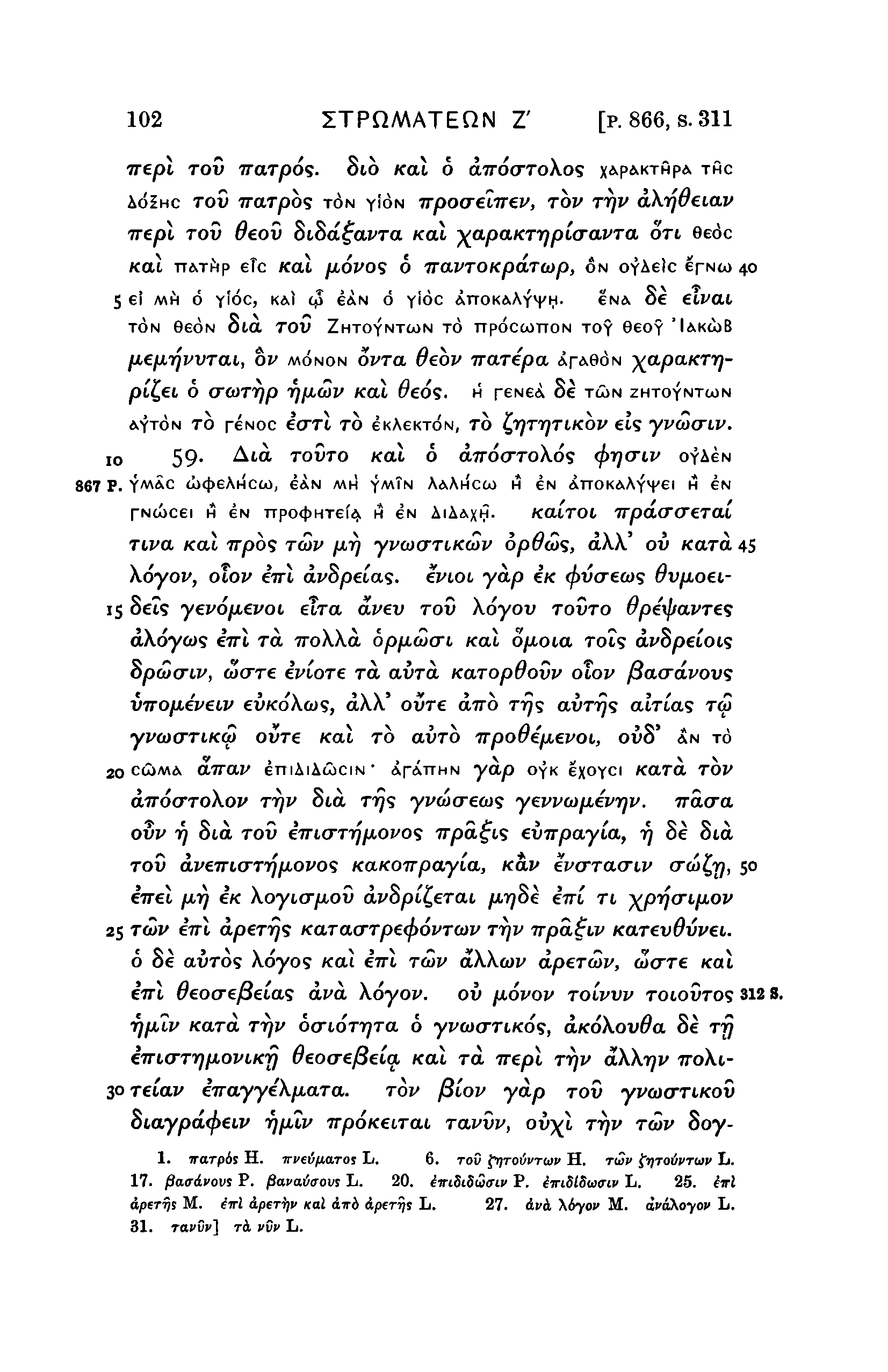
[p. 866, s. 311 irepl TOV iraTjodsSto /cat 6 a7rdoToXos X*P*KTHPA THC AOSHC TOU Trarpos T6N YION irpoaeiTrev, TOV Tr/v dXrjdeiav
Trepl TOV deov StSdfavra /cat ^apaKTUjpiaavTa on 6e6c Kat n&Tfip etc /cat j^oVos 6 TravTOKpaTwp,
ON oyAeic epNw 40 5 ei M& 6 YIOC, KA) cp 6AN d yioc AnoK&AyyH.
CNA oe TON 6GON Sia TOU ZHTOYNTCON TO npoccorroN TOY 6eoY 'I i, bv MONON ovTa deov TTCvripa. ir^eoN ya.pa.KTt\- 6 o~G)Trjp rjfioiv Kal Oeos.
H feneA Se TO>N ZHTOYNTCON AYTON TO peNoc icrTL TO enAeKTON, TO £,r)Tr)TU<bv eis yvwcrtv.
I 0 59*
A l (* TOVTO
Kal
aTrdcTToXd? <f>r](Tiv oyAeN 867 P. YM^C <i)t|)eAHCa), GAN MH YM^N A&AHCCO H IN AnoKAAYyei H CN
TNtbcei H 6N TrpotJiHTef^ H €N AIAAXH- /cairot irpdcrcreTai Tiva Kal wpbs TCOV /AT) yvwcrTiKaiv opOws, dXX' ov KaTa. 45
\6yov, olov iirl avSpeias. eviou ydp 4K 15 Sets yevofjuevot etra avev TOV Xoyov TOVTO dXdyws iirl TOL TTOWCL 6pfi.<ao~i Kal ofioia rot? avhpeiois v, wcrre ivioTe TO. aura KaTOpdovv oTov /3ao~dvovs evKoXojs, dXX' oure dirb TT}<; aur^s atrias rw yv(ao~TiKu> OVT€ Kal TO avTO vpoddixevoL, oiS" AN TO 20 C&MA airav eniiiAcociN' Ar^nnN yap oyK exoyci /card rov aTrdcTToXoi' TT/V Std T^S yi/aScreais y^vvcofxevyjv. Trao~a ovv rf Std TOU iiTLO'T'rjiJ.ovos TTpa^is evirpayia, rj Se Std TOW dve!rio~Tr\\LOVo% KaKoir pay La, KOLV eVcrracriv o~u)t,rj, 50 e7ret ^n) eK Xoytcr/Aou d^S/Dt^erat /AijSe evrt Tt
25 rail' eTrl dperrjs KaTao~Tpe<j>6vTO)v TTJV vpa^tv 6 Se auros Xdyos Kal inl TCOV dWcov dpeTcov, wcrre Kat eVt ^eocre^eta? di'd Xoyov. ov fiovov TOLVVV rotouros 312 S. rj[x,2v KaTa Trjv ocrtdr^ra 6 yvwcrriKds, aKoXovOa Se T^ eTno-TrjfiovLKr) 0eocrey8eta Kat r d Trept TTJV dXXrjv TTOXI30 reCav iirayyeXfiaTa.
TOV j3Cov yap TOV yva)o~TLKOv Siaypd(f>€LV rjfuv irpoKevrai Tavvv, ou^t TTJV TCOV Soy1.
TorpAs H .
7ri/ei)/xaTO5 L.
TOV fip-otWwi' H.
T W £r)To6vTiov It.
17. Paa&vovs P. jSapai/irovs L.
20. ^irtStSwcrtv P. iwiStSwiriv h.
25. ftrl operas M. iwl iperijv Kal iirb dperr/t L.
27. di»d X^oi' M. oi'aXo70<' L.
31. rai'Oi'] TA VVV L. https://doi.org/10.1017/CBO9780511695513.010 Published online by Cambridge University Press
C. X. §§ 58, 59]
MISCELLANIES, BOOK VII.
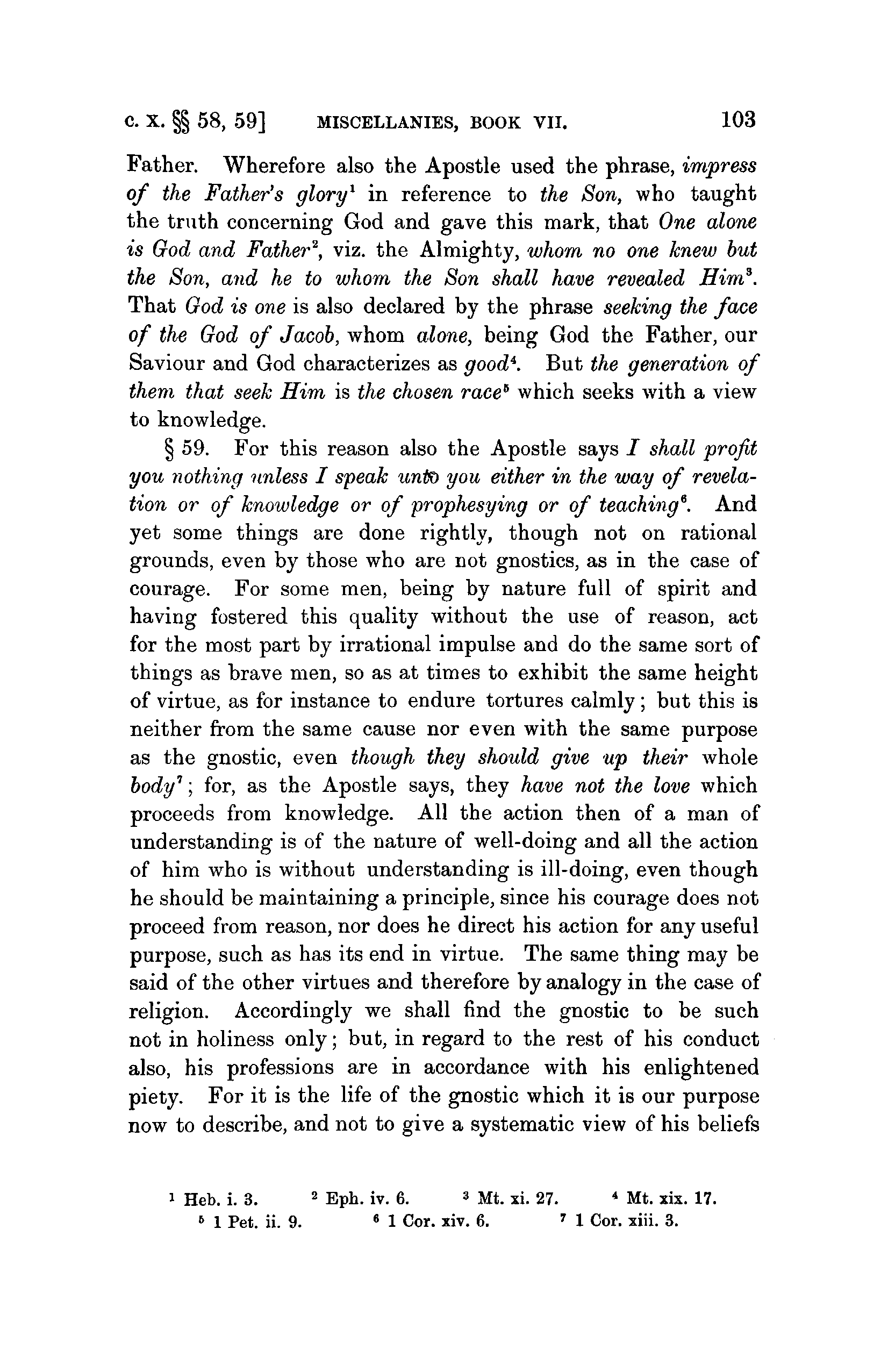
Father. Wherefore also the Apostle used the phrase, impress of the Father's glory1 in reference to the Son, who taught the truth concerning God and gave this mark, that One alone is God and Father2, viz. the Almighty, whom no one knew but the Son, and he to whom the Son shall have revealed Him3.
That God is one is also declared by the phrase seeking the face of the God of Jacob, whom alone, being God the Father, our
Saviour and God characterizes as good*. But the generation of them that seek Him is the chosen race* which seeks with a view to knowledge.
§ 59. For this reason also the Apostle says / shall profit you nothing unless I speak unto you either in the way of revelation or of knowledge or of prophesying or of teaching". And yet some things are done rightly, though not on rational grounds, even by those who are not gnostics, as in the case of courage. For some men, being by nature full of spirit and having fostered this quality without the use of reason, act for the most part by irrational impulse and do the same sort of things as brave men, so as at times to exhibit the same height of virtue, as for instance to endure tortures calmly ; but this is neither from the same cause nor even with the same purpose as the gnostic, even though they should give up their whole body*; for, as the Apostle says, they have not the love which proceeds from knowledge. All the action then of a man of understanding is of the nature of well-doing and all the action of him who is without understanding is ill-doing, even though he should be maintaining a principle, since his courage does not proceed from reason, nor does he direct his action for any useful purpose, such as has its end in virtue. The same thing may be said of the other virtues and therefore by analogy in the case of religion. Accordingly we shall find the gnostic to be such not in holiness only; but, in regard to the rest of his conduct also, his professions are in accordance with his enlightened piety. For it is the life of the gnostic which it is our purpose now to describe, and not to give a systematic view of his beliefs
1 Heb. i. 3.
2 Eph. iv. 6.
3 Mt. xi. 27.
4 Mt. xix. 17.
6 1 Pet. ii. 9.
6 1 Cor. xiv. 6.
7 1 Cor. xiii. 3. https://doi.org/10.1017/CBO9780511695513.010 Published online by Cambridge University Press
ZTPQMATEQN Z'
[p. 867, s.312
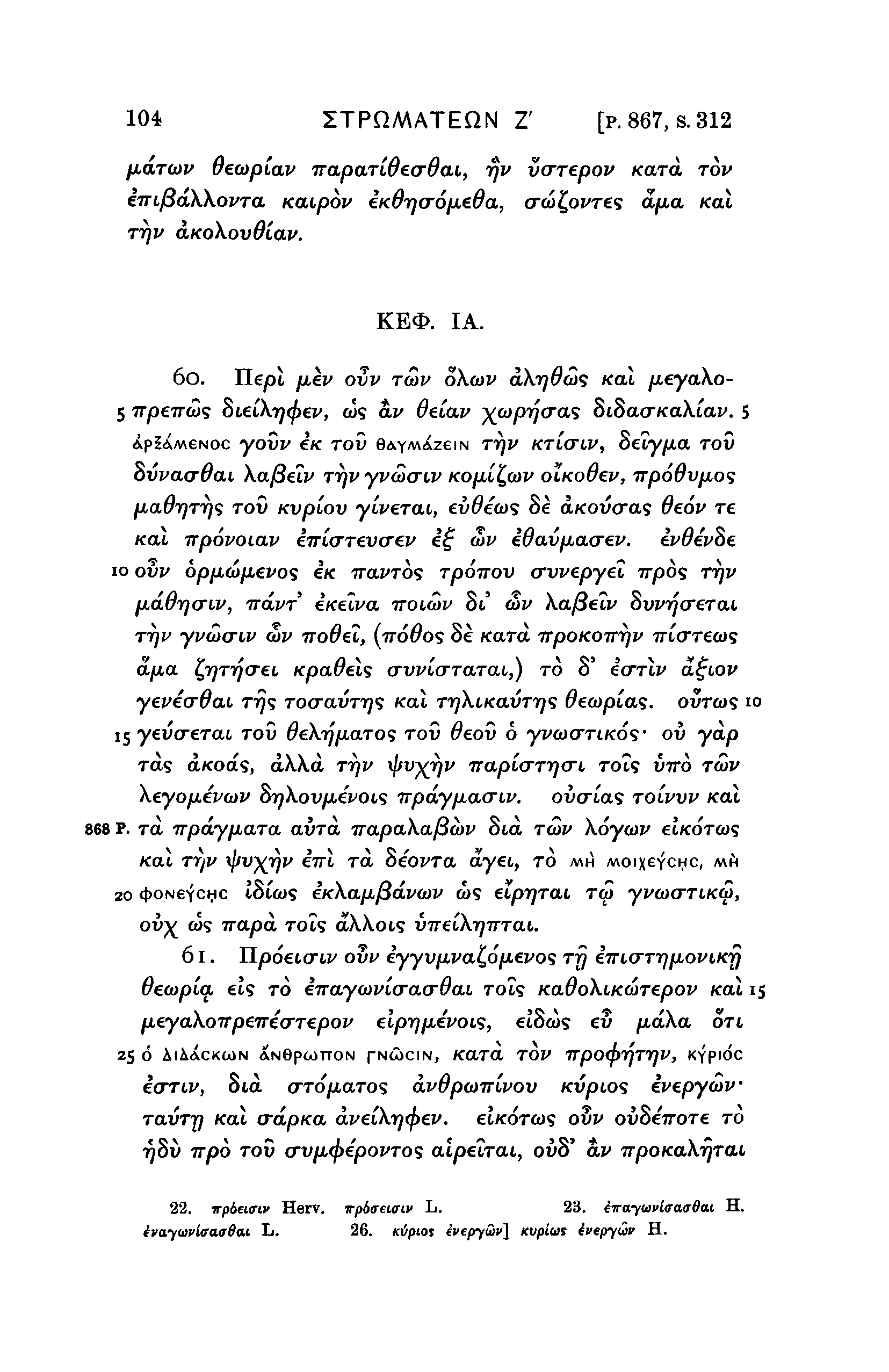
Oetapiav TrapaTidecrOai, rjv vcrrepov /ca/rd TOV xaipov eK6iqcr6p.eda, cr(o£,ovTe<; dfia Kal rqv aKoXovdiav.
. IA.
60.
Tlepl [iev ovv T5>V oXcov aXydais Kal fieyaXo5 TrpeTTCus SieiXT^ev, OJS OLV 6eCav ^w/ai^cras SiSacr/caXtav. 5
Ap5A/v\eNoc yovv 4K TOV BAyMAzeiN rrjv KTicriv, SevyjjLa TOV ovvacrOcu Xafteiv rr}v yvaicrLV KO/JLI^COV oiKodev, Trpodvfios
[ia0r)T7)'i TOV Kvpiov yiveTai, evOews Se aKovcras deov re /ecu trpovoiav eTTiVreucrej' ef 3>v idavfiao-ev. iv0ev8e 10 ovv opficofievos ex TTOLVTOS TpoTrov o-vvepyel Trpo<s rrjv fiddrjo-LV, irdvT eKelva TTOLCOV SI' &V Xafietv
Swifcrerat T ^ yvuxriv oxv irodei, {iroOos Se Kara 7rpoKoirr)v Tricrrews d//,a tflTrjO-ei. Kpadels awCo-TaTou,) TO S' eo-Tlv d^tov yeveo-dat. 7175 roo"aurTjs «:ai TrfKiKavT'q's 0ea>pias.
OUTWS 10 15 yeucrerat TOT) 6eXiqfx,aT0<; TOV deov 6 yvwcrTiKO1;' ov yap ras d/coa?, dXX.d TT^V rf/v^r/v TrapCo-TrjcrL TOXS VTTO TMV
Xeyo/Jievcjv BrjXovjxepoL? Trpdy[i.ao~tv. ovo~ia.<s TOIVVV KCU 868 P. TO, vpay/JiaTa aura TrapaXafia>v Sid TWV Xoywv etKorws
Kal TY/V xjjv^rjv evri rd Seovra dyei, TO MH MOIXEYCHC, Mfi 20 <t>oN6-fcyc iSiws iKXafi^dvav ws elp7)Tai ra yi'wo'TtK&J, ou^ a5s irapa rots dXXots vTreiX-qnTat.
61.
Ilpoeiarw ovt' iyyvfival,6fjievo?
TTJ iTrLO~Trjfiovi.Ky decopla ei9 TO eir ay caviar a.o~ 9 at TOIS KadoXiKMTepov /cai 15
IxeyaXoTTpeneo'Tepov elprjiAevois, eiScis eu fidXa OTI 25 6 AIAACKWN ANOpconoN rN<*>c|N> xaTa TOV TTpo^rjT'rjv, Kypioc eo~TLV, Sid o"TOju,aTos dvdpoiirCvov Kvpios ivepywv TavTji /cai crdpKa dveCXrj<f>ev. CI/COTOJS oSv ouSeVoTe TO TJSU 7T/3O TOU o-vfj.(f>epovTo<s aipeiTai, ouS' ai> Tr
22.
7rp6«cru' Herv.
Tf>6<reunv L.
23. £iray<avl<ra<r8<u H. evayuvlaaaffcu L.
26. Kipiot biep/ywv\ Kvpius inepywr H. https://doi.org/10.1017/CBO9780511695513.010 Published online by Cambridge University Press