
CHAPTER XV
c xiv. § 88—c. xv. § 89] MISCELLANIES, BOOK VII.
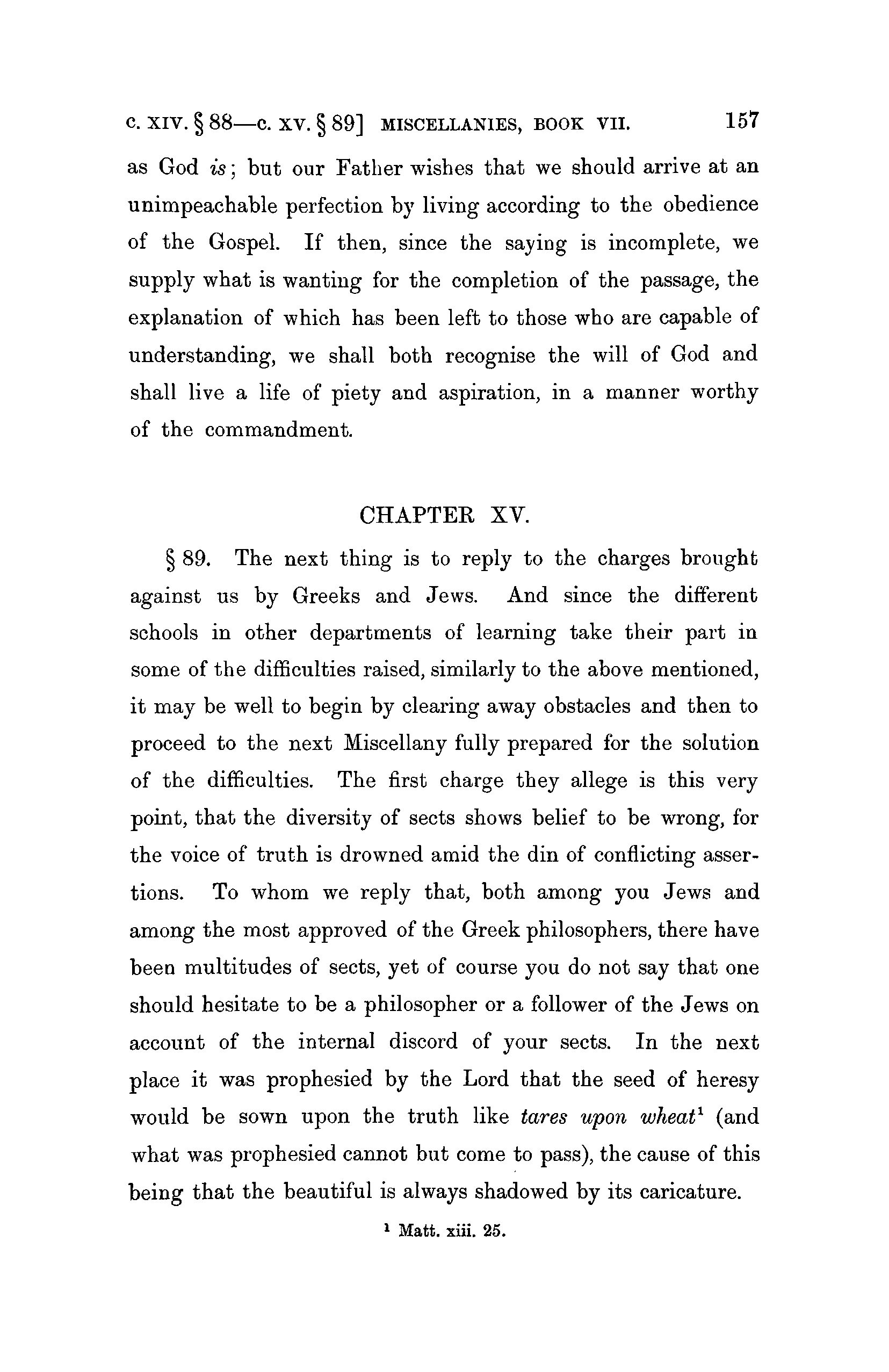
as God is; but our Father wishes that we should arrive at an unimpeachable perfection by living according to the obedience of the Gospel. If then, since the saying is incomplete, we supply what is wanting for the completion of the passage, the explanation of which has been left to those who are capable of understanding, we shall both recognise the will of God and shall live a life of piety and aspiration, in a manner worthy of the commandment.
CHAPTER XV.
§ 89. The next thing is to reply to the charges brought against us by Greeks and Jews.
And since the different schools in other departments of learning take their part in some of the difficulties raised, similarly to the above mentioned, it may be well to begin by clearing away obstacles and then to proceed to the next Miscellany fully prepared for the solution of the difficulties.
The first charge they allege is this very point, that the diversity of sects shows belief to be wrong, for the voice of truth is drowned amid the din of conflicting assertions.
To whom we reply that, both among you Jews and among the most approved of the Greek philosophers, there have been multitudes of sects, yet of course you do not say that one should hesitate to be a philosopher or a follower of the Jews on account of the internal discord of your sects. In the next place it was prophesied by the Lord that the seed of heresy would be sown upon the truth like tares wpon wheat1 (and what was prophesied cannot but come to pass), the cause of this being that the beautiful is always shadowed by its caricature.
1 Matt. xiii. 25. https://doi.org/10.1017/CBO9780511695513.010 Published online by Cambridge University Press
ITPQMATEQN Z'
[p. 887, s. 320
90.
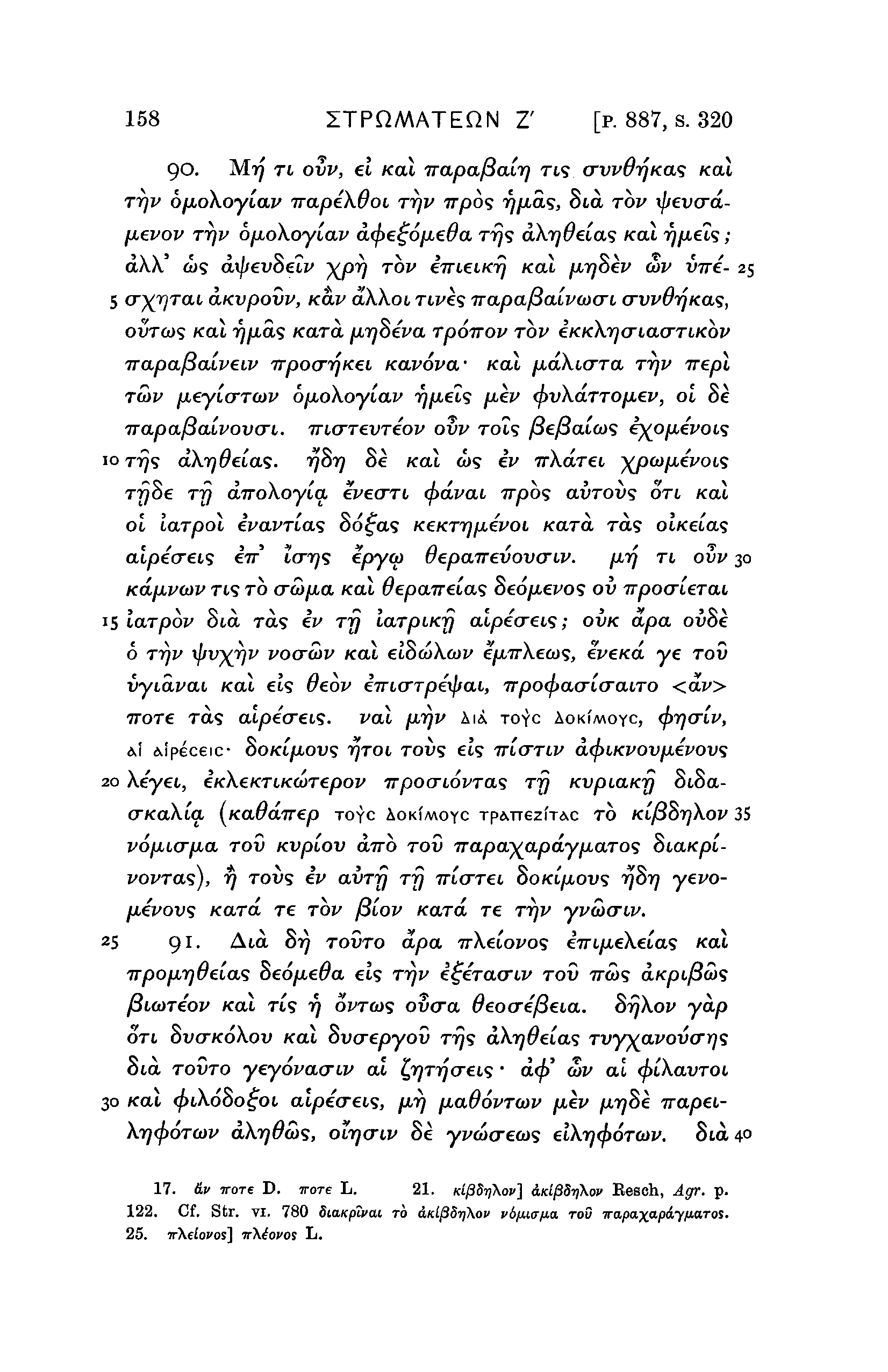
M77 7i ovv, el KOX Trapafiair) TIS crvvOrJKas Kal bjxoXoylav vapeXOoi TT)V 77/365 rjfids, Sia TOV \\ievo~dTT\V ofioXoyiav d(f>e^6jjieda rrjs dXrj6eia<; Kal r)fieL<s; dXX' &>s aAJjevSelv XPV TOV twLeucfj Kal [JLrjSev d>v viri25
5 cr)(r]Tav aicvpovv, KO,V aXkoi nves irapafiaivaxri o~vv9rjKas, OVTCOS Kal rjfJids Kara, fxrrjheva Tponov TOV i.KKk'qo'Lao'TiKov
Trapafialveiv Trpoo"qK€i tcavovaKal yaaXtcrra TTJV ire.pl TCOV fxeyio~TOiv ofxoXoyiav ^jueis pev ^vXaTTO/xev, oi 8e napafiaivovo-i.
TrtcrrevTeov ovv TOIS /SeyScuws ey 10 TTJS dXrj6eia<;. 17877 Se Kal a>s iv TrXarei rr^Se TT} diroXoyla ei'ecrTt <f>dvaL irpbs aurovs 6Vt /cai ot laTpol ivavTias Sofas K€KTT)IJL€VOL Kara ras otKetas aipio~ei<; eif to-^s tpytp Oepairevovcnv. fnj TL OVV 30 Ka[woiv n s TO aco/xa Kal ^epairetas Sed/Aevos ou irpoo-ierai
15 laTpbv 8t<x Tas ei' TT} iaTpLKr) aipecreis; OUK apa ov8e 6 TI)^ xfjv^rjv voo~S)v Kal elScoXcov IjairXews, eveKa ye TOV iyidvai Kal ets ^eov inio'Tperpai, 7rpo(f>ao'io~aLTO <av> TTOTe r a s atpecreis. ral ja^j/ Aii TOYC AOK(MOYC, <f>7)O'lv, A! ^ipeceicSOKIJIAOUS I^TOI TOUS eis TTIO'TLV dtyiKvovfievowi 20 Xeyet, eKXeKTLKtoTepov irpoo-LOVTas TT) KvpuaKyj Si8acr/caXia, {Kaddmep
TOYC AOK(MOYC Tp&TrezfT&c TO KifiSrjXov 35 TOV Kvpiov a.7ro TOV TTapa)(apdyiJ.aTO<s SiaKpi- , ^ TOVS ev auTij TIJ morei SOKC[X,OVS VJ8T] yevoKara TC TOV /3IOV /caTa Te TT)V yvSiaiv.
91.
Aia. 817 TOUTO apa irXeiovo<; eTTt/teXetas fal irpoixrjOetas heofieda eis TT}V i£eTao~Lv TOV 77<SS aKyai/Sals fiuiiTeov Kal TIS 17 OVTWS oucra deocrefieia.
SrjXov yap oTi 8UO-KOXOU Kai Si)O"e/3yo5 TTJS dX^^eias Tvy)(avovamr]ts Sta. TOVTO yeydi'acrw at ^TTJCTCIS • a^>' <5v ai <f>lXavT0t.
30 /cal <f>i\68o£oL atpecreis, /AT) padovTtov fiev /u/^Se TrapetdXr)8(o<s, OLTJO-LV Se yvcocrews eiX°qtyoT(>)v. Sia. 4° 17. fo TroTe D.
TTOTE L.
21. KtpdrjXov] AdpdrjKov Eesch, 122.
Cf. Str. vi. 780 SmKptvai. TO &Klj}dtj\ov v6/u<rp.a TOV 25.
TrXdoKOs] TrX^twos L. https://doi.org/10.1017/CBO9780511695513.010 Published online by Cambridge University Press
C. XV. §§ 90, 91]
MISCELLANIES, BOOK VII.
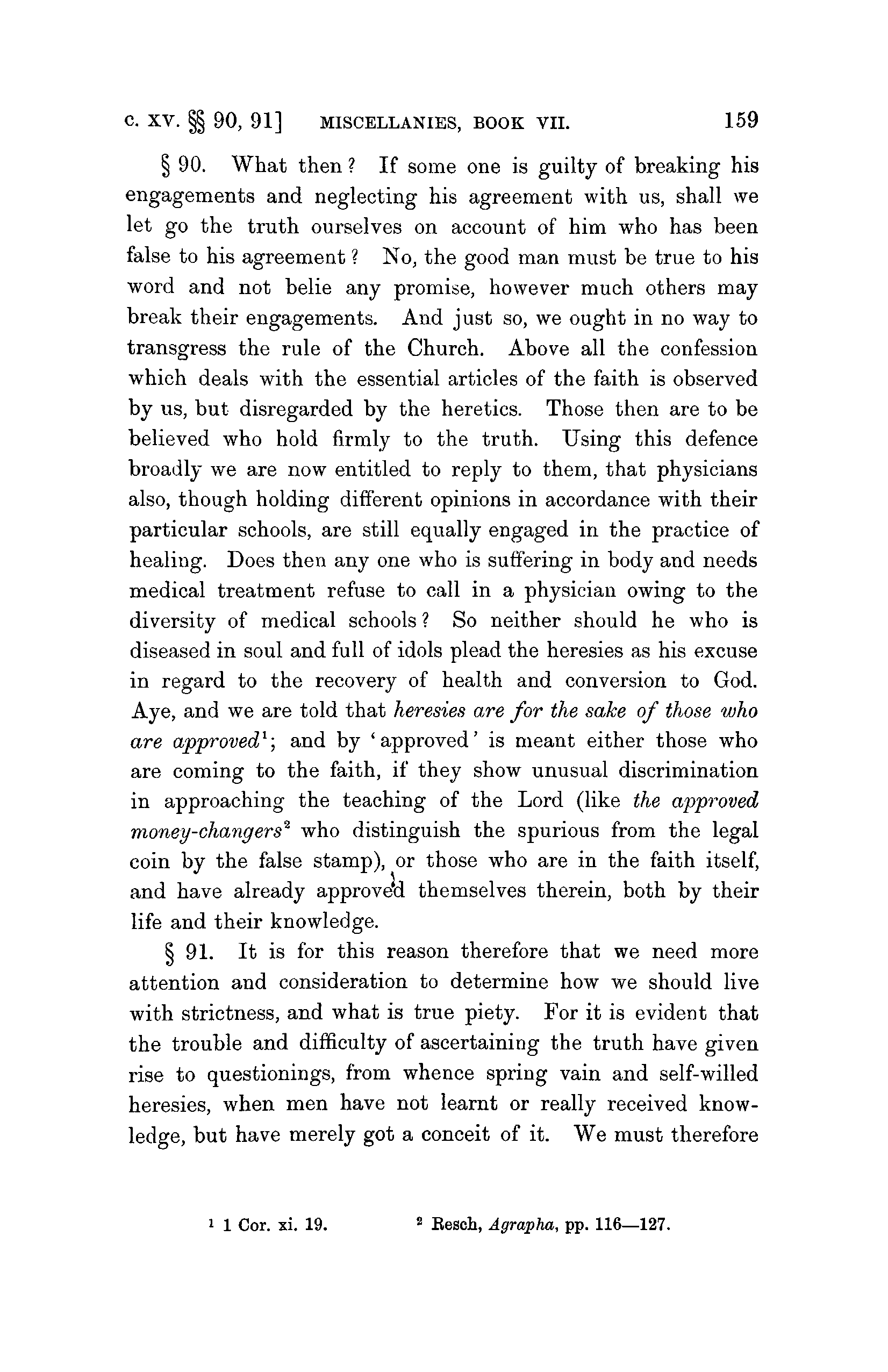
§ 90. What then ? If some one is guilty of breaking his engagements and neglecting his agreement with us, shall we let go the truth ourselves on account of him who has been false to his agreement ? No, the good man must be true to his word and not belie any promise, however much others may break their engagements. And just so, we ought in no way to transgress the rule of the Church. Above all the confession which deals with the essential articles of the faith is observed by us, but disregarded by the heretics. Those then are to be believed who hold firmly to the truth. Using this defence broadly we are now entitled to reply to them, that physicians also, though holding different opinions in accordance with their particular schools, are still equally engaged in the practice of healing. Does then any one who is suffering in body and needs medical treatment refuse to call in a physician owing to the diversity of medical schools ? So neither should he who is diseased in soul and full of idols plead the heresies as his excuse in regard to the recovery of health and conversion to God.
Aye, and we are told that heresies are for the sake of those who are approved1; and by 'approved' is meant either those who are coming to the faith, if they show unusual discrimination in approaching the teaching of the Lord (like the approved money-changers2 who distinguish the spurious from the legal coin by the false stamp), or those who are in the faith itself, and have already approved themselves therein, both by their life and their knowledge.
§ 91. It is for this reason therefore that we need more attention and consideration to determine how we should live with strictness, and what is true piety. For it is evident that the trouble and difficulty of ascertaining the truth have given rise to questionings, from whence spring vain and self-willed heresies, when men have not learnt or really received knowledge, but have merely got a conceit of it. We must therefore
1 Cor. xi. 19. s Eesch, Agrapha, pp. 116—127. https://doi.org/10.1017/CBO9780511695513.010 Published online by Cambridge University Press
ITPOMATEQN Z
[p. 887, s. 320
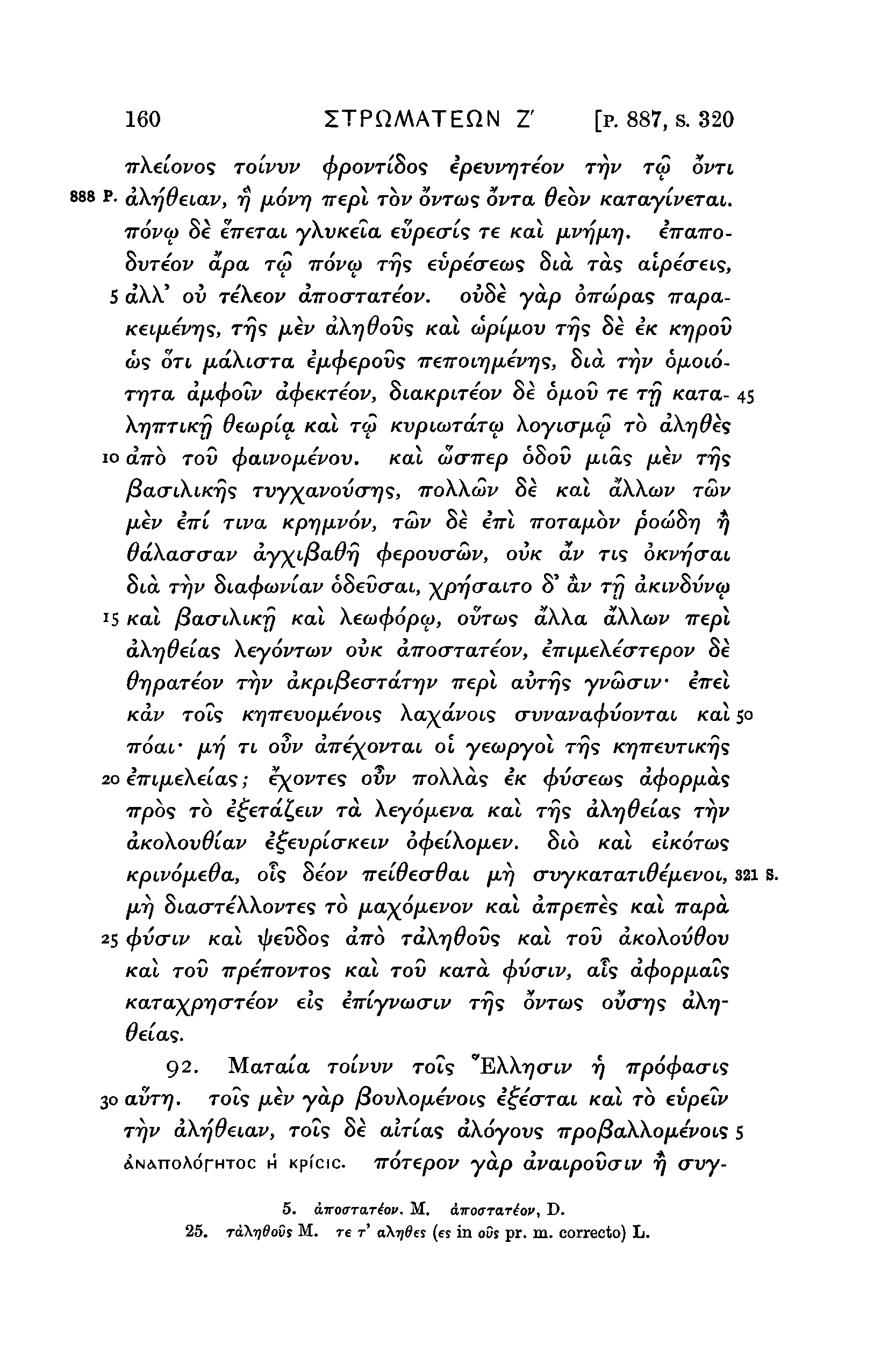
TrXetovos TOLVVV (ppovTiSos ipevvrjTeov rrjv ra OVTL 888 P. dX^^eiai', rj \xovr) vepl TOV oWa>s ovra deov
KaTayiverai.
7r6v(o Se eVerat yXt/Kcta evpeerts re KCU fivq/xr].
Svreov dpa ra trovca Trjs evpecrecas Sta Tas 5 aXX' ou Te'Xeoi' aTrocrTariov. ouSe yap oTrcopas TrapaKeLfJL€vr]s, Trjs /lev aX^^ovs /cat topijjbov TTJS Se e/c Kr/pov ws o n yxaXto-ra ififiepovs ireTroLrjfjuevrjs, Sia TIJZ' 6jototddfX(f>oXv d<f>eKT£ov, hiaKpiriov
Se 6/xou re T77 Kara45 Oeoipla KOX TM KvpioiTourca Xoyio"yxw TO a 10 aTro TOU <f>aLvofievov. Kat axnrep bhov /Ata§ /xeV
^ Tvy^(ai/ouo"^s, TroXXajf Se Kat aXXaiv eVt Tti'a Kprjfivov, TGJV Se eVt Trorafibv pocoSf) rj ddXacrcrav dy^i/Hadf} fapovcrwv, OVK dv rts OKvrjcrau Sta r ^ Si,a(f>a)viav oSeucrai, yjyf\cr<xno S' ai' T^ dKtvSvi/Gj
15 Kat fiacrCXiKfi Kat Xeoi<f>6pq>, OVTOJS aXXa aXXw^ Tre/at dXrjdeias Xeyovrcav OVK amoo-raTiov, iTrifieXecrTepov Se drjpariov rr)v a.Kpi^o~TdTr\v Trepl avTrj's yvoio~Lv inel Kav Tot? Kr/Trevofievois Xa^aVois o~vvava^>vovTaL Kat 50
Troat* /ATJ Tt ouv direyovrixi ot yewpyol rrjs 20 eVifieXetas; e^oi'Tes ouv 77oXXas CK ^>vo-ews ir/309 TO e^erdtfiiv TO. Xeyo/xeva Kat T175 dXiy aKoXovdlav i^€vpio~K€iv dcfteiXofiev.
Sto Kat etKorws KpivofJieda, ots Se'ei* irtlOeo'dai fir) crvyKa.Ta.Ti64.fii.voi, S21 s.
/t7) Stao-re'XXovres TO fia^ofievov Kat aTrpeires Kat 25 <J)VO~LV Kat i^euSos aTro TaXij^ous Kat rou
Kat rov vpeTTOVTOs Kat TOU KaTct <f>vcriv, afs a Ka,TOL)(pr)o-Teov els emyvcocnv Trjs oVra>9 ovcrr/s dXrj92.
MaTata TOLVVV TOIS "EXXijo-ti' 17 Trp6<]>ao-v; 30 avTr/.
TOIS //.et' yap f3ovXo[AevoL<s e^ecrat Kat TO evpetv Tr)v aXrydeLav, TOIS Se atrta? aXoyovs 7r/3o/8aXXoju.eVots s
H Kpfcic.
TTOTepov ya.p dvaipovo~Lv rj crvy5. aTroaTariov. M. dTroorar^ov, D.
25. rdXi;9oCs M. re T' aXijSes (es in oOs pr. m. correoto) L. https://doi.org/10.1017/CBO9780511695513.010 Published online by Cambridge University Press
C. XV. §§ 91, 92]
MISCELLANIES, BOOK VII.
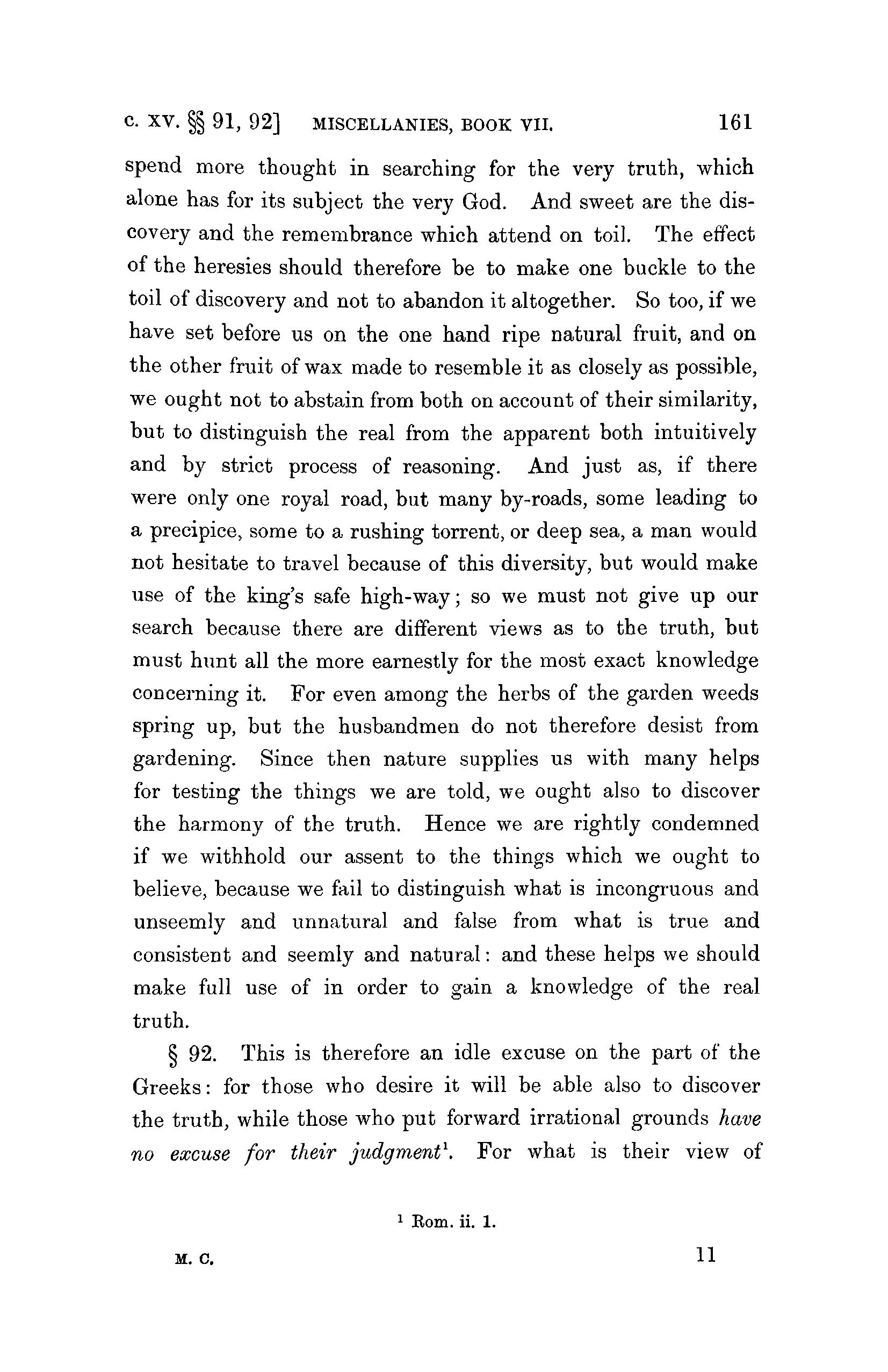
spend more thought in searching for the very truth, which alone has for its subject the very God. And sweet are the discovery and the remembrance which attend on toil. The effect of the heresies should therefore be to make one buckle to the toil of discovery and not to abandon it altogether. So too, if we have set before us on the one hand ripe natural fruit, and on the other fruit of wax made to resemble it as closely as possible, we ought not to abstain from both on account of their similarity, but to distinguish the real from the apparent both intuitively and by strict process of reasoning.
And just as, if there were only one royal road, but many by-roads, some leading to a precipice, some to a rushing torrent, or deep sea, a man would not hesitate to travel because of this diversity, but would make use of the king's safe high-way; so we must not give up our search because there are different views as to the truth, but must hunt all the more earnestly for the most exact knowledge concerning it. For even among the herbs of the garden weeds spring up, but the husbandmen do not therefore desist from gardening. Since then nature supplies us with many helps for testing the things we are told, we ought also to discover the harmony of the truth. Hence we are rightly condemned if we withhold our assent to the things which we ought to believe, because we fail to distinguish what is incongruous and unseemly and unnatural and false from what is true and consistent and seemly and natural: and these helps we should make full use of in order to gain a knowledge of the real truth.
§ 92. This is therefore an idle excuse on the part of the Greeks: for those who desire it will be able also to discover the truth, while those who put forward irrational grounds have no excuse for their judgment1. For what is their view of 1 Rom. ii. 1.
M. C.
https://doi.org/10.1017/CBO9780511695513.010 Published online by Cambridge University Press
ZTPfiMATEfiN Z'
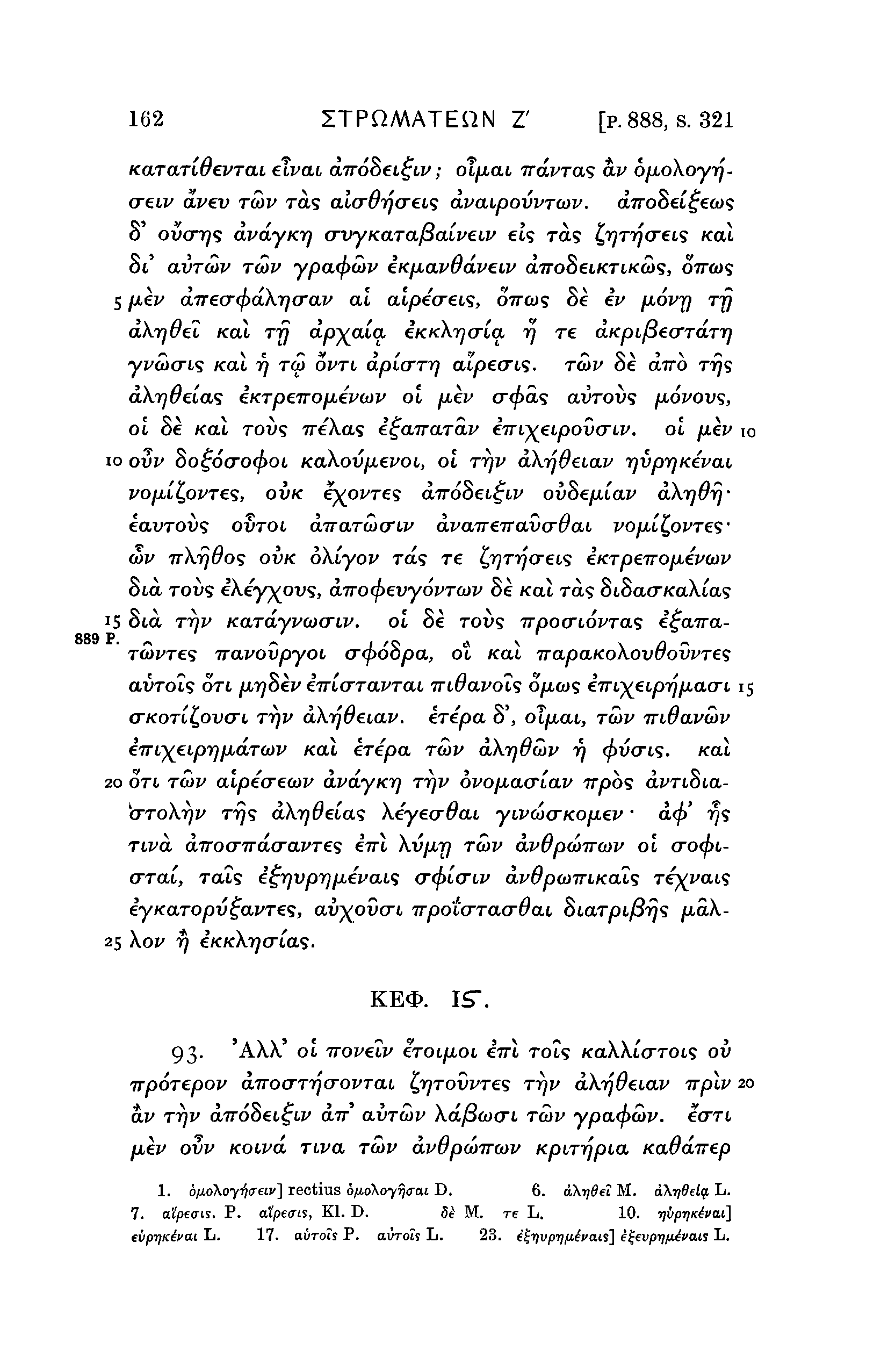
[p. 888, s. 321 elvat dir68e.L^iv; oT/xat 7rdvTa<; av of cre.iv dvev TCOV rets alcrdijtreLS dvaipovvrcjv.
8' ovo-rjs dvayKT) o-vyKaTafSalveiv eis Tas tflTrjcreis /cat Si' aurwt' TWV ypa<f>(ov iKjxavddveiv d7roSei/m/ca>s, OTTW?
5 /Aei/ dTTecr(j)dX.7)crav at atpeVeis, O7rws §e e^ Kal rrj dpyjxla e/c/cXi^cria ij T£ d/ /cat 17 ra ovrt dpia'Ti) alpecns.
T£>V 8k dtro iKxpeiro/xevcov ol fjikv cr^as avrous ol Se /cat rous Tre'Xas i^aTrarav iiri^eipovo'Lv. ol fiev 10 io ovv So^6o~O(j)OL KaXovfxevoi, ol rr/v aKrqdeiav rjvprjKevai vofjbi£,ovTe<;, OVK e^ovres aTrdSet^iv ovhe/jbuav akyjOrjeauToiis ovrot a.7ra.Ta>o~Lv dv air €Travo~ 6 ai vofx,itpvTe<;wv 7r\y}do<; OVK oXtyov Ta? re ^r/ycreis e/cjpevop-ivuv Sta TOUS iXeyxpvs, dTro<f>evy6vT(ov 8e /cat ra§ StSacr/caXtas
15 Sta T ^ Kardyvcoariv. ol Se TOUS irpoo'LOVTa'S i^airaTfcWes iravovpyou o~<f>68pa, 0% Kal TrapaKoXovdovvTes avrols OTL fjL7]8ev €Trio~TavTai TTidavols Ofjb(t)<; iTri^euprjfJLao-i 15 cr/cort^ovcrt TTJV dXrjOeiav. erepa §', ol/xai, TO)V Trt6avS)v iwL^eip^fjidTcov Kal kripa T5>V dXiqduiv 17 ^>ucrts. /cat 20 ort rail' alpdo-eo)v dvdyKT) rrjv ovo/iacrtav TT^OO? dvrtStaCTTOXT^I' rrjs dXr)6eia<; X4yeo~9ai yivcoo-Kop.€V • d<f>' TJS
Ttva a7roo'Trdo'avT€<5 iirl Xvp/rj rcov dvOponrtov ol o-o<f>ucrrat, rats i^rjvprjjx4vai<; o~<$>lo~iv dvdp(i)TriKai,<; iyKaropv^avTes, avypvcri irpoio-Tacr6ai StaT/Di/Jrjs 25 Xov y) e/c/cX^crtas-
KE<I). 15".
93.
'AXX' ol Troveiv eVot/Aot eVt TOIS /caXXicrrots ov irporepov diToo-Tf\o-ovjai tpqTOvvres TTJV dX-qdeiav irplv 20 av TTJV a.7rdSetfiv dir avjuiv XdySwcri TS)V ypa(f>cov. io~TL ovv Koivd Tiva TO>V dvdpconatv Kpn-qpia Kaddirep 1. bno\o-fl)<Teiv] rectius O/UoXoyijo-ai D.
6. dXijSe? M. aKrfelq. L.
7. oif/Kiris. P . aXpeais, Kl. D.
5^ M. re L.
10. i]bpr)Kha.i] evfyifKivai. L.
17. oi/rois P . auTois L.
23. £%T)vprifi.ha.i$\ £S£eupi)fUi>ats L. https://doi.org/10.1017/CBO9780511695513.010 Published online by Cambridge University Press