
Chapter Xviii
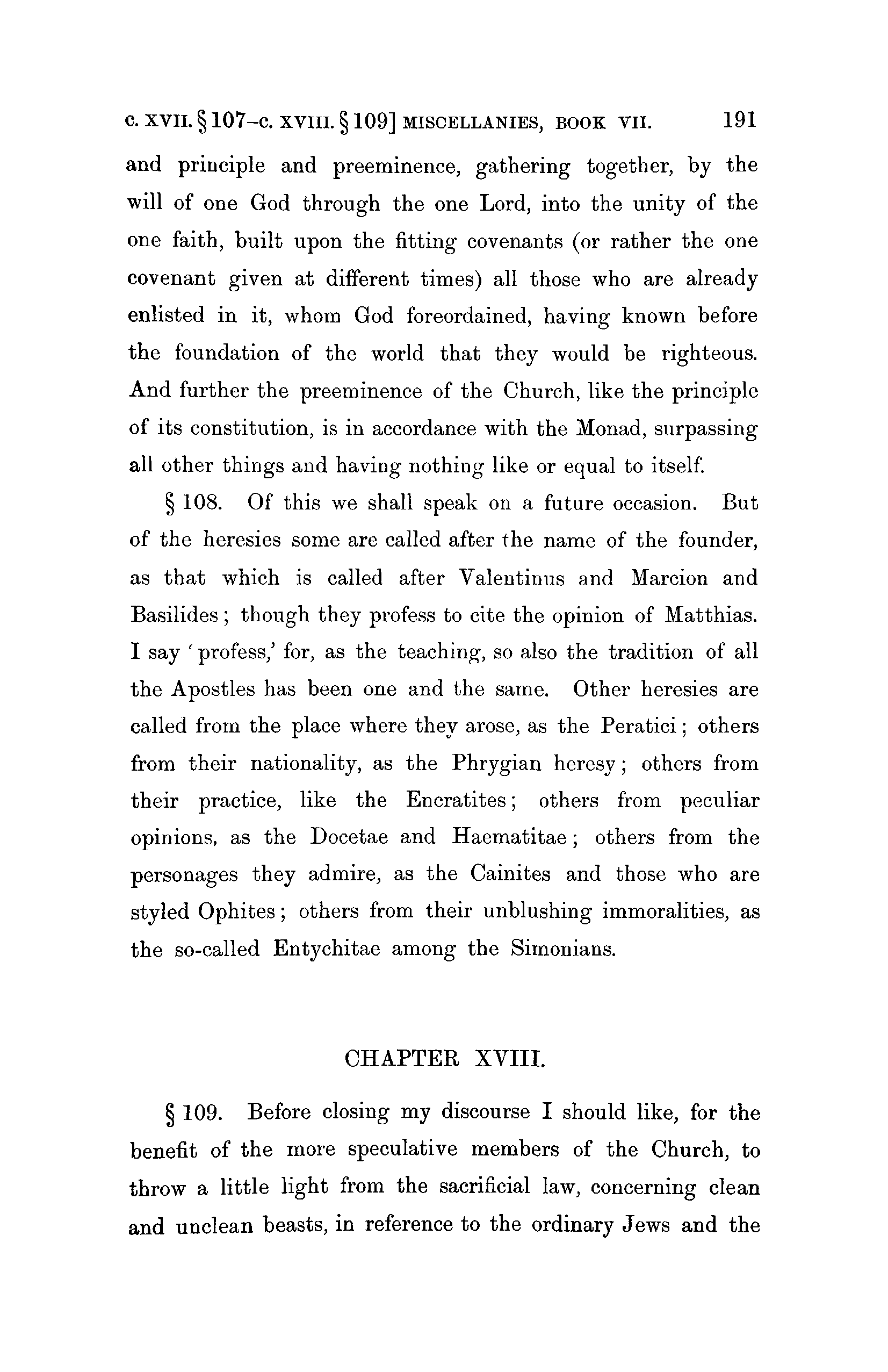
C. XVII. §107-C. XVIII. §109] MISCELLANIES, BOOK VII.
and principle and preeminence, gathering together, by the will of one God through the one Lord, into the unity of the one faith, built upon the fitting covenants (or rather the one covenant given at different times) all those who are already enlisted in it, whom God foreordained, having known before the foundation of the world that they would be righteous.
And further the preeminence of the Church, like the principle of its constitution, is in accordance with the Monad, surpassing all other things and having nothing like or equal to itself.
| 108. Of this we shall speak on a future occasion. But of the heresies some are called after the name of the founder, as that which is called after Valentinus and Marcion and Basilides ; though they profess to cite the opinion of Matthias.
I say ' profess,' for, as the teaching, so also the tradition of all the Apostles has been one and the same. Other heresies are called from the place where they arose, as the Peratici; others from their nationality, as the Phrygian heresy; others from their practice, like the Encratites; others from peculiar opinions, as the Docetae and Haematitae; others from the personages they admire, as the Cainites and those who are styled Ophites; others from their unblushing immoralities, as the so-called Entychitae among the Simonians.
CHAPTER XVIII.
§ 109. Before closing my discourse I should like, for the benefit of the more speculative members of the Church, to throw a little light from the sacrificial law, concerning clean and unclean beasts, in reference to the ordinary Jews and the https://doi.org/10.1017/CBO9780511695513.010 Published online by Cambridge University Press
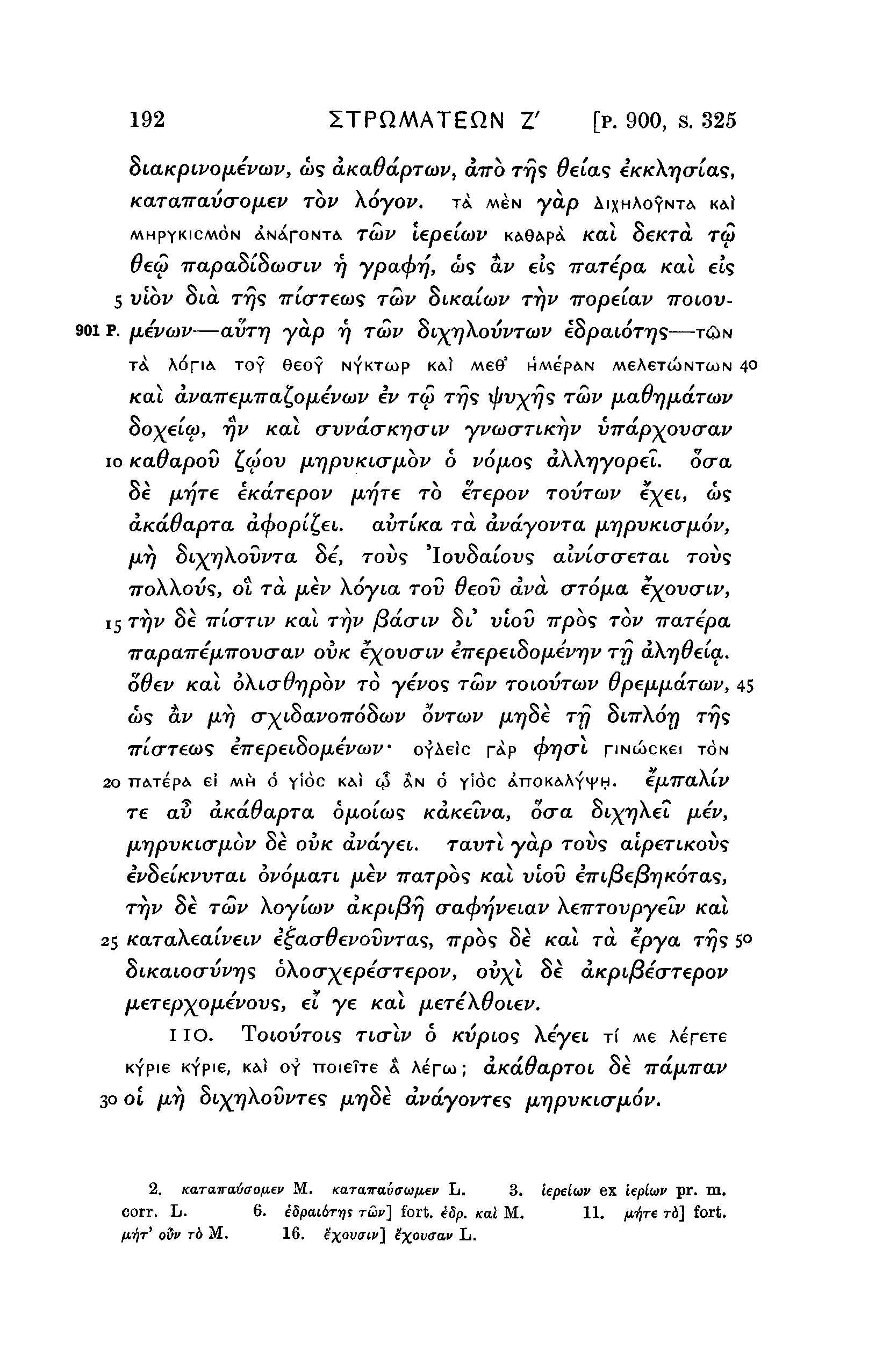
STPQMATEQN Z'
[P. 900, s. 325
, cos aKaOdpTcov, dirb Trjs deias e'/ Karairava-ofJiev TOV Xoyov.
T& MEN yap
AIXHAOYNTA KAJ
MHpyKICMON ANATONTA TCOV lepeiCOV KA9A,p(i Kal Se/CTO. TCp deco TrapaSiSbXTLv rj ypa<f>7], cos av eis irarepa
/cat eis 5 vlov Sta Trj? TricrTew? TCOV StKaCwv TTJV Tropeiav voiov901 P. fxevoiv—avTT] ydp rj TCOV ht^rjXovvTOiv iSpaioTTjS—TQN T&.
AOflA TOY SeOY NYKTtOp KAt M60'
HMepAN MeAeTCk>NTO>N 40 /cat dvaTTiybTratflfJiivoiv iv ra T^S ^V^T^S rait' ixaOrj/JidTCtiv
So^eiw, T/V /cat crvvdcna)criv yvoxTTLKr/v v-irdp^ovcrav 10 Kadapov t,(oov firjpvKicrfJibv 6 VO/AOS aXX^yopet. ocra Se /ATJT£ eKaTepov fM7)T€ TO eTepov TOVTCDV ex". &>? aKadapTa d(f>opi£,£L. auri/ca, rd dvdyovTa fJirjpvKCo~fi6v, fj.r) Su)(7]XovvTa Se, TOVS 'IovSatou? atvtcrcreTat rows
73"oX\ov9, ot r a jaev Xoyia TOV Beov dva crrd/xa e^ovcrtv, 15 T^V Se iricrTiv /cat Tip /3acriv St' viou TT^OOS TOV iraTepa
Trapaire/JLTTOvo-av OVK k\ovo~LV iTrepeiSofx,iviqv Trj akrjOeCa. odev Kal 6\io~0r)pbv TO yevos TWC TOIOUT&>V OpefifjiaTcov, 45
W5 av fir) o-yj£>avo"Tr6"&<av OVTWV firjSe Trj SnrXor) Trjq m c r T e w s eTrepeiSofxevtiiv• OY^GIC r^P <f>r)o~l piNticKei TON 20 TT&TepA ei Mfi 6 Y'OC KA! <J AN 6 YIOC AnoKAAY
X Te av aKadapTa OjLtoiws /cd/cea'a, ocra fjL,rjpvKLarjx,ov Se ou/c dvdyei.
TavTi ydp TOUS ivBeLKWTat ovofiaTL fiev naTpbs Kal vlov eTn TTJV Se TCOV Xoyicov aKpLJSrj cracf>rjveiav XerrTovpyelv /cat
25 KaTaXeaCvetv i£ao-0evovvTas, vryao? Se /cat TO. Ipya Trjs 5° St/catocruvijs 6Xoo")(epeo-Tepov, ov)(l Se aKpifiecrTepov fieTepxoiAevovs, et ye /cat fieTeXdoiev.
IIO.
TotovTots Ttcrtv 6 /cuyotos Xeyet T( MB AepeTe KYpie K-fpie, KA) OY Troierre A Aerto; aKadapToi
Se TrdfJLirav 30 01 JU-TT) Six^XoJWes jitTySe dvdyovTts 2.
Karawaiaofiev M. KaTairaieu/jiev L.
3. Upeluv ex ieploiv pr. m. corr. L.
6. £dpcu6Ti)s rue] fort. e5p. xai M.
11. /wjre TA] fort, /uijr' oSx ^A M.
16. ^x0U(7"'] fycovaav L. https://doi.org/10.1017/CBO9780511695513.010 Published online by Cambridge University Press
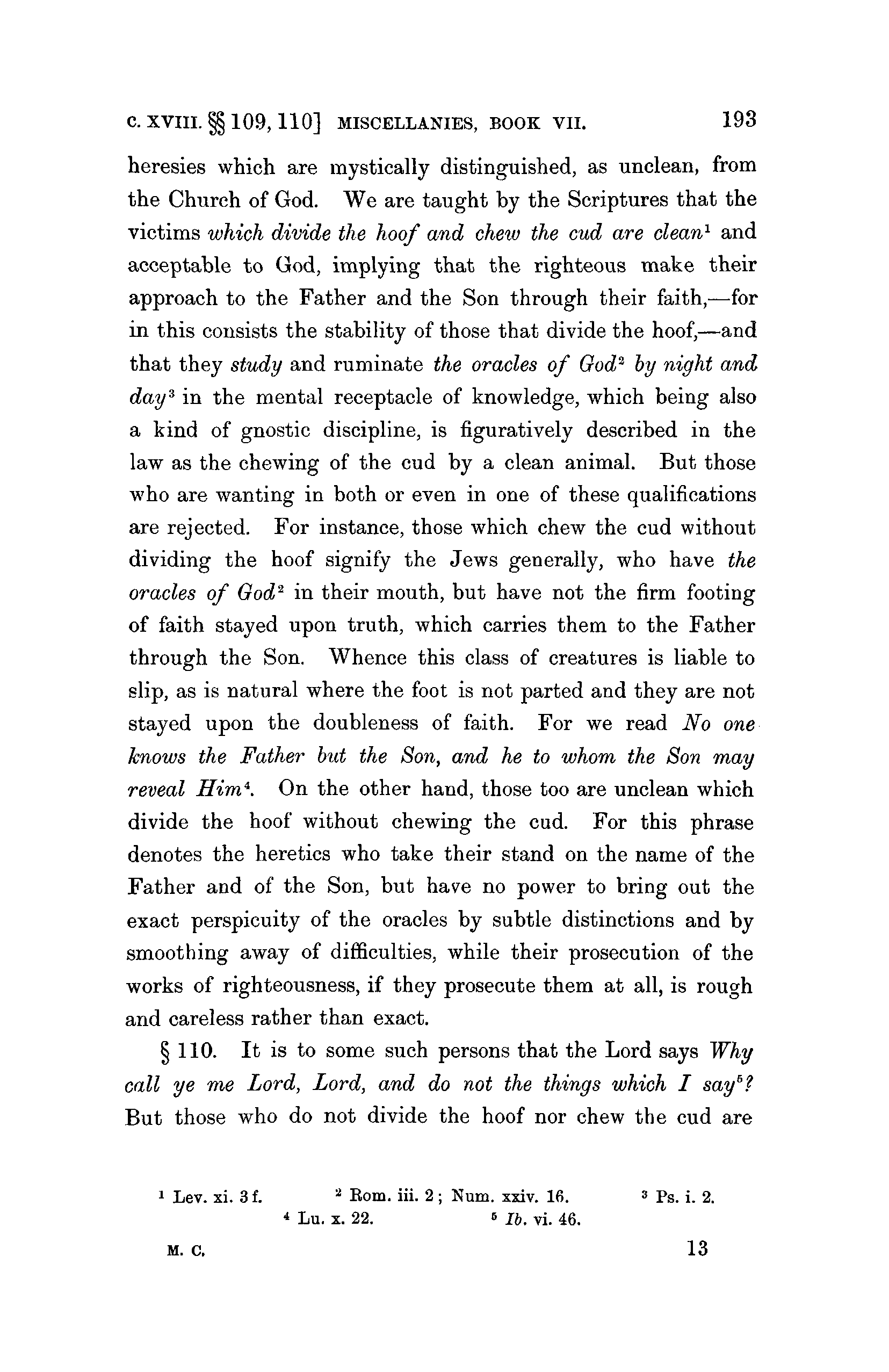
C. XVIII. §§ 109, 110] MISCELLANIES, BOOK VII.
heresies which are mystically distinguished, as unclean, from the Church of God. We are taught by the Scriptures that the victims which divide the hoof and chew the cud are clean1 and acceptable to God, implying that the righteous make their approach to the Father and the Son through their faith,—for in this consists the stability of those that divide the hoof,—and that they study and ruminate the oracles of God2 by night and day3 in the mental receptacle of knowledge, which being also a kind of gnostic discipline, is figuratively described in the law as the chewing of the cud by a clean animal. But those who are wanting in both or even in one of these qualifications are rejected. For instance, those which chew the cud without dividing the hoof signify the Jews generally, who have the oracles of God2 in their mouth, but have not the firm footing of faith stayed upon truth, which carries them to the Father through the Son. Whence this class of creatures is liable to slip, as is natural where the foot is not parted and they are not stayed upon the doubleness of faith. For we read No one knows the Father but the Son, and he to whom the Son may reveal Him''. On the other hand, those too are unclean which divide the hoof without chewing the cud. For this phrase denotes the heretics who take their stand on the name of the Father and of the Son, but have no power to bring out the exact perspicuity of the oracles by subtle distinctions and by smoothing away of difficulties, while their prosecution of the works of righteousness, if they prosecute them at all, is rough and careless rather than exact.
§ 110. It is to some such persons that the Lord says Why call ye me Lord, Lord, and do not the things which I say5?
But those who do not divide the hoof nor chew the cud are 1 Lev. xi. 3 f.
2 Eom. iii. 2 ; Num. xxiv. 16.
3 Ps. i. 2.
4 Lu. i. 22.
« Ib. vi. 46.
M. C.
https://doi.org/10.1017/CBO9780511695513.010 Published online by Cambridge University Press
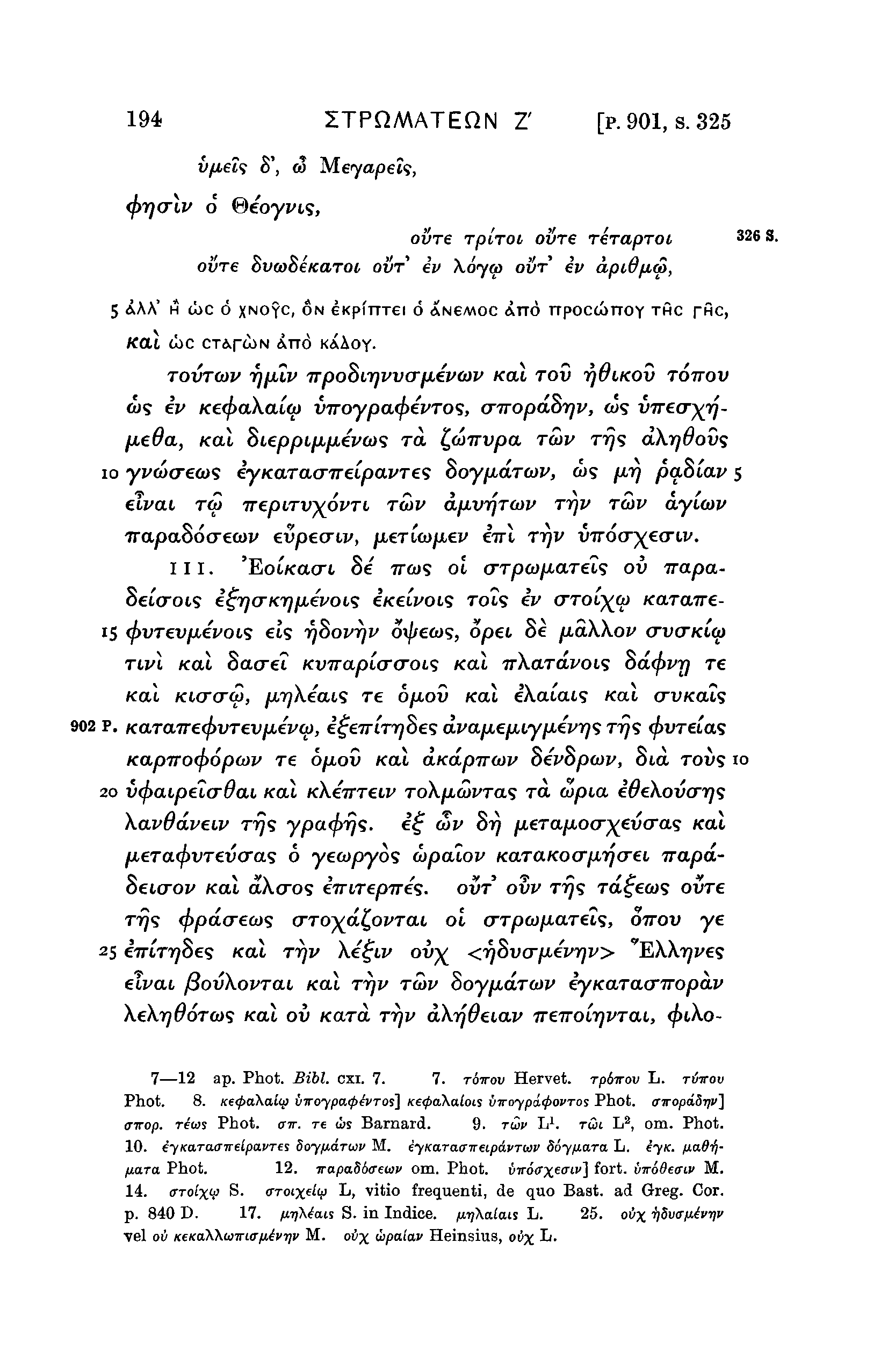
ZTPQMATEQN Z
[P. 901, s. 325 vfieis 8, <u Meyapet?, <j>r)(rlv 6 ©e'oyvts, ovre rpiroi oiire reraproi 326 s. ovre SvaySiicaToi OVT1 iv \6ya> OVT iv api6fiq>,
5 AAA' H i i c o XNOyc, ON eKpfrrrei 6 ANCMOC And rrpoctorroY THC THC,
KOl.1 WC CT4.rWN ATTO KA^OY-
TOVTCOV 7)[UV TTpoSiTjVVafXeVCOV KCU TOV YjOlKOV TOTTOV tti? iv K€<f>a\aia> vvoypaffyevros, (riropdSrjv, «5s VTreo-yrjfjieda, KCU 8ieppLfLfjievC)}<; ra ^anrvpa TWV rrjs dkrjOovs io yvaxrews iyKaTacnreipavTes Boy^aTcov, ws fti) p'q&Cav s elvai Th> irepiTvyovTi TWV a.[Lvr\To>v TTJV TU>V ayCwv TrapaSocrecov evpecriv, /jLeTtofiev evl Trjv VTrocr^ecriv.
I I I .
'Eoucacri 8e 7rcos ol (TTpco^aTels ov vapaSeiVois i^Tja-KTjfj.evot.'i iiceCvois TOIS iv CTTOLX^ naTaireiS (f>vTev/Jievoi.ts eis rjSovr/v oxf/eas, opei 8e fiaXkov CTVCTKCO)
TLVI /cat Sao-ei Kvirapio-croLS /cai Tj-XaTavoi^ 8d<f>vr] re Kai /cicro-w, ju.77A.eats re 6/AOU Krat e'Xatats /cat cru/cats
902 p. KaTaireffyvTevfJievq), e^eTrrr^Ses dvafj.eiJULyfJievr)<; Trjs ^)UTetas KapTTO(j)6po)v Te O/JLOV Kal dicdpiroiv SevSpwv, Sta, rous 10
20 vtyaipeicrdai KO1 KkeirTeiv roX/xaii'ras ret wpta e^eXovor>js \avddveiv Trjs ypa<fyf}<;. i£ (Sv 817 /ieTa/xocr^eucras /cat fieTa(j)VTevcra<; 6 yeaipybs ojpalov KafraKocr^qcrei irapdSetcrov /cat aXcros int/repTre<s. OVT OVV TT^S Tafews oure
TT^S <j>pdcrea)<; (jTtxyoXpvTai ol crr/awjitaTets, OTTOV ye 25 emr^Ses Kat TI)V Xe'^if ov^ <rjSva-fJiev7]v> "EXX^^es etvat ^SouXovrat /cat TT)J/ Twy Soyfj-aTaiv iyKaTacnropav \e\r)6oT(o<; /cat ou KaTa. TT)V aWrjOeiav TreTroLrjVTai, <f)i\o7—12 ap. Phot. -Bi6Z. cxi. 7.
7. TOTTOI/ Hervet. rpfnrov L. TI/JTOU Phot.
8. Ke0a\a&£> L»7ro7pa0^ros] /ce^aXafots inroypafpovros Phot. ffwopddTjv'] (nrop. rias Phot. air. re as Barnard.
9. TUV L1.
T&L L2, om. Phot.
10. iyKa.Ta.tnrelpa.i'Tes Soyixaruv M. eyKara<nr(i.pdvTiiir Soy/xara L. iyic. paStffiara Phot.
12. irapaSbaeuv om. Phot.
U7ro<rxe<""'] fort. vTroOetnv M.
14.
(TTOIXV S.
<rT0ix^V L, vitio frequenti, de quo Bast, ad Greg. Cor. p. 840 D.
17. /iMjWtus S. in Indice.
^Wcus L.
25. oi)x 7i5v<T/j.{vr)v vel oi> K€KaK\onnanivTjV M. ov^ Oipaiav Heinsius, oi>x L. https://doi.org/10.1017/CBO9780511695513.010 Published online by Cambridge University Press
C. XVIII. §§ 110, 111]
MISCELLANIES, BOOK VII.
utterly unclean. As Theognis says, You Megarians are neither in the third class, nor the fourth, nor even the twelfth, nor in any number or account whatever; but are like the chaff which the wind scattereth from the face of the earth1, and as a drop of a bucket2.
Having completed this introduction, and given a summary outline of ethical philosophy, wherein we have scattered the sparks of the doctrines of the true knowledge dispersedly here and there, as we promised, so that it should not be easy for the uninitiated who came across them to discover the holy traditions; let us pass on to our general argument.
§ 111. Now it seems that what are known as Miscellanies are not to be compared to ornamental parks with rows of ordered plantations to please the eye, but rather to some thickly wooded hill, overgrown with cypresses and planes and bay-tree and ivy, and at the same time planted with appletrees and olives and figs, the cultivation of fruit-bearing and of woodland trees being intentionally mingled together, since the Scripture desires to withdraw from observation on account of those who venture secretly to steal its fruits. It is by transplanting the suckers and trees from these preserves that the gardener will furnish a beautiful park and pleasure-ground.
Our Miscellanies therefore make no pretence of order or of choice diction, seeing that in this kind of composition the Greeks purposely object to over-sweetness of style, and sow their doctrines secretly
1 Pa. i. 4.
2 Is. xl. 15.
13—2 https://doi.org/10.1017/CBO9780511695513.010 Published online by Cambridge University Press
2TPQMATEQN Z'
[p. 902, s. 326 irovovs ical evpeTLKOvs elvat TOUS ei TLVCS ivrij^oiev 15 •7rapa<TKevdt,ovTes. woXXd yap TOO SeXe'ara /cat iroiKika hid Tas TCHV l^Ovcov 8ia(j>opd<;.
Kal S17 /xera. TOI' efihofjiov TOVTOV T)ixZv TS)V efijs CITT' aXA/r^s dp-^rjs TroLrjcrofjieda TOV
\6yov.
1. ivTixoiev S. Tix°^v L.
3. Subscriptum in L, So/«os 6 (toi Tjra. https://doi.org/10.1017/CBO9780511695513.010 Published online by Cambridge University Press
C. XVIII. § 111]
MISCELLANIES, BOOK VII.
and not in a plain, unmistakeable manner, seeking to exercise the diligence and ingenuity of the readers, if there should be such. For we must provide a large variety of baits owing to the varieties of fish.
And now, having concluded our seventh Miscellany, we will make a new start in our discussion of what is to follow. https://doi.org/10.1017/CBO9780511695513.010 Published online by Cambridge University Press

https://doi.org/10.1017/CBO9780511695513.010 Published online by Cambridge University Press
NOTES.
§ 1. p. 2, line 2 foil. Christians were reputed to be atheists, partly from their rejection of the popular gods, partly from the absence of outward signs associated with worship. H. At the beginning of the previous book Clement declares it to be his intention in Books vi. and vu. to describe the character of the gnostic, and to show to the philosophers t h a t h e IS ovdafLas cifleov, a>s VTTfi\r}(f>acnv, povov de Tea OVTL 6eoo~e($rj. So Polycarp retorted on the heathen the cry alpe TOVS ddeovs raised against the Christians (Mart. Polyc. 9). Cf. Lightfoot's note on Ignat. Trail. 3, where he cites Justin Apol. I. 6, 13, Athenag. 3, 4, 30, Tert. Apol. 10.
<Ss in sense of S>o-re. H. Cf. below P. 837 ad Jin., 846, 877, 879 and passim, also W. Schmid Atticismus iv. 87.
3. otos TCS for us. oior re : r<? seems to have nothing answering to it. H.
5. 8i«KovTas Touvo(ta. Cf. James ii. 7; 1 Pet. iv. 14, 16; 3 Jo. 7; Acts iv. 17 foil., v. 28, 40, 41, ix. 21, xxvi. 9, &c. H. Justin Apol. 4 ty' rjfiav TO ovopa els ?Xey^o>» Xa^dvere, Tert. Apol. 2 oditur itaque in hominibus innocuis etiam nomen innoxium. Proinde Plinius ad Trajanum haesitare se refert, nomen ipsum, etiamsi flagitiis careat, an flagitia cohaerentia nomini puniantur, also P. 885 TO ovopa fwiK€K\rjii4vot jiavov, and P. 511 init.
7—9. £vapiy«<rTe'pois...Tois \6701s. Clement often speaks of the use of philosophical training as a preparation for Christianity, as in Str. 1. P. 331
XPyTLH"*] trp05 $£O(re(3€iav (fj <f)i\oo~o<f)ia) yivtTai, Trpoirmheia TLS ovcra rots TTJV irio-Tiv hi' dno8el£eas Kapnovfiivoa, P. 341 fin., P. 785/, cf. Faye, Pt II. ch. 6. Here rols Xoyotr seems to mean 'reasoning,' as opposed to the 'witness of prophecy,' cf. P. 378 rais rav \6ya>v dvdyKais. Unfavourable examples of such reasoning may be found below in P. 845, and 852.
8. ferateiv: a favourite word with Plato and Clement, from d(a>, a Homeric term for any sense-perception (chiefly hearing, but also sight and feeling): used especially of acquaintance with any art or science,
=peritus esse. H.
10.
Ttjs TOU irioTeucrai Suvdjiews.
Cf. Plato Rep. I. 328 el en ev dvvd/iei r)v TOV nopevea-dm irpos TO aarv, and for meaning Joh. v. 44 was Sivacrde irco-Teveiv, vi. 65 ovBels Svvarai e\deiv npos pe, eav jxrj 3 hehofiivov avTuj en
TOV irarpos, Heb. xii. 2, &c.
11, T»V irpo<j>iiTi.Kwv. Why should the prophets alone be mentioned to the exclusion of all other testimony to Christ ?
13.
Wrepov TOIS 7pai}>ais OTTY)(P')O'O|«VOI..
See below on TO 1. 19. https://doi.org/10.1017/CBO9780511695513.011 Published online by Cambridge University Press
NOTES.
[P. 829, § 1—
15. xPl<rTtavi0>°vThe word is used more than once by Ignatius.
See Lightfoot's n. on Magn. 10.
16. <rv|iirapaXo|ipdvovT£s. H. prefers the MS. reading o-vjxnepi.\aii^dvovres. The two are often confounded in MSS., and Sylburg's emendation seems to me more appropriate here. Cf. Arist. de Aniina I. 2 init. rat
™ nporipav So£as avfnrapakaiifidveiv, Rhet. I. 3. 5 with Cope's 11.
17. Xe£eis, 'modes of language': just below A<?£is is opposed to vovs. H.
But it is also used simply for ' saying' or ' speech,1 as \e£ewv npofprjTiK&v above, and in P. 856 17 Xe|ts Trjs vorjo-eas x°-Pll> &e$°™ W*lv> a n (^ P883 rats c7riicaip(HS rav aTTOCTTok<.Kav o~vyxpd>)j.evoi
\f£e(n.
18. IK irepiovo-Cas, ex abundantly a flexible phrase arising from the general sense of easy superfluity.
Aristotle, Top. 118 a. 6—15, contrasts TO. CK wepiova-ias with ra dvayKaia, e.g. TO ev £r)V with TO £rjv, TO <f>i\o<ro(p£lv with TO xpTjfj.aTi^€<rdai. H.
See Index, s.v. irepiovo-la.
19. TO papTvpia, 'the actual testimonies,' i.e. passages of Scripture.
Probably a reference to the Eclogae Propheticae in the Hypotyposes, a book intended for advanced Christians. H. See below p. 4. 6, 100. 20,
146. 23, and (for the reference) the Introduction.
21.
TUV KvpiaK&v -ypa<t>(Sv. The same phrase occurs below P. 890. p. 4, line 1. dvcurvet.
Cf. P. 625 el KCU 6 Tlavkos TOIS xP°v0ls vca{ei... aXX' ovv Tj ypctfpjj OVTCO ex Trjs TraXaiar rjpTrjTai biadrjKjfs, exeWev dvajrviovcra Kal \a\ovcra.
2. iropio-Tav. The form lo-Tav occurs in Plat. Cratyl. 437 B, avviorav in Eus. Pr. Ev. vi. 8. 3. Winer (p. 94, Moulton) cites anroKaduTTa. Mk ix. 12, acpicrra Test. Jud. p. 610, awio-rav Chariton, p. 140, where Dorville refers to Artemid. 11. 42 for dvio-rav. Other exx. will be found in Graevius' n. on Lucian, Soloec. 7, where the form is condemned.
See Paed. I.
P. 131 01 fiao'tXe'is XlepaSav iraidayaiyovs Tois o~(p&)V avTwv €(pto~r(ov naio~tvt W. Schmid Attic. IV. 605, Veitch Or. V. Jo-ram.
3. eire^ep-yoo-Co, ' working out,' either in investigation or in exposition; usually with a sense of special minuteness.
5. T4 Ka-reirei'yov, ' what is specially pressing, urgent.' So the phrase ov KaTenelyet. Usage common from the orators onward.
§ 2. 9. irpoKci/rai. See Lightfoot Ign. vol. 11. p. 272 n.
10—12. e€OTrpeiro3s...eeo<|>iX^...<(>iX6e€ov. See below p. 6,11. 20—27. H.
Verbal adjectives in --qs have commonly a passive or neuter force, as Beofiio-T}!, deofiavrjs, but also an active force as in 0eoo~eftT)s. Those in -os sometimes combine both meanings, distinguished by the accent, as 6eo<popos, ' bearing God,' 6e6<f>opos, ' borne' or ' sent by God.' For the combination of deotyiXrjs and (pi\68fos cf. Philo's description of Moses as <f>iK66(6s T€ Kal 6eo<pi\r)s (M. 2, p. 145), Eus. Pr. Ev. vn. 4, p. 303 b OVTO>
Br) <piK68coi ofiov icai 8eo<f>iKfis avafpavevTes, depairfvrai rives OVTCOS <a\ Upels TOV vv^t'orov Seov d7re<pdv37}O~av.
11. r i Bcoirpcirci. See Index, and Lightfoot on Ign. vol. 11. p. 108. https://doi.org/10.1017/CBO9780511695513.011 Published online by Cambridge University Press
P. 829, § 2]
NOTES.
12. airav TO iirepfyov, 'every class of pre-eminence.' For the art. with distributive nas in the singular cf. Orig. Joh. torn. i. 12 (p. 14 R.) iras 6 TS>V /MaSijTav TOV 'ITJUOV Trpo&OTrjs eivai XeXoyio-rai
TOV 'irjo-ov npoSorrjs.
So just below we have navra TCW Trpeo-fivTcpov. Cf. Plato Leg. v. 731 c was o ddiKos o&x u w USIKOS, Arist. Pol. I. 4. 1 acrnep opyavov npo opydvwv nas
6 xnrripeTTjs.
H. I suppose this is intended to meet the charge of irreverence. ' It is true the Christians do not honour the gods of the heathen, nor worship the emperor, nor bow down before popular opinion : still we do pay honour where it is due.'
13, 14. TI|AT]T&>V. . .irdvTa TOV irp£o-p«Tepov. Cf. the address of Pythagoras in Janibl. V. Pyth. VIII. 37 i'v TC ra K6O-/J.CO K<U Tta /3I'W K.CU rats noXetn. KOX rfj
(fivcrti fiaXXov rifxiop.evov TO ITporjyovp-fvov jj TO xpova en6fi€vov K.T.X.
15. SiSaKTots, a Socratic and Platonic word as applied to Virtue.
Here contrasted with voryros, another Platonic word, to express what is directly perceived by the highest powers of the mind. H. See below on p. 68. 26.
TT)V dpxa.toTa.TT|v 4>iXoo-o<f>£av. By this Cl. means the revelation given to Israel, which he often calls J; fiapfHapos (ptXoo-oipia. Compare his proof of the priority of Moses to the teachers of Greece, who stole from him their wisdom, Str. I. P. 350 f. Plato is said to have confessed as much in the words "EXA^i/tr act Traifie'r eore...oi8fiiiav i'xfTf &' apx^iav OKOTJV irakaiav 86£av ovSe fiadi}fia XP°V<? iroXiov (Tim. 22), cf. Str. P. 355—7, 426.
Hence Tertullian (de Praescr. Haer. 31) contrasts principalitatem veritatis and posteritatem rnendacii, and Cl. speaks (below, P. 888) of the one true and ancient Church. See, on the claim to antiquity, Kaye p. 22.
17. axpovov <Kal> avapxov. The word Sxpovos is used with curia, Str. P. 931. It also occurs in Ignat. Polyc. 3 (where see Lightfoot) and is common in Plotinus; but perhaps H. J. is right in suggesting that it may be a marginal explanation of avapxos. If we omit it, the play of words
(avapxov dpxrjv re tai dirapxrjv) is brought out more distinctly. Cf. P. 638 o 8e6e avapxos apx1? T^v o^a>"> a nd P. 733.
19. lK|iav8av«iv. If we keep the inf. we must suppose it to depend on the orat. obi. implied in ijyen-m (1. 12), but the ind. is a far more natural construction.
TO eireKeivo. ailTiov, 'the ulterior cause.' The Son is called TO Scvrepov airiov below, § 16. H. There is a reminiscence here of Plato Rep. vi. 509 B, where it is said that ro dyadov is not the same as ovo-ia, but eVexftva Trjs ovo~ias ITpe&fitiq Ka\ SvvafieL, a n d of Tiffl. 28 C TOV TTOITJTTJV Km narepa
Tov8e TOV navros. H. J. Cl. speaks of the Son as in. TOV VOJ^TOV P. 669, and of God as eV. TOV ivos P. 140.
20. cucp-ycTiKUTaTov. See below, p. 8, 1. 18.
21.
OUKCTI 4>o>vfj irapaSiSojievov. At first the gnostic received his knowledge of God by hearing from others, but now he knows by intimate union.
Cf. Joh. iv. 42. eri-yfj.
Cf. Rom. viii. 26 o-Tevayfiois d\aXr)T0is, Plotin. Enn. v. 1. 6, p. 906, and C.'s favourite quotation lvvoT)6ryri KOI TTOHJO-O), P. 876, &c. This seems to https://doi.org/10.1017/CBO9780511695513.011 Published online by Cambridge University Press
NOTES.
[P. 829, § 2—
contradict Bigg's assertion (quoted with approval by Harnack3 Dogmengesch. p. 559 n.) that 'the Silent Prayer of the Quietist' is not to be found inCl.
26. oTJYYfWvao-iUvuv. The original has yeyvjivaa-jieva i^ovTiav.
§ 3. 27—8. The iiri|ic\ci.a TTJS ^xfls is illustrated by p. 16. 25; 26. 26.
Cf. Str. IV. P. 633 8ebv 6 8epaneva>v eavrov Sepanevei' iv ovv ra 6ea>pt]TiKCd pita iavrov TIS inifieXeiTm, 8pi]o-Keiav TOV 8eov. H.
28.
This diligence applied to the divine part of the soul implies a contradiction unless there is an unceasing love of men. Cf. Str. n. 438 med. eiKG>v TOV 8eov av6pa>7ros evfpyerav iv co Kai avros evepyeTeirai. M.
On the divine part of the soul cf. Exc. ex Th. P. 981, Str. II. P. 703, Protr. P. 59.
In this doctrine, as in so much besides, Cl. follows the guidance both of the Bible (Gen. ii. 7) and of Greek philosophy, esp. the Stoics. p. 6, line 2. -yoveSo-i Zi. H. J.!s emendation JMJ]V for the MS. p.iv is supported by Str. II. P. 441 JJ /j.ev o-ocpia (ppovqcris, ov p.rjv iraaa (ppovqo-is o-oifiia, PI. Phaedrus 268 E, Epist. vn. 326 B 'iaas fiev Kara rixqv,
COIKC jxrjv K.T.X.
Orig. Cels. III. 9 vvv fiiv ovv rd^a...oi p-f/v Kara TTJV dpxfjv, where firjv is opposed to p.iv. Cf. Klotz Devar, I. 132, II. 659.
5. irp6o-p4Tepoi....8i.<iKovoi. Cf. Str. VI. P. 793passim, H. (where, as in Str. i. P. 318, comparison is made between the orders of the ministry and the angels, a comparison probably suggested by Apoc. i. 20, &c.); also Str. iv. P. 593 eiKiav TTJS oipavlov iKx\r]o-ias JJ iwiyeios.
The comparison is elaborated in the treatises on the Heavenly and on the Ecclesiastical
Hierarchy by Dionysius Areop., on which see below, p. 16. 4 n.
Lightfoot in his essay on the Christian Ministry (Philipp. pp. 98, 229) quotes this passage as showing that at the end of the second century the bishop of Alexandria was still not clearly distinguished from the presbytery. In fact we are told that till the middle of the third century both the election and the consecration of the bishop of Alexandria were in the hand of the presbyters. Before the episcopate of Demetrius (A.D. 190—233) there was only one bishop for the whole of Egypt (ib. pp. 231, 2). Elsewhere, however, Cl. recognizes the three orders, as in Paed. m. P. 309, Str. in. P. 552,
Str. vi. P. 793.
The last passage begins with the mention of presbyters and deacons only: 'the true gnostic is enrolled' els TTJV EKXOT^I/ ra>v anoo-roKav.
OVTOS npio-fivTfpos io-Ti TOI OVTI TTJS iKKXrjo-ias, Kai diOLKovos akrjdrjs Ttjs TOV
0eov jiov\r]o-ca>s...ovx in' avOpairiov ^eipoTovoij^iei/os, oib', OTL TrpecrfivTepos,
StKaios vo)u£6p.€vos, dXX', on SIKCUOS, iv irpeo-fivTepiq Ka.Ta\ey6iJ.evos, K&V ivravda eVl TIJS yrjs 7rpa>TOKadeSpla p.fj rifirjdrj, iv TOIS e'Uoo-i Kai Teaaapo-i Ka6e8eirai Opovois, but just below he speaks of ai ivravBa Kara TTJV iKK\r)0-iav irpOKOwai, inuTKOtraiv, npfo-^vrepmv, SiaKovav K.T.X.
In Q. D. S. he uses the titles inio-Konos and npeo-fivTepos of the same person (P. 959).
6. SiaKovCas. As two kinds of depaneia (not of biaKovia) have been spoken of, and the words diaKovoi and o~iaKovovp,evos are used, in the preceding and following sentences, distinctively of one kind of depdweia,
I think the scribe carelessly wrote diaKovlas for Bepanelas. https://doi.org/10.1017/CBO9780511695513.011 Published online by Cambridge University Press
P. 830,13]
NOTES.
7. iirrjptTovvTai. The middle is only found in late Greek. Just below we find the active of the compound e^vnrjpeTa>, but the middle in P. 562. ircpiYcCuv: contrasted with oipdvws in Plut. Mor. 745 B, 887 B. Cf.
P. 755 \frvxas (previously called dyyiXovs) et-ovo-iav Xafiovcras Sia Kadaporijra
TOV ptov TTJ vela npovoia els TT]V dv8pa>7ratv XeiTOvpylav TOV irepiyetov neptnoXelv TOTTOI/, 822 al TQ>V evapcTwv dv8pwir<ov inivoiai Kara etriivvoiav 8elav ytvovTai, btartSefievrjs na>s rrjs ^v^rjs nai bia8idop.evov TOV 8elov 8eXrjp.aTOS els ras dvdpunrlvas \jrv\ds, rav iv fiepei 8ei<av XeiTovpyav trvXXafi^avoixivav els
Tas Totavras dtaxovias, K.T.X.
9. peXTiuTiKii Secopta. So philosophy is said just above to be /3. tyvxqsCf. Paed, I. P. 98 init. TO TC\OS TOV 7raibay<nyov fic\Ttcoo~ai TTJP ^rv^rjv, ov difia£ai, o-G><j>pov6s Tt, OVK €7rio~rr]p.ovtKov, Kadrjyrjo-ao-8m /3/ov.
The word /3c\Tioia and its derivatives are found in Plutarch and are very common in Philo, see
Wytt. on Plut. MOT. p. 75 A TTJV OVTOV @f\TiovtA€vov irpbs dpeTr^v o~vvaio~67)o~w.
12.
«|\iiriip6T(Sv occurs again below, p. ] 2. 9.
13.
BepaireCa $\nS>v. See P. 319 and below p. 138. 28.
21.
0«o<j>i.Xijs.
As Cl. here ascribes this quality to the gnostic, so Hierocles to the Wise Man, in Carm. Awr. I. fiivos iepevs 6 <ro<fios, p,6vos
@eo(pi\r}s, fxovos eldats ev^ao~6ai.
23. 4o-o(i6va> 9€w. Cf. P. 865, also Protr. P. 88, where Potter gives many illustrations from Clement. See esp. Paed. in. P. 250 foil. H.
Nothing in Clement is more startling to the reader of the present day than his repeated assertion of the deification of the gnostic, not merely in the future (as here), but in this present life, as in P. 894 6 T<3 Kvpico neidofievos "cat T7] hoBtifTTj Si' avTov KaTaKo\ov8i]o~as TTpo<prjT€ia reXe'ojy eKTfAfirat
KaT* flKova TOV o'idao~Ka\ov, ev o~apKi TrepinoXwv 8eos, 890 f£ dvBpa>7rov fleos a7TOTeXeira(, 632 TOIJTQ) hvvarov Tto Tponco TOV yvti>o~TiKov fj&rj yeveo~8ai
8(6v. In proof of this doctrine he cites passages both from the Bible and from secular authors, e.g. Ps. lxxxii. 6 (quoted in P. 94, 113, 494,
632), Heraclitus avdpamoi dtoi, 6eo\ avdpomoi (P. 251), Plato Soph. p. 216
(P. 634), Empedocles (P. 632). He might also have referred to 2 Pet. i. 4
Betas Koivoivol cpvaeas, and to the Stoic claim of equality with God (cf. Cic.
Somn. Sc. 24 deum te igitur scito esse, siquidem est deus qui viget, qui sentit,...qui tarn regit et moderatur id corpus cui praepositus est, quam hunc mundum ille princeps deus, N. B. u. 154). Yet strangely enough
Cl. denies the identity of divine and human virtue (see P. 886). The deification of man was also maintained by Theophilus Aut. u. 27 ovre ovv ddavaTov avrov eirolrjO'ev aKKa beKTwbv (aSavaartas) lva...p.io~6bv KOfiio~rjTai
Trjv ddavacriav cai yevr/rai 6eos, ib. 24 6Va>r re'Xetot yev6p.evos, '4TI he KCU 8ebs dva8ei)(8eis, els TOV oipavbv dva^fj: by Irenaeus iv. 38. 4 nos autem imputamus ei quoniam non ab initio di facti sumus, sed primo quidem homines, tune demum di: by Hippolytus Philos. x. 33 (p. 540. 2) el yap 8e6v o-e r)8eXrjo-e iroiTJaai., e'SvvaTo...av8pa>Trov 8e\a>v, avSpwnov ae eiroi-qo-ev el be 6eXeis icai 8e6s yevioSai inaKOve Tm TrenoirjKOTi, ib. 34 (p. 544. 37) e'o-rj
OfuXrjTris deov xai trvy<Xr)pov6f>.os XpiaTov...yeyovas yap 8eos: by Athanas. de Incarn. 54 airbs evt]v8pa>Trtjo-ev iva rjfieZs 8eowoi7]8a>ij.ev.
See also quotations https://doi.org/10.1017/CBO9780511695513.011 Published online by Cambridge University Press
NOTES.
[p. 830, § 3— in Suicer s.v. deonoieo, 6e6a>, deao-is, Harnack Dogmengesch., who goes so far as to say that the idea of deification is to be found ' in all the Fathers of the ancient Church after Origen' (vol. in. 164 w..tr.), cf. his Excursus on the use of the word 8e6s (vol. i. 119) and the references in the Index under the heading 'Deification.'
Aquinas explains the appellation as follows:
(Summa I. qu. 108) sancti homines participative dicuntur dei. ego|j.oi.ov|Uv<p. The idea of man's assimilation to God is connected by CL, as by Philo (M. 1.16, 106), with the statement in Gen. i. 26 KOI elnev
6 $eo?, 7roiT]a'Ctifi€v avdpcoirov Kar' et/coi/a rjfieTepav Kal naQ' 6fioicoo~iv (quoted in P. 156, 576, 642, 662, 703), and also with the famous passage in the TheaetetUS, p. 176 TreipaoSai xprj fvBivtie fxeicre (pevyeiv S,TI ra^itrra. (pvyrj be ofioiGHTLs 6etia Kara TO hvvarov • op-oimtris he hinmov Kal orrtov fiera <ppovr)o-ecos yevecrdat (quoted P. 482, 499, 500, 502, 792). Cf. Faye, p. 263 foil. flew. The dative here has a double use; in its first use, as understood after io-op>iva, it is governed by ^Laireov, in its second use by tgo/ioiovfieva.
§ 4. 27. •§. The reference seems to be to lines 14—20 in the preceding paragraph.
28. diroT€\€<r(io, a favourite word with Polybius and later writers. For the three gnostic cnroTe\eo~p.aTa cf. P. 453 Tpiwv TOVTCOV avTe^erai 6 7][ie8a7r6s
<pi\6iro(pos, nparov fikv rrjs 6eapias, devrepov Se rrjs TO>V evTo\S>v iTrireXeVewf,
Tp'irov avhpa>v aya8S>v KCtTao-Kevrjsa 8rj <rvve\66vTa T6V yvatrriKov iirvrehti. irpwTov. The omission of irp. in the MS. is probably due to its being written as a, which would easily disappear after the preceding a. p. 8, line 1. irpdYiiaTa. One would hardly expect to find this word used as equivalent to 8ea>pia in P. 453 (quoted on avorekea-p-a just above), but it occurs elsewhere in Cl. with a pregnant force = ' reality.' Cf. P. 875
(ppovifioi yjrvxal TO OIKC'IOV avcnvTovo-ai <f>a>s els TTJV T£>V Trpayp-aTav Beapiav,
867 fin. ovo~ias TO'LVW K.ai Ta irpayp.a.Ta avTa irapakaftaiv hia TG>V \6y<ovy eltcorays nai TTJV ^rv^rjv enl Ta 8eovTa ayet, Iren. IV. 18. 5 diro yrjs apTOS,
•Kpoa\ap.^av6iievos TTJV eiriKkrjo-tv TOV deov, ovKeri Koivbs apros eo-Tiv, aXX eii^apttrrta, eV dvo npayp-aTuiv o~vveo~TT}Kvia^ entyelov re Kal ovpaviov.
3. ra irapa TTJ dXT]6eCa tmK€Kp-up.|i^va. Cf. above, p. 2, 1. 8 TT)S nap' airo'is naiSeias.
5. |«)(rTi]pia. See Introduction.
6. aOeos. See above, § 1. 5.
8eiiri8oC(jiuv. Cf. P. 450 17 8eio-t.o'aip,ovia iraOos, <f>6l3os Saifiovav ov<ra
€K7rad5>v Te Kal ip.na8a>v. By S. are meant the heathen gods. Cf. 1 Cor. x. 20. In Protr. P. 21 Cl. speaks of atheism and superstition as the two extremes of AfiaBla. See Plutarch's interesting treatise De Superstitione.
8. avflpwirov. For the pregnant sense cf. Protr. P. 89 TTJS yvao-eas al dicTLves ava.Tfd<aT<x>o~av TOV eyK€Kpvfxp.evov evdov fK<paivovo~ai avopatiroVj Theoph. Aut. I. 2 eav <f>rjs Afi£oi> not TOV deov aov, Kaya o~oi e'inoifu av Ael£6v p.oi TOV avdpionov crov (internum hominem).
§ 5. 10. On rudimentary and other faith see P. 644 foil. H. The reference to jrioris is probably suggested by 8e6v TteTreio-fievos elvu above https://doi.org/10.1017/CBO9780511695513.011 Published online by Cambridge University Press
P. 831, § 5]
NOTES.
(1. 4). Faith in the existence of God comes first, theft the acceptance of Christ's teaching.
The text presents many difficulties.
How can it be said that a rudimentary faith is knowledge, and how does the rest of the sentence bear on this proposition ? We may escape the first difficulty by inserting ivepyei, which might easily be lost after elhevai, and thus we also gain a construction for f)yelo-8ai, if we connect the two sentences by inserting 8e after fifTa, as in Str. VI. P. 791 TO. p.ev npara c'i(peo-iv afiapTiav alTrj(TfT<u, jxera 8i TO fir/Keri afiaprdvetv, eweiTa (MS. eVi TO) eviroiuv Svvatrdat.
I should prefer however to make TO 8pav dependent on ivepyei, changing fiyeia-dai into r)yovp.evov. The two stages of faith correspond to the 1st and 2nd stage of knowledge (1. 1). For ITIOTIS see Introduction.
11. ir«iroC8i]<ri.v. Cf. Str. V. P. 697 ninoiBev aXrjdrj eivai TT)V SiSa<rKa\iav
TOV Ylov. cor Se ij p.ddrjcris ras (ppevas av£ei, OVTOIS T] els TOV 8cbv ivewoldiqo-ii avt;ei rfjv TT'KTTIV, P. 444, where nen. is defined as 8idXj;\|«r fieftala nepi
Ttvos810 TTMTTfvofiev a av TreTtoidoTfs wfiev els aa>Tr]pLavmTrol.dap.fv hi TW p.6va> dea>, Sext. E m p . P. H. III. p . 238 17 Treiroidrfo-is TOV T<18( p.ev elvai <pi(TCL ayadd, TaSf be KaKa. See Wetst. on 2 Cor. i. 15. H. J., putting a colon after SiSao-KaXiar, and substituting TOV for TO after 7rerroWrjo-iv, would translate ' Faith in its first form is the knowledge of God and of the Saviour's injunction to regard the resolution to do no injustice in any way as proper to the knowledge of Him.'
15. oyyeXos o irXT]<ri.a£Tepov...(i.eTaXaiYxdviov. I n t h e MS. 6 is changed into TO owing to a misunderstanding of the adverbial use of the neuter comparative.
Probably the reference is to the archangel Michael.
17.
On the Divinity of the Son, cf. Bull, vol. vi. p. 239 foil. H.
20.
T] p.cy^o'TT] iiir€pox.ii.
Cf. above p. 4. 12 TL^LOV anav TO virepi^ov TjyeiTat KaTa TTJV d£lav, and below p. 136. 16 TYJV KCIT* d^iav V7repo)(rjv.
Kara T& deX^a K.T.X. Cf. below, p. 12. 8 foil. &c. H.
21. olaKiJei.
Cf. Diod. 5VIII. 59 6 KOIVOS /3I'OS atrirep VTTO 8ea>v TIVOS olaKi£6p.evos, Heracl. Byw. 28 ndvTa otaKt^ei Kepavvos, Philo M. I. 419 6 <v/3epvrjTTjs Seos TQ)V oXcov, OLKOvop.cov KOL nr]ba\iovj^a>v o~<0Tr)pia>s Ta 0~vp,7raVTa, ib. 437, below, p. 16. 4 KvfiepviovTa TTJV ndvTiov o-urqplav.
22.
8L' av ivepyel.
So Numenius (ap. Eus. Pr. Ev. XI. 18) compares the pilot steering by the stars with the brffuovpybs TT/V VXTJV Tali ISiais olaKL^ayv, fiXencov QVTI TOV ovpavov els TOV avo> Beov, which Eus. illustrates by quoting Joh. V. 19 ovSev Bivarm 6 vlos noielv d<p' eavTov edv fir) TL /3Xe'7r?j TOV rrarepa rrowvvTa: cf. also Joh. viii. 28, 38, Philo M. I. 414 6 yevvrjdeis, fjLtfiovfievos Tas TOV rraTpos 6§ovs, rrpbs irapah*Lyp.aTa dp^eTvna txeivov fiKiirav ijioptpov Ta e'tSr), Strom. P. 635 oiov ayyeXos rjbrj yevop.evos o~vv Xpio-T(p eorcu, de\ TO fiovXijpia TOV Oeov O~KOTTO)V, P. 323 6 awTrfp del ipyd£*Tai u>s fikfrrei
TOV irarepa.
23. <m|3X6roiKra,' watching,' i.e. while acting; quoted in Theodoret Aff.
Or. p. 63. H.
24. irepiwirijs, 'look-out place,'apparently a reference to Plato, Politiais, 272 E TOTe dr) TOV navTos 6 p.ev Kv^epvr)Tr)S oiov 7n}da\l<av o'laKOS d<pep,evos els rr)v avTov nepianrjjv aneo-Trj, where the pilot of the universe leaves the helm https://doi.org/10.1017/CBO9780511695513.011 Published online by Cambridge University Press
NOTES.
[p. 831, § 5— and retires into the irepta>Tri).
The true Divine pilot, he means to say, is at the 7repi(B7rij and at the helm all at once. Clement's application may have been suggested by Numenius, who, as quoted by Euseb. Prep, Ev. xi. 18, speaks (539 c, d) of the devrtpos 8e6s as guiding the world &c.
/3XeVt»j/ els TOV avai 8eov (cf. below, p. 16. 2—4) and of what ensues when he iLtrao-Tpifai els TTJV eavrov Trepian-qv (537 d, cf. 538 b). Contrasted with these is the language of Greg. Naz. Or. 37. 3 et inl TJJS ISias eaeive nepuoirrjs, el firj trvyKari^r) rrj dn-0eveia,...6Xiyov av TjKoXovflrj&av TV\6V.
H. Cf. Protr.
59 (even the heathen acknowledge) TOV debv d'va nov nepl ra vwra TOV ovpavov ev TTJ I8ia KCU oiKela Trepianrrj OVTWS OVTO. del, Orig. Jo. 22. 18 6
7raTTjp ev TTJ eavTOV TrepKoirrj eir\ TTJ eavrov Oecoptq ev(ppalveTai. ov (j.«pi56|j.evosCf. 1 Cor. i. 13 /ie/ie'pioTai 6 Xpia-ros; Aug. Epist. 187.
19 Deus totus adesse rebus omnibus potest et singulis totus. Cl. may have in mind the contrary doctrine of some gnostics and of Numenius
(Eus. Pr. Ev. XI. 15) 6 fiev npmros 6e6s ecrriv AirXovs 8ia TO eavra <rvyya>6fievos dioXov jxi^Trore elvai dtaiperos, 6 6eos pevroi 6 devrepos...<TV[j,(pep6pevos rrj O\T] 8vd8t oUaji, evdi fiev avrrjv, tr^i'ffrai fie in' avrrjs.
Protr. P. 87 6 XpMTTOs ov fiepi^erai, Str. II. P. 431 oi8' ev fxipei KaraylveTal irore (6 deos) ovre nepie\a)v ovre irepie^ofievos Tf Kara opitrfiov rtva rj Kara aTroropiTjv, ib. III.
P. 542 p.e6' av 17 jraveTrio-Kotros TOV Beov Bvvafiis afxepas nepto-Tr/, ib. IV. P. 635
6 Xoyor ovba/jiov Sido-Tacriv Xafiav, Exc. Theod. P. 967 oifSe bteKeKonro § avuiQev fierecTT] ftevpo, TOTTOV CK TOTTOV aixeifitov, cos TOV fiev eTTLXafieiv, TOV &e anokmelv aXX' T]V TO ndvTr) ov Kal napa Tta naTpt KavTavda, P. 969 init. oidenoTe TOV p.elvavTos 6 KaTa/3af /«piferai...d/iepi<rTor els 8eos, ib. P. 978 errel 8e fjfiets rjjxev 01 fif/ieptcr/tfi'ot, 81a TOVTO e/3arrnVaTO (? efitd&aTo) 6 'Irjcrovs
TO dp.epia~TOV p.epio~8rjvai} Philo M. 1, p. 209 TefiveTai ovbev TOV deiov Kar* a7rdpTT)o-iv, dXXa fiovov eieretvFrai, Justin M. Dial. C. 128 TOV \6yov yeyevvrjo-OaL dno TOV rraTpos Svvdfiei /cat /3OV\TJ UVTOV dXX* ov fear' diroTo^v^
6>s d7ro[iepi£ofievr]S TTJS TOV irarpos ovo~la$, orroia ra aWa fiepi^ofieva oil Ta avrd e'cTTiv a Kal irp\v Tfir)8fjvai, Orig. Princip. I. 2. 6. Dr Gifford supplies the following reff.: Athanas. de Sent. Dionys. § 16 fiepl£ei TOV vlov, Euseb.
Caes. ap. Athan. Epist. de Decretis, §§ 4, 7. p. 10, line 2. oXos vois, taken from Xenophanes (Karsten, p. 35) ov\os opo, ov\os 8t voel, ov\os de T aKovei. In his note, K. cites Plin. H. N. 11. 5
Deus totus est sensus, totus visus, totus auditus, totus animae, totus animi, totus sui; Iren. ap. Epiphan. Haer. 33 6'Xos evvoia a>v, o\os BiXrjpa, oXos vovs, oXos 6<pdaXfios, oXos duor], oXos irrjyt] ndvrav dya8i>v. See below
§ 37 and § 79, and Psellus (Boiss. p. 34) ro dai/xoviov, wvevfia 81' SXov ov KaTa <pvo~iv alo'dTjTiKTjv, KaTa ndv eavTov fxepas dfieo~o>s opa re Kai aKovei^ also
Seneca N. Q. I. prob. 14.
4. rds 8vvtt(j.£is ipevviav. Cf. Apoc. ii. 23 iya> et/xi 6 ipevvtov ve(ppovs K.
Kap8ias, 1 Cor. ii. 10 TO Trvevp.a ndvTa ipevva Kal Ta (iddrj TOV 6eov, Rom. viii.
38 ovTe Swdpeis, ...ovre v^mpa, 01/Ve ftddos, oiVe TIS KTiais erepa 8vvr}<reTai Tjjxas xwpi°~al °' r" T'ls dyaTrrjS TOV Beov, Apoc. ii. 24 TO. fiddr] TOV Saravd,
1 Joh. iv. 1 SoKi/itzfere Ta irvevfiaTa, Luke iv. 36 iv e£ovariq Kal bwd/iei https://doi.org/10.1017/CBO9780511695513.011 Published online by Cambridge University Press
P. 832, § 6]
NOTES.
roir a/cadapTois nveipao-iv. Iren. II. 28. 7 spiritus Salvatoris qui in eo est scrutatur omnia et altitudines Dei. Strom. P. 425 IJ dXijdfjs dia\eKTiKrj ras Svvdpeis Kal Tas et-ov<rias doKi[ia£ovcra vnei-avafiaivei nepl TTJV iravTOiv KpartfjTTjv ovcriav. ..€7rio~TTjpT}v TU>V deitov Kal ovpavlcov eirayyeWopevr), foil., P. 635 KUKXOS1 6 vlos 7Tatraiv TU>V dvvdpeiov els ev eXkovpevwv. StTOTfl.
P. 431 ndpeariv del TJI re eVoTrriKJj rij re evepyeTKrj Ttj re TraiSevTiKjj airrofievr) fjpav bvvdpei fSvvafiis TOV deov, Exc. Theod. P. 988 6 apros Kai TO TKaiov dyid^erat Trj fiui'djaet TOV 6v6fiaTos...8vvdp.ei els hvvap.Lv •nvevp.aTiK.rjv perafti- ^X^ratj StTOM. P. 366 eviot dvvdp.eis rti'a? v7ro^ej3r]Kvias epLTrveixrai TTJV
(piXo(To(pinv vTrei\rj<pao-iv.
This power was shown by our Lord in the Temptation, and in His Passion, see Lightfoot on Col. ii. 15. irdera virorsTaKrai o-rpoTid. For a similar anarthrous use of arpaTid see
Plato, Phaedv. 246 T<O d' eneraL trTpaTtd 6ea>v re Kai datp.6va>v} Lk. ii. 13
•n-XrjSos o-rparmsoipaviov. The absolute supremacy of the Son, as opposed to the gnostic worship of angels, is asserted by St Paul in Col. i. 15—19, ii. 18, 19. See below n. on p. 16. 4.
KOI 8ewv. Cf. p. 20. 15 at paKapwi deoiv oiK-qtreis, 32. 14 BeaTai ayyeXoi Kal deoi. In Ephr. Syr. (quoted by Lightfoot on Col. i. 15) the first rank of the hierarchy consists of 8eoi, 6p6voi, Ki>ptdi-r;res.
Sia TOV iiroTaJavro.
1 Cor. xv. 27 ndvTa inera^ev viro TOVS noSas avrov. H.
8, 9. ws <|>£Xoi...t0S oiK^Tat. Cf. P. 423 e^ecrrt $€ p.rj elvai aTreidelas viov, a\\d...8ov\ov pev ra vpS>Ta, enetTa 8e TTMTTOV yeviudai depdjrovTa, (poftoipevov Kvpiov TOV deov el Se' TIS inava^air), TOIS viols eyKOTaXeyeTm, below p. 34. 5, 109. 5, 136. 23.
§ 6. 12. irai8t£a.
Cf. below, p. 20. 7.
Si' al<r6i]TiKTJs evepYaas. Cf. Exc. Theod. P. 972 7r£f be Kal al Ko\a£6pevai •^u^al o~vvato~8dvovTai prj o~a>paTa oixrai.
TOV o-KXiipoKapStov.
See below n. on p. 20. 7 / .
13.
I8{a Kal 8t)|xoo-Ci}. See my n. on Cic. JV. D. n. 164 singulis provideri.
18.
TOV e£ avTow TI^V o-<oTi]p(ov \ap«tv...8vvd|i«vov.
Cf. Paed. P. 118
7reirio~TevKapev eKovo~i<o npoatpeaei o~co£6pevott Str. P. 788 rjpds e£ rjpa>v avT<ov
(3ov\eTai o~a>£eo~6ai, Q. D. S. 940 P. 5i5o>o"t (HovXopevois Iva OVTQJS 'Iftiov avra>i> fj
(ro>T7jpia yevrjTm • oi yap dvay<d£ei 6 8eos, PLa yap e\8pov flea, P. 947. See below n. on p. 16. 19. Orig. de Orat. 29 fin. oi yap fiovXeTai 6 6eos ran TO dyaSbv ws Kar' dvdyKrjv yeveo~&ai, dXX* eKOVO~1(0SJ Hoitl. XIX. ill Jev. 6 8eos ov
Tvpavvel, dWd jSatrtXevet, Kai ($ao~i\eva>v ov /3ta^erat, aXXa rrei&ei.
19. diroirXTipuo-au Plat. Hep. X. 620 E TTJV Ad^co-iv eKacrTco ov eiXero Saipova TOVTOV (piikaica ^vpTvipiveiv TOV /3IOU Kai dnoTrXrjpaiTrjv TWV alpeBevTov. II.
21. virohtta-Tipav (has no positive), ' inferior' generally, as here ; esp. poorer, or feebler, or more insignificant.
Similarly applied to angels by Origen (in Mt. torn. 14. 21) 3. 644 R. (^ ijrvxf)) p.eTa ripa>plas lira Tiva vTTodteo'Tepov ytVerat Trapa TOV Mt^ai^X, inrobeeo'Tepos ydp etceivov 6 Trjs peTavoias. H.
Cf. P. 366, quoted on 1. 4 ras dwdpeis, and see Potter's note there. https://doi.org/10.1017/CBO9780511695513.011 Published online by Cambridge University Press
NOTES.
[P. 832, § 6—
23. c^y-yeXoi Kara 26VT|. Strom. P. 822 Kara rd Z8vr\ xat noXeis vev€p.r]vTai rdv dyyiXav al irpoarao-iai, Deut. xxxii. 8 ore fSie/iiptfa 6 v^iaros i'Bvr}... eo-Trjorev opia idvwv Kara dpt6p.6v dyyiXav
6eov, ib. iv. 19; Daniel X. 13, 20, 21 ; cf. Sir. xvii. 14 eKaaTCf edvei Karicrrqaev jjyovjxevov, KOC fieph Kvplov
'la-parfK itrriv.
24—29.
TJTOI yAp oi <j)povT^a K.T.X. Cf. Plato Leg. x. 901D, where it is shown that God's Providence extends to individuals (1) because He is
Omnipotent, (2) because He is perfect in goodness, whence it follows that He cannot be actuated by pa8vp.la KOL rpvcpjj (OTJKOW viro Tpu<|>TJs p<£6v|j.os
1. 28) in any of His dealings.
27.
Cf. below p. 14. 4 foil. H., also Paed. I. P. 135. p. 12, line 4. K<ITA TOV OIKCIOV KOipov. Tit. i. 2,3 fafjv...eV))yyfiXaro jrpo
Xpovcov alcovlav, e<fiavepa)(re 8e Katpols l$[ois TOV Xoyov avroii.
5, 6.
OVT" OVV 4>8ovaCt). Cf. Theoph. Aut. II. 25 ovx i>s (f>6oucov 6 6e6s, ai! oiovrai rives, ixiXcvo-fv JUIJ iadUiv dwo rf/s •yi'totrftor, in allusion to the Just and Jealous God of Marcion. See below p. 22. 24. In the translation the word ' envy' is employed both here and in 11.11—13. Perhaps however the meaning here is rather that of 'bearing a grudge.' The case of Ishmael and of Esau may have been adduced as proving such (pdovos on the part of the Demiurge.
«£vmip6T(Bv. Potter cites Bull n. 6, 7. H.
§ 7. 11. dvapx<»s means that in the Lord dwddfia was not the result of a struggle and process, as in man ; see below, 11. 24—26. H.
13. 6 <(>8ovuv. Str. P. 569, Iren. IV. 40. 3 ix rdre aTroordi-^y o ayyeXos d(p' ore e^riXaxre TO wXaajia rot) Beov, ib. v. 24. 4 invidens homini apostata a divina factus est lege: invidia enim aliena est a Deo; Theodoret, Or. Aff. p. 54, 19 foil. Cf. Plato, Phaedr. 247 <p66vos e£a Bdov x°pov "o-rarai, Tim.
29 E dyados rjv (6 8e6s), dya8a> 8e oiSei? nep\ ovdevos ovfieVore ytyveTai (pdovos. ov «al irddos ij<|»aTo, e.g. the passion of hate, see Joh. viii. 44. Of the demons Clement says ayyeXoi Tives apparels yevofievot inidvfiia aXovres oi/pavodev Sevpo KaraTrfjTTcoKao-iv P. 538.
18. o"U|n.pov\ov...<ro<|>Ca.
Cf. Strom. P. 769 (the Creator) o-o<pia t'lprfrai Trpos airavTaiv Tutv Trpotprjrwv. OVTOS £O~TIV...6 o"vp.$ov\os TOV 6*OV TOV TO. irdvra npoeyvaiKOTOs, P. 101 init.
19—21. The verse Xpio-rov faoii tsiva/uv KCU 0eov o-o<plav is also referred to in Str. I. P. 377, 421 and 424.
20. ctT6...dpxiK<"TaTos. dp%iK.6s, being explained by irpb jrdvrav T5>V yevofievav, seems here to mean ' original.' We find it joined with Aoyos in Str. 821 init. rj <ppovr]o~is avev deatpias 7rapade^afi€vrj TOV dpxitcbv Xoyov
...TT'LO-TIS Xeyerai, where Lowth's n. is 'Filium Dei'; also P. 604 dpxiKos 6 Xoyos, 'the subject is of primary importance,' and 927 (of the causes of scepticism) TOVTCHV alrav ra>v dpxiMHTaratv rrjs eiroxrjs TO p.ev d|3e/3atoi/ rf/s biavoias ycvvrjTinov fVn Stacpiovias. For examples of are not followed by a participle see Plato, Rep. VIII. 551 E, 568 B avTovs...oi irapabf^ojieda are rvpavvidos vfivr/Tds, ib. 619 D ure •nbvinv dyvfivdo~rovs. https://doi.org/10.1017/CBO9780511695513.011 Published online by Cambridge University Press
P. 833, § 9]
NOTES.
26. diraBeCas. See below, P. 834, 836 and Introduction. p. 14, line 3. irarpiKij TIS ivipyeia. So, at the beginning of § 9, the Son
IS called bvva^iis 7raTpiKr).
§ 8. 7, 8.
KOIVI) -yap justifies Koivtjv. H.
Besides this universal goodness the Saviour has a special inducement in His special relation to man
(iSCov i-p-you) : cf. P. 80 TO olnelov avrov KCU e^aiperov nai iduopaTiKov irapa Ta
3X\a fua.
For eXo(i«viov cf. below, 1. 18, also pp. 10. 19, 12. 28, and esp. p. 16. 19.
TU p.ovo). The former dat. is causal, the latter governed by ivto-rdX&u.
It would have been easy to avoid confusion by using dia TO, but Cl. is careless in such matters; see below, p. 24. 18, and 18. 6, 7. For cvccrrdxfau cf. Protr. P. 59 na<rt.v evitrraKTai airoppoia dc'lur), Herodian I. 4, 5 Trodov TTJS avTuiv xprjo-TorqTOS Tats Tav ap)(Ofiiva>v •^rv^ais ivevra^av.
11. dppoviwTtpa goes with ra 8ea. Cf. P. 447 Tois en TrepnraTov... dpfiovLOs rjde rj do£a : =cl. apfiofttos. H.
12. irpoo-iJKu T£ KpeCrTovi ^•yelo-flau Cf. Plat. Leg. III. 690 B TO iiiyio-Tov a£ia>fia...eireo-8ai fi(v TOV dveTno-Trniova, TOV 8C (ppovovvra rjyelcrdai, Rep. IX.
590 D (it is right that the worse should be subject to the better) OVK cVi /3Xa/3?7 TT] TOV SovXov ol6y.tvoi heiv ap^cBac avTov, dXX1 cos ajietvov ov TTCLVTX VTTO Oeiov KCU (jipovlnov apxe(r8at, fiaXiarTa /iev oiKflov €%OVTOS (? €\OVTI) iv avTO>, el Se fir), e^wdev e'cpco-Toiros, Arist. Pol. I. C. 5, 6.
17.
TWV oiK«t<Dv. Gal. vi. 10 TOVS oiKfiovs Trjs TTiVrfwf, Eph. ii. 19
O"u/X7roXtrat TU>V ayiwv KCL\ OIKEIOL TOV 6eov, H e b . iii. 6.
19.
Sia TTi<rT(a% T€\«toi(i£voi..
Cf. below p. 18. 16 TT)V &a 21. irpwToupYoi) Kivijcreus. Plato (Leg. x. 897 A, a passage which is also cited in Str. v. P. 701) speaks of the soul moving all things in heaven and earth with her own movements, such as wishing, thinking, loving, &c.
These and such-like irpaTovpyol Kiv-qo-eis make use of rat Sevrcpovpyovs Kivr)o-fis of bodies, and cause physical change.
Plato goes on to describe how the soul vovv p.iv npoo-Xaftovo-a df\ Belov 6p65>s, 6e6s <us, 6p8a icai eihaljiova tr cub ay ay ei rrdvTa, which may have led Cl. to identify the Svvafits npaT. mv. with the Son.
The term nparovpyos is also used by Proclus and Julian, and frequently by Dion. Areop.
§ 9. 26. 8xlva|us. See Strom, v. P. 647 init.
28.
8«HKI]O-«WSOften used by the Stoics of the divine government of the world.
29 f.
'It belongs to (it requires) the greatest Power (to make) the fitting' &c. (cf. 27 foil.).
•KpoijK.ovo-a might do if p.4xpt stood earlier, but it can hardly go with <m p-ixP1 T°v p-iKpoTdrov alone ; nor is there reason to disturb -rrpoo-r)Kovcra.
I have kept Sylburg's -n-poriKovo-a because (1) I think Trpoo-qKovo-a superfluous with the following 8i aKpipeias, and (2) /ue'xpi seems to call for a word implying progress, to which it sets a limit.
The order does not seem to me harsh for Clement.
Perhaps it might be made clearer by putting the clause KCU—npoijicovcra in brackets.
M. C.
https://doi.org/10.1017/CBO9780511695513.011 Published online by Cambridge University Press
NOTES.
[p. 833, § 9— p. 16, line 2 foil, refers back to p. 8. 20 foil., where see the reference to Numenius.
3. Kvptpvuvra TI\V irdvrw o-a>TT|p(av, an unusual expression for KvfiepvStvra iravra els <ra>Trjplav. For the metaphor, cf. Lightfoot on Ign. Polyc.
2 (vol. II. p. 339), Q. D. S. 950 P. el fiXinoiev irpbs TOV Kvptov drevel Ta fi\ep.p.aTi, KaOdrrep els ayaBov Kvfiepvrjrov vevp.a SefiopKorey. ..TI 0-rjp.aivec, ri
Si'Swcri TOIS avrov vavrais TO o-vv8r)p.a, above p. 8. 21.
4. eripiav ii<j>' Wpovs. Cf. the answer of the centurion, Mt. viii. 9.
The conception of the Celestial Hierarchy was elaborated by Dionysius (pseudo-Axeopagita), probably in the fifth century, from whom it passed to Scotus Erigena, Aquinas, and Dante, and so to Spenser and Milton.
According to this, three orders (8iaKoo-p,r)o-eis, or lepapxiai in the narrower sense) are divided into nine choirs. The first order consists of Seraphim
(Isa. vi. 2, 3), Cherubim (Ps. Ixxx. 1, Heb. ix. 5, &c), and Thrones (Col. i.
16), receiving their glory immediately from God, and transmitting it to the second order; which consists of Dominations (Kvpiorr/Tes), Virtues (dwd/xeis),
Powers (e'|ov<nai), all mentioned by St Paul in Col. i. 16, Eph. i. 21, cf.
Eom. viii. 38. Again, the second triad pass on their light to the third, which consists of Principalities (dpxai) mentioned both in Col. i. 16 and Eph. i. 21, and of archangels (1 Th. iv. 16, Jude 9) and angels. Bp Lightfoot in his excellent note on Col. i. 16 traces the gradual development of this theory in its earlier stages, citing the description of the seven heavens in Test. Levi 3, where the highest or seventh heaven is occupied by dpovoi and it;ov<riai (the account of the other heavens seems to me confused);
Orig. Princ. I. 5. 3 where the different dignities of principatus, potestates, throni, dominationes, virtutes are said to have been attained by desert, just as other angels were degraded by their own fault (of which an instance is found in Ezek. xxviii. 13, Isa. xiv. 12 f.). Ignatius seems to refer to some generally recognized hierarchy in Trail. 5, p.rj ov bivapai vp.lv ra iirovpavia ypa^rai;...hvvaflat voeiv ra iirovpavia <a\ Tas TOTroOetrlas Tas dyyeXiKas Kai Tas (TVOTCUTUS Tas dp^ovTiKas, where Lightfoot cites Smyrn. 6, Papias (Routh
Rel. Sacr. I. 14) ivlois fie avrav, 8rj\a8f) TWV ndXal @eia>v dyyiXav, Kai Trjs nepl TTJV ytfv BtaKoa-ixrjcreas i'&a>itev apxeiv.
See Appendix on CL's Angelology, Lupton's art. on Dionysius Diet, of Chr. Biog. I. 841, ib. Plumptre s.v.
'Angels' p. 113, Mrs Jameson Sacred and Legendary Art vol. I. p. 41 foil.
5. iw'yav dpx«p&i. The phrase, taken from Heb. iv. 14, occurs frequently in Clem., see P. 93, 835 (with n.), 858.
7. ijprrrrai TO 7rpa>Ta Kai StvTepa Kai rpCra, an allusion to the Platonic Epistle II. p. 312 E nepl TOV irdvrav /3ao"iXea navr* e<rrt, KCU enelvov evtKCi ndvTa, Ka\ €K€tvo CLITLOV awdvTUiv rSiv KaXwv devrepov fie nepl Ta deurepa,
Kal rp'iTov 7repi Ta TpiraK Cf. Plot. I. 82 nprnra icai fieurepa rdyada KCU rplranep\ TOV TrdvTtov ^atriXea izdvTa e'ori, Kal eVetvo avnov ndvT<ov KaXwv, Kai
•ndvTa eo-Tiv exelvov Kal BcvTtpov ncpl Ta Sevrepa Kal Tpirov irepl Ta Tpira'.
1 This is the reading in all the editions, but, as I have stated below, I should prefer to read detirepov de irtpi, KOX Tpirov Trtpi. https://doi.org/10.1017/CBO9780511695513.011 Published online by Cambridge University Press
P. 833, § 9]
NOTES.
n. 9. 13, &c. H. The doctrine of the Platonic Trinity is built on the very enigmatic sentence in the pseudo-Platonic epistle. It formed an important part of the Neo-Platonic system and is discussed at length by Plotinus in his Fifth Ennead.
His triad is made up of (1) TO ev or rayadov, (2) vovs, and (3) ^rvxri, the latter being subdivided into the creative and the animating spirit of the world. The relation between the Christian Trinity and the Platonic in its various forms is fully treated of by Euseb. Pr. Ev. Bk xi. chapters 12 to 24, by Cudworth and Mosheim in the former's Intellectual System, vol. n. pp. 312—486; see too
W. H. Thompson in A. Butler's Lectures, vol. n. p. 38, Caesar Morgan on the Trinity of Plato, ed. Holden.
The same quotation is referred to in Protr. P. 60, where 6 pao-iXevs is explained by 0eo? TTJS rov ovrav d\j]8eias TO fierpov, also in Sir. v. P. 710, where Cl. adds OVK aWcos eywyc e£aicova> r/ rfjv dyiav rpidha fir^vvecrdai •
Tplrov fiiv yap eivai TO ayiov nvevp.a, TOV UIOI> fie Sevrepov, oV ov ndvTa eyevero KOTO fiov\r)o-iv TOV Trarpos. Here however it seems impossible that there should be any allusion either to the Christian or Platonic
Trinity, as Cl. makes his three degrees depend on the Son (apxr/s rtjc Kara TO QekrfjM ivepyoio-qs). Though the expression is taken from Plato, the thought is probably taken from St Paul's words in 2 Cor. xii. 2 foil, olda avOpairrov ev 'S.pi(TTa...apnayevTa...ea>s Tpirov ovpavovxat oiSa TOV TOLOVTOV (ivOp<07rov...oTL rjp7rdyT] els TOV napddeio~ov, which Cl. paraphrases in StrO7)l. V. P. 693 apirayivTa €O3S TpLTOv ovpavov KaKtWev els TOV napdSa.o-ov; see the whole passage 690—694, Exc. Theod. P. 981 hi ™
7rapafiet'o"w, TG> T€TapT<o ovpav<o, hrjjxiovpy^iTat (rf i/zT^jy), and compare Papias
(tp. Iren. V. 36 eivai fie TTJV 8iao~To\7]v TavTrjv Trjs OLKT]O~€(OS TU>V Ta luaTov Kap- •rrocpopovvTcov <a\ TO>V Ta i^T]K0VTa mi rmv Ta TpidnovTa- <Av oi fxkv els TOIIS ovpavoiis dva\rj(pdrjo-ovTai, oi 8e ev To) napabeimo Siarptyovo-iv, oi 8E TT)V TTOKIV KaToiKrjO-ovo-iv1Koi 8ia TOVTO elp-qtcivai TOV Kvpiov, ev TOIS TOV irarpos
[*ov fiovas eivai noXKds • Ta ndvTa yap TOV 6eov. So in I. 5. 2 Paradise is said to be vnep TpiTov ovpavov.
Cf. below § 40 TYJV finicaplav TOV dy'i<ov Tpidba p.ova>v. Since the angelic orders are replenished from among the saints, as they pass from this world (see P. 1004), we may perhaps understand the three heavens, the three mansions and the three degrees of fruitfulness, in reference to the three Orders of the Hierarchy, mentioned in the n. on 1. 4 above. We may then take rjpT-qrai K.T-.X. as answering to npaTOTOKos ndo-rji
KTio-etos in Col. i. 15. The Platonic quotation is explained of the Christian Trinity in Justin, Apol. I. 60, p. 93 BC Sevrepav xwpav ro> itapa deov Xdyoj...
SiSaxri (nXarcoi'), rf/v de TpWr\v ra \e)(6evTi e'ni(pepeo-6ai ™ vbari •wvevfiari,
CITTVV "TO Si TpiTa nepl TOV Tpirov " (which suggests that we should read TP'ITOV Trepi in the Platonic Epistle, as indeed it is given in Eus. Pr. Ev.
XIII. 13. 29), and Celsus declared that the Christians had stolen their doctrine from Plato (Orig. c. Cels. p. 287, Spencer), so Cyr. e. Jul. p. 34.
1 Just before, the highest class are described as those who rfy \aij.Trp6n)Ta U—2 https://doi.org/10.1017/CBO9780511695513.011 Published online by Cambridge University Press
NOTES.
[p. 833, § 9— 8. «tTa tirl Te\«i TOU 4>aivo(j.«'vov. If we are right in interpreting rplra of the Third Hierarchy, consisting of &pxah dp^dyycXoi, and ayyeXoi, the e'ra is used a little carelessly, as the dyyfXodeo-la is included in the rpira, and does not come afterwards as a separate order. Though unseen, the angels have their place on the verge of the visible world, KOTO, TTJV rav nepiyeiav olnovop.iav as we read above p. 6. 7 : see too Papias cited on 1. 4.
There may also be a reference to the stars, which were identified with angels by the Jews, and the worship of which Cl. considers excusable among the heathen P. 795, cf. P. 817 ra ao~Tpa} TOVT£O~TIV at dwdp.€is al SioiKrjTiKai, irpoo-erdyrjaav CKTCXCIV TO. US olK.ovop.iav eVtrijSeia Kal aird re
7rei'#erai ayeral re irpbs rusv (TriT(Tayp.(vmv airols, fj av rjyrJTat TO prjpa KVpiov,
668, 1003.
9. dyyeXo8«r£a. Used again Ed. Pr. 57, s.f. P. 1004, and apparently nowhere else. Cf. do-rpodeo-la Exc. Theod. 74, P. 986. H. See Lightfoot on rono6(o-lai dyyckiieal, Ign. Trail. 5 (vol. II. p. 164).
11 foil. Founded on Plat. Ion, 533 DE, where the power of the Muse {6fla Siva/us) communicating itself from one to another is compared to that of the Magnet or Heraclean stone, communicated to a 6pp.a66s of rings {nacn be TOVTOIS ££ eKfivrjs TTJS \idov r) Svvap.is avriprrfrai.)1.
Cf. Lucr. vi. 906—916 (usque adeo permananter vis pervolat eius); Philo, M. I. 34,
&c. for the rings. H.
(laKpoTarT]. As Cl. is here insisting on the far-reaching influence of the magnet, it seems necessary to change piKpordrrj (naturally suggested by fxiKporarov in p. 14. 27) to p.a.K.poTaTri, esp. as the original has 6pp.a86s jiaKpbs irdvv o-i&rjpav 5a<Tv\la>v t'£ ak\r]\a>v rjpTrjrai. For the meaning
1 remote,3 cf. Herod. II. 32 e'i n nXiov 'Iboiev TO>V TO fxaKporara ldop.iv<ov.
12. irve6|icm.
Strom. II. P. 443 17 \180s f) 6pv\ovp.ivrj eXxei rbv o-idrjpov Sia crvyyivciav...ireIderm Se ra eXKOfieva dpprjTm e\>;6fieva nvevp.a.Ti.
The word was used by the Stoics to denote the element of aether which holds together all the parts of the world by its attractive force, shown particularly in the magnet, cf. Philo, M. I. 277 \idav
KCU fjiXaiv S(o-p.6v Kparaiorarov e^iv clpyd£(TOT] Se fVn irvevpa dvao~Tpi<pov e'(p' tavTo, Alex. Aphr. de Mixt.
142 (ap. Zeller, IV. 119) riv!oo-8ai VTrorideTai Xpwi7T7roy TTJV o-v/iiracrav oio-iav
Trvevp.aTos Ttvos 81a 71-do-TjS avrrjs SirjKovros.
Celsus (Orig. VI. 71) charged the Christians with borrowing from the Stoics their doctrine of an allpervading Spirit, cf. Cic. If. D. 11. 19, Plut. MOT. 1085 D.
15.
(jLovfj. Cf. Str. v. P. 667, where, in his explanation of the mystical meaning of the Tabernacle, he says, after speaking of the showbread, elev 8' av fioval rives fir $v <r<op.a tta\ crvvodov p.iav crvnirveovo-wv eKKXTjcriav, vi. P. 794 &c. where after quoting John x. 16, he continues aXXrjs aiXf/s <al p,ovi)S dvaXoyois rijs nlcrTeas <aT?]£(.a>p.4va, a n d shortly after, drrodio-dai r'a wddr) dvdyKT] TOV niorov, iis (Is TTJV p.ovtfv rf/v oiKtiav ^<up^<rai hvvr)6rfvai... dirtK?}vo~dii(VOS Ta irdSrj p.€T€io~iv €7r\ TTJV fifXriova Trjs 7tporepas p.ovrjv, Ed.
Pr. 56 fin. (P. 1003) where he has ivava(ir)o-6jxevoi Kara TrpoKonrjv dq^i^ovrai.
1 See the notes in the Variorum edition https://doi.org/10.1017/CBO9780511695513.011 Published online by Cambridge University Press
P. 834, § 10]
NOTES.
«Vi 7-171/ npaiTijv fiovr)v, see the whole passage. H. See also n. on p. 70.
12, 13, below.
16. iiro d<r6€ve(as KCIKOI. Cf. P. 894 Jin. o-^efioi' 8vo eurlv dp^ai 7r(*a''?f ifiap-ias ciyvoia Kai dadeveia.
Kaxeijia irepi7rtirT<DK<5T6s. Both medical terms, as well as dn\rjo-ria. H.
17. irepixaTapplovariv.
So nepiKaTappelv Ttj (pdopa, Protr. P. 89 :
'collapse,' as of buildings (Lys. p. 185. 20). The simple verb is used in the same sense.
18. diroiriiTTovo-i. Esp. of any ' falling away' from a normal attachment, as of leaves from a tree, a soldier from the army, a wife from her husband.
19. alpcio-6ai TAV (3ovX6|j.evov dpenjv. The fact of man's free-will is much insisted on by Cl. in opposition to the doctrine of Basilides and other gnostics, who held that men were naturally predestined to belief or unbelief (Str. n. P. 433 (pvo-iKTjv rjyovvrai TTJV wia-Tiv, iv. p. 600 f., v. p. 645), cf. above, p. 10. 18 f., below pp. 18. 22, 24. 14, and P. 434 <5 8ffie\ms rfjs o-cuTTjpi'as r] eKovcnos Tri(TTis...Tr)v cupeaw Kai (pvyr)v Sfdoadai Tols dvdparrots avTOKparopiKTjv irapa TOV Kvpiov Sia TUIV ypoKpwv 7rapci\r]<pap.fv. The same doctrine was strongly held by the Stoics, see Seneca Ep. 80. 4 Quid tibi opus est ut sis bonus ? velle. [It forms the subject of the Sixth Book of Eus. Pr. Ev.
Gifford.J § 10. 22. OVK evvofj-ois seems to belong to trpa TOV VOJXOV only.
Compare for the contrast between the state under the law and that prior to the law, Rom. v. 13, 14, and for the unwritten law of the prior state
Rom. ii. 14, 15, 26, 27, also § 11 below, and P. 532 (Christ fulfilled the law) T<3 Tat Kara vofiov TrpotpijTfias eViTeXets yevccrBai Kara rr/v avrov vapovalav, iirei ra TTJS opBrjs irokireias ica\ rols SiKaiais /3f/3io>Ko<n irpb TOU vofiov dia TOV
Adyou cKrjpvcro-eTo, and P. 568 init.
In P. 809 Clement speaks of the two tables of the law as embodying ras np6 TOV vofiov TrapaSeSo/xevas cvToXds.
Instances of special ivrokai in the prior state are those to Adam and to Noah, see P. 1001, and Euseb. Pr. Ev. vn. 6 and 8.
SiKaCu v6(ios oi KJITCU. It is difficult to see the appropriateness of the quotation.
The pre-Mosaic generations with few exceptions are described as the opposite of righteous. Is it a reference to Abraham, to whom the promise was made, and whose faith was counted for righteousness long before the law was given (Gal. iii. 17 foil.) ? Compare Str. u. P. 452 init.
6 TroiuTjv SiKatovs oi§€ Tivas Iv %6vto~i Kai ev lov&atois, ox) povov irpo TTJS TOV
Kvpiov irapovo-Las, dXha <a\ Trpb vofiov, o)r"A/3eX, as Naif.
23.
TOV IX6|ievov—<rw«xi»PT:ravDeut. xxx. 19 ' I have set before you life and death, blessing and cursing : therefore choose life.'
24. o~uv€tvat ots G'OWTO. Cf. Str. VI. P. 789 6 fiev Ka<6s <pvo~a7 dfiapTrjTiKOS 8ia KOKiav yevofifvos, <pav\os Kadeo-rrjKtv, €\av 171; e<atv fiXfTO, Ps. Cvi. 15
' He gave them their request, but sent leanness into their soul.' Hos. iv. 17
' Ephraim is joined to idols, let him alone.'
25. peXTiov|i€viiv. See above n. on p. 6. 9.
26. The corruption of iTriyvao-is into iniboo-is is as natural as the https://doi.org/10.1017/CBO9780511695513.011 Published online by Cambridge University Press
NOTES.
[p. 834, § 10— reverse would be unnatural. We have also a reference to yvao-is in 1. 29.
For the expression cf. Rom. iii. 20 liriyv. ay-aprLas, Philemon 6 eVtyy. navros dyaBov, Plut. Mor. 1145 A ittiyv. novo-iKrjs.
27. fltkrlova.. .Tt\v TO£I.V. Cf. djicivovs OIXTJCTCIS below, p. 20. 5.
28. irpoKoinjv. A term employed by the Stoics to denote a relaxation of their original uncompromising division of mankind into wise and fools, the former possessed of all perfection, the latter all alike vicious and miserable. The more reasonable Stoics allowed that among those who had not attained to wisdom there were some who were making advances towards it, irpoKonTovTes, profieimtes. Cf. Upton's Index to Epictetus.
30. •yvwo-ews KO.1 K\i]povo|i£as rnrepox^v. Cf. the semi-personal v-n-epoxri of p. 8. 20 above. H. See below, p. 96. 25, where we have the steps nia-ns, yvSxns, dydnr), <Kr)povofiia. iMpiTpoiraC, first 'revolutions,' then all 'turns,' vices. H. I think Cl. still has the original meaning in view. The salutary influence of the heavenly revolutions (governed, as we have seen on p. 16. 8, according to Cl. by the presiding angels) is often referred to by the Stoics, cf. Cleomedes de Motu Circ. Corp. Caelest. I. 3 6 ovpavos KUKXOJ ttkoifievos <al rairrjv rrjv
Kivrjinv npovor]TiKt]v ovirav «ri (ruiT-qplq Ta>v oXo)V Tromifitvos, Cic. N. D. II. 60
(of the stars) ita feruntur ut ad omnia conservanda et tuenda consensisse videantur, ib. 56 caelestium admirabilis ordo ex quo conservatio et salus omnium omnis oritur; also Plat. Rep. VIII. 546 Srav irepiTpoirai endo-Tois
KVK\(OV Trcpupopas gwdnraxn, Phaedr. 246 foil, where the soul is represented as carried round with the gods in their circuit, from which the gnostic
Carpocrates borrowed his description of the pre-existence of Jesus (Hippol.
Philos. VII. 32 TTJV $e •^rvxv'' avrov evrovov yeyovvtav biap.vr)fwvevcrai TCL opara
[lev avrff iv rrj fiera TOV dyevvrjrov 8eov 7repi<popa). Even in Dionysius, the account of the Heavenly Hierarchy contains allusions to the movements of the spheres; and Clement's idea of it is coloured by reminiscences of the procession of the gods in Plato's Phaedrm (P. 732) and of the Platonic vision of Er (P. 713); see also P. 636, and P. 986 hia TOCTO dvcreiKcv £4vos daTrjp ral Kaivbs naraXvav rr\v irakcuav dtrrpoBecriav, Kcuva
(par! ov KOO"[IIKC0 \ap.7r6[Levos, 6 naivas 68ovs <ai (TWTTjpiovs Tp€7r6fi€vost avros
6 Kvpws. Pachimeres on Dion. Gael. Hier. vn. says eon <ai eVi rS>v ddav <a\ ovpaviav voa>v op/irj /cat nivrftris, r) Trpbs TO delov i'<f>eo-is xai 171 nep\ ai™ a>s nepl Kcvrpov KVKXIKTJ yfopela. Clem, speaks below (P. 866) of three p.erafio\a\ o-aTrjptoi (1) from heathenism to faith, (2) from faith to knowledge, (3) from knowledge to love. p. 18, line 3. Ka6' eKao~rnv, feminine to suit nepiTpoTrai, as in Plato
±1171. 83 D irofidjokvytov £vo~Ta(ra>v <a& kKatm\v p.kv dopdrtav dia a £vva7rao~a>p Se TOV oyKov irape^O[j,iva>v oparov. eKdo-n]. Potter explains the genitive of the MS. as referring to ^ra^oX^s
(Lowth having proposed exaorotr): but it is more likely a corruption of , SC. TTCplTpOTTT]. H . https://doi.org/10.1017/CBO9780511695513.011 Published online by Cambridge University Press
P. 834, § 11]
NOTES.
4. eiravaf36PijKv{as, ' supreme,' SO used of ycvos, Kpvrrjpiov, rpoirot, novas in Sext. Empir. (P. H. 160). Stephanus cites ' Diosc. 7' enavaficl3r)icvia KM
KaSoXt<fj atria.
Orig. Mt. torn. X. § 14 (ill. 458 R.) iwava^€^r\KOTa>s vorjdev.
Also Clem. Str. IV. P. 626 med. j] cTravafiefitiKvia rfjs wla-reais Idiorris. H.
Below p. 80. 19.
5. OcupCas. ' Contemplation of the Lord.' irpocr«xovs put where it is because it means closeness to the Lord, though expressed absolutely.
Otherwise we should have r<a Kvpia, as in the kindred passage 886 init. H.
L. and S. quote exx. of the genitive from Dion. H. and Pausan., and another is given in the note on p. 20. 9 below. I prefer therefore to take
Oewpias after a"i8t0Tt)Ti and Understand nepirpoirrjs with jrpoo-exovs. [Cf. Eus.
Pr. Ev. IV. 1 pr. TO laropiKov, o Sij fivBiKov dTroKaXoucri, Ka\ TO enavafiefHTjKos
TOIIS fivOovSj 6 8rj (pvutKOV r/ OewprjTtKOV.
Gifford.] (rywyov may possibly come from Plat. Rep. VII. 525 B ravra 84 ye (palveTai dymya irpbs aXrjdeiav ; and TO epaordv more probably from Symp. 204 C Kal yap e'o-Ti ro ipaarbv TO TW OVTI KaXov Kai afipbv KCti ri\eov Kal fianaptdTov. H.
Cf. Arist. Met. xi. 7, p. 1072 b. 3 Kivel (TO bv KOKOV) &>S ipwfitvov, Strom.
P. 630 aydnr) rou OVTOIS (L ovros) epaarov cXco/ifKor dcoaefiel, Faye, p. 282.
6. 7. deapia here (unlike p. 6. 9) seems used not in its Aristotelian sense, but as ' contemplation,' already with something of the Neo-Platonic tinge
(cf. Creuzer on Plot. in. 8 init.).
In Plato himself there is no distinct trace of this use of the word, though his use of 6eap.ai paves the way for it. But two places in the Republic seem to have given rise to the later use : VI. 486 A, speaking of a soul jieKKovo-r) roil SXov Kai navTos del enope- £eo~6aL 6ziov re Kal dvOpanivov, he refers to its /ieyaXo7rpe7reta Kal Bcapia navrbs /xev %p6vov, nda-qs 8e oio-ias: and in the same vein vn. 517 D to One coming anb 6ua>v demptav e'jrl Ta dvdpaineia. Very possibly there is a secondary reference to the beholding of solemn religious rites, this use of Beaipia being common in Plato. H. For the combination of different datives, TJ} dya7rrj...Tjj 0ea>plq, see above on p. 14. 9.
§ 11. 8. evroXds. It seems necessary to omit the following as of the MS. and to take rds re Trporepas.. .Trrjyrjs as the predicate, what follows being epexegetic. H.
In the translation rds re wporipas, rds re Sevrepar are taken attributively.
They are the two classes of eVroXat distinguished at the beginning of § 10, where see notes. The one source of both is the divine love.
10. iir«pi8«v does not seem to be used with the infin. elsewhere, as 7rfpiopda> often is.
11.
TTJS pappdpov <fu\o<ro<f>£as, often used of the Christian religion as contained in the Jewish Scriptures; cf. P. 376 o-xcSbv ol ndvres avtv r»)s iov iraiddas Kai (f>i\o<ro<plas TT)S "EXKJ)VIKTJS, OI 8e Kai avev ypajijidrmv
6eia Kal {iapfidpa KivrjBevTes <piko<ro(piq, TOP wepl 6cov 8ta 7riore<»r Trapei- \6yov, aiirovpya o-o<f>Lq irenaibtvjxevoi, and the references in the Index s.v., also Plato Tim. 22 cited on p. 4, 1. 15. d<f>T|vi.d<rai. See n. on p. 92. 27 below, and Index s.v. https://doi.org/10.1017/CBO9780511695513.011 Published online by Cambridge University Press
NOTES.
[P. 834, § 11—
13.
<rweK\ei<r£v TI^V dirurrCav tts njv irapowCav. C. has in his mind Rom. xi. 32 crvvinXficrev 6 8eos Toils iravras els direideiav Iva TOVS ndvras ikerio-T], and Gal. iii. 22 (cited in Strom. P. 421) o-wiicXfio-cv i) ypa(j>fj ra iravra vwo apaprlav, but how can it be said that unbelief is shut up to the time of our Lord's earthly life ? The passage from Galatians continues
Iva r) irrayytXia CK irloTeais 'IJJCTOO XpioroO do6jj TO'IS irurrfioviri.
7rpo roC Se eXffeiv TTJV irltTTiv, liro vopov icppovpovfieda, o-vy<eK.Xet(riievoL us TT)V fUXXovuav nia-TLv airoKaXvfyBrivai. C. appears to have argued that, if faith was impossible before the coming of Christ, unbelief also must have been impossible, the Jew being saved by obedience to the law, the Greek by his philosophy. We may compare Sir. VI. P. 823 eUdras 'Invdalois ficv
"HWrjo'i de <piXoa~o(f)ia ^te^pt Trjs napovo'ias, evrevBev 5e r] KXTJCTIS 7 (the call to believe only came with the founding of the Church), 762 rots
Kara vojiov biKaiois eXeinev f) 7rttrrir, rols 5e Kara <f>iXocro(piav SiKaiois ov^ V •K'ICTTIS \iovov r) els TOV Kvpiov, aXXa Kai TO anoarfjvai rfjs fltScoXoXarpeias efifi.
14.
OT€ dvairo\6'yilTOS. Acts xvii. 30, 31 TOVS fiev ovv xpovovs rrjs ayvoias vntpiftviv 6 8eos ra vvv napayyfXXei Tois avBpu>7rois ndvTas TravTa^ov [ifTavofiy, now that life and immortality have been brought to light through the Gospel (2 Tim. i. 10).
15. e£ CT^pos <«T^povs> irpoKOirrjs. P. 338 Jin. at jiev els dtKaioo-ivrjv 6801, iroXvTponas CTO>£OVTOS TOV 6eov, noXXai re <al noiKiXai.
16.
TTJV 8ta irCarjttS TeXtCwo-iv. See above, p. 14. 19 81a nlo-reas reXeiov17. irpoii7oii(j.6vov: usually 'primary' in the sense of importance or independence, but here simply as antecedent in time: so Str. 11. P. 434 med. where it is partly in its special sense of a prior cause. H. Cf. P. 331 r) <f>iXoo-o(j>ia Trporfyovjiivms Tots "EXXT/CIC e'868rj np\v r) TOV Kvpiov KaXio-m,
540 yevctjiv <a\ tpBopav 7rpor]yovp.ev<os yiveo~6ai dvdyKrj fi€^pi...dnoKaTaoTao-fins.
19. vircpeSCo-Kcvo-ev, a very rare word, elsewhere with accus., but here absolute. H. The form vwepSto-Kcai occurs in the same metaphorical sense Bekker's Anecd. 62. 27 ndvTas novr/pia VTT. L. and S. compare
20.
TI)V eiriTO|XTJv must be governed by iXopcvos and mean ' compendious substance.'
His simple faith has enabled him to dispense with the preparation of Greek philosophy. H. For the reading iiziro^ov given in the text, compare Luc. Mort. Dial. vn. 2, p. 357 oiSc o-e TT)V iiviTOjiov ixplv
Tpaff(0-6aiTJKC yap av uoi 6~ia Trjs Xeaxpopov do-<paXio-Tepov fl Kal oXiya ppadvTcpov and other exx. in Index, o-ivrofios is similarly used in P. 66 o~vvTOfioi o~(t>Tr]pias 6Sot at ypacpai,
103, 865 ^ TTIOTI? O~VVTO[I6S €O~TL TO>V KaT€-
yva>o-is. For the thought see P. 376 quoted above on 1. 11.
§ 12. 25. |i6vos tl%: so Dion. Hal. Ant. in. 64 /xovos eh 6 dya>v.
27. irpAs Tqv TOV 6Xov o-uTT|p£av. The scope of Divine Providence was much discussed by the Stoics; see Epict. Diss. 1. 12 and my note on Cic. N. D. 11. 164. https://doi.org/10.1017/CBO9780511695513.011 Published online by Cambridge University Press
P. 835, § 12]
NOTES.
8«os dvaCnos, a saying of Plato's, to which constant allusion is made by the Christian Fathers and esp. by Cl. See P. 138 (with Potter's n.), 318,
368, 468, 632, 731 (with P.'s n.), 841. p. 20, lines 2, 3. Cf. Epict. Diss. II. 10. 5 d 7rporjbe<, 6 KOXOS KCH dyaBbs
Ta eo~6p.eva, cvvrjpyei av Km rca vocrdv KO! ro> d7ro@vrjo~Keiv <al T<5 7rrjpov(rdai, alo-6av6p.ev6s ye on dnb Tr)s TWV okaiv biard£ews TOVTO dnovep-erai, xvptwrepov be TO SXov TOV fiepovs xat r) TTOXLS TOV WOXITOV.
5. d(j.e£vous olKi]<ms, above, p. 16. 25 f.
7. avTOKpa.Topi.Kijv.
P. 434, quoted on p. 16. 19 above. H. irai8«4o-ei.s...aiya.86TiiTi TOXP...KPITO«.
See above p. 10. 12, 12. 29 f., below p. 134. 28, 180. 5, also P. 422, 423, 580 TOV peravoovvros Tpoiroi bio, o p.ev
Koivorepos (pofios en\ TOIS npa^delo'tv, 6 be iftiaLTepos r] dvo"(O7rla rj npbs eavTrjv rj;r yjrv)(ris e< (TVvadrjtTeus, fir' ovv ivTavda e'lre Ka'i aXKa^rj, ive\ p.rjh*e\s TOTTOJ apybs evnoiias 8(oi, Eel. Proph. P. 996 Trip y\8ov (3aXfiv e'iri TTJV yr/v,
8T)\OU6TI 8vvajj.iv TWV fiev ayicav KadapriKijv, TO>V 8e V\IKO>V, i f fiev eKe'ivoi
(pacriv, dcpavioriKrjv, i>s 8e rj/xels &v <pair))iev, nato'evTiKrjv, and compare the remarkable words of the prayer quoted from Chrysostom (m Col. 10. 3) by Neander (Memorials of Chr. Life, p. 259) eixa/HcrroO/iev vnep iratrav TOCV
€V€pyeo~iG>v (rov...vnep TCOV <pavepa>vt virep Tav a<$>avu>v...TWV GKOVTL, TCOV dKOVTt...vTrep 6\i\jre<j>v, inep dvtcreav, inep rf/s yeevvrjs, vwep TTJS KoXairfi)!, iinep fiacnXdas TWV ovpavav.
9. irpoo-ex^v might mean 'heedful,' 'watchful' (as in Hippol. Prov. p. 616 B, Migne, it is used of 'attentive' hearers, though npoo-tKTiKos is more commonly found in this sense). But in Eel. Proph. 51 (P. 1001) it is used of the angels next to the TrpaTOKTiaroi, and of the next rank generally; also (if not corrupt) of those in immediate attendance on the prophets, rovs wpotrexels rois irpocpriTats ayyeXovs.
So also Julian (Gyr. 96 B) uses the phrase TOJ» irpoo-e-^rj TOV Koa-fiov TOVTOV of the Creator, as being in close proximity to the creation, in contradistinction to the supreme God; and so Cyril. H.
In Eel. Proph. 56 (P. 1003) the irpaiTOKTitrroi are said to be enjoying avairavo-is, relieved from all other service and engaged in p.6vrj TI, dewpla TOV 6eov, ol 5e npoare^taTepoi TOVTOLS (those next below them) npoKO^OVCIV els T)V €Ke1voi dnoXeXoLTrao'i Ta^iv, Koi OVTWS ol t>7ro/3e/3^Korfff dvakoyas.
In the Adumbr. P. 1008 npoo-exrjs is translated by propinquus nobis angelus, in 1009 by vicinus et infimus.
See also P. 824 81' dyyeXav r) deia bvvafiis nape^ei Ta dyadd...irao-a uKptXda /StwTiKi) Kara p.ev TOV dva>TaTa>
Xdyoi/ dirb TOV iravTOKpdropos 6eov...8i' VioC e'niT€\eiTai...KaTa He TO npoo-e^ei vnb TWV irpoae^wv eKao~Tois Kara Trjv TOV 7rpoo~€^ovs Tta irpwTcp aiTiGt Kvpiov eniTa^iv. irpoKpurewv.
Eel. Proph. 40, P. 999 fin. icaXij 17 Kpio-ts TOV 6eov, 17 Te biaKpio-is fj TWV TTio-rav dirb TWV d-rriaTav, 17 Te npotcpicric inep TOV /X17 p,ei£ovi nepmeo-elv npio-ei, rj Te KpLais nalbevcns ovo-a. H. Cf. also P. 895, 1007 praecedentia indicia (bis), and the parallel passage below, p. 180. 5 / .
For the punitive action of angels see P. 700, where the Svbpes bidnvpoi of Plato Rep. p. 615 are explained to be angels ot TrapaXafiovTes TOVS dbUovs KoXd£ovo-LV. https://doi.org/10.1017/CBO9780511695513.011 Published online by Cambridge University Press
NOTES.
[P. 835, § 13—
§ 13. 12. xd 8" aXXa <riya, 'I will not dilate on the economy of punishment leading to universal salvation.'
See below p. 154. 17 f., where there is the same breaking off (ov yap cKKVKKetv xp'l T0 fivo-Trjptov) in the midst of his description of future blessedness, also P. 324. irXi^v K.T.X. Resumption of the digression beginning § 5 post init. H.
Or is it rather an exception to the statement TO. S' 3X\a a-iya ?
14. inreppcuvowras TIJV iroXi/rjiav.
It is strange to find this sort of n\eov(£ia attributed to the gnostic souls. Is there any allusion to Mt. si. 12, 'the violent take it by force,' or to the p.avla of the Phaedrus 245 ?
We may compare P. 696 TO iv r\pA.v avTe£ovo~iov, els yvaxnv d(piic6)ievov TayaOov, (TKipra re KOLI nrjda V7rep ra io'Kap.p.i'va, j] <pao~iv ol yvp.vao~Taii trXrjv ov x^PiTOS avev Trjs i^aiperov TTTepovrai T( KCU aVeo TWV {nrepKeip-evav a'Lperat if ^n>xvThis may be explained by P. 1004, where it is said that the perfected saints are admitted to the highest angelic orders. See above p. 16. 28, 18. 3 f.
15. at (laKdpiat 6ea>v oUijo-eis. Cf. Plat. Phaedr. 246 D avca...fj ro TWV 6fS>v yivos oiKci. What follows is evidently full of reminiscences of this part of the Phaedrus (245 foil.); e.g. kaTi.ap.ivat, 8iav, Kaprcovixivas (often in Plato with ffiv^v). H. For 6cS>v cf. below, p. 98. 10, 18 f. and P. 697.
16.
£7(01$ iv dyCois. The same phrase occurs below § 56 <av ay la fj xal iv ayiois TJ XeiTovpyia, Isa. lvii. 15 ayios iv ay lots ovop.a avTa j cf. the frequent ayioe ayicov Exod. xxx. 10, xxvi. 34.
17. d|i€£vovs d|i€ivovuv Toircov T6TTOVS. Cf. below p. 22. 29 els TO dvevftees e< TOV dvevBfovs.
18.
Sid KaToirrpwv. See Wetst. on 1 Cor. xiii. 12, Ps.-Cypr. De duobus montibus (ap. Resch Agr. p. 221), Christum in nobis tamquam in speculo videmus, ipso nos instruente et monente in epistola Johannis discipuli sui ad populum: ' ita me in vobis videte, quomodo quis vestrum se videt in aquam aut in speculum.'
Plato illustrates the difference between opinion and knowledge, and between the mediate and immediate knowledge of Absolute Good, by contrasting the sight of the sun himself with the sight of his image in a mirror or in water {Rep. 510 A, 516 A) ; and so Dion. Ar. compares the different ranks of the heavenly hierarchy to mirrors receiving light from above and reflecting it in turn to the rank which follows {Cad.
Hier. in. 2). Possibly Cl. may have some such idea in his mind, when he speaks of the gnostic souls moving to higher and yet higher regions until at last they come into the very presence of God, and are thus made equal to the Seraphim, whom Dion, affirms dp.4<ra>s fjvwo-dat with the Divinity {ib. vi. 2).
23.
TCIVTOTTITI Ti}s iirepoxijs. But how does this agree with the diversity of p.ovai and the different degrees of moral progress ? Do the gnostics all belong to one p.ovq ? Perhaps TOVTOTJJS should be rather taken as equivalent to iravTij 7rdvTa>s aTpenrov in p. 100. 17, cf. p. 24. 25 8e6v TOV iv TavToriyn
SVTO. But elsewhere Cl. contemplates an eternity of progress.
25.
The KaToKrjnTiKr) <f>avTao-ia of the Stoics was an impression carrying with it a clear conception, the axaraX^Trros <p. being fifj Tpavfjs pjSe IXTWOS. https://doi.org/10.1017/CBO9780511695513.011 Published online by Cambridge University Press
P. 836, § 13]
NOTES.
Clem, substitutes deapia. H.
See below p. 160. 8, Zeller3 iv. 83 and Upton's Index to Epict. s.v. The vision of God, granted to the pure in heart, is no illusion, but carries conviction with it.
'Scribendurn 17 <araXijirTticri (pro KaTaKj]nrij) deapLa.
Sic fiedfuro'i pro /uedcicnKoi superius positum Strom.
1. p. 348, e<pcKTo\ pro efanTiKoi Strom.
VIII. p. 924, SiSaKTtKTjv pro SiSaKTr/v Strom. 1. p. 334.' Potter.
27. dpx«p&)S. Cf. above p. 16. 5, Sir. P. 633 init., Philo M. 1. p. 653 bvo ifpa 8eov, iv /lev ode 6 Ko<r/ios, iv a Kai dpxifpcvs 6 irparoyovos avTOv Beiot
Xdyor (called in 654 6 fiiyas dpx-), erepov §<= Xoyi/ci) ^vx^l, ?s Upevs 6 irpos a\rj6(tav avdpcoiros, and Lightfoot on Clem. R. 1. 36, Ign. Phil. 9 (vol. 11.
274 f.).
28.
TTJS <l$ T6V 8eov 9«paireias. See above § 3. p. 22, line 1.
Ki)8c|ioviav implies unflinching care, as of a father, not mere indulgence: so Paed. 1. P. 142 o£Se dWorpwv TOV a-coTtjpiov \6yov KT/Se/ioVIKCOS \oiSopf1cr8ai: cf. P. 143 (§ 76 init.) vovderrjeris £<TTI \jr6yos KqdefioviKos, vov ifinoLT^TKos. H.
Also P. 548 rr)v TOV O'LKOV K>)8f/xoi»iai'.
TTJS els was «wp76<r£as. Clement puts himself on a level with the ordinary believer both here and below p. 24. 29.
•ri\v XeiToupyiav.
See Lightfoot on Philipp. ii. 17. It is used of public worship, Paed. II. P. 193 TTJV Xeirovpyiau TTJV BeUrjv bia.x«>p't-£ov
•v^aXXet TO ffvevpa ' mVerre aira iv rj^a aaXiriyyos,' of service in general P. 546 *x*1 Ka^1 ° yafxos tSi'tif XetTovpylas Kai diaxovias TO) Kvpica dia<p€pov<ras,
TeKvtov Xcyw KTjBeaOaij K.T.X., P. 548 TTJ olKovofxia 7T€i66fxsvos evapeo'TcoSf xa^' fjv aTr(pl(T7ra(TTOs Trjs TOV Kvpiov yeyove XeiTovpyias, P. 838 rjv hivajxiv <ai r)v Xetrovpyiav elo-<pepercu; cf. P. 755 and 822 cited above on nepiyelav p. 6. 7.
On the particulars of this service, see P. 824 6e68ev Xaj3o)v ro bivao-dai acpeXeiv K.T.X. As it is distinguished from 8i8a<rKaXia and diroiia, it seems best to take it of worship in this passage, and so probably in 865 rjj? yvcoo-TiKrjS \jrvxvs V TcXciaxns irao-as Kaddpo-fis Kai XfiTovpyias vwepfiacrav o~vv
Tia Kvpia yiverrBai.
4, 5. laiiTov KTi5«u..e|o|iOtoiJ|j.«vos.
Cf. P. 633 8e6v 6 depawevav eavrov Oepanfvei' iv ovv rta SetoprjTLKG) /3i'a) iavrov Tts eTrt/AeXetrat 8pT]o~K€v<ov TOV
6e6v K.T.X. On i^o/ioiovfievos see above p. 6. 23, and cf. Plato Tim. 90 D, Faye p. 266.
TO 4J d<rKi]<rc(»s €ls dirdOtiav <ruv«(TTaX(i^vov. See above p. 12. 25 TJ)V crapKa TTJV i/Hradij (pi(rei yevofiivr/v (Is et-iv enradeias inaiScvo-ev, p. 16. 28, and below P. 859 TO) dvanofBXrjTov TTJV dperfiv aa-Kr)<rei yvao-TiKTJ treiroirifiiva
<f>v<riovTcu fj i^is, Sir. vi. P. 777 f., also Cognat's Clement lib. iv. ch. 7.
The Stoics made the same distinction between virtue, innate in God, acquired in man, see Cic. N. D. 11. § 34 with my notes.
7. els a7rd9«iav OTiv«TTaX|jL«'vov. Plut. Vit. 809 o-vo-TeXXo/xfvoi £71-' avayKtjs els TT)V AaKaviKrjv bicuTav ('like a weaned child').
8. direp«nrd<rT«i>s.
1 Cor. vii. 35 Trpoj TO evo-xiH-0" K a ' evirdpedpov roJ 9. iipcp6n]s. P. 858 the gnostic is described as rjptpos KO\ vpaos. https://doi.org/10.1017/CBO9780511695513.011 Published online by Cambridge University Press
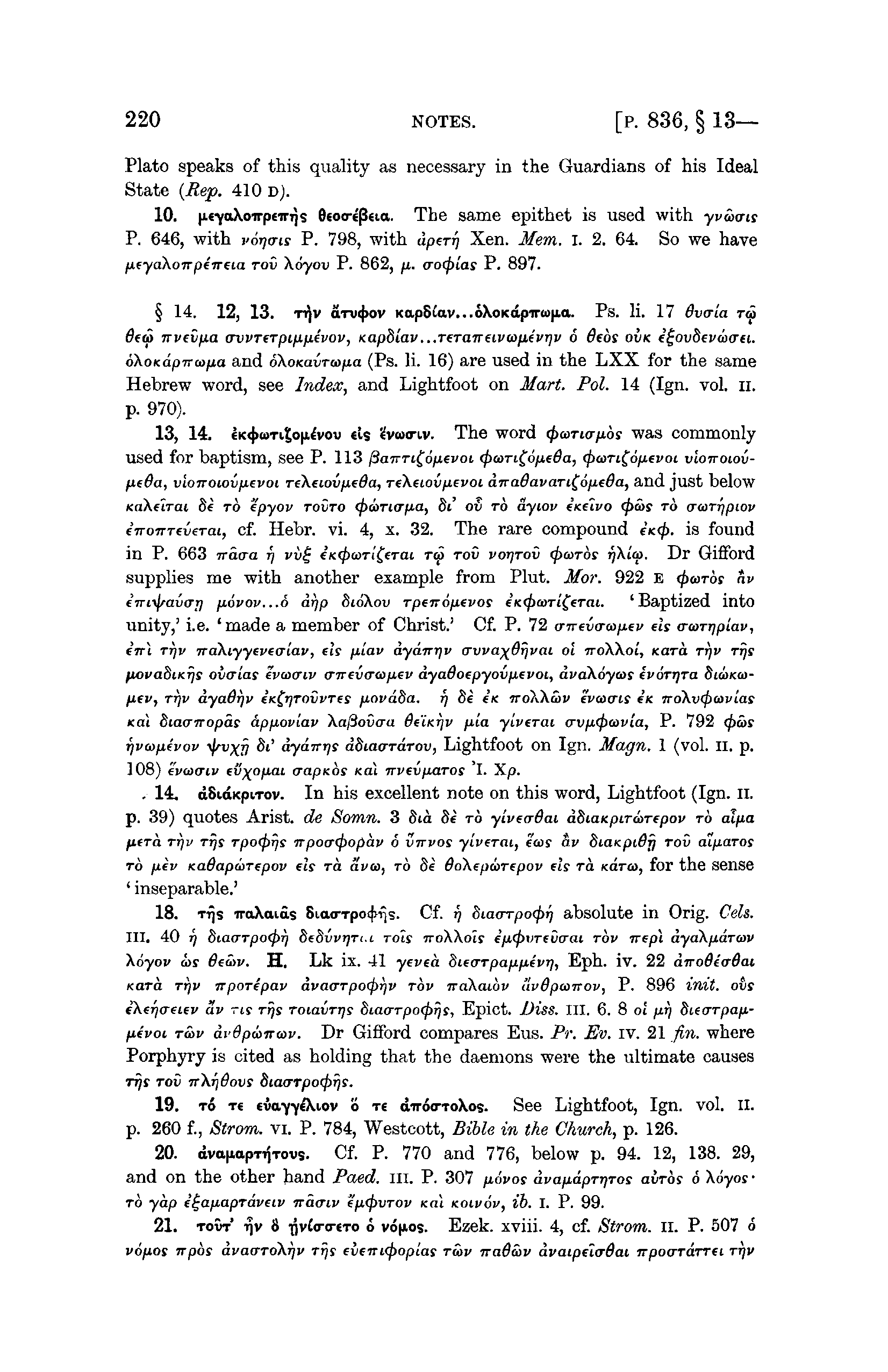
NOTES.
[P. 836, § 13—
Plato speaks of this quality as necessary in the Guardians of his Ideal State {Rep. 410 D).
10. ju-yaXoirpeirijs fooo-tpaa. The same epithet is used with yvwais P. 646, with vorjiris P. 798, with uperij Xen. Mem. I. 2. 64.
So we have HeyaXo7r peireta TOV Xoyov P. 862, p.. <ro(j>ias P. 897.
§ 14. 12, 13.
TI^V cmxpov Kap8tav...6XoKapirco)ia.
Ps. li. 17 8v<ria TO> 6(m nvevfia o~vvT€Tpifi)ievov, napdiav...TfTaneivafiivrjv 6 6eos OUK e£ovdeva<Tii. okoK.apira>iia and oXoKavTcofia (Ps. li. 16) are used in the LXX for the same
Hebrew word, see Index, and Lightfoot on Mart. Pol. 14 (Ign. vol. n. p. 970).
13, 14. !i«t>cimS;o|Uvov els 'ivaa-iv. The word tpwTurnos was commonly used for baptism, see P. 113 ftairTi£6iievoi (paTi^o/jteda, <pa>Ti£6p.evoi vloTroioifieOa, vionoiovfievoi TeXeioip.eda, TeXewip.evoi aTra6ava.Ti£6ji.e6a, and just below
Kakdrai, b~e TO epyov TOVTO (pomo-pa, di o$ TO ayiov i<eivo <pa>s TO o-o>T7jpiov e'nonTeveTai, cf. Hebr. vi. 4, x. 32.
The rare compound eiccp. is found in P. 663 iracra r/ vii£ (K(j>aTi^eTai. ra TOV VOTJTOV <J>COTOS f)\ia>. Dr Giflford supplies me with another example from Plut. Mor. 922 E (parbs hv eniyjravcrri /j.6vov...6 df/p SwXov TpeKOfievos CK<pa>Ti£fTm. 'Baptized into unity,' i.e. 'made a member of Christ.'
Cf. P. 72 0-wevcrap.tv els crarripiav, e'jri TTJV nakiyyevco-iav, eh fiiav aya.nrjv crvva^drjvaL ol noXKoi, Kara TTJV TTJS
IwvaSiicfjs ovo-las evatcriv cnrevcraifiev dyadocpyovixevoi, avaXoycos ivoTTjra 8IO>KG>- /xev, TTJV dyaBrjv £i<£r]TOvvTes fiovdda. rj de €K iroWcov evato~i$ £K 7ro\v<pa>vias
Kai diao~7ropds apfioviav \aftovo~a de'inrjv fiia yiveTai o~Vfi<p(0VLa, P. 792 (j)a>s r)vo>)ievov yjrvxii ^'' aydirrjs ddiao-Tarov, Lightfoot on Ign. Magn. 1 (vol. II. p.
108) €vtao~iv tv^ofiai crapKOS Kai nvevfiaTos 'I. Xp.
. 14. dSirfxpiTov.
In his excellent note on this word, Lightfoot (Ign. II. p. 39) quotes Arist. de Somn. 3 fSia 8e TO yiveo-dai dhiaKpiTaiTfpov TO alfia fitTa Trjv TTJS Tpo(prjs ITpoo-(j)opav 6 vwvos yiveTai, eais av SiaKpt6fj TOV a?/xaror
To fiev KaBapaiTcpov els Ta ai/Q), TO Se 6o\epa>Tepov els TO. KATCO, for the sense
' inseparable.'
18.
TTJS iroXoias Siaa-Tpo^TJs. Cf. ij diacrrpofpr) absolute in Orig. Cels.
III. 40 T) diao~Tpo<j)r] deo'vvrjTi.t Tots noWols e[i<pvTevo~ai TOV 7vep\ dyaXfiaTotv
\6yov a>s 6e(iiv. jQ.
Lk ix. 41 yevea o'leo'TpamievT], Eph. iv. 22 dno6io~@ai Kara TTJV npoTipav dvacrTpotyrjV TOV nakaiov avdpamov, P. 896 init. ovs e'XerjO-(Lev av ris Trjs ToiavTrjs Sta<rrpo(^)^f, Epict. Diss. III. 6. 8 ol /it) dieo-Tpapfievoi T&V dvdpanav.
Dr Gifford compares Eus. Pr. Ev. IV. 21 fin. where Porphyry is cited as holding that the daemons were the ultimate causes
TTJS TOV nXrjdovs 8ia(TTpo<f>ris.
19.
T6 T« tiayyi\iov o TC diroo-ToXos.
See Lightfoot, Ign. vol. II. p. 260 f., Strom, vi. P. 784, Westcott, Bible in the Church, p. 126.
20. dvonopTiJTovs.
Cf. P. 770 and 776, below p. 94. 12, 138. 29, and on the other hand Paed. in. P. 307 fiovos dvafidpTtjTos avros 6 \6yos •
TO yap e£ap,apTaveiv 7rdo~iv ep.<pvTOv Ka\ KOIVOV, ib. I. P. 99.
21.
TOVT' iiv 8 TJvCo-creTo o vo|ios.
Ezek. xviii. 4, cf. Strom. II. P. 507 o vojios npos dvao-ToXTjv TYJS evciricpoplas TUSV na8S>v dvatpeto-dat jrpooraTTfi TTJV https://doi.org/10.1017/CBO9780511695513.011 Published online by Cambridge University Press
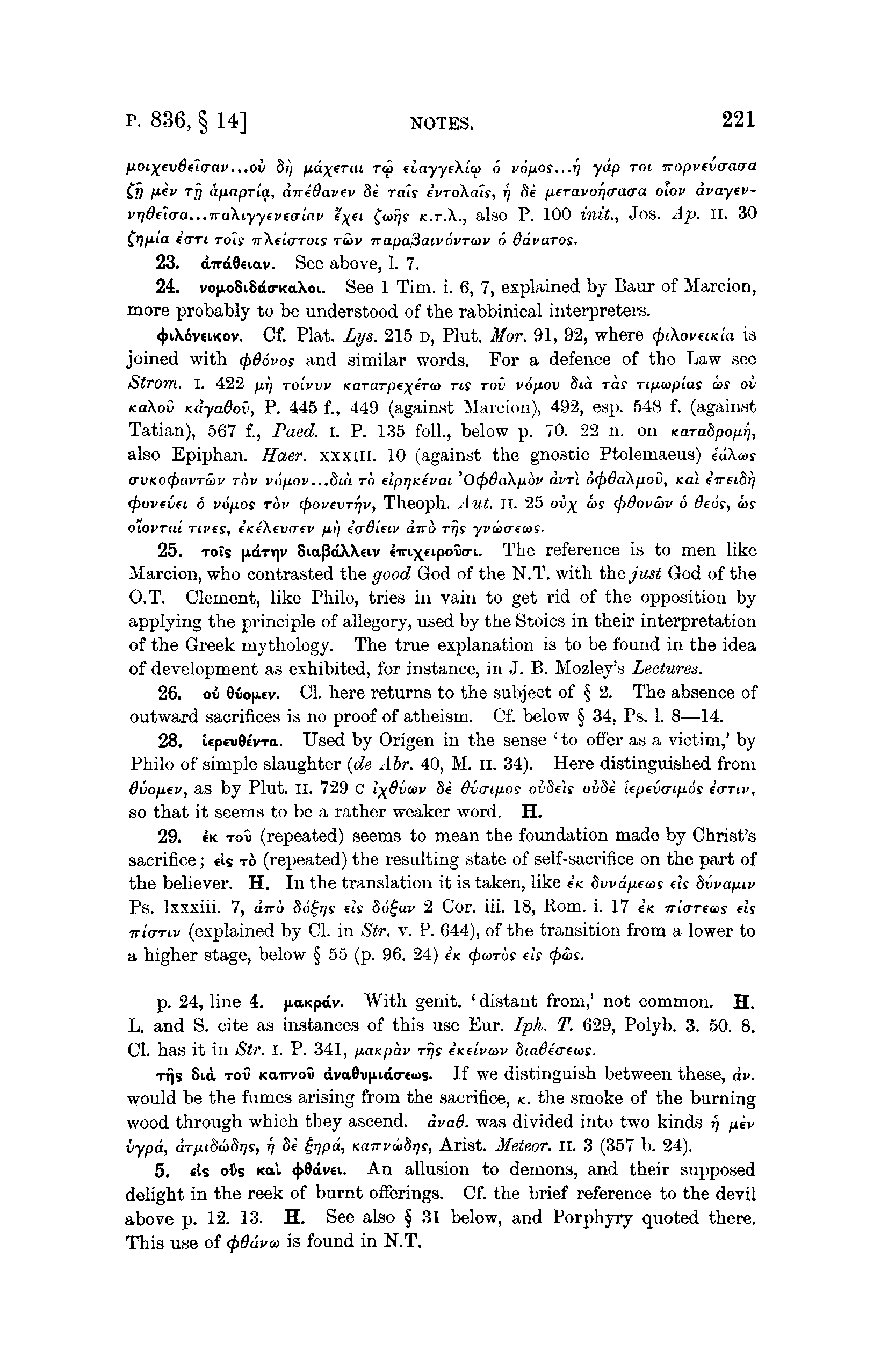
P. 836, § 14]
NOTES.
fJiOi)(ev8f~i(rav...oi Si) ^a^erm r<u evayyeXlco 6 v6fxos...r] yap TOI iropvevcrcura
Cjj fiev Tjj afiapriq, anedavev 8e Tats evroXals, 17 Se /xeTavorjcracra oiov avayevvrj8('irTa...TraKiyyeve(riav e^ei f<»^f K.T.X., also P. 100 init., Jos. JjO. II. 30
£r)fita eWt rot? TrXetoroiff T&V napafiaivovTav 6 davaros.
23. dirdOeiav. See above, 1. 7.
24. vopoSiSdo-KaXoi. See 1 Tim. i. 6, 7, explained by Baur of Marcion, more probably to be understood of the rabbinical interpreters.
(JUXOVCIKOV. Cf. Plat. Lys. 215 D, Plut. Mor. 91, 92, where (piXoveiKia is joined with (pdovos and similar words. For a defence of the Law see
Strom.
I. 422 p.}] TQ'LVVV KaraTpe^eTa TLS TOV vofxov Sia TCLS rip.apias as ov KOXOV Kaya6o\>, P. 445 f., 449 (against Marcion), 492, esp. 548 f. (against Tatian), 567 f., Paed. 1. P. 135 foil., below p. 70. 22 n. on Karadpow, also Epiphan. Haer. XXXIII. 10 (against the gnostic Ptolemaeus) eaXair tTVKOtfiavTGov TOV vop.ov...bill TO elpr]K€vm '0<pda\^6v CLVT\ 6tfi6akfjLov, Kal tneidrj
(povevfi. 6 vofios TOV (povevrrjv, Theoph. Aut. II. 25 oi^ as (pdovav 6 5fdr, a>s
OLOVTai Tives, €K€\ev(T€v [it] iaOUiv anb TTJS yv(i>o~€(os.
25.
TOIS |j.dTT]v SiapdXXeiv «Trix«ipoiio-i.
The reference is to men like Marcion, who contrasted the good God of the N.T. with the just God of the O.T.
Clement, like Philo, tries in vain to get rid of the opposition by applying the principle of allegory, used by the Stoics in their interpretation of the Greek mythology.
The true explanation is to be found in the idea of development as exhibited, for instance, in J. B. Mozley's Lectures.
26. oi 6vo|iev. Cl. here returns to the subject of § 2. The absence of outward sacrifices is no proof of atheism.
Cf. below § 34, Ps. 1. 8—14.
28. UpevOevra. Used by Origen in the sense ' to offer as a victim,' by Philo of simple slaughter (de Abr. 40, M. 11. 34). Here distinguished from 6VO/J.(V, as by Plut. II. 729 C l-^dvav 5c 6vo-ijxos ovbeis ovbk Upevmfios ia-Tiv, so that it seems to be a rather weaker word. H.
29.
IK TO! (repeated) seems to mean the foundation made by Christ's sacrifice; cl$ TO (repeated) the resulting state of self-sacrifice on the part of the believer. H. In the translation it is taken, like f'c dwdpfus ds dvva/xtv
Ps. lxxxiii. 7, arrb 86£rjs els Sotjav 2 Cor. iii. 18, Rom. i. 17 C'K trio-Teas els nio-TLv (explained by Cl. in Sir. v. P. 644), of the transition from a lower to a. higher stage, below § 55 (p. 96. 24) e'< (partis els (pas. p. 24, line 4. paicpdv. With genit. ' distant from,' not common.
L. and S. cite as instances of this use Eur. Iph. T. 629, Polyb. 3. 50. 8.
Cl. has it in Str. I. P. 341, p.a<pav TTJS exeivav btadeo-etas. rr\s Sia TOV KcnrvoO dva8v|udo-«a>s. If we distinguish between these, av. would be the fumes arising from the sacrifice, K. the smoke of the burning wood through which they ascend, dvad. was divided into two kinds 17 p.ev vypd, ariubat&rft, 77 de frpa, KanvaSijs, Arist. Meteor. II. 3 (357 b. 24).
5. «ts ovs KOX <f>9dv€i. An allusion to demons, and their supposed delight in the reek of burnt offerings.
Cf. the brief reference to the devil above p. 12. 13. H.
See also § 31 below, and Porphyry quoted there.
This use of <p6uva is found in N.T. https://doi.org/10.1017/CBO9780511695513.011 Published online by Cambridge University Press
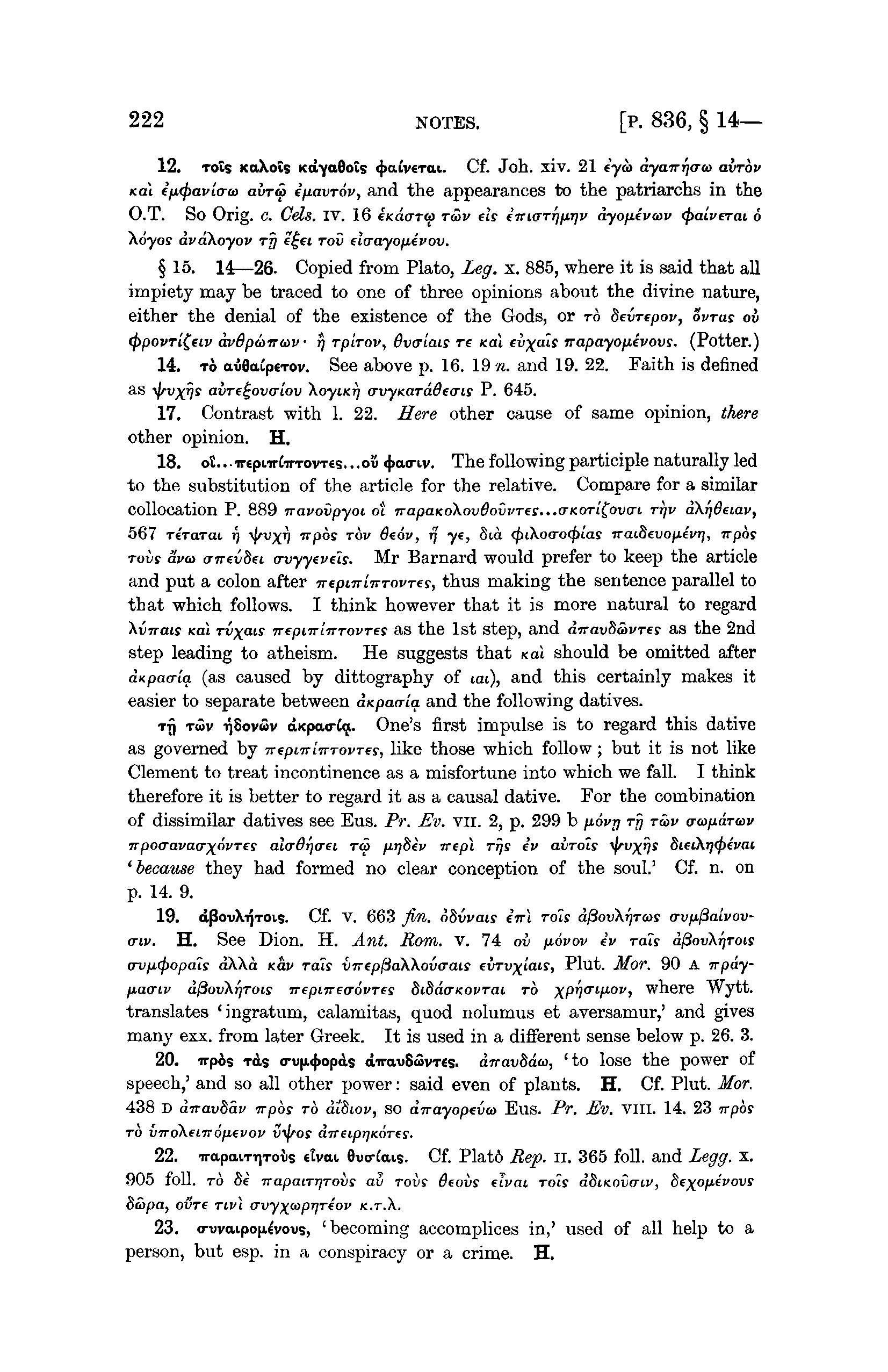
NOTES.
[P. 836, § 14—
12.
TOIS KaXots KOYOOOIS <}>a£v€Toi. Cf. Joh. xiv. 21 eya> dyani]O-u> airbv Kai ifi<pav'«ra> aiira ifiavrov, and the appearances to the patriarchs in the O.T.
So Orig. 0. Cels. IV. 16 eKaara Tav els itriO"Trni.r)v dyofievtov (palverai 6 Adyos dvakoyov TJ e£ei TOV elo-ayoy,ivov.
§ 15. 14—26. Copied from Plato, Leg. x. 885, where it is said that all impiety may be traced to one of three opinions about the divine nature, either the denial of the existence of the Gods, or ro Seirepov, Suras oi
<t>povTt£(iv dv8p&>ira>v fj TptTov, 8V<TLCLLS re Kai ev\ais irapayo/ievovs. (Potter.)
14.
TO a«8a£pm>v. See above p. 16. 19 n. and 19. 22. Faith is denned as yjrvxrjs avre^ovo'lov AoyiK?) o~vyK.ard8eo~is P. 645.
17.
Contrast with 1. 22. Here other cause of same opinion, there other opinion.
18. ot..irepLirCirrovT€s...o« <f>ao-iv. The following participle naturally led to the substitution of the article for the relative. Compare for a similar
Collocation P. 889 navoipyoi oi Trapa.Ko\ov8ovvTfS...o-K.ori£ovo-i TTJV dXrjdeiav,
567 rirarai rj ^V^T) npos TOV deov, rj ye, dia <pt\o(TO<pLas natdevop-evr], npbs
TOVS aua> o-irevSei rrvyyevels. Mr Barnard would prefer to keep the article and put a colon after jrepmiwrovres, thus making the sentence parallel to that which follows.
I think however that it is more natural to regard AuTrms mi Tv\ais Trepnr'nrTovres as the 1st step, and airavbrnvres as the 2nd step leading to atheism.
He suggests that K<U should be omitted after dxpaaia (as caused by dittography of im), and this certainly makes it easier to separate between aKpaa-ia and the following datives.
TTJ TWV iiSovwv aKpao-Ca. One's first impulse is to regard this dative as governed by irepnrinTovTes, like those which follow; but it is not like
Clement to treat incontinence as a misfortune into which we fall.
I think therefore it is better to regard it as a causal dative. For the combination of dissimilar datives see Eus. Pr. Ev. vn. 2, p. 299 b povy rfj TWV a-cofidrav
TVpofravao")(ovTes alcr&rjo'eL TCO fiTjdev irep\ rrjs ev avrols ^v^rjs diei\Tj<pevat.
'because they had formed no clear conception of the soul.' Cf. n. on p. 14. 9.
19. dpovXijTOis. Cf. V. 663 fin. oSvvais cVl rois dftovXrjTcos avfiflaLvov- <riv. H. See Dion. H. Ant. Rom. v. 74 oi povov ev rats a/3ouXjjrois o-vp.(popais dXka KOV rais virepfiaWovcrats evrv^ims, Plut. Mor. 90 A npdy- \iao~tv d$ovhT)TOis TrepiireaovTes diddo~KOvrai ro ^pr^o~ip.ov-) where Wytt. translates 'ingratum, calamitas, quod nolumus et averaamur,' and gives many exx. from later Greek.
It is used in a different sense below p. 26. 3.
20. irpos TOS o-V|j.4>opds dirau8£v«s. aTravSaco, 'to lose the power of speech,' and so all other power: said even of plants.
Cf. Plut. Mor.
438 D diravBdv npbs TO dthiov, SO dnayopcvai Eus. Pr. Ev. VIII. 14. 23 irpbs TO vn6\eLir6fievov vyfros dweiprjKores.
22. irapaiTT]Tois etvai (WCais. Cf. Plat6 Rep. II. 365 foil, and Legg. x.
905 foil, TO Se Trapairrjrovs av Toi? 8eovs flvai rois dbiKOvo-w, Se^o^ieVour 8a>pa, ovre TIVI o-vyx^pr/Tfov K.T.X.
23. <rwcupo|j^vovs, 'becoming accomplices in,' used of all help to a person, but esp. in a conspiracy or a crime.
H. https://doi.org/10.1017/CBO9780511695513.011 Published online by Cambridge University Press
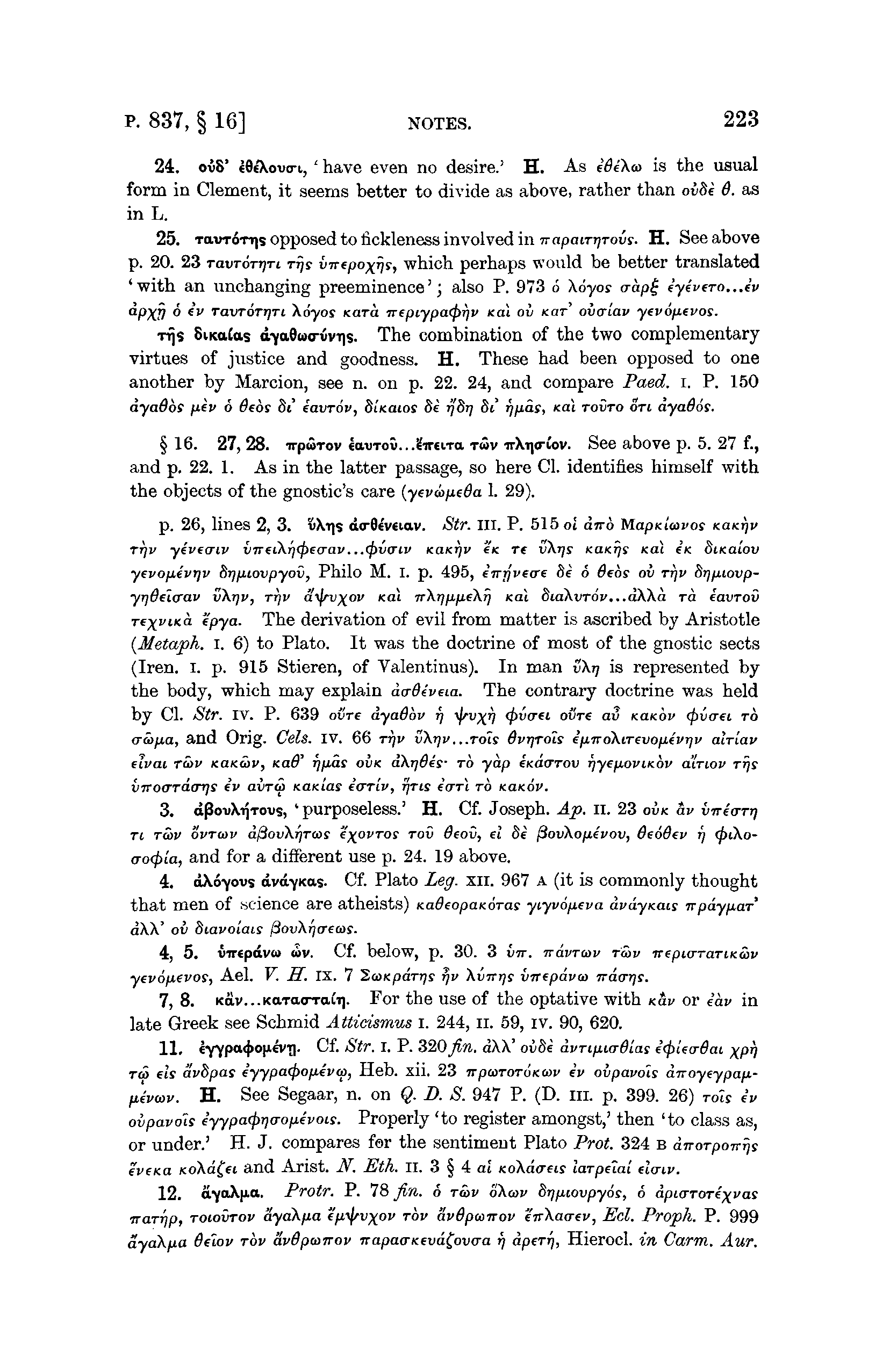
P. 837, § 16]
NOTES.
24. ovS" tOeXovo-i, ' have even no desire.1 H. As i8i\a> is the usual form in Clement, it seems better to divide as above, rather than oiSe 8. as in L.
25. TO.UT6THS opposed to fickleness involved in napaiTtjrois. H. See above p. 20. 23 TavTorrjTi rijs i7repo^Jj$-, which perhaps would be better translated
'with an unchanging preeminence'; also P. 973 6 Xoyor o-apt; iyiv(To...iv ipXV o iv TavroTijTi \6yos Kara ireptypacpriv KCU OV nor' ovarlav yevofievos.
•rijs SucaCas d-ya9wo-«vTis. The combination of the two complementary virtues of justice and goodness. H. These had been opposed to one another by Marcion, see n. on p. 22. 24, and compare Paed. i. P. 150 dyadds fiev 6 6cos Si iavTov, Sixmos Si rjSri St' ijfias, Kai TOVTO STI dyaBos.
§16.
27,28. irpwTov 4aDTo«...?ireiTa TwvirXntriov. See above p. 5. 27 f., and p. 22. 1. As in the latter passage, so here Cl. identifies himself with the objects of the gnostic's care {yevwfitBa 1. 29). p. 26, lines 2, 3. vkr\% d<r8e'v«av. Sir. III. P. 515 ol dnb MapKiWo? KOKIJJ/
TT]V y4ve(riv v7reL\j](pe<Tav...<pv(rLV Ka<r]v €K T€ VXTJS KUKTJS Kai €K StKalov yevofiivtjv Srjfuovpyov, Philo M. I. p. 495, enrjve&e 8e o 6(6s ov TTJV Sr)/j.tovpyrjOelcav v\r)v7 TYJV a^rv^ov Kai 7r\7]p.p.e\j] KOL SiakvT6v...dWa ra iavrov T€xvi<a (pya. The derivation of evil from matter is ascribed by Aristotle
(Metaph. I. 6) to Plato. It was the doctrine of most of the gnostic sects (Iren. I. p. 915 Stieren, of Valentinus). In man vkrj is represented by the body, which may explain dtr84veia. The contrary doctrine was held by Cl. Str. IV. P. 639 oCVe dyadbv 17 ^ru\V 4'^"Tet °^Te a " KIKOK (fivaeL TO craifia, and Orig. Cels. IV. 66 TTJV vXrjv...Toh 6vryrols €fj.7ro\iTevofi(vriv alrlav fivai rcov KdKuv, Kad1 r}fias OVK dXrjBeS' TO yap GKaffTov rjye^ioviKov aiTiov TTJS inroo-rdo-qs iv avTif KOKIOS C'(TTIV, TJTIS eari TO KOKOU.
3. d|3ou\i]Tovs, ' purposeless.' H. Cf. Joseph. Ap. 11. 23 OVK av vwio-Tt] TC TO>V ovTiav d/3ovXrjTa>s '4)(OVTOS TOV deov, el Se ^ovKofiivov,
6e66ev rj <pi\oo-o(pla, and for a different use p. 24. 19 above.
4. aXoyovs dva-yicas. Cf. Plato Leg. xn. 967 A (it is commonly thought that men of science are atheists) KadeopaKOTae yiyvo/xeva dvdyKms npayfiar' dXk' ov Siavolais /3<wXij(re<»j.
4, 5. VTTtp&Vfa (ov. Cf. below, p. 30. 3 (in. irdvTtav ta>v trepio-TaTtKUiv yevofievos, Ael. V. S. IX. 7 2a>Kpdrr]s rjv \v7rr]s vnfpdvco rrdo'rjs.
7, 8. Kav.-.KaTaoTaCi]. For the use of the optative with K&V or eav in late Greek see Schmid Attirismus 1. 244, 11. 59, iv. 90, 620.
11. «YYPo<l)0lJ'r'v'n- ^" ^r' I- ^- 32,0 fifl" aXX' oiSe avrifiurBias i(pUo-6at ^prj
Ta els avSpas iyypa(j>ojxiv<f, Heb. xii. 23 irpaiTOTOKWv iv oipavols dnoyeypappivuv.
H. See Segaar, n. on Q. B. S. 947 P. (D. in. p. 399. 26) TO'IS iv oipavo'is iyypa(t>r)o-op.ivoi.s. Properly 'to register amongst,' then 'to class as, or under.' H. J. compares fer the sentiment Plato Prot. 324 B dvoTpoTrijs
(veKa Ko\d£(t and Arist. N. Eth. II. 3 § 4 al KoXdaeis larpelai ucriv.
12. a^aXfia.
Protr. P. 78 fin. 6 TO>V okcav Sr)fiwvpyos, 6 dpio-Tore\vas •na.Tr)p, TOIOVTOV ayaXfia i'fiifrvxov TOV avBpanrov 'iir\ao-ev, Eel. Proph. P. 999 aya\p.a Beiov TOV avdpoirov napao-Kfvd£ovcra 17 dpeTrj, Hierocl. in Carm. Aur. https://doi.org/10.1017/CBO9780511695513.011 Published online by Cambridge University Press
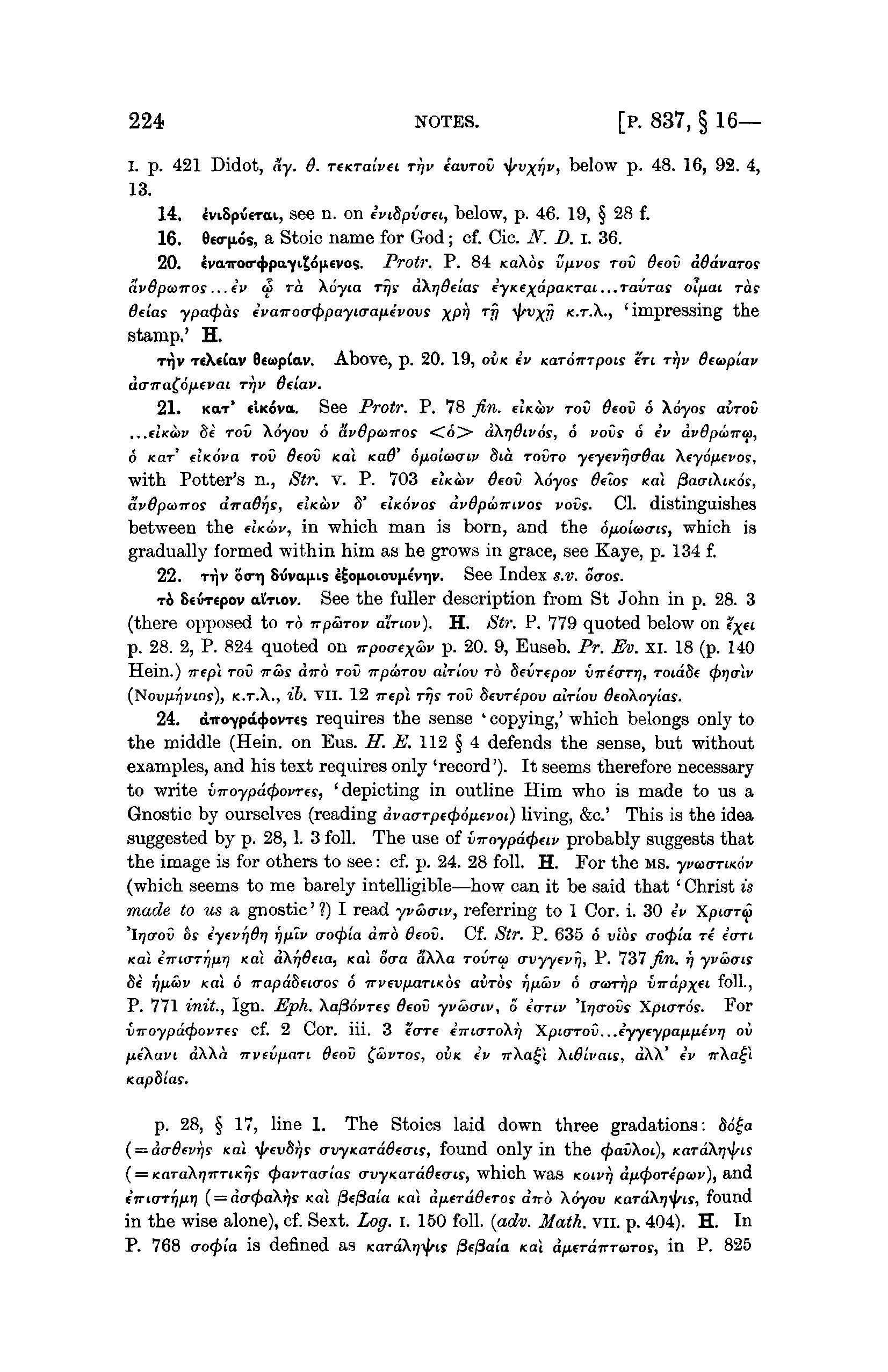
NOTES.
[p. 837, § 16— I. p. 421 Didot, ay. 6. TCKTaivei TTJV iavTov ^ir^iyv, below p. 48. 16, 92. 4,
13.
14.
IviSpverai, see n. on ivi8pi<ru, below, p. 46. 19, § 28 f.
16.
Oeo-^s, a Stoic name for God; cf. Cic. N. B. I. 36.
20.
4vaxocr<|>pa7tJ6(j.«vos.
Protr. P. 84 KOXOS vfivos TOV 6eov adavaros avOpatnos...iv <o ra Xoyia T7)s dXrjdeias iyKe^dpaKTm...ravras oifiai ras Beias ypa<pas ivairoo-<f>payi(ra)ievovs XPV TV ^faXM K.r.X., 'impressing the stamp.' H.
TIIV Te\«£av ieaplav.
Above, p. 20. 19, OVK iv KaronTpois tri TJJV Bfcoplav d(T7ra(6iJ.evai TTJV 6(lav.
21.
KttT* ciKova. See Protr. P. 78 fin. CIKWV TOV 6eov 6 Xoyos avrov ...CIKCOV 5e TOV \6yov 6 (ivOponros <To> dXrjdtvos, 6 vovs 6 iv dvOpaurtp,
6 Kar' (iKova TOV 8eov <al icad' OfXoiaHjiv 8ia TOVTO yeyevrjo-dm Xeyd/ifvos, with Potter's n., Str. V. P. 703 CIKOHV 6eov \6yos
6e7os <al /3aa-iXiKos, av0p<O7ros a.Tra6r)s, CIKGOV 8* SIKOVOS dvBpa>7rtvos vovs.
Cl. distinguishes between the el<a>v, in which man is born, and the SfMoiaan, which is gradually formed within him as he grows in grace, see Kaye, p. 134 f.
22.
TI)V o<n} Svvap-Ls e£o|ioi.<n>|UvT]v. See Index s.v. oo-os.
T& SeuTcpov al'nov. See the fuller description from St John in p. 28. 3
(there opposed to TO nparov alnov). H. Str. P. 779 quoted below on e'x« p. 28. 2, P. 824 quoted on 7rpoo-ex^v V20. 9, Euseb. Pr. Ev. XI. 18 (p. 140
Hein.) irepl TOV TTHS diro TOV 7rpa>Tov QITLOV TO devrepov inio-Trj, Toid8( (prjcrlv
(Noujuj^i'ioff), K.T.X., ih. VII. 12 irep\ T7js TOV $€VT€pov atrt'ou SeoXoyias.
24. diro-ypd<j>ovT« requires the sense ' copying,' which belongs only to the middle (Hein. on Eus. H. E. 112 § 4 defends the sense, but without examples, and his text requires only 'record'). It seems therefore necessary to write vnoypdcpovrcs, 'depicting in outline Him who is made to us a Gnostic by ourselves (reading dvao-Tpetpopevoi) living, &c.' This is the idea suggested by p. 28, 1. 3 foil. The use of vvoypd<\>uv probably suggests that the image is for others to see: cf. p. 24. 28 foil. H. For the MS. yvaxmnav
(which seems to me barely intelligible—how can it be said that ' Christ is made to us a gnostic' ?) I read yvi>o-iv, referring to 1 Cor. i. 30 iv Xpto-ra
'Ir/aov or iyfvrjdrj r\)uv o-ofpia dirb Oeoi. Cf. Str. P. 635 6 vios rro(pia T4 « m
Kai inicrTrj/irj <a\ d\r]6cia, Kai Sera aXXa TOVTUI o-vyyevr), P. 737 fin. IJ yva>o-is
8f r)fio)v Kai 6 7rapdbcio~os 6 irvevfxaTiKOi avTos f}[ia>v 6 o~a>Trjp virdp)(€L foil.,
P. 771 init., Ign. Eph. Xafiovres deov yvwcriv, o io-Tiv 'ir/crovs X/HOTOS. For v7roypd(povTes cf. 2 Cor. iii. 3 €o~Te iiria'ToXrj Xpio"Tov. ..iyyfypafififvrj ov fjiiXavL dWa irvev^iaTi deov £&VTOS, OVK iv 7rXa£i Xt^iVats, aXX' iv rr\a^l
Kapdias. p. 28, § 17, line 1. The Stoics laid down three gradations: do|a ( = do-OevrjS Kai ^evbrjs crvyKaTd6fo-is, found only in the (pavkoi),
Karakuls ( = KaTaXTjTTTiXTji <pavTao~las O'liyxard^eo'is", which was KOtvrj dftfpoTfpwv), and iTrio-Trjfir] ( = do-(j>a\fis <a\ /3e/3ai'a Kai d/xeTadfTos dno \6yov KaTaXr/y^ts, found in the wise alone), cf. Sext. Log. I. 150 foil. (adv. Math. vn. p. 404). H. In P. 768 o-o<pia is defined as KardXri^is /3e/3aia <al dfieTairT<oTos, in P. 825 https://doi.org/10.1017/CBO9780511695513.011 Published online by Cambridge University Press
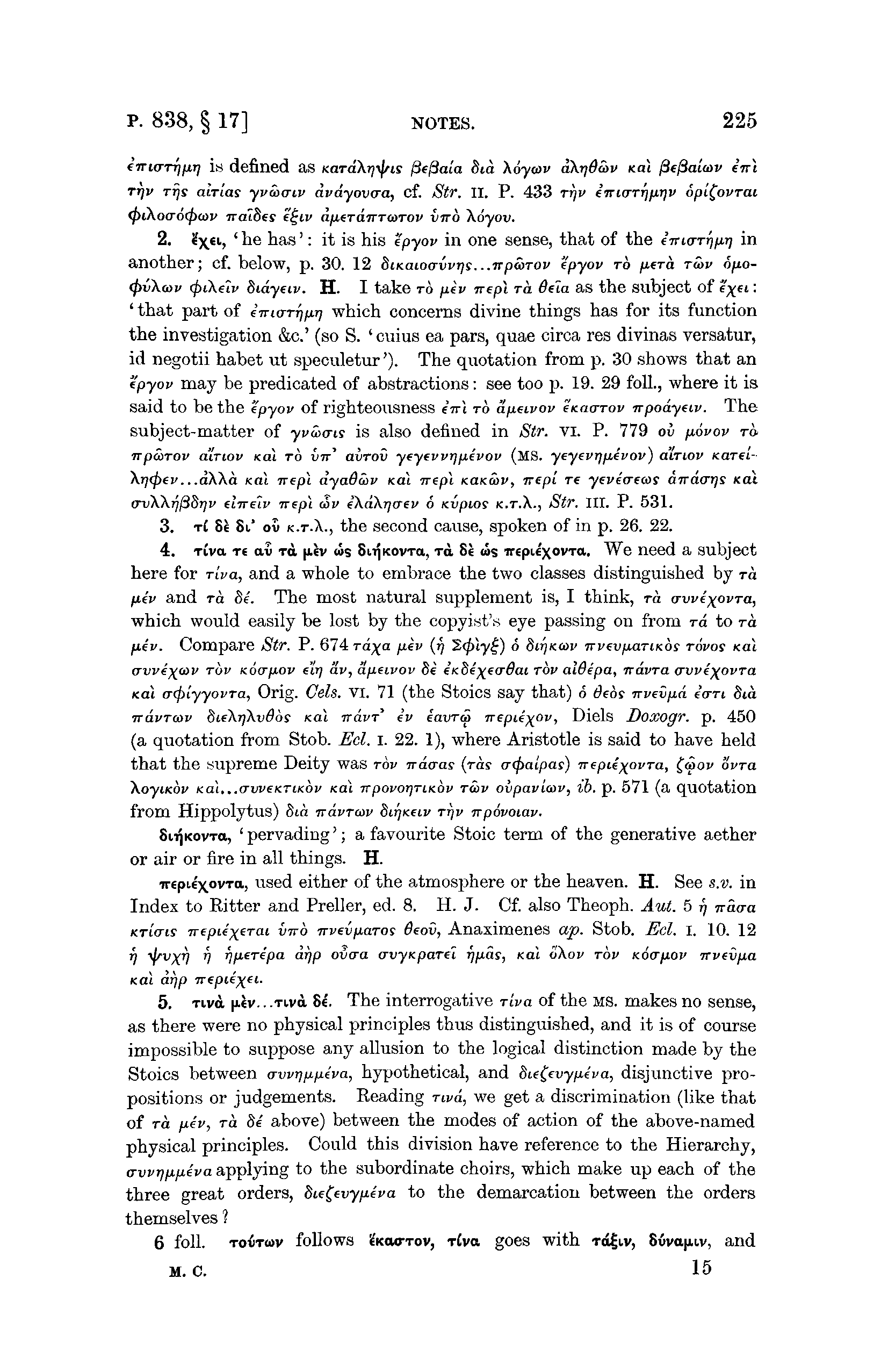
P. 838, § 17]
NOTES.
is defined as KaraX?;ijar /3e/3ai'a 8ia \6y0v dXrjd&v Kal fitftalaiv eVi rrjv TT)S alrlas yviocnv dvdyovo-a, cf. Str. II. P. 433 TT)V £iricrTr)ixi)v opifovrai
<pi\o<r6(f)(ov TrmSes e£iv d[X€Ta7TT(aTov VTTO \6yov.
?x61; ' h e h a s ' : it is his epyov in one sense, that of the C'TTIOTIJP) in another; cf. below, p. 30. 12 8iKaio(rivr]s...rrpS>TOV i'pyov TO p.(Ta TU>V 6p.o- <)>v\aiv (piXew Sidyav.
I take TO p.tv nepl Ta 8cla as the subject of e^ei:
' that part of imariffu} which concerns divine things has for its function the investigation &c.' (so S. ' cuius ea pars, quae circa res divinas versatur, id negotii habet ut speculetur').
The quotation from p. 30 shows that an epyov may be predicated of abstractions: see too p. 19. 29 foil., where it is. said to be the i'pyov of righteousness eVi TO 'dp.£ivov exao-TOV irpodyew.
The subject-matter of yvaxris is also defined in Str. vi. P. 779 oi fiovov TO npcorov aiTiov KM. TO VTT' avTov yeytvvr)p.ivov (MS. yeyevrjfievov) aiTiov KaTfi- \r]<p€v...dWa KOI Trept dyadaiv KOL nep\ KOKWI', 7repl T€ •yei/eVeco? aird<rr)s nai o~vWij@drjv €L7TE7V nepl cSv eXaXijaev 6 nvpios K.r.X., Str. III. P. 531.
T£ Se 81' ov K.T.X., the second cause, spoken of in p. 26. 22.
4. riva rt ail ra |i6v ws Sii^KovTa, TO 8C WS irepie'xovTa. We need a subject here for riva, and a whole to embrace the two classes distinguished by TO fiiv and Ta 84. The most natural supplement is, I think, TO o-wi^ovTa, which would easily be lost by the copyist's eye passing on from i-d to Ta fiev.
Compare Str. P. 674 Tay^a jxev (17 2<jny£) 6 SIT/MOV TrvcvfiaTiKos TOVOS KOI avv€^(ov TOV Koo~p.ov z'lr] av, ap.€ivov 5e £Kh4^o~8ai TOV aWepa, ndvra cvvi^ovTa <a\ o-cplyyovra, Orig. Cels. vi. 71 (the Stoics say that) 6 deos- •Kvivp.d IO-TI 81a irdvTcav 8i£\r)\v8ds Ka\ ndvr' iv iavrm nepie^ov, Diels Doxogr. p. 450
(a quotation from Stob. Eel. 1. 22. 1), where Aristotle is said to have held that the supreme Deity was TOV irdo-as (rar afpalpas) nepii^ovTa, £(pov ovra
\oyiK0V Ka\...<rweKTiKbv KO\ ITpovorjTLKOV T£>V ovpavlwv, ib. p. 571 (a quotation from Hippolytus) bia ndvTO>v dirjKeiv TTJV npovotav.
SIIIKOVTO, 'pervading'; a favourite Stoic term of the generative aether or air or fire in all things. H. irepiixovTa, used either of the atmosphere or the heaven. H. See s.v. in Index to Ritter and Preller, ed. 8.
H. J.
Cf. also Theoph. Aut. 5 17 naaa KTI(TIS nepU^Tai vnb 7rvevp,aTos 6eov, Anaximenes dp. Stob. Eel. I. 10. 12 tj ^rvxh h rip-eTepa dr)p ovo-a o-vynpaTel rjp-as, Ka\ okov TOV Koapov irvei/xa tcai dfjp ncpitxel5.
Tiva |itv.. .Ti.vd 8^. The interrogative TIVCI of the MS. makes no sense, as there were no physical principles thus distinguished, and it is of course impossible to suppose any allusion to the logical distinction made by the Stoics between 0-wqp.p.iva, hypothetical, and 8ie£evyp,4va, disjunctive propositions or judgements.
Reading nvd, we get a discrimination (like that of TO fiev, TCI Se above) between the modes of action of the above-named physical principles.
Could this division have reference to the Hierarchy, a-wrjfxjiiva applying to the subordinate choirs, which make up each of the three great orders, bm^evyjieva to the demarcation between the orders themselves ?
6 foil.
Toirav follows i-Kao-Tov, T£VO goes with TOJIV, SOvajiiv, and M. C.
https://doi.org/10.1017/CBO9780511695513.011 Published online by Cambridge University Press
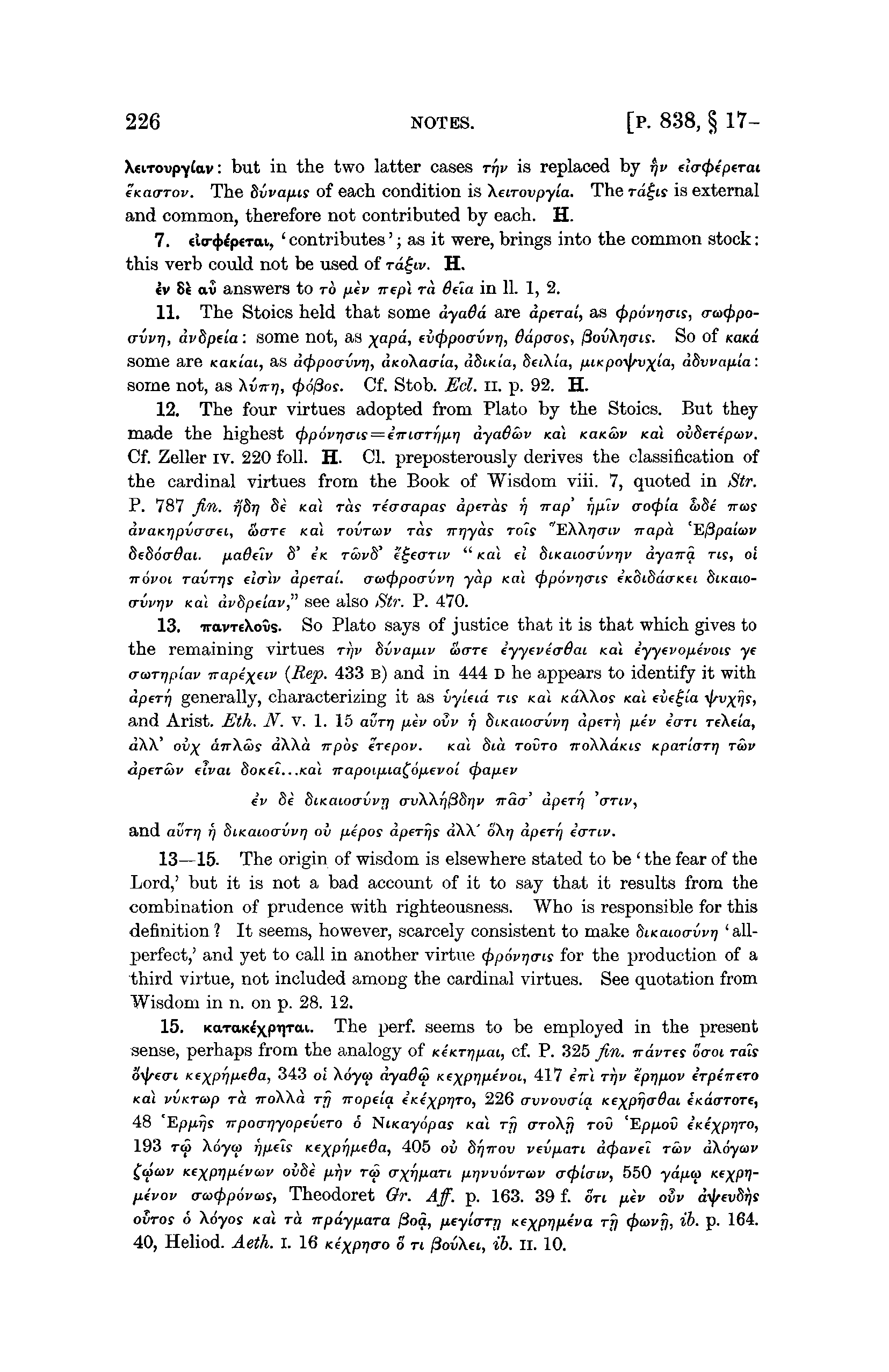
NOTES.
[P. 838, § 17-
XeiToupyCav: but in the two latter cases TTJV is replaced by fjv ei<r<pepeTai eKao-Tov. The Svvafus of each condition is Xeirovpyla. The rd|ir is external and common, therefore not contributed by each. H.
7. eltr^pCTat, ' contributes'; as it were, brings into the common stock: this verb could not be used of rd£iv. H.
4v 8i av answers to TO fiev nepl ra 8ela in 11. 1, 2.
11.
The Stoics held that some dyaBd are dperai, as (f>p6vt]<ns, craxppo- (TVVTJ, dvdpeia: some not, as xaP®> eifppoavvr], ddpaos, fiov\r)<ns. So of KOKO some are KaKt'at, as dcppocrvvt], aKoXaa-ia, dSiKi'a, SeiXia, p,iKpo\frv)(la, d6Wa/«'a: some not, as XVTTT}, <£d/3o?. Cf. Stob. Ed. n. p. 92. H.
12.
The four virtues adopted from Plato by the Stoics. But they made the highest <£poVj7O-is = eV(o~rrjjiii; dyaBcov KCU KaKcov Kai ovberipav.
Cf. Zeller iv. 220 foil. H.
Cl. preposterously derives the classification of the cardinal virtues from the Book of Wisdom viii. 7, quoted in Sir.
P. 787 fiw>. fj$7] de Kai ras reo~o~apas operas rj 7rap' f]p<~iv co<p[a code nas dvaKrjpvo-a-ei, wore ml TOVTWV rds wr/yas TO'IS "EXXi/o-ii/ napa
'Jifipaiav didocrdai. p.adelv 8' ft TOPS' effort!/ " KQI (I biKawvvvrjv dycnrq TLS, of TTOVOI ravTTjs tl&Xv dpfTat. crcocppoo'vvT] yap Ka\ (ppovrjcris e'/cdidacrKei SIKQLOa-vvrjv xai dvbpeiav" see also Str. P. 470.
13. iravTtXovs. So Plato says of justice that it is that which gives to the remaining virtues rr/v hvvapnv &<TT€ iyyevicr8ai
KM. iyyevojievois ye o-arr/piav napexeiv (Rep. 433 B) and in 444 D he appears to identify it with dperr] generally, characterizing it as vyleid rts <a\ KaWos nal evei-la ^rux^st and Arist. Eth. N. V. 1. 15 avrrj p,ev ovv fj hLKaioa-vvrj dperrj [lev eari reXeia, dXX' ov)( anXas dXXd npos erepov. nal Sta TQVTQ noXXdms Kparlart] TOIV dpercov elvai SOKCI...Kai napoiiiia^op-evoi (pa/j.ev ev de hiKaiotrvvr] o~vXXr]{3dr}v irda' apcrr) 'CTTIV, and avrrj fj biKaioo-iivr) ov fiepos dperrjs dXX' o\i/ apcrr] icmv.
13—15. The origin of wisdom is elsewhere stated to be ' the fear of the Lord,' but it is not a bad account of it to say that it results from the combination of prudence with righteousness.
Who is responsible for this definition? It seems, however, scarcely consistent to make StKawo-vvr) 'allperfect,' and yet to call in another virtue (ppovrja-is for the production of a third virtue, not included amoDg the cardinal virtues. See quotation from Wisdom in n. on p. 28. 12.
15.
KaraK^xPT™1The perf. seems to be employed in the present sense, perhaps from the analogy of Keicrrjiuu, cf. P. 325 fin. irdvres oo-ot rais o^revi, KexprffieOa, 343 ol Xdyw dyaBa Ke^p^^tcvot, 417 eVi TT\V eprjfwv erpeiveTO
Ka\ WKTGtp ra 7roXXa rrj iropeiq eicexpTjTO, 226 (rvvovdlq /cexpfjadai e<d(TTOTe,
48 'Epfirjs TTpoa-rfyopevero 6 NiKaydpar xat rf/ oroXjj rov 'Ep/ioO iKi\pryro, 193 ra Xdyw rj/j-els Ke^pweda, 405 ov drj-rrov veifian dcpavel ratv dXoyav fwwi/ Kexpi)p-ivav ovbe /j.f]v TCO crxwort firjvvovraiv a(pi(nv, 550 ydfia Kexpifievov craxppovws, Theodoret Or. Aff. p. 163. 39 f. 6Vi y.ev ovv d\jfevdf)S
OVTOS 6 Xoyos Kai ra. irpdyfiara y3oa, /ieylo-rtj Kexprj/ieva rfi <fia>vfi, ib. p. 164.
40, Heliod. Aeth. I. 16 <expw° ° « flovXei, ib. II. 10. https://doi.org/10.1017/CBO9780511695513.011 Published online by Cambridge University Press
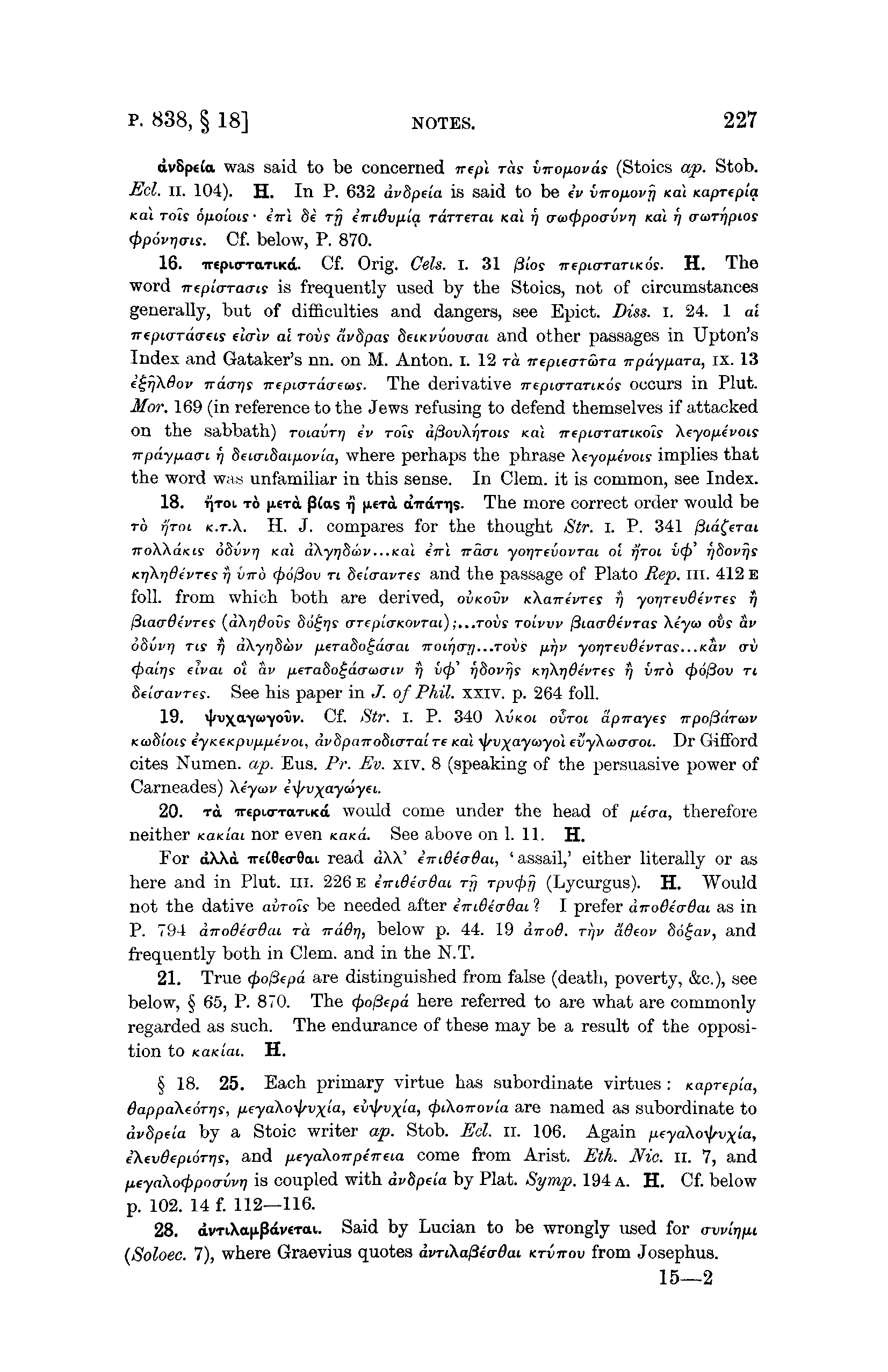
P. 838, § 18]
NOTES.
dvSpcta was said to be concerned ncpl ras vnofiovas (Stoics ap. Stob.
Ed. II. 104). H. In P. 632 dvSpeia is said to be iv iwo/iovfi Kal Kaprtpiq Kai TOIS ofioiois' inl 8e rg iwiOvjila TaTTerm Kal r) o-wCppoavvT] Kal fj aarrjpios
(ppovrja-is. Cf. below, P. 870.
16. irepioTa.Ti.Kd. Cf. Orig. Cels. I. 31 /3ios TrfpioremKos. H. The word ntpio-racns is frequently used by the Stoics, not of circumstances generally, but of difficulties and dangers, see Epict. Diss. I. 24. 1 al irfpcvrdo-ets ei<rii> al roiis avdpas 8eiKvvov<rai and other passages in Upton's
Index and Gataker's nn. on M. Anton. I. 12 ra Trepieo-rmra npdyfiara, ix. 13 igrj\8ov naa-qs irepMTTacreats.
The derivative nepio-rariKos occurs in Plut.
Mor. 169 (in reference to the Jews refusing to defend themselves if attacked On the sabbath) roiavrrj iv rois dfiovXrjTois Kal TrfpL&raTiKols \eyop.evois
Tvpdyjxacn ff heurtbaifi.ovia, where perhaps the phrase XcyojucVoir implies that the word was unfamiliar in this sense. In Clem, it is common, see Index.
18.
I^TOL TO iieTct |3£as rj p.€Ta airaTi]sThe more correct order would be
TO IJTOI K.T.X.
H. J. compares for the thought Str. I. P. 341 /3iaffraj noWaKts odvvjj Ka\ a\yr}$a>v...nai eVt Tract yorjrevovrai ol fjroi v(j>' Tjdovfjs
KrfKrjdevrfs rj vivo cpofiov n hflaavres and the passage of Plato Rep. III. 412 E foil, from which both are derived, OVKOVV icXanevTes i) yoj]Tfv6(vT(s i)
/3iao"^eVref (akrjOovs So^rjs GTepiijKOvTai);,..TOVS TOLVVV fiiao'SiVTas Xiyco ovs av obvvrj TLS rj akyTjScov peTado^daai T7oir)a-fj...rovs fxr)v yorjT€v6evTas...Kav (TV <palrjs eivat ot av ^erado^datao'iv rj vcp1 rj&ovrjs KTjXrjOevres f) VTTO <po(3ov TL
SelcravTes. See his paper in J. of Phil. xxiv. p. 264 foil.
19.
(J/Dxa-ywyoiiv.
Cf. Str. I. P. 340 \VKOI OVTOI apirayes npofidrmv KWSIOIS iyKOcpvjijievoi, dvSpanoSiuTai re Kal ifrv)(aya>yol evykaxro-oi. Dr Gifford cites Numen. ap. Eus. Pr. Ev. xiv. 8 (speaking of the persuasive power of Carneades) \eywv e^u^aytuyet.
20. i i Trepi.o-TaTi.Kd would come under the head of p.i<ra, therefore neither KOKLOL nor even K.a<d. See above on 1. 11. H.
For dXXd ire£e«o-6ai. read dXX' f-rriSeo-dai, 'assail,' either literally or as here and in Plut. in. 226 B emBia-Bai, rfj rpvifcrj (Lycurgus). H. Would not the dative avrols be needed after iwi.8i<r&ai ? I prefer dnoBia-daL as in P. 794 dnodfo-dcu ra TrdBi), below p. 44. 19 dno8. TT)V aSeov hot;av, and frequently both in Clem, and in the N.T.
21.
True cpofiepd are distinguished from false (death, poverty, &c), see below, § 65, P. 870. The cpofcpd here referred to are what are commonly regarded as such. The endurance of these may be a result of the opposition to KaKiai. H.
§ 18. 25. Each primary virtue has subordinate virtues : naprepia, dappaXeorrji, p.eya\o^rvx^ evtfrvxla, (pcXonovia are named as subordinate to avdpda by a Stoic writer ap. Stob. Ed. n. 106. Again p.(yaXo\jruxia, eXevdepiorrjs, and fieya\onpinei.a come from Arist. Eth. Nic. II. 7, and fj.eyaXo<ppo(rvvt] is coupled with dvftpeia by Plat. Syrup. 194 A. H. Cf. below p. 102. 14 f. 112—116.
28. dvTi\o|ipdv£Tou Said by Lucian to be wrongly used for awtrj/u {Soloec. 7), where Graevius quotes dimXafHtrBat. KTVITOV from Josephus.
15—2 https://doi.org/10.1017/CBO9780511695513.011 Published online by Cambridge University Press
NOTES.
[p. 838, § 18p. 30, line 3. Wepdvs). See above, p. 26. 4.
<ra(ppoo-vVT) de o-<OTT]pla, ov vvv 8r) i(TKefifi,(6a, <f>povr]<Tca>s Plat. Crat.
411 E ; whence Arist. (Eudemus) Eth. Nic. VI. 5 evdcv KCU rr]v o-axppoo-vvrjv TOvrca ITpocrayopevofiev reo ovojxan, &>s <ra>£ov<rav TTJV (ppovr/aiv.
5—7. rio-v^ws, Koo-fiLos much used by Plato of o-atppoo-vvr]. H. Of. the saying attributed to Socrates in Plut. Mor. 600 v OVK 'Adrjvaios oi8e
"TSXXrjv a\\a icoo-p-ios, and the suggestion at the end of the 9th book of Plato's Republic that the Ideal Commonwealth may only exist in heaven.
H. J. The saying is also given in Epict. Diss. I. 9. 1, Cic. Tusc. v. 108.
6. irapaSeKTiKos used also Str. II. P. 437. H.
TUV eirayyeWoijivwv.
Used in passive sense, as in Gal. iii. 19, 2 Mace. iv. 27, Str. P. 812 init.
6, 7. oiKekov...dXXoTpCtovCf. below, § 78 t;evos T£>V rrjde, KXr/povofujfidrav ixovo>v Tti>v ldlo)v fji€fxvTjfi4voSj ra Se ivravda ndvTa aKkoTpia r^yovp.evos^ with Segaar's n. on Q. D. S. Dind. p. 397. 8 (P. 946). diroo-Tpo<(>ii, ' aversion to.1 Very rare in this sense, and almost wholly of physical aversion to particular foods or smells. H. Cf. below, 1. 17.
8. inr«pKoo-(ii.os. Basilides is cited (P. 639) as holding gevrjv TTJV enXoyrjv Toil Koo"jaov, as av v7r€pKO(r{iiov <pv(rei oixrav '. for other exx. see Index.
The word is common in Dionysius and in the Neo-Platonists, where it is opposed to eyKoa-p-ws, see Sallust in Gale's Mythogr. c. 6, Proclus in Plat.
Ale. i. p. 19 Creuzer. There is a similar play on the word Koa-fitos in Paed. P. 243.
9. n-Xotmov. It was one of the Stoic paradoxes that the Wise Man was rich. In the translation I have interchanged this sentence with the following, as that has reference to the virepKoo-fiios of the preceding sentence, and has no connexion with § 19 which follows ; whereas this is out of place where it stands, but explains the liberality recommended in § 1912. atrroi...i(p7ov. Cf. p. 28. 2, 19. 29 f. H.
13. 6(io<j)vXa>v, 'compatriots,' )( d\\6<pv\ot, used in the LXX. of the Philistines and others.
§ 19. 15. (i€Ta8oTiKos.
See below p. 120. 21 rj c^is 17 nap' rjfj.iv /xeraboTlKTj.
17. diroorpocfni as above, 1. 6. H.
19—21. eepdiro)v...<j>£Xos. See above, p. 10. 8, 9.
20. Tats IvToXals inra-y6(j.6vos. Apparently ' led along by the commandments.' Often used of deceptive leading : here rather ' gently.' Cf. the use in iv. 596 of heathens els TT'KTTIV vira.y6p.evoi by wonder. H. 4 Mace. iv. 13 TOVTOIS vna^dels (al. 67ra^5eif) TOIS Xoyois, Eus. Pr. Ev. VIII. 10 fin.
TTJV 7r\rjSvv rats TG>V vop,a)v VTToSrjKaLS vnrjye.
21.
Si* a«Ti)v Tijv 7vw<riv Kaflapos.
Cf. P. 581 17 yvaxris TOV {jyepovmov TTJs yjn>xrjs <a6apo~is eVri K.T.X. which suggests the translation 'owing to' for hi avrrjv, instead of that given in the text.
22 foil. The origin of virtue was a common subject of discussion in Plato's time, cf. the Meno throughout, Protag. 318 foil., Rep. VII. 518. https://doi.org/10.1017/CBO9780511695513.011 Published online by Cambridge University Press
P. 839, § 20]
NOTES.
owe 4>vcra T^V dpETijv 'ycvv<&|j.c6a ?x0VT€SP. 788 init. tpvo-et fiev c'n yeyovap.ev irpos dpeTr/v, ov fvqv flare exeiv a^TVv f K yfverijs, dXKa npbs TO KT7]o-a<r8ai cVmjfieioi, ib. f) 8e eiriTr/SewTrjS (popd npos dperrjv...dXX'
6 fiev p.SX\ov, 6 8' TJTTOV npotreuri rfi re fxadrjcreL Tjj re dcrKrjcrei.
25, 26.
«K TTJS TCOV <rv[i.piovvTav €iriYwvoli^v1l <mv»|8e(as.
Cf.
Plato, Protag. 327 ndvTes 8iddcnca\oi elcriv dpeTr)s...Kal ovSeis croi (paiverai. eid' &>s hv el £T]TOLS TLS SiSatrKaXo? TOV 'EXA^vi^eti/, ou§' av els (paveirj. The MS. reading <rvp.fidvTa>v KOL\ inijivofiivrjs seems to me to give no sense. Probably iniyivop.ivr] was altered to agree with a-w^Beias and «ai inserted to make some construction.
29. iropiOTTiKuv.
Cf. p. 138. 15 below Karap,eyaKo<ppovel ndvro>v TCOV els drjuiovpyiav Kal TpoKprjv TTJS crapKos oiKfioiv, P. 573 rj irevia Trjs Oecopias airafT^oKe'iv (3id£eTai TTJV "^rv\r)v nepX TOVS Tropiap-ovs diaTplfteLv dvayKd£ovo~a,
P. 509 TTJV nep\ TOV 77optcrfi6v TCOV €7TLT7jdelcov dfT^oklav.
Sext. Emp. P. H. I.
§ 6 6 6 KVCOV. ..T€%vr]V ?X e t TTOplCTTlKTJV TCOV oltceLCOVj T7JV &7]pevTLIi7]V, ib. 7 2 . p. 32, line 1, if yvaa-is. Comes in unexpectedly here instead of dperij, but yveoens was mentioned in p. 30. 21 as the ground of virtue; and in Str. vi. P. 779 it is described as originating in the same way as virtue oi frvyyevvaTai TOLS dvOpconois aXX' enLKTTjTOS etTTiv TJ yvwerts, Kal npocro)(r}S [lev
Se^Tai KaTa TC\S dp%as rj p.d6rjo~is avTrjs eKflpetyecos re Kal av£rj<recos, eVetra Se etc
TT]S ddiaXetnTOv p.e\eTrjS els e'£iv ep^erat.
1, 2.
4K TraiS«£as TTJS 4-YKDKXCOU. Cf. Str. P. 332, 333 (on the importance of preparatory training) cos TO. ey/cu/tXia paB^fiaTa <ru/i/3dXXfrai irpbs cpCkocro- (plav, OVTCO Kal cptXocrocpia avrr} irpbs crocpias KTTJCTLV a"u/i/3aXXerat, 373 r\ eyK.
Tratdeta crvvepyel irpbs TO dieyeipeiv Kal crvyyvLcvd^ecv Trpbs TC\ vorjTa TT)V ^/-v^rjv, (shown in detail in P. 780), Quintil. I. 10. 1 haec de Grammatica...nunc de ceteris artibus quibus instituendos...pueros existimo,...ut efficiatur orbis ille doctrinae, quam Graeci iyKVKkiov naibeiav vocant. Included in this training were music, geometry, astronomy, grammar, rhetoric, developed later into the seven liberal arts (constituting the Trivium and Quadrivium) as described by Martianus Capella in the 5th century. In his estimate of the vraiS. iyK. Cl. follows Philo, see Zeller, v. p. 408, n. 1, and Potter on P. 333 init.
3. 8iaKovrj<r<u, ' sharpen.' The lexicons give the word without examples. aKovdco and vapaKovdco are similarly vised. H.
•ydp. If this is the true reading, it is probably to be explained by ellipsis occasioned by rapidity of expression. (' It is no good to think of law) for all that law could do is to control action,' see my nn. on the transitional use of nam in Cic. N. D. I. 27, n. 67.
§ 20. 5. oi Xo-yoi. oi ireio-TiKoC, ' doctrines of persuasion,' i.e. rhetoric.
H. I prefer to take it more generally 'persuasive reasonings.' On the form TTIO-TLKOS found in the us. see Lobeck on Aj. 151.
6. For Siapoviiv read 8iavo|njv, comparing the use of 8iavevep.ripLevais Str. vi. P. 800 med. and Plat. Leg. iv. 714 A TT\V TOV VOV 8iavop.r)v enovopd- £OVTCU vofiov.
The definition of enuTTr)p.T] as xaTaX^^ir )3f/3aia (above, https://doi.org/10.1017/CBO9780511695513.011 Published online by Cambridge University Press
NOTES.
[P. 839, § 20-
p. 28. 1) and ?£t? a/ieTdirraiTos V7r6 Xoyov (P. 433) sufficiently support the MS. reading diapovrjv. H. J. cites Arist. Top. iv. 4. 125 b el yap oiraxrovv fOTiv r) p-vy/ir] fiovfj eVtorijfi^r K.T.X.
7. i)>iXoo-o<)>£a.
On the use of philosophy see Sir. VI. P. 780 f.
8. kty' j] Tr[V •yvw<riv liroiKoSo|j.ei.
Cf. Jude 20 rfj irioret iiroiKoBopovvTes iavTois, 1 Cor. iii. 10—14, Col. iii. 7.
10. o d0Xi)Tijs, 2 Tim. ii. 5, 1 Cor. ix. 24—27 OVK oi'Sare on oi iv r<5 (TTab'ta Tpi\ovres K.T.X.
Ignat. Polyc. 1 iravrtnv ras vocrovs /3aorafe its 7-e'Xciof adXrjTrjs, ib. 3 with Lightfoot's nn. See also his note on Clem.
Rom. 5 oi eyyuTra yevofievoi adXryral (of the martyrs). A favourite metaphor with the Stoics. Barnard cites Q. D. 8. 937 P.
11.
™ KaXw K6<T|X<IJ.
Plato Tim. 29 A KOXOS itrnv OVTOS 6 Kocr/ior u !
6 drjfiiovpyos ayaffos, Plac. Phil. I. 6 (Diels, p. 293), Cic. N. B. n. 15.
12. dYO>vo0^TT)s...PpoPevr^s.
Protr. P. 77 iv T<5 TTJS akrjdeias <rradia yvr)<rta>s aya>vi£a>fj.e8a, Ppaftevovros fiev rov Xoyou TOV ayiov, aya>vo8fTovvTos 8i
TOV beanoTov TO>V OXCOV, ib. 3 \6yos ovpdvios 6 yvrj(rtos dywvMTTrjs in\ roJ iravros Kocrp-ov dedrpco <TTe<pavov[Kvos, Q. D. /S. 937 P. avrov UTTOjSaXe'ro)
(pepcov yvp-vaa-rfi jxev ™ \6ya>, dycovodirrj Se rep XpKrriu.
Tert. ad Mart. 3 bonum agonem subituri estis in quo agonothetes Deus, xystarchus Spiritus
Sanctus, epistates Christus. H.
14. e6oTaV...0€o£. Cf. 1 Cor. iv. 9, Heb. xii. 1, 2, 22 foil., and for 0eoi, above n. on xai 8eS>v p. 10. 5, and below § 57.
15. iro^KpoTiov, a combination of boxing and wrestling: cf. Philo II. 449 M, also Arist. Rhet. i. 14. H. The figure was taken from the Stoics, like so much in the early Christian writers, see the interesting quotation from Panaetius in Gell. xni. 27 vita hominum, qui aetatem in medio rerum agunt ac sibi suisque esse usui volunt, negotia periculaque ex improviso assidua et prope quotidiana fert. Ad ea cavenda atque declinanda proinde esse oportet animo semper prompto atque intento, ut sunt athletarum, qui pancratiastae vocantur. Nam sicuti illi ad certandum vocati proiectis alte brachiis consistent, caputque et os suum manibus oppositis quasi vallo praemuniunt; membraque eorum omnia, priusquam pugna mota est, aut ad vitandos ictus cauta sunt aut ad faciendos parata: ita animus atque mens viri prudentis, etc.
Plato applies the phrase to the sophist Euthydemus {Euth. 271) coupling it with ndfipaxos, as here. ird|i(iaxov. Cf. Plut. II. 804 B wpos oil (paiXov, dWa nappaxov dyava,
TOV T7]s 7roXtreta$-, rj6\r)KOTa.
H . ov irpos atjia Kal crapxa. The Apostle continues dXXa npbs ray dpxds, Trpos TCL£ e^outrtas", irpos TOVS Koo~p.OK.paTopas TOV alatvos TOVTOV, npbs TO. TTVCVjuartKa Trjs Trovrjplas iv Tols iirovpaviots.
17. avTa^uvio-iAaTiov seems to be abstract for concrete, denoting the antagonists themselves. So Heliod. Aeth. vn. 6, p. 263 K. ri^i) TLS KO.IV6V ineio-68wv (TTfTpayaSei Tols 8pa>p.ivots, acrirep els avTayavur/xa bpdp.aros apxri" a'XXou Tzapeio-^epova-a. H. In Didot's ed. the last sentence is translated 'quasi aemulatione quadam initium alterius fabulae afferens,' https://doi.org/10.1017/CBO9780511695513.011 Published online by Cambridge University Press
P. 840, § 20]
NOTES.
which gives no support to H.'s view, and in the translation I have taken it literally.
18. ciraprdu. Generally spoken of fears, but also used with words like SovXetav and rifimplas. Cf. Ael. JV. A. I. 19. 8 with Jacobs' n., where there is an allusion to the stone of Tantalus, which possibly suggested the use.
H. See Str. II. P. 492 6eiws 6 vofios TOV <p6/3ov inapra.
20. diropaX6-YicrTos. Either 'not deceiving' or 'not deceived': here the latter, ' unmoved by the sophistry of advocates.'
<|n)<j>os, 'decision,' sc. as aya>vo6eTrjs. H.
21.
Kp£|ia, 'a judgement': this sense is common in LXX. and N.T., but rare in classical writers.
22. •n-a-yKpcmdSovcri. must mean 'are already engaged in the contest,' not preparing for it. H. See above, 1. 15 wayKpanov. els. For the confusion between els and iv in later Greek, see below p. 118. 20 fiivei els rr)v avdiravo-iv, Exc. Theod. P. 969 (o Xdyof) els TOV
KoKrrov TOV warpos eivat \eyerat copied from Joh. i. 18, also Blass, Or.
N.T. § .39. 3, Jannaris § 1548; (unless we suppose Cl. to distinguish between three stages, the entrance of the spectators, the entrance of the wrestlers, the awarding of the prize.) 23. 4K of the MS. is right, for oi affKrfral cannot mean only the adverse wrestlers, but both sides. H. ireiOiivios, 'obedient,' without reference to etymology: see below, 1. 28 and Str. II. 467 ftovXrjfxd e'<m. TOV deov o-a>£fo-8cu TOV TOIS ivroXals n(idr)viov, often in Plut.
H. dXeCirTT). Cf. Paed. I. 132 passim. H. ' Qui certaturos ungebat aliptes dicebatur.
Idem leges ac totam rationem certaminis docebat.
Hinc...
Greg. Naz. ap. Suid. akeiirTai TTJS apeTrjs....Clemens metaphorice voce akeiirTov usus est, Paed. I. P. 132 6 Xdyos r\v b aXfiVr?;? apa TU> "IaKw/3 xai
•Kaihayayos Trjs avdpairorrjTos.' Potter.
See Lightfoot on Ignat. vol. II. p. 38.
25,26. l\tiTai,..l<r\ilet.
See the Olympian proclamation quoted in the critical note.
27. yviadi o-avTov. Explained in Str. I. P. 351 as bidding us TTJV yvao-w fi€Ta8io>Keiv.
OVK %O~TI yap avev TTJS TWV oXatv ovo~ias elhevai Ta fitprj, del 8e TTJV yev€O~iv TOV Koo-fiov noXvirpayfjiovTjarai,
§i rfs KOI rrjv TOV av6po>7rov <pvo~iv KarajxaSeiv e$-4o~Tm. tvroifla.
Used sometimes for 'here on earth,' as in P. 895 TCXOS TOV yvaxrTiKOv TO ye ivTavOa hiTTOv, £<p* fov [lev rj Becopla, e'<^>' £>v de rj irpa^is '. a t other times with a logical force as in 897 yvacropiat el fieya\orf>p6va>s Trjs ypa<pi]s o-vviereivTavda yap T) dvvafus TG>V TCKVCOV TTJS o~o(pias, 'for herein lies the power of the children of wisdom,' 865 evravSa ri/r yvao-riKris ^v^qs rj Te\elao-is, ndo-as Kaddpaeis imepfido-av crvv T<a Kvpica yiveo-dai OTTOV e'o-Tiv npoo-exSis vn-oTeTayfievrjv, where it seems to be explained by the following infinitive, 'herein, viz. in being brought into immediate contact with the Lord,' a perfection which seems to belong rather to heaven than to earth, and so to preclude the other meanings. https://doi.org/10.1017/CBO9780511695513.011 Published online by Cambridge University Press
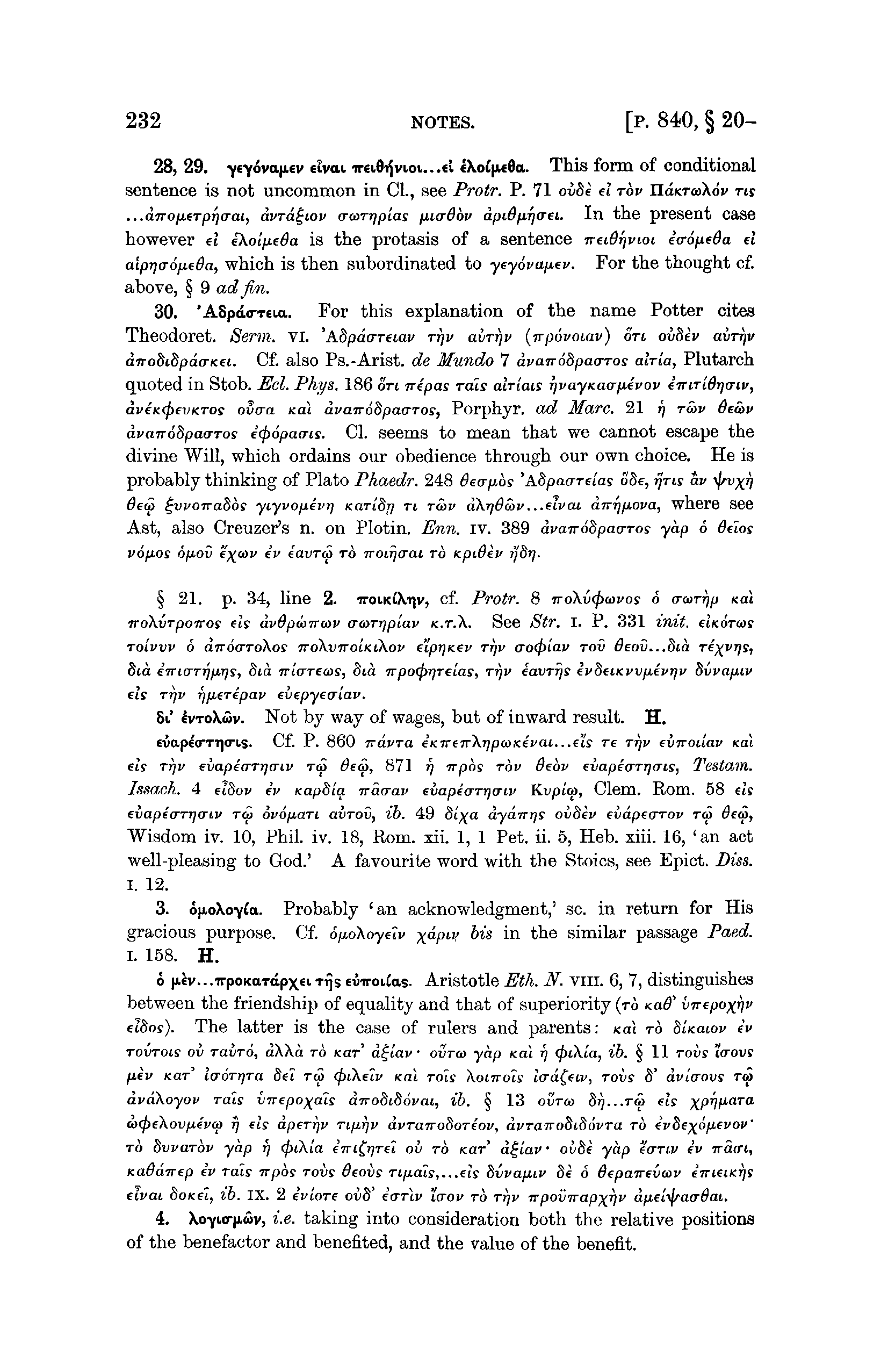
NOTES.
[P. 840, § 20-
28, 29. YryovapEv elveu imdifvioi.. .«l c\ot|M6a. This form of conditional sentence is not uncommon in CL, see Protr. P. 71 ovSe ft rbv H6.KT<O\6V TIS
...awojXfTpr)(rm, avra^iov tra>Tr)pias /ju<r&bv aptdfirjcrei. In the present case however et e\olp-eda is the protasis of a sentence nei8r]vioi io-6fif&a ei aiprjo-ojizda, which is then subordinated to yeyovafiev. For the thought cf. above, § 9 ad fin.
30. *A8pd<rma.
For this explanation of the name Potter cites Theodoret. S&nn. VI. 'Adpacrreiav TT)V avrfjv (irpovoiav) on ovdiv airr/v anobidpaa-Kfi. Cf. also Ps.-Arist. de Mundo 7 dvanobpao-ros atria, Plutarch quoted in Stob. Eel. Phys. 186 on nepas rats airiais r)vay<ao-fievov iiriTlBrj&iv, aveMpevKTos ovcra ical dvawodpao-ros, Porphyr. ad Marc. 21 r) rS>v 6ca>v dvanodpaa-Tos ecp6pa<ris.
Cl. seems to mean that we cannot escape the divine Will, which ordains our obedience through our own choice. He is probably thinking of Plato Phaedr. 248 6eo-p.bs 'ASpaarelas 6'Se, T)TLS av ^n>xh
6ea> ^vvonados yiyvofievr] KaTiSr; TI ran aKri6a>v...eivai airr]fi.ova, where see
Ast, also Creuzer's n. on Plotin. Enn. iv. 389 avairahpao-ros yap 6 6elos vop.os 6[iov e^aiv ev €avra> TO noLTfaaL TO Kpidev tj&r}- § 21. p. 34, line 2.
TTOIKCXI^V, cf. Protr. 8 Tro\v(pa>vos 6 (roirrjp KO\ noXvTponos ets dv6pai7rcov o~(orr]plav K.T.X.
See Str. I. P. 331 init. €IK6TO>S TOLVVV 6 a7r6o-To\os TTOXVKOLKIXOV ciprjuev TTJV crocpiav TOV #eoO...Sia ri)(VT)S, dta €7Tio~Ti]fiT]s, Sta 7rlo~T€<os, $La 7rpo(pr]T€tas, TT/v eavrr/s iv$eiKi>V[i€i'r]v dvvapiv els TTJV rujL€Tepav evepyeaiav.
8i IVTOXWV. Not by way of wages, but of inward result.
H. riap«orii<n.s.
Cf. P. 860 navTa iKTren\-qpa>Kevai...els re TTJV evnouav xai els Ttjv €vapeo-Trjo-iv ™ 6ea>, 871 ij npbs rbv deov evapio-Ttjo-is, Testam.
Issach. 4 elbov ev Kapdla 7rao~av evap€o~Tr)o~iv Kupio), Clem. Rom. 58 els evapeo~Tr]0~Lv raj oi/o/xart aiiTov, ib. 49 &i)(a dydffrjs ovdev evdpecTov TCO Betn,
Wisdom iv. 10, Phil. iv. 18, Rom. xii. 1, 1 Pet. ii. 5, Heb. xiii. 16, 'an act well-pleasing to God.' A favourite word with the Stoics, see Epict. Diss. i. 12.
3. 0)1.0X07(0.. Probably 'an acknowledgment,' sc. in return for His gracious purpose. Cf. 6jj.o\ayeiv x^Pcv bis in the similar passage Paed.
1. 158. H.
6 |jiiv...irpoKaTdpx«!.T-i5s eiiroiCasAristotle Eth. N. VIII. 6, 7, distinguishes between the friendship of equality and that of superiority (TO naff' vTrepoxqv eldos). The latter is the case of rulers and parents: xa\ TO bUaiov iv TOVTOIS 01/ ravro, dWd TO tear* d^'iav ovrco yap xa\ rj <pi\ta: ib. § 11 TOVS iVovs fji€v Kar* lo~oTT)ra fiei ra (ptXeiv Kal rois Xoiirois lo~d£ftv, TOVS 5' dvlcovs TO) dvakoyov Tats vnepo)(als diro8i,86vai, ib. § 13 OVTW 817...ra> els xP*ltlaTa axpeXovfyievco rj els dpeTrjv rifirjv dvranodoTeov, avraTrodidovra TO cVfie^o/xei'Oi''
TO bvvaTov yap r) <pt\ia £ni.fcqTti ov TO tear* d^lav' ovhe yap 'io~Tiv iv Tram,
KaSdntp iv rats npbs TOVS Oeovs TLfjLa7s,...€is hvvap.iv de 6 Qepaireixov e7rieiKr)s etvai (Wei, ib. IX. 2 iviore oi8' eVrij/ "urov TO TTJV npov'nap-)(T)v djid^raoSai.
4. \0710-1100v, i.e. taking into consideration both the relative positions of the benefactor and benefited, and the value of the benefit. https://doi.org/10.1017/CBO9780511695513.011 Published online by Cambridge University Press
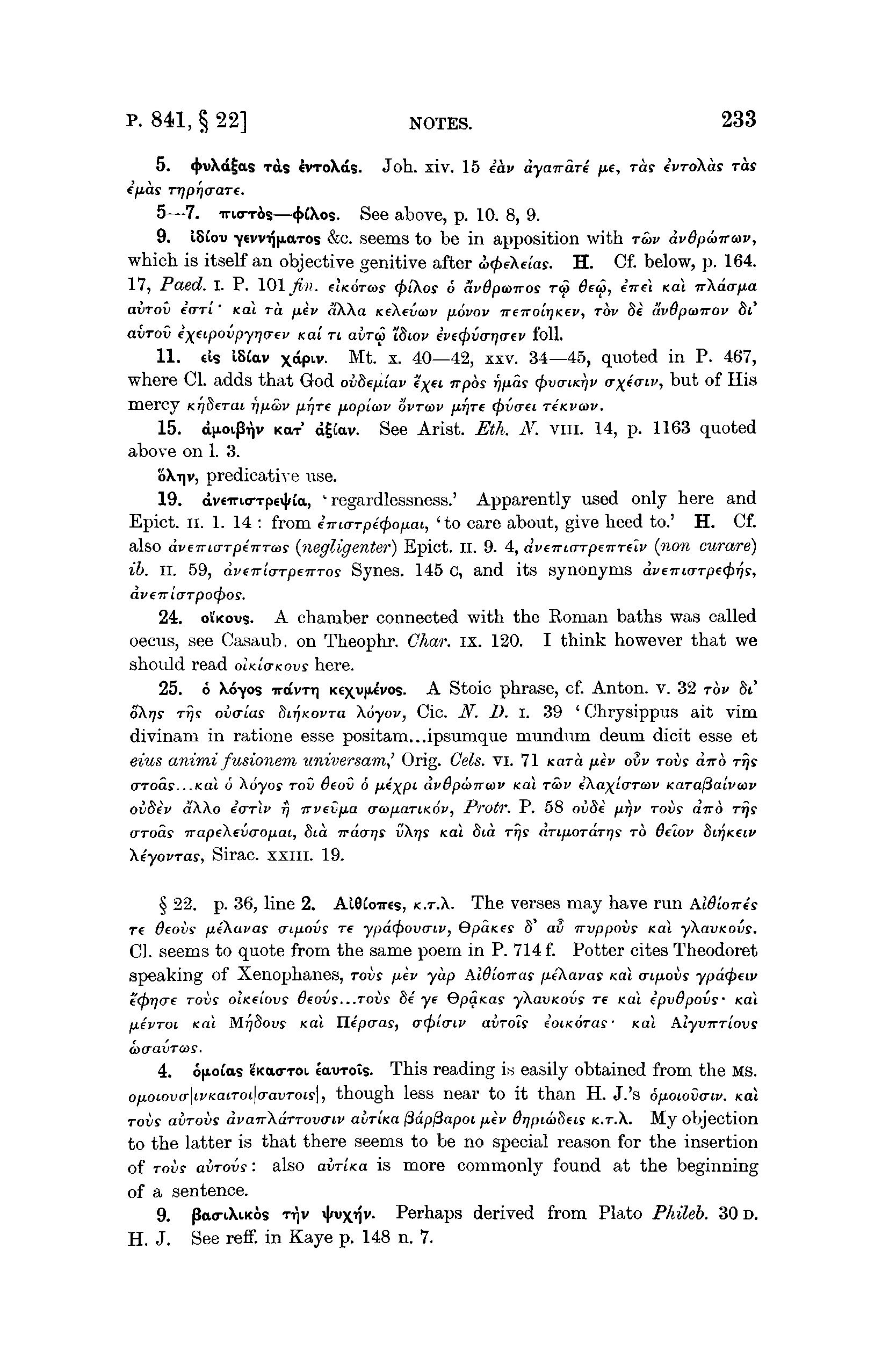
P. 841, § 22]
NOTES.
(|>v\d£as Tas IvToXds. Joh. xiv. 15 eav ayanari fie, rat ivrokas ras efias Tr)prj(TaT(.
5—7. moris—^ft-os.
See above, p. 10. 8, 9.
ISCov •ysvvijiJi.aTos &c. seems to be in apposition with TO>V dv6pa>iru>v, which is itself an objective genitive after wcpekeias. H.
Cf. below, p. 164.
17, Paed. I. P. 101 fin. eiKoras (piXos 6 avffpioiros ra 6ea>, inel Kai n\do-ft.a avrov €&TI ' Kai ra fieV aWa KeXevatv p-6vov neTrotrjKEv, TOV 5e avdpaiTrov di' avrov e^eipovpyrjo-fv Kai Ti aiiT<p I'Siov €V((pv(rrj(r(V foil.
11. els ISCav \ap\.v.
Mt. s. 40—42, xxv. 34—45, quoted in P. 467, where 01. adds that God ovSefiiav e^ei irpos rjfias <pv<TiK7]v cr^iaiv, but of His mercy KrjSerai jjiiav jxr]Te fiopiav ovrav firjTf (pvcrei T£Kva>v.
15. anoipiiv KaT diiav.
See Arist. Eth. N. vm. 14, p. 1163 quoted above on 1. 3. o\i)v, predicative use.
19. dvemcrTpe\|iia, ' regardlessness.' Apparently used only here and Epict. II. 1. 14 : from ciria-rp4(pofj.m, ' to care about, give heed to.' H.
Cf. also dveirio-TpcnTays (negligenter) Epict. II. 9. 4, dveirio-TpnrTelv (non curare) ib. II. 59, dveirio-TpeiTTos Synes. 145 c, and its synonyms d p 24.
OI'KOVS. A chamber connected with the Roman baths was called oecus, see Casaub. on Theophr. Char. ix. 120. I think however that we should read OIK'UTKOVS here.
25.
6 X670S iravTt] Kexi)(Uvos. A Stoic phrase, cf. Anton, v. 32 TOV hi oKrjs rijr ovaias StrjKovra \6yov, Cic. N. D. I. 39 ' Chrysippus ait vim divinam in ratione esse positam...ipsumque mundum deum dicit esse et eius anirni fusionem unwersam,' Orig. Gels. VI. 71 Kara jitv ovv TOVS OTTO TTJS o~Toas...Kai 6 Xd-yos1 TOV fleov 6 p-£XPi dv6pa>7roiv Kai TCOV eXa^/crrtav KaTafiaivtov ovdev aWo €0~TIV rj nvevjxa (rwp.aTiKov^ Protr. P. 58 ovhk prjv TOVS d-iro Trjs o~Toas rrapeKevcofxai^ 81a T?do~1qs v\rjs Kai diet Trjs aTip-ordT^s TO 8e1ov dir/Ktiv
XeyovTas, Sirac. XXIII. 19.
§ 22. p. 36, line 2. Al8£oires, K.T.X. The verses may have run AldLonis T( 0eovs jifhavas o~ip.ovs re ypd<pov<TLV, QpaKfs S' av irvppovs Kai y\avKovc.
01. seems to quote from the same poem in P. 714 f. Potter cites Theodoret speaking of Xenophanes, TOVS /ieV yap hlOiorcas p-fkavas Kai o-ip-ois ypdtpeiv i'(pi]O-€ TOVS oiKeiovs 6covs...Toiis Si ye QpaKas ykavKois TC Kai ipvdpovsKa\ p.ivToi Kai Mrjbovs Kai Hepo~as, o~(pio~iv avrols eoiKOTas' Kai AlyvirTLOvs
(oaavTcos.
6(ioias e'lcaoTToi. laDTots. This reading is easily obtained from the MS. ojj.oiovo-\i.vKaiToi\o-avTois\, though less near to it than H. J.'s OJXOWVO-W. Kai
TOVS avTovs dvaTi\dTTOvo-iv aiiTiKa fidpfiapoi p-iv 0r]pia>8fis K.T.X. My objection to the latter is that there seems to be no special reason for the insertion of TOVS avTovs: also airiKa is more commonly found at the beginning of a sentence.
9. pacriXiKos TI^V +«xi)vPerhaps derived from Plato Phileb. 30 D.
H. J.
See reff. in Kaye p. 148 n. 7. https://doi.org/10.1017/CBO9780511695513.011 Published online by Cambridge University Press
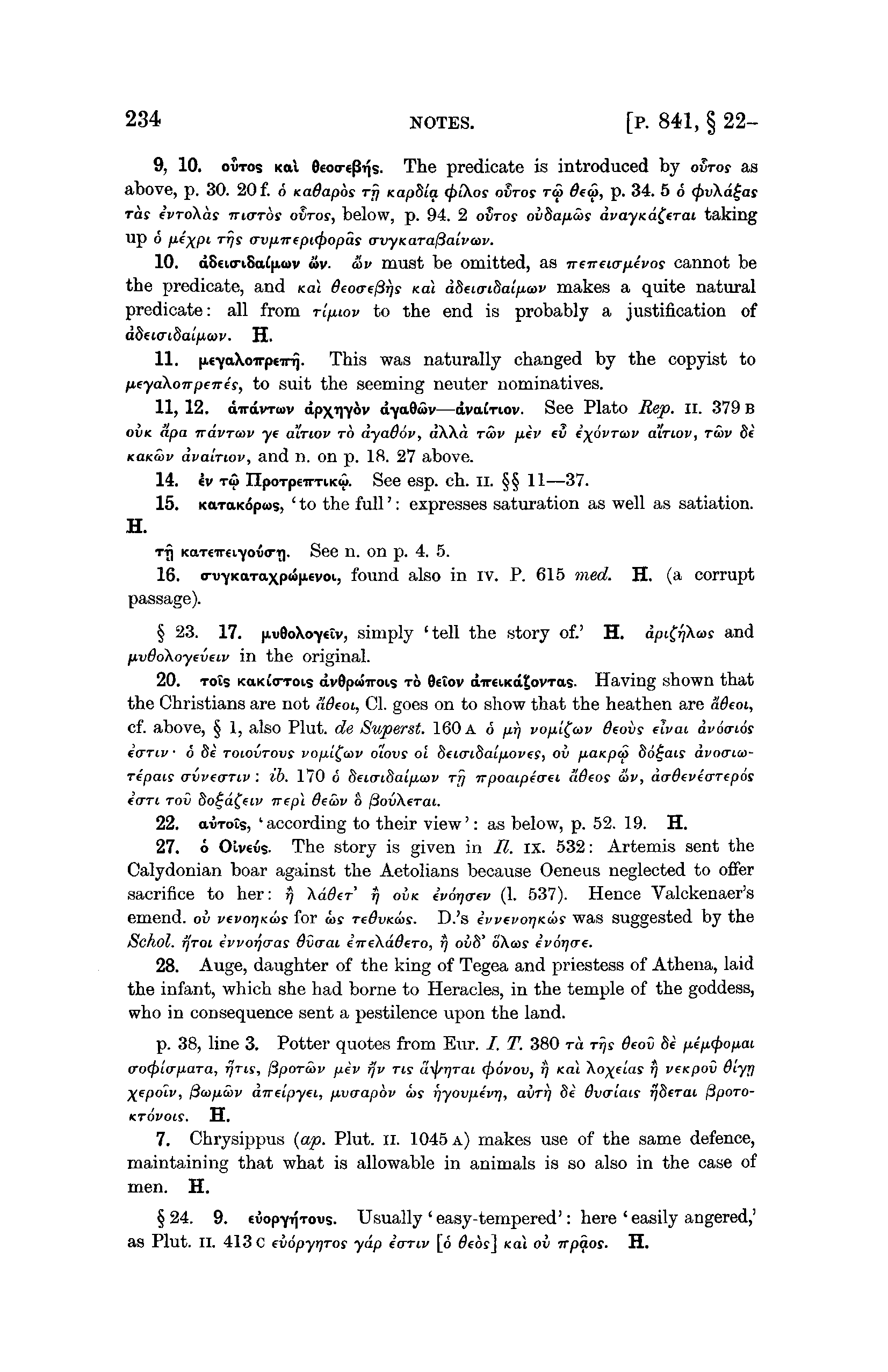
NOTES.
[P. 841, § 22-
9. 10.
OSTOS Kai eeoo-epTJs. The predicate is introduced by OVTOS as above, p. 30. 20 f. 6 KaOapos 177 KapSia (pIXos OVTOS ra 6ew, p. 34. 5 6 (pvXdgas ras fvroXas TTMTTOS OVTOS, below, p. 94. 2 OVTOS oiiSafias dvayi<d£eTai taking up 6 jne'xP' Trjs (TVfLirept(j>opas o-vyKarafiaivaiv.
10. dSeio-i8a£(io)v o»v. &v must be omitted, as nenfio-fiivos cannot be the predicate, and <al #eo<re/3iyy nal dSfio-iSalfiav makes a quite natural predicate: all from rlfiiov to the end is probably a justification of ddcMndaifxav. H.
11. |x€-yaXoirpcirfj.
This was naturally changed by the copyist to fieyakoirpeires, to suit the seeming neuter nominatives.
11, 12. dirdvTcov dpxryyov aYdOwv—dvaCriov. See Plato Rep. II. 379 B OIIK apa ndvTa>v ye a'lnov TO aya66v, aXka TO>V /lev ev i-)(6vTa>v a'lTiov, T£>V 8i
KIIKWV dvainov, and n. on p. 18. 27 above.
14. ev ™ npoTpeirriKcji.
See esp. ch. n. §§ 11—37.
15. KaraKopus, ' to the full': expresses saturation as well as satiation.
TTJ KaT«ir€iiyotio"rj. See n. on p. 4. 5.
16. o-vyKaTaxpw|i6voi, found also in IV. P. 615 med. H. (a corrupt § 23. 17. nvOoXoyav, simply 'tell the story of.' H. dpi^rfkas and Hv6o\oyeveiv in the original.
20.
TOIS KaxtoTois dv8p»irois TO 8elov direiKa^ovTasHaving shown that the Christians are not adeoi, Cl. goes on to show that the heathen are tideoi, cf. above, § 1, also Plut. de Superst. 160 A 6 pr) vojxi^av deovs elvm dvoo-ios
£O~TIV ' 6 5e TOLOVTOVS vop.L^cav otovs ol denrt^alfiOveSj ov jxaKp^ 86£ais dvocria)ripais o-vveo-Tiv : ib. 170 6 Seio-tSaiixaiv rfj rrpoaipeo-ei (ideas $>v, dadfvio-Tfpos f'o-Ti TOV do£d£(iv nepl 6ewv o ftovkcTm.
22. a^Tots, 'according to their view': as below, p. 52. 19. H.
27. o OlveisThe story is given in E. IX. 532: Artemis sent the Calydonian boar against the Aetolians because Oeneus neglected to offer sacrifice to her: rj XddiT r/ OVK iv6r]o-ei> (1. 537). Hence Valckenaer's emend, oh vtvorjKcos for i>s Tedvwus. D.'s iwevor]K.£>s was suggested by the Schol. JJTOL evvoijcras 6vo-m ineXdOfTO, 17 oi§' 6'Xcos ivorjo-f.
28. Auge, daughter of the king of Tegea and priestess of Athena, laid the infant, which she had borne to Heracles, in the temple of the goddess, who in consequence sent a pestilence upon the land. p. 38, line 3. Potter quotes from Eur. /. T. 380 TO. rf/s 6eov Se p.£n$ofiai o~o<pi(rnaTa, TJTLS, fiporcov pev rjv TLS a^rr^Tai (povov, rj ical Xo^eias rj veicpov diyrj
^epotv, @(ofjLwv dnelpyfi, p,vo~ap6v a>s r)yov[i€vr], avrr) de 6vo~lais ^Sfrat jSpoTOKTOVOIS.
S .
7. Chrysippus (ap. Plut. 11. 1045 A) makes use of the same defence, maintaining that what is allowable in animals is so also in the case of men. H.
§ 24. 9. eiop-yiJTous. Usually ' easy-tempered1: here ' easily angered,' as Plut. II. 413 c evopyr/Tos yap icrnv [6 6eos] Kai ov irpqos. H. https://doi.org/10.1017/CBO9780511695513.011 Published online by Cambridge University Press
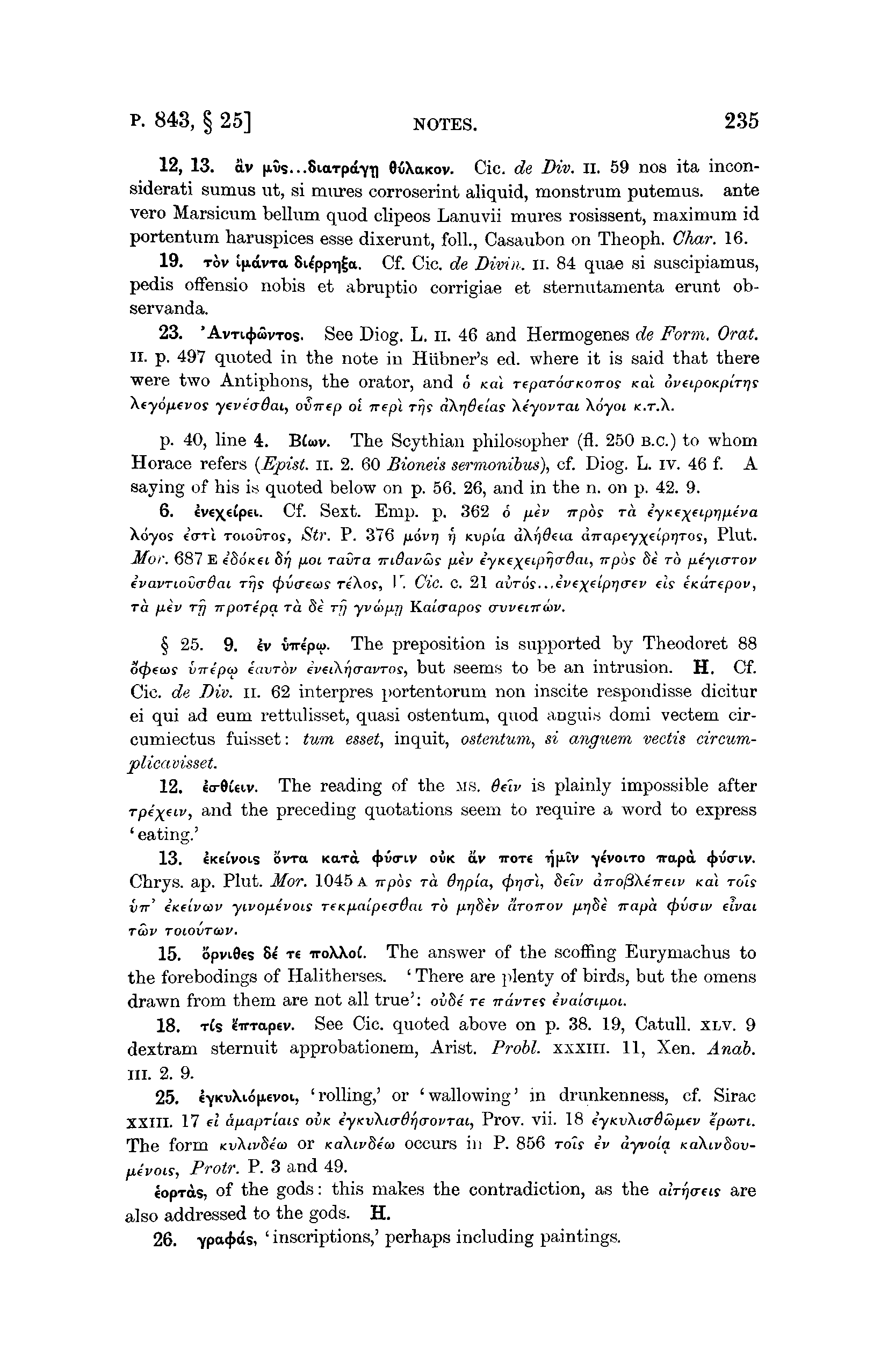
P. 843, § 25]
NOTES.
12, 13. av (ivs...8i.aTpa.7ti OdXaicov. Cic. de Div. II. 59 nos ita inconsiderati sumus ut, si mures corroserint aliquid, monstrum putemus. ante vero Marsicum bellum quod clipeos Lanuvii mures rosissent, maximum id portentum haruspices esse dixerunt, foil., Casaubon on Theoph. Char. 16.
19.
TOV tfiavra SUpprjga. Cf. Cic. de Diviii. II. 84 quae si suscipiamus, pedis offensio nobis et abruptio corrigiae et sternutamenta erunt observanda.
23.
'AVTKJIOSVTOS. See Diog. L. n. 46 and Hermogenes de Form. Oral.
II. p. 497 quoted in the note in Hiibner's ed. where it is said that there were two Antiphons, the orator, and 6 KCU reparoo-Korros xai. oveLpoKpir-qs
Xtyojievos yeveudai, ovrrep oi irep\ rrjs akrjdelas \iyovrai \oyoi K.T.A. p. 40, line 4. BCwv. The Scythian philosopher (fl. 250 B.C.) to whom
Horace refers (Epist. n. 2. 60 Bioneis sermonibus), cf. Diog. L. iv. 46 f. A saying of his is quoted below on p. 56. 26, and in the n. on p. 42. 9.
€V€\€ipei.
Cf. Sext. Emp. p. 362 6 fi€v rrpos Ta €yK€^€ipr]fi€va Xoyoj €(TTI TOLOVTOS, St)\ P. 376 [IOVT] T) Kvpla akqdtia anapeyj^lprjros^
Plut.
Mor. 687 E eSoKfi 817 not raira iridavas p.ev eyKe^ei/J^cr(9a(, wpos 8e 7-0 fieytcrTov evavTiovcrdcu TT)S (pvcreais re'Xof, V. Cic. C. 21 avros...Ivexeip^uev
(Is eKiirtpov, Ta p.€V TT] TTpoTepa Ta 5e TTJ yvmpjj Katfrapo? &vv€L7T<ov.
§ 25. 9. 4v vire'pu. The preposition is supported by Theodoret 88 o<f>(a>s ivipcp eavrov eveiXrjcravTos, but seems to be an intrusion.
H. Cf.
Cic. de Div. 11. 62 interpres portentorum non inscite respondisse dicitur ei qui ad eum rettulisset, quasi ostentum, quod anguis domi vectem circumiectus fuisset: turn esset, inquit, ostentum, si anguem vectis cireumplicavisset.
12. lo-Oieiv. The reading of the us. 8elv is plainly impossible after Tpf'xeif, and the preceding quotations seem to require a word to express
' eating.'
13.
IKCLVOLS ovra Kara fyvtriv OWK dv TTOTC i]|xtv •yevoiTO Trapa IJ>I3<TLV.
Chrys. ap. Plut. Mor. 1 0 4 5 A npos ra Orjpia, (prjcrl, detv aTrofiXeTreiv KCH TOIS VTT' €K€ivo>v yivop-ivois T€Kp.a[pe(rdai TO p-rfdev aroTvov p.Vjh't Trapa <pvo~iv elvat
TCOV TOlOVTOiV.
15. opviOes 8e rt iroMoC. The answer of the scoffing Eurymachus to the forebodings of Halitherses. ' There are plenty of birds, but the omens drawn from them are not all true3: oiSe re travTes fvaio-ipoi.
18. rCs firrapev. See Cic. quoted above on p. 38. 19, Catull. XLV. 9 dextram sternuit approbationem, Arist. Probl. XXXIII. 11, Xen. Anab. in. 2. 9.
25.
!-yKuXio|Aevoi., 'rolling,' or 'wallowing' in drunkenness, cf. Sirac XXIII. 17 el ap.aprtais OVK eyKv\io~6r)0~ovTai, Prov. vii. 18 iyKv\iO~6wp.(v epcori.
T h e form KvXiJ/Setu or Ka\iv8e(o occurs ill P. 856 TO7S iv ayvoia KaKivbovfievois, Protr. P. 3 and 49. eopTcts, of the gods: this makes the contradiction, as the alrrjo-eis are also addressed to the gods. H.
26. vpa((>ds, ' inscriptions,' perhaps including paintings. https://doi.org/10.1017/CBO9780511695513.011 Published online by Cambridge University Press
NOTES.
[P. 843, § 26-
§ 26. p. 42, line 1.
6 Aio-yfriis.
Potter remarks that this is a combination of two stories given by Diog. L. VI. 39 dvovxov fioxdr/pov eiriypdifravTos eVl TTJV oiKiav, Mrjhkv elalrai KCIKOV • 6 ovv Kvpios rrjs otKias nas eicreXevcrfrai; ib. 50 veoydfiov ewiypd^avros
fV! TT)V OIKICIV, 'O TOV AIOS
Trais 'HpaKX^s tcaWiviKos evddfte KaToiKei, /xrjdiv WO"IVG> KaKov iireypa'tye, Mcra TOV noXefiov 17 cru/i/na^ia.
6. 7. Xt8ov...\i.'irap6v. Theophr. Char. 16 (of superstition) Kal raiv Xi7ra/xii' Xidcov T5>V iv rais Tpiodots napiav ex rfjs \TJKV6OV e'Xaioi' xara^eii",
Kal inl yovara ITG(TG>V KOL yrpo<TKVvr]cras a7raXXarrecr#ai, where see Casaubon :
Arnob. 1. 39 si quando conspexeram lubricatum lapidem et ex olivi unguine ordinatum, tanquam inesset vis praesens, adulabar, affabar (given with other quotations in Potter's ed.).
<:pux Trvppd. Cf. PvotT. P. 9 K.a8ap(TL(av fxeraXdfi^ave 6eonptiru>Vi ov Sdcpvrjs rrtTaXav Kal raiviav rivoav ipitg Kal 7rop(pvpa nenoiKikjievwv, Heb. ix. 19, Theocr. <$>apjxaK. 2 (rre^ov rav Kektfiav (potvLKecp 016s dcarc). dXwv x6"Spo«sThese are mentioned as used in the Mysteries, Protr.
P. 13, 19. See below, p. 44, 5.
8aSas o-KCXXav Tt Kal 0eiov. Luc. Necyom, 7 cwl TOV noTafibv ayaymv eKaBr^pi re fit Kal dnepa^t Kal irepiryyvLO'e dqdl Kal O'KIWTJ Kal aXXot? TrXet'oo'ii',
Theophr. Chu/r. 16 lepeias Kakeiras CTKIXX^ rj o~Kv\aKt KeXeuorat avTbv nepiKaBapai.
9. dxafldpTous Kaflap(j.ois. Servius, commenting on Virg. Aen. VI. 740 f.
(aliae panduntur inanes suspensae ad ventos: aliis sub gurgite vasto infectum eluitur scelus aut exuritur igni), says that 'in sacris Liberi omnibus tres sunt istae purgationes; nam aut taeda purgantur et sulphure
(Sa8as Kal Belov, 1. 8, 19, 20), aut aqua abluuntur (p. 42. 4 dno Kpovvav Tpimv vSaTi -n-cpippavai), aut aere ventilantur.'
The fourth element was also used for purification by smearing the body with clay, to which reference is made by Demosthenes in his account of the bringing up of Aeschines, KaOalpcov TOVS TeXovpevovs Kal dirofidTTwv TCO nr]\a) Kal TO"LS niTvpots {de Cor. 313), on which Reiske notes 'Loti fricabantur creta ochra argilla et furfuribus, quae sunt res abstergendis sordibus perquam accommodatae.' Cf. Wytt. on Plut. de Superst. 166 TTJV •n-epifiaKTpiav KOXCI ypavv,
' istius modi lustrationis pars erat ut corpus lustrandum circumlineretur in primis luto, turn abstergeretur: quorum illud est nepi/xdrTfiv, hoc aTrolidrTdv : sed utrumque promiscue de tota lustratione dicitur.'
This purification was known as 7rr)\<oo-i,s.
He also cites ib. 168 D nepidvofievos O'IKOL Ka6r]Tai nepifiaTTOfievos, al Se ypats, KaSdnep TrarraXo), (prjalv 6 BtG)i>, o TL av Tvx<do~iv avTto 7repid7TTovo~L Allusion is made to the Tr^Xworts in p. 44. 3 below, and to the Trepiduixara in p. 42. 12. Cf. Protr. P. 89 ol uev TOIS yot)o-t
7TfjrtcrreuKOTff TO ncpiawTa Kal Tas tiraoiSas ws o-a>T-qplovs 8rj8ev diroSix0"™- 10. oyiov otSev TO ^6OS. For this use of oiSa cf. Str. II. P. 452 init. 6
7roifiT)v (so. Hernias) SiocaiousoiSe Tivas ev Wveo-iv, Schweigh. Lex. Herodot.
S.V. eifiei/ai and cnio-Tauai, Schmid Att. IV. 415-7.
12. TO wd TA dwo rav ir«pi.Ka6ap6evTuv. Beside the ordinary modes of purification, the stain of sin might be removed by vicarious atonement, as https://doi.org/10.1017/CBO9780511695513.011 Published online by Cambridge University Press
P. 844, § 27]
NOTES.
by the execution of the Si^dcrux or cpapfiaKol at Athens, or by animals which were either slaughtered or driven into the wilderness bearing the curse in behalf of the people, like the scape-goat. The fastening of eggs to the person of the individual who needed purification, brought him into immediate contact with a form of animal life, which (as drawing to itself the punishment he had deserved) ought at least to become sterilized. The fact that this was not the case proves the inefficacy of the ceremony.
On the use of eggs in purification see Luc. Dial. Mart. I. 1, where the impiety of the Cynic is shown by his eating the offerings to Hecate or i>bv
EK Kadapa-iov. Cognat cites Ov. A. A. n. 329 et veniat quae lustret anus lectumque locumque, praeferat et tremula sulphur et ova manu, Juv. vi. 516.
17. IIpoi.TC8as. Abas, king of Argos, the son of Lynccu.s, had two twin sons, Acrisios and Proetos, who contended for the kingdom after his death.
The latter being defeated took refuge in Lycia, where he married Sthenoboea the king's daughter, and by his aid established himself in Tiryns, while Acrisios ruled Argos. The three daughters of Proetos were stricken with madness as a punishment for pride and impiety, and Melampus was called in to Restore them to their senses. The common legend says nothing of these incantations, but speaks only of sacred dances. In the scholia to Od. xv. 225 the cure is said to have been wrought by sacrifices and prayers to Hera. Others attributed the cure to Asclepius.
20. •iroXv<)>\o£a-poi.o 0aXd<r<n]s. Probably this refers to the Dead Sea, Lacus Aspkaltites, from which the ancients obtained most of their bitumen
(Plin. N. H. xxxv. 15). Tacitus {Hist. v. 6) describes how it was collected, ' undantes bitumine moles pelli manuque trahi ad littus.' Some read
Tro\v(f)S.oial3a> re 8a~kacr<Tr), understanding it of salt water. We read of the use of bitumen in incantations (Virg. Eel. VIII. 82).
Many of the ingredients mentioned by Diphilus are prescribed as a remedy for diseases of sheep by Virgil: ' et spumas miscent argenti et sulfura viva, Idaeasque pices et pingues unguine ceras, scillamque elleborosque graves nigrumque bitumen' (Geo. III. 449).
22. *Ai]p. Identified with Zeus by Philemon (Fab. Inc. II. 3) 'Arjp, ov av TLS ovopdtreie KOI Ala.
23. "AvTiKijpav. Used for the hellebore which grew there, as in Hor.
Sat. II. 3. 83 nescio an Anticyram ratio illis destinet omnem, A. P. 300 tribus Anticyris caput insanabile.
K6piv. Kock translates 'ut huic mordaci homini aculeum adimam.'
Cf. Philostr. V. Soph. II. 3, p. 588 Srjyfiara Kopeav ras XoiSopias KaKav, Hor.
Sat. I. 10. 78 Men moveat cimex ?
§ 27. p. 44, line 3. irepi,|m£dT<oo-av. See n. on p. 42. 9, and Wytt. on Plut. de Superstitione, p. 166 A TT/V nepiyMKTplav KaXei ypavv, Lobeck, Agl.
632 foil.
5. 4>aicovs. See Lobeck Agl. p. 254 n. https://doi.org/10.1017/CBO9780511695513.011 Published online by Cambridge University Press
NOTES.
[p. 844, § 276. irds d-yvos ia-nv—o-vvaSms. The rhythm and the thought both suggest that this is a continuation of the quotation, and this is confirmed by the emphatic ™ yap ovn of 1. 10.
13. aurCKo. See the Appendix.
\f>t<&v = xpf<0" eivai.
14.
Sid TO« \6yov TOU 6p6ou.
See below p. 94. 21.
15.
T<5V irpoi]7ou(ji.^v(ov.
Barnard compares Str. VI. § 162 d yvaxrTiKos iv rots KvpiaTaroii de\ SiaTplfjei, tl 8i nov &xo\r) ano ra>v npo^yov/xivrnv, dvTt rrjs dXKrjs pqflvpias, Kai rrjs 'TZWTJVIKTJS anTeTai <pt\o(ro<ptas.
17.
\Lva-Tt\piav. See pp. 8. 5, 10. 10, and Appendix.
§ 28.
20. kv Toirio nvl u£piYpd<|>o|jLcv.
See 1 Kings viii. 27, Isa. lxvi. 1, Str. v. P. 691.
22.
7repi.eKTi.K6v. Often absolute 'comprehensive,' but also, as here, ' comprehending.' H.
23. fiavaio-ov T€\VT|S. Cf. the description of these arts in P. 45, where the nya\p.a is defined as V\TJ ve<pa Texyirov x^P*- p-^fJ-opd^coixevj], also P. 50 and 78, where even Pheidias and Praxiteles are said to practise fiavaitrovs rexvas, below pp. 46. 5, 48. 6.
24. ovxl d|xe£vo«s K.T.X. The allusion is to the Stoics; see the account of the theology of Cleanthes in Cic. JV. D. I. 37 'turn ipsum mundum deum dicit esse, turn totius naturae menti atque animo tribuit hoc nomen, turn ultimum et altissimum atque undique circumfusum et extremum omnia cingentem atque complexum ardorem, qui aether nominetur certissimum deum iudicat.' It is impossible that Clement, who writes thus here, could have charged the Stoics with anthropomorphism, as he is made to do by the corrupt reading in § 37 (p. 64. 20). p. 46, lines 1—3. Plat. Legg. VII. 803 C avdpamov be...6eov TI iraiyvwv elvm fi(fir)xavr]jj.€vov: in the context iraihia occurs often, especially in the same sentence, TOVT<O 8f) 8eiv ra rpoira ^vvcnop-ivov Kai irai^ovra on KaWiarras
Traifitat iravr avhpa...§iaj3i5>vtu, which explains vraiSiaif re'^j/jjs.
See also Legg. x. 889, where it is said that the greatest things are produced by nature and chance, and only the smaller by art, T4XVV $* vo-Tcpov...avTr]v BvrjTTjv eK 6V7]TO>V yey€vvrjK€vai natbids rivas, dXrjdelai ov <T(f>6bpa peT€x°^>a'as ...oia fj ypadjiKT] yeuva Kai IIOV(TIKTJ KOI o<rai ravrais cirri avvipidot Texval- ' I t is to the play of such arts that we are indebted for our belief in the gods';
Oic. N. D. i. 81 Vulcanum, Apollinem, reliquosque deos ea facie novimus qua pictores fictoresque voluerunt; and the argument on enshrinement which follows below (1. 11—25).
10—23 resumes p. 44. 20 foil. Evidently taken from some other writer. H. The style of argument resembles that (taken probably from Carneades or some other Academic) which we find in Cic. N. D. in. and in Sext. Empiricus.
01. is here answering the charge brought against the Christians, that the absence of images and temples proves them to be atheists. He met this, at the beginning of § 28, by an argument drawn from the nature of God. 'How can the Infinite Spirit be https://doi.org/10.1017/CBO9780511695513.011 Published online by Cambridge University Press
P. 845, § 29]
NOTES.
confined to one spot of earth V But he is not content with this: he wishes to show that the enshrinement which the heathen think essential to the idea of divinity is really an evidence of the non-entity of their gods.
' Before enshrinement they were nothing: how can this action, this whim (jraiSta) on the part of man, give being and life and power to that which was previously non-existent?' Apparently there is a play on the two senses of ISpva, ' to fix in place' and ' to consecrate,' i.e. to enshrine the God in a temple or image, the latter being one of the iraidicu re';^? referred to by Plato (1. 2). H. J. thus sums up the argument: ' Gods are spoken of as ISpvpevoi. (A) Now nothing can be ib'pvp.ivov unless it has passed through a process of I8pveo-8ai, and this process implies a previous stage in which the thing was dvi&pvrov. (B) Hence if God ibpifrai, he was previously dvihpvTos and non-existent: for by dviSpvrov and /117 &v we mean the same thing. (C) But the existent cannot be 'set up' either by a non-existent or by another existent, since it exists of itself. Can the existent then be set up by itself? No. It did not set up itself having been previously not-set-up: for then it would have been non-existent, since it is the non-existent (and not the existent) which is not-set-up.
Finally that which is supposed to have been set up cannot make itself what it was already.'
10. dvi.8piiTo«. Usually ' unfixed,' ' unstable': but here it implies the negation of the religious sense of iSpva and ividpvco, 'to set up' an altar, or god. Cf. Orig. Cels. in. 34. 36. H. Lobeck Phryn. p. 730 gives many exx. of the word, which is often written aihpvros. It is found with its usual meaning in Plut. MOT. 925 F, 6 K.6o~fxos dvecrTios KOI dvlbpvros ioriv iv dirfipto K€va> <p€pop.€vos, Dion. H. Ant. I. 15 TJ vrjaos dvibpvTos itm^ Philo M.
1. 272 6 p.ev (pavXos aoiKos <a\ airoXis «oi dvibpvros KU\ (pvyds, ib. 2. 112 TO Trjs ijfvx'js dviSpvTov, 2. 268 6 (piXrjSovos dvihpvTos, 2. 382 (and 454) dveppdrto-Ta
KOL dvlSpvra fj@i], 2. 413 TO dlo'pvTov KCLI 7r€7r\avt]fievQv d6^rjs; 2. 361 (and 216) Tvxq d/3e'/3aio£ Ka\ didpvros, 1. 650 didpvroi p.ev 01 XoyL(rp.oL..dvlbpvrov
Se <a\ TO o-a>ixa...dvL8pvTa 8e KOI ra EKTOS.
In our passage the word occurs six times in the sense ' unenshrined.'
12. Two points: the setting up of a god implies a prior place to set him up in, and also a prior agent by whom he was set up. H.
§ 29. 18. avTo T6 OV. The Being of beings, the localisation of which in an individual shrine is a special contradiction.
19. iviSpva-ii. The word occurs above p. 26. 14 (dvOpinrov hiKaiov •fyvxi] iv fi T€fX€vi^€Tai Kal evihpvtTai 6 TrdvTU>v rjyefiwv, and below p. 48. 14 6 yv<aCTIKOS iv <o 6 0e6s iv'ibpvTai and 1. 19 TO ivibpvTov Kal TO ivibpvop.evov, also in P. 755 ol €fi7reipoi TOV \6yov KaTa Tas idpvo'ets iv noXXols Tatv Upa/v Kai o~%€§6v ndo-ais rats 8rj<ms (MS. wdo-as Tas drjKas) rau Karoi)(ofiiva>v ivthpicravTO
<i^D^ar>, 8aifj.ovas...Ka\ovvTes, Philo M. 2. 412 eiVoia-d/io/or ex irpaTrjs rjXiKtas a%pi yr)pa>s ividpverai (rdis ^cv^atf 6 Tvfpos), Anton. III. 6 6 iviSpvpevos iv o~o\ daificov, Plut. MOT. 924 D avco TTJV O~€\T]VT]V ividpvovras, ov% onov TO fxio-ov io-ri. The MS. inserts eivai before iviSpvo-ft, probably owing to dittography. https://doi.org/10.1017/CBO9780511695513.011 Published online by Cambridge University Press
NOTES.
[p. 845, § 2921.
8 <|>8d<rav tl\tv ov. ' Which was its condition already.'
22. ov Si TO. OVTO. i.e. all particular ovra belong to airo T-6 OV. H.
24. dvBpwiroeiSe's, the most usual classical term for human form, whether in beasts or deities, from Herod, (who also uses dvdpwirorpvrjs) onward, including Aristot. (Met. 997 b 10; 1074 b 5). Probably includes both
(T^jia or fiop<f)r] and ndBrj.
25.
O-KCTTIS, used of a coat in P. 325.
26. dKoXo«8«v irdvTuv. The MS. reading, nadav, is unsuitable here, where (as we see from the following line) the argument is that those who are o/ioioo-^^juoi/tsand ojioiorraOels with man, must share the same kind of life. If the middle letters of iravrav had got rubbed, the copyist may have been led to write nadav from the following 6p.oioirad&. Whether understood of human passions or of the conditions attaching to food, &c, it seems to me impossible that Cl. should have written it. p. 48, line 2. On the spiritual temple see Hort, Ecclesia, p. 163 f. and Cl. Protr. P. 90 Jin.
KaTao-Ktiao-jia, 'apparatus' generally, but especially applied to buildings and statues.
The MK. reading dyvprov does not seem appropriate; but there may be a reference to Daedalus (who might be called an dyvprrjs) in fieficuSaXliivov. He was said to have introduced life-like statues: cf. Athenag. Supp. c. 17 and Diod. iv. 76 foil., also i. 61. 97, and Plato Meno 97 D.
H. In these words Cl. meets the charge of atheism brought against the Christians from the absence of a material temple, as he does in § 30 that based on the absence of sacrifices.
H.'s defence of dyvprov seems to me too farfetched.
I had thought of ovSe dyyeXov xelPl 8(8ai8aXfi(vov, as we find the same contrast between the work of angels and of God in Str. P. 769 avdpairmv
Htu oide'is aXX' oiiSe ayyikos TIS... (but God himself is the teacher of men): also in Heb. i., ii. Christ is contrasted with angels. Angels were believed by the Jews to have been concerned in the giving of the law, including of course the injunctions respecting the tabernacle, cf. Gal. iii. 19, Acts vii. 53,
Heb. ii. 2. An angel is represented by Ezek. xl. 3 foil, as planning the new temple; cf. Rev. xxi. 9. Valentinus held that man was made by the angels,
Stv.
P. 448 a n d 449 6 <f>6ftos imfiovKovs TOV &(peTe pov TrXdap-aTos 7T€7rotT]K€ TOVS ay-yeXov?, a>s ividpy/xevov rat djjp.iovpyrjp-ari TOV o~7T€p[iaTos TT)S avadev alrlas.
The same doctrine was held by Simon Magus, Saturninus, and Carpocrates (Iren. I. 24. 1, 25. 1); see ib. iv. 20. 1 'Non ergo angeli fecerunt nos neque plasmaverunt nos, neque angeli potuerunt imaginem facere Dei,—nee enim indigebat horum Deus, quasi ipse suas non haberet manus,' ib. I. 22. 1, iv.
7. 4. On the whole however I prefer H. J.'s emendation Tvpiov, referring to the Tyrian artist sent by Hiram to Solomon (1 Kings vii. 13, 14): dXX' aide will then contrast the finer work of decoration (SeSaio'akij.ivov) done by the artist, with the work of the common builder (fidvavo-os). The corruption in the Ms. is more easily explained from the somewhat obscure TYPIOY
(aFYPTOY) than from the familiar AITEAOY (Ar-yeTOY); and we find Hiram referred to as apxircKruv Tvpws in Str. I. P. 396 Jin. https://doi.org/10.1017/CBO9780511695513.011 Published online by Cambridge University Press
P. 847, § 30]
NOTES.
SeScuSaXpivov. Before Clement apparently only poetic. He uses it in Protr. P. 43"Ocrtpti/ Bai8aK6r)vai eKe\evo-ev •jroXvreXSis. H.
8. vvv implies that the building was already called eKuXr/a-ia. H.
10. a£Cas TOV 8eov. Cf. Const. Apost. VI. 27. 3 eyvp,va>9ri rr)s a£iar, dvri ap^ayyeXov StajSoXos alpe<rdp.evos eivm.
12.
OVSEVOS dvTaJCui. Cf. P. 71 avrdt-tos o-aTr/pias p.io-86s.
16. dir»K6vur|j,a, common in Philo and Greek Fathers. H.
17. d/yaXna is properly not the mere image, but the image considered as set up in honour of the god, from the old sense of dydXXa, ' to venerate.'
Cf. Plat. Legg. xi. 931 A. Hier. in Aw. Carm. 25. H. See above n. on p. 26. 12, and 1. 23 below. avri^ = ' in itself,' as distinguished from hi.anpa.TTop.evrj epya. On Sianp. see above p. 30, 1. 2. H. After fiaicapLa p.ev avrr) rvyxdvy, we naturally expect p.a.Ka.pia be Stan-pdrrrjTai epya. The contractions used in verbal terminations are often confused.
19.
The present e'vi8pvop,evov is necessary in opposition to evlhpvrov. H.
22.
TO |JA\OV irio-reveiv iriorov TJSII rep 8«u, ' faithful already in God's eyes': cf. "Lord, I believe; help thou mine unbelief." H. Paed. P. 113
TO p.d\\ov TOV xpovov TT) $vvdp,€i TOV OcXrjfiaTos Trpo\ap.fidv€Tai.
23.
Jvdperov. Cf. above p. 16. 14, 20. 5, below p. 112. 11, 114. 10, Str.
I. 376 Ttied. TOV KeKocrp.Tjp.evov Tr)v "\jn)xr)v evapeTtos. H. See also Lob.
Phryn. 328.
§ 30. 25. See above § 28.
27.
BVO-KSV. It seems necessary to correct the MS. dvo-lav. There are instances of ('ntdvpew with the accusative as in LXX, Exod. xx. 17 and Deut. V. 21 OVK [email protected]]o~eLS TTJV yvvaiKa TOV n\r)o~lov o~ov K.r.X., but not in such good writers as Clement (in Str. i. p. 412 T4KVOV 8e eiviOvpova-a, Dind. reads T4KVO>V from Philo), and the plural is more likely here. H. In Str. ni. P. 513 fin. Cl. keeps the rrjv ywaiKo of the LXX, but has TTJS yvvaiKos eight lines before and twelve lines after. H. J. p. 50, line 1. <Sv airrerai irdSas 4>9apT& irdvra «TT£. This is the argument of Cameades given in Cic. N. D. in. 29 cumque omne animal patibilem naturam habeat, nullum est eorum quod effugiat accipiendi aliquid extrinsecus, id est quasi ferendi et patiendi, necessitatem, et, si omne animal tale est, immortale nullum est...mortale igitur omne animal et dissolubile, cf. Sext. Emp. IX. 146 el ovv alo-ddvercu 6 Beos, «u erepovTm' el 8e eTepoi/Tai, irepwo-eas SCKTIKOS ecrrt sat p.eTaf3o\r)s K.T.X.
The phrase airTerai ird6os is used in a different sense above p. 12. 14.
Ko.Ta|i€(i.<j>o|ie'vous To''s dvBpwirois rav iepwv. The classical constr. is KaTap.. rivd TI or TIVI or eVi TIVI. In later Gr. we find the dat. of the person, as in Longus Past. II. 21 TOXS Nvpxpats o>r Trpohovo-ats KaTep,ep.(peTo, and gen. of the thing, as in Plut. Dion. 8. pJp,<pop,ai is used in classical writers with the ace, gen. or dat. of the person, and ace. or gen. of the thing: cf. Aesch. Th. 652 OVTTOT' dvdpl ra8e Kr}pvKevp.aTa>v p.ep/^rei.
8. T<i |it|p<i ir6pi\^avT€s...Kp«o irdin-a. We have an example of the M. C.
https://doi.org/10.1017/CBO9780511695513.011 Published online by Cambridge University Press
NOTES.
[P. 847, § 30—
double accusative after n. in II. I. 236 nepl yap pa e X<I\K6S eXeifrev (pvXXa Te Ka\ (pXoiov.
«rir6vS«\ov, Att. <r(f>6vbv\ov, see Lob. Phryn. p. 110 foil., Moeris ed.
Kock, p. 238 s.v. <rxii/8aX/jos.
16.
8ia<rr«XX6|Mvov, 'explaining.' H. Comparing the other passages in which the word is used by 01., e.g. Sir. P. 376 el He diao-TeXXecrdai 8ta TOVS
<piKcyKXr)fiovas 8er)(rei, 449 8iao-TeXXeiv TO dyadov TOV diKalov, 888 8tao-TeXXeiv
TO i^-eCSos <i7rd TaXrjdovs, also the use of SiatrroX^ in P. 781 fj StaoroXi) TWV re
6voixar(t)V (cat rcov 7TpayfidT<av...fieya <£G>? evTiKTei rals "yjrvxals, I think it is better to translate 'distinguishing' or 'particularizing,' which seems to me to suit the passage better than ' explaining.' Or it might be taken in the sense of ' giving orders' as in the LXX and N. T.
20. tirnroXeuov (Hesych. ap. Mein. v. 83) = «VinXoov, omentum. H.
Cf. Juv. XIII. 114 foil. Juppiter...cur in carbone tuo charta pia tura soluta ponimus et sectum vituli iecur albaque porci omenta ?
21.
-yXuKstttv, 'gall,' as Meineke shows, IV. 613 foil. H.
§ 31. p. 52, line 1. i] TWV 6Xe>KcwTw|idTiov Kvto-a icai TOIS 8i]pvois d<j>cKT^a.
The neuter alone is recognized in L. and S., and certainly the commoner construction is the impersonal, rijs Kvitrr/s roh B-qpiois dcpeKTfov, 'beasts must abstain from the smoke of the sacrifice.' We have an example of the personal (gerundive) construction in Bpiphan. Haer. XXXIII. 5 (the ten commandments are) ei's re dvaipeo'iv TU>V d(p€KT£wv nal els np6(TTa^tv rav
TTOujTewv. Cf. below p. 60. 6 a Kai KV(T\V neLvaxnv oi^l /3/>o>o-(^a.
3. ve'pas> 'meed' exactly: the special prize of the chieftain, set apart for him before the spoil is divided. H. Used here of the gods, as in the speech of Zeus (M. IV. 48) ov yap jxoi nore /3o)/xos eSevero Sairoj eicn]S,
Xoifirjs re Kviaris re' TO yap Xd^o/xev yepas fji^els, referred to in Protr. P. 15.
Cf. below p. 60. 8, and Porph. de Abst. II. 42 (the evil daemons rejoice) \oiftrj re Kvlcrrj re §t' a>v avrmv TO TrvevjxaTiKov Kal o~a>naTiK.6v 7naiverai.
£ij yap TOVTO aTfioTs <al dvadvp-idaea. ,.Ka\ dvvafiovTat rats eK TWV aifiaTajv Ka\ o~apK<av
Kvio-ais, ' wherefore a wise man will refrain from participating in sacrifices which bring him near to such beings.' See above p. 24. 5, and passages quoted in Cudworth, vol. in. 350 f.
OUK av <f>6rivoi.6v KaV TOIIS na^Cpovs 6eoiroiovvT£S. So Aristaeus ap. Euseb.
Pr. Ev. vin. 9 § 371 c (referring to the deification of the discoverers of wheat and wine, &c.) ert Ka\ vvv evpeTtKiHTepoi...rcov npiv elo~i TroXXot, Kat
OVK av <f>6dvoiev avrovs npoo-KVVovvres, cf. W. Schmid Att. IV. p. 427.
TOV lirvov aiTov.
Possibly we should read TT)I> Kanvrfv avTr/v : Kairvrj is the hole for the smoke, used Ar. Vesp. 143; Alex, in Mein. in. 464. Cf.
Hesych. s. v. opyrjTos. Kanvohoxq has the same meaning, cf. Pherec. (Mein.
II. 325):
KaTreld iva firj Trpos TO7O~L ftatfiols TravTa^ov del Xo^oivrer /3<i)/xoXo^oi Ka\a>p.e8a, eiroiTjo'ev 6 Zevs Kanvo86^rjv [icydXrjv ndvv.
Or onrjv may be right, with the same sense. H. I think Invov must https://doi.org/10.1017/CBO9780511695513.011 Published online by Cambridge University Press
P. 848, § 31]
NOTES.
certainly be retained, cf. Arist. Vesp. 837 6 KVCOV trapagas e's TOV ITVVOV avapndtras Tpo<pa\l8a rvpov 2iKf\iKTJv KaTfSrjboKev. The Only difficulty is the following feminine, which may be easily explained by supposing that ecrxapav has been lost after wpoo-exeo-ripav.
For the last word see below p. 62. 15 7Tpo(T€)(4o~Tepov 6 yvoiaTiKos oiKfiovrai 8e(p, p. 82. 26 6 8ebs
7rP0(reXca"r€P? T-qprjcras inurKOnrj, P. 798 6 yvaxTTtKos irpoo-e)(eo-Tepav avap.atj- (TfTaL <ro)Tr]piav.
13.
KOTd Tijv «iu6u|i£av KaKodptvov, 'being distressed owing to the Craving.'
Cf. P. 530 eTri8vp.ia XVTTT) res Kai cppovrls Si' evheiav opeyopivr) TIVOS.
17, 18.
«£ aiTijs Tijs TO! oiKtiov <rw|±a.TOS dva0v|ud<r£us.
A common explanation was that they lived by sucking their paws (Plin. N. H. VIII. 35).
HeraclitllS held Trjv [lev roil KOCTfiov ^rv^v dva6v[l{a<Tlv eK rwv ev avrw vypwv, TJJV Se ev rolr fffloir ano rrjt euros Km TTJS ev airo7s ava6vfud<rea>s (Plac.
Phil, IV. 3, 4); so the Stoics, avrrjv TTJV tyvxqv opi^ovrm nvcifia <Tvp<pves KCL\ avaQvp-latriv al(r8r)TLKr]v avairTO\iivr]v drro TO>V ev awfian vypwv (Plut. V. Horn.
§ 1 2 7 ) , TOIOVTOV 5T) Kai ailTTJ rj £o)T] €<d(TTOV olov f] dip' CUfldTOS dva@V[Aia(TlS KCU ff ex. TOV depos Sidnvevins (Anton. VI. 15)
19. aii-ots, ' in their view,' as above p. 36. 22. H.
22. Plat. Legg. VII. 799 A <a\ xopeiais •Kolaicri. yepaipeiv rrfv Tore Bviriav.
But it is hard to take yepaipovres with Ovaiav here, as TG> diKaiordrai \6yto cannot be instrumental.
23. When accompanied by righteousness (as in the 4th psalm) the prayer is best and holiest.
H. dvair«|iirw, of hymns, and especially their close: doubtless with uplifted voice, expressing oblation.
See Hein. on Eus. H. E. iv. 15. 34 {dvatvip.- ^ravros avrov TO 'A/i^f); Just. Apol. I. 65, 67; and the end of Clement's
Paed. 310 foil. esp. ZWfin., which well illustrates the whole passage. H.
TU SiKaioTaTcp \6yu), superlative of the Platonic phrase 6 SUaios Xdyor; here used personally: cf. 1 John ii. 1 napaK\rjTov...8iKaiov. The offering is made to Him as in Paed. 311 (rw \6ya> npoo-ev^a>fj.e8a), apparently as thereby made to the Father.
Origen distinguishes the process of sending to the High Priest and Paraclete for Him to present to the Father.
See de Orat.
15 foil, and Ashton's notes; also in Celsum iii. 34_/m. He uses dvawefinco, irpoa-aya to the Father, npocrfpepai to the Son. H.
The same phrase is used instrumentally ( = 'most justly') in Plut. Mor. 737E TO. (pavrjevra r<u
SiKawrdrco Xoyio rrpwrevei. rav drpavoiv, ib. 1072 D.
Perhaps it would be better to take it thus with yepaipovres, putting a comma after dvcnriixnofiev instead of after X6y<o.
24. The sense apparently is that we yepalpop.ev and dogdfrnfv the Father through Him (better so probably than ' thereby').
25.
Sojdjovres 8v |K|jia87]Ka|i€v.
The change of MS. a to Sv is indispensable.
Cf. Paed.
310 8i r/v (olKOvop.lav)...6 av8pa>TTOs,..naihay<nyoviievos naTepa...(K€i (ev ovpavots) Xafifidvei, bv eVi yrjs p.av8dvei.
Either Kai before bta or be before 8o£d£ovTes is a gain, though perhaps not necessary.
Cf. Protr. P. 89 jxddmjiev 8eov, 82 ovyip nio-revovo-i r<a 8e& ovde eKfiavdavovcri
Trtv 8vvautv avTov, StT. P. 829 TOV vlov nap oil €K[j.av8dvei TO €7reK€iva a'lnov.
16—2 https://doi.org/10.1017/CBO9780511695513.011 Published online by Cambridge University Press
NOTES.
[p. 848, § 31— 26, 27. TO eirC7«iov, implying in contrast another altar, not among us or here or on earth: cf. Heb. xiii. 10. H.
27. xats ««xa^SCf. Acts ii. 42 r\o-av Se npotTKaprepovvres rfj StSaxfj T&v anoiTTokaiv Kal TTJ KOivatvia, rrj KkatreL TOV aprov ical rais ITpoo-evxals, Ign.
Smyrn. 6 evxapiarrias Kal ITpotrevxrjs ane^ovrm with Lightfoot's n., below p. 136. 25.
§ 32. p. 54, line 2. BiairvttTai. The word is used of external ventilation (as in the case of the rustling of leaves in the wind), and of internal, as in the arteries which were supposed to transmit air through the body (see my n. on Cic. N. D. n. 138 spiritus per arterias). To this latter was compared the imbibing of sacrificial fumes by the airy body of the demon.
Cf. Arist. Probl. I. 21 onep iv 6a>paKi avanvorj, TOVTO iv T<O o-apan Stawvor) Sea TS>V dprripiwv and Resp. 4, 5, Galen (Hippocr. de Diaeta
15) ovofjid£a> dvaTrvofjv p.ev Tr)v 8ia o~r6p.aros (£a> re Kal earn (popav TOV 7TV€VfxaTos: dici7rvor]v 5e TTJV hi' oKov TOV (rcofiaros 6p.oi<os yiyvop.£vrjv, esp.
'Yyicivd I. c. 12 quoted by Gataker on M. Ant. p. 81, also ib. pp. 228, 229, (vi.
16) rifiiov ovre TO 8ianv(icr6ai a>s ra (pvrd, ovre TO dvanrvelv cos Ta ^otr/c^ara, where Gat. quotes many parallels, and proposes to read 8fv8pa>v for Smfiovav here. The correctness of the MS. reading is however proved by Psellus
(Boiss. p. 13) quoting a certain Marcus, <n baijiovts Tpeqbovrm <n pev hi elo-n-vorjs, as TO iv dpTrjplms <eal cV vevpois nvevfia, oi 8e 8i' iyportjTos, aXX' oi fTTofian icaO' ^aff, aXX' ao~irep o-iroyyoL, o~na>vTes Trjs 7rapaK€i[i€Vi]s vyporrjTos e£a>dev, Basil on Isa. cited by Cudworth, vol. in. p. 351, Sai'/xoo-iv al 6vo-iai
<pcpovo~i Tiva rjhov^v Kal xpelav eKdvfiiwfxevaij but TT]$ Kavo~ecos e^arp-i^ofievov
TOV alfiaros Kal ovrco did Trjs ToiavTtjs \e7TTO7roi.T]o-ea>s els TTJV o-vcrTacnv avTav dva\ap.f$avop.ivov' oXot yap 5t* o\av Tpi(povTai TOIS dr/xotf, ov 8ia fiaarjo'eas
Kal KoiKias. Mosheim in his n. on Cudworth says that this view was combated by Jamblichus de Myst. Aegypt. v. 10, p. 125.
£|MrvctTtu. In classical writers the verb is commonly used in one of three senses, (1) 'to breathe upon,' (2) 'to breathe' or 'live,' (3) of divine inspiration. I do not know any example of the special sense it bears here:
Aristotle however carefully distinguishes the breathing of fishes from that of animals {Part. An. IV. 13) d8vvarov ap.a TO OVTO dvanvciv
<al /3payx'a e'X«i>, (de Resp. 1) Sera p.r) e^et n\evp.ova oi8(v dvairvfi, (ib. 2) el dvdyKf] Ta dvanviovTa eKnveiv Kal elcnrvtTiv, eKTrvelv Be p.r) ev8e^erai...<pavep6v o>s ov8 dvanvel, (ib. 10) o<ra Se ^pdy^ta e%ei irdvra KaTa^v^eTai 8e%6p,eva TO vdcop...
Ta 8e fipdyxia irpbs Tr)v dirb TOV vSaros Kardyjfv^iv eo-ri, (ib. 21) alpop.evov jxev
TOU 8epp.oii TOV ev Ta alpari...a'ipovTai Kal Ta /3pay^ia Kal 8ua<rt TO v8o>p'
KOTIOVTOS 8e irpbs TT)V KapSiav 8ia TUSV nopav Kal KaTa\jfvxo/ievov o-vvi£ovo-i.
Kal dcpidm TO vStop.
Siao-ToXijv. The process is explained in the last quotation from Arist. de Resp. The word is more commonly used of the lungs.
4, 5. irepiirvemu. The process is explained by Arist. (de Resp. 9) ' the longer-lived insects have a fissure below the waist, and the membrane which covers this fissure is thinner than elsewhere, so that refrigeration may take place through it. The sort of panting sound made by certain https://doi.org/10.1017/CBO9780511695513.011 Published online by Cambridge University Press
P. 848, § 32]
NOTES.
insects is produced by the innate spirit (T&> ep.(pvT<o irveifian) within the body, which by the rise and fall which it occasions causes friction (rpl\jnv) against the membrane, for there is a motion of this part in insects corresponding to the motion of the lungs in animals and of the gills in fishes.' Cf. Cambridge Nat. Hist. vol. v. pp. 128—132 'Placed along the sides of the body are little apertures for the admission of air to the respiratory system. They are called spiracles or stigmata, varying in number.'
' There are in insects no lungs, but air is carried to every part of the body by means of the spiracles attached to tracheae': also Ogle's ed. of Arist. Part. An. n. 16, p. 182. As in the case of e'fiirvea, this seems to be a unique use of the verb.
8. dvTiSiao-ToXtjv, elsewhere 'distinction'; here means the dilatation of the lungs following on and corresponding to the dilatation of the thorax.
Cf. T h e o p h . Corp. Hum.
Fabr. III. 2 6 •trvevp.av ov Ka& avrbv KiveiTai, dXXa T§ KivrjcreL TOV OapaKOs (TvyKLveirai Kara TT)V TOV KCVOV V7roxo>pi)o-iv, ib. 41) XPf^a TT)S avanvorjs Bta TTJV Kaphiav, heofievrfs avrrjs TOV i'^toBev depos.. .dva^v)(fi yap avrrjv 6 'i^uiQev drjp clo-irve6p.evos iiro BepfiOTr/TOS £iov<rav.
SnrXrjs 8e rrjs Kivrj(Tf<as rfjs iv Kaphia ovcrrjt Kara ScaoToKrjv Kai <rv<TTo\r)V, ev p.kv TW Siaore'AXea"#ai Karai/z-v^erat, iv be rat <rv<TTeXke(r6ai r a XiyvvcoSr] ITeptTTGifiara dnwOeiTai, ib. 11 6 6a>pa£ opyavov i<rri TJSVXLKOV KLVovfitvov fxzv Kara
Trpoatpemv ...Kara dia<TTo\i]v Kai CTU(TTO\T}V V7ro fivatv Kal vevpiav.
8i€(TTa\r] roiyapovv
9b>pa^,..€7TT)Ko\ovdr]o'€ de Kal 6 7rXeujLt&)i'...eXxerat ovv 6 e£co$ei/ drjp V7ro TOV nvevfxaTos Staa'raXei'roff, Galen Resp. vol. IV. p. 466 TOV nvevfiovos Tas
Siao-ToXds T€ Kal truoroXas 6 6wpa£ oia/ci'fei.
9. pu6(j.a> ?XK«I. The MS. p'vfiovXKet is only used of towing a ship. The word eXxfi is regularly used of inhaling the breath and pvdfuo has the sense of ' rhythmically' as in Arist. Spirit. 4. 7 6 o-<pvyfios 6 alros o>v pvSfiw, Plut.
V. J-AjG. 22 pvdp-w ffpbs TOV avkbv e/A/3aiWll>.
9, 10. d <nr\otyxva 8o«v...Kal |iopia ra 9ec3. Cf. Cic. N. D. I. 92 habebit igitur linguam deus et non loquetur, dentes, palatum, fauces nullum ad usum, quaeque procreationis causa natura corpori adfinxit, ea frustra habebit deus, &c, ib. 94, 99.
11. €l<rr)Yij<rovTai. Cf. Plat. Symp. 189 Trfipdtro/xai clcrrjyfjo-ao-dai TTJV 8vvap.iv TOV i'paTos. For constr. (ind. after opt.) cf. Str. u. 507 init. el fir]
Se^otro, dvaKafxtyei) ib. IV. P. 599 init. et eit (ppovolp-ev, %dpt.v €lo~6[i€daj below pp. 76. 9, 128. 12.
12. <ru(iirvout, not another physiological mode of respiration, but' taking breath together,' as horses do: Plat. Legg. iv. 708 D TO Se o-vp.wvevo-ai. Kal,
Kaddircp tiTTTOiV £evyos, KaO* eva els Tavrov, TO \eyop.evov, ^vjxfpvo~rjarai.
Plut. II. 618 D applies the figure <W fj o-vfnrvovs r) (f>d\ay$; fie' SXrjs ep.\jrv)(ov exovo-a Sear/iov. Similarly Stoics and Platonists spoke of a o-ifnvvoia of the world. H.
Cf. Cic. N. D. ill. 28 naturam quasi cognatione continuatam conspirare, StTom. v. P. 667 o~vp.7rveovo~av CKK\7]O~IQ>V.
13. i\ 6vo-£o...XdYos...ava8u(iiw|x€vos. See above p. 22. 11 foil., below 1. 18 f., p. 58. 24 f., p. 86. 10 f., P. 469 fin., P. 720 f.
A metaphor borrowed from the sacrifices and incense of Pagan worship. https://doi.org/10.1017/CBO9780511695513.011 Published online by Cambridge University Press
NOTES.
[p. 848, § 32— 14.
«KKaXvirTO|Ji^vt)s, used rather widely for 'discover,' 'disclose'; but the force as applied to Svcrla does not appear; so that it seems necessary to read rrj 6vo-ia instead of the MS. rfjs Ovo-ias. H. Perhaps €<K. may have some reference to the exstipieiiim of pagan sacrifices.
16 foil. apxai°TaTOV* ^>o Porph. de Ahst. § 27 cnr' dp^rjs alrcov Kapniav iyivovTO TOIS 0€ois dvcriai, Ov. F. I. 337 f. pu)p.6v tv AijX.a). Laert. in Pythag. VIII. 13 /3a>p.6v 7rpoo-Kwrjo-ai p.6vov iv AtyXo) TOV 'AwoXKatvos TOV yfveropos.,.dia
TO wvpovs Kai Kpidas Kai ra rro7rava fxova TidctrOm eV' avTov avev Trvpos, lepeiov 5f firjdev, &s <pi]<Tiv
'Apia-ToTfXrjs iv AijKlatv woXtreia.
Potter.
Cf. Iambi. V. P. v. 25, VII. 35, xxiv. 108. H. Porph. de Abst. n. 28. avvov, 'unpolluted,' used of unbloody sacrifices.
See Thucyd. I.
126 difxara inix&>pia cited by Pollux 1. 26: also Plat. Legg. vi. 782 c ayva Bvfiara, 759 c (ftovov ayvov, Porph. de Abst. 11. 31 and Bernays 28.
155.
19.
TO 9«(i£a(i.a T^V o<r£ov eix1!"- ^ e e Lightfoot on Ign. II. p. 44.
20, 21. See Theophr. ap. Porph. II. 27 a>s OVK anfia •Koiovp.evoi ra deois &v[iaTa, yevcracrSai TOVTWV TrporjxBrjcrav, Kai 6m Trjv ap\r)v rrjs TTpd^cas ravrr^s npocrdrjKri ij £a>o<payla yiyovev Trj ano TO>V Kapnaiv rpo(pfj K.T.X., Bernays
118 foU. H. ' irpoc|>a<m.
So Thuc. III. 86 tnep.'ty-av 01 'A0r]valoi rijs jxkv OIKCWTTITOS •n-po<pdv€t, ftov\6[icvoL de K.T.X., V. 53. 1 TroXe/xoy eyevsTO 7rpo<fid(rei p.ev irep\
TOV OvfltXTOS TOV 'ATTOXXWVOS, VI. 76. 1 ifKOVO~L...ITpO<pdo~CL fl€V fj 7TVv8dveO~6£, biavoia &e r/v navTes VTrovoovjiev, Str. P. 319 7r\eove£ias npo(pdo-ei.
24. al |i^v yap Kai-a TOV vo(iov ivtriai.
The use of yap here is elliptical, implying a limitation on what precedes. 'I speak of heathen sacrifices, for, &c.' For other instances of this use, see n. on p. 32. 3.
TTJV irepl i](J.ds, i-e. that which is shown in the care and purification of ourselves. H. Or does it mean ' piety that has to do with us,' i.e. the piety of Christians, as opposed to that of the Jews under the law ?
25.
11 Tpuytov KaX r\ ircpurTcpa.
Cf. Lev. xii. 8 \r)\jf£Tai 8io rpvyovas rj 8vo voo~o~ovs 7T€pto~Tepa>v, [Aiav els 6\oKavTa>[ia Kai p,iav nepi ap.apTLas} Paed. I.
P. 106 init. orav (prj a>s p-oaxdpia yaXadrjvd, t]p,as naKw aXXj/yopa, xai ws ITepio~Tepav (IKCLKOV Ka\ a^oXovf irdXiv rjp-as. veoTTOvs Te ert dvo irepto~T€pwv...vnip dp.apTias Kf\£V£t...7rpocr(pepeo~&ai, TO dvapapTTjTov...TWV veoTTbav
€vnpoaheKTOv flvai Xeyojv TGJ 6(a> Kai TO 6p.otov TOV 6fio[ov KaOdpaiov rjyovp.evos
K.T.\.
31. neTe'vSeo-iv. Probably ' changing of prisons.' Not found elsewhere. fMTcvSelo-dai is joined with ivo-a>p,aToiio-8ai and p.eTayyi£to-8ai in Str. III.
516 ined. H. For the Pythagorean and Platonic notion of the soul's imprisonment in the body, see Str. in. P. 516—519 and Lightfoot's Essay on the Essenes (Coloss. p. 88).
On Transmigration see Zeller4 I. 418, Sext. Emp. adv. Physicos IX. 127 ol fiev ovv nep\ TOV Hv8ayopav.. .(pao-l p.Tj [lovov ^p^v Trpbs d\Xrj\ovs KO.1 wpos TOVS BCOVS civai Tiva KOivavlav, dk\a Kai irpos TO aXoya rav £(OG>V ' ev yap vndp^civ irvcvpa TO 8ia navTos TOV KOGIIOV dtrfKov yjrv^rjs Tponov, TO Kai evovv fjpL&s Trpos eKeiva. did Kai KT€LVOVT€S https://doi.org/10.1017/CBO9780511695513.011 Published online by Cambridge University Press
P. 850, § 33]
NOTES.
avra Km. rals <rap£iv avraiv Tp«f>6)J.(V0i dfiiKija-o/ieV re xm d(T(firi(rojj.fv, as (Tvyyeveis dvaipovvres K.T.X. p. 56, line 1. HevoKpdrr]s. Succeeded Speusippus as head of the Academy and was himself succeeded by his pupil Polemo. See Str. I. P.
353, II. 500, Zeller n.3 862—883, 896.
ISCq. irpa-y(j.aT€vd|ji€vos irepl... 'In a special treatise on the subject of...'
Perhaps the same as nep\ 6O-I6TTJTOS (Diog. iv. 12), to which Bernays (31) refers three laws of Triptolernus mentioned by Xenocrates (ap. Porph. iv. 22) as still extant at Eleusis. H.
2. ircpl Toii Kara §4<riv p£o\>. There is no distinct notice of this book elsewhere (indeed we have but scanty knowledge of Polemo): but traces of this doctrine of Nature are characteristic of the earliest Academy, before it was taken up by the Stoics. Cf. Cic. Fin. iv. 14 cum superiores, e quibus planissime Polemo, secundum naturam vivere summum bonum esse dixissent, his verbis tria signiflcari Stoici dicunt, Plut. Gomm. Not. 1069 rivas fie
HoXefjLKov Kal SfvoKpdrrjs XafMlBdvov(Xiv dp^ds; ov^l na\ ZTJVCOV TOVTOIS TJKOXOV6rja-(v, vwoTiS4fX(vos (rroi^fla rrjs (vdm/jiovias rrjv (pvtriv KCU TO Kara (pvaiv;
(cited by Zeller n. 880). H.
€lp"yaa-|«Vi]. So Arist. de Juoent. 4. 4 ipyd^erai. xai TrirTti TW cpvcriKa Bfpfim rfjv Tpo<f>r)v ndvra, cf. KaT€pyaaia, COnficio.
§ 33. 6. The same view is put into the mouth of Pythagoras by Ovid Met. xv. 112 foil, cf. Fast. I. 349 foil. See other classical instances in Bochart I. 982 foil. H.
11. a-tpyd, a poetic word, used e.g. of horses turned loose. Possibly these two words maybe a quotation. H. Cf. Cic. N. D. n. 159 'tanta putabatur utilitas percipi e bubus ut eorum visceribus vesci scelus haberetur,' with my notes.
17. vurpi^ and vo-Tpixis axe equally well attested for a scourge of hogs' bristles. See passages in Steph. Thes. vni. 524, where Dindorf quite arbitrarily gets rid of this sense of iVrpif. H.
18. Cf. Ael. V. H. x. v. where the fable is given at greater length : TTJV vv, idv TIS a\jrr]Tai avrrjs, fioav Km fidXa ye (IKOTCOSOVTC yap i'pya i'^et, niire
CtXXo TL' Kdl OVGLpO7TOA€l fVOVS TOV udVCtTOV, ClOVla. €LS O TL TOIS YpTlfJOllfVOlS XucrtreXfi: ' so it is with tyrants.'
20 foil. Cf. ii. 484, Plut. Fr. (iii. 57 Dub.) ap. Porph. iii. 20. Cf.
Doehner An. Plut. i. 46 foil.; ii. 32 foil. H.
21. KXtdvO-qsThe witticism is with more probability attributed to Chrysippus by Cic. N. D. n. 160, where see note.
25.
TOV Tpo'YOV 6 vopios W«t.
Lev. xvi. 10 TOV ^ifiapov (<j)' ov eirrj\dev 6 K\rjpos TOV a7TO7ro/x7ratov, o~TT]<rei avTov £<OVTCL evai/Ti Kvplov TOV ££ikdo'ao~8ai fV avTOv, &CTTC dnoo-TfiKm OVTOV us TTJV dn07rofinr]v, Num. xxviii. 15, 22, 30, xxix. 5, 11, 16, 19, &c.
26. 8ioiro(i.injo-ei. Phrynichus, quoted by Ruhnken on Tim. Lex. s. v. dirodioTrou.7relo-8ai {dironifnreo-dai Ta ifiapTr/fiaTa o-VfnrpdKTopi. xpwjuev09 ra
Au), mentions the shorter form, but says that the form compounded with https://doi.org/10.1017/CBO9780511695513.011 Published online by Cambridge University Press
NOTES.
[P. 850, § 33—
airo is 'AmKairaTov. So also Eustath. and Lexx. have Siononirtltrdai, though it is apparently not found elsewhere in literature.
See passages cited by Ruhnken and also by Wytt. Plut. n. 73 D.
|iT)Tpoiro\is. So Bion ap. Stob. Flor. x. 38 TTJV (pikapyvpiav /xrjTponoKiv eXeye irdoTjs Katcias, Phil. M. 1. 560 r] p.ev irpeafivrdrr] fijjTp67roXis 6 Sclos eori
Xoyor.. al b" aWai irivre, GSJ av anoiKiai Svvdfieis «Vi TOV Xcyovros, Porphyr. de Ab$t. I. 33 oiov p,r)Tp6iroKis rj a'lo~6i]O~LS TJV rrjs iv rjfuv inCpvXov TS>V naBatv ajroiKias, Plut. Mor. 718 E yca>iifTpLa dpxr) nal fir)Tp6irdXis ovo~a TS>V SKKWV
27.
OVTCKO. See Appendix. p. 58, line 2. dvaSoo-iv, used in Greek physiology for the distribution through the body of the results of digestion, and generally for the later processes of digestion.
The corresponding verb is common in Plutarch.
Cf. Porph. I. 45 foil.
The word occurs Paed. n. P. 163 ri/s rpodjfjs TO evKoXov, e'is re ras dvaSocreis (cai TOV <ja>p.aTos TTJV Kov(porr]Ta xprj<Tififvov, Str.
II. P. 489 ai TS>V (rapKiKwv iwiBvpiav dvahoaen Ka\^iav irpoorpifiovTcu ^jniXU KaraaiceBavviovcrai ra eiSa)Xa rijs rjdovrjs cnlirpocrde TTJS ijfvxfjs.
Compare also Polyb. III. 57. 8 oi Xi^voi ovre Kara TO ivapov akr)div£>s dnokavovai Tmv fipiop.dTa>v, ovre els TO p.4Wov uKpiXifiuv ilairav
Trjv dvdbocriv Ka\ Tpo<prjv Kop.i£ovTm, Orig. de Orat. 27 (Lomm. xvil. p. 214) 6 <ra>fia.TtKos apros dpaBidofifvos els TO TOV Tpedjopevov catfia.
7. ore|>pi.-ydv. The parallel passage Str. II. 484 rj cW/ca TOV ras crdpnas o-<f>piyav shows that nothing more than fulness of flesh is intended: the evil sense comes from trtpl Ta dcppo&io-ia. H.
"AvSpoKiiSiis. sc. 6 UvBayopiKos, of whom we read (Str. v. 672) TO 'I£(p€o~ici Ka\ov[i€va ypdfifiaTa O~VJLA/3OXG>J/ *X€lv <Pr)(T'i Ta^iv.
Little is known of him.
See Fabr. B. Or. I. 481 (Harl. i. 830). H.
The saying is quoted anonymously by Plut. Mor. 472 c and by Theopompus ap. Athen. iv. 157 D.
Potter attributes it to the physician, of whom Pliny (N. H. xiv. 7) relates that he wrote to Alexander warning him against intemperance, 'vinum poturus memento te bibere sanguinem terrae,' see Fabr. xm. p. 60. But why may we not identify the physician with the Pythagorean ?
10. va>xaKrji or va>xeXrjs, a poetic word, used (vtaxf^™of"" at least) by Aquila and by late philosophers, nearly in the sense of vadpas. H.
11. AtyiiirTioL For the absence of the art. see P. 670 S6ev KO.1 Aly. and 757. So 'IouSaloi above p. 56. 6.
13. opviBeCois. Arist. Eth. Nic. VI. 7. 7 el yap uSeit] on TO. Kovdya fvrtCTTTa Kpe'a xai vyieivd, jrola di Kov(pa dyvooT, oi TroiTjvei vyUiav, dXX' d
(Idas OTI Ta opviBeia Kovfpa KCU vyieiva noir]o~€i fxaXkov.
H. J.
15. irXaSapos, 'flabby' and watery.
See Paed. n. 177 voo-rj\evop.iv<a KCU nXa&wvTi crw/iaTi (of Timothy wanting wine); ib. 184 fin. 7rXaS£o-a ope£ir, a depraved appetite for peculiar wines.
§ 34. 18. o-uY7«vr} T<j> dipi T^V +«xtlvCf. the Orphic belief (Arist.
Anirth. I. 5. 15) TT\V T/^V^IJV CK TOV OKOV elo-Uvai dvanveovraiv, dyepojiivrjv VTTO TS>V dvep.a>v, also Democritus (Ar. de Resp. 4) iv T<U dipt TTO\VV dpi8p.bv dvai T5>V https://doi.org/10.1017/CBO9780511695513.011 Published online by Cambridge University Press
P. 850, § 34]
NOTES.
TOLOVTIOV (minute Spherical atoms) a KaXei eKe'tvos vovv Kal ^v\rjv dvairveOVTOS ovv, Kal elcnovros TOV depos, <rvvei<riovTa TavTa...Ka>\veiv TTJV e'vovo-av iv rols faiots buevat ^u^ijv (which would otherwise be squeezed out by the pressure of the external air), and the Stoics (Euseb. Pr. Ev. xv. 20. 2) elvai be ^v^v ev Ta oXa> <fia<riv, b KaXovcriv aWepa Kal depa KVKXW nepl yijv Kal ud\ao~o~av, Kai e< TOVTU>V dva8vp.ido~eis, ras be Xomas ^v^as 7rpoo~7re(pvKevai raiiTJj, o<rm re iv f<»oir fieri Kai o<rai ev rra nepie^ovTi. oiZ\ avairvtiv. That fishes inhale air from water was denied by Aristotle {Reap. 2, 3), affirmed by Anaxagoras and Diogenes and later by Pliny H. N. ix. 6 and Galen (Us. Part. II. 9). See Ogle {Aristotle on Youth,
&c. Intr. p. 9).
20, 21.
47K^KpaToi T<5 vSa-ru Arist. Gen. An. III. 11 ylyverai 8' iv yjj Kai ev vyp<& Ta fwet Kai ra (pvra fitot TO ev yrj fiev vba>p vndpxeiv, ev S' vSart jTvev/xa^ ev 8e Tovra> iravrX 3epp.6rrjTa ^v^iKrjv^ wore rponov Tiva ndvra yjsvxrjs elvai
TrXj/pi/, cf. Cic. N. D. i. 40 with my n.
22, 23. TI^S iXiKTJs Siajioviis, probably 'the permanence of material things.' The exact phrase does not seem to occur: but Plut. Mor. 425 D and 1055 BD uses biajxovfj in reference to the universe in arguing against Chrysippus {TL yap eon Kvpiu>repov rrj? TOV KOO~JXOV biayiOVTjS Kai TOV TTJV ovcriav r\va>\i.ivT\v TOIS pipecn. o-vve^eo-8ai irpbs avrifv;).
The idea seems Pythagorean: it occurs in a Doric fragment in Iambi. V. P. c. 28. 146 Jin. speaking of number as Qeiuv Ka\ 6eS>v KOX &aifi6va>v 8iap.ovat pi£av, where
Kuster refers to Philolaus ap. 'Iambi, in Nicom. Arith. p. 11' {dpidfiov elvai) rrjs TCOV KOO~p.iKG>v aluvCas Sia(i0VT]s TTJV KpaTLorTevovo~av Kal avroyevrj <rvvoxty; and Philolaus (Stob. Eel. i. 420) says that the world Stafiivei TOV aneipov aia>va {init. bis). H. Instead of the MS. heiyfia—how can the pervading air be an evidence of the mundane eternity 1—I think we must read some word which would correspond to o-wo^v in the above quotation from Iambi, in Nicom. Either epa.o-jxa or beo-p.6s would do. Cf. Protr. P.
5 {TO ao-jia TO Kaivov) TO irdv eKoo-firjo-ev ifip.e\<os Kal TWV o-roi^eloiv TTJV
3ia(pa>viav els rd£iv ivirewe o-vfi(po>vias..,ipa<rfi.a TWV SXCOV Kal apfiovia TO>V TrdvTtitv, dtro TMV fieo~a>v enl Ta irepaTa Kai ano TWV aKp<av eirl Ta p.eo~a Siaradev, Cic. iV. D. ii. 115 ' maxime autem corpora inter se iuncta permanent, cum quasi quodam vinculo circumdato colligantur; quod facit ea natura quae per omnem mundum omnia mente et ratione conficiens funditur et ad medium rapit et convertit extrema.' 'This binding principle,' he goes on to say, 'is found in air and aether.' (§ 117) 'Huic (aquae) continens aer fertur ille quidem levitate sublimis, sed tamen in omnes partes se ipse fundit.'
(§ 101) 'restat ultimus...omnia cingens et coercens caeli complexus, qui idem aether vocatur.' Philo {Deus Immutabilis) M. 1.
277 fin. TWV o-asjiarav Ta fiev evebr^aaTO e£ei, Ta Be (pvo-ei, Ta Se \jfvxfj..Xi6a}v fxev ovv Kal £vka>v...o'i<ry.bv KpaTaiorarov etjtv elpydcraTOIJ be eo-Ti nveiifxa dvao-rpirpov i(p' eavro. apteral, jxev yap atro TS>V jxio-tov iirt Ta 7repaTa
TeiveaQai, ^ravo'av be aKpas ei?i<f>avelas dvaKap.'KTei irakiv,..e^ea>s 6 o^vveyvs
OVTOS biavKos a(j>6apToc, ib. ZZOfin. vop.os {al. \6yos) 6 dtbios 8eov...To /3f/3<uoTOTOV ?peto-(ta ratv SXav e'<m.
OVTOS dirb TCOV peo-aiv fTri Ta 7repaTa...Tadels https://doi.org/10.1017/CBO9780511695513.011 Published online by Cambridge University Press
NOTES.
[p. 850, § 34— 8o\i)(ev€i TOV TTJS <pvo-f a>s hpopov.. .avvdyav Ta pcpy KCU tr(j>iyya>v • Sccpov yap aiirov apprjKTOv TOV navTos 6 yevvrjo~as eno'tet naTTjp, ib. p. 499 ra aWa
\6ya o~<piyy€Tai 0€to>. KoXXa yap Kai 8eo~[i6s OVTOS, ndvTa ra rrjs ovo~tas fKnenXrjpaKcos,
Plut. MOT. 1125 E {r\ Trep\ Bewv 5o£a) TO o~vveK.TiK.6v dndfrrjs KOtvoovtas... epeio-fia. See my n. on N. D. n. 115, Zeller3 IV. 118, 131, and Lightfoot on Col. iii. 14 o'vvheo'fxos reXeiorr/roy.
24.
Bet TOIVUV goes back to p. 54. 13.
[uj iroX-vreXtis, taken from Theophrastus ap. Porph. de abst. n. 19 del Toivvv Kadypafj-ivovs TO rjdos Uvm OvcropTas, Tots dcols 0€o<pi\(is raf dvcrias npoo-dyovTas, dXAa /JLTJ noXvreXels. H. On true sacrifice cf. Sir. vi. P. 686, and above p. 22. 26.
25.
TA 8u|iia|j.a TO OTJVBCTOV. Exod. xxx. 34—36. (Verse 25 which is referred to in the translation describes the making of the holy oil.) For the spiritual significance see Ps. 141. 2 K.aTev6vvdrjTO> f] npoo-evxi] fwv as Bvfiiapa fvawiov o-ov enapcris Tasv -)^\.pa>v fiov 8vo-ia eo-wepivfi and Apoc. V. 8 (pidXas yep,ovo~as ^ujLtta/xarcoi/, ai elcnv at TTpocev^at TCOV dyiaiv.
28.
TAS BiaOijitas. ' Old and New Testament' certainly, perhaps different testaments under the old. See esp. P. 899 Jin. els ev6rr)Ta Trio-Teas fiias, rijs
KaTa Tas otKetas 8taflr]Kas, fiaXXov dc Kara TTJV 8ta6r]Kr]v TTJV fjitav dta<popots TOIS
Xpovots and the whole passage: also P. 894 init. TTJV SXr/detav Sta rrjs axoXovdlas TG>V 8ta6r)Ka>v o-a4>Tjvi(ovTes. In Str. v. P. 666 init. he seems to speak of four ' ancient covenants.' H.
Sdo-is, 'a Divine bounty': it is possible, as bia8r]Kas occurs here, that there is some allusion to ' bequest' as distinguished from intestate succession by descent. H.
29. al'vous. Apparently 'songs of praise': a biblical use. H. See below p. 86. 10 dvcriai [lev awrcS eu^at re Kai alvot^ Paed. III. P. 311 Ka\a>s av eX01 hf-as aivov dvanefi^rat Kvpico, Const. Apost. II. 59.
31. iroXireCo. See below p. 62. 2. p. 60, line 2. Kara T^V ITOIT)TIK^V x*PlvCf. P. 663 where the same phrase follows a quotation. So we have x°-Pls SoxcpariK^, 'Arnxij.
6. Cf. above p. 52. 1.
8. Spuo-iv, 'perform the rites': see Wytt. on Plut. Mor. 352c. H.
Athen. 14. p. 660 A ol naXatol TO dvetv 8pav a>v6fia£ov. Cf. Plato Rep.
II. 365 E dSiKr/Teov Kal dvreov dnb TWV dStKrip-aTtav.
10.
TO Kp^a. The flesh of the sacrifice.
11.
TO <f>povi|xov Trvp. So Eel. Pr. P. 995 fin. bio KCU. (ppovipov Xiyerai irapd TO'LS irpon^rjTats TOVTO TO nvp (see the whole passage).
Also Paed. iii.
P. 280 med. and Protr. P. 47 init. TOV iv AeX<pois ''ATTOXXWI/OJ veav rj(pdvia-f nvp o-a)(ppovovv. Again Hippol. in Dan. iii. 23 (p. 175 Lagarde). So the Latin fathers, sapiens ignis Minuc. Fel. 35; Tert. Scorp. 3; Hier. in Dan. iii. 92, p. 643 A; Paulin. Ep. ad Sever, fol. 62. H. Cf. Heb. xii. 29 o
8fbs Tjnoav Trvp KaTavaXio-KOV, 1 Cor. iii. 13 e<do-Tov TO epyov nip Soictlido-et, Matt. iii. 11 avTbs ifias /3ajTTi<rH iv nvevfiaTt ayta> <at trvpi, Mk. ix. 49 nets yap nvpi aXto-6r)(reTai, Isa. iv. 4 (cited in Paed. P. 282) rov rponov https://doi.org/10.1017/CBO9780511695513.011 Published online by Cambridge University Press
P. 851, § 35]
NOTES.
TTJS Kaddptreas eirrjyayev 6 Aoyor elirav, "eV irvevpari K/KWCOJ Kal iv Tivevp-aTi.
Kav<r(a>s," Cl. Protr. P. 46 oi'Sa €•)/<!> irvp ekeyKTiKov Kal Seuridaipovias lartKov •
(i /3ouXei Trav(ra<x$aL TTJS ai/oias1, (ptoraytayrjO'eL o*e TO 7r{ip.
The distinction between two kinds of fire TO vafupdyov <al fidvavo-ov and TO cppovifiov, here made by Clem., is borrowed from the Stoic distinction mentioned by Cic
JV. D. II. 41 'hie noster ignis, quern usus vitae requirit, confector est et consumptor omnium...quocunque invasit, cuncta disturbat et dissipat: contra ille corporeus vitalis et salutaris, omnia conservat, alit, auget.' This latter is identified with the aether, irvevpa voepov Kal <pp6vip.ov, the vvp
TCXVIKOV 68«> fiaSl£ov a? yeveviv, to which they gave the name of Nature and God. Cf. Hippolyt. Ref. ffaer. i. 4, Stob. Ed. I. 1, I. 25 § 538, Plac.
Phil. I. 6, Wisdom vii. 22, Strom. P. 708, Exc. Theod. P. 971 o! fiev (iyye\oi voepov rrvp Kal nvev/xara vo€pa...(pa>? be voepov rj /xeyt'crT^ npoaonr]
(?itpofiokr)) airo TOV voepov nvpos. Eel. Proph. P. 995 fin. dya6rj dvvap.LS TO Trvp voeirai...
<p0apriKr} TWV X€tp6vo>v Koi o~(o<TTiKr] TO>V dfxftvovayv, Orig. de Orctt. 29
(L. vol. XVII. 262), and see art. on Purgatory in Schaff-Herzog's Encydo- •paedia, Addis and Arnold's Catholic Dictionary.
12.
Cf. Is. sliii. 2 iav hif\6fjs Sia nvpos, oi p.r) KaraKavdffs, (p~K6£ ov KOTaKaitTei ae. H. This is quoted by Origen (Horn. Hi. in Ps. xxxvi, vol. 12, p. 181 L.) in reference to the purgatorial fire: 'ut ego arbitror, omnes nos venire necesse est ad ilium iguem. Etiamsi Paulus sit aliquis vel Petrus, venit tamen ad ilium ignem. Sed illi tales audiunt " etiamsi per ignem transeas, flamma non aduret te." Si vero aliquis similis mei peccator sit.. .non sic transiet sicut Petrus et Paulus.'
§ 35. 15. Either something must be lost before xai \6yov, or avr'ov must be corrupt, as He has not been mentioned in the preceding context.
On the sentence cf. p. 52. 20—25. H. Acting on this hint, I read view for avrov.
16.
Iv 4£aip6Tois rjiUpais.
See below p. 70. 4, 130. 22.
20.
KOT' IVTOX^V 8iKaioii(ji€vov.
Ps. cxix. 172, 3 ncurai al evroKai <rov hiKmocvvrfytvi<j8a> fj ^fip crov TOV o-cocrai fie, OTL ras c'vroXds o-ov fipfTicrdfir/v, below p. 72. 24. H.
20. wpio-jie'vov TOITOV. There is no government for this ace. I have suggested the insertion of either Kara or ol&e.
22. ttiroTCTa-y^vas,' detached,' 'reserved,' 'set apart for special uses.' H.
23.
Kav jidvos «v TUY^avrjj KCLV oirou...av...^\T|. The sequence nav—KCLV is as common as idvre—idvre (see below § 89, p. 118. 23 K&V otKerris fj, <av TroXe/j-ios, Kav oo-rurovv), but not K&V—Kai, as in the MS. Of course &>v x must be supplied in thought before oVov. I think the potential
^ is wanted instead of the indefinite e^ij, which may have been assimilated to the preceding rvyxavr;. p. 62, line 1. -i-qs yvdo-tns. Cf. p. 60. 24, 62. 1. H.
Tijs iroXiretas. P318 (the evangelist ministers to his hearers) apyqv jri'oTewr, noXireias irpodvplav, opfirjv TTJV eiri rr/v dXrjdetav, P. 321 u.i<T&ov d^iokoyov dnoXafi^dvav rf/v woXirflav avrrjv, above p. 58. 31. https://doi.org/10.1017/CBO9780511695513.011 Published online by Cambridge University Press
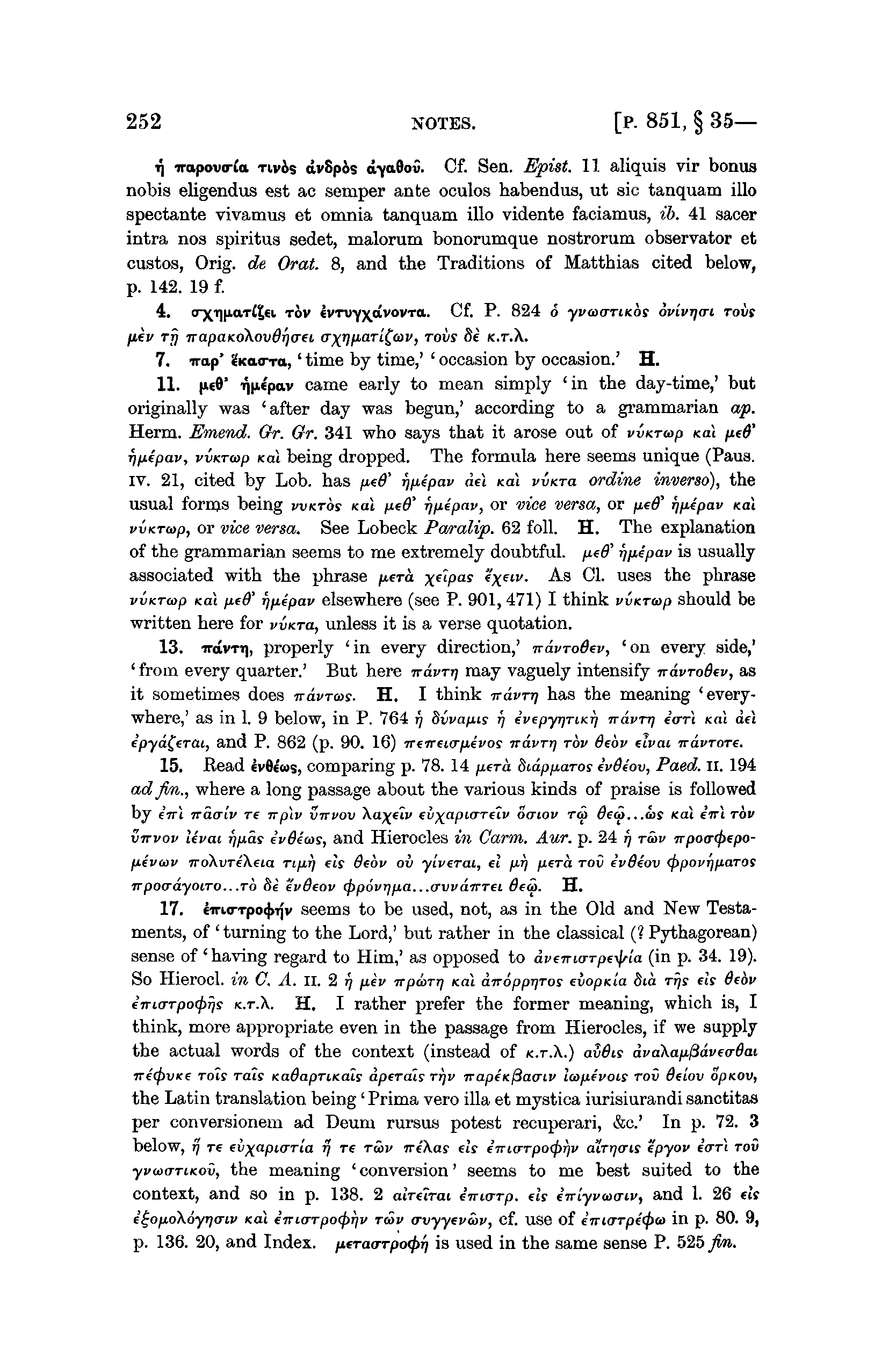
NOTES.
[P. 851, § 35—
ri irapovo-ta TIVJS dvSpis ctyaOoi. Cf. Sen. Epist. 11 aliquis vir bonus nobis eligendus est ac semper ante oculos habendus, ut sic tanquam illo spectante vivamus et omnia tanquam illo vidente faciamus, ib. 41 sacer intra nos spiritus sedet, malorum bonorumque nostrorum observator et custos, Orig. de Orat. 8, and the Traditions of Matthias cited below, p. 142. 19 f.
<rxi]|Lar(£ci TOV evTwy^avovra.
Cf. P. 824 6 yvaxmubs ovivi\<n robs /lev rf) napaicoXovdrjaei. o-)0fiaTi^a>v, TOVS Si
K.T.\.
7. irap' ifKacrra,' time by time,' ' occasion by occasion.' H.
11. |«8' 'Hl*«pciv came early to mean simply 'in the day-time,' but originally was 'after day was begun,' according to a grammarian ap.
Herm. Emend. Or. Or. 341 who says that it arose out of VVKTUP KM p.e6'
7)ntpav, VVKTWP KM being dropped. The formula here seems unique (Paus. iv. 21, cited by Lob. has pe0' rjp-epav del u ! vvKTa ordine inverso), the usual forms being VVKTOS K<U /xe6' r/fiipav, or vice versa, or fied' ijfiepav <al vvKTiop, or vice versa. See Lobeck Paralip. 62 foil. H. The explanation of the grammarian seems to me extremely doubtful, fxed' rj/iepav is usually associated with the phrase pera x**<-Pas *X""- -^-S du s e s *he phrase vvKTmp Kai pe6' ffpipav elsewhere (see P. 901,471) I think vvKrap should be written here for VVKTCL, unless it is a verse quotation.
13. iravrt), properly 'in every direction,' wdvrodev, 'on every side,'
' from every quarter.' But here •KO.VTT) may vaguely intensify iravroBtv, as it sometimes does •KO.VTWS. H.
I think irdvrq has the meaning 'everywhere,' as in 1. 9 below, in P. 764 17 bvvapis fj ivepyqriKT] navrr) eori Kai ad epydfcrat, and P. 862 (p. 90. 16) 7rfTT€i<Tfi4vos irdvrr) TOV 8ebv eiVat Travrore.
15.
Read evBe'ws, comparing p. 78. 14 jiera bi.apjj.aTos ivdeov, Paed. II. 194 ad Jin., where a long passage about the various kinds of praise is followed by eVi nao-lv re jrp\v virvov \a)(fiv d^apiaTeiv oo-iov T<U de<p.,.a>s <al eVl TOV VTTVOV tivai rifnai ivdeas, and Hierocles in Carm. Am. p. 24 f) TS>V 7rpoo-<f>epofiivaiv Tro\vTe\eta Tifir) fif 8ebv ov ylverai, el jxrj fiera TOV ivBiov <ppovT)fiaTOS npoo-ayOITO...TO 8e evBeov cpp6vr]fj.a...o-vvd7rTei 8ea>. H.
17. eirio-Tpoc|>ijv seems to be used, not, as in the Old and New Testaments, of ' turning to the Lord,' but rather in the classical (? Pythagorean) sense of ' having regard to Him,' as opposed to dvenio-Tp^la (in p. 34. 19).
So Hierocl. in C A. II. 2 17 p,ev irpa>TT) <al airopprjTos elopKia dia TT)S els 8ebv e'iTLo-Tpo<pris K.T.X. H. I rather prefer the former meaning, which is, I think, more appropriate even in the passage from Hierocles, if we supply the actual words of the context (instead of K.T-.X.) av6is dvaXafifidvfcrOai rrecpvKe TOIS Tats KaOapTiKais dperals TTJV nap(K(3ao~iv la>p.evois TOV Beiov opKOV, the Latin translation being 'Prima vero ilia et mystica iurisiurandi sanctitas per conversionem ad Deum rursus potest recuperari, &c.' In p. 72. 3 below, 77 re ei)(apio-Tia ij re rav 7re\as els e'irio-Tpo<f>riv air^ois epyov e'ori TOV yvao-TiKov, the meaning ' conversion' seems to me best suited to the context, and so in p. 138. 2 aireirai e'mo-Tp. us eiriyvatatv, and 1. 26 els e'£ofio\6yr]o-iv Kai cirio*rpo(priv TWV o~vyyeva>v, cf. use of effio-Tpe<pa> in p. 80. 9, p. 136. 20, and Index. peraoTpotpt) is used in the same sense P. 525 Jin. https://doi.org/10.1017/CBO9780511695513.011 Published online by Cambridge University Press
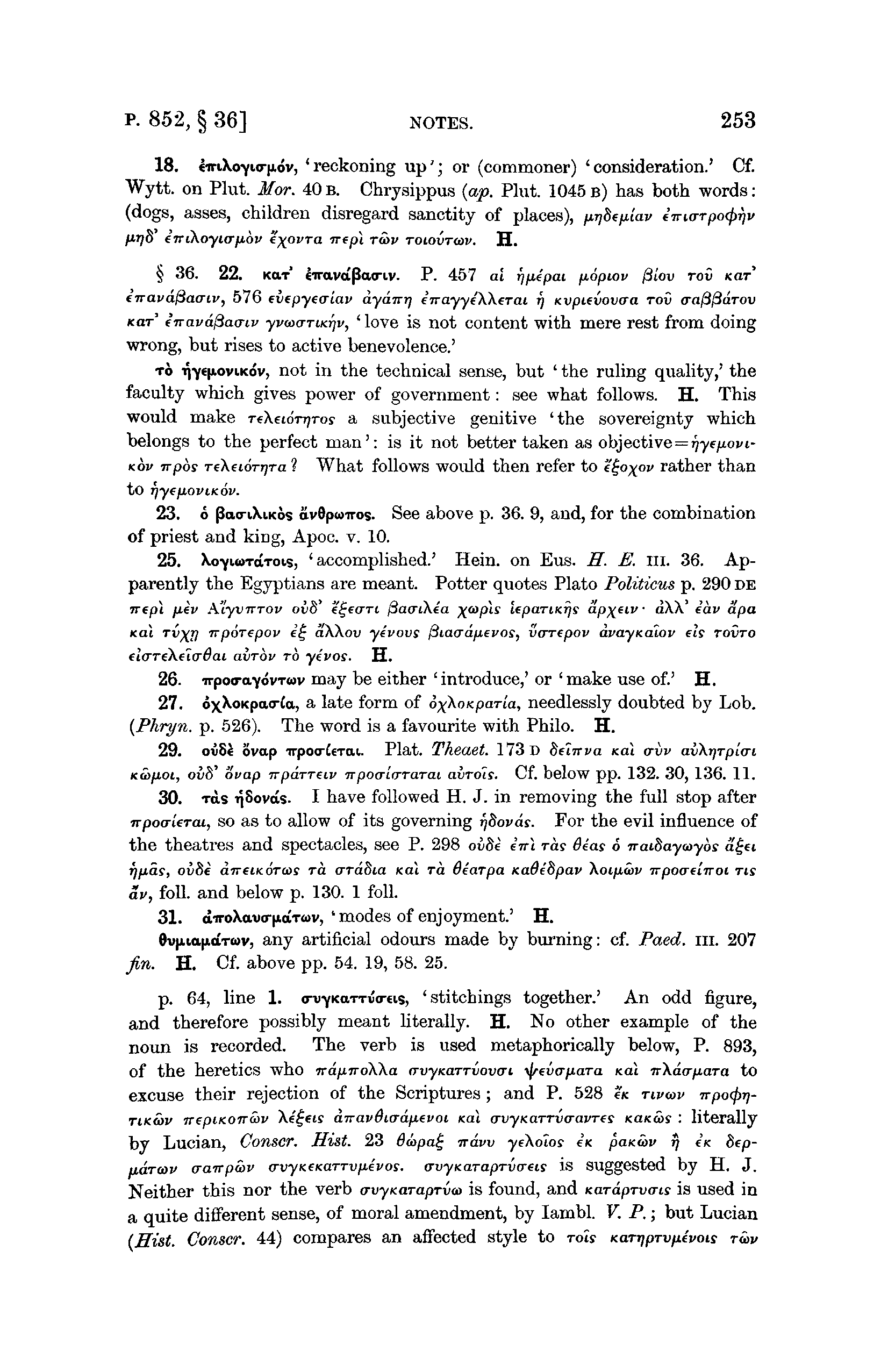
P. 852, § 36]
NOTES.
18.
«iri\o7io-|j.ov, 'reckoning up'; or (commoner) 'consideration.'
Cf.
Wytt. on Plut. Mor. 40 B.
Ohrysippus (ap. Plut. 1045 B) has both words:
(dogs, asses, children disregard sanctity of places), ^hfjiiav e [irjo CTriKoyiafiov t=%ovTa irepl TO>V TOIOVTUIV.
H .
§ 36. 22.
KCIT' 6iravapacri.v.
P. 457 al 17/xe'pai p.6piov /3iou rod xar' enavdfiao-tv, 576 cvcpyeaiav dydnr) iwayyiWfTai ij Kvptevovcra rov <ra/3/3a7-ou /car' enavdftao-iv yvaia-TiKrjv, ' love is not content with mere rest from doing wrong, but rises to active benevolence.'
TO V|Y6|j.oviKdv, not in the technical sense, but ' the ruling quality,' the faculty which gives power of government: see what follows.
This would make TfXewrqros a subjective genitive 'the sovereignty which belongs to the perfect man': is it not better taken as objective = fjyfixoviKOV irpos TfXciorriTa ? What follows would then refer to ti-oxov rather than to rfyfjioviKov.
23.
6 pao-iXiKos avSpuiros. See above p. 36. 9, and, for the combination of priest and king, Apoc. v. 10.
25.
Xo-yuoTaTois, 'accomplished.'
Hein. on Eus. H. E. m. 36. Apparently the Egyptians are meant. Potter quotes Plato Politicus p. 290 DE nepl juei* A'lyvnTOv ovd* i£e(TTi ftatriXea ^apls UpartKrjs ap^etv dXX* eav apa ical TV^TJ nporepov e£ aWov yivovs /3tao"a/iei/off, v(rrcpov avayKoiov els TOVTO elcrreXelcrdai airov TO yivos.
26.
TTpoo-avovTwv may be either ' introduce,' or ' make use of.'
27. oxXoKpacKa, a late form of o^XoKpai-ia, needlessly doubted by Lob.
(Phryn. p. 526). The word is a favourite with Philo.
29. oihk ovap irpoo-CcTai.
Plat. Theaet. 1 7 3 D belnva KCU a~vv avXrjTpiai Kwfioi, ovb' ovap npaTTiiv TTpotriiTTaTm avTols. Cf. below pp. 132. 30, 136. 11.
30.
Tas ijSovasI have followed H. J. in removing the full stop after Trpoa-Urai, so as to allow of its governing rjSovds. For the evil influence of the theatres and spectacles, see P. 298 oiSe eVl ras Bias 6 natdayayos a£ei f/fias, oide direiKOTCvs TO. crraSia xai Ta dearpa xa&eSpav \oip.£>v irpoadivoi TIS
Sv, foU. and below p. 130. 1 foil.
31. airoXavo-piaTwv, ' modes of enjoyment.'
0v|i.iapdT(oy, any artificial odours made by burning: cf. Paed. in. 207 fin.
Cf. above pp. 54. 19, 58. 25. p. 64, line 1. o-u-yKaTTvo-tis, 'stitchings together.'
An odd figure, and therefore possibly meant literally.
No other example of the noun is recorded.
The verb is used metaphorically below, P. 893, of the heretics who Trdp-noWa (rvyKOTTvovai yfrevGiiaTa nal 7r\d<rpaTa to excuse their rejection of the Scriptures ; and P. 528 ?K TIVO>V 7rpo(priTiKav irepiKOiraiv Xe'£«s a.Tvav&i.trd\>.*voi Ktn (TvyKaTTvo-avra
KCIKCOS : literally by Lucian, Conscr. Hist.
23 dtopat; trdvv ythoios t< pa<S>v r) {< Bepadrtov cranpuv (rvyKfKaTTVfiivos. avyKaTaprvtreis is Suggested by H. J.
Neither this nor the verb crvyKaTapTvco is found, and KardpTva-Ls is used in a quite different sense, of moral amendment, by Iambi. V. P.; but Lucian
(Mist. Conscr. 44) compares an affected style to rois KarqpTvfx.ivois riiv https://doi.org/10.1017/CBO9780511695513.011 Published online by Cambridge University Press
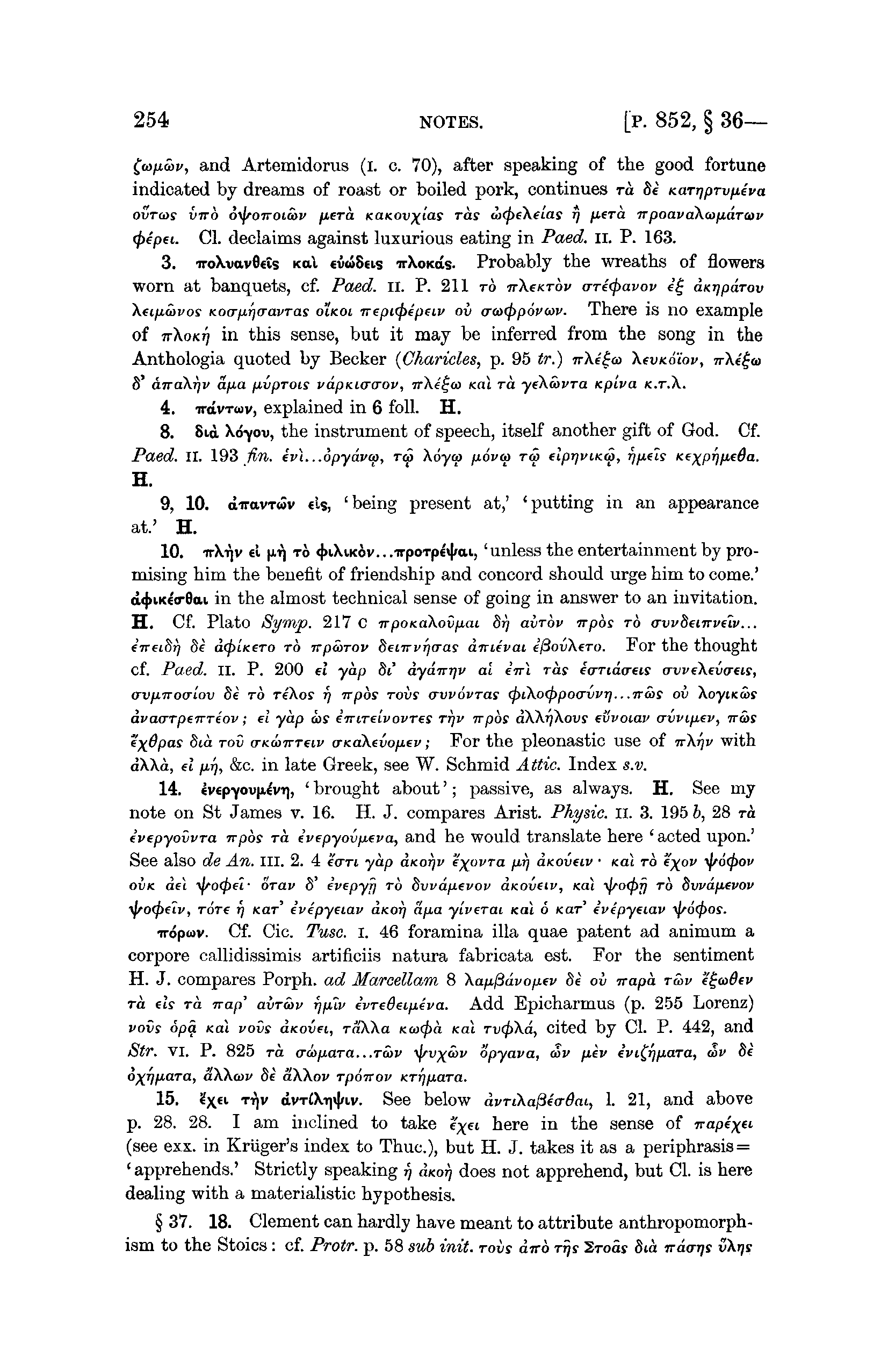
NOTES.
[P. 852, § 36—
fw/iooc, and Artemidorus (i. c. 70), after speaking of the good fortune indicated by dreams of roast or boiled pork, continues ra 8c
OVTCDS vnb o\jrowoiS>v jxerd KOKOv^t'ay ray w<pe\eias ij fiera Trpoav (j>epei. Cl. declaims against luxurious eating in Paed. II. P. 163.
3. iroXvavOets KaV CVUSEIS irXoKas. Probably the wreaths of flowers worn at banquets, cf. Paed. n. P. 211 TO •JTXCKTOV o-Te<pavov it; auriparov
Xfifiwvos KO{rp.rj(TavTas OIKOL irepupepeiv ov (roKppovojv. There is no example of 7TXOKJJ in this sense, but it may be inferred from the song in the Anthologia quoted by Becker (Gharicles, p. 95 tr.) TTXE'|<B \evKoiov, w\e^a>
8' dnaXr)V dfia jxvprois vdpKio~o~ov, 7rXe£oj Kal ra ye\S)VTa Kpiva K.T.X.
4. irdvTwv, explained in 6 foil. H.
8. Sid. \6yov, the instrument of speech, itself another gift of God. Cf.
Paed. II. 193 fin. evl...opydva>, r<» Xoya) fiovco ra elprjviKa, ripeis Kf^pr)fie6a.
9. 10. diravT«v els, 'being present at,' 'putting in an appearance at.' H.
10. irXi}v el (AT| TO <|>iXiKov...irpoTpe<|/oi, 'unless the entertainment by promising him the benefit of friendship and concord should urge him to come.' cujnKe'a-Sai in the almost technical sense of going in answer to an invitation.
H .
Cf. Plato Symp. 217 C npOKaXovfiat 8r/ avrbv npos TO (TvvSanvfTv...
(•jrciSri 8e acpi/cero TO irpanov htnrvr\o-a^ dnievai efiovXcTO. For the thought cf. Pcted. II. P. 200 cl yap St' dydmjv at eir\ ras io~Tido~€is o-vve\€vo~€is, crvfiTToa-lov 8e TO TCKOS f) Ttpos TOVS crvvovTas <pi\o<ppoo-vvr)...w£is ov XoytKaif dvao-rpeTTTeov; cl yap a>s iniTelvovres Trjv irpos dWrjXovs fiSvoiav crvvifiev, was e^dpas Sid TOV O-KWTVTCIV o-K.a\tvop.tv; For the pleonastic use of n\rjV with dWd, el p.r), &c. in late Greek, see W. Schmid Attic. Index s.v.
14.
Ivep-yovneVr], ' brought about'; passive, as always. H. See my note on St James v. 16. H. J. compares Arist. Physic, n. 3. 195 b, 28 TO f'vepyovvTa wpos rd evepyov/ifva, and he would translate here 'acted upon.'
See also de ATI. III. 2. 4 CO~TI yap aKorjv e^ovra fxrj dicovfiv • Kai TO €^OV yj/6<pov OVK del "tyofal"
OTav 8* evepyjj TO dvvdfievov aKovetv, Ka\ -^o(pTJ TO dvvdfievov tyotyeiv, TOTf r) <ar' evepyetav QKOJ) dp.a yiverai Kal 6 <ar' ivipyeiav i\ro(\>os. iropuv. Cf. Cic. Tusc. I. 46 foramina ilia quae patent ad animum a corpore callidissimis artificiis natura fabricata est. For the sentiment
H. J. compares Porph. ad Marcellam 8 \ap,^dvoixev de ov irapd TWV e^toBev Ta els Ta nap' avrav rj/juv ivTe6eip.eva.
Add Epicharmus (p. 255 Lorenz) vois Spa Kai vovs dicovei, TaWa KaXpd Kal Tv(f>\d, cited by Cl. P. 442, and StV. VI. P. 825 Ta o~a>fiaTa...Tcov ^rvx^v b'pyava, tov p.ev evi^rj/xaTa, aiv oe o^rjfiaTa, aWcov 8e aWov Tpoirov KTrjfiaTa.
15.
?xet ""iv CIVT£XT)<|/IV. See below avriXa^eo-dai, 1. 21, and above p. 28. 28. I am inclined to take c^ei here in the sense of wapexei
(see exx. in Kriiger's index to Thuc), but H. J. takes it as a periphrasis = ' apprehends.' Strictly speaking JJ axoij does not apprehend, but Cl. is here dealing with a materialistic hypothesis.
§ 37. 18. Clement can hardly have meant to attribute anthropomorphism to the Stoics : cf. Protr. p. 58 sub init. TOVS diro TTJS STOCIS Bid vd<njs v\r]s https://doi.org/10.1017/CBO9780511695513.011 Published online by Cambridge University Press
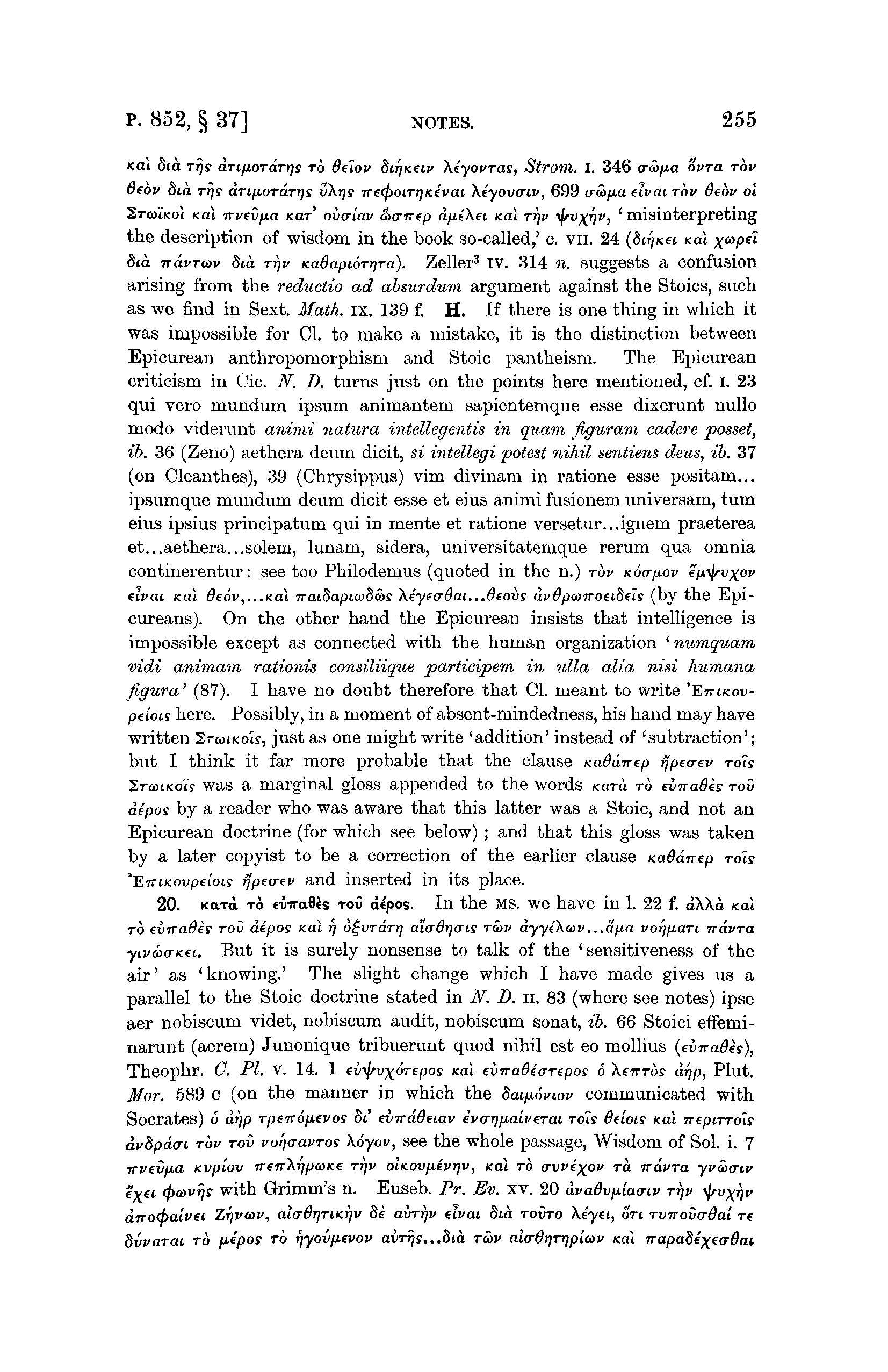
P. 852, § 37]
NOTES.
Kai &ia TTJSdniiordTt]! TO 8eiov BtrjKeiv \eyovras, Strom. I. 346 <ra>fia ovra TOV
6eov oca rijs drifioTaTrjs v\rjs TT€(J)OLTJ]KCVm \£yovo~iv, 699 craifia tivai TOV 8e6v oi
2r<utKoi Kai nvevp.a KaT* ovcrlav a>o"rr€p a/ieXei Kai TTJV ^jrv^Tjv, ' misinterpreting the description of wisdom in the book so-called,1 c. vn. 24 (8117x61 nal xaPel
81a. navTav 81a TTJV KadapioTrjTa). Zeller3 iv. 314 n. suggests a confusion arising from the reductio ad absurdum argument against the Stoics, such as we find in Sext. Math. ix. 139 f. H. If there is one thing in which it was impossible for Cl. to make a mistake, it is the distinction between Epicurean anthropomorphism and Stoic pantheism.
The Epicurean criticism in Cic. N. D. turns just on the points here mentioned, cf. 1. 23 qui vero mundum ipsum animantem sapientemque esse dixerunt nullo naodo viderunt animi natura intellegentis in qvmnx figuram eadere posset, ib. 36 (Zeno) aethera deum dicit, si intellegi potest nihil sentiens deus, ib. 37
(on Cleanthes), 39 (Chrysippus) vim divinam in ratione esse positam... ipsumque mundum deum dicit esse et eius animi fusionem universam, turn eius ipsius principatum qui in mente et ratione versetur...ignem praeterea et.. .aethera.. .solem, lunam, sidera, universitatemque rerum qua omnia continerentur: see too Philodemus (quoted in the n.) TOV KOO-JLOV ep.^rvy(ov clvai Kai 0e6v,...Ka\ 7rat§apico8co? Aeye(7#ai...$eou? dvdpa>noei$els (by the Epicureans). On the other hand the Epicurean insists that intelligence is impossible except as connected with the human organization 'numquam vidi animam rationis consiliique participem in idla alia nisi humana figura' (87). I have no doubt therefore that 01. meant to write 'ETTIKOVpeiois here. Possibly, in a moment of absent-mindedness, his hand may have written STGHKOI?, just as one might write 'addition' instead of 'subtraction'; but I think it far more probable that the clause Kaddnep rjpwrev rois
STGHKOISwas a marginal gloss appended to the words corn TO evnades TOV depos by a reader who was aware that this latter was a Stoic, and not an Epicurean doctrine (for which see below) ; and that this gloss was taken by a later copyist to be a correction of the earlier clause Kaddvep rols
'EiriKovpeioK rjpeo-fv and inserted in its place.
20. KaTci TO eiira^s TOU cUpos. In the MS. we have in 1. 22 f. dXXa Kai TO eu7ra#e? TOV dipos Kai rj 6^VTaTr] atcdrjais TO>V dyyfkwv...dfia voryxaTi ndvTa yivaa-Kd. But it is surely nonsense to talk of the 'sensitiveness of the air' as 'knowing.'
The slight change which I have made gives us a parallel to the Stoic doctrine stated in N. D. 11. 83 (where see notes) ipse aer nobiscum videt, nobiscum audit, nobiscum sonat, ib. 66 Stoici effeminarunt (aerem) Junonique tribuerunt quod nihil est eo moUius (einadis),
Theophr. C. PL V. 14. 1 cu^u^drfpos Kai eviradio-Tepos 6 XETTTOSdfjp, Plut.
Mor. 589 c (on the manner in which the 8aifi6viov communicated with Socrates) 6 dr/p Tpcrro^vos §1 evTrddemv evo-rjfiaivfrm rols Beiois Kai TrtpiTrois dvdpdo-i TOV TOV vorjcravTos Xdyoi', see the whole passage, Wisdom of Sol. i. 7
7rvevtia Kvpiov TTenXrjpaKe TTJV olKOVfievrjv, Kai TO o~vve%ov Ta irdvTa yvwo~tv i'%€i <pa>vT]s with Grimm's n.
Euseb. Pr. Ev. xv. 20 dvadvp-iao-iv TTJV ^vxyv a7ro(palvei Zr/vcov, alo-drjTiKTjv 8E avTrjv eivai 8id TOVTO Xeyei, OTI TV7rovcrdai re dvvarai TO jiipos TO fiyovfievov avTrjs,..di.d TO>V alo-6rjTr)pLa>v Kai Trapahi\ea8ai. https://doi.org/10.1017/CBO9780511695513.011 Published online by Cambridge University Press
NOTES.
[P. 852, § 37—
ras rvnao-eisravra yap tSta ^x^s eamv. Epicurus held that we see by means of the images discharged from the surfaces of things, and hear by the audible atoms which strike on the ear, cf. Usener Epicurea pp. 219—
224.
22. o-uva£o-8Tj<ris, not necessarily more than 'apperception': but here probably crvv has its full force.
On angels as the medium of divine communications see Strom. VI. P. 822 at TO>V ivapirav dvdpanav eirivoiai Kara iw'nrvoiav deiav yivovrai, bia.Ti8ey.ivrjS iratt TTJS ^rv^rjs Kal biabido/iivov
TOV delov Se\rjp.aTos els ras dvOpatnlvas i^u^dff, TCOV ev fiepei Beitav Xeirovpy&v <rvWaiJ.f3avoiJ.4va>v els TCLS roiavras biaKovias, 824 17 6e68ev diareivov&a els dvdpainovs a><peXeia yvapifios KadicTTarai o-vjxnapaKaXovvrwv dyyeXcov' Kal bi dyyeXoiv yap f] deia bvvafxis 7rape%ei ra dyaod...ore de Kal Kara rag eTrivolas rwv dv&ptti7ra>vtt.i[nrve'i TL Kal 17 8eia dvvafiis Kal evridjjO'i Tals <ppeo~lv lo")(yv T€ Kal (Tvval(T&T}(TLV dKpi($eo~repav, Exc. Th&od. P. 976 TOVS Xeirovpyovs
Ttitv dva(pepo[iev<av ev%a>v dyyeXovs, August, de Gen. ad Litt. XII. 30 sunt quaedam excellentia quae demonstrant angeli miris modis, utrum visa sua facili quadam et praepotenti iunctione vel commixtione etiam nostra esse facientes, an, &c. But in P. 769 Cl. argues that angels could not have taught men philosophy, on the ground that they are incapable of communicating with men, ovb' as rj/ilv TO. BTO, OVTWS fKeivois 17 ykarra, oifi' av opyavd TIS dolrj (pcovijs dyyeXois, x*^1! ^ey<o Kal ra TOVTOIS TrapaKtifieva...Kal
Trvfvfia Kal TT\r}fTt76fievov depa...iroWov ye del TOV 6cbv efifioav.
23.
T\ TOU CTUV€I8OTOS lirou|>o>|x^vT] TTJS ^j^X1^ 8iJvap.is.
(The power of conscience touching the soul (e.g. as a lyre).' H.
The difficulty of this interpretation is that it occurs in an attempt to explain how our prayers may be heard by God, though He is without any organ of hearing.
This is illustrated first by the angels who are able to participate in our thoughts (an attempt to prove ignotum per ignotius); but how by our consciousness or conscience, which is identical with our very self ? Probably we are to understand by it the conscience as judge, speaking in the name of God, cf. Chrys. {in Ps. 142) quoted by Suidas s.v. 6 BiKaa-rrjs 6 ev&ov,
TO o-vveidos Xc'yo) TO rjp.lv iyKadrjp.evov, {Horn. III. in Isa. vi. 2) TOVTO TO diKao'Trjpiov ov xpr]p.ao~i hia<p8eipeTai^ ov KoXaKeiats evhiba>o~i. Oelov yap eo~Ti Kal irapa 6eov TOIS rj^eTepats evthpvjievov "^v^ais.
One wonders why Cl. should have cared to add anything to Seneca's ' nihil prodest inclusam esse conscientiam; patemus Deo' (Frag. Exhort. 24), and ' illius divinitati omne praesens est' (N. Q. 11. 36) or to his own remarks in P. 821 yviivfjv i'o-mdev TTJV ijrvxriv jSXcn-tav Kal TTJV inlvoiav TTJV 6Kfi(rrou...f^« Si alS>vos. See below, p. 74. 17 f., and compare a curious argument in P. 756, where Cl. tries to explain the miraculous voice on Sinai.
There is the same confusion in Orig. Cels. 11. 72 Totavrr] eo-nv 17 6eia (pavrj, aKovoftevrj fiovois e'neivois, ovs fiovXeTai aKOveiv 6 Xeyav. ovbina be \eya> OTI ov irdvrais early dijp ireir\r)yp.evos r\ iikt)yj] depos, rj 0 TL irore XeyfTat e'v Tols nepl (pavfjs, 17 dvaypacpofiivr) <pa>vrj TOV 6eov.
25—27.
-rrjv <f>o)V^v...KvXLv8av|x^vi]v, cf. 24. 4—6.
27, 28. T^|IV€I...T6V KOV(JLOV, cf. Sirac xxxv. 17 npoo-evxfi Taireivov v€(j>eXas https://doi.org/10.1017/CBO9780511695513.011 Published online by Cambridge University Press
P. 853, § 38]
NOTES.
8ir)\6e, below p. 144. 7 (the gnostic) Tefivei Sia rr)s eVicrnj/ji/f TOP ovpavbv
Kai...anrcTai TO>V Spovcov rcov l p. 66, line 1. irpocupe'a-as. If this may be taken for granted, what need was there to argue the matter at all ?
4>8dvou<ri. Cf. above p. 24. 14, Mt. xii. 28 e(pdao-ev e'<j)' i/ias r) /3a<rjX«'a TOV dfov, Phil. iii. 16, &c. The construction with the Inf. which we had in the preceding line is common in late Gr., see 1 Kings xii. 18 o fiao-i\evs
((pdaa-fv dva^ijvm 'made haste to go up,' quoted with other exx. in Jannaris Or. 2121, also <pd. e^eveyKeiv below p. 170. 14.
2. Wo TTJS orvveiSrjo-eios iropfl|uiiovTai.
Cf. Eur. Andr. 1230 Saifiav oSe ns \(VKT)V aldepa jropdij.ev6fj.evos, Dion. Areop. Cael. Hier. 2 TT)S dyye\iKr)s
(Travvfiias eKKpi-ciis T)£LU>VTM fiia TO TT pa>ra>s els avTas eyyivecrdai rr/v diap-^ucTjv i'Wafx-^nv KOI SI' avroiv els rjfias Sianopdfievecrdai ras vnep rjfias eKCpavropias.
Steph. cites Synes. de Insomniis ra napa TOV deiov Tropd/icvoixeva.
In p. 64. 23 we had the conscience apparently judging men, here it seems to act the part of a mediator transmitting prayers to heaven : at least this is suggested by the Trpbs 6(6v of the preceding sentence.
I have inserted Tiva in the test to serve as a subject of the verb (the plural of the verb being often found with a neuter plural noun in late Greek). To understand
Trpompeo-eis would add a fresh complication: what distinction could we draw between ' resolves forwarded by conscience,' and ' resolves which speak with a voice of their own' ? Supposing Tiva to have been lost before riva, we may understand it of pious feeling of any kind.
4. dvafiEivai.
Cf. p. 74. 19, 168. 12, below P. 778 TOVTOV <pa>pfiv OVK avap.ivet Kvpios. irpo TTJS •yevscreajs.
Cf. Susanna 42 6 TWV KpvnTcov yvmo-Trjs, 6 el§a>s TO. ndvTa irp\v yeveaecos avTcov, below p. 74. 23.
7, 8.
T^S 8«vd(i.eo)s bis, referring to p. 64. 29. H.
Prov. xx. 27 is also quoted and explained in P. 611.
8. oX.os dKoij. See n. on p. 10. 2.
§ 38. 12. Xd-yous. Oratorical, but not metrical.
15. vTrovoLdsCf. Strom, v. 658 fifi., 659 init. 01 Trot^rai 6t' imovoias •noWd (pt\o(ro<frovo~L.. .oirtos els TTJV Toiv aiviyp-aTcav 'evvoiav 77 £TJTT]O~IS irapeio~~
Svovo-a eVi TTJV evpeo-iv TTJS d\r/()eias dvabpatirj.
Plato Rep. II. 378 D 6 veos ov)( oios Te Kpiveiv o TL T€ virovota K.a\ o fir) foil. eu<|>i](i.£o, ' devotion,' used of prayers: mostly found in poetry, but also in Plat. Alcib. 11. 149 B (the god Ammon is said to have preferred TT)V AaKeScufioviwv evcprjficav to all the worship of the other Greeks) TT)V yovv evfbrjfiiav OVK aWrjv Ttvd fioi Sonet Xeyeiv rj TT)V eu^r)v CIVTCOV, (the others try to bribe the gods to assent to their petitions whether bad or good) fiXao-- (brjLLOvvTGiv ovv avTihv duovovTes ol @eol OVK dnoSe^ovTai
Tas noXvTfkeis Bvaias. H.
8vcrc|>T](i.Cas, ' profaneness,' a rare sense.
So probably Sva<prj)xos in 2 Mace. xiii. 11 : TOV apTi avrfyv^oTa Xabv fir) edcrai TOIS 8vo-<f>r)fj.ocs e&vecriv vno\ei.plovs yevioSai, xv. 32.
H .
M. C.
https://doi.org/10.1017/CBO9780511695513.011 Published online by Cambridge University Press
NOTES.
[p. 853, § 38— 16 foil. i.e. the prayers of those whose desires are base must themselves be base. From 1. 11 to 1. 18 the subject is worthlessness of prayers to misconceived deities : from here to p. 68. 6 worthlessness of prayers when desires are misdirected; from which point the two are combined.
This very hard passage seems Stoic. Probably the idea is that, as in the case of all objects of desire, it is the personal use of them that is desired, so most of all is this the case with the highest good, which is only attained by being good. H.
Cl. is still elaborating the idea that prayer is good or bad according to the character of the petitioner.
This is so, because prayer is the religious vesture of desire, and therefore varies according to the nature of the desire. I take S>v fiev as gen. object, after dpegeis, 6p/W, fi)(al, as below, 1. 26 TTJV evxrjv TWV ovrws dyaBwv noieirai.
The Stoics distinguished between Sppr} and ope^is, see Epict. Diss. in. 2. 1 rpeis elm
TOTTOL 7T€pl OV doKrjBrjVat hel...6
7T€pl TCtS 6pe£eLS Kal TaS €KK\l<reiS tva JU1JT* opeyo/xevos dnoTvyxdvr/ firjr' eKKXlviov Trepnr'nrTr) • 6 ircpl ras opfias Kal d<popp.dt Kal anXas 6 nepl TO K.a8r)Knv...TpiTos...6 wepl ras (TvyKaTa8e(reis.
Chrysippus limited the opfirj to actions (Plut. Stoic. Rep. 11. 6, p. 1037) TJ 6pp.rj Toil dvdpoinov \6yos €<rrl irpotrraKTiKos avra rov irotciv.
In P. 617 init. Cl. quotes a distinction between ope^is and ewLdvp-la, the latter being related to r^hovdis KQ! aKoXatxia, the former being a Xoyt<r) Kivr/ais eVl rS>v <ara (pixriv avaytcaiaiv.
18—22.
Sioirep ovScls €iri8u|j.et iropaTOS, dXXa TOXP irietv..iroXiTe«£o-8oi.
This seems to be out of place here. It interrupts the connexion between the preceding and the following sentence (TOVTWV—eVitfvp'at), and it is difficult to see how it can be a consequence of the preceding (diowep). If opfMi alone were spoken of, we might make use of the distinction of Chrysippus, which limits these to action, but Cl. is speaking of 6pe£fis and iwiBviiiai. as well, and he gives its widest sense to opfiai by the phrase
6Xwy fin-eiv.
In the translation I have placed the sentence at the end of the section, but the force of hionep, in that or any other position, is far from clear. We should rather have expected Sri. Perhaps something has been lost. For the opposition of the verb to the substantive cf. Str. iv. P. 581 npo(Tf)(i<TTepov iv e^si yivtrm TavTOTrjros anaSovs, as HJ/KEVI inirrTr\)i.r\v i'Xfiv Kcti yvaxnv KeKTrjoSm, liruTTr\p.r\v hi eivai <a\ yvaxriv, Epict. Diss. III.
20. 4 vyela dyadov, votros he Katcov; ov, avOpcone. d\\a T'I; TO KOXCOS vyiaiveiv dyadov, TO KCIKWS KCLKOV, Paed. I. 136 TO he dyaBbv [etVai] ov rw TTJV dpeTTjv e%eiv dyadov eivai Xeyerm.. .dperfj yap e'tTTtv avrrj, dWa r<5 avrrjv Ka6' avrrjv Kal
Si avTrjv dya6r)v elvai, below p. 138. 9 f. Zeller3 IV. 224, 225. This opposition seems to be connected with the Aristotelian doctrine that man's work and happiness consists in an evepyeia, and also with the Stoic distinction between ra e<f>' rjp-'iv and TO. OVK e(p' fjpXv. Stobaeus' account of the Stoic philosophy seems to show that this was a subject of controversy among them {Eel. II. 196 exeiv...opey6ixe8a Taya8d,...Trjv yap (ppovrjmv alpov)ie8a *?Xelv Ka* TVV wtppOGvvriv, ov p.a Ata TO (fipovc'iv Kal ctocppovelv, dcra^iaTa ovra Kal KaTfjyoprjfiaTa).
24.
KaTaXXijXws 7Cv«T<n tls, 'correspond in regard to,' cf. p. 12. 30 https://doi.org/10.1017/CBO9780511695513.011 Published online by Cambridge University Press
P. 853, § 39]
NOTES.
oiKeia Km KaTaWr/Xoc evcpyeo-ia, Epict. Diss. I. 22. 9 TCLS (pvcrwas npokijtyeis
£<papix6£*iv Tais inl [itpovs ovcriais KaraXX^Xws Tr/ (jyvo-et.
25. irapaKcCficva, cf. below p. 68. 2, Plut. Mor. 36 B &v TO fiev elprjicev (vapyws, TO Se TG> elprjfifvco napaKeipfvov itrnv, Strom. P. 769 x*^7!
Kal ™ TOVTOIS ivapaKeijieva.
26.
6 TOCVW •yvoio-TiKos.
Possibly the reading of the MS. (roiwv 6) may be correct, as TOLVVV often stands first in late Gr. (see Lob. Phryn. 342) ; but I do not know of any instance in Clem.
TOV OVTWS tryaOdv.
Cf. below p. 76. 16.
28. a-vvtpyav, cf. below p. 74. 11, 80. 14.
H. p. 68, line 1.
|M|K£TI i?x«iv...etvai S4.
Cf. below p. 138. 9, 10 ov fierovo-la •n-vpbs (jicoravos, dXX' elvai oXot (pios. For the use of &t = d\\a, see W. Schmid iv. p. 549 f.
§ 39. line 3. irpocriJKti: contrast with § 44. H.
8. <j>avTao-£<j d-ya8<Gv, 'from an imagination of good.' The technical word for any mental ' impression,1 Lat. visurn or species, cf. Laert. vn. 45 f.,
Gat. on Ant. in. 16, Upton, Index to Epict. s.v., and such phrases as (p. fioi eyevero eXaiov Ep. Diss. II. 20. 29, (p. fjSovrjs nvos ib. Ench. 34.
For the sentiment cf. Plat. Ale. II. p. 138 B OVKOVV SOKCT trot 7TOXX?5J TrpOfArjOctas ye npovheiaBai OTTCOS firj \rjcfi TLS avrbv eu^d/ievoff /xe'yaXa Kand, doKwv dc ayaOd; 11. dXX' oi\ 6(io£ws. The angels' prayer is solely for a continuance of what they have already. H. But elsewhere Cl. speaks of heaven as a state of progressive virtue and happiness, see p. 20. 5 ^cra^dXXft -n-av TO cvdperov els djidvovs oiKijo-eir, ib. 11. 17, 18 eir dfxeivovs dp.eiv6vav TOTTWV
TOTTOVS d(pmofi*vas: and the angels, who have their station at the end of the visible world (p. 16. 8), have their ranks filled from among men
(P. 1004), who are again promoted to the higher orders. Perhaps Cl. may have been thinking of the clause in the Lord's Prayer in which heaven is represented as the pattern and standard for earth.
13. airoTpoirrj, ' deprecation' of evils, by prayer or sacrifice: cf. aTroTpo- •n-cuos.
This implies that the true conception of prayer goes beyond amjo-it, cf. p. 66,1. 26 (for a'iTT)o-is would equally include positive and negative), and involves positive communion with God, which means more than anything desired for ourselves. The deprecation of evil therefore is, in a sense, prayer, but only subordinately. H.
It seems unnecessary to state that deprecation is a form of prayer. Can diroTponr) have the more literal sense of 'turning away' (transitive = 'deterrence') which it bears in Plat.
Leg. IX. 853 C vojxo8(Teiv direikovvTa, idv TIS TOIOVTOS ylyvrjTm, icai TOVTCDV diroTpoirrjs r€ evfxa (tai ytvofiiviav Ko\do-eo>s TiBivai in' avTols vofiovs, 881 A TOVTCOV Sei TIVOS drroTpoTrrjs eo^em;?, Ale. II. 148 D, or neuter (of repentance) which it has in Plut. Mor. 519 p xph<Tltl0V np°s TI)V dnoTponr^v 17 TWV 7Tpoeyva)o~u.zva>v dvdixvrjo't.s, 520 D ^liyitrTov rrpbs TTJV TOV ird8ovs dnoTpo7rr)v 6 I6i.o-p.6i, iav TroppaSev dp£dp.evoi yvp.vd£a>fiev eavToiis cVt Tavrrjv TT)V 1 Another €ifios evxvs is mentioned in p. 72. 10 below.
17—2 https://doi.org/10.1017/CBO9780511695513.011 Published online by Cambridge University Press
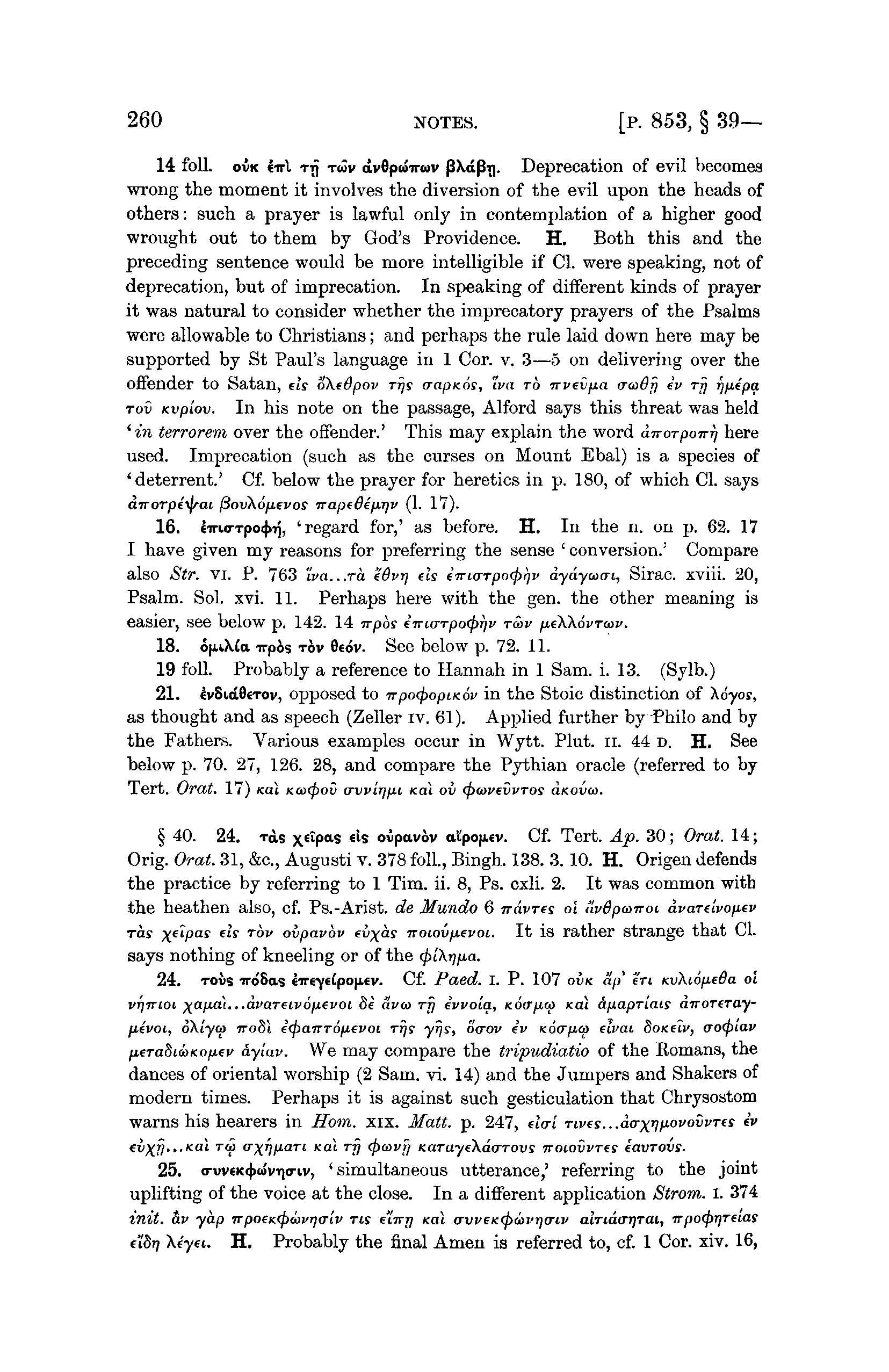
NOTES.
[P. 853, §
3.9— 14 foil, OVK 4irl TTJ TOT avOpuiruv fSXctpT]. Deprecation of evil becomes wrong the moment it involves the diversion of the evil upon the heads of others: such a prayer is lawful only in contemplation of a higher good wrought out to them by God's Providence.
Both this and the preceding sentence would be more intelligible if Cl. were speaking, not of deprecation, but of imprecation.
In speaking of different kinds of prayer it was natural to consider whether the imprecatory prayers of the Psalms were allowable to Christians; and perhaps the rule laid down here may be supported by St Paul's language in 1 Cor. v. 3—5 on delivering over the offender to Satan, els oKedpov rfjs aapKos, iva TO nveifia o-a>8f) ev rrj f/liipa rov Kvpiov. In his note on the passage, Alford says this threat was held
' in terrorem over the offender.'
This may explain the word aTTOTpoirr) here used.
Imprecation (such as the curses on Mount Ebal) is a species of 'deterrent.'
Cf. below the prayer for heretics in p. 180, of which Cl. says airorpi^rai @ov\6fievo$ TrapfOi^irjv (1. 1*7).
16. 4iri<rTpo4>rj, 'regard for,' as before.
In the n. on p. 62. 17
I have given my reasons for preferring the sense ' conversion.' Compare also Str. VI. P. 763 'iva...TO. edvrj els eTrio-Tpatfirjv ayayaxri, Sirac. xviii. 20,
Psalm. Sol. xvi. 11. Perhaps here with the gen. the other meaning is easier, see below p. 142. 14 irpbs inio-rpo^v TOIV fiek\6vTa>v.
18. 6|xi\£a irpis TAV 0€OV. See below p. 72. 11.
19 foil.
Probably a reference to Hannah in 1 Sam. i. 13. (Sylb.) 21. 4vSwifl€Tov, opposed to TrpofoptKov in the Stoic distinction of Xdyos, as thought and as speech (Zeller iv. 61). Applied further by Philo and by the Fathers. Various examples occur in Wytt. Plut. n. 44 D. H. See below p. 70. 27, 126. 28, and compare the Pythian oracle (referred to by Tert. UTdt. 17) Kal Kco<pov o~vvirjiAL Kal OV (fxavevvros aKovoi.
§ 40. 24. TAS x£'Pas «s oipavov a£po|iev. Cf. Tert. Ap. 30; Oral. 14; Orig. Orat. 31, &c, Augusti v. 378 foil., Bingh. 138. 3. 10. H. Origen defends the practice by referring to 1 Tim. ii. 8, Ps. cxli. 2. It was common with the heathen also, cf. Ps.-Arist. de Mundo 6 navres oi avdpanroi dvaTfivo/itv
Tas %eipas eiV rov oipavov fu^af noiov/ievoi. It is rather strange that Cl. says nothing of kneeling or of the (plXijfia.
24.
TOUS iroSos eireye£po|i£v. Cf. Paed. I. P. 107 OVK ap' en KvXiofifda oi vrjnioi xa/iai...ai'arFivd/iiCi'Ot Si ava ry evvola, xdcr/xw xai afiapriais dnoreTayfievoi, oXiyio TTO8I i<j>airTop-€voi rfjs yrjs, Saov dv Kotr/ift) elvai SOKCIV, aocptav fieTadiooKo/xfv dyiav. We may compare the tripudiatio of the Romans, the dances of oriental worship (2 Sam. vi. 14) and the Jumpers and Shakers of modern times. Perhaps it is against such gesticulation that Chrysostom warns his hearers in Horn. xix. Matt. p. 247, elo-i nves...darxrjpovovvTfs iv *v)(r}...Kai TU c^ijuaTi KW. rj] <f)(ovrj KaTay€\do~rovs
TTOCOVVTZS
iavrovs.
25. crvveK<|>ii>VTicriv, 'simultaneous utterance,' referring to the joint uplifting of the voice at the close. In a different application Strom. I. 374 init. av yap npoeK<pa>vr)(riv TIS emy Kal crvveK(pwvr)cnv alrido-rjTai, irpo(f>rjreias f'idr] \4yei. H.
Probably the final Amen is referred to, cf. 1 Cor. xiv. 16, https://doi.org/10.1017/CBO9780511695513.011 Published online by Cambridge University Press
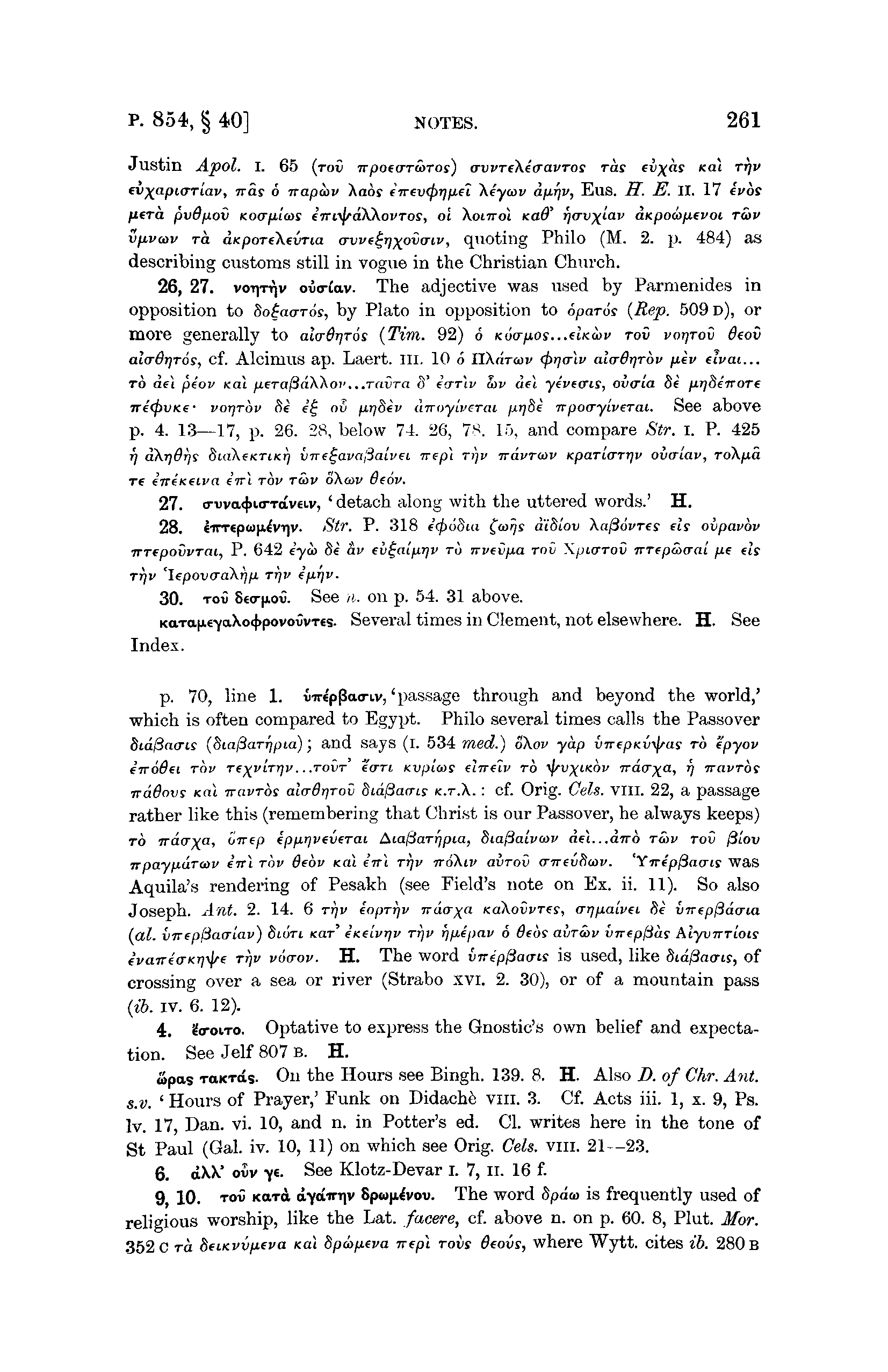
P. 854, § 40]
NOTES.
Justin Apol.
I. 65 (TOV npofo~TWTOs) o~WTfXeo~avTos ras cii^ds Kai TTJV tv^apccrriav, nas 6 napav Xaos fnev<prjjiel Xeya>v dju.ijv, Eus. IT. E. II. 17 ivos fiera pv6p.ov Kocfiicos iffL^aXXovTos, ol Xomol icaO* r)o~v\lav aKpotbficvoi TCOV vfivav TO. aKpoTfXfvria o-vve^rj^ovo-iv, quoting Philo (M. 2. p. 484) as describing customs still in vogue in the Christian Church.
26. 27. voiyr^v oio-Cav. The adjective was used by Parmenides in opposition to Sofaords, by Plato in opposition to Sparos (Rep. 509 D), or more generally to ala-Or/Tos (Tim. 92) 6 K6o-nos...fiKa>v TOV vorjrov 6eov ala-drjTos, cf. AlciniUS ap. Laert. III. 10 6 nXdrav (prjo-lv alrrdrjrov p.ev tlvai...
TO de\ pcov Kai /iera/3aXAor...ravra 5' €(TT\V hv del yeVecriff, oviria 5e /x^SeVore ni(pVKevorjTov Se i^ nv p.r)8ev dnoyiveral prj&e 7Tpoa-yiveral.
See above p. 4. 13—17; p. 26. 28, below 74. 26, 78. 10, and compare Str. I. P. 425 rj aXrjdrji SiaktKTtKr} vire^avafiaivEi nep\ rr)v ndvT(t>v KpaTt(TTrjv oiKriav, ToXfxa
T€ i7T€K€tva €7Ti TQV TUtV o\oiV BtOV.
27. cruva<)>i(rTavei.v, ' detach along with the uttered words.'
28.
4irT€p<ojJi.^VT|V.
Stv. P. 318 f(po$ui £<or}S didtov XafiovTcs €is ovpavov TTT€povvTaiy P. 642 eya> de av ev^aiprjv TO irvevjxa TOV \pi(XTov nTep&Krai [le fls rr/v 'ItpovcraXfjp. TT\V ip.rjv.
30.
Toi 8eo-|j.ov. See n. on p. 54. 31 above.
KaTa|ie-YaXo<)>povoijvTes. Several times in Clement, not elsewhere. H. See Index. p. 70, line 1. iireppao-iv, 'passage through and beyond the world,' which is often compared to Egypt.
Philo several times calls the Passover hidfiaais (§ia/3ari7pia); and says (i. 534 med.) SXov yap vnepKv-^ras TO epyov inoQei TOV Te^viTrjv. ..TOVT €O~TI Kvplois elrrriv TO ^TV^LKOV Trdtr^a, rj iravTos
Tfd6ovs Kai ivavTos al<r8r]Tov Sia/3ao-ir K.T.X. : cf. Orig. Cels. VIII. 22, a passage rather like this (remembering that Christ is our Passover, he always keeps)
TO Tracrya, onep kpp.i)V£V£Tai ALajSaTrjpia, &ta(3alv(i>v aet...a7ro Tutv TOV /3/OU
TTpay\iuT<xtv €TT\ TOV deov Kai enl TT)V TTOKLV QVTOV <nreua'(j>v. (Yirep($ao~is was
Aquila's rendering of Pesakh (see Field's note on Ex. ii. 11). So also Joseph. Ant. 2. 14. 6 TYJV eopTr)v irdo-^a KaXoiivTes, o~Tjp.atv€i fie VTrepftdo'La
(<xl. VTrepfiaalav) SLUTL KaT* €K€LVTJV TTJV f]p.epav 6 de6s avTtov V7T€p^ds hiyvnTiois ivanio-K-q^e Tr)v votrov.
The word vnipfiaa-is is used, like 8ia/3acrir, of crossing over a sea or river (Strabo xvi. 2. 30), or of a mountain pass
(ib. iv. 6. 12).
2<roiTo. Optative to express the Gnostic's own belief and expectation. See Jelf 807 B. H. upas TaKTds. On the Hours see Bingh. 139. 8. H. Also D. of Chr. Ant. s.v. ' Hours of Prayer,' Funk on Didache vin. 3. Cf. Acts iii. 1, x. 9, Ps. lv. 17, Dan. vi. 10, and n. in Potter's ed. Cl. writes here in the tone of St Paul (Gal. iv. 10, 11) on which see Orig. Cels. vin. 21—23.
6. dXK' ovv -ye. See Klotz-Devar I. 7, n. 16 f.
9 10. TOV Kard aydiriyv 8pw(j^vov. The word Spam is frequently used of religious worship, like the Lat. facere, cf. above n. on p. 60. 8, Plut. Mor.
352 c TO. BeiKvifieva KM 8pa>p.(va nepl roiis Oeovs, where Wytt. cites ib. 2 8 0 B https://doi.org/10.1017/CBO9780511695513.011 Published online by Cambridge University Press
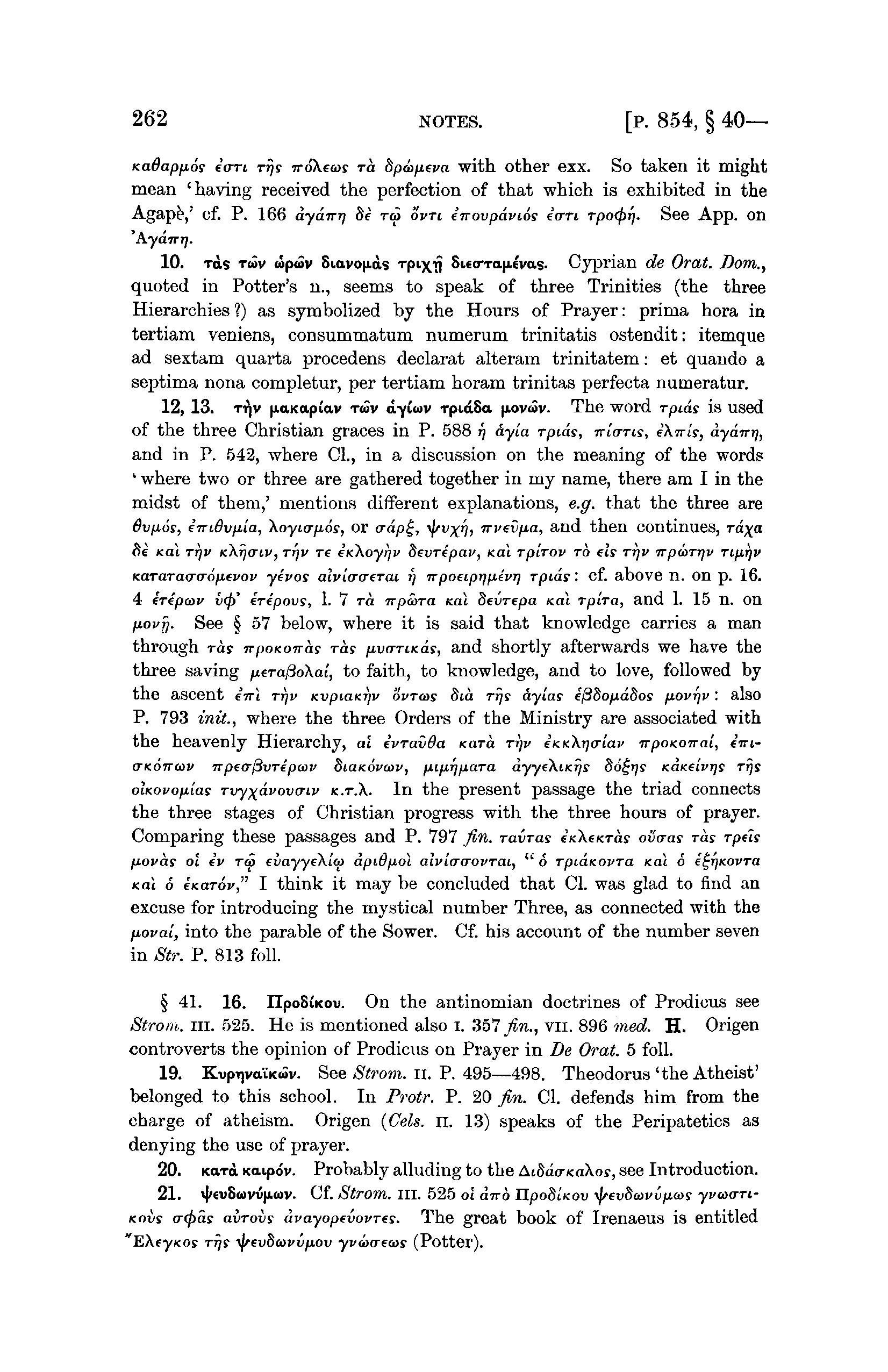
NOTES.
[P. 854, § 40—
KaBapjxos ion rijr TroKeas TO bpmfieva with other exx. So taken it might mean 'having received the perfection of that which is exhibited in the Agape,' cf. P. 166 dydirrj Sf ra OVTL iirovpavios Itrn Tpo<prj. See App. on Ayanrj.
10.
T<XS TWV toptSv Siavo|j.d$ TPtXT) 8i€o-Ta|ievas.
Cyprian de Orat. Dom., quoted in Potter's n., seems to speak of three Trinities (the three
Hierarchies ?) as symbolized by the Hours of Prayer: prima hora in tertiarn veniens, consummatum numerum trinitatis ostendit: itemque ad sextam quarta procedens declarat alteram trinitatem: et quando a septima nona completur, per tertiam horam trinitas perfecta numeratur.
12, 13. rffv (iaKapiav T<OV d-yCuv rpidSa p.ovwv.
The word rptds is used of the three Christian graces in P. 588 17 dyia Tpids, rria-Tti, e\7ris, dydirr}, and in P. 542, where Cl., in a discussion on the meaning of the words
' where two or three are gathered together in my name, there am I in the midst of them,' mentions different explanations, e.g. that the three are
0vfi6s, e7ri#u/Aia, Xoyio'/Aos', or o~dp£, tyvxf]i 7rv€V[ia, and then continues, Ta%a &e Ka\ Tr)v K\T)<TIVJ TTJV TC exXoyrjv devTfpav, Kai rptrov TO els TTJV irp<HTr\v TI\LT)V KaTaTaa-frofievov yevos alvitrcrfTai r) wpoeiprffievrj rpids : cf. above n. on p. 16.
4 GTcpcov v(j>' €T€povs, 1. V Ta ffpcora nai Sevrepa nal Tpira, and 1. 15 n. on liovj/. See § 57 below, where it is said that knowledge carries a man through ras trpoKonas ras /xva-TiKas, and shortly afterwards we have the three saving fierafloXal, to faith, to knowledge, and to love, followed by the ascent eVl TT\V KvpiaKrjv ovrms 8ia rij? dylas eftdofidSos fiovrjv: also
P. 793 ink., where the three Orders of the Ministry are associated with the heavenly Hierarchy, al ivrav8a Kara TTJV eKKXrjcrlav npoKonai, iirio-Kowav npcrrfivTipwv diaxovcav, fiifirjiiaTa ayyeXucrjs do^rjs KaK(ivrjS rrjs oiKovofiias Tvyxdvovcnv K.T.X. In the present passage the triad connects the three stages of Christian progress with the three hours of prayer.
Comparing these passages and P. 797 Jin. ravras exXcKTasoila-as ras rpiis fiovas ol iv ra eiayye\i<a dpidfioi alvio-<rovTai, " 6 TpiaKOvTa. Kai 6 e^rjKOVTa
Kai 6 CKOTOV," I think it may be concluded that Cl. was glad to find an excuse for introducing the mystical number Three, as connected with the fiovai, into the parable of the Sower. Cf. his account of the number seven in Str. P. 813 foil.
§ 41. 16. IIpoS^KOD. On the antinomian doctrines of Prodicus see Strom,, in. 525. He is mentioned also I. 357 fin., VII. 896 med. H. Origen controverts the opinion of Prodicus on Prayer in De Orat. 5 foil.
19. K.vpi)vaiKuv. See Strom. II. P. 495—498. Theodorus'the Atheist' belonged to this school. In Protr. P. 20 fin. Cl. defends him from the charge of atheism.
Origen {Gels. n. 13) speaks of the Peripatetics as denying the use of prayer.
20. Kara Kaipdv. Probably alluding to the Ai.bda-K.a\os, see Introduction.
21.
<|/«D8<OVI5(».<OV. Cf. Strom, in. 525 ol dno HpoSinov \^ev8a>viJ/i<or yvaariKOVS o-<pas aiiTovs dvayopcvovTes. The great book of Irenaeus is entitled s Tr/t •^rev&aivvfiov yva>aeo>s (Potter). https://doi.org/10.1017/CBO9780511695513.011 Published online by Cambridge University Press
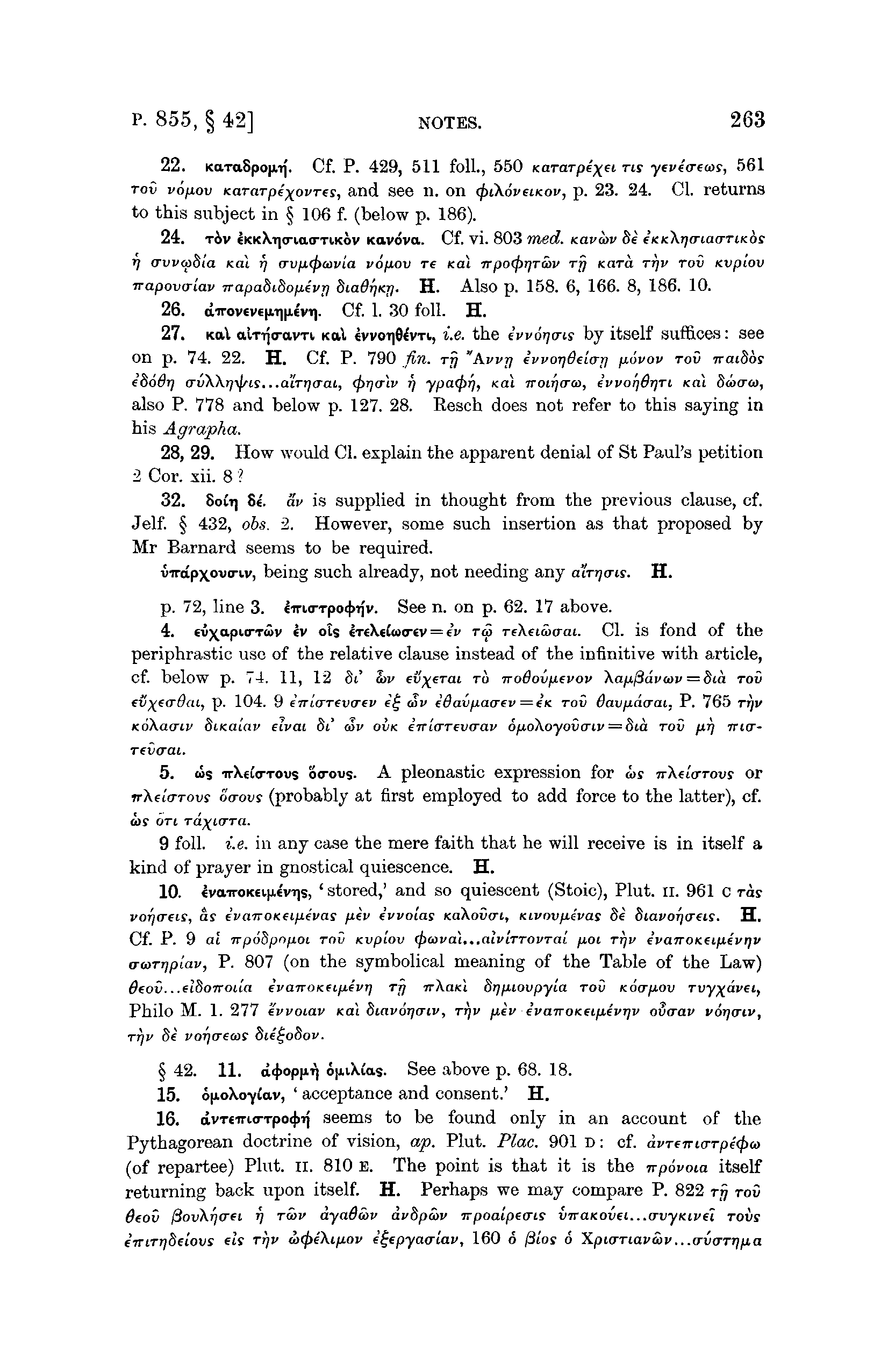
P. 855, § 42]
NOTES.
22. KaraSponif. Cf. P. 429, 511 foil., 550 KaTaTpiXe<. ns ycviveas, 561 TOV vofiov tcararpixovTcs, and see ii. on <fit\6veiKov, p. 23. 24. Cl. returns to this subject in § 106 f. (below p. 186).
24.
T&V «KK\T]o-ia(TTiKov Kavova. Cf. vi. 803 Tried. Kavav Se e/acXr/o-iao-TiKos r} (Tvvtphia Kai i) o-v/xcpaivia i»d/nou re Kai rrpo(pr)Tav rfj Kara TT)V TOV Kvpiov irapovo-iav napadiSou-ivrj diaOrjKfl. H .
Also p. 158. 6, 166. 8, 186. 10.
26. a<irovcvE|U||Uvi|.
Cf. 1. 30 foil.
H .
27.
Kal al-njo-avTi Kal IVVOIJO^VTI, i.e. the ivvorjo-is by itself suffices: see on p. 74. 22. H. Cf. P. 790 fin. rrj "Awy ivvo-qdeicrrj fiovov TOV iraMs i&odrj (TuX\i;i^(s...aiVt;(rai, (prjcr'iv fj ypafpr), xai iroir)(ra>, ivvoqdrjTt Kai Saxra), also P. 778 and below p. 127. 28. Eesch does not refer to this saying in his Agrapka.
28. 29. How would Cl. explain the apparent denial of St Paul's petition 2 Cor. xii. 8 ?
32. Soir] 8«. av is supplied in thought from the previous clause, cf.
Jelf. § 432, obs. 2. However, some such insertion as that proposed by Mr Barnard seems to be required. v, being such already, not needing any O'ITTJO-K. H. p. 72, line 3. «irio-Tpo<|>r]v. See n. on p. 62. 17 above.
4. rixapio-Toov Iv ots &re\eCii>(rev = iv ra rsXeiaxrai. Cl. is fond of the periphrastic use of the relative clause instead of the infinitive with article, cf. below p. 74. 11, 12 di' o>v eiSxerai TO nodovjxevov \aixfidva>v = bia TOV ev^frdatj p. 104. 9 e7rlo~Tevo~€v e£ atv tdavfiao'ev =€K TOV Oavfxd(rai: P. 765 TTJV
Ko'\ao~iv hiKaiav elvai bC <ov OVK e7Tio~rei/o"ai> 6p,o\oyovo~iv = hta TOV firj 7rio~T€VO~at.
5. us irXeCo-Tous ocrousA pleonastic expression for as nXdo-rovs or ir\(io-Tovs So-ovs (probably at first employed to add force to the latter), cf.
<a? OTL Ta^to'Ta.
9 foil. i.e. in any case the mere faith that he will receive is in itself a kind of prayer in gnostical quiescence. H.
10. ^vairoKevnevi]s, ' stored,' and so quiescent (Stoic), Plut. II. 961 C ras vorio~(i£, as £va7roKfip.€vas [lev tvvoias
KaXouo"t, Ktvovfievas de $iavor](T€LS. S .
Cf. P. 9 at npodpofioi TOV Kvpiov <pa)va\l..alviTTOVTal jxoi TT)V €va7roKei[l4vr]V o-aTr]piav, P. 807 (on the symbolical meaning of the Table of the Law)
&€ov...etSoTroii'o evanoKtifievT] TJJ ir\aKi drjp.iovpyla TOV Koo~pov Tvy^dvety Philo M. 1. 277 evvoiav Kai hiavorjaiv, TTJV p,ev ivanoK*ip,tvr]v ovo~av v6rjo~ivt TTjV $€ VOT]O~€O)S SU^oboV.
§ 42. 11. ac}>opnT| 6[j.iXias. See above p. 68. 18.
15. o|ioXo-y£av, ' acceptance and consent.' H.
16. avT«Tn.o-Tpo(J>TJ seems to be found only in an account of the Pythagorean doctrine of vision, ap. Plut. Plac. 901 D: cf. CIVTCnurTpe<p<o
(of repartee) Plut. II. 810 E. The point is that it is the npovoia itself returning back upon itself. H. Perhaps we may compare P. 822 rrj TOV
Ocov ftovh.rjo'fi TJ TO)V aya8a>v avbpa>v ITpoaipeo~LS VTraKovei...o~vyKivH TOVS f'ntTr]8elovs els Trjv aXpfXi/iOv etjepya<riav, 160 6 /3tos 6 Xpio-Tiava>v...o-vagT7jp.a https://doi.org/10.1017/CBO9780511695513.011 Published online by Cambridge University Press
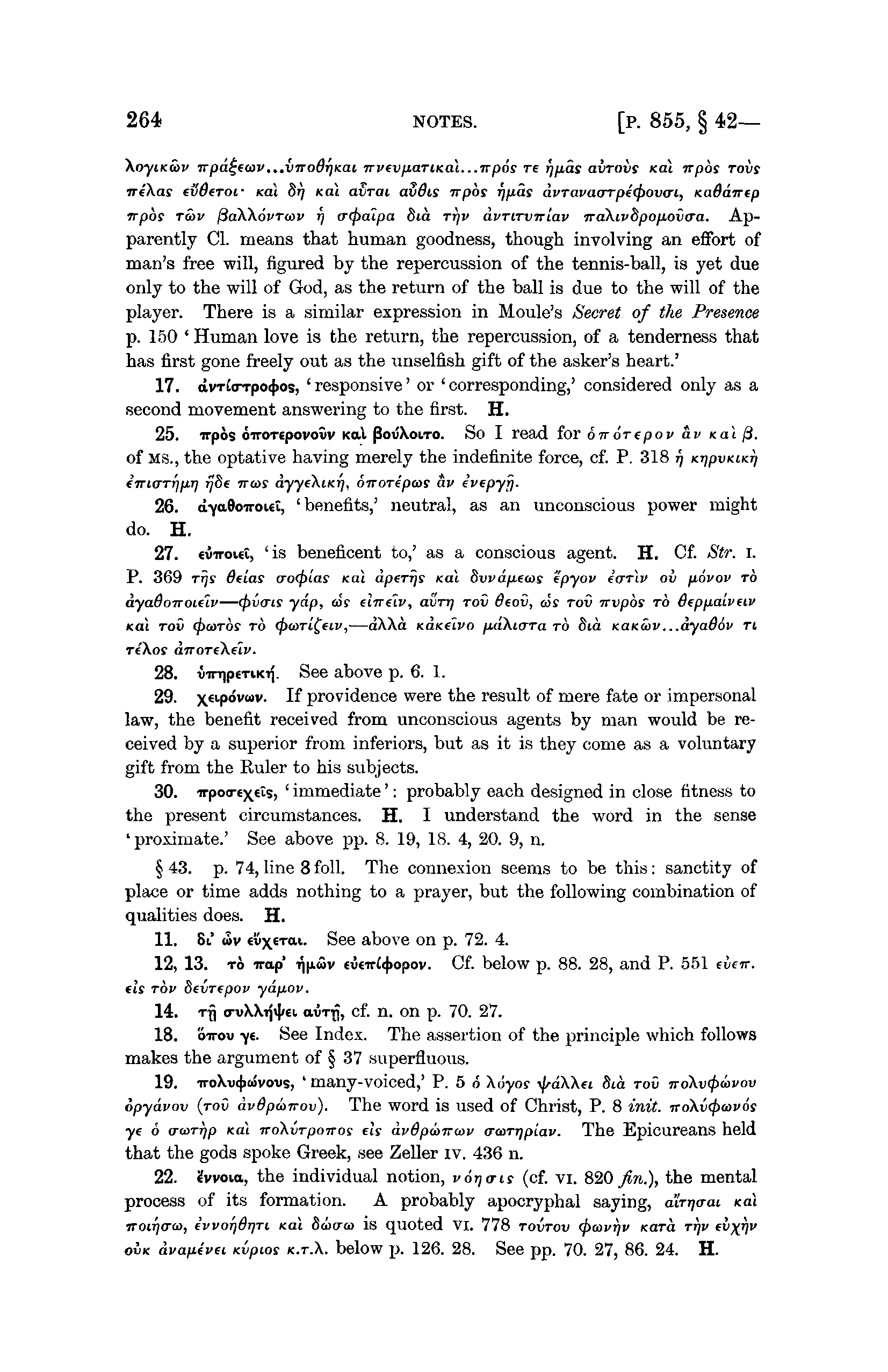
NOTES.
[p. 855, § 42— \oyiKwv •Kpa^ea>v,..VTTo6r]Kai nvevfi.aTiKal...np6s re fjfias airovs Kal irpos TOVS ireXas evOeroiicai 817 xai avrm avdis Trpos rjfias dvravao-rpecpovo-i, KaBdirep npbs ra>v jiaXkopTwv r) artpalpa dia rf/v dvTVrvniav
7ra\iv8pofiovo~a. Apparently Cl. means that human goodness, though involving an effort of man's free will, figured by the repercussion of the tennis-ball, is yet due only to the will of God, as the return of the ball is due to the will of the player. There is a similar expression in Moule's Secret of the Presence p. 150 ' Human love is the return, the repercussion, of a tenderness that has first gone freely out as the unselfish gift of the asker's heart.'
17. dirCorpo^os, ' responsive' or ' corresponding,' considered only as a second movement answering to the first. H.
25. irpos oiroTepovouv Kal POUXOITO.
SO I read for onoTepov av Kal /3. of MS., the optative having merely the indefinite force, cf. P. 318 77 K^/WKIKJ) fVioTTJp; rj8f TTCDS dyyeXt/cij, oiroripios av e'vepyfj.
26. d-yaOoiroict, 'benefits,' neutral, as an unconscious power might do.
27. rfiroKt, 'is beneficent to,' as a conscious agent. H. Cf. Str. 1.
P. 369 rrjs deias o~o<pias Kal dpcrrjs Kal dvvdfiews epyov €CTIV OV fiovov TO ayadcnroieiv—(pvcris ydp, &>? eine'iv, avrrj TOV deov, as TOV irvpbs TO BepjxaLvtiv
Kal TOV (pa>Tos TO (pari^eiv,—a\Xa KCLKCIVO fiAXicrTa TO 8ia KaKwv...dya86v Ti T4\OS aTroreXeiv.
28. iirt]p6TiKtj.
See above p. 6. 1.
29. xaP°VMVIf providence were the result of mere fate or impersonal law, the benefit received from unconscious agents by man would be received by a superior from inferiors, but as it is they come as a voluntary gift from the Ruler to his subjects.
30. irpoa-exe1?, ' immediate': probably each designed in close fitness to the present circumstances. H. I understand the word in the sense
'proximate.' See above pp. 8. 19, 18. 4, 20. 9, n.
§ 43. p. 74, line 8 foil. The connexion seems to be this: sanctity of place or time adds nothing to a prayer, but the following combination of qualities does. H.
11.
8L" <5V €«x6TatSee above on p. 72. 4.
12, 13. TO irap' ijn<Sv eveir£<j>opov. Cf. below p. 88. 28, and P. 551 fix it. els TOV devTepov yd/j.ov.
14. rfl o-v\.\ifi|/ei oujTT], cf. n. on p. 70. 27.
18.
OTTOI) •ye. See Index.
The assertion of the principle which follows makes the argument of § 37 superfluous.
19. iroXv<(K<ivovs, ' many-voiced,' P. 5 o \6yos \^dXX« 8ia TOV iroh.vrf>u>vov opydvov (TOV dvdparrov).
The word is used of Christ, P. 8 init. iro\v<\>a>v6s ye 6 o-a>Trjp Kal TroKvTpoTros els dv6pa>Tzwv <ra>TT)piav.
The Epicureans held that the gods spoke Greek, see Zeller iv. 436 n.
22. ?vvoia, the individual notion, vOTJO-IS (cf. vi. 820 Jin.), the mental process of its formation.
A probably apocryphal saying, a'irrja-ai. Kal iroirjO'id, evvoTjdrjTi Kal ddio'co IS quoted VI. 778 TOVTOV (pcovrjv KaTa TTJV ev^rjv
OIK dvapevei Kvpios K.T.X. below p. 126. 28. See pp. 70. 27, 86. 24. H. https://doi.org/10.1017/CBO9780511695513.011 Published online by Cambridge University Press
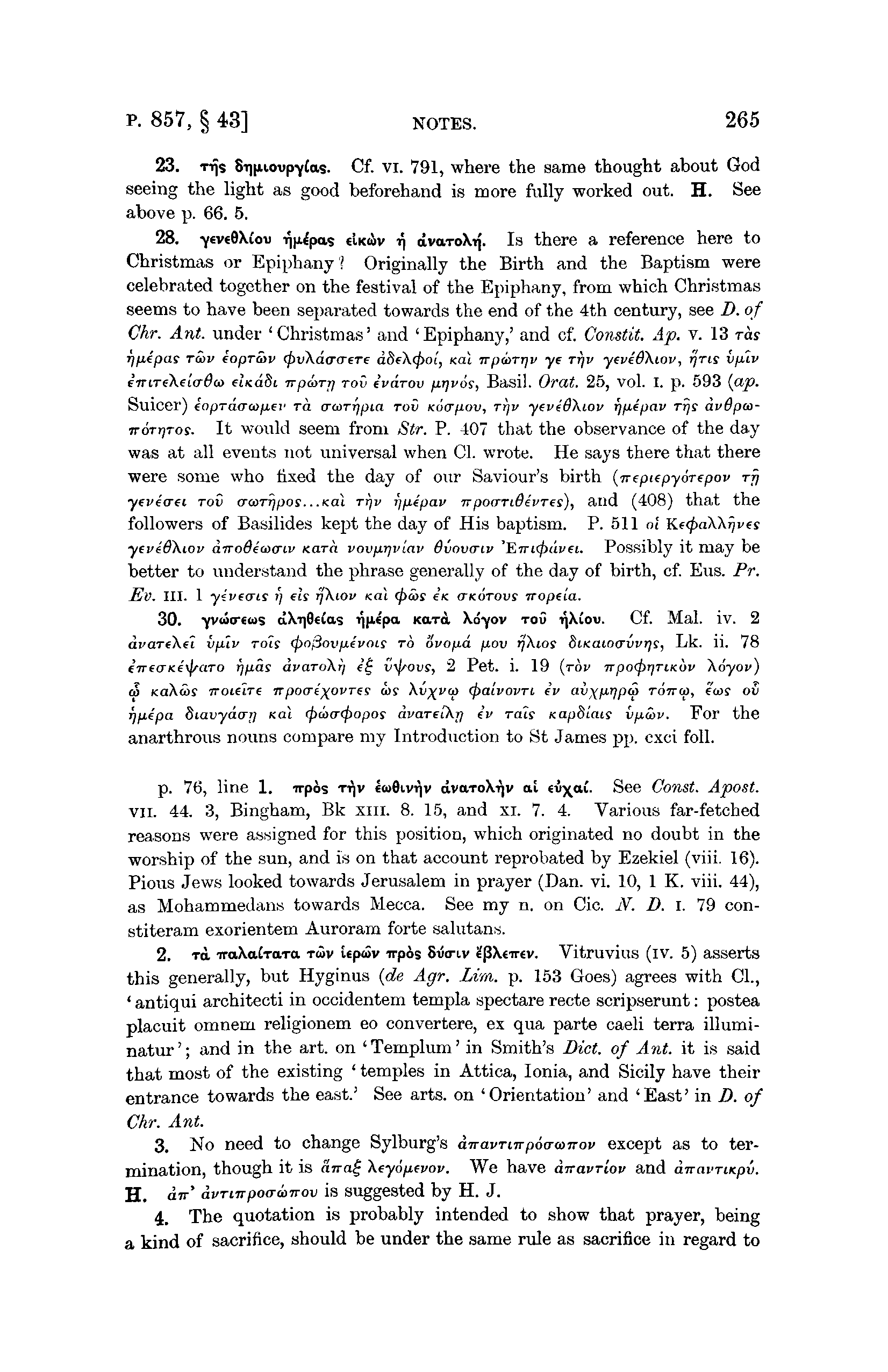
P. 857, § 43]
NOTES.
23.
Tqs 8i]|uovp-yCas. Cf. vi. 791, where the same thought about God seeing the light as good beforehand is more fully worked out. H.
See above p. 66. 5.
28.
-yevtOXioii iinipas eUilv r\ dvaToXrj. Is there a reference here to Christmas or Epiphany 1 Originally the Birth and the Baptism were celebrated together on the festival of the Epiphany, from which Christmas seems to have been separated towards the end of the 4th century, see D. of Chr. Ant. under 'Christmas' and 'Epiphany,' and cf. Constit. Ap. v. 13 ras rifiepas TO>V eoprav <pv\d<rcreTe dSeXcpol, Km Trpwrrjv ye TT)V yevedXiov, ijrif vp'iv fVireXfiV^a) ei<dSi irpo>TT) TOV ivarov fir/vis, Basil. Orat. 25, vol. I. p. 593
(ap.
Suicer) eopTaacopei'
Ta craiT-qpia TOV Kooyxou, Trjv yeve&Xlov rjpepav Trjs du6p(o~ ir6rr)Tos. It would seem from Str. P. 407 that the observance of the day was at all events not universal when Cl. wrote. He says there that there were some who fixed the day of our Saviour's birth (nepupymepov rfj yeveo~ei TOV (rwrrjpos...Kai rrjv ijpepav npoo-TidivTes), and (408) that the followers of Basilides kept the day of His baptism.
P. 511 oi KecpaWrjves yeviffkiov awodeaxriv Kara vov/xrjvlav 6VOV<TIV 'Evi(fiuvei.
Possibly it may be better to understand the phrase generally of the day of birth, cf. Eus. Pr.
Ev. III. 1 yivtuts y) els rjkiov KO1 <pcos £K CTKOTOVS vropeta.
30.
•yvucrews aX.il0«£as i]|xepa Ka-ra Xd-yov TOU i]X£ou.
Cf.
Mal. iv.
dvaTeXfl vp.1v TOLS (pofiovpevots TO ovop.6. p-ov rjXios diKawo~vvTjs, Lk. ii. 78
(7T€o~K€\jraTO tjpds dvaToXf) i^ v^/ovs, 2 Pet. i. 19 (TOV irpo<prjTLKov \6yov) (ti KaXws TroitiTt irpoo~t)(ovTes o>? Xv^vat (palvovTL ev avxp,r)pa> TOTTQJ, eto? ov rjpepa hiavyduij Kai (fia)O~<popos dvaTelXij ev Tals Kapdlais iipwv.
F o r t h e anarthrous nouns compare my Introduction to St James pp. cxci foil. p. 76, line 1. irpos TI^V IwOiviiv dvaroX-^v at ii\aC. See Const. Apost. vn. 44. 3, Bingham, Bk xm. 8. 15, and xi. 7. 4.
Various far-fetched reasons were assigned for this position, which originated no doubt in the worship of the sun, and is on that account reprobated by Ezekiel (viii. 16).
Pious Jews looked towards Jerusalem in prayer (Dan. vi. 10, 1 K. viii. 44), as Mohammedans towards Mecca. See my n. on Cic. N. D. I. 79 constiteram exorientem Auroram forte salutans.
2. m iraXaCTdTa TWV Up<Sv irpis hva-iv i$\nrtv.
Vitruvius (iv. 5) asserts this generally, but Hyginus (de Agr. Lim. p. 153 Goes) agrees with CL,
' antiqui architecti in occidentem templa spectare recte scripserunt: postea placuit omnem religionem eo convertere, ex qua parte caeli terra illuminatur'; and in the art. on 'Templum' in Smith's Diet, of Ant. it is said that most of the existing ' temples in Attica, Ionia, and Sicily have their entrance towards the east.' See arts, on 'Orientation' and 'East' in D. of Chr. Ant.
No need to change Sylburg's diravTiwpoaamov except as to termination, though it is anal; Xeyop-evov.
We have diravTiov and dnavriKpi.
H. an' dvTnrpoo-anov is suggested by H. J.
The quotation is probably intended to show that prayer, being a kind of sacrifice, should be under the same rule as sacrifice in regard to https://doi.org/10.1017/CBO9780511695513.011 Published online by Cambridge University Press
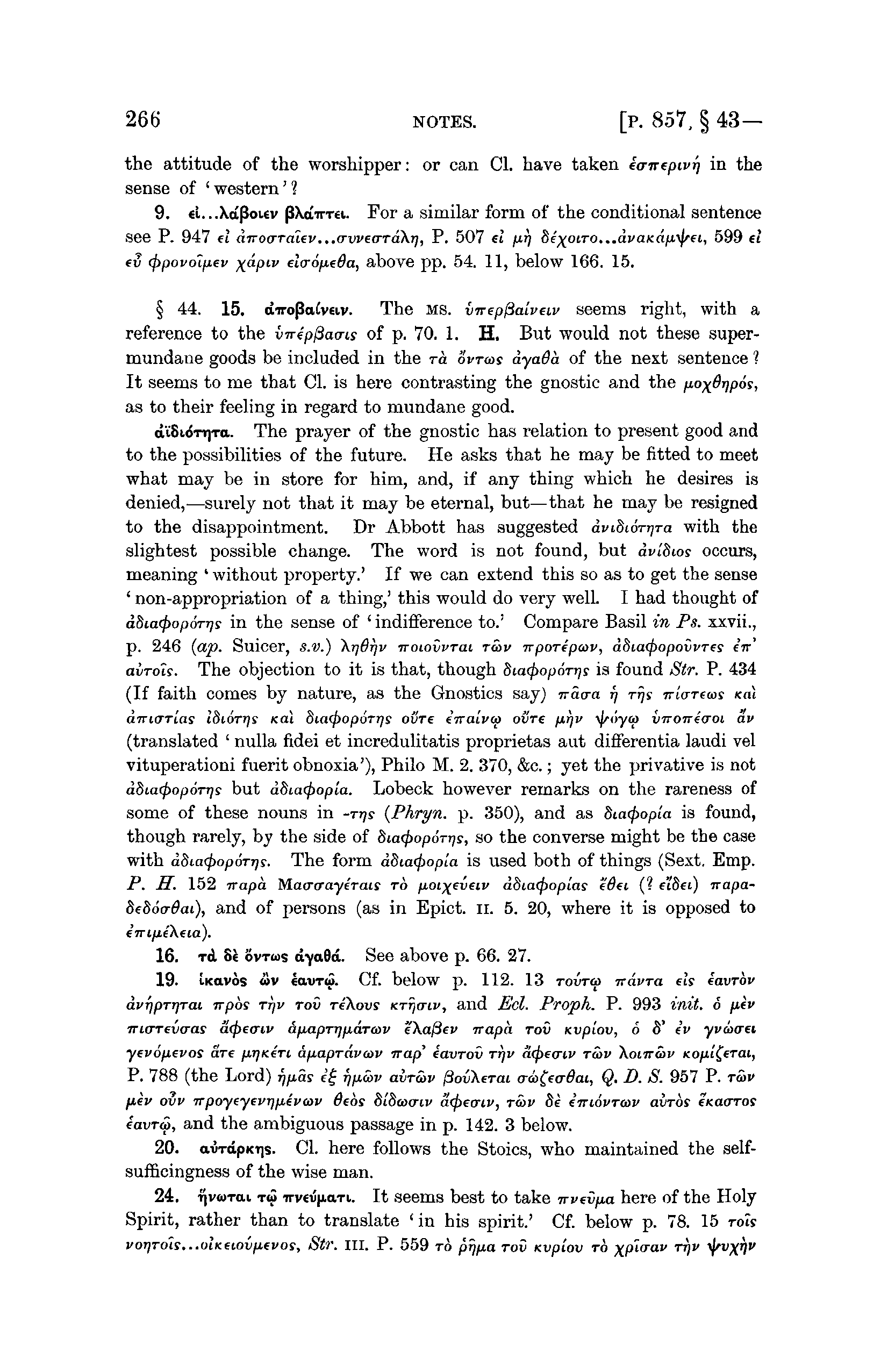
NOTES.
[P. 857, § 43—
the attitude of the worshipper: or can Cl. have taken eo-nepivr] in the sense of 'western'?
9. «l...XaPoitv pXa7TTei. For a similar form of the conditional sentence see P. 947 (I diroo-Tai€v...o-weo-rd\r], P. 507 el p.f) bi)(oiTO...avaKajx.^rei, 599 el
(v (fipovolfiev x"Plv elo-opeda, above pp. 54. 11, below 166. 15.
§ 44. 15. diropoCveiv.
The MS. vTrepfiaLveiv seems right, with a reference to the i-n-fpfiao-is of p. 70. 1. H. But would not these supermundane goods be included in the ra OVTOS dyada of the next sentence 1
It seems to me that Cl. is here contrasting the gnostic and the p.ox8ipos, as to their feeling in regard to mundane good. at8i<5T«)To. The prayer of the gnostic has relation to present good and to the possibilities of the future.
He asks that he may be fitted to meet what may be in store for him, and, if any thing which he desires is denied,—surely not that it may be eternal, but—that he may be resigned to the disappointment.
Dr Abbott has suggested dviSiorr^ra with the slightest possible change. The word is not found, but dvidws occurs, meaning ' without property.'
If we can extend this so as to get the sense ' non-appropriation of a thing,' this would do very well. I had thought of dSia(pop6rrjs in the sense of ' indifference to.' Compare Basil in Ps. xxvii., p. 246 {dp. Suicer, s.v.) \rj6rjv -jroiovvTat TS>V npoTcpcov, dduKpopovvres eV airois. The objection to it is that, though SiatpopoTrjs is found Str. P. 434
(If faith comes by nature, as the Gnostics say) irao-a fj rfjs Trio-Tews /cni dnurTias idiorrjs Ka\ diacpoporrjs ovre etvalvca ovre fxfjv \^oy&) vnoneo'oi av
(translated ' nulla fidei et incredulitatis proprietas aut differentia laudi vel vituperationi fuerit obnoxia'), Philo M. 2. 370, &c.; yet the privative is not dSiarpoporrjs but dSiaipopla. Lobeck however remarks on the rareness of some of these nouns in -rr)s {Phryn. p. 350), and as 8ia<popia is found, though rarely, by the side of biacpoporrjs, so the converse might be the case with dSiacpoporris.
The form ddiacpopla is used both of things (Sext. Emp.
P. H. 152 irapa Maacrayirais TO fiot)(eveiv do'i.arpopl.as i'dei (? fiSfi) Trapabeboo-9ai), and of persons (as in Epict. n. 5. 20, where it is opposed to 16.
TCL Si <5VTO)S dyaQa. See above p. 66. 27.
19. iKavos «v iavrio.
Cf. below p. 112. 13 TOVTOI iravra els eavrbv dvi)pTryrai npos TT/V rov TCKOVS KTTIO-LV, and Eel. Proph. P. 993 init. 6 p.ev
7riOTcvo-as afpeanv a)iapTTip.aTa>v Fkafiev napa TOV Kvplov, 6 5' iv yvi>crei yevop.evos are p.T]tceTi dfiapTavcov Trap eavrov TTJV a<peo~iv ra>v Xotiroiv KO/xi^erai,
P. 788 (the Lord) fjp,as e£ r)p.a>v avTa>v j3ov\crai o-ai£co-8ai, Q. D. S. 957 P. TS>V fiev ovv 7rpoyeyevT]p,£va>v 6eos Sidexnv atpecriv, rav fie imovraiv avrbi exaoror eavrai, and the ambiguous passage in p. 142. 3 below.
20. avTctpKtis. Cl. here follows the Stoics, who maintained the selfsufficingness of the wise man.
24. i]va>Tai TO irv«ii|iaTi. It seems best to take wvsipa here of the Holy Spirit, rather than to translate 'in his spirit.' Cf. below p. 78. 15 rois vor)ToU...olKeioip.cvos, Str. III. P. 559 TO prjp.a TOV Kvpiov TO xplvav TTJV https://doi.org/10.1017/CBO9780511695513.011 Published online by Cambridge University Press
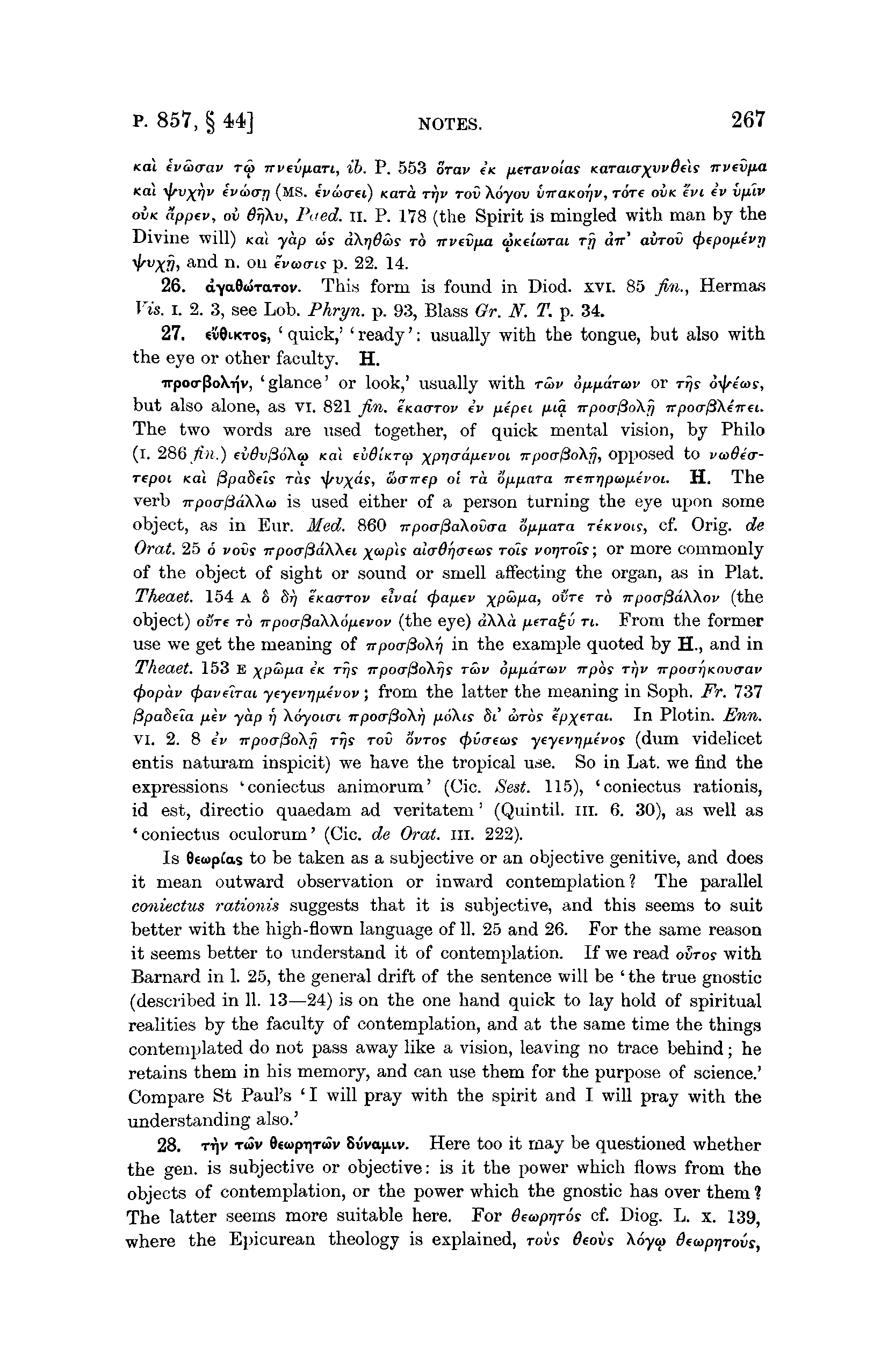
P. 857, § 44]
NOTES.
Kal evaxrav ra> nvevfian, ib. P. 553 orav i< fieravoias KaTmirxvvBfls nvevjia Ka\ ^rv^rjv ivacrr] (MS. fvaxra.) Kara TTJV TOV \6yov {nraKorjV, TOT( OVK evi iv vfuv
OVK appev, ov #77X11, Pned. 11. P. 178 (the Spirit is mingled with man by the Divine will) xai yap a>r aXrjOws TO wevfia (BKei'&mu Ttj cm' airov (fxpofievrj ilrvxfj, and n. on eVcoo-i? p. 22. 14.
26. d-yaOwTciTov. This form is found in Diod. xvi. 85 Jin., Hermas Vis. 1. 2. 3, see Lob. Phryn. p. 93, Blass Or. N. T. p. 34.
27.
«V$I.KTOS, ' quick,' ' ready': usually with the tongue, but also with the eye or other faculty.
H. irpocr|3oX.'qv, 'glance' or look,' usually with rcnv ofifidrav or TT)S oi^iais, but also alone, as VI. 821 Jin. eKao-rov iv fiepei p-ia Trpoo-fiokfi rrpoa-^Xenei.
The two words are used together, of quick mental vision, by Philo (i. 286 fin.) evdv{$6\<p KO\ eu#iKTQ> xprj(rd[ievoi 7rpo(r{3o\j}, opposed to va>6eirrepoi Kal fipadeis ras T^u^af, cocmfp oi ra ojip.aTa 7r€irrjpa>p.evoL.
The verb 5rpoo-/3aXXot) is used either of a person turning the eye upon some object, as in Eur. Med. 860 itpoa-ftakovaa 0/1/iara TCKVOIS, cf. Orig. de
Orat. 25 6 vois TrpcHrftdWei xaPls ai<rdfi(rea>s rois vorjrois; or more commonly of the object of sight or sound or smell affecting the organ, as in Plat.
Theaet. 154 A O SI) eicao-rov eivai (pafiev ^pio/Aa, ovre TO npoo-fidWov (the object) ovre TO wpoo-fiaXkofievov (the eye) aXXa fKTa^v n.
From the former use we get the meaning of irpoo-ftoXr) in the example quoted by H., and in Theaet. 153 E ^payxa en TTJS Trpoo~(io\rjS Tbjv ofifiaTQiv npos TTJV TrpoariK.ov<Tav
<f>opav rpaveiTai yeyevrjfji.4vov; from the latter the meaning in Soph. Fr. 737 ftpadela fiev yap r) Xoyotcn Trpoo~fio\r) {xoKis 6V COTOS ep^frat.
In Plotin. Ewn.
VI. 2. 8 iv Trpoo-ftoXrj TTJS TOV OVTOS <pi3o-f<os yeyevrjfiivos (dum videlicet entis naturam inspicit) we have the tropical use. So in Lat. we find the expressions 'coniectus animorum' (Cic. Sest. 115), 'coniectus rationis, id est, directio quaedam ad veritatem' (Quintil. in. 6. 30), as well as 'coniectus oculorum' (Cic. de Orat. in. 222).
Is BewpCas to be taken as a subjective or an objective genitive, and does it mean outward observation or inward contemplation? The parallel coniectus rationis suggests that it is subjective, and this seems to suit better with the high-flown language of 11. 25 and 26. For the same reason it seems better to understand it of contemplation.
If we read OVTOJ with Barnard in 1. 25, the general drift of the sentence will be ' the true gnostic
(described in 11. 13—24) is on the one hand quick to lay hold of spiritual realities by the faculty of contemplation, and at the same time the things contemplated do not pass away like a vision, leaving no trace behind; he retains them in his memory, and can use them for the purpose of science.'
Compare St Paul's ' I will pray with the spirit and I will pray with the understanding also.'
28.
TTJV T«V 8«wpT]Tiov 8vvo.)uv. Here too it may be questioned whether the gen. is subjective or objective: is it the power which flows from the objects of contemplation, or the power which the gnostic has over them ?
The latter seems more suitable here. For decoprjTos cf. Diog. L. x. 139, where the Epicurean theology is explained, TOVS Seoiis Xoy<» &(a>pr)Tovs, https://doi.org/10.1017/CBO9780511695513.011 Published online by Cambridge University Press
NOTES.
[P. 857, § 44—
which Cic. translates 'earn esse naturam deorum ut primum non sensu sed mente cernatur' (N. D. I. 49), and Cl. Sir. v. P. 653 6 i\iri£a>v ra va> Apa
TO. vor)Ta...va> apa 6ea>prjr6s 6 \6yos.
29.
TT|V 8iopoTiKii)V...8pi|ivTi]Ta.
Cf. P. 116 (paTurfios apa IJ yvaxris ioriv 6 ctjacpavtfav rrjv ayvotav <a\ TO BiopariKov €VTi8ets, Philo M. 1. 486 x^Piv i'ScoKas efjalperov rm SiopariKa yivfi, Plato Rep. VII. 535 B bpt/ivTtjs irpos ra
30. pidi€Tai KTTJo-ao-Oai. For this use of /3. cf. Thuc. VII. 79.1 ifiiao-avro IkdeTv (which Poppo calls unique) and Lys. 115. 29 fi<,a£6fievot. jUXaTrTeiv.
It is common in Cl., cf. below p. 108, 1. 4 /Sidferat civai KOKOS, ib. 1. 8 iw' aKpov yvaxjeas rJKtiv /3., p. 124. 29 aveiridvfi.T)Toi yevicrdai /3.
See Index, s.v. p. 78. 2. «|>€KTiKfj, 'exercising restraint.' H. A metaphor from holding in a horse, iirexeiv inhibere. IIJ P. 924 we find the word in its technical sense, 'sceptic' as opposed to 'dogmatist.'
4. c77«|xvaird|i6vos dcrKijcrei.
See Index.
6. dOupo-yXaxro-ov. Cf. P. 165 ddvpco yKoxrcrr/ xpij<r<9ai. For other exx. see Index.
10.
For d£io\6yas of MS. read dtjioXo-yuv,' of distinguished persons.' H.
§ 45. 11. SI«I\T|<JK6S, 'received a clear understanding of.'
Cf. vi. 816j Trjv eKKkrfiria(TTiKrjv Ka\ akr)8rj yvSxriv <ai Tr)v wept Beov SiaKrjxjnv. H.
Below p. 104. 5.
11—14. Sentences like this (which are far from uncommon in Cl.) remind one of Aristotle's criticism on 6 CTKOTCIV6S in Rhet. III. 5. 6 ra ytip
'HpaKXeirov bia<TTi£ai epyov, bia TO a8rj\ov eivai noTtpa npicrKfiTai., ra> vo-Tcpov rj Tm irpoTcpov. Is a\t)delas governed by irpos or by ^opoO ? is ^opoO governed by wpos or by Xdya> ? is TO )iiye8os governed by 7rporpenovTL or by cvSeiKvvftevcp ? Comparing p. 166. 8, 9 below, ty p.fi TOV Kavova TTJS eKK\r)<rlas
Trap' avTrjs Xa/3ovres f^oocrt rijs aXrjBfias, we should be inclined to take akT)0£ias here with Trprir, but, before deciding, it is necessary to ascertain the meaning of x°i>°yIt occurs below p. 152. 28 IJ eKK^rjala Kvpiov, 6 irvevliariKos KCU ayios xopis, 86. 14 8ia TOVTWV (prayers, &c.) iavrov ivonoid ra
Pftot) xop^y 136. 13 KOI* fiovos evxiJTai TOV TCOV ayto>v x°Pov o~vvio~Ta}i.fvov e^ftj
Ign. Row,. 2 Iva iv dydnrj xopbs y*vop.*voL acrjTe ra) Trarpt ev 'Irjo'OV Xpitrra), where Lightfoot's n. is 'the Roman Christians are asked to form into a chorus and sing the sacrificial hymn round the altar...The metaphor is taken from a heathen sacrificial rite; see K. F. Hermann Oottesd. Alt. n.
29.' Here however the epithet IXVO-TIKOS suggests an allusion to the dancing at the mysteries (of which Lucian, de Saltat. 15, says, TEXCTIJI/ dpxaiav ov8e)iiav 4CTT\V flpflv avev Spxrjo-ews, 'Op<pia>s SrjXadrj Kai Movo-aiov...vopo&tTT)o-dvTinv o-vv pvdfia <al opx^jo-ei p.velo-8aib'rt de ovTas e^fi...rovs et-ayopevovTas ra fivo-Trjpia e^opxdo-dai Xiyovo-iv) with the further connotation, that this chorus is to be spiritually interpreted.
Cf. Protr. P. 92 opos {O-T\ TOVTO 8ca n«ptXr]iieiiov, ov Tpayqdiais, as Ki8aipa>v, iiroKei/ifvov, dX\a rols rf/s aXr]8fias dvaKfififvov 8pdfiao-iv,...l$aKxcvovo-i Se iv avra...ai djivdbes at Ka\at ra vefiva
TOV \6yov 8€(rn{£ovo~ai opyta, x°pov fy*ipovo~ai o~a><ppova, and a little below, https://doi.org/10.1017/CBO9780511695513.011 Published online by Cambridge University Press
P. 858, § 46]
NOTES.
Tavra Toiv efj.a>v fivo~Trjpl<ov ra ^aK^evfiara KCU O~V fivov, Kal ^opfvacts fxeT* ayy4Xa>v dfi(f>i rbv...jxovov ovra>s 8e6v.
Actual dancing was a part of the religious services of the Therapeutae described by Philo M. 2. 484, 485.
There seems no reason why d\r)8elas should not be appended to x°P™ n e r e as it is to dpupao-iv in P. 92, cf. P. 100 Sfio-tSai/ioxmr adeoi xopwrai.
The meaning will then be, that it is through and from the Church that the individual Christian is instructed in the things of God. If we prefer the other construction, governing ^opov by Xoyw, we must translate (with H.)
'uses a language belonging to a mystic chorus.' In that case, it is difficult to explain npoTpenovTi. Taking it as equivalent to nporpewTiKw, and governing TO fidyedos by evbeiKwfieva,, as I have done in the translation, we may illustrate the sense from Cl.'s treatise of that name, where he enlarges
(as in the later chapters) on the excellence of Christianity, cf. Paed. P. 98 init. npoTpenTiKi) ij jraa-a 8eoo-e^eia, Ca>Vs T'ls v^v KCLl T'ls p-eWovo-r/s ope^iv eyyevaxra TO trvyyevel Xoyicrfia.
14.
8iapp.a.Tos.
Cf. Wytt. on Plut. Hor. 165 C TO yavpov e'viois Kal v\jfrj\ov Kal <5LT)PIJ.£VOV HvecrTiv vrro KOviporrjTos '• 'sic supra p. 116 D 8uupdo-6ai
71-posaka£oveica>. Et h~Lcupe'icr8ai se erigere Arist. de Mund. init. <pt\ocro(pia
Siapafzevrj Trpos TT)V TO>V OVTWV Qiav.
Et Siappa Plut. Mor. 853 C oyKOS Kal Siapfia, Laei't. IX. 5 btapfia i^u^^t.'
15.
Tots VOT|TOIS".OIK€IOO|I,€VOS.
Cf. p. 76. 24 rjvwraL r<u npev/xan, p. 152.
19 T(O TTvevfiari dveKpd8r]T€, Eph. ii. 6.
18. av<m)pos, 'grave,' 'serious'; cf. Strom, II. 494 init. H. Protr. 85
TO avo-Tiqpbv Trjs 0~(aTrjpLas VTTO\I£V£IV OV KapTep€LT€.
21.
SiKao-TTJs, «dv 6 Xo-yos KOX^.
Above p. 26. 8.
26. a.vri> TO d-yaBov.
See p. 30. 11, Plato Rep. vi. 505
27.
€irl irpo9upoi.sCf. Plat. Phileb. 64 C eVi TOIS TOC dyaBov vvv rjbr) irpoBvpois i(p£O~Tdvai. H. J. p. 80.
1. eiapeoraTai.
Cf. Epict. DiSS. I. 12. 8 7ra>j av evapcaToirjv Ttj deia 8ioiKrjo-ei; ib. II. 23. 49, above n. on p. 34. 2.
§ 46. 3—6. Cf. Mt. vi. 25—34. iTr<X,r\Ttl 'seeks in addition.'
4. €i8eT<nivTo>v (for MS. ovdor ovv, where the last syllable may have been lost through its resemblance to the penultimate), 'useful': often followed by els. H. Cf. Diod. XIX. 98 TTJS xpfict? (is rpdpfiaKa ddtTovo-rjs,
Diosc. v. 136 TO (VBCTOVV els rovs noXeixovs. Cl. has in mind Mt. vi.
31—33. H. J. suggests evdeTelv with transitive force ' to arrange.' I am not sure that P.'s reading oiS' OTIOVV may not be defended, as giving more reason for the clause els TJJV dvayKaiav xpijo-iv, ' the gnostic seeks none of the fli.a>TiKa, nothing at all as absolutely necessary.' Or should we read evdeTwv 'being provided for all necessary use he seeks nothing further
(iirijjfre'i) of the things pertaining to this life' ?
7. eBviKwsSee below p. 154. 5 6 iBvtKws iv EKKXIJCTICI iro\irevop.evos, Str. VI. P. 761 init. e'dr/Xaio-ev TOV e'va Kal fiovov Bebv vivo p,iv "EXKr\va>v eflviKois* biro de 'lovdatcov 'IouSa'iKwj, Katvcos de v(j>y rjficov Kal 7rvevp,aTLK<os yiva>o-Kop.evov. The general meaning seems to be that prayer cannot be https://doi.org/10.1017/CBO9780511695513.011 Published online by Cambridge University Press
NOTES.
[p. 858, § 46— regarded as an abstract thing, apart from the mind and character of him who prays; and thus the answer to prayer is limited by the receptive power of the suppliant.
The prayer for knowledge, e.g., would be differently conceived and answered in the three cases supposed. See above, §§38 and 44.
9. lirurTp^cov, intransitive: the two stages of discipleship need different gifts.
See Str. VI. P. 770 6 Ka8apio~p*6s TTJS "^rvxjiS OVTOS io~Tiv, rj aTro^rj T&v KaK&v...Ka\ eanv awX&s TOV KOIVOV TTKJTOV f/ TeXelaxrts avrrj, TOV de yvaxTTKOv fiera TTJV aXXois vop.i£op.evrjv TeXelatcriv r\ hiKaiotrvvT) els ivepyeiav evTrouas 7rpo/3aivei, Kal ora> Si) rj inlraa-is TT)S biK.aioo~vvr)s els dyadonouav emSiScoKev, TOVTW JJ reXeiaxris iv a/xrra/3dXo> ei-ei evnodas Kaff Ofioiaxriv TOV deov Sta/ievei, below p. 100. 7 f.
10. eiravapaCvoiv.
Cf, Str. V. P. 690 eav ini^eipri TIS eV avro o itmv €KO.O~TOV opfiav nai fxrj airo&TOTfiv T<ov ovratv, irp\v iiravafiaivuiv inX ra vnepKeijieva avro (MS. avTa) 8 itrnv ayaBbv avTrj vo-quei. \dfir], above p. 62. 22
Kar' effavdftao'iv av£r]<ras, below 1. 19 eTravafiefirjicos.
12.
<J-UV«X&, adverbial, as often: ' uninterruptedly.' H.
So Arist. Eq.
21, Luc. Somn. 4, Epict. Bus. II. 21. 8, cf rekeov below p. 86. 4.
14. cnvep-ycSv, cf. p. 66. 28.
16. oXuj-B^o-avTas aSflis X*!10^Does avdis imply that the angels originally belonged to a lower sphere (see Eel. Proph. § 57) ? or should we understand it in the sense it bears in Xen. Mem. I. 2. 23 a-axppovria-avTa irpwTov avdis fir) <ro><ppov(iv, Eur. Or. 907 KCLV fif) rrapavriK', avBLs (lai
Xp^o-Lfxai,, of which Klotz (on Dev. n. 214) says 'reiecta alia re iam nova inducitur, quasi, antequam fuisset ilia, haec fuisset.' On the fall of the Angels cf. Paed. in. P. 250/m., ib. P. 280. C.'s language here implies the possibility of the restoration of the fallen Angels, and even a certain progress towards this end (/ij/StVco ri\eou).
Similarly Origen de Princ.
I. 6. 3, and elsewhere, cf. Huet Originiana n. 5 de Angelis, Hagenberg Hist, of Doctr. 1 § 52. 5.
TT|V (i£av eKeiyqv ifjiy, 'that single habit.'
Cf. Str. iv. P. 633 init. p.v<mKu>s ovv €Cp* rj/xav Ka\ TO Tlvdayopetov e\4y€TO eva ytvicrQm Kai TOV avBpairov fieiv, eVf i Kal avTos 6 dpxupevs els ivos OVTOS TOV deov Kara rfjv dfieTaTpeirTOv TOV del 6eiv Ta dyada c$iv, ib. els TTJV dirdBeiav deov/ievos avdpanros dxpdvras jj.ova8i.ic6s yiverai, where Potter cites P. 777 iv Trj fiia e£« fiivei TTJ dfierafioka, and 635 TO els a\>Tov KOX TO hi avTov •KLO'Tevarai jiovahtKov io~Ti yiveo~8ai, dnepio~TTdo~Ta>s evovfievov iv avTaTO dirio~Trjo~ai Sioracrat e'(rri Kat 8iao~TT]vai Kai fiepio-6fjvai.
Cf. also below p. 190. 9 KOTO, TTJV fiovdSa, and Protr. P. 72 there quoted, P. 1009 (Adumbr. in Joh. I. 5) una quippe via est secundum praecepta divina. Monas namque Dei opus est, dyas autem, et quicquid praeter monadem constat, ex vitae perversitate contingit.
See Kaye Clem. p. 149 n. 6. plav e^iv seems here to be equivalent to evo-rtjTos e^iv.
17.
8IITX6T]V. See Tim. Lex. S.V. 8m\6ov.
«Vl crib-qpov e'ipryrai orav dv6 TWOS eva>o~ea>s anoKvais TLS y els 7rapdSeo~tv p.aWov rj eva>cnv' enl Be rjQovs
TponiKats TO p-fj uyie? 8rj\oi, where Ruhnken cites many exx. It is used in a different sense below P. 901. Cf. diyfrvxos an(^ S'V"'*"2 ^* James i. 8. https://doi.org/10.1017/CBO9780511695513.011 Published online by Cambridge University Press
P. 859, § 46]
NOTES.
The angels fell when other motives interfered with their single-hearted devotion to God. lirrni&ioTiiTos, 'aptness': used in a neutral as well as a good sense. H.
18. iKOXtyavTas. Cp. Arist. H. A. ix. 40 'the bee leaves its sting in the wound and so perishes,' iav fir) 6 nXr/ycls TO Kivrpov (KSXiip-y, ' unless he squeezes out the sting,' Be Anima I. 2. 3 'Democritus held that life is sustained by respiration, which supplies fresh atoms in place of those which are forced out' (iK6\II3OVTOS TOC TrepuXovTos), de Resp. 4, Meteor, i. 4.
7 'when the air contracts from cold, the heat is squeezed out' (eK/cpouerm xai endXifierat), ib. 9 of falling stars, u. 9. 8 'lightning is caused by the expulsion (iKSXifiofutvov) of the air {nvcvjxa) inclosed in the cloud,' ib. IV. 6.
5, de Audib. I. 'the lungs by their contraction ei<d\i($ovcn the air,' Plut.
Mor. 81 c.
19. 4iravaP«|3T)K6s. ^ e e o n P- ^- ^- 20. irpo 68ov, 'advantageous,' 'appropriate': originally 'forward,' but later like npovpyov. H.
22.
HOVOTOVOV, ' t>ent one way-' H. Chiefly used of music, also metaphorically of obstinacy. i8pai<5TT|Ta. Cf. below p. 88, 1. 9 iv a/iera7rTa>™ <ai e8paia> /Sim, p. 192. 6 r) TO>V St^^Xourrtov iftpaioTrjS.
23. ppCfloucra.
Cf. Plato Phaedr.
247 A fipidei yap 6 rrjs rniKijt IWTTOS fierexwv, eVi rrjv yr)v p'eirwv, Wisdom ix. 15 (pdaprov yap trS>p.a fiapvvei
^rv)(riv-> Ka^ fip$Ei TO y€&)5es o~Krjifos vovv no\v(ppovTida, Str. V. P. 696 av GO TO>V VTrepKClfievcov a'iperai rj ^l^X1? Tray TO fipiOov arrOTlQifXivrj^ Anton. X. 26 Trjv fjpt&ovo-av Kal TTJV avwrpeprj bvvafxiv (centripetal )( centrifugal).
The yavia of the Ms. making no sense, the emendation which naturally suggests itself is ayavia. This may be thought to receive some support from II. xxi. 385 Seo'io-w epis nia-e fteftpidvia, but it does not suit the context. dyvaxria is suggested by H. J. with a reference to yvao-ecos aKporr/Ta in 1. 18, and makes very good sense; but I am rather disposed to prefer aTovia, for which compare Plut. Mor. 535 D eoticev r/ Trjt ijrvx*ls arovLa o-w/iaros <pao-fi
KaKws ire<pvKVLq, below p. 166. 6 Set TCO Trjs aXrjSelas epacTrj ^SVXLKTJS fVToviav o~<baWfoSai yap avayxrj p.eyia'Ta TOVS [J.€yio~Tols ey^ipovVTas irpdypaaiv rjv fir) rbv Kavova TT)S akr/deias Trap' avrrjs Xaflovres f^axrt Trjs a\r]deias, Carpocrates ap. Hippol. Haer. VII. 32 Tr)v i\rvxr)v 'Irjo-ov evrovov Kal naBapav yfyowlav biafxvrjjxovevo-ai TCL opara fiev avTrj ev TTJ fiera Toil aytvrjrov 8eov irtpKpopq
(Plato Phaedr. 246 f.).
24. ' In them even what is uplifted by their faith [the lower stage which they have reached] is dragged down.' H.
26. <j>uo-iovTcu, 'becomes a nature.' H.
Cf. Arist. Cat. 8 8iadio-(is Xeyovrai a io~Tiv evKivr]Ta <al raxv fieTaj3d\\oi>Ta...el fir) TIS Kal avT<i>v TOVTODV Tvyydvoi Sict XP^VOV 7r\rj@os rjdrj 7r€<pvo~iG>p.evT].,.r)v av
TIS iVw? t£iv rjBij npoo-ayopevo-ai. Used in a different sense below P. 896 fin.
Kafldirep TU XC6a> TO pdpos. The same illustration is used in Arist. Eth. N, II. 1 ovSefiia TWV r)8iKa>v dpeTwv (pvaei fjfiiv iyyiveTW ovdkv yap Tatv (pv<rei https://doi.org/10.1017/CBO9780511695513.011 Published online by Cambridge University Press
NOTES.
[p. 859, § 46— OVTCOV aWa>s idl^erai, olov 6 \LBOS (pvcrci Karat <pep6fi€vos OVK civ eStcrBfLTj avoi
Cf. p. 72. 18 f., of the goodness of God.
§ 47. p. 82, line 1. err«l TO |x-r| diropXT)6«v. The MS. has enl for «V« also in P. 684; ano^Xrjdrjvai for airofiXrjdev is explained by the following AI mistaken for AI, and by the constant confusion of long and short vowels.
The following p.iv and fie make it probable that Kal evXoyto-rias has been lost after evKafteLas.
3. rfjs evXo-yiorCas. A branch of cppovrjcns according to the Stoics, the others being evfiovXta dy^ivoia vowe^ta eifirj^avta Stob. Eel. II. p. 106. Cf.
Philo M. 1. 130 eav yap s\Orj els TTJV dtdvoiav evvoia Seov, evXoyurrel cvOvs.
6. [le'-YiorTov ^' ^PaThe particle is wanted to show that we have here not the conclusion, but the minor premiss, and A is easily lost before A as in 1. 1.
|iovos. This may be true, but does not follow from the argument.
Why may not 6 mareiav be ei>a-e/3ijy as well as 6 yvanrriKos 1 Perhaps we are to take yvaxris here as including faith, see p. 136. 28 below.
13.
Si' »v S-yvio <j>8cUras old «<TTIV. I think this is an instance of the use of the finite verb with the relative to express the infinitive with article
= $ia TOV <p8d(ras yva>vai old e&riv, cf. below n. on p. 104. 9 €7rlaTev<rev e£ d>v edavfia<Tfv, p. 130. 17 )(aipa>v p.ev e'(p' ois i'yva, o-voreWofievos
8e e(p' ois eyKvXierat.
14.
KOI KeKTTp-ai TOVTO. The changed position of Kal in the MS. is probably to be accounted for by its omission before K6-. It would naturally be inserted in the margin by the corrector, and might then be misplaced by a subsequent copyist. For the thought cf. Mk. xi. 24 and Sir. vi.
P. 777 init. 6 8e eV ois f'orai 8«' dydir-qs r/8rj yevop.evos, rfjv iXnlSa irpou\i](pus 8ia Trjs yvuxreats oiihe opeyerai TWOS, ^COV COS olov re avr6 TO opeKrov, P. 778
TT)V iv ois ICTTI Kardcrracriv jieftaiav rav p-cWovratv KardXrj^nv eiScbf 8i dydirrjs
TvpoairaVTO. Taj peWovTl, also p. 136. 26 below.
15.
The connexion is hard to seize. Probably it means ' what he has is only inchoate and imperfect, but its true nature is seen by reference to the perfect standard,' ' is measured by what is fitting (normal).' See what follows. H. There seems no reason for drawing a fine distinction between TO svSels Kal €iri8ee's, while it is important to state that both sufficient and insufficient must be determined by reference to a standard. I propose therefore to read (WvSee's. irpos T6 eiripdXXov. Cf. Luke xv. 12 TO eVi/3dXXoi/ fxipos, and Wytt. on Plut. Mor. 37 F, who cites PI. 1036 A inifidWei TOVTO noidv (convenit facere), 1034 D inirekclv TO ewifidWovra, Diogenianus ap. Eus. Pr. Ev. VI. 8
TO xptcov €cpi]o~Sat TO iiri(3dWov Ka\ KaQrjKov Kara TTJV fl[xappr4vrjv, also Anton.
VII. 7 ('vepyelv T6 iwiftaXXov, where see Gataker's excellent n.
17.
6 dvcvScovs y.tTiyo)v dvevSeTJs «£T) civ.
Cf. Paed. I. P. 113 OVKOVV dreXrjs 6 eyvcoKcos TO T(\CIOV.
18.
KivoiivTiov Kal MTXOVTWV, 'moving and stopping' (correlatives). H.
19. evepycias. Probably ' inspiration': or at least ' Divine action.' H. https://doi.org/10.1017/CBO9780511695513.011 Published online by Cambridge University Press
P. 860, | 48]
NOTES.
H«TC<T\OVTOS. Rare and chiefly Platonic.
H. As we have the form /ieT€x<»v in 1. 17, it is possible that this form is due to la-xovrav in 1. 18: still Cl. often uses 10-^0) = e^o> (as in Paed. P. 114) and we find inicrxovo-i rr)v rifiaplav P. 598.
20. a<|>aipov|j.lvou, ' being robbed.' dpcCuTosSee Index.
22. KaTa. TTJV 8wa|iiv. ..KaTcl TAV api8|i.dv. So we have Swa/xfi opposed to apiBfiw in Arist. de Gen. et Corr. I. 3 voi/a-i? 17 ivipyeiaflare e'£ evtpydas 17 ovvafj.tsKCH 6ta TOVTO noiovvTes yiyva>o~K.ovo~iv varepov yap y*V€O~ei rj evipyfia
17 icnr' apiBfiov (cited by Trend, on Ar. de An. p. 308). The more common opposition is that of sor' eldos to KOT' dpi8p,6v, contrasting qualitative to quantitative (see my n. on JV. D. 1. 49 ad numerum and Waitz on Cat. 2, p. 276). As opposed to bwdfin. it is nearly equivalent to ivepyeia 'in actual reality.'
24. svB&ros irpoKoirasCf. p. 16. 5, 28 f., p. 20. 5, 15 f., p. 78. 25.
§ 48. 26. Trpo<rex«TTe'pa. See Index.
27. Ti|xtjo-as. One would rather expect Tr)pj]<xas, as in Protr. P. 10, where I am disposed to read ycpdvSpvov fit tyapjUHs iprj/ims TeT-qprmtvov for p. 84, line 1. He will not take away whatever is for the sake of virtue from them, as it is for their sake that all things exist. H.
4. Ti|i»v T\V 'is ve. H. J.'s excellent emendation of the MS. Ti/io)pfvos re: cf. for the periphrastic tense Mk. x. 22 ?JV yap '£yu>v xprj/xara
TroXXa', Blass iY. T. Or. p. 202 f., Schmid Att. in. pp. 112—115.
KOX o-u\Xa[j.pavo[).6vos, middle here, as active in p. 82, 1. 26, ' helping' as well as ' exhorting.'
4iri.-yevvT)(iaTiK6v. A Stoical and medical word for what is accessory and accidental. Cf. Epictet. III. 7. 7 oi/Se, rod vporiyovfievov p.rj 6Vro? ayadov,
[bivarai] TO iiriyivvi)p.a ayaBbv flvai. H. The adjective seems to be found only in Gic. Fin. 111. 32 posterum quodam modo et consequens putandum est, quod illi ini.yevvr]fiaTi.K.6v appellant, cf. Laert. vn. 94 where (after denning TO dyaOov as TO T^XCLOV Kara (f>vo~iv XoytKOv Q)s XoytKOi}) Zeno continues TOIOVTOV 8' eivai TTJV aperr)v...iwiyevvT]jx.aTa 8e TX]V T€ )(apav teal rfjv evcppocrvvTjv KOI ra Trapan\r]o-ia.
Similarly hvo~6vjxia and dvo'Cppoo'vvr] are mentioned as eViyevi/Tj/iara of vice, ib. 85 fin. o Se \eyovo-i nves, npbs fjdovTjv yiyv€O~8at Trjv 7rpa>T7]v opp.rjv rots £(oois, yfrevdos anofpaivovciv eirty^vvrjfia yap (paa-i, where see Menage, and Seneca V. B. c. 9 (quoted in his note) 'voluptas non est merces nee causa virtutis, sed accessio.' It is equivalent to Aristotle's eniytvop-tvov n ri\os in rekeioi TTJV ivipyaav IJ fjbovr], oi% coy 17 t^is evvnapxovo-a, dXX' coy tniyivop-tvov ri TCXOS [JEth. N. X. 4).
12. ewpavtav, cf. below p. 102. 22, and P. 802 init.
13—14. God's Commandments and His Promise are indissolubly j oined: the promise receives fulfilment simultaneously with the performance of a commandment.
16. iroX.X<[> TI5 XP°<"S>- The dative marking one cause of the result. H.
M. c.
https://doi.org/10.1017/CBO9780511695513.011 Published online by Cambridge University Press
NOTES.
[P. 860, § 48— I rather doubt this. The dat. is often used of duration of time in late
Greek. See Schmid Att. iv. 58, Blass Or. N. T. § 38. 5, Jannaris § 1394, Winer, p. 273.
17. els '0XV(MTI' dvapas. There is no reason to depart from the us., cf.
Cic. Divin. n. 144 ad Olympia proficisoi.
20.
<f>Epuv, ' make haste and': the pass, <j>ep6p,evos (lit. ' being carried along') is similarly used. H. Possibly the act. may get its meaning from the use of the imperative (pipe, ' come now,' or = our ' took and gave.' For exx. see P. 569 TM TO cratpdrtov OITOVVTI (ptpcov irpocrhibaio'i, P. 535 2apovr]\
KCBXCOI' (j>. eba>K£ TO) SaoiiX (payeiv, P. 44 fill. 'Pcopaioi (pepovres dveBrjKav rr/v rvxrjv, Q. D. S. 937 P. avrov vTrofiaXcTm cpipmv yvpvao-Tfj, where see Segaar's n.,
Luc. Necyom.
8 ipe S<= (pepav iv€<TK.evao-e TG> 7ri'Xo>, Dial. Mort. VI. 3 rols dreKvois TO>V ytpovrcav eiVjroifire (pipovres airovi where many exx. are given by Hemst., also Plut. V. 159, 353, Plut. Mor. 4 with Wytt.'s n. The moral of the anecdote is scarcely in harmony with such texts as Lk. xvii. 10, but it agrees with p. 126. 15. Cf. Epict. Diss. IV. 10. 14—16 apKei poi av bvvafMi npbs rbv debv avarelvai ras ^eipar KCU elrrelv o n , "At eXafiov d(popjxas irapd (Tov npbs TO alo~6eo-6ai o~ov Trjs 6'IOLKT]O~€G>S KCU dico\ov&r]o-aL aiiTrj, TOVTOIV
OVK rjp.€Krjo-aov KarrfiT^yva ire TO ip.6v fiepos. ifioii TTS>S K€^prjp,ai Tals alo-Brjo'fo-iv, ISov TraJr Tals npokrj-^retriv. p.rj troTe o-f ip.tp.tyap.-qv, p.i] TI TO>V yivop-evav TIV\ bvo-r^pioTrjcra; K.T.X.
24.
6uape<rTt)o-iv T<1 Ofi.
Cf. below p. 114. 29
TTJV npos TOV 6(6V fiap4o-Ti]o-iv, above n. on p. 34. 2, p. 80 1. 1.
No use of o-vvaipoviuu (apparently never deponent) seems possible here.
What is wanted is o-vvaipfrai, 'is helpful,' cf. above p. 24. 23. Yet o-waipoip.€vov appears to be similarly used, P. 896j TO napdwav rah ijoWais crwaipov jxcv ov. H,
25.
TI^V o-wrqpCav, in apposition with rrjv TeXeiorijTa. H. The gen. read in the text seems to me far more natural.
26.
Kal TMV irpis i7)xas CIVTIKOVTWV, ' which concern us.' So with wpos often Polyb. Diod., with els Demosth. Aristot., &c. H.
I take tcai here in the epexegetic sense, cf. Winer Or. p. 545 n. 4, Hermann-Viger p. 525.
28.
8iavo|x-r{. So I read, instead of the 8iap.ovrj of MS., because I cannot see how the latter could be reckoned among ra e<f>' rjp.lv (1. 26). Compare
Epict. Ench.
I. 1 TOIV OVTCOV Ta p.£v io~Tiv ed>* rjp.1v, TO. 5e OVK e(p' rjp.lv.
€<f>* fjplv piv v7r6Krj\lni, oppr), ope^is, eKK\to-is, KCU iv\ Xoyia ocra rjpiTtpa epya.
I t is true the same objection might be made to K-rijo-tr, as we read in Diss.
III.
24. 68 KTrjo-is OVK (fir], crvyyeveis, OIKCIOI, q^iKoi...cr6v oiiv TI; XPV<TLS q^avracniov; but perhaps we may distinguish between two uses of the word.
In Epict. KTr}o-is evidently means ' possession,' in the text we may understand it of the act of acquiring.
§ 49. p. 86, line 5. TAS eixas...iroiturQa<.. There is a rule against praying with heretics in Const. Ap. vn. 28 oilrc p.r) irpoo-evHtjo-Be T<» a Iva fir/ o-vp.p,iav8rJTe avrw. https://doi.org/10.1017/CBO9780511695513.011 Published online by Cambridge University Press
P. 861, § 49]
NOTES.
erriELKws KaV \ur lirieiKtovHere used in the wide sense given to it in Plato and Aristotle. See mjr note on the word in St James iii. 17.
7. <ruveiri-ypa<|>eo-8ai. The act. eiriypd(pa> ipavrov TIVL is used of endorsement, and so the p. (Triypdcfxcrdai dXXorplais yva>nms. Hence the compound means 'to give one's name to,' cf. Philo M. 1. p. 517 ™ -v^euSfi o-weniypd<p(TM nas 6 TWV ayeXatav o^Xof.
TOIS Koivdrepov "ir€iria"T€UKoopL. So I read instead of tcaivoTtpov, cf.
Str, V. P. 659 TTJV KOivfjv TTLOTIV nr) p.ev 8zp.iXiov Xtyei, rrr) Se ydXa, ib, P. 892
(p. 172. 7) vncp^rjvai o~novhdo~avT£s TO KOIVOV rrjs nlo-TC&s, e^e^rjo'av TT)V dXr)@eiav, P. 608 ni(TT€o>s TfXeioTrjs npos TTJV KOLVTJV StacrreXXerai TTiVrtv,
Plut. Jfor. 568 C ei 5e tcoivorepov e@e\oi ns ravra crvyypdtyat K.T.X.
10. irav^upis, used esp. of a great religious gathering such as that of the Olympic games, cf. above p. 62. 12 -n-avra TOV fiiov eoprrjv ayovres, Jer.
Ep. 151 nobis qui in Christum credimus resurgentem iugis et aeterna festivitas est, Justin Dial. 12 <raf$[iaTi£eiv Ifias 6 MUVOS VOJIOS 8ia iravros i6€Kei, and, for what follows, Paed. II. P. 228 init. ficd' {jp-ipav...tv^ijs KO.1 avayi>G)(r€<i>s Kal Tcov...€vepyo}v epytov 6 Kaipos, etmipas fie dvanavaao'dai KadrjK€i fiera TTJV €<TTia(jtv Kai p.era TTJV €7r\ Tals d7ro\av<r€(riv €i>xapi<TTiav, above p. 58. 24 f., p. 22. 11, below p. 140. 3 f. and Str. II. P. 506.
11. ivrti^as, 'private reading,' cf. Polyb. IX. 1. 3 oi /ieV yap a\\oi <Tvyypa<pe7s...7raX\ovs €<pe\KOvTai irpos evrtv^iv Taiv v7rop.vrjp.aTwv, and n. On evrvxovres, below p. 172. 6. See Const. Ap. vi. 27. 3. H.
12. irapa T^V eorCacriv.
Paed. II. P. 194 as Ap/xoSiov f'crrt rrp\v rjixas p.€Ta\aj3e7v TpoCprjs TUIV o~v[nrdvTo>v eiiXoyeii* TOV notr^Trjv, ourtoff Kai napa
TTOTOV Ka8rfK€i i^aXXetv avrta TCOV avToii ueTaXafifidvovTas KTio~p.aTa>v...eVt nda't
T€, 7Tp\v V7TVOV Xa_^etV, €V\api.<TT€iV OtJIOV T<3 @€(ti K.T.X., StV. VI. P. 785 illit.
13. vuKTup ti\ai.
Paed. II. P. 218 init. eVeyepTiKcar anovvo-raKxeov ...Sio noWaKis <al Trjs VVKTOS dveyepreov TTJS Kolrrjs KCU TOV deov ev\oyrjT€ov.
14.
TU BeCiii xop"?) cfabove p. 78. 12.
14. 15.
IK TTJS O-DV€XOVS |IVT{(JIT]S.
Potter cites Basil, p. 14 otVe yap afiapTiais Kaipov Tiva 6<utro/xev, OVTS TW e^dpa TQTTOV iv Tais napd[ais rjfiatv
KaTaXctTp'opeVy dta TYJS (rvv^^ovs p-vr^pr/s (fvowov (?%ovTes eavratv TOV d€ov.
15. d«C(ivii<rTos is either active or passive: here probably active.
Probably TT/S awexovs p,vr}p,r]? is the present human state, dtipv-qo-Tov Beatpiav the supernal or angelic state. H. So no\vp.vrfo-Tos has both the active and passive meanings.
16.
TT|V a\Xr)v. Prayer and alms often associated. H. As in Acts x. 4.
18.
Mt. vi. 7 Trpocrevx6p,evoi 8e p.r) $aTTo\oyr]o-r)Te &>o-nfp oi tdviicoi'
SoKoio-t yap on iv Tjj TroXvXoyia avrmv elo-aKovn-drjo-ovTai K.T.X.
18,19. evxfj...|uif)'iM'.
Matt. vi. 6—13.
20. avriKpus, 'publicly,' cf. Ar. Plut. 134 <a\ vr) A" ev^ovTal ye nXovrelv avTitpvs: often used of open warfare. H.
21. 6 8J Kal irepiirdVu xP"llevosCf. above p. 62. 13 f. For the pleonastic 6 hi, continuing the subject of the preceding sentence, see
Schweigh. Lex. Herod, s.v. 6, Krtig. Or. 50. 1. 4, Jelf 655. 6. 2. It is also 18—2 https://doi.org/10.1017/CBO9780511695513.011 Published online by Cambridge University Press
NOTES.
[P. 861, § 49—
often used to introduce the apodosis, as in Paed. I. P. 137 o tcvpios ov 8ia TOLS dvdpGHTTois Aoifiopelrat, ovs i£6v avria diroXcaai, 6 5e vnep rjfiwv KCU
Q. D. S. 935 P. a<rcj3els /xei'...e7rt/3oi»Aot 5e, on Kal avrij? rrjs nepiovcrias Kad' avrf/v litavijs ovcrr/s \avvao-ai ray \jfvxds...ol St Trpoo-fKn\r]cnrov(Ti, also P. 430 ...al Se CTKaXevovo-ai itiXeyovTm, cf. Jacob's Aelian
N. A. praef. xxvi. f.
24.
IvvorjOr} |AOVOV. See above p. 70. 27.
26. Tpiwv 8" ovTuv...TeX<Sv. The relations between the honestum, the utile and the dulce are discussed in Cic. de Off. and de Fin. The Stoics held that the second was a constant accompaniment of the first, see de Off. ill. c. 3, Str. IV. 499.
§ 50. p. 88, line 1. I^TaJd^vov. Cf. Wyttenbach on Plut. n. 74 B fitrpwi iv TOIS &VT]K4(TTOLS <r£erafo/xei<oi, who says of this use ' elegans usus verbi inserviens paraphrasi, pro wrer, sed ita lit notio famae, cognitionis, et iudicii apud altos homines subsit; spectari, censeri in aliquo ordine, spectandum se praebere, ostendere'; and quotes many exx. H. It is frequently followed by a participle, or by the gen. pi. or iv with dat. pi. or, more rarely, dat. sing, as here.
2. irpdx.ei.pov, ' prompt,' ' readily disposed.' H.
Ka8opi.crTi.Kij. Kadopi£a> very rare, used by Cyr. Al. (Soph. Lex.) of God defining penalties for sin. The definition is evidently from another source, probably Stoic. H. On the prohibition against swearing see notes on St James v. 12.
4. irpoo-irapaX.TJ\|/«i>s. Very rare. Somewhat similarly Philo I. 285 Jin. fiovqi Beta xwP'f erepov irpoo-7vapakr)i\r£a>s ov pqdiov
Tricrreva-ai, 'without calling in the help of something else.' In Strom, vm. P. 927|- we have
7rpo(Tnapakj]7rT£Ov used in a cognate sense.
H. napaXafi(3dvo3 p,dprvpa is the regular term for ' producing a witness.'
6. Ko8wpio-(ji^vios, ' definitively.' H. See on 1. 3 above.
Iv o^eToirTioTO) Kal ISpaCiu pCu. See above p. 80. 21 f. a/ifTaTrriirwr fiioiiv eXo/ieVo) Sta Tqv TTJS yvcafirjs edpmorrjTa.
10.
TOU 8iairovou|i€Vou.
Cf. Acts iv. 2 oi 2a88ovKaioL &ia7rovovp.fvoi 8ta TO SiSa<TKe!i> avrovs TOP Xaov, ib. xvi. 18, Eccles. X. 9 i^aipaiv \l8ovs diawovrjOrjcreTai iv avrois.
11.
<ovx> ws dSiKwv T6 8etov. The negative seems required not only by the protasis, which lays down the principle that guilt is determined by the intention of the agent, not by the suffering of the injured party ; but also by the confirmatory clause, affirming that God can suffer no injury.
13 foil. Three grounds of abstinence from perjury: duty toward God, neighbour and self. H.
19. 4ir£ppT||ia.
Schomann (Die Lehre von den Redetheilen, p. 164) quotes the definition of Dion. Hal. irripp-qfid itm p-epos Xdyov UKXITOV, Kara p'fjiiaros Xcyopevov fj iniXeyoptvov pr/pari. It included the particles of affirmation and negation (p. 153). For the order ro val in-ipprj/xa cf. 6
EvKppdrrjs irorafi6s: Kriiger Or. 50. 7. https://doi.org/10.1017/CBO9780511695513.011 Published online by Cambridge University Press
P. 862, | 51]
NOTES.
20. opKov...irpoo-4>fp(Eo-8ai, 'to employ an oath,' cf. below P. 891 (p. 168.
30) iv TTCHTIV ois npoo-qbepovTai, pqrois, Demosth. 284. 1 npo(r<pepeo-8at (ptXoTijiiav. diro 8iavoCas...iropacrTaTiKiJs.
Of. Euseb. Pr. Ev. VI. 6. 51 yivotro & av Kai tiXXa TOV 7rpoftXr]p*aTos Tvapaa'TariKa p.vpla, Plut. MOT. 238 A KevTpov o *t-X€ Tavra ra p.eXrj eyepriKov 8vp.ov Kai (ppovrjfiaros Kai TrapatTTariKov opfiijs evdovo-iadovs, and n. on napdo-Tacnv, 1. 22 below, Orig. de Orat. 24 ovofxa eori TTpoar/yopia rijs Idias TTOLOTT]TOS TOV 6vofia^op.€vov irapaaTariKr).
§ 51. 22. els iraprfo-Tao-iv. Suidas s.v. (interpreting by opfir), irpo6vp.ia) cites Diod. FT. XXXIII. (vol. X. p. 88 W.) Trapda-Tcuris ^rvx^s npos eXevdepiav eVeVfa-f T-oisirXrj$c(n (Ubertatis stmUutit): Schweig. Lex. Polyb. quotes exx., where the meaning is impetus, stud/urn, animi ardor, as in Pol. v. 9. 6 napdarams el)(e TOV fiao-ikea fiducia regem tenebat, XVI. 13. 2 ficra napa- (TTaa"6a)sequivalent to T€ToXp.i]KOTcos. Cf. Diod. XIV. 52 TOLavrrjs napao-rdaeois ep.rt€o-ovo-r)s els ras raw iroXiopKovp-ivodv -^rv^ds (haec pertinacia cum animos incessisset), Polyb. III. 63 Xap.[5dveiv opprjv ica'i rrapdo-Tao-iv, ib. VIII. 23
TOLOVTOS ev8ovo~iao~[ios iyeveTO Kai Trapao~Tao~is TOV o~Tparo7v£hov, ib. X. 5 n€pt)(apr}s ovo~a...fieTa 7rapci(TTd(recos r]O~7rd£eTO
TOVS vtavio~K.ovs, similarly 7rapdo~Tr}[ia ill Cl. P. 589 Trjv x€^Pa ^ni TQ^ nvpos dels aTp€7rTq> ndvv T(a 7rapa(TTrjjAaTi. Jos. B. J. XX. 7. 580 'Pafuiioi di' dXurjv cra)p.aTos Kai ^jsvxrjs
Trapdo-Tr]p.a...Kpa.Tovo-iv. Similarly the verb irapao-Trjo-ai is used in the sense
'to rouse' or 'stimulate,' Polyb. vi. 53. 10 fin. TO yap ras TS>V in' apery SeSo^ao-fievav dvbpwv eiKovas I8civ...riv' OVK av wapaa-rrjo-ai; and vapao-Trjvat in a neuter sense Diod. xvn. 43 TO Seivov e^ovres ev 6(f>8aXp.o~is...Tais ^v^als
OVTW Trapeo~Tr]O~av npo$ TOV Kivhvvov <oo~Te TOV SavaTov KaTa<ppovrjo~ai, ib. c. 99
Toira TG> 8vp.m napao-rds. The metaphor seems to be taken from soldiers standing in battle array.
More commonly the substantive is used in the sense of' proof,' as in P. 864 (p. 94. 8) els irapdo-Tacriv dXrjdeias.
25. ws |iii8e opKov ai.Tuo-8at. As in the case of Xenocrates, Cic. Ep. ad Att. I. 16. 40. irpos «urrov.
HOW can it be said that the gnostic xpfj e'xciv elyvafioo-vvrjv towards himself"! His life is to be a sufficient guarantee as regards outsiders: those who know him more intimately should have a further assurance from their experience of his fairness of mind.
I think we must read TOVS iavTov and possibly (as Sylburg) o-vvovras.
Probably dgioirto-Tov f'x«>' should be understood with eiyv.
26.
TOI/S <rvvi«'vTas, 'those who have a right understanding,' seems justified by the quotation from Prov. viii. 9 in vi. P. 803£.
27. avrtKa. For its meaning here see Appendix. p. 90, line 4 foil.
Observance of the oath is exactly correspondent with observance of the simple rules of duty, and therefore needs no special rule.
KaTop8»(riv...Ka8i<KoiKriv.
The Stoics distinguished between Kardp8u>fia (or KaSrJKov reXciov, officiwn perfectum), and Kadijuov (or KadiJKov fieo-ov), see Cic. Fin. in. 58, Off. i. 8. Here the word Kar6p8<oo-ts (used by https://doi.org/10.1017/CBO9780511695513.011 Published online by Cambridge University Press
NOTES.
[P. 862, § 51—
Cio. Fin. in. 45 in its technical sense, recta effectio,—Karopdaxjiv enim ita appello, quoniam recte factum KaropBaijxa.)—seems to be used in a more general sense.
7. iroXXou 76 Set diriopKijo-Ei.
This, the MS. reading, is explained by the adverbial use of the phrase w. y. 8. = ov8afia>s. It is followed by an ind. in Dem. 631. 5 voWov ye Sei biapMrev, os ye Travra rdvavria eiprjKev, where
Eeiske questions the reading; but Schaefer's dictum 'Vulgata est sanissima' is confirmed by its frequent use, without an infinitive, as an appendage to a sentence, cf. Arist. Ach. 543 Kadrjo-0' av ev hofiouriv; rj TTOWOV ye del,
Str. II. P. 429 OVK. afiMvofievcov rjp.a>v TOVS Karrjyopovs, ffoWov ye nai Set.
9. ircou-cm. Used in later Greek as a strengthened form of nore, see exx. in Lobeck Phryn. p. 458.
16. irdvTT] TOV 8eov tlvai iravTOTe. For the meaning of wavrrj see above p. 62. 9 and 13.
20. irowt TI. H. J.'s emendation for n noietrai. Probably, the true reading having been corrupted into Tvoielrai, the correction n was made in the margin and wrongly inserted in the text.
22. €vaxo8vi]<rKT| Tats Pao-dvois. The same phrase is used in Athen.
XIII 596^/tw. Aeatva rj eraipa aiKi^OfjLevrj vno ru>v nepl 'iTrnlav TOV rvpavvov, oifdev e^emovca evaneBave rats /3ao"dvot?.
§ 52. p. 92, line 1. <rvva<j>eiav, ' combination'; close fellowship or coupling. H.
«(j.|i€(riT6v6i, 'brings about by his mediation': not used elsewhere, but fiecriTevai in just this sense and transitive in the historians. H.
3. iirC, ' in the presence of,' common of judges or witnesses: so in the fourth line it seems to refer to the presence of a congregation at the 4. On the force of dyaXfidrcov see line 13 foil. H.
6. irapaXajipavsTau Specially used of the reception of wisdom and learning by a disciple from a teacher. H.
8. 6 T<5 OVTI avBpioiros. The teacher more than others is the true man, the true image of God as exercising specially a function like God's. H.
8T]|UOupyet. See above p. 22. 4 eavrbv <Ti£et <ai 8r)fuovpyei...(t;o)ioiov- /ievos dea>.
9. (wrappi^^i.
Below p. 106. 16.
10.
<r£8r]pov "Apr)v. Cf. Protr.
56 TTOWOL TO £i<pos povov wrf^avTes eiriOvowiv cos 'Ape'i.
12. dvaij>opav. Cf. p. 14. 2. H. See dva^iperai just above, 1. 7, and for exx. Cic. JV. D. n. 60 with notes.
14. ov Kord, T^V TTJS |iop<|>TJs tStoT»)Ta. Cf. P. 798 r\ he opoiao-is oix, »f TLves, IJ Kara TO ar\rifj,a T!> dvdpanveiov, P. 809 KOT' eiKova deov yeyovevai 6 avdponTTOi elprjTcu oil Kara rf/s KaTao-Kevi]s TO (r^^a, aXX' «V<?1 6 /iev 8(6s \6y<f
TCI ndvra bqfxLOVpyelj 6 de tivOpwiros 6 yvcou-TLKOs yevop-evos T(O XoyLKa Tas Kakas irpa^eis enirfXel.
See reff. in Kaye, pp. 134 f.
15.
Komi TO Trs 8uvd(ji€o)s OTS|»POXOV.
Probably a reference to dr/fuovpyet https://doi.org/10.1017/CBO9780511695513.011 Published online by Cambridge University Press
P. 863, § 53]
NOTES.
m l . 8: also Paed. P. 220 Kara TOVTO eiKu>v 6 avBpwnos ylverai TOV deov <ado us yive<Tiv dvSpunrov clvdpanros crvvepyei.
18.
IK TTJS <rv7KaTa9{T«cosOf. below p. 118. 8, 9 r) ofiovoia 17 iripl ravTO Trpayp.a o'vyKa § 53. 19. dirA YvwunsCf. Wytt. Plut. n. 44 D, where exx. are given of two meanings, (1) ratione et consilio )( tenure et casu p. 798 E, (2) ex animi iudicio et sententia, H.
For the harmony of thought, word, and action see below p. 176. 2.
21. ev Oepairetas (Wpa. See Plato Rep. 11. 382 and in. 389 B with the nn. of Stallbaum and Ast, also Philo M. 1. p. 141, and Orig. in Joh. x. 4 o~a£op.€vov noWdius TOV dXrjdovs nv€vp.aTLKov iv ro) (TcofiaTiKco ^/-euSet (of allegorical interpretation), and in a fragment of Strom, vi. where he comments on Plato, cf. Gieseler tr. 1. 235 n.
22.
<|/«i!o-€Tai T) <|/evSos ipd.
Cf. Str. VI. P. 802 ^/€iiarai T£ ovn ov\ oi tTVniT€pi<p€p6p.evoi hi oiKOvofxlav (rwr^p/as1, ouS1 oi mpi nva
T<OV ev p.4pci o"$aXXd/zei'oi, dXX' oi els ra Kvpiti>rara TvapaniirTovTss. Potter refers to Gell. 11. 11, quoting Nigidius: 'inter mendacium dicere et mentiri distat.
Qui mentitur ipse non fallitur, sed alterum fallere conatur: qui mendacium dicit ipse fallitur...vir bonus praestare debet ne mentiatur, prudens ne mendacium dicat.'
26. airocrirwv might be taken in its usual transitive sense: but the position suggests the intransitive, found in Lucian and other writers.
Cf. Luc. Dial. Deoruvi XX. 5 noXv npo'iovres ajre(T7rao"a/xer r<ov dwTepcov, 'progressi longius processimus a stellis,' where Hemst. says that, in its later use, the verb, whether in the p. (as Lk. xxii. 41 dimmaaBr] an' airav), or intr., as here, ' simpliciter pro x^pin^1"11 digredi ponitur.'
He cites 2 Mace. xii. 10 e<eidev dno<rird(ravT(s aradiovs evvea, Luc. Dial. Mar.
XII. 1 infihav nokv diro rrfs yr)S aTrocrndtrwO'lv.
27. d<J>r]viaJovTas. Common in late writers. See Index, Schmid Att.
III. 234, and Siegfried's Philo p. 62, s.v. d<t>r)viao-ij.6s and d<pr)vmarr)s.
27, 28. TOVS dKpow(«Vous TOV 'Eppafiov, 'his disciples (cf. Str. 1. 323 tried.) among the Hebrews.'
23. diropprjgai., intransitive, as rarely (Steph. p. 1646 c); once in Lucian Abd. 6 vrroiKOVpovv iv rij ^rv)(fi KOKOV aTreppr)^ ml f's rovfirpaves e£eviKt)<re. H. o-wa,Y»-yTJs, apparently not used by Clement for ' Judaism': probably ' the religious assembly,' Jewish or Christian: cf. Paed. in. § 80,
P. 300 and Heb. x. 25 iiria-wayayrjv. H.
Other instances in my n. on St James ii. 2.
<ru|ii«pi.<|>£pd(Mvos, ' consorting,' especially with assimilation to another's ways, or even blandishments. Often in Epictet., e.g. 111. 147, and LXX. H.
Cf. below, p. 106. 30 o-viiTrepiCpiperai rots dvayxaiois, p. 140. 19 d<r<pa\.rjs iv o-viiirepi<i>opq, and P. 802 (quoted just above on 1. 22), where the case of Timothy is discussed.
29. irovras. This reading of DFG vg. occurs also in Str. vi. P. 802 https://doi.org/10.1017/CBO9780511695513.011 Published online by Cambridge University Press
NOTES.
[P. 863, § 53—
and (with rois) P. 656: but navrms nvds P. 332. H.
The subjunctive Kepdria-rj is found also in the original after the past indicative.
30.
H^XP1 T11S <ni(iirepicj>opos. Cf. P. 802 Kara crvinrepicpopav <ra>£a>v TO.
Kvpia TCOV BoyfxaToiv. No need to omit the words dia rrjv T<OV Tre'Xas a-arrjpiav, which Dindorf brackets; they express the limitation in general terms, the sense being afterwards repeated, with a closer reference, to prevent misunderstanding.
The double hid is like the double vrcip in p. 94. 5 below.
31.
>|/I.X.TJV. Emphatically at the end; cf. for the predicative use P. 737
Kara \fn\rjv TTJV Trjs i/n^p^s evepyeiav, P. 891 avrfi tyiKr] aTTO)^pa>jxevos TTJ Xe'£«, and often, as we have £n\ TWV ifKr^alov ox^eXfta fiovrj just below. p. 94, line 2. dvayKoC^Tau Some word expressing falsehood or shirking seems required. dvaxdC*™ suggested by Potter seems too poetic, though
Xenophon has it ('retreats').
Perhaps the MS. reading may be retained with Potter's explanation: ' is neqtiaquarn cogitur, metu scilicet, quem ad modum paulo post dicitur ddovXaros OVTOS iv </>o/3c»,' cf. below p. 134. 4 iva firj 6 TOKOS dvayKafy.
6. yvup(}uov. Often found in this special sense in later Greek.
See below p. 188. 12, and W. Schmid Att. Index s.v.
8. els irapaerrao-iv TTJS dXijOeCas. See n. on p. 88,1. 22, and Index s.v.
11.
We have here the Stoic distinction between the spoken and unspoken word (Xdyos npo<popiKos and \6yos e'vSidderos), which was also used by Christian writers in regard to the Word.
Cf. Zeller3, vol. iv. p. 65 f., Wytt. on Plut. Mor. 44 A, Philo M. 1. pp. 209, 215, 270, M. 2. p. 347.
12.
TO dvap.c£pTt)Tov. See nn. on p. 22. 20 above, and p. 138. 29 below.
13. aira.
For the dat. cf. above pp. 36. 22, 52. 19.
§ 54, line 21. Kard Xoyov TOV op0ov. See p. 44. 14, Stein Erhenntnistheorie d. Stoa II. p. 254.
24.
TOVTI Yelp r\v TO TrpoK«£(ievov. See above § 1, p. 2.
27. ovh\ atrtfiti, d\X' rj |iovos 8eocrepet. See below p. 194. 5 dXX' r) as b X^oCs. dXX' rj in later Gr. is often used for dXKd, much as el /J17 and vXr/v; see below on p. 96. 16, and Index, also p. xvii of my Introd. to St James.
Probably the use arose from comic phraseology, such as we find in Arist.
Pax 474 oib' oi&e y el\<ov oiSeV 'ApycXoi 7rdXat, dXX' rj KareyeXav rav TaXcuirtopovfievoyv.
29.
Pao-iX&i iravTOKp^Topa. The MS. inserts <al, probably because n. is often used as a substantive; but it is evident that /3. needs an epithet to balance the preceding 8zbv iravi)y^i.6va: cf. below P. 895 med. TOV vavroKpdropa 6e6v.
30. irpoo-Tp«ir<5|i€vos. The MS. here repeats 6<r'ia>s from 1. 28.
§ 55. p. 96, line 1. Sharp opposition to the Pseudo-gnostics, who drew an impassable line between the yvaxrriKos and other men.
Clement looks on Gnosis as what should be the aim of every man.
See below 6 foil.
H. https://doi.org/10.1017/CBO9780511695513.011 Published online by Cambridge University Press
P. 864, § 55]
NOTES.
3, 4.
Kara « T4V Tpdirov Kai TOV (5Cov Kai TOV X070V. Cf. below p. 176. 2 oios 6 Aoyo?, roido-Sf Kai 6 /3i'os.
5. TeXeunmu. See below p. 98. 30, and St James i. 4, ii. 22, iii. 2, Kaye p. 143 foil.
£VSU£8ETOV.
Of. above p. 68. 21 TT/V e'v8td6eTov 6p.t\iav 6 8e6s iiraUi.
The contrasted word T>pocpoptKov appears above p. 94. 11 and below 1. 16, where it is used to characterize <ro<pla.
As used to distinguish nlans from yvaxris, eVS. probably implies that the former is inarticulate, cannot give an account of itself. avcv TOU JjTp-eiv.
The gnostic belongs to TO yivos TO CKXCKTOT, TO £T)TJ)TIK.OV els yvwcriv, below p. 102, 1. 9.
9. ava-y6|j.evov, ' starting,' specially ' putting to sea.' H.
Cf. Sir. ill.
P. 511 01 dno KapiroKpaTovs dvayopevoi, Plut. Mo)\ 392 F cnro TWV avrwv dvayofievos, ' eadem institutus disciplina.'
12 foil.
The distinction between yvaxris and o-ocpia here given is very difficult to follow; indeed it seems to me to be an amalgamation of contradictory notions. In 1. 12 the difference between them is said to lie in the fact that aotpla comes through teaching; but in 1. 21 foil, we are told that yvSxris is handed down by tradition and is intrusted as a deposit to those who show themselves worthy of being taught, and in 1. 2 that it is completed by the science of divine things.
Then in 1. 13 we are told that yvaxrts is a species of o-o<pla, and in 1. 15 that the name cro<p{a is somehow connected with the uttered word, while yvao-is is founded in faith. In § 77 below (p. 132. 24 foil.) yvSxns is said to be shown iv ™ TO. OVTCI p.ffiadr]Kivai.
<a\ (ppovelv, while faith is shown iv ra> TO avra alpeio-8u : again in § 61 (p. 104. 25) it is said that knowledge is taught by the Lord through the mouth of man. Turning to Bk vi. P. 771, we road that if we call Christ
Our wisdom, o-ocpta f'irj av rj yvcocris, €7rto~Tj)p.T] ovo~a Kai KaTaKrj^ns TWV OVTO>V T€ icai i(rop.iva>v Kai Trapa^ijKOTaiv fitfiaLa Kai ao-<pakrjs, its av napa TOV vlov TOV
6eoi> Trapa8ode1cra...rj yvwo-is Si avTrj (MS. airjj) rj Kara SiaSo^af els oXlyovs e\
TCL>V drrorrToXiOv dypd(pa>s napadoSeia'a KaTe\rj\v6ev, evTevdev §' apa yvaxriv erre o~o(plav o~vvao~KT}6r}vai xph e'ff e^iv Setopias at'Stoi'.
The last sentence seems to refer to the narrower meaning of yvao-is as the knowledge of a secret tradition handed down by the initiated.
In Barnabas yvao-is is used of allegorical interpretation, cf. x. 10 and Harnack's n. on i. 5. The fundamental difference, however, between yiyva>trKa> and yva>o-t,s on one side, and olSa and aroqyla on the other, as they are generally used, is that the former implies direct cognizance of an object, the latter right judgment about it.
This would agree fairly with the distinction in 1. 12. If yvao-is is the result of a direct inspiration it is in that respect distinguished from the knowledge which is the result of study and instruction.
But I do not remember to have read of o-o(pia being limited to this latter.
In P. 333 and elsewhere Cl. defines <ro(pla, with Philo and the Stoics, e'iri(rn]p.t] Beiav
Kai avdpwwlvaiv Kai TWV TOVTCOV alTiav (cf. Cic. Off. II. 5): in P. 331 yvanris is identified with r) ev deoo-c/ieiq a'ia-drjo-is, see P. 531 6 yap otydaX/jLOS iv <ro)/iari,
TOVTO ev ™ via 17 yvS>o~is, P. 454 1) eVojrriKij deapia, r) raj OVTI inio-Tr]fir)...avTr) https://doi.org/10.1017/CBO9780511695513.011 Published online by Cambridge University Press
NOTES.
[p. 864, § 55— av el?) p.6vt) rf rtjr crocpias yvaxris a n d P. 775 init. yvaxrts 5e aiiTO TOVTO 8ea TIS i(TTl TTJS \jfV)(^ ™" OVT<t>V, rJTOl TtVOS T) TIVCOV, cf. K a y e p. 140 foil.
13.
T| \i(v ydp T£ «OTI yvairvs, raiiTT| ITOCVTUS Kal tro<f>ia rvy\dva.
Cf.
P. 441 7] piv (ro(pia (ppovjjcris, ov firjv nacra (ppovrjcris o~o<fiia. T h u s (ppovijo'is includes more, has a wider extension, than o-o<pia, and crocpia again has a wider extension than yvuiais. See P. 820Jin. noXvpeprjs ovaa I) <ppovr]o-is 81 oXov Terafifvrj TOV KOo-pov...peTal3dXXei TTJV npoaiqyoplav, Kal erceibav pev e'ntfidXXT] rots irpiiTois ahiois vor^ms <a\flrai, orav 8e ravTt]v airobeiKTiKa Xoya) (3e@aiG>fT7]Tai yvtocris re Ka\ trofpla <ai €7TL(TTrjp,Tj oj/o/xa^erat...Kai avev Becapias napahe£ap.ivr) TOV dp^iKOV \6yov...TritTTis Xeyerai, nav rois alo-drjTols, Tri<TT<o(rap.cvt) TO ye boKovv...akr)6icrTaTov,
Sd^a opBi] (and u n d e r Other conditions is called Tixvrt a n d ip-trupia).
15. ev (lovij.
So I read with H. J. instead of p.ovy which would require the addition of a substantive.
He compares Plato Meno 97, 98 where the difference between bi£a ip8f) and eiri<TTT)p.r) is made to depend on the permanence of the latter. See also Joh. xv. 7 iav ra prip-ard p.ov ev vpXv
TV] TOV irpo<j>opiKov Xoyou TO TYJS (rocf>(as"ovo|jLa tj>avTd^€Tai.
H . J. translates ' For the meaning of the word a-ocpia is shown in the abiding of the uttered word,' and suggests that there is an allusion to the etymology of o-ocpla
(from <Tv6r)vai = <pip(<r8m, and iwatyi) given in Plat. Cratyl. 4 1 2 B (cpopas e7ra<j)fjv crt]p.alv(i rj o-o(j>ia, cos (pipopiviop
TO>V OVTWV).
This very ingenious explanation of a most difficult passage supplies a reason for the use of irpotpopiKoi (being one of the (f>ep6p.(va as distinguished from the cvSidBeros
Xoyos).
Otherwise, it is strange to find Cl. defining wisdom by the memory of uttered words, say, of the Creed or Pater Noster; esp. as in P. 323 we read ov%i TTJ €K<ppd<Tfi fjaOevreSj p-ovrj Be rrj Kara TTJV VTroa'rjp.eidxxiv
Typr/o-fi, a n d in P. 646 6 TOV irarpos TS>V oka>v Xoyos ovx OVTOS icrnv 6 irpofpopiKos, o~o(pla Se Kal xPVa"r°TVs (pavepatTaTrj TOV 8eov, where wisdom is opposed to the Trpo<f>opi>c6s Xoyos.
In Theoph. ad Aut. II. 22 we have both terms used of the Divine Xoyos.
6 p.iv norr/p TWV OXQ>I' d\aipryr6s e'o-Tiv...6
5e Xoyos avrov, 8t* ov Ta irdvTCt TrejroLtjKev...OVTOS o>ju/\ei rco 'Addp..
(For the voice which spoke to Adam signifies) TOV Xoyov TOV ovra 8ia navrbs evdidSCTOV ev Kapftiq Qeov. npb ydp rt yiveo~0ai TOVTOV ei%e <rvp.(3ovXov, eavTOV voiiv
Kal (ppovr/o-iv ovra. onore de r/OeXrjo-ev 6 6eos noirjcrai ocra efJovXevo-aro, TOVTOV TOV Xoyov eyevvtjcre ITpo<popiKov,
TTPCOTOTOKOV
ndo~rjs KTio'ecos, oi Kevcodels avTos TOV Xoyov.
16. ir\-r\v dXXd.
This pleonastic expression is frequent in late Greek, see Index, and W. Schmid Atticismus i. 285, m. 343, iv. 559, JTXTJV being used by itself in the sense of d\Xa or even 8e, as in Sir. vi. P. 797 init.
Kopniobovs pev yjrv^rjs Kav^ipa wXrjv evo-vveibfjTov, Herodian III. 4. 1 7roXXrjV o-Tpa.Tiav nXfjv 'dneipov, cf. Jannaris Or. S>S. 1734; nXrjv el p.t) above p. 64.10, and the use of dXX' if above p. 94. 27.
18. o T€ 6c(i«\i.os i) Te liroiKoSo|ir|.
Eph. ii. 20 enoiKohoprfBevres ewl ra BepeXiuy TWV dnoo'ToXoyv Kal Trpo<prjTa>v: OVTOS aKpoytoviaiov axiTov 'ITJCOV Xpto-Tov, ev (a nao-a if oiKobopfj av^ei els vabv ayiov ev Kvpito.
I n 1 Cor. iii. 12 https://doi.org/10.1017/CBO9780511695513.011 Published online by Cambridge University Press
P. 865, § 56]
NOTES.
Paul speaks of himself as having laid the foundation, viz. Christ, on whom other teachers build.
19.
TO. T^XT).
Cf. VI. 792 fin. ticXeyevTes npos TOV KOX TO re'Xi; vpooptofievov. H.
The one dpxr) has many ends, but these may all be summed up in ayanr], 20. iriims KO.1 r\ d'yeCin].
Ign. Eph. 14 dp^rj P-*" ^v'^Tii rAor Se dydni) with Lightfoot's n. (vol. n. p. 67). They begin and end the list of graces in 2 Peter i. 5—7, see below p. 100. 8—10.
23. otov irapaKaTaOiJK-q.
Cf. Str. I. P. 322 fin. ot p.ev Tqv aXrjBij Trjs p-atcapias (ra>£ovT€s 5i8aa"KaXt'aff napdhoo~w evBvs dno Tlirpov re KCII IaKa>/3ou, laidwov re /cat TIavXov. ..Trots irapa narpos eKbex6fi€vos...iJKOV drj KCU els rffxas
Ta...diroa-ToKi.Ka Karadricrojievai. attipp-ara.
24.
4K <j>a>Tos els <|>»s.
Cf. above p. 22. 29 els TO avevSees <SK TOO dvevdeovs.
25. irpoo-T68ij<r«Tai..
See Eesch Agrapha, p. 231 foil.
26. ii KXiipovojiCa.
Col. iii. 24, Eph. i. 18, above p. 16. 29 yvoxrcais re Kai nX-qpovofiias vnepo^rjv^ p. 18. 3 K\r]povo[iiai?, and ProtT. P. 75 with the quotation from Isa. liv. 17.
§ 56.
27. €KKpe|Aao-flTJ TOV KupCov.
Cf. P. 936 Trjs ivTdvBa £a>rjs eKKpefiaa-Oevres. The change from the Ms. uptp-ao-Brj is required by the genitive. p. 98, line 3. eirl reXei, probably 'ultimately,' as immediately from the Son : hence also napadiSoTm: the Son transmits what He has received.
Cf. p. 144. 16 below.
4. l-yKpii-ois. See Lobeck on Phryn. p. 385 where he explains the word iyKpireov ' traductum a senatorum et athletarum probatione,' Stallb. on Plato Leg. vn. 802 B, XI. 936 A, where iynpivw is opposed to diroKpivai, and ib. xn. 952 A. In Leg. 966 D Stallbaum reads ra>v wpor dperriv iyKpWwv ylyvcadai.
Sid TO, K.T.X. Apparently gnosis is given them as a means of perfecting life, because they need more preparation than without it they could receive: cf. 1. 21 below. H.
6. KttTao-ToXiiv pCov. Cf. K. wa6S>v P. 137, 778, <. r^dovs P. 785.
7. en-l irX^ov TTJS KttTa vop.ov 8iKaioa-vvT)sSee Barnard Cl.'s Bibl. Text p. 6.
KOT «ir£o-Tao-i.v. The word is often used by Polybius in cases where •subsistimus ad rem et ei irnmoramur ad earn considerandam1 (Schweigh.), as in II. 2. 2 fier' e'iri(TTd<Tca>s)( napepyas, and XXII. 17. 2 where it is contrasted with £K napaSpofifjs.
Similarly t'| iwitjTdcrea>s is opposed to CK irapipyov, ib. in. 58. 3. [See also Berlin Index to Aristotle s.vv. iiriarrao-is, dcpurrdvai.
H. J.] 8.
Tt'Xos dT€X€UTT|TOV.
So P. 500 rjp.lv els re\os aT(\(VTi)Tov d<piKe<rdm wpoKetrat.
9. irpoSi8do-Kouo-o, ' supplying in this life a preliminary teaching.'
10.
(X«TCI 6«wv. See above pp. 20. 15, 32. 12, and below 1. 18 foil.
11. asKoXatrif and rip-wpLa are alike els iraidfiav <r<oTr)piov.
Cf. https://doi.org/10.1017/CBO9780511695513.011 Published online by Cambridge University Press
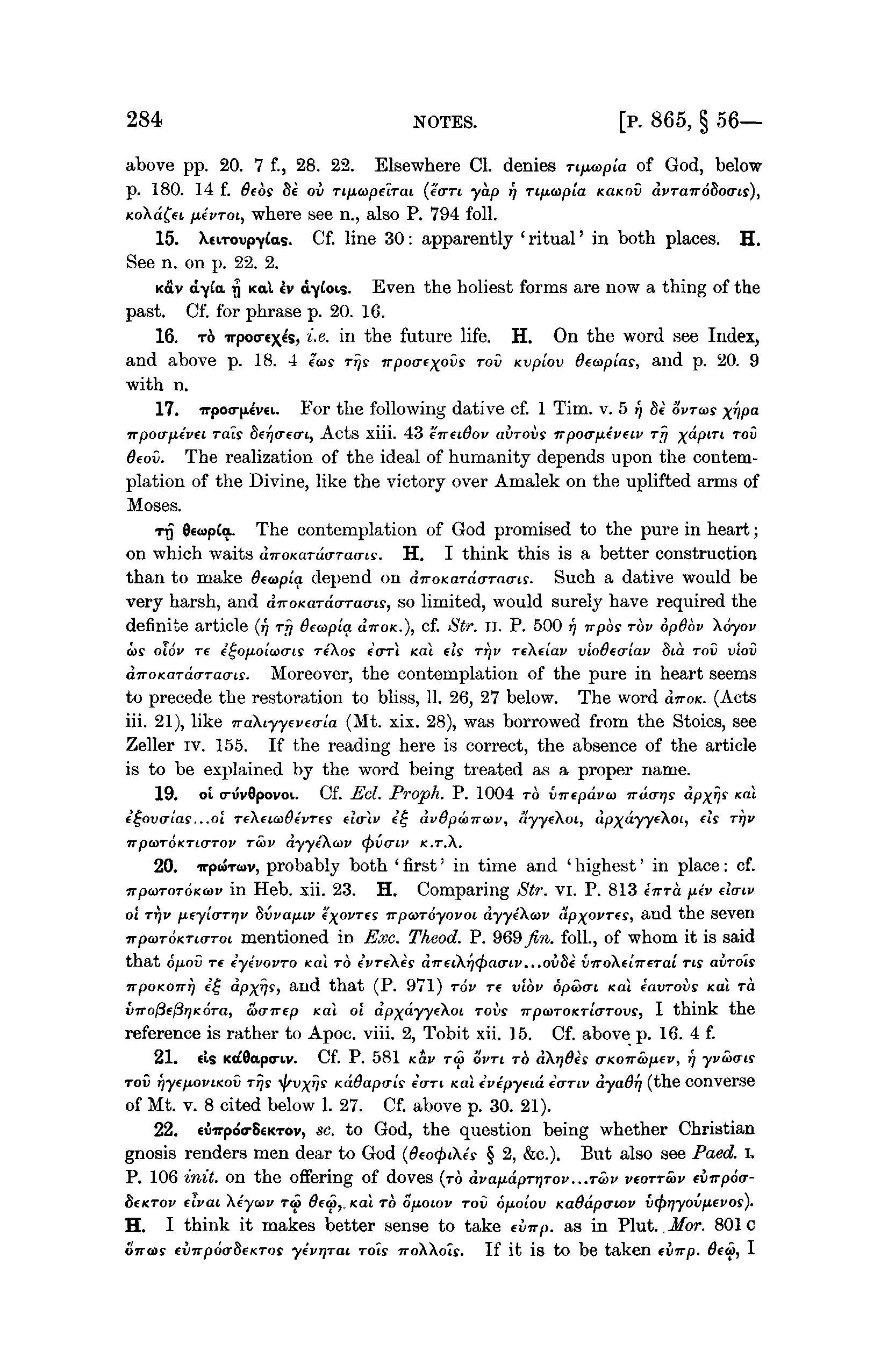
NOTES.
[P. 865, § 56—
above pp. 20. 7 f., 28. 22. Elsewhere Cl. denies rtfuopla of God, below p. 180. 14 f. 6c6s 8e ov TLfio>pflTai (tern yap rj TLfjLOipla KCIKOV avTmrofioo'is), xoXafet jxivroi, where see n., also P. 794 foil.
15.
Xeirovp-yfes.
Cf. line 30: apparently ' ritual' in both places.
See n. on p. 22. 2.
Kciv ayla. g Kal iv aylot.%. Even the holiest forms are now a thing of the past.
Cf. for phrase p. 20. 16.
16.
TO irpoo-ex^s, i-e. in the future life.
On the word see Index, and above p. 18. 4 eW rijs vpoo-c)(ovs TOV Kvplov 6eopias, and p. 20. 9 with n.
17. irpoo-|j.«'v€L For the following dative cf. 1 Tim. v. 5 i) Se b'vrats xwa irpoa-jxiveL TOLS 8cr](Te<ri, Acts xiii. 43 eneiBov avrovs npoo-fieveiv rrj y^apiTi TOV dfov. The realization of the ideal of humanity depends upon the contemplation of the Divine, like the victory over Amalek on the uplifted arms of Moses.
TT) 0ewpta. The contemplation of God promised to the pure in heart; on which waits dvoKaTdo-Tao-is.
I think this is a better construction than to make deapia depend on dnoKaTao-Tao-ts.
Such a dative would be very harsh, and dnoKaTao-rao-is, so limited, would surely have required the definite article (^ rf) Oeapla oiroit.), cf. Str. II. P. 500 ij irpbs TOV 6p6bv \6yov o>ff olov T€ (^ofiolaxTis T4\OS €OT\ KO.1 eis TTJV TtXtiav vlo6to~iav hta TOV VLOV aTroKaTao-Tacns.
Moreover, the contemplation of the pure in heart seems to precede the restoration to bliss, 11. 26, 27 below. The word dnoK. (Acts iii. 21), like naXiyyivicria (Mt. xix. 28), was borrowed from the Stoics, see
Zeller iv. 155. If the reading here is correct, the absence of the article is to be explained by the word being treated as a proper name.
19. ot criivSpovoi.
Of. Eel. Proph. P. 1004 TO vnepdva> nao-rjs dpxrjs /cm €^ovo~las...ol reXetoj^eVres1 eictv e'£ avdpoonav, oyyeXoi, dp)(d.yye\oL, els Trjv
TrpayTOKTiCTov TQJV dyy£\cov cpvo'iv K.T.X.
20. irpwroiv, probably both ' first' in time and ' highest' in place: cf.
TTpaTOTOKwv in Heb. xii. 23. H.
Comparing Str. vi. P. 813 en-i-a piv elo-tv oi Ttfv p-fyio-rrjv Siiva/iiv f^ovres npcoroyovoi dyyiXcov apvovTes, and the seven npa>TOKTio-Tot mentioned in Exc. Theod. P. 969 Jin. foil., of whom it is said that 6p.ov T€ iyivovTO Kal TO evTe\es dnei\r)(f>(io~iv...oufie u7roXei7rerai riff avTois irpoKOnrj e£ dp%T]s, and that (P. 971) TOV re vlov 6pa>o~i KO\ eavTovs Kal Ta inrolleftriKora, £>o-7rcp Kal ol dp^dyyikoi
TOVS ivpatTOKTlo-Tovs, I think the reference is rather to Apoc. viii. 2, Tobit xii. 15. Cf. above p. 16. 4 f.
21. els KdCOapiriv. Cf. P. 581 KOV r<3 6Vn TO dXrjdes o-Kowaifiev, rj yvao-is TOV rjyffiovLKoi Trjs yj^vxv^ Kadapo-is ecrri Kal evepyad etrTiv dyadr/ (the converse of Mt. v. 8 cited below 1. 27. Cf. above p. 30. 21).
22. eiirp^o-SsKTov, sc. to God, the question being whether Christian gnosis renders men dear to God (deo(pi\h § 2, &c).
But also see Paed. I.
P. 106 init. on the offering of doves (TO dva\x.dpTiyrov...TO>V vtoTTasv evnpoa- &€KTOV tivai \£ya>v T<a Ofa7. Kal TO opoiov TOV 6p.oiov Kaddpo'tov vcprjyovfievos).
H. I think it makes better sense to take evnp. as in Plut. Mor. 801c 6na>s einpoarbeKTOs yivryrai TO'IS TTOXXOIJ.
If it is to be taken dirp. #€<», I https://doi.org/10.1017/CBO9780511695513.011 Published online by Cambridge University Press
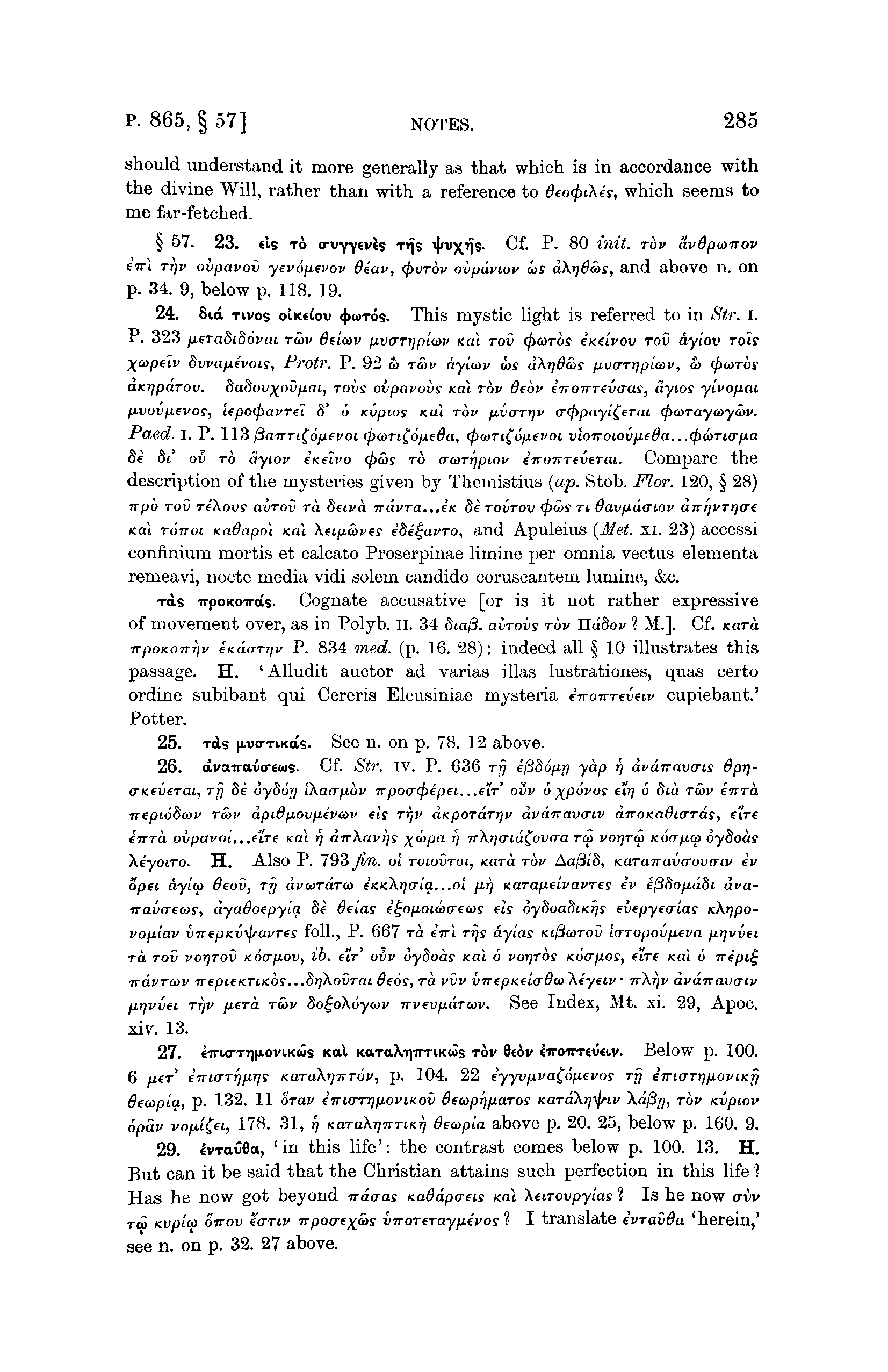
P865, § 57]
NOTES.
should understand it more generally as that which is in accordance with the divine Will, rather than with a reference to 6eo(f>i\4s, which seems to me far-fetched.
§ 57. 23. els TO wyytvis TTJS 4>«X')S- ^f. P. 80 init. TOV avdpanov C7ri TTJV ovpavov yevop-evov Beav, (pvTov ovpdviov caff dXrjdtos, and above n. on p. 34. 9, below p. 118. 19.
24.
8id TWOS oUtfov <|>UT6S. This mystic light is referred to in Sir. I.
X. 323 fx^Tadibovtu TWV Stiaiv p.vo~TT}p[a>v Kal TOV (pcdTOS CKC'IVOV TOV ayiov rots \wpf~iv Svvapevois, Protr. P. 92 a> TO>V dylmv as a\rjSo)i p.vo-TTjpiwv, ft) (pa>Tos aK.ripa.Tov. SaSovxovfiai, TOVS ovpavovs Kal Tov 8eov ewonT(vo-as, ayios yivofim p-vovpevos, UpofpavTel 8' o Kvpws KCU TOV jxio-rr^v crfppayi^fTm (po>Taya>ya>v.
Paed. I. P. 113 l3anTi£6p.evoi <pG>Ti£6[i€da, <pwTi£6[i€V0L vtOTroiOvfieOa. ..<pcoTio~fxa oe ot ov TO ayiov tn*\vo <pais TO o~ujTr]piov (7ro7TTfveTai.
Compare t h e description of the mysteries given by Thcmistius (ap. Stob. Flor. 120, § 28)
•npo TOV TeXovs auTov Tci dfiva 7rdvTa...iK de TOVTOV (fows rt davfxaatov a7rr]VTT]o~£
<a\ T07TOI Ka9apnl Kal \a./j.6>ves ihi^avTo, and Apuleius {Met. xi. 23) accessi confinium mortis et calcato Proserpinae limine per omnia vectus elementa remeavi, nocte media vidi solem candido coruscantena lumine, &c.
Tas irpoKoirasCognate accusative [or is it not rather expressive of movement over, as in Polyb. n. 34 8ia/3. avToi/s TOV HdSov ? M.]. Cf. KOTO. wpoKonTjv eKaarr/v P. 834 med. (p. 16. 28): indeed all § 10 illustrates this passage.
' Alludit auctor ad varias illas lustrationes, quas certo ordine subibant qui Cereris Eleusiniae mysteria ino-nTeveiv cupiebant.'
Potter.
25.
TOLS |j.vo-TiKas. See n. on p. 78. 12 above.
26. dvairavcrewsCf. Str. IV. P. 636 Trj efi&onrj yap rj avanav&is @pi]o~K€V€Tai, TTJ he oyhoij iXaarp.6v npoo~<pepei.. .eiV ovv 6 %povos e'lf] 6 Sta Tutv eTrra
Treptohajv TCOV dpiOp.ovp.ivwv els TTJV aKpoTaTT]v dvdnavcnv dnoKaOiO'Tds, eiVe eiTTa ovpavoi.,.€'[T€ Kal rj d-rrXavrjs x^Pa V 7T^<r]O'id£ovo~aTC0 VOTJTW Koo~p.w oyfioa?
XeyoiTO.
H .
Also P. 793 JlTl. ol TOIOVTOI, KaTa TOV Aa/3i'8, KO.TaTravo'ovo'lv ev opet aytco Oeov, r?/ dvatTaTco €KK\rjo'ia...ol p.rj KaTap.eivavTts £v cftftop.db'i dvaTravaecos, dyaSoepyla
Se deias t^opoicao~e<*>s etff 6ydoab*iKT]s ev€py€0~ias /cX^povofiiav vnepKv^j/avTes foil., P. 667 Ta enl Trjs dyias Klfio>TOV lo~Topovp.€va p.rjvv€l
Ta TOV vorjTov Koo-p.ov, ib. eiV ovv oyboas Kal 6 vorjros Koap-os, fire Kal 6 irtpit^ ndvTtov n€pt€KTLK6s...dr]\ovTat #609, Ta vvv vnepKELO'doy^yeiv•
TTXTJV avdnavaiv p,rjvve(. TTJV p,eTa TCOV 8o£o\6y<ov nvevp-droov.
See Index, Mt. xi. 29, Apoc. xiv. 13.
27.
€1TLO"TT][IOVLKWS Kal KaTaX.7]iTTiK«s TOV Btov liroiTTeiJeiv.
Below p. 100.
6 peT1 emo-Trjixris KaTaXrjwrov, p. 104. 22 £yyvpva£6)xevos TTJ (wio-TrjpoviKrj $ea>pi'a, p. 132. 11 OTav eTTLO~T7)p.oviKov Bea)prjp,aTos KaTaXrjyjnv X a ^ , TOV Kvpiov opav vo/u'fei, 178. 31, ij caraXj/TrriKi) 8ea>pia above p. 20. 25, below p. 160. 9.
29.
IvTavBa, 'in this life': the contrast comes below p. 100. 13. H.
But can it be said that the Christian attains such perfection in this life 1 Has he now got beyond ndcras Kaddpcreis Kal XeiTovpyias 1 Is he now o~vv
TQI KVOLO) OTTOV €o~Ttv TTpoo~e)((i>s vTTQTiTayjxivos^ I translate ivTaiida * herein,' see n. on p. 32. 27 above. https://doi.org/10.1017/CBO9780511695513.011 Published online by Cambridge University Press
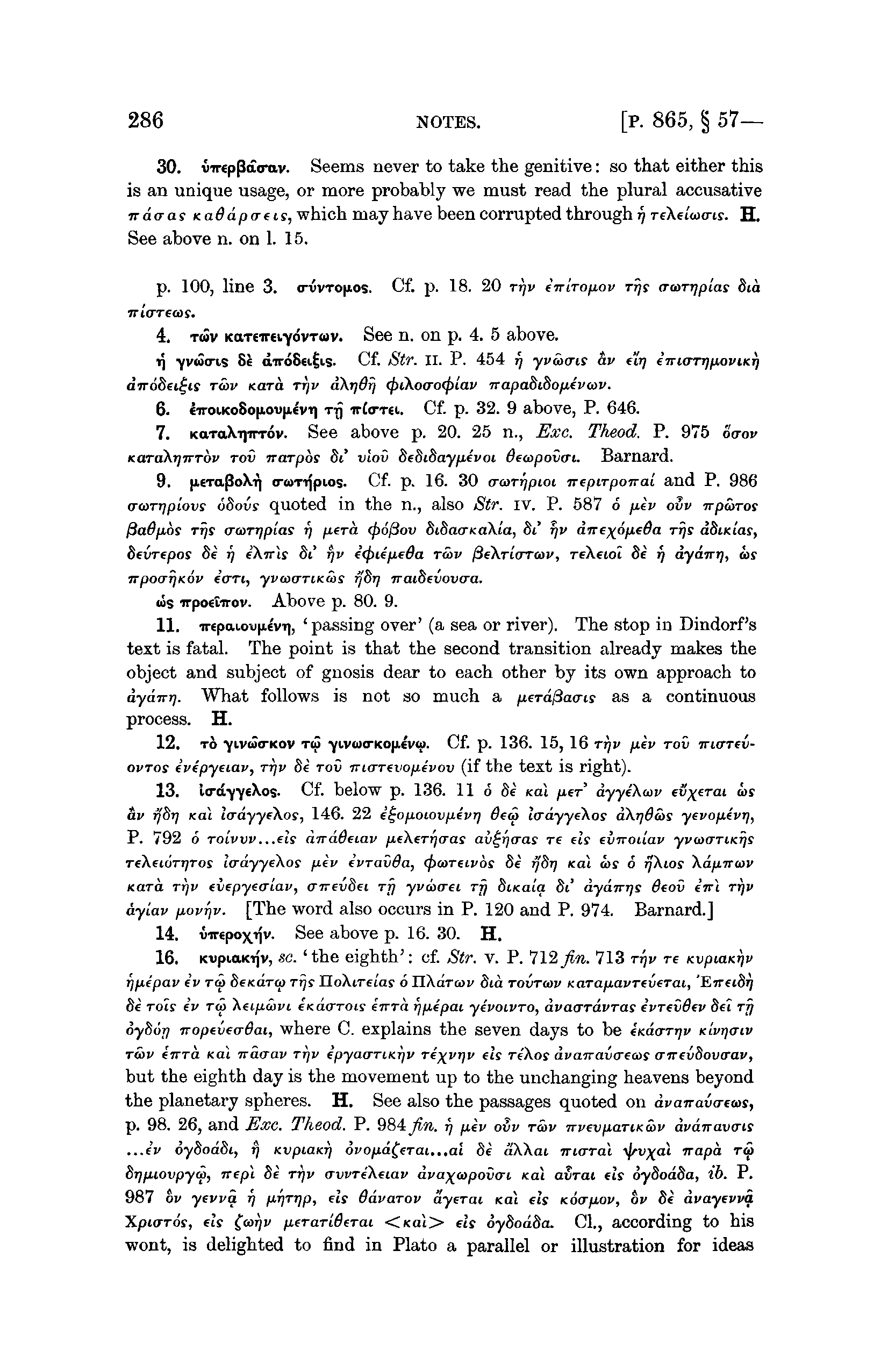
NOTES.
[P. 865, § 57—
30. iireppriurav.
Seems never to take the genitive: so that either this is an unique usage, or more probably we must read the plural accusative
IT do-as Kadapa-fis, which may have been corrupted through r) i-eXeiWir. H.
See above n. on 1. 15. p. 100, line 3.
<TVVTO|I.OS. Of. p. 18. 20 rr/v (wlrofiov rrjs (rayrqpLas bia 4.
T<3V KaxeirtiYdvTojv.
See n. on p. 4. 5 above. ij •yvwors BJ dirooEitjis.
Cf. Str. II. P. 454 r) yvixris av (it) (7naTrjfx,oviKfj dirodd^is TO>V Kara Trjv d\r]6rj (j>iko<ro(piav TTapahibofxevtav.
€iroiKo8o|iou|j.«vT| TTJ irCo-rei. Cf. p. 32. 9 above, P. 646.
KaTaXifirTov.
See above p. 20. 25 n., Exc. Theod. P. 975 Strov KaraXrjTrTov TOV narpos bi vlov deftio'aypJvoi 6e(x>povo~i.
Barnard.
|jieTapoXT| o-UTTJpios.
Cf. p. 16. 30 rrcoTr/pioi nepiTponai and P. 986 a-aiTrjpiovs odovs quoted in the n., also Str. IV. P. 587 o yueV ovv wparos fia0p.6s rf/s iTCOTTjpias 17 fiera (pofiov StSacrKaXta, 81' r/v airt)(6iie6a rrjs dBiKias, devrepos $€ rj iXirls Si* rjv ((piefxeda T<OV ^eXrtaTO)^, reXetoi. 8e ff dydjrr], a>s
•npo<jT}Kov can, yvwo-Tiicws ^'drj Traihevovtra.
10s irpoetirov.
Above p. 80. 9.
11. irepauni|i£vi|, 'passing over' (a sea or river). The stop in Dindorf's text is fatal.
The point is that the second transition already makes the object and subject of gnosis dear to each other by its own approach to aydnrj. What follows is not so much a jxerd^acns as a continuous process.
12.
TO yiva(TKOV TCO 1y('V<oo'KO|i€V<p. Cf. p . 136. 15, 16 Trjv /zei* TOV TrioTevOVTOS tvcpyeiav, rrjv 5e TOV TTiaTcvofxivov (if the text is right).
13. lerekyyeXos. Cf. below p. 136. 11 6 8e KO.1 /ier' dyy4\av cu^erat as av rjSrj icm lo-dyye\os, 146. 22 t^ojioiovp-ivq 6«a lo-dyyeXos dXrjdas ydio/iivrj,
P. 792 6 Toivvv...els aTrdBetav p.e\cTr)o~as av£r](ras re et? evnoiiav yvb><TTiKr)S
TfXetoTijTos lo~dyye\os fiev ivTavda, (pcoTetvos de rjhr) Kai a>s 6 rjXios XafnTtov
KaTa Trjv cvepytaLav, airevdci TTJ yva>o~€i TTJ StKaia 5t' dydwqs flfov eVi rr]v aylav p.ovrjv. [The word also occurs in P. 120 and P. 974.
Barnard.] 14. iirepoxijv.
See above p. 16. 30. H.
16.
KupuxKTJv, so. ' t h e eighth': cf. Str. v. P. 712Jin. 713 TTJV re Kvpianriv Tjp.epav iv TCO deKaTcp TT]S HoXtTeias 6 UXaTcov dia TOVTWV KarajLtai/rfuerat, 'E7T«5^ hi TOIS iv ra> Xeifiwvi endo-TOis eVra rj/j.4pm yivoivTO, dvao-TavTas evrevdfv Sci TTJ oybor/ iTopiveo-Bai, where C. explains the seven days to be eKao-Trjv Kivrjo-iv TO>V (ffTa Kai wdcrav TTJV ipyao-TiKrfV Ttyyr)v (Is Te'Xor dvanavcr(a>s <Tir(v8ov(rav, but the eighth day is the movement up to the unchanging heavens beyond the planetary spheres.
See also the passages quoted on dvanaio-cas, p. 98. 26, and Exc. Theod. P. 98i Jin. 7) jxev ovv TO>V nv(vp.aTiKa>v dvd7ravcrts
...iv 6y8od8i, i) KvptaKj) 6vo/jid^(Tai...,ai 8c aXXai irio-ral yjrv^al irapa rffl
Brffuovpyco, n(pi 8e TI)V <TvvT(\(iav dvay^apovcn <a\ avTat els oydodSa, ib. P.
987 ov yevva r] [irjTTjp, (Is BdvaTov ay(Tat Ka\ (Is KOO~fJ.ov, ov dc dvayevvq Xpio-Tos, els fwijv fi(TaTid(Tai < K < J I > els 6y8od8a.
Cl., according to his wont, is delighted to find in Plato a parallel or illustration for ideas https://doi.org/10.1017/CBO9780511695513.011 Published online by Cambridge University Press
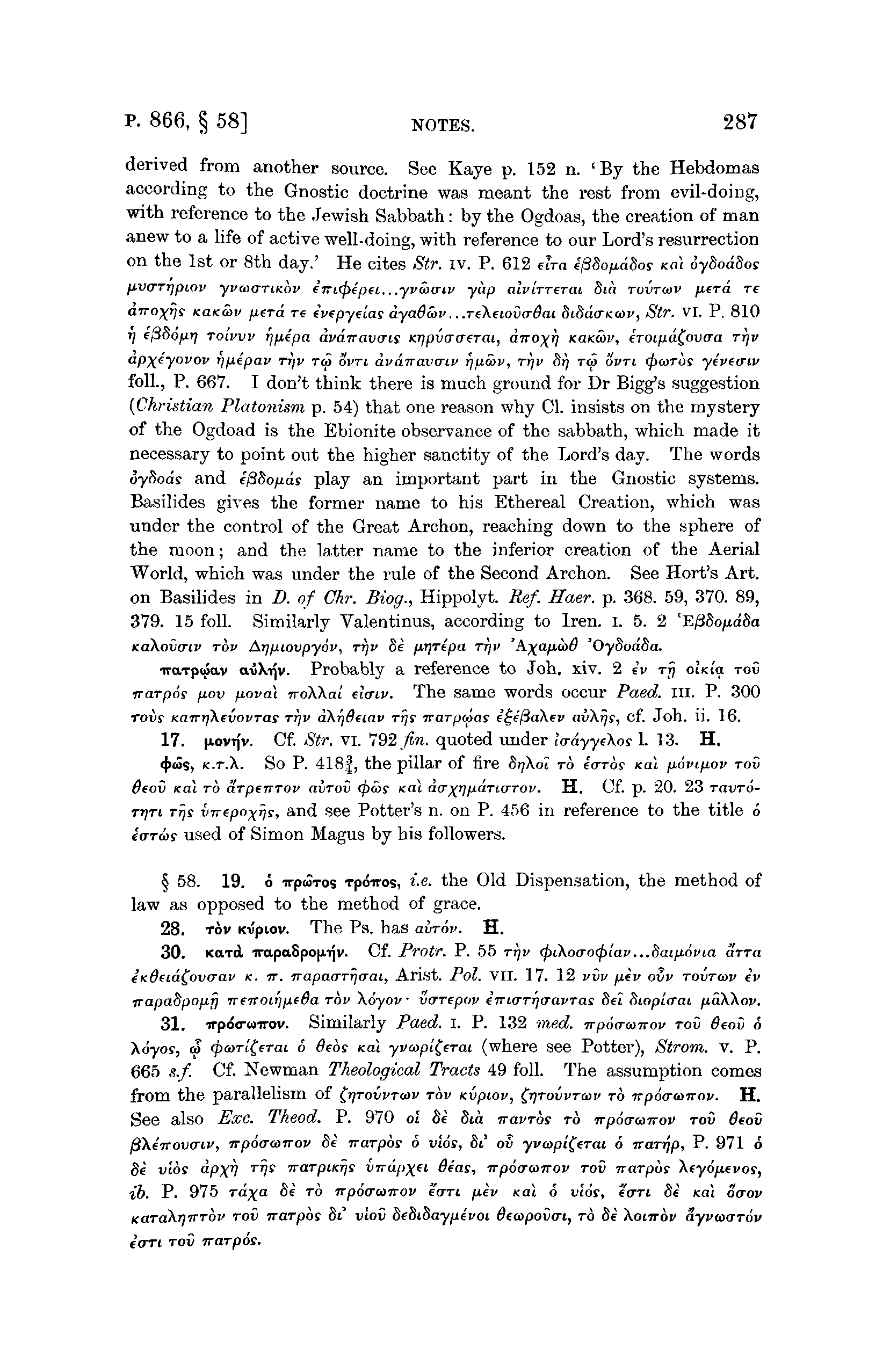
P. 866, § 58]
NOTES.
derived from another source. See Kaye p. 152 n. 'By the Hebdomas according to the Gnostic doctrine was meant the rest from evil-doing, with reference to the Jewish Sabbath: by the Ogdoas, the creation of man anew to a life of active well-doing, with reference to our Lord's resurrection on the 1st or 8th day.' He cites Str. iv. P. 612 elra epSo/iddos «eni dySodSos jivorrjpiov yvaxTTiKov e7ri<f>epei...yvwaiv yap alviTrerai Sin TOVTWV fierd re arrows KOKOOI/ fierd re ivepyeias dyadav.. .TeXeiovcrdai Si8do-KO>v, Str. VI. P. 810
T\ eftSo/ir] Tolvvv rjfiipa dvaTravo-is KTfpvaaeTai, diro)(r) KaKonv, iTOtfid£ov<ra rrjv
QPX*~/OVOV
^{J-epav TTJV T(O OVTL dvaTTaV0~LV f][l(0V, TrjV hrj TO) OVTl CpOiTOS yeVeO~lV foil., P. 667. I don't think there is much ground for Dr Bigg's suggestion
{Christian Platonism p. 54) that one reason why Cl. insists on the mystery of the Ogdoad is the Ebionite observance of the sabbath, which made it necessary to point out the higher sanctity of the Lord's day. The words dySods and eftSo/jids play an important part in the Gnostic systems.
Basilides gives the former name to his Ethereal Creation, which was under the control of the Great Archon, reaching down to the sphere of the moon; and the latter name to the inferior creation of the Aerial
World, which was under the rule of the Second Archon. See Hort's Art. on Basilides in D. of Chr. Biog., Hippolyt. Ref. Haer. p. 368. 59, 370. 89,
379. 15 foil.
Similarly Valentinus, according to Iren. I. 5. 2 'E/3S<yidfia KaKovcriv TOV Ar/niovpyov, TT\V Se firjrcpa TTJV 'A^a/i<»^ 'Oy8od8a. iraTpwav aiXijv.
Probably a reference to Joh, xiv. 2 iv rrj OIKIQ TOV naTpas p.ov fiovaX u-oXAai el<riv. The same words occur Paed. HI. P. 300 rovs KnnijXfvovras rfjv akr^dfiav rrjs irarpwas e^fjSaXev avXrje, cf. Joh. ii. 16.
17.
HOVTJV. Cf. Str. VI. 792 fin. quoted under iVdyyeAor 1. 13. H.
<f>a>s, K.T.A.
So P. 418^, the pillar of fire SrjXol TO {<TT6S KOL p.6vtp.ov TOV 6eo\> KCIL TO CtTpfTTTOV (IVTOV <p<dS KOI Ao'^qjxdTlO'TOV.
H . Cf. p . 20. 2 3 TaVTOTTJTI TTJS vTrepoxijs, and see Potter's n. on P. 456 in reference to the title 6 forctfj used of Simon Magus by his followers.
§ 58. 19. o •n-pui-os Tp<5iros, i.e. the Old Dispensation, the method of law as opposed to the method of grace.
28.
TOV KiJpiov.
The Ps. has airov.
30.
KaTcl irapaSpofjL-ijv.
Cf. Protr. P. 55 TTJV (fii\oo~o<filav...daijAOVLa arra iK9eid£ovo-av K. W. napao-rfjo-ai, Arist. Pol. VII. 17. 12 vvv jicv ovv rovratv iv irapaSpopfj neTrotrjiiefla TOV \6yov vo~T€pov into~TT)o~avTas Set hioplo'aL fiaWov.
31. irpdo-wTrov.
Similarly Paed. I. P. 132 med. wpoo-airov TOV Oeov 6 Adyor, a (pct>Ti£cTm 6 debs KCLL yvoapl^erai (where see Potter), Strom. V. P.
665 s.f. Cf. Newman Theological Tracts 49 foil. The assumption comes from the parallelism of farovvT&v TOV icvpiov, ^TJTOVVTCOV TO 7rp6o-<o7rov.
See also Exc. Theod. P. 970 ol ht 8ia navrbs TO npoo-airov TOV deov fSXiirovo-iv, TTpoo-anvov be naTpbs 6 v'ws, Si ov yvapl^erai 6 nar-qp, P. 971 o
8e vlbs apXV TVS vaTpiKrjS invapxei 6eas, 7rp6ara>7rov TOV narpbs Xfyopevos, ib. P. 975 Ta\a Se TO Trp6o~a>ffov eo~Tt fxev KOI 6 v'tos, eo~Ti 5« na\ oo~ov
KaTa\r)irTOV TOV narpbs 8i' uioC 8e8ifSayfiivoi 6ea>povo-i, TO 8e Xoiirbv ayvaorov '
TOV Trarpos. https://doi.org/10.1017/CBO9780511695513.011 Published online by Cambridge University Press
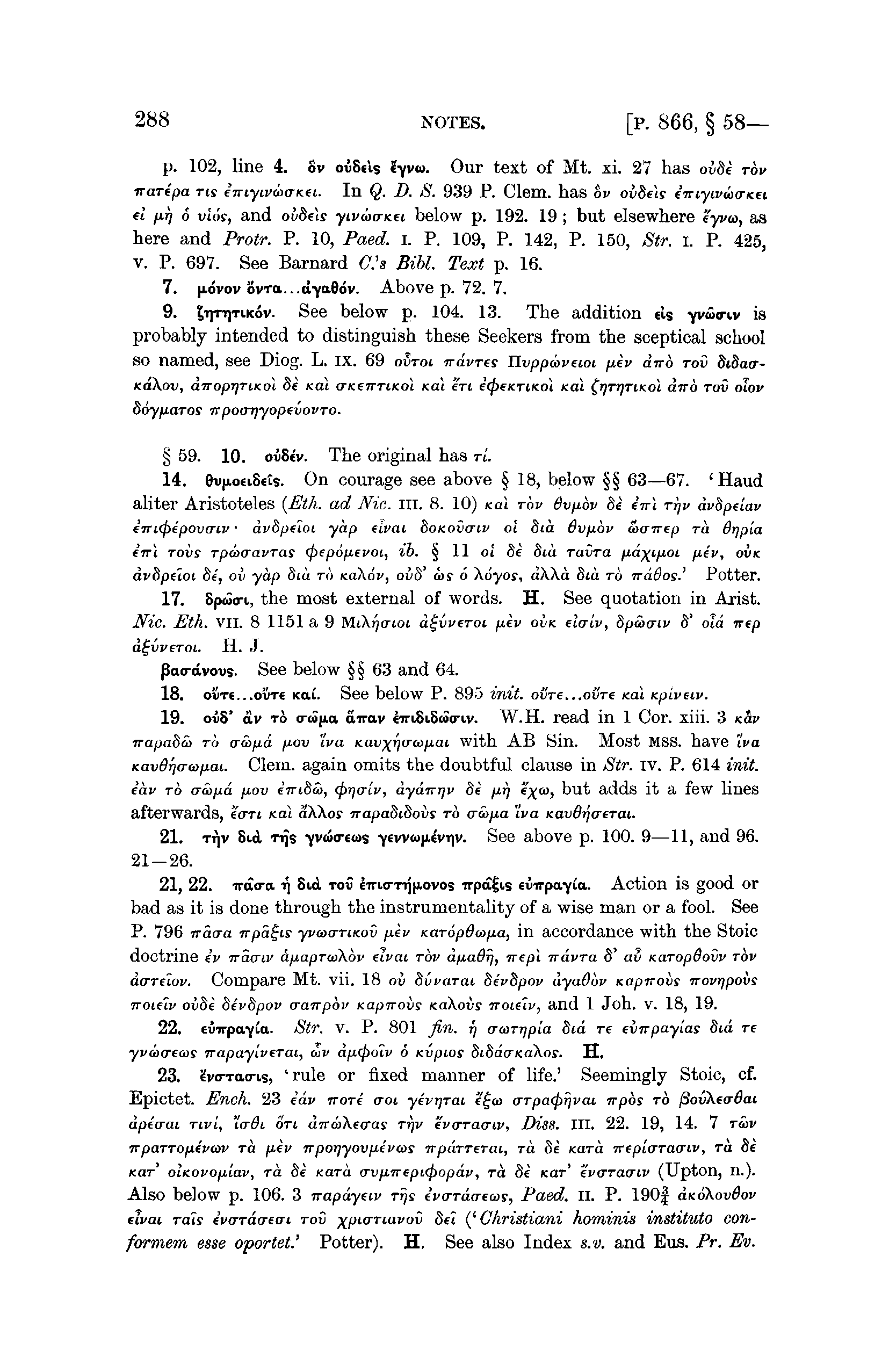
NOTES.
[p. 866, § 58— p. 102, line 4. Sv oi8tis £yvw. Our text of Mt. xi. 27 has olbe TOV iraTCpa res iniyivacrKei.
In Q. D. S. 939 P. Clem, has ov ovbeis eniyivaxTKei fl fir) 6 vlos, and ov8e\s ytvaxrKfi. below p. 192. 19 ; but elsewhere eyva, as here and Protr. P. 10, Paed. I. P. 109, P. 142, P. 150, Str. I. P. 425, v. P. 697. See Barnard C.'s Bibl. Text p. 16.
|iovov ovTa.-.d-yaeov. Above p. 72. 7.
(T]TT)TIKOV.
See below p. 104. 13.
The addition els yvHa-iv is probably intended to distinguish these Seekers from the sceptical school
SO named, see Diog. L. IX. 69 OVTOI ndvTes Tivppaveioi fiev duo TOV bidarrKfiXov, aTTOpTJTlKol de KOI O~KeTTTlKol KOI (ETC e(f)eKTlKo\
Kai £r/Tr}TlKo\ diTO TOV OlOV doyfiaTos IT pocrrjyopevovTO.
§ 59. 10. oi8tv.
The original has TL.
14.
8v(ioei8«ts. On courage see above § 18, below §§ 63—67. ' Haud aliter Aristoteles (Eth. ad Nic. in. 8. 10) <a\ TOV 6vp.6v Se eirl TTJV dvbpdav
€7U(p€povo~iv • dvdpfioi y&p tivai hotcovaiv ol dta 6vjxov a>o~Trep TU 8rjpla fir I rovs Tpaxravras (pepofievoi, ib. § 11 of fie hia Tavra p.d)(ifi.oi p.iv, OXIK dvbptioi 6^, oil yhp hia TO KOXOV, ovd' a)ff 6 \6yos, dWa 8ia TO 7rd$os.} Potter.
17.
Spuon, the most external of words. H.
See quotation in Arist.
Nic. Eth. VII. 8 1151 a 9 MiX^trioi U^VVITOI jxkv OUK etViV, Spacnv S' old jre/> d^vveTOL. H. J. paerdvovsSee below §§63 and 64.
18.
OVT€...OVT€ Kai. See below P. 895 init. oiVe...OVTC KOL Kpivetv.
19. oiS' civ TO crmna oirav «iri8iSw<riv.
W.H. read in 1 Cor. xiii. 3 <av irapabco TO crcop.d pov 'Iva /cau^^a-w/iat with AB Sin. Most MSS. have Iva
Kavdrjo-apm. Clem, again omits the doubtful clause in Str. iv. P. 614 init. iav TO o-wjid jiov eViSw, (prjcriv, dydnrjv be fir] €)((»), but adds it a few lines afterwards, eori Kai aXkos wapabibovs TO oS>fia Iva K.av6r)o-tTai.
21.
TTJV Sid TI}S •yv<6o-£a>s -yewun^vtiv.
See above p. 100. 9—11, and 96.
2 1 - 2 6 .
21. 22. ird<rct ii Sid TOC eirio-Ttjuovos irpdjis eiirpctyia.
Action is good or bad as it is done through the instrumentality of a wise man or a fool. See
P. 796 irdo-a npd^is yvao-Tinov fiev KaTopdafia, in accordance with the Stoic doctrine iv TTCLO-IV &fiapTw\6v etVat TOV ajixa^i}, nepl irdvTa 8' av KaTopBovv TOV do-Telov. Compare Mt. vii. 18 oi bivarai SevSpov dyaBbv Kapirovs novrjpovs notfiv ovbe bivdpov o'anpbv Kapnovs KaXovs irotelv, and 1 Joh. V. 18, 19.
22. eiirptfyia.
Str. V. P. 801 fill, r) (Tarr/pia bid re fiirpayias bid re yvoxrfcos napayivfTai, cuv dpxpolv 6 Kvpios bibdaKaXos. H, 23.
2v<rTao-is, 'rule or fixed manner of life.'
Seemingly Stoic, cf.
Epictet. Ench. 23 idv ITOTS aoi yevr/Tai e£<u (TTpacprjvai npbs TO /SovXeo-dai dpio-ai Tivi, 'I<T8I OTI diraXfo'as TTJV evo-Tao-iv, Dies. III. 22. 19, 14. 7 T<OV
IVpaTTop.ivcav Ta fxev 7rpoi]yovfi€v<os TrpaTTeTai, TO. be KaTa 7replo~Ta(riv, Ta be
KOT' olKovofiiav, Ta be Kara <rvp.7repL(popdv, Ta be KOT' evcrTao-iv (Upton, n.).
Also below p. 106. 3 napdyeiv Trjs ivo-Tao-eas, Paed. II. P. 190| duoXovSov fivai rah evo-rdo-eo-t TOV xplo~nav°v 8" (' Christiani hominis institute conformem esse oportet.' Potter).
H, See also Index s.v. and Eus. Pr. Ev. https://doi.org/10.1017/CBO9780511695513.011 Published online by Cambridge University Press
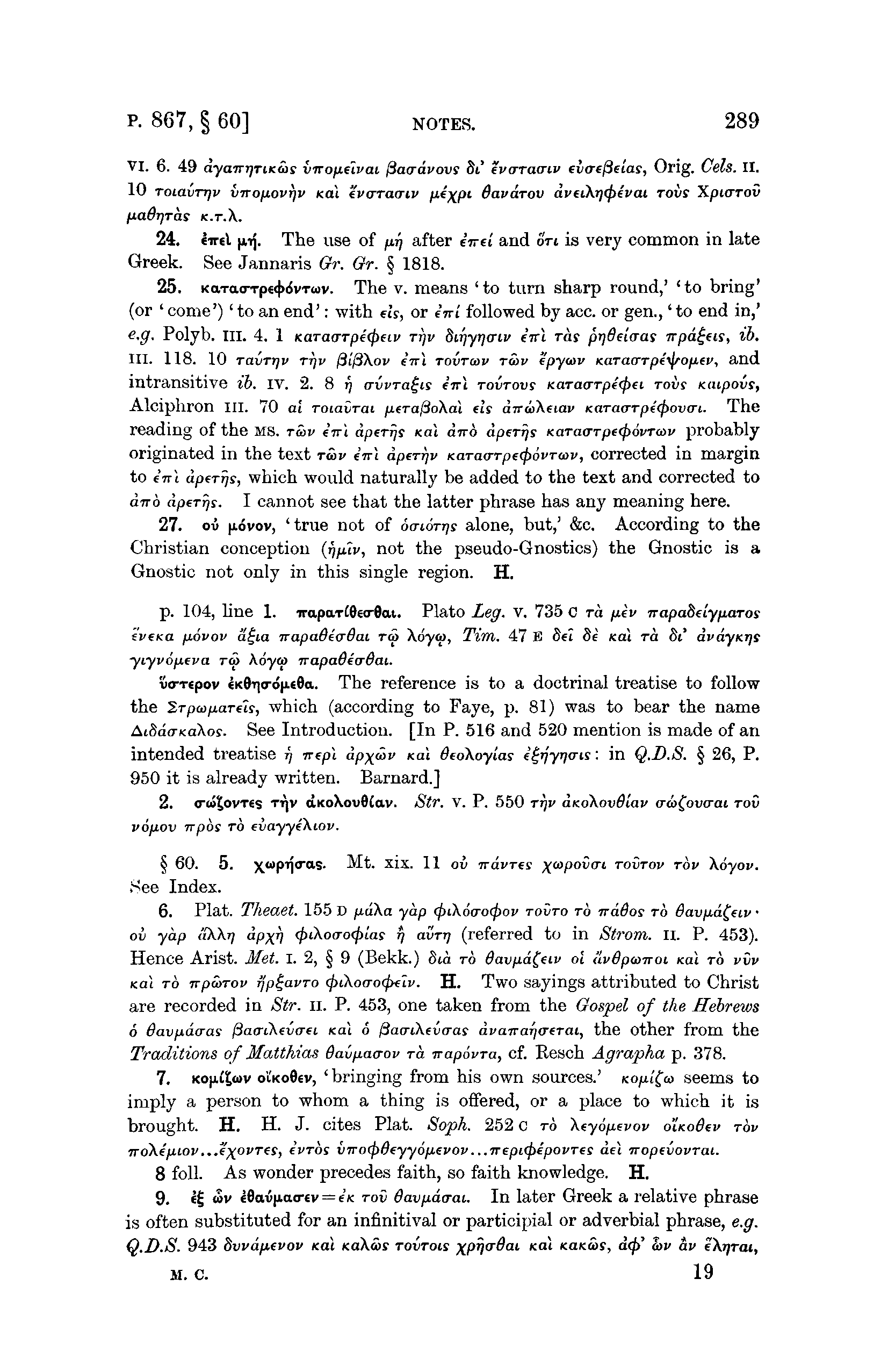
P. 867, § 60]
NOTES.
VI. 6. 49 dyanrjTiKas virofielvai fia&dvovs 8t' evtrracnv elcrefielas, Orig. Cels. II.
1 0 TOtaVTTJV VTTOflOVrjV KCtl €VO~TaO~lV fli^pl OaVCLTOV dv€l\r]<p£vat TOVS XpiOTOV fiadijras K.T.X.
24. lirel |iij. The use of pr) after eVei and 6V1 is very common in late Greek. See Jannaris Or. Gr. § 1818.
25. KaTaoTp«<|><5vTa)v. The v. means 'to turn sharp round,' 'to bring'
(or ' come') ' to an end': with ds, or eVi followed by ace. or gen.,' to end in,' e.g. Polyb. III. 4. 1 KaTao~Tpe<f)fiv rfjv 8i.T]yt)o~iv eirl ras prjdeiaas 7rpa£tis, ib.
III. 118. 10 TdVTTJV TTjV /3l'/3\ov €7r\ TOVTCOV TWV epyo)V KaTaorrpe'l^O/AeP, a n d intransitive ib. IV. 2. 8 rj o~vvTa£is fTrl TOVTOVS naTao~rpe(pei TOVS K(upovst
Alciphron III. 70 at roLavrai [XfTafiokai ety airw\eiav Karao'TpeCpovo'i. The reading of the MS. ra>v «Vi dperijs nal dwo aperrjs Kara(TTpe<p6vTa>v probably originated in the text TS>V en\ dperrjv Karao-TpeifiovTw, corrected in margin to en 1 dpfrr/s, which would naturally be added to the text and corrected to an 6 dperrjs. I cannot see that the latter phrase has any meaning here.
27. oi |i6vov, 'true not of oo-torr/s alone, but,' &c. According to the Christian conception (wlv, not the pseudo-Gnostics) the Gnostic is a Gnostic not only in this single region. H. p. 104, line 1. irapaT£6eo-8at.
Plato Leg. V. 735 C ra p.ev i'vfKa /xovov a£ia wapadi&Btu ra \6y<o, Tim. 47 B SfZ 8e Km ra Si dvdyKrjS yiyvopeva ro> Koyto napaOifrQai. vorepov «K9rio-o(ji«6a. The reference is to a doctrinal treatise to follow the S,Tpwfj.aTe7s, which (according to Faye, p. 81) was to bear the name
AtSdo-KoXos. See Introduction. [In P. 516 and 520 mention is made of an intended treatise jy T?ep\ dpxo>v *a\ dcokoylas i£ijyr)o-is: in Q.D.S. § 26, P.
950 it is already written.
Barnard.] 2.
<riȣovTes T^V aKoXouOCav. Str. V. P. 550 TTJV aKokovdlav o-a^ovcrm TOV VOJXOV npos TO tvayyfKiov.
§ 60. 5. x«i)pij<ras.
Mt. xix. 11 ou iravrts )(capovcn TOVTOV TOV Xd-yoi>.
See Index.
Plat. Theccet. 155 D p.d\a yap (pi\6o~o(pov TOVTO TO rrdOos TO 6avp.d£€iv • oi yap <!X\T] dpxri <pi\oo-o<pias rj avrrj (referred to in Strom. II. P. 453).
Hence Arist. Met. I. 2, § 9 (Bekk.) Sta TO davjxd^av ol avBpanoi
KUI TO VVV
<al TO 7rpa>Tov rjp£avTo (pt\oo-o(p(lv.
Two sayings attributed to Christ are recorded in Str. n. P. 453, one taken from the Gospel of the Hebrews
6 8avp,dcras /3a(riAevo"ei Ka\ 6 j3ao~i\evo~as dvairaT]O'€Tai, the Other from the Traditions of Matthias davfiao-ov ra wapovra, cf. Resch Agrapha p. 378.
7. Kop.£)>v oi'KoOev, ' bringing from his own sources.' KOfii£a> seems to imply a person to whom a thing is offered, or a place to which it is brought. H. H. J. cites Plat. Soph. 252 c TO \ey6jievov OIKOBCV TOV noXe/xiov...f'xovT(S, e'vTos vwoCpOfyyo/Mevov...nepKpepovTfs del nopevovrai.
8 foil. As wonder precedes faith, so faith knowledge. H.
9. e| »v «flav|iacr€v = e< TOV dav/j.dcrai. In later Greek a relative phrase is often substituted for an infinitival or participial or adverbial phrase, e.g.
Q.D.S. 943 Svvdfifvov Kal KaXas TOVTOIS xprjoSai /cai cacms, d(j>' hv av eX M. C.
https://doi.org/10.1017/CBO9780511695513.011 Published online by Cambridge University Press
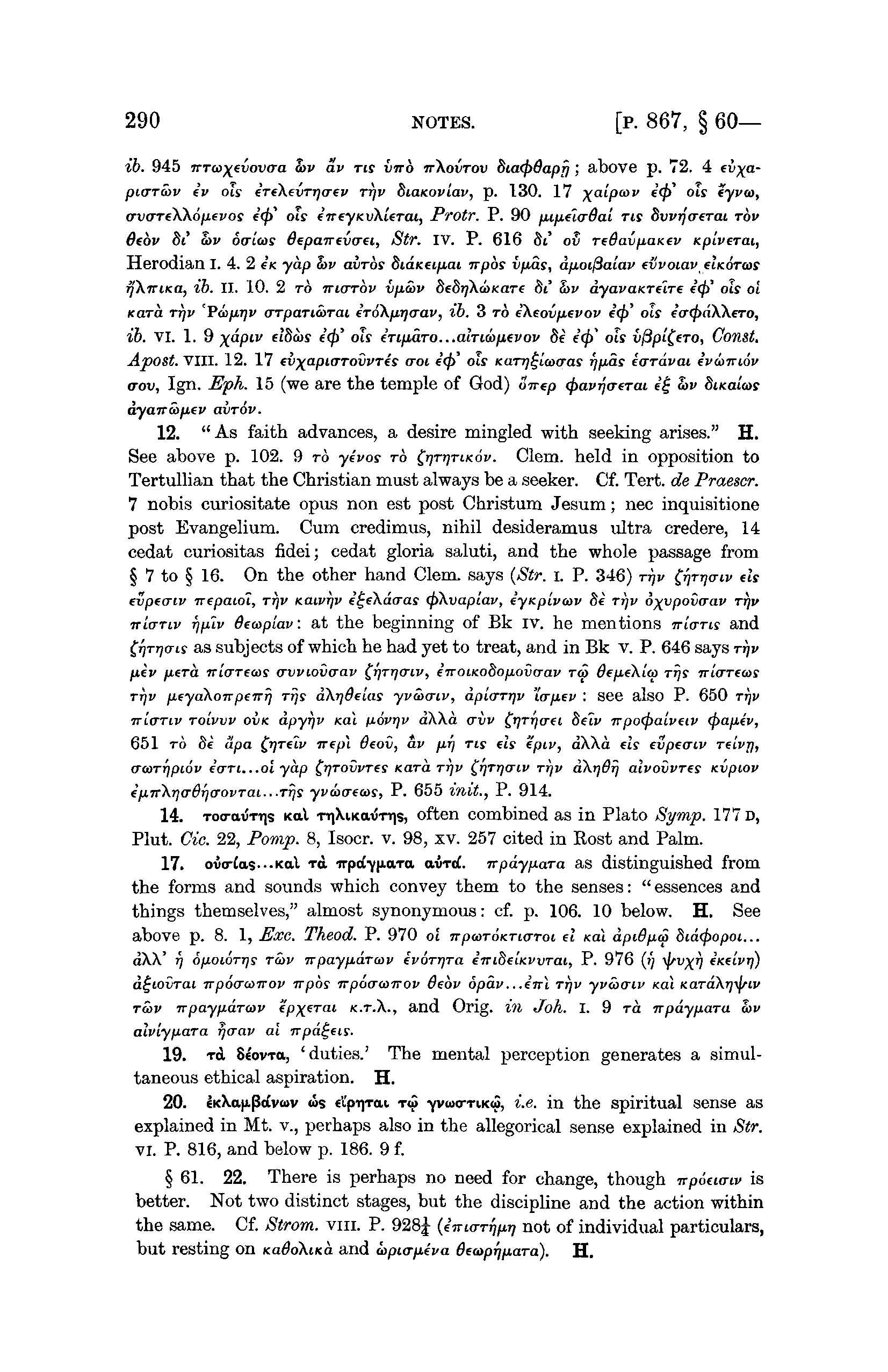
NOTES.
[p. 867, § 60— ib. 945 TTTa>)(evov(ra mv av TIS vno TTXOVTOV 8ia<f>8apfi; above p. 72. 4 cv%apitTTCtiv €v ois GT€\e{iTj]<T€v Tr/v SiaKoviav, p. 130. 17 %aipa>v i<fi ois tyvu, crvoreW6p.evos e<$> ols eVe-ycuXierm, Protr. P. 90 mpfUrBai TIS SvvtjcrcTcu TOV
Btbv hC &>v 6o~[o)S Bepanevcrei, Str. IV. P. 616 8C ov TfdavfiaKfv Kpiverai, Herodian I. 4. 2 e< yap $>v avTOS biaKtifiai npos ifids, dp.oifiaiav filvoiav etKOTas
TjXniKa, ib. II. 10. 2 TO TTIOTOV vp.S>v de8rfKa>Kare Si' $>v dyavaKTcire i(\> ols oi
Kara rr/v Poifi7)i' <TrpaTt£>Tai eTo\fir]o-av, ib. 3 TO ekeovpevov f(f>' ois i<T<pdX\fTo, ib. VI. 1. 9 x&Plv f'8*>s i(p' ois infiaTo.. .aiTia/ievov 8e eijf)' ois i/3pifeT0, Const.
Apost. VIII. 12. 17 €V)(api(TTOVVTes o-oi e'(f>' ois Karq^lao-as rj/xas coravm ivitiviov o-ov, Ign. Eph. 15 (we are the temple of God) Sirep q^avijo-eTm i£ &v diKalas dyairaifiev OVTOV.
12.
"As faith advances, a desire mingled with seeking arises." H.
See above p. 102. 9 ro yivos TO ^TTITLKOV. Clem, held in opposition to Tertullian that the Christian must always be a seeker. Cf. Tert. de Praetor.
7 nobis curiositate opus non est post Christum Jesum; nee inquisitione post Evangelium.
Cum credimus, nihil desideramus ultra credere, 14 cedat curiositas fidei; cedat gloria saluti, and the whole passage from § 7 to § 16. On the other hand Clem, says (Str. i. P. 346) TTJV CvTWlv " f evpfaiv nepatoi, Trjv Kaivrjv €£e\do~as (pXvaptav, iynpivoyv fie TTJV o^ypovaav TTJV irLtjriv r)fiiv deapiav. at the beginning of Bk iv. he mentions iricms and ^r]Trjo-Ls as subjects of which he had yet to treat, and in Bk v. P. 646 says TTJV
/lev /j.(Ta nlo-reas o-vviovo-av (rjrrjcnv, inoiKobofxovcrav T£ 8fp.iKia> TTJS nurreas
Trjv [leyaKonp€7rrj TTJS aXrjQeias yva>o~iv, dpicrTTjv tV/xev : see also P. 650 TT]V TTLCTTIV Toivvv OVK dpyrjv Kal IXOVTJV ak\a criiv farr/a-fi. 8eiv wpofpalveiv (pa/ifv,
651 TO Sc apa jjjTtlv nep\ Beoii, av p.rj TIS tis fpiv, aWa «f evp(O~iv Tclvrj, o~(OTr)pi6v i<TTi...oi yap £r]TovvTes Kara TTJV £rjTr]O~iv TTJV d\r)6r) alvovvTts Kvpiov e)nr\rio'8r)ogovTai..-Tijs yvaxrens, P. 655 ink., P. 914.
14.
Too-auTiis Kal TiiXiKavTils, often combined as in Plato Symp. 177 D, Plut. Cic. 22, Pomp. 8, Isocr. v. 98, xv. 257 cited in Rost and Palm.
17. ovo-Cas.-.Kal TA irpd-y|iaTa aird.
Trpayixora as distinguished from the forms and sounds which convey them to the senses: "essences and things themselves," almost synonymous: cf. p. 106. 10 below.
See above p. 8. 1, Exe. Theod. P. 970 oi npaToKTicrToi el KO.1 dpiBfia Sidrpopoi... dXX' r) 6p.owTTjs TQ>V jrpay/iaTtox kvoTr)Ta iiriBeUvvTai, P. 976 (i) il'vpfij eneLvrj) d^iovrat irp6a'o>7rov irpos 7rp6o~o)Trov 8e6v dpav...inl
TTJV yv<oo~iv Kal KaraK'q^nv TWV npayfiaTwv epx^Tai K.T.X., and Orig. in Joh. I. 9 TO. npdypaTU cov alviyfiaTa r)o~av al irpd^eis.
19.
Td ScovTa, 'duties.' The mental perception generates a simultaneous ethical aspiration.
20.
IKXO|J.|3C£VII>V WS ctfnfnu T» -YVWO-TIKW, i.e. in the spiritual sense as explained in Mt. v., perhaps also in the allegorical sense explained in Str. vi. P. 816, and below p. 186. 9 f.
§ 61. 22. There is perhaps no need for change, though np&tio-iv is better.
Not two distinct stages, but the discipline and the action within the same. Cf. Strom, vm. P. 928J (CVIO-T^ not of individual particulars, but resting on KadoXwa and atpio-fieva 8ea>pr)ij.aTa). H. https://doi.org/10.1017/CBO9780511695513.011 Published online by Cambridge University Press
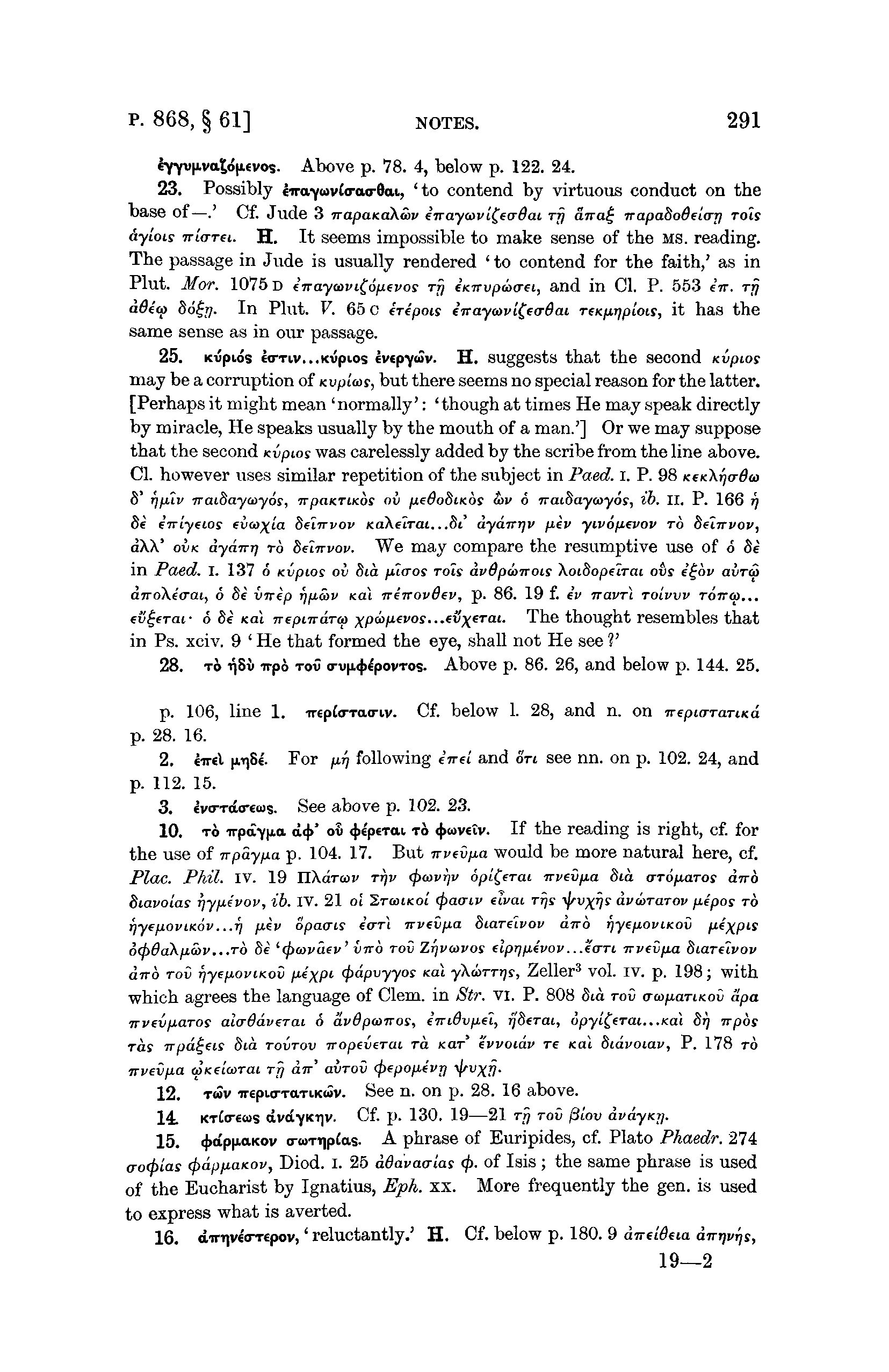
P. 868, § 61]
NOTES.
s. Above p. 78. 4, below p. 122. 24.
23.
Possibly eircryuvfrrao-Oai, 'to contend by virtuous conduct on the base Or—.
Cf. Jude 3 napaKaXwv tTraycovifccrdaL Tt) ana£ 7rapa8o8eio~y rols ay'iois 7rt'oT«. H.
It seems impossible to make sense of the MS. reading.
The passage in Jude is usually rendered ' to contend for the faith,' as in Plut. Mor. 1075 D ewaya>vi£6pfvos rfj fK-n-vpao-ft, and in 01. P. 553 in. rfj a8ta> 86£rj. In Plut. V. 65 C (repois iwayu>vl£co-6ai Tex/ir/piW, it has the same sense as in our passage.
25.
KvpuSs eo-Tiv...Kvpios evepYcov. H. suggests that the second Kvpios may be a corruption of Kvpiats, but there seems no special reason for the latter.
[Perhaps it might mean 'normally': 'though at times He may speak directly by miracle, He speaks usually by the mouth of a man.'] Or we may suppose that the second Kvpios was carelessly added by the scribe from the line above.
Cl. however uses similar repetition of the subject in Paed. I. P. 98 KcuXtjo-da 8* rjp.1v TrcuSayajyos", irpaKTiKOS ov fxeOodiKOS &>v 6 Trai&aycoyos", ib. II, P. 166 rj de eVtyetOff evto^ia $el7rvov K<zAeiTai...oV ayairrjv pev yivofifvov TO beinvov^ dXX' OVK dydnrj TO Stlnvov.
We may compare the resumptive use of 6 &e in Paed. I. 137 6 Kvptos ov 5ta p.1o~os TOIS avSpoyirois Xotdopelrai ovs e£bv aurco a7ro\io~aiy 6 Se VTT€p rjficov KOI TreirovGev, p. 86. 19 f. ev TTOVTI TOLVVV Toira... ev^erm6 He Km Trepindra ^pa>ftfi'oy...€i'^fTat.
The thought resembles that in Ps. xciv. 9 ' He that formed the eye, shall not He see V 28.
TO T|SV irpo TOV o-u(i<|)4povTos. Above p. 86. 26, and below p. 144. 25. p. 106, line 1. irepCorao-iv. Cf. below 1. 28, and n. on Kepio-Tannd p. 28. 16.
2. tirel |XT)8e. For pj] following eV« and on see nn. on p. 102. 24, and p. 112. 15.
3. evo-Ttto-ews. See above p. 102. 23.
10.
TO irpd-y|j.a <£<)>' o5 <j>e'peTtu TO 4>wv£iv. If the reading is right, cf. for the use of npaypa p. 104. 17. But Trvevp-a would be more natural here, cf.
Plac.
Phil. IV. 19 nXarcov TTJV <po>vrjv opi^erai •n-vevp.a Sia o-Toparos ano Siavoias rjyfj.ivov, ib. IV. 21 o\ 2rtotKOi (paaiv elvai Trjs yj^v^fjs dvayrarov pepos TO rjyefiovtK6v...fi fxev opacns «OTI nveii/xa hiaTtfwov dw6 rjyefioviKOv fie^pis o(p8dkfia>v...T6 Se 'cpiavaev' vrro TOV Zrjvavos elprjfiivov...eo-Ti irvcvpa SiaTetvov
OTTO TOV fjytjioviKov p*XPl <pdpvyyos Kai yXaTTrjs, Zeller3 vol. IV. p. 198; with which agrees the language of Clem, in Str. vi. P. 808 hia TOV o-aifianKov apa nvevfiaTOS alo-ddverai 6 avdpa>iros, iiri8vjxei, fjdfTai, opyl£(Tcu...Kai fiij 7rpos ras irpd^ecs Sta TOVTOV TropevtTui Ta KWT' Hvvoidv re Kal Sidvoiav, P. 178 TO nveifia <oKeio>rai Trj air' O.VTOV tp€pop.4vrj i^vx^j.
12.
T<SV irepio-Ta.Ti.Kwv. See n. on p. 28. 16 above.
14.
KTCO-£IOS dvd.yKT]v. Cf. p. 130. 19—21 Ttj TOV fiiov dvdyKrj.
15.
()>dp|iaKov o-»Tt)p£as. A phrase of Euripides, cf. Plato Phaedr. 274 o-o<f>las (pappaKov, Diod. I. 25 adavao-las <fr. of Isis; the same phrase is used of the Eucharist by Ignatius, Eph. xx.
More frequently the gen. is used to express what is averted.
16. diniveo-repov,' reluctantly.1 H. Cf. below p. 180. 9 direideia dirrfvrjs, 19—2 https://doi.org/10.1017/CBO9780511695513.011 Published online by Cambridge University Press
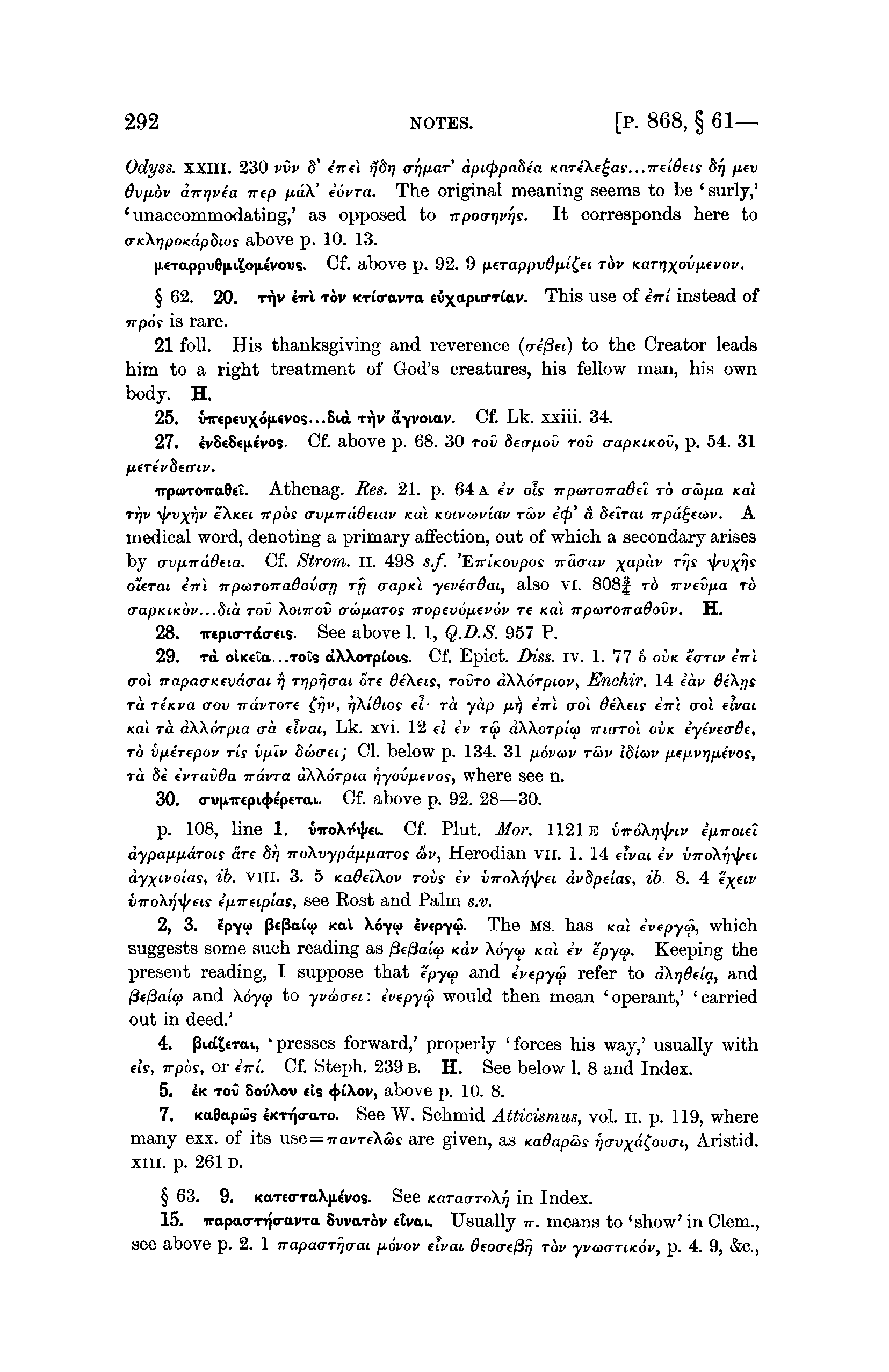
NOTES.
[P. 868, §61—
:s. XXIII. 230 vvv §' lirei 7S17 (njfiar' dpMppa&ea KCtT(\e£as...7rel8cts 81) fiev dvfibv awrjvia nep fidX' iovra. The original meaning seems to be ' surly,'
'unaccommodating,' as opposed to npoo-r)vr)s. It corresponds here to <TK\r)poi<dp8ios above p. 10. 13.
|j.€Tappv8|i.i£o|MVOvs.
Cf. above p. 92. 9 fierappv^/ii'fei TOV KaTt])(oviJ.(vov.
§ 62. 20.
TTJV 4irl TOV KTto-ovTa cvxapurrCav. This use of iiri instead of 7rpof is rare.
21 foil. His thanksgiving and reverence (o-eftti) to the Creator leads him to a right treatment of God's creatures, his fellow man, his own body. H.
25. •Sir«p«ux6|i.evos...Bid ""lv etyvoiav. Cf. Lk. xxiii. 34.
27. 4v8e8e|Wvos. Cf. above p. 68. 30 TOV Seo-fwv TOV aapKiKov, p. 54. 31 fieTev&tcriv. irpo>TOira8et.
Athenag. Res. 21. p. 64 A iv ols irpaToiradel TO cra/m Km Trjv tyv)(Yiv CXKCI irpbs cvfj-ndSeiav teal KOtvwviav T<av ftp1 a BftTai Trpa^eutv. A medical word, denoting a primary affection, out of which a secondary arises by o-v/inddeta.
Cf. Strom. II. 498 S.f. 'EiriKOvpo? irdcrav -^apav rrjs yjrvx^js oi'ertu (irt irpa>Tona6ovo-r) rrj crap<i ycveoSai, also VI. 808f TO nvfy/xa TO a~apKiKov...hta TOV \017rov aatfiaTos nopevo^ifvov re am npoyTonadovv.
28. ircpurrdcms.
See above 1. 1, Q.D.S. 957 P.
29.
TA oiK«ta...Tots dXXorpCois. Cf. Epict. Diss. iv. 1. 77 o oin (O-TLV eVi <roi irapao-Kevdo-cu r] T^pijo-ai OT( diXets, TOVTO aXXorpiov, Enchir. 14 lav 9(\j]S
Ta TtKva aov irdvTOTe £vv> fjXldios et* ra yap fir) eVl o~o\ deXeis enl o~o\ aval
Kat Ta dXXorpia o~a €iVat, Lk. xvi. 12 fi iv rep dXXoTpiw TTIO~TOI OVK lyiveaOe^
TO VfieTepov Tts vp-lv Sftxretj Cl. below p. 134. 31 jxovayv T&v idi(ov p.fp.vTjfiivoSj
Ta 5e evTavOa irdvTa dXXoTpia rjyovp,€vos, where see n.
30. a-v|iir£pi(()6p6Tai.
Cf. above p. 92. 28—30. p. 108, line 1. iiroXr<|«(,.
Cf. Plut. Mor. 1121 B vir6Xr)\jnv efiiroici dypa/j.p,dTois are 8r] TToXvypay.fi.aTos &v, Herodian VII. 1. 14 elvai Iv VTroX^fi dy\ivoias, ib. VIII. 3. 5 KaBeTXov TOVS iv inroXij^et dvhpzlas, ib. 8. 4 e\eiv iiTroXij^fts f/iweipias, see Rost and Palm s.v.
2, 3. Sp-yw PepaCu Kal Xoyu €vep7u. The MS. has Ka\ ivepya, which suggests some such reading as /3f/3ai'a) xdv X6ya> nal iv 'ipya. Keeping the present reading, I suppose that epy<o and ivepya refer to aXrjOeia, and /3e/3ai<» and Xoya to yvi>ix€i: ivepya would then mean ' operant,' ' carried out in deed.'
4. puberal, 'presses forward,' properly 'forces his way,' usually with els, npbs, or Iiri. Cf. Steph. 239 B. H. See below 1. 8 and Index.
4K TOC SOVXOV els <(>£Xov, above p. 10. 8.
7. xaBapus €Ki-i]<raTo. See W. Schmid Atticismus, vol. II. p. 119, where many exx. of its use = 7ravTeX5>s are given, as Katiapas r)o-vxd£ovcn, Aristid. xin. p. 261 D.
§ 63. 9.
KttTeo-TaX(j.evos.
See KaTao-ToXr/ in Index.
15. iropao-TTJo-avTa Suvarov ttvou Usually 7r. means to 'show' in Clem., see above p. 2. 1 Trapao-Trjo-ai p.6vov elvai deoo-f^rj TOV yvao-TiKov, p. 4. 9, &C, https://doi.org/10.1017/CBO9780511695513.011 Published online by Cambridge University Press
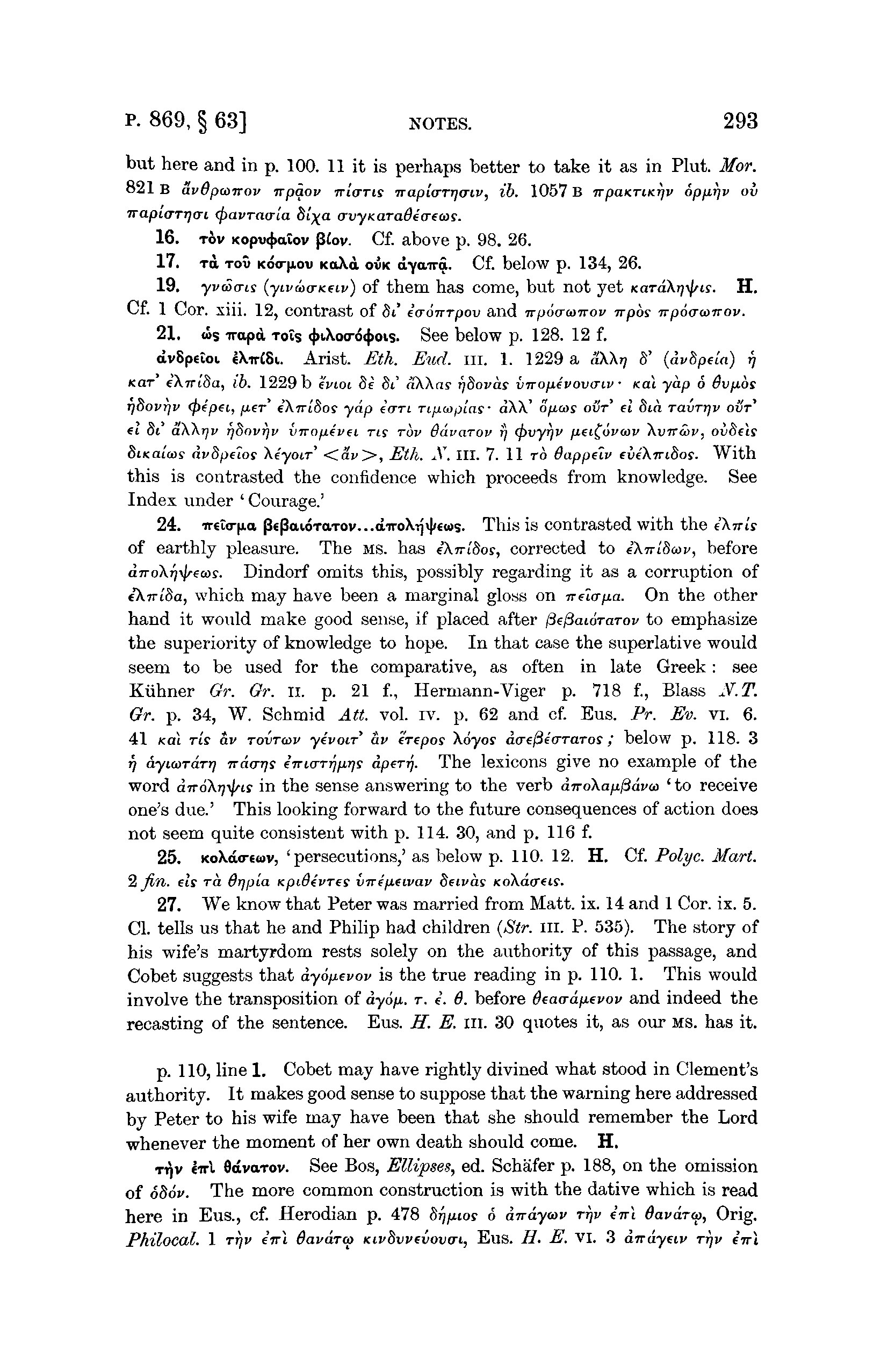
P. 869, § 63]
NOTES.
but here and in p. 100. 11 it is perhaps better to take it as in Plut. Mor. ol\ B avaptOTTOv npaov nio'Tts Traplo~rr]o~LV1 ib. 1057 B 7rpaKTiKrjv 6pp.rjv oil napicTTrjcn (pavraaia Si'^a (TvyKaTa8i<rea>s.
16.
TOV Kopvcfxnov p£ov.
Cf. above p. 98. 26.
17. rd TOV KO<T|IOV KaXd OVK d-yaira.
Cf. below p. 134, 26.
19. yvacns (yLvwo-Keiv) of them has come, but not yet KardXr]\j/is.
Cf. 1 Cor. xiii. 12, contrast of 8i ia-oirrpov and wpoo-tawov irpbs Trp6aa>Trov.
21.
<os irctpd TOIS <|>tAo<r64>ois.
See below p. 128. 12 f. dvSpctoi IXirCSi.
Arist. Eth.
Eiid. in. 1. 1229 a aXXrj §' (av&peia) 17 tear' (XiriSa, ib. 1229 b evioi 8e 8t aXAri? rjSovds vwopipovo-w teal yap 6 dvfxbs rjoovrjv (p4p€L, juer* eXTrt'So? yap i<m rt^coptas" dXX' o^ws O\JT* ei hia TavTtjv OVT*
€1 81 aWrjv Tj8ovrjv V7rofj.ev€i rts rbv Oavarov rj (pvyrjv fi€i£6v(ov XUTTCOT, ov8€is
SiKaiai? dvSpeios Xc'yotr' <av>, Eth. X. III. 7. 11 TO dappelv cvi\7n8os.
With this is contrasted the confidence which proceeds from knowledge. See Index under ' Courage.'
24. ir«to-(jia (3«paioTaTov...aiToX;]>(/£u)s. This is contrasted with the cXwis of earthly pleasure. The MS. has eXn-i'Sor, corrected to fATr/So)!/, before ano\ri^(a>s. Dindorf omits this, possibly regarding it as a corruption of cKtrlSa, which may have been a marginal gloss on irfiap.a. On the other hand it would make good sense, if placed after (3(f3at6raTov to emphasize the superiority of knowledge to hope. In that case the superlative would seem to be used for the comparative, as often in late Greek: see
Kiihner Gr. Or. II. p. 21 f., Hermann-Viger p. 718 f., Blass N.T.
Or. p. 34, W. Schmid Att. vol. iv. p. 62 and cf. Eus. Pr. Ev. vi. 6.
41 Km rls av Tovrav yivoir* av erepos Xdyof ao-efieo-Taros; below p. 118. 3
17 ayianaTrj Tzaa-rji ewio-T^r/s dperr/. The lexicons give no example of the word a7rdXj)T^if in the sense answering to the verb dTro\ap.f3dva ' to receive one's due.' This looking forward to the future consequences of action does not seem quite consistent with p. 114. 30, and p. 116 f.
25. KoXd<rt<ov, 'persecutions,' as below p. 110. 12. H. Cf. Polyc. Mart.
2 fin. els TO. Oj]pla Kpidtvres vne[ieivav 8elvas KoXdo'dS.
27. We know that Peter was married from Matt. ix. 14 and 1 Cor. ix. 5.
Cl. tells us that he and Philip had children (Sir. ill. P. 535). The story of his wife's martyrdom rests solely on the authority of this passage, and Cobet suggests that dyopevov is the true reading in p. 110. 1. This would involve the transposition of dyop,. T. «'. 8. before 6ea<rdp.evov and indeed the recasting of the sentence. Eus. H. E. in. 30 quotes it, as our MS. has it. p. 110, line 1. Cobet may have rightly divined what stood in Clement's authority. It makes good sense to suppose that the warning here addressed by Peter to his wife may have been that she should remember the Lord whenever the moment of her own death should come. H.
T^V lirl Odvarov. See Bos, Ellipses, ed. Schafer p. 188, on the omission of 686v. The more common construction is with the dative which is read here in Eus., cf. Herodian p. 478 8TJJUOS 6 dndyav TTJV in\ 6avdr<a, Orig.
Philocal. 1 rr)v eVl davdrca KIV8VVCVOVO-I, EUS. H. E. VI. 3 dirdytiv rr/v eVi https://doi.org/10.1017/CBO9780511695513.011 Published online by Cambridge University Press
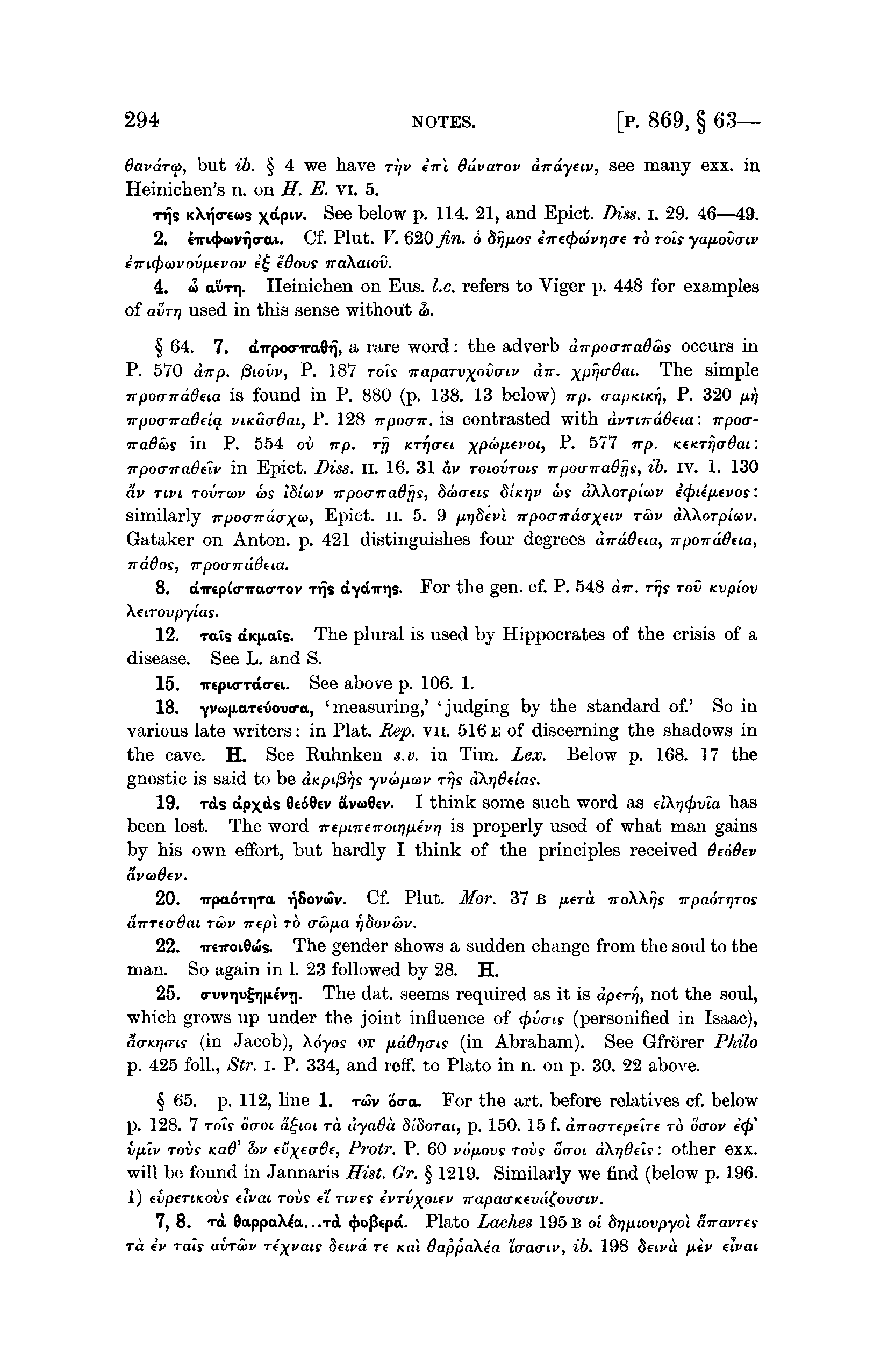
NOTES.
[P. 869, § 63—
davara, but ib. § 4 we have rrjv eVl davarov dirdyetv, see many exx. in Heinichen's n. on H. E. vi. 5.
TT}S KXIJO-«WS X<*PIVSee below p. 114. 21, and Epict. Diss. I. 29. 46—49.
2. eiri<p«vij<rai.
Cf. Plut. V. 620 ,/m. 6 8rjp.os (necpcivrjo-f ro TOIJ yajiovaiv eirt(pa>vovp.cvov e£ edovs rrakcuov.
» avn|.
Heinichen on Eus. I.e. refers to Viger p. 448 for examples of avTrf used in this sense without 3>.
§ 64. 7. airpoo-ira07J, a rare word: the adverb dnpoo-nadios occurs in P. 570 dirp. fiwvv, P. 187 rois 7rapaTVxoi(Tiv air. xpijcr#<u.
The simple Trpo<rna8eia is found in P. 880 (p. 138. 13 below) np. o-apKinrj, P. 320 fiij npocrnadeia vitcaadai, P. 128 npoo-ir. is contrasted with dvrmddua:
Trpotriradtos in P. 554 ov 7rp. TJ KTI)(TH xpapevoi, P. 577 TT/). KeKTrjirdcu: npoanadtiv in Epict. Digs. II. 16. 31 av TOLOVTOIS npoa-nadrjs, ib. IV. 1. 130
CLV TLVt TOVTCOV O)J ldlG>V 7TpO(T7ra6r]Sj 8oitT€lS 8lKt]P O3S dWoTpiiOV €<pl£fJ.€VOS°. similarly 7rpoo-jrdirxa>, Epict. II. 5. 9 p.j)dev\ Trpocmdcr^eiv TWV dWorpLav.
Gataker on Anton, p. 421 distinguishes four degrees dnddeia, •n-pondStta, ndBos, TrpocmdBeta.
8. direpkriracrrov TIJS d^yciinis. For the gen. cf. P. 548 an. rrjs TOV nvplov Xeirovpyias.
12. rats aKjiais. The plural is used by Hippocrates of the crisis of a disease. See L. and S.
15. irepurTdo-a. See above p. 106. 1.
18. yvt»\La.Tfiova-a, 'measuring,' 'judging by the standard of.'
So in various late writers: in Plat. Hep. vn. 516 E of discerning the shadows in the cave. H. See Ruhnken s.v. in Tim. Lex.
Below p. 168. 17 the gnostic is Said to be aKpifHrfs yva>p.a>v rfjs d\r)9(ias.
19.
TOIS dpxds 0€o8ev avo>8ev. I think some such word as fl\rj<pvia has been lost.
The word TvepmeTroi^fievr] is properly used of what man gains by his own effort, but hardly I think of the principles received avcooev.
20. irpaoTTiTa i^Sovuv. Cf. Plut. Mor. 37 B fiera noXhr)s 7rpaoTT)Tos anTeirdai TWV Trept TO crwjua r]8ov<ov.
22. ireiroiOcos. The gender shows a sudden change from the soul to the man.
So again in 1. 23 followed by 28. H.
25.
(ruvi]vfT]|i€v[). The dat. seems required as it is dperfj, not the soul, which grows up under the joint influence of <pvais (personified in Isaac), ao-K7/<ris (in Jacob), Xoyos or fiddrjins (in Abraham). See Gfrorer Pkilo p. 425 foil., Str. i. P. 334, and reff. to Plato in n. on p. 30. 22 above.
§ 65. p. 112, line 1. TOV oo-a. For the art. before relatives cf. below p. 128. 7 rots oaoi <Z£«H rd dyadd S/Sorai, p. 150. 15 f. a7ro(rTepfiT£ TO OCTOV e(p' vp.'iv TOVS Ka8' %>v fv\e(r8e, Protr. P. 60 vop.ovs rovr 5<roi d\rj8els: other exx. will be found in Jannaris Hist. Or. § 1219. Similarly we find (below p. 196.
1) evpercKovs eivat TOVS e'l Tives evTv^Oifv 7rapao~K(vd£ovo~i.v.
7, 8. Ta SappaXla.. .Td <j>o(3«pa. Plato Laches 195 B ot br)(iwvpyo\ airavres rd iv Tais avrwv Ti^vait Sfira Te Kal Sappakia i(rao-tv, ib. 198 dcivd fiev (ivat https://doi.org/10.1017/CBO9780511695513.011 Published online by Cambridge University Press
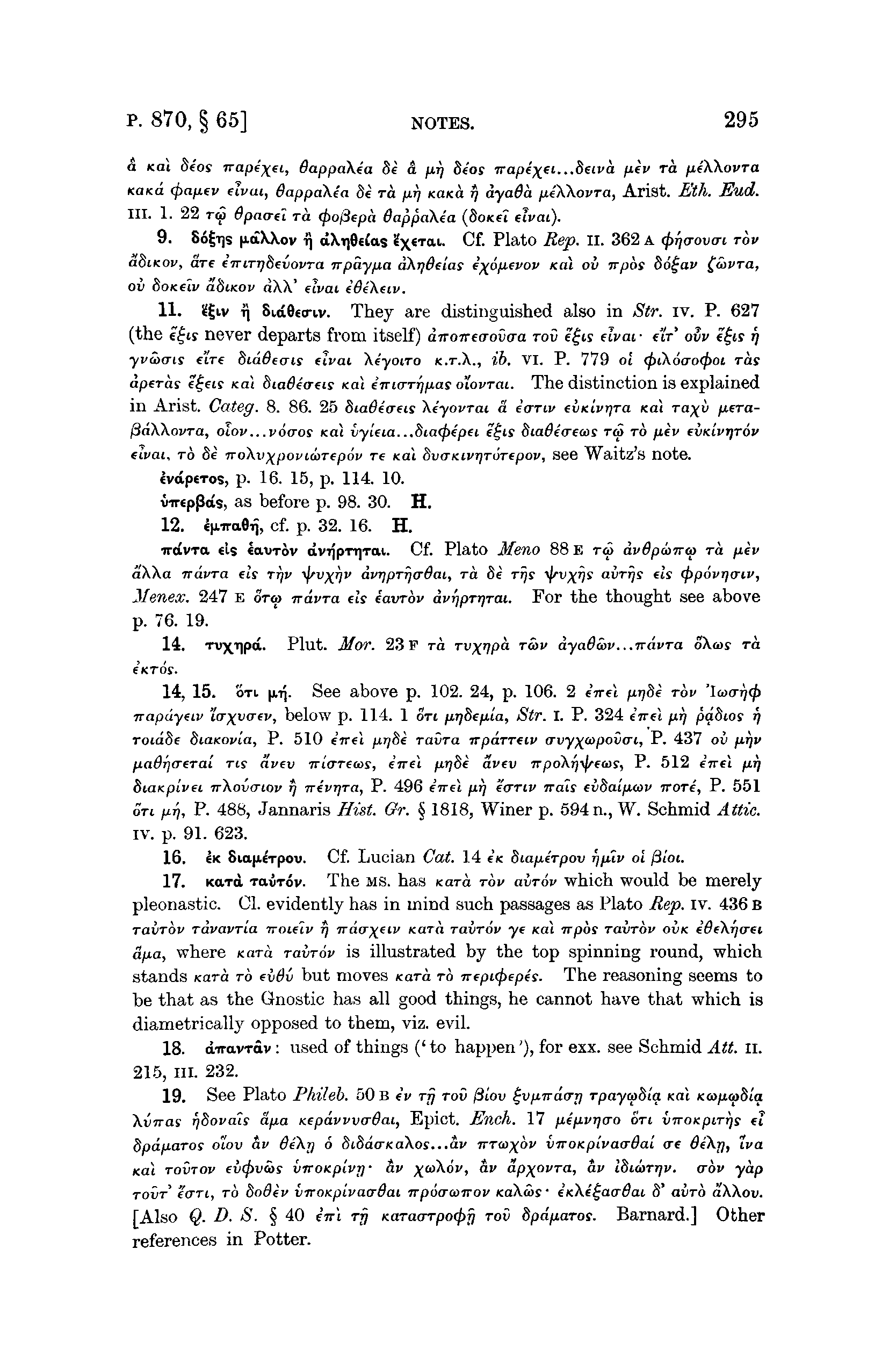
P. 870, § 65]
NOTES.
a Kai Se'os nape^et, BappaXea 8e a fir) Sios Trape^et...Seiva fiev ra fieWovra naicd <f>afiev elvat, dappaXea Se ra p-f/ KOKU r/ dyaBa fieXkovra, Arist. Eth. End.
III. 1. 22 ™ Bpao-el ra (po/Sepa BappaXea (Sonet elvat).
86fi]s (J.dXXov T) aXrfidas ?x«Tai. Cf. Plato Rep. II. 362 A (pTjo-ovo-t TOV aoiKov, are eiriTTjoevovra irpaypa dXqBetas e^ofievov Kcii ov Trpos do£av ^wvra, ov SoKe'tv abiKOv aW eii/ai (8e\eiv.
11. iffjiv r[ Siadeoriv. They are distinguished also in Str. iv. P. 627
(the e£ir never departs from itself) dnoTrca-ovo-a TOV e£is ehm • f'ir' ovv e£is 17 yvao-is €LT( &id&eo-is rival Ae'yoiro K.T.X., ib. VI. P. 779 01 (j)i\6cro(poi, ras operas e^eis <a\ btadecreis nai enitrrrjiJias OIOVTCIL. The distinction is explained in Arist. C<Xteg. 8. 86. 25 diaOeaeis \eyovrai a earriv evKtvy^ra not Ta%v fierafidWovra, oiov...voo~os Kai vyieia...8ia<pepet e^is §ta^eo"66)ff T6> TO jiev evKivrjrov elvai, TO 6e no\v)(povia>Tcp6v re KOL 8vo~Kiv7]TUTfpov, see Waltz's note. evdperos, p. 16. 15, p. 114. 10. vireppds, as before p. 98. 30. H.
12. 4|iiraevj, cf. p. 32. 16. H. irdvTO. «ls tavrov aVTJpTqTai. Cf. Plato Meno 88 E ra> dvBpanrco ra fiev aWa rrdvra ris rrjv y^v^rjv dvijpTrjo~6at, TO Se TTJS tyv^s avrrjs els (ppovTjat.v,
Jfenex. 247 E oro> wavra eh eavrbv dvr)prr)Tai. For the thought see above p. 76. 19.
14.
Tu\T]pd.
Plut. MOT. 23 F ra rv^poTG>V dya6a>v...ndvra oXais TO.
14, 15. OTL (j/q. See above p. 102. 24, p. 106. 2 eVei fn]8e TOV Jla>o-rj(j) napdyeiv 'i(rxvo~€v, below p. 114. 1 on fiijdefita, Str. I. P. 324 eVet p.rj pdhios rj roidSe dtaKoi/t'a, P. 510 eTrct p*]$e ravTa irpdrretv o~vyx<i>povo~i, P. 437 ov firju
^ia6j]O~erat TLS avev Trt'crrewy, enei ^ S e avev npo\r)t\reais, P. 512 ene\ [LTJ
SiaKpivei nXovatov ^ 7rev7/ra, P. 496 eVet [irj eo~riv nais evdaifuov Trore, P. 551 on fir), P. 488, Jannaris Hist. Or. § 1818, Winer p. 594 n., W. Schmid Attic. iv. p. 91. 623.
16.
4K 8ia|X6Tpov. Cf. Lucian Oat. 14 e< &iap.eTpov Tjfiiv 01 /3/oi.
17.
Kara Tairov.
The MS. has Kara TOV OVTOV which would be merely pleonastic. Cl. evidently has in mind such passages as Plato Hep. iv. 436 B
TOVTOV rdvavTia voielv rj nda^eiv Kara ravrov ye Kai vrpbs Tavrbv OVK e6e\ijo~ei afia, where Kara ravrov is illustrated by the top spinning round, which stands Kara TO ev$v but moves <ard TO Trepi(f>epes.
The reasoning seems to be that as the Gnostic has all good things, he cannot have that which is diametrically opposed to them, viz. evil.
18. dtravrdv: used of things (' to happen'), for exx. see Schmid Att. 11.
215, in. 232.
19.
See Plato Phileb. 50 B e'v rjj TOV (BLOV ^v\nrd<7rj rpayahia n.a\ nafimbla Xviras rfdovais ap.a Kepdvvvo~6aL, Epict. Euch. 17 fiefivrjco 6TL vnoKpLTrjs ri dpdfiaros o'lov av dekrj 6 8ib*do-Ka\os...av TrTffl^ov VTroKpivao-Qai o~e 6£\y, Iva nai TOVTOV ei(f>va>s viroKplvy av )(a>X6v, av ap^ovra, av lbi.a>Tr]v. o~6v yap TOVT' eo~Ttj TO Sodev viroKpivao~$ai 7rp6o~u>irov Ka\a>s' eWe£ao~&ai S* aiiTO aXXov.
[Also Q. D. S. § 40 eirl Tjj Karao-rpo^fi TOV dpafiaros. Barnard.] Other references in Potter. https://doi.org/10.1017/CBO9780511695513.011 Published online by Cambridge University Press
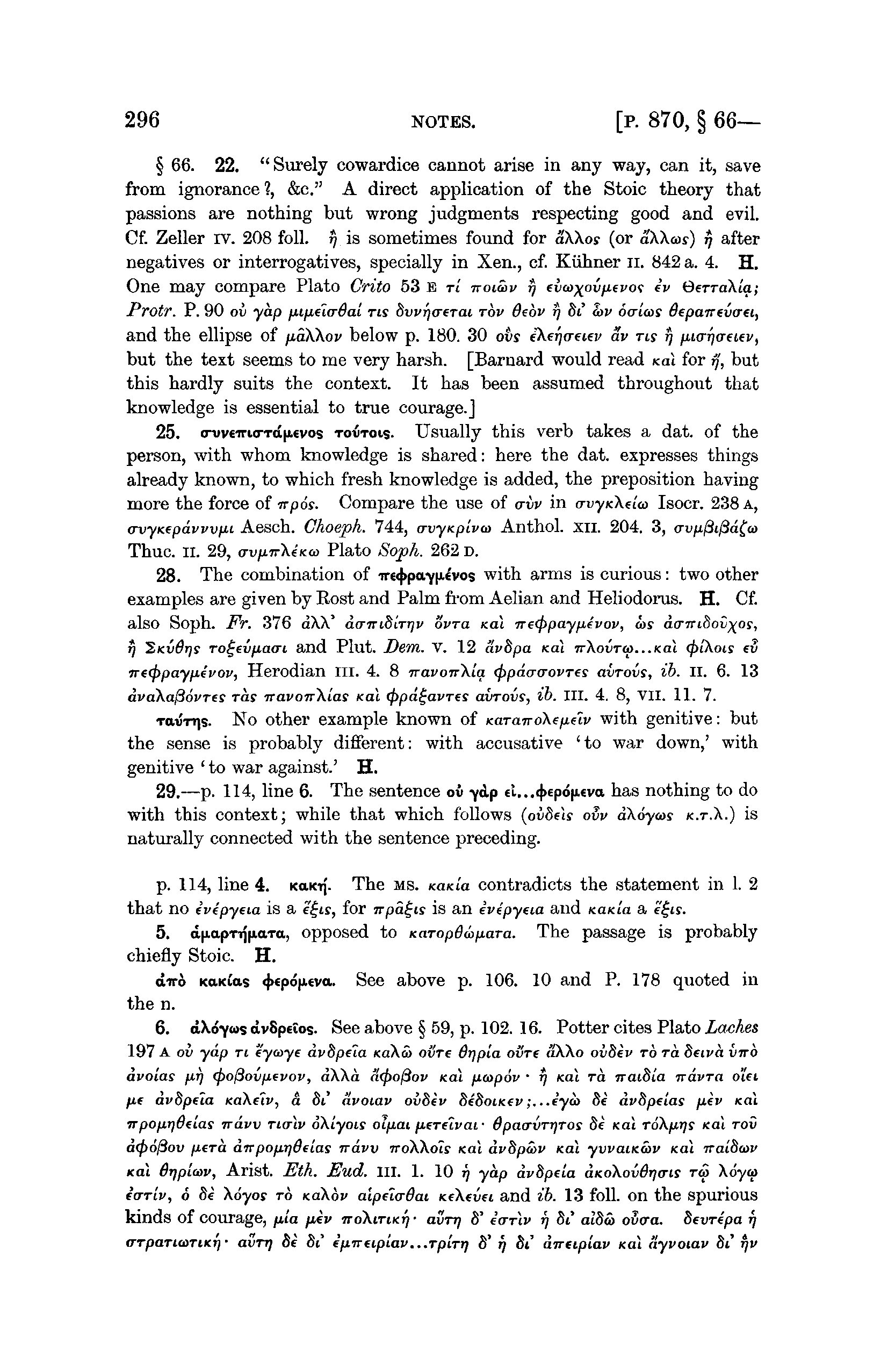
NOTES.
[P. 870, § 66—
§ 66. 22. "Surely cowardice cannot arise in any way, can it, save from ignorance ?, &c." A direct application of the Stoic theory that passions are nothing but wrong judgments respecting good and evil.
Cf. Zeller IV. 208 foil, rj is sometimes found for a\\os (or aWas) rj after negatives or interrogatives, specially in Xen., cf. Kuhner n. 842 a. 4. H.
One may compare Plato Crito 53 B TL tvoiasv r) cva>xovfi(vos iv 0erraXia; Protr. P. 90 ov yap p.iixfio-6ai TIS bwrjafrai
TOV 8ebv r) 8i G>V 6o-ia>s 8epaneiareit and the ellipse of /laWov below p. 180. 30 obs iXerjo-fiev av TIS r) fiio~r)aeiev, but the text seems to me very harsh. [Barnard would read <ai for rj, but this hardly suits the context. It has been assumed throughout that knowledge is essential to true courage.]
25. o-uv«m<rTd|Kvos TOIITOIS. Usually this verb takes a dat. of the person, with whom knowledge is shared: here the dat. expresses things already known, to which fresh knowledge is added, the preposition having more the force of npos. Compare the use of o-vv in o-uyxXeio) Isocr. 238 A, o-vyKfpavvvfii Aesch. Choeph. 744, o-vyKplvm Anthol. XII. 204. 3, crvfifiifidfa
Thuc. II. 29, O-U^TTXCKW Plato Soph. 262 D.
28.
The combination of ire<|>pa7|j.«vos with arms is curious: two other examples are given by Rost and Palm from Aelian and Heliodorus. H. Cf. also Soph. FT. 376 dXX' do~7ri3iTrjv ovra Kal ITecppay^i€vov, cos dcTTTLdov^os, rj "2Kv8r)S ro^evfia<Ti and Plut. Dem. V. 12 av8pa Kal ir\ovTO>...Kal (p[\ois ev irafipaynevov, Herodian III. 4. 8 navoTrXla <ppd<r(rovTes avTois, ib. II. 6. 13 dvakafHovres ras iravonXias Kal (f>pdt;avTes avrovs, ib. III. 4. 8, VII. 11. 7. ravT^s. No other example known of KaTawoXeuttv with genitive: but the sense is probably different: with accusative 'to war down,' with genitive ' to war against.' H.
29.—p. 114, line 6. The sentence oi -ydp ei...<|>epoH.«va has nothing to do with this context; while that which follows (oASetr ovv aXoyats K.T.X.) is naturally connected with the sentence preceding. p. 114, line 4. noncTf. The MS. KOKIO contradicts the statement in 1. 2 that no ivcpyeia is a c£i£, for npa^is is an evepyeta and KaKia a e£js.
5. d|iapTij|iaTa, opposed to KaropdwpaTa. The passage is probably chiefly Stoic. H. diro KctxCas <|><po|uva. See above p. 106. 10 and P. 178 quoted in the n.
6. dXoYws dv8p«os. See above § 59, p. 102. 16. Potter cites Plato Laches 197 A ov ydp TI tytnyi dvdpe'ia Ka\S> ovre drjpia OVT( OXXO ovSev TO Ta 8(iva inrb dvolas p-T] <fio(3ov[i€vov, dWd aKpofiov Kal po>pov ' r/ Kal Ta iraihia TrdvTa ot'ft fif dvdpfia KaXfTv, a 8i avoiav oiSev 84SoiK(v;...eya> 8e dvSpflas fiiv Kal irpofirjOfias irdvv TLO-IV SXiyois oi/mi /ifTftvai • 8pao-\)Ti)TOs be Kal ToXfirjs Kal TOV a<po^ov /itra dirpofLTjdeias ndvv 7roX\o7s Kal dvdpwv Kal yvvaiKav
Kal Traib*<i>v Kal flrjplcov, Arist. Eth. JEJud. III. 1. 10 rj yap dvbpcia aKo\ov8rjo~is T<O Xoya fo-Tiv, 6 8<r \6yos TO KO\6V alpeio-8ai KeXfvct and ib. 13 foil, on the spurious kinds of courage, p.ia p.iv n-oXn-txij' avrq 6" cVriv rj dt aldS> ovcra. Sevrepa i) o-TpaTia>TiKT) • avrr) &i Si' ipLnfiplav...Tp'iTr) 8' rj hi dneipiav Kal liyvoiav 8i fjv https://doi.org/10.1017/CBO9780511695513.011 Published online by Cambridge University Press
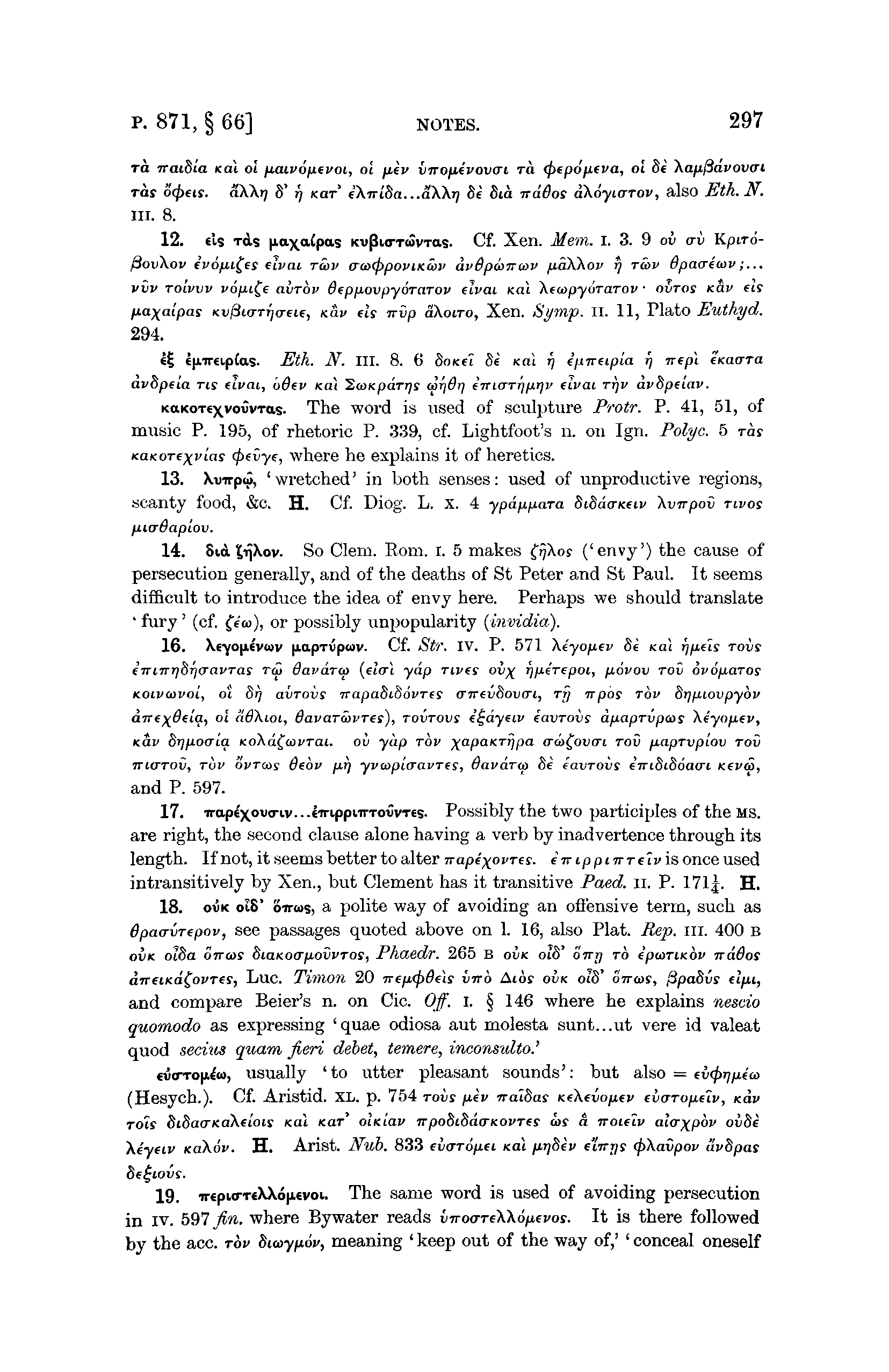
P. 871, § 66]
NOTES.
TO iraidla Kal ol fiaivopevoi, oi p,ev vtropAvovai TU <f>ep6fieva, ol 8e \ap,ftdvovo~i ras o<f>eis. SXXt] 8' 17 KOT (\7ri8a...aK\ri Si Sid irdBos akoyurrov, also Eih.N.
III. 8.
12. els TAS |xaxa£pas KvpioTwras. Cf. Xen. Mem. I. 3. 9 ov o~v Kptro- @ov\ov ivop,i£es elvai T(OV craxppoviKcov dvSpo>TT<jt>v jxaKkov rj TWV dpa<retov;... vvv ro'ivvv v6[ii£e avTov 6 epp.ovpy or aTov elvai Kal \f<apy6rarov • OVTOS Kav eis paxalpas Kv/36(rrij<mf, nav els irvp akoiro, Xen. Symp. II. 11, Plato
Euthyd.
294.
4| !|nmp{as.
Eth. N. III. 8. 6 Socei Se Kal 17 ifnveipia 17 ire pi (Katrra dvdpcia TIS elvai, oQev Kai Scoxpar^s lorjdr] eiruTTr)fit)v eivai TTJV avftpeiav.
KaKoT«xvouvTas. The word is used of sculpture Protr. P. 41, 51, of music P. 195, of rhetoric P. 339, cf. Lightfoot's n. on Ign. Potyc. 5 ras
KaKore^vias (peiiye, where he explains it of heretics.
13. Xuirpci, 'wretched' in both senses: used of unproductive regions, scanty food, &C. H.
Cf. Diog. L. X. 4 ypafifiara SiSda-Keiv \virpov TWOS fiio-dapiov.
14. Sid tq\ov. So Clem. Rom. I. 5 makes fijXor ('envy') the cause of persecution generally, and of the deaths of St Peter and St Paul. It seems difficult to introduce the idea of envy here. Perhaps we should translate
' fury' (cf. few), or possibly unpopularity (invidia).
16.
\eyoHl€'vwv piapTvptdv.
Cf. Sir. IV. P. 571 \iyopiev de Kal rjptcls TOVS ininrjdrjO'nvTas Tat OavaTa) (elo~\ ydp Tives ovj( ^/ie'repot, ixovov rov 6v6p.aTos
KOLVCOVOL, oi drj avTovs napadidovTes o~7T€v8ov(Tii Ti] irpos TOV br]p.iovpy6v a7re)(d(Lq, oi affkioi, 6avara>vT(s), TOVTOVS i^dynv iavTovs d/xaprvpcos Xiyofiev,
Kav drjfioalq Ko\d£a>vTai. ov ydp TOV xapaKTtjpa o~d>^ovcri TOV p-aprvpiov TOV TTio~Tovy TOV OVTCOS 6eov fxr] yvwpio~avT€sy BavaTfp fie eavTOvs 67ri5tSda(rt Kevin, and P. 597.
17. •Trap6x<»|o"iv...4iripp<.irTowTes. Possibly the two participles of the Ms. are right, the second clause alone having a verb by inadvertence through its length. If not, it seems better to alter napexovTes. e'-n-ippmTclvis once used intransitively by Xen., but Clement has it transitive Paed. 11. P. 171j. H.
18.
OJK 0I8' oirus, a polite way of avoiding an offensive term, such as 6pao-vT(pov, see passages quoted above on 1. 16, also Plat. Rep. in. 400 B
OVK olda O7ro)ff o°LaKOO~[iovvTos, Phctedv. 265 B OVK old1 OTTTJ TO iputTiKov nd&os dneiKa^ovTes, Luc. Timon 20 nefKpde'is ino Aios OUK ot'S' OTTCDS, fipa8vs el/u, and compare Beier's n. on Cic. Of. 1. § 146 where he explains nescio quomodo as expressing 'quae odiosa aut molesta sunt...ut vere id valeat quod secitts quam fieri debet, temere, inconsidto.' eitrropia, usually 'to utter pleasant sounds': but also = cv^/w'co
(Hesych.).
Cf. Aristid. XL. p. 754 TOVS jiev naib'as K(\fvop,(v evo-TOjjielv, Kav rois SidaaKaKeiois Kal /car* oiKiav npob't.b'do-KOVTes a>? a iroielv alo~xpov oi8e
\4yftv Ka\6v.
Arist. Nub. 833 clo-ropa Kal p.yo'ev eiVijj (pXavpov dvbpas 19. iMpurreXXoiMvoi. The same word is used of avoiding persecution in iv. 597 fin. where Bywater reads iinoo-TeW6p,evos.
It is there followed by the ace. TOV 8ia>yp.6v, meaning ' keep out of the way of,' ' conceal oneself https://doi.org/10.1017/CBO9780511695513.011 Published online by Cambridge University Press
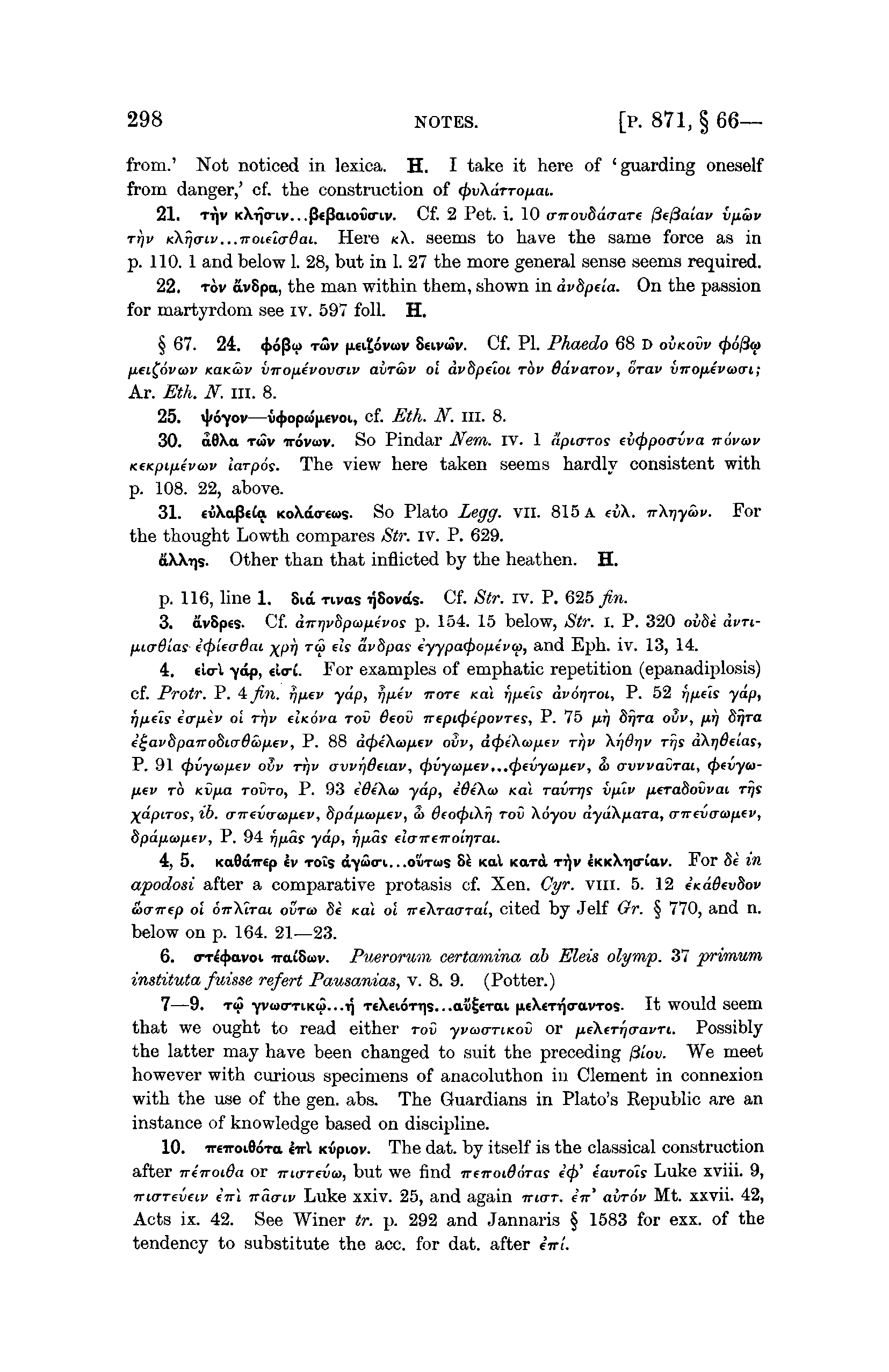
NOTES.
[P. 871, § 66—
from.' Not noticed in lexica. H. I take it here of 'guarding oneself from danger,' cf. the construction of (pvXaTTop.ai.
21.
Tijv ic\i^a-iv...pcPaioi!(ri.v. Cf. 2 Pet. i. 10 (TTrovSairare /3e/3aiai> vp.a>v rt]v Kkri<nv...woi.ti(T8ai. Here K\. seems to have the same force as in p. 110. 1 and below 1. 28, but in 1. 27 the more general sense seems required.
22.
TOV avSpa, the man within them, shown in dvdpela. On the passion for martyrdom see iv. 597 foil. H.
§ 67. 24. <j>6|3u> TCOV |iei£6v<ov 8«iv<3v. Cf. PL Phaedo 68 D OVKOVV <£O/3O> p.ei£6va>v KaKav vnofievovcnv avTcov ol dvSpciot TOV ddvarov, orav vnofxivaxn;
Ax. Eth. N. ill. 8.
25.
+6-yov—v^opco^evoi, cf. Eth. N. III. 8.
30. a8Xa T«V iroviov. So Pindar Nem. IV. 1 lipio-ros eicppocrvva irova>v KCKpipevav larpos. The view here taken seems hardly consistent with p. 108. 22, above.
31. tvkafitla Ko\d<r«i>s. So Plato Legg. VII. 815 A d\. ir\r)y£>v. For the thought Lowth compares Sir. IV. P. 629.
OXXT)S. Other than that inflicted by the heathen. H. p. 116, line 1. Sid nvas ijSovos. Cf. Str. IV. P. 625 fin.
3. avSpes. Cf. anrjv8pa>ftevos p. 154. 15 below, Str. I. P. 320 ov8e dvnfj.L(r8{as e(pieo-8ai ^pij TO> fls av8pas iyypa<pofiiva, and Eph. iv. 13, 14.
4. tlo-l yap, iitrt. For examples of emphatic repetition (epanadiplosis) cf. Protr.
P . 4 fin. rjptv yap, r/fiiv nore Kal ij/xfif dvorjTot, P. 52 r/ficis yap, r}p.*is ecrp.€V ol TTJV elicova TOV Beov 7T€pt(pepovT€s, P. 75 firj drjTa ovv, firj 8rJTa i^avbpanobitr8a>p.€v, P . 88 d(j>(\to/jLfv ovv, d<j>e\a>jxev TT)V \rjdrjv rfjs dXr/Btias,
P. 91 (pvycofiev oZv TTJV avvrjBeiav, (fivya>)jiev...(pevya>fiev, & crvvvairai, (peiyoj- [iev TO Kvjia TOVTO, P . 93 eOiXo) ydp, e$e\o> Kal Tavrtjs vp.iv pATabovvai Trji
\dpiTos, ib. o~7r*vo~a>p.€Vy 8pdp.top.ev, a> S€0(piXrj TOV \6yov ayaX/xara, o~nevija>p.*v, 8pdp,a>p€v, P . 94 fjp,as ydp, rjp.as do-TreTroiriTm.
4, 5.
Ka6direp kv TOLS a.y<i<r\....<yuTtas Si Kal Kara TIJV «KK\r)iriav. F o r Se in apodosi after a comparative protasis cf. Xen. Cyr. vm. 5. 12 endBevdov loo-trfp oi oirXirai OVTO> Se Kal ol jrcXra<TTat, cited by Jelf Or. § 770, and n. below on p. 164. 21—23.
6. trrifyavoi ireUSwv. Puerorum certamina ah Eleis olymp. 37 primum instituta fuisse refert Pausanias, v. 8. 9. (Potter.)
7—9. rip YV<SOTIKI3...I} reXetoTqs...aiiJ«Toi |uXeTij<ravTosIt would seem that we ought to read either TOV yvao-TiKov or /ieXenjo-ai/ri.
Possibly the latter may have been changed to suit the preceding filov. We meet however with curious specimens of anacoluthon in Clement in connexion with the use of the gen. abs. The Guardians in Plato's Republic are an instance of knowledge based on discipline.
10. ireiroiOoTa lirl Kvpiov. The dat. by itself is the classical construction after jr4noi8a or TriareuG), but we find TrenoidaTas €(f>' eavrois Luke xviii. 9, iruTTtvuv ciri vdcnv Luke xxiv. 25, and again ITLO-T. eV airov Mt. xxvii. 42,
Acts ix. 42. See Winer tr. p. 292 and Jannaris § 1583 for exx. of the tendency to substitute the ace. for dat. after eVi. https://doi.org/10.1017/CBO9780511695513.011 Published online by Cambridge University Press
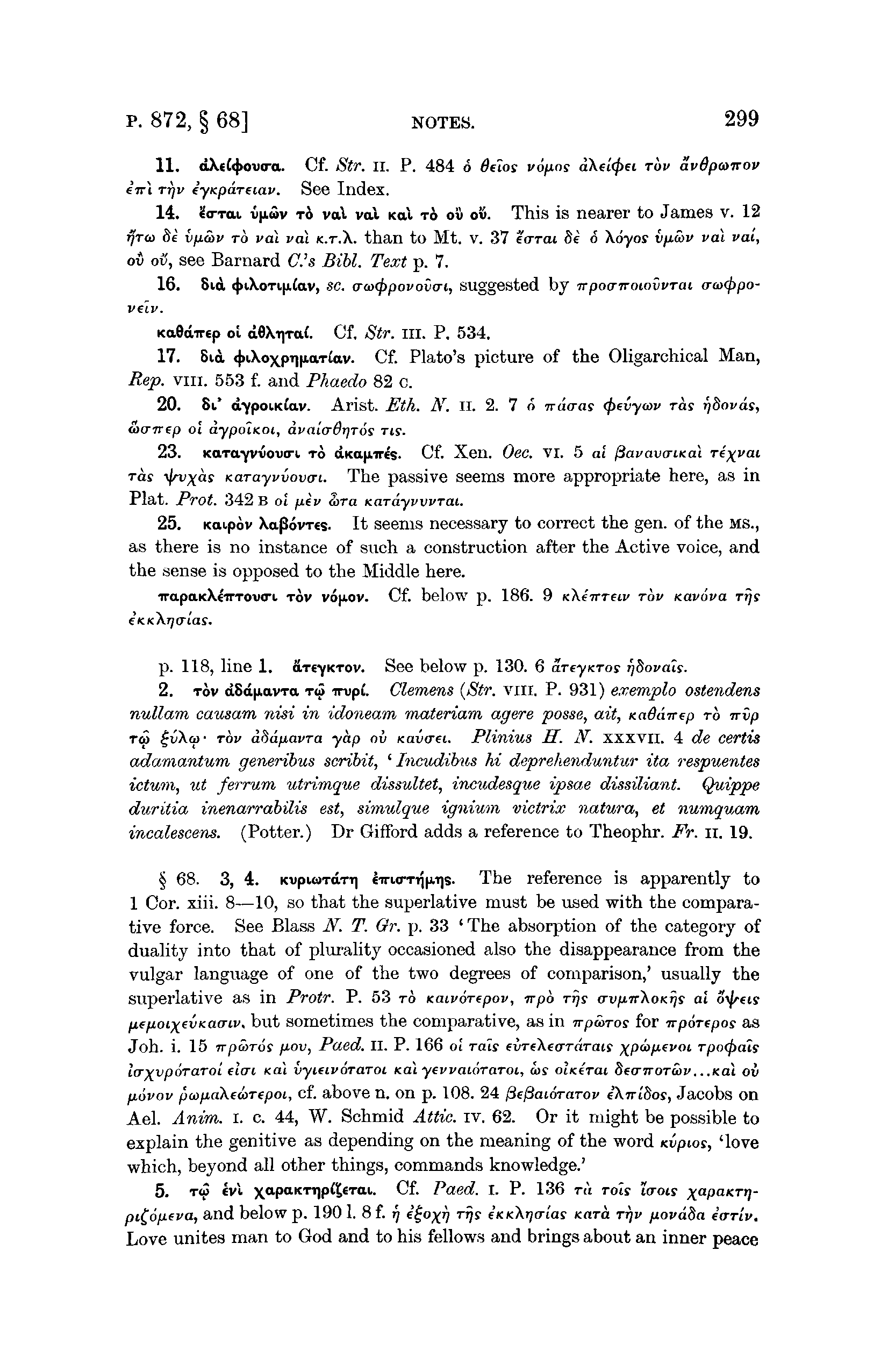
p. 872, § 68] NOTES.
11. dXeC<j>o\)(ra.
Cf. Str. II. P. 484 6 6eios vo/xo? akeicpei TOV avdpconov €7TI T-fjv iyttpcLTeiav. See Index.
14.
Sorai vijiciv TO val val Kal T6 oil 06. This is nearer to James v. 12 fJT<*> be v)xa>v TO val val K.T.X. than to Mt. V. 37 eortu 8e o \6yos Vfiiov val vai, ov ov, see Barnard C.'s Bibl. Text p. 7.
16.
Sia <))tXoTi(j.Cav, SC. o-<o(ppovovo-i, suggested by irpoo-rrowvvTai o-a><ppoveiv.
KaBdirep ot deXt]Ta(.
Cf, Str. III. P. 534.
17.
Sid 4>iXoxpri|iaT£av. Cf. Plato's picture of the Oligarchical Man, Rep. VIII. 553 f. and Phaedo 82 c.
20.
8i' d7poiK(av.
Arist. Eth. N. II. 2. 7 o ndcras (f>evya>v ras r/Sovas, <oo~n£p ot aypotKot, avaio~6r]T6s TLS.
23.
KaTa-yv\ioiio"i TO dKajiires.
Cf. Xen. Oec. VI. 5 at {5avavo~tKa\ Te^vai Tas ijn>xas Karayvvovat. The passive seems more appropriate here, as in Plat. Prot. 3 4 2 B oi jj.ev ara KaTayvvvTat.
25.
Kaipov Xap6vT«s. It seems necessary to correct the gen. of the MS., as there is no instance of such a construction after the Active voice, and the sense is opposed to the Middle here. irapaicXeirTovo-i TOV VO\I.OV. Cf. below p. 186. 9 KXtnTeLv TOV Kavova TTJS p. 118, line 1. a/re-yicTov.
See below p. 130. 6 areynTos fjbovalt.
TOV dSdpiavTa T<3 irupi.
Clemens (Str. VIII. P. 931) e.vemplo ostendens nullam causam nisi in idoneam materiam agere posse, ait, KaBairep TO irvp
T<5 £vX&)' TOV abdfiavTa yap ov Kavaei. Plinius H. JV. XXXVII. 4 de certis adamantum generibus scribit, ' Incudibus hi deprehenduntur ita respuentes ictwm, ut ferrum utrimque dissultet, incudesqtie ipsae dissiliant.
Quippe duritia inenarrabilis est, simulque ignitim victrix natura, et numquam incalescens. (Potter.) Dr Gifford adds a reference to Theophr. Fr. n. 19.
§ 68. 3, 4.
KupiwTaTt) !ITI.OTII(I.I]S.
The reference is apparently to 1 Cor. xiii. 8—10, so that the superlative must be used with the comparative force. See Blass N. T. Or. p. 33 'The absorption of the category of duality into that of plurality occasioned also the disappearance from the vulgar language of one of the two degrees of comparison,' usually the superlative as in Protr. P. 53 TO Kaivorcpov, irp6 TTJS o~vfiir\oK^s al o\jf€ts ueu.oLY€vicao~iv, but sometimes the comparative, as in npa>Tos for nporcpos as Joh. i. 15 npa>Tos fiov, Paed. II. P. 166 ol raiy euTeAcorrarai? xpafitvoi Tpo(pais ta"^vporaroi ftVt <al vyieivoraTOL KaXyevvaioTaTot, cos otKerat dfo~7roTtov...Kal ov fiovov po>fiaX(a>T(poi, cf. above n. on p. 108. 24 fie^aioraTov CXTTI'SOS, Jacobs on Ael. Anim. I. c. 44, W. Schmid Attic, iv. 62. Or it might be possible to explain the genitive as depending on the meaning of the word Kvpios, 'love which, beyond all other things, commands knowledge.'
T<3 evi xaPaKTT)P^6TaiCfPaed. I. P. 136 ru rois t<rois \apaKTt]pi^o/Mfva, and below p. 190 1. 8 f. ij ffo^ij TTJS (KK\rjo-ias Kara rfjv povada io-Ttv.
Love unites man to God and to his fellows and brings about an inner peace https://doi.org/10.1017/CBO9780511695513.011 Published online by Cambridge University Press
NOTES.
[p. 872, § 68— and harmony in himself : cf. Plato's praise of Justice as that which gives unity to his Republic.
8. Apparently a Stoic definition of opovoia. Clement then translates the Stoic Tavro into his own TO ev. H. Cf. Epict. Diss. IV. 5. 35 ravra ra
Soyfiara iv alula (piKlav iroiei, ev irokei 6/j.ovotav, below p. 132. 21—27.
11. God's unity being His perfection (line 5), he who loves Him becomes perfect by that unity. H. Cf. below p. 188. 23 f.
15. Kopv«j>aioTdTt)v irpoKoinjv. Cf. p. 98. 24 f. 8ia/3t/3af« ras irpononas Tas }iv(TTLKas TOV avOpconov a^pis av els TOV Kopvcpaiov drroKaTao'TTjarj TTJS dvanavcreais TOTTOV.
19. irpos TO OTiyyevIsCf. p. 98. 23 above, els TO crvyyeves Tijs ^fV)(rjs Beiov re KOL ayiov fieroiKL^ei.
20.
H-€'V" {ls T^V dvdirauo-iv. In P. 636 Clem, seems to identify the highest av6.Tra.vrns with the 7th heaven. In P. 866 (p. 98. 22 f.) he speaks of yvacris as transplanting man to that holy and divine state which is cognate to the soul, and restoring him at length to that highest dvairavo-is where he sees God face to face. In P. 866 (above p. 100. 13 f.) the gnostic, after reaching the final ascent in the flesh, is said to press on through the Hebdomad into the Father's house, there to remain a light standing for ever.
In P. 794 he speaks of those who shall rest in God's Holy Hill, the Church above, those who are not content to remain in the Hebdomad of dvdnavo-is but have attained els oydoab'LKrjs evepyecrias KXrjpovofiiav vTrepnvtyavTes, aKOpeGTov 6ea>pias eTkiKpivei €TronTe[q Trporrave^ovres.
Should els here be taken as equal ev, as in p. 32. 22 nayKpana^ova-iv ds TO O-TO.8I.OV 1 Naturally we should translate it 'abides until,' but that hardly seems the sense required. Is not the soul which is 'all spiritual' already in the avdrravcns ?
Or if avdnavo-is denotes a higher stage of glory, should we not rather have fievei TT)V dv. 'awaits the rest' ? See nn. on p. 98. 26, p. 100. 15, 16.
§ 69. 22. irpos TOVS ir^XasThe MS. has npos TC TOVS n. where Te was inserted under the idea that the phrase was subordinate to e^tuv like •n-pbs
TO o~a>p.a, whereas it depends on lo-os <a\ Sfiows.
27. PwoTiKats xp'foreCf. 1 Cor. vi. 3, 4. p. 120, line 2. irpos 8e. See Index s.v.
3 .
€t TOVTOV 8&HTO, SC. TOV doVVal.
4. Either airov or ai/rov avrai is indispensable. H. [Here H. ends.] 6. d<J>iX.dp-yi>poi. Seems to be only found elsewhere in 1 Tim. iii. 3 and Heb. xiii. 5. d|ivi]o-iir6vTipoi. This &na£ Xeyofievov is an emendation by Lowth (in the incorrect form dfivi)o-oir6vrjpoi, if we are to trust Potter's n.) for the MS. fuo-ovovtjpoi.
A similar emendation fivr^o-nvovripel for pio-onovripel had been made by Sylburg in Str. II. P. 475 rols ye Kattas Trewc».T)K6o-iv ov fivrjo-nrovr)pel.
Elsewhere Cl. uses the equivalent dfivrjo-'iKaKos (below p. 148. 11), dp.vr)o-iK.aKia (pp. 150. 12, 152. 8) and dp.vrjo-i.<aKeai (p. 154. 22).
8, 9. OTU &v TIS Kal 6-nwov Kal 6TT6T{ KOI oirais 4iri8<^r]. Cf. Arist. Eth. N.
IV. 1. 12 6 ekevdepios Sao-ei ois fie! xai oVa xai 6Ve Kal TaXka ocra eneTai TJ/ https://doi.org/10.1017/CBO9780511695513.011 Published online by Cambridge University Press
P. 873, § 69]
NOTES.
op&jj Sd<r«, Kcu ravra ijSe'eo? fj dXinoDS. The MS. has the subj. eVi§<» for which I have written imdcor] (on this form see Veitch p. 167 f., Blass
JV. T. Or. § 23. 4 and Jannaris § 996. 51), as the meaning requires av with the opt.; or (omitting av) we might take iniha as deliberative.
11. p.i] TI. See below n. on p. 152. 20.
13. irdvrojv -yap KTCO-TTIS. The fact of creation is alleged in proof of the Divine goodness in Wisdom xi. 25 f. dyairas yap ra ovra wdvra Kai oi>8ev fide\v<rar] lav iTroir)o~as' ouSe yap av fiurdv
TL KaTto~Kevao~as- (peidfl 8c navTcov on ad ea-Ti navra, Sf'triroTa <pCX6\lrvxe, a passage referred to in Paed. I.
P. 135 where Cl. continues ov yap SIJTTOU jxiael fiiv TI, (iovXeTat hi avTO eivai o purel, ouSc fiovXerai p.4v TI /XTJ elvai, a'lTios 8e yiverai TOV elvai avTO b ftovXfrai fir) tivai, oiSe firjv ov (3ouXeTai fiiv TL [/XIJ] civai, TO 8e ecrTiv. el TI <xpa fxio~ti 6 Xuyos, /3oijXerat avTO fir] eiVat* ovhev Se eo~Tiv a (MS. ol) [irj TT\V aiTiav TOV fivai 6 Beos nape^Taf ovbev apa }ii<r*~iTai VTTO TOV 6eov-,..el
Se ov fiio~ei TQ>v VTT' avTov yevofievcov ovdev, XtiTrerat <pi\e7v avTO.
14.
8 (j.i) 9IXet. One is tempted to read <pi\ei, but in later Greek we find 8e\a> used transitively in the sense of ' desire' or ' love,' see Lightfoot on Ign. Rom. vm. (p. 220) ^eXijaart Iva Kai 6f\r)8r)Te, where he cites Athan.
C. ATI<XU. III. 66 6 vlos TTJ 8f\r)0~€L fi $eXerai napa TOV nciTpos TavTrj Kai ai/Tos dyawq Kai deXa Kai Tipa TOV narepa.
It is common in the LXX, as in Ps. xviii. 19 pvo~eTai /xe ort T]6t\7]o~e /ie, Ps. xxii. 8 pvo~do~B(O ai)Tov, on BeKfi avTov, Ps. xxxiv. 12 T'IS eo-riv avdpmnos 6 8eKa>v £a>r)v; Ps. xli. 11 iv TOVTCO lyj/coj/ OTI TedeXrjKas fif, see too Hos. vi. 7 e'Xeoj 8f\a rj 6vo-lav, 1 Sam. xviii. 22 84\ei iv o-ol 6 fiao-ikevs (' the king hath delight in thee'), 2 Sam.
XV. 26, 1 Kings X. 9, Col. ii. 18 diXiov iv Taireivo(j>poo-vvr].
16. otov Tovs SiexSp'^ovTos airov TTJ Sia8i]Kr). I am disposed to omit TOVS. Without it, bi^xdp. will give a reason for speaking of TOVS awedeis as ixdpovs, whereas it is difficult to think of a definite class who could be described as TOVS 8. T. 8. If there were a reference to the backsliding
Israelites we should have expected the past participle. Sifx^P€vof-at is used below (p. 148. 27) with the same force. See Index.
20. oXXws Tt seems to be used in the sense of atque etiam, see Luc.
Dial. Mort. xv. 3 aXXws re opas So-oi io-pev, Hermann-Viger p. 781, Klotz-Devar n. 83—91. Cl. here reverts to the subject of discrimination in giving. In 1. 9 foil, it was maintained that such discrimination could give no ground for offence: here it is asserted to be a higher kind of justice than that simple readiness to share alike with others which Carpocrates called justice (see Str. in. P. 512 init. T^V 8iKaioo-vvr)v TOV 8eov Koivavlav fura
IO-OTT]TOS), carrying it to the extreme of communism. jaeraSoriKij agrees with what is said of the Gnostic above § 19. The distinguishing of less or more is shown in Aristotle's distributive, as compared with corrective justice.
22. dXKd introduces the apodosis after the conditional clause, as co-dp does in Protr. P. 12 Bifpevovo-i yap, el K<U d'XXoi Tivis, drap 8fj KOL ol fiv8oi
K.T.X., cf. Rom. vi. 5 tl yap <TVfj.(pvToi ycyovafiev T<n SfioiaifiaTt TOV davdrov avTov, dXXa Kai rfjs dvacrrdo-etos itr6fie8a, above p. 70. 6 el 8e Tives Kai S>pas https://doi.org/10.1017/CBO9780511695513.011 Published online by Cambridge University Press
NOTES.
[P. 873, § 69—
raKTas anovefiovo'tv ev^rj, aXX* ovv ye 6 yvaxrTiKos irapa oXov ev\eTai TOV (3LOV.
See Klotz-Devar n. 93.
25.
KttTa i8vwTicrp.6v.
Of. Orig. de Orat. 23 hia TOV lhia>Tio-jJ.bv fiiKpa Kal Sipa%el TOTTIO efnrepi\aiJLj3dvovcn TOV enl navratv deov, Epict. Ench. 33. 15 anio-Tm he TO yeXara ttiveiv • okur8r)pbs yap 6 Tponos els lhia>Tio-p.6v, ib. 6 (if you accept an invitation to dine) evreTdcrda o-oi ij irpotroxr), fi^trore apa vnoppvrjs els Ihiayno-pov. Potter also refers to Ench. 48. 1 Ihiarov a-rdo-is KO.1
\apa<TT]povheiroTe e'£ iavroii Ttpo(rhoKa (oCpeXeiav rj fiXdflT)v, dW duo TWV ?^a).
<piKoo-6<f>ov crrdo-is icat ^apaKTrjpvaaav ddje\(tav nal ft\dfir)v i£ iavrov •npoo'hoK.a.
26. iv rots ?8v€criv. The question of right action springing from inferior motives is also treated of in pp. 108. 20 f., 114. 30, 116. 15 f., 128. 12 f.
Cf. Plato Phaedo 68 D el yap edeXeis evvorjcraL TTJV ye TWV aWwv dvdpelav T€ KOL o~ai<ppoo~vvr]v, 86£^ o~oi elvai aTorros.,.ovKOvv <£o/3&> p.ei£6v<ov KaKav vnofievovo-iv avTa>v oi dvSpeioi TOV BdvaTov;...TZ SeSiivm Spa Kal deel dvdpeioi elat rrdvTes "rrXrjv oi <pi\6(ro(f>oi ...TL 5e; oi Koo~p,LOi avrcov ov Tavrov TOVTO neirov6acriv; axoXacria rail o-a><ppoves elo-i;...<pofiovp.evoi yap erepaiv r)8ova>v (TTeprjBrivai.t.aXX(>>v dni^ovTai vn1 aWiOV KpaTovfievoi...firj yap o~Kiaypadjia TIS fi t)
Toiavrt) dpeTrj Kal ro OVTI dvbpairoha>8r)s, ib. 82 O on the virtue of the (piXoXprjp&Tot and (piXoTip.oi.
27. Tvx«tv wv Ipa TIS. A quotation from Theognis 256 np^ypa 8e TepnvoraTov, TOV TIS epa, TO Timely (Bergk). It appears in different forms in Arist. Eth. N. I. 8. 14 rj8io-Tov Be iridjvx' ov TIS e'pa TO rvxelv and Eth. Eud.
I. 1, p. 1214 a ndvTcov rjSicrTov K.T.X.
29.
Kav T^j irCiTTti = iv TOTS mo-rots opposed to iv TOIS edveo-iv, 1. 26. Cf.
StT. II. P. 450 ehtoKev aXXr)v en TOLS KCLV TTJ Trio~Tei TrepiTrtTTTOvcri TLVL TTXT)}Lp,eXr]jixartj Tit. iii. 15 aanaaai
TOVS (piXovvTas Tfp.as ev Trio-Tei, Acts xiii. 8
SiacrTpiijfai TOV dvdvnaTov dwb rfjs nio-Tecos.
29, 30. i\ 8i' lira-y-yeXCav rj Sid <|>6|3ov. See above p. 114. 31 f. The difference of motive distinguishes the Gnostic from the ordinary Christian, cf. Str. IV. P. 625 epyov (TOV •yvoxrriKoC) ov% rj diroxfj TO>V KOKWV (iirifidBpa yap avTT] TrpOKOTrrjs p.eyio~Tr]s)i ovde p.rjv iroieiv TI dyaSbv fjToi hid 0o/3oi>...dXX ovde 5t* cXnlfta Ttp.rjs eTTY)yyeXixevrjs...fxovq 5' r] 6t* dydirrjv evnoua, rj 8t' avTo
TO KaXov, aipeTrj T<D yvwo-TiKw, also Str. III. P. 537, 538.
§ 70. p. 122, line 6.
KCIT' «raKoXoi9ii|ji,a.
Cf. Str. I. P. 331 ivdvTav p.iv a'Lrios TO>V KaXav 6 6e6s, dXXd rav fxkv Kara npaqyoijievov, as rrjs SiaSf/Kris...
TO>V de tcaT* eVaKoXou^^jua, a)ff r^s <p(Xoo~o<piaS) StT. VIII. P. 927 fill. Ta 6vop.aTa avjifioXd eo-Ti r<i)» vorjfidTaiv KaTa TO nporyyoijievov, KOT' enaKoXovdrjfia hi Kal
T£>V vnoKeijiivav 'primarily of concepts, incidentally of things,' below p. 124. 16, Str. VI. P. 789 TeXeioTaTov dyadbv f] yva>o-is hC avrf/v ovcra aiperrj,
Ktzr' (7TaKoXov8rfixa he Kal Ta hia TavTr)s aKoXovdovvra KaXd, Str. II. P. 434 init.
(j>acrlv eKXoyr)V olnelav eivai Kad' eKacrTov hido-Trjfia, Kar' iiraKoXov8r)p.a h' av rijs e'/cXoyijf TTJV KOO-p.iKrjV o-vvetreo-dai nlcrTiv, Sext. Emp. Math. VII. 34
7roXXax&>y Xeyop.evov TOV KpiTrjpiov itpoKevrai TO o~KeTrTeo~Qai 7rporjyovfievws [lev nepl TOV XoyiKOv, KOT' eiraK. 8e xai 7rep\ exdoTou TO>V KaTa TOV fiiov, Anton. https://doi.org/10.1017/CBO9780511695513.011 Published online by Cambridge University Press
P. 874, § 70]
NOTES.
III. 2 ra crnyi.vo)ieva rots (pvcrd yivojxlvois e^ei Ti eu^api...woTf, c'L TIS e^et tvvoiav ftaavrtpav, c^edov ovdiv ov%l do£ci aurai Kal TG)V tzar* inaKoXoi>Bj]o~tv
<rvfil3atv6vT<i>v tj&iios Trio? o-vvlarao-dai, ib. VI. 36 ndvra eKeWev (e'/c TOV KoV;uot>)
€PX€Tali a7r CKCLVOV TOV KOLVOV fjyefxovtKov 6pp.r]o~avTa rj Kar' f7raKoXov6r)o~iv, ib. 44 (if the gods) p.i) iftovXcvo-avTO car' ISlav nepl cfiov, nepl y€ rav KOIVCOV navr(tjs €J3ov\ev<TavTO, ols Kar* enaKoXov8r]O~iv Kal ravra frvjx^a'tvovra <TTcpytiv o^>fiXco, ib. VII. 76, ib. IX. 28 >JTOI e<^>* £KCL(TTOV opjxa rj TOV 6\OV didvoia...rj aira^ app.r)<re, ra Se Xoi7ra KOT' erraKoXovdrjcriv. In his note on III. 2 Gataker quotes Max. Tyr. XXV. iv rats TU>V rexvav xeipovpylcus ra p.kv r) ri-)(yr\ npor)yov)j.4v(i>s Spa, (rro^afo/ieV>) TOV TCXOVS, ra Se eirerm rj) ^fipovpyia, ov
Te^vrjs epya, dW vXrjs nddrj, cnTLv6rjp^s...Ka\ aWo TI dvayKaiov p.tv Trj ipya<ria, ov irpor/yovfievov Se raj Te^viTrj, Philo de Prov. (ap. Eus. Pr. Ev.
VIII. 14) at TS>V (TTOi^fiW fi€Ta[io\a\ ravra yfnvwcnv (storms, &c), ov 7rporjyovpeva tpya <pvc(cos dXX' €Tr6[ieva rots dvayKaiois Kal TOLS Trporjyovfitvois iiratcoXovOovvTa, ib. TO nvp <pvo~€ws dvayKaiorarov epyov, €7raKo\ov6rjfia de
TOVTOV <a7rvd?, ib. (the rainbow, &c.) rcov eyKpivojxevcav rols vt(peo~Lv cnaKoXovBrifiaTa, OUK (pya (jiicremt nporjyovfieva (fivo-iKOts Se ('nio-vfiftalvovTa (pyois,
Plut. Mor. 117 D olStv Sfti/ov ra>v dvaynaiav ftporois, ovre ra» Kara nporjyovjievov Xoyov o~vp(3aivOVTWV ovre T<OV /car' inaKokov6t]O'iv^ where see Wytt.
It is equivalent to cniyevvrjfiaTiKov in p. 84. 7, and to Aristotle's irnyi.v6fifv6v
TI Tf'Xoc in Eth. N. X. 4.
KCIT' aXXo oTi(i.aiv6|x€vov. Cf. Sir. vni. P. 921, 922, below p. 170. 1. e-yKpa-riis. I suppose this refers to such a use as that in Ar. Hist. An. ix.
536 b TO. waiSia bia\4KTov oi< e'yupaTrj: for the words which follow (/3f/3aiW .../-teyaXeta) cf. Eth. JV. VII. 1. 6 6 avTos eyKparrjs <al €fip.€V€TiKos r<5 XoyLO~p.<o... elbows on (pavXat at eVt^v/xiat, OVK aKoXovdel dta TOV Xoyov.
12. irtpurrao-eais.
See above p. 28. 16 n.
13. i-fis ISCas ^ews 6 •yvwoTi.Kos l^o-TaTai.
See Arist. Eth. JV. vn. 1. 6
(6 avros) aKparrjS Kal €KO~TaTLKos TOV Xoyio'P'Ov.
15. eirio-TijjiT) 8e£uv Kttl dvBpajireCiov irpaiy|».dTii>v. This definition of wisdom, due probably to Chrysippus, is also given in Paed. II. P. 181, Str. iv. P. 638, vi. P. 807 Jin., P. 823, and more fully in Str. I. P. 333 init. fj cro(j>ia eViorrj/i))
Oeiwv Kal dvdpa>7rivG>v Kal T<OV rovroyv alnwv.
Both definitions occur in Cicero, the shorter in Off. i. 153, the longer in Off. n. 5.
18. ov irpoTryoup.evtos dXXd dvcfyicaCws. For nporjyov^ievuis see n. on 1. 6 above, where exx. are given of its opposition to KOT' i-n-aKoXovdr/fia.
For the contrast with dvayKaiws see Str. vi. P. 781 where the study of Greek learning is recommended oi Kara TOV npotjyov/xevov Xoyov, TOV 8e dvayKaiov
Kal deirepov Kal TvepiaraTiKov, P. 779 fin., where simple diet is recommended, aXXct pTqhz TavTa a>s irporjyovp.evat eV 5e TTJS Kara TOV ftiov KOtvayvias a>s dvayKoia rr) rfjs o-apKos ivihrffnia els oo-ov dvdyKTj npociefievos • irporiyovjiivrj yap ai>To> i) yva>ais. Other contrasted terms are Kara o-vpfiefiriKos Plac.
Phil.
II. 3. 3 (Diels p. 330), napaKei/ji4vo>s Sext. Emp. Math. vn. 182, aKoXovdcas ib. IX. 418, 419, KOTO TO aKoXovBov below p. 152. 25, Kara irepto-rao-tv Epict.
Dist. in. 14. 7.
19. iav 6 XO'YOS atprj. See below p. 136. 9. https://doi.org/10.1017/CBO9780511695513.011 Published online by Cambridge University Press
NOTES.
[P. 874, § 70—
20. clKovas TO«S dirocrroXovs. Peter was mentioned above (p. 108. 30 f.) as a pattern of married life.
He and Philip are spoken of as having had children, and Paul as married in Str. in. P. 535 Jin., where see Potter.
Below p. 134. 5 f. the Gnostic is said to fill the place of the Apostles.
22. avSpas VIKO\ See above p. 116. 4 f., Str. in. P. 546. For the cognate ace. after VLKS. L. and S. cite Diog. Laert. vi. 33 Hidia vt<a> avdpas,
Dem. 1342 fin. 'O\vfj,nla(TL nai&as crrdSiov VIKQ, similarly apjxa v., BIITKOV V.
25. dSidoraTos.
Cf. Str. IV. P. 626 TO fie del voelv ovcria yivaxrKovTos Kara avdnpatriv ddidcTaTov yevofievrj, Exc. Theod. P. 969 ddtdcTTaTos, dfiepia-ros, els 6(6s. The lexx. give no example of this meaning, but it flows naturally from such a use as that in Arist. Vesp. 41 Suo-Tavai nva TWOS.
26.
KOT£5ovMTT<i(i.6vos. See above p. 110. 21, below p. 138. 17.
29. airtipdo-Tio.
See above p. 78. 19, and my n. on St James i. 13.
|i6vou ICUJTOV KT)86(j.evos. Cf. 1 Cor. vii. 32—34. p. 124, line 1. elxdva O-<O£OVTOS TTJS TJJ d\T|6<:£a irpovoCas. Cf. Str. in.
P. 546 cxct y^P <*>o~7T€p r] evvov^ia OVTW Kal 6 ydpos idias XecTOvpyias Kal Sianovlai TG> KVpla Siafpepovcras, TCKVOIV \iya> Kr/Sfcrdai (cat yvvaiKosirpo(pao-is yap T<a Kara ydfiov reXet&) rj Trjs o~v£vylas OIKGIOTTJS yiveTat, TTJV npovoiav
TrdvTiav dvaheh€yp.zva> Kara TOV OIKOV TOV KOIVOV K.T.X., ib. VI. P. 779 air' eKfivov avatdfv TO>V dp^Tvnoiv TT)V irepl Ta dv&panreia avTos dtoiKTjiriv dnoypafpofifvos.
§ 71. 6. ica8cup€Tai XOXKOS.
Plat. Polit. 3 0 3 D xpvo-bv KCI8.
OVI-CKO,.
See Appendix.
8. ii 7vwcris otov 6 Xo-yLKos fldvaTos. Cf. Plato Phaedo 66 B el jieWo/ifv iroTe ica8apcos TI e'[o~e<r8ai anaXkaKTeov TOV o~a>fiaTos Kal avTrj TTJ ^V\JJ 8eaTeov avTa ra irpdy/iaTa, 67 D oixoiv TOVTO ye ddvaTOs dvojidfereu, Xvo-is Kal
XO)pLO-[ibs yjrv^s dno o~a>fiaTos; \veiv Se ye avTrjv ITpo8v[ioi>VTai del /xdXtora ol
(pi\oo-o(povvTes 6p8S>s. St Paul uses the same figure in regard to baptism, Rom. vi. 4 f., Col. ii. 20, 2 Tim. ii. 11. See above p. 22. 16, Str. v. P. 686
8v(Tia he rj ro> 8ew denTr) o~difiaTos Te Kal TG>V TOVTOV iradaiv dfieTavorjTos X<>>pio-ix6s a n d P . 569.
9. diro T<3V ira8<5v aTrdYiov...Kal irpod'yuv «is Ti^v TIJS cuiroiCas £<oi]V. The two stages of Christian progress, abstinence from evil, produced by fear, active goodness produced by love, p. 136. 19 f., Str. iv. P. 576; compare the distinction between the Hebdomad and the Ogdoad, p. 100. 15 n., and p. 118. 20 n.
11. cos OeXeis X/o. There is the same self-complacent tone above, p. 84.
19 f.
12. dvOpcoirois dpeo"K€iv. Gal. i. 10 rj £T]TG> dv8pu>irois dpeo~Keiv7 Col. iii. 22
/iri e'v 6(p8a\no8ov\tais d)s dv8pa>7rdpecrK0i.
13.
0e<5 dp&rtu ou Svvarai.
Rom. viii. 8 oi 8e e'v crapKi ovres 8ea dpetrai ov bivavrai.
Probably Cl. may have had in his mind 1 Cor. vii. 32, 33 6 aya/xos fj.epi.nva Ta TOV Kvplov jreoj dpeo-et Tea Kvpia • 6 8e ya/iijiras fj.epip.va,
Ta Toil KO<Tp.ov TTCOS1 apeo~ei TTJ yvvaiKL.
|i^ Td o-u|A<j>i=povTa. dXXd TA TepirovTa.
Cf. p. 86. 26. https://doi.org/10.1017/CBO9780511695513.011 Published online by Cambridge University Press
P. 875, § 72]
NOTES.
15.
KCIT' caraKo\ov6t)|jia.
See n. on p. 122. 6 above.
§ 72. 26. aveiri9vi|iiyros. Cf. Str. IV. P. 632 8ebs be airadfis adv/ios re Kai aveiri8vjU)Tos, Stob. Eel. II. 304 (racppova jiev yap elval ovre TOP nadanai; dv€7Tt8l!p.7JTOV OVTe TOV fTTtdvpiTJTLKOVj TOV fl€V yap
\l8ov blKrjV flijbe T&V KdTO.
<pvo-iv dpeyecrSai K.T.\.
27.
<J>i\dvOptoTros. Cf. Wisdom i. 6 <pikdv8pwnov nvevfia O"o0ia, xi. 26
(peibrj be irdvTQiv on <rd eVri, bio-iroTa (^tXo^v^e.
28, 29. TU tiir avTOu 8e8o(i£va) xttpaKTTJpi. See above p. 118. 5.
30.
Ka.Tao-x.ilv eav-rov. For the gen. L. and S. quote Arist. Cat. 8. 4 rovs TSJV ini(TTr)ixa>v /xfj vdvv xaTe'^oi/ras, Polyb. XIV. 1. 9, Diod. XII. 82, al.
31. ii XiipaCf. below, p. 132. 6. Potter refers to Str. ill. P. 558
TTJS napdevov TTJV %r}pav els iyKpdrtiav npOTeivovtri (? 7rpoTL^iuKTi) Kara/ieyaXo- (ppovrjo'a&av f]S 7re7reiparat rj8ovrjs. p. 126, line 1. |uo-66s yv&trtas. It is stated here that both negative
(dno-^fj) and positive virtue (elwoua) are the reward of yvasa-is. More commonly Cl. makes the former the mark of the lower religious stage
(nia-Tis), the latter of yvaens: see Str. VI. P. 770 Kadapitr/ios rrjs V";X>)f TTpCOTOS OVTOS fVrtV, 77 aiTO^Tj TO3V KOKMJ*, i]V TlVeS TeXciaHTlV TjyOVVTdl,
Ka\ %<mv drrXws rov KOIVOV TTKTTOV TJ TeXelaxris avrrj, rod 6e yvuxTTiKOv [lerd TTJV aWoLS vojAi^Ofxevryv TeXeicotriv rj diKaLoavvrj els evepyeiav cvnouas irpofiaivei, also P. 791, 792. But it is further stated that these are the reward of knowledge to the Saviour, which He Himself asked for.
In no passage of the N.T. is there any hint of our Lord making such a prayer for Himself, but Joh. xvii. is a prayer for His disciples, that they might be kept from sin, and might have that Eternal Life which consists in the knowledge of the Father and the Son. The nearest approach to our text is perhaps
Is. liii. 11 ' He shall see of the travail of his soul and be satisfied (fiia-Bos): by his knowledge shall my righteous servant justify many,' where many take 'his knowledge' objectivery = 'the knowledge of Him.' For fxia-Oov we may also compare Joh. iv. 36 KM 6 8epL£a>v iiurdbv Xa/i^dvei KCU <rwdyei
Kapnov els CaVv alcovwv, 1 Cor. ix. 18 f., Str. I. P. 319 init. TOVTOV fiovov KapnovTai TOV fxitr86v, TTJV (rcoTrjplav T5>V eTvdiovTwv.
TI^V diroxiji'. For this ' inverse attraction' of the noun into the case of the relative, see Jelf Or. § 824, and cf. the Latin there cited, haec est quam Scipio lavdat temperationem rei publicae (Cic. Leg. in. 12).
4, 5. 8t* <ov ImxiSeuflria-av. ..8t* <Sv lirCoraTai. For the use of these relative clauses instead of the article with infinitive, see above p. 82. 13 bi S>v eyvas
<p8d(ras, p. 104. 9 eTrLtTTevaev e£ hv i8avjj.a.<Tev, below p. 130. 17, 18 )(aipaiv erf)' ols eyvo>7 (rvfrreWop-evos be i<\> ois eneyKvXierai, Chrys. 3om. in Matt. VI. p. 79 F Spa T. dperrjv OVK d(p' &v rj\8ov, dXk' d(f>' a>v napp7]o-id£ovTcu.
TO Tijs T*VXIIS ^KKOi|/ai irdflos. Cf. Mt. V. 30 icai ct 7; be£t.d <rov \flP o-Kav8a\i£ei (re, CKKO^OV avrrjv. H. J. compares Plato Rep. 519 A, B TOVTO TO Tr)s ToiavTTjs (pvcrea>s el e'< naibos ei8vs Koirrofievov nepieKonrj ra rf)S yevecreus
£vyyevrj axrirep fnokv^blhas K.T.X. and Str. IV. P. 570.
14. irpa7ixdT<«v BewpCav. Cf. p. 104. 17, 18.
M. c.
https://doi.org/10.1017/CBO9780511695513.011 Published online by Cambridge University Press
NOTES.
[P. 875, § 72—
16, 17. |i.T)8iv...irapape|$TiKDiai. The same tone as above, p. 124. 11, cf.
Epict. Diss. in. 5. 8—11.
17. dirarrovfJL€v.
Below, p. 142. 5 6 TOIOVTOS aTrairei napa TOV Kvplov.
18. ov\ »s KaBiJKovros. I have suggested i>s ov K., which gives a reason for asking ra o-vjKpipovTa rather than ra KaXXtora (like the sons of Zebedee,
Mk x. 37). I can make nothing of the text.
19, 20. eirl cn>|i<t>6pa> 8eij6|ie6a. Cf. such phrases as eV dyada e/ivrjo-dt), Plut. Mor. 520 B.
§ 73. 23—25. Compare for a similar chivalrous sentiment Str. iv.
P .
626 ToXfiTjrras einoi^i aj>, ov fiia TO <ra>£etr#afc /3ovXeo"#at rrjv yv<oo~iv alprjartrcu 6 Si' avTrjv TT)V 8(iav imo'TT)jX7jv ne6ina>v TTJV yvaxriv.. .el yovv TIS KCL6* V7r68eo~tv TrpoOeirj roj yv<no~TiKip norepov iXiO'BaL /3ouXotro, TTJV yu£>o~iv TOV 8(ov T) TTJV o-arrjpiav TTJV aionvwv (e'ir) Se Tavra KC^cuptcrfiiva, navTos fiaWov iv TavroTTJTL ovTa), ovde KU6' OTIOVV bio~Tao~as CXOIT' av TTJV yvwo~iv TOV 8eov.
25. €ixf\ 6 pios airas. See above p. 60. 22 f., p. 68. 18 f., p. 70. 6.
28.
IwWjBifr* Kal ironfo-u. See n. on p. 70. 27. p. 128, line 3. Tqv 0eoij SiKaCav a7a8(5Tt)Ta. Cl. combines the attributes which the Gnostics divided between their highest God and the Demiurgus, cf. above p. 24. 26, Str. vi. P. 795 ayadr) f) TOV deov duauoo-vvrj,
Ka'i SiKaia r) ayaOorrjs.
5. ij olKovo|ife. See Kaye, p. 235 f.
TOIS 8' ooroi a^ioi KaV \LT\ alTov^vois Sfficmu.
Cf. above, p. 70. 31, 32, and Isa. lxv. 24, 1 Sam. i. 13, also Poet. ap. Plat. Ale. II. p. 143 Zed pao-i\ev
TO fiev io-8\a Kal evxofievois Kal dvcvKTois ajXjxi 81'Sou, Ta Sf heiva Kal ev^o/ievois a7raXe'|fiv. For article with relative see Index s.v. ocros, and n. on p. 112. 1.
8—10. |ii^ KOTadvd'yKT)v...dXX> «K irpocup&reus. See Str. iv. P. 126—131, and Frag, cited in Barnard's Q. D. S. § 42 ad fin. ov yap TOVS avayKrj TT)S
KaKias ane)(op.fvovs, aXha TOVS wpoaipeo-ci (TTMpavol 6 deas. H. J. compares Arist. Eth. N. in. 8 §§ 3, 4, 5, 13, on the spurious avbpclai.
10.
68os pao-iXiKTJ. The phrase is taken from Numb. xx. 17 68a fiaa-iXiKfi wopevo-ojxeda' OVK tKKkivo$p.ev be^ia oiSe zva>vvjia, on which Philo
-comments (M. I. 294 f. §. Dews est immutabilis): he explains it as 'wisdom,'
TTJV TOV aloviov Kal dfpddpTOV TcXeiav odov Tr)v npbs 8ebv ayovo~av...&ia yap TavTrjs 6 vovs nobrjy€Tovp.€vos tvOetas Kal \€<o<popov virap^ovo'rjs a^pi Tutv Tepfidrav dcptKvf'iTai. • TO 8E rippa rf/s 68oi> yvavLs io~Ti cat iTtiarT7)iirf deoi, ib. 296 and M. 2, p. 364 quoted in my n. on St James ii. 8. Cf. below, p. 160. 10 f. o>o-7rep 6Sov fiias [lev Tr)s fiao-ikiKr)s Tvyxavovarjs,
TTOWCOV 8E Kal aXXtav Tav p.ev iiri Tiva Kprjp.v6v...(pfpovo-a>v K.T.X., Str.
VI. P. 825 eav /xij 7r\€ovao~i] vfj-cov rj biKatoo~vvrj 7rXeoi>...ra>v Kara dno^rfv
KaKu>v biKaiovfxtvatv...
T<a TOV nXrjo-iov dyairdv...OVK '<io-ta6i j3a(riXtKoi, Str.
IV. P. 565 fjjrct /cat evpr)o-cis, TTJS /3aorXiK7jr OVTCOS e'xo/ievos odov.
11.
TO Pao-tXiKov 7^vos.
Cf. 1 Pet. ii. 9 vpcts Se yivos eK UpaTevfia, and below, p. 136. 5 fiao-iXiKos ais yvao-TiKOS.
The only example of this meaning. https://doi.org/10.1017/CBO9780511695513.011 Published online by Cambridge University Press
P. 876, § 74]
NOTES.
12—14.
Cf. above, p. 108. 20 f., and Str. vi. P. 827 where the endurance of the Christian martyr is contrasted with the timidity of the philosopher.
12. el 70W TIS d((>eX.OL—OVK 0I8' el iirocrnjo-ovTcu.
Cf. above p. 54. 11.
14.
-yewdSau Used with the same ironical force in Str. in. P. 527.
§ 74.
15, 16. TptpoXoi Kai o-KiSXoTres.
Cf. Heb. vi. 8 eK(pepov<ra 8e aKavOas Kai TpiftoXovs dSoKt/ios KO.1 Kardpas iyyvs,
Ezek. xxviii. 24 OVK Cfrovrai ovtceri iv ro> OI'KG> TOV 'Io~par}\ (TKoXoyjr niKplas
KCU aKavBa oftvvTjs, Mt. vii. 16 /xfjTt o-vXXeyovo-iv ana aKavdwv (TTafpvXrjv rj diro TpiftoXav (rvKa; 17.
KXaSeiuv. See Str. I. P. 341 >i., above p. 6. 13 f.
18. 19, Ttov els Tritrnv KaTair€(jivT€'U|i€vo)v.
2 Mace. i. 29 KaTacpvreva'ov rov \aov crov els rbv TOVOV TOV ayiov (rov, below p. 194. 14, 18.
20.
|ii(r8ov dp-yCas.
Cf. the parable of the Talents.
21. diraiTei TOV |iio*66v «s 4pY<xTi]s.
Luke x. 7 a£ios yap epydrrjs TOV fxio~6ov.
22.
StirXovv.
1 Tini. V. 17 ol naXtos npoeaTcoTes npecrftvTtpoi di7r\rjs Tifirjs a^iovo~6a>o~av.
24. ireipdJeTai iir' ovSevos.
Cf. above, p. 78. 18, 19 avcrrr/pos OVK eir TO aStdcpdopov fxovov aKka Kai els TO dTT€ipao~Tov.
25, 26.
Sid T^V riov O-DVOVTWV «(j>e'\eiav.
See below p. 132. 3.
28. els iri}?i.v. We should rather have expected eVl iri^f a.
30.
JvavXov. See Euhnken's n. on Tim. Lex. s.v.
31.
8v e-yii -iraTafu, <ri IXet]o-ov. The nearest approach to this in the Bible seems to be Job xix. 21 Have pity on me, O my friends, for the hand of God hath touched me, or Ps. lxix. 26 They persecute him whom Thou hast smitten. p. 130, line 1. rois |ii<rovvTas olretTai (leravoTJo-cu. The connexion is difficult.
Cl. has been speaking of the persecution of Christians, which, in the following sentence, he contrasts with the punishment of criminals in the amphitheatre. He speaks of the beneficial effect of the former and the injurious effect of the latter upon spectators. It would seem as if the words e'x(»i> ovv—p.€Tavorjo-ai would come in best after ^i; 6edcrao-6ai. ' The gnostic cannot delight in seeing these wretches punished, for he remembers that he is bound to show mercy to those who are smitten of God and will therefore pray for their conversion.'
On the Spectacles cf. above § 36, Protr. P. 36 (the cruelty of the demons is shown by what is done at the Spectacles) avdpamoKTovias
Tts<, vvv\ jitv Tas €v trradiois CVOTTAOUS (piXoveiKias...d(pop[ias o~(fii<riv piCofievoi, Paed. III. P. 298 and 299 init. el yap Kai iv naidias ueoet napa\a[i(3dveo~6ai <p7jo~ovo~i ras Oeas els dv^Lrjdlav, ov o~(o<fipov€7v (prjo'aip.* av ras nokeis, als Kai TO na'i^eiv (TTrovSd^erai.
OVKITI yap naidiai al (pi\ofio^t'at <Cal> dvrfkeels els TOO-OVTOV <<oo-Te> davarao-ai K.T.X., Tert. Sped.
Bonum est cum puniuntur nocentes...Et tamen innocens de supplicio alterius laetari non potest, cum magis competat innocenti dolere quod
20—2 https://doi.org/10.1017/CBO9780511695513.011 Published online by Cambridge University Press
NOTES.
[P. 876, § 74—
homo, par eius, tain nocens factus est ut tain crudeliter impendatur, ib. 21 Qui propter homicidae poenam probandam ad spectaculum veniat, idem gladiatorem ad homicidium flagellis compellat invitum, ib. 25 Poterit de misericordia moneri defixus in morsus ursorum ? See a most interesting letter of Seneca (i. 7, with Lipsius' notes) of which the drift is that ' nihil tarn damnosum bonis moribus quam in aliquo spectaculo desidere1: also
Friedlander Sitteng. Roms vol. n. 2. 2 (Das Amphitheater), Martial Spectac. 7 (on the criminal who acts the part of Laureolus).
2, 3. Kal ira£8a>v ia-rl |ii^ 8£a<ra<r8ai. 'Even neophytes (p. 116. 2 above) should have enough of Christian feeling to keep them from the amphitheatre.' Perhaps diXeiv may have been lost before 6edo-ao-6m. Compare
Protr. P. 58 TTOXXOO ye 8ei dvhpd<nv e7rirpenetv aicpoacrdai Toiovrav \6ymv ois jtx/ySe TOVS TrmSa? rot'? iavraiv e6i£op,€v Traprjyopela'Bat fivfii^ovTcs. It is reported of the youthful Caracalla (Ael. Spart. I.) that si quando feris obiectos damnatos vidit, flevit aut oculos avertit. Dr Gifford notes 'a love for shows is more excusable in children, for whom also the sight of punishment might be supposed to be a useful deterrent.'
4. ircu$«j0€Cii.
The cruelties of the circus were defended on the ground that they strengthened the character, see Plin. Pan. 33 visum est spectaculum non enerve...nec quod animos virorum molliret et frangeret, sed quod ad pulchra volnera contemptumque mortis accenderet, cum in servorum etiam noxiorumque corporibus amor laudis cerneretur.
6. aT«YKT0S. Cf. p. 118. 1 above.
9. Koo-|xiK<i)v eirayytXuSv, e.g. the fancies of the Chiliasts, on which see Origen de Princ. II. 11 § 32 f.
10, 11. oi irds...8«ni. This differs from St Matthew's text by omitting fiov after \4ya>v, by reading ftao-iKdav TOV deov instead of /3. TWV oipavS>v, and SeXrjpa TOV deov instead of 6. TOV Trarpos fiov TOV iv Tols oipavols.
13.
KO<T|UK<SV eiriSviAiwv. Titus ii. 12 (dpvrjcrdfievoi) ras Koo-piKas iniBvjiias.
15.
On the gnostic's certain anticipation of the future, see above, p. 82. 11 f.
16. TOV iv iroo-C. Cf. above p. 121. 29 TO>V CV TOIS noo-lv f)8ea>v.
§ 75. 17.
€V6«TOS. See Lk. ix. 62, quoted below p. 164. 19, Sir. n.
P. 503 evdeToi Trpos ydfiov, Paed. II. P. 189 eild. «s iroWd.
Xatpuv i<|>' ots ?-yvco. For the use of the relative and finite verb instead of the art. and inf. see the next line, and above p. 104. 9 inLo-Ttvo-tv e| &v £Bavp.ao~£v.
18.
<n)o-TeX\6|i€Vos. Above, p. 22. 7 eis dndSeiav (TVveo-TaKfiivov. iire-yK-uXCmu.
Apparently only used here: cf. cyicvXiopevoi /j.43ais, p. 40. 25.
22, 23. On the observance of days and hours, see above, p. 60. 16 f, p. 70. 4 f.
•njs T«Tp<lSos Kal TIJS Trapa«rK«titjs. The earliest mention of the weekly ' stationes' is in the Didache c. 8 al 8e ptjcrrelai vfiaiv fir] 'io-Tono-av ficra TO>V v7TOKpiTii>v vrjo-Tevovai yap Sevripq aa^aTav
K<M irifinTTi (Lk. xviii. 12), https://doi.org/10.1017/CBO9780511695513.011 Published online by Cambridge University Press
P. 877, § 75]
NOTES.
Vfids fie vrja-Teia-aTf rerpafia nal napatTKevfjv, cf. H e r m a s Sim.
V. 1 vrjcrTeva>v...l3\4na> TOV noifiiva TTapaKadr)fiiv6v pot <ai \iyovraTt opBpivbs (tide €A7]\voas; O n , <prjp.[, o~TaTLO)va e^co. Ti, (pr/criv, eVri o~TaTia)v; Nr]O~T€va),
KpJlfii, Kvpte.
N^oret'a fie, (prjai, TL iuTLV avTrj, TJV vrj(TT€V€T€; 'i2? elaidfiv, fpTfp.1, KVpi€, OVTQJ VT)O~T€VW. OlIK o'tfiaTe, <p7]<Tl, VT}(TT€VelV TW KVptO), Oufie €O~TIV vrjiTTeia avTrj r) dv<o<pe\r]s...vr]o~T€vo~ov fie XG) ^eoi vrj&Teiav TOiavrrjv.—Trjprj<TOv ras evro\as airov K.T.\., ib. 3, Tert. de Jejun. 14 cur stationibus quartam et sextam sabbati dicamus?
See Bingham, Ant. xxi. 3.
23, 24. tiru^iiCtovTai ii |iiv 'EPH.o5, r\ Sk ' A4>po8£Tt]s. Cf. Plut. Mor. 270 A ™v rj/jiepcov ras p.ev,,,lepas eOevTO, ras fie daifxcHTLv €7Ti(p7jp.i(TavT€s...dnpaKTOvs ivop.icrav. The reason generally assigned for fasting on these days was that 'ipsa quarta sabbati...consilium reperiuntur ad occidendum Dominum fecisse Judaei; intermisso autem uno die passus est Dominus sexta sabbati'
(Aug. ep. 86).
24, 25. vi^oreiei t^iXapyupCas. Cf. below 1. 30 v. dno TWV Trpd^eiov rwv <pav\(x>v, Str. III. P. 556 fxaKaptot ovroi
£I(TLV O\ TOV KUCT^IOV vrj(TTfi>ovT€s7 Str. VI. P. 791 ixjoreiai fie aTro^aj KCLKHV p.t]vvov(rt, Ed. Proph. P. 992
17 vrjcrTtia dno^Tj rpo<p7]s ian Kara TO o"r}fiatv6p.fvov...KaTa fie TO p.(v ovv KOtXfilKJ] 6 wpoTepos /3i'or /cat Ta ap.apTrjp.aTa, Tpo(pr) fie deiicfj nicrTls eXrrls dyd-irrj, Logia 2 Xe'yei 'irjo-ovs, iav p.rj vr)crTevo-r)Te TOV Kocrfiov (1 TOV
Koo-p.ov) oi p.j) evprjTf TT)V fiacn'keLav TOV 6(OV, Ptolemaeus (A.D. 160 ?) ad Floram (ap. Epiph. XXXIII. 5) vrjareifiv TTJV irvtvp.aTiKTjv vrjo-reiav iv § to-Tiv aTro^j] TrdvToyv TQJV <pav\(ov. For (pi\. see 1 Tim. vi. 10 pi^a yap ndvTwv TWV
KaKwv eo~Tcv r\ (piXapyvpta.
26. e£ av at irdcrcu KaKiai. See Lightfoot on Col. iii. 5, where he cites Bengel ' homo extra Deum quaerit pabulum in creatura materiali vel per voluptatern vel per avaritiam,' and Test. XII. Patr. Jud. 18 <pvkdga<r8e—
OTTO Tr/s jropveias <a\ Trjs <pL\apyvpias...0Ti Tavra dtpio-rq v6p.ov 8(ov.
27. rds dvo>TttTa) Siacj>opas. So Str. VI. P. 824 ndaa a>cpi\€ia /3«uriKij Kara fxev TOV dva>TaTa> \6yov dno TOV navTOKpaTopos #eoO. Cf. Waitz (Arist.
Cat. 1 b. 17) on 8ia<popd, Anal. Post. 1. 20 (p. 82 a. 23) Xe'yw 8' &va> p.kv 1-171/ in\ To KaSoKov paWov, naTco fie TT)V en\ TO Kara [Aepos.
7rap6crrij<ra|ji6v.
Above, Str. III. P. 552 init. ait yap 17 n-Xeovefia wopvcia Xeyerai Trj avrapKeiq ivavTiovp-ivrfy KO.\ OJ? etfici)XoXar/?(a CK TOV evos els TOVS
7roXXout enivijxrjo-is ICTTI 8(OVS (MS. deoi), OVTWS f/ Tropveia CK TOV evos ydjiov etr
TOVS noWovs itrTiv eKHTwn-iS' TpL^ws yap, a>s ciprjTai, 17 re iropveta fj re fiot)(eta napa ™ aTroo-rdXw Xa/i(3di/erai, Str. VI. P. 816 fioi^ei'a 6' ctrTiv can TIS
KaTaXtnoiV TTJV iKKkr}O~ia<TTiKT)v Kai dXrjdrj yvato~iv...€nl Tr)v fir) npoo-rjKova'av cpyrjTai yj/evbrj fio^ai/...6to7rep 6 yevvaios a7r6o~To\os eV Tl rav Trjs nopveias elbtov Tr)v €i8w\o\aTpLav KaXe?.
28.
Ka/rd TOV dmSoroXov. St Paul only speaks of covetousness as idolatry.
Cl. may be thinking of Eph. v. 5, where the three vices are named together (nds 7ropvos f) aKaOapros IJ nXeoveKTTjs, b's iaTiv eifiojXo- \aTprjs), but in the O.T. idolatry is often spoken of as adultery, and so in St James iv. 4. https://doi.org/10.1017/CBO9780511695513.011 Published online by Cambridge University Press
NOTES.
[P. 877, § 76—
§ 76. 30 f. See Mt. v. 21, 22, 27, 28. Potter cites Justin, Dial. 10
(p. 227) Vjitov Se xai TO. Iv ra Xeyofiiva evayyeXLa irapayyiXfiara Bavftatrra ovrtos Kill fieydXa iirlcrTafiai eivai, its viroXaji^dveiv jj.rjo'iva hvvaaBat, (f>v\ai-<u avrd, and Joseph. Ant. xu. 9. 1 (§ 358), where Josephus expresses his surprise at Polybius bs drrodaveiv Ae'y« TOV 'AVTIO^OV ^ovXrjBivTa rb...Upbv tnArjaw TO yap firjKeri noirjirai TO epyov ^ovXevo-d/ievov OVK 'IO~TI TCficopias a£iov, as showing the difference between the Jewish and the Christian conception of sin. p. 132, tine 2. diroKd9apo-iv.
This word occurs above, p. 54. 26 TTJV anonddapo-iv TOV dXoyov, but probably H. J. is right in reading avroi
Kadapa-tv here.
3. els -rqv Twv nAas u^Xtiav. See above p. 128. 25.
6, iv ireCpa ytv6\uvov (Ira. diro<rx€o-Bai. Cf. above p. 124. 31, with n.
7, 8.
IVTOXTJV TTJV Kara TO (iayyiKiov. Cf. above p. 130. 31, where the Gospel is distinguished from the Law as controlling thoughts.
8, 9. KvpiaKi]v niv ij|Wpav irowt. By rising out of our sins we commemorate the Resurrection of Christ; cf. Ign. Magn. 9 ^KiTi o-aftj$aTi£ovT(s aXXa Kara TTJV <vpia<rjv ££SVT(S, iv r) KCU rj fojij r]p.a>v aveTeCKev hi avrov, with Lightfoot's n. (vol. II. p. 129), Col. iii. 1, Eph. ii. 4—6, Ps. cxviii. 22—24.
11, 12. oTav €irio~rt]|ioviKO%i 0ca>pij|i.aTOS KaTa\r]\|/i.v XdPt), TOV Kilpiov opav vo|i£?«i. We may compare Inge Christian Mysticism p. 249 "The peculiar happiness which accompanies every glimpse of insight into truth and reality, whether in the scientific, aesthetic, or emotional sphere, seems to me to have a greater apologetic value than has been generally recognized. It is the clearest possible indication that the true is for us the good, and forms the ground of a reasonable faith that all things...work together for good to those who love God."
12, 13. TO,S 8<|/«is xetPaVw7«>'- L. and S. quote Maximus Tyr. for the expression ^eipayayw TT\V yj/v^rfv.
15.
KOTO TI^V irpoo-poXi^v nis oijrcws.
See n. on p. 76. 27 above.
16. irpoo-rfKcv.
For the imperfect cf. p. 146. 3 below, Paed. II. P. 212 in.it. Tpvcpav -rrpoa-^Kev o-axppovas, Plut. Mor. 7 B, 8 C, 11 D, F, 12 B, B, F.
18.
TTJS o-apKos TO xaXXos airfi pX£n-«i T^ tyv\j\- Cf. Str. IV. P. 616 tav els icdWos o"o)fj.aTOs jBXiyj/r/ rtf, KCL\ avrco rj o~apjelvaL KaT* enidvfilav d6£y
KaXrj, trapKiKcos lBav...di ov re6ai>naKcv Kpivcrw zp.naXi.v yap 6 81' aydmjv Trjv ayvr)v irpoaftXeiraiv TO KOXXOSOV TJ]V crdpKa rjytiTai, dXXa Tr/v i^u^iji'
KaXrjv, TO o-a/ia, oipai, a>s avbplavTa davfido-as, 81' ov KaXXouf e'jrt TOV Tfxv'-T1v
Kal TO OVTO>S KOXOV avTos avrbv Trapancinrci.
[Cf. Q. D. S. § 35, P. 955 ov arapicbs Trjs crrjs airTco-6ai 8OKOVO-LV, aXXa Tr/s eavTOV \jtV)0S CKacrTos, OVK ddeX<pa XaXetv, aXXa rai (3ao~iXei TCOV al&vov ev o~ol KaToitiovvrt.
Barnard.] § 77.
20, 21.
Ti]v KT£O-IV TT]V £^IX«7H^VT)V.
Cf. -yt'i/or (KXCKTOV above, p. 60. 19, p. 102. 9, and exXcKroy below, 1. 30, p. 142. 20, 21. In Str. vi.
P. 793 the elders of the Apocalypse (iv. 10) are called €KXCKTCOV tKXacTorepot.
The actual word f^EiXfy^eVos is used above p. 4. 24 ot e£eiXeyiJievoi els yvdo-iv, below p. 164. 15 ^ V'^X'? •? (^CKfyfiivr).
The phrase KT'IO-IS c£eiX. https://doi.org/10.1017/CBO9780511695513.011 Published online by Cambridge University Press
P. 878, § 77]
NOTES.
may perhaps be taken from 2 Cor. v. 17 ei nr iv Xpiara, Kaivr; KTLO-IS, but more probably it was suggested by the Gnostic distinction of the TrvcvfianKOI from the ip-vxiKol, on which see below p. 170. 18 f. (the Gnostics accuse us) as aXX^j yeyovoras <f>v<T(a>s prj olovs T( clvai (rvveivai ra oiKfia tKtlvois,
Str. in. P. 510 (the followers of Basilides claim immunity from guilt) bia TT)V e'fMpvTov eWoyrjv, VI. P. 792 ov% on rjcrav iiikcKToi yevofxevoi ano(TTo\oi
Kara n <pio-€(os c't-aiperov I8la>fia, IV. P. 639 £evr]v rfjv etcKoyfjv TOV Koo-fiov o Ba<nXei'8r;£ t'l\r)(pe Xe'yeiv cos av vnepKoafuov <pio~ei ovo-av K.T.X., ib. P. 603
<f>v<rei cru>^6p.fvov yevos vnoTiderai OvaKevrivos eficfxptos ™ BcurtXci'dr/, civwdev
8e rjfiiv SeOpo TOVTO 817 TO Sidcpopov yivos iir\ TT\V TOV Oavdrov xadalpeaiv i)Kfiv.
21. o|ioi^e«iav.
See Index.
22. gp-ywv tiirdo-Tao-iv, 'groundwork,' 'foundation,' 'substance,' then 'existence,' 'essence,' 'character,' 'person.'
Cf. p. 188. 28 f. below KOTO, re oiiv vn6<TTa(Tiv Kara, re (7rivoLav...^iovr]v elvai tpafiev TTJV dp^aiav eKKXrj&tav,
Str. V. P. 645 init. ovarlav KOI cpvcriv <al vTro<TTa<n.v, Str. IV. P. 626 TO be del voeiv, ovo~la TOV yivwtricovTos.^.yfvofisvrj KOL dtdios Bzo>pLa, £&o~a i>7r6o~Tao~is fiivei, Paed. I. P. 109 init.
6 vrjnws...dvvn6K.piTos, Idvs TTJV yva>\a\v Km OpBoS'
TO &£ €O~TLV an\oT7)TO£ KCt\ dXr)0€ias V7r6o~Ta<TLS.
25. -yvioo-is iv ™ TO. auTcl p.6(ia9r|K«vai. See above, p. 96. 21 f.
27, 28. oXfryov TL TTJS upas.
I do not see the force of the Ms. &pas (though we find the expression et^erat nda-av TTJV &pav in P. 791, perhaps with reference to Mt. xxvii. 40). Sometimes S>pa seems to be used for fip-ipa, as in Mt. xiv. 15 17 &pa fjSrj waprj\6e, Polyb. XVII. 9. 2 6
Qikmnos r)£iov TOV Tirol* vTTtp8£o-Qm TTJV o~vvodov els Trjv avpiov 8ta TO TTJV <opav els o^e o-vyK.\fUiv, ib. 7. 3 (which I think is wrongly translated in L. and S. 'as the season was now closing in, i.e. the days becoming shorter'). For &pas cf. Ael. Ar. A. I. 59 vnkp TOVTOV oiSe 6\lyrjv Wevro apav, ib. V. 50, VII. 17.
28. xP6UKO1re':(r8ai. Cf. Sext. Emp. Math. VI. 6 o6(v KOL r]p.cls vwep roO /j.rj doKew TI Trjs Sibao-KaXias xpea>*on£lv TOV tKaripov 86yp.aros xaPaKTVPa e'0o8evo~ofi€v, Plut. Mor. 829 C 6 yap ov ypd(pei Xa^dvoiv e\aTTOv ^pecoKOTrcirat.
30. ovop (iii apuojov IKXCKTIU. See above, 1. 13 £, and below, p. 137. 10.
Plato contrasts the dreams of the bad and the good, Rep. ix. 572. p. 134, lines 7, 8. TA opt) (icOurTdsSee Str. v. P. 644 onolot rjo-av oi a7roo"roXot, e<p' &>v TYJV nio~Tiv oprj \xeTariQivai icai ftevdpa [XfTaffivTeveiv dvvaadat e'lprjrai. So here, the removing of mountains is regarded as a sign of a true
Apostolical Succession (dwovo-iav dvTavan\j}pol 1. 6). Cf. also p. 122. 20, 21.
T<XS TTJS +«xr|s dvw|iaX£as.
The word is used by Plutarch both locally, as in V. 534 c %aipi<ov dvwfiaKim, ib. 642 ?/ dva>[iaXla KCU Tpa^vTTjs
TO>V oxdav, also 978, and metaphorically, as in V. 565 r/ Ka<ia dva>iia\ia eori Tpoirov, ib. 1031.
9. airou T« djjLircXwv. The more correct order would be airov dfiireXav T(.
13. birov ydp o vovs. As this reading occurs twice in Cl. we can hardly accept the transposition of Arcerius, approved of by Dindorf. See Barnard
Biblical Text of Cl. p. 10. Is any support to be found for the reading in other Fathers ? https://doi.org/10.1017/CBO9780511695513.011 Published online by Cambridge University Press
NOTES.
[P. 878, § 77—
14. lavTov (ICIOVCKTCI. If the text is correct, this is the only known example of the transitive use of the verb. The transitive force of nXeoveKTHV ('to defraud') is so different that it scarcely supplies a parallel.
But we may compare its use in Maximus Qw. ad Thalass. 157 Sevrepav KOivcoviav 6 \6yos €Koiv7)o~e rrj <pvo~eL...aiS e£ dp^rjs KaOapav 7rapao~ri]o~j] TT\V <§tvo~iv, TTJ 6ea>o-ei Tr\eoveKTOvo~av TTJV TrpatTrjv bidn\ao~iv.
H . J. suggests eavTOv, 'gets less than his right.'
Cf. for this use Xen. Hiero I. 18 ol rvpavvoi TTJ ev(ppo<TVVT) rfjs iXiridos fiewveKTOvcn TO>V ihuorav, ib. § 19 a n d § 27.
16. |idXurTa would be more natural before e'dv.
18. dXyii86va...a\7ii|»,o. The former seems to differ from the latter as being more subjective.
§ 78. 19. IK TI]S eouToii evSeias. Potter compares Mk xii. 44 avrt) be eV rr/s vaTep-qo-eais avTrjs ivdvTa ocra tlxev e/3aXei/. See also 2 Cor. viii. 2—15.
22. irpa-yiufcr-wv. For the pregnant force of the word cf. above p. 104.
18, and Index s.v.
23. liraivwv does not seem a very suitable word. Possibly it may have taken the place of ive^wv, owing to the following enawov.
25. irepunrwiMvos ^v° T'ls l^'as «^ir'8°sThe word •nepumaw seems to be always used in a bad sense of that which distracts a man from his true aim. We want here an expression for the elevating influence of hope in leading a man to despise earthly honours, such as eVio-7ra<a in Plut. V. 992 iniunaa-divra rw £>;AQ> irpos TO KO\6V W avrov. Cf. however Orig. Cels. III.
2 ovdcva TOV €irayeXK6p.evov el^ov 7rpo<pr]Tev€iv, nai 3vvdp.Gvov -irepicnav rovs
IT68a wpoyvoxrews avTOp.oXf'iv <.iroip.ovs> irpos TOVS nap aKkois Salfiovas, unless we ought to read inurnav there also. For Ibias perhaps we should read d'iSlov1, contrasted with the following T£>V iv KOO-^CO icakav and rmv ivravda. It is to be noted however that l'8ta and dXKorpia are contrasted just below (p. 136, 1. 1), where see n.
25—p. 136. 9. Cl. is fond of using the participle instead of the finite verb.
In this long series {KaTap.(yako<j)pova>v—olKreipav—ETOI/IOS a>v — ix.eiivqp.ivos—rjyovp.evos—davpa^av—p.ero)(os &v—vnepopaiv) it seems best to supply eo-riv with OIKC'LOS.
26. ov •yevsTai T<5V iv KOO-JIO) KaXwv.
Cf. p. 108. 17 Sia TOVTO ra wpo^etpa irdvra TOV Koo-p.ov Kaka O^K dyawq...aWa ra ehiri£6p.eva, and § 74, p. 130.
27.
T<SV lvTa»!8a KaTa|X€7aXo()>pov(i>v.
See above p. 130. 10.
28. irai86vo|i6vovs Sid TTJS KoXd<r€»s.
Cf. Paed. I. P. 140 KoXafeiy fiev OVTOV opoXoyqo-aifii <ai<> TOVS dirlo-TOvsr) yap xoXatrif iir' dya6a KCU E'TT axpekeiq TOV xoXafo/xe'i/ou, cW( yap enavopdaxns dvTiT*LvovTOs...Tip.u>pia ht ioTiv dvTan68oo-is Ka<ov eVi TO TOV Tijiatpovvros crvpiptpov dvanip-nofiivj], Str. IV. P. 580 TOV p.eTavoovvTos Tponoi 8vo7 6 [lev KoivoTepos <po($os fVt Toli npa)(8(lo-iv, 6 Se ISiairepos f) bvo-aiiria r) irpbs eavrffv Trjs yjtv)(rjs e'< o-vveibr]0-e(os,
1 When the initial a was lost, the termination -ov would naturally be changed to -as. 01. does not appear to have used the three terminations of dWios, as was done by some later writers, of. Lob. Phryn. pp. 105, 106, Sohmid iv. 43. https://doi.org/10.1017/CBO9780511695513.011 Published online by Cambridge University Press
P. 879, § 78]
NOTES.
fir' ovv ivravBa e'irc KOI dXXaxJj, eVfi firjfieis TOTTOS dpyos evnouas 8cov, Str. VI. P. 795 dyadfj r] TOV 8eov SiKaioavvr) Kai SiKaia iariv TJ dyadorrjs avTov.
<av TraiHravrai Spa nov al Tipinpiai Kara. rrjv dTroTrXrjpaxriv Trjs KTtVea>s Kai Trjs eKao~rov a7TOKaddp(T€o>s p.eyio~Trjv f%ovo-i Trapap.evovo~av XVTTTJV ot Trjs tiWrjs d^ioi evpedevres avkr)s in\ TCB p.r) o-vvcivat rois 8ia SiKauxrivrjv 8o£ao-8elo-iv, below p. 180. 14, above p. 98. 11.
29.
6VOT)V€C8T)TOS irpos TT\V 8jo8ov. See below p. 138. 3, p. 144. 2a, Anton. VI. 30 iv ovrtos zv<Tvveiftr\T<a (rot ema'Tjj r) reXevrata aipa ws eKetrw,
Ign. Mag. 4 with Lightfoot's n.
The word ?£o8or is used of death in Luke ix. 31, 2 Pet. i. 15, cf. Wisdom vii. 6 pia 8c •n-dvrcov c'lo-oSos els TOV fiLov f^obos Tf 'larrj. p. 136, line 1.
K\IIPOVO|J.T](J.O.TWV TOV tSCuv. See n. on p. 106. 29 above.
Cl. adopts the Stoic distinction of t8ia ( = ra icp' TJP-IV) and dWorpia ( = ra eKTor); cf. Epict. Diss. IV. 1. 130 TO crafia dWorpiov, Ta p-iprf avrov dWorpta, r] KTrjcris dWorpia. av ovv TIVI TOVTIOV <BS l&itp 7rpo(riradrjs, Saxrcis SIKOS as n|ioj/ TOV Tav dXkoTpicov i<picp,(vov (other exx. in Schenkl's index s.v. dWorpios), cf. the famous saying of Anaxarchus (Str. iv. 589) nTio-o-f TOV
'Ava£dpxov 8v\a.KOV • 'Avd^apxov yap ov Trrio-o-eis. See too Str. IV. P. 605 dXXdrpia rjpels (pap-ev ra TOV Koo-p.ov...eVeifi?) fj.r) Karap.4vop.ev eV avTois TOV
•ndvra alcova, KTT)O'6L ovra dWorpia xa\ rwv Kara diado^rjv xnrdpxovTa, Q. D. S. 946 P. init. (of two kinds of poverty) 6 p.ev Kara nvevpa Trraj^or ro t'Stor, 6 de Kara Kocrpov TO aWorptov, where see Segaar.
The word K~kr)pov6p.rip.a is very rare.
In p. 96. 26 r) K\rjpovopla is mentioned as the goal of the Christian course.
The usual punctuation is after /cX^povoyui/pdrav, in which case we should perhaps read p.ovi>v, but I think givos reads best with T£>V rf/Se alone.
In any case the plurals are a little difficult.
Perhaps they are meant to imply that the Kkqpovopia is given in portions.
6av|iat;»v TCLS IvToXcisPlato (Theaet. 155 D) and Aristotle (Met. I. 2) make wonder the beginning of philosophy. Cl. (above p. 104. 6, where see n., and below p. 146. 2) makes the admiration of the universe the starting point of faith and knowledge. In p. 108. 11 fol. the gnostic is described as keeping his eyes fastened on noble images: here it is the Divine Law which excites his wonder.
5. olK€lOS TOV KVptOV KtjX TWV €VToX«V.
G a l . V]'. 1 0 OIKeiOVS TTJS niO~T€(0S, Eph. iii. 19 OLK('WI TOV 6eov, above p. 14. 17 oi oiKfioi rfjs irpovoias.
4ijei.X£iy|Mvos <«s SCKCUOS. Cf. p. 4. 24 e£ei\. els yva>o-iv. Foreseen righteousness is the cause of their election, cf. Str. VI. P. 792 fin. oix on rjo-av eWeKTo\ yevopevoi drroo'ToKoL Kara TL <pvo~eais e^alperov Ib'twp.a, eVet Kai o 'lovdas e^eXeyr] o~vv avrols, dXX olot re f)o~av dnoo'ToXoi yevecBai, fnXeyevres npos rov Kai TO Tf'X?; 7rpoopwpevov, ib. P. 778 KaBdirep npoapio-p.eva>s Ke'trai
8i' &v npd^ei na\ ov Tev^erai, OVTCOS <al avros irpoopio-as ?^« bi &v (MS. ov) tyvw ov rjydntjo-fv. ' All the early Fathers agree that God predestines men to bliss or condemnation, as He foresees their good acts: the foreseeing of these acts is not the cause of them, but the acts are the cause of the foreknowledge.'
Gieseler in Hagenberg, Hist. Doctr. I. p. 270. https://doi.org/10.1017/CBO9780511695513.011 Published online by Cambridge University Press
NOTES.
[P. 879, § 78—
PacriXiKos. Of. above p. 36. 9 6 r<» ovri /3a<riXnc6f TT/V yvaxTTiKos, p. 62. 23 OVTOS 6 /3. avdpionos,
OVTOS tfpevs ocrtoj TOV 6eov.
<5s vvaxrrtKos. The omission of the MS. article seems required by the corresponding £>s SiV atos and by 1. 30 below.
10.
816 Kal lo-Otuv, K.T.X. Potter compares p. 122. 17 f. fiio KOU icrdiei K.T.X. eclv 6 Xo-yos atpr}. See Index s.v. alpia>.
11. oveCpovs pXeiruv. See above p. 62. 28, 132. 30. Potter compares Str. VI, P, 779 Jin. aKafiwTos 7j<Wais rais re vnap rais fie fit' ovupdrav' fitairi; yap A«"77 ial avrapKflq o-vveLdio-fiivos, aaMppoviKos iiirap^ei.
11, 12. dXXd Kal TO a-yia iroiel.. .KaOapos EIS et>X'llv ircivTOTe. o Si Kal |ur* dyy^Xcov €iix6TatCf. for the use of 6 Sf, referring to the subject of the preceding sentence, p. 86. 19 f. iv wavrl roivvv rdn-o)...e0|erat6 Se K<U
Trepinara \pa>n€vos...e'J^eTai, Herodian III. 11. 4 OVTOS iirepfiaWovTws TOV TlXavTiavov iBepaTrtveKal navTcov TOVTO TTOIOVVTOIVJ €Ktivos de irXeiovi
6pr)O~K.€lQ CtiK€lG>TO avTOV.
14. d-yCos <jjpovpds.
Ps. xci. 11, 12.
TOV TOV ayimv xopbv <r«vtcrTd(ji«vov %x*iSee above p. 86. 14 8m TOVTUSV {fV^p3v') kaVTOV (VOTTOtel TCO 6*t(*> ^0/>CO, belOW p. 138. 31 fX€TCt T0)V djtOLCOv dtdyet TCO irvevfiaTL iv TOLS xopois
T£>V dyicov Kav eVt yjjs <(TL KaTe^rjTat.
Orig. de OTdt. 11 ov JXOVOS 6 dpj(i€p€vs TOIS yvrjffia>s eu^oyxevotf (Twcv^rai, dXXa Kal oi iv ovpavai ^aipovTes ayye\oi...m
T( TWV irpoKfKOLfitjpAv(av dylcov "\jrv^aL 15—18. The MS. reading is difficult here. As a makeshift I suggest the omission of KOL after oi'Se (in which I find I am anticipated by D. in Potter's n. vol. iv. p. 439), the transposition of ivipyeiav after oi'Se, and the change of Tn.o-Tfvofi.ivov into iirio-Tafievov on account of the words which follow.
By itself, it makes good sense to speak of the joint energy of the believer and of Him in whom he believes (which is quite in accordance with 1. 4 jufVo^or &>v TTJS Gcias flov\r]<rea>s, and with p. 72. 16 f., where holiness is said to involve free choice on the part of God and man); but this does not seem to have any connexion with the subsequent distinction between the two kinds of righteousness, that of love, which belongs to the gnostic, that of fear, which belongs to the believer; cf. above p. 100. 7 f.
§ 79. 22. diroxT|v KCLKUV tpYdJeroi 6 <}>6pSos. For the contrast between the motives of fear and love, cf. Str. vi. P. 625 cpyov TOV yvwariKov ov^ rj dnoxri TO>V KOKS>V (inifia.6pa yap avrr/ irpoKonrjS p-fyio-Trjs), oi8e pfjv noieiv
Ti dya66v dia <^>o/3oi>...aXX* ovde St* eXnio'a Tip.rjs...fiovrj 8' ^ Si' dydirtjv evTroaa, rj fit* avro TO Ka\6v, atpeTrj TG> yvaxTTiKO), above p. 126. 1, n.
25. irpocrt{| rats «Jxais. The plural with the article seems to imply the prayers of the Church, as in Acts ii. 42. Catechumens were not allowed to use the Lord's Prayer.
26. ewxaP"rT'°' Cf. above p. 72. 2 r) ei^. epyov TOV •yi/G><rruco€, and Isidorus ap. Cl. Str. III. P. 510 init. orav tj evxapto-ria <jov eh vironio-r), ydfirjo-ov. https://doi.org/10.1017/CBO9780511695513.011 Published online by Cambridge University Press
P. 880, § 79]
NOTES.
27, 28.
-rots |t«XXov<riv <os T]8T) irapovo-iv.
See above p. 82. 11 y4yt]6ev eVl rois inrjyyeKjiivois a>s rjdr] irapovtriv, 130. 15 f.
28, 29.
TOVTOV ifyctTai TO £l\i]<f>lv<u n^v -yvwo-iv. For this use of f/yiofiai. see below p. 166. 26 177. ri)r •yvaxreoor, Aristides 1. p. 385 {Orat. 30) OTOV yap av npayfiaros fi-q TO Svvarov rjyrjrat, TO ye Xonrov vffXoi Kal (TKUU.
31.
(is fio-apKos. Below p. 152. 16.
Tvxetv y.\v TWV dpCoTiov.
Called in p. 76. 16, and p. 66. 27, ro 6W<»? dyada ra ntp\ -^rvxnv. We may pray for the apiora, but not the /caAAiora
(above p. 126. 19). p. 138, line 1. eiri.Kov<j>i.o-|idv.
See p. 142. 15, and p. 118. 26 8\ifi6p.evov i7TiKOv(pi^£i irapap.vS'iais.
3—5.
See above p. 134. 29 f., and below p. 144. 21—25, also Sir. iv.
P. 640 a7ro\nro>v TTJV OLKT]<TIV KOL TTJV KTrjaiv dirpoanaBuis, irpoOv^iats TW airayovTi TOV (3LOV o~vven6fi€vos, ov&apiais 6TTL<7IO KCIT' ovtffitav d(pop[A.rjv iiri- <TTpe<p6p.evos...fvXoyaiv 5f enl TIJ e£6da), TTJV ^.OVTJV d<rira£6iievos TTJV iv ovpava), ih. P. 569 KoKov^xevoi 6 yvaxrTlKos v7raKOV€l pqbiais Kal Tat TO o~a>[laTlov OITOVVTI cpepcov Trpoo~8i8wo-i.. .€vxapLO~To)s evovfievos npos TO <rvyyeves, ov [irjv dWa KOL
TW Tifiia) atjxaTi TOVS diriarovs dvo~(O7rwv.
4. irpoa-ywv. It seems better to take this of the gnostic rather than of 6 Ka\S>v, in consequence of the following as el-rrclv. That Christ goes before is literally true; that the martyr anticipates his call is only a hyperbolical expression to denote his willingness to obey the call. cO^opio-nio-ai. is probably best understood as equivalent to (iXoymv in the passage quoted above from P. 640, but there seems to be some allusion to the blood of the martyr being offered as a eucharistic sacrifice; see Str. iv.
P. 623 (the term ' perfect' cannot be used till the close of life) (pSdo-avros rjdr] TOV yv(oo~TL<ov fidpTvpos TO TeXtLov epyov eV5et£ao"$m Kal 7rapao~Tr)o~ai
Kvplcos, §1' dydnrjs yvb>o~TiKT]S €v^apt(TTrjS€VTOs aip.aTos. T h e following eKfl m a y then be understood of the martyrdom, or (as in Plato) of the other world.
KOTA dvctKpao-iv.
Cf. below p. 152. 19 ra> irvevp-aTi r<» ayla> dveKpd6rjTe, Segaar's n. on Q. D. S. 956 P. 6 Bern St' dydirrjv r]}Civ dveKpadr/ (al. ideddrj), and Ign. Eph. 5 with Lightfoot's n. on dvaneKpafiivovs.
(leToixr^ flepnonyos 8«p(«>s. Cf. above p. 68. 1, and Str. IV. P. 581 dyaOa Ta fxev aiiTa Kad' eavTa, Ta 5e p.€Ti^ovTa Totv dyaB&v, cbf Ta9 Kakds npd^eis <pa[ifV...oTav TOLVVV evdiaTplyjfT] TTJ Bewpla.. .6 yvcoo~TiKa>s fi€T€^<ov rijs ayias TTOIOTTJTOS npocr()(£O-Tcpov iv e£ei yivtTm
TCIVTOTTJTOS dnaBovs, cos firjKfTi iirio~TT\\ir\v ^Xelv Kal yv<i>o~iv K€KTr]O~6at, iirio~TT)\ir)v hk ctVat Kal yvwcrtv.
These somewhat hyperbolical expressions may perhaps be defended by such passages as Eph. iii. 19.
10. oXos <J><»s. Cf. above p. 10. 2 (of the Son) oXos <pa>s narpaov.
11. ia.v \ir\ |iun]«rT|Te, /c.r.X. The original has e'i TIS...OV fiio-tl TOV naripa avTov KCU Tr)v fxrjTepa Kal Trjv yvvdiKa Kal Ta TeKva Kal TOVS dde\(povs nal TCLS adeX(pds, %TI Te Kal TT)V eavrov TJmxrjv, oil dvvaral fiov (f/iidy Q. D. S. § 22) u.a6r)Trjs clvai.
Kal OO-TIS ov /3aordfci TOV crravpov iavrov Kal ip\eTai 6irlo-<o fiov, oil SvvaTai fiov elvai fiaOryrqs. https://doi.org/10.1017/CBO9780511695513.011 Published online by Cambridge University Press
NOTES.
[P. 880, § 79—
12.
TO <rt)|j.«iov.
Potter compares Str. v. P. 666 fin. e'x« 8e Kal SkXo a'lvtyfia 17 Xv^vla i) XPV(r'l Tov <n//*«»'o" T°v XPia"rc*'> ov r <? <TXVPaTl povov, Str. VI. P . 782 IJw't fpacrlv ovv eivai TOV jiev KvpiaKov o-rjfieiov TVTTOV Kara TO o~X*}P-a TO TpiaKoo~ioo~Tov tiToi^e'iov, ih. P. 783 fin.-, Exc.
Theod.
P . 979 ra o-rripp-ara 6 'lij&ovs, dia TOV o~rjp,elov e'rri ra>i> iojiav /Hao-Tacras, fitrdyei €tr ro Tr\tjpa>ii.a. See also Joh. iii. 14, xii. 32, <2. -D. >S. 939 P. fin. 0 cra>Tr]p anb ytvto-eas /ie'xP' ToC o-rjfieiov with Segaar's Excursus
11., Tert. Cor. 3 _/?w. ad omnem aditum et exitum, ad calciatum, ad lavacra, ad mensas, ad lumina, ad cubilia, ad sedilia, quaecunque nos conversatio exerceat, frontem crucis signaculo terimus, Orig. Sch. in Ezek. c. 9 (a Christian writer regards the Egyptian Tau as symbolical of the cross) KOL npocpijreveo-dat ir(p\ TOV yfvofievov iv 'X.pMTTiavo'is in\
TOV fieTwnov arjfjLetov oirep noiovo'iv 01
n€7TMJT€VK6T€S
ndvT€S ovTtvocrovv 7rpoKaTap)(6fi€VOL TvpayfxoTos Kai fidXio'Ta r) ev^cov r) aylwv dvayva>o-p.aTwv, Athan. V. Ant. 23 (apparitions sent by demons disappear) eav p.d\io~Ta Trj nLarei Kal TO) o~rjfj.fi(j> TOV o~ravpov iavrov TIS rrepKJ)parry, and art. on ' Sign of the Cross' in Diet, of Chr. Ant.
Probably this use of the word originated in the description of the Brazen Serpent (Num. xxi. 9),
(Troirjo-ev S(j>i.v ^OXKOCJ' Kal ecrTT)o-(v avrov cni o-rjp,dov, of which Justin says (c. Tryph.
94) eKr/pvo-o-e o-torrjpiav TO'IS irurTevovcnv tVi TOV Sia TOV o~rjp.€Lov TOVTOV, TOVT£O~TI TOV o~Tavpov, BavaTOvcrBai fiiWovra
; cf. also Isa. xlix.
22 iSoti a'ipco eh rd edvrj rqv XelP^ Pov Kal els ™s vrjaovs dpco o-vao-7]]).6v pov, which is referred to the crucifixion by Ign. Smyrn. 1, and by Barnabas xii.
The word combines the ideas of a standard, a watchword, a token.
13.
Trpoenra&Cas.
See n. on dirpoanadijs above p. 110. 7.
15.
T<3V els Stiiiioup-yCav O!K«C»V.
See n. on jropicrriKcui/, p. 30. 29 above.
16.
TTJS o-«naTiKT}s 'Hx'is.
Cf. Str. vi. P. 808, quoted on p. 106. 27 above and the words which follow, dm TOV o-a/xaTiKov trveviiaTos alcrddverac
6 civdpanros, iiriOv/ifi, fj8(Tai, opyi^fTai, TpefpfTat, av^eraiKm Si) Kai npos Tas 7rpd£«f did TOVTOV Tropeverai Ta KUT' tvvoidv T€ Ka\ Sidvoiav,
Kal eireLo~dv Kparrj TWV (widvp.iaiv, ftao-iXeieL TO fjy€p.oviKov, Exc. Theod. P. 981, where the oipdveos and 6da X/'U^T; is distinguished from the -yewSijf and VX1K17 ^vxv> and Kaye, p. 138.
17. d<J»)v«i£ovTi.
See above p. 92. 27.
19.
TOV Odvoyrov ircpiijt^pciv.
2 Cor. iv. 10 navroTf TT)V viKpao-iv TOV Kvpiov *lrjo~ov ev rw o~a>fj.aTi 7repi<f>€povT€s.
20. irdo-iv dirOTo£d|iEvov.
L u k e xiv. 33 nds ii; vp.a>u os OI>K dtrOTao-aiTai. ndci Tois eavrov virdpxovo'iv 011 bvvaTa'i pov etVat p.aOrjrr)s.
§ 80. 23. OdTTov TO£ \iyav.
Cf. Xoyou OCLTTOV Heliod. iv. 7. 7, v. 9. 3, dicto citius Hor. Sat. 11. 2. 80, 6. vorj/j.aTos Xen. Mem. iv. 3. 18.
24.
Ta TOV dScX<j»i>v d|iapTi]paTa p.«picraa-8cu cv\6|jievos.
Bom. ix. 3 >]vx>'firjv yap avros eya) dvddefia elvai V7r(p Ta>v dde\(fia>v /xov, T(ov o~vyyev<OV fiov Kara. cdpKa.
25.
«?O(IOX6YHO-IV. Strictly used of the public confession of sin by the penitent, then for the whole course of penitential discipline; see art. s.v. in Diet, of Chr. Ant. https://doi.org/10.1017/CBO9780511695513.011 Published online by Cambridge University Press
P. 881, § 80]
NOTES.
28.
TO. irop' avrij Ka.Ta.Tiefy.eva o-ir^p|ia.Ta. Cf. Str. I. P. 323 (the successors of the Apostles) J)KOV KCLI eh i)p.ds ra npoyoviKa iKeiva Kal aVooroAiKa Ka8r)<rojitvoi. (nvipfxara, and (on the Lord's husbandry) above p. 6. 13 f., p. 129. 15 f.
29. 30. dvo(j.dpTt)Tos |iiv€i, ^VKpoT^s 8£ •yCvtTai. It is startling to find sinlessness spoken of as a state preceding self-control; but it is probably to be understood here of the lower stage, anoxn naKav, as opposed to the higher stage, ivipyeia evnouas (above p. 126. 2), not yet a fixed habit of mind, like iyKpdreia. Cl. however seems in places to speak as if man could really attain to a sinless perfection here on earth; see above p. 22. 20 n., p. 94. 12, and Kaye, p. 146 n. 1.
30. (xcTct Ttiiv ojxouov. Above p. 86. 5.
31. iv TOIS xopo^s T«V d-yfov. Above p. 136. 13, p. 78. 12 n. p. 140, line 2. ov irpui'as piovov dvaords Kal (i«rov i]|xepas. If we keep avaa-rds (and it seems supported by Siaviordficvos in Deut. vi. 7), it will refer only to npcolas. The word avanrds had occurred to me as applicable at noon also; see p. 68. 28 TJ)V tyvxqv iivTepa>)x.evT)v, with the passages quoted in the n., and Philo 2 M. p. 604 at yj^v^al odev wpfirjdrjo-av exeicre ndXiv occurs in LXX. and N.T. as in Matt. xxi. 18 npmias inavdyav ds r-qv irokiv. It had occurred to me that pecninfiplas might be the true reading for /xea-ov rjjxipas, as in Ps. lv. 17 ctnrtpas <ai npwt Kal fiefrrmfipLas fit^-yTjco^tat; but the text is confirmed by Phil. ii. 15 T£KV<I deov a^too^ta pftTov yeveas (TKokids, Acts xxvii. 27 Kara peaov Trjs VVKTOS, Xen. Amah. I. 8. 8 rjdr] rjv fieaov r)fiepas, and especially Susanna 7 rjviKa antrp^ev
6 ~kaos fiecrov Tjnepas, elcfnopevero 2ov(rdvva, Theophr. Ch<tr. X. fin. ro [teaov T7]$ rjfiepas vnoXvofifvovs, where Casaubon notes 'Atticum est pro Kara TTJV fico-rmfipiav.'
See Lobeck, Phryn. pp. 53 and 465. For the thought cf. above p. 62. 12, 86. 10 f., and Deut. vi. 7 npo^ijida-eis alrd roiit viovs <rov us! \akr)<reis iv avTois KaOrjfXfvos iv O'IK<O Kai 7ropev6p.evos iv 65<u Kai Koira^6fji€vos Kal ftiavt- (TTafievos, ib. xi. 19.
5. 4d.v vtos g TO YCVOS. I understand this, not as excluding daughters, but as justifying the use of the term vlos ('son,' assuming, that is, the child to be of the male sex; otherwise, 'daughter'). For TO yevos cf. Str. iv.
P. 563 6fiOL<os <pt\o<To(pr]T£ov Kav dvqp rj yvvT) TO yevos vnap^jj.
6, 7.
TA £cpa TO 8of oXo-ya. A similar phrase is used of the Cherubim in Str. v. 667 fin.
9. Job is taken as an example of the gnostic Christian in Str. iv. 572
(cf. St James v. 10, 11), where he is compared with the Stoic wise man.
12. r\v •yd.p"-irol'Tlp'a.sThe words in Job i. 1 are Kal rjv 6 av8pa>wos (Keivos d\rj6ivos, afiefiirTos, SiKaws, deoo-efSrjs, aTre^o/ievof d;ro navros vovrjpnv
13. For the definition of holiness cf. Cic. N. D. I. 116 pietas justitia adversum deos, Sext. Emp. Math. IX. 123 SaioTrjs SiKaioo-ivr) TIS irpbs Oeovs, and Str. VI. P. 803 r) 8mawo~vvrj dvdpanrivr) ovaa KOivbv vjTOj3e/37;Kc Trj 6O-LOTT]TI,
6(ia btKaioo-vvy inapxovo-rj (MS. deiav -r\v -<rav). https://doi.org/10.1017/CBO9780511695513.011 Published online by Cambridge University Press
NOTES.
[p. 881, § 80— 15. irpoo-TjTijK^voi, a favourite word in late Greek. The metaphorical sense is, I suppose, derived from the soldering of metals.
16. direxfldveo-flat avTois. Cf. Ael. V. H. II. 21 fjpeTO ri ftovXo/xevos ovra nvKva aire)(6aveTai TO) navrtav fiaKtora (ptXovvTi avrov, ib. XII. 16 dnrj^Bfro
Hep&iKKa 'AXt'^ai/Spoy on rjv noKffiiKOS, ib. XIV. 15 OVK rjfiovXeTO dvr€^6dvf(rdai
TOVTOIS wpos oiis 8ie\eyero. This meaning is not noticed in L. and S.
Stephanus cites Jos. Ant. xm. 9. 3 TOSV 2vpav irpos airov anexBavofLevaiv, irovqpbs yap r\v, ib. 5. 3, and XI. 4. 1.
18. do-4>aX.7Js. Heind. on Plato Soph. 231 explains 'hie, ut saepe, est cautus,' citing Xen. Mem. III. 1. 6 TOV o-TpaTijyov clvai 8el do-<pa\rj
<al iniBeriKov, Eur. Phbeniss.
599 d<r(paXrjs yap car' dfieivav ^ Spcurvs (TTparrfkciT-qs.
19.
<rv|i.irepuj>opa. See above p. 92. 30 f.
(IT| \<£6T) ij cTOfiTrcpt^opd SidSco-is -yivoiie'vii. I can make no sense of the Ms. reading, which probably arose from dittography of r\ and the consequent alteration of the participle into the subjunctive.
[Barnard suggests \ddpy for XdOrj jj, but would Cl. have used the Ionic form ?] § 81. 24. |M)Scv6s &iri8u|j.eiv. As this does not seem very appropriate to the context, it had occurred to me that cTnfpdoveiv should be read for eniOvfieiv, and iitjSfvi for p.r]8ev6s. It appears however to belong to a quotation, see 8tr. iv. P. 602 init. where Cl. quotes Basilides to the following effect, ev jj.epos €K TOV \eyop.4vov Oe\rjp.aTos TOV Beov TO rjycnrTjKevai aTravTa...eTcpov de TO )n)8evbs eTridvfitiv xai Tpirav /iio-clv fir)8e iv.
26.
H T I . Seep. 112. 22, 120. 11, 152. 20, 158. 1,13.
T^Xeioy «tvai pov\o(i€vosThe meaning of the text is again discussed in p. 154. 20 f. p. 142, line 1. TOVT&TTIV laurdv. I think as must have been lost before iavrov. Cl. could not have said that Christ ivas the Father in Heaven.
2. aKovtrari |j.ou. The original has Si8d£<o v/uaj.
4, 5. Tijv <)>povpdv ?x£lv iraP' «ai)To^- This seems to contradict p. 136.13 ovte c£a> jrore TTJS ayias (ppovpds yivcTai.
See however p. 112. 12 f., p. 76.
18 £, and the remarkable sentence in Q. D. 8. 957 P. TO>V piv •npoytyfvr]p.iv<ov
6eds dtdaxxiv atpeo'iv, TCOV 5e CTTLOVTCOV avTos €KacrTos iavTtp, a n d Eel.
PTOph.
P. 993 init. 6 p.ev nto-Tfvo-as a(pc<riv ajxapTrjp.dTa>v <l\a(3ev 7rapa TOV Kvplov 6 5e iv yva>o~€t ytvojjLevos aTe [LTJKGTI a/xapTavav nap' eavTov TTJV d<p€o~LV TWV \oi7T<DV KOfli^€Tai.
6. oij^V 8{ KaX alT«i. The only way in which I can make sense of this is to suppose it a marginal query by a reader, who stumbled at the previous dnmTel. If it were a statement by Cl. himself, it must surely have run d W ovKeTt aiTei.
11. dTu+ws irap^xCTatCf. Matt. vi. 3, 4.
13,14. 8i6p8ii)(n,v...eirio-Tpo<|>ijv. Would not these be more appropriately interchanged, amendment being concerned with the future, repentance and conversion with the past ? For (mo-Tp. see p. 72. 3, and p. 68. 16. https://doi.org/10.1017/CBO9780511695513.011 Published online by Cambridge University Press
P. 882, § 82]
NOTES.
15.
4iriKov<|Ho-|i<{v. See p. 138. 1.
§ 82. 19. The Traditions of Matthias are also cited in Str. n. P. 453
MaTPias ev rats TrapaSdo'eoH napaivwv (Xeyei), Oavp.aa'ou Ta ndpoura, fldBpov TOVTO Trpcorov rrjs €7rfKfiva yvQxrecos virortdefifvos, Str. III. P. 523 \4yov<ri yoiv KOL Tov M. OVTIOS St8a|at, (TapKi jiev fiaxetrBcu <a\ irapaxprjo-dai, p,r)btv
O-VTTJ irpos Tjdovrjv aKoXacTov evbidovra, y^rv^qv 5e av^eiv hid TriaTeais Kal yvaxrcas, below p. 190. 14, where Dindorf quotes Hippolyt. Ref. Haer.
VII. 20 BacrtXfi'Sr/s Kal 'ltrlba>pos...(paa\v elprjKevm Mardiav avTo'is Xoyovs anoKpv<fiovs, ovs rJKOvat 7rapa TOV 2a>Trjpos tear* Idlav 8i$ax@fis. The name occurs in Str. iv. P. 579, but no doubt Mardaiov should be read instead. The Traditions are probably the same as the Gospel mentioned by Origen
(Mom. 1 -in Luc.) where after stating that 'ecclesia quattuor habet evangelia, haereses plurima' he continues 'scio quoddam evangelium quod appellatur secundum Thomam et secundum Mathiam, et alia plura legimus, ne quid ignorare videremur propter eos qui se putant aliquid scire, si ista cognoverint.'
It is also mentioned among spurious gospels by Euseb.
H. E. in. 25. Dr Salmon thinks that it is referred to in a fragment of the Hypotyposes (Adumbr. in Epist. Joh. I. P. 1009) 'fertur in traditionibus
[quoniam] Joannes ipsum corpus quod erat extrinsecus tangens, manum suam in profunda misisse, et ei duritiam carnis nullo modo reluctatam esse sed locum manui praebuisse discipuli.' See his art. on 'Matthias,
Traditions of in D. of Christ. Biog. vol. n. p. 863, and Eesch Agrapha p. 447. For the thought cf. above p. 62. 2 f.
26.
9eo(j>op<ov Kal 6eocf>opoij[j.evos.
See Index s.v. and Lightfoot's n. on the double sense of Occxpopos (Ign. vol. II. p. 21). He compares similar expressions of the Stoics, as of Epictetus (Diss. n. 8. 12 f.) OVK olSas STI daov
7T€pi(f>€p€is; ev aavrcc Kpepeis avrovy Kal fioXvvtcv OVK alaOavr] duaBdprois /xev
Siauorjixacn pvirapais Se npd^eui.
Kal dyaXfiaros p.kv TOV 8eov wapovTos oiic av To\p.r)aais Ti TOVTO>V Troitiv &>v iroiels' avTov 5e TOV 6eov napovTos €<T(od€v Kal effiopavTos navTa Kal inaKOvovTos OVK alorxvvr/; In our passage the exAecTos of Matthias is to others an ayaX/jia Belov, but he himself, the gnostic, has a more prevailing witness in the God within him, who is also the moving and inspiring principle of his life. The passive is used by Lucian Philops. 38, and a play of Menander"s bore the title 17 deofopovficvrj. Cf. 2 Pet. i. 21 vno nvevp-aTos ayiov (pcpopevoi eXahrjcrav ayioi TOV deov avBpanroi, Justin M.
Apol. I. 43 'Ho-alas 6co(f>opovnevo? TW Trvfi/jLari r<a Trpocpr/TiKw. So Philo M. 1. 689 OTav e£ eptoTos &€LOV KaTao~)(e8els 6 vovs opp-J) Kal o~7rov8rj ndarj
Xpwp.evos irpoepxv™ 6eo(popovp.cvos, eVtXf'X^oTai ra>v aXXwc : he speaks also of a deofpoprjTos p.avia M. 1. 229, 658, M. 2. 659. Cl. uses the phrase in relation to Plato (Str. 1. P. 341).
28.
11 'YP<"}>il TO^S irapairccrovTas TOIS dXXo<j>v\ois mirpdcrKti.
Cf. Str.
II.
P. 506 TO vTroireaiiv TOIS Trddeo-iv co-^dTrj SovXeia, aenrep TO KpaTtiv Tovrav Ikfvdepla p.6vq. f) yovv dela ypa(pfj TOVS irapafiavras ras evroXas neirpao-dai
Xeyu TOIS dXXo(pvXois, Tovriarw ap.apTiais dvoiKeiois Trj (j>vo-ei, a^pis av Tes iifTavorjo-axri, and Str. III. P. 552. The scripture reference is https://doi.org/10.1017/CBO9780511695513.011 Published online by Cambridge University Press
NOTES.
[p. 882, § 82— to such passages as 1 Sam. xii. 9 iireXdBovro Kvpiov TOV Beov avrav Kal aireSoro avrovs...els xeipa? dXXocpvXav, 2 Kings xvii. 17, and Isa. 1. 1 rais afiapTiaLs vp.a>v enpddrjTc. (I think Hervetus wrong in supposing the reference to be to the boastful Joseph, sold by his brothers to the Midianites.) nnrpdo-Kei brachylogy for TrtnpdcrKeo-Bai Xeyei.
29.
|xii| e(ip\«'|'tis irpos eiri8u|iiav dXXoTpfa •yuvaiKC. Cf. Mt. v. 28 Traj 6 $Xeira>v yvvatKa rrpos TO e7riBvfiT]O~ai [aiiTrjvj fjdr] ip.oixevo~ev a&Trjv, with Barnard's n. on the reading in his Biblical Text of Clement (Texts and Studies, vol. v. no. 5, p. 6). dWorpia is added from Prov. vii. 5 &c. where it has the meaning ' strange,' not only in the sense of belonging to another man, but as belonging to a foreign nation, in which prostitution was not forbidden as in Israel. p. 144, line 2. See above p. 48. 2—20.
TO <rirlp|ia <ri»£aiv TO 'Appadp,. Gal. iii. 29 el fie voxels Xpio-ToO, apa TOV 'Aftpaap. anepfia eari, KOT' inayyeXlav KXrjpovofioi, Rom. iv. 16, 1 John iii. 9 nas 6 yeyfvvrjfievos €K TOV 6eov dp,apriav ov Troiel, on trnip^ia avTOv jueWt, above p. 138. 28 f. av^cav TO. Trap' QVTCO KaTaTi64fi€va o~TripjMiTa dvafidpTrjros
[level, Orig. in Joh. xix. 3 oo-ov ye o-a>£ofiev ra evo-napevTa Tj/xav TTJ ^rvxJI TVS aXrjdeias a7repp.aTa, oiSeVo) dire\fi\v8ev dtp' rjficov 6 Xoyos.
In Str. VI.
P. 770 fin. we find the o-rre'p/xa 'A/3padju contrasted with the viol 'IaK<ij3 as the xX^rot with the €KXEKTOI.
5. dvairav6|j.evov TOV 8e6v. Cf. Eel. Proph. P. 1003 Bpovoi av etev ol 7rpa>T0KTio~Tot fita TO dvanavecBai ev aiiTois TOV Beov, a>$ KCU iv Tots nio~T€vovo~iv ...€Kao~Tos ex€l rfv nepl 6eov yv<oo~iv, e'(p* fj yva>o~€i di/arrauerat 6 Qeos,
Str. I. P. 329 fiovco r » mo-revovTi iiravcmaveTm TO KecpdXawv T<OV OVT<OV, Orig. de Orat. 26 6 npaTOTOKOs <3 6 narfip as dpova inavairaitTm,
Isa. lvii. 15 Tabe Xeyei 6 ui^toror iv i^XoIy KCITOIK&IV TOV alwva, v\jnoros iv dylois dvanavop.evos, 2 Sam. xxii. 10 iirtKaBio-ev eVt rm ^epou^i/i Kal ineTao-Br],
Ezek. X. 18 bo£a Kvpiov cVe/3>j in\ Ta. ^epou^ija, Ps. xcix. 1 6 Kadr/fievos eVi
T<OV xepovfiifi.
7. iirepi]<(>avtio-as. For the transitive force see Index.
7. 8.
Te'p.v6i Sid TTJS 4irio-Ti]|ji'i)s TOV oipavov.
Above p. 64. 27 ra vofnurra TS>V ayionv Tefivei TOV OXOV K.6o-fiov. For Sia rf/s eViorij/xT/f, cf. Str. I. P. 318 ol de cvTpa(f>evTcs yvrjcrlcos TO'IS TTJS dXr/delas Xoyois i<f)68ia £a>rjs aidiov Xafiovres els ovpavov TTTepovvTai, and above p. 98. 23 (rj yva>o~is) els TO cvyyeves Tjjs i/ti^iys Beiov fieToiKi£et Kal 8ta)3i/3dfei ras irpoKOiras Tas fivtTTiKas TOV avdpanov, dXPts ^v €'s Tov <°pvtpa1°v dnofcaTaoTrjo'rj TTJS dva7ravo~eu>s TOITOV.
8icX6dv Tas irvev(ioTiKds ov<r£as. Cf. above p. 16. 14, 15, 25 f., p. 20.
17 £, p. 78. 26 f., p. 98. 23 f., p. 100. 13, p. 118. 11 f.
9. irdcrav apx^v Kal «^ouo-£av. On the celestial hierarchy see nn. on p. 16. 4, 7. inrreTai TWV flpovwv T<OV ctKpwv. This may refer to the thrones mentioned in Apoc. iv. 4 icvuXoBev TOV Bpovov Bpovoi e'i<oo-i Kal Tecraapes, Kai iirl TOVS
Bpovovs el&ov TOVS einocn KOI reo-o-apas irpeo-fivTepovs Ka8t)jj.evovs, ib. xi. 16, xx. 4; or to the Thrones of the celestial hierarchy (see above p. 16. 4 n.) https://doi.org/10.1017/CBO9780511695513.011 Published online by Cambridge University Press
P. 882, § S3]
NOTES.
which come immediately after the Seraphim and Cherubim and before the e^ovcriai. and dp^al; or (taking 8p6va>v as a plural of majesty) we may connect it with the promise in Apoc. iii. 21 Saxrto avra Kaditrm eVi TO 8pov<a fiov ; or (which I think the most likely) Cl. combines them all into one vague idea.
10. eir IKEIVO U(ievos, «t>' 8 iyvo> jiovov.
The simple construction in' exeii/o Up., o eyva goes through the stages, (1) i<j)' 6 %yva> Ujx.., (2) i(f>' o in' eKetvo, (3) eV ficdvo e'$' 6. For the repetition of the preposition with the relative, when it follows the demonstrative, see Q. D. S. 944 P. iv GKeivots evpeBrjcropevos iv ols et'XeTO, and Lye. c. Leocr. 32 fls avro TTJV Tip.wpi.av rd^avres, els o fiaiXurra <f>ol3ovp.cvoi Tvy^dvovcn, quoted by Jelf, Of. § 822.
The last clause is not easy. What is it which alone the gnostic knows ?
Does it mean that heaven alone is the true subject-matter of knowledge, all else being a matter of opinion only ? This would agree with the description, given in the Phaedrus 247, of the imepovpdvws ronos, where alone the soul beholds absolute truth and righteousness, of which only shadows are to be found in this lower world. The aor. i'yva would then refer to the pre-existent state. The doctrine of pre-existence was certainly held by Origen.
11.
T^ irepur-Mpa TOV O<|HV.
That is, knowledge (Sia rrjs fVicrrjjp/r, 1. 7) with sinlessness (p. 142. 27).
12.
«i<rvvei.8i]T<Bs.
See below 1. 22, above p. 134. 29.
16. in\ Te'Xei.
Used of the past cause in p. 98. 3, here of the future effect.
§ 83.
21.
"yivo|±6vu>v ovStv.
As vTvonrtvai takes an ace. I have inserted ovSev which might easily be lost before ou8e.
21, 22. ov8£ aUrxwtnu rats i£ouo-Cais d^Oijvav.
See above pp. 134. 29, 138. 3.
Comparing Eph. vi. 12 OVK ea-rtv rj/J-w 17 naKr; irpbs alfia ecu (rapKa, aX\a irpos ras dp^ds, irpb? ras ii^ovtrias K.T.X. and also Apoc. xii. 10 ifH\r)8ri
6 Karr/yap T5>V d8e\(paiv K.T.X., I think the i^ovo-im here are the accusing angels who oppose the admission of the dying Christian into Paradise.
Cf. the quotation from the apocryphal Gospel of Philip in Epiphan.
Haer. XXVI. 13 dneKakvtye p.01 6 Kvpios, TL TTJV \jnx^v Set \iyeiv iv ™ dvievm els TOV ovpavov, KOI nios endc-Ty TWV ava> Swajxewv diTOKpiveo-dai,
Origen {Horn. v. in Ps. vol. xn. 233 Lomm.) gives a description of this examination of the soul by the powers of darkness ' venit ad unamquamque animam de hoc mundo exeuntem princeps huius mundi et aereae potestates, et requirunt si inveniant in ea aliquid suum : si avaritiam invenerint, suae partis est: si iram, si luxuriam, si invidiam...suae partis est, et ad se earn trahunt.'
This passage is quoted along with others of a similar nature in James' very interesting Introduction to the Testament of Abraham, p. 19.
He considers that the original sources from which Origen drew were the Assumption of Moses (quoted in Jude 9) on which he gives the scholium, e/3Xao"^>i7/i« 0 8idfio\os Kara Maxre'wy, (povta TOVTOV Ka\a>v 8ta TO nard^m
TOV AiyvnTiov K.T.X., and the Testament, in c. 12 of which the counting up and M. c.
https://doi.org/10.1017/CBO9780511695513.011 Published online by Cambridge University Press
NOTES.
[p. 882, § 8 3 — weighing of good and evil deeds is described.
Such weighing would be familiar to one who was acquainted with the Egyptian Books of the Dead.
24. opeivov a«T$ (xera r^v ^oSov •yevijowSai. Cf. the words of Socrates (Plat. Apol. § 33) SijXov eon. TOVTO on rjSr) TtSvdvai Kal anrjWd^dm irpayp-aTtov fiekriov rjv fioi. The outlook of the gnostic here described resembles that of the philosopher in the Phaedo §§ 29, 32, 33.
25.
TO i^S-u KOI T6 cru|u)^pov. See above p. 86. 26.
28. irpos TOV KoVpov liraiv€Tos. As we read just below (p. 146. 2) 6avfid£ei rr}v KTLO-IV (on which see p. 104. 6) it might be thought that tnaivfTiKos was more suitable here; but in the following line we have tTrtuvfirau The gnostic deserves praise as regards the world's estimate, but to God he cannot be more than eldpeo-ros.
29. irdvTa e<|>' 4v6s forTOToi. I have inserted <?<£', giving the same construction as we have below p. 148. 9, 10 eVi TOV d8uula-6cu icm/o-t TOV yva>o~Tin6v. We may compare tv rais" vavo-i irdvTa TO. irpdyfiaTa €0"n]K€
Aristid. vol. n. p. 279 D. Another way of mending the sentence would be to change laraTai into rlpTr/Tai.
30. «ls TO. H8ia. I suppose this is cited in proof of the preceding. All depends upon Him, for all is His own. p. 146, line 1.
T-^V T<SV KO<T|IH«OV XP^TIV.
Cf. 1 Cor. vii. 31 ol 3. irpoo-TJKev. For tense cf. p. 132. 16. liroivetrai. Lowth translates gloriatur, referring to Ps. xxxiv. 2 eV
TO Kvpla en-aivedrjo-eTiu r] faxr] pov, but this middle use seems to be only found with iv, and, as the phrase eiraiveTos npot TOV KOO-^OV occurs a little before in p. 144. 28, it seems better to keep the ordinary passive force, as in p. 188. 25 TO ciKpas Tifuov Kara TTJV [A6V<OO~IV inaiveiTai.
3—5.
TO TCXOS ets 8«<op£av irepaiouTai. There seems to be a mixture of two constructions: TO rc'Xor e'oxl 6eupla and 17 ivipyeia fj Kara Tas eVroXar els
0ea>piav ntpmovTm, cf. below 1. 20 17 TeXeiwo-ij els avSpa Te\eiov d(piKV(iTat.
In late Greek irtpmoat is confounded with nepaiva, cf. Sir. v. P. 734 init.
S>8e fih' ovv Kal 6 7rep.7rTos rjp.1v o-Tpa>fiaTei>s Trepatoio-6a>, ib. VI. P. 787 6
KvpiaKos \6yos els bv irepawvTai. 6 vop.os, 'in which the law finds its completion.'
5, 6. 81' «irurT!]|uis TO. £<|>68ia TTJS BewpCas Kapirovfuvos. Cf. Sir. I. P. 318 cited in n. on p. 144. 7, 8 above.
10, 11. alvCo-o-eTai Tois (ii|/i]\ws irpo<rSc£a|ilvovs T6V \<5-yov. For a similar allegorical interpretation see Sir. vi. P. 802 eVl T£>V 8<op.dTiov, <f>r)o-t,
KqpvtjaTe, p,eya\o<ppovas T€ ei<8e£dp.(voi Kal vyjfrjyopais TrapaSidovTes.
§ 84. 15. o-ir«p(i.ttTiKcos. Cf. Paed. in. P. 308 init. o-ncpfiariKas rds VTToQrjKas iK0r}O'opai.
16.
?V...T) Kal SeiTepov. Cf. Joseph. Ant. XVI. 10. 8 TO>V nepl 'HpnSqv irfcrovros evbs Kal bfvrepov, Schmid Attic. Index s.i>.
19.
TTJS KOTO T6V 7V<I)O-TIK6V diraOeCas. This seems to be an instance of https://doi.org/10.1017/CBO9780511695513.011 Published online by Cambridge University Press
P. 884, § 85]
NOTES.
the periphrastic use of Kara for the possessive genitive, as in p. 190. 24
TOV Kara ras 6v<rias vofiov, see Blass § 42. 2, who quotes Acts xviii. 15 vo/iov
TOV Kad' vp.ds, Eph. i. 15 TTJV <a6' vfias •KIOTW. For dnaBelas see Index s.v.
27. dveiruntyicCoTov.
Cf. Str. III. P. 544 jm.
SOKW p.oi p.f/ avt7rio-Tjp.ela>Tov on TOV avrov 6tov 6 air6<TTo\os Krjpvaaei. p. 148, line 3. The original has OAK oifiarc on ol ayiot.
5. irepiKoirijs. Longinus (in Waltz's Rhet. ix. 566) defines the as made up « dvo KWXWI/ Km rpiav.
It is used more loosely by Christian writers of the portions of scripture, such as the Epistles and Gospels, appointed to be read in Church, see art. on Lectionary in Diet, of Chr. Ant. The word is used by Cl. below p. 156. 5, Str. in. P. 528 ava\4yovrat Se Kai OVTOI SK TIVO>V TTpocprjTiKtov nfptKOTrayv Ae'£ft? anavSi(Ttip,evoij
10. 6 \aos, €<p ov ciprjTat rj 7reptK07Tij,...5teyoyyi'fov, P. 547 init. fVt r^f
TTporepas ffepLKaffrjs u €8avaTa>3r]Te" <^r)tr\ " T& vofuo," ib. rj devrepa fie nepiKO7r>j fxovoyap.iav icrTri&iv, Str. IV. P. 596 ra /lev aXKa (paiverai ojxoho^elv fjp.lv
6 'Hpaic\4a>v Kara rr\v TrepiK.onr\v Tavrr/v.
9, 10. lirl TOV d8iKCio-8ai ttmfri TOV •yvwo-TiKov. See above p. 144. 29, and Str. II. P. 433 Jin. enl TTJS eKKoyijs Tarrovui TTJV niimv, IV. P. 575 init. 6
(ro>Tr)p Kai eVi Tav TTVivp.aTiK.av xm eVl Ta>v al(rdr)Twv TTJV 7revlav eT<x£ev.
15.
8oKtiv. Comparing the following sentence, we plainly want a principal verb, answering to epfpaiv«. Cl. probably wrote SE«VV«, for which the scribe carelessly put SoKfi: this latter would then be corrected by superposing the letters ei w, which might be taken as a correction of the last syllable.
16. dvTa8i.K7)o-cu.
Potter cites Max. Tyr. Diss. XVIII. 5 ei TO aSixdv novrjpov, Kai TO avraStKelv opowv ov yap T<a virap^ai TTXCOVCKTCI Kara wovrjpiav 6 dSi/cmi/, aXKa ra) dfivvaoSai (£io-ovTai Kara fu>\6rjpiav 6 dvTa8i.KS>v.
See Anton. VI. 6 apio-Tos Tpoiros TOV dp.vveo-6ai TO fn) i£op.oiovo-8ai with Gataker's n.
§ 85. 24. c)>pe'vasCf. Str. VIII. P. 916 avdpairos 6 fitv ovrtos avdpamos 6 ras KOivas (ppevas iceKTrjp.ivos, 6 dt aypios Kai drjptwSrjs, where K. (pp. seems to mean communis sensus.
25 foil. See the parallel passage in p. 120. 11—18.
26.
TOVS irapaSuXovvras.
Deut. xxxii. 21, 1 Cor. x. 22.
27.
8i«x8p«««Tai. This seems to be the only example of the middle.
The active is used in the parallel passage, p. 120. 16, as well as below, p. 150. 19.
28. fleos itr\ SixaCovs Kai dSdcovs T6V auToi iiuXdp/im i^Xiov. The original has (6 TTaTrjp vp.iav 6 iv ovpavois} TOV tfKwv avTov dvaTeWei eVt Trovrjpovs Kai ayaBovs, KO.1 /3pe^ft eVl Smaiovi <a\ dSUovs. For the different forms in which the quotation appears in Cl. see Barnard Biblical Text of C. p. 8.
Another example of this rare causative use of inCK. occurs in p. 152. 9.
30. pia£6|«vos. On the construction see n. on p. 108. 4.
32.
Ka6* oX-qv TT\V KOO~|UKI)V irEpLtjXwriv e(38o|j.({cn.v o~q|xaivo)i^vi]v.
So Chrys. Horn. LXI. 611A quoted by Ah°. on Mt. xviii. 22, OVK dpi6p.bv ridiis 21—2 https://doi.org/10.1017/CBO9780511695513.011 Published online by Cambridge University Press
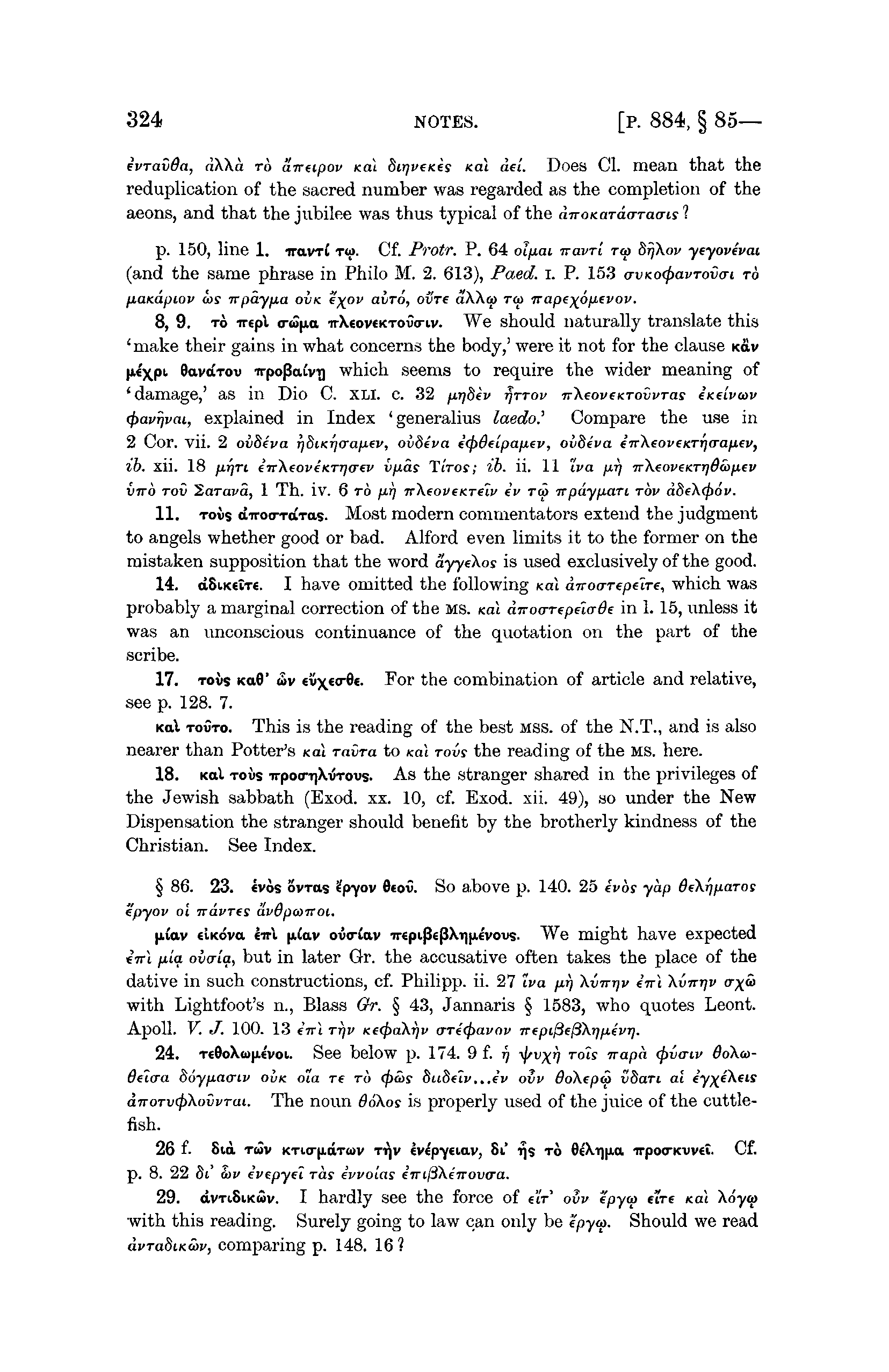
NOTES.
[p. 884, § 85— evravda, dXXa ro aweipov KCU Sujveices /cat del. Does Cl. mean that the reduplication of the sacred number was regarded as the completion of the aeons, and that the jubilee was thus typical of the dTroKardo-Tao-is ? p. 150, line 1. iravrC TO>. Cf. Protr. P. 64 oljiai TTQVTI TCO SfjXov yeyovevai
(and the same phrase in Philo M. 2. 613), Paed. I. P. 153 o-vKoipavToio-i TO fiaKapiov cos npayjxa OVK e%ov avTo, ovTe aXXca TCO irape^Sfievov.
8, 9.
TO irepl crio(j.a irXeoveKTovo-iv. We should naturally translate this 'make their gains in what concerns the body,' were it not for the clause K&V l«Xpt BavetTou irpoPaLVT) which seems to require the wider meaning of 'damage,' as in Dio C. XLI. C. 32 [iTjdev TJTTOV irXeovenTovvTas itzelvcov
(pavr/vat, explained in Index 'generalius laedo.'
Compare the use in 2 Cor. vii. 2 ovdeva 7}diK7]O'ap.€v, ovdeva icpBelpafxev, ov8eva et7TXeoveKTrj(rap.evt ih. xii. 18 firjrt enXeoveKTrjo'ev vp.as TITOS; ib. ii. 11 Iva y.rj nXeoveKTrjdcofiev ino TOV 2aTava, 1 Th. iv. 6 TO fj.j] n\eove<Teiv iv TCO irpa.yp.aTi TOV d8(\<p6v.
11.
TOVS dirooraTas. Most modern commentators extend the judgment to angels whether good or bad. Alford even limits it to the former on the mistaken supposition that the word ayyeXos is used exclusively of the good.
14. dSiKeiTe. I have omitted the following KO\ a7roo-repeire, which was probably a marginal correction of the MS. teal diroo-Tcpeicrde in 1.15, unless it was an unconscious continuance of the quotation on the part of the scribe.
17.
TOVS KO8' uv «vx«o-fl«. For the combination of article and relative, see p. 128. 7.
Kal TOUTO. This is the reading of the best MSS. of the N.T., and is also nearer than Potter's Kal TavTa to <a\ TOVS the reading of the MS. here.
18. Kal Tois TTpoo-r|\iJTovs. As the stranger shared in the privileges of the Jewish sabbath (Exod. xx. 10, cf. Exod. xii. 49), so under the New
Dispensation the stranger should benefit by the brotherly kindness of the Christian. See Index.
§ 86. 23. tvos ovTtts ?pyov 6eov. So above p. 140. 25 tvos yap deXrifiaros zpyov ol ndvTcs avQpco-noi, jiiav eUdva lirl |j.£av ov<rlav irepi^pXiujiivovs.
We might have expected <-Vi jxia ova-la, but in later Gr. the accusative often takes the place of the dative in such constructions, cf. Philipp. ii. 27 Iva p.r) Xvnrjv «Vi Xv-mjv a\S> with Lightfoot's n., Blass Or. § 43, Jannaris § 1583, who quotes Leont.
Apoll. V. J. 100. 13 iir\ TTJV KCCpaXrjv o~T€<pavov 7Tfpi(3efikr]fi4v7].
24.
TeOoXcojUvoi.
See below p. 174. 9 f. ij •v/'ux1? r o's napa cpvcnv doXcodeitra doyp-acriv OUK ola re TO (pcos $udclv.t.€v ovv doXepco vbaTi at ey^eXeis dnoTvcpXovvTai. The noun doXos is properly used of the juice of the cuttlefish.
26 f8ta TWV KTio~|idT(i>v TI^V ev^pY^i-o-v, Si* TJS TO 8^Xi][xa xpotrKwei.
Cf. p. 8. 22 Si' lov e'vepyft rets ivvolas eVi/3\e7roi/o-a.
29. dvTiSiKwv. I hardly see the force of clV ovv tpyco eire nai Xoys> with this reading. Surely going to law can only be epya>. Should we read dvTabiKa>v, comparing p. 148. 16 ? https://doi.org/10.1017/CBO9780511695513.011 Published online by Cambridge University Press
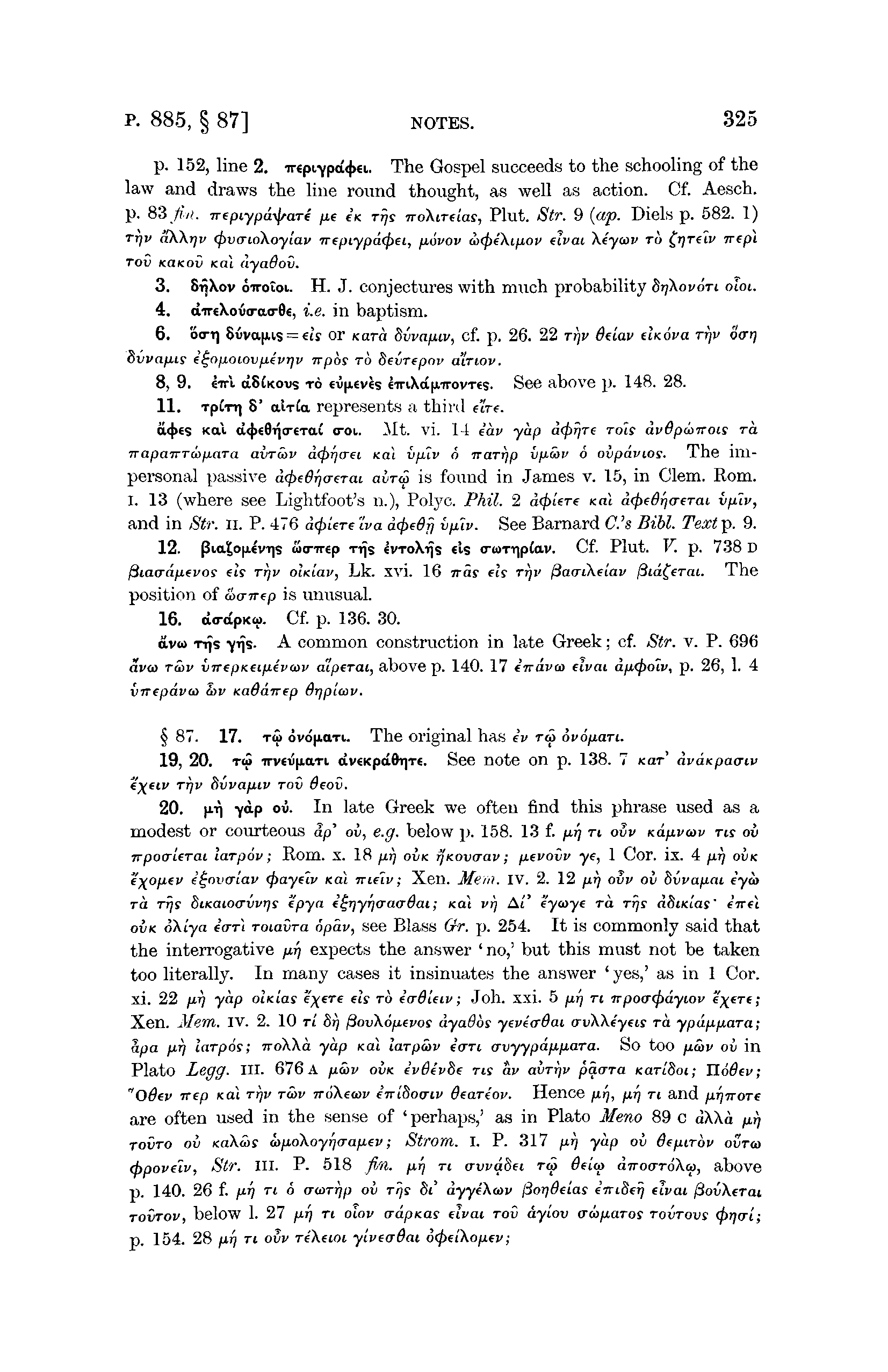
P. 885, § 87]
NOTES.
p. 152, line 2. irepi7pa<|>ei. The Gospel succeeds to the schooling of the law and draws the line round thought, as well as action.
Cf. Aesch. p. 83 fin. Trfpiypd-^raTe fie €K TT/S noXneias, Plut. Str. 9 (ap. Diels p. 582. 1)
Tr)v SWrjv <j>v<rio\oyiav ireptypafei, fiovov a(f)€\ifiov flvtu \iyav TO £r)T(lv wfpl TOV KCIKOV Kal dyadov.
8i]Xov owouH. H. J. conjectures with much probability SrjXovori o'wi.
4. direXovo-ao-Be, i.e. in baptism.
6. oo-t) 8wa|us = «r or Kara Svvcifuv, cf. p. 26. 22 TX\V 6uav UKOva rtjv ocrt) Swa/iis" t£op,oLovp,tvi]v Trpoy TO 8evT€pov airiov.
8, 9. em (XSCKOVS TO eij|xeves eiriXd|xirovTes. See above p. 148. 28.
11.
TpCTij 8' aWta represents a third tire.
CUJKS Kal a<|)«8i]o-6Tai o-oi. ilt. vi. 14 iav yap a(prjr( rots avSpcoirois ra Trapa7TTwp.aTa avrwv d(prj(T€i Kai v[uv 6 irarr^p Vfitov 6 ovpdvios.
The impersonal passive afaOrio-eTcu airS is fcmnd in James v. 15, in Clem. Rom.
I. 13 (where see Lightfoot's n.), Polyc. Phil. 2 d(pi(T( unl dcpedrjaerai ifi'iv, and in Str. n. P. 476 d<pUre Iva dcpeSjj vfxiv. See Barnard C.'s Bibl. Text p. 9.
12.
(5ia£o|j.€vr]s ioo-7r€p TI]S «VTOXTJS «ls o-wTTipCav. Cf. Plut. V. p. 738 D /3iacra/xfi/os- (Is TTJV oiKiav, Lk. xvi. 16 jrar fir riji' /3a<riXfiai/ /3taffrai.
The position of axnrep is unusual.
16. do-dpKo.. Cf. p. 136. 30. avw TIIS -yTfs. A common construction in late Greek; cf. Str. v. P. 696 aw T£>V vnepKdfxivcav dlpirat^ above p. 140. 17 eirdvai eivat dfMpoLVt p. 26, 1. 4
) a>v KaQdrrep 6r]picav.
§ 87. 17.
TU 6vd)j.aTi. The original has iv TG> ovofian.
19, 20. TI3 7rv€ijp.aTL dv€Kpddr]T€. See note on p. 138. 7 /car' dvaKpacriv %Xftv TV" tovvafuv TOV 6eov.
20.
|IT| -yap oi. In late Greek we often find this phrase used as a modest or courteous ap' oi, e.g. below p. 158. 13 f. fir/ n oZv ndfivav TIS OV
7rpoo~L€Tai larpov; Kom. X. 18 p.rj OVK rjnovcrav; p.evovv ye, 1 Cor. ix. 4 p.jj OVK
€)(OfifV e^ovijiav <f)ayeiv Kal meiv; Xen. Merit. IV. 2. 12 ^ ovv ov bvvaixai eyw
TO. Trjs diKatoo~vvr}s tpya f£i}yr}O~ao'6ai; KCU vrj At* eyoiye Ta TTJS dftiKtas' €ir(\
OVK o\iya io-Ti ToiavTa opau, see Blass 6-V. p. 254. It is commonly said that the interrogative fir/ expects the answer 'no,' but this must not be taken too literally.
In many cases it insinuates the answer ' yes,' as in 1 Cor. xi. 22 /J.rj yap olxias ?Xer£ e's T° fc6iciv; Joh. xxi. 5 jirj TI irpoacpdyiov €XtTl!
Xen. Mem. IV. 2. 10 W 8)) fiovkofievos dyaBos yeve<rdai avWeyas ra •ypa/j/iara; apa fj-rj laTpos; 7roXXa yap Kal laTpwv eVrt o~vyypdp.fiaTa. So too p.wv ov in Plato Legg. III. 6 7 6 A II&V OVK ivQivht TLS av aiiTr/v pqo~Ta KaTtdot; Hodev;
"O6(V irep xai Trjv TU>V irokeiov cTrio'ocriv deareov.
Hence fir), p.j] TI and fir/norc are often used in the sense of ' perhaps,' as in Plato Meno 89 c ak\a p,r)
TOVTO ov Ka\<os cop.o\oyr]0~afi€v; Strom. I. P. 317 p.r] yap ov Se/xirov OVTO) (fipoveiv, Str. III. P. 518 fin. p.fj TI avvaSei ra deiw aVoo-ToXa, above p. 140. 26 f. /J-rj TI b o-iOTr/p oi rqs Si' dyyfKtov jiorjdeias eiriSfrj eivai /3ovXfTa»
TOVTOV, below 1. 27 p-r) n olov o-dpKas fivai TOV ayiov aafxaTos TOVTOVS <f»]o-i; p. 154. 28 p,rj TI ovv re'Xeiot yiveo~8ai 6<pei\op.€v; https://doi.org/10.1017/CBO9780511695513.011 Published online by Cambridge University Press
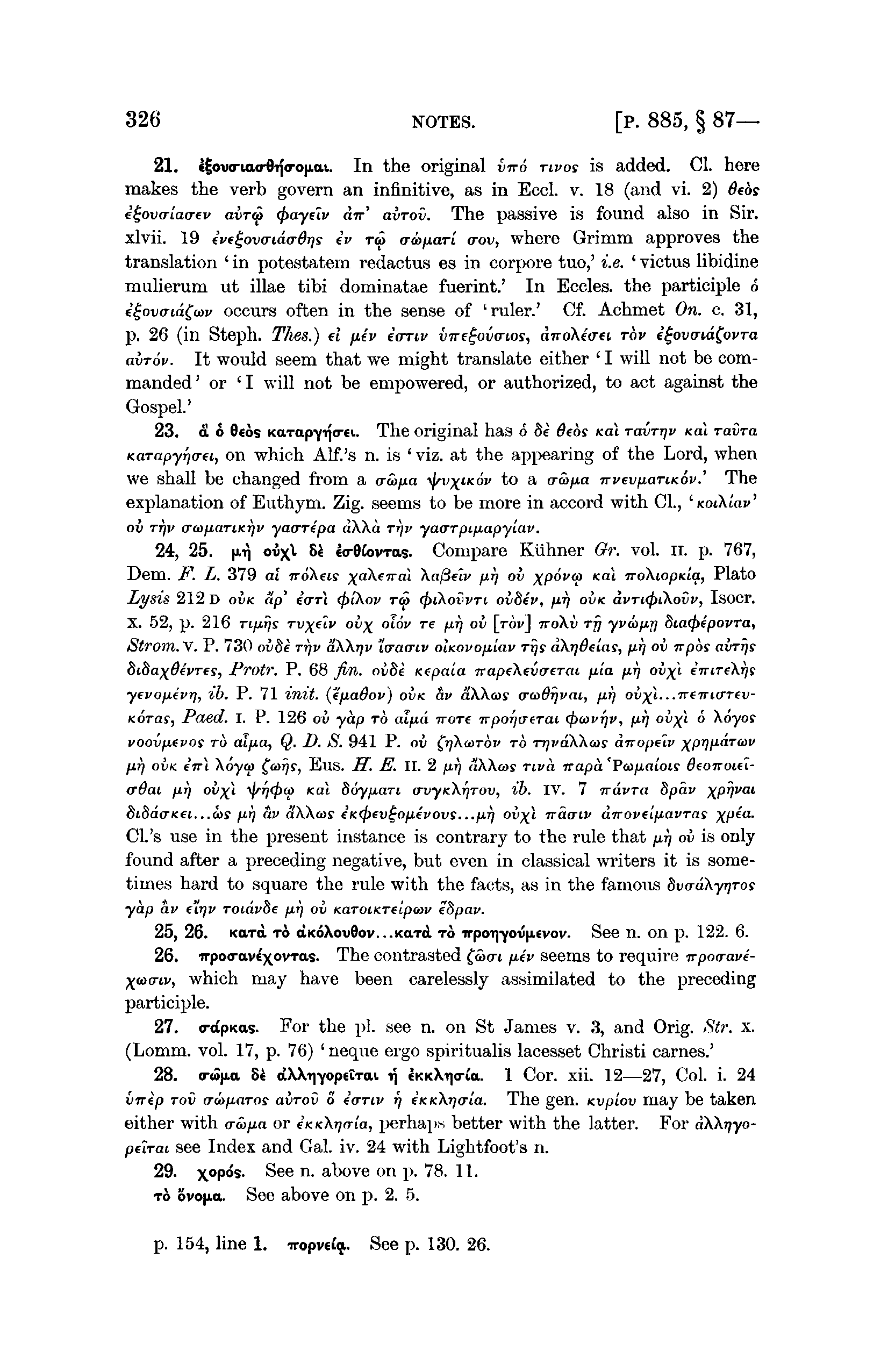
NOTES.
[P. 885, § 87—
21. l£ovo-iao-6ijo-o|i,ai.. In the original viro TIVOS is added. Cl. here makes the verb govern an infinitive, as in Eccl. v. 18 (and vi. 2) 8ebs e£ov<rlao-ev airy <f>ayilv an' airov. The passive is found also in Sir. xlvii. 19 fvf^ovo-ida-dris iv na <ri»/jaW o-ov, where Grimm approves the translation ' in potestatem redactus es in corpore tuo,' i.e. ' victus libidine mulierum ut illae tibi dominatae fuerint.'
In Eccles. the participle 6 ii-ovo-iafav occurs often in the sense of 'ruler.'
Cf. Achmet On. c. 31, p. 26 (in Steph. Thes.) (I jiiv iariv ine£ov<rt.os, (i7roXe'<7« TCIV egovirtd£ovTa airov. It would seem that we might translate either ' I will not be commanded ' or ' I will not be empowered, or authorized, to act against the Gospel.'
23. a 6 8«6s KaTapyijtrei. The original has 6 Sc 8(bi Kai TavTifv Kai ravra Karapyrja-ei, on which Alf.'s n. is ' viz. at the appearing of the Lord, when we shall be changed from a o-S>fxa \jn>^iKov to a o-5>ft.a nvtvfiaTiKov.'
The explanation of Euthym. Zig. seems to be more in accord with CL, 'KOIXLOV' ov riyi/ craj^iaT-iKiji/ yaaripa dXXd rr/v yacrrpifiapylav.
24. 25.
(J.1] ovy). Sk 4<r9CovTas.
Compare Kuhner Gr. vol. II. p. 767, Dem. F. L. 379 at TroXets ^aXfTrai Xafifiv [IT] OV ^pov<a Kai iro\iopKia7 Plato
Lysis 212 D OVK tip* eort (piXov TG> (pikovvn ovfiev, /XTJ OVK dvTtfpiXovv, Isocr.
X. 52, p. 216 TLjj.rjs TV)(clv ov% oiov Te JLIIJ oi [TOV] 7TO\V T§ yvaifiT] &ia<pepovra,
StTOm.y. P. 730 ovde TTJV aXKrjv tVacrtv olicovofiiav TTJS aXTjdelas, fifj oi Trpos avrtjs b'lb'ax&evTfs, PtotT. P. 68 JlTl. ov&e Ktpaia TrapeXeucerat p.ia firj ov%i sniTeXrjs yivop-ivr], ib. P. 71 init. {(fxadov) OVK av aXXcos (raidfjvm, fit) oi^i...•KtTTiO'TtvKoras, Paed. I. P. 126 ov yap TO alfid noTf npojjcrcTai. (pcovrjv, fxi] ov^l 6 Xoyos voovfievos TO aifia, Q. D. S. 941 P. ov £T]XO>T6V TO TTjvdXXais dnopelv fir} OVK €7r\ Xoyto £*o>^?, Eus. IT. E. II. 2 firj <iXXo>s Tiva napa 'PtojLtatotp o~Bai fir) ov)(l **lrr](pq> Kai Sd-y^Lwirt o~vyKXr]Tov, ib. IV. 7 ndvTa dpav %pr)vai fit8a<7KCi...ci>j pri av aXXais CK(p€v^ofiivovs...p.fj oi)(l irao-iv cnroveijiavTas XPeaCL's use in the present instance is contrary to the rule that ^17 ov is only found after a preceding negative, but even in classical writers it is sometimes hard to square the rule with the facts, as in the famous hvo-dXyrjTot yap av e'lyv Toidvfte p.r] ov KaTOiKTeiptav edpav.
25. 26.
KOTO. T& dKoXouSov.-.KaTol TO irpoT]'Yoii(i.6vov.
See n. on p. 122. 6.
26. irpooravexovras. The contrasted fScrt fiiv seems to require wpoiraveX«>o-iv, which may have been carelessly assimilated to the preceding participle.
27. o-cCpKos. For the pi. see n. on St James v. 3, and Orig. Sir. x.
(Lomm. vol. 17, p. 76) ' neque ergo spiritualis lacesset Christi carnes.'
28. <r<5|j.a 84 aXXrivopeirai 11 €KKXt]o-ia. 1 Cor. xii. 12—27, Col. i. 24 vnkp TOV (Tw/inror airov 3 io-TLv if fKKXrjo-la. The gen. Kvpiov may be taken either with 0-wp.a or (KKXrjaia, perhaps better with the latter. For dXXrjyopuTai see Index and Gal. iv. 24 with Lightfoot's n.
29. x^*5See n. above on p. 78. 11.
TO ovopa. See above on p. 2. 5. p. 154, line 1. wopv«>. See p. 130. 26. https://doi.org/10.1017/CBO9780511695513.011 Published online by Cambridge University Press
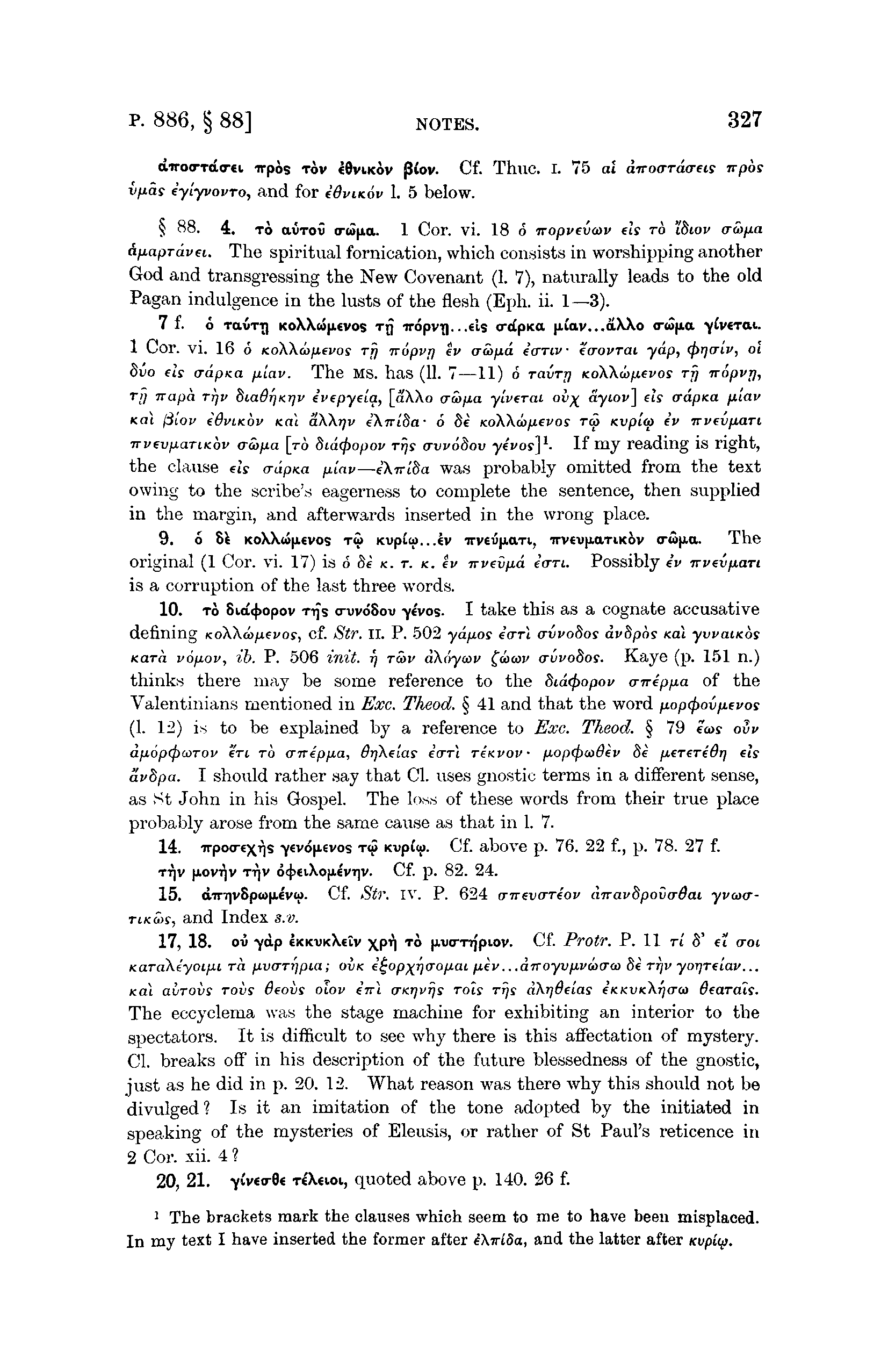
P. 886, § 88]
NOTES.
diroordo-ei irpos TOV CSVIKOV |3£OV. Cf. Thuc. I. 75 al diroo-Tao-eis npos ifias iylyvovro, and for e'dvinov 1. 5 below.
§ 88. 4. TO CIVTOV o-up>a.
1 Cor. vi. 18 6 iropveia>v els TO Idiov o-oifia AfiapTavet.. The spiritual fornication, which consists in worshipping another
God and transgressing the New Covenant (1. 7), naturally leads to the old Pagan indulgence in the lusts of the flesh (Eph. ii. 1—3).
7 f.
6 rauTT) KoWufievos TJJ ir6pvT|...ets crfpica |iiav...aXXo <ru|ia yivtrai..
1 Cor. vi. 16 6 KoXXa>juei>os Trj nopvTj ev o~<o[xd eo~Tiv 'etjovTai yap, (pryrriv, ol dvo els adpKCi filav.
The MS. has (11. 7—11) 6 ravTrj KoXXw/*ei'or rjj nopvrj, Tt] napa TTJV hiaOrjKrjv evepye'iq, \a\\o o~wp.a yiverai ov% ayiov] els (rapKa filav teat filov e6viKov cai aXX>;v e'XTriSa6 8c /coWw/ievos ra Kvpla e'v nvcifiaTi
•jrvevp.aTiK.bv acojia [TO Sidcpopov rrjs crwodov ye'vor]1.
If my reading is right, the clause els 0-upn.a jxiav—e'Xirida was probably omitted from the text owing to the scribe's eagerness to complete the sentence, then supplied in the margin, and afterwards inserted in the wrong place.
9. o 8fc KO\X.W|A€VOS TU Kvpi(?...lv irveii|AaTi., Trv«v|iaTiK6v ir«|ia.
The original (1 Cor. vi. 17) is 6 St K. T. K. ev nvevp.d eo-Ti. Possibly iv nvev/xaTt is a corruption of the last three words.
10.
TO 8ia<f>opov TIJS o-uvdSov 7«vos.
I take this as a cognate accusative defining Ko\\d>fi.euos, cf. Str. II. P. 502 ydpos earl crvvo&os dvSpbs KOI yvvaiicos
Kara vofiov, ib. P. 506 init. T) TO>V d\oya>v £a>a>v o-vvobos.
Kaye (p. 151 n.) thinks there may be some reference to the 8id<popov o-wepfia of the Valentinians mentioned in Exc. Theod. § 41 and that the word p.op<povfievos
(1. 1-2) is to be explained by a reference to Exc. Theod. § 79 «W ovv d}j.6p<$>(x>Tov eTi TO crTrep/ia, SrjXeias eiTT\ T£KVOV' fiop<pa>dev Se fiereTeOr] els avSpa. I should rather say that Cl. uses gnostic terms in a different sense, as St John in his Gospel. The loss of these words from their true place probably arose from the same cause as that in 1. 7.
14. irpoo-«xiis -y«vo(i.6vos TU> KupCip. Cf. above p. 76. 22 f., p. 78. 27 f.
TT|V )1OV^V TT]V 6(J5ei\0|16'vT]V.
Cf. p . 82. 24.
15. a7nivSpo>|jL€Vfa).
Cf. Stv. IV. P. 624 tmev(rTeov cnravbpovo~6ai yvaio~TiKa>s, and Index s.v.
17, 18. oi •yap CXKUKXCIV \pif| TO (j.\jo-rrjpiov.
Cf. Protr. P. 11 T'L 8' el <TOI KCLTaXeyoLfii Ta [xvo~Ti]pia; OVK e^op^rjorofiaL fiev...dnoyvpvuiJTai he TTJV yorjTeiav...
KCU avTovs TOVS Beoiis olov eTrl o~Kr)vrjs Tols TTJS dXrjBeias eKKVKXrjo'co SeaTais.
The eccyclema was the stage machine for exhibiting an interior to the spectators. It is difficult to see why there is this affectation of mystery.
Cl. breaks off in his description of the future blessedness of the gnostic, just as he did in p. 20. 12. What reason was there why this should not be divulged ? Is it an imitation of the tone adopted by the initiated in speaking of the mysteries of Eleusis, or rather of St Paul's reticence in 2 Cor. xii. 4 ?
20, 21. ylveo-Qt T£X«IOI, quoted above p. 140. 26 f.
1 The brackets mark the clauses which seem to me to have been misplaced.
In my text I have inserted the former after i\irida, and the latter after Kvpii^. https://doi.org/10.1017/CBO9780511695513.011 Published online by Cambridge University Press
NOTES.
[p. 886, § 88 22. KaToPiouvres, ' living out their life,' not necessarily ' bringing it to a close,' cf. Plut. Mor. 603 B IJ ' k.K.a.hr))ila olKTjTrjpiov rjv BXaravos tea!
SfvoKparovs avroBi ay(oka^6vTtov KO.\ KaTaftiovvTav TOV avavra y^povov.
25. ov8iv...«ls 6|ioi6TT)Ta 8eov irapaXapPrfvETai.
'None of these perfections is accepted as resembling the Divine.' One can scarcely believe that it is Clement who says this, when we remember his repeated references to the gnostic's assimilation to God (pp. 6. 23, 20. 27, 26. 22, 146. 21,
178. 11, 12, Q. D. S. 955 P. TOVT' ea-ri TO o-nepfia eUaiv <al dfitiiaxns $eov) and even to his deification (see n. on lo-ojiivm 8ea>, p. 6. 23).
26, 27. The Stoic doctrine of the identity of divine and human virtue is stated in Cic. Leg. I. 25 virtus eadem in homine ac deo est. Est autem virtus nihil aliud quam in se perfecta et ad summum perducta natura.
This, which was the common Greek belief, was opposed by Aristotle (Eth.
N. vn. 1) 'We can no more attribute virtue or vice to God than to a brute,' dXX' r) fxev Tipiwrepnv dperrjs, 17 &e (Tepov ri yevos na/cias. See also ib. X. 8 § 7 where it is argued that the divine activity must consist in Beaipla, as it would be absurd to ascribe to God practical virtues, such as courage or temperance or prudence. The later Academy followed Aristotle. Plotinus goes deeper ' If, as Plato says, we are made like to God by virtue, it would seem that we must ascribe virtue to God, but is it in accordance with reason to ascribe to Him the political virtues ? God is the exemplar of all virtue, and man receives his virtues from Him, but the divine goodness is something beyond virtue. What we term virtues are merely purificatory habits, the object of which is to free the soul from the bondage of the flesh. With God virtue is nature, with man it is effort and discipline' (a brief abstract of Enn. I. 2). The Christian Fathers were divided on the subject, Clement, as we see, denying the identity both here and in Sir. 11.
P. 501 'Hcat'af firj rrjv avTrjv civai dperrju avdpaTrov KO.'L Beov napicrdsy (ode
<pri<n (quoting Is. lv. 8, 9 'my thoughts are not your thoughts, &c.'), and Str. VI. P. 798 init. 17 Se dfiolaxris ov%...ri KQT' aptrr/v d<r€/3j)? yap Ka'i fj$( rj TTJV avTTjv dp€TTjp €Lvat dvSpaiirov Kal TOV TravTotcpaTopos Seov...
, 0^a"iV, dvo/xtav, o n eo~o[ial o~oi o^totoj, while Origen affirms it, maintaining that K.a6' rjixas 17 airi) aperf eVri T<OV fMKapiav ndvTa>v, 5aT(
Kai rj aiiTT] dpcTr] dvdpdnrov KG! Beov • bionep yeV€O~0ai TeXeioi, cos 6 naTrjp rfjiav 6 ovpdvios TeXtios eari, SiSao-KOjieda (Gels. iv. 29), though elsewhere he condemns the Stoic presumption in claiming for their wise man equality of virtue and happiness with God (Gels. vi. 48). There can be no doubt that the Christian Eevelation proceeds throughout on the supposition of the real identity of goodness in God and man, and that this lies at the very heart of the doctrine of the Incarnation.
Our idea of the goodness of God is simply goodness as we know it in man, but stripped of its association with human weakness. See further my n. on Cic. JV. D. Til. 38, and Bigg,
Christian Platonists, p. 65.
29. tt8ivaTov...7ev&r8<H nvd r^Xeiov. It is plain that we cannot accept Cl.'s explanation of the difficulty contained in these words; nor, I think, can we accept Alford's suggestion, that the verb is rather prophetic than https://doi.org/10.1017/CBO9780511695513.011 Published online by Cambridge University Press
P. 887, § 89]
NOTES.
imperative. It stands on the same footing as ayairri<ret.s in Mt. v. 43 ('thou shalt love'), and oi cpovevo-eis in v. 21 (' thou shalt not kill'). The point of the assertion is the same as that contained in two clauses of the Lord's
Prayer, that the standard of heaven is the true standard of earth, that man is never to rest satisfied with any perfection lower than that of God.
And how this is to be brought about is explained in Eph. iii. 19 and iv. 13, iva Tr\rjp(t)dT]T€ els TTCIV TO n\r)pw}ia TOV Beov, els p-erpov r)\iKias TOV ir\r]paip.aTos rov Xpiorov. Compare above p. 140. 26 f. where the same text is discussed. p. 156, line 5. TTJS irtpiKoinfjs.
See above p. 148. 5.
6. €xXa|3eCv. See p. 48. 2 TO lepov Sterns eKkapjiaveTai, p. 104. 20.
§ 89. 11—13. cruvemXaupdvovTai—alp&ms. The Sceptics and New Academy laid great stress on the variety of opinions, as proving that all were wrong, cf. Cic. .V. D. i. 1 tarn variae sunt doctissimorum hominum tamque discrepantes sententiae ut magno argumento esse debeat causam esse inscientiam, prudenterque Academicos a rebus incertis assensionem cohibuisse, where see n. The same argument was used by the Empiric school of medicine. See Sext. Emp. P. H. I. 14. 145, Orig. Cels. III. 12.
12. ax ircpl TTJV aXXTjv Si8a<rKaX£av oipt'a-eisDr Abbott suggests that we have here an allusion to 2 Cor. xi. 4 el p.ev yap 6 ep^ofievos aWov 'Irjo-ovv
Krjpvo~o~et ov OVK eKrjpv^ap.ev. ..r) evayyfKtov erepov o OVK e'8e£ao~de K.T.X.
The phrase would thus mean 'heresies concerned with the other (i.e. the false) teaching.'
For irepi cf. above p. 54. 24 Tr]V irepl rjp.as ei>o-ifieiav. Two points in which the charges brought against the Church by the heretics resembled those brought by the heathen and the Jews were that both were founded in ignorance of facts and misinterpretation of the Scriptures, see below § 96.
15.
TOV !£rjs errpwuaTta. This, then, was not intended to be the final Miscellany. See Introduction.
16.
Trfto<raLyov<riv.
Cf. Orig. Cels. IV. 4 oirep rjp.lv KOI 'lovbmois npotrayei 6 KeXaos, PhiloC.^ II. p. 24 Xueraxxai* raff npoo-ayo^ivas v(f>' rjfiatv avTots anoplas.
18. irapaTeivti.. This verb is used in the passive to denote exhaustion and prostration as in Xen. Mem. in. 13. 6 irapeTaAi) paicpav 686v nopevBels,
Plat. Symp. p. 207 B Zroip.a IO-TW inep TovTav <ai hiafia\fo-6m TOL dcrdeveo-TaTa
TOIS lo~xvpoTdroi.s <al vir€pano6vT)o-K(iv, xai avra r<» \ip.a> 7raparei.v6p.eva, &O-T' ene'iva eKTperfieiv, quoted with many other exx. by Ruhnken Tim. Lex.
We find also the reflexive use in the same sense in Philo V. M. 21 (M. 2, p. 100) ovdfls 7Tpoo~eveyKao~uai Tpotpas vnefieivev, a W r)o~v^ia KO! Xi/iai napeTetvov avrovs. As napaTelvo) is vised intransitively, for the passive, in the sense
'to persist,' 'to extend,' 'to continue' (and similarly dvareiva, imoreiva, KaTarelvui), it seems not impossible that it may be so also in the sense
'to faint.'
I think therefore that it is unnecessary to adopt Hoeschel's 7rapa<f>6ivei, of which no example is cited.
25. TW irvpa TCL £i£<£via. The original has 6 e'^dpos eo-neipe {. dva TOV crirov. https://doi.org/10.1017/CBO9780511695513.011 Published online by Cambridge University Press
NOTES.
[p. 887, § 89— 28. iravTl TW Ka\u pupo; 'iirerai.. This reads like a quotation. Momus, the god of fault-finding and mockery, may naturally stand for criticism and caricature of any kind. I have not however found any exact parallel for the latter use, which seems the most appropriate here. The heretical sects are a caricature of the true Church, resembling it as tares resemble wheat, and intended by the enemy to bring it into discredit. Taking the word in the more common sense of 'blame,' we may understand it of jealous fault-finding aroused by the sight of superior excellence; as in the 59th fable of Babrius, where Zeus, Poseidon and Athene, striving ris na\6v
TL woirja-fi, appoint Momus to be umpire; but he has nothing bvit blame for their creations. So the heretics criticize the law of God, whether revealed in nature or in the Bible.
§ 90. p. 158, lines 1—3. et •irapaPaCT)...d<f>e£6|«9a. For this form of conditional sentence see Index s.i>. ' Optative.'
TOV eKKXinriaoTiKov Kavova. See above p. 70. 24, 25 6 r£> OVTI Kara TOV eKK\T}(Tia(TTlKOV KClVOva yVQMTTLKOS, StT. VI. P . 8 0 3 K. GKK. f] (TVVCobta Kal f) crvp-KJXovia vojiov re Kal TTpocpijrcov TJJ Kara TTJV TOV Kvplov Trapovtriav irapabiSojievT] biadr)K.T), Kaye, p. 216, n. 4, and Westcott's excellent account of the word in App. A of his Canon of the N. T.
8. ojioXo-ytav, i.e. I suppose the baptismal confession, cf. 1 Tim. vi. 12 cb/ioXoy^tras1 TTJV Ka\rjv 6jxo\oyiav.
10. kv irXtiTet.
Cf. Dion. H. Comp. Verb. XXI. eori rav iv n-Xar« 0€a>povfA€va)v, ib. XXIV. opaTat Se ov Kara airapTi(rp.6v, a\X' €v TrXaret ((non perfectionis absolutae ratione habita, sed in genere').
12. ot larpol Ivavrtas Sofjas KCKTIJIUVOI.
On the medical sects of antiquity see art. ' Medicina' in Smith's D. of Ant., and cf. Galen vm. 657 K.
OCLTTOV av TIS TOVS OTTO Mcovcrov Kal Xpitrrov fieTadiddtjfLfv r) rovs rals aipe&evi irpoiTTeTrjKOTas laTpovs T€ Kal <piho<ro<povs.
13, 14.
(iii T l °^v oi Tpoo-UTai.
See above on p. 152. 20.
16. eLSwXoJV 2p.irX€«s.
Plato Pliued. 66 C civ TIVGS VO(TOI Trpoorireo'OHTiv, (fiTroSi^oviTiv TT)V rov OVTOS drjpav • ipu>T(x>v 8e Kal iTTi6vfu,5>v K.a\ (pofitav xai eldai\a>v TravroSaircov KCH CpXvapias ijnr'nr'Krjo-iv fjfias 7roXX^f.
18.
Swl TOVS SOKCJIOUS at aip€o-6tsThe original has Sei yap Kal alpe&ets ev vp.l.v elvai, Iva ol doKifiot <pavepol yivwvrai eV vp.1v.
19.
SoKtyuous iJToi TOIIS iKX«KTiKuTcpov irpo<ri6vTas.
Such as the Beroeans are described in the Acts.
20.
T'jj KvptaKij 8i8a<TKaXia..
Cf. p. 148. 22 r) TOV Kvpiov StSacrKaXiu.
Below p. 190. 15 we read of r) TQ>V anoo-rokaiv bihaaKakia.
21—23. This remarkable saying of the Lord is referred to by Cl. in Str. I. P. 425 r) ypafpr) irapatvei "yiv€O-0( Se 86<ip.oi Tpawe^iTai," ra /lev aTrohoKifxa^ovTes, TO 8e KaXov Kare^ovres, Str. II. P. 436 ?OTI yap boKiuov vd/xto"/xa Kal aXXo Ki^brfkov, onep ovbev CXOTTOV aTrara TOVS Ibiatras, ov fxfjv
TOVS dpyvpafioifiovs, ot "urao-i fiadovrcs TO re irapaKe^apayfievov Kal TO boKifiOv
Xo>pi£civ...ovTu>s 6 dpyvpap.ot($6s TW lb~id>TT) TOVTO fiovov, on Kijibr)X6v £<rn TO v6)ii.a-fia, (prj&iTO §£ jras, JJLOVOS 6 Tpairt^irov yvapi/jios Kal 6 iir\ TOVTO https://doi.org/10.1017/CBO9780511695513.011 Published online by Cambridge University Press
P. 888, § 91]
NOTES.
aKeKpo/ifvos p.av8dv(i, Sir. VI. P. 780 rpdnct^av OVK i'^fi TTJV TS>V dpyvpa/j.oil3a)V, OVO€ flTjv TO KpLTTJplOV TOV XoyOV.
KOL TTW? €Tl Tpan€^LT7]S OVTOS, doKlfldfTdl fir) Svvdfifvos Kal biaKplvai TO aKi^brjXov vofuo-fta TOV irapaxapdyfiaTos;
Comparing the last quotation, I think that Eesch is right here in reading OKI'/38I;XOV and contrasting it with irapaxa.payfi.aTos. Otherwise the contrast will lie between TO Kif3$r]\ov and TO Kvpiov, and awo TOV irapaxapdyfiaros would denote the flaw in the workmanship which betrays the forger.
Origen (in Joh. torn, xix.) connects it with 1 Th. v. 21 as well as with a word of Christ's (probably Mt. xxv. 27). In Constit. Apost. n. 36 it is limited to the judgment of the priests, to whom alone the commission was given yiveo-Be Tpane^irai SOKI/XOI. Apparently the earliest reference is found in the Clementine Homilies n. 51, in. 50, xvm. 20, or in Apelles
(fl. c. 150 A.D.) ap. E p i p h a n . Ilaer.
XLIV. c. 2 OVT<OS yap, (prjo-iv, i'<prj iv r<a euayyeXtco iy. §. rp.'
XP® y^P* ^^O'tVj CITTO 7rdo~r[S ypa<j)r)s avaXeywv Ta ^^<rtjua.
Dionj'sius of Alexandria (a disciple of Origen's) makes use of it to justify his inquiry into the tenets of the heretics (Eus. H. E. vn. 7). He believed himself called to this work by a vision, which he obeyed, i>s anocrrokiKfi cpcovj] o~vvTpcxovi TV Xeyovcrr] Trpos TOVS dvvaTaTepovs ' y. 5. Tp.'
F u r t h e r information will be found in Fabricius Cod. Apocr. N. T. p. 330 IF., Suicer
Thes. s.v. Tpawi^iTrjs, Heinichen Exc. ix. ad Eus. H. E. vn. 7 (vol. III. p. 389), Nicholson Gospel ace. to the Hebreivs, p. 157 ft'., Resch Agrapha, pp. 105, 116 ff., Ropes die Sprikhe Jem pp. 141 ff.
§ 91. p. 160, line 2. irepl TOV 6«OV KdTa-yCveTai,.
Of. Protr. P. 79 init. 6
/3/of Too~avTTj o-novdjj 7T€p\ Trjv v\rjv KaraytVerat, Paed.
I. P. 101 irzpl TOV av&p(onov TJ TTucra anovbrj KaTayivtTai.
3, 4.
€irairoSvT«ov T<$> ITOVW.
Cf. Paed.
I. P. 112 fin. %^to~Ti 5' rjfxiv np6$ TOVS cpiKeyK.\r)fiovas iTranohvo-ao-Bat.. The first instance of the metaphorical use seems to be Arist. Lys. 615 d W eTraTroSvcvfieB' avdpes TOVTCOL TG> npayfiaTi.
It is common in late Greek, esp. in Philo, see exx. in Siegfried p. 78.
8, 9. KaTaXT]irTi.KTJ 8e<apCa. See above p. 20. 25. The Stoics held that we could distinguish truth from falsehood intuitively by an infallible criterion, termed by Chrysippus KaTaXrjnTiKrj tpavTao-la, an impression in which the mind grasps reality, or, as it was also explained, which seizes the mind by a kind of irresistible shock1: this is followed by o-vyKarddeo-ts, a declaration to ourselves that the impression is true. Cl. probably substitutes 8eu>pLa for (pavTao-la in order to give prominence to the activity of the mind. In p. 20. 25 he uses Oeapia of the beatific vision of the pure in heart.
10, 11. 68ov (iias Tifs PatriXiKTJs. Cf. above p. 128. 10 f.
1 On the history of the word and its ambiguous signification, see Stein Erkenntnistheorie d. Stoa n. 154—186.
KaTa\afi^dvw, as a rule, has for its subject the mind, and for its object that which is presented to the mind, as in Plato Phaedr.
250 D KaTeCk-qtyaiitv airb did, -rijs 4vapye<FT&TTis aiVS^ircus, Arist. de Mundo 391 a 15 rj <pvxv 6eiip i/'ux^s fifi-fiari TO. Beta KaTaXafiovaa, Epiot.
Fragm.
1 (p. 404 Soh.) ravra x^P€l"
& Tvxi" ^ aKaTd\r)vrd e<m Ty av6piinrivri yviifKtjy el Bi Kal TO. jiAXuTTa Bel-q TIS etvai KaTaXijTrrd, dXX' oiv ri 6<pe\os Kar https://doi.org/10.1017/CBO9780511695513.011 Published online by Cambridge University Press
NOTES.
[p. 888, § 91— 17.
9r\pwrlovZahn Forsch. in. p. 162 illustrates Cl.'s fondness for metaphors derived from the chase by instancing Paed. II. § 114 Brjparpov,
Sir. ii. § 5 dvo-Brjparov, vii. § 23 &c.
It is of course borrowed from Plato, cf. Rep. iv. 432.
18, 19.
<ruvava<|>uoVTai Troai.
Cf. Str. VI. P. 774 init. at alpefreis Trap' rjp.lv (Tvvavc<pvr)(rav r<» yovtp.a> irvpio.
The word noa, as defined by Theoph.
H. PI. I. 3. 1, includes corn (iroa TO OTTO p'ifys (pvXXo(f>6pov npo'iov dcrre'Xeyer, ov 6 KavXos o-irepfiofpopos, oiov 6 alros Kai ra Xd%ava), and SO it is used by Cl. Paed. II. P. 232 dypos 6 KO<Tfios, Ka'i noa i)p.eis ol rfj -j^dptTL dpoo-i£6p.evoi
TOV Beov...%6pTos fie 6 xvdaios dXXTjyopfirai b'^Xos...€ls ovdev dXX' r) et? vneKKavfui eildeTos. But elsewhere Cl. uses it of weeds, as in Str. n.
P. 479 fin. Tag crvvavadaWoiKTas TO* yovificp Kapnut fiaralas Tr/s evvoias Troa? and Str. I. P. 325 (the ground must be cleared) dno re TS>V aKavOav Kai rfjs.
•n-oas airacrrfs. These are also called aypiai fioravm Str. VI. P. 770, and fiordvcu simply by Ign. Eph. x., where see Lightf.
21, 22.
TTJS dXr]8«fas TX\V aKoXouBCav. Cf. below p. 170. 28 TTJS aKoXovdias rutv (T(f)eT€pa)v doyp,aT03v KdTafppovovo'Li') Str. I. P. 426 TTJV aKoXovOiav rijs
Beias 8i8a<TKaXtas 8r)pa>p.evoi, below p. 180. 29, Sext. Emp. Math. VIII. 288
(naan differs from brutes) X6ya> rt KCU /jerajSariK?; (pavracria Kai iv rfj aKoXovBia
(i.e. in facilitate colligendi aliquid et consecutiones perspiciendi) but this is limited to ra (paivo/ifva, in regard to which he has Ti)pr\TiKi)v nva aKoXovBlav
Ka@* rjv p.v7][Lov€v<ov Tiva fxfra rivaav Tedeooprjrat., Kai Tiva irpb rlv<av, Ka\ rlva fiera. Tiva, eV rrjs T<OV irpoTcpaiv viroTTTaHTtcus dvavfovrai ra Xoiwd.
23.
8«'ov. The participle used for finite verb, as often in Cl.
24.
TO |xaxo|i«vov.
Contrasted with TOV d.KoXovdov below, as in Epict.
Euch. 52. 1 TL aKoXovOla, TL p.d^rj, T'L dXrjBes, TL yjrevSos; 25.
TCIXT]8OCS.
Like rdyadov, rdvSpos and even 8aTepos for 6 erepos Str. I. P. 322, ddrepov for rov erepov Protr. P. 24, Saripav for TTJV erepav
Paed. II. P. 236.
§ 92.
32. dvoiroXo'yTiTos ij Kp£<ris. The original has dvanoXoyrjTos cl... nas 6 Kplvwv iv u> yap Kpivtis TOV crcpov o-eavrbv KaraKpiveis. iroT€pov dvcupovo-cv d-TroSeiiiv; This was done by the later Academics, esp. Arcesilaus and Carneades, who held that neither the reason nor the senses were to be trusted.
For the arguments by which demonstration was overthrown see Cic. Aead. II. 91 foil, and Sext. Emp. Math. Bk VIII. p. 162, line 4. 8i" avrov T<5V -ypa^aiv diro8€iKTiK»s. See below p. 168. 12 f. rrj roil Kvpiov (pdyvjf nitTTOVficda TO £rjTOvp,evov, TJ p,6vr] diroSei^is ovcra 5, 6. iv (JI6VT| TT) d\T)8et Kai TTJ dp^aua eKKXr|cr£a.
It is a mere truism to say, with the MS., that iv p-ovy rfj dXrjdeia is to be found the most exact knowledge.
For the reading dXrj&ei cf. p. 188. 17 i) 7rpo-yei»eoTdr>j K<U dX7]B€O~TaTT] iKKXrjo'la, and 1. 21 p>[av etVat rr)v dXrjBrj iKKXrjo'iav, rr]v Tea OVTC dpxaiav, p . 176. 20 f. oi iv rfj i'ma'Trjp.Tj ij iKKXrjcr'ia r/ dXrjBfis, also above p. 4. 15 TTJV dpxaioTaTrjv <f>iXo<ro(j>lav.
The repetition of the article with the https://doi.org/10.1017/CBO9780511695513.011 Published online by Cambridge University Press
P. 889, § 93]
NOTES.
second epithet is not uncommon in Cl., cf. Str. i. P. 342 quoted in the n. on 8i8a<TKaX['af 1. 14 below.
9, 10. ot 8o£6o-O(j>oi KaXoujievoi.. Cf. below p. 172. 13 irro 8o^oo-o(plas ivrjpnivoi, Prov. xxvi. 12, 1 Cor. iii. 18 t"i ns 8OKC< <ro<pos elvai iv vfiiv iv T<U alavi TOVTCO, pa>pos yevi&dio Iva yevr/Tai <ro<f)6s.
Clem, also uses the form doKr/crio'Ocfios, ils in Prott'. P. 58 rj upas rutv boKTjo-io~6<puiv TOVTCOV KarayyeWop.ivrj ddeorrjs, Str. I. P. 347 Jin., P. 370, and olVo-Lo-o<pos Str. II. P. 454 and 456.
12. dvairfiraiicrOai VO|U£OVT€S.
Cf. Plut. Mor. 694 D ra ra>v vpeo-fivTipav eVi^etpij^iara (the arguments of the ancients) TOVS pev dpyovs oiov dvawaiiei.
14.
Sid. TOUS tKiy^ovs.
See below p. 172. 18 8ia7rX?/Krifoi>7-<u 8ia TOVS ouf, p. 174. 14 ras irpo(pr]Teuis e'ipyovtnv rf/s (KKXrjcrias v(f>opo)p.evoi. 8i'
Kal vovBeulav ( = KardyvoxTLV here), Pvotv. P. 14 i'tlit. ra o"U/x/3oXa rijs p.vrj(T€0>s Kli'ijtr€L ye'XwTa KCU p.rj ye\a(T€Lov(rLV vp.1v dia TOVS eXe'y^ovs1.
SiSatrKaXias.
^o Str. I. P. 342 Jin. 6 vovs TOV npocprjTiKOv ical TOV dtdao'KaXiKov nv€vp.aTos Tas evTe\vovs dnaiTel 7Tpos (ja(prjVfiav didao~na\ias.
16,17. irapaKoXovilouvTes aJi-ois OTU Cf. Epict. Diss. III. 5. 4 napaKoKov6e\s aeavTa> OTI diroftdWets Ttva 86yp.a.Ta.
17, 18. eirixwpiinafi O-KOTCJOUO-L TI\V dX^tiav. Arist. Top. vm. 11, p. 162.
15 eort 8e <pt\o(T6cpT]fj.a o~v\\oyio~p.os a7ro§eiKT£Ko?, €7TL^iprjp.a de crvWoyio~p.6s
8ia\eKTLKOS, 0-cxpio-p.a 8t crvWoyi<Tp.6s ipiaTiKos, thus explained by Trendelenburg (Log. Arist. p. 100), vermn ratione et experiendo aggredi ((•n-t^eipelv) dialecticcce est, eVri S* rj StaXtKrtK^ TTfLpaoTiKTj irep\ lav rj cro<pLa yvwptaTLKT), rj
Sf o-txpio-TiKT] (paivopevr), ovaa 8' oii (Met. III. 2. 20). Cf. also Schw. on Epict. Diss. I. 8. 1 iiri)^Lpr)p.a est quodlibet genus argumenti quo aggredim/ur advermrium, Ernesti Lex. Techn. Or. s.v., Dion. H. p. 723. 1. 10 -^rvxpdv KOL dnlOavov eTri^c/p^crti' etcrayet, fiia^ofxevos TO KaKovpyoTaTov TQ>V ciri^etprjfidTQiv noidv iri8ava>TaTov, where it seems to have the force of o-6<$no-p.a, as in the text.
See Index and Str. II. P. 454 quoted below on p. 168. 5. For O-KOT. compare Paed. II. P. 214 ov TCe(pa>Tco-T<u TOV o-Koriap,6v, OVK elbev TOV deov.
20. irpAs dvTiSLao-ToXijv.
See Index s.v.
22.
Tiva airoo~irdo-avT6S.
Below p. 168. 24 f. ei<\(y6p.evoi...6\iyas tnropdhrfv dnav6i£6p.evoi qbcovds.
24.
Sia.Tpi.|3TJs. Cf. Gell. I. 26 'interrogavi in diatriba Taurum, an sapiens irasceretur,' xvn. 20 ' recens in diatribam acceptus eram,' Str. I.
P. 340 rj dpvXovjiivr] Kara Tas dtarpifias 8tah.€KTiKr].
§ 93. 26. iroveiv lirl TOIS KOXXICTTOISSO in Plut. V. 913 Utayavio-ao-dai in\ TOIS p.eyio~Tois aSXois.
29.
KOivd Ti.va KpiTi^pta. Cf. Str. II. P. 455 init. iv TJIJ.IV yap avTo'is Tpta KpiTi)pia p.7]vvfTai, a'lo-8r]o-is p-ev alo-0r)Twv, \eyop.£va>v 8e 6vop.aTU>v Kai p-qp.aT<av
6 Xoyof, voijTav 8e vovs, below p. 166. 12 dXrjdav ical ijffvScov KpiTr)pwv, p. 168. 2 Tjj Kvpiaxij yparpfj xpa>p*da Kpvrqpia. The Stoics were the first to give importance to the criterion as the foundation of their philosophy, see
Zeller iv. p. 80 f. and esp. Stein Erkenntnistheorie d. Stoa, pp. 250—276. p. 164, lines 3—5. Comparing below p. 176. 19 f. rptav ovo-S>v dia0eo-(av https://doi.org/10.1017/CBO9780511695513.011 Published online by Cambridge University Press
NOTES.
[p. 889, § 93— TT)S yfrv\ris, dyvoias, olr)o-ea>s, e'jrtoTij/«;s, of which o'vqcns is said to be the mark of the heretics, and CVKTTIJ/M/ of the true Church; it is strange that here 01. is content to assign to the Christian a lower stage, intermediate to fVttrrij/tj; and 8o£o<ro(j)la. Yet in Str. vi. P. 825 it is said that iirio-Tr)jiq belongs to the gnostic alone, 17 TS OVTI eirco-Tripr), i)v cpa/iev fwvov <?xeiv Tov yvwa-TiKov, KardXjji^t'f itrri /Je/3ai'a bid \6ya>v dXrjdav na\ /3e/3aiwv iiri rr)v rrjs alrias yvwcriv avayovtra, see above p. 26. 26 f., 100. 3 f., below p. 168. 12 f.
We must suppose therefore, that, though Cl. here seems to speak as if Christians generally were only to aim at the mean between knowledge and conceit, he is really contemplating the case of an imperfect Christian, who has indeed received the Gospel, but is still in danger of turning back
(11. 8, 9), because he finds the entrance difficult.
That the Stoics made a similar classification appears from Sextus Emp. Math. vn. 151 rpia yap fival <pao~iv CKeivoi rd o~v£vyovvTa dXXrjXois, eTrio~TT\p,T)v KCU bo£av Km TT)V iv fieSopiat TovTfDV Terayfievrjv K.ardXrj'^nv • fov i7rLO~TTj[ir]v fiev eivcu TTJV drr(pa\rj
Kai /3e/3ataj/ KaL dfierdBfTov virb \6yov KardX^yjnVj $6£av Sc rrjv do~devrj Kai ijrfv&rj (TvyKarddeaiv, KaTaKrj^jnv Se rrjv peTa^v TOVTIOV, TJTLS eVrt KaraXrjnTiKrjs <f>avTCMrias wyKarddeo'is...cov TTJV eni<jTT]ixr)v iv [tovots v(pl(rTacrOat rots o~o<pois,
TT/V be 8o£av iv povois TOIS (f>av\ois, rfjv 8e icaTaKrj\JAiv KOIVTJV apfporipav ttvai.
Probably Cl. makes irlo-ris (= opdfi 86ga) his mean between the extremes.
3, 4.
|M'YIOTOV TO TT\V OIT)O-I.V dirofle'o-Oat. Above p. 158. 31 the heretics are said to have ohja-iv dXrjdcias. The aim of the Socratic method was to get rid of this oi'ijo-t?. It is condemned in two sayings ascribed to Heraclitus : ovqais ttpa VO<TOS, oiritris npoKonrjs iyKOnf] TTpoKOTrrjs*, also by Epictetus Diss. II. 17. 1 TL wpatTOv icrnv epyov <pi\otro<povvTos; a5ro/3aXftv o'it]<Tiv • dfirj^avov yap a TLS elbivai oierai Tavra ap^acrSai p&v&dvfiv.
6. dvdirawiv. Above p. 98. 26, Paed. I. P. 115 fin. reXelaa-is inayyfXias, nepas yva>crca>s rj dvdnavo-is.
T h e original h a s crrevfi r) trvKr} Kai Te8\ip.fi.(vrj ij 680s.
8. aira£ tiayytkurQtl'S. Cf. Heb. vi. 4 roi/s ana£ (pMTiadevrat, and iv. 6
01 nporepov evayye\i(T@€VTes.
TO o-«Ti{piov, <j)Tio-£v, Iv •g upij IITIYVW. The sentence is evidently incomplete, there being no government for TO aan^piov. From the word <prj<riv it would seem that it forms part of a quotation. I suggest that this may have been Mt. xiii. 20 OVTOS itmv 6 TOV \6yov aKoviov ( = evayye\i<r6cls), KOI evOvs ( = eV t7 &P& iiriyvai) fieTa %apds \a[i(3dva>v avr6v,...y€vofievTjs be
OXtyews ij biaryfwv evOvs aKavbaXifarai, and that Cl. wrote iv fj &pa iircypa fi€Ta %apds Xaj3a>v, cf. Mt. xxiv. 44 fj ov doKelre &pa 6 vlbs TOV dvSpanrov fp)(frah ^Jld 1 Tim. iv. 3 ineyvwKotrt TTJV dXr)deiav. For TO O"a>TrjpLOv see
Lk. ii. 30, iii. 6.
|*i} €irio-Tp£<|>&r8u> els TOI otrltra.
The original has 6 iv rm dypi ojioicos fir/ eViOTpe^dro) els ra OTTIVO). p.vrjp.oveveTe TTJS yvvaiKos AOJT.
10. els TOV irpoTtpov ptov, i.e. before his conversion from heathenism, cf. Eph. iv. 22 dTro6io~Qm Vfias Kara TTJV npoTepav dvao~Tpo(pr)v TOV naXaibv avBpanov, 1 Pet. i. 14.
1 They are both classed as spurious in By water's ed. p. 51. https://doi.org/10.1017/CBO9780511695513.011 Published online by Cambridge University Press
P. 889, § 93]
NOTES.
Tots alo-flrjrots irpoo-ov^xovra. See above p. 152. 26, below p. 170. 1 roi? ovofiam fiovois npoa-avi^ovcn. L. and S. lose the force of the word, which is rightly given in Host and Palm ' seine Gedanken auf etwas richten.'
11.
TraXi.v8pop.tCTa). So in Str. VI. P. 777 eVi Ta Koo-fiiKa n. dyaBd, but below p. 166. 21 of a return from heresy to the Church.
12.
IBviJowcn. -yap d|H|Y6irii|. There is no authority for the word i8vi£a, which I venture to read here in place of the unmeaning idi£ov<n of the MS.
There is a certain resemblance between heresy and paganism, cf. Str. in.
P. 538 where he compares the asceticism of some heretics with that of certain Gentiles, aWcos eyK.paTiv6p.evoi KaQdirep Ta nXflara TGIV aWav edvav, and again, in reference to the Antinomian tenets of some of the followers of Basilides, P. 510 fi/l. p.rj roivvv, vnoftvop-tvoi TO ovop.a TOV XptcrroO <ai T<av iv Wvtcriv aKpa.Te(TTaTa>v aKoKaa-TOTfpov fiiovvres, fi\ao-<pr]piav rm 6vop.(iTi
IT poorpijUuOtav, Str. I. P. 375 6 irape KTpane\s e\ TTJS KGIT' aKr)6eiav edpawTTJTOS, <rvv€Kpvels aiiBis €LS Ta idviicd, also p. 154. 5 6 CBVLKCOS Iv eKKXrjo'la
15. dvaKTC£ovTa.
Cf. Str. IV. P. 631 fin. 17 £K TTJS StaSrjKris dvaKTMrls TC •cat avavea>o~is.
Ti9^voii(itvov, used with a middle force here, as well as in Paed. 1. P. 123, II. P. 174, but with passive force in P. 124 fin. TM yoiv yakaicTi ev&vs p-iv Tidrjvovptda, and in Hippocrates.
Cf. p. 132. 21.
17—19. The original has ouSet? emftaXwv TTJV x€^Pa avTov fV* aporpov Kai /3\€7rci)i> els Ta oTTicrto evQfTos 4<TTiv cif Trjv f5a<Tiktiav TOV Qtoii) see B a r n a r d
Biblical Text of C. p. 42.
20—23. This sentence has no relation to what goes before, but merely prepares the way for the comparison between the Virgin Mother and the Scriptures. I think therefore we should read aXX' i>s TOIS 7ro\Xols, <as i'oiKcv, which would easily give rise to the MS. reading by the scribe's eye passing from the 1st to the 2nd <»r, and the subsequent insertion of rotr
TTOXAOI? in the wrong place.
The Sc which follows TotavTai 1 take as marking the apodosis. This construction is very common in later Gr., cf.
Jacobs Aelian N. A. praef. xxvi. f., W. Schmid Att. vol. 1. 183, 425, in.
333 f., Klotz-Devar 11. 369 f., and see exx. fr. Cl. in n. on p. 86. 21, p. 116.
4, 5, also Pddd. I. P. 137 t^ov avTUt dno\eo~ai rjpas...6 Be vnep Tjfiaiv Ka\ 7r€7rov6eu.
20, 21. TOIS iroXXots SoKti Xex<» ctvcu. On the belief in the miraculous birth, as well as the miraculous conception of our Lord (affirmed in the 79th canon of the Council in Trullo towards the end of the 7th century), see my Introduction to S. James p. xxxii foil. It is plain from Cl.'s words that it was due to an apocryphal Gospel, and was not generally accepted when he wrote. Xe^w lit. 'confined to her bed.' See Paed. 1. P. 123 &>
OavpMTOs p,vo-TL<ov...piia p.6vr] yivtTai pJjTTjp napOivos—eKKXr/o-iav ep.ol (pl\ov avrrjv KaXeiv—ydXa OVK €<r^fv...orj povr) p.rj yiyovtv yvvrj, irapdevos Si Sfia Kai p-'iTrjp io-riv, and Tert. de Virg. Vel. 6, de Carne Ghristi c. 23 si virgo concepit, in partv, suo nupsit ipsa patefacti corporis lege...Apostolw non ex https://doi.org/10.1017/CBO9780511695513.011 Published online by Cambridge University Press
NOTES.
[P. 889, § 93—
virgine, sed ex muliere editum Filium Dei pronuntiavit, agnovit adapertae vulvas nuptialem passionem.
22.
|±(ua)6eto-dv <J>acrC rives irapWvov cvpc8r]vaL. This is stated ill the Protevangelium six. xx. (also in Pseudo-Matthew p. 379 Thilo), where
Salome is introduced first as saying to the midwife fg Kvptos 6 0e6s, e'av fiij KaTavorjo~a>, ov ^LTJ •JTLO~T€VO~G> OTL napBevos eyivvrjo~€vy and then as punished for her unbelief by the burning of her hand.
§ 94. 24. at Kupi.aKai -ypacjxu.
The same phrase is used p. 2. 21.
25.
€Tn.Kpv»|«u)S. Cf. Sir. VI. P. 803 dta iroXXas alrias eniKpinrovrat TOV vovv at ypatpai, ib. P. 805 (in the case of Greek writings) al KaXovpevat ra,v rpoTTtnv e£aXkayal ras e7rtKpv\jf(ts TTOIOVVTCLI ; and, for the comparison of the mysteries involved in Scripture and in the life of Christ (ib. P. 803 fin.), napafioXtKos 6 xaPaKTVf> indp^ft roav ypa(pa>v, htort iol 6 Kvpios OVK &V Koo-fitKos a)? KotjfUKos tls dv8pw7rovi rj\8ev K.T.X., and P. 804 (the economy of the Incarnation is like a parable to him who hears) TOV vlov TOV 8eov adpKd dvitkrjfpoTa Kai ev fMrjrpa napdivov K.vo(poprj&€VTa.
26.
T«TOK6V Kal oi T6TOK6V. Cf. Tert. de Cam. Chr. c. 23 agnoscimus signum contradicibile, conceptum et partum virginis Mariae; de quo Academici isti (the followers of Marcion) ' Peperit et non peperit,'.. .legimus apud Ezechielem de vacca ilia quae peperit et non peperit.
There is nothing like this in the canonical Ezekiel, and the reference is probably to some lost apocryphal work. See Zahn Forsch. vol. vi. p. 309. Allusion is made to it in Epiphan. Haer. XXX. c. 30 'Ibov yap, (prjo-lv, r\ napdevos ev yaarp't e£et Kai re£erat vlov' OVK eiirev, Idol* TJ yvvrj.
Kal traktv ev erepa ronta Aeyet, Kal re'^erat rj 6*a[ia\is, Kal epovvLV, Ov riroKev K.T.X.
27.
«K <ruvSuao-|ioi). Aristotle's usual phrase for sexual union. p. 166, line 1. Trapairejiirovrai.
See above p. 132. 4 f., below p. 172. 12 rrap(neij.\jfavTo ras ypa<pds, and Index s.v.
TU alpowri Xoyo.. See p. 106. 20, p. 122. 19, p. 136. 9.
4. irltmii.
See Index to Cope's ed. of Arist. Rhet.
5. pidiJovTai TIIV Ypa<j>t{v. So p. 170. 13 below; cf. Str. in. P. 529 init. ol StaaTpecpovTes ras ypa(pas Trpbs ras Idias fjdovds, Kai Ttvwv irpoaahiwv Kal aTtyficov ixeraOio-et ra napayyeXBivra o-axppovcos /3iafo/^evot irpos jjSvnadfias ras eavrwVj ib. P. 539 /3ia£o/xevot rtvas oXiyas ypafpds.
Cf. 2 Pet. iii. 16.
^V^IKI^S evTovCas. Cf. Epict. Diss. II. 15. 2 6eXo> yap elvai TOVOVS ev <ra>fiaTi, dW cor vytaivovTi...av Si fiot (ppevtriKovs TOVOVS i'-)(a>v ivSeiKviir/...
TOVTO OVK elo~l Tovot, dXX* drovla. fTepov Tponov rotovTov Tt Kal CTTI TJJS yjrv)(T)s ird<T)(ovo~tv. ..(8) ov ^e'Xet? TO Kpi[ia o~Ketyao~8at irwepov vytes rj oi/% vytes, Kal OVTCO Xonrbv e7rotKohop,elv avTa TTJV evToviav, see above 11. OH drovia p. 80. 23. The beginning of § 93 shows why eirovia is needed.
TOV Kavova TTJS rfXr)8fCas. See on p. 70. 25, p. 158. 6.
9. irap' aii-njs TTJS dXi)8e£as, i.e. the Word, as stated below in 11. 29, 30 and p. 168. 7.
10. 11. Kal TOVS irXeCa-Tois or<jxi\\ovTai. Should we read KOV ? The v. is https://doi.org/10.1017/CBO9780511695513.011 Published online by Cambridge University Press
P. 890, § 95] NOTES.
sometimes followed by the simple dative, but only, I think, where this is instrumental, modal, or causal.
12. dVt|6uv Kal i|/cu8(i>v Kpmjpiov oTfY-yeYV|U'a<r|Wvov. Potter compares Heb. V. 14 ra al(r6r)Tr)pi.a yeyvpvao-jiiva i^oPTtov rrpos diaKpuriv KOXOV re Kai § 95. 15. t£ dvOpuirov. The singular seems required, as we have just below (1. 22) e'f dvdpa>7Tov #eor a7roTcXfirai, and e'£ dvdpanrav following TIS could only mean ' one of mankind.'
18. dvaXaKTuras T^V €KK\T]<riao-TiKi]v irapdSoo-iv.
Cf. below p. 174. 21
TOVS alperiKOvs KSVOVS TSV TOV "KpurTOv wapab6<rta>v eivai (pa/xev, p. 186. 25
Tjficls Sia r^s TOV Kvpiov 7rapa&6crea>s eivifiev, p. 190. 14 f. pla yap ij irdvruv yeyove TG>V dnoiTToXuiv, Sxmep St5ao"/caX/a, OVTOS §e Kai 17 napddoo'tSy p. 194. 11
TCOV aylwv 7rapaS6o-(cov. The v. dvaX. is very rare: cf. Aa£ in Aeschylus, and Deut. xxxii. 15 'laKw/3 dneXaKTurev, Acts is. 5 7rpos <ivTpa \aKTi£eiv,
Pvotv. P. 143 fiSwff TTJV dvanr^yvTiav TOV €KXa.KTio~avTos Xaov Kal dnoa'KipTr]VCLVTOS.
19. d"7roo"KipTi]0*as.
See Str. II. P. 446 dnoo-KiprrjO~as rrjs dXrfdelaSy Luc. de Merc. Oond. 23 17 p.vrjp.rj TTJ? e\ev@epias dnoo-Kiprav o~€ eVi'ore noui.
22.
TOV ptov lirioTp^as TTJ d\T]8i:(a.
The common construction after eirio-Tpicpo) is either cir or «Vi (as in p. 170. 11), but the dative occurs in Jud. six. 3 TOV evio-Tpe-^m airr/v avra. I am inclined to prefer eniTpe\j/as, the reading proposed by Hervetus, as it seems to denote a higher stage, and so to prepare us for the startling statement of the next line.
23. 0€os diroTeXeiTcu. See above n. on p. 6. 23. It is contrasted here with the effect of Circe's bewitchment.
26. iroXvTpoirws Kal •iroXvp.tpus. In the inverse order in the original, where too it is God who speaks, first through the prophets and then through the Son. ij-yov(J.evov TTJS •yv<o<r«ii>s.
Cf. Str. VI. P. 736 6 novos r/yuTai. TTJS yvao-fas, above p. 136. 28 f. TOVTOV de jjyeirai TO eiXr^djlvai TTJV yvaxriv.
27, 28. T^V dpxt]v...<J>vXax8«CT). Potter quotes Arist. An. Post. I. 11 dpyh 5' i<TTiv aVoSet^ecoff ITporauis afiecros' apecros 5e r)s jui) aWrj TrpoTepa.
There seems to be some confusion in the word dpxr), which is used first of Christ as our guide to knowledge and then of a logical first principle.
29.
ITIOTOS TTJ KupiaKtj "ypatfnj.
One would rather have expected TVL<TTevo>v, but cf. Plato Legg. VII. 824 B vv<TeptvTr)v apKvo-L Kal irXeKTals
•KIO-TOV. One who puts his faith in the divine teaching is contrasted with the heretics, as worthy to be trusted himself.
30. eiicoTMs av...4v6pY<>ii(i£vos. The reason for his being trusted is, because one who submits himself to the teaching of Christ is naturally moved to act in Christ's spirit for the good of men. The MS. evepyovpevri is impossible, and Potter's correction ivepyovp.4vr;, though grammatically admissible, spoils the meaning. For the force of the v. see above on p. 64. 14. p. 168, line 1.
TWV irpay|i.d™v. Cf. above on p. 104. 18.
M. c.
https://doi.org/10.1017/CBO9780511695513.011 Published online by Cambridge University Press
NOTES.
[P. 890, § 95—
KpiTT)p£u. Above p. 166. 12. That which is still under examination is still undecided, and cannot therefore be used as a criterion or first principle.
3, 4. irbrre, irepiXafJoVTes.
Cf. Plut. V. 497 (Luc. 9) nepiKafiaiv TTJ dtavoia TO fieXKov, Polyb. II. 52. 5 n. TT)V dpxh" T a ' s iKiricn. The word is constantly confused with the 7r<r/H/3aXoi/rey of the MS., which in the active has no such meaning as is here required.
For faith as the ground of knowledge compare Str. II. P. 432 fin. irians Trpokrj^/is IKOVCTLOS ea-rt, #eo<re/3ei'as <jvyKaTade(Tis, "ekTn£op.ivav vnoorcuns, irpayfidrav (Xeyxos ov fiXeirop-evuv," ib. P. 434 6 nuTTeicras rais ypacpais, Tr)v Kpityiv fiefiaiav 'i\a>v, aw68ci£tv dvavTipprjTov rrjv TOV rds ypacpas u'edaiprjp.evov (pcovrjv \afij3dv€t oeov. OVKST ovv TTIVTIS ylvtrai bi airoBei^eas &>xypa>n£vr), ib. P. 454 fj So^aariKij a7roS«|ir avdpanrlvrj re e'ort KOI npbs TU>V prjTopiKwv yivofiivt] eVi^etpj/^ara)!' TJ nai
BiaKsKTLiccciv crvWoyKrfiwv.
7] yap avurraTT) dnodfi^is €7rt(rrrjp.oviKfjv nlariv fvTidrjcri 8ia Trjs rwv ypafpwv napaBe&ecos K.T.X.
IK irepunxKas. See Index s.v.
5, 6. irap* <UJTI}S TVJS apx'is Irep^ T'is ^PXl5Thus, we must believe in the existence of God before we can believe in a revelation from Him; but from the revelation we get far stronger proofs for our original belief.
8. dvToiro<()a£ve<r9oi. Cf. Str. VIII. P. 915 ?£eort KOI TOV dvTiKa6io-ra\x.(vov i7!-' iaTjs dvTano($)T]vao-8ai o (iovXerai, dWd nioTa><ra<r#<u xprj TO \e)(d4v.
The last clause is repeated below 1. 11.
11, 12. TTJ TOU KupCou <t>uvj. See above p. 166. 29, and P. 434 quoted above on 11. 3, 4.
14. airoytva-anievoi |xovov. Paed. II. P. 179 init. aprov p.6vov drroyevadfi€VOi a7re^ecr^o)i' Trdfiirav TOV TTOTOV.
16.
•yv<*(l0V6S T"i$ dXr^Oeias. See n. on yvcofiaTfiovo-a above p. 110. 18, Eus. Pr. Ev. XI. 18. 1 Btov eavTov yvcofiova yevofievov ra> Xoyo).
19. eKTUiroviri. Str. VIII. P. 927 fin. Tpia €0~TI irepX TTJV (pwvrjv, rd re ovofxaTa o~vjifio\a ovra T&JV voTjp.aT<tiv, devTfpov fie Ta vorjfiara 6pLOia>fj.ara nai eKTvnaifiaTa TWV vnoK€tfxiv<av ovTa' TpLTOv 5e ra vnoKsiixeva npayfiara, d<fi* uv rjjiiv Ta vorjjiaTa iKTvnovrai, Plut. Mor. 404 B Krjpov fitu ia> KOL xpv°~ov.. ,oo~a Tf dXKa ir\aTTop.(vr]s ovo-ias e'ldrj Sf'^frai fiiv Ideav p.lav eKTVTTovjievris 6p.oi.6TtjTos, aXXo 8e aWrjv d(f>' cavrov ra pufirjfiaTi 8ia<f)opav npoo-rWrjo-i. For the thought cf. Diog. L. VII. 21 aXXojj 6ea>peiTai vno Tf^vi'rot; CIKCUI/, icai aXX<»9 vno drcxvov with Menage's n.
20, 21. dir' airav irepl OUTWV TMV 7pa<j>uv. Cf. below p. 182. 7.
§ 96. 23. ot Tas otp^creis (lenovTes. The same phrase occurs Str. l.
P. 340, III. P. 547 and below p. 186. 8, cf. Str. I. P. 330 oi ras ftavaio-ovs p,€TiovTes rexvasi HIP- 536 ol TTJV aKoXa&Tov p,*Ti6vr€s KOivavlav.
24, 25.
TO erw|j.a xal TO IKJIOS. Aristotle (Rhet. I. 1. 3) uses o-iifia TT)S 7rio-Tea>s for 'the substance of proof as distinguished from appeals to feeling &c.
It is used in an opposite sense in Str. vi. P. 289 init. ol /xeV TO o-S>ft.a T5>V ypa(pa>v, Ta? \t£eis ral la ovofiara, ITpoo-fSkinovo-iv, ol he Tas dtavoias xat rd vnb
Ta>v ovofiaTwv o*rf\ovp,cva diopao~i.
For v(fios cf. Longin. I. 4 TTJV raiv https://doi.org/10.1017/CBO9780511695513.011 Published online by Cambridge University Press
p. 892,197] NOTES.
>, in 8e TOV okov rwv X6y<ov v(pnvs 27. airavfliJ6|i6voi.
The same word is used of the heretics known as Antltactae in Str. III. P. 528 dvaXeyovTai Se teal OVTOI '4K TLVWV npocprjTtKtov
TTfpLKOTvwv Xe'^eis1 dnavOtO'dfifvoi Kal o~vyKaTTvo~avT($ KaKws, KCIT1 dXXr)yopiav
(lpt]p.4vas e£ evdflas Xa/3d>TfS. p. 170, line 1. irpo<rave'xovo-i.
See above 164. 10.
6, 7. TC TU Kvpla vpiirov.
This would be the principle followed in interpreting the anthropomorphic language of the O.T.
12.
TO T(JS <j>iXavT£as irXeov^KTTKia. Cf. Str. n. P. 434 (Basilides held that) <pv(Tea>s 7r\cov€K.rrjii.a i) 7TI<TTIS, ib. P. 433 (the Valentinians) TTJV p.kv
7ri<TTiv TOLS dnXols dirovelfiavTes i)p*v, avrois Se TTJV yvGxriv, rols <f)v(T€t croi^ofxfvots Kara TTJI> TOV $ia<p£povros nXeove^lav <nr4pp.aTos.
13.
<(JUQ> PUJ.£6|MVOI TCLS 7pa<()(is. See p. 166. 5. Cl. explains the way in which the heretics treat the Scriptures, (1) by their fear of losing their position, if they acknowledged that they were in the wrong, and (2) by the necessity of claiming the support of Scripture, which could only be done by forcing the sense.
14.
<J>ed<ravT€s €£eveyKetv. For cpd. c. inf. see above p. 64. 28, 1 Kings xii. 18 d fiacnXevs ((pdaaev dvafitjvai, Jannaris Or. § 2121.
17—20. vTTOp.4vov<r\. T& (JLJV |ii] irpocrC«r8ai...Ta Si i](j.(£s avroiis...8ia.p<iC\Xouo-iv. The more regular construction would be TO /J.ZV fuj npoo-Ufxevoi, ra
Se SiafHaWovTes.
18, 19. us aXXris 7«-yovoTas 4>i5<r«i>s. See quotations on 1. 12 above, also Str. IV. 639 ^ivrjv TJJV 4<\oyr]v TOV Kon-fiov 6 Bao-iKdSrjs \4yei iys av vnepKotrfjuov <pv(T€L ovo~av, and Kaye p. 154 f.
19. o-uvtivoi.. There seems no reason to change this to o-vvuvm. Theaor. inf. is also found in Str. I. P. 336 o-vvdvai TO iv rfj nio-Tti Xeyofjieva (where
D. reads n-vvUvm after Hoeschel), n. P. 437 rl> 8e KaraKovo-ai o-vveivai eo-riv,
Str. IV. P. 583 oCVe Ko\do-ets o-vveivai ftovXovTai, Plat. Crat. 414 D /ir/d' tva avdpanav o-vvsivai o T[ TTOTC /3ou\erat TO uvofia, Anton. V. 6 fin. where Schultz would read avvUvcu.
Cf. too Str. I. P. 337 xprj p.eTe'ivai TO eXeyKTCKOv elSos.
§ 97. 24.
IITI6VTOS, 'going over,' cf. Luc. Herm. 1 iiriav TT; jj.vfjp.ri anavTa, Str. V. P. 733 ei ras Xe'^fi? iirwijxiv avTau, Str. VI. P. 737 ra nep\ apx&v rols "EXXj/trtv clprjpJva eViovres, Heliod. Aetk. II. 6 d4\TOv dveXofxevos fTreipaTO TI T<ov eyyeypafififpav enievai.
28.
TT]S dKoXovOCas. See above p. 160. 22 and Index s.v.
29. irpo<(>t)T€£as. On the importance attached to prophecy, see above 1. 17 f. and p. 2. 11, below p. 174. 14.
30. alpouvrat eKcurTore TO 8o£av...ij TO irpos TO<! KvpCov dpr^ivov.
For the omission of p.aXXov with rj, cf. below p. 180. 30, above p. 112. 22. Potter cites Iren. in. 2 cum autem ad earn iterum traditionem, quae est ab apostolis, quae per successiones presbyterorum in ecclesiis custoditur, provocamus eos; adversantur traditioni, dicentes se non solum presbyteris, sed etiam apostolis existentes superiores, sinceram invenisse veritatem.
22—2 https://doi.org/10.1017/CBO9780511695513.011 Published online by Cambridge University Press
NOTES.
[P. 892, § 97—
Apostolos enim admiscuisse ea quae sunt legalia Salvatoris verbis; et non solum apostolos, sed etiam ipsum Dominum modo quidem a Demiurgo, modo autem a Medietate, interdum autem a Summitate fecisse sermones; se vero indubitate et incontaminate et sincere absconditum scire mysterium.
31. im&p\ti.v IvopY^o-Tjpov. Perhaps 'to be a-priori the more probable.' p. 172, lines 5, 6. -rots iv \Uo-u IVTUX<JVT«S. Cf. Schmid I. 141, 300,
IV. 651, Polyb. Schw. Lex. s.v., n. on eVrev£« above p. 86. 11.
8. t&'Piio-av TT|V dXtj8siav. Cf. Arist. Pol. IV. 11. 16 ol TO pio-ov eKpaivovres <aO' avrovs ayovtri Trjv iroXiTeiav, Plato Polit. 295 D /if) e<(ia[vfiv
Ta apxaia.
12. irap«ir«|n|/ovTo TOS 7pac)>ds.
See above p. 166. 1.
§ 98.
17.
TCXOS biKoXouOeiv £Kiropi£i|X€voi.
I have suggested CKTTOVOVfievoi (cf. Str. VI. P. 795 OVK i^novqo-av irzpiyevecrOai irio-Toi, LongUS Past, prooem. rir-rapas j3ij3Aovr e^irovqtTaixTjv) as I know no instance of an inf. following eKiropi&nat, or of its being used of an unsuccessful attempt; for, I presume, we are not to suppose that the gnostics could really succeed in proving the connexion between their premisses and conclusions.
18.
8iairXt)KT£JovTai.
See an excellent note of Holden's on Plut.
Timoleon 14.
8id rois tKiyxovsSee above p. 162. 14.
20. viro <|>iXoTi.|iCas vTro|Uvoutri. I explain the transposition of the words ii7ro rpikoTi/iias in the MS. by the scribe's passing unconsciously from the first to the second VTTO, and the insertion of the marginal correction in a wrong place.
21. irdvTa KOXUV KLvoio-u The proverb is also used in the form jr. K. e|iW«, as in Arist. Eq. 756, and Eur. Med. 278.
24, 25. irpn)TOKa6e8pCas...-Trp(DTOKXi.(riav. See Mt. xxiii. 6 (piXova-i rfjv 7Tpa>TOKki(Tiav €v TOLS htiirvois Kat Tas npcoTOKadedpias €V rais crvvaycoyais.
The MS. has TTJV a-vinroTiK^v hia TTJS ^vhavvjiov.
I have omitted S«i as an unmeaning repetition of the &ia before rjv.
25.
TT}S xl'fuStovvpi.ou dydirtis. Cf. Paed. II. 165 (ra ftpafiaTa) iiav 6 (TapKuc6s...dTrr)pTT)Tai filos, ov ayaTrrjv rives ToX/jtaxTi KaXeiv...Seiirvapid Tiva xvio'Tjs icai £a>[i(tiv dnonv£ovTa...TT]v dydnrjv
TTJV y\yiatj\xkvr)v Kv&pihiois KCLI ^(a^ioO p'vo-ti K.a6vfipi£ovTes, TTOTM re jcal rpv(prj K.al Kairva fi\ao-<fir)fL0vvTes
Tovvofia, (T(pdWovTat. Trjs VTroXiji/^ea)?, TTJV iirayy^Klav TOV deov bemvapiois e^aveiarBm 7rpou8oKi}(raj'T-es...rar Toiavras Se eoriacrcts d Kvpws dydiras ov
KetcXrjKev, ib. 166 dydinq Se TCO OVTI eTrovpdvws io~Ti Tpo(prjy earTiao'ts XoytKjJ,...
XaXenaTaTOV Se navrcov TTTafidrmv TT/V anraiTOv dydjrrjv avadev i£ ovpavov eVi TOVS £a>p.ovs piTTTeoSai )^afiai,...ovK dydwrj TO he'nrvov, Sdy/xa Se evvoias
KoivaviKTjs (directions for its use are given in P. 167), Str. in. P. 514 (of the followers of Carpocrates) TOVTOVS <f>ao-\v els Ta Sei7ri/a ddpoi£ofi(vovs (ov yap dyaTTrjv f'iiroifi av i'yayt TT)V o-vveXevo-iv avraiv), where he goes on to impute to them the enormities which were falsely laid to the charge of Christians generally by the heathen. The name occurs in Jude 12, 2 Pet. ii. 13 evTpv(j)avTfs iv rdls dydirais aircov (where some MSS. have dirdTais). In both https://doi.org/10.1017/CBO9780511695513.011 Published online by Cambridge University Press
P. 893, § 100]
NOTES.
of these passages, as well as in 1 Cor. xi. 20—34, reference is made to the abuses to which the Agape was liable. It is described by Tert. Apol. 39.
See Lightf. on Ign. vol. i. p. 386, vol. n. p. 312 f., Suicer Thes. s.v., Plumptre's art. in Diet, of Chr. Ant., Bigg Christian Platonists, pp. 102—
106.
§ 99. p. 174, line 8. Terapa-ytUvos. Tapanis is a technical term for a special inflammation of the eye.
6oXo>8eto-a. See above p. 150. 24.
10.
Td ev TTOO-C. See above p. 120. 29.
11. 12. T<XS I'Yx&ei.s d\i<rKEO-8<u. Of. Arist. Eq. 864 otrtp yap oi ras cy^eXei? Srjpwfifvoi ntnovdas. orav p.ev r] \ipvrj Karaarjj, Xap.^dvovo'tv ovdev '
€av d avci) re Kal Kara* TOV fiopfiopov KVKaxrtv, alpovtxi, and the reference in Nab. 559.
15.
Si* ?\£'YXOV4 Cf. above p. 162. 14 f»/Ti7<r«£ eKTpfnoficvot Sta roiis IKdy^ovs, p. 172. 18 StajrXijKTi'foi'Tai 8ta TOVS eXiyxovs, Protr. P. 14 init.
KivijtTfi -ye'Xcora 8ta TOVS eXeyxovs.
16. o-v^Ka-mJouo-i. Cf. Str. III. P. 528 (of the Antitactae) quoted in n. on p. 168. 27 above, and fipajiaTav o-vyKM-Tvcrcis above p. 64. 1, where see n.
17.
|«1 Tpo<rC«r8ai TOS 7pa<(>ds. Above p. 170. 17.
22.
TWV TOV Xpurrov irapaSdo"£tav. See above p. 166. 18 n.
23.
•n-iKpii6vTcov...8oY|idTO)v. So I read in place of TriKpLgovras, as an epithet is wanted for Soyfidrav. The verb is used of a species of honey by Strabo p. 498.
24.
^dp\ovTas Scvyiidnov.
Potter quotes e^dp^tii/ navrbs So-y/xaror, 'auctorem fieri senatus-consultorum,' from Plut. V. 1056.
§ 100. p. 176, line 2. otos 6 Xo^yos roido-Se KOI 6 pCosQuoted also in Str. III. P. 531 ra yap Trjs iroXireias e'Xe'y^et (raffias TOVS iyvaxoras ras evroXds, inel olos 6 Xoyosrolos 6 /3iW, and more fully in Protr. P. 95 init.
<$84 na>s i'xfi. Ta ij/ifrtpa TO>V XptcrTOv onadaiv " olat fi€v al /3ouXai, TOWL Ka\ oi
Xdyot, dnoloi de ol Xoyot, rotai^e icai at Trpdi^tis, Ka\ onoia ra epya, TOWVTOS 6
(3LOS, where Potter cites Philo M. 2, p. 421 iav yap ofa ra /3ouXev/iaTa, TOIOVTOL ol Xdyot, Kal ola Ta Xeyd/Aez/a, Toiaihe at npa^ets ^>(Jtv...ivhatjxovia
Kparet Seneca speaks of it as an old proverb (Ep. 114. 1) audire volgo soles quod apud Graecos in proverbium cessit ' talis hominibus fuit oratio, qualis vita.' See too Eus. H. E. vi. 3 (of Origen) ra Kara npagtv epya avrw
KaTop6u>jxaTa cv fid\a Savfxao~Ta Treptelxev. olov yovv TOV \6yov7 rotdfSe, (pao~L,
TOV Tpoirov, ical olov TOV Tpowov, Toiovbe Kal TOV \6yov eTredctKvvTO, Philo M. 2 p. 85 (of Moses) 7rpdTT<ov aKoXov&a TOIS Xeyofitvots, <V' olos 6 \6yos, TOIOVTOS 6 fitos, Kal olos 6 /3ior, TOIOVTOS 6 \6yos i^Ta^avTat,
Kaddnep iv opydvtf avvr)XovvTes. [Add Cic. Tusc. v. 47 (Socrates) sic disserebat: qualis cuiusque animi adfectus esset, talern esse hominem; qualis autem homo ipse esset, talem eius esse orationem; orationi autem facta similia, factis vitam, Diog.
L. I. 58 (26\a>v) e'Xeye TOV /jtiv \6yov fiSioXov eivat ran epyav, Schol, in Hermog. (ap. Walz Rhet. vol. v. p. 534) 2a>Kpdrrjr dwBev \4yav • olos 6 ftios
TOWVTOS 6 Xoyos, Kal olos 6 Xoyos Toiavrat al npd£as, Publ. Syr. Append. 156 https://doi.org/10.1017/CBO9780511695513.011 Published online by Cambridge University Press
NOTES.
[p. 893, § 100— Eibbeck, ps.-Seneo. de Moribus 72, Cowell, Art. on ' Thought, Word, and Deed' in «/. of Phil. vol. in. p. 215, where this ethical division is traced back to the Brahmins and to the 0. T.
J. E. B. Mayor.] The same form is still used in the prayer, ' Grant, 0 Lord, that what we speak with our lips, we may believe in our hearts, and what we believe in our hearts, we may practise in our lives.'
I am informed by Mr W. H. Frere that it is found in mediaeval pontificals for the ordination of a singer, and I have since read words to the same effect in the forms of Ordination for the Lector, Ostiarius, and Cantor contained in the Pontificate Romanum.
Bingham {Ant. Bk in. ch. 7) cites the last as taken from Cone. Carth. iv. can. 10, 'vide ut quod ore cantas corde credas, et quod corde credis operibus comprobes'; and so Diet, of Chr. Ant. s.v. cantor.
3, 4. ?Tre(r0ai Tip 0€u> t£ apX'HS ™ irdvTa evOeiav irepafvovn.
Plato Legg.
IV. 714 E 6 deos, aenrep Ka\ 6 rraXaios Xoyos, &pxhv Tf K<" TeXevrrjv Kai p.e<ra
TOJV OVT(OV a.7ravTG>v %%<ov evdeiq (ctl. evdelav} irepalvei Kara <j>vo~iv TrepnropevolievosTG> 8e del ^winerm biKrj TWV dnoXciiropJvcov TOV Oeiov vop.ov Tip,a>poS' r)S 6 p,ev evSaipLOvr/aeii' p.4XXo>v f'xop.evos £vveireTai Taneivos Kai KeKoo-p.rjp.evos, quoted again in Protr. P. 60, and Sir. n. P. 499. See Stallb. in foe, where a whole catena of quotations are given, including Anton, x. 11 oiSev aXXo jSouXerat rj tvOelav Trepaiveiv dia TOV v6[wv, KCU ev6flav nepalvovTi eireaBai r<u
6cw.
4, 5. eirdv 8e irapapf{.. .TOV 8sdv. For endv see Klotz-Devar II. 546; for the ace. 6e6v Dion. H. Ant. I. 23 fiavrevo^voi riva Oeov TrapaftdvTGS rdde Trdtrxovcri, and Herod, vi. 12.
TrpoxeCpous Tas (|>ai'Tao-ias Tas X071KIXS ironiT«ov.
Cf. Epict. Diss.
II. 18. 23 f. ravTa avriTiBeis viKr]<reis TTJV (pavraa-iav, ov% cXKV(r6rj(rTj VTT' avr^s.
TO n-pwTOV b" VTTO Trjs O^VTTJTOS fiTj (TVVapiTaaBrjs, dXK fine "EKdc^ai /i€ fi.iK.p6v, (j>avTao-la • a<pes iSa> TIS ei cat irepi TLVOS, a(f>es o~€ SoKi/iatra)
...dXXa paXXov aXXrjv Tiva avTeirdyaye KaXrfv <a\ yevvaiav (pavTacriav Kai TavTijv TTJV pvnapav CK(3aXe, to. III. 10. 1 ei<do~Tov 86yp.aTos OTav rj xP^a Traprj, npoxeipov avTO tx*lv ^€^> ^ ^0 yo-p Tavra npox^tpa e^€tv Sel* ort i'£co Tr/s npoaip4o~€a>s ovfev i(TTiv OVT€ dyaOov oure KaKov, Kai OTL OV del itporiyucrdm TWV TvpayjidroDV, dXX' iiraicoXovBeiv, lb. 17. 6 npox^ipov (X(Tf " T l vop.09 OVTOS <]>VO~LK6S TOV upeiTTOva TOV ^etpovos nXiov e^etv, ib. 24. 115 ravra
(e.g. Ta dyada e^a> p.r) ^rfrelre) i'xiov del iv XfP°~l K a' Tpifiav avros 7rapa aeavra
Kai Trpd^etpa TTOI5>V, ovbeiroTe der]o~ei TOV irapap.v6ovp.evov, TOV eTrippoivvvTos,
IV. 3. 1, 4. 39, 12. 15, Anton. III. 13 &o-irep ol larpoi de\ ra opyava Kai cndfjpia irpoxeipa exovcriv Trpos ra alrpviSta TS>V 8epanevp.aTa>v OVTCO TOL
Sdyfiora o~v eroi.p.a ?^e, ib. V. 16 oia av noXXaKis (pavTacrdjjs, Toiavrr) croi eo-rat
TJ SidvotaftdnTercu. yap vnb TO>V (pavTao-Liov t] "^vx^. fidiTTe ovv avTrjV T;J crvve^eia TGIV TOLOVTIOV <pavTa(Tioi>v, olov, ort OTTOV £TJV eVrt, eKei Kai ev £i}v.
The definition of \oyiKrj (pavraa-ia given in Sext. Emp. Math. vm. 70 is (pavrao-ia Kad' TJV TO (pavTaadev e<rn Xdyw irapao-Trjo-ai.
8, 9. yiyovtv xv8atos.
The passage referred to is Exod. i. 7 01 viol 'lo-paf/X xvfiaioi eyivovTo 'increased abundantly.'
01. applies the word in another sense, as in Paed. 11. P. 232 noa fip.ds ol TJJ x<*PlTl 8po<n£6ncvoi TOV https://doi.org/10.1017/CBO9780511695513.011 Published online by Cambridge University Press
P. 894, § 101]
NOTES.
Qeov...)(6pTos 8e 6 ^vSaios aXAr/yopen-ai o^Xos...<5 <pi\oKoo-fios Kal <f>t\68o£os Kal navra fiaWov r) (pi.\a\ridr]s, Sir. VI. P. 761 _/Ml. 'EXXIJVGH' TOUS 8oKifia>T<XTOVs
TS>V xv8al<ov avdpairiov SifKptvfv.
W e are told t h a t this latter sense belongs to late Greek (see Eustath. xi>8<uoi iraXm cKeyovro ol ireTr\t)9v- (rfuvoi, vvv 8e ol oldafuvoi), but the word itself is unknown to classical writers.
11.
(laxop-eva 86-yjj.aTa.
See above p. 170. 28 TJ)S a.Kokov6ias TO>V (Ttperipav doyfidrav Kara<ppovov(Ti, and below 1. 16 K&V ivavria rvyxavy, and (for fiaxofieva) p. 170. 15.
12.
«lpT)voiroiovs TIOV 8o-y|iaT<Bv.
The phrase is taken from Mt. v. 9 fiaKapim ol eiprjvorroLoi, and modified with reference to the previous clause: cf. >SY/\ IV. P. 581 fiaK. ol dp. TOP dvTtO'TpaTrjyovvTa vofiov TO) <ppovrjp.aTi. TOV vov fjp.cov, ..TiOao'€vo~avTes K.T.X.
13.
KOToraSovcri TOVS >|/o<j)oS€€is.
Cf. Str. VI. P. 785 ev r « irapa norov i/^aXXeii/ aXXTJXoif npoTrivofiev, KarcnaSovrfS JJ/I&U TO inidvjir]TtK6v <a\ TOV debv 0>o!;a£ovT€s. In speaking of those ' who are easily startled from their want of experience,' Cl. probably refers to novices who stumbled at the anthropomorphic language of the O.T.
14. 15.
Tijv dXij6«i.av SLO. TI^S aKo\ov0£as TWV SIO.6T|KUV o-a<|>T]vC£ovTes.
See below p . 190. 1—5, »SV?'. VI. P. 803 xavaiv Se eKKkr^o-iao'TiKbs rj o~vvcpdia vop.ov
Tf KCU 7rpo<pr]Ta>v TTJ Kara TTJV TOV Kvpiov irapovrriav irapa^ibofxivrj hiaBrjKjj.
Many of the Gnostics opposed the Old Testament to the New.
17, avo~n]pa •yap «<TT<..
Gf. Protr.
P. 85 TO aio-TTjpov TT]S (roDTrjplas 19.
Tpnov oicruiv StafieVeiov TVJS 'J'wx'iS'
^ e e above p. 164. 3—5.
Plato makes So|a the mean between eViorjjp; and ayvoia. (Rep. v. 477 foil.).
§ 101.
22—24.
H. J. compares Eth. End. vn. 5, p. 1146 b. 29 evioi yap irio-Tfvovo-iv ovSev TJTTOV ois 8o£d£ov<riv rj erepoi ols inio-TavTM.
28. irapavoias ^XUK^VOI. A metaphor from the law-courts, see Diet, of Ant. under Paranoias Oraphe.
Kal |MVTOI |i£|ia9iJKa|Mv a\Xo etvaL I]8OVTJV. I account for the MS. reading, Kairoi fj.cfi. n'XXo p4vToi, by supposing that fiiv had been carelessly omitted after <ai by the copyist, and the correction pivToi (for TOI) written in the margin, and wrongly inserted after a\\o. There is certainly no opposition between this sentence and what precedes, to justify nmToi. The phrase <ai fiivToi. introduces a second set of characteristic differences between the heathen, the Church and the heretics. Dindorf keeps to the MS., only changing p,evroi into fiev TL. But there is no more reason for p.iv TL after the first SXko, than after the third in 1. 30. On Km p.evTot see
Klotz-Devar n. 649, Schmid Atticismus n. 307, in. 339.
29. 30. rjv TOIS 'iOvariv.. .i\v rats aip&reo-t.. The iv inserted in the MS. after each rjv is unmeaning, and seems to me to have been carelessly written for ijV by the scribe in the first instance. I suppose the correction to have been made in the margin, and wrongly added in the text.
30. irpoo-KpiTeov.
I see no sense in the MS. irponpiTtav, which is https://doi.org/10.1017/CBO9780511695513.011 Published online by Cambridge University Press
NOTES.
[P. 894, § 101—
mistranslated ' quae in haeresibus praeponitur' in Potter's ed. For npoaKpiTfov compare Jos. B. J. prooem. 4 (let the reader) TO p.kv npayfiara rrj loTopLa npo(TK.piviTU>, ras 8' 6\o<pvpcreis ra ypd<f>ovTi.
\apdv. This along with ev<f>pocrivri was regarded by the Stoics as an C7riyivvriixa of virtue (Laert. vn. 97), and, as such, contrasted with rjbovrf, cf. Sen. Epist. 59. 2 scio voluptatem rem infamem esse, et gaudium nisi sapienti non contingere. Est enim animi elatio suis bonis verisque fidentis...
Gaudio iunctum est non desinere nee in contrarium verti. Suidas s, v. ascribes to Prodicus and the Stoics the definitions xap& eiiXoyos enapo-is, ei<ppo(rivrf 17 did \6yav ijdovr/. The N. T. use is marked by the same lofty character, cf. Joh. xv. 11 ravra XeXdXtjKa vp.lv Iva r/ xaP°- V ^H-V e v vt"-v tie'-vV'
Gal. v. 22, and for d(pp. Acts ii. 28 ir\r)pa>o-eis fte eixppoavvqs pera TOV
ITpO<TO>TTOV (TOV.
p. 178, line 1. irpo<roiK«coTt'ov.
Cf. Strabo v. 244 TOV TOTTOV TOIS Kijxixnpirns TTpoo-oiKfio'i. txi<))pocrvvT|v. Above p. 20. 22, p. 116. 1.
2. 3. edv irp6o-(rxti TIS, K.T.X. I am indebted to H. J. for references (taken from Pape-Benseler's Eigennamen) on Crobylus and Archelaus in the following list. The former reference is to Ael. V. H. iv. 16, where we find a corresponding list : iav Trpoo-iycQ TIS KaXXia, (piKorroTrjv avTov epydo~€Tai 6 KaXXi'as1' 4av 'lo~p.T]vtai avXrjTrjv d\a£6va, eav 'A\Ki{$idb*T]• 01^0770101/, iav Kpa>fiv\w K.T.X.
Aelian appears to have been a younger contemporary of 01. Probably both copied from some earlier writer.
Anyhow it is a queer list, combining the most obscure with the most famous names, and all to no purpose. The conclusion would have been just as indubitable, though no names had been mentioned. The same curious lapse from common sense is shown in the futile argumentation of § 37, p. 65 above.
3. 'Io-xo|idx<i>. I suppose Cl. is thinking of the account which Ischomachus gives to Socrates of his work at his farm (Xen. Oec. xi.).
4. Ad(jiiri8i. Potter quotes Plut. (JHor. 787 A) A. o vav<\rjpos, ipa>Tr)6e\s TTWS €KTrjo'aTO TOV TTXOVTOV, OV ^aXeTrwy, *<pT], TOV fieyav,
TOV Sc {3pa.)(yv eTTtTrbVei)?
Kai fipaSias.
See also ib. p . 234 F rrpbs TOV )iaKapi£ovTa Kdjxinv TOV hlyivr]Tr)v, Stdri e'SoKet n\ovo-ia>Taros tivai vavicXrjpia jroXXa i'xa>v, Aduav fL7T€V Oil TTpOO~€X<*> €vbmpA3VlO. €K O~XOIVI<OV €7rrjpTrffieV7].
XapiS-qiico. The famous condottiere of whom we read in the speeches of Demosthenes.
5. SCfiwvi. Potter quotes Plin. IT. JY. xxxiv. 8 to the eifect that S. was the first to write on the subject, and Xen. de re Eq. 1 o-vviypa<\rf /xev ovv
Kai 2i/ia>v irep\ lmriKi)s, 6? mi TOV Hard TO 'EXfVO-ivtov 'K6r]vrjinv tirirov XOXKOVV dvfdrfKe KO\ iv r<i fiddpm TO iavrov epya (Tvncoo-ev. Xen. adds that he has taken much from him for his own treatise.
ZUp8i>a. Cf. Ps.-Plut. Prov. Alex, cxxiv. TO nipdiicos o-Kt'Xor. 6 II.
KanrjXos 'Adrjvtjo'L ^caXoff, Kai Ka>[ia>&ovp,€vos inl ^o)X6r?/ri.
Nothing further seems to be known about him. It is very https://doi.org/10.1017/CBO9780511695513.011 Published online by Cambridge University Press
P. 895, § 101]
NOTES.
improbable that he was the comic poet.
Perizonius, on Aelian quoted above, suggests that Cr. may be the informer, who, when Plato undertook the defence of Chabrias, threatened him with the fate of Socrates (D. Laert. m. 24).
6. ' ApxtXdoi. Hegesander (up. Athen. I. 34 c) says that he was highly esteemed by Antiochus the Great.
7. IIuppuvi. kpuniK6v. P. died about 270 B.C.,' .see Zeller iv. 480 foil.
For cpurr. see Arist. Rhet. I. 11. 15 tVei TO VIKHV r)8v, dvdyKrj KM rds -n-aiStas
Tjdfias flvai ras fia^rjTKas Kal epio-TtKas...xal irepl rets eo-novSaa-pfvas fie naihias 6p.oLais...hib Kal r) SiKavtKr) /cat 17 ipurriKfj t)8ela rots (W«rp.dvois, where
Cope quotes the definition from Top. vm. 12, p. 162 b (pio-riKol <n i< rwv <fiatVOfJL€VG)V €v86£;(OV, [17] OVTCOV Se, VvWoyLtTTlKOI
J] (paiVO[l€VOl (TvWoyMTTlKOl '. cf. Strom.
I. P . 339 17 fie <ro(f>io-Tiicr) T€^vr) 8iva/j.is eVrt <pavTa(TTiKr) 81a \6ywv, &o£a>v ifiTTOirfTLKt) ijffvSav as akrjBav • irapexet T°P irpbs p.ev TTdBas rr)v pr)Topi<r)v, npbs TO ayasviariKov Se TI)V epicmKTjv, ib. P . 340 rotovroi 01 £pio~TiKo\ OLTOI, eire alp€o~€ts fi€Ttoifv eiVe Kal SiaXeicrtKa o~vvao~icolcv T(%vv8pia, ib. P. 343i/?ft. rrjv 8e €pLO~TiKr)v nal o~o<pto~TLKr]v T€^vrjv
TrapaiTr)T€ov 8. StaXeKTiKov. Aristotle uses the word of one who reasons from probabilities, esp. in the way of question and answer, as contrasted with the continuous oration of the rhetorician.
Hence the term iparr]p.a, interrogatio used for argument generally. In Str. I. P. 424 Jin. Cl. uses the term in its higher Platonic meaning, ij Kara H\dra>va StaXeKTiicr) TTJS rmv
OVTUSV 8r)\a>o-(a>s evpenKr/ ris io-nv iirio-Trmr), ib. P. 425 ij dXi;^i7S SiaXcKTiKij... vne^avajialvei nep\ rr)v Travrav KpaTiarqv ovcriav...iirio-TT]fir)v rav deiiov Kal ovpaviaiv cnayyeXKopAvq.
10.
TTJ So8eCo-T| St* avTou irpo<{>T|T€£a. A remarkable phrase. We should rather have expected in' avrov hi aWwv.
Probably it refers to the office of Christ as the Logos, through whom the Father manifests Himself.
In that case TTpo^rjrda would probably have its original sense of ' telling forth,' not of ' telling beforehand.' We can hardly suppose that Cl. is here thinking of the life of Christ as typical of what man is to be.
11. iv <rapKi ntpmoXav OeosSee n. on p. 6. 23 above.
14. 9eoirvei5o-Tovs -ypcuJMisSee Protr. P. 71 where the words are given as a quotation from the Apostle.
15, 16. apxal d|xapT£as, a-yvoia Kal dcrOevcia. Cf. above p. 16. 16 vir' dcrBevela? KUKOL, p. 26. 2 KO.K£>V alrlav KO.1 V\TJS av ris ao-Qivuav vnoXafioi. Kai ras a(lov\r)TOvs rrjs ayvoias opfias, also Str. II. P. 462 TO 8C ap,aprdv€iv in TOV ayvoelv Kpivnv o TL XPV irouiv (rvvio~TaTai, rj Tat ahvvaTciv Troitiv, uHTnep afifKei Kai fiodpca nfptninra Tis, TJTOI dyvotjtras i) a8\iva.Tr)o-as vircpftrjvai fit' daBivuav ainp-aros. We find something like this in Plato, Legg. ix. 863
TpiTOV p.r)v clyvoiav \iytav av TIS rwv dfiapTrjfiaTtDv alrlav OVK av yjffvdoiTO, where the two former causes are the incapacity to resist pleasure and anger.
Cl. (after St James i. 14) substitutes ini8vp.ia for these.
17. The gen. is a little awkward in consequence of the d(j>' i)ijuv, which https://doi.org/10.1017/CBO9780511695513.011 Published online by Cambridge University Press
NOTES.
[P. 895, § 101—
intervenes between it and what seems to be its governing nouns. Should we read e<j> rjp.S>v ' in our case' 1
23. l£cur8cv(i>v. See below p. 192. 25 KaraXealveiv e^ao-6.
§ 102. 24.
T<3 7eva=/yei'tK(»y, cf. Str. I. P. 349 dXXrjXois dcd/xoia eivai boKel, ra yivei ye oXy rrj akrjdelq ofioXoyovvTa, Plut. Mor. 954 D irdo-a •yf) raj yevei o-rifpeiv KO.1 -\jfvxei.v necpvKe. For the thought compare Str. II. P. 443 init. binXov TO'IVVV OVTOS TOV rfji caia'ay eibovs, TOV fiev pera anarqs Kal TOV
XavBdveiv, TOV be fiera /3i'as ayovTos, 6 Belos Xoyor KeKpayev irdvTas CTVWT)I38T)V Ka\a>v...oTi e(f>' rjfiiv TO TreiBecrdm Kal fit], a>s JXJ) ^Xelu ayvoiav irpo(f>ao-i<rao-dai
Tivas...To1s pev yap ojiov r<a SeXeiv Kal TO 8vvao-0ai ndpeaTiv, in o-vva<jia)o-eass rjv^rjKoo-i TOVTO Kal KeKadap/jievoii.
28, 29. 4K ITIOT6(OS Tt Kai <))dj3ov irai8a-yo>Yov}MVT) • ap.(j>co S' els dydirr\v <ruvai!?ou<riv. Cf. Str. II. P. 458 TTporfye'irai fiev ITIO-TIS, (pofios 8e OIKOSOJUCI,
TfXetoI 8e r] ayaTrr). A gloss is quoted in Stephanus for the intransitive use of o-wavga>, which seems more appropriate here, though usually Cl. makes it transitive. See however Str. vi. P. 736 6 nai8ay(oybs T)\HV ev Tpto~l diaipovfievos /3/^Xot? TTJV £K 7raio*cov dycoyfjv re Kal Tpofprjv Trapeo~TT]o~ev,
TOVTCCTTLV in. KaTrjxrjcreios o-vvav^ovo-av rfj it'io-Tei noXiTeiav, translated in Potter's ed. ostendit institutionem a pueritia, hoc est, vitae rationem quote ex catechesi per fidem incrementum accipit. The simple verb is often intransitive in later Greek, as in p. 118. 7 (ayant]) <p[Kov TOV yvao-TiKov airepyd^eTm els fierpov r/XiKtas av^rjo-avra, and SO the compound {nrepavtjdva in 2 Th. i. 3.
29, 30.
T«XOS TO yi evTavfla SITTOV. The distinction between the practical and contemplative life may be traced back to the /3t'o? TTOXITIKOS and SeapTjTiKos, and the TJOIKOI and biavo-qriKal dperai of Aristotle {Eth, N.
I. 5. 2, and 13. 20) and to the <$>i\aKes and inUovpoL of Plato's Republic. p. 180, lines 4, 5.
TOW xaivus |*£v XeyoiUvou dpxaiOTcfrrou 8e ao-(iaTos.
The original has Bvjibs avTois...i>o-el do-irLSos KwCprjs...f]Tis OVK elo-aKovo-erm
(paivrjv enabovTayv.
Cf. Protr. P. 6 TO ao~fi.a TO o~o)Ti]piov firj Kaivbv ovTtos vno\dlBrjs...7rpo ecoo-cpopov yap fjv, where the Gospel is compared to the strain of Orpheus.
5. iraiSoiBettv irpos TOV 8eov Tas irpo TTJS Kpio~E(»s vov6to-£as virojUvovres.
1 Cor. xi. 32 Kpivofxevot be vnb TOV Kvpiov naibevofieda Iva fir) o~vv TOI Koo-ficf
KaTaKpiOa>jiev.
10. iwpiKaC, as opposed to the wavTeXfjs Kplo-is mentioned above, cf. below p. 184. 19.
12. KaToXio-6avovT«s. On the tendency in later Greek to change forms in -ava> into -aiva, see Jannaris § 900.
14. 0eos 8e oi Ti|iwpetTcu. H. J. compares Plato Prot. 324 oibels xoXafft TOVS dbiKOVVTas, irpos TOVTto TOV VOVV e^cov Kal TOVTOV eveKa ort rjbiKJ)O~ev, Of ris p.rj wo-Tvep Srjpiov dX6yio-TOV TifiwpelTai6 be fierii Xoyov eni)(eipa>v KoXd^eiv oi TOV wapeXrjXv&OTOs eveKa dbiKTjfiaros Ti/MopeiTat.—oi) yap av TO ye ffpa^dev dyevr)TOV Belr)—dXXa TOV fieXXovTos X"Ptv ' v a W a ^ ' f d8t«»j<rfl f^Te avrbs
OVTOS p.r]Te aXXos 6 TOVTOV I8av KoXaaBevTa. For the distinction between and Ti/impia see also Paed. I. 140 init. KoXd£eiv p.ev TOV 8e6v https://doi.org/10.1017/CBO9780511695513.011 Published online by Cambridge University Press
P. 896, § 103]
NOTES.
av ojioXoyijtrai^ti TOVS anlo'Tovs' f] yap Ko\ao~is e V dyaBat teal t V a>(f)eXeia
TOV KoXa^opevov, eo~Ti yap (7rav6pdco<ris avTireivovTOS • Tifia>peio-6ai be fir) fiovXeoSat. rificopla &€ e'crriv dvTairoSocrts KOKOO eVi TO TifiapovvTos (TVfi- (pepov avaTrtfiiTOfievrj.
OVK av be enidv/itjo-eie TifuopeicrBai 6 vwep rmv iwrjpea(ovrav rjfias npoo-evxeo-dai bi8do-Kav. This is in accordance with Cl.'s general teaching (see above on p. 20. 7 and Index s.v. ' Punishment'), but a contrary statement is quoted by Huber {Philos. der Kirchenvdter, p. 149) from a fragment said to belong to the treatise Ilepi Sh^s (P. 1020)1, aOavaroi Tratrai at A^u^al Kal TU>V dcrfftatv, als aficivou rjv firj d(pddpTovs eivai.
<o\a£6fievaL yap vno TOV dtr^io-Tov nvpbs dirtpavTa Tipaipiq xai pf) 6vrj<TKOv(rai
€ir\ xaxw ra (al. TO) eavrwv Tekos \afifiv OVK e^ova-iv (preserved by Maximus Loci Comm. p. 656).
16.
KoXdtci \IAVTOI. See Klotz-Devar I. p. 125 and Arist. Pol. in. 4. 9 oi/% TJ avTrj airXcos dp€Trj TTOXITOV Kal dvdpos, rivos [I4VTOL noKtTov.
17. airoTp€»|/ai f3ou\6|jL€vos.
See Plat. Protag.
324 dnoTpoTrrjs €V€Ka Ko\d^€l.
18.
TT^S els Tas aLpeo"€is £V€|xirTwo"(as. Of. Paed. I. P. 99 TJ KwXvtris TTJS els TJJV o~vvi]&ziav TWV ap.apTT]pdT<ov evejxnTOKTiaSj Diog. L. VII. 115 ms cir\ TOV o~Q>[iaTos ev€fi7rT(t>o~lat Tives Ae'-yoi>rai, oiov icaTappovs Kal ^Lappoia^ OVTO) ndnl TTJS ^Ini^rjs elcriv evKaTa<popiai.
§ 103. 27. 4>XuopeIv. eTTixcipovo-i. The common meaning of $X. seems out of place here.
Can it mean ' to be witty' ? Cf. Plut. Mor. 873 E /3arpa^o/ia^i'ai' iv eireo-i nat£a>v Kal (p\vapa>v 'iypa-fye. In 3 Joh. 10 it has a transitive force, \6yois novrfpois (pXvapav r/fids.
28, 29. crcJK<ri-v a«Tots TA |i€7KTTa <ru-yxwP0*'VT€S- &• Plato Legg. x. 906
0-vyK.fxcoprjKajiev rjfiiv avrols TOV ovpavov TroXXcoi' fiVai fieo-rov dyadav (quoted by Cl. in Str. V. P. 702), Xen. Hier. I. 16 o-vyxojpw croi TOVS enaivovs
7]hlo~Tovs eivai.
30. irove'o-avTes. On this form see W. Schmid Att. iv. 693.
TTJV aKoXovflCav. Does this refer to the consistency of the truth, as in p. 160. 21, 22; or is it general, implying the absence of consistency in the heresies, as in p. 170. 28 ?
31. rj (uo-ijo-aev.
For the omission of /xaXKov, cf. Lk. xv. 7 xapa eo-rac eVl evl dfiapT<o\tu fieTavoovvTi r) eVi ivvevrjKovTaevvia biKalois, ib. xvii. 2
XvtrtreXet aira el i'ppnrTai els TT)V OaKao-aav f) tva o-KavSaklo-r) i'va, MoultonWiner pp. 301, 302, and above p. 112. 22 firj ri ovv r) di' ayvotav o-vvio-TaTai
T) SeiXla; p. 170. 30, Str. II. P. 434 init. TT)V yvwo~iv p.aKp<o Sij Kex<^pt-o~iJ.€vrjv rfji rriOTfcos ft TO TTvevjxaTiKov Toil XoyiKov
Xeyovcriv. p. 182, lines 2, 3. dirore|ivowav <Kai> KaCovo-ov. Cf. Paed. I. P. 136 fin. eo-TC 8e oiovei ^ctpovpyia TQ>V TT)S i^u^ijf naOiiv 6 eXey^os. ..a ^pij 8ieXiy%eiv
1 Allusion is made to a future treatise with this title in Str. n. P. 488, ib. in.
P. 516, ib. v. P. 699, but the fragment is entirely inconsistent with Clement's known views, and, in fact, as Zahn has shown (Forsch. vol. in. p. 63), it is taken from the Clementine Homilies, xi. 11. https://doi.org/10.1017/CBO9780511695513.011 Published online by Cambridge University Press
NOTES.
[p. 896, § 103— bmipovvra rrj TOJITJ, where Potter cites Tert. adv. Marc. II. 16 Quid enim si medicum dicas esse debere, ferramenta vero eius accuses, quod secent et inurant et amputent et constrictent ? See also Str. I. P. 422 TTJS pev TOV adfiaros vyiclas CVIKO KCU TOfias Kai Kavo~eis <ai fpapfianoTroo-las v(picrTane6a, icai 6 ravra irpoo-dyaiv o-a>rr)p re KCU laxpbs KaKe"iTm,...Trjs 8e \jfV)(TJs cvena oi%
3. virex^ru r a ura TTJS <|">X11SCf. Aelian JV. A. VIII. 17 OTO> , OVTOS vTvi^iv Ta £yra duovfToi, where Jacobs quotes ib. xn. 44 6 fa &ra KM Bekyerai, Synes. de Prov. 90 A ra irarp\ vircix* T°- %>T<h
Themist. Or. xv. p. 184 D.
See also Dio Chr. i. p. 661 Aoy<u ras aKoas ii7r<:'xoii<ri.
There is therefore no reason for D.'s fVe^«V<o.
4. 5. pa8u(j.eiv lireiyoiJicvoi seems rather like a contradiction in terms.
I suppose Cl. means ' from their love of ease.'
5. opi/yvu|i€voi. Cf. Plat. Axioch. 366 r] ^n>xv T°v ovpaviov irodu KOI (rvp.(pvkov aidipa, rrjs eKeure diair>]S Kai xopf<-as opiyvafiivrj.
K<UVOTO|MCV piatwvTai.
For inf. with /3. see above p. 108. 4, below p. 188. 27.
7. 8. For the self-demonstration of Scripture see above p. 168. 6 and 21.
<ruvatpov|i€vov.
Cf. p. 84. 24 TO TTCLV o~vvai.ptiTa.i Trpos TTJV TeXetdr^ra rfjs o-oyrqpias, where H. suggests o-walpeTm. Perhaps we should read o-vvaipoixevov here: or was there a confusion between the two verbs in late
Greek, as between ncpaivoi and n(pm6a> (on which see p. 146. 4) ?
10.
TA irpo<r<J>vT] TOIS BeoirvricTTois XoyoisCf. Plato Phileb. 67 C voiis r/dovrjs irpoo-<pv4o-T€pov nidjavTai Trj TOV VIKU>VTOS ISea, Dion. H. p. 820 Ae'fiv
Tois irpdypao'i irpoo~<pvr).
12. irapa8eSo|x«va. The pf. seems required instead of the present part, of the MS. See below 1. 21 nporrapadedofieva.
IKOVTCS ttvai. It is usually said that this phrase is limited to negative sentences, but D. refers to Phryn. p. 274 f. where Lobeck gives many exx. of the neglect of the rule in later Greek.
Cf. also Theodoret, Or. Aff. p. 175. 22 TavTa 6 Hopcpvpios €<prj KOI aXXot arra, a cKtJav eivai TrapeXnrov.
O-(XJK£OVTCU.
Cf. Str. III. P. 547 o-o(pi£fTCU TT)V aXrjdeiav Si aXrjdovs ijrevfSos 13. irapeyx»pln'o'<«v, 'cavillatio3 gl. Philox.1
Cf. Str. VI. P. 762 TO.
&v<rj3do-TaKTa (popria avTols (MS. avTols) did Ttjs dvdpwnivqs 7ra/3fyx«/)')tr€a)r tiravadfjifvoi, verb used by Plut. V. 276 cl p.i) TIS ^OVKOITO Trapeyxeiptiv
OTI K.T.X., Str. I. P. 376 17 Kvpia avrq d\r]6eia airappy^fipjyror, fjv rrapa TW via
TOV dcov irm8cv6iic6a.
For the simple v. compare Plut. Mor. 687 D f'Sdicct Tavra TriSavtos fitv cyxciprjaOai, Trpos 8e TO fxiyio~TQv ivavTioinr6ai Trjs (pvafors
T4\OS. Philo M. 2, p. 677 (commenting on the word eyxeipl&iov in Exod. xx.
25) explains it to mean oi TTJV (pvcriv irapeyxeipelv ToX/iavTes KOI Ta 'dpya TTJS <pvo~ca>s €y%eipr]ij.ao'iv IBlois fifTafiopdjovvTes.
13, 14. tviordnevoi 8fi<f irapaS6o-ei.
Arist. Top. VIII. p. 157 b 2 eViaTao~6ai rw Ka66\ov.
1 The word is wrongly explained in L. & S. https://doi.org/10.1017/CBO9780511695513.011 Published online by Cambridge University Press
P. 896, § 104]
NOTES.
17.
Mapnuovos. Also mentioned in Str. n. P. 449, ill. P. 515, 519,
520, 522, IV. P. 584, 593.
v. See above p. 70. 16 n.
§ 104. 25. op6oTO|i(av w 8o-y|idT«v. Potter cites Eus. H. E. iv. 3 rrjs d-rroaToXiKrjs opdoTo/iias, where Valesius refers to 2 Tim. ii. 15 opBorofioiivra TOV Xoyoi' TTJS aXrjdetas. Cf. Prov. iii. 6 iva opBorofifj TCLS oSois <rov.
27. dvaire(iir6nevos. I can make no sense of this, and think it possible the true reading may be TTapanep.Tr6p.evos. The latter verb is a favourite with Cl. in the sense of ' to help along,' see below p. 192. 16 rrjv fido-iv fit' vlov npos TOV naripa wapaTTep.TTOvo-av OVK i'^ovcriv, Protr. P. 7 init. irapa TOV
Xpio-Tov TO ev £rjv fK&iSatrKOfifvoi els dt&iov £a>r)v TTapairep.Tr6p.e8 a, also Anton.
II. 17 Tl ouv TO TrapaTrep.yjrai hvvdp.evov; <pl\oo~o(pia.
30. dXX' ov trdvTojv. In the original dXX' oi>c iv irao-iv. p. 184, lines 1—6. The original has ov 8i\a> yap v/xar dyvoeiv, aSe\(pol,
OTI [ol iraTtpes ijpui/] TTOVTCS VTTO TT}V ve<pe\j]v rjcrav KO\ \_7rdvT€s 8ia TTJS
6a\do-o-r]s &ir}\dov, Kai irdvrfs els TOV Mwvo-rjv ejianTio-avTO iv TJ) vecpeXy Kai iv TTJ 6a\do~o~r], Kai ndvTes TO avTo] nvevp.aTiK.6v
(3pa>fia €(payov, KOI [ndvTes TO avTo] Trvevp.aTiK.bv emov n6p.a, \UTTIVOV yap eV nvev/jLaTiKrjs dxoXovBova'rjs 7reTpas, rj neTpa de rjv 6 Xptoro?]- dXX* OVK iv TO7S n\eioo~iv avTav 7)v8oKT]o~ev [6 ^edy]1.
KaTO<rK£udJ<ov.
Cf. Philo M. 2, p. 619 KaracTKCudfei ro npioTOv OVT<OS, ib. npbs TT)V TOV Tpirov KaTao~Kevr)v Ke(pa\alov ^po>VTat Xdya) TOiaJSe, Epict.
Diss. II. 20. 2'2 KaTao-Kevdo~<0 O~OL OTI K.T.X.
7. T£ fie Xryei-e, Kvp\.e. Quoted above p. 130. 10 f. The reading in Lk. vi. 46 is T'I fie icoXcirt K.vpie \_Kvpie], Kai ov noievre a Xeyoj; For a \4y<o
Cl. substitutes words from Mt. vii. 21. See Barnard Biblical Text of Cl. p. 41.
9. ir6|io 8{\|/av OIJK €iri<rTd|«vov. Cf. John iv. 14 6s 8' av TVLT) eV TOV vfiaTOS ov iyu d(i>o~<o avTco, ov p.rj bc^rj]O'T] els TOV alava
K.T.X.
10. iiSwp Jwtjs. Kev. xxi. 6, xxii. 17, vii. 17. r\ "YVWCIS «tp^Tai i^uo"iovv. 1 Cor. viii. 1 TJ yva>o~is (pvo'Lo'i, JJ 8e dyaTrr) oiKoSojael, where there can be no doubt of the meaning of the word, any m o r e t h a n in 1 Cor. iv. 6 Iva p.rj (pvaovo'Se
Kara TOV eTepov, 18, 19 i<f>vo~iG>- 6r]o~dv Tives...yva>o-oyiai ov TOV Xoyov rai> ne(f>vo-iaiixevo>v, dWa rijv 8vva/j.iv, ib.
V. 2 vp.eis 7re(pvo~LG>p.evoi core, ib. xiii. 4 f] dydn'q ov <f>vo~iovTai, Col. ii. 18 eiKJj
(nvo"iovp.evos VTTO TOV voos Trjs aapKos avTov.
T h e sense is connected with (pvo-a and (f>vo-da>, of which we have exx. in Is. liv. 16 ^aXxevs (pvo-av
AvdpaKas, Wisdom xi. 18 drjpes Trvpnvoov (f>vo-£>vTes acrdp-a, and (metaphorically used) in Xen. Mem. I. 2. 25 iTTrjpp.4vo> irrl TTXOVTW, Tre(j)vo-rip.iva> 8' itrl dwdftei. The form <f>vo-ida> is similarly used in both senses. There is however another use of <f>vo-m<i> which is connected with cpvo-is, cf. above p. 80. 26, Arist. Categ. 8 (p. 9 a. 2) bidOecns bia xpovov Tr\rj6os rj8r] rre(j)vo-iQ>- 1 Words in square brackets are omitted by Cl., those in spaced type are altered. https://doi.org/10.1017/CBO9780511695513.011 Published online by Cambridge University Press
NOTES.
[p. 896, § 104— fidvr] Kal dvlaros, Simplic. ad Epict. p. 219 Schw. 6 hia rrjs (fraVTCurias
<Tvvedi<T)i.bs (pvcriol na>s fi/ias OVTOIS ex6'" (' m a k e s it natural to us to be so').
Elsewhere Cl. uses the word in the same sense as S. Paul, cf. Paed. I. P. 129 o~(pas TeXelovs rives To\p.a>o~i KaKeiv, virep TOV dnoa'ToKov (ppovovvres, (pva'iovfievol re Kal (ppvaTropevoi, P. 108 fin. rjp.els roils irapa(f>vo-£>VTas els (pvo-two-iv fpvXa^dfievoi TWV alpeo~ea>v dvefiovs, P. 112 fin. oi els yvS>o~iv 7r€<pvo~ia>p.evoi,
Str. I. P. 347 fin. Kal y v a>o~opai, <pr}o~lv, ov TOV \6yov ra>v 7re<£utriG>fniva>v, dWa TTJV bivap.iv,
TOVS SoKr)<r6<rd<^oi/r Kal olo/ievovs elvat, OVK ovras Se, o-o(povs eTrippairifav ypdcpfi, so Ignat. Magn. 12, Trail. 4, 7, Smyrn. 6,
Polyc. 4.
§ 105. 17. i] <ro<(>{a ivtfyvo-tao-cv TO, eavT-fjs T«'KVO. The LXX. of Sir. iv. 11 has t) ao(pia vloiis avTrjs dvvyjfaxre, where Itala has 'filiis suis vitam inspirat,' which Lansen thinks may represent an original <tyvx<u<rei> (taken from n. in Potter's ed.). The word occurs in 1 Esdr. ix. 48 dveyvaa-Kov TOV vopov ep.(pvcnovvTes a/ia TTJV dvdyvatcriv, which Ball translates ' breathing into them withal the reading, i.e. inspiring the hearers therewith,' and also in v. 55 eve(pvo'i6>6T)o~av ev TOIS p7]jxao~iv ols etidd^d^o'av.
In classical writers the verb is used in the sense 'implant,' 'instil,' cf. Xen. Lac. in. 4 TO alSelaSai ip.<pvo-i£>crai (iov\6fievos avTois. The cognate e'p.(pvirda> is found in Ezek. xxi. 31 iv nvpl opyijs p.ov e/Mpvo-rjo-ai err'i erf, Job iv. 21 evKpvo-rjo-f yap avTois, Ka\ €^rjpdvdrj<rav, 1 Kings xvii. 21 eve<fivo~T]o~e roj naihapito rpls.
Clearchus (ap. Ath. 225 D) uses it in a metaphorical sense TJJ xoXaxfia e')i<pvo-a>fi.evos, and Cl. has ep.<fivo-r)fia of inspiration (Str. iv. P. 603 fin.)
TOVT' ecm TO e'fitp. TOV dia(pepovros nveijxaTos Kal Ka&oXov o ifiirvelTai Trj •^vxfl19.
TOIS |i€piKais.
Above p. 180. 10 we have fieptKot rives naidelat.
If the reading in the text is correct, the phrase must have become so common as to admit of curtailing by the omission of the noun.
22. virocrvpdvTwv. Cf. Paed. II. P. 187 init. TO.)(V els dra£iav vnoo-vpeTai yvvr).
27.
TOS 7pcuf>ds <ruv£«T«. Lk. xxiv. 45 dirjvoi^cv airav
TOV VOVV TOV
o-vvievai ras ypafpds. p. 186, line 4. 'IovSaia IgopoXoYno-is lp|iT|v«ieTau Cf. Str. I. P. 335 init.
6 cpiKopadrjs 'lovftas—ftwaros 5e eppyveverai—Trpos TTJV Qdfiap e^€K\tvevy o-u>(wv TJ}V Trpos TOV 6eav opakoyiav, where Potter cites Philo M. 1, p. 349. 24
'lovSas, 6s epjujveierai Kvpico i^op.oK6yr)cns, ib. p. 59. 44 ro0 p.tv e'^ofioKoyovp.evov 'lovhas o-vp./3o\ov, Constit. Ap. II. 60, where Cotelerius notes 'passim auctores Judam de confessione et laude interpretantur.'
The significance of the name appears in its use in Gen. xxix. 35 (Aem) ereKev vi6v, Kal elite,
NOv en TOVTO e^op.o\oyrjO-op.aL KVplca • Sia TOVTO eKa\eo-e TO ovo/xa avrov 'lovdav, cf. ib. xlix. 8.
5. ov (JLOI\CVCT€LS—ws <reavr6v. The original has oi (frovevo-ets after fxoij(evo~€is and ov "^revbojxapTvprja'eis after KXe^reis. The best MSS. have o-eavrbv agreeing with the corrector in L.
8. ot -ras atpe'o-cis (ICTIOVTCS. The same phrase occurs in p. 168. 24. https://doi.org/10.1017/CBO9780511695513.011 Published online by Cambridge University Press
P. 897, § 106]
NOTES.
|xoix«^€iv T^v aXijSciav.
Cf. Str. III. P. 552 6 cra>Tr)p TOVS 'Iot>8aiotif, yeveav enrwv poixaXida, diddo~Ket p.r) iyvayKoras vop.ov a>s 6 vopos fiovXerai... fxoL^eveiv TOV vofiov, ib. VI. P. 816 fun\fia
§' ea-Ttv, iau TIS KaraKmav TT)V eKicXr)<riao-TiKr)v KM aKr/Bfj yvuxriv KM TT)V nepi 6eoi> StdXr/^iv eVt TT)V fifj
Trpoa-rjKovo-av i'pxrjTai -^revSr) 86t-av K.T.X., and the corresponding use of iropvevw above p. 154. 4 IT. els TT)V eiacXrio-lav, p. 130. 26, also Protr. P. 53 rjTaiprjuev V/AIV ra 5>ra, nciropvcvKaviv ol 6(pBaXfiol not TO Kmvorepov npo
TTJS (Tv^tjrXoKJjj m o\j/(is ifiiv fiefiotxevKainv, Jer. iii. 9 ep.otx(V(rc TO ^VAOV xai
TOV Xldov.
KkfTrnw TOV Kavova TTJS CKKXT|O-COS. Cf. above p. 116. 25 Trapai<\4irTOvo-i T. vofiov, Synes. Epist. 283 hnvbv 77 tvvoui K\t\jrcu TTJV akr)6eiav, Aesch. p. 73 fin. TOI£ ovofiaai K\47TT(OV Ta Trpa.yp.aTa. On Kavwv see above p. 70. 25.
16.
8oXi.oi)o-i.v. The original has the irregular imperfect iboktova-av.
§ 106. 19. ^dpxovresSee above p. 174. 24.
20. ouTe aiuTol €lcrCao-iv. The original has KXeUrt TTJV fiacrikeLav TS>V ovpavcov ep.npoa-8ev TO>V dv9pa>na>v • vp.d? yap OVK (l&cpxetrOe, ovSi TOVS el(T€pxop.€VOVS d(pl€T€ CtCTeX^etV.
22.
KX«IV. This, the Attic, form is found in Apoc. iii. 7 6 e^miTT)V K\CIV AaveiS, ib. xx. 1; but in Lk. xi. 52 we have TT)V Kkelha rfjs yvaxrcws and in Mt. xvi. 19 Soxra croi Tar ic\el8as TTJS fiacrCkeLas Tav oipavmv, like dvTi<Xflda 1. 24 below.
24. dvTiKXeiSa, ' a vice-key,' like dvnftao-iXevs, ' a vice-roy.'
Cf. Pollux X. C. 4 napa TOLS vcwTtpois Kai dvTiKAetSe? e'lprjvTai. It is used with a different force by Serap. Aegypt. (Migne Pair. Gr. vol. XL. p. 936 c) 6<^6a\p.6s 6 nd\at alpovp-cvos Tr\ rjhovfj dvTiicXclda TT)V o~Gi<ppo<TVvr]v eixtv.
•n^v aiXeCav. The MS. avXaiav means ' a curtain,' which is not opened by a key and is altogether out of place here: av\eia or aiiXeios Ifivpa) is the regular word for the main entrance from the street into the courtyard
(al\r)) of the house, cf. Herodian II. 5. 3 eicao-TOS, fjv ey/^xciptoro (jipovpav
\i7ro)V r) (7r\ TTJ avXela) r) eni Tals \017rais el&odois, etpevyov, ib. IV. 1. 5 irapafppdTTOVTfi Traa-as el<r68ovs, ei Tives rjtrav \av6dvovo-m, fwvais 8e Tals bt)fioo-Lois Kai avXelots xpa/xevoi, Joh. X. 1 6 p.r) dcrepxopevos 81a rrjs Bipas els
Trjv avXrjv TWV npofidTaiv dWa dvaftalvcov aXXa^o^ei/, eiceivos KXenTrjs earl Kai
\r/o-T7]s.
Cl. refers to the same passage of S. John in Protr. P. 9 and continues OTTCOS r)plv ddpoas TWV oipavav dva7reTd(Trf nvXas' XoytKai yap at TOV
Xdyov 7Tv\at, nicrreas dvoiyvipevai xXetSi.
24—26.
Si' ^s.-wonrep T]|i.<-ts...6tcn.|i€v.
The construction is attracted from e'uriacri to elaifiev by the intervening Sxnrep i)p.e~LS.
On this attraction, which is very common with ovx axmep, cf. Kuhner Gr. Gr. vol. 11. p. 1079.
26. irapaflupov dva.Te(i.0VTes. Cf. Philo M. I, p. 16 6 peyas r/yefiaiv 7roXfO"vt8etff dva.Tep.vaiV odovs 81a yr)s epx^Tai^ ib. 2, p. 362 ev dvodlais lo~xvcrev
Xeoidtopovs odovs dvaTepelv, ib. 2, p. 2 i\7rlha ola Xeaytfiopov 6§ov r) <pi\dpeTos dva.Tep.vei KM dvolyei ifaxVi Plut. Mor. 617 A dedia p.fi doKapev TTJ aiXeiai
TOV Tvd>ov dnoKXeiovTes elcrdyeiv TTJ napa&vpco p.€Ta TTOXXTJS d8ia<popias. https://doi.org/10.1017/CBO9780511695513.011 Published online by Cambridge University Press
NOTES.
[P. 897, § 106—
27. vir«ppaCvovT«s TX\V dXiieeiav.
See above p. 172. 7.
28.
\t,v<TTay<ayol.
Cf. Str. IV. P. 637 fin. 17/ias 6 o-arrrjp /ivo-Tayayei, ib. V.
P. 693 a>t #e'/u'y roir exci /iuoraywyriv rar i^eiX.eyp.ivas ^fv\ds, ib. P. 727 (from Menander) aTravTi dai/icov dvhp\ o-vp.7raplo-Ta.Tai evBiis y(vop.iva> fj.v<TTaya>y6s
TOV [i!.ov ayados. On the Christian use of language belonging to the Mysteries see Lob. Agl. p. 32 f., Anrich Das antike Mysterienwesen pp. 154—162.
29. iMTa-yeveorepas. See below p. 188. 18. p. 188, line 1. i-as dvOpwirivas o-wr]Xwei.s. The word <r. is also used in Paed. 11. P. 175 and 167.
6. Kcvra. Used in later Gr. of time, as &va> in earlier Gr., cf. Aristid.
XIX. p. 453 Tray 6 raw Kara Swacrraiv KardXoyos, cited with other exx. by Schmid (Alt. 11. p. 220, in. p. 245). For the date of heresy cf. Euseb. H. E. in. 32 (commenting on Hegesippus) p.i\pi T^v T°Te XP°va"> (^ne martyrdom of Symeon under Trajan) napdevos KaQapa KOLI ddid(pflopos Zfxeivev TJ €KK\j](rla... iis Se 6 Upos TS>V dnoiTToXaiv xopos hiafpopov flXr/fpei TOV f$lov reXos, napekrfKvBii.
T( r) yevfa ixtlvr) TS>V avrais aKoais rf/s ivBeov tro(pias f7raKov<rm KaTT)£ia>iiiva)v,
TrjviKavTa rfji ddfov 7r\dvr)s TTJV apx1?" eXdjifiavev 17 (TvoTaais K.r.X. The notices in the Epistles and the Apocalypse seem to show the existence of heresy at an earlier date, and Simon Magus and Cerinthus are certainly prior to Basilides, as indeed is admitted below 11. 10—16. For Basilides see Hort's art. in D. of Chr. Biog. 1. p. 269.
10. rXouictav. Only mentioned here.
11. IleTpov cp|i.T]vEa. This office is generally ascribed to S. Mark, see Papias ap. Eus. H. E. III. 39 Mdp<os p.ev, epfirfvevrris Hirpov yevopievos, oaa
4p.vrj)i6vevaev, aK.pifla>s 'iypa^rev, but Jerome thinks that he employed more than one interpreter (Ep. ad lied. cxx. 11) duae epistolae quae feruntur
Petri stilo inter se et charactere discrepant structuraque verborurn. Ex quo intellegimus pro necessitate rerum diversis eum usum interpretibus.
OvaXevTivov. See art. by Lipsius in D. of Chr. Biog. III. pp. 1076— 1099.
12. 0eo8d 8uiKi]Ko6>ai. For the use of the v. Potter compares Diog. L.
II. 5. 3 2o)Kpdr7)f SirjKovcrev 'Ap^eAdou TOV (pvo-tKOv (quoted in Str. I. P. 352 fin.), ib. II. 12. 1 (the sons of Crito) dir/Kovo-av Soxcpdrouf.
Nothing is known of Theodas. Zahn (Forsch. ill. 125) suggests that it may be another form of Theodotus, from whom Cl. has made excerpts, but Lipsius
I.e. shows that this is improbable.
§ 107. 13. MdpKos -yap. This is Gieseler's emendation adopted by Hort.
The reading Map/aW followed by jxe6' Sv (or even, as emended by Dodwell, p.(6' ov) 21/j.av UeTpov eirrjKovo-ev is in flagrant contradiction to the chronology, since Justin Martyr and Irenaeus both witness that Marcion flourished about 154. 'Mark the Evangelist was older than either
Glaucias or Theodas, even though we should allow that these were disciples of the Apostles. He was older also than Simon, who undoubtedly heard
S. Peter.' ydp is here used like nam in passing on from one instance https://doi.org/10.1017/CBO9780511695513.011 Published online by Cambridge University Press
P. 900, § 108]
NOTES.
to another, see my note on Cic. JV. D. I. 27 and above p. 32. 3. Gieseler supports his emendation by a reference to Greg. Naz. Orat. xxv. p. 441, where Mdpxou (the Gnostic) should be substituted for MapKiavos.
16. 4inJKovo-ev. The same correction (<rV. for vn.) is made by Zahn in otr. I. P. 324 TO irvfVjia etcelvo TO Kf^apiTWfievov ov KaTrj^LaBrjjiev vnaKovo'ai.
I am not sure that it is required in either case.
19. virop«(3T]Kmas T£ XP°V<?- ^ a m n0^ aware of any other instance in which ITTTO/3. is used generally of posteriority in time: Cl. mostly uses it of subjects to be dealt with in later chapters, cf. Str. I. P. 366 init. i>s oklyov iirol$dvT(s bei^ofifv.
K«KaivoTo|XTJcr8ai.
Cf. above p. 182. 6.
20. irapaxapa\6c(<ras.
Cf. above napa^dpayna p. 158. 22.
22. ot Kaxd irpdfccrLV Sbcaiou Cf. Rom. viii. 28 rols Kara irpoBetnv KXTJTOIS ovo~tv.
23. ryKaTaXcyovTai.
Cf. Protr. P. 35 daifiovcs Sevrepq iyicaTa\ey6p.evoi Ta£fi, Str. I. P. 350Jill. 'AKOvo~i\aov eynareXe^av TOLS enra o~o(f)6is, ih. P. 423
Toiff vioir iy<araKiyeTai, Luc. de Paras. 3 Trapao-iTiKrjv TCCIS aXXais 24, 25.
KaTa TI^V |i6v«o-iv liraivEtTai.
See n. on p. 190. 8—10 17 i^ox'j Trji eKKXr/o-ias Kara TTJV )iovd8a io-Tiv.
26. rfj TOV evos <(>''<r{l OTYKXTIPOWTOI «KKXt]<r£a 1} (i.£cu Cf. Ael. N.
A. xv. 28 o-Kanas ('owls') o-vyK(Kkr)pa>o-8at. crianrrj, where Jacobs quotes Max.
Tyr. I. 4 o-vyK€KXrjpcoTm 17 i/'i'XV TOIOVTOI naBei, ib. XVI. 9 '^rvxh XPW'V 8a*'/«"" o-vy<\., other exx. in W. Schmid Att. II. 151, III. 152. p. 190, line 2. els SVOTIJTO n-toreus K.T.X.
Cf. Eph. iv. 3-6, and Collect for Unity in the Accession Service.
3, 4.
Kara TCIS oiKetas SwxB^Kas, (idXXov Si KaTa TI)V SiaOiJKiiv TI^V \i.tav.
Cf. Str. VI. P. 793 jxia fiev yap ra) OVTL biaBriKrj rj o~a>Trjpios, anb KdTaftoXrjs
Kocrfjiov els rjp.as dir)Kov(ra KaTa diacpopovs yeveds re Kat ^povous, dLacpopos elvat rf/v 860-cv V7ro\r)<p8e'io-a, above p. 176. 14.
KaTa TT]V p,ovctSa €(TT(V.
Cf. above p. 80. 16 n. on T^V p[av €K€IVT)V e^tv, p. 118. 4 f. did TTJV TOV dpio~Tov Bepanziav,
6 drj TCO ei/t xaPaKTrlP^C€Taly <fii\ov (rj dydnrj) TOV yva>o~Tiitov dnepyal^eTai, Protr.
P. 72 o~7r€vo~cop.ev els o-o>TTjpiav...els p-iav dydnrjv crvva)(8rjvai oi woXXoi, Kara TTJV TTJS )jiova$iKr}s ovtrlas €v<oo~iv o~irevo~(Ofj.ev dyadoepyovp-evoi dva\6yws: evoTryra hicoKiofxtv TT)V dya8r)v eK£T]TOVVT€S p.ovdBa~ rj Se CK TTOWMV i'vo>o~ts CK iro\v<puivias...dpp.ovLav \aj3ovo~a 9eiKrjV p.ia yivtTai (rvfiKpcovla, ev\ ^opevTrj TCO \6yco i7rofx4vrj^ Str. V.
P. 689. In Str. in. P. 512 init. it is said that Epiphanes, the son of Carpocrates, Kadr/yrjo-aTo TT)S jiovabiKrjs yvi>o-ea>s. The term seems to have been borrowed from the Pythagoreans, see Plac. Phil. I. 7 (Diels p. 302)
JJvdayopas TG>V dp^a>v TT)V jxovdha 8ebv Ka\ TayaOov, TJTIS eo~Tiv rj TOV £V6S <pvo-is, avTOS 6 vovs'
TT)V 8' dopiorov 8vd8a Saljxova Ka\ TO KOKOV, nfp\ rjv can TO vXiKOV 7T\T]0OS.
§ 108. 12, 13. ws i] ctiro OVOX«VT£VO\). One would rather expect ai, as three distinct schools are spoken of.
M. c.
https://doi.org/10.1017/CBO9780511695513.011 Published online by Cambridge University Press
NOTES.
[P. 900, § 108—
14.
Ti}v MarOCov av\u(ri irpoa-dytirdai. Soijav.
From a passage of Hippolytus cited in the n. on p. 142. 19 it would seem that this refers only to Basilides and his followers. For npoo-dy. cf. Plut. Mor. 1049 B TOV
Evpnrl8t]V fidprupa npcxrdyerai.
17. HtpariKot. The founders of the sect (a branch of the Ophites) are said to have been EicppaTr/s 5 HcpariKos KCU KeX/3r/r 6 Kapvcrnos
(Hippol. v. 13). The second name is also given as 'AKep.fir)s (ib. iv. 2), and 'Adifir/s (ib. x. 10 and Theod. Eaer. I. 17). For Euphrates see D. of Chr. Biog. n. p. 296, where it is said that the name may have taken its origin from the phrase"A/3pa/i 6 irepaTr/s (Gen. xiv. 13), which was understood to mean 'one who came from the other side of the Euphrates,' as explained by Jul.
Africanus in Routh's Reliquiae II. 244 ('E/3p<uot yap oi irepdrai epprjveiovTm, Smwepda-avTos Ev<ppaTrjv 'Aj3pad/i). A mystical interpretation is given to this in Eus. Pr. Ev. VII. 8. 15 TLepariicoi nves ipp.r)vevovTai, rf/v OTTO TS>V TTJSC tirt rr)v TOV TO>V b\av deoii bidfiaaLv re Kal 6ea>piav <TT(i\afievoi...Kai ircpav
TWV crapKos rjbovav eVi TOV 5eotre/3i} f$iov hia^efirjKOTes dvaypd(f>0VTai. Similarly
Hippol. V. 16 A'lyviTTOV. ,.T6 (ra>p.a vofLi£ov<ri, KCU nepacrai TTJV 6d\a(T(rav Ttjv
'EpvBpdv, TOVTeffTi T^ff (pSopas TO vd<op...KOL yev4o~6ai irepav TTJS 'EpvOpas 0a\do-o-r)S...Kal e\6clv els TTJV i'pr/iiov, TOVT£OTIV e£a> yevecreas yfveoSai.
It would seem therefore that Cl. was unfortunate in taking this sect as an example of a geographical name. Perhaps he may have supposed them to belong to the Trans-Jordanic Peraea.
•fi TWV $pvy<Z>v.
Montanus was born in Phrygia; and Pepuza, the sacred city of his followers, was situated in the same province. See
Salmon's art. in D. of Chr. Biog. in. 935, and Str. iv. P. 605 init., vi.
P. 773 owep eVi TO>U npoqbr/Tfveiv vvv Sij X^yojiivav napart]prjriov, and above p. 114. 18, where the allusion is probably to them.
18. 'E-yKpaTiiTaSv. They were ascetics who boasted of their iyKpdreia.
Cl. mentions them also in Paed. n. P. 186, Str. i. P. 359, and speaks of their leader Tatian in Str. III. P. 458, 550, 551 fin., Ed. Proph. 999.
They are called 'EyKpareh by Irenaeus, 'E-yicptmTai by Hippolytus, see Salmon in D. of Chr. Biog. II. 118.
19. So-yiidrcov iSia&JVTiov. Cf. Str. V. P. 675 fin. iv ra wtp't TTJS 'Opcptac noir)creas ra ibid^ovTa (peculiar phrases) eKTi.8ejj.evoi.
AoKtruv.
' Quia Christum 8oKj]o-ei, specie sola, humanam naturam induisse docebant' Potter.
In Str. in. P. 552 Cl. quotes from 6 TTJS SoKTjo-fas e£-dpxa>v 'IOVXLOS Kao-arlavos, cf. P. 558 fin. Docetic doctrine was not confined to this particular sect, see Salmon's art. on ' Docetae' and ' Docetism' in D. of Chr. Biog. I. 865—870. Even Cl. himself comes very near it in Str. vi. P. 775, cf. Adwmbr. in Joh. p. 1009. The form AOKITWV is found in Hippolytus and others.
20. Al|jiaTiTi3v. This seems to be the only mention of them. The name may have referred to the substitution of blood for wine in the Eucharist, which was laid to the charge of some heretics, cf. Ps. xvi. 4
' their drink-offerings of blood will I not otfer.' diro viroB&recov [Kal] &v TCTi|jiTjKa<riv.
I can make no sense of this, and https://doi.org/10.1017/CBO9780511695513.011 Published online by Cambridge University Press
p. 900, § 109] NOTES.
propose to omit <ai and read viroo-Tdo-eav.
A similar substitution is suggested by Kiessling in Iambi. V. P. c. 8, p. 84 Sfia TTJV TOV narpos ral rrjs fuf)rpos vnoBeaiv \afieiv.
For the meaning of VTTOO-T. cf. Suidas s.v. <f>vo-ts Xeyerai olov rj dyyfXioTrjs' vnotTTacrtiS Sc at iftiKal €Kao~TOV irpo(njyopLcu) rjyovv
Mi^aijX Kai TafipirjX. ixrairuis (pvvis ij dvdpan6rr]st/jrooraereis 8e Herpos Kal HavXos. The meaning of the passage will then agree with Epiphan.
Pan. I. 3. 37 ol 'O<plrai ras irpofpdrreis clkr)<j>a<rip dnb rrjs TOV NwcoXaow alpiatw 'Ocpirai 8e KaXovvrat, di ov do£d£ov(Tiv o<piv.
See art.
'Ophites' in D. of Ghr. Biog. iv. 79—88.
21. KavavMTTaC. See Salmon in D. of Chr. Biog. I. 380, where they are said to have been a branch of the Ophites, who, regarding the Creator as evil, reversed all the moral judgments of the O.T. and held that the Serpent was the vehicle employed by Wisdom to free man from his bondage to the Demiurge, and that the death of Abel at the hands of Cain proved that the power from which the latter sprang was higher than that from which the former was derived.
23. Ei(iioviavwv. Spoken of as ol dfuf>\ TOV ^t/xava in Str. II. P. 456 fin., above p. 188.15. See art. 'Simon Magus' in D. of Chr. Biog. iv. 681—688.
'EvruxmiC.
The name embodies the common belief that promiscuous sexual intercourse was practised at the nightly meetings of the Carpocratians and other heretics, see D. of Ghr. Biog. s.v.
§ 109. oiniv. See Index. rots <f>i\o8«i(ioo-i.. Cf. Plato quoted in Str. I. P. 373, II. P. 442 in.it.,
V. P. 654 init. rovs Se d\rj6tvovs <piXoo~6cj)ovs rlvas X/yet?; rovs rfjs dXrjdftas, rjv 8' iya>, (pikodedpovas. Standing alone, the word is used by Plato for 'lovers of sight-seeing/ but frequently by Philo in the higher sense, e.g. M. 1, p. 376 TOIS ^>tXo^ea/xoo"t Kal ra dca>^tara opav yXt^o^ievois, ib. p. 566
6 6c6s (rrfv crocpiav) rais tv(pv4o-i Kai <f)iKo8edjXOO-i.v ava>8ev cVi\|^f^afei
Siavolms, other exx. in Siegfried p. 128.
24. d Kcrni Tas Bua-Cas v6(ios = o TO>V dvcniov v., cf. above p. 146. 19 rijs Kara TOV yvwo-TiKov aTraddas, Diod. I. 65 TTJV Se TT/S eio-eftelas {nrepj3o\r)v (rvWoyio-air' civ rtf (K Trjs Kara TTJV dpxqv diroBecreas, Aelian V. H. III. 36 alvLTTOfievos TOV naB* avrbv Ktvdvvov ('ipsius periculum'), ib. II. 41 TJ JlKaTwvos
86(-a <ai 6 TTJS KOT' avrov dpcrrjs Xo-yos els 'ApKaSar dtpUeTo, Acts xvii. 28 ol Kad' vfias noirjTai, ib. xviii. 15 vopos 6 <ad' ifxas, ib. XXV. 14 TO Kara TOV
IlaiXov, Winer Gr. p. 241.
26. xv8a"01'Cfabove p. 176. 9. p. 192, line 2. Karairaio-o^ev. The future, stating the writer's intention, seems more appropriate here (as below p. 196. 5) than the subjunctive; and the long and short vowels are constantly confounded in the MS.
TO. fiiv 8ixt)\oCvTa K.T.X.
Cf. Lev. xi. 3 TTCLV KTTJVOS Si^'/XoCi' oTrXjjv Kai ovvxio-TTjpas 6vv)(l£ov dvo ^ijXSv <al dvdyov iirjpvKLo-fibv...TavTa (pdyerrde, quoted by Barnabas x. 11 in the form <f>dyco-6e nav SI^IJXOCV Kai p.apvKa>uevov, and explained as follows, TL OVV Xe'yet; KoWdo~8€...fifTa TCOV /AeXertovro)!'
23—2 https://doi.org/10.1017/CBO9780511695513.011 Published online by Cambridge University Press
NOTES.
[p. 900, § 109— o eXaj3ov hidtrTaXpa prjparos ev TTJ Kaf>htq...peTa Tatv ...dvaftapvuoopevoiv TOV
Xoyov Kvplov. Ti he TO htx*)Xovv; on 6 hUatos Kai ev TOVT<O ra> xoapco irepmaTfl <a\ TOV ayiov aliiiva eKhi\eTai.
Reference is made to this passage of Barn, in Sir. v. P. 677, Paed. in. P. 298 nav yap hix^Xovv KO.\
[AapVKa>fi€vov KaBapov eo~Tivy OTI TO di^(T}\ovv hiKatoo-vvyv €p.<patvei TTJV lo-oo-Tao-iov, iu)pvKa£ovo-av TTJV oiKeiav htKatoo-vvrjs rpo(j)fiv, TOV \6yov,
(KTOcrBev fiev flo'iovTa Kara r a u r a TJJ Tpo<py hta KaTrjxr)o~e(0Sf evhoBev de dvaTrep-nofievov SxTTtep etc KOikias TTJS Siavolas ds dvdfivr)o~iv \oyiKTjv K.T.\.
Philo gives a different account of Si^^Xovv (M. 1, p. 320) p.r)pvKa(ei 8e 6 bUaios TT^V irv€VfiaTiKT]v TpoKprjv dva Gropa e^covt TOV \6yov. nai St^^Xet rj diKaioo~vvr], €LK6TQ>S KavTavBa ayid£ov(ra Kal ety TOV fieWovTa Trapcnrip.novo~a al<nva. a>o-!rep TO p.r)pvKU>p.tvov TTJV T!pOKaTaj3\r)6e'io-av invavarrXiovo-av avSis eV(XfaiV« Tporprjv, ovrtos f) ^u^i) TOV (piXopiadovs, cV«8av Tiva hi dicorjs he^rjTai 8ea>pl)fiara, XTJSTJ p.ev avra ov 7rapahlh<do~iv, rjpeprf]O~ao~a he KCL8% eavrrjv e/cacrTa /xe$* r)O-V)(las TTJS nao-rjs dvairo\fl...fivr]p,rj b" oi irao-a dyadov, aXX' fj eVi p.6vois ro'ts dya$o1s.. .oil cvena trpos reXeidrT/ra ^pci'a TOV St^^Xeiv, Iva TOV p.vr}p.ovLKOV hi\a Tp-rjOevTos 6 Xoyos hia CTTop-aTOS piutv.. ,hiao~T€i\r] TO re w<p4Xifiov
Kal TO ini£r)p.iov p.vrjp.rjs yivovs ethos K.T.X., ib. p. 321 fin. Si^j/Xijo-et p.ev, hiao-TeXXeiv Kal hianpiveiv enao-Ta hvvdpevos, ov firjpvKT]Brjo'€Tai he a)ff caCpeXlpxo xpj]O~dai
Tpoipjj Kara ray vnop-vrjo-eis.
Much the same account is found in Aristeas (at the end of Havercamp's Josephus vol. II. p. 117): pjipvK.io-p.os signifies recollection, hixnXi-"- signifies discrimination.
Origen {in Levit. horn. vn. 6) gives a somewhat different explanation: 'revocat ruminationem qui ea, quae secundum literam legit, revocat ad sensum spiritualem...sed, si mediteris legem divinam...actus autem tui non sint tales ut habeas discretionem vitae praesentis et futuri...non dividis...nec angustam viam a via spatiosa secernis.' Cl. here is in close agreement with Iren. v. 8. 3, as will be seen by the quotations which follow.
4, 5. us av els ira-rlpa Kal cts vtov 8La Trjs irCa-Tecos rcSv SiKaCaiv TTJV irope(av iroiovfiEvuv. Of. Iren. I.e. ' qui sunt ergo mundi ? qui in Patrem et Filium similiter iter firmiter faciunt.'
6. aiiTT] •ydp i] TWV 8i^T)XoiivT<ov 48paioTt]s. Of. Iren. I.e. ' haec est enim firmitas eorum qui duplicis sunt ungulae,' above p. 80 djueran-ravrar Pioiv do-KoivTi hia TTJV TT)S yvoiprjs povoTovov ehpaiOTrjTa, p. 88. 9 edpaiw /3ia) Kai 7.
TWV Ta X6"yta TOW 0«OV vxiKTtop Kal |ieG* i^fji^pav jj.€\€TtoVTti)v.
Cf. Ps. i. 2 eV ra v6po> ai/Tov peXeTrjo"et t)pepas *cal vuKros, and Iren. I.e. ' et eloquia Dei meditantur die ac nocte.' The art. TWV seems inappropriate here : comparing Iren., I am disposed to read xai in its place.
8. dva7TE|jnra£o|iivwv.
The verb is literally 'to reckon up on the fingers,' then to 'ponder over,' cf. Ruhnken Tim. s.v. where exx. of the middle are quoted from Plato and Max. Tyr. (Diss. xvi. p. 187 dvaTrepira- (erai rj/ pvrjp.ri TCI 'TOV VOV BedpaTa), and of the active from later writers, e.g. Heliod. III. 137 coo-nep e'l irov yva>pl£ovT€s fj, ihovTes npoTepov, Tats
•fjv Kal o-vvda-KTjcriv K.r.X. If the reading is right, we must either https://doi.org/10.1017/CBO9780511695513.011 Published online by Cambridge University Press
P. 901, § 109]
NOTES.
take nopeiav (1. 5) to be the antecedent to rjv (which seems hardly possible), or we must suppose that o (viz. TO peXeTav Ka\ dvaTre/ind^eo-Sm) is attracted to the following o-vvao-Kr)o-i.v.
The attraction of the gender to the predicative noun is common enough (see Jelf § 821. 3); in this instance it would be to the noun in an appositional clause. There is also a difficulty in «oi: what else is implied besides o-wdo-KTjo-is?
Perhaps TpcKprjv (which appears in Philo's explanation) may have been lost after rjp.
10. dXXrryopet. For construction cf. above p. 152. 28 aaifia aXXrjyopelTai r) e<K\r]<ria, Paed. II. P. 186 TOV \6yov TOV irepl noXXSiv (K)((6p.evov...ayiov dXXrjyopel vcifia (o Kvpios).
11. otra (Hire iKa-repov |nJT« TO i-repov TO^TUV 'i\a.
Apparently an awkward phrase for Ccrois TO erepov cn-tXein-ei. Or is eKOTtpov used here for a/j.(pa> 1 see Plut. Mor. 1072 C <paivcTiu 7rp6 Trjs (Tepas avayKa£6fi(vos del TTJV erepav hiwueiv, airoXeinofxevos Se cKarepas.
But then we should have expected something to mark the climax, such as pr^r' ovv TO erepov. For the thought cf. Iren. Lc. ' immunda autem quae neque duplicem ungulam habent, neque ruminant.1
12.
£<|>op&L. Rare use, see Lk. vi. 22.
13. Tois 'IouSaiovs alvCo-o-eTai. x.r.X. Cf. Iren. I.e. 'quae autem ruminant quidem, non habent autem ungulam duplicem, et ipsa immunda; haec
Judaeorum est imaginalis descriptio, qui quidem eloquia Dei in ore habent, stabilitatem autem radicis suae non infigunt in Patre et in Filio.' Both here and above (11. 4, 5) Irenaeus' interpretation seems to me to come nearer to the original figure, and therefore to be anterior to Cl.'s more guarded and reverent explanation.
17. o0«v Kal 6XLO-6T)P6V K.T.X. Cf. Iren. I.e. 'propter hoc autem et lubricum est genus ipsorum: etenim quae sunt unius ungulae animalia facile labuntur; firmiora autem sunt quae duplicem quidem ungulam habent, succedentibus invicem ungulis fissis secundum iter; et altera ungula subbaiulat aliam.'
18. rfj SiirXoTj. Used in a different sense above p. 80. 17.
20—27. Cf. Iren. I.e. 'immunda autem similiter quae duplicem ungulam habent, non autem ruminant; haec est autem omnium videlicet haereticorum ostensio et eorum qui non meditantur eloquia Dei neque operibus iustitiae adornantur...Qui enim sunt tales in Patrem quidem et
Filium dicunt se credere, nunquam autem meditantur eloquia Dei, quemadmodum oportet, neque iustitiae operibus sunt adornati.'
24.
Xerrnwp-yetv. Used properly of any fine or delicate work, cf. Plut.
Mor. 997 where Lycurgus is said to have permitted the use of saws and axes, but forbidden that of chisels /cm ova XcirTovpyelv 7rc<pvK€v, Paed. n.
P. 234 where Cl. allows women to use softer fabrics than men, fiovov ran \f7TTOvpylas KO.\ Tas iv rais vfpals irepiipyovs TTXOKOS fKirotSoav f Plato uses it of minute logical division, Polit. 294 D XenTovpyeiv OVK iyx&peiv r)yovi>Tai Ka6* eva €K<IO~TOV ...dXXa na^vTepov oiovrai fietv ws tir\ TO iroXv...irot(to-8ai rd£iv.
25.
KaraXtatv€iv. Used of the mastication of food in Paed. II. 179 https://doi.org/10.1017/CBO9780511695513.011 Published online by Cambridge University Press
NOTES.
[P. 901, § 109—
init. ovhe yap vSaros dvibrjv e')i(popeio-6ai jrpovfjitei, i>s fifj CKKXV^OITO T/ rpodjrj, KaTaXfaivotTo 8e ds ntyiv, see quotation from Quintil. on 1. 26. Stephanus cites Cyril. Al. in Hagg. II. p. 646 Beov rtjv r£>v TtpaKTcwv r)plv ov KaroXeaiVOVTOS 686v (' making plain' or ' smooth'). e£a<r86vovvras. Above p. 178. 23 iv rols epyois iijao-Bevav.
TOI fyrya Ttjs 8tKoioo-ivT]s. See Iren. cited in n. on 20—27.
26.
6\o<r)(«p6rr€pov...|MTepxon.&'ovs.
See Anton. I. 7 ro aKpifias dvayivaxTKeiv teal fir) dpneladm weptvoovvTa oXoo^epwr, where Gataker cites Quintil. x. 1. 19 ' repetamus autem et retractemus et, ut cibos mansos ac prope liquefactos demittimus quo facilius digerantur, ita lectio non cruda sed multa iteratione mollita et velut confecta memoriae imitationique tradatur,'
Sext. Emp. P. H. I. 13 its av oXocrx^peo-repov euroi rts, Epicurus ad Herod.
(Usener p. 3, 1. 15 f.) ro Kara jiipos anpi'/jco/ja irav e^cvpedfjO-eTm, TS>V 6\Orvirtav ev 7r€piet\7]p,p,€va>v.
§ 110. 28. T£ |XE \iyen—\iya.
Quoted by Iren. I.e. p. 194, line 1. i(ieis 8", a> MeyapetsAn oracle wrongly attributed to Theognis, which is given more at length in the schol. on Theocr. xiv. 48 afifies 8' oure \6yo> TIVOS a^tot, OVT' aptSfirjTotj tvfrrrjvoi Meyaprjes aTifioraTTj evl poipy, where the historian Deinias is cited as follows: ol Meyapels (ppovrjfiaTMrSevres TTOTC, OTI KparurTOi TS>V 'E\\rjva>v elalv, CTTVBOVTO TOV deov rives
KpeiTTOves rvyxdvoicv.
6 8e ecprj • Talrjs fikv Tta<TJ)s TO HeXacryiKov "Apyos ajieivov, tmrm SprjiKiai, AaKfSaifiovim 8e yvvaiKts, avSpcs 8' oi nlvovtriv vda>p
•caAijr 'A.pe8ov(TT)s...vp.eis 8' a Mcyaptis K.T.X.
Allusion is made to it in Callim. Epigr. 26 vvv 8* 6 p.ev a\\rjs Sf] SepeTai 7rvpi, TTJS 8e TaXaivy^s vvpdjrjs, o)ff Meyapewv, ov Xoyos oyr* apiBfxos.
OUT" iv \6yia OVT iv dpififiu, 'unworthy to be either mentioned or counted,' cf. Herod. I. 120 Xoyov ovSevos ytvofieda irpos Hepo-ecov, Eur. fr.
8«Xoi yap avbpes OVK e\ovcnv iv fiaxv aptd/iov.
H. J. compares Plato Phileb.
17 E OVK fXXoyifjiOv ovff €vdptdp.ov.
5. dXX" tj. See above p. 94. 27, and cf. 2 Chron. xix. 3, Dan. x. 7, 21.
TOU I]8IKOV TOITOV. At the beginning of the Sixth Book Cl. sketches out what he has still to do 6 8e 8J) ZKTOS opov KOL 6 e)38o^to? rjpXv...crTputfiarevs diaypatyas TOV TJBIKOV Xoyov iv TOVTOLS irtpaiovfievov, Ka\ Trapao~rr]o~as OO~TIS av eir) Kara TOV fiiov 6 yvacrTiKos, 7rp6ei(Ti Sei^av K.r.X.
This does not seem quite consistent with the beginning of Paed. I. where he says rpmv TOVTIOV
Trcpl TOV avBptairov OVT<OV, rjda>v7 npd£€G>v, na&GiV, 6 ITporpfTTTiKos ftXrjx^v ra i}6x) avTov. Again, at the beginning of the 4th Strom, he mentions various topics which he means to discuss Iv' a>s iv ini8pop.fi Tov h@lK0V o-vp-wepavdp.fvoi Xd-yov, rrapao-Trjarap.ev TTJV els 'EXX^var ex rrjs fiapftdpov djiXoaodjlas
8ia8o8eio~av wKpeXeiav, ib. P. 564^/171. vvv\ 8e...rbv rjdinov d7roirXrjp(OT€ov Xoyov,
Sir. IV. P. 638 (6 Beos) fj p.kv io~riv oucta, dp^r] TOV 7TOIT]TIKOV (? (pvo~iKoi>)
TQirov• KaB oo~ov io~rl rdyaBov, TOV T)8IKOV' f/ 8* av io~Ti voiis, TOV XoyiKov Ka\ npiTiKov TOWOV. Cf. P. 469 Moses supplied to the Greeks dpxrjv TTOVTOS TOV
TjBlKOV TU7TOV. https://doi.org/10.1017/CBO9780511695513.011 Published online by Cambridge University Press
P. 902, § 111]
NOTES.
8. iis w«rxij|«6a.
See Str. I. P. 324, esp. 326 nepUt-ovo-i 8e ol <TTpa>fiaTels dvajxfjuyjiivjjv rrjv d\rj8fiav rois (pt\ocro(f>las doy/xacri, fiaXXov 5e cyncKakvfjLfjLtVTjv...apuofci yap TTJS dXrjdeias Ta o~ir kp\x.ora aovots (pv\do'O~€O~8ai
Tots TTJS TTMTTeais yf(x>pyois.
9. Ta JiSirupa.
First employed in this metaphorical sense by Plato Legg. m. 585 c. Many examples are given in Ruhnken on Tim. Lex., cf. Julian Ep. 34, p. 406 D olovel o-iriv8r)p TIS Upos d\r)8ovs Kai yovlixov
•n-aifSevo-eas VITO CTOL fiova {unvvpeiTcu. Cl. has it also in Str. I. P. 321 fin. a-vvf^aTTTei r) ypcKprj TO fairvpov TTJS -^rvxv5' a n d a s a n adjective Str. VI.
P. / 36 (ot trrpco^arets') e/xol vTTO^ivrjfiaTa eUv av ^convpa.
11, 12.
T<SV d'yCiov irapo86<r«wv. Cf. above p. 44. 19 ?y aKrjSrjs irapado&is, p. 182. 14 6eia 7ra/>adocrty, ib. 1. 30 fj TOV Kvptov 7rapddo<ris, p. 174. 22 at rov
Xpio-Tov irapa86<reis, and Index s.v.
12. lirl Tx\v vir66«<riv. So I am inclined to read for v-noa-^aiv, which seems to have slipped in owing to the previous iireo-xruieda. The argument or theme of the AMCTKOKOS is laid down in the first chapter of Str. iv.
§ 111. 13. ol o-Tpu(iaT«ts. See P. 565, and Introduction. irapa8e£o-ois. Here the word is used of a formal garden, as shown by the description which follows; but in Str. vi. P. 736 of something like an English park, as it is joined with a meadow, iv fiev ovv ra Xd/imvi ra avBrj
TroiKi'Xojf avdovvra icav TCO irapabei(T<£ 17 rav aKpo&pvoiv (pvrcla ov Kara eifior eKao-Tov Kex<>>p<-<rTai TS>V dWoycvwv, cf. Becker's Oallus, exc. on 'Gardens,'
Longus Pastor, iv. 2.
14.
«?7]CTKT)|I€VOLS. Cf. Lycophr. Cass. 857 opxarov <pvToi<riv i^rfa-Krj- [xevov.
KaTaTT«((>vT«v(j.«vois. See above p. 128. 19, below 1. 18.
16, 17. Kvirapwro-ois—o-uKais.
This agrees with the description in Longus I.e. fi^f 8( wavra SevtSpa, iitjkeas, fivppivas, o^vas Km p'otai KOI <TVKTJV
Kai eXaias...roaavra rj[i€pa' rjaav Se <a\ tcvirapiTTOi Ka\ ddtpvat Kai nXdravoi
<a\ TTtTvs...i'vdov fjv ra Kapjro<f>6pa (fnrra Kaddnep <ppovpov)i(va, e£a>8cv 7r€pici(TTT]Kei Ta aKapna.
21, 22. e'£ wv 81] (j.€TO(j.O(T)^«v<ras Kai |«Ta<}n>T«6a-as 6 7«up'yos wpaiov KaTaKOO-|M]<rei irapdSturov.
Cf. Str. VI. P. 736 fin. 6 irapaftfiaos
nvev/iariKos avros rjp.a>v 6 a-ffiTijp iirdpxfi, els ov KaTa(pvrev6fic8a jj.eTare8ivT(S xal /xcra/iocrXevdevTes (Is TT)V yrjv TTJV dyaSrjv ex (3i'ou TOV nakawv.
23, 24.
OVT ouv -rfjs Ta|ems—aroxdjJovTai..
Cf. Str. II. P. 429 fin. ((pafiev 8( TroXXa/cif l'jbri p-rjTf p.ep.e\eTt]Kevai /iJJTe /ir/u iniTTjh'eveiv eX\rjvl£fiv...h'ei
8', olfiat, TOV d\r)6elas icr)86p.tvov OVK (£ CTTI/3OUX^9 xai <ppovrl8os TTJV (ppdo-iv (rvvBeivaiy ireipao'daf. 8e ovofidfeiv p.6vov uts 8vvaraL o /3ouXerai.
25. iiSvo-ntvtiv.
Cf. Plato Rep. X. 607 1-171/ rjh'vo-p.ivrjv pMvo-av, Arist.
Poet. 6. 3 \eya> 8e f)8vo-p.4vov \6yov TOV £)(0VTa pvBfibv <a\ apfiovlav Kai s, Rhet. III. 3. 3 ra 'A\Ki8d/j,avTos i^vxpa (patvfTaf ov yap ^Sio-pari
Tai dXX' i>s e8eo-)iaTi TO'IS ewidtrois, Polit. VIII. 5 fin. 77' p.ovo-iKr) (piaet TOIV v €O~TLV. https://doi.org/10.1017/CBO9780511695513.011 Published online by Cambridge University Press
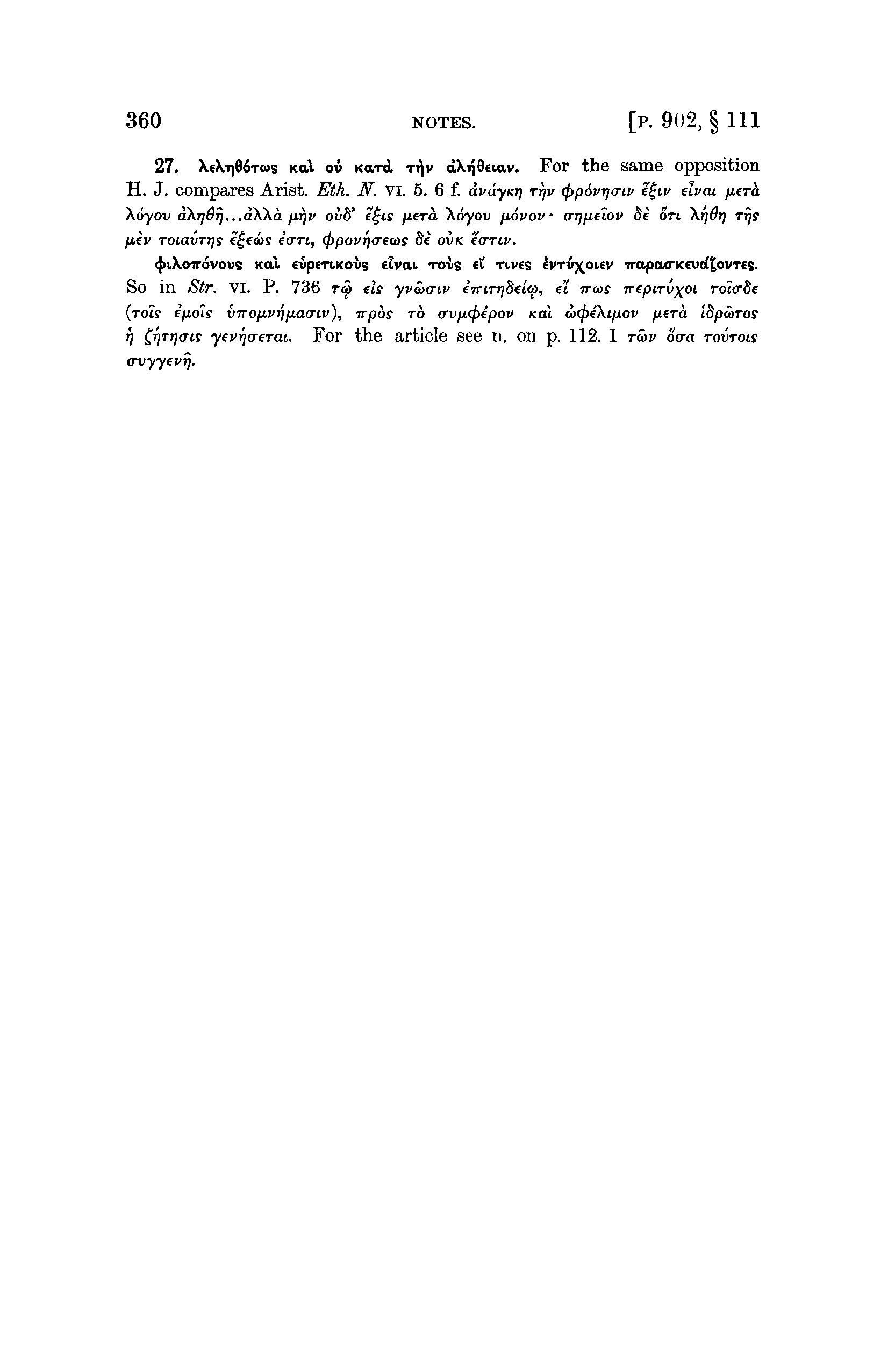
NOTES.
[P. 902, § 111
27.
XeVr)86Tus Kal ou KaTeL TI\V dX^Sciav.
For the same opposition H. J. compares Arist. Eth. N. VI. 5. 6 f. avayttr) TTJV (ppovrjo-iv i^iv eivai fifra
\6yov a\rj3rj...d\\a firjv ouS* e£is fiera \6yov povov trrjfif'tov 5e on \rj6rj TTJS ftfv ToiavTrjs e^fias eVrt, <f>povT)<rea*s 8i OVK to-Tiv.
<J>I\OTT6VOVS Kai evpETiKovs eivcu Tois el Tives hrixoicv Trapao-KCva^ovrfSSo in Str. VI. P. 736 raJ els yvS>o-iv EVH-^SWIB, ft vats Treptrv)(Oi To7<r8c
(rots f'^ioif vnofivrjfiao-iv), npbs TO o-v/j,(f>ipov Kai a><pe\iixov fiera ISparos f) £r)T)]o~is yevrjo-eTcii. For the article see n. on p. 112. 1 TWV b'o~a TOVTOIS o~vyyevrj. https://doi.org/10.1017/CBO9780511695513.011 Published online by Cambridge University Press
APPENDIX A.
Unrecorded Uses of avrUa.
Beside the ordinary temporal uses of airi/co, the Lexicons (Stephanus, Rost and Palm, L. and S.) only recognize the use, found not unfrequently in Plato and Aristophanes, by which a particular instance is introduced to confirm a preceding general statement.
Many examples of this are given in Devarius, and in Ruhnken's note on Timaeus. There is however another use to be found in Clemens Alexandrinus, which approaches more nearly to yovv and justifies a previous statement, not necessarily by an example, bvit by reference to some generally recognized fact or principle, with which it is logically connected. Sylburg in his Index quotes two examples and translates it by utiqiie. It is however very common, and it may be well here to put down the instances I have collected in order to ascertain its exact force. I will mention first one or two cases in which the rendering ' for instance' is admissible. Str. iv. 573 ' Choice and rejection are in accordance with knowledge. Hence it is knowledge, not pleasure, which is the good, and owing to this we sometimes choose a particular kind of pain, e.g. (airUa) the martyr chooses the pleasure he hopes for by way of the immediate pain'; Str. vu. 841 ' the heathen make their gods like men, not only in body, but in soul, e.g. (avTUa) the barbarians make them savage in disposition, the Greeks gentler but passionate.'
VII. 878 rovro povov opav (3ov\eTai 6 npoarfKei' aura). avr'iKa TG>v d8e\<p(ov ras "^v^as flecopaiv Kal TTJS (TapKos TO KOWO? avrfj /3\e7rei TTJ ijrvxij, 'he desires to see that only which becomes him. For instance, while he contemplates the souls of his brethren, he beholds even the beauty of the flesh only with the eye of the mind.' So n. p. 570.
Now consider the following: (a) Str. I. 316 \j/vxfjs exyovoi oi Xdyoi • avTLKa ('at any rate') warepas TOVS KaTT]^rj<Tavras (pa/j.ev. The fact that we call our instructors by the name of father, is not an instance of the general statement that 'words are the offspring of the soul,' though it may be alleged in confirmation of it. Ib. 323 /ifraStSdvcu TWV dclwv fivo-TTjplwv rois
Xtope'iv hwaptvois a'vyKe^oyprjKev. aurtKa ov rroWols air€K.akvfy£v a p,r] 77-oXAaw rjv, ' he has permitted us to impart the divine mysteries to those who are capable of receiving them. Certainly he has not revealed to many what was beyond the capacity of many.' Here avrUa introduces a clause to justify the limitation implied in TOIS xiope'tv Swafifvon.
Ib. 318 U^<£<B https://doi.org/10.1017/CBO9780511695513.012 Published online by Cambridge University Press
APPENDIX A.
KT)pvTTOv<n TOV X6yov..Trj 8c atria TOV fir) TO /3E'XTIOTOI/ eXofitvov 6ebs ava'nios. avr'iKa TO>V fiev ixbavfio-ai, TOV Xoyov tpyov icrriv, TS>V 8e SoKifidcrat Ka\ rjrot i\eo-6ai 7} fir), ' God is not to be blamed; at any rate it is the duty of one set to communicate the word, of the others to test it.' Ib. 367 <pao-i yap a'Lriov fivai KXOTTTJS TOV fir) (pvXd£avra...a>s TOV ifi7rpr]o~fiov TOV fir) o~$io~avra... airiKa KoXd^ovrai rrpbs TOV vofiov ol TOVTUIV a'inoi 'any how this is proved by the fact that such are punished by the law.' Ib. n. 447 6 vop-os oi< iirolrjaev dXX' e&ei£tv rr)v dfiapTiav...avTiKa 6 djrooroXor yvaxriv e«rei> dfiaprias did vofiov TTe<f>avep£>o-9ai, 'the law did not cause, but revealed sin.
At any rate the Apostle said that the knowledge of sin was brought to light by the law.'
Ib. 462 TO eKOvaiov f) TO KOT' ope^iv io-riv i) TO KOTO 7rpoaipeo~Lv r) TO Kara didvoiav. avriica TrapaKeiTai nas ravra dXkrj\oLS, dfidpTrjp.a aTvxrif>.a dSixij^a, 'the voluntary is that which is done either in accordance with inclination, or with purpose, or with understanding: at any rate there is a close connexion between error, mishap, and wrong-doing.'
(Or should this come under the following head b 1) Ib. 472 Kivhwevovras di/f^amo-e vov9eTr)o-as <poj3osavrUa ol TrepL\ei.(j>6evTes...KvptoL KarecrTrjo-av
T£>V 7roAf/ii'a>i/, (speaking of the Israelites seduced by Midian) 'when they were in danger, fear rebuked them and pulled them up...at any rate the survivors defeated the enemy.' Str. in. 540 (' as woman is considered the cause of death owing to her. child-bearing, so for the same reason she will be called the author of life') avri<a...^ifr) npoo-rjyopeidr) 8ta rr)v Tr)s SiaSo^f aiTLav, TCOV re yevvwfiev<tiv TCDV re a7rodvrja'K6vT<ov (so Louth for dfiapravovTcov) ylvfTai...fir]Tr)p, 'at any rate Eve was called by a name meaning life, because she brought about the succession of birth and death.' Ib. 553
(' Cassianus thinks that the soul is of divine nature to begin with, but that it was rendered effeminate by desire, and descended here to birth and death ') avriKa /3ia^€Tat TOV HavKov eK rrjs diraTrfs Tr)v yevecriv o~vv€o~rdvat
Xeyeiv, 'at any rate he makes Paul say that generation is caused by deceit.'
Str. iv. 570 (The martyr departs to the Lord with good courage and hears from Him the salutation ' Dear brother' because of the similarity of their life) avTiKa reXeiaaiv TO fiaprvpiov KaXovcriv, 'at any rate they call martyrdom perfection.'
Str. iv. 574 ('Plutus makes men blind') avriKa irpbs rav noir/rdv Tv<f>\bs ex yeverrjs KrjpvTrerai, ' certainly he is represented as blind from his birth.'
Ib. 566 rr)v (iriypa<priv tcvpiav e^ovcriv ol ra>v virop.vr)p.dTGiv CTTpcofiarels Kara rr)v ira\aiav eKelvr/v irpoo'<fiopav...avTLK.a ol o~TpaifiaTfis r)p.a>v,.,o-vK.' TKaiov Icr^dbas jxeki npoo-ob'evovcn, 'at any rate.'
Str. V. 660 aTTOK€KoKvfup.€V<os ov% olov re r)v Ta roiavra rwv ^apio~fidrQ}v €7rto~TeWfiv. avTiKa rrjs jiapfidpov (f>iXoo-o(plas wdvv o-<j)68pa eTriKeKpvfificvas rJpTr/Tai Ta
Tlvdayopeta crvfi^oXa, ' it was not possible to set forth such graces without concealment. At any rate the allegorical precepts of Pythagoras which are derived from the Hebrew philosophy are most carefully shrouded.'
Str. VII. 844 7ras Aypos io-nv 6 firjSev iavra Kaxov crvveitSais. airUa r) rpayiob'ia Xe'yei, 'OpeVra, ris <r' dtroXXvcrtv poffor; r) o-vveais, on avvoiba 8fiV elpyaa-fiepos. ra> yap OVTI r) ayvcta OUK aXXr/ T'LS £O-TLV nXr)v r) rav a7roj(r). KaXas apa Kal ''Eni^apfjios <pr)o~t, Kadapov av TOV VOVV https://doi.org/10.1017/CBO9780511695513.012 Published online by Cambridge University Press
APPENDIX A.
CXHS> anav TO (Tafia KaBapbs ft. aiiTiKa Kai Tas \jtvxas irpoKaBalpeiv ^pean/ (pajxev dnb rav <pavka>v Soyfidrav.
' Every one is pure whose conscience is clear. At any rate the tragic Orestes witnesses that to be conscious of guilt is a fatal disease. For purity consists in abstaining from sin. It is well said therefore that, if you have your mind pure, your whole body is pure. Anyhow we say that we must first cleanse our souls also from evil opinions.' Ib. 897 (discussing the meaning of the word (pvcnovv, Clement says it does not imply vanity but a high-minded trust in God, and contempt for the world) avTiKa <pr)o-\v 6 airocrrokos ' Kai yvao-ofiat ov TOV
~K6yov rutv ne(pv(TiCiip.€ifU)v dWa TT)V bvvajXLv^ et p,€ya\o<pp6v<os rfjs ypa(prjs a-wUre, 'at any rate the Apostle says "I will know not their word, but their power," i.e. whether they have a lofty understanding of the Scripture.1
Protr. p. 38 ('the demons are always plotting against men and are incapable of benefiting anyone) avrlica yovv i'xw o-oi (Ukriova TU>V i/ieSaTrmi/
Qeav, r<av baifiovav, eiriSd^at TOV avdpawov 'at any rate I can show you that the man comes out much better than the gods in the story of Croesus.'
The only example I have from other writers is Plut. Mor. p. 1137D ov St' nyvoiav direlxovTo iv rols Awplois TOV rerpa^opSou TOVTOV avriKa itr\ TWV Xoitrdv rovav expa>vro, STJXOVOTI cldores 'it was not owing to ignorance that they abstained from using this tetrachord in the Dorian mode; at all events they used it in the other modes, which shows their acquaintance with it.'
What is the origin of this peculiar use? The word airUa properly means 'on the instant' as ahrov means 'on the spot.'
Hence it is employed like fudvs to introduce a sudden thought with the force of ' to go no further,' ' to take what first comes to hand,' and so is fitly joined with an example, implying that they are so abundant there is no need to spend time in looking for one. As the word yovv, which originally means 'at any rate,' is narrowed to mean ' for instance,' it is possible that avri^a may have received a converse extension of meaning, especially as it is often united with yovv by Clement (cf. pp. 108, 113, 159).
More probably however it is a parallel development from the root-meaning.
(b) Among the instances of the use of the word by Clement there are some which do not seem to come quite under either of the heads mentioned.
Thus Str. i. 342, after speaking of the importance of regular training in husbandry, medicine and other pursuits, and showing that an athlete is thought little of without it, C. goes on avriKa KO\ nvftepvrjTrjv TOV Tro\vTT£ipov cTrmvovfiev. Here neither the interpretation 'for instance' nor 'at any rate' seems appropriate, as avrUa merely continues the series of examples already commenced.
Perhaps it may be equivalent to the Latin jam 'further.'
Str. iv. 577 (What is the meaning of the parable of Lazarus, and of the saying no man can serve God and Mammon 1) airi<a els rf/v k\rjo~iv TOV dflnvov oi (piXotcTrjfioves Kkr]8ivTes OVK dnavTa>cnv...bia TO 7rpoo~na&as K(KTr)or8ai. Here neither 'for instance' nor 'at any rate' will give a natural meaning to airUa, which, I think, must be translated ' further,'
'again.' Str. iv. 633 (God is passionless, without anger and without https://doi.org/10.1017/CBO9780511695513.012 Published online by Cambridge University Press
APPENDIX A,
desire. This is the meaning of the Pythagorean precept that man should be one, as God is One) ainKa 6 o-a>Tr)p Sia Tr)s (TriBvfilas o-wavijpti nal TCIV
Gvfiov npapias ovra eTriOv/iiav, 'further the Saviour did away with anger by forbidding desire, anger being a desire of vengeance.' Ib. 633 r) yap o~<o(ppoo~vv7] eavrrjv eTTio~Konovo~a KCU Betapovo'a ddtaKdnTais etjofioiovrai Kara hvvafxiv Beio. avTiKa TO c(p* ^jxiv e<mv oinrep eV '[(TTJS avrov re nvpiol €trfi€v mat TOV avTtKCLjievov, ' self-control constantly surveying and observing itself is made like to God so far as is possible. Now that which is within our power is that in which we are masters alike of the thing and of its opposite.' Str. v. 659 (After a quotation from St Paul on the distinction between the spiritual and the psychical man) airtxa 6 dirooroXos irpos dvTLdiao-Tokrjv yvao-TiKrjs rfXeidr^ror rrjv KOLvfjv nlo-riv 6ep.fkiov \4yei,
'again the apostle calls ordinary faith the foundation in contrast to gnostic perfection.'
Ib. 663 (After quoting sayings of Pythagoras which are taken from the Bible just as a candle is lighted from the sun, Clement proceeds) avr'iKa iwiTOixrjV T£)V irepl SiKmoo-vvrjs elpr]fieva>v Ma>v<TU 6 Ilvdayopas
•jTfirolrfTai, \iya>v fuyor pri vircpftaivetv, 'again P. has given an abstract of the words of Moses about justice in his phrase "not to exceed the balance.'" Ib. 712 (Plato calls the light of this world night, and the descent of the soul into the body slumber and death; so David says of the Saviour, ' I laid me down and slept, I awaked for the Lord shall sustain me'), avTLKa 6 avTos crcnTrjp Trapeyyva ypr)yop£iT€y olov ^teAeTare £qv /cat
X">pi-C€lv Thv tyvxV" T°v <r°>paTos, ' again the same Saviour charges us to watch, i.e. to practise how to live and to separate the soul from the body.'
(c) There are some passages in which avrUa is read, where the text seems to me corrupt.
Such are Str. I. p. 426 (the Apostle used the phrase 'according to that ye are able' because he knew that some had only received milk) ovo'ewco 8<= <a\ ^pai/ia, avriica ovx d-n-XSis yaXa.
Here I think we must read with Louth rj Ta^a ('not yet allowed meat, perhaps not even milk unconditionally,' i.e. unless mixed with water): airiica makes no sense.
Str. II. p. 460 na8os he,..6pp.ri fK<pepop.evr) KCU aireidrjs XdyiM. rrapa <pvo~iv ovv KLvrjo'ts yjfvxTji Kara TT/V irpos \6yov dneidziav TO. Kadiy, rj §€ an-doramr tcai eKO-Tacns «a! diruBeia e<p' f)jilv.,.bib Ka\ Ta (Kovo-ia Kplvtrai.
[avTtKa KCL6' ev CKOCTTOV TOP wadwv et' rir eVefwH, dXdyovr 6pi£cis evpot. &v avTa\.
TO yoCi» aKovo-iov ov KpiveTai. I have elsewhere suggested that the sense requires us to transfer the sentence in brackets after dnei8rjs Xdyo>.
This would give the force of 'at any rate' to avrUa, which is meaningless as it stands, but would then justify the preceding words by reference to the fact that each particular passion is an a'Xoyor opetjis. Str. iv. 566
'E7ri'^ap/iOf ixip-vao-' dnio-Tflv, (prjcriv, apBpa ravra T&V <f>peva>v. aiWxa TO ficv dnco'TeLv Tjj d\r]6tiq 66.VO.TOV (pepei, ws TO 7rio~Teufiv {corjv, efiiraXiv fit TO nMTTevfiv ra i^fuSet dnio-Tflv 8e rjj dXrjdciq (Is airaikeiav virocrvpfi.
Here it seems to me that airiKa has no meaning as it stands. If we exchange it with the following 'ipwakiv hi we should get the sense ' on the contrary to disbelieve the truth brings death ...at any rate to believe a lie sweeps men to destruction.' https://doi.org/10.1017/CBO9780511695513.012 Published online by Cambridge University Press
APPENDIX B1.
On Clement's use of av.
Abnormal uses of av in late Greek.
Indefinite av in connexion xoith relatives and particles:
(a) Joined with the indicative.
(b) Joined with the optative.
Potential av:
(a) Omitted with optative or past indicative.
(6) Inserted with subjunctive, or present, perfect, or future indicative.
Indefinite av in Clement.
1. Normal subjunctive with relatives.
A bnormal examples: indicative or optative for subjunctive.
2. Normal subjunctive with hypothetical particles.
Abnormal examples: optative for subjunctive.
3. Normal subjunctive with particles of time.
Abnormal examples: indicative or optative for subjunctive.
4. Normal subjunctive with particles of manner and place.
A bnormal examples: indicative or optative for subjunctive.
Potential av in Clement.
1. Normal with optative in apodosi.
A bnormal use of av in apodosi: with future optative, with present or future indicative, with subjunctive.
A bnormal omission of av in apodosi.
A bnormal insertion of av in protasi.
1 On the subject of this Appendix compare the Grammars of Winer and Blass, and Viteau's Etude sur le Grec du N. T., Vol. i. Chapters 15, 16, 17,
Sophocles Lex. s.v. &v, Klotz-Devar De Graecae Linguae Particulis, Schmid Atticismus. https://doi.org/10.1017/CBO9780511695513.013 Published online by Cambridge University Press
APPENDIX B.
With past indicative.
Abnormal omission of av in apodosi.
3. Secondary uses of potential av. av with infinitive.
Abnormal use with future infinitive. ws av with participle, with noun.
The spread of the Greek language through the world after the conquests of Alexander was naturally followed by the disappearance of many of the finer distinctions in the use of Cases, Moods, and Tenses, and also of particles, such as prj and av. The most marked departure from classical use in regard to /ZJJ, which we meet with in the writings of Clement, is the substitution of p.i] for ov after on and eVeifiij, of which examples will be found in the Index. Peculiarities in the use of av are dealt with in this
Appendix.
It may be well to begin by pointing out the exceptional uses to be found in the N. T. and in other post-classical writings.
A a. We will take first the use of av in connexion with relatives and conjunctions, where according to the normal use of classical writers1 it should depend on a principal tense, and be followed by the Subjunctive mood. In later Greek av is not unfrequently omitted as in James ii. 10 ocrrif oKov rbv vojiov Triprja-rj, nraiirri Se iv evi, and V. 7 jiaKpo6v)ia>v ems
Ari/3?7, Herm. Sim. VIII. 11. 3 oaoi Kadaplo-axnv eavrovs. Sometimes we have the indicative instead of the subjunctive, (1) e.g. Luc. Dial. Mort. ix. 2 ovnva av ITpocri^ke^ra, Mk. xi. 19 Srav iyevcro, Apoc. iv. 9 orav Smcrovinv, ib. ii. 22 iav fieravorja-ovaiv, ib. viii. 1 orav rjvoi^ev, Luke xix. 40 iav o"«u7TT)<rov<nv, Acts ii. 45 Biefiepi^ov KO66TI av TIS xpelav fi'xfv> Lk. xvii. 33 or iav &TT](TT] TTJV y^v^rjv...a7roXeo"et avrrjv, os 5* av dnokevei
£a>oyovr}(r€i avrrjv, Clem. Rom. II. 12 (quot.) orav i'trrai ra dvo Iv: and even the present ind. as in Apoc. xiv. 4 6Vov av lirayei, 1 John V. 15 iav ovbajiev, 1 Th. iii. 8 t'oir (TrrjKfTe, Mk. xi. 25 orav (TTr]K€Tf.
In the following examples the frequentative av with the past indicative is made subordinate, contrary to the ordinary classical use : Herm. Sim. ix. 4. 5 orav iTedrjo-av ol \l0oi iyevovro XevKoi, Barn. 12. 2 orrorav KaBe'ikev iBavarovvro,
Mk. vi. 56 oirov iav el<reTropev€To...iTi8e(Tav, xai oVoi av rj^avTo...i(ra)^ovTO, Mk. iii. 11 orav iOewpovv, Trpoo'eTTLTTTOVj Gen. vi. 4 0)9 av elo-eiropevovTO Trpbs ras Bvyaripas TOIV av6pa>naiv.,.iKfivoi rja-av ol ylyavres, Gen. xxxviii. 7 orav el(rfipxeTo...i^i^fv, Exod. xvii. 11 orav iwrjpev ras f(€ipas Kartcr^vev, Num. xi. 9 orav Kari^rj y bpoiros Kare/3<uve TO fiavva, Jud. vi. 3 iav eo-fffipav Kariftaivov, Ez. i. 12, X. 11,
Philo M. II. 112 orav els evvoiav ifXde...avveyivao-Kcv.
(2) Sometimes the Optative is used after iav or similar particles (see Klotz-Devar n. 457 f.,
689, Jelf § 844 c obs., Kuehner vol. n. p. 1054 f.) as by Socrates H. E. I. 8
1 Exceptional uses are found in verse and (very rarely) in prose, in which iv is omitted. https://doi.org/10.1017/CBO9780511695513.013 Published online by Cambridge University Press
APPENDIX B.
ov irporepov Ka8i£eiv fiptiro, npiv av iffivevo-eiav, ib. I. 40 oircos av diroXifinavoiVTO, III. 1 evdaifiovr)(reiv eXeyev rjv KpaTr)crctcv, by Herodian (after as av) I. 1 cos av fir) Xddoiev, I. 5 edotjev jrpoayayelv TO fieipaKtov coy av oia~
\eX6ei1, ibI. 8, 9, II. 1, 6, 11, 13.
A b. There are also irregularities connected with the potential use of av in apodosi, where it properly accompanies the optative or past indicative.
It is often omitted with the latter, even by classical writers (especially if the verb implies necessity, possibility, &c), rarely with the former : cf. Joh. XV. 24 ei Ta 'ipyafir) inoirjira iv avrols.. .dfiaprlav OVK eixoo~avi and Schmid I. 89 f., iv. 90, Jelf §§ 426, 858, 859, Kuehner n. 191.
Ac.
A more flagrant irregularity is the use of the potential av with the future indicative, as in Artem. n. 70 ov yap exarov j^crcrcu av TLS err/,
Sext. Einp. Math. VIII. 296 TTSIS av OVTOS xph°~eTai T<i> <"W*«V>' ib. X. 12 KCLV anavra dveXaifiev, o TOTTOS OVK av dvatpeSrjo'eTaL, Socr. H. E. II. 40 a7ravTrjo~€i 8' av TLS irpos TOVTOV, ib. III. 16 TOVTO 8' oi< av irticr6fie6a el ^
Kai <ppovo>fiev : or the subjunctive, as in Polyb. XI. 6. 6 Kvpicvo-avres OUT' av vfipi&LV inrofieivrjTf TOVS eXevdepovs OVTC €fj.wi.fnrpdvai T. TrdXeif,
Epict. I. 2. 17 ri ovv o-£ e'8« <ppovrl£eiv rrcoj av Sfiows ys rolt <i\Xois; ib. III. 13. 8 nas av depaircvdrj, nas f^aipedfj; IV. 6. 31 fijrei TLV' av do-ndcrrjTai, TLVI dapov niji-^-rj, cf. Kuehner ii. 169, 170.
I proceed now to consider how far these and similar irregularities are to be found in Clement: and I will take first the use of indefinite av.
B a. After relatives {normal construction). In Str. vn. we have the following exx.: § 4, p. 8. 1 eTrtreXetv o n av 6 Xoyos vnayopevj}; § 9, p. 14.
27 irepLyiveTat. &>v av iOiXrj; § 19, p. 30. 15 nerao'oTiKos u>v av fj KeKTrjpievos ;
§ 41, p. 70. 28 irav o av alrrjo-ri Xafifidvei; § 46, p. 80. 5 6 c5eof o ri av o-v/x(p(pr/ xoprjyel; § 65, p. 112. 19 oirep av 6 6f6s napao-XQ ', § 101, p. 178.
13 eirofxzvoi #eco 77 av rjyrjrai', § 104, p. 182. 26 raff dnodei^eis as av ini^T)Trjo-rj dvevpio-Kfi; § 53, p. 92. 17 (subj. understood) o TL wep av iv va> ((pepy),
TOVTO KOL €irl yX&)(ro~r)s <fit=pei.
B b. After hypothetical particles: edv, av, TJV, Kav (= nal lav).
§ 33, p. 56. 9 iav Xe'ycocri SeS6cr8at. ra fwa, <ai rjp.els (TvvojioXoyoijxev; § 45, p. 78.
21 iav 6 Xoyos KaXfj; § 70, p. 122. 19 (also in § 78, p. 136. 10) iav 6 Xoyos alpfj; § 73, p. 126. 28 iav o-vp.<f>ipovTa r\; § 77, p. 134. 16 iav iir('crr?;rai;
§ 80, p. 140. 4 iav vlos y; ib. 15 iav dyada §...iav KOKCZ; § 82, p. 142. 20 iav dfiapTTjO-i], ijfiapTev 6 exXeKTOf; § 84, p. 148. 21 r/v fir) TTpoo-fv^avTai; § 88, p. 156. 3 rjv Trpoo~vrraKovo-ap.cv ; § 94, p. 166. 8 r)v fir) TOV Kavova e^axri;
§ 101, p. 178. 2 iav irp6<ro~x!l> § 1^3, p. 182. 4 iav fir) dwodtiodavTai; § 59, p. 102. 19 ovS' av TO o-aifia eVAScoo-iv ; § 61, p. 104. 28 ovh' av irpoKaXrjrai.
KCIV stands both for KOI idv and K<U av (potential): of the former (which alone comes for consideration under this head) we have examples in § 1, p. 1. 20 KOI/ £Tfpola <$>aivr)TaL; § 11, p. 18. 19 Kav Ibiarrfs j)\ § 28, p. 46. 8
K&V Tqv Tixvr)v i<T(Xio-r)s; § 29, p. 48. 21 Kav fir)bina> haiv a£iot; § 34, p. 60.
8 Kav Treiparai KCLV Tvpavvoi TVX<OO-IV ; ib. 24 Kav y.6vos t>v Tvyxdv-g; § 37, p. 64. 25 KCLV fir) Xiyr); § 39, p. 68. 19 K&V \jndvpl£ovTes npoo-XaXafiev; § 42, https://doi.org/10.1017/CBO9780511695513.013 Published online by Cambridge University Press
APPENDIX B.
p. 72. 20 K&V TrpoXafiPavr]; § 49, p. 86. 23 K&V iwoj]8ji; § 50, p. 88. 14 K&V fifj <rvvT)8r)s Tvyxdvy; § 51, p. 90. 22 K&V evano8vr]o-KTj; § 56, p. 98. 15 K&V &yia II > § 59, p . 102. 23 K&V fvo-raa-LV o-d>£i>i; § 6 1 , p . 106. 11 K&V voVor eVig xav TL; ib. 22 K&V agios rvyxdvy ; § 69, p. 118. 23 K&V OLK(Tr)s § K&V noXip-ios;
§ 69, p. 126. 20 Kav XiyrjTai; § 72, p. 128. 20 K&V novrfpa eivat 8OKTJ ; ib. 26
K&V Kadapos ?}; § 73, p. 128. 1 Kav TLS Xeyn; § 76, p. 132. 13 K&V ,3XeV«v SOKJI ; ib. 27 KOV do-xoXridrj; § 78, p. 134. 19 K&V TrdBr, TL; § 78, p. 136.14 Kav fiovos ti^ijrat', § 80, p. 138. 32 K&V Karc^rat; § 85, p. 150. 8 K&V TTpofialvrj; ib. 24 K&V rixaa-LV ; § 90, p. 158. 5 K&V napafialvao-i; § 96, p. 168. 22 K&V ToXfifjo-axTi; § 98, p. 172. 21 KOV dvefieiv fiiXXaxriv; § 100, p. 176. 16 K&V ivavTia Tvyxdvrj; § 108, p. 190. 13 K&V avx<i>o~i. b*.
Abnormal constructions under this head are § 16, p. 26. 7 K&V els dpx^jv Karao-Tair) TTOTC eV'i cra>TT)piq f)yr)(reTai, where I have suggested that we should read Karacrry; § 101, p. 178. 20 ovre dirarqBeis TLS dvvair' &v ev nparreLv,
K&V rrdvv Swaros y TO. yvaxrSivTa noiciv, ovre K.T.X. (here the more regular construction would have been el KO.1 Swaros ei'?7 in the protasis, or else dwrja-eraL in the apodosis; but such irregularity is not uncommon); § 69, p. 120. 8 elftevaL OT(O av TLS /idXtcrra Kat o-iroo'ov eViSw (here there seems no place for the indefinite av : we want either the deliberate subjunctive or the potential optative; I have accordingly changed cViSm to eViSojj;). § 41, p. 72. 1 napfkKeL r) O."LTT)(TIS K&V ^wpts d£iu>o-ea>s 8i8oTai TCL dyadd (here t h e editors have rightly substituted the subjunctive for the indicative of the MS, the long and short o being constantly interchanged). Paed. n. P. 201 fin.
K&V €KadL(ras irpOTepos p-rj eKTeivjjs x€^Pa (original has et cKa8.).
B c. oTav, oirorav, lirdv, limSdv, %<TT av, irplv av, a\pis av. § 1, p. 1. 18 cnav evhei£cop>£8a; § 33, p. 56. 19 orav eXstovrai; § 43, p. 74. 12 iirav Xd/3//;
§ 56, p. 96. 27 orrorav TLS eKKpefiaa-df/ ; § 62, p. 106. 19 oirorav alpj] Xoyos;
§ 73, p. 128. 8 oTav fiixaiof TLS ?/; § 76, p. 132. 11 orav KardXiji^ij» Xd^rj; ib.
14 6Vav rjSop.ivov eavroi crvvaicrBrjTai; § 97, p. 170. 24 €7rei8av avarpeVtovTat;
§ 100, p. 176. 4 iirav irapaPjj; § 7, p. 12. 29 car' av TVXOXTL ; § 9, p. 16. 5 ear' av TLS dtpLKr/TaL; § 10, p. 16. 29 axpis av KaTavTrj<rri; § 45, p. 78. 26 for' av d(pLKG>VTai; § 57, p. 98. 25 a-xpLS av anofTTrjcrj; § 93, p. 162. 27 np\v av
Xd/3a)(7i; § 102, p. 180. 7 ear' av fxeTavoi](Ta>o-iv. c*. Abnormal construction (indie, for subj.): § 43, p. 74. 9 orav aWeinu
(MS), where D. reads aixTjrat; cf. Str. in. § 93, p. 553 orav ovv /^re TLS 6VIMO IITJT' cnL8vp,iq xa-pL(rdp,evos...dXX' dnoSvo'dp.evos TTJV CK TOVT<OV dxXvv...Trvev^uz Kal y^vx^v fva)O"6i...Tore OVK evi iv vpAv OVK appev ov 8rjXv. Here it would be easy to correct eva>o-rj, but the length of the sentence may perhaps excuse the anacoluthon.
B d.
»s av, oirtos av, oxou av. § 3, p. 6. 9 TTJV j3eXrtioriKiji' evSeiKVv/ievoj 8ea>piav oirws &v 77 Terayp-evos 'in whatever way he may be appointed.' d*. Abnormal (opt. for subj.). After a historic tense the subjunctive with indefinite av regularly changes to the simple optative. But in Str. VII. § 42, p. 72 we read TCLS ivroXas «Xa/3ev 0 avdpamos OJS av e^ airov opuTlTLKOS TVpOS OTTOTepoV &V Ka\ (BovXoiTO Th3V Te alpeTO3V
KOL TWV (f)€VKTO)V.
For the use of <BS av see E b below. The general construction of the https://doi.org/10.1017/CBO9780511695513.013 Published online by Cambridge University Press
APPENDIX B.
sentence should either be \apl3avei—irpbs onorfpov av fiovXtjrai, or '{\af3cv npos oTroTcpov ftov\oi.To. Possibly the second av represents an original ovv, this particle being regularly used like the Lat. cunque with an indefinite force.
Similarly Str. I. § 56, p. 348 e'yKarea-n-app.€vrjv f^outrt TTJV dXtjdeiav OTTOIS av \adoi rovs o-Trep/toXoyovr, unless we should here make av potential,
'in a way in which it would elude the curious.' Paed. in. § 41, p. 279 irarpiba iir\ yrjs OVK e'xouev a>s av karacppovoiacv TWV emyeloiv; cf. Eus.
Pr. Ev. I. 5. 12 8r)(Ttt> 8' OVK e'/xay qbavas dXX' avrav df] rwv p:dXto-ra rfjv evo-efiaav Trtpio-rrovSao-rov TrerroirfKoraiv, tos av 6 ~X6yos andcrr^s1 euros virovolas Karao-rair) (perhaps we should read Karacrrrj as in Str. VII. 16), also exx. from Herodian given above under A a (2).
(Subj. for opt.) the av being potential, Str. VII. § 35, p. 60. 22 6 yvaa-riKos iv navri roirai, K&V KO6' eavrov jxovos &v rvyxdvrj,
K&V (MS. <a\) 6Vov rtvar av r<ov 6p.oiu>s 7reffLo~T€VK6r<tiv e^j/, rt/za rbv Beov.
Here I propose to read €Xot 'where he would have believers of like mind.' The indefinite force of ovrov av (\rj is inappropriate, while the misreading is naturally accounted for.
C a.
Potential av with opt. in apodosi following optative in protasi, expressed or understood.
Str. VII. § 1, p. 4. 2 IJ eiri ivkiov eVc£ep-ya<rta ncpio-o-rj 86£fi(v av ; § 3, p. 6. 22 ovros av e'irj 6 elSois ; § 6, p. 10. 25 rovro nadoi av J § 6, p. 12. 5 ovr' OVV tpdovolr] nor1 av ovr€ KG>\v8fiy] iror* av ; ib. 22 o~ocj)la
KVpltos av Xf^Oflr]; § 8, p. 14. 8 ovdt roii ISiov nor' av a/xeXoi;/ epyov, ib. 11 oi>5* av /3fXri'ajv rts 8IOIKT]O~IS f"if]\ ib. 18 ovrot S* av fiev ol f\6[icvoi;
§ 15, p. 24. 13 TO bUawv OUK av trore npo&aifv (D. unnecessarily wpodolev); § 16, p. 26. 2 KOKCOV alrlav v\r/s av ris ao-8eveiav iirokdftoi;
§ 17, p. 28. 1 KaraXi;yfris fieftala deovr&s av \iyoiro enKTrr/fitj; § 20, p. 32. 5 ovBf ol \6yot ol TTfioriKOi
TTJS aXrjdeias Siafiovr/v napao-xoiev av; § 21, p. 34. 14 ris anroir av arifiia Oeov;
§ 25, p. 40. 13 OVK av nor€ yevotro napa <pv<riv ; § 28, p. 44. 22 TL av ayiov c'lr] i'pyov; ib. p. 46. 1 yeXoioi> /levrav eirj; ib. 7 ra dyaXfiara aira. av elrj dpyd; ib. 10 ri av m! ibpvoiro; ib. 16 TO OV OVK av ISpvvdcir); § 29, p. 48. 13 f&j S' av ovros 6 yvmcrnKos ; ib. 16 evpoifiev av ; § 31, p. 52. 3 OVK av (pdavoiev ;
§ 33, p. 58. 6 ra^ ^v Tts dir6o~)(OLTO; § 35, p. 62. 6 €v\6ycos av eavrov Kpetrra>v (it); § 47, p. 82. 17 dvcv8erjs e'lr) av; § 50, p. 88. 4 was av jrapda-^ot; ib. 16 OVK av aSiKos fvpfdflrj ; § 51, p. 90. 8 ovtT av 6uoo~ai iranrore; § 53, p. 92. 13 fiKorws av Xeyotro ; ib. p. 94. 3 OVK av npaxdeir] el p,rj TTOIOLJJ; § 54, p. 94. 22 uovos av elf] evo-(^r]s; § 69, p. 120. 9 rls av e)(8p6s yivoiro; ib. 18
TOV avrov rpoivov evpoiuev av; § 71, p. 124. 16 irws 'in av eir\ reprrvd; § 74, 1 Dr Gifford writes : ' This construction is however not uncommon in Eus. cf. P . E. rx. 1 dp^erat 6 \6yos dwd rod ^lou cos hv II6.6OLS, ib. vi. 6. 3 TO Saipdviov
<TKr)TTTerai tV, iv ots &v TTJS Trpoppr}<Je<j3S arrowlTTTot, Kara<j>vyi}v aury Troplfroiro, ib. I. 6. 6 fifi)fjioveij<rofia.L rrjs Itrroplas OJS B.v {fxxvcpbv yfroiro, ib. iriGTojffbfxeOa cos b.v in) SOKO7/ICV, also u. 5. 1 and 17.' He also refers to Str. i. § 42, where Plato's words (Crito 46 B) ^7I!J...TOIO07-OS olos...fn;dei'l &X\<p ireWefffftu rj r p \6yip 8s di> /ioi
\oyi^ofiivii> piXnaros (palvifrai., are altered to oirotos ouSevi &XXif> 77 rep X6yij> Trei$e<r8ai
Ss &v 1x01 VKoTrovii4vif jSAriffTos (fralvonro. Here, I think, Cl. means us to understand SP (palmcro as potential.
M. C.
https://doi.org/10.1017/CBO9780511695513.013 Published online by Cambridge University Press
APPENDIX B.
p. 130. 3 OVK eariv OTToif VTTO TOiovTuv naibfvBflrj ITOT' av 6 yvaxTTiKOS; ib. 12
OVTOS av fir) 6 yvaxxTiKos; § 89, p. 156. 13 fv av ex01 •wpoiivai; § 91, p. 160.
13 OVK av Tis OKvr)<rai, xprjcraiTO 8' av ; § 95, p. 166. 27 e'l TIS virokaftoi flKoras av <j)v\ax6ur); § 96, p. 168. 30 evpois av ; § 103, p. 180. 31 ovs eXeqaeiev av
TIS. a* Abnormal use of av in apodosi with fut. opt. In classical writers the future optative is only used for the purpose of representing the future indicative in oratio obliqua after a historical tense, cf. Madvig Gr. Or.
§ 134, rem. 2. I am indebted to Dr Gifford for the following exx. from Eus. Pr. Ev.: nias wpotrit-oi av (VI. 6. 8), flKorais irav advpov arrocppd^ot av
(rrofia (i. 3. 8) where he would read dirocppd^ai av. Compare also Dion. H.
Ant. Rom. III. 15 ei ovv el(r\v olovs duovofiev npoOvfiorara av Sc^otvro, Philo M. I. 469 ^eipotj^elj ei yevoiro rJKurra av jSkdtyot. (where however
Wendland corrects /3Xt'-^ai). a**. Abnormal use of av in apodosi with fut. or pres. indicative. Of this abnormal construction D. gives the following exx. in the Index. Protr. § 41,
P. 36 init. riva 8' av (jxovriv, fl (pcavr/v Xdfioicv Alyvirriwv 6foi...irpori<TovTai rj TT)V 'OfiTfpLKjjv; This, I think, is a case of anacoluthon excused by the length of the sentence. Paed. I. § 47, P. 126 ov yap TO alpa av itmt npoi)<r(Tat.
(pavrjv. Perhaps for av TTOTC we should read ov TTOT(. Paed. I § 17, P. 108 ft de fis o'iddo~Ka\os f'v ovpavo7s,...oi €ir\ yrjs fLKOTws av irdvTfs RfKkr]o~ovTai p.a8r)Tai, read perhaps apa. Str. I. § 143, P. 405 el ns Ix&vs dvao-7ra>jj.fvos... a7ro&pdo-fi, ovKer' av ev r<» avra TOTTIO TOV avrov f'ibovs lx@vs airrjs fKelvijs fipe6j]o-frai rrjs rjpepas. The insertion of av is easily explained by dittographia of f'v, but the length of the sentence makes anacoluthon possible. Str. vi. § 4,
P. 738 init. oi (? ot, Eus. has ei) yap /xr;8c eavrav, o-^oX^ ye av T<OV r/fifTepav d(pit;ovTai. Here D. would omit av: possibly it stands for ovv, or it may be that, in the phrase crxoXrj y av, the av has lost its force as sometimes in K&V, and rax' av (see exx. in Ast's Lex. Plat, and Str. in. § 86, P. 550 rdxa
8' av...wpo<priTfvet (pdopdv). Of the pres. ind. D. cites two instances from Str. VII. § 7, p. 12 KaraXei7TfL TTOT' av TTJV dvdpanrtav Krjhffxoviav and ib.
1. 26 7rcos 8* av icrri o~ayrr]p, el prj navTcov o~a>Trjp, in both of which I have followed him in restoring the optative. He also cites Str. vi. § 159, P. 823 fj xpVaLS T*ls ^>tXoo"o^>i'as OVK eo~riv av KOKUIV, where I should read av, referring to the preceding sentence, in which it is argued that philosophy must be good as the gift of God: further it is shown to be good from the character of the philosophers themselves. a***. Abnormal use of av in apodosi with subjunctive. Str. vn. § 85, p. 150. 10 TTCOS 8' av teal dyyiXovs TIS KpLvrj. D. suggests either uplvoi or Kpivai, but has the former in his text. I think the corruption is more easily explained by assuming that the latter was the reading of the archetype.
Protr. § 55 •n-as av evdiKios oi av6pa>iroi irapa TOV Atos aht)artovrai (Cobet ap. D. I. p. xxviii. init. alTrjo-ovTai.) TT)V evTfxv<-avi hv °v$ avTa napa<Txl'lv io-xv(Tfv > ^ w e a c c ept Cobet's emendation, I should be disposed to read ydp for av. of.
Abnormal omission of av in apodosi (a). § 29, p. 46, 21 f. n-ws, 6 https://doi.org/10.1017/CBO9780511695513.013 Published online by Cambridge University Press
APPENDIX B.
<p6ao~av ei\*v ov, rov6* eavro vaTtpov 77010(77; ov 5e ra ovTa 7ra>s ovv TOVT av
Seoiro TWOS; I see no excuse for the omission of iiv after the first n£>s, or for the insertion of ovv after the second irS>s, and am disposed to think that ovv represents an original marginal correction, inserting av in the former place.
§ 37, p. 66. 3 rlva Kal (jxiivfjv dvap-dvai. 6 Kara irpodecrtv rbv CKKCKTOV iyva>Ka>s; I think D. and H. are right in inserting av after di/a/ifli/ai, the word av being easily lost after -at. § 48, p. 84. 1 OVKOW d<pe\otro TOVTOVS ra 6V dpfrijv.
D. inserts av after d(p(Xoiro: perhaps the loss would be more easily explained, if the original were OVK av ovv.
§ 69, p. 120. 18 avros p-tv oidevl e'xOpbs av yevoiro, ix^pol 8' eival voolvro aira ol TT)V evavrlav ohbv Tpeir6p.evoi. Here av might be understood with voolvro from the former clause, as in § 41, p. 70. 31 alrrio-aaiv dvat-lois oix av Bolt], 80177 Se aglois, where however Barnard conjectures Soi'77 Se < av
Kal p.fj alTT)o-acnv > d|ioir.
So, here, I am inclined to think that av may have been lost before aira.
§ 82, p. 142. 24 TI jrepi rov JVUXTTIKOV <fir]o-aip.ev; I have followed D. in adding ax after <pr)o-aip.ev.
§ 90, p. 158. 17 OVK apa 6 rrjv ^rvx^v voo-S>v npo<pao-icraiTo ras aipicreis. Here too I have followed
D. in inserting av. § 95, p. 168. 8 ovx ""•^"S cnro<paivop.ivois dvBpanrois irpoo-4)(OL)j.cv.
Here D. suggests either irpoo-ixopev or 7rpoo-exotPev ""• I prefer the former, as it makes the appeal to actual fact.
Str. 1. § 57, P. 349 oo~ot Ta\j]6ovs o>ptx@T]o~av, 01 fiev OVK oXt'ya, ol Se fiepos Tt, eiTrcp apa,
TOV TTJS d\r]6eias Xoyov exOVT€s dvahtix6*i*v.
It would be easy for av to be lost after dvadeixOflev.
StT. III. § 8, P. 513 Kal ncos en ovros iv rw Kad* r)p.as i£(Tao-6eiri \6ya>; 'deest av' D. Str. II. § 129, P. 497 TL ST) aoi
'Apio-rava Kara\iyoip.i; where D. inserts av, but perhaps it might be understood from below, as Cl. continues {ri\os OVTOS dvai TTJV d8ia(popiav
(<pr/), f) ra 'Hpi'Mov fif p.icrov rrapdyoip.' av; III. § 28, P. 524, crv/ifie'ro^ot elev < S v > (added by D.) avro^s ol o~ves, elev 8' av iv rals fjifi£oo~iv Iknicrw al rropvai.
A similar case is Str. III. § 72 P. 543 ov fiei'£«asiyKvp.ovi.
7rX^crtdo'avra, dXX' vo~T€pov evpocs av yivcoo~Kop.€vas ras yvvaiKas, where, however, D. does not insert 3K1. a t t .
Abnormal insertion of av in protasi.
Str. in. § 91, P. 372 ^reiv TO Oflov el apa •\jsr]\a<p7}o~eiav rj evpotev av. The original (Acts xvii. 27) has Kal evpoiev; the insertion of av is probably due to dittography of the preceding syllable.
I cannot believe that Clement wrote it2.
D a. av with past indicative in apodosi. § 9, p. 14. 28 ovSe yap av en r/v TO OXOK (v elpyao-p-ivov ; 19, p. 30. 25 ovb' av tfv W eKoio-iov; § 26, p. 42. 13 oi< av roiiTO eyivero (I dve\dfifiavev ; § 29, p. 46. 20 OVK av oiSe r)v ; § 82,
1 Dr Gifford furnishes the following exx. from Eus. Pr. Ev. TI. 8. 18 irdXtv oSv Kavravffa 0av/j.d<rei4 TIS, 1. 5. 9 TTISS oiv fiXXwj 66£cu/iev eS trevoiriKivai; where Hein. inserts hv after oiv. He adds that the interrogative use of the opt. without &v is common in Eus. Compare also Justin M. Dial. 7 rln otv in T «
•XpijoaiTo diSaa-KdXifi fi irbdtv <i<pe\i]0eii) TIS el /MTide iv Toirois TO &\i]6h ianv; 2 Dr Gifford suggests that Cl.'s reading may be due to one of the vv. II.
(evpoiav or ei/pourav) in the original.
24—2 https://doi.org/10.1017/CBO9780511695513.013 Published online by Cambridge University Press
APPENDIX B.
p. 142. 21 el ovras eavrov rjyev, KaT7]8to~8r} av TOV filov 6 yeWav; § 98, p. 174. 2 <av ( = <al av potent.) Id8r), el treiQeadai riPovkfidrj; § 103 OVK av birepefiaXov <ro<fi{a roiis e/nrpoaBev avbpas; § 47, p. 82. 23 KCLV afifraOeros f/v. a*.
Abnormal omission of av. § 24, 40. 5 TOVTO yap f/v OavjxauTov el TOV fivv 6 6iXa£ KaTetpayev. Str. III. § 29, P. 525 init. el yap ofiroi TrvevfiaTiKas eTiSevTo KOLvavias, 1o~as Tts avratv TTJV IITTOXTJ^IV ejrebe^aTO <iav^>.
Ib.
§ 103, P. 559 iras S' < a V > avev TOV 0-ap.aTos 17 Kara rfjv eKKXrjo-iav OIKOvop.ia Tf'Xoj i\dp.{iav€v; The first example is of a type in which av is liable to omission in classical writers : in the 2nd and 3rd, I think av should be inserted.
Secondary uses of potential av. a.
With infinitive.
Str. VII. § 31, p. 52. 13 OVK av oiSa/xais <pa<r\ Kara rrjv TTJS e'vSfias inidvaiav KOKOv/j-evov TptcpecrBai TOV deov, where the av with infinitive has its usual force as the oratio obliqua of av Tpi<poiTo. Str. 1. § 18,
P. 326 01 5e Kat 7rpos KaKoii av TJ]V <pt\otTOtpiav etcSefiuKevatrov ftlov vofii£ov(Tiv.
Here the oratio recta would probably be >j (j>iXocro<pia av eicreSeSvxfi. Str. iv.
§ 1, P. 563 aKoXovdov 5' av oiaai nepl fiaprvpiov dia\afielv. Here I think we should read Ar) for otp.ai, as there seems no room for the ordinary force of av with inf. a*. Abnormal use of future infinitive with av. Str. VII. § 92, p. 162. 1 olp.ai navTas av 6p.o\oyr)(reiv, where D. notes 'rectius 6uo\oyrjcrai.' Dr Gifford supplies an example from Eus. Pr. Ev. VI. 8. 21 Kaddfiaprai p; av i'o-eo-Sal
Tl TOVTOIV. b.
With participle.
Str. vu. § 95, p. 166. 30 6 TTIO-TOS agtoniaTos, eiKormy av Sia TOV Kvpiov ivfpyov/ievos ( = os elKoras av ivepyo'iTo). Str. VII.
§ 33, p. 56. 6 TavTT/ 'louSaioi ^oipeiov aw^ovTai a)f av TOV Or^plov TOVTOV fitapov OVTOS {sc. ane^oivTo).
Ib. § 40, p. 70. 9 (6 •yvcoartKOff KaraXeXonrev) ndvra ocra fifj ^p-qo-ifievei yevojxiva enel (sc. ev ovpava>), Ins av €v8evde ijSrj rfjv Ttkeiwcnv direi\r](pas (sc. KaraXeiTrot). Ib. § 47, p. 82. 12 oi yap \4~Xr)dcv OVTOV (TO. inrjyyeXpiva) cor av dnovra en (sc. \ddoi).
§ 60, p. 104. 5 rrepl Twv o\a>v d\rj8S>s dieiXr](pev i>s av Beiav ^a>pr]O-a (sc. 8ia\apfidvoi).
§ 63, p. 108. 8 as av in' axpov yvaaeas rjneiv (sc. Trotot), Ta ridet K€Koo~p.i]p.€vos...Ta npo^eipa Trdvra TOV KOO~JXOV KOLKOL OVK dyana.
§ 94, p. 164. 27 Teroicev xai ov reTOKev iis av e'£ avTrjs OVK CK o~wdvao~lJLOv o'vXXa/Sovo'a (sc. TeKoi). § 109, p. 192. 18 6kio~Br]p6v TO ylvos
Tav ToiovTav as av (sc. e'trj) fir) o~\ihavoir6hav ovTav.
From this usage as av (often written as one word) comes to be used simply like quasi without thought of a verb to be supplied, as in § 109, p. 192. 4 TO Si^T/Xouira Kadapa napahibao-iv r) ypa<j)rf as av els iraTepa Kal viov dca TTJS 7rio~Teas Tav diKalav TTJV nopelav iroiovfievav.
Hence the participle disappears, as in § 42, p. 72. 24 rar ivToXas eXajiev 6 avdpanos as av e£ avTov opfirjTtKos irpos oirorepov ovv cal /3ou\otro; § 78, p. 134 del eroifios av as av Trapeni8r]fios Kal £eVor; ib. p. 136. 13 o 8e Kai per' dyyeXmv eiSxerai to? av 17817 Kai ladyyeXos; § 50, p. 88. 19 ouvvvai yap eori To b'pKOV
$1 as av opKov wpoo~<pepeo~6ai. https://doi.org/10.1017/CBO9780511695513.013 Published online by Cambridge University Press
APPENDIX B.
I subjoin a few other cases in which av has found its way into the MS. without justification, as far as I can see. § 21, p. 34. 8 Kaddirep av ISlnv yevvTjfiaTos 6 <ra>rr]p draSe'xerat rar ixpeXdas rav dv6pd>7riov (Is Ibiav \dpiv, where D. after Herv. reads yap, but o3v seems to me both an easier and a more suitable correction. Sir. i. § 90, P. 371 fin. dyadov 8' av avayK-q dtov ayaBav TOV \6yov, where for av I propose to read elvai. Str. iv. § 124,
P. 620 Ta fiiv ovv ahXa e'lpyeiv hvvarai ns npo<nro\ep.5>v, TO d' e(f>' 7]fi7v ov8afia>s, ovS' av p.aki<TTa evicrratro, where «, or possibly av (sc. Svvairo) el, should be read for av.
The general conclusion which I should draw from the occurrence of these impossible readings, as well as from the prevalence of the normal usage, is that instances of the abnormal usage of av should generally be set down to the credit of the copyist, and not to Clement himself. https://doi.org/10.1017/CBO9780511695513.013 Published online by Cambridge University Press
APPENDIX C.
ON THE RELATION OF THE AGAPE TO THE EUCHARIST
IN CLEMENT'S WRITINGS1.
The order of the Kvptanov beiirvov (1 Cor. xi. 20), which took the place of the Jewish feast of the Passover (Luke xxii. 15, 1 Cor. v. 7), was strictly observed by the Christians of the apostolic age. It was commemorated by an evening meal, and the eucharistic bread and wine were administered during the course, or at the close of the meal (Mk xiv. 22, Acts xx. 7—11,
1 Cor. xi. 24). At Corinth this common meal, expressive of the union of Christians in their Head, seems to have been regarded by some as merely on a level with the o-vo-avria or epavoi of their heathen countrymen, and St Paul, who condemns in the Corinthians much the same faults— selfishness and greediness—as Socrates is said to have done in the case of the partakers in an epavos (Xen. Mem. in. 14), finds it necessary to remind them earnestly of the spiritual meaning of their feast of love, and of the punishment which might be expected to follow a careless or irreverent participation in the Communion of the Body of Christ.
St Paul does not himself use the term Agape, but it occurs in Jude 12 OVTOI el&iv of iv rais dydnais Vfi&v (nrtXdo'e.s, avvevai^ovp.evoi d(p6fia>s, eavrovs Troip.aivovTfS, where the word ovroi is explained by v. 4, 7rap(io~8vr]o-av yap rives !iv8pa>woi ol nakai npoyeypap.p.evoi els TOVTO TO Kpifia, dcrefleis, TTJV TOV dcov r/p-wv %api.Ta fi(TaTi6(VT€S els aa-iXyfiav, Km TOV p-ovov hecnriynqv no! Kvpwv rjpav 'Irjtroiv
Xpio-rov dpvovp.€voi. From these words and from the rest of the passage it would seem that the men who disgraced the Christian love-feasts by their greediness and licentiousness were antinomiari heretics of a more advanced type than the disorderly members of the Corinthian Church, though the words of St Paul (1 Cor. xi. 19) seem to imply that the latter also entertained heretical views.
In the parallel passage, 2 Pet. ii. 13, the colours are even darker, fjtovtjv rjyovfifvoi. rf/v iv fjp.epq rpv(pi)v, <riri\oi KCU jj.wp.oi e'vTpv(p£>VTfs iv rals airarais'1
1 The most recent works on the Agape are Keating's Agape and Eucharist and Achelis Canones Hippolyti.
2 Bp Lightfoot on Ign. Sviyrn. 8, vol. II. p. 313, speaks of this reading as an obvious error for d.ydirats, but in that ease it is difficult to explain avrwv. How could the heretics be ' feasting with you' if they were in their own agape ?
Beading dirdrcus, we get the excellent sense ' taking part in (i.e. being admitted to) your feasts through their deceitful wiles.' I think these dirirai are alluded to https://doi.org/10.1017/CBO9780511695513.014 Published online by Cambridge University Press
APPENDIX C.
avTti>v o~vveva>xovu€iroi vfiiv, 6<pBa\ixovs f^oprfs fieoTovs ^lOi^aXldos Kai aKaranav(TTovsl (ifiaprias, SfXfafovTfs- \j?vxas afTTrjpiKTovs. These men are further described (ib. ii. 1) as yjffvSoSiSdo-KaKot, O'ITIV(S vapetadt-ovo-iv alpeo-cis anaXetar, Kai TOV ayopda-avra avrovs Seair6rr)v dpvoifievm, and we read that many e/-aKo\ov&rio-ovcnv avrmv rait airfXyetais, 6V ovs r) 686c TTJS akr)6eias
Of the charges of immorality alleged against the Christian love-feasts we shall presently hear more; but there is no reference to them in Ignatius, the nest writer to mention the agape by name. Compare Smyrn. § 8 IK.CI.VT]
/3f/3a«i ev^iiptoxia rjycio-da), r) vno TOV ento-Konov ovo-a rj a> av airos eiriTpcijfr], ib. O£K ££6V icrriv xaPLS To*> iiruTKOwov OVT€ ftaTTTi£eiv oiVe ayairrjv noieiv, where ei^apio-ria and dydnrj seem to be identical, both standing for the complete eucharistie feast. In the longer recension 'the interpolator, living more than two centuries after the cvxapia-ria had been separated from the dydmjj inserts the words ovre 7rporr(pep€LV OVT€ Qvtj'iav npocKOfiifciv oOVe doxrjv cViTeXciv ' (Lightfoot).
For the use of 80^17 in the sense of dydirrj, L. refers to Apost. Const. II. 28 TOLS (Is dyaTnjv rjrot 8OXT)V, a>s 6 Kvpios G>v6{xa<re (Lk. xiv. 13), npoaipovy-ivois KoXeiv. Compare also Ign. Eph. 20 dTrtpKnvdfTTut Stavola eva aprov K\(DVT€S, 0 ioriv cpdpfidKov ddavao"ias, avTiftorov rov fir) dnodaveiv, dWa £i)v iv 'IT]<TOV Xp«rrc5 Sia navros, where L. notes 'the reference will be to the agape, but more especially to the eucharistie bread, in which the agape culminated, and which was the chief bond of Christian union....
For K\av Sprov comp. Acts ii. 42, 46, xx. 7, 11, 1 Cor. x. 16, where it occurs as a synonym for celebrating the eucharistie feast, apparently in all cases in conjunction with the agape.' On Ign. Rom. 7 aprov deov dc\a>, o eanv
<rap£ TOV Hpi<TTOv...Kai "irofia $CXG> TO aifia avrov, o itrrtv dydnrj af^Sapros^
L. says ' the reference here is not to the eucharist itself, but to the union with Christ which is symbolized and pledged in the eucharist...As the flesh of Christ represents the solid substance of the Christian life, so the blood of Christ represents the element of love, which circulates through all its pores and ducts, animating and invigorating the whole.' For similar allegorical and mystical interpretations, see Trail. 8 dvaKTrjo-atrde iavrovs iv 7ri<TT€i, o itTTiv &dp£ TOV Kvptov, Kai €v aydirr], 0 eoriv aip-a 'Irjo~ov Xpio~Tov, and quotations from Clem. Al. below. But elsewhere Ignatius uses far more definite language than we find in Clement, cf. Smyrn. § 6 (the Docetae) eixapuTTias Ka\ Ttpoo-evx^ dwexovrai &ia TO firj 6ao\oydv ei>xapio-riav
{rdpKa elvat TOV o~coTrjpos r/^aiv 'I. X. TTJV vnep au-apTia>v rjp.mv 7radovo~avy rjv
Tjj xprjo-TOTrjTi 6 TraTifp rjyeipev. in v. 14 SeXedfocTcs ipirxps &<TTr)ptKTovs, and in V. 3 irXaflTois X6701! u/t£s ifiTopeieovTai. Moreover it is only what might have been expected, when we find that, in some MSS, dirdrais has been altered to suit the 0.707™!? of Jude.
1 W. H. read aKaTair&crTovs (said to be from xdfu a Doric form of iratiw), but, as the line in Cod. B ends with -ira, it seems to me easier to suppose that the u was accidentally omitted in the same way as the last syllable of ftrxara in the same sis. has been lost at the end of the lire in v. 20. https://doi.org/10.1017/CBO9780511695513.014 Published online by Cambridge University Press
APPENDIX C.
Pliny's letter to Trajan has been much discussed in regard to the relation of the eucharist to the agape.
He states that the Christians confessed 'quod essent soliti stato die ante lucem con venire carmenque
Christo quasi deo dicere secum invicem, seque sacramento non in scelus aliquod obstringere sed ne furta, ne latrocinia, ne adulteria committerent, ne depositum appellati abnegarent: quibus peractis morem sibi discedendi fuisse rursusque coeundi ad capiendum cibum, promiscuuni tamen et innoxium, quod ipsum facere desisse post edictum meum, quo secundum mandata tua hetaerias esse vetueram.'
Lightfoot's comment (Ign. i. 50 f.) is ' The account here supposes two meetings in the course of the day,
(1) before daylight, when a religious service was held; (2) later in the day, probably in the evening, when the agape was celebrated...The later meeting however was suppressed after the issue of Trajan's edict forbidding clubs.' He concludes that the eucharist had been already separated from the agape, and was celebrated before dawn; but notes that ' in some parts of Asia Minor, and probably at Antioch, the two were still connected when
Ignatius wrote.' From the language of Tertullian and Clement it is plain that either the abolition of the agape was merely temporary, or that it was at any rate not universal. We learn from Origen c. Cels. I. 1 that Celsus, writing, say, 50 years after Pliny, spoke of the agape as forbidden by law, and Origen does not deny it. See, however, on the changes in the legal position of the agape, Keating App. B.
In the Didache, chapters 9 and 10, we have an account of the eucharist as administered shortly before the time of Ignatius. It begins with thanksgiving for the vine of David and the life and knowledge revealed through Christ, followed by a prayer that the members of the Church may be united in one body, as the grains of wheat are united in the loaf which is broken.
Then come the words ^tera TO €fA7r\j]o~6r]vai OVT<OS €vxapio~Tr)<raTet implying that what precedes refers to the agape.
This is followed by a form of prayer and thanksgiving for earthly and heavenly blessings, especially because e-jfap'ura irvfvfiaTiKriv rpo(pf)v Km irorbv Kai fcoiji' alaviov
Sia TOV Traibos <rov. It is added that prophets are to be allowed to utter thanksgiving in their own words, evxapurrelv ocra BtkovarLv. In C. 14 it is ordered that the eucharist should be regularly administered on Sunday after confession to those who are at peace with all, Iva /xij Koivadrj 17 Bvo-ia
VfitoV.
Justin Martyr goes further into details in regard to the eucharist, but without any allusion to the agape. After baptism, he says (Apol.i. 65), the newly baptized Christian joins in the prayers of the Church, and receives the kiss of peace ; eTreira npoo-(p(pfTai r<3 TrpofOTam ra>v aSe\(pa>v apros Kai
7roTrjptov vdaros Km Kpajiaros, Kai OVTOS Xaficov alvov Kai 86£av r<a narp\ Tav Sia TOV ovofiaros TOV vtoO Kai TOV nvevfiaros roi dylov avaTTejxirei, Kai riav vnip TOV KaTTj^ioicrdat TOVTWV nap' avrov eVt 7roXii TrotfiTaf ov o~vi>T€\4cravTos Tas €i>j(as Kai Trjv €v^apto"TtaVj iras 6 irapa>v Xabs fTr
Xeycov 'Ap.rjv. After this, 01 Ka~Koifi(Voi Trap' fj)iiv StaKOvoi &i.86ao-iv TWV 7rap6vro>v [MfTaXafidv dno TOV fv^apia"rq6ivTOS apTov Kai o'ivov Ka\ v&aTOS, https://doi.org/10.1017/CBO9780511695513.014 Published online by Cambridge University Press
APPENDIX C.
Kai TOIS ov irapov&LV diro(j>ipovo-i.
Kai 17 Tpo<pf/ avTT) /caXerrtu nap i/^"" ei\apia-ria, ijs ovdcvl aXXca ntra<r\elv ££6v ianv r] T<O THOTIVOVTI d\r]6ij civai
Ta dtoifiayfxtva v<p* rjLiaiv, Kai \ovo~afievta TO inrep dcpetreois afiapTLcov Kai €ts avayivvr]<Tiv \ovrp6v, Kai ovrats (BLOVVTL a>s 6 Xpioroj napiba>Kev. ov yap Ins
KOLVOV aprov ot>8e KOLVOV iro/ia ravra \apfiavo)itv.
In C. 67 he continues 01 '4)(OVTfs rois \emoiJ,€vois naa-iv tniKovpoikiev Kai avve<r)iev dAXrjXois deltnl 7ra<rL re ols TrpO(r(p€p6p.e6a ev\oyovfjifv T6V 7TOLT]T7}V TS>V wavnav.
He then describes what takes place on Sunday, rfj TOV IJXI'OU Xfyo/iivji ij/ie'pa irdvrav
Kara noXets f/ dypovs /ifvovTav ini TO avro cvvd\(vo-is yiverai, Kai Ta aTrofivr]fxovevLtaTa TQ>V aTrooroXa)!' TJ Ta o~vyypajxp.aTa Ttov ITpo<f>7]rcov dvayivcoo~K€TaL fiexpis iyxapei. eira navcrafiivov TOV dvayivwo-KOVTOs 6 wpofcrTas Sia \6yov
Tjjv vov6eo-Lav...TroieiTai. eirciTa dvuTTafuBa KOLVJJ navrfs Kai Tas ei^as irijinofiev.
Kai, as ITpoe<pr]fiev, Travo-apfvav fj/iaiv Trjs f^X^f apros Trpoo- <p€p£TaL Kai oivos Kai vdo>p, Kai 6 npoeo'ToiS €v%as ofiolats Kai €v^apio~Tias, oo~rj dvvaLits avTM, dva7r€fiir€L,..oi eviropovvTes 5e...Kara irpoaipto~iv €KaaTOS Trjv eavrov 6 fiovKfTai St'Scoo'ir, Kai TO <ruXXe-yoiievov napa T<U 7rpoecrrcl>rt diroTideTai, Kai avTos entKOvpel opcfjavois Te Kai %rjpaLS...Kai cnr\o}S TOIS €V \PeLa °^°~t
KT]8€/iaiv yivfTaL. Justin challenges unbelievers to find any fault with such a meeting as this. He allows however that abominable and utterly baseless charges were brought against the Christians (Apol. 1.10,23,27), charges circulated by Jews (Dial. 17) and supported by evidence extracted from slaves by torture (Apol. II. 12), and that he himself had once believed them (Apol. 11. 12), till he was convinced of their falsehood by seeing how fearlessly the Christians faced death.
Possibly such charges may be truly alleged against some of the heretics, though he will not affirm it
(Apol. 1. 26).
Clement of Alexandria and Tertullian have a good deal to tell us about the Love-Feast. Tertullian especially gives two remarkable sketches of the Agape, one written before, and the other after he became a Montanist.
The former is contained in Apol. 39, cena nostra de nomine rationem sui ostendit; id vocatur quod dilectio penes Graecos est.
Quantiscumque sumptibus constet, lucrum est pietatis nomine facere sumptum, siquidem inopes quosque refrigerio isto juvamus...Si honesta causa est convivii, reliquum ordinem disciplinae aestimate, qui sit de religionis officio.
Nihil vilitatis, nihil immodestiae admittit: non prius discumbitur, quam oratio ad Deum praegustetur: editur quantum esurientes capiunt; bibitur quantum pudicis est utile. Ita saturantur, ut qui meminerint etiam per noctem adorandum Deum sibi esse1; ita fabulantur, ut qui sciant Dominum audire. Post aquam manualem et lumina, ut quisque de scripturis sanctis vel de proprio ingenio potest, provocatur in medium Deo canere: hinc probatur quo modo biberit. Aeque oratio convivium dirimit. Inde disceditur...ad eandem curam modestiae et pudicitiae, ut qui non tarn cenam cenaverint quam disciplinam.
1 See D. of Chr. Ant. under ' Vigils.' https://doi.org/10.1017/CBO9780511695513.014 Published online by Cambridge University Press
APPENDIX C.
Tertullian notices the charges made against the Christians, adding that they arose from a misunderstanding of the eucharistic feast (Apol. 7): dicimur sceleratissimi de sacramento infanticidii et pabulo inde, et post convivium incesto, quod eversores luminum canes, lenones scilicet, tenebrarum et libidinum impiarum inverecundia procurent (cf. also ib. 8, 9).
Compare with this the account given of the catholic agape in his later Montanist treatise De Jejuniis 17: apud te (the 'homo psychicus') agape in cacabis fervet, fides in culina calet, spes in ferculis jacet. ' Sed major his est agape1,' quia per hanc adolescentes tui cum sororibus dormiunt.
Appendices scilicet gulae, lascivia atque luxuria.
It is plain from the language used in Apol. § 39 (cena, per noctem, lumina), that the agape, as described by Tertullian, takes place in the evening; but the eucharist is said by him to be celebrated in the early morning; cf. De Corona 3, where, among other examples of changes made from primitive use, it is said: Eucharistiae sacramentum et in tempore victus et omnibus mandatum a domino, etiam antelucanis coetibus, nee de aliorum manu quam praesidentium sumimus. Here it may be questioned whether etiam means ' as well as at the time of the evening meal,' or ' even before day-break,' enhancing the contrast to the primitive communion administered at nightfall.
Perhaps it is better to suppose a complete change in the time, as there is in the mode of administration from the Xa/3cre rovro KO.1 Sutyiepi'crare eh iavrois (Lk. xxii. 17) to the distribution by the presiding minister.
The passage quoted by Keating in support of this (ad Uxorem n. 5)—non sciet maritus quid secreto ante omnem cibum gustes ?—seems to be an allusion to the ' eulogia,' the portion of the ' panis ego/iKicr/iov,' which was distributed by the president at the beginning of the Agape and taken home by those present (Achelis p. 208), or else to the reservation mentioned in Basil's 93rd epistle (below p. 382).
Clement is much less definite than Tertullian.
It is often difficult to know whether he is speaking of an ordinary feast, or of the agape, heretical or catholic, or of the eucharist, or simply of pious meditation.
I will take first some passages in which he appears to be speaking of the eucharist.
Paed. II. 29 /XVITTIKOV crvfi/ioKov rj ypa(pr) alfiaros ayiov oivov avo/xao-fv.
Str. I. p. 318 Jin. § 5 rrjv evxapurTiav Tives Siaveifiavres, cas e$os, avrov Sr]
€tcao~Tov roil \aov Xa/3eii> rfjv fiolpav eTrirpenovo'iv. dpio~rij yap irpos TTJV aKpi^rj aipeo-iv re xai (pvyfjv <rvvci8r)<ns, Str. IV. § 161 P. 637 MfX^«r«8eK 6
TQV oivov KCU TOV aprov, Trjv yjyiao"^i€vrjv StSovff TpofprjV, (Is TVTTOV fv^apio~TiaS)
Str. VI. § 113 P. 797 Siva/uv Xo/3oCo-a KvptaKrjV f] •v/'v^ /ifXfra elvat 8(6s... del ct)(apio-Tovo-a eVi nairi ™ 6ew Si dxoi/s SlKaias /cai dvayvuxreas Bcias, Sia ijf)Tti<reu>s dXij#ovr, Sid irpoa-<f>opas d/yCas, Si eix")£ /iaxapiar, tdvovo-a, ifivovaa,
€v\oyovo~a, i^aXXou<ra.
In this and the following quotations the phraseology is eucharistic, but 1 Tertullian applies 1 Cor. xiii. 13 in a different sense, ' There is a feast surpassing these luxurious meats,' viz. the following lascivia. https://doi.org/10.1017/CBO9780511695513.014 Published online by Cambridge University Press
APPENDIX C.
the feeding spoken of, the realization of the union of the Body with the Head, seems not to be limited to the actual reception of the eucharist.
Paed. I. § H fin. (payere jiov, <f>Tjtri, TT)V <rap<a Kal nifri fiov TO aifia, § 43 a>
TOV wapado^ov fivo-Trjpiov...o-dpKa fjfiiv TO nvfvfia TO aywv ak\rjyopd ('he uses the figure of flesh to describe the Holy SpiritJ) Kal yap vw' airov SeSrjfttovpyrjTai rj o-dpg, aifia fjfitv rbv \6yov aiVirrfrai, Kal yap iis aifia ir\ov<rtov fViKe'^vrai T<B /3ia>- f] Kpao-is fie f) dficpolv 6 Kvpios, f) rpotpr) TO>V vrfnitov.
Ib. § 47 OVTCOS irok\a)(£>s aWyyoptIrat 6 Xoyor, /cm /3pa>^ia icai crap£ KCII Tpo<pr)
Kai apTos Ka\ aifia Kal yd\a, anavra 6 Kuptof ets dnokavaiv TWV els avTov ncirio-TivKOTwv. Q. D. S. § 23 (Christ is speaking) iyai aov rpofais, aprov e'/MavTuv 8i8ovs, ov yevo-dfacvos ovSAs en nflpav davdrov \ap.f$dvci, Kal no/ia
Ka8' 1'jp.epav evMoiis ddavao-ias, Paed. I. § 38 (P. 121 init.) Cl. explains J o h . vi. 53 f. a s follows: Si' &v (sc. rijf TriaTeoor KOX TTJS eVayyeXi'as) fj iKKkrjo-La fx. no\\£>v trvveo-TrjKvla /ieXwi' apSerm iea\ av^erai, crvyKpoTenai Te Kal o-vp.- 7TT)yvvTaL e^ dp.<polvy o~wp.aTos p.ev TTJS Trtarecoff, tyvxrjs fie TTTJS eA7Ttoo?, a>o~irfp
(cat o Kvpios €K aapKos Ka\ atfxaTos.
TCO yap ovn aljxa TTJS Triarecoc17 eX7risv<fr i]S (llS. e(fi ^ff) (Tuj/e'^erat, naddnep virb tyvxrjs, fj iritjTis.
In contrast with these passages we may take the description of certain heretical agapae in Str. in. § 10, where Cl. relates what is reported of the Carpocratians and others, els TU beinva ddpm£o/j.evovs (ov yap dyanrjv einoip.' av €ya>ye rfjv o~vve\€vo~iv avrav) avhpas Ofiov Kal yvvaiKas p-tra dfj TO Kop€o~- 6rjvai, TO KaTaia-^vvov OVTUV TTJV Tropvintjv Tavrrjv hiitawuvvTjv^ eKTroftoiV Troirjo-ap.ivovs tfia>s TTJ TOV XV)(VOV nepiTponf}, p.iyvvo'Sat als
@OV\OLVTO,
p.(\*Trjo-avTas Se eV ToiavTT) dydnjj TTJV KOLvcovlav, p.e6' f)p,4pav rjdrj Trap' cov av €dt\fjo~a>o~i yvvaiKwv dnaLTt'iv TTJV TOV Kap-rroKpaTfiov..,vop.ov vnaKofjv.
I n Str. VII. P. 892 Cl. speaks of heretics who will endure anything rather than give u p their heresy, <a\ TTJS noXvOpvkfjTov
KaTa Tas €KK\r]o~tas avTcov 7Tp<0TOKadeSpias, Si' r)v Kal (Kfivrjv TT)V o-vp.7TOTiKr)v Trjs \jrev&a>vvfiov dydnr/s Trpo>TOK\io-tav do-rrd£ovTac.
In Str. I. 96 he applies Prov. ix. 17 (Stolen waters are sweet and bread eaten in secret is pleasant) to heretical sacraments.
'The phrase bread and water is here used': OVK eV aXXwi/ TIVOIV dXX' r) errl Tav apra Kal vSari Kara TT)V irpoo-(popdv, p.r) KaTa TOV Kavova TTJS €KK\rjo~Las, xpatp.4va)v alp£o~eo>v.
In the passages which follow Clement appears to be speaking of abuses to be found in the agapae of Catholics, to which he attributes the ill-repute of Christianity among the heathen, and at the same time to be setting forth a higher view of the meaning and use of the feast of love. Paed. III. § 81, P. 301 d£ia>s TT)S /3atriXei'as no\iTevap.eda (MS.
-ojiefla) 6(6v dyaiTtovTts Kal TOV nXTjcrlov. dyaTrrj 5e OVK iv (piXrjp.aTL, dXX* ev cvvoia KplveTai. ot 8e ovbev dXX' fj <pi\f]p.aTi KaTayj/ocpoiKTi Tas fKKX^frt'ay, TO <f>c\ovv i'vSov OVK e^oi/rer avro.
Kai yap 8fj Kal TOVTO (KTreTrXrjKfv vnovoias alo~xpas Kal (3\ao'<pT]p.Las, TO dvtdrjv %pr]O~6ai rco <pi\r)p,aTi, onep e^prjv elvat 1 The Suca.LO(r6vT] of Carpocrates was communism, Kowuvia ner' /<r6rijros
Str. in. § 6. https://doi.org/10.1017/CBO9780511695513.014 Published online by Cambridge University Press
APPENDIX C.
pvariKov. Paid. ii. § 4, P. 165, speaking of excess in eating, 01. says that some have ventured to give to the fleshly life the title of dydirr], ro KOKOV
Kai (Ta>Tr)ptov i'pyov TOV Xoyov, TTJV aycnrrjv TTJV rjyiao-pevTjv, Kvdptblots Kai
£(i>poi> pvo~et Ka6vfipi£ovres.,.Tr)v eirayyeXiav TOV 8eov hetjvvapiots €£o>vel(r6ai irpocr&OKr)O-avT£s.
Tas pev yap en\ TT)S ei<ppo<rivt]s (?TT} evcppoavvrj) o~vvayayyas...benrvdpid re Kai apiora Kai bo^as €LK6T<OS ay KaXolpev...Tas Toiavras be eo-Ttdaeis1 6 Kvptos dydnas oil KtKXrjuev. § 14 TTOppa TOUV iraay^ryriwvTav ibto-jLaTaiv fj Tpdire^a rrjs d\i]&eias, contrasted with TWV bai)iovla>v Tas Tpane^as in § 10^?^.
§ 5 dydrnj de Tat OVTI eirovpdvws io~Ti Tpo<prj, eo~Ttao~is XoyiKT)- irdvTa o-reyei, ndvTa vnop.ivei...p.aKapios os (pdycTai apTOv iv rrj /3a<riAeia Toil 6eovxa\eira>TaTov de ndvTtav nTWfidroDV rf/v aTTTiorov dydirr\v avo>6tv e£ ovpavap £7r\ TOVS faiiovs pt7rT€0~@ai %au.aL. § 6 TavTrjs o\rjs a7TrjpTT]Tai dydirrjc 6 vou-os <at 6 Xoyos, nav dyanr)<TTjS TOV 6f6v <rou KOI TOV irXTjaiov (TOV, ev ovpavols eo~Tiv avTrj rj enovpdvios ciia>^ia, rj de eiriyews btiirvov K£KXr)Tai,..hC dydnrjv [lev yivou-evov TO deinvov, aXX* OVK dydirt)
TO bflnvov, heiyp.a fie eivoias Koiva>viK.rjs...oi yap e'o-nv fj /3a<riX«'a TOV 8(ov ftpaxns <a\ ir6o-is...a\Xa 8iKmoo~vvr) Kai €lpr)vr)...TOvrov 6 (paymv TOV dpio'Tov TO apioTov TO>V OVTCOV rrjv /3ao"iXetW Toil Oeov KTr}o~eTai, /xeXer^caff ivdivbf ayiav o-vvrjkvcnv dyaTrrjs, ovpdviov eKKXrjcriav. § 7 dydnr) pev oiv
Xprjpa...TOV Sfov ci^iov, epyov fie avTqs rj /xeraSoa"tff..,ai fie evfppotrvvai avrai evavapd TL dydirr)s e^ovo'iv €K TTJS 7ravdrjfiov Tpocprjs o~vve&i£6[i€vov els didtov
Tpo<pr)v. dydnr) pev ovv beiTrvov OVK EO~TLV, rj fie eo'Ttaa'ts dydnTjs rjpTrjo'dtj)... dX\a yap TO beinvov i'o-Ta XITOV r/plv Kai (v^wvov...dya6rj yap KOvporpoCpos els
Koivaviav dydrrri, e'fpobiov e^ovo-a TTXOVCTLOV TT/V avTapxeiav, § 9 dyao-rov fiiv ovv
...TTJS ava> Tpo(pijs e^e^eo~0aL Kai Tijs TOV OVT<OS OVTOS dirXrjptoTov ep.irifxv:Xao"6ai
Bias...TavTrjv yap TTJV dydiTTjv eabe^eo'dai belv e'ftfpalvei TJ fipa>o~is T) Xpio~Tov...
§ 10 6 io-8La>v Kvpita eoS'iei. Kai evxapio~TeX r&> 6ea...i>s elvat TT)V hiKaiav Tpo(f>r)v fi^apia-Tiav, Kai o ye del ei)(apio-T(ov OVK do-)(oXe'iTai irep\ rjbovds. § 11 dvorjTov yap ccpobpa Savpd^eiv...TO. [email protected] TOIS 6iT]fia>o'eo~iv eo'Tidueo'iv pera TT)V iv Xoyo> Tpv(p7jv. By hrjpwheaiv eo~Tido-eo~iv we are probably to understand public as opposed to private agapae2, preceded by readings from Scripture3.
Paed. II. 53 el yap Si dydin}v at eVi Tas eo-Tido-fts crvveXevcreis, avpixoa'tov be
TO re'Xor T) irpos TOVS o-vvovras <f)iXo(f>po(Tvvri, napen-opeva be rrj dydnr; T)
/3p£>(TLS Kai T) iroa-ts, 7ra>s oil XoyiKois dvao-TpevTeov ; In the above passages there seems to be an attempt to sanctify not 1 I agree with Dr Keating that eo-rma-ts is perfectly general, not limited to the eueharist.
See Index.
8 Compare Keating pp. 86, 123.
3 Dr Keating translates ' after the rich fare which is the Word' (written with a capital): a phrase which could only be used of the eueharist itself.
It seems to me more natural to understand it of the reading of Scripture which formed the first part of the agape. Compare 2 Pet. ii. 13 -r)dovTiP iiyoipevot rty iv ypipq. Tpv<fr/)v, which Dr Bigg translates ' counting our sober daylight joy a mere vulgar pleasure.'
This may be illustrated by 1 Tb. v. 5—8. https://doi.org/10.1017/CBO9780511695513.014 Published online by Cambridge University Press
APPENDIX C.
merely the agape, but ordinary entertainments, by connecting them with the thought of the eucharist, and of the brotherly kindness which every meal of Christians should symbolize.
In what follows the original meaning of the Lord's Supper seems to be lost in mystical allegorization.
§ 19 rf afATTcXos r) dyla TOV fiorpvv efiXdaTrjO'ev TOV irpoKprjTLKOV.
TOVTO ai]fielov...6 jxiyas fiorpvs, 6 Xdyos 6 iinep r)p.av dXifteis1, TOV aip-aros rfjs o~Ta<pvXrjs vdari Kipvacr&at tBeXrjaavTos, TOV Xdyou, a)ff Kai TO aijua avTov aaiTrjpla Kipvarai.
BITTOV fie TO alfia TOV Kvpiov To fiiv yap evriv avTov o-apKiKOv, aS TTJS (pdopds XeXiirpayie^a, TO Se irvevp-aTiKOV, Tovnanv <3
Ke^pirTfJ-eoa. KOL rovr* %O~TI TTICIV TO aifxa TOV 'irjcov rrjs KvpiaKrjs p.cTaXafifiv d<pdapo-ias • lo-%vs Se TOV \6yov TO TTvevfxa, as alfia o-ap<6s. (' The meaning is that what the blood is for the flesh, its life and power, that the Spirit is for the Logos' Bahr ap. Hagenbach H. of Doct.) § 20 dva\6yas TO'LVW Kipvarac
6 fiev oivos Tea vbciTi, TCO Se av6pa>ntf TO nvev/ia • Kai TO fiev eis TVIO-TIV eum^ei
TO Kpafia, TO Se eir acpdapcriav oSrjyel TO 7rvevp.a' fj Se d/Mpoiv av8is Kpaaris, norov re <a\ Xd-you (Potter compares Iren. V. 2 SWOT* oiv KCLI TO Kdcpa/xevov iroTTjpLOV KOL 6 yeyovays apTos eVtSe'^ernt TOV \6yov
TOV Sfov Kai yiVerat rj €vxapio~Tia o~o>fia 'X.pia'Tov) €v^apLO~TLa KtK\r]Tat..-7]S ol KOTO. nto'Ttv p,fTa~
\afx!3dvovTcs ayid^ovTai <a\ o~a>p.a Ka\ yjrv^Vj TO fielov Kpdfia TOV avdptonov TOV naTpLKOv (3ov\evp-aTos trvevpaTi Kai Xdyo) o~vyKpivdvTos p.vo~TLKWSStr. V.
§ 66, P. 685 fin. yd\a p.ev TJ KaTY]\r)o~is...^po>p.a Se rj enoTTTiKr] 6fa>pia. o~dpKts avrai Kai aip.a TOV \6yov, TOVT£O~TI KaTaWq^ns TTJS Betas hvvdjietas Kai ovcrias.,.
OVTO>S ydp eavTov /zeraSiSaxriv rots nvevixaTtKCOTepov Trjs Totavrrjs ^leraXa^t- (idvovo~i /3pco(recos>. ..ftpioo-is yap Kai TT6O~LS TOV Sftov \6yov rj yv<ao~is eVrl
TTJS 6das ovo-ias. Str. I. § 46 init. dia TOVTO 6 aioTrjp aprov \a@a>v nparov iXaXr/afv Kai eixapio-TTjcrcv • eiYa icXdo-as TOV apTov npo('6rjK€v, "iva Sij (pdya>p.fv
Xoyncas, Kai Tas ypa<pas e'myv6vT€s (liiravayvdirer) 7ro\iT(vo-a>fif8a <ad' inraKorjv. Paed. I. § 15, P. 106 fin. TOV nwkov, (pr/o-i, npoo-iSrio-fv ap.vfXa' drrXoiv TOVTOV Kai vr/niov Xaov ra Xdya) irpoo-SrjO-as, ov a/XTreXov dXX?)yopeI.
(ptpei yap oivov fj afnreXos, cojalfia 6 Xdyof, a^i(po3 Se dvOpdnrois TTOTOV (IS o-itiTrjptav, 6 fi€v oivos ra> craj/mri, TO Se alp,a rai 7rvzvfiaTi.
1 The holy vine with the prophetic cluster of grapes is a reference to Num. xiii. 23, to be interpreted by Joh. xv. Lowth thinks the com. 6 v6/ws 6 9\t/3els should be in the gen. as it depends on o-Tj/teioe, but perhaps we may keep the nom. if we translate ' This is a sign, the great cluster is the Word.' Herv. translates rod aijaaros—Klpvarai 'cum sanguis uvae, Verbum scilicet, aqua temperari voluerit, ut etiam sanguis ejus salute temperatur,' but the sense is very obscure. We might read rb al/xa (ace. instead of gen.) and translate ' The Word having willed that the blood of the grape should be mingled with water,' a reference to the two sacraments, and to the blood and water which flowed from the side of the Saviour; or perhaps better, retaining TOV at/iaros, but transferring TOU \6yov to the next clause, we might read ws Kai airoS TOU
\670u TO al/xa aurqpia xipvarai.: 'the blood of the grape craves to be mingled with water, as the Word is mingled with salvation ' (the Water of Life). https://doi.org/10.1017/CBO9780511695513.014 Published online by Cambridge University Press
APPENDIX C.
I will conclude with a quotation from the Ease. Theod. § 82, which Harnack cites as an example of Gnostic tenets subsequently borrowed by the Catholic Church {Dogmengesch. I. 252 ed. 3): 6 apros cm TO eXmov (the eucharist bread and the chrism) ayid^frm rfj hwdjiei TOV ovopaTos, oi 1 TO avra ovra Kara TO <patv6fievov oia i\rj<p&r), aX\a hvvdjiei els bvvafiiv
Considering all these passages, it does not seem to me that we are able to assert positively either that the eucharist in Clement's circle was celebrated in the morning apart from the agape, as Dr Keating seems inclined to do, or (with Dr Bigg) that it was always joined with the evening agape.
There is a sentence in Str. vn. § 40 which should perhaps be understood as implying that it did sometimes form a part of the agape. ' The gnostic is not limited to fixed hours of prayer, but prays all his life through, striving to be united with God in prayer, and to have done with all that is useless for the higher life (e'xei yevofiiva), i>s av tvOevdt rjbrj ri\v T«X«£ai<riv direiX.i)<|>a>s tov Kard d-ycCirnv Spuplvov. I have translated the last clause
' as one who has already obtained the perfection of loving action'; but I do not see why, if this was his meaning, Cl. might not have written simply dyaTTTjs or ivepydas dyaTrTjTiKrjs, and in the note I have suggested that it may mean 'having received the perfection of that which is exhibited
(or represented) in the agape,' viz. the union with Christ and with the brethren2.
We learn from Sozomen vn. 19, some 200 years after Clement, that it was still the custom in some parts of Egypt to administer the eucharist in the evening after the agape. After mentioning that Rome and Alexandria were exceptions to the general rule of holding religious services on Saturday as on Sunday, he continues Trapa Se AlyvTrrlois iv noKXals woKeo-i Kal KafiaLS, napa TO Koivfj wacri vevofuanivov, irpos to-nipav rm aafifiaTCp <TVVI6VT(S, T)PIO-TT]K6TCS fjSr], fivo-n]pi<ov fieTfxpvo-i) or as it is more strongly put in Socr. V. 22, ^xera TO fv<o^6rjvai Kal navToiav ede&ndTav sp.<poprjBJjvai
TTfpi eo-nipav npoo-fpcpovTes TOIU ji.vo'Trjplaiv fieTaka/Ji^dvovo-i. Another peculiarity of the Egyptian Church is noticed by Basil {Ep. 93) where he justifies his advice to a layman to administer the sacrament to himself in time of persecution, by the example of the hermits and by the Egyptian usage: €Kao~Tos row iv Xao) TfKovvTtnv a>s 4TT\ TO •n\(io~Tov €Xfi ^oivatviav £V T<5 oiK6j avTov KOX ore /3ov\tTai Xafifidvei Si eavrov.
Apparently the bread had been already blest by the priest; for he goes on to say that the recipient in church receives the bread in his hand and applies it to his mouth himself, and that sometimes the priest gave several portions, which the recipient was at liberty to carry away.
All Clement's references to the eucharist seem to me to be characterized by the principle laid down in our Lord's teaching on the subject, TO irvcifui
1 Dr Abbott would omit oi.
2 For the liturgical sense of Spdw see my note on the passage. https://doi.org/10.1017/CBO9780511695513.014 Published online by Cambridge University Press
APPENDIX C.
e'ori TO faoiroiovv, r) crap!; OVK urpeXei olSev, and also to resemble in many points Plato's teaching in the Symposium (p. 211 c to E) where he traces the upward development of i'pios from its beginning in the natural admiration for a beautiful person, to the unselfish delight in all objects of beauty, until it rises at last to the contemplation of avro TO 8elov KOKOV, the Divine source of all beauty, whether in earth or heaven: dp^ofiivov OTTO raivSe TQ>V KO\O>V (Kflvov ev€<a TOV KO\OV d(\ enavUvai uxnvep £navafia8p,o'is xpa>p.evov...Tt brjra olofieda ei TO) yivoiro avrb TO KOKOV Ibelv (IXtKptvis, KaOapov, a/iiKTOV; dp' o'lfi
(pavKov fiiov ylyvstjSai eKetO"€ ^XenovTos dv8pu>nov Kanelvo brj 8ea>p.4vov KO\ £W6VTOS aira; So Clement passes from the good fellowship of ordinary hospitality (« rfjs Trav&rjfiov rpocpfjs) to the more ideal fellowship of the love-feast; but there too the heinvov is nothing, except so far as it is an inovpdvios rpo<prj, ia-rlaa-is Xo-yixij, the manifestation of that inner feeling of love described by St Paul in his ep. to the Corinthians. In the eucharist itself, the actual bread and wine are nothing; the Body and Blood of Christ are no material body and blood, liable to accidents, such as were anxiously deprecated by some of his contemporaries1; but the Body is faith, the Blood hope {Paed. I § 38); the Flesh and Blood of the Logos are the apprehension of the Divine Power and Essence; the eating and drinking of the Logos is knowledge of the Divine Essence (Str. v. 66); the Flesh is the Spirit, the Blood is the Logos, the union of the two is the Lord who is the food of His people (Paed. I. § 43).
Indeed, as far as I am able to judge, Clement would not have dissented from Barclay's language (Apology p. 453): ' The Supper of the Lord and the supping with the Lord (Rev. iii. 20) and partaking of His Bread and Wine, is no way limited to the ceremony of breaking bread and drinking wine at particular times ; but it is truly and really enjoyed as often as the soul retires into the Light of the Lord and feels and partakes of that Heavenly Life by which the inward man is nourished; which may be and is often witnessed by the faithful at all times, though more particularly when they are assembled together to wait upon the Lord.' This seems also to have been the view of Clement's pupil Origen, if we may judge from his language in the Answer to Celsus vm. 22 6 vorjo-as on TO ndaxa f/fi&v vjrep rjfjicov €Tv6r] X.pLO~Tos, Kcil %pr] €opTti£eiv eo~6iovTa TT]S o~api<6s TOV \6yov'
OVK eo~TLV 6T€ OV TTOLCI TO 7ra(7^a, onep epfirjvevfTm Aia^aT^jOia, diafBalvav dft
TIM Xoyurfia Kai navTi \6ya> xai ndo-fl n-pd^fi airb TWV TOV /3IOU npayfidrav in\ T6V 8C6V KCU in\ TT)V wiiXiv avTov o-TTfv8a>v.
Compare also Comm. in Joh. t. XXXII. § 16 votio-8a> 8e 6 apTos Kai TO irorrfpiov TOIS p.tv ctTrXovo-Tepois Kara
TTJV Koiporepav 7rtpl Trji ev%apLO~Tias e^o^rjv * Tois Se ftaovTepov aKoveiv fi^/xaSr]KOO-I Kara TTJV Beioripav KM n(p\ TOV Tpo(pip.ov Trjs dXydeias Aoyov iirayyekiav : and Comm. in Matt. t. xi. § 14 where he applies the words ov TO do-epxofifvov els TO (TTOfia KOIVOX TOV av6pa>nov to the eucharist, ovVe ex TOV fifj cpayeiv,
1 Calicis aut panis etiam nostri aliquid decuti in terram auxie patimur.
Tert. De Coron. 3. https://doi.org/10.1017/CBO9780511695513.014 Published online by Cambridge University Press
APPENDIX C.
nap' airo TO fir) (payc'tv, dnb TOV ayiaoSevTos \6yc0 6eov <a\ ivTevl-ei aprov, ViTTepovfifda dyaBov TLVOS, OVTC eic TOV (payeiv 7T€pia'a'€vofifv dyaBa Ttvt • TO yap aiTiov TTJs ticTTeprjo-emy 17 Kaxi'a itrr\...Ka\
TO alriov rrjt nepur(T(V(Tea>s f) Sucaw- (Tvvrj e<TTi...Kcu o&x t) vKrj TOV aprov, dW 6 en' aiiTa clprjfiLeuos \6yos (oriv 6 dxp(\£>v TOP fir) dva£ia>s TOC Kvpiov ivBlovra airov.
Kal ravTa fiev nep\ TOV rvniKov Kal (m/i/3oXjKoO awficiTos.
For the rules laid down as to the management of the agape in the Apostolic Constitutions and elsewhere, and for the later history of the agape, see Keating pp. 107—165, Achelis Canones Hippolyti, and the articles on Agape in the Diet, of Christ. Ant. and on Love-Feast in Hastings'
Diet, of the Bible. https://doi.org/10.1017/CBO9780511695513.014 Published online by Cambridge University Press
INDEX TO QUOTATIONS AND ALLUSIONS.
BIBLE.
Geu. i. 26, § 3 (n. on ^o/xoiou^c^); Luke vi. 46, §§ 104, 110; ix. 62, § 93; xxix. 35, § 105 (n.'on 'louSaia) Exod. i. 7, § 100; xx. 13, 15, § 60; x. 22, § 109; xi. 52, § 106; xiv. 26, 27, § 79 bis; xiv. 33, § 79; xvi. 13, § 71; xvii. 31, § 93; xix. 26, § 55; xx. 36, §§ 57, 78, 84; xxiv. 45, § 105 John i. 3, §17; i. 11, § 83; i. 12, §68; xxx. 34-36, § 34 (n. on Bv/ila/xa.); xxxii. 32, § 80 Levit. xi. 3, § 109; xii. 8, § 32 (n. on i] rpvytov); xvi. 10, § 33 (n. on rpdyov)
Num. xx. 17, § 73; xxi. 9, § 79 (n. on i. 18, § 16; iv. 14, § 104; v. 13, § 54; v. 39, § 1; vi. 36-40, §§ 5, 7, 8, 9; viii. 33, § 82; x. 1 f., § 106; xiv. 2, §§ 9, 40, 57; xiv. 15, § 21; xv. 14, 15, §§ 5, 19, 21, 62, 68, 79; xvii. 3, § 41; xvii. 4, § 41; xvii.
20 f., § 41; xviii. 37, § 54 Acts vii. 48, § 28; x. 43, § 1; xvi. 3, try] fieTop) Deut. vi. 7, § 80 (n. on wpdlas); xiii.
8, 9, § 14; xxxii. 8, § 6 Jud. ii. 11, § 82 1 Sam. i. 13, § 39 (u. on 1. 19); xii. 9,
§ 82 (n. on TrnrpdcrKei); xvi. 7, § 61 1 Kings vii. 13, § 29 (n. on dyvprov) Job i. 1, § 80, ib. 21, § 80 § 53; xvii. 24, § 28 Eom. i. 20, and ii. 1, §§ 11, 92; ii. 25,
Psalms i. 4, § 110; iv. 5, § 31; v. 9, § 105; ix. 11, § 105; xix. 9, § 79; xxiv. 3-6, § 58; xxxiv. 11, § 81; xlviii. 12, § 83; li. 16, 17, § 14; Mil. 4, 5, § 102; lxxvi. 1, § 105; xci. 11, § 81; xciv. 10, 11, § 61; cxix. 2, § 1; cxix. 66, § 3G; cxix. 164,
§ 35; cxli. 2, § 43; exlv. 15, § 49 Prov. i. 7, § 70; viii. 9, § 51; viii. 22 f.,
§ 53; ii. 29, §§ 53, 78; iii. 21, § 1; iii. 30, § 53; vii. 14, § 82 ; vii. 23, § 44; viii. 15, § 82; viii. 20, § 5; viii. 26, § 49; viii. 28, § 37; viii.
30, § 6; ix. 3, § 80; ix. 11, § 37; x. 5, 6, § 56; xi. 32, § 11; xi. 34, § 7; xiii. 9, § 105 1 Cor. i. 24. § 7; i. 30, § 16; ii. 7, § 107; iii. 6, § 74; iii. 13, § 34; iii. 16, §§ 64,
82; iv. 15, § 53; iv. 19, § 105 ; vi. 117, §§ 84-88; vi. 19, §§ 64, 82; vii. 29,
§ 64; vii. 32, § 71 (n. on 6eip apiacu); vii. 35, §§ 13, 64; viii. 1, § 104; viii.
6, § 9; viii. 7, § 104; ix. 19, § 53; ix.
21, §§ 10, 11; x. 1-5, § 104; xi. 9, § 90; xiii. 2, § 77; xiii. 3, § 59; xiii.
7, § 70; xiii. 12, §§ 13, 57, 68; xiv. 6, § 59; xv. 27, § 5 (n. on uwarcL^avra) 2 Cor. iv. 2, § 43; iv. 10, § 80; x. 5, § 14
Gal. iii. 22, 23, § 11; iii. 24, § 86; iii.
§ 7; ix. 10, § 70; xx. 27, § 37 Isa. iv. 4, § 34; v. 7, § 74; vi. 3, § 80; xl. 13, § 7; xl. 15, § 110; xliii. 2, § 34; lvii. 15, § 13; lxv. 24, § 49 Jer. iv. 3, § 74; xvii. 10, § 61 Ezek. xviii. 4, § 14 Dan. ix. 21, § 49 Matt. iv. 16, § 43; v. «, §§ 13, 19, 56,
57; v. 9, § 100; v. 20, § 56; v. 28, § 82; v. 30, § 72 (n. on c/ocdi/'cu); v.
37, §§ 50, 67; v. 44, § 84; v. 45, §§ 84, 86; v. 48, §§ 81, 88; vi. 6, § 49; vi. 7, § 49; vi. 12, § 81; vi.
14, § 86; vi. 21, § 77; vii. 14, § 93; vii. 21, §§ 5, 7, 8, 9, 104; x. 16, § 82; x. 37, § 93; xi. 27, §58; xii.
50, § 5; xiii. 7, § 74; xiii. 20, § 93; xiii. 25, § 89; xvi. 19, § 106; xvi.
25, § 14; xvii. 20, § 77; xviii. 22, § 85; xix. 17, §§ 39, 41, 58; xix. 19, § 50; xxi. 22, § 41; xxi. 33, § 74; xxiii. 6, § 98; xxiii. 14, § 106; xxv.
1 f., § 72; xxv. 23, § 62; xxv. 34-45, § 21 (n. on eis iSiav X°-Plv)- 29, § 82; iv. 9, § 82; v. 17, § 79 Eph. i. 4, § 7; i. 21, § 82; i. 23, § 87; ii. 8, § 11; ii. 11, § 53; ii. 20, §55 (n. on 9e/j.4\ios); iv. 6, §58; iv. 13, §§ 10, 34, 68, 84; iv. 19, §§ 12,39; iv. 22, § 14; iv. 24, § 14; v. 5, § 75vi. 12, § 20
Phil. iii. 14, § 10; iii. 20, § 35; iv. 18, §14 Col. ii. 3, §16; iii. 5, §75 1 Th. ii. 4, § 70; iv. 17, § 57 1 Tim. i. 6, 7, § 14; i. 9, § 10; iii. 3,
M. C.
Published online by Cambridge University Press
INDEX TO QUOTATIONS AND ALLUSIONS.
§ 69 (n. on d<pCkapyvpov); vi. 19, § 16; James ii. 22, § 55; ii. 23, § 19; v. 12,
,rl !ll Ul S (W. *r IK S Sfi § ( vi. 20, § 41 Heb. i. 1, § 95; i. 3, §§ 16, 58; iii. 5, mes ii.
, § 55; i § 67; v. 15, § 86 1 Pet. i. 10, § 1; i. 17, § 49; i. 20, § 107; ii. 9, § 35 2 Pet. i. 10, § 66 1 Job., iv. 17, § 46 Rev. xvii. 14, § 6; xxii. 17, § 104 §§ 5, 19; iv. 12, § 34; iv. 14, §§ 9, 13, 45; v. 14, §§ 2, 94; vi. 18, § 6; ix. 25, § 40; xi. 13, §§ 13, 77, 78; xii.
2, §9; xii. 7, §56
APOCRYPHAL WRITINGS.
Pseudepigrapha Nov. (Protevang. xix), Sirao iv. 11, § 105; xvii. 14, § 6 (n. on § 93; (Trad. Matthiae), § 82 Agrapha [ivvorfSijTi nal voir/aw), § 73; ayyeXoi.); xxxv. 17, § 37 (n. on rifivei.)
Susanna 42, § 37 Wisdom ii. 24, § 7 (6 <f>6ovG>v); xi. 25, (or eyui Tarawa) tsi> ektrfaov), § 74; (doKl/JLOL TpCLTTefLTat), § 90 § 69 (n. on KTiarqi) Pseudepigrapha Vet. (Ezek.), § 94
OTHER GREEK AUTHORS.
Menander, Deisidaimon, § 24; ib. § 27; ^schylus, Again. 36, § 13; Theb. 577, ib. % 31 Numenius, § 5 (n. on irepiwn-r) and §98 JEsop, Fab., § 33 Androcydes, § 33 Antiphon, § 24 Aristophanes, Eq. 864, § 99 Aristoteles, Eth. N. n. 1, § 46 (n. on fj.epif6fj.evos); § 16 (n. on Set/repop atriov) Phereorates, Deserters, § 30 Philemon, § 25 Plato, Crat. 412, § 55; Epist. II. 312, Ka.66.irep rif Xlffy); n. 2, § 67 (n. on aypoiKia); in. 8, §§ 59 (n. on Bvfusei.Sets), 66 (n. on dXdyojs avdpe'tos); v. 1,
§ 17 (n. on iravreXovs); vi. 5, § 18; VIII. 6, §21 (n. on TT poKarapxei) Basilides, § 81 (n. on fi7)devds iiridvuiiv),
§ 9; Ion 533-536, § 9; Laches, 195, § 65; ib. 197, § 66; Legg. in. 690, § 8 (n. on irpoo7]Kei T£ Kpelrrovi.); iv.
716, § 100; iv. 799, § 31; vn. 803, § 28; ib. x. 885, § 15 (n. on irapaiTT;TOI5S); ib. x. 897, § 8; ib. 901, § 6;
Phcedr. 246, §§ 13, 40; ib. 247, §§ 7 (n. on <t>8ovuv), 46; Phileb. 30, § 22; ib. 64, § 45; Polit. 272, § 5; Prot.
313, § 19; Rep. n. 361, § 98; ib. 365, § 15 n.; ib. n. 382, § 53 n.; ib. 379, § 22; ib. in. 412, § 17; ib. iv. 436, § 65; vi. 509, § 2; vn. 525, § 10; x.
613, § 13; x. 617, §§ 12, 20; x. 620, § 6; Symp. 204, § 10; Thecet. 155, § 60; ib. 176, § 3; Tim. 29, § 7 (on 6 <t>8ovC>v); ib. 42, § 12; ib. 90, §§ 3,13
Plato Com. § 33 Polemon (6 Kara, (piicriv filos), § 32 Sextus Empiricus, Math. vn. 121, § 17 Socrates (?), § 100 (n. on ofos 6 Xo-yos)
Theognis, § 110 Theophrastus, § 34 Xenocrates, § 32 Xenophanes, §§ 5, 22, 37 Xenophon, CEcon. xi., § 101 § 96 (n. on aWi) (piins) Bion, § 24; § 33 (n. on fir)Tp6iro\is) Chilon (yvCidi aeavrov), § 20 Chrysippus (definition of wisdom), § 70; what is allowable in brutes right in man, §§ 23, 24 Cleanthes, § 33 Diogenes, § 26 Diphilus, § 26 Epieharmus, § 27 Eubulus, § 51 bis Euripides, Auge, § 23; Orestes, 395, § 27; Pharn. 893, § 61 Frag. Com. §§ 24, 34 Frag. Trag. § 16 Hesiod, Theog. 556, § 31 Homer, II. iv. 48, § 31 (n. on ye"pas); VII. 422, § 26; ix. 533, § 23; Od. n.
181, §25; x. 235, § 95; xn. 453, §23 Irenaus, v. 8. 3, § 109 notes Published online by Cambridge University Press
INDEX OF GREEK WORDS1.
The list is meant to be complete for all the less common words and usages occurring in Strom, vn.
The figures in thick type denote that the word is commented on in the note on the passage. The references are ordinarily to Potter's pages, but a small ' p.* prefixed denotes a reference to the pages of this ed. dp.aOias eire d/3. dfkXTfpi'a : 895 ffocplav dta, T. virobeea'Te'puiv yy ib.
&yye\oi Kara Wvi), 839 Bearal d77eXm K. ffeot, 835 ol nrpoixexeTs ay7eXoi, 852 r\ avvalad-qcns T&V (177., 865 diretpoL otjoi #77., 879 /zer' 1x77. eilxeTcu, 881 i] di' dyy. /3o7j0«a: (fallen)
859 T. dyy4\ai> Tivds oXurOrfaavTas, 884 iruJs civ dyye"\ovs TLS Kpivai roi)s diroffTaTas ; dpXa(3ijs : p. 868 dj3. T-qpeirai i) 861 TO Beiov tpiiaei d(3Xa/3^s dpXapScos: 848 d/3Xa/3ws aiJifei dpo-uA.T]TOS : 837 rixais d/3. irepnrlvTovres, ib. d^ovX^rovs d7co(as bpixds, see Sehmid Att. n. 213 appaiTOS : (quot.) 847 aYaSoirotcw : 855 OCKOVV b debs dvdyKTj i]S : 860 dOXijTTjs OVK dyevvr/s yeuo-TOS : c. gen. 872 117. rfiovwv, 945 dyaBowoiei, 879 dya.Boiroie'iv TrpOTpiirei ij dydirrj dy. SiKaioaivrji Oeov, see Sehmid 1.
^ 233, in. 55 dyia^o): 851 07. irvp \pvxds, 875 7)71017i: 855 OVK a.Kuv dy. 6 debs
; : 835 C17. TOU Kpnov, 853 ££ts a7a(?6r77Tos, 876 7) Strata a7< rou ^eou, 882 mii., 884, 885 07. irpovolas bis ayafluo-iJVT) : 837 6 8ebs iv TavrbTr/Ti TTJS
[le'vai irapQe'voi dyios ev 071015: 835 \j/vxal a'7. iv A7.
Xoyttrdelaat, 865 ic&v dyia 7] /cat if dyloLs r) XetTOVpyia: 854 iiri TO. ayia ('heaven') xaP(lv '• 879 TOV T&V dyluiv Xopbv (rvviarafxevov e'xet, ib. ovd£ ^w Trore Trjs a7tppovpds ylveTai diKaias dyado&vvTjs io~TL oYa8»TaTOS: 857 d*yaX|j.a : 837 dy. Beiov diKaiov tf/vxri, 846,
862 {tfixftuxa dy. ol dvdponroi, 863 #7. ijjvxiK-bv TOV KVpiov b yvwo~TiKos, 52 S: 846 Si' vrep^oMiv dyl6rrjTos ]:
836 dvaXr/ifidels els dyiwrat r. aKopeffTov deav dydiri] : (love-feast) 514, 854 TO Kara i ayvcia :
8 4 4 T) dyveia ij TUIV dfjipj /xdrcov diroxv '. pi.
kiyuiTTioi iv T. dyvelais OVK itnTpe'irovG'i o~iTeio~d<xt. o~apKas dyvfljw : (quot.) 844 dCyvoia : 837 KCIKUIV atria at dfiovXriToi dydiriqv dpwfxevov, 892 i) o~vf/.7roTiK7) Sid TTJS \pev5a}vtif/.ov dydTtjs irpojToKXurla, cf. App. C and Elmenhorst on Minuc. Fel. pp. 308—310 ed.
Ouzel: 865 Trpoo-Tedi)aeTai T% yvilio~ei 7) 07., Trj dy. Se 7) KX7]povo/j.ia, see under 'Love' dYairT|Ti.K6s : 872 c. gen. 6 yvw&TiKbs dyvoias bp/j.ai, 868, 871 ov8£ i] di' diyvoiav o'vviGTafj.e'vrf irpa^is rjdri &yvoia, aXXd KaKrj (MS. Kanta) [/.ev 5t' ayvoiav, ib. oi iraibes ayvo'tq. T. SeivQif v<plo'TavTai ret ifiofiepd'. &70 5t' d7yotaj^ awio'TaTai T) deiXia, 874 oOwoTe &yv. yiverai i) yv&aLS, 875 dTporpia r) &yv. T. ipvxTJs, 894 ei/ dyvoia rd ^fiy d"yvds: 844 d7j*6s 6 fj.rj5ev aury <7U!>et5(t>s : deou a^yairtiTiKos, 873 dy. irpbs rois oUelovs d'yairTiTOV : 896 dy. rjv airois el K.T.X., 839 07. et 7rapao"/ceudo"at dvvaiTo dyyekoSarta : 833 fin. irrl T. &Kpif riXei T. 0aivop.ivov T) d77- (only in Cl.) dyyeXos : 831 Kpario-Tov ev ovpavi} #77.,
848 /3w^t6s d7i-.
: 88107.irapixerai, 'secretly'
832 6 Kvpios 6iStoo~i T."EXX7/t7t T. 0tXo1 Note.
I am indebted to my brother, the Professor of Latin at Cambridge, for many of the illustrations from other authors.
25—2 Published online by Cambridge University Press
INDEX d-ypios : 893 017. ipvyddXi), 837 TO dypwv ef»;,i«pwcreTai, 841 Seol dyp. ret,
_ ridr, d-ypoiKia : 872 oV dypoiKlav eyKpar-fjS d-yvpT»js(?) : 846 see Ttfpios,269 ^ u p r a i aipi r) ipvxr), ib. dijp iytc^Kparai rt$ lidari, 844 'A?jp dTJTTTjTos: c. dat. 870 d. Tjdovjj dOavacrCa : 840 init. Kpareiv T^S dd. aOeos : 831 dd. b fir] vofiifav eXvai debv, 841 dd. b rots Ka.Ki(TTois T. debv direiicdfwc, cf. 19, 21,' 864 OVK &8. 6 xp'<rriavbs, 854 iVa fii] iirl TTJ ddei# aotplq i /fpyp °pYXlPa"1is : 888 daXaatra dyxa.yo>: 882 eaurdp dyei ws 6 X670S i»7ra70petfet d'Ywyos: 852 rd bpuj/xeva TJO'OFTJS dycoot6«Tos: 850 d$. i] Toiairt] <ro<pla wpbs aiveaiv a0£ws: 886 dO. r. airrjv dperriv Xiyovoiv you "X&piv ou irpoateTai, 834 C17. TO epainbv Travrbs, Plut. Lye.
V. 5 5iivafics dvOpibiroiv dyuybs dydv:
871 ,/m. a.7. yv/j-vmbs ayiavlX,o\i.ai: 870 (£7. Spa/xa a'yc6via"|jLa: 840 smf. K^KXjyrai eiri TO (£7. dvdpdjirwv K. deou d8\i)Trjs : 839 6 r. dXriSr) vl\it\v aTe<j>avoTj[Levos ddX., 840 7ra7/fpartdfouo'iv ol ddX., 872 T] dydinj yv/ivd^ei rbv tdiov ddXr/Trji', 860 dOX. TIS els 'QXOfAiri' dvaftds d8Xov : 871 eicbvTes ireiSovTai oixl Si did TO. d$Xa TWV irbvwv ddXos: 839 Jin. ddXovs eiraprg, 6 Trcipafav a0poicr|ia:
846 TO dffp.
T. iKXeKT&v eKKXr/uiav /caXw, 848 TO ddp. rCiv TOIS TO dearpoy <XY«vo0eTt)S : 839 6 dyoiv. 6 wavroKpdT(ap 6ebs, cf.
77 ^w^o^erouyTos T.
SeairoTov r. SXav, but in 937 Christ is called the dyuvodiTTjs, see /3/ra- /3ei5s d8dp.as : 872 6 a5. dreyKTos rip irvpi dScrjs: 872 &<f>ofiov K. a5ea r^ dydirrj dSpoos: 856 d$p. Iwerai T& dyadd d8pdws: 863 'all at once,' 958
KaTacnccvafei T. dd\i)T7)v d8€i(riSaC|ji(ov : 841 dd. 0 T£ OVTI /3a- \6 f>6s: 878 ad. elaXv Ty 6Vri ra ai5ra iroiovvres K. yooucres K. AaXoO^Tes, 880
Ta Tw^ dS. dfj.apT7ip:ara fj-epiaaaQai evx.6fj.evos, 878 d5. ofiotrdrpios K. 6fio- /j.r}Tpios, 884 dd. Kara wio'Tiv S p O s : 836 evwtris dSidicpiTos, 190 TT)V dirXoJs OVTOJS dd. duvafuv,
SxXos d8., Eur. Or. 903 d8a>os : (quot.) 866 dff. x(p^ aiS€O|xai.: 862 aid. fir/ dXriBeveiv, 891 aid. Karad^trdai T6 irXeov^KTi)fia, 892 dtSios : see tdtos 879, and didiws 835 d'iSi6TT|s : 857 see ddiacpopbTr/s diSCcus : 866 0uis /j.£vov dXdltos, 835 etrrtTTIO~TIS d5., 474 dydin] dS., cf. dStaKpiTWS 115 uSiaXeiiTTOS : 829 Jin. r\ irepl TO detov wvrai 64av d'ihiws aidiov, 873 Al8Co<|<: (quot.) 841 alv^o> : 851 yewpyovfiev alvovvTes ai'vL7|ia: 877 TTJS vrjCTelas Td alv. alv£o-<ro|jiai.: 836, 883, 901 rd dva7oi'Ta
Kara T. dSidXeLirrov dya.ir7jv dffxoXia dSta\«iT7Tcos: 851 o-vinrapwv dSiakelwTws
T. &€({), 854 6 #eds a5. e7ra'iei, 858 rrj 8eiapi<f dd. irpoo-eSptiuv dBido-TaTOS : 874 dS. TT)S T. 6eov aydusnovKLGtxov T. ^'LovStxiovs
CLIVIG'G'GTCLI.
124 init. alfxa ijfuv T6P \6yop alvtTTercu atvos : 851 T6 /card TOVS atvovs <rvvay67ry)S, 792 cpu>s 7}vojfx£vov ipvxv 5t' a7air-qs dSiaardrov, see exx. in Siegfried's Philo p. 48 dSi.a.<j>0opos : 858 OI)K eis TO d5i.d(p8opov
LLCVOV 0uu.lcLU.GL 360 0v<ricti CL^TCO G'&'YCLI re KOX alvoL cup€<ris : (1) * choice' 835 eKotivtos avfxbvov, aXXd /cat eis T. direlpaffrov d8iacf>opoTT|S (?) : 857 dSiaipoporrjTa (us.
Opwirqi i) alpeais; (2) 'sect,' 'school'
854 7) IlpofilKov, 886 al irepl TT]V OWTJV SidaGKaXiav alpfoeLS, 888 iv fxbvQ TT} £KK\7)<ri$ i) dpt<JT7} a'lp., ib. a7r«r0dA?j- <rav al alp., 887 init, /XTJ Seiv Tnareijew dca rr\v dLa<po)viav r. alpeaiwv, ib. at kv ry larpiKy alp., ib. Trap' "E\X?7<ri (pikoGoffxav TrdfMTroWat yeybvaaiv aip.,
889 7} 6po(xa<ria rdv alp., 890 al alp4<T€i$ irapaTrifATTOVTai, rasypa<pas, 891,
892, 894 iv oirjGei ol Karar. alpi<T€ts, dXdibrrjTa.) we X^^erat aiTi)trerai d'SiKos: 861 a5. eis eavrbv d8o|Ca : 870 KareifapioraTcu a5o^£as d8ov\uTOS : 837 T6 aSo^Xwroj/ T. ^vx^js Trpbs eKXoyriv (3iou, 864 a'SoiiXwroj ev
0 / J "A8pd<rT€i.a : 840 OUTT; T) 'Adp. KO.9' fpi O'UK gari dcaopdi/cu r. debv 'ASpiavos: 898 irepl roiis'ASp. xpocous <j8a>: (quot.) 842 aKetcTpvatv for/ a€(|j.vT|o~TOs : 861 init. decopia deifj.v7}o'Tos atpyos ; 849 depya fya ei's (ipuiaiv dtjp : 845 T. a^pa K. TO irepie'xoi' &^wv
897 ol Tas alp. fA€Tl6vT€S, 898 7T€pl TOilS 'ASpiavov
XP&VOV$ °'L T^s
a^P' i'R'tPO'f)o-avres yeydvaat, (list of) 900 atp€TiKOS: 893 TOVS alp. tcevovs TWI> T. r/yrj<rdtievoi TTJS T. Oeov virepoxv^t 852 r6 ei^Tra^^s TOV a.:
850 ffvyyevrji Ty Beov BovXevfMTwv, 895 Published online by Cambridge University Press
OF GREEK WORDS.
aipCTos : 855 alpera nal <f,evKrd, 872 f) aKapiros: 902 &K. MvSpa a,Kip8t]X.os: 887 6.K. vby-ia/J-a dx6 T. ayair-q avrr] 5t' avT-qv aiperr) alp&o: 868 bis X670S aipe? (MS. epe?), 874, irapaxapd.yiJ.aTOS biaKplvtlv (MS. alpSr]Xox). 780 aKivSvvos: 888 xpijffeuTO SK T J d/c. K.
879 edx 6 X. aipy (MS. Iprj), 890 d/coXovBovvres Ttp aipovvTi \byq> (sis. ipovPTt), cf. 94 01) 6-); dfupijidWeu'
£peT (D. aipei) 6 X670S: m., 892 aipovvTa.1 TO dbi^av avroTs ivapy^cTcpov if TO 7rpos roO Kvplov elpyj^vov, H34 aipeitrSai TOX (3ovX<5p.epop aperijy, 833
KOic-J) ^ TrlffTLs T. e\o/j.4i>uv, ib. oi eX. otVetot eTpcu T<£> ^e/y X6'y(fJ> 840 eXe?rai 6 StwdjUexos, 16. el e\olfj.e$a TO /3ouXeo"#cu, 858 dpeTrjv e\6jue^at x^uxai fj 6 (b5^) fifj p p p (^) aKXivrj's: 858 diKatTTris OKX. aK|iij : 869 4v rais a'/Cjuais T.
X P aKorj: 852 Std aafj.artKwi> ir6pwv ivepytiTai 1; aKoij, p/. 867 ow Tas d/cods dXXd T. \[/VXTIV irapi(TT7]iTi Tols irpdyfiacriv, Avist. Pol. in. 16. 12 Suou/ b'fxjxaGiv K. bvalv d/coats Kpivoiv aKoXcurCa : pi. 837 d.Ko\ao-Ta£vw : 851 /j.e8' T)ti.£pa.v an.
CLKoXovOiw : 892 avayKaiois reXos 6,KO- : 852 ^ a/co^ 5ta rtvo? "^I'X4" ajs ^xe£ r - ^VTIK^XJJLV^ ib. aladi-jffccjjv ou dec (?ew, /6. eKOr/Xdvovcxi 81 atc^crews r. ipvx-riv, 888 ot rds i p al<r0T|Tr]piov: 889 KpiTiripLa. r a aicrdri- \ov0ei, 890 die. ry aipovvTi \byip, 893 aaKTjffis 7rpos rd d^oXoK^ery 8vvaadat aKoXov8T|T€ov : 893 &K. TIVI aKoXovflia : 867 aKo\ov8lav aiii'^tiv, 550,
TTjpta, ^29 oi r. a.i<7dt)TT)pux yeyvfiva- (Tfiivoi (quot.), Sext. Emp. Math. vn.
altrBTyriKo's : 831 yin. iraiSeia St' aladrj888 r. d\i]8eLas T. aKo\ov8tav e^euptcr/ceiz', 892 r^s d«"oXoi;(?tas r. <7</>er^pa)j> b~oy[idT<jjv KaTa<ppovov<n, 894 T. dX?76eiav SLO. TT}S a.Ko\ovdias r. diadrjKajv oatprjvifav, 895, 896 -/«i/£. Oi5x tvpbvTes
TT\V OK., Fhilo 2 p. 141 d/coXouSia (fiiaeus, Clem. Horn. 11. 8 d/c. U7roTIKTJS evepyeias
OI<T8T)TOS : 829 rd alcdrjTa )( rd SiSasra and rd VOTJTO., 833 aXuQ'qT'qv avaXafiCov u6.pKo. 0 vlos, 852 a^eu r. alaOrjTTJs aKor/s iravTa ytv<b<TKeL, 889 6 ro?s a^trdrjTois Trpocrav€Xuv j^toj, 922 TrapbvTwv
TG)V al<sQrjTdv a'i'(r8o(J.ai. : 882 c. part. ai'trSerai a|ios : 846 oUla re K. TO. &K. irdpTa, 867 d/c. T^ #eo<re/3etp, 896 Xi^ot T^ T.
Kvpiov anbXovdoL wapadbffei, 885 /card TO aKohovdov )( Kara r6 TpoT]yov[/.€voi»,
886 a.Kb\ovdbv iaTi irpbs TO. ^/cX-^jUara d7roXo7i7<raff9ai, 888 Sictor^XXeic rA fxaxbiJ-evov dirb TOO cuco\oidov:
[adv.) 882 d/c<5Xoi>0a T^ e7rt(Tr^r; (MS. di/a/c.) CIKOXOVBUS : 864 ate. otidt daefSei, 875
'/efo^e^o?, 519 c. f/^w. attfd. TTJS dioL- /c^o"eais /caXws exouc7;y, 4 aperiys at<r6.,
Ael. W. jl. HI. 2, Becker Anecd. Gr, 359. 6 al(T)(j>6s: 864 acirxpov o i&Tiv ddiKov a\a~Xyvri: (quot.) 847 aiaX' To KaTCLwelv al<r\i5vo|j,ai.: 882 oi)5' aiVxTOIS i^ovaitus dffJ pJ otT«a>: 881 ah.)( a7ram?w, m. 881, 884, die. oh €ver€t\o) effitrafiev, 868 d/coXoilflws d'pa drpeiTTOS /xevu, 895, IX fin. ctKopeo-Tos: 835 d/c. S&, d/c. eitppo876 rd a7a^d d^iots K. fj.7] alTov/A^pois
SidoTai, cf. 855 afrrqcis: 853 TO^TOIV at ei^xa^ ^^ alTr)<rets o"bvr\ CLKOVO-IOS : 8 6 8 d/c. irepl<TTa<ns dKOvo"La>s:
8 5 9 roOSe 17 e'inaTrif/.T} dva7T6J3XJ;TOS OU/C d/c. dXX' <r/cou<r(a>s, 8 7 9 01
/xerd T. QdvaTov OK. ££o[/.o\oyoijij.ei>oi aKpacrCa: 837 d/cpacria i)SovCiv irepiwiirK. TOVTWV al air. i2v eTidv/xiai, ib. a'lTt)tTi.v TroLeiadai, 855 ov irapiXKU r/ air., 876 (iriTvyx^vu /card -rds air. alTT|Wov: 853 otnov : 838 rb TrpSiTOV ah., ib. TO 5ei/TtlV (?) cCKpa/ros: 879 d/c. iriffTis aKpi|3TJs: 850 (rvvetns &Kp., 888 -q aKptrcpoi/ ah. ai(j>v(Sios : 893 ai<pvi8iov irpoaireaelv TWO, fietTTaTri y^ui/fis (bis) aKpipwS: 835 d/cp. ei\i.Kpii>7]s 9ia, 877
<pavTaalav alxfiaXcoTi^w : 836 (quot.), 0. 5 ai<ov * 835 e£ aluivos els ai&va, ib. a/cp. TreTrtiG[xtvos, 887 d/cp. [3IWT£OJ> aKpodo|j.ai: 863 6 aKpo<i/j.ei>oi='disciple' obepos : 864 dtad^ao~dat r. aKpav OLKOaiuves, 879 efc aiufa vofilav T. TratdevTody 869 d/cpa eue^fa,
873 d/cpordr?; St/catocrt;*'^, 882 ctTrreTai T. dpbvav T. a/cpwi/, 883 iin(!Ti\jj.T] T) a/cpa, 862 /car' aKpov d\y}$elas /3toG^,
869 ^ir' anpov yv&acws TJKCCV, 864 rd pa oi SiSdcTKeTai ^ re dpxi) K. TO aKafiapros: 900 &K. fpa, 844 tniJ. d/c.
Ka0ap/j,ol dKaXappcfTi]S: (quot.) 844 dKd|xaros : 831 &K. teal arpiTif Swi/iei (j.Tnis: 872 T<> 6.naixirh TT)S iyxpaS, 847 (quot.) d/cpac TT)V 6a<pvv las eh r. i]Sov(is, Theophr.
Published online by Cambridge University Press
INDEX p q : 859 &Kp. yvdxrews ctKpws : 899 rb aKpws rlpiov, 941 aicpas 843 TO. 01X070 Twy fyui": 849 rh 0X070 ' brutes' dXoyus: 867 dX. iirl ra iroXXa dp/twin, awopeiv, Plut. Daem. Socr. 7 aicupow: 887 p.ri5ev wv viriaxi)Tai &KV871 ouSeis dXo7WS d^Spetbs 7yw£rTt/r6s a \ s : 849 Jin. KXedj/Sijs 0ij<riy dvd' aX&v povv XPV, 923, 3 Esdr. vi. 32, Philo dXaXijTos: (quot.) 861 dX. trrevaypoi dXyeivos:
869 TO hiearura dXy. dXyqSwv: 878 riyeirai. TT\V dXynSbva robs vs ixiiv T- ^vXnv'
843 fin. dX&v XovSpovs Sediatnv, 844 (quot.) £/j./3aX&j> aXas dX<ros: 902 &. iirn-eptrh eKeivou tdiov 6.Xyy)p.a, 838 xPV^'-f10^ V dXy., 877 Ka.Te<pp6vT)<rev d\y. aX-yr]|j.a: see ahyqS&v o.\tl-mt\%: 840 init. 6 weid-fivLos r y dX.,
X ^ s :
874 dvrjbbvus re Kal dX. y y / [ dXu<ri.|xos: 858 dX. ijdov^ re Kal Xiiry 132 6 \6yos yv 6 dX. Kal iraibayorybs, 958, PMlo op. Eus. Pr. Be. vin.
11 intt. dXe£<f>w : trop. 872 ^ d7d7ri) a\el<povcra ^ <pvx^, 397 fin. i a(ia: 857 ^x u" °-fia Kal evxbiuvos dfJiaOCa: 853 dp.. k(yxdrr\ ra p.7) avp.- <p£poi/Ta alreiadai., 895 T) e7ri7roXdfoi«ra e'lre d/j.. e'ire dfteXrepta dp.dpTT]|j.a: 871 otide ra afW.pTiip.aTa
KaTa&Kev&fei r. Ibtov dBXyTfy, 4:36, Philo ap. Eus. Pr. Ev. vm. 12. 5 dXcKTpvuv : (quot.) 842 aXTJfleta: 888 evpeiv TT)V dX., 890 T.
/ca/a'cu, 880 dSeX<pQ^ dfj.apr-qp.aTa p.epl<ra<rdai dfiapTla: 894 dpxo! 7rdcri)S afiapria; Kavbva rijs dX. Trap' aur?)s Xa(3a>v TTJS aX., 902 \e\ri6oTUS K. OV Kara TT)V ok. a\r\Bevto: 863 aX-qQevei K. d\f]6rj <ppovei aXt]iTTos: 833 aX. ai(r6ii<rei Klinjffis dXC<rKO|Aai: 894 c. gen. irapavoias ^Xwdyvoia K. daOivtia, 895 Tratcieiai Trpicr- (popoi eKaripa rwv dp.. d(tapTwX6s: 851 d/t. if/vxai d|xetpto: m. 840 d^4. TT)V einrodav dp.Eivwv: 835 p.eraftaXXei irav TO ivdKtvai, 893 ai e7x^Xeis dX. aXXa : repeated 883 fdi' KaTop8(b<rij, perov ei's df/.eivovs o'lK'qaeLS, ib. rds
7><w<TTiKds ^uxds...eis dpelvovs dp.eivbvwv rbiroiv TOTTOVS dfj>iKop^vas, 8^2 ^TTI- (ndp.tvos d'p.uvov avr£ /j.erd r. yj d|ie(a>TOs: 859 fin. dp., ij evipyeia SelicdXX' ou ri 7e £v iraxnv, dXX' oi)5^ /i^j' p.er' £iri.<TTif)/j.ris: in apod. 873 dXXd Kai in apod. : 873 Kav \4yqrai, aXXd /cai riryxdpei dXX' rj: 'but,' 864 oi35e dcre/3£i dXX' 17
/toi'os 8eo<ref$ei, 901 u^iets oi)/c ey api8fji(j> dXX' -^ OJS 6 xi'oi'S, 823 77
<pCKouo<pla OVK £<XTI KO,K&V, dXX' ^ T . apiffrots 5e5orat, 151 e^ 65y afxaprioXQv OVK '4ITTT] aXX' ^ e^ T<# vbp,q
T. Kvpiov TO deKrifia airov dXX' ovv yt in apod.: 854 d S^...dXX' vvrai, very rare, ef. Basil. Neopatrensis in Mai Nova Biblioth. vn. praef. 12, Sever, (in Mai Scr. Vet.
Nov. Coll. vu. (1) 138), Athan. Be Sent. Dion. § 17, Dionys. Areop. 2.
2. 417, Philo 11. 66 fin. iirip rov irapaTrep.<p9rivai TT\V <rtTO}vtav dpLelairov d)j.€'Xei: beginning a sentence 855, 856, ovv ye, cf. 6 ei'r' o5p...efr' aS, dXXd 858, 872, 876 bis, 890, 893; see Schmid Attic, iv. 122, Klotz-Devar 1. 24 f.: with wWep, 854, 862, 22 X' : 841 d\\r)7op€U: 849 al Bvalai. r. evaifiaav dWriyopovai, 901 crwdo-K^crw yvuarLKijf fjLTjpvKLfffidp 6 vbfios dWtjyopeT, 186
T6 al/ia r^s d/i7r^Xou T6C ~kbyov dWrfyopet: p. 880 TCL fi^a r. bib. 'Hcraibu d\X?;7opoi'/Ae^a, 885 (T&fxa, dW^yopetrai.
7) e'lacXijaia dXXoTpios : 870 rd ry 6VTI feiva dXX. os: 895 ap.epnrTov eavrdv jrap^ijs: 840 8ebs afA€fJ.<pr}S d|X€(x<f)WS: 870 afx. uiroKptvopevos r.
5pd/j.a r. /3tou d[i€Tdp\T]TOS: 874 a/x. i] rod dyadov TOO xpicrnapoC, 879 Ta ivravBa aXX. ifyoijfievos, 882 dXXorpta ^ afiaprla, 882 dXX. 7W7J, 868 aXX. )( okeios (coi di'a7/ca?os (cf. Segaar Q.D.S. 946 P., 397, 8 D.), 877 ry /3((fj T(J5e ihs dXK. yXPJ dXX6(J>vXos: 882 rout Trapaireadfras rots
£TTMTT7)/J.0VIK71
KTrjffLS dfi.€Ta6cTos : 860 init. d/A. Kara TCLS irpod|X€Ta7TTWTos: 861 d/x. K. edpcuos jSfos,
433 l^is d/j.. virb X070U, 865^71. rd ap.
Kal KCLTCLXTJITTSV, 434 d/t. KpiTrfpiov, Philo djJLeTaiTTWTws : 859 afji. fitovv djA«Tao-TaT(os: 858 a/j.. (3a5ifav (MS. aWotpvXois TrtirpdaKei, see bfxixpvKos aXX(i>s T« Kav: beginning the sentence, followed by dXXd Kai 873 aXoyos: 837 &X0701 dvayncu, 870 <2X. afX€Ta(XTCLTlpj, ( ZO d|JiT|-y€irr): 835, 856, 889, Philo <MM)Xav0S : 870 dpvifxavov dp.a TQ aim} rk liri.dvii.la, 880 arbjixov i/j.fSaXoji' r. dXbyq} i, 849 T6 dX. /t^pos T. ipvxTJsf Published online by Cambridge University Press
OF GREEK WORDS.
ivavTla drravrdv, 886 a.pjfixav0>> 7^ve'o'OaL riva r^Xeiov ws Beos dpCavTo;: 860 i/'ux'fy dp.. d\i.vT\triKa.Kto>: 886 d<pi4vres K. dpivquiKaadvTWv eh e'a,vri]v d^aSexeTai, 831,
862 rty oUovopdav dva.S., 871 eiOapcws Trdv dvade'xeTai, 846 apa5. eiriGTT)p.T\V, 8 4 0 O COlT-fjp dvaS.
TO.S iblpe- \eias els IStav xdpiv, 883 rb r. yvdxrews p.iyeOos dvaS. dvaSoo-is: 'nutrition,' 850 ir\elaTri dvdKovvres, see p.vijo-iKaice'ij) and n. on a/jLvrjtjnrovqpoi 873 d(j.vt)o-iKaK£a: 884 e'%op.oiov<r8ai 8e$ 5ia
T. a/iCTjcrt/ca/cias, ib. 17 Kara r i evayytXiov a'/iv., 885 bp.oiovaBai T. dyaBbrrjTi T. Bead did TTJS a^v., cf. 474 fin. d|ivTi<r£KaKos: 883, 884 d|J.VT)<riirovTipos: 873 (MS. puo-owbvripoi),
Socris 4K xoipe/uj' Kpe&v, 163 els ras dvadbo~eis xp^cri/Aei5ei, Cleanthes Fr.
55 Pearson dvd6r]p.a: 836 obbe dva6r}p.a<xi KijXeiTac T. deiov, 853 Kaddirep dva$rjp.aTd (MS. p.a.0Tjp.aTa) rtva irapaKeip.€va, dva8u|iLatris : 836 17 Sid r. Kairvov dvad., a7r. Xe7a|JioiPT]: 840 dpi. KvpujOTaTi] Trapd dvBpwTrojv, ib. bXfjv dirodiSovai dpioifiriv
'reward,' opp. to KbXaais 802, 866 il Kara T. Beoo-£fieiav dp.., 883 T. yvSiaiv dva8e£dp.evos irpbeio'iv eirl r. dyiav TTJS f fpi d(jiireX.aSv: 876 6 r. Kvplov ap.Tre\u>v, 878
848 rd tpaiketiovra dypla e^ avrrjs TTJS T. olKeiov Gibp^aros dva.0vpxdaeojs rpe- <j>bp.eva, 184 al & T. divov dvad. dva0u|j.idw : in. 848 -q dvtria icrl \byos dirb T. dyliiiv ^pvx&v dvadvp.iihp.evos dvaip€a>: 836 eavrovs dvaipelv T. irdkaibv avdpwirov awoKTivvvvras, ib. rbv dpapTOJXOV dvaipelffBai KeXevei 6 vopios, 888 dvaipovviv dirbdei^iv... alrrOrjo'eis dvainos : (quot.) 835 /ca/cias dv. 6 Bebs, eKacrros avrov re d^iir. K. ipy&TTjs d-i>.vySd\r[: 893 dy.vy5d\cu Keval, ib. rous alperiKous iriKpi^ovTas Kara TI)V dypiav dfj.uySdXT]v d|i\i8pcos: 835 dp.. Siopav d(JliJT]TOS: 901 fj.7i padiav elvai TT\V T.
731 aiTla e"kop.ivov, Bebs dv., Eus.
Praep. Ev. vn 22 §§ 21, 37 dvaKeip.cu: 843 T. ypacpds deSiain T. vapaSoaewv evpetnv r. a^UTJrois, 936 d/j.. Trjs dX-qdetas, PMlo d^L(f>L: 854 ol d/xtfil TT]V T. HpoSiKov dvaKeip.4vas, 846 ayaXpa dvaKe'ip.evov 6e(p, 848 duffiaar^jpiov evrav&a TO dBpottrpa raiv T. evxals dvaKeiptvuv dvaK€pdvvv[jLi: 885 r y irveOp.ari Tip dyi(p a'Lpeaiv d|xcf>ip6X(i>s: 891 rh dpi.<p. eipr/ixiva d ^ v p . l :
880 dp<pievvvfievo% K. dirop av : see Appendix B avcvyevvdw : 889 T. trarepa T. dvayevd d B dva.K£<f>aXcud<i> : 897 (quot.) dvaKoXouBos : 882 adv. p.eraTeBels dvaKbXovBa. rrj iiricrTT}p.r], see dKbXou&os dvaK0|n.8i) : 869 17 els OXKOV dvaK., VQJVTO. KO.1 dvaKri^ovra.,
dvcryKcuos: 892 dv. dp\ds wpay/j-drajf KarafidWetrSaL, 868 (necessarii) crvfi7T€pi(p4peTat T. dvayKaiois avrov, 878 Kara TO dvayKoiov T. fiiov, 858 oiSh eintjjTei ety T. dva.yKa.lav xPV^^t ^^^ at dvayK. Tratdeuaets dvayKaiois:
892 dv. reAos aKo\ov8etv £Kiropi£6fj.tvoi, 874 kaBiei ov 7rpo7]yov- /t^fws, dXX1 dvayKaiojs dvd'yKT]: 837 KaK&v atria al akoyoi 5t'
Polyb. dvaKpacris : 880 5ioi KaBapbTtjra Kara dvaKpacriv 'c\ei r. hiivap.iv r. Beou, 626 rb del voeiv ou<ria r. yivwcKOVTOs /car' dvaKp. ddidararov yei>bp.evq, see dvaK€pdvvvp.i dvaKTC^to : 889 0 dvaKri^icv irar^p dvaXaKT^co: 890 dv. T. TrapdSoaiv dvaXajxpdvb}: 832 dvaXal3iov TT]V £p.iraBT) trdpKa Ms, 833, 868, 836 dvaX-qQBels els dyiojavvrjv, 844 r a T. irepiKa&apB4VTOS /ca/ca dv., 862 T. irpoaraaiav dvaXaPwv, Eus. Pr. Ev. VII. 8. 312 b ev Tots 8eo(plX4ai dveiXrjTrrai dvaXb<rK(i> : 847 avrol r a aXXa ct^aX. dvaXXot'aiTos: 838 TO, fttpaia K. dvaXXotitiTa dvaXo'yciJS: 835 dv. TOIS eavrwv ijBeai dp,aSlav dvdyKai, 868 eidihs ra Toiavra (disease, <fec.) /crtcrews dvdyKTjv elvai,
877 eweyKvXieTCU rrj rod ftlov dvdyKrj, ib. Tw5e r. [ilqj OGOV ev dvdyKi]s avyXpwa.1 noipq. dvd*yvwcris : 861 avayv&trei xp<^fx€vo? avd-yio: ' exalt,' 859 TO did r. Tricrrews dva.ybp.tvov, 864 dub T. Tiareuis dvaybjievov,
868 dvdywv eavrbv iirl r a ot/ceia, 85 els obpavbv dvdyei f] a\^deia, 431 dvdyei
T] TOIITWV pidB-qirii ewl T. ijyepibva, 239 dvdyovrai ol iropcpvpevrai K. avTa. T. Koy%vXia : ' t o refer,' 852 rr/v diro\awiv iirl T. 6ebv dvdyeiv:
901 uvdyeiv p-rjpvKiap.bv bis S a i :
830 r. Kapiroiis T&V iriCTev5ioiKe7rai rd p.iKpbrepa dva|iav8dvai: 828 dvapi. olos e<m 6 Xpiffriavbs (elsewhere only in Herod.) dva|idpTt)Tos: 836 dv. yivbp.evost 864 TO dvap.dpTf)Tov KaTopBwv, 880 dvap.. p.4vei, iyKparrjs Se yiverai, see Potter on Paed. 1. § 4 dva|jivw : 853 (puvrjv dvap.elva<., 856 Published online by Cambridge University Press
INDEX f o : 897 irapddvpov a f dvaToXij: 856 yevedXlov i)fi4pas ras iro\v<fiii)vov$ yXit}<raas OVK dvafi4vet 6 $ebst 891 ov TTJP e£ avdp&irojv dpay.kpoy.ev fiaprvpiav dva|j.£'yvv|jt,L: 902 dvayefxiyixipT) <pvrela i av.) ib. Trpos T. eujdwTjv d i dvarpiirta:
891 dvarpixpovai iraaav d- \r}6rj dtdaaKaKiav, 892 dvarp^irovrai Kapircxpbpwv K. aKdpirojp 8ip8p(av dva(xvT]crLS: 886 TO IXV<TTT)PLOP iytpatpeiP o<rov els av&fjLvrjffiv dvd£io$: 855 dva^iots oi)/c &v Soirj, 862
TTpOS TjfjL&J/ deiKViJVTCOV CLVTOVS e'vaVTLOV fxivovs dvac))aLvo[J.aL: 838 dvrjp TQ OVTL dva<p., dvd^LOV TO \J/€vd€ff6a,L avdiravcris: 865 b nopvcpcuos TTJS dva835 6Vu>s 6 TravroKpdrojp dyadbs dvat dva<|>epw: 862 ij euepyeala els TOP ira^xreois T6TTO5, 115 reXeluxris eirayyeXlas 7} apa.Tr., irtpas yvwaew,
kv 7rv€VfJ.aTucrj rr\ £KKh.y\Glq. fxivei [eis] TTJP avdiravaw r. deov, 889 i) aiibvios ^ dp. avairavco: p. 882 oi)« £iridviMf}<xeL er4pov d4 fp dva<j>opd : 833 7} r. Kvpiov ipipyeia tirl T. iraPTOKparopa T. dva<fiopav ^x€lt ^^3
T. ffLSrfpov "Api)P irpo<rayop€ijov<n KCLTA Tiva dvacpopdv dvaxd£o|j.ai: 863 (so P. for MS. dvay6 'ix^v dvatraybfievov T. 6e6v, 888 dva- : 901 rot \6yca r. 6eov KafreTai), Numen. ap. Eus. Pr.
Ev. xiv. 8. 3 ol dvaxdfoPTes Orjpes /3tat6repop eauroi)y leiatv els rds alxfJ-ds dvSpeCa: forms of, 838, 867, 871 dv8p££o|xcu: 867 jiffy ^K XoyHTfxov dpdpl- ^ :
848 dvalav dpiarriv dvair^fi7rof£€Pf 311 aXvov avaTre(j.\f/ai Kvpiip, 896 TCLS diroSei^eLS dvtvp'tGKew dva7refnr6fi€vos (? TrcpdTr.) 0TT6 T. tcvpiov dir6 re vbfxov K. Trpo<p7}TCjv, 140 Ttfxwpla itrrlv dvrairbdo&is Katcov 4wl TO TOV £€TCLI, 264 yvpoutces dpdpifopTai dvSpLKo's: 876 dpdp. inroixopi) dv€tfx€vws: (quot.) 851 dv. e&TreurTos dvevSeijs: 836 6 debs dpevd., ib. a<f>as fp (jp f f } dvair£Tdvw)JLL: 897 rty adXetav dvaireratravTes dva7r\aTTW:
841 rets i/'uxa? r. 8e&v ofioias e/cacrrot eaurols (us. bjj,ot,ov<nv KOLL rots avTois) avaTr\a,TTov<ri dvairXijpoxris : 886 els avair\. rrjs ireptavTobs iepeuoPTes eis TO dpevSees £K TOV dvepSeovs, 848 el dpevdeojs rp^erat
debs, ris XPeia Tpo^V?
TV dvevdeei;
ai/TapKrjs K. dvevdei)?, 859 TO dpevBets (MS. ivdees) K. iirtdeisj ib. b dvepbeovs ixer^x(j}V dvevderjs dr} dv, Philo dv€v8ews: 848 see dvev8er}$ dvc|tKaKCa: 885 b/xoLodrai (TO> 6eq>) did
KOTTTjS dvairvew: 848 8<ra dvairvei KaTot rr\v T. irveufiovos &vri5t,a<TTo\'r}v, 850 ra irrrfvb. ava-rrvei TOV OVTOV o.ipa r. 7}fier4pats ypvx<M$t ib' TOI>S t*X^t;s oti8e dvawveLv
TOVTOV T. d£pa, ttop. 829 ret Xeybjxeva itceWev dvairvel K. £rj, 950 6ebv avairvei dva7rvoi]: defined 848 d 6 p X S :
duair. eTrotT}ix4vos quinquies dvairoSeiKTOs: 891 iriarei Te T. dve^LKaKias 5td re r. d/xPTjfftKafdas dve^LKaKos: 858 dv€iri0v(J.T)TOS: 875 eh b dp. £% apx^s, 6
& )( dp€7ri.0VfJ,f]TOS 4% d(TK7)(T€0}S rT<os : 830 $€0<rej3r}s 6 avetnj s e^uTnjperQp TO? ^ey, 860 6 ypioariKOS TrdproL dvetr. eKTreirXTjpajiabs,
886 fioijXeTai 6 debs ijfids dp. TeXeiovs ytve<rdai, Philo dv€irt(TT](JLetft)TOs: 883 ws /JLT} dveinai]dvairbSeiKTov T. dpxfyv dvairoXoyrjTos : 888 dvair. i] Kplcis, 834 dva.Tro\by7}TQ$ eo-n iras 6 IXT] TTMTrevaas dvdiTTto; 875 TO oUeiop dv. <p&s dvapTaa) : 870 Travra els eavrbv dvr^p- (xeltoTov TrapaXnreiv r. TGTTOP dveTn.<rrt]fjLa>v: 857 dp. TT}$ xpfowsi
7ratra 7} 5ta TOO dpeiri<TT7}fjL0P0s irpd^is Ka.Koirpa.yLa dv£iri<TTpEx|/Ca: 840 Kvptov £GT\P dp. if TTJTCtL dvapxos: 829 dvapxos dpxh Te K. dirapxh 6 vlbs, 733, 638, 791 &vapXos irpbde<n$ dvdpx<os:
832 diraOijs dv&pxws yevd- (xevo% 6 Kijpios dvd<TTacri,s: 877 TT)V kv avr^ T. Kvpiov irepl TOVS Kadojaiojfie'povs auTip tcd/coiais, only found elsewhere in Epict. dvev: 885 OIOP daapKip TJSTJ K. dvev (S. dvu) TTJade yijs dytifi yeyovbri,
irdvres &pev T£JP T. aladfiffeis dpaipotjpTWP, 849 dv€vp£o-Kb>: 896 dp. diro8ei£eLS dvex,opcu: 895 ofiSe aKOuaai dpk%QVTO.L avaaroLGLv 5oi*d£u)v dva(rrpc<f}op.aL: 838 irepl TO, /3^j8oia dvaarp., 852 tvQtias (MS. ivTtyvios) dva(7Tpe(j>b(j.e0a dvareXXw : 856 dviTet\eu yvwoeuts d\t}Oelas ij/j.e'pa TCOP TrporpeirbpTcop dvi]Sdvtos: 874 see dXvTr^rus Published online by Cambridge University Press
OF GREEK WORDS.
dvi]K<i>: 860 r&v irpbs irpovolas 7] T. yvuxTTtKOV 6(TL6T7]S K. avTl<TTpo<pos eftvoia dvT€\op.aL: 879 fxovqs TTJS T. Kvpiov atpeo-is, Ign. dvrjp: (emphatic) 838 dpijp rip OPTL eV rots dWoLS dvdpibirots, 871 r. Hvdpa £v T. XoytKrj dvdpela. e^eT&feadat, 874 avijp deUwTai (ci. W. Headlam in dvT^xeadai Sepaweias, 859 r. ev\oyiCTias dvT., 897 r. dXr/deias dvT. dvTi8tao-ToXi] : 848 ij TOV irvev/xovos C. R. for 1901, pp. 393 foil.), ib. ovdtiraj &v8pes yeyovdres, 874 tivdpas vtKq. * wins in the contest of men' dvGptoimos : 852 ra dvdp. dyadd dv6pt»TriK6s: 889 T^xvaL dpdp. dvBpuiTLvos: 890 alpiaeis dvdp., 898 Trpos TOP Owpana CLVT., 889 TCOV aip4~ aeojp i] 6vo/j.a<ria \4yeTai irpbs &VTL5iao~To\'}]P TTjs aXrjdeias, 109 6 Xabs 6
KaiPos irpbs CLVTLS. TOV TrpecrfivTtpov XaoO, 331, 545, 551
: 885 dfii/cet 6 O,VTI5IKQV (? dva v d p . ffVPt}Xvaets){ 7 / k a d o X i K t } e K X l dvQpioTroaSrjs:
846 init. el dv detop, TCJV iaitiv SerjcreraL r. dv 852 otifcovv dvdp. 6 debs dv8ptOT7o'fjLop<})OS: S 4 1 deol dvBp.
K. dvOd TadiKuv} dvrlKei[Lai:
875 at dPTLKei/xevai ijdopai, 873 debs ovdevl airtKetrat OLVTLKX€LS : 897 6,VTLK\. ^evdrjs TLS /cXets
(rare) dvTUKpvs : 832 dvT. wapto'Tdo't, 861 4v p a 9 i ] s :
841, Orig. c. Cels. i.
16 fin.y Eus. Pr. Ei\ in. 3 fin. dvOptoiros: (emphatic) 830,863 in it. 6
T<£ QVTI dfdp. hrjixiovpyei /car' eitcbva r.
Kvpiov, 8'dly (quot.) dvdp. 7ra\cuds, 890 avdp.
8eov, ib. e£ dvdpuirov deploy,,.££ avdpunrov Oeos dvOpwrroT'qs : 8 3 2 G&fav fiovXerai TT\V dvBpLOTroTTjTa 6 Kvpios, 101 bis dviaTOS : yi.>5 /J,€Tairelaat rovs /xi] iravrdiravTi TOTTIJ}, OVK avTiKpvs d£ ofide i/j,- <pavu>s TOIS 7roWoh €i)%€Tai, 892 dvTiKpvs 6/j.o\oyeiv aidovfjLevoi, 882 dvT.
AXXdrptov T. au-apTtav X^et, 883, 897, Philo i. 688 dvT. (^ou — coram 'AvTiKvpa : 844 (quot.) avTiXappctvco: 838 taiKoSotjias TTJS £K T.
7TO\\LIV OVK &vTt\afAJ3av€TaL b yvojGTiKOS, 862 fir) Svvaadat eT^pajs dpTiXafifodai (rj did T. al<T0r)<T€<j}v) dvriKiyw : 894 irpbs TO dvTiXtyetv r^j iracnv dviarovs dviSioTqs: 857 suggested for diSiSr-qs dv£8puTos : 845 rb Idpvfxevov inrb TWOS gdei r. ^/VXTJP yvfXpacT^ov, 891 vwb T. dvTiXtyovToov eXeyxofJ-evoi dvTCXij\|as : 852 17 aKoi} ov Sta T. aw/xaidpvTaL irpbrepov dvidpvrov 6v. eiirep odv 6 debs idpueTai wpbs dvdpibnojv, dvi5pvros TVOTE r\v /cat ou5' oAws yjv, &c. dvLO"Ti']|i,i. : tr. 836 r. Kaivbv avdpwirov
TLKTJS dvvdfieojs @X€L rdvTi\rj\pi.v avTnrpocwTros : see aTravTt.7rp6au)iros dvTCppT]O"is: 854 dvTtpprjaeios re^^erai i] dv. • intr. 880 irpwias afaoras dvo£*y« : 854 ,u,Tj5e r. X€^V Q-V'i 892^/in. avoo~ios yvQais dvTLO-TpaT€uo|j.cu:
858 iyKpaTTjs TWP dvTL<JTpa,T€VQ(J.£v(i2V T(£ vQl dvTCa*Tpo<j>os : 855 OPT. eflpoia TOV rf>l\ov T. deov avTiTaccw : m. 838 aVr. trpos Trap TO 7raira atpects t5ra ^x e t fibvov rots Trpbs i]8ovi)v dveipybra dvofios : av. )( '4vvo}xo5 834 dvop€KTWs : 848 O/MOLOS <pvrui, dvop^KTOis
ppf dvopvcro"<»>: 849 %o(pos dv. napirovs dvoo-ios: 854 dv. yv&vis dvraytavia-[ka : 839 TrepLyivb}ievo$ r. fie- \pvxo-ywyovv 'AVTWVIVOS : 898 fx^xP1 Ayr. dttretpap al alpia^LS dvw: 877 iropveias Tpets ras avwT&rta ydXojv dvrayojuLcrfxdrojv (rare) 5(.a<popcL$ TrapeaT'/jaa/nep: c. gen., 885
&V10 (MS. dv€u) T7}$ yrjs dvtoGtv: 833 aV6 /xids dp. dpxv$, 834 SKc-w: 883 a^raSt/c^uat idtXew, see ipow : 878 6 yvwariKbs r. diro- <TTo\i.K.7]v dirovalav dvravairXrjpoi avTa^LOS: 846 TO irepl TTOWOV &%LOV ^I}OV vofxos dv. OVTOS, 869 debdev dvtodev, 459 dp. dpxyQev irpoelbep dva>[iaX£a: 878 al r. TJSVXT}$ dvu)/xa\lai d|£a: 846 ay irapadoxyv [xeyidovs d^las TUJ T. iravrbs d^lu), /xdWov 5k oudevbs dvTa^iip, KaOdptoTai, 956 v-jrip y\\x(av KCLTidrjKe T. tpvxvv TdvTatjiav TU>V O\WV dvTairo8£8w|jLi: 883 dvTairodovvat jSoii- (S. d£Lap) T. deov, cf. Chrys. Horn, in Matt.
VII. p. 89 F . ovda/xov irepl TTJS &i;Las avTov StaXtyoPTai ol Trpo(pyJTai, To<rovTOP 6<TOP irepl TTJS evepyeaias:
rd jxiyedos r. dp€Ty)s KOT* d^iap £vdeitcvv/x€Pos, 879 17 /car' di-lav VTrepoxv,
829, 840, 882 irpbs d%lap r. x«ptros €V8€LKPV/JL€POS T. 4v€pyr}{xaTa, 886 /car' d£tav T. ivToXijs troXiTevad^da,
/car' d|fa^ 5t.aKptTiK7)
\€TCU, 8 8 4
8 9 5 7) Ti/j-wpia KCIKOV s £<TTL : 891 dirocjxtLvofAevoLS dvp p Tro<paiP€<rdai CTT' fays ^T]:
855 CLVT. TLS iari r.
Published online by Cambridge University Press
INDEX 829 ^ axpovos dpx^l re K. px^ 0 vl6s, 851 (quot.) Beois xa'" pav dirapxols (MS. airavras) d£idX(>Yos: ot^ioTrnTTos'. 862 a%. /3ios, ib. d£. 5LSdV/caXos, 890 6 inffrbs
T. Kvpia/crj d
m, TQ Sorjjpi T. 6'XWJ' a£ios : 846 TO irepi TTOXXOO a£. T $ rod diras: 829 airav rb virepe'xoi' iravTos a|i(fj KaBUpurai diraTau : 888 eavrovs diraruaiv,
d|i6w:
847 p. rrjs i'mjs eidai/xovias otire dira.TT}8els r. yviifnjv 56PO.IT' dv a^iouvrai ed itpdrreiv : 862 TO yvtiXTTiKov aj., 865 rb dirarr]:
838 TO /xerd /3iis ij /ierd dirdriis xj/vxayayovr, 890 ex T. a7raT);s iraXivdpofj,e?ii dtfauSda: 837 irpbs rhs <TV/j.<popds dir.
7 7 S £ dtjiaxris: 855 oi5 TrapA/cei r; ai'T7/<ns rax X^pls d£[cS<rews (SISSTCU ra dyaSd aoixos: 874 T<j> dot/ajj rd TroXXa eZyai
(' to lose heart at'), 594 init. oud" dTravdrjcrei 7\ 71^^?^ /ca/cy (rwoiKoOtra dv5pl diret0aa : 895 97 dn-qvris direWeia clirctOeoi: 833 TUIV direidijtrdvTojv Kvptos dir€i0T]S : 873 8ei£ ex^poi 0^ ^TT. dir€iKd£a>: 841 TOZS KaKi&Tois dv8p(birot.s fif5 d dopo/ros: 877 TO ju^XXocra K. dopara dopuTTOs: ('unlimited') 857 5id T. dopicrrou dydirijs TJvcoraL r. irvev/aaTt airdyoy : 875 init. dirb rCov iraBwv air.
(MS. eireiyojp) r. ^/vx^r, see iireiyo) dirddcia: 832 T. Capua r. efjuiradrj (ptjaei
T. 8eLoi> dir., 848 dir«Kov£tw: 846 8ebs O6K diretKovi^Tai.
, 41, Plato, Philo 834, 886, 836 TO ej do-KiJcreus els dirciKovurpia: 846 a7r. trvve&TaXfji&oi', ib. 77 e/: 7Tt£TT( dird8et.a, 883 17 /cara r. yvuGTi direiKovt<7p.a iv SiKaia direiKOTios: 848 01V dir. rifia/iev T. Bebv airmXia: pass. 837 06/3os dir.: m. 142 iis: 832 6 KtJpios CJTT. dvdpxus yevbfo?, 836 6 0(Jcei r6 dira^es KeKr avTovs UpeiovTes (is dircCpao-Tos: 858 avGT-qpbs OVK eh TO fiivos, ib. p TO diraftes £K TOV dirafiovs, 872 aTr. rais ydovaTs re K. XiJTrats 5T67/CTOS &is,
884, 886, see Potter on Paed. i. § 4 dircUSeuTOS : 837 dw. d&wia, dira(.T€0>: p. 860 ravra d7ratre?rat 7rap'
1: 857, 859 ]p pdopov /j.6vov d\Xa K. eh r. direiptMTTov, 874 6 aoiKQS dir. d'-impos: 'infinite' 869 dir. Saoi ruiiv
XoyifrixivoLs dyyeXot: ' inexperienced'
KareiradovaL r. ipotpodeeis T<2J> direipwv dir€K8oxT] : 882 •wianv £\T15I /cepdiras Trpos Tr)v T. IJ.£WOVTOS dirai5.- (rare) direpYa^o|iai: 850 (rw/xa po}/j.a\e'ov direpi]fi(jjy ret e'0' TUMP, 862 ol»5^ O/XWCLV opKov diraiT7]9eis: act. 875 Tas L<7ro- <rxfo"ei? ct7r., 876 cLTrairel r. fii(r$bi> ws epyarijs d7a#6s, 881 6 roiouros ctTratre?
Trapa Kvpiov [oi>xl 8e Kal airfi] d X ) :
835 5td r. Kpicreus roiis dir7}\fidu ixcravoelv, 854 T. ydfovrat direpCXTjirTos : 845 ev Toirip irepiypdtpew rbv direpl\i)irTOv : 856 i) dw. irpos T. 8ebv pffi, 869 dir. rrjs irpbs T. Kiipiov dydirijs, Bpict. Diss. 3. 22. 69 direpioTracTTios: 836 aw. crwebe TIJ Kvplif dir«x8dvo(J.ai.: 881 direxSdveadai. avrois dir€x w : m875 irapBe'voi KaKoiv direaxv^val< 877 fiiyurrov ev irelpq. yevbfj.evov eTra diroax^a^ah 887 d<pe£6/ie8a T7;s d\7j8elas, 888, 850 dtrK-qGews x*/"" dirbax<"-T0 &"< 874 ijii't., 881 dir. dirb q x i', 142 T. dir / x v r diravSpoco : 886 i] JXOVT) T\ b<peChoiilvt\ Ty
OBTWS dwqvSpuixivo}, 974 r a SriXvKa dwaydpojO^vra evovrai rots dyye"\ois, 347 vrjTrioL Kal ol <pi\6ao<poi idv ^.y] virb r. XpitTTov aTravdpudijifTiv, 118 dirav9^O|J.ai: 891 dXiyas airavd. (paiv&s,
528 Xefets dr. diravTao): 852 tnravtais eis r. ecrridfrets j yp : 895 dirdSeia dir., 868 dir-qvitrrepov fj.erappv8iu£b/J.evoi dirio-Te'w: 849 init. dir. rifuv, 892 dir.
Tais 7pa0ats, 87 a7r. ^/ias y.a8i]Tas yevop.e'vovs diriCTCa: 834 T^V dir. avviKheiaev eh r.
T. avfiiroTiKa.% aTravTioy, 870 dirfixavov dfia rtp auTtp ret tvavrla divavrav (occurrere) dirayrarpoo'tiJTros: 857 d7ravrt7rp6a"W7rot
(MS. a-rrav n Trpbauirov) TQV aya\[tdTOiv l<TTdp.evoi (air. \ey.), H. J. reads air' dvrnrpoadnrov dira£air\o>s' 856 air. airdvTiijv irapovaiav dirio-Tos:
837 TO dypiov K. dirurroi', 861 6 aTraf irtaros irws an eaurw fir. dirapaXd-yKTTOS: 840 air. r\ T. 8eov \j/TJ(pos
Published online by Cambridge University Press
OF GREEK WORDS.
i C a : 834 &T dirXcus : 858 d. OVTOJS dirofJdXXw: 877 d-Trop. <pav\ov }: 893 Tovr)pd iraibla r. Tratdaywybv dir. diroKpCvw: ' set a p a r t ' (quot.) 847 diroKpiiirTto: 893 6Va dTroKp&xpa.L of>K
859 rb fA7} <xiroft\7}$£v (MS. diro- ) ytverai, 878 rds r. ipvx iaXvaav diroKpU(j>os: 831 i) fieyttrrrt VTrepoxv T ^ s dirQKpv<pQv$ evvolas £Tufi\£ir€i diroKTeivto: 878 6 fxr} OiXojv €KK0ipai evw : m. 891 diroyevadfxevot fxbvov r. ypa<pujv dircypdc^io: m. 779 6,irb TQIV dpxeT~0iro)v irddos kavrbv aTroKrelvei airoKTLvvvjji.1: 836 diroXa|xj3dvw: 875 iro9odfj.ii/ <xe dwoXaTT)V faoUv}<nv diroyp., act. 838 otov airoypdcpovres (H. i/Troyp.) r. yvoxmKbv,p. 954 &eov diroyeypafifxivos /j.a&7]rr)s, 157 6 a7royeypafjLfj.fro$ Xptcrr^ avTapKT) eiravaipetraL (3Lov diro^LKVUjJU: 891 A?r' avr&v irepl avrCov
§€tv, 854 dir. TT]V rekelwcriv, 886 X s :
852 rds e% O'LVWV diroXauaets, ib. irduTOJv T. o~efxvr]v dwbXavaiv ewl r. debv dvdyetv y 868 a7roXai5<reajs Kijpios
(6 yvu}<jTifc6s) dirdXau(T|xo.: 852 ac did r. dXKojf diroT. ypa<pwv dirobeiKWfiev diroSeiKTiKtos: 888 5td r. ypacpwv £KXavfffxaTwv iroiKiXiat. dTroXtC'irw: p. 874 diroX. )( ireptTreijeL, fxavddveiv dir., 891 e/c Tr^oreajs 7rei66fxeOa ct7T. diroSeL^Ls: 865 17 7fwa"ts d,7r65. tVxi'pd
886 dTroX. €KXa[3eiv dir6X7]i|/is: 869 ij ypGxrts Tretafia iveyfrvr}<rev Trjs T. fxeXXbvTWv diroXrjtpeajs
6,Tr6Wv\i,i: 890 avdpojiros etvai r. 6eou CL7roX<jbXeK€ diroXoYCOfiai: 8 8 6 dir. irpbs iyKX^fxara airokoyia : 887 ^pw/Aepos ct7roXo7^ diroXovw : vi. (quot.) 885 diroXiJTpw(rts: 865 diroXvdivnav 7}fiQv KoXdcreojSy fxed' r)v diroXuTpojaiu ai TLfxal diroblbovTaL diroXvw: 865 irdcr]S KoXaaeais diroXv$ei$ aTrofxepL^w: p. 834, at TrepiTpoiral /card iiroiKoSofxov/J.ei'Tj r. 7rto"ret, 888 irorepov avcLLpovcnv TJ ffvyKararidevrai elvai airod. bin, 889 -^ a7r. a7r' at^rwi' TW^ ypaupCov, 895 ^ TTJJ e/c r. ypacp&v fxapTvplas air., 896 rds dw. dvevpiaKeiv dirb re v6fj.ov K. Trpo<prjT<jJv, ib. rd$ oineias r. ypacpals ct7rJ avrdv r. ypacpiav iropi^eirdaL aiToSe't^eis, 892 ij TTIIXTIS aiftritx a7ro5e(^ews, 454 dwod. iTnarrifio-
VLKT}, 8 9 1 7] <pOJV7) T.
KVptOV TTCMTUJV
dTrodei^ecoi/ ex^yyvcordpa, fj.d\\ov §e y\ fxbvrj a7r., ib. rds dir. Trap' avrijs r. dpxv* Kepi TYJS dpxv? Xa/3w^, 894 avev aTTodei^ews 8ia(3€{3aiovvTcut cf. 1 Cor. ii. 4 ev dirooei'iei Trvev/xaros dTToST)ji.€£»>: JS(J9 dirod'rjfj.ova'a r. fiiov irpbs
TT)V r, ,u€Ta/3oX?)s rd^tv a?r., Plato d-7rov€|xir]Teov: 894 rihovyv [ev] roh '48veGiv dirovefj.7}r4ov d7rov€p.« : 854 copas ra/crd? dirovifxovatv euxy, 855 7} atrr}(ns dirovefxeraL Kara T7]v r. deov ^o^Xrjciv d'rroTra'ua-Teov: 894 diroiravaTiov TO £6OS diro7raijw : 895 TOUS de TT}S d/j,adia$ T. Kvptov yvv-i) diroStSpacTKto : tr. 872 d7rodidpd<7Kovres rd Ka\d diroSiSufii: 833 ' to assign as due,' ctTTOTrauffat yXt.xbfJ.evos diroirtirTW: 834: ol KaKol dir. x0-^0-^ 859 fJ-rj diroireffeiv r. dperys atTTjaeTai,
890 diroir. Trjs 6p&r]s 65ou, 894 diroir. rovde rod viftovs d7TOTrXif]p6« : 832 irdvra dir. rd Trap' avrou diropecu: 897 X4\vrat rb 7)irop7]fiivov (' problem') diropCa: 886 at rdv d-rcopiCov XiJc dTroppa.9up.co):
892 ^XP1 TKareXdelv dTroppq.6vfAT}<rai>Te$ diroppTJ7Vv[j.i: intr.
863 diropprj^ai T. cvi/aydiyTjs
diroSioiro[j,'irr]<ris : 850 (dioTr6fj.7T7)<ns H. with MS.) dTro5ia>9ea>: 896 diro5ioj&ov<r0cu r. dXiJ6etav (rare) STeov: 894 cixppocrvvTjv dirod. ry Zvta: m. 868 dir. CLVTT} T. xLr<£va, 880 dfA<p(.evvijfj.evos K. aw. d-rroKaOcapaj: 882 rovs TTJS ipvxys drroKeKaOapfxivos airiXovs diroKCtOapo-is: 877 ireipaafiol els rrjv d-jroK., 849 7} diroK. r. dXbyov /x4povs r.
: 885 T. Trd^^ r diroKa(Ko-TT][Ju,: 865 ets rbv Kopv<patov ): 890 airoffKtpTriiras eh 5<5£cts aipe'fftwv, 143 inXaKTcaavros Xaou nat airo<TKipTri<ravTos, Themist. 87b diroKaTa.<7Tr)(TU r. dvairafi(Tews rbrrov diroKaXew: 828 d64ovs diroK. rods T. dirotrirdw: 860 rwv r. /ca/cias ^pyojv deov iyvwfcbTas diroKaXvx[fLS : (quot.) 867 diroKaTao-Tcuris: 865 Kadapols r. Kapdty aTT€tnva<riJ.ho%, 889 a.Tro<7TracravT4s TWO. k-wh T. akriBelas, 863 intr. air. TOU vb/xov tvet T?J Oeuipia diroKaTd<TTa<n$ Published online by Cambridge University Press
INDEX dirooTcuriS: 885 i) dirb T. euayyeXlov air. Trpos rbv tdviKov filov dirooraTeov: 888 OVK dwoar. {TOV TT6VOV) dTro<|>evY<o: 880 Jin. air. ras 8i5a<r(taX£as 5td r. /card7yaj(Tiy diroxr) : 844 r\ ayvela oiK dXXr; eo-ri TTXTJI' 17 T. djuapr^aTMC diroxh, 875, bis, Diod. Sic. 16. 1 diro(TTctTT)S: 884 7r£s h\v dyyiXovs TIS
8 7 9 KO.KU3V O.TT.
diro\pdo|Ji.ai: 891
Kplvcu TOUS dTrotrrdras, afirbs cnrot7T&T7]s yevb^evos (T. eiayyeXlov) dirooreWco : 840 Jin. -rjXios air. r. avyfjv diroorrepeci): 884 (quot.) diroaTepetade— airoaTepeZre dTrotrToXiKos : 883 ai itrUaipoi rwv airoX^ x p ] : 841 6X170 e/c 7roXXwp dir 886 aTr&xpV T^ Selyfia TO
? dwpeiri^s: TO dirp. )( TO irpiirov dirpoo-iraBrjs: 869 7a,uos air., (-us 640 inii.) airro): 832 7rd^os aiTTerai TICOS, 840 GTOXIKWV Xe£eis, S78 r. CLTTQGT. dirovo~iav ai>Tava.ir\r}p6i 6 yvwariKos, 896 T] air. drifxia diTT. deov, 846 Clip a7TT. Trd^os,
882 8ie\0LM T. irvev/xaTiKas oialas d'7TT€rat T. dpbvtav T. aicpoiv, 871 irvpbs ixwrovTai, 897 a-wTOvrai \byav aiTTWTOS: 859 ffvvepy&v irpbs rd dirrctjTos
K. iKKkrj<na.t!Ti.K-q 6p8oTO/j.ia T. 5oyfi.aTOJV QTTO'OTOXOS : 898 r) TUV OV. SiSauKaKia iirl NepaJpos reXeioOrai, 883 6 6eiosdir.,
876 oi na.Ki.pt.oi air., 866, 867, 869, 877, 882, 990 Sid re T. vpofyiyr&v K.
TOU eiayyeKlov K. T£>V atroiTTohuiv, 874 eiKbvas $xet r°bs air., 900 /xia 7} irdvTuiv T, dwotrrbXtoy wapadoais Kal dtdacKaXla oiro<rTpoc|>i]: 838 Jin. /card TT)P air. TWV diaytviaeai, Clem. Horn. 11. 37 d"- 7rTwros a,Kpoarr]s, III. 62 a7TT. elprjVT], Vita Polycarpi 31, Longin. (usual form OTTTUJS) d'pa: 887 5ta <Sr/ TOOTO fipa, ef. Xen. Oec.
18 § 9 <ri) [JLEV brj dpa dp7T]S: (quot.) 848 apyCa: 876 /iio-^As dpylas dp"yos: 864 r6 tpevbos OVK dpybs ken aiaXP^v &s aWorptoiy, 839 fiLffoirofrjpdraros Kara TT)V re\eiav a.TroiTTpo<pT)V KaKovpyias Traces, 509 6.T. irpbs yvvama diroo"4>dWa): 888 a.Tre<j(p6.\riaav at alpeX670S, 845 f£ d»7^s T. CX17S dp7& ylverai, cf. dep76s dpytipiov : 875 oi rb dpy. Xiyuv Majawva dXAd T^y 6^ a/>7. xoPVy^aI/ C€LS diroTdo-crw : 851
880 wdcnv airoT^f d-TrOTe\£<r|j.a: 830 rpia. ecrri r. y j bvvdfjieois aTroreX^cr/xaTa, 840 Kaddirep tdiov yevv7)[iaTos K. KCLT& TL (rvyyevovs airoTeXtafiaTos 6 <T<J3TT)P dvad^xeTaL Tds a»0e\etas T. dvdp&irwv, Philo diroT«Xe<o: p. 890 e£ dvdpuirov 0ebs diroTeXurat diroT«|j,vi» : 896 17 ira.pp-qtria diroriixvovaa dpSEuto: 876 epyd^erat 6 yvucriKbs dpbevuv dpeo"KO>: 852 ijpeae r. Srwt/cots, 874, 875 (quot.) dpto-KEiv TQ 8e$ dp£o*TOS: 8 4 0 dp. 8e<p dp£TTJ: 886 oix V air}] dp. avdpiliwov K.
0eov, 860 Td Si' dpeT-qv, 870 dp. 4K <p6<reois, doKiicews, \byov "Api]S: 863 T. alSripov "Aprjv irpoo-ayo- </cat> Kaiovffa. r. •^ey5e2y 56^as, 831 O&K dTror^/xcerat 6 vibs T. 8eou diroTi8T)|ii: 836 TO irdSi; a.TroTi.de/j.4vovs, petjovtn dpiSrjXws: (quot.) 841 Td dp. elprifie'i'a dpi8|xos: 860 wavra ?%et rd dyadh a 838 ov yap virop-iveiv bet T. /ca/ctas dXX' airodtadai (MS. dXXd weideffffai), 845 T. d^eoi' dirodt/Aevoi 56^avf 889 O'IT]<TIV d.7T0$. diroTCKTU: 890 ai ypacpal TTJV a\r)8eiav yvuffTiKos Kara r. SOvafuu, ovd^Troj d£ Kara T. dpL0/j,6v, 869 airupoi b'aol apid/JU{>, 901 (quot.) otfr' iv \bycf) OST' ev dpid[Mp, 894 ixvpiitin b'vroiv /car' dpi#fibf a irpdrrovaiv dvBpwiroi. dpKeco : 8S7 dp/ce?rai TOU irapovtriv, 862
AiroTiKTOvffai. diroTpt'irw: 895 dirorp. T. <pi\oiAa.6ovvTas diroTpoTri] : 853 ^ dTOTpoiri) r. KO,KG}V dpKtirai TT] avveibjjfTtl dp|J.6vios: 833 OVK hv apiioviurtpa, 5ioielSos eixys,
221 inif. iraiSepatrrias d f y : 815 fin. ahotiiievos /taXXoK Ki;cris dvBpiinrijiv etr/, Wisdom xvi. 20 ap/j.. yevo~is apv6O|j.ai.: 892 Td eavrav dpv. Sbyp-ara
&pvr\cns: 861 kirl r. apv-fiaeus TO ' oi)' x diroTV(j>\d6>: 893 r. e-y d iipp]H dppT|Tos: 852 5vvd/J.ei rivl (MS. rrj) a rpaaw dTroTv<p\ov[A£v atroviria.: 878 6 yvwaTLtcbs r. d7ro0"roXid d y dpTaw: 833 curb fuas apxys dpnr]p{ov: 848 dpr. K. <pX^/3es dpvTO|xai.: 834 rds ^roXds £K futis dpvd diro<]>a(vojJLai: 891 ou ^ Qaivofie'i'ois dvBptbTrois rb/ievos irr)yijs b Kipios Published online by Cambridge University Press
OF GREEK WORDS.
x :
878 dX^oj' n r. wpas Trepi T. rpo<pr\v d<7%o\eiTCU do-)(o\ia: 829 ^in. d(rxvepl TO ^eiov dT«: not followed by participle 832 &T«7KTOS : 872 (LT. ydovais K.
\virais,
aT€\€%iTT]TOs: 865 dr. Kal r^Xetov T£\OS, 500, 835 cu'wi* dr. drexvaJs: 874 eUbva dr. trcifwc TTJS a p x a t o s : 888 y dpxiKKXrjo-La, 895 #07x0, apxaiiraToi', 829 ipiXoo-ocpla, dpx., 848 (3ufibs dpx. apx'q : 894 Suo elalv dpxal wda-qs d/xaprtas, 869 T. dpxas Beodev nepi.veiroi.rifJ-ivr/, 882 die\$tbv wacrav dpxvv xal i^ovo-Lav, 890 T. apx?)!' ci ris ertpov de?o-8at {jiroXafHoi. ovKir' hv dpxv <pvXaX&e'fqy 864 5ia XpttrroO ^ dpxv K. rd re\r), 891 TritTTet irepi\a/3aj^ dvairbdetKTov r. dpxyv, 892 dvayKaias dp\ds KaraftaXXb/ievoi, 43." ai apxal dvairS5et/crac: (aJv.) 893 irdaa cupetrts dpxyv wra a/couoyTa OVK £xet ^"0 <Jlf'fj.<popov,
ot)5£ ai'ex O I' r a t T* &PXVV e~ira- /coucat irpovoias, 878 dr. J^KOS aTi|x£a: 840 rds ^Xd/3as tdlas aTi/iias yyuTcu, ib. ris yap dXXr/ dn-roir'' dv dr. deov ; aTOvCa : 859 b'crois ppWovad Tis in viroXelireTat drovia (MS. 7wWa) Kara p£irovcra: ef. 493 T. drovas K. dadeviKols rb fiirpiov inviprovov bone?, 890 eurovia dpx.T|1y6s: S41 dirdvTWV dpxdyaOQv 6 \pvxvs aTp67TTOS : 866 (pus eirrbs irdvrr] irdvTias
8e6s dpx.upcvs: 835 (quot.) TrpoaofuXe'iv T.
8e(2 5LO. T. fj.eyd\ou dpxt-ep^ios, 833, 858, 500 dpxiKos: 832 6 vibs irpb TT&VTOJV TU>V drp., 868 drp. faivei nard T. I/'UX^") Igu. L. vol. 11. p. 24 aTpo<j>(a: 875 ctTp. 17 dyvma T. \pvxr)s ctTpvTOs : 831 dKa.jj.dru K. drpOru 5uvd~
*yevoy.£vwv apx^wraTos \byos r. 7rarpos d p \ u v : 893 6 \byos bv dpxovra el\r)- (pajxev yvuxreibs re K. fiiov dVapKos: 880 oCrus f?)<rcu T. ihpi.aiJ.ivov
/J.ei iraVTa, epyd^erat OLTU((>OS : 836 Bvcrla Senrr] irapd Beip r) drv<pos KapSla dTU<j>a>s: 881 TO (MS. T<£) Sid r. evxvs ayi>uj<TT(vs K. driuftws 7rapexeTat ev vapid fiiov us &o~apKos* 885 otov dtrdp/ccfj 7}5r] tcai ixvuj Trjade r. yijs ayiip yeyovbri, 851 (quot.) o&ra. d<7.
CLtrtfiio): 864 aKoXotidus oude acre^e?, avy>i: 840Jin. 17X105 diroo-TeXXei r. a.iyr)v,
(quot.) 843 U7r' avyds <poiru>o~iv Av-yova-TOS : 898 v diSaaKaXta drb Aiiy.
894 dire/3ei Sid TO dtnarelv a.<rz$r\<i : S97 T. direjSQv dirrofj-evoi X6yojv do"6€V€ia : 894 dpxat Trdcr^s dfj-aprias d'7^oia K. d i r ^ e i a , 834 iiw' daBeveias
KdKoi, 837 8Xi;s dad., 855 ^ ^/ter^pa dp^aftivri au0a£psTos: 837 rb aid. ri)s fvxv^ K. ddovXoirov aS8ts: 859 'backwards,' rQiv dyytXwv rivas dXi&9r)<ravres avdis xa^-a'1' avXaCa: 'curtain' 269 dvaireTrraixivris do"K€(o : 860 T6 awfxdTiov -rrpbs dvdpeiav rrjs avXatas, 665 r] £t;w6ev irepLKei^ur) avXaia (? ai/Xi)) 7) Tra<nv dveifj.e'i'ri, see avXeia auXeta : 'chief door' (MS. auXafa), 897 dtTKT)o-as, 889 d<r/c. T& dXij^^, 859, 850 TOIS do-Kodai r. ad/la xpijiri^eiiei T. xmPeicL T. avXeiav dvaTrerd<Tavres)[Trapddvpov av\y\ : 866 perd r. iv aapni reXevralav virepoxrjv /j.eraf3dXXuv els r. irarpipav avXr)v, 794 av|i]a"LS : 834 dtKaioGtivris ati%. av£co : intr. 848 ravra e/c rr)s dvadvpudo"KT]a*t.s • 836 TO e£ dcr/c^ffew; ets a7rdSciai' avve<!Ta\)xevav, 858 17 KaropdanKrj TG)V irpaKT^wv date., 850 do~K7]o~eois xdpiv, 875 dveiridiixrp-oi e | dcr/c-^trews yev&ada.i, 893 7) acrx. T. tpvxvs, 859 aer/c. 7><WITT«?7, 895 17 /card X670C dcric. eK TTicrrebK K. 06/3OI; iraiSayaiyovfj.hr/, 870 dpcTT) f/c (piiirews, duKiJcrcMS, X6701/ o~vvrjv£r]iJ.£vr] acr|ia : 895 dpxa'OTaToi; iira'teiv fyrfj.a.Tos d<r(Uv«)S: 856 a<nrdjjo|iai: 835 r. 6eapiav do-ir. r. dcrews dflXafi&s ati^ei, 859 demplav etixerai aii^eiv K. irapa^veiv, 872 dvijp eh (xirpov av£r)aas : tr. 850 r^v ipvxty av^etv 67Tix6ipo5(J'(, 852 au^rjaas rb VyefloviKbv: p. 856 rb <pws av^erai, 864 av^-qdds iv iricrrei, 872 r) reXeibr-qs a#£eTat ai(TTiipds : 858 auiyr. O{IK els r. dSidBelav, 892 r. o~U[j.iroTtK7]v irpwTOKkialav do~ird{ovTai do"T€L<us: 843 ct(rv|i<f>opos:
876 &<r<jfj.<popa ovSiirore aiT-qaeTai do-<(>aXT{s: 881 do-tp. <'4GTU» iv avfi- •jrepupopq. 6 yvwanKOS d'<r«|>a\TOs: (quot.) 844 & J v :
8 5 3 d<rxhivoia.
<p9opov fj.bvov, dXXd K. elsr. direipaarovt 894 aiffr.
K. 0-e/J.vr) r) dXr)deia avT<£pKT|S: 857 avrapKr/s dvevderis Se TuJv dXXajv aiJTtKa: see Appendix A avTOKparopiKos : 835 r. a'ipeaiv r. yviicrews avroKparopiKrjv iKiKTr/ro r] i Published online by Cambridge University Press
INDEX Philo II. 594, Galen xiv. 4 E., Dio.
57. 23. 5, 61. 5. 1, 63. 25. 3. avTOKpdi-up: 872 aa<ppoaivr\ Kipiov K. d(|>opC£<i>: 901 us aKadapra dtpoplfet ('rejects'), Lk. vi. 22 irav aipoplaoiuiv bfias d(j>opp.Ti: 855 d(p. TIS b/uXlas irpbs T. avTOKp&Topa r. avdpa KaraGKevd^ec avrcSs: 878 ' alone' rb jcdXXos airy pX^irei. rg ipvxy '• 870 dfia T £ avT$ TCI, ivavrla Kara ravrbv (MS. rbv airbv) KCLI irpbs rbv airbv dvavrav Xpbvov, 878 T4 aira. alpela8ai riims, (ppoveXv yyums, iroOdv iXirls avTov: only found once in the MS. of eebv i) eixi, bis, 836, 871 d(popfiAs <T(pl(nv aiiTois irapixovres eiripplirTovtrw eavrois r. Kii>d6i>ois, 888 ^x°/4eI' ^* (pijveois a<popfj,as Trpbs rb i^erd^etp, ib. dtpopixals Ka.Taxpwrt'oi', 829 dirb TWV ypaipuv rds atpopfias ?%ei TO, XeYA/xei/a d<j)poS£cri.os : 850 ntppiyav irepl TO. dtpp.,
Str. VII. in P. 892 (p. 172.18), where edd. read airots, but perhaps the aspirate should be retained, as we should otherwise expect airaus to suit the preceding feminines.
Elsewhere the printed airou stands for MS. airrov except in 843 (p. 40. 21), where the MS. has eavrtf for original airy in a quotation.
The other exx. are 831 (p. 8. 24), 832 bis (p.
875 d(pp. 7}b*ovr] 'A4>po8(TT|: 877 T) TrapaoKevrj £ ' A d i £ p p j d4>povT«TTOS: 833 oi8i TO fp diroXelirei. rys eavrov Stot/c^trews dtppbvTUTTOV 6 deos d<f>poo~vvT]: 871 oti ydp, el 5t' a/ppo~ aivr\v n ffwioraTtu, TOUT' eidias atppocCvi) : 840
10. 18, 19) 837 (p. 24. 24), 855 p.
72. 24), 862 (p. 90. 17), 869 (p.
108. 27), 871 (p. 114. 21), 872 bis (p.
116. 7, 26), 877 (p. 132. 10), 878 (p.
134. 9), 885 (p. 154. 4), 889 (p. 162.
17), 890 (p. 164. 27). The aspirated form is found in the MS. of Q. D. S. p. 1.10 (Barn.) KO.6' abrty, p. 4. 2 d\X' avrbv, p. 16. 12 KaB' avrov.
Cf. on the question whether airov can be used for aurov, Hort N. T. App. p.
144 f., and Winer Gr. p. 188 f. av)(^«: 892 avxovGi StSdoTcopres, 889 avxirpdiGTaadai dtaTpifirjs, 898, 900 d4>€KTeos: 847 r] r. oXoKavfidroiv KvT<ra
860 &xp- <pvx^l \p 893 Keval a/j,vy8d\at.
\iyovrai iv aTs axpwrov To ^vov oxpovos: 829 &xpdpxy T. wavThiv 6 vi6s, cf. Plotinus Enn. iv. 4. 1 dxiopurros : 880 a%. we TT}S evroXrjs d\p€v8€(i>: 887 dij/evSeiv xph TeTLeucij
: 855 OVK '4O~TLV &ip. b o~a)£6[j.evos Pa8tJ<fl : 843 airy jS. eKaoTos, 896 (3. T. bp8rfli b86v pa'6os: 892 n^xP1 r. pddovs r. trpay- [/.druMf KareXdelv, 853 TO (3. TTJS ipvxys paGijppoos : (quot.) 844 PavavcrCa: 845 ™ irpbs dvdpthirwv flaTOIS dTjplois a(p€KT^a (H. dcper^a), 888 ov SLCL T. 6fj.ot6rt]Ta d[i<po?i> dipenrtov,
SiaicpiTtov 5^, 785 init. ovrc dcpeKT^ov T. (piXopiaSias, Themist. 199° d<f>€o*is : 884 dtp. dfiapnoif dcj>T|vid£u> (trop.):
834 -rods pvi) iirtLtovTas T. fiapfidpov 0tXo(To0t'as a(pr]vid<ra.i oi (7i/yxwp?7O*as, 863, 880 <TT6/JUOI> ifj.(3a\&v d<pT}vid£ovT(.T. ciXOyip Trveij/xaTt, 73, 137 irapa, rbv V6/J.OV a.(p7]i'id£'ovTESt Orig. c.
Gels. in. 55 d<|>(i]p.i: 881 odd^irore f/.4fivi]Tat a\Xa vaAaav KaracrKevafofj.ei'a rijs pavav<ria.s f i p Pdvaucros : 845 /3. TixvV< ibP- &"• dpwiroi, 846 iepbv oil fiavaucrQ /carecrKevafffji^vov T^XVV^
^1 irvp ov TO iraf/.(pdyov K. ft. aXXd. TO (ppbvifxov Pdppapos:
834 -q /3. <piXo<Torpla, i.e.
Jewish )( Greek, 364, 349 v re /S.
7] '^XXTJVLKT] </>tXo(ro0£a, cf. 355, 356, 359, 371, 700, 701, 702, 703, 693, 679, 680, 733, Bus. H. E. vi.
Pdpos: 859 r y XiBq} rb /3. dvairbfiXTp-ov Pdo-avos: ' tortures ' 862 oi \pevSeTai atpl-qm, ib. (quot.), 886 dcpthres T, d/AapWas, (quot.) 885 dfiedTj&erai aot d(|>iKv^o(Ji.ai: 852 (of accepting an inKS.V £va.Trodvt]GKri T. jSatrd^oty, 867 (3. viro[i4veLv eitKoXajs, 869 T. j3uo~dvovs
K. r. dXLipets virofj.&ei Pa<ri.\eiis: 898 'Adpiavbs b p. pacrtXiKOS: 831 /3a<nXi(cwTdr?j T) T. vlov vitation), 862 eTrl rb bp.vuvai a<p., 883 dtp. els avbpa r^Xetof, 951 TTWS av rb iXiriadtv els KTTJCLP dtplKoiro; d<j>i\dp7Vpos: 873 Trpbs ixSpois a<piXdpyvpos K. aiwr}<jLir6vTipos d<))C(rTri|i.i: m.
889 OVK (pvats, 366 PatrLXtKWTdTr} di5ao~KaXla,
6 T4> &VT<. fia.aiXi.Kbs T. I/'UXV K. ypuiGTiubs, 852 OBTOS 6 jJaaiXmbs avdpbjiros iepeits fl<rios r. deov, 856 eXevdepiKUT&Tri K. (3a<nXiKQjTdTri depairela,,
876 656s /3ao\ ijv rb fiaffi.Xi.Kbv bdeict yivos,
+ p s :
872 40. «. dS«js dt|>opdt>>: 869 els T&S elubvas a<pop^ r.
KaXds, 833 TT&VTIIIV els r. &t,oiKJ\Tt\v dtpOpdlVTOJV (MS. itpop.) Published online by Cambridge University Press
OF GREEK WORDS.
pdcris: 901 p. hi' vlov Trpbs T. ov: 848 5; rwv ftp, SiauToXi} P p ^ :
883 5i& j3paxvTdru)v ter PpC6a>: 859 oVois flpldov&d TIS viroXelPao-Ta^co : 880 p. rb aijfj.eiov
P«Paios : 838 pep. KardXiji/'ts, 869 ireta-fia Trerat drovia (MS. 7wf£a) /cdrw p^Troucra, /caTa(r7rarat r6 5td TTJS irltTTeus dvaybfievov PpoTa<|>66pos: (quot.) 841 cxKvXa pp.
Ppa>[ia : 896 7) SiSaaKaXla. r. trwr^pos pefiaibrepov ^XirfSos PePaioTTis: 875 7u,u^dcrta T)/MV Trpofftpepei T] GT\ oiKovofj.ia eh ffi
; du: 891 T) dXr/deia ev T<£ pepaiovv iKUJTov TS>V d.iroSuKvviJ.hwv e{ avrwv T. ypa(pwv, 89'2 rb {nrb TOU ei5a77eXtou fiefiaLotifiGvov Pe(3a£ais: 874 /3. Kryaanevos TTJS eTTtffTT)fir)s TO /icyaXela, 887 ,8.
Ixovrai TTjs dAr/0e(as, see Schm. iv. 717 peX.Ti.6w: 834 T) peXriovfj.e'vq ipvxk eh
Pp. iffTnrvevfj.aTi.Kdi', (quot.) 885 ppii- /xara Trj KOlXlq., 852 Q d ppuo-L5: 850 ij ToidSe ,8. irXadapdy r. adpKa irapaffKevd^eL, 849 /3p. raw KpecSv,
850,852 Ppibcreus K. Tri/xaros O7rd\aucrts, 875 ^p. /c. 7r6<ris ppojcri|j.os : (quot.) 851 P<B(j.6s: 842 (quot.) ,8. TTTJXIVOS, 848 (3. dperrjs enlyvojuw peXTiova aTroXa/lpdvec raftc, Orig. c. Cels. 1. 9 fin.
PCXTUOTIKOS : 830 rf}s depairelas r) /xev a7tos ^ diKaia tpvxT], 848 /3. ev AX fieXTLUTiKT] 7] de virijperLKT] K.T.X. bis
Pia: 838 /xera j3Las \pvxayuyei pid^O|iaL: (c. inf.) 868 ov fj.6vov eirawei ya\Uv>: 874 7. 01) Trpo7)yov/j.ev(as a'AX' edi/
6 X670S atpij, 879 *ydfj.os: 869 6 TWP fxaKapitxjv y., ib. 7. dfy, 874 6 ydf/.<g eyyv/xva<rdT. KaXa dXXa avrbs
/3idferai elvai.
Ka\6s, S54 r. Tpvxyv G'TTI TO. dyta Xupeiv /3-, 896 (3. KaLvoTo^tv, 869 e7r'
&Kpov 7Fa><reu>s ?7/ce£f /3., 8 5 8 /3. KTr]<ra<Tdai, 875 dpewidu]j.rjToi et; daKTjaeois yevduffai /3idfoi'Tai, 884 /3. e'%o/j.oiov<r8ai f •yap : (in 3rd place) 878 drex""' &"°s yap: (elliptical) 839 ol vb/j-oi yip, 849 at [Lev yap /caret r. vbjxov dvalai Y€ITO)V : 882 e/cXe/froO 7.
•yeXotos: 845 7€\oto!' hv et-q HvSpairov Oebv epydfeffOat •y6ve'6X.i.os: 856 7. -rjfiipa •y€V€o-i.s: 850 1} Trpihrri y.
'creation,'
829 TrpefffivTepov ev yeve"ffei, 853 irpb Trjs 7. TO iffofxevov ws virdpxov eyvuKuis
•ycvT|T6s: 836 TO 7. K. ivdeh, 846 •y6vvd8i]s : (iron.) 876 oi 76^1'. T. Trappr)cia^o^vojv
(ptXoab^wv •yevvatos : 863 6 7. dirbffToXos •yevvdw:
864 init. ofls eyivv-qaev iv TriareL, 869 070^7; 5td T. yviiffeois yevvojf/.€V7] yivvrftia.:
840 7. I'Stop ^eoiJ 6 dvdpcciros 7eWT)<ris: 889 Jin. Xexw 5m rip> T.
Traidtov yhvr\ffiv •yevviJTwp : 837 TCOJ' KCLXQV 7. 6 #eos •yevos : 895 S60 T. yivei TratSefat wpb<r- (popot eKare'pa r. &fj.apTiwv, 880 ( = 'sex'), 563 fin., 851 7. iKXeKrbv *yepaCp<i>: 848 dvfflav dyiOjTdTTjf dvaTrifxirofiev yepaipovTes (n. on SiKaiordrw
X67W) "yepas : 847 rj Kviaa y4pas dewv r. Trap'
Oetf), 899 ^. Kararefiveiv r. €KKXr]<Ftav, cf.' 64 /3. fiaUfriv, 328 j3. e£evpi<TKeu/:
885 ij {VTOXT] /3idfeTac eis aior-qpidv :
('to strain a meaning') 890 /3tdfoKTai 7rpos T. iiri8vp.la.s T. 7pa0ijc, 891 6is
PCOS : 840 / ? i . al roC ^ . xpdf eis, 861 6 KQLvbs ^., ?6. 6 /3. opKos r y Tricrtpj 864
Kara Tpbirov K. p. K. \670c, 878 T6 dca7/caiOT' T. (3IOU, 882, 891 ec rots KCCTO. rbv §iov lxov<Tl Tl irXtov oi rexv^rai Plow: 863 dwb yvw/j.i)i Xiyuv 'dfia K.
/3ioi5s, 831 XoyiKus fiiovvra, 860 ev /3., 862 /car' cuzpov dX'qdela.s (B.
PtaiT€Ov: 887 TTSS dicpi^ws ^., 830 STOS /3. euofievui $af, 230 ou BVTJTWS p. ayiafopjvovs Bet}, 104 aceu 7roi- [/.e'vos irpbfiaTa ov /3. piuTiKos: 873 ai /3. xP £' a' p\a(3€pds: 857 TOIS poxSypois v eix>l Kal eh atpds airovs fi\. p\apT): 840 rds eh r. TreTntrrevKOTas flX&pas iotas rjyeiTai., 853 pXdinrw: 841 XE'POUS T. dvBpth-wwv (iXa.TrTofxevoi deiKvuvrat ol deoi p\ao-<f>r||xos : 895 Ao7ot /3A. pofj8cia: 881 T) 5I' dyyiXwv /3.
"EAAr/o-ic, 851 (quot.), 7. Xaxefi' T6SC, 865 /ieTa T. aTro\ijTpctifft.v TO ye"pas K. ai rifml, 834 TOP eX6/j.evov 7. Xa/J.pdveiv
^Ta^av •ycijO|J.cu: 867 7eiyo-erat T. BeX-qfiaTos Beov 6 yvoiffTiK&s, 879 ou 7. ™ ^^ KOffixop KaXQv •ycuo-is: 852 ai dVoAatWs SeXedfovffi r. yevcriv •yetop-yt'w: 851 yewpyoC<nv alvovvres 3OT]0£(I>: 859 r a /3o»)0e(c Sucd^fva jjopa: 846 irpoadyeiv (3. ™>i Jouptiv: (quot.) 847 3ovX.r]|xa : 857 rb TravTOKpaTOpinbv j3.
3ou\r)o-is : 879 ^eroxos T. ^eias §ovX-q- (T6WS Ppap€VTiis : 839 dyavodeT7js 6 8e6s, /3pa/3.
0 ui6s, Searai ayyeXoi., cf. 77
Published online by Cambridge University Press
INDEX ytiapyia: 880 (spiritual husbandry) •ytwp-yixds: 830 efnreipla y.
•yewpYOS : 876 6 yvacrriKbs SeTos yeapybs, 888 fi.ii Tt dire'xovTai ol y. T. KIJTTCVTIKTJS iirifieXeias;
'laxbpaxos yeupybv iroie'i •yT]8&o: 859 yeyijBev iiri rots ivqyyeXfievois -yivo|J.ai: 840 e. inf. yeydva/iev efoai ireidrjvioi T. ivroXais, 845 rb yivb/xevoy rairbv T$ e£ ov yiverai 855 6 Kara r. iKKXritriaanKov KUVOVO. os, 835 6 re\ei.w6el$ yv., 896 yv., 901 o~vvdGKi](Tis yv., 858 r. yvojaTiKQs '^Kaffra dirodidorai, 875 al yv. \pvxal, see under ' Gnostic'
^VGHTTiKtos: 858 TOIS vorjrois yv. OIK€LO6ficvos, 855 eixn ivaTroKd/ihri yv.
•yvwo-Tos: (quot.) 897 yv. ev 'lovSalg. b deos yo^s '• 843 irpbs T. yoi)Ttj)v KaTayorjTevwcTKO): 86i5 Ql\ov (piXcp rb yivGxrKov d&res Kara rtvas dfcaddprovs Kadapfiovs, 844
YOi]T<i)oi: 852 j yu>uKoixiv(f, 877 7rep! u> lypw (things revealed)
TSIV /ICXXOVTUV K.
%TI aopdroiv iretreio'^vos aKpifi&s, ib. fiTjdeiro} Kara^ioOfjievos TTJS WV Zyvui fxeraX7jipeu>s, ib. %aipwv £<p' ots £ypa),
882 lefievos i(p' 6 iyvoi, 840 (quot.) yvui&L ffavr6vy 466 bis 7\avKos : (quot.) 841 ^\£)^O|itti: 895 c. inf. ef. Clem. Horn.
} /p} yy YpatSiov : 841 otyxoXov yp.
Ypoujn] : (of Scripture) sing. 836 Xf7e[ i) yp., 892 rj (pijaiv ri yp., 883 iroXXa eK ypa.<pr)s [mprvpia iraparideadai, pi.
829 rah yp. avyxpv^bp^evoi ter, 883 /car' etcXoyrfv ruiv yp., 895 rj eK TWV yp.
IxapTvpla, 896 iv at)ra?s KaTayripdaas Tats yp., 888 5t' avr&v r. ypatp&v (Kfxavddveiv diroSELKTiKcJjs, 890 (cf.
829) al KvpiaKal yp. r. dXi)deiav airoTLKTOv&ai, 891 yp. irpoip7]TU<al, 894 Bebs riyelrai Kara r. BeoirveiaTovs ypa0as : (general) 843 ras ypaipds deSla<n ras avaKei.iJ.tvas, 853 <wW ec ypcupats o~&$ei 0eoo~e(3eiav i) /xi) irpe'irouva Tepi
T. deov vTrbX-qif/Ls, cf. Clem. Horn. ind., and see ' Scripture '
YV}iva£<i>: 859 6 els aKporr/ra yeyv/j.va(7index s.v.
•yXvKeta : 'gall,' 847 (quot.) •yXvKus : 888 init. y\. evpeins •y\«o-<ra: 850 rb Sufiia^a TO 4K TTOXXWC y\o)<j<j(bv re K. <pwvQv /card. f. evxhv avyKei/xevov, 856 r. iroKvtyibvovs y\ihaa*as OI)K ava^€if€i 6 Oebs, 862 TO /tarA r^y y\. [lapTuptov, 863 Tray omrep €V V{£ TOUTO K. €irl y\&<?(n}S (p^peL "Co)S: 838 r. aXy^deiq. yv. 7rp6cr€t<nv yvwfxaTE-uei 6 yvuariKds, Themist. 36b irr)X€L KM^rPV yvoj/x. TT\V dper-rju, 188d fievos, 872 T) dydirt] dXei<powa K. yiif/.vdo'ao'a KaTao~Kevd$ei T. tdtov d^Xi?T-qv, 882 yv/j-vafei. eavrbv did r. ivTOXCJV
YV|xvao"T«ov: 894 y. TT\V ipvxty els rb otroOev otercu yvonxarevuv r. deoeidi] eytifAvovs avrois TO. dydX/xara, 253a ov ravTT)T. irKovaiovyvufxaTevoixev el 8CLKTVXLOV viroxpv&ov 7r€pt.64fjL€i>os K.T.X.
Yvw(x^ : 863 dirb yvd>fj,7)s \iyeiv •yvw[xwv: 891 aKpLpels yvtb^oves r. aK-qOelas ol yvoxTTLKoi
YvojpC^w: 886 yv. rb 6e\7)/j.a, r. deov, dvrCXiyeiv Yu/JLvao"tov: 875 r a irpocnbvTa, y.
•yu|i.vi.K6s: 871 iv dyui<n T. yv/iviKois Yi)|j.vds: 868 y. TTJS a/iaprlas, 876 y.
•wpoalpeo-is •yuvij : 869 r) Htrpov y., 889 T) AUT 7.
•yajvta : see drovia 854 yv.
TTJV fxaKapiav rptddcij 870 yv. TCL irpaKTea, •yvwpL|j.os: 863 eavrbv einU^aiv birkp T. yvtopipiiov oOs aurbs iyivvrjaev iv iri<TT€i, 898 0€o5as yv. HatiXov YVwtris' 838 6 yv(3(7is (MS. yvu}ari.Kbs)
8aiSa\X<i>: 846 lepbv 06 %eipt 5e5at5aXjiAvov Sai^Loviov: 831 deio~idal[xuv 6 deSubs rd yivofxevos ijfuv, 839 6 fxr) 8ia r. ecroXds,
5t' avrrjv 5e TTJV yv. Ka&apbs (piXos r.
Oeov, 853 ovSels E7n6v/j,€L yvdxrews ctXXd, rod yvQv<xi, 864 17 7^. reXelwcis ris dv6pd}Trov (hs av$pd)irov> ib. yv. distinguished from aotpia, 865 ?? 7^. a7r65et^ty T&V 5td 7rio"rews TrapetXij/Afxe'vuiv icrxvpd, bta r. KvpiaKyjs didaff- /caXias iiroLKodo/xov/ji^vTj ry 7r£o"rei, 775
•yctoffis ^^ct T£S e(7Ti TTJS ^U^TJS, 897 "ye.
Saifibvca Sa£|io>v: 848 diaTrveirai rb r. dai//.6vuv yivos 8aKTi)Xios : 834 irvev/xa Sid TTOXXQV CKreivbfxevov daKTvXloiv
8<js: 843 (quot.) 844 Samis : 901 opos S. Kvirapiao-ois K. irXardvois ddtpvy re SttyvT): 901
S^: = dXXd 888 cw5e yap d<peKTiov, SiaKptT^ov 54, ib. OUK diroffra.Te'ov, eirijj.eXe'tTTepov de 6tjpar4ov, passim; in apodosi ill fin., 890 init.
.KOS : 836 7*\ e^o/j-olucns, 830 r.
•TucTJs dwdfj-ewsTpla aTroreXeovxara, Published online by Cambridge University Press
OF GREEK WORDS.
Selena: 'evidence' 866 6 ir/juros r.
Tav (unless we read abrov in accordance with Joh. i. 3), 867 i) Sta TOV tTruTTrinovos TrpS£ts, 880 r a did 'H- (ratov dWrjyopoti/j.eva f y a SiapdXXu: 836 r. vbfiov 5ta/3., c. infin.
KvpiaKrjs evepyelas rp6wos r. elpi)p.tvr\i AfwifUjs Seiyfj.a, 867 5. TOO SvvaaBai.
Xa§elv T. yvwaiv KOfitfav (T6 8av/xd- £eiv), 886 airoxpT) rb d. rots WTCL '^xovtriVj 850 d.T]p iyK^Kparat rots croiXet'ots, 8 K. be2yfj.a. r. bXiKijs biap.ov?is
(? see ipeitTfxa and be<rp.bs) SeCSo): 843 ypcupds bebiaai 892 SiafidWovinv ri/idt /JLT] o'lovs re eivai (Tweicat 8iaPcpai.6o|j.ai: 894 ol iTn.aTdpi.evoi Trepi uv i'tract biafiefiaiovvTaL Siapi,(3a.|a): 865 ?} yvGiais 5ta/St/3df£t rds
SciXCa : 870 5t' a7P0tap r. Setv&v K. pn) 5€LfU}U <JVvlt?TCLTO.l 7) 5ei\ia 8«v : (pleonastic) 851 aifieiv belv iyiceXevbp.e6a, see 7roXfo SeuriSaLpLovia: 841 r) 'EXXr)vtKr) 5.
8€icnSa£|Mi)v: 831 5. 6 Trdvra deidfav, 842 5eMn8a.Lfj.ove5 Trepi rovs e0opy7]Tovs,
842 6 Aetcn5at/uw*', see Satfj.bvLov SCKTOS : (quot.) 836 0wr£a 5.
ScXea^u: 852 at e^ oiviov &Tro\aij<T€is TrpoKOTras r . //.v&TLKas T.
HvOpuirov SidpoXos: 871 oi) 7ap, el 5ta biafibXov ivipyudv TL avvlsTaTa.1, TOUT' evdiws didfioXos Sia*yivo)j.ai: 859 o~uvepy&v irpbs TO OVTWTOS biayeve'irdai
Siaypdifxa: 867 T. (Stoy T. 7i<U(rrtKoO diayp&tpetv 7]p.?v 7rp6/cetrat Sid'yu: 880 intr. //.era TWV bp,oloiv S. T£ de\ea.^ov(TL r. yeuffu/ ScXcap: 902 TroXXa r. SeX^aTa K. TTOI.Trvaj/xaTi, 839 ixeTa TWV bf/.o(ptj\Q)v (piheiv bidyetv SiaSe'xo|ji<u: 864 ot biab^aadai T. OIKOvofxiav T. TratbeijTov bvvdfxevoi
SiaSiSufxi: 864 TJ yvCxns iK irapabbtreus Ki\a S«X<|>dKi.ov: 842 Karicpayev i5s Tii 5.
ScvSpov: 902 KCLpirocpopa. K. dKapira 5.
Se'ov:
( = 8el) 888 oU deov Trd8ea9tu /j.1) ireidbfJ-evot Kpivb/xeda.
SGOVTWS : 838 ij TWV vorjruiv KaraXij^ts bebvrws av Xe'yoi.To eirt(TT7j^T)y 860 dedvTtois fj.0L TO. Trpds r. dyutva irapeffKevatrrat 8€<T|x6s : -S-54 T. decrfiov Karafj.eya\o(ppoveiv T. aapKiKOu, 850 (air mingled with the other elements is) ieafibs btabibcTai SiaSiSpdo-Kw: 840 avrri -q 'AbpdtrTeia, KaS'
•qv oiiK taTi btaSpdvai T. debv (b. nvd also in Herod.) 8ia£«i7vti|u : 838 o-wq/ifieva )( bte^evy- /J.eva, cf. avvdTrroj 8ia^a)ypa^)Eci>: 841 rds fwp<pds Ofiotas iavTois diafayparpovcrLv, Plato 8id6eo-is: 851 T. ^ 7 a K. 17 bid8., 869 ij )i.ixPl T- <PCXT6.TUIV Smd., 870 Sia6. ofj-oXoyov/x^VT] r y ei)a77eXt(ij, 881 /JAJ
•q trvfiTrepupopa b. ytvr)T<u, 894 rpeTs biade/reis r. i^vxys dyvoia OIT]<TLS ^7rtUTri/iri, 870 ?|ts rj Siddeais
SiaSrj KT] : 850 ij Kara T. Staffr/Kas 56ats, (MS. buyiia) r. VKLKTJS bia^ovrj^, see i-peio-p-a, and cf. Lightfoot on Col, i.
17 uvveur-qKev SeinroTis: 852 5. Bedrpuiv o%Xo/cpa<n'a 8«{IT6: 881 (quot.) SevTepos: 833 fin. ra irpCna K. Seirepa 885 TTopvevei Trj irapa T. btad^Kijv evepyeit}, 894 T. dX-qdeiav bed T. d/coXouflt'as T. 5ia6r)Kwv <ja<t>-qvl£eiv, 899fin. y TritrTis r} /cara r. o^e/as Sta^^Kas, /uaXXop o£ Kara T. fj.iav bi(x<p6pois TOTS
Xpbvois, 87-5 biexdpetioiv Ty biadTjKr} SCaiTa: 846 oi o/noioiraOeis T. lo"i)s b{K. Tplra, 838 rb bevrepov ainov, 883 ihv £v TotfThiv ri K. Seurepof KaropBiharj, 883 avTabiKfjuai beirepov 8ij a p a : see dpa 8I)XOVOTI: 855, 884, 885 TOLOVTOL brj\ovbn oloi (MS. bifkov OTTOIOL) SrjXos: 892 SfjXoi yeyovbres ws irpovoovvrai — (pavepds irpovoobfievoi.
ST]X<I>TIK6S : 848 dvairvoTJs b.
Srffiiovpyiui:
836 eavrbv Krifei K. brjfuovpyec 6 yvtiHTTLicos, 863 6 TUJ bvn avdpuiiros brj/iiovpyet K. fieTappv8/j.i^ei r. KarrixoifJ-evov hv\\Liovpyia.:
833 [ibvip dvdpuiirtp Kara r. Srj/J.iovpyiap e'vvoio. iv4<rraKTai deov, 856 irpb T. bij/uovpytas b ffebs TywlVTaTo, 880 r a els 8. /cat rpoip^v T. aapKbs oiKeia Stjjxos: (quot.) 848 init.
Sr|(Jloo-£a.: 832 init. Ibiq. KaX 5.
Sta c. gen. = virb:
890 5ta T. Kvpiov ivepyoii/j.a'o!, 832 <ro<pia airov XSl av K. 5»td(7/caXos TWV SI' airou ovTat StatrTjs, 865 7] eaofxb/t] y)fuv /tera Seuiv biaiTa 81.aKa8a.Cpw: 886 biaKaOdpavras TO. 1/J.irobiov evTpeireis Trpo'Ce'vai
8LO.K\T]P6OJ : 835 al /xaKdptcu 8ewv oUr)aeis biaKeKXriptovTaL SiaKOvdu : 839 Sta/coy^crat T. fvx'qv {atr. Xe7-), cf. aKovaw 90 c'o : act. 190 init.
6 Xixvos biaqaei rb <f>u>s, p. 530 rp^0erat 5tai eh diroXav&iv iiridv/xla, m.
830 6 yvtoaruibs #ey StaKoveiTai, see Sia.Trove'o} &LaK0v(a: 855 0 Ktipios e'reXelwo'ev T. biaKovtav, 830 &p.cj>oi rds b. ayyekoi VTTIJpeTOUVTai
M. C.
Published online by Cambridge University Press
INDEX 8£app.a: 858 8. ivffeov y fixi SiacTTe'XXco: m. 847 T. kibvvtrov Sia-
SULKOVOS: 830
TTJV fiev peXnuTUcty ol irpe(rf3tiTepoi ffib^ovffiy eUdva, TT}V birr/per IKTJV 8e oi SI&KOVOI., cf. 793 in n.
SiaKOTTTW: 829 ha fir) SiaKbirTu/iev TO OTeXXbixevov ireirolrjKe, act. 888 8. rb
\pev8is awb TaKrjdovs 8LO(TTOXI] : 848 i) T. f$payxiw> 8.
SiacTTpotpif : 836 d SacaTOS TT\S iraXatas <Tvvexh T. \6yov, 854 5. TOP iv %eptrl Xbyov SiaKovu: 898 Ouakevrwov OeoSa Sia,<rTpo(p7)s, 896 eXeijcrcu T. ToiaiiTijs
SiauTpoipijs, cf. Eus. Pr. Ev. VIII. 9 bis 8iacrTpo(pas Xafi^aveiv 8iaTdcro'O|Jiai: til. 831 7} fieyiaTrj birepoxty
Ta iravra 8., p. 834 aXXot {IT' aXXois BiaTeraxarcu, 835 Trpbs TT)V T. 6'XOU tcoevat (ptpovcTiv SiaKpCvw: 870 SiaK. ™ $appaXia T&V <paivofj.il/av,. 887 nlB8t)Xov Kvpiov 8.,
SiaKpiTcov: 888 5. TO aXijOh dirb r. tfatvo fj.fr ov 8ldKpi.Ti.KOS: 852 T) aKorj l%£l T- <*»'•'Xijipiv Sta T. diaKpiTLKTJs T&V <n)fiaLvowrGiv TI (p(i>vun> vorjaews, 873 ?|is
Siaicp. irpbs TO fiaXXov K. TJTTOP, 448 init. (quot. fr. Basilides) aocpla <pvXoKpiVTyriKri K. dia/cpiTLKr)
8iaKu>p.co8«o : 842
8iQi\afj.pav(o:
858 ra irepi r. deov SieCK-qtpws irpos airrjs T. a\7)8elas Xopov
JUUCTIKOD, 867
irepi T. O\OJV
5 \ X/)u- /p y[ &LaT€ivb>: 835 els TI\V T. avdpibirwv 8iaTelvei G(aTT)piav, 898 p-^XPl T7)$ 'AvTuvivov r/XiKias S.
SiaTfXia:
892 ipifrovTes SiareXovn 8iaTT]pea>: 892 a'ipetrtv SiaTTjpe?
8iaTi0T][j.L: 891 OVK C'XOVGLV tiirws 8id6uvTai ras avrwv 56{as SiaTpipi] : 889 TrpoUraffdai Siarp^TJs ficLXXov r) eKKXr/o-tas, ef. Athen. 3 5 0 A,
Clem. Horn. i. 3, n. 24
Siarptiya : 842 (quot.) bis Sia<j>Epa>: 449 nadovres rb SiaQipov rb ] /0 SiaXeKTiKos: 894 ia (v irXripu/iaTi, 603 rb i/Kpiarj/ia rb 8ia(p^pou r. Siatpe^povros irve{tp.arost
604 T. 8ia<j>4pov yivos, cf. Stdcfiopos 8ia{|)opc{: 877 rpeis al dvitirdriji 5ia- (popal 8id4>opos: 850 rb CK 8ia<p6poiv tdvuv K.
<fi]jaeu}i> (TKeva^Ofievov dvpiafxa, 886 rb 8iarpopov r. o~vv68ov y£vos KoXXwfxevos,
899 8ia<p6pois TOIS xpofois, 603 dvtadev rb 8. yivos, a phrase of Valentinus, see 5ta0^pw Sia<^wvCa: 887 fjt/i] 8elv inffTedeiv did. r.
<rlinru> 8. aiirbv i 839 €K J [j (MS. avfJ-^avroji' Kai y / } ) ) ) XeLourat 8ia|ie'vw : 835, 879 8id)J.€Tpos sc. ypap-jj/t}: 870 Tct rQ OVTL
Suva. <k Bia/xtrpov XWP6' Tayadois SiajxovTJ: 835 irpbs TT\V T. KpeiTrovos 8ia^ovT]v SioiKetTat. ra [uupbrepa, 839 eirtiTTijfLoinKT] TTjs a\r}6etas 5., 850 T\
UXIKTJ 5., 860 5. (? diavofXT]) TWI> Trpbs 8iaij>wviav T. a'tpiaeuv bis, 888 5. oidv
SiSaKTOS : 829 SiS. )( vorirbs 8i8aa"Ka\(a: 831, 896 17 T. aojTTJpos 5., 834 7j a\T)8r)S 5., 835, 862 irpoaracla TTJS 8., 864 <ro<pla Kara 8. iyylverai.,
867 8. 6ela, 890 dpxv StSaa-KaXias b Ktipios, 891, 896 SiSacTKaXiai dvdptbireiai, 900 fiia 5; irdvTuv T. diroarbXav
SiSaffKaXia, 884 -q T. Kvpiov 8., 886 al irepl T. aXXijy SiSaaitaXlav alpttjeis,
887 7] KvptaKT] 8., 888 diro<pe6yet.v ras S18.
SiSda-KaXos: 831 b 8. b vlos, 832, 840 0 b /^ ] 8iavoT]o*is: 841 a£ irepl T. deov SiacoTj8idvoia: 862 opKov TrpovQtpeGdaL airb Siavoias irapaffTaTtKrjs, 883 TT}V 8. TOV
P"I)TOV, 848 i} 8. ^KKaXvirreTac T. fitoi, 875 KLV7)ixa SiavoLas 8i.avo|j.ij: 854 at T. wpwv Siavo/ial rpixi Sa/Aevai, 860 (for MS. bLafjLovf)) (quot.) 844 SiairX'qKTC^o^at: 892 8iair\iiKTL£ovTaL irpbs rods r. ahtidrj <f>CKoGo<plav /j.eraXetp<-£o/j.&ovs, Chrys. xi. 768 c
SiairWw: p. 848 SiairveiraL rb T. Sat5. K. 0-jirrip, 862 6 d^ioinaros 8. 889
8iSda-K(i>: 864_/in. Ta /xet> &Kpa oi biSAtrKerai, irlffTis X^7w Kal 17 aydirrj Si(K(y\a : 891 Ta eavruiv h apvovvrai dSy/iara SUirco: 833 /caAws TI 5., 855 Teray fibvav yivos, act. 221, cf. 124 al 0\^3es Siairvorjs ou Tvyxavovaai atfrti- £OV(TL Stairoveto : 861 TO adiKelv O{/K kv Tig irddet icetTai T. &ia.irovovfA.£iio\] (MS. 5taKovov/xfrov, Lowth aSiKovjjAvov), cf.
Hesych. 8i<xirovT)dels, Xvirrjdeis SioirpaTTw: m. 868 ixiaovs afios £<p' ols 8. Plut. and poet.
SLEppi|i|Uv<os: 901 5. Ta fairvpa T. yviiiffews 4yKaTao"rreLpat 8iEp\O)i.ai: (quot.) 851 ri SiepxopM>ri r.
Tip fvxf) 8iairpaTTeTai, 838 5. TL T W irpoffijK6VTWV, 846 r'vx') /J.aicapia 8. ipya,
877 ivToXriv 8.
8ev»: act. 873 oi aVeifleis 8ie%Published online by Cambridge University Press
OF GREEK WORDS.
Bpeuovai TJ) 5ia0r)/q;, 139 ol M SiexBpeiovres rfj aKijBela, 884 6 vvv SiexBpetiiov So-repov Turreiffei, m. 884
7j a\r)Beia ov ri SiexBpetieral Tin Sir)-yfo|iai: (quot.) 883 8. iv rots irip- ) : 859 ix-qSliriti eh T. plav ^a> £K TT)S ets T. 8nr\br)V e7TiTT/5ei6rr)Tos ii<6\l- \pavTes eavTois, 901 T. 5ITT\6T/ r. TriffTews iirepeiSbi^evoi, Philo
SITTXOVS : 879 T) SiKaioaivq dnr^ij, 876 yois SiiJKu: 838 TO fxkv cis SirjKovra rd Se fiuirBbs S. &v re oi5/c eTroiijaev K. dvB' wv ei>7]py^T7}<rev 8«TT(1JCI) : 864 T6 JUT/ 5«rTdo"ai Trepi Beov tire TrepttxovTa, 699 ol fxev Si-fixeiv 8ia irao-ijs T. oitrias T. Bebv tpamv, ij/j.eis Si
Troi.T)Triv fxbvov avrbv KoXodfiev, Sap. vii. 24 5(r/«t Std TTOVTUV TJ aocpla, Clem. Horn. ind.
8iiKV€O|iai: 851 T. <pp6vi[xov irvp Sid i/vxv* S.
8i£crrr||« : 854 Siavofxdt up&v Tpixv Siearafiivas 8iKcuoXo-ye'«: m. 841 eS S. irpbs T.
' h8~qva.v SiKaios: 848 T<£ Si/caioraT^ \6yif>, 876 ^
8ITTOS: 879 S. ivipyeia 8 X 900 ra SixT/XoCj'Ta, 901 r; T. vTOiv eSpaibrT)S, ib. dvdyovra nbv fi-ri &XT/XoDi'Ta 5^, ib.
ScxvXe't /J.&, /j.7]pvKtafj.bv Se oi5/c avdyei Status: 846 5. €K\a/j.(3dveTai Shpa:
896 irbp.a Siipav oiiK iiriardfjievov SIWKO) : 828 elKTJ Suba. Toiivo/xa Sd-y(ia : 844 <pav\a K. poxBripa 8., 853
S. firj Kara avdyKrjv -q <p6/3ov rj eXirlSa, d W £K irpoatp^aews 8iKaioo-uvi]: 835 5. o-wnjpios, 872 SIKCUOaxivrj TO a.\t)8tvtiv Trepiiroief, ib. Si/taioavvrjs eirLTofirj, 873 5. fieradoTiKr]
SiKaioto: p. 851 /car' CVTOXTJV dLKcuotiouSe/xiav iv 86y/j.a(nv ach^et Beoo~£(5eLav,
891 dby/naTa r. ypa<pais fjLa.xbfJ.eva, 892 ai iioxB-nplai TQV 5., ib. irpoetrTGiTes
TOV 8., 893 ret trapd (pvatv 8., ib. e^dpxovres SoyfJ-aTuv, 896 dpdoTOfila Soy/MTCw, 900 dtrb 8. irpoaayopeijovTai, 854 rd irepl rod p.T) Setv eOxevBai
•jrapeiaaybfjieva 8., 867 r. fitov r. yva)O~TIKOU Siaypdtpetp, ov TTJV T. 8oyp.drojv
Bebjptav TraparldeaBaL, 883 Trpo<reKirovetv r. Sbyfj.ara /car' eKKoyyv T. ypa- <pwv, 894 fj.axbtJ.eva Sby/j-ara, 892 So7|XaTi^o) : 887 iraparelvei 7) d\r)Beia fievos BtKaius:
897 yvihaofiai ei S. i pp 8iKa<TTT]S : 858 5. d/cAu-ris 8l0lK£(i>: p. 835 Trpbs T. ffoiTTjptav T.
Kpeirrovos S. Kal r. fuKpSrepa., 858 eS ^tdXa ?ra7Ka\cD$ 5. ret 7rdcTa, i5.
7r€TT€t(Tfxdvos dpL<TTa dioLKe?ada.L ra Kara T. K6trfj.ov, act. 231 o Ktipios 5. rd dWojv aXXa SoyfiaTi^bvroiv, Philo 8oK€w: 857 init. S. )( dvai, 868, 870, 891 OVK dpKel eiireiv rb Sb^av, dXXd TriaruKraaBaLy 892 rod SoKelv fulWov T} TOV (f>i\o(yo(peiv Tpovoovvrat SoKip.os : 887 ol 8. Tpaire^lTai T. KI/SST]- ^xy 8io(KT|<ri.s: 833 5. avdpunruv, ib. rif dvvafj.4v(f} KCLX&S TL dieivetv airoS^Sorai i} etcttvov 5., ib. ot)5£ r6 fjUKpSrarov airohnrwv rrjs eavrov diotKTj&ews atppbvTuTTov, 860 dfieraBeros
Kara T.
&6£ovs 5tot/cT/{reis 8IOIKT|TT|S : 833 d wpwros S. TWV SXUV Aiovucros : 863 ' wine '
8ioiro|MTT|o-i,s: 850 rpayov Biv. iirl SioTrofj.irri<rei T. KOLK&V (D. airoSioirofitvqffei)
SlopaTiKos: 857 T) 8. TIJS iin<TTrifir)s \ov vbfiiufia T. Kvplov Stanpivovffi, ib. init. ol SoKi/xwraTOL r. <pt\oab(f/ojv, ib.
SoKi.fJ.oi. iJTOt ol ds irianv dfpt.KvovfJ.evoi. rj ol ev avrrj Trj iriaTet 86\ios: (quot.) 848 8O\LOCO : 897 (quot.) ra?s y\wG~<rais 8.
SoXos : 864 r. \pevSos ,ueTa SAXou ei'/oijrai, 866 (quot.) oiSe ufxoaev tirl Sb\bi 8o|a : 838 6 yvwaTiKbs ov Sb^ats virofle'phriTai, 845 5. cWeos, 870 SAfijs ^aXXoy rj dX^Seias ixerai., 890 Sb^ai alpiaeuv,
892 Sb^ais dvBponrlvaLS KeKivqixivoi So£d£<o : 877 TT\V iv avrtg r. Kvpiov dvdSpL/j.ijTris, 785 \pvxT) TOV OKTJBOVS 5.,
116 (poiTMTfiJbs rb S. evTiBets, Orig.
Cels. VII. 4, Philo Siopato : 835 df^vSpws 5., 853 init. tpB&vet r} Beta Sivaius Sudeiv T. \I/VXV">
859 5. r a fio-qBuv Svvaneva, 862 S. TO /3^/3aioK T. dwoKpiaeas, 893 r/ BoKaSftaa ipvxv o&x ota Te r6 $£>S SiiSeZz/ SiopOoto: p . 838 5. eis <b<pi\eiav Si' crraaiv 8., 835 T. Kvpiov 5., 864 8o£oXd-yos : 880 T. fya T. 5of. TO Sick "Ho-atov dXX?;7opoiy/iefa 8o|oa*o<|>Ca: 889 iv /x^crw KarafTTavres aKpifjovs enwT-qpvrfi K. wpoTrerovs 8., 892 1V6 5. i-wTjpfj.i'voi 8o^6troc{(OS: 888 oi 5. KaXoifievoi iavrois ct7rarw(7t So'cris: 876 oy Sia r. alrif/aavra r) 5. ylverat dXX' T) olKovofiia. SiKatav Troietrat
T. Sojpedv d\yrjSbvo$ Si6p0wcris : 881 5. TSIV irapeKqkvBbTwv Siopt^to : 835 al fiaKdpiai okr)<reis Siupiff^vat SiaKeK\ifjp(i)VTaL
Siopvo-o-w : 842 (quot.), 897 S. TO T.
\ t 26—2 Published online by Cambridge University Press
INDEX SoTtjp : 852 rou Trbfxaros Tip SOTTJPL T.
Ti/jua, 806 '4yypacjioi )( aypa<pos irapa6X px EVU: 875 5. -qSovats Soi)\os : 868 iK r. TROTOU SOIJXOU [xeradotTLS iyypafya : p. 837 KoXans i] KIXTO. \6yov el; iraiSelap iyypa<j>o^ivri, 736 oi eh dvSpas e'yyp., 53 bis eyYV|ivdi>): m. 858 T. KaropdaTucri r. fialvuv bC dydirTjs els <j>LXov Soxeiov: 901 rb T. fvxvs TGIV /taSr)- /xdroiv Soxeior, Lueian Spapia: 870 a/jietupuis VTTOKpivbfxevos rb
Tpa.KTc'uip e'yyviJ.va.Gdfj.evos a&icfiaet, 868 ^77. T. iTL(TTi]fiopi.Kri Oeupta, 874 e'lceTvos avb'pas vucq. b ydfii^) ^77., cf.
Plut. Caes. 28 eYKaTttXtYW : ^). 899 ol SUcuoi iyKaraXe'yovTat els r. eKKXrjalav «-yKaTao"7reipw: 901 r. fc67rupa e'7K., Plut., Philo 67KaTao-iropd : 902 ^ T. Soy/idroiv iyx. eyKCLTopicro-w: 889 01 ao^iaraX rois T^pais 67/0 Tira, Dion. H.
Sp. T. /3iov, 849 6 KW/ILKOS iv T<j> Sp.
Spdu : 851 ([icopbs eXTl^et Beods TUIV 8vo~idv) \dpiv rots Sp&o~iv (' to the worshippers') Urlvav, 854 r. reXeiuGIV airei\r]<p<jjs rod /car' dydtrrjif Spioi
Spipvs: 871 K6Xa<ns iLXXi] pi 8pi|ivTT|s: 857 i) 5i.opa.TiKT] r.
|U7)S dp.
8vva)xis : 829 r) TOV Tncrreuffcu 5., 831 6 vlbs Swd/iei T. Swd/ieis (the celestial powers) ipevjfujv, 833 irpurrotipyov Kivfjcreas Siva/iis
6 vios, ib. S. warpiKT) vwdpxojv, 853 tpds rijs 5., \v%vos TTJS 5., 857 i?tip.ovoi> T7}v T. Q^ojprjrCjv 5.
K€KTr}tr8ai, 859 5. XoyiKrj: ooir\ Swafus (iffTi), 838 rrjv eiicova. TT]V 6VT? 5. e^ojxotov^vt]v: tis 8uva[iLV 840, 835 : Kara d. )( KO.T1 dpiBfiov, 860 init.
SvcrapEarTeopiai: 893 S. T. Bdats ivroXais, Polyb., Sohafer on Dionys.
Hal. Comp. p. 124
SiJO-ep^os : 887 5. sal 6I)ITKOXOS dXrjffeia, eiiio: 851 p. atpeiv [Seic] eyK.
TT/JJS r a 67K. o7r :
ffe^Xtos yvdiaeas i) i ToiatiT) iyK.
6YKpaT«vo|iai : 877 TI yap et TIS o fii) oldev eyKparetiovro, 874 eyK. rj 81' e'wayyeXiap rj 5ta ipbfiov €"yKpaTTjs: 858 eyK. yevbixzvos r. dvTi- <TTparevop.4v<i3P TQ v<g, 872 5t' dypOiKiav e'yic., 874 iyK. o&x ° T> tradiov nbvov Kpar&v dXXa Kai b T&V dyad&v eyK. yevopevos, 880 dva/xdpTrjTos fi&ei iyKp. de yiverai, 471 rb delov OVK iyK.
^"yKptfos: 865 r\ yvwais Trapadiborai rois Polyb.
Svcis : 857 init. r. TraXafrara r. iepujv els Touro e7/c.
4YKIJK\I.OS: 839 iyK. iraidela GyKvKiopai:
843 iyK. pedals, see iweyK. iy\eipio> : 842 'ApKe<rLXaos traifav iveTrpbs S. ?/3Xc7re
SIJO-KOXOS : 878
ird^xetv n S6<TK. ,
S. Kal Stiaepyos i) d\y6aa Stio-oio-TOS (?) : 861 rb iiriTeXeiv Sid rbv Xe//)ei, see exixfi/'W below, 890 SiooWTOv Kowbv ploy SiwKavcri Kara- \ifXTrdvu (H. TO %v TI reXe?^ 5ict rb i)5d rdis rbv Koivbv K.T.X.) Sv<rc}>T|fUa: 853 i) r. iroWwv tiiprj/ila 8va(pr]fj.ias ovSev diaipe'pei Sv(T\epa(v(»: 837 S. roh yivofiivois irpbs
X P £ ^ x p ] ex 8eoO, 865 i] yvQxns rots d£iot.s eyxeipli : 893 iv BoXepi} ilSari ras iyx^ TTJS dSiKlas, 878 fin.
SxiwSeKaTOS: (quot.) 901 Swped : 876, see 56<m 48patos: 861 dutrdvruros K. eSp. (3ios e8paioTT]$: 859 d/ierairTd>ras jSiouj' K. do~Ketv ikovbrovov edpat.br7}ra, 901 7} TQV SixyXotivrcov edp. kUpa:
878 fiMvov rb K<£Xbv eiruiKOireiv eldianivr), see edvlfa 4eia-|i6s: 893 6 id. Trpbs <=T6> roh KpiSeiaiv 6pd&s ^%eiv dKoXov&e'tv, cf. i6i£ea8ai -rrpbs ri Arist.
!8vC£a> : 889 al aipi<rei.s idvifovau' dp.ileP8o(j.ds : 866 eirl T. Kvpiaicty OVTUS 8ia
T. dyias e/35o/id5os ^7ret7erat fiovfy (cf. a.pd-!rav<ns 873), 884 i] i ^ d d yiwq (MS. £8l{ov<n) IBVIKOS : 858 rip idviKip iSvutws iKatrra
!p8o|JLT]KovTaKis : (quot.) 884 jp8o|j.os: 902 6 ?/3S. crTpafMTeis iyyivvdut:
869 r; yv£><ns vd<r/j.a hveyivdiroSiSorai, 885 ij dirb r. evayyeXlov CLTroaTacrLS [a] irpbs rbv i8v. ftiov, 886
IBVIKWS : 858,
885,
?9vos : 859 6 e£ idvuv iirurrp^oiv,
fin. iv TOIS $8v. 5ia /lelfavas r)Sovds dirixovrac TQW TjSiojp, 900 dirb tBvovs TrpoaayopevovraL, 866 fieTaftoXr] Cdyri)'
] eyyCvo|Jioi: 839 r) KaKla e/c j kyyiveTai, 850 T) d.irb r. /cpeocpaylas eyyivonhiy vtadpla, 864 Kara di8a- (TKaKlav 677. i) trotpta } : 897 £yypa(j>a.
Published online by Cambridge University Press
OF GREEK WORDS.
pioj e£ eBvUv et's irlariv, 894 IJOWTJI'
TO?S eflp. dirovefi.t)r£ov '4Bos: 894 i«it. T<£ TrpoKaT«rxii<bn iBei pi/ciis fe/3. upata. yvv-l]: pass, in 64, 66 rrj XP^}°~€L TdXtjdeias eK^ta^dfievov (pvyaSeverat
CKSE^OIICLI :
(piXbvetKov £K5. r. vbtxov, Arist.
!KS(8(I>|U : 890 atpds avrovs ijSovah £KS.
4K6I : ' in heaven ' 884 )( evdivSe.
ER^TE'CO : (quot.) 829 €K9T^XVVW : 852 evcodefc TrXoKal £K6. T.
TjTTTjdeh elSuXoXaTpia: 849 £%rji> dvev rijs eiS. fiera\afii(ldveiv Kpeuiv,H77 iropveiasrpeis
8ia(popal 0i\j)SoWa (ptXapyvpta eiSaXo- \arpia tl'SuXov: 887 elStbXuv fynrXeus r. \pvxnv t\.Kt\ : 828 IIKTJ SIWKOWI. roiSvo/xa eUcov : 838 ink. rpir-qv rijp Btlav ek., 862
\pvxrif, 164 Jin. £K8. rr\v CUKOXOV §pC>aiv, Philo «K9X{pw : 859 eh r. fdav ?|ti> £K rrjs eh r. r. Kvpiov KCLT' etVova TratSevojv dij^iovpyeT r. KaTi)xoinevov, 869 eh -ras ci/c. a.<t>opCsv T. icaXds, 894 T. Kvplifi irei66fl€VOS €KT€\€?TCLl. KCLT* eitibvo, TOll didaa-KaXov, 830 T. f3e\r(.wriKriv oi wpsapVTepoi aih^ovaiv eixdva, 870 e7r£- 7eio! ciVibx #e(as tSwduecus, 874 e/zcii'as ^X« Tewrocn-iXous, i6. UKSVO. criifei T. wpovoias, 884 ^ai/ eiKova i-jri fxla.v oitriav xepi/3e/3Xr;,u^coi, cf.
Stahlin Ctem. ^;. ». d. i.YA'. p. 12 foil. elXi.Kpi.viis : 835 £i/apyr)s K. a/cpi(3us eiX.
SLTTXOTJV iTTLrijSeLOTTjTos eK$X. eavrotis, Plut. Mor. 878 rd /xiKpd K. \eta tjti'fiara e^tdXifiero ei's re rb [i.ere'ifipov dve(pepero €KKaXu7rT« : 848 iKKaXtjirrerai d[j.a r. kKK\t\a-Ca: 830 /cara rr\v eKK. ol irpeaj3<JT€pOi...oi dt&KOVOl, 846 €KK. Up6v deov, ib. rb &dpoi<Tfj,a r. iKXetcTLov €KK.,
i} dvala TTJS £KK. \6yos airb eavrbv iKidldojGiv virkp rfjs £KK., 871 elal Karcfc TTJV e/c/c. artfiavoi avbpQiv re
K. iraidwv, 873 T) yvaxrriKT} ^pvxv *=v 8ta. ei.XiKpiv.3s : 860 tj/vxv a/j-iavros el\.
CL|JLL : S95 (opt. c. inf.) e'i-q ij.iv oSc (<a^> D.) roiVSe r. aiperiKods ffoi- <p'povL<r8r}va.i cipt)voiroi.6s: 894 n-pos TOUS eip. TWI/ irvevfiaTLKr) rrj £KK. jihei [eis] r. dvdiravoiv, 882 6 jx^yas vabs TJ €KK., 885 cruj/za aW-qyopeirai 77 e/c/c., 893 r.
TrpocpTjreias cipyovctv eavrwv TTJS e/cfiXrjaias, 888 h fxdvrj T. aKtjdeL (MS. aXrfdeiq.) K. r. a p x a ^ ^KKV dxpt.j3e<TT&TT) yvGxns, 894 x<a.pb.v rrj £KK. irpoffoiKeiujTiov, 892 77 7ro\v6ptj\r)Tos Kara ras £KK. afiTQv TrpuroKaSedpla, 899 rj TTpoyeveo-TCLTT} K. a\r}d€<TT&T7} 4KK\., ih. pXa.v eivai rr\v a\yjdi] £KK. TTJV T^J
OVTL apxatav, ib. ap%aia K. KadoXtKT] £KK\. , see els and ii-oxv iKKX^triao-riKos: 855, 826, 887 6 £KK.
5o7^drwi' Tropevrtov, Xen.
€ls==f*/ • 840 TrayKpaTiafoiHTLv et? TO o"rct6ioi/, 873 H^VCL sis r. ai'dTrauo't^, frequent in N. T.; repeated with different sense 876 ei's Trrjtiv...eh iretpav els : 859 T) ilia, tffis )( rj dnrXdr), 899 fcAt i^TOS T. ^eoO K. ei>&s r. Kvpiov rb dnpois
Tt/j-cov Kara r. flhvwtriv tiraLveiTO.1, ib. rrj T. evbs (putrei avyK\TjpovTai r\ [da
4KK\r)<ria, 633 (from Pythag.) T. avOpwirov 5e?f hta yevtadai, 695 tca- \ovvres TJTOL £V T) rayadbv -q deov : 883
£v ij SztiTtpov elVtifJLL: 897 SiaTrjs r. Kvpiov wapaSoaeas KQ.Vu)v, 890 7] tKK. irapadoGts, 892, 896 i} €KK. yvGxris, ib.7) dirouToXiKT} K.
4KK. dpdoTOfxla doyfMdrojv IKKOTTTW : 875 ipvxys etacdxpcu irdOos CKKp€[ia|iai: 865 QTT6TO.V TLS £KKpefj.a<7$7} tlo-q-y«O|iai.: 848 ovdei> Sia<pipovra av- (MS. Kpefxacrdfi) r. Kvptov 5ia iri<TT€<as> cf. 936 dpwirov eltnjy. 6e6v eiVoSos: 889 T) eta. T. dvawaicreuis re0: 886 OVK iKKvkXeTp XPV T^ O\t/ji.fj.ei''fjy 897 rj Kkeis r. elaodov da-<\>ipoi: 838 Xeirovpyiav eicrcptperai ^/cacrros (late use of m. for classical act.) ttr' otiv...€l'T€...€i!Te: 885 bis without verb IK...els : 836 (of an ascending scale) in ^ q p €KXa|xpavco: 846 rb lepbv Sixws iKXaixfidverai, 868 (rb p-qdiv) ISlws eKXa/i.fi&vojv, 886 diraX£Xenrra( f/cXa^etv TOIS
(TvvUvaL Svva/xivois, l l l ^ n . e"oriv erkpus ^/cXa/3e?f, cf. Plut. Pericl. 6, Hein. on Eus. H. E. vi. 8
€KXct|iir(d : 865 rb r. dydivqs a^ia)/Aa e/cX.
TOU dvevdeovs eh rb avevbets, 865 e/c tpurbs els 0us: 4K. ..Sid: 834 ef evbs K. di' eubs awftfiev f 1 C iii 6 eKarepos: 901 S<ra , cf. 1 Cor. viii. 6
£K (purbs eh 0iDs, 853 eh rb /3d0os r.
\pvxys rb <p&s £KX. tKX^-yw: p. 829 oi e'i-eiXeyfie'voi. eh yvSxnv, itcdrepov yrfyre rb erepoo roirav ?%e' tK^aCvo): 892 6c/3. T. a'XjJSeiac lKf3i.d£o}i.aL: 835 5ia r. Kplffeois rods
878 i^eCXeyixevri Kriais, 879 <-ifaX. ws dUaws, 889 i] fvxh v ^«X., 812 oi opav eKXeytvres, 792 £K\ey4vres wpbs dir7}\yrjK6ras 4K[$. fteravoeiv, 868 eraiPublished online by Cambridge University Press
INDEX TOV T. rfl?; irpoopu/jjvov, m. 891 £KXtyovTat. TO. d/i0i/36Xws elpif/iAva, 896 rb T. ijBovals avvai.poiij.evov iicXiyovTai.
CKX.CKTI.K6S : 887 SOKI/IOI oi e/cXocTi/oiels lva<nv, 663 ^ vif etajxartfeTai r<j! i)\i(ii, Constantine in Soor. H. E. i. 9
CKCOV efpoi (affirmative): 896 db&s iirtdvfj.ovfftv b'ffoi. etzbvTes eTvat <ro<pi£ovTai
&\.tyXO5: 888 T. fijTTjo-eis enTptwovrai 8ia Tepov wpoffibvTes r. KvptaKrj d(.5ao~KaXlq.
CKXCKTOS : 846 TO &dpoi.o-/j.a T. i/cXeKT&v, rovs eX., 892 SiaTTXrjKTit^ovTai Sid TOI>S eX., 893 vtpoptZ)/j.evoi r. irpo^r/Teias dt' e'Xeyxov i\iy\<o -. p. 891 t/7rd ran dvTiXeybvTUv tX. c\ccu>: 876 6v iyw irtXTa^w o~i e\47io~ov,
853 /caret irpbdeoiv rbv £K\. iyvoiKibs, 851 and 866 T. 7&0S T. ixXenrbv, 793 and 955 eicXeKTuv iKXexTorepoi, 832 (quot.), 882 (saying of the Apostle Matthias) rap ^KXCKTOV yeiTOJV d/j.apT7io"f}, rj^aprev b 4KX., 878 c'lcXoyif: 837 rb aSoffkarov T. isvxTJS irpbs €K\. [3LOV, 883 irpoo'CKirovetv T.
Soy/iara tear' CKX. TQV ypacpdv, 891 enXoyks KOfxi^ovffi.
CK|iav6dvo> : 829 irapa r. vlov iKfi. TO c. gen. 896 TOVTOVS iXetfaeiev &v TLS rrjs ToiaiTTjS SiaarpoipTJs, cf. ijfias T^S irXdvqs IXeT||iO<rwi]: 866 (quot.) ^ X s :
855 icar' ZXeov .Kds:
856 init.
Bepaireia «X€«6epi6TT)s : 838 a form of avSpeia cX«f>as: 845 TO eif iXfipavTOS iXe<j>6.vTi.vov dda-a-a : 834 eXixOtvTts T. ird$e<n CXKCO : 834 TI£ dyiui irveipaTi e'Xtcbtievoi
C*XXEII|HS: 886 KO.T' eXX. Xeyopivov T. prjTou Trpoo'V'JTaKoiaojf/.ei' TO ev84ov cXXiir^s: 857 ^XX. T. oltceliav dya.QQ>v eircKeiva alnov, 831 r. Beta fivo-TTjpia wapd. T. fiovoyevovs enfj.., 888 5ta r. ypatpaiv e/c/i. airoSeiKTiKais, 890 a£ aEp^o~ets OUK €Kfj-adou<rat Trapair^fxirovrai r. ypacpas eKovo-tos: 879 eiro«o5o/iei iirl TO e»c. ij d7a7r?7
IKOVITIWS : 855 £K. o-ireiiirei rpbs auiTyplav CKiriKpaCvto : 841 els opyrjv eKinKpai- ): 851, 896 A m f V e r a els KO.T&cX7r(s: 869 TeT<r/xa §e§au>Tepov eX 8 9 2 Trjs eavTwv 4XiriSos Ka.Ta<j>povov<TL 4p.f3d\X<i>:
8 9 5 eis T.
Kp'imv eavrotis ) ^ : 8 3 0 fair, ayla (Kir\t]p6<o:
8 6 0 foS eavrou e/c7r. ets r. i cKirovew: (c. i?i/.) TO. 892 TAOS irap'
«|iPds : 841 (quot.) IIMVTO. /^ «|ipXe'irw : 882 IXTJ i/i/3. irpbs 4iri.dviJ.lav atoXof^et'i'
^Kirovoijixevoi (MS. e'KTropi^bjj,evoi), cf. E u r . Med. 241 ™V ^tev rdS'
Tjfuv eKirovovfj.e'va.Knv ed irbais £w~ otKrj K.T.X.; act. 795 OVK QeTvbvTiffav yeve'o'dat. TTLO~TOI 6Kirop£^<u: m. 892 -^ T7)s dXTj^eias eiriyvweis e/c7r. TT7^ 7ri(7Ti^, act. 942, see dXXoTpig. yvvaud €|i|xcvi»:
871 TTJ Tijs KXrjcreus ip.pi.. bfioXoyiq.
C|i(iE<riT£ija): [air. Xey.) 862 Koiviaviav efj.fj.. irpbs r. debv ^p.p.ovos: 857 i!p.p.ovos T. 9eo)pi}TQv Sfiva- /us iv T. fvxi €p.ird8«i.a: 833 aapicbs dvBpuirlvrjS ip.ir.
CKTC£V(I> : 834 r. Trvev/xa dia TTOWUV T.
(MS. eiiir.) ejiiraBiis: 832 T. adpKa T. ifi.Tr. ipieei. els cnSripdv eKTeivercu SaKrvklwv CKTCXCOJ : 845 K&V T. r^xvVv €KTe\4(T7]St 894 p. b T. Kvpiifi irei.6biJ.evos TCX^WS eKTeXeirai CKTtOrjfii: 867 TT)V T. Soyfidrwv dectipiav
'Qiv dira6elas iiratdevire, 839 irvevfiaTLKCLS il-ovo~la,s ip.ira.dGiv iradwv, 841
(3dp(3apOL aypioi, "BXXT/yey efj.T., 870 6 ifxir. [Slos ^|xiraXiv: 901 '4iiir. av aicdSapTa KavGTepov eKBTjffofxeda
CKTlvw : 851 X&PlI/ TovrltiV e*KTiveiv CKTOS : 884 TO 4. fibvov T\eoveKTovtnv oi
Keiva £|jiircSos: 874 gpir. r\ T. dyadov iinar<\adwelv e'trtxetpouvTes: for rd £KTOS see
881 trait, dtpripie-q TSIV ettrbs, n. on p. 136, 1. 1 and 943 fin. TO. iKTbs oi /3X^7r<ri iKTpcirw: m. 853 ei's Taireii'ds iKTp.
{nrovoias, 888 oi d7rd T. aXijdelas eKTpeTrbfievot., ib. c. ace. rds '£i)TT]<reis eKTpe"irovTat
CKTVITOU : 891 oi re^iVai Trapd. T. Kotvits /lOVLKri KTTJcnS C|X7r€8cus: 861 TI^ yvojaTiKtj) ip.ir. bpicos eo-rlv b fitos cp.irci.pCa: 871 e'f ifj.ir. KanoTexvelv, 858 iixireiplq. 7roXX)j xPW^el">s Kari re fJ.d&7}0'lV K. fliov ^[iirXccos: 887 6 T. ^vxty VOG&V K. eldtjjXojv €fj.ir. ipirvia : 860 lo~xvv ep.irve'i, 848 ijj.itveiTa.1.
T. hvSpa Kara TT)V T. j3pa.yxl<ov SiaXi ] evvolas £KT. TO fitXTtov CK(|>6pu : 891 4K4>. SbynaTO.
CKcjnju: 877 eK (piXapyvpias K. <j>i\y]Sovlas al Traaat eK<piovTai Kaidai f ^
iK<pum£o/J.e'vov iravrbs ojv : 882 Td ifj.rr. KaTaXiiriiv Tip.vei T. oipavbv, 886 Published online by Cambridge University Press
OF GREEK WORDS.
tv8e'co: 868
(rJjfj,aTi | ) :
897 TVQOV
lvol\aiv ?|iirpo<r8€v: 896 ov yhp inreptXafioii aoiplq.
€v8id0«TOs: 864 Tr/o-rts £VSI&6€T6V rl £<rrtv dya$6v} 854 r. ^ 5 . b/xi\lav 6 6ebs eiratei, cf. Clem. Horn. Ill 19 r\ T&V T4KVOJV Trpbs T. iraripa £vd. ri/j/q, ib. XIII. 16 T) auxppojv T. &vdpa £v8taetrus 0t\e?, Prantl i. 420, 507, Walz
Rhett. Gr. vn. 5, Galen i. 1, Philo Be Abr. 18 (n. 13 M.) ivS(Sw{iL: 852 els ox^onpaalav eavrbv evS.
^v8o6ev : 854 &>5. tceKpayafiev, 856 £vSo£os : 894 piiro^ev els TCL '4V8. /ubdWov r. g/nrp. tivdpas €|uj>O.£vo>: 884 T6 \4yei.i' i^alvei. roiii alrovixtvovs, K.0.1 efrcu Toirovs afielvovs cp4avus : 861 e/x<£. TOIS TTOAAOIS, 886 tfi<f>Epijs : 888 i] CK Kiipou e)l(p. weTroirjfi^i'T]
TTJ a\r)6ei dtrwpq.
4|JUJ>opT)<ri.s : (quot.) 850 aapKwv i/i<popri- <reis au>fj.a fiu/iaXfov airepyafavTcu 4(i<)>v(ri6w: (quot.) 897 -i) aotpla eVe0uiriwcre T. airijs T{KVO., see rpvinoio kpfyvTiia:
897 r) <ro<pla rots Kara T. fi6.di)!Tiv T^KVOIS £fi<pvTev9ei<ra (MS. i/xT7 iiri T. aKrqdeiav evS6o-Lp.os: 858 T. \pvxty evd. i]Sovy tpvreu tracra) ^(i+vxos : 862, 863 faf. &ya\/j.a irapl<TT-r)<n, cf. Schmid iv. p. 354
[Stephanus cites from Greg. airoKkivei €*K TOV dTrorojAov TTpbs rb ev86aip,ov, Max. Tyr. I. 2 Trpos rds r. xet/xwi'O?
^Mj3oXas affOevecrrdrr} K. £v86<Tifios vavs] i : 844 $ei>s evayis olSev r. HSIKOV pyx.:
868 ivaywviaa&ffaL (H.
4iray.) rols Kado\(.KU)Tepov elprj/xevoLS evavTi.6o|iai.: 892 4i>. rah ypatpais €Vairo9vno"Ka): 862 e^a7r. TO?S Baa&vois, ucd : 833 adpua evSvaduevos 6 awqp 4 : 837 HvearL <pdvat, 893 Keval Xtyovrat ev ah axpyvrov
TO tvov €V€pV€ta: 831 8i ai<T&7]TLKr}S kvepy. iraiPhilo 6VCMTOK€LfJLGLl '. 855 elSoS €lf)^7J$ eV(X,1TOK€Lfievyjs yvuicTTLKujs, P l u t . , P h i l o 4vaTro<r<f>paYi£op.ai: 837 6 fiouoyevrjs ivaTro<r<pp. T. yvoxjTLKip r. TeKeiav deaipiav
KCLT eludva TTJV iavrov, 240 rb iratptKQV evair., 84 ravras r. deias ypa<pas ivairoa(ppa.yl(TCLadaL rrj *j/vxv> c ^ ^97
TO. irdOf} evaTTOffcppayiafxara r. irvevixaTLKUJV 8wdfj,e(ov, Sest. Math, v n 248
Ivdp'yEia: 893 ev. TQV aX-qdCov €vap7?js : 828 ivapyearip detiei r. Gfc\7}poKdp8iov, 833 TrarptKrj
TLS 4v£pyeia 6 vlos, 859 KLVOVVTWV K.
I^XOVTOIV
dWyXovs rrjs re €V€pyeias K. TOV /jLeriaxovros, 864 oi)s iyivvyjaev els e've'pyeiav dydirrjs, 866 KvpiaKT} ev., 869 fiefilala irlans rj dKoXovOowi iruTTai iv^py., 870 ov8e/xia kvipy. ^|t?, ib. StafioXov ev. fxdWov Se avve'pyeia, 875 ev. evirodas, 883 yvojariKT) ev4pyeia. ivepyita: p. 852 i\ a,K.or\ Sid <roj/j.aTtKQv
\6yoiSj 835 7} dia £v. K.
892 TO dd^av avroLS vwapx^tv 4vapy£<rrepov, 895 7} T. fiaprvpias ev. airodei^Ls €Vap"yws '• 891 86y/j.ara ev. [ULxofJ-eva,
TToptov evepyovfxe'vT} ^X€L TavTiXTjif/tv, 855 at oiKOvofJjiai ivepyovvrcu,
8ta r. Kvpiou 7rpb$ TTJV T. dvdpwTTtov etiepyeaiav ivepyotifxevos (MS. •ovfj.e'vr})' act. 864 rb i/'eOSos otiic dpy6s can Xdyos dXX' els KCLKICLV evepyel, 868 Sid
GT6/JUZTOS dvBpwirivov nOpiOS ev,, 877 i} evepyovaa /xeraX^i/'is, 839 at 5td <rapK(ov ivepyovaat e^ovcriai ev€pYTlH'<i: 875 £v4py. reptrvbv ixpoparai,
854 iv. -jravrbs /xaWov evctp€TOs: 834 oi ev. oiKeiovvrai r. wpujrir) fj-ovrj, 835 fxeTafiaWeL irav rb ev. els a/xeivovs olKr}<T€is, 846 dyaXfxa iv.} 870 ££is TT7? ev. '/'fXTyy, 871 TO. Orjpia ivdpera \ey6vriov, Lob. Phryn. 328
£vau\os : 876 @XeL o yvwtrri/cos c'vavXov 878 evepy-qpiara 'dyta a 6 Kijpios avrobs
TjBiXrfaev (ppovetv, 809 Sid r. dettov evepyr)/j.dru>v r. Svvafiiv avrov KaraXa/jL- ^dvovffi, 882 ivdeiKvjjfievos rd £v. r. <pwv7]v €vS€TJs: 859 rb evS. (? dvevd.) irpbs r. eTTifidWov fxerpetraty ib. ivdeovs yivof/,evov, 829 rb i^y) £ Treated at padvfxov
KCLI evdeis, 836 OUK evd. rb 6etov} ib. rb yevTjTov K. evd., 846 debt OVK £V8. evSei: 886 TrpoaviraKovcai TO evdiov SvScta: 848 /caret TTJV £K T. tvdelas eiriE: 859, 866 evB. ijSv bis, 883 s: 858 Slap/j-a £v9. -q evxv> 860 iv9. irpoKoirai, Philo €v8e(os : 852 evd. (MS. eir^xPWS) avatrrpeBvfxiav KaKovTcu, 878 pdov rod ade\<pov
T. i-vdeiav OLGUIV bis €v8e£KVvp.i: vi. 901 rauri r. atpeTt/coi)y <p6fieda '4\n.: 883 OJS ZVI fjLa\i(TTa /3pax^raroy, evd. dvd/ACLTi fxev irarpbs iirifiefir}KOTaSi
854 £v8. &$, 830 r. 6eajptav avdpuTTOLS 4v5., 829, 858, 882 2vSeif;is: 841 6Xi7a airdxpV npb* &§'
L: 835 Kara TO ev
evCSpvTOS: 846 TO iv. K. TO iviSpvo/xevov >: 837 iv Swalov <}>VXTJ ividpierac Published online by Cambridge University Press
INDEX 6 iravruv 7iye/j.tiv, 845 TTUS airb rb ov e'avTb ivcdpiJCFei; 846 6 0ebs eviSpvrac iv T. yvo>GTiia£, ib. see ividpvTos, in. 755 iv iroXXois T. ie/juy raj 0ij»cas iviSpitravro IvCcTTrjjii: 896 ivlaravrai Beta irapadStret (' resist'): 869 r. iveo-rura dXyeivd, 879 T. iveuTwra) ( T. irpoyeyovdra and T. jiiXXovra evvoe'a): m. 855 ^ air-qais yherai K. ahrjC0.VTI K. ivV07}8£vTt., 876 eVVO7]07]TL K. pn): 848 see / ?VTO|J.os : 848 Trepiirve'irat. TO. I. Kara rty
8ia T. vrepiyuv iwt$\i\f'iv T. ivTO/jirjs IvTpoinj: 851 T) hrp. K. r) aiSds IvTuyxovo): 892 TOIS ev pia^ evrvXovres (sc. j3ij3X(ois), 851 i] irapovo-la avdpos dyadov o'x'OP'a.ri^eL TOP evr.
SvvSpos: 848 TO. 2v. iixirvetTai Kara. TT)V T. jSpayxliov Siao-ToXTjv, ef. Theophr.
H. P. I. 14. 3 fieyitTTTj Stda'Tao'LS eTri TSIV £i!iav on TOfiiv ivvSpa, ra Si Xepcrata, Plat. Tim. L. 104 Ko6<pwv ipvxal ts TTTr\vG>v fwp<pas jxereviiovrai, dpyuiv Se /cat dfj.a6Qv ^s TTJV TUIV kvub~pojv Ide'av
2vo)<ris: 836 ^/c0UT(fccrSai els tv. ddidKpnov e^a£p€TOS : 832 e^atp^rovs rols Qaipe'TW'i ifvvoia: 831 r. dTroKpti<povs ivv. eTifiXiireii', 833 fey. 0eoC, 852 6 0<rds eiratei.
T^S ei'j'., 853 eis acrxif-ovas ixTpewerat ivvolas, 856 6Vep -qfuv T) (poivrj o"f]\J.aivei,
TOVTO T. 0eu> i) ivvoia, 876 vijareva. diro T&V ivvoi&v T, irovypdv., 885 T) TOU fSotiXeo-Sai. hvoia, ib. etVe h tpyqi dre ev \6y<p ei're & TTJ ippoig, 891 Tapd. rets
KOIVO.S iw. iKTVTTOVdl. TO §i\TlOV Svvo|a.os: (quot.) 834 al ivroKai oix hiTremo-TevKoaiv d7rovelfia; Tifids, 851 OVK ev e'%. •tffie'pais ae'fietv r. Trarepa, ib. k^. lepov, 881 rb i%. T. yvibffevs ^aip^Tws: 832 see Qalperos, Lightf.
Ign. p. 308 vbp.011 cvoiroicu : 861 eavrbv evoir. r. 6el<p x°P$> s : 837 i%. Xirrais K. afiovX^TOis % p T e i e^airaTau: 888 i^aTrctrav <rtpas avroits
Arist.
IVOT^S : (quot.) 850 f/ ev. T. Trtvreois, 899, 793, 776 cvoa): 857 6 yvoxTTticbs 5ia r. dydirrji yjvtarai r. irvcOpaTL, Philo, Clem.
Horn. ind. ivcTTa^o): 833 /x6yy dvOpitnr^ hrvouiv £Tnxet.pov(nv, ib. oi TOVS -rpoaiovras e|o.Tra.TWVTes irovqpol
££apvos: 862 6 Sixafws piovs oi8i Qapvos Trore ylverai, Isaeus 40. 9 ^f. ylyverai
T. ftaprvplav, Iren. I. 21. 1 i^apv-rjais ivea-Tdxffo.1. ffeov (eve<TTd\dai MB.), 59 iraaiv ei/^crraKTat dirbppoia. BUKT} 2v«rTairis: 867 a-wfeix Zvar., 868 rbv 'icotTTjtp napdyetv T$]S £VGT. OVK la~xyaev,
893 e£apxSoyfidrwv, 897 T. v Xoyoiv £%., 552 rijs SoKTJaeais 190 fyffr. X^iffTiayou, 469 iVa W&LV oi Xfryoi K. 6 ^ios dic6\ov0OL TTJ evtrrdcrei,
5 3 6 T. 'Iwdfl'Oi' T^C e'vGTCUTl.V T. /3£oU, Clem. Horn. XIII. 14 rrj irpbs TO ffoxppoveiv kvardaei cefxvi} /isivaaa audrivai. ?x«, of. Wytt. on Plut. Mar.
62 B, Sehw. Index in Epict. s.v., ('principle,' 'obstinacy,' 'obstacle') 4vTaa"O"o>: 861 ivT^ray^vos els dewpiav «VTav8a: 854 evr. yevofievos ' at this vew: 895 iv TOIS tpyou £%ao0., 901 rrjv T. Xoyiojv <ra<p7Jveiav Xetrrovpyeiv i£aad., Arist., Philo, Ign. Phil.6 i^owKla : 901 irapdSeuroi e%T](TKTjfi4voi
«|«ir£TT|86S : 901 e'g.'dva.fie'/j.iKTai i) (pvreta ifypydXpiuii:
860 dyadov eavrov £%epyaferat e|epewdo>: (quot.) 829 i\fTdX,e>: p. 856 5«i TTJS evxrjs ^eraffTai
6 Tpowos, 861 6 ev evcefSeia ^era^o/ievot, 862 T) KplaLS T. dXTjdelas ^eTaferot, 871 iv r. XoyiK"r) dvdpeiq. iterdfeTai: act. 868 6 Beds ffeTafei TO TrvevfM (MS. irpa.y/ia), 888 CHpop/ias ixwv 7r/"'s point,' 615: 865 ivravda r/ TeXelaxns ' herein,' explained by infin. following, as in 840, 897 ivr. TJ diva/us:
895 ' in this world' rAos T. yvaffrt-
KOO IVT. SLTTOP
TO t%eT. TO, Xeyo/J.eva, 893 oiSe TOUTO ^TjrdKaaLv el e'en TLVI dicoXovd'ijTe'ov i^iraxris:
833 7) Trdvroiv T. fxepwv Si' aKpifieias £%., 887 it TOU TUS fSiaiTiov l^evpCcTKu: 888 £$•. TT)V dnoXovStav T.
TJS : 859 dvr)p hr.
: m. 875 &K6\OV0WS oh e'verelXoi v, 880 | : 860 fin. al vpb T. ivndjetas ivr. T. ypcup&v ?VTi(i.os : 894 6 avrbs voDs Trap' oh fi.Zi> ifdXridetas, 892, 889 al i A x (i>s: 897 T. X0704S it avyXPf e|r]|xcpd(i): m. 837 TA Aypiov e"£i)n.ep<bo~erai
TifioraTos Trap' oh 5^ TrapavoLas ij\wKe Xij: 834 a! Kara vo\usv re K. irpo T. ofiou EVT. , ib. Trp6repai K. SeOrepat tvT., 877 ePToXcis Bia.Trpa.%a1J.evos, 893 dvo~a.peo~Tovfi.evoi. rats Oelais ivroXats, KoXdaet T. fj.ox0i]puv 4JiKV^O|j.ai: 852 T) <puvi) 0-I.KV. irpbs r. debv Published online by Cambridge University Press
OF GREEK WORDS.
iS: 830 OeoTrptwHa ££is 4arl rb irp4irov 868 iir. rots (MS.
( 7) €iratv€Tos: 882 irpbs r. ictipiov etidpearos r$ 0e£ (Tibtovaa, 834 ££. avadelas, 853 6 yvtoijTLKbs etfxerat ei's £ TTJTOS iX&tiv, 859 r; /iia e y £v '/6. 0v(rioDrai r; ££., 869 rd ri\eov T.
££., 870 ££. 7? 5td0ecris r. 4vap4rov 7rp6s r. K6(T/XOV 4TT., 839 iiraiveTov ij apery 4-rraiveco: act. 879 iiiit. rb eijayy4\iov 5i' Ipywv eiraiv&v (? ^Tre^twi'), 868 Jin. iiraivQiv ra /caXci, p. 883 (TTJ Kricei)
XpcojU^^os cos irpoo-rJKEv 4iraiv€trat, 899 r6 S,Kpojs TI/XLOV iir., see e^iraivos i-iraivos : 874 ^7r. '4-Trerai KCLTJ €7raKo\o6- *&. ovdefiLa iv4pyeia e£ts, 885 TOOTO rJKovrt ^ews a/yfy cfrat filvei., 874 ovdeirore r. Idias g£. 6
7i>u><rrtKds ^crrarat, 873 17 ?^t? 77 Trap' fr/ju^, 880 ev ££et ^ej/d^uevos euTroiTJTi/t??,
OTJ/JLCL els rr\v r. eirtxivotivTiav {j.tfj,iy<jiv eira^pw : ^92 iJ7ro Bo^o&ocplas £irr}pfjL4vos ciratco : 829 4iraieiv yeyvfAvcur^voi, 830, i: 831 ou/c e^iararal wore TTJS 7T€pL(ijTr7}s 6 vtis, 874 see ££i?
£ :
879 eixrvv eldyr os Trpos rr\v ££., 886 o^ws CTro^evos r. KaXoufri /card T. ^ . , 882 eTTLaTcifievos dfieivov eavraj fxera r. QoSov yevi}(T^<jdai (MS. 7cvecrdai), 961 e7r' a^r^s r. e£d5ov r.
GirideL^Lv T. 5oy/j.aT(jji> 6^/^rai t^o\xoi6o) : act. t36 r<£ <pv<jet (a7ra^e?) TO 863 ol eircdeLv d&QL, c. gen. 852 6ebs iir, rijs eVi>ot'a$, 834 4TT. rijs (Bapfiapov
<pi\o<ro(pLa$, 836 Koafiet r. 4ira'i'ovras avrov, 856 vous vobs 4ir., 862, 895 4ir. dpxo.iordrov ^trp.aroy, c. ace. 854
Tracaf r. ofxCKicLv eircti'et 4-TraKo\oi)9t'co: 854 i-jr. rrj Trpodvfiiq, r. irvetj/j.aros eTraKoXov0T](j.a: 874 6 ^7ratf os eTrerat e^ aa-KT)aeu>s dirades £%ofju>i<2v, p. 830,
835, 836, ys^, 885 e^o/i0ey, 838 ^ ^eta CIKUIV 77 i^o/j.oLov/x^vT] irpos rb Sevrepov airtov, 849 rpo<pri e|. ra?? r. a'Xo7wi/ i/'i'X0^) 875 e^. xaPaKTVPLi 883 reX«w(7is €^. ^€(j; c£o|i.ouocri$: 869 7) \pvxv ^pos r. 9etav 4£,
/car' 4TT<XK. <-.VK els r. avrou w<p4\€iav, 875 dp4<TKO3V r. $e£ r. (nrovdaLois evdpejTos /car' in. yfaeraiy 927 /car* eiraK. )( Kara T6 irpoTjyov/j.evou, 429,
623, 331 TrdvTtjv ainos r. KCLXQV 6 Beds, ru>u jxkv Kara. TrporjyoTjp.evov, rCov
5e /car' iiraK., 789 )( 5t' auTiJy, Philo eiraKouw : 856 r. yj/vx^ 4w. 6 $e6$, 895
•rrpaoTTjra 7rfpnre7ron)fJ.4v7], 835 yvuxxnKTJS i£. Kavoves €fjo(JLoXoYeop.cn.: 838 ^crr' tiy e^o/xo\oyr}eir. T. TrpQrpeirhvroJv, 899 TOU JJ4rpou
(TT. (MA. VWr)K0V(T€v) lirdv: 8 9 3 / H . , 806, 829 €Travapa£vto : 859 6 ets yvOxnv eiravafi&lvuiv airy&ercu r. TeXetir^ra r.
&yd7rr)$, ib. r. dvafiefiTjKbs vipos dvdpbs evreXovS) 834 7; eirava^e^yKvia K. wpocr- €xy$ TKvplou -rrepiTpoTTT}, Sext. E m p .
(raedai 5vv7)84pTes rrjs evepyeaias rvV, 879 SLCL T. /coXdcrews aKovaicos ££.
"ts : 880 eh e£. /c. eTnarpQcp^v r. o"^77ej.pajv, 897 'IouSaia e|. ip/xr}veveTdL ovtrCa: 882 ira<ra dpxv K. i%., ib. ov5£ alffxvveTcu r. e^oua"fais dfpdrivai, 839 t . ) TTVeV/jLCLTlKal €$;, l>: p. 885 (quot.) "»j: ^99 /xd^T? itara e^. ^ ap%a^a e/c- : 852 /car' 4irav. av£r}<ras rb v, Synes. Ep. 11 and 95 ia, 900 7) e^. r. eV/cX^cr/as /cara T. da. icrrL * ^ ' ^ r ^ ^ ' T1^s 7fticrews, 872 77 T. wTaTou depaireia : 860 oi ei5 fiiovv 4ira.vr}p7}/j,4voi, 874 OVK ev r y /jLovrfpyj iira.va.Lpeladai fHov deitcvvrai dvfyp, 87
€iravdp0a)O"LS: 830 77 r. dvdpdmicv eirav., 840 6 awTTjp aVaS^xerai ras iirav. r. dv6p<Jj7ricv eis ISLav x^PiP> -Philo CTravopOtoTiKos : 831 77 ^TT. 7rat5fta €<o : aci. 830 6eo(T€j3r)S 6 i^virr}perwv r. 6e(^t 832 deXrjfiaTi irarpbs £%.,
537, 581,m. 562
« : 870 6 I. T. 7rci0a}p, 862 ol ^ u 'those : 881 4TT. ehai dfj.<potv S 888 4ir. r. irbvip r. evp4outside the Church,' cf. 1 Cor. v. 12 rj : 843 Kara ras copras, 851 fez's 77 ^TT. reXetouTat, 874 Xt'as iyKparevovrai, 877 i. KOGfUKtov eV. Karouppope'i eirayy&.\«: m. 829 01) r. X^iy irapiffrav p : (quot.) 857 '4ir. r. xeP&v pov dvaia eirapTao): 839 Jin. &d\ov$ rivas 6 iretpdfav iiraprq,, 863 6 ewqprTjfiivos rots
SIKCLIOIS tclvdwos €7ra(f>da): m. 852 77 T. crweto'iroj 4ira<pu}- ^XKai, 852 rd <jvfj,7r6cnov 4irrb tj>t\tx6vm. p. 838 irapaTUV
4irayyeKKofx4vo3v, 859 ev eirl rote i7n)yye\fj.4vois Y j :
867 TCL Trepi r. dXXT/c 7roXiretav iirayy.
-aYW : ' to add,' 896 5ib K. i-irriyaye fx4v7j r. ipvxys dtiva,(ju$, 59 ev 4ira<pa.<jai r. d\r}6eias, Themist. 144C pw : 854 r. ?r65a? ^ € 7 . jcard r. l p 7-): 877
Published online by Cambridge University Press
INDEX wos 4<j>' oh iTreyKvKUrat rrj T. v&yicQ, see eynvKloiiai 4XISCCKVV|JII: act. 855
€mS£8b>}u : 863 eavrbv eV. {iir^p T. ^«- : ' else' 871, see pvi] y>:
866 iirl T. KvpiaKyv f eirelyerai, 896 padufietv eVeryd/iepos, 90 (TwBrivai ae iirelyoiuu, see dxd7&> £irci|u: 874 6 Kypbs T. exicWa %aPaK~ KX?j<rtes, 871, 873, 867 r. <rw/M airav kiv.
£^£800*15 : 861 i] tca.T& T. SeOjLt^ous £ir.
K. Soyfidroiv K. xP7lflaT0JV> 834 see iirlyvuais «iriSpO(j.TJ : 864 us h cxiS. <pdi>cu, 883
TTJpa Trapadtxerai., 883 xoXXd e/c ypa<t>7js ixapTvpia ITTCKTI iraparideadai, 892 etnbvres T. fioxSrjplas T. SoynaTUV eireKava: 829 TO ex. atnov, 774 ^ Sia fipaxuTdTwv ^ | iTnSponijs, Plut. V.
953 dvrjp, eiireiv fiev ££ eTrtSp., rue irCtJTTOTe LKCLVUlTaTOS lm«K7]S : 860 ras eux&s c7T(eiKus o^ia reXeia eiri<TT7}fj.ri e x . K6<T/J.OV dva.o~Tpktpercu ktrtKTtlva : 834 -^ i/'ux') fara xpoKOxrji' ic. j«er' iTriuicwv iroieiadcu, 887 €1TL£IK<3S : see ewiecKfy hrit,ii]T(U> : 896 e5Tifi;rei dvevplvKeiv, 858 eK&arqv eiracrdverai eis e-|ti' dxaOelas iirefypyatrla:
829 ij iiri TT\4OV iire%. ouS^i' e7rt^*., 896 a7ro5e££eis eTrt^rei lirC6Xii)>iS: 848 ?) Sid ran irreptiyuv eir.
TT]S eVTOflijS «Tri0u|i6iv: 881 /MjSepos ex., 853 oi55e!s p u :
901 TTIVTIS eirepeiSonivr) T. ahrjdeiq., ib. rg diirXSr/ T. i p 4ire'x<i): 839 oJ xi/toi ex. Trpd^eis iiri: c. gen. ' in presence of' 858 ecp~'
^xi^. irb/xaros aXKd rou xtety €iri.6u|xCa: 853 Ssv al iinff. TO-UTWV al evxa.L, 882 e'^X^xetc xpis eindxi^iav lirCKaipos : 829 /tard rois eir. rixous,
883 ex. Xe'leis eTriKaXew: 885 p. oi TO ovo/jia eVue/cX?)Civ xpi], 862 ^?rl rdv ayaKixaruiv : 837 e0' i][uv rb irMrTetiew (for rd e0' ^jUi"^ see n. on p. 136. 1 ) : 882 iw' i/tewo pibvov t'era: e0' 6 ^7Pto fxbvov eiripaCvw :
901 oi alpeTiKol 6v6p.aTi fih Trarpos K. vioC eTn^e^rjKbTet tiripaWw : 834 eavrbv eiri(3e(3X7;Kdis T.
[lAvOl [MVOV liriKovpCa: 873 p.T) Sib. (pbfiov, SC extKovplav 5e" l-rriKov(j)i^a) : 873 9\i^b/j.evov ex. xapofMvdiats ei7iKOV())io'(ids : 880 alretrai ex. xepl up deuipiq, 859 TA evSeis Trpos T6 eirifiaWov fierpeirat, 867 Kara T6V f7Tl- (SdWovra Kaipov eKdrjabfieBa «irip\cTru: 831 T. diroKpiipovs evvolas Tjfi.dproixei', 881 T6I>
^XIK. TOIJTOIS
aj: 858 m. fj.7jSev TOJV Xex^^pat vwv ext/cpi/XTijCtevos, 831 j?. rd 7rapd r. d\7]6eiq. iTiKeKpvfJ./j.^a «irCKpv>|/is: 890 7; ex. ruic T. dX
(TTI/3\.,
840 _/sn. 6 \670s rd b 3X^ q:
690 Tas aKpaMpveis TTJS 5ta3d : 848 r. kiriy. dwi.aaT'qpiov T. fL&po«rfj.a T(OV T. ei)^;a?s dpa/cei/i&'wi',
86'^ ot rii €7r. 6pT]<rK€ijovTes r. a7aX- /xaa"i Trpo<reiJXovTaL, 870 eir. eiVtoj' ^e£as 5ui>(iMews, 876 ai e r . 7)$oval e"iri7«vvr)|J.aTiK6s : 860 eir. airav T. yvuii P l t f ) p , iirtXajj.ira): fa-. 884 6 0eds ^xl ScKaiovs ex. rfKiov, 885 ^xi SiKatovs TA ev/xevh iiriXd/j-Trovres, 840 #eds 7^p ^x., 781,
85, treir. 92, 86 £ir£\r]i(/i,s: 850 rd Tpa7eta /cp^a xpos eV.
3dW yxoi : 852 iXap6s 5id T6C ex. nil' ayad&v e-rri(j.€'X«La: 829 ^ (ruJ-exV eirific\aa TTJS
(TTIK$ TO dyadbv tiri-y£vo|j.ai. : 839 ov 0uffi/ciis iiriy. ij aperr) bis liriYivwa-Ko): 855 'iva 6 debs Si' vloS I/'UXTJS depaweia IUTX T. deov,
fjLTjSevbs TrapopgJ TTJV ex., 887 €7rtfj.€Ketas SebpitOa, 888 ?j KijirevriKT] eirtfj..
«iri|».€X^<rT«pov: 888 e'xi/«. BypaTtov T. eirtyiifd)(TKriTat, 889 £v 7} aip^t iwiyvaj (MS. eirtyvL}) eiriYvwcris: 830, 855 4v eiriyv. irXeioves yivovTai, 831 4TT. deov, 834 apery* iirlyv.
(MS. 1st hand eorr. fr. eiriSotns), 846 e7T. 1x7101, 897 oi KO.T' cir.
'irxpaijX'iTat, 880 iiricTTpotpr} e/s e7T., 888 liri-ypd<|>u : p. 841 6 npoT/jeTrriKds eTriyvw<nv
€Tn,(j.i|iviia-Kto:
829 TUI' Xe'fewc oik dda, 883 juias ypa<j>7JS e'xi- /
j ^<o: 849 ^?. irapKocpayiuiv irpotpdfftL aJ dvulai iTrunvbrpnai: act. 898 oi r. aipeVeis eTnvo^aavrts lirCvoia: 899 /card exij/oitw /ii^iji' elval
7pa06/ue!'os ^ f » X670S, 843 exl oliclq. evpwv i-rrLyeypaiXfiivov: m. 898 BairiXeW?;s rXai>/ciai' eTnypafarat.
SifiaaKahov 4iriSeijs: 859 T6 ivbeks K. iiriS., 881 T^S 8' d A p (j>a/iev T. apx^lav eKKkiqaiav, 856 TTJK ex. ^eou \a/j.(3dvofj.ev ia: 861 Ms, 862 Published online by Cambridge University Press
OF GREEK WORDS.
€miro\di>>: 895 r) iiriiroXd^ovo-a afxadta ImiroXaiov : subst, 847 (quot.) €Trtiro\atos : 839 ol \6yoi ol ireiffriKol irpos T. $eov iir., 854 iir. T. SIKCUO- ) l7TLT€Cvw : 862 fiaWov iir. r. yvuiffTiKbv
C7T17T. eirnroXif : 892 i£ iir. dvayvCovat T. d^lhjfia 6 r. irpoGTacriav rrjs dtdaffKaXtas dydXa^ibv
€iriT€\€(TLS : 862 ij iir. rod opKov erriTeX&o : 830 Jin. iwiT. 6 TL &V 6 \670s 7pa0ds, Chrys. xi. 630 A, 719 D eirfcirovos: 889 rj ettroSos T. avairav'o'ems iir.
€irippT]fxa: 862 iirl r. apvfoeus rb ov {rrrayopeur}, 861 iiriT. TL 5ia TO T75I5,
876 iv GTadlois iiriTeXeiTat. i) t
871 eir. iavrovs rots KIV- «iriT€piriis: 902 SXuos iir. p SUVOLS eiripptovvvpii: 876 iirippibvvvrai irpbs r.
TTiaTlV did T. VTT0fA0V7]$ ciri(TT]jjLaCv(«>: m. 8 4 1 b'aov £irio~r)fA7iva.(rda.i lirwrKOTrt'co : 829 TO /AT?5' oXws eireantydai
T&acreL eir.
: 878 uxpeXei TOUS iiri I O T T O S : 857 iir. els a 859 iir. els T. hnrXb-qv, 832 o<rov iin~
TTjdeioTriTos elxw ^
iir.
TTJV \i%iv ovx <y5utTfjLev7jv> elvai fiovhovTai riTi]8€u|xa: 897 d7ra.77etXaTe r i eiriT.
TO KaT€7T€tyov, 868 ol TOV iravroKp&ropos 6cp8a.Xfj.ol eiretTKOTrovv, 878 /J.QPOV TO KaXbv eiriuKOireX r) \j/vxh eirio-KOirrj : 860 6 debs irpoffex^o-ripq.
Tifj,r)tras e-jriffKOTry €Trio"ird(o: nt. 843 v6<rov$ eTTLffircovTaLj ai/Tov L : m. 847 iir. rots 6eols oaria p : 897 e'yypatpa ^xov<ri T- ^7rt"
Tifita, 954 ov TO eiriTifxiov >coXa<rts alwvtos liriTOp.!] : 872 diKaioGvvrjs TJV eiriTO/xr}
156 ffeavTOU atriu; r. KptTTjv i7rto"rro}juevos, pass. 879 virb r. idLas €\7rt5os eV. (MS. ir^pLCirwfxevos) €iTLO-'Tr€Lpaj : 887 TCLS aiptaeis ewnnrap'r}- <pavai, 'ioTat v(j,G)v T6 val vat, fcal TO ov ov, see eirirofios kir(ro\i.os sc. boos: 834 (MS. iirLTOfx-rj) aeadcLL TTJ aKrjdelq. Kaddwep raj Trvpip
' short c u t ' iir. r. o~o)Tripias 5t<i iri(TTeo}s, cf. 66 init. GVPTO/AOC ffWTrjptas bdoi, 79 17 cvvTOfxia TOV K~qpvyp.oi.Tos, and Lueian vol. 1. Scyth. 866, Harmon. 853, Hermot. 797 eiriTpeirw : 876 iir. 0 6e6s, 883 TOTS iro- €ir£(rTa[iai: 896 irb
OVK €TTL(TT6.-
fiievov, 875 6 yvoxx : 865 /car' ex.
Polyb. fq : defined 838, 864 ij T. veiv ide~\ov(Ti irpoaeKirovelv iiriTpirpas, ib. /xrjOe eu'xe<7#cu /card TOV ddtK^aaPTos iinTpeirei 874 e7r. deiojv K. avdpid v, 894 Siadtaeis T.
876 abs. iiriT. Kara, r&s €TTLa"TT]}j.ovLK6s : 867 eir. deotrifleia, 868, j €7ri(j>€pb>: 886 TCL virb 'TSWrjvasv eirt<pep6895 e-ir. ffeapia, 874 ^ T. iryafoO iir.
KTTjiJLS) <J i t €1T. u€(j)p7jfACt,, OOy fc7r. T?/s [leva T\}XLV iyK\f)/j.aTa 4TTL(|)T][J,L^W : c. gen. 877 iirKpTj/ni^ovrai ij
(xev (rjfxipa) 'Epfiov, i) 8e 'A<ppodiTi}s (cf. Strabo p. 250 "Apews iire<pr}/xL~ o~av), c. dat. 37, 46 ols Ta dyahfxaTa.
(TT1/COS, 9 8
4TTl(TTT]|iOVl.KdJS : 8 6 5 4ir. K. KaTaX7J7TTl- /cajs r. 0ebp kiroirreveiv C7ri(TTT]ji6vtiJS: 860 irpaffaeiv £ir., 870 p €iri<J>opT££<o : 849 OVK eirup. Kpewv ^puxret iiriaTf)iibvo>s vcpvffTarat a 5«, ib. 5taKpivixiv Eir. tm<rrtj|A(ov: 867 r) Sia rod iir. irpal;is
T. ipuxy"* Heliod. 11. 25 irddos ipioTiKbv iirL(popTH7d/J.evos, ib. vin, 9 ^t;Xa iirufi. eiri<f>a)vct»>: 869 iir. ed fxdXa irpoTpeirevirpayia
€irio"ToXi^ : 883 7/ irporipa irpos KoptyTLKG>S €irt)(€ip^ci): 884 ol ddtKeiv iinxetpovvTes, 895 <pXvap€ii> iirtX', ib. fj,erairei<rai
Oiovs iw.
«ir«TTp6(|>a): intr. 855, 859 6 e| i8t>Qv iir., 879 iK <p68ov els iriariv evr., 891 iirl
_ eiriX.
T. aXrjffeiai' iir., 895 eTri r. ^edi> ^^-., €iri.x«'pTl|«i: 889 (bis) iriBavoh iir. <TKO887 eis Seo»" iir., m. 889 iiriarperlfovvi T. dXr/Oeiav, 320 X^YWI/ I tpiadij} eh rh diriew, 890 tTans. TOV K. iirtxe'-pijfj'.dTCxji' dvi'tifj.eis, 454 rj iavrov fitov iir. T. ahTjBdq., 897 p . &a CTTIKTI airbdei^is irpbs T&V pijro, iiriaroaiboiai ylverai. iirixeip-qiJ.&TUiv, 339 T. pLKi)s 'ipyov rb eir., cf. TrapeyX€lpi]<n.s alT7j<ri's, 880 ^TT. ft? eiriyvoxnv, ib. els
4iroi.Ko8o(ie<i) : 879 iir. eis rb eKoinov TJ T. avyyevGiv, 881 eir. r. /xeXaYaTr^/, 839 eTri T. irlarei TTJV yvweiv eir. i) aX^jdeia, 865 ^ yvCxiis airbdu£i.s pp €irto-Tpo<(>ij : 855 ij rCov iri\as els iir. a,'(T7}(ns, 880 iir. els iiriyvoxnv, ib. ds iirtcT. T. crvyyevQv, 881 iir. r. /ACX- \6VTO3V, 852 i) iirl r. Oelov iir., 856 ij
Published online by Cambridge University Press
INDEX T% irlaTei, 646 T) fieri, iiromoSofJiet r. BefieXtip y ciroiKoSop.ij : 864 &/i<t>u> 6 Xpurrbs o re ea-ircpivo's: (quot.) 857 Bvala e<nr. l(TTido(j.ai.: 835 d/copeo-rov 6iav euTidvTT)V lo-rCatris: 852 ear.
0-V/J.TOTUC-?/, 860 o£
irpb rij! OTT. ivTetii;us, 861 ii/xxoi irapa, Tr\v i<ST. l<r)^dpa: 847 T.
BepiXios T\ TC iir.
Cf. 660 ravra yvojo'Tt.Ka eirouco5ofj,ri/jiaTa. rrj Kpyirldi T. Trttrrews £iro|iai : 856 airavra T. ffvXXrjxpei HIT. T.
VOVVTES irpotTex yivop.ivr\v T. Kvltrri IraipiKus: 868 ex. eKfiia,^op.ivrj CT£pd5o^os : 854 irpbs £Tepod6£wv dyaBd, 893 UTT. T$ 0e$, 894, 897 iir. rats ypa<pou$ errOTrreia : 873 i, T. 0eoC <hr., 424 (the aybixeva, 86y/j.a.Ta Ircpoios: c. gren. 829 ir. TQIV ypa,(pQ>v, summit of the Mosaic philosophy is) rj eiroTTTeia. T. fj-eydXoiv bvrws [AVO~Tijpiwv, 130 T\ Kara Bebv iraiSaywyla.
KaTev9v<T/j.6s e<TTiv dXt)Beias els iir.
Beov, cf. 325 init. r/ jcard TT\V ewcnrTLKTJV Bewpiav yv&ffis, 794 Beajpias itr. eiroiTTevw: 865 r. Bebv eir., 114 T<£ r.
Plat. Parm. 161
&r£pos K. '^Tepos: 833 'iTepoi U(p' eTipovs TeTa.y11.ivoi, 889 eripa. TU>V inBavdv i d T i o v Kal iripa TS>V dXi]8£>v iv:
858 eu /mXa TrayKaXws diotKencu, 843 init. ed y' oiv (vayyt\lt,of.ai.: m. 866 6 ffurfp 6 eiayyeXio-dfievos, p. 889 (quot.) 6 (uraf eva.yyeXicr8eis tvayyi\iov : 836 TO TC ei)a77^Xioi' 0 re aTrdtfToAos, 890 5ta re T. Trpo(fyr}Twv Sta TC T. ei5a77e\Iou, K. 5ia ran airo- (TToXdiv, 877 Kara re r. v6fj.ov K. Kara
TT);- T. evayyeXlov TeXetoTrfra, ib. T) Kara TO evayyiXtov ivToXi), 879 rd evay.
6i' 'ipyuv K. Beoiplas eiratvwv (? e?refici!'), 885 r. 'ivvoiav neptypd(pei TO eua7., ib. irapa, TO euay. TroieTv ri,
875 TO eua7. direlKacrev vapBivois T. yvwGTiKovs, 884 i] /cara rd evay. ajxvrio-LKaKla, 886 i/ Tod evay. inra.Ko'fj,
896 /card r6 eua7. dpBoTaTa. fiio?, 870 SidSems 0/j.oXoyov/j.ivri T$ eiiay. irveiiifLaTos o^fxtxri rb deZov kir,, 633
5tot T. iSias Ka0&p<reu)S iir. r. Bebv, 686 TQ V<£ T. ^eot' €TT. eirrciKis : (quot.) 851 4pab>: 873 Jin. rvxeiv OJV epa TLS €pao-Ti^s : 890 o rijs d\ijdelas ipaar^s epairxos : 834 dyuybv TO (paarov, 776 (Tvvwv 5i' dydtnjs T(*J ipaar^,
lpYa^O|j.ai: 849 p. i] dcd. T. ca.pis.Siv rpcxp'y] elpya.uij.ivT) ij57], m. 881 ipy. T7]v evirouav tpYan]?: 872 ipydrrjv rplfSovres fllov, 876 ipy. dyaBos, 877 ^ 7 . e66eros, ib.
6 yvuffTiKbs ipy.
: 838 1. «x« <TKOWC?V, 882 ?xerai T. yvtiiaei, 884 lrdvTes evbs eiinv i. deod, 885 A> #p7ij), Ao7<f>, evvolq, (see
XaXew), 886 ?/)7a K. Xo'7Oi d/coXouffoi T^ r. Kvplov irapa.86<Tei ip(9it,a : p. 841 «'s ipyrp ip. cpcCma: (quot.) 841 SpEio-|xa : 850 fy. (MS. Scfy^a) rijs VKIKTJS
6«airavTiiTos: 858 eiair. 6 yvwcmKbs (rare) £vapeo-T6O|J.ai.: 858 waffiv eiap. T. (7U/tj8i.a.p.ovT)s, Philo 2. 604 vofxos 8eov ficfia.ioTa.Tov 'ip. T&V b'Xoiv iarlv K.T.X.
(ptwdia:
831 dwdpei T. Swd/j-eis ip., 853 T. Ta/jueTa. ip.
«pewvT)T^ov : 887 ip.
TTJV T. OVTI. d\^-
deiav 4pr]|i(a: 878 KaSdwep iv ipy/ila, fiidi iptt,<o : 892 iplfovTes 8ia.Te\ov<n 'ipiov : 843 #p. wppd 8pis : 894 ?pi5a rats aXpiaea-i irpoaKpniov
Ipia-TiKos : 894 iav irpoffcrxy m Hippavi ipurriKbv airbv worftTei cp|i.T]V€ius: 898 TXavdas 6 IHrpov ip/J.., 856 ol Trap' avBptbiruv epfi. lp|M|veva>: 896 TeTV<f>&a6a,i. TT\V Xi^iv fiaivouai, 876 ^in. ^^"t7eto£s Bewpiats evap., 508 eiiap. 7d/x<j>: act. in Diod.,
Epict., Clem. I-Iom. ind.
««ape<TTT](ris: 840 eiap. (iffriv) bjioXoyia, 860 Trdi'Ta etctreTrXr)po)Kev eh Trjv evap.
TQ BeQ, 871 it irpbs r. Bebv eiap., 497 'HpdicXeiTos TO T^XOS evap. el-rev evdp&TTOS: 882 eiap. irpbs T. Kipiov, c. dat.
875 dpio-Kwv T. 8e$ ev. TOIS ffTrouSatots 7^erat, 481 eudp. r y Trar/>i yevdfievos, 801 ./l»l. T6 ciit eu. Kvpttp Ettp'ovXos: 869 eilfi. irepl ra eiyivtia : 8 7 2 fin. evy. K. r e i £ V 7 V w p . o c r w T | : 8 6 2 eKoiaios
Swaiocrivr) i] eiyv., cf. Chrya. 111. 139 0, vn 39 0 Us, xi. 230 c, 231 B, 246 c, Iambi.
V.Pyth.232: Plut. Mor. 116 A oide ol Tpaire^tTat diraLToifj.evot ret BifxaTa.
&v<rxepalvov<nv iirl rfj ctTroSdirfi idvirep eiyvwixovSxn, Clem. Horn. ep. Gl. 10 irpbs T. irapaKaTaBr/Kas eiyvufiovefre, (sc. (pvo-iovv) ip/v]veveL : p. 897 'IouSala i^ofj.oX6yr/<ns ipfir/veieTat, cf.
Schmid iv. 171
'Epnijs : 877 see iwuprinifa ia-Ua : 843 Tpixeiv K. iadleiv (MS. 8eiv), 874, 879 io-8lei K. wivei K. yanei ko-ntpa.: (quot.) 842 &$' eo-iripas Published online by Cambridge University Press
OF GREEK WORDS.
Honi.
II. 20 evyvw/xovovaa Tpbs r. awdy'jKas, IX. 4 xpos T. b'pnov evyvafioveiv, ib. evyvo)/j.oa6vr]v irpbs debt* aTTO(TU]^€iV tvyv<i\Lav: 858, characteristic of the : 849 ebXoytp Xoytf XPV™ : 841, 851, 858 eiX. ovdev infrTei, 893 eu(j.cvi]S: 885 iwl SiKatovs rb ev/j.. T. gpywv eiriXa/nrovo-i evvoia: 855 -q avTlaTpocpos etlv. T. cplXov
Christian «v8ai(iovfa: 847 rrjs tarjs evSai/iovlas T. 6eov «iop-yT)Tos: 842 (' irascible') dei<ndaiiJ.av evBoKt'u:
(quot.) 896 ev ird<nv TJVS6Krjaev irepl Toiis evopy. tiopKtio:
862 r i ev. avfi^alvei. Kara T.
KaTopBwaiv, ib. T. fpyots evopKetv cvopKOS : 862 eO. b yvoxTTuebs «iira8iis: 852 TO evir. rod aipos, cf. ei- £LCI : 872 evSo^las x^PLV o~u<ppovovo~w oi ddXqral €ve(i/irT(oa-Ca : 895 rj els T. aipiaeis eie/j.irT. cvE|Ca: 869 iv ti,Kpa ev. KadeaTTjuma TrcLdeia 89 djir£i9eia: 840 avBp&weiov fpyov euir.
6ei}, 881 T. (ppovpav lxu lraP eavTov bia Tr/s euV.
(iiir«i,<rTOS : (quot.) 851 dvei/xivas eS-w. tviToilia : )( ayadoTroitw 855 Kara irpoal- €OcirL(f)opos: 856 eirdv T6 Trap1 TjfiCiv ev.
6 T W dyaBCiv XdfSrt doT-qp, 862 OVK €V€T. eiri TO 6/j.vvvai. 6 yvioaTiKos, 745 TO eueir. els KXOTTTJV, 551 eveir. els T. deurepov yafAov, 986 avOpomos £<2ov eveir. els TO x^Pot/> 270 eveir. ol a/coXaffToi wpos T. dae'Xyeiav, cf. 507 -q eveTTMpopia T. waOiSv, rare fiip-yto-la:
833 KO.T&X\T]\OS eiepy., 835 joined with einroua, 855 i) ev. r. 8eov, 862 Jin., 879 init., 890 evepyoinevos els evepy., 862 peciv evTr. TOVS einaTpecpovTas €VITOIT]TLK(JS : 841 evir. 0 6e6s, 880 ^^is evw.
€vnroiCa: 836 TT\V ZC 'tpyuiv eu7r., 840 6 evepye'r-qs irpoKaTapxei TTJS evir., 875
7} TTJS evir. ^a>?), ib. tvipyeLa. TTJS evir., 878 fin., 881 epydfrTai TTJC era-., 480 ffirelpeiv ray T. Oeov evirodas 6iJTrpa-y(a: 860 avvepyeiv lrpbs evirp., 867 1) 5td r. eiTLffTTj/AOvos irpd^is evirp. evirpoaCpcTos: 856 einrp. K. evxdpiaros iv):
880 Kal iSXXous (MS. KOAWS) s: 840 6 ei. irpoiaiTapxei. T. eviroiias «vfp^6TiKos: 831 evepyeTiKUTdTTj i] woO (rare) €UTrp6<ro€KTOS: 865 evir.
[ieTaj3oX7] 4irl TO KpeiTTOV {uirpocriTOS: 858 characteristic of the (pvats, 829 r6 irpeo~fiio~Tov K. evepyeTtKWTO.T0V svepyos: 874 eu. 7rpos TJJIT. yvwcrews
Christian, 85 eiivoia eiirp. evpe<ris: 888 irdvy eireTai. yXvKeta elip., trapa-Soxy" ei8ap(njs : 870 KaTe^aviararai T. <p6§wv
890 els TT)V T. irpayixaTOiv etipetriv Xp&lxeBa TeKirrjpiw, 901 us /IT) padiav elvai TTJV T. Trapa86<reuv evp.
(vpeTiKOS : 902 0iX67roi-os K. evp. cifcrcPeia: 849 at dvulat TTJV irepl Tjfids evd. (>is. eudapcrus) cv6apo-us : 871 ei5S. Trai/ TO irpoaibv dva.SexeTat
€V0€T€<<>: 858 ovSev iirL^rjTei TWV Kara T. j3iov els T. ava.yKa.Lav XPV^IV eiiOeTotivTOIV (H. for MS. oi6'
6T' OSV, H. J.
evdeTelv, M. eiideT&v) «v9eros: 889 (quot.) effl. rrj [la<n\eta, evff. dX\7jyopov<n tio-iPtjs: 829 eiix. K. OVIOS, 837, 859 /xdvos eva-. 6 yvioaTtuSs, 864, 893 eOcrePios: 864
Iva-ro[iiti> = ev<prjp.tui: 871 OUK olb" oirws, 877 epydT-qs eW., Aristot., Polyb.
€V9IKTOS : 857 eOO. /cara r. irpotT^oX^v T. evffTOfj.e1v yap S'tKatov €va"W€iSr]Tos: 797 *pvxTJs KatjxTT/J-a evavvBeaplas, Philo 11. 570, Plut. He Fato fin., Clem. Rom. 1.64, Test. XII. Pair. eiS-rjTov, 858 Christian characteristic,
879 ever, irpbs T. i^oSov, 882 ov8k alffx^veTai eva. wv T. t^ovalais otpdijKOI, Anton, vi. 30, Ign. Phil. 6
6uo-uv€i8rJTus: 860 eva. rd irap' eavrov irdvTa eKTrerrX-qpajKe, 882 eva. f3toT, 510 eva. irpoaevxov (cf. evavveiS-qala 797), Orig. Pkilocal.
43. 24, ed.
Robinson €VT«\iis : 892 ws eireXiZv KaTa<j>povfj<rai. riTOv£a: 890 evr. ipvxt-Ki), Plut., Epiet.
Is. 4 e«8vs: 893 (subaud. 656s) e{ dpx^s «#Sefai' irepaivei., Eus. Pr. £t). vi. 6 p. 250 T. eufleiai' /3a5ifet, P. 22 imit.
Ivvoiai TrapijyiJ.4vat TTJS ev6eias EVKOXUS : 867 fiaaavovs viro^e'vei evK. cvXdpeia:
859 8L' ev\a(3eias avair6pX-qTov, 871 eiXapeltf KoX&aews inrofjiifovtnv tiXoyCa : (quot.) 866 eiXoylav Xiji/'erat tiXoyio-Tta: 859 T. evXoyi-aTias avBirfs: 886 evrp. iwl ras T. diropidv
|fTai.. .^ yv&ais T. eiXoyuyrlav irapix^t Philo : 857
Published online by Cambridge University Press
INDEX €u<j>T|(j.ta: 853 17 r. TTOXXWV eiip.
887 r^s dX^^e/as 5U<TK6XOU oiiaijs yeyovaffiv at ^T^trets, 888 bis JT]TT]TIKOS : 866 rb f. 7^05, of. 867 irbdos filas oiSev Bia<pipei cv<j>po<rvvT]: 835 eitpp. dKbpearov KapirovvTatj 894 evtpp. T<£ yvuffTiKq diro8OT£OV, 871 ot 5ta ev<ppocnjvas T&S fjLera ddvonov inrofJ-evovTes ti\a.purrta>:
855 evxe> o£s ireXeluiirev T. diatcovlav, 880 (Tiretidaiv iirl rb eux«, t6. eil^. del T £ 0e£, 883 KaTa TTJV T.
KOO~[UKWV xpyfLV evxtv^apicrTia : 851 avfj.ira.pibv Sid T^S euxa/ia tjiTr/ffei. KpaBels tildvia: (quot.) 887 Jcoi^ : 838 17 OVTMS fw^j 5t' r\v faijuex T.
TJi', 847 \. eiirodas, 896 88w/) J £ y J S t,o>oyoviw : 844 r. ya faoyovotifiem ^wov: TO TTOXXOD a^tov f., 849 dd Stdorai r a f., 900 faia Ka dd^ p ijtoirupov : 901 rd f. T. 5o7^drwj' iyKaradSiaXelirras T. 8e$, 855 ?; etix- ^ 7 " "
T. yvuxTTiKOv, 879 etSos T. euxijs evxap., 868 17 eVt T. KTiffavTa evx.: (' eucharist') 318 Siavei^ai. T. eixtixa-pia-Tos:
856 6Vac 6 evxalrryrai ffvvepyet TL irpbs r. \rj\piv tvxtj: 849 ffvfilafia 7; daia evxv* 851 ffTreipavres, 21 eis dXij^etay <ppovr)(reias f. dvacfnierai : ( = aXXus ^) 870: ( = ij.a\\ov ij) 896 oOs eXe^tretei' ac TIS 7; fj.iar)Geiev, 892 aipowrat TO 56Ja!/ ^ r6 dpTifie'vov Y<xp o^x' • 860 and passim i)7€|iovi.Kds: 879 tyy. K. ^afftXt/tos ws init. i£ 6<rioiv ^pywv evxV* r e 5i/ca/as,
854 o^atXfa 7r/)ds T. ^eoj' r; e(5^j 855 ij Trtvns elSos e^x^s, 876 init. etixk ° /3ios airas, 881 SiSuai TTJV eixV" KT^>
5ia ri7? e ^ ^ s irap^erat: 853 c5p /tt^j/ at 6pfj.ai eltriv TOUTUV elvi K. at evxa^ 848 ot rat's euxct?s dvaKelfievoi, 879 i-Va Tre7rot0u>s TrpoaiTj rah evxaTs, 856 TT/)6S T. dyaroXV 01 ewxat €VWST]S: 852 ev. ir\oical ind'qKijvovcn r.
•n yvwanicbs, 852 rd •fryeiU. T?]S TeXet6T?;TOS, 822 ot ijyefi. K. iraiSevriKol,
831 7iyefj.ovLKOJTdrtj rj vlov <pfois ^7€(i.wv: 837 6 irdvrwv 777., 851 iyyEO|Lai: ('precedes') 880 TOOTOV ijy.
TO etky]<pivai. T. yv&<nv, 890 ijyeiTat TTJS yvthaews rjSojjiai: 869 litrdijvat. TTJS (cXijireus xdpir, xpvx^ c<|>eKTiK6s: 858 ^ i<f>. T. T)8tuv (? ri&ov&v)
878 orav Tido/j.e'vov eavrov avvaXaBtyrai.
: 902 Xe*£ts <7I8V<T/J.£VT]> j u s :
868, 869 TGIV •qSe'wv peTatrxeiv, ib.
TQV 7/5. Karatppove?, 873 ra ev TOffl r]84a, 882 TO ijSv )( rb avp-^ipov, 861 TO Se ev n reXe'iv dta TO i]5v rots T&V (so H., MS. eTriTeXetj" Std rbv <4>E\KCI>: m. 894 fiax&fJ-eva Sbyfiara {<p.
TLV&S €<)>6^s: 834
«J>CT])U : m. 860 icp. yvwaeus l<j>68i.a: 883 81' ewi.aTrjiJ.ijs ra £<p. T.
8eaiplas Kapirovrai €(j>opdw: 835 6 £<popQ)v KPLTTJS, see &<pop&a3 'X^YYVOS • 8^1 r; T. Kvplov <poivri iracrwv b'tJO'OKTTOv) KOiVOV f$lov 8tdjK0VtTLV Kara'
Xtfnrdvei 7J01KOS: 901 6 r)9. Tbwos T]6os : 835 dpaX67aJS TOLS eavrwv ijdeo'i, dwodet^ewv exeyyvuir^pa i\9pa:
873 afrlav Ix^pas irapix^ IxflpuS: 870 jaii-T; (ca/cta ix&pd, 873 ^X w :
( = ?raP^Xu) 852 ixei TavrlXrifw, 853 T. Trpbtrcpopov dpeTTji* @xovcrt T(p 8eu>: (intr. c. part.) 890 r. tcavbva r. dXqdeLas Trap' avTTjs \a(Sbvres ^xovtTL T* d\r)deias: m. 870 Trevia db^Tjs fj.a\\ov rj d\r}6eias ixeTai.: 887 /3£/3a(ws exT- 5ioiKe7rat ra /uupbrepa, 844 init. a7toi<
/j.bvov rb SLKalov T)(?OS, 868 rb Kbffp.LOV T. ijdovs, 869 ijffei KeKoa/j.r/iie'vos rJKw: 869 tir' &Kpov yviiaeus f/Kew j3tdferat, 92 rjKi fiot u irapair\r}l;, r)Ki fj.01 cu vp^ffjSv i^XiKCa: 899 init.
Kara T. avrrjv ij\. avrots yevbfJ.evos, 898 1} 'Avravlvov i;X. il|J.£pa : 851 vvura (?) Kat ,ueS' y/j.e'pav,
IO>6LVOS: 856 irpds T. eoidivrjv dvarohty at evxai 901 r. X67ta T. ffeov vtiKTWp Kal fi,e8' ri/j.e'pav ^eXerucres, 880 irpwlas dvacrrds K. fj.£aov Tjfie'paSt 856 trc^). rjfj.. yvtl)0~€ws Xv^Kos '. 871 Trpo<pavrjs 6 Kivdvvos 5la T6V
T. TroWcD? ^"TJXof ^i]\oa>: 863 6 iwriprrjixivos T. StKa/ot! p :
858 77'ja. K. Trpjos de£, 841 r/fieparipovs 6eois dvairXdrrovaiv "EXXr/ves epoTi}S : 836 rnxepbrris Kav£>v yvaaTiKT)S e'^op.otdxxetas dird T. fTjXotJ^Tuy Kivdvvos t,yyriia:
864 wiffTts &vev TOV £t}Teiv 6fio\oyei 8tov, 866 (quot.) 7ei»ea f?/Toiii/Twc ter, 895 01) fvjT^o-as 01) TroeeVas,
889 d7ro(TTi}o-oi'Tat fijToCj/Tes, 891 Trtcrtida rb £i]To6fievov
TTISSOS frrricrei KpaBels, XCa \C6os : 834
: 861 •qavxla XP&P*"05 etxerai : 838 Jin. ev ijiruxtoTT/Ti T.
^ x 7 i]TTaO(j.ai: 874 ftbvov iavrov Published online by Cambridge University Press
OF GREEK WORDS.
7)TTS.TCU irpbs TOU d7roXei?ro/i^i/ou Kara rr)v eavrov auiTrfplav, 894 init. f8ei iiroiKoSo/iri, 874 8. yviixreas ij Toiavrri iyupdreia, 646 T$ Befi. rijs wlaTeois e'lroLKodofiet T. yvwaiv e€|ii.Tds: 832 6Vep oi 8., 792 eh b'aov 6dXira>: 844 bpav ?<TTL TO yd, ei Ba\- <pdd-q, faoyovoifieva BcivaTos: 858 6 (po^epura.Tos 8., 879 oi dvBpojTrivrj 6. <pvcei 0e68«v: 8 5 5 T) eh r/ixas 8. TJKOVCTO. wpbvoia, 869 T. dpxds 8. &vw8ev <ei\ijipvta >, 821 8. TT)V 'ivavaw d\r\<pbTO.,
714: rf 8. dwpr]8e'i(Ta yetopyta BeoTTVmoros: 894 al 8. ypa<pa.l, 896 8.
Herd 8a.va.Tov irat.bev6iJ.evoi, 880 (quot.) TOP 8. irepi.tpe'peiv, 874 u;s 6 ddvaros
Xwpi(T/i6s i*vxVs a"'0 T' (rii/xaros, OUTWS 6 XoyiKOt 8. a-rro T. iraBQiv xcjp/fei T. ipvx-fi", 869 T) yvvr) ofyeTcu T T > <??ri ^dj/aTOf BappaXe'os: 870 ^6yos 0. 6 yvoi(TTi.Kbs,
Uyoi 0eoiroif'w: 847 OVK a.v ip8dvoiev T. fMyelpovs SeoTToiovvres BeOTTpi-Kiia : 830 rj 8. ?|is €<JT£ TO irpi- (of things) 870 Td r y 6Wi 8appaXia TOVTean TO. dyadd 6aTEpav = T7)!/ ertpav, 236: 8drepos = 6 erepos 322, 8drepov = rbv Mpov 24, see Moeris 432, Clem. vol. I. p. 307 n.
Dind.
8CITTOV : 880 8. TOV X^eiy KaXais (? Kal aXXous) evepyerei &av\uit,u>: 867 dpid/xevos e/c TOU 8. T. irov T. dtqi aw£ou(ra Beoirpeirirjs: 830 6 8. fibvos 8eo<pCKj)S,
829 Tif 8. TO 8eo(pi\es eireTai. K. (piKbBeov, 9 8. Ka.8dptna, 955 iravres oi •KIIJTOI Beoirpeireis, cf. Ign.
Magn.
1, Mart.
Polyc.
7, Luc. Alex.
Geoirpcirws: 829 8. r. Bebv 8pT]<rKevajv, 831 8. irapaStdbvac rd irapd T. d\tj8eia. eiriKeKpvfi.fj.tva.
Beos: (spoken of men or angels) 839 i jUa07)T7)s T. Kvpiou ylveTai, ib. vo'ei' e^ uiv e&av[j.a<re, 878 rd i>7r6 TWV aXXwf 8a.v/j.a£6/j.eva, 879 ^. TCLS evroXas, 883 S. rijy KTIIXLV 6av|j.aTOTTm6s: 871 oi 8. eh r. /iaXa-Lpas Kv{Hio~TQivTes
6ea: 852 ac T]5oval TTJS 8eas 6€aop.ai: 876 TT\V r. KaKotipyuv rip.uipiav Beuifievos, 892 SVOLV Bdrepov 'e'o'TL 8ed~
<ra<r8ai yi.vofj.evov 8«aTiis: 839 Bearai &yye\oi K. Beoi Be'aTpov: 840 ( = 8ea.Tal) K^icXijTai eirl
Bearal dyyeXoi Kal 8eol, 831, 835 8eG>v oiK7]<rets, 865 Beoi KiK\y]VTai oi GvvBpovoi T. a'XKwv 8eQv TUIV virb T. o-UTTJpi irpwTwv Terayfiivwv, 89 i b r.
8eQ irti.8bfj.evos TeX^ws eKreXeTrai ev capKi irepiTToXuiv 8ebs, 830 OTTOJS ^3twreov 8eifi eaonivui, see under ' G o d ' p : 831 17 B. avyKo/judriv apio~Ti]v epyd.£eTat, 836 fieyaXoirpeir-qs 8eofrtfieia KO.V&JV e'£ofj.oLuxT£O}s,853 ovde/xiav
<7<h£ei 8. r} fj.7] irpe'irovo'a irepl r. Beov ir>r6X?)fis, 864, 866, 867 Us, 887 rls rj ftvTbJS oSca 8.
8€0O"€p€w: 864 6 Xpttrrtafos fjovos 8.
8€0<T€PT]S : 830 8. fibvos 6 Ka.\u>s €%VirripeTwv T. 8e$, 841, 854 fin., 856 77 did TTJS 8eoo~€fiovs yvthfj.r\s K. yvajtxecos
Bepawela., 864, 831 KpariGrov ev yrj d'vBpwwos 6 Beoaefle'o'TaTOS 8eo<j>i.\TJs: 829, 830 see Beowpeir-ns, 850
8v<ria 8eo<piXr}S 6eof{>op£(o : 882 6 yvuxrriKbs Tjdtj ayLos 8eo<popwv K. 8eorpopovfievos, 341 n \ d raf oloi' 8eo<popov/xevbs <p7)<nv, 792 d7a7r77 deofpopoutra. K. deotpopovfJ.e'vr], cf.
976 Beotfrbpoi yiverai 6 a'vBpuiiros irpocre%u)s evepyoufxevos virb T. Kvpiov Qepairtia.: 829 0. TOC fieoO 7; ffi/^i)! eTTt^Xeta T. i//^X^5, 830 r^s B. 7) /x^ fieXTioiTiKi) -q b" VTrrfperiK-q, 835 1) eis
Bebv 8. hiareivei eh rty r. dvdpthiriav <xwTt)piav, 856 init. 6. i\ev8epLKwrdTrj
K. ^aaiXiKOJTaTtj, 872 7; TOU e^oxoiTdrov 8., 879 7; TOU /tujoiou «., 887 Bepairelas debfievos, 893 Tpirrrf 8. rrjs oi-rjaews
K. iravTos iraBovs, 863 ev 8epaireias fitpei.
8«paTrtvTT]S: 856 9. TOU fldou TO dyu}vicTfj.a TO 8., 852 deaTpojv 5ecITOTIS dx^oKpaela
Oeid^to : 831 deMnda.tfi.uiv 6 irdvTa Beid^ojv 6etov: 843 Jin. 8. Sediaai, 844 (quot.) 0eios: 833 6 8. \byos, 833 6 8. dirbcroXos, 853 y) B. dvva/j.Ls o\r}v Siopq.
T. Tpvx'hv, 829 rf irepl TO delov dffx.o\la.) 836 ov 4>i\oxpvpa.Tov rb 8. bis, 841 TO 8. direiKa^eiv o.vBptb'irw, 831 rd 8. fivcrTrfpia, 832 8. irpo<pT]T€La, 8. irpbo~rafrs,
835 8. deapla, 837 8. irpoatpetrcs, ib. 8. &ya\p.a, 8. tpuxti, 8. eUoiv, 981 8. fvXV ){ VTUKT) \p., 848 ai did r. 6<r(pp7]0~ews BeioTepai TUIV Sta
(XrofiaTos rpocpGiv 6e\^)JLa: 833 r\ dpxi] V Kara r. 8i\yjfj.a evepyovaa, 832 (quot.) 8. Trarpos, 833, 867 rod 8. T. Beov yevtrerat b yvwaTLKOS, 885, 881 evbs 8e\rifia.Tos ipyov ot wdvTes, see 601 and cf. Ign. L. n. 85, 290, 318, 357 Qt\io: 873 ovStv eo~Ti TWV inroffrdvTwv 8 fir) BtXei 6 KTIVTTJS, cf. Ign. Rovi. 6 iKelvov f??TU>, €K. 8£\a), Magn.
3, Clem. Horn. ind.
Qtu£\ios:
864 rb iruTTedcrat 8. yvdxrews, ib. dfMpa b XpurTbs o re 8efi. rf re Published online by Cambridge University Press
INDEX Oepa-rreuTiKos: 839 TO. irepi r. o-ufia 0epa- ^: (quot.) 842 T. /J,VV 6 0. Karicpayev 6v\i]|ia: Phereerates ap. Cl. 847 init.
(MS. has ov Xri/xaai) 9v\ila\i.a:
849 TO dirb T. Si/cams fvxijs 0. T) bala. ei%Vt 850 rb 0. TO crivdeTOV, 852 8v/ua/j,dTU!V TroXvriXeia, 856
7) irpoireux'! 'i'5 ^-i c^- Constit.
Apost.
7. 33
0u|M>€iSi^s : 867 iK (pia-eus 8. yevo/ievoi 6/j.ota T. dvSpelots dpCxnv BupCs: 840 dih BvpiSos r/Xios A,TotTTi\Xet
TT€VTIK6.
itpairtva:
887 iir' i'cri/s depairetiu Oepairujv: 839 8. r. 8eov o ixiip T. 4PTOXCKS VTra.y6fj.epos, 856 0. K. 0epa.irevral r. 0elov oi pacnXiKWTdT7]v 0epaireiav Trpoffdyopres
Oepfiav-riKos: 855 8. TO irup 0€p|XOTiis: 880 oi fierovtriq. 0epfj.OTr)Tos depfws 8eir|i6s: 837 (0eos) V6/J.OS K. 0eo-fios K.
Xbyos ai&vios Oetapcu: ' see' 868 0. r. o-dfiara, 878 T. aiyr/v dvarla: 837 Bvalcus irapaiTTiTol, 890 oi 8.
0. T. i/»i>xas 8eaip-q|j.a: 877 iiri(TTijp,oviKoS 0. KardXrjiivis 6cup-QTO9: 857 T7)v r. 0eo)pT}Tu>v divafiiv
<rapKO<payi&v Trpotpdffei ixivevoTjVTai, 861 8. T) KaTa. Toils Seo/ji.ivovs 4iri8o<risr
900 6 Kara TO.S 0. vo/xos, 848 17 0. T. iKKXrialas X670S dwb T. dytav dpa- &v[/.i<l)fj.evost ib. 8. efixVi ^() Bvfflav
Trpoadyeiv, ib. 8. SCKTT) dperal, ib. oi 0v<riais KTjXeiTai Tb Beiov, 850 (quot.)
8v<rlas irpoijipipeiv /AT) 7roXuTeXe<s dXXa 8eo<pi\eis, 860 0v<riao"TT]piov : 848 riwiyeiov 8. ecri
T. &8poio~ixa Taiv r. evxa^s dvaK€t/j.ivav, of. Lightfoot Ign. 11. p. 44, 258,
Ocopai;: 848 T) T. irveijfj.ovo$ wpOS rbv 8. e'fJ.fi/.OPOP K€KT7]fJ.eP0S OewpCa: 830 ij /3eXTiwrari; 8. (8epairda?),
834 dyuybv T6 epatrrbv irpis TT)V eavTOU 0., ib. iv dXdwrTjTL 0€<*)pias, 835 )} ixeyaXoirpiireia rrjs 6., ib. oiiKiri. in KaTbirTpoL'5 TT]V 0. d(Tira^6/J,€vat T. delav, ib. rj Kara\i)irriKri 0. T. na.0a.pSiv, 888,
837 7j reXeia $., 868 and 895 y iTnaTijiJ.ovi.KT] 0., 857 etiBiKTOs Kara. TTfv •wpou^o\T)v TTJS 0., 859, 861, 865 6. dtdtos, 867 B. doyfj.dT(*)v, ib. d^toy yevta6a,i r. roiatf-njs 8., 875 8. irpayf/.aTwv, 879 T6 eva77^\ioy 5ta 0e(jpla.s eira.U'wv, 883 ra e0o'5ta r^s ^. KapTrovTat, ib. 8. )( evtpyeia., 794 aKop£<FTov
0€upias eTroTTTelu, Trpo<TavixOVT^^ 876 ^ ; j . 'spectacles' ^7r(7«oi 0. dvTi5i.ao~To\ri Idofiai.: 893 p. K&V ld0r} ns, ei jrel8eo-0a.i T)povXT)8ri iao-i|ios: 896 e? TIS idai/ios, v-rex^roi T.
WTO. T. \pvxys tarpiKOS: 830 1. Oeparrda, 887 aX iv rrj 0T]paT€ov: 888 0. r. dKpi@e(TTdTT]v yvwcriv
8i)pCov: 871 0. OjTOcre \o7xais Tro/jei^erai, 890 8. 4£ dv0puiirov 8r]pua8T]s: 841 0eovs 8. TO T)8T] dvair'KdTTOv<riv
8i)cravpi5s : (quot.) 878 OTTOV 6 vovs inn 6 0. eXi'paj: (quot.) 889 TeSXifi/iivTi i) elVoSos, tarpiKrj aipiaeis larpos: 863 i. iirl trwTijpla. T. Ka-pvovTU>P xpeifferai, 887 oi I. ipavrlas
56£as KeKT7}fj.ipoi iir' %<njs 'ipy<$ 0epa.T&jovaiv, ib. larpbv oi TrpoffteTai ISia^u: 900 r. aipicreav ai flip dirb 807fxdTojv ISia^ovTOjp irpocrayopetjoPTaiy
Heliod. VII. 12, Socr. H. E. v. 22, Philo £8ios: 833 'idiop tpyop 0eoO avBpuiros, cf.
873 0Xi.p6ii.epov inKOvrpl^u eX£v)/Ls: 869 TT6VOL K. §dtsa.voi K. 0\.
876, 878 OoXepos: 893 0. USap 0oX6iu: 893 8oXu0ei<ra Sbynaai ^vxr), 885 T€0oXu>fxtvoi $XXot dXXojv /j.a.XXov
©pa?: (quot.) 841 0pe'|j.|J.a: 901 TS>V rowtiTWv 0. 6Xia0-qpbv Tb y£vos, 956 dp. T. diafioXov 6pr)(TK£vi>>: act. 829 /xbvos 6 yvw<TTwbs
TOP Tig OVTL 0ebv 8., 862 TO. iTriyeia.
0p., 633, 778 6p. TO 0etov did. SIKCUO- <njvr]s: Til. 19 dpTjaKe^ecrBaL Tas [/.vfjaeis : pass. 636 T) dvaTravais 0pr](TKeieTai 8povos: 882 TWV 0p6v(jov T. aupbiv a7rreTat
0pvX«'w: 848 T. dpxa.ioTa.Tov j3w/j.6v iv A^Xy dyvbv eZVcu TedpvXrjKaffiv Bvr\tls : (quot.) 848 0viXaKos: (quot.) 842 TI 8a.v/J.a<TTbv el
6 fivs rbv 0. diirpayev; 101 Jin. T. avdptoirov Si avTou ix^ipovpyrj&ep Kat TI aiTy tdiop epe<pv<n]<?ep, 879 6 ypwo-Tiubs iirb T. ISlas iXiriSos irepio~irib/j,evos oi yetieTai T&V iv tcbfffiip
KaXQv, ib. KX7]popo/j.7}fj.dT0}v JXOVOW r.
Idlwp [i.e[j.vr}f/.4vos, TO. de €PTav0a aXXbrpia. riyoifiepos, 892 KCIT' ISlav ISioTi^s: 863 ofyaXjua ^fitpvxop oi /caTct
TT}V T. p.opcpris IS., Philo ISCws: 868 Id. iK\a/j.fidva us dpijTai r. ypOJtTTlKtp 18LCIJTI]S : 891 ^xovirt TI TTX4OP rexviTai
ISiorrGjp l8iwTi.o-(ios: 873 Ka.ro. id. irpbsTivuv KOTop6ovTa.i. iytcpdreia, Diog. Laert. vn.
iSpvo>: 845 rl a,p ISpuono fiTjSevbs dviSpirov Tvyxdvovros, ib. rb iSpv/i&ov Published online by Cambridge University Press
OF GREEK WORDS.
p : 874 KaOatperai. %aX«6s Ka6ap|xos : 844 fin. Kard rivas cLKaB&pbirb TLVOS tdpvrai,
Ib. rb OP virb rod fxy] b'vros OVK av ISpvvBelr}, 90 iv o.v Bpdiir ois ISptieiv r. Oebv Icpanicos: 852 rb I. ytvos els favCkdav rovs Ka.0apfj.oijs (cf. Plut. Mor. 172 B),
845 irpb TTJS r. fivaTTjpLwv Trapa.86- <recjs Kadapfj.ov's rwas irpoa&yovaiv Kadapos: 835 7; KaraXrjirrLKr} dewpla r&v py evs: 852 6 {3ao-iXtKbs tivdpuiros I. r.
Bead iepcvu: 836 rbv inrhp rjfxdbv lepevBivra K. rrj Kapdlq,, 844 (quot.) POVS KaBapbs,
(adv.) dyyeXos b KaOapdrepov fays /xeraXayxduojp Ka0apOTi]s: 880 &£ios Sia Ka8ap6rrjra do%a£o/j.ev (T<pas avrovs iepetiovres XT\\LI : S82 ^7r' e/cetvo fxbvov U/xevos <•<£'
5 £yv(a fxbvov tKavos : 857 IK. eaury IXapos: 852 ce/xvos K. IXapbs 6 yvwariKos ijids: 842 rbv i/x. S^pprf^a t v a : ^53 oXos 6<p0aXfj.6s, tva rts TOIJTOLS
%X€LV TS6vafiLV T. Oeov KctSapcris: 865 irdaas KaBdpaeis (MS.
Trdarjs KaBdpaeois) KO.1
Xetrovpylas L'TrepjSatra reXe/cotrts, ib. raxeta els K. 7) yvQxris, ib. ireiravfiivoi Kaddpo~ews KaOapws : 869 rb r4Xeov r. e^eois eic Xpva"nraL T°is dvofiaaiv (utita dieam), cf. Sclimid A tt. in. 81
*IovSaCa: S91=:€^o/J.o\6yr](rts t $ :
687 o^ 5e? OKvetv lovd. TT}$ fivias '4VEKCL T. alp^aeaj^ lirvos: 847 r. iirvbv (MS. Irfxbv) avrbv irpO<JKVVOVVT€$ t7nrtK6s: 894 tav XXJ BQ £ ? p (TCLTO, 831 Kadap&repov iieraXayxdviav Ka9eip-yvu|j,L: 845 ovd' iv lepois KaBeipyvvfxev rb iravrcov TrepieKriKOv
Ka0TjK€t: 832 rb Kr)5ea6at irdvrwv K. rip Kvplip, 860 avixirpdrretv K., 873 t'0* wv K.
KaOi^Kovxws: 86-4 K. ravra, iroiet Kal Kara Xbyov Ka8tJKa>i': 862 i] iv rois KaByKovaw Karbpdwais, ib. irapa rb KaBrJKov, ib.
/J.T)5£V irapafiaivwv r. KadyKovrwv, 875 KaOiSpvco : 846 dyaXfia Kadt.b'pvfxivov els l-rnrcKbu avrbv iroj iirayyeKos:
879 ^er' dyyeXojv x us b.v ffn-q KCLI la-., 883, 866, 792 6 airaOijS tV., 120 rb "trpdcrajTrov ludyye\ov $X€L ilo-os: 840 iraai Trdvra. Lira /cetrat, 873 ftros K.
6/J.OIOS, 900 6fj.oi.os 7} i'cros, 887 evavTias 5o£as KeKTT}/j.4vot eir* tarjs depairevovcriv, 832 iravTas e?r' tarjs rifxi\v Ka6i€poa>:
846 T<£ rod iravrbs d^ty KOtdUpiarai
K€K\7)KU}S
ia-riov: 829, 883 : 869 iv evetiq. KaBeaTTjKvta
l : 883 OVK €TTL TOV
adIK€IG60,1 ov y adiKtiv 'ifTTijai r. yv<ao~TiKbv, 882 rot ircLvra, < i<p' > ivos r. dcou '{a-rarai, 866 <f>Qs cards, cf. Clem.
Horn. ind. s.v. l o r o p t a : 841 avyKaraxpufitvoi laropiq. io-^vw : 840 o fiovKqdeis hx^eLi
irapcuyetv avrbv rrjs iva'TdaeoJS OVK to'xvo'^ tcr^w: 859 i] r. a~o<plas fAerdSocris oft
LKOS : 868 ret KadoXtKuirepov elpyjfxeva, 899 i) dpx&iaKal Kad. 4KKXrjata, cf. Light foot on Ign.
Smyrn, 8, p. 310
KixQoXov: 835 K. Kal eirl fiipovs KaQopdw ; 837 ov KaBeop&Kaai rb avBaiperov r. dvdpwTrlvrjs ipvxys KaGopLCTTtKos : 861 b/xoXoyia KadopKTrtKTj o'pKOS (air. Xey.) KaBocrioto: 840 oi KaBcoano/xdvoi r. Kvplty,
KWQ-uvrwv K. lax^vrcoy
O\\T)\OVS
rrjs re ivepyeias K. rod ixeT^xovros yivero.1 :
= '4X<» H4 fin., 590 l^Ovs: 850 KlytiirriOL ixQtiwv ovx l^7r"
Philo Ka0o>ptcr(J.€va)S: 8 6 1 efj.ire'b'ujs K, KO.8.
HpKos 4(XTI roiiry 6 /3fos (air. Xey.) Kaiv£^(o : 863 K. els o'larijpia.v rbv Kari}rovrat, 902 iroKKa r . deXeara 5ta ras
T. ixOvwv 5ia0opas, 850 rous I. o^St avairvelv rovrov r. dtpa a \ \ ' iKeivov 6s iyKeKparai r. vbart Kaivos: 836 (quot.) K. dvOpcjiros, see KcuvoTOfUW :
896 dd^rjs dpLyvw/xevot Katvorofxelv (3id£ovrai, 899 r. alpiaeis KeKaworofArjaBai, Philo Kaivws: 895 KacvQs fiev Xeyb/xevov dpxd&os: 901 (quot.) arayojf awb K.
KaOaipCTtKos : 870 KCL&. TQ>V iiri r. yvCj- <nv irpQKoirrbvruv 77 /ca/cta, cf. Corn,
(p. 184 Osann) Atdvvffos KadcuperiKhs iravros ovTtvoaovv vir&pxw ^So^e Kai iroXefiLarTjs elvat, Orig. Cels. I. p . 25 rtvas i/trkp rod KOLVOV reBvr\K^v<xi. KO.6atperiKovs
(al. -/cws) TQ>P irpoKara3 6 v r. irSXeis KOLKG>V 'Vatorarov ot ao"ixa Kaipos: y72 Kaipbv (MS. Kaipov) Xa^v Kairoi = Kaiirep: 871 Kairot dirb Kadas <f>epbfj,eva, 73 Kairot 4irify/juot ovcai, 877 r. KOfffxtKusv KCLITOL Belw ovrw LCWC KaTe/j,eyaXo<f>pbvTjo~ei>
M. C.
Published online by Cambridge University Press
INDEX »: 896 17 irappriata, awoTi/ivet. <c Kal > ilec T. ypevdeis 56£as affTiKbs 7] (TVfjupoovla P6/JLOV re teal irpo- <p7)T&v TT) Kara TTJV r. Kvptov irapovtrlav
Trapa5idofj.4t>r) SiaBrjKr}, 836 teavoves yvojo-TiKTjs i^o/jLOtdxrcctJs, 543 K. iyKparelas, 897 KXtirreiv rbv K. TTJS ^ X <rlas, 890 6 K. TT]S dXrjBetas d X s :
894 idu irpovaxv T i: 870 see tx8p°s, 871 see 0<^w, 877 see incpiu KaKoSo^ia: 838 TTJS K. OVK i.v verai 6 yvwariKos KaKoirpa1y£a : 867 Tratra ij Sia r. av (Tr'rjfjLQi/os 7rpa£ts /c., PMlo KaKOT6\V£<i>: 871 /c. iirl Xvirpq T. r. avrbv TroLrjaet p :
(quot.) 847 Kapirocf>op€a>: 874 K. TCLS /car' Aperfyv Kv{3io"T&vTes, 51 at T^xval KCLKOTCXVOU- (Tat ottTTpov T. avoifjTOLS eveiroiritTap
(statuary led to idolatry), 195 al i/ypal apfxoyiat. irepl ras /ca/i7rds r.
<j)66yyo)i' KaKOT€xvou<rai. Cf.
41 ij einrpbfTonros affrr; KaKorexvio., 339, 340 (of rhetoric), Lightf. on Ign.Polyc. 5, Philo ivepyelas 6 4yKpaT7)S KapTro^>dpos: 902 K. Kal a/capTra h4vb~pa
Kapirow: m. 879 Zwaivov irapa r. Beov Kapirovraij 883 r. e<p6dia r. Becjplas K., 835 evcppoavvYjv K.
KapT£pia: 838 K. elSos dvftpelas KapTtpLKos '• 864 K. iv wovip Kara: 840 tdiov yivvrjfxa Kal tcard TI x: 839 wyyeves, 870 d/j,rixavov d^a r. avrqi rd evavrla Kara ravrbv (MS. rbv avrbv) Kal irpbs rbv avrbv diravrdv xphvov^ ib. eyvitifribs Kara icpdros rd davd K. T& ftV '• ( = §en-) 900 6 tcardrds dvalas vofxos,
883 r) Kara rbv yvu&riKOv dirdBaa KaTapdXXu : 892 dvayKaias dpxds irpay-
i) TSIV fp KCAKOCU: 848 ov /caret rtjv ik T. ivSetas eTTiOvfiiav KaKovrac 6 deos, 840 ol r. KT^fxara naKOvvres r. 8e(nr6Tas vfipifyven
KCLKOxriS: 840 r. Kvpiov early aveirMTTpe- \pta i] irepl T. KadojtjLco/j.ii'OVS avrtp K.
KaXc&>: 880 oCrtos o^ews ^irerac Tip KCL- & {3XX6 ow : 886 iv r. ^|et r. d-rradelas K.
\OVVTI U)S €K.eiVQ$ K<xKCL KaXivSeto: see KVKIVBIOJ KaXXCviKOs: 843 (quot.) KaXXos: 878 rrjs uap/cos rb K. airrj : (quot.)tt832, 900 irpb K. K6<TfXOV co: 840 6 Bebs (rwryplav KCLT. fi\tirei T7) ipvxy, 870 rb K. rijs ve&s ylvETai r. kyiov Trvetifiaros KaXos: 861 fitd rb tcdXbv KOX TO (Tvfpp w: 894 K.
^ dw : 896 h avrais K. rats ypap KCLTa-yCvofxai: 888 7) dXr]6zia, irepl rbv iravra evepyel 6 yvwcrrtKOS, 869 ra rod /cda/J-ov Kaka oiiK ayaira, ib. els r. eUSvas d<popQiv r. /caXas, 875 alruv ra KaXXiCTa, 878 \xovov rb fcaKbv ETTLffKoiretv eldi<7[xivQs, 879 ov yetierat, rCov iv K.b<j\xty /caXwf, 887 iravrl rip /caXy fi&fios girerai, 889 iroveiv eirl rots KaWtaTois, 625 Jin. ixbvrj 5' 17 5tJ debv K.
KaTa^i-vwcKti): 828 KarayvCovat TTJS avrwv dfxadias KaTa^vvw : 872 Karayvvovot rb atca/nr^s r. eynparelas els r. r)8ovds KaTcfyvGHris: 888 diro<pevyovres r. 81dydir-qu eviroda, if di' atirb rb Kakbv alperr} r y yvuiGTtKip, 90 0 Beios OVTOJS
£pu?s TTpoaytverai orav if aury rrj \pvxf} rb ovT<as itoXbv birb r. delov X670U 8ao~KaXlas 8id TT)V K.
KaTaYOT]T€v<o : 843 irpbs r. yo7)riov Karayo7]T€v0evres, Philo, Luc. Timon 38, Chrys. x. 717 c KaTa^wv^op-aL: 839 Jin.
/car. rod TTCLpdaavros d fap 839 4v rip fieydXip aradtip rep /caXy Kdcfiu), 868 ov fxdvov eiratvei rd Ka\d dXX' avrbs fiidferai ehai /caX6s, 837 r.
Kokuiv yevvTjriap 6 8e6s, 884 Ka\bv /caXas (ppevas fJ-eraKafie'iv, 836 TO detov rots KOXOTS fcdya&o'ts <fiaLverai7 876 Jin.
KaXos K. dyadbs elvai, o~vpa(nc/jo~a5 aXcos: 892 irdvra, <f>avl>K. Kivovffi, 103
SuKco: 873 r y Kara8id)K0vrL 818<I)<TL ou: m.
8ei<n8alixu)v 6 wTTov XoytKus (3tovpra /caraSeSou- : 854 r) rovruv K. 'censure' ai.:
882 Karrj84aBr] av a^rod w: 895 fcr' av %d6 KCifivco: 863 larpbs irpbs vocovvras £irl
: 851 OVK iv rbirots Karahov r. Bebv viroXafiibv (Twrrjpla r. Kafxvhvrwv iJ/ejjo~eTai Kav:
KCLV JHOVOS UV rvyxdpy Kav
K.T.X., 873 K. 01K£TT]5 7) K. TToX^fUOS K.
Ho-rts ovvy see App. B Kavuv: 855 6 «rara r. 4KKXr)<na<rTtKbv : 894 r. Sodelffrj K. irpop :
K. iaropta, 220 Jin.
K. yvojo-ritcds, 887, cf. 803 K. ZKKXT}<TI.Published online by Cambridge University Press
OF GREEK WORDS.
KaTaKoo-|jLew: 902 lipaTov K. irapaSeuyov KaTaKouo: 890 K. TSIV ypa<pGiv KwroXtalvo):
901 T V T. Xoylav aaty-qveiav K. (trop.) KaTaXeyco : 872 ev viov KaraXeyeh rd^ei KaTaXaira: 854 crireiiduv KaTaXeXonriT6 wXeoviKTyfia, 880 r a nap' airy KaraTiBifieva <nripp.ara KaTat)>aivo|iaL: 829 erepoia Ka,Ta<pa.lveTai T. KvpiaKwv ypcHpCiv, 830 Tpla
/noi K. efoai rrjs yvwtTTiKTJs dvi/dfieas i Ka.Ta<t>poWa>: 841, 878, 892 TTJS irpoipi)oat Trdvra, 882 TO. e'fAwodwv tcaTaXnruiv
KaTo\T|irTiK6s: 835 K. dewpla T. KaBaTetas K., 894 K. dXXrjXui', 70 joined "with irepctppovtoj KaTa(j>\)T€uti>: 876 detos yeojpybs TUIV els pwv T. KapSia, 888 KOTaXijirTiKws : 865 K. rbv Sebv iwovreieiv KaTaXT)irTos: 866 in it. TO dfxerdiTTaTov iriffnv KaTa.Tre<pVTev/j.£v<i}v, 901 bis
Karaxeu: 895 /3Xao-0i;/ioi)s T. d\r)6elas Kai fier' ein<7Triiu.7]s K. (P. KO.TaXrjTTTi.Kbv)
Ka-raXiplris: 838 fiefiaia K. debvTas av K. Xdyovs KaTaxpdo|iai.: pf. in pres. sense 838, \4yoiTo iwuTTri/i-rj, K69 TO. tyvwap.e'va rjS-q, els nardX-rnf/iv 5e e\m£bfj.eva, 877 see xpd-Qf*0-1 KctTa)(pT|<rT^ov : 888 dcpoppcus K. els eirlyvuGLv
Kd.Tt\.\iia: (quot.) 842 wapado^drcpov rjv dvw: 861, 956 q s : 833 otKela /cat Kar. evepye- <rLa, 5 3 , 177 KaTaWijXws : 853 TO eixeffBat. Kai dpiel rb virepov irepi T<£ otpei KaTeiXrjjLtvov effedaui
KaTcJav£o-Ta|xai: 870 K. TOP 4>6ftu>v, ib.
K. iravTOS <poj3ovy 8 7 4 K. irdaris ireipas, 8 8 0 K. TTjS {TU>fAO.TlKTJS l//UX^S> 7 7 6 , Synes. Enc. Calv. 2 n. 31 Krab.
KaTeiraSw: 894 K. Tats Oelcus ypatpais r. yeodai K. ylverai KaTajiavOdvw : 895 /caTa/iaffocTas e/c TWVSE T. vwofj.i'rifj.a.rcjv <ju>(ppovujBr]va.i,
KaTa|i€-yaXo4>povew: 854 K. rod aapKiipotpodeets, 27 at Moucrat Kareir. rbv MciKapa, 960, 83 TO. dira wpbs r. KaTeTrdBovras diroK^KXeiGTai, Orig. c. Cels. i. 6 in it.
KaTtirtlyia'.
829 rb fjJi] iwt&KetpdaL TO Ka.Teireiyovpq.6vfj.op KOfxtBr], 841 r) KCLTCireiyovo-o. l<yropia., 865 i) TTIGTLS (TIJVTOfj.6s io~Tt. T. KaTtiretyovToiv yvCio~LS, 564 i] KO.T. xpela, cf. 99 oi)5eo TOGOVTOV K.
'is so pressing'
KQV dcfffAov, 877 TQV KOG[UKG>V ^iray- 'yeXtcDy K. , 879 iravruv TCJV ivravda K., 880 ruv els rpo(pT)v olKelwv K., 274, 538, 558, 575 (only in Clem.) Kara|jLEp.4>o|i.ai: (c. (hit. pers. gen. rei)
846 K. TOIS avdpwTvois rdv lepwv KCLTa.\Ltv<a : 869 r& r. Kbtrfiov /caXa O{IK ayairq. Iva. ,U7J Ka.Tafj.elvT] xa^tiai Ka/ravTao) : (quot.) 834 KO.T. eis avSpa
: 892 p.ixPL Tfi&Bovs r. pyi KaTC(r6Ca): 842 Cs K. TO. 5e\<p&Kia Ms KaT6u8iiv<u: 867 K. TT]V xpa^iv, 856 T^\eiov KaTaJiou: 873 bpdv KUTa^wvixevos T. deov, 877 KaTa£i.ou/j.evos TTJS ev / i f KaTairaviw : 900 K. TOO X670P, Polyb. 11.
(quot.) KovrevdwdijToj T) Trpoo'eux'7
KaTt'xw: 868 K. TOV x'TO"a, 880 /cai/ 8. 8, ix. 31. 7 &c.
KaTairoXe|jieo>: (c. gen.) 870 T. 6'TTXOIS T. e-rri yrjs Karixyrai, c. gen. 875 o xaTa- (7%wo eavrou KaT^x.^<»: 863 Kaicffwc T. Karrixoifxevoi'
Kvpiov KarairoXefiet /ca/cia?
KaTap7£<o : (quot.) 885 KaTao"K€vd5w^ 850 TrXadapav TTJV (rdpica els awTrjplav KaTio-)(vaCvo): 842 5s ii7r6 Xt^ou KwriaxKCIT. T) ftpuxns, 872 dtpoj3oi< i) dydirr] K.
T6V d8\7)T7)v, 896 ('proves') K. p.T] Trdvro.% r. \byov Kex<^pr)Kiva.i KaTao-K6iia(r|ia: 846 'building'
KaTa<nrd«: 859 /caTa<rxaTat rb dia r. vafiivT) KaToXia"8avw : 895 as KoXacets ot TroXXoi
KaroXio-BdvovTes irepnr'nrTov<n, ef. 289
Tpixes els Tr\oK&p:ovs KaToXtcrddvovtrcu yvvaiaelovs, 56 ct's hepav K. aTrdrriv [MS. KCLToXto-dalvo]] KttToirTpov: 835 OVK ec KarbirTpois •)? dia,
7rio"Teus dvaybjj.evov KaTa<rT€XXw : 869 T. oxh^a-Ti KO.Te.arakKaToirrpuv '4TI. do~Traf6fj.ei>oi T. delav deaplav KaTOpOoco: 864 (the gnostic) TO doai: 865 els K. §loxi
KaTao"Tp€(J>(o : 867 ol eirl aperty K. 6.wb d
(?) pp () ): 899 T\ kKKkr\Gla. ffvv j/ y KaraT€().v<i>: 8 9 9 T . (nKK-qaiav els TroXXat K. aXptaeis KaTarC6i]|X.i: 8 9 1 aldoti/Mvoi Ka.TaOe'trBa.i fw.pTr\Tov irdvroTe KaTopdo?, ib. Karop8ol ev 7ra<u TrdvTws, 867 ivloTe TO. airi.
K., 869 ot KaTwpdwKores irarpiapxai, 883 fV rj Seirepov KaTopSSxrai: p. 873
&T7W a -irpbs TIVWV Karopffodrai, 958 /xera 6eov irdOrj KaTopdovrac 27—2 Published online by Cambridge University Press
INDEX KaTop6cixris: 862 17 iv rots Ka8r)Kovtnv K.
KCLTOpSuTlKOS : 858 1) K. TU>V TtpaKTiuV KXr|povo(j.(a: 853 oiSels iiridvuei jp vofilas dXXa rod KXyjpovof/.e'tv, 884 (quot.), 865 irpo<TTe6i]<TeTaL Ty yvt&aet.
T) ayairr;, rrj ay&ir-y Se i] KX., 834 yvtixrews Kal tcXijpovof/Xas virepoxtf, ib.
KXripovofniat! diro/xepi^ovrai.
KXTJO-IS: (the call to die), 869 i]<T$ijvai a<TKi)<?is, Arist.
KtxTta: 852 Jin. KCLTU irepl r. dipa. KV\LVBovfxivri tpuvtf: (of time) 898 K. irepl rovs'ASpiavov xpovovs KaT(i)<j>€pijs: 850 K. ek avvovalav, Lobeck
Phryn. 439
Kaxe£(a: 834 Kaxe^lo. irepuriirreiv, 895 r. nXr/trews x&piv, 871 rty K. e~K rov /iijdev avrois avveyvtaKivai |3e/3aio0iri>', ib. ireidovrat TTJ kX'qaei: (the Christian calling) 871 v T. /cX^treus 6/ioX
Kvt<ra: 847 T) T. oKOKavrafiaTinv KV. etre dj3eXreplas eire Kaxe^ias KCifxai: 840 iraffi iravra. ura tcelrai irapa
T. &eou xcvoSogCa: 881 ov Sta K. ipyafrrai. r. eviroCiav, 941 <pr)/j.i]s Kevijs K. KevoSo^ias
'tzVeKev K6vos : 844 (quot.) K. eiip-qKa <j>dpfi.aKov yepas ecrl 6edv ter KOl|ido|iaL: 880 irepiiraTuiv K. Koi/iiifj.ev os
KOIVOS : 859 6 K. HvSpwiros, 892 iirepirpos r a K., 893 d/j.vySdXcu Keval, aipertKol K.
Kepdvvv|i.i: 867 irbOos jprrfioa KpaBcls, firjvai rb K. TTJS irl&Tews, 891 Koival f-vvotat, 889 K. KptrripLa, 895 Kotvrj /cat idia, 860 avved^eTat. rots Koiv6repov ireirLtTTevKotn. (for MS. KtuvSrepov) KOIVOTT)S : 872 i] K. iv rif evl nenai Koivwve'w: 880 K. TS>V liiwv rots <piXra882 wtcrnv iXirldi /cepacras, cf. Heb, iv. 2
KepKos: (quot.) 847 Kt<j>aX.cuov: 845 r a irpo-qyoufieva ice<p., 901 <bs iv Keipahaiif iiiroypaipuv Ke<f>aXaicoSci>s: 829 K. rbv xpuxTLavio'iibv
TOiS : 862 irpbs T. Oetov Kowuvlav viroypd<povTes, 866 TrapaeTfoo/iia If ftaprtipiov K.
Ki^Sefiovta: 832 (obj. gen.) T\ avdpthiroiv KOLVUVOS : 868 dyairg. rbv K. rod /3/ou KOCTT] : 861 tpaXpoi irpb rrjs K.
KoXd^u : 878 K. rb bpariKov, 895 debs oi) K., 874 ri T. oUov K.: (subj. gen.) 835 *cara K. rrjs els i]fias evepyevias :
143 ij KT]S. Seinvvcn r. aurriplav Ki^8o|x.aL: 832 K. avinravTiov 6 Kijpios, TL/j.wp€?Tui, KoXdfa fj.ivroi irpbs TO XP'H' fft.fj.ovy ib. irpbs T. irpovoias KoXa^bjxeda.
X C :
838 o yvwartKbs oi>x v"1*0'
Tai KoXaKelais 874 /i.6vov K. eavrou KT)\{W.
836 ovde ava.8tfij.acn KjjXeirai rb deiov KT|ireuTiKOS: 888 ^ / KT]ireva>: p. 888 ev TOIS tcijirevofj.e'ifois
: 837 K. els TaiSeiav eyypa<peraiy 871 KoXa<rews cvXa(3eta, 865 aToXvdels KoXdtreois, 869 aJ ivravda. K., ib. iv avTais TSJV K. rais dicftais, 879 iraib'evo/j.e'vovs did. TT)S K., 895 fjiepiKai rives iraideiai as K. ovofid^ovfft KoXao-TiKii: 838 iraidevTLKri Kal KO\.
KoXXdw: p. 885 K. TTJ vbpvrj (quot.), 886 \axu-vois avvavacpvovTat. KOX iroat KT]pos: 874 K. ^aXacrcrerat Iva r. e7ribvra xapoKT^joa irapaSi^Tfrai., 888 7) £K p : 863 aya\/xa T. Kvpiov icard. rb K. Tlf KVpiip KO|iu5rj: 829 see Kareirelyw, 847 (quot.)
KO|i,^(i>: 864 TT/i' irepl Oeou Kopliiandai €O)S bfXOLOJfia :
899 Kt)piaaovTos Tlirpov yvwfftv, 867 T. yvGxnv tco[ii£aiv oUSdev, 891 ('adduce') xp&lxevo1a^s KOfii^ovcnv eicXoycuSy 551 iiceivo KOf/.t^ovffc rb pijrdv,
511 ov TO. <Tvyypd/j./j.aTa KOfdfcrai Kopis : (quot.) 844 Kopv<j>atos: adj. 859 K. T}5T) 6 yvuffTiKds, j KT)«)>IIV: (quot.) 844 KtpSr|X.os: 887 K. V6IJ.KX/J.O. r. Kvpiov SiaKpiveiv (aKtjUSTiXov Besch)
KCVSVVOS : 892 6 K. oti irepl evbs 86yfiaros Kivita: 854 KIVOIJVTWV KO.1 ifTx^vrtav a\- 865 6 K. rbiros r. dvairatiffeujs, 869 6
K. iKetvos fiios, 873 Kopv<patoTdri)v irpoK01T7)V T7]p T. deOV iirOTTTeiav 7] yvOHTTLK^] Xo^dpet, 939 TO Kopvcpawrarov / KiVT||ia : 875 K. Siavotas iKpoparat KCVT)(TIS: (quot.) 833 K. irpo>Tovpy6s KCpKii: 890
Kicriros: 901 Spos Saab Kiff<r<^ KotrfUta: 836 6 yvuiffTiKbs T. iiratovras XScvcu: 876 ipyafrerai iv T. 6.fAire\u>vi avroO K., 869 T. rjBet. KeKoffixtuxivos,
870 reXda apery KeKOo-prifiivos KOirpiiKds: 877 K. iwayyeXlai, ib. T&V K. iwidv/xiCiv KpaTel, 884 15 K. irepLijXv- <ris, 883 init. i) TU>V K. XPV0"1-* Koa-|uos: 839 K. Kal virepKbcawi iv Ka<rn<#
: 897 TTJV KXCLV ^xof<rt r. eiV65ou KX^TTTW : 897 ov XPV KX^TTTCIV T. Kavdva KXr)pova|j.T||j.a : 879 K\. rwv ISlav /leiivqfUvos (only other ex. in Luc. Tyr. 6)
Published online by Cambridge University Press
OF GREEK WORDS.
irpdaaav,
868 TO K6G/UOV
3X\6 KOO-|J.OS : 839 6 KaXds K., see Koo-fuos,
KTKTTOS : 868
aiprj X670S Kv^epvaio: 833 K. TT)V vdvTwv KuBurTaco: 871 ol SavfiaToirotol els r. /J.O.- 845 T » K. a£iav riyri<rdfj.evoi rijs r.
0eoD i>7repox-i?s, 879 r a ^ icgo/up xaXd KOS<)>OS : 850 TO. opvideia K.
Kpa£w: 854 tvSodev KeKpdyafj.ev, 863 Kpare'co: 834 'to hold' olire KparovvTes Xalpas K., Ael. Ep. 16 crv fioi So/ceis fcac es trip a\aa8m KOV is /xaxalpas KV^LO'TTJaat Kvloi: 890 TOIS yvojo'TLKois KeKwr]Ka<nv al otire Kparovfievoi, cf. Mt. ix. 2 5 : 840
Kp. rrjs dSavaffias KpdTOS: 870 iyvuKws Kara Kp. ('thoroughly ') TO. Setva. KCLI TO. ^.TJ, cf. Plut. ypa.<pal, ai 5^ aip^ffeis ws /IT; KeKvrjKvtas p KUKXOW : (quot.) 883 KiAi.v8e'w (Ka\ivS£a) : 852 <puvi]v irepl
T . 440 el de dXr)f)i]s 6 X670S, ei;eX£yxe'
KO.TCL Kp&TOS TOUS ipdaKOVTaS K.T.X.
Kp^as: 819 Kpeusv jSpa'creis, 850 x°tp£La TOP &4pa Kvkwdovp.e'vriv, 856 TO(S e^ dyvota Ka.Xu/Sovfj.e'i'OLS, 3 ot e^ <TK6T€I K., 49 Trvei/xaTa Trepl r. rd<povs K.
KuirapKrcos: 901 6pos davit Kvira.plo'o'ois KupiaKos: 829 K. ypaipai, 890, 866 K.
KP.
KpeCTTtov: 833 TrpoarjKei r y KpelTTOvi •fiyeiaOcu r. xe'P">/<'5> 835 irpds T. awT-rjpiau r. Kpzlrrovos Stot/cerrcu TO fxtKp6T€pay 851 eaurou /cp. af el'?;, 855 ^K
Xeipocwi' els KpdrTOvas Trpowvva. irpovoia, 865 /i*eTa/3oXrj firi TO /cp., 886 Kp6(j.a|JLCu:
865 birbrav TLI Kpeua (? iKKpe/ia<rOrj) r. icvpiov, 705 iv ivipyeta, ib. K. SidaoKaXia, 887, 866 4irl TT]V K. /xovrjv iirelyeTai, 877 K. eKeivTfv T. i/tte'pav voiel orav diroftdWr] ipau\ov voTipj-a, 895 K. Xaos Kvpios adj. : 872 77 KvpturdTT] Trdo~T\s
^7ri(TT7)^T)S d7a7n;, 888 iiaKpniov Tif KvpiasTdTU] \oy«rpt.(p T. d\t]des dwb r.
(paivoixe'vov. siibst. 833 K. )( O~(ATT\P, 84;! 6 K. TTJS oiKlas, see Kvplws Kvp£(os : 829 creirTov Kupc<hra.Ta, 832 crotpia
6[ pp p f y i a :
850 7; vwdpia rj dirb rijs Kp., cf. crapKocpayia Kpt}|j.v6s : 888 65oi e7ri K. cj>£povcrai
Kpi)|i.vco8T|s : 876 tikiadripal teal J
i pp xa: 840 inif. d7rapaX67i<rTor ^ r .
SeoC \prj(po5 eis TO 5<.KCU6TO.TOI> Kp.
Kplvo:
883 (quot.) KpivetrBai iirl TGIV dSiKiov, ib. (quot.) ayiot r. KO<T/J.OP Kp., 890 fin. TO Kptvo'iLevov &TTIO~TOV ivplv
Kpi0rjvai, 893 rd KpidivTO. dpd&s ^XetJ/) 895 Kplveiv TO iiov iVx^et Kp{o~is: 835 Kp. rj TravTeX^s, 884 aXXots
Kuplcos civ Xex^GiT], 868 K. evepydv H.
(MS. Kiipios), 888 /c. XtyeTai K*upoa>: 877 eirbp-evoi T. ypatpais K. TO l h ep]phov Kvpuo-is: 862 iv TOIS ipyois r) Kip.
KIJO-TIS: (quot.) 847 KioXiia): 8 7 2 ol vofj.(^ K. <p~5fio: Ko:Xv6[ievoi KwptiKds: 843 6 K. 3>LX-!)ILWV, 844, 846,
KwpuSeu; 843, 844 Ku(f>os: (quot.) 895 oi K. TSIV S<peuiv eTTtrp^Tret T^y ftp., 895 Tas 7rpo T.
Kptaews 7raTpyas pov^efftas, 891 ou5' dpxv T° KpLvecos deofievov, 861 e? T.
Kptcrei TO ddtK€?v OVK iv TOJ 890 T. adrijv Kp. e'xovtri TTCLVTCS KpiTijpiov : 889 Kowd Tiva Kp. TO.
] TrjpLa, 890 irpb^ TT)V T. Trpa.yfj.dTUV evpe&iv T. 7pa0?j %P^^(^a KpiTtjplljl, ib. dXtjdwv K. ipevdwv KpiT^jptov XdSpa: 897 Sioptffas X. TO Tax't-ov \a\ka : 856 »J ivvoia X. r. BeQ,, 861, 878, 885 iroietv K. XaXeTv K. voeiv \a|ipavw : 872 Kaipov (? Kcupbv) XapdvTes
Trapa.KXe'irToviji T. vbfiov, cf. however Clem. Horn. Contest, tit. irepl TUV TOV 8tpS\lov XaiApavbvTwv Xapiiro): (quot.) 856 0ws £K O~K6TOVX.
Xttv8dva>: 841 XaS6fievos ri/x£Xri<rev, 859 T^s: 835 0 £<pop&v Kp., 884 irapa TCJV d p p Kpowos: (quot.) 844 KT-fj(ia: 840 oi rd KT. KaKovvTes T. ov XiXtjOev OLVTOV us av dirdvTa, 902 Xavdaveiv iSiXei 77 ypa<j>i), 881 Xads: 895 X. KvpiaKbs Xd^avos: 888 ot Ki)irevb}xevoi X.
Xeiirr^ov: 893 X. Tdltc bis XcCino: 845 Xe^Trerat S77 u0' eavrov IBpu5 6 bfSl' f p £ KTT)<ris: 853, 870 5) T. TFKOVS KT.
Krltfi):
880 6 r. \pvx^l" els eTn<TTTHJ.r)v KTlaa.5, 836 eavTbv KTI'^CL K. dypuovpyel KT£O-IS:
6»av/«ifei T^V KT.,
8i.va.T0s KTfoetos dvdyKrj, 878 d.5e\<pol K0.TO, T. KTiaiv T. i^eikeyfiivrjv KTicr|xa : 885 Sia. ran KTtafidTWV r. ivipGBO.1
X€iTovp*yCa: 834 al irepiTpoiral XeiTovpyiais diroixeplfrvTat., 836 init.
Ka.Ta Te TT)V X. KaTd Te T. diSaaKaXtav, 838 XeiTovpylav elcrtpe'peTat. '^KatTTov, 865 7re7rauo"^at r. #XX?is X., ib. TeXelbocns wdaas X. virepf3a<Ta, 898 i] IlaiiXou X.
XeXT)8oT<i>s: 902 Trjv T. Soyix&Tiov iytcayeiav r. Oeou irpoo~Kvvet, 776 //.rjSev r.
KTLafidTwv r. deov iiiaeiv, James i. 18
KT£(TTI]S : 873 irdvTav KT. 6 0e6s Published online by Cambridge University Press
INDEX Xys: 853 X. r. Svvdfiecj \vw: 897 inii. \4\VTCU rb ra<nropd,v X. woiovvrai, Cic. Fam. ix.
2. 3, Att. vi. 5. 3, Orig. c. Cels. i. 19 init.
\e£is: 902 OTTOV KO.1 TTJV X. ov% <T)$VO~- : 847 Jin.
: 901 T6 T. \pvxys T&V M5oxf">^ ri.s:
869 T. TAeov r. e'ijews £K /J..
<TVPaaK7}ff€(a$ efCT-qaaro, 893 /J.. TOV 7TWS dv i^aipedclr) rb a'iriov j L : p. 890 iMuiadeiadv <pa<jl rives irapd&ov evpedrjvai (JiaKap: (quot.), 844 /x. 'k-qp [xaKCLpios: 846 /J,. jikv a$rij fi. d£ diatx£vr)v~> elvat fiotiXovrcu, 829 at Trpo- <pr}Tucal X., i&. /jLTjdeiro) avvievres rds
Xe^ets, i&. r. coCv ov TT]V \4%iv, 856 ^ (pwvT] K. i] Xe^ts r. vo^aews %dpiv 8eSo~ rat, 883 at iirUatpoL r. diroo-roXiKwv X., 898 7; TWV dTroaroXaie X., 897 i) " ive(j)vai(j3<xe^ X<:£ts X€7rTovp*y€ti): 901 r?Ji/ T. Xoytoiv o-atprjveiav
XeTTr., Themist. 14d •7rparrofjt,4v7) tyya, 854 JX. rpids, 869 rbv fx. n^rpoc, 871 /j-andpioi /xev, ovS4TTO) 5£ avdpes ev dydirr}, 896 fx. dirocrroXos
[xaKpctv: c. gen. 836 /A. rajy ve<f>£>v, Polyb. fiaKpds : 834 avyKiveirat. fiaKpordrr} (MS.
Xe^w: 889 7? Mapta^ct 5o/ce? Xex^' etVcu O S X& x opos: 888 656? /3actXiK7j /cat X., 664
yp yp /p 65oi>s /3a5^"etv, Philo \i9o£oos : 845 Xido^owv '4pyov XC60S: 859 r y Xt^y rb (Sdpos avaTr6(3\7]jxiKp., cf. 26 where the same corruption occurs) adrfpov /xotpa
|xaXao-crw : 874 KTjpbs fxaXdaaerai jiaXXov: 873 -irpbs TO /X. K. TJTTOV jjiajiuvas: (quot.) 875 )xavOdv(0: 848 do%a£ovre$ a (H. dv) fxt'
TOV, 834 r? 'H^a/cXeia X., see Xnrapos Xitrapos: 843 Trdcra Xidov X. icpoaKVV€LV
XoY^ofiaL: m. 869 airetpovs 8<rov$ 7}fuv \oyL$op.4vois (H. for -»»ous) (I77A0US, p.
835 &7tas ev d-yiois XoyurQcitTas fxadrftcafxev, cf. ifc/xavdavw jidpTvp: 871 6 ri^j OVTL dvSpetos r. a'XXwp
Xeyofiivojv fxapT\jpo)v xwpt^erat |j.apTvpE(o : 864 6 yvajo-Ttubs /xaprvpei rrj Xoyt-Kos: 859 dtivafxis X. /c. irpovoTjTiKr},
871 X. avdpela, 874 7) 7fa)a"is orGy 6 X.
^dj/aros Xo"yiKt3s: 831 avdpwrrov \oytt<u>s fitovvra \6-yiov: 901 ra X. r. ^eoD t«r Xoytos : 852 trapa r. Xcytwrdrots r. /?apdXrjdeiq. fiapTvpta: 895 ?? CKTWV ypa<p<2v /A., 891
7) e£ avdpcbircov /x.
}iapTijpLOV: 862 rb Kara r. yXwrrav fx.f 883 TTOXXCL €K ypa<pi}s fx. &iret<n TrapaTiBeadai, 876 ot diroaToXot els ireipav KQ\ fx. TeXeidrrjTos i}x&7)(Tav, 866 iroXXd /x., 829 (quot.) fx. Kvplov p.aTa.109: 846 TrpoadyeLv fiopav T<£ /XTJ pdpwv trtiferat Xo^icfJ-oS : 840 ,uer& r. deovnav XoyurfxCov irapa^€^a,fxevos T. einrotiav, 889 /cptrr/pta
5ta fou /c. Xoytc/iou rex^i/ca, 867 e/c X. avSpi^ofj-ac, 888 6 KVpLdbraros X.
X6"yos: 837 X670S aldivios 6 vios, 858 Tpe<pofj,4vif} /xdratov MaT0(as: 882 (a saying of) edv tn- <Wa,uts a7rX(f5 X<57y xp^lxevosi *^« f(*j'
6 X. /caX?;, 893 6 X. apx^v yvio<reihs re /cai ^S£ou, ife. oios 6 \6yos roi6<T5e /cai 6
/St'oy, 864 ev X6">tij K. e^ Trpd^ei K. EV avrrj rrj evvoity, 867 6 avrbs \6yos icai
M'T.
'dXXwy, 872, 877, 896 Ws X670S uTreXetTrero MajO/cfw^os; 901 vfxeis QVT' kv \byi)3 oftr1 kv apidfj.ip, 844, 864 6 opBbs X., ifr. X. irpO(j)opLKb$, 848 6v<rlav ojiffxirkiLirofxev r. SLKCLIQT&TU} \6yu), 829 frapye&re'pois ^pr\(jQa.i r. \6yois, 839 ot X670t ol iretaTiKoi, 837 /cara \6yov 'reasonably,' 861 rk /cara Xo7O^ e'pya, 856 Aara X. roO ^Xiou, 867, 885, 867 dva X670*', see alpeo) XetcTov ydriav a/xapT-ftar), Tjfxaprev 6 ittXetcTds, 900 Valentinus and Basilides T7)v M. a&x&o'i irpoadyeadat do£av fxa^aLpa : 871 els fx. Kv^cardv [idxojiai: 888 SiaVTtX'hw TO fxaxfycvov dirb T. afcoXotiBov, 891 Sby/xaTa, jxax&~ fieva r. ypa<pais, 894 jx. doy/xara liE-yaXetov : (»44 rb fx. rrjs dwd/xcw, 874 fieftaius KTT)(r&fX€vo5 r. i7ri(TT7ifX7}S rd fx.f 892 fxr) xw/>77<raiTes TO JX. TTJI dXyBelas, 987 rb fx. Tjjs T. Kvpiov (piXavdpWTrlas, Philo \t.tyaXd<x>s: 897 init. rb fx. <ppovelv p.eyaX6voia: 885 eiV ovv (xeyaXovoiq, XOYXT : 871 bfxbae \6yxw-s iropetieadai Xotiros: adv. rb X. 891, 847 (quot.) Xv|iavTLK6s : 850 X. TCOV Kapirwv Xv|XT|: 889 airo<nra<ravT4s nva dirt Xi5/x?/ rovro Trepnrot.'rjO'eTai e'ire fxifxiiffei r.
Kpdrrovos jieyaX0irpeVeLa : 835 r? fx. TTJS Bewptas, 838 a form of dvdpeta, 862 rj fi. rod X670U, 897 [x. T5}$ tro0tas (jteYaXo7rp6-frTis : 836 /x. Oeoo-ifieia, 841 /JL.
T. dvdpil)TTU)V Xvirpds: 871 /ca/corex^w^ iirl \virp<g T(g 6 0e6s, 868 rd Xi clprj/xiva fXLffB^ XVCLS : 886 ai r. diropidv \6a~eis Published online by Cambridge University Press
OF GREEK WORDS.
|i«TaY«v«rTepos: 898 /u. ai avdptlmivai Y p r c o s : 867 ?rept r. S\UV fieyaXowpetrujs dieiXrjfav,
eirayujvlvaaBai rois ixeyakoirpeire'vTepov elpyjfxtos y ^ p o v t o s : 875 r. Bebv 'iyvunev fx.,
883 ix. rb T. yv(h<re<j}% dpade^d/xevos fj,4ye0os, 886 evaepios /cat fi. TTOXLreveaBac, 897 jx. TTJS ypatftTjs vvvlere
|j.€"ya\o<f>poo-ijvii: 838 a form of dvdpela f«YaX.o<j>pti>v: 897 p. ev yvdxrei, 857 6 (x.
(TvvyjKtiaeLS T^S KO,0O\I.KT}S £KK\7]<Ttas, 899 £K r. TrpoyevearaTTjs iKK^Tjaias al ix. aipteets K€Kaivor6/j.TjvTat, Diod.
(jL£Ta-ya>: 891 ra dpy\\i.tva. (Is ras tdias p.6Ta8i.coKM : 872 rb dyadbv fi. p.€Ta8oo"is: 855 eKoixnos r\ r. ayadwv fi.
T(fi de':, 859 -q T. <ro0i'as ,u., 860 rj €$0LKTOS Kara r. Trpoo-fioXrjv r. flew/was jw-yaXo^mxCa: 838 a form of dvdpela p.^Y€0os: 846 fx. d£Las r. Beov \L&T\ : 843 pi. /xtBats iyKvXid/xevoc |M9£(TTI]|U : 878 (quot.) 5p7j fx.
|Jt«iov€KT€«: 878 avrbs eavrbv (H. J. eavrov) fx. irpbs TO /xr) virepiSeiv iv $\i\f/ei yevo/xevov ddeXtpoi', Heliod. Till.
9 Jin. veviKTjddai virb 8ar4pov K. JXCLOV€KT€LV rOlV epWTLKLOV OlO/XEVOS, A r i s taen. 1.10Jin., Chion Ep. 6. 1, Philo jicXeTciw: 872 p.. rwv TTOLBIOV KpaTeiv,
881 xPVlJJ^TWV wepLovaLa. eU fj.tra5ocrtvt 859 see ^er^xw |XETaSoriKos: 839 ,u. l i dp y KeKrrnj.tvos,
873 ij (in r) Trap' ij/iiv /«
§LKaLOO~VVT}
|i€Ta0€O"Ls: 883 irpoeujiv iirl r. ayiav TTJS [x d/xoL(3r]v [ / ( ] jj.€TaKojj.L^w: 835 ij/vxas / i b'Xas e£ b'Xbjv (JL€TaXaYX.av<»>: 831 rijs alcoviov far)s fx. p.€TaXap.pavu : 884 eppevas fx.
[AeTaX-r|\|/is: 877 T) evepyovaa /x. UJP i-yvta p.€T<x\LQcrxwi»>: 902 fxeTafxoffxevcas K.
/xeracpurevaas Copalov KaraKoo~fxr}O~ei irapabeiGQV |i€xavo€O): 835 at 7raide6creLS TOI)S air901 /j,e\eT$ TO, \6yt.a r. deov : 859 ireireLUfxevos <hs %GTIV eKacrrov TCJV fxzWbvTwv, 869 i) T. fxeWdvTOJV d7r6X??i/'is, 877 ret fieWovTa fiaKKov TjyeiTai TLOV ev iroal Trapeiva.1., SI9 Jin. ra fxeWovTa )( ra irpoyeyovdro, K. TO.
TjXyrjKoras €K{3ia£ovTai /xeravoeXv, 876, ^95 vovBealas v-KOfxevovres €>o~rJ av /xeraVOTjaUJVLV
|i€Tavoia: 884 p.€Ta7T€L0to : 895 ixerairelaai rovs /xr) irav- ( | | s : 838
|i€VT<H: 895 (—5^) 'effTtv i] ri/xcopia KO.KOV avrairodoais, Ko\a£et jxevrot irpbs rb Xpi)<nixQv, cf. Schrmd iv. 716 : KOX fxivTOL 894 p.€Vo>: 873 (x£veL els T. avdiravatv r. deov jxcpi^o): p. 868 irpbs rys irpovoias Ktxr*
Tairaatv avcarovs jxeTappvOjiL^w : 862 /x. TOP KarTjxov/xevov, 868 O'L a.TTT}v£o-TepQv ixerappvB(XL^O(xevot
|X€Tapcri,oS: 854 rb aQ/xa fx. Troirfad/xevoi.
\k€TO,rCQt]\t.i'. 882 fxeraredds CK dovXeias ets vioBeviav, 836 fxerariBe&dai. £K davdrov els faqv, 891 i} aXrjdeia OVK iv Ty fxeTaridevat r. ffrjfxaivb/xeva evpiirtcerai, 892 Trdvra /xaXXov viro(xivov<nv
Tjirep fxtTCLTiOevrcLL r. alp^ueojs |i€Ta<j>pd£co: 833 olov fxera^pd^wv r. pijcnv a£iav fj-epi^ofxeva, 831 6 vlbs r. Bead ov
(xepi^ercLi : m. 880 TO. T. ddeXcpui^ a/xaprrj/xara fxepio-aadai |X€pLKos: 895 ix. rtvts waideiai, 897 ov r\j(pov iveiroLrjijev raXs fxepucals (sc.
Traideiais) Kara r. dtdatTKaXLav, 774 ij (xepiKT) <piXoao<pia (i'C. TLOV 'EXXTJZ'WJ/), cf. 87 p.epLS ; (quot.) 832 ij rod Kvpiov jxepL0-(j.6s : 848 /x. Kpecov piepos: 890 TO. Kara /x4pos, 835 KaddXov j l :
902, 2, 88, see fxera/xox p ^ [ i :
892 r. dXTfdTJ (piXoiro- <piav fx., cf. /j.eTaxelpL(Tis 943 [ACTeifJU: 891 ol T. aipioeis fxeTLdvres, 897, 901 fxerioj/xev iiri TTJP virodeo~iv (MS. UTr6(rx€O'LV) jtgTevSecTLS '• 849 ot dirb IlvBayopov TTJV (x. 6v€Lpo7roXo0vres r. \J/vxys (ct7r. Xey.)
|j.€T€p\op.ai: 901 7rpb$ rd epya r. dtKatoK. eirl fxipovs, 863 ev depa-Keias pApei
|i€o-os : 838 ra /xe'aa, * things indifferent, 1 880 ov irpoiias fiovov /cat jxtaov i}/x4pas, 89'2 TCL ev fxe"o~ip p.ecrow: 898 fieo-ovvrojv r<2v Tipeptov Xpbvccv fj,€Ta(3cuv<o: 868 Jin. in r. SovXov /x. ets avvTjs bXoax^p^T^pov /xer. el ye KOX /xereXBot€v jiCT^w : 859 6 dvevheovs fxerex<s)V dvevderjs €ir] dv, ib. ov yap tj /xerddoffis
KiPovvTO)v K. lo~xovT(jOV aXXTyXoi^s TT}$ evepyeias K. rod (JL€T(<TXOVTOS yiveTou,
886 (x. yvuxreuis p.£TOLK^a>: 865 T) yvuxns els r. crvyyeves <f>iXov |JL€TapdXXb>: 874 oijirore /xerafiaXXei rb dyaObv eis Kaabv jjL€TapoXif] : 834 /caret TT\V T. fxeTafioXijs
Tal;tvt 835 T7/s fxeTafioXyjs alria 7) alpeo-LS r. yvu)(reojsi 865 evirpdadeKros fx. iiri rb KpeiTTOv, 866 init. fx.
K. d ^ 0€tov fx. rbv dvdpojirov Published online by Cambridge University Press
INDEX fierovtria.:
880 /itTowlq. 9epiibnjTOS depfibs )UTO\OS : 879 fi. TTJS Betas fSovXtfaews |i€Tpe'w: 859 TO eTtSeh irpbs TO eTnfUaXXop
, 876 fu<?0bv dpylas (ii(roir6vT]pos: 839 fj.t<rotrovijpbTaTOi /cam T.
TeXtiav diroffTpofpTjf tcaicovpytas, Philo, of. Ps. exxxix. 21, 22 |M<ros: 868 plaovs afios HVijfiil: 888 init. irimf irrerai yXvicela ixv. p.VT]<n.KaK€<a: 868 ov \a>. irore 6 yt>ui<rnpterpeirat
|UXP1 • 869 rj /i. TQV tpArcLTOip reXeia Stddeets, Clem. Horn. n. 22 /J,. avTov r. dtov aaefieLV pij: after iwel and Sri 870, 868, 867, cf. Jarmaris § 1818 (ii) ov (with indie, in questions): 885
Kb!, see dfivriaiKaKiw (ioipa: 877 Iv dvdyKijs /*., 834 [uwpoTdTi} fj.7] yap ov Tr&vTa fj.ot e'i-eo'TLV; 173 fin. fi.il ydp OVK iveuTtv KOX ev eireXela aui- (ppovi icoXvetbla eSe&fj.aTOJv vyteivr}; p.^ oiyj.: (with part.) 885 /3iotWas us aiS-fipov jj.. iia:
868 init. fii] fwix^varis /J.^ pevo-ys (for the order see 816, Stahlin Clem. u. LXX. p. 15, and my n. on James ii. 11): trop. 897 oi XPV [/.. TTJV dXifdeiav (cf. iropveuat) |xovrfs: 900 T) ££oxv T. eK/cXrjalas Kara
Sid TO iaB'tetv yevoixhovs, jur; oiyl Se ttrdiovTas Iva. ^waiv:
(with inf.) 122 TI'S ij txTroKkTipucris fir) oixi Kal T6 al/m eirl rb XevKdrarov rpeireadai b^oKoyeiv;
(iij TI (with indie, in questions): 870
TT\V fJ.. ktJTlv |xovi]: 834 o£ fkkv evdptToi olKeiovvTai T.
! tt i p y p t p TGIV dytwp Tpidda fiovQv, 864 £v ftovri T. Trpo<f>opiKOv Xbyov (ij <ro<pta), 866 eirl T. KvpiaKTjv Sid T. dyias e/35oyad5os iirdyerai p.ovi)v, 886 r) &<pei\oiJ.£vt) fi.
|i.0V7]pr|S : 874
|8fos /i.
(— p.ovax^bi Hesych.) (ioi'o-yenjs: 831 6 ;«. 7ra?s T. 0eov, 837 6 (U?? Tt odv Si' dyfotav GvviGTaTai rj SeiXi'a; 873 ix^ TL...T6V airbv rpbirov iiri TOV yvwffTitcov eVpoifj.ev dp; 885 /117
TI olov aapicas etvcu rod ayiov tnli/xaros
TOOTOVS <$>T)GIV; 886
jU^ T t °^v T^Xetoi ylveaSai 6<pei\o/iev; 887 fir) TI 08c &(pei-6t/.e8a TTJS dX^tfeias; 888 fjA] TI oSv airix0"™ °' yewpyol rijs iirtfie- \etas; 519 /ATJ Tt avvqfiei T<£ airoffTbXip; 119
(irj TI o i : 881 /«j TI T. yvaarucbv ov Trjs Ty b'vTi /i., 839 |iovos: 835 TQ SVTI /ibvos els vavTOKpaTOjp
|J.OV6TOVOS : 859 i) T. yvdfirjs p.. eSpaiiTrj!
5t' dyy^Xajy (Sor/detas £wc5er) elvai fio6Xercu; 887 M « 08!* Ka/ivwv TIS 017 irpoffieTcu laTpbv;
|XT]KOS: 883 ,u. T. X670U
|iii)X^a: 901 /it. Kal eXaitus KaTanreip'vTev- (rare exe. of music) povuens: 899 rb d/c/>us rlfuov Kard TTJV fi. iiraiv eiTaL (JLOpiov: 848 fidpia Sovvai T. 6e$ p.opc))TJ: 841 8ewi> fi.
Sia^ur/pa^ovaiv, 863 KCLTd TT]V T. (XOpfpTj^ tSlOTTJTa jd(i>: 886 fwp<poiiJ.evos T% T. Kvplov [JL4VOV ftpos (JL.I]V (answering piv like 5^): 830 init.
(so H. J. for MS. fj.iv)
(M]VIJIII : 849,
881,
|ir|pia: (quot.) 847 |xt)pos : (quot.) 847 Ms (!T|puKnrfi6s: 900 /J.. ivdyeiv, 901 bis |nJT£ |xi] : 882 ixTyrt fj.i] yvotjs (iT)Tp6iroXis : 850 /J.. /ca/cias fiSovf/, Diog.
Xq, |j.oxflT|p£a: 892 al /j.ox9rjptai. T. SoyixdT0>V os : 839 /i. TToafts, 841, 843, 844, p
ea): p. 845 Trpb TIJS T. i).\j<jTt\pitjiv Sb dapfiois Tivas irpocrdyovffi. rots t [WKkovcnv ) : 841 oi XP*1 T a Laert. vi. 50 n., laid. Pelus. Ep. 11.
|Aia£vcu: 848 [iwfxbs j p I |iiapos: (quot.) 842, 849 p)/ p fj.C0os : 850 6V aXXous Ttvds /xidovs |xvpiai: 894 fin. fiijpia tartv d irpdaeovatv l i :
882 ^ifas T. TrepuTTepq. T. &<f>m o^os: (quot.) 842 | p | x : 842 T; /j.. TOV TpiipovTos |j.i|xeo(J.ai: 837 /J.. TT}V delav Tpoaipetnv
|iC)iT]|j.a: 899 /x. apxrjs rrjs /xias p,C|iT|o-is : 874 0 ?iraivos lireTai. eis TTJV T. avOponrot H«S : (quot.) 842 ter p.vtna,yay6s:
897 ft. rijs T. daefiSiv fvxns |nvo-TtJpiov: 845 77 T. ixvarripLuv irapa- ^iraivouvTwif ft.
Soats, 890 TO rrjs dXr)0elas fiv(TT., 892 Ta T. yvdiaeus T. iKKXrjataaTiKyjs yn., 886 OVK eKKVKXeiv Set T6 /X., 831 T. Beta p.. irapd T. fiovoyevous TatSbs £KfML8<in>,
832 iraiSev'bjv ixviTTtjpiots T. yvuxTTtKbv iXirlat Sh T. irtcrrbv, 956 init. dea TO fjLurdv0pci>-rros: 833 o^irore 6 0-. .ir r.. jxurtw c. gen.:
896 oOs £\€7]<reiev dv TLS ij fXKXTjdeiev T. TOLO.6T7)$ 5i(i<TTpo(fiijs p-io"6ds: 875 ,u. "yt1 aKrews T^J txojTTJpi, 871
Published online by Cambridge University Press
OF GREEK WORDS.
T. ayaTTis fivarripLa K. rbre iiroTTeiITHST. K6\TTOVT, irarpbs, 120, see fxvtu, Kaye, p. 150 voos: 850 vovs Ka$apot, 889 KpLT^pia Sia voC rexviKd : ' interpretation'894, for inflexions see Lob. Phryn. 453, Blass § 9. 3, Sehm. Alt. iv. 586 vocrtm: 887 v. T. \JJVXW vovOeo-La.: 893 r. Trpo<pT]Tdas ixpopuvrai
(UKTTIKOS: 858 %op6s /*• TTJI dXriOelas, 865 ai fiva-TLKai wpoKoiral (J.V(TTIKUJS : 900 ,u. 5i.aKpiv6fji.evoi awo T.
6LCL vovdeoiav, 895 rds irpb r. Kplaews Trarpi^as v. vTrofj.£vojv, 881 wetpat £iri
\i X T O S : 840 6 TIXLOS irpbs rotis fi. oi'icous (? oMaicovs) diroo-Te'XXei T. aiyhv
(J.u)|ios: 887 iravTi Tip /caXy ,ct. cVerat (iwpos: (quot.) 851 pp VVKTwp: 861 v. eixal irdXiv, 901 r. X6710
T. deov v. KOX fxeff jyxipav fieXerav, see fii|, 471 vvj: 851 viiKra (? vixrup) K. fieff' ijfiipav val (irjv (in asseveration): 859, 364, Xi: 850 17 v. 17 dirb r. Kpeocpayias 365; val vaC 872; vai, fyiyrlv (introducinu an objection): 896, 366, 446,
551, 59S vavKXrjpos: 894 edv irpoaoxv T\X AdfiinSi : 850 aQ/xa gvos: (quot.), 878, 879 |v\ov: 843 irdv £. wpoaKVPeL vavKXrjpov avrbv irov^atL Ne'pwv : 898 7; Iiai)Xou XeiTovpyla eivl
Ntpbivos reXeiouraL vcvpov: 84S 0\e/3as K. V. dovvat r. deep 6 Se (pleonastic, continuing previous subject) : 861 6 5£ (cat 7repi7rdry %pu>vc<j>os: 836 oude fJ-^xP1 T&>v veipwv TJ dva6i/ f V€ws or vaos: 846 eKKKrjcla ftovK-qcra. r.
OYKvWojiat: 854 e7rt r. d#^y o~o<f>lq.
6yK. oScvo); 876 see 656$, 888 686s : 876 6. (3a<Ti\ifcr], TJP TO fiaaCKiKbv odevet yevos, 888, 859 raj yeyv/xvaafx^p^ aTravra irpb odou, see Xew06pos o0€V : 8^2 * wherefore '
OICLKL£U) : 831 7) ixeyltrrt) virepoxT] T& TTCIV dcov ets vewv ireTroirjTai, 870 T. KaXXos r. ipvx^ Vyiverai r. ayiou TrvetifAaros,
882 vads itjre r. deov, ib. vads iffriv 6 filv ju.4yas T\ €KK\T]aia, 6 5e [uicpbs 6 avdpwiros veoiT€pos: 899 (is irpeafSvTr^ veurepms (rvveyevero Map/cos (MS. Map/citup) VTJOTTtfa : 877 r-^s v. ra alvly^xara oTSev vr\(TTeva>: 877 v. airb r. irpd^eujv r, dpttrra olaKifei. olSa: 871 otin old' 6Vws, 300, 452 : (* regard as') 844 &eds ayiov dtSev T6 TOV diKaiov v&o$ O^TJCIS : 887 at <pi\65o%oi alpicreis olf)(nv fpaijXaiv, ib. v. tpiXapyuptas vijcjxo: 843 vr/(povres vyelav aiTovvrai viKaoj (with cogn. ace.): 874 vo^co : 829 voovfxevos wpbs T£IV i£etXeyyv&aws eiXrupaffi, 889 [xeyiGTOv rb r.
OLijaiv airodtadcu, 893 Oepaireia otrjffecos fxaBrjats r. aiTtov, 894 oi if olr}<Tei ol
Kara r. aipdaecs liAvwv els yvCunv, 871 ex^pol a.v voolvro 01 T. evavriav 6Bbv rpeirb/xevot voY]p.a: 877 airofiaXXeL <pauXov v. KOX yvoxxTiKov irpoaXa/j.(3&vet, 852 Jin. afj.a vorj^iaTL TravTayivdxrKei, ib. TO. voy^ara.
T. dylwv r4f/.veL r. K6<T/J.OV Vot]O"is: 852 i] 8ia.KpiTiK7} r. <Ty}fxa.Lvov(ruiv
OIKCIOS: 838, 868 oU. )(d\X6rpia, 833 OIK. evepyeaia, ib. ol olKecoi TTJS Trpovolas,
879 OLK. T. Kvp'tov K. TGIV ivTo^Qv, 899 at OIK. 5(.ad7}Kaif 88 i olneiov TOV yvoj-
CTTIKOV, 891 TL 6ei^ OIKGIOV;
oiKaow:
* to adapt,' ^34 ol iv&pzToi olKeLovvTai T. TrpcoTfi ftovrj, 852 TrpoaeX^&Tepov olKetovTai #e<£, 858 TOTS vorjrots oitcciov/j.ei'oSy Polyb, Tt <pu>vG>v v., 856 i] X£%is rrjs v. x&Plv
S^SOTOLL, ib. 6 debs yvuipifei ras v.
VOIITOS: 829 v. )( ai<r8r)Tbi and diSaKrbs, 838 7} TCJV v. yvQxris debvrws av Xeyotro iiri<TTr)iA-q, 854 v. ovaia, 856 (jxnvr) v.,
858 v. KOI Trvevfj.art.Kd VO|iC^o): 837 ov v. eXvai debv, ib. ol vofjuOIK€IWT€OS: 885 r. (x€)/j,a TOVTO <rb~>- •jrvevfxariKbv ov T. iropvetq, OLK.
OIK€TT]S : 831 contrasted with <f)l\os OI'KT)O"IS : 835 /zerajSaWet irav T. iv6,perov f(S/ie»oi Scot, 847 ra vofii^bixeva diroKpivere, 888 evprjK^vai v.
VO(io8i.Sa<rKaXos: 836 oi v. <piX6veiKov els d/xetvovs OIK., ib. ai /xa/cdptat deQv eK5e£d/i.evoi T. vb/iov VO|4OS : 829 6 v. K. oi irpocprjTai, 896, 836
OLK.
OIKurKOS (?): 840 6 ^Xtos Trpbs r. /JLVXCUTOUTO aivio'aera.i 6 v., ib. <piXbv€iKov
T&TOVS OLKICKOVS (MS. O?KQVS) d7roo"r^XXet eKde^afxevos T. v6fiov, 837 v. Kal Oetr/j-bs
6 vi6s, 849 ai Kara rbv V. 6vcriai, 865 tf Kara, v. diKatoaOvrj, 873 TroXtfjuos v6fJAi>, 885 *q rod v. Tratdaywyla fos : 845 oUodoficov 'ipyov O2KO9CV : 867 Ko/dfav OLK. (' from himself ')
Published online by Cambridge University Press
INDEX pici): act. 854 6 yvuo-TtKbs QIK. T. aiT7)<nv'. m. 146 fx€fx\pifxoipia aoJTTjpiay olKovofAUTai: p . 943 Jin. TO, (pp0vi}<7€lt>S olKOVOfXOV/XGVa oli<ovop.£a: 830 /card rr\v TW^ ireptyeloa/ p :
6p.iXCa: 854 bfx. irpbs T. dsbv ?j ib. 7} £V5L&$€TOS 6/x., 861 bfx. xp(6jueros eijxerat, 876 o|ivv|u: 861 6is, 862 6pLO-yvwp.wv: 871 ipbyov dirb TWV OIXOTIotnovofxiav, 882 ovBetrore TO i)Sti K. TO <XV/J,<p£pQV TTpOKpivei T7JS OlKOVOfXlClS, 8 8 1 fjLQJV K. 0/J.OyVdJ/J.bvCJV V<pOpU>VTCLl, cf.
SiKaiav T. olKOvofxlav fijjvvei, 875 T) O"T/ OIK. 7rpo<T<p4p€L yv/xvaaia,
831 6 X670S
6 iraTpiKos T. ayiav OIK. avadtdeKrai, 855 at irpoaexeis r. Trpovotas hepyovvrat OIK., 862 r . fj.eyio'Tov ayadov TT\V OIK. ava5e$;&fj,€vos, 864 Stade^aadai r . aicpav OIK. TOV iraiSevrov, 874 77 Kara T. /3toi> ot/f., 882 r d Kara 777c oi*. iirl 7.
(rvfj.<pipovTi ytvbjxeva, 876 ^ otV. Trpoopwfxevrj 7roi€LTai r. dojpedv, Kaye p . 235 bfAoyvu)fioo~iJV7} 4 5 1 6(iOTJ8eLa: 8 7 8 adeX<f>oi ei<ri KOTO, T^V bft., cf. Ign. Polyc. 1, Magn. 6, Philostr.
F. 4. ir. 11 o(j.oLO7ra0i]S: 846 $ebs oi>x OM-» cf> OJJ.OIO~ vxhv-w, Pgn-] -P^^. 9, TraK. 10
6|ioioo-x.'r]|xctiv : 846 01 bfioio<rxvtlol/es *• bfiOLOTraOefc r. fays derfcovTai SiaiTTjs, Synes. Enc. Calv. 11, init.
6(J.OLOTT]S : 872 ^ 0tX(a Si' 6^.016777705
Trepati'erai, 886 o£5£p ei's 6^t. ^eoG irapaXa fj.fi &v erai ofioCws: 851 ot 6/i. ireirio-TevKOTes 6p-oXcryeto : 870 diddefftv bfxoXoyovfj.4v7}v T. evayyeXiip KT^aaadai, 851 x^P 1"
6/A. 7^s 7i*uJtrea)s, 852, 864 TTLO'TIS dvev TOV ^TjTetv b/JL. 6ebv elvat O|ioXo*yCa : 887 TTJV irepl TU>V p.zyiGTwv
OIKOS : ' h e a v e n ' 869 ij els OXKOV ava.KOfj.L8ri olov: 885 (' q u a s i ' ) olov aaapKos ydr/ yev6fievos, 890 olov e£ avdpthirov 6e6st
olov " eiffofiat el diKaiojs <ppoveire" otoveC: 855 oios : 893 olos 6 \6yos Toi6o-8e 6 fUlos eTvai irpoo"r)K€i 842 olojvL<ra^vov TWOS on 5s T. 5eX0d/cia 887 OKV. <pikoffo<peiv, 888 6KV. oSeDcat OXLYOSCI^S : 839 TrXovrei ev Tip fxtjdevbs bfx. <f>vXdTTop.€v, ib. bfxoXoylav irapeXOeTv, bfx. \p€tiGao~dai, 855 i] daibrTjs <rvfA7rXaK€t<ra r. Trpovoia /card TT)V eKofotov bfj.., 871 Trj 7. KXTI<7€0)S £(X(j.€veii> bfioXoyta,
840, 861 TO Trurrbv TTJS O/JL., 887 r} irepl TQV fxeyiffTuv bfx.
OJXOXOYOS : 864 7) yvuxns bfx. iavTrj re K. T. 6ei(p Xo7(f?
6|AO|iiJTpioS: 873, see b/xoTrdrpios iTTL$VfJL€LV Q.T6 6X. W^, 8 3 , Philo (ip.
E u s .
Pr. Ev.
V I I I . 14. 53 <H 6X170-
Seets GQJtppovtffTepoi, P o l y b . oXC'yos: 899 I^ifxwp e?r' 6X1701* T.
6(J.OVOT]TIKOS : 852 76 </>i\ucbv /cat bfx. eTrayyiXXerat 76 avfxirbaiov djjiovoia : 872 17 bfx. i] irepl TCLVTO vvyica- : 859 o!5e*'
) a . $ %a/xat, 187 d 6Xicr^acoi;(7as 6pe£as, L o b . P A r . p .
742, P h i l o M. 1. 327, cf. /caroXtaOavu) oXi(r0T]pos : 876 6X. K. Kprjfwwdris irapeKrddeais
€<TTI 6|AoirctTpi.os: 873 ot>x virepopq, 7. d5eX<f)bv bfi. ovTa K. bfxofj.r)rpiov 6(x6o-€: 8 7 1 T. 6-qpia b/x. r. Xdy p 6p.0TLp.0s : 8 7 1 , see bfxoyf^fxojv 6(i6(f>vXos : trop. 839 ovap : 852 ijSovty ov5£ 6vap Trpocrierai, 878 ovd£ ovap rroTk fxrj apfxb^ov 4K-
: 849 T.
6V. TT}S Tpoirr}, 901 6X. TO 7^vos, 273, 23 6X.
Trapefcfidaeis r. aKrjBetas, cf. 66 6 /3ta>TIKOS 6\MT6OS 6XoKdpirw[ia : 836 7} aTv<fros Kapdla 6X0- /cdpTTW^a r. Oeov, 609 OJS 6 \ . dveias irpo<red4i;CLTQ avTotis (quotation from Wisd. iii. 6), 688 6X. virkp rifitiv 6 Xpt(rro9 oXoKavTiopia: 847 rj TWV 6X. KVICTCL, cf. p x v i 6v€Lpos : 879 6v. fiX^iroiv r d a7ia Troiet ovo|xa: 869 7rapa/cX?;ri/cuJs £% ovb/xaTos bXoKavreiv 37. See Lightfoot on Ign. p. 470, vol. 11. iSXos: 831 6\. vovs, 6'X. <p£os, 6X. 6<p$a\' irpoffetwev r . yvvaXica, 891 ovofxafft fioVOLS 7rpo<xa^xou<Tt> 900 aTro 6f6juaros
7TpoffayopetiovTai at atp^aets:
(pregn a n t ) 828 cite?} StibKovai To&pofxa, 885 ol TO b'v, iiriKeKXrifxtvot fxbvov 6vo|J.acrLa : 889 T\ 6V. TUV alpto-euv OVTWS : 887 7) SVTIOS o$o-a 0eo<re/3aa, 888 fios, 6 vlosy 853 6'X. CLKOT} K. 6\. 6<pda\fx6s 6 $eo$, 833 r}V a u r y r6 6\OV ed etpya<xfj.4vovt 835 ?rp6s TTJV T.
6'XOU ffoiT-qplav Tt} T. OXOJV Kvptip TravTo, earl 5KIT€Tayfx^va, ib. T. yvwaTiKas '/'U^ds fxeTaKo/xLoSela-as b'Xas i% o\wv, 867 irepl T. OXOJV aXrjdCJs 8iei\r}(f)ev oXoo-^cpifs: 901 irpbs r . ^p7a T. diKaio7} 6VTOJ$ ovtra aXr)$eia, ib. -q r y ovn a\-f)deia irepl 7. OVTOJS OVTCL debv KaraylveTat o|«ws: 880 6£. iirofxevos r y KCCXOVVTL <riJV7)s bXoax^P^Tepov j Published online by Cambridge University Press
OF GREEK WORDS.
n : 855, 867, its def. 881 o<ros: 870 r a Utra roiSrots (Tvyyevyj, 876 g $ :
852 7) 6%VT&TT} o~vva.la8i]ffLS T. dyyeXwv o^iS^oXost 841 6£. ypaidtov oirij : 840 6 TJXIOS 5td /Aiicpas dirijs dirorots 5' 8(XOL &%LOL, TO. dyaOd, didorai, p .
6 0 vbfxovs rods 6V01 dXTjOets, 8 8 4 dtro<TT€peire
TT}$ T. $COV
dyaOdrrjTos, rb 6<JOV £(f>7 vpuvj roi)s Ka6y <J)v e^%e(T^e, 8 3 8 , 885 i^ofMOLOvadaL oar] dvvafxts ry T. deov dyaB6T7}TLt ef. 9 9 , e[x<f>alv€iv T. fj.vo~Ti]piQv o<xov els dvdfifTjfftv,
8 4 1 b'ffov €~TrL<T7}/j,7}V(to'dat, 8 9 4 diafiefiaiovvrai oaov ye iiri r<£ 5ta/3e/3atoO(T^at dvev dirodei^ews : 855 ws irXelffroi fitrot, 866
TTOXXQIV b'(TU)v fjLapTvplajv 8PTOJV, 869 direipovs b'aovs Xoy(.£6jj,evos dyy4Xov$9
175 fxvpiuv b'o-wv (cf. Jannaris p. 321
§ 1219) ariWei T. avyy)v, 900 dirty i!»7ro5et£cu 'window,' cf. Plut. Mor. 9 7 2 A , Orig.
Philoc.
§ 10 us 6Y STTTJS i & d vo7]fA&T0Jv d(pop/J,7}v iraptyei oir((rfc): 889 (quot.) oirXov: S70 r. OTTXQLS r. Kvpiov Tre<ppayoirorepocroOv: 855 6 dvdpioTros e£ ai/rou
6p/Ar}TiK0$ irpbs birbrepov o$i> (MS. av) fiovXoiTo OTTOV -ye : 856 TTWS ou%i avrrjs r. \pvxv*
€7ra,K0V£i 6 0ejs, oirov ye i/'i'X^ ^vXVs eiraiei; 875 repwva TOIJTCP TTQS av ei'77
TO, irepl r. fipuxrw, b'irov ye K. \6yov (pipovrd nva 7?5oy7jj/ 0(poparaL; 862, So-ircp : 8 9 7 el 54, b'irep /cat fxaXXov, rb dXrfOCis (ppovelv ixi}wuei OO-T^OV: (quot.) 847 6. ra dfipajra oo"Tio"7r6p : 863 b'rnrep hv ev vip, TOUTO
, 1 6 oirtopa: 8S8 6V. TJ fxev d\7)$T]s ?J 5^ e/c K. eiri yXwffcnjs (ptpei oo"<[>p^o"ts : 8 4 8 at 5ta rijs 6<r<p. TLOV dia (TTo/J-aros rpo<pai deiorepai, 8 5 2 dvfitafxarcov iroXvT^Xeta T. 6(T<pp7}(TLv yoTjrevei, oo-<|>vs: (quot.) 847 bis O£K£TI: logical 850 ovv : (in apodosi) 895 el Se /xl] eiratotev
KTjpOV 7r€7T0l7)fJ,£vT) opariKos: 878 KoXd^cov TO op.
6p"ycivov : ,s8l bpy. yivtrtxi rijs T. 8eou dyad6r7)ros opiyot: in. 853 ei^xecr^at K. opey. /caraXXTJAWS yiverai, 857 dp. T<2V dirovroiv
6'pe^LS : 853 wv at opi^eis K. at bpfxal, TOVTU)V at evx&t6p66s : 843 ire pi opdtp T £ o<j>ei, 844 / n . ras \}/vxp.s irpoKaBatpeiv dtd r. Xoyov T. opdou, 864 /card Xoyov rov 6., 871, 500 i} Trpos T. opdbv Xoyov e^o/iotaicts,
846 opduTCLTa /3io? op6oTO|Xia : 896 77 eKKXt](7La<JTiK7} 6p6. r.
... iraidev9elev odv ovpavtos : 881 6 ovp. irar-qp ovpavos: 882 r4/xvei r. ovpavov oi>s : 886 ol wra 'ixovres, 893 ovtc ^X€L
LOTa aKOtJovra r. ctifufiopov-, 896 rd wra J-f ^VXW oiio~La : 854 ov<?la VOTJTT], 867 ovvias K. r a Trpdyfiara aura 7rapa\a/3uw 01a T.
Xbywu, 892 7} irians ovaia dwodei^eujs, 882 dieXdwv ras TrvevfiariKas ovffias,
doyixdrojv opfyvdojJiaL: 896 56£T}$ dpiyvthfievoL, 220, 526 Tpo<j>9is dp., cf. Cobet Collectan. p. 1-54 6pi£(D: 851 Copiaixivos TOTTOS bis, 880 r.
CjpiGtxtuov ev rig vapid (iiov 6'pKOS : 861 ftpK. earlv 6/J.oXoyia Ka$opuTTLKT) fxerd Trpo<jirapa\7)\pem delas,
OTJT€...ou8e : 8 3 6 O$T7 odv evdees ovde fxfyv (piXoKepSes T. Belov, ib. otire $vo~lcus oi'Se firjf dvaBr)ixa<nv ot)5' ad do^y
OVT£...OVT€ KaC: 867
OVTOS : 869 fj.t/j,V7}(T0 tu aur?; r. Kvpiov :
836 Kal ravra : Sid TOUTO : (introducing result of a gen. abs.) 899 evbs 6VTOS r. deov 5td TOUTO TO a/cpw? TI/JLLOV eTraivetTai, 887 Svo-fcbXov r. aKtjdeias
Tvyxavov&r/s dtd TOUTO yeyovaai. fyrr}o~eis ovy\ S« : 901 irpbs r. e"pya r. diKaiofftivrjs
862 bis opp-du : 867 'ivioi dv/jLoeideis dXoyws eirl r. iroXXd bpiiCocn., ib. m. ivdivSe bpfxibfj.€vos (Twepyei irpbs r. fid&7}<TLv
6pjj.TJ : 853 see opefys, 837 d(3ovX7)Toi dyvoias bpfiai op|xi]TtK6s: 855 6 dvOpojiros ££ avrou bXoo'x^p^o'Tepov, ovxl $e aKpifito-Tepov fj.eTepxoiJ.evoL, 881 ovxl Se xai atret (?)
6(j>€£Xw : 860 at 6<petXbfAevat irpoKoirait 886 17 /XO^T; 77 OfpeiXofJ.e'vT)) ib. riXeiot ylveoSai dfaiXo/xev, 888 o(j)9aXp.ds : 893 ws 60^. T€Tapayfj,^vos bp/j.. opv£0€ios : 850 opvideiots ais Kov<pordroLS
•XP&VTCLL
6'pVLS : (quot.) 843 opos : 878 6p. fj.€0L<rrds, 901 ol Grpw- (Liarets b'pei. auffKii^ ioiKajL ourws /c. ?J tyvxhi 831, 853 6'\os 60^. o<f>is: 843 6'0. vir4pif TrepceiXrjfi^vos bis, i^s : 894 iav Trpbao'XV TLS *A.p%eb Xdy opxOitirbv 7ronj<T€t o s :
(indirect interrogation) 838 see Winer tr. 207 f.: os [JLCV—os U 895 OOUOS8 8 1 'itbjS 7)V O0LOS, T 6 5£ OtTLOV
895 (quot.), 882 /u£ay TT/ ire purr epij.
T. 001^ oxXoKpacria: 852 6xX. 17 r. dedTpw deffirdTts, Philo de Paenit. 2
Published online by Cambridge University Press
INDEX o\|/is : 877 T. o\peis airov vpbs r. dbpara fj ovra jUr) elvai TT., 311 6 ir. Xiyos,
Orac. S%H. 1. 152
•7ravT|Y£|j.wv: 864 8ebs IT. , Philo irovi^'yupis: 860 airas 6 /3/os T. a7/a, 953,
XeipayuyeX, 878 init. T) TTporrfiokTi TT)S oif/eas, 852 06 Sei 0e<f 6\peuis, 901 oij/eas els Tjdovrjf ot|/oiroio's: 894 cf. Const. Ap. 11. 62, Schm. iv. 718 iravoCpYOS : 889 oi T. irpoaibvTas e^oiravKaXus : 858 c2 /idXa TT. dioueetTai iraTuvTes IT. iravo-Sevijs : 857 npoo-exys Trj IT. Svvd/iei
T. ir&vTa ira-yKpaTid£a>: 840 TT. els r. ard&iov 01 yevb/xevos irovTairacriv : 895 ir. dvlaros iravT«X^s : 894 a.TVOTravaTe'ov T. IBos els dflX j Y p a n o v : 839 TO TT. TO ir&niMXov oi5 irpds al/xa iro8i]Tds : 832 6 ictipios Si' Tjfias r. TraBrjTO TravTeKe's, 835 KpLais if IT., 895 fj.ij els TTJV IT. Kpiaiv eavrobs e'p.fid'koiev,
838 r) 7T. dper?) $LKtuo<nii>ri iravTeXios : 838 jr. dcaXXotora irdvTT| : 835 TT. irdprws dpa/Ttos, 866 TT.
TT]V dve'Xapev ffapua, 868 7ra#. truj/xari ^SeoVp-^os ira9os : 846 fin. u>v ctTrrerat 7r. tpdapra irdvTus &TpeirTov: ' everywhere' 862 irdvT-t) ir&vTOTe elvai T. 8ebv, 764 irdvT-q
£O~TI Kal del ^pydfreTai, 831, 851 7r. irdvTodev irdptaTiv 6 ffebs bis iravTOKpaTopixos: 857 Tb TT. ^oiiXi)/ia, irdvTa. earl, 872 5eip<£ Travel rd dyaffbv fieTadni}K€L, 893 irddovs rpiTTT] depairela, 871 otiSe Ta 7r. oyo"^ T. dp.fx.pn)fxara KaKiai iralyviov : (quot.) 845 avdpairos IT. 8eov
611 TO IT. 9e~\rnxa, 564 avdevTia TT., Clem. Eom. 1. 8 fin. Lightfoot iravTOKpaTtop: subst. 833, 835, adj.
j :
895 77 Kara X67 d y y f } y y : 885 77 r. vbixov IT. irai.8a7wy6s : 893 T. irovrjpa. iraiSia. rbv
831 debv TreTrei.afj.4fos eTvai TT., 839, 864 (where MS. wrongly inserts Kal), and passim, 864 ,3a<7iXeus TT. 833, 834 iraTiip TT. irapapaCvw : 861 TT. TI, 887 TT. avvB^Kas iraid. airoKKtiu ircuSaa : 839 17 ^/ciJ/cXios ir., 869 Sia iratSefas eije/37ere?, 895 hvo IT. irapadidovrai npd&cpopoi eKarepq, T. af/.apTi&i1, ib. |Uepi/cai rices ir. iraiScpoirTTJs: (quot.) 847 iraCSeixris : 835 w. al avayxaiai quinquies, 862 ^r)5ec TT. TWV Karh T. o-vfdrjKas, 893 eTric wapa^ Ti! T. 0e6j>, see :rapa77^XXu irapdpacris : 862 r?)s ?r. /cai T. e'lriTeS n j s : 864 6 <j>i\dvBpamos K. <pi\6- \{<reo>s ev r. Zpyois 77 K6pw<ns TrapayycXXd): 875 fiijdev TWV irapr)ye\- ): 838 xpjjtrijaos ri AXyrjSiiv Karb. rijv ir. aiSsuo): 862 TtmSeioiv Sijfuovpyci r.
&v6ponrov, 876 U7r6 TOIO6TWV oi iratBetieTcu 6 yvaoTiKfo bis, 879 oi ,ucTii 66.va.T0v ira.ib'evbiJ.evoi d : 845 yeKoiov yiveo~6ai 7rai5ta?s (MS. 7rat5tas) T£XVV* T* ^e6y ^raiSoiroi^a:
874 yafiip K. TraiBo-jrodg. iyyv/xvaad/xevos ira(£(r>: 842 fin. iralfav eVe^etpet irais : 871 7r. h irlffrei, 876 ' neophyte '
TraXcuos: (quot.) 836 7r. &v0puiros, 856 ixivuv 7rapa/3^/3i)/fa, 830 6 ictipios HVTIKpvs irapayytWei irapdYY«X|Jia : 837 irapa.yye\fidTOit> inraKOT) irapd'yw: act. 847 r. Aiovvcrov Tupdyei,
868 Trapdyeiv O&K taxvffev V ywh '• P836 TO (?e?o^ 011 irapdyeTac TOiotiTOLS irapdSfLiros : 901 iv OTolxf KaraTre^vTevfievoi TT., ib. wpaios TT. 736 irapaSeKTiKos: 838 TT. TCIV iirayyek- \oij.tvo)v, 437 Trp6\T}\pis TUIV Xeyop.e'vw
Trap., cf. TrapaSoxr) and irapaUxop-ai irapa8f'xo|iai.:
840 TT. evTo\ds, 874 Kt)pbs xo-puKTiipa TT.
7rapa8(Sa>ji,i: act. 831 T6 wapaStdbvai Ta irapa TTJ dXTjflc/p iTrtKeKpv/i/ie'va, 900
T& Six'Aowra Kadapa TT. 77 ypa<pT), p. 895 5t/o 7rai5e?at 7rapa5t5ocTat exard iraKalTara T. Upu>v irdXiv av: 834 iraXivSpoji&o: 889 fiTjde els T. alpdcreis
V; 890 & > . dirdTiis IT., Ill iiri rh a.ya6i. IT., 23, Philo evs: 837 6 IT. KOI iravTOKpdrap ip, Eus. Pr. Ev. 1. 1. 3 6i«, ib. 4
§ 9, 7T. )( fiao-iKetis spoken of the T^pa T. d/xapTiQv, 865 77 yvCiais irapadldorai r. i-KirriSdois, 897 r/ 5id T.
7pa0w»' 7Tapa5i8ofj.4vq yvQtns irapaSo^os: 843 TJK 7ap Trapado^brepov irapdSoo-is : 845 T) T. fivaT-qplav irapdSon, Barnab. ird|i|J.axos: 839 see irayKpdriov Trd|xliroXvs :
893 ird^uTroXXa o~vyKa.TTvovai fei<T/j.aTa, 887 T . yeybvaaiv alpe'aei.s Trap.<j)d.70S : 851 irvp TA TT. KOI fSdvawov
6o<ris, ib. tirl TT)V d\r\89\ TpiveaBai. TT., 864 77 yvuxris CK TT. 8ta5i5op.^vTj oXov
TrapaKaTaB^Kr), 865, 890 77 iKKhytria0-TIKT) irapaS., 896 Beta TT. )( atpeiris,
C : 837 o£J <pa.aiv elvai Oebv Published online by Cambridge University Press
OF GREEK WORDS.
Clem. Horn. 11. 31 irapaire/jLTreraL T. op/coi/s, Plut. MOT. 1039 B irpoffTjKH TCL (xkv {afiapT7)/j.aTa) 6Aws irapair4fxireG9<U TCL bk fUKpas iiruTTpo(p7}S Tvyx&VHV ib. Kvptov ir., 900 fxia 17 TT&VTOJV r. airocrbXw TT., 807, 897: pi. 882 X<*yovciv iv rats ir., 893 at r. Xpiarou ir., 901 ir. aytai irapaSoxii: 839 ir. irlo-Ttws, 846 dfielvwv impairfrirrtt : 882 roi)s irapaireadvTas TOIS
6 veuis els ir. TOV Beov, 874 ?} r. yv&aecos ir. irapaSpop-TJ : 866 Kara ir. dv4Set^€V, 55 dXXo<pijXQis TrtTrpdff/fet, cf. Heb. vi. 6 irapairXTjorCws: 890 irapdirT«p,a: 895 ol iv irapairTibfmTi yevdfievoc els KoXdtrets irtpiirlirTOVfTiv irapao-K€va£<o: 839 iraidela ir. T. \^vxvvt
/caret ir. Trapaa-rTJcrat, Arist., Polyb., iv -7} Basil Ep. 258. 2 (111. 393 d) irapa^Xoto: 884 ix&pol ot ir.
TrapdOvpos: 897 Trapddvpou dvaTepibvTes 897 Tb iirl T. dXr)8eiq. ireiroidtvcu virepoirTiKbv ir. ('makes a man highminded ')
K. 6lOpui;aVT€S T. TetX^OV irapaiveto: 869 0 dvrjp Trjyvvaitd dydin]S Zxevdcu 7rapr}V€(X€v irapaiTT]T6s: 837 6v<riais ir. TOVS Oeotis irapa. KaXeco: 876 6ta r. avSptKrjs irapatuTJ: 877 ' Friday ': 865 wapa- ) irapdc-Tao-is: 862 dpnei irpoadetvat TO dXy)8u)$ X ^ w els ir. TQ>V JJ.T] biop&vTOJV, 'confirmation,'
864 els ir. TTJS dXijdelas, cf. Eus. H. E.vi. 19, Epict. irapacraTiKos : 862 dfxvvvat ecTi Tb UpKov dirb diavolas TrpocxtpepeaOai irapa.-
(TTaTLKTJS (MS. -TLKU>$)
irapaTtivoj: 887 ir. i] dXrjdeia (LXXotv KoXov/xevoi ^UTTO/XOVTJS TrapaKaTa0i]KTj: 865 wit. oXov TT. iyx^pi^eTai 7} yvGxiis irapaKci)xai: 853 r. TrapaKel/xeva ibfpeXrf- /jLara r. KTrjcrei, ib. ttadairep dvaOrjyU,ara 7rapa,K€ifj.€va,, 838 oirojpa IT.
TrapaKXerrTG): 872 TT. rbv vbp,ov irapaKXiiTLKws: 869 irporpeirTLKCo's K. IT. dXXa 5oy/J.aTL^6vTwv ew: (quot.J 843 ir. TIS 'i-KTapev : 867 r. filov 8i.aypd<peiv ovxi TOempiav irapa.Ti6e<rda.L, 895 raOra irapeSi/xtjVy 883 irapaxdpaY(i a : 887 T. KI(35T}XOV v6fii<Tfj.a ewLtpojvrjaaL irapaKoXouSew : 889 TrapaKoXovdovvres aVTOLS OTL fJ.7)S£v €TTl<TTaVT<Xi.
7rapa\afj.pdvto: act. 848 ir. r. yvQ- (Tiv : p. 862 7] peyakoTrptirtia r. \6yov Trpos T. 5iSa<TKa\ov irapaXafAJSdveTat, 865 dirodei^Ls rdv 5ia iriaTews irapet- \r)/j.fxevojv, 887, 886 ovStv TOVTW els ofiotoryjTa deov irapaKa^dveraL, Philo irapaXctirT^ov: 855 ovdefiiav d<f>opfxT)v T. Kvpiov dirb TOV ir.
Siaicplvovviv, [Ignat.] Magn. 5 bis dtio Xiyoi xa9aK~ Trjpas 4v dvOptoirois evpi<rK€o~8ai, T6V fxev vofxlo~fJ,aTos, Tbv 8k irapaxc-pdy/xaros, ib. 6 d(re(37}s Ki^8rfXov v6/j,i<rfj.a,
Trapaxdpayfxa, Basil Ep. 214. 3 init., Chrys. si. 551 c irapaxapdo"O"(» : 899 aip€<rei$ irapaTT}$ 7rpocr6dov irpbs r. debv ir. irapaXetTrw: 883 dveirunifAtLaiTov ir. T.
XapaxGelaaL, Philo 11. 568, Tatian 40, Lobeck Aglaoph. 603 >t. irap€*YX€{pT](rLS : 896 <ro<pl£ovTai St' €T4rbirov
7rapap.€VCi> : 853, 857 ret oVrws dyada evx^TUi irapa/Ae'ivcu, 872 *irapap.ovt]: 857 6 yvoxxrifcbs u>v K^KTTirai ir. airrjcreraL, 859 TCL ftorjdei]/ els rr\v ir. TT)S dp€T?}$ bvvdfxeva Trapa|x\j0La: 873 eiriKov<pifa r. &de\<pbv pwv ir., cf. iirixdpi]/j.a, iyx^pih} irdp€ifiL: 896 irapbv TCLS oltceias r. Oelats ypa<pais 7roplfe(r9ai dtrodel^ei.s, 879 evx^piTTia iirl r. fJiiXXovcnv ws T)8IJ Sid irlffTtv irapovcLV irap€to-d'y«: 854 irpbs TIVUJV €Tepo86£an> irapa/JivOiais irapdvoLa: 894 6 atirbs vovs trap1 oh irapGicrayb/xeva doyfiaTa, 2 Pet. ii. 1
Trap£Lcr8iJO(i.ac : 854 ir. TO virSp.vTjfxa TJ fiev 4vTifjLQTa.Tos irap' ols 8e irapapoias ijXtoKe irapairejiirw: act. 856 '4^<TTLV fxi)U ^XAJVJ)
TOiJTWv KaTadpo/ATj, cf. irapeurbtiio 270, 659, 666>i., Jude 4 iraptKTpoirfj: 876 6Xi<x8v]pcd K. Kprj/xT. evxw irapairefAireLv, 666 i} yvuxns els TO dfxerdirrwTov ir., 881 r. 0,70^0r. 8eo/J,4vois irapcLirtfiirei, 901 17 TT'KTTLS dC viov irpbs r. iraripa ir.: p. 896 r. diro5eti;€is dvevptaKeiv TrapaTre/xirb/xepos
{MS. dvair.) virb r. Kvpiov, 7 irap' ov rb ed £T}V 4K5idacrK6fAevoi els dt'Stoc farjv irapaire/xirdfieda, 572 els 'ifyv di'5i6r?jTOS TrapaTr^fjUrerat 6 fj,€XeT7]<ras evfaiav,
Philo M. 1. 12 virb 0WT6S dvco irapa- •7r€/j,<p0€iaa i) opaais: m. 877 irbvovs irapeirifx^pOLTo^ 890 at alpe'o'a.s irapaTrifxirovrai. r. ypa<pds, 892, 36, cf. vd)8ets ir. irapeXicco: 855 ov ir. i] aiTTjcrts icav xwP'S d^iujcrews 5t5u)rat, 862 ir. avT<p rd Kara T. yXwTTav /xapruptof, cf. 645 ir. at ivToXai irap€ir£8T][JL0S: (quot.) 879 ir. KOX ^Ivos
TCQV Trj8e, 878 Trape'pxo|xat:
ir. TTJI> 881 irapeXrjXvdbTa )( fiiXXovTa Trape^a*: "*• ^^^ TiP ^eV f$ TO. vt{?> 860 6 laTpbs vytetav Published online by Cambridge University Press
INDEX ax^S: 836 oiSi :tt 871 T. &vSpa iv r . dvdpdg.
H-€T&$e<rdat irap^xovrai, 881 T. deofx^vots T6 (MS. TtfS) 5id r . ei'X^s dri5- <pO)S 7i\, 895 d/xefxirrov eavrov ir., ac£. 839 €7n<TT7}/j.ovLK7}v diafiovty wap4Xovirtv, 836 d(popfxas irape<TXVKaffl vctpusv T. ira rdrojv WOXVTT]S: 848 17 (caret r . aipa ir. ir€i8i]vios: 840 jr. r<f) dXelirrri, ib. b yeelvai ir. ra?s ^ : 856 avOis ir., i&. ijyiaa/j.haL ir., i6. TT. Q>S KCLKWV dTT€<TXV/J-^t'a'ly &Q® TWS Ma/JidjU, i&. ai ypa<pal ir. /X^VOUCL Trap{.frry\[Li:
828 Katpos irapaa-Tija'ai r.
"E\\tj(n fibvov CTI><XL deoaefii) r . yvw- <TTLK6V, 829 ret L<0' T^/MQV Xeyd/xeva r. vovv T . ypcupwv irapiCTTav e-rrayy^kXerat, (cf. Clem. Horn. xv. 5 €K <JTOXaffjU.uip So/ce? irapuTTav r. d,7ro5e^ets), i6.
Trp6K€LTat 7rapa<rr7](rai V/MV T. yvoxTTiicbv offiov, 832 TOOTO^ e ^ a t T. <ro)T7)pa at 0 a a t irapurraGi, 7rpo<p7)TeTcu, 841 d#6)vs 7rapaair^a'at TOUS rois
KOLKIGTOLS TO deiov aTreLK&faiTas, ib. ifcav&s 7rap£<rT7}<ra wept Setaidat/xovlas,
852 (pCLLUETCXL T6 (:$~O'YQV T. yP(J}(T€OJS UjS€
TrapKTTcty, 858 odda.f/,7} iv56cn/j.ov r.
Tpvxw irapiarijacp, 866 tpiXov rb yivwaKov r. ywcoffKOfjievip ir, bis, 867 r .
\f/vxvv irapl(TTri<nv TOLS irpdy/J.a(TiVj 869 6 7rapa<7T7}<ras Svvarbv etvat r. tcopvtfxuov KT7)<xaadaL ftiov, 877, 882 r6 afxaprrfGCU aXKoTptov ir. 7) ypa<p7}, 883 irapopaco: 833 i] irphvoia. /x'rjdevbs irapop :
874 rj dtd T4KVUV r., 876 ets irelpav Te^eibj J x j , 877 ireipav Xafiwv irbvwv Kct.Te<ppbvi](re, ib. iv irelpq. yevb/xevov diroaxi^Sai. ijdovijs, 880 fin. virojj.ovijTi.Kbs irpbs iraaav ireipav, 881 irevLa K. vbaos K. roiaCrat ireipai. irEipd£<»: 839 &8\ovs (iraprq. 6 ireipdfav, 877 6 yvufXTUibs Tveipdfcrai vir' ovdevbs irEipao-pLos: 877 oi ir. •wpoadyovTo.i. roirq eis Tip TWV 7T^\as <h(p£heia,v xeipomjs: 851 K&V IT. nan Xijara! T&X ir6icr|JLa : 869 IT. fHcfta.ibTa.Tov rrjs T. /teX- \bvTuv aTroXiji/'eus (see critical n.), 785 ireur/xa r . $vxy j3^3aioi', 327 /3^ftcuoi' Xafj.j3dpop.ev ireto'p.a r . d\i}6ovs Ka.Ta\T}\jjeuis, 488 IT. Sovvai STL ircio-TiKos: 839 oi X6-yoi oi ir. (wrongly written TTMTTIKOS, cf. Lobeck Aj. p.
139, Plato Legg. 723 A) irevCa: 881
: 881 oi irevbixevoi d5eX0o/ : 872 ir. iiri Kijpiov, IVa ireirotdihs vpoairj r . e^xais, 897 rb iirl T7J dXr/^et^t ireiroidtvai TreTrotQi\(ris:
831 TTJS T. ffwrijpos dtda- <TKa\ias r} ireiroWijins, ef. E p h . iii. 12 ircpa£v<t>: 872 rj (pi\la 5i' 6fj.oibT7]ros irepaiverai, (quot.) 893 tire&dcu r . ^eijj e£ &PXV* T& irdvra. efideiav ircpaivovri ircpaioa): p . 866 rj els dydTrtjv irepaiovp.evrj /xera/SoXiJ, 883 (pleonastic) rd r^Xos SV evepyeias els Bewpiav irepcu-
OVTCU, 787
irepas : 879 7/ dirb TWV irepdroiv tirl IT. wKeavov /3aa*iXet'a irepaTt)S: see n. o n irepaTiitol 900, cf. pGxra r. 4irtfjA\€tav, 893 o\>x oia r e rb 0ws r . d\?;^eias SttSel^ dXXdc. rot ev iroffl irapopq, •7rctpop|j.T]O"ts : 873 T, d5^\(pbv £iriKov<plfei irapovcrla: 851 ^ ir. avdpbs dyadov irpbs r. Kpelrrov a'XVfJ'aT^t€l TevTvyxdvovra:
834 <JVv£K.\tL<J€V T. dWMITtcLV els TTjP 7T.
(the First Coming), 898 r\ r. Kvpiov Kara TTJV IT. didaatcaXla, Lightf. Ign.
II. 275 f.
7rappYi^Cci: o5o 6/i7T€ip(tt TTOXXTJ xpy&Q'~ /ICVOS IT. ?x e'i 875 eiireiv /j,erd IT. irpbs
T. 6ebv, 896 i) ir. TTJS dXijBelas irappT|(ri.a^O|xai: 876 oi yevvddai T.
Harnack Gesch. d. altchr. Liu. 1. p.
irepi: 849 ai Bvalai TTJV IT. Tjfms tvatfieiav d\X7]yopovai, cf. X e n . Hell. v.
4. 2 7/ IT. QlXiiriTov rvpavvis, Plat.
Phaedr.
279 A oi ir. Avatav Xbyoi Trepi.pdX\(o : act. 891 irldTfi ir. (? irepiXaw a s : 878 x a s ouros f^Kos : 829 irds 6 irpefffivTepos, 835 irdv rb evdpeTov, 836 iras 6 dvaXr}<pdels, 854 iravTos /j.a\Xov ivapyws, 855, 897 : irds Tis 884 irai-ri
Tcp xp7l<rrevGTCU '• 884 TO irdv ' t h e universe' iraTaa'O'w: 876 6 P £yu> iraTdi,- ... waT^co: 881 ir. r d dvBpwirtva tea. waTpiap)(7]S: 869 oi KaTupSwicbTes ir. waTpiKos : 831, 68 6 X670S 6 ir., 833 (HbvTes) dvairbdeucTov r . apxty, m.
868 TO Kbafxiov rov tfdous ireptftaXXbjUfi/os, 884 iilav eUbva iiri fitav oiaiav i, p . 954
^® pftftj^ p y s :
830 T\ TWV IT. olKovofila, Philo 1. 416 M., Stob. Eel. 1. 488 Heeren, Heliod. x. 67111.
Trtpiylvo\uu.: 833 * prevail' it. £>v av IT. iv^pyeia 6 vibs, ib. 5i5pa/Aiy ir. waTpuos: 866 i) IT. aiXi], 895 vovPCfflCtt IT.
IlaOXos: 894 ij XI. Xeirovpyla wavu: 865 ireiravcrBai Kaffdptrews 40i\ri, 840 'survive,' 839 ir. avTO-yuPublished online by Cambridge University Press
OF GREEK WORDS.
vLfffxcLTosv. ib. 'result from' ovde 4K %1-etas e^iVrarai, 869 %<TTLV iv Taffy ir. ippixJfjL&T] T. yViOffTLKQU ?j r^VXVt 575,
Polyb., Epiot.
•irepLO-TaTiKos: 838 r d ir. viro^iivnv, ib. virep&Vio irdvTCov TLOV TT. yiv6/J.evoSj
868 K&V rt r . Tr€pLffTa,TiK£jv iirir] r . yVWffTLKQ &TpeiTTO$ fJ.iv€t, 598 TCHS TrepiffTCLTiKOts irepnriTTTew, Orig. Z)e Oral. 30 irepio-Ts'XXca: 871 irepiffTeWd/xevoi /caret X6701' r . opBbv ir€pt(rT€pd: 849 7) Tpvywv
K. 7) TT., 882
T£XUV$ lr' V yViOClSi 875 Bt7 tOV 7) ffO)T7}pla 7r.
Cpu-ypdcfito:
OVK iv T6TTI$ IT. TOV direptX-rjirTOv, 846 ov ir€piypd<p€Tai r6ir(^ debs:
885 a5i/ce? 6 dvTiditcQv KOLI T. evvoiq,, rjv TO evayyeXtov ir. (' exc l u d e s ' ) , 273 '46et irovTjpij) ireptypd- <f)ovr€s (MS. irapayp.) TOV <pb(3ov, 309 €KKQTTT€Ta,L /ca/aa K.
Trepiypa<p€Tai aSiKla, Heliod. in. lQjin., iv. 21, v.
29, x. 20. BQfiji. repiciXcco: 842 8<pw [ei>] T. viripty irepLeifJ,L^aS TT} IT. T. 001^
Xrjfxivov repteKTLKos: £45 OVK iv iepois tcaBelpyvvfxev TO trdvTiov TT., Sext. E m p .
<TT€pi,T^[jiv<»): 8 6 3 p j ] 8 6 3 ypd<pojv ir. TJ]V X€LP°~ irotrjTov ou5£v oxpeXetv, ib. ir. Kapdias ircpiTpOTTT]: 834 at crwT?Jpcot ir. dwofj.epiS31 6 vibs fx-qdapLT] irepiexbs, 838 TO, jxtv <hs SirjKovTa, T& d£ ws fovTOLl XPOVOlS rfy7)(7d/xevoL TTJS T . ^ e o u v p x TP€plTT€V« : 8 7 4 7T. €V T7) KCLTO. T. j3'lOV ir€pir\\v<ris:
8 8 4 7; KOGHLKT}
IT.
•irepiteiow : (quot.) 844 7T€pLKa6aipio: 844 r. y d a,7r6 r. 7reptKaOap&tvTCov faoyovovfj-eva bis, Philo ireptKaTappew : 834 IT. eXcxBivTes T.
Tr&6e(TL, 89 7T. T7) (pdopq, TrepLKOir1^ : 883 fxeyiaTrfs oij<n]s r^s ir.
5ia {3pa.xVTQ-TOlp T* Stdvotai' •wapa.ffTT}- (Tofxev, i>S6 ets avair\7}p03<TLv TTJS IT. oiKOvofxiq. a): 901 6 irepLTVXwv r. dfxvT}ir€pL(|>lpa>: 880 ir. TOV OdvaTov
Trepianrrj:
831 otf/c e^trraraf
TTOT€ T77S
eairoC 7r. 6 vlbs T. Oeov, 59 ^eos ec T. i'Sta 7T. w^ det, Heliod. v. 14 ir^'yq : 834 e/c ^ttas dpuTOfievos injyrjs 6 nijpLos r. e^roXas 'iduiKev •n"i]Xivos: (quot.) 842 /3w^6s ?r. dvw : (quot.) 883, 891 see 7reptTTT|X6S: (quot.)
irfjlis : 876 ol diroGToXoi els TTTI^LV r .
) : (quot.) 847 TCO fx-qpih irepCXixpavTes (al. irepiXaxj/.) irepip.do'O'w: (quot.) 844 irepLOXKria: 829 £K irepLovaias T. /iapT6pia eKKXrjCTLUfv a s irelpav 7Jx^Va'ai/t ^ ^ 8 ef r y Tpeirofxivu} ddvvaTOv XafHeiv TTTJ^LV, Philo, Chrysippus iriSavos: 889 ir. iirixeiprjfiaTa mKpi£a>: 893 ol aiperucol ir. /card r . dyplav a,fj,vy5d\r)v irCvw: 853 ouSets iiudvfxeZ TrbfxaTos d\Xd TOV irieiv r . iroTbv irurpcto-Ko): 882 {trop.) r. irapairea-bvTas (pavepcoBrjaeTaL, 839 iv wepLovaig. dyaa7ro5e^ets Xaj3bvTes, 13 ^/c TT. 7rapare- ^ r a 112, 102 iT€ptTraT€ti): 880 irepnraTCjv K. KoiiAibfievos
TT€ptirctTOS . o o i ircpnr(XTLi3 vpdJjttej'os irtpnriTTTw:
834 ol KOLKOI Kaxe^ia ir., 837 Xvircus ir., 895 e/s /coXd^ets ir.y 885 fjLTjdevi r . iraOQv ir.
Tr€pfrrv€OJ: 848 irepiirve'tTaL Ka&direp TCL
TOLS U,XX0(p1jX0LS IT.
ir«rT€VT€ov: 887 m<rT€i5ti>: 879 0 triGTeijwv.. .0 irtffTevb- /xevos TTLO-TLKOS (see TTeiCTTLKOS) '• 839 Oi X070t ot ir. iTTiGTr\jxoviKr\v T. dXtjdetas 5tafj,ov7jv irapdax0161'
&v> c^- ^ 7rT^XV7}t Plato Po^/t. 304 D TTIO-TIS: 864 )( 7i»o;(rts, 890 ' p r o o f aKOTTCpLTTOLCCi) I 771. 8 7 0 7TpCLQTTfTO. irepL7T€1T0l7}fj.4v7], 885 fj.eyo.XovOLO. TOVTO TT., act.
Xa$ovvTes r. aipovvTt X6y<>) iroiovvTai TCLS 7r., 901 intt. iri<TT€i irepiXafiwv r . dpxvv '• (= Christians) 874, see ' Faith * m o r o s : 831 irio'Tbs OLK4TTJSJ 846 irdv TO iv ffapKt irepLiroXei debs ' >-. (quot.) 844 •aw; 832 virb T}6ovris irepiffir&- >s, 878 ir. uirb T. irpdy/JitXTOs, fx^XXov TruTTevetv irtaTbv ijdyj r y Qei^y 883 iav £v 6 ir. rj KCLL SetiTepov KdTopOOXTT}, dXX' oil T'I ye iv iraatv
Kaddirep 6 yvo)ffTLKbsj 890 6 e£ eauTov irta'Tbs T. KvpLdKrj ypa<pr) d^ibiriaTOS, ib. TT. r y
Kvpi(p dia/xivei, 892 77 €7riyvo}<ns £K TWC -f}57) IT. TOiS O07TW 7T. €KTrOpl£eTCU T.
(? eina"ir.), 882 r . irepLffirQffav avrbv •7T€pi>o"(r6s: 829 7^ eiri irXiov iire^epycLffta IT. db^etev av irep^<TTao*iS : 868 TrpoKaTaX7}<p8els KCLTA
Tiva ir., ib. ir. aKovaios (cf. 957), 874 = irepio-TdffewyevofA&ris r.ldtas IV) 861 T6 irtcroi' T. 6/^0X07^5 Published online by Cambridge University Press
INDEX i: m. 891 iriffTdxratrBai Set rb Xex^ip, ib. ry r. Kvplov <pwvr} TTICTTOIJilfj.S>i> a'lpeats re K. vbBot, 867 TT. (card irpotcoirty irl&Tews ffyviartxrai TTOUW : 885 £iroiT)8T)re Skaioi ef^ai, 847
(' represent') T. Aibvvvov Sia<rre\X6fievov 7T., i&. M^afSpos T. ^OX^P Treiroii)K€vi 846 ^w. r. 0eot)s KaTafiefupo- /j.e'vovs T.
TTOIT^TCOS : 870 r a TT. /cai i^q •ttOvt\Tt\%: 868 ' t h e Creator,' 894 'poet' iroii]TiKds:
851 xard r.
TTOIT;TIKT)I'
irXaSapos: 850 ?rX. TTJV aapKO. rj rotdSe irXdo"(j,a: 893 TrdfnroWa (TvyKaTTvovfft
7rX.: 74 6 debs fyret rb irX. ...TTX. V/JLCTS T. dcov, 53 rb £vdeov r. TrXdcr/iaros, 101 6 \6yos 6 dy/jLtovpyrj&as rbv dvdpunrov oKov K7) Serai T. TrXafTjCtaros irXaa*O"0): 832 oi 5t' ai^roC irXacOfoTes irXaTavos: 901 8po$ daav irXardvois irXctTOS: 887 OJS 4V irX&rei. Ypwuevot r.
: 862 dTroXaua'^draji' TroiiaXLai '
TTOIKCXOS : 902 TroXXd r. biXia.ro. KOX IT., 840 TTOLKIXT} (Twrijpia, 835 7r. irpoKpitr€ist
875 TT. rjdoval iroLKiXais: 874 irpoyvixvaariov T. ry\v fvxv iroipiiiv: 855 rj T. iroifiAvos Trpdvoia ei's Td
irXeov : 862 TTX. TI rai /rnXXop imreivei. rb yvtiXjTLKOv a£Loi/j.a 6 r. irpo&Taffiay ava\af3wv irXeoveKTew : 884 rb iicrbs fibvov TTX. OI
7rpi/3aTa iroXis : 878 Tr6Xi»' OIK&V TU>V Kara TJ> T. adlKeiv iirtxeipovVTes, see /xeioveKTe'uj
•irX€ov€KTT]|j.a:
869 TCL TTX. TOU /car' dX?7^etay 7Pa)crTiKoi},
8 9 1 TTX.
TT)S tpikaurLas irXe'd): 852 init. TrXioncv ifivovvrcs ITXT][JI|I€X€&) : 839 oibev TTX., 884 TrXrjfi,
Kara(ppov€i iroXiTtia : 835 ai -yvuianKal \p\>xcu iiwep- (3alvov<rat. e/fdcrTijs d^tas rai^eus T. iroXireia.il, 851 xd/>u> 6^0X076? r. yvdcrews KO.1 T. TroXtretas, ib. TT. ducala. K. opdr/, 852 /card T V TT. ivdiuis dvavrpecpoiieda, 867 Td Trepi TT\V &XXT]V IT. eirayyi\iJ.ara, 853 oifeh eTnBv/xei iroXireias dp&rjs dXXd rod TTOXLT&Jeadai, Clem. Horn. ind. iroXiT«rio(jiai: 853, 863, 886 TTOXITIKOS : 839 oi vbfWi oi TT. Trpd^eis ets avrov, ib. tear' dyvotav 7rX.
TTXI^V dXXd: 864 TT. d. TO /XT; SttrTdtrai 6£/J.4\IOI> yvwereus, cf. 54, 108, 122, 132; TrXfy/ ei ^ 852, Plut.; 7rX7ji/ = 5c
: 836 TTX. )( ^Se-^s i C p :
8S1 6 xX. /card rbirov iiyye\os, Heliod. x. 18 init.
Tr\r\<rCov : 861 dia rbv TT\.
'TTXOKT] : 852 irokvavdeis K. euaj5e?s 7rX. eTrcaxeiv otoi re TroXvav8ijs: 852 ai TT. irXoKal 4K9T)X6- (' wreaths') irXoimco: 839 ir\. iv r$ /i.iijSepbs iinVOVGI r. tyvxvv iroXvOpiiXr^Tos: 892 ij TT. Kara. r. eKKXtjdvntli/, cf. 438 irvtvjjia: 834 rb T. 'HpaKXcias \L6ov irveufm dia TTOXXW^ T. o~i5y}pwv ttcreiverai SatcrvXiajv, 857 Sea r. dopta-rov dydin}^ ijvairai r. Tvev/xari., 90 rb r.
^i»X??s irveO/j.a, 880 txrbfitov tiifiaKihv r(f dXoyif! irv£i/j.an (see Trpay/xa 868)
7rv£V|xaTiKOS: 856 ffvvreivwv r. TTV. ira,v eh ipuvriv voTjTfy, 857 irvevfiariKbs e?yat <77rou5d£ei, 873 TTC. 6'XT/ yevofj-evrj
V ^"XV £" "•"• T3 im<\T)<rlq. /iivei, 882 dLeXOiiiv rets Try. ov(r£as aTrrerat r.
Bpbvoiv r. aKpwv, 885 -^ iKK\i)<ria b irv. Kal ayios x°pfc> 886 Try. (TcDjua:
(quot.) 839 TTV. i&v<rlcu, 896 TTC.
<rlas avrujv irparoicaBeSpla, 58 fin., Heliod. ix. 20 init.
•iroXiJXoYos: 861 rfj 5id ffrbfiaros evxy ov iroXvXbyct) xPVTaL iroXv(i€pws: (quot.) 890 iroXvs: 866 TTOXXUJ' 6<rav fiaprvpiwv 6vruv, see 6Vos: iroXXov •ye Set (initial),
861, 876, 862 c. ind. itnopK-tiaei. iroXvTeXcta: 852 TT. dv/j.tafidr(t)v ITOXVT«XI]S : 850 6v<riai fiT) ir.
ITOX«T£|I.T)TOS : 841 (quot.) x. 6eoi, 847 T;
KVIGO. 7/ IT.
TToXuTpdirios: (quot.) TT. KOX TroXu/iepcSs
TToXv<J>Xcuo-pos : (quot.) 844 iroXvijxavos: 856 ras IT. yXdxraas oiK dva/xivei b Beds, 58, Luc. Hist. Conscr. 4 irop.a: 896 TT. blipav OVK e'Tiffrdf/.evop,
: 848 ^ TOO TTV. TT/JOS T . OJipaKa dvridia.a'roXTi iroa: 888 ev TO?S Kifjrevo^vois Xaxdvois ffuvavatpuoi/rcu K. ir6ai (' weeds ') iroBew: 856 dajxhus 6V (!>> eiixerai rb Trodoij/xevov Xa//.(3dv<*}v, 875 <re dTToXa/Sci!/, 878 A 2 ib. (quot.) irvev^armbv ir., 853 ovdels eiriBviJ.ei Trbnaros dXXd roO wteiv, 852 ir6f/.aro$ diroXavats irove'w: 895 ov farrfffavres ov irovtaavres,
889 7T. iirl rots KaXXiffrots irovos: 888 Trbvip Jxerai eiipeais, 864 irdflos: 854 T) •J/vxh iirrepwuivri r<p T.
TWV KpeiTTbvwv, 860 d7ratre?Tat Trap'
Kaprepmbs iv it., 871 TaaSXa T. vbvuv, Published online by Cambridge University Press
OF GREEK WORDS.
868 dvdyuv eavrbv dirb TQ>V IT. iirl T& oiKtia iropcta: 900 els iraripa dm r. irlcrreois ol athiovaiv ek6va, T. vTriperiKriv Si oi didicovoi irpeo-pvTi]s:
899 us irp. vewrtpois avveyivero irpod-yo>: tr. 835 ?p70^ T. SiKaioo-tVrjs 67/catoi T. iropetav irowuvTac iropevopai: 858 rj iriipVKev TO SUaiov eirl TO afieivov 'e'KO.GTOv irpodyeiv, 875 init. irp. r. \pvxv" "'s T. fai^i": in*r.
880 irpodyuv Std r. dyadi)v avveiS-qaiv xpoaipeaas: 837 i} Se(a Trp., 853 ai irp. iropeieo-0ai (iaSl^av, 873 nark. r. ivroXas ir. irop€\)T€OV : 894 wpbs T. tiprivoiroiobs T. , cf. Tropevria. Heliod. ix. 8 fin. irop6\uva:
853 ai irpoaipiaeis bird r. ffweiSri^eojs irop8/xevovTai iroptfjio: act. 875 Si' iv iiraiSeM-qaav TTOpifouGl TO.S rpo<pd$.. .IT. TT]V far}V, m. 896 olKelas iropl^eadat diroSei^ets iropi.o-Ti.Kos: 839 rix"V T « rjroi r. iropi- (pSdvovin irpbs r. fle6i/, 855 6 debs oit< dvdyKr] dyaOoiroie?, Kara irp. d£ eiiroLeL,
860 r V 0.7/av irp. n/i? d fieis, 876 /ur; /car' dvdyKt)v dXX' ^K irpoaip4<rews ter9
irpoaipenKus: 855 eKovalws Kal irp.
GTIKWV i) r. depairevTiKwv, Chrys. XI.
254", ef. Eas. Pr. Ev. vm. 14. 17
(philosophers) /xrjSev iriiiroTe TUV els airevo'ei Tpbs aojT7}piav irpoaipca: in,. 875 init. dvBpdiirois dp^cKeiv irp. irpoaKovai: 897 tva 4wtaTpa<t>u>aiv ol p Ttopveia: trap. 877, 885 iropvEvco: intr. 885 ir. eh T. (KKkriaiav irpoaK-qKobres, Aesohin. Tim. § 145, Heliod. vi. 9 irpo(Bo.£vco: 883 els fx^Tpov ^Xi/c£as irp. f
6 e^fiKws TroKLTev6fievos, 52 iropvetiei l i ura, 53 Tropveiovvi. oi 6<p6a\/xol, ef.
163 eKiropvevei r] yevffis iropos : 852 7} 6,KOT) did. WIUXTIKCJV irbptav 884 /xe'xpi 6av&Tov irp. irpopdXXu : m. 888 7rpo^. 0X6701;? alrias irpO"Y€veo"TaTOS: 899 y irp. Kal d\vdepy iroTa|j.6s: 888 TT. poiiSijs ITOTOV: 853 irieiv rb IT. irous : 854 T. Trddas iireyeLpo/j.ei> /card T. d i \ i \ irpo'yCvo|j.cu: 879 fin. TO. irpoyeyov&ra irpo'yTJji.vao'Ca: 865 ir\elovos irp. SelTa.1 irpOYV|j.vao"Te'ov: 874 irp. TT\V tyuxw irp6ot)\os : 869 irp. riv 77 irio-Tis irpoSiavvw : 901 TOVTWV rj/uv irpoSujwo"TeXevraiav r. evxys <rvveK<j>u3VT]<riv, 873 ra eV roc's TTOGIV i}dea, 893 ou^ oi'a re r. 0i3s Sudecv, d\\d Kal rd iv irocrl Trapopa irpa-y|*a: 830 fin. (pregnant force), pivuv, 645 dc6?;roi 01 airurToi. iK TUV irpoSi'rjvviTLi.ivuv fialvovrat, 156, 65 irpoSi8do~K(o: 865 irp. T. icofjAv-qv rtfxiv
867 fin. (' reality') oiVias K. rd irp. avrd 7rapa\a/3tl)j' did r. \6yiov r. %pvxvv jtiera deujv dlairav irpoSiSufjii: 836 fin. irpod. rb SUaiov TrpoeQC^ia : 839 irp. TTJV ^vxhv irpt>Ei.|JLi: 855, 858 T\ irpoKoiri] del eh TO lirl T. diovra dyec, 868 TjfieTs T. (fxtivTJs aKovofj-ev K. T. crtojuara dewpodfxev, 6 debs Se r. irpay/xa (irvevfjia ?) d</>' ou
(piperai T. fSkiveiv il-eT&fci, 878 Trepivwuifxevos virb T. irpdy^aros (sc. T^S rpoipijs), 879 57 7T«pi TWJ< irp. Trl 892 dpx&s vpa.yix6.Tbiv, 425 ^ dX diakeKTiKT] eTrtffKO-jrec rd irpdynwra,, 875 ^ irpa.yiJ.dTwv deupia, 976, 883 (quot.) irp. ^XMJ' irp6s T » « Trpa'y|i(tT€iJop.at: 849 irp. irepi TTJS dirb dfxeivov irp., 873 irp. e'irl Tb aKpifiws elSe'vat Trpo£p^o|xai: 865 eh Tb e'irl ir\iov irp.,
883, 886 TrpoT]-yoi!|«vos :
834 (' preliminary ') virepftas T. irporiyo'up.evov r. tpikoffo4>las, cf. 434: 845 ('leading') rd irp.
Ke<pd\aia : 885 foOlovTes iva fucri fiev KaTa T. aK6\ovdov /card 5£ r. irporjyoijfxevov TTJ yvwaei irpoaave^xwav (MS. -ixovras), 927 TO. 6v6/xaTa a-Ufx- /3oXd ecm T. voyLidnav Kara Tb irpoiiy.
/car' iwaKo\oti87]p.a 5c Kal TWV i/iroKeiixivoiv, 331, 337, Kaye p. 67
•TrpoiiYov|ji€VWS: 863 fin. OVK av irpot\yovjxivuis irpaxSelr) el /AT] SI' 4KCIVOVS,
874 ya/iei oi irp. dXXd dvayitaiios, 773 T.
Spiiravov 'i'veKev rod K\adeueu/ irporpj. yiyovev dXXd Kal... aKdvdas KbirTOjx-ev, ib. avSpuiros irp. 'y^'yocej/ els eirlyvuaiv Beov dXXd Kal yea- /xeTpel: ('by way of preliminary') 3317) 0iXocro0(a irp. rois "EXXIJO-IK iS6Si)
TU1V fyblV TpO(p7]S TTpaKTgOS - 8 5 8 7] KO.T0p9u3TLKT) T. TTpaKT4CI}V curKTjcns, 8 6 9 r . dtKaiip r d Trp. yvupiaTevovffa, 870 rd ?rp. /cai U7ro- ^levcr^a irpaoTT]S : 869 irpabTyTO. rfSovwv ffw^iani k p f t i TTpiiria : 853 rj /J.TJ irptirovca. irepl r. Oeov viroKTiipis, 860 wpiirov tori iroieiaffai 891 rl det£ irp. irpeo-purros: 829 Ti^Tiov rqv (piXoaotpiav K. T. irpeafiiaTTiv irpo- <pi)Telav, ib. rb irpia^. irp€o-piJT€pos: 829 was 6 irp., ib. rb irp. iv yeviaei, 830 r. peXruoTiKTiv ol irp.
M. C.
Published online by Cambridge University Press
INDEX (divine) 832 tvTcvdw -q irp. 151$ K. o~7}fio<rig. K. irapraxov, 855 i} naKapla irp., ib. 7} irp. debdev T)K€I, ib. a! irpoff- €x& ^ s trp. otKOvo/jiat, 868 irpbs TT7S ayaOyjs irp. fiepifcrau, 867 ebdius d/coiJffas TTpovotap €7ri<rrevcrep, 874 etKova <ribfav TT)S r. 6.\rj8eiq, wpovoias
(MS. rrj T^S dXyjOeias irpovoiq.)) 895 irpbs TTJS np. KoXa^S/xeda irpoopdu: 876 T) olKOPo/xla TOP cnbfcadai irplv T) T. Kijpiov KCLkiaai, 540, Orig. c.
Cels. in. 47. 48, Philo n. 22 M.
TrpoTJKw : 833 (MS. 7rpo<r.) /itxp1 T°v A"*P°rdrou irpo7)Kovo~a i^&ra&is irpoOecriS: 853 /cara 7rp. TOP €KXCKTQP eyvwtc&s, 899 ot Kara irp. SLKCLIOL 7rpo6v|JLCO|i.ai: 880 irp. KOLVOJP€?P irpoSufxCa: 854 r} irp. r. irpev/jLaros (cf.
Mt. xxvii. 41) irp60v|ios: 867 TT/J. /xa$i)ri]s r. Kvplov 4XX ' f p p f ) trpooptXfii: act, 900 irp. 6 0e6s (cf. yiverat irp66vpov: 858 ^Tri irpoOvpois r. irarpfc irpoti)p.i: 853 at irpoaipiffeis <pd&vov<n
1 Cor. ii. 7, 1 Pet. i. 20): p. 832
(quot.) TOTS irpoojpi(Tfx4pots: m. 951 oi5 TrpoioptaaTo TOV irpbs CU/MITOS irpoTrapa8t£u>(jLL: 896 ra 7rpo7rapa5e5oirpoi'eiaat r. <f>(avT\v r. eavrdv irpoio-TTuii,: 892 ol TrpoecruJres T. 56y/j,aTOS, 889 TrpoiGTacr&ai 8iaTpifii}s /xaXXop
Xi irpoxaSaCpco : 839 irpoKadalpet r.
$ )5d f ) TJS: 871 /njSep avroTs irpoweres (rvpeyvoitifraiy 889 So^otro<pia irp. irpos S« : adv. 836 ir. 5. KO.1 T. iiraiovras
844 T. ij/vx&s irp. airb r. ^a^Xwv doyfA&TQjv, 846 irpoK€Kadapfxiv7) ipvXVt Themist. 52a KoffficT, 4, 24 -rrpds 5<* 76 Kai, 26, 38, and passim irpcxra^opeub): 900 a7rd virodiaewv (? i/iroirpoKaXew : 868 o$5* at* TrpoKaXrjTai avrbv
KCLT& Tiva TrepiaTCunv irpoKaTa\'r)<f>d£vTa. wpala ywr) 7rpOKaTa\afipava): 868, see irpoKaheu) irpoKarap^w: 840 6 e^epyeryjs irp. TTJS o~rd<reoiv) irpoaayopeiJOPTai, 862 <ri5i)pop
"Apy)p Trp. irpoo-d-yw: act. 836 irp. dvaiav, 845 init.
IT p.
Kadapfiovs, 852 ol /9dp/3apot T. lepaTiKbv ytvos els ^afftXeiav wp., 856 (3a(TtXi.KU}TdT7}P depaireiap wp., 886 TrpuiTOP TOVTO irp. vfitv, 895 irp. TTJ dXydeLq, rods fxri dpidrovs: p. 877 ol iretpaa-fjiol irpoadyoPTcn: m. 900 r-r\v Mardiov a^x^tri irpocdyeadat 36%ap irpocpa-ywYT]: 874 Trp. ns iiri r. ^4XTLOV
7rpo(ravcLT€(va): 854 irp. r. tcscpaKifV irpotrav^xw: c. dat. 885 TT? yvuxret irp., ei/7roa'as, Polyb., Plut. irpoKaT€)^w: 894 r. %Bet r. irpoKarea-)(7}K6TL -rjTTTjdeis irpOK€ip.ai: 829 irpoKetrai Trapao-rijcat T. yvojariKQP off toy t 867, 864 TOVTI rjv T6
TrpoKeifXEvov TTpoKOTrrj: 834 i/'L'XT? ^aTa irp. €K6,<TT7]V €tr€KT€Lvoix4vri els '4%w airadetas, ib. dyei £% irtpas <. irtpovs > irpoKOTrijs €irl r. reXeioJULVy 858 ir€ir€t(rp.^vos eh
T. a/xeivof T7\v irp, irpoUvai TCUS dpery\v ekoiievats xj/vxouSi 860 'ivQeoi irp.t 865 flVffTlKOl TTp.t 867 irpQKQITT) TTtOTewS,
873 KopvtpaioT&Tr} irp. irpoKoiTTW: 860 irp. eiri r. yv&Giv, 870 889 aiadyTois irp., 891 6p6fia(TL jxbvots irp.., 22 yjftvois Trpo<rap^x€LV 7rXd(T/iao"t,
51 Jin. dyaXfxarloLS irpo<rav^xovTest Cbrys. xi. 624 c, D, 628 E, cf. Flac.
Phil. i. 6
TrpocaTTOTiSTjjJLi: 881 rk 4KTOS aifp rrj ol iirl T. yvusviv -rrpoKoTTTovres irpoKpLvw : 882 ov54irore r. r]5i/ irp. TT}$
T. aw/xaTos vyietq. 'Ia)/3 Trpoffairidero irdvra 7rpo<rav^«: 878 irp. TT^P evepyefflav 7Tpocr(3o\TJ: 857 eO&iKros Kara, TTJP irp. r. detjplas, 878 Tjddfiepos Kara TT)P wp.
TT]S 6'^ cos, see iiri^oXr) irpo<r86KTos: 849 7} dirondBapats r. dX6olKovofiiaSj 878 irpotcp. ravTa ^| <S» etvai ireiriffTevKev ffpoKpwris : 835 5ia irpoKplo-eiov TTOIKIXWV
T. dinjXyTjKdras eK^id^ovrat. fxeravoetp (this sense peculiar to Cl.) irpoKpiTCOV: 894 iv r. alpitretn irp. 'ipiv, cf. 236 TTJs iadrjros TO xp^wSes irpotcp.
See irpo<TKpir4ov yov iifpovs r. faxy* Trp. r. 6et} Trpoo-8e'xoH-aL:
875 (quot.) irapddvoi irpoo~54xovTai r. Ktiptop, 883 01 irpoffdei-d/JLevoi v\p7)XQs T. X6yop irpocreSpcvw: 858 r. dewpiq. dStaXefTrrws
\f3dv<i>:
854 (j,a8^roj(Tav irpoeii, 855 irpoX. r. atrifO'iv, 866 p f i $x€L T0 iff&yytXos etuat TrpO|iT]8€ia: 887 irXelovos irp. 5e6fi€$a els
7rp., 63 (quot.), Aristot.
TTpoo*€ijiL: 838 apx^y eavrov rrj dXrjdelg.
T. i^raatp Trpovo&o: 892 rod <j>CKoao<p€iv irpovoovvirpoaeLviv, 871 wdv rb irp., 887 irpoatbpTes rrj dida&KaXlq,, 888 Jin. rovs irpoo~tl>PTas i£airaTu><np, 875 5e£o,u.e0a ra irpoffLOPra yvfxpdffia els <?\)Pa<TKr}<np}
879 i.Va rts 7T€iroi.$u>s irpoo-ir] r. eiJxa*s TCLt irpovoTjTiKds: 859 Bvva.pi.ei Xoyucr} K. yvaxTTLKrj K. irp. KadiaraTai rj iiri-
<TT7)/X7}
Trp6vota: 874 TJ TOV Q'IKQV irpbvoia: irpoo-eKirovew: 883 iropelp idtXovai K.
Published online by Cambridge University Press
OF GREEK WORDS.
iv T. Soyuara, 371 irpoatK. a T. aXriBeiav, 565 Set roirois p p irpoo-«n4>epTJs: (quot.) 837 irp. deif xpoo-c£evp(crK(i>: 896 vp. n TOIS vir' inelvuv ak-qBus pi)8utnv, Diog. Laert. x. 63, Philo irpoo-exiis : c. gen. 834 i) irp. rov nvplov irpocroSos: 855 i) wpbs T. $ebv irp. irpooroiKtiWTt'ov : 894 xaPal> T' ^ irp. irpo<ro|uX&i>: 835 aOrr/ ij ivipyew r. yvwartKOV irpoffOfxikelv r. 8et^, 836 dTepiairdo~ra}s irp. np Kvpity, 860 irp. r(f 6e{£ irpocrirdflaa: 880 ras irp. ras (rap/ci(cas neixLo-qKev, 1000, Porphyr.
AdMarcell.
32, Vita Polycarpi 7, Isid. Pelus. Fp.
I. 310, cf. dirpoo-iradi)s irpoo-irapdXr]<|n.s: 861 op/cos early bfioTrepirpoirT), 865 KaBapol yevbfxtvoi /caret rb irp. rod Kvptov, Sext. E m p . P . .ff. II.
240: c. dat. 831 irpoaexeo'rdr'r} r y iravroKpdropi, 824 (iracra ib<p4\eia iirireXetrai)
Kara T. 7rpocre;^s 6TT6 r.
Trpo(Texdv ^/cdcrroii /card r^p r. ir/>o<r6X°^S T' Trpwry alrLy nvplov entrain*, 847 Tpoaexeartpa <^0'X(*Pa:> ywopilvrj T% KVLfTrf, 852 Trpoaex^Grepov oUeiovrai r. dey, 886 irp. yevop.evos rqi Kvpitp, 857 irp. TT} Travffdevel dvva./xeL yevdfj.evos, 858 7rp. T<£ (UcydXy apxtepei yiv6[±evoL: afrs. 835 oi :rp. a77cXoi, 855 ai irp. r^s Trpovotas frepyovvrai O'IKOVOp.La.1, 860 6 6ebs irpoacx^f^pq, TlfJLTjffas twiffKOTrrj, 679 i) irp. r. awTjjpos ivipyeta, 822 irpoaexeaT^Pa iirurKoirii, 798 6 yvoj&TLKbs T. Trpo(T£X€a"r^Pa-v Xoyia //era irp. ffeias, Philo irpo<rir£irTu: 893 fin. (pavratrla ris irp.
Trpo<nroU« : m. 872 irp. aoxppovelv TTpocraYjia: 880 TOLUIV rd irp. r. Kvpiov birepevtppatverac irp6trra£is : 832 elal (rxjvbia.vevep.yjfjAvoi irpoara^ei 8eia dyyeXoi Kara idvi) irpoo-TatrCo.: 862 r; Trp. TT)S r. iripwv 5t5acr/caXtas, 822 at irp. rQv dyy&aiv Trpoo-TT]KO(j.ai: c. dat. 881 irpoarirrfKev dvdpwirivois dyadotSy 79 irpoo~rerr}KUiS rjSocais, Galen vm. 657, Themist.
251b, Ael. V.H. in. 31, Chrys. xi.
207e, 297d, 391a, Cobet Var. Led. ed. 2, 519 irpoo-Tporw : 864 r. 8ebv irpoarpiirerai irpoo-viraKoiiii): 886 irp. rb evSioy Trpoccfjcpu: act. 850 dvaias del irpou- (pipeiv r. 8e$ : m. 862 6p.vvvai. iarl rb b'pKov Trpoa<pepe(r8at, 891 kv irdaiv ols xpoatp^poyrai prjrois: pass. 849 virkp a/xapriuiv irpoa<p4povrai al c?uatat, 874
17 did reKvuv irpoa<pepop.tvr] ireipa, 881 irivia K. vbao% e~iri vovBeixia irpoatpkpovrai irp6o"(j)opos : 853 rr\v irp. dperty '^xovffiv avafj-dcrcr^TaL o/xoLdTTjra irpotri\a>: 891 ovx cnrXus airo(pcuvo/j.4vois
^ ®94 ^ x x } irpotr«X"S: 865 wp. {nroTerayftivri, 852 irpocrext&i'tpov ot'/cetoOrat 0e<p 6 yvwaTIK6S itpocrr)yopla:
865 9foi rr/p irp. /c^/cX^i/rai o£ crupdpofoi r. aXKojif detHv irpooTr)K6vTus: 864 6<r£ws /c. TT/J. r6v Seix
TrpoaTpewo/j.ei'OS <irpoo"i]K(o: imp. 878 TOVTO JXOVOV opav avrui, 895 5i5o iraideiai irp6<r<popoi. cicar^pci r. dfiapri&v irpocr(()UTis : 896 ra irp. rots 8eoirv^{njroi% fSovXerai 8 irpoar\K(v avrif, 883 x/"ifievos <hs TrpoarjKev, cf. 211: 866 del
Kara rd TTpoar/KOV iirl r. Kpeirrov /iera- (3dX\«: 893 (de&e* personal) roiotrSe \6yois virb r. diroarb\<t)v trapadidd/iieva irpda-WTrov: 865 (quot.) irp. irpbs irpdtju6 fttos elvac rip Trtcry Trpoa^Ket: 838 r a irpoaT]Kovra, 855 irpooTJXvTos: 884 oJ roiis Kara iciariv irov r. 8ebv eiroirreueiv, 873 (quot.) irp. irpbs irpaaairov r. 8ebv bpdv, 866 irp.
6eov 6 awrrjp Trpocrwre'pco : 891 irp. x^P^1" irpor(8T||u: m. 867 rb avrb irp.
TrpOTpeirrtKOS : 841 6 irp. \byos, Pa.ed.
1. § 1 ter, Stob. Flor. xcv. 21; title of books of Demetr. Phaler. (Diog.
Laert. v. 81), and Cleanthes (vn. 175) irpoTp€7TTLKws : 869 e^iTMpwijo'aL ev p.d\a /xovov d\\a K. rovs irp. \iyei, cf. 951 ov rov Trpos a'tfiaros ov5£ r. TroXtr-qv ovde r. TTpo<frj\vrov Trpo<rCT]|u: m. 852 r a \eyo/j.(va ijSov^s Xapt-y odde b'vap Tpoaierai, 887 fJ.r\ n odv
Kap,vwv r u ov irp. larpov; 891 rd /xtv {XT} irpoaleffdai r. irpo<prqriK<jii', 893 Xva evXoyws 86£wfft p.r) irpoaieadai r. ypa<pas irpoo-KpiTt'ov: 894 ipiv \iv\ r. alpiaeai trposKpirtov (MS. irpoKp.) irpocKW^ti): 843 irav tyhov irp., 847 rbv irp. ^ irpOTpeiroi : act. 852 rb avp.wbo'iov dtpiKeaBal irp., 860 adJrrjpiav £p.irvel rots
/x^f irporptirwv jxbvov, 858 6 irporptirwv X6*yos : m. 941 rb irporpeipdpevov avrbv irpbs <pvyi]v irpoi))aviis : 871 irp. rbv KIVSVVOV fxei b iirvbv irp., 885 rb diXjifia Beov irp.
XXeiD : 854 fieri, o-iyijs irp. rip deip p f p d w :
877 irp. yvtaaruKbv vtrtyia xpoo-|j.^va): c. dat. 865 irpoaixivei. rrj dydpeTos irp6<J>ao-is : 888 p.arala y irp., adv. dat.
Bewpla diroKardaraais 28—2 Published online by Cambridge University Press
INDEX 849 trapKotpayiuv irpotpdtrei al 9v<riat eirivevbrivTat, cf. Philipp. i. 18 etre irpotpdcrei etre d\r)9eia, Clem. Horn. ind.
7rpo<f>a<r(£o|iai: 887 otiSe 6 r. if/vxw votrCov irpotpatrltraiTo av T. alptaeis irpo<|>T]Tc(a: 829 r. irpetrfUcrrriv irpotpijreiav, 892 rijs irpotpijrelas KCLTCLtppovovcrt, 894 rf dodeitra 8ia T. Kvptov irpotp., 891 TO aSiixa K. TO !}<pos T9JS np.,
832 at Beiai irp., 893 r i s irp. e'tpyovtnv eavrujv rijs eKK\yfffla$ irpo<j«iTT]S: 829 (quot.)o' vbfios K. ol irp., pqSv\Ut>>: 896 paSv/ietv e7re1.ybiJ.evoi, ib. paOvfj-ovaiv ol rb TaU rJfioKais airuv ffwaipodfj-fvov itcXeyb/xevoi, 89 pa6v|i£a: 859 T. dyy4\ttiv Ttves itiro paOv/iias 6\io-6ijtravTes xa^ paBujios : 832 viro Tpvtpijs pa^u/xos, 829 pq.6vtJ.ov T6 fj.7j eireeicttpdai T6 nareireiyov peirio: 859ppWovtra. TIS arovta (ws.yoivla).
K&TOI piirovaa, 894 p. iirl ra tvSo^a prjcris: 883 ixeratppafavTes T. pr\ai.v pr)Tos : 883 T. Si.avot.av TOV p . irapaaTx}o'o/j.ev, 886 /car' ZWetif/iv \4yerat rb p . ,
891 pr]Ta irpoo-tpipovrat. piyrup: 894 pivciu: (quot.) 847 powSijs : 888 iirl iroTatj.bv p . <p4pei pv8|i6s: 848 pvdixq IXxei (MS. pvfiovXitei) pvp.ovXx&a: 848 b'tra avairvel pvjxo\)\'
Kti(?) T. atpa pci)|xd\€os : (quot.) 850 tr&iia p . puftt]: 869 ipvxh £» pti/i?) KadeaTfjKvta
852, 866, 868 o irp., 869 iraTpidpxas, Trp., ayy£hovs, 890 irpotprfrai ol ayiot. K.
TO ei;a77c\ioc K. OI diriiffToXot, 892 TrpocjjTjTiKOS : 891 irpotp. ypatpal, ib. TCL ixkv fii] Trpotrleadai TG>V TrpcxpijrtKCbv,
829 al 7T/3O0. X^|£tS TTpo4>T^TLKUS : 887 TTpOS T. KVptoV Tp. dpTjTO, Martyr.
Polycarpi 12 fin.
Trpoc(>opi.Kos: 864 (v iiovij ry T. irpotp.
: 869 e"v irdtrr] Tepurratrei \6yov TO r. o~o<pias ovo/xa <pa.vT&%tTat, ib. fxrjde kv T(p Trp. \oy£ {
Philo II. 13 M. irp6\€i.pos : 861 irp. irepl TO ty crapKiKos: 854 0 har/ibs 6 a., 876 a.
892 TOLS if fj.£<rtp K. irpoxeipots (MS.
-pus) evTvxbvres, 445 Trpbxa-pov T. ir'io~TLV, 869 ra. irp. ir&vra T. Kb(T[J.ov (caXa OVK ayairq,, 893 fin. irpox^povs T. (pavTOfflas iroifyrkov Tjdovrj, 880 irpoo-ira.dei.ai. tr.
(rapKocJMTyCa : 849 aapno<payiu>v irpotpaffei al duffttu eirivev&qvTai, 850 Td^'
&.V TIS T. yVWffTlKWV OffK'/jtTedlS X&P1" o~apKotpaylas dirdo'xoiTO crdp^: 850 irtppi.ygj T\ a., 878 irapKos
: 880 Trpoj'tas avafTT&s p S S p t a : 892 ij iro\v8pti\riTos irp., Hermas Mand. xi. 12 irpcoTOKXttrttt: 892 T. (rvpuroTLKiju irp.
K&WOS fiXe'irei T% ipvxy> 894 4v vapid irepiiro\G)V deb?', pi. 839 5ta trapKwv &epyovo~iv i^ovaiat, 885 olov trdpKas elvat T. aytou tX(j3jJ.aTos roiirous /caXet bis, 850 aapKurv iptpopyitreis trafjnfvcia: 901 ^ r. Xo7taw d/cpi^^js a., ao"ira£ovTa.i irpci}TO-rra0€(o : 868 avf/.TraffxeL &W oi irp. /carot T. ir&dos irpcoTovpYOS: 833 irpwTOvpyov (MS. -70s)
Philo <ra<j>t]v^io : 894 r. akriBetav Sid r. d»coKicijcreus Siva/us 6 vibs iTTa£pa>: 843 (quot.) irrdpvv(jiai: 843 (quot.) •nrepoa): 854 r) ipvxri iirTepu/ifari T. irbdip \0v8las r. SLadi}Kitjv catptjvL^ovtn <T€'Pacr(j.a: 829 TO irpiafiiGTQV trefi&trfj,ari.
K. fftyri trefiatrrbv K. treirTov Kvpidyrara o-ePaords: 829, see at/Sao-iia. tr^Pco: 868 tr. T. iroii)Ti)v o-«|±vos: 841 ir. 0 Seos, 852 6 7vwuTiras j :
848 TrepiirveiTtu Kara rty r. tjyuv 4irL$\i\J/ti> r. evro/i^s S : 850 ra TrrTjva TOP aurbv T.
Tj/Aertpats ^/vxo.ls avairvu p irvp : 880 ov irvpbs fiieTouaiq. p , 896 (ptpeiv ws irvp 17 aiSrjpov, 851 TT. ov TO irafj.tpa.yov K. fiavavaov dXXa T. tppbvipov, cf. Heracl. B. 26 jnipra rd irvp Kpivtet. Kal KaTa\i]\[/eTai iripyos : 883 (quot.) Sir/yriaatrde hi TOIJ irvpyot-S, ib. vipr]\ovs <hs ir. £o~etrdai injpos : 887 imo-iraprio-eiTBai. Tip Trvptp T. tr. did TT]V eirl rd (?eto*> kiritSTpotp'qv, ib. irdvTuv tr. dTrb\avo-is, 894 17 dXi)S«a avtTT7]pd Kal o*. ereirrds: 829, see tri^atrp.a O"T||J.aCvw: 829 eirdv ra ffrifjai.v6iJ.eva ivSe^Jifieda, 874 nar' SXXo trijfiau'bfj.evov
\4yerat, 891 01) T6 o~rjfj.aivbfj.evov two- -TOVVTCS, ib. rd o-iffxai.vbfj.eva. viraWdTrovres, fxeraridetxevoL, 852 Tajy 0*7;fxaivovcruv TI tpuv&v vbrjtns, 897 8 <n/fialvet. 7} X^is o-T||ictav: 'cross,' 880 T6 <r. /3aordffai i r v p d u : ( q u o t . ) 8 5 1 x V p / i i r v p p d s :
( q u o t . ) 8 4 1 Qpq.Kes IT.
TOVS deovs Siafaypatpovcw, 843 Zpia irvppa T. ddvarbv icrri. irepitpipetv, 939 ^ 0' d ^ ^ ^ Ki : (quot.) 843
= 7TOTC 862
Published online by Cambridge University Press
OF GREEK WORDS.
cnyirw: 849 fin. vs (%u T. \j/vxkv tva fiA) •iraldoiv, 872 are^dvuv x&Plv °"u"
<ppovov<n <rr«|>av6o>: 839 T. dXijfliyrjv vlmp> Kari.
0-a.wij TO, Kpia o-ivn : 829 fin. cnyrj aefHao-rbv, 854 <riSr]peos: 834 a. SaxTtJXioi <r£8i)pos : 854, 863, 896 o-i(ios: (quot.) 841 <ri.Teo|xai: 850 a. sapiens o-Keirt]: 846 <TK£TI}S Serjfferai o*K€vd£ci>: 851 p. 6vfi.la.fiui iK 8ia<t>6po)V •jrdvTwv tTT€(pavo6fj.€i'OS T. iraOuiv VTOiyflov:
850 dyjp iyKiKparai T. Xoi-
TTOiS <TT.
OTot\os : 901 iv ffroixv KaTaire<f)VTev- /iivoi irapaSetfToi o r 6 | i a :
901 dvi. <TT. £X*IV, 861 T) Sta <TTbfxaTo% evxv, 868 5(a err. dv&poitrivov Ktjpios ivtpyel <rTop.tov : 880 <TT. ififiaXCw T. aXSytp
<pti<reaiv OK.
<TKia: 882 lirerai T. Ipya. T. yvilxrei. us r. (rcujuart ?j <TKC& O-KCXXT] : 843, (quot.) 844 <TKVr|poKap8i.os : 831 fin., LXX., of. Mk. irvei/iari a-TO\dXo]i.o.i: 902 ouVe T. <j>pd<reus aroxvi.
14 wveiiiuev TT\V <TK\rjpoKapSlav, Rora. ii. 5 Kara r. aK\7]pbrr)Ta. K. dfxeravoyyrov KapSiav 87}ffa.vpl£eis <reavrip 6pyT)v iv T}fj.4pq. opyrjs
<TKOXO\|/: 876 iiridvfiiai. rpi(3oXoi K. <TK6Xdfyi>Tat 01 CTpoiftaTels <TTpaTt)-y6s: 893 rd^tv frafcv 6 arp. T.
(TTpCLTlWTT}, 8 9 4 o-Tpand: 831 7raffa dyye"\wi> arp.
<rrpio|JiaT€i5s: 886 eS hv ?x 0' (k rbv i(ijs irpo'iivai arp., 901 ioiKaacv oi <rrp. ou
TrapaSelaois, lipei Si avtriiiy, 902 otire T. Ta^ews O0TC r. (ppdtrews tjTOxdfovTcu oi arp. trvyynr^S : 840 a. diroTi\ea-jj.a T. 8eov o
XOTTES eiprjvrai. trKoiros: 871 cr/c. aipeiadcu CTKOT££(I> : 889 7rt^apo?s iTrix^(-prjfjia(ri CTKOTi'fouffi T. aX-ffinav, cf. aKOTiafim 214 o-KvXa: 841 (quot.) inc. (3poTo<p86pa cofyia.:
<j. )( 7vc»;£ris 864 ej* ^ o ^ r?J T. irpofpopiKOv \6yov TO r. <jo<plas ovofxa tpavra^erai, def. 874, 832 a. avfAflovXos dcov 6 vlos, 897 i] <r. i] Kara r. fi6.$T)triv
&v8pwiros, 850 TO irr-qva r. ipvxty o~vyyzvT\ (MS. cvyyevei) TQ dipt KCKTT)fiiva, 866 rb o\ T^s I/'U^TJS detov, 873 rj
<pvx^l ""pos TO cru77ei'^s xwpe?, 889 fin. ixadryr^s K. (pi\os K. a. deou <ruyyivi&<rKa>: 871 nydiv airoU irpoTreres (rvveyvtotcivai, 885 o-uyyvp.vdjw : 829 (quot.) oi T. aiaBrip cro<j>C£o|i,ai.: mid. tr. 896 TO U7r6 T. a7roffr6\wy
Trapadtdo/xeva ao<pl^ovrai Si' eripuiv iyxei.p'hctuv, 446 IT. T& (icofiaTa.: pass. 67 'E/3pa?os ireffo<pi<r/j.fros o-o<j>KTTijs: 863 ^7ri aoirripitf xpeiaercu
T-qpia ovyyeyvfLva.iriJ.ivoi, 890 KpiTTjpLov crvyyeyvfivaa/xivov TO. Siovra alp€io~dai o-u'YKaTapaCvu: 863 tr. M^XP' T^S avP-~ Kara. TOI>S cr., 889 d?r6 T. aXr/Seias dwoa-n-QpTat Tu>a oi <r.
<riravu»s: 852, 862, 876 cTTreCpaj: 880 6 a"7re£pas r. trdpKa <nr«'p|xa: 880 rd Trap' ai^Tu KaranOefieva tnr., 882 (TTT. <riafav rb 'Aflpaa/j. o-n-6p|ia-ri.Ku>s: 883 raOra air. elpiiaBu, wepupopas, 888 o~. els ^•qr'qaei.s cruYKaTaSetrts : 861 iirl TTJS <J. fiovov rb va.1 Taacrei. eTripp-qfia., 862, 863, 872 ri irepl TavTb bftovoia. a. iuTi trvyKaTaT£8e[j.ai.: 888 fir) o-vyKa.Ta.8ifj.evoi ols diov TeLBetT&ai, ib. ffvyKararidevrat elvat dirodei^tv <ru-yKaTaxpdo|j.ai: 841 T. KareTreiyoiar)
Clem. Horn. xvn. 18 iv rrj 4K deov redeicrr] <.v<y?i<ju> cnrepfj.aTLKuJs irdtxa Iveariv •}] 6Xi)Beia cnriXos : 882 TOVS T. ipvxv* tr7rdiroKe- <T. iffTOplq., 615 opu<yKdTTU(TLs: 852 ^pwJuctTajj' a. (H. J.
KaBapnevos <nrXd'YXva: 848 trirX. Sodvat T. 6ti£ cnrovSvXos : (quot.) 847 o-7ropd8t]v : 891 0X17CIS air. d ffvytca.Tdprrv<ns) crtryKaTTuai : (/caTa-<ri5w, ef. Ka.fj.fj.vu}) 893 a. \j/(iafj.aTa (TV'yKCLp.aL: 850 T. 8vfxla.fxa, TO eK iro\tpwv&s, 901 ixiropdS-nv K.
\6iv yXuxrawv ovyKd/xevov <rvyKiV€o): p. <r. fjaKpoTdrrj o-tS'qpov fxotpa.
Lp aJo):
853 air. Xa/3fix, 857 o-irovSaios: 837, 841, 870 crTa"ywv : (quot.) 901 ws <7. a?r6 K&dov crTaSiov: 839 rb jitya ardSiov 6 Kahbs
KOV/AOS, 840
TayKpaTtafyvcn els rb ffrdSiov oi d8\rjTal, 87 TO TTJS d"\T)8elas T(J Trveifiari.
O"vyKXe£u>: 834 TTJV airiffTiav els r.
Tra.povo-lav o-. cvyKX^poco: 899 TTJ TOV ij*bs tpijaet avyKk-qpovTai. iKK\i)<rla. ij fi-la. o-u'yKOiJ.iSi]: 830 <r. dpiffTqv ipydfercu, Herodian i. 1. 1
<rvyKO\i.lt,a>; 830 p. oi Kapirol a. oTi^yxpaoiiai: 829 iiaTepov T. ypa<pais GT.,
TJ T. KaKoOpywv ev TOIS <TT.
' i f) p <rriyia: (quot.) 874 ir&vTa UT. o - T « v a ' Y | j . o s :
( q u o t . ) 8 6 1 or. d X j o-., 877 T. §ly us dWorpiij) a., 883 Xi^en a., 895 <TT^<f>avos:
8 7 1 tlal <TT. apSpdv r e K.
Published online by Cambridge University Press
INDEX aipeirai, 875 /t^ ri. o-vfupipovra. dXXA r a rifmovTO. alpovvrai oi iroXXoi, ib. T4 c r uYXPT r T^ o v • 853 rrj roiq.Se G. o-uy\apia>:
834 T6V Ktudq. T\a8tvTa. aweivcu ofs cl'XeTo <r., ib. rota fiij 4iratovTas acp-qvidaai G., 895 fin. <r<pl<nv airois
TO. liiyiGTa. eyvuiKivai Gvyxupovvres, cf.
Philostr. V. Ap. I. 21 oi avvextipei.
€avT(£ dSeuis $r\v cvKtj: 901 opos await KaTaTretpVTevfjJuov o-u\X.a|ipavo): 860 act. Toirifi G. 6 Beos,
( ) p 5 :
875 irdvra iwl <rv/j.<p6pu> 5e- ^6/j.effa T. yv/inaffia a wpo<r<p£pei TJ <ri) olKovofila, 892 fin. (3ra obn &KO6OVT<I rb a., fibvov 5& Tolt Trpbs riSoviiv dvct^ybra. o-v|i<f)wv£a: 862 TO d\7jSei)«v juera o-vfi- <j>oivlas ylveTCLi TT)S Kard. rb d\i)dis
O-V|M|><I>VOS : 864 i] yvCxris o-ifupuvos airy Te K. TCJ Beitf \6yqi o-uv KOC: 881 &<pcupe6iji>iu TO iicrbs avv ib. m. rofs d£iois yevofUvois avWafijSavo/xevos, 890 e£ avri)s K. ofin 4K GWSvaa-fiov GvWafiovGa
O*VXX.T]\|/LS : 856 iriivTa r. GvXKTj^/ei airy} Kdi T7] T. <ru)fj.aTos vyiel/}, 3 T. 7rot^rds
<svv K. T$ aWtj) X°PVi ^7 vbv K. TTJ Updq, o-uvd^w: 884 4% av awdyerai. atupSis ('is inferred'), 851 T. Bv/xta/xa rb Kara r. aivovs <Tvvay6/j.ei>oi', 899 Jin. i] 4KK\ri<rla u. els evdrrjTa irlffreas rois TJSTJ KaraTerayfi^ovs a-uva-yai-yij: 'congregation'863
<rwaip£<o: (?) 860 rb irav avvtupelTai irpbs (MS. avTTjs) iirerat rh dyaBd <ru|iPa£vb): 882 eir' ofiSevl r. vvu.fiScuv6vTUV TCLp&averai, 885 a/yip elvai. crv/j.- | p ) : m. 850 avufiaWtadai TTJV T. rpayetoiv Kpedv /3pw<nv wpbs iirCKir)ij/lav
<ru|j.fii.6a): 839 i; T & <rvjj.^ioivTwv (MS. f & ) Bl <rvy.fioK.ov: 863 dyaX/xa KVplov Kara rb
T. TeXei6T7jra, 896 rb Tapdirav rats
j pf y o"uva(po|i.ai: 837 oi Beol avvaXpovrai T.
T. 5vfdfj.eas a. o-i|i(3ovXos: (quot.) 832 aoipla. Gip.p.
6eov <TUfj.|j.apTDpc'iD: 892 TO iirb T. eiayyeXlov d*roXa<r(ais, H. would read instead of avvaipiofjMi. in 860 and 896 <rvvaur8dvo|xai: 878 b'rav TjSonivov iavi f f p p f o-V(j.TrapaXa|J:(Jdvu): 829 a. ras ypcupas
(read by S. for MS. (rvfiirepiKa.fi.pdi'o)) o-u|iirapci|i.i:
851 6 avpirapuv d5ia- \ei3TTWS T. ^6(^ <ru|«ra<rvti>: 868 a. r y <rdjfj.a.Ti T£ tpfoei roO uvvaiadTjTai., 147 o~. TTJS eavTov TrappTjtrtas <ruvai<r0Tjo"LS: 862 T\ 6i;urdT7] a. TCIV dyyi\wv,
978 £x°" T e s <r. TOU irvpos, 331 evpCTLxbv K. k-KlVOTTTlKbv T) G., 9 7 1 G. KO~
Xdo-ews, Oenom. ap. Eus. Pr. Ev. vi.
7. 10 o-uvavapaCvu:
ovvavafialvei. T<£ Kvplif, ivda, iarlv <rovava<f>vo|xai: 888 ev T. KTjTrevofiivois d p p | p [ J i a i :
8 6 3 & v f p f ' l o v S a i o i s b i s , 8 6 8 t r . T O I S d > > a
) Epict. £ncft. 78, Stob. Flor. LXIV. 31 trv|j.ir6pi4>opd: 863 6 f^XP1 TV* a- <rvyKara^aivajy did TTJP TWV 8L' OOS (rv/iTrepi<p£peTai aon-qplav, 881 &<r<pa\ris hi trvfj.Tr., /j.ij \a$rj r] av/xir. didBeffis yivo- /j-tvr}, see not. crit. crv|rTrXeKw : 855 (TViLirXaKeitra. r. irpovolq.
\axdvois a. irbai (rare) o~uva7TO(f>epci>: 868 ov (ruvairo^perat TOCS dWorplois av^TTepupipeTai Si TOIS dvayKalois, 487 SuiKplveiv r. cpavTOGlas
K. fj.i) Gvva.TTo<p4peGda.i avrais cwdirTW: 838 rivb, fiev GWT}^.fUva. Ttvd 7] T. yvWGTIKOV 6(Tt6r7]S o-u|J.irXt]pda>: 864 T\ yvCxns avixirX-qpovTai
Si diet^evy^va, cf. Clem. Horn. vi. 24 ra GTOtx^a. etre dXX^Xwr SieffTa\K€t... efre del dXXijXois GWTJTTTe, virb rex"'™" vou TTpbs TO olKelov Gvvap[/.6£eTa.L, ib. 25 avayKT) Tivd etvcu ayhnTirov Tex'^TTTV, 6s Td GTotxeio. T) 5tt(7T(5ra avviyya,yev
•q avvbvra dXXiJXois wpos fwou yiveeiv rex^ttcds e'Ke'pa.Ge truvaa-Keu: 876 KaXos K. dyaBbs elvu a.,
5ia TTJS T. Beltav €in<TTi}tJ.K)% <rv|nrvoia: 848 i] <r. iirl T. eKK\rj<rlas X^yeTGU KVpitiii <rv|x-irocruov: 852 TO U. tirayytXhtTai T.
(piKiKOV K. bp.OVOT]TlKbv (rvp-TTOTiKos : 8 5 2 ffTraviws els T. e<md<Tets ras <r. a.iro.vT&v, 8 9 2 <r. irpuyroKkuriav l y <rvnirpaTT(o: 860 ff-wetflerai irepl wv Iambi. Vit. Pyth. 68, 188, 225 <ruvd<TK7]<ris: 860 Tjdvra e'KTreTrXifipuicev
(ru/j.TrpdTTew KadyiceL <rv|juj>avTJs: 899 avpcpavh iK T. vpoyeveaTaTtjs iKKX-rjaLas T&S fierayevebyvuiGTUibsels TT\V G., 869 eK/xaBTjffeias
KOX G., 872 T) r. /3(ou a., 875 els a. f3epat.6T7]Tos, 901 G. yvwGTLKT), 317 T.
Stivajiui iK awaGKT)(reois atfjeic, 443 iK G. Tji^T}Kiis rb StivaGBai, 734 init. o~waii/a: tr. 870 dpeTT) 4K <piGeas, Geas, \byov G\>vr\v^T}y.ivr\, 331 c p p [j o-»(i<|>epa)v : 882 ovStirore rb i]8v K. T6 avfAtpipov 7rpoKptf€c rrjs OIKOVO/ALCLS, ib.
TO, iiri TI} a\i)x<pipovTi yivo/ieva, 861 Sia rb avfupipov irdvTa frepyei, 868 oiSiirore rb rjSi irpb T. av\xs)>tpovTos Published online by Cambridge University Press
OF GREEK WORDS.
pjv r/ avvdaxriais: intr. 895 a/supa els T. reXelav dydvr]v cvvati- £ou<rip crvvd<j)€ia: 862 a. KOX noivuvla irpbs r. mvTJXwS: 898 iierayeviarepai. TTJS intcX-qalas al dvdpdnrivat a. 165 aiivfleTOS : 850 r. 8vfiLa/*a rb a. truvBiJKT]: 862 /j.rj5iv irapaflalviav T&V Beiov, Pint. cmva<|>urTdv<o: 854 avvaipi.iiTa.veiv T.
Kara T. avvti-fjKas bin, 887 bis erwBpovos: 865 a. T£IV dewv, Orig. c.
XA71}) T. ffiifto TJjs yfjs Treipwfievoi.
<ruv8i.aW|Juo: 832 eiffi avvRiavevef).-rjf^voi Cels. III. 50 aivdpovoi rai5rg dperai, Chrys. XI. 358 e a. TOV SeoO, Philo (rvvtr\\i.i: 829 rots pqbe'iro) avvteiatv rds
HyyeXoi Kara tdv-q o-vvSvao-pios: 890 i$ avTrjs OVK C'K avvX^eis, 886 trvvqaovaui 6'xws etprjTai,
897 [xeyaXotpphvus ras ypaipds avvlere, 892 fj.ij o'iovs re elvai avvelvai r. oUeTa,
irpbs T. avvttvras (? avvdvras) evyvo}fj.oa6vt]v ^xeiv XPV (rvvCa"TT|jii: p. 867 irbdos Kara TrpoKoirijv
Svacrfiov avXXajiovaa, Philo •rvveyyvs : 854 c. gen. ilis aiiveyyvs iaono 0 G ^o-is: 853 al irpoaipiaecs itro TTJS a. iropQtxevovrat, 862 TT; c TTJ #eta K.
TJ} eauT-ou dpircmu, 880 d7a07j <r., 318 apiary Trpbs T. a'ipeaiv y] aw., 445 0e6- ^e^ ?'j/cei ij a. crvv€ip.L: 839 ativean r. 6/j.O(pu\oi.s ^v re iriarews avviararat, 870 5t' fiY^otav T. oeti'tjj' avvlararai y\ detXla, 871 5tA 5taj86\ou avvepyecav a., ib. rj hC ayvoiav avviaraixhiri irpd^ts OVK TISTJ ayvoia, 879 TOV T. ayiwv %op6c avviardixevov @X*L> m896 ivLtxrdixevoL Beta irapadbaei inrtp rod r. a'Lpeaw avffTrjaaadai crvvoSos: 886 6 KoXXd/j.evos r. Kvpl(# T6 yrj K. ovpavtp, 85-1 avvetvat airevdiav T.
@e(p, see avvlrifxt.
<rvv«K4>uSvri<n.s : 854 TJ re\evraia T. eiixv^ a. (rare) OTIVCXOVTI : 854, 878 6 yvwariKOS avvdidcfeopov TTJS a. yivos
<ruvoi8a: 844 irds ayvbs 6 p.T)bh eavrip eXbvri eiTreiv r. diroaTo\cKijv airovatav
KaKbv avvtibibs (MS. avvtd&v), 849 r. fis crvveLOtvai aOrois els otiSev xP'/0'/^ois,
852 -^ TOD awaSbros eira<pti>fji,h>7) T. tpvxys duvapis }p (rvv€iriYpa<()w: 860 p. a<pa\ep6v rots ertpuv aaapT7jp.a(Ti avveTnypatpeadac, Philo <rvveiriAa|if3dv<i>: m. 886 avveirtXa/j.-
| Y ) : 849
o-vvTa-y(j.a: 849
OIIVTCCVW : 856 tr. T6 Trvev/xartKhv irdv els fiavovrai r. diroptuiv at Trepi r. aWrjv
SiSaaKoAiav alpeireis, Luc. Prom. 13
Hemst. o-uv6iri<rTtt|iai: (c. dat. rei) 870 a. TOI5- (pd)VT]V T. VOTJTTjV <riivTO(ios: 865 i) irlans a. r&v Kareireirots TO. fj.ij 8et.vd cvvipyna:
871 5ta d<ppa<ji)vr\v K. 5ta/36- \ov avvipyeiav avvlararai OTivepYfio: 853 etixeTaL avvepydv aixa, 856 o einrpoatperos a. Trpbs T. Xrjiptv,
859 a. Trpbs rb Siayeviadai, 860 6 larpbs vyeiav irap^xerat. rots avvepyouai Trpbs vyeiav bis, 867 a. irpbs r. ybvTwv yvwats, 103 odbs a.
O"UVTOJI.WS : 866 a. TOV yvojartKov ifxr)vvaev CTTJCTKIOS : 901 b'pos a. /cat 8aa6, 92 opos d7Kais SXats a. o"vo"Ta(ris: 900 i] dpx*] T. avaTaaeuis Kara r. /xovdda iartv a-va-TtWa:
('to brace') 836 rb <•{ daK^aeois els dirddeiav avveaTaXpAvov, 877 <rv<TTeXXb/j.evos €0' ots iireyKvXieTat.
Trj T. /3tou dvdyKrjy cf. 128
O"<j>a\cp6s: 860 a<f>aXepbv TOIS eWipiov \ pYOSt 835 a. irpbs aperyv <ruv«<ris: 850 afferos ri roiairrj T/3007) npbs aivtaiv:
(= conscience) 844 (quot.), cf. Tobit iii. 8 oi) avvueis dwoirvlyovaa T. dvdpas;
<ruv6TJX°[JLat • 860 6 yvuaTiicbs a. rots d/xapT7}iJ.aai avv€iriypd<peadai o-<))dXXw: m. 890 <r<^>. /i^yiara, ib.
-civ> rocs irXdaroLS TCIV (card fiipos <r<pd\Xovrai (Tt^dSpa: 889 init. wavoupyos &<p. crcjjpi-yauj: 850 a<pp. irepl ri, d<ppodiata o-x«86v: (of courtesy) 839, 872, 894 <rxrj(J.a:
846 Oebs otiK aTreiKovlferai fijiou axrfniTi, 869 ax'hlxaT{- xareaTaXixtvos <r\r\IJ.a.TC(,<'>: 851 17 irapovtsia dvdpbt a7a^oO. ax. T6V hrvyxdvovra, 824.
DioC.
<rxiBavoir<tt)S: 901 ws axt-SavowSSwv rfj Koivbrepov (MS. ttaiv-) ireTnarevKbai <ruvex1is: 861 fxvqp.'q a., 829 rb awex^s
T. \byov, ib. imtie'Xeia <r., 859 (adv.) avvex^s vytaivetv e£/'x€rat o"W€X«: 838 r& avv^xovra (n. on p.
28, 1. 4) <rw€Xws: 851 a. rbv oXov [ilov TOVTO Trpdrrei (TUVil8eio: 897 dvriKXeis, us (pTjaiv i) a.,
839 i) TSIV avfifidvTWv (? avfifiwuvTuv) avvrjSeia <TVVIJ8T)S: 861 of persons, see Clem. diirXdy T. Trlareus e-repeiSof^vuv, Arist.
Horn. ind.
Published online by Cambridge University Press
INDEX orujju: 855 ol (ru^biievoK, ib. 6 au£6/jievos T&.eios: 881, 886 T. US 6 TTOT^P, 886 r.
O6K S.KWV troiB^aerai, 867 <r. TT\V ano- \ov0lav, 853 T) fiy irpe'irovaa ifjr6\7j\l/ts ovSe/ilar 0"c6f« deoo-tfieiav o-iofia: 891 TO a. KO.1 T6 ii<pos, 886 a. larpbs, 869 TO rdXciop Trjs ££ews, of.
Lightfoot on Phil. iii. 15
T«Xei6rr|s: 852 TO i)ye/iovutbv Tijs re\eibT7jTost 859 d'ydTn/s T. TeXei^TijTa OXTT\'
<rerai, 872 TE\. avSpdas, 876 eis /lapriipiov TeXeibTijTos, 877 v-qaTeiei (cari T^P T. e[)ayyeX£ou TtXeioT^Ta TcXdOW : 833 oi Sia Trlarews TeXuaipevoi, 864 5iA yvtbffcws TeXeiOuTat 17 TrfffTts
TCXCCWS : 886 ylveirOe T^Xetot TeXeltos acpitvres T. a/iaprlas,
882 T. /3IOI
TEXCCUCTLS : 854 TCX. TOO KCLT'
aydTrjv 8po)[/.&ov, 834 TTJV did. iriuTetos TC- ~Ktlw<ri.v, 864 ^ yvwtns T. TIS avBp&irov,
865 ^ T. TT)S Y^VXTJS, 883 ^ T. TOU
7Tt(TToO 5t' dYaTTT/S T^Xeov: adu. 859 [L-qSiiru) T. IK T^S els irvev/MTiKiv, 885 a. aWriyopelrai <ra)|iaTiK6s: 852 a. wbpot, a.
Siva/us, 870 \iirai a., 880 Trjs a. \pvxns Ka.Te£aviarwrtxi <rwp.dTi.ov: 860 &.6\qTT)s TO <r. e5 /idXa d(TK57ffas trcuTiip: contrasted with Ktjpios 833, 837 i5fp re e/cdcrrois K. KOIVT} iraffiv els &v (TIHTTip (ro>Ti)pCa: 835 7) rod b'Xov a., ib. i) TCIV
Kpeirrbvuv a., 855 ri /tar' iirlyvwaiv IT.
(rioTrjpios: 834 avrai ai a. TrepiTpoiral airofj,€pi£ovTcu K. xpbvois K. T6TTOLS (cf.
130 ffWT. St'aira), 866 ficTa^oXij a., 865 7rat5eta <r., 835 diKatoaijvTj a., 889
T. aUTripiov h r) Cbpq. iiriyvq (?) crci)(f)pov^u:
895 T . alperiKoiis Kwrafxa.Qbvras GOHppovLaBrivai <r<o<j>pO(rvvT]: 872 57 81' air^v alperf a. airoKpkropa T. &vdpa Karair/ceuafct, 838 etym., 875 17 x7)?11 8t4 auHppoatirqs aidis irapBhos TT\V b'm\bi)v eirirrideibTTiTos 4K6\t\j/avTes eavTovs, 860 T. airecnra<TfjAvos TCIV T.
KaWas Ipywv, 873 T. Kadaph yevofiivt}, 45, 884, 888, 40, 69, 98 f.
•M\«OS : 860 dyadbs T.
T€\OS : 861 Tpia to~Ti Trdtnjs 7rpd£ews T^XT;, T. Ka\bv, T. avfupipov, T. 7)56, 865 iirl Tt\ei TrapadldoTtu, 882 iiri Ti\(i ivheUWTai T. ii/epyrtfiaTa.,
883 TO T^XOS els Oewplav irepaiovTai, 895 TCXOS T. 7^01- (TTLKOV ivTavBa biTTbv, pi. 864
Tt\uvlt,a : 837 ev diKaiov ipvxV Te/xevtfcTa.1
K. ividpiieTai 6 iravTav riye/uiv T€fi.vu: 882 T. TOV ovpavbv /cat aiTTeTcu TCIKTOS : 854 dipas T. airovtfAovffLP evxy
TaXr)floiis: 888, see daripav, a n d rdSeX- (pov 960 Tafuetov: 861 rd T. TT\% ^UX^S, cf. 157,
853 (quot.) ipevvav ra T.
TCL|IS: 834 fiekrlwv T. ev T$ iravrl, 835 rajc Bpbvwv TWV OKpojv, S52 fin.
Ttpirvos: 875 ivipyTjjxa T. v<popa.Tcu, ib. eKaar'qt ayias Td|eojs virepfiaivovcn r .
•woXtreiav, 838 rfca eKaarov ^x £' TT6JC.IV, 839 ^ Ta£ei ir&vTa irp&TTWv,
171/ TO^LV
£vz-x£ipiG6r\Ga.v, 902 r. Ta£ews ou aroxdf'oi/Tai oi ffTjOW/AaTeiS, 872 ev vloC KaTaXe7eis Tti^ei, of. 136 x
virovolas Trajs av e'li) T. Ta irepi T^V fip&aiv; Ttpirw: 874 TO. TtpitovTo. aXpovvTai ol TTOWOI, 876 fin. oi T^pTreTcu T. araSlois
T«TaY(i€V<i>s t 856 T. SitwovTes
KO.8' IJK
ivex^f-plG'B'qaav TO^LV £K dtov T«Tpds: 877 ('Wednesday'), 744, Lobeck Aglaoph. 430—434, Constit.
Apost. v. 15. 20, VII. 23, Socrates H. E. v. 22 ir 'AXefrvSpeiq.
TTJ TerpaSi K. TTJ Xeyo^vyi irapaaKevr] -K6.VT<X, TCL cvvd^etos ylveTai 8tx<*- TT)S T. l p Tapdcro-w : 882 ^jr' ouSsvi Ta 893 6(p8a\iAos TeTapa.yiJ.4vos TOiro-d) t 833 otfic OK fiekriwv i: 854 init. TT]V avSpuTrwv elt] r. Sey T^S TCTayfi{i>i}s TavTr\: (initial) 850, 830, 831, 832 and passim TavTov: 845 T. >cal b'fioiov, 870 a.jx.i\xa.vov
X 1 T* T i S T^V TtopiGTlK&V, 845 iraiSiais Tixv\s yiverai 6ebs, 875 T.
T^xvas p.av8dveiv, ('system') 889
T«)(VIK6S:
858 T<$ Tex"^KV TeX"tKi2s iKaoTa awoSlSoTai, 889 TO Sid vov K.
\oyicrfiov rexvtKa \byiov T£xviK<os: 858, see Tex""tos T«XVITT]S : 891 Ixovai n itXtov oi T. TCIV a/xa Tip auTtp r. fravTia Kara TauTbv (MS. TOP ai/rov) ic. 5r/o6s TOP afa-op diravTay xpbfov,
872 TO TOLVT6P ei> 4(XTL : 835 TO.VT6TTITI ri}s iiTrepox^s L, 837 fibvos debs b ev TavTbTT)TI T. diKalas aya.Bw<jtivqs (Sr, 973,
Basil i > . 129. 4 (111. 220 c), 189. 6 fin., 7fin., Philo T€.. .8^ : 888 Tas TC ^r;njo"ets ^KTpfiro/x^vbjp
IBlOJTOJV
TT]\IKOSTOS: 896 T. dvSpes, 867 i] roaaijTrj K. T7]\i.KaTjT7j dewpla TtBtptos: 898 oi T^eplov yfibvoi T£6T]|XI: m. 842 (quot.) T. TOCTO o-qii.etov, airofpevybvTOiv 8e T. 5i5ao"/caX£as T«KVOV:
897 T\ TiKvois ipo~o<f>ia 862 /3e/3aios T. TAS o-wfl^Kas Published online by Cambridge University Press
OF GREEK WOKDS.
TOV Tpbirov, 873 T. avrbv rp. (iri T. yvojffriKov efipov: 840 ovirep rpdirov 6 Tpuos (J>WT1^O., 855, 867 in wavTos rp6irou: 866 6 TrpwTos r. KvpiaKijs tvepyelas rp. ('dispensation') TpocJiT]: 846 init.
CK^TTJS K. rpotpTJs Tb 0eZov Ser/o-eTai, 846 fin. 6ebs OVK it/defy Tpo(f>7jst 848 al dta T. oo'Qp'qo'eus, <xi dtd
T. o-r6fiaTOS Tpoipal, 849 rp. dirb fifioiK, : m. 889 6 dvayevvwv K. TiBt\voifievos T7jv \pvxv" tr\v H-&\eyii4i>r)v, cf.
123, 174, Themist. 225 B : p. Paed.
I. 45 init.
TIKTO : 841 T. iv T £ !ep£, 890 riroKev K. ov TCTOKCV <pT]{jlv (quot.) TIJMLU: act. 860 debs irpoaexeffT^pa Tiftq. tinaKOTrrj, m. 860 TT\V irpoaipeinv rrjv dyiav Tiy.iliix.evot (where H. J. reads Ti/iuiv T\V oi), p. 848 TLiiihi rb Belov, 854 upcu eixats T TCpiLos: 829 riixiov txircLV rb virepe'xov ib. 7] 5ia TWV (TCLpKWV Tp., 8 5 0 Tp. &$€TOS irpbs aiiveaw, 875 iropL£ovo~i -ras rp.t ib. drpocpta T. fvx?is 17 ayvoia, Tp. bk
T) yv&ais, 880 TWV ds Tpo<pT)v olndwv Kara/ieyaXoippovei Tpu'ywv: 849 7j Tp. Kai T] Trepiffrepd Tpvt^T^: 832 I!»TT6 Tpvtpijs pq.dvfj.os Tvpios : 846 Tvptov xelpl SeddX (MS. dyvpTov) TOAOS : 897 ov rvfyov ifeirotfjirev 6 Kvpios rvipdu: 896 etns (MS. TJTIS) TiTV^Cxrdai TT}v XQiv (sc. fpvat.ovv) epfiTivcveu* viroXd
Tjyeircu, 841 r. o 6ebs, 846 6 rip.ios r.
&ei^, 857 rb ircivTiov TLfiiJjTaTOV, 899 rb &Kpu>s rlfuov (carol rr/v fibvuiaiv eiraiveiTai Ti|iwpe'a) : m. 895 ov TipupuTai 0e6s, Ko\a£et fUvroi Tifxupia: 865 K6\a<ns K. T., 895 T.
)( KoXaats, Kaicou dvTair6So<ns i] Tt^uwpia, 876 T. KaKotipyoip, cf. Arist.
Rhet. I. 10. 17 r/ /iei< /coXairis r. 7rdtrXOfTos iveKa, i] Se npwpia r. iroioCyTos iVa airoTrXTipwdrj with Cope's n.
X1P P ravra. r y GTrovb'a.itg ov 0o/3epd TOCVDV (initial): 853 TOLVVV b yvuvTuebs vPplia: 840 vytla.'.
860 vyeiav 7rapexerat 0 la-Tpbs TOLS ffwepyovci Tpbs vy., 872 vyeias X^pi-v o-w<ppove2v, 881, see Jannaris p. 85, § 148" i-yiaCvw: 859 o-vvex^ ^7vSup: 896 (quot.) 97 5i5a.a-KO.Xia. r. <rwTT)V evxv" Toieirai (?), in apod. 31 dedyKT] roivvv To\|xdu: 891
ToX|iT)poT€pov: (adv.) 854 T. eiVfiv TOITOS : 835 €i's a/AEivovs a/j*eiv6vwv rdirajv rdtrovs acpiKi/ovvTcu, 845 ^p T67T£JJ ^rept7pd0etc, z6. Trd^ra ei' T07T(fj, 856 T. iep6s, 878 iVa ^UT; 6 T. dudy/cdfo, 900 d?r6 TOTTOV irpoaayopevovrai.: 841 /caret
T. r67ro^ 7Ci<6Mf "os, 901 T. 6 TJOIKSS, 469 (the Mosaic law gave to the Greeks) dpxrjv iravrbs r. TJ8LKOV TOTTOV Tpa"y€Los : 850 T& rp. Kpea rpdyos : 850 TOV rp. iirl 5i07ro/xx^<r« T.
Tijpos VSoip fy^s yvojGTUcqs, 850 dijp vio0«rCa: (quot.) 882 •uids: 851 o vlbs K. Xbyos, see under ' G o d ' vXt):
837 KO.K&V alrla C(X?;s dvBiveia, 845, 882 r/ irepio'ir&io'a. V.
VXIKOS : 845 dydXfiaTa CK T. CX-qs T. dpyijs dpya teal vXttcd, 850 ^petafxa.
(MS. 5eiyp.a) UXIKTJS 8ia/j.ov7]S ti(j.vtw : 852 init. irXioixev ifivovvres lip-vos: 861 \pa\fj.ol K. Ofj.vot iraph r.
KaK&v 6 fSfios dtiei Tpa*ya>S£a: 844 7) rp. \iyet.
Tpair6^iTT)s: 887 (quot.) oi 56«/iot rp.
TO tdfldrjXov vbfjLLGfJLa. StaKpivovcriv Tp«(}>a>: 842 (quot.) aXeKTpvwv rpe(f>6fievos, ib. dta fjLtKpo^vxto.v TOV Tp£<f>ov~
TO5, 848 T. dtbv dvop^KTGJS Tpe<fi6fj.evov Trotovo'Lv, ib. T. drjpia £K TTJJ r. OIKCIOV aihfiaTos dvadvixidvews Tp£<f>€Tai, 867 rb BvfioeiSes d\6yus rp. rpicts: 854 oi yvuipi^ovrei TT\V fw.Ktxpia.v T£>V dylwv TpidSa fj.ov£jv, 710, 588,
TpCpaXos: 876 eTriBvplai rplfio\oi dpi\vvira-yopeiiw: 830, 870 and 882 6 X670S VTT., 8 9 1 u s T . v<f>os T .
Trpo(pi)Teias VTT. virdyta : p. 839 virayb/j-evos rcus evToXdis, 596 els irio-riv vir., 532 itc Trjs dSitdas els 5IKO.IOO~VVT\V vir. viraKoi]: 833 vir. r. ivroXCiv, 866 vir. T. evayyeXiov viraKoiJW: 899 rod Wrpov ivqKovaev (al. {T-f)K.) viraXXttTTO): 891 ra aTjix.aivbii.eva iira\TdL
Tp£(3<o: 872 oi rbv ipydTt\v rpi^ovres filov Tpfrros: 833 ra irpwra K. deirepa K. rpira TptTTOS: 893 rpiTTT) 0epaTTcia ot'^crews
Tpij^rj: 854 Siavofiai Tp. SieuTa)j.ivai Tpoiros : ' character' 856 ^ferdferai Sia iir€^aip€T«ov : 894 d ixa.xbp.eva Sby/mra
€<p£XKeada.i Ttvas 5oKet, vir. TavTa virtpdva): 837 vir. <uv> KaBdirep 6-qpiiav 6 yvwanubs yevbfx,evos, 838 inrepdvu irdvTUV TCIV TvepidTa.TiKuiv yevbfxevos rijs evxvs ° TP6TTOS, 864 reXetiacns Kara
Published online by Cambridge University Press
INDEX , 961, 784 viroaxivres T. anoas vircpfiaCva: 834 virepfSas TO irporiyoifievov T. <j>iXoo~o<plas, 835 al yvuxmicaX ipvxa-1 birepfSaivovaai eKdarris ayias rd^ews T. iroXirelav, 857 6 yvwrriKbs atViJfferai eTnrijo'eioTijra els a //.iXXei inreppalvuv (D. dirofi.), 892 liirep^vai rb KOtvbv T. irlaretos, 897 virepfi. r. dXrjdetav, 870 i>7r. flXop r. i/j.Tradij (3lov,
865 c. <7en. T<£OT;S Kaddpaews (H. xdcas -ffets) virepfids vireppctXXu : 833 ^ iireppdXXovo-a (piXavi
s / i / vmjKOOS: 839 rats ivroXais iiT. vizr\f>erta: m. 830 iir. diaicovlas rq: $e<p
AyyeXoi «Tri]p€TLKos: 830 T^S Sepairelas TJ fib fieXTiwTiKT] 7} $e uirripeTiKTfi...yovev(ri e"t< iratSuv iw., ib.
TT)V fitv ^eXriaTiKTjv oi irpetrpfrrepoi au^ovinv eUova, Tijv Se vir. oi dc&icovoi, 855 oi>x vir. JJ els 7}fji5.s deddev yKOVGa irpbvoia viro : 892 TO irpbs r. Kvpiov Sid. r. irpodpwirta T. ffojTTjpos, 900 ^ ^£°X^? r> iKKXifdlas irdvra virepfidXXovaa virepPacris: 854 6 'yi'GKrriKds T^P vir.
<pr]Twv elpTjfi^vov Kai uirb r. evayyeXiov fxaprvpoijfievov, ib. virb 8o!;o<ro<pias e'ir7]p/jLe'voL, c. dat. 865 virb ry awrjpi
TravTOS T.
K6O~/J.OV
eKOViloiS TTOLUTaL vnr€p(3oXij: 875 Jin. iir. btnbrryros, 895 i vu: 899 al in. ToiTuiv virofieiiir. dyad6TTjros vircpSurxevto: intr.
834 vTreppas rb Tpoijyotjf/.ei'ov r. /piXotrotpias virepeSly XP^VQ aiptaets : 838 6 yvwuTiKbi oi KoXaKetcus virojiifiXTrrai iiroYpaij)!!! :
838 viroypd<povTes (MS. diroyp.) rbv yydcrtp (MS. yvwariKov") yiv6p,evov ijfuv, 883 T. TeXeidTTjTO. viroy.,
901 TOO 7I$IKOU TSITOV WS ev Kf<pa.Xaltp viroypa<p4vTOSt 829 Ke0aXatw5ais T.
XpL0TiavttT/j.bv vivoypdipwv,
vir. vbjxovs, 94 ; m. 106 viroypdfpofj.a.1 dirXiyr'qTa. els TJXLKIOLV iraidtKTif {iiroSc^oTtpos: (positive not used) 832 (rare) X ^ i : 843 vTrepefjLirtTrXdfievoi K. /j.£6ais iyKv\i.6iievoi, Luc.
Hist.
Conscr. 20, Conv. 35 virep£v<f>pa(vo|j.ai: 880 Xiyav K. iroi&v T. irpoardy/xara T. 8eov vir., Barn.
Ep. i. 2, Jos., Luc. vir€p€V)^o|j.ai: 868 olKTeipwv K. inrepevx6Me"os airov, Chrys. xi. 580", 581 b, ter oi VTT. ayyeXoi vir68ei.7|j.a: 864 els vir. rots dtaS^a<r$ai
: 829 rifitov o/rrav rb bir€p4xov pf^i : tr. 882 rip* irepi.trT&aav vXrjv VTrepT)<t>a.vei, 439, 48 TT\V Bebv iir., c. inf. 69, see Segaar on Q.D.S.
vircpKoo-pLios : 839 6 yvustTTiKos (t6<r/iios T. omovonlav dvvan&ois, 876 dXXorplwv KCLKGIV virodelyfj.a.(Tiv oi iratdeierat viroSe£KVV}JU: 900 dirty riva. i/ir^Sei^ev inoSio):
(quot.) 840 iiroSoifievos vir60€O"LS: 900 TG>V a.lpe'o'EiOV al p.ev dirb /c. inrepKbfffLLOS tv K6fffJ.y <• TT&VTO. > irp6.<TGO)v, 434 /car' ^7ra^o\ot)^77/ia T^S ttcXoyrjs T. virepKoafjiiou rj KotTfiLK-q irltms, 6, 111 init. atxpla iir., 640 deov rk 7r&i>ra, 8 re nda/ios Kai ra inrepK6(rf/.ia, cf. 948 virepovpavia TratdeiifiaTa vTT€pov: 843 rjvpep T. 5(ptv [^p] Tip iiiriptg virodiaewv (? viroUTaaeav) irpoaayopeiOVTOJ.
\nroKp£vo|iaL: 870 afiefiipCis vir. T. dpa/m T. /MOV
oidefuas viroKplaems vnroXap.pdvu): 868 us vTelXi)irTai irapa rots SXXois, 896 fin. el TIS T. Xigiv epiirivetieiv inroXdfioi uiroXetirco: 896 TU iv TTIXIKOIJTOIS dvSpdirepieiXTifiivov, ib. TrapaSo^brepov yjp el rb tiir. irepl opdtp T. 6(peL Ka.reCXrnj.4vov tQe&ffia uirepoiTTiKos: c. gen. 897 VT. TWV els <nv vireXelirero X67OS Map/c/wos; 859 fipWovaa TIS drovia vvoXelireTm VTr6Xr\y\ii<s: 853 -q ny trptirovo-a irepl T. afrnpriav inrowpbvTWv virEpapaw: 834 vir. etvcu avbfwvs, 873, 0eov vir., 868 OVK iv viroX^ei oiSi iv Tip SoKeiv irttrrbs elvat fiotiXerai yvwaei Sk K. dX-qBda «7TO(i.6V€T^os: 870 TO. re irpaKria rd re
878 virepopq. r. &5eX<p6v, 879 xpvabv inrepopt}. virfipo^tj: 835 ravrbrijTi TT/S XJTT. Tenlj.r)iiiv(n, 845 T. o\ov Kbtrixov &£iov
Tjyri(r&/jievoi TT}S T. Qeov inr., 866 T\ kv oaptd reXevrala. vw., 879 i] nar' &%lav vir., 831 (abstr. for concr.) aiirr) 57 fieyltTT-ri iir., 834 virepT{0i^[XL:
883 &f/.eivov uirepde'trOai (' to defer') T. TOIO.VTI)V (piXorLfuav, 737, Philo 11. 36 M., often in Heliod. virepif>vu$ : 835 (IT. AubpecrTos Bta vtri\w : 896 virexera (D. iirex-) TWTO vir. yvuipl^ei, Plut. Virt. Men: 2, Stoic.
Rep. 7. 4 viro(i€v»: 838 ov Set iiro/xivetv T. Kaidas dXXa rk <pofiepd, 871 <p6p<p TQV fieifovav
SetvQv ra ^XCITTOI iir.,
Tas vovBarlas viro/i., 891 c. inf. (to persist in) u7ro/x. fi'q irpoffletrBai vTTO|xi|i,vi]<rKa: p. 854 vire/ivfio-8r}ii T.
Published online by Cambridge University Press
OF GREEK WORDS.
vtr6\LVT]\L(x: 895 £K rwp8e r&v vir. ret <pcup6fj.€pa )( TCL &vra dyaOd, 888 coMppopio'B'rjPCLt) 854 7] KaradpofiTj Traprb 0. )( rb d\7}B£s enrdvofieptj TO virbfxvijfia <b(XKo$: (cjuot.) 844 e'lxfio.Xojp 0CIKOI5S viir6[JtvT](rLS: 845 iirl rty r. Trporjyov- ^avTatojiai: 864 4P fiovy rrj r. irpo- /J.4VO)V Ke<pa.Xalu)p virbfJiPijo'tp rp^Treo'Bo.i (poptKov X670U TO r, <ro0tas ovofxcL yirop-ovij: 876 7} dvbpucq vir.
(pavTaferai, 85 viro|AOVT|TiK6s: 880 vir. irpbs irdaav cj>avTa<r£a: 853 <pavrao~la dyaBCop KCLKCL
TreTpap, 391 rb viro/j.. alrov/jLepoLf 893 fin. et did TO al<pvtdiop uirovoia: 853 ei'5 rairetpds K. dvx'hfJ-ovas irpoatreo'eiv riva (pavraaiav i}ffB4p7)aep, iKTpe'irerai viropoias ( = virbXyifits Clem. wpoxdpovs r. fpapraalas r. Xoyiicds Horn. iv. 8) viroirCiTTtt: 876 c. dat. vir. dfiaprj}pxp
P TTOLTJT^OV, cf. for KaroX^TTTiKT] <pav~ raffia n. on 888 fiao~ty 620 TO e0' rffup ovx vir. <SXXy nvi viroirrevw: 882 iir' ovdepl rapdo-fferat
: 868 irdvra r. irepio-TariKa r.
Oeov (pdpfxaKov ylverai o-ojrrjptas, 844 (quot.) bis <|>apjxctcrcrta:
890 ol virb rrjs KipKrjs #6 r. fpytav vir., 899 Kara re virbffraaip <|>aOXos: 841 0. irepl Beov p p 877 vby^/xa (p. )( yveoffntebv : 868 TO Trceu^a (MS. 7rpa7jUa) di£'
(pipeTOLi TO <piave!v, 178 T. irvedfAa (pKeLoiTai rrj air' avrov <pepofie'vj} \pvxv>
871 ou5£ T. dfxaprrjfMara Katciai Kalrot dirb Kadas (pepofieva : 895 JJ.7) els rty iravreXr} <p£povT€s eavrovs efxfiaXoiev Kpiaiv (cf. Ens. Pr. Ev. VII. 4. 4 rovrip <T0as 6'Xous <p4povret dvaredei- /cao"t), 860 d.7r65os <p^pu)v r. viK-qv ifxot,
569 0. irpoffdidojai, 45, 535 0. ^5w/ce :
854 tiipas Ta/cTas, LOJ rpirf\v% (ptpe, Kal ofot viroTrrevEi <^ovo€P>- T. yivoiM^vojp virdo-Ta(TLS: 878 ddeXipoi el<n Kara TTJV
Kara re ei-oxyv fJ-6v7} earlv 77 a, , see virbdeffis
virepoirrucbs TWP els d/xapriav viroavpbvrup viroor\ia-19: 837 Sibpaiv viroax-i 875 Tas vir. dirairovixep, 901 p-ericofiep iirl TTJP
I/TT. (? virbdeaiv) a : 830 ol virorerayfxdpoi 1: m. 841 dv&pioiroiraOus r.
Beovs vir.
5s: 849 Kpta. TJSiora $xov<^lv ^es iert ^84 vv BVP etvai (pyjaiv, UJS els B&o~iv fxbpov e'iriTTidet.ov, 75, 317 ii(TT€pos: 900 raurt pkv odv KOI els <J>€VKTOS: 855 0. K. atperd iiffrepov v<TTpi|: (quot.) 849 v<f>aipea>: 902 u0cupeF<70cu K. KX^irretv
4>0dva»: 836 (as in 2 Cor. x. 14) ov5£ fJ-dxpt Pe<p£)P r. Traxwrdrwp rrjs 5td r.
Kairvov dvaBvf&iddettis <pBa,vovffi}S els ot>s K. (pBdvei, 845 irCos 6 <pBdffav eTx^v OP rovB* eavrb ftffrepop iroLoiirj;
847 OVK b\v tpBdvoiev T. piayeipovs r. oipta a 5e?, 871 ol iraides dyvoia r. deivwv VKpiffTCLvrai T. (pofiepd, 873 ovde'p iart r. virocrTaPTajv 6 ILT) 0^X«, 876 OVK oT8a el viroo~T7)ffovTaL r. BXi\j/et.s v<|>opdo) vi.: 871 tf/byov vtpopibfxepot, ry r.
SuSeTv T. "djvx^Wi ih. ctt TTpocLip4ffets <pB. irpbs rbv Bebp, 859 %yv<a (pBdaas old ivrtv, 891 <p6dffavres i^epeytceiv Soy/xara cf»8apTos: 846 u>p airrerai irdBos (pBaprci
/cX^ceajs ifj-fxivovatp bfioXoyla, 875 X6yop tpkpoprd riva. rjdovijv u0opaTcu, 893 T. irpo(pr)Teias xxpopaivrai vef>os : 891 ths r. a(2fj.a nal £5. rijs irpoirdvra
<|>0ovc(*>: 832 aXXos tarlv 6 <pBovup <J>6OVT]T6S : 832 rd dvBpcbirojp ovx °VTOJS
<p7}T€la$ virayopevu ^vci QJS d>&. etvcLt irpbs T. Kvpiov ovs r. \byov vipTjXovs ws irvp- <|>06vos: 832 ovx tt7TTerai r. Kvpiov <pB.
€0~€0'&ai, cf. 798 ot v\j/. oltcoSo- <j>iXav8pwirCa : 833 77 virepfiaXXovffa rod
Bai 8vvd/j.€POL ffutTrjpos 0., 836 rffiepbrYjs K. <p. yuio859 rb e'TravafiefiT}febs tf^os, 894 ffriKr^s i^op.oiiijo'eois navbves riirrovffLV roOSe r. v"\povs ol fii] <j>iXdvOpo>Tros: 864 6 0. iraLSevr-^s, 875 tjiiXapYvpCa:
877 vyGre-Oei <piXapyvptas K. (piXfjdovias i: 883 alplfffferai robs v\p. irpoo~- <j)air8pvvo|xai: 836 r. 0e?oi> jxbvois r.
274 init.y Cic. Att. xra. 13
<f>£Xcn>TO$: 887 at (piXavroi K. 0tX65o|oi rots £K TOV dytov irpetifiaTos tyirpeoaipto-eis, Orig. c. Gels. 1. 14: fin.
KOXOLS K&yaBois (paidpij^eTai (so H., <palverai MS.): cf.
di <f>iXT]Sov£a: 877, see <piXapyvpLa, Plut. d>aCvo|iaL: 833 fin. rb (paivbjxepoPy the <j>iXi]8ovos: 836 ofide fxrfv <piXrfjo'ovop visible world, see 0ai5p(fro/tat, 870 <pi.XoKep8is re 57 (piXoxp^^rop r. Belov Published online by Cambridge University Press
INDEX <piXoc6s: 852 T. (piXucbv K. i <ppovipos: 851 wvp oi T. fi6.va.vaov dXXd TO (pp., 875 (pp. tyvxoA- (JjpovT^w: 832 (pp. Trdvruv, 873 d\lya iirayyiXXeTai. T. avp.Trtxji.ov <jnXo8og£a: 871 oi piv tpiXoSofya iicolitvovres TraiSes iv irlffrei, 897 T. iSiais
(pp. Tivbs <|>povTis: 887 Sid irXeiovos (pp. ipevv-qriov tpiXoSo^iai-s xaPltbp.evoi, Philo 4>iX68o£os: 38, 887, see (pLXavros 4>i\o6<d|iCi)v: 900 <bri)p inro5e?!-ai T.
(pi\o6ea.)ju>tn, 654 (from Plato) the true philosopher is TTJS dXi)$eLas (pi\o8eanat>, 442, 373, 656 tpiXoBedfwvos ifrvxys oipis dOa/iffis K. o^vSepK^s,
Philo i. 38 M.. ib. 566
4>iX6e«os: 829, 830 <f>. K. BeotptX^s 6 6eoTrpeirris, 864 6 (piXdvSponros K. <pi\69eos
TratSeuTTjs <j>iXoKcpSijs : 836, see 0I\I}5OJ'OS <j»Xo}j.a8ea: 895 diroTptyai
TTJS «'S T.
aip^cets CLfefxtrrojcrtas roiis tpLXofiadovvT. dXi)8eiav cppovpd: 879 oiSk £ifw irork TT\S b.y'ux.%
(pp. ytverai, 881 T. (ppovpdv £xav lraP eavrov <|>poupds: 865 6 r. wiartuis K. dyairris
8ehs K. (pp.
<f>v<riKos: 894 ihi irpoaaxv r ' s Apio-ToT^Xec (p. avTbv Trotijcei <f>V(TLK(as: 839 (p. varepov (inyiveTax pipy TWO. T. (TiifUlTOS (pvo-idd): 859 T<J dvairbfiXirp-ov T. dperrjv ireTroiruxivif (pvoiovrai T] ?^IS ('becomes his nature'), 896 r\ doKovcra yvwais (pvo~iovv Xiyera.1 el TIS (BIS. yrts) rerv- (pwaffcu T. Xi^LV ep/irivefcLv iiroXdf3oi.,
897 oXoyosTwv wetpvo'twfx^vcov (quot.), ib. T. iretpv(TLti)[i£va rdicva TTJS (TO(pla,s cpvo-is: 870 (p., ttcriaitns, X670S, 860 i)
TCLS (fnXovaxos : 836 tp. indeiiafievoi. T. vbfiov, cf. Cobet Collectan. 359, 364-5 <j>iXo7rctTa>p: 830 tp. b TL^IQIV r. iraT^pa,
Jos. Bell. Iud. i. 21. 9
(j>i\6irovos : 902 <f>. ical evptnKol <j>CXos: 855 0. T. 0eoO, 869 TJ pixP1 T^v (p. avruv i) dyadri, 831 17 viov (p., 867 init. (K (p. 6vfj,oei5fy, 838 T'I Kara. (p. rj wapd (p., 843, 849 irepl TOV /card 0. fiiov, 882 a/taprla irapa (p., 891 r]fj.a! us fiXX?;s yeyovbras (piaeus fii] olovs re eTcat avvetvai biafiaXXovaiv (piXr&Twv rcXela 8iai)e<ns 4>iXotro<j>€u: 887 ov Set dtcvelv ijroi <pi\o- (Totpeiv fi'lovScd^uv, 892 TOO <pi\o<rotpeiv irpovoovvrai <f>iXo<ro<f>ta: 839 tp. rj 'E\\T)VLKTI irpona$aipu T. ^/vxhv, 892, see 'philosophy '
(j>iX6<ro<j>os: 887 ol dvdpewt irapa rots C : 902 dvaixiiuKrai -q (p. Kapirowv K. aKdpiriov d&dpojv fr:
<()VT6V : 8 4 8 8/J.OIOV (pvT<p iroirtaovai Bebv <j>ci>Xcva>: 848 rd (ptaXevovra drjpta, Philo
<pi\o<r6<pois, 8 9 4 <j>iXo<r<i>|iaTCa: 872, see faXon/ila <j>iXoTL|j.Ca: 872 oCre 5ia (piXoTt/ilav OST'
11. 553 M., Eus. H. E. in. 32
>wv€<i>: 868, see (p^pw aS Sid tpihoxp'WJ.a.Tla.v ovd£ Sid 0 i \ o - <Toi/j.aTLav ovdels u<b<ppo3v, 8 8 3 d/j.€iyov virepd^vdaL r . rota}jT7]v <p., 8 9 2 TT&VTO.
UTTO (p. inrofx^vovfri (^iXoxptHJiaTCa : 872, see (piXortfila <j>iXoxp!]|j.aTos: 836, see <pi\r/8oi>os
^CXTpov : 880 at TrpoffirddeLai a.1 aapiii.j : 848 pia <p. T\ KOIV/I, 850 Bv/xiaiia
£K TTOXXQV (pwvwv avyKelfj.evov, 853 ij (p. r&v Trpoaiptaewv, 890 TJ KvpiaKi) (p.,
891 (pwvYf Kvplov TraLdeubfxeda, ib. (p.
Kvplov iraffutv dirodei^etov ix€yyVOJT^Pat ib. diravdi,£bp.evoi (pavds, 852 ai ai)ixalvovaal TI (puivai
<}>a)S: 831 b'Xos <p. varpfov, 880 elvai b'Xos (p. jSotfXercu, 865 dirb T. yv&o~eo3S
TO T. dydtryjs d^lafia iKXdfnrei £K (pojTbs ets 0ws, ib. tp. oiKeiov, 866 ^ff6jtifcos (/>£s eo-rbs, 893 TO tp. TJ/S dXi;ddas
<pws ^ 844 (quot.) T6<ra ffdifj-ara tpijT&v <j>Q>T€iv6s: 8 8 0 oil Trvpbs ixeTovffia
(puyrecvbs 4>wTi?w: 836 n. on eKipur., 840 Kal 7roXu r. rjdovTjs rb tp. t^oi/ffi, 228
(plXrpa fyorros 4>Xci|>: 848 0X^/3es K. vevpa 4>Xt)vac))os: (quot.) 842 4>Xuap€co : 895 0Xuape?y eirixeipovai <j>op«p6s: 870 TO. SOKOVVTO. <p., 838 s: 895 S £ S <|>oi.Tdo: (quot.) 843 <j>oveva>: 868 init., see / x <j>pd<ris: 902 TTJS tpp&aeois ov X p :
842 x P XaX«ira£va>: 841, 868 XOXKOS: 874 xKaBaipeTat ~^o.\i.ai: 834 oi KaKol diroirlirTovo'i X'i OL (TTpU}fJ.aT£lS <)>pdo-o-w: 870 T. STTXOIS T. tcvplov ireppy/
<t>pTJv: 884 rpptvas /caXds in /xcravolas 859 iiro pq.6vij.las 6Xia87]cravTes x-t 869 TO T. Kbaixov KaXa oiiK dyair$, 'iva
^7; KaTa/ieivu x- ^ \apd: 894
Xflew, 916 icoicds (ppivas K€KT7Jj p :
848 c8 <pp., 863 ak-qBri (pp., 878 <j>p6vT|cri.s: 871 ?f« i) (pp., 838 Published online by Cambridge University Press
OF GREEK WORDS.
jp: (quot.) 837 /Mvoyevfjs, 866 xaPalcTVPa T.
^j vlov irpoffeiirev, r. xaPaKT7lP^avTa Kadaipcw xpewv ffxifxev dirb r. tpavkotv doyfl&TCOV )^pT|o*i|x€ii«: 850 x°^P€l0t/ Kp^a$ XP'
T0*s T6 a&fxa a<TKov<nv, 854 9ebs [ibvos 6 iravroKpdrojp, 874 Krjpbs /xaXdccreTcu Iva rbv 4-jnbvra xTapas: 838 xpV ahyrjdtbv, 895 j.t irpos TO xpT 0' s Ko\a^ofi4vois S: 852 x®-Plv 6/Ao\oyei r. dwpeds K. T. xp^treojs, 857 dve7n<rri)/j.(x}p T.
Si^ifrai, 875 e£ofioiova6ai. rif SeSo/iilvQ XpaKTr|pC^u: act. 866 &v dyadbv x- ° truTTjp rifiCif, ib. see xaPaKT'QP'• V8^2 rb dpiarov T<p ivl xapaKTjjpfferai, 136 : m. 156, Philo rews, 858 e£s T. avayKaiav xp-
-€VO|MU: 884 6 '*
iravri TCp ^r., „.
XP^O-TOTI^S : (quot.) 552 \pC(T|xa: 852 xP^lxaT0^ CLTr6\av(ris Xpio-Ttavto-|jLos : 829 r. XPV7roypd<f>eiv,
: 842 xaP^-ev To T- '^vrupCivros ws:
844 %• ° KU/UKOS Ai<pi\os KdJfXi^ideL T. <y6?7Tas, 846 ^epeKpart]^ x* ireiroii]Ke r. deovs Kara^/.efj.<pofJ.evovs r. avBpwTrois \ap(£o|i.ai: 837 d ^Ws jra-rpl ayaBtg %•,
Ignat. Magn. x. with L.'s n.
^pL(TTLav<is: 8 6 4 -q r , xPL<TTLa-V0^ 8eo<r£- ^eta, ib. OVK Udeos 6 xP-» 870 T& r y 858 ^«;5' OTIOW T. 7ra^e<ji xX«xpiS: 851 Kara r. Tvotr^riKrjv x^PLV> *^y
Xpdvos: 860 iroXXp r y xpb"V d<rfcij<ras Xpuo-os: 845 T6 ^K XP' XPvtro"''> 879 X6,uoXo7er r. 7Pt6(7ews, 852 \ c t \ o s : 854 )j.7)5i TO. X' i-voLyovres
\«Cp:
854 T. xe*Pas e^s obpavbv a'lpoXpvabv rbv iirl yijs K. i»iri 7T7X virepopa X«Satos: 894 T<J JSei rirrri&ete 7^70^^ Xapayioyiu : 877 r. 6\j/eis irpbs ra abpara X-, 92, 103 init.
X«ipoiro£t)Tos: (quot.) 845, 863 \€ipuv : 880 tpvyetv TO xe^P°"a )( T. apiuTwv, see KpeLrTwv X«peratos: 850 T. xeP^a^a Kal T' rbv avrbv r. TjjUerepais ^fx a^ ! d X-, 900 'Iou5a?oi oi xXup«'o>: tr, 833 oi5/c w'00); TOIS x^p^irat
/A17 dvva.f/.e'vot.s, 809 TOUTO ex&P°w fjcaBelv, 867 Beiav xojprj&as dtSa<TKa\iavy
892 fi?) xuP^"ra>'res T° /t^aXeioi" T. dX7}^etay, 896 01) irdvres ol dtzovovres /cex^p-^/fatrt TO fie'ye&os r. yvoxrews, at. 214 75 ftaardfeiv TOVTO oti Kex&pT]Kev, 88 x°JPV&tJ}fl€l/ ?• 0 ^ s ^ a XT*
: 840 X670S 7rdvTi7 Kex"^"0^ j p :
875 r; x- ^l* eouppoaivr irapdivos XITOSV : 868 rbv xdTredtjcraro XvoSs: (quot.) 901 Xoipeios: 850 <paffl ir\tiarf\v avtidoffiv eK xoipeiwv yiveffdat npeu>v XoXr]: (quot.) 847, 851 XovSpos: 843 a\Sv x6"Spous K. Sfdas
X<Dp£i>>: 875 i«i«. ddvaros xTdwb rwv iraffuiv )(a)pi.crp.6s: 874 Bdvaro? X' ffiby.a.TOS, 569, 568 fu?) 6 xTias \|/a\p.ds : 861 \l/a\/j.ol K. V/XVOI. irapa rriv dediaa-i, 13, 19 Xopij'yed): 858 6 Sebs 0 ri &v av/xipepri r. eariaaiv, 856 oi \p. \£yov<riv, 883 dKT\Koev rod *p. i|r€vSo[iaL: 862 rod (MS. T6) ipevbeaBai K.
&ya6oh x°PV7e'> 880 Swa/xis T. deov 5ict T. Xpiarou x°PriyovfJ-^v'r} XOpTJ^Ca: 875 17 e/c r. dpyvpiov eis r. rod (MS. T6) ipev5opKe?v rj Kvpoj&ts 4v r$
'ke'yei.v irapa TO KaOrJKOv, 863 iarpbs irpbs voaovvTas xf/eiuerac rj ^evdos epeX
Kara r. aofitcTTdSy 887 eipetjaaro r, bfioXoytav <|fEt/SopK€u : 862, see ^evdofiat i|f€vSuvvp>os: 892 T. (Fv^.iroriK7}v did rijs
7roiKiXas liSo^as x-> 881 x°Prn^av » '
X°p6s: 858 TO TTfpl 9eou Sui\r)<pws Trpbs avrijs r. akt}deia.s x°P°v fJ-vartKov, 861
6 7^aj(rTt/cds eaurdf ecoTrotet r. ^e/y XopaS, 879 w /i6^os eiixiircu rbv r. ayiwv x°P®v wviard/Jievov ^xet» 880 iv r. xopoTs r. ayiwv, 885 rj eKKXr/aia b irvevfxarLKbs K. Se'tos X- (c^# Lightfoot
Ign, vol. II. p. 41), 6 x* Trpo<pr)riKbs, 656 rb araicTov K. vMnbv ££o> Betov XopoS laraaBai del Xpao|xai: «^f)/«" used in present \p. dydirris wpwroKkio-iav daird^ovrai, 854 17 ritjp xp. TOUTOIV yvoj(ris <|/evcrp.a: 893 Trdfiiro\\a avyKarrioiitn ipeva/jaTa p/ v(;ij4>os : 840 ij rov Beov \[i. fyi&vpCCfii: 854 Kav \pi8vpi£oi>res 7rpo<rXa- \uifj.ev fvdoBev KeKpdya,[iev i[ri\ds • 863 5ta TT}V TWV ir^Xas o-torypLav sense, 838 n. on Kara.Ki'xpyrcu XpEuKoirc'co : 878 xP(aKolre^a^ai otertu irepiairu)/J.evos virb r. Trpayfiaros Gvynarafialvuv ipikfy (MS. i^iXiys), 891 airy <f/i\y diroxptifievoi r. X^ei, 847 (quot.) ( ) 844 fd irpoPublished online by Cambridge University Press
INDEX OF GREEK WORDS.
<|#iXios: 875 oi T. dpyipiov \tyuv api|jios: 888 oVwpa a\r)6ris K. oipi/ios upios: 902 K\4irTeiv ToAjUwtri rk a.,
«ls = c5<7Te c. ire/. 828, 837, 877, 879 and ilrd'yos : 871 tybyov {xpopujfievoi t|>o<f>oScijs: 894 Karev(j.Sovcn r. Bdcus ypa<pa.h roiis if/. ™ airdptav, 326, Dionys. Hal. I)e Demosth. 18, Plut.
Mor. 529 init. passim, cf. Jannaris § 1949, Eost and P. s.v. (is B. ii.
<os ov: (with part, or adj.) 867 «s &v 6dav x^p^ffas di8a<rKa\lat>, 879 <I>s &y iraparlSTifios, ib. u>s ckx <irii77eXos, 890
«s 4K ^| au7-^s (ruXXa/SoDira, 900 us &v Toiovfitvuv, &e.
See App. B «S o n : 888 Ktjpos ws 8ri /j.a\t.(yTa £/*.- \yy(<i>:
838 dvrndaaeTa.1 irpos Tav rb ^v\ixyu>yovv ?J/ias tj: 853 Ta cWws dya.6h TO. irepl T.
", 856 \p\ixh ^VXQ* ^»"fai 896 Ta p : 852 aXae-qah TIS ^., 890 ^ . ia, 943, 885 jue-ra 7><i6(reiijs T.
<pepr/s, 3 u>s 6TL fxd\urTa rr)\avyis 0(3s, 99, cf. Jannaris § 1754 and us IW ib.
_ § 1767 <5s TrXefcrxous offous: 855 evx&lievos (is ra ^. aTeppitpaffde uKeavos : 844 (quot.), 879 iripara wK 7r\et(TTous citrous ev iizuyvwirei yiveadat
&<rietf. attracting the principal verb vov wov: 844 rd diro TWV Tre into subordinate clause, 897 ov rty aiXelav dvairerdaavm wirep ijneis... efoiftei/, cf. Heind. on Plat. Gorg.
: 860 e£s TTJV T. dyadwv w<p4\Hav wpa: 854 alpas ra/crds 6,iro XVi ib. al T. &pwv 5tavofj.ai Tpixy diteravrai, 878 6\iyov TK T. aipas (uipas ?) irepi
T. Tpo<pT\v a<Txo\i]8els (cf. Clem. Horn.
XIX. 25 wpas OVK dXiyrjt oijtnjs OIKOL 4Kadia6ri, ib. XII. 25 ITI apas oScrrit ^4>7]V C7t6), 889 kv y uipq. ^inyv^ (? eWyvu) (apatos: 868 wp. yvvi), 902 iip. irapiSetaov
7 7 c , 863 ibla <ru3TT}pla TJ T&V Aas ii0. bis, 874 oiK ds TT^V avrov (i0. w(f>e'XT||ia: 853 ret irapaKd/xeva a<f>. rg
^a, Cic. Fin. in. 33 with Madvig's Published online by Cambridge University Press
INDEX OF SUBJECTS AND OF GRAMMAR.
Grammatical notes are distinguished by italics.
Abraham's seed preserved in the ChrisriroKev KOX ov rtroKcv explained of the pregnant force of Scripture; §§ 109, 110 (Lev. xi. 3) clean and unclean beasts explained of Christians, Jews and heretics allusive reference to Satan § 7 ; to the tian § 82 abstinence from sin follows upon faith § 5; is the only true purity § 27; the negative side of goodness §§ 47, 49, 72, 74; flows from fear, as the positive side from love § 79 ; abstinence from tried pleasure is of more value than from untried § 76 accommodation (vvjAirepupopa), danger demons § 14 altar, the Christian congregation § 31; the righteous soul § 32 Ambrose, his adaptation of the De Officiis, Introd. ch. n, p. xxvii amphitheatre of the universe § 20; attending § 80 ; practised by St Paul towards the Jews § 53 act distinguished from habit § 66 admiration leads on to faith and spectacles of the § 74 anacoluthon with gen. abs., see § 67 n. angel, see nn. on § 9 and s.v. &yye\os anthropomorphism of the heathen knowledge §§ 60, 83; also to endurance and hope § 63; admiration of the commandments unites us to God § 78 adultery, spiritual §§ 75, 88 Aesop, fable of § 33 agape, see App. C air akin to the soul § 34; mixed with §§ 22 f., 30—32; of philosophers §37 antiquity deserves honour § 2; a mark of truth §§ 92, 107 Antoninus Pius, heresies flourished under § 106 apathy is the natural attribute of the the other elements so as to bind them together § 34; the medium of hearing and speech § 36 allegorical interpretation, § 14 (Deut.
Lord § 7; acquired by the gnostic through discipline § 13; is the death of the Old Man, the life of the New § 14; man is consecrated to ever higher degrees of § 14; results from voluntary self-control §§ 67, 74; not yet attained by those who cannot forgive their enemies § 84; is a consequence of union with Christ § 88; by it the gnostic attains perfection §§ 84, 86; cf. Kaye p. 147,
De Faye p. 274 foil.; see Introd. ch. II, p. xliii apostles, their exemplary sufferings xiii. 8, 9) death = conquest of passion; § 34 (Exod. xxx. 25) incense = prayers and praises; § 75 varieties of fornication, idolatry, love of pleasure and of money; §82 (Jud. ii. 11—14) the selling of sinful Israel to strangers shows that sin is alien, and similarly Prov. vi. 24
'Lust not after another's wife'; § 83 (Ps. xlviii. 12) 'walk about Sion' explained of the gnostic; § 87 (1 Cor. vi. 13) ' meats for the belly' explained of the carnal members of the Church; § 88 (1 Cor. vi. 16) 'harlot' explained by unfaithfulness to the covenant; §93 (apocryphal saying) § 74; married § 63 n. apostolic succession consists in following the apostles in their life and knowledge § 77 Add.
Archelaus the dancer § 101 Published online by Cambridge University Press
INDEX arguments, weak, used by Clement on cause, the first, the Father §§ 2, 17; the practice of enshrinement § 27 f.; to prove that prayer is heard § 37; that the gnostic is perfect § 47; see Introd. p. xxxvi f.
Aristotle an instructor in science the second, the Son §§ 16 n., 17; who by the Father's will is the cause of all good § 8 celibacy inferior to marriage § 70, Str.
II. 142
Charldemus § 101 choice, see 'freewill' chorus, mystical, of the truth § 45, see
§101 art leads to idolatry § 28 Artemis, her wrath against the OetoIntrod. ch. in, p. lii, n. 3
Christians attacked as atheists, see lians § 23 assimilation to God § 3; rules of gnostic
' atheism '; on the ground of their divisions §§ 89—94; Christian childhood and manhood §§ 67, 68, 74
Chrysippus § 101 Church, the Lord's body § 87; one assimilation § 13; by them the gnostic fashions himself and his hearers § 13; the divine likeness visible in the just man §§ 16, 29, 52, 64, 72, 84, 85, 86; the gnostic is a third embodiment of the divine image §16 atheism, Christians accused of § 1; who behaves as a heathen in the Church is guilty of fornication against it § 88; the rule of the Church to be followed §§ 95, 105; knowledge and joy notes of the Church §§ 100, 101; intruders into § 106 ; the catholic §§ 106, 107; the most ancient is the true Church § 107 ; marked by unity § 107; ministrative and meliorative service in §3 Circe § 95 citizenship, gnostic, not of this, but of absurdity of the charge §§ 2, 4, 54; cause of atheism § 15 ; consists in having unworthy ideas of God § 23 Athena, see Auge attraction, inverse of noun to relative §72 Auge, her plea against Athena § 23 Augustus § 106 banquet seldom indulged in by Christians § 36, see App. on Agape pp. 378 foil.
Basilides fl. under Hadrian and Antoa higher world § 18 clean and unclean meats § 33; meaning of law respecting §§ 109, 110
Clement, estimates of, Introd. ch. rv; ninus Pius §§ 106, 108 beatific vision (eirowTela) the final perhis obligations to Greek philosophy,
Introd. ch. n; to the Mysteries, ch. in; list of philosophical terms used by him in Strom, vn, Introd. pp. xlvii—xlix collation, Stahlin's of Laurentian MS., fection of the gnostic §§ 57, 68; (debipla) granted to the pure in heart § 13, see' contemplation' and Introd. ch. in, pp. liv—lvi beauty perceived with the spiritual eye § 76 believer knows God and knows that Introd. pp. lxxxv—xci comment on Ps. xxiv. 3—6, §58; on he is bound to do no wrong § 5; is educated by the divine Teacher by means of hope § 6; some are unworthy to receive power to believe
§ 1; is a faithful servant but not yet a friend of God § 21; acts from motives of hope and fear, while the gnostic is actuated by knowledge and by love §§ 67, 69 ; still he is on the way to perfection § 70; the inferiority of the believer to the gnostic
§ 84; he who believes the Scripture is himself worthy of trust § 95 ; the believer has but tasted of Scripture § 95; see ' faith' bishops in Egypt § 3, n. on p. 6. 5, with 1 Cor. vi, §§ 84—88 communication, spiritual, possible without speech §§ 37, 43, see ' worship,'
' silent' communion with God through Christ § 13; by prayer §§ 39, 42, 44; requires purity of soul § 49; constitutes the life of the gnostic § 73 companionship, Christian, effect of §35 comparison, degrees of (superl. for comp.) § 63, n. on (HepatdTarov, cf.
Paed. II. 5 ol rats etiTeXe<rah-(KS XpA/ievoi Tptxpah l<rxvpira,Tol eUri...
WS oiK^TCU dtffWOTWV contemplation arises on the sight of what is lovely § 10 ; is the result of intelligent obedience § 83; a characteristic of the gnostic § 45; sought in prayer § 46; the occupation of the highest order of the blessed Add. breathing of fish, of insects, of animals, of demons § 32
Cainites § 108 Published online by Cambridge University Press
OF SUBJECTS AND OF GRAMMAR.
§§ 10, 13, 56; the contemplative and the practical gnostic § 102 ; science supplies material for §§ 44, 83, see 'beatific vision' cooperation on the part of man with enshrinement, pagan § 28 Entychitae § 108 envy alien from God, a characteristic of the devil § 7 Epicureans and Stoics confounded God § 48 courage shown in endurance and re- §37 eucharist (of martyrdom), in it the sistance § 17; various forms of § 18; spurious, arising from mere impulse §§ 59, 66; from hope of pleasure § 63; from ignorance § 66; from training § 66; from fear § 67; courage of the gnostic free from rashness § 66; he distinguishes between true and false terrors §§ 65,
66; and endures hardships as incidental to life § 61; and as medicinal § 61 ; and leading to glory and blessedness § 63 ; his courage distinguished from that of the philosopher §§ 63, 73; and from that of the simple believer § 67; he has no fear of death §§ 78, 83 criterion, some common to all, as the Christian is united to Christ § 79, see App. on Agape evil, origin of § 16 faith is open to all who choose § 8; but some have not the power to believe § 1; those who are being perfected through faith are included in the family of God §§ 8, 11; faith is a short cut to perfection § 11; a compendious knowledge of essentials § 57 ; leads on to ' apathy' § 14 ; philosophy prepares the soul to receive the faith § 20; faith is the desire of the heathen who turn to God §§ 46, 57 ; an inward good perfected by knowledge § 55; glorifies
God instinctively § 55; is the first step in the ladder of virtue Str. II.
27 f., the lowest stage in the ascent through knowledge and love to the inheritance §§ 5, 55, 57; springs from admiration § 60 ; manifests itself in seeking and in knowledge § 60; witnessed in martyrdom § 64; the purest faith is that of the gnostic § 78; which makes what is future present § 79; may originate in fear § 79 ; first principles received by faith without proof § 95; faith has the force of demonstration § 96 ; that which is already believed supplies proof for what is not yet believed § 98; weakness is cured by rational training under the influence of faith and fear § 102 ; cf.
De Faye ch. vn senses § 93; others technical known only to few § 93 ; the heretics have no real criterion § 94; Scripture the true criterion § 95; faith is the criterion of knowledge Str. II. 15
Crobylus § 101 Cyrenaic school denied the efficacy of prayer § 41 dative, double use of §3 Jin.; combination of different datives §§ 8, 10,
15 ; of duration of time § 48 deacons, their service compared with that of the presbyters § 3 death signifies apathy §§ 14, 71 ; gnostic's readiness to die § 79 deification of the gnostic §§ 3 n., 95,
Deissmann on the secularization of religion, Introd. ch. u, p. xxiii n.
Delos, its unbloody altar § 32 deponent verbs used in passive signififalsehood is treachery § 53; when verbal falsehood is allowable, see 'reserve' fasting customary on Wednesday and cation Paed. II. 14 oi35e ij TOV Xpioriavov
Siacra 7]hviradelq, Tre/jt/c-rarcu, Apost. Const, II. 58. 2 Trpoadex^Sw virb TWJ' irpe(rj3vr4pojv, ib. v m . 32. 4,
6, Lightfoot on Ign. Smyrn. i)ydtr6o> Docetae § 108 dreams show the character §§ 77, 78 Friday § 75 ; spiritually understood of the mortification of the love of gain and of pleasure § 75; the gnostic fasts from evil thoughts as well as from evil deeds § 76; see Kaye p. 268 ff. fear, use of §§ 79, 102; righteousness east symbolizes birth § 43; temples of fear compared with righteousness of love § 79 fire, the discerning, consecrates sinful look to the east § 43 education, use of the ordinary curriculum § 19
Egyptian priests, their diet § 33 Encratites § 108 ends of action, the honourable, the exsouls § 34 fornication, three meanings of § 75 freewill essential to faith § 8; to virtue §§9, 10; to knowledge §12; to pedient, the pleasant §§ 49, 61, 76,83
M. C.
Published online by Cambridge University Press
INDEX the gnostic involves the exercise of freewill on the part both of God and man § 42; having in himself all good things, the gnostic is selfsufficing through divine grace § 44 ; he possesses the faculty of contemplation joined to clearness of thought and speech § 44; qualities of the gnostic, his optimism § 45 ; he watches and prays that his virtue may be indefectible §§ 46, 47 ; as it is in some through discipline and knowledge § 46 ; he enjoys the future as already present to hope §§ 47, 74, 79; all works together for his good and nothing is required of him but what is in his own power § 48 ; the gnostic does not swear, but his word is as good as an oath §§ 50, 51; his highest work is teaching § 52; he is an image of the Lord §§52, 64; under what circumstances economy of truth is allowed him § 53; described by David § 58; his admiration for nature § 60; he understands the commandments in their spiritual sense § 60; he hears with his soul, not merely with his ears § 60; he knows that all trials are a medicine of salvation § 61; has his eye always fixed on noble images § 63 ; despises both the pleasures §§ 63, 74, 78, and the persecution of the world § 63 ; becomes a temple of the Holy Ghost § 64 ; gnostic courage §§ 65— 67 ; gnostic temperance § 67 ; justice and liberality of the gnostic § 69; his continence § 70; gnostics compared to the wise virgins § 72; would prefer prayer without success to success without prayer § 73; how he works in the Lord's vineyard § 74; fasts from wrong acts and wrong thoughts §§ 75, 76 ; holds that to be the Lord's day on which he feels the power of the Kesurrection in himself, believes that all truth is a revelation of the Lord Himself § 76; even his dreams are holy §§ 77, 78; he fills the place of the apostles § 77; is made a partner of the Divine Will, has angels and saints for his companions in prayer §§ 78, 79; the prayer of the gnostic §§ 79, 81; carries God within him and is carried by God § 82; has no fear of death § 83; contrasted with the simple believer § 84; to the gnostic the Bible is pregnant of truth §§ 94, 95 ; the gnostic guards the doctrine of the apostles by his knowledge of Scripture § 164; his life oonsists of salvation § 42; not hindered by the divine ordering § 12; evils caused by § 15, cf. Bigg p. 77 foil. friend, distinguished from servant, of God §§ 5, 19, 21, 62, 68, 79 friendship, reciprocation of § 21 Glaucias, teacher of Basilides, was one of Peter's interpreters § 106 gnosis, in what it consists § 17; how attained, does not come by nature or without conscious effort, nor from ordinary education, or rhetoric, or even philosophy §§ 19, 20; faith is made perfect by gnosis § 55 ; how distinguished from wisdom § 55 ; is the link between faith and love § 55; is a deposit handed down by tradition § 55; carries the soul on to the final perfection, which consists in the beatific vision § 56; is a demonstration of what has been intuitively received by faith § 57; is a rational death § 71; the food of the soul § 72; is it true that gnosis puffs up ?
§ 105 f.; see Kaye p. 140 f. gnostic, alone pious §§ 2, 16, 47, 54; paying fitting worship to God § 2; elected for knowledge by the Lord § 2; how he serves God and man §§3, 13; is now being made like to God and will hereafter be deified §§ 3, 95; three stages of the gnostic § 4; is educated by the Divine Teacher through mysteries § 6; gnostic souls are always rising to higher grades of blessedness, till at last they attain to the beatific vision §§ 13, 68; the gnostic trains himself to apathy §§ 13, 14; holds communion with God through Christ
§ 13; by his learning conquers his lower nature § 16; gnostic as ruler §16; as judge §45; becomes the shrine of the Saviour §§ 16, 29; a third embodiment of the divine glory § 16; scope of his knowledge § 17; gnostic virtue §§ 18, 19, 59 f., 65 f.; precious in the sight of God § 29 ; honours God everywhere and at all times, enjoying His uninterrupted presence §§35, 43, 73, 80; combines cheerfulness with seriousness § 35; is truly rich § 18 ; a priest and king, despises all the pleasures of sense § 36 ; prays only for what is really good §§ 38, 44; strives to be united with God in prayer, rising above this lower world § 40; the true gnostic receives from God all his petitions §§ 41, 73; faith is a gnostic prayer § 41; the holiness of Published online by Cambridge University Press
OF SUBJECTS AND OF GRAMMAR.
deeds and words agreeable to the tradition of the Lord § 104; is already a god while on earth § 101; earnest in intercession §§ 79, 81; prays that he may bear the punishment of his brethren § 80; cf. In trod, p. xliif., Kaye eh. v, pp. 134—153 gnostic, pseudo- § 41 God the Father, the ultimate cause world to reveal the possibilities of man's nature § 8; the great High Priest §§ 9,13, 45; leaves no part of the universe uncared for § 9 ; is the cause of salvation drawing men upwards, as the magnet draws iron § 9 ; gave the law to Jews, philosophy to Greeks § 11; consecrated
Himself for us § 14 ; the ruler of all mortals and immortals, Himself the Law and Ordinance and Eternal Word, being both Light and Life § 16; the Second Cause §§ 16, 17; the umpire in the amphitheatre of life § 20; feels, as done to Himself, the good or evil done to His followers § 21; Christ is the beginning and the ends, the foundation and superstructure of religion § 55 ; called ' the face of the God of Jacob,' 'impress of the Father's glory' §58 (see s.v.), first and best of all beings
§ 2 ; manifested through the Son § 2 ; Almighty §§ 5, 12 ; all-sufficient § 15; proof that He loves all men §§6, 7 ; unchangingly good § 15 ; the universal king §§ 16, 54; presides over the amphitheatre of the world §20; incomprehensible §§ 28, 30 ; beyond all worth § 29 ; to be honoured by us through the Son §35; omnipresent §§35, 51; omniscient § 36; source of all good and of no evil §§ 12, 36, 43; knows, as present, all that shall be § 37; unity of §§ 39, 68; His goodness is voluntary § 42 ; He is absolute goodness §§ 18, 45; the cause of eternal salvation § 48; is near to all that call on Him § 49; insusceptible of injury § 50; the keeper of our faith and love § 56 ; known only to the Son and to those to whom the Son reveals Him §§ 58, 109 ; determines each man's life § 65 ; loves all that He has created § 69; His goodness and justice are inseparable §§ 15, 73 ; shines on all alike, and sent His Son both to just and unjust § 85 ; does not take vengeance, but chastens for good § 102; the knowledge of God possessed by Christians alone § 1, received from the Son § 2; see Introd. p. xxxviii f.
God the Holy Ghost speaks in the commandments § 99 ; the gnostic by his earnest striving after spirituality is united to § 44 god, used of men (1), of other finite beings (2), of false gods (3) (1) See ' deification,' Protr. 8 ' The Word was made man that man might become god'; Clem. Horn. xvi. 16
(2) Coupled with angels § 20 ; inhabitants of heaven § 56 ; cf.
Clem. Horn. xvi. 14
(3) Greek gods distinguished from barbarian § 22 ; exhibit a low ideal of divinity § 23 f.; live on the smoke of the sacrifice § 31 good things are such as pertain to the soul itself, not mere outward appendages § 38 ; the Christian prays for real, the wicked for seeming good § 44 Greek, Greeks make the diversity of God the Son, testified to by the law and prophets § 1; the beginning and firstfruit of all things, Himself without beginning, manifests the Father
§ 2, and the divine mysteries § 4 ; the Word §§4, 5, 8, 21; only-begotten § 4; the highest Preeminence ordering all things according to the Father's will, undivided, all reason, all eye, all light § 5; the Teacher of man in various ways § 6; cares for all, using persuasion not compulsion § 6 ; free from envy and passion of every kind §§ 7, 72 ; is the Father's Counsellor, the Power and Wisdom of God, the Lord of the disobedient, the Saviour of believers § 7; the principle of all movement and the cause of all good things by the Father's will § 8; came into the sects a reason for disbelief § 89; their own philosophers might be condemned on the same ground §§ 89—92; see -god' habit a second nature § 46 Hadrian saw the rise of heresy § 106 Haematitae § 108 Harnack on Clement, Introd. p.xxxiiin.; on the secularization of Christianity ib. p. xxiii n.
Hatch on injurious effects of Hellenism, Introd. pp. xxii, xxvi—xxxi hebdomad the stage of rest, preceding the ogdoad of loving activity § 57 Hellenism, its influence on Christianity, Introd. oh. n
Published online by Cambridge University Press
INDEX Heracles § 26 heresy, existence of, urged against individual, the, and the whole § 12 inheritance [K\ripovo/J.la = &6ai>a<rla, 0ewChristianity § 89; prophesied by the Lord § 89; not confined to Christianity § 89; permitted for the exercise of the judgment § 90; no excuse for refusing the aid of religion § 90; springs from hastiness and selfconceit § 91; to be cured by more earnest study § 91; the heretics build up their systems on fragmentary truths by means of sophistical arguments §§92, 103; they constitute a school rather than a church § 92; imitate the heathen § 93; find the Scriptures barren § 94; spurn the traditions of the Church § 95; misinterpret Scripture by neglecting the analogy of the faith, and forcing the meaning of words § 96 ; or even deny the authority of Scripture, and if pressed by argument, contradict themselves without shame § 97; their one aim is to gain applause and have the pre-eminence in their assemblies § 98; they are characterized by conceit and contentiousness § 101; to be cured by discipline and study § 102; some are incurable from their sloth and ambition § 103; the founders whom they extol cannot be compared with the Apostles § 104; they adulterate the truth and steal the canon of the Church § 105; do not enter the Church by the door § 106; date back only to the time of Hadrian § 106; thus their heresies are mere spurious innovations § 107; they have neither the unity nor the antiquity of the true Church § 107; names of different heresies § 108; they are like the unclean animals which do not chew the cud § 109; some denied the use of prayer § 41; their view of martyrdom § 66 hierarchy, celestial § 9 with notes High Priest, Christ the great §§ 9, 13 honour, scale of gnostic § 2 hope is virtual possession §§ 47, 74 husbandry, spiritual § 3 pla, TraTpya afiMj, KvpLOUcrj fnovrj) the reward of the Christian course with its three stages, faith, knowledge, love §§ 10, 55 involuntary action illustrated by the warmth of fire § 42, the weight of a stone § 46 Ischomachus § 101 Jewish law of clean and unclean § 109; Jews signified by animals that chew the cud without dividing the hoof §§ 109, 110 Job § 80 Joseph the patriarch § 61 Judah denotes confession § 105 judgment mercifully sent to lead men to repentance § 12 ; preliminary and final § 12 justice the all-perfect virtue § 17; the highest involves discrimination § 69 king's highway § 73 'know thyself,' meaning of § 20 knowledge contrasted with opinion §§ 93, 100; does it lead to self-conceit? §§ 104, 105 ladder of perfection, faith, knowledge, love, heaven § 55 Lampis § 101 Law of Moses testifies of Christ § 1; charged with inhumanity by heretics § 14; primaeval law that virtue involves choice § 9; Mosaic and praeMosaic § 10; not intended for the just § 10; Christ is law § 16; the law is a schoolmaster to bring us to the Gospel § 86 light used of the Word, whose light penetrates the universe §§ 5, 21 logical method employed by Clement, Introd. ch. n, p. xxxvi f.
Lord's Day, the day on which we feel the power of the Eesurrection § 76 love the highest stage of Christian progress, the two lower being faith and knowledge §§ 46, 53, 55—57, 68, 84; love to God ihe motive of the mature Christian §§ 64, 67, 68, 70, 93; anoints and trains the Christian athlete § 67; the gnostic loves all men §§3,40, 69; even impoverishing himself to help them § 77; loves God and is loved by Him §§2, 4; loves that which is promised § 63; love of knowledge the way to contemplation § 10; love raises a man from the condition of servant to that of friend of God § 62; God ignorance and weakness the causes of evil § 16, and of error § 101, cf.
Clem. Horn. x. 12, xi. 20; the soul is starved by ignorance § 72 ; ignorance contrasted with opinion and knowledge §§ 93, 100, 101 image, see 'assimilation' incense the prayer of holiness § 32; the composite incense of the law denotes the joint prayer of many nations § 34 Published online by Cambridge University Press
OF SUBJECTS AND OF GRAMMAR.
loves all that He has made § 69; cf.
Introd. p. xliii n., De Faye p. 282 foil. luxury has no attraction for the Christian § 36 § 44, p. 76. 9; § 73, p. 128. 12; § 90, p. 158. 1; § 95, p. 166. 15; with i&v § 16, p. 26. 8; see App. B Peratici § 108 Perdix § 101 perfection, faith supplies a short cut magnet used to illustrate the divine influence § 9 man alone of animals was created to § 11; he who partakes of perfection is perfect § 47; nature of Christian perfection § 81; Christ the only perfect man Sir. iv. 130; cf. De Faye p. 293 persuasion, not compulsion, the divine with the idea of God § 8 mansions, various in heaven § 12 ; advance from lower to higher §§9, 13 ; the triad of holy mansions § 40 Marcion §§103, 108; written by mistake for Marcus § 107
Mark the evangelist, an elder conmethod § 6 Peter encourages his wife on her way temporary of Glaucias and Theodas §107 marriage, St Peter's a pattern of § 64 ; to martyrdom §§ 63, 64; his interpreters § 106 philosophers persecute Christians on superiority to celibacy § 70 martyrdom, true and false § 66 ; false the charge of atheism § 1; how they should be argued with § 1; their pantheism better than idolatry § 28; their protest against animal sacrifice and a flesh diet § 32; on eating pork § 33; on anthropomorphism § 37 ; Cyrenaics denied the use of prayer § 41; the courage of philosophers based on hope of future pleasure § 63, or on fear or honour § 73; their temperance based on the same motive § 69; on the identification of divine and human virtue § 88 ; the gnostic is the true philosopher § 98 philosophy, Jewish is the most venermartyrs expose themselves to danger uncalled, true wait for the call from God § 66 ; of Peter's wife § 63 ; see Kaye p. 147 n. 5
Mary, her virginity § 93 ; represents the pregnancy of Scripture § 93 matter by some thought to be the cause of evil § 16 Matthias, Traditions of § 82 ; appealed to by the heretics § 108 Megarians lightly esteemed § 110 metempsychosis § 32, Bigg p. 198 mirror gives only an imperfect knowledge § 13 miscellanies (^Tpuifiareis) described § 111, Introd. ch. i money-changers, parable of the § 90 Montanists § 108, Introd. p. xxxiii n. moods, use of with &v, App. B, see able, as most ancient § 2 (cf. Justin Apol. i. 46); its function, as seen in the gnostic, is the improvement of the soul § 3; barbarian (i.e. revelation) given by God to Jews § 11;
Greek given through angels to the Greeks §§ 6, 11; prepares the soul to receive the faith §§ 1, 20; philosophical sects § 89; ethical philosophy §110; effect of Greek philosophy on Christianity, Introd. ch. ir;
Clement's obligations to ib. pp. xxxvi foil. piety, see under ewre/3i7S, 01710s, 6eo- ' optative'
Moses ruled for the benefit of his subjects § 16 ; his sacrifices typical of Christian holiness §§ 32, 34 mysteries, gnostic taught by means of § 6; see pvaT-qpwv, and Introduction ch. in ire/3^s, 0eo0i\i)S, <f>i\6t)eos, and Str. II. c. 18
Plato § 101, cf. Index to Quotations pleasure a less worthy aim than Nero § 106 oath defined § 50; its use unnecessary and forbidden §§ 50, 51 Oeneus § 23 Olympic games § 48 Ophites § 108 opinion, diversity of, urged as proving honour or utility §§ i^fiu., 61, 73; slavery to pleasure inconsistent with godliness § 71; worldly pleasure has no attraction for the gnostic § 74; self-denial is of little worth if it abstains only from untried pleasure §§ 67, 76 polytheism § 22 prayer is signified by the incense of that there is no such thing as truth § 89, is found in medicine and philosophy as well as in religion § 90; contrasted with ignorance and knowledge §§ 93, 100 optative in prot. with indie, in apod. the law § 34; by sacrifices § 49; where there is an unworthy idea of God, § 20, p. 32. 28; § 32, p. 54. 9—11; Published online by Cambridge University Press
INDEX death and unwillingly brought to repentance § 78; implored for heretics to save them from utter condemnation § 102 ; God does not take vengeance, but chastens to restore § 102; punishment of criminals in the amphitheatre § 74; see Introd. ch. II, pp. xxxix—xlii purification, pagan §§ 26, 27; Christian prayer is worthless § 38; subjects of prayer § 38; prayer is converse with God, spoken or unspoken §§ 39, 42, 43; attitude of prayer, head, hands and feet rising heavenward with the soul § 40; face turned eastwards § 43; hours of prayer commonly observed § 40; the gnostic prays everywhere at all times and under all circumstances §§ 35, 40, 43, 49, 73, 78; all his prayers are granted §§ 41, 73; Prodicus denied the use of prayer § 41; God gives unasked, yet prayer is not superfluous § 41; prayer is a test of character § 43, being the utterance of desire § 38 ; joyful readiness contributes to the acceptance of the petition § 43; God foreknows our prayers from the beginning § 43 ; prayer is hurtful to the wicked, but unites the pious soul to God § 44; includes faith § 41, thanksgiving § 41, 79, and warning § 39; with whom the gnostic should pray § 49 (see under 'gnostic'); it is wrong to pray for vengeance § 84; prayer that the heretics may come under the divine discipline § 102; the Lord prayed that men might know the truth § 41; cf. Kaye p. 266 f., De Faye p. 291 presbyters, their meliorative service § 27 ; see Introd. pp. li n., liii, lv Pyrrho a master of eristic § 101 Pythagoras, as a believer in metempsychosis, objected to bloody sacrifices § 33 relative phrase used for infinitival phrase §41, p. 72. 4; §47, p. 82. 13; § 60, p. 104. 9; § 72, p. 126. 4; § 75 init. p. 130. 17 repetition, emphatic § 67, p. 116. 4 reserve, doctrine of § 53 ; allowable medicinally and by way of accommodation § 53 reticence of Clement §§ 13, 88; see Introd. p. lvi f. reverence incompatible with an unworthy conception of God § 38 revolution, saving § 10 n. rhetoric, supposed bad effect of, Introd. eh. II, p. xxx ritual no longer needed in heaven §57 rule naturally belongs to the superior resembles that of angels § 3; their exceptional position in Alexandria § 3 n. (p. 6. 5 and Addenda) Prodicus denied the use of prayer §8 sacrifice, Christians offer none but the sacrifice of themselves § 14; consisting in prayer and holiness § 31 (cf.
Justin Apol. i. 9, Dial. 117, Iren. iv. 18 cited by Harn. i3. 196), and the speech ascending from holy souls § 32 ; pagan sacrifice is offered to demons § 14; is ridiculed even by pagans §§ 31, 34; unbloody sacrifice of Delos § 32; Mosaic sacrifices symbolize piety § 32; why goats are sacrificed § 33 salvation won by man's freewill §§ 6, §§ 41, 103 Proetos and his daughters § 26 progress, prospect of continuous, both in virtue and happiness §§ 10, 45; suited to the particular case § 11; stages of §§ 57, 79 prophecy, proof from, reserved § 1; the prophecies prove that the Son is the Saviour § 6; David cited as a prophet § 58; Hatch on, Introd. p. xxii n.; see irpo<f>T]Tda and irpo<prj9, 12 science defined § 17 ; its object § 17 Scripture, the foundation of Clement's propitiation, heathen idea of § 15 Protrepticus, reference to the § 22 providence, nearer dispensations of argument, however different the form of the latter § 1; includes the Law, the Prophets, the Gospel, and the Apostles §§ 1, 6, 11, 14, 58, 76, 95, 103; is the ground of demonstration and needs no further proof
§95 search, see £r}T7)<ns and note on p. 104.
§ 42 ; general and particular §§ 6, 12; see irpivma punishment used to educate those who are too hardened to profit by other influences §§ 6, 7,17, 39; repentance enforced by different stages of § 12 ; purifying influence of the discerning flame § 34 ; a salutary chastening to be followed by the bliss of heaven §§ 55, 61; some are punished after
secularization of religion, see Deissmann, Harnack and Hatch Published online by Cambridge University Press
OF SUBJECTS AND OF GRAMMAR.
servant of God, how he becomes the tradition, the deposit of the faith friend §§ 5, 21, 62, 68, 79 service of God, in what it consists § 55; contained in the Confession and Canon of the Church § 90 ; the heretics spurn the tradition of the Church § 95, which is also called the tradition of the Lord and of Christ §§ 99, 106, and of the Apostles § 108 triad of the holy mansions § 40 ; of § 3 ; of man, meliorative and ministrative §§ 3, 13 sign used for cross § 79 silent worship §§ 2, 39, 43, 73 Simon, the equestrian § 101 ; the heretic §§ 107, 108 sin caused by ignorance and weakness the gradations which depend on the Word § 9 Trinity, the Platonic § 9, of. Bigg §§ 9, 101 sinlessness, how possible for man § 14, cf. De Faye p. 281 smoke of burnt sacrifices the food of p. 248 foil. truth, a sight of is a sight of Christ demons §§ 14, 31 soul akin to air § 34 speech, power of, a gnostic grace § 44; §76 unbelief limited to the period of should be in harmony with thought and deed §§53, 100; see 'reserve'
Stoics identify divine and human Christ's presence on earth (?) § 11 unclean, see 'clean' unity the mark of the true Church virtue § 88; confused with Epicureans by a misreading § 37
Stromateus, meaning of, Introd. ch. i; §107 Valentinus a disciple of Theodas why this form of composition was chosen by Clement ib. pp. xix—xxi; used by what other writers ib. pp. xiv, xv; text of Strom, vn, ch. v, classification of corruptions in ib. pp. lxvi—lxxix; various readings ib. pp. lxxx—lxxxv; Stahlin's collation of ib. pp. lxxxv—xci suffering, uses of § 17 superlative for comparative §§63, 68 superstition § 4; portents §§ 24—27 swine's flesh, why forbidden to Jews §§ 106, 108 vegetarianism advocated by Pythagoras, Xenocrates and Polemo §§ 32,
virgins, the wise symbolize the gnostic §72 virtue is voluntary § 9; wrong views as to its origin § 19; cardinal virtues § 17, cf. Str. II. c. 18; height of gnostic virtue § 45; indefectibility of, how obtained §§ 46, 47; spurious forms of §69 (see 'courage' &c); better than innocence §§ 72, 76; identity of divine and human denied § 88; connexion of the different virtues Str. n. 45
§ 33 ; a favourite with Gentiles § 33 teaching the highest work of the gnostic § 52, Str. n. c. 19 init. ; implies the training of character §52 temperance § 18; genuine and spurious weakness the cause of wickedness § 9 wisdom the result of prudence and justice § 17; distinguished from gnosis § 55 worship, true consists in love § 3; §67 temple, Christian invisible § 28; the congregation of saints § 29 theatres shunned by Christians § 36 Theodas teacher of Valentinus and Christian not limited to special times or places §§ 35, 43; though it is customary to pray thrice in the day § 40; the gnostic's whole life is a festival § 40; see 'prayer' wrestler, the Christian § 20 disciple of Paul § 106 thought, word, and deed, harmony of §§ 55 init., 100 Tiberius § 106 Timothy, his circumcision an instance of accommodation § 53 Zeus, the athlete's prayer to § 48
CAMBRIDOE : PRINTED BY J. AND C. F. CLAY, AT THE UNIVERSITY PRESS.
Published online by Cambridge University Press