
CHAPTER XVII
C. XVI. § 105-C. XVII. § 106] MISCELLANIES, BOOK VII.
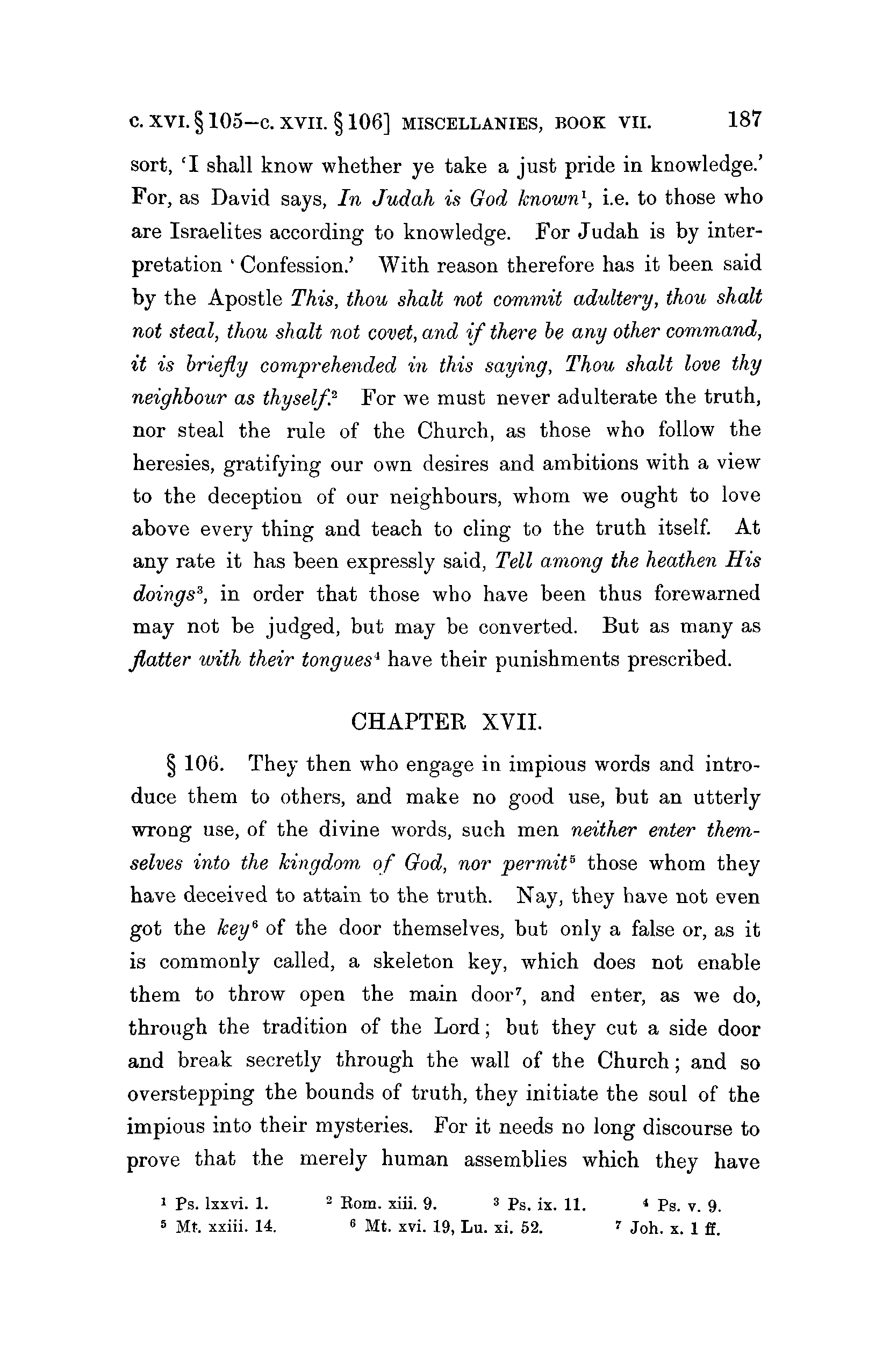
sort, 'I shall know whether ye take a just pride in knowledge.'
For, as David says, In Judah is God known1, i.e. to those who are Israelites according to knowledge. For Judah is by interpretation ' Confession.'
With reason therefore has it been said by the Apostle This, thou shalt not commit adultery, thou shalt not steal, thou shalt not covet, and if there be any other command, it is briefly comprehended in this saying, Thou shalt love thy neighbour as thyself.2 For we must never adulterate the truth, nor steal the rule of the Church, as those who follow the heresies, gratifying our own desires and ambitions with a view to the deception of our neighbours, whom we ought to love above every thing and teach to cling to the truth itself. At any rate it has been expressly said, Tell among the heathen His doings3, in order that those who have been thus forewarned may not be judged, but may be converted. But as many as flatter with their tongues* have their punishments prescribed.
CHAPTER XVII.
§ 106. They then who engage in impious words and introduce them to others, and make no good use, but an utterly wrong use, of the divine words, such men neither enter themselves into the kingdom of God, nor permit5 those whom they have deceived to attain to the truth. Nay, they have not even got the keys of the door themselves, but only a false or, as it is commonly called, a skeleton key, which does not enable them to throw open the main door7, and enter, as we do, through the tradition of the Lord; but they cut a side door and break secretly through the wall of the Church; and so overstepping the bounds of truth, they initiate the soul of the impious into their mysteries. For it needs no long discourse to prove that the merely human assemblies which they have
1 Ps. lxxvi. 1.
2 Rom. xiii. 9.
3 Ps. ix. 11.
4 Ps. v. 9.
5 Mt. xxiii. 14.
6 Mt. xvi. 19, Lu. xi. 52. i Joh. x. 1 ff. https://doi.org/10.1017/CBO9780511695513.010 Published online by Cambridge University Press
ZTPQMATEQN Z
[P. 898, s. 325
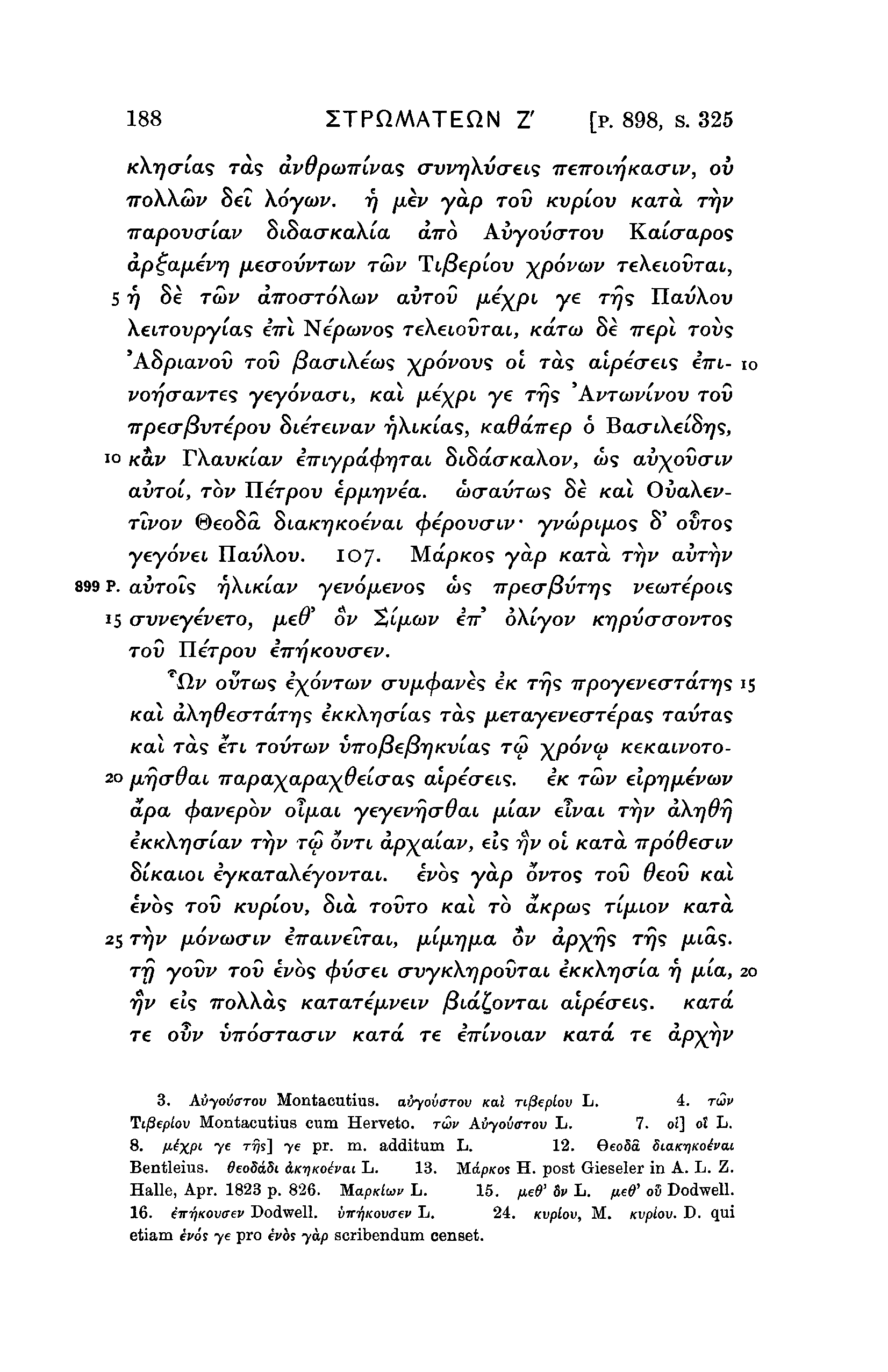
/cX^cria? Tas av^pcomvas crvv^Xvcreis irenoLT]Kacriv, ov TroXXaiv SeZ Xoycov. rj jiiev yap TOV Kvpiov Kara TT/V Trapovcrtav SiSacr/caXia aVo Avyovcrrov Kauxapos ap£a(x,evr) fLecrovvTwv T<3V Tcfiepiov ^povc 5 r) Se Twv
OVOOTOXOJV
OLVTOV fJ-^XP1 "Ye T1??
XeiTovpyias CTTI Neyowvos TeXeiourat, /carw Se Tre^l roi»5 row /SacriXews \povov<s ol T<XS aipecrebs iiriio yeyovacri, KOX ^XPL 7€
TV? 'AVTWLVOV
TOV irpecrftvTepov hieravav rjXiKia?, Kaddrrep 6 io Kav TXavKiav iirtypd^nqTai StSacr/caXov, a>s avTol, TOV liirpov ipfirjvia. axrauTw? Se /cat TIVOV ©eoSa. SiaKrjKoevaL <f>epovo~w yvcopLfios S' oSros yeydvet IlauXou.
IO7MapKOS ya/3 Kara, T^I/ avTrfv 899 P. aurois rjXiKuav yevofxevos a>s Trpeo~/3vT7)<; veojrepois 15 o-vveyeveTO, /i,e#' ov ^Zi^oiv iif oXiyov Kr)pvo~o-ovTOS TOV TLeTpov £irr}Kovo-ev.
THv OVT<O<; i^ovTCiiv crw/A^ave? e« T^S TrpoyevecrTarijs 15 /cat dX^^eo"TaT7^s CK/cXiycrias ras fi€Tay€veo'Tepa<; rauras
/cat Tas eVt, TOUTWI' VTro/3€f3r)Kvla<; T<5 XP^ 20 fjurjo-dai, irapa)(apa-X^e''cra^ o-i/ae'cret?.
CK TCJV dpa <j>avepbv olfxai yeyevrjadai, fiCav etvat T'ijv aX7)0fj iKKXrjo-Cav TYJV TW ovrt ap^aiav, eis i^V ot Kara vpodeo-iv SiKaioi iyKcvraXeyovTai. evos yap ovros TOW #eou /cat evos rou Kvpiov, S10L TOUTO Kai TO a.Kpa><; TI[LIOV Kara
25 T^V [JLOVcoariv iiraivelTai, /Atju.7jju.a ov apxfj'S TIJ? jutas.
T^ yovv TOV evos (ftvo-a o-vyicXripovTai eK/cX^cria 17 jitia, 20 Tjv ei? TroXXas /carare)u,veiv ySia^ovrai aip4.o-e.is.
Kara re ovv V7rdo"rao"iv Kara re e?rivotav KaTa re d 3.
AifyoiiaTou Montacutius. avyovorrov ical nfieplov L.
4. TUP Montacutius cum Herveto.
TUP Atiyouorou L.
7. ol] ot L.
8. A":*/" 7e T'5S] 7C Prmadditum L.
12.
6eo5a diaK-qKoiixu Bentleius.
0eoSaSi totiKoivai L.
13. MapKos H. post Gieseler in A. L. Z.
Halle, Apr. 1823 p. 826.
Mapduf L.
15. pet)' Sv L. fieO' o5 Dodwell.
16. iirriKomev Dodwell. virijKomev L.
24. Kvpiov, M. Kvpiov. D. qui etiam epos 7e pro eras 7ap scribendum censet. https://doi.org/10.1017/CBO9780511695513.010 Published online by Cambridge University Press
C. XVII. §§ 106,107] MISCELLANIES, BOOK VII.
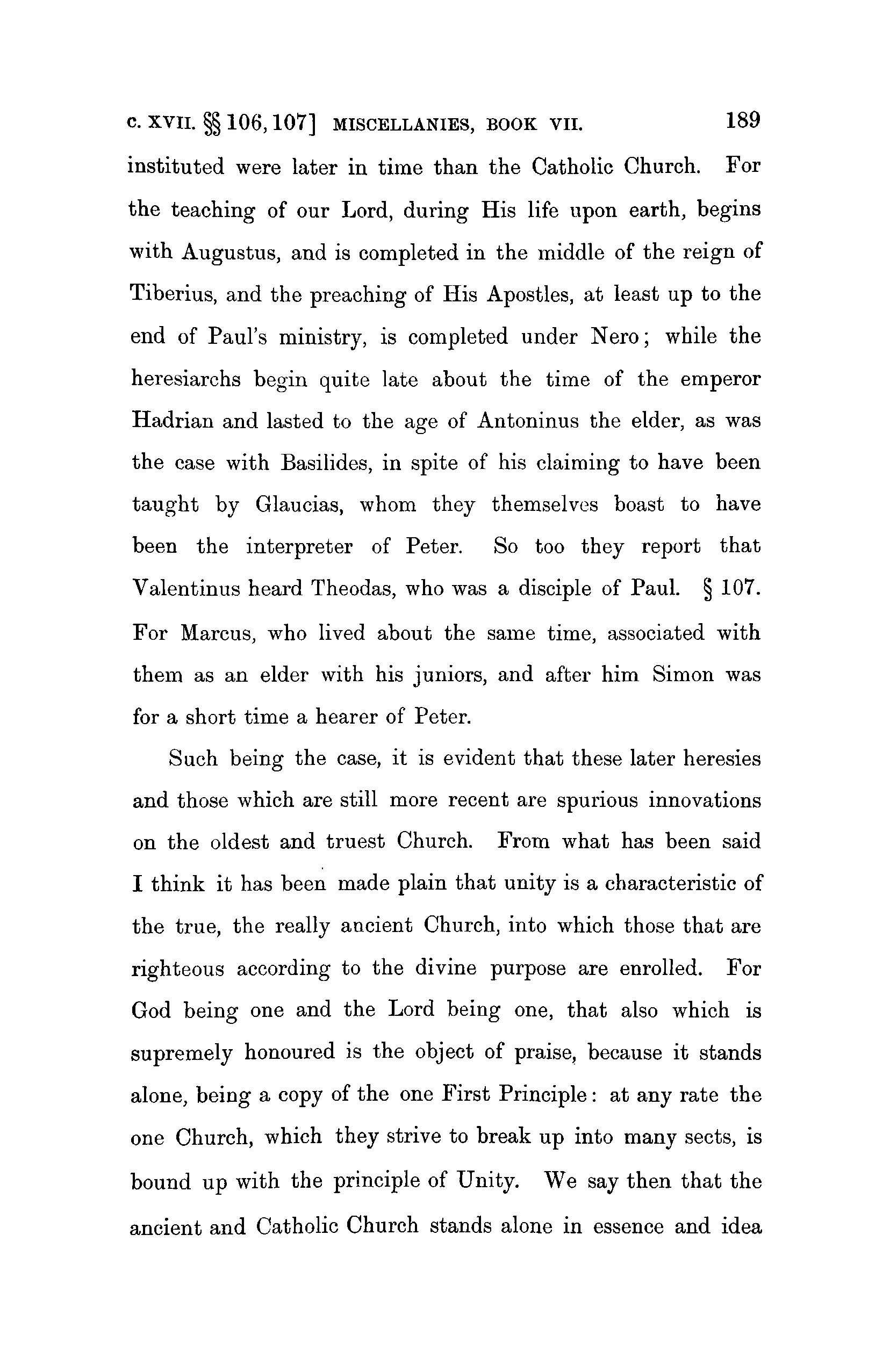
instituted were later in time than the Catholic Church. For the teaching of our Lord, during His life upon earth, begins with Augustus, and is completed in the middle of the reign of Tiberius, and the preaching of His Apostles, at least up to the end of Paul's ministry, is completed under Nero; while the heresiarchs begin quite late about the time of the emperor
Hadrian and lasted to the age of Antoninus the elder, as was the case with Basilides, in spite of his claiming to have been taught by Glaucias, whom they themselves boast to have been the interpreter of Peter.
So too they report that Valentinus heard Theodas, who was a disciple of Paul. § 107.
For Marcus, who lived about the same time, associated with them as an elder with his juniors, and after him Simon was for a short time a hearer of Peter.
Such being the case, it is evident that these later heresies and those which are still more recent are spurious innovations on the oldest and truest Church. From what has been said
I think it has been made plain that unity is a characteristic of the true, the really ancient Church, into which those that are righteous according to the divine purpose are enrolled. For God being one and the Lord being one, that also which is supremely honoured is the object of praise, because it stands alone, being a copy of the one First Principle: at any rate the one Church, which they strive to break up into many sects, is bound up with the principle of Unity. We say then that the ancient and Catholic Church stands alone in essence and idea https://doi.org/10.1017/CBO9780511695513.010 Published online by Cambridge University Press
ZTPQMATEQN Z
[P. 899, s. 325
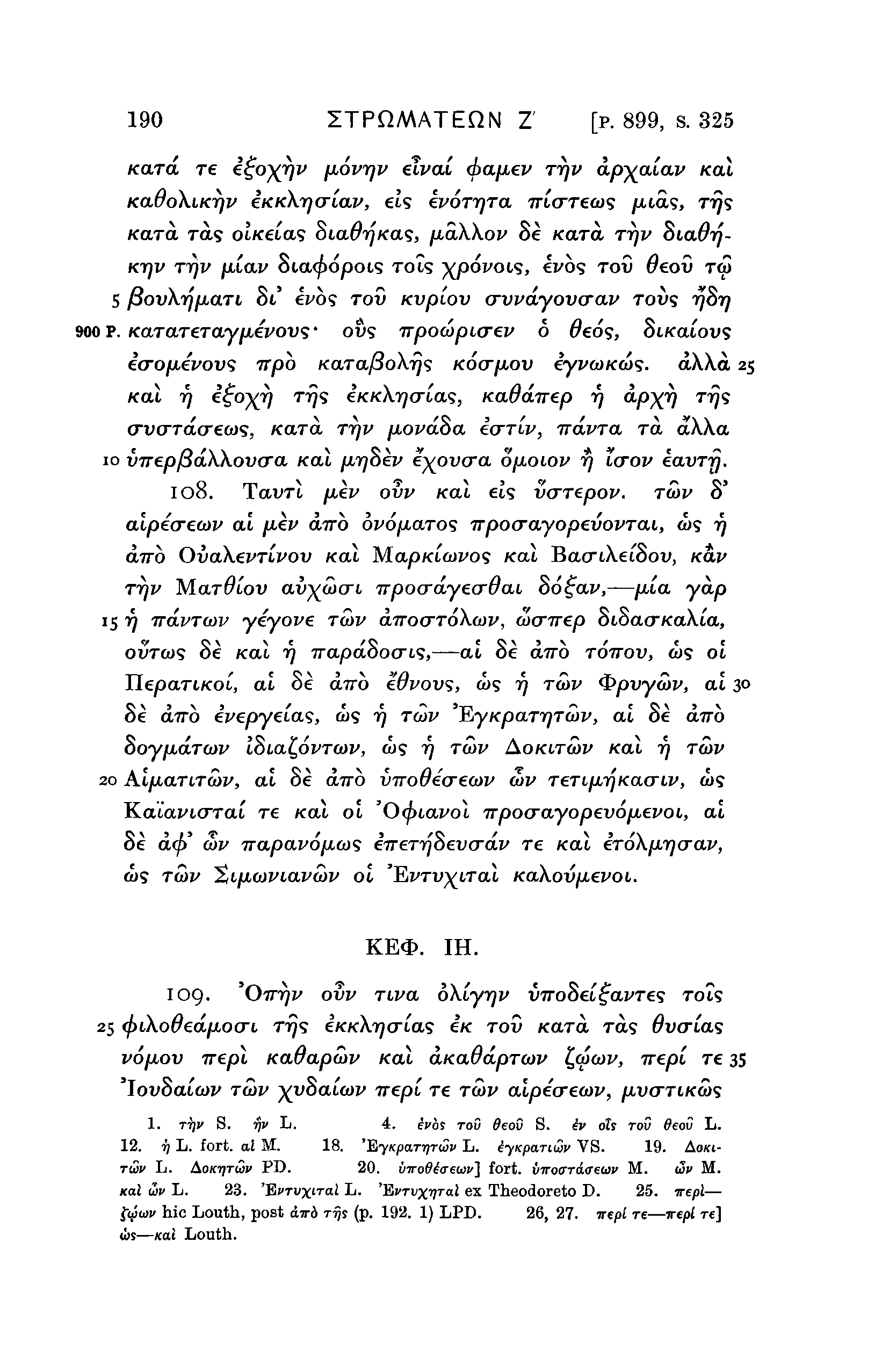
/caret TC i^o^rjv povqv etvat Sa^ev rrjv dp^aiav /ecu KadoXiKrjv iKKkrjcriav, eis evoTTjTa 7TicrreG>s ju.tds, rrjs
Kara ra? ot/ceta? Sta^/cas, fiaXXov Se /caTct TT)I> St,a$7]- /CT^I' T77V ju.tai' $ia<f>6poL<s TOIS xpovois, evb<$ TOV deov TW S f$ov\i]fJLa.Ti SL ivb<; TOV Kvpiov o-vvdyovaav
TOUS 17877
900 p. KaTOLTeraypjivovi • ous TrpoaJpicev 6 deos,
SIKOLIOVS
io~o[X€vov<; irpb KaraySoX^s KOCT/JLOV iyvo)Ka><;. olXXa 25 Kai 17 z&XV TV^ £KKXT)O-LCLS, Ka.da.Trep 17 ^-PXV T^ s crucrracrews, Kara T17V fxovdha, io~Tiv, iravra
TO, aXXa 10 vrrepfiaWovo-a KOX fjbrj&ev e^oucra OJJLOLOV 77 icroz/ eavry.
108.
Taurl /Liei' ou^ /cat eis vo~Tepov.
TO>V S' alpeo-eo)v ai /x.ev diro OVO/XOLTOS Trpoo-ayopevovTai, &>? 77 a.7ro OvaXevTLVov KO1 Map/ctajvos fat BacriXetSou, KO.^
TT))^ Mardiov av^cocrt TTpo<yd,yeo~da.i S6£a.v,—)u.ia yap 15 77 TrdvTwv yiyove T5>V O.TTOO'T6X(I)V, wo'irep SiSacr/caXia,
OUTWS Se /cat 77 7rapa8oo"ts,—at Se a.7ro TO7TOU, w? ot Ile/Dan/cot, at Se dvro edvovs, <ws 77 roiv ^pvyciv, at 30 Se diro evepyeias, w? 77 TW;/ 'EyKpaTTjTcov, ai Se a7ro Soyfidrov iSia^ovTcov, w? 77 TWC AOKLTWV /cat 77 w 20 AlfxaTLTOiv, at 8e aTro inroOeo-ecov cov TeTi[vf\Ka,o-iv, w?
Kai.'ai'tcrTat T€ Kat ot 'Ocfuavol 7rpoo~ayopev6[jbevoL, at Se d<^>' wi' Trapavofxo}'; iTrerrjSevo'dv re /cat iroXfiyjcrav, a>S TWZ/ %Lfio)VLava>v ol 'Evru^trat /caXou/x.ei'ot.
IH.
109.
'OTTT)^ ovi' Tiva oXuyrjv woSetfai/re?
TOIS 25 <f>i,XodedfLocrL T779 iKKXr)o~ia<; £K TOV Kara, TCIS Ovarian vofiov Trepl Kadapcov /cat dtcaddpTcov t,(oa)v, wepi re 35
*IouSat6>i> T&JI' ^uSatwi' Trept re rail' alpecrecw, /Ltuo"TtK&>s 1.
T V S.
^K L.
^pos TOO 5eou S. iv ots TOV 8eov L.
12. i) L. fort, ai M.
18. 'HZynpaTriTuv L. iyKparnSv VS.
19. Ao/uTc3y L.
AOKTJTWV PD.
20. u7ro^^<rewz/] fort. vTrocrdo'ewj' M. uv M.
KOI Civ L.
23. 'EcTuxiTai L. 'EvruxtiTal ex Theodoreto D.
25. irepl— fyui/ hie Louth, post airb rijs (p. 192. 1) LPD.
26, 27. irepi re—jre/>( T«] ws—Kai Louth. https://doi.org/10.1017/CBO9780511695513.010 Published online by Cambridge University Press