
CHAPTER XVI
c. xv. § 92-c. xvi. § 93]
MISCELLANIES, BOOK VII.
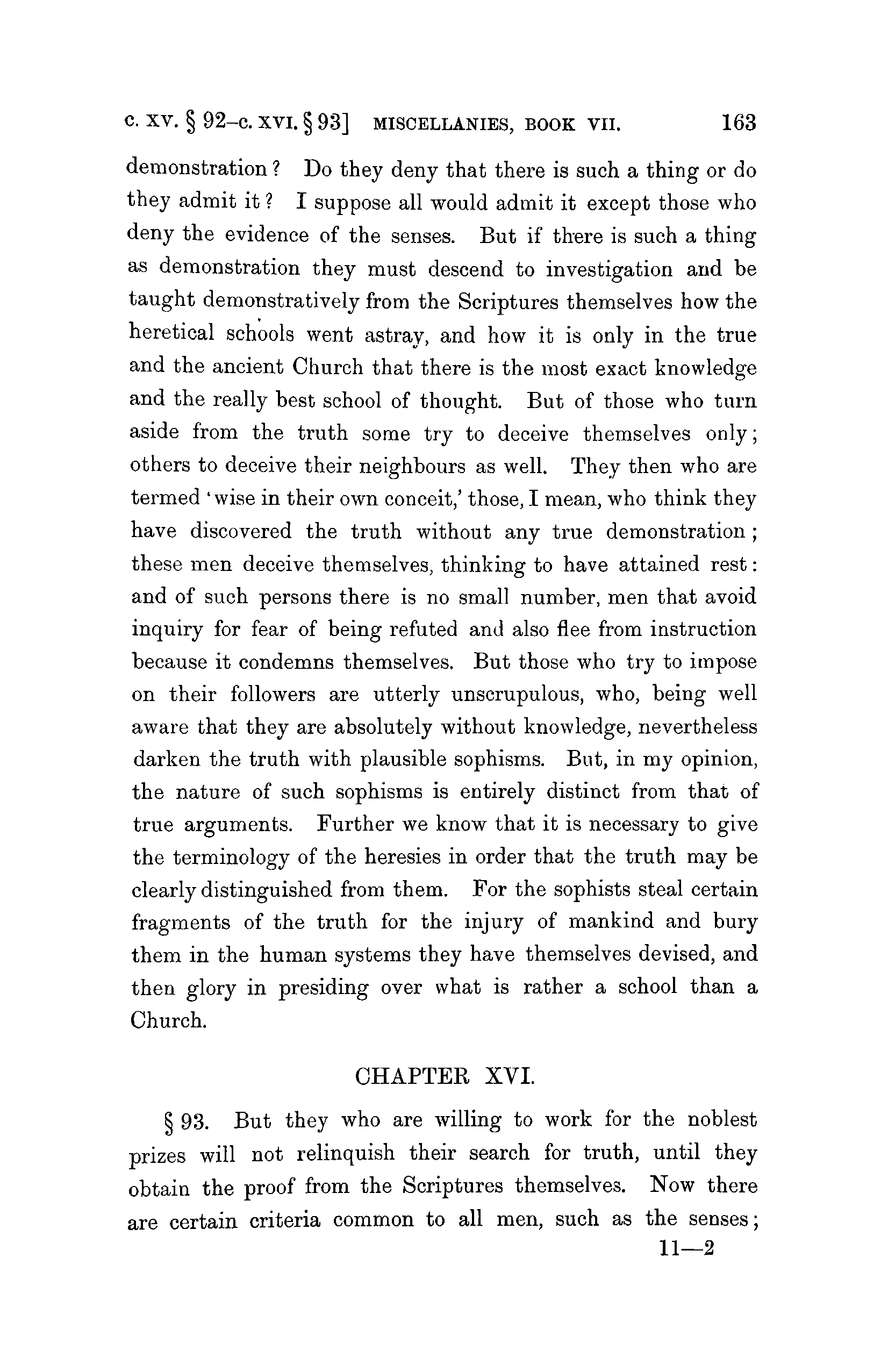
demonstration ? Do they deny that there is such a thing or do they admit it ? I suppose all would admit it except those who deny the evidence of the senses. But if there is such a thing as demonstration they must descend to investigation and be taught demonstratively from the Scriptures themselves how the heretical schools went astray, and how it is only in the true and the ancient Church that there is the most exact knowledge and the really best school of thought. But of those who turn aside from the truth some try to deceive themselves only; others to deceive their neighbours as well. They then who are termed ' wise in their own conceit,' those, I mean, who think they have discovered the truth without any true demonstration ; these men deceive themselves, thinking to have attained rest: and of such persons there is no small number, men that avoid inquiry for fear of being refuted and also flee from instruction because it condemns themselves. But those who try to impose on their followers are utterly unscrupulous, who, being well aware that they are absolutely without knowledge, nevertheless darken the truth with plausible sophisms. But, in my opinion, the nature of such sophisms is entirely distinct from that of true arguments. Further we know that it is necessary to give the terminology of the heresies in order that the truth may be clearly distinguished from them. For the sophists steal certain fragments of the truth for the injury of mankind and bury them in the human systems they have themselves devised, and then glory in presiding over what is rather a school than a Church.
CHAPTER XVI.
§ 93. But they who are willing to work for the noblest prizes will not relinquish their search for truth, until they obtain the proof from the Scriptures themselves. Now there are certain criteria common to all men, such as the senses;
11—2 https://doi.org/10.1017/CBO9780511695513.010 Published online by Cambridge University Press
ITPQMATEflN Z'
[P. 889, s. 321
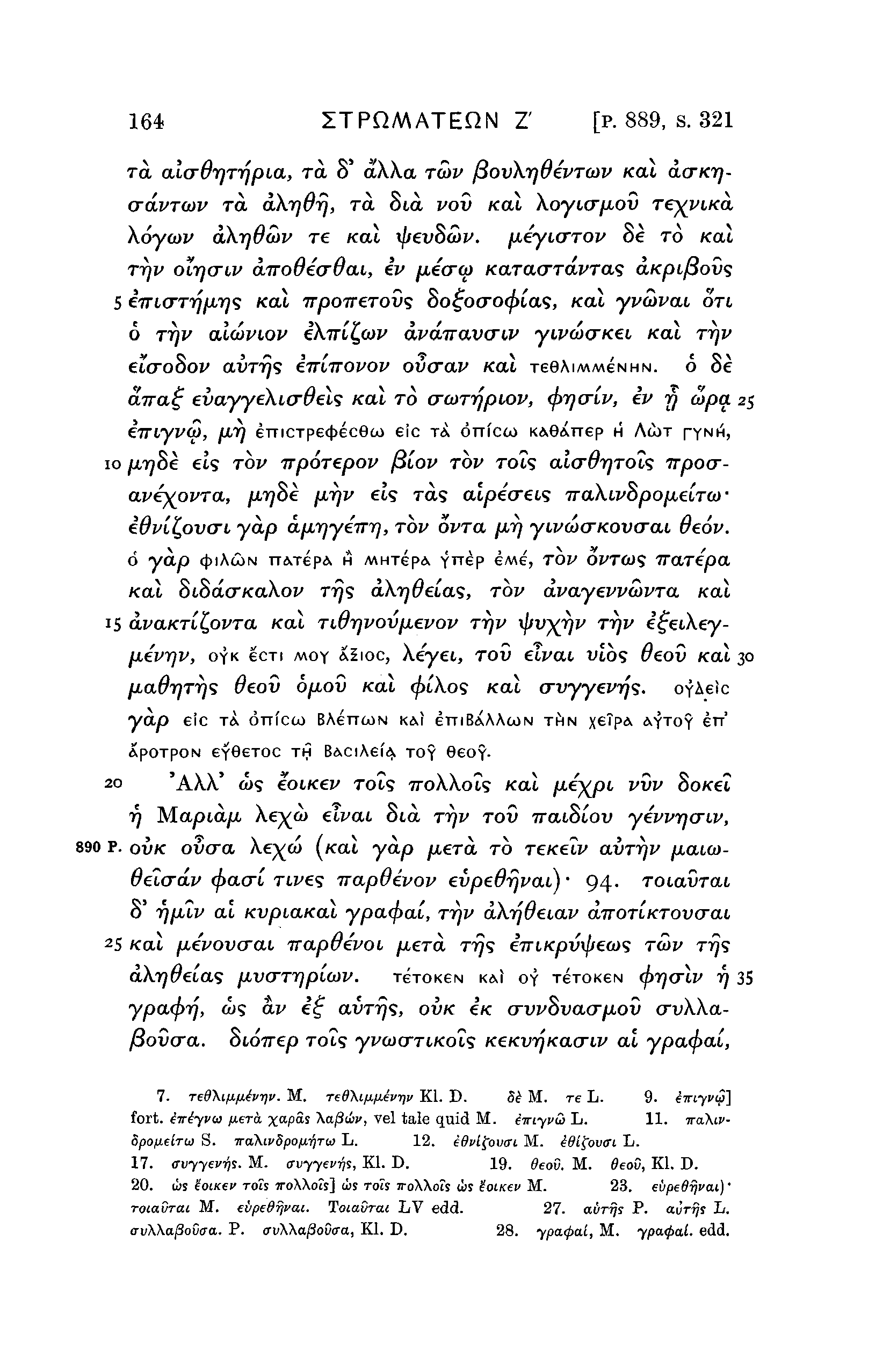
TO. aladrjTrjpLa, ra S' aXXa roiv ^ovkqdivTtov /cat dcr/07crdvTOJv TOL dkrjdrj, r a Sid vov /cat Xoytcr/ioC TeyytKa.
\6y<ov dXrjdwv re /cat rpevSatv. piyiQ-TOv Se TO /cat TTJV oir)criv dirodiaOai, iv fxecra) KaracrTavras d/cpt/Jous 5 eVt(TTi7/x.T7s Kai TrpoTrerovs 8otjocro(f>ia<;, Kai yvoivai OTL
6 TTJV aiwvLov i\irit,(DV dvairavaiv ywaxrKei Kai rrjv eicroSov avTrjs ITTITTOVOV ovcrav Kai TeeAiMMgNHN.
6 Se f evayye\icrdei<i Kai TO ao)T7]pu>v, (f)7]crCv, iv y atpa. 25 co, fin) eTricTpe4>ececo eic TA orrfcw Kt&Luep H A(1>T rYN^>
10 ju.TjSe ets TOV irpoTtpov {SLOP TOV rots a t c ^ r o t s Trpoa- , ju/^Se JMTJV ei? ras atyaeVets Traku>Spo[xeiTcam yap afirjyeTn], TOV ovra [xrq yivwo~Kovamai Oeov. o yap 4>IACON n^Tep* H MHTSPA ynep eMe, TOV OVTCJS
Kai SiSdo-KaXov Trjs akyOeCas, TOV dvayevvSiVTa 15 dvaKTitpvTa Kai Tidrjvov/jievov TTJV ^V^TJV Tr)v v, OYK ecn MOY &lioc, Xeyei, TOU elvau vlbs 6eov Kai 30 eou OfJbov Kai ^tXos >cal o"vyyevT7S. oyAeic yap eic Ti\ OTTICCO BAerrwN KAI eniB^AAcoN T^IN xe^PA &YTOY en
ApOTpON 6Y66TOC TH B&ClAef*. TOY 66Oy.
'AXX' w? eoiKev TOIS TTOXXOI? Kat /Ae)(/ot vuv SoKet 17 Mapiayx Xe^a> etvat Sta, T17V TOV TratSiou y4vvr]aiv, 890 p. ou/c ovo~a Xe^w (/cat ya/t) jaeTa, TO Te«retv avTrjv jaatwdeio-dv (f>ao-£ Ttves irapOivov evpedrjvai) • 94. TOKZOTCU
8' i^jLttv at KvpiaKal ypa(f>ai, TTJV dkyjOeuav diroTLKTovo-au 25 /cat fievovorai trapOivoi fierd rrjs iTTLKpvxjjea)^ Tutv Trjs aXrjdeias jxvo-Trjpicov.
TETOKGN KA! oy TeTOKeN <f>r)<rlv r) 35 ypa<f>rj, ws av e^ auTijs, ou/c e/c o-vvSvao-fJiov o~v\\a- /Sovcra.
Storrep TOTS yvwcrrt/cors K€KvqKao~iv at ypa<f>a£, 7.
Ted\ifi/i4pr]v. M. TtSXt/t/iei'Tji/ Kl. D.
5£ M. re L.
9. ^Tiryi^] fort, iirlyvbi /iera %apas Xafiiliv, vel tale quid M. iiriyvd L.
11. n-a\u>Spo/xelTti} S. irahivdpo^Tw L.
12. eOvlfovffL M. tdlfyvffi L.
17. ffi/77£>'5)S. M. o-uTvei-)}!, Kl. D.
19. ^eoC. M.
SeoC, Kl. D.
20. ws toiKev TOIS TTOXXOIS] ws TOIS 7roXXo?s us ioutev M.
23. eiipe^fli'ai) • Toiavrai M. etopeBrjvcu. TotaCrat LV edd.
27. ai>7~i;s P. aur^s L. o-i/XXa/3oCffa. P. cruXXa/3o0cro, Kl. D.
28. ypcupal, M. ypa<j>aL edd. https://doi.org/10.1017/CBO9780511695513.010 Published online by Cambridge University Press
C. XVI. §§ 93, 94]
MISCELLANIES, BOOK VII.
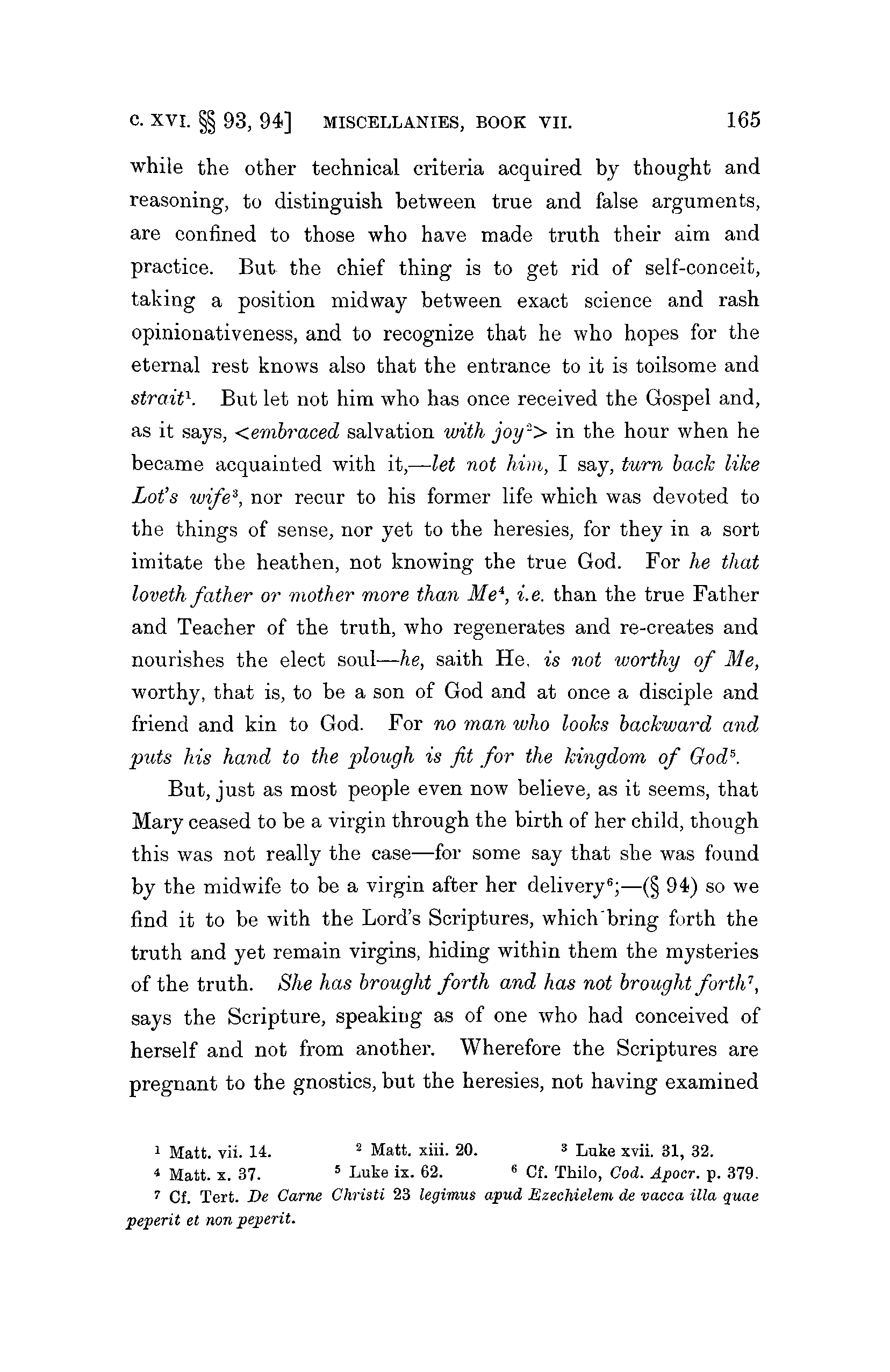
while the other technical criteria acquired by thought and reasoning, to distinguish between true and false arguments, are confined to those who have made truth their aim and practice. But the chief thing is to get rid of self-conceit, taking a position midway between exact science and rash opinionativeness, and to recognize that he who hopes for the eternal rest knows also that the entrance to it is toilsome and strait1. But let not him who has once received the Gospel and, as it says, <embraced salvation with joy°> in the hour when he became acquainted with it,—let not him, I say, turn back like
Lot's wife3, nor recur to his former life which was devoted to the things of sense, nor yet to the heresies, for they in a sort imitate the heathen, not knowing the true God. For he that loveth father or mother more than Me*, i.e. than the true Father and Teacher of the truth, who regenerates and re-creates and nourishes the elect soul—he, saith He, is not worthy of Me, worthy, that is, to be a son of God and at once a disciple and friend and kin to God. For no man who looks backward and puts his hand to the plough is fit for the kingdom of God5.
But, just as most people even now believe, as it seems, that Mary ceased to be a virgin through the birth of her child, though this was not really the case—for some say that she was found by the midwife to be a virgin after her delivery6;—(§ 94) so we find it to be with the Lord's Scriptures, whichbring forth the truth and yet remain virgins, hiding within them the mysteries of the truth. She has brought forth and has not brought forth7, says the Scripture, speaking as of one who had conceived of herself and not from another. Wherefore the Scriptures are pregnant to the gnostics, but the heresies, not having examined
1 Matt. vii. 14.
2 Matt. xiii. 20. s Luke xvii. 31, 32.
4 Matt. x. 37.
5 Luke ix. 62.
6 Cf. Thilo, Cod. Apocr. p. 379.
7 Cf. Tert. De Carne Christi 23 legimus apud Ezechielem de vacca ilia quae peperit et non peperit. https://doi.org/10.1017/CBO9780511695513.010 Published online by Cambridge University Press
ZTPQMATEQN Z'
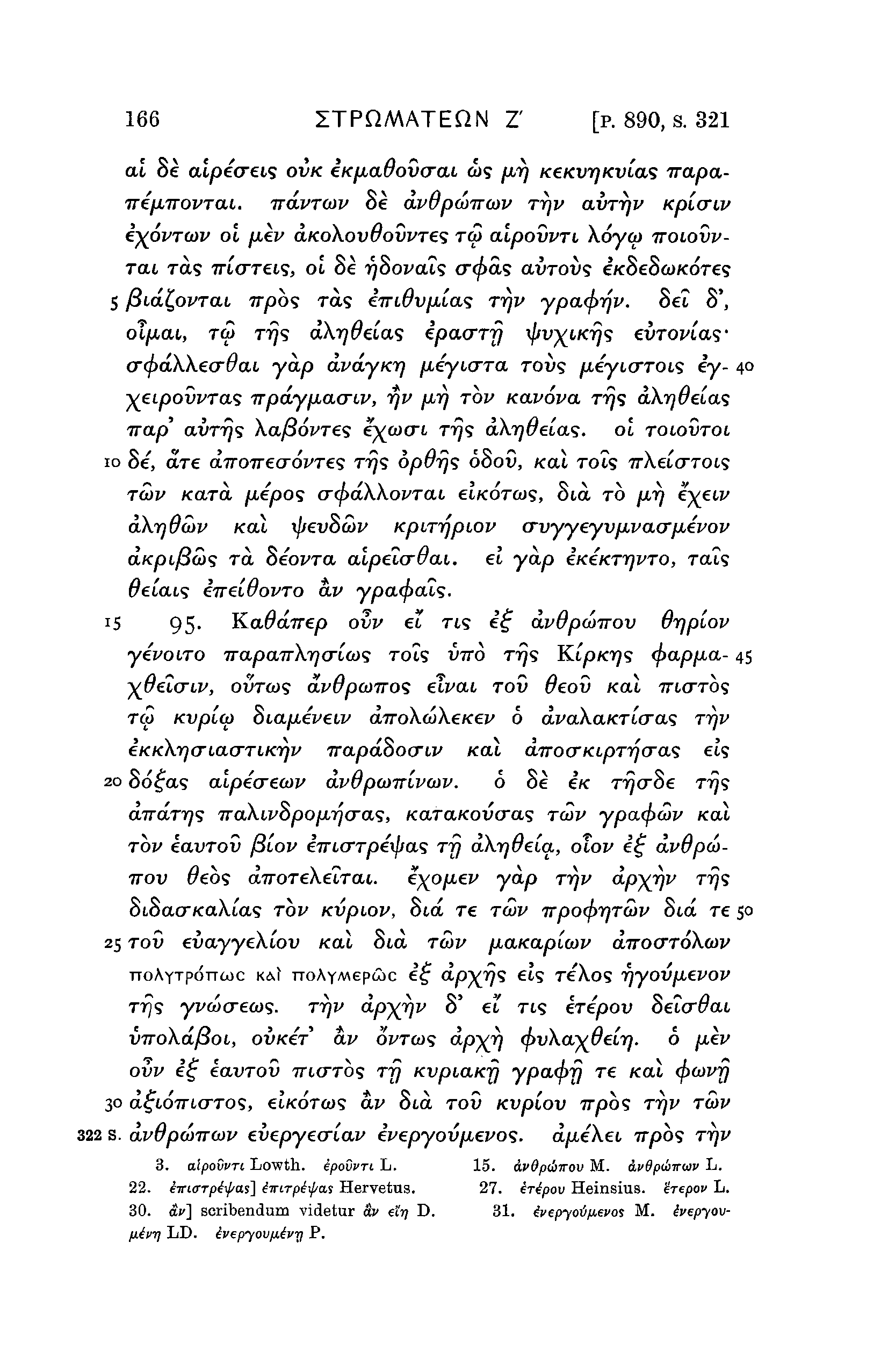
[P. 890, s. 321 ax Se alpeceis OVK iKfiaOoxxrat o»s ft/q KeKvyjKvias irapaTT€fnrovTai. vdvTOiv Se dvOpcoiTCJV rrjv avrr/v Kpicriv eXpvTcov ol /xev aKoXovdovvTes TW alpovvTL Xoyca TTOLOVVTai TCIS 7ruTTei9, oi Se ^Sovais cr<£as awous e/cSeStoKoVes
S fSiatflvrai -irpo<; ras eTTt^u/Aia? T1*)^ ypa<f>rjv. Set S', otfxaL, TW T7J9 d\r)$das ipaarfj ^JJV-^LKTJS evroviascrcfxiWecrOai yap dvdyKT) /Aeytcrra roi)§ fieyuoroLS iy40
Xet^owTa^ Trpdy/JuacTLv, rjv [JLTJ TOV KOMOVO. TTJS akrjOeia'i Trap avTTjs XaySdvres er^axri rrjs ak.7}6ela<z. ol TOLOVTOL
JO Se, aTe aTTOTrecrovTes TTJS op6rj<s 6Sov, Kal TOIS 7r\eio~Tois T(Si' Kara. jxepo<; a<j>d\\ovTai eiKoYais, Sta TO JU,^ e^etv d\rjda)v Kal xpevScov Kpnr\piov crvyyeyvfivacrfxevov aKiptySai? TO, SeovTa alpeiaOai. el yap iKeKTrjvTO, Tais OeCaLs eireWovTo av ypa^ais.
95.
Ka^carep owz' et Tts e^ dvdpanrov drjpiov yevoLTO TrapaTr\r)o-Ca)s TOIS VTTO T^S Kip/cijs <j>apfjua45
^deicnv, OVTW? dvdpoiTros eivai TOV deov Kal 7rto"TOS TW Kvpccp Siafievew dirokaXeKev 6 avaXa/cTto"as TTJV iKKkrjcrLao'TLKTjv TTapdo'oo'iv Kal dTroo~KipTrjO-a<i eis 20 So^as alpeaecov dvdpcoTrCvcov. 6 Se e«: Tijo"8e aTraT^s 7raXivS|0O)U-7jo"as, /caTaKouo"as TOJI' ypacftcov
TOV kavTov fi'iov eTTLO-Tpexfjas TTJ akiqdeia., oXov i£ dvdputirov debs diroTe\eiTai. ey^ofiev yap TTJV dp^yjv T^S SiScur/caAias TOI^ Kvpiov, Sia Te TaJv TTpofyiyroiv
Sia TC 50 25 TOU evayyeXCov Kal Sid TCOV jxaKapiuiv aTroarTokoiv TToAYTponwc K&f TroKyMepQtc i$ dp^rj<; eis TCXOS rjyovjxevov
TTJS yvwo-eais.
TTJV dp-^rjv S' et TIS krepov Selo-ffau vTToXdfioi, OVK4T av OVTWS dp-^r/ (f)v\ay^6eL7).
6 jj-ev ovv i£ eavTOV TTIO-TOS Trj KvpuaKy ypa(j)rj re Kal (frojvfj 30 d^rt07no"Tos, etKoTws av Sia TOG Kvpiov irpb? Tr/v TS>V 322 s. dvdpoJTTWv eiepyeaiav ivepyovfjievos. d/xeXei irpbs TTJV 3. alpovvri Lowth. ipovvTi L.
15. dvOpiirrov M. avBpihirav L.
22. i-noTptfas] iTnTptyas Hervetus.
27. ^T^pou Heinsius. Zrcpov L.
30. oi'] scribendum videtur &v etr; D.
31. ivepyotinevos M.
/i^ci; LD. ivep-yovixivQ P. https://doi.org/10.1017/CBO9780511695513.010 Published online by Cambridge University Press
C XVI. | | 94, 95]
MISCELLANIES, BOOK VII.
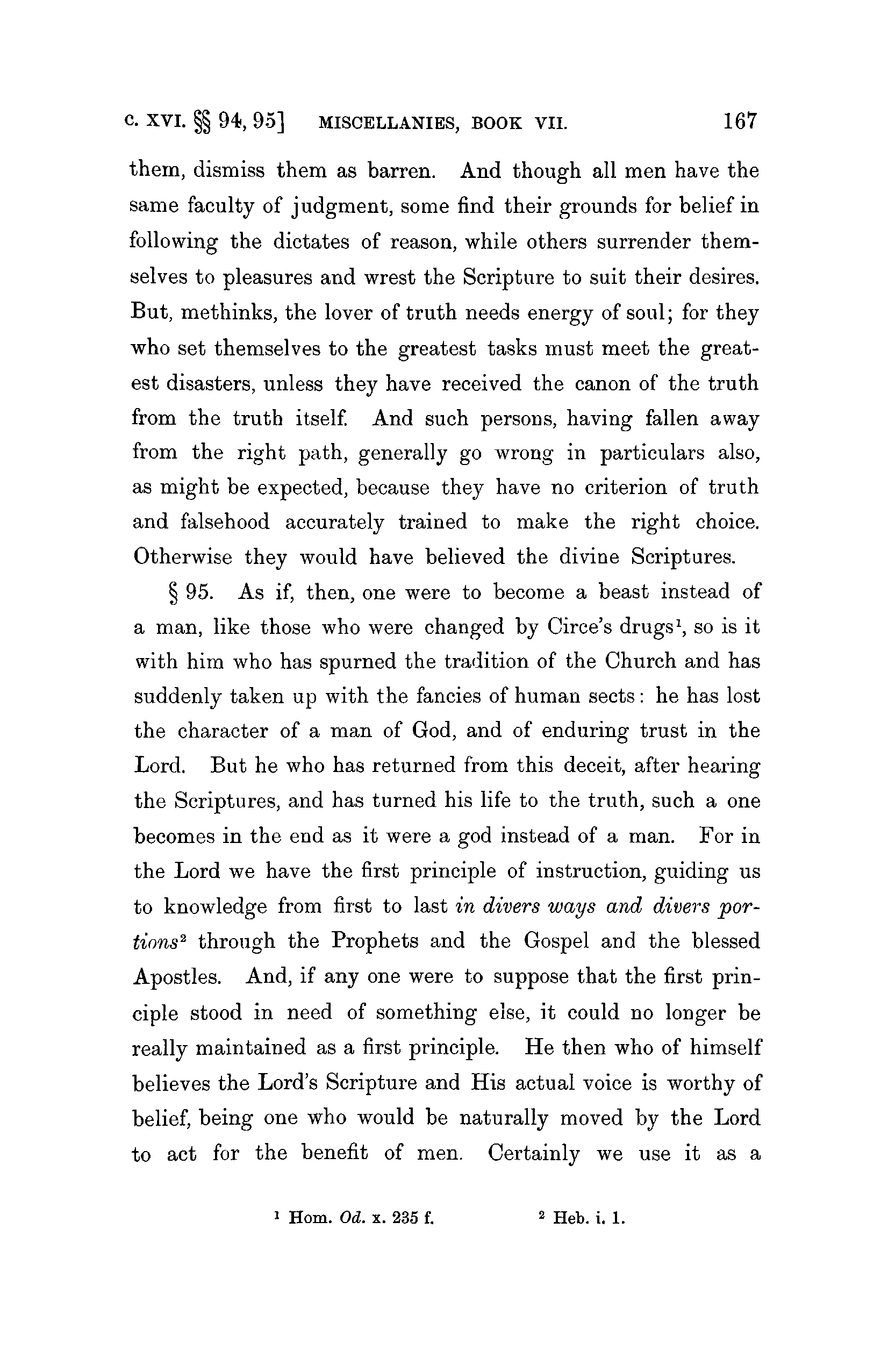
them, dismiss them as barren. And though all men have the same faculty of judgment, some find their grounds for belief in following the dictates of reason, while others surrender themselves to pleasures and wrest the Scripture to suit their desires.
But, methinks, the lover of truth needs energy of soul; for they who set themselves to the greatest tasks must meet the greatest disasters, unless they have received the canon of the truth from the truth itself. And such persons, having fallen away from the right path, generally go wrong in particulars also, as might be expected, because they have no criterion of truth and falsehood accurately trained to make the right choice.
Otherwise they would have believed the divine Scriptures.
| 95. As if, then, one were to become a beast instead of a man, like those who were changed by Circe's drugs1, so is it with him who has spurned the tradition of the Church and has suddenly taken up with the fancies of human sects: he has lost the character of a man of God, and of enduring trust in the Lord. But he who has returned from this deceit, after hearing the Scriptures, and has turned his life to the truth, such a one becomes in the end as it were a god instead of a man. For in the Lord we have the first principle of instruction, guiding us to knowledge from first to last in divers ways and divers portions2 through the Prophets and the Gospel and the blessed
Apostles. And, if any one were to suppose that the first principle stood in need of something else, it could no longer be really maintained as a first principle. He then who of himself believes the Lord's Scripture and His actual voice is worthy of belief, being one who would be naturally moved by the Lord to act for the benefit of men. Certainly we use it as a i Horn. Od. x. 235 f.
2 Heb. i. 1. https://doi.org/10.1017/CBO9780511695513.010 Published online by Cambridge University Press
ITPQMATEQN Z'
[p. 890, s. 322
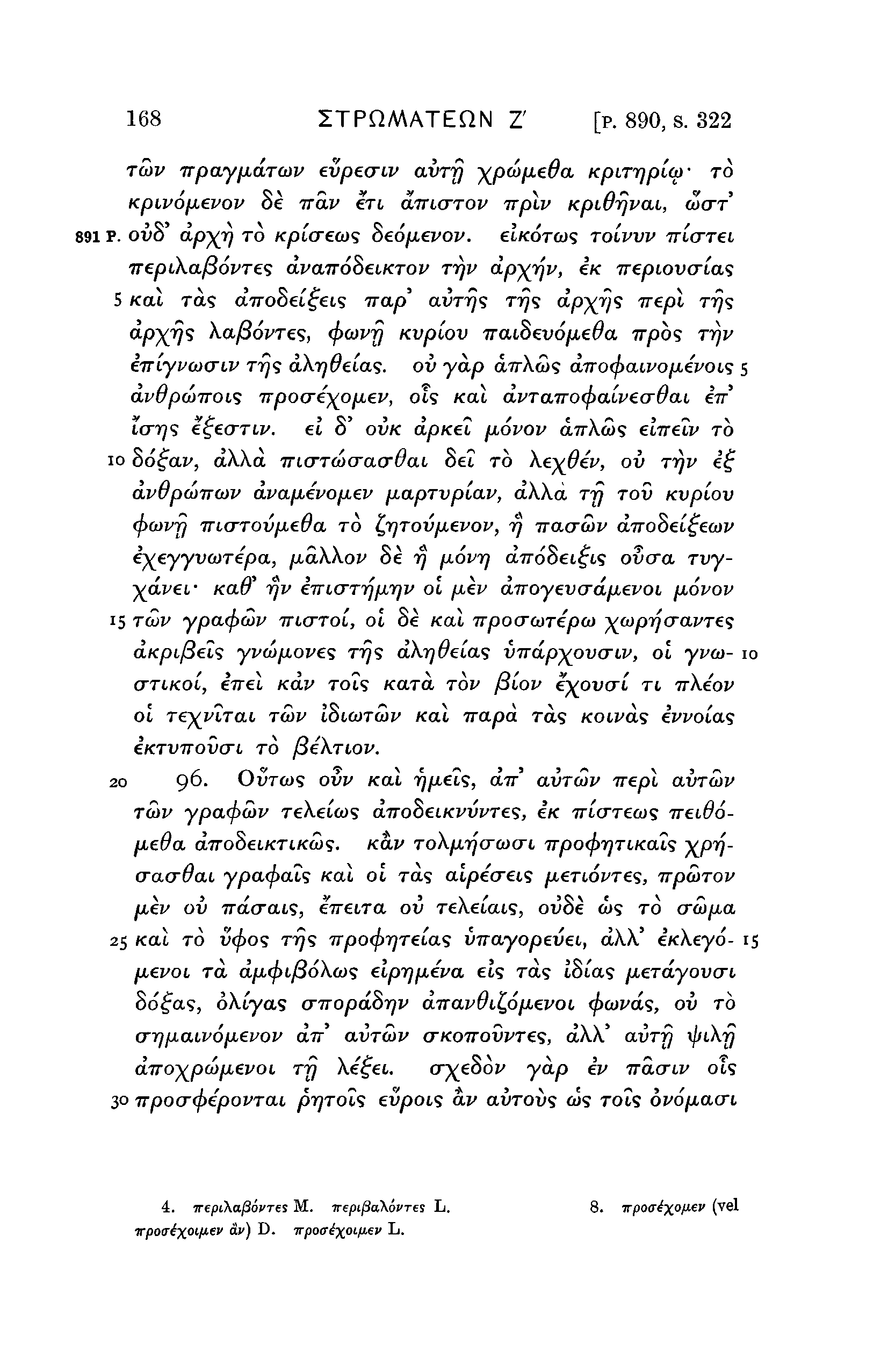
TrpaypaTOiv evpecrw avrrj -^pcofxeda KpiTtqplo)- TO Se irav en dino'TOv irplv KpiOrjvai, WCTT'
891 P. ovS' oipXV T° Kpicreais 8e6fj.evov. et/coTft>s TOLVVV Trtcrrei neptXa/3dvTes aVaTrdSet/cToi' TT)V dpxrjv,
ZK TrepLovaias 5 *cai ra§ aTroSeil'eis ira^o' aur^s TI^S a/3^r/s Trepl T17S apXVS
^/36VT€S,
<f>o>vr} Kvpiov TraiSevdjae^a Trpos T^V hriyvoHTiv TYJ<; d\rjdeia<;. ov yap airXcjs aTro^att'OjLiei'oi? 5 dvdpdiirois irpocrixoiiev, 01s /cat dvTairo(f)aivecr9at, in' lcrri<$ e^ecrTiv. el 8' oi?/c dpnei JJLOVOV aTrXais eirrelv TO 10 Sdfav, aXXa TricnuxracrQai Set TO \ey6£v, ov Trjv i£ dv6panrcov dvaficvofjiev jj.aprvpiav, aXXa TI^ TOU Kvpiov (fxovrj Tno~Tov[x,eQ(L TO ^QTov/xevou, f) Traaa>v (XTroSe epa, fxaWov Se 17 p.d^ aTrdSet^ts oScra iKad' rjv hri<TTri\xr)v ot fiev aTroyevadfievoL
[lovov 15 T(Sv ypa<j)cov irurroi, oi Se Kat wpoacoTepo) x°)PVcyavTf-<i a/cptySei? yvwfAoves Trjs d\r)0eia<; VTrdp^ovaw, ot yf<u10 (TTLKOL, iirel Kav Tot? /caTct TOV fiiov e^ovcrt Tt oi Te^tTai Toit' tSt&JTwj' /cat irapd Tas /cot^as e
TO j3eXTiov.
96.
Ourws ow /cat ^/Aetg, air' auTwi' irept avratv ypa<f>5iv TeXetws aVoSei/cvwTes, e/c Trtcrrews ireidojxeda aVoSet/cTiKw?.
/ccti' ToXyu,7jcrwo"t crao-0ai ypa<f>al<; /cat ot Tas afyjecreis fi€v ov Tracrats, eVetTa ou TeXetats, ouSe cus TO 25 /cat TO u^)os TT7§ irpo^rjTetas imayopevet, aXX' exXeyd15 fx.evoL rd a/A^>tySdX&)§ eiprjfieva eis Tas tStas fxeTdyovai,
?, oXtyas o~TropdSy]v dttavditp^voi <f>a)vd<;, ov TO drr' avTOtv <TKOITOVVT€<;, aXX' ots i. rfj Xefet. cr^eSot' ya/3 eV> irdcnv ots 30 Trpoo-(j>epovTaL prjTols eu/jots w avrovs (us Tots ovof
7re/3iXa/3ocTes M.
TepifiaXoPTes L.
Tpo<r4xo/J-ev (vel sv L. https://doi.org/10.1017/CBO9780511695513.010 Published online by Cambridge University Press
C. XVI. §§ 95, 96]
MISCELLANIES, BOOK VII.
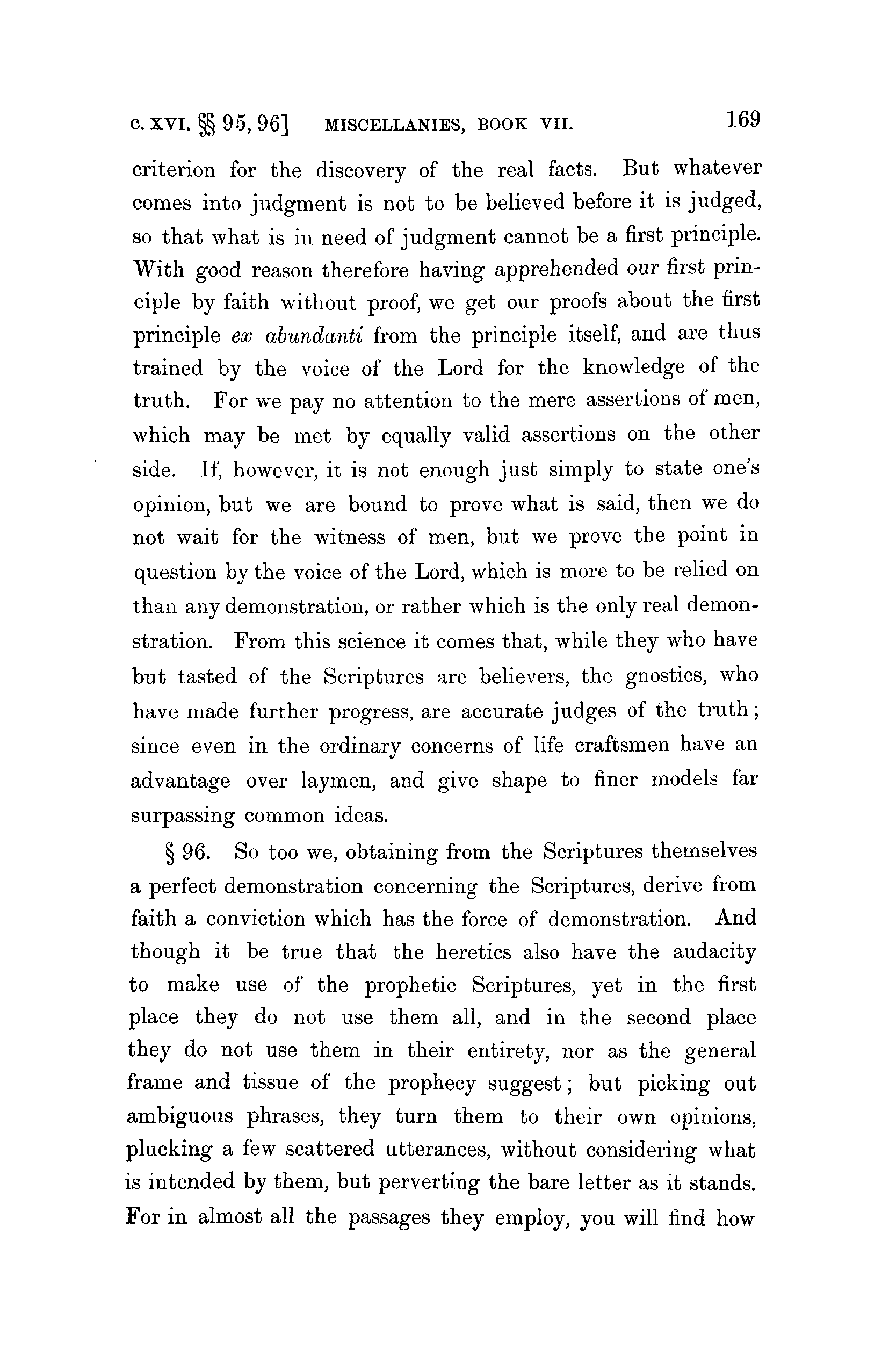
criterion for the discovery of the real facts. But whatever comes into judgment is not to be believed before it is judged, so that what is in need of judgment cannot be a first principle.
With good reason therefore having apprehended our first principle by faith without proof, we get our proofs about the first principle ex abundanti from the principle itself, and are thus trained by the voice of the Lord for the knowledge of the truth. For we pay no attention to the mere assertions of men, which may be met by equally valid assertions on the other side. If, however, it is not enough just simply to state one's opinion, but we are bound to prove what is said, then we do not wait for the witness of men, but we prove the point in question by the voice of the Lord, which is more to be relied on than any demonstration, or rather which is the only real demonstration. From this science it comes that, while they who have but tasted of the Scriptures are believers, the gnostics, who have made further progress, are accurate judges of the truth; since even in the ordinary concerns of life craftsmen have an advantage over laymen, and give shape to finer models far surpassing common ideas.
§ 96. So too we, obtaining from the Scriptures themselves a perfect demonstration concerning the Scriptures, derive from faith a conviction which has the force of demonstration. And though it be true that the heretics also have the audacity to make use of the prophetic Scriptures, yet in the first place they do not use them all, and in the second place they do not use them in their entirety, nor as the general frame and tissue of the prophecy suggest; but picking out ambiguous phrases, they turn them to their own opinions, plucking a few scattered utterances, without considering what is intended by them, but perverting the bare letter as it stands.
For in almost all the passages they employ, you will find how https://doi.org/10.1017/CBO9780511695513.010 Published online by Cambridge University Press
ZTPQMATEQN Z'
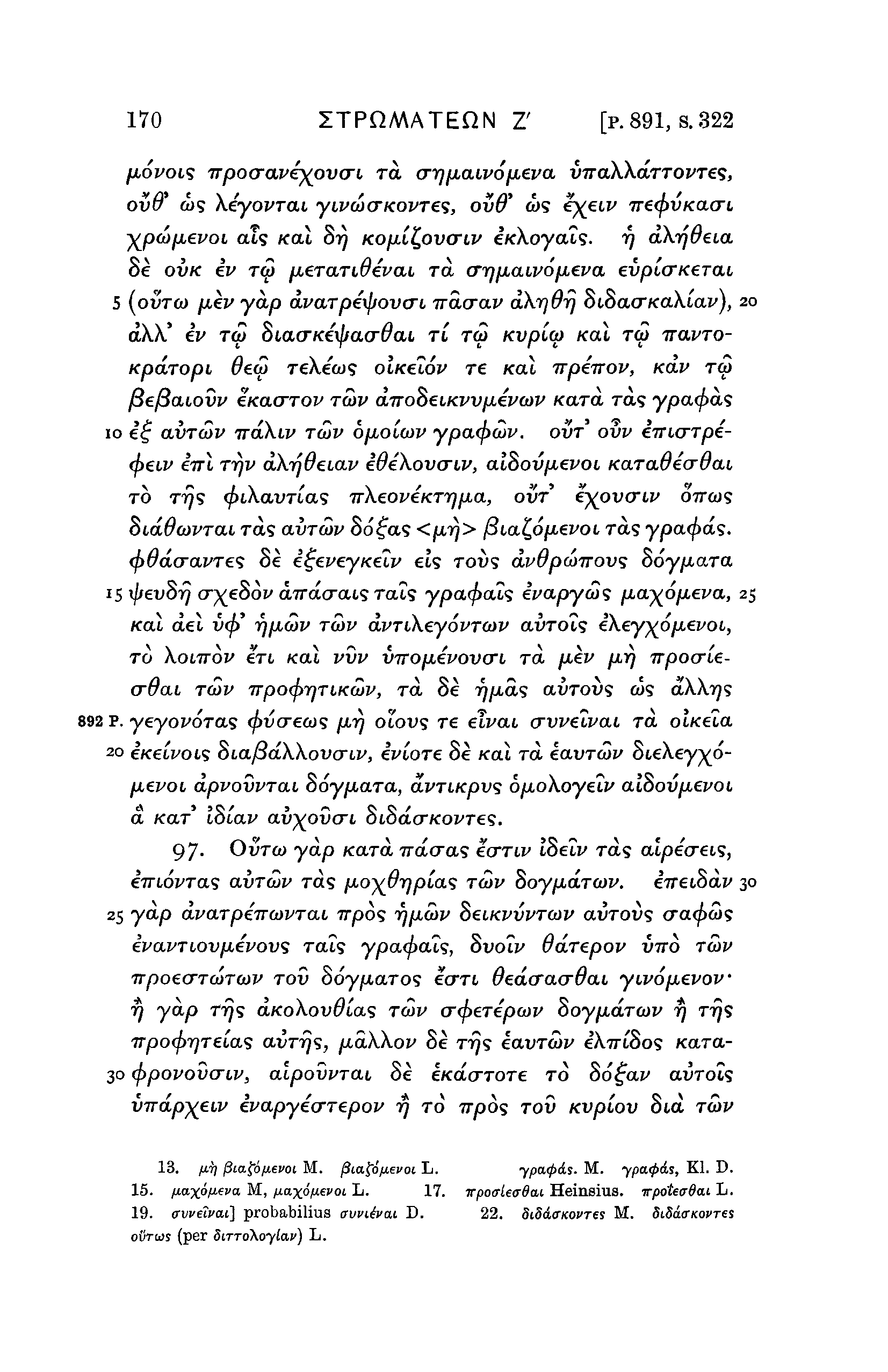
[p.891, s.322 fjiovois vpoo~ave)(ovo~i TO. cnjfiaLvojJLeva imaWaTTOVTes, ovff o>s Xeyovrai yivaxTKovTes, ovd* <ws ^X^ir 7re<j>vi<ao~L
Xp(LlxevoL afs Kal Srj /co/u£oucrii' e/cXoyats. r) dh/jdeia Se OVK iv ra peraTidivai TO. a-r^yLaiv6p.€va evptcr/ceTai 5 (oi!ra) ixkv yap dvaTpexpovcn iracrav dXrjdrj SiSacrKaXiav), 20 aXX.' eV TftJ Siacr/cei/facr^ai, r t T&> KvpCco Kal TC5 iravroKpdropi
Oeco rekecos oifcetdv re /cat npdirov, xdv T&5 fiefiaiow eKacrrov TS»V aTroSeuKw/JLevcov Kara ras ypa<f)a<;
10 e^ aurali' TTOXLV TCOV ofjuoCcov ypa(f>wv.
OVT' OVV krrKjrpi- (j>£LV ei7t TTJV dkrjOeiav idiXovcriv, aiSoTJfievoL Karadicrdai
TO TTJS ^iXavTias ir\eoveKTiqp.a, OVT e^ovcrtv O7TOJS SidOaiVTai Tas avTcov Sofas <[*?)> ySia^o/ievot ras ypa<j)ds.
(f>6do~avTe<; 8e i^eveynelv ets rows dvOpanrov; BoypaTa 15 ijjevSrj o~xe8ov aTracrais rais ypa$>ai% ivapyais
[iayo\Leva, 25 /cat ae! v<j!)' 17/x.wf raif avriXeyoyrftiv auTot? eXey^o/Aevot, TO XOITTOI> IVt /cat i/uv VTro^ivovo'i T<X [xkv /JLYJ Trpoo~Lecrdai TSV 7rpo<f>r)TLK0jv, T<X Se i7/x,as avrous ws aXXijs
892 p. yeyovoras (^vcrews /AT) otous Te etvat crvvetvai TO. ot/ceta 20 e/cetwis StaySaXXovcrtv, ivCoTe Se /cat T<X eauTwi/ SteXey^ofjL€voi dpvovvTat Soy/AaTa, avTiicpvs ofAoXoyeLV atSov/xej/ot a Kar' tStav au^oucri SiSacr/covTes.
97OUTW yap /cam 7racra? eo~Tiv tSetv Tas atpe'crets, eTrtovTas avTGjp Tas po^Or)ptas T<3^ Soy/MaTcov. iTreiSdv 30 25 yap dvaTpeiroivTai irpos 17)110)^ Set/«'ui'Ta)i' auTous cra<^)5s
Tat? ypa^at?, Suoti' daTepov
VTTO T£>P
TOV SdyjaaTos e o n 6edo~ao-0ai yivofievov rj yap TTJS dico\ovd£as TCOV o~^>erepo)v SoyfjiaTov r\ TT}S Trpo<j>7]TeCa<; avTrjs, /xaXkov Se TTTJS iavTWV CXTTISOS Kara30 (f>povovo-Lv, alpovvTai Se e/cao"TOTe TO 86£av ivapyecrTepov rj TO Trpos TOU KVpiov Sia 13.
/ir/ ^lafo^eKoi M. /3iafoVe"O( L. ypa.<f>&s. M. ypa<j>ds, Kl. D.
15. ftaxoftca M, 1xa.x6iJ.evoL L.
17. irpotrleaBtu Heinsius.
Tpote<r$ai L.
19.
(rvveivaC] probabilius awUvu D.
22. SiSciff/coi'Tes M.
(per 5iTToXo7!a»') L. https://doi.org/10.1017/CBO9780511695513.010 Published online by Cambridge University Press
C. XVI. §§ 96, 97]
MISCELLANIES, BOOK VII.
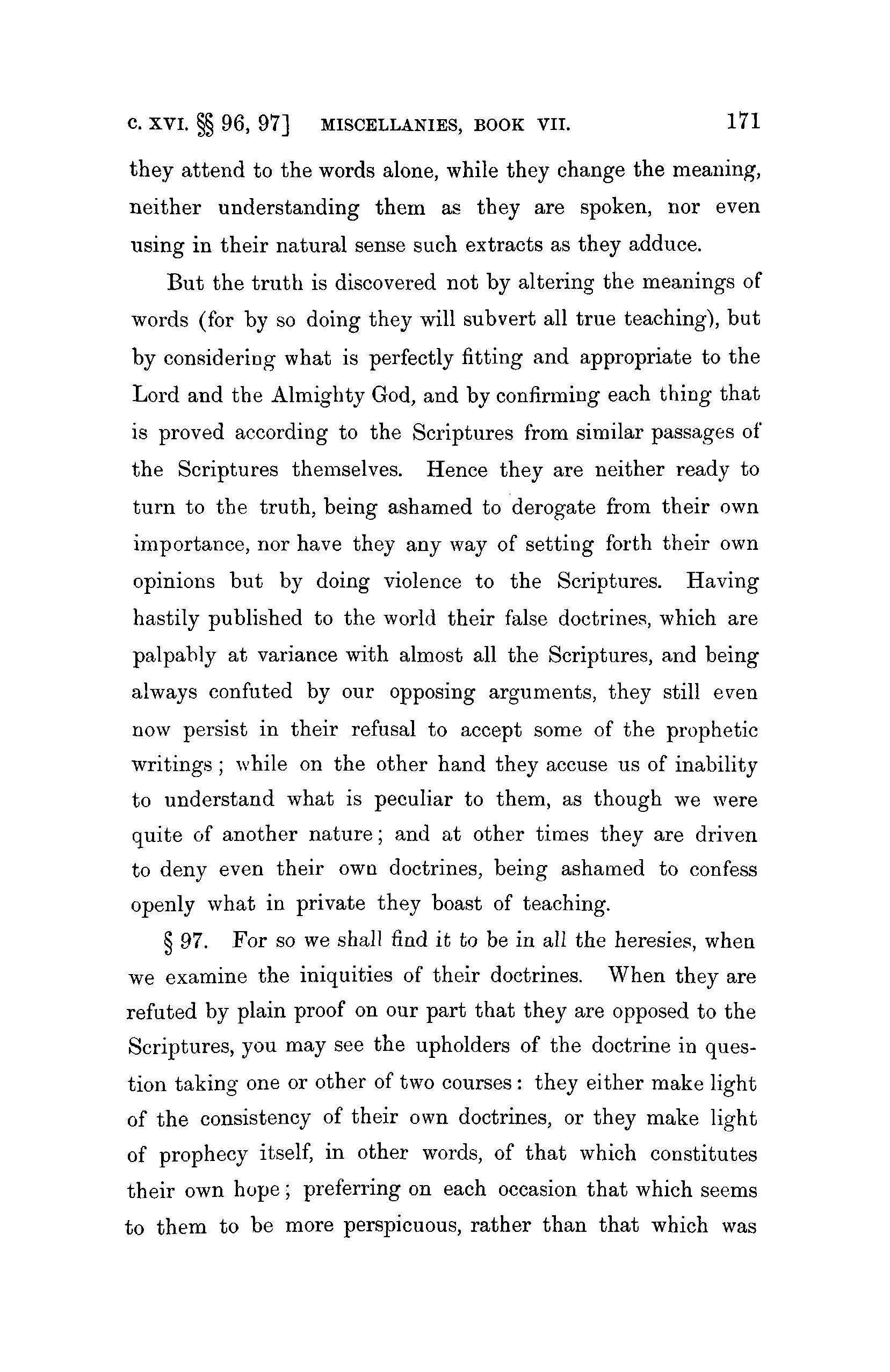
they attend to the words alone, while they change the meaning, neither understanding them as they are spoken, nor even using in their natural sense such extracts as they adduce.
But the truth is discovered not by altering the meanings of words (for by so doing they will subvert all true teaching), but by considering what is perfectly fitting and appropriate to the Lord and the Almighty God, and by confirming each thing that is proved according to the Scriptures from similar passages of the Scriptures themselves. Hence they are neither ready to turn to the truth, being ashamed to derogate from their own importance, nor have they any way of setting forth their own opinions but by doing violence to the Scriptures. Having hastily published to the world their false doctrines, which are palpably at variance with almost all the Scriptures, and being always confuted by our opposing arguments, they still even now persist in their refusal to accept some of the prophetic writings ; while on the other hand they accuse us of inability to understand what is peculiar to them, as though we were quite of another nature; and at other times they are driven to deny even their OWD doctrines, being ashamed to confess openly what in private they boast of teaching.
| 97. For so we shall find it to be in all the heresies, when we examine the iniquities of their doctrines. When they are refuted by plain proof on our part that they are opposed to the Scriptures, you may see the upholders of the doctrine in question taking one or other of two courses : they either make light of the consistency of their own doctrines, or they make light of prophecy itself, in other words, of that which constitutes their own hope; preferring on each occasion that which seems to them to be more perspicuous, rather than that which was https://doi.org/10.1017/CBO9780511695513.010 Published online by Cambridge University Press
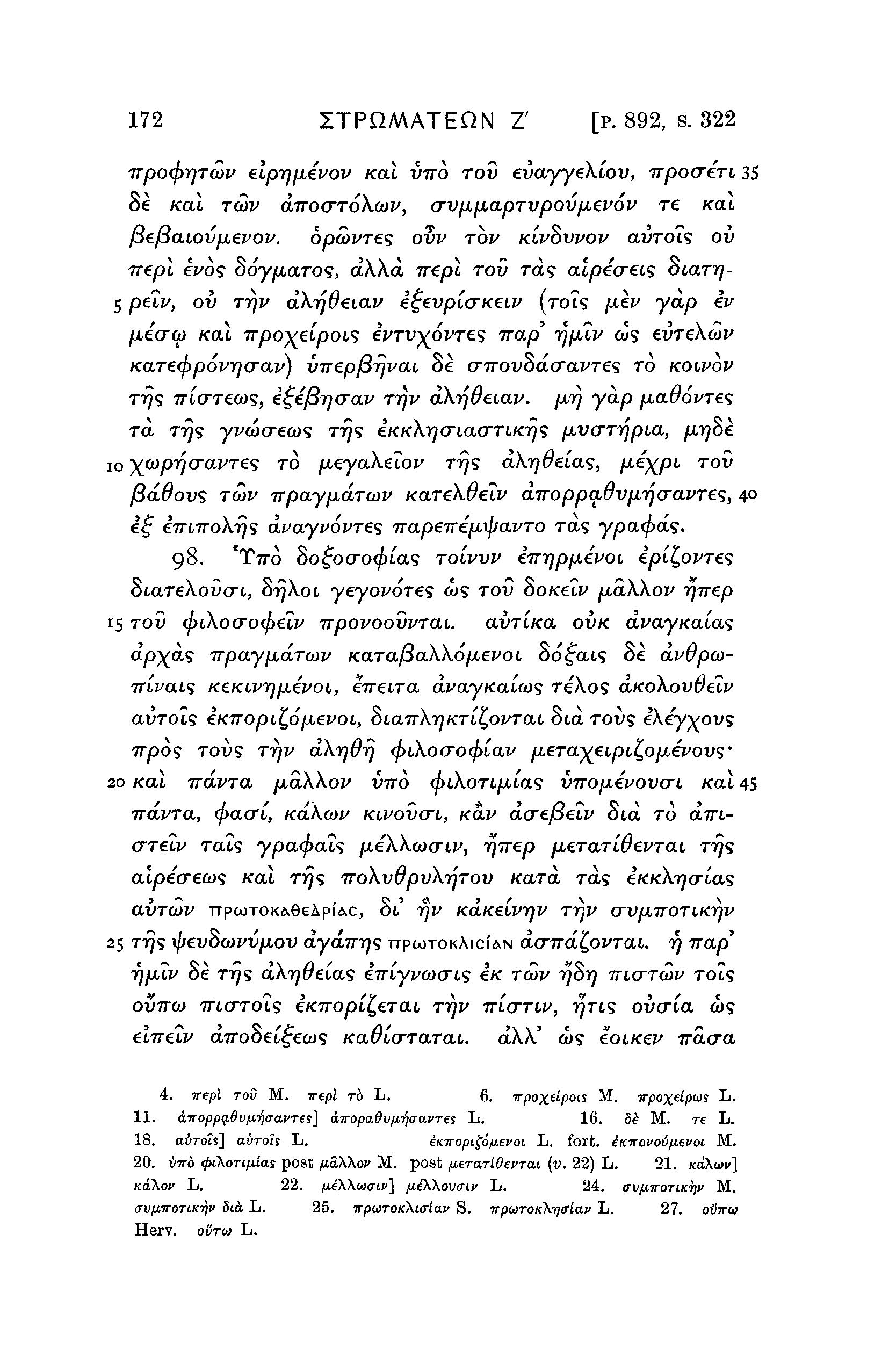
ZTPQMATEQN Z
[p. 892, s. 322 v eipTj/xevov /cat VTTO TOV evayyeXuov, irpocreTL 35 Se /cat T5>V aTTOcrroXwv, o~Vfifx,apTvpovfJiev6v re /cat fie/SaLOV/Atvov. bpu>vre<; ovv TOV KCVSVVOV auToIs ov TTf.pl ivos SoyjLtaros, a\Xa Trept TOV T<XS atpeVets
5 petv, ov Tiyj' akrjdeiav efeuptcr/cetv (TOIS /u.e^ /aecrw /cat Trpo^etpots eVru^ovres Trap' ^jatv cos
KaT€(f)p6vrjaav) vTrepfifjvcu §e o-T7ou§acravTes TO KOIVOV Trjs Trtcrrews, l^i^rfo-av Trjv aXyjOeuav. p,rj yap ret T^S yvcoo-ecos TTJS e/CKXijcrtacrTt/c^s io yo)prjO-<xvT£<i TO [xeyakelov TTJ? akrjd fiddows TWV TTpayjx(XTOiv KaTekdelv diroppadvjjirjaavTe<;, 40 e£ e77t7roX7js dvayvovT€<i Trapeire^avTO
-ras ypa(j>d<;.
98.
'TTTO Sofocroc^ta? TOLVVV €Trr)p^ivoi £pi£,ovT€.<; hiaTekovai, S77A.01 yeyovores ws TOU So/cett' ^iaXkov -rjirep
15 TOU (f>uXoo~o(f)elv npovoovpTai. avrt/ca ov/c avay/cata? as TTpayixdTGJv KaTa/3a\\6fjLevoL Sofats Se dvOpcoK€.Kivr)p.ivoi, evretra dvay/catws TeXos dxoXovBelv avrols tKiropitp[xevoi, hiaTrXrjKTitpvTai Sta. rovs vrpos TOUS T17V d\rjdrj ^Ckoao^iav jL 20 /cat TrdvTa fxdWov VTTO <£iXoTt/Luas vno/jLevovaL /cat 45 trdvTa, <f>ao~i, Kakotv KLVOVO~L, KOLV dcreySetv Sid TO aTTtcrretv Tai9 ypa^at? jxeXXojcrcv, rjnep fi,eTaTiOevTat. alpecrecos /cai T^S TTo\vdpvkrjTov KaTa. rds e/ a.vT<ov npooTOK^eeApiAC, St' r/v KdKeCvrjV Trjv
25 TTJS ^ievSctivv/JLOV dyaTrrjs npcoTOKAicf&N dcnrdtpvTai. r] Trap rjfjuv Se T?ys d\.r)0eia<; eVtyi'Coo'is e/c TWV T^S^ TTIO-TWV rots
OUTTft) TTtCTTOtS kKTTOpitfiTO.1
TTjV 7TL0~TLV, I^TtS 0V0~la COS etTreti' d7roSet^eciJS Ka6io~TaTai. dW cos eot/cev 4. trep! TOO M. irep! T6 L.
6. irpoxeipois M. irpoxdpws L.
11. dTrop/jpfhijUTJo-aPTes] airopa.9\ifi,^aavTa L.
16.
5^ M. re L.
18. a&rcus] avrols L. iKiropi^o^evoL L. forfe. €Kirovo6fi€voi M.
20. ii7ro (pikoTi.iJ.las post fiaWov M. post fieTarlOevrai (v. 22) L.
21. /caXwp] KaXop L.
22.
^XXwtrip] /ie'XXouo-iy L.
24. aviJ.irorLKT]v M.
{jviAiroTLtcqv 5id L.
25. irpb3Toit\i(Tlo.v S.
TTpitiTOKk'qfflav L.
27. Qiiiroj Herv. ofira L. https://doi.org/10.1017/CBO9780511695513.010 Published online by Cambridge University Press
C. XVI. §§ 97, 98]
MISCELLANIES, BOOK VII.
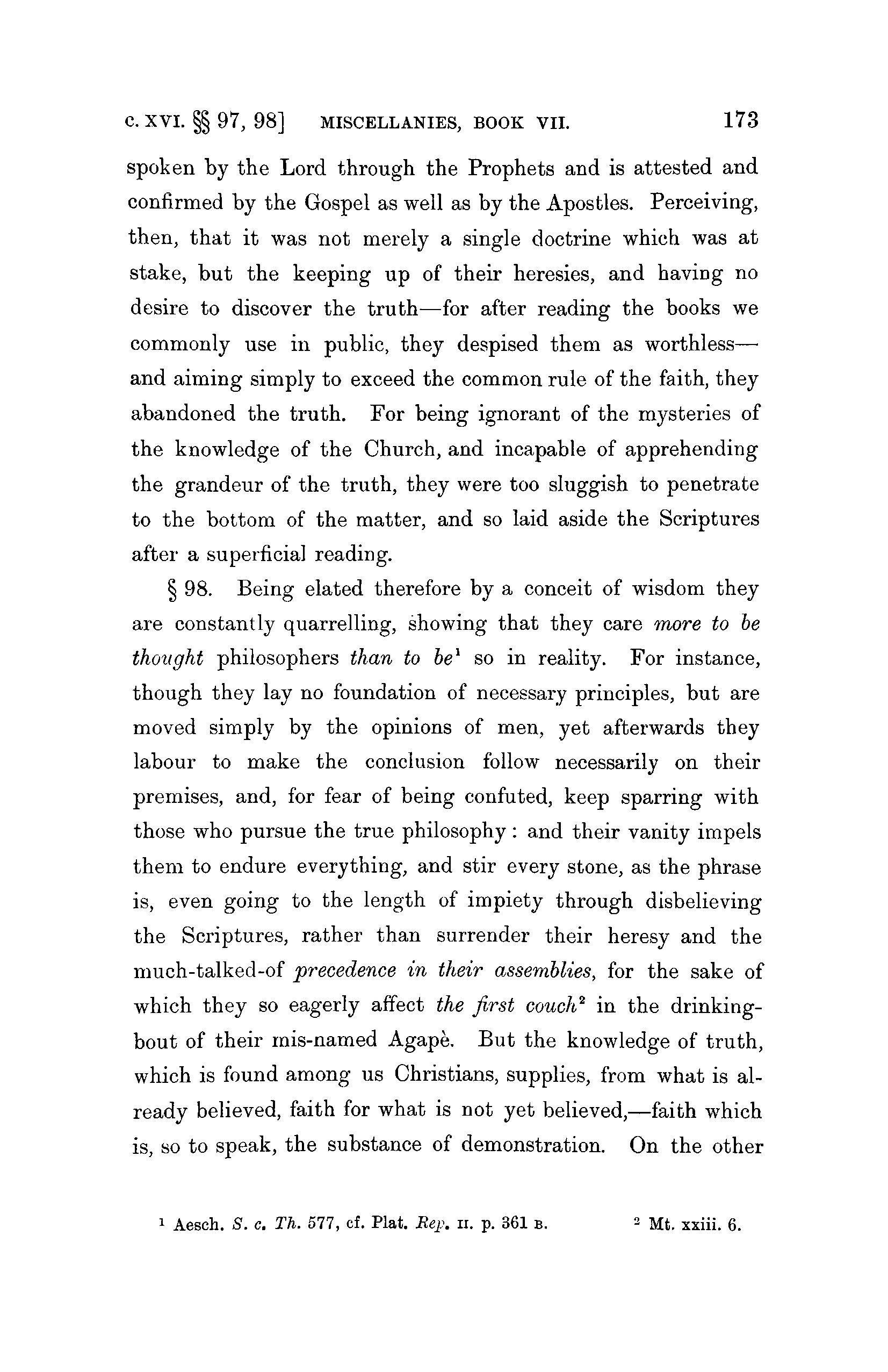
spoken by the Lord through the Prophets and is attested and confirmed by the Gospel as well as by the Apostles. Perceiving, then, that it was not merely a single doctrine which was at stake, but the keeping up of their heresies, and having no desire to discover the truth—for after reading the books we commonly use in public, they despised them as worthless—• and aiming simply to exceed the common rule of the faith, they abandoned the truth. For being ignorant of the mysteries of the knowledge of the Church, and incapable of apprehending the grandeur of the truth, they were too sluggish to penetrate to the bottom of the matter, and so laid aside the Scriptures after a superficial reading.
§ 98. Being elated therefore by a conceit of wisdom they are constantly quarrelling, showing that they care more to be thought philosophers than to be1 so in reality. For instance, though they lay no foundation of necessary principles, but are moved simply by the opinions of men, yet afterwards they labour to make the conclusion follow necessarily on their premises, and, for fear of being confuted, keep sparring with those who pursue the true philosophy : and their vanity impels them to endure everything, and stir every stone, as the phrase is, even going to the length of impiety through disbelieving the Scriptures, rather than surrender their heresy and the much-talked-of precedence in their assemblies, for the sake of which they so eagerly affect the first couch* in the drinkingbout of their mis-named Agape. But the knowledge of truth, which is found among us Christians, supplies, from what is already believed, faith for what is not yet believed,—faith which is, so to speak, the substance of demonstration. On the other
1 Aesch. S. c. Th. 577, cf. Plat. Rep. n. p. 361 B.
"- Mt. xxiii. 6. https://doi.org/10.1017/CBO9780511695513.010 Published online by Cambridge University Press
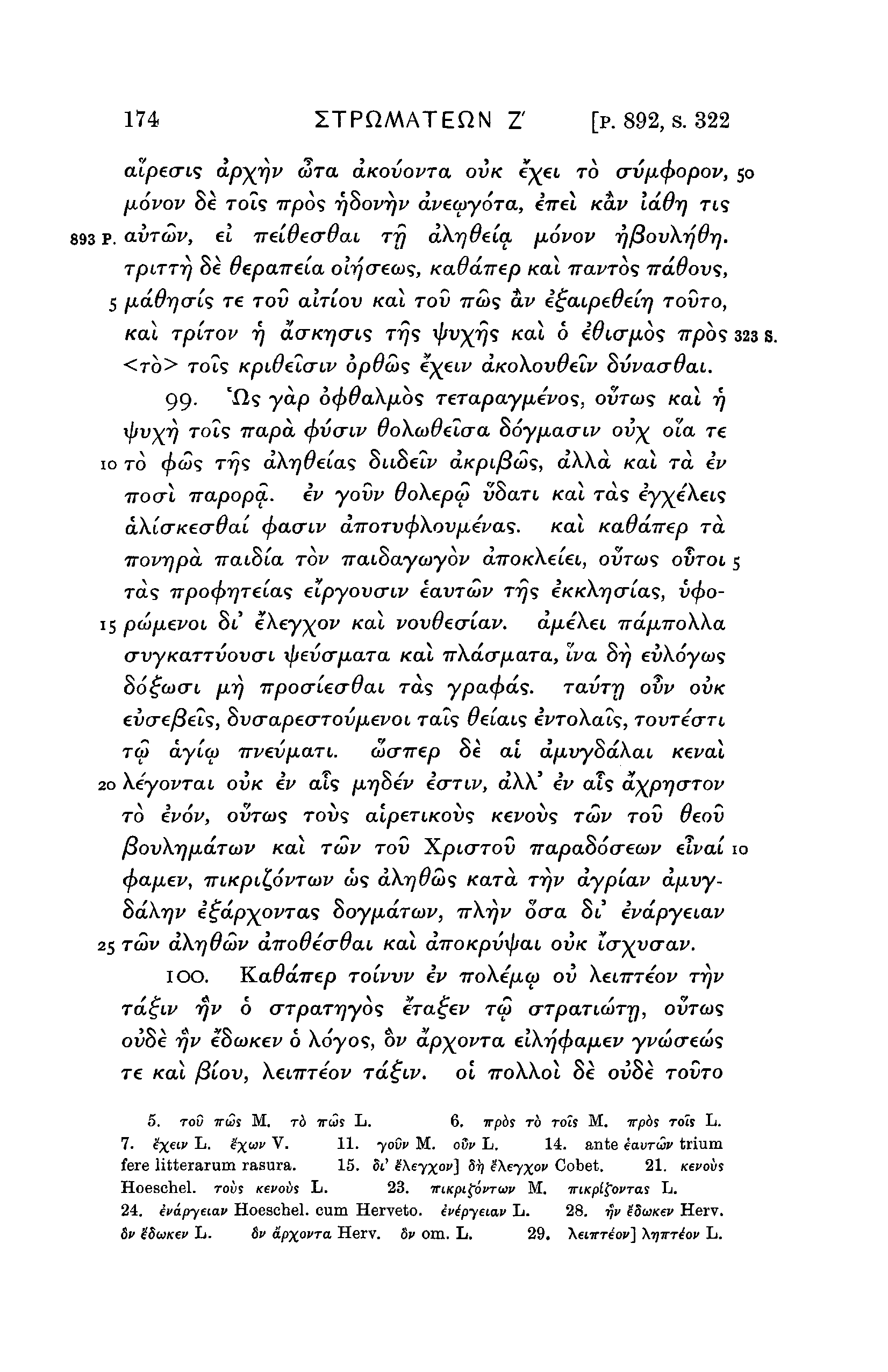
ITPQMATEfiN Z [p. 892, s. 322 alpecris dpxVv ^Ta dKovovTa OVK e^ei TO crvfi^opov, 50 fxovov Se TOIS 7rpos rfiovr)v dveioyora, eVei KOLV Iddr) TIS
893 P. avrcov, el w€i,6eo~0aL rfj dXrj&eCa [x.6vov rjfiovXrjOr).
TpLTTTj Se depaireia olrjo~ta><;, Kaddnep /cat TTOLVTOS irddovs, 5 fidOr/aCs Te TOV alnov KGLL TOV TTOX; av i^aipedeCr) TOVTO, KCU Tpirov rj ao-Kr)cns rrjs '//VX17? K a ' ° ^tcr/nos npbs 323 s.
<rb> TOIS Kpidtiaiv bpdSy; exetI/ dKoXovOtlv hvva.o~6ai.
99.
'Us ya/3 6(f>6akfx.bis TeTapayfievos,
OVTCOS KCLL TJ
*pv)(r) TOIS napa (J)VO~LV OoXcoOelo-a SoyfiaaLV ov^ ota re IO TO (^a>s T17S dX^^eias SuSeii' aK/3iySaIs, aXXd /cai TO. ei'
7roa"t. Trapopa. iv yovv 6o\ep(p uSaTi Kat Tas ey^eXei? aXCcKeadaC <f>ao~iv diroTv^kovfjLiva';.
KOLI Kaddirep TO.
TTovrjpd TratSta TOV iraiSaycoyov aTTO/cXetet, OVTCJS OVTOL 5 Tas vpo(f)rjTeia<; elpyovaiv eavrcov TTJS e/cK:\ijcrtas, u</>o15 p(itjj.€VOL Si' iXey^ov Kat vovOeaiav. ayxeXet TrdfnroXXa o~vyK<XTTVovo~L xfjevcT/JiaTa KOI TrXdafiaTa, tVa Si) evXoyws
So^wcrt JU,I) Trpoarleadai Tas ypa<f>d<;. TGLVTT) OVV OVK evcreySets, 8vo~apeo~Tov/ji€vot Tats ^etats ei'ToX.ats,
TW aytw TTvevfJiaTt,. wairep Se at dfivySdXau 20 Xeyovrai OVK iv ats fi-rjhev icrnv, dXX' iv afs TO et-ov, OUTOJS TOVS aip€TiKoi><; KGVOVS TCOV TOV deov
^ovXrjjjidTOiV Kat T W TOU Xpto"Tou 7rapaS6o~€<t)v cxvax 10 (j>a[j,€v, TriKpitpvTOiv ws dXrj65><; Kwrd TTJV dypCav dfj.vyBdXrjv efap^ovTas SoyfJidrcov, irXrjv oara. Si' ivdpyeiav 25 T&iv dXrjdwv dirodicrdai /cat diroKp-uxfjai OVK tcr^ucrai'.
100.
Kaddirep TOIVVV iv voXe/xa) ov XeiirTeov Ta^iv rjv 6 (TTpaTrjyos eTatjev TO! o~TpaTL(OTjj, ovSe 971^ iScoKev 6 Xoyos, oi» dpxovTa elXrj<f>afjLev
TC /cai /Stou, XZITTTCOV Ta^iv. ol 7roXXot Se ouSe TOVTO 5.
TOO 7rc5s M. T6 TTUS L.
6. 7rp6j TO TOIS M. irpis TOIS L.
7. fjceo" L. ?xw" V11. 70ft' M. offf L.
14. ante eaurai' trium fere litterarum rasura.
15. Si' IXe-yxoi'] ST) ?\e7^oi' Cobet.
21. /ceeovs Hoeschel.
TOUS Kevoi/s L.
23. iriKpifoiraic M. inKplfrvTas L.
24. ivapyeiav Hoeschel. cum Herveto. ivtpyuav L.
28. i^ iSuKev Herv. fiv '{SbiKtv L. fiv apx<""'a Herv.
8» om. L.
29. AeiirTeox] \rjirTiov L. https://doi.org/10.1017/CBO9780511695513.010 Published online by Cambridge University Press
C. XVI. §§ 98-100]
MISCELLANIES, BOOK VII.
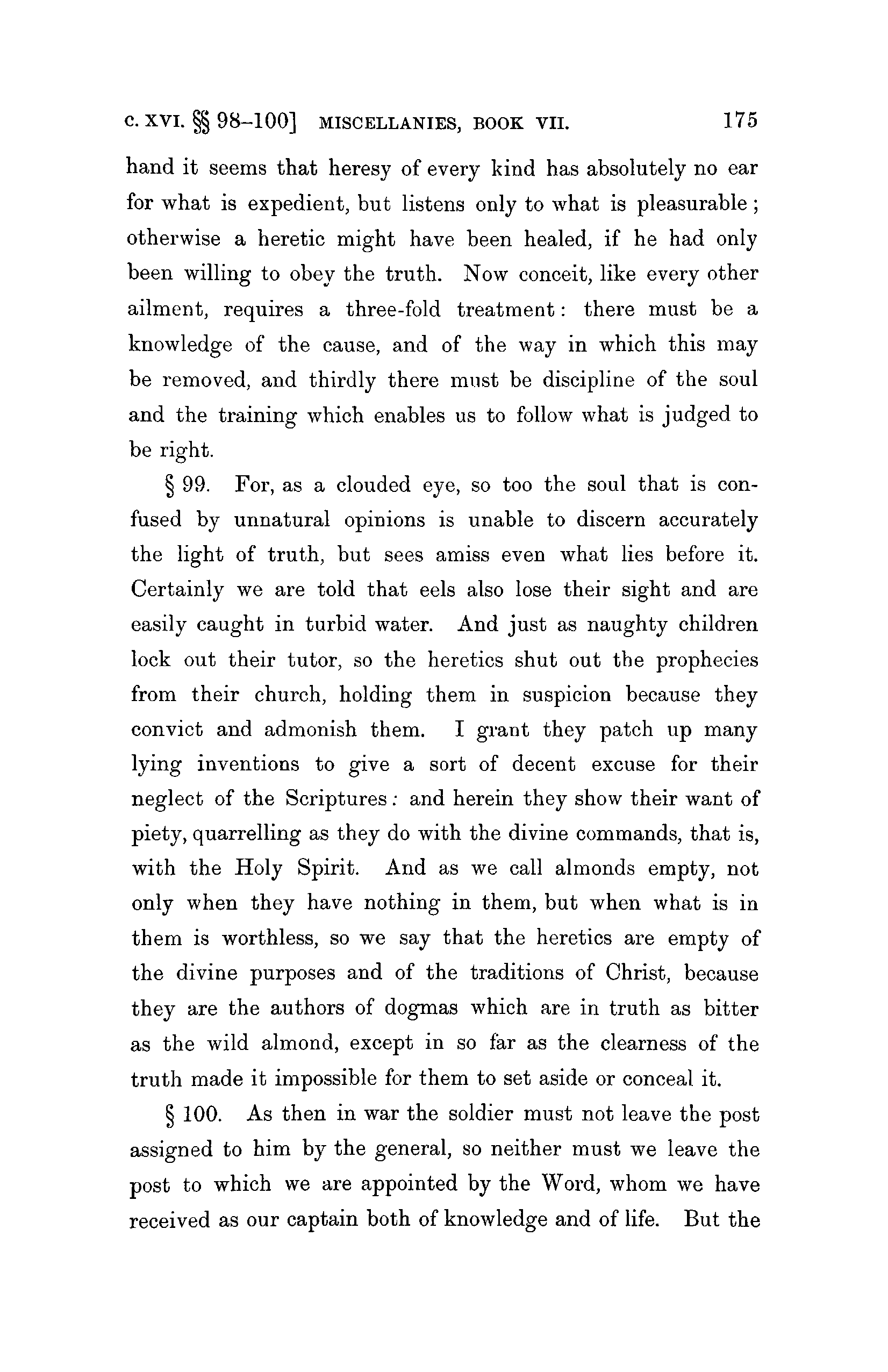
hand it seems that heresy of every kind has absolutely no ear for what is expedient, but listens only to what is pleasurable ; otherwise a heretic might have been healed, if he had only been willing to obey the truth. Now conceit, like every other ailment, requires a three-fold treatment: there must be a knowledge of the cause, and of the way in which this may be removed, and thirdly there must be discipline of the soul and the training which enables us to follow what is judged to be right.
§ 99. For, as a clouded eye, so too the soul that is confused by unnatural opinions is unable to discern accurately the light of truth, but sees amiss even what lies before it.
Certainly we are told that eels also lose their sight and are easily caught in turbid water. And just as naughty children lock out their tutor, so the heretics shut out the prophecies from their church, holding them in suspicion because they convict and admonish them.
I grant they patch up many lying inventions to give a sort of decent excuse for their neglect of the Scriptures: and herein they show their want of piety, quarrelling as they do with the divine commands, that is, with the Holy Spirit.
And as we call almonds empty, not only when they have nothing in them, but when what is in them is worthless, so we say that the heretics are empty of the divine purposes and of the traditions of Christ, because they are the authors of dogmas which are in truth as bitter as the wild almond, except in so far as the clearness of the truth made it impossible for them to set aside or conceal it.
§ 100. As then in war the soldier must not leave the post assigned to him by the general, so neither must we leave the post to which we are appointed by the Word, whom we have received as our captain both of knowledge and of life. But the https://doi.org/10.1017/CBO9780511695513.010 Published online by Cambridge University Press
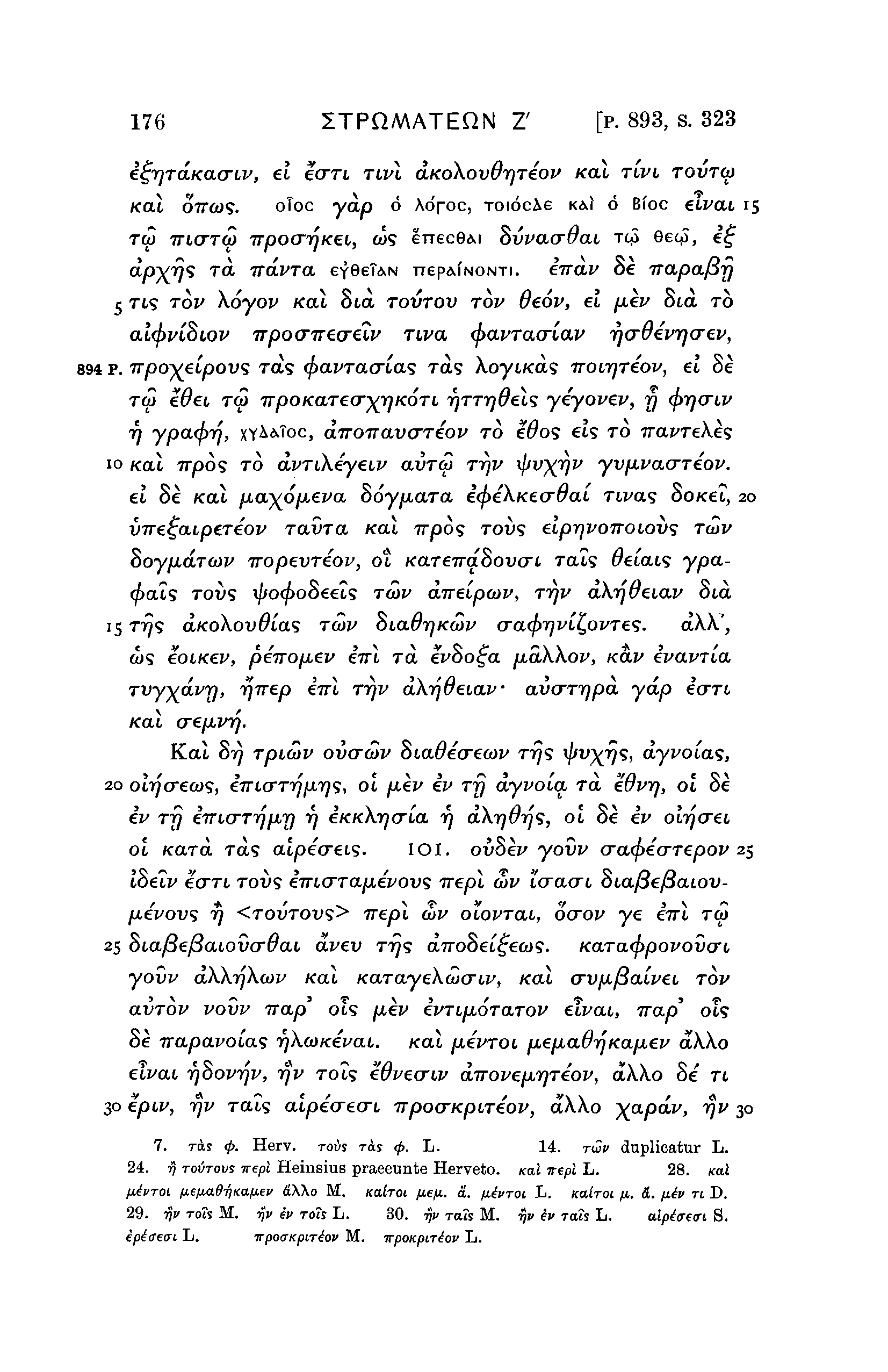
ITPQMATEQN T
[P. 893, s. 323 i£r)Ta.Ka.<Tiv, el ecm TLVL aKokovdr^Teov Kal TLVL TOVT<O Kal oTTft)?. oToc yap 6 Adpoc, TOIOCAG KA.} d Bfoc elvau 15
TW TTICTTW TrpoarrjKei, G$S eTTecGAi hvvacr0ai TC£ 6ec^, ef apy^S TOL TtdvTa ey6eTAN nepAfNONm. hrdv Se vapafifj 5 TIS TOI' Xoyov /cai 8ta TOVTOV TOI' ^eov, et /x.ez/ Sta. TO ai(f>viSiov Trpoo~Treo~€lv Tiva <j>avTao~iai> 7]O'64vrjO'e.v, 894 p. Trpoyeipovs ras ^ai^racrias Tas XoyiKa? TTOVY)T4OV, el Se
7w e^ei T&3 TrpoKarecr^/cori r)TT7]0el<; yiyovev, fj <§>r\cn,v r\ ypa<f>rj, XY^^OC, dirotravo'Tiov TO e6o<; eis TO 7ravTeX.es io Kal Trpos TO avTikeyeiv aurw T^V \JJV\7]1' yvfJivacrTeov. el 8e Kal ^a^ojueva 8oy/i,aTa e<f>ekKeo~dai Tivas So/ce?, 20 vire^atpereov TavTa Kal irpos TOUS elpr)vo7roioi><; TCDV SoyixaTeov iropevTeov, ot KaTeiraSovai. Tals deiais ypa- (^als TOWS \jJO(j)oSee'L<; TCOV dneipcov,
TTJV dkrjdeiav Sta, 15 T17S aKoXovdias TCOV SiadrjKwv o'a(j>r]VL£)ovTe<;. aXX', ws eoLKev, pe-nopev eirl TOL evSo^a [JLHWOV, KOLV ivavTia TvyyavQ, r\irep inl Trjv d\rjdeiav aucrr^pa yap eo~Ti Kal o~efjLvrj.
Kal 877 TpL(ov ovaaiv htaOeo-eoyv Trjs i/zu^s, dyvoias, 20 olyjo-€(i)<;, iTTLaTTJ^ir/s, oi jxev ev Trj dyvoiq
TO. edvrj, ol 8e ev TTJ etno-Trjixr) 77 e/cKATicrta 17 ahqurj^, ov oe ev oirjo-ei ol KaTa Tas atpe'crets.
101. ouSev yovv aa<f>eo-Tepov 25 tSelv cart TOVS e7rto"TajU,eVovs Trepl w iVao-i Siay8e/8atov- /xeVovs 77 <TOVTOVS> Trepl we olovTai, ocrov ye eVl TOJ
25 StaySeySatouo'^ai aveu T77S avroSei^ews. KaTa<f)povovcri, yovv aXkr\K(j>v Kal KaTaye\ajo~i,v, Kal avjx^aivei vouv Trap 01s /xev evTifxoTaTOV elvai, nap" ol?
Se Trapavoias r/XcoKevai.
Kal /xevTOi /jLe/xadyjKa^ev dkko elvau 77S0V77V, 77V TO ts eOveo-w dirove^Teov, aXXo Se Tt 30 epiv, 77V Tais aipeo~eo~L ~npoo-Kpneov, aXXo yapdv, rjv 30 7.
Tas 0. Herv. roils ras 0. L.
14. ran duplioatur L.
24.
17 ToiJTovs irepl HeinsiuB praeeunte Herveto.
Kal Trepl L.
28. Kal ixivroi 11eiJ.adiiKaiJ.ev aXXo M.
/cairoi ftefj,. 0. ^ ^ T O I L.
KO(TOI p. &. piv n D.
29. jje TOIS M. ^V ev rots L.
30. 17X rats M.
^K ^K rais L. alpe'treei S. eptaeai L.
TrpoaKpniov M. irpoKpiTe'ov L. https://doi.org/10.1017/CBO9780511695513.010 Published online by Cambridge University Press
C. XVI. §| 100, 101] MISCELLANIES, BOOK VII.
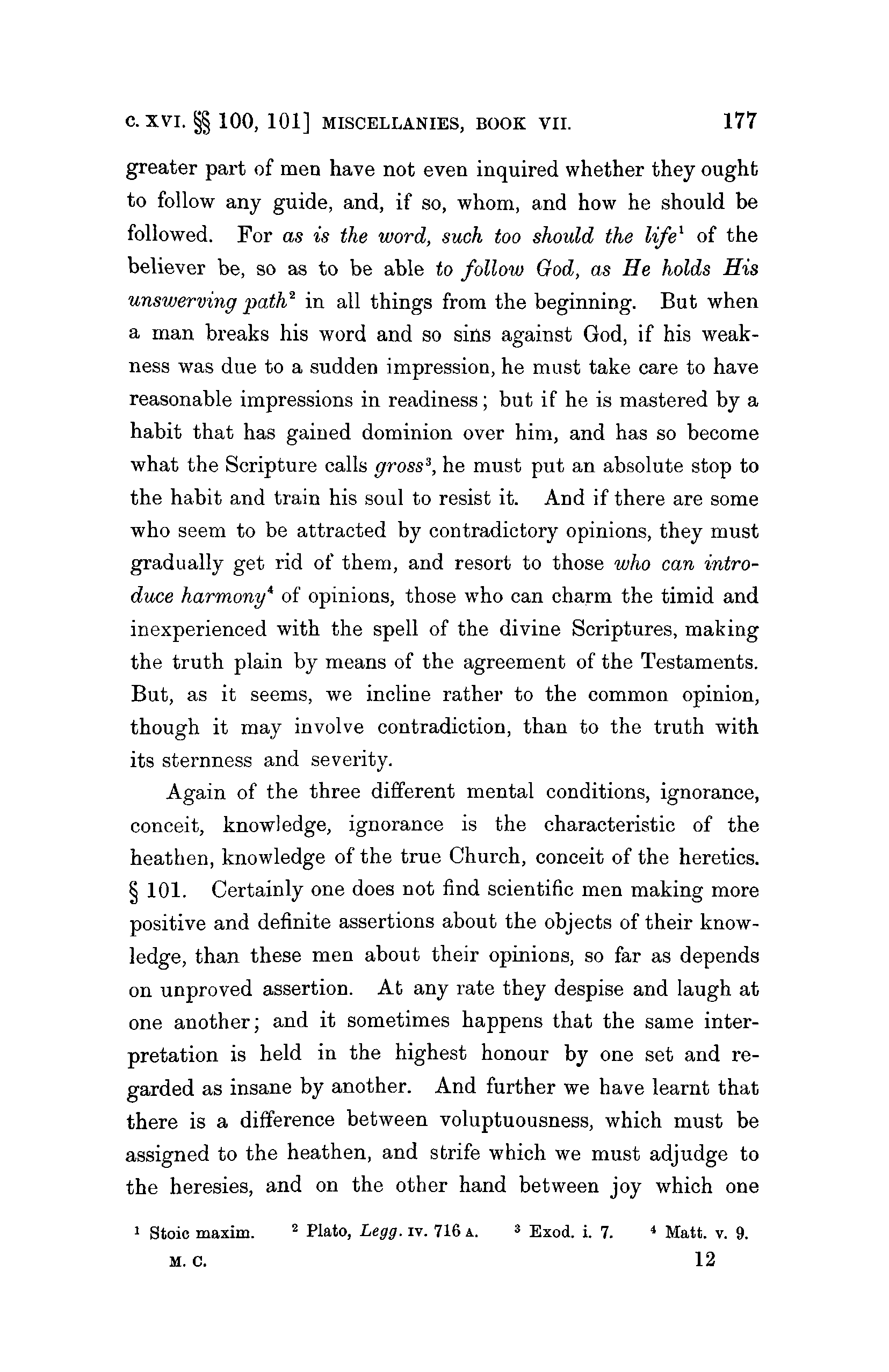
greater part of men have not even inquired whether they ought to follow any guide, and, if so, whom, and how he should be followed. For as is the word, such too should the life1 of the believer be, so as to be able to follow God, as He holds His unswerving path2 in all things from the beginning. But when a man breaks his word and so sins against God, if his weakness was due to a sudden impression, he must take care to have reasonable impressions in readiness; but if he is mastered by a habit that has gained dominion over him, and has so become what the Scripture calls gross3, he must put an absolute stop to the habit and train his soul to resist it. And if there are some who seem to be attracted by contradictory opinions, they must gradually get rid of them, and resort to those who can introduce harmony* of opinions, those who can charm the timid and inexperienced with the spell of the divine Scriptures, making the truth plain by means of the agreement of the Testaments.
But, as it seems, we incline rather to the common opinion, though it may involve contradiction, than to the truth with its sternness and severity.
Again of the three different mental conditions, ignorance, conceit, knowledge, ignorance is the characteristic of the heathen, knowledge of the true Church, conceit of the heretics.
§ 101. Certainly one does not find scientific men making more positive and definite assertions about the objects of their knowledge, than these men about their opinions, so far as depends on unproved assertion. At any rate they despise and laugh at one another; and it sometimes happens that the same interpretation is held in the highest honour by one set and regarded as insane by another. And further we have learnt that there is a difference between voluptuousness, which must be assigned to the heathen, and strife which we must adjudge to the heresies, and on the other hand between joy which one
1 Stoic maxim.
2 Plato, Legg. iv. 716 A.
* Exod. i. 7.
4 Matt. v. 9.
M. C.
https://doi.org/10.1017/CBO9780511695513.010 Published online by Cambridge University Press
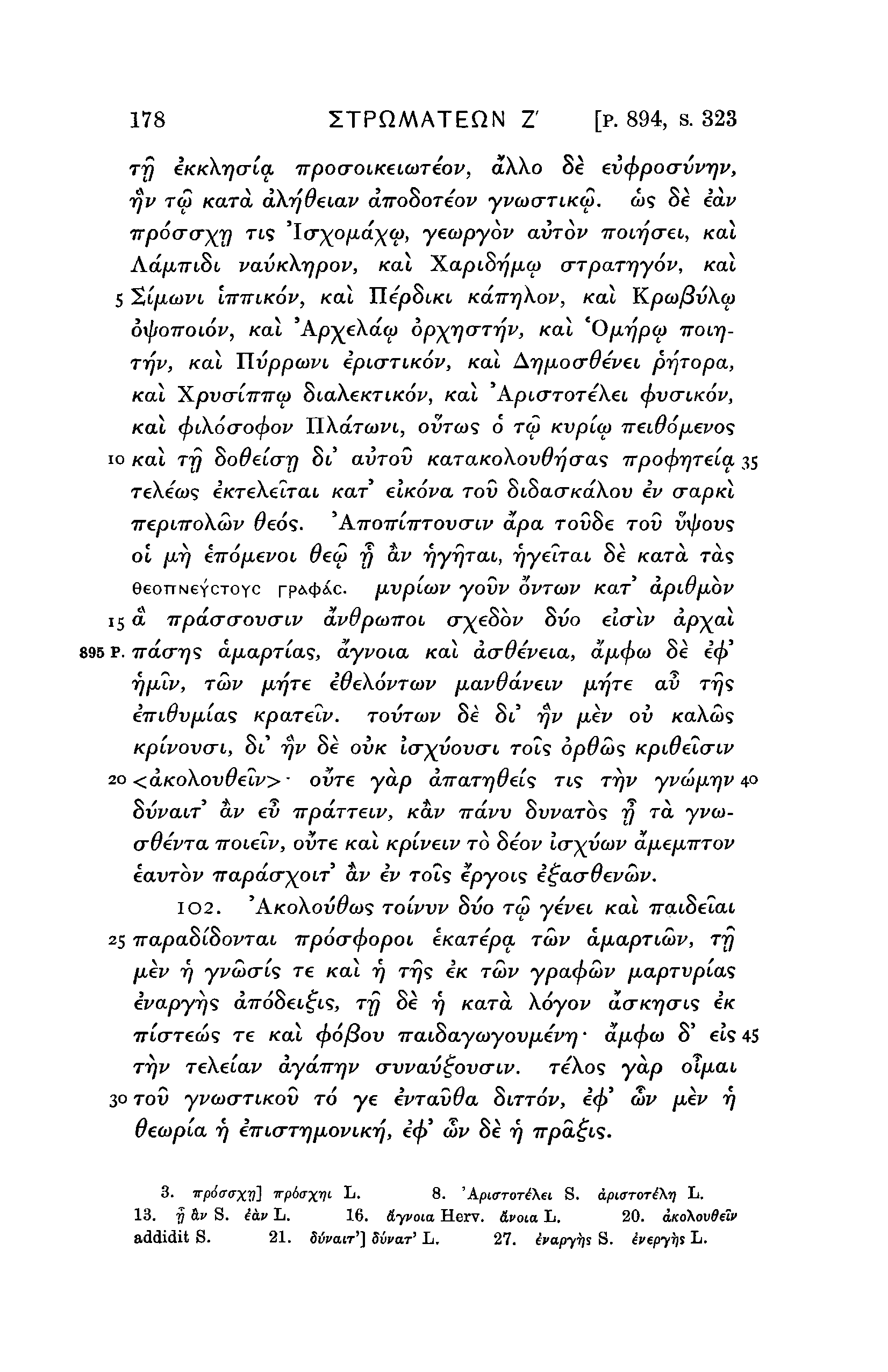
5TPQMATEQN T
[P. 894, s. 323
TTJ €KK\r)(rCa irpocroiKeioiTeov, dXXo Se ev(f>poavvr]v, rjv Tw Kara dXrjdeiav aVoSoreov yvuo'TLKM. ws Se idv Trp6ao"xrj n s 'Icr^O|U,a^<M, yeapyov avrov Tronjcrei, xal Aa/X7ri8t vavKkrjpov, Kal XaptS^jnai cnparrpfov, /cat 5 Xl/JLCtiVL LTTTTIKOV, KCll HepSiKI, KaTTrjXoV, Kal
KpG)ftv\(p OXIIOTTOLOV, Kal 'Ap-^eXda) 6pyri<TTiqv, KOL Ofxrjp(a iroiffTrjv, Kal Tlvppcovt ipurriKov,
Kal Arj/jLocrOevei prjropa, l ~KpvcriTnT(p SiaXeKTLKov, Kal 'AptaroTeXei <$>V<TIKOV, l <f)tkocro(j)oi' IlXdrcovL, ourws d T&I Kvpiw TT€I66JX€VO<;
IO Kal rfj SodeCa-r/ Si avrov KaTaKoXovdrjaa<; Trpo^reia. 35 iKTeXelrai /car' eixova TOV SiSacrKaXov iv crapKL v deos.
''K.iro'n'nrTovcviv dpa rovhe TOV VXJJOVS ol fx,rj eTro/xevoi dew y av riyrJTai, r/yeiTai Se /cara. ras
66OTTN6YCTOYC rP*-4>^C.
[LVp'lOiV yOVV OVTtoV KWT dpi6flOV 15 a irpdo~(Tovo~iv dvdpunroi cry^eSov Svo elo-lv dp-^al 895 P. irdo~rj<; dju,a/3Ttas, dyvoia KOI dcrdeveta, dfx^ca Se e^)'
TU>V fj/qTe WeXovTotv ^avOdvetv jJirJTe ai) KpaTeiv.
TOVTCDV Se SC rjv fiev ov Kpivovo-i, Si rjv Se OVK io")(yovo~L rots bpday; Kpi6eio~iv 20 <dKoXov9e2v>ovTe ydp a-7raT7j^et5 TIS TT)V yvwjxrjv 40 Svvaif" av ev irpaTTew, KCLV irdvv SvvaTos rj TO. yvo)o~6evTa Tioieiv, ovTe Kal Kpiveiv TO Seov io-^yaiv d[j,efx,TTTOV eavTov •napdcr\oiT' av ev TOIS epyoi? i^aadevutv.
102.
'AKOXOV0CO<; TOLVVV Svo TS yevei Kal iraiSeiai 25 irapaSlSovTat Trp6o-<f)opoi eKaTepa. T<av dfiapTiwv, Trj fiev rj yva>o~LS re Kat r) Trjs eK T5)V ypacj>£>v fiapTvptas evapyr)<; aTrdSeifis, Trj Se 17 Kara, Xoyov dcr/c^cris e/c Tricrrews re /cat (pofiov naiSaya>yovyi.evrj • dficfxa S' ets 45
Trjv TeXetW dydirrjv o-vvav^ovariv.
TeXos ydp oljiiat 30 TOV yva)o~TLKov TO ye evTavOa SVTTOV, e<j>' a>v [xev r) decopia r) iTTio~Tr)fiovt,K7], icfS otv Se r\ Trpd$;i<s.
3. wpoaaxy] irpdaxv1L.
8. 'Apurror£\ei S. apurrortXri L.
13. y hv S. iav L.
16. &~/voia Herv. dp oca L.
20. axaXov0cu> addidit S.
21. afoair'] Sui/ar' L.
27. ipapyTjs S. hepyfy L. https://doi.org/10.1017/CBO9780511695513.010 Published online by Cambridge University Press
C. XVI. §§ 101, 102] MISCELLANIES, BOOK VII.
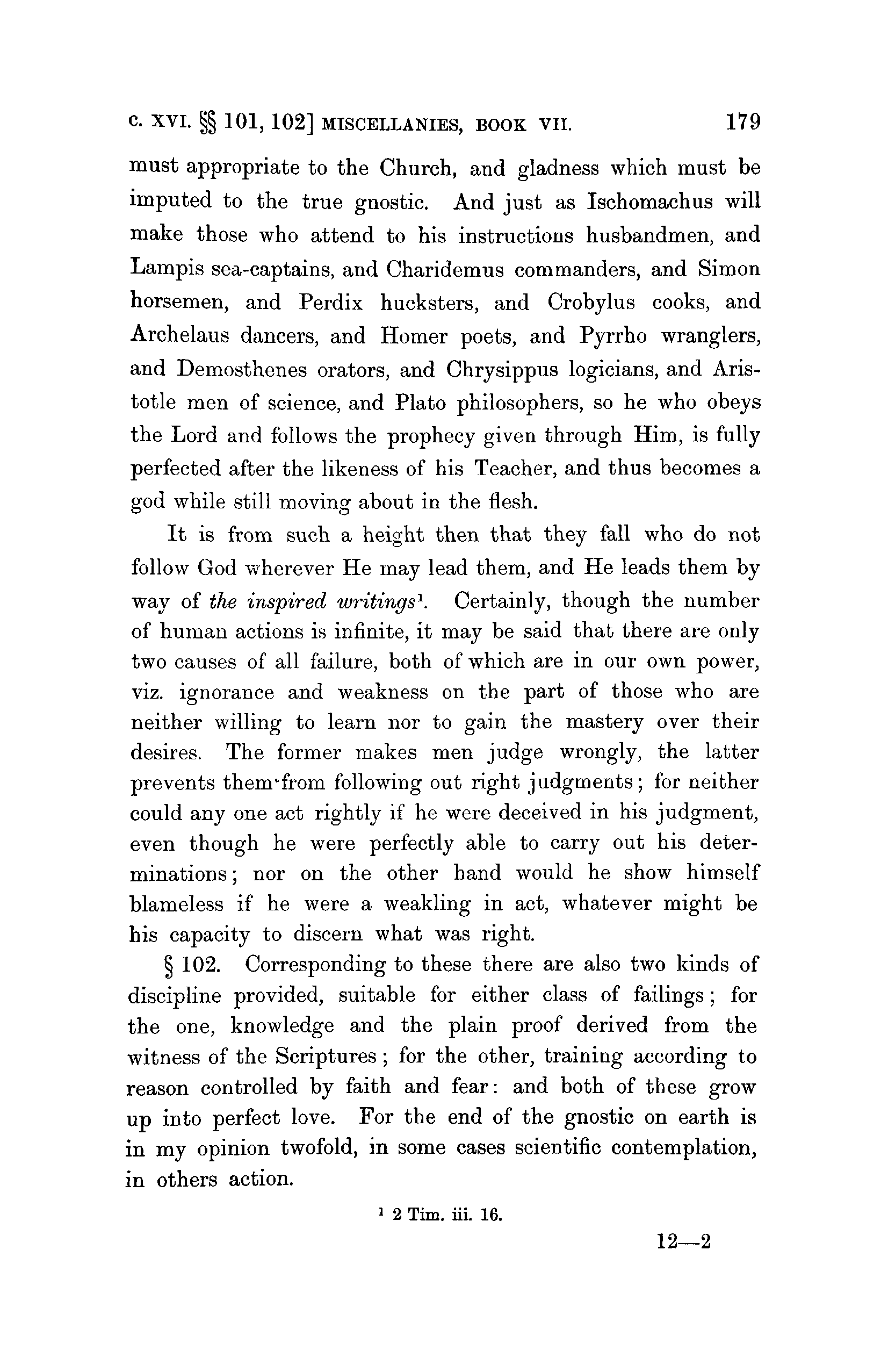
must appropriate to the Church, and gladness which must be imputed to the true gnostic. And just as Ischomachus will make those who attend to his instructions husbandmen, and Lampis sea-captains, and Charidemus commanders, and Simon horsemen, and Perdix hucksters, and Crobylus cooks, and Archelaus dancers, and Homer poets, and Pyrrho wranglers, and Demosthenes orators, and Chrysippus logicians, and Aristotle men of science, and Plato philosophers, so he who obeys the Lord and follows the prophecy given through Him, is fully perfected after the likeness of his Teacher, and thus becomes a god while still moving about in the flesh.
It is from such a height then that they fall who do not follow God wherever He may lead them, and He leads them by way of the inspired writings'1. Certainly, though the number of human actions is infinite, it may be said that there are only two causes of all failure, both of which are in our own power, viz. ignorance and weakness on the part of those who are neither willing to learn nor to gain the mastery over their desires. The former makes men judge wrongly, the latter prevents thenrfrom following out right judgments; for neither could any one act rightly if he were deceived in his judgment, even though he were perfectly able to carry out his determinations ; nor on the other hand would he show himself blameless if he were a weakling in act, whatever might be his capacity to discern what was right.
§ 102. Corresponding to these there are also two kinds of discipline provided, suitable for either class of failings; for the one, knowledge and the plain proof derived from the witness of the Scriptures ; for the other, training according to reason controlled by faith and fear: and both of these grow up into perfect love. For the end of the gnostic on earth is in my opinion twofold, in some cases scientific contemplation, in others action.
1 2 Tim. iii. 16.
12—2 https://doi.org/10.1017/CBO9780511695513.010 Published online by Cambridge University Press
ITPQMATEQN Z'
[P. 895, s. 323
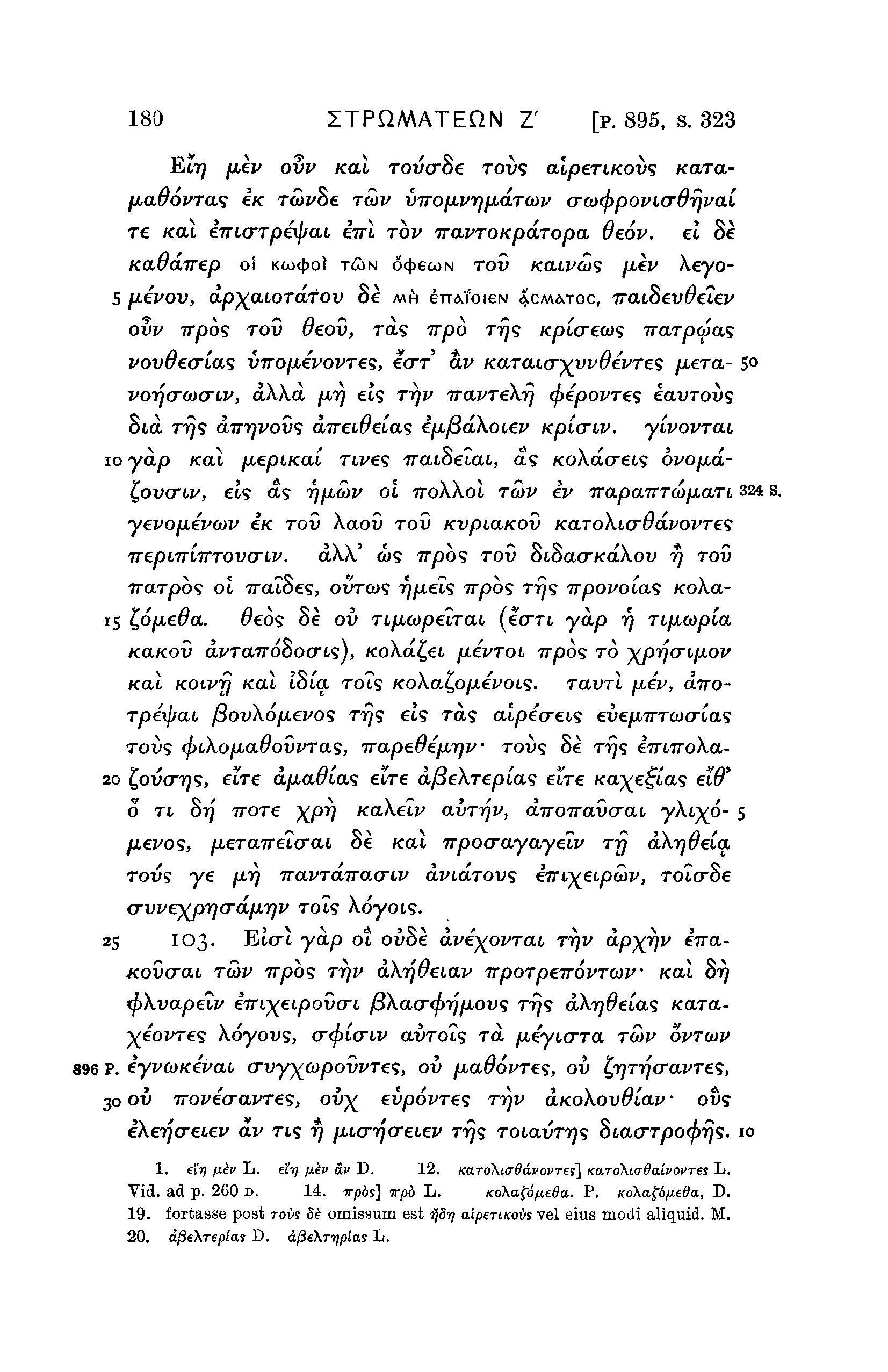
E177 ju,ev ovv KOX Touo~Se rous aiperi/cous /carajjba66vTa<; iK TG>j/Se TCOV VTrojwrjjJbdTUiv cra)(f>povLcrdrjvaL re /cat eTTicrrpe/zat eVi TOV travTOKparopa deov. el Se Kixuairep oi KCOCJJO! TUN 6(j>ewN TOV /caivws ju,eV Xeyo5 fievov, ap)(aioTatov Se MHI enAfoieN ^CMATOC, ovv 7rpos TOG deov, rds TTJOO T^S Kyotcrews vovOeo-ias VTro^ivovTe<i, ear av /caTcucr^w^eWe? pera5° voijo-oio-Lv, aXXd fir/ eis r ^ TravTekrj (frepovres eaurous
Sid TTJS a77-7;vous a7rei^etas i^^akoiev Kpio-iv. yivovrai io ya,p fai fxepLKai rives iraiSetai, as /co\acreis bvopa- £,ovo~w, eis as rjfJiStv oi rroWoi TCQV iv TrapaitTOi^aTi 324 s.
CK TOU Xao5 TO£) KvpiaKOv KaToXio-BdvovTes aXX' ai? Trpos TOU SiSacrKaXou ^ TOU oi TraiSes, OUTW? ^/teis TT/)OS TTJS irpovo'ia<; KoXa15 tpyieOa. deos Se ou TLficopelrat, (eo"Ti yap 17 TL/xcapCa
KaKov dfraTrdSocris), /coXa^ei [LIVTOI vrpos TO -^pijaLfiov Kal KOivfj Kal iSia rols KoXat,ojJi.4voi<;. TOVTI fxev, a/rrorpexjjai fiovXopevos
TTJS eis ras aipeVeis rous (juXofJuaOovvTas, Trapedep/r^v
TOUS Se TTJS CT
20 ^oucr^s, eiVe d/xa^ias eire dySeXTe/Jtas etre o TI STJ 77OTC xp1') faXeiv avTYjv, diToiravaai yXi^o5 fuevos, fJueraiT£LO~aL Se /cai npoaayayelv
TT/ aXrjOeCa TOV? ye //.17 TravTa/Trao-iv ovta/rovs eiri^eipwi/, Toio"Se crvve^prjO'diJirjv rols Xoyois.
103.
Eio-i ydp 01 ouSe dve^ovrai TTJV apxyv inaT5>V 7rp6s TI^V dXijOeiav irporpeTrovTOiv Kal ST) em-^ei.povo'i fZXacr^rjiiovs TTJS dXrjdeia<; KaraXdyous, a<f)io-Lv auTois rd fjueyio-ra TO>V OVTCOV
896 P. iyvcoKevau cruy^wpovvTes, ov fxadovTes, ov E,r)Trjo~avTe<;, 30 ou TTOveaavres, oxr^ evpovres rrjv aKoXovOiav • ous eXerjcreiev dv TIS T) yua-qcreiev rrjs Toiaur-^s SiacrTpo^ijs. 10
1. e'c'?? /i^f L. eify /i^v ai' D.
12. KaroAtcfltipoz'Tes] KaToXiaOalvovTes L.
Vid. ad p. 260 D.
14. Trpos] jrpd L.
KoKa^ofieBa. P.
Ko\a{6//.eda, D.
19. fortasse post TOI)S 5£ omissum est ^5?; alpenKoiis vel eius modi aliquid. M.
20. dpeXreplas D. d/3«XTj)/)ias L. https://doi.org/10.1017/CBO9780511695513.010 Published online by Cambridge University Press
C. XVI. §§ 102,103] MISCELLANIES, BOOK VII.
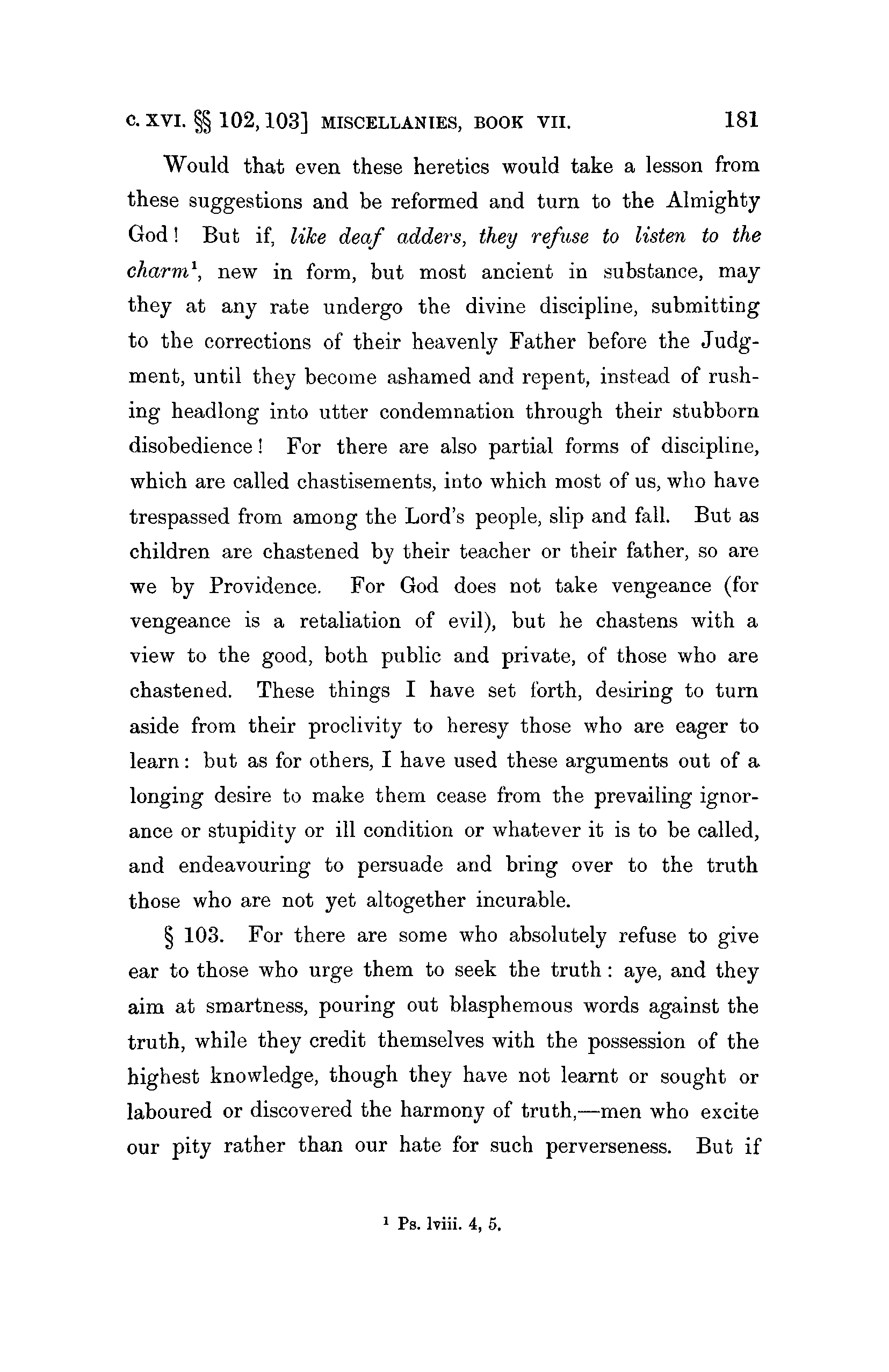
Would that even these heretics would take a lesson from these suggestions and be reformed and turn to the Almighty
God! But if, like deaf adders, they refuse to listen to the charm1, new in form, but most ancient in substance, may they at any rate undergo the divine discipline, submitting to the corrections of their heavenly Father before the Judgment, until they become ashamed and repent, instead of rushing headlong into utter condemnation through their stubborn disobedience! For there are also partial forms of discipline, which are called chastisements, into which most of us, who have trespassed from among the Lord's people, slip and fall. But as children are chastened by their teacher or their father, so are we by Providence.
For God does not take vengeance (for vengeance is a retaliation of evil), but he chastens with a view to the good, both public and private, of those who are chastened. These things I have set forth, desiring to turn aside from their proclivity to heresy those who are eager to learn: but as for others, I have used these arguments out of a longing desire to make them cease from the prevailing ignorance or stupidity or ill condition or whatever it is to be called, and endeavouring to persuade and bring over to the truth those who are not yet altogether incurable.
§ 103. For there are some who absolutely refuse to give ear to those who urge them to seek the truth: aye, and they aim at smartness, pouring out blasphemous words against the truth, while they credit themselves with the possession of the highest knowledge, though they have not learnt or sought or laboured or discovered the harmony of truth,—men who excite our pity rather than our hate for such perverseness. But if 1 Ps. lviii. 4, 5. https://doi.org/10.1017/CBO9780511695513.010 Published online by Cambridge University Press
ZTPQMATEfiN Z'
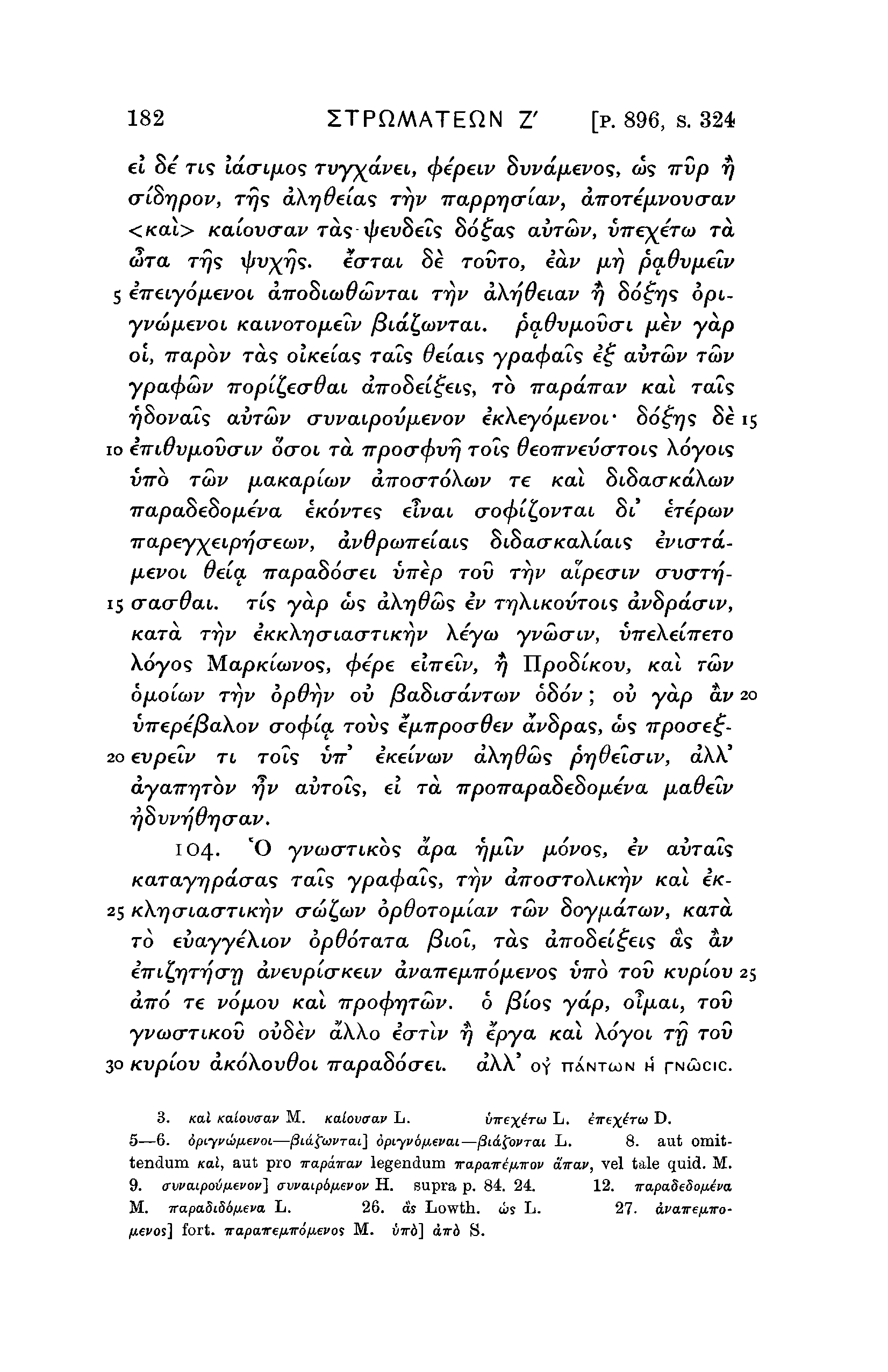
[P. 896, s. 324 el oe Tis ictcrt/Aos Tvyydvei, <f>epeiv Swa/xevos, GJS irvp rj crihiqpov, Trjs aXrjOeias TTJV nappyjo-Cav, airoTepvovcrav <KCU> Kaiovcrav r a s i/»euSeis Sofa? avTatv, inre)(4ro) ra wra TT}S xpv^rj'iecrrat Se TOVTO, eai- /AI} paOvfieiv
5 iirtLyofJLevoi, aTToSicadaivTai, TTJV akt/jdeiav 7} 8 0 ^ 9 opiyvcofievoi KaLvorofieZv fiid&vTai. paOv/Jiovcri fiev yap oi, Trapbv ra? ot/ceta9 rats deiais ypa(f>au<; i£ avrcov TO»V tropit,e<jQa.i a7J"oSetfei?, TO Trtxpanrav KOX rats avrSiv crvvaipovfjievov e/cXeyd/ievoi,*
SO^TJS Se 15
10 €Tri,dv[jLovcriv ocroL TO. TTpocr<f)vr) rot§ deoirvevcrTois Xdyois V7ro Twy fxaKapioiv arrocrTokcov re /cat SiSao"«:aA.G>i> eivai ao^>il,ovTai hi irepcov av6pa)TreCai<; SiSacr^aXtai? ivicrra.- /JL€VOU deia irapaSocreL virep TOV TTJV alpeariv crvcrTrj15 arcurdai. rts yap &>s a.Xr)da><; iv TTJXLKOVTOLS avSpdcrtv,
Kara TTJV iKKkrj<ri,a.<TTLKr)v Xeyco yvoidiv, Xdyos MapKicovos, 4>epe eiirelp, ^ UpoSiKov, /cat
OfMoCoiv Trjv opdrjv ov [$a8icrdvTcav 6S6v; ov yap av 20 virepefiaXov cro(f>La TOVS epTrpoaOev dvSpas, a>s npocre£- 20 evpelv Tt TOIS uir' €KeCva)v dXy)0a)<; p'rjdelcriv, dXX' aurots, ei rot TrponapaSeSo/Jieva /xadeiv 104.
'O yvwcTi/cos apa i^jLtti'
[JLOVOS, iv avrats /caTay^pacras rats ypa^ats, ri)v dTroaroXiKr/v /cat e/c25 KXrja-baaTiK-qv <ra>£,a)v 6p6oTOfjiiav TWV Soy/xdrcov, /cara. ro evayyeXiov opOoraTa yStot, Tas aTroSetfeis as ctv iirtijrjTTjcrr) dvevpicrKeiv dvaTTe^ir6fx,€vo% VTTO TOV Kvpiov 25 d.7rd re V6[MOV /cat Trpo<f>y)Tcov.
6 ^tos ya/o> otyutat, TOU yvft)o"rt/cou ovSev aXXo £O-T\V rj epya /cat Xdyot T^ TOU
30 KvpLov dxoXovdoi TTapaSoaei. dXX' of n&NTtoN H 3. tcai Kaiovcrav M.
Kalovaav L. iiTrex^™ L. errex^rw D.
5—6. dpcyyii/jievoi—/3idfwi<Tcu] opiyvo/ta/ai—[3iafa)>Tai L.
8. aut omittendum /cai, aut pro irapairav legendum wapaire/j.wov airav, vel tale quid. M.
9. awaipoiptvov] avvai.pbij.evov H. supra p. 84. 24.
12. irapaSt5ofj.fva M.
-jrapadidofieva L.
26. as Lowth. us L.
27. dcoTre/iTro- /uepos] fort. irapaTrefiiro/xevos M.
UTT^] a7rd S. https://doi.org/10.1017/CBO9780511695513.010 Published online by Cambridge University Press
C. XVI. §§ 103, 104] MISCELLANIES, BOOK VII.
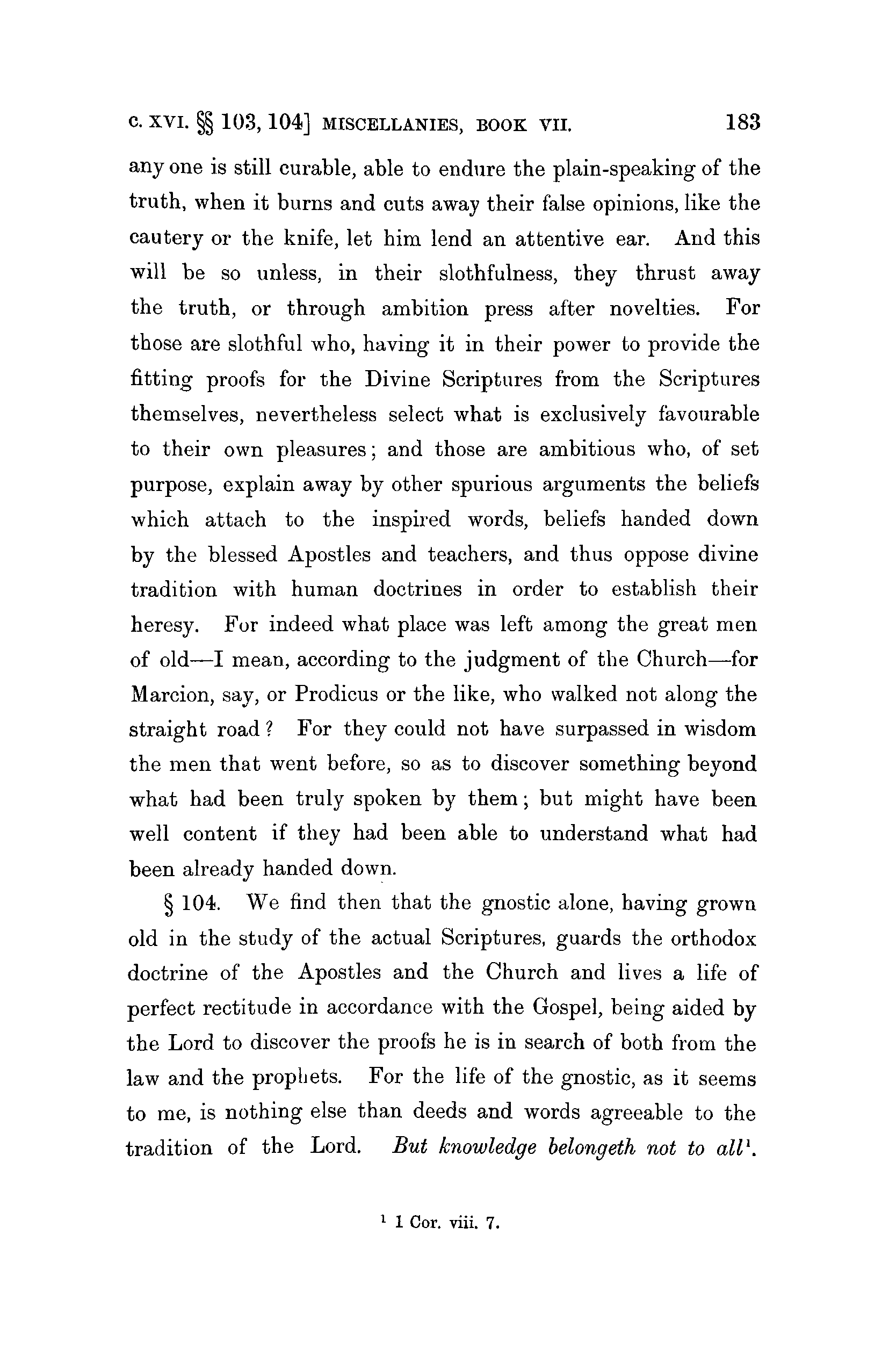
any one is still curable, able to endure the plain-speaking of the truth, when it burns and cuts away their false opinions, like the cautery or the knife, let him lend an attentive ear. And this will be so unless, in their slothfulness, they thrust away the truth, or through ambition press after novelties. For those are slothful who, having it in their power to provide the fitting proofs for the Divine Scriptures from the Scriptures themselves, nevertheless select what is exclusively favourable to their own pleasures; and those are ambitious who, of set purpose, explain away by other spurious arguments the beliefs which attach to the inspired words, beliefs handed down by the blessed Apostles and teachers, and thus oppose divine tradition with human doctrines in order to establish their heresy. For indeed what place was left among the great men of old—I mean, according to the judgment of the Church—for Marcion, say, or Prodicus or the like, who walked not along the straight road ? For they could not have surpassed in wisdom the men that went before, so as to discover something beyond what had been truly spoken by them; but might have been well content if they had been able to understand what had been already handed down.
§ 104. We find then that the gnostic alone, having grown old in the study of the actual Scriptures, guards the orthodox doctrine of the Apostles and the Church and lives a life of perfect rectitude in accordance with the Gospel, being aided by the Lord to discover the proofs he is in search of both from the law and the prophets.
For the life of the gnostic, as it seems to me, is nothing else than deeds and words agreeable to the tradition of the Lord.
But knowledge belongeth not to all1.
1 1 Cor. viii. 7. https://doi.org/10.1017/CBO9780511695513.010 Published online by Cambridge University Press
ITPQMATEQN Z'
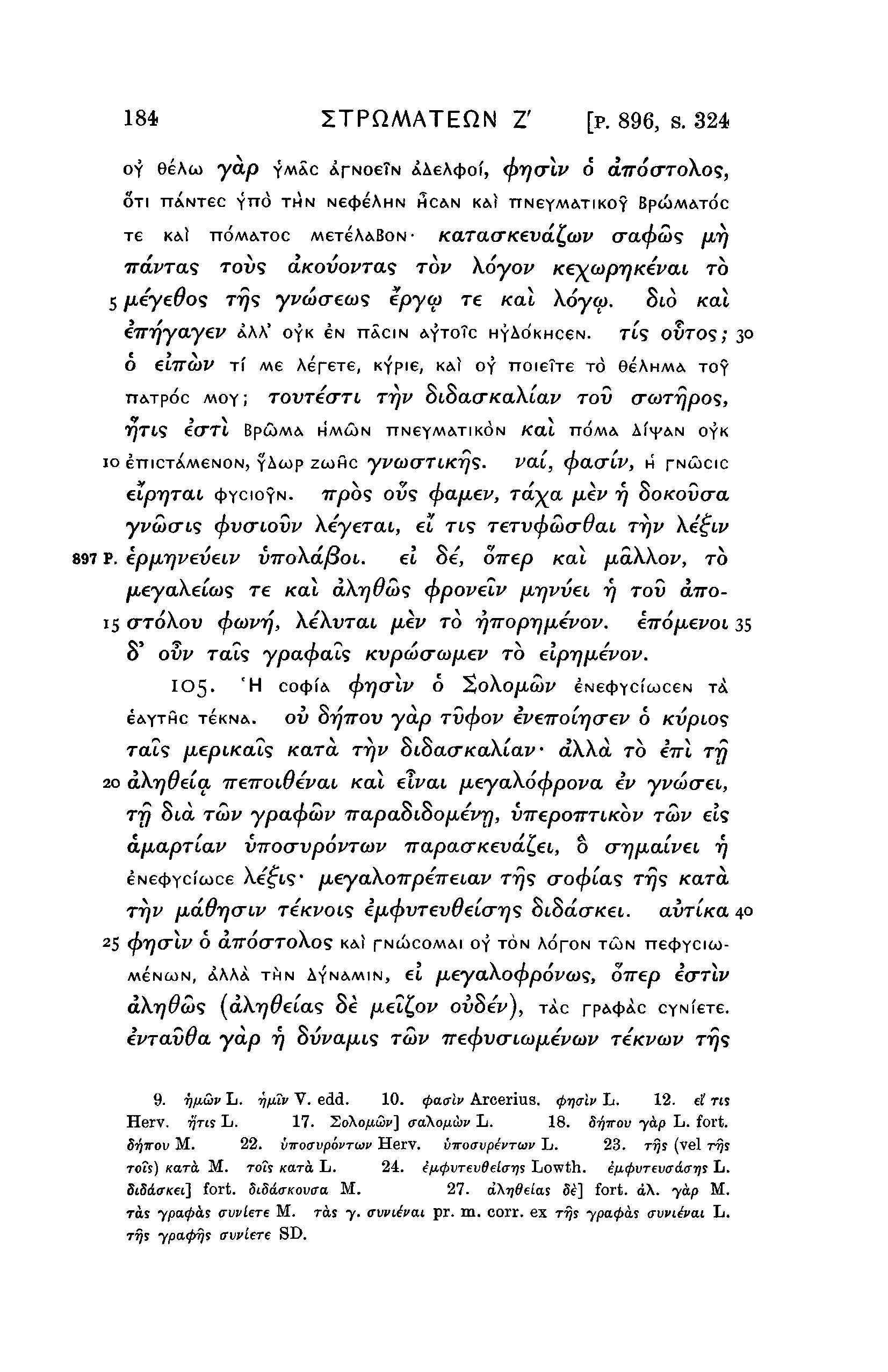
[p. 896, s. 324 oy 6eAw yap YM^C ATNOETN AAeA<j)of, (ftr/crli' 6 a/rr6o~To\o<$,
OTI TTANT£C YTT6 THN N6<j>eAHN HCAN K*,) TTNGYMATIKOY BpC^MATOC
KAI TTOMATOC
M6T6AABON-
KaTaarKevdtfiiv crowded? ///r) TrdvTas TOVS aKovovras TOJ/ Xoyoi' Ke^caprfKevai TO 5 jjLeyeOos TTJS y^wcrews e/Jyw xe /cat Xoyw.
Sto «al €Trr)yayev
AAA' oyK eN HACIN AYTOTC HYAOKHCCN.
TIS OVTOS; 30
GLTTCOV j\ M6 AepeTe, Kypie, K&1 oy noieTTe TO 66AHMA TOY n<vrp6c MOY; TOVT4O~TL TTJV SiSacr/caXtai' TOV a~(OTrjpo?, TJTtS eCTTt
BpWMA HMWN
TTN6YMATIKON /Cai TTOMA
IO 6TTICT&M6N0N, yAtOp ZCOHC yi'WCTTl/Cr^S.
I ' a t , (f>Ol.O~lV, H ^ycioyN. irpos ous (fyafjuev, r a ^ a ju.ei' 17 Sofcoi)o~a.
(f>vcrcovv Xeyerai, ei rts Terv^wcr^ai r^j/ Xe'fti'
897 P. ipfJLrjveveLV viro\afioi. et Se, 6Vep Kal /LtaXXoi', TO |u,eyaXei(W9 Te Kai akr)6o><; <f>poveiv fjLyjvveu 7] TOV airo15 CTTOXOU <f>(ovij, XeXvTat /AEI' TO r)Troprj[i€vov. hroyuevoi 35 8' ovi/ Tais ypa<f>ai<s Kvpu>(T(a^v TO eiprjixevov.
1 0 5 .
'H co<t>f», <f>7)O~lv 6
^OXO/AWI/
eNecJjycfcoceN T ^
6AYTHC TGKNA.
ov 8t]TTOv yap Tv<f>ov iv€TTOLr)o~ev 6 Kvpios Tats jLtepiKats Kara T^V SiSacriaxXCav • aXXa TO inl Trj
20 akrjdeCa, TreiroiOivaL Kai elvai fJL€ya\6(j>poi>a iv yvo)o~ei, Ty Sta Th>v ypa(f><ov TrapaZi^ojxevrj, virepoiTTiKov T£>V el? a/jbapTiav vwocrvpovTcov irapao-Kevd^ei, o o-^/taiVet 17 eNe4>Ycfcoce XefiS" fjieyakoTrpeneLav Trjs crotyias rrjs Kara
Trjv jidOrjO'iv TeVvots i(jL<f>vTevdeCo-r)<; 8iSao"Kei. avruca 40 25 cf>r)O~LV o aTrocrToXos KA! TNU)COMAI oy TON AopoN TCJN ne4>YCicoM6NWN, AAAA THN AYNA/VMN, ci fieyokocppovoi^, oirep io~Tiv akrjdais (dXi^^eta? Se fxzitpv ovSev), TAC rp*4>Ac cyNieTe. ivTOLvda yap rj Swa^ais TWV Tre^vo-Latfiivdiv TCKVCJV r»js
4/U!JI> L. Tifuv V. edd.
10. ifiaalv Aroerius.
<pri<jlv L.
12. e? rts Herv.
77Tts L.
17. 2oXo^£p] craXo^iy L.
18. 5^7roi; yhp L. fort.
S^TTOK M.
22. inroavpbvTwv Herv. viroovpivTwv L.
23. T-ijs (vel 7~?s rols) Kara M. rots Kara L.
24. ifj.^>vT€vdel(rr)s L o w t h .
£[i<pvT€v<r&&T)S L .
SiSdo-xei] fort. SiSdo-Kouira M.
27. d\ri0eias Si] fort. dX. 7^p M. ras ypa(f>hs <rvvUre M. ras 7. <rwdi>cu pr. m . corr. ex T^S 7/)a0as avvUvai. L.
T^S ypa<pijs ffvvlere SD. https://doi.org/10.1017/CBO9780511695513.010 Published online by Cambridge University Press
C. XVI. §§ 104, 105] MISCELLANIES, BOOK VII.
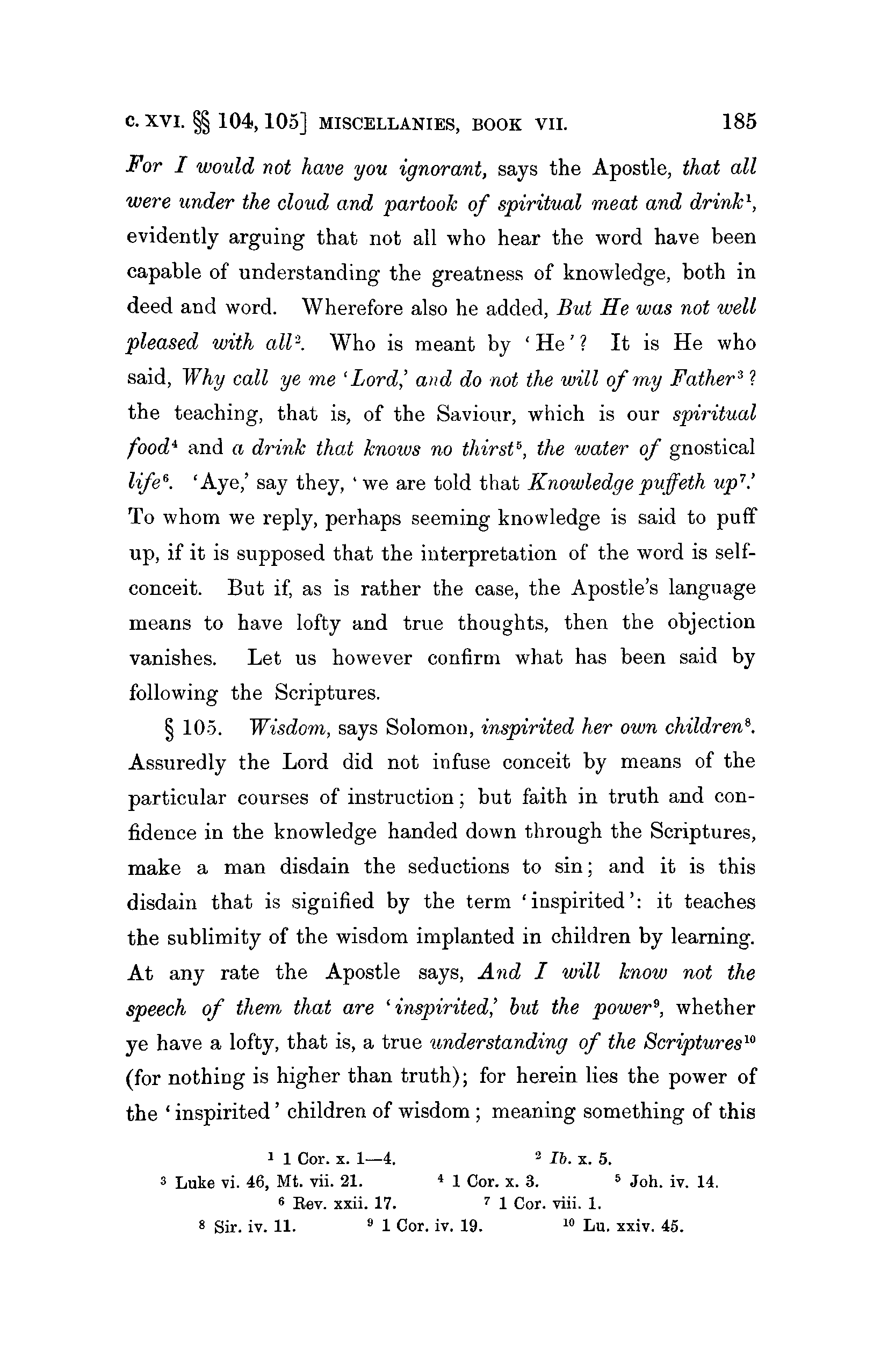
For I would not have you ignorant, says the Apostle, that all were under the cloud and partook of spiritual meat and drink1, evidently arguing that not all who hear the word have been capable of understanding the greatness of knowledge, both in deed and word. Wherefore also he added, But He was not well pleased with all'2. Who is meant by 'He'?
It is He who said, Why call ye me 'Lord,' and do not the will of my Father3 ? the teaching, that is, of the Saviour, which is our spiritual food* and a drink that knows no thirst6, the water of gnostical life*. 'Aye,' say they, ' we are told that Knowledge puffeth up7.'
To whom we reply, perhaps seeming knowledge is said to puff up, if it is supposed that the interpretation of the word is selfconceit. But if, as is rather the case, the Apostle's language means to have lofty and true thoughts, then the objection vanishes.
Let us however confirm what has been said by following the Scriptures.
§ 105. Wisdom, says Solomon, inspirited her own children*.
Assuredly the Lord did not infuse conceit by means of the particular courses of instruction; but faith in truth and confidence in the knowledge handed down through the Scriptures, make a man disdain the seductions to sin; and it is this disdain that is signified by the term 'inspirited': it teaches the sublimity of the wisdom implanted in children by learning.
At any rate the Apostle says, And I will know not the speech of them that are 'inspirited' but the power9, whether ye have a lofty, that is, a true understanding of the Scriptures10
(for nothing is higher than truth); for herein lies the power of the ' inspirited' children of wisdom ; meaning something of this i 1 Cor. x. 1—4.
2 Ib. x. 5.
3 Luke vi. 46, Mt. vii. 21.
* 1 Cor. x. 3.
6 Joh. iv. 14.
6 Rev. xxii. 17.
7 1 Cor. viii. 1.
8 Sir. iv. 11.
9 1 Cor. iv. 19.
10 Lu. xxiv. 45. https://doi.org/10.1017/CBO9780511695513.010 Published online by Cambridge University Press
ZTPQMATEQN Z'
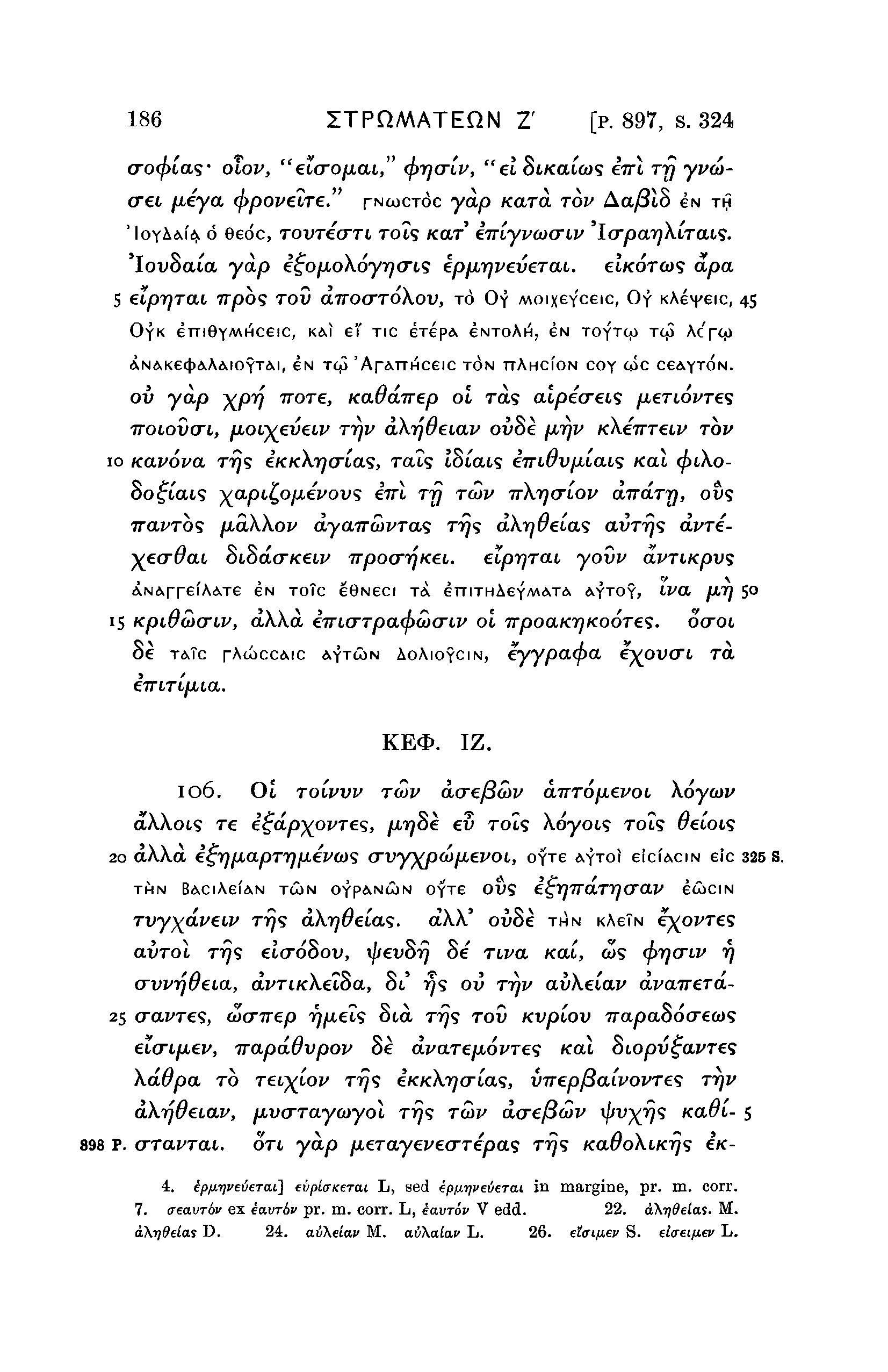
[P. 897, s. 324 crcx^ias* olov, "eicrojLiai," (f>r)criv, "el SIKOXOJS hr\ rrj yvco- <T€i jxeya (ffpovelre."
TNWCT6C yap Kara, TOV Aa/3i,S CN TI^ ' loy^^f^ 6 eedc, TOVT€(TTL TOIS fear' iiriyvoMTiv 'Icrpar/Xirat.^.
'IovScua yap e^o/xoXdy^cris ipfjbrjveveTaL. ei/cd-ras a/>a 5 eipv)Tai Trpbs TOV airoo'ToXov, TO Oy Moixey'ceic, OY KAeyeic, 45
OyK eTTi6YAMHceic, K*,I e'( TIC eTepA eNToArt, eN TOYTCAJ Tcp Ac'r'f*
ANAKe^AAAIOYTAI, 6N T(f> 'AfAnHCGIC TdN TTAHCION COY WC C6AYT0N.
ov yap xpyj TTOTS, KaOdirep oi ras aiyaecrets fieTLOvres TTOLOVO'L, jxoi)(eveiv rrjv akrjdeLav ovSe. firjv /cXeVret^ TOV
10 Kavova rrjs e/c/cXr^crias, rats tSiats eTTt^v/xiats Ka pitpiievovi iirl TTJ TCHV TTX^CTIOI/ dirdTrj, O? jxdXXov dyaircovTas TTJS dXrjdeia'; avTrjs dvTehihdo~K€iv irpoo'TjKeL. eiprjTai yovv avTiupwi e N TO^c e6Neci T& 6TTITHA6YMATA AYTOY, L v a p7) 5° 15 KpidStcriv, dXXd iTTLO~Tpa<j)a)O'Lv oi irpoaKTjKooTes. ocrot oe T&TC P^^CCIMC AYTCON AoAioyciN, eyypa(f)a e^ovo't, r a . IZ.
106.
Ot TOCVVV TWV aarefioiv diTTOfjievoL X6ya>v aXXots re i^dp^ovTeg, fxrjSe ev rots Xdyois rot? ^eiois 20 dXXa i£r){jLapT7)jJLev(i)S avyxpcofievoi,
OYTG AYTO! eicf«,ciN eic 325 s.
THN BACIASIAN TCON oypANcoN oyTG OU5 igyjiraTrjcrav CCJCIN Tuy^ai/ew' TTJS dXrj$eia<;. dXX' ovSe THN KAGTN e^ovTCS avTol rr^s eicrdSov, ijjevSrj Se ni^a Kat, a!s <f>r)o~iv rj o-vvrjdet,a, avriKXelSa, SL lys ou TT)J' aiXtlav a 25 cravres, coo-trep -^/nets Sta r^s TOU KvpCov T etcrijaev, irapddvpov 8e dvaTe/xovTe? Kal Xddpa TO T€L^COV Trjs e/CKXijcrias, vvep/3aivovTe<; TY/V dXrjdeiav, fivcTaycoyol Trjs TU>V do~eji<ov \^vy(rj<; Kadi5 898 p. crrat-Tai.
6V1 yays jaerayei/eo-xepa? Tijs KaOoXuKrjs e/<- 4. epfntveiierai] cvpiaKercu L, sed ep/ir/ceiyerai in margine, pr. m. oorr.
7. treavTif ex eavrbv pr. m. corr. L, eauroi" V edd.
22. dXi;Seias. M. akqBelas D.
24. avkelnv M. ai^Xoiai' L.
26. etaijiev S. elaeifiev L. https://doi.org/10.1017/CBO9780511695513.010 Published online by Cambridge University Press