
CHAPTER IX
CC. VIII. IX. §§ 51, 52]
MISCELLANIES, BOOK VII.
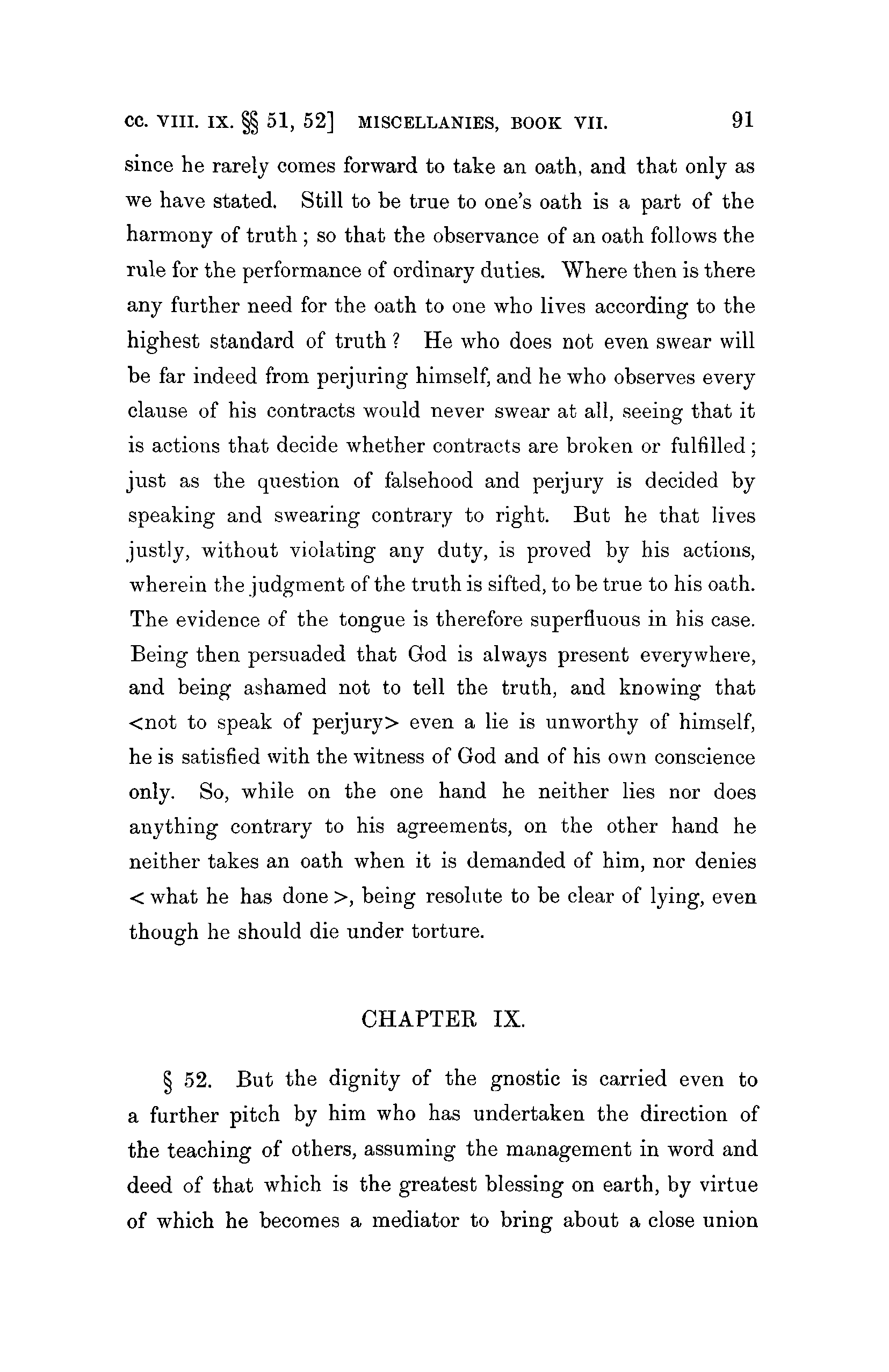
since he rarely comes forward to take an oath, and that only as we have stated. Still to be true to one's oath is a part of the harmony of truth ; so that the observance of an oath follows the rule for the performance of ordinary duties. Where then is there any further need for the oath to one who lives according to the highest standard of truth ? He who does not even swear will be far indeed from perjuring himself, and he who observes every clause of his contracts would never swear at all, seeing that it is actions that decide whether contracts are broken or fulfilled; just as the question of falsehood and perjury is decided by speaking and swearing contrary to right. But he that lives justly, without violating any duty, is proved by his actions, wherein the judgment of the truth is sifted, to be true to his oath.
The evidence of the tongue is therefore superfluous in his case.
Being then persuaded that God is always present everywhere, and being ashamed not to tell the truth, and knowing that <not to speak of perjury> even a lie is unworthy of himself, he is satisfied with the witness of God and of his own conscience only. So, while on the one hand he neither lies nor does anything contrary to his agreements, on the other hand he neither takes an oath when it is demanded of him, nor denies
< what he has done >, being resolute to be clear of lying, even though he should die under torture.
CHAPTER IX.
§ 52. But the dignity of the gnostic is carried even to a further pitch by him who has undertaken the direction of the teaching of others, assuming the management in word and deed of that which is the greatest blessing on earth, by virtue of which he becomes a mediator to bring about a close union https://doi.org/10.1017/CBO9780511695513.010 Published online by Cambridge University Press
ITPQMATEQN Z'
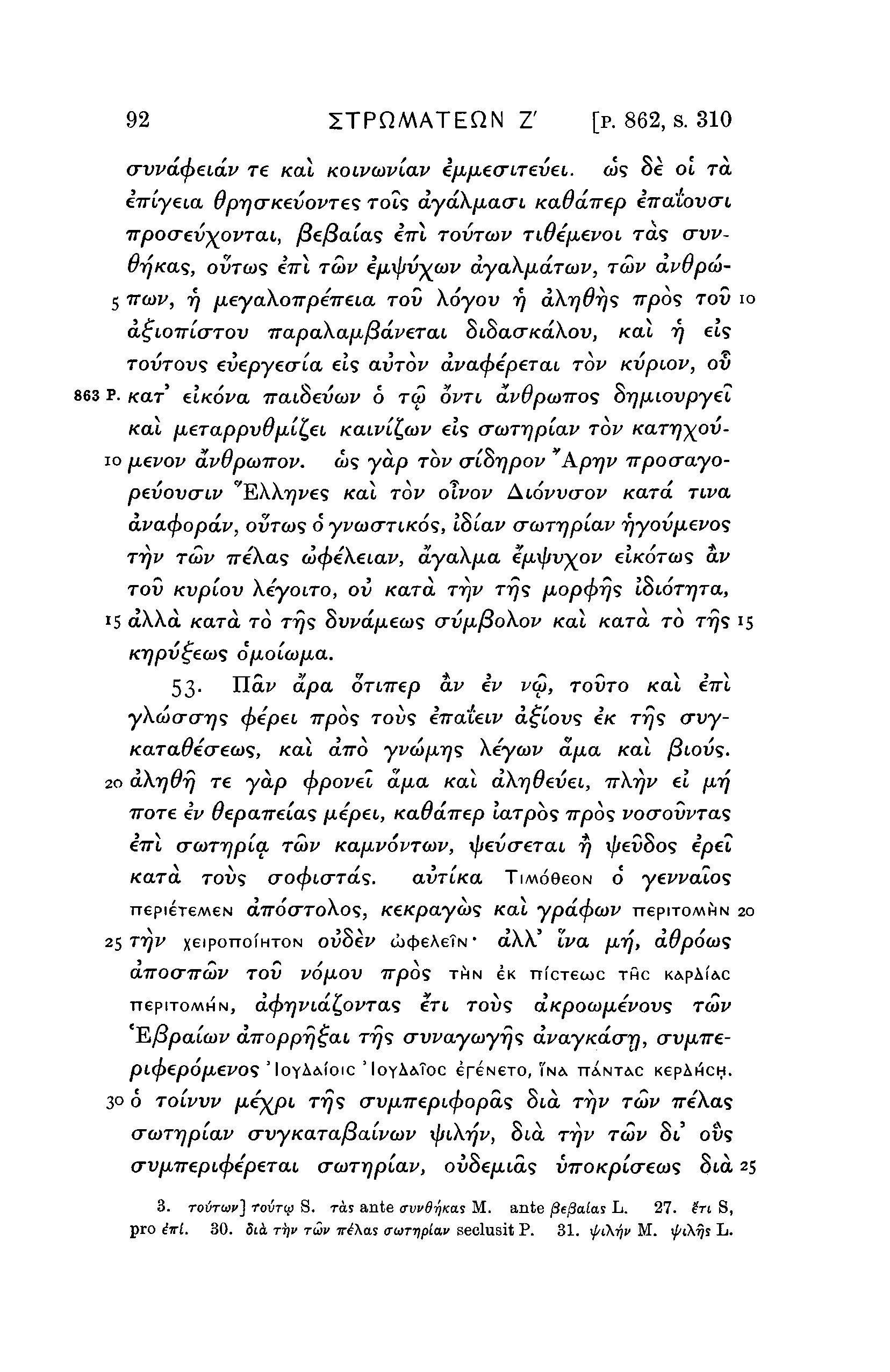
[p. 862, s. 310 crvvd(f)€Ldv re Kal Koivutvlav e\nx,ecriTevei.
OJS §e ot TO. eViyeia dpyo-KevovTes TOIS ayaX/Aacri KaOdirep inaiovai. i, /SeySatas CTTI TOVTCOV Tidifxevoi ras crvvs, OVTWS CTTI TWV e/i,i//u^wi' ayaXynaVajv, TU>V dvQpw5 7TWI', T^ ixeyaXoTrpeireia TOV Xoyov r) akrjdrj1; rrpos TOV io
TTapakajx^dverat SiSacr/caXou, /cat 17 ets evepyeo-La els avrov dva(j>epeTau TOV Kvpiov, ov
863 P. KCLT e'lKova TraiZevoiv 6 TW OVTL dvOpaiTTOS SrjfjLiovpyei Kal fjueTappvd^it,€i Kaivitfuv eis ao)Tr)p[av TOV KaTTj^ov10 fj.evov dvdpaytrov.
<is yap TOV crCSyjpov "hpr\v Trpocrayopevovcnv vF,k\7)ve<; Kal TOV otvov ALOVVCTOV KaTa Tiva dva<f)opdv, ovrws o yvcocrTiKos, iStav crcoTTjpiav rjyovfievos
Trjv TU>V TreXas (o<j)i'\€Lav, dyakfLa ifL^pv^ov eiKOTWS av TOU KvpCov XeyoiTo, ov Kara, TTJV TT^S [Jiop<j}r]<; l8iOT7]Ta,
15 d\Xd /caTa TO Trjs hvvdjxeoj^ avfj-fioXov Kal Kara TO TT)<; 15 53.
Ilai' apa OTiirep av iv vco, TOVTO Kal iirl yX(i)o-arj<; <f>epei Trpos TOUS iirateLv d£;Covs eK TTJS crvyKaTadecreo)<;, Kal diro yv(Ofxr]<; Xeyav d.fj.a Kal /Stous.
20 dXyjdr] T€ ydp <f>povei dfx,a Kal dXrjdevei, TTXTJV el fitj irore iv depaireCa<; [xepei, KaOdirep laTpbs TT/DOS vocrovvras inl crcoT7]pta TWV KafxvovTcov, i|/evo"€rai 7) i/;e{)8os epel a.
TOUS cro^)tcrTas. avTt/ca TIM696ON d yevvalos a7rocrToXos, /ce/cpayw? /cat ypd<fxov
TT€PITOMHN 20
25 TVV X6lPOTT°iHTON ovSkv dxJieAeTN' aXX' Iva JJLTJ, anocnrcov TOV vofxov irpos THN GK nicTecoc THC
HN, d<j>r)VLd£,ovTa<; CTL TOXJS aKpocofievovs aTTopprjJjaL TTJS avvayayyfjs dvayKacrrj, pL(f>ep6ixevos 'IOYAAIOIC 'loyA&Toc ereNeTo, TNA TTANTAC
30 6 TOLVVV fJ-£XPL TV? o-vfjLirepi.<])opas Sta Tr^v T<OV TreXas awTrjpiav crvyKaTafiaivaiv xpLXtjv, Sta TYJV TUV §<,' OVS crvfjt,nepi.<j)epeTat o~a)Tr)piav, ovSe/xias VTTOKpio~eoi<; Sia, 25
3. roiirw^] Tovrtf S. TAS ante awd-liKas M. ante /3e/3ct(as L.
27. ?ri S, pro ^?rL 30. did. rty TUV TreXas (rurijplav seclusit P.
31. yj/CKijv M. ^tXijs L. https://doi.org/10.1017/CBO9780511695513.010 Published online by Cambridge University Press
C IX. §§ 52, 53]
MISCELLANIES, BOOK VII.
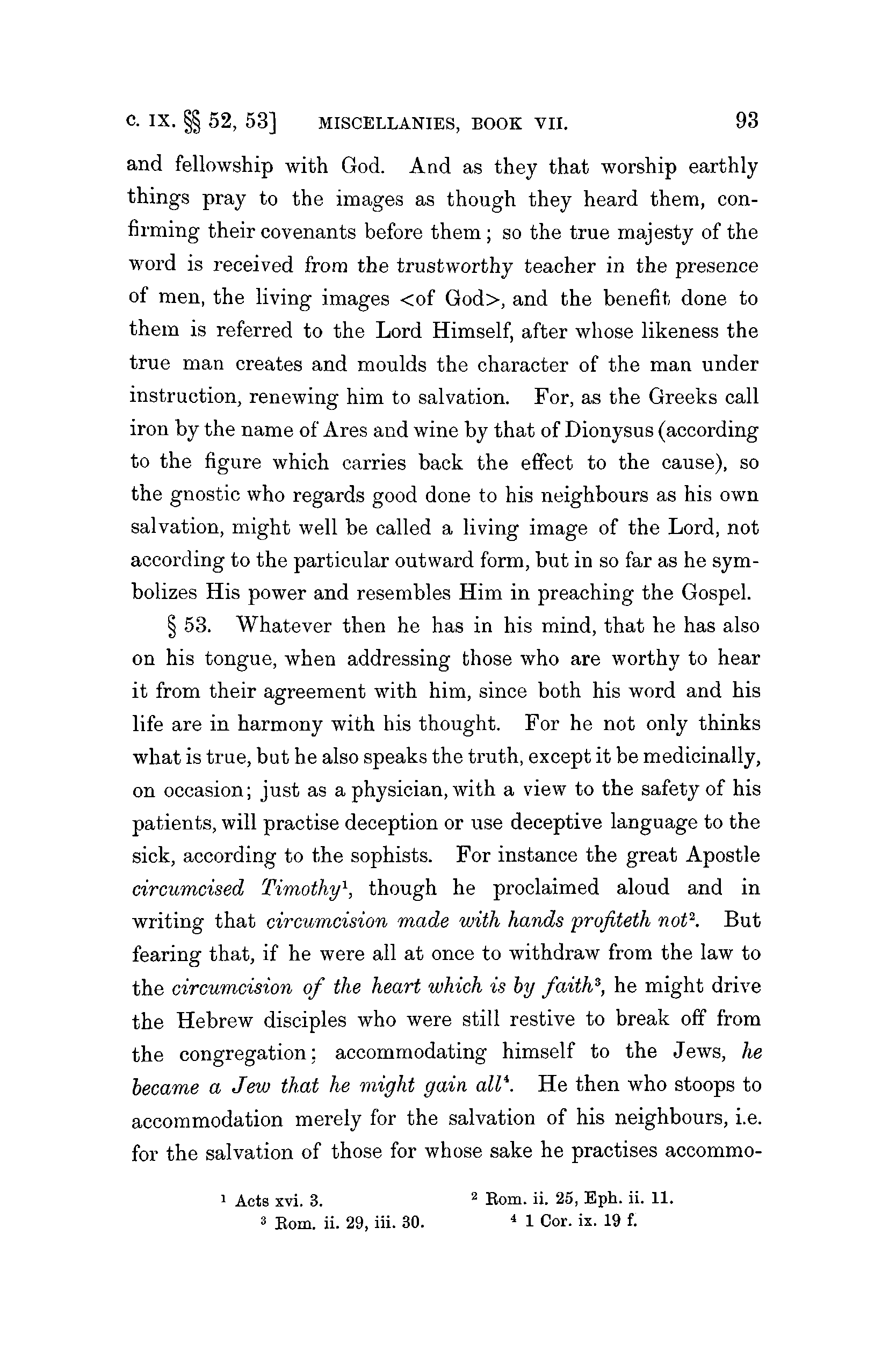
and fellowship with God. And as they that worship earthly things pray to the images as though they heard them, confirming their covenants before them ; so the true majesty of the word is received from the trustworthy teacher in the presence of men, the living images <of God>, and the benefit done to them is referred to the Lord Himself, after whose likeness the true man creates and moulds the character of the man under instruction, renewing him to salvation. For, as the Greeks call iron by the name of Ares and wine by that of Dionysus (according to the figure which carries back the effect to the cause), so the gnostic who regards good done to his neighbours as his own salvation, might well be called a living image of the Lord, not according to the particular outward form, but in so far as he symbolizes His power and resembles Him in preaching the Gospel.
§ 53. Whatever then he has in his mind, that he has also on his tongue, when addressing those who are worthy to hear it from their agreement with him, since both his word and his life are in harmony with his thought. For he not only thinks what is true, but he also speaks the truth, except it be medicinally, on occasion; just as a physician, with a view to the safety of his patients, will practise deception or use deceptive language to the sick, according to the sophists. For instance the great Apostle circumcised Timothy1, though he proclaimed aloud and in writing that circumcision made with hands profiteth not2. But fearing that, if he were all at once to withdraw from the law to the circumcision of the heart which is by faith3, he might drive the Hebrew disciples who were still restive to break off from the congregation; accommodating himself to the Jews, he became a Jew that he might gain all*. He then who stoops to accommodation merely for the salvation of his neighbours, i.e. for the salvation of those for whose sake he practises accommo1 Acts xvi. 3.
2 Rom. ii. 25, Eph. ii. 11.
3 Rom. ii. 29, iii. 30.
4 1 Cor. ix. 19 f. https://doi.org/10.1017/CBO9780511695513.010 Published online by Cambridge University Press
ITPQMATEQN Z'
[P. 863, s. 310
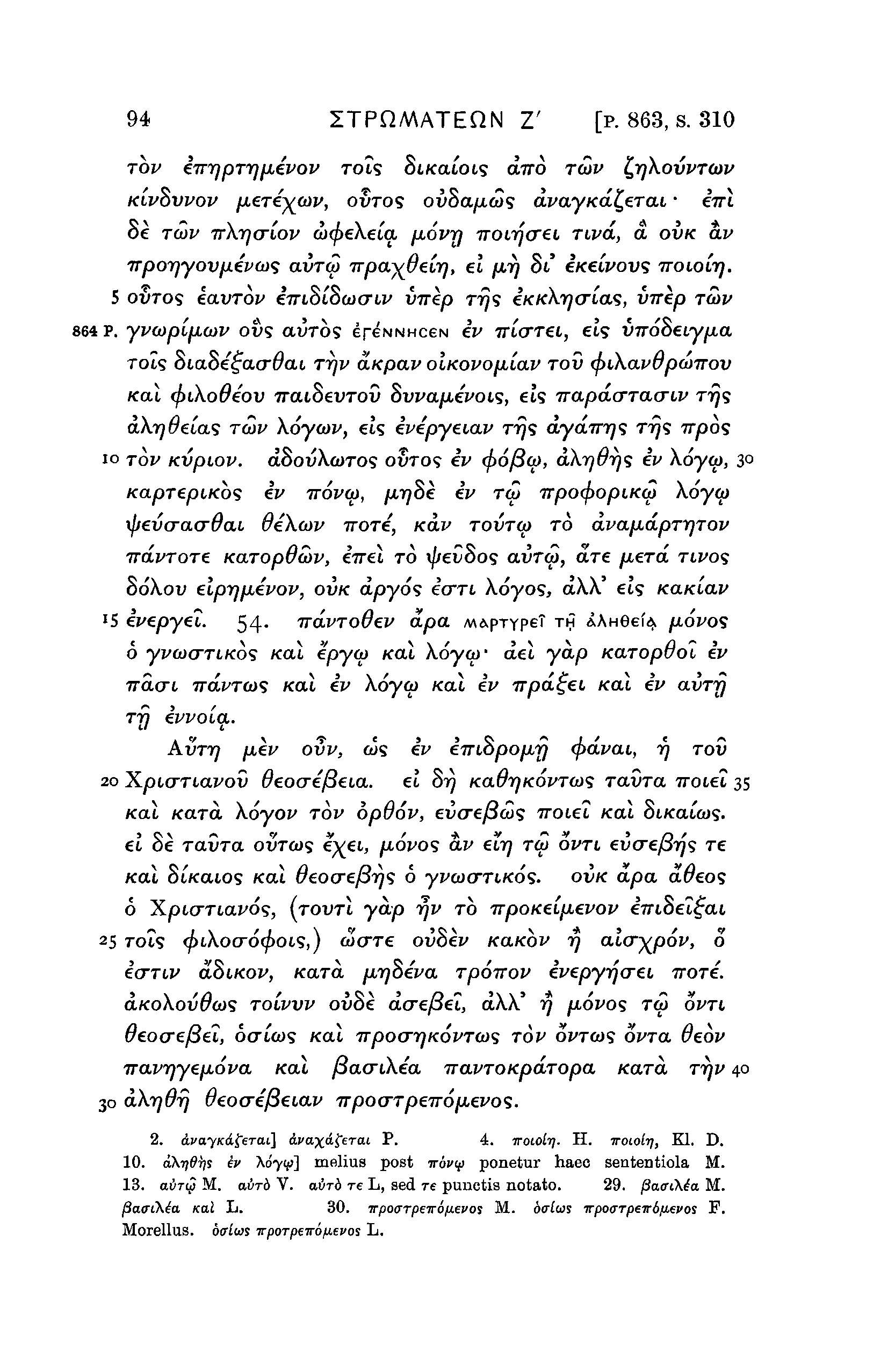
TOV €Trr)pTT]fldvOV TOIS SlKCUOlS
COTO TCJV
Kivhvvov fxeTV^oiv, ovxos ouSa/iws avay/ca^erat • eirt Se rcDi' irXrjcriov dxf>eXeCa ftovy iroirfcrei TLVCL, a OVK av
Trpo7)yovfx4po)s avraJ TvpayBeif), el fj.r) SL e/ceiVovs TTOLOIT).
5 ovros eauToi' eTTtStSwcriv inrep T7js ex/cX^crias, uTrep rwi'
864 p. yvcopCfjiwv ous avTos ereNNHceN eV TTicrret, ei9 U7roSeiy|U,a TOZS SiaSefacr^ai T^V aKpav olKovofiiav TOV <f>i\avdpa>Trov
Kal (j>i\o9eov waiSevTov Swa/xevoL^, eis Trapdo-Tacnv TIJS a\7)0€La<; TWV Xoycov, eis ivepyaav Trjs ayaTnjs TTJS TT^OS IO rot" Kvpiov. dSov\d)TO<; OVTOS iv <f>6/3(t>, a\r}6r}<; iv \6ya>, 3°
KapTepiKos iv nova), /xirfSe iv raj Trpo<f>opi.Ka> \6yq> xfjevo-acrOac deXcov TTOTC, KO.V TOVTCO TO dvafjidpTrjTov TrdvTOTt KaTop05>v, e7rei TO xpevSos avTuj, are jaera TLVO<S
SoXov eiprjfjLevov, OVK dpyos ecrrt Xoyos, dXX' els lS evepyel.
54. irdvToBev dpa M&pTYpeT TH AAHBef* 6 yvtocrnKos Kal epyaj Kal X6ya>- del yap KaTopdol iv iracrL TrdvTbiS Kal iv Xoyco Kal iv -rrpd^ei Kal iv avTrj
T7J ivvoia.
AVTT) (lev ovv, ct5s iv iTTiSpofirj <f>dvat,, rj TOV 20 Xpio-Ttavov 0eoo~e/3eLa. el Srj KadrjKOVTQ)? ravra iroiei 35
Kal KaTa Xoyov TOV opdov, evcrey8a)s Troiei, Kal Si/catais. el he TavTa OVTCO<; e^ei, jawos av €117 TW OVTL evo-efirjs re
/cal Si/caios Kal ^eocreySijs 6 yvaJO-TiKos.
OVK dpa d6eo<; 6 XpiaTLavos, (TOVTI yap rjv TO irpoKeCfievov imSel^ai 25 7ois <^>tX.oa"d^)Ois,) wo"T£ ovBev KaKOV rj alcr-^pov,
icrTLV dSiKov, Kara pyhiva Tpo-rrov ivepyijaei TTOT4. aKoXovdctiS TOLVVV ovSe do-efiel, dXX* 17 fiovos r&! oi'Ti
0eocref3ei, ocrtws Kal 77pocrrjKovTcos TOV 6Vra»s owa deov Travrjyefj-ova Kal /3ao~iAea TravTOKpaTopa Kara TTJV 40 30 dXrjOrj Oeocrefieiav TSpoo~Tpeirofj.evo'i.
&vayKA.£eTa.i\ di/ax^erac P.
Troioi^. H.
Troiolrj, Kl. D.
10. aX^^Tjs ^y \6yifi] molius post TTOIHJI ponetur haeo senteatiola M.
13. airi} M. avrb V. airi re L, sed re punctis notato.
29. /3a<riX^a M. fiatnXta. Kal L.
30.
TrpoaTpeirofievos M. ocrfus Trpo<jTpeir6fi(i>os F .
Morellus. oaiws irpoTpeir6/j,cpos L. https://doi.org/10.1017/CBO9780511695513.010 Published online by Cambridge University Press
C. IX. §§ 53, 54]
MISCELLANIES, BOOK VII.
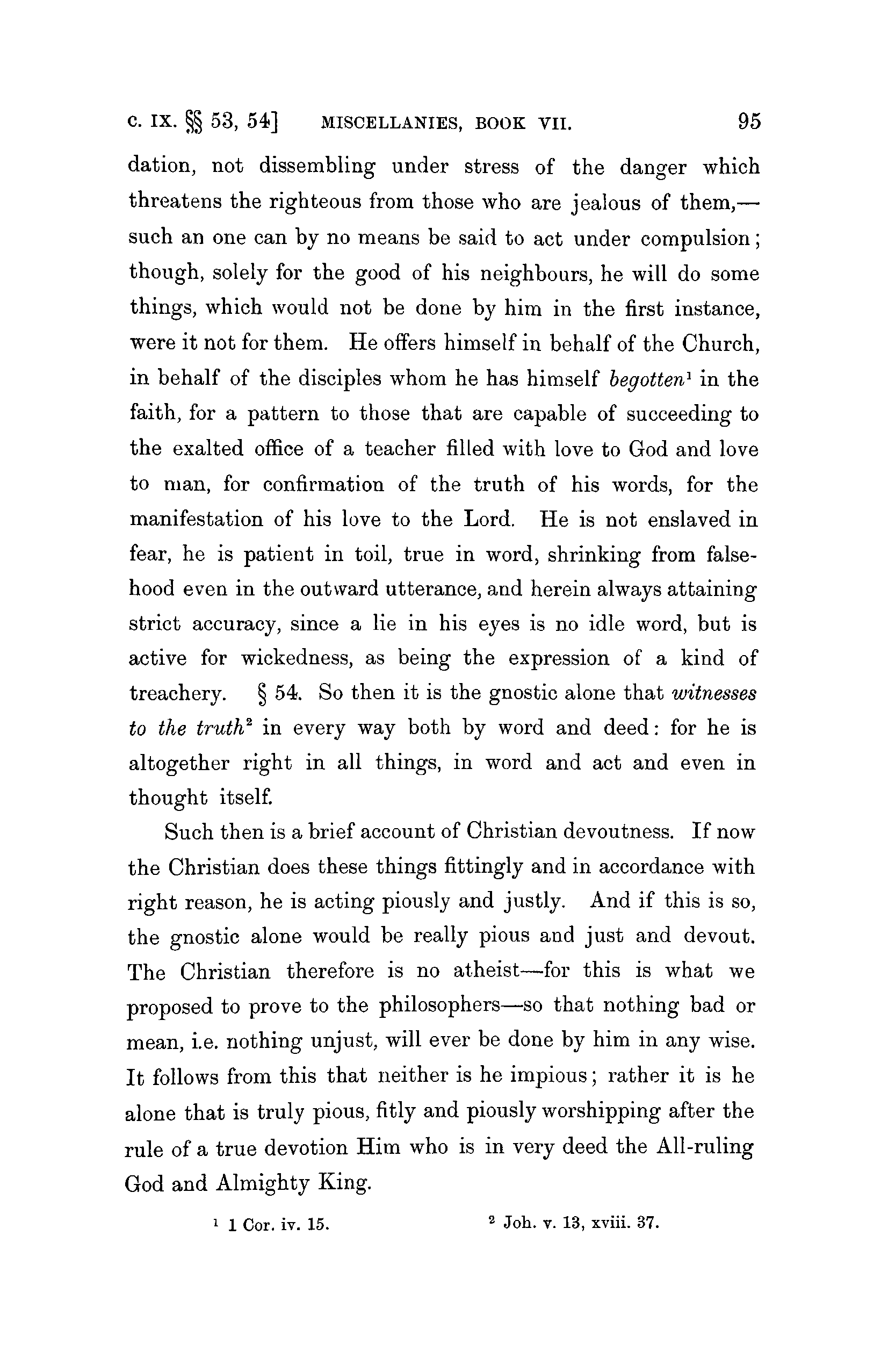
dation, not dissembling under stress of the danger which threatens the righteous from those who are jealous of them,— such an one can by no means be said to act under compulsion; though, solely for the good of his neighbours, he will do some things, which would not be done by him in the first instance, were it not for them. He offers himself in behalf of the Church, in behalf of the disciples whom he has himself begotten* in the faith, for a pattern to those that are capable of succeeding to the exalted office of a teacher filled with love to God and love to man, for confirmation of the truth of his words, for the manifestation of his love to the Lord. He is not enslaved in fear, he is patient in toil, true in word, shrinking from falsehood even in the outward utterance, and herein always attaining strict accuracy, since a lie in his eyes is no idle word, but is active for wickedness, as being the expression of a kind of treachery.
§ 54. So then it is the gnostic alone that witnesses to the truth'' in every way both by word and deed: for he is altogether right in all things, in word and act and even in thought itself.
Such then is a brief account of Christian devoutness. If now the Christian does these things fittingly and in accordance with right reason, he is acting piously and justly. And if this is so, the gnostic alone would be really pious and just and devout.
The Christian therefore is no atheist—for this is what we proposed to prove to the philosophers—so that nothing bad or mean, i.e. nothing unjust, will ever be done by him in any wise.
It follows from this that neither is he impious; rather it is he alone that is truly pious, fitly and piously worshipping after the rule of a true devotion Him who is in very deed the All-ruling
God and Almighty King. i i Cor. iv. 15.
2 Joh. v. 13, xviii. 37. https://doi.org/10.1017/CBO9780511695513.010 Published online by Cambridge University Press
ITPQMATEQN Z'
[p. 864, s. 310
KE$>. I.
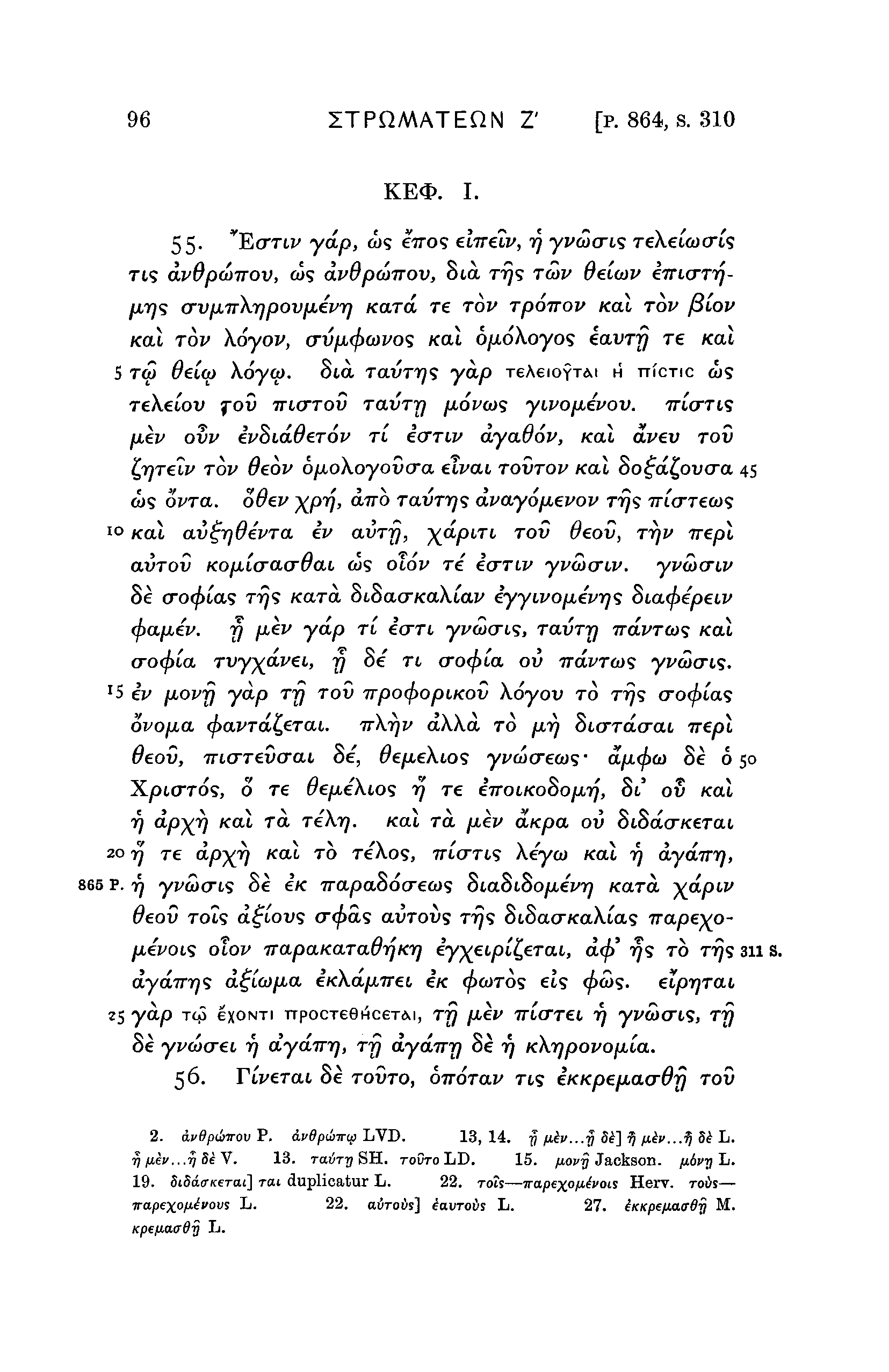
55- *Eo"nv ya-p, <w? 67705 €177611', Tj yvwo~L<; reXeuuo'is dv0pa>Trov, cJ? dvdpcjTTOv, Sta. TTJS T&)P deioiv err urn/}crvfx.Tr\"qpovjji€V7) /caret re ro> Tpoirov /cat TOV fiuov
/cat Toy Xoyoi', O~U/A<£OWOS /cat 6/xoXoyos iavTjj re /cat 5 TW #eta> Xoyw.
Sid ravrrys yayo TeAeioyTiM H THCTIC ais TeXetov fou Trtcrrou TavTrj (JL6I><OS ywopivov.
TT'KTTIS fiev ovv ivSiddeTov TL ICTTIV dyadov, /cat dvev TOV t,rjTeiv TOV 9eov oyLtoXoyoucra eivat rourot' /cat Sofa£ouo~a 45 ws OVTOL. odev XPV> <*7r0 Ta^7")?? dvayo/jLevov Trjs TTLO~T€CO<; 10 /cat av£r)0evTa iv avTrj, ^dpiTL TOV deov, TTJV vepX avTOV KOfjiCo~cLcr0ai 6JS otoV re 4O~TLV yvwo'iv. yvSiO~iv Se cro^tas TT}S /cara. StSao-zcaXtaf iyyivo\i.£vr\<; Sua^epecv
(f>afxev. r) fiev yap TL io~TL yvaJo-is, Tavry TrdvTcos /cat o-o(j)Ca Tvy)(dvei, fj Se TL o-o<^>ta 01) TrdvTOi'i yvaio-L<s. rS ev [lovfj yap TJJ TOV 7rpocf>opLKov Xoyov TO TTJS o~o<£tas ovo/jia (f>avTd£,£TaL.
TTXTJV dXXd TO (JLTJ Stcrrcto-at 77ept deov, 77to"7€vcrat Se, ^e/x,eXtos yi'wore&)S" a/x^xu Se 650
X/3to"Tos, o Te ^e/AeXtos 17 TC iiroLKoBo/JLTj, St' ou /cat 17 dp^rj /cat TO. TeXrj.
/cat ra. //,ez> a/cpa ou StSacr/cerat 20 -^ re dp-^ff Kat TO TCXOS, TTLCTTLS Xeyco /cat 17 dydirrj, 865 p. 17 yj/wo-ts Se e/c 77a|0aSoo-ec(}s StaStSoyaeVij /caret deov Tot§ d^tovs erects avrous TTJS StSac/caXta? olov TTapaKaTadyjKr) ey^etpt^erat, a^>' 17s TO T^S 311 S. d^tw/ta e/cXa/A77et e/c (f>a)To<; ets <£a>s. et/s^rat 25 yap TCP IXONTI npocTee^ceTAi, T ^ jitef 77to-ret 17 yi'wo'ts, T^
Se yvcoacL rj dydvr), TTJ dydnr) Se 17 KXrjpovofjLLa.
56.
Ftverat Se rouro, bitoTav rts iKKpefxaadfi TOV 2. avdpdnrovV.
&vBpdnrV LVD.
13,14. fl /nfe...^ 5^] i? ^c...i5 5£ L.
^^e^...^5eV.
13. TaiJrT? SH. TOUTO LD.
15. ^top?/ Jackson.
JU6I'T; L.
19. Si8d(rice7-a[] rai duplioatur L.
22. TOIS—Trapex°^voi.s Herv. robs— vapexofi^vovs L.
22. avrois] iavrobs L.
27. iKKpe/icurBfi M.
L. https://doi.org/10.1017/CBO9780511695513.010 Published online by Cambridge University Press